A vine tattoo is the only common tattoo subject that is not really a picture of a thing — it is a route. A flower sits where you put it; a vine travels. It starts at an ankle and climbs a calf, leaves a wrist and works its way around a forearm, sets off along a collarbone and disappears over a shoulder. That travelling is the design’s whole character, and it is also the design’s whole difficulty, because a line that wraps a living, turning, tapering limb has to survive geometry no flat drawing ever faces: the limb narrows as the vine climbs it, turns as the wearer moves, and twists the design with every rotation of a wrist or bend of an arm.
You will find 25 original vine tattoo ideas here — ivy in its several tempers, grapevines carrying their clusters, morning glory and jasmine in flower, thorny rose vine, berry vine, and the starkest version of all, the bare winter stem with nothing on it but tendrils. But read the craft section before you fall for any of them. A vine lives or dies by laws that have nothing to do with how pretty the reference photo is: the weight of the stem at the far, narrow end of the limb; the air left inside every tendril’s curl; the rhythm of leaves and the skin gaps between them; and the join, where a wrapping vine meets itself and either disappears into the design or shows its seam forever. Get those four things right and a vine is the most graceful long-term tattoo in the flower family. Get them wrong and it heals into a rope with lumps.
What Does a Vine Tattoo Mean?
Start with the plant, because the vine’s meanings are all read off its behaviour, and its behaviour is remarkable. A vine is a plant that refuses the ordinary arrangement of growing up under its own strength: it climbs by borrowing — twining, tendrilling, rooting itself to whatever stands near — and in that borrowed climbing it achieves heights and reaches no self-supporting stem of its slenderness could manage. Ivy is the family’s overachiever: as the University of Illinois Extension’s English ivy page records, English ivy is a woody evergreen vine that climbs by aerial rootlets and can reach 90 feet — its mature height limited only, in the Extension’s own words, by “the height of the surface on which it is grown”. The grapevine climbs differently, by tendrils: the Morton Arboretum’s crimson glory vine page describes the ornamental grape as a vigorous vine, up to 20 feet long, that “climbs by tendrils by twisting around a support”. Two plants, two climbing technologies, one idea: growth that finds a way.
Wearers take the vine for readings that all grow out of that behaviour. Growth is the root meaning — not growth as an event but growth as a direction: the vine is always on its way somewhere, and the tattoo is taken by people who feel the same about themselves. Persistence and tenacity come next, and they belong especially to ivy: ivy grows over ruins, through cracks, across dead walls, evergreen in the middle of winter when everything else has given up and gone bare — the plant that is still working when the building it climbs has fallen down. Connection is the reading the wrap itself speaks: a vine joins the places it passes — wrist to elbow, ankle to calf, one person to another when two wearers carry two halves of one climbing stem — and it holds what it touches. Friendship and fidelity are ivy’s specific inheritance from the language of flowers, the Victorian system that assigned plants their sentiments: in that tradition ivy stands for friendship, fidelity and wedded love, precisely because it clings and does not let go. Like all floral-language readings, that is tradition, a meaning assigned and handed down — offered here as tradition, which is all it ever claimed to be. And abundance belongs to the grapevine: the vine that fruits, the harvest plant, Bacchus’s own — a symbol of plenty, celebration and the good years, carried in every cluster the designs below draw.
One distinction is worth making before the designs, because this site covers the vine’s neighbours: a vine tattoo is not a flower tattoo with a long stem. In the flower guides the bloom is the subject and the stem is plumbing. Here the stem is the subject — the travelling line, the wrap, the climb — and flowers, grapes and berries appear as cargo the line carries. Choose accordingly: if you want a portrait of one bloom, choose the bloom’s guide. If you want a living line that goes somewhere, you are in the right article.
The Wrap Law: Why a Vine Is a Line That Must Survive a Turning Limb
Every law in this section follows from one fact: a vine tattoo is a line drawn on a cylinder that narrows, turns and twists — and the line must still read as a vine on all of it. A straight, even, beautifully spaced vine on the flat drawing can fail in four separate ways the moment it is wrapped around a real arm, and each failure has a rule that prevents it.
Rule one: draw the stem by the far end’s width. Limbs taper. A forearm is thick at the elbow and slender at the wrist; a calf narrows to the ankle; an upper arm thins towards the elbow. A stem drawn at one weight in the sketch does not keep that weight in effect on the body — on the narrow end of the limb, the same stem looks heavier, crowds its neighbours and turns a graceful vine into a cable, because the gap between the stem and itself, on a wrap, shrinks as the cylinder narrows. The professional build inverts the instinct: the stem weight is chosen for the narrowest ground the vine will cross, and where the drawing needs presence on the wide ground, the design gains it from leaves and spacing, not from a thicker stem. A vine whose stem stays honest at the far end reads as one plant all the way along.
Rule two: a tendril curl is a join, and joins merge. Look at what a tendril is in a drawing: a spiral — a line curling in on itself, each turn passing close by the last. Tattooists know this shape from lettering, where the joins of cursive script weld together as ink settles; a tendril curl is the same trap wearing leaves. Every turn of the spiral settles outward slightly, and turns planted close together meet, fill the curl’s open centre and convert the most elegant move in the vine vocabulary into a dark blob with a stem. The rule is the lettering rule restated: a curl must keep its centre open — turns spaced with clear skin between them, the spiral drawn looser than the reference shows, and the curl’s heart left as bare skin, because that hole of skin is what makes it read as a curl at all. A tendril with no light inside it is not a tendril; it is a knot.
Rule three: leaves need skin between them, and the rhythm is the design. A vine’s readability lives in a rhythm — leaf, gap, leaf, gap — the eye following the stem by the leaves planted along it the way it follows a path by its stones. Two failures wait. Leaves planted too close, or clustered in bunches, settle into one another and heal as a single green-black mass with a stem through it: fine leaf detail is the first loss in any vine tattoo, the veins and serrations gone within years, and a cluster designed at fresh density loses not just detail but separation — it becomes foliage-shaped fog. The build that survives plants fewer leaves than the reference, each one a clean, simple silhouette, separated by gaps at least the width of a leaf, so that the healed vine — softer, simpler — still beats out its rhythm clearly. If your artist proposes removing leaves from your reference, they are not impoverishing the design; they are setting its tempo.
Rule four: the wrap is stencilled on the standing, turning body — never on the flat one. A wrapping vine is a drawing in three dimensions pretending to be two, and its stencil check is rotational. The stencil goes on with the wearer standing naturally; then the limb must be turned — forearm rotated palm-up and palm-down, arm raised and lowered, calf flexed and relaxed — while wearer and artist watch what the wrap does. A vine that spirals beautifully on a still arm can bunch at the inner elbow, stretch across the forearm’s flat and dive across the wrist bone in motion. The check is not a courtesy; it is where the design is actually decided, and a wrap that has not been watched in rotation has not been checked at all.
Rule five: a circling vine must have its join designed — never butted. When a vine wraps a wrist, an ankle or an arm and meets its own beginning, the two stem ends have to become one plant again. The amateur ending is a butt joint: two stem ends simply meeting, a seam the eye finds every time, where the line’s weight, direction and rhythm all hiccup at once. The professional endings are disguises: the returning stem slides under a leaf planted at the meeting point, so the join hides in foliage; or it finishes in a tendril curl that overlaps its own start, the spiral swallowing the seam; or it tapers into a fine point that tucks against the first leaf, so the vine appears to grow out of its own beginning. Choose the disguise at the drawing stage, walk the stencil’s full circle looking for it, and if you can find the join in ten seconds, send it back.
Vine Tattoo Styles and How They Age
A vine ages by the laws above, and every style below is a different wager on them. What never survives is density: whatever a style packs tightest is what it loses first.
| Style | How it is drawn | How it ages |
|---|---|---|
| Fine line | A hairline stem, small simple leaves, open tendril curls | The most delicate treaty: the stem softens first, so fine-line vines are drawn with the fewest leaves and the loosest curls, and still plan on a touch-up in their future |
| Blackwork | A bold solid stem with filled leaf silhouettes and generous skin gaps | The longevity champion: nothing to lose but black, the rhythm reads across a room for decades, and filled leaves simply become slightly larger leaves |
| Traditional bold | Thick stem outline, flat green leaves, simple flower or fruit shapes | Ages the traditional way — colour softens within an unmoving outline; the wrap’s structure outlives the green |
| Colour botanical | Realistic leaves, shaded stems, coloured blooms or grapes over a complete black drawing | The colour settles unevenly — greens dull first — so the black drawing beneath must read as a complete vine with the colour imagined away |
| Dotwork / shaded | Soft stipple or wash shading along the stem, leaves suggested by tone | The shading mellows into the skin and the vine becomes a ghost of its fresh self; the stem’s line must carry the design alone in the end |
| Bare stem minimal | Stem and tendrils only — no leaves, no flowers, one continuous line | Ages exactly as well as its line weight; with nothing else to read, the spacing of the curls and the evenness of the stem are the entire tattoo |
One honesty belongs here, because vines attract it even more than most subjects: the gallery problem. The vine tattoos that circulate most are fresh wraps photographed on still arms — leaf clusters at jewellery density, tendril spirals like watch springs, stems hair-thin at the wrist and somehow the same at the elbow. Skin keeps none of that. Every design in this guide is therefore described at its healed reality: fewer leaves, looser curls, a stem weighted for the narrow end of the limb, and a join you could hide a secret in. A vine drawn for year ten looks slightly emptier on day one than the reference you fell for; that emptiness is the spacing law, working.
Vine Tattoo Ideas at a Glance
| # | Design | Style notes | Best placement |
|---|---|---|---|
| 1 | Ivy Climbing the Forearm | Classic ivy, spaced three-lobed leaves | Forearm |
| 2 | Grapevine Wrap with Clusters | Fruiting grapevine, tendrils and clusters | Upper arm |
| 3 | The Ivy Wrist Wrap | Bracelet vine, join hidden under a leaf | Wrist |
| 4 | Morning Glory Vine | Trailing vine, trumpet blooms | Shoulder blade |
| 5 | The Bare Winter Vine | Stem and tendrils only, blackwork | Calf |
| 6 | The Leaves-Only Vine | Leaf rhythm, no flowers | Upper arm |
| 7 | The Ankle Vine Wrap | Anklet vine, designed join | Ankle |
| 8 | Grapevine Down the Calf | Second fruiting vine, long clusters | Calf |
| 9 | Jasmine Along the Collarbone | Fine trailing vine, small white blooms | Collarbone (outer edge) |
| 10 | The Vine Heart | Vine looped into a heart outline | Shoulder blade |
| 11 | The Vine Wreath | Full circular wreath of vine | Shoulder |
| 12 | The Thorned Rose Vine | Rose vine with honest thorns | Forearm |
| 13 | The Vine and the Bird | Small bird perched on the stem | Upper arm |
| 14 | The Berry Vine | Vine with small berry clusters | Calf |
| 15 | The Birth Flower Vine | One climbing stem, your month’s blooms | Forearm |
| 16 | The Red Vine | Single-colour red stem and leaves | Forearm (outer edge) |
| 17 | The Fine-Line Single Stem | One hairline stem, minimal leaves | Wrist (inner) |
| 18 | The Blackwork Vine | Solid stem, filled leaf silhouettes | Upper arm |
| 19 | Ivy Over the Shoulder | Ivy trailing from blade to shoulder point | Shoulder blade |
| 20 | The Double Vine Twist | Two stems entwining | Forearm |
| 21 | The Blossom Vine | Flowering vine, scattered blossoms | Upper arm |
| 22 | The Tiny Vine Behind the Ear | One leaf, one tendril curl | Behind ear |
| 23 | The Spiral Tendril Vine | Tendril curls as the subject | Ankle |
| 24 | The Vine Around One Flower | Vine circling a single hero bloom | Forearm |
| 25 | The Full Vine Armband | Complete circle, leaf-covered join | Upper arm |
25 Vine Tattoo Ideas
1. Ivy Climbing the Forearm
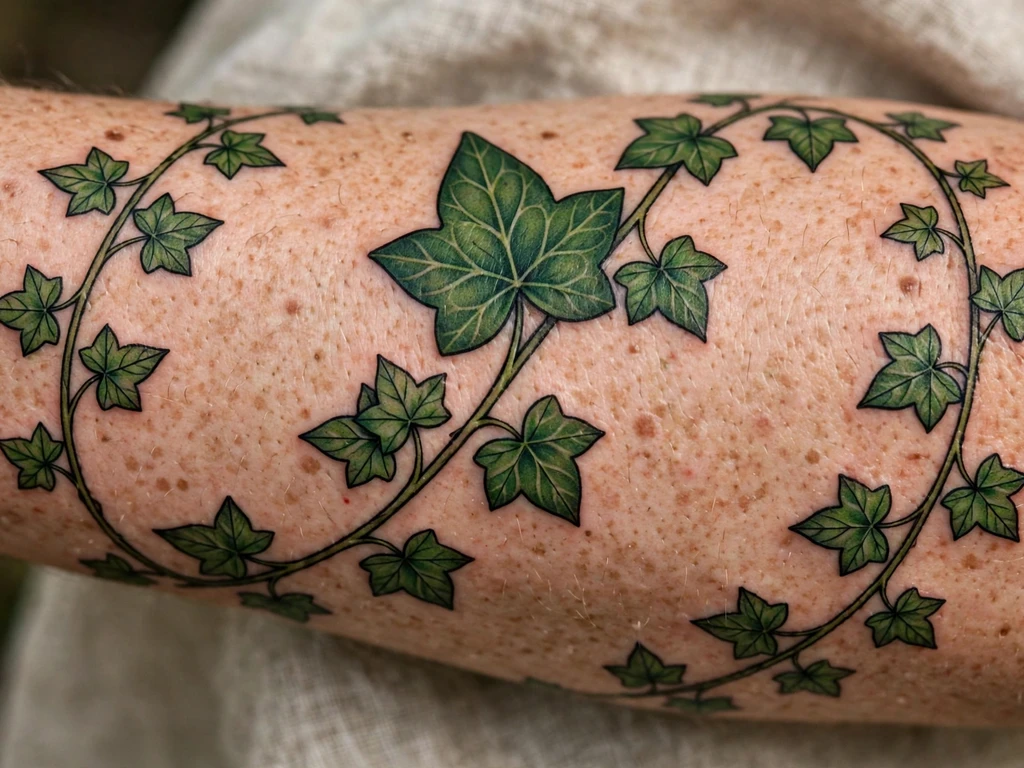
Begin with the archetype, and with ivy — the subject of the fastest-rising ivy searches and the plant this family’s reputation rests on. A single ivy stem enters at the wrist and climbs the forearm’s length, leaves alternating along it in the classic three-lobed ivy silhouette, two tendril curls opening beside the stem where it passes the forearm’s flat. It climbs rather than wraps — the beginner’s vine, and deliberately so: a climbing line on the forearm’s broad, fairly still surface is where the wrap law’s lessons can be learned at their gentlest, because the stem crosses no full circle and the limb’s taper is a slope, not a cliff.
The craft is the leaf rhythm. Ivy tempts artists into hedgerow density — the real plant is a mass — but on skin the mass is the failure mode set out in the craft section: leaves planted at hedgerow spacing heal into one green-black thicket with a stem lost inside it. The build that survives plants perhaps a dozen leaves on a forearm’s length, each a bold simple silhouette, separated by gaps the width of a leaf, the stem visible and travelling between them. Readers working out the forearm’s other possibilities will find the canvas itself surveyed in our forearm tattoo ideas guide; this design’s claim is narrower — of everything a forearm can carry, nothing uses its length the way a climbing stem does.
Best placement: Forearm, the stem running wrist to elbow along the inner flat or the outer edge; it extends gracefully onto the upper arm later.
Best for / know before you book: This is the design to judge a vine artist by — count the leaves in their healed work and measure the gaps; an artist whose healed ivy still shows separate leaves understands the spacing law in their hands, not just their words.
2. Grapevine Wrap with Clusters
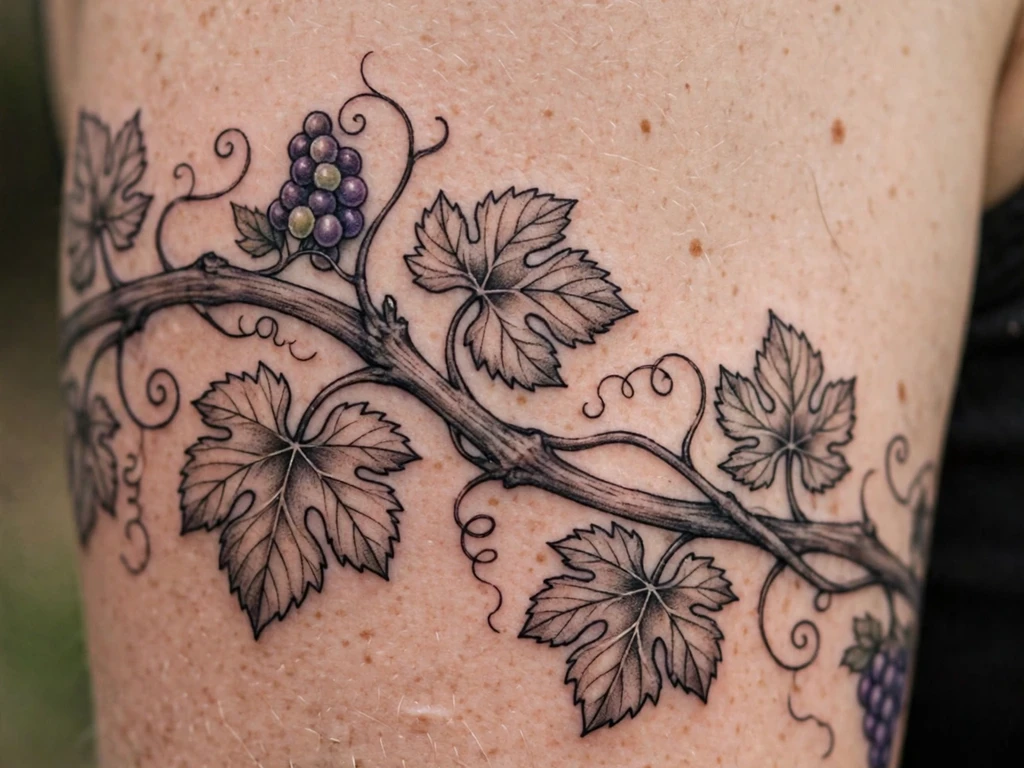
The grapevine is the rising search of this whole subject — grapevine queries are the round’s steepest climbers — and it earns the attention honestly, because the grapevine is the one vine that carries treasure: clusters. This design wraps the upper arm in a fruiting vine: a gnarled, slightly woody stem — grapevine stems are drawn with a bark texture no ivy stem needs — lobed grape leaves, open tendrils, and two small clusters of grapes hanging where the wrap passes the arm’s outer face. The clusters are kept small on purpose, a dozen grapes each at most, each grape a bold circle with real skin showing between the rows.
That restraint is the design’s whole craft. A grape cluster is a honeycomb of touching circles, and touching circles are what settling ink eats first: draw the cluster at orchard density and it heals into a purple bunch-shaped smudge. Drawn as this guide prescribes — fewer grapes, bigger grapes, gaps between them, the cluster’s triangle silhouette doing the recognition work — it stays a bunch of grapes for decades. The plant behind the design is the real thing: as the Morton Arboretum records of its ornamental grape relative, the vine climbs by tendrils twisting around a support and can run 20 feet — a wrap around an upper arm is, botanically, exactly what this plant evolved to do.
Best placement: Upper arm, the wrap circling once with the clusters hanging on the outer face; the join hides under the largest leaf.
Best for / know before you book: Count the grapes in the drawing, then ask what the cluster looks like with a third of them removed — that sparser version is the one to approve, because it is the one you will be wearing in year ten.
3. The Ivy Wrist Wrap
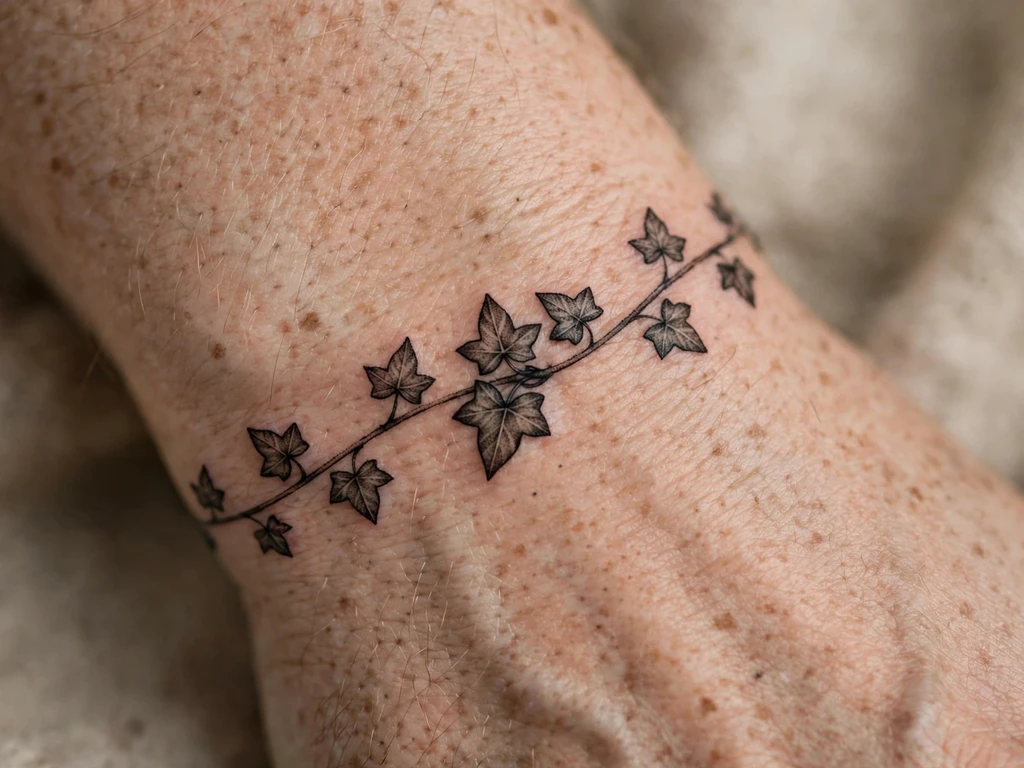
The vine worn as jewellery: a slender ivy stem circles the wrist once, completely, small leaves alternating along it like charms on a bracelet, and the circle closes — this is the point — invisibly. The wrist is the wrap law’s examination room. It is the narrowest common canvas, it rotates more than any other in daily life, its skin is thin, and a wrap here has nowhere to hide a mistake: the stem’s weight is judged at the limb’s thinnest standard, and the join sits in plain sight unless it is designed away.
So this design is specified by its join. The returning stem slides beneath the design’s largest leaf, planted exactly at the meeting point, and emerges as a tendril curl on the far side — the seam swallowed by foliage and spiral at once. Check it the way the craft section insists: stencil on, wrist rotated fully both ways, and the wearer hunts the join for ten seconds. If it cannot be found while the wrist turns, it will not be found in ten years either. Keep the leaves few — six to eight around the whole circle — because at wrist scale, rhythm beats density even harder than elsewhere.
Best placement: Inner wrist running to the side, the stem circling just above the wrist bone where the skin is stillest.
Best for / know before you book: This is the design most sensitive to stem weight in the whole guide — a stem drawn for the forearm will cable the wrist. Print it at final size and wrap the paper around your own wrist before you book.
4. Morning Glory Vine
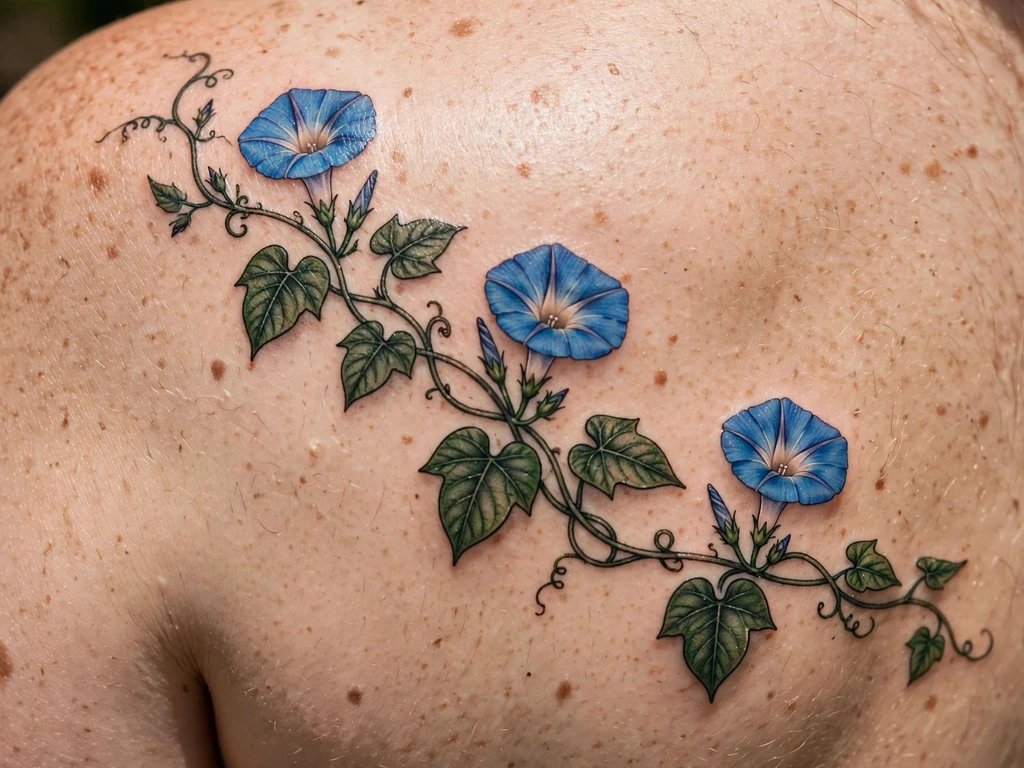
The flowering vine at its most romantic: morning glory, the trailer whose heart-shaped leaves and trumpet blooms open with the day. This design lets the vine do what the plant does on a fence — wander. The stem enters at one corner of the shoulder blade, trails diagonally across it in loose, unhurried curves, and carries three open trumpets at its widest turns, with heart-shaped leaves spaced along the run and one curl of tendril finishing the end rather than stopping it. The shoulder blade is the vine’s kindest large canvas: flat, still, and broad enough that the stem never has to wrap or hurry.
The blooms carry the colour question. Morning glory blue is a soft pigment and soft pigments settle palest, so the trumpets are drawn with a complete black structure underneath — the botanical wager from the styles table — and sized generously, since a trumpet that shrinks reads as a bell and then as a blob. The leaves, heart-shaped and simple, are the design’s quiet strength: the silhouette is so plain that even softened by years it stays unmistakably morning glory.
Best placement: Shoulder blade, the stem trailing diagonally with blooms at the turns; a longer run can spill onto the shoulder itself.
Best for / know before you book: Blue is the pigment to interrogate in healed photos — ask to see this artist’s healed soft-blue work specifically, because fresh morning glory blue is a promise the healed colour only partly keeps.
5. The Bare Winter Vine
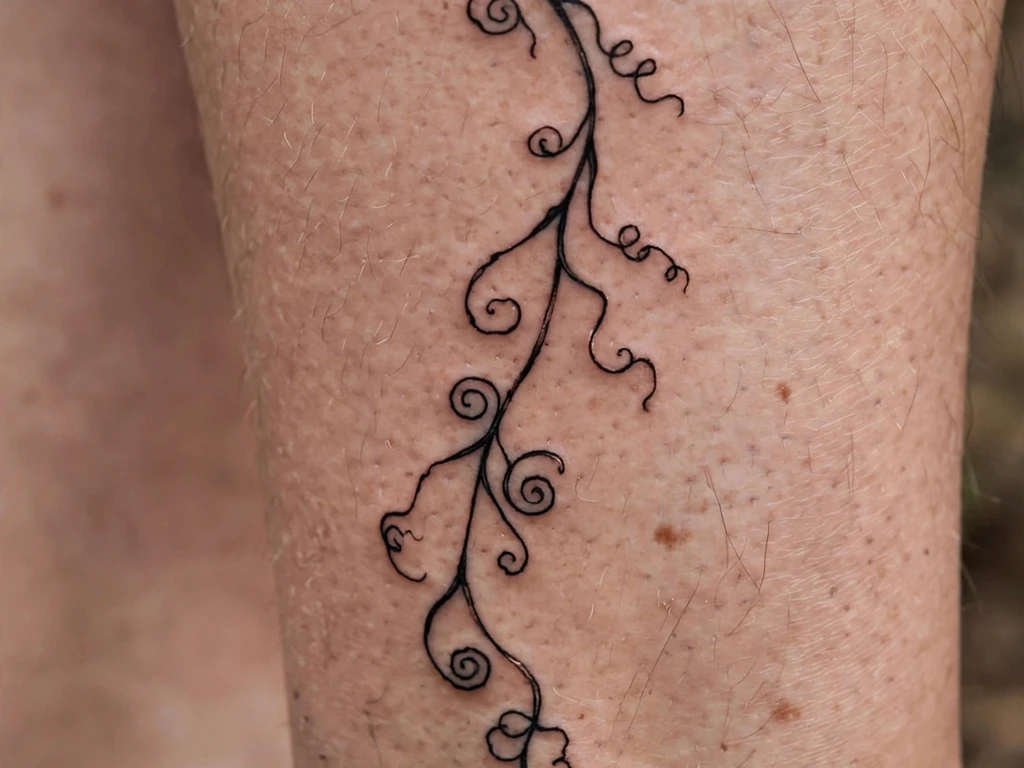
The starkest design in the guide, and for many readers the most beautiful: a vine with everything removed except its architecture. One black stem travels down the calf, throwing tendrils as it goes — curl after open curl, each spiral’s centre left as bare skin — with no leaves, no flowers, no fruit, nothing but line and air. It is the vine as calligraphy, and it makes the guide’s craft argument all by itself: with nothing to hide behind, the spacing of the curls and the evenness of the stem are the whole tattoo, exactly as the styles table warns of the bare-stem build.
The calf is its correct home — a long, gently tapering run where the stem can be judged at the ankle’s narrow standard per rule one, and where the design’s verticality flatters the leg. Draw the curls looser than feels safe: a winter vine’s tendrils are drawn at the spacing the healed line demands, since a settled line is a thicker line, and a spiral that only just stays open on day one is closed by year three. This is also the most extendable design in the list — a bare vine can grow leaves in a later session, which is more than can be said for the reverse operation.
Best placement: Calf, the stem running from below the knee to above the ankle, tendrils opening to alternating sides.
Best for / know before you book: Judge artists for this one on healed line work alone — there is no shading, colour or foliage to forgive a wobble, and the artist who welcomes that judgement is the one to book.
6. The Leaves-Only Vine
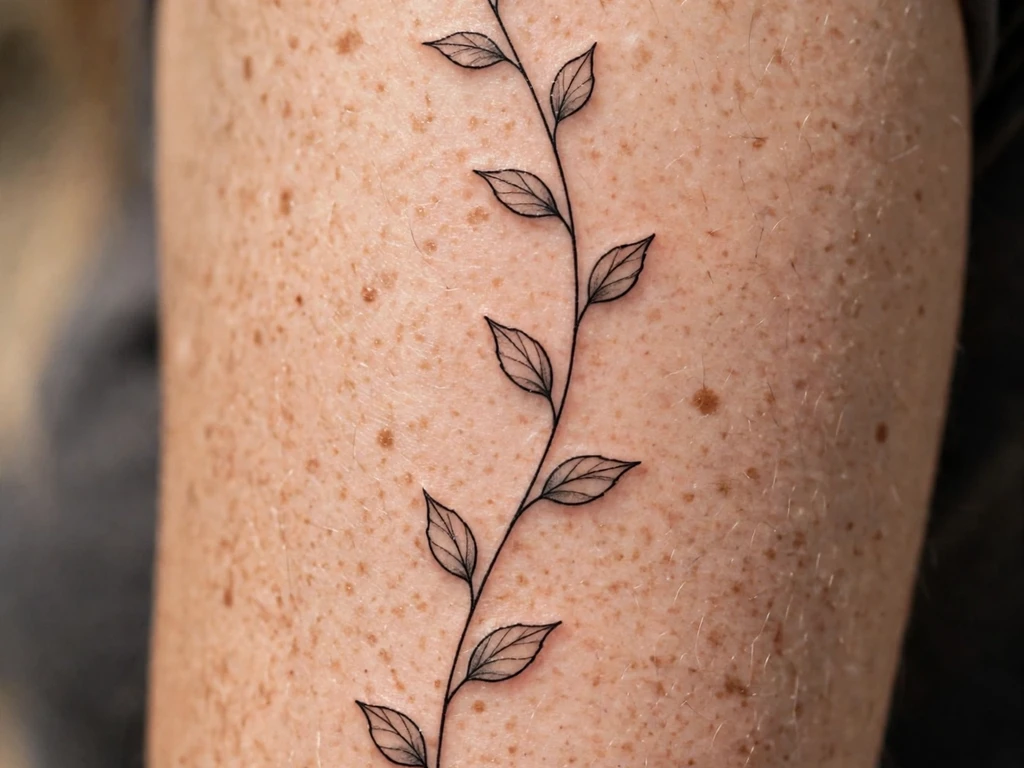
Strip the vine of everything but its rhythm. This design is one continuous stem running the upper arm’s length, carrying nothing but leaves — no blooms, no berries, no tendrils even — leaf, gap, leaf, gap, from shoulder to elbow like a line of music. It exists to make the craft section’s third rule visible: the readability of a vine is its spacing rhythm, and a leaves-only vine is that rhythm with the volume turned up, the design most likely to still read as a vine — instantly, from across a room — in twenty years.
Its discipline is sameness-with-variation. The leaves are one species’ silhouette repeated — ivy’s three lobes or the grape’s broad hand — each drawn as a clean filled or outlined shape, each separated from the next by a gap in the same tempo, the stem running visibly between them like a staff through notes. Resist the artist’s kind suggestion of “a few small ones in between”: in-between leaves are how the tempo dies. Worn in blackwork fill it is the longest-lived floral design in this guide; in outline it is the most delicate of the bold options.
Best placement: Upper arm, the stem running its full length; the design also wraps a forearm beautifully at a slightly smaller tempo.
Best for / know before you book: Count leaves and gaps on the stencil as the artist works — the design succeeds on arithmetic, and an even count of evenly spaced leaves is a thing you can verify with your own eyes before the needle.
7. The Ankle Vine Wrap
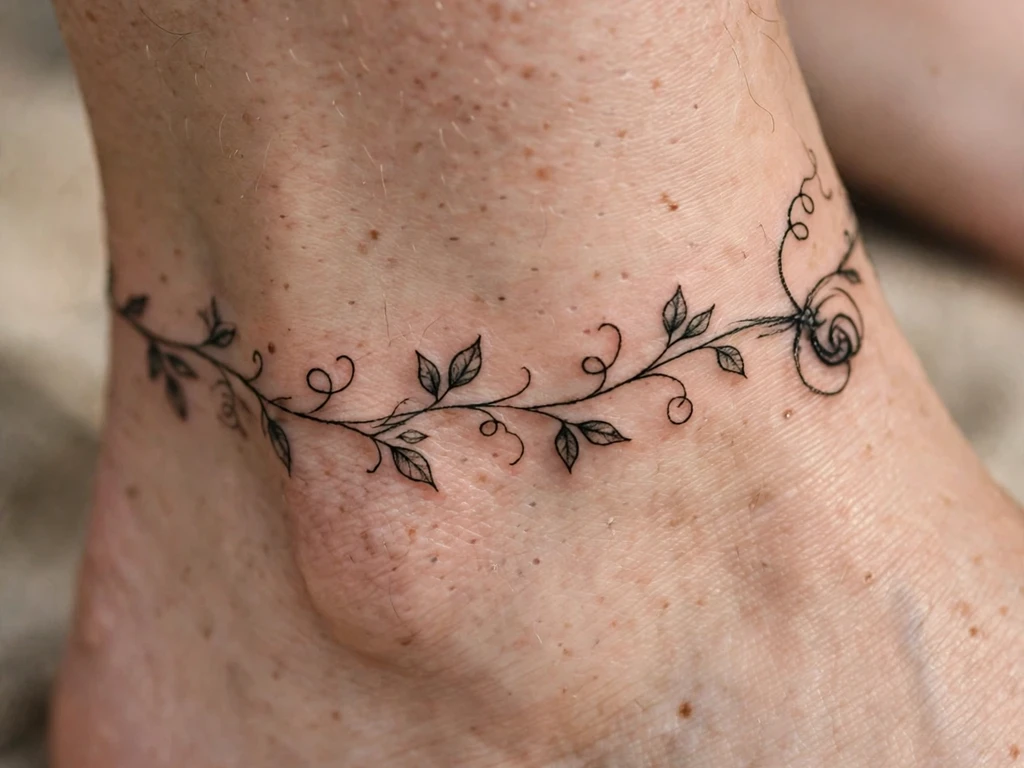
The wrist wrap’s smaller, quieter sister: a fine vine circling the ankle once, worn exactly where an anklet sits, its small leaves riding just above the ankle bone and its join tucked under a tendril curl at the back. Ankles are strict teachers — thin skin, a bone in the middle of the canvas, and the collar of every shoe rubbing the design’s lowest strip — and the vine that respects those facts is drawn fine but not fragile: a stem with real weight, leaves kept to five or six bold little shapes, and the whole circle parked on the flatter wall above the bone where the skin moves least.
The wrap law’s rotation check becomes a flex check here: stencil on, then point and flex the foot, walk a few steps, and watch whether the circle rides over the bone or stays on its wall. Readers comparing the ankle’s other small designs will find the joint’s full rules in our ankle tattoo ideas guide; the vine’s specific claim on the ankle is that a wrap is the one design that uses the joint’s circularity instead of fighting it — the anklet shape is the ankle’s own idea.
Best placement: Ankle, the circle sitting on the flat wall above the ankle bone, join at the back above the heel.
Best for / know before you book: Shoes are this design’s lifelong neighbours — heal it in low shoes and a quiet fortnight, and expect the strip nearest the shoe line to want a touch-up before the rest does.
8. Grapevine Down the Calf
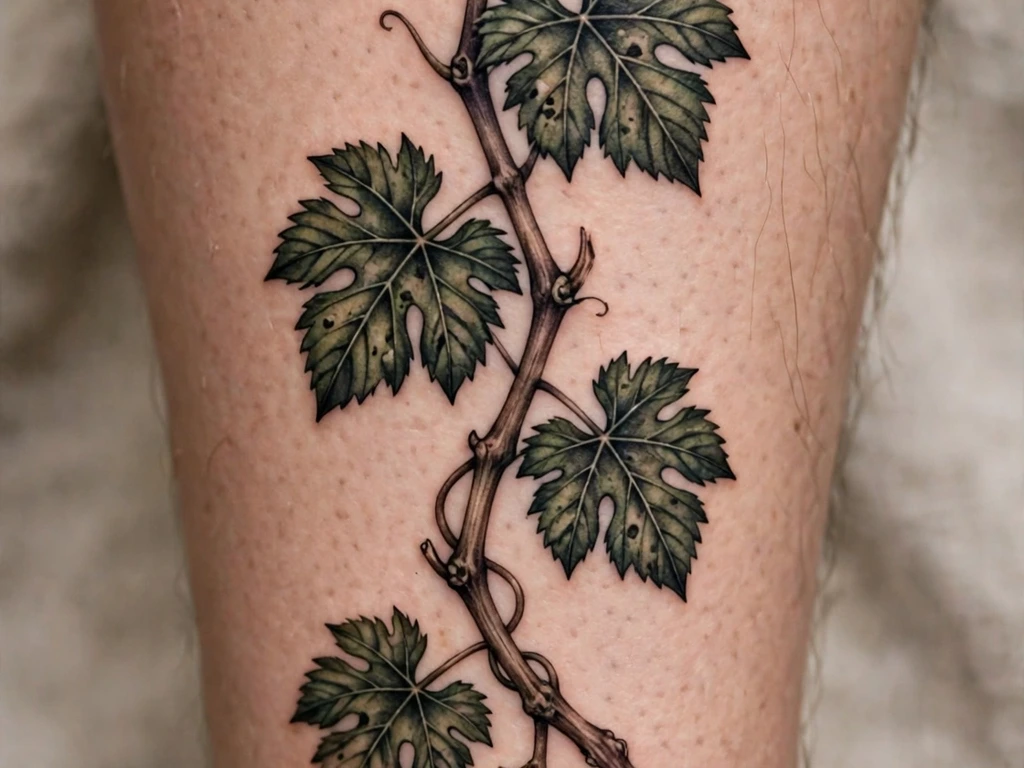
The grapevine’s second appearance, built on the opposite geometry from Design 2: instead of wrapping, this vine hangs. A woody grape stem descends the calf’s length, its lobed leaves spreading at the calf’s wide top, and at its lowest, narrowest point — where the leg is slimmest and every eye lands — hangs one long cluster of grapes, drawn as the design’s single centrepiece. It is the composition a real trellis teaches: leaves up where the sun is, fruit hanging low and heavy.
The cluster obeys the same arithmetic as Design 2’s, taken further because this one is the focal point: a long triangular bunch of bold circles, gaps between the rows, the silhouette unmistakable before any single grape is. And rule one is doing quiet work — the stem drawn by the ankle end’s width stays slender all the way up, so the top of the design reads airy rather than top-heavy, the leaves gaining their presence from spread, not stem weight. Wearers choosing between the two grape designs are really choosing between the wrap and the hang: the arm shows the wrap turning; the leg shows the cluster swinging as you walk.
Best placement: Calf, the stem descending the back or outer side, the cluster finishing above the ankle.
Best for / know before you book: The cluster sits at the calf’s narrowest ground, where skin is thinnest over the bone’s approach — ask your artist to confirm the bunch’s lowest grapes clear the ankle’s movement zone, or shorten the drop.
9. Jasmine Along the Collarbone
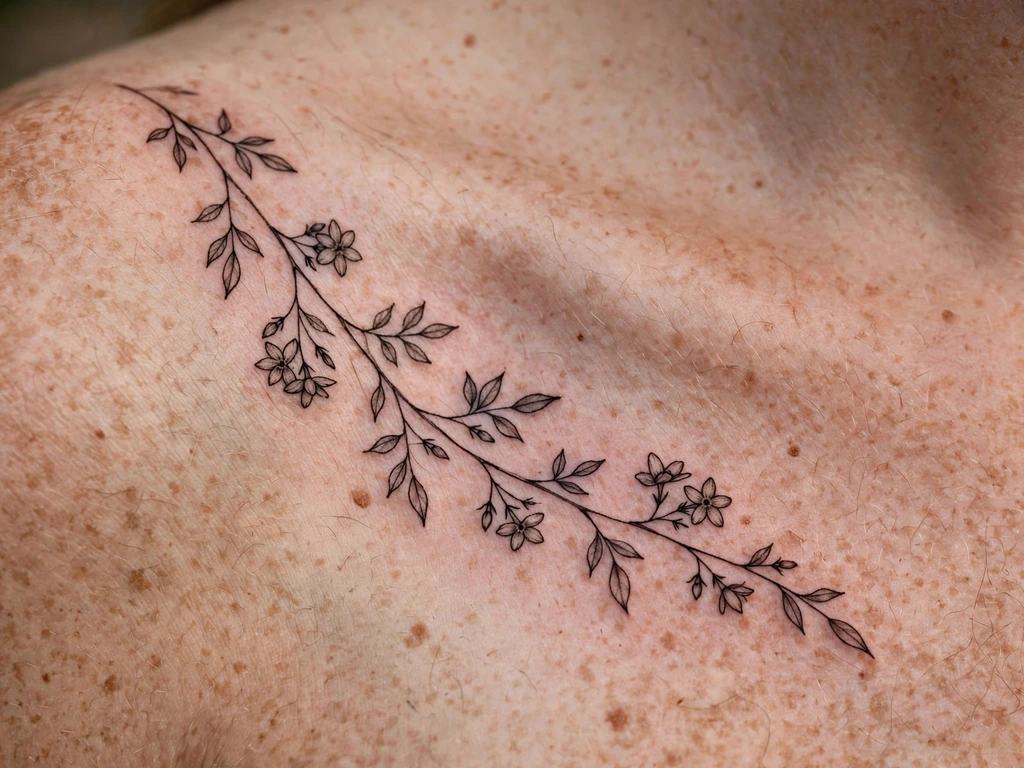
The finest flowering vine in the guide, placed on the body’s finest line. A jasmine stem trails along the outer edge of the collarbone — the approved edge, riding the bone’s own curve without crossing to the centre chest — its small leaves in opposite pairs and its little white star-flowers opening along the run like a string of pale lights. Jasmine is the night-scented vine of garden walls across Asia and the Mediterranean, and in tattoo form it is the design for wearers who want the vine’s travel without its weight: this is jewellery drawn by a plant.
The craft is proportion under a microscope. At this scale everything in the wrap law compresses: the stem is fine but must stay a stem — one unbroken line, not a dotted suggestion; the blooms are five-pointed stars a few millimetres across, each drawn as a simple silhouette that can survive softening into a soft dot of light; and the leaves come in pairs because pairs are how the tempo is kept when there is no room for rhythm to spare. A collarbone vine is also the design most exposed to the sun’s daily tax after the face and hands, so white and pale pigments get the honest warning the styles table gives colour work: the black structure underneath must carry the read.
Best placement: Outer edge of the collarbone, the stem following the bone’s curve from shoulder towards the centre without crossing it.
Best for / know before you book: Print this at final size and wear the paper for a day — at jasmine scale, the difference between delicate and merely faint is two millimetres, and only the true-size test tells you which side of it your design is on.
10. The Vine Heart
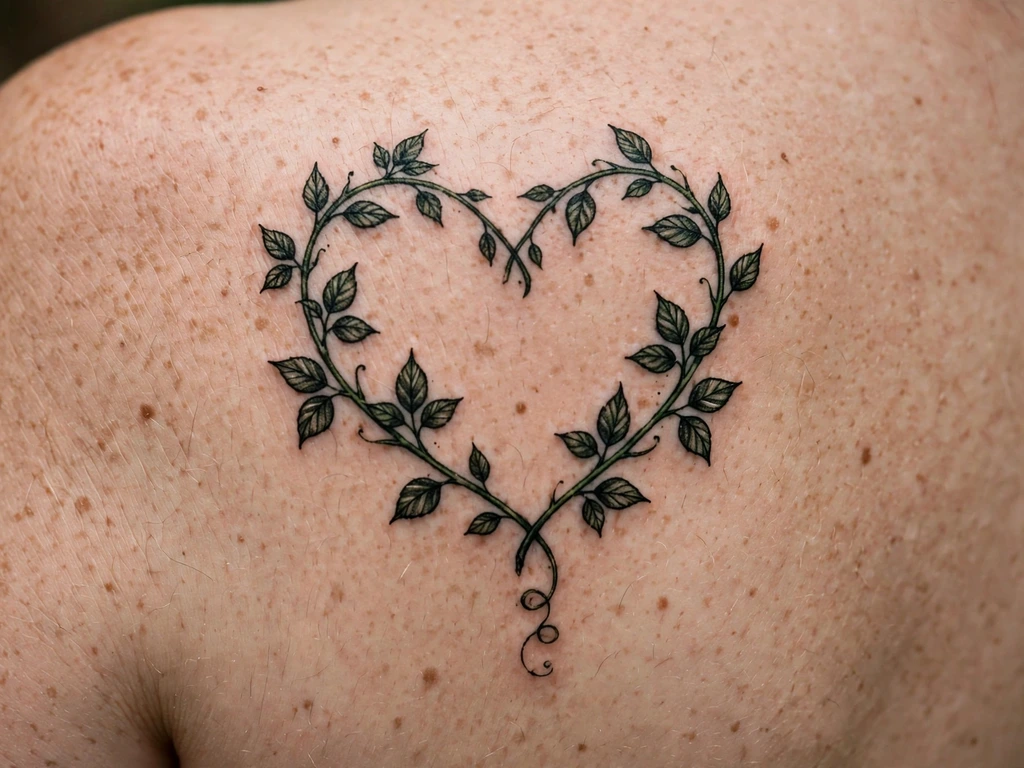
A vine persuaded into the oldest shape in tattooing: the stem leaves its start, climbs, curves over and comes down to close a heart outline on the shoulder blade, leaves growing outward along the loop and one tendril curling loose at the heart’s bottom point, where the design refuses to be tidy. The heart is usually lettering’s or a banner’s shape; drawn by a vine it gains something neither can give — it reads as a heart that is still growing, its outline alive, its point unfinished on purpose.
The wrap law applies in miniature, because a heart loop is a wrap around empty space: the two curves of the top must stay open and generous — a heart drawn tight at the top closes into a spade as the line settles — and the point, where the stem crosses its own neighbourhood, needs the join treatment, the returning stem sliding under a leaf rather than butting into the loop’s start. On the shoulder blade’s flat the whole shape can be checked in a mirror at conversational distance, which is this design’s test: if it reads as a heart from across the room and as a vine from up close, it is drawn right.
Best placement: Shoulder blade, the heart sitting centre-blade at palm size or larger; a small version rides the shoulder.
Best for / know before you book: Hearts fail by proportion, not detail — check the loop’s two top curves against each other on the stencil, because a lopsided heart cannot be fixed by any amount of careful leaf work afterwards.
11. The Vine Wreath
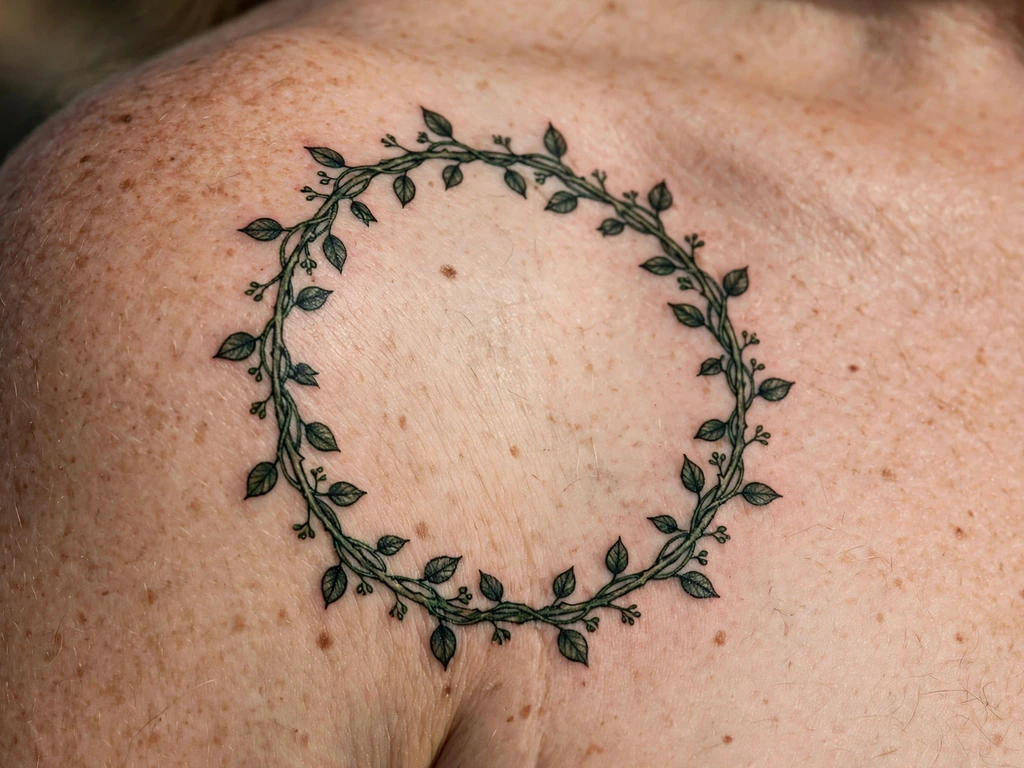
The vine completing its circle as a wreath: one stem bent into a full ring on the shoulder, leaves alternating outward and inward along the ring, the join dissolved into the circle so completely that the wreath has no visible beginning. Wreaths are the victory-and-honour shape of the classical world — laurel above all — and a vine wreath keeps that ring’s dignity while trading the laurel’s stiffness for a living plant’s irregularity: no two leaves identical, the circle organic rather than machined.
A ring is a symmetry test wearing foliage. The circle must be a true circle on the shoulder’s dome — checked standing, arm hanging and raised, since the shoulder cap stretches a ring into an egg in some poses — and the leaves must beat their rhythm evenly around it, or the uneven stretch announces itself at the ring’s thin patch. The join rule reaches its purest form here: the wreath’s stem ends are tapered into each other under the ring’s two largest leaves, top and bottom, so the eye travelling the circle finds no seam to stop at.
Best placement: Shoulder, the ring centred on the cap; the same design sits beautifully flat on a shoulder blade for wearers who want it stiller.
Best for / know before you book: Ask for the circle to be checked with a compass-drawn stencil, not freehanded — wreaths forgive many things, but an oval is not one of them, and the shoulder will not hide it.
12. The Thorned Rose Vine
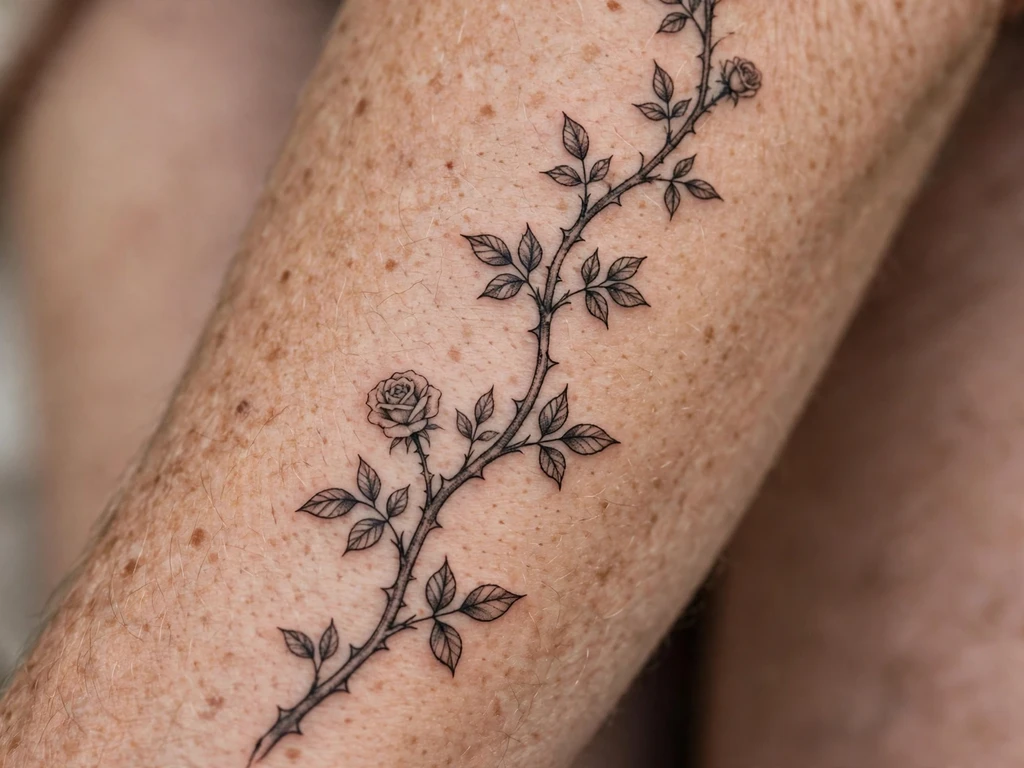
The vine with a warning in it. A rose stem climbs the forearm carrying two small roses — but the design’s honesty, and its whole identity, is that the thorns are drawn: real thorns, spaced along the stem the way the plant grows them, not airbrushed away in the name of prettiness. Rose vines in galleries are almost always thornless, which makes them drawings of an imaginary plant. This guide’s version holds that the thorn is the meaning — beauty that defends itself, love with its cost left in — and wearers who choose it usually choose it for the thorns.
Craft follows from that honesty. Thorns are small triangles on a line, the single most merge-prone shape in this article after tendril curls: drawn tiny and close to the stem they settle into bumps, and bumps on a stem read as disease, not defence. The build spaces them — fewer thorns than the plant grows, each one bold, each with clear skin around it — and keeps the blooms small and simply drawn, so the eye’s story stays where the wearer put it: stem, thorns, and then the flowers the thorns were guarding. A thorned vine is also the design to discuss placement honestly: a forearm shows it daily, which is either the point or a reason to move it to a calf.
Best placement: Forearm, the stem climbing the outer edge where the thorns silhouette against the arm’s line; also strong down a calf.
Best for / know before you book: Count the thorns on the drawing and halve them — a healed thorned vine needs each thorn to read individually, and the plant’s real density is precisely what skin cannot keep.
13. The Vine and the Bird
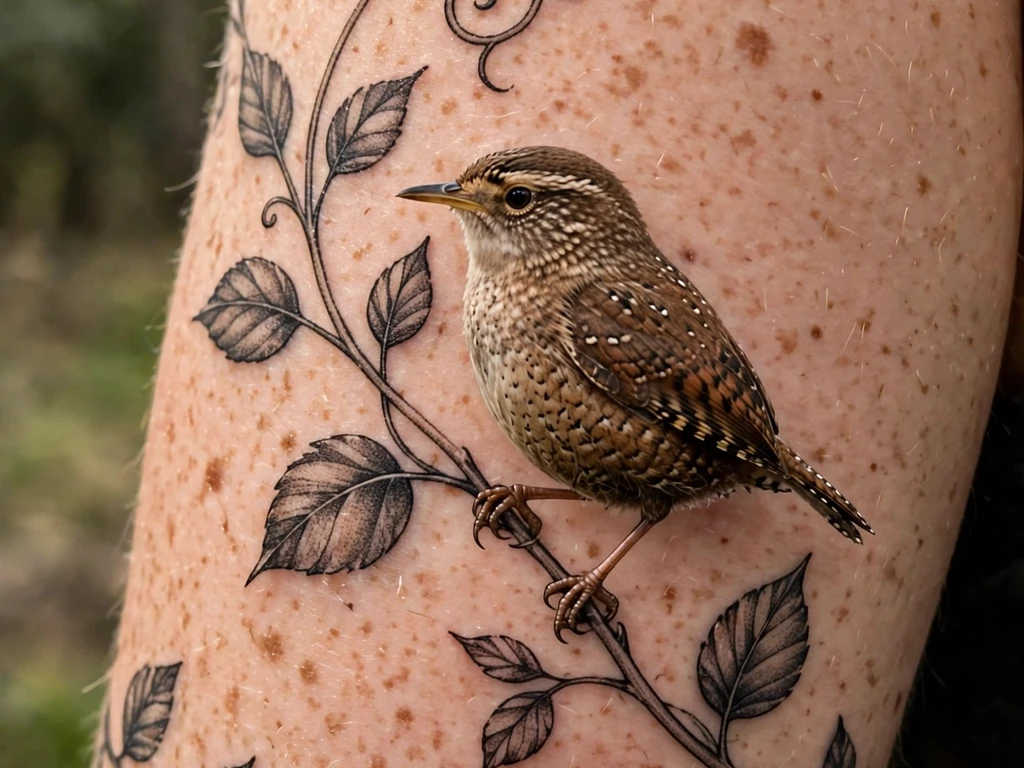
The vine as a place rather than a pattern: a leafy stem runs the upper arm, and at its widest, calmest stretch a small bird sits on it — a sparrow or a wren, drawn as a simple, bold silhouette with a few markings, feet gripping the stem, one tendril curling beside it like the plant’s own punctuation. The pairing is one of tattooing’s oldest comforts — a creature at rest inside a growing thing — and it works because the two subjects agree on scale: the bird is drawn the size the vine’s world implies, a bird that could actually sit on that stem.
The discipline is hierarchy. Two subjects in one design must have a senior partner or the eye splits its vote, and here the vine is senior: it owns the length, the rhythm and the placement, while the bird is a guest the stem hosts at one chosen perch. Draw the bird bold and spare — silhouette first, detail second — because a small bird rendered feather by feather at this size is the leaf-cluster failure wearing wings: fine detail is the first loss, whatever it is attached to. Choose the perch where the arm is flattest, so the bird sits level in every pose the arm takes.
Best placement: Upper arm, the stem running its length with the bird perched on the outer flat; a forearm version lengthens the vine and shrinks nothing else.
Best for / know before you book: Approve the bird as a pure silhouette before any detail is added — if it reads as a bird in black paper cut-out form, the finished tattoo will read for decades; if it needs its feathers to explain itself, simplify it.
14. The Berry Vine
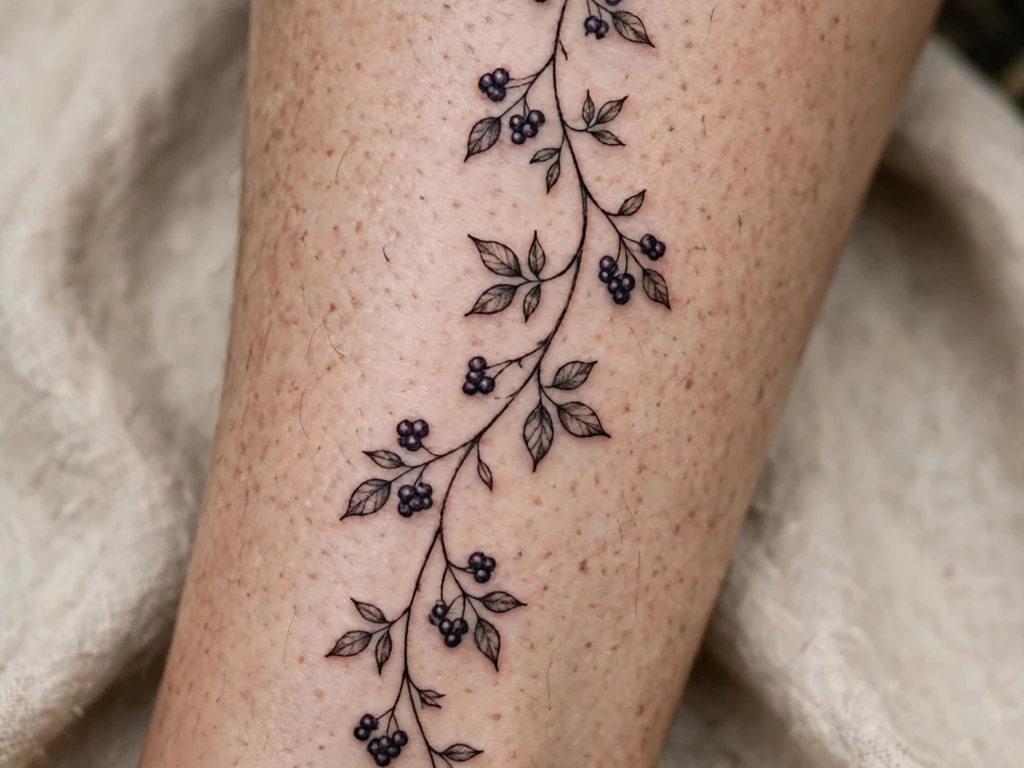
The grapevine’s wild cousin: a slender stem descending the calf, carrying not grapes but berries — small round clusters of the kind bramble and winterberry wear, each cluster a modest knot of five to nine bold circles, leaves kept simple between them. Berry vines carry the year’s other half in their meaning: fruit in the cold season, colour that arrives when the leaves are thinking of leaving, the plant still providing in winter. It is the design for wearers who find the grape’s abundance a little grand and want the same idea at hedgerow scale.
Its craft is the grape cluster’s arithmetic in a smaller hand, and one extra warning. The clusters must stay knots, not bunches — nine berries is the ceiling, each berry a clean circle with skin showing around the cluster’s edge — and the berries should be drawn at two sizes only, full and small, because berry clusters drawn in graduated realism blur into the bunch-shaped smudge this guide keeps warning about. Singles help: one or two lone berries dropped along the stem below the lowest cluster give the design its wild, ungardened truth, and they cost nothing in clarity.
Best placement: Calf, the stem descending the outer side with clusters at the wide top and mid-calf; the design also trails well across a shoulder blade.
Best for / know before you book: Berries in red settle darker and duller than the fresh photo promises — ask whether you still love the design in the deep wine shade it will become, because that, not the bright red, is the tattoo.
15. The Birth Flower Vine
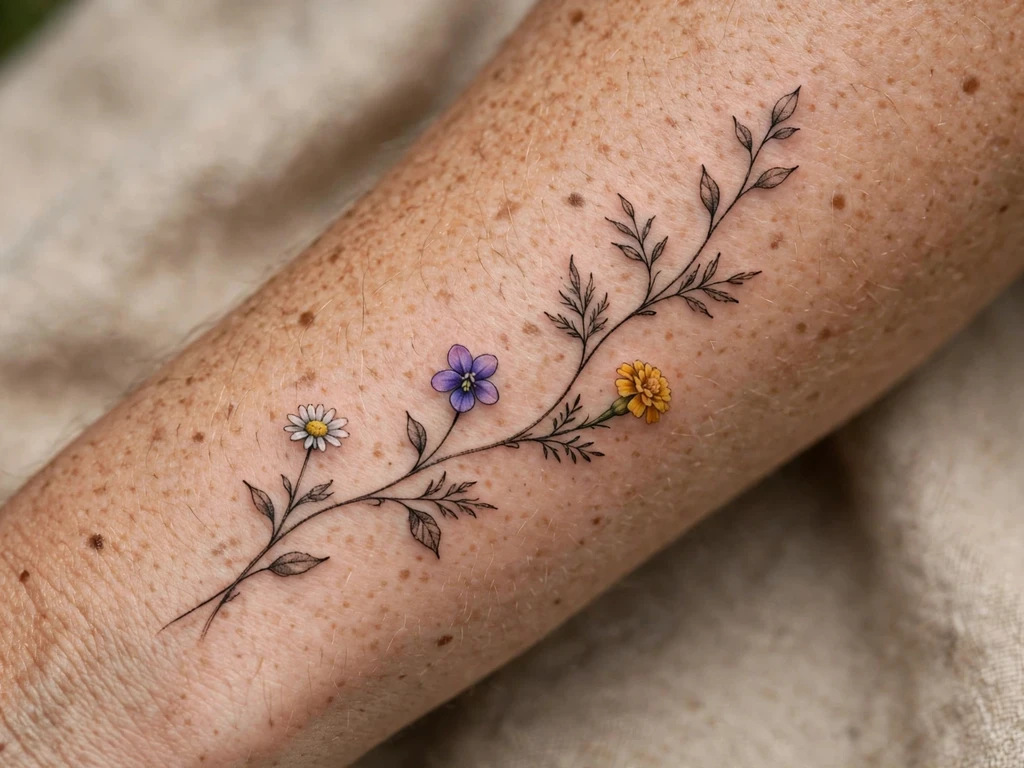
The vine as a family tree worn one stem at a time: a single climbing stem on the forearm, carrying — spaced along its length like stops on a journey — the birth flowers of the people the wearer carries. A mother’s month at the wrist, a partner’s at the mid-forearm, a child’s near the elbow, each bloom drawn at the same modest scale in the same hand, the stem itself doing the meaning: one life, growing through all of them. It is the most personal design in this guide, and the one most likely to gain a flower in a later session, which the drawing should plan for from the start — leave a gap in the rhythm where the next bloom will go.
The blooms themselves obey the single-flower discipline of their own guide: each is drawn simply, as a silhouette-true version of the month flower, because at vine scale a botanically fussy bloom is just a knot in the stem. Readers choosing their month’s flower will find all twelve drawn and explained in our birth flower tattoo ideas guide; this design’s rule is that the vine chooses the versions — the simplest true drawing of each flower, in the order of the wearer’s own story, with the stem never breaking its rhythm to accommodate a showy bloom.
Best placement: Forearm, the stem climbing wrist to elbow with blooms spaced along it; a longer family climbs a calf.
Best for / know before you book: Decide the order and the reserved gap at the drawing stage, in writing — adding a bloom later is easy only if the stem’s spacing was planned to receive it, and a squeezed-in flower breaks the rhythm forever.
16. The Red Vine
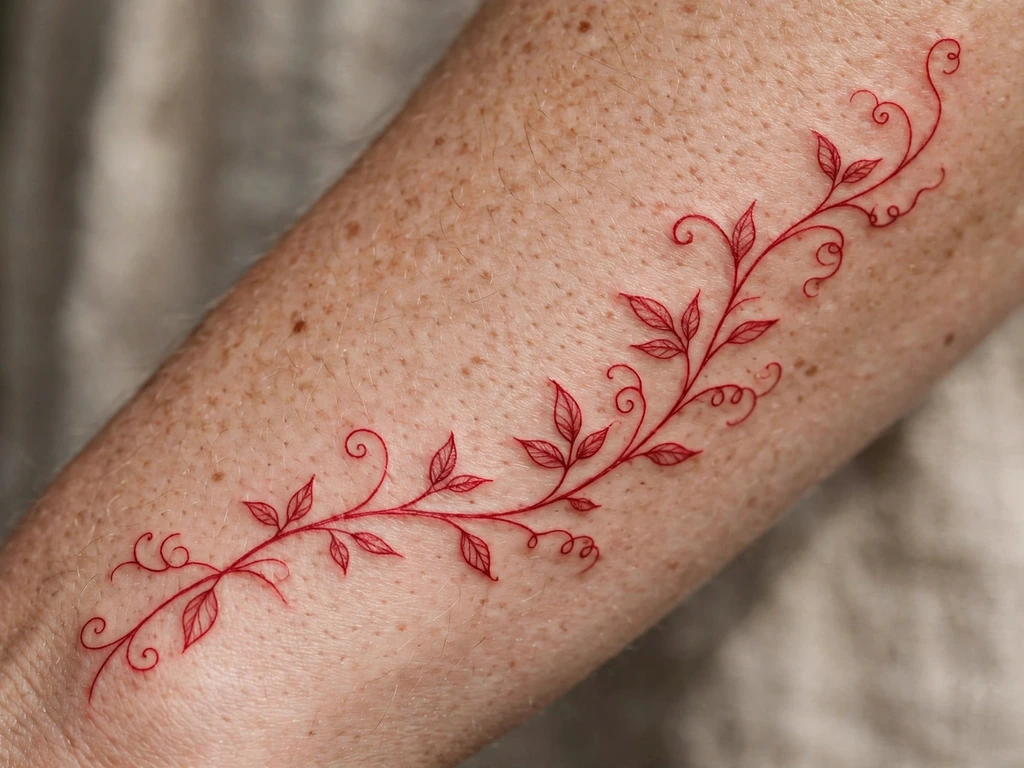
One vine, one colour, nothing else: a stem in red ink only — red stem, red leaves, red tendrils — running along the outer edge of the forearm like a line drawn by a single pen. Red vine work is having a quiet moment of its own, and the effect on skin is genuinely strange and lovely: less a picture of a plant than a plant remembered, a vine in the colour of autumn and arteries at once. This design keeps the build at its purest — no outline in black, no second colour — because the single-colour discipline is the entire aesthetic.
Red ink carries its own honest ledger, and this guide states it rather than discovering it later: red pigment is the colour most associated with ink reactions, it settles and fades on its own schedule — faster in sun than black, drifting towards rust and rose — and a design with no black skeleton has nothing to hold its read when the colour softens, which is why this vine is drawn bold for its size, leaves as simple shapes, curls wide open. Wearers weighing the colour itself should read our red ink tattoo ideas guide before booking, since it covers the pigment’s behaviour, testing and removal reality in full; this design assumes that homework done and spends its own words on the vine.
Best placement: Forearm, the stem running the outer edge’s length; the design also traces a collarbone’s outer edge beautifully.
Best for / know before you book: A patch test and a healed-red portfolio are non-negotiable homework for single-colour work — judge this artist on red that has lived on skin for a year, not on the red that left the studio yesterday.
17. The Fine-Line Single Stem
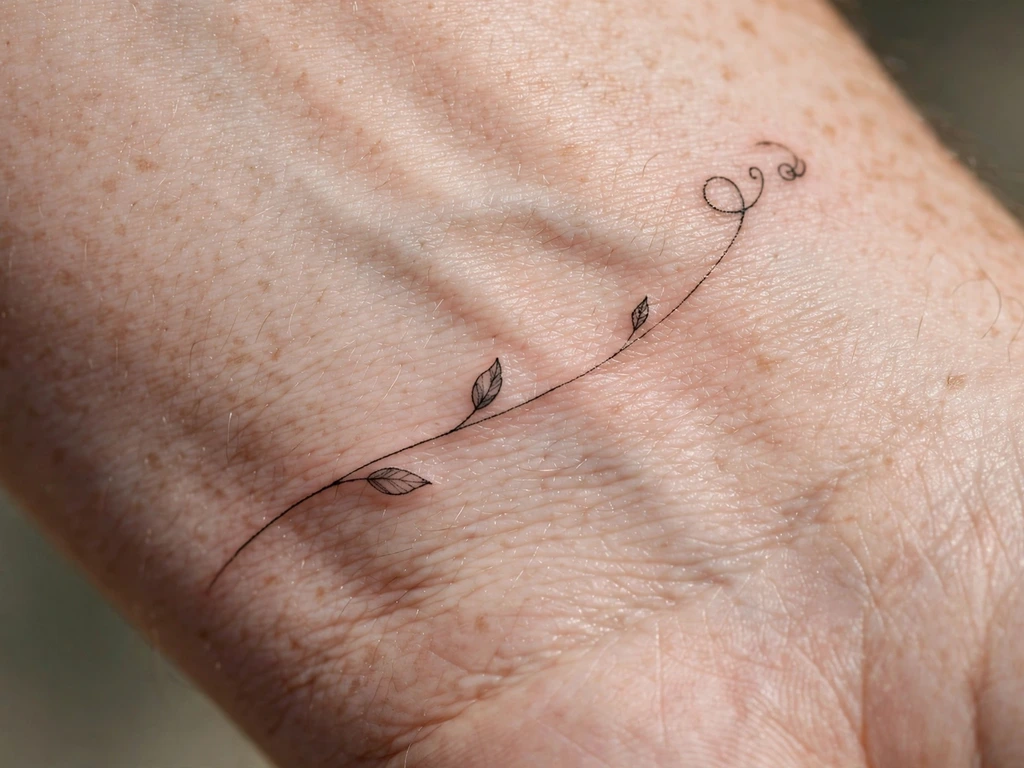
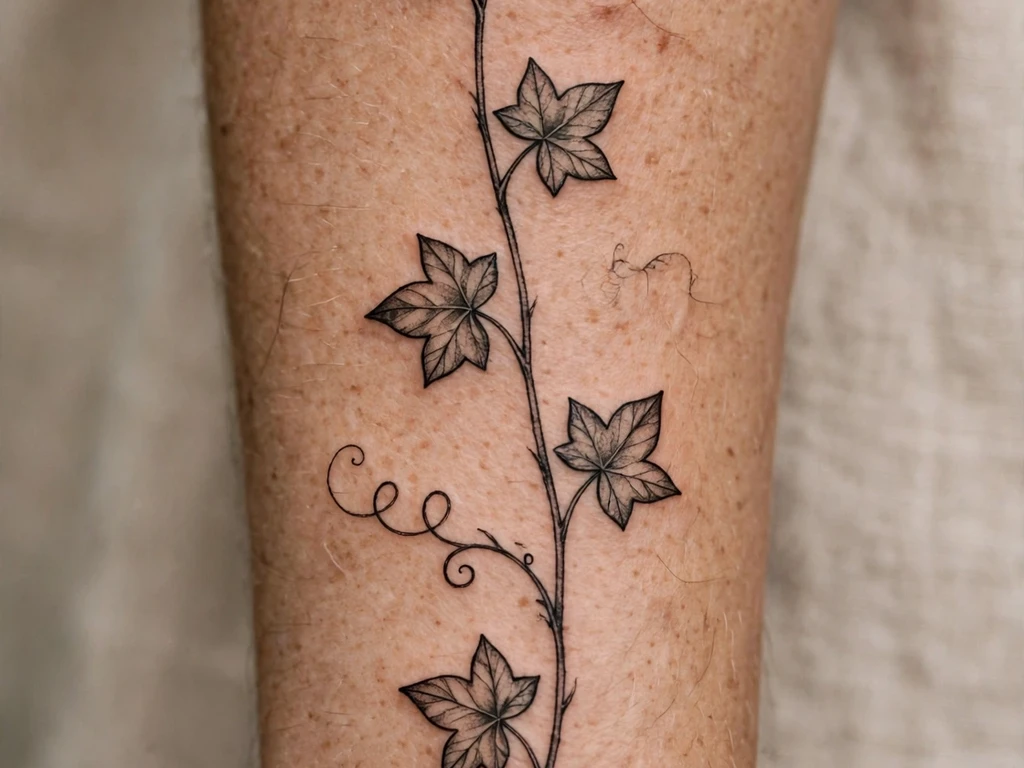
The vine at its absolute minimum: one hairline stem on the inner wrist, three tiny leaves, one tendril curl — the whole plant reduced to a single gesture, a line that starts, grows, leafs twice and curls, in under ten centimetres. Fine-line vines are the most requested and most refused design in this family, refused by honest artists for the reason the styles table gives: the hairline stem is the first element in any vine to soften, and a design that is only a hairline stem has its whole self in the frailest possible keeping.
This guide includes it with its terms stated. The terms: the stem drawn at the boldest weight that still counts as fine line, the three leaves as clean silhouettes rather than outline wisps, the curl’s centre kept open at a size the healed line cannot close, and the wearer’s informed acceptance that a touch-up in the first years is part of this design’s price, not a sign of failure. On those terms it is a legitimate, lovely choice — the vine as a whisper. Off those terms it is a grey smudge by its fifth birthday, and no artist’s talent changes that arithmetic.
Best placement: Inner wrist, the stem running lengthwise where the skin is stillest; it should not be attempted smaller or wrapped.
Best for / know before you book: Ask the artist to show you a healed fine-line stem — one year old minimum — and look only at the stem’s continuity; if their healed lines still read as unbroken threads, the design is in safe hands.
18. The Blackwork Vine
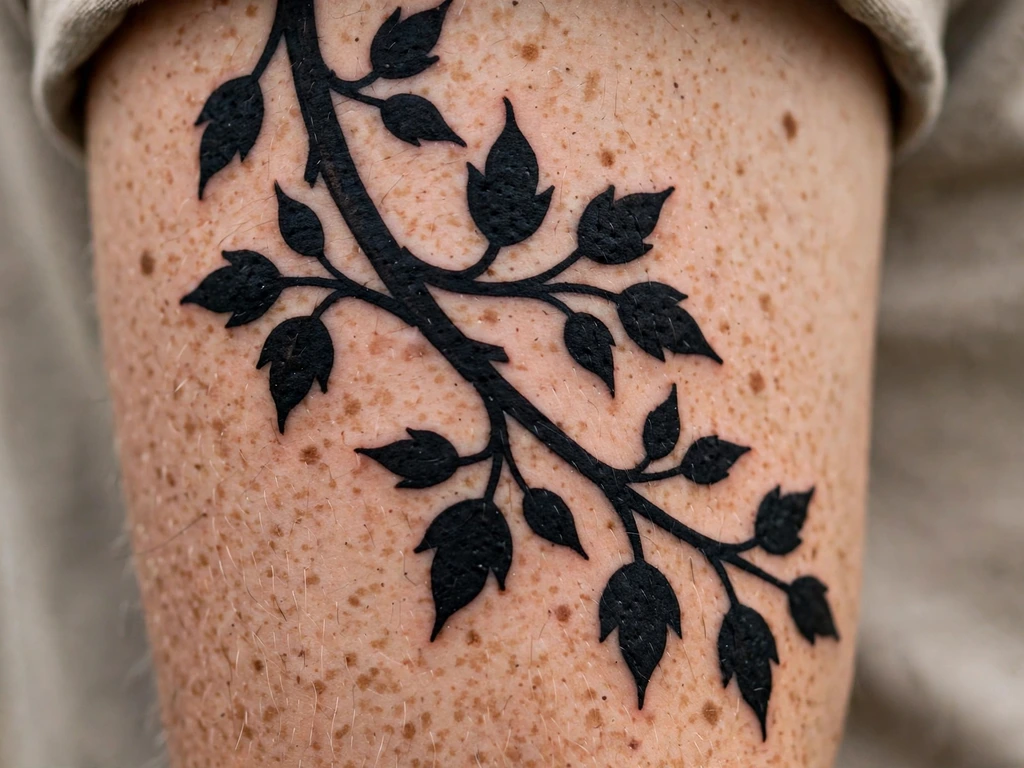
The vine built like a fence: a solid black stem of confident weight running the upper arm, leaves filled in solid black silhouette, tendrils drawn as bold open spirals — every element at the weight the longevity table promises will outlive its wearer. Blackwork is the vine’s answer to the gallery problem: where fine-line work borrows against the future, blackwork pays cash. Its leaves are shapes, not studies; its stem is a cable in the good sense, drawn at one honest weight sized by the arm’s far end exactly as rule one commands.
The craft is all in the gaps, because solid black forgives nothing about spacing: leaves filled black and planted too close do not blur politely, they weld, and a welded stretch of blackwork vine reads as a scar of ink with a stem lost in it. So the rhythm is set wide — leaf, long gap, leaf — and the tendril spirals are drawn with skin channels between their turns wide enough to survive the black’s slow spread. Worn well, this is the design strangers can identify from across the street in the wearer’s seventieth year, and that is a claim no other vine in this guide can make as strongly.
Best placement: Upper arm, the stem running its length or wrapping once; the design scales down to a forearm without losing its nerve.
Best for / know before you book: Live with the drawing as a black paper silhouette taped to your arm for a few days — solid black cannot be lightened, and loving the shape in pure silhouette is the only honest rehearsal for this tattoo.
19. Ivy Over the Shoulder
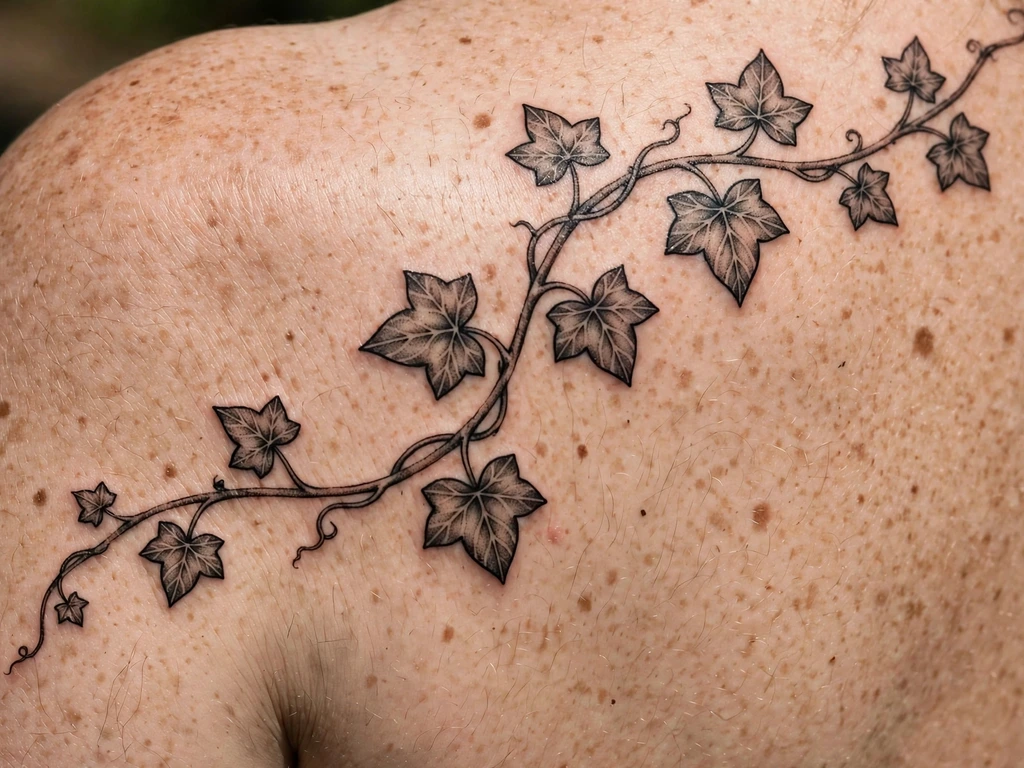
The vine caught mid-journey between two canvases: ivy enters low on the shoulder blade, climbs it, spills over the point of the shoulder and sends its last leaves down the upper arm’s first stretch, like the real plant coming over a garden wall. It is the most cinematic composition in the guide — the only design whose whole point is a threshold, the moment of crossing — and it suits wearers whose meaning is exactly that: something in their life that came over a wall and kept growing.
Crossing the shoulder point is the wrap law’s hardest examination, harder than any wrist: the shoulder is a hinge that folds the design in two directions, and a stem that runs true with the arm hanging can shear sideways when the arm reaches forward. The stencil check for this design is a rehearsal of the wearer’s actual day — reach, lift, carry, hug — with the stem’s line watched at the shoulder point through all of it, and the leaves at the crossing planted where the skin’s fold is shallowest. Plant the design’s boldest leaf exactly at the point: it draws the eye to the crossing and forgives whatever small shift the hinge insists on.
Best placement: Shoulder blade over the shoulder point, the stem descending a short way onto the upper arm; commit to the crossing or choose Design 4’s stillness instead.
Best for / know before you book: This design must be stencilled and approved in motion, full stop — a wearer who books it from a still-arm stencil check has not actually seen their tattoo yet.
20. The Double Vine Twist
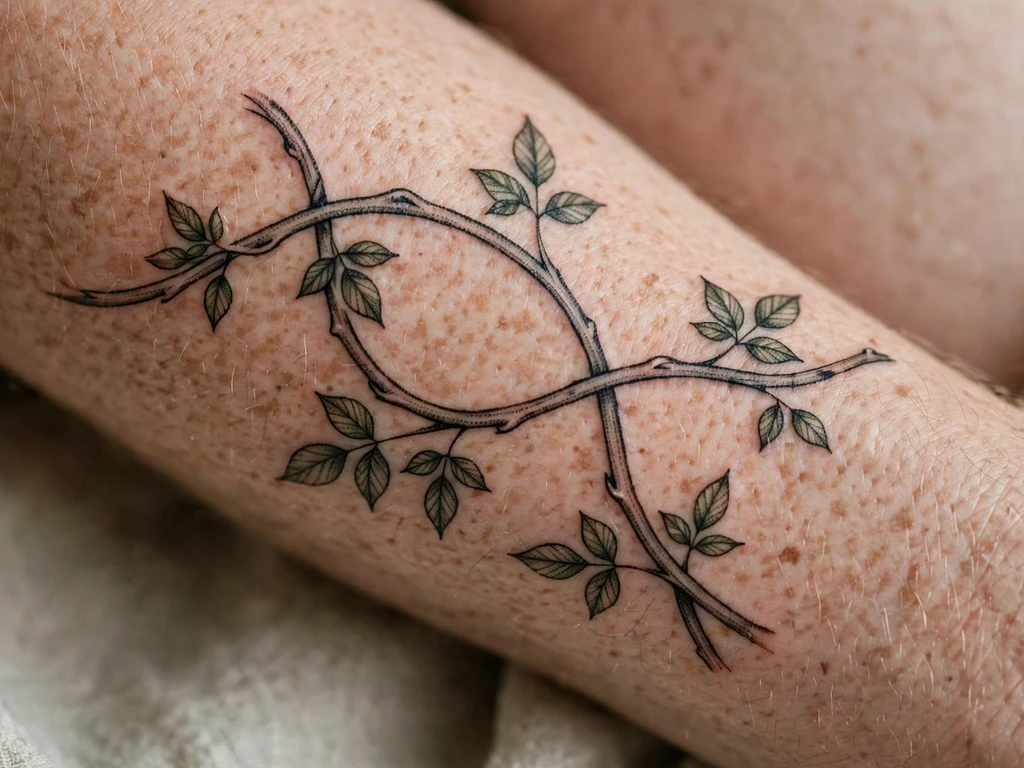
Two stems, one journey: a pair of vines entwine down the forearm, crossing and recrossing like a plait — one stem leafy and full, the other slimmer and mostly tendril — in the design that says two lives growing around each other more plainly than any matching-symbols pair. Couples, siblings and oldest friends take it, and some wearers take both stems themselves, for the two halves of a life grown together. Either way, the entwining is the meaning, and the drawing must protect it.
Entwining is a spacing problem wearing a romantic costume. Every crossing is a place where two lines meet — and meeting lines are what settling ink welds — so crossings are designed like tendril curls: one stem passes over with a deliberate break in the under-stem, a small gap of skin left at each intersection so the over-and-under stays readable after the lines thicken. The rhythm helps: crossings planted at even intervals read as a plait’s pattern, while irregular crossings read as a tangle, and tangles are the one thing this design must never resemble. Keep the two stems visibly different in weight or leaf, so the eye can follow each one’s path through the twist.
Best placement: Forearm, the pair twisting wrist to elbow; a calf takes a longer, slower twist.
Best for / know before you book: Trace each stem with your fingertip on the stencil from start to finish — if you lose either stem at a crossing, the healed tattoo will lose it too, and the crossings need their gaps widened.
21. The Blossom Vine
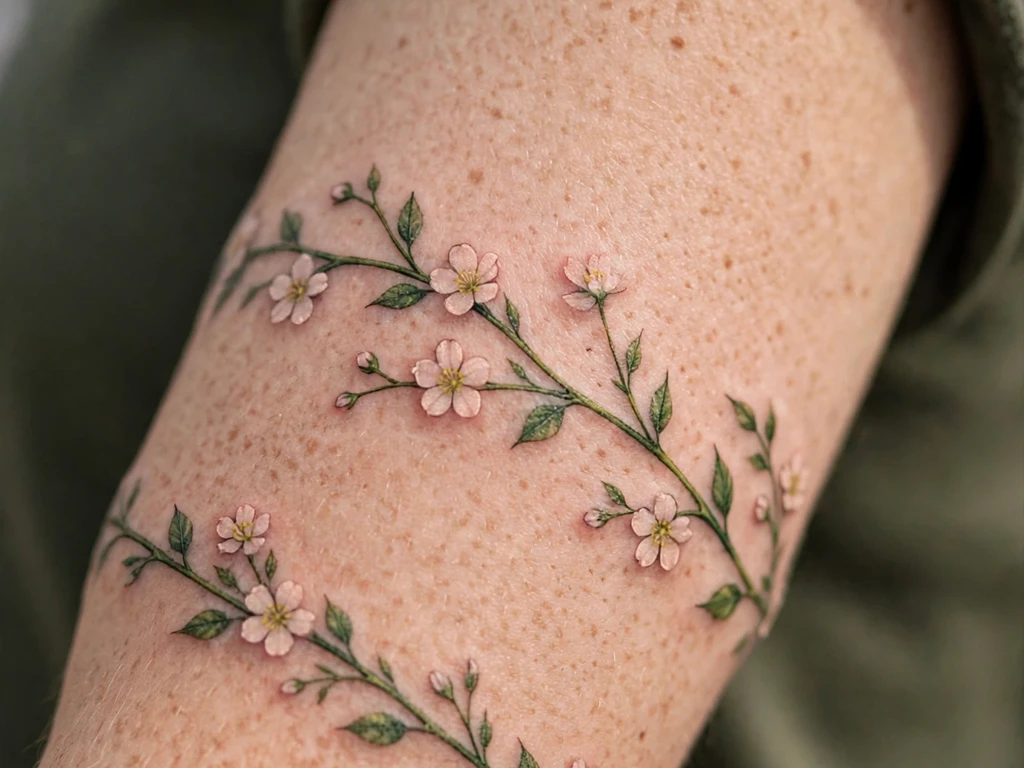
The flowering vine in full dress: a green stem wraps the upper arm carrying small blossoms all along it — five-petalled, simply drawn, in one soft colour — with leaves spaced between the blooms so the wrap reads as a garland the arm is wearing. It is the design that answers readers who arrive wanting flowers and leave wanting a vine: the blossoms are many and small rather than one and grand, and the plant’s travelling stem, not any single bloom, is what the eye follows around the arm.
Its cousin on this site is the blossom branch — the woody spray that carries cherry blossom — and readers comparing the two families will find the branch’s own full treatment in our cherry blossom tattoo ideas guide; the difference is the support: a branch is stiff and carries its blossoms in clusters at its twigs’ ends, while this vine is supple, wraps, and spaces its blooms along a stem that never stops moving. Craft follows the grape cluster rule in flower form: blooms kept identical in size and simple in construction, gaps between them at least a bloom’s width, so the garland’s rhythm survives the softening that turns close-planted blossom into a dotted rash.
Best placement: Upper arm, the stem wrapping once or twice with blooms on the outer face; a forearm version runs straighter and spaces wider.
Best for / know before you book: Soft-coloured blossoms fade at different rates around a wrap — the outer arm’s blooms live in more sun than the inner — so choose a colour you will still love at two different strengths.
22. The Tiny Vine Behind the Ear
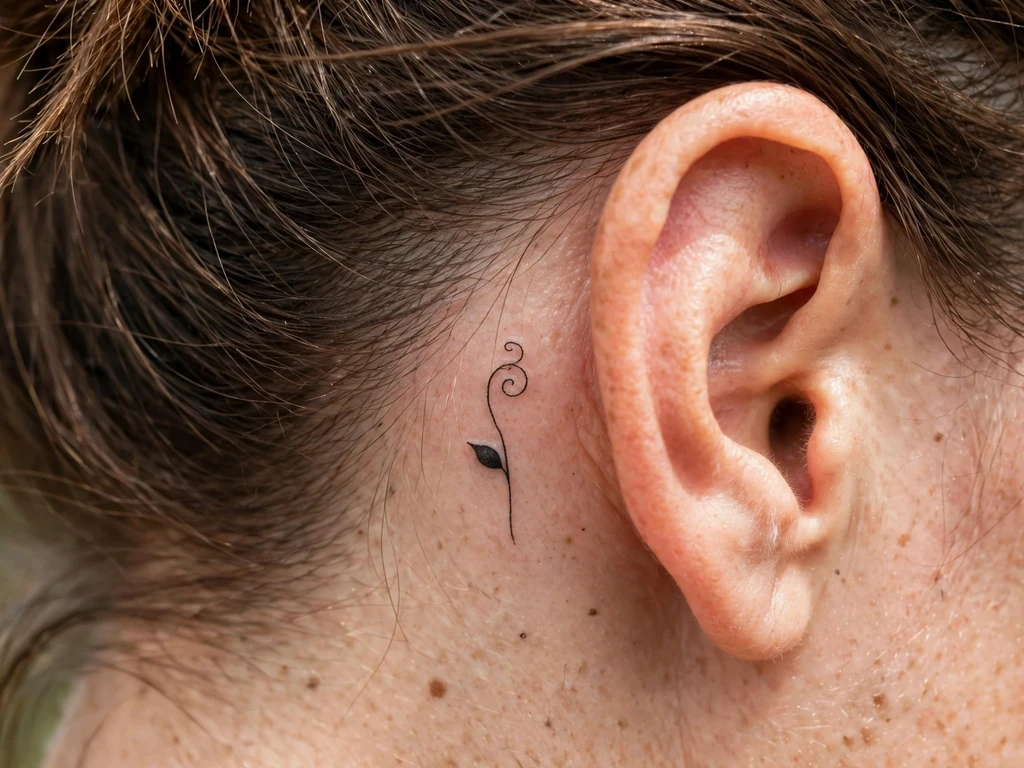
The guide’s one behind-ear design, and it is small in the way this placement demands: not a vine composition shrunk, but a vine fragment chosen for the space — one short stem, one small bold leaf, one tendril curl with its centre open, fitted to the flat of skin beneath the ear’s cartilage fold in perhaps three centimetres. It reads as the start of something: a vine that has just arrived and might, one day, be continued down the neck’s edge — an implication wearers of this design usually intend.
Everything the wrap law says about fine work applies at maximum force, because behind-ear skin is thin, curved and partly hidden, and this design’s whole estate is a few millimetres. The leaf must be a filled silhouette, not an outline — outlines at this size close into blobs — and the curl must be drawn at the loosest spiral the space allows, its open centre the design’s second-largest feature after the leaf itself. Hair, glasses arms and healing ointment are this tattoo’s lifelong neighbours; the wearer who chooses it is choosing a secret garden, and should expect to garden it — a touch-up here is maintenance, not failure.
Best placement: Behind the ear, on the flat beneath the cartilage fold, the stem vertical and the curl opening towards the hairline.
Best for / know before you book: This is a design to approve at true size printed on paper and held in place — at three centimetres, every judgement is about the two millimetres between the leaf and the curl, and no screen shows you those honestly.
23. The Spiral Tendril Vine
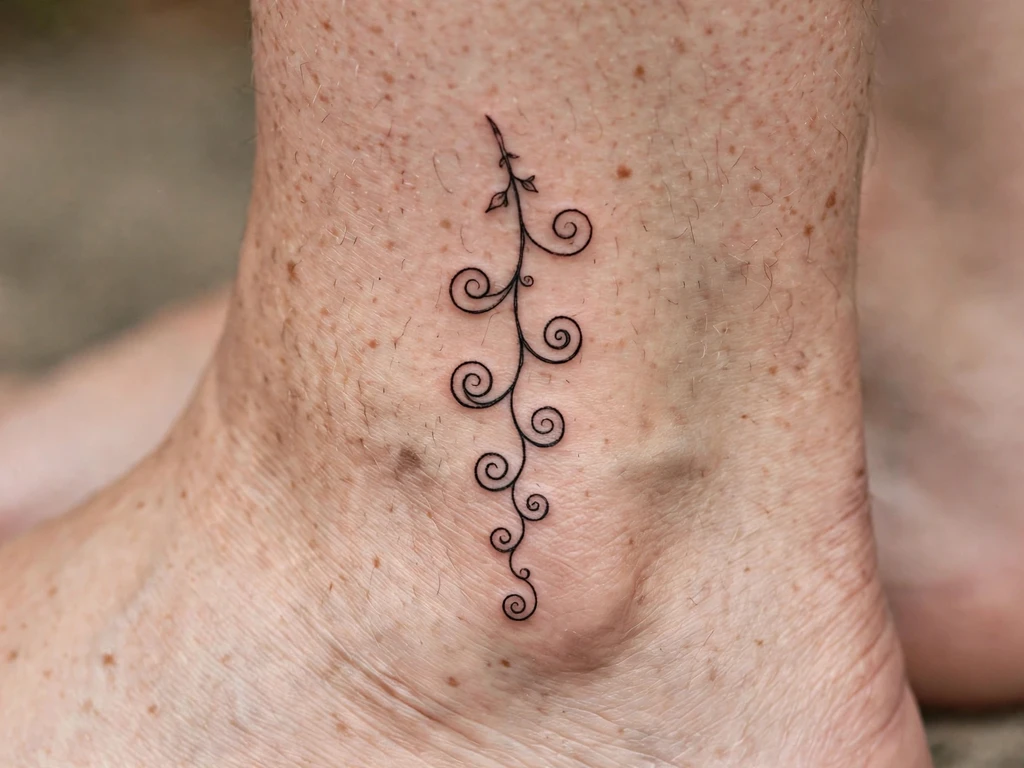
The tendril promoted from punctuation to subject. A short stem runs above the ankle, and along it the vine does nothing but curl: spiral after open spiral, three or four of them in a descending row, each a small green-black vortex with bare skin at its heart, a stem that has decided the journey is less interesting than the turning. Tendrils are how a grapevine holds the world — the Morton Arboretum’s description of the grape’s climbing, tendrils “twisting around a support”, is this design’s portrait — and worn alone they make the most abstract, jewellery-like piece in the guide.
This is rule two’s showcase, so its terms are strict: every spiral’s centre stays open at a width the healed line cannot bridge, the turns of each spiral are separated by clear skin channels, and the spirals themselves are spaced like beads, never overlapping. Ankle skin is thin and the joint flexes the design with every step, which actually suits the subject — a real tendril is a spring, and a spring is meant to move. What does not suit it is smallness: below a certain size the spirals become punctuation marks, so this design starts at a scale where each curl could hold a grain of rice in its open centre.
Best placement: Ankle, the stem running horizontally above the ankle bone with the spirals descending from it; a wrist takes a two-spiral version.
Best for / know before you book: Judge this design on the stencil with a magnifier if you must — the open centres are the tattoo, and a spiral whose centre is drawn closed will heal closed, whatever the fresh ink promises.
24. The Vine Around One Flower
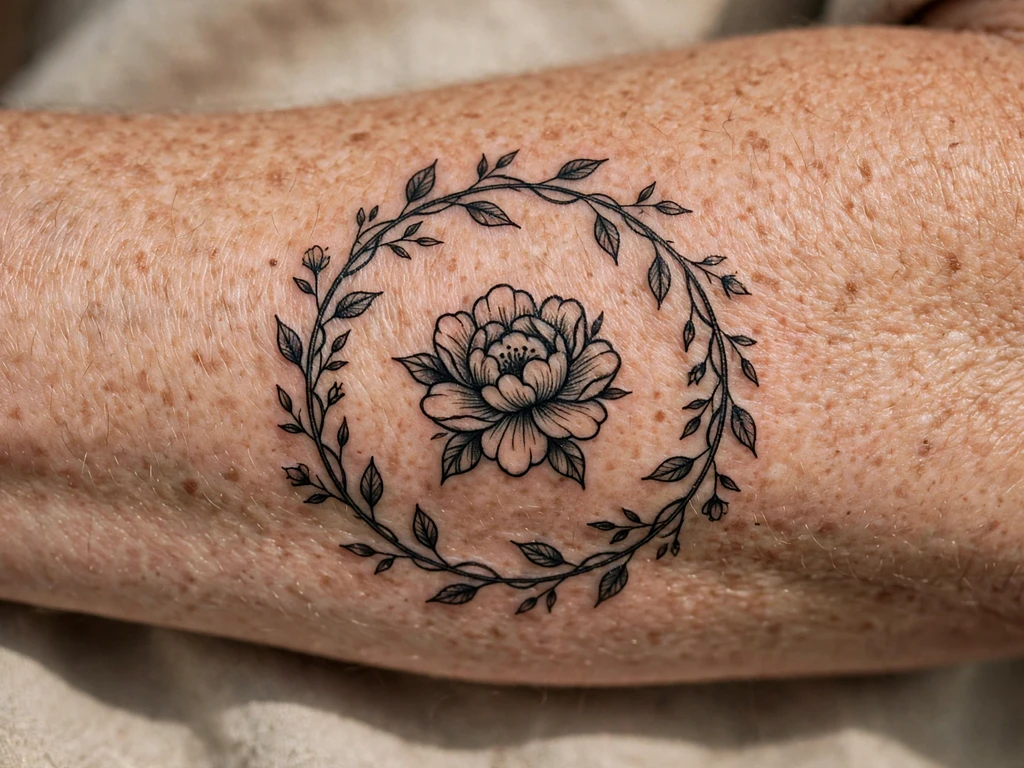
The vine as a frame: a leafy stem climbs the forearm, and at its centre it stops travelling and turns in a full loop around one flower — a single bold bloom, drawn at hero size, which the vine circles the way ivy circles a window. It is the meeting point of this guide and the flower guides: one bloom given the portrait treatment, and a vine given the job of honouring it, the two subjects in the hierarchy the bird design taught — except here the flower is senior, and the vine is the setting it sits in.
The loop is a wreath in miniature, so the wreath’s rules apply inside it: the circle must be a true circle at the forearm’s flattest ground, the join of the loop hidden under a leaf at its least-watched point, and the bloom inside drawn bold enough that the circle reads as its frame rather than its cage. Choose the bloom for silhouette — a flower whose shape survives at a glance — and let the vine’s leaves point outward around the loop, so the composition breathes: flower, ring, leaves, in that order, from the centre out.
Best placement: Forearm, the loop centred on the inner flat with the stem arriving from the wrist and leaving towards the elbow.
Best for / know before you book: Decide which subject you would keep if one had to go — because the honest answer tells you which should be drawn larger, and artists should hear that answer before the stencil, not after.
25. The Full Vine Armband
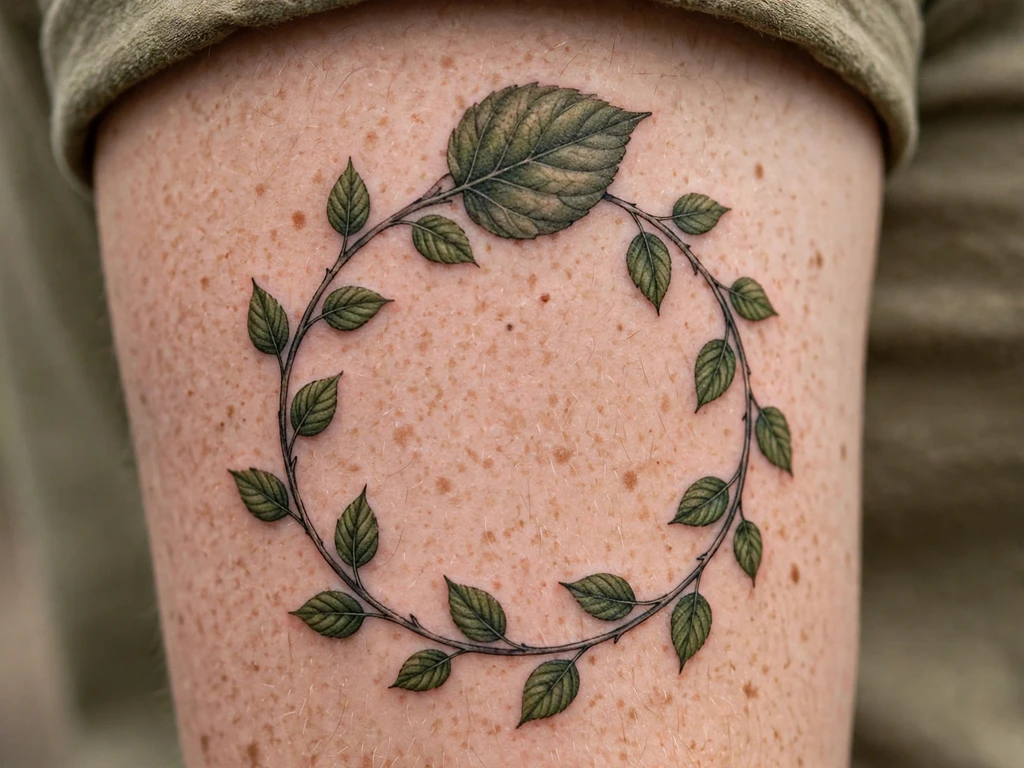
End with the wrap law’s graduation piece: a vine that circles the upper arm completely — a full armband of living stem, leaves alternating around the entire ring, the composition with no beginning and no end because its join has been designed out of existence. The armband is an ancient tattoo form, and the vine is its most natural modern tenant: bands of thorns and geometry state their pattern, but a vine band grows its pattern, and a wearer can extend it — a tendril escaping upward next year, a second ring below — without ever breaking the design’s logic.
Everything in the craft section is tested here at once. The stem is weighted by the arm’s narrowest arc; the leaves keep their rhythm around a circle whose circumference the wearer cannot see all at once, so the tempo must be counted, not eyeballed — an even number of leaves, evenly spaced, verified by walking a fingertip around the stencil. The join hides under the ring’s largest leaf at the inner arm, the least-watched ground. And the rotation check is a revolution check: arm raised, lowered, flexed, relaxed, the ring watched for the pinch at the inner elbow’s approach and the stretch across the outer arm. Pass all of that, and this is the vine in its complete form — the design the whole guide has been building towards.
Best placement: Upper arm, the ring circling at mid-bicep or higher, clear of the elbow’s fold by a hand’s width.
Best for / know before you book: Book the artist whose healed wraps you have seen in the round — photographs of one side of an armband prove nothing about the half this design will be judged by.
Vine Tattoo Placement by Size
| Size | Typical dimensions | Best placements | Good to know |
|---|---|---|---|
| Tiny | 2–4 cm | Behind ear | A fragment, not a composition: one bold leaf, one open curl; filled shapes only, since outlines close into blobs at this size |
| Small | 4–8 cm | Wrist, ankle | Wrist and ankle wraps, fine-line single stems — the join design matters more than the foliage; few leaves, wide gaps |
| Medium | 8–15 cm | Forearms, ankles, collarbone edge | The climbing and trailing vines’ home: full leaf rhythm, one fruit or flower accent, tendrils with open centres |
| Large | 15–25 cm | Upper arms, calves, shoulder blades | Full wraps, armbands, grape clusters, wreaths and hearts — the circle designs finally get the circumference their joins deserve |
| Extra large | 25 cm+ / multi-element | Shoulder-to-arm trails, blade-to-shoulder crossings | Compositions that cross a joint or span two canvases; the stencil check must be done in full motion, over the wearer’s real range |
How to Choose Your Vine Tattoo (and What to Know Before You Book)
Decide the route before the plant. The vine’s first decision is not ivy or grape — it is the journey: climb, wrap, trail, hang or circle. The route chooses the placement, the placement sets the stem weight and the leaf budget, and only then does the species matter. Wearers who fall for a plant first and a route second end up squeezing a wrap’s design onto a climb’s canvas, and the wrap law collects its fee in merged leaves. Sketch the line on your own skin with a pen — the actual route, at actual size — before you look at a single species.
Weight the stem by the far end. This bears repeating because every artist’s instinct fights it: a stem that looks right at the elbow looks heavy at the wrist, and a vine is judged at its narrowest ground. If your design climbs or wraps a tapering limb, ask explicitly what weight the stem will be where the limb is thinnest, and judge the drawing by that answer. Presence on the wide ground comes from leaves and spacing, never from quietly thickening the stem.
Count the leaves, and then remove some. The leaf rhythm is the design, and its tempo is set by arithmetic you can check: leaves evenly spaced, gaps at least a leaf’s width, no clusters drawn at hedgerow density. Take the drawing you love and ask what it looks like with a third of its leaves removed — that sparser version, with its clean silhouettes and honest gaps, is the tattoo that will still be a vine in twenty years. The artist who suggests the removal unprompted is the artist who has watched their own healed vines.
Find the join before the needle does. If your vine wraps or circles anything, walk the stencil’s full circuit with your fingertip and find where it meets itself. A designed join — under a leaf, inside a tendril curl, tapered into the start — disappears; a butted join announces itself forever. This is a thirty-second check that decides a thirty-year detail, and no wrap should be booked until you have failed to find its seam.
Watch it turn. The stencil check for any vine is rotational: forearm turned both ways, arm raised and lowered, foot pointed and flexed, shoulder reached and relaxed. Vines live on limbs that move, and a wrap that only works in one pose was drawn for a photograph. Artists who build wraps will suggest this check themselves; artists who resist it are telling you something about their healed work.
Choose the species by its behaviour, not its photograph. Ivy persists and clings; grapevine climbs by tendrils and fruits; morning glory trails and opens with the day; the bare winter vine endures by structure alone. The meaning sections of this guide are not decoration — the wearers happiest with vine tattoos in year ten are the ones whose plant’s real habits matched the story they wanted to tell, because the design keeps telling it every time it is seen.
Key points to remember:
- A vine tattoo is a route, not a picture: decide the journey — climb, wrap, trail, hang, circle — before the species, and let the placement set the stem weight and leaf budget
- Draw the stem by the far end’s width: a stem that looks right on the wide ground turns into a cable on the narrow ground, and the vine is judged at its thinnest point
- A tendril curl is a join, and joins merge: every spiral must keep its centre open and its turns separated by clear skin, or it heals into a knot
- Leaves need skin between them — leaf, gap, leaf is the rhythm that survives, and fine leaf detail is the first loss in every vine tattoo ever healed
- A wrapping vine’s join must be designed — hidden under a leaf, swallowed by a curl, tapered into the start — and never left as two stem ends butted together
- Check the stencil in rotation, on the standing, moving body: a vine that only reads in one pose was drawn for a photograph, not a person
Frequently Asked Questions
What does a vine tattoo mean?
Most often, growth as a direction rather than an event: the vine is the plant that is always on its way somewhere, climbing by tendril or rootlet to heights its slender stem could never reach alone. Around that centre the readings gather by species. Ivy adds persistence and tenacity — evergreen over ruins, still growing in winter — and, in the Victorian language of flowers, friendship and fidelity, because it clings and does not let go; that floral reading is tradition, handed down rather than proven, and it is worn as tradition. The grapevine adds abundance and harvest, the fruiting vine of celebration. And the wrap itself speaks connection, joining every place it passes. Choose the species whose real behaviour is the sentence you want to wear.
Do vine tattoos age well?
The boldly drawn ones age beautifully and the dense ones age exactly as their tightest spacing deserves. A vine is a long line with repeating elements, and its enemies are all forms of crowding: tendril curls whose centres close, leaf clusters that weld into green-black masses, joins that thicken into lumps. Designs built on the wrap law — a stem weighted for the narrow end, open curls, leaves separated by honest gaps, a hidden join — read clearly for decades, with blackwork and traditional builds lasting longest. Fine-line vines are the honest exception: they are chosen for delicacy and priced in touch-ups, and a wearer who knows that in advance is making a legitimate trade, not a mistake.
How do I stop my vine tattoo from looking like a rope?
With rhythm and air. A vine reads as a rope when its elements are uniform and crowded — leaves of one size at one spacing, packed tight, the stem lost inside them — because the eye stops seeing a plant and starts seeing a cable. The fixes are the craft section’s arithmetic: vary the leaf sizes slightly, keep gaps at least a leaf’s width so bare skin keeps interrupting the line, let tendril curls open beside the stem to break its run, and keep the stem visibly travelling between its leaves rather than buried under them. If a drawing looks like a rope on paper, it will heal into a thicker rope; the time to break its uniformity is at the stencil.
Where is the best placement for a vine tattoo?
Wherever the route you want fits the limb you have. Forearms are the climbing vine’s home — long, fairly flat, watched by their owner daily. Upper arms host the full wraps and armbands, with the circumference a designed join deserves. Calves take the hanging and descending designs, grapes and winter stems, down their long taper. Wrists and ankles take the jewellery wraps, drawn fine and joined invisibly; the collarbone’s outer edge takes the finest trailing line; the shoulder blade takes the trails and shapes that need stillness. The placements this guide refuses are the ones that fight the plant — a vine needs length or circumference, and small flat patches give it neither.
Can a vine tattoo be extended later?
Better than almost any other design — extension is the vine’s native behaviour. A climbing stem can grow another stretch next year, a wrap can send out an escaping tendril, a bare winter vine can be given its leaves in a second session, and a birth flower vine can receive the next bloom in the gap the drawing reserved for it. The condition is planning: extensions stay invisible only when the original drawing left room in the rhythm and kept its stem weight consistent, so tell your artist at the first consultation that the vine may grow, and let them draw the first instalment as the beginning of something rather than the whole of it.
Final Thoughts
A vine tattoo is a small argument that the way you grow matters as much as where you arrive — a line that borrows strength, finds the gaps, goes over the wall and keeps its rhythm for the whole length of the journey. The designs that honour it are drawn the way the plant actually lives: stem honest at the narrow end, curls open at the heart, leaves given their air, and a join so well hidden that the circle seems to have grown that way. Drawn like that, a vine is the longest-lived poetry in the flower family — a tattoo that still looks alive in twenty years because it was designed the way living things are: with room to grow.
So choose your route, pick the plant whose habits tell your story, and book the artist whose healed vines still show separate leaves. Then let it climb.