
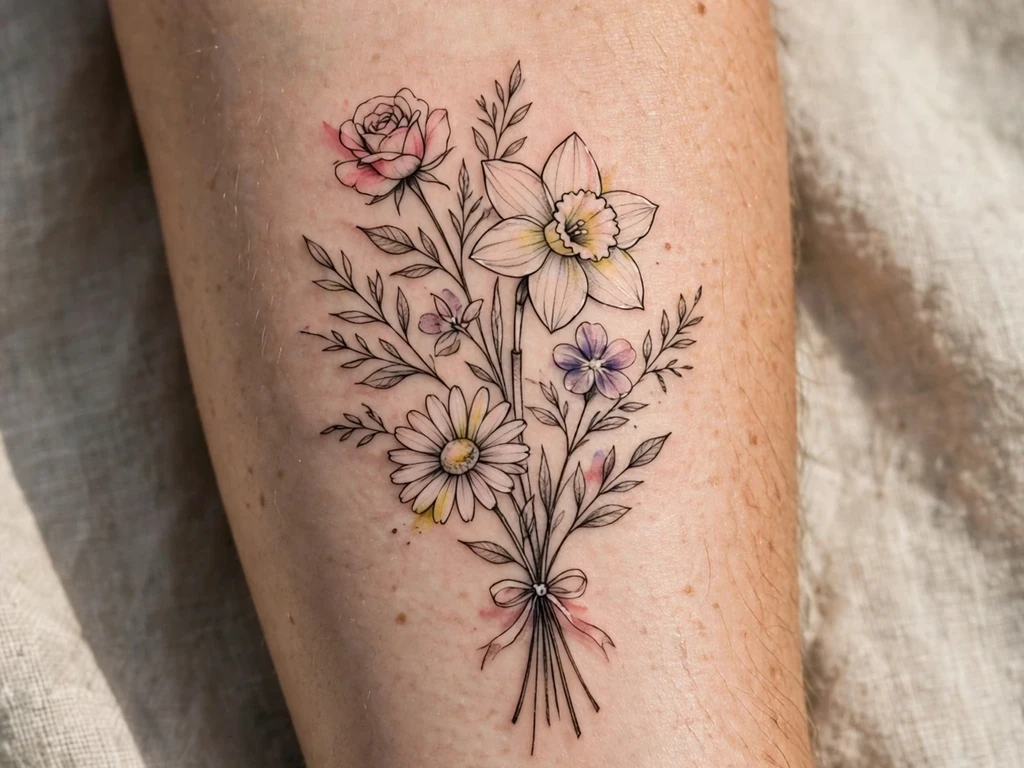
Some tattoos are chosen because they look beautiful. Birth flower tattoos are chosen because they mean something before the needle even touches skin. Every month of the year has its own flower — January’s devoted carnation, June’s romantic rose, October’s blazing marigold — and each one carries a meaning that was assigned to it long before any of us were born. Tattoo your own month’s bloom and you are wearing your story; tattoo your children’s, your partner’s or your mum’s, and you are carrying them with you.
Searches for “what is my birth flower” keep climbing, which tells us plenty of people are doing exactly that homework right now. So this guide starts with the answer — a complete month-by-month table of birth flowers and their meanings — and then walks through 25 birth flower tattoo ideas, from single fine-line stems to full family bouquets. If you are still browsing broadly, our wider flower tattoo design ideas collection is worth a look too; but if you want ink that is personal by design, start here.
What Is My Birth Flower? Meanings and the Language of Flowers
Birth flowers work a lot like birthstones: just as each month has a gem, each month also has a flower (some months traditionally have a second, alternative bloom as well). The meanings attached to them come from floriography — the “language of flowers” — a tradition that flourished in the Victorian era, when people sent carefully chosen bouquets as coded messages because the feelings in them could not be said out loud. A red rose said what a love letter could not; a sprig of lily of the valley wished someone happiness returning.
The tradition is older and wider than Victorian England, though. Japan’s hanakotoba assigned meanings to blooms centuries earlier — it is the same tradition that gives cherry blossom tattoo ideas their themes of renewal and the beauty of fleeting things. The Old Farmer’s Almanac’s guide to birth month flowers remains one of the most-referenced lists of the month-by-month pairings and the meanings behind them.
So — what is your birth flower? Find your month below:
| Month | Birth flower | Traditional meaning |
|---|---|---|
| January | Carnation | Love, fascination and devotion |
| February | Violet | Faithfulness, humility and loyalty |
| March | Daffodil | New beginnings, rebirth and prosperity |
| April | Daisy | Purity, innocence and true love |
| May | Lily of the valley | Sweetness, humility and the return of happiness |
| June | Rose | Love, passion and beauty |
| July | Larkspur | Positivity, lightness and an open heart |
| August | Gladiolus | Strength of character, integrity and remembrance |
| September | Aster | Love, wisdom and faith |
| October | Marigold | Creativity, passion and warmth |
| November | Chrysanthemum | Joy, friendship and longevity |
| December | Narcissus | Hope, renewal and good wishes |
A few things to know before you choose from the list:
- You are not limited to your own month. Plenty of people tattoo a parent’s, partner’s or child’s flower instead — or combine several (designs 13 and 17 below are built for exactly that).
- Meanings vary a little between sources. Floriography was never one fixed dictionary, so treat the table as the most widely used version, not a legal document.
- Colour can shift the message. In the old language, a yellow rose meant friendship while a red one meant romantic love — a detail worth discussing with your artist if meaning matters to you.
Birth Flower Tattoo Ideas at a Glance
| # | Design | Style notes | Best placement |
|---|---|---|---|
| 1 | January Carnation Stem | Ruffled single carnation, fine line | Forearm |
| 2 | February Violet Cluster | Small bunch of violets with leaves | Shoulder |
| 3 | March Daffodil Trumpet | Daffodil with bold central trumpet | Shoulder blade |
| 4 | April Daisy Chain | Linked daisies wrapping the arm | Forearm |
| 5 | May Lily of the Valley Sprig | Arching stem of tiny bells | Collarbone |
| 6 | June Rose with Stem | Classic rose, stem and two leaves | Forearm |
| 7 | July Larkspur Spire | Tall vertical spike of blooms | Upper arm |
| 8 | August Gladiolus Sword | Sword-like stalk of stacked flowers | Calf |
| 9 | September Aster Burst | Cluster of star-shaped asters | Shoulder cap |
| 10 | October Marigold Bloom | Layered marigold in warm tones | Upper arm |
| 11 | November Chrysanthemum | Many-petalled statement bloom | Thigh |
| 12 | December Narcissus Cluster | Paperwhite narcissus, fine line | Inner bicep |
| 13 | Family Birth Flower Bouquet | Several months’ stems tied together | Forearm |
| 14 | Birth Flower with Birthstone | Stem with small gem accent | Sternum |
| 15 | Fine-Line Single Stem | One hairline stem, ultra minimal | Inner wrist |
| 16 | Birth Flower with Name Script | Stem flowing into a name or date | Inner forearm |
| 17 | Two-Month Half-and-Half | Two people’s flowers, shared stem | Upper arm |
| 18 | Birth Flower Wreath | Circular wreath of bloom and greenery | Between shoulder blades |
| 19 | Ankle Sprig | Tiny two-bloom sprig | Outer ankle |
| 20 | Spine Stem Line | Long stem running down the back | Spine |
| 21 | Watercolour Birth Flower | Bloom with soft colour wash | Shoulder blade |
| 22 | Birth Flower with Butterfly | Butterfly resting on the bloom | Front shoulder |
| 23 | Minimalist Outline Trio | Three tiny outline blooms in a row | Inner forearm |
| 24 | Collarbone Sprig Pair | Mirrored sprigs along both collarbones | Collarbones |
| 25 | Blackwork Birth Flower | Bold blackwork with dot shading | Upper arm |
25 Birth Flower Tattoo Ideas
1. January Carnation Stem
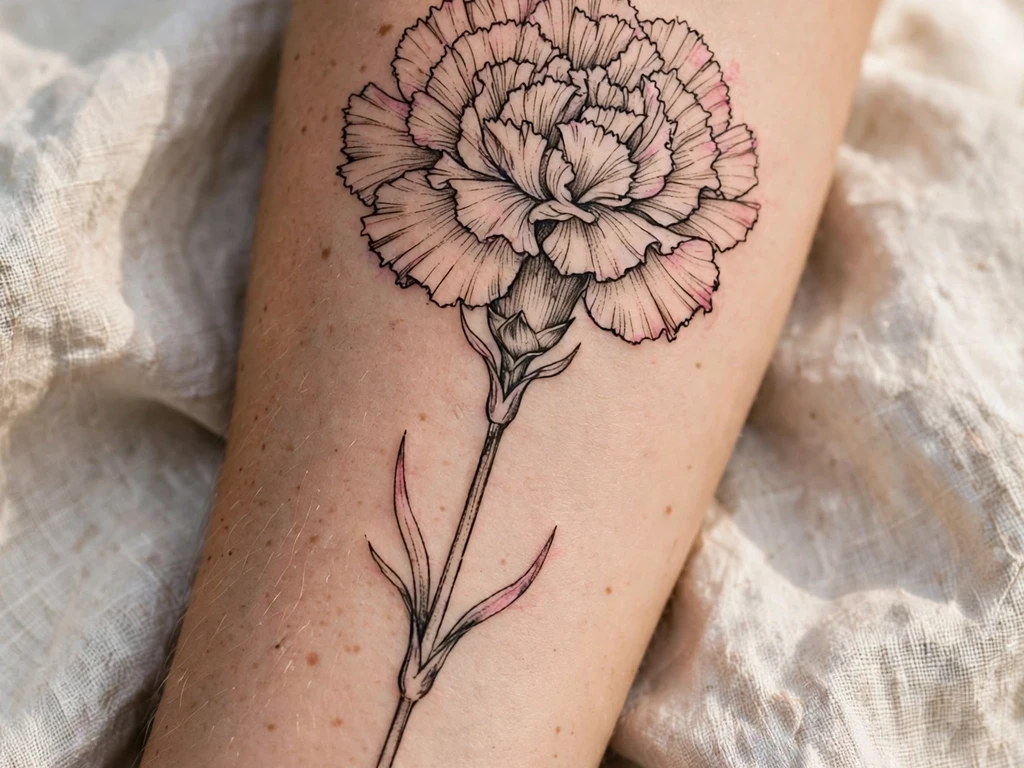
The carnation’s ruffled, layered petals make it one of the most satisfying flowers to draw in fine line — every frill is a chance for delicate detail. A single stem on the forearm keeps it elegant and legible, and January’s meaning (devotion) suits a tattoo perfectly: this is a bloom about sticking by someone. It works beautifully in black and grey, or with the palest pink wash if you want a nod to the real flower.
Best placement: Forearm, bloom at the top and stem running towards the wrist.
Best for / know before you book: A devoted, understated first floral. Those ruffled petal edges need a minimum size to stay readable — go too small and the frills merge into each other as the ink settles.
2. February Violet Cluster
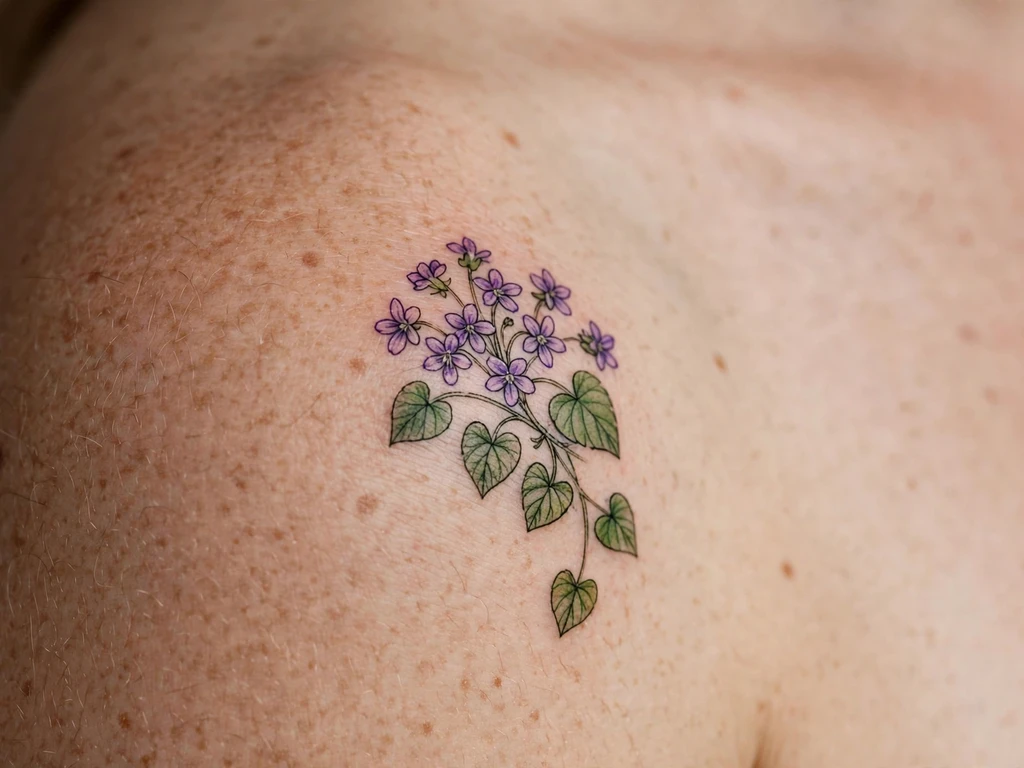
Violets are small, low-growing and quietly lovely — the opposite of a show-off flower, which is exactly their charm. A little cluster of three to five blooms tucked among heart-shaped leaves makes a sweet, compact tattoo, and February’s themes of faithfulness and loyalty give it real emotional weight. The natural purple ink is tempting, but it holds up in black and grey too if colour is not your thing.
Best placement: Shoulder or just below the collarbone, where a small cluster sits naturally.
Best for / know before you book: Perfect for a discreet, meaningful piece. Purple and violet inks can fade unevenly on some skin tones, so ask your artist about healed colour work before committing to full colour.
3. March Daffodil Trumpet
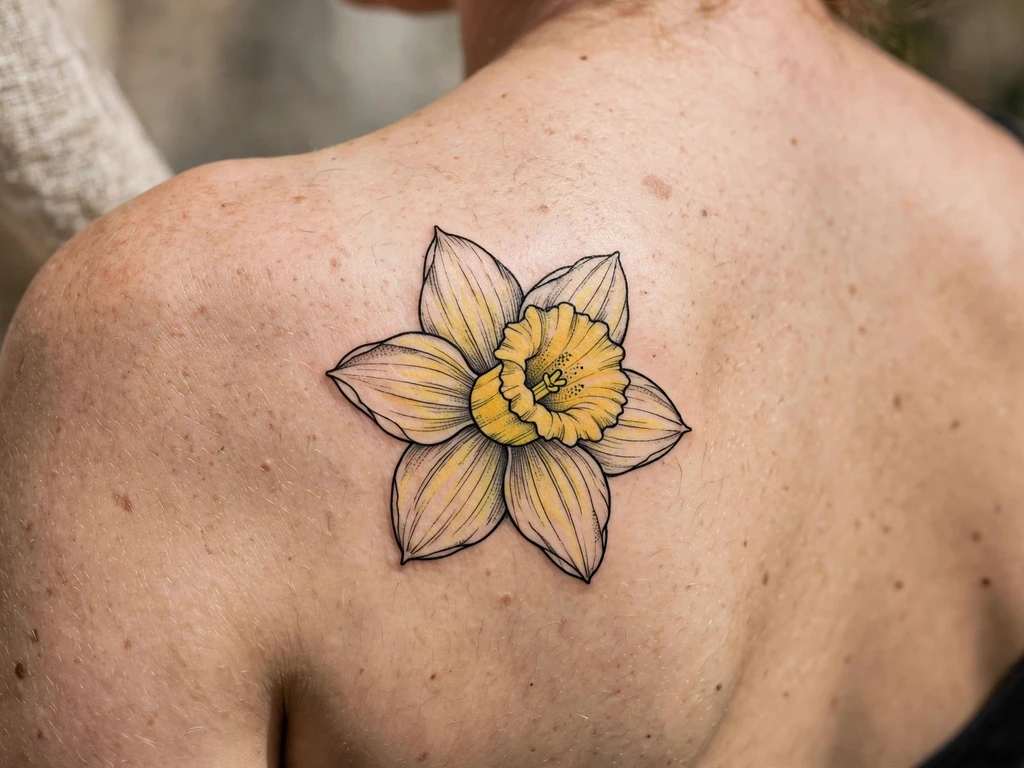
The daffodil is spring announcing itself, and its meaning — new beginnings — makes it a favourite for tattoos marking a fresh chapter: a new baby, a recovery, a life restarted. The design is pleasingly architectural, with six flat petals around that unmistakable central trumpet, which gives your artist a strong focal point to build around. Yellow is the classic colour, though a black-and-grey version with clever shading reads just as clearly.
Best placement: Shoulder blade, where the bloom has room to open fully.
Best for / know before you book: Ideal for marking a turning point. If you choose yellow ink, know that pale yellows are among the fastest-fading colours — a fine-line outline underneath keeps the design defined even as the colour softens.
4. April Daisy Chain
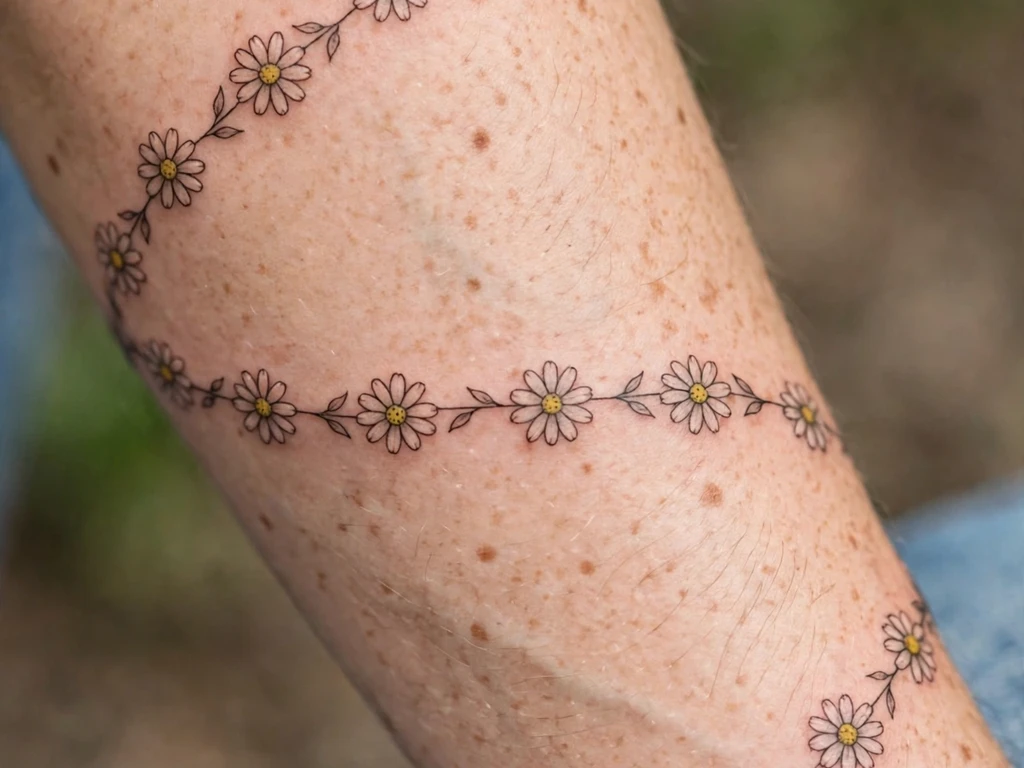
Who did not make daisy chains as a kid? This design links daisy after daisy into a flowing chain that wraps the forearm — or circles a wrist or ankle like a bracelet you never take off. April’s meanings of purity and innocence fit the nostalgia perfectly. Because the motif repeats, the chain can be exactly as long as you like, and adding one more daisy later (for a child, say) is genuinely easy.
Best placement: Wrapping the forearm, or as a band around the wrist or ankle.
Best for / know before you book: Lovely for playful, nostalgic personalities. Repetition exposes inconsistency, so choose an artist whose linework stays even across a long piece — and decide the daisy size carefully, because tiny white petals need their outlines to survive.
5. May Lily of the Valley Sprig
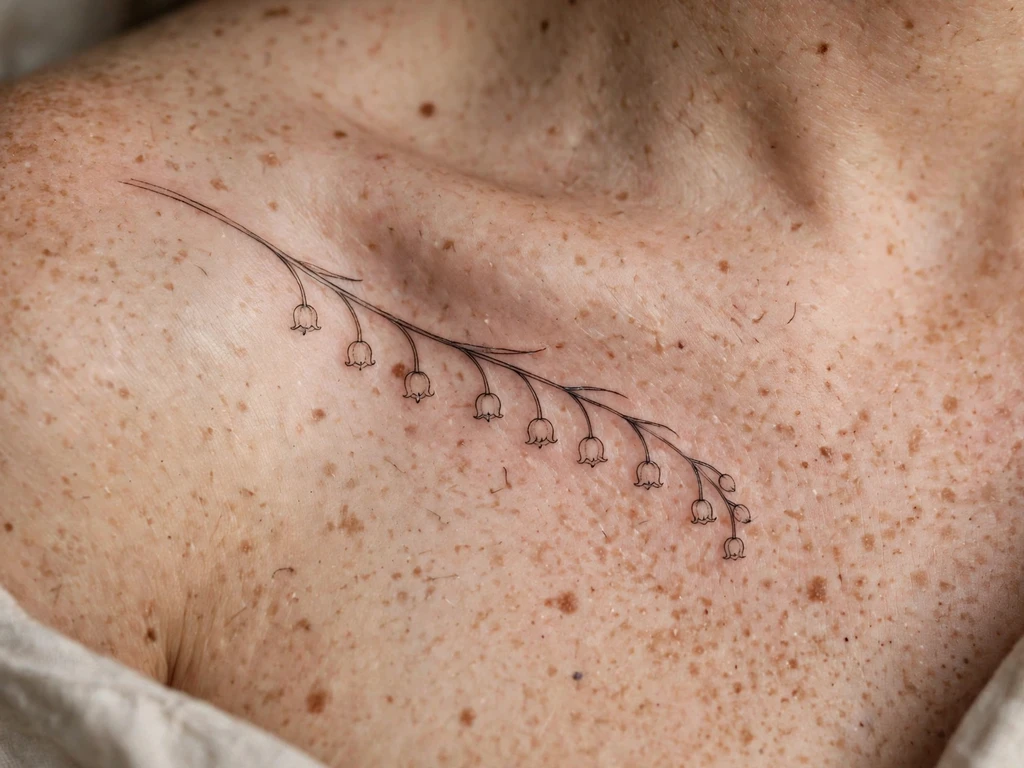
Lily of the valley might be the most tattooable flower on this list: a gracefully arching stem hung with tiny white bells, like a string of miniature lanterns. Its meaning — the return of happiness — is one of the loveliest in the whole language of flowers, and the design’s natural curve follows a collarbone or the line of a sternum beautifully. It is delicate by nature, so this is a design for people who love fine, quiet detail.
Best placement: Along the collarbone, the sprig arching with the bone.
Best for / know before you book: A romantic, gentle piece. Those bells are small — keep each one clearly separated and slightly larger than feels necessary, because closely packed tiny shapes are the first to blur with age.
6. June Rose with Stem
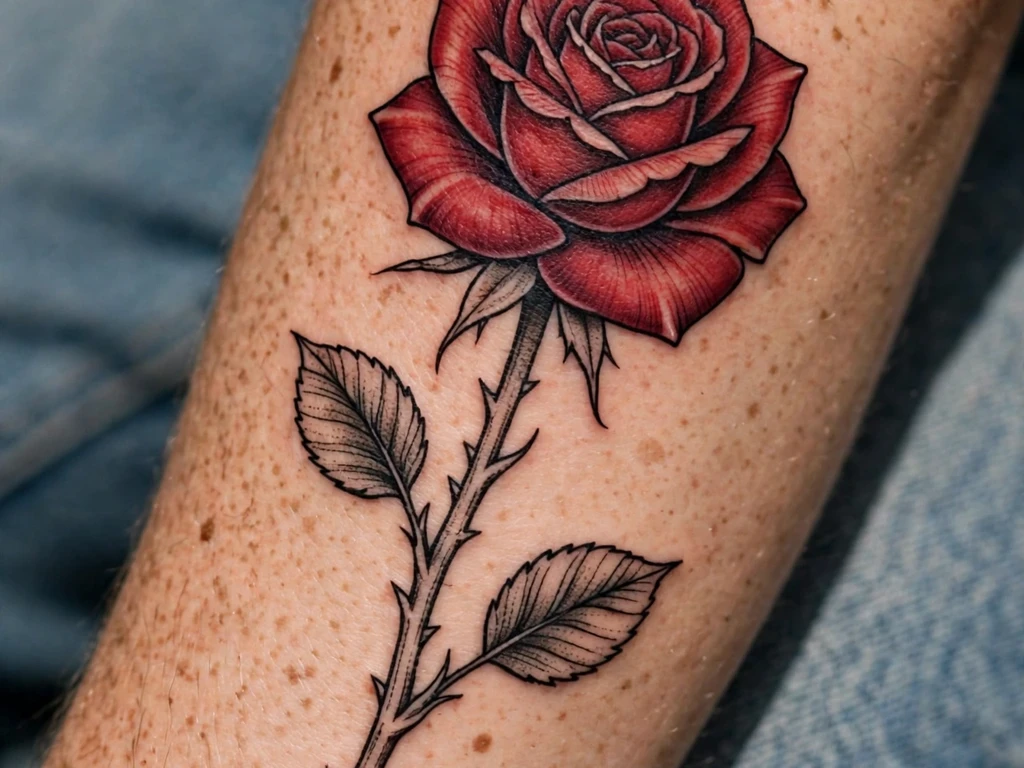
June gets the most famous flower of all, and a rose with its full stem — thorns and all — is a stronger tattoo than a floating rose head. The stem gives the design direction and length, the thorns add honesty (love is beautiful and it can hurt you), and the whole thing sits naturally along a forearm. Red is traditional; black and grey is timeless; a yellow rose shifts the meaning towards friendship if that is your story.
Best placement: Forearm, bloom uppermost and stem tapering down.
Best for / know before you book: The classic choice, endlessly customisable. Roses are the most-copied tattoo in history, so bring your artist references of the drawing style you like — fine line, traditional and neo-traditional roses are very different tattoos.
7. July Larkspur Spire
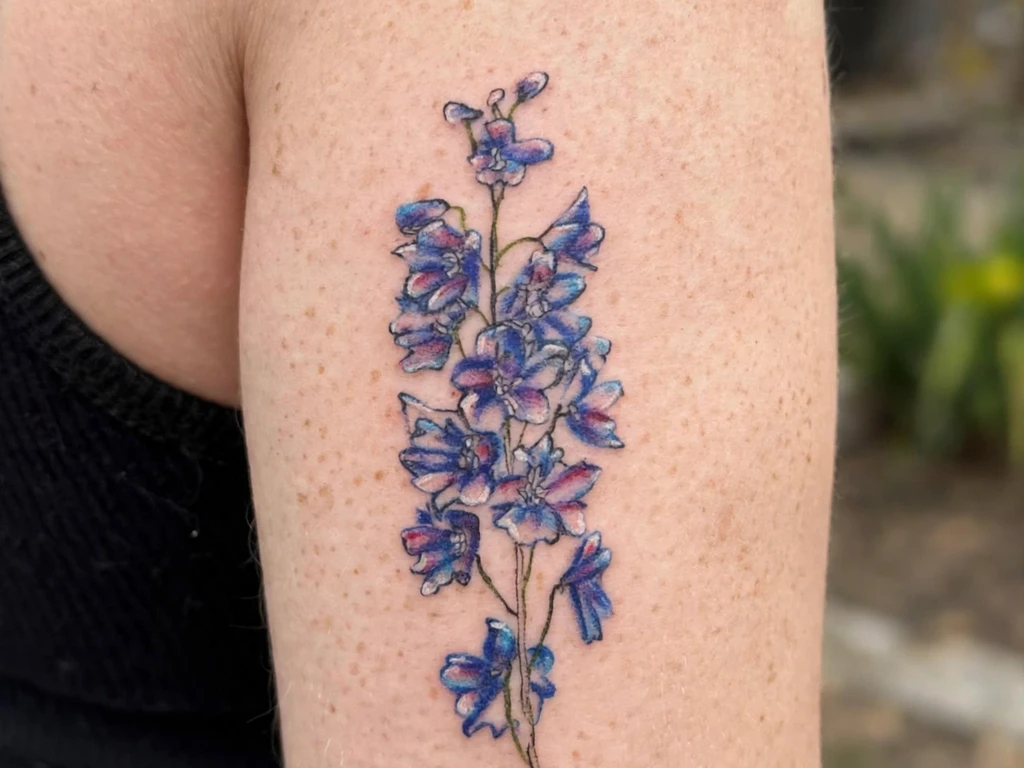
Larkspur grows as a tall spire of clustered blooms, and that vertical shape is a gift for tattoo placement — it runs naturally down an upper arm, along a spine or up a calf. The flowers open progressively up the stem, largest at the bottom, which gives the design a built-in sense of rising energy that suits July’s meaning of positivity and lightness. Blues and purples are its natural colours, though it translates well to black line work.
Best placement: Upper arm, the spire running vertically from shoulder towards elbow.
Best for / know before you book: Great if you want a larger floral that still feels airy. The many small blooms up the spike need spacing discipline — ask your artist to simplify the top cluster rather than cramming in every bud.
8. August Gladiolus Sword
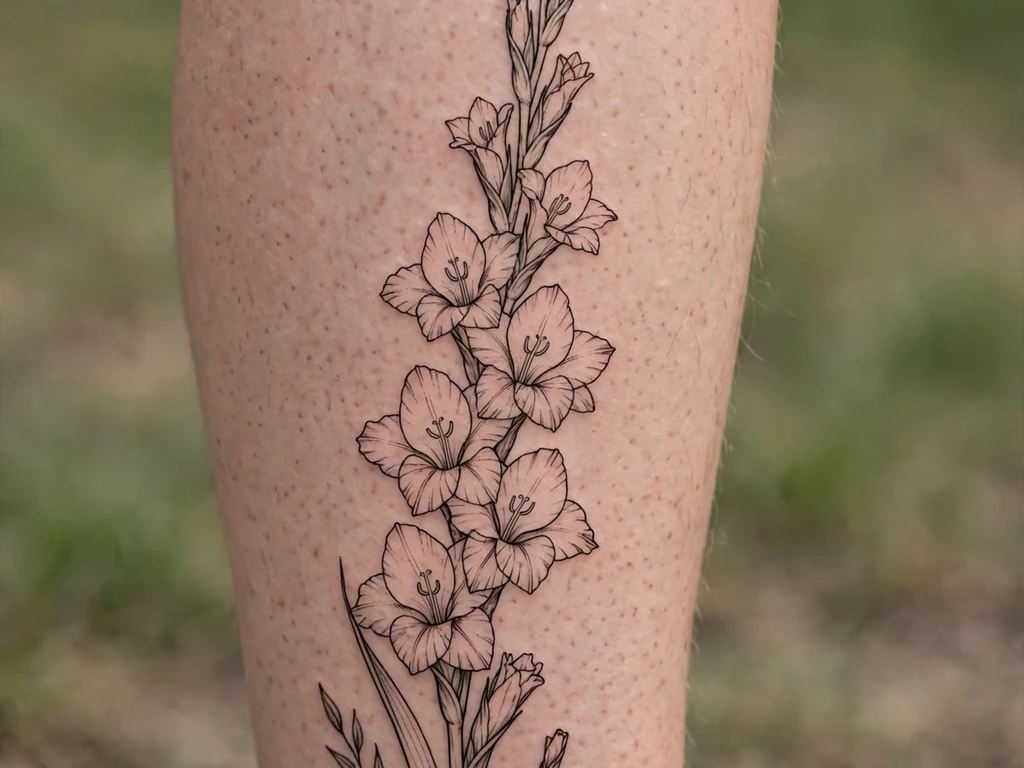
The gladiolus is named for the sword — gladius in Latin — and it is the gladiator’s flower, which is why its meaning is strength of character. As a tattoo, one tall stalk with flowers stacked up its length makes a striking vertical statement down a calf or along the side of the torso. It is a birth flower with backbone, and a popular pick for people who see their birth month flower as armour rather than ornament.
Best placement: Calf, the stalk running from below the knee towards the ankle.
Best for / know before you book: For anyone who wants their floral with some steel in it. Vertical designs on the calf move and flex a lot; your artist may suggest slightly bolder lines than a forearm piece would need.
9. September Aster Burst
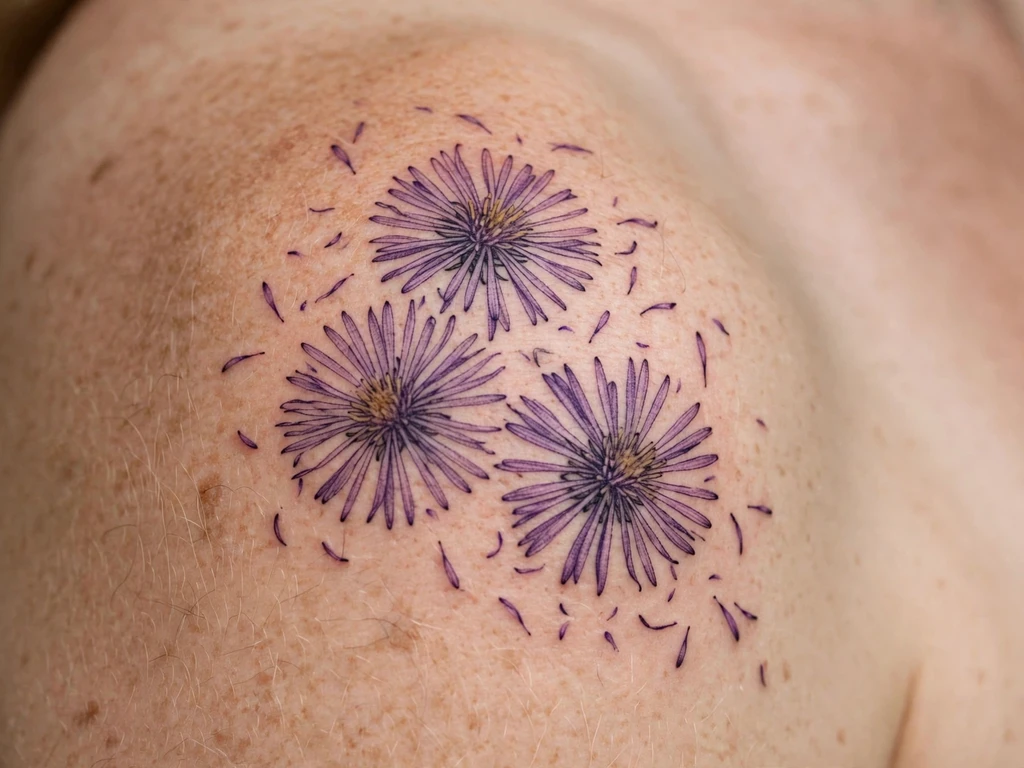
Asters are little stars — the name literally comes from the Greek word for star — with a spray of thin petals around a bright centre. A cluster of three asters at different sizes makes a lively, scattered composition that suits the shoulder cap, where it can spill naturally in several directions. September’s meanings of wisdom and faith add a thoughtful layer beneath the cheerfulness.
Best placement: Shoulder cap, blooms scattering down towards the upper arm.
Best for / know before you book: A joyful, informal piece. Aster petals are numerous and thin — at small sizes they can crowd, so let the blooms be a touch bigger and fewer rather than many and tiny.
10. October Marigold Bloom
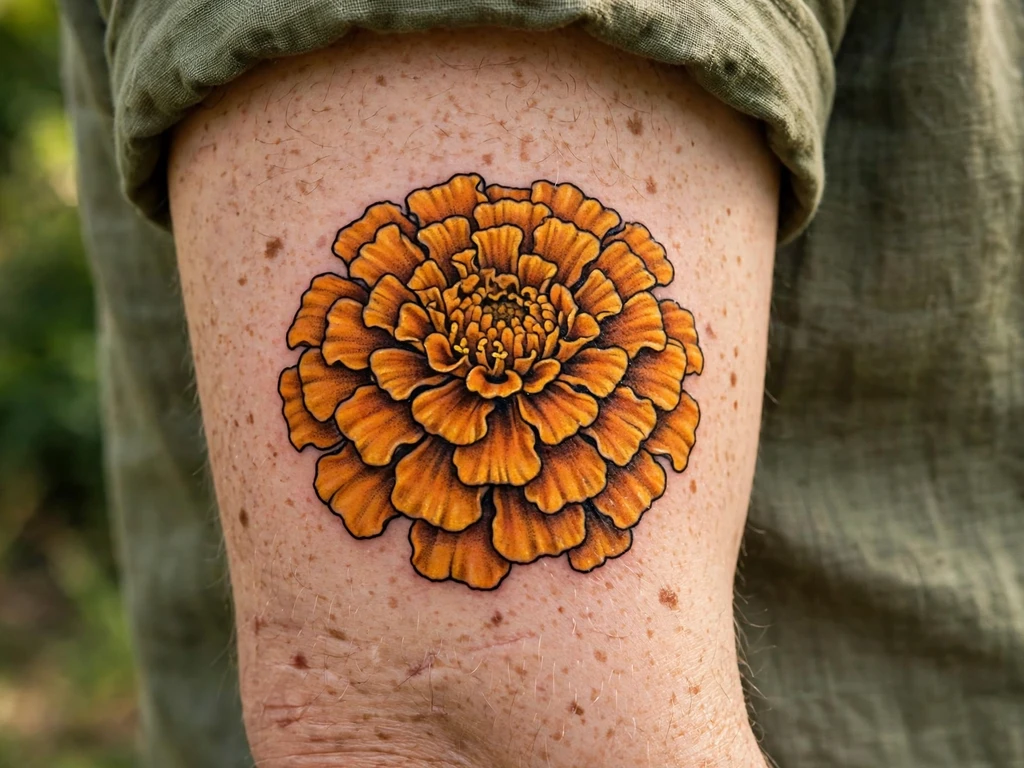
The marigold is the extrovert of the birth flowers: dense, ruffled, and unapologetically orange. It carries real cultural weight too — marigolds are the flower of Día de los Muertos ofrendas, guiding spirits with their colour and scent — and October’s meanings of creativity and passion match its energy. As a tattoo it loves bold colour and a bit of size, so the layered petals can be shaded properly.
Best placement: Upper arm, with room for the bloom to be the full centrepiece.
Best for / know before you book: For bold, warm personalities — and anyone honouring Mexican heritage. Oranges and golds vary in how they heal on different skin tones; a test of healed work from your artist’s portfolio is worth more than any fresh photo here.
11. November Chrysanthemum
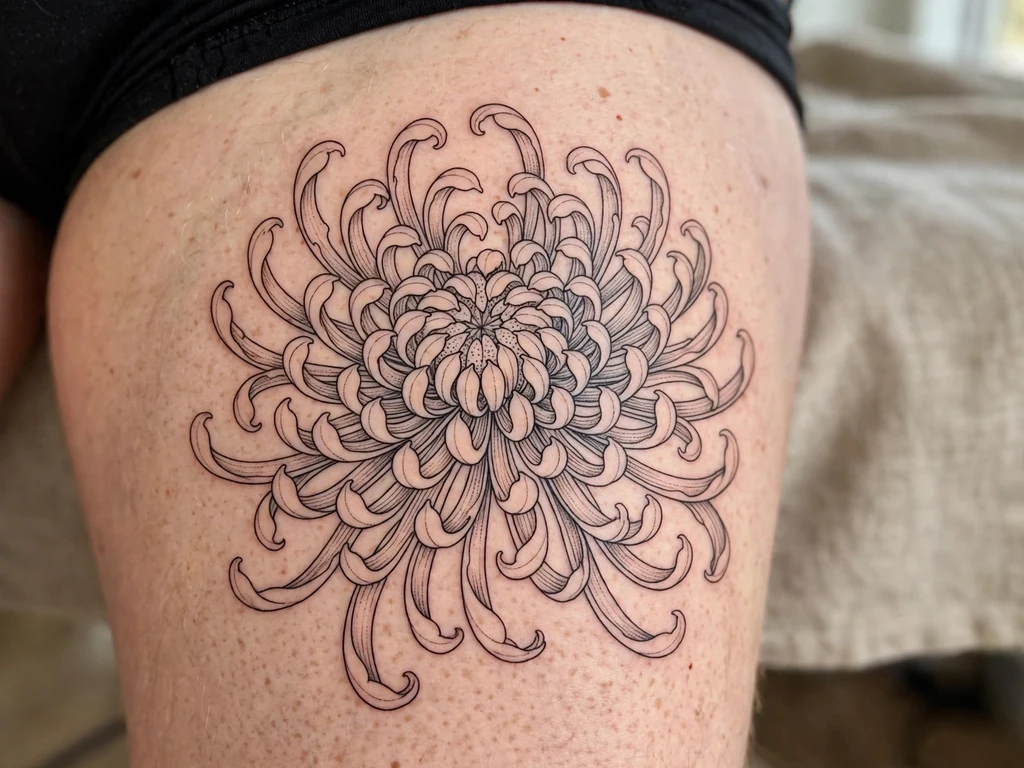
If you want a birth flower that can carry a big piece, the chrysanthemum is your bloom: dozens of long, curling petals radiating from the centre, endlessly detailed. In Japan it is the imperial flower, a symbol of longevity and rejuvenation, and November’s meanings of joy and friendship keep it warm rather than solemn. It shines at larger sizes — thigh, back or upper arm — where every petal has room to curl.
Best placement: Front or outer thigh, where the bloom can be drawn large.
Best for / know before you book: The detail-lover’s choice. Chrysanthemums are line-heavy; resist shrinking one onto a wrist. The design earns its impact from size, and petals that are too small will knit together over the years.
12. December Narcissus Cluster
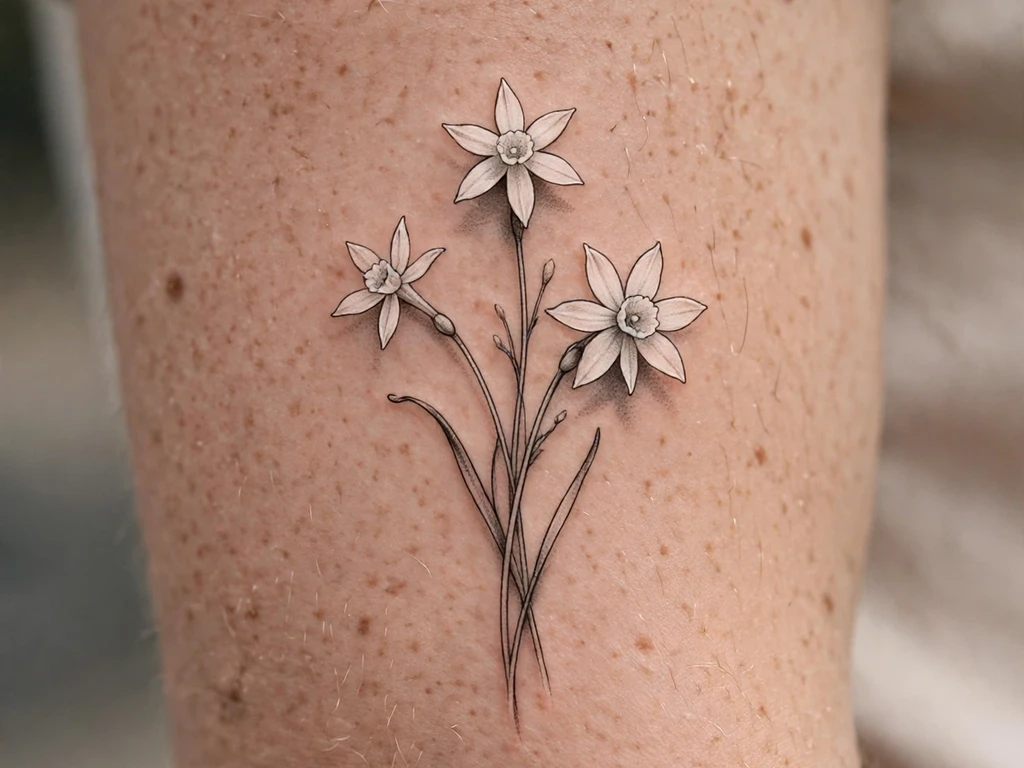
December’s flower is usually drawn as paperwhite narcissus: a cluster of small, starry white blooms on slim stems, flowering in the middle of winter — which is why its meanings centre on hope and renewal. A cluster of three blooms on the inner bicep makes an intimate, elegant tattoo that feels like a secret garden. Fine line suits it beautifully, with the faintest grey shading to suggest the white petals.
Best placement: Inner bicep, the cluster sitting in the flat of the arm.
Best for / know before you book: A quiet, hopeful piece for winter babies. White petals cannot be tattooed with white ink alone and expected to last — your artist will draw them with line and negative space, so pick someone confident with that trick.
13. Family Birth Flower Bouquet
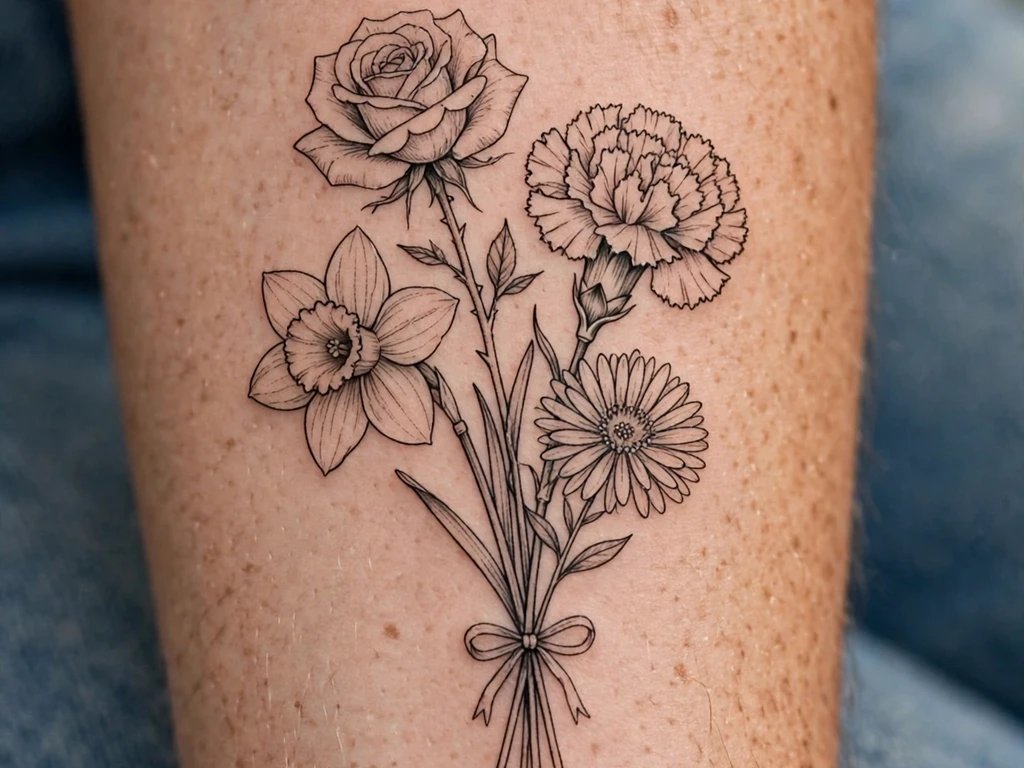
This is the design that turns a birth flower tattoo into a family portrait: one stem for each person — your rose, your partner’s daffodil, the children’s carnation and aster — gathered and tied with a ribbon or a simple bow at the stems. It is probably the most requested variation in studios right now, because it grows with the family; a new baby simply means a new stem at your next session. Forearm and thigh give the bouquet the length it needs.
Best placement: Forearm or front thigh, bouquet vertical with the bow at the bottom.
Best for / know before you book: The ultimate personal piece. Plan the composition so stems can be added later without crowding — tell your artist up front that the family may not be finished growing, and they will leave breathing room by design.
14. Birth Flower with Birthstone Accent
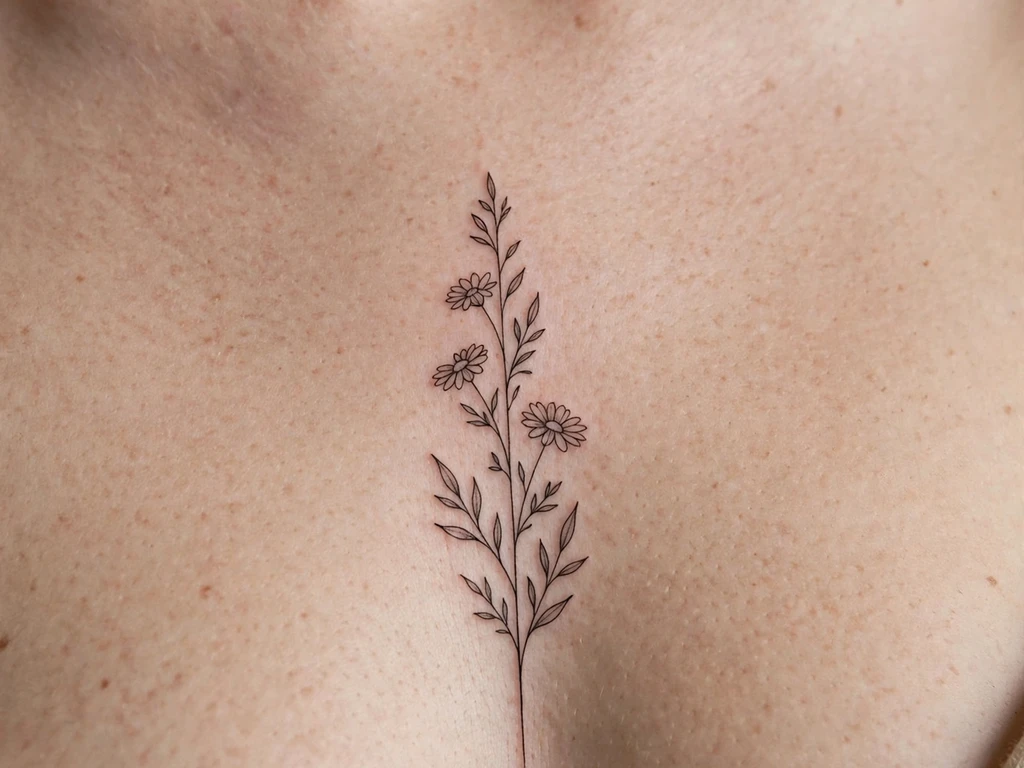
Two birth symbols in one tattoo: your birth flower drawn in fine black line, with your birthstone as a single small point of colour — a garnet-red dot for January, an amethyst violet for February, a sapphire blue for September. The gem usually sits at the base of the stem, in the centre of the bloom, or hanging from it like a drop. It is a subtle way to wear colour if a full-colour tattoo feels like too much.
Best placement: Sternum, with the gem at the centre of the composition.
Best for / know before you book: For detail people who love layered meaning. Gem dots are small, so choose a saturated colour — pale stones like opal or pearl read poorly as ink and usually become a soft grey-blue dot instead.
15. Fine-Line Single Stem
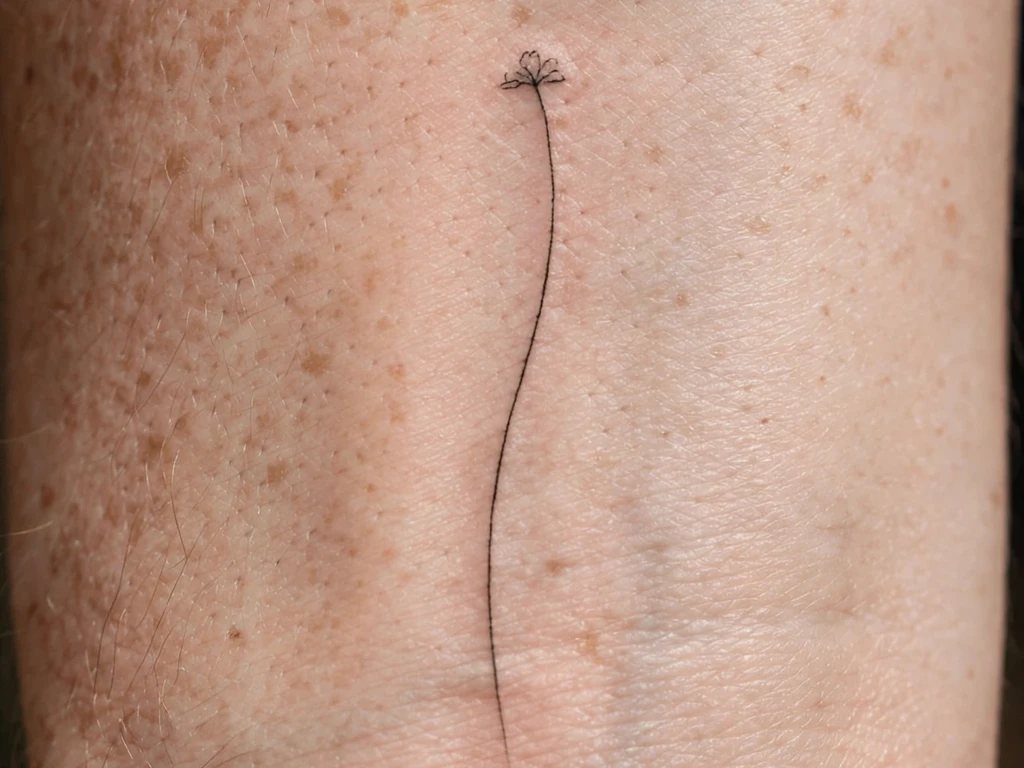
The minimalist’s answer: one stem, one bloom, drawn in a single weight of hairline black ink with no shading at all. On the inner wrist it reads like something written rather than drawn — discreet enough for conservative workplaces, personal enough to matter every time you see it. Any month’s flower can be simplified this way, though naturally slender blooms like lily of the valley and larkspur suit it best. If you are comparing small placements, browsing wrist tattoo ideas will show how much variety fits in a few centimetres of skin.
Best placement: Inner wrist, the stem running along the wrist’s length.
Best for / know before you book: The gentlest entry into floral tattoos. Single-weight lines are the least forgiving style there is — there is no shading to hide behind — so judge artists on healed fine-line photos only.
16. Birth Flower with Name Script
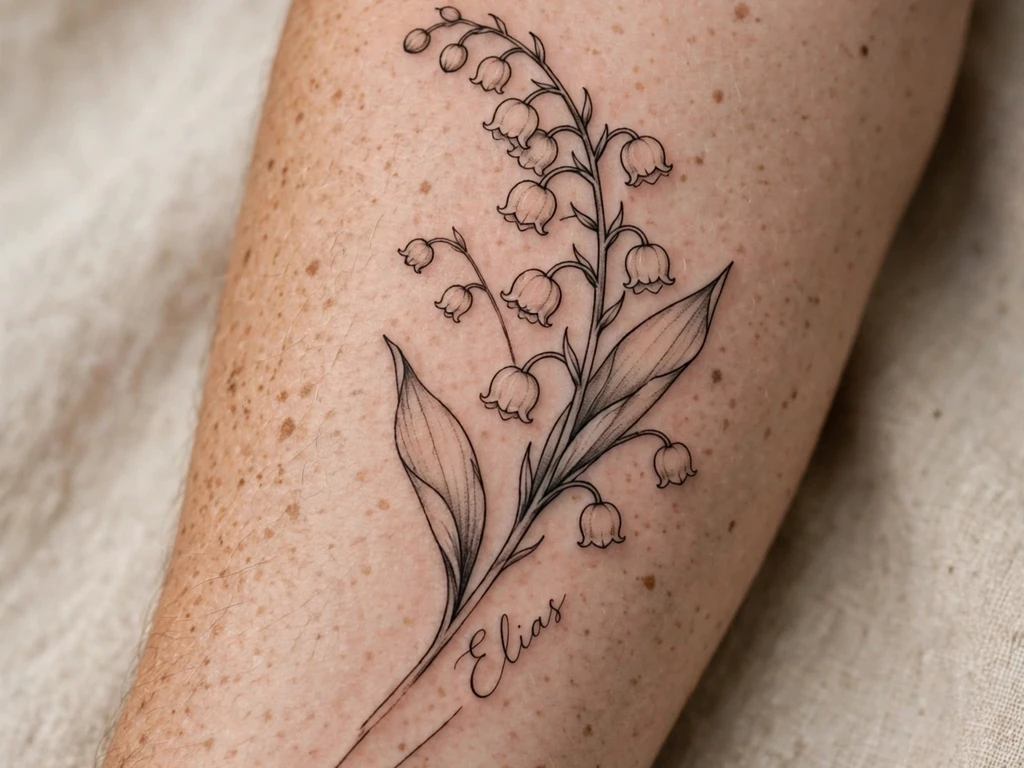
Here, the flower’s stem does double duty: it grows upwards into the bloom, and along its curve your artist letters a name or a date in fine script — most often a child’s, matching the flower to the child’s birth month. The lettering follows the stem’s natural bend, so the words feel grown rather than pasted on. It is one of the most emotional tattoos a parent can choose, and one of the most popular new-parent pieces in studios.
Best placement: Inner forearm, where both flower and script stay readable.
Best for / know before you book: Check your spelling, then check it again, then have a second person check it. Also agree the script size generously — lettering is the fastest-ageing element in any tattoo, and small script is where blurry regrets come from.
17. Two-Month Half-and-Half Design
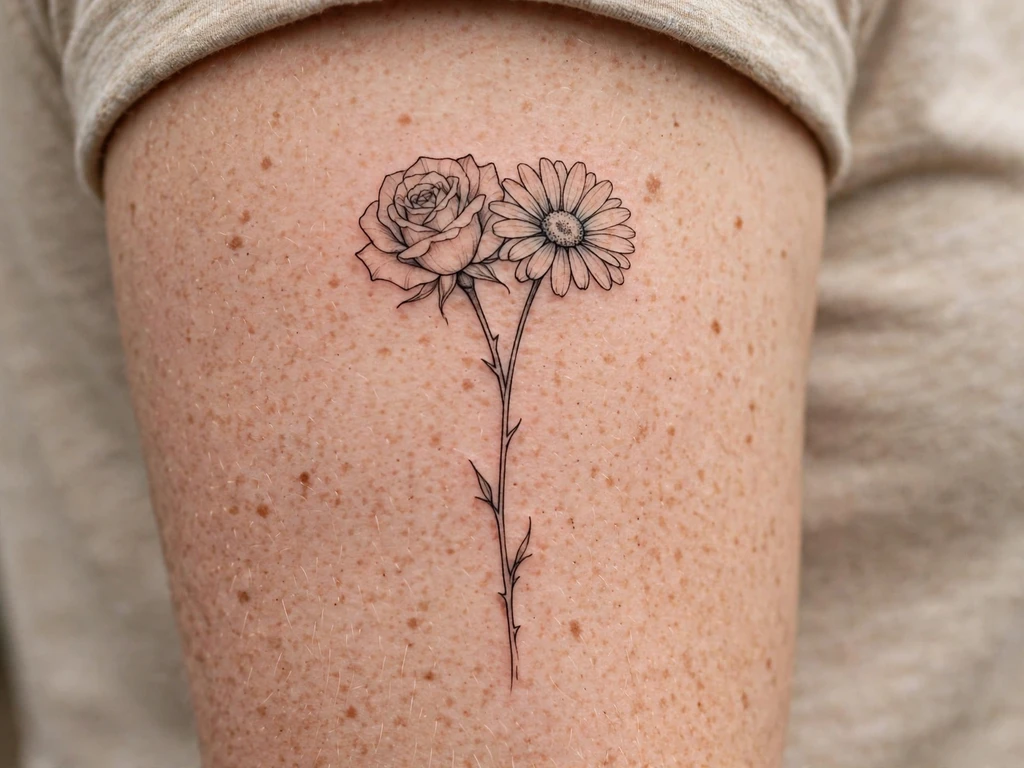
Made for two people in one design: your flower and your partner’s flower drawn as two blooms sharing a single stem — or split half-and-half down the middle, one bloom’s petals blending into the other’s. It is a matching tattoo without being identical, and it works just as well for siblings, best friends or a parent and child as for couples. The symbolism writes itself: different flowers, same roots.
Best placement: Upper arm, with the two blooms side by side at the top of the stem.
Best for / know before you book: Choose two flowers of similar visual weight so one does not swallow the other — a rose beside a violet needs scaling care. Bring both birth months to the consultation and let the artist sketch the balance before booking the full session.
18. Birth Flower Wreath
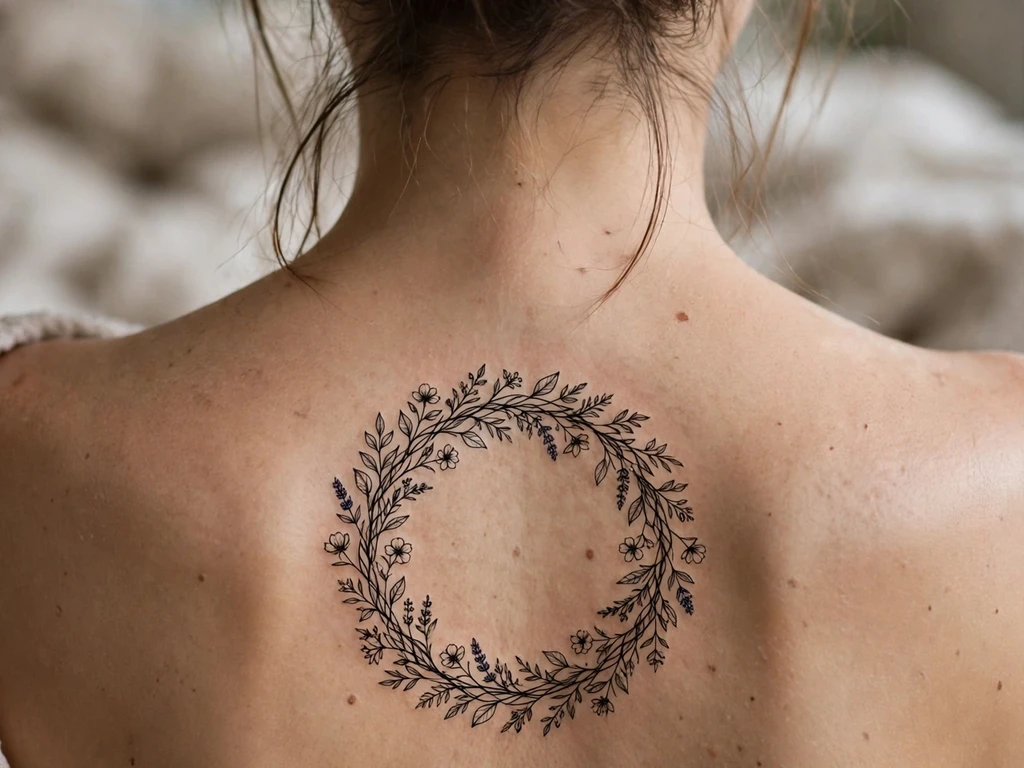
A wreath bends your birth flower into a circle, woven with leaves and smaller buds — a symbol of cycles, seasons and things that come back around. Sat between the shoulder blades, it frames the spine beautifully and photographs like a piece of jewellery worn under the skin. You can leave a gap at the top of the circle for an airier feel, or close the ring completely for a bolder emblem.
Best placement: Between the shoulder blades, centred on the spine.
Best for / know before you book: Symmetry and circle geometry are unforgiving — the stencil check matters more than the tattooing here. Stand, twist and sit while wearing the stencil; a circle that looks perfect lying down can drift when you move.
19. Ankle Sprig
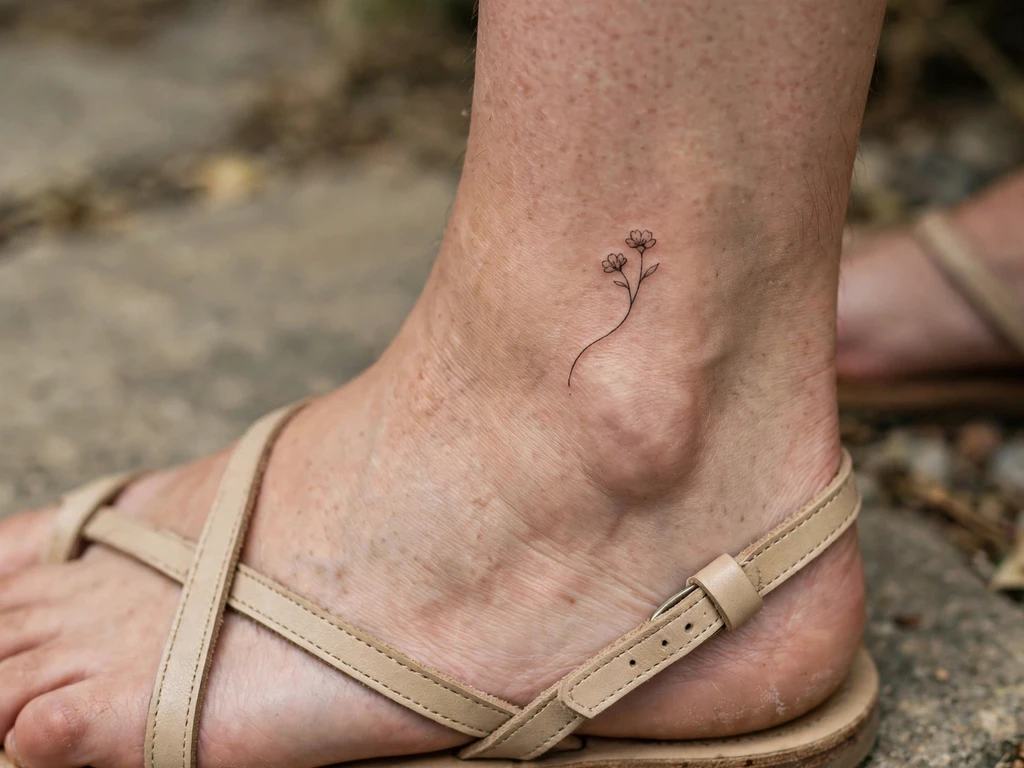
Two or three small blooms on a short curving stem, placed just above the ankle bone — the ankle sprig is the birth flower tattoo at its most wearable. It peeks out of shoes, frames sandals in summer, and hides under socks the rest of the year. Compact flowers like violet, daisy and aster suit it best, but any month can be distilled down to a recognisable sprig by a good artist.
Best placement: Outer ankle, the sprig curving up from the ankle bone.
Best for / know before you book: Small does not mean simple aftercare — footwear rubs exactly here. Book it when you can wear open shoes for a fortnight, and expect ankle skin to need a touch more time to settle than flatter areas.
20. Spine Stem Line
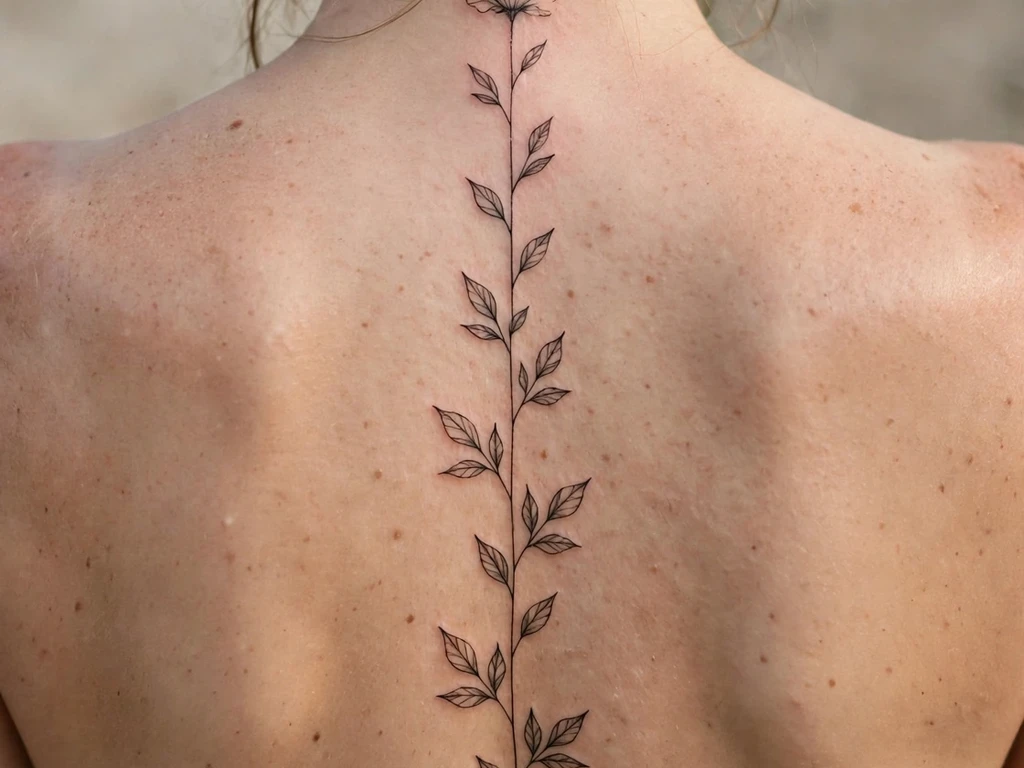
One long stem drawn straight down the spine — bloom at the nape, leaves alternating down the back, the stem ending in a fine point at the lower back. It turns the body’s own centre line into a growing stalk, and there is something quietly striking about a flower that quite literally has your back. Any month’s flower works; taller blooms like larkspur and gladiolus feel made for this placement.
Best placement: Centre spine, from the nape to the lower back.
Best for / know before you book: A statement piece that is easy to hide. The spine is bony and sensation varies a lot along its length — eat beforehand, plan for breaks, and know that the middle section is usually the tenderest.
21. Watercolour Birth Flower
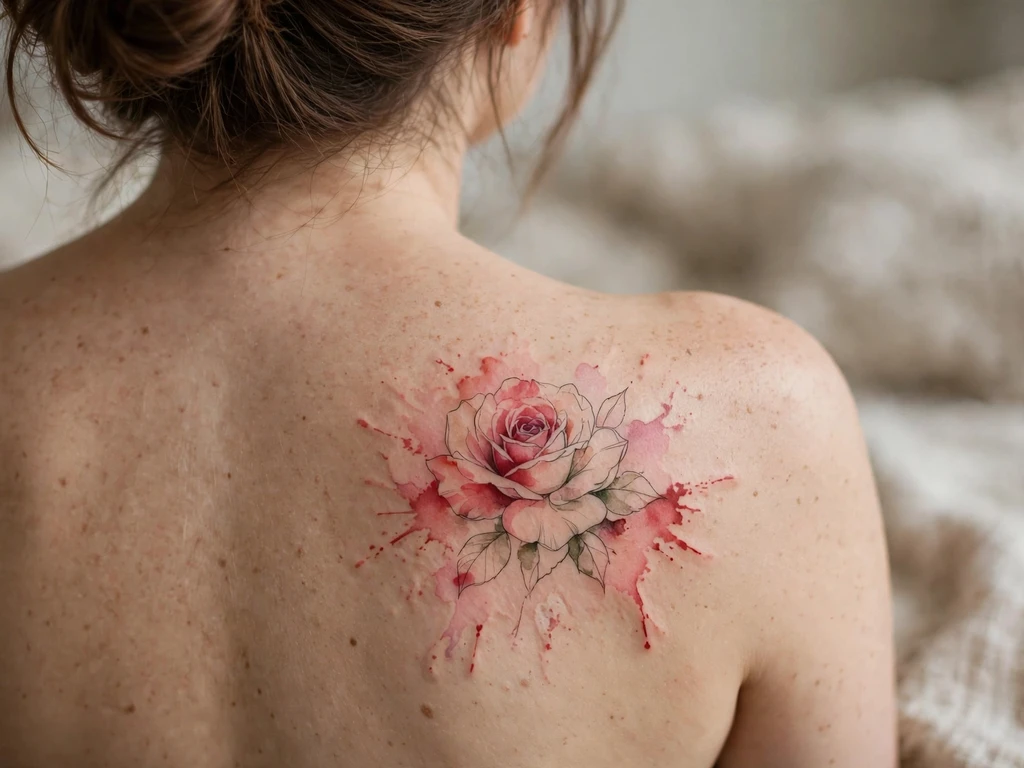
Watercolour style trades hard outlines for soft washes of colour that bleed gently beyond the petals, like a painting still wet on the page. Marigolds, roses and daffodils — flowers with real colour to show off — look glorious this way, especially across a shoulder blade where there is room for the colour to drift. A faint fine-line skeleton underneath the wash gives the design structure as the years soften the colour.
Best placement: Shoulder blade, with space around the bloom for the wash to fade out.
Best for / know before you book: Be honest with yourself about upkeep: watercolour tattoos usually need colour refreshes sooner than lined work, and sun exposure fades them fastest. If you love the look, budget for a refresh every few years as part of the bargain.
22. Birth Flower with Butterfly
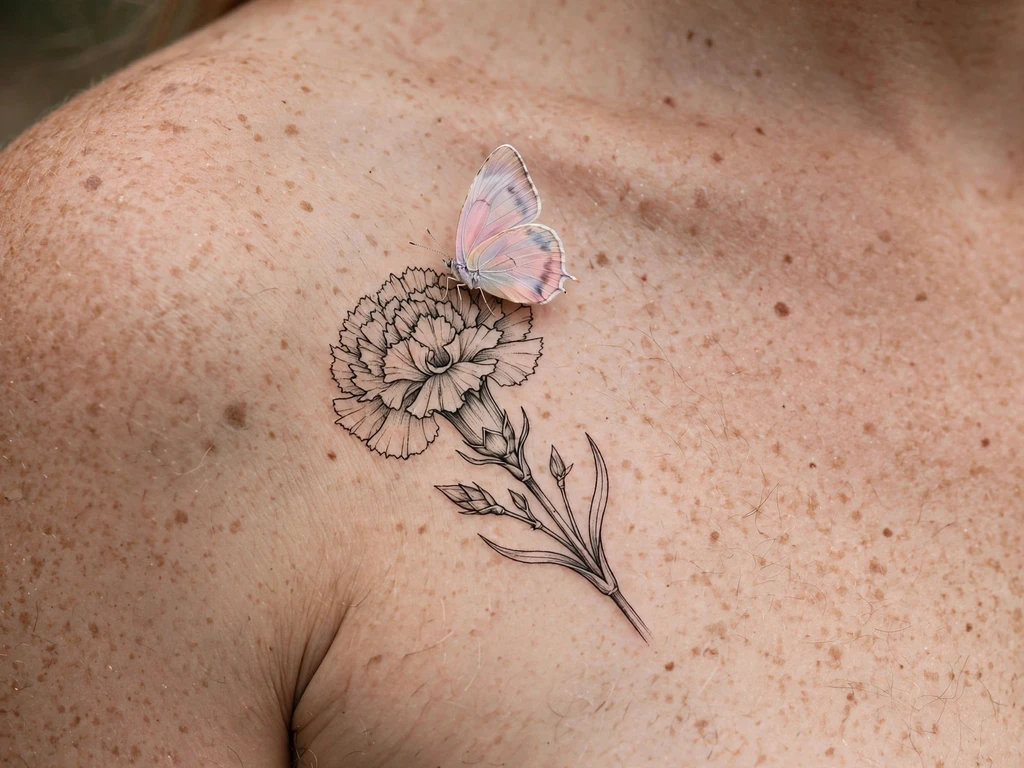
A butterfly settled on your birth bloom adds a second layer of meaning — transformation, freedom, a loved one remembered — and gives the composition a focal point that pure florals sometimes lack. The butterfly can be drawn in the same fine line as the flower for a unified feel, or picked out in colour so it lifts off the skin. Front shoulder and collarbone placements let the pair sit like a brooch.
Best placement: Front shoulder, the butterfly uppermost on the bloom.
Best for / know before you book: Match the line weights of the two elements or the design looks like two tattoos sharing space. If the butterfly is a memorial, tell your artist — they may suggest small details (a date in a wing, a favourite colour) that make it yours.
23. Minimalist Outline Trio
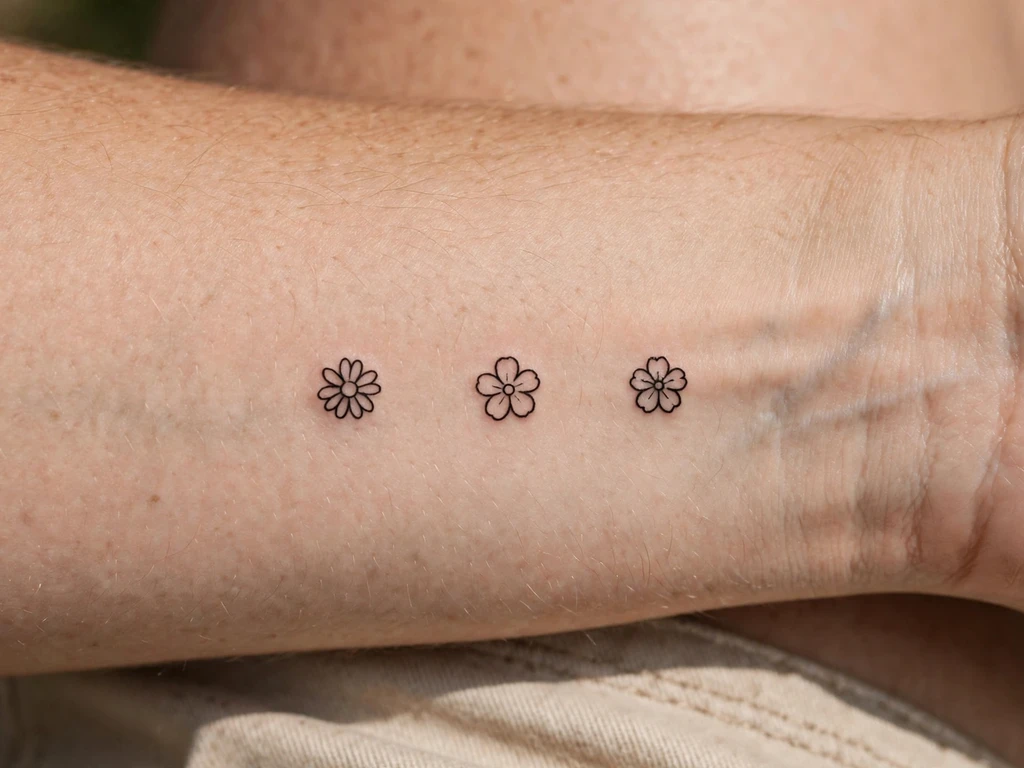
Three tiny blooms in a neat row, each drawn as a pure outline with no shading or colour: yours, and two people you carry with you — parents, siblings, children, the friends who became family. The joy of this design is its restraint; it reads almost like a line of handwriting. Inner forearm and the side of the ribs are favourite spots, and a fourth outline can join the row whenever life gives you a reason.
Best placement: Inner forearm, the trio running in a horizontal line.
Best for / know before you book: Outlines this small must be simplified ruthlessly — a chrysanthemum becomes a circle of petal arcs, and that is fine. If a flower cannot be recognised at this size, swap the order or give that one bloom a bigger slot.
24. Collarbone Sprig Pair
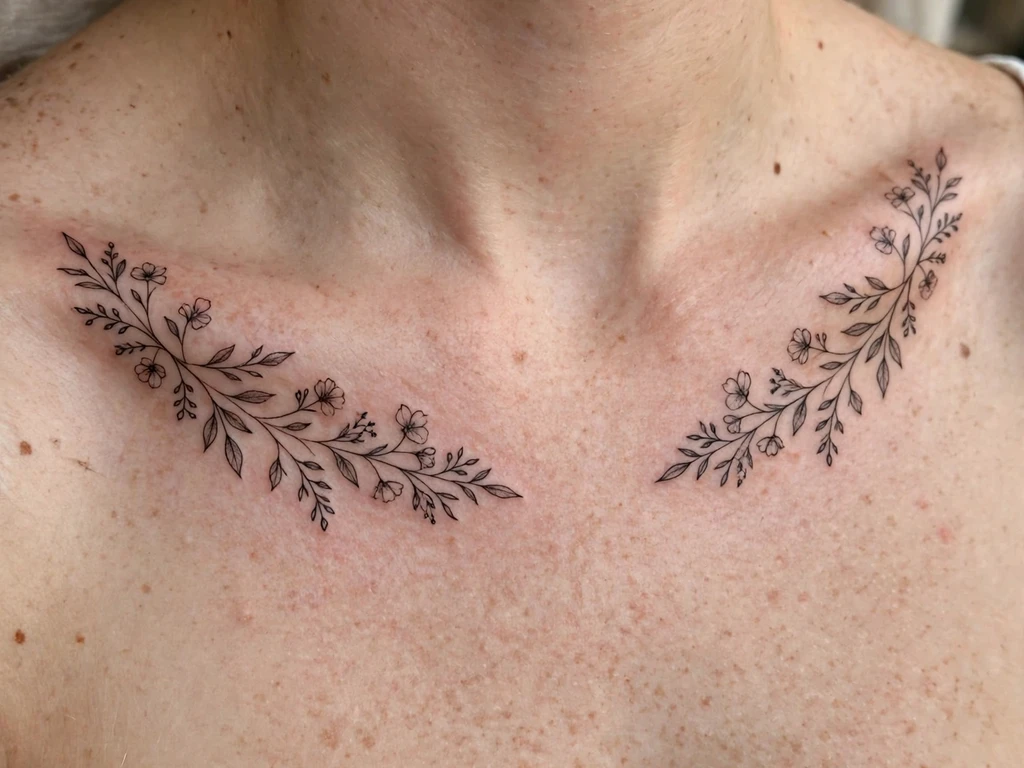
Matching sprigs of your birth flower tracing each collarbone, curving with the bone like a necklace you were born wearing. The symmetry frames the neckline and draws the eye up, and because each sprig is small, the pair stays elegant rather than busy. You can mirror the same flower on both sides, or — a sweet twist for couples — wear your partner’s flower on one side and yours on the other.
Best placement: Along or just beneath each collarbone.
Best for / know before you book: Collarbone skin is thin and close to the bone, so sessions are short but sensations are sharp. Small, simple sprigs are the right scope here — save dense detail for fleshier placements.
25. Blackwork Birth Flower
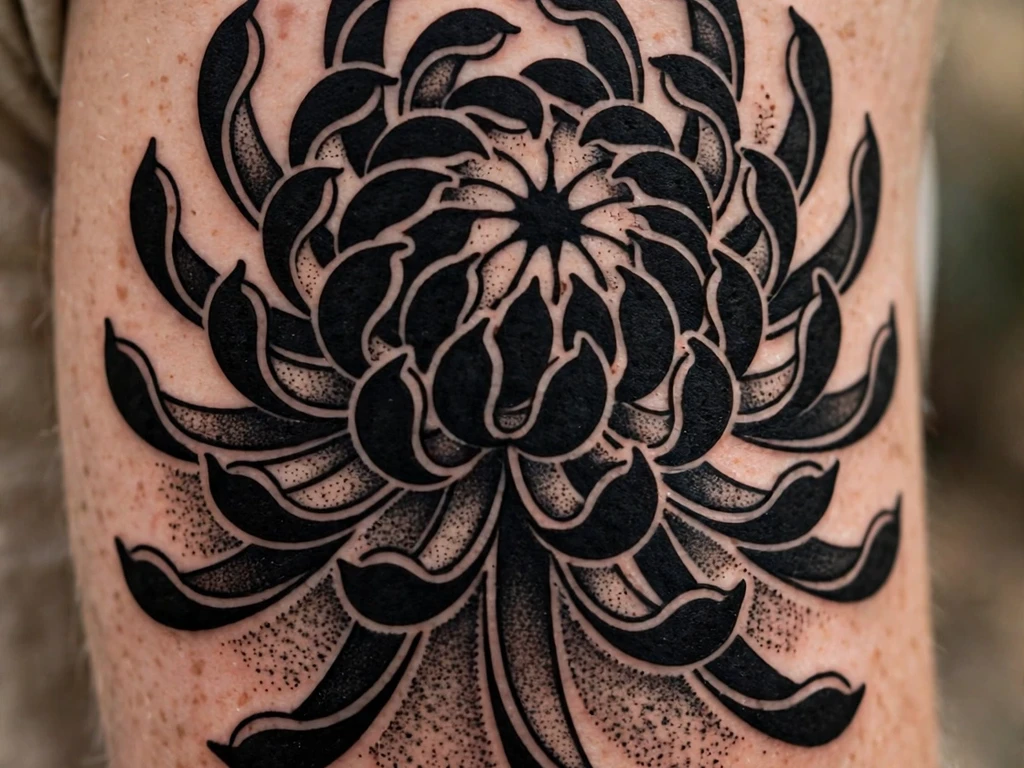
For every delicate fine-line flower on this list, blackwork is the counterweight: solid black petals, strong silhouettes and dot-work shading that gives the bloom depth without a drop of colour. It suits graphic flowers — chrysanthemum, marigold, gladiolus — and it has a practical superpower: heavy black ages slower and stays bolder than any fine line. If you want your birth flower to look as strong in twenty years as it does today, this is the version to book.
Best placement: Upper arm, where the bold silhouette can be drawn at a confident size.
Best for / know before you book: Blackwork is a commitment — solid black is the hardest style to cover or laser later. Be sure about the flower and the placement, and choose an artist whose saturated black heals evenly, not patchy.
Birth Flower Tattoo Placement by Size
| Size | Typical dimensions | Best placements | Good to know |
|---|---|---|---|
| Small | 3–6 cm | Inner wrist, ankle, behind ear, collarbone | Compact flowers (violet, daisy, aster) suit this scale; petal detail must be simplified |
| Medium | 7–15 cm | Forearm, inner bicep, shoulder blade, calf | The sweet spot for a single stem with leaves and clean ageing |
| Large | 16–30 cm | Thigh, upper back, spine, shoulder | Room for bouquets, wreaths and full petal detail on bigger blooms |
| Extra large | 30 cm+ / multi-session | Full back, sleeve built from several months’ flowers | Plan the whole composition first so added stems still look intentional |
How to Choose Your Birth Flower Tattoo (and What to Know Before You Book)
Decide whose flowers you are wearing. Your own birth month is the obvious start, but the most-loved birth flower tattoos often belong to someone else: a mother’s flower for a memorial, a child’s for a new parent, a partner’s woven in beside your own. Settle the “who” before the “where”, because a family bouquet (design 13) needs a forearm or thigh, while a single personal stem (design 15) can live happily on a wrist.
Match the flower to the style, not the other way round. Some blooms are natural fine-line subjects — lily of the valley, larkspur, violet — while dense, many-petalled flowers like chrysanthemum and marigold need either confident colour work or the graphic strength of blackwork. If a symbolic flower with deep roots appeals to you as a partner bloom, browsing lotus tattoo ideas shows how a second meaningful flower can be drawn to sit beside yours without stealing the scene.
Think hard about colour before you commit to it. Colour makes marigolds glow and daffodils sing, but petal colours soften faster than black line work, and pale shades (yellow, white, light pink) fade fastest of all. A popular middle path is black-and-grey flowers with one coloured accent — the birthstone design (14) exists precisely for this. Whatever you choose, flowers bloom on skin that sees the sun, and sunscreen is the difference between a five-year flower and a fifteen-year one.
Look after it like it is alive. Fresh tattoos are open skin for the first days, and floral pieces often cover broad, petal-shaped areas that need gentle, consistent care. Follow your artist’s routine first; the Cleveland Clinic’s tattoo aftercare guidance is a solid reference for what normal healing looks like, when flaking is expected, and which warning signs mean you should call the studio or a doctor.
Key points to remember:
- Your birth flower is a starting point — family members’ months are where the design gets personal
- Fine-line flowers need spacing and size to age well; tiny packed petals blur first
- Colour is beautiful but higher maintenance — black and grey with one accent is the low-fuss compromise
- Script and names must be checked letter by letter before the session, not after
- Sunscreen is lifelong aftercare for a flower tattoo, not a summer extra
Frequently Asked Questions
What is my birth flower?
Find your birth month in the table near the top of this guide: January is the carnation, February the violet, March the daffodil, April the daisy, May lily of the valley, June the rose, July the larkspur, August the gladiolus, September the aster, October the marigold, November the chrysanthemum and December the narcissus. Some months have a recognised second flower too — June also claims honeysuckle, for example — so if your main flower does not feel like you, ask your artist about the alternative.
Can I combine several birth flowers in one tattoo?
Yes — it is one of the most popular ways to wear them. A bouquet (design 13) gathers one stem per person and can grow as your family does, while the half-and-half design (17) merges just two people’s flowers on a shared stem. The trick is composition: your artist will balance big blooms against small ones so no single flower dominates, and leaving gaps for future stems costs nothing at the design stage.
Do birth flower tattoos look better in colour or black and grey?
Neither is objectively better — they age differently. Colour captures the real flower (marigold orange, violet purple) but softens sooner and needs sun care; black and grey stays crisper for longer and suits every skin tone and wardrobe. If you are torn, a black-and-grey flower with a single coloured element, like a birthstone dot, gives you most of both.
How small can a birth flower tattoo be?
A simplified single bloom can work at 3–4 cm, but the flower has to be reduced to its most recognisable features — a daisy’s circle of petals, a narcissus’s trumpet. Dense flowers like chrysanthemum and marigold should not go below about 7–8 cm, because their many petals need space between the lines. When in doubt, trust your artist’s minimum size; they are protecting the tattoo’s tenth year, not just its first photo.
What is the best placement for a first birth flower tattoo?
The forearm is the favourite for good reasons: flat skin, moderate pain, easy healing, and enough length for a full stem that can later grow into a bouquet. The shoulder blade and inner bicep are close seconds — private, forgiving, and roomy. Save the spine, ribs and collarbones for later pieces, when you know how your skin holds fine floral lines.
Final Thoughts
A birth flower tattoo is a rare thing in the tattoo world: a design whose meaning is decided before the drawing starts. Your month hands you the flower and centuries of floriography hand you its message — what you and your artist decide is how it grows on your skin, whose flowers twine in beside it, and how boldly it blooms.
Pick the version of your flower that you cannot stop picturing, wear the stencil for a while, and book the artist whose healed floral work you trust. Flowers may be soft subjects, but a well-chosen birth flower tattoo will be telling your story long after louder designs have faded.
1 thought on “25 Stunning Birth Flower Tattoo Ideas That Make Your Ink Deeply Personal”