The forearm is where a lot of first tattoos land, and it is also where plenty of people put the piece they most want to look at themselves. It is flat enough to draw on, easy to show, easy to cover with a sleeve, and it heals without the awkward reaching of a back or ribs piece. The 30 forearm tattoo ideas below are all real tattoos on real forearms, photographed on skin — inner arm, outer arm, wraps and full-forearm pieces.
One honest note first: the forearm is not one placement, it is at least three. The inner forearm has thinner, softer skin and holds fine detail well, but rubs against desks all day. The outer forearm is tougher, tans faster, and suits bolder work. A design that wraps the arm has to be drawn for a cylinder, not a flat page, or its ends will never meet the way the sketch promised. Each design below notes which part of the forearm it sits on and what that means in practice.
If you are deciding between the forearm and somewhere smaller, the wrist tattoo ideas collection sits right next door, and anyone planning a very small piece should also look at the small tattoos for women guide. For safety basics before you book — ink reactions, hygiene, what to ask a studio — the FDA’s page on tattoo safety is the straightest source there is.
Black and Grey Forearm Tattoo Ideas: Realism That Fills the Arm
Black and grey realism is the style most people picture when they search for forearm tattoo ideas, and the forearm earns it: the long, gently curved surface gives a portrait or an animal head room to breathe without the distortion you get on a shin or a shoulder cap. These eight pieces all run wrist-to-elbow or close to it — big cats, a wolf, an eagle, a warrior, a pet portrait, and one very committed drinks order.
1. Leopard Head Filling the Whole Forearm
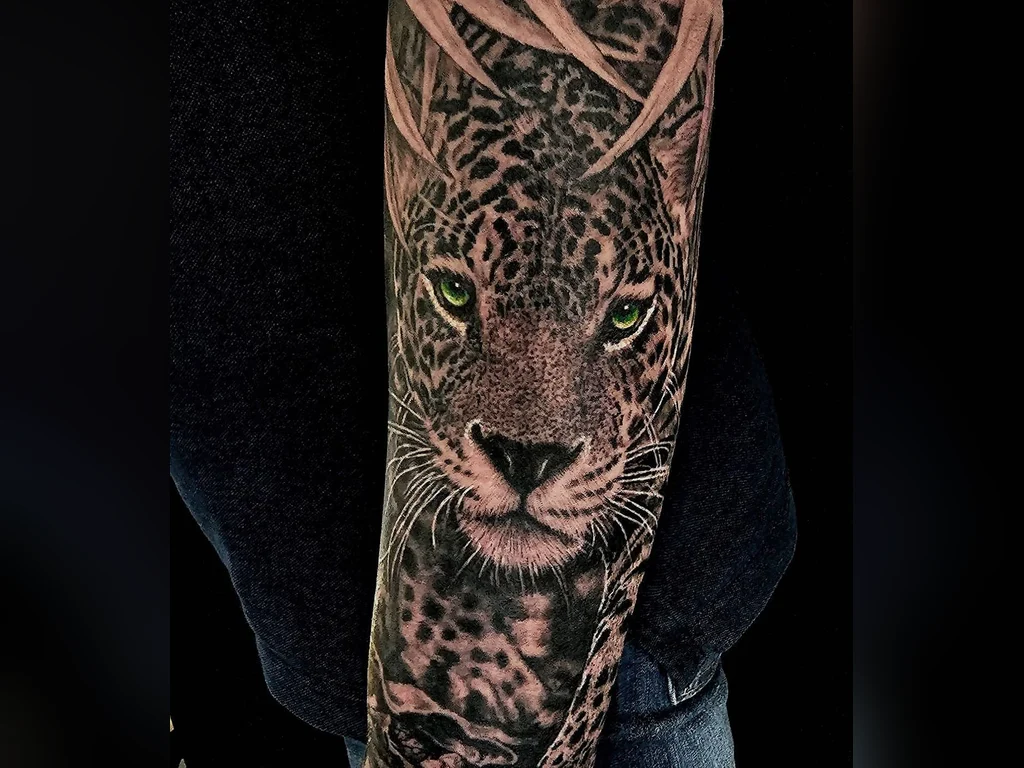
A leopard’s head drawn at the full size of the forearm, nose towards the wrist and ears up by the elbow crease. The whisker spots and broken rosette pattern give the artist texture to work with across the whole surface, so there is no dead space anywhere on the arm.
Big-cat realism lives or dies on contrast: the darkest blacks sit in the nose, ears and eye line, and the skin itself is left to do the lightest tones. Ask to see healed photos of an artist’s realism before booking — fresh black and grey always looks punchier than it will in six months.
2. A Woman’s Portrait, Photographed Halfway Through
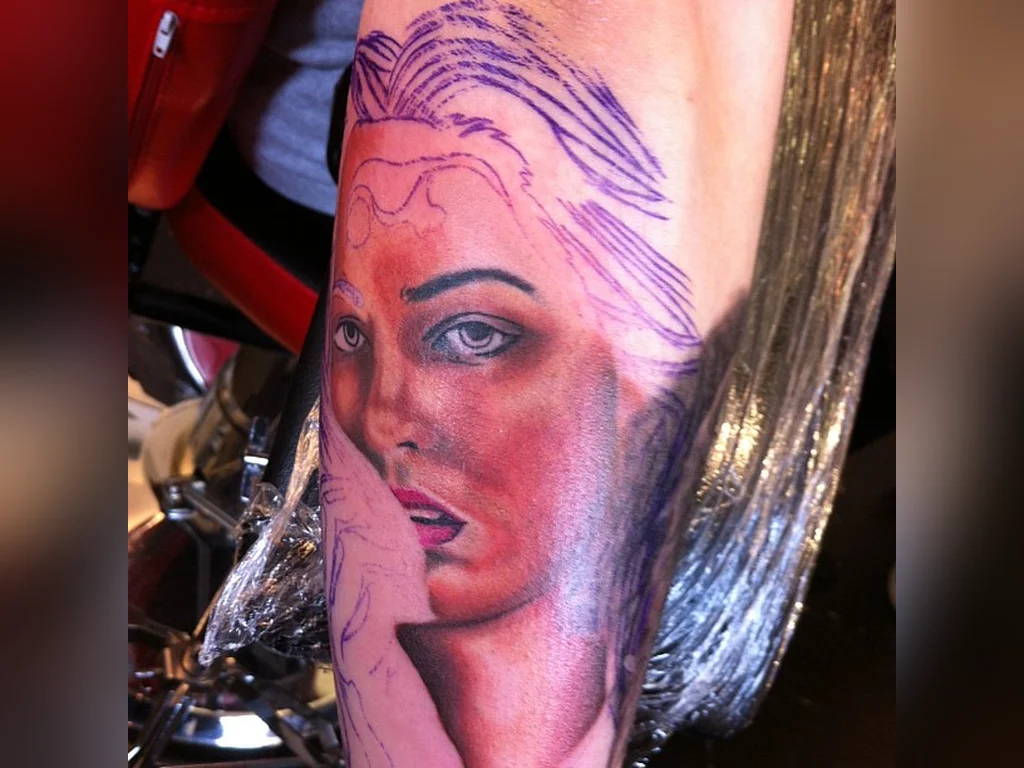
This one is a portrait caught in the middle of being made: the face is already coloured — skin tones, lips, the shading around the eyes — while the hair is still purple stencil lines waiting its turn. It is the only unfinished piece in this collection, included on purpose, because this is what realism actually looks like halfway through a sitting.
Artists build a portrait in layers, face first, because the face is where a likeness lives or dies. If you commission one, expect it to look strange and patchy until late in the session, and judge your artist on healed portraits, never on a half-done one. The finished piece will cover the whole forearm; at this stage you can still see the plan.
3. Wolf With a Forest Growing Out of It
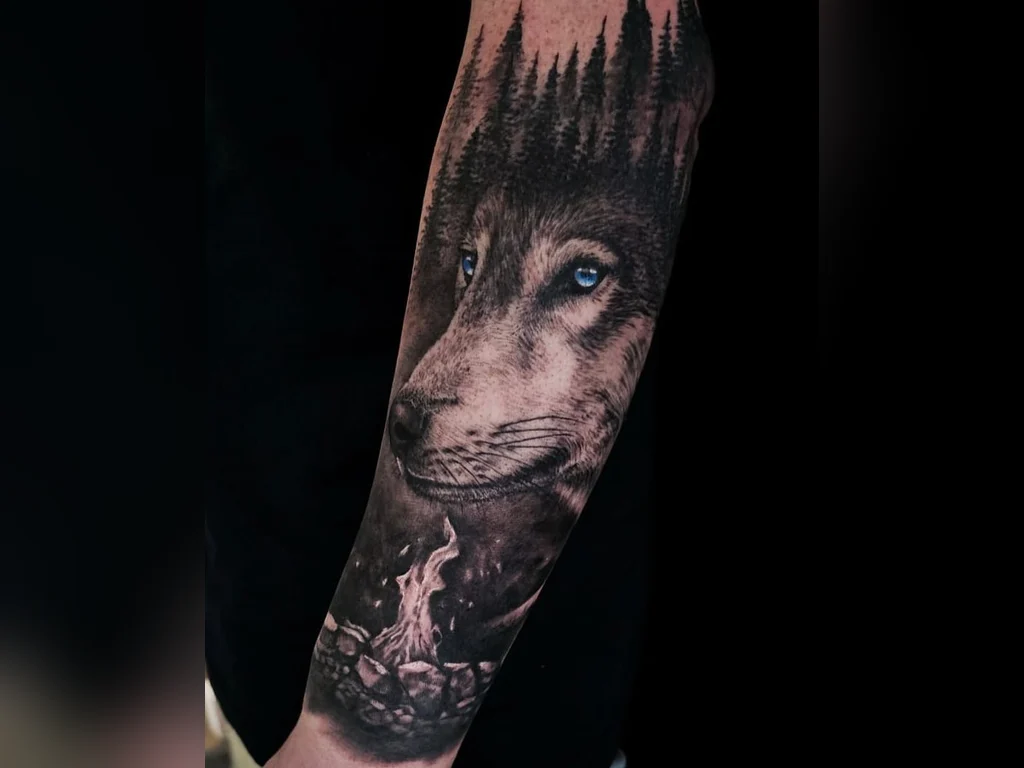
A wolf’s head takes the top half of the forearm while pine trees, a tent and a small campfire run down towards the wrist, so the design tells a small story along the arm. One pale blue eye is the single spot of colour, and it pulls your attention straight to the face.
Double-exposure designs like this — an animal with a scene inside it — suit the forearm’s long canvas. The risk is the small scene at the wrist end crowding as the ink settles; the trees here are kept bold and simple, which is exactly how it should be done.
4. Eagle Head With a Gold Eye
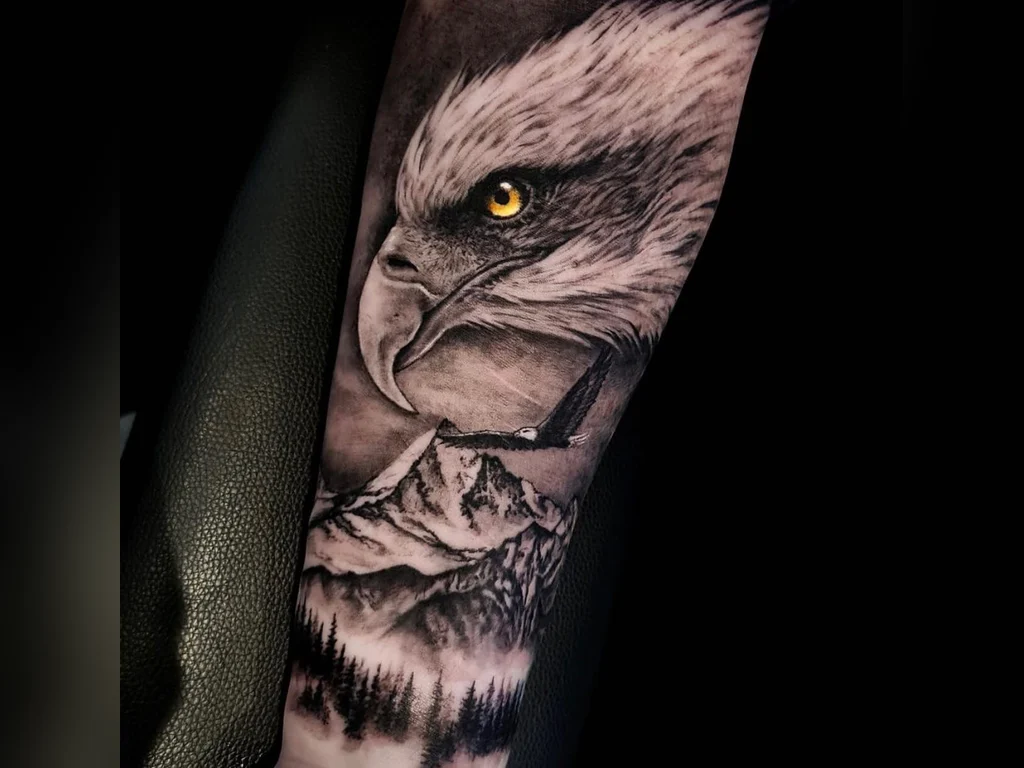
An eagle’s head in profile, beak pointing down the arm towards the hand, with mountains and pine forest worked into the feathers below. The eye is a muted gold — the one warm note in an otherwise black and grey piece, and the first thing you notice.
Feather detail is where forearm realism earns its keep: the individual barbs are drawn large enough to survive, and the head sits on the outer forearm where the skin moves least. A head-only treatment like this ages far better than a full spread-winged eagle shrunk to fit.
5. Armoured Warrior Standing Over the Fallen
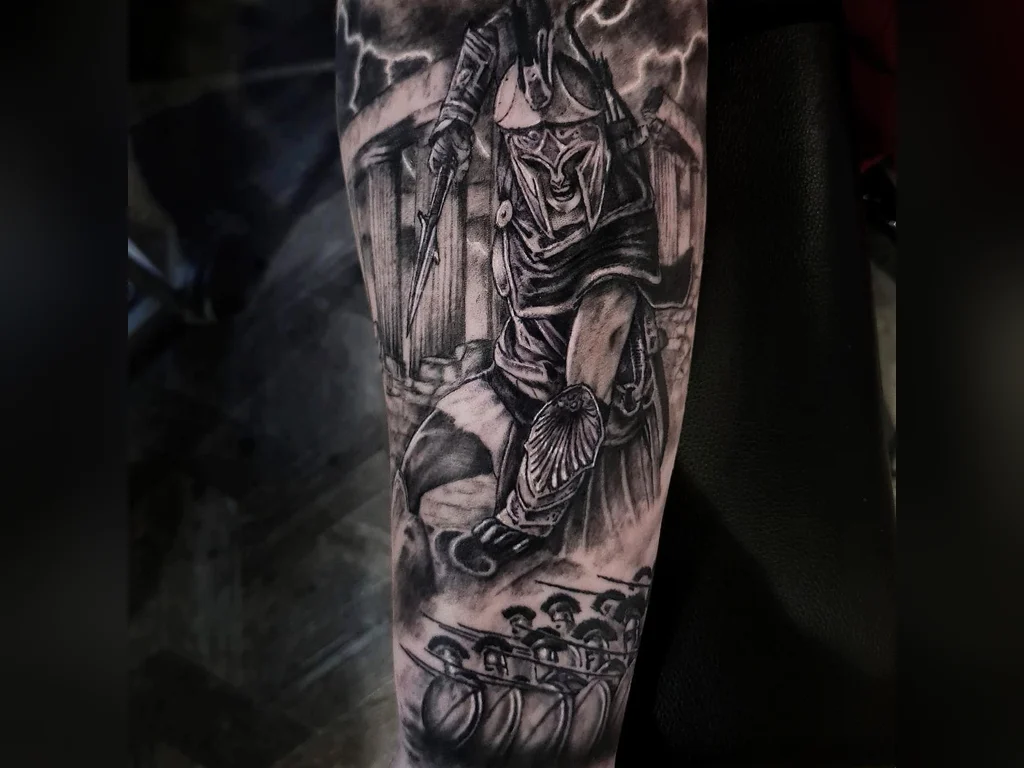
An armoured warrior in a helmet and cloak, weapon in hand, standing over fallen figures at the wrist end of the forearm. Battle scenes like this draw on the Spartan warrior image — discipline, courage, standing your ground — and the forearm puts the figure somewhere the wearer sees it every day.
A piece with this much going on needs the whole forearm and a patient artist; the armour, cloak and crowd below are all competing textures. It sits on the outer arm here, which is the right call — detail this fine would blur faster on the softer inner skin.
6. Black Panther Face, Nothing Else
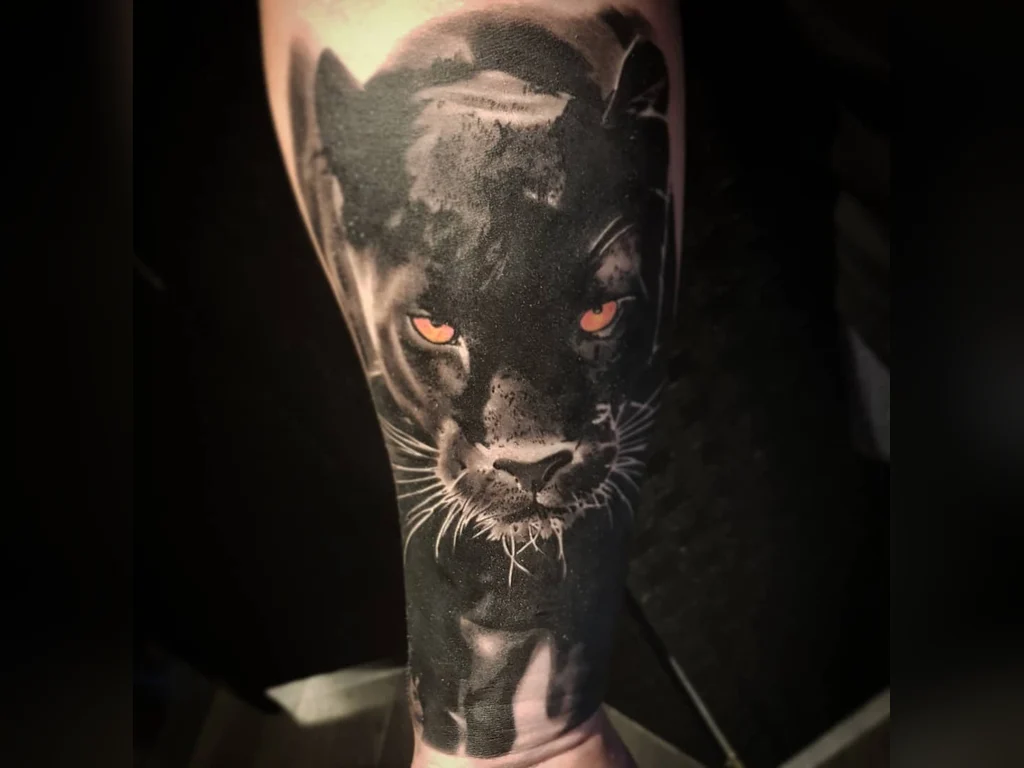
A black panther’s face and nothing else — no background, no filler, just the head taking up the full width of the forearm. The eyes are burnt orange, and against all that black they do the work of an entire colour palette.
Panthers are an old tattoo subject — the crawling panther is a traditional classic — but this straight-on portrait is a modern realism take. Packing this much black into one area means a long session and a careful heal; dense black scabs need patience, not picking.
7. A Pet Cat Portrait, Cat Included for Comparison
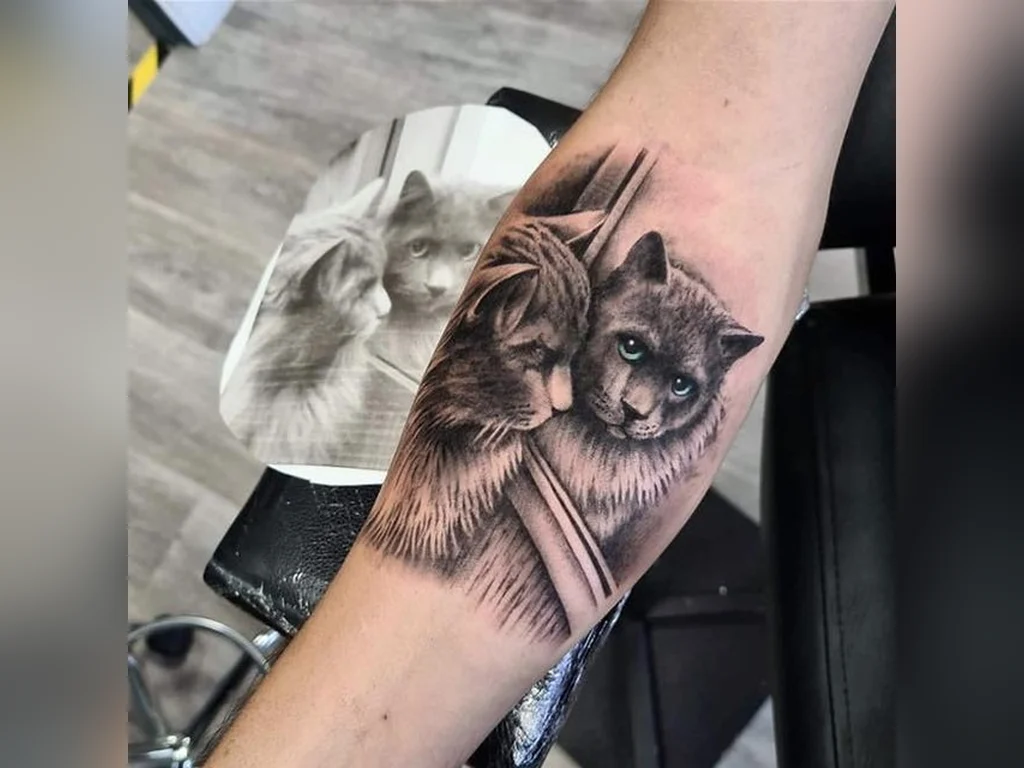
A black and grey portrait of a grey cat on the forearm — photographed with the actual cat sitting behind the arm, which makes it the most honest reference check in this whole collection. Pet portraits are among the most personal forearm tattoo ideas there are, and this one earns its place.
For a portrait of your own animal, bring your artist several clear photos, not just your favourite, and expect them to pick the angle with the strongest light and shade. Fur texture at this size holds up well; the eyes make or break it, so that is where a good artist spends the time.
8. Whiskey Bottle Realism, Shown From Outline to Finished
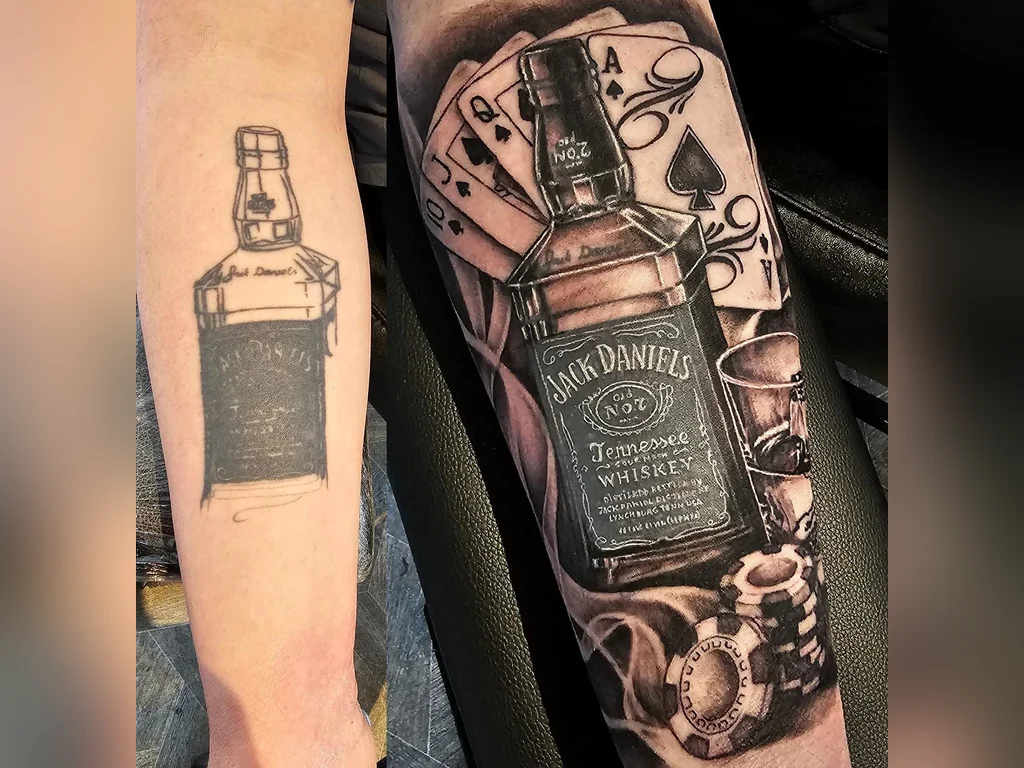
This photo shows one design twice: the bottle as a bare outline in one shot, and the finished realism piece — bottle, playing cards, poker chips and a rose — in the other. It is a gambler’s-and-a-drink tattoo, done as seriously as any portrait on this page.
The two-panel photo is worth studying if you are planning realism. Everything that makes the finished piece look real goes in over that plain outline, which is why realism is priced by the hour and rarely finished in one short sitting. The bottle’s label is drawn faithfully; if you do not want a real brand on your arm forever, ask for an invented one at the drawing stage.
Colour Forearm Tattoo Ideas: Bright Pieces That Still Read at Arm’s Length
Colour on the forearm lives a harder life than colour elsewhere on the arm, because the outer forearm catches sun every time you drive, walk or sit near a window. These six forearm tattoo ideas show colour used three ways: soft watercolour washes, bold flat colour with hard outlines, and one red dragon that takes over the whole arm. The outlines do quiet work in all of them — colour fades, but linework is what keeps a design readable in ten years.
9. Soldier and Poppies Memorial Piece
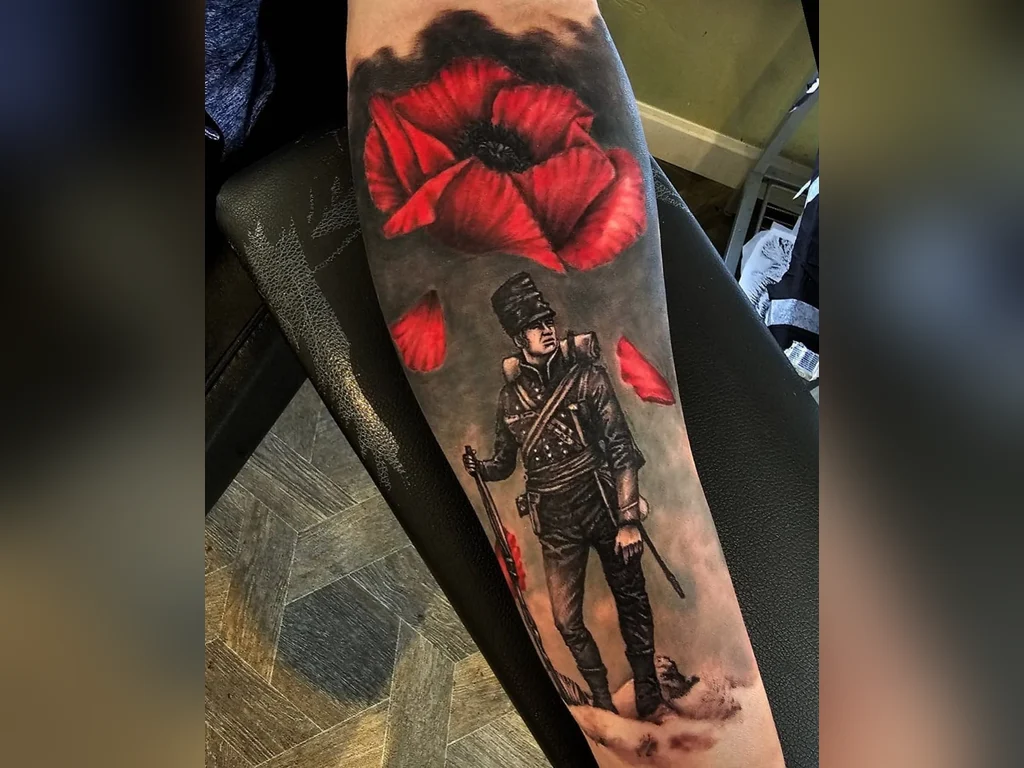
A soldier in period uniform standing below two large red poppies, in the muted palette of a remembrance piece. Memorial tattoos for service members are a long tradition, and the poppy has stood for remembrance of the war dead since the First World War — the meaning here is worn openly, on the outer forearm.
The colour is desaturated on purpose: greys and khakis, with the red held back for the poppies alone. That restraint is practical too. Red is one of the faster-fading pigments in sun, and the outer forearm gets plenty — this design puts its red where it matters and nowhere else.
10. Watercolour Big Cat With a Rose
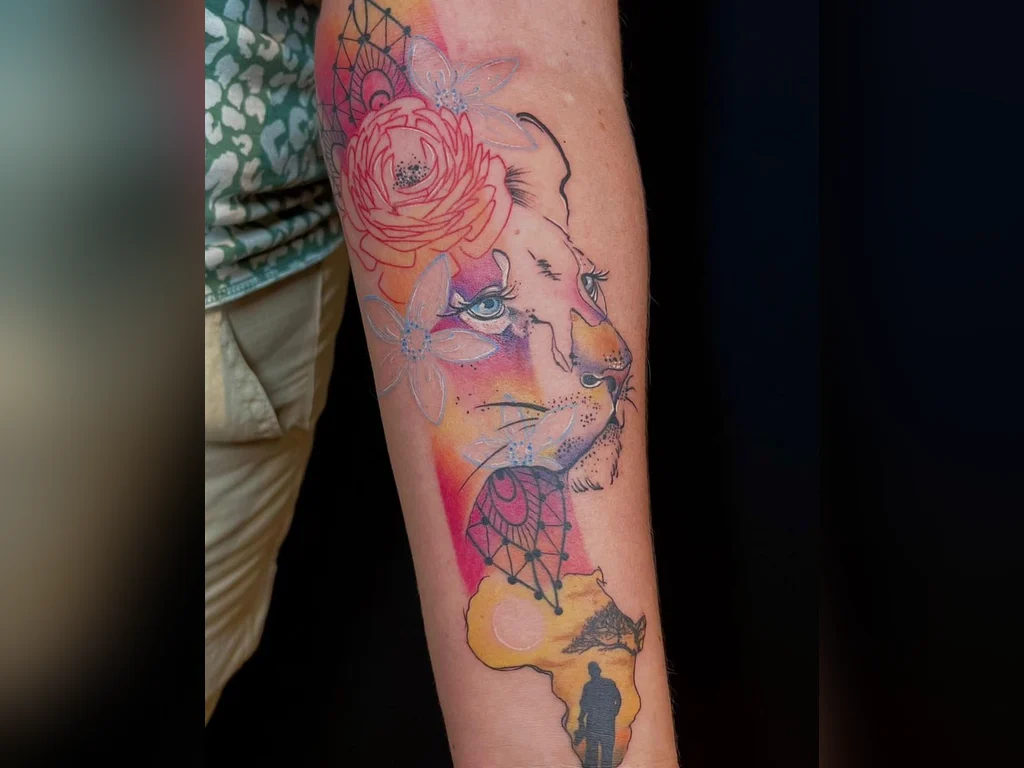
A big cat’s face in profile, washed in pink, orange and yellow, with a rose worked into the top of the design and soft colour running down towards the wrist. Watercolour tattoos copy the look of pigment bleeding into wet paper — soft edges, splashes, no hard outline around the colour itself.
Be clear-eyed about this style: without an outline, colour softens faster, and a piece like this will need a refresh sooner than the traditional work further down this page. The artist left fine black linework in the face and whiskers, giving the colour a skeleton to age around. That combination — watercolour fill, real lines underneath — is the version that lasts.
11. Crow Against a Red Sun
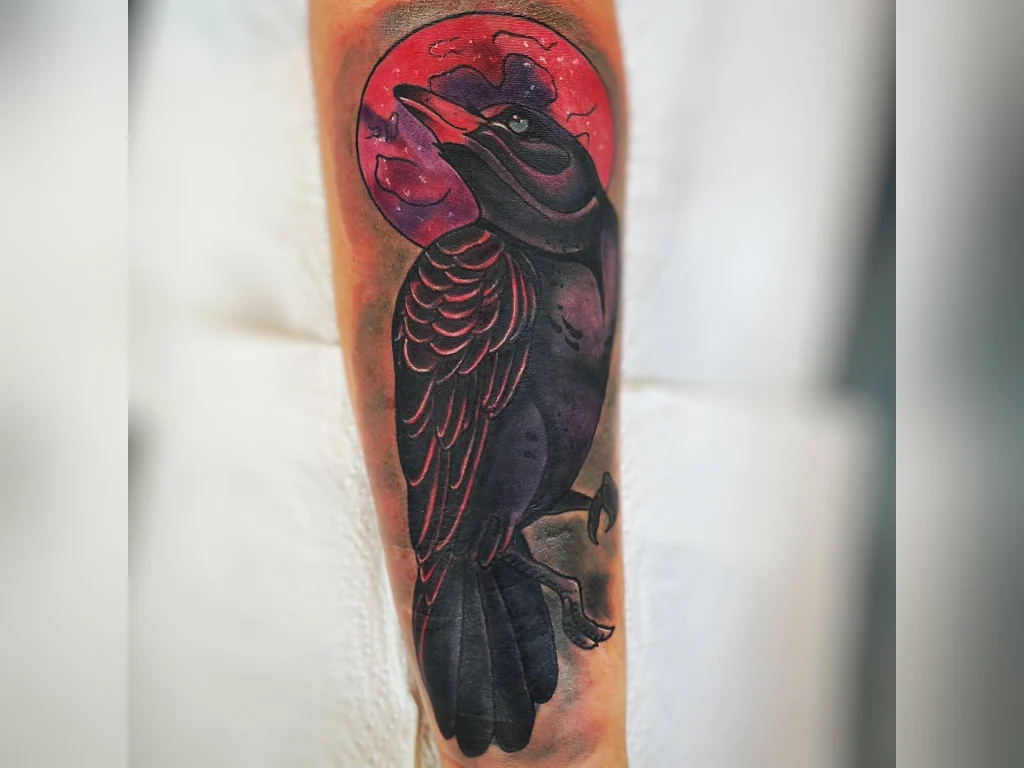
A black crow, wings folded, set against a solid red disc of a sun or moon. The bird is drawn with strong black shapes and fine feather hatching, and the red circle behind it does what a frame does for a picture — it makes a medium-sized tattoo feel like a finished composition.
Crows carry different meanings depending on where you are standing: intelligence and memory in a great many traditions — crows genuinely do remember faces — and a darker omen in some European folklore. The design does not need you to pick one. Bold black shapes like these also age slowly and stay legible — among the most forgiving things you can put on a forearm.
12. Orange Butterfly Under a Watching Eye
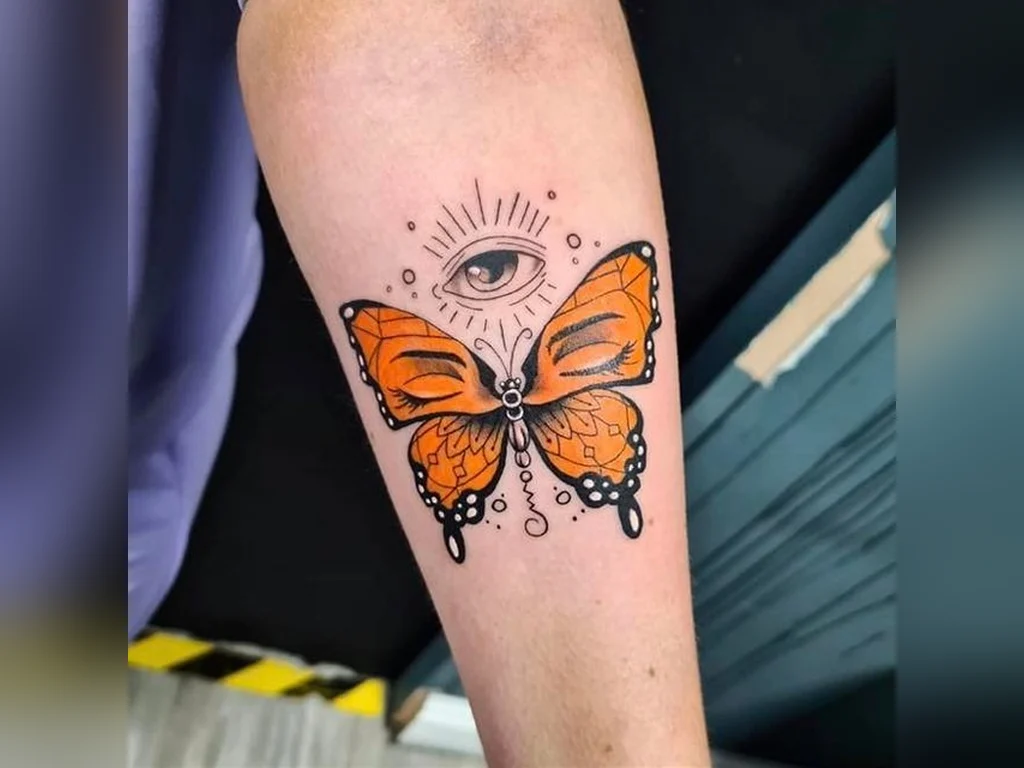
A monarch-orange butterfly with its wings open, and above it a single eye with fine rays — the all-seeing eye that turns up in tattooing as a symbol of protection and being watched over. The butterfly gets the colour; the eye is done in plain black linework, and the contrast between the two halves is the design.
It sits on the inner forearm, where the wings can spread across the flat of the arm. Butterfly wing detail is drawn in fine black lines over the orange, which gives the colour a structure to hold onto as it ages — the same trick as the watercolour piece at number 10, used in reverse. Small and medium pieces like this are also the easiest to extend later; there is room here for flowers or script around it one day.
13. Red Dragon Head Taking Over the Arm
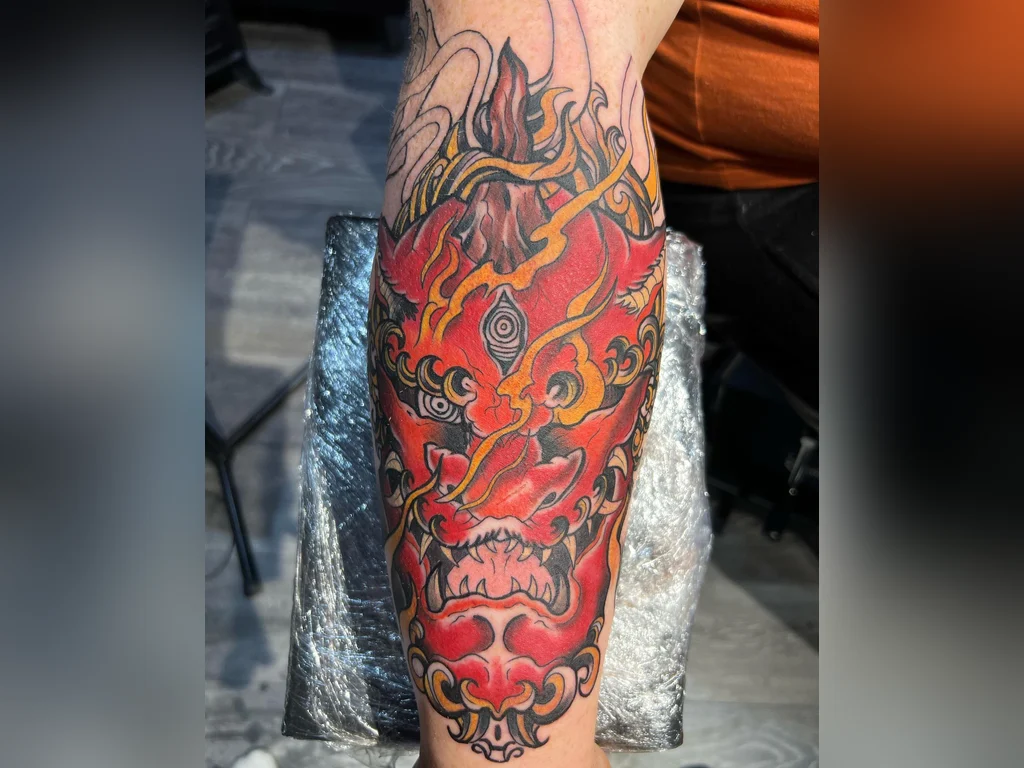
A dragon’s head in saturated red with gold, green and black detail, wrapped around the forearm so the horns, whiskers and flames curve with the arm. Dragons in Japanese tattooing are not the monsters of European stories — they are water beings linked with wisdom and protection, which is why they so often stand guard on an arm. The cling film in the photo means this one was photographed fresh, straight off the chair.
Fresh red this bright settles a shade or two deeper as it heals. Large areas of one saturated colour show every inconsistency while healing, so the boring advice matters: leave the film on as directed, keep it clean, do not soak it. The dragon’s face stays on the flat outer forearm and only the edges bend — the smart part of the placement.
14. Prism and the Handshake: a Tribute Piece
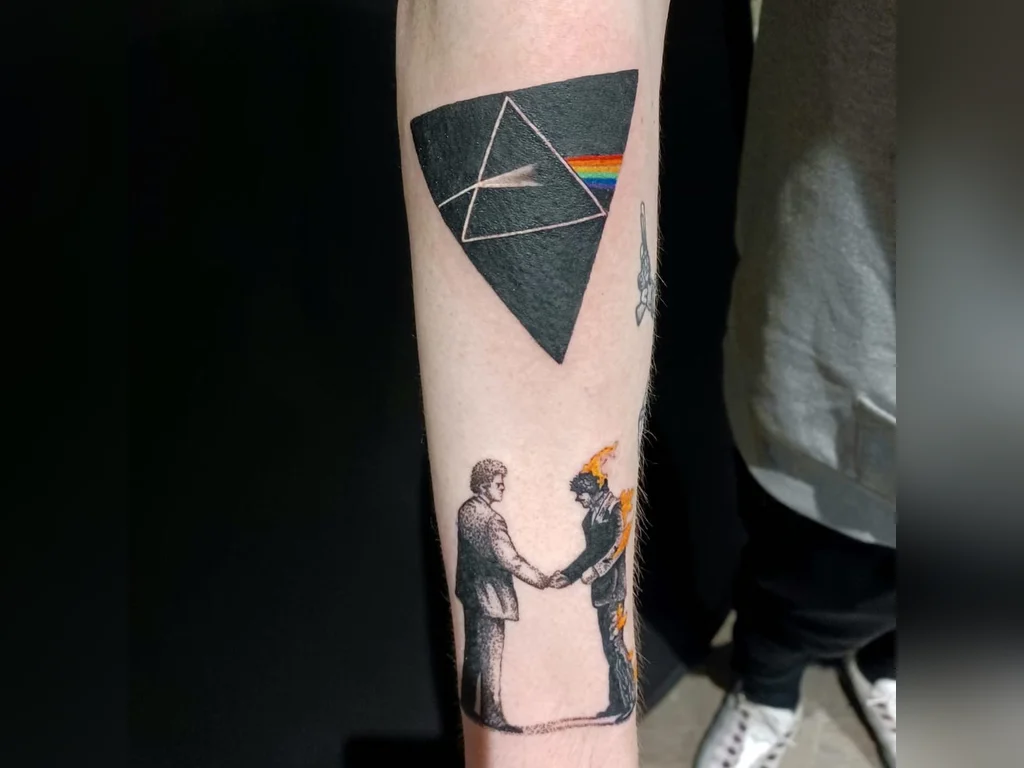
Two images from the same band’s artwork on one forearm: a black triangle splitting a beam of light into a rainbow at the top, and below it two men shaking hands, one of them on fire. It is a tribute tattoo — the forearm as a record shelf, which is one of the most honest reasons people get tattooed at all.
Solid black shapes like the prism are close to bulletproof in tattoo terms, and putting the fine detail — the handshake scene — lower on the arm, where the skin is steadier, is good planning. If you are copying famous artwork, a good artist redraws it in their own hand rather than tracing it, and the tattoo looks better for it.
Traditional Forearm Tattoo Ideas: Bold Lines, Flat Colour, No Apologies
American traditional was built for arms like these: thick outlines, a limited palette, and designs that read from across the room. Three of these four are older photographs of settled tattoos rather than fresh studio shots, which is useful — this is what traditional forearm tattoo ideas look like after they have lived on an arm for a while, not on the day they were done.
15. Heart, Banner and Anchor Down the Whole Forearm
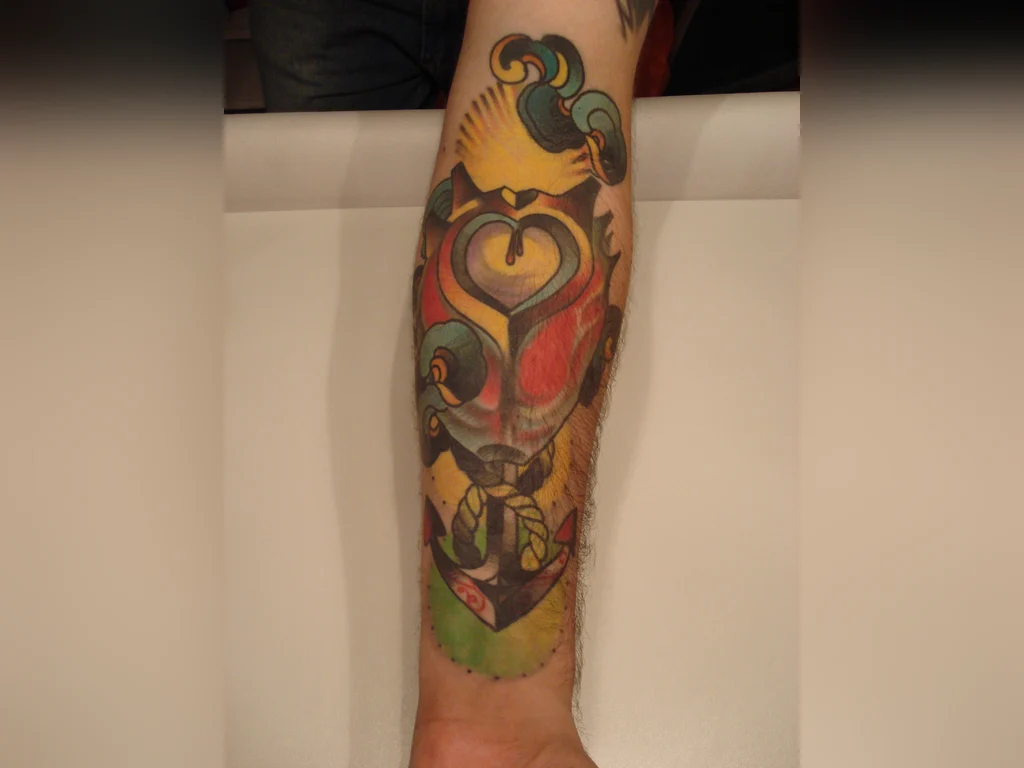
A full-forearm traditional piece: a heart at the top wrapped in a banner, scrollwork and flowers through the middle, and an anchor finishing at the wrist. This is the classic sailor-tattoo vocabulary — heart for the people at home, anchor for holding fast — arranged to use every inch of the arm’s length.
Notice how the design is built from separate bold blocks rather than one blended picture. Each element reads on its own, the black is packed solid, and if one section ever needs a touch-up it can be done without disturbing the rest. Pieces like this are the benchmark for how well a forearm tattoo can age.
16. Pin-Up Woman in Red
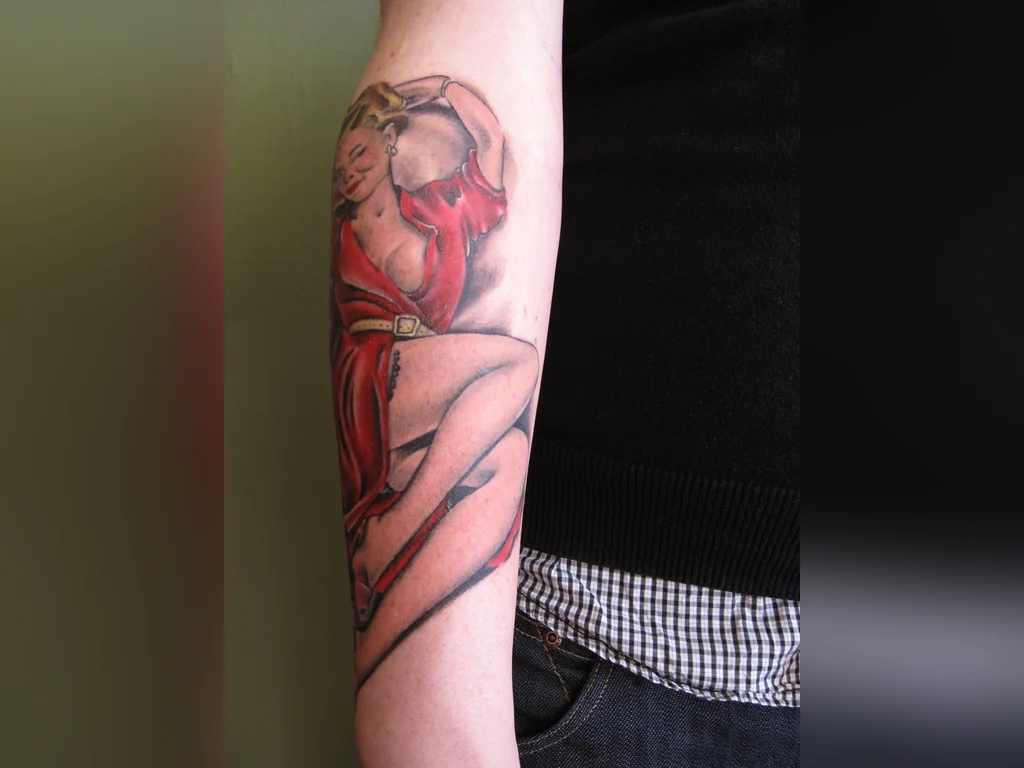
A pin-up woman in a red dress, drawn the long way down the forearm so her figure follows the arm from elbow to wrist. Pin-ups are one of the oldest forearm subjects there are — a serviceman’s tattoo before they were a retro fashion — and the elongated forearm is still their natural home.
This one is photographed settled and healed, the red a touch softer than it would have been fresh, which is the honest state of any red tattoo after some years. The black outline has not moved at all. That is the pin-up trade: it gives up likeness and gains decades.
17. Ship’s Wheel and Compass Rose
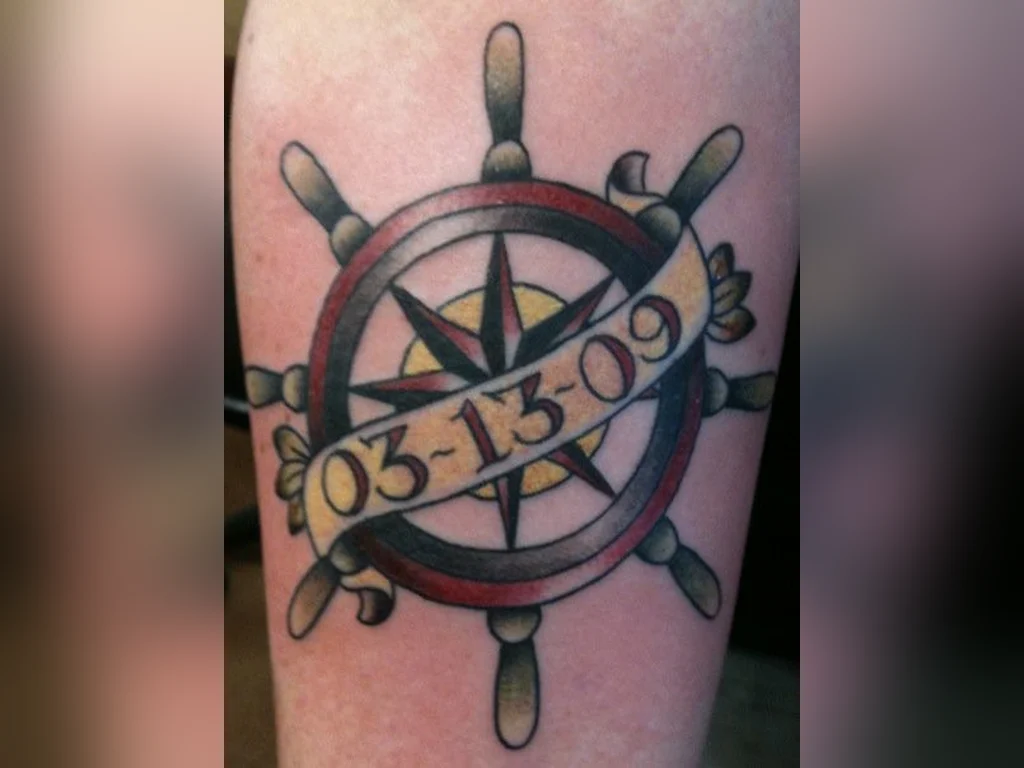
A ship’s wheel wrapped around a compass rose, with a banner carrying a date across the middle. Wheels and compasses are navigation symbols — steering your course, finding your way back — and the date banner turns a general symbol into a specific memory, which is what most people actually want from a tattoo.
Round designs sit well on the outer forearm, where the surface curves gently and evenly. One caution: a compass needs enough diameter for its points to stay separate as the lines thicken with age. Bigger is genuinely better here, and this modest-sized piece is about the smallest it can honestly go.
18. Koru Pattern Band From Wrist to Elbow
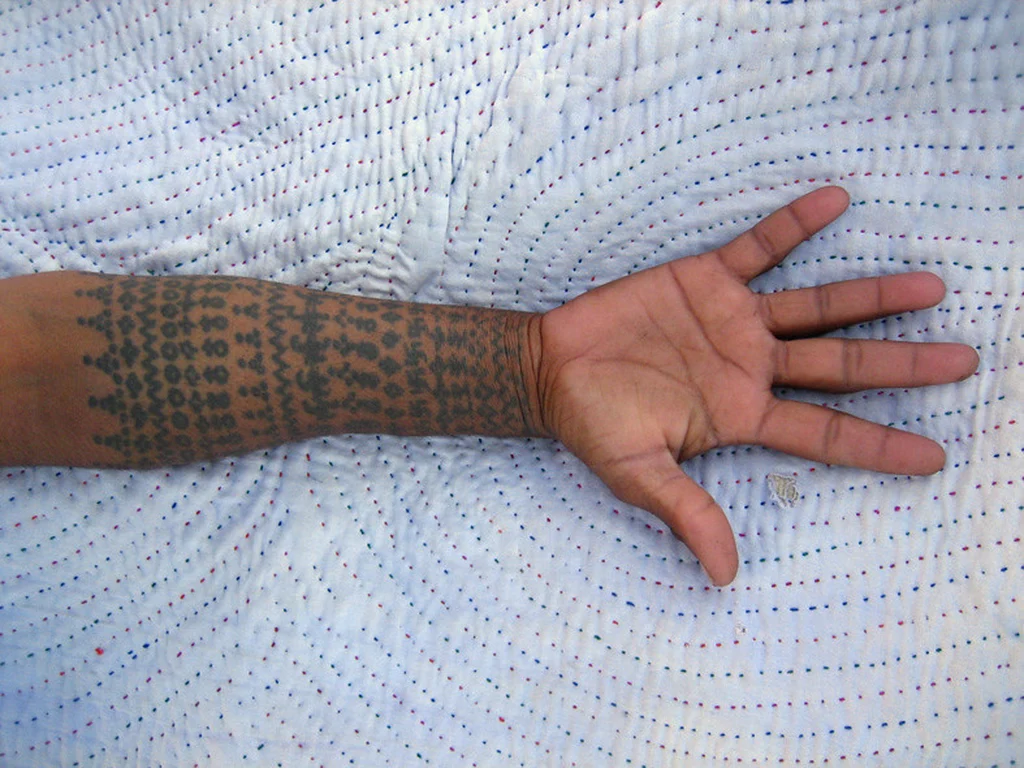
A band of bold black koru — the spiral fern-frond shapes of Māori design — patterned down the entire forearm in rows. As pattern work it suits the placement perfectly: the repeats hide the arm’s taper, and there is no single picture to distort when the arm turns.
The cultural side deserves a straight word. Tā moko is a Māori art form whose patterns carry genealogy and meaning, and it belongs to Māori. Non-Māori wearing koru-based pattern (sometimes called kirituhi) is a debated subject — if this style draws you, choose generic koru pattern rather than copying a specific moko, talk to an artist who knows the tradition, and understand what you are wearing. Bold black pattern, whatever its source, ages as well as anything in tattooing.
Fine Line Forearm Tattoo Ideas for the Inner Arm
The inner forearm is the fine line placement. The skin is smooth, the surface flatter than the outer arm, and the area stays out of the sun more than almost anywhere else you could put a tattoo. The five designs here — a cross with roses, a floral heart, carnations, a geometric lotus and a peony with a crescent moon — rely on placement to survive: fine lines spread a little with age wherever they are, and they spread slowest somewhere sheltered.
19. Fine Line Cross With Roses
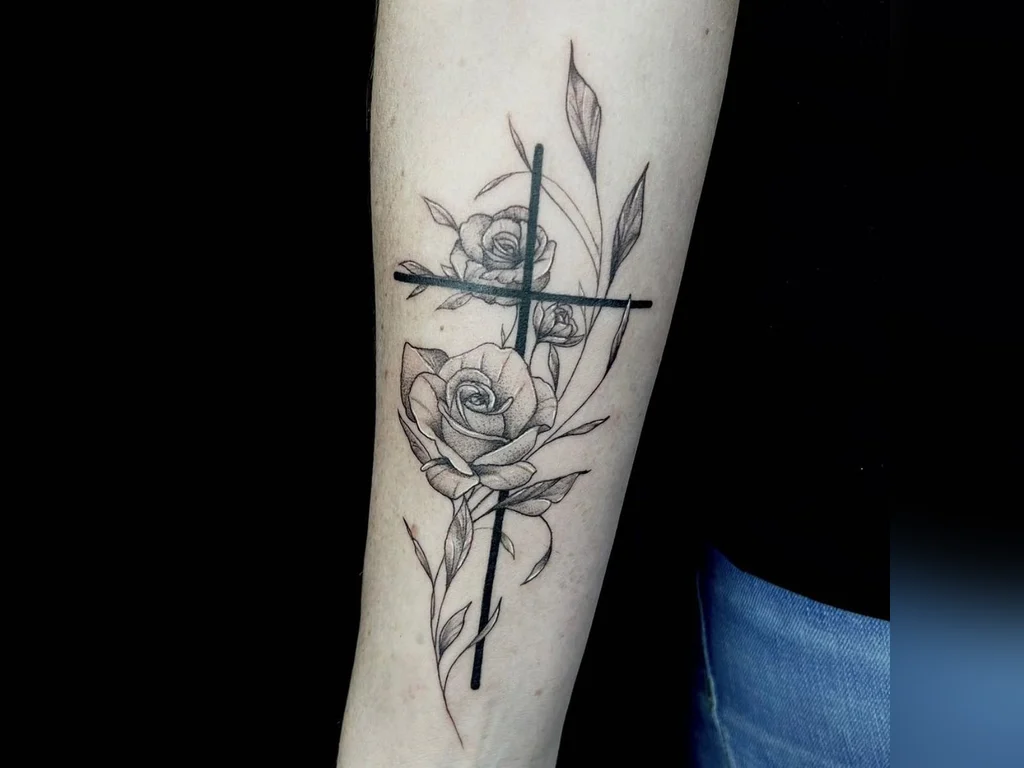
A thin cross built from a few long lines, with roses and leaves drawn in the same fine black and grey, running down the inner forearm. It is a faith tattoo drawn as lightly as the subject allows — all line and air, where the big realism pieces at the top of this page are all weight.
The inner forearm is the right home for it: smooth, sheltered, steady skin is what fine line needs. Even so, expect the lines to soften and thicken slightly over the years — that is ink in skin, not a flaw. Designs drawn with air between the lines, like this one, absorb that change gracefully.
20. Floral Heart Outline for Mum and Dad
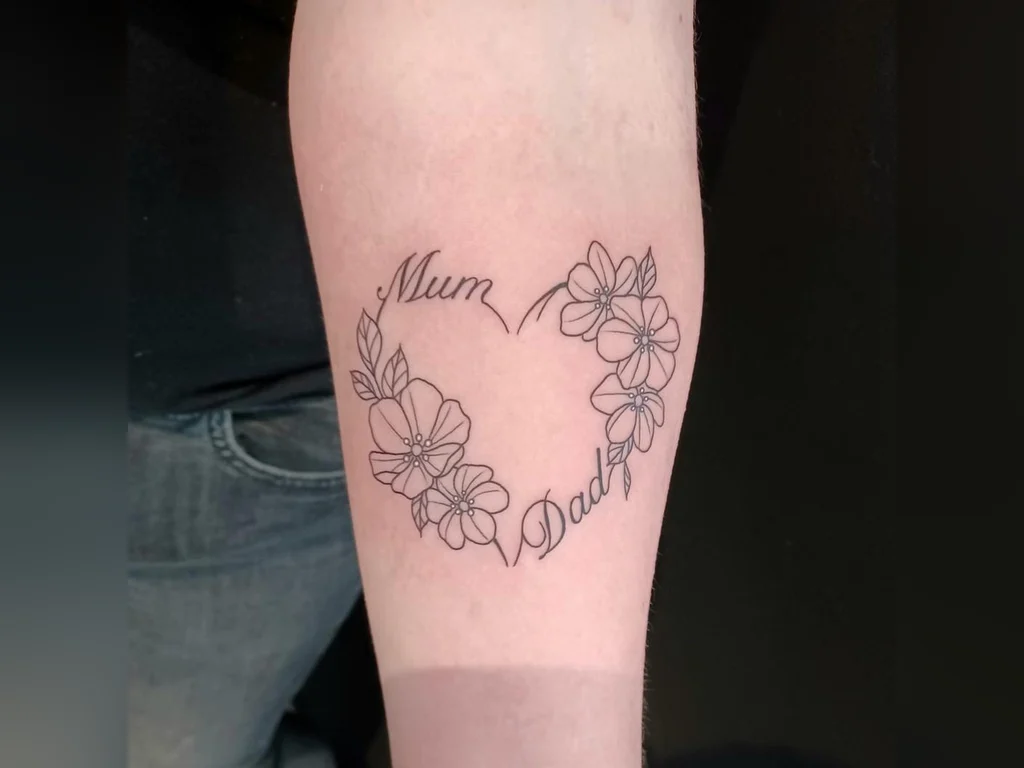
A heart drawn as an outline of flowers and leaves, with the words Mum and Dad lettered into the stems at the top and bottom. Family tribute pieces are probably the most common reason for an inner forearm tattoo, and the heart-of-flowers outline keeps it light — no heavy fill, nothing that cannot be added to later.
Outline-only designs are quick to get and gentle to heal, and they leave the door open: colour can go into the flowers later, or names and dates inside the heart. The trade-off is that a pale outline is the first kind of tattoo to look faint in old age, so choose this one with a future touch-up in mind.
21. Two Pink Carnations on a Stem
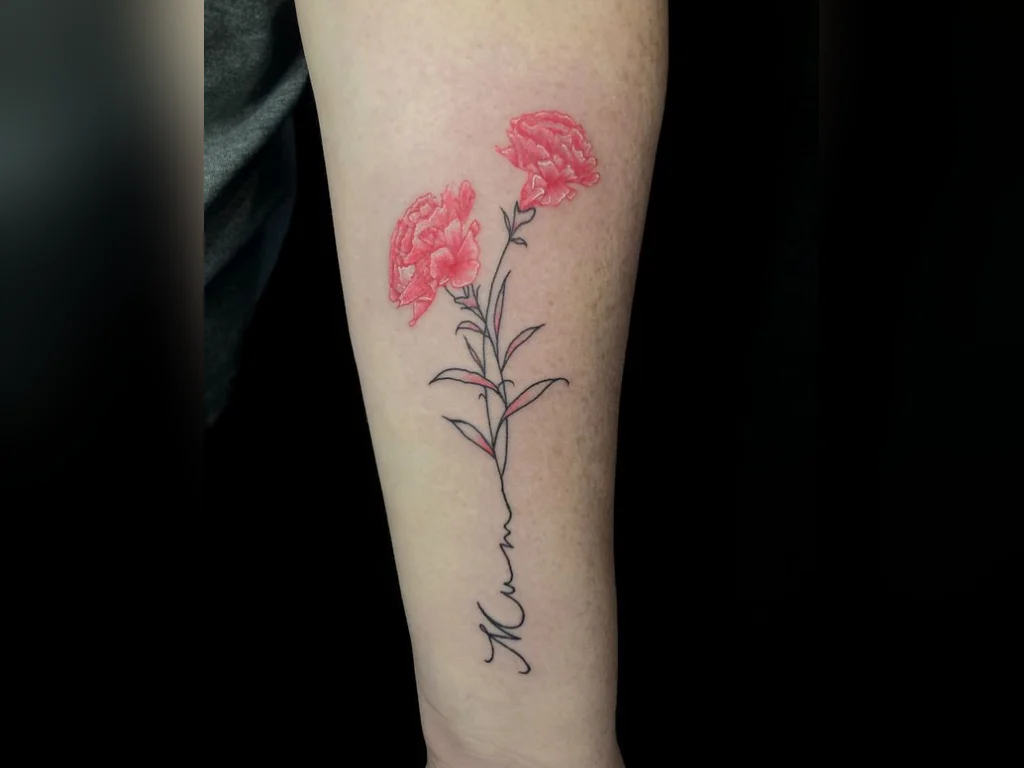
Two carnations in soft pink on one long stem, running down the inner forearm, with a name worked into the stem itself. Carnations are a traditional flower for mothers in a lot of families, and the long single stem uses the forearm’s shape the way a florist uses a vase.
Pink this pale is a fair-weather pigment: it fades faster than the black work elsewhere on this page, though the inner arm at least avoids the worst of the sun. Plan on a colour refresh some years down the line as normal upkeep, not failure. The drawing deserves it — the petals are suggested with a few lines, not laboured over.
22. Geometric Lotus With Triangle and Arrow
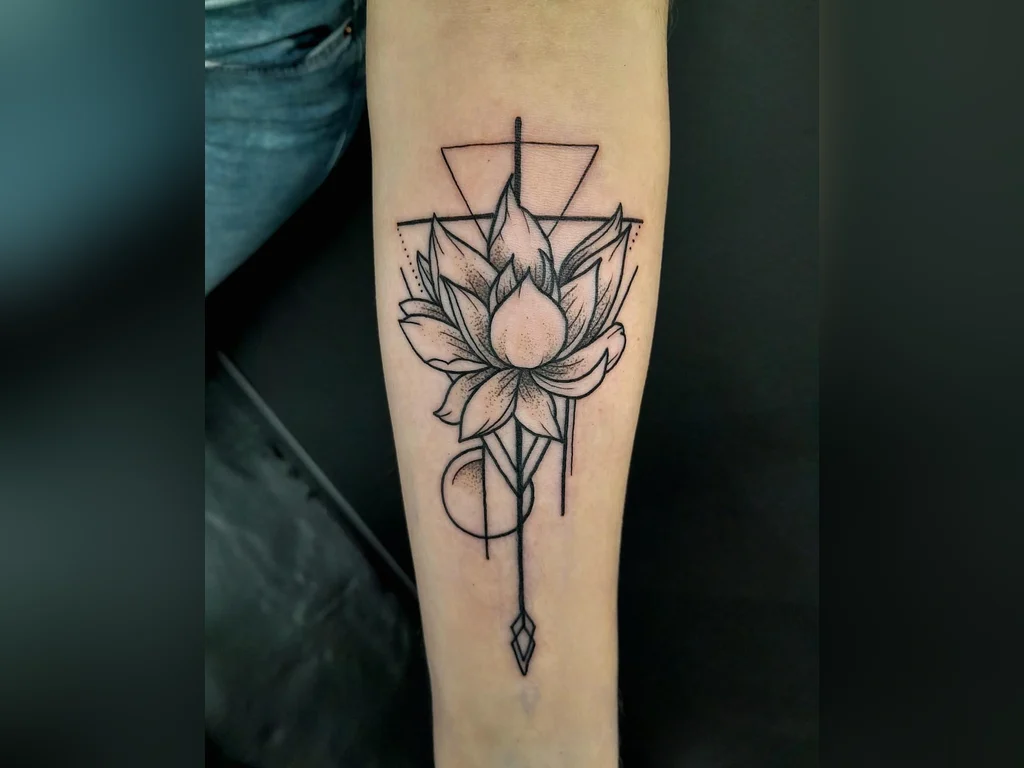
A lotus drawn in clean linework, held inside a triangle with a thin arrow dropping below it towards the wrist. The lotus carries its usual meaning — a flower that grows out of mud and opens clean — and the geometry around it turns a soft subject into something architectural.
Geometric linework shows every wobble, so this is an artist-selection tattoo more than a design-selection one: look at their healed straight lines before anything else. The inner forearm helps, being one of the steadiest surfaces on the body. Keep the triangle’s lines a touch heavier than the lotus petals, as here, so the structure outlasts the detail.
23. Peony and Crescent Moon
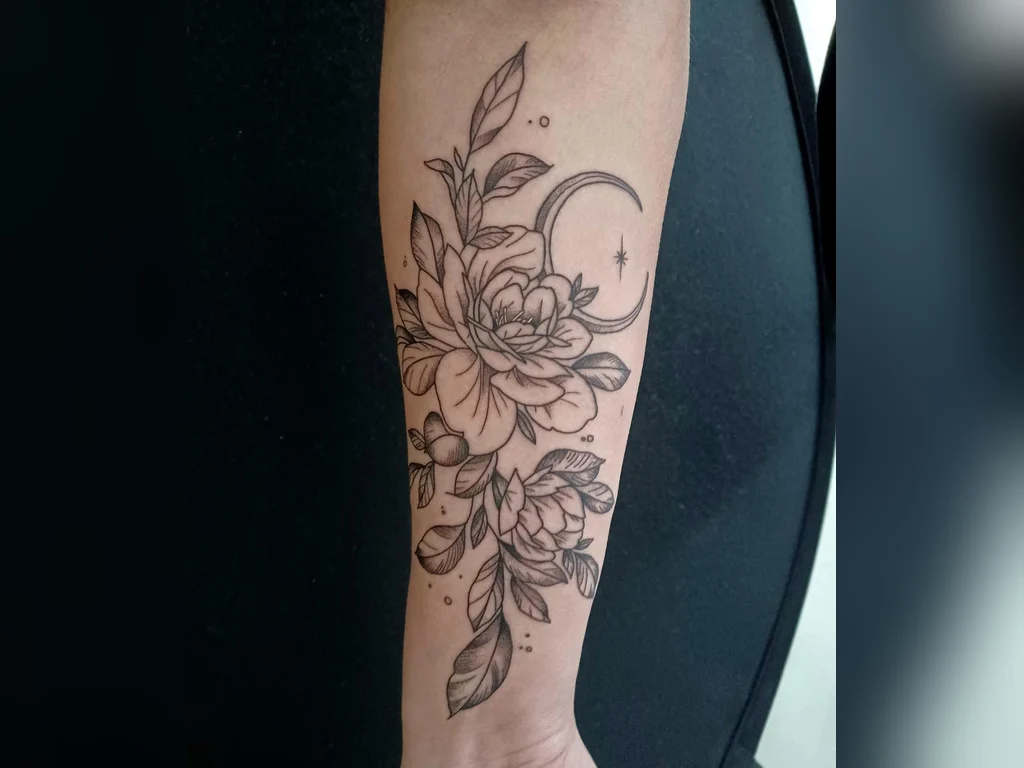
A peony in fine black line with a crescent moon and small stars above it, the whole design running vertically down the forearm. Peonies are drawn big in Japanese and traditional work; shrinking one into fine line is a newer habit, and the forearm is where it works best, because the flower can still be given real length.
Fine line florals spread gently with age, and petals drawn this close together are where you will see it first. The spacing here is honest — the petals have room. If you take this design to an artist, resist asking for it smaller; the size is the reason it will still look like a peony in fifteen years.
Script and Small Forearm Tattoo Ideas
Script belongs on the inner forearm more than anywhere else, because the words are for the wearer: turn your arm over and the text faces you, the right way up, all day. These four pieces run from a memorial infinity loop to a single name and date, a stack of three small symbols and one very small revolver. Small pieces like these are quick to get and easy to build on later — which cuts both ways, so leave room around them if a bigger piece might come.
24. Infinity Loop Memorial Script
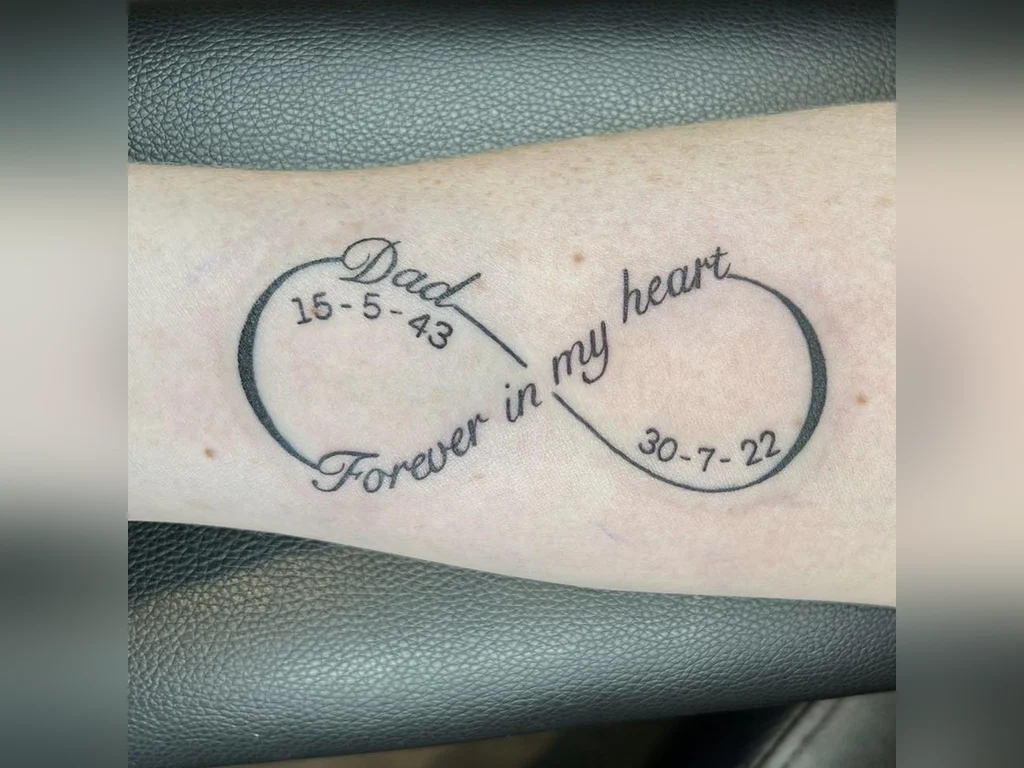
An infinity loop lettered as a memorial: a father’s name and dates at one end, the words Forever in my heart flowing along the loop. Designs like this are less about the symbol — the infinity loop is everywhere — than about the lettering being someone’s own words in a script that feels like handwriting.
Dates and names are the most unforgiving content in tattooing, because a wrong digit cannot be explained away. Check the stencil character by character before the needle starts, then check it again. On the inner forearm the text sits where the wearer reads it daily, which is the point of a memorial piece — and the loop’s open spacing lets the lettering soften over time without closing up.
25. One Name, One Date, One Small Heart
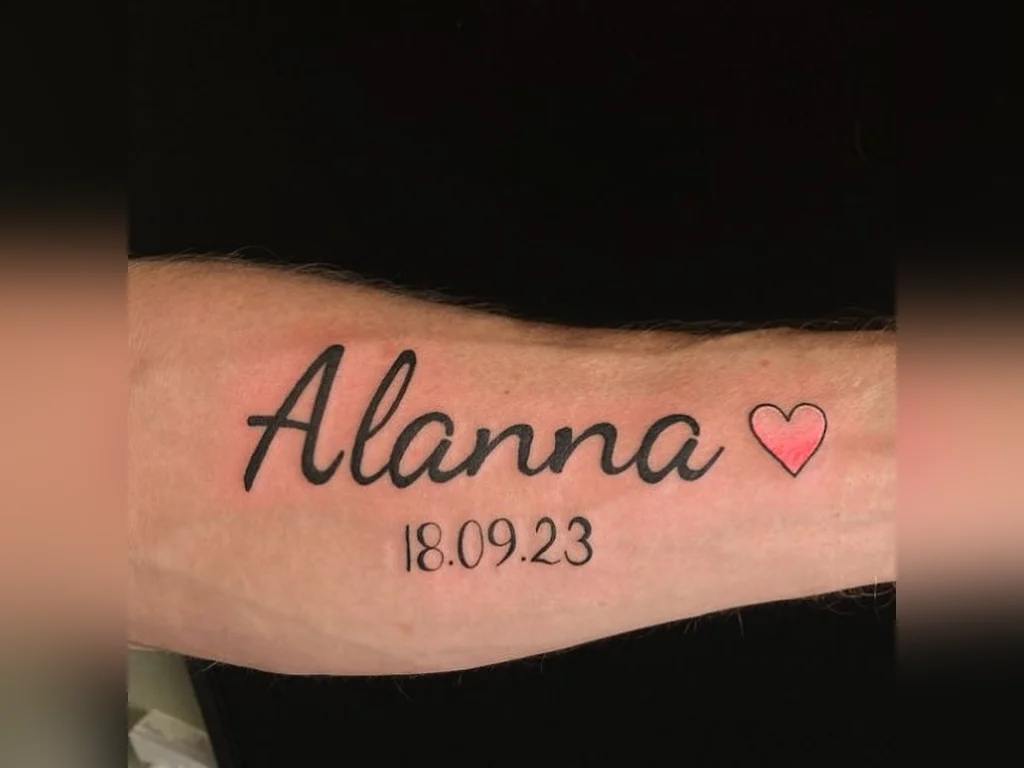
The simplest design in this collection: a child’s name in flowing script, her birth date under it in plain figures, and one small pink heart. Thousands of forearms carry some version of this tattoo, and it is easy to see why — it says everything it needs to in about four inches of inner arm.
Small script is where size discipline matters most. Letters need height and spacing to survive the slow thickening of lines, so a name at this size is about the floor, not a starting point for bargaining smaller. The single spot of pink is good judgment: one colour accent, easy to refresh, and the tattoo still works in pure black if it ever fades.
26. Three Small Symbols in a Column
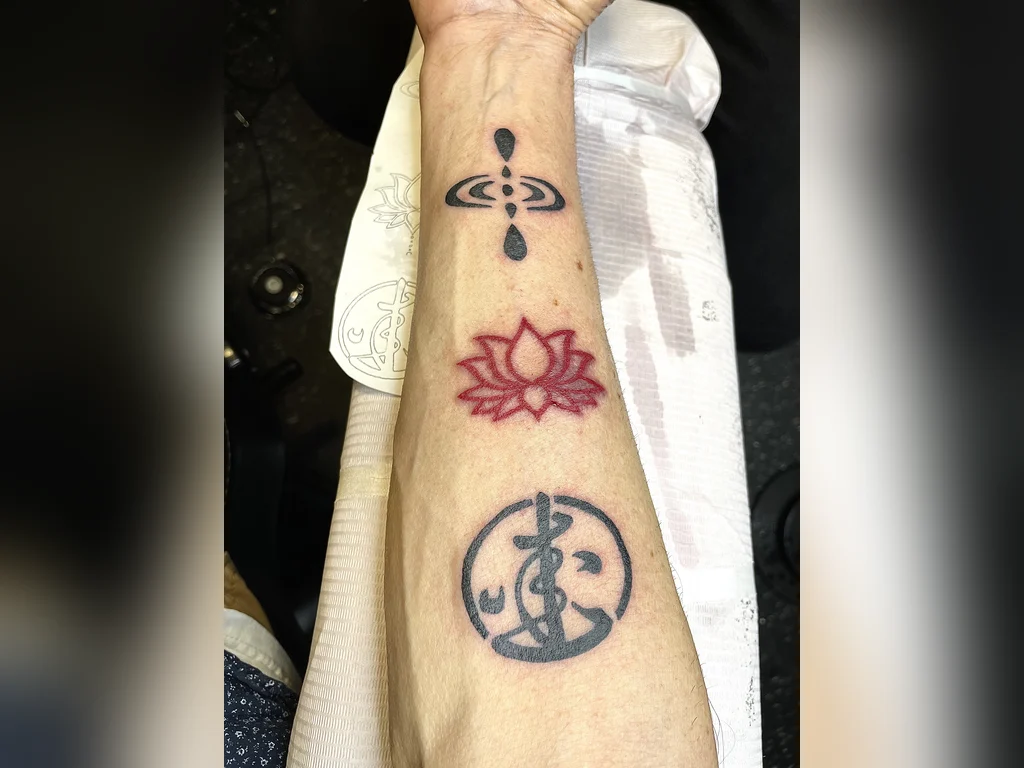
Three small marks stacked down the inner forearm: a black geometric symbol at the top, a red lotus in the middle, and a circular emblem at the wrist end. Each is small enough to be its own tattoo; together they read as one collected column, the way charms collect on a bracelet.
Building a forearm this way — one small piece at a time — is a real strategy, not indecision. It spreads the cost, lets each tattoo heal before the next, and the column can stop whenever it feels finished. The discipline is in the spacing: these three share a centre line and similar weights, so they look collected rather than random. Plan the grid with the first tattoo, not the third.
27. Tiny Revolver With a Flower in the Barrel
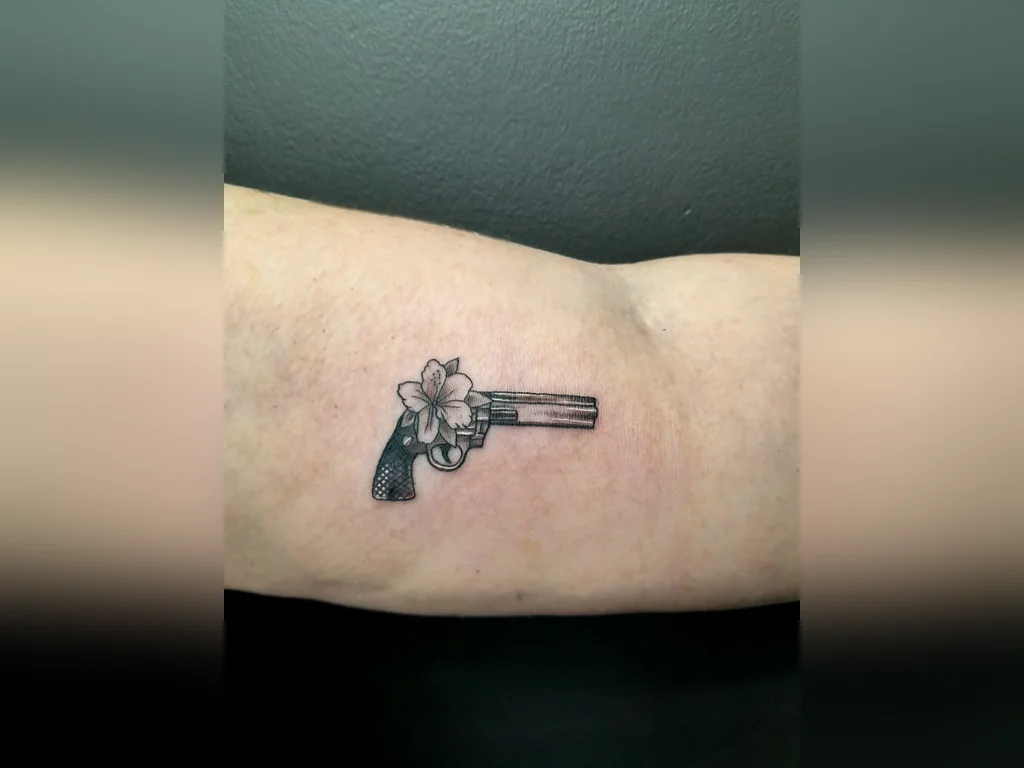
A small revolver, no bigger than a thumbprint, with a flower tucked into its barrel — the old peace-symbol joke drawn in about twenty lines. It is the smallest design here by a distance, sitting alone on the inner forearm with a lot of bare skin around it.
Tiny tattoos live on their linework, and a gun is an unforgiving subject — the shape has to be right or it reads as a blob with a handle. This one keeps the silhouette simple and the detail to a suggestion of cylinder and grip. Small and simple ages kindly; small and fiddly does not. If you want a miniature, copy this one’s restraint rather than its subject.
Wraps, Bands and Matched Pairs
The last three forearm tattoo ideas use the arm’s shape instead of fighting it. A floral wrap leaves bands of bare skin inside the design, a snake uses the arm’s length to coil around a rose, and one wearer went for mirrored skull-and-clock pieces on both forearms at once. Wrap designs are the ones to plan most carefully with your artist: the drawing has to be made on the arm, or at least checked against it, because paper is flat and forearms are not.
28. Black Floral Wrap With Bands of Bare Skin
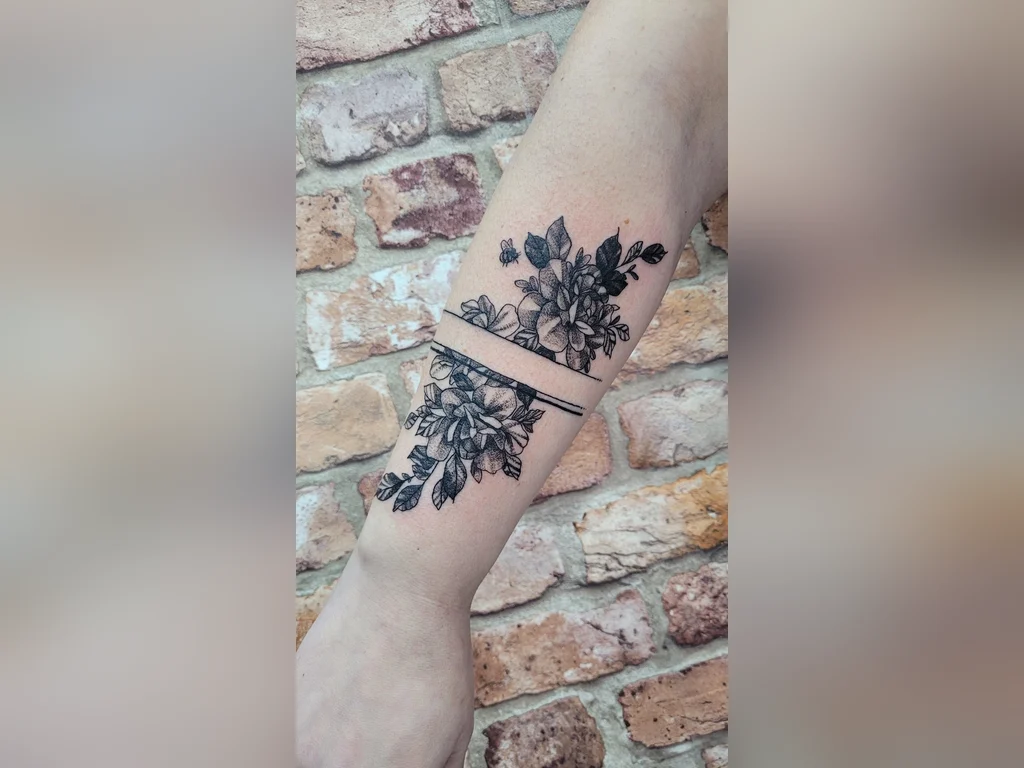
A dense black floral design wraps the forearm, but the clever part is what is missing: two clean bands of untattooed skin cross the arm inside the design, left blank on purpose. The bare skin becomes part of the pattern — a bracelet effect built out of nothing.
Negative space like this only works if the edges are disciplined, which means an artist who can pull a long clean line around a curved arm. It also future-proofs the piece: the bands will still read as bands even as the floral detail softens. Wraps should always be drawn or at least fitted on the arm itself, and these bands line up too well to have been done any other way.
29. Mirrored Skull and Clock Pieces, Both Forearms
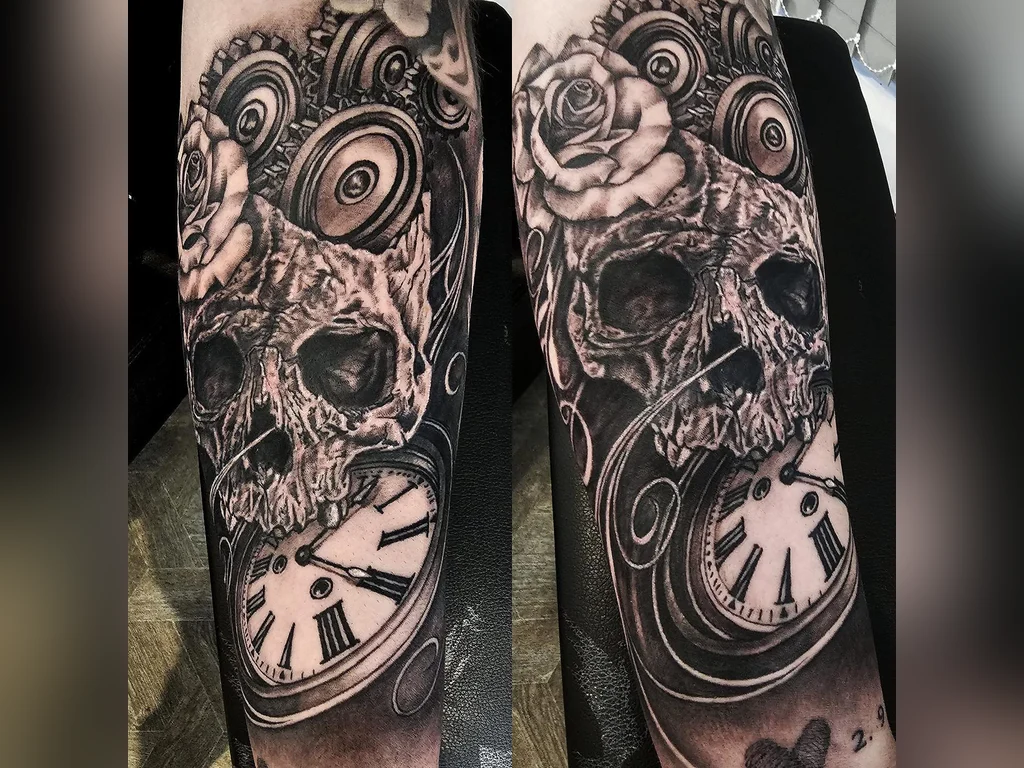
Both forearms, one composition mirrored: a skull worked into swirling machinery and roses above a clock face, repeated on each arm. Skull and clock is a memento mori pairing — remember that time is limited — and wearing it twice, symmetrically, turns a reminder into a statement.
Matching pairs double everything: cost, sitting time, healing and commitment. The practical way is the way this looks to have been done — same artist, same drawing flipped, sittings close together so the two pieces age at the same rate. Of all forearm tattoo ideas, a mirrored pair is the one that is on show as a pair every single day, which is the whole appeal.
30. Snake Coiling Through a Rose
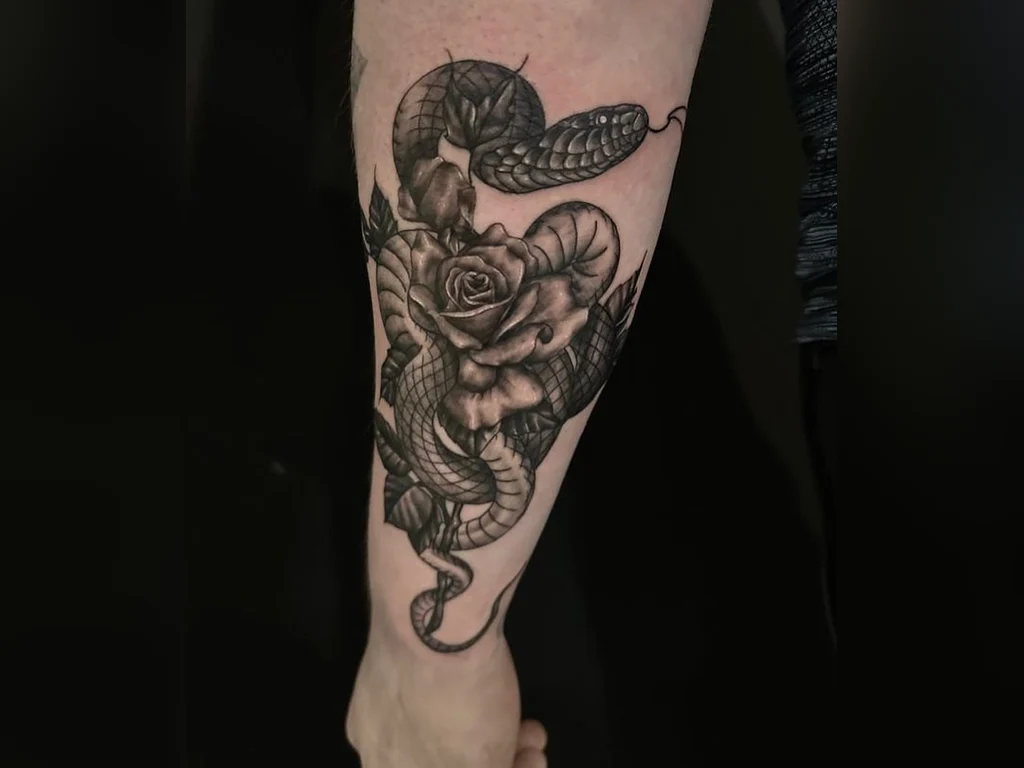
A snake winds down the forearm and through a large rose, its head near the elbow and the tail finishing towards the wrist. Snakes are drawn for this placement because the animal and the arm share a shape — the coil can follow the forearm’s own taper instead of being flattened onto it.
The scale pattern is the ageing risk: drawn this fine, scales merge into texture over the years, which honestly suits a snake — it will read as skin pattern rather than a diagram. The head and the rose carry the contrast, and those are the parts your eye goes to anyway. For far more snakes than any arm could hold, the snake tattoo ideas collection is the place to go.
Forearm Tattoo Ideas in Real Life: Pain, Work and Ageing
Pain, work and ageing are where forearm tattoo ideas stop being pictures and start being decisions. The same design behaves differently on the inner and outer arm, fades at different speeds, and raises different questions at work — so before the questions, here is the practical side of the placement, plainly.
Pain: what the forearm actually feels like
The forearm sits at the kind end of the tattoo pain scale, and most people rate it among the easiest placements on the body. The outer forearm is the toughest part — thick skin over muscle, with enough padding that most people describe it as a steady scratch rather than real pain. The inner forearm is more tender, especially near the elbow crease and down where the skin thins towards the wrist, and lines there can feel sharper than they look.
Two things catch people out. First, length: a full-forearm realism piece is a long sitting, and hour three hurts more than hour one wherever you are on the body. Second, vibration — the needle over the forearm bones can make your hand tingle or twitch, which is normal and not a sign anything is wrong. Eat beforehand, bring water, and tell your artist if you need a break; they would rather pause than have you go pale on the table.
Visibility, work and everyday life
A forearm tattoo is visible every time you wear short sleeves, roll up a shirt, type, drive or shake hands — and hidden in about two seconds by pulling a sleeve down. That on-off quality is a big part of the placement’s appeal, but be honest about your own workplace before you commit. A design that runs onto the wrist or hand is a different conversation; those are the ones some employers still treat as job-stoppers.
Day to day, the forearm is a high-contact surface. It rests on desks, catches sun through car windows, and gets knocked more than almost anywhere else. During healing that means loose sleeves, no leaning the fresh piece on cafe tables, and care with gym equipment. After healing it means sunscreen — the single most effective thing you can do for any of the forearm tattoo ideas on this page is keep a tube of it wherever you keep your keys.
How forearm tattoos age
Ink spreads slowly in the skin over the years, lines thicken a little, and the finest detail merges first. On the forearm those rules run in a particular order. The outer forearm fades fastest because it gets the most sun. The inner forearm holds detail best but rubs against the world more, and designs there soften from friction as much as from light. Pieces sitting in the elbow crease or on the wrist bone live where skin folds and stretches daily, and they are the first to need a touch-up.
That is why the designs in this collection sit where they sit. Bold traditional work and packed black shapes barely notice a decade. Soft realism holds well at full-forearm size and disappoints when shrunk. Fine line and pale colour are the most delicate, and they are shown here on the inner arm, at honest sizes, with room between the lines. None of that should put you off a style — it should decide its size and its exact spot, a conversation worth having with your artist before the stencil goes on.
Forearm Tattoo Ideas: Frequently Asked Questions
How much does a forearm tattoo cost?
It depends on size, detail and the artist’s rate, and any honest answer has to be a range. A small inner-forearm script or symbol piece might take under an hour; a full-forearm realism piece can run to a full day or split across two sittings. Studios price by the hour or by the piece, and rates vary a lot by city and by waiting list. Get the quote after a consultation with the design agreed — a price quoted for ‘a forearm tattoo’ sight unseen means very little.
Do forearm tattoos hurt?
For most people, not much. The forearm is regularly rated one of the least painful placements: the outer arm has thick skin and muscle under it, and the inner arm is tenderer but still manageable. The sensitive spots are the elbow crease, the thin skin near the wrist, and anywhere the needle runs close to bone. Long sessions wear you down more than any single spot does.
How long does a forearm tattoo take to heal?
The surface usually settles in about two to three weeks — the flaking and itching pass, and the tattoo looks healed. The deeper layers take longer, up to a few months, before the skin is fully back to normal. Forearms heal straightforwardly compared with hands or feet, but they are hard to keep out of harm’s way: sleeves, desks, bags and gym kit all rub. Keep it clean, moisturised as your artist directs, and out of soaking water until the surface has closed.
Will a forearm tattoo stop me getting a job?
It depends on the job and how far down the arm the tattoo goes. A forearm piece is covered by any long sleeve, and plenty of workplaces have relaxed about tattoos below the elbow. The placements that still cause problems are hands, fingers, neck and face. If your industry is conservative, keep the design above the wrist bone so a cuff covers its end, and check your employer’s actual policy rather than guessing.
Which is better for a first tattoo, inner or outer forearm?
Both work; they suit different designs. The inner forearm is flatter and more sheltered — the best surface for fine line and script — and the tattoo faces you, which most first-timers want. The outer forearm is tougher, less painful, and better for bold work and anything you mainly want other people to see. The inner arm is also easier to keep out of the sun, which matters more with every year the tattoo ages.
Do forearm tattoos stretch or distort with muscle?
A forearm changes shape less than most placements — it is not a joint and does not flex the way a bicep does. Serious muscle gain widens the arm slightly, and a well-drawn design widens evenly with it; portraits and perfect circles show it most. Weight change affects the inner forearm’s softer skin more than the outer. In practice, distortion ranks low among forearm worries — sun and time do far more.
How do I choose between fine line and traditional for a forearm?
Choose by how you want the tattoo to look in fifteen years, not fifteen days. Traditional work — thick lines, packed colour, simple shapes — looks almost the same for decades and suits the outer forearm’s sun and knocks. Fine line looks delicate now and will soften into something gentler; it belongs on the sheltered inner arm, drawn at a fair size with space between lines. Neither is better. They are answers to different questions.
Can a forearm tattoo become a half sleeve later?
Yes — it is one of the most common ways half sleeves get built. If there is any chance you will extend upwards later, tell your first artist. They can leave the top of the design open, avoid hard borders at the elbow end, and keep background elements flowing in a direction that can continue. The pieces that extend worst are the ones boxed in by a frame or a band at the top. The column of small symbols at number 26 shows the other approach: a forearm collected piece by piece, on purpose.
What should I look for in an artist for forearm realism?
Healed work, at least a year old, in their portfolio — realism is the style where fresh photos flatter most. Look for smooth gradients without patchiness, blacks that are truly black, and portraits where the likeness holds. Realism specialists usually have waiting lists and charge accordingly. A forearm is a billboard you will look at every day for decades, which makes it the worst place on your body to save money.
Are forearm tattoo ideas different for women and men?
The placement is the same and so is the skin; what differs is mostly taste and the size of the arm. A smaller forearm suits designs with less fine detail packed in — not because of gender, but because the canvas is smaller and detail needs room. The fine line florals and script pieces in this collection sit on a range of arms, and so does the realism. Pick the design for the arm it is going on, at the size that arm can hold.
Final Thoughts
The forearm’s popularity is not a fashion cycle — it is geometry. No other placement gives a tattoo this much flat, visible, easy-healing skin and then lets you cover it with a shirt cuff when you need to. The 30 designs here run from a thumbprint-sized revolver to a leopard that takes the whole arm, and the honest differences between them are not about taste. They are about how much sun the spot gets, how fine the lines are, and how much room the design was given — the three things that decide what a tattoo looks like in fifteen years.
So use these forearm tattoo ideas the way they are meant to be used: find the two or three that make you stop scrolling, then take them to a good local artist and let them redraw the idea for your arm, at your arm’s size. That step — a design made for one specific forearm instead of copied onto it — is the whole difference between a tattoo that settles in and one that never quite sits right.
Photo credits — all photographs via Flickr, every licence verified from the photo’s own page on 31 October 2026: design 1 by TattoosAll (CC BY-SA 2.0); design 2 by TattoosAll (CC BY 2.0); design 3 by TattoosAll (CC BY-SA 2.0); design 4 by TattoosAll (CC BY-SA 2.0); design 5 by TattoosAll (CC BY-SA 2.0); design 6 by TattoosAll (CC BY 2.0); design 7 by TattoosAll (CC BY-SA 2.0); design 8 by TattoosAll (CC BY-SA 2.0); design 9 by TattoosAll (CC BY-SA 2.0); design 10 by TattoosAll (CC BY-SA 2.0); design 11 by TattoosAll (CC BY-SA 2.0); design 12 by TattoosAll (CC BY-SA 2.0); design 13 by TattoosAll (CC BY 2.0); design 14 by TattoosAll (CC BY-SA 2.0); design 15 by ftrc (CC BY-SA 2.0); design 16 by Strandell (CC BY 2.0); design 17 by Shrie Bradford Spangler (CC BY 2.0); design 18 by Meanest Indian (CC BY 2.0); design 19 by TattoosAll (CC BY-SA 2.0); design 20 by TattoosAll (CC BY-SA 2.0); design 21 by TattoosAll (CC BY-SA 2.0); design 22 by TattoosAll (CC BY-SA 2.0); design 23 by TattoosAll (CC BY-SA 2.0); design 24 by TattoosAll (CC BY-SA 2.0); design 25 by TattoosAll (CC BY-SA 2.0); design 26 by Librarygroover (CC BY 2.0); design 27 by TattoosAll (CC BY-SA 2.0); design 28 by TattoosAll (CC BY-SA 2.0); design 29 by TattoosAll (CC BY-SA 2.0); design 30 by TattoosAll (CC BY-SA 2.0).
1 thought on “30 Forearm Tattoo Ideas: Realism, Traditional, Fine Line and Script Designs”