A cherry blossom tattoo is usually a branch, not a single flower — a dark length of wood carrying pink blooms and a few petals already letting go. If you are working through cherry blossom tattoo ideas, that shape is the whole point: the branch can climb a back, wrap an arm or shrink to a sprig on an ankle, and it means roughly the same thing at every size.
Every design below is a real tattoo in a real photograph, counted one by one: 24 in total. No stock illustrations, no flash drawings passed off as tattoos, no padding. Where a photo shows a tattoo fresh, faded or photographed in poor light, that gets said out loud — one design in this list is included precisely because it shows what fifteen-year-old pink looks like.
This guide sits inside the flower cluster on this site, alongside our flower tattoo design ideas collection and the lotus tattoo ideas guide. It is built the same way as the rest of the cluster — real photographs only, honest counts, and the ageing notes included, good or bad. If you want the blossom drawn as a single fine stem rather than a branch, our fine line tattoo ideas page covers that end of the scale.
What Cherry Blossom Tattoos Mean
In Japan the blossom — sakura — is the standing example of how short a beautiful thing lasts. The flowers open, peak and fall inside about two weeks, and that brief run is tied to an idea called mono no aware: a gentle sadness at the passing of things, and an appreciation that comes from knowing they pass. A cherry blossom tattoo is most often a small, wearable version of that thought — a reminder about time, not a decoration that happens to be pink.
The samurai link is real, but it is a tradition rather than a rulebook. In Japanese tradition the blossom became associated with the samurai, whose lives were also expected to be brief and whose ideal was to fall at their peak, like a petal in its prime rather than withering on the branch. It is a genuine piece of the symbolism — just know it is an association built up over centuries of art and poetry, not a code anyone swore by.
Hanami is the living custom underneath all of it. Every spring, people across Japan gather under flowering cherry trees to eat, drink and look at the blossom while it lasts — a practice documented for well over a thousand years. Britannica’s cherry profile covers the trees themselves, including the flowering kinds grown purely for that display. Plenty of cherry blossom tattoos are simpler than any of this: a birth in April, a trip to Kyoto, a person who is no longer here. Those reasons need no footnotes.
One popular framing deserves a straight answer. Branch-and-blossom pieces do appear in Japanese traditional tattooing, alongside waves, wind bars and other seasonal fillers — designs 3, 4, 5 and 16 in this list are that family. That is the extent of it. Cherry blossom is not a badge of any group, and a blossom branch on a forearm in Manchester means what its wearer says it means.
The 24 Designs
1. Full-Back Blossom Tree
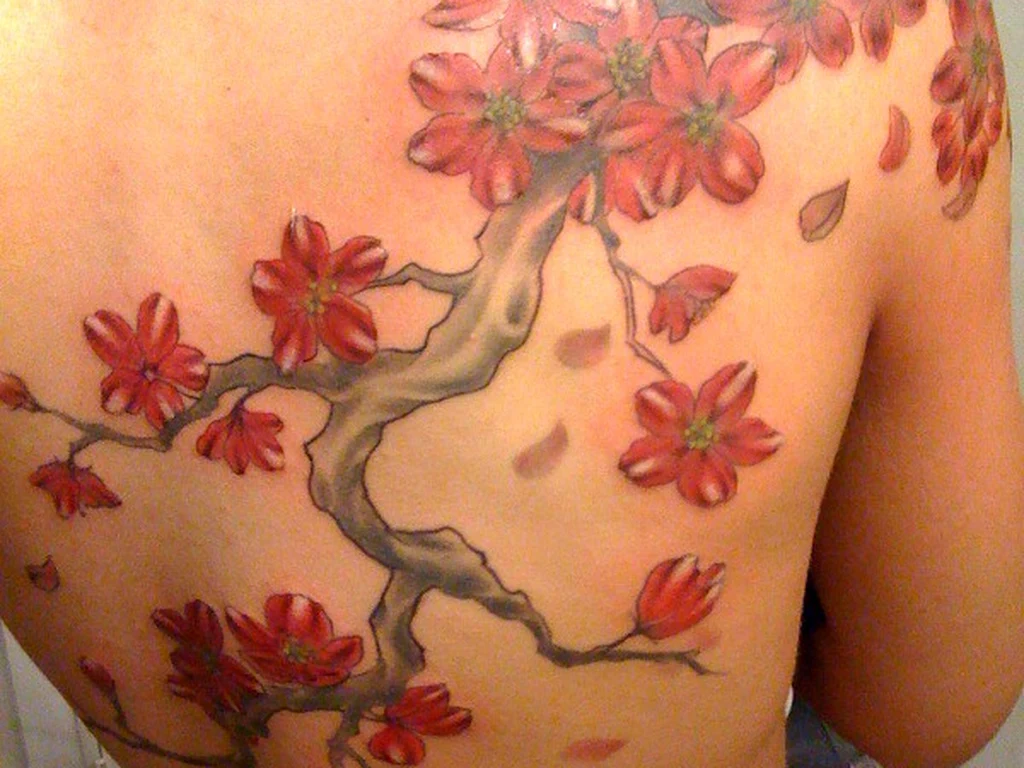
The biggest commitment in the list: a whole tree, gnarled grey trunk forking across the back, with deep red blossoms at the shoulder, ribs and hip and a few petals already falling. This is the design the smaller branches in this list are all cropped from, in spirit if not in fact.
A back this size is several sessions and a serious budget, and the trunk does the long-term work — thick, dark and widely spaced, it will hold its shape for decades. The red is a deeper choice than the usual pink and tends to settle into a rust tone as it ages.
2. Blossom Branch and Koi Back Piece
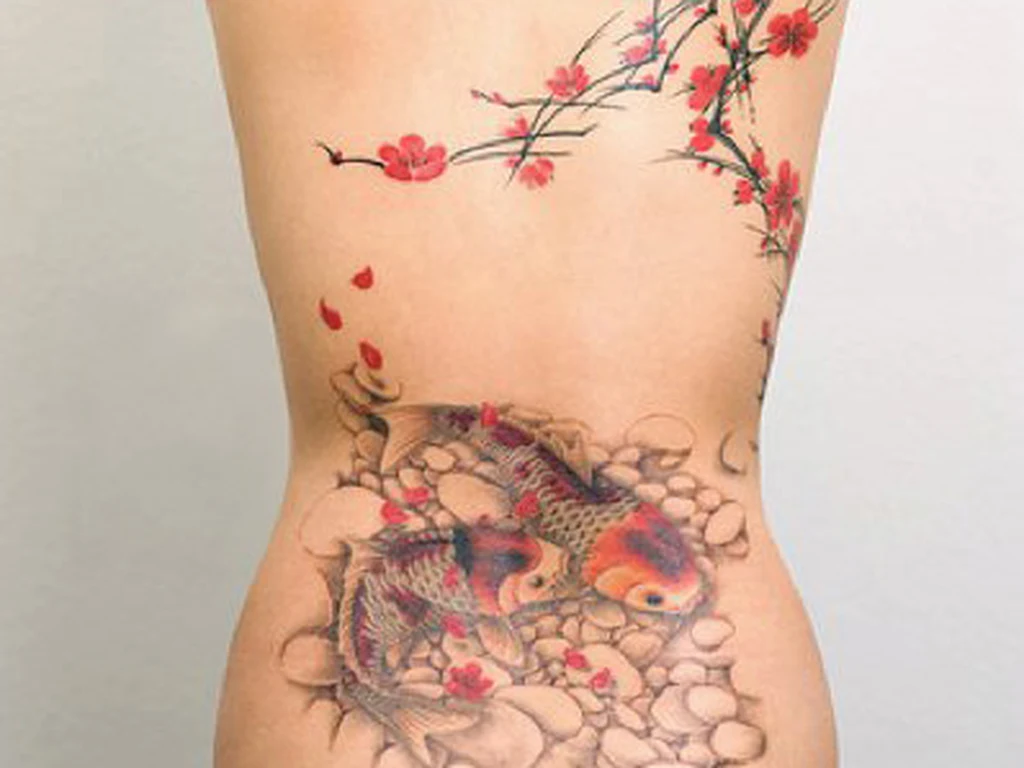
A fine black branch enters at the shoulder, drops red blossoms and loose petals down the spine, and lands at a koi circling in shaded water at the lower back. The two subjects share one idea — things that move, drift and pass — which is why the pairing turns up so often in Japanese-style work.
Notice how much empty skin the design leaves. The branch reads clearly because nothing crowds it, and the petals scattered down the back are doing composition work, not filling space. If your artist suggests adding background everywhere, this photo is the counter-argument.
3. Temple Sleeve in Black and Grey
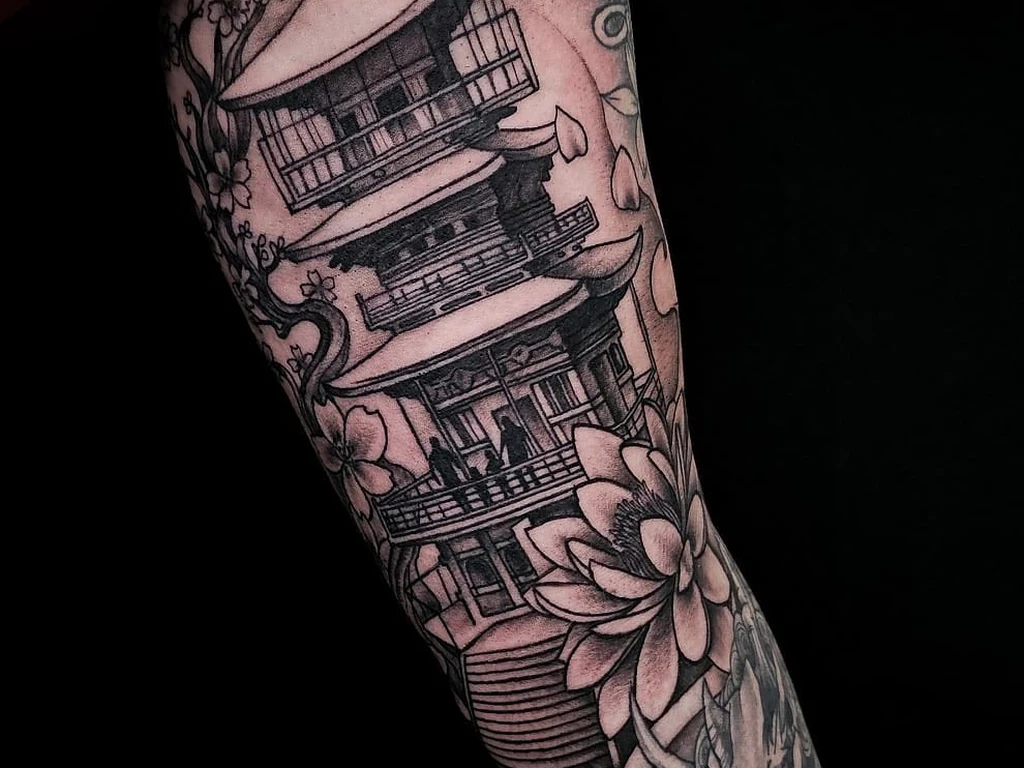
A pagoda stacked down the arm in black and grey, with blossom worked through the levels and a large lotus at the base. The blossom here is a supporting player — it softens the architecture and marks the season the scene is set in.
Buildings are unforgiving subjects: rooflines that wobble read as mistakes, not style. This is specialist Japanese-traditional work, and the portfolio to ask for is healed sleeves, not fresh ones — grey wash settles lighter than it looks on the day.
4. Samurai Helmet Forearm
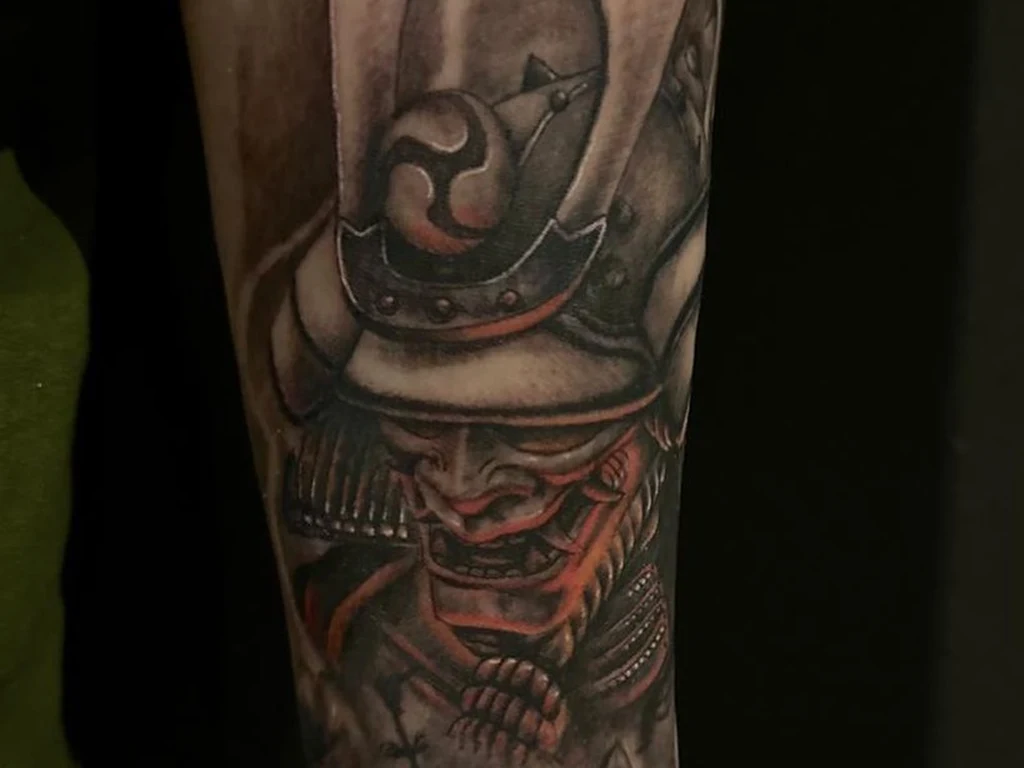
A kabuto helmet and snarling face guard fill the forearm in black and grey, with blossoms gathered underneath. Of all the designs in this list, this is the one that leans hardest on the samurai-and-blossom association described above — the flower under the armour is the contrast the wearer is after.
Armour is dense, dark work, and a forearm gives it a long, narrow frame. Expect the blossoms to be the first part to soften; drawn this bold, they have years of softening available before they stop reading.
5. Hannya Mask Forearm
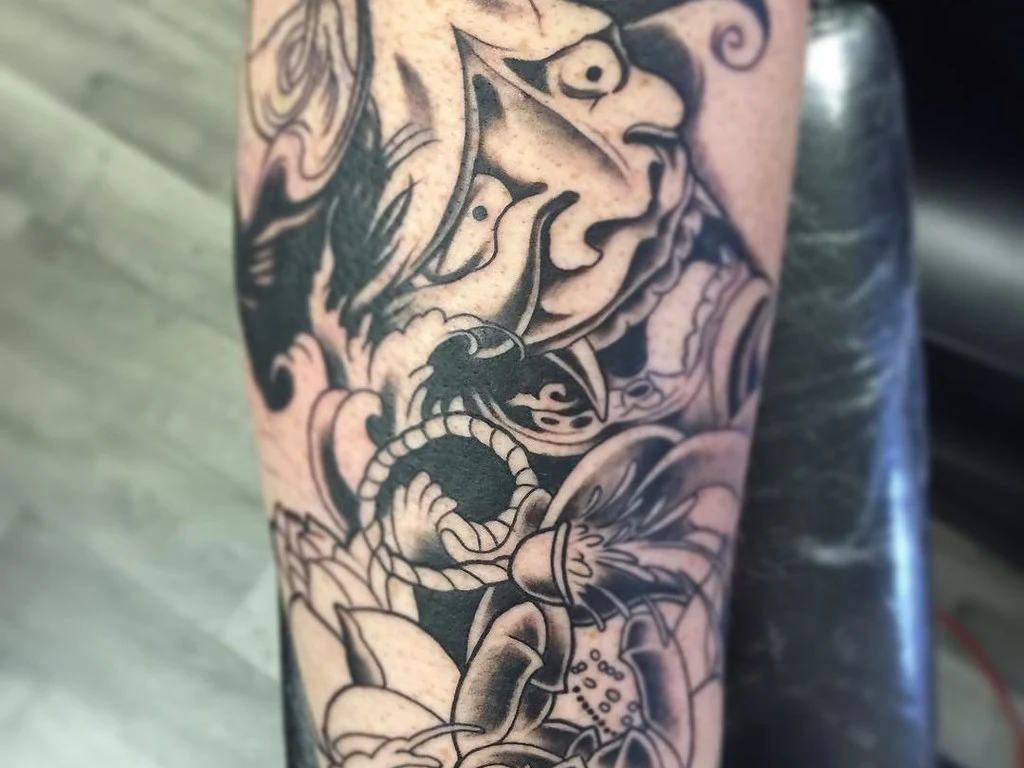
A hannya mask — horns, fangs and a glare — worked in black and grey down the forearm, blossom woven through the lower half. The hannya comes from Japanese theatre and stands for a jealousy and grief that has curdled into something dangerous; pairing it with the shortest-lived flower in the garden is a deliberate tension, and a common one in Japanese-style tattooing.
Masks live on their expression, and expression lives in the eyes and mouth. At forearm size there is room to keep both sharp; shrink this design and the face turns to mush first.
6. Temple Forearm in Colour
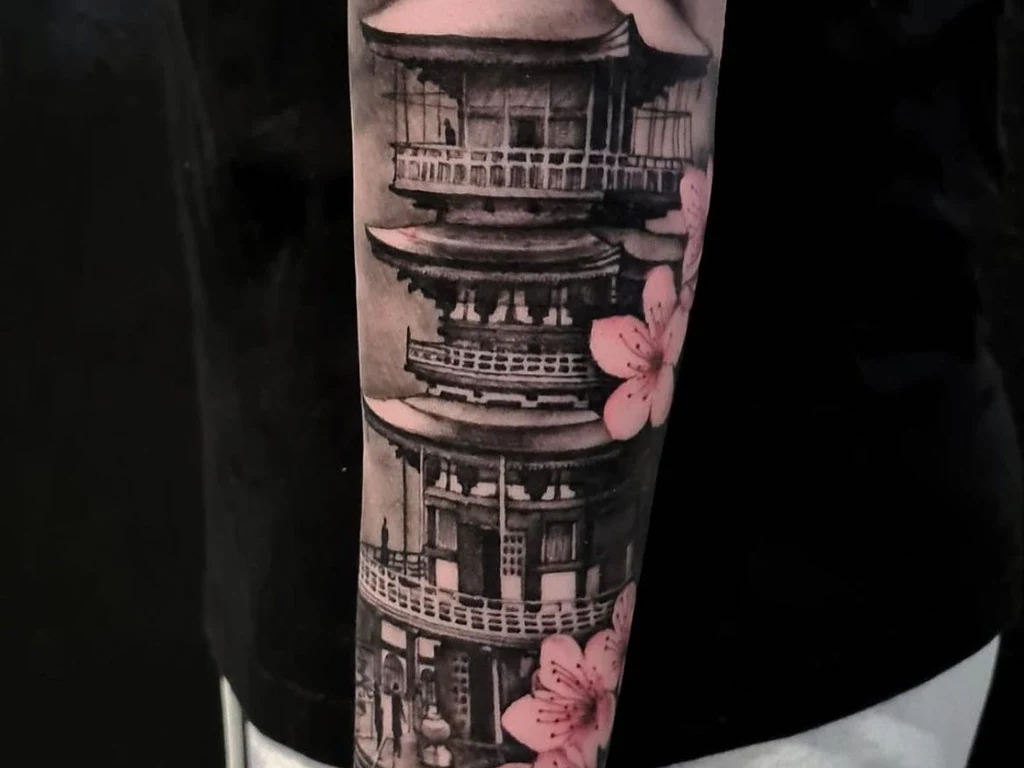
The same temple idea as design 3, cut down to a forearm: grey-wash pagoda, pink blossoms placed at the top and bottom of the building like bookends. It shows how a sleeve-sized subject survives being shrunk — fewer levels, bigger shapes, the blossom promoted to a bigger share of the design.
Mixing one colour into a black and grey piece is a decision with a maintenance angle: when the pink eventually wants a refresh, it can be re-hit without touching the grey work around it.
7. Flank Blossoms in Colour
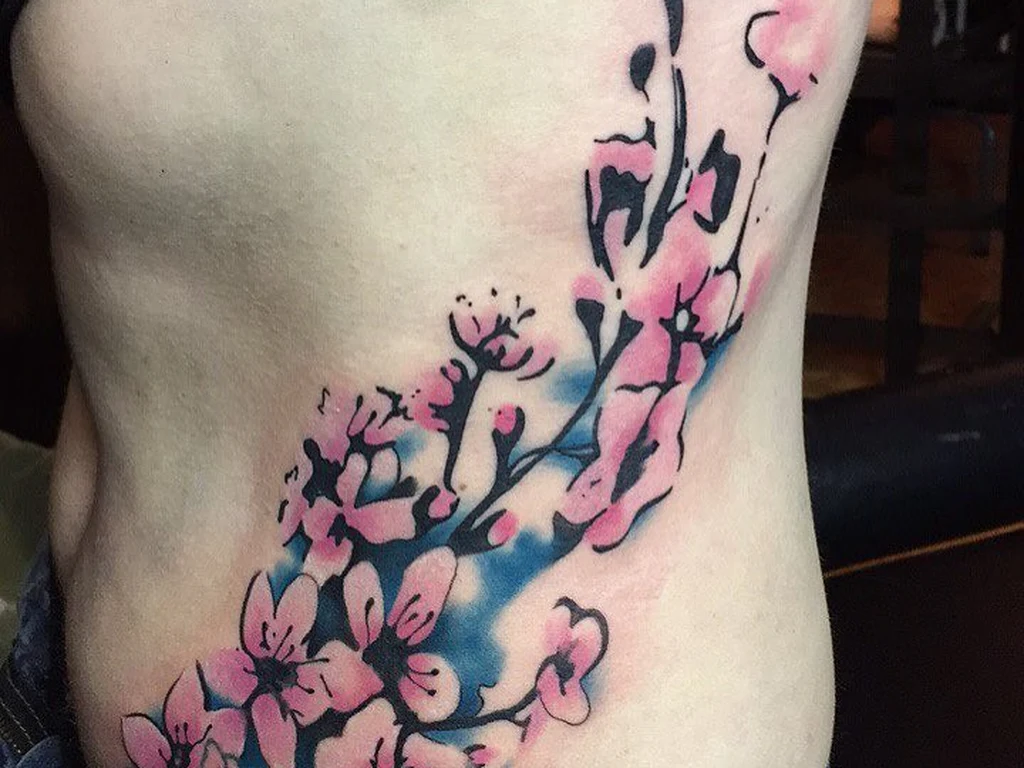
Big, graphic blossoms in pink and black climb the whole flank from hip to ribs, the flowers drawn far larger than life. Nothing about this one is delicate, and that is its charm — it reads from across the room.
The flank is a private canvas that moves a lot: it stretches when you breathe, twist and sit. Bold shapes forgive that movement; fine detail does not. The heavy black in the branches is what will keep this piece structured as the pink settles.
8. Rib Branch With Falling Petals
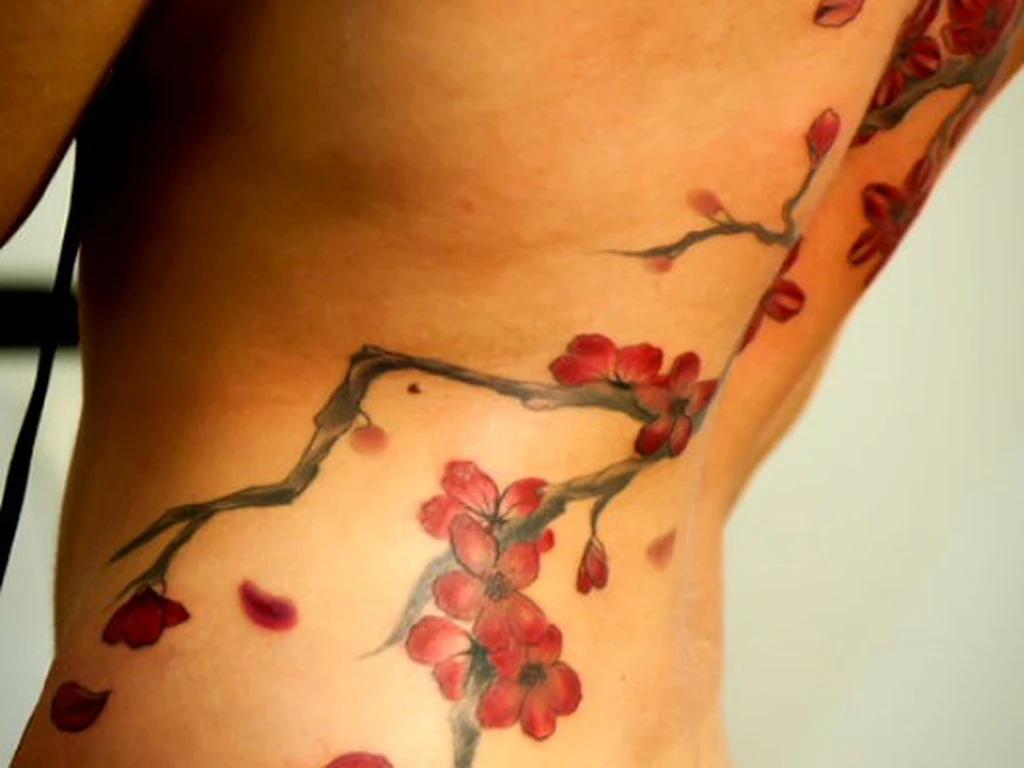
A dark branch crosses the ribs carrying red blossoms, with single petals scattered down toward the hip as if the wind has just passed through. Those loose petals are the oldest trick in the sakura book — they turn a flower tattoo into a picture of a moment.
Ribs are usually rated the sharpest sitting in this list, and the skin there stretches with every breath, which is why the design is built from a few strong shapes rather than many small ones. Compare it with design 9: same placement, opposite temperament.
9. Rib Branch in Red Ink-Wash Style
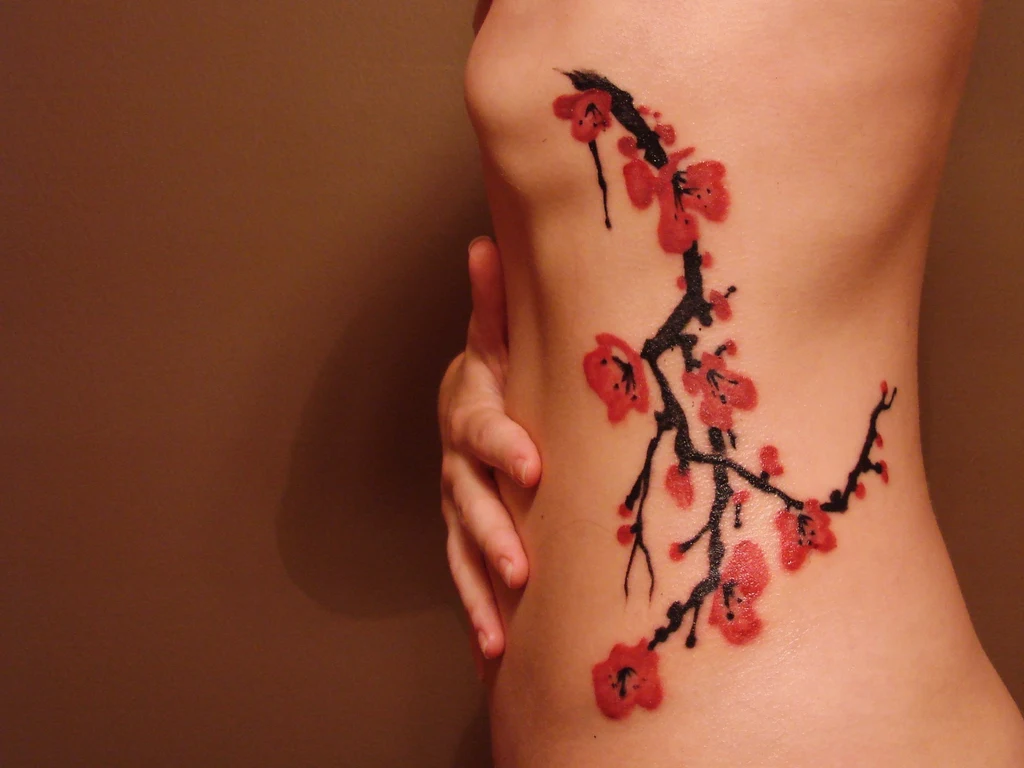
Painted rather than outlined: a near-black branch with blossoms laid in as flat red washes, in the spirit of a sumi-e brush painting. There is almost no line work in the flowers at all — the colour itself makes the shapes.
Be clear-eyed about the trade: colour without an outline softens at the edges as years pass. Worn knowingly, this style keeps a softness the outlined pieces cannot match — and it may want a colour refresh sooner than they will.
10. Forearm Branch in Colour
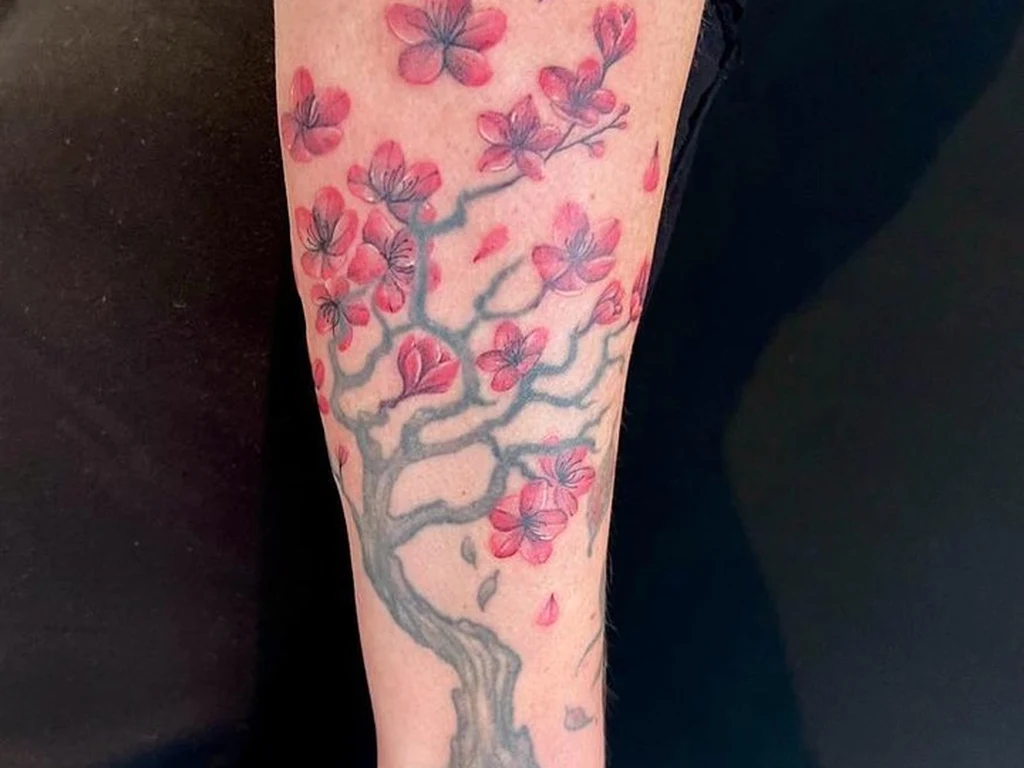
A grey-brown branch runs the length of a forearm, loaded with pink and red blossoms from wrist to elbow. This is the most-requested shape in the whole cherry blossom family: the branch follows the arm’s own line, so the tattoo moves the way the arm does.
Forearms live in the sun. Pink and red are the colours sunlight takes first, so this placement quietly commits you to sunscreen on healed skin if you want the blossom to stay pink rather than drift peach.
11. Forearm Branch, Stylised Pink
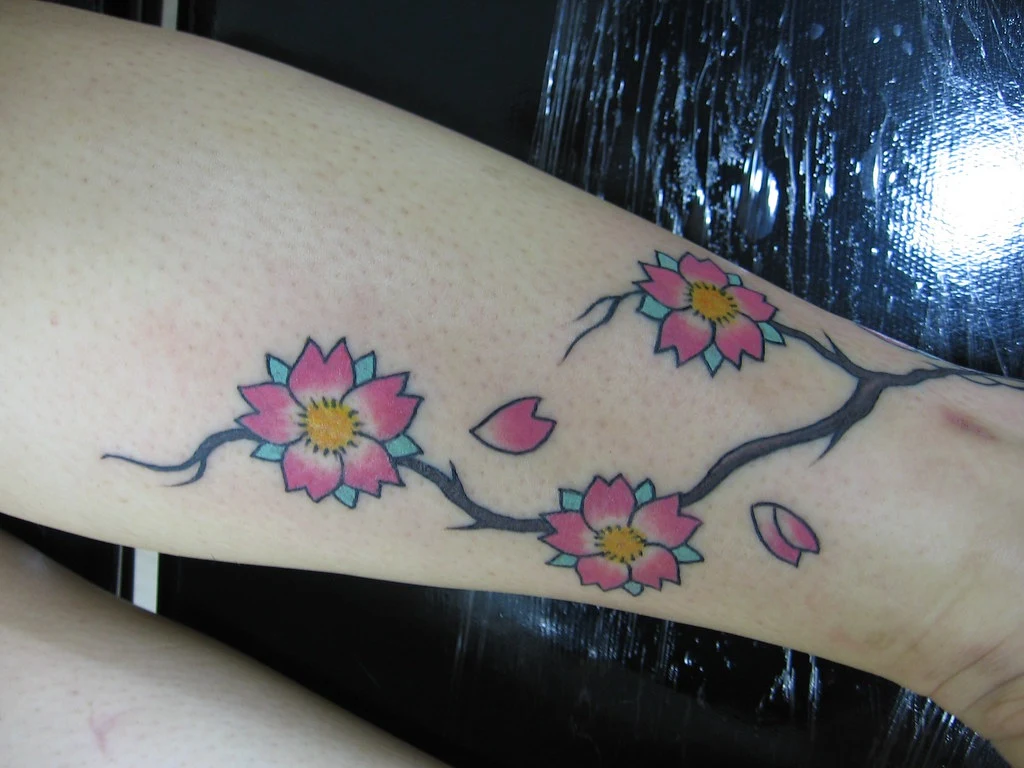
The same forearm branch, drawn the storybook way: flat pink flowers with dark centres on a simple black branch, spaced out like a pattern on fabric. It gives up realism and gains the cleanest possible read at a glance.
Flat colour and hard edges are the most forgiving combination in tattooing. If you like this look, the main choice is flower size — at this spacing, each bloom can shrink a little over the years and the pattern still holds.
12. Bird, Bee and Blossom Shoulder
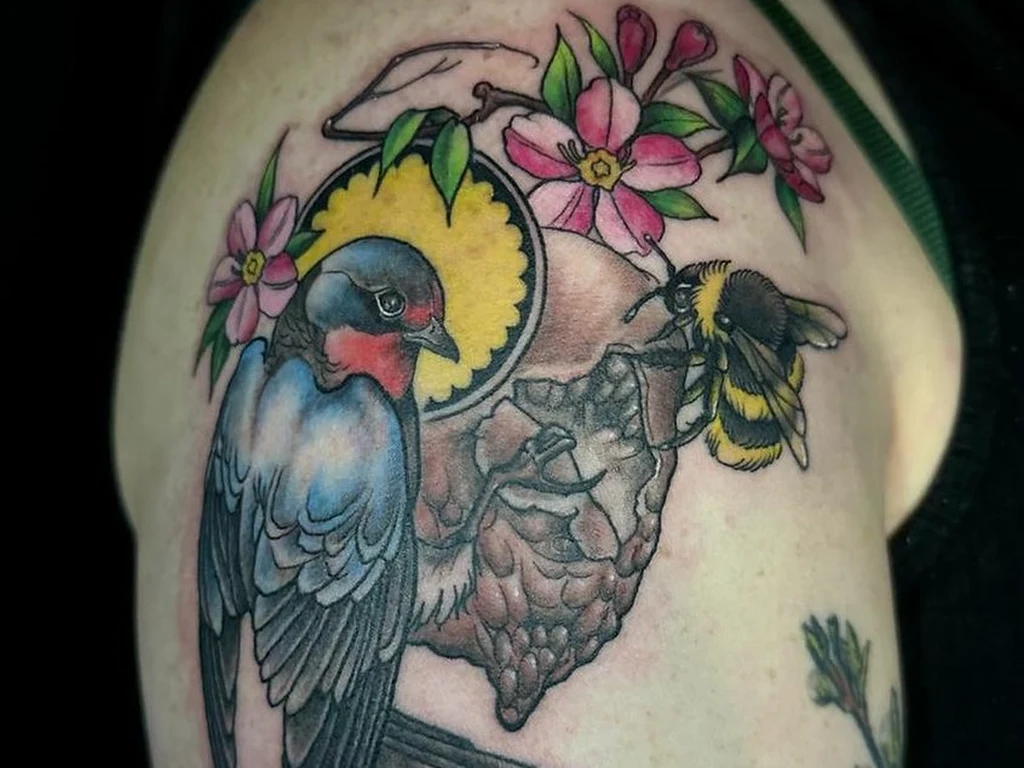
A blue bird and a fat bee share a shoulder with pink blossoms, drawn in a bright, traditional hand. Blossom is the setting rather than the subject here — it is what tells you the season, and it lets the wearer build a spring scene instead of a single symbol.
Multi-subject pieces need one element in charge. Here the bird takes the size and the centre; the blossoms stay smaller and lighter. If everything in a design shouts at the same volume, the eye gives up — this one is mixed like a song, not an argument.
13. Shoulder-Blade Blossom Cluster
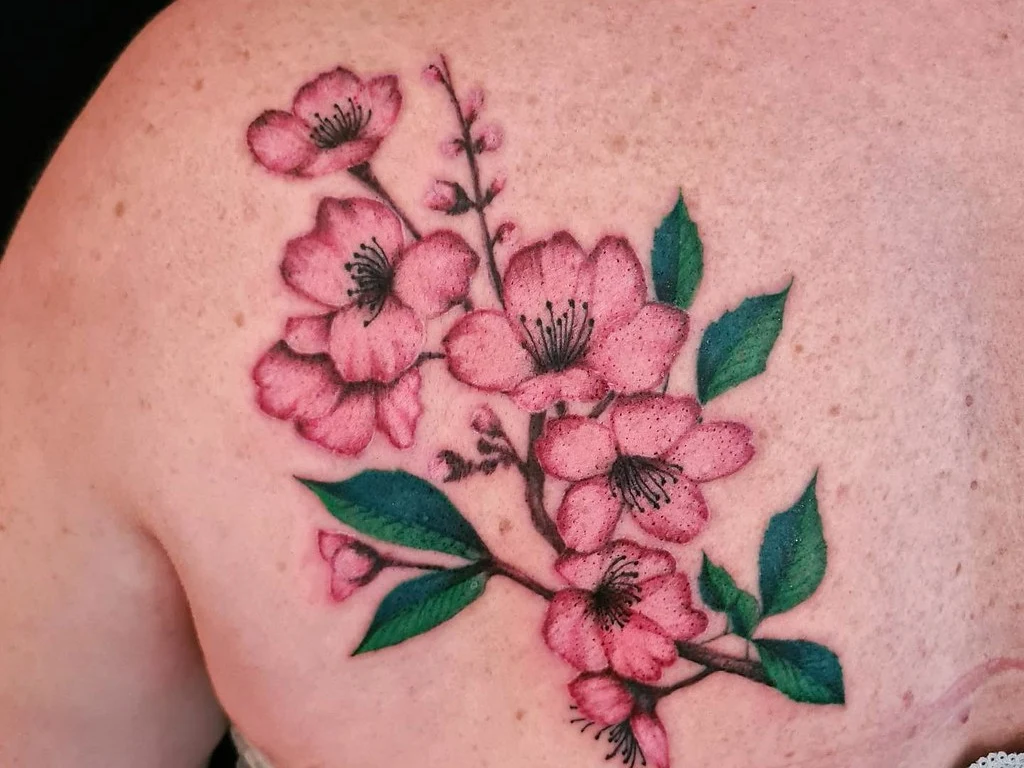
No branch worth mentioning — just a tight bunch of big pink blossoms with green leaves, sitting on the shoulder blade like a corsage. Most sakura leaves are drawn brown or dropped entirely; the green here is a deliberate, fresher choice.
The shoulder blade is a kind canvas: flat, still, and easy to cover or show. It is also a spot you cannot watch being tattooed, which some people count as a feature.
14. Shoulder Branch With Fine Twigs
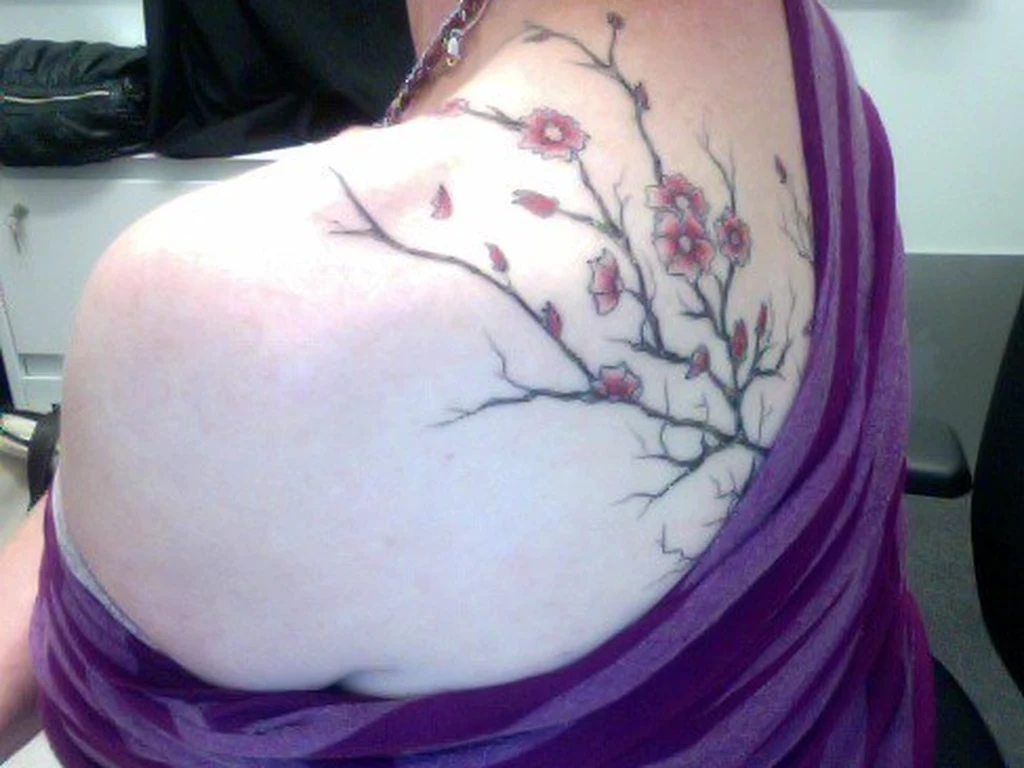
A wintery branch — thin black twigs, a handful of small pink blossoms, buds still closed — spread over the curve of a shoulder. It looks like the tree a week before peak bloom, and that restraint is the design.
Fine twigs are the detail most likely to thicken as the tattoo ages, so the spacing between them matters more than their thinness on day one. This one keeps its twigs far apart, which is exactly right.
15. Shoulder Sprig in Soft Pink
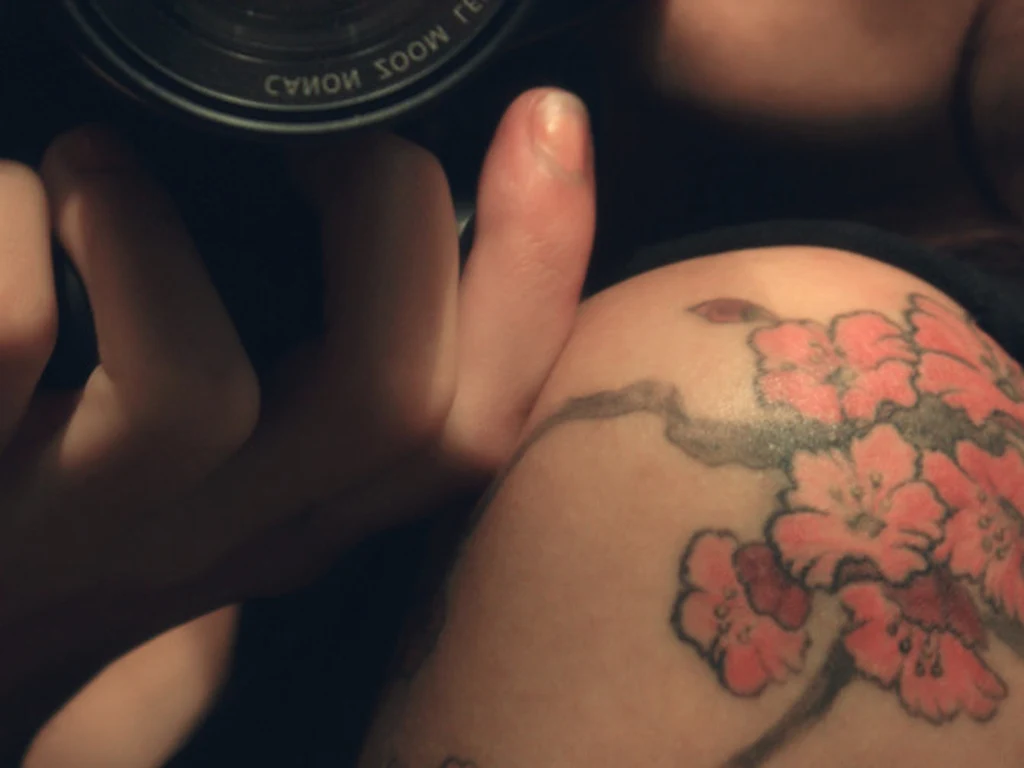
A small cluster of coral-pink blossoms on a short branch, photographed by the wearer over her own shoulder. It is the lightest piece in the list — a sprig, not a statement — and it suits how a first tattoo usually feels.
Soft pink with soft edges fades faster than anything else in this list. Plan on it being paler and gentler in five years, and like it anyway.
16. Faded Shoulder Blossoms With Kanji
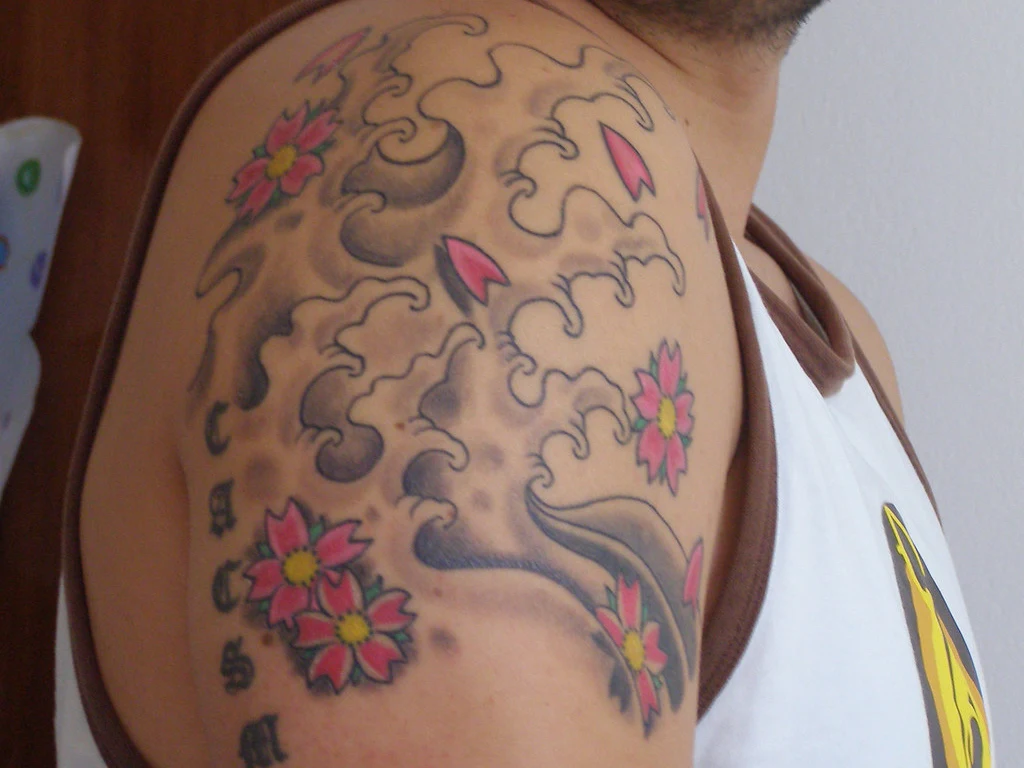
An older Japanese-style shoulder piece, honestly photographed: blossoms gone pale, grey wind bars behind them, a line of kanji down the arm. This is what a cherry blossom tattoo becomes after years of sun and skin — softer, greyer, still readable.
It earns its place in the list as evidence. The bold dark shapes — the wind bars, the branch work — have held; the pink has thinned to a blush. When an artist tells you pink is a loan, not a purchase, this photograph is what they mean.
17. Dragonfly and Blossom Calf
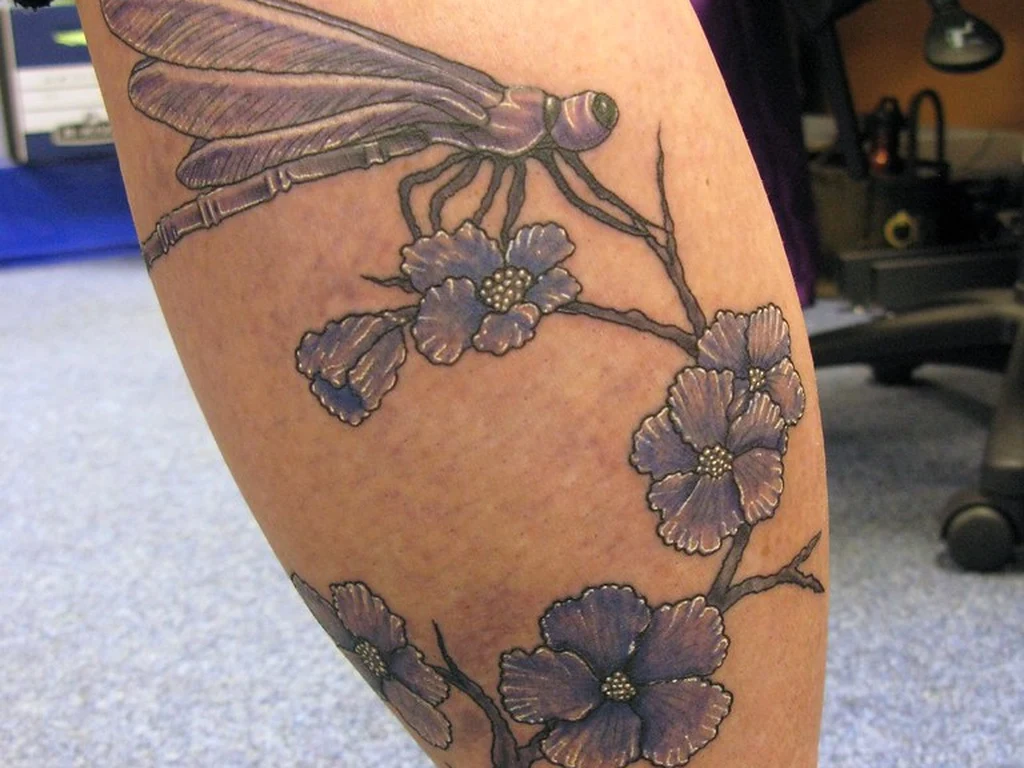
A large dragonfly rests at the top of the calf above a branch of grey-purple blossoms. In Japanese art the dragonfly is a summer creature and an old emblem of resolve; set over spring blossom, the piece quietly covers two seasons at once.
The muted palette is the story here — no pink at all. Grey-violet blossom reads elegant and ages evenly, and it suits people who want the shape of sakura without the sweetness.
18. Blossom Branch in Black and Grey
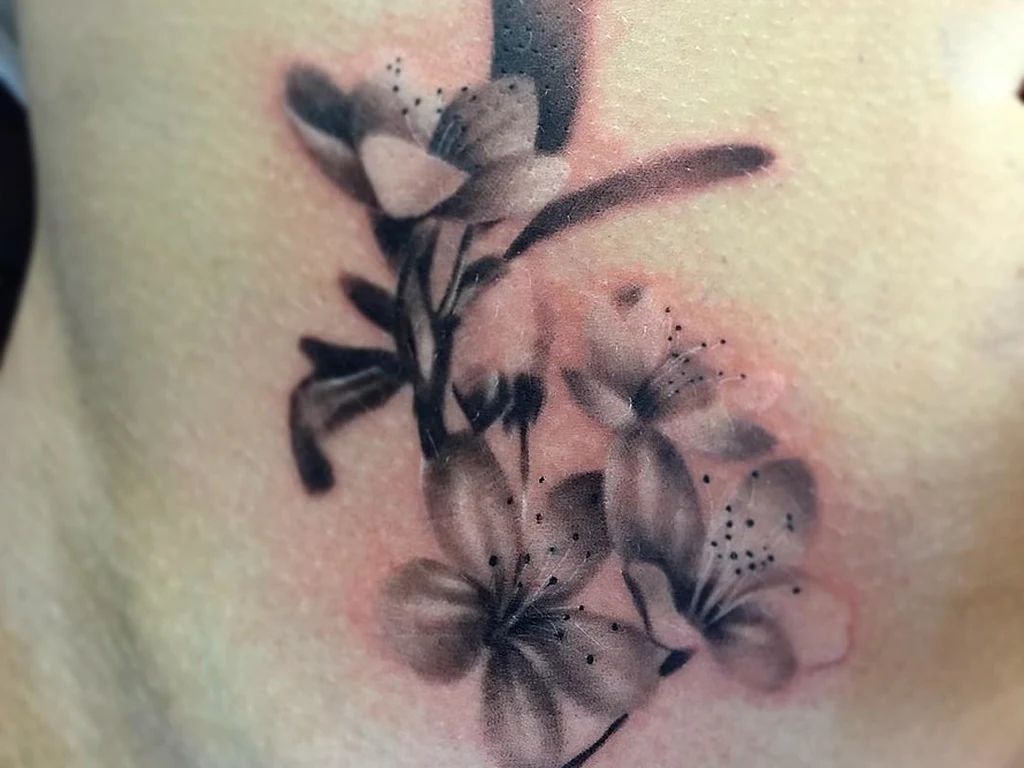
The branch with the colour taken out: soft grey blossoms and dark leaves, shaded like a pencil drawing. Without pink to lean on, the design stands on its shapes — the curve of the branch, the spacing of the flowers, the dark buds.
Black and grey is the longest-lived version of this subject, full stop. It will not fade to a different colour, because there is no colour to lose; it simply lightens, evenly, like a photograph left in a bright room.
19. Blossom Cover-Up With Butterfly
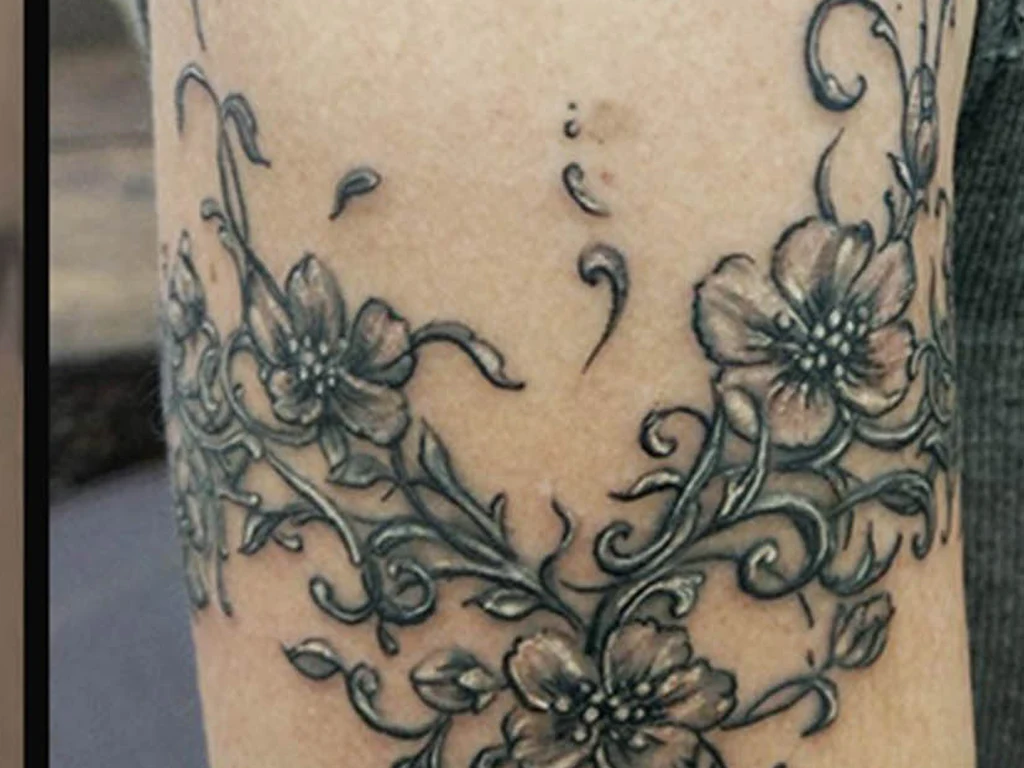
This upper-arm piece in black and grey — blossoms, curling stems and a butterfly above — was built to bury an old tribal band, and the photograph it comes from shows the faded band it replaced. The busy stems are not decoration for its own sake: scrollwork and layered petals are what hide old ink.
Cover-ups obey arithmetic: the new piece must be bigger and darker than what sits underneath, and blossom branches happen to be one of the best shapes for the job, because a branch can be steered exactly where the old ink is. Your artist, not the internet, gets the final say on whether a given old tattoo can be covered.
20. Foot Branch
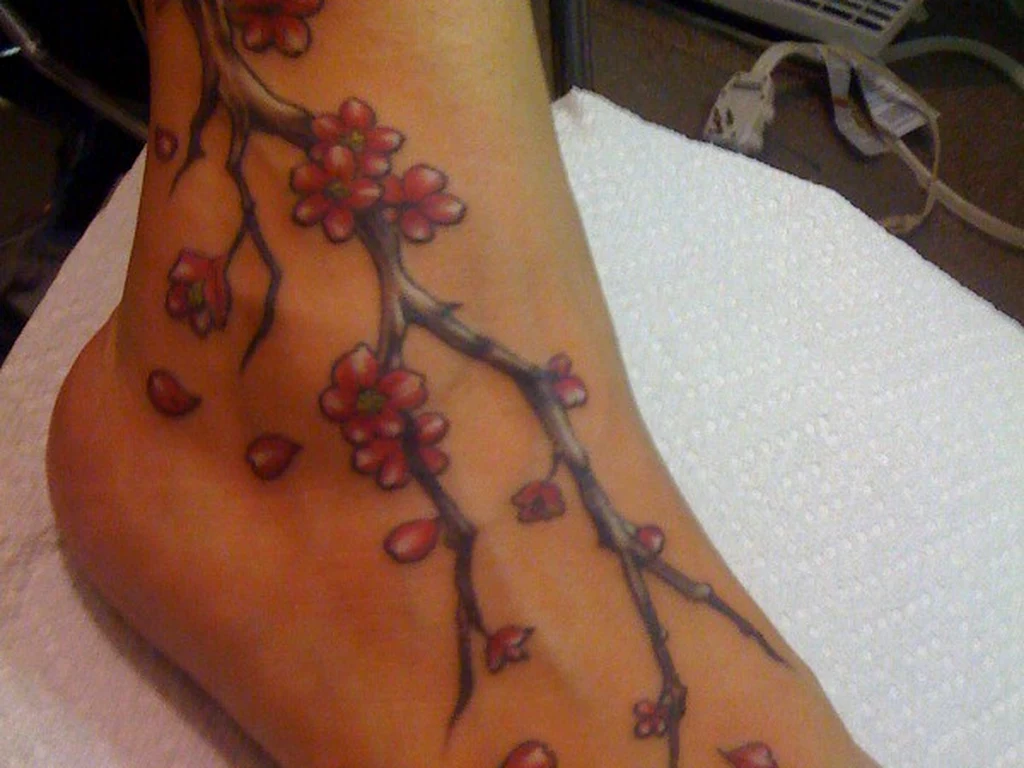
A slim branch with red-pink blossoms runs from the ankle down the top of the foot, petals scattered ahead of it toward the toes. Feet suit branches the way forearms do — the canvas is already long and narrow, so the design barely has to try.
Feet are hard-wearing skin: shoes rub, socks rub, and ink there often needs a touch-up after healing. Keep the blossoms simple and the branch bold, as here, and there is something left to refresh.
21. Foot Blossom Cluster
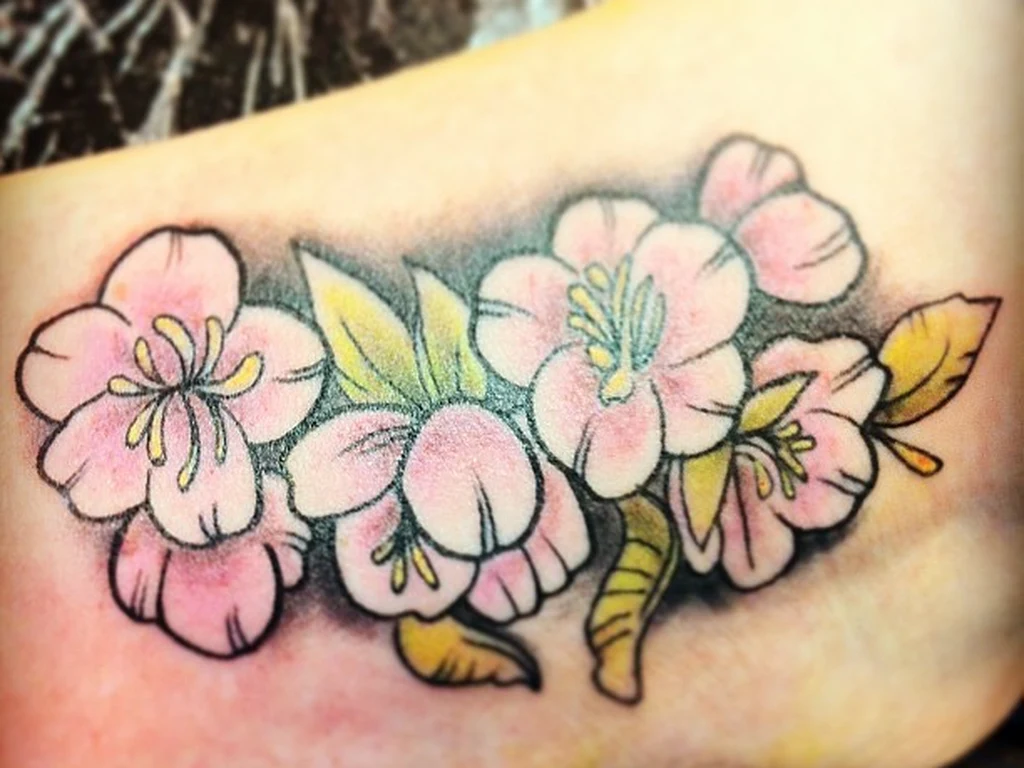
The opposite approach to design 20: no branch at all, just a row of big, bold, traditional blossoms across the top of the foot, petals overlapping like scales. It reads more like jewellery than botany.
Big shapes are the right survival strategy for feet, and these are about as big as a foot allows. If you want blossom on your feet and you want it to last, this end of the scale is where to shop.
22. Ankle Sprig in Pale Pink
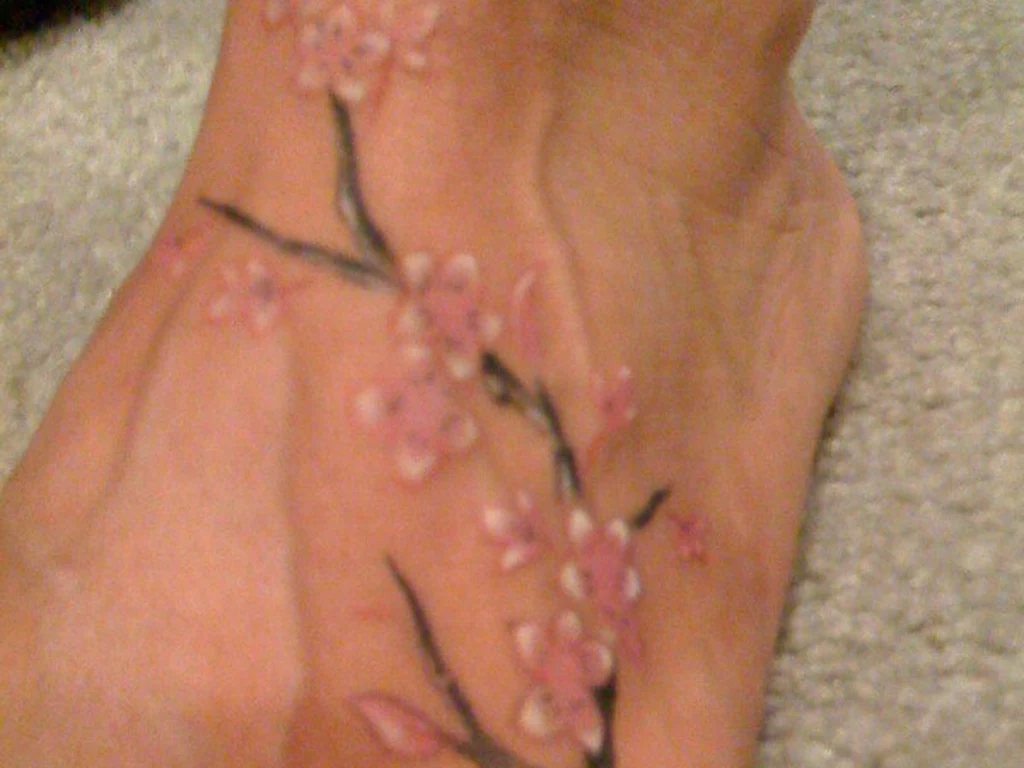
A single small sprig — a few pale blossoms, a wisp of branch — sitting above the ankle bone. This is the minimum viable cherry blossom tattoo, and there are days when minimum is exactly the right amount.
Nobody should sell pale and tiny as permanent-looking. Chosen with open eyes, it behaves like a pencil note in a margin: light, personal, and easy to live with.
23. Ankle Branch in Fine Line
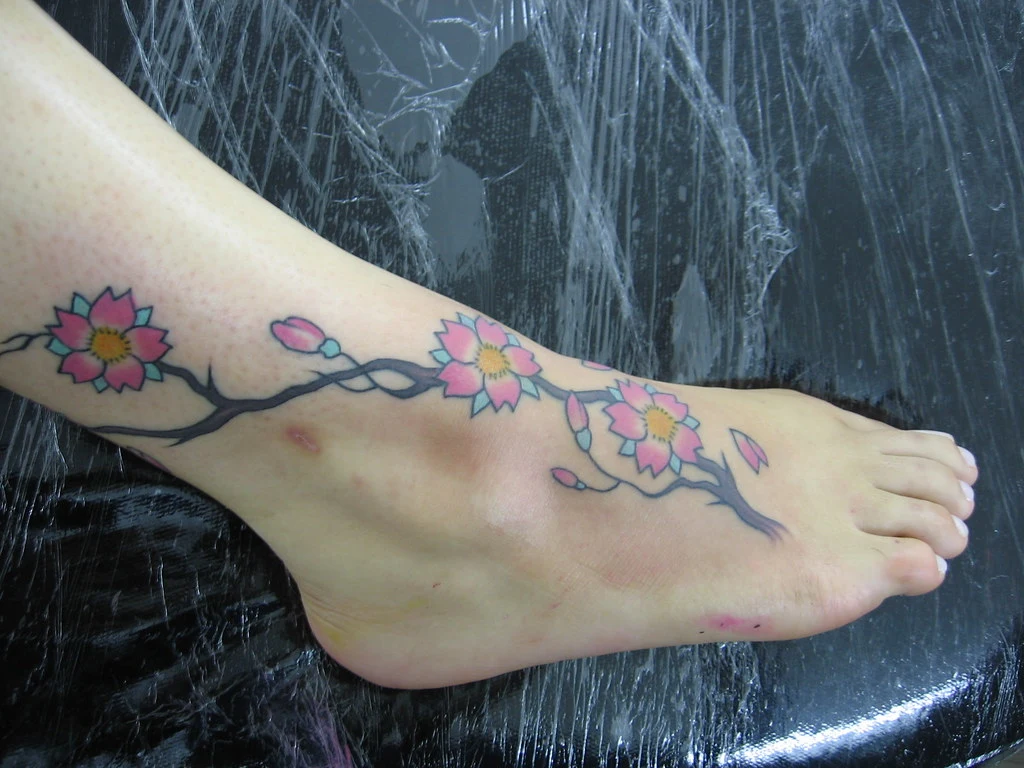
A fine black branch curves around the ankle and sends small pink blossoms down onto the foot — the wreath version of the idea, made to be seen in sandals and hidden by boots.
Ankle skin is thin and the area flexes constantly, so fine lines here settle a touch thicker than they are drawn. Good artists allow for it; ask yours how they adjust small work for the ankle before you book.
24. Hip Sprig
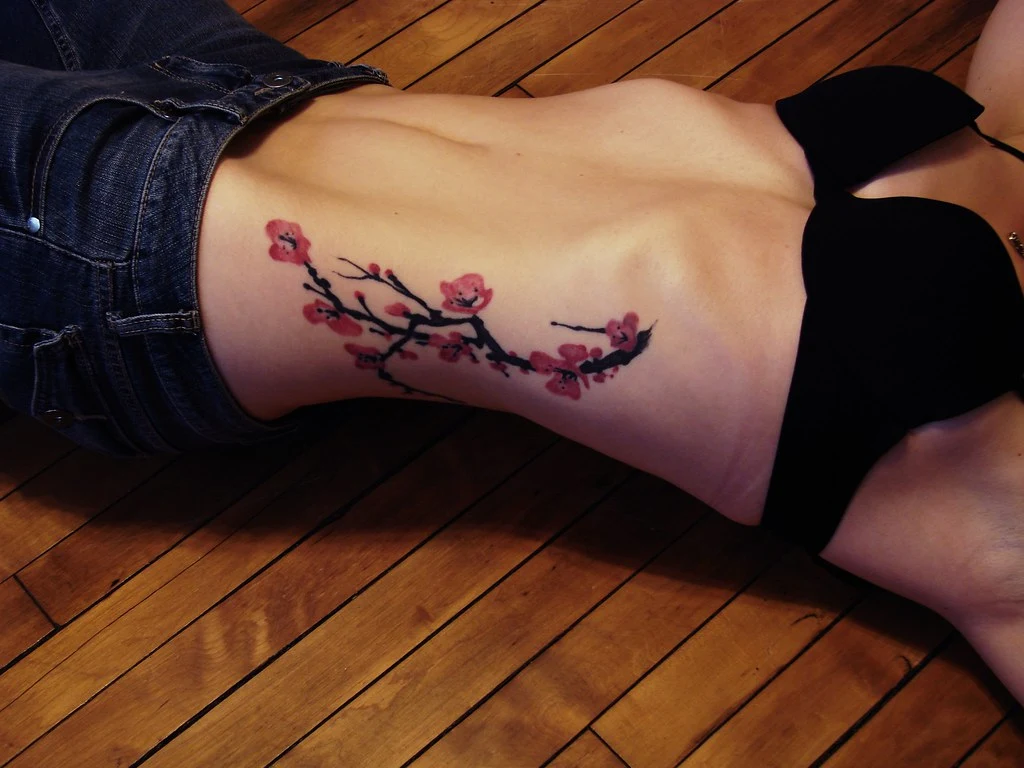
The list closes where it could have started: one small branch on a hip, blossoms in pink and red, placed where clothing decides who sees it. Private placements carry meanings that stay private too, and a lot of cherry blossom tattoos are exactly that.
Hips change shape more than most canvases over a lifetime, so simple is smart here — a small branch can stretch a little and still be a branch. Fine detail cannot make the same promise.
Where a Cherry Blossom Tattoo Works Best
Back. The only canvas that fits a whole tree. Designs 1 and 2 use the back’s width in opposite ways — one fills it, one crosses it diagonally and leaves most of it empty. Both work because a branch can be scaled to the space instead of squeezed into it. The cost of the back is simple: you will mostly see your own tattoo in photographs.
Arms — sleeves, forearms and upper arms. The busiest address in this list: designs 3, 4, 5, 6, 10, 11 and 19. A branch wraps an arm naturally, blossom can be added a cluster at a time over the years, and a forearm piece is one you actually get to look at. Japanese-style subjects — temples, helmets, masks — belong here, where there is room for their detail.
Shoulders and shoulder blades. Designs 12, 13, 14, 15 and 16. The shoulder’s curve suits a branch bending over it, and the blade is flat, still and slow to age. It is the easiest large-ish placement to keep covered at work and the classic spot for a first colour piece.
Ribs and flank. Designs 7, 8 and 9. Big, private and dramatic — and usually the sharpest sitting on the body. The skin moves with every breath, so branches here are drawn bold or painted loose; fine detail is a bad bet on this canvas.
Ankles, feet and hips. Designs 20 to 24, plus the calf at 17. Small branches and sprigs live here. Expect faster fading and the odd touch-up, especially on feet, and keep the shapes simple — at this scale, simple is not a compromise, it is the technique.
Styles Worth Knowing
Japanese traditional. Bold branches, blossom set against wind bars, waves or architecture, flat colour held by strong outline — designs 3, 4, 5, 6 and 16. This is where the subject comes from, and specialists in it draw the branch differently: more angular, more weather in it. If this is the look you want, choose an artist who does this and little else.
Fine line. Thin black branches, small blossoms, lots of air — designs 14 and 23. Fine line suits the subject’s lightness and is the easiest style to keep small and office-safe. Its weakness is time: lines thicken as they settle, so spacing is the whole craft. An honest fine-line artist will show you healed work a year or two old.
Watercolour and ink-wash. Design 9 is the honest example: colour laid in washes with little or no outline, in the spirit of brush painting. It can be the prettiest version on day one and the softest on year ten — edges blur and reds lift. Treat it as a style you maintain, not a style you forget.
Black and grey. Designs 18 and 19, and the grey architecture of 3 and 6. Taking the pink out sounds like losing the point, but the branch shape survives translation intact, and black and grey ages the most evenly of any approach here. It is also the easiest style to extend later, in any direction.
Making It Yours
Start with the branch, because the branch is the design: how gnarled, how long, which way it leans, how many petals have already let go. A branch heavy with falling petals leans into the impermanence reading; a branch in tight bud is about beginnings instead. Show your artist photographs of real cherry trees as well as tattoos — the difference shows.
Then decide what keeps the blossom company. The traditional partners are seasonal and symbolic: koi (design 2), a bird or bee (12), a dragonfly (17), a butterfly (19), temple architecture (3 and 6). Personal additions work best kept small — a date worked into the branch, initials in fallen petals — because the design is already saying something quietly, and shouting over it helps nobody.
Colour is the last lever. Classic pink and red read instantly as sakura. Grey-violet (17) turns the volume down; black and grey (18) turns it off. White blossom exists in nature and in tattoos, but on most skin tones it needs a dark branch and shaded backing to read at all — ask to see a healed white-blossom piece before choosing it. And a branch is one of the kindest subjects to grow over time: one more cluster, one more petal, whenever the next spring earns it — much like the slow builds in our small tattoos for women collection.
Frequently Asked Questions
What does a cherry blossom tattoo mean?
Most often, the shortness and sweetness of life. In Japanese tradition the sakura stands for impermanence — the flowers peak and fall within about two weeks — and for mono no aware, the gentle sadness of knowing things pass. The blossom is also traditionally linked with the samurai, whose lives were expected to be brief and to end at their peak. Plenty of wearers add their own layer on top: a spring birthday, a person they miss, a fresh start.
How much does a cherry blossom tattoo cost?
Size and detail set the price, not the flower. A small sprig like designs 22 to 24 usually starts at the studio minimum, commonly $60–$150 in the US. A forearm branch is a few hours of work, a rib or flank piece more, and a full-back tree like design 1 runs across several sessions. Get the number at a consultation, at the final size — a branch quoted small and tattooed large is a different bill.
Where is the best place for a cherry blossom tattoo?
The forearm and the back are the two classic answers, for the same reason: a branch wants a long canvas. The shoulder blade suits a cluster, the ribs suit a dramatic private piece, and ankles, feet and hips suit sprigs. Match the size of the idea to the size of the space — a whole tree squeezed onto a wrist stops looking like a tree.
Do cherry blossom tattoos age well?
The branch does; the pink needs help. Black branch work and bold outlines hold their shape for decades, as design 16 shows. Petal pink and red fade faster than any other part, especially in the sun, and styles without outlines — like the ink-wash piece at design 9 — soften at the edges. Sunscreen on healed skin, and a colour refresh every several years if you want the blossom to stay loud.
Can a cherry blossom tattoo be small?
Yes, if it stays simple. Designs 22, 23 and 24 are all a few centimetres of ink and all read clearly, because each is one clear shape: a sprig, a slim branch, a short stem. What cannot shrink is a whole tree with twigs, buds and falling petals all at once — simplify the design rather than shrinking it, and it will still be legible in twenty years.
What is the difference between sakura and other blossom tattoos?
Sakura is cherry blossom specifically, and in tattoos it usually travels with its branch — dark, angular, a little weather-beaten — plus petals shown falling. Plum blossom looks similar but blooms earlier, on bare wood in late winter, and stands for endurance in Chinese tradition. If the exact flower matters to you, tell your artist which one you mean; the drawings differ in the details, and so does the meaning.
Do cherry blossom tattoos have to be pink?
No. Pink and red are the classic reading, but this list alone has grey-violet blossom (design 17), full black and grey (18 and 19) and grey-wash Japanese pieces where the blossom is a whisper of pink in a monochrome design (3 and 6). White blossom exists too, though it needs dark backing to read on most skin tones.
Can a cherry blossom tattoo cover an old tattoo?
Often, yes — design 19 in this list is exactly that, a blossom piece built over a faded tribal band. Branches are useful cover-up shapes because they can be steered across old ink, and layered petals and scrollwork hide what sits beneath. The rules do not bend, though: the new tattoo must be bigger and darker than the old one, and an artist who has seen your skin gets the final say.
How long does a cherry blossom branch tattoo take?
A sprig or ankle branch is usually a single short sitting. A forearm branch in colour is commonly two to four hours, depending on how full the branch is. Rib and flank pieces stretch longer because the canvas is bigger and the sitting is harder. A full-back tree is a project measured in sessions and months, not hours — design 1 was not done in a day.
Is a cherry blossom tattoo only for women?
No, and it never has been. Blossom runs through Japanese traditional tattooing on men — full backs, sleeves, pieces like designs 3, 4 and 5 in this list — and the samurai association alone should settle the question. Size, style and placement are personal choices; the flower is not assigned to anyone.
Final Thoughts
Twenty-four real cherry blossom tattoos, and the pattern is the same one running through this whole cluster: the pieces that last are drawn at the size their detail needs, by people who looked at the artist’s healed work first. Pick the version that matches the thought — the full tree for the big statement, the branch for the everyday reminder, the sprig for the private one — and let the pink fade honestly, the way the real flowers do. If blossom is not your flower after all, our rose tattoo design ideas guide makes the case for the classic instead.
Photo credits: 1: Flickr (mytat_2s), CC BY 2.0. 2: Wikimedia Commons (TattooTemple), CC BY-SA 3.0. 3: Flickr (TattoosAll), CC BY-SA 2.0. 4: Flickr (TattoosAll), CC BY-SA 2.0. 5: Flickr (TattoosAll), CC BY 2.0. 6: Flickr (TattoosAll), CC BY-SA 2.0. 7: Flickr (TattoosAll), CC BY 2.0. 8: Flickr (mytat_2s), CC BY 2.0. 9: Wikimedia Commons (Katie Tegtmeyer), CC BY 2.0. 10: Flickr (TattoosAll), CC BY-SA 2.0. 11: Flickr (s1mone), CC BY-SA 2.0. 12: Flickr (TattoosAll), CC BY-SA 2.0. 13: Flickr (TattoosAll), CC BY-SA 2.0. 14: Flickr (alliewiki), CC BY-SA 2.0. 15: Flickr (doscronopios), CC BY 2.0. 16: Flickr (daflai), CC BY 2.0. 17: Flickr (pamlovespie), CC BY 2.0. 18: Flickr (TattoosAll), CC BY 2.0. 19: Wikimedia Commons (AnjanaTattoo), CC BY-SA 4.0. 20: Flickr (mytat_2s), CC BY 2.0. 21: Flickr (TattoosAll), CC BY 2.0. 22: Flickr (mytat_2s), CC BY 2.0. 23: Flickr (s1mone), CC BY-SA 2.0. 24: Flickr (Katie Tegtmeyer), CC BY 2.0. Full file names and source links are listed in this article’s package notes.