
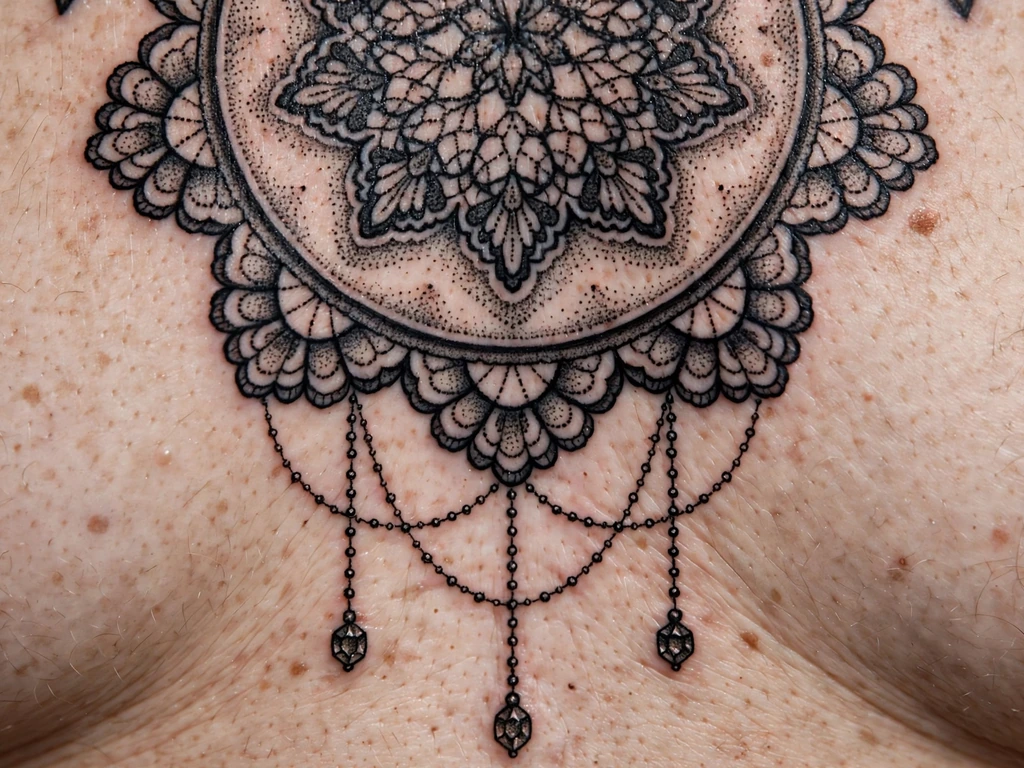
Most tattoos picture something — an animal, a flower, a word. Ornamental tattoos are the exception: they do not depict, they decorate. Built from lace, chains, gemstones, mandalas and scrolling filigree, an ornamental piece works the way jewellery does — it follows the body’s curves, catches the eye with symmetry, and turns the skin itself into the display. It is the oldest idea in body decoration and, judging by how fast ornamental work is climbing in search, the most current one too.
In this guide you will find 25 ornamental tattoo ideas for almost every placement: a lace centrepiece at the sternum, a chain swag draped under the collarbones, ornaments for hands, feet, knees and spine, and bold blackwork versions for anyone who wants the jewellery look with maximum staying power. First, though, a quick tour of what ornamental tattooing actually is — because once you can name the elements, you can brief an artist the way you would brief a jeweller commissioning a piece.
What Is Ornamental Tattooing?
Ornamental tattooing is jewellery you never take off. Instead of picturing an object, the design is built from decorative elements — scalloped lace edges, hanging chain drops, faceted gemstones, radiating mandalas and curling filigree scrollwork — and composed to flatter the anatomy underneath it. A sternum piece is drawn to follow the centre line and curve of the chest; an ankle ornament wraps exactly where an anklet would sit; a shoulder mandala radiates from the joint. Symmetry is the style’s signature: the left half mirrors the right, and that balance is what makes the work read as jewellery rather than doodle.
The vocabulary is borrowed from older crafts. From the henna and mehndi traditions of South Asia, North Africa and the Middle East come the fine floral sprays, paisley teardrops and fingertip detailing still used in hand and foot ornaments today. Victorian lace contributed the scalloped edges, eyelets and delicate netting behind lace centrepieces and garters. Art Nouveau added the long, whipping organic curve and nature-drawn scrollwork, and sacred geometry — the mandala, the lotus’s radiating petals, interlocking circles — supplied the medallions that anchor so many pieces. Modern ornamental artists mix all four freely, usually in black ink with dotwork shading for softness.
One more trait defines the style: it is designed for your body, not copied onto it. The best ornamental work is drawn or adapted at the consultation so drops hang vertically, points land on bone landmarks, and both sides match when you stand naturally. That is why the stencil checks in the How to Choose section below matter more for this style than for almost any other.
| Element | What it looks like | What it does in a design |
|---|---|---|
| Lace | Scalloped edges, eyelets, fine netting patterns | Softens edges and adds a fabric-like delicacy |
| Chain drops | Fine lines and bead chains hanging from a centre point | Adds movement and length; draws the eye downward like a pendant |
| Gemstones | Faceted diamonds, teardrops and cabochon shapes | Creates a focal jewel at the design’s centre or low point |
| Mandala | Radiating circular pattern of petals, dots and rings | Anchors a piece with symmetry; perfect over joints and centre points |
| Filigree scrollwork | Curling, vine-like lines and spirals | Connects elements, fills space gracefully and follows body curves |
Ornamental Tattoo Ideas at a Glance
| # | Design | Style notes | Best placement |
|---|---|---|---|
| 1 | Sternum Lace Centrepiece | Lace medallion, chain drops, dotwork | Sternum |
| 2 | Under-Collarbone Chain Swag | Draped bead chains, central pendant | Below collarbones |
| 3 | Spine Ornament | Vertical chain of medallions and drops | Spine |
| 4 | Mandala Shoulder Cap | Radiating dotwork mandala | Shoulder cap |
| 5 | Ornamental Hand Tattoo | Lace and filigree across the hand | Back of hand |
| 6 | Finger Lace Rings | Tiny bands and fingertip detail | Fingers |
| 7 | Forearm Cuff Band | Bracelet-style band, front medallion | Forearm |
| 8 | Ornamental Thigh Garter | Lace band with hanging drops | Thigh |
| 9 | Ankle Chain Anklet | Fine chain with a small charm drop | Ankle |
| 10 | Back-of-Neck Pendant Drop | Necklace line with a pendant | Nape |
| 11 | Hip Ornament Pair | Mirrored scrollwork pair | Hips |
| 12 | Ornamental Foot Tattoo | Lace fan across the foot | Top of foot |
| 13 | Elbow Mandala | Circular mandala centred on the joint | Elbow |
| 14 | Ear and Jawline Accent | Dotted ear-edge detail, fine jaw curve | Ear and jawline |
| 15 | Long Sternum-to-Navel Drop | One vertical line of gems and drops | Sternum to navel |
| 16 | Men’s Ornamental Chest Plate | Bold symmetrical medallion plate | Chest (men) |
| 17 | Wrist Bracelet Ornament | Delicate chain bracelet with a charm | Wrist |
| 18 | Upper-Back Yoke Ornament | Necklace-style yoke across the shoulders | Upper back |
| 19 | Ornamental Knee Mandala | Mandala with radiating drop petals | Knee |
| 20 | Bold Blackwork Ornament | Heavy black lace and solid shapes | Upper arm |
| 21 | Fine-Line Delicate Ornament | Hair-thin minimal ornament | Inner forearm |
| 22 | Dotwork Chandelier Ornament | Tiered stippled chandelier drops | Sternum |
| 23 | Gem-Centre Back Ornament | Large faceted gem medallion | Upper back, centre |
| 24 | Art Nouveau Whiplash Ornament | Long flowing whiplash curves | Outer calf |
| 25 | Ornamental Floral Fusion | Lotus and florals woven into filigree | Upper arm |
25 Ornamental Tattoo Ideas
1. Sternum Lace Centrepiece
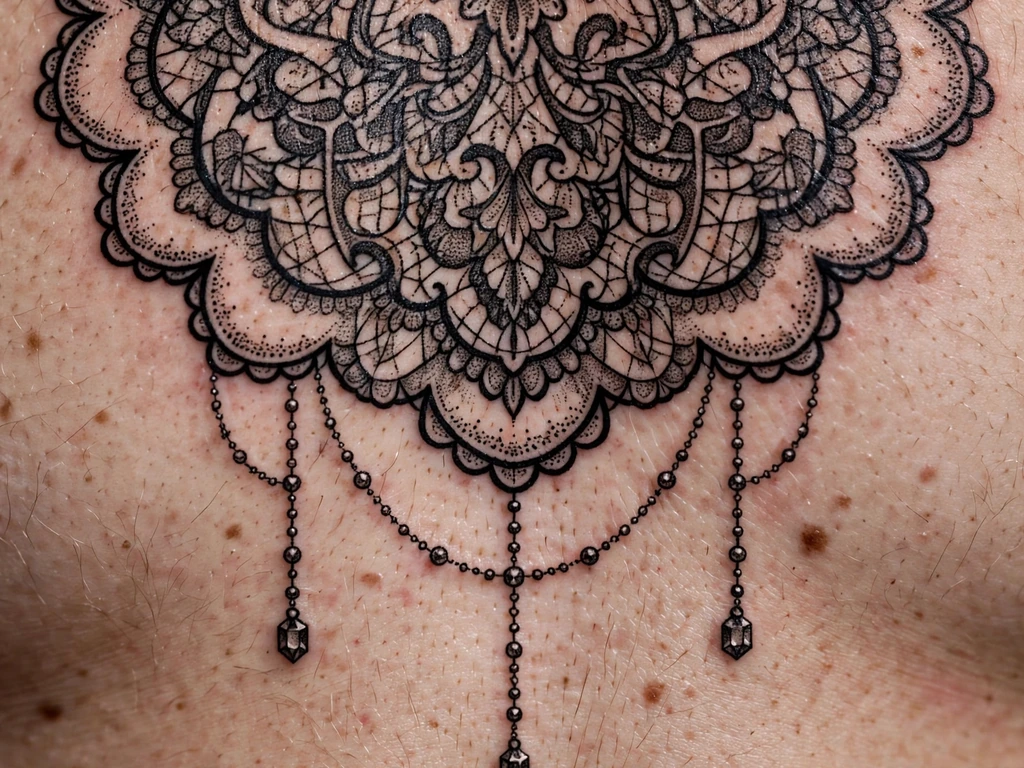
The signature ornamental piece: a lace medallion sits at the centre of the chest, its scalloped edges fanning outward and fine chain drops with tiny beads or a small gemstone pendant hanging below. Dotwork softens the shading so the lace reads delicate rather than stamped on, and the whole composition is drawn symmetrically around the body’s centre line. It frames the chest the way a statement necklace does — except it is always on.
Best placement: Centre sternum, the medallion on the centre line with drops following the natural curve below.
Best for / know before you book: Symmetry is unforgiving here, so insist on the mirror ritual: check the stencil standing, arms relaxed, in a full-length mirror, and speak up about a millimetre’s tilt now rather than forever. The sternum is a tender, bony spot — short, calm sessions are the norm.
2. Under-Collarbone Chain Swag
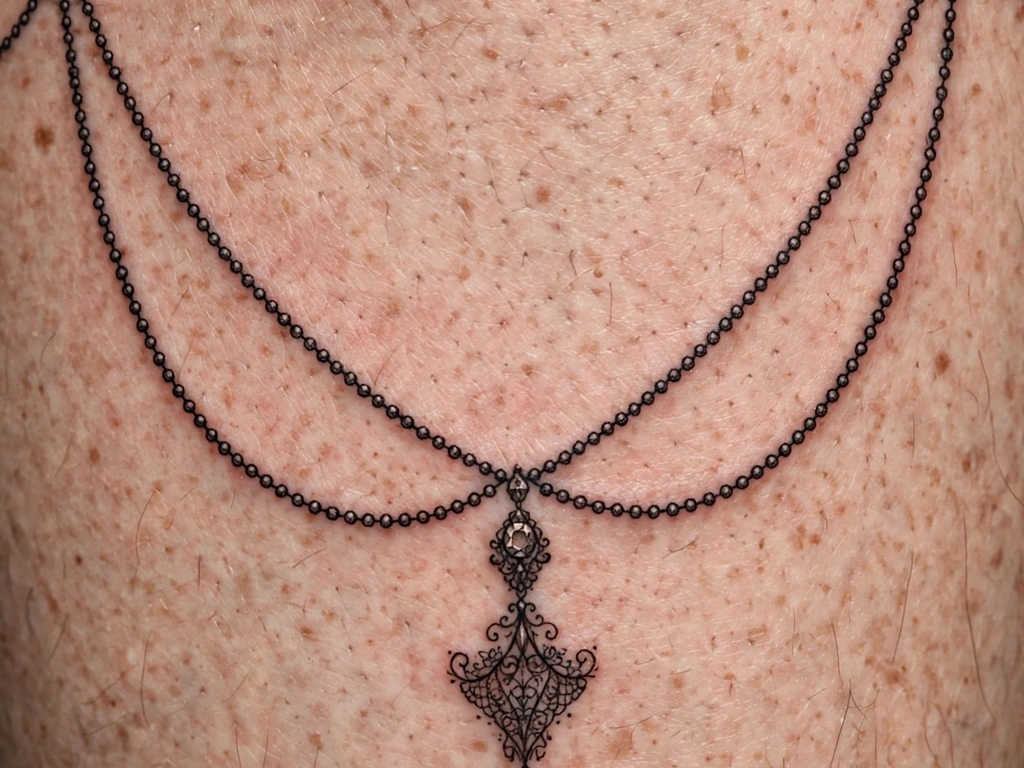
Two fine chains drape in soft swags just below the collarbones, meeting at a small central pendant or gem drop, like the front of an elegant necklace worn under the skin. Bead dots along the chains catch the light as you move, and small filigree flourishes at each end finish the piece where the chains “fasten” near the shoulders. It is one of the most jewellery-like designs in all of tattooing, full stop.
Best placement: Across the upper chest, the swags following the line just below each collarbone.
Best for / know before you book: The drape only reads correctly on your body, standing — have the stencil applied and checked upright, never lying flat, because chains drawn on a reclined chest sag differently the moment you stand up. Sun exposure fades fine chain lines quickly, so this piece earns you a permanent sunscreen habit.
3. Spine Ornament
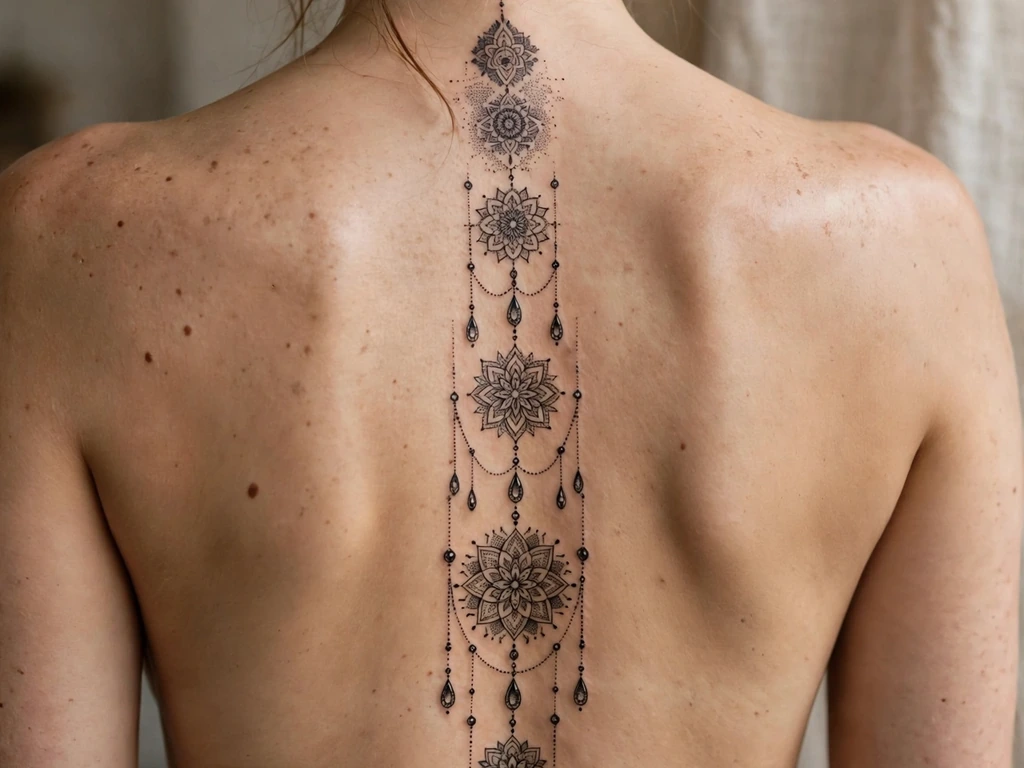
A vertical jewellery chain for the back: a small medallion between the shoulder blades, then a descending line of linked motifs — tiny mandalas, gem drops, bead strands — following the spine down to the lower back. Each element is centred on the spine itself, so the piece moves along the back like a string of ornaments as you bend. In a backless dress it reads as couture jewellery; under clothes it vanishes entirely.
Best placement: Down the centre of the back, from the shoulder blades to the lower back.
Best for / know before you book: The centre line must be truly centred — ask your artist to mark it while you stand naturally, not while you are stretched out on the table, because posture shifts the line. Skin over the vertebrae is thin, so expect a sharper sensation and a slower hand from your artist.
4. Mandala Shoulder Cap
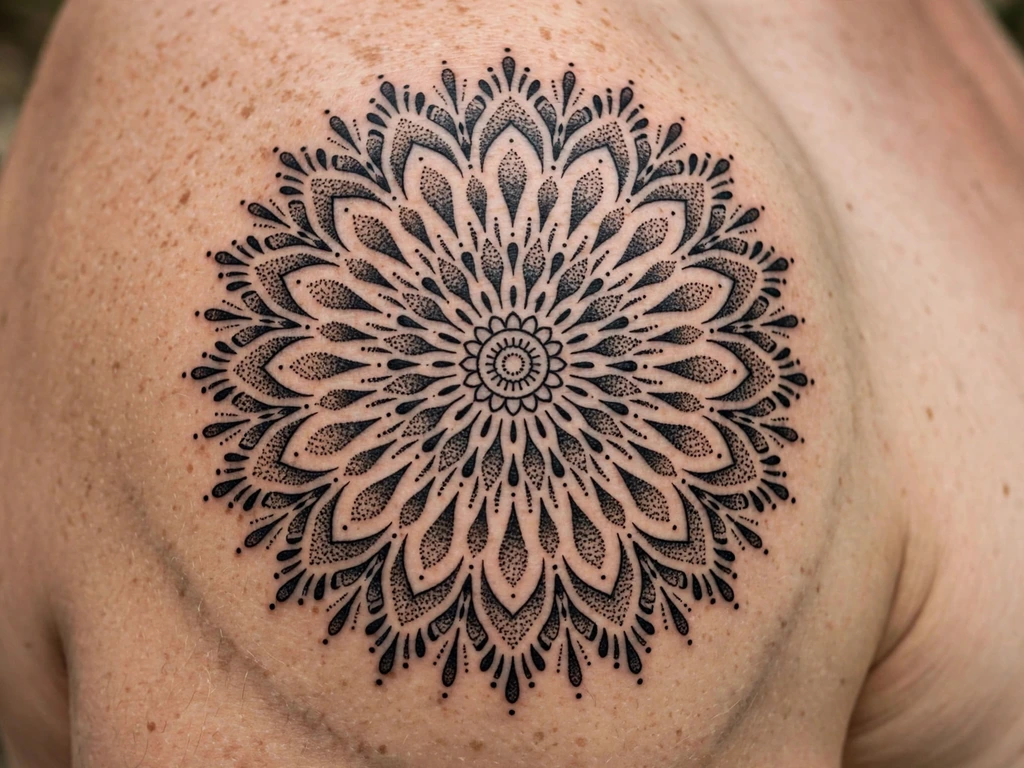
A mandala drawn to sit exactly on the shoulder’s round cap, its rings of petals, dots and teardrops radiating from the joint’s centre like a brooch pinned to the body. Shoulder mandalas are endlessly extendable: add a hanging drop towards the elbow, or a half-mandala fan reaching towards the collarbone later, and the cap becomes the anchor of an ornamental sleeve.
Best placement: Centred on the shoulder cap, radiating evenly in all directions.
Best for / know before you book: Shoulders curve in three dimensions, so a mandala that looks perfectly round on paper can heal slightly oval on the body — choose an artist who draws the final rings freehand on your shoulder rather than forcing a flat stencil onto the curve.
5. Ornamental Hand Tattoo
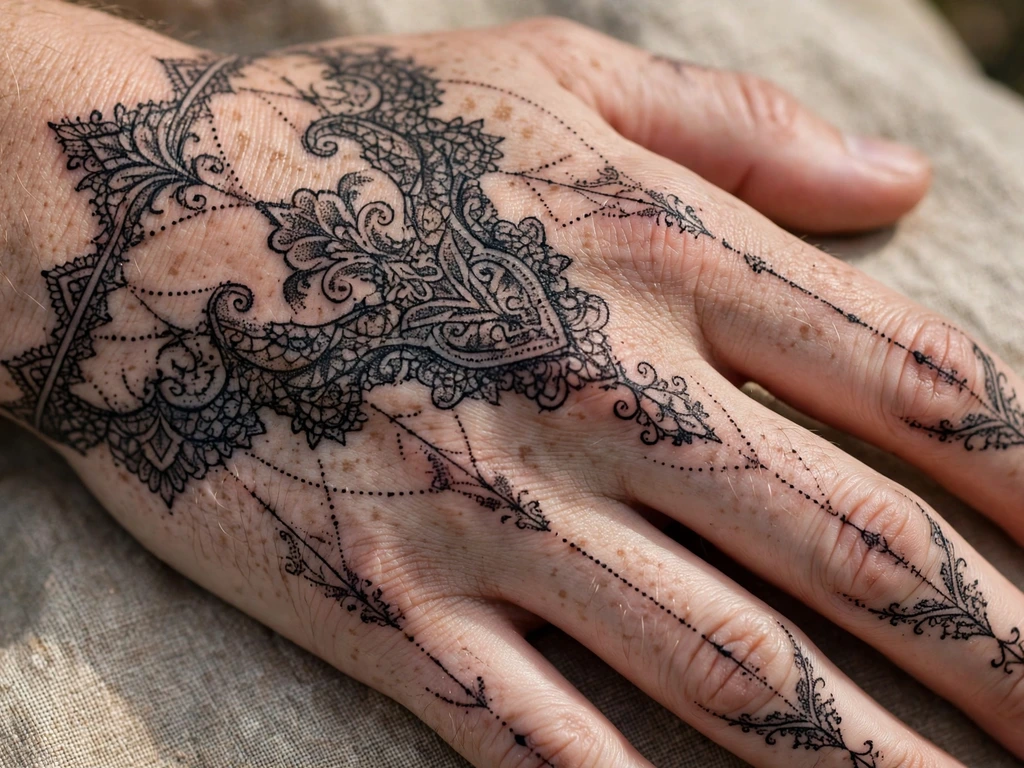
Mehndi’s permanent heir: lace fans across the back of the hand, filigree curling from the wrist towards the knuckles, and fine detail running partway down each finger. Hand ornaments pair naturally with real rings and nail polish — the tattoo becomes the base layer of your hand jewellery. Because the canvas is small and always on show, the drawing is usually kept airy: fine lines, dots and negative space rather than heavy fill.
Best placement: Back of the hand, anchored at the wrist and fanning towards the fingers.
Best for / know before you book: Hands shed skin constantly, so expect this to fade faster than almost any other placement and budget for touch-ups as routine maintenance. Some artists only take on hand ornaments for clients who already have visible tattoos, because the placement is impossible to cover at work.
6. Finger Lace Rings
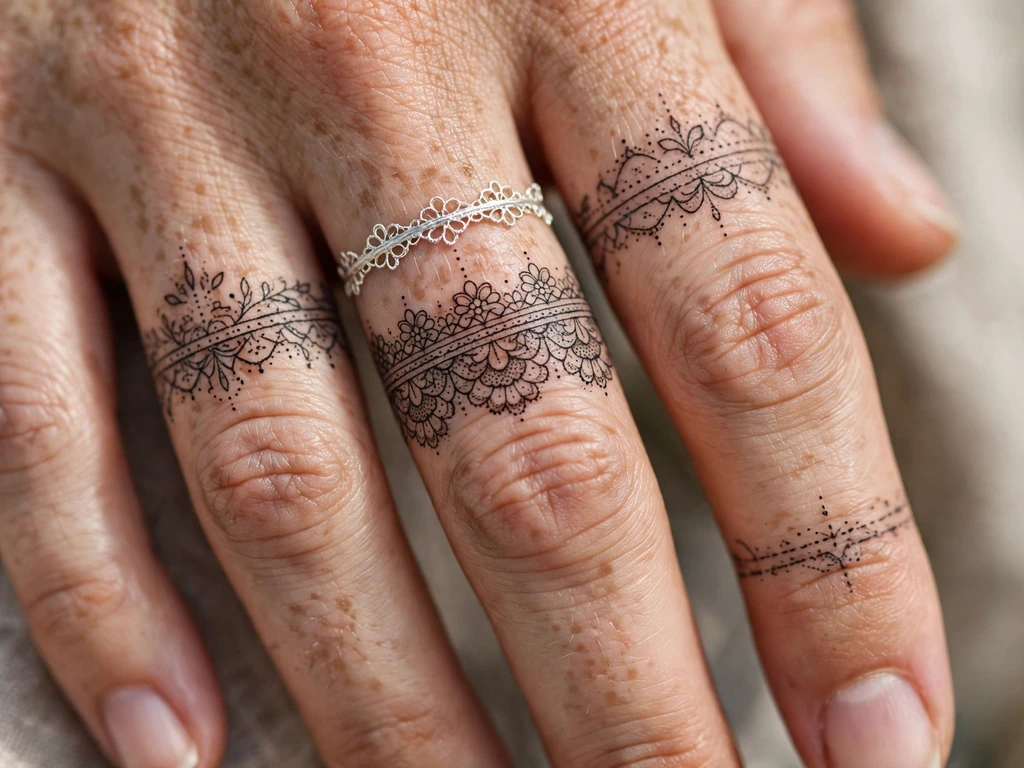
Jewellery distilled to its smallest form: a lace band tattooed around one finger, a tiny dotwork ring on another, perhaps a small drop hanging from a fingertip joint. Finger ornaments are often chosen as permanent promise or wedding rings, or simply as the finishing detail that ties a hand ornament together. At this scale the design is almost abstract — scallops, dots, one tiny gem point.
Best placement: Around the base or middle joint of one or two fingers.
Best for / know before you book: Finger tattoos are the highest-maintenance ink on the body: the skin here regenerates fast, and fine lace detail can drop out in patches during the very first heal. Go in expecting at least one touch-up, and keep the pattern bold enough to survive it.
7. Forearm Cuff Band
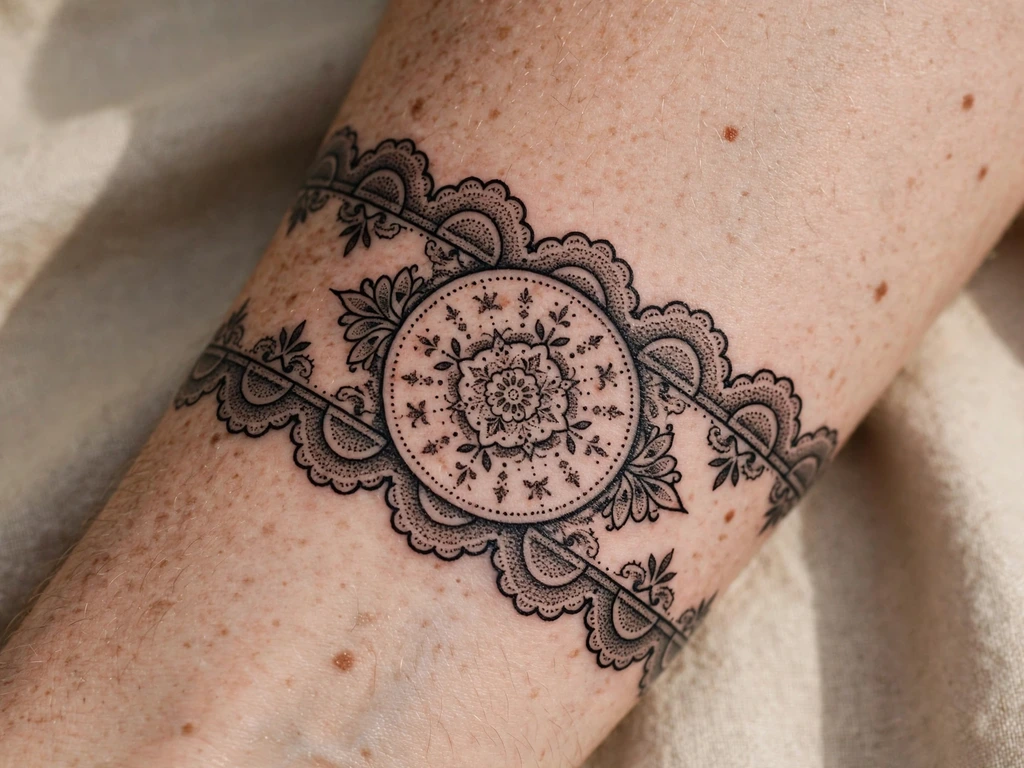
A bracelet scaled up: an ornamental band wraps the forearm, centred at the front with a medallion or gem and finished at its edges with lace scallops or bead chains. Cuff bands are the classic first ornamental piece for good reason — the forearm is a kind, flat canvas, the band hides under a long sleeve, and it can grow: many ornamental sleeves begin as a single cuff that later sprouts drops and filigree up and down the arm. If a full sleeve is somewhere on your horizon, the layouts in our forearm tattoo ideas show how a band like this anchors a growing composition.
Best placement: Around the forearm, a few centimetres above the wrist or at mid-forearm.
Best for / know before you book: Wrap bands expose every wobble, so check the stencil with your arm hanging naturally — forearm skin twists noticeably between palm-up and palm-down, and the medallion should sit centred in your most natural position.
8. Ornamental Thigh Garter
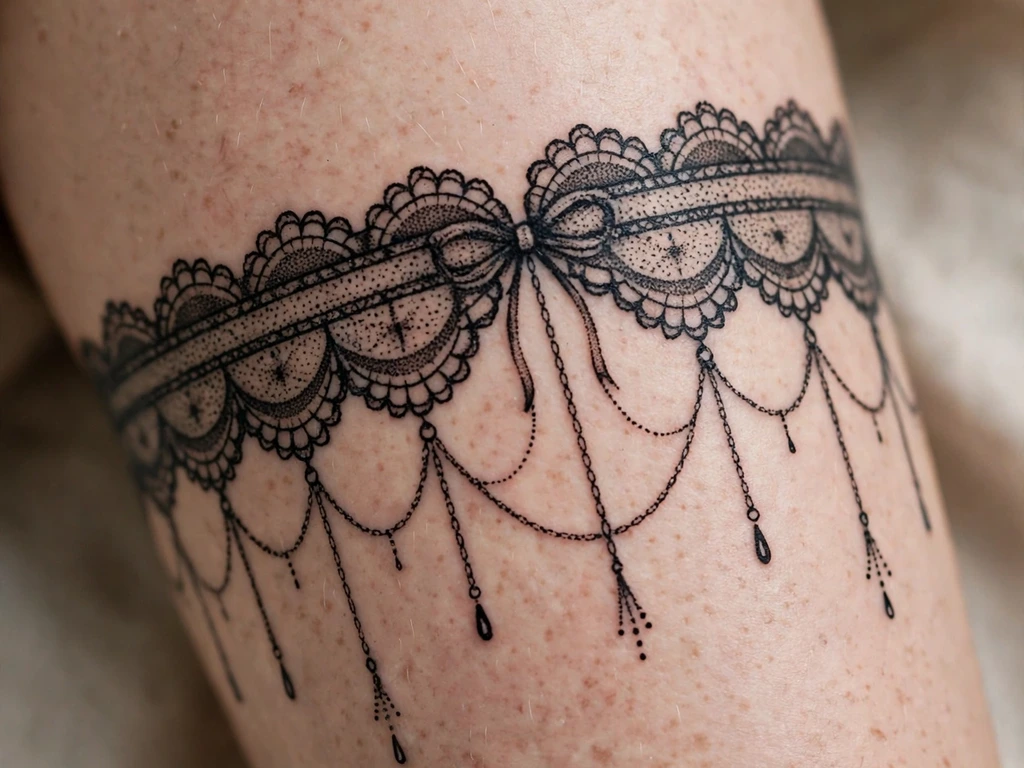
Lingerie translated into ink: a lace band circles the thigh, complete with scalloped edges, a front bow or gem, and short chain drops that hang like garter jewellery. The garter is designed to be glimpsed — under a skirt hem, in swimwear — and it frames the leg the way real hosiery does, only permanently. Dotwork netting behind the lace band sells the fabric illusion.
Best placement: Around the upper or mid thigh, the front motif centred on the thigh’s front line.
Best for / know before you book: Thigh skin shifts with weight change and muscle, so choose a band position that sits on stable flesh rather than the inner thigh’s softest skin — and have the hanging drops placed while you stand, so they point truly downward on your leg.
9. Ankle Chain Anklet
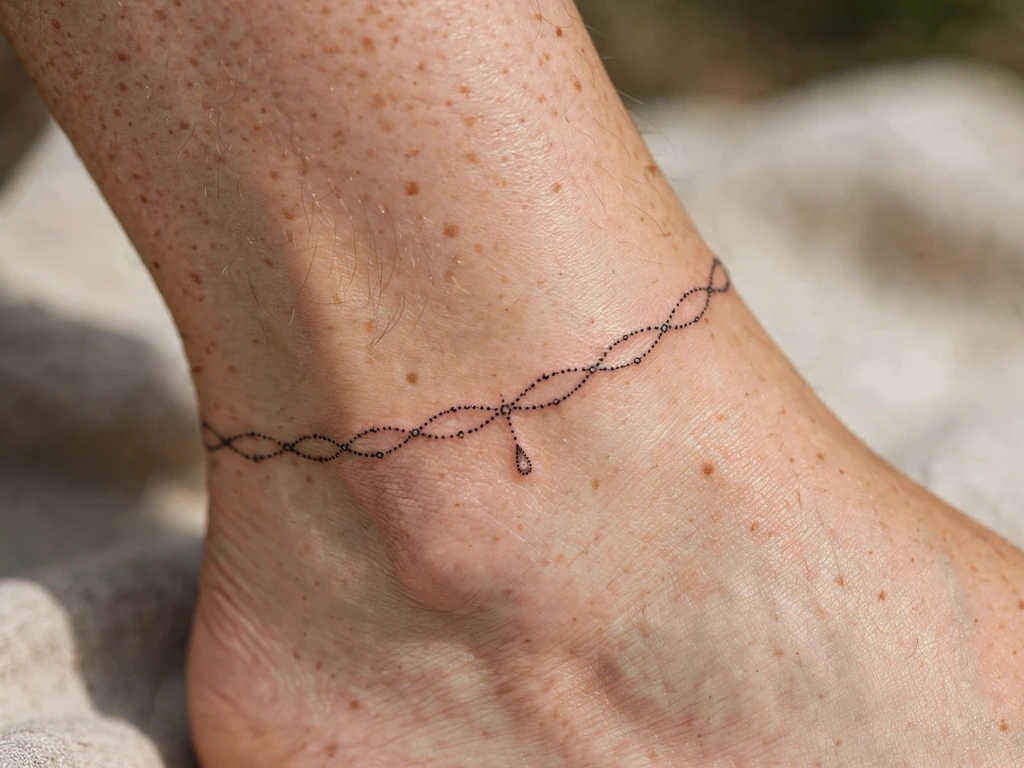
The lightest piece in this list: a fine chain — sometimes two — circles the ankle with a single small charm drop at the front or outer side, drawn to sit exactly where a real anklet would rest. It is playful with sandals, invisible in socks and boots, and a favourite first ornamental tattoo because it tests the style at almost no commitment. A tiny butterfly is the most requested charm of all, and the pairings in our butterfly tattoo ideas collection show exactly why the combination works so well.
Best placement: Around the ankle, just above the ankle bone, with the charm at the front or outer ankle.
Best for / know before you book: Ankles swell during tattooing, which distorts a wrap design, so a careful artist checks the chain standing, with your weight on the leg. Shoes and socks rub exactly here while it heals, so time the appointment for open footwear.
10. Back-of-Neck Pendant Drop
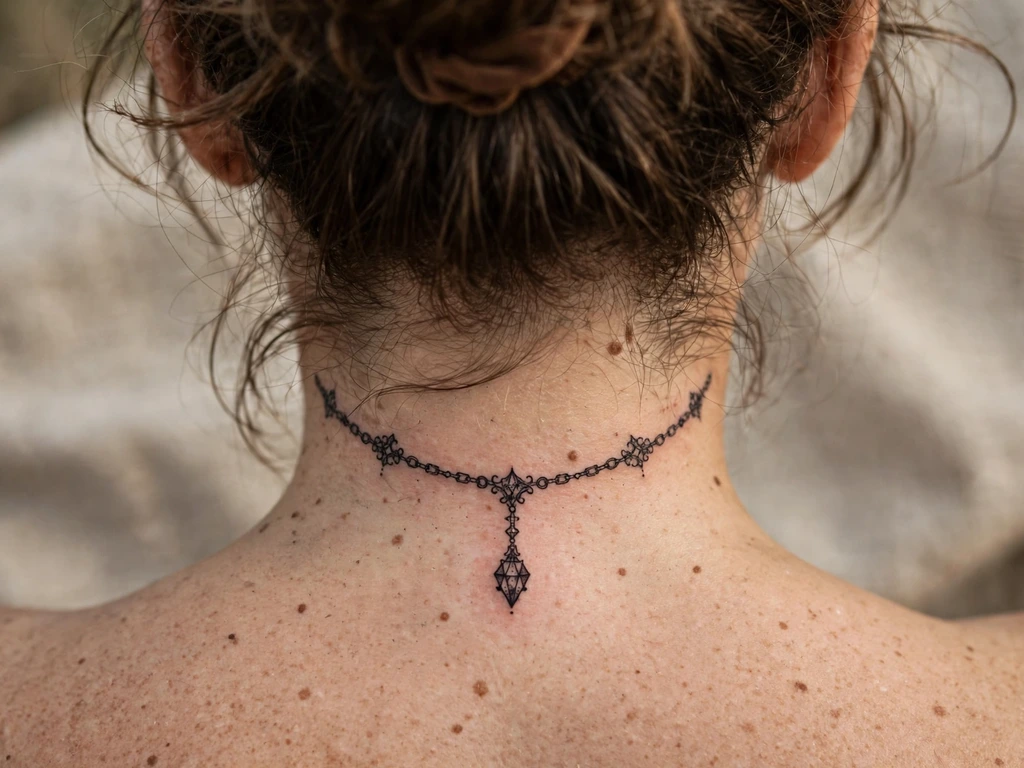
A necklace drawn from behind: a fine chain line curves across the nape and a single pendant — a gem drop, a small mandala, a teardrop — hangs at its centre, revealed when hair goes up and hidden when it falls. It is one of the most discreet ornamental placements, and a quiet favourite for people who wear their hair up at work and down everywhere else.
Best placement: Centre of the nape, the pendant sitting just below the hairline.
Best for / know before you book: Centring is everything and you cannot see it yourself — bring a friend, or trust the studio’s mirror-and-photo check before the needle starts. Hair products and collars rub the nape during healing, so tie hair up and favour open necklines for two weeks.
11. Hip Ornament Pair
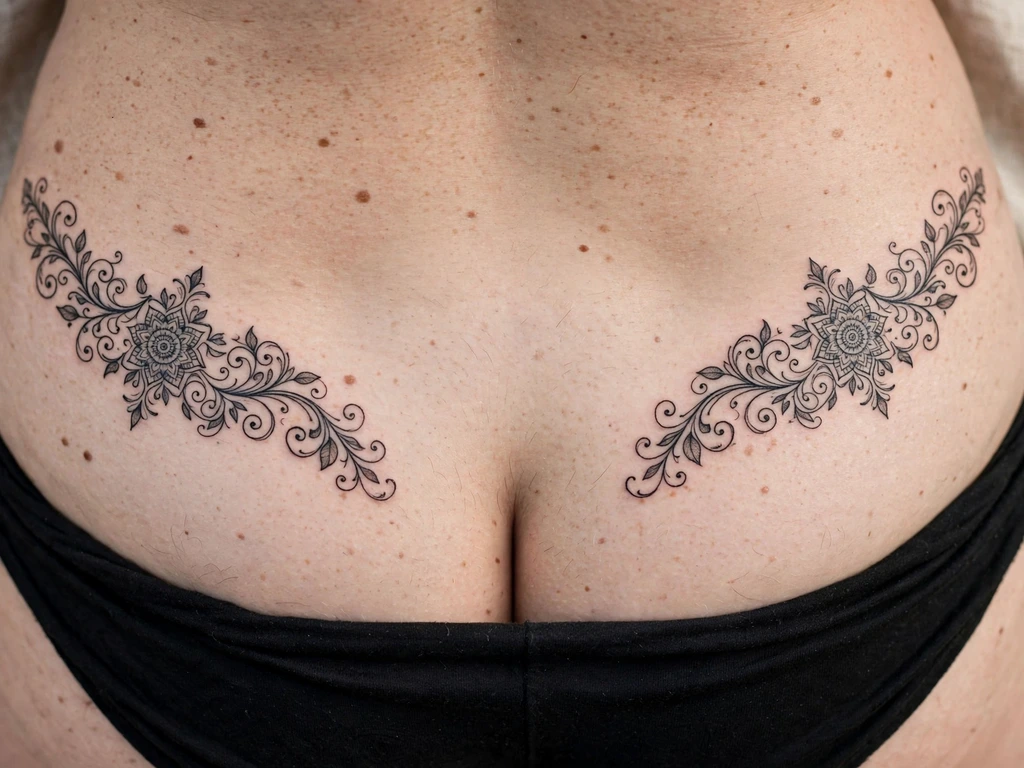
Two mirrored ornaments, one on each hip: scrolling filigree, a small mandala or lace fan on each side, drawn as a matched pair that frames the waist like the clasps of a belt. Because each side is small, the pair can usually be tattooed in a single session. They can also be staged — one side now, its mirror when life gives you a second reason.
Best placement: On the front of each hip bone, mirrored precisely in size and height.
Best for / know before you book: A pair only reads as a pair if both sides match to the millimetre — have both stencils applied and checked together in a full-length mirror before either side is tattooed. Hip skin stretches with waistbands and movement, so slightly bolder lines age better here.
12. Ornamental Foot Tattoo
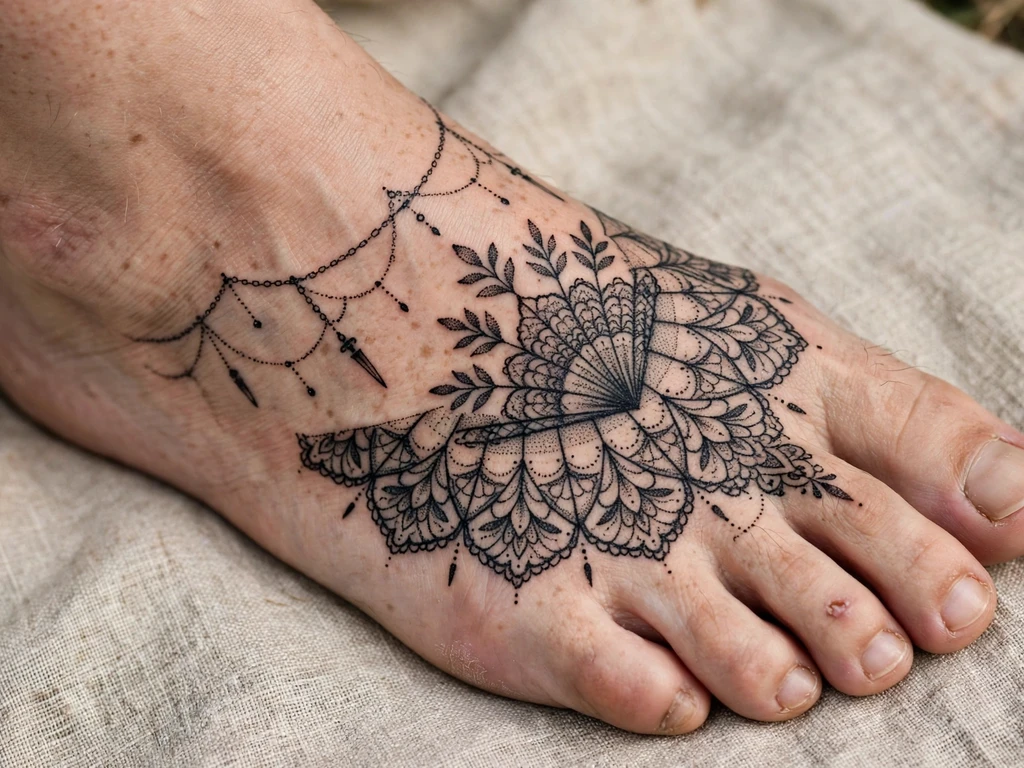
A lace fan spreads across the top of the foot from the ankle towards the toes, often with fine chains following the foot’s outer edge and a small gem point where a sandal strap would cross. Foot ornaments complete the mehndi pairing with hand designs, and they turn plain sandals into a styled look. The drawing follows the foot’s bones and tendons, so it moves elegantly when you walk.
Best placement: Across the top of the foot, the fan opening towards the toes.
Best for / know before you book: Feet are among the fastest-fading placements — the skin is thin, constantly rubbed by shoes and sheds quickly — so simplify the lace, keep lines a touch bolder, and heal in open sandals with your feet up in the evenings; feet swell impressively after a session.
13. Elbow Mandala
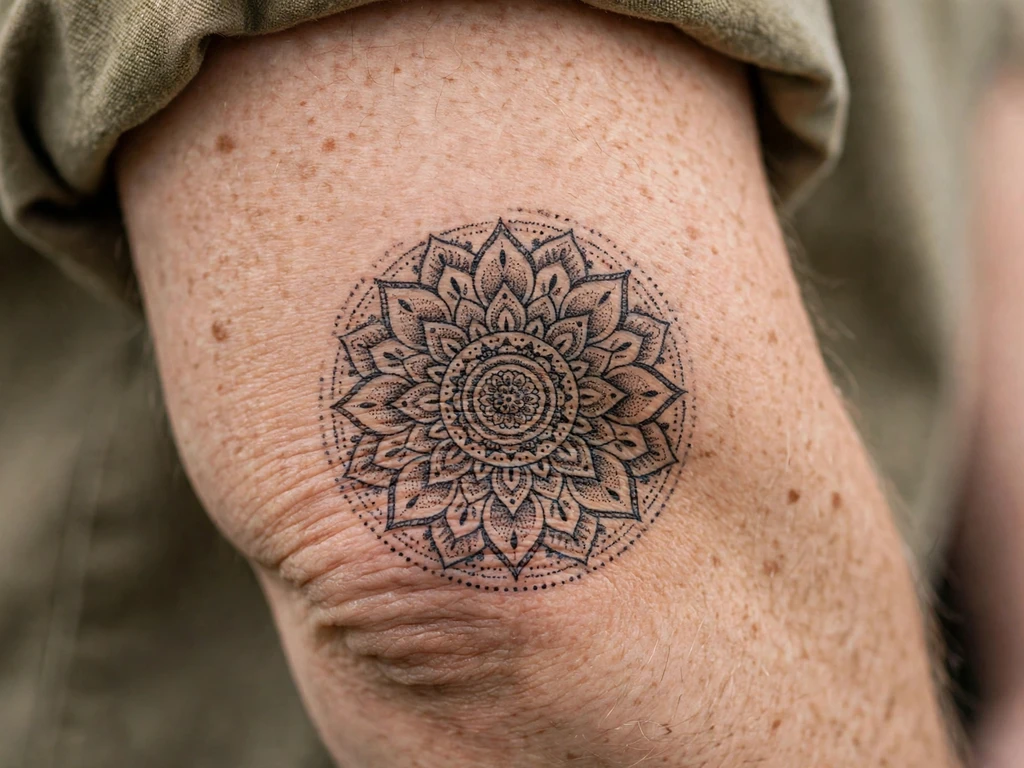
Instead of avoiding the elbow, crown it: a mandala centred directly on the elbow point, its rings and petals radiating onto the forearm and upper arm so the pattern breathes as the joint bends and straightens. Circular ornament suits joints better than any picture could, because there is no image to distort — the geometry simply opens and closes like a flower.
Best placement: Centred on the elbow, radiating evenly onto both segments of the arm.
Best for / know before you book: The stencil must be checked with your arm both bent and straight: a mandala centred on a straight arm can sit visibly off-centre the moment you bend it. Elbow skin is tough and dry, so expect a scratchy session and a likely touch-up once the thick skin settles.
14. Ear and Jawline Accent
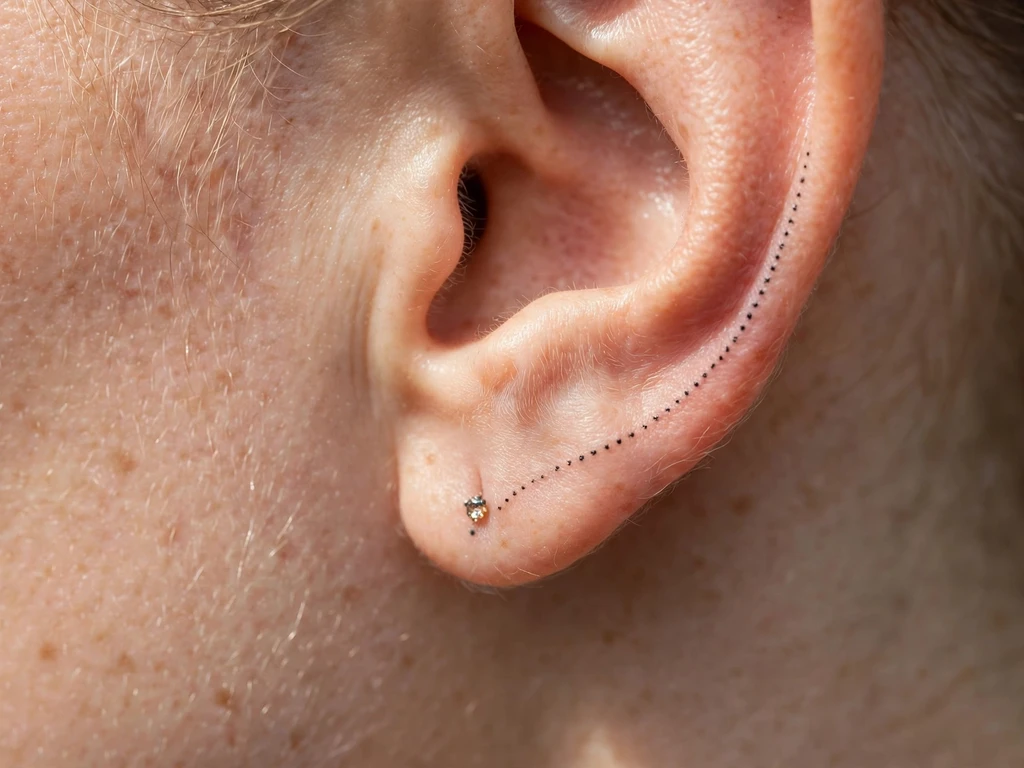
The most subtle ornament in tattooing: a fine dotted line tracing the ear’s inner curve like a permanent ear cuff, sometimes paired with a whisper-thin curved flourish along the jawline or a tiny gem point below the earlobe. It is jewellery at the threshold of visibility — noticed only in profile, in conversation, up close. Wearers often say it is the piece people ask about most, precisely because it is so easy to miss.
Best placement: Along the ear’s helix and inner curve, with or without a fine line sweeping along the jaw.
Best for / know before you book: This is face-adjacent, always-visible work, so be certain; some studios will ask you to sit with the decision after a consultation before booking. Ear skin is thin and oily and sheds fast, so keep the dots bold enough to survive and expect fading sooner than on protected skin.
15. Long Sternum-to-Navel Drop
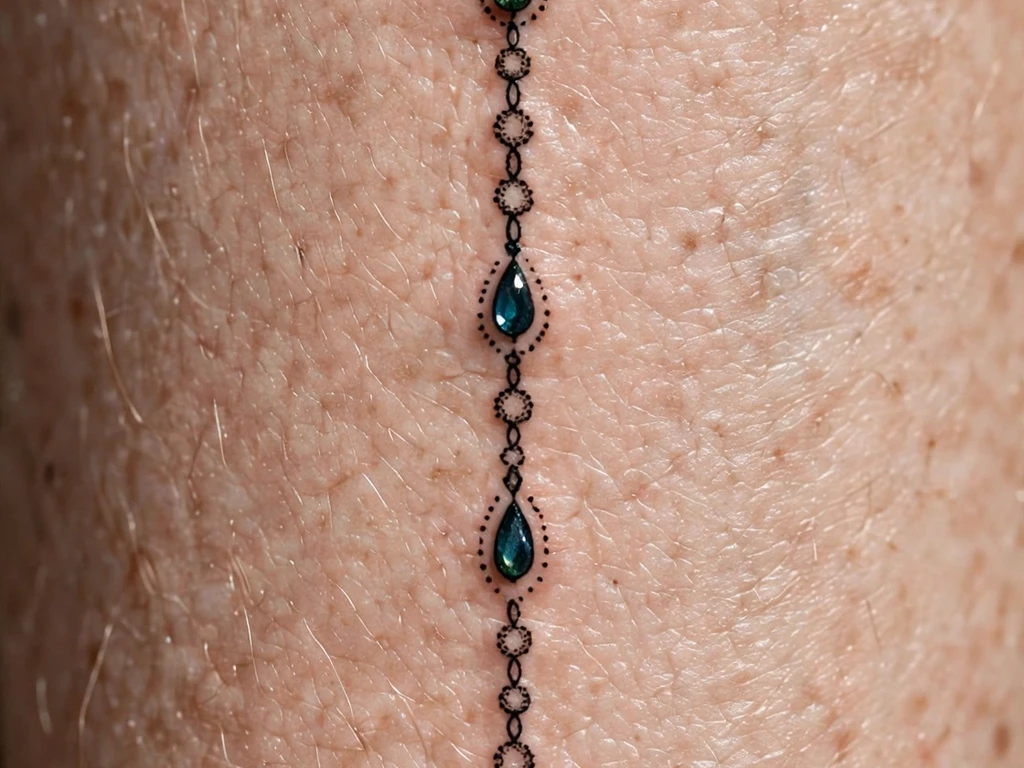
The most dramatic line in ornamental tattooing: a single vertical composition that begins with a small medallion at the sternum and descends the centre of the torso in linked drops — chains, beads, tiny gems — ending in one statement pendant point above the navel. The design works like a long necklace worn against bare skin, lengthening the torso’s line and moving gently as you breathe. Despite its size it is mostly fine line and dots, so it can be completed faster than its drama suggests.
Best placement: The body’s centre line, from the sternum medallion to the final drop just above the navel.
Best for / know before you book: A design this long lives or dies on the centre line: have it marked and checked standing, breathing normally, because a reclined body stretches the torso and a line placed lying down can wander when you stand. Bras and waistbands cross this territory during healing — plan loose, soft clothing for two full weeks.
16. Men’s Ornamental Chest Plate
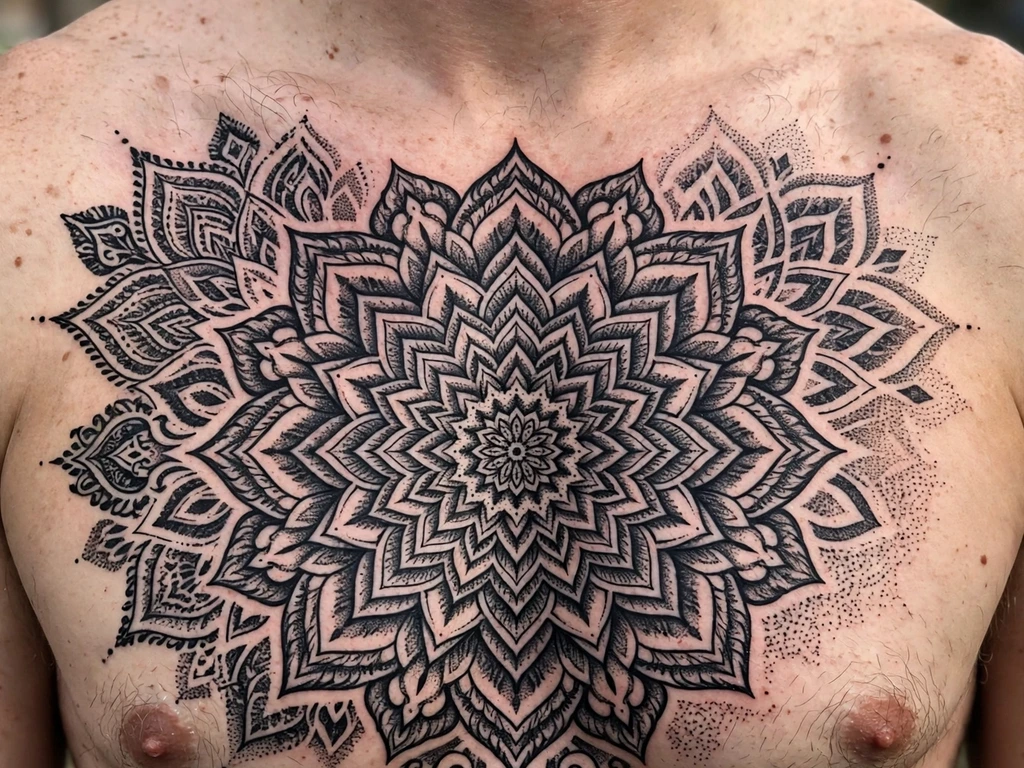
Ornamental tattooing’s fastest-growing branch: a bold, symmetrical plate across a man’s chest — a heavy medallion centred on the sternum, with wings of filigree and mandala segments spreading towards the shoulders, usually in solid blackwork with dotwork gradients. Where many women’s chest ornaments lean towards lace and fine chains, the men’s plate borrows from armour and heraldry: stronger lines, denser black, and geometry that follows the chest muscles like a breastplate.
Best placement: Centre chest, the medallion on the sternum and the design spreading symmetrically across both sides.
Best for / know before you book: Muscle changes the canvas — a plate drawn on a relaxed chest shifts when you flex or train, so check the stencil standing, arms down, in your natural posture, and discuss training plans with your artist; serious muscle growth can stretch fine dotwork spacing over time.
17. Wrist Bracelet Ornament
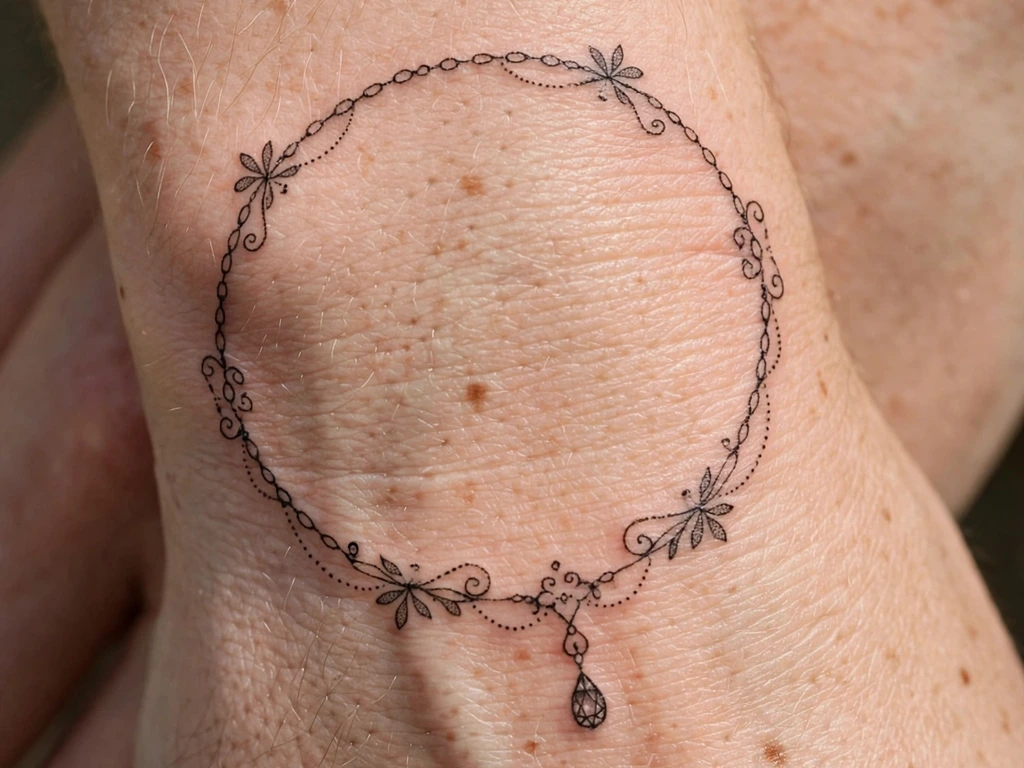
A permanent bracelet: one or two fine chains circle the wrist, finished with a small charm — a gem point, a tiny mandala, a single bead drop — sitting where a real bracelet’s pendant would fall. It is the gentlest possible entry into ornamental work, it pairs with real bracelets and watches, and it can later grow into a forearm cuff or a hand ornament. More small-scale inspiration sits in our wrist tattoo ideas collection, where this bracelet style is a perennial favourite.
Best placement: Around the wrist, the charm centred on the inner or outer wrist.
Best for / know before you book: The wrist crease is the danger zone — chains that cross it distort with every bend and fade the fastest — so position the band a centimetre above the crease, and keep watch straps and bracelets off until it has fully healed.
18. Upper-Back Yoke Ornament
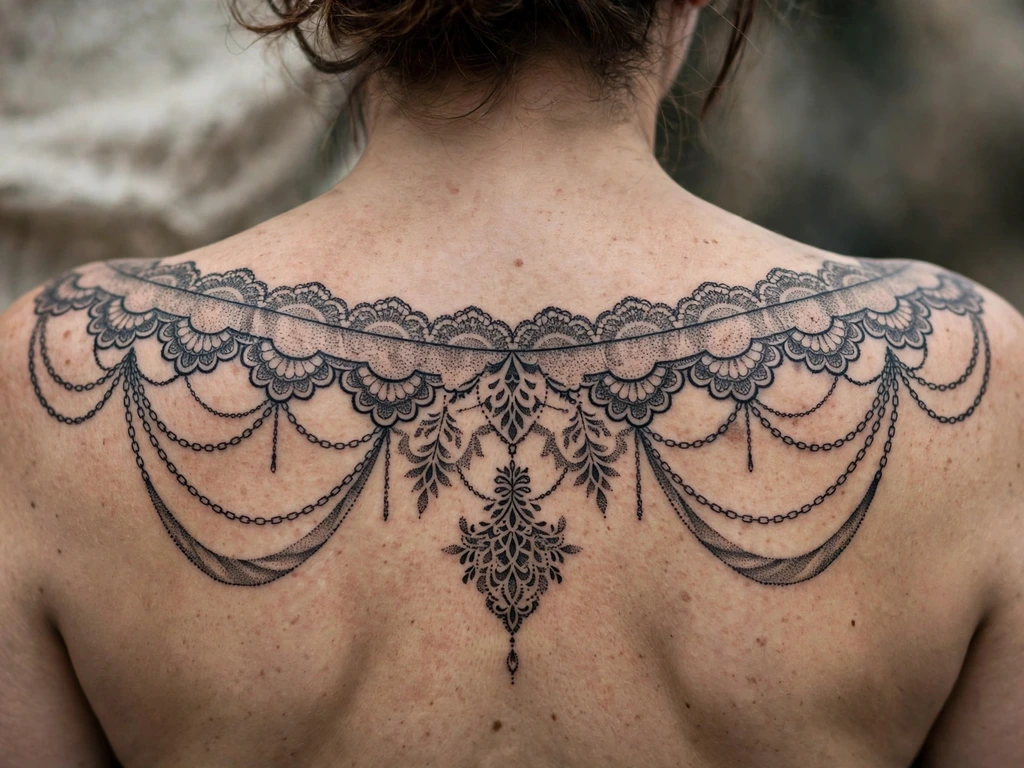
A necklace worn backwards and scaled up: a yoke of draped chains, lace scallops and filigree spans the upper back from shoulder to shoulder, with a central pendant drop falling between the shoulder blades. The yoke turns every backless top and swimsuit into a styled outfit and photographs beautifully, because the whole composition is visible at once. It is also the natural partner piece to a sternum ornament — front necklace, back necklace.
Best placement: Across the upper back, the yoke line following the shoulders and the drop centred on the spine.
Best for / know before you book: This is a large symmetrical piece you cannot monitor yourself, so judge artists by their healed back work and insist on a full stencil photo check from behind before the session starts. Shoulders are sun-exposed territory, and yokes sit exactly where straps and sun meet — sunscreen is this design’s long-term care.
19. Ornamental Knee Mandala
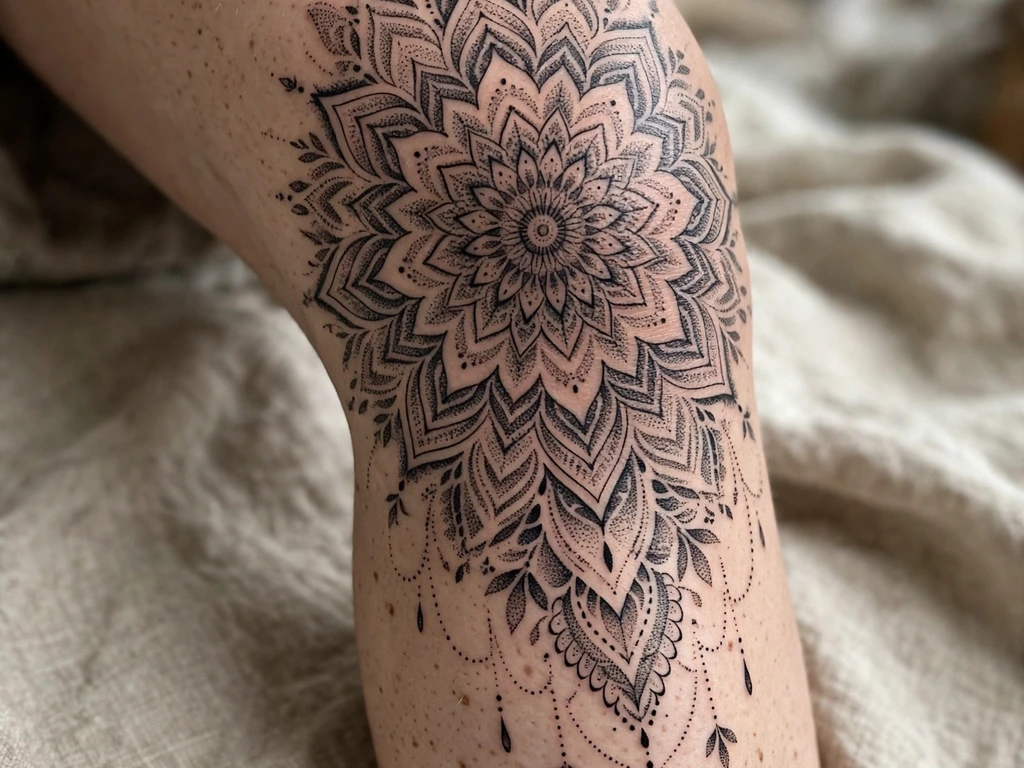
The leg’s answer to the elbow mandala: a circular ornament centred on the kneecap, with petal rings and hanging dot drops radiating onto the thigh and shin. Knee ornaments are statement pieces — visible in shorts and dresses, hidden under trousers — and the mandala format suits the kneecap’s round dome perfectly, turning one of the body’s most awkward canvases into the design’s jewel.
Best placement: Centred directly on the kneecap, with drops radiating down the shin.
Best for / know before you book: Straight talk — the kneecap is one of the spiciest placements on the body, though the mandala’s centre session is usually short. Swelling afterwards is normal and dramatic, so schedule before rest days, and check the stencil both standing and with the knee bent, since the cap shifts position between the two.
20. Bold Blackwork Ornament
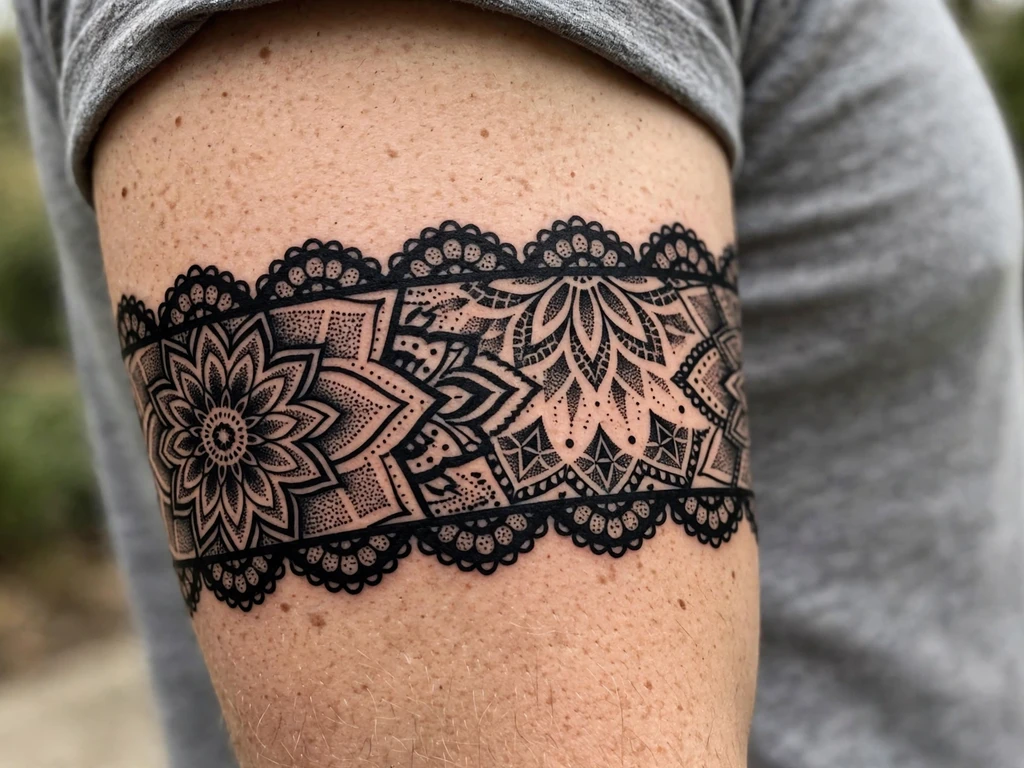
Ornamental design with the volume turned up: thick lace silhouettes, solid black mandala segments, and negative-space dots and gems carved out of packed black. Blackwork ornament swaps the style’s usual delicacy for graphic power — it reads from across the room, sits happily alongside other blackwork tattoos, and holds its shape for decades where fine lines would soften. Wrapped around the upper arm, it reads like a carved cuff.
Best placement: Upper arm as a wrap cuff, or as bold panels on the thigh or calf.
Best for / know before you book: Packing solid black is slower and feels more intense than linework, and it scabs more noticeably while healing — leave it to shed naturally, never pick. Check healed blackwork in portfolios; it should heal like velvet, not patchwork, because thin patches show immediately in ornamental patterns.
21. Fine-Line Delicate Ornament
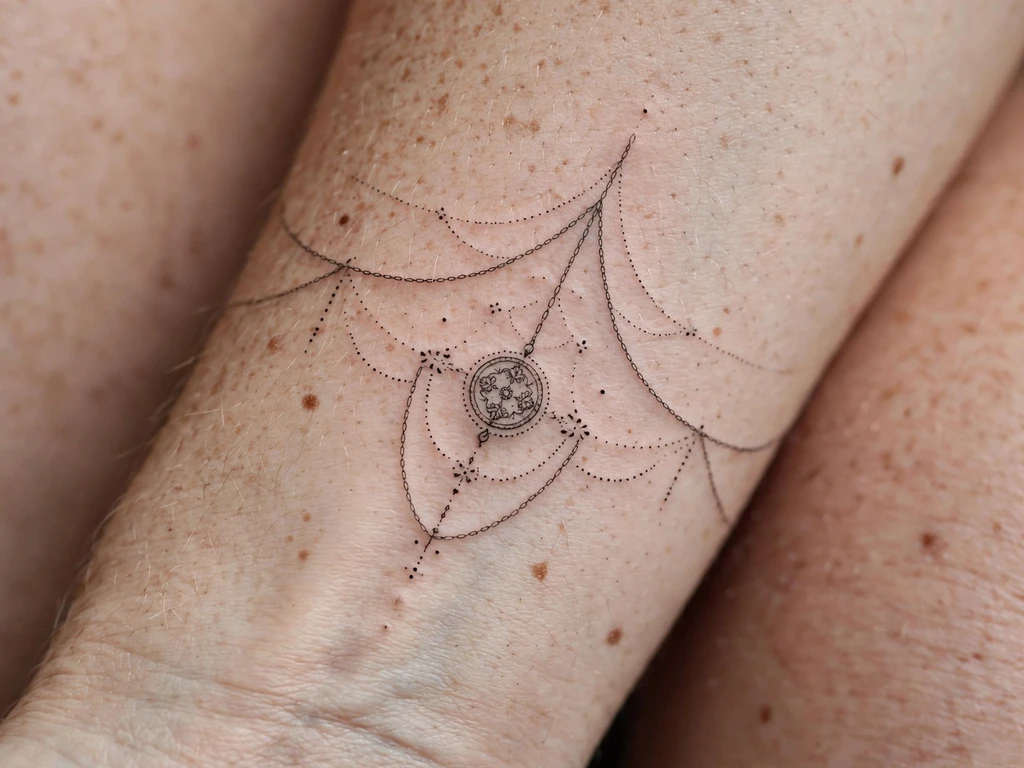
Ornament reduced to a whisper: hair-thin chains, micro dots and the faintest filigree, often a single small medallion or a minimal drop on the inner forearm. Fine-line ornament suits wearers who want the jewellery idea without visible “tattoo” weight — in soft light it can read as actual delicate jewellery until someone looks closely. It is also the execution most sensitive to the artist’s hand: one wobble, and there is no shading to forgive it.
Best placement: Inner forearm, inner bicep or below the collarbone, at small to medium size.
Best for / know before you book: Fine lines soften and spread slightly as they settle — that is the medium, not a mistake — so good artists draw them a fraction bolder than the reference photo suggests and space micro-dots generously. Sun exposure accelerates the softening, so this style asks for lifelong sunscreen discipline.
22. Dotwork Chandelier Ornament
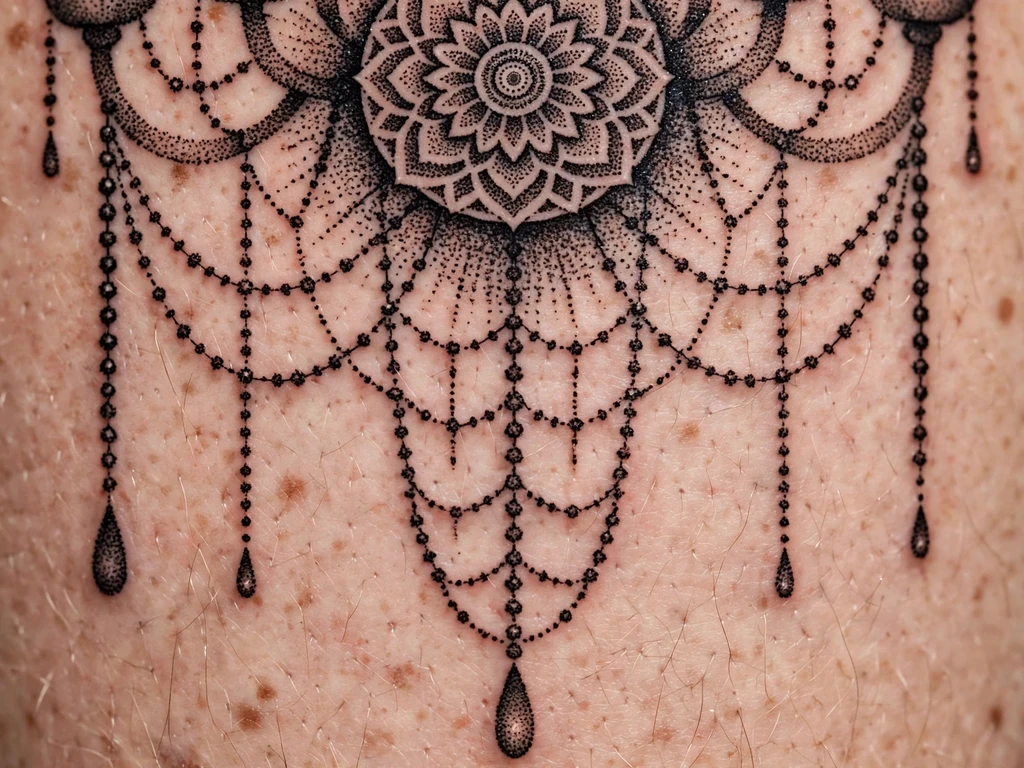
A chandelier built entirely from dots: tiered strands of stippled beads descend from a central medallion in graduated lengths, each strand ending in a tiny pendant drop. Because there are no long solid lines, the chandelier has a soft, almost embroidered quality and moves gracefully with the body it hangs on. It is also the most patient design in this list — thousands of individual dots, placed one at a time.
Best placement: Centre sternum, the strands descending in tiers; also beautiful centred on the upper back.
Best for / know before you book: Dotwork sessions are long and priced for patience — a full chandelier can take two to three times as long as the same shape drawn in lines. Dots must start properly spaced, because placed too tightly they heal into a smudge; choose an artist who does stipple work as a speciality, not an occasional extra.
23. Gem-Centre Back Ornament
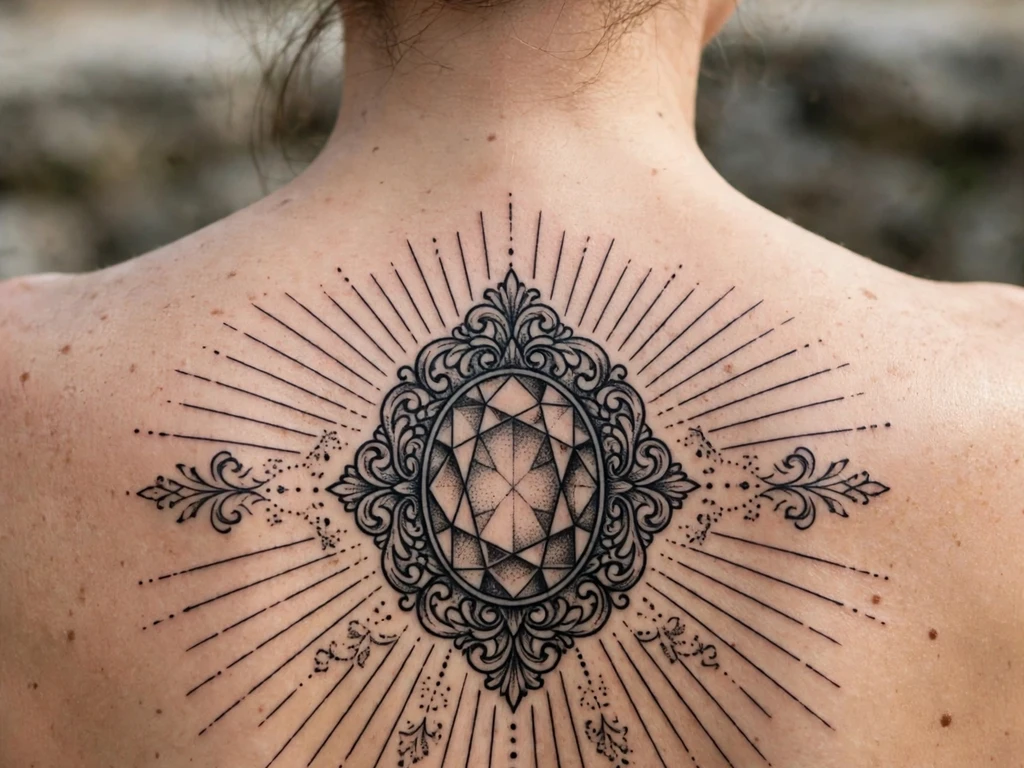
One jewel, framed like a museum piece: a large faceted gemstone — diamond-cut, teardrop or smooth cabochon — sits at the centre of the upper back, held in an ornamental setting of filigree prongs, radiating lines and small satellite dots. The gem is usually the one place a whisper of colour appears in ornamental work — a pale blue-grey or soft violet wash inside the facets — or it stays pure black line for a cut-glass look.
Best placement: Centre of the upper back, between the shoulder blades.
Best for / know before you book: Facets are geometry, and geometry exposes everything — check the gem’s straight edges in a photograph taken square-on, because a mirror check can hide a tilt that will show in every backless photo for decades. If you add a colour wash, keep it pale; gem colours are accents, not the structure.
24. Art Nouveau Whiplash Ornament
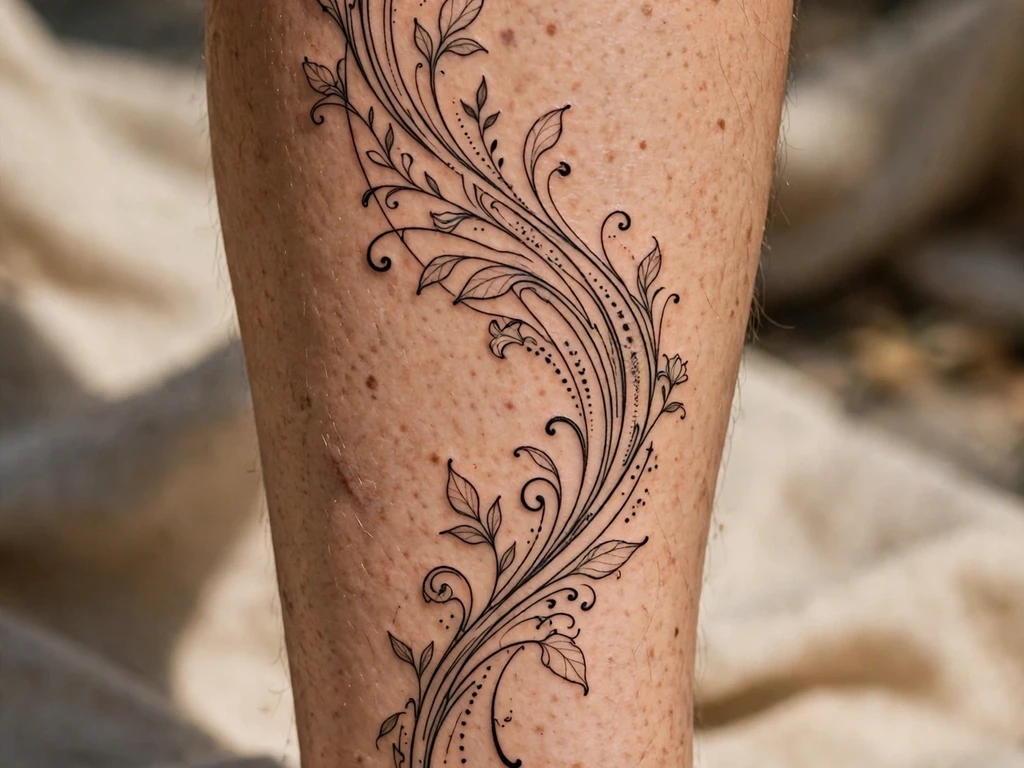
Pure line, pure movement: one long whiplash curve — the signature S-curve of Art Nouveau — sweeps along the outer calf, throwing off tendrils, leaves and small dot accents as it travels, like a vine of jewellery climbing the leg. The V&A’s essay on the whiplash motif traces how this single ornamental curve came to define an entire design era, and on skin it does what it did on Mucha’s posters: it makes a still surface feel alive. No medallion, no centre point — the line itself is the ornament.
Best placement: Flowing along the outer calf and ankle, or down the side of the forearm.
Best for / know before you book: A single long curve shows every tremor, so this design quietly demands the steadiest linework artist you can find — judge by healed single-line work, not fresh photos. Have the curve drawn freehand on your leg rather than stencilled from paper; the S must follow your calf’s actual shape to flow.
25. Ornamental Floral Fusion
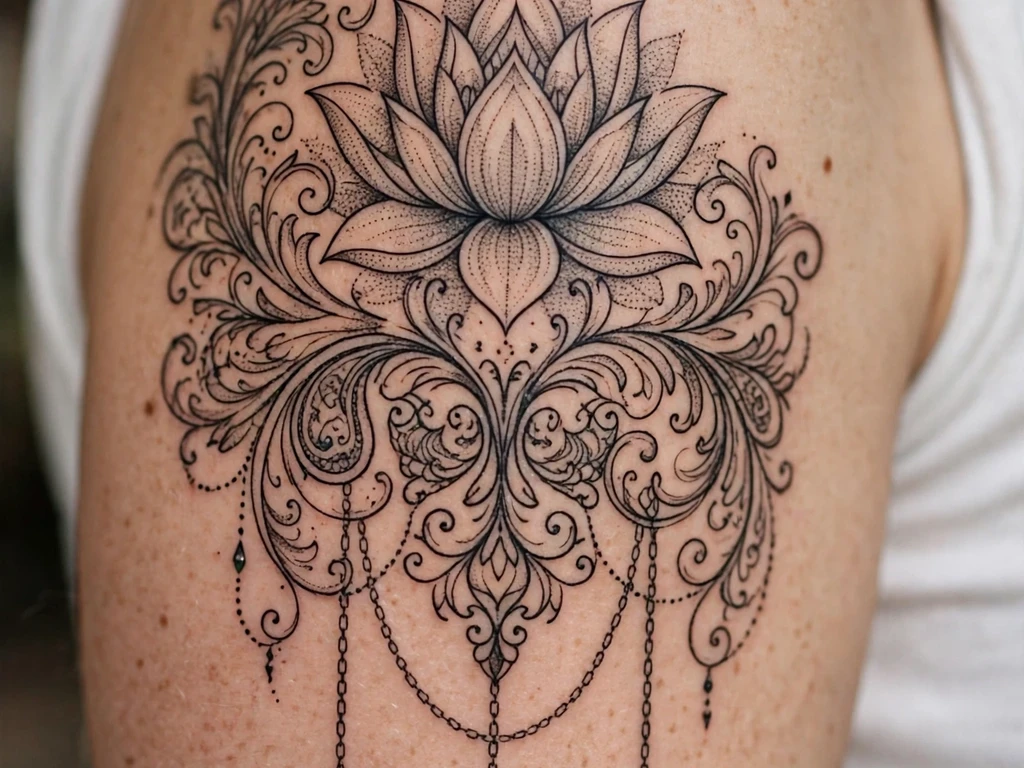
Where ornament meets bouquet: filigree scrollwork grows leaves, buds and one hero flower — most often a lotus, whose natural radial symmetry is already halfway to a mandala, which is why so many wearers start from our lotus tattoo ideas before adding the jewellery framework around it. Chains can hang from the flower’s lowest petals and small gems nestle between the leaves, so the finished piece reads half garden, half necklace. It is the most romantic design in this guide, and the easiest to personalise with birth flowers.
Best placement: Upper arm, where the flower can open and the scrollwork can wrap; thigh for a larger composition.
Best for / know before you book: Fusion pieces fail when the two halves fight — decide at the consultation which is the star, flower or filigree, and let the other one support it. Petal lines and chain lines age at different speeds, so keep both a fraction bolder than the airy references suggest if you want them to age together.
Ornamental Tattoo Placement by Size
| Size | Typical dimensions | Best placements | Good to know |
|---|---|---|---|
| Small | 2–6 cm | Wrist, ankle, finger, nape, ear | Bracelets, anklets and finger rings live here; simplify — micro detail merges as lines settle |
| Medium | 7–15 cm | Forearm, inner bicep, hip, foot, upper chest | The sweet spot for chain swags, cuffs and small centrepieces with real detail |
| Large | 16–30 cm | Sternum, thigh, upper back, shoulder | Chandelier drops, garters and yokes need this scale for their tiers and drapes |
| Extra large | 30 cm+ / multi-session | Full chest plate, spine compositions, ornamental sleeves in progress | Draw the whole composition in one consultation, even if it is tattooed in stages |
How to Choose Your Ornamental Tattoo (and What to Know Before You Book)
Symmetry is the whole game. More than any other style, ornamental work lives or dies on balance: a medallion two millimetres off the centre line will bother you in every mirror for decades. The defence is the stencil ritual — stencil applied, then checked standing, arms relaxed, in a full-length mirror and in a photograph, before any ink. Never approve an ornamental stencil lying down or craning over your own shoulder; bodies change shape between positions, and the design has to be right in the position you actually live in.
Choose your line weight for the decade, not the day. Fine-line ornament is exquisite when fresh and softens the fastest; bold blackwork ornament looks heavier today and reads clearly in twenty years. Neither is wrong — but be honest with yourself about which ageing pattern you want. The middle path most artists recommend is fine detail carried on a slightly bolder structural line, so the design keeps its architecture even as the delicate parts mellow.
Match the ornament to your anatomy. Ornamental designs are drawn for curves, not flat paper: drops must hang from real high points, chains should follow collarbones and ankle bones, and medallions belong on the body’s natural centre points — sternum, spine, joints. Bring reference images for the elements you love, then let your artist compose them onto your body; a composition copied from someone else’s photograph will sit wrong on your different proportions.
Judge artists on healed ornamental work. Fresh ornamental photos flatter everything: lines are crisp, dots are perfect, and the redness hides a multitude of sins. Healed photos — six months or older — show the truth about an artist’s spacing, symmetry and dot discipline. Ask specifically for healed sternum, hand and dotwork pieces if those are your placements, and be wary of portfolios with no healed work at all.
Take safety seriously. Ornamental work often means long sessions on sensitive placements, which makes studio hygiene doubly important. Choose a licensed studio, watch that single-use needles are opened in front of you, and check the studio’s inspection record where your city publishes one. Toronto Public Health’s tattooing safety guidance sets out the health risks of tattooing and exactly what to look for before you book, and it is a sensible checklist wherever you live. Afterwards, follow your artist’s aftercare first: keep the piece clean, moisturised and out of the sun while it heals, and take extra care with healing ornaments on hands and feet, which are washed and rubbed far more than other placements.
Key points to remember:
- Symmetry is checked standing, in a mirror and in a photo — never lying down
- Fine lines soften fastest; bold blackwork ornament ages the slowest
- The design must be composed on your anatomy, not copied from someone else’s photo
- Dotwork and chandelier pieces take longer sessions — budget time, not just money
- Hands, feet and fingers need routine touch-ups; that is maintenance, not failure
Frequently Asked Questions
Does an ornamental tattoo have to mean something?
No — and that is its freedom. Ornamental tattoos are decoration first: their “meaning” is the way jewellery means something, through beauty, placement and the occasion you chose it for. That said, wearers often load the elements with private significance — a birthstone as the central gem, a lotus for calm, a chain drop for each child — and artists are happy to build those layers in. A design can be pure adornment and still be deeply personal.
Do ornamental tattoos hurt more than other styles?
The style itself is average; the placements are the story. The sternum, spine, feet, hands and kneecaps — all ornamental favourites — are bony, sensitive areas, while forearm cuffs and thigh garters are comparatively gentle. Dotwork is often described as less intense than linework per minute but goes on much longer, so the total discomfort can even out. Eat properly beforehand, plan breaks, and split big symmetrical pieces into two sittings if your artist suggests it.
How well do fine-line ornamental tattoos age?
Honestly: they soften. Fine lines spread slightly and micro-dots merge a little as the years pass, which is why experienced ornamental artists draw fresh work slightly bolder and more widely spaced than the delicate references clients bring in. A well-spaced fine-line piece ages into a softer version of itself and still reads as jewellery; an over-detailed one can blur into grey lace. Bold blackwork ornament is the low-maintenance alternative if longevity is your top priority.
How much does an ornamental tattoo cost?
It tracks size, detail and session length rather than the style alone. A wrist bracelet or ankle anklet may cost a studio’s minimum charge; a medium forearm cuff or collarbone swag usually sits in the low-to-mid hundreds; and a full sternum chandelier, back yoke or chest plate — especially in dotwork — runs into higher figures across one long session or several. You are paying for precision: symmetry and stipple work cannot be rushed.
Can I extend an ornamental tattoo later?
Yes — ornamental is one of the most extendable styles in tattooing, because it is built from repeatable elements. A wrist bracelet grows into a forearm cuff, a shoulder mandala sprouts chain drops, a sternum medallion gains extra tiers. The rule is to tell your artist from day one that growth is likely, so the first piece is drawn with open edges and spacing that future elements can join cleanly.
Final Thoughts
An ornamental tattoo is the oldest idea in body decoration — adorn the body the way you would with jewellery — executed with modern precision. Whether yours is a two-centimetre chain on a wrist or a chandelier of dots descending from your sternum, the same principles hold: compose it on your anatomy, check the symmetry standing still, and choose your line weight for the years ahead, not the photograph today.
Shortlist the designs from this list that you keep coming back to, take them to a consultation, and wear the stencil before you commit. The right ornament should feel less like a picture you added and more like a piece of jewellery you were always meant to wear.