Short answer first: a snake tattoo meaning usually starts with one plain fact — a snake walks out of its own skin and leaves the old one behind. From that single act people have built rebirth, healing, temptation, wisdom and protection, and different cultures picked different items off that list. Some of those readings are documented in temples and texts thousands of years old. Some were written by tattoo blogs last spring. This page keeps the two apart, because a meaning with real history behind it and a meaning that sounds good in a studio are both fine reasons to get inked, and they are not the same thing.
The animal earns the attention. A snake has no legs and still gets where it is going, sheds its skin whole, and can kill with a bite — yet it also became a sign of medicine. Every culture that lived alongside snakes had to decide what they stood for, and most decided on more than one thing at once. The designs themselves fill our snake tattoo ideas collection; what follows is the story underneath them, from an Egyptian crown to a two-inch line on a collarbone.
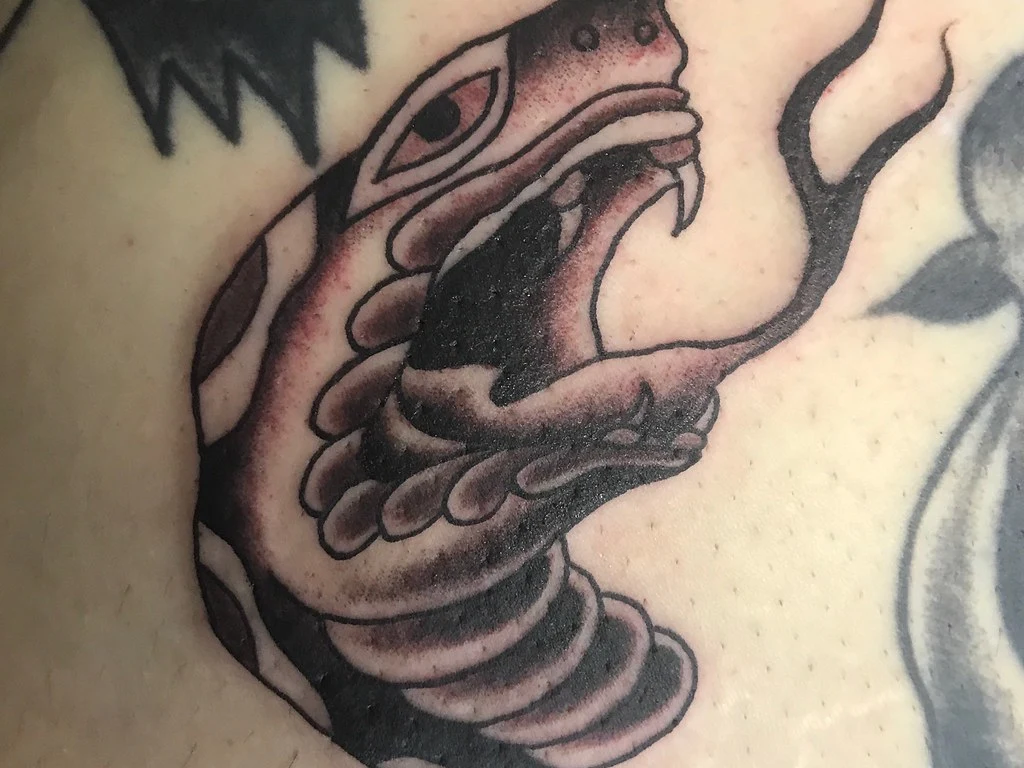
The Core Meanings, One by One
Shedding its skin: rebirth and renewal
This is the centre of the whole subject, and it comes straight from watching the animal. A snake outgrows its skin, splits the old layer at the mouth, and works its way out over hours, leaving a complete empty copy of itself behind — eyes clouded, pattern and all. The skin underneath is brighter. Snakes do this their whole lives. It is hard to watch that and not think about a person leaving an old life. Greek and Roman writers used the shedding snake as a picture of youth renewed, and folk belief in more than one country held that snakes never truly aged, for exactly this reason. In modern tattooing this is the meaning doing the most work: the snake marks the divorce that is final, the illness that is beaten, the addiction that is years behind you, the version of yourself you are done with. It is a modern emphasis built on a genuinely ancient observation, and it is labelled that way here on purpose.
Temptation: the Eden story, told straight
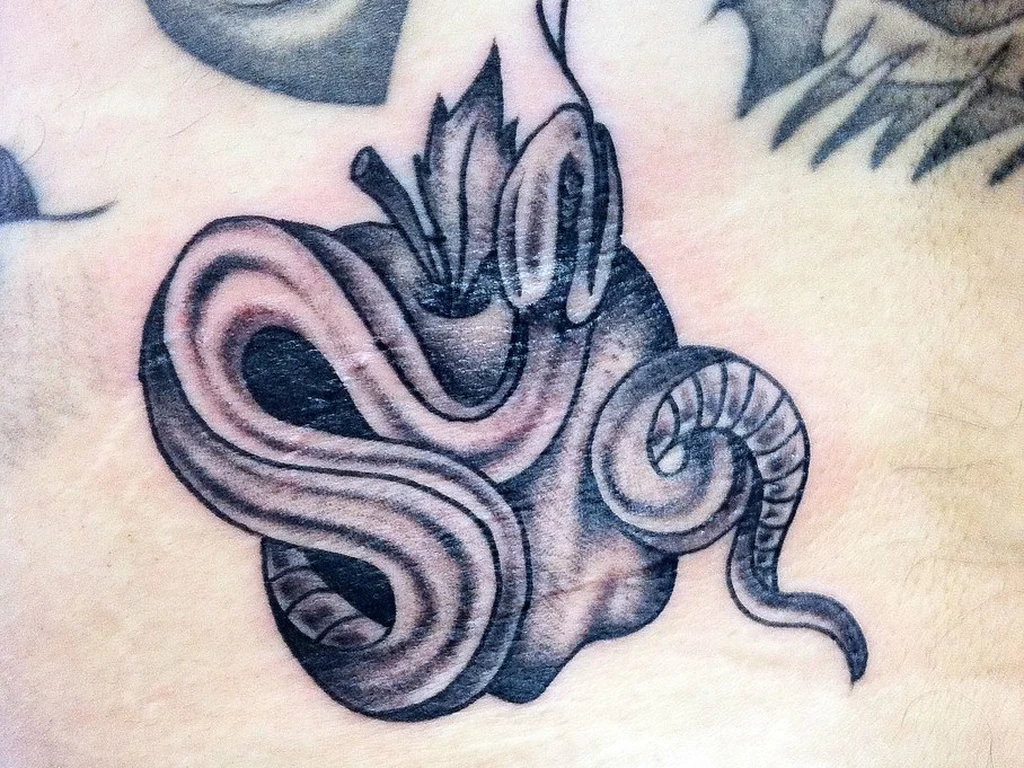
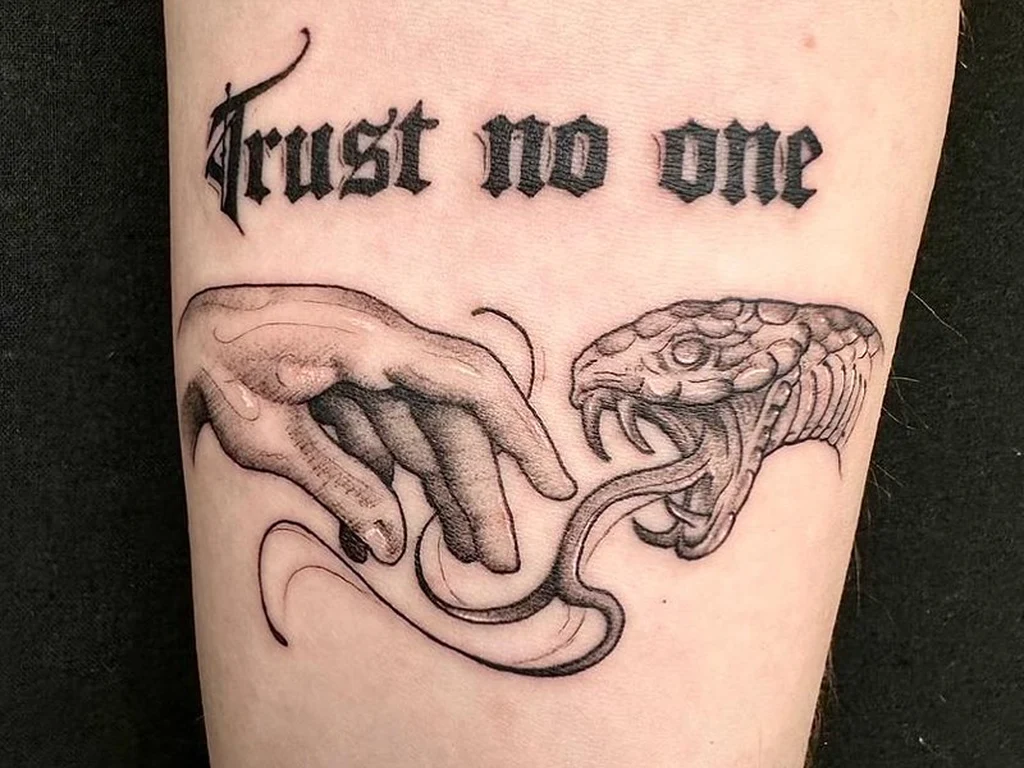
The Western reading, and the one your grandmother probably holds. In Genesis, a serpent talks Eve into eating the fruit she was told to leave alone, and centuries of Christian art fixed that scene — snake in the tree, apple in hand — in the Western mind for good. Two honest details are worth keeping. The Genesis text calls the creature a serpent and never names it as Satan; that identification came later, in retelling and preaching. And the serpent is the one figure in the garden offering knowledge, which is why some wearers take the Eden snake as a sign of curiosity and thinking for yourself rather than sin. A snake-and-apple tattoo, like the black and grey piece below, can be worn either way: as a warning about temptation, or as a small act of defiance against being told not to ask questions. Both readings are real, and neither is older than the tradition that produced it — a Western, Bible-shaped layer, not a world rule about snakes.
Kundalini: the coiled serpent
In the yoga traditions of India, kundalini is the name for a spiritual energy pictured as a serpent coiled at the base of the spine — the word comes from a Sanskrit term for something coiled up. In those teachings the serpent sleeps until practice wakes it, then rises along the spine through the body’s energy centres. A kundalini tattoo is usually drawn coiled, and the spine itself is a placement people choose for it on purpose. This layer is a living tradition’s teaching rather than a historical claim, and it is written that way here. If your coiled snake is about energy held in reserve, this is the reading it stands on.
The ouroboros: the snake that eats itself
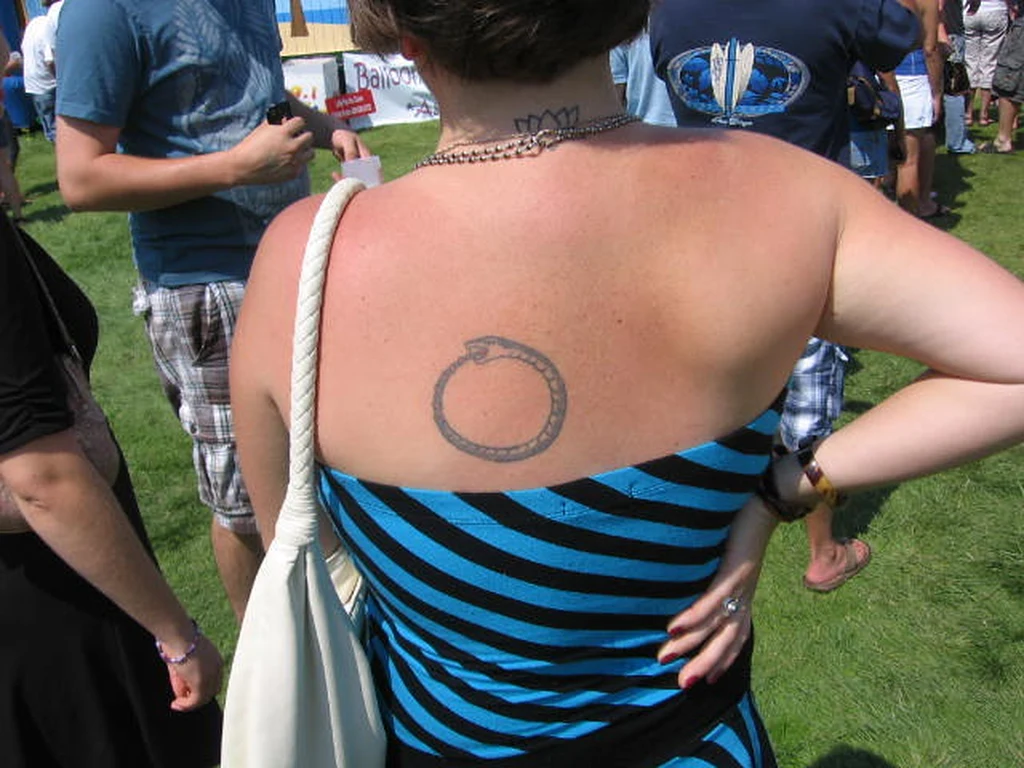
The ouroboros is a snake, sometimes a dragon, drawn in a circle biting its own tail, and it is one of the oldest symbols on this page. Britannica’s page on the ouroboros traces it from Egyptian funerary texts through Greek magical papyri, which carried the words “one is the all” around it: a cycle of destruction and re-creation with no beginning and no end. A tattooed ouroboros is rarely just decoration. People pick it after a life that has come full circle, or as a private statement that endings feed beginnings. The plain ring version, like the small back piece below, is the oldest-looking form of it: no scale detail, no decoration, just the loop.
Healing: one snake on a staff
The snake is also the oldest medical emblem in the West. Asclepius, the Greek god of healing, carried a staff with a single snake wound around it, and his temples kept live snakes moving freely through the wards, held to be part of the cure. His rod is still the sign of medicine today; it sits on the flag of the World Health Organization. Two honest footnotes. Why a snake meant healing is argued about, and the shedding skin, with its picture of renewal, is the usual answer. And the two-snake wand with wings that turns up on pharmacies and ambulances is a different symbol, the caduceus of Hermes, mixed into medicine by mistake and habit, mostly in the United States. If your snake is a healing snake — for a recovery, or for the medical work you do — one snake is the historically right drawing.
Wisdom and patience: the zodiac snake
In the Chinese zodiac the Snake is the sixth sign, and the tradition describes people born in its years as wise, intuitive, calm and private — thinkers who watch before they move. The fit with the real animal is easy to see: a snake does not chase. It waits, reads the ground with its tongue, and strikes once. Chinese folklore also gives the snake one of its kindest roles anywhere. The Legend of the White Snake tells of Bai Suzhen, a snake spirit who takes human form, falls in love, and fights to keep her family — a story retold for centuries in opera and film, with the snake as the heroine. A snake tattoo worn for wisdom stands on this layer: patience, intuition, and a mind that keeps some of itself back.
Protection: the snake that guards
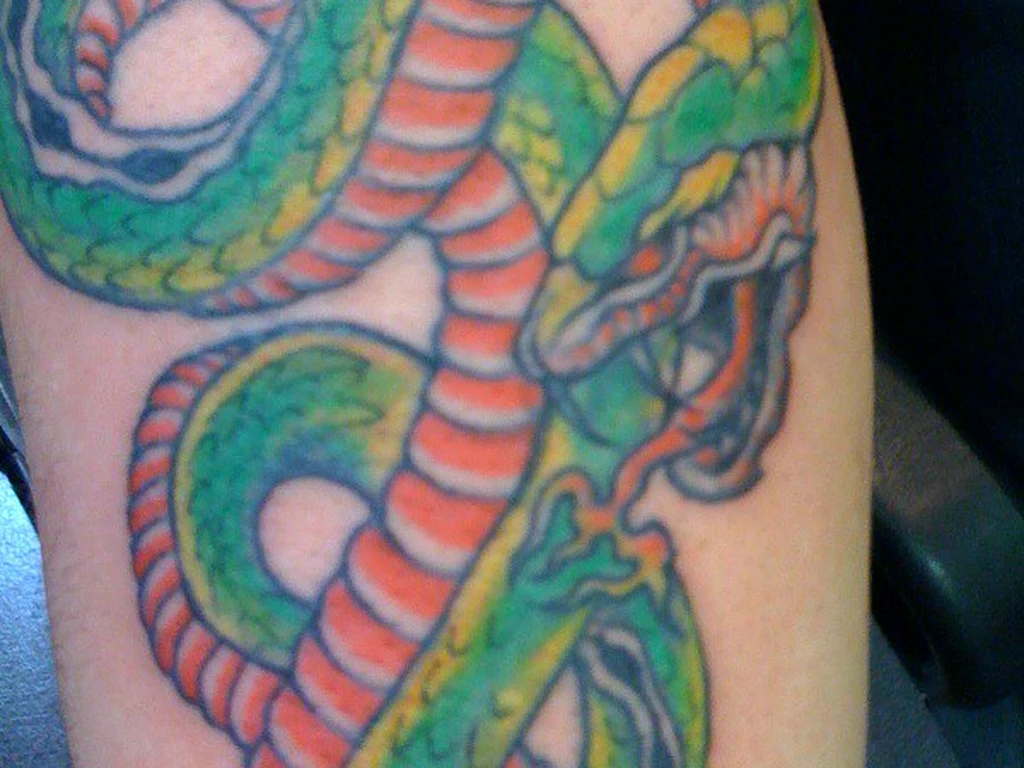
Snakes bite, and old cultures put that bite to work. A cobra with its hood spread is a warning sign that nothing misunderstands, and snakes were set as guardians in story after story: the cobra rearing on the Egyptian king’s brow, the nagas coiled at temple steps across India and Southeast Asia, snakes said to watch over springs, thresholds and buried gold. There is a practical root under the mythology — snakes kept near grain stores ate the rats, and a snake around the house was quietly useful before it was sacred. A protection snake is usually drawn alert: hood up, head raised, or head out and watching from a tight coil. The reading is simple and old: what is mine is watched.
History and Culture: Where the Meanings Come From
Egypt: a guardian on the crown, a monster in the dark
Egypt held both snakes at once. Wadjet, the cobra goddess of Lower Egypt, was protection itself — her image, the uraeus, reared up on the front of the pharaoh’s crown, ready in the stories to spit fire at his enemies, and another cobra goddess, Meretseger, watched over the valley where the tomb-builders lived. Against them stood Apep, the great serpent of chaos, who attacked the sun god Ra’s boat every night in the myths. The same civilisation, the same animal, two opposite meanings — a reminder that snake symbolism was layered from the very start, and that anyone selling one flat meaning for the ancient world is trimming the record.
Greece: healers, prophecy and a famous head of snakes
Greece ran the same double track. Asclepius and his single snake stood for healing, while the oracle at Delphi took her title, Pythia, from Python, the serpent Apollo was said to have killed on that spot. And then there is Medusa, whose hair of living snakes made her face a weapon and, in modern retellings, a sign of survival and rage held on the wearer’s own terms — our Medusa tattoo meaning guide pulls that one story apart on its own. Greek snakes slid between medicine, prophecy and horror without the culture finding it strange, and a Greek-flavoured snake tattoo can honestly claim any of the three.
The Norse world serpent
Norse myth gave the snake its biggest job. Jörmungandr, the serpent cast into the ocean, grew so large that it circled the whole world and bit its own tail — the ouroboros picture wearing a Norse name. The myths say that at Ragnarök, the end of the world, the serpent rises to fight Thor, and that Thor kills it and walks nine steps before its venom kills him. A Norse snake is therefore about scale and fate: the thing in the deep that even a god has to settle with in the end. Twisting, knotted bodies suit it — one of the few snake readings about raw power rather than renewal.
Mesoamerica: the feathered serpent
Across the ocean the snake was revered outright. Quetzalcoatl to the Aztecs and Kukulkan to the Maya, the feathered serpent joined the earth animal to the sky — a snake wearing quetzal feathers — and stood for wind, learning, creation and the calendar. Serpent imagery covered temples, and at Chichen Itza the equinox light still draws crowds to watch a shadow take serpent form on the pyramid steps. Nothing in this tradition reads the snake as evil; it is a teacher and a maker. A feathered-serpent tattoo belongs to that lineage and usually says so in the drawing, feathers laid along the body.
Japan: the white snake brings luck
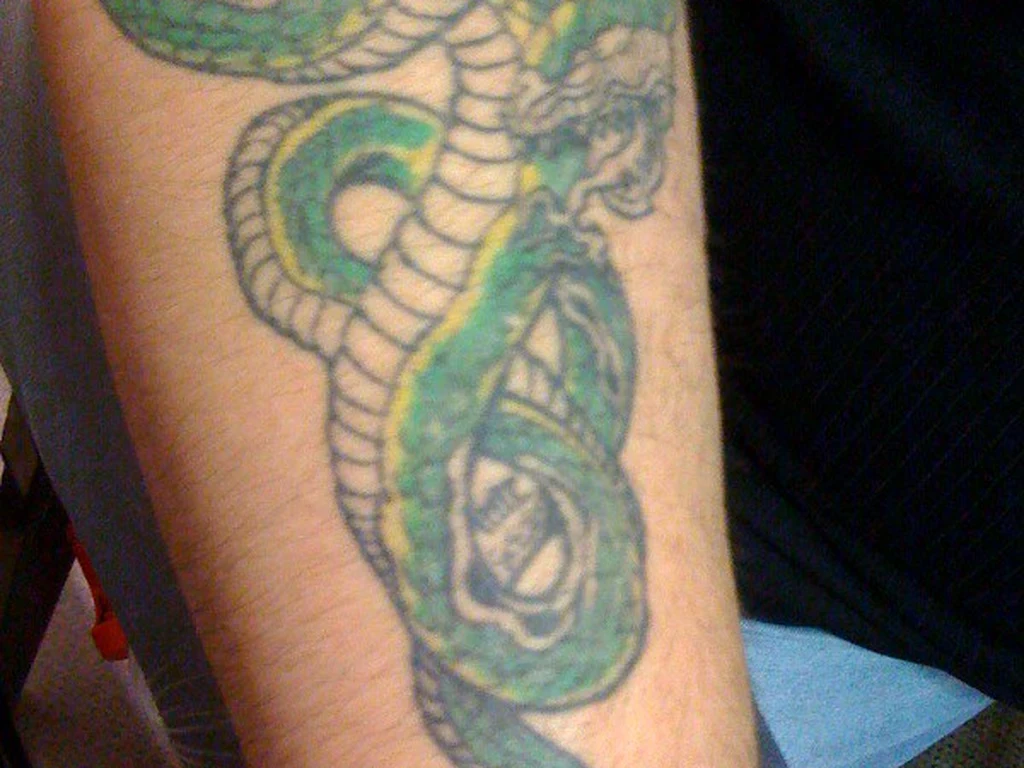
In Japan the snake, hebi, is braided into good fortune. White snakes are treated as messengers of Benzaiten, the goddess of water, music and wealth, and folk custom says that finding one — or keeping its shed skin in a wallet — brings money luck. In Japanese tattooing a hebi winds through peonies or cherry blossom, bright and unhurried, and it sits in that work as a sign of luck, protection and renewal at the same time. The winding green piece below is the shape of it: a snake drawn to travel the body the way water travels a field.
Details That Change the Reading
Coiled, striking or travelling
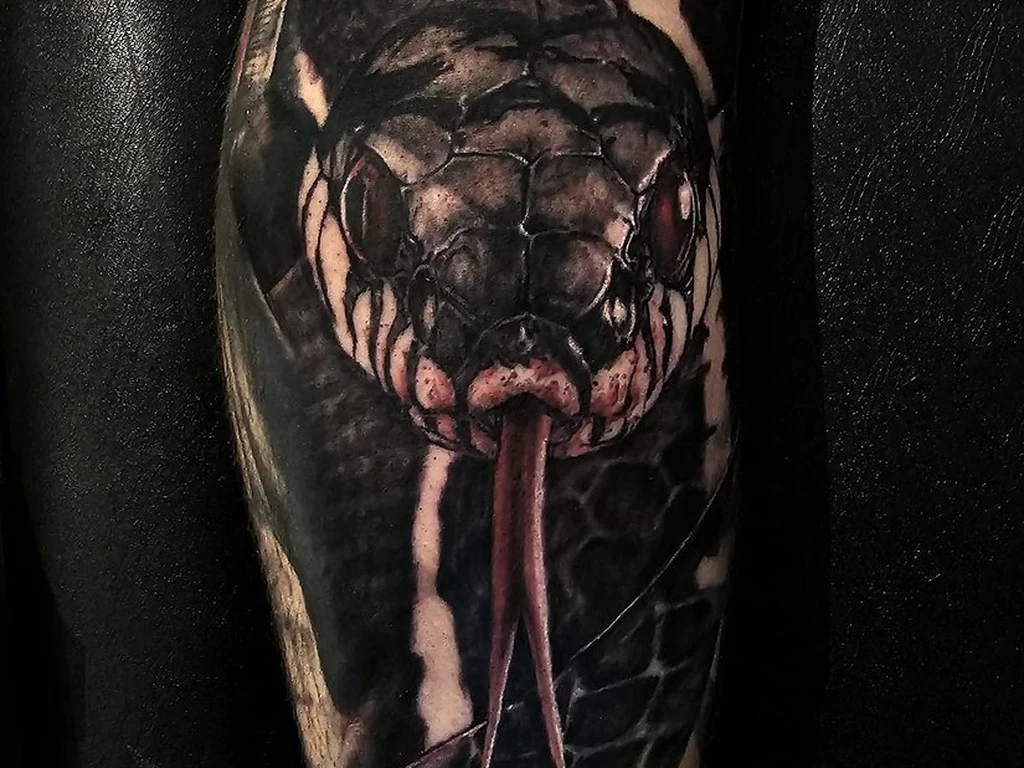
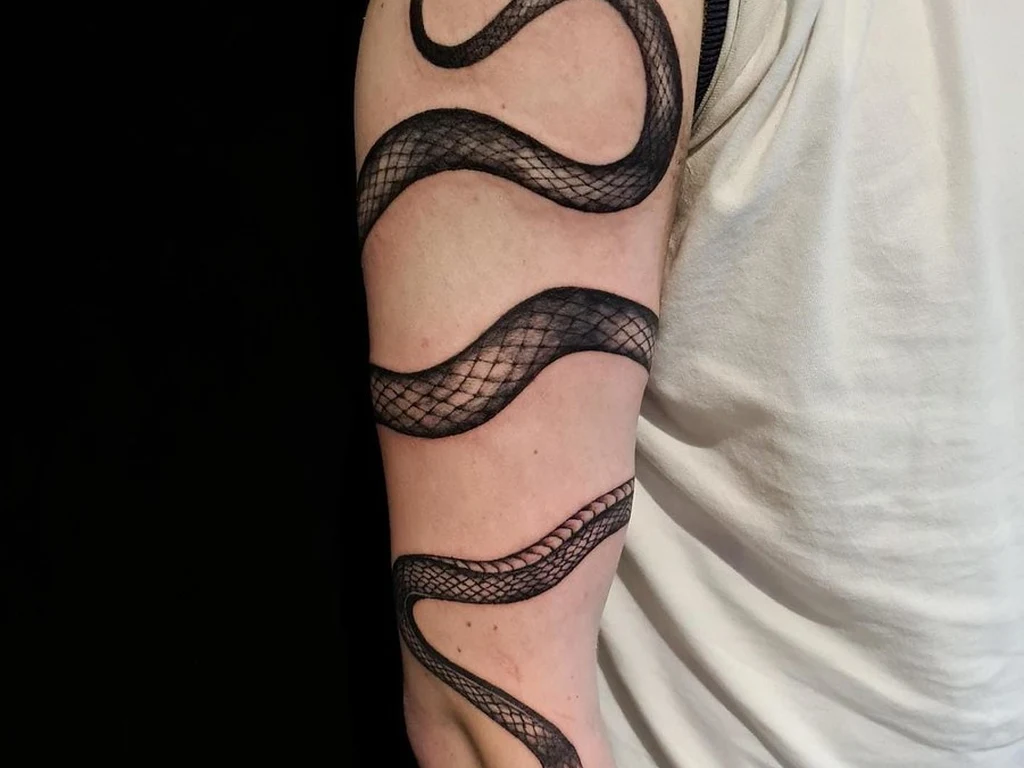
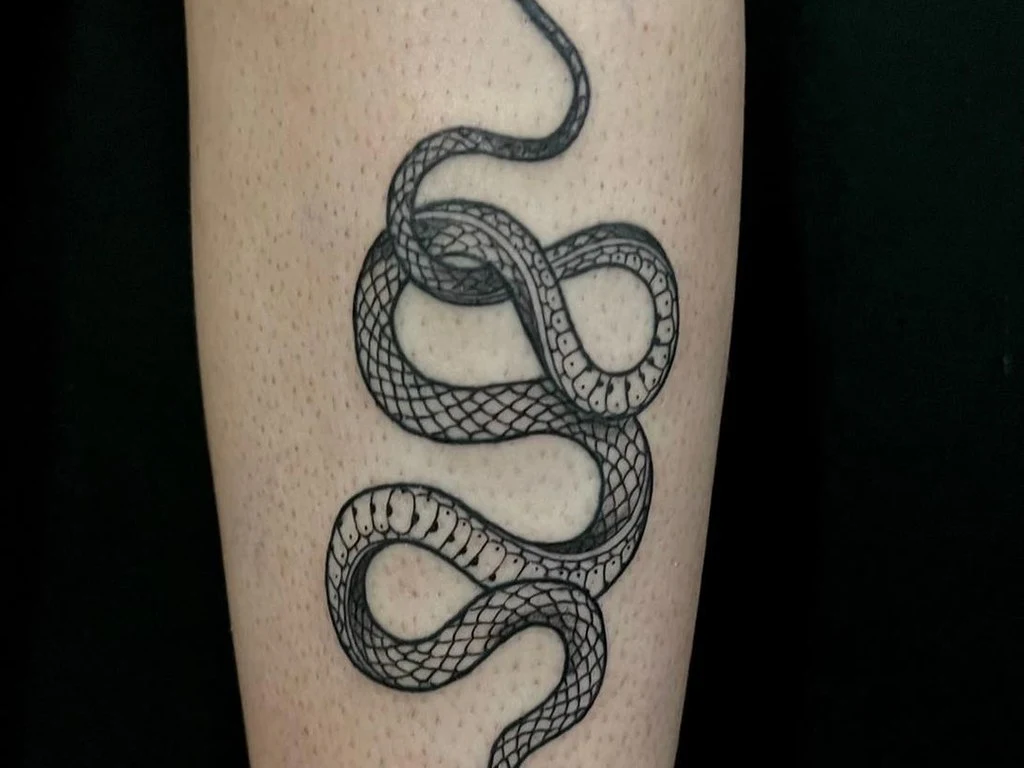
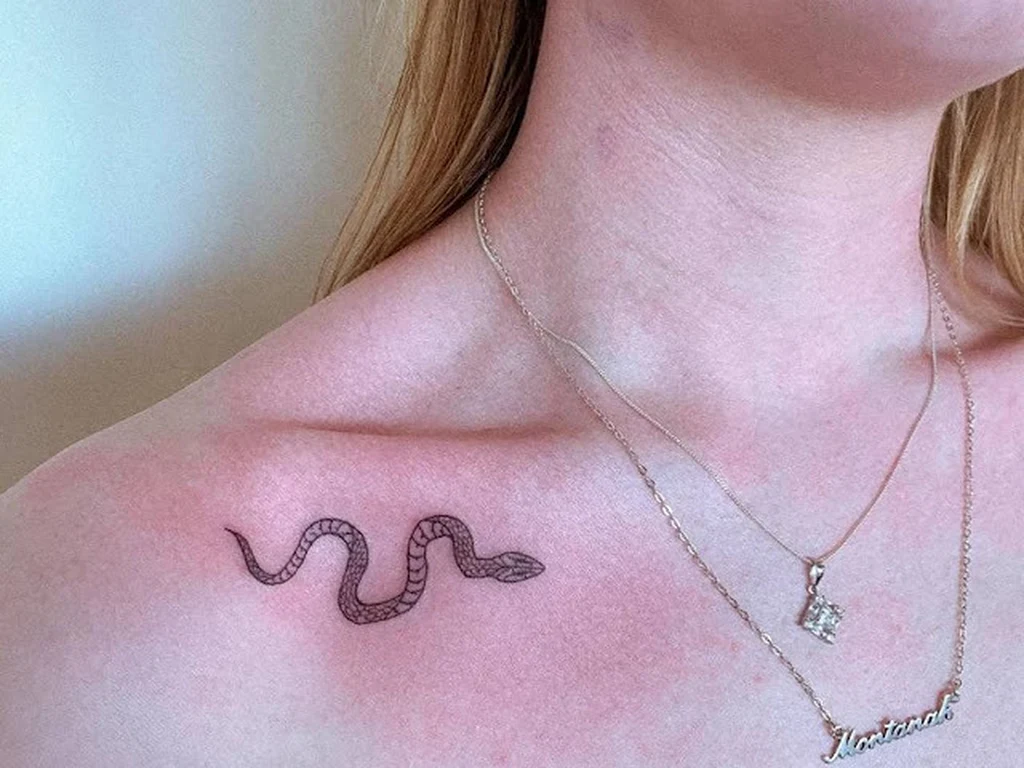
Posture is the loudest choice in a snake design. Coiled says stored energy — patience, the kundalini picture, a snake at rest that does not need to prove anything. Striking, mouth open and fangs out, says warning: the rattlesnake on the American Gadsden flag works on exactly this reading, a creature that leaves you alone unless you step on it. A travelling snake, stretched out and winding, says movement and adaptability, and it is the practical choice for limbs, because the design follows an arm or a leg the way the animal follows ground. The long black piece below runs a whole upper arm on that logic, and the fine S-curve under it shows how quiet the same idea can be drawn.
Size changes the voice too. A snake that takes a whole back is a statement strangers read across a room; a two-inch snake at the collarbone is a note to yourself. Decide which sentence you are saying before the needle starts.
Species and the shape of the head
A cobra, hood spread, reads royal and guarded — it is the Egyptian and Indian snake. A rattlesnake reads American and desert-dry, all warning. A python or boa, thick-bodied and calm, reads as strength without venom. A plain slender snake with a rounded head, like the tiny collarbone piece below, reads gentlest of all and carries the wisdom and renewal layers best. Venomous species bring the danger reading with them even when you did not order it, so choose the species the way you would choose the words.
What travels with it
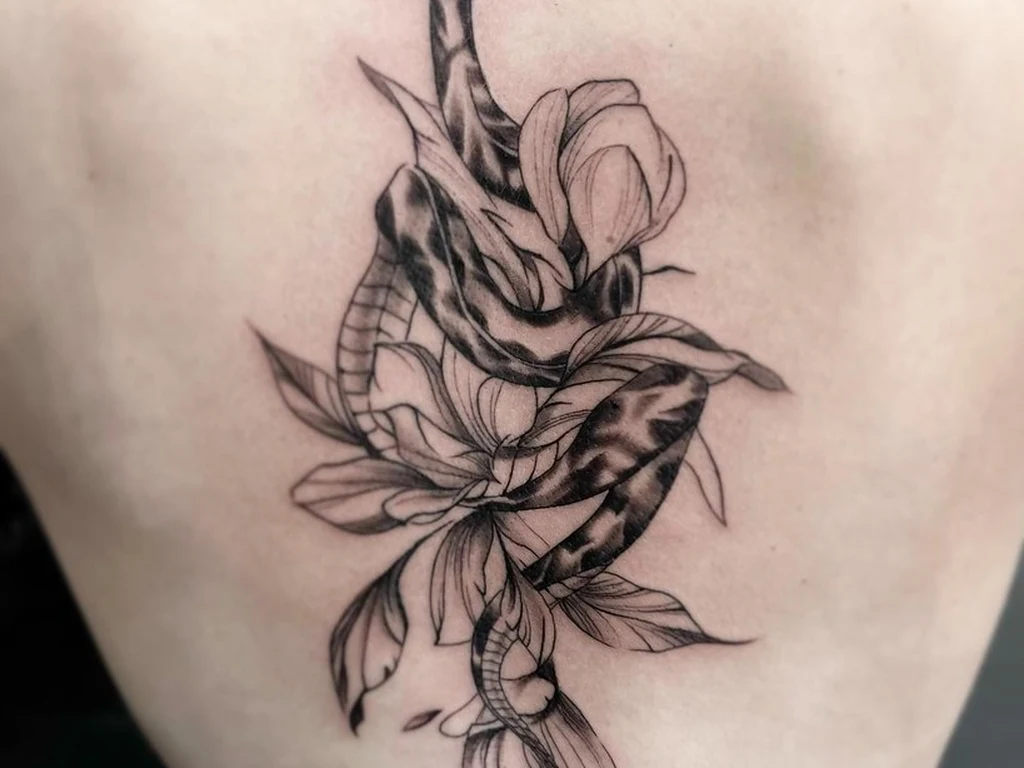
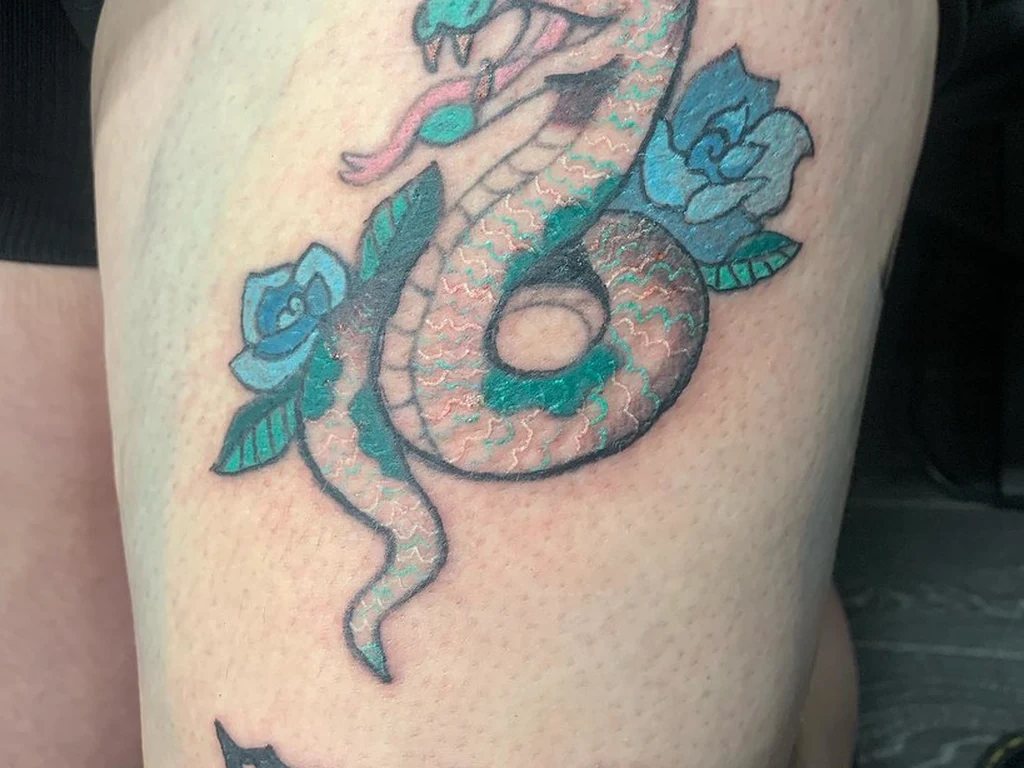
Snakes rarely sit alone for long. Through flowers — peonies and cherry blossom in Japanese work, roses in Western traditional tattooing — the reading softens into beauty with teeth in it, and the two pieces below show the range, from a full floral back to a single teal snake among roses. With a dagger, a pairing as old as modern tattooing itself, the usual reading is a fight carried and survived; studios also repeat it because it looks right, and the meaning gets written by the wearer. With a skull, the design puts life and death in one frame, and pop culture fixed one famous version — a snake sliding out of a skull’s mouth — which plenty of wearers choose as a reminder that time runs out. With a crescent moon it leans toward cycles and renewal — a pairing that is mostly modern studio convention, and none the worse for it, as long as nobody sells it as an ancient code.
What a Snake Tattoo Does Not Automatically Mean
It is not automatically evil. The evil snake is one tradition’s reading — the post-Genesis Western one — and it is not shared by the Egyptian crown, the Indian temple steps, the Maya pyramid or the Japanese rice field, all of which honoured the animal. A snake tattoo marks its wearer as a person who picked a snake. Anything it says beyond that is set by the design and the wearer, not by a rule.
It is not a gang sign. Specific designs in specific places can carry group meanings — that is true of letters, numbers, crowns and nearly anything else that gets tattooed — but a snake on its own is one of the oldest mainstream motifs in the craft, worn by sailors, soldiers and grandmothers for well over a century. No authority anywhere is reading a plain snake tattoo as a membership card.
There is no single official meaning to get right or wrong. Charts that assign one fixed decoding — this coil count means purity, that head direction means death — are tidying a layered record into a sales pitch. The real structure is the one on this page: documented tradition at the bottom, regional culture in the middle, studio habit over that, and your own story on top. Our lotus tattoo meaning guide pulls the same layers apart for a flower, and the pattern is identical — solid ground below, studio talk above, and clear air between them.
Frequently Asked Questions
What is the main meaning of a snake tattoo?
Renewal. The shed skin is the image nearly every other reading grows from: the snake leaves its old self behind whole and carries on. Underneath it sit protection, wisdom and healing, each with its own old tradition, and the temptation reading the Eden story fixed in the West.
Does a snake tattoo mean evil?
No. That reading comes from the Genesis story as the West retold it. Egypt put a cobra on the king’s crown as a protector, India set snakes to guard temples, Mesoamerica revered a feathered serpent as a teacher, and Japan treats the white snake as a bringer of luck. Evil is one culture’s snake, not the world’s.
What does a coiled snake tattoo mean?
Stored energy and patience. A coiled snake is resting, not weak — it can strike from that shape faster than from any other. In the kundalini tradition the coil pictures spiritual energy waiting at the base of the spine. Most wearers mean a mix of calm, readiness and power held back on purpose.
What does an ouroboros tattoo mean?
Cycles. The snake eating its own tail is an ancient sign — Egyptian first, then Greek — for a world that destroys and remakes itself without end. People choose it for lives that have come full circle, for grief that turned into growth, or simply for the belief that endings are also supplies for beginnings.
What does a snake tattoo with flowers mean?
Beauty with an edge. The flowers soften the snake and the snake keeps the flowers from being merely pretty, so the pairing is usually read as balance: gentleness and danger in one person, or a soft period of life that was survived. In Japanese work, a snake through peonies or blossom also carries luck and renewal with it.
What does a snake tattoo mean on a woman?
The same things it means on anyone. There is no separate women’s code for snakes in any documented tradition — the renewal, wisdom, protection and healing layers are shared. Size, species and style set the tone: a fine line snake at the collarbone reads quietly, a striking cobra reads loudly, on every body alike. Blog lists that assign women a fixed snake meaning are inventing it.
Where do snake tattoos sit best?
Where the body is long. Snakes are built to wind, so they follow forearms, calves, thighs and spines better than almost any other subject — the design moves the way the animal does. Coiled designs suit flatter spots like a shoulder or the centre of an upper back. Small straight snakes fit wrists, ankles and collarbones.
What do two snakes together mean?
Usually balance: two forces held against each other — life and death, calm and danger, the two halves of one person. It is mostly a modern studio reading rather than an ancient one. Do not confuse it with the Rod of Asclepius, the medical emblem, which has exactly one snake; the two-snake wand belongs to Hermes.
Does a snake tattoo bring good luck?
In Japan, that is genuinely the folk belief: white snakes serve Benzaiten, goddess of wealth among much else, and a found shed skin is kept as a money charm. Everywhere else, luck is something the wearer brings to the design. Treat it as a hope with one culture’s blessing, not a mechanism.
Will a fine line snake tattoo age well?
It will age softly. Thin lines spread a little as years pass, and tightly packed scale patterns are the first detail to blur, so a small fine line snake should be drawn with simple, open scales or none at all. Bold outlines hold their shape longest. Sunscreen and a design drawn a touch larger than your first instinct are the two cheapest forms of insurance.
Final Thoughts
A snake tattoo can honestly mean a skin you have outgrown, a warning you mean, a wisdom you are growing into, or a cycle you have made your peace with — and the details are what choose between them: coiled or striking, cobra or plain green snake, an apple, a staff, a flower, or nothing at all. Decide the layer first and the drawing second. The history on this page is solid ground, from Wadjet’s crown to a white snake in a rice field. The rest of the meaning is yours to write, which suits an animal that has spent its whole existence being itself while people argued about what it stood for. The snake tattoo ideas collection is built from real photographs only, counted one by one.
Photo credits: Images 1 and 3: Tobyotter, CC BY 2.0, via Flickr. Images 2, 6, 8, 9 and 12: TattoosAll, CC BY-SA 2.0, via Flickr. Image 4: kencf0618, CC BY-SA 2.0, via Flickr. Images 5 and 7: mytat_2s, CC BY 2.0, via Flickr. Image 10: www.mydeardesign.com, CC0, via Flickr. Image 11: TattoosAll, CC BY 2.0, via Flickr.