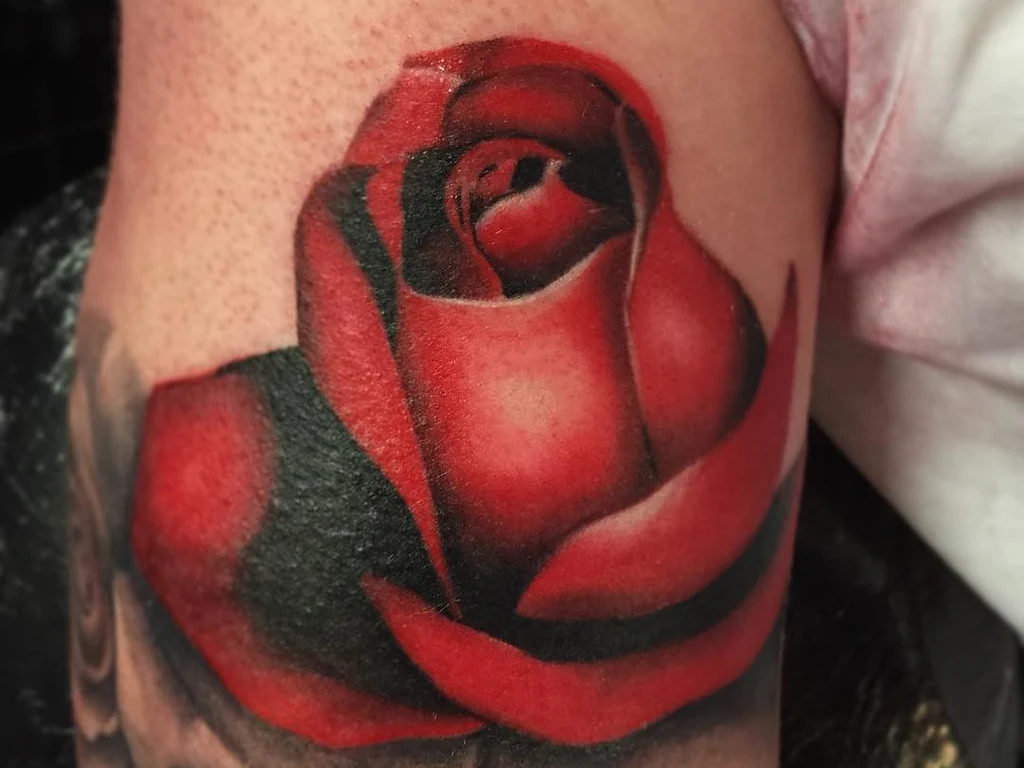
Botanical tattoos skip the bloom and go straight for the greenery. A trailing ivy vine, a single fern frond, a pair of tall pines — the subject is leaves, stems and branches rather than petals, and that changes the whole feel of a piece. Leaf work can be soft or bold, tiny or wrapped around a whole arm, and it bends around the body better than most subjects.
This guide collects 24 real botanical tattoos, photographed on skin and shared under open licences. They run from a full sleeve of black leaf sprigs and a back covered by one family tree to a four-leaf clover no bigger than a coin. Every design below is one you can point to in a studio and say, that one, in that spot.
One thing to know before you fall for the finest sprig on this page: thin lines do not stay hair-thin forever. Ink spreads a little under the skin over the years, so close lines soften and tiny leaves can merge. Good artists plan for it by leaving breathing room between lines. Keep that in mind as you look at the small designs near the end.
24 Botanical Tattoo Ideas
1. Full Botanical Sleeve of Leafy Sprigs
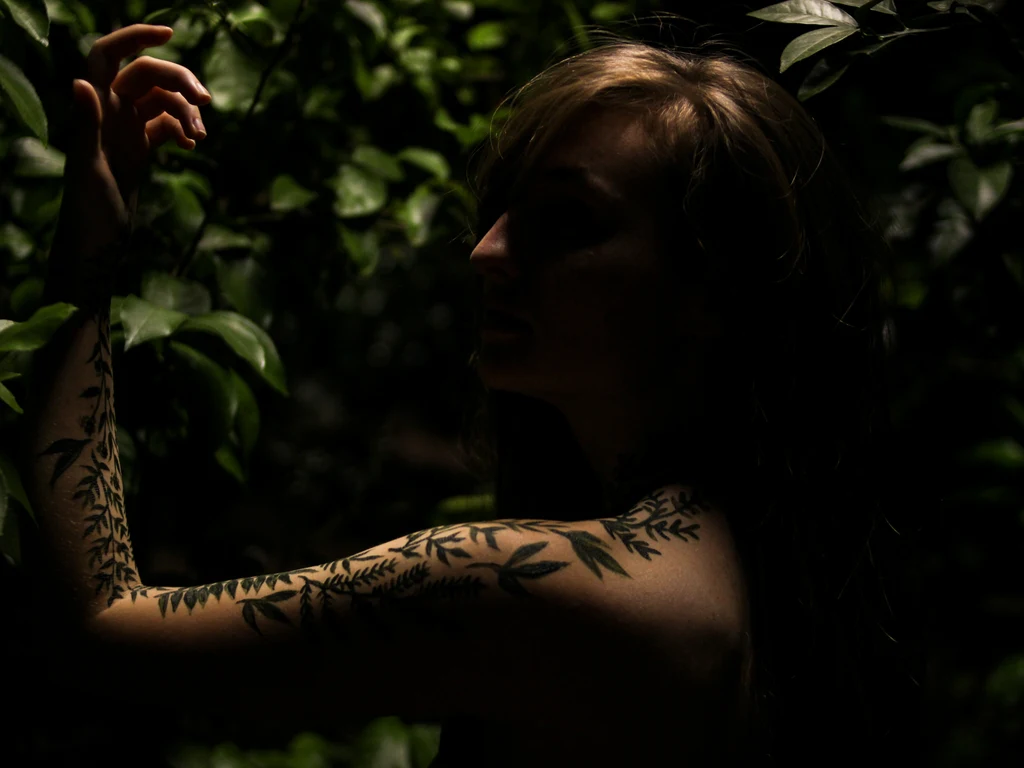
This full sleeve is built from nothing but leaves. Thin sprigs and trailing vines wrap the arm from shoulder to wrist, each stem following the muscle underneath. There is no single main image; the pattern itself is the design, like a pressed-plant page wrapped around the arm.
A sleeve like this is a long project, usually planned in sections so new stems join old ones without a visible seam. The fine work will soften over the years, which suits leaves — real foliage is not crisp either. Ask your artist to keep gaps between the sprigs so the pattern stays readable.
2. Waterfall and Forest Full Sleeve
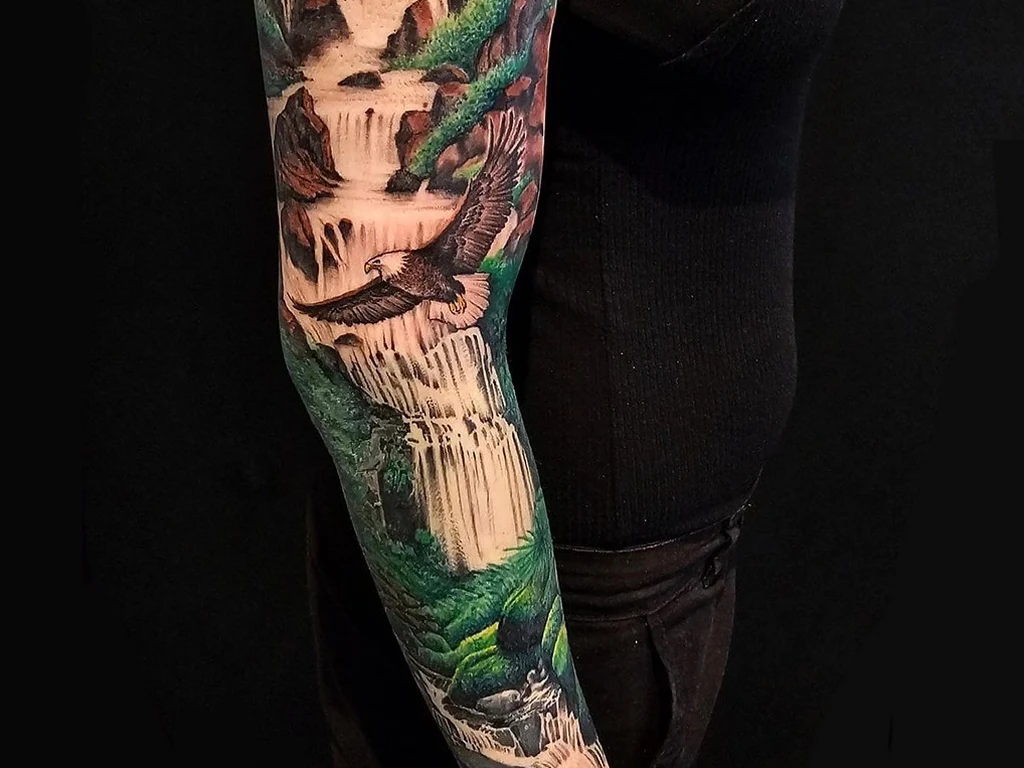
A whole landscape wrapped around one arm: a waterfall drops over pale rocks, thick green forest crowds both banks, and an eagle sits in the lower half. The trees and undergrowth take up most of the sleeve, so it feels like a walk through wet woodland rather than a picture of one animal.
Colour landscapes are the most demanding tattoos on this page. The greens will need a touch-up sooner than black work would, and a design this dense only works at full sleeve size — shrink it and the trees turn to mush. Commit to the scale.
3. Ivy Vine Across the Upper Back
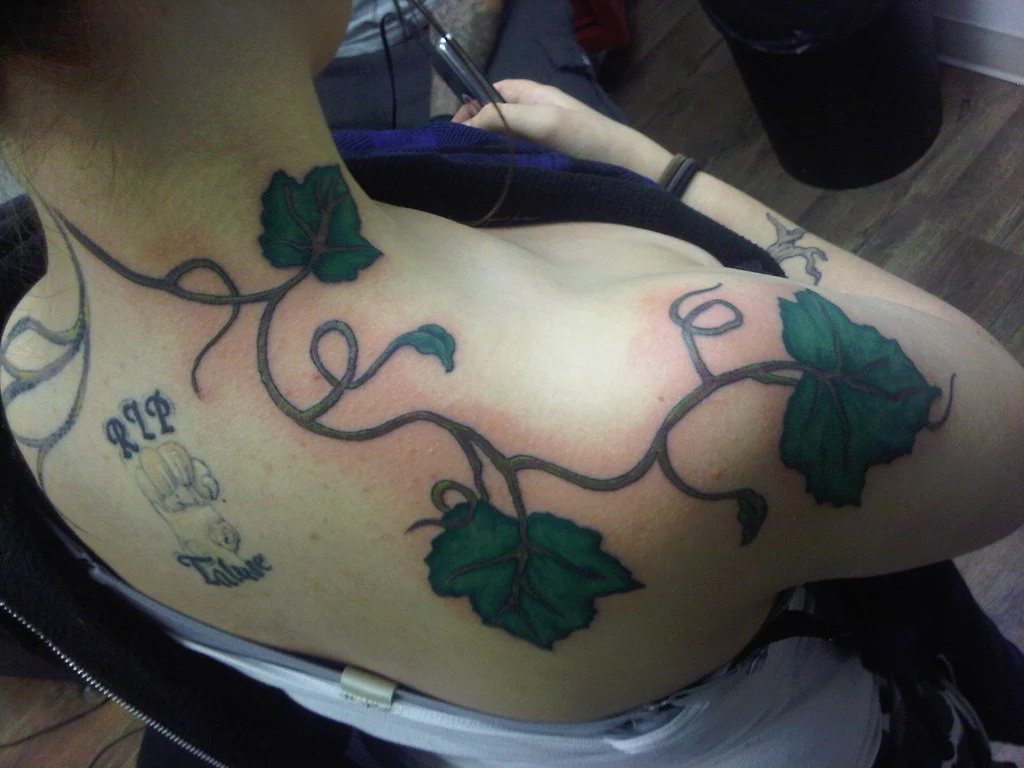
A single ivy vine curls from the neck, across the shoulder blade and down toward the opposite side, carrying five big green leaves. The curly tendrils do as much work as the leaves — they give the vine its movement and stop it sitting flat on the back.
Ivy stands for loyalty and sticking with people, because the real plant clings and keeps growing. Bold outlines like these hold up well over time, and the upper back is easy to hide or show as you please.
4. Leafy Stem Down the Spine
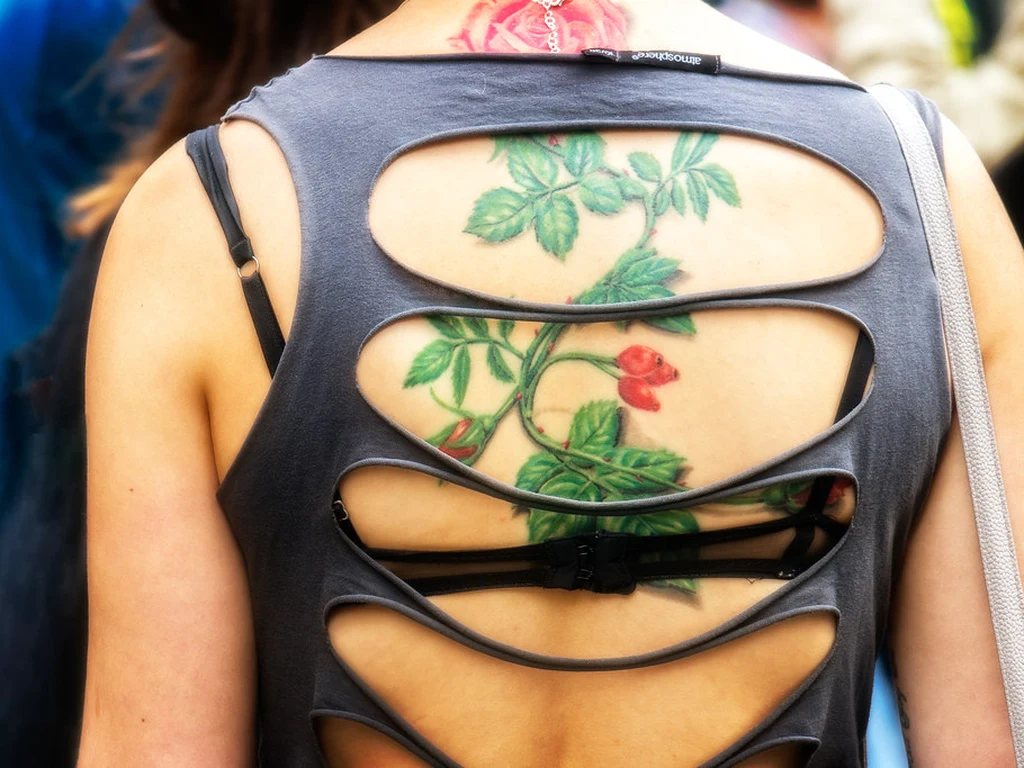
One long stem follows the spine from neck to lower back, throwing out pairs of serrated green leaves as it goes. Two small red rosebuds sit on the stem, but the leaves run the show — a foliage piece with a flower accent, not the other way round. The photo catches it through the cut-out back of a top, which is how a spine tattoo gets seen in real life.
Spine pieces follow the body’s centre line, so they lengthen the back and sit flat with little distortion. The skin over the spine is thin, though, and many people find it a tender spot. Eat before the session and expect a few sharp minutes over each bone.
5. Family Tree Back Piece
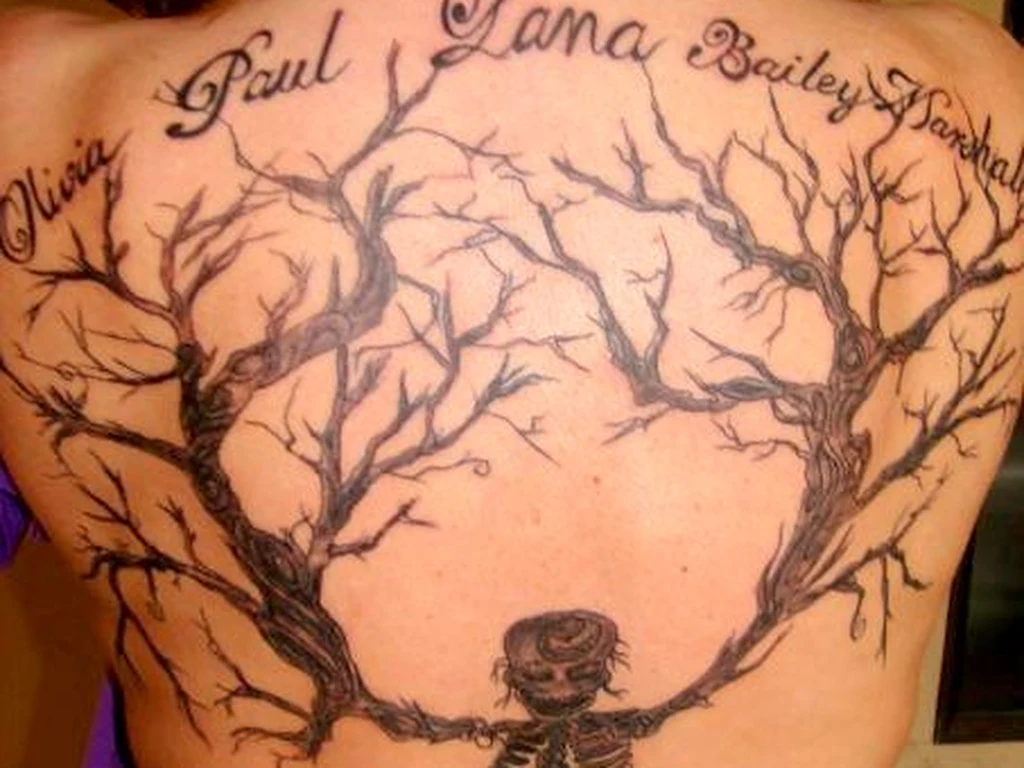
This whole back is one bare tree. The trunk rises from the lower back, the branches spread to both shoulders, and family names are written in script along the top, one following each main branch. A small skeleton figure sits at the base of the trunk, for the generations the tree grew from.
The family tree is one of the oldest reasons people tattoo a tree at all: roots for where you came from, branches for the people who came after. Script this size stays readable for decades, which matters when the names are the point.
6. Celtic Tree of Life Circle on the Back
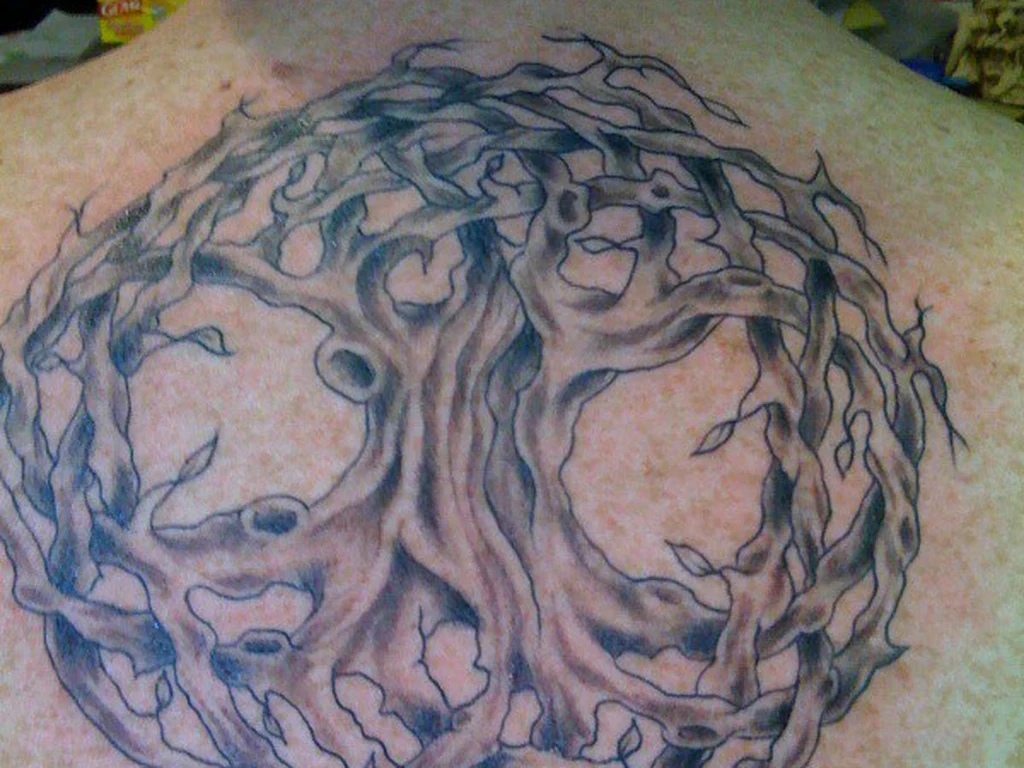
Here the tree of life is drawn as a knot: branches twist down into roots and roots twist up into branches until the tree forms one closed circle on the back. There are no leaves at all — the shape of the wood itself carries the design, in soft grey.
The circle is the meaning. In Celtic tradition the tree of life stands for the loop between earth and sky, roots and branches, birth and return. Back placement suits it because the design is symmetrical, and the back is the flattest, widest canvas the body offers.
7. Bare Winter Tree Silhouette
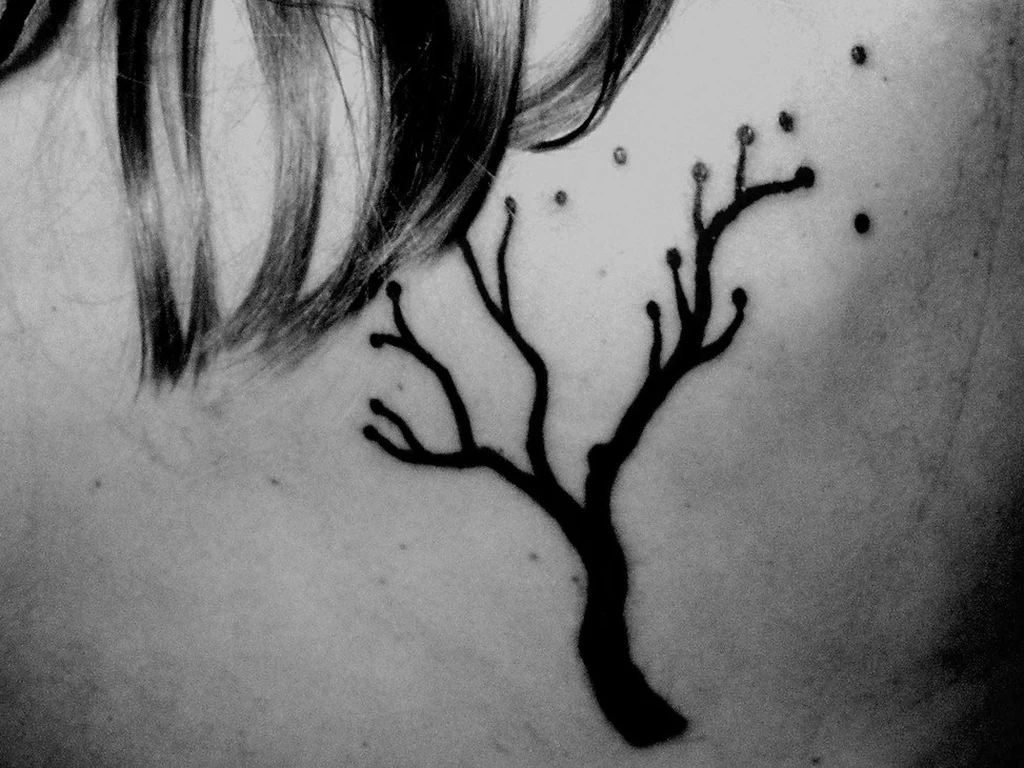
No leaves, no shading tricks — just the black shape of a winter tree on the upper back, twigs branching to fine points and a few loose dots drifting from the top branches like the last leaves letting go. It is the simplest tree on this page and one of the strongest.
Solid black silhouettes age better than almost anything else in tattooing because there is no detail to lose. The one thing to watch is the twig tips: drawn too thin, they thicken into the branch over time. A good artist keeps twigs short and gaps wide.
8. Tree of Life With Roots on the Upper Arm
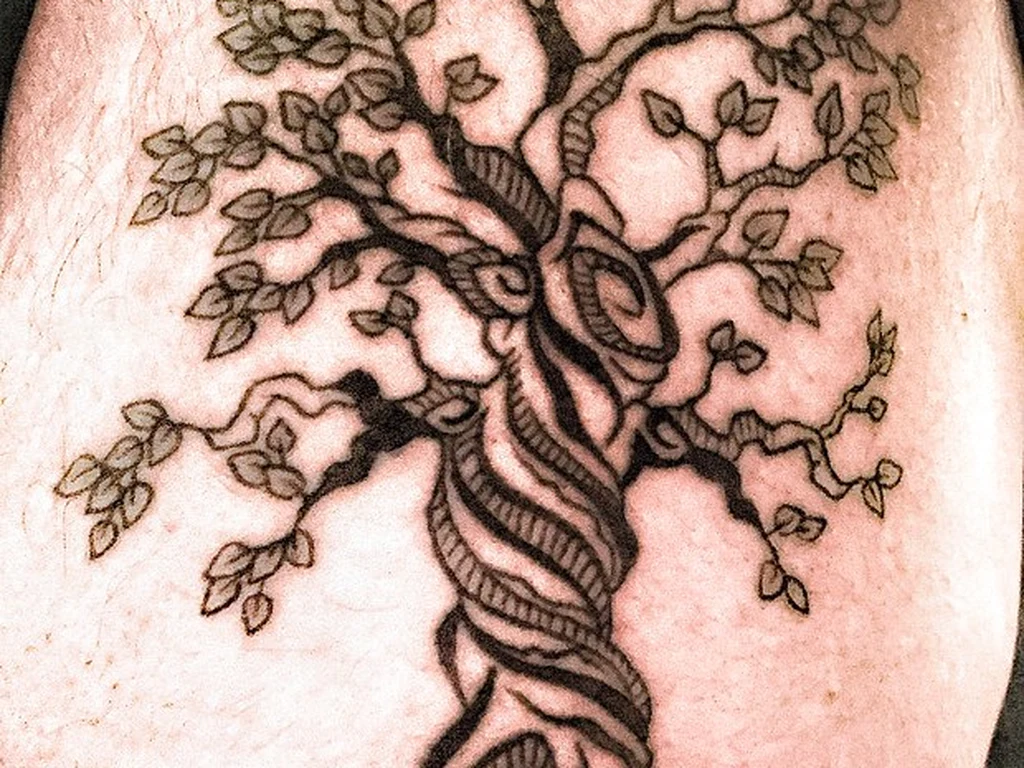
This tree of life fills the whole upper arm. The trunk twists like rope, the canopy is packed with small leaves, and the roots spread as wide below as the branches do above. A name sits in an arc above the canopy.
Showing the roots is what separates a tree of life from a plain tree tattoo: roots for grounding and family, canopy for growth. The upper arm wraps the design around a curve, which suits a round canopy, and short sleeves cover it when you need them to.
9. Leafy Branches and Crescent Moon on the Shoulder
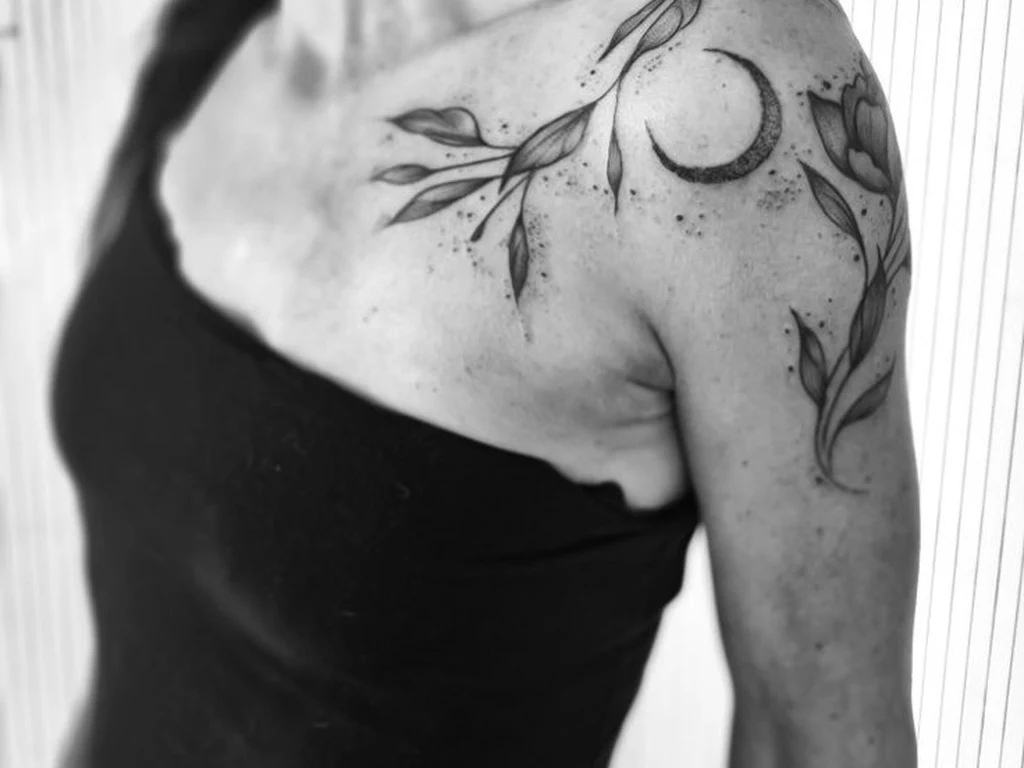
Fine black branches drift over the collarbone and shoulder, dotted with small leaves and stipple shading, with a crescent moon resting on the shoulder point. A second leafy stem with one closed bud runs down the upper arm. Nothing here is packed solid.
The shoulder is a natural shelf for a branch: it can start at the collarbone, crest the shoulder and trail down the arm. Work this fine needs an artist who specialises in it, and it is the style most likely to need a gentle touch-up after some years of sun.
10. Faded Maple Leaves on the Shoulder
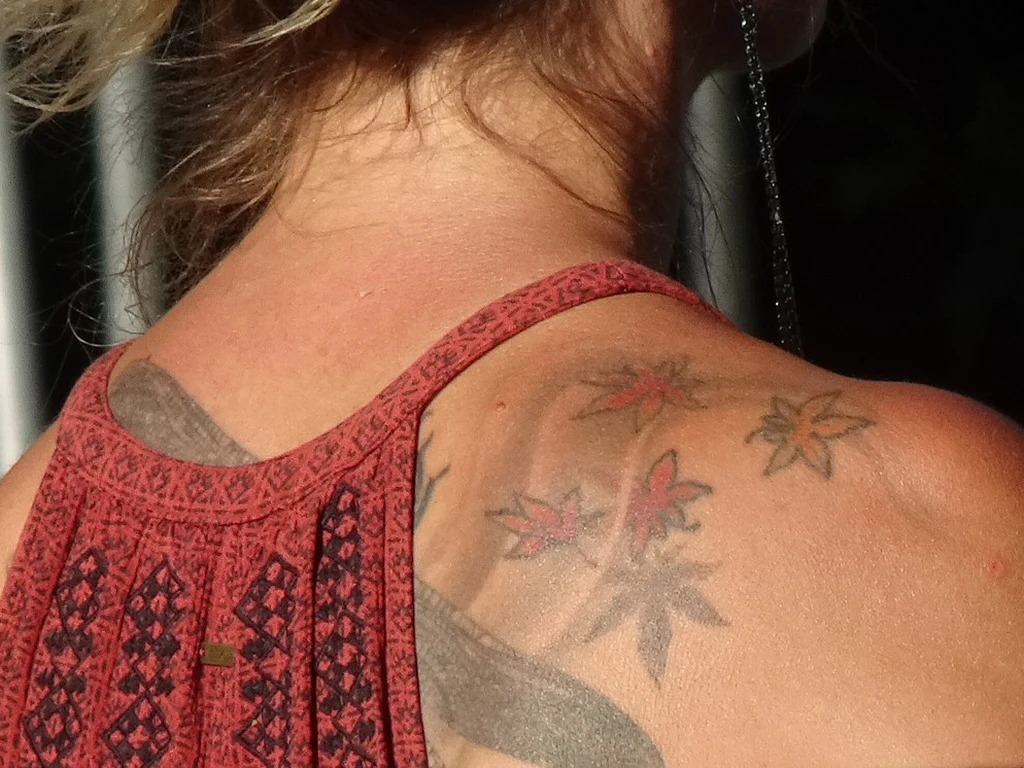
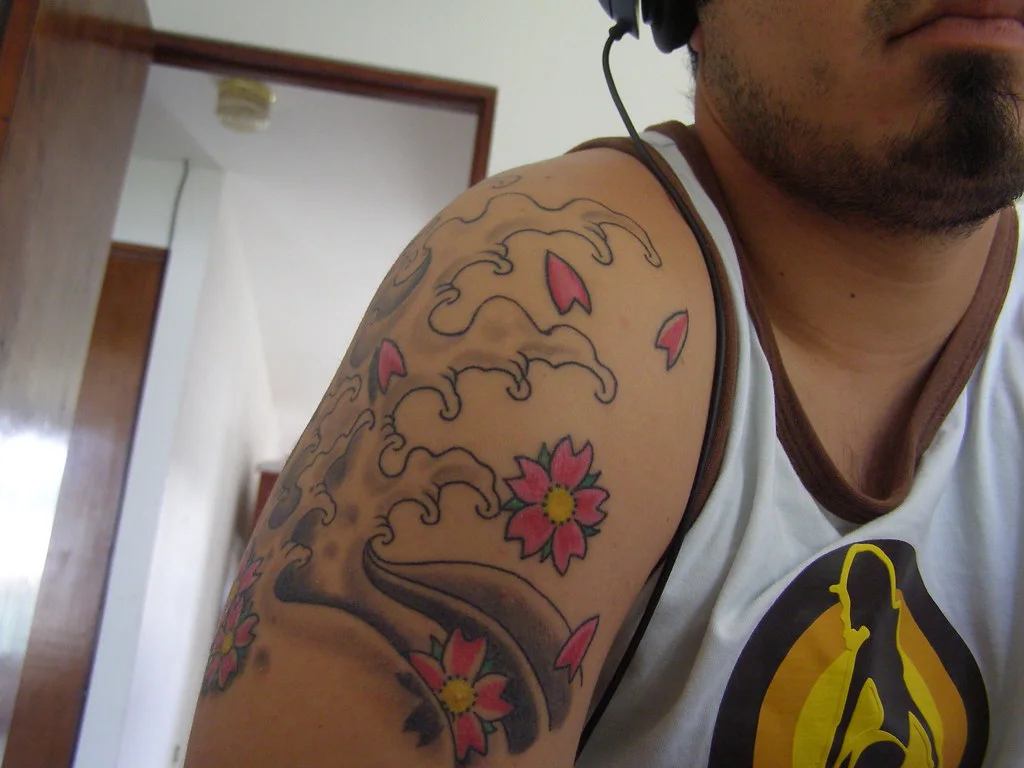
A scatter of maple leaves drifts across this shoulder, a few still holding a rusty red, most softened to grey. This photo shows an older tattoo, and that is worth looking at properly: this is what colour leaf work can become after years on sun-exposed skin.
Maple stands for the turn of the seasons and for balance — the leaf that is beautiful exactly because it changes. Shoulders catch a lot of sun, and sun fades red and soft colours first. With scattered leaves like these, sunscreen is the difference between this photo at five years and at fifteen.
11. Hop Vine on the Upper Arm
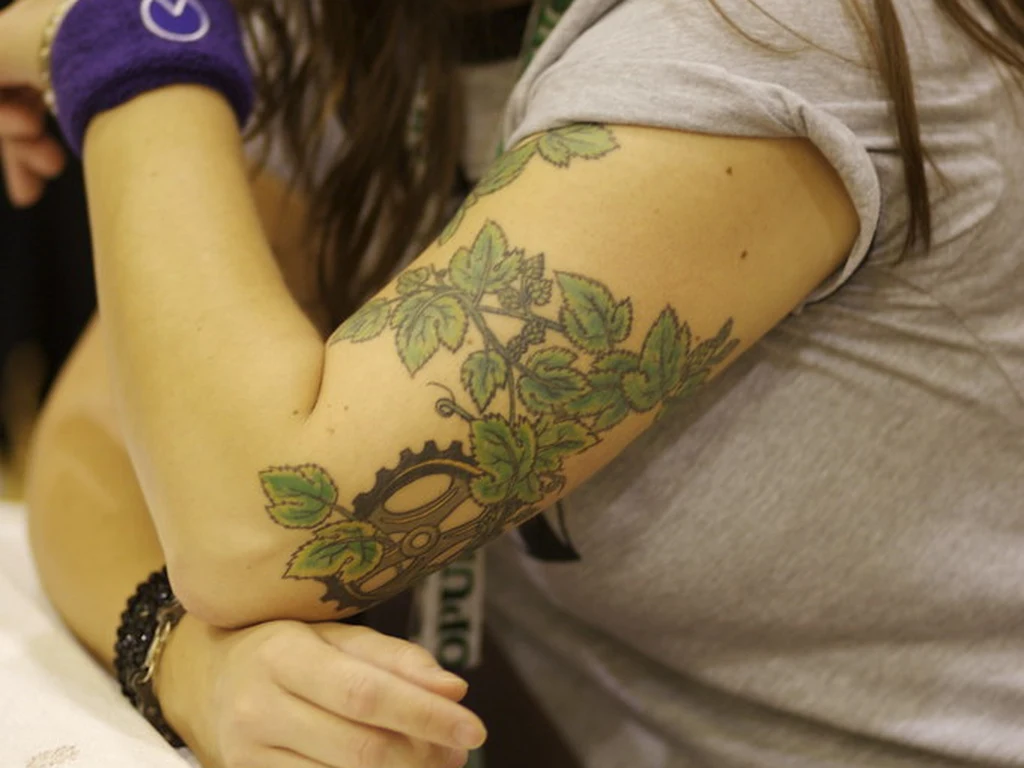
This upper arm is wrapped in a hop vine — the climbing plant that flavours beer. The wide, lobed leaves are drawn in layered greens, and the papery hop cones hang between them. It is a brewer’s tattoo, drawn accurately enough that anyone who has picked hops would know it at a glance.
Hop tattoos belong to an old tradition of trade tattoos, like a sailor’s anchor: the plant you work with, worn on the arm that does the work. Greens hold reasonably well, and bold leaf shapes like these will still read clearly when the piece is old.
12. Pine Forest and Falls Under a Full Moon
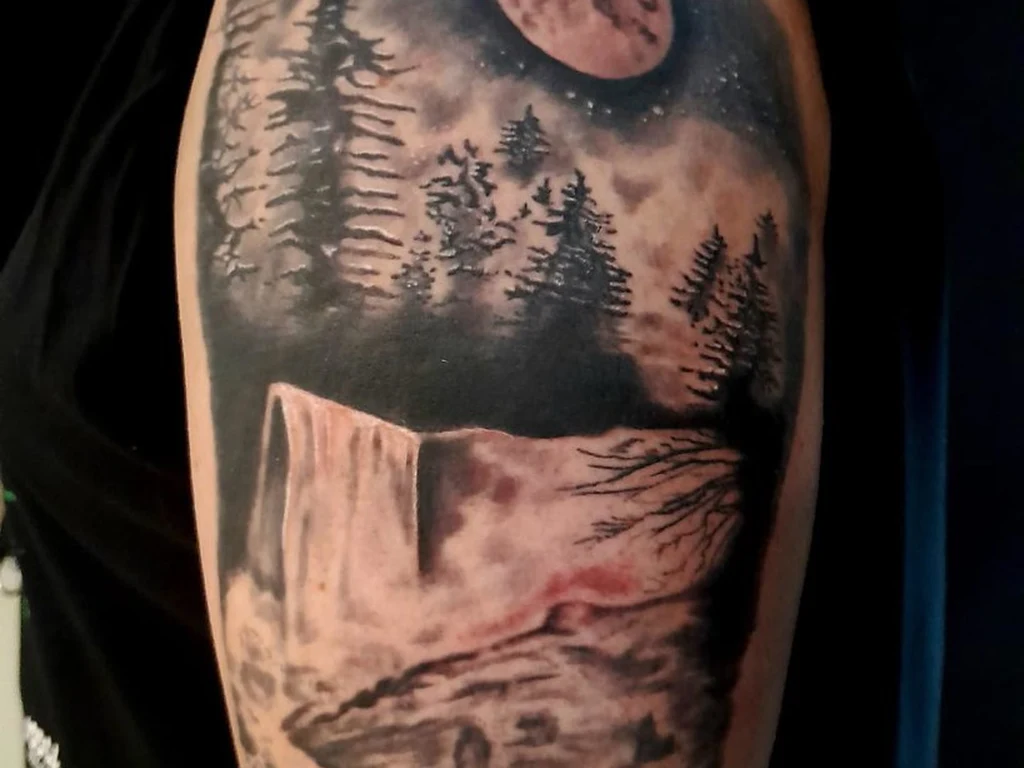
A night scene on the upper arm: a full moon over a stand of straight pines, and below them a waterfall pouring off a rock ledge. The trees are the frame of the picture — tall, dark and repeated — and they make the scene feel like deep forest instead of open country.
Black and grey landscapes hold up far better than colour versions, because grey wash fades evenly instead of shifting hue. The moon gives the design a bright centre that keeps working as the softest shading lightens.
13. Oak Leaves and Acorns in Colour Realism
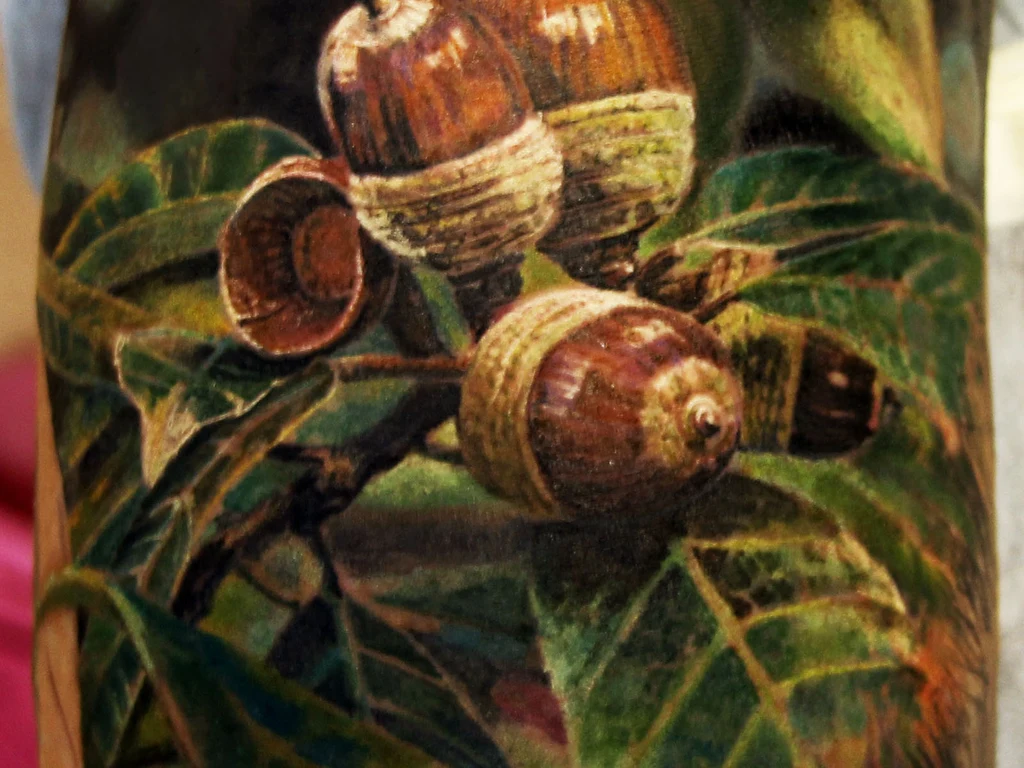
This close-up shows what realism artists can do with an oak sprig: ripe acorns with textured cups, glossy green leaves with every vein shaded, all packed with colour until it looks lit from inside. There is barely any outline — the shapes are built from light and shadow alone.
Oak means strength and patience: the tree grows slowly and outlives everything around it, and the acorn is its promise that something small becomes something huge. Be honest about upkeep, though. Realism without outlines softens fastest of all the styles here, and a piece like this wants a skilled artist and a refresh down the line.
14. Sequoia Trees Down the Forearm
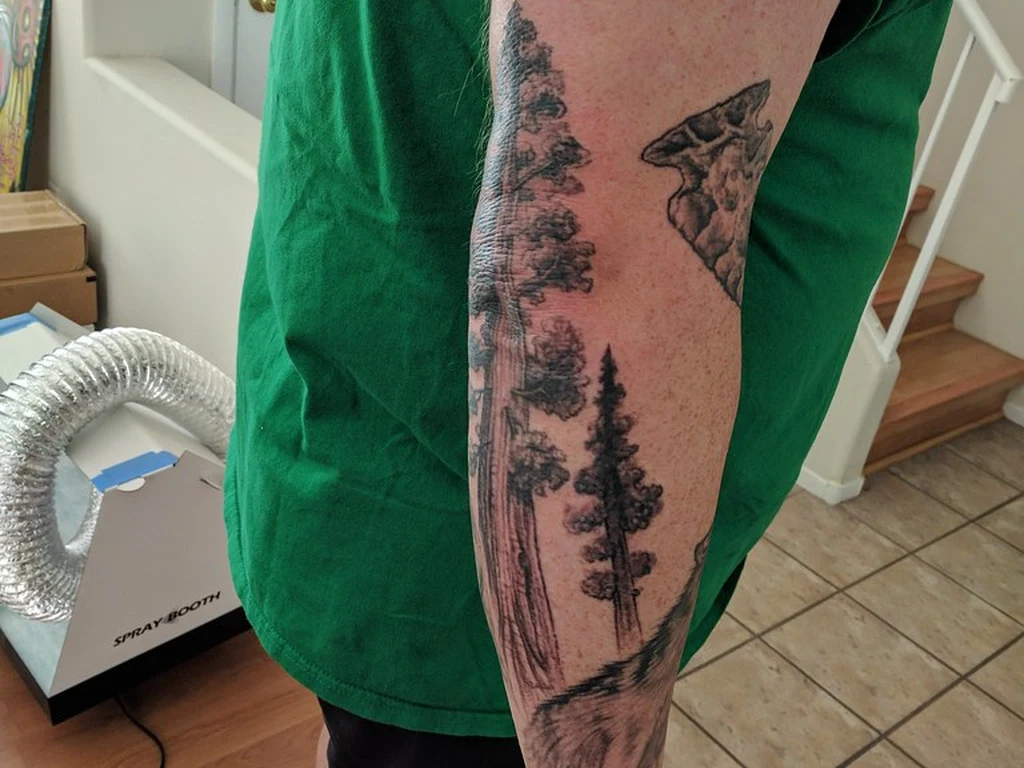
Giant sequoias run the length of this forearm, trunks drawn with fine vertical lines and the crowns left soft and smoky. The forearm is the one place on the body shaped like a tree trunk, and the design uses that: the trees stand the way the arm hangs, so the piece reads clearly at a distance.
Sequoias are among the oldest and largest living things on earth, so they carry meanings of endurance and perspective — problems look smaller next to a three-thousand-year-old tree. The soft crown shading will lighten with time; the strong trunks keep the design standing.
15. Pine Forest Forearm Wrap
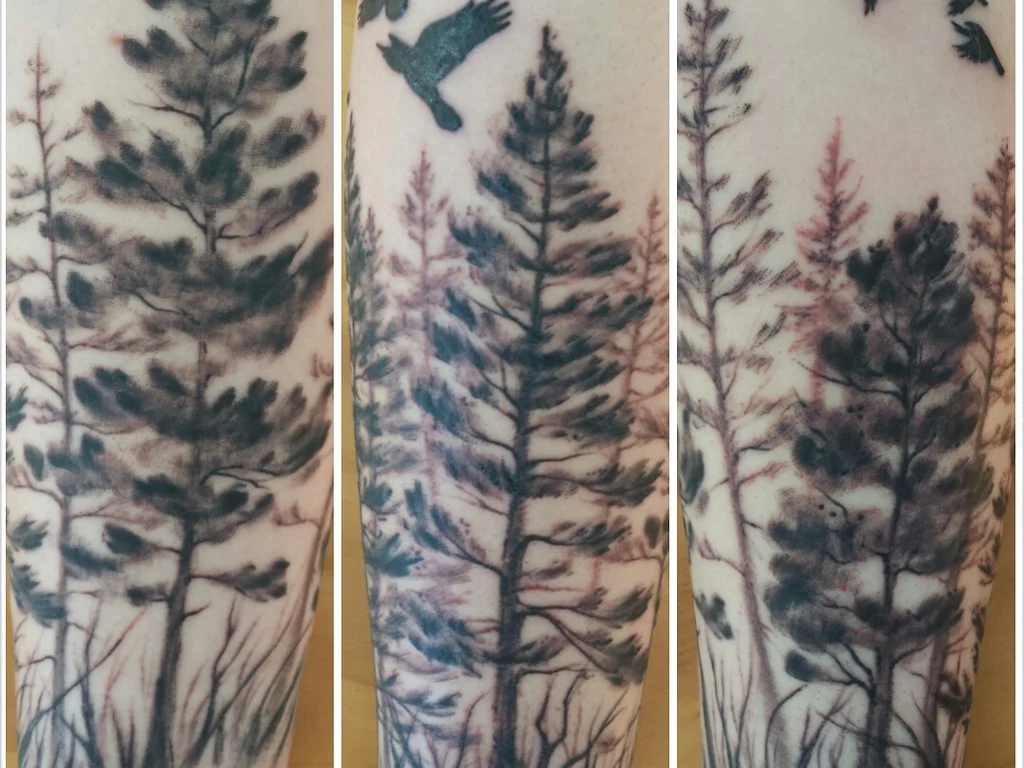
This photograph shows one forearm tattoo from three sides: tall pines wrap all the way around the arm, with two crows crossing the inner forearm above the treeline. Because the forest has no front or back, there is no angle it looks unfinished from.
Wraparound designs are where botanical work beats most other subjects — trees and vines are supposed to grow around things. Evergreens stand for endurance and staying green through winter. Plan the wrap with your artist using a paper template around your own arm first.
16. Watercolour Forest Silhouette
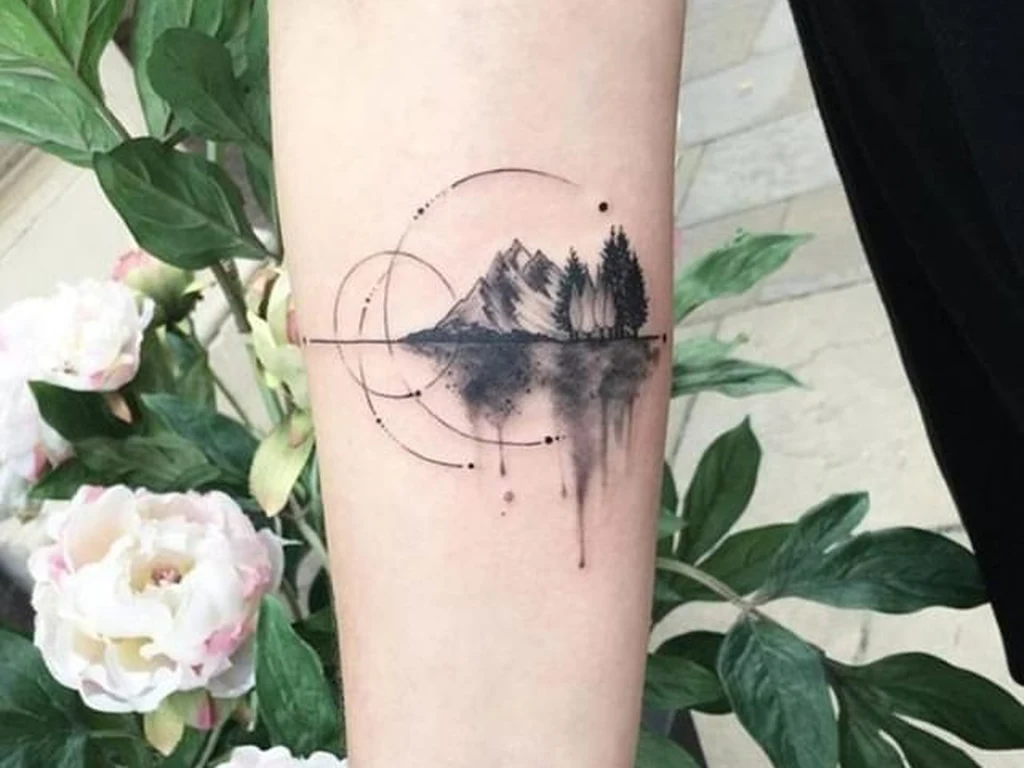
A small stand of dark pine silhouettes sits inside thin geometric circles on this forearm, its reflection dripping below in loose watercolour strokes. The design is mostly open skin — the trees are a dark island in fine linework, and that contrast is the whole effect.
Watercolour passages fade first, because the ink sits light and patchy on purpose. The black silhouettes here will outlast the wash beneath them, so the design has a built-in second life: when the colour softens, the forest still stands.
17. Two Sequoias on the Calf
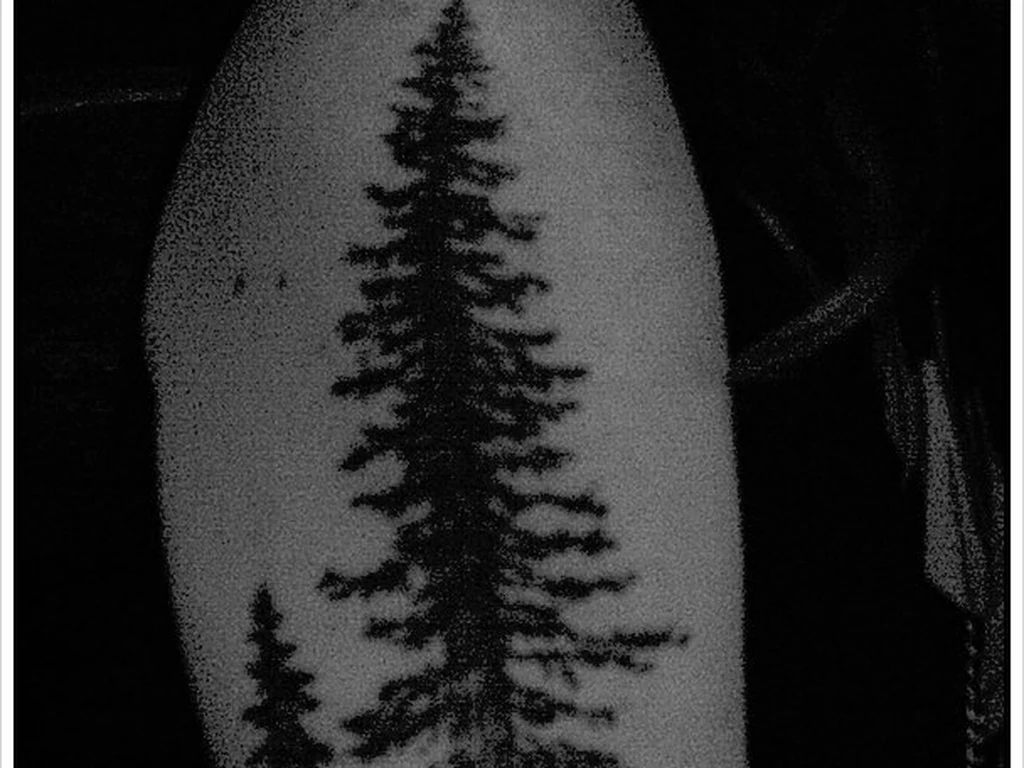
Two sequoias stand on this calf, one tall and one shorter, drawn in solid black with spiky, layered crowns. The photograph is black and white, but the tattoo itself is plain black work. The pairing is the point — parent and child, partners, or two people who grew in the same soil.
The calf gives a tree a long, flat run of skin and hides under trousers at work. Solid black crowns like these are built from packed shapes, not fine lines, so they keep their silhouette for years. Keep the trunks thicker than you think they need to be.
18. Celtic Tree of Life on the Calf
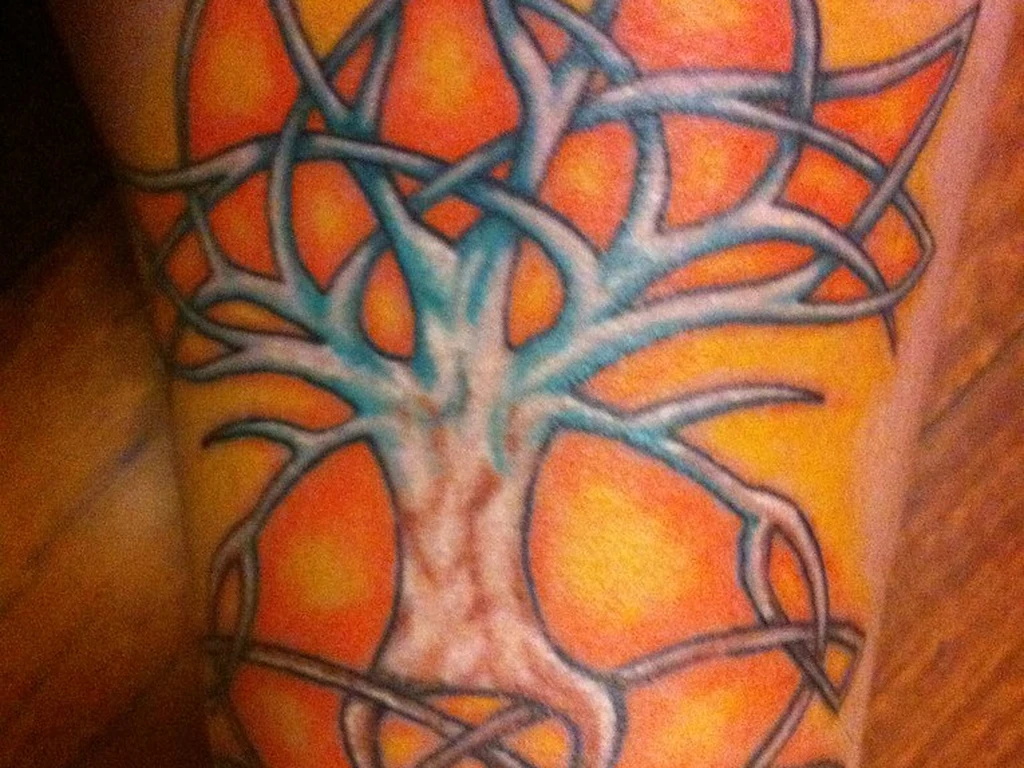
The second tree of life here takes the opposite route from the grey back piece in design 6. This one is all colour: a knotwork tree with interlaced roots and branches over a blazing orange ground, wrapped around the calf like a shield. The weave never breaks — every root becomes a branch.
Warm colours fade first in sunlight, and calves see plenty of it in summer. The black knotwork underneath saves this design long term: even as the orange mellows, the tree’s structure stays bold. Compare it with design 6 — same symbol, two very different ageing paths.
19. Oak Tree With a Squirrel in Outline
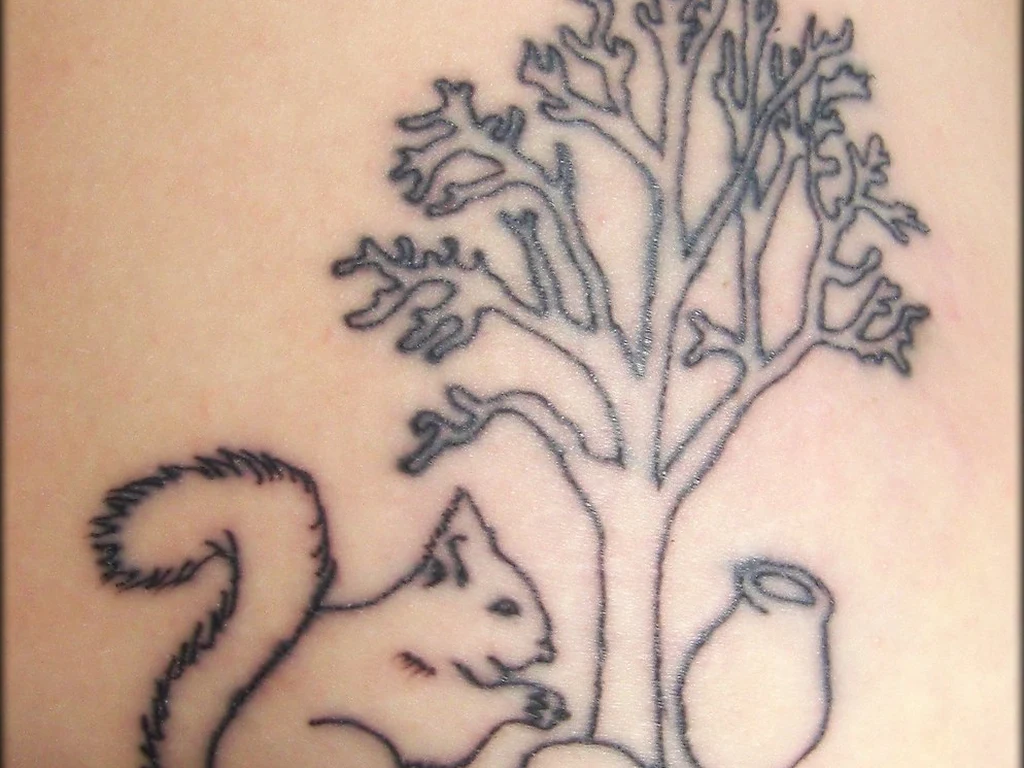
One clean outline draws a whole autumn scene: a spreading oak, a squirrel sitting up with an acorn, and a second acorn beside it. Nothing is shaded and nothing is coloured. It has the feel of a picture in a children’s book, in the best way.
Simple outline work is forgiving as it ages because there is so little to blur — the lines thicken slightly and the picture stays a picture. It suits people who want a tattoo with a story but not a statement, and it heals fast.
20. Fine Vine With Leaves on the Hip
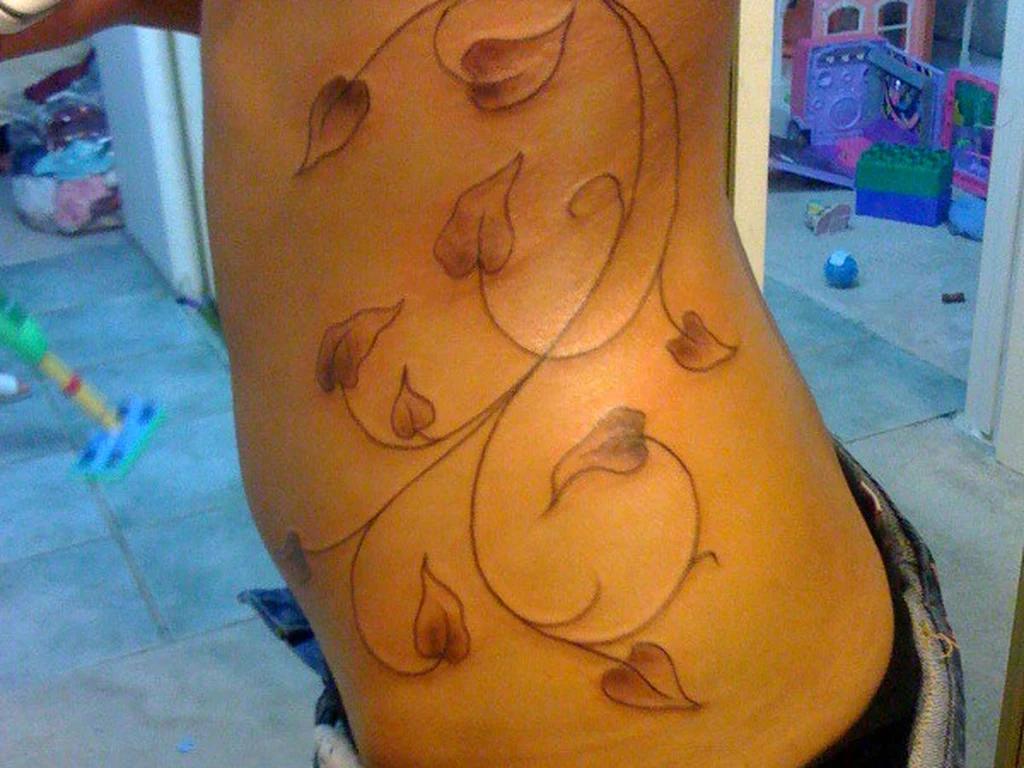
A slim vine climbs from the hip up the side of the waist here, curling into loose spirals and carrying small brown leaves. The design follows the waistline instead of fighting it, so it moves the way the body moves and disappears under ordinary clothes.
The hip and side are private placements — seen at the beach and in the mirror, hidden the rest of the time. Skin here stretches more than on an arm, so keep leaves simple and spaced, the way this one does, rather than packed with detail.
21. Small Fern Frond on the Neck
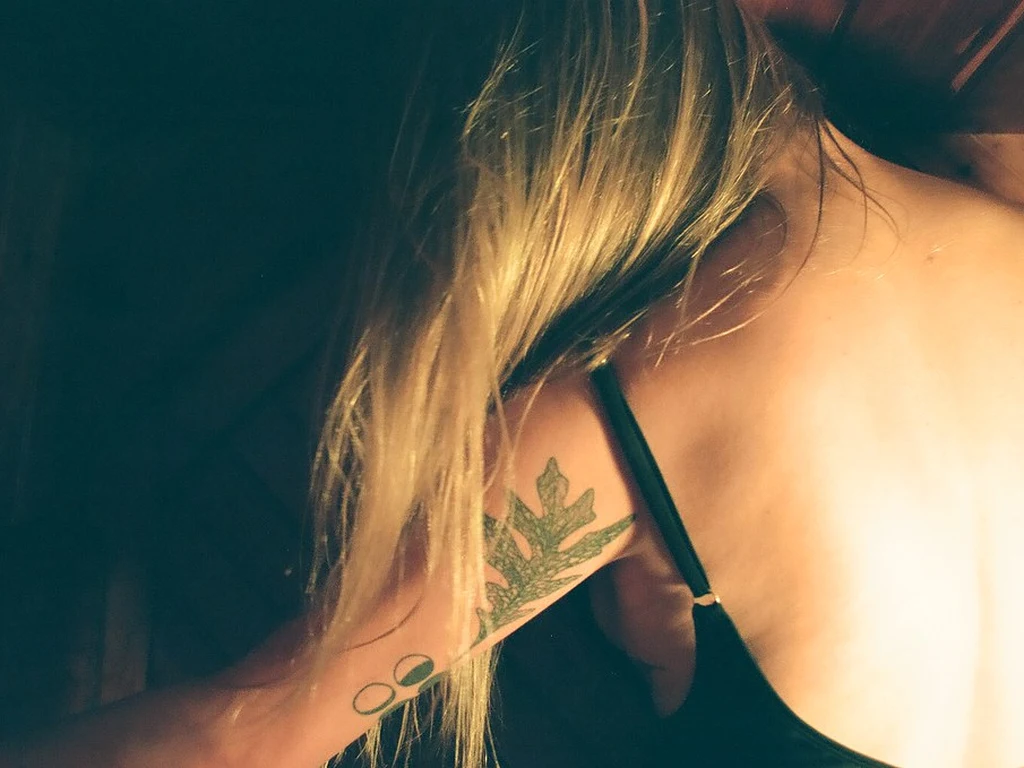
A single green fern frond sits on the side of this neck, small enough to hide under loose hair and visible the moment the hair goes up. Its rows of leaflets make a ladder shape that suits narrow spots — neck, ankle, behind the ear.
Ferns are ancient plants, older than flowers by a long stretch, and a frond unfurling is a classic symbol of a fresh start; in Māori tradition the unfurling koru stands for new life and growth. Neck skin is thin and the tattoo will be seen daily, so choose this one once and mean it.
22. Tiny Pine Inside a Circle
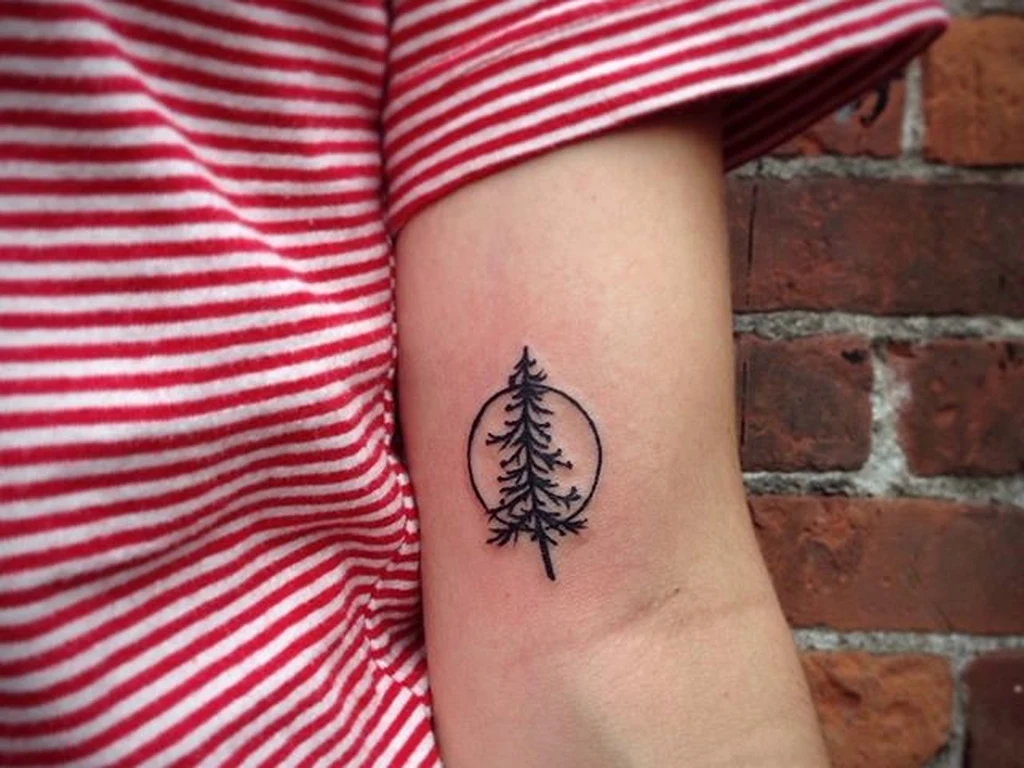
This pine is barely two centimetres tall: a few stacked strokes for branches, a short trunk, and a thin circle drawn around it like a full stop. It sits high on the inner arm, the kind of tattoo its owner sees all day and everyone else has to be shown. If tiny work appeals to you, our guide to small tattoos for women collects more pieces at this scale.
Honesty matters most at this size. A pine this small will not keep every branch separate forever; in ten years it may read as a neat black pine blob inside a ring — still charming, but softer. Artists who do a lot of small work often suggest going one size up from your first instinct. Take the advice.
23. Matching Four-Leaf Clovers for Four Friends
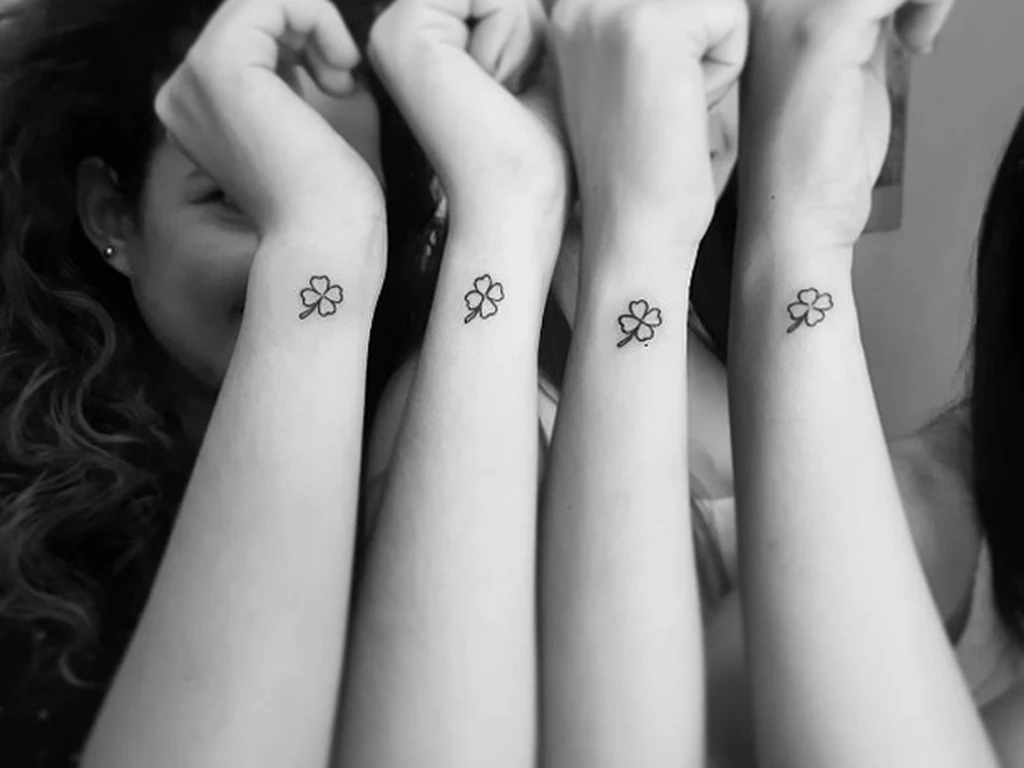
Four friends, four wrists, four tiny four-leaf clovers — the same small design in the same spot, photographed together in black and white. Each clover is four heart-shaped leaflets and a stem, small enough to cover with a watch strap.
The four-leaf clover is the luck symbol everyone knows, and as a matching tattoo it says the group is the lucky thing. Matching sets work best kept simple and identical, drawn by the same artist in one session if you can, so the pieces age at the same pace.
24. Small Leafy Tree on the Wrist
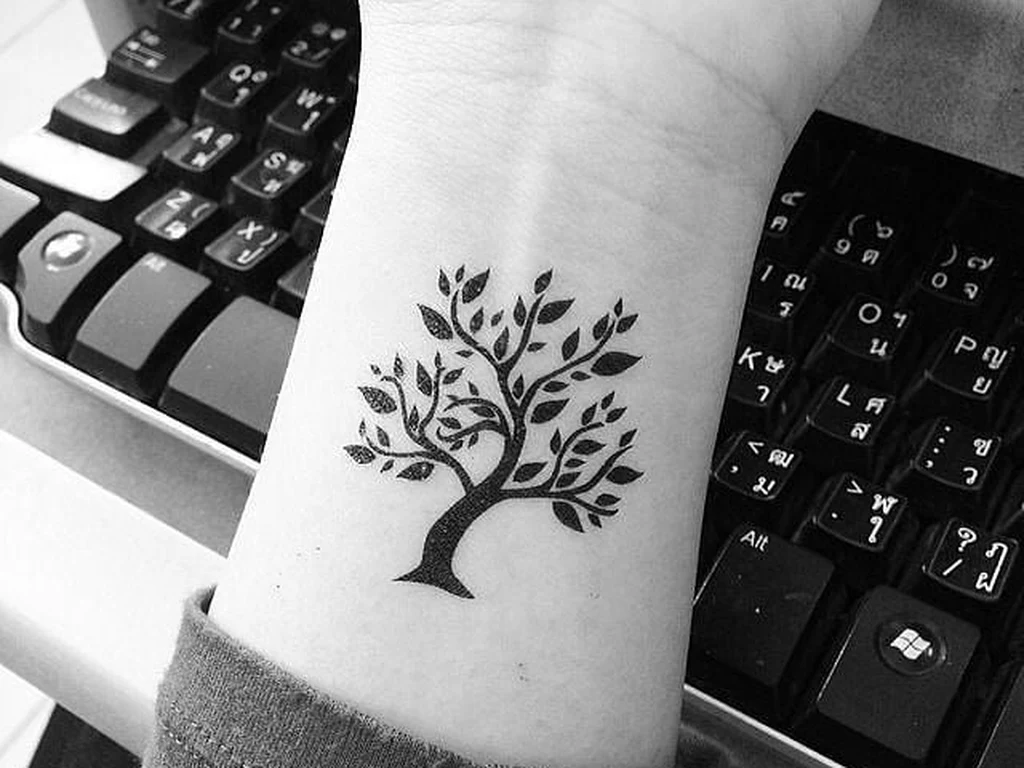
The last design is the smallest tree here: a little black tree with a full round canopy of leaves, sitting on the wrist where a watch face would go. The photograph is black and white, and the tattoo is simple black work — a trunk, a cloud of leaves, nothing else.
A whole tree shrunk to wrist size works because a tree’s shape is one of the most recognisable silhouettes there is. Keep the canopy as one leafy mass rather than individual leaves; at this scale, tiny separate leaves are exactly what merges first as the ink settles.
Best Placements for Botanical Tattoos
Botanical designs are shaped like the body in a way most subjects are not. Vines and stems are long and flexible, so they follow long places: down the spine like design 4, around a forearm like design 15, up the side of the waist like design 20. A design that grows along a limb looks planted there; squeezed into a square patch, it looks pasted on.
Trees want the opposite: width and stillness. Backs carry the big canopy pieces (designs 5 and 6), upper arms carry round trees of life (design 8), and calves carry standing trees (designs 17 and 18) because the calf is already trunk-shaped. Sprigs and fronds are the travellers — collarbone, shoulder, neck, ankle and wrist all suit them, because a sprig reads clearly at almost any size.
Think about covering, too. Every design in the top half of this list hides under normal clothes; the neck fern and wrist tree do not. Hands, necks and wrists also get the most sun and washing, so work there fades faster than work under a sleeve.
Botanical Tattoo Styles
Fine line is the style most people picture first: single-needle stems, hair-thin leaf veins, lots of skin showing through, like designs 9, 20 and 22. It is delicate, and lines spread slightly as they age, so the finest pieces soften first. Our fine line tattoo ideas guide shows the style across other subjects too.
At the other end sit bold traditional and blackwork: packed silhouettes, knotwork trees, heavy greens. Designs 7, 17 and 18 will look close to their fresh selves in twenty years. Between the two sit black and grey realism (designs 12 and 14), which trades boldness for mood, and colour realism (design 13), the most lifelike and the most upkeep-hungry of all. Watercolour (design 16) works best as a soft wash behind a solid black subject, not as the structure of the piece.
Pick the style by the life you want the tattoo to have, not only by the photo you like today. If you want crisp detail in a decade, go bolder than your first instinct. If you love the fine look, keep the design a little larger and budget for a touch-up one day.
Making It Yours: Meanings and Choosing a Plant
The strongest botanical tattoos start from a real plant with a real reason behind it: the tree you climbed as a kid, the hops you brew with, the fern from your grandmother’s garden. Plant lore gives a starting point — oak for strength, ivy for loyalty, pine for endurance, the unfurling fern for a new chapter — but a personal link beats a dictionary meaning. If you are drawn to blooms as well, our flower tattoo design ideas cover the petal side of the garden.
One warning worth repeating: a lot of tattoos labelled eucalyptus online are not eucalyptus at all. They are generic round leaves on a stem, pretty but botanically anonymous. Real young eucalyptus has round, silvery-blue leaves set in opposite pairs along the stem. If the plant matters to you, check what it truly looks like before the session — Kew’s Plants of the World Online database has reference photos for nearly every plant you could name — and take a printed photo to your artist rather than another tattoo as your only reference.
The same goes for ferns, oaks and vines: a hop leaf (design 11) and an ivy leaf (design 3) are different shapes, and a good artist will draw the one you actually mean. Specific plants age into better stories, too — “my grandfather’s oak” beats “a tree I liked” every time.
FAQs
What counts as a botanical tattoo?
Any tattoo where plants are the subject: leaves, ferns, vines, herbs, branches and trees. The line most people draw is that foliage leads the design. A rose with two leaves is a flower tattoo; a leafy stem with one small bud, like design 4 in this list, is botanical.
Do fine line leaf tattoos age well?
They age gently rather than badly, if drawn with room to breathe. Ink spreads slightly under the skin over the years, so very fine lines soften and leaves placed close together can merge. A slightly bigger design, spaced lines and sun protection all slow that down. Expect fine work to look softer at ten years than bold work does.
What does an ivy tattoo mean?
Ivy stands for loyalty, attachment and endurance. The plant clings to walls and stays green through winter, so it symbolises faithfulness and bonds that keep growing. It is also a classic choice for friendship and memorial pieces.
What is the best placement for a vine tattoo?
Somewhere long. Vines look best where they can travel: around a forearm or upper arm, down the spine, across the collarbone, or up the side of the waist. The design should follow the line of the body part, the way designs 3, 11 and 20 do.
Are botanical tattoos only for women?
No. Several of the biggest pieces in this list — the sequoia forearm, the pine wrap, the tree of life upper arm — are on men. Trees, forests and trade plants like hops have a long history in men’s tattooing. Leaves are unisex; the style and size set the tone, not the subject.
How do I pick the right plant for my tattoo?
Start with a plant you have a real link to: a garden you know, a tree from childhood, a place you love. Then check the plant’s traditional meaning to see if it fits, and look at true photos of the plant itself — not only other tattoos — so the leaves are drawn correctly.
Can a botanical tattoo include flowers?
Yes, as long as the greenery does the main work. A leafy branch with one bud, or a rose stem where the leaves dominate, still reads as botanical. Once the bloom becomes the centre and the leaves turn into decoration, you have a flower tattoo — fine too, just a different family.
How big should a leaf sprig tattoo be?
Big enough that each leaf keeps its own outline after the ink settles. As a rough guide, a sprig with detailed leaves wants at least 7–10 cm; below that, simplify the leaves into clean shapes. Tiny pieces like designs 22–24 work because their shapes are simple, not detailed and small.
What does a fern tattoo mean?
Ferns stand for new life, growth and sincerity. They are among the oldest plants on earth, and a young frond uncurling — the koru in Māori tradition — symbolises a fresh start and a life unfolding.
Can I extend a small botanical tattoo into a sleeve later?
Yes, and botanical work extends better than most subjects. A sprig can grow more stems, a tree can gain a forest around it, and vines are easy to continue because they are meant to spread. Tell your artist you might extend it one day, and they will leave the ends open instead of closing the design off.
Final Thoughts
Botanical tattoos reward people who slow down. Pick a real plant, give it room on a part of the body it can grow along, and choose a style whose ageing you can live with. Do those three things and a leaf tattoo looks less like a picture placed on the skin, and more like something that was always growing there.
Photo credits: Tyler Dozier via Wikimedia Commons (CC0). Bruno Antonio Menei via Wikimedia Commons (CC BY 4.0). Anarchyvarius via Wikimedia Commons (CC BY-SA 3.0). garryknight, KaseyEriksen, Taymaz Valley, outcast104, joshandholly, gemsling, agahran, fifikins, mytat_2s, Mini Tatuajes and Zlee* via Flickr (CC BY 2.0). dfell81, mikecogh, huronbikes, TattoosAll and RuggyBearLA via Flickr (CC BY-SA 2.0). Images cropped and resized to 1024×768.