Short answer first: a cherry blossom tattoo meaning usually rests on one fact — the flower does not last. A cherry tree holds its full bloom for about a week, and then the petals come down, sometimes all in one windy afternoon. Out of that short life people build ideas about beauty that passes, moments that cannot be held, and starting again each spring. Some of those ideas are documented in Japanese thought going back centuries. Some were written by tattoo blogs last year. This page keeps the two apart, because both can be good reasons to wear the flower, and they are not the same kind of reason.
The tree sets the terms.
Britannica’s profile of the cherry covers the flowering cherries and their brief, heavy bloom, the one whole countries plan picnics around. In Japan the blossom forecast is national news and the viewing parties, hanami, are held under trees that will be bare again within days. The designs that carry these meanings fill our
cherry blossom tattoo ideas collection; what follows is the story underneath them.
The Core Meanings, One by One
A short life, honestly faced
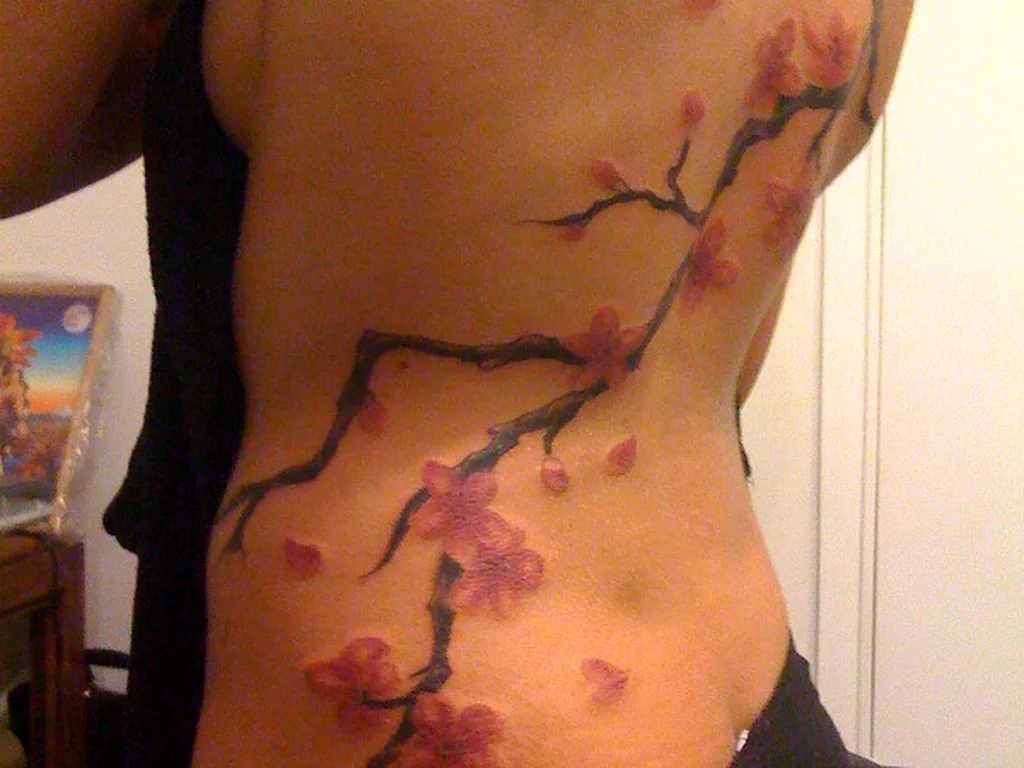
This is the centre of the whole subject, and it has a name. Mono no aware is a Japanese idea, given its classic form by the scholar Motoori Norinaga in the eighteenth century, about the gentle sadness of things passing: nothing stays, and knowing that is part of how a thing is beautiful rather than a flaw in it. The cherry blossom became its standard example because the flower makes the argument by itself. It opens all at once, at full strength, and it is gone in days. A cherry blossom tattoo worn for this layer is not a gloomy tattoo. It says the wearer has made peace with the terms: people, years and good stretches end, and they were worth having anyway. Notice what the design does with the petals. Petals drawn mid-fall, like the scattered ones running down the flank in the photograph below, belong to this reading. In Japanese art a fall of petals even has its own word, hanafubuki — a petal blizzard — and it is painted as a beautiful event, not a disaster.
Renewal and spring
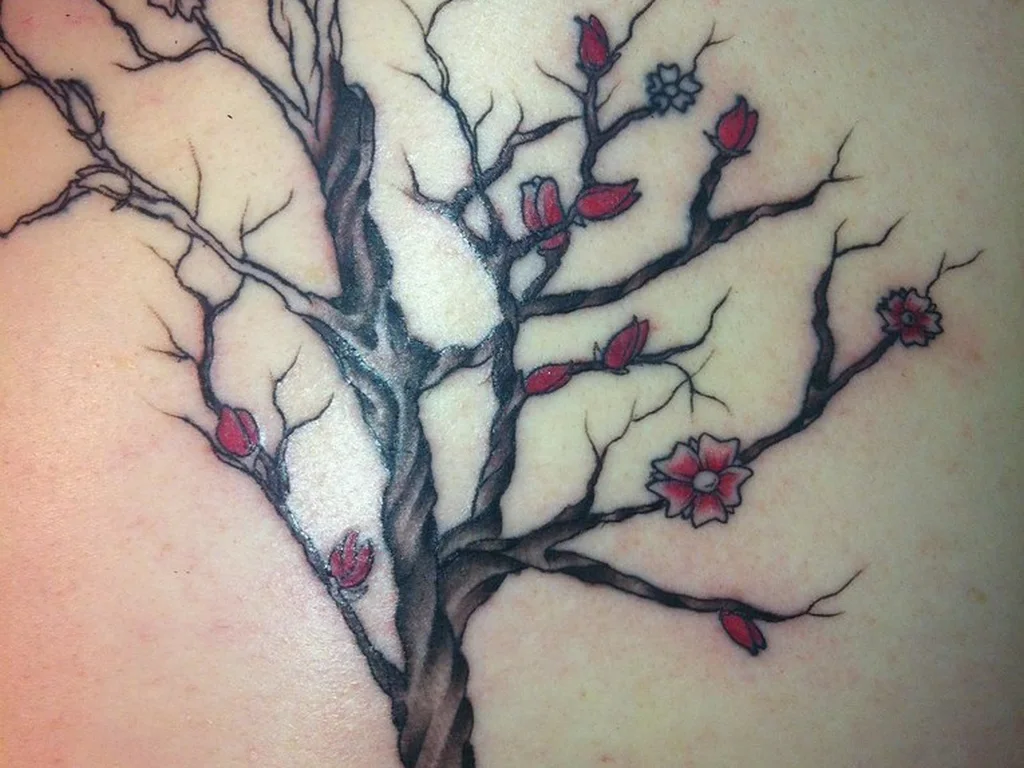
The second reading runs the same fact in the other direction. The tree that drops every petal in April is covered in blossom again the next April, and it does this for decades, in some famous cases for centuries. In Japan the school year and the working year both begin in April, under the blossom, so the flower is tied to starts in daily life and not just in poetry: new classes, new jobs, new homes. A cherry blossom tattoo chosen for renewal is standing on that calendar. It is a modern emphasis — the old texts dwell more on the falling than the return — but it is anchored in a real and very old rhythm, and the budded tree below shows the version of the design that carries it: mostly promise, a few flowers open, the rest still to come.
The samurai connection, told straight
Here is the story as it is usually told: the blossom falls at its peak, still perfect, and the samurai admired it because a warrior should be ready to fall the same way, at his height, without clinging to life. It is a strong story. It is also a heavily polished one. The tight pairing of blossom and warrior was pushed hardest much later, in the military Japan of the early twentieth century, when the falling petal was used openly as an emblem for soldiers’ deaths, and it was polished again in postwar books and films. Older samurai writing does not hand down a neat blossom code; the warriors of the time left cherry blossom poems, as everyone did, but the tidy doctrine is a modern build. None of this makes a blossom-and-sword design dishonest. It makes it a romantic association, chosen in the last hundred years or so, rather than an ancient rule. Wear it as that, and it stands up fine.
Grace and love: the Chinese reading
Cross to China and the same flower leans a different way. Cultivated cherries have a long recorded history in China, longer than their career as Japan’s emblem, and in Chinese tradition the blossom reads toward beauty, love and feminine strength and grace. It is a softer, more celebratory set of meanings, with less of the falling-petal melancholy that Japan layered onto it. Neither reading cancels the other. They are two cultures working the same flower for different ideas, and a wearer is allowed to pick the one that fits. What is worth avoiding is the merged internet list that stirs both into a single chart and presents the result as one ancient system. No such single system exists.
History and Culture: Where the Meanings Come From
Japan: a thousand years of looking at blossom
Blossom viewing in Japan is documented for well over a thousand years. Court nobles of the Nara and Heian periods held viewing parties and wrote the poems; at first plum blossom shared or held the honour, and by the Heian centuries the cherry had taken the lead it has kept ever since. The custom walked down the social ladder over the centuries — to warriors, to townspeople, to the whole country packing lunches under the trees each spring. The blossom became the unofficial national flower, worked into woodblock prints, kimono patterns, family crests and, in modern money, the cherry design on the hundred-yen coin. When a symbol has been looked at that hard for that long, it collects meanings the way the tree collects years. The tattoo meanings above are the short version of a very long national habit of paying attention to one flower.
The flower reached skin early, too. Japanese tattooing grew up alongside the woodblock print in the Edo period, and the prints the tattooists borrowed from were full of blossom — heroes and beauties under falling petals, branches worked into the background patterns that filled a back or a sleeve. That is why the blossom in a Japanese-style tattoo so rarely sits alone even now: it arrived as part of a whole visual language of seasons, water and wind, and it still speaks that language. A modern branch on a forearm is the descendant of those print backgrounds, simplified for a smaller canvas.
China: the older root
The plant itself is at home across East Asia, and Chinese gardens grew ornamental cherries, and Chinese poets wrote about their blossom, long before the flower became a Japanese emblem. Japan received a great deal of its early high culture through China, and the blossom’s story follows that road: adopted, then made so thoroughly Japan’s own that the world now reads it as Japanese first. The Chinese associations kept their own flavour on the way — beauty, love, a feminine grace with strength in it — which is why the two traditions still read the flower differently today. A tattoo that leans on the Chinese reading is not a mistake or a mix-up. It is the older branch of the same tree.
The trees that crossed an ocean
In 1912 the city of Tokyo sent Washington, D.C. a gift of some three thousand cherry trees, and the story behind it is pure blossom luck, good and bad. An earlier gift had arrived infested and had to be burned on the advice of inspectors; the 1912 trees were the healthy replacement, planted around the Tidal Basin, where their descendants and successors still draw crowds every spring. It is a small piece of history, but it explains why the flower carries a friendship meaning in the United States that it does not carry anywhere else, and why an American wearer may honestly mean goodwill by it. Meanings travel with trees.
Details That Change the Reading
On the branch, or already falling
The plainest dial on the design. Blossom held on the branch is the flower at its height: full, bright, the moment everyone photographs. Blossom already falling — loose petals drifting past the branch, scattered across a hip or a shoulder — is the same moment one breath later, and it belongs to the mono no aware reading above. Japanese painting uses both constantly, and neither is the dark version. A petal shower is not the tree dying; it is the tree doing the thing it is famous for. Choose falling petals if the tattoo is about letting a good period go with grace. Choose the loaded branch if it is about the period itself, while it lasted.
Bud, bloom, or the whole tree
Scale of subject, not size of tattoo. A single open flower is the peak moment and nothing else. A branch mixes buds, open blossom and the odd falling petal, which quietly tells the whole timeline in one design. A whole tree, like the budded one in the renewal section, is the boldest statement: mostly bare wood and patience, blossom as a brief annual event on something that endures. That inversion is worth noticing. On a full-tree design the tree is the wearer, and the blossom is the year. On a single-flower design the blossom is the wearer, and the message is the short life itself. Same plant, opposite ends of the telescope.
What travels with it
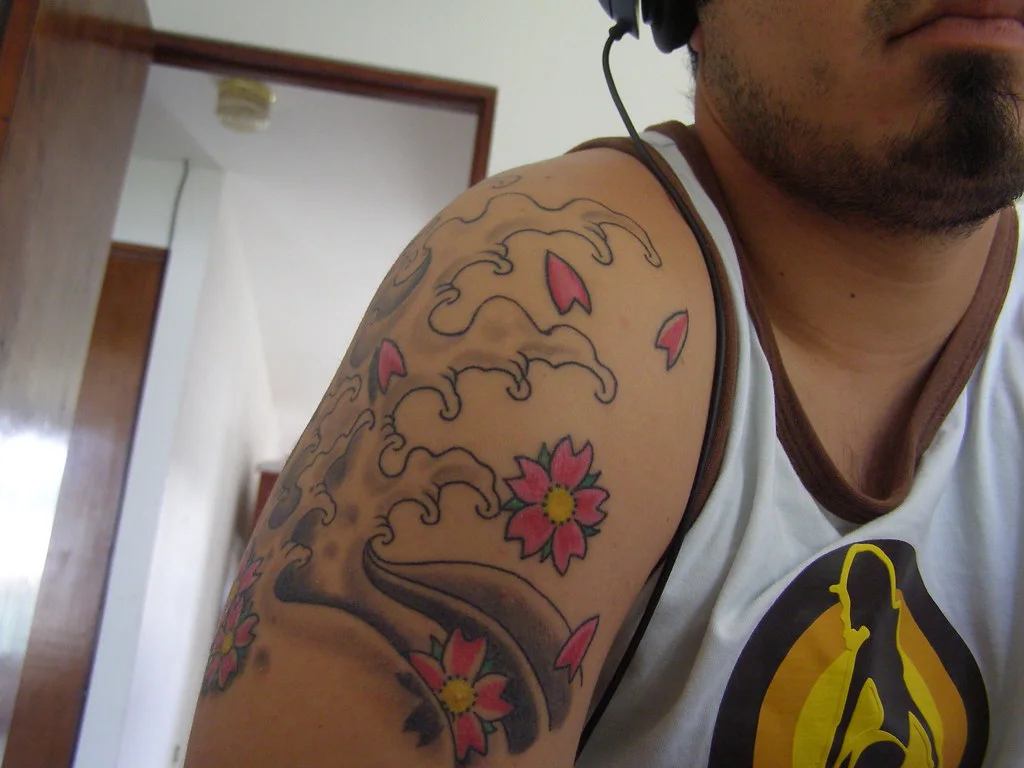
In Japanese tattooing the blossom is a team player. With koi it softens a design about strength and persistence, the fish pushing upstream through falling petals. With water and wind it becomes seasonal weather: the grey swirling bars behind the blossoms in our first photograph are the standard wave-and-wind patterning of Japanese work, there to say the petals are moving, the season is turning. A small bird settled on the branch is a pairing borrowed from painting, where it stands for the living moment appreciating the flower before it goes. And the blossom is only one stop on a whole calendar of tattooed flowers, each with its own season and story; our
flower tattoo design ideas page maps the wider field.
One branch, any scale
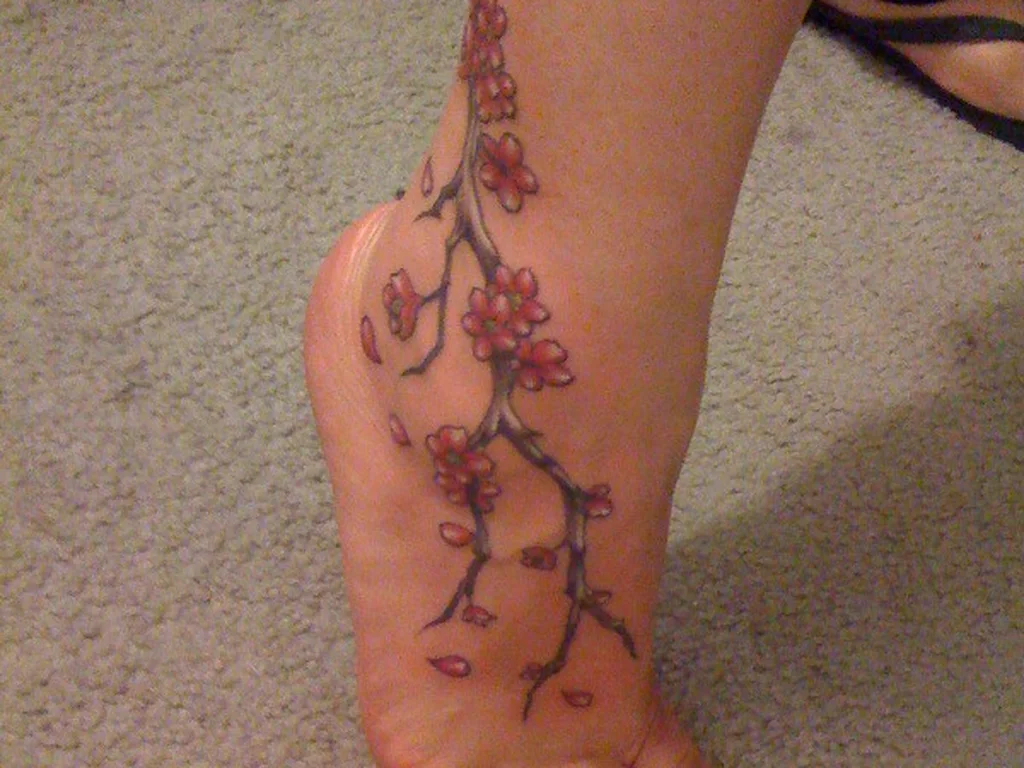
The branch design scales down better than most large-subject tattoos, because its parts stay separate: a twig, five-petalled flowers, loose petals. The ankle piece below keeps all three, running from the ankle bone down across the foot, and it still reads at a glance. Two honest warnings ride with small placements. Feet and ankles shed ink faster than almost anywhere — shoes, socks and thin skin see to that — so a foot branch should be drawn a touch bolder than the reference photo and booked with a touch-up in mind. And petals drawn too close together will merge as the lines settle; the spacing in that photograph, each petal with air around it, is the spacing to copy.
What a Cherry Blossom Tattoo Does Not Automatically Mean
Falling petals are not a death omen. This is the most common scare story attached to the design, and it inverts the tradition it claims to quote. In Japanese art the falling petal is the standard picture of the blossom’s beauty, painted, printed and embroidered for centuries without a curse attached. Death is in the neighbourhood of the meaning — mono no aware is about impermanence, and lives are among the things that pass — but a petal shower on skin is a statement about appreciating things in time, not a prediction or a mourning band. Unless the wearer built it as a memorial, it does not read as one.
It is not a gang badge. The claim that a cherry blossom marks its wearer as yakuza gets the history backwards. In Japan, tattooing as a whole carried an organised-crime association for much of the twentieth century, which is why many bathhouses long barred tattooed bathers of any design; those rules were about ink in general, never about this flower, and they have been loosening for years. The blossom itself is as mainstream as a motif gets — school songs, coins, crests, wedding stationery. A cherry blossom tattoo says no more about criminal ties than a rose says about gardening gangs.
There is no single official meaning to get wrong. Pages that hand down one fixed decoding — this petal count means purity, that placement means death — are tidying layered history into a chart. The real structure is the one on this page: an old philosophy of impermanence at the bottom, a national custom of blossom viewing in the middle, a Chinese reading alongside, and the wearer’s own story over everything. Our
lotus tattoo meaning guide pulls the same layers apart for the other great flower of Asian tattooing, and the pattern is identical: documented tradition below, studio convention above, and daylight between them.
Frequently Asked Questions
What is the main meaning of a cherry blossom tattoo?
The short life of the flower: beauty and good periods that do not last, faced without bitterness. Underneath it sit renewal each spring and, in the Chinese reading, love and grace. The first meaning is the documented Japanese one; the others are real but younger or from the neighbouring tradition.
What does mono no aware mean for a cherry blossom tattoo?
Mono no aware is the Japanese idea that things are moving because they pass — a gentle sadness at impermanence that makes a moment worth more, not less. The cherry blossom is its classic example. A tattoo carrying this layer is about acceptance: the good stretch ended, and it was good.
Do falling petals in a cherry blossom tattoo mean death?
No. Falling petals, the hanafubuki or petal blizzard, are a standard and admired image in Japanese art, standing for the blossom’s brief season and the grace of letting go. They touch on impermanence, which includes mortality, but they are not an omen, a curse or an automatic memorial.
What is the samurai connection to cherry blossoms?
The popular version says the falling blossom, cut down at its peak, mirrored the warrior ready to die at his. Samurai did write blossom poetry, but the tight blossom-and-warrior doctrine was built mostly in the military early twentieth century and polished afterwards. Treat it as a romantic association with real feeling behind it, not an ancient code.
What does a cherry blossom tattoo mean in China?
In Chinese tradition the blossom leans toward beauty, love and feminine strength and grace, with a longer recorded history of cultivation behind it. It is a warmer, more celebratory reading than the Japanese emphasis on the falling flower, and neither tradition cancels the other out.
Is a cherry blossom tattoo only for women?
No. Small pink sprigs get marketed at women and big Japanese back and sleeve work at men; that is shop marketing, not the flower. Blossom has been worn in Japan by monks, warriors, artists and everyone else for centuries. Size, colour and placement are taste. The meaning is the same on anyone.
What do cherry blossoms pair with in Japanese tattooing?
Most often koi, where the blossom softens a design about persistence; waves and wind bars, which turn the petals into moving seasonal weather; and birds on the branch, a pairing taken from painting. Each partner shifts the reading — the combinations section above works through what each one does.
Is a cherry blossom tattoo a yakuza symbol?
No. Japan’s old tattoo stigma attached to tattooing in general, through its twentieth-century organised-crime association, and bathhouse rules barred ink of every kind. The blossom itself is a mainstream national motif found on coins and crests. It marks the wearer as nothing but a person with a blossom tattoo.
Where do cherry blossom tattoos sit best?
Branches follow long lines well: down a flank or back, along a forearm, over a shoulder. Trees need room — a back or a thigh. Small sprigs work on ankles and wrists, drawn bold for their size; feet and ankles fade fastest and often need a touch-up, which is a fact of the placement, not a flaw in the design.
Does a cherry blossom tattoo have to be pink?
No. Real blossom runs white through deep pink, and plenty of trees bloom near-white. On skin, black and grey branches with uncoloured blossom are common and keep the full reading; red-leaning blossom reads bolder and a touch more Chinese in flavour. Colour changes the mood of the piece, not its right to the meaning.
Final Thoughts
A cherry blossom tattoo can honestly mean a life or a love that ended in season, a self that comes back every spring, or a flower admired in China for grace long before it was anyone’s emblem — and the details are what choose between them: petals held or falling, one flower or the whole patient tree, a koi pushing through or a bird sitting still. Decide which layer is yours and the design mostly draws itself. The history on this page is solid ground, from Heian viewing parties to a gift of trees across the Pacific. The rest is the part no chart can hand you, which is fitting for a flower whose whole point is that the moment is yours briefly. The
cherry blossom tattoo ideas collection is built from real photographs only, counted one by one.
Photo credits: Image 1: leivajd, CC BY 2.0, via Flickr. Images 2 and 4: mytat_2s, CC BY 2.0, via Flickr. Image 3: alliecassidy, CC BY-SA 2.0, via Flickr.