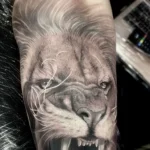
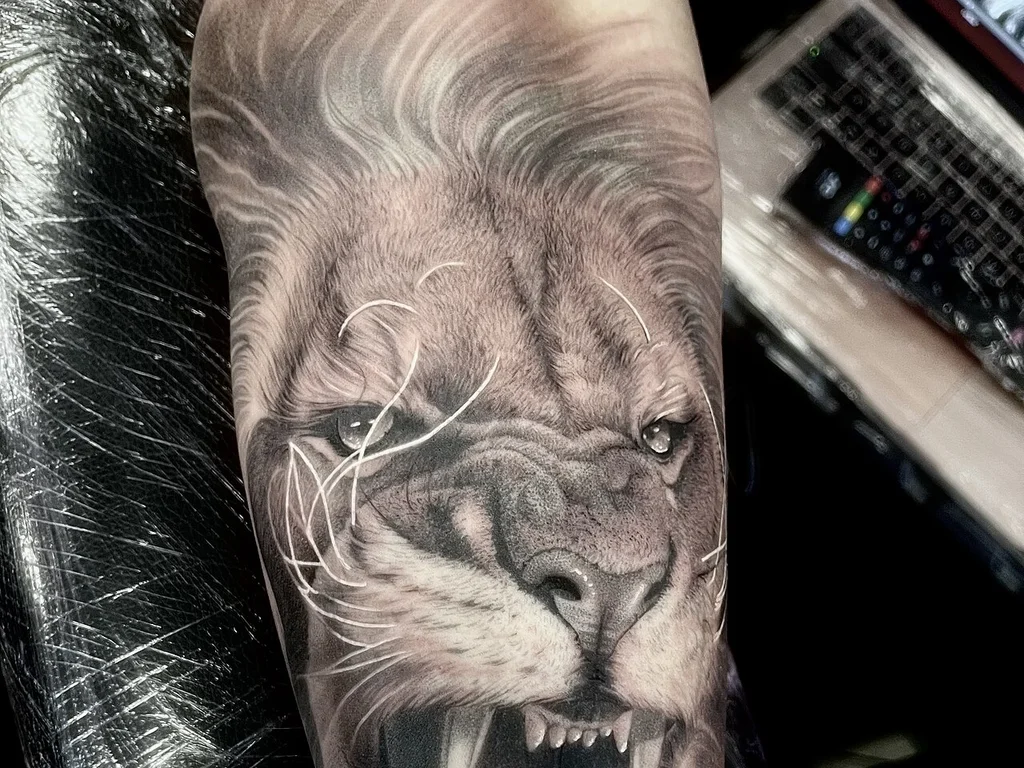
Short answer first: a lion tattoo meaning usually comes down to courage, strength and quiet authority — the animal people pick when they want a design that says they protect what is theirs and do not scare easily. That is the modern reading, and it is a fair one. But the lion has also been a god’s weapon in Egypt, a royal badge in Europe, a temple guard in China and a name for Christ in the Bible, and some of those older meanings are still the real reason behind plenty of lion tattoos. This page sorts the two piles apart. Some of what follows is documented history. Some is modern tattoo-shop talk repeated so often it started sounding ancient. Both are fine reasons to get tattooed. They are not the same thing, and you should know which one you are wearing.
Choosing the design itself? Start with our lion tattoo ideas gallery and the realistic lion tattoo ideas page — this article is about what the lion stands for once it is on your skin. It sits inside the wider animal tattoo ideas pillar, alongside the other wild designs in our wild animal tattoo ideas collection.
The Core Meanings, One by One
Five meanings account for most lion tattoos. Three rest on real history; two are modern readings that grew out of the animal’s behaviour and out of astrology. Each is labelled for what it is.
Courage and strength
This is the meaning almost everyone reaches for first, and the animal earns it without any help from mythology. A lion is one of the few predators that faces down animals bigger than itself, and male lions fight rival males head-on for control of the pride. People have read bravery into that for a very long time — medieval storytellers made the lion the king of beasts partly on the strength of it, and “lion-hearted” still means brave in plain English. As a tattoo, this reading is usually personal: a hard year survived, a fear faced, a reminder on the skin for the next one. Modern convention built on real behaviour — a solid enough foundation.
Royalty and leadership
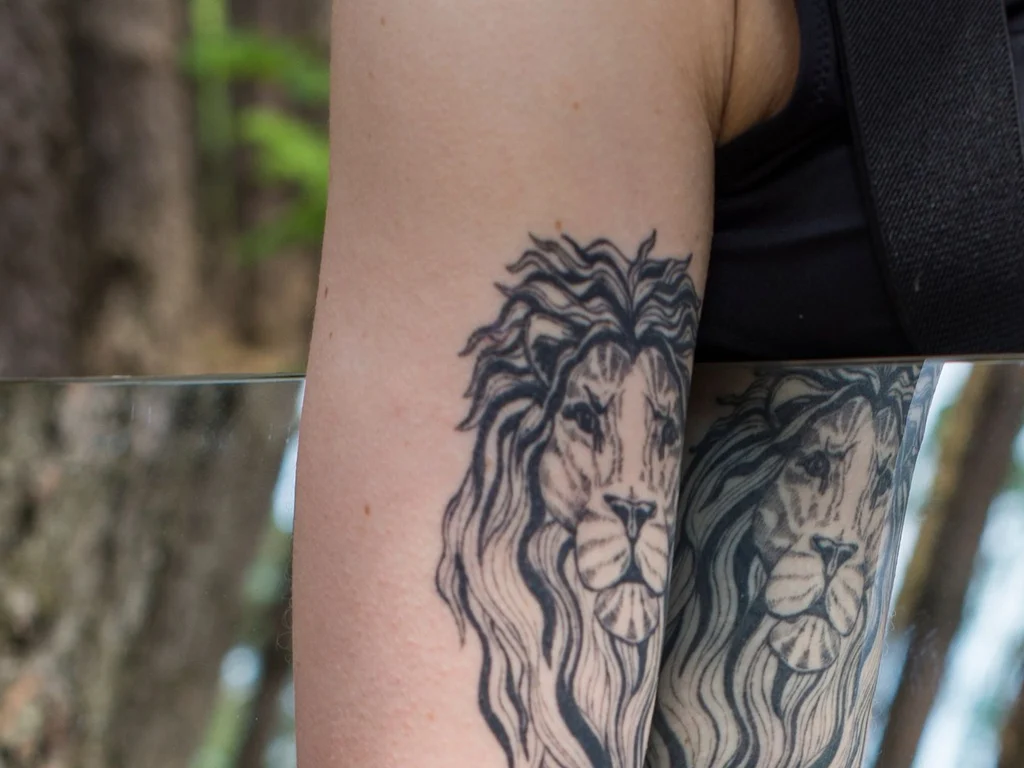
The lion as a king is not something tattoo culture invented. It comes out of heraldry, the medieval system of coats of arms, where the lion stood for bravery and command and ended up on more royal shields than any other animal — the full story is below. When a modern lion tattoo adds a crown, it is borrowing that badge language directly. The honest label: the royalty meaning is documented history; the crowned lion head as a tattoo design is modern artwork using it. People choose it to mark a role — head of a family, owner of a business, the one others lean on — rather than any royal blood.
Protection and family — the pride
Lions are the only big cats that live in family groups. A pride is mostly related females, their cubs, and a few males. The lionesses do most of the hunting and raise the cubs together; the males patrol and fight off rivals and hyenas. Encyclopaedia Britannica’s lion entry lays out that division of labour plainly — worth knowing before you repeat the cartoon version where the male does everything. In tattoo terms, the pride is why lions so often stand for family rather than lone power. A lion with cubs is one of the most common parent tattoos there is, and a lioness piece is often about protecting children. This meaning is modern — nobody in ancient Egypt was tattooing a pride to mark fatherhood — but it is rooted in how the animal actually lives.
Leo and fire
Leo is the fifth sign of the zodiac, drawn as a lion, ruled by the Sun and classed as a fire sign. People born under Leo — roughly 23 July to 22 August — often choose a lion tattoo as a birth-sign piece, and the design usually gives itself away: flames worked into the mane, the Leo glyph, a sun disc, or the constellation picked out in stars. Astrology itself is old, and the lion has stood for Leo since Babylonian and Greek star charts; the tattoo habit is modern. One warning: most lion tattoos are not Leo tattoos. With no glyph, flame or star chart in the design, nobody should read a birth date off it.
Faith — the Lion of Judah
This is the one lion meaning that comes straight out of a text. In Genesis 49, Jacob blesses his son Judah and calls him a lion’s cub; the tribe of Judah took the lion as its emblem. In Revelation 5:5, Christ is called “the Lion of the tribe of Judah.” The Lion of Judah later became the emblem of the Ethiopian emperors, who claimed descent from Solomon and the Queen of Sheba, and from Ethiopia it passed into the Rastafari movement, where the lion stands for Haile Selassie I and for Africa itself. A Lion of Judah tattoo — often a crowned lion carrying a cross or a banner, or worked in the green, gold and red of Ethiopia — is a statement of Christian faith, Ethiopian heritage, or Rastafari belief, not a generic strength tattoo. If that is not your faith or your heritage, leave it alone.
Lions in History and Culture
The lion’s range used to cover Africa, southern Europe and Asia as far as India, so many cultures met the animal face to face and built it into their religions and royal symbols. Lions have been tattooed for as long as modern tattooing has existed — photographs of tattooed men from the early 1900s already show lion heads among the eagles and ships.
Ancient Egypt — Sekhmet and Bastet
Egypt’s fiercest goddess was a lioness. Sekhmet — her name means something like “the powerful one” — was a goddess of war, plague and healing, shown as a woman with a lioness’s head and a sun disc. One myth has her sent to punish mankind and enjoying it so much that the other gods had to trick her into stopping. Bastet started out as a lioness goddess too, a protector of the pharaoh, and only softened over the centuries into the cat goddess most people know — her statues change from lioness to house cat as the years pass. So the accurate version is: Bastet began as a lioness and became a cat; she was not always the gentle cat of the gift shops. An Egyptian-style lioness tattoo is pointing at real, documented religion, some of it more than 4,000 years old.
Heraldry — the lion on the shield
No animal comes close to the lion in European heraldry. As the heraldic lion article sets out, lions appear in more coats of arms than any other beast, standing upright in the famous “rampant” pose or walking with one paw raised. England’s royal arms carry three lions — they have been there, in one form or another, since the time of Richard the Lionheart — and Scotland answers with a single red lion rampant inside a double border. Towns, regiments and football clubs across Britain still use them. A heraldic lion tattoo is usually a heritage piece: English, Scottish, or family-crest pride — and the clearest proof that the “lion means leadership” line is history, not sales talk.
China — the guardian lions
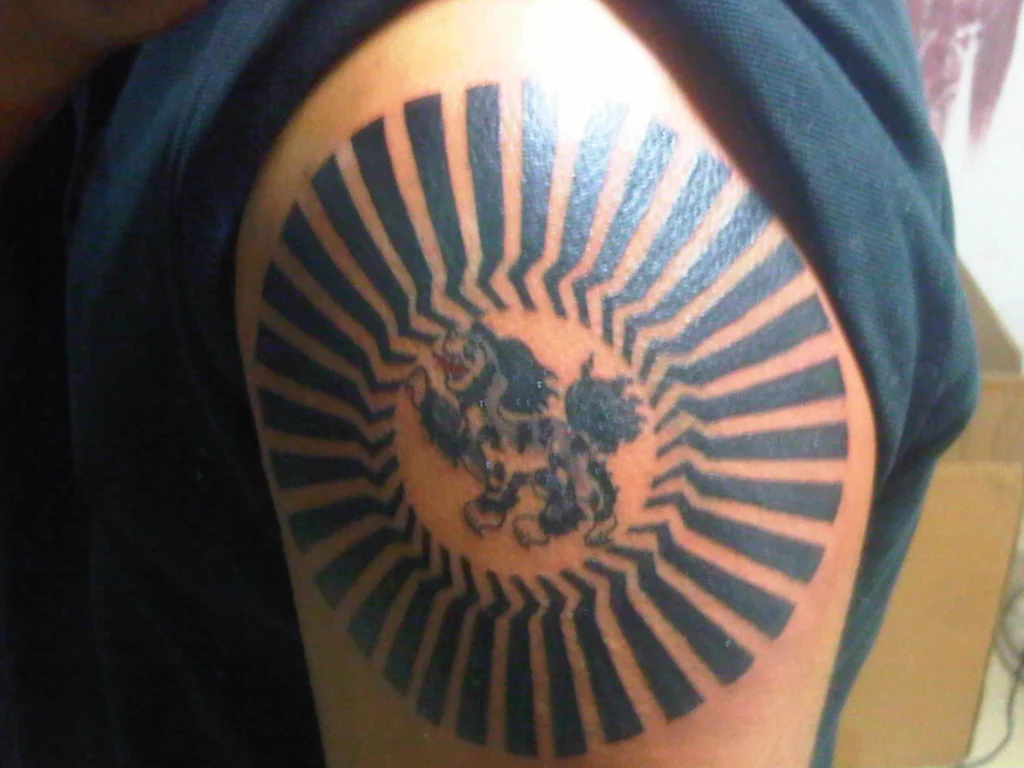
The stone lions outside Chinese temples, palaces and banks are real lions as a symbol, even though the sculptors had mostly never seen one — lions reached China as gifts along the Silk Road and were copied from descriptions and skins. The guardian pair, often called fu dogs in English, is always a pair: the male rests a paw on a ball, the female on a cub, and together they guard the entrance. In Tibet, the snow lion is a separate figure again — a white or green celestial lion that stands for fearlessness and appears on the Tibetan flag. Two honesty notes. First, these are gate statues and emblems, not a historical tattoo tradition; a guardian-lion tattoo today is a modern borrowing of a protective symbol. Second, a Japanese shishi or Okinawan shisa comes from the same family of guardian beasts by a different road, and the names are often mixed up.
India — Narasimha, Durga and the Ashoka lions
India has its own lions — the Asiatic lion still lives in Gujarat’s Gir forest — and its own lion stories. Vishnu takes the form of Narasimha, half man and half lion, to kill a demon king who could be killed by neither man nor beast. The goddess Durga rides a lion into battle. And in the third century BC the emperor Ashoka set carved lions on top of his pillars; the four lions from his Sarnath pillar, standing back to back, are now the national emblem of India, printed on its money and government buildings. An Indian lion tattoo can be a Hindu faith piece, a national-pride piece, or both — which is why you should not guess which one a stranger is wearing.
Aslan — the fictional lion
Plenty of lion tattoos are really about one lion: Aslan, from C. S. Lewis’s Narnia books. Aslan is a Christ figure in a story written in the 1950s, and people choose him to stand for a gentle kind of strength — good, protective, and, in Mrs Beaver’s famous line, “not a tame lion.” Label this one honestly: it is a modern literary meaning. There is nothing wrong with that — a tattoo about a book that mattered to you at age ten is a real reason. It just should not be dressed up as ancient symbolism.
What the Style and Details Mean
Two people can both wear “a lion” and mean different things by it, because the details do a lot of the talking. Here is what the common choices usually signal — nearly all of it modern tattoo convention rather than old symbolism.
The maned male and the lioness
The maned male is the display lion — authority, presence, the face on the shield. The lioness is the working lion: the hunter who feeds the pride and defends the cubs, usually drawn leaner, mid-stride or mid-snarl. Lioness tattoos are often chosen by women, and just as often by mothers, but there is no rule in either direction — men wear lionesses and women wear maned males every day. The choice signals which half of the lion’s life you identify with: the one who is looked at, or the one who does the work. Both readings are modern convention, and both are honest.
Roaring and calm faces
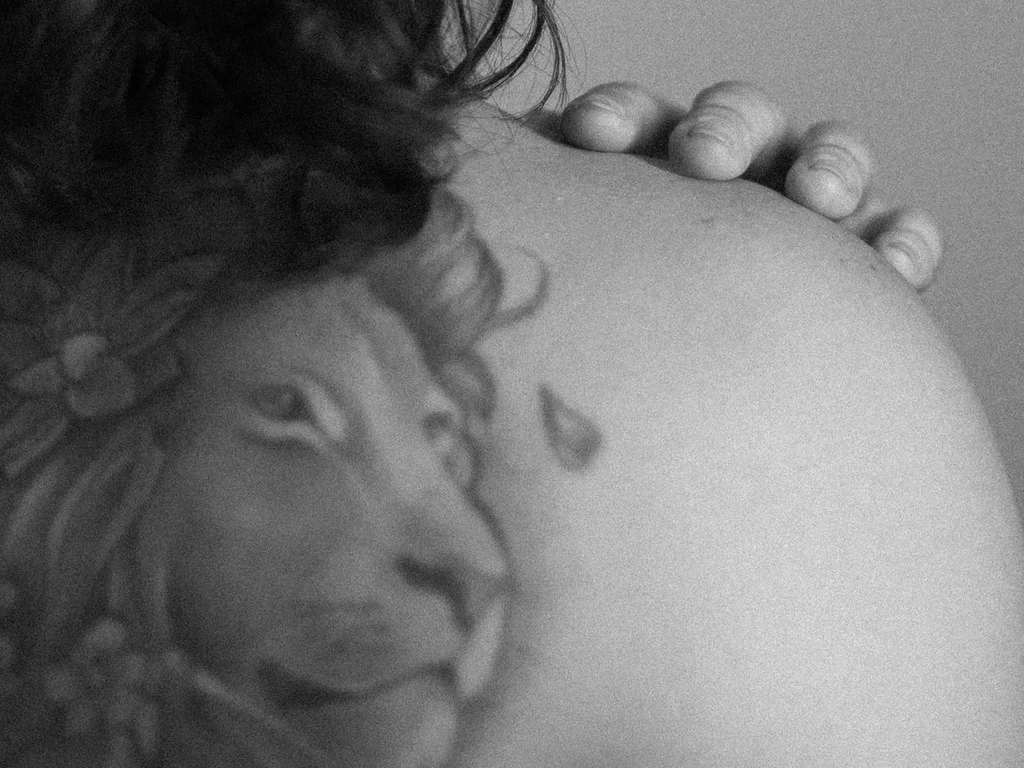
Studio talk draws a clean line here: a roaring lion, teeth out, is read as aggression, defiance and a fight already survived; a calm lion staring straight out is read as controlled power — strength that does not need to prove itself. Artists call the second one “quiet confidence,” and plenty of wearers pick the calm face for exactly that reason. Treat the line as what it is: a useful modern shorthand, not a code with fixed translations. The same calm face on another person may simply be the photograph they fell for.
Adding a crown
A crown turns a lion portrait into a statement about rank: king of your own life, head of the family, boss of the business. It borrows from heraldry and from the Lion of Judah, and modern pieces often pair it with roses, a compass or lettering. One caution honest artists give: crowned lions are also used by specific groups — the Latin Kings street gang is the best-known example — so a crown design copied from the internet can carry baggage you did not intend. Show your artist the exact artwork; if it is a known emblem, expect them to redraw it rather than copy it.
Geometric and tribal lions
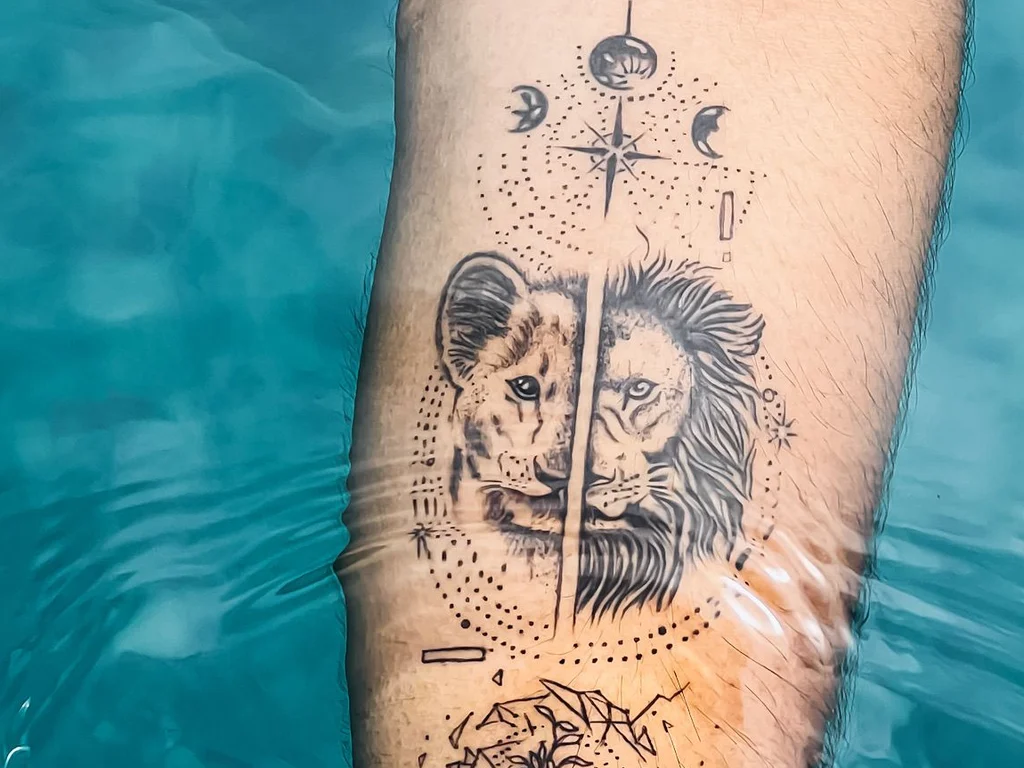
Geometric lions — the face split into straight lines, low-poly facets or dotwork — and black tribal lions are style choices first and symbols second. Neither comes from an ancient lion tradition: the geometric look grew out of 2010s tattooing and graphic design, and the bold black tribal shapes come from 1990s Western tattoo fashion, which borrowed its curves from Pacific and Borneo work without taking the meanings with it. People pick them because the lion reads clearly at a distance and ages well in solid black. If a website gives a geometric lion a sacred ancient meaning, it is selling you something.
Does placement change the meaning?
Only in the loose way all placement talk works — as studio convention, not history. A chest lion is read as close-to-the-heart: family, faith, the thing you would defend. A full back lion is the big statement piece, chosen for the canvas more than the symbolism. Forearm lions are the everyday reminder. A hand or neck lion says the wearer is past caring who sees it. None of this is a code: placement changes how a tattoo is read at first glance; the wearer decides what it means.
Lions Combined With Other Symbols
Lions rarely sit alone in modern work. The partner symbol usually carries the personal half of the meaning — these are the pairings you will see most, all modern convention unless stated otherwise.
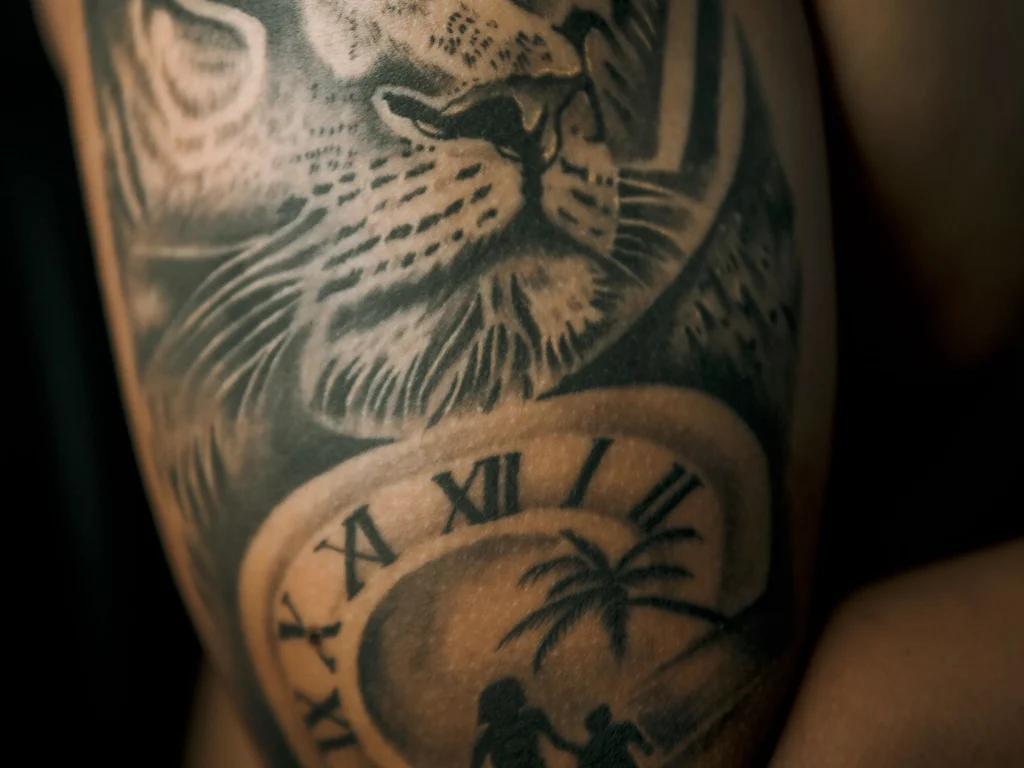
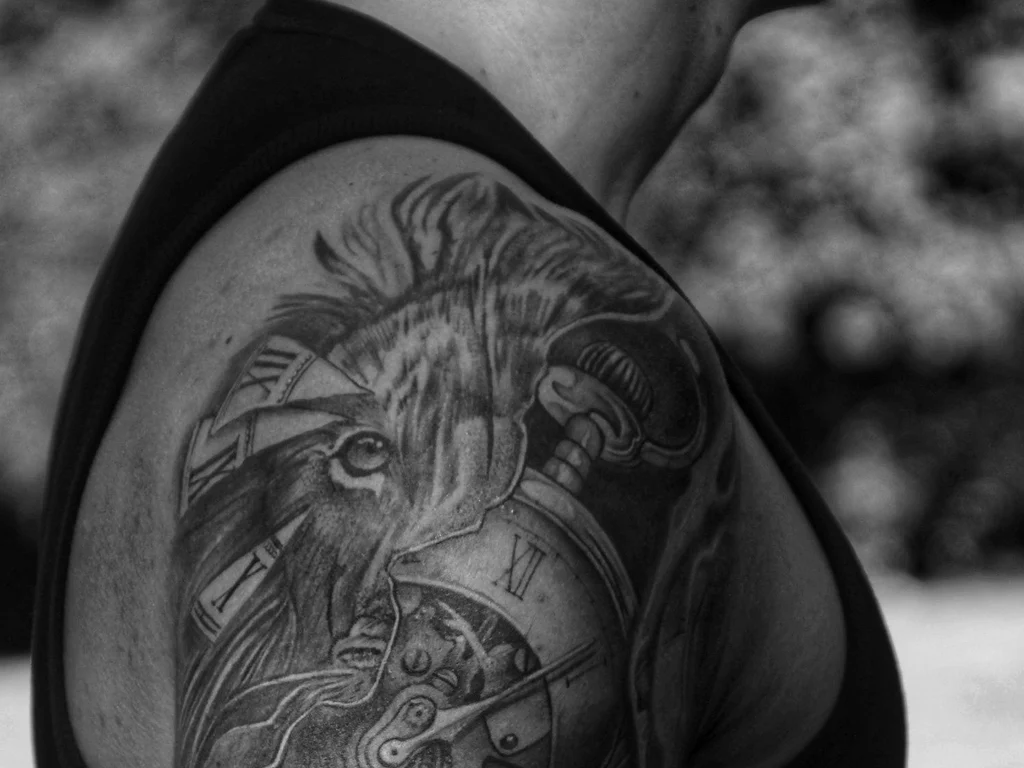
Crown. Rank and self-rule, covered above; the most common addition to a lion portrait. Cub. A child — one cub per child is the standard parent design, and the count in the picture is normally the count in the family. Clock. Time: a birth time, a date, a memorial, or a reminder that time runs out. Clock faces in manes are a black-and-grey fashion of the last decade or so. Flowers. Roses and peonies soften the piece and often mark it as a family or memorial tattoo. The lamb. The one pairing with real paperwork: “the lion shall lie down with the lamb” is a popular misquote of Isaiah’s wolf and lamb, and lion-and-lamb tattoos draw on that peaceable-kingdom image — strength at rest, or faith. Cross and scripture. Points the design at the Lion of Judah rather than the animal.
What a Lion Tattoo Does Not Automatically Mean
There is no master code. Lists that decode every lion detail — left paw raised means this, blue eyes mean that — are made up for clicks. Heraldry has real rules for poses on shields, and the Lion of Judah has a real religious meaning, but a modern lion portrait is artwork, not a form filled in from a chart. The only reliable decoder is the wearer.
It is not automatically a Leo tattoo. Leo owners are a minority of lion wearers. Without a glyph, flames, a sun or a constellation in the design, assume the lion stands for the animal’s qualities or for family — not for a late-July birthday.
The “alpha lion” reading is internet talk. Social media sells the lion as a lone alpha who answers to no one. Real prides do not work like that: the females run the hunting and cub-raising, males hold their place for a few years at most, and no lion survives long alone. If your tattoo marks independence, that is a fine personal meaning — just know it comes from motivational posters, not from lions. Our eagle tattoo ideas page makes the same point about its own bird: the lone-hunter story is usually the first myth to go.
It is not automatically religious, and not automatically a gang mark either. Most lion tattoos are neither. A small number of specific designs — the Lion of Judah, a crowned lion copied from a known emblem — do belong to a faith or a group. That cuts both ways: do not read faith or gang ties into a stranger’s lion, and do not copy an emblem design without checking what it is.
Frequently Asked Questions
What does a lion tattoo mean in general?
Most often courage, strength, protection and family. The leadership reading has real history behind it through heraldry; the family reading comes from how prides actually live. Beyond that, the wearer’s own reason counts most.
What does a lioness tattoo mean?
Usually the protective, working side of the animal — hunting, providing and defending cubs. Lioness pieces are common as mother tattoos, and for people who carry a family quietly rather than loudly. A modern reading, and a fair one.
Is a lion tattoo only for Leos?
No. Leo tattoos are a small share of lion tattoos, and they normally announce themselves with the Leo glyph, flames, a sun disc or stars. A plain lion portrait says nothing about a birth date.
What does a lion with a crown mean?
Rank and self-rule — the wearer as head of their family or their own life. The crown borrows from heraldry and the Lion of Judah. One caution: crowned lions are also used as group emblems, the Latin Kings included, so exact artwork matters.
What does the Lion of Judah tattoo mean?
It is a faith and heritage symbol. The phrase comes from Genesis 49 and Revelation 5:5, the lion was the emblem of the Ethiopian emperors, and Rastafari believers use it for Haile Selassie I and African identity — not a generic strength design.
What does a lion and cub tattoo mean?
Parenthood, almost always. One cub usually stands for one child, and the design is often a companion piece with the other parent’s lion or lioness. Dates and names in the mane belong to the same family reading.
Are lion tattoos for men or for women?
Both, and the split in studios is close to even. Maned males are filed as men’s designs and lionesses as women’s in online galleries, but that is marketing habit, not a rule — wearers cross it constantly.
Does a roaring lion mean something different from a calm one?
In studio talk, yes: roaring reads as defiance and fights survived, calm reads as controlled power. It is a shared modern shorthand, not a fixed code — a starting point for the conversation with your artist.
Is a lion tattoo a religious tattoo?
Only some are. Lion of Judah designs, Narasimha pieces and lion-and-lamb tattoos carry faith meanings. A plain black-and-grey lion portrait does not — it is about the animal or the wearer’s family.
What does a lion tattoo with a clock mean?
Time, in one of its personal forms: a birth time or date, a memorial, or a reminder to use the time you have. A modern black-and-grey pairing with no older history behind it — no less personal for that.
Final Thoughts
The lion tattoo meaning is not one meaning, and that is its strength. You can stand on real ground with it — heraldry’s most-used beast, Egypt’s lioness goddesses, the Lion of Judah, India’s emblem — or wear it for the modern reasons: courage, a family you would fight for, a hard stretch of life you came through. Both kinds are honest. What is not honest is the listicle version, where every paw position and eye colour decodes to something ancient. Pick the lion whose story matches yours, tell your artist which story that is, and let the details follow. When you are ready to look at designs again, the lion tattoo ideas gallery is the place to start.
Photo credits: lion head on a shoulder blade by Craig Adderley via Pexels; linework lion by Anastasia Lashkevich via Pexels; lion with clock and children by jovan curayag via Pexels; snow lion by Jitenmehra via Wikimedia Commons (CC BY-SA 3.0); lioness by Maria Fernanda Fotografia via Pexels; split lion design by rael frames via Pexels; lion with clockwork by Luca Betti via Pexels. Pexels photographs are used under the Pexels License.