Ask tattoo artists which animal never goes out of fashion and the snake comes up fast. The reason is simple: a snake is basically a line with attitude. It can coil into a circle, climb a leg, wrap a wrist or run the length of a back, and still read as a snake at every size. Few subjects bend around the body that well.
Below are 20 real snake tattoo ideas, every one photographed on real skin: American traditional, Japanese, heavy blackwork, soft realism and a few small pieces you could get done on a lunch break. Each comes with notes on placement and how it is likely to age. First, a quick look at what snakes actually mean, because with this animal the meaning talk is half the fun and half the nonsense.
What Snake Tattoos Mean
Rebirth and starting over. Real snakes shed their whole skin in one piece as they grow. That one fact carries most snake tattoos: people pick the snake after a recovery, a divorce, a career change, a bad year they are done with. For once, the symbolism rests on something the animal genuinely does.
The Eden story. In Genesis, the serpent talks Eve into eating the fruit. That gives snake tattoos a built-in edge: temptation, forbidden knowledge, not doing what you are told. Plenty of wearers lean straight into that reading. Just know the association exists before you put one somewhere your grandmother sees it every Sunday.
Kundalini. In yogic tradition, kundalini is pictured as a serpent coiled at the base of the spine, and spiritual practice is about that energy rising upward. It is why so many spine and back snake tattoos are drawn climbing. If that is your reason, a vertical design that follows the spine makes the meaning part of the layout, not just a caption under it.
The Japanese hebi. In Japan, snakes have long been tied to protection and good luck. Farmers valued them for hunting the rats that got into stored rice, and folk belief links them to water and to Benzaiten, goddess of water, music and learning. In Japanese tattooing the hebi is a respected traditional subject, usually drawn with a flicking tongue and plenty of movement.
The ouroboros. A snake eating its own tail shows up in ancient Egypt and Greece, standing for cycles: things end, things begin again, nothing is wasted. Britannica has a short, solid history of the ouroboros if you want the full background. As a tattoo it is usually a small circle on a wrist, ankle or shoulder blade, and it is one of the few snake designs with a fixed shape.
Meanings stay personal in the end. Pick the story you can still tell in ten years without rolling your eyes.
20 Snake Tattoo Designs
1. Realistic Black and Grey Snake on the Forearm
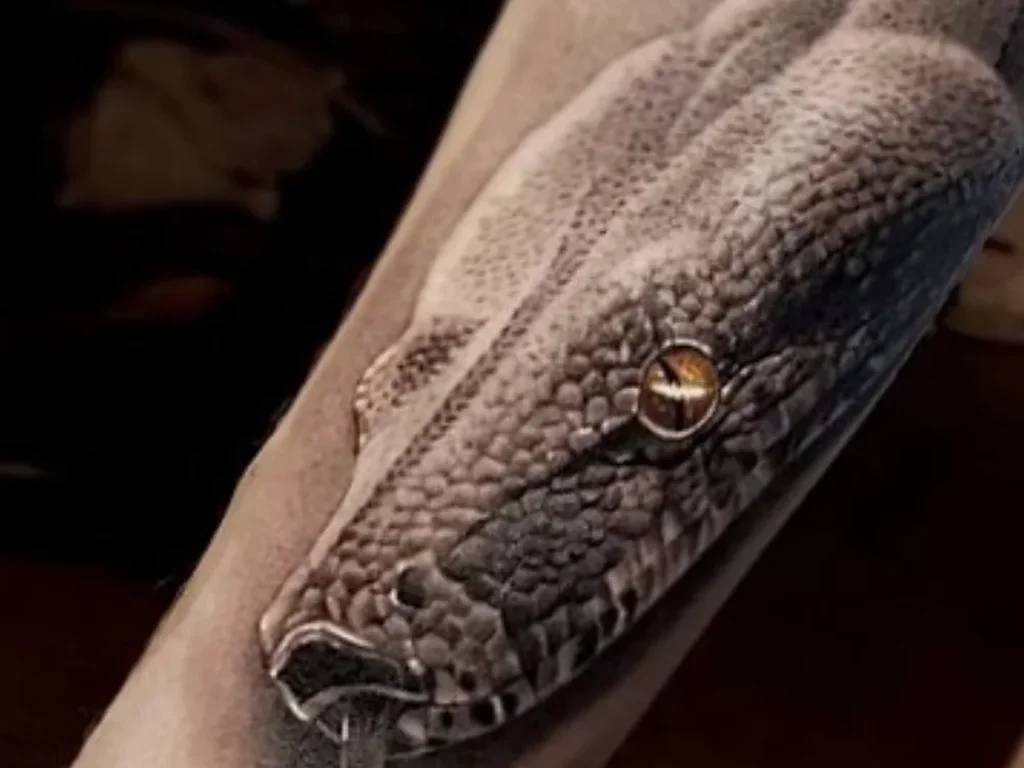
This head is the whole tattoo, and it earns it. Every scale is shaded, the tongue is out, and one small gold eye does all the colour work. Realism needs room: the forearm gives the head a long, flat stage, and the body can trail off around the arm instead of stopping mid-air.
Know what you are signing up for. Soft grey shading is the first thing to soften as years pass, so this style wants a bigger size and an artist who really does realism, not one who dabbles. Keep it out of harsh sun and it will hold its bite for a long time.
2. Traditional Snake Biting a Hand
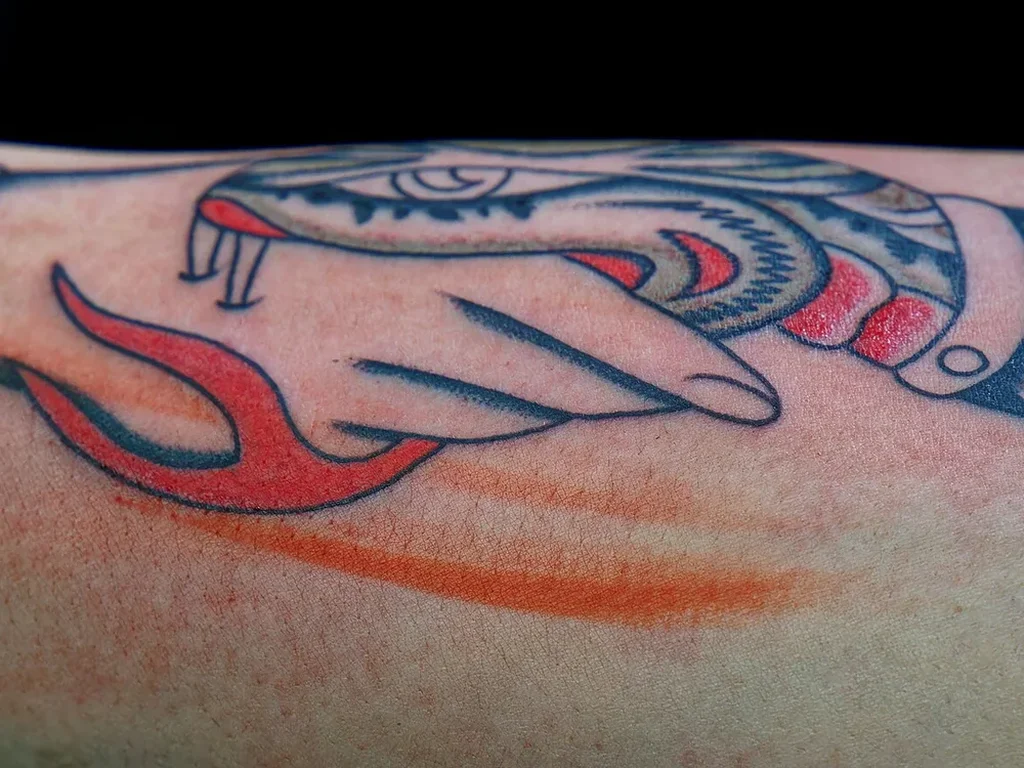
Old-school tattooing loved a snake with a grudge. Here it wraps a hand and sinks its teeth in, drawn with the thick outlines and flat reds and blues that have read from across the street for a hundred years. A joke, a warning and a design all at once.
Traditional work is also the safest long-term bet on this page. Bold black lines hold their shape as skin ages, and flat colour packs in tight. A classic upgrade is a snake through roses instead of a hand; our rose tattoo design ideas covers the flower side of that pairing.
3. Japanese Hebi With Cherry Blossom
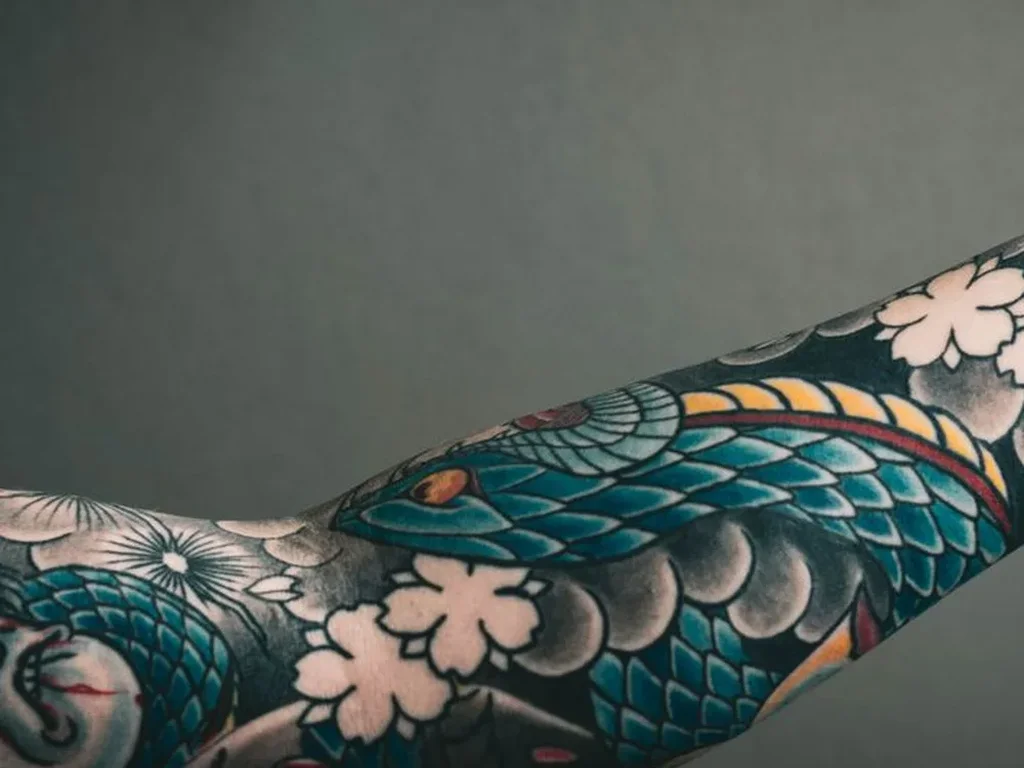
Teal-green scales, pink cherry blossom, dark background waves: this is the Japanese hebi done properly, built as a forearm sleeve rather than a single floating snake. The blossom is not decoration for its own sake. In Japanese composition the flowers soften the snake and fill the gaps so the whole arm reads as one piece.
Colour this saturated needs a Japanese-work specialist and, down the road, a colour refresh sooner than a black tattoo would. Budget for it from the start.
4. A Full Back Piece From 1880s Japan
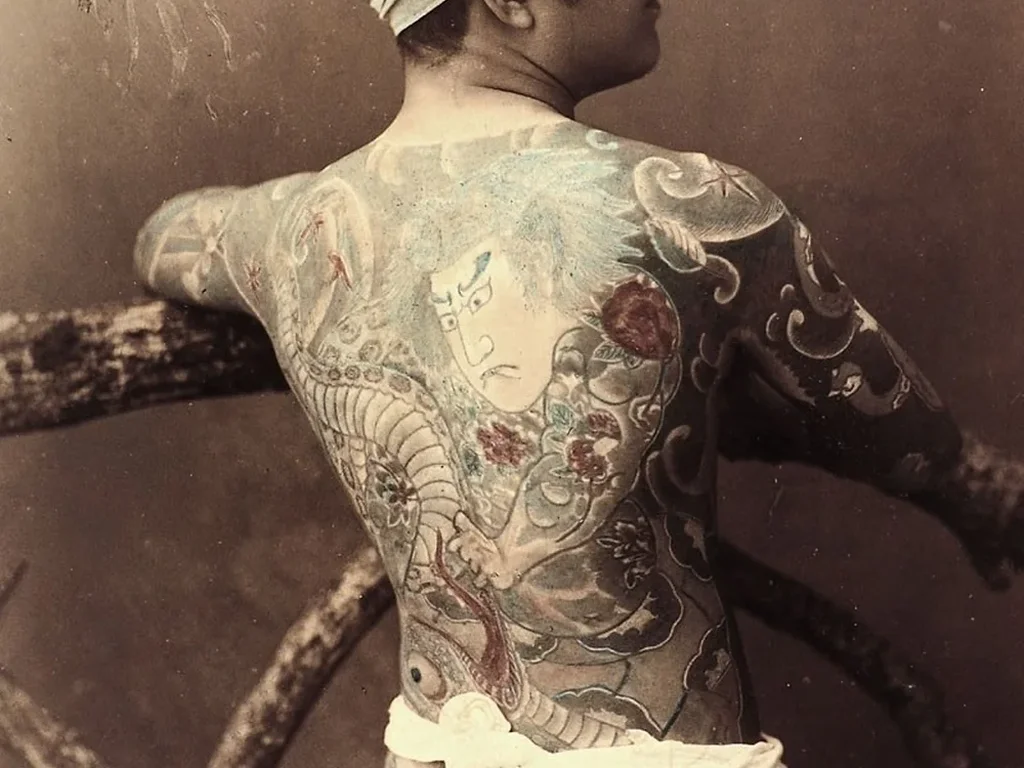
This photograph is roughly 140 years old, and the back piece in it would still turn heads in any studio today. A huge snake winds across the man’s back among flowers and figures, the kind of full-coverage work Japanese tattooing was already famous for while most of the West still treated tattoos as a sailor’s habit.
It is here as a reminder that the snake-and-back pairing is not a trend but one of the oldest big-canvas combinations there is, sitting alongside the dragons and koi of classic Japanese work; our dragon tattoo design ideas shows the snake’s bigger cousin.
5. Blackwork Snake Through Peonies
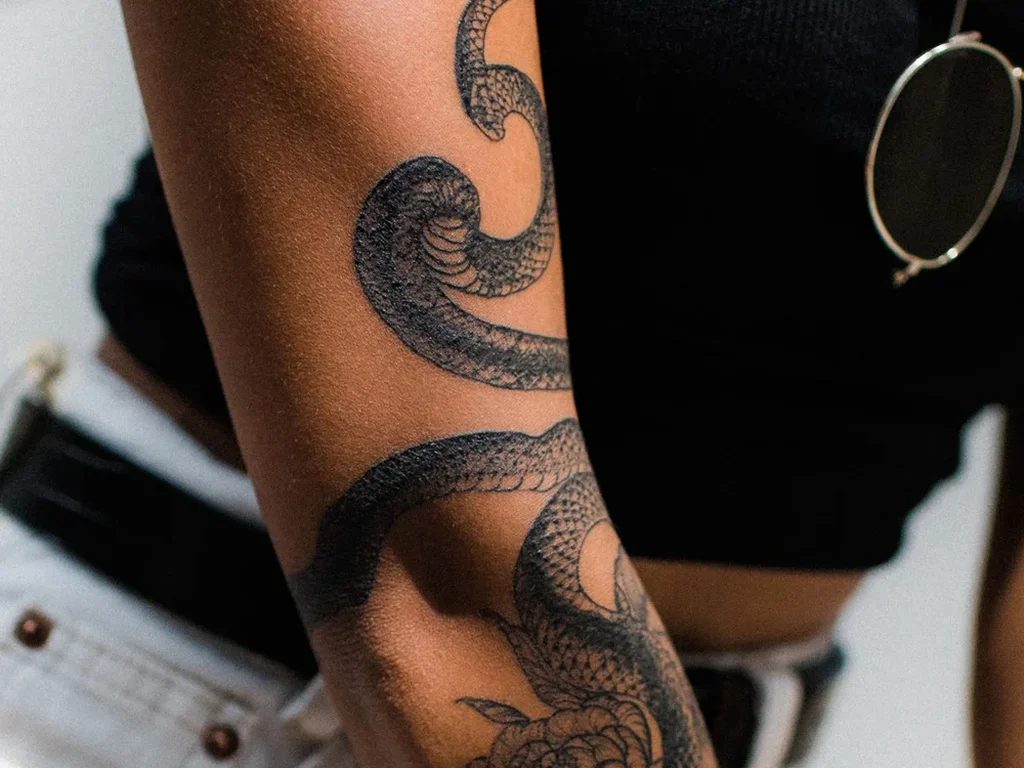
A full arm of black scales and big peony blooms. The flowers do practical work here: their round shapes break up the snake’s long body, give the eye places to rest, and let the design cover the whole arm without a background. Black on black sounds flat. Done with this much contrast between scale and petal, it is not.
Peonies are the usual partner, but most bold flowers do the same job. To plan the floral half properly, our flower tattoo design ideas runs through the options that hold up at this size.
6. Snake Wrapped Around the Forearm
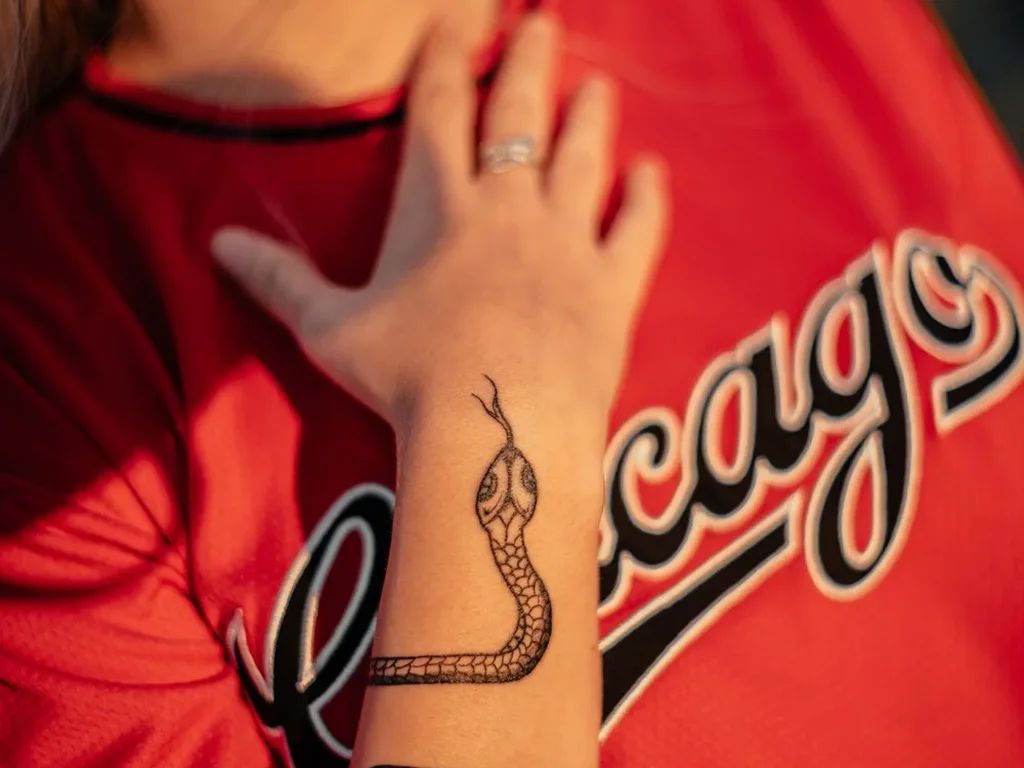
The wrap is the snake tattoo most people picture first, and this one shows why. The body circles the wrist, climbs the forearm in a spiral and finishes with the head raised, tongue out, right where it gets seen. Your arm’s own shape does half the drawing; the artist just has to follow it.
One decision matters: where the head lands. Head at the wrist reads playful; head near the elbow, body pouring downward, reads heavier. Show your artist photos of both before the stencil goes on, because moving it later is not an option.
7. Dark Snake Winding Up the Forearm
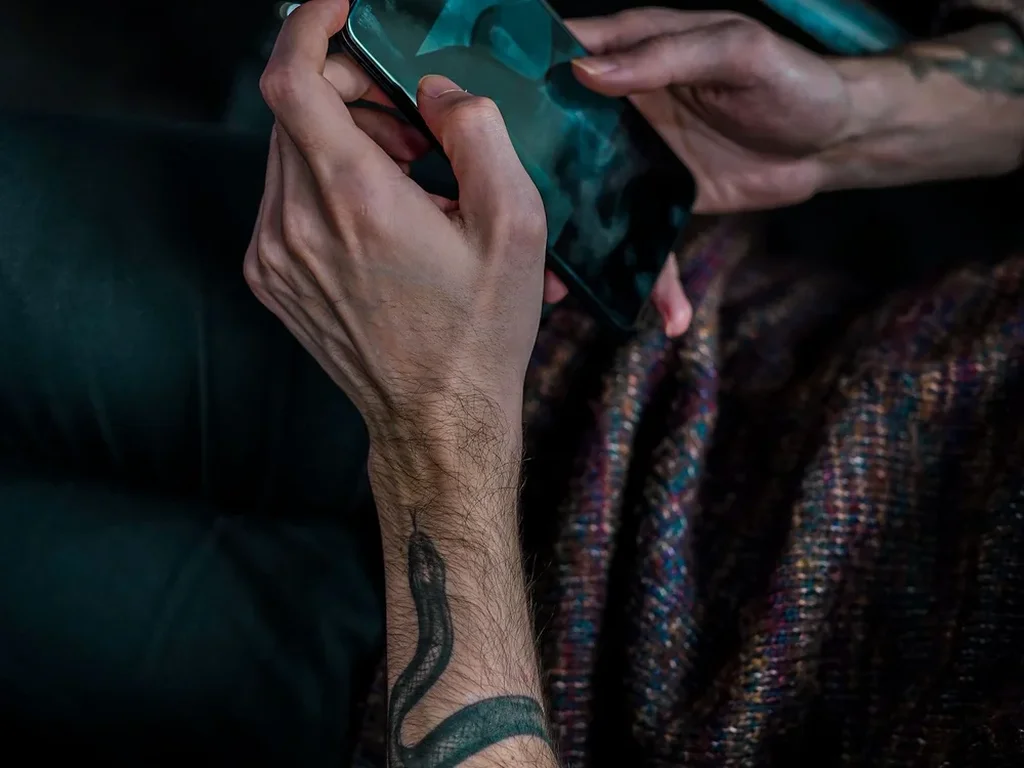
Not every snake tattoo photo online is a fresh, studio-lit shot. This dark green-black snake climbing a forearm looks like somebody’s actual arm on an actual day, which is why it is useful: this is what a settled, lived-in snake tattoo really looks like.
Deep greens behave like this over time: they stay moody and dark rather than bright. If you want colour that reads green from day one to year ten, go lighter than this or accept the shadowy version, which plenty of people honestly prefer.
8. Heavy Blackwork Snake on the Upper Arm
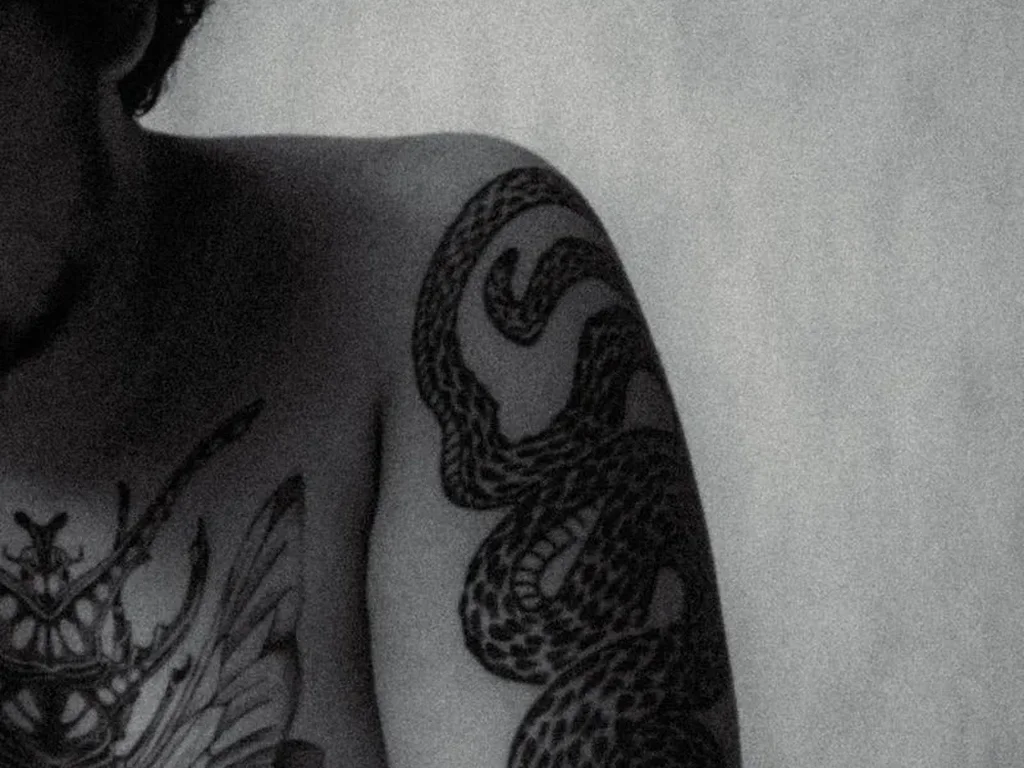
Solid black, stippled scales, zero colour, maximum weight. The upper arm is the right home for a piece this heavy: the skin is flat, the muscle gives the coils something to wrap, and a short sleeve still covers it when you need it covered.
Solid black can go patchy if the artist rushes the packing, so pick someone whose healed work you have seen, not just fresh photos. Healed blackwork should look like velvet, not a scab that never left.
9. Cobra With a Flared Hood on the Chest
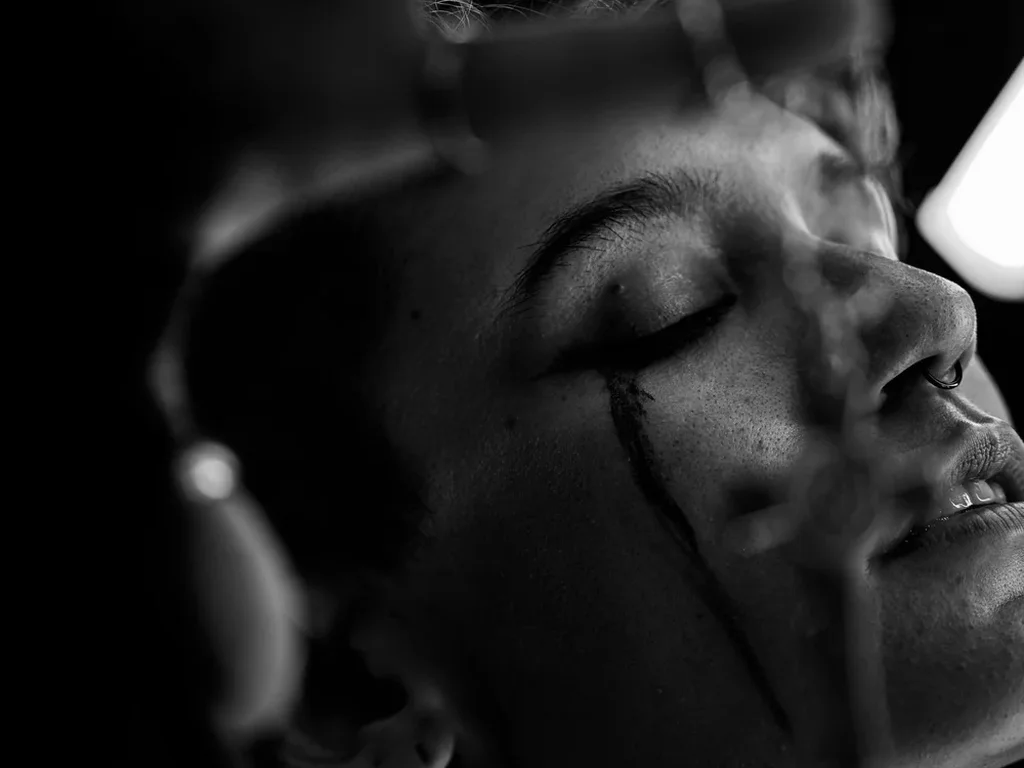
A cobra’s hood is a ready-made chest piece: it spreads where the chest spreads, frames the throat, and the fangs give it a front door you cannot miss. This one runs from neck to upper chest in hard black, about as far from shy as a tattoo gets.
Honest warnings: the collarbone area hurts, neck skin moves a lot and fades faster than arm skin, and a throat-level snake is a job-stopper in plenty of workplaces. None of that makes it a bad tattoo. It makes it a grown-up decision.
10. Coiled Snake on the Side of the Neck
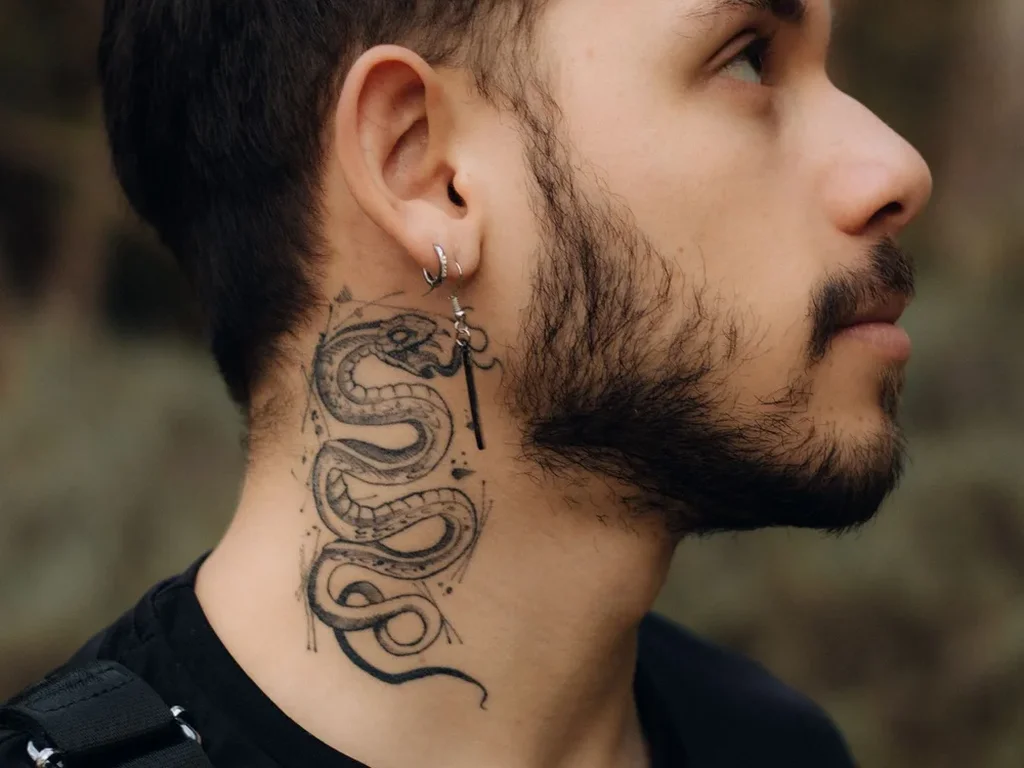
Smaller than the cobra above and quieter for it. A single tight coil, finely shaded, sitting behind the jaw where it appears and disappears as the head turns. The coil shape suits the neck’s curve better than a stretched-out snake ever could.
Neck tattoos fade quicker and blur sooner than almost anywhere else: the skin is thin and always moving. An artist who steers you to a slightly bolder design up here is telling you the truth.
11. Snake Across the Ribs
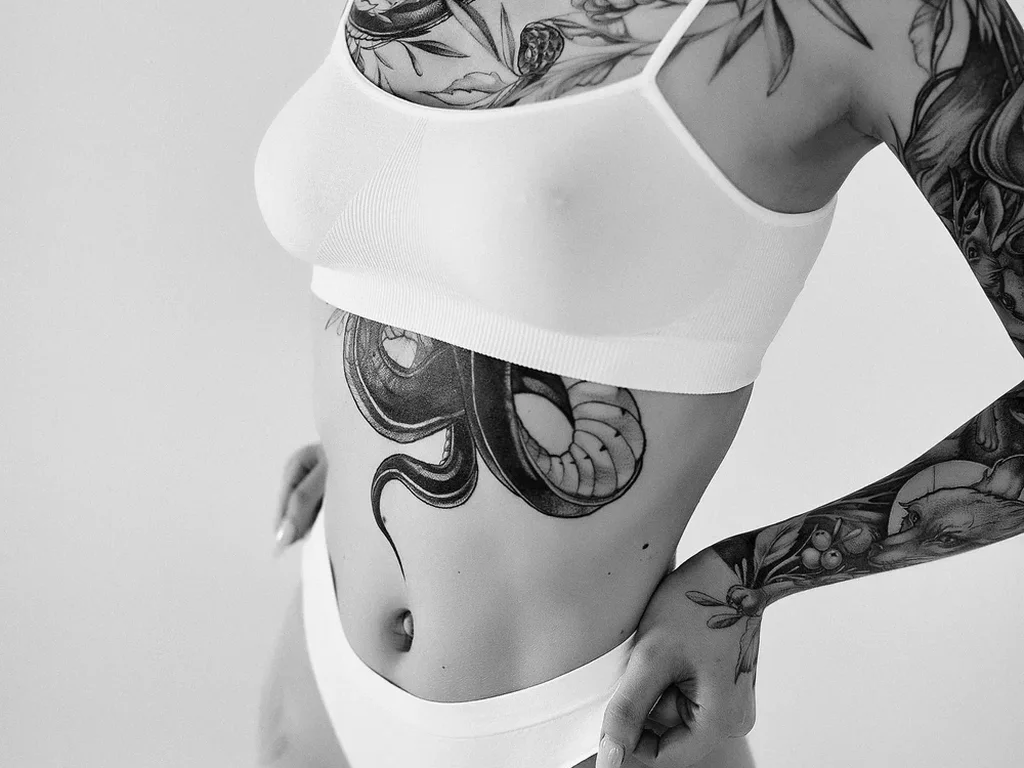
The ribs give a snake the longest unbroken run on the front of the body. This big black snake drops from the chest, sweeps down the side and curls at the waist, using every inch of the route. It hides under almost any top, which is the point for many people who choose this spot.
The trade-off is the sitting. Ribs are bony, the skin is thin, and breathing moves the canvas. Most people rate it among the sorest placements on this page. Eat first, book a shorter session, and do not plan anything athletic the next day.
12. Medusa, With Snakes for Hair
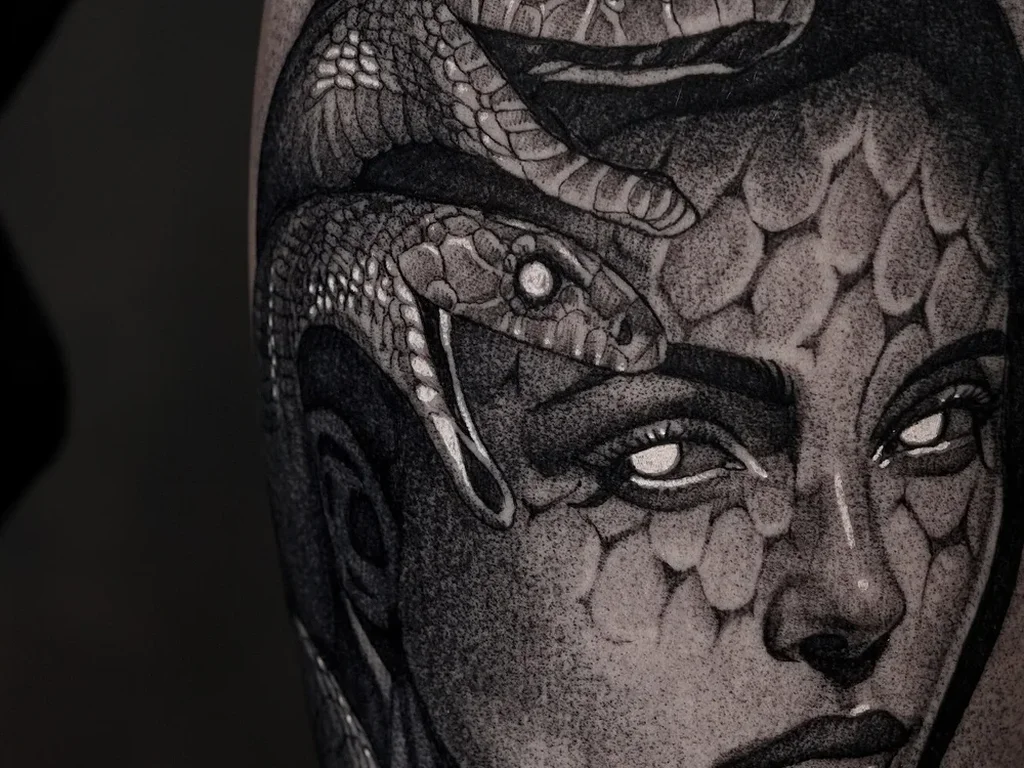
Count the snakes in this one and you will lose track, which is rather the point. Medusa’s hair is a nest of them, each head drawn with its own scales and stare, around a face shaded in fine dotwork. There is no single snake to hide behind, which makes it one of the most demanding pieces on this page.
Medusa carries her own heavy stack of meanings, from rage to survival to protection, and she gets chosen for those reasons more than for the snakes. If she is on your list, our full guide to the Medusa tattoo meaning goes through her story properly. Tattoo by Dom Carter.
13. Green Snake and Drumsticks on the Calf
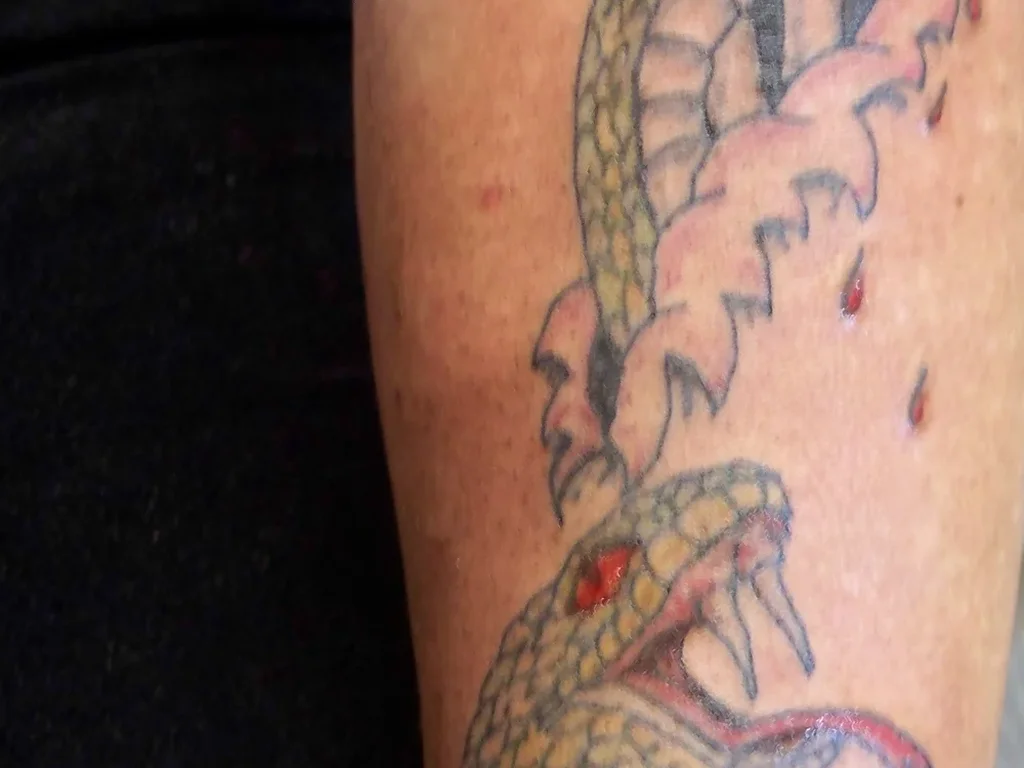
A green snake, a pair of drumsticks and pink Japanese-style clouds, all on one calf. This is a drummer’s tattoo, and it shows the best customisation trick on this page: thread the snake through something from your own life. An instrument, a tool, a plant from your home country. The snake wraps anything.
The calf is an underrated spot for a first bigger piece: meaty, still, hidden under trousers, and a long vertical canvas a climbing snake uses well. Expect a calf cramp halfway through and you will be fine.
14. Fine Line Snake on the Forearm
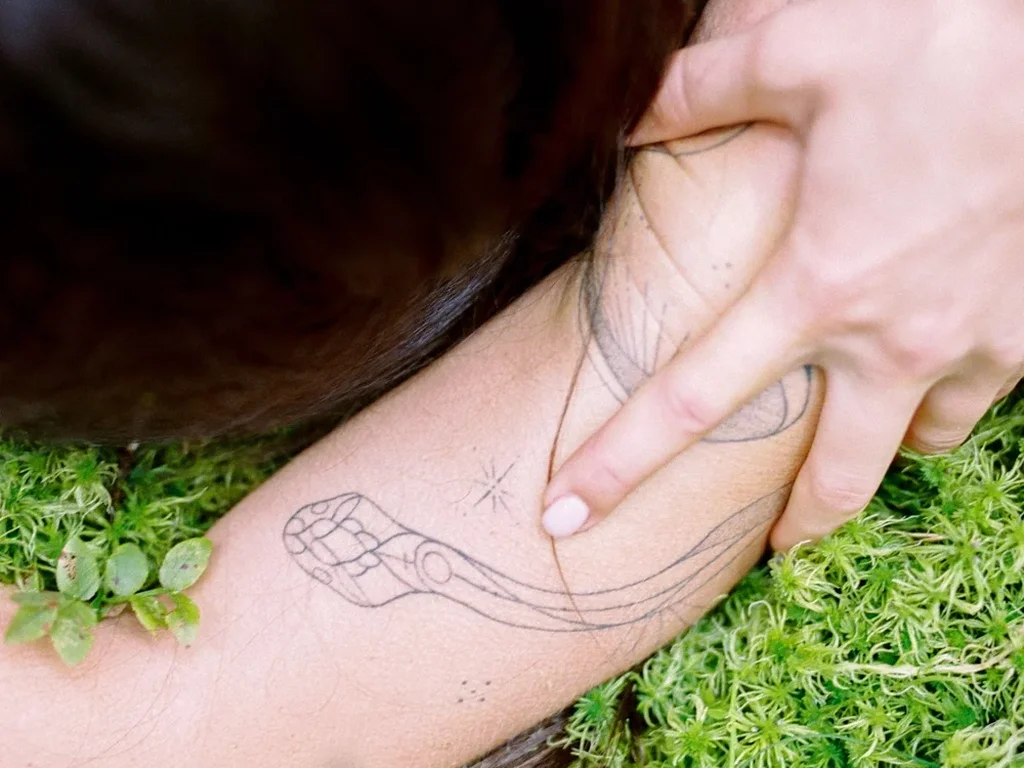
No shading, no scales, just one clean outline of a snake’s head and curves on the inner forearm. Fine line work like this is the lightest touch a snake tattoo can have, and it suits people who want the shape and the meaning without a big visual shout.
Go in with clear eyes: thin lines soften and spread a little as they age, so a fine line snake looks gentler at year five than at week one. Artists who draw the line a touch bolder than the reference photo are compensating for that, not upselling you.
15. Coiled Snake on the Forearm
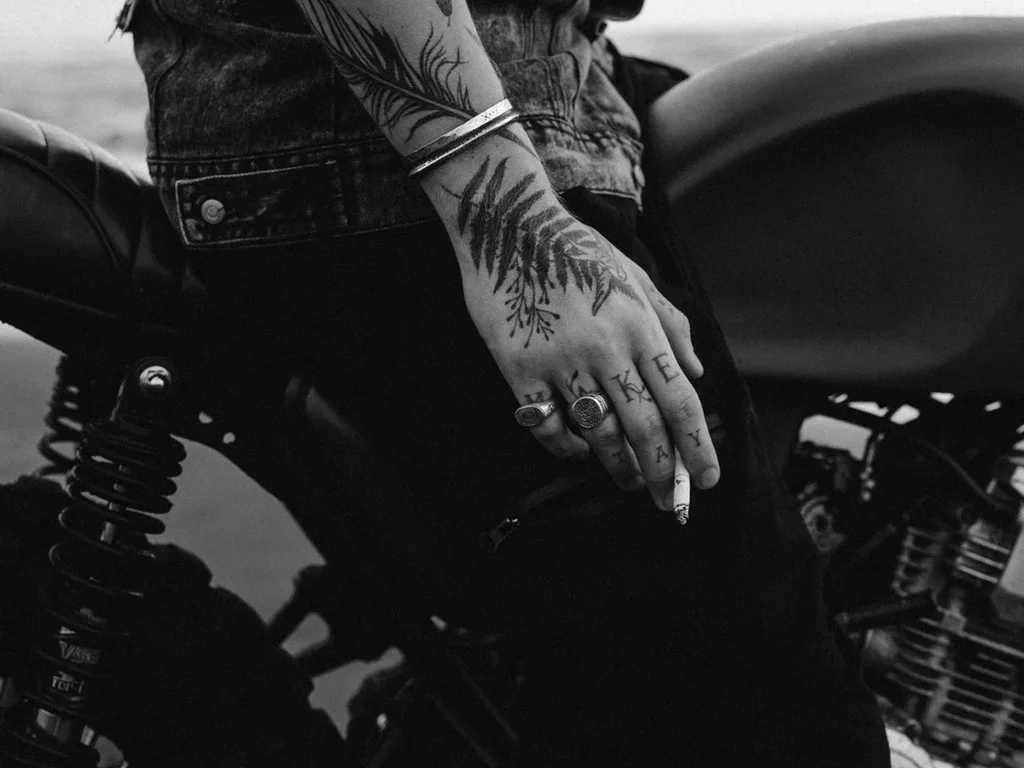
Seen from above, a coiled snake becomes a near-circle, and a forearm frames it well. This rider’s coil sits flat on top of the arm and reads instantly, more emblem than scene. If wraps feel too busy, the coil is the calmer way to wear a snake on the same patch of skin.
Coils also scale well into matching tattoos: same circle, two arms, two people. Keep the line weight identical on both and they will still look like a pair in ten years.
16. Snake Head on the Back of the Hand
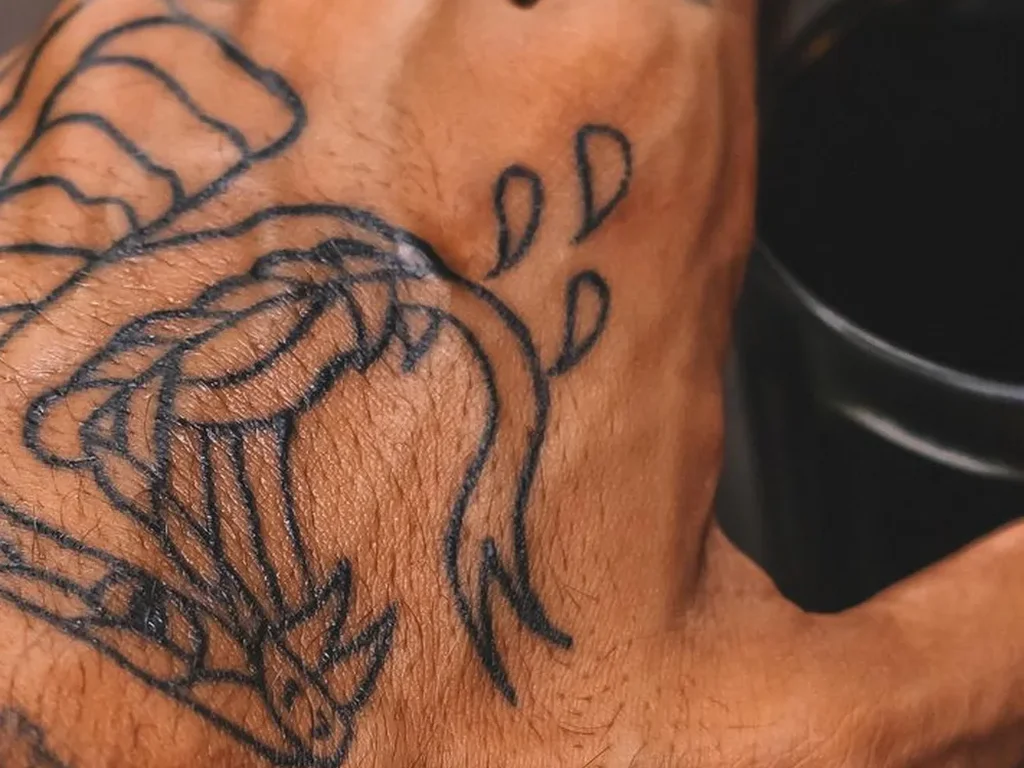
Just the head, mouth open, striking across the back of the hand, the body left to imagination or a future sleeve. Hand tattoos are a statement before anything else: the one placement on this page nobody can unsee, future employers included.
Hands also shed and regrow skin constantly, so expect faster fading and a touch-up or two over the years. Many good artists will ask you to get tattooed somewhere less loaded first. That is not gatekeeping. It is experience talking.
17. Snake on the Shoulder Blade
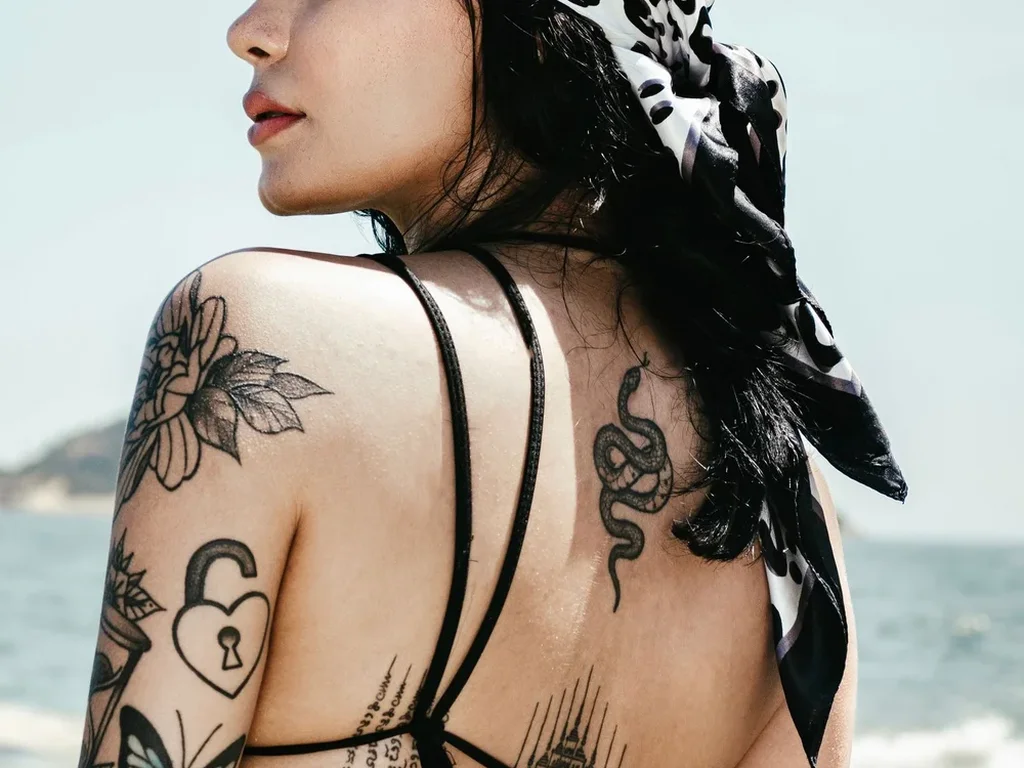
Among this wearer’s flowers, butterfly and script sits a small black coiled snake on the shoulder blade, easy to miss until you look for it. The shoulder blade is a flat, kind oval of skin, and a coil fits it like a stamp. It is also one of the least painful spots on the back.
Small back pieces like this are often the start of a collection rather than a finished statement. If that is your plan, tell your artist now, so the snake’s scale and line weight leave room for neighbours later.
18. Small Black Snake on the Forearm

One wavy black snake, a few inches long, sitting on the forearm like it has always lived there. No scales, no shading, no background. At this size the drawing has to be honest, because there is nothing to hide a wobbly line behind.
This is the size most first-timers actually want, and a sensible place to start. It heals fast, costs little, and grows into a bigger piece easily if you fall in love with being tattooed. If you do not, it stays a neat small mark.
19. Simple S-Curve Snake on the Inner Forearm
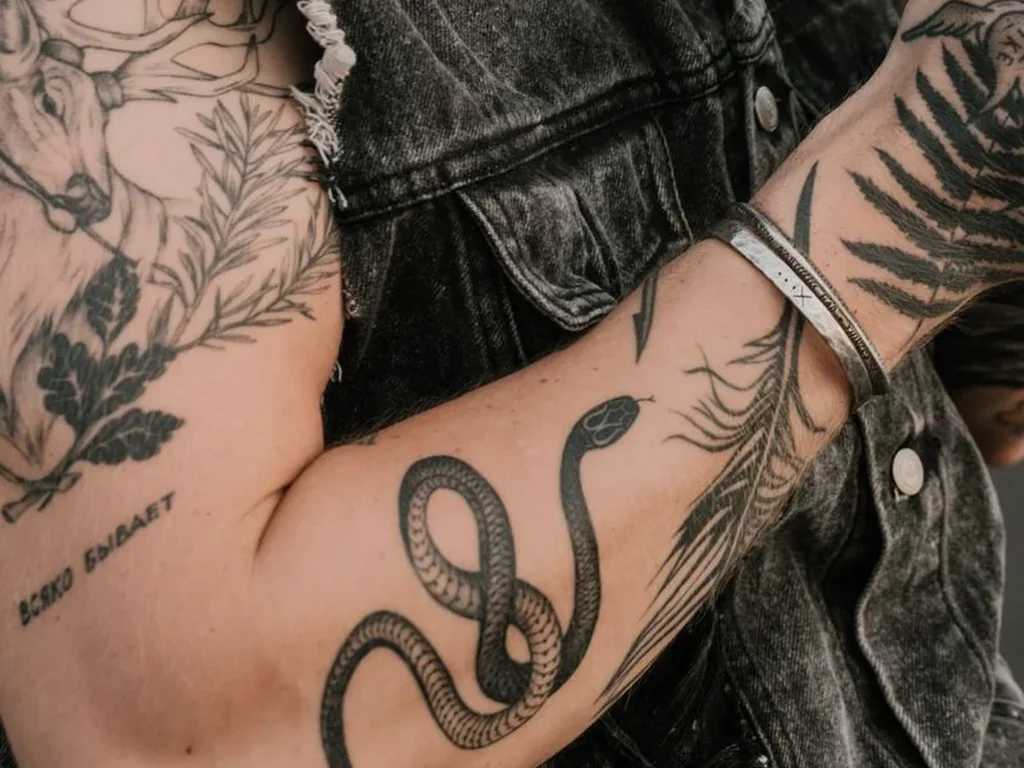
The same idea as the tattoo above, on a man whose arms carry a lot of ink already, and the little snake still holds its own corner. An S-curve is the snake at its purest: it works at two inches, it works at ten, and it never fights the tattoos around it.
Inner forearm skin is soft and holds fine detail well, but it creases at the wrist. Keep the head and tail clear of that fold or the design will bend every time you do.
20. Small Snake on the Wrist
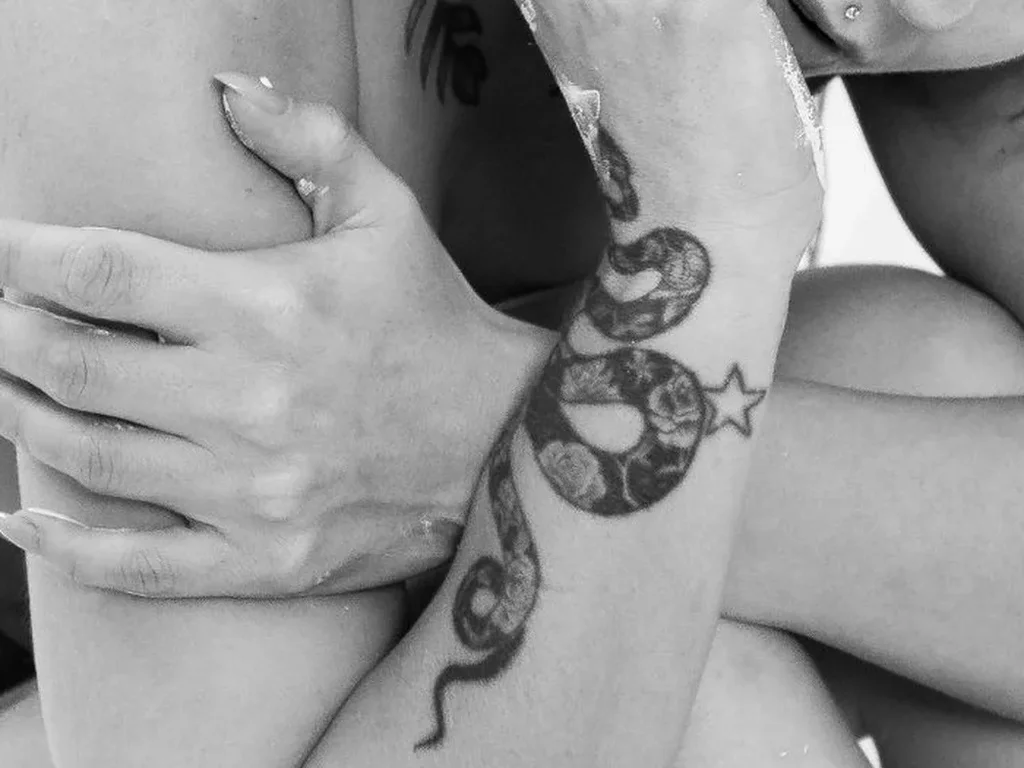
We end at the smallest end of the scale: a slim snake winding down the forearm and finishing at the wrist, with a tiny star by its head. It is delicate without being frail, because the line stays consistent all the way down instead of fading into wisps.
Wrist skin is thin and flexes all day, so small wrist pieces soften faster than the same design on a forearm. Keep it simple and the lines clean, and it will soften gracefully instead of blurring.
Where a Snake Tattoo Works Best
Spine. The most natural fit on the body. A long snake can follow the vertebrae from neck to lower back, head up or head down. Expect the bony sections to sting more than the fleshier ones, and a full spine piece to take more than one session.
Forearm. The wrap lives here for a reason. The forearm is visible, fairly flat, low on the pain scale for most people and easy to show or cover with a sleeve of the clothing kind. If you are choosing between several designs on this page, the forearm versions are the ones to measure your ideas against.
Leg. A climbing snake uses the calf and thigh better than almost any other subject, because the leg is long and the muscle gives the coils a curve to follow. Calf pieces sit still while you are being tattooed, which your artist will quietly thank you for.
Chest. Built for the cobra’s hood or two snakes meeting in the middle. The centre of the chest is manageable pain-wise; the collarbones and sternum are not. Chest skin also changes with weight and training more than arm skin, so bold designs age kinder here than fine ones.
Hand and neck. The highest-impact, highest-maintenance spots. Both fade faster, both are hard to cover, and strangers will read them before they read you. If your life allows them, they look incredible. If not, the same designs lose nothing by moving to the forearm.
Frequently Asked Questions
What does a snake tattoo mean?
Most people mean rebirth: snakes shed their skin and come out new, so the tattoo marks a fresh start. It can also point to Eden and temptation, to kundalini energy rising up the spine, to protection and luck in Japanese tradition, or to the ouroboros cycle. Your reason is the one that counts.
Are snake tattoos bad luck in some cultures?
Attitudes genuinely split. In Christian-influenced readings the serpent is Eden’s villain, and some people will always see it that way. In Japan and much of Asia the snake leans lucky and protective, and it is one of the twelve zodiac animals in China. Not bad luck in any universal sense, then, but a symbol people hold opinions about, so expect both reactions.
How much does a snake tattoo cost?
Rough US ranges: a small simple snake like numbers 18 to 20 often lands between a shop’s minimum (commonly $80–150) and about $250. A detailed forearm wrap usually runs $300–800. Big work like a full arm or back piece is priced by the hour or session, and totals in the thousands are normal. City and waiting list move these numbers a lot, so treat them as a starting point, not a quote.
Do detailed scales age well?
Scales age in proportion to their size. Big, bold scales with solid black between them still read clearly after a decade. Tiny scales packed close together soften into texture, which can still look good but stops looking like individual scales. If long-term detail matters to you, go bigger than feels necessary on day one.
What is the smallest size a snake tattoo can be?
A single-line or S-curve snake works down to about two inches, because it asks so little of the skin. The moment you want visible scales, eyes or a tongue, think four inches and up. Below that the details have nowhere to live and blur together as the tattoo settles.
Should I get a snake tattoo in colour or black and grey?
Black and grey is the safer long game: it fades evenly and suits every skin tone. Colour gives you the green hebi, the traditional reds, the gold eye on the realism piece, but bright colours need sun protection and, for saturated Japanese-style work, an eventual refresh. Pick colour because you love it, not because black felt like settling. It is not.
Is a snake a good first tattoo?
Yes, with the right shape and spot. A small or medium snake on the forearm, calf or shoulder blade heals easily, costs fairly and can be built on later. Save the ribs, throat and full spine for when you know how you handle being tattooed.
How long does a snake sleeve or a leg climb take?
Plan on sessions, not an afternoon. A full-arm snake piece usually starts with a 3–5 hour lining session, then one or two shading or colour sessions of similar length, spaced weeks apart for healing. A leg climb runs about the same. Anyone promising a detailed full sleeve in one sitting is selling you something.
Do matching snake tattoos work for couples or friends?
They work better than most matching designs, because a snake mirrors itself: one curls left, one right, same size, opposite forearms or wrists. Another popular split is one person wearing the snake, the other the moon it curls around; our moon tattoo design ideas covers that symbol on its own. Keep line weights identical so the pair ages together.
Can a snake tattoo cover up an old tattoo?
Often, yes. Snakes bend to any shape, scales create busy texture, and dark sections can sit exactly where the old ink is darkest. The limits: the new piece usually needs to be bigger and darker than what it hides, and very black old work may need a laser session first. Bring photos to your consultation and let the artist judge it.
Final Thoughts
If you take one thing from this page, take this: choose the shape before the style. Decide whether your snake coils, wraps, climbs or strikes, and where that shape belongs. Style can be settled with your artist in one conversation once the shape is right.
Save the three designs you keep coming back to, look again in a week, and notice which one you are still thinking about. That is usually the tattoo. Book a consultation, bring the photos, and let a good artist bend the snake around your body instead of copying one outright. Yours will fit better anyway.
Photo credits: Design 1: photo by Gypates, Wikimedia Commons, CC BY 4.0. Design 2: photo by Miguel Discart, Wikimedia Commons, CC BY-SA 2.0. Design 4: Wikimedia Commons, public domain. Design 12: tattoo and photo by Dom Carter, Wikimedia Commons, CC BY-SA 4.0. Design 13: Wikimedia Commons, public domain. Designs 3, 5, 6, 7, 8, 9, 10, 11 and 14–20: Pexels, Pexels License.