An elephant is the tattoo people pick when the point is not power but weight — memory, family, patience, the long way round. If you are working through elephant tattoo ideas, the split to know is between the animal itself, drawn as a portrait or a herd piece, and Ganesh, the elephant-headed Hindu god, who is a different subject wearing a similar outline. This list keeps both, labels them clearly, and shows what each one asks of your skin.
Every design below is a real tattoo in a real photograph, counted one by one: 24 in total. No stock illustrations, no repeated photos under different names, no padding. Where a photo shows a tattoo fresh, half-hidden or photographed in poor light, that gets said out loud.
This guide sits inside the animal cluster on this site. It is the single-species companion to our
animal tattoo ideas pillar and the
wild animal tattoo ideas sampler, and it is built the same way as our lion and owl guides — real photographs only, honest counts, and the ageing notes included, good or bad. For the elephants that live with people rather than in herds, see our
pet tattoo ideas page.
What Elephant Tattoos Mean
Memory and family come first, and this one is rooted in how elephants actually live. Herds are led by an old female, calves are raised by the whole group, and elephants revisit the bones of their dead.
Britannica’s elephant profile covers the family structure in plain terms. That is why so many elephant tattoos are really family tattoos — a mother and calf, a line of elephants walking, names worked in underneath.
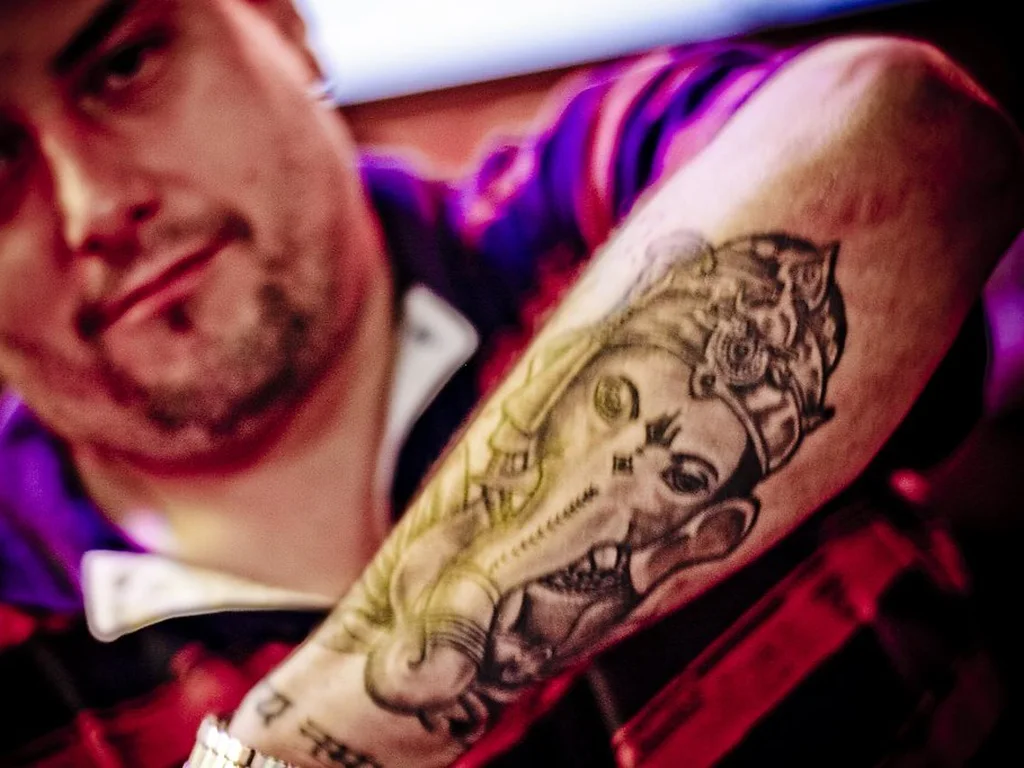
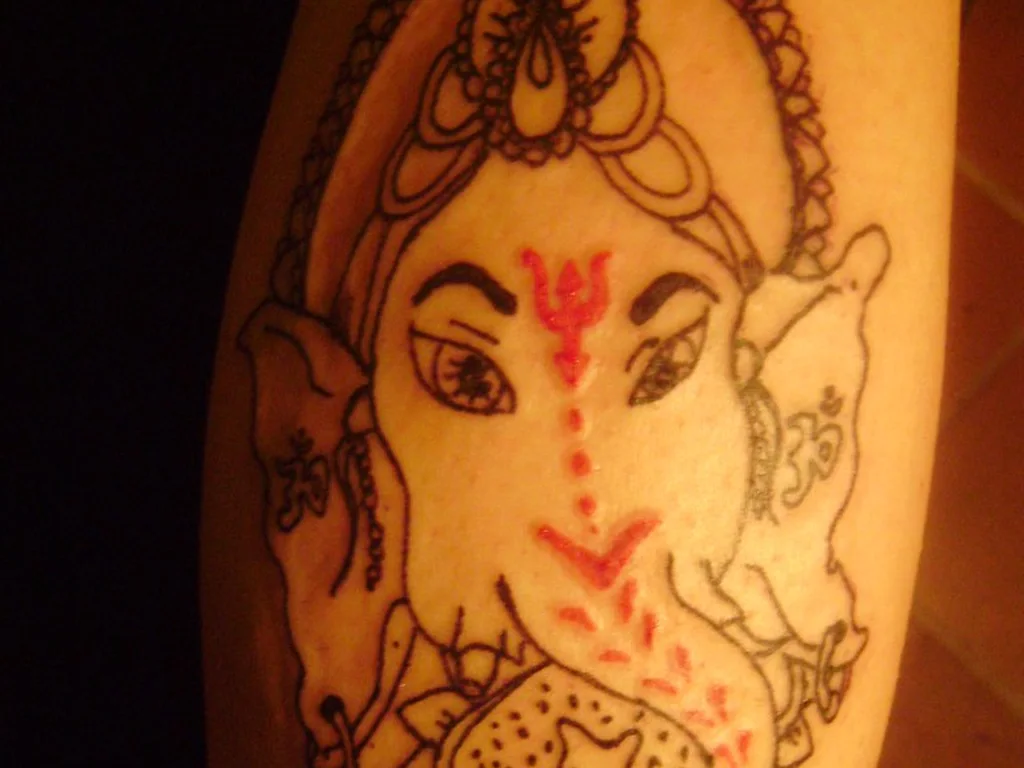
Ganesh needs his own paragraph, because he is not an elephant design at all. Ganesh — also written Ganesha — is a Hindu god, the remover of obstacles, worshipped at the start of new ventures. Designs 8 to 13 in this list are Ganesh pieces, and they are faith tattoos before they are animal tattoos. If you wear one, wear it with that knowledge: many Hindus keep images of deities off the feet and lower legs, and a respectful artist will steer a Ganesh design to the arm, shoulder or back.
Luck and wisdom are the softer readings, and honesty requires a label: the “trunk up means luck, trunk down means bad luck” rule is tattoo-shop and gift-shop talk, not an old law. It is repeated so often that many wearers choose on that basis anyway, which is fine — just know it is convention. In Thailand there is a harder fact underneath: the white elephant is sacred and royal there, and the three-headed Erawan of Hindu and Thai tradition is a genuinely old religious image.
One design note that costs nothing: African and Asian elephants are easy to tell apart in a portrait. African elephants have huge ears shaped roughly like their continent and two “fingers” on the trunk; Asian elephants have smaller ears and one finger. Most of the big realism heads in this list — designs 1 to 6 — are African elephants, which is why the ears do so much of the work.
The 24 Designs
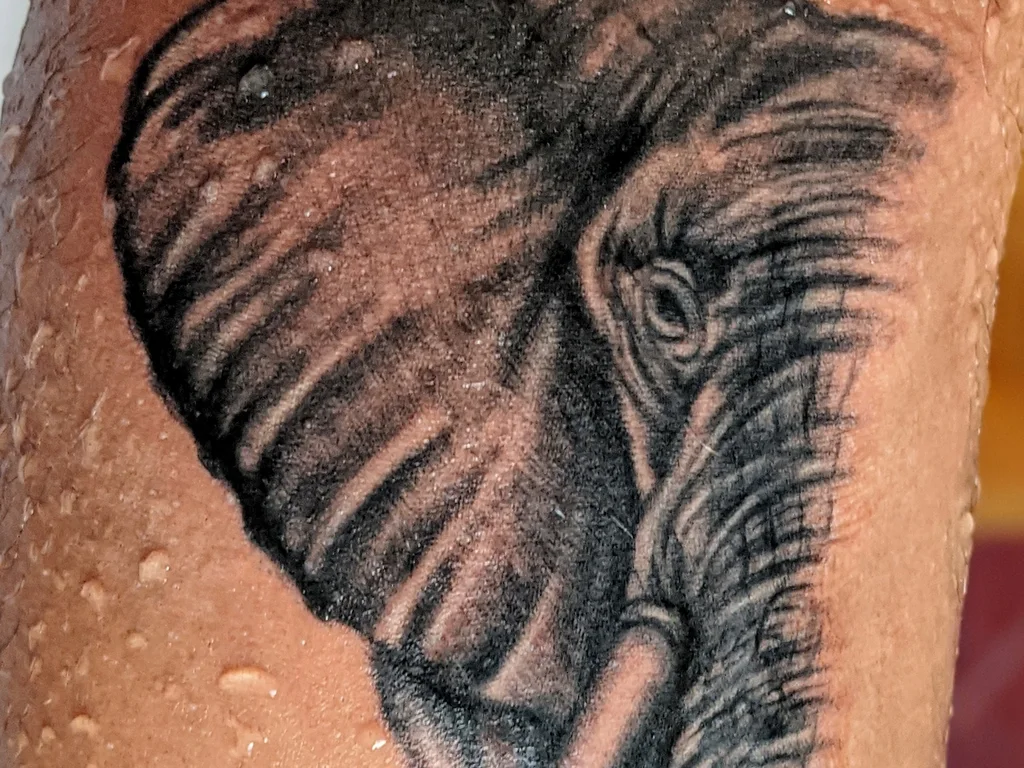
1. Realism Elephant Head, Calf
A single African elephant’s head in black and grey realism, cropped tight on the calf: one big ear, one eye, the trunk running out of frame. The skin texture is drawn wrinkle by wrinkle, which is the whole appeal of the piece.
Wrinkle work is a promise you make to your future self. Those fine lines are the first thing time softens, so a head drawn this large is the right call — the ear and eye stay readable long after the smallest creases relax.
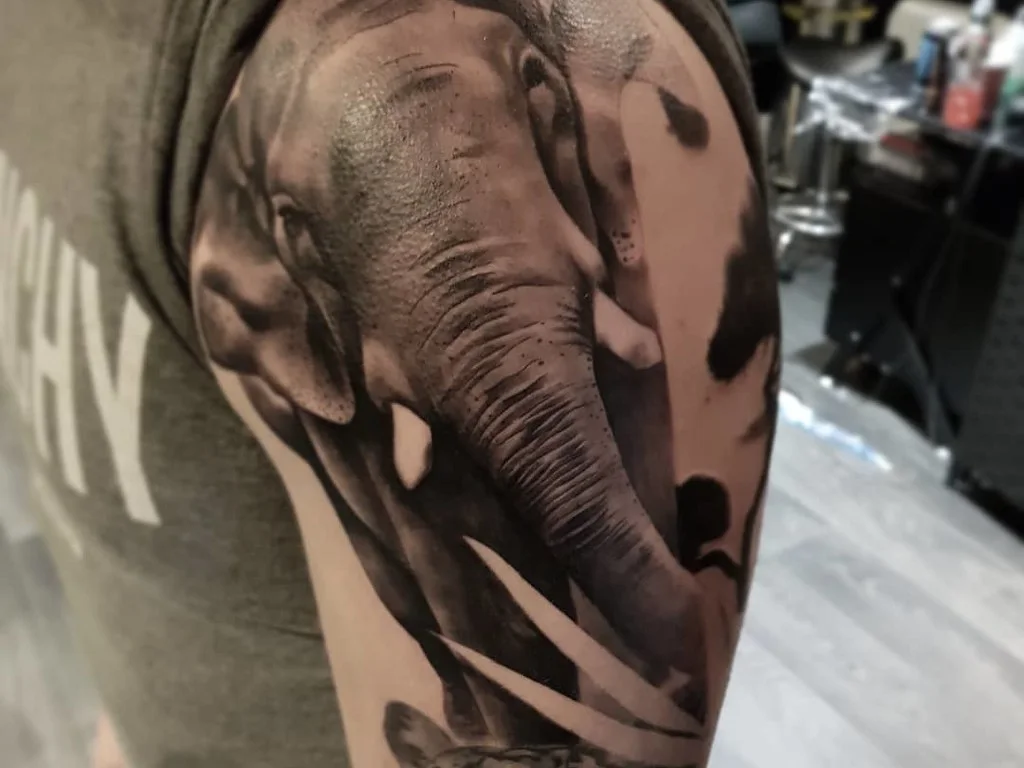
2. Realism Elephant Head Sleeve, Upper Arm
An elephant’s head wraps the upper arm, trunk curling down toward the elbow, with dark background shapes pushing the grey skin of the elephant forward. It is built as the top panel of a sleeve rather than a standalone piece.
The wrap is the point and the risk. A head that circles the arm has to be drawn on the arm, not adapted from a flat sketch — ask how the artist plans the join at the back, where the ear meets itself.
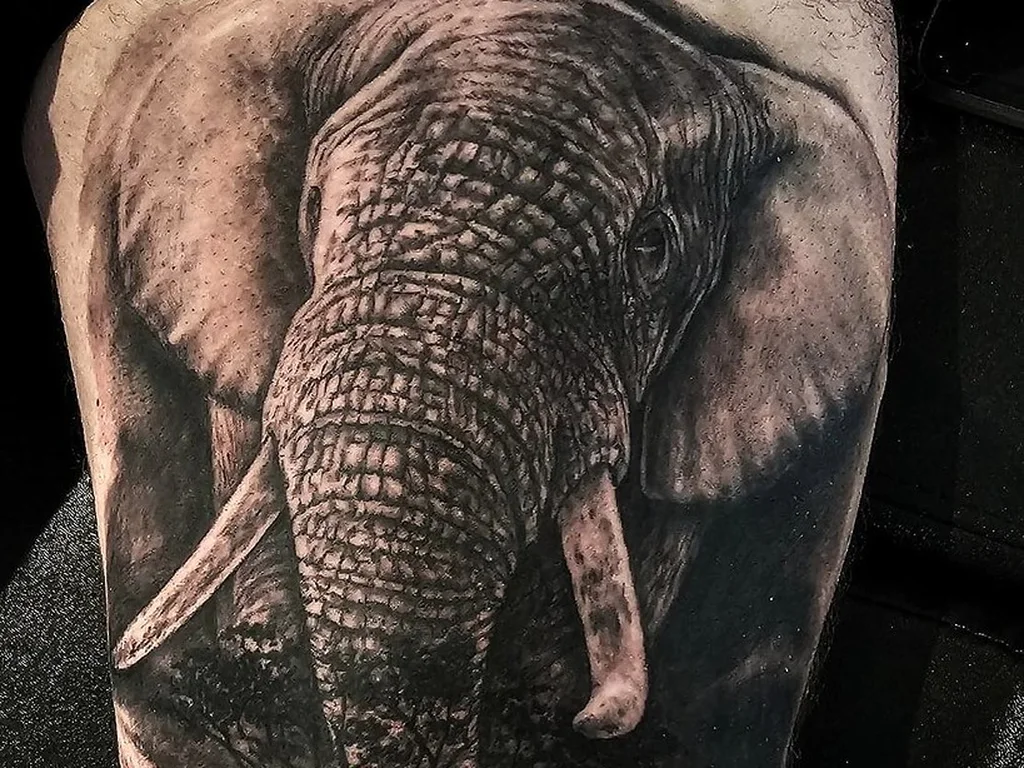
3. Elephant With an Acacia Tree, Thigh
A front-facing elephant’s head fills the thigh, tusks out, with an acacia tree worked into the design and two small calf silhouettes standing at the bottom of the piece. The head is realism; the calves are plain dark shapes.
That mix is a sensible way to build a family piece. The portrait gets the size, the little elephants get the meaning, and silhouettes hold their shape at sizes where small realism would blur.
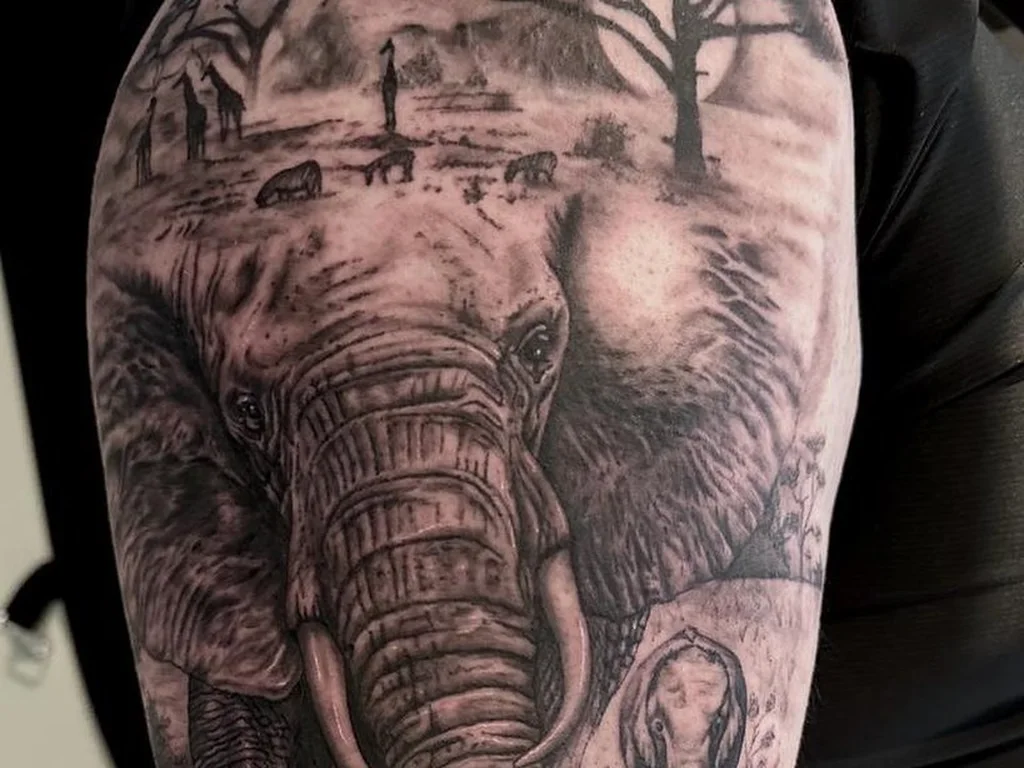
4. Savanna Scene Sleeve, Upper Arm
A whole landscape on one upper arm: an elephant’s head at the centre, flat-topped trees, distant elephants on a horizon line and birds in a pale sky above. It reads like a framed picture that happens to be on skin.
Scene pieces live or die on their lightest greys, and the sky here is nearly bare skin. Expect the horizon to stay and the sky to quietly disappear over the years — the design is built to survive that.
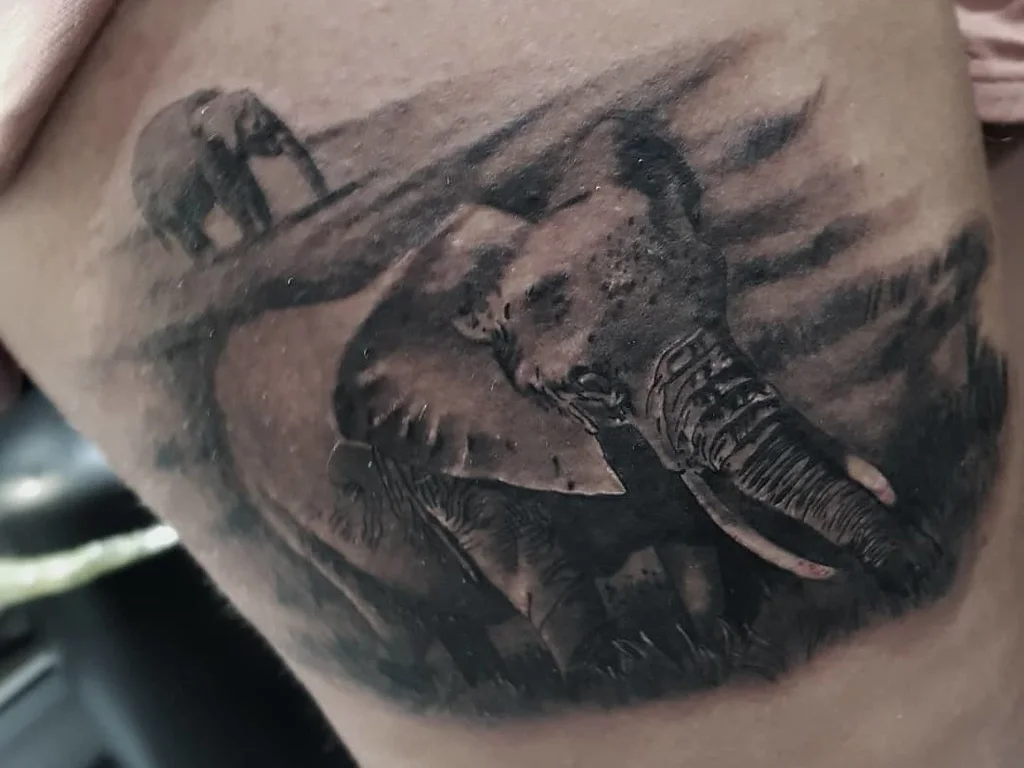
5. Elephant Herd Wrap, Thigh
Two elephants in black and grey, one walking out of a smoky background, worked around the thigh so the scene continues past what a single photograph can show. The shading is soft and the edges are smoky rather than outlined.
Smoke and soft shadow age faster than hard shapes, and a wrap hides its own back side from you. Choose this style knowing it will settle into something gentler than the fresh photos suggest.
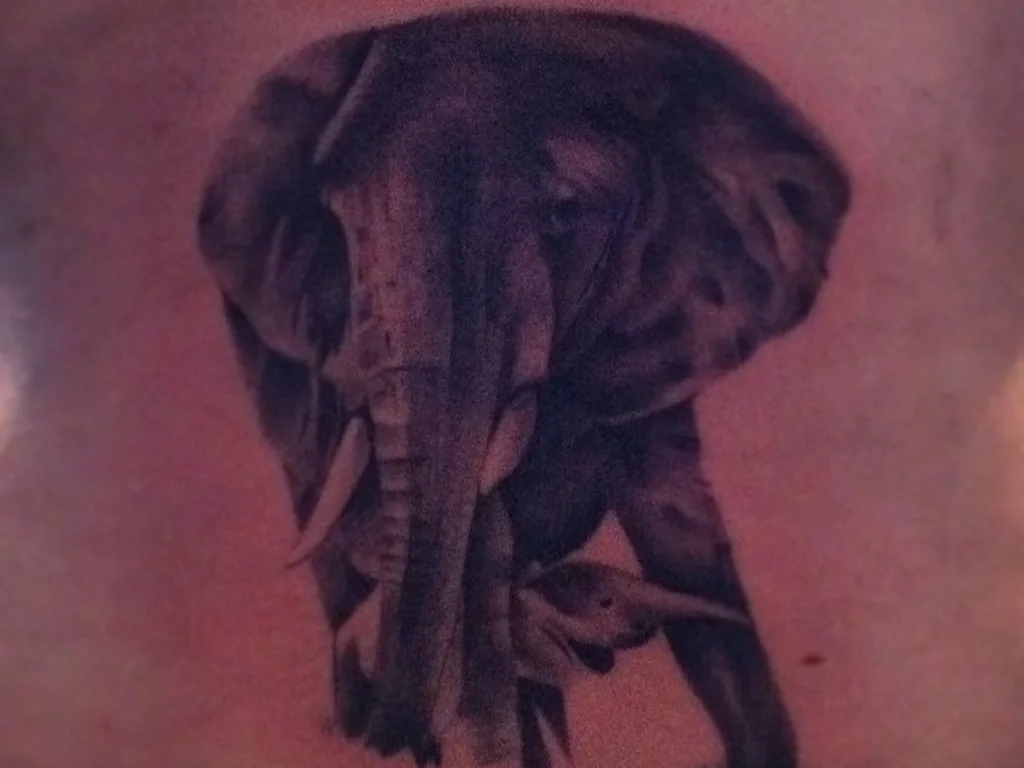
6. Elephant Walking Forward, Lower Back
A full elephant walks straight toward the viewer across a lower back, head on, both tusks showing. The photograph is dark and warm-toned, so the tattoo reads moodier here than it will in daylight.
Front-on is the hardest elephant angle to draw — two eyes, two ears, everything symmetrical. The lower back gives it the wide, flat canvas that symmetry needs, and it is easy to keep covered.
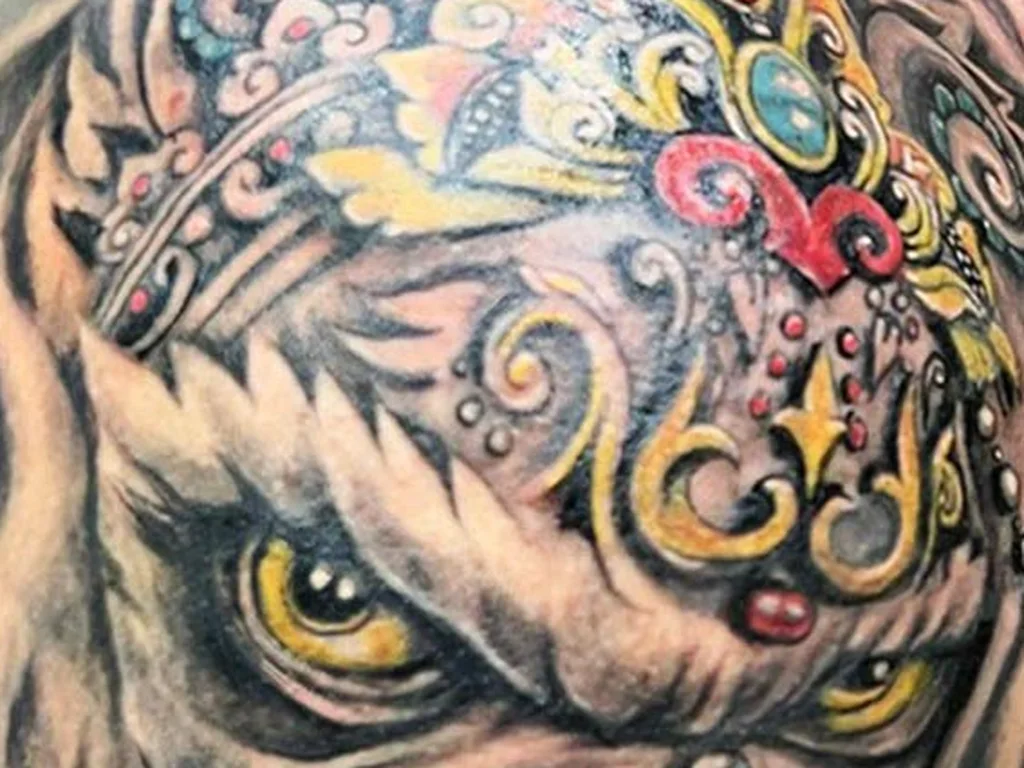
7. Decorated Elephant Head Cover-Up, Upper Arm
An elephant’s face staring straight out, wearing a jewelled headdress in gold, red and turquoise, with painted patterns across the forehead. The photograph shows the finished half of a cover-up — this design sits on top of an older tattoo.
Decorated elephants come from real festival tradition in India and Thailand, where elephants are painted for processions. As a cover-up the busy detail is practical too: pattern and dark shading are what hide old ink.
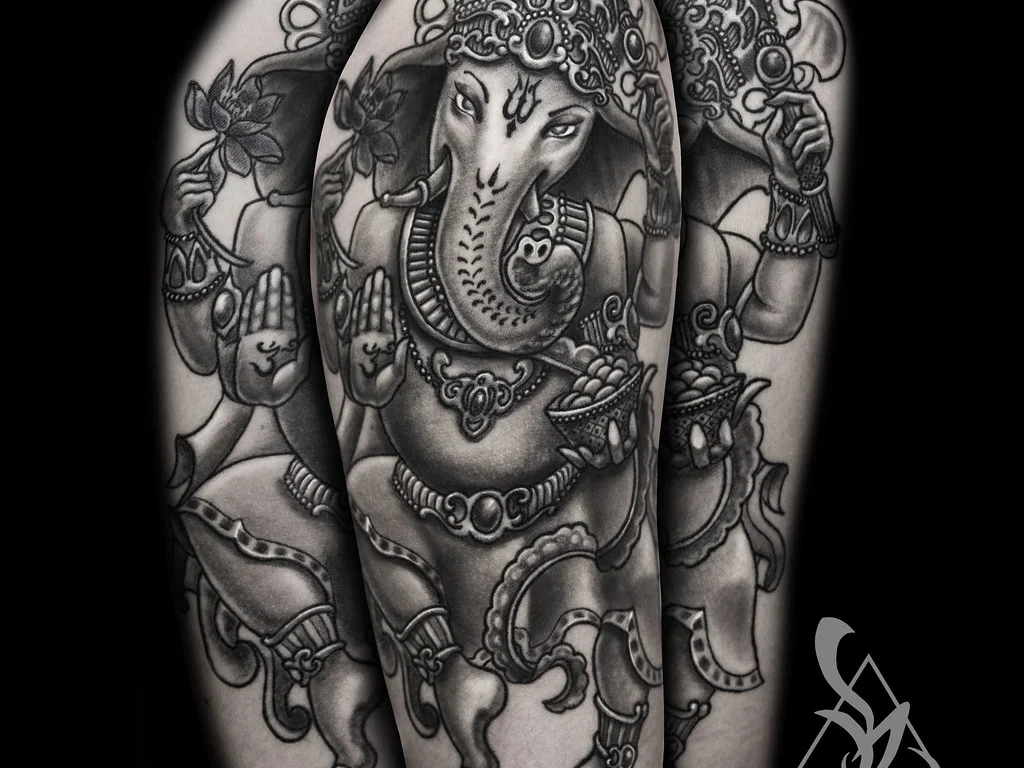
8. Ganesha Half Sleeve in Black and Grey, Upper Arm
Ganesha worked down an upper arm in black and grey, crowned and jewelled, with the god’s trunk curled and ornamental detail packed around him. The photograph is a composite showing the arm from two sides, because the design wraps.
This is the full-commitment version of a Ganesh tattoo — a half sleeve of a deity, drawn to be seen. Work like this takes more than one sitting, and the fine jewellery detail is why.
9. Ganesh Head, Forearm
Ganesh’s head fills a forearm — long trunk running toward the wrist, crown and jewellery drawn in fine black and grey. The photograph has a strong colour cast from the room it was taken in; the tattoo itself is monochrome.
A forearm puts a deity on display at handshake height, which is exactly what most wearers of this design want. The trunk following the arm’s length is the natural layout, and artists reach for it again and again.
10. Ganesh Face in Colour, Forearm
A front-facing Ganesh face drawn in outline with soft colour, a red tilak mark on the forehead and the god’s big ears framing the design. It is closer to the style of a temple painting than to realism.
Soft colour over line work heals gently and fades gently too. The outline is doing the long-term work here, so it matters that the lines are complete and confident rather than sketchy.
11. Ganesh Face in Colour, Calf
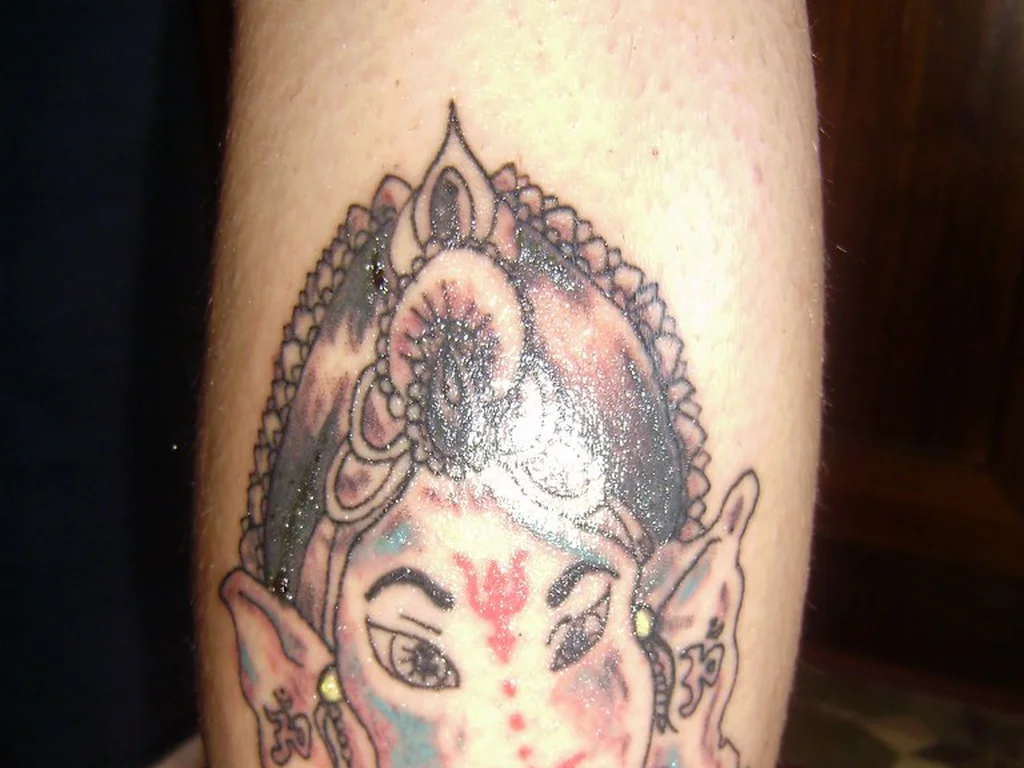
The same face-on approach on a calf: Ganesh’s head in outline and colour, crowned, with red markings and a calm expression. The calf’s shape suits a face — wide at the top, narrowing below.
One honest note, repeated from the meanings section because the placement makes it matter: many Hindu wearers would not put a deity this low on the body. If the calf is your spot, know the convention exists before you book.
12. Ganesh With Flowers, Forearm
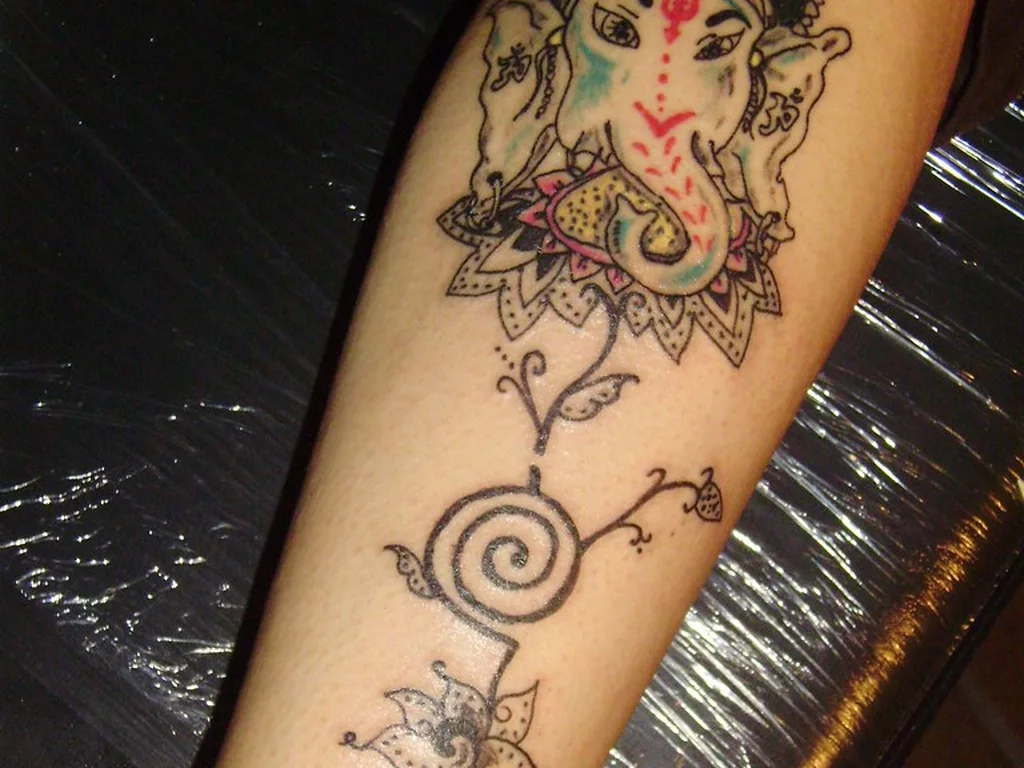
A small seated Ganesh at the top of a forearm, drawn in fine line and soft colour, with flowers, a curling spiral stem and dotted detail trailing down toward the wrist. The lightest touch of any Ganesh piece in this list.
Fine line and pale colour is the fastest-fading combination in tattooing. Worn knowingly, it has a delicacy the bold pieces cannot match — and it may want a touch-up sooner than they will.
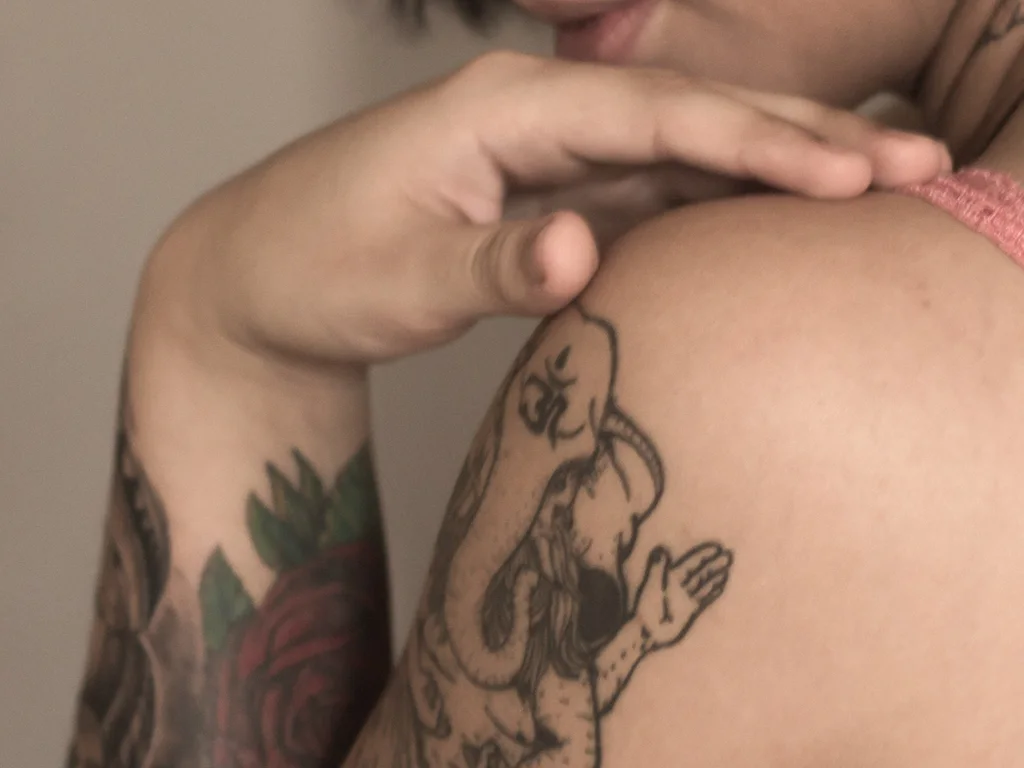
13. Traditional Ganesh, Upper Arm
A seated Ganesh in traditional outline style on an upper arm — pot belly, raised hand, drawn the way he appears in Indian popular art. The photograph shows the wearer’s shoulder and back as well; the Ganesh sits on the arm, among her other tattoos.
Traditional beats realistic for some wearers precisely because it looks like the pictures they grew up with. Bold outline, flat shading, nothing to prove — a design that will still read clearly in twenty years.
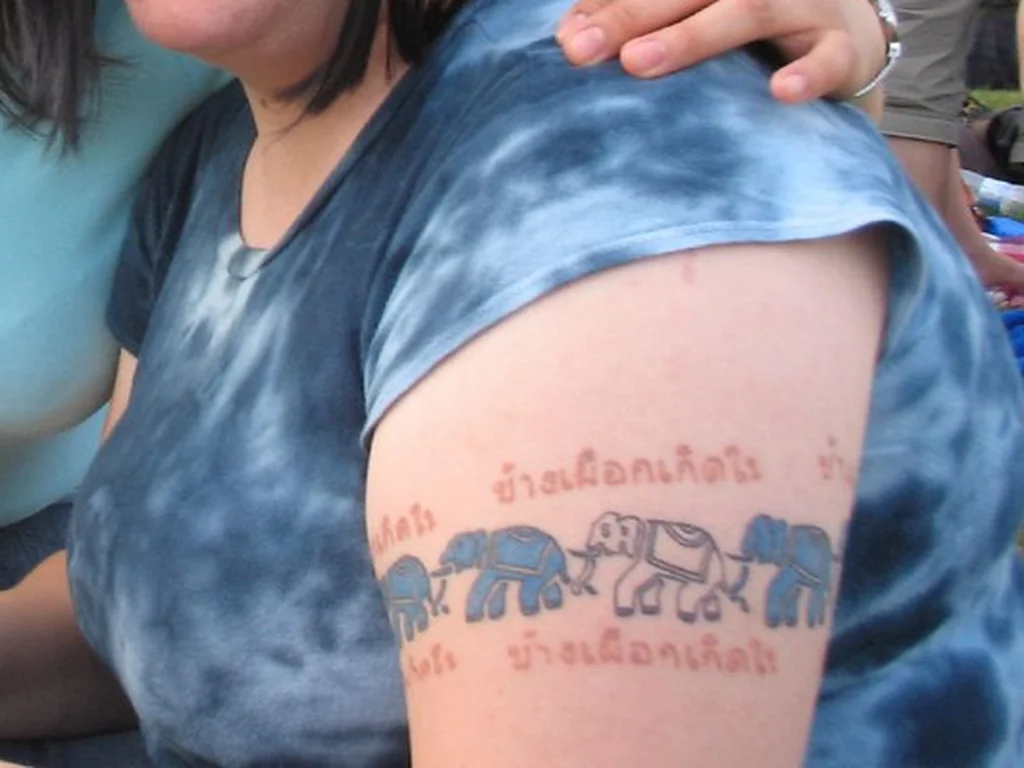
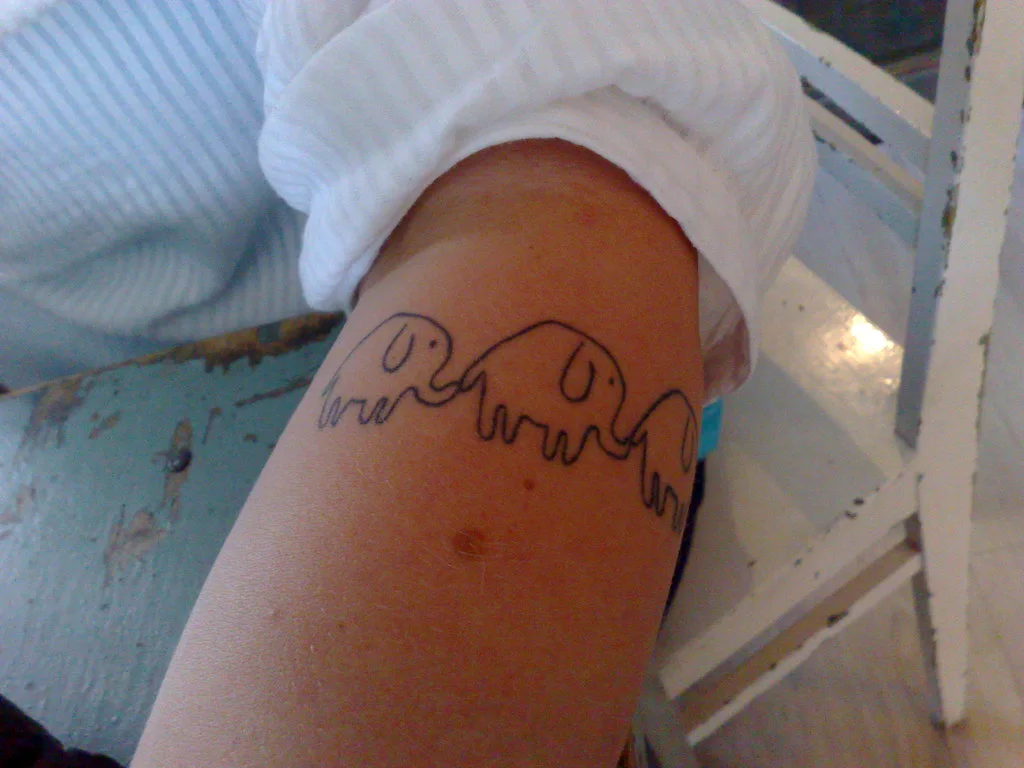
14. Elephant Procession With Thai Script, Upper Arm
A line of small elephants walks around an upper arm, trunk to tail, with a line of Thai script above them and another below. The photograph is a tight crop of the arm, so the final image is softer than most in this list.
Procession designs are the family reading drawn literally — everyone in a row, nobody left behind. If you copy the idea, write your own script: lettering you cannot read is a risk, in any language.
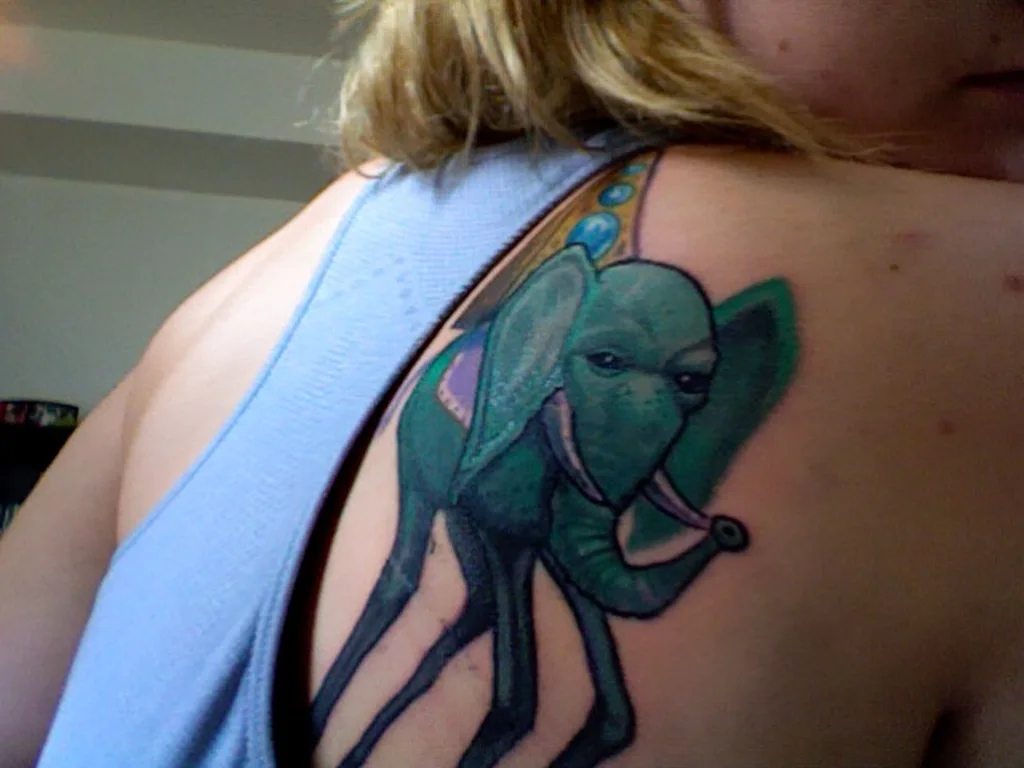
15. Green Elephant, Shoulder Blade
An elephant in green and blue with legs far longer than nature allows, standing across a shoulder blade. It is a surreal piece — the proportions are the style, not a mistake.
Stretched, storybook animals are a small but real corner of elephant tattooing. The flat back gives the tall design its room, and bold colour with hard edges is what keeps a playful piece from turning mushy.
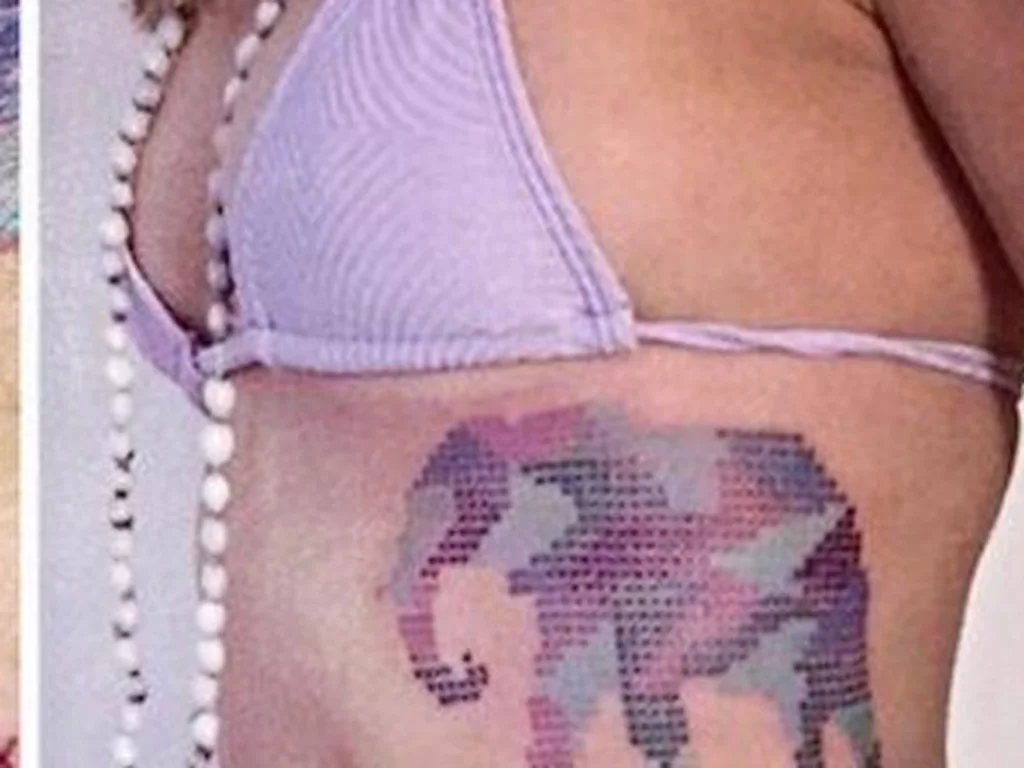
16. Cross-Stitch Elephant, Ribs
An elephant built entirely from tiny X stitches in purple, pink and teal, sitting on the ribs. This is a real tattooing technique, not embroidery — every cross is a pair of needle passes, and the photo is cropped from the artist’s own progress collage.
Pixel-style work stands or falls on spacing. Stitches packed too close merge as they heal; spaced like this, the grid stays crisp and the elephant reads as both animal and pattern.
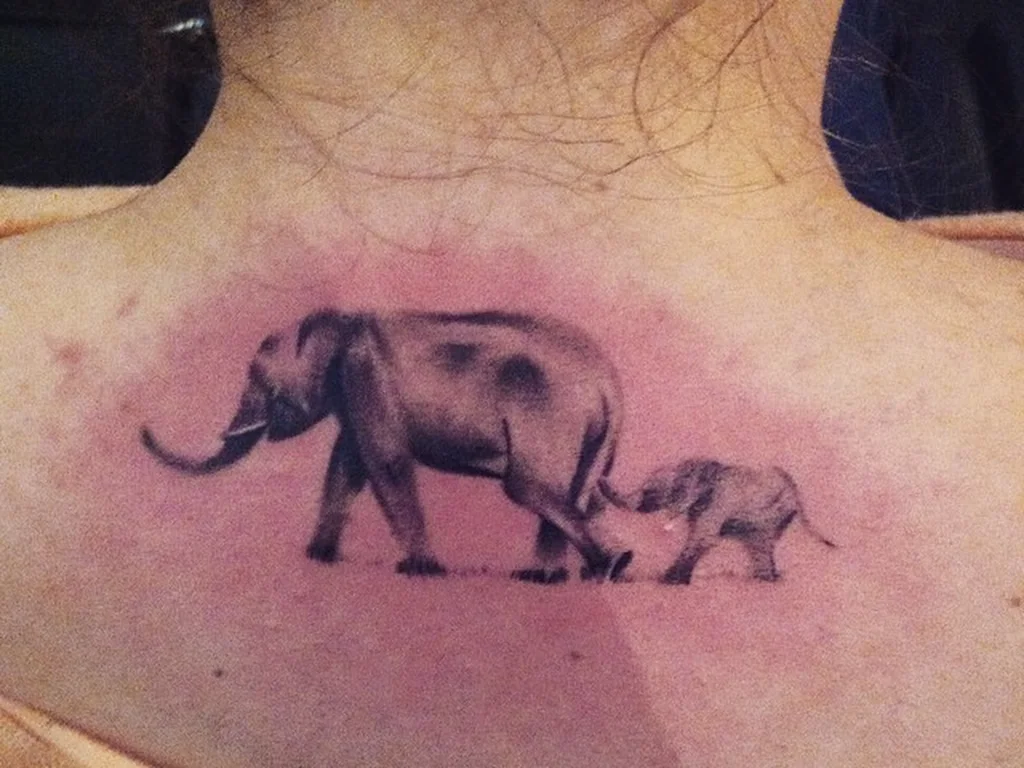
17. Elephant and Calf Silhouettes, Upper Back
A mother elephant and a small calf walk across an upper back as shaded silhouettes, the calf tucked at her heels. The skin around the piece is pink — the photograph was taken soon after the sitting.
This is the design most people picture when they say they want “a mum and baby elephant tattoo,” and the placement is the classic one: wide, flat, and easy to show or hide as you choose.
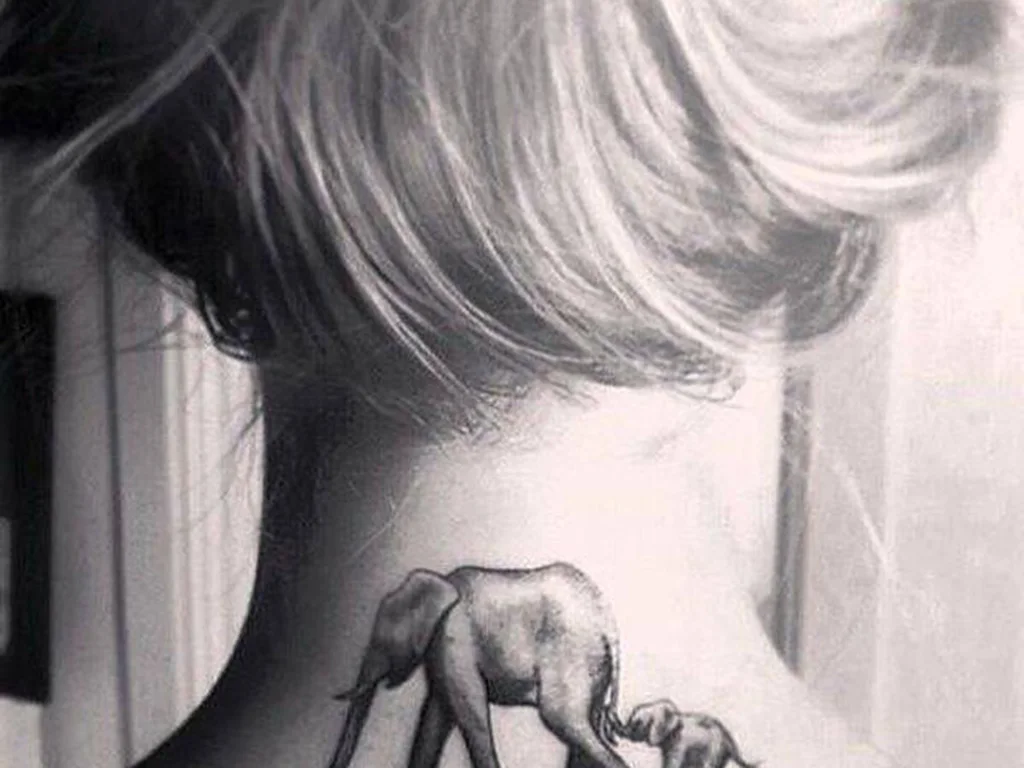
18. Elephant and Baby, Back of the Neck
The same mother-and-calf idea at a fraction of the size: two small elephants in black and grey walking across the back of a neck, photographed in black and white.
Neck placements live a double life — hidden by hair or a collar, or on full display. At this size the design survives on its outline alone, which is exactly how small elephants should be drawn.
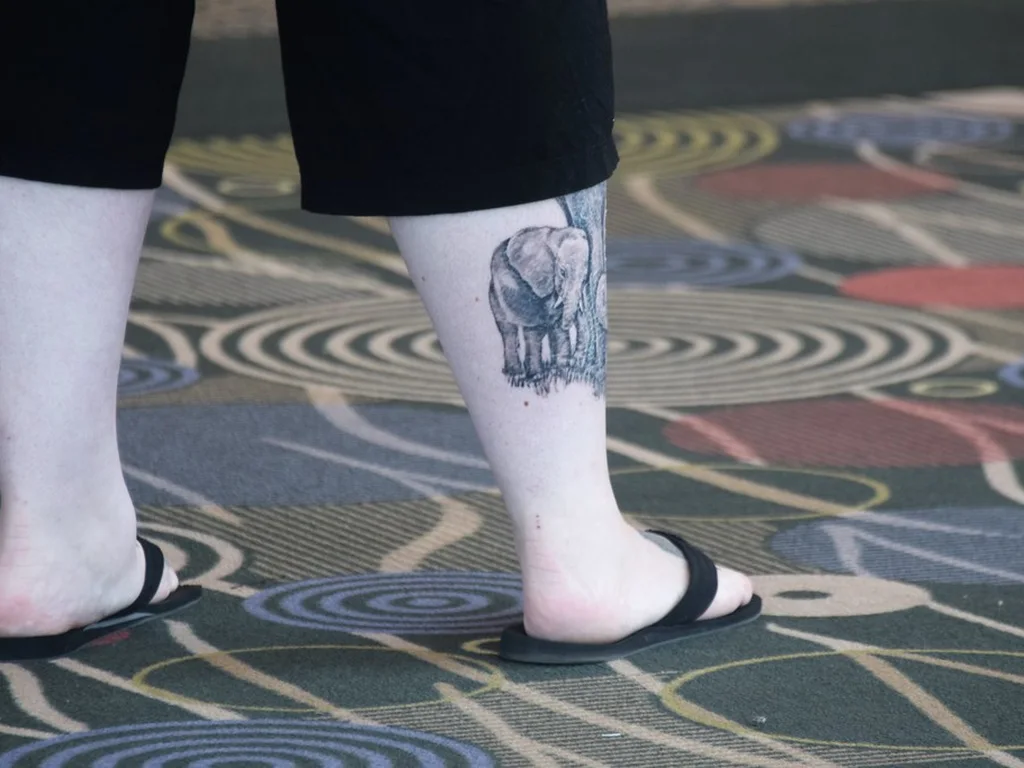
19. Elephant in Black and Grey, Calf
A shaded elephant portrait on a calf, photographed at a distance in what looks like a convention hall — the wearer is standing in socks on a patterned carpet, which gives the photo its charm and its limits.
What you can judge from here is the shape and the value pattern: a head held together by strong darks. Calves suit elephant heads well, and this one will look better in person than any wide shot can show.
20. Outline Elephant in Script, Forearm
A single flowing line runs along a forearm and becomes an elephant as it goes — the animal drawn inside handwriting, trunk curling out of a letterform. From across a room it reads as script; the elephant is the second look.
Designs that hide inside another design are a quiet pleasure, and this is the smallest commitment in the list after the tiny trio at the end. One line, no shading, nothing to fade but the dark.
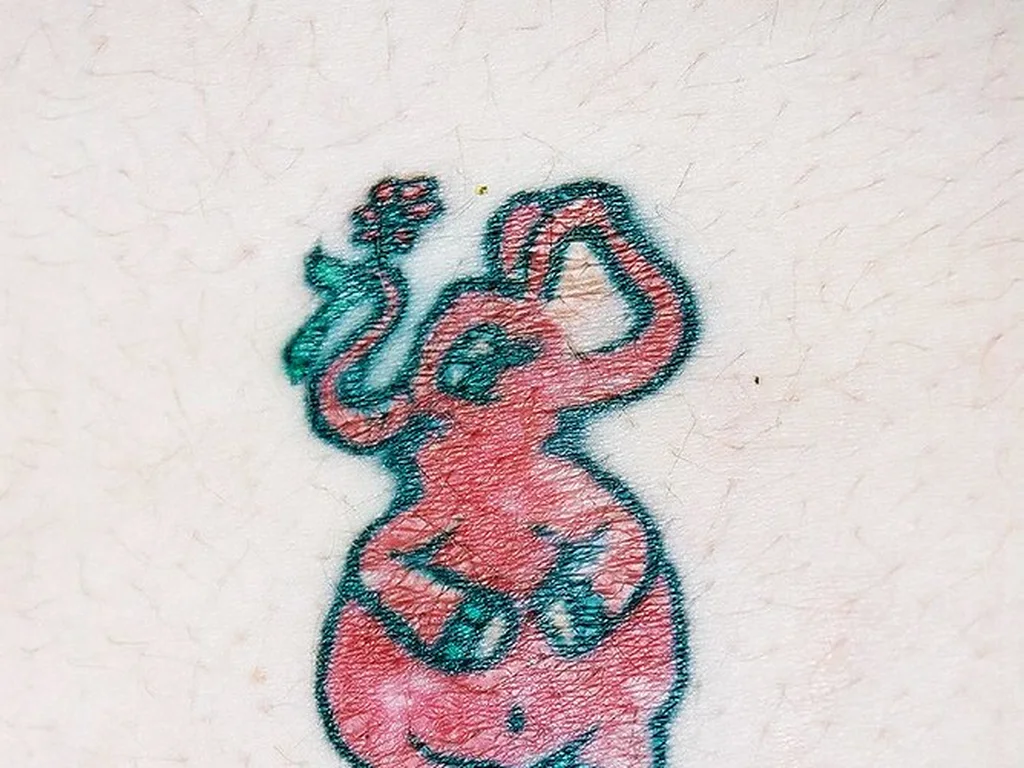
21. Small Pink Elephant in Colour
A small elephant inked in pink with green shading, trunk raised, photographed close enough that the placement is out of frame. It is a cheerful, cartoon-leaning piece with hard outlines and flat colour.
Pink elephants carry a joke in English — the old slang for drunken hallucinations — and wearers choose them for exactly that wink, or simply because pink was the point. Flat colour this small holds up well.
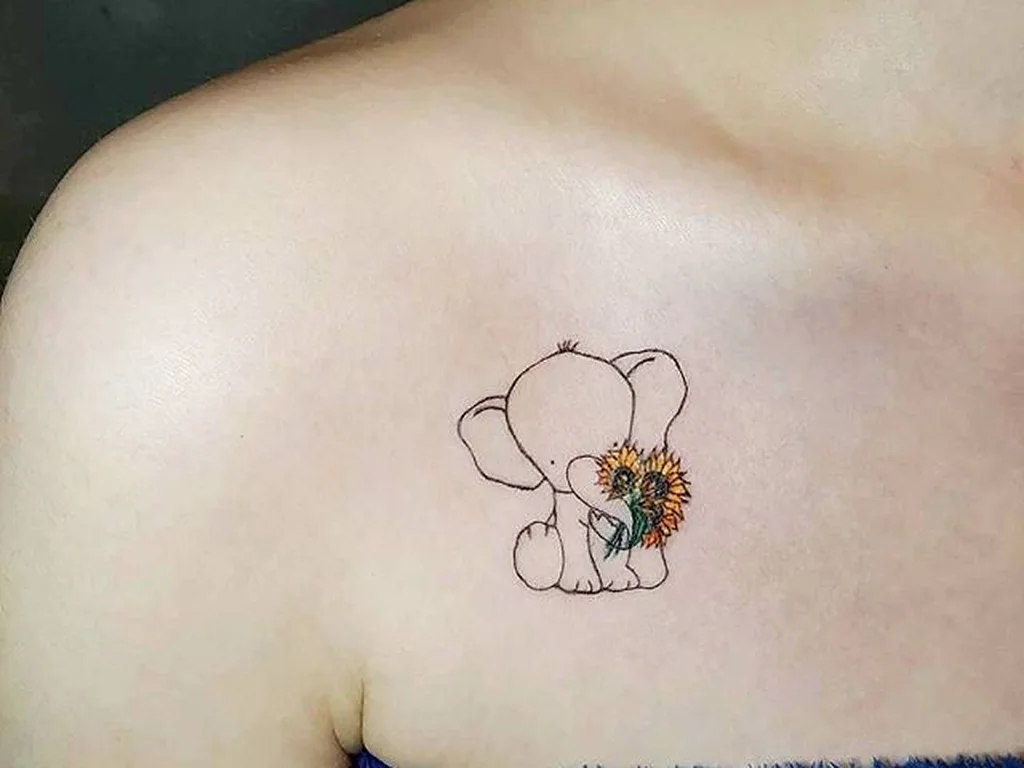
22. Tiny Elephant With a Sunflower, Collarbone
A baby elephant drawn in a few fine lines at the collarbone, holding a small sunflower. This is the minimal end of elephant tattooing — a signature more than a picture.
Fine lines at this size will thicken slightly as they settle, and good artists draw them expecting it. The collarbone shows in most necklines, so expect this one to be seen daily.
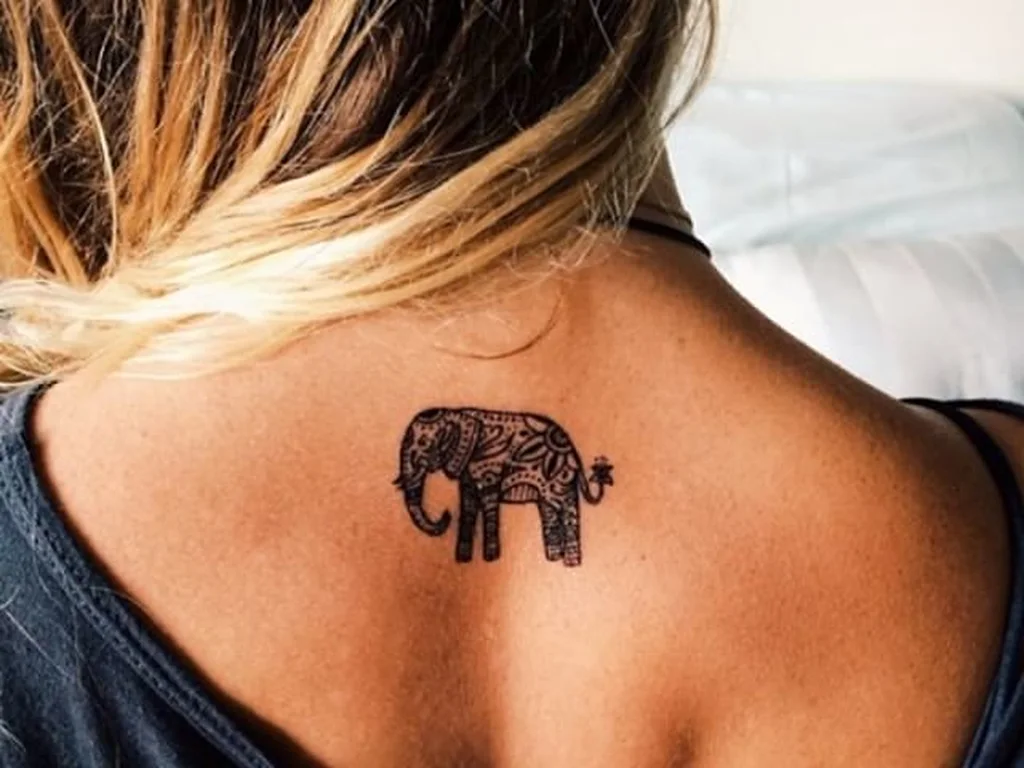
23. Tiny Black Elephant, Upper Back
One small black elephant, patterned inside like a decorated festival animal in miniature, sitting high on a back between the shoulders. A few centimetres of ink doing the work of a postcard.
Pattern inside a tiny silhouette is a balancing act: enough detail to reward a close look, spaced widely enough that it does not fuse into a blob by year five. This one is drawn the right side of that line.
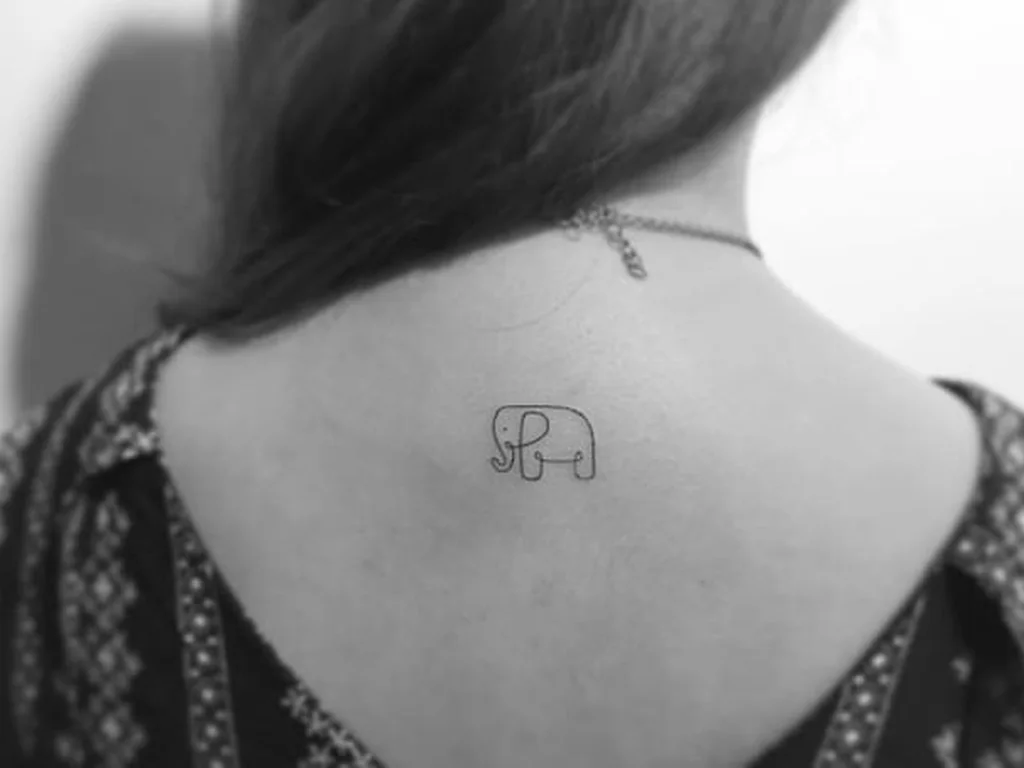
24. Tiny Outline Elephant, Nape
The smallest elephant in the list: a bare outline a couple of centimetres wide at the nape of the neck, photographed in black and white. Ear, back, trunk, legs — nothing else.
An outline this small is the honest minimum for the subject, and it ages into it gracefully. If you want an elephant tattoo that behaves like jewellery, this is the end of the scale to shop at.
Where an Elephant Tattoo Works Best
Upper arm and shoulder. The busiest address in this list, and it earns it: room for a full head or a Ganesh figure, easy to cover with a sleeve of the cloth kind, and the natural first panel if a bigger piece might follow. Designs 2, 4, 7, 8, 13 and 14 all live here.
Thigh. The realism canvas. Designs 3 and 5 use the thigh’s width and flatness for heads and herd scenes that would not fit an arm, and it is the easiest large placement to keep out of the sun.
Back. Flat, wide and slow to age. The walking elephant (design 6), the mother and calf (17) and the tall green elephant (15) all need the back’s room or its stillness. The trade is simple: you will mostly see your own tattoo in photographs.
Calf and forearm. The portrait placements — designs 1, 9, 11, 12, 19 and 20. Forearms are on show all day, including to you; calves flash in and out with the season. Both give an elephant head the vertical frame it wants.
Small spots — neck, nape, collarbone, ribs. The tiny trio (22, 23, 24), the neck pair (18) and the cross-stitch ribs (16) show the range. Ribs are the sharpest sitting in the list and the most private canvas; necks are the opposite — mild to sit for, impossible to keep secret with short hair.
Frequently Asked Questions
What does an elephant tattoo mean?
Most wearers mean memory, family and patience — all three rooted in how elephants live, in herds led by an old female who remembers where the water is. After that it depends on the design: a mother and calf is a family piece, a decorated elephant nods to festival tradition, and a Ganesh tattoo is a statement of Hindu faith, which is a different thing entirely.
Is a Ganesh tattoo disrespectful?
It can be, and the details decide. Ganesh is a Hindu god, not a mascot: respectful versions are drawn accurately, placed on the upper body, and worn by people who know who he is. Many Hindus object to deity images on feet and lower legs — which is why design 11 carries its note. If a studio sells you a cartoon Ganesh smoking or drinking, that is the version to walk away from.
How much does an elephant tattoo cost?
Size and detail set the price, not the animal. A tiny outline elephant usually starts at the studio minimum, commonly $60–$150 in the US. A palm-size realism head is a few hours of work, and a scene sleeve like design 4 runs across sessions — get the number at a consultation, at final size.
Where is the best place for an elephant tattoo?
For a realism head, the upper arm, thigh or calf — flat skin and room for the ear. For a mother-and-calf piece, the upper back is the classic. For something small, the collarbone, nape and shoulder all work. The design chooses the spot: a wide ear and a long trunk need a wide, calm canvas.
Do elephant tattoos age well?
The bold ones do. Outlines, silhouettes and decorated pieces hold their shape for decades. Realism softens: the wrinkle lines on a head like design 1 relax first, and the palest greys in scene pieces lift. Size is the best protection, and sunscreen on healed skin is the second best.
Can an elephant tattoo be small?
Yes, if it stays simple — designs 22, 23 and 24 are all a few centimetres wide and all read clearly, because each is one clear shape. What cannot shrink is detail: a realism head squeezed small loses its wrinkles and then its likeness. Simplify the design rather than shrinking it.
What is the difference between African and Asian elephant tattoos?
The ears, mostly. African elephants have very large ears and a more wrinkled trunk with two finger-like tips; Asian elephants have smaller ears, a smoother skin and one trunk tip. Most big realism heads are African. Asian elephants are the ones tied to Thailand and India — and to Ganesh’s silhouette.
Does trunk up or trunk down mean luck?
You will be told trunk up means luck and trunk down means the opposite. Treat it as shop talk: the rule circulates in gift shops and tattoo studios, not in any old tradition we could check, while real elephants use their trunks every way imaginable. Pick the pose that draws better on your body.
Colour or black and grey for an elephant?
Black and grey suits the animal’s own colouring and ages evenly, which is why most of this list is monochrome. Colour earns its place when it is the subject — the decorated festival head at design 7, the green shoulder piece at 15. Greys cannot imitate those, and those cannot imitate greys.
Can an elephant tattoo cover an old tattoo?
Yes — design 7 in this list is exactly that, a decorated elephant head built over older work. Busy pattern, dark shading and a big bold shape are what cover-ups need, and an elephant head offers all three. The new piece must be bigger and darker than what sits underneath, and your artist gets the final say.
Final Thoughts
Twenty-four real elephants, and the pattern is the same one running through this whole cluster: the tattoos that last are drawn at the size their detail needs, by people who checked the artist’s healed work first. Decide which elephant is yours — the herd animal, the family symbol, or Ganesh, with the respect his image asks for — and let the placement follow. If the elephant is not your animal after all, our
lion tattoo ideas guide makes a louder case.
Photo credits: 1: RamyRaoof, CC BY 2.0, via Flickr. 2, 5 and 6: TattoosAll, CC BY 2.0, via Flickr. 3 and 4: TattoosAll, CC BY-SA 2.0, via Flickr. 7: AnjanaTattoo, CC BY-SA 4.0, via Wikimedia Commons. 8: BenLucasTattoos, Public Domain Mark, via Flickr. 9: savoryexposure, CC BY-SA 2.0, via Flickr. 10, 11 and 12: cayooo, CC BY-SA 2.0, via Flickr. 13: Gabriel Nunes, CC0, via Wikimedia Commons. 14: jazzlah, CC BY 2.0, via Flickr. 15: savanna-smiles, CC BY-SA 2.0, via Flickr. 16: katexic, CC BY 2.0, via Flickr. 19: Tony Alter, CC BY 2.0, via Flickr. 17: TattoosAll, CC BY 2.0, via Flickr. 18: 1nktattoo, Public Domain Mark, via Flickr. 20: xmacex, CC BY-SA 2.0, via Flickr. 21: Daniella M. Echeverria, CC BY 2.0, via Flickr. 22, 23 and 24: Mini Tatuajes, CC BY 2.0, via Flickr. Full file names and source links are listed in this article’s package notes.