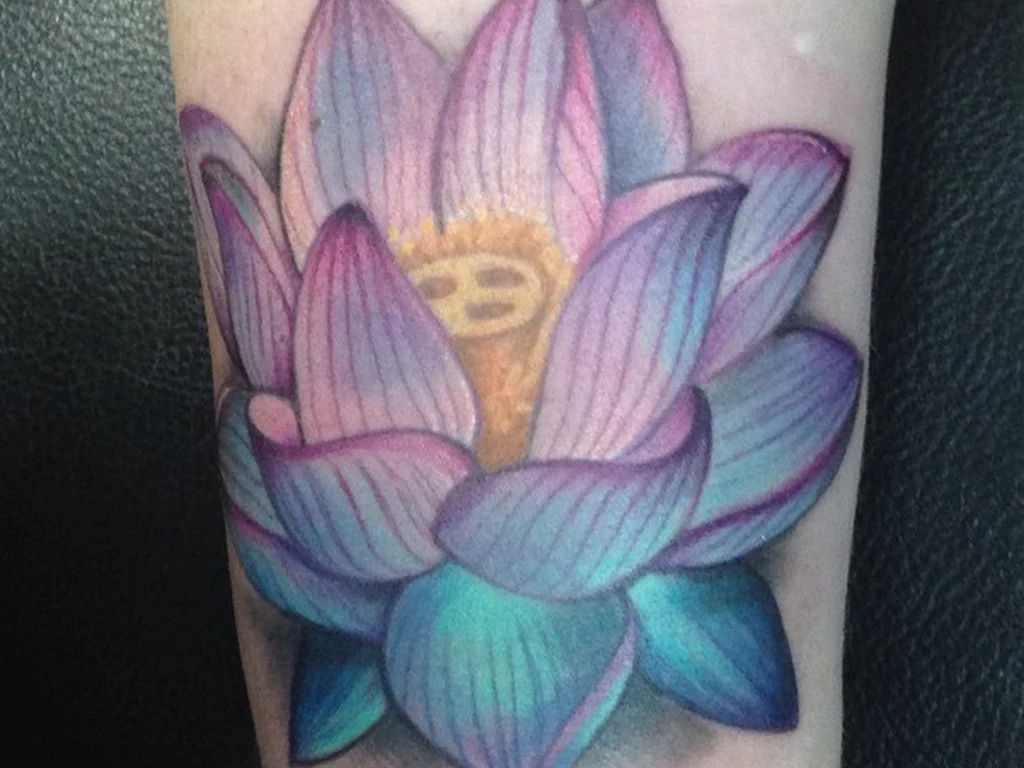
Short answer first: a lotus tattoo meaning usually rests on one picture — a clean flower opening on dirty water. From that single image people build purity, rebirth, patience and a hard stretch of life survived. Some of those readings are thousands of years old and written into two world religions. Some were invented by tattoo blogs in the last fifteen years. This page keeps the two apart, because a meaning with real history behind it and a meaning that sounds good in a studio are both fine reasons to get inked, and they are not the same thing.
The plant earns its symbolism honestly. A lotus roots in pond mud, pushes a stem up through murky water, and opens a flower that sheds water and dirt so cleanly that scientists named an effect after it — Britannica’s profile of the sacred lotus covers the biology, the seeds that stay fertile for centuries, and the flower’s place in Asian art. The designs that carry these meanings fill our lotus tattoo ideas collection; what follows is the story underneath them, from temple carvings to the small outline on a wrist.
The Core Meanings, One by One
Purity — the traditional reading
This is the oldest layer, and it comes straight from watching the plant. The flower opens spotless every morning out of water that is anything but, and closes again at night. Hindu and Buddhist teachers used that daily routine as a picture of a mind or a soul staying clean inside a messy world — the mud is not denied, it is simply not what the flower is made of. That is why the lotus sits under gods and Buddhas in art across Asia: it is the seat you give to something untainted. A lotus tattoo worn for purity is standing on documented tradition, not studio invention.
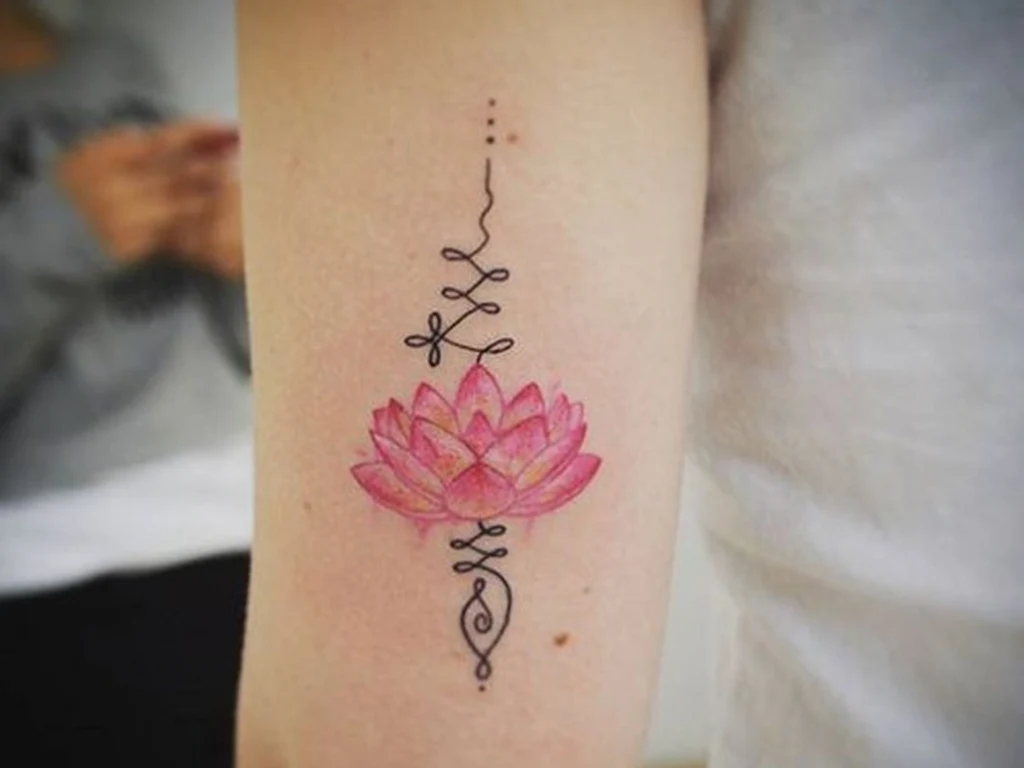
Rebirth and new beginnings
The same daily routine drives the second meaning. The flower closes and sinks at night, then opens again at dawn, and ancient Egypt used the pattern for the sun and for creation itself; Hindu and Buddhist retellings kept the rhythm and pointed it at the soul. In modern tattooing this is the meaning that does the most work. Lotus tattoos mark divorces finalised, illnesses beaten, addictions left behind and plain fresh starts — the comeback reading, worn by people who did the coming back. It is a modern emphasis built on a genuinely old rhythm, and it is labelled that way here on purpose.
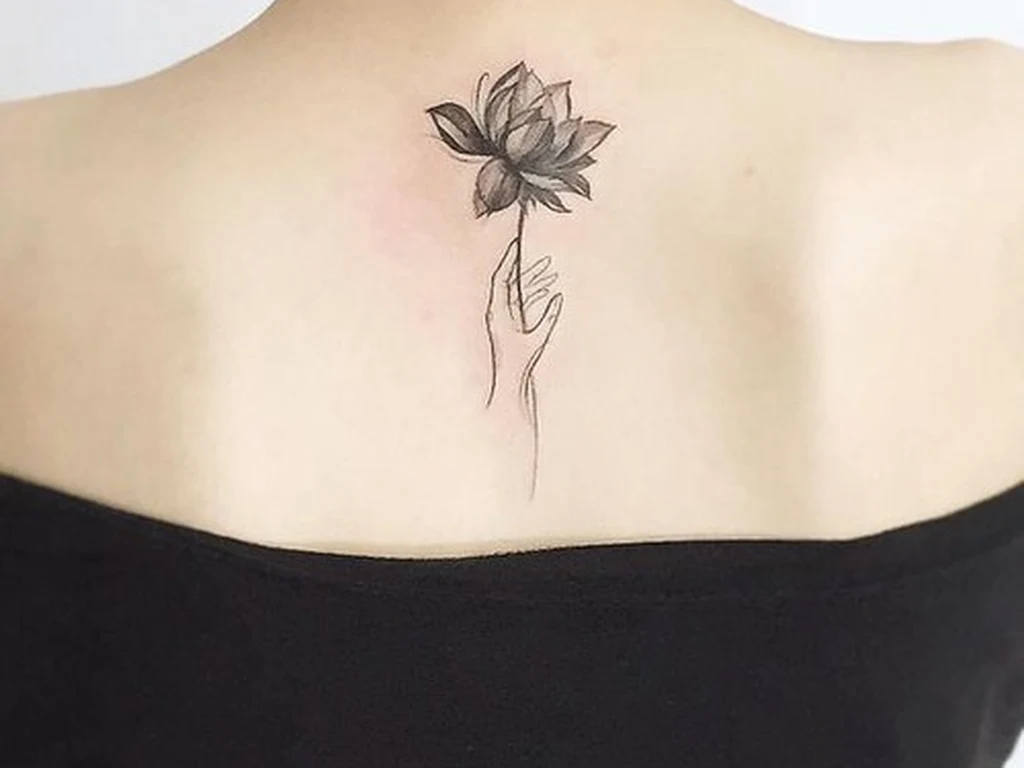
Strength through muddy water
A plainer cousin of the two above, and mostly a modern one. The stem does not grow around the mud; it grows through it, and the flower at the top only exists because the root held in bad ground. People who pick the lotus after grief, a rough childhood or a long illness usually mean this layer rather than purity — not “I stayed clean” but “I came up anyway.” Artists draw it literally: roots and a long stem included in the design, instead of the floating bloom on its own. If your lotus has its roots showing, this is the layer it stands on.
History and Religion: Where the Meanings Come From
Hindu tradition: the flower the gods stand on
In Hindu tradition the lotus is not a decoration; it is furniture for the divine. Lakshmi, goddess of wealth and fortune, stands and sits on a fully opened lotus and carries lotuses in her hands. In one widely told creation account, a lotus grows from the navel of the sleeping Vishnu, and Brahma, the creator, is born sitting inside it — creation itself starts from the flower. The Sanskrit word, padma, turns up in names, mantras and sacred geography all over India. A lotus tattoo with this layer behind it is leaning on one of the oldest continuous symbol traditions on earth, and it deserves to be worn knowingly rather than as a generic “spiritual flower.”
Buddhist tradition: eight petals and the path
Buddhism took the same flower and gave it geometry. The lotus in Buddhist art is most often drawn with eight petals, and those eight petals are tied to the Noble Eightfold Path — the eight practices at the centre of Buddhist teaching. Buddhas and bodhisattvas sit on lotus thrones, and one of the best-known mantras in the world, Om mani padme hum, names the jewel in the lotus. The colour lists copied around the internet — white for purity, pink for the Buddha himself, blue for wisdom, red for compassion, gold for enlightenment — are a retold version of associations that do exist in Buddhist art, tidied into a chart. The associations are real; the chart’s neatness is modern, and no old text hands out a penalty for picking the “wrong” one.
The flower travelled with the teaching. One of Buddhism’s best-known texts is named for it — the Lotus Sutra — and across China, Japan, Korea and Vietnam the lotus became the standard picture for a person developing through difficulty toward clarity, the same arc the Eightfold Path describes. Garden ponds at temples are planted with lotuses on purpose, so the lesson flowers every summer where people can watch it happen. When a modern wearer picks the eight-petal version, that whole travelling history is the ground the design stands on.
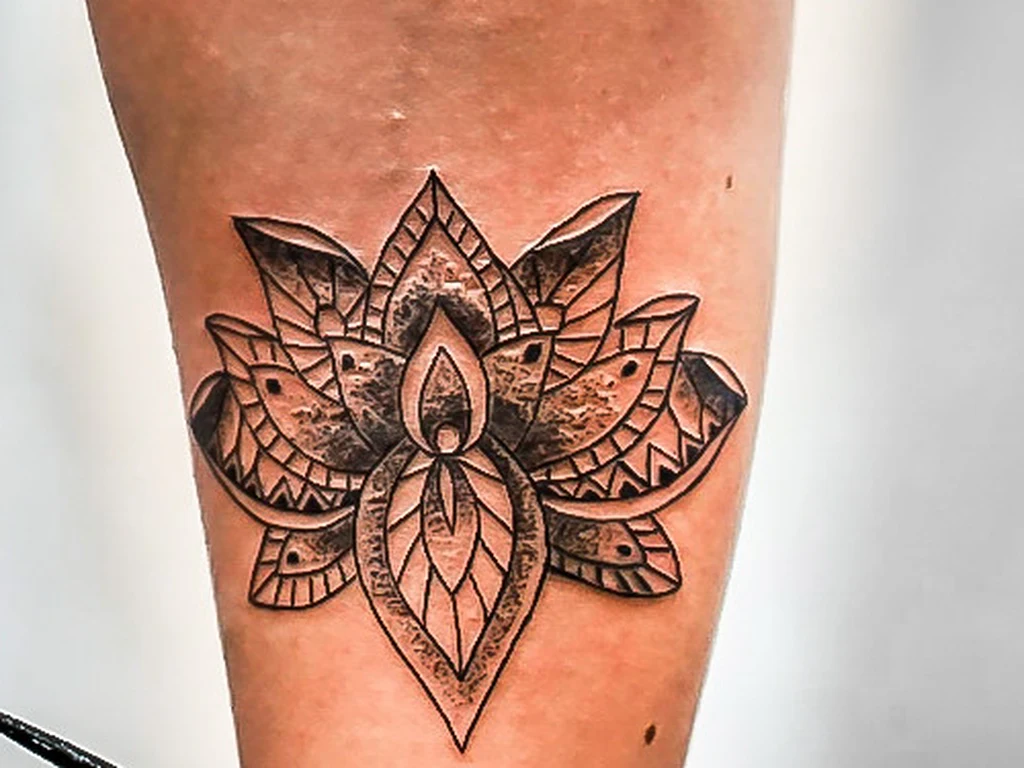
Egypt: the blue “lotus” that is not a lotus
One correction worth making plainly, because tattoo flash repeats the error constantly. The famous blue lotus of ancient Egypt — the flower in tomb paintings, the one tied to the sun, creation and rebirth — is not a true lotus at all. It is a water lily, Nymphaea caerulea, a different plant that floats its flowers on the surface instead of lifting them clear of the water on stems. The true lotus, Nelumbo nucifera, is the Asian flower behind the Hindu and Buddhist symbolism above. Egypt’s rebirth reading is real history; it just belongs to a lookalike. An Egyptian-styled blue flower tattoo is a water lily wearing the lotus name, and now you know which plant you are wearing.
The Unalome: a Sacred Symbol, Not a Swirl
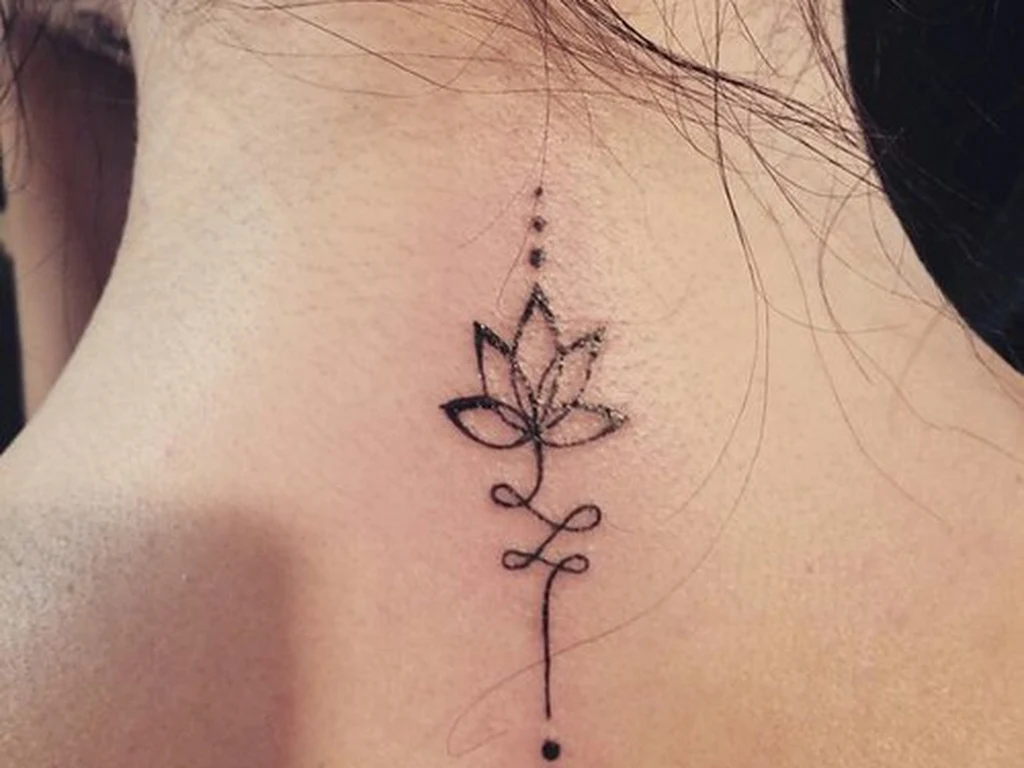
Plenty of lotus tattoos end in a spiral tail, and that tail has a name and a job. The unalome is a sacred symbol from the sak yant tradition — the hand-etched sacred tattoos of Thailand and Cambodia, given by monks and masters, often with a blessing worked in. The spiral stands for the path through life: the loops are its twists and setbacks, the straightening line and the dots at the end mark the way out of them, toward enlightenment. On many designs the spiral rises into a lotus bloom, so the flower becomes the destination the path was heading for.
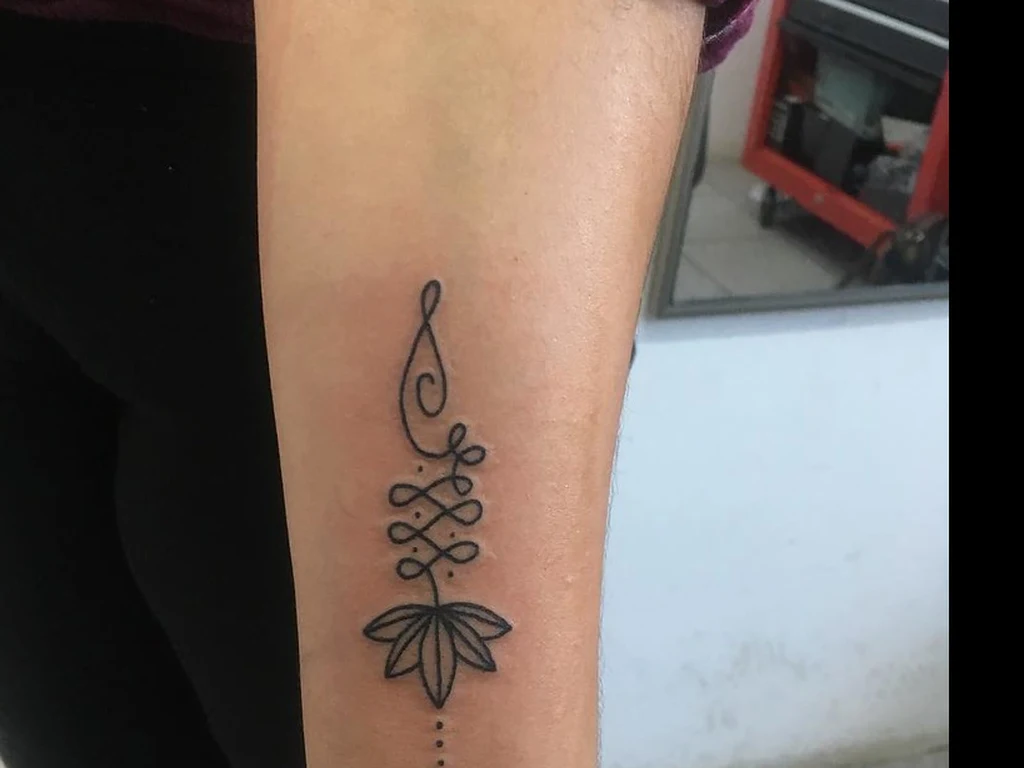
Two duties come with borrowing it. First, accuracy: a real unalome has a structure, and a random swirl drawn from memory is not one — bring reference and use an artist who has done sacred-geometry line work before. Second, the script that often travels with it. Sak yant designs carry Pali phrases written in old Khmer script, and lettering you cannot read is a risk in any language: a misspelled blessing is a permanent one. Have the characters checked by someone who reads them before the needle, the same rule this site gives for the Devanagari lines that appear in the lotus tattoo ideas collection.
Placement follows the idea. Because the unalome is a path, it gets drawn vertically — running up a spine, a sternum or a forearm — with the spiral at the bottom and the lotus where the journey ends. Horizontal versions exist, but the vertical ones are the ones that read the way the symbol means: down in the tangle, up through the loops, out into the flower.
Details That Change the Reading
Open bloom or closed bud
The plainest dial on the flower. A fully open lotus is the finished state: openness, a heart or a life unfolded, the seat-of-the-gods version. A closed bud reads as potential — something protected, still becoming, a beginning kept safe. Half-open sits between the two and gets picked after transitions, by people who are mid-change rather than done with it. None of this is ancient law; it is the plant’s own stages doing the talking, and artists and wearers have read them this way for as long as the flower has been tattooed.
Petal count
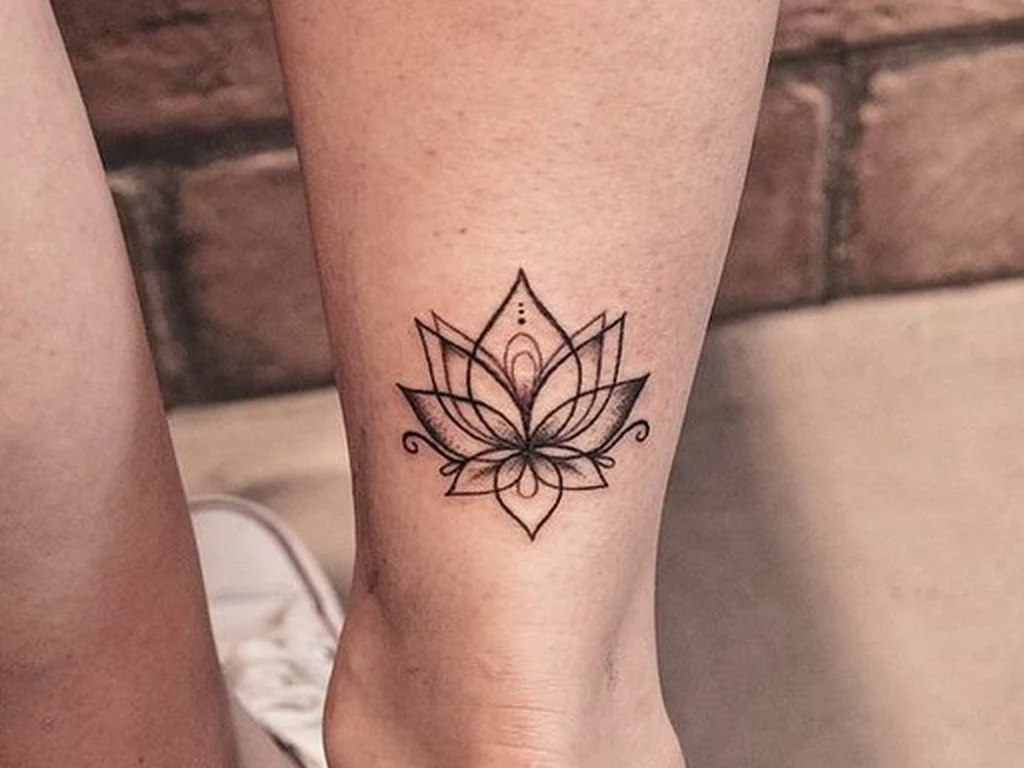
Counted petals usually mean one thing: eight. An eight-petal lotus points at the Eightfold Path described above, which is why eight is the number drawn again and again in Buddhist-flavoured pieces. Beyond that, honesty helps: most lotus tattoos are drawn with however many petals fit the space and the style, and nobody’s grandmother is checking. If the eight matters to you, tell the artist before the stencil, not after — petal count is one of the few details that cannot be adjusted once the outline is on.
Stem, roots and scale
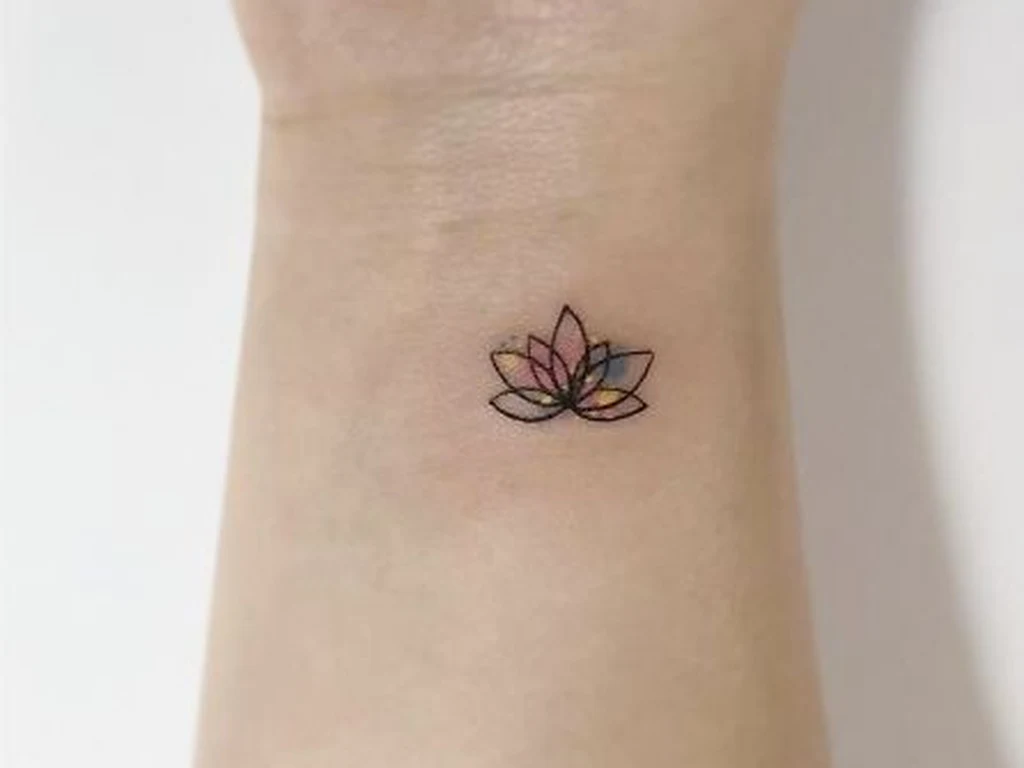
A bloom floating on its own is the purity version — the finished flower, lifted clear of everything. Add the stem and you add the journey: the long way up through the water. Add roots and mud, and the design tells the whole biography, which is why the strength-through-mud reading almost always comes with the bottom half of the plant attached. Scale changes the tone rather than the meaning. A sternum or back piece can carry the full story; a two-centimetre wrist outline keeps only the silhouette, the way the tiny pieces in our fine line tattoo ideas collection keep theirs — a mark that stands for the flower, not a picture of it.
Colour
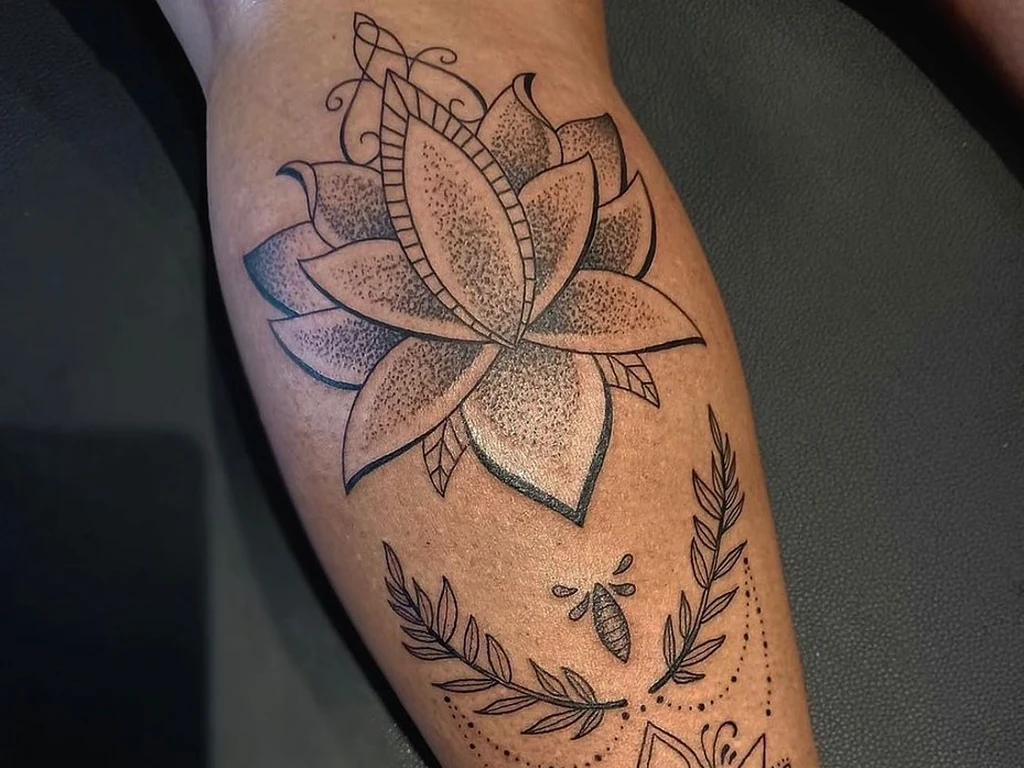
Natural lotus flowers run white, pink and pale yellow, and pink carries the senior rank in Buddhist art — the supreme lotus, the one tied to the Buddha himself. Red and blue lotuses exist in the traditional lists with their own associations, compassion for red and wisdom for blue, retold from older art rather than set down as rules. Then there is the colour the plant never grows: black. A black or black-and-grey lotus is a modern, graphic choice — the symbol kept, the botany dropped — and plenty of wearers pick it for exactly that contrast. What colour cannot do is betray you. No tradition anywhere fines a wearer for the wrong shade, whatever the charts say; the myth section below takes that one apart.
Lotus Combinations
The lotus rarely sits alone for long. The pairings below are the ones that come up again and again — modern tattoo practice, labelled as such.
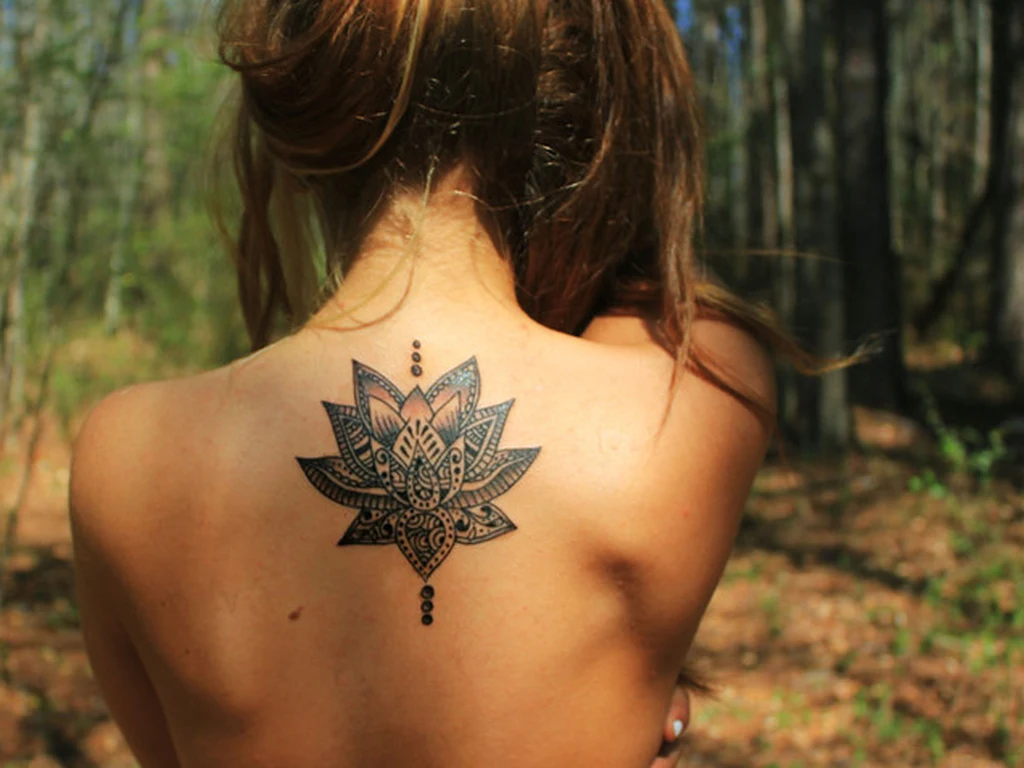
Lotus and mandala. The geometry pairing. A mandala built around or behind the bloom turns the flower into the centre of a pattern about balance and wholeness — the eight-petal structure already leans that way, which is why mandala lotuses fill sternums, backs and underbust placements. It is the most decorative reading of the flower, and the one where the petals are counted most carefully.
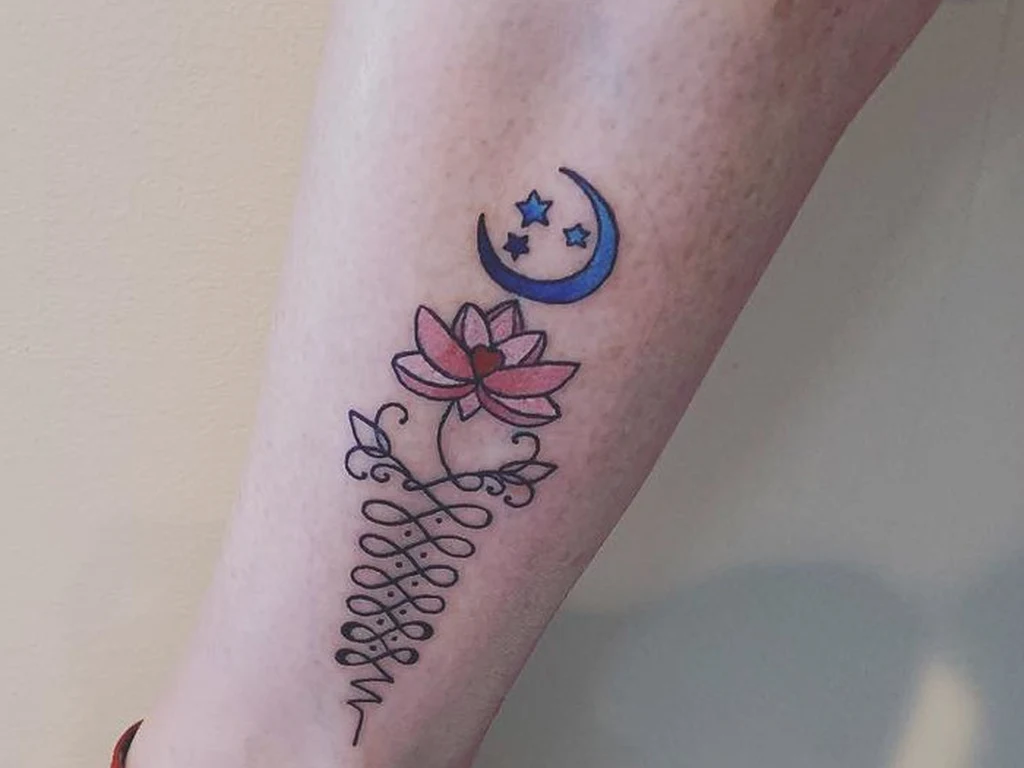
Lotus with the moon or sun. The sky pairing. A crescent moon under or over the bloom borrows the flower’s own daily rhythm — closing at night, opening at dawn — and points the piece at cycles, rest and starting again; moon phases in a row stretch the same idea across a month. A sun behind the lotus runs the Egyptian-flavoured version of the story, the flower that opens with the light. Both are modern combinations standing on the plant’s real behaviour.
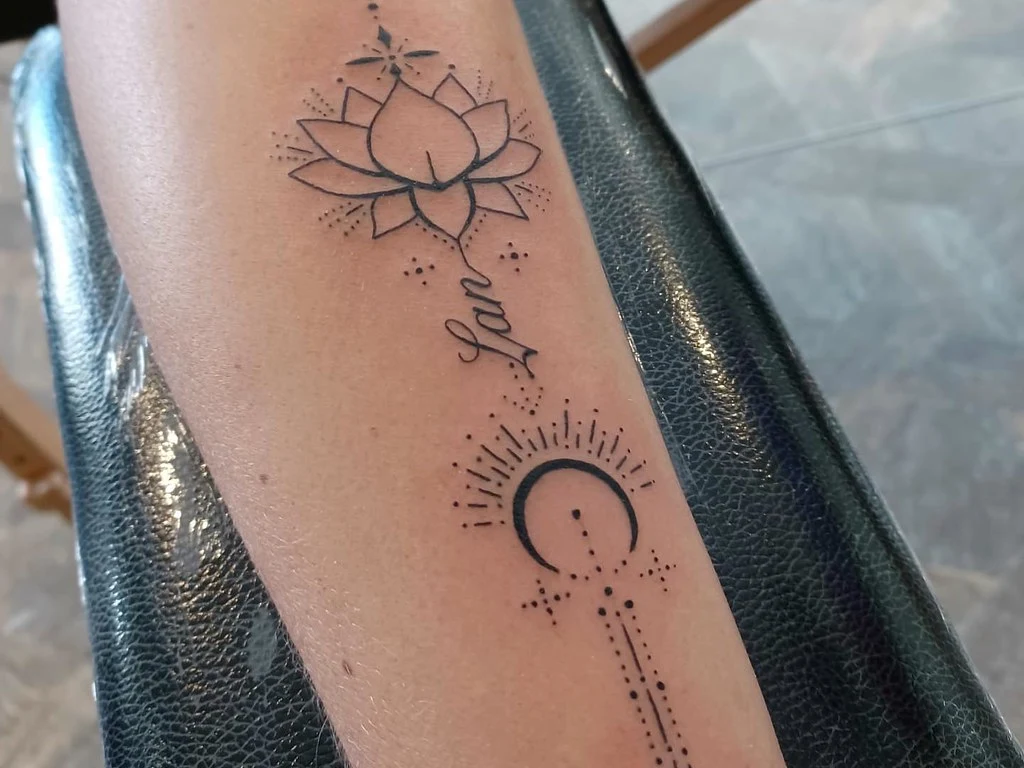
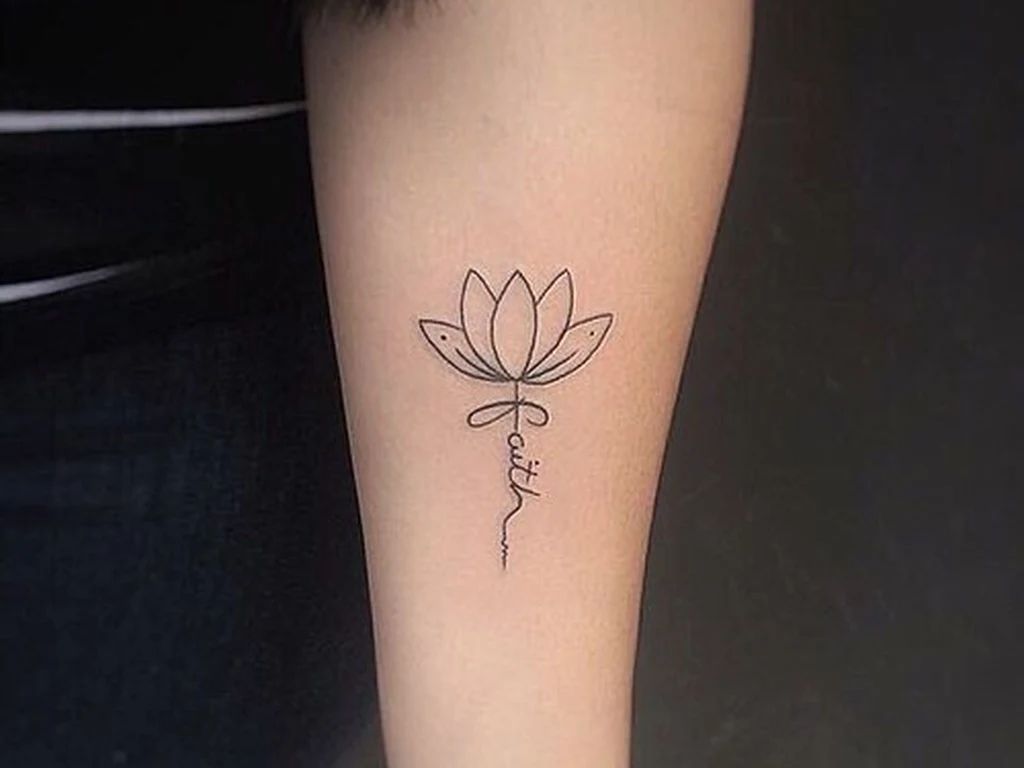
Lotus and script. The flower carries the message. Names, dates and single words get worked into the stem or set under the bloom — the stem-as-handwriting designs in the collection are the neat version, where one line of ink is both plant and lettering. The lotus softens whatever the words say, which is why this pairing turns up on memorial pieces so often. The wider flower symbolism behind all of these pairings is mapped on our flower tattoo design ideas page.
What a Lotus Tattoo Does Not Automatically Mean
“Wrong colour, bad meaning” is shop talk. The strictest version of the colour chart — pick blue for one meaning and you have accidentally claimed another, or worse, invited the opposite — has no source behind it. Colour associations exist in Buddhist and Hindu art, loosely and with regional differences. They were never a code with penalties. Choose the colour for the flower you want to look at for forty years.
There is no single fixed code. Pages that decode every element — three petals mean this, a dot below means that — are tidying a living symbol into a spreadsheet. The real structure is the one on this page: documented religion at the bottom, plant behaviour in the middle, studio convention on top, and your own story over everything. The same layering runs through every meaning page on this site — the lion tattoo meaning guide separates heraldry from shop talk in exactly the same way.
It is not only a women’s tattoo. Small pink lotuses get marketed at women and big black-and-grey pieces at men; the filing says more about marketing than about the flower. The lotus has been carved on temples, worn by monks and carried by warriors for a very long time. Size and colour are taste. The meaning is the same on anyone.
Frequently Asked Questions
What is the main meaning of a lotus tattoo?
Purity first — the flower that opens clean out of muddy water — with rebirth close behind, from the same flower closing at night and opening at dawn. Modern wearers add strength through hard times. The first two are documented tradition; the third is a newer reading built on the same plant.
What does an eight-petal lotus tattoo mean?
It points at Buddhism’s Noble Eightfold Path. The lotus in Buddhist art is traditionally drawn with eight petals, one for each practice on the path, and Buddhas are shown seated on lotus thrones. If you want the reference, ask for eight petals by number before the stencil goes on.
What does a lotus tattoo mean in Hinduism?
Divine beauty and creation. Lakshmi stands on an open lotus, and in a widely told account the creator god Brahma is born from a lotus growing from Vishnu’s navel — the world itself starts from the flower. The Sanskrit name padma runs through names, mantras and sacred places across India.
Is the Egyptian blue lotus a real lotus?
No — it is a water lily, Nymphaea caerulea. The blue flower of Egyptian tomb art, tied to the sun and rebirth, floats on the surface; a true lotus lifts its flower clear of the water on a stem. Egypt’s symbolism is genuine history attached to a lookalike plant.
What is the spiral under a lotus tattoo?
Usually an unalome, a sacred symbol from the sak yant tradition of Thailand and Cambodia. The spiral is the twisting path through life; the line straightens and ends in dots as the path reaches enlightenment, and the lotus on top becomes the destination. It is a religious symbol, so accuracy and respect apply.
Does lotus colour change the meaning?
Loosely, not legally. Pink ranks highest in Buddhist art and is tied to the Buddha; white reads as purity; red and blue carry compassion and wisdom in the retold lists. But no tradition penalises a colour choice — the strict charts are modern tidying, and a black lotus simply drops the botany and keeps the symbol.
What does a closed lotus bud tattoo mean?
Potential. A bud is the flower before it opens, so bud tattoos get chosen for beginnings, for something protected, and for people mid-change. A fully open bloom is the finished, unfolded state by contrast — the same plant at two different moments of a life.
Is it disrespectful to get a lotus or unalome tattoo?
A lotus flower on its own is one of the most shared images in Asian art and is fine. The line sits at sacred specifics: the unalome and sak yant script are religious material, so copies should be accurate, script should be checked by someone who reads it, and sacred phrases should not be placed on feet or similarly low placements. A drawn flower is a tattoo; a mangled blessing is a mistake.
Where do lotus tattoos sit best?
The sternum and upper back take the symmetrical mandala versions; the spine suits the vertical stem-and-unalome designs; wrists, ankles and the nape take the small outlines. Match the version to the canvas: a full roots-to-bloom story needs room, while a two-centimetre outline needs a flat, quiet spot.
Do lotus tattoos have to mean something?
No. The lotus carries more documented symbolism than most tattoo subjects, but plenty of lotus tattoos mean “I like how this flower looks on this arm,” and that is a complete reason. If strangers will read a meaning into it anyway — with lotuses, they will — it is worth knowing which one they are reading.
Final Thoughts
A lotus tattoo can honestly mean purity kept in a messy world, a life that closed down and opened again, or roots that held in bad ground — and the details are what pick between them: open or closed, eight petals or five, bloom alone or the whole plant with its mud still on. Decide the layer first and the style second. The history on this page is solid ground, from Lakshmi’s flower to a water lily in an Egyptian tomb. The rest of the meaning is yours to write, which was always the best part of a flower that refuses to stay down. The lotus tattoo ideas collection is built from real photographs only, counted one by one.
Photo credits: Images 1 and 11: TattoosAll, CC BY-SA 2.0, via Flickr. Images 2, 5 and 9: Sergi Roberto, Public Domain Mark 1.0, via Flickr. Images 3, 6, 7, 8 and 12: Mini Tatuajes, CC BY 2.0, via Flickr. Image 4: Pitbull Tattoo Thailand, Public Domain Mark 1.0, via Flickr. Image 10: Nicolas Huk, CC BY 2.0, via Flickr.