Short answer first: a horse tattoo meaning usually rests on four legs of its own — freedom, power, loyalty and the road. Which one carries the weight depends on the horse you pick and how it is drawn. A galloping mustang says something a quiet horse head never will, and a horseshoe on its own is a different sentence again. This page separates the meanings with real history behind them from the ones tattoo shops repeat because they sound good, because both are fine reasons to get inked, and they are not the same thing.
Horses earned that workload honestly. For roughly five thousand years they were the fastest way a human could move, the strongest help a farm had, and the animal a soldier trusted with his life. No other creature sits in so many myths, wars and family photo albums at once. The designs behind these meanings run from the brush-stroke sprinters in our horse tattoo ideas collection to the big symbolic pieces in the animal tattoo ideas pillar. What follows is why the same animal can stand for escape, for grief, or for a horse you still miss.
The Core Meanings, One by One
Freedom
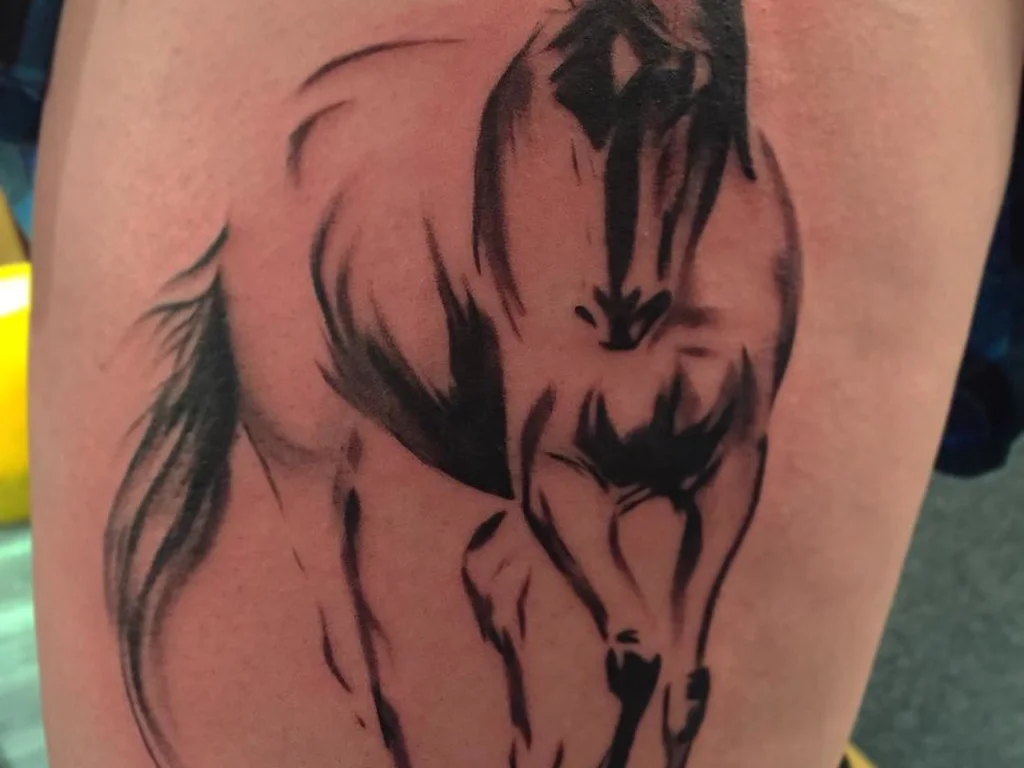
The meaning most people reach for first, and the one with the least paperwork behind it — this is modern convention more than ancient symbol. Wild herds did it. The mustangs of the American West were never fully tamed in the public imagination, and a horse running with no fence, no rider and no saddle reads as freedom in almost any country now. The usual shapes: a galloping full body, a mane streaming like it costs extra, a horse breaking out of a frame or a circle of rope. If the piece is about leaving — a town, a job, a version of yourself — this is the layer it stands on.
Power and strength
This one is documented in the language itself. When James Watt needed to sell steam engines in the 1780s, he measured them against the animal they replaced and gave us horsepower — the unit is a two-hundred-year-old admission that the horse was the standard of strength. Before engines, that power was literal: ploughs, cannon, coaches and cavalry charges all moved at horse speed. A horse tattoo about power tends to look the part — a rearing stallion, a heavy draught breed, a chest or back piece built big. There is a quieter cousin here too: the dark horse, the racing term for the runner nobody backed who wins anyway. Plenty of people wear that one.
Companionship and loyalty
The oldest documented layer on this page is not the horse as a symbol. It is the horse as a partner. Alexander the Great rode Bucephalus for close to twenty years, through most of his campaigns, and named a city after the horse when he died. Cowboys, cavalrymen, farmers and carriage drivers repeated the pattern for centuries: one person, one horse, a working life shared. That is why so many horse tattoos are memorials — for a mare someone grew up with, a first pony, a horse that taught them to ride. If your piece has a name and dates under it, it stands on this layer, and it is the most honest one here.
Travel, roads and the working horse
Before trains, the horse was the road. Mongol couriers crossed a continent on relay horses. The Pony Express lasted only eighteen months in 1860–61, but it fixed the image for good: a rider, a fast horse, a bag of letters and a long way to go. Stagecoaches, horse-drawn caravans, mounted police and travelling tinkers all left the same residue in the culture — the horse as the animal of people who live moving. Tattoos on this layer often borrow the tools: a horseshoe, a saddle, a compass rose, a stretch of open landscape. Sailors had the swallow for coming home; people of the road have the horse. Britannica’s entry on the horse traces how complete that partnership was: transport, farming, war and sport all ran on the same animal for thousands of years.
What History Actually Says
Epona and the Celtic horse
The Celts went further than liking horses. They gave them a goddess. Epona protected horses, mules and the people who worked with them, and her worship spread so far through the Roman world that she ended up the only Celtic deity with her own feast day in the Roman calendar, on 18 December. Roman cavalrymen kept her shrines in their stables. Carvings show her riding side-saddle or seated between two horses, often holding a dish of grain or fruit — a working goddess for a working animal. The Uffington White Horse, cut into an English chalk hillside around three thousand years ago and still maintained today, says the same thing from the same islands: this animal mattered here for a very long time. A Celtic-styled horse tattoo is standing on genuinely old ground.
Sleipnir, horse burials and the Norse
Norse myth gave Odin the best horse in the story and made him strange on purpose. Sleipnir has eight legs, was born in a shape-shifting accident involving Loki and a giant’s stallion, and carries his rider between the world of the living and the world of the dead. Under the myth sits a harder fact: Vikings actually buried horses with their dead. Ship burials and warrior graves across Scandinavia include horses — sometimes whole, sometimes represented by their gear — because the journey after death was imagined as a ride, and a rider needed a horse. A Norse horse tattoo, especially an eight-legged one, is about that crossing: endurance, and transport between one life and the next.
The Chinese zodiac horse, and why 2026 matters
In the Chinese zodiac the Horse is the seventh sign, linked with energy, independence and a temper that warms up fast and cools down slowly. Horses also carry a plain good-wish meaning in Chinese tradition: an old saying pairs the horse’s arrival with success arriving with it, which is why horse imagery turns up in New Year art. The timing gives this section its edge. The next Year of the Horse starts on 17 February 2026, and it is a Fire Horse year — a combination that only comes round every sixty years, last seen in 1966. Expect a run of horse tattoos from people born in horse years, people whose children arrive in one, and people who simply like starting a sixty-year cycle with the fastest animal in the zodiac on their side.
Horses in Native American life
Horses came back to North America with the Spanish in the 1500s — the continent’s own wild horses had died out thousands of years earlier — and spread fast after 1680, when the Pueblo Revolt scattered Spanish herds across the Southwest. Within a few generations the nations of the Plains had rebuilt their hunting, trading and warfare around the horse, and a person’s wealth could be counted in animals. Horses were painted for war and ceremony, given in marriage and in compensation, and mourned when they died. A fair line for tattoos: the horse itself is a shared human symbol, and drawing on it is fine. Specific tribal designs, names and regalia belong to the nations they come from — those are theirs, not clip-art, and a respectful artist will steer you to your own story instead.
The horseshoe: luck, iron and the points-up argument
The horseshoe is the one horse symbol that is really about the object, not the animal. Folklore across Europe held that iron drove off fairies and worse, and the shoe had two extra things going for it: its crescent shape echoes the moon in protective charms, and one popular legend has St Dunstan, a tenth-century blacksmith who became Archbishop of Canterbury, nailing a shoe onto the Devil’s own hoof and letting go only after a promise was extracted. Shoes went up over doors, on ships and eventually on skin. Then comes the argument nobody settles. Points up, one camp says, so the luck cannot fall out. Points down, the other camp answers, so the luck pours over everyone who walks under it. Both traditions are genuinely old, both are folklore, and no authority anywhere has a verified rule — which makes the horseshoe the rare tattoo where the honest answer to “which way is right?” is “whichever story you were told first.” It is covered again in the questions below.
Styles and Details That Change the Reading
The whole horse or just the head
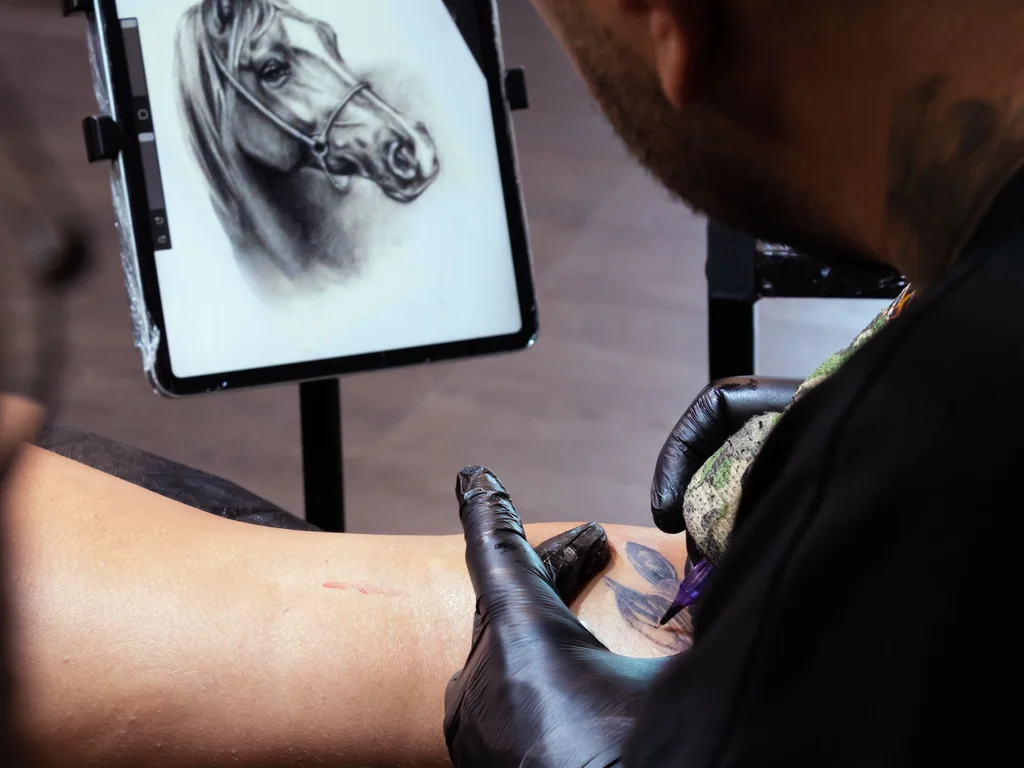
The head is the portrait choice. A horse’s character lives in its face — the eye, the ear position, the line of the jaw — so head studies suit memorial pieces and tributes to one real animal. Realism artists love them for the same reason portrait artists do: a good head carries expression, and expression is what people bond with. A full body is a statement about motion and shape instead — the animal as a force rather than a friend. Neither is deeper. They answer different questions: who was this horse, or what does the horse do.
Galloping, rearing or standing still
Pose is grammar. A galloping horse is going somewhere — freedom, escape, urgency, a life picked up and carried forward. A rearing horse is arguing: spirit, defiance, power that has not agreed to be used. A standing horse, head up and ears forward, is the calm version — patience, watchfulness, an animal at home in itself. A grazing or resting pose reads as peace and retirement, and shows up in memorial work more than anywhere else. Pick the verb first; the style can be decided after. A fine-line gallop and a traditional gallop mean the same thing, while a gallop and a graze never will.
Pairing a horse with a horseshoe
The shoe on its own is the luck charm, covered above. Paired with the horse it changes job: it becomes the signature of the working world — farriers, stables, racing yards, the family trade. Two shoes crossed, a shoe framing a horse head, or a shoe worked into a name banner all sit in blue-collar tattoo tradition that goes back to the era of working horses. Keep the pairing simple. A small shoe under a big horse is a footnote; the same shoe at the same weight turns the piece into a trade badge, which is a fine thing to be if the trade is yours.
Unicorns and pegasus: the mythic branch
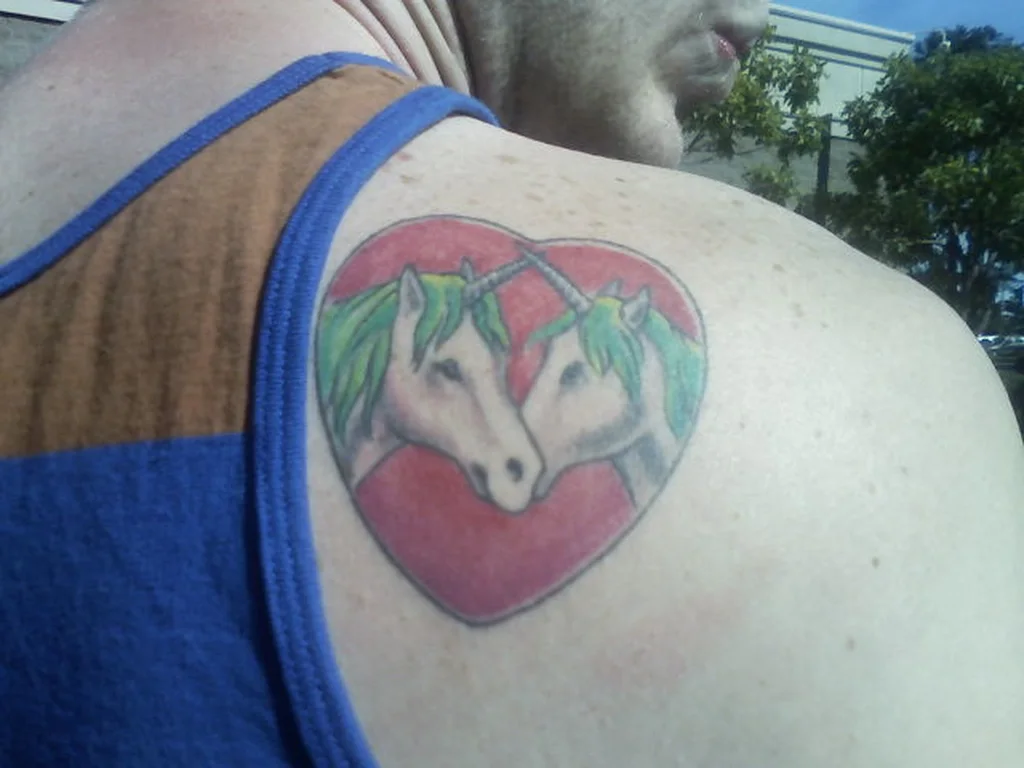
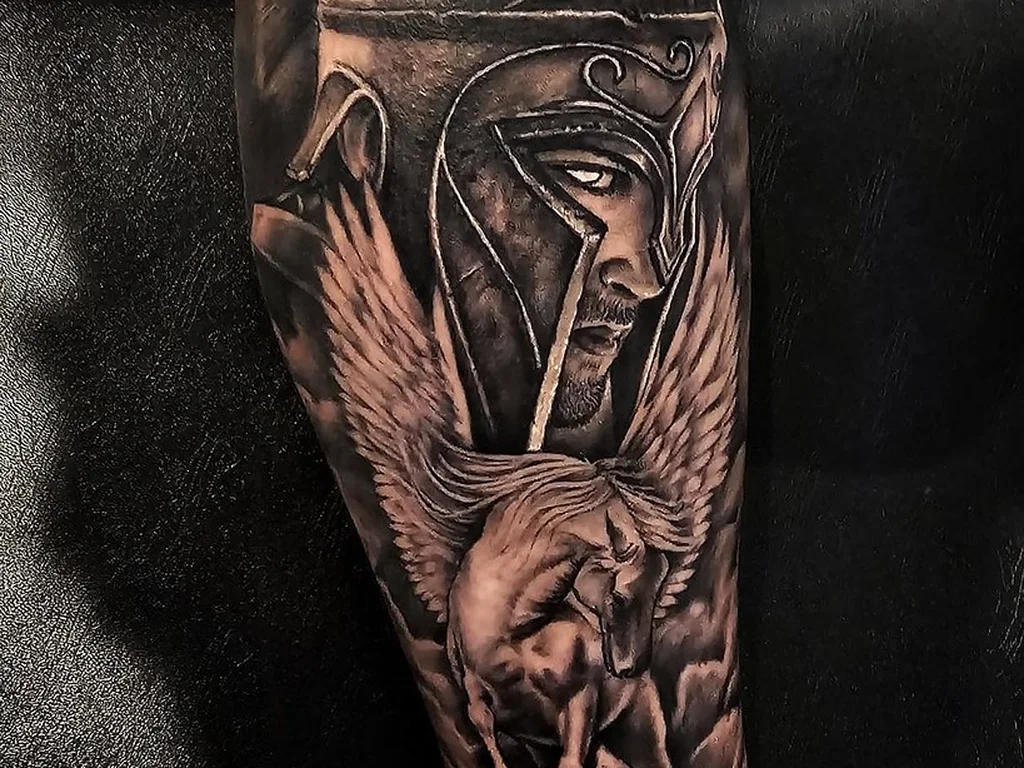
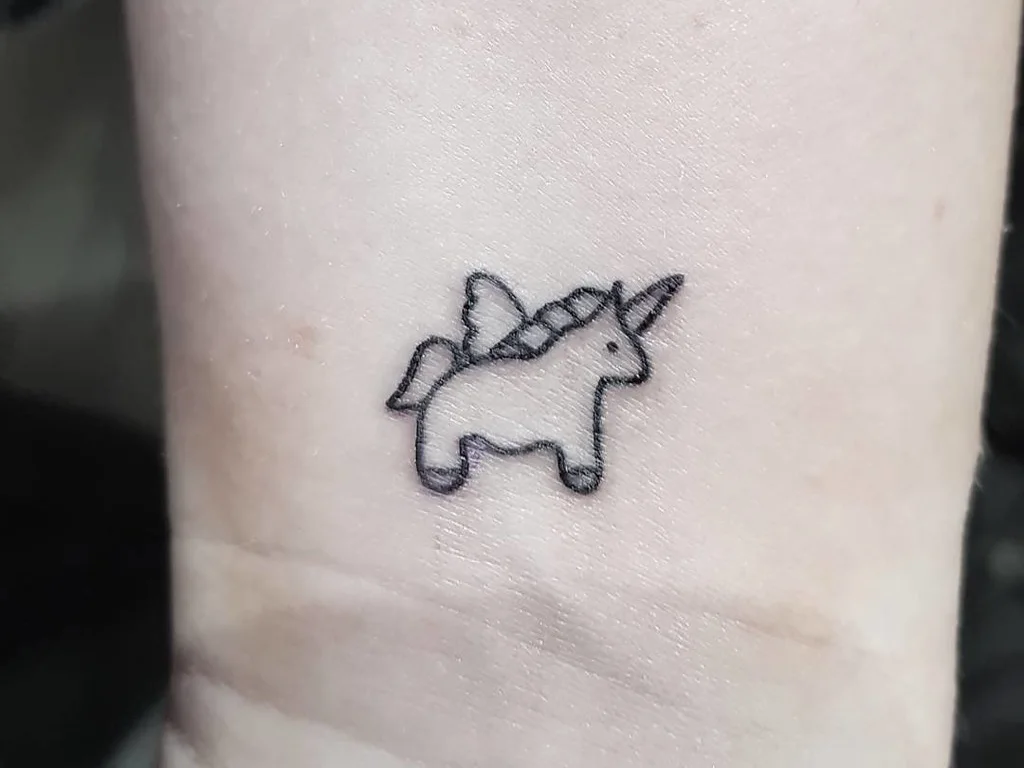
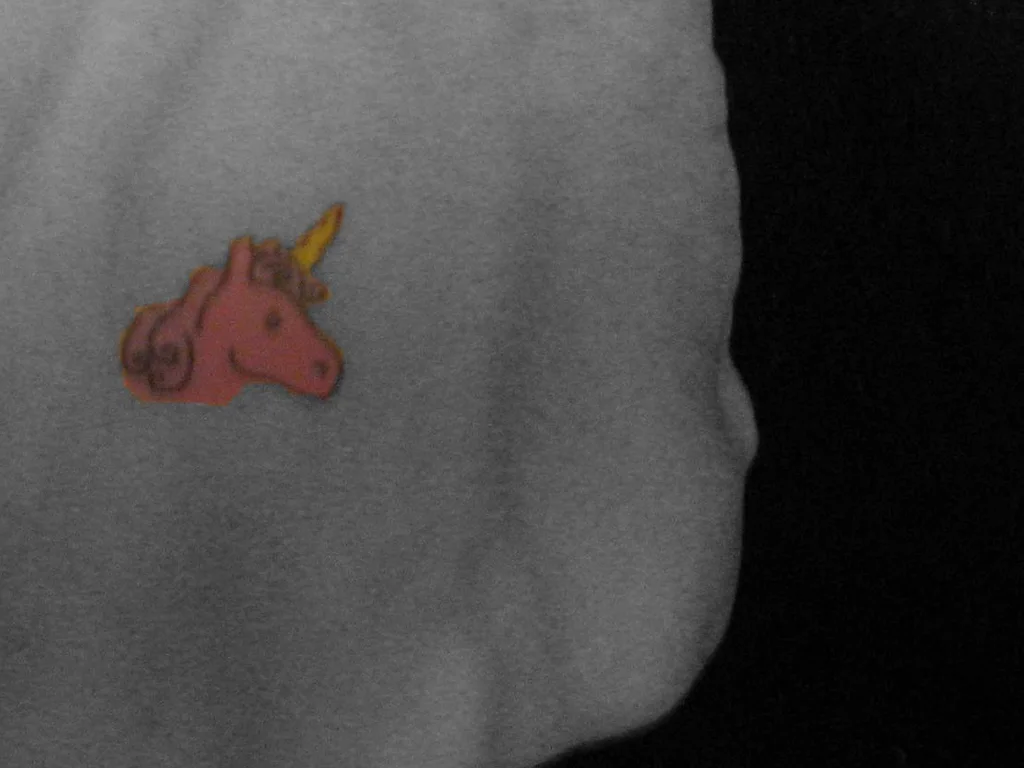
Two relatives get their own shelf, and the labels matter: these are mythic creatures, not horse breeds. The unicorn carries medieval meanings — purity, rarity, a creature that could only be approached gently — and it is, oddly for a fantasy animal, the national animal of Scotland. Modern unicorn tattoos usually keep the rarity and drop the purity lecture: hard to find, harder to catch, not sorry about it. Pegasus is the Greek winged horse, born in the Medusa story and ridden by the hero Bellerophon, and he stands for the leap — poetry, ambition, getting off the ground. A pegasus piece with a Greek helmet, like the forearm below, is mythology worn openly, and it reads that way.
Going small
Small horse tattoos give up the mane, the muscle and the movement, and keep the silhouette — which turns out to be enough. A tiny outline horse or unicorn on a wrist, ankle or hand works the way a signature does: not a picture of the thing, a mark that stands for it. The trade is ageing. Fine small lines soften faster than bold ones, and a two-centimetre horse has nowhere to hide a wobble, so small pieces reward a steady artist and punish a cheap one. Keep the outline bold for its size and the meaning survives intact.
Combinations and Personal Details
Most real horse tattoos are not dictionaries; they are biographies with props. A name and dates turn the piece into the memorial described above. Flowers steer it — roses toward romance and the racing world, wildflowers toward the freedom layer, a horse chestnut blossom toward home counties and childhoods. Landscapes do the opposite job: a mountain line, a desert, a favourite coastline tells the reader where this horse belongs. Other animals change the tense entirely: a horse with a dog is usually about two specific animals, a horse with a wolf pushes toward the wild sampler pieces in our wild animal tattoo ideas collection. Text works best kept short — a stable name, a race name, one line of a song — because the horse is already saying the long part. For how a single animal’s meaning page handles combinations like this, the lion tattoo meaning guide works through the same questions for the other stable-yard king.
Myths Worth Dropping
There is a fixed code. There is not. No culture left a rulebook that assigns one meaning to a horse tattoo, and the pages that list ten exact meanings per animal are writing fiction. What exists is documented history — Epona, Sleipnir, the zodiac — layered under modern habits like the galloping freedom piece. Use both, label them apart, and your tattoo is standing on something true.
Every horse tattoo means “free spirit.” That phrase has been photocopied so many times it has stopped meaning anything at all. Memorial pieces mean grief. Trade pieces mean work. Rearing pieces mean an argument the wearer is winning. If your horse means freedom, say what it is freedom from, and the tattoo gets its spine back.
A horseshoe must point one way or the luck reverses. Covered above, repeated here because it refuses to die: points-up and points-down are both old traditions with opposite reasoning, and neither has a verified rule behind it. Anyone who tells you one direction is simply wrong is selling certainty the folklore never had.
Frequently Asked Questions
What does a horse tattoo mean in general?
Most horse tattoos lean on freedom, power, loyalty or travel, and the design picks the winner. A galloping horse is about freedom and forward motion, a head study is usually about one beloved animal, and a rearing horse is about spirit and defiance. There is no single fixed code — the layers on this page are the honest menu.
Does the meaning change for women and men?
No. The symbolism is the same on anyone. What differs in practice is taste in size and placement — smaller outline pieces and ankle or rib placements are common with women, big chest, back and arm pieces with men — and those are fashion habits, not separate meanings. Pick the design that says your sentence.
What does a galloping horse tattoo mean?
Forward motion. Galloping is the freedom pose: leaving, arriving, refusing to stand still. Riders and travellers pick it for journeys, and people marking a big change — a move, a recovery, a new start — pick it for the same reason. The faster the legs and the longer the mane streams, the stronger that reading gets.
What does a horse head tattoo mean?
Usually one specific horse. The head is the portrait format: it carries the eye, the expression and the markings that make an animal recognisable. Head tattoos are the most common shape for memorials and tributes, and they suit realism and fine-detail work better than any other crop of the animal.
What does a horseshoe tattoo mean, and which way up is lucky?
A horseshoe is a luck charm with iron folklore behind it, often tied to stables, racing or a family trade. As for direction: points-up (“holding the luck in”) and points-down (“pouring luck over the door”) are both genuine old traditions, and neither has a verified rule. Choose the story you grew up with.
What does a unicorn tattoo mean compared with a horse?
The unicorn keeps the horse’s freedom and adds rarity and a little defiance: hard to find, harder to catch. Medieval lore tied it to purity, and it is the national animal of Scotland, but most modern unicorn pieces are about being one of one. It is a mythic branch of the family, not a breed.
What does the horse mean in the Chinese zodiac?
The Horse is the seventh zodiac sign, linked with energy, independence and warmth, and horse imagery also carries a traditional good wish — success arriving with the horse. The next Year of the Horse begins on 17 February 2026, and it is a Fire Horse year, a pairing that returns only every sixty years.
Where is the best placement for a horse tattoo?
Full-body and galloping designs need room to run: thigh, back, chest, ribs and upper arm all work. Heads fit forearms, calves and shoulder blades. Small outlines live happily on wrists, ankles and behind the ear. Match the space to the pose first — a gallop squeezed onto a wrist stops looking like a gallop.
Do horse tattoos age well?
The bold ones do. Manes, flowing tails and tiny legs are the first details to soften as ink spreads with age, so galloping designs in fine line need either size or simplified shapes to stay readable. Black and grey with strong outlines ages best; a good artist will thicken the lines you love most on purpose.
Can a horse tattoo be a memorial for a horse I lost?
Yes, and it is one of the most common reasons people get one. Portraits from a clear photo, the horse’s name or stable name, dates, and sometimes a lock-of-hair detail worked into the mane all appear in memorial pieces. Bring your best photographs to the consultation — likeness lives in the markings, and markings live in good reference photos.
Final Thoughts
A horse tattoo can honestly mean a run for freedom, twenty years of shared work, a goddess’s protection, a good-luck shoe over a door, or a mare you still think about every spring — and the design is what picks between them. Decide the layer first and the style second: gallop for going, head for remembering, shoe for luck, wings for the leap. The history on this page is solid ground, from Epona’s stable shrines to the Fire Horse year opening in February 2026. The rest of the meaning is yours to write, which was always the best part of an animal that never held still for anybody. The designs themselves live in the horse tattoo ideas collection, built from real photographs only, counted one by one.
Photo credits: Images 1 and 5: TattoosAll, CC BY 2.0, via Flickr. Image 2: 10 Corso Como, CC BY 2.0, via Flickr. Image 3: fthdgrl via Pexels. Image 4: TattoosAll, CC BY-SA 2.0, via Flickr. Image 6: bigbadjon32, CC BY 2.0, via Flickr.