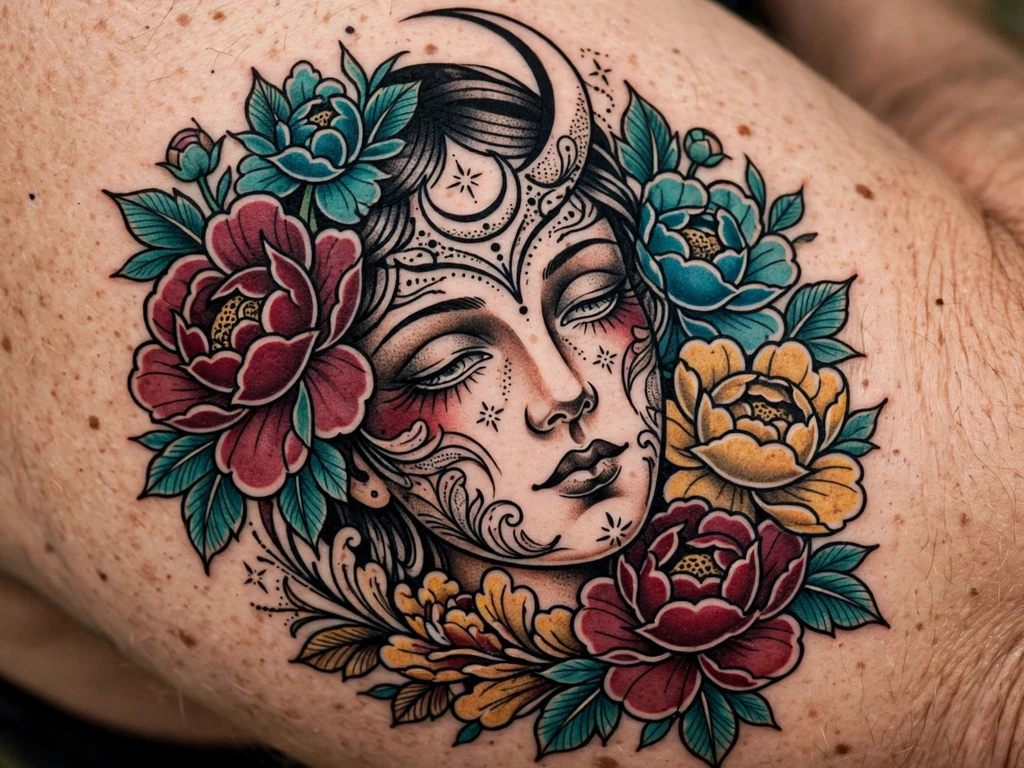
Neo traditional is the style readers ask about with the same sentence again and again: I love the boldness of old-school tattoos, but I want more from the drawing and the colour. That sentence is, almost word for word, the style’s founding brief. Neo traditional keeps everything that made American traditional tattooing survive a century — the heavy black outline, the drawing that reads from across the room, colour packed to last — and then opens the doors that old-school work kept shut: a far wider palette of muted and jewel tones, line weights that vary inside one design, subjects far beyond the sailor’s flash sheet, and decorative, illustrative detail borrowed from Art Nouveau, Art Deco and Japanese tattooing.
You will find 25 original neo traditional tattoo ideas here — the lady faces everyone is searching for, animal portraits, dagger-and-rose classics rebuilt in the new grammar, ships, swallows, sacred hearts and deco-framed curiosities. But read the explainer and the craft section first, because this style is misunderstood in one specific way: neo traditional is not “traditional, but with more stuff in it.” The extra detail and colour are earned by the discipline underneath, and every design below is specified the way the style actually works — outline first, colour inside it, detail budgeted by distance.
What Is a Neo Traditional Tattoo?
Start with the inheritance. American traditional tattooing — the sailor-era style of eagles, anchors, roses and daggers — was engineered for permanence under hard conditions: bold black outlines that hold a drawing together as skin ages, flat, saturated colour in a short list of pigments, whip shading (a stippled gradient flicked from dark to light) and compositions simple enough to read at a glance, across a dock, in bad light. Neo traditional begins exactly there — and then asks what more the drawing could carry without breaking the engineering.
The additions are four. First, the palette opens up. Where old-school work lived on red, green, yellow, brown and black, neo traditional works in ochres, mustards, dusty teals, plums, mauves, olive, burgundy and skin-warm neutrals alongside the classics — tones chosen in families, so a piece feels curated rather than rainbowed. Second, line weight varies. The outline is still black and still bold, but inside the design the line steps down in grades — heavy for the silhouette, medium for the structure, finer for interior detail — where traditional holds one weight throughout. Third, the subject list escapes the flash sheet. Lady faces become full portraits, animals are drawn as characterised portraits rather than emblems, and Art Nouveau florals, Deco geometry and Japanese composition all enter the vocabulary. Fourth, shading deepens. Whip shading remains, joined by smooth gradients and soft colour transitions that old pigments made impractical.
The Art Nouveau debt deserves its own sentence, because it explains the style’s favourite subject. When the Cooper Hewitt, Smithsonian Design Museum describes Alphonse Mucha’s Femme à Marguerite, it names the era’s signature outright: the coupling of nature and the female form, lyrical organic forms, and rooms “filled with sweeping whiplash lines and crescent forms, punctuated by his sultry young women”. The neo traditional lady face — a woman’s portrait wreathed in flowers, hair flowing in long rhythmic curves, a crescent moon overhead — is that Art Nouveau maiden carried into tattooing almost unchanged, given a black outline and asked to survive on skin. The whiplash curve survives too: it is the line that draws the hair, the stems, the snake’s body and the wave in half the designs below.
So the differences from old-school traditional, stated plainly: neo traditional uses a wider, more muted palette where traditional uses few saturated primaries; it varies line weight where traditional holds one weight; it draws any subject illustratively where traditional works a fixed iconography; and it layers decorative detail — frames, filigree, floral filler — where traditional leaves bold empty skin. What it refuses to change is the foundation: black outline, distance readability, colour packed for decades. A design that drops those is not neo traditional; it is an illustration hoping skin behaves like paper, and skin does not.
What Does a Neo Traditional Tattoo Mean?
Neo traditional meanings are carried by subject, the way traditional meanings always were — the style is a grammar, not a message, and wearers load their own sentences into it. The vocabulary, though, has settled readings worth knowing. The lady face is the style’s muse: beauty, longing, the feminine as an ideal or as a portrait of someone real — in Art Nouveau tradition she is less a person than a season or a mood given a face, which is why so many wearers choose her as pure emblem rather than likeness. Animal portraits take the animal’s traditional reading — the fox’s wit, the owl’s watchfulness, the tiger’s contained power — and deepen it with character: a neo traditional fox is not the idea of a fox but a fox, mid-thought, and wearers usually mean something correspondingly specific. Dagger and rose keeps its century-old pairing of love and loss, beauty and the wound. The sacred heart carries devotion and enduring love in Catholic tradition, drawn here as it has been drawn on skin for generations — as a symbol of faith and sacrifice, stated as tradition, which is what it is. Ships and swallows are the sailor inheritances: the ship for the journey and the hope of return, the swallow — traditionally earned for distance travelled at sea — for homecoming and loyalty.
One framing note, in this series’ habit: these readings are symbolism and tradition, worn as meaning, not fact. The facts here are the craft ones — how the style is built and how it ages.
The Outline Is the Law: How Neo Traditional Is Built
Every rule in this section follows from one fact: a neo traditional tattoo must first work as a black drawing. Photocopy any good neo traditional piece in black and white and it loses nothing structural — silhouette, composition, the path of every form — because the colour was never carrying the design. It was filling one. That is the whole style in a sentence, and the five rules below are its working form.
Rule one: the black drawing is completed before colour is discussed. Outline, internal structure lines, the black shading that anchors the darks — all of it must read as a finished drawing. If a design only makes sense once the colour is in, it is not ready; colour laid over a weak drawing produces a colourful weak tattoo, permanently.
Rule two: colour lives inside the outline’s discipline. Colour fills forms the black has already defined; it never invents edges of its own. Where two colours meet without a line between them, the meeting is a gradient planned as shading — whip shading or a smooth blend — never a hard border the eye must invent. This is the rule that separates neo traditional from soft illustrative work that blurs at the edges within five years.
Rule three: detail is budgeted by distance. The design must read at two metres — subject, posture, direction — before it may spend anything at twenty centimetres. Fine interior detail (fur texture, feather barbs, filigree) is legitimate only as the second read, decoration the first read does not need. Detail that the first read depends on is detail the skin will tax away, because healed lines thicken and fine interior work is the first thing ageing spends.
Rule four: the palette is a set, not a shelf. A piece chooses its tones — typically three to five colour families plus black and skin — and repeats them through the design, so a teal in the headdress answers a teal in the flowers. Every extra colour admitted dilutes the set’s coherence and adds a pigment ageing on its own schedule.
Rule five: whip shading and gradients serve the structure, never replace it. Neo traditional’s soft transitions — the cheek’s blush, the petal’s turn — are shading inside forms the line has built. The moment shading becomes the only thing defining a form, that form has an expiry date. Judge artists accordingly: their healed work should show soft colour still sitting obediently inside crisp black architecture.
There is an old craft that ran on exactly these rules, and naming it explains why they work. In Japanese woodblock printing, as the University of Alabama’s Japanese prints materials page sets out, the carved key block “provided the black outline for the finished print”, and “the same process was used to make separate blocks for each color to be used” — colour printed afterwards, inside the black, one disciplined block at a time, with gradation added as a deliberate effect. Neo traditional’s debt to Japanese art is usually discussed as composition — the waves, the peonies, the animal poses — but the deeper borrowing is this workflow: black first, colour second, nothing structural left to the colour’s mercy. Tattooing cannot re-carve a block; it gets one pass, which is why the rule is a law here rather than a sequence.
Neo Traditional Tattoo Styles and How They Age
All neo traditional work ages by the law above: the black holds, the colour settles. Lines thicken slightly and stay legible for decades; saturated colour mellows toward its muted register — which is why the style’s muted palette is also its ageing strategy, a palette chosen near where pigments end up anyway. The variants differ in what they risk.
| Style | How it is drawn | How it ages |
|---|---|---|
| Classic neo traditional | Bold even outline, traditional subjects, extended but disciplined palette, whip shading | The longevity benchmark: reads for decades, colour mellowing evenly inside an unmoving architecture |
| Muted / jewel palette | Ochres, teals, plums and burgundy in limited family sets, smooth gradients | Settles the least visibly of all — the fresh tattoo is already drawn near its healed register; soft gradients are the only watchpoint |
| Illustrative neo traditional | Varied line weights, characterised portraits, narrative detail, Art Nouveau and Deco borrowing | Detail is the spend: interior fine work softens first, so the design survives exactly as well as its two-metre read was built |
| Deco-framed | Subjects set inside geometric frames, arches, rays and filigree borders | Frames age superbly — geometry in bold black barely moves; the framed subject follows its own row above |
| Black-heavy neo traditional | Expanded black shading, colour used as accent rather than fill | The boldest treaty: black does more work each year as colour quiets, and the design is drawn expecting that shift |
One honesty belongs here, because this style attracts it: the healed test. Neo traditional photographs circulate fresh, when the muted palette glows and every gradient is at full strength. The healed reality is calmer: colours a register quieter, gradients softer. Every design below is described at its healed reality, and artists should be judged the same way.
Neo Traditional Tattoo Ideas at a Glance
| # | Design | Style notes | Best placement |
|---|---|---|---|
| 1 | The Classic Lady Face | Portrait, rose crown, whip-shaded cheeks | Forearm |
| 2 | Lady With a Wolf Headdress | Portrait under an animal headdress | Upper arm |
| 3 | Medusa in Full Colour | Mythic lady face, jewel-toned snakes | Upper arm |
| 4 | Lady With Flowers and a Dagger | Portrait, dagger through the bouquet | Shoulder blade |
| 5 | The Fox Portrait | Characterised animal portrait, floral frame | Forearm |
| 6 | The Death’s-Head Moth | Bold wings, skull marking, night florals | Upper arm |
| 7 | The Owl Portrait | Watchful owl, crescent and stars | Shoulder |
| 8 | The Snake Through Peonies | Coiling snake, full peony blooms | Calf |
| 9 | Dagger and Rose | The classic pairing, extended palette | Forearm |
| 10 | The Sacred Heart | Devotional heart, rays and flowers | Forearm |
| 11 | The Peacock | Fanned tail, jewel eye feathers | Shoulder blade |
| 12 | The Tiger Head | Snarling portrait, bold stripes | Upper arm |
| 13 | The Tall Ship | Full-rigged ship, waves and sky | Calf |
| 14 | The Swallow Pair | Two swallows, reimagined with florals | Collarbone (outer edge) |
| 15 | The Key and the Lock | Ornate key, heart-shaped lock | Forearm |
| 16 | The Lucky Cat | Maneki-neko, coin and waves | Calf |
| 17 | The Ornate Skull | Decorated skull, floral crown | Shoulder |
| 18 | The Koi Among Waves | Koi carp, woodblock wave framing | Calf |
| 19 | The All-Seeing Eye | Eye in a floral wreath, radiating lines | Forearm |
| 20 | The Panther Head | Traditional panther, redrawn in colour | Upper arm |
| 21 | The Hare in a Deco Frame | Hare portrait, geometric arch frame | Forearm |
| 22 | The Hourglass and Roses | Hourglass, roses, falling petals | Forearm |
| 23 | The Tiny Swallow | Single small swallow, minimal detail | Behind ear |
| 24 | The Small Dagger | Miniature dagger, one flower | Finger (side) |
| 25 | The Lady and the Tiger | Grand portrait, tiger headdress-crown | Shoulder blade |
25 Neo Traditional Tattoo Ideas
1. The Classic Lady Face
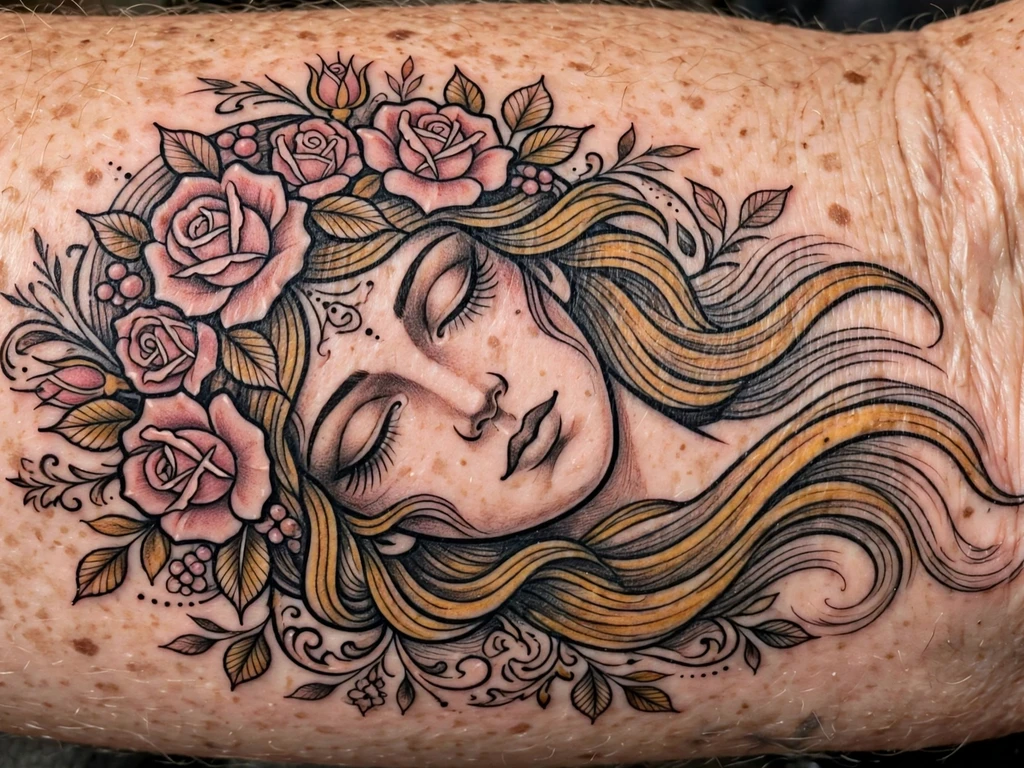
The design the searches are asking for, drawn the way the style intends: a woman’s face in three-quarter view, calm and unsmiling, crowned with roses and framed by hair that falls in long whiplash curves to fill the forearm’s panel. This is the Art Nouveau maiden under tattoo discipline — the hair’s flowing lines are pure Mucha, but every curve is locked inside a black outline heavy enough to hold the portrait together when the soft cheek shading has settled. The palette is the style’s calling card: dusty rose, ochre, muted teal in the leaves, skin left to do the highlights.
A lady face succeeds or fails on the features’ spacing. Eyes, nose and lips are drawn larger and simpler than a portrait painter would draw them, because features at true-life delicacy close up as lines thicken — the two-metre test applies to faces hardest of all. The flowers in the crown are not filler; they are the frame that lets the face sit smaller than a portrait otherwise could, because the composition reads lady with roses from across the room before it reads as a specific face.
Best placement: Forearm, the face upright along the arm’s length; the panel shape suits the composition perfectly.
Best for / know before you book: Judge lady-face artists on healed faces specifically — a face is the least forgiving subject in the style, and fresh whip shading hides a multitude of sins that healed skin will present to you.
2. Lady With a Wolf Headdress
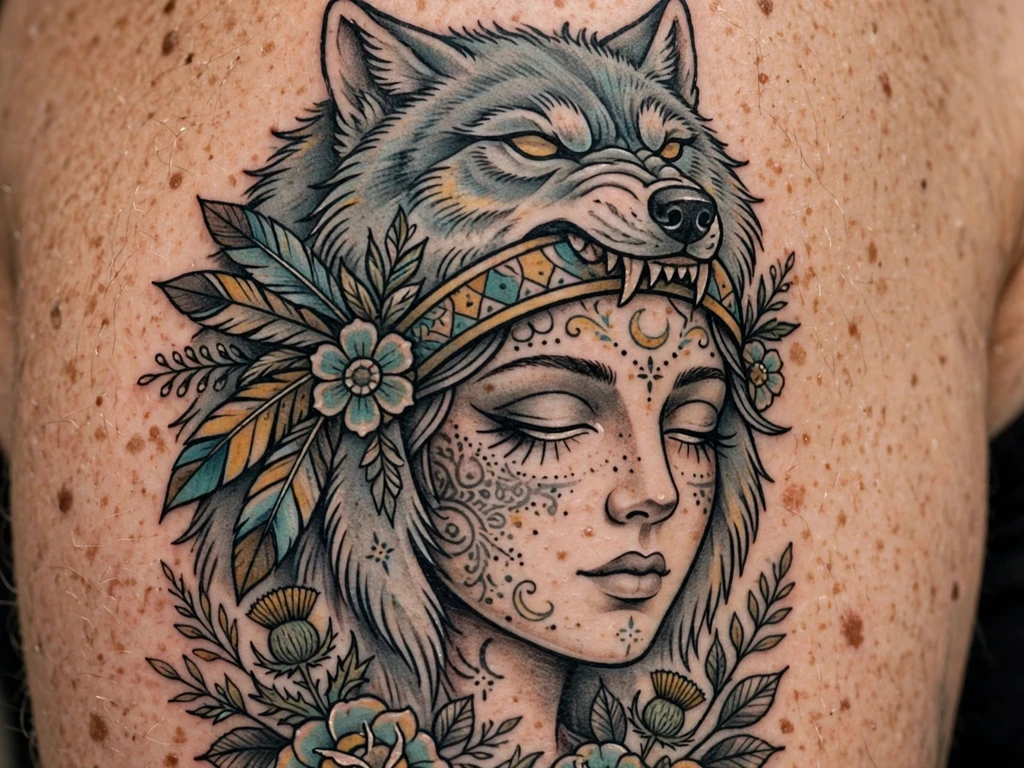
The lady face wearing the animal: a woman’s portrait set beneath a wolf’s head worn as a headdress, the wolf’s ears rising above her brow, its fur framing her face, paws resting at her shoulders. It is one of neo traditional’s signature compositions — portrait and animal portrait in a single stacked design — and its meaning is the pairing itself: the wearer’s human face and the animal they carry with them, guide, guardian or wilder self. The wolf is drawn with the same characterised care as the woman; neither is the other’s decoration.
Stacked compositions live or die on the join. The headdress must sit on the head with believable weight — ears placed off her skull’s true crown, fur falling where gravity puts it — or the design reads as two stickers. Line weight does the signalling: the wolf’s outline a grade heavier, the face’s a grade finer, so the eye files them in the right order.
Best placement: Upper arm, where the stacked composition gets the height it needs; a shoulder blade takes it larger.
Best for / know before you book: Bring references for both halves separately and judge the artist on each — headdress pieces expose artists who are strong on faces but weak on animals, and vice versa.
3. Medusa in Full Colour
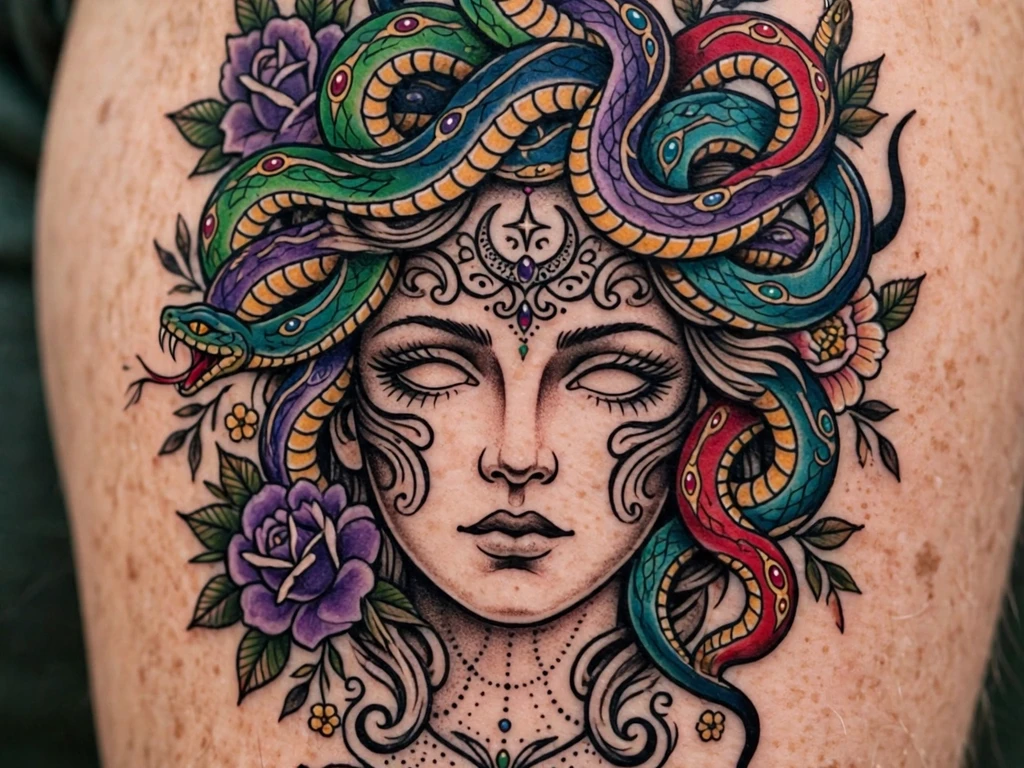
Medusa is the lady face’s mythic sister, and neo traditional is arguably her natural style: a beautiful, composed face — the style never draws her monstrous — crowned with a living headdress of snakes in jewel greens, ochres and burgundy, each snake a small complete drawing with its own head, tongue and coil logic. Wearers take her for survival, for rage made regal, for the protection of a gaze that answers back; the full account of her symbolism lives in our medusa tattoo ideas guide, while this design is specifically her portrait in this style — the difference being the colour architecture and the snakes drawn as ornamental pattern as much as animals.
The snakes are the detail budget’s examination. A crown of eight snakes is eight small tattoos’ worth of heads and scales competing around one face; the build that survives draws fewer, larger snakes — five or six — with bold scale patterning rather than fine scale texture, and lets two or three heads carry the expression. Snake colours repeat in a set of two or three tones, never a different green per snake.
Best placement: Upper arm, the crown of snakes filling the arm’s width; a shoulder blade hosts the grandest versions.
Best for / know before you book: Count the snake heads on the stencil and ask for the total to come down until each head is at least a thumbnail’s size — miniature heads are where Medusa pieces go to blur.
4. Lady With Flowers and a Dagger
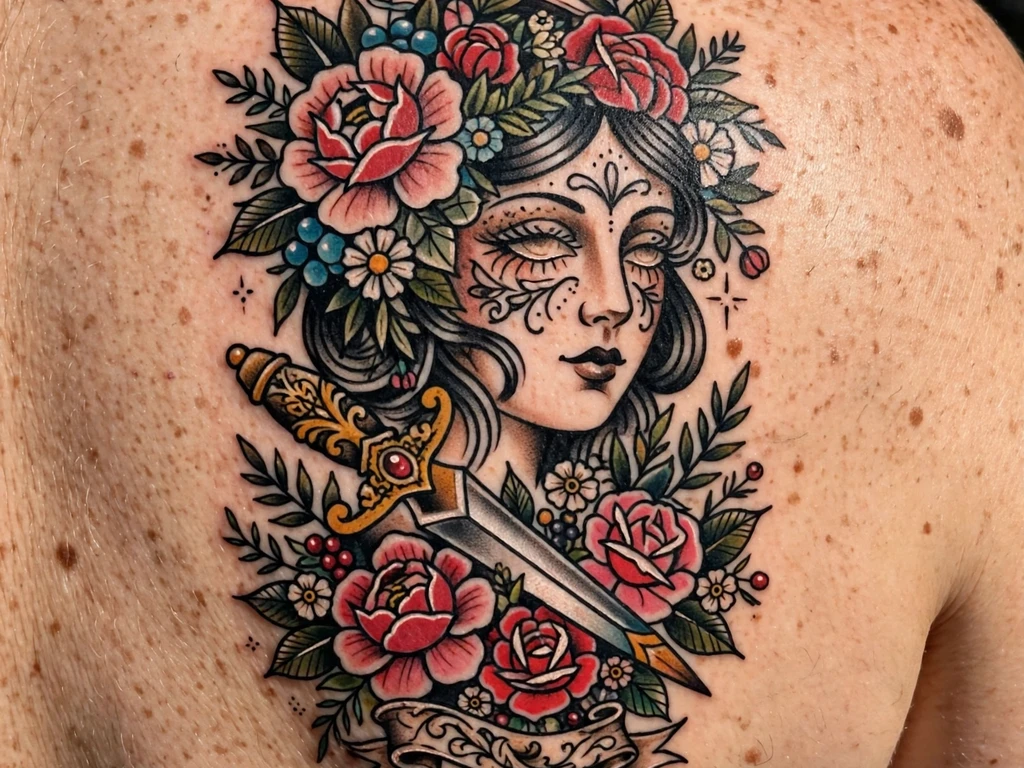
The lady face with the story turned darker: a woman’s portrait wreathed in full blooms — peonies, roses, leaves — with a dagger laid diagonally through the bouquet beneath her chin, its handle jewelled, its blade clean. The composition is a neo traditional staple because it does two reads at once: from distance, a beautiful framed portrait; up close, the blade that says the beauty is defended, or mourned, or hard-won. Wearers choose it for love-with-a-cost meanings, for memorial portraits, and for the simple drama of softness and steel sharing a frame.
The dagger is drawn with traditional discipline inside the newer style — a straight, true blade with no decorative wavering, because a blade that bends reads as a ribbon. Diagonal placement is the craft choice: it animates the portrait’s symmetry and gives the shoulder blade’s broad flat a composition with movement. The flowers nearest the blade are drawn a shade deeper, a small storytelling gradient the style’s smooth shading makes possible.
Best placement: Shoulder blade, where the wide composition spreads naturally; an upper arm takes a tighter, more vertical version.
Best for / know before you book: Check the blade’s line on the stencil standing in a mirror — diagonals distort on the shoulder blade’s curve more than any other shape, and a dagger exposes it instantly.
5. The Fox Portrait
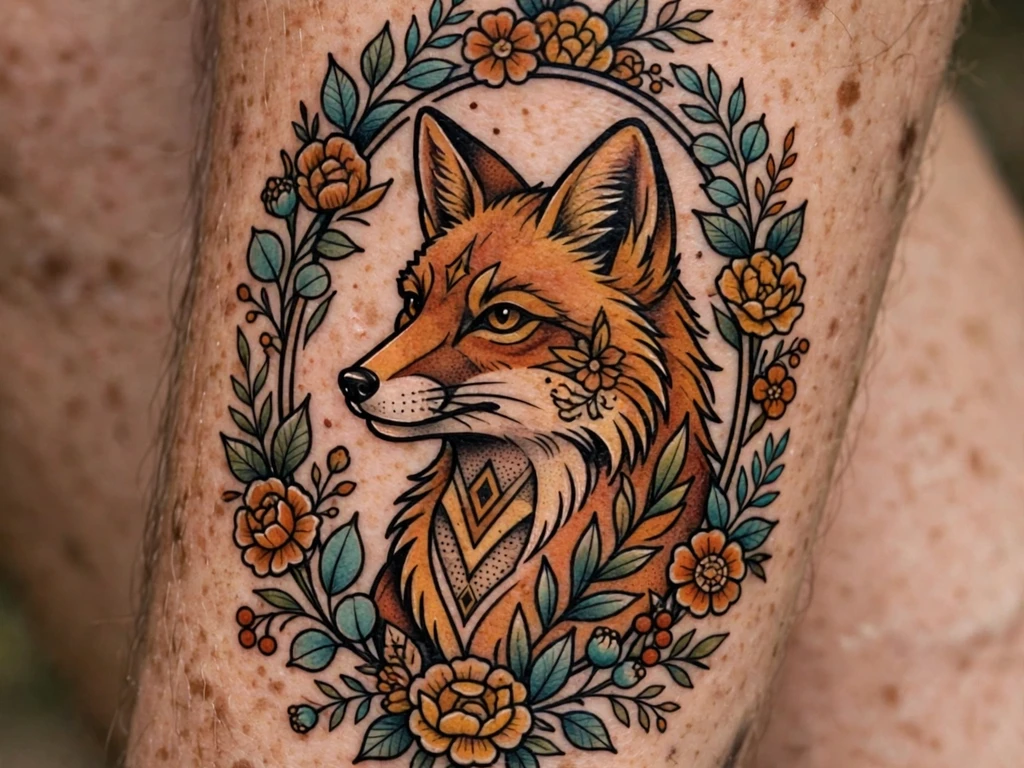
Not the emblem fox and not the fine-line fox — a portrait: the fox’s head at full panel size, ears tall, gaze angled with the animal’s famous calculation, fur built from bold patterned strokes in rust and ochre, the whole head ringed by a frame of leaves and small flowers that turns the animal into a sitter in a gallery. This is the clearest place to state the style’s difference from the site’s other fox coverage: our fox tattoo ideas guide draws the animal across every style including the lightest fine line, while this design is the fox under neo traditional law specifically — black architecture first, a limited jewel palette, detail spent on character rather than fur realism.
Fur is the craft trap. Real fur is thousands of fine strokes; tattooed, it is a thicket that settles into mud. The neo traditional answer is patterned fur: a dozen bold directional strokes and a few white-tipped markings that say “fur” the way woodblock says “water” — by convention, clearly, at reading distance. The white chest and ear tips are drawn as reserved skin bounded by line, never as white ink.
Best placement: Forearm, the portrait upright and full-panel; also excellent on a calf.
Best for / know before you book: Ask to see the design reduced to black only — a fox portrait whose character survives without its rust colour is drawn right; one that needs the colour to read as a fox is not.
6. The Death’s-Head Moth
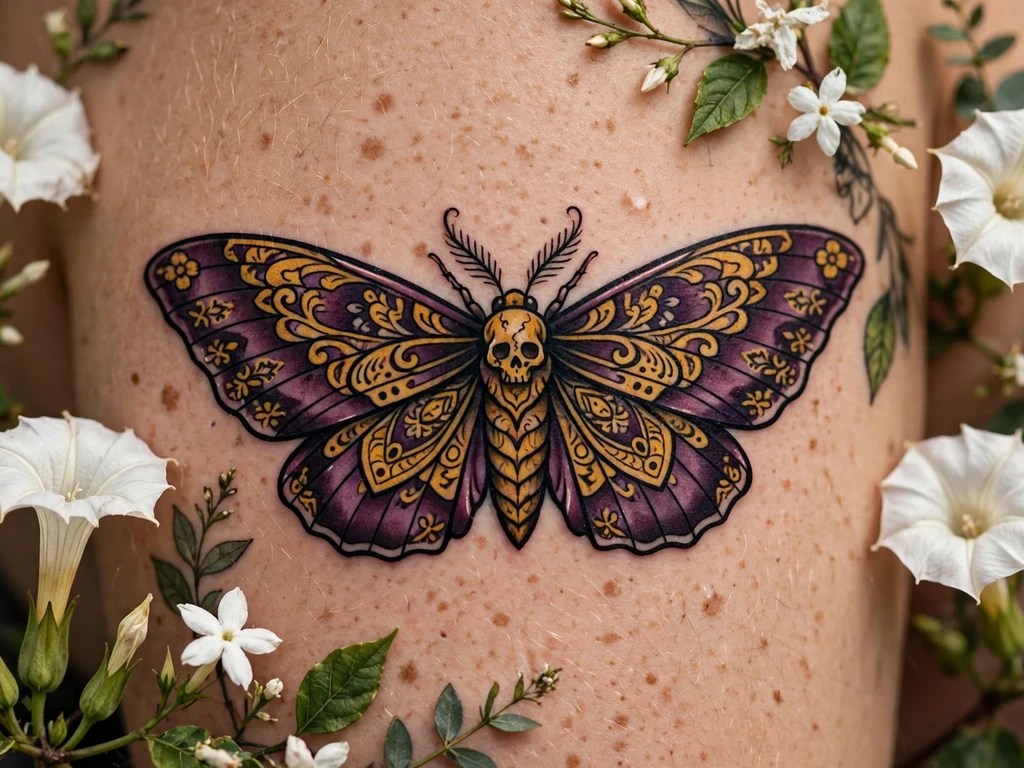
The moth rebuilt at full neo traditional weight: wings spread wide and patterned like textiles — bands, eye spots, scalloped edges — the thorax carrying the pale skull-like marking that gives the death’s-head its name, night flowers and a crescent moon completing the panel. Where the site’s moth tattoo ideas guide spans the animal in every register from fine-line to blackwork, this design is the moth as the style’s showpiece: symmetrical, decorative, unapologetically ornamental, its wings a pair of patterned fans rather than a naturalist’s study.
Symmetry is the whole craft, doubled. The two wings must match as drawings and as colour density, and the stencil must be checked on the standing arm, because upper arms taper and a moth checked flat heals lopsided. Wing patterning obeys the distance budget: bands and spots large enough to read as pattern at two metres, with the fine internal tracery kept to the wing centres where the skin is stillest. The skull marking is drawn as a suggestion in the thorax’s patterning — an unmistakable pale shape, not a miniature skull portrait.
Best placement: Upper arm, wings spread across the outer arm; the design also sits magnificently on a shoulder blade.
Best for / know before you book: Approve the stencil by its silhouette and banding alone, squinting — if the squint test shows a bold patterned moth, the detail can be as rich as the artist dares; if it shows a grey fan, simplify the pattern.
7. The Owl Portrait
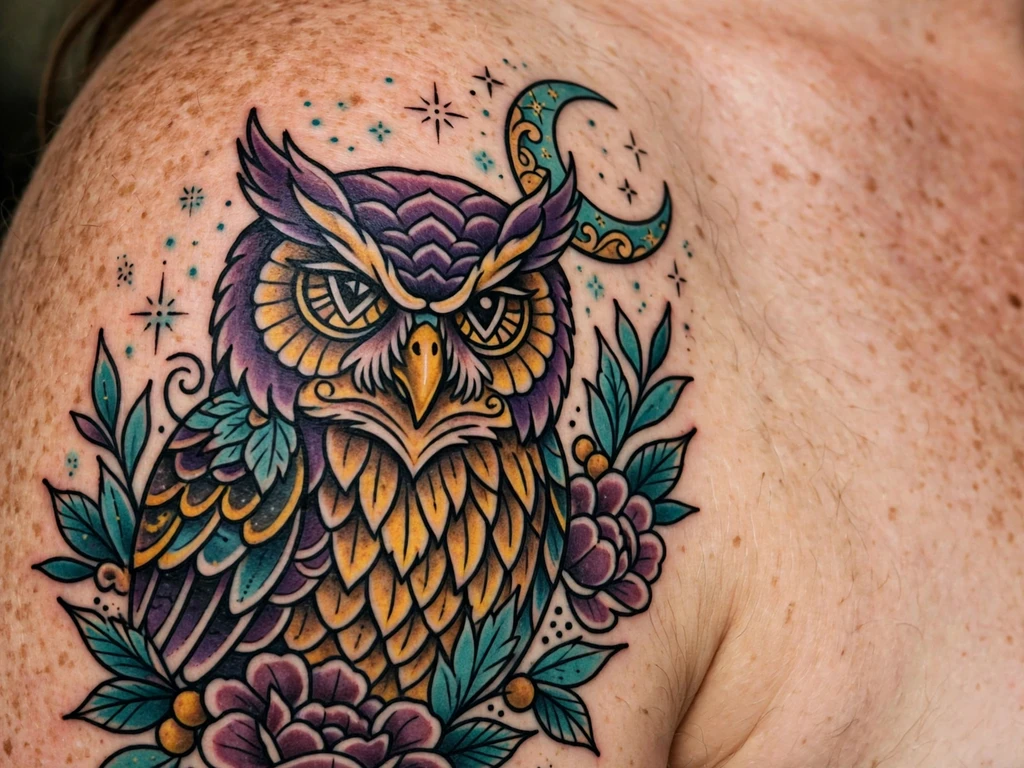
The owl as the style draws it best: front-facing, symmetrical, the facial discs rendered as concentric patterned rings, eyes large and amber, ear tufts rising into the composition’s points, a crescent moon and stars set into the background like a night sky in a frame. The owl’s traditional readings — watchfulness, wisdom, the creature that sees what others miss — are carried here by the stare itself: this is a portrait designed to look back at the room. Night palettes suit it: plum, deep teal, ochre and mustard against expanded black.
A front-facing owl is a symmetry appointment like the moth’s, with one addition: the eyes. Two eyes a fraction uneven read as a wink, then as an error, forever — the stencil check for this design is a ruler across the eyes and discs before anything else.
Best placement: Shoulder, the owl centred on the cap with the moon above; a forearm takes a slightly smaller, tighter version.
Best for / know before you book: This is the design to choose if you want the style’s symmetry discipline at its most satisfying — and to avoid if unevenness bothers you, because no design in this guide shows a millimetre’s error more honestly.
8. The Snake Through Peonies
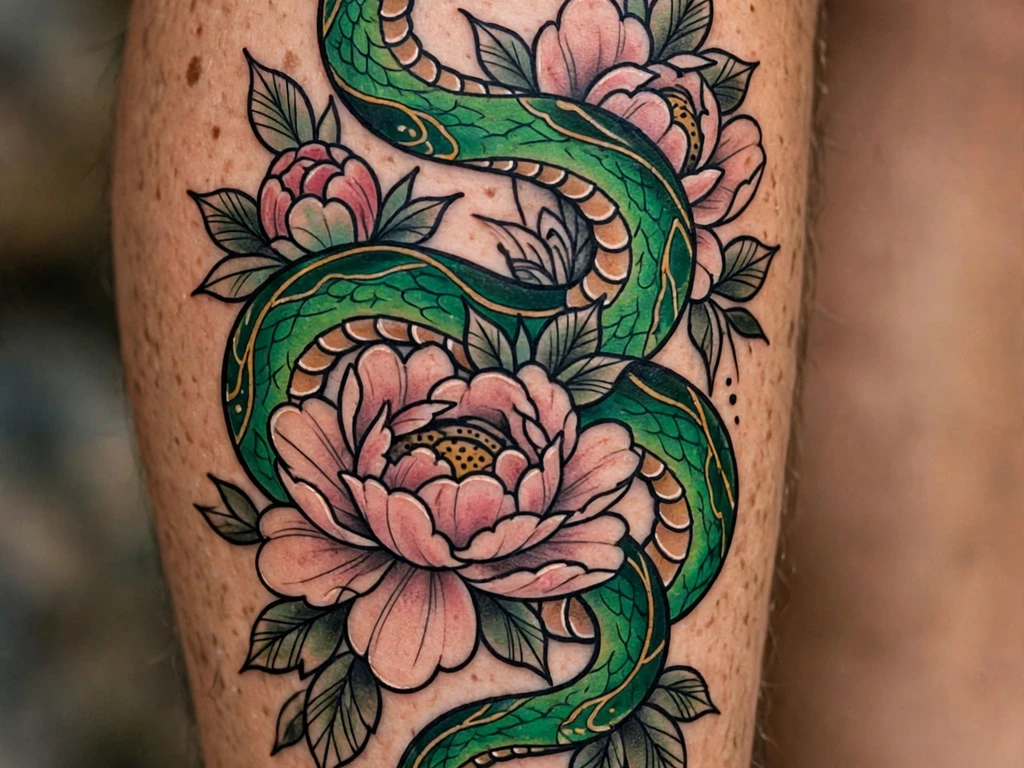
A snake in full neo traditional dress: the body coiling in a long S down the calf, scales drawn as bold patterned bands rather than texture, head alert with a flicked tongue, and at every coil a peony in full dusty-pink bloom, so the snake travels through flowers the way the design travels down the leg. The pairing is borrowed from Japanese composition — animal and bloom sharing one flowing rhythm — and the site’s wider snake coverage, from fine line to blackwork, lives in our snake tattoo ideas guide; this version is the snake as colour architecture, its body a green ribbon of pattern built to read from across the street.
The coils’ spacing is the design’s law. Curves that nearly touch when fresh will kiss when the lines thicken, merging the S into a stack — keep a finger’s width of skin between coils at the drawing stage. The scales obey the fox-fur rule: pattern, not texture. A bold diamond or banded scale repeated along the body says “snake” for decades; a thousand fine scale cells say it for a summer.
Best placement: Calf, the S running the muscle’s full length; the same composition climbs a forearm beautifully.
Best for / know before you book: Count the peonies and coils on the stencil and check the skin gaps between coils with your own finger — this design is arithmetic wearing flowers, and the arithmetic is checkable before the needle.
9. Dagger and Rose
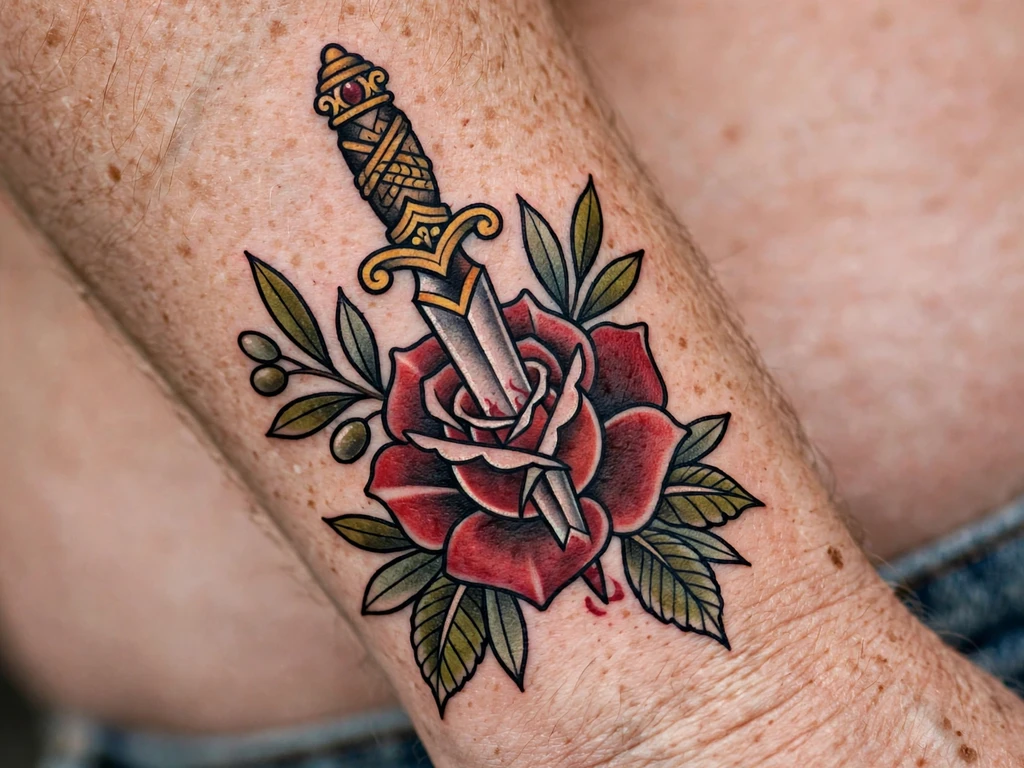
The oldest pairing in tattooing, redrawn in the new grammar: a dagger driven through a full rose, the blade straight and true, the bloom built petal by separated petal in deep reds and burgundy, leaves in olive and muted green, a ribbon of negative space where a banner might once have carried words — the style leaves it empty, and the emptiness is the update. The full rose family’s range is gathered in our rose tattoo design ideas guide; this design’s claim is narrower — the classic composition with neo traditional’s deeper palette, varied line weight and smoother shading, proof that the style honours its inheritance most when it redraws it.
The rose’s petals are the discipline. Each petal is its own closed shape with skin or deep shadow between it and the next, because a rose drawn as nested swirls becomes a red pom-pom as lines settle. The dagger’s shading is whip work at its most traditional — the style keeping one foot in the old shop — while the bloom’s gradients are the new register, and the contrast between the two is the design’s quiet thesis.
Best placement: Forearm, vertical, bloom high and blade running to the wrist; an upper arm takes it bolder.
Best for / know before you book: Count the rose’s petals on the stencil — if you cannot count them fresh, you will not count them healed, and an uncountable rose is a rose already lost.
10. The Sacred Heart
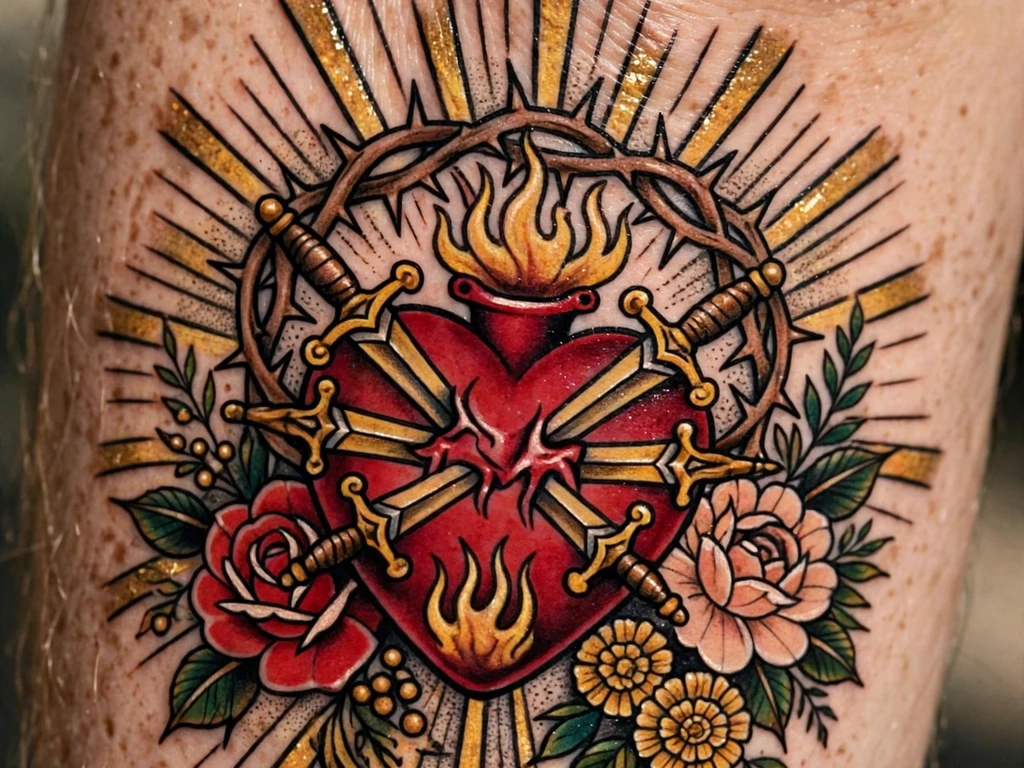
The devotional heart drawn in the style’s full register: a deep red heart wrapped with a crown of thorns, a cross and flame rising from its top, rays radiating behind it, flowers gathered at its base. In Catholic tradition the Sacred Heart stands for divine love and sacrifice, and it has been tattooed in that meaning for generations — worn as devotion, as memorial, as a promise carried on the skin. This guide presents it factually as what it is: one of tattooing’s oldest sacred subjects, drawn here with the respect of getting its established elements right — thorns, cross, flame, rays — rather than improvising on a symbol other people hold holy.
Its geometry is the craft. The heart’s two lobes must mirror cleanly, the rays must strike from a true centre at even intervals, and the thorn band must read as separate bold thorns, not a briar blur. Red is the palette’s centre and red settles warmest of all — the heart is drawn a register deeper than the fresh colour you approve, so its healed register lands where you intended.
Best placement: Forearm, the heart upright and centred; historically also worn on the upper arm at larger scale.
Best for / know before you book: If the devotional meaning is the point, tell the artist — artists draw sacred subjects with a care for accuracy that they cannot apply to a meaning they do not know is in the room.
11. The Peacock
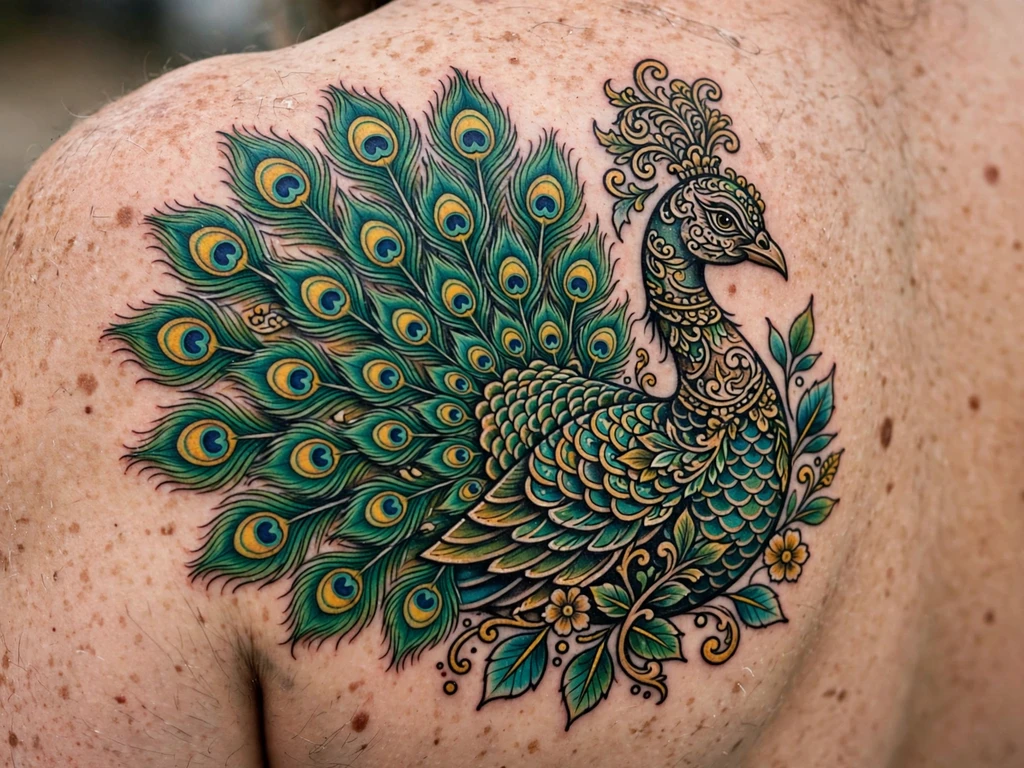
The style’s most decorative animal given its full stage: a peacock with its tail fanned across the shoulder blade, every eye feather a small jewel of teal, green and gold, the bird’s neck a deep sapphire curve, its crest a tiny crown. The peacock’s readings — pride, renewal (the tail is regrown each year), watchfulness in its hundred eyes — suit the style’s temperament, and the fan composition is a gift to the shoulder blade’s wide flat: a natural semicircle waiting for exactly this tenant.
The tail is a detail-budget masterclass, and it must be budgeted honestly. A real fan carries scores of eye feathers; the tattoo carries perhaps eleven, each drawn large, each eye a complete target of concentric colour, spaced so the fan reads as a pattern of eyes rather than a texture. Artists who attempt thirty eyes produce a shimmer that heals into green noise.
Best placement: Shoulder blade, the fan spread to the blade’s full width; this design does not shrink gracefully and should not be asked to.
Best for / know before you book: Count the eye feathers in the drawing and defend the low number — the fan you can count at year ten is the fan that was countable on day one.
12. The Tiger Head
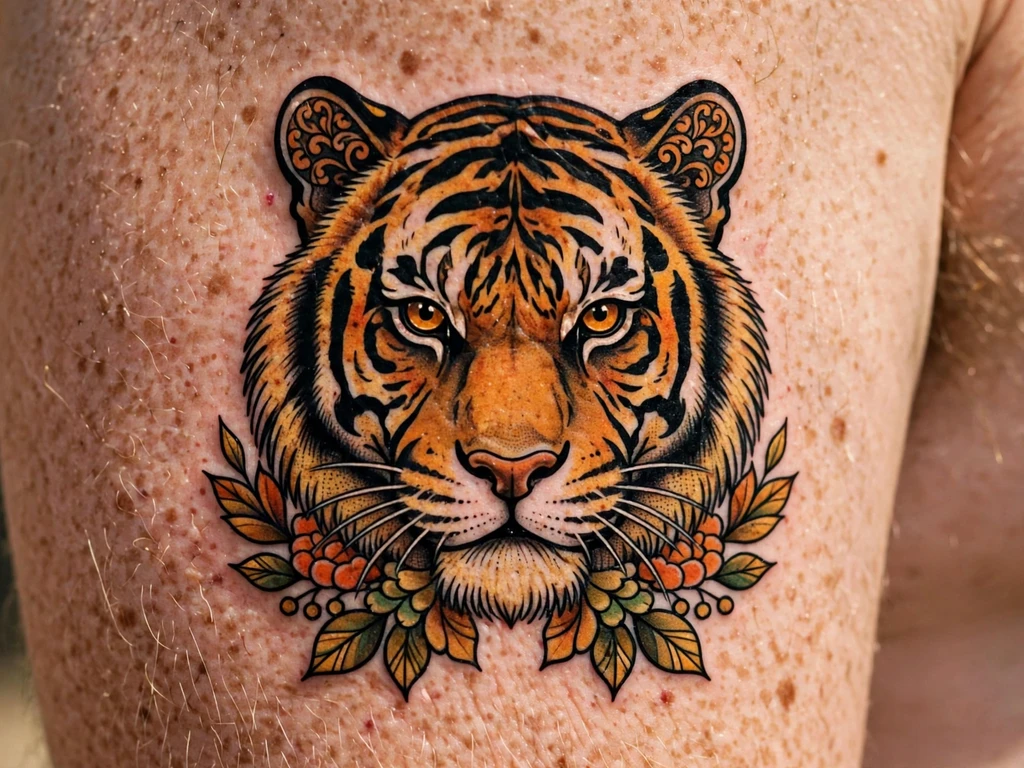
The tiger at portrait scale: head full-frame, mouth open in a snarl or closed in the calmer, more regal register, stripes drawn as bold black architecture over ochre and burnt orange. The tiger is Japanese and traditional tattooing’s shared emblem of contained power — strength that does not need to move — and in neo traditional it gains the characterised portrait treatment: this is a tiger, with an expression chosen by the wearer, not a heraldic blank. The snarling version reads as warning; the calm version, increasingly chosen, reads as sovereignty.
Stripes are the whole craft. A tiger’s stripes must be drawn as the animal’s own map — following the skull’s structure, breaking at the cheeks, never as uniform decoration — and each stripe must keep skin or orange between itself and its neighbour, because merged stripes turn the head into a tabby pumpkin by year five. The muzzle and nose carry the finest work in the design and are drawn boldest-simple: a tiger’s expression survives on the set of the jaw and eyes, not on whisker dots.
Best placement: Upper arm, the head at the arm’s full width; a shoulder blade takes the truly grand versions.
Best for / know before you book: Approve the head as a black silhouette of stripes alone — cover the colour in the reference and check the stripe map still reads as a tiger’s skull; if it does, the colour is free to be beautiful.
13. The Tall Ship
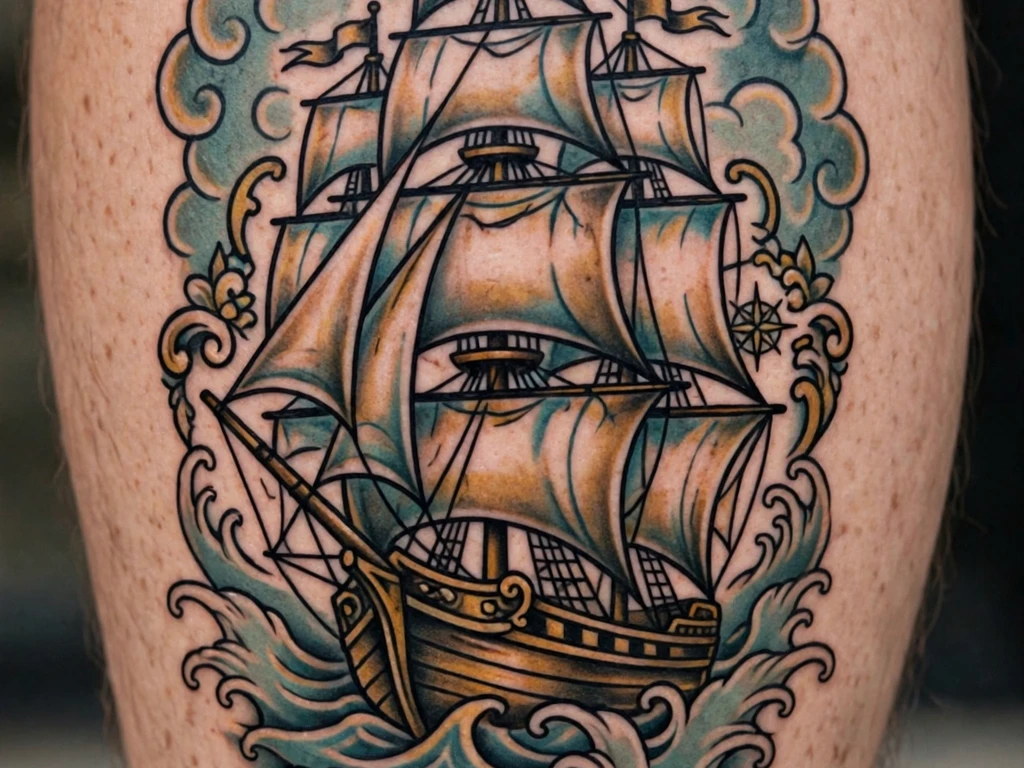
The sailor’s homeward emblem rebuilt with everything the new style can add: a full-rigged ship under a spread of sails, stylised waves curling at its hull in the woodblock manner, clouds and a low sun banding the sky, a banner of empty ribbon beneath. Old-school ships were deliberately simple — a hull, three sails, done. The neo traditional ship keeps the silhouette’s honesty but fills the panel: rigging drawn as disciplined parallel lines, sail shading in smooth gradients, the sea given the decorative wave-pattern the Japanese prints taught tattooing to love. Its meaning is unchanged and unembarrassed: the journey, the work, the hope of coming home.
Rigging is the detail budget’s test. Real rigging is a web of dozens of lines; tattooed at calf scale it must be reduced to the dozen that carry the drawing — shrouds and stays as bold parallel lines with clear skin between them — or the mast becomes a cobweb with sails. The waves, by contrast, may be as patterned as the artist likes: bold repeating curls are structure, not detail.
Best placement: Calf, the ship riding the muscle’s length with waves at the ankle end; a forearm takes a smaller, simpler-rigged version.
Best for / know before you book: Ask the artist to draw the rigging count down on paper first — the reduction from forty lines to twelve is the design, and it should be a decision, not an accident of the stencil.
14. The Swallow Pair
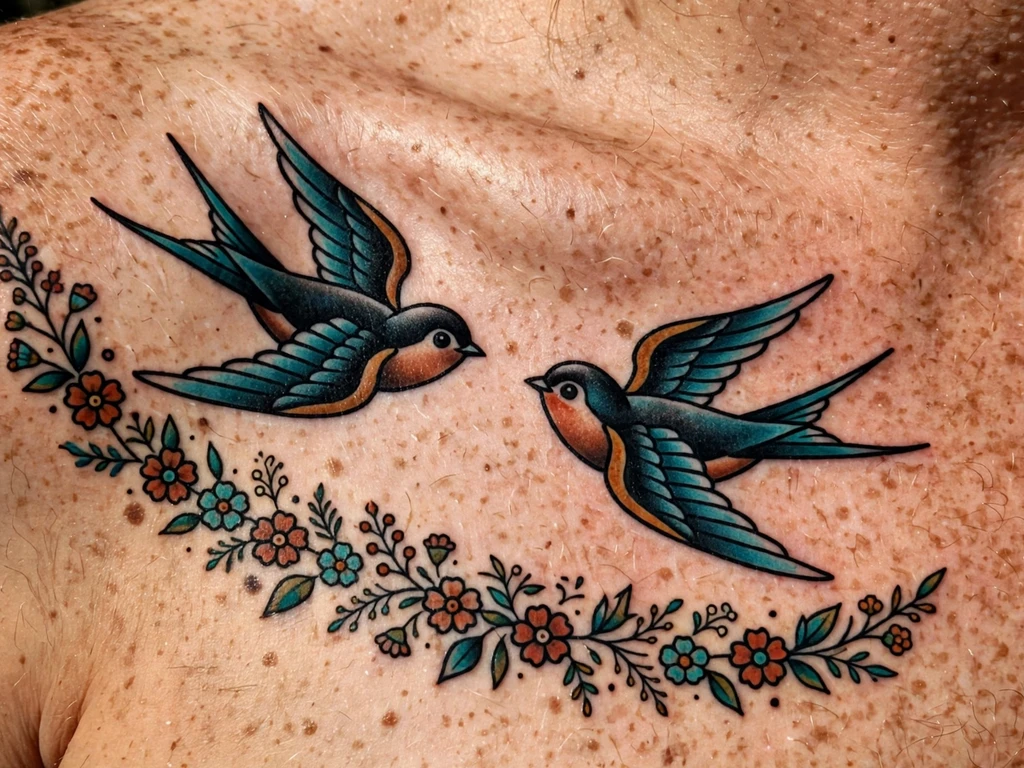
Two swallows in flight, reimagined: the sailor’s homecoming bird drawn with the new style’s fuller bodies, patterned wings in teal and rust, forked tails streaming, small flowers trailing in their wake along the collarbone’s outer edge. The swallow is perhaps the oldest continuously worn tattoo in the Western tradition — earned at sea for distance travelled, worn for return and loyalty — and the neo traditional version honours it by enrichment rather than replacement: same silhouette, same meaning, more bird.
The collarbone’s edge is a placement of bone and motion, and the pair must be composed as a flight, not two stamps: one bird a fraction higher, wings at different beats, the flowers spacing them like a phrase. Keep the wing feather separations few and bold — a swallow whose wing detail merges still reads by silhouette, and one whose silhouette was sacrificed to detail reads as nothing.
Best placement: Outer edge of the collarbone, the pair flying toward the shoulder; a single swallow of the pair also sits well on a shoulder.
Best for / know before you book: Approve the pair printed at final size and check the two birds read as flying together — the composition is a duet, and stencils that treat it as two solos produce two unrelated birds.
15. The Key and the Lock
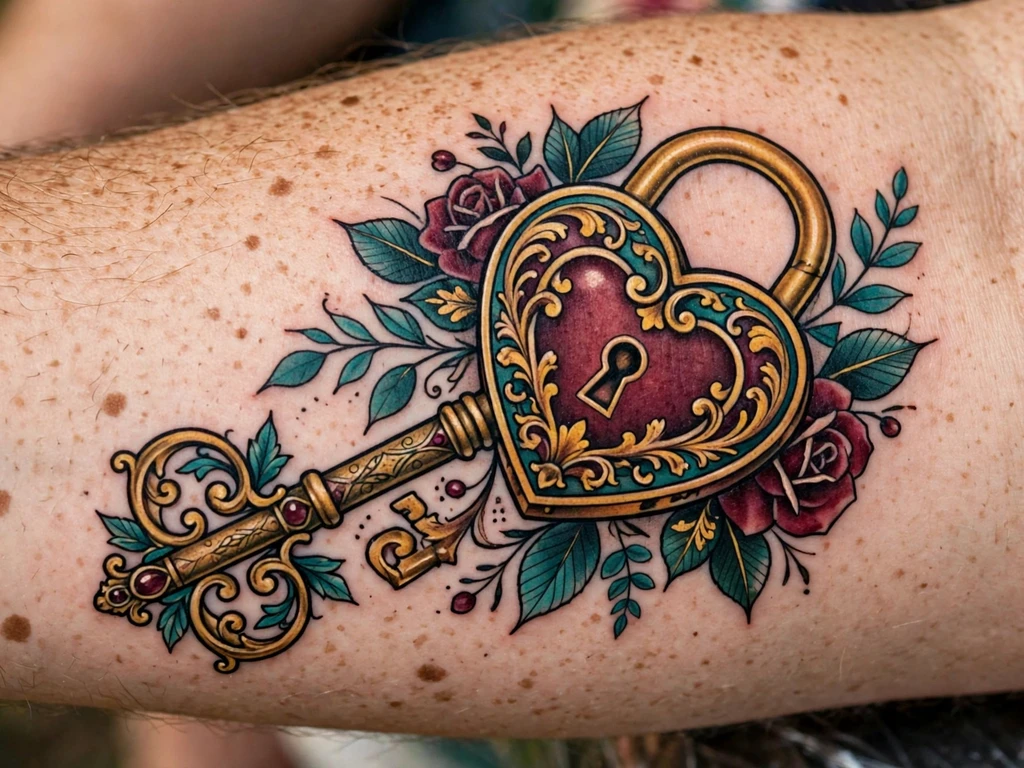
An ornate key laid beside — or above — a heart-shaped padlock: the key’s bow worked as a small piece of jewellery, its bit cut in a bold simple pattern, the lock’s heart body in burgundy with a gold shackle and a keyhole of reserved black. The pairing’s meanings are the readable ones: the key to a heart, a secret kept, a person who holds the one or wears the other — it is also one of the classic two-person designs, key on one wrist, lock on the other, each half complete as a drawing alone. That last quality is the style’s requirement and this design’s test: halves that only work together are a debt; halves that work alone are a promise.
Metal is drawn by convention, not realism: gold is ochre and mustard with black structure, shine is reserved skin in deliberate slashes, and the lock’s curves obey heart geometry — mirror-checked lobes, a true bottom point. Keep the key’s teeth few: a bit with three bold cuts reads at distance, a bit with eight fine cuts reads as a comb, then as a smudge.
Best placement: Forearm, key and lock stacked along the arm; as a pair across two wearers, the inner wrist takes each half at smaller scale.
Best for / know before you book: If it is a two-person design, approve each half as a standalone tattoo first — the relationship reading should be the bonus, not the load-bearing wall.
16. The Lucky Cat
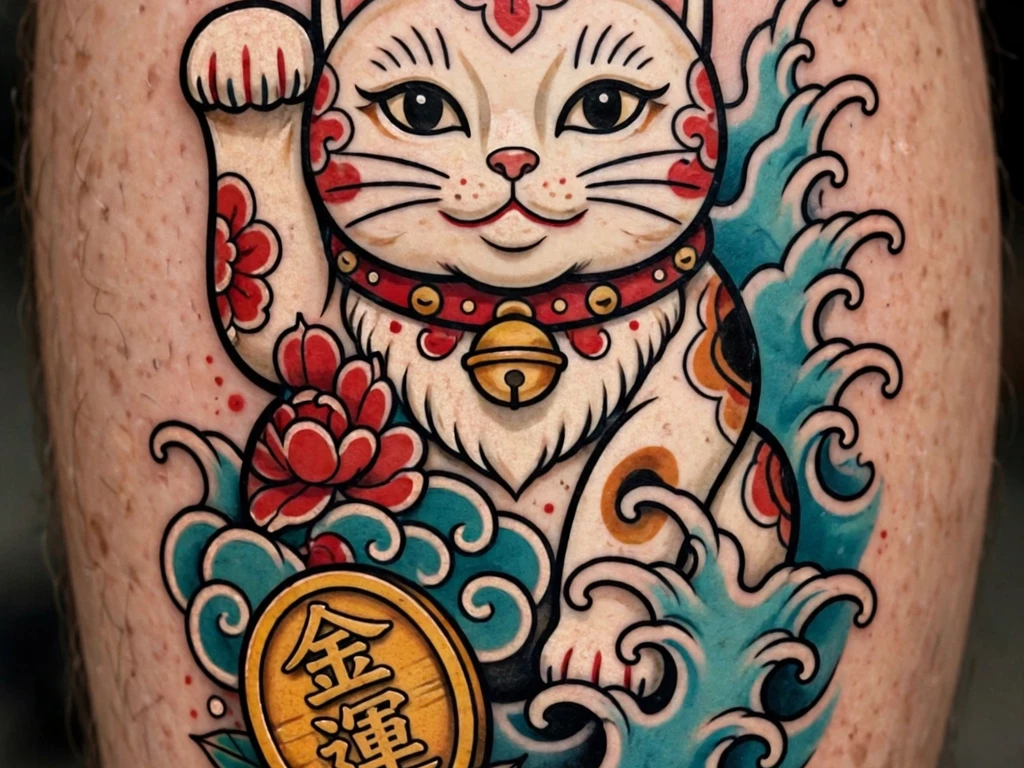
The maneki-neko — the beckoning cat of Japanese shopfronts — drawn in the style’s bold colour: cream fur with calico patches, red collar with a gold bell, one paw raised in the beckoning gesture, the oval gold coin (koban) held or beneath its paw, waves patterning the base. The raised paw’s side carries the folk distinction — right paw for fortune, left for customers and company — offered here as the tradition it is. It is the guide’s lightest design by temperament: luck, welcome and good business worn as a small smiling monument.
The cat’s charm depends on the face staying simple: two dot-and-line eyes, a small mouth, whisker strokes kept to three a side, because the maneki-neko is a folk figure whose expression is a convention, and over-rendering the face trades the icon for a pet portrait and loses both. The coin’s oval must be checked on the standing calf — ovals distort on the muscle’s curve into eggs — and its markings should be a few bold cuts, never an inscription.
Best placement: Calf, the cat sitting squarely on the muscle; a forearm takes it at slightly smaller scale.
Best for / know before you book: Decide the paw deliberately — right for fortune, left for welcome — and tell the artist the choice matters to you, because it is the one detail wearers discover they cared about afterwards.
17. The Ornate Skull
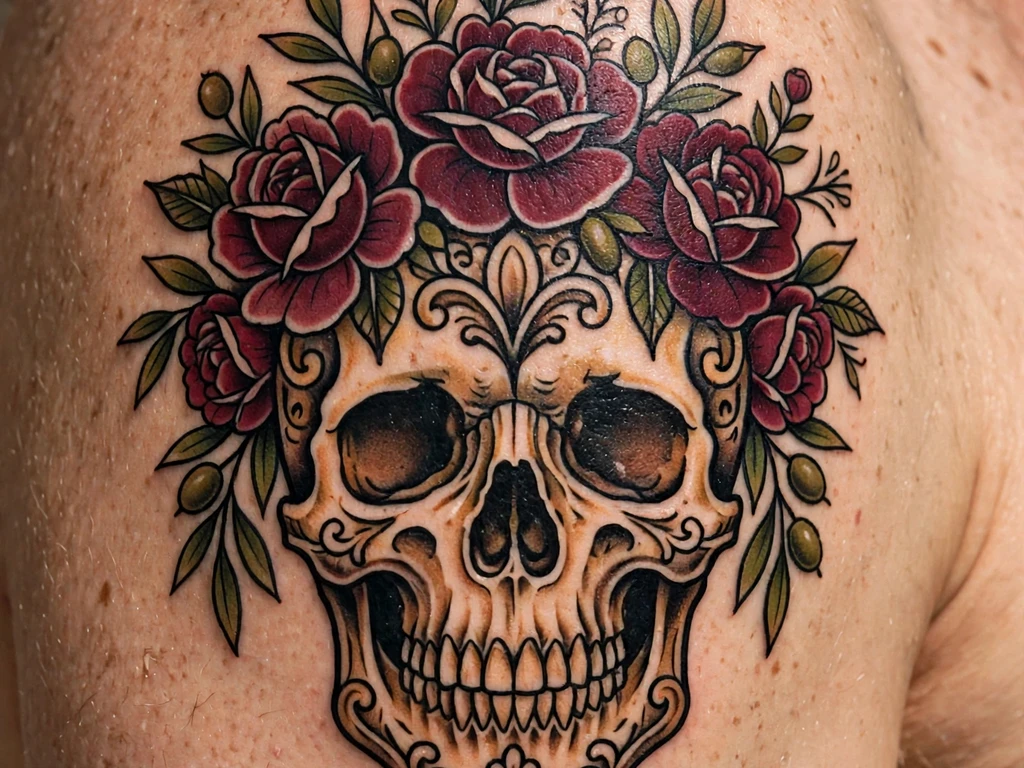
A skull treated as the style treats everything — as a portrait: the cranium in warm bone tones with its shading smoothed, eye sockets deep and black, flowers crowned across the skull’s top and one jaw-side, a small candle or a jewel set into the composition. Neo traditional skulls are deliberately not horror pieces; they belong to the memento mori tradition — remember you must die, therefore live deliberately — and to the decorated-skull folk traditions that dress death in flowers to make the point gently. The ornament is the meaning: beauty arranged on the skull, not despite it.
The sockets and teeth are the craft. Eye sockets must be packed to a true, even black or they read as grey smudges at distance; teeth are drawn as a few bold separations — a full dental row merges into a zip — and the cranium’s highlight is reserved skin, planned in the drawing, since it cannot be added later.
Best placement: Shoulder, the skull centred on the cap; a forearm takes it well at slightly reduced ornament.
Best for / know before you book: Approve the skull in black and white first — the bone structure and socket depth must carry the design before a single flower is allowed to charm you.
18. The Koi Among Waves
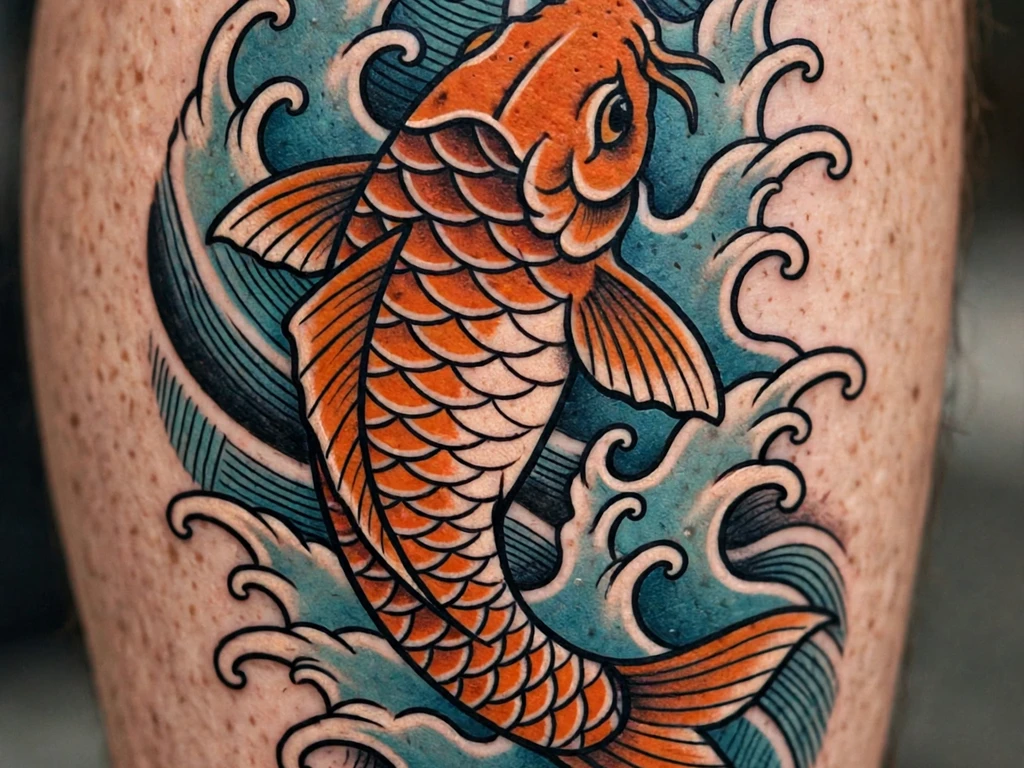
A koi climbing through patterned waves: the fish in burnt orange and cream, scales drawn as bold overlapping arcs, fins flowing, the water around it built from the repeating curl-and-finger waves that Japanese woodblock composition made famous — the same visual family the craft section’s key-block passage describes, black structure first and colour laid inside it. The koi’s legend is tattooing’s favourite: the fish that swims against the current and, in the story, becomes a dragon at the waterfall’s top — perseverance drawn as a beautiful animal mid-effort, head up the calf, tail still in the lower water.
The waves are this design’s discipline. Woodblock water is a pattern language — each curl a complete shape with skin between it and the next — and tattooed waves fail exactly when artists improvise texture instead of repeating shapes: the water becomes grey porridge and the fish is lost in its own river.
Best placement: Calf, head up toward the knee, the body following the muscle; the composition also climbs a forearm.
Best for / know before you book: Ask the artist to draw one wave curl and repeat it — if their water is a repeatable shape, book; if every curl is a fresh invention, the river will not hold.
19. The All-Seeing Eye
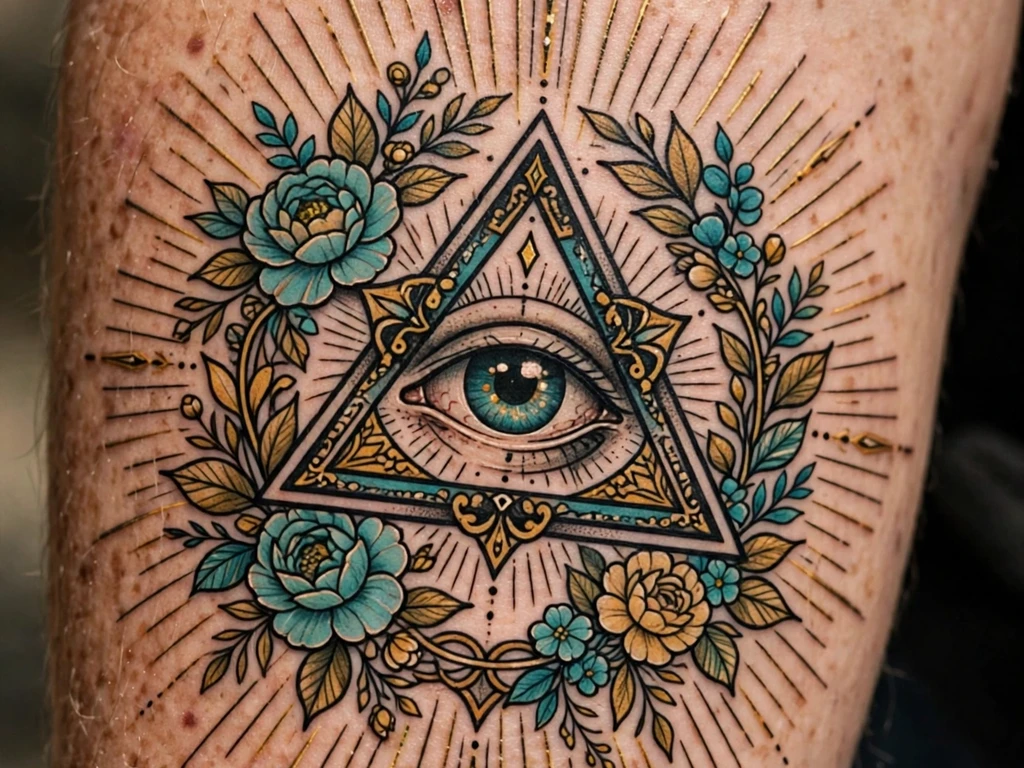
An eye, open and calm, set inside a wreath of leaves and small flowers, fine rays radiating behind the wreath like a sunburst in a chapel window. The watching eye is among the oldest protective symbols worn on skin — the gaze that watches back, warding by witnessing — and in neo traditional it gains the style’s characteristic softness: the iris rendered in teal and gold gradients, lashes bold and few, the wreath turning a stern emblem into a garden relic. Wearers take it for protection, for a watch kept over someone, or for the wish to see clearly.
The iris is the craft, as it is in every eye design: concentric colour must sit inside a black architecture of circles that remain circles healed — the pupil a genuinely packed black, the iris’s gradient rings wide enough not to merge into a teal coin.
Best placement: Forearm, the eye centred on the inner forearm where the gaze meets the world; the wreath also crowns a shoulder neatly.
Best for / know before you book: Print it at final size and check the gaze reads from arm’s length — an eye that does not read as an eye at one metre is an ornate oval with ambitions.
20. The Panther Head
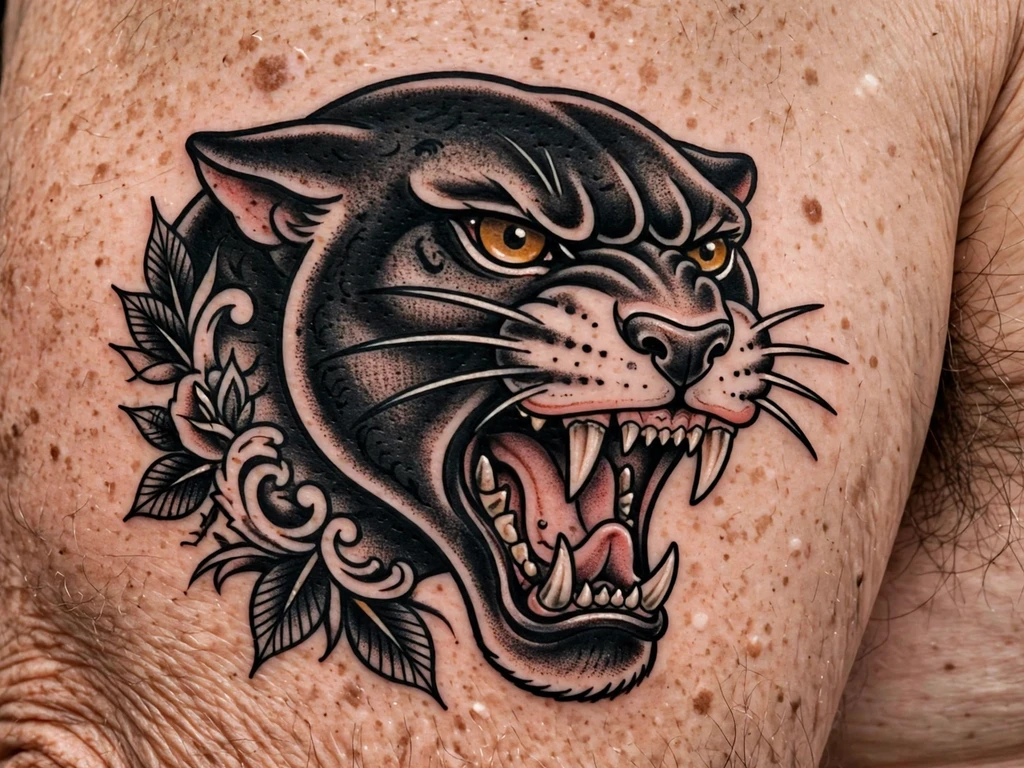
The crawling panther of old-school legend, taken at the head: a black panther’s portrait at full panel, fur rendered as expanded black shading with the highlights reserved as skin, amber eyes and bared fangs in bone and a flash of red tongue — the palette reduced almost to black alone. This design is the black-heavy variant’s showcase: it demonstrates how much of neo traditional’s expansion can be subtractive, the colour pulled back until the black architecture does nearly everything, and the result is the most traditional-feeling piece in the guide and, not coincidentally, among the longest-lived.
Black-on-black is the craft problem, stated plainly: a black animal on skin is a study in degrees of black, and the design survives only if its forms are separated by reserved skin — the highlight slashes along the brow, jaw and ear that carve the head out of its own darkness.
Best placement: Upper arm, the head at full width; the design also stalks down a calf in a longer crop.
Best for / know before you book: This is the design for wearers who want neo traditional’s drawing with traditional’s restraint — and the one whose artist must be chosen on healed black work alone.
21. The Hare in a Deco Frame
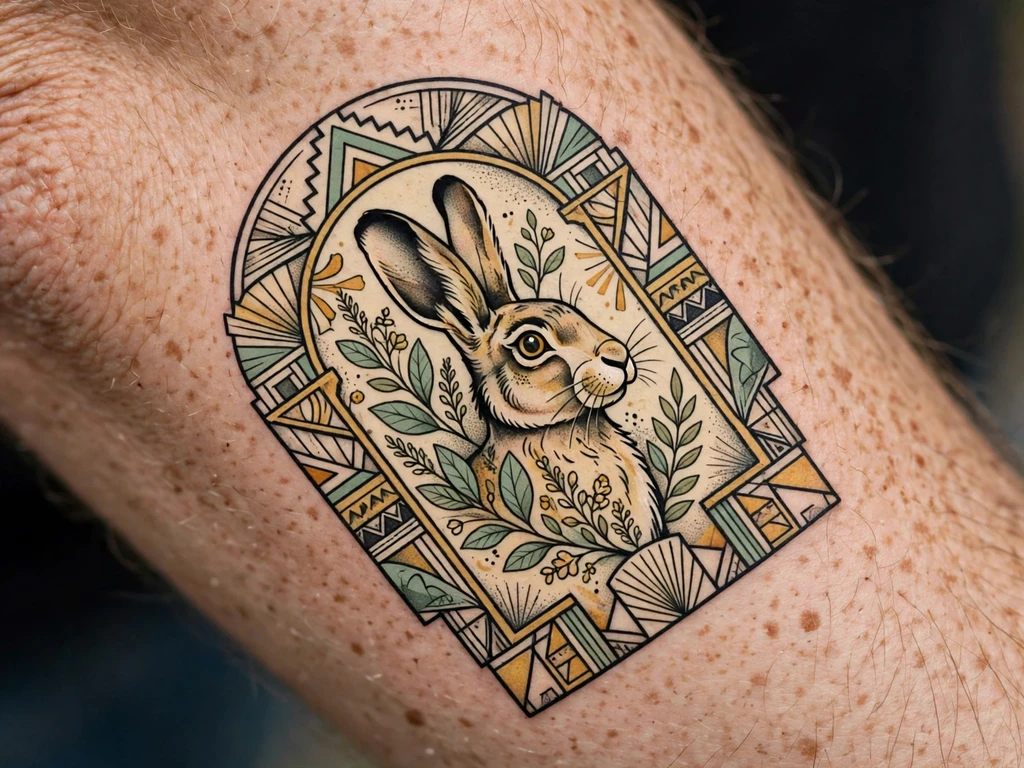
A hare’s portrait set inside an Art Deco arch: the animal upright and alert, ears rising into the frame’s point, fur patterned in sage and cream, the frame itself a geometry of stepped arches, rays and small diamonds in black and ochre. The Deco borrowing is the style’s second decorative inheritance — where Art Nouveau gives neo traditional its curves, Deco gives it its frames: hard geometry that turns a portrait into an icon on a shrine wall. Hares carry their own quiet readings — alertness, spring, the moon in several folk traditions — stated here as the traditions they are.
Frame and subject must be designed as one drawing. The arch’s geometry is checked with the stencil standing (forearms rotate, and a frame that twists reads as a mistake rather than a style), and the ears’ tips are placed to answer the frame’s point without touching it — a deliberate gap of skin that keeps both silhouettes clean as lines thicken.
Best placement: Forearm, the arch running the arm’s length; the framed format also flatters a calf.
Best for / know before you book: Frames are unforgiving of placement drift — stencil this standing, arm relaxed and turned both ways, and approve the arch’s upright in the arm’s natural rest position, not flattened on the table.
22. The Hourglass and Roses
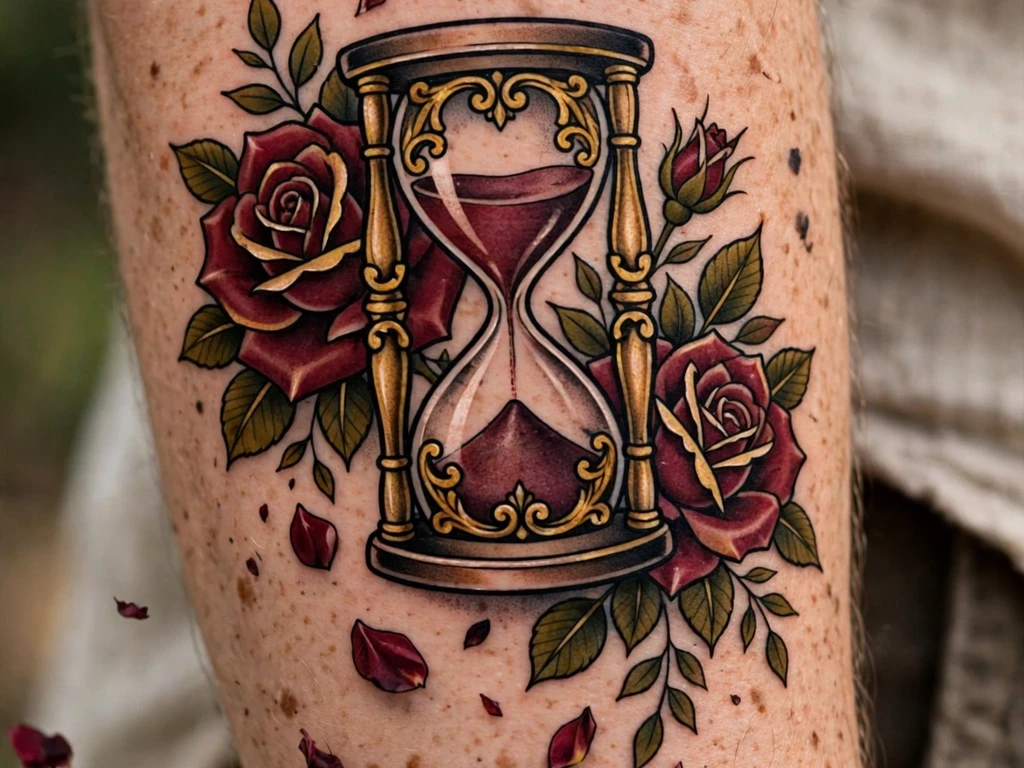
An hourglass in a carved frame of gold-toned wood and black, sand running in a fine stream, roses gathered at its top and fallen petals scattered at its base: time and the flower in one emblem, the memento mori pairing the rose has kept since long before tattooing — love is brief, beauty is brief, the sand is the argument and the roses are the answer wearers give it. Neo traditional’s contribution is the rendering: the glass drawn with reserved-skin highlights and soft gradients, the wood given patterned grain, the whole object built like a piece of furniture for the arm.
Glass is drawn by its edges and highlights alone — there is no grey wash that reads as glass on skin — so the bulbs’ curves must be true ovals mirror-checked like a heart’s lobes, and the sand’s stream a single unbroken line.
Best placement: Forearm, the hourglass upright along the arm; a calf takes it with a longer fall of petals.
Best for / know before you book: Hourglasses are read by their symmetry before their detail — spend the stencil check on the two bulbs’ mirror match, because a lopsided hourglass cannot be rescued by beautiful roses.
23. The Tiny Swallow
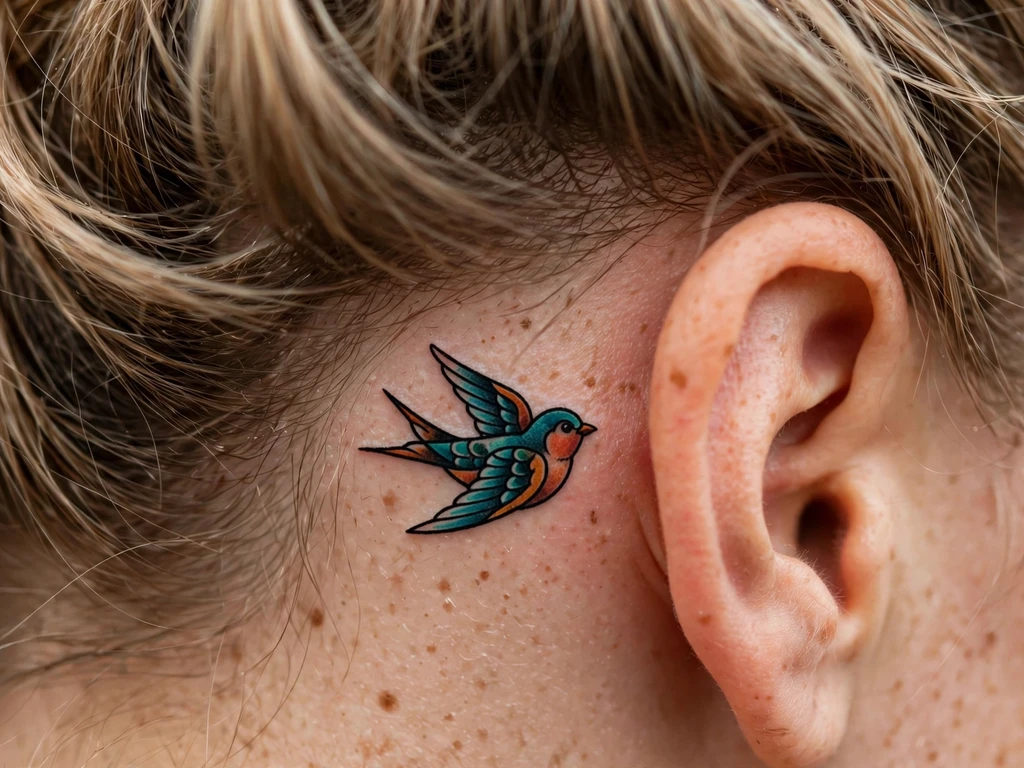
The guide’s one behind-ear design, and it is offered as the exception that proves the style’s size rule: a single swallow at three centimetres, reduced to the silhouette and two colour blocks — teal back, rust breast, the forked tail kept as two bold points — tucked on the flat behind the ear where hair hides it in formal rooms and a tucked strand reveals it like a rumour. The swallow’s homecoming meaning survives the shrinking intact; what does not survive is any interior detail, and this design asks for none.
At this size the craft is pure honesty, in the series’ established terms for this placement: the bird must be drawn bold for its size, its tail points short and sturdy rather than needle-fine, its colour blocks large enough to stay separate when the lines around them thicken. Behind-ear skin settles a touch soft, so the swallow is drawn a fraction larger and simpler than the reference photo suggests — that fraction is the difference between a bird at year ten and a teal smudge with ambitions. Expect a touch-up across its life as normal maintenance for this placement, not as failure.
Best placement: Behind the ear, centred on the flat of skin beneath the cartilage fold; sized to the wearer’s own ear, never from a universal template.
Best for / know before you book: Hold the printed design behind your ear in a mirror at true size — behind-ear tattoos are judged at real scale or not at all.
24. The Small Dagger
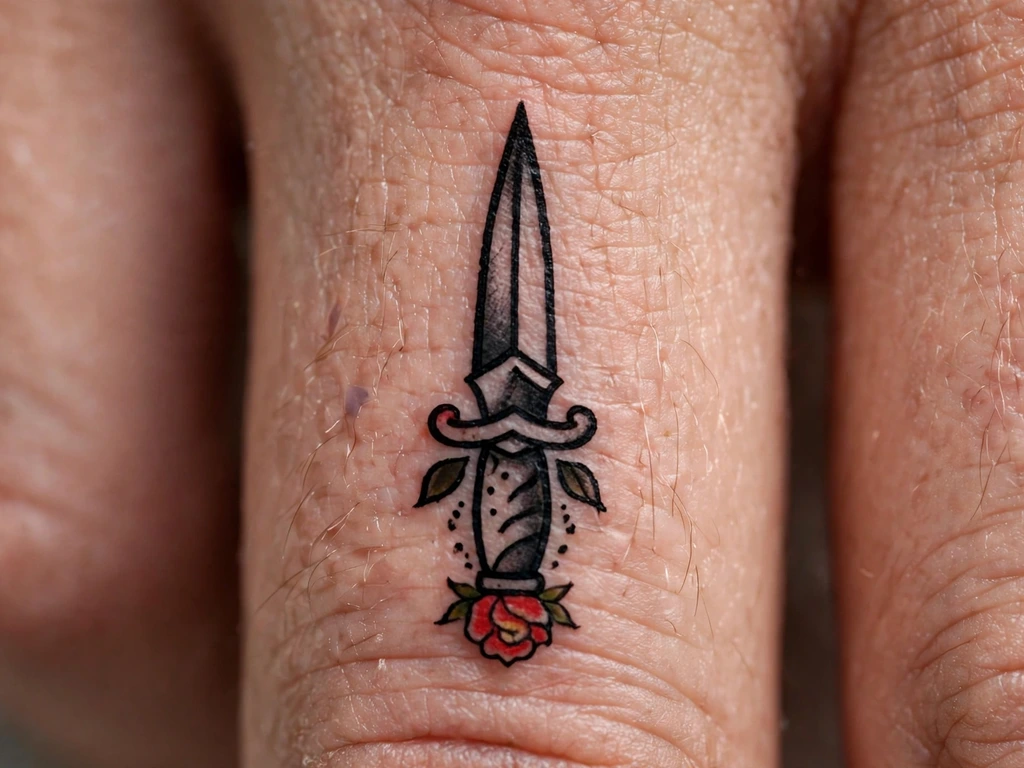
The style at its absolute minimum, offered with the fullest honesty in this guide, because the placement is the fastest-fading ground on the body: a miniature dagger down the side of a finger, blade perhaps two centimetres, a single tiny flower at the handle, the whole design reduced to a bold silhouette with one red accent. Finger skin regenerates fast, flexes constantly and sheds ink faster than anywhere else — so say it plainly: this dagger will fade and soften sooner than any other design here, its fine points first, and it will need touch-ups across its life to stay a dagger rather than a rumour of one. Wearers choose it anyway, as the style’s signature worn as a secret — a charm with a maintenance schedule.
What can be done is done at the drawing: the blade drawn as boldly as a finger allows, its point honest rather than needle-sharp, the flower a single filled shape, and the side of the finger chosen over the palm side because side skin holds ink slightly better — the best bargain this placement offers. Sized at the largest the finger’s flat takes, and no smaller: a neo traditional design below its minimum size is not a small tattoo but an expiring one.
Best placement: Side of the finger, where the line can run unbroken and the skin keeps ink longest of anywhere on a finger.
Best for / know before you book: Price the touch-ups before you fall for the charm — if re-inking a small dagger every year or two would annoy you, Design 15’s key carries the same sharp romance on skin that keeps it far longer.
25. The Lady and the Tiger
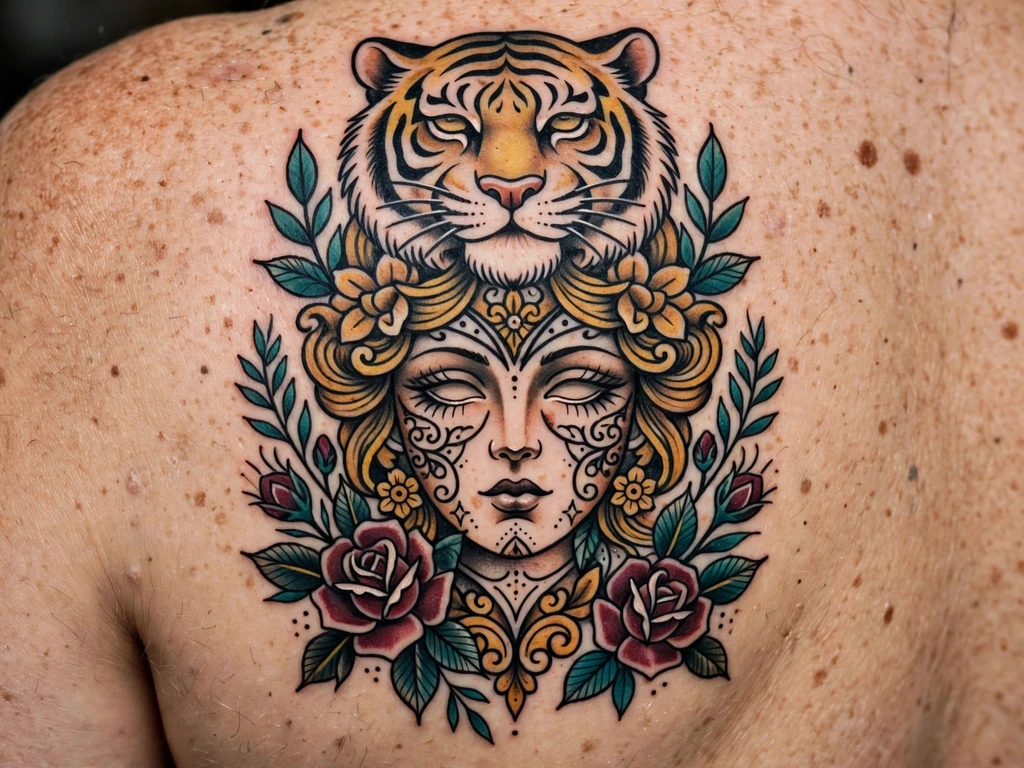
End with the style’s grand composition, the headdress idea taken to its largest register: a woman’s portrait across the shoulder blade, and above her — worn as a crown, its paws framing her temples — a full tiger’s head, calm-eyed, its stripes answering her hair’s curves stripe for strand. It is the lady face and the animal portrait fused into a single emblem: beauty and power in one stacked drawing, the wearer and the force they carry. Pieces like this are the style’s exhibition works, the ones portfolios are built around, and everything in this guide’s craft section exists to make them survivable — two portraits, one palette, one black architecture.
Scale is the design’s first requirement and it is not negotiable: two faces need room for both sets of features to stay open as lines thicken, which puts this piece at the shoulder blade’s full width and rules out every smaller canvas in this guide. The palette is a single set shared across both subjects, and the two gazes are set in slightly different directions, because twin stares at the viewer read as a poster, while averted-and-direct reads as a story.
Best placement: Shoulder blade, at the blade’s full width; there is no honest smaller version.
Best for / know before you book: Book this as the multi-session commitment it is, with the drawing approved in two stages — black architecture first, colour plan second — exactly the order the craft section prescribes.
Neo Traditional Tattoo Placement by Size
| Size | Typical dimensions | Best placements | Good to know |
|---|---|---|---|
| Tiny | 3–5 cm | Behind ear, side of finger | The style at its limit: one bold silhouette, two colour blocks, no interior detail — behind-ear and finger pieces carry a permanent touch-up expectation |
| Small | 5–9 cm | Wrist, ankle, collarbone edge | Key-and-lock halves, single swallows — the smallest scale at which a limited palette still separates cleanly |
| Medium | 9–16 cm | Forearms, calves, shoulders, upper arms | The style’s home: portraits, daggers, hearts and hourglasses with their full detail budget intact |
| Large | 16–28 cm | Shoulder blades, upper arms | Lady-and-animal compositions, peacocks, grand portraits — the scale the two-metre read and the twenty-centimetre read can both be served |
Say the honest thing plainly, because this style’s galleries will not: neo traditional is a medium-to-large tattoo style. Its whole method — bold architecture plus layered detail plus a multi-tone palette — needs skin to work in, and below roughly eight centimetres the detail budget is spent before the design is drawn. The two tiny designs in this guide are included as the deliberate exceptions, drawn at the silhouette-only discipline their size demands. If your heart is set on small, choose a design whose silhouette is its detail — the swallow, the small dagger — and let the style’s larger works wait for the canvas they deserve.
How to Choose Your Neo Traditional Tattoo (and What to Know Before You Book)
Start from the black drawing. Whatever subject you choose, ask to see it — and approve it — as a black-only drawing before colour enters the conversation. This is the craft section’s first rule turned into a booking habit, and it protects you twice: the drawing you approve is the tattoo you will still have when every pigment has settled, and an artist who happily shows the black stage is an artist who builds the style correctly.
Fix the palette as a set, in writing. Agree the colour families — three to five, named — before the session, and ask what each becomes healed. The muted jewel register is a family resemblance among tones, and a palette that grows by “one more colour” at every element ends as a shelf, not a set. Deeper tones and bold application are the professional answer where contrast matters on your skin; judge the plan by the artist’s healed work on similar skin, not by ink bottles.
Run the two-metre test yourself. Print the design at final size, tape it where it will live, and look from across the room: subject, direction, silhouette must all read instantly. Then look closely and enjoy the detail. If the order fails — if you must approach to learn what it is — the detail budget is overspent and the drawing goes back, however beautiful it is in the hand.
Judge the artist on healed neo traditional. This style’s specialism is the gap between its fresh photographs and its healed reality. Ask for healed work, a year old at least, and check three things: is the black still architecture rather than bruise, do the colours still sit inside their lines, and does the muted palette read as chosen rather than merely faded? Artists who show healed work gladly are showing you the actual product.
Size honestly, and book the sessions the size implies. Portraits and stacked compositions are large, sometimes multi-session works. The wearers happiest with them planned the sittings, the budget and the healing weeks as part of the design. A grand piece rushed into one sitting is how good drawings become tired tattoos.
Know which inheritance you are buying. If what you love is the old flash sheet exactly as it was — few colours, one line weight, the classic icons — you may be a traditional wearer, and there is no upgrade in either direction; the styles are siblings, not ranks. Choose neo traditional when it is the additions you want: the portrait’s character, the muted palette, the decorative frame.
Key points to remember:
- Neo traditional = traditional’s foundation (bold black outline, distance readability, packed colour) plus an expanded muted palette, varied line weights, illustrative subjects and decorative detail
- The outline is the law: a design must first read as a complete black drawing, and colour never invents an edge of its own
- Detail is budgeted by distance — the two-metre read is bought first, and fine interior detail is only ever the second read
- The palette is a set, not a shelf: three to five colour families, repeated through the piece, ageing on one shared schedule
- Whip shading and gradients serve the structure; shading that alone defines a form is shading with an expiry date
- It is a medium-to-large style — below roughly 8 cm the detail budget fails, and tiny pieces survive only as bold silhouettes
Frequently Asked Questions
What is a neo traditional tattoo?
A neo traditional tattoo is a tattoo built on American traditional’s foundation — bold black outlines, drawings that read at a distance, colour packed to last — extended with everything the old style left out: a wider and more muted palette of jewel and earth tones, line weights that vary inside one design, illustrative subjects such as characterised animal portraits and Art Nouveau lady faces, and decorative detail borrowed from Art Nouveau, Art Deco and Japanese tattooing. The test is structural: remove the colour mentally, and the piece still stands as a complete black drawing. If it collapses without its colour, it was an illustration, not a neo traditional tattoo.
What is the difference between neo traditional and traditional tattoos?
Four working differences. Traditional holds a short list of saturated colours — red, green, yellow, brown, black; neo traditional opens the palette to muted and jewel tones mixed in families. Traditional draws at one bold line weight throughout; neo traditional varies line weight, heavy at the silhouette and finer inside. Traditional works a fixed iconography of sailor-era subjects; neo traditional draws any subject — portraits, animals with character, framed curiosities. And traditional leaves bold empty skin around simple forms, while neo traditional layers decorative detail — floral frames, filigree, Deco geometry — inside the same black discipline. The foundation they share is the point: outline, readability, permanence.
Do neo traditional tattoos age well?
They are among the best-ageing colour tattoos there are, when built by the style’s own rules — because the design is carried by black architecture that barely moves, and the muted palette is chosen near the register pigments settle into anyway. What ages is the decoration’s fine print: interior detail softens first, smooth gradients calm down, and colours quiet by a register over the years. Designs that passed the two-metre test fresh pass it healed; designs that spent their budget on fine detail spend their healed life explaining themselves. Sun protection on healed work remains the single habit that slows the whole process most.
Can a neo traditional tattoo be small?
Honestly, only at a price. The style’s method — layered detail over bold structure in several colour families — needs room, and below roughly eight centimetres something must be surrendered: usually the detail, reducing the design to its silhouette with two or three colour blocks, as this guide’s tiny swallow and finger dagger are drawn. That can still be a good tattoo, chosen knowingly, with touch-ups expected on fast-fading placements like fingers. What does not work is a full lady face or animal portrait miniaturised: features close, palettes merge, and the piece expires into a colourful blur that no touch-up can redraw.
How do I choose an artist for a neo traditional tattoo?
Choose on healed evidence of the specific skills your design needs. For lady faces, healed portraits — features still open, shading still inside the lines. For animals, healed portraits whose character survives in black and white. And ask how the artist sets the palette: an answer in named families (“ochre, teal, burgundy, black, skin”) signals the discipline; “whatever looks good on the day” signals its absence. Finally, an artist who talks you down in detail — fewer snakes, larger eyes, simpler rigging — is telling you the style’s truth at cost to their own canvas, and that is the artist this guide exists to help you find.
Final Thoughts
Neo traditional is best understood as a promise kept twice: to the old tattooing that proved bold black and honest colour outlive everything, and to the drawing that old tattooing never had the palette or the permission to attempt. The lady faces, the animal portraits, the framed and filigreed curiosities — all of it stands on one unglamorous law, that the black drawing comes first and the colour lives inside it, and the wearers who love their pieces longest are the ones who chose artists for whom that law is a habit rather than a slogan.
So pick the subject whose silhouette you would love in pure black, fix a palette you will still love a register quieter, and give the design the size its detail honestly needs. The winter light is coming that this style photographs best in — but a neo traditional tattoo is not built for a season’s photographs. Built by its rules, it is built for the decades after them.