Few tattoo subjects carry as much weight in a single image as Medusa. One glance at that calm, beautiful face crowned with living snakes and the message lands instantly: what tried to destroy her became her power. That is why searches for what a Medusa tattoo represents keep climbing — this is not a design people pick on looks alone, even though the looks are extraordinary.
In this guide you will find the full story behind the symbol — the Greek myth, the darker version of it that many wearers connect with, and the modern meanings of survival and protection — followed by 25 medusa tattoo ideas ranging from a whisper of snakes behind the ear to full-back and thigh pieces that stop rooms.
What Does a Medusa Tattoo Mean?
To understand the tattoo, you have to know both versions of her story. In the oldest Greek accounts — Hesiod’s Theogony, written around the 8th–7th century BC — Medusa was one of three Gorgon sisters, daughters of the sea gods Phorcys and Ceto. Her sisters Stheno and Euryale were immortal; Medusa alone was mortal. Her gaze turned anyone who met it to stone, and the hero Perseus was sent to bring back her head. Armed with a mirrored shield so he never had to look at her directly, winged sandals and a curved sword, he succeeded — and from her blood, in that strange mythic logic, sprang the winged horse Pegasus. Athena, who had guided Perseus, set Medusa’s head at the center of her shield, the aegis, where it guarded her in every battle and froze her enemies with fear.
The later Roman poet Ovid told a very different, much sadder version, and it is the one many tattoo wearers carry in their hearts. In Ovid’s Metamorphoses, Medusa began as a beautiful mortal woman, famed for her hair. Poseidon assaulted her inside Athena’s own temple — and instead of punishing the god, Athena punished Medusa, transforming her glorious hair into a nest of serpents and her face into something no one could look upon and live. In this reading, the snakes were never really a curse: they were protection. After what was done to her, no one would ever be able to harm her again — anyone who came at her with bad intent would be turned to stone first. You can read the original sources gathered together at Theoi Project’s Medusa and Gorgons pages, which collect the ancient texts on her story.
That double history is exactly why the Medusa tattoo means so much to so many people today:
| Symbolism | What it means to the wearer |
|---|---|
| Survival and strength | She endured the worst thing that could happen to her and came out of it untouchable. For many wearers — including survivors of abuse and assault — she is a declaration: it did not break me, and it will never touch me again. |
| Protection | Athena carried Medusa’s face on her shield as a guard against enemies. A Medusa tattoo works the same way: a personal aegis, a guardian worn on the skin. |
| Transformation | A woman was turned into a “monster” — and the monster became the most powerful figure in the story. The tattoo honors change, rebirth and becoming someone new out of pain. |
| Feminine power | Medusa refuses to be small, quiet or pleasing. Her image celebrates female rage, autonomy and beauty that does not ask permission. |
| Warning to enemies | The petrifying gaze is a boundary drawn in ink: come closer with harm in mind, and see what happens. Many wearers describe it simply as “don’t test me.” |
A note of respect: because the survivor meaning is real and deeply personal for many women, it is worth choosing this tattoo thoughtfully rather than purely as a fashion piece. If Medusa’s story is part of your story, the designs below will mean even more. And if the snake element itself fascinates you, our guide to snake tattoo meaning digs into why serpents have symbolized rebirth and protection across cultures for thousands of years.
Medusa Tattoo Ideas at a Glance
| # | Design | Style notes | Best placement |
|---|---|---|---|
| 1 | Classic Medusa Portrait | Realistic face, full crown of snakes | Upper arm |
| 2 | Medusa Thigh Statement Piece | Large flowing portrait, snakes spilling down the leg | Front thigh |
| 3 | Sternum Medusa Centerpiece | Symmetrical face, snakes fanning across the ribs | Sternum |
| 4 | Forearm Medusa Portrait | Vertical composition, snakes framing the face | Forearm |
| 5 | Full-Back Medusa Piece | Epic scale, snakes reaching both shoulder blades | Full back |
| 6 | Fine-Line Minimal Medusa | Single-weight lines, tiny snake crown | Inner wrist |
| 7 | Medusa Profile Silhouette | Side view, elegant and understated | Shoulder blade |
| 8 | Snakes-Only Medusa Crown | No face — a wreath of serpents alone | Shoulder cap |
| 9 | Medusa with Roses | Soft blooms woven through the snakes | Outer thigh |
| 10 | Blackwork Medusa | Solid black shapes, bold contrast | Upper back |
| 11 | Medusa and Perseus Pair | Her face on one arm, his shield reflection on the other | Both forearms |
| 12 | Watercolor Medusa | Painterly color washes behind black linework | Shoulder |
| 13 | Dotwork Medusa | Stippled shading, sacred-geometry feel | Ribcage |
| 14 | Neo-Traditional Medusa | Bold outlines, jewel tones, decorative snakes | Hip and upper thigh |
| 15 | Split-Face Medusa | Half serene beauty, half skeletal snakes | Inner bicep |
| 16 | Tiny Snakes Behind the Ear | Two or three miniature serpents only | Behind the ear |
| 17 | Spine Snake Cascade | Small Medusa head at the nape, snakes trailing down | Spine |
| 18 | Medusa Back-of-Hand Piece | Compact face framed by coiling snakes | Back of hand |
| 19 | Medusa with Moon Phases | Lunar arc above her head, night symbolism | Underbust |
| 20 | Geometric Medusa | Faceted lines and symmetry, modern edge | Inner forearm |
| 21 | Weeping Medusa Portrait | Emotional, tear-streaked fine shading | Upper arm |
| 22 | Medusa Half Sleeve | Portrait flowing into a full snake composition | Upper arm / half sleeve |
| 23 | Small Medusa Ankle Piece | Simplified face, minimal snake detail | Ankle |
| 24 | Medusa and Skull | Dark pairing, memento-mori mood | Calf |
| 25 | Greek Statue Medusa Bust | Marble-sculpture shading, classical and timeless | Chest and shoulder |
25 Medusa Tattoo Ideas
1. Classic Medusa Portrait
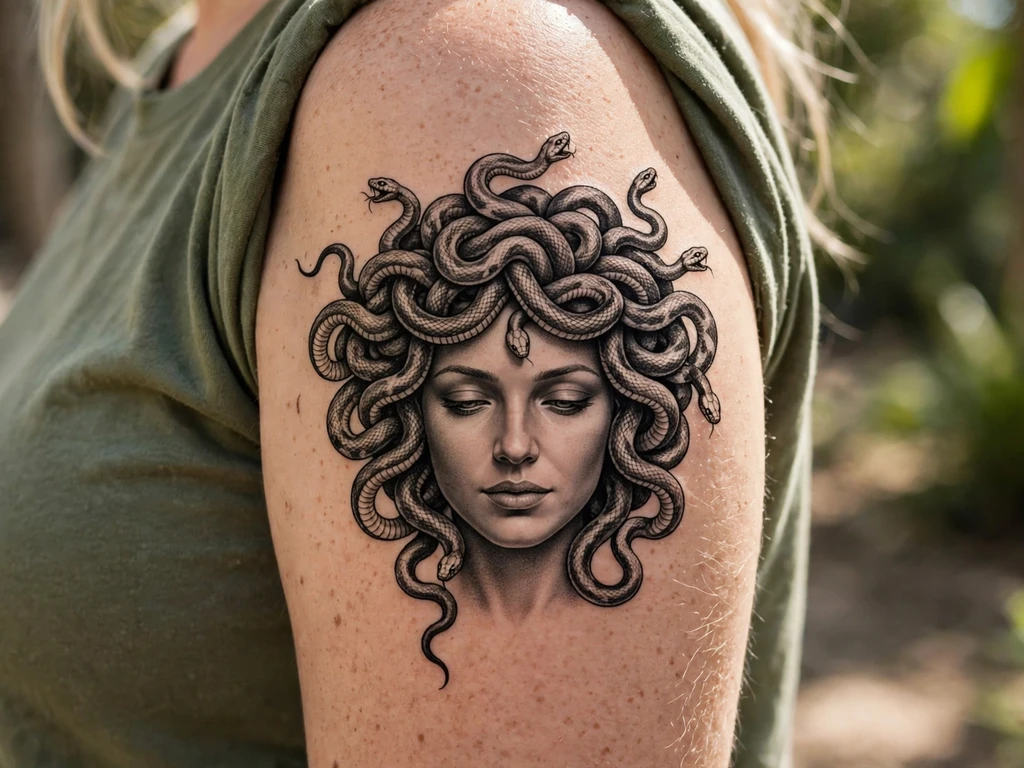
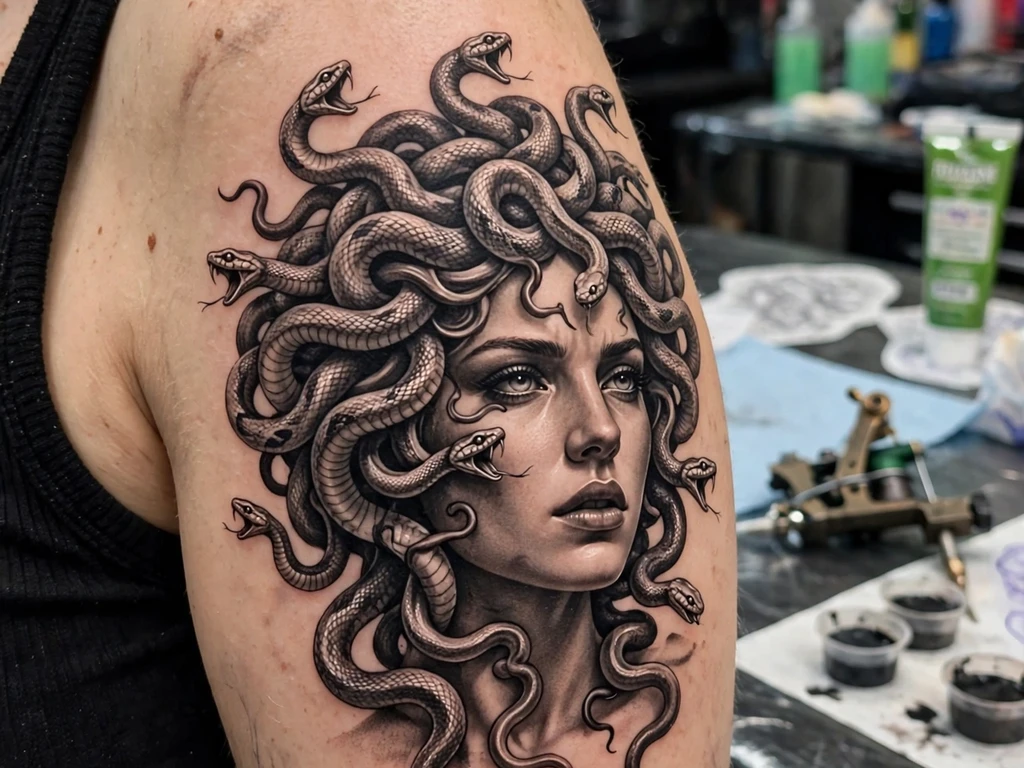
The reference design against which all others are measured: a beautifully rendered woman’s face, serene and direct-eyed, with a full crown of individually drawn snakes rising and curling around her head. Done in black and grey realism, it has the gravity of a museum painting and the attitude of a warning sign. This is the Medusa most people picture first, and on a flat, generous canvas like the upper arm it rewards every hour spent on it.
Best placement: Upper arm, where the portrait can sit at portrait size without wrapping.
Best for / know before you book: For anyone who wants the definitive version of the symbol. Faces are the hardest thing in tattooing — choose an artist whose healed portraits, not just fresh ones, convince you, and do not shrink it: below about 10 cm tall, the eyes and expression start to lose their power.
2. Medusa Thigh Statement Piece
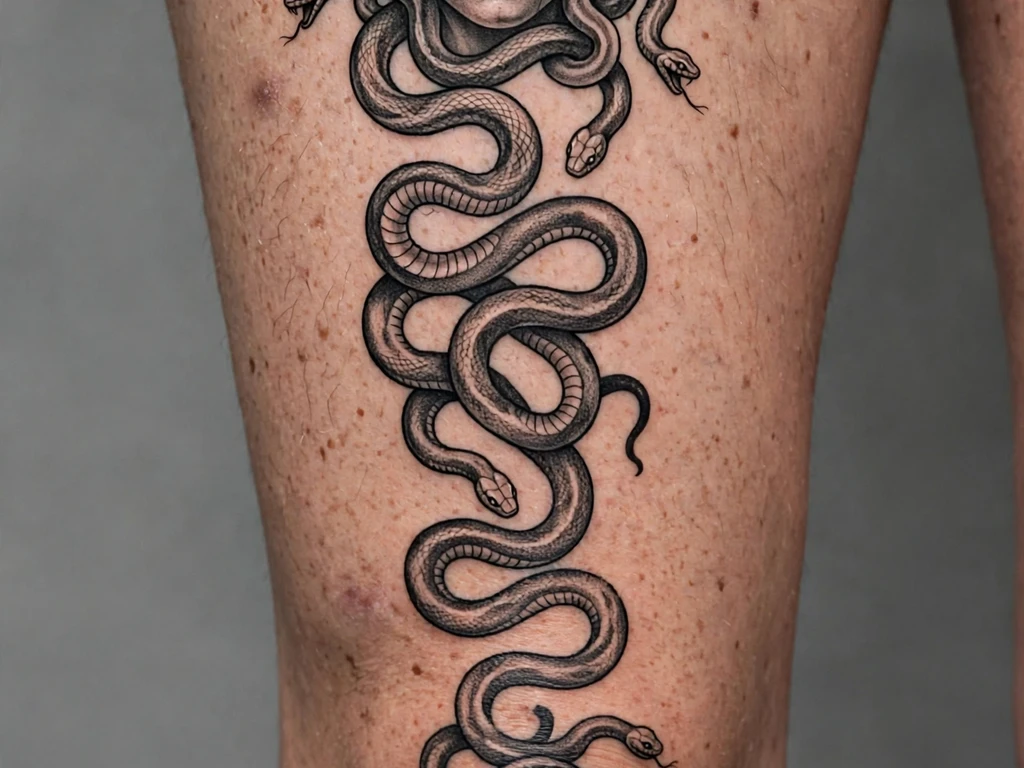
The thigh is where Medusa gets to be monumental. A large portrait placed high on the front thigh lets the snakes spill and curl down the leg like living ribbons, using the thigh’s length and curve as part of the composition. It is the placement behind the surge in “medusa tattoo on thigh” searches, and for good reason: dramatic in swimwear and shorts, completely hidden under trousers or a longer skirt, and big enough for the facial detail this subject deserves.
Best placement: Front thigh, portrait high, snakes trailing toward the knee.
Best for / know before you book: The single best canvas for a detailed Medusa. Plan for a long session or two; the front thigh is a comparatively kind place to sit, but a piece this size is a marathon, not a sprint. Bring reference photos of the expression you want — fierce, calm or sorrowful changes the whole tattoo.
3. Sternum Medusa Centerpiece
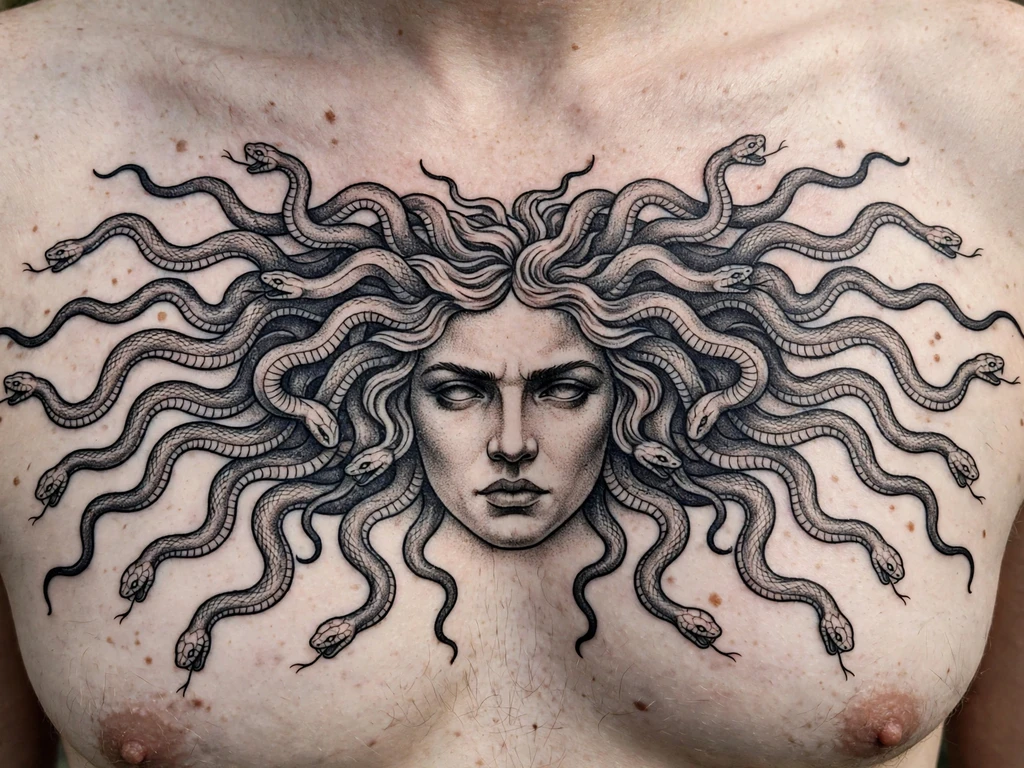
Placed at the center of the chest, Medusa’s face sits like the boss of a shield — fitting, since that is literally where Athena wore her. The composition mirrors outward: snakes fan symmetrically across the ribs on both sides, following the underbust curve, while her face anchors the middle. It is intimate, architectural and quietly intimidating all at once.
Best placement: Center sternum, snakes spreading along the underbust line.
Best for / know before you book: A deeply personal placement that only shows when you choose. Symmetry is everything here — insist on seeing the stencil from the front, standing, in a mirror. Expect tenderness: the sternum is close to bone, though the rib sections are usually more manageable.
4. Forearm Medusa Portrait
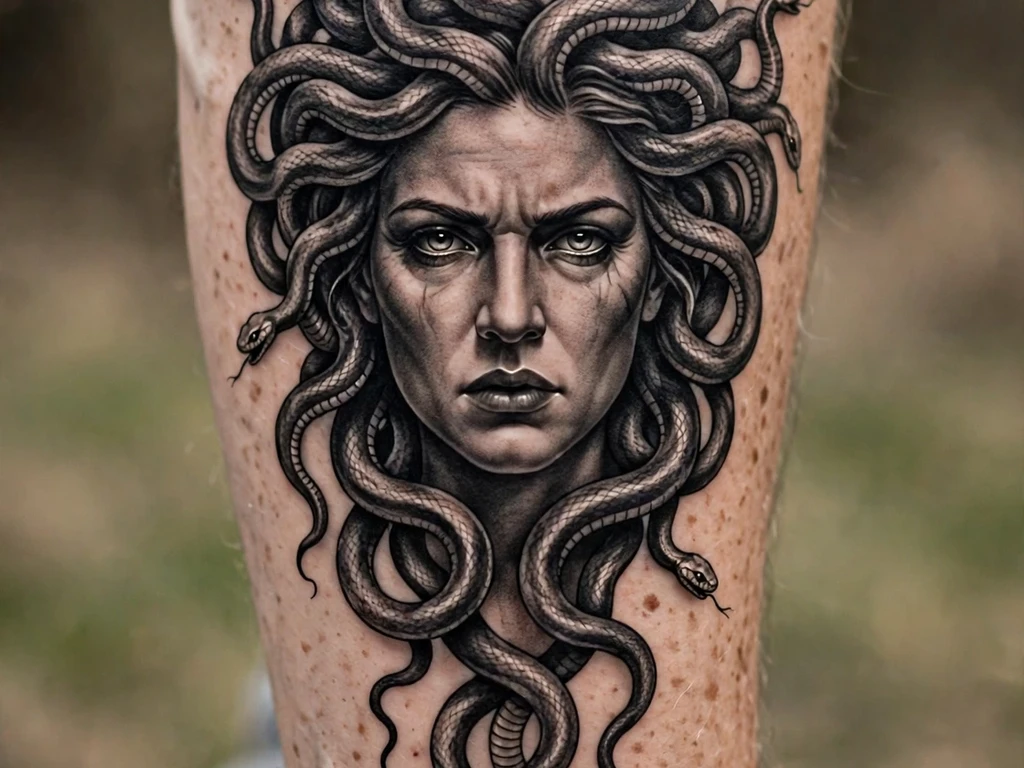
The forearm’s natural vertical shape suits a Medusa portrait beautifully: her face in the center, snakes rising above her head toward the elbow and tapering below toward the wrist. It is visible in your own eyeline all day — a reminder you can actually look at — and it photographs superbly from every angle. Keep the snakes flowing with the arm’s taper rather than boxing the design in a rectangle.
Best placement: Outer or inner forearm, running wrist to elbow.
Best for / know before you book: Ideal if you want your Medusa where you can see her. The inner forearm holds fine detail well and is among the gentler spots; the outer forearm is bolder and more public. Either way, agree the minimum size with your artist — forearm portraits squeezed too small age into a blur of snakes.
5. Full-Back Medusa Piece
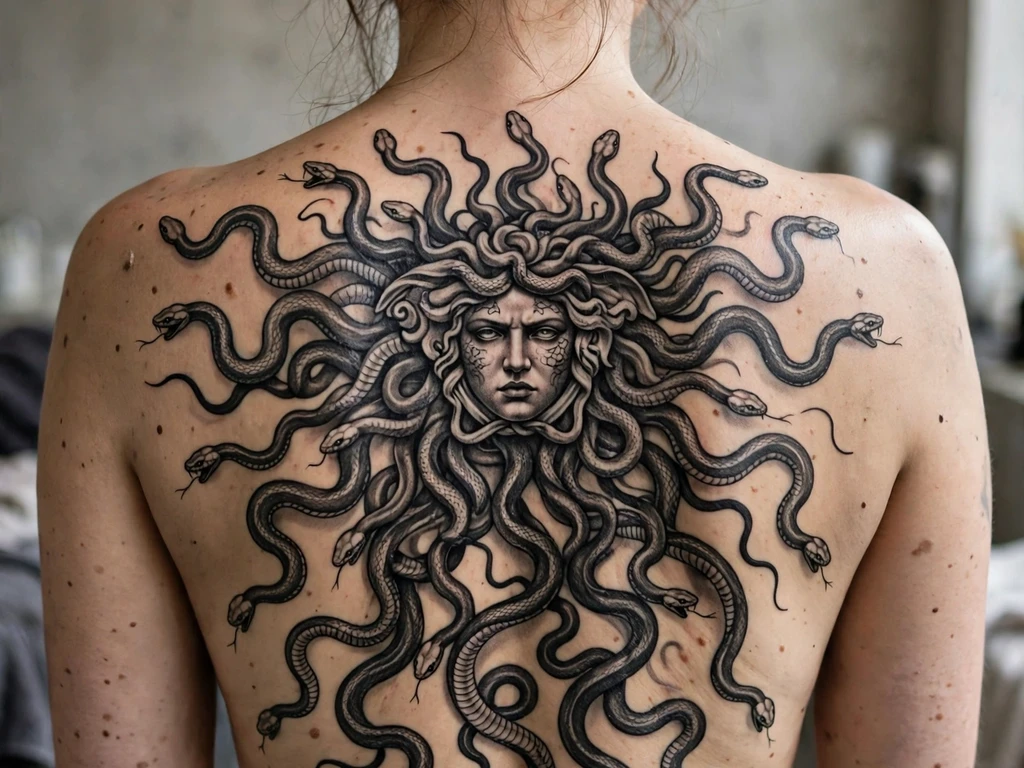
The maximalist option: Medusa at full scale across the back, her face between the shoulder blades and dozens of snakes radiating outward and downward as far as the lower back. At this size an artist can give every snake its own personality — some coiled, some striking, some asleep — and weave in moons, flowers or Greek key patterns around the edges. It is less a tattoo than a mural you happen to live inside.
Best placement: Full back, face centered between the shoulder blades.
Best for / know before you book: A multi-session commitment with a multi-session budget — plan it in stages with one artist so the style stays consistent from first outline to final shading. Wear the full-size stencil and live with it for a day before session one; scale mistakes are expensive up here.
6. Fine-Line Minimal Medusa
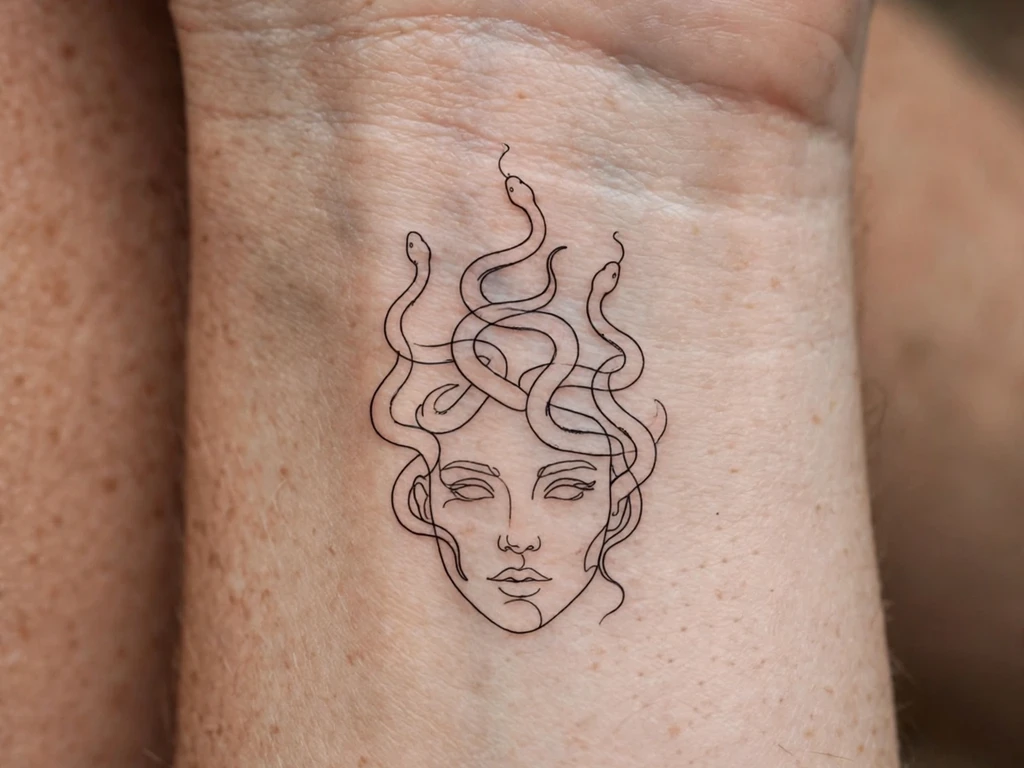
Proof that Medusa does not need scale to have presence. This version strips her down to elegant single-weight lines: a simple profile or front-facing outline, a handful of slender snakes suggested rather than detailed, no shading at all. The effect is more jewelry than armor — quiet, modern, and easy to wear with everything.
Best placement: Inner wrist, small and close to the pulse.
Best for / know before you book: A graceful first Medusa. Minimalism lives or dies on line quality, so pick an artist with a healed fine-line portfolio. Keep a little breathing room in the design — at tiny sizes, snakes drawn too close together will merge into a braid as the ink settles over the years.
7. Medusa Profile Silhouette
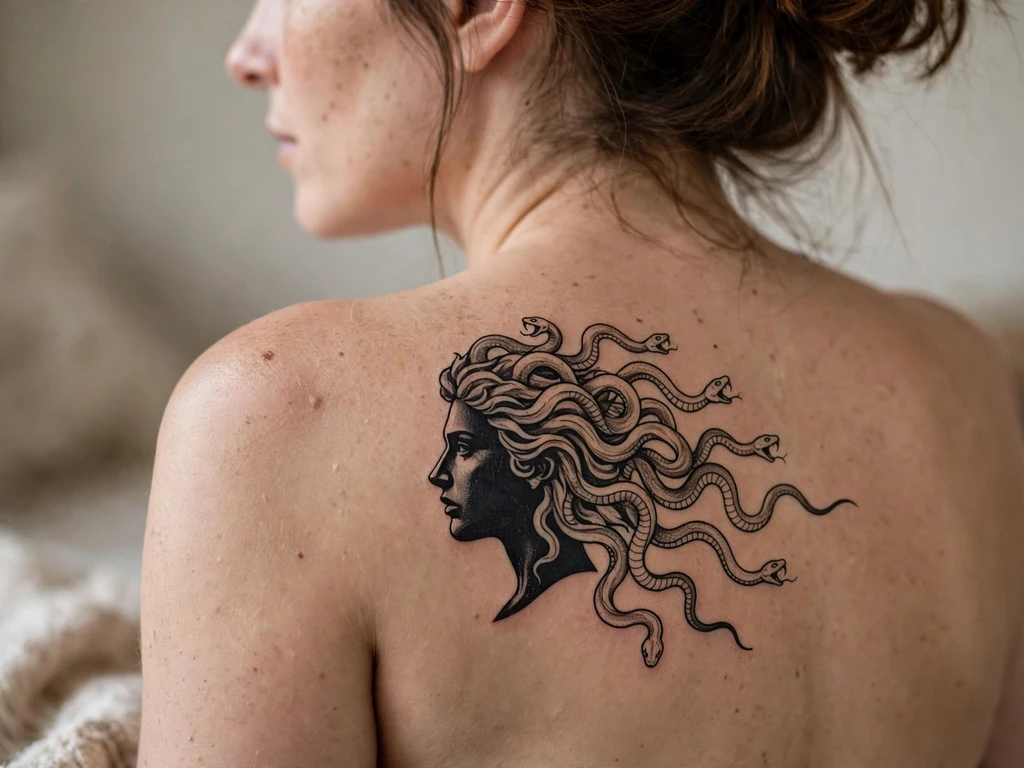
Seen from the side, Medusa becomes almost peaceful: closed or downcast eyes, a classical Greek profile, and her snakes streaming behind her like wind-blown hair. The silhouette approach reads beautifully at medium size and sidesteps the hardest part of front-facing portraits — perfectly matched eyes — while keeping all the symbolism. It has the feel of a coin or cameo from the ancient world.
Best placement: Shoulder blade, where the profile can face inward toward the spine.
Best for / know before you book: For lovers of classical art and quieter statements. Profiles forgive a mid-level artist more than front portraits do, but the single flowing outline of the face must be flawless — check your artist’s healed linework, and decide which way she faces before the stencil goes on.
8. Snakes-Only Medusa Crown
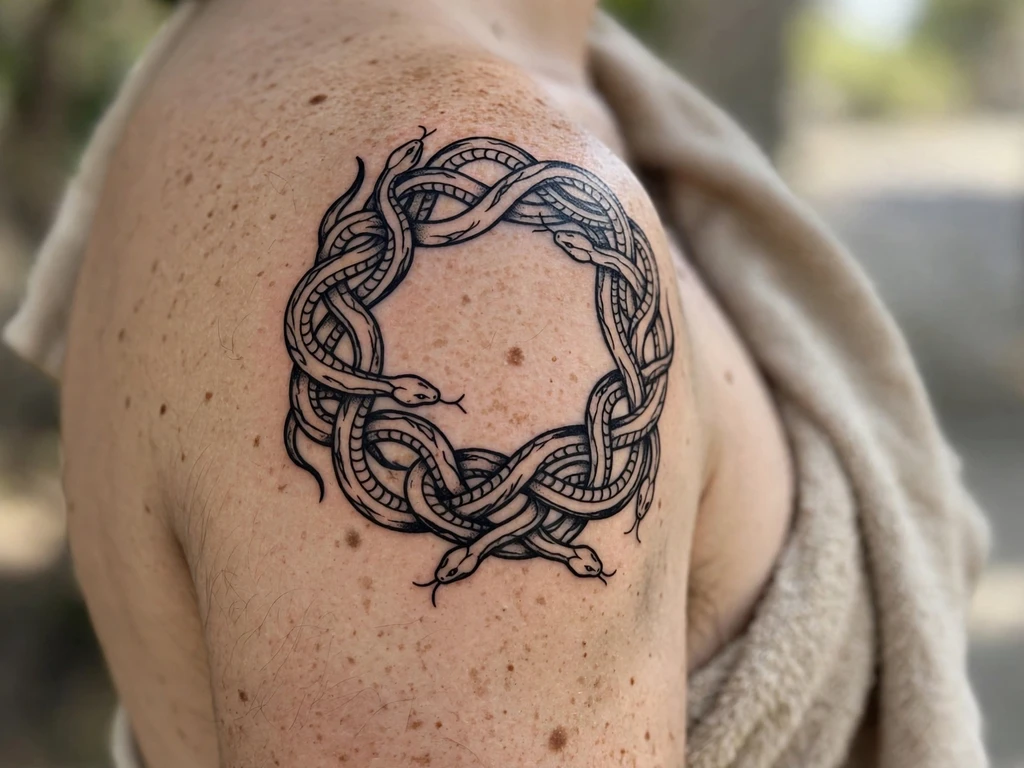
No face at all — just a wreath of interwoven serpents, coiling and knotting where Medusa’s hair would be, arranged as a crown or halo shape. It is the most abstract design on this list and the most open to interpretation: other people see a striking snake piece; you know exactly whose crown it is. It also ages gracefully, because snakes drawn bold and simple hold their shapes for decades.
Best placement: Shoulder cap, the crown curving with the shoulder’s roundness.
Best for / know before you book: Perfect if you want the meaning without a portrait, or a Medusa reference only initiates will catch. Snake-only work is more forgiving than faces, but ask for varied scale patterns and head shapes so the wreath does not turn into an unreadable knot at a distance.
9. Medusa with Roses
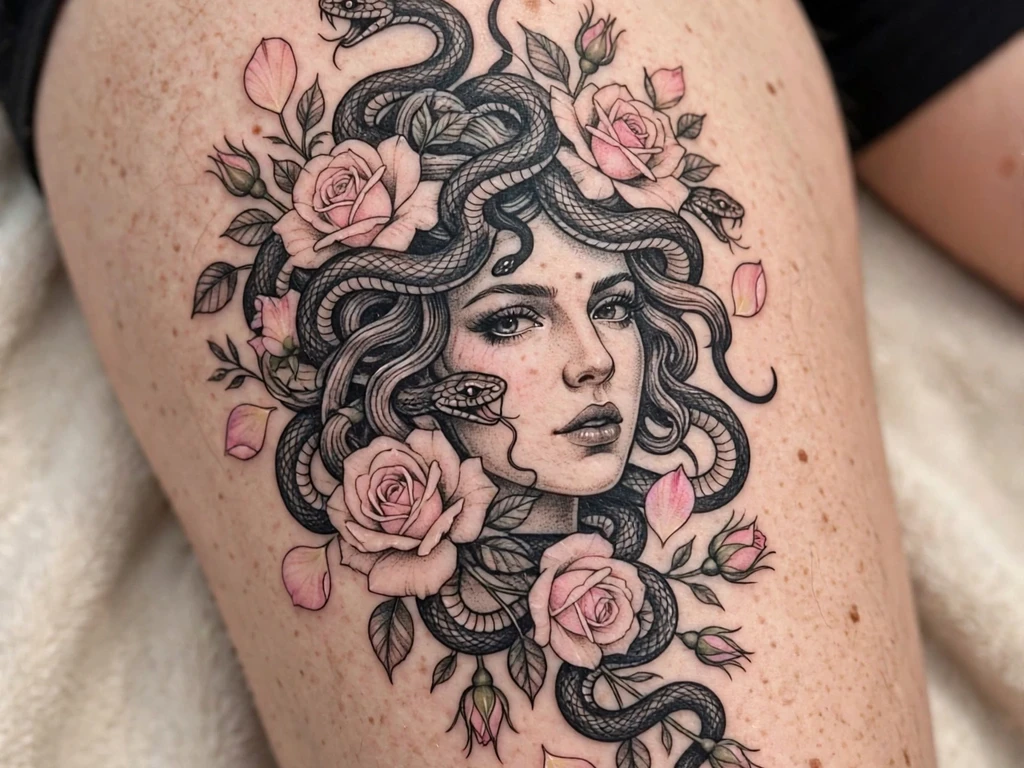
Softness and danger in the same frame: lush roses bloom between the snakes, petals drifting against scales, her expression calm in the middle of it all. The contrast is the meaning for many wearers — beauty that survived, gentleness that is not weakness. Color or black and grey both work; soft pink and red blooms against dark snakes is the classic pairing.
Best placement: Outer thigh, where there is room for portrait, snakes and flowers to breathe.
Best for / know before you book: A favorite for wearers who identify with the “soft but unbreakable” reading of Medusa. If you choose color, know that petal pinks and reds may need a refresh sooner than the black linework; if you want zero maintenance, black and grey roses shaded like engravings age superbly.
10. Blackwork Medusa
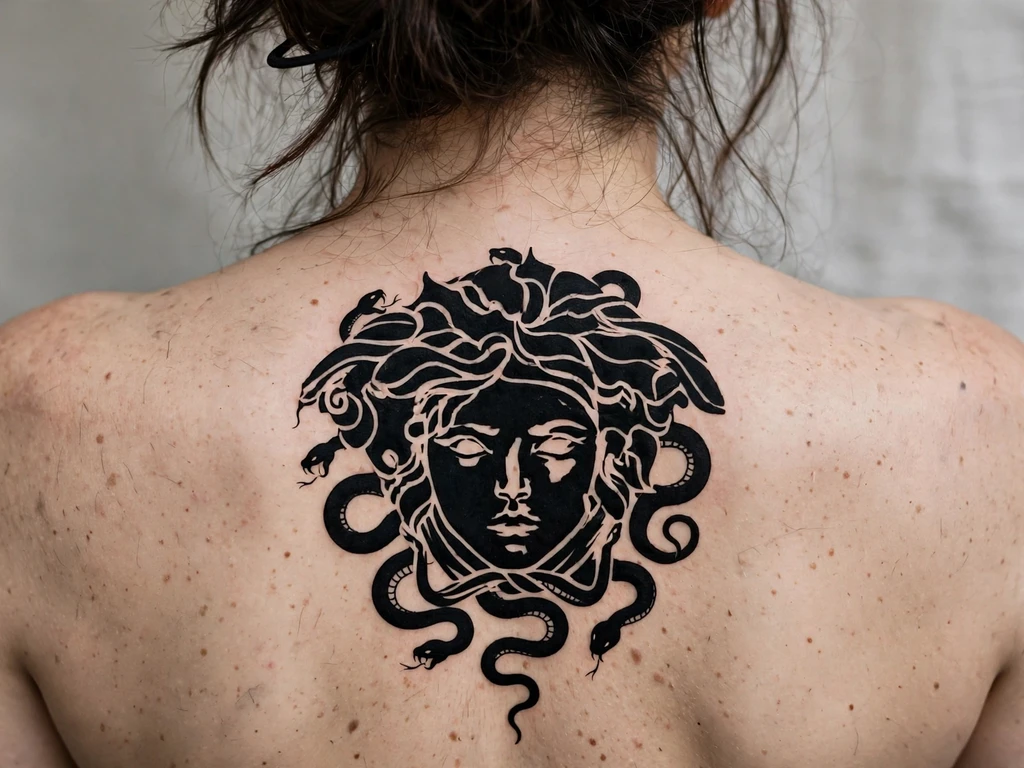
Blackwork swaps soft shading for graphic punch: solid black snakes, strong silhouetted shapes, and a face built from bold lines and negative space. It reads from across the street, suits a gothic wardrobe perfectly, and is one of the most forgiving styles as the years pass because heavy black holds its ground. Think woodcut illustrations and occult posters rather than oil paintings.
Best placement: Upper back, centred between the shoulder blades, bold and symmetrical like a sigil.
Best for / know before you book: For high-contrast tastes and lower long-term maintenance. Solid black packing takes time and can be spicier to sit through than linework, and it is the hardest style to laser or cover later — be sure. On the plus side, a skilled blackwork artist can execute this without portrait-realism prices.
11. Medusa and Perseus Pair
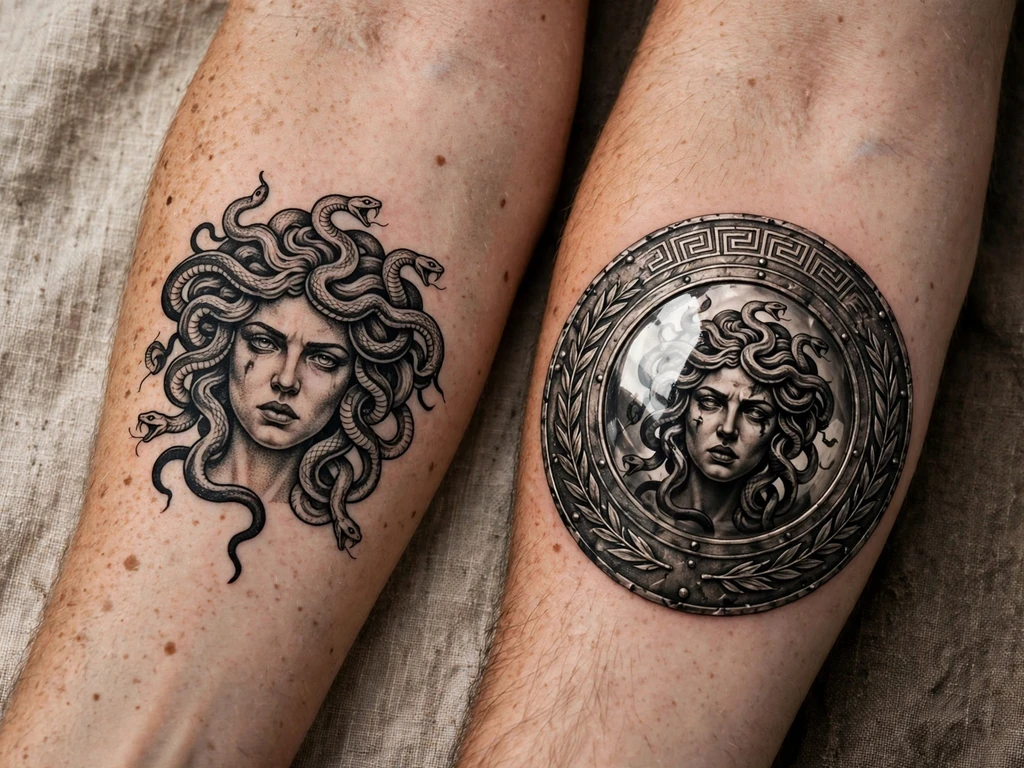
A storytelling diptych across both arms. On one forearm, Medusa in full glory; on the other, Perseus’s polished shield — and reflected in it, her face, the only safe way to look at her. Together the pair captures the whole myth in two images: the monster, the hero, and the mirror between them. It is also a clever way to wear a big concept without one giant piece.
Best placement: One design on each forearm, aligned so they face each other.
Best for / know before you book: Wonderful for mythology devotees and for partners or siblings splitting the pair. Book both in the same era of your life with the same artist if you can — matching styles across two pieces done years apart by different hands rarely matches. Keep each side strong enough to stand alone, because most days only one will be on show.
12. Watercolor Medusa
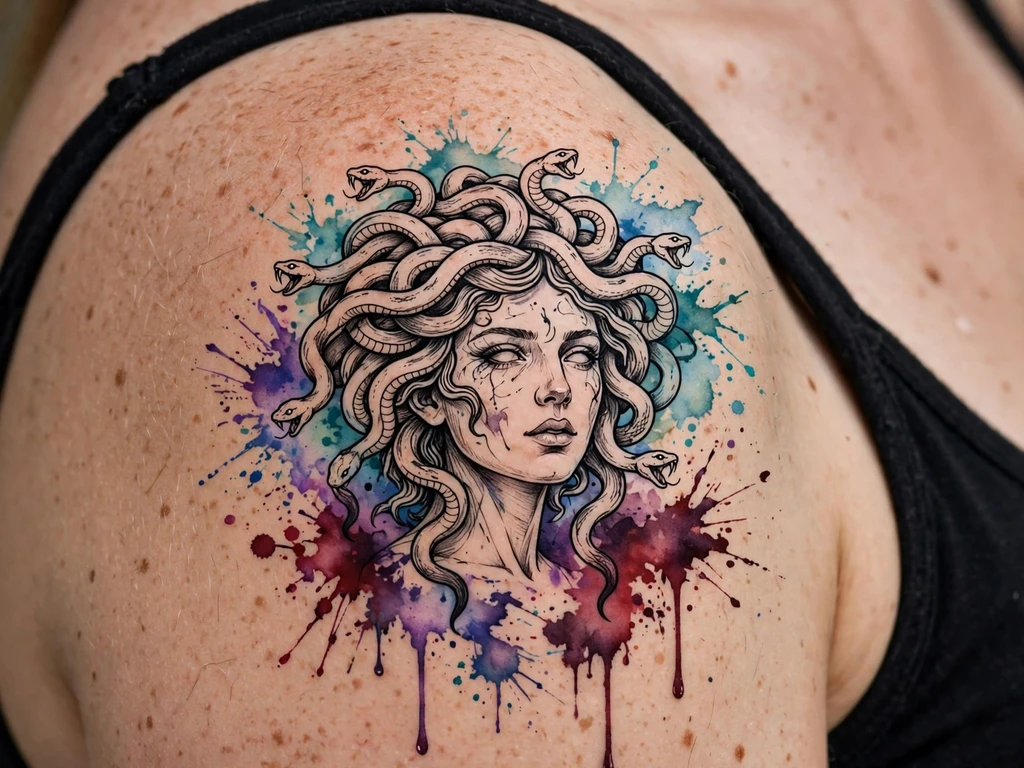
Here, confident black linework draws Medusa and her snakes, then loose washes of color — teals, purples, wine reds — splash and bleed behind her like wet paint. The contrast between the controlled portrait and the chaotic color gives the piece an emotional, artistic energy that pure realism cannot. It tends to suit wearers who see their Medusa as art first and emblem second.
Best placement: Shoulder, where the color can spill naturally over the curve.
Best for / know before you book: Honest talk: watercolor effects soften faster than any other style as skin renews itself, so expect this to mellow into a dreamier version within some years and budget for a possible color refresh. Anchor it with strong black linework — pieces built on the black skeleton age far better than pure color washes.
13. Dotwork Medusa
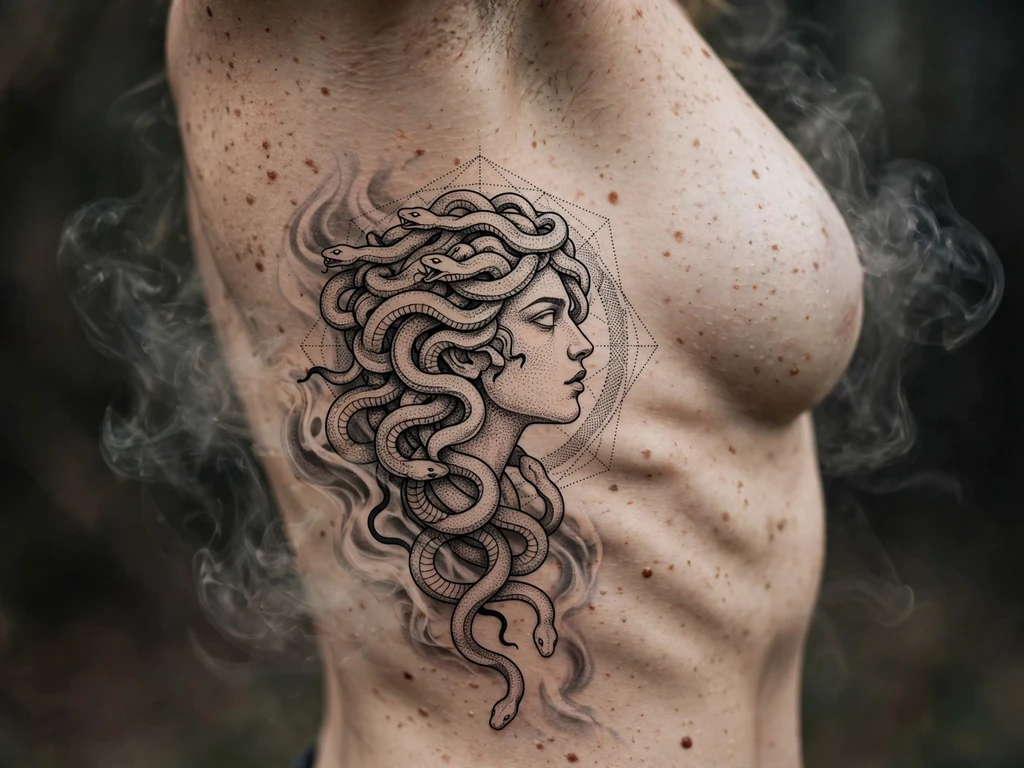
Every shadow in this Medusa is built from thousands of individual dots, giving her a soft, smoky, almost sacred quality — part icon, part constellation map. Dotwork pairs naturally with geometric halos and fine ornamental frames, and it tends to be gentler on the skin than heavy shading because the needle spends less time packing any one area.
Best placement: Ribcage, the portrait running vertically with the ribs.
Best for / know before you book: For patient people — dotwork is slow, meditative tattooing, and large areas take real time. The payoff is shading that ages like a photograph rather than a smudge. Ribs are a tender placement for anyone; a design that needs several long sittings here deserves an honest conversation with yourself about pacing and breaks.
14. Neo-Traditional Medusa
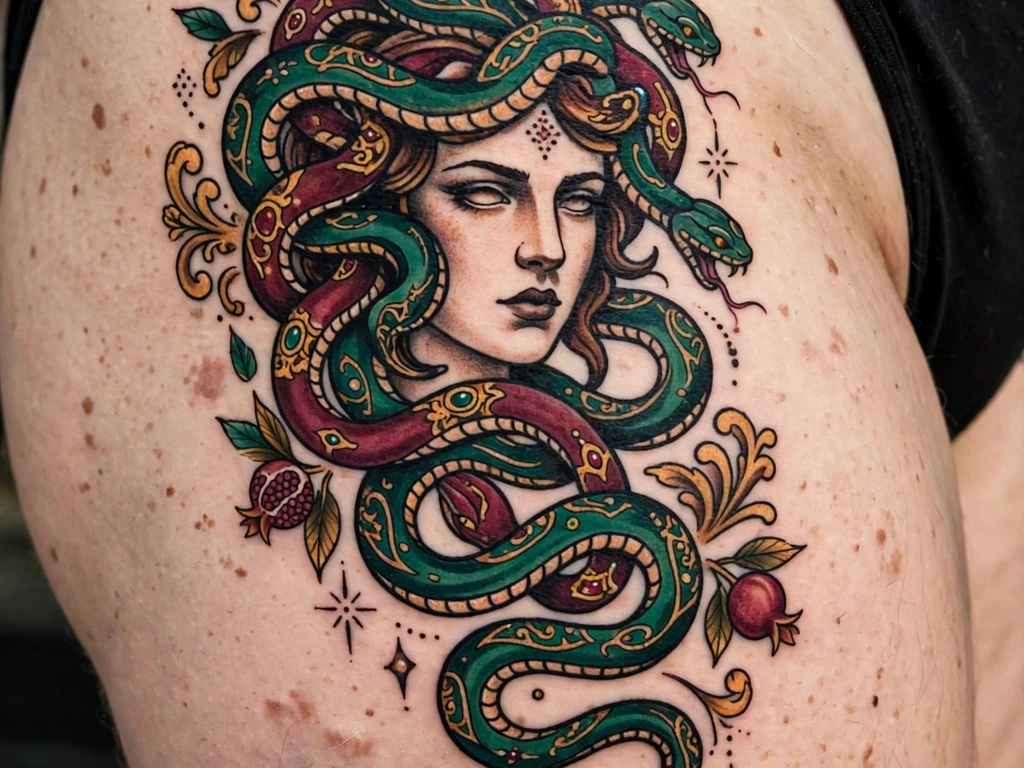
Neo-traditional gives Medusa the storybook treatment: bold black outlines, a rich limited palette of emerald, gold and burgundy, and snakes stylized into decorative patterns with jewel-like eyes. It keeps the readability of old-school tattooing while allowing far more detail and elegance. If realism feels too solemn and blackwork too stark, this is the glorious middle path.
Best placement: Hip and upper thigh, following the body’s curve.
Best for / know before you book: A superb choice for color lovers who still want longevity — bold outlines and saturated color are exactly what ages best in tattooing. Bring your artist reference for the palette specifically; neo-traditional lives on disciplined color choices, and a face framed in the wrong greens can turn swampy instead of jewel-like.
15. Split-Face Medusa
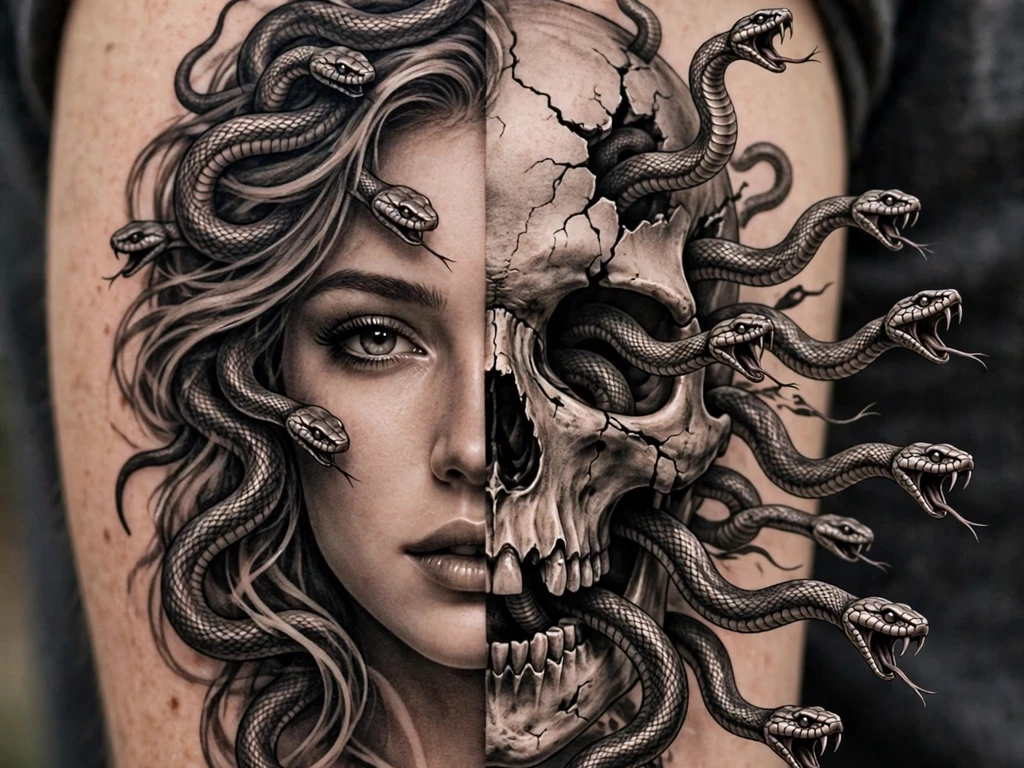
One face, two truths. Down the center line, this design divides Medusa in half: one side the beautiful woman she was, hair soft and eyes alive; the other side skeletal, shadowed, snakes bursting outward. It is the most conceptually loaded design here — a picture of before and after, of the self the world saw and the self that survived. Expect questions about this one for the rest of your life.
Best placement: Inner bicep, revealed when the arm lifts.
Best for / know before you book: For wearers whose Medusa is about duality and transformation specifically. The center split must align perfectly with the face’s symmetry, which makes stencil placement a genuine art — choose a portrait-capable artist, and expect this design to need a decent size so both halves stay legible.
16. Tiny Snakes Behind the Ear
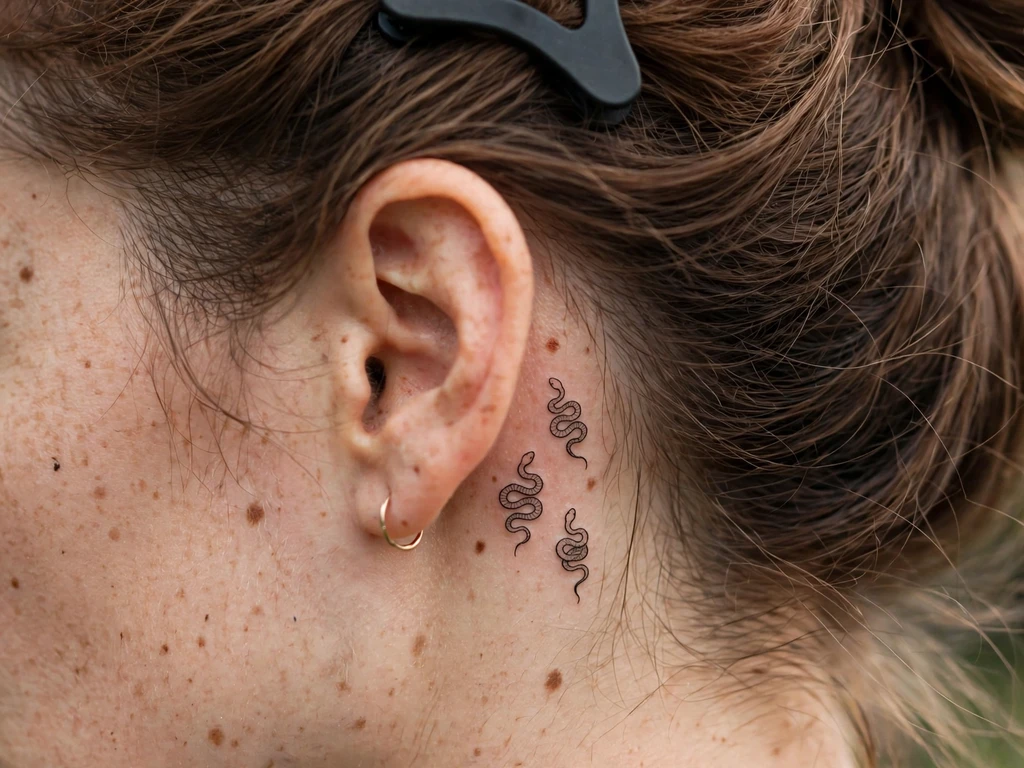
The smallest possible nod to Medusa: two or three miniature serpents, no bigger than a coin each, curling behind the ear where her hair would fall. Hair down, they vanish; hair up, they appear — a secret kept at the edge of sight. For many wearers this is a private symbol, known to almost no one, which can make it the most meaningful piece on this entire list.
Best placement: Directly behind the ear, following its curve.
Best for / know before you book: A discreet first step into Medusa symbolism. Tiny tattoos need simplified shapes — a good artist will talk you out of micro-detail that cannot survive healing behind an ear. The spot itself is quick but sharp-feeling, and it is wise to remember some workplaces still notice anything near the face.
17. Spine Snake Cascade
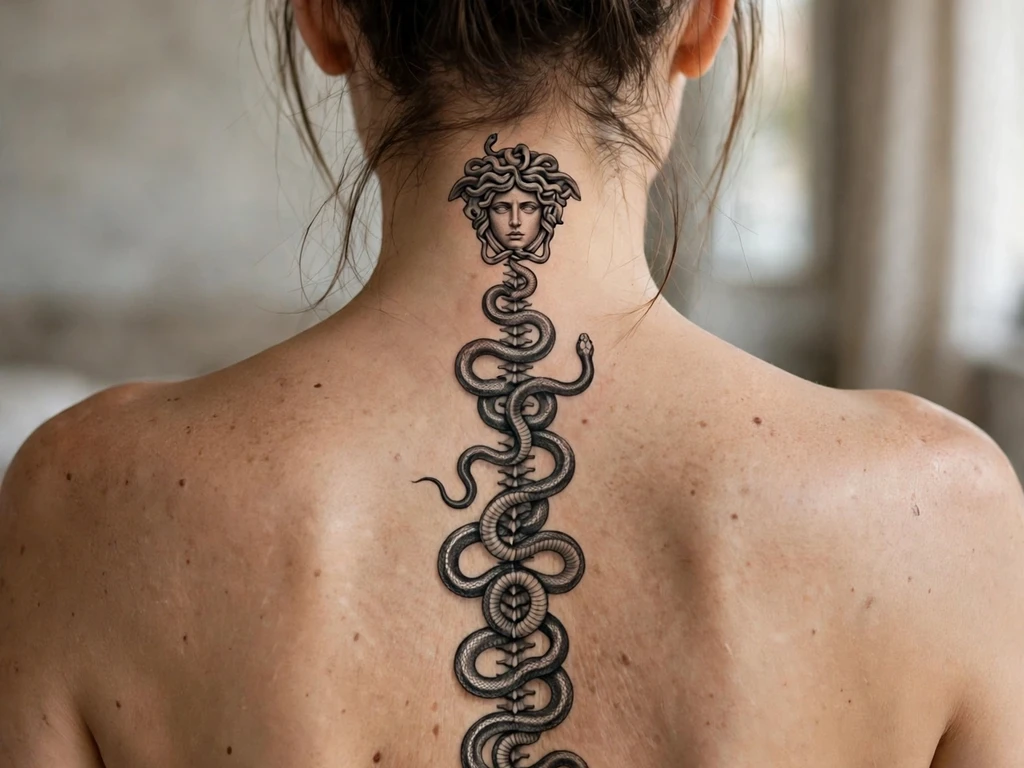
Instead of containing the snakes in her hair, this design sets them free down the whole back. A small, finely drawn Medusa head sits at the nape of the neck, and from it a cascade of serpents pours down the spine — twisting, separating and rejoining all the way to the lower back. It moves like water when you walk and turns a backless dress into a gallery opening.
Best placement: Center spine, from nape to lower back.
Best for / know before you book: Elegant and surprisingly concealable for its size. The spine is a sensitive line of real estate, and long straight-ish compositions punish any wobble, so artist selection matters more than price here. It also extends beautifully later — extra snakes or a moon at the base can join the cascade years down the line.
18. Medusa Back-of-Hand Piece
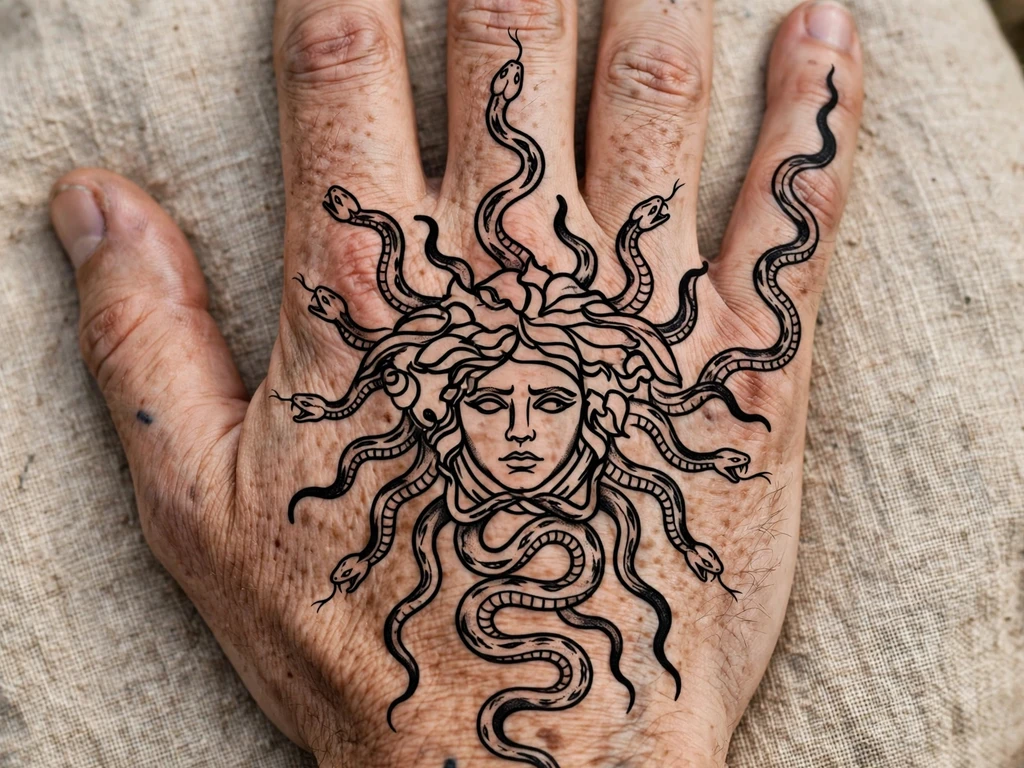
A compact Medusa face centered on the back of the hand, her snakes radiating outward and reaching toward the fingers and wrist like the rays of a dark sun. Hands are the most public canvas you own — this design turns every handshake and coffee cup into a small declaration. Simplified boldly, it keeps its readability despite the hand’s constant motion and sun exposure.
Best placement: Center of the back of the hand, snakes flowing outward.
Best for / know before you book: Only for the fully committed: hand tattoos cannot be covered at work and still carry stigma in some professions. Hand skin also sheds faster than anywhere else on the upper body, so fading and touch-ups are part of the deal — artists who guarantee otherwise are not being straight with you. Bold, open shapes are non-negotiable here.
19. Medusa with Moon Phases
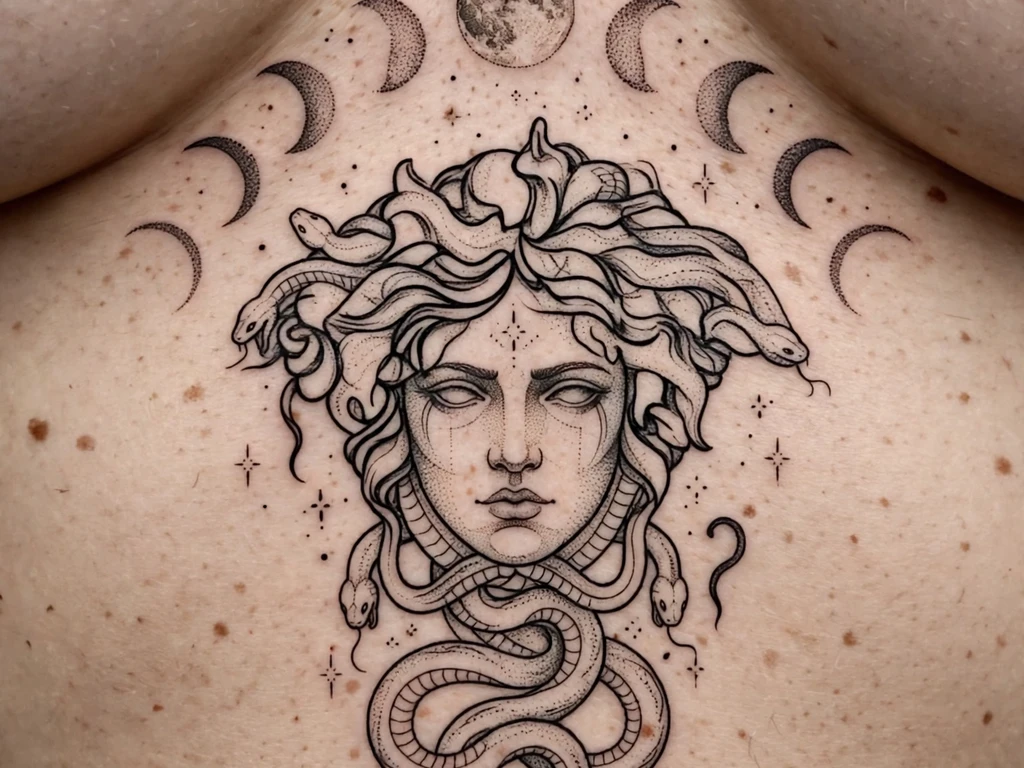
An arc of moon phases — crescent, half, full, half, crescent — crowns Medusa’s head like a second, celestial set of horns while her snakes curl beneath. The pairing layers lunar symbolism (cycles, intuition, the feminine divine) over everything Medusa already carries, and it makes the design unmistakably nocturnal and witchy in the best way. Fine lines and dotwork shading suit it beautifully.
Best placement: Underbust, the moon arc following the curve of the ribs.
Best for / know before you book: Lovely for wearers who connect Medusa to cycles and renewal specifically. The moon arc has to mirror perfectly, so expect extra stencil time — and photograph the stencil from the front before agreeing, because small asymmetries in a repeated shape are the first thing the eye catches.
20. Geometric Medusa
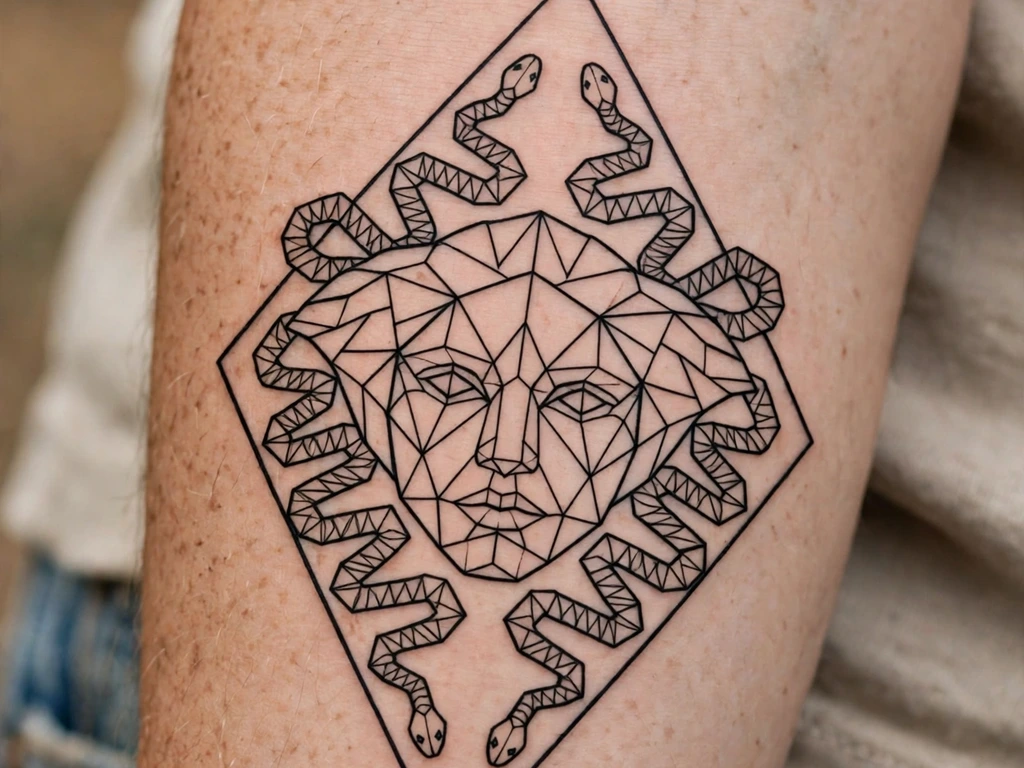
Medusa rebuilt from straight edges and perfect symmetry: her face suggested by faceted planes, the snakes arranged as mirrored zigzags and triangles, often inside a diamond or hexagonal frame. It reads almost like a logo or a gemstone cutting diagram — ancient subject, futuristic execution. For people who love the meaning but find flowing organic portraits too soft, this is the answer.
Best placement: Inner forearm, flat and display-friendly.
Best for / know before you book: Geometric work is a specialist discipline: lines must be ruler-straight and mirrors must match to the millimeter, or the whole illusion collapses. Interview artists with healed geometric pieces specifically. The reward is a design that stays crisp-looking for years, because bold straight lines age more gracefully than delicate curves.
21. Weeping Medusa Portrait
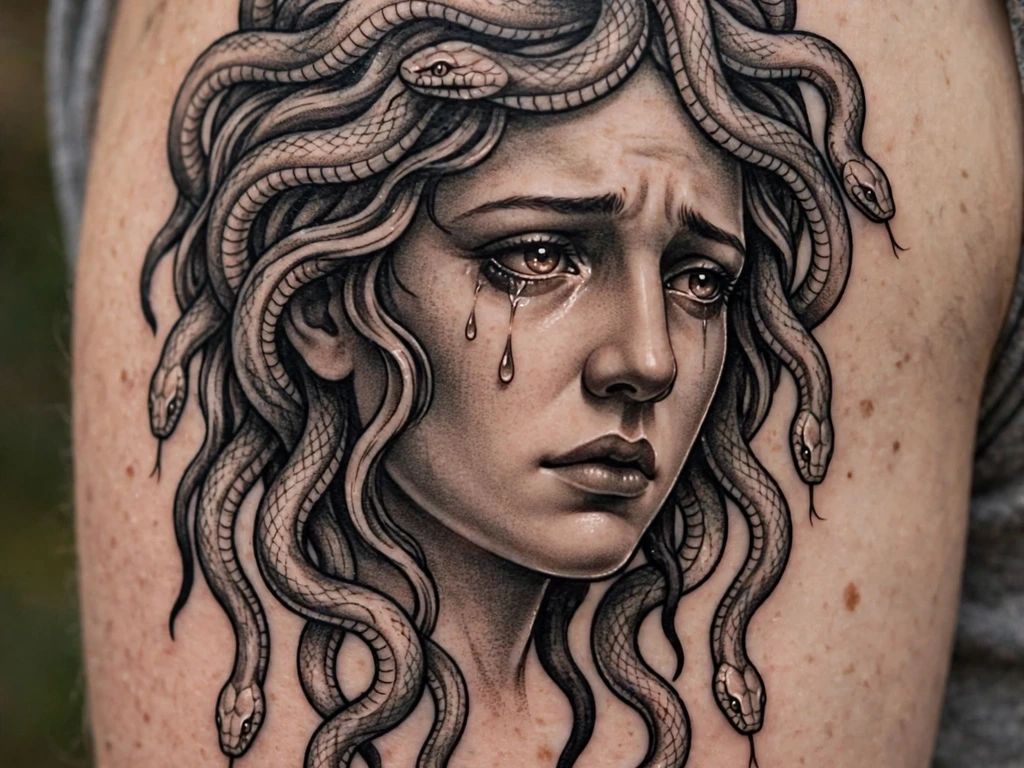
Not every Medusa has to snarl. This portrait shows her mid-sorrow: eyes wet, a tear tracking down one cheek, snakes hanging heavy and quiet around her face. It honors the part of the story that comes before the strength — the grief itself — and wearers often describe it as the most honest tattoo they own. Done in soft black and grey, it has the tenderness of a Renaissance Madonna with twice the story.
Best placement: Upper arm, at a size that lets the expression breathe.
Best for / know before you book: Emotionally specific portraits demand a genuinely skilled realism artist; a tear rendered badly reads as a smudge, and a sorrowful expression rendered badly reads as an accident. Study healed emotional portraits in portfolios. And sit with the design for a while before booking — this is a tattoo about a feeling, and feelings deserve a cooling-off period.
22. Medusa Half Sleeve
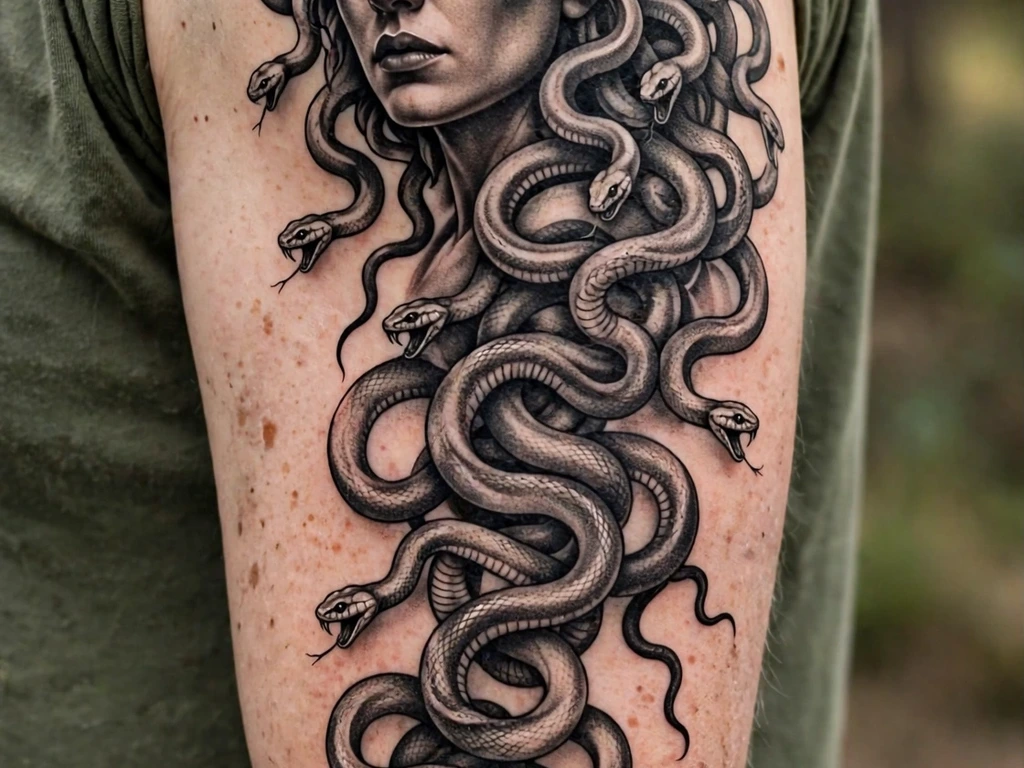
Why choose one composition when the whole upper arm is available? The half sleeve places Medusa’s portrait at the shoulder and lets her snakes become the sleeve itself — dozens of serpents winding down to the elbow, filling every gap, sometimes joined by roses, skulls or Greek patterns. If you are browsing arm tattoo ideas with a Medusa in mind, this is their natural meeting point: a complete, self-contained world on one arm.
Best placement: Upper arm, shoulder to elbow, as one connected composition.
Best for / know before you book: A half sleeve is planned, not improvised — book a consultation, agree the full design before the first line, and expect several sessions. It is also the most expandable option here: today’s half sleeve is tomorrow’s full sleeve, with the lower arm free for Perseus, Pegasus or a temple scene whenever you are ready.
23. Small Medusa Ankle Piece
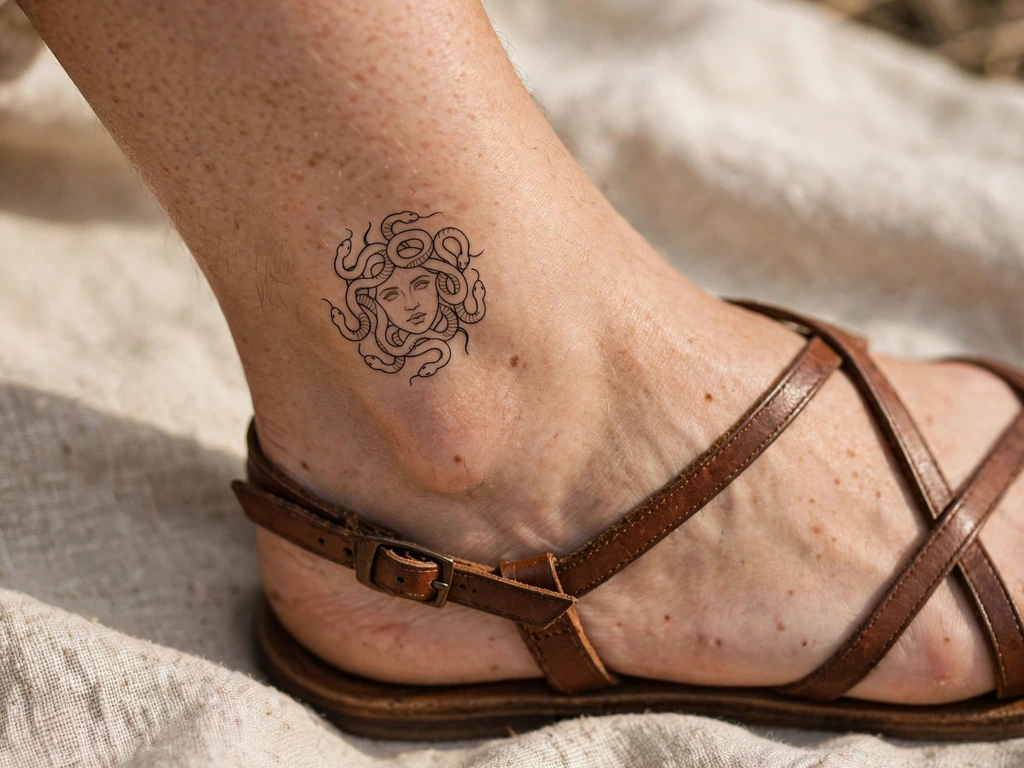
Medusa at her most wearable: a palm-sized, simplified portrait just above the ankle bone, with a tidy swirl of four or five snakes standing in for the full crown. It peeks out of shoes and sandals, starts conversations at ankle height, and takes a fraction of the time and budget of the big portraits — while carrying exactly the same meaning for the person wearing it.
Best placement: Outer ankle, above the ankle bone.
Best for / know before you book: A friendly entry point with real symbolism. Simplification is the whole game at this size — a good artist will reduce the face to its essentials rather than shrinking a detailed portrait. Ankle skin near the bone can be tender and shoes will rub while it heals, so schedule it when open footwear is an option.
24. Medusa and Skull
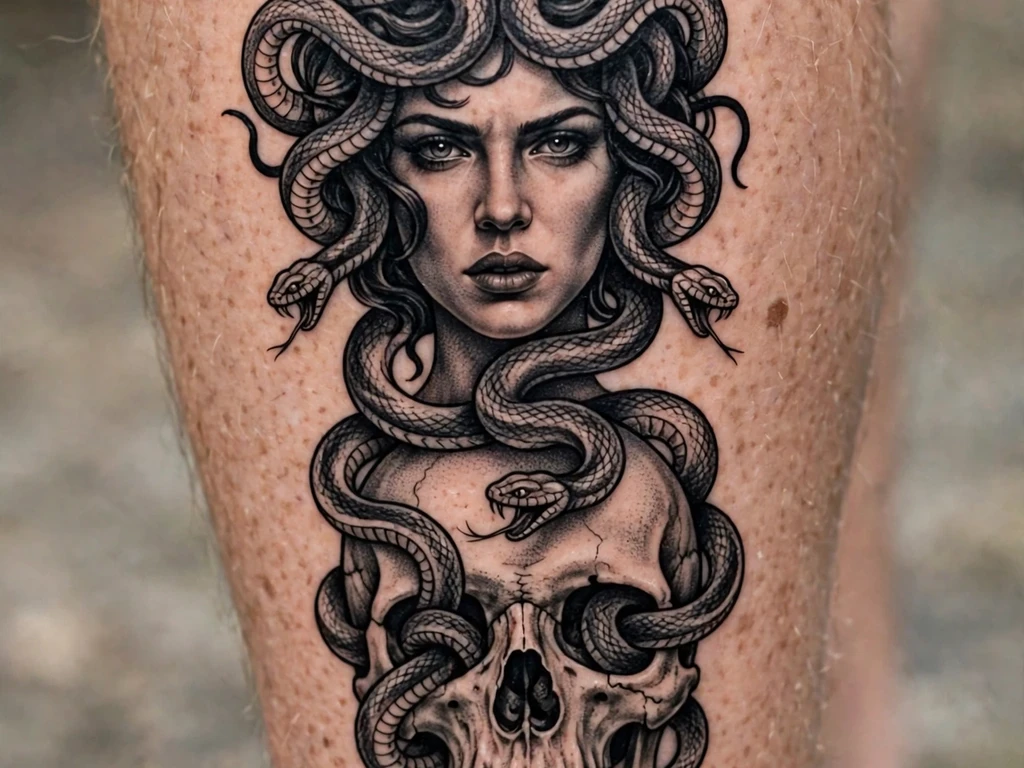
The darkest pairing on the list: Medusa’s living gaze set against a skull — sometimes the skull of Perseus himself, sometimes an anonymous memento mori, her snakes threading through its empty eye sockets. It is a meditation on the story’s ending and on mortality generally: even the hero who killed her is bones now, and she is still here, still looking. Gothic, philosophical and completely uncompromising.
Best placement: Calf, where the two elements can stack vertically.
Best for / know before you book: For wearers who embrace the macabre reading of the myth — and who have thought about how a skull reads in their everyday life and workplace. The two elements need contrast to stay readable: usually the face is rendered soft and alive while the skull stays hard and graphic, or the reverse. Agree that contrast plan before the outline goes on.
25. Greek Statue Medusa Bust
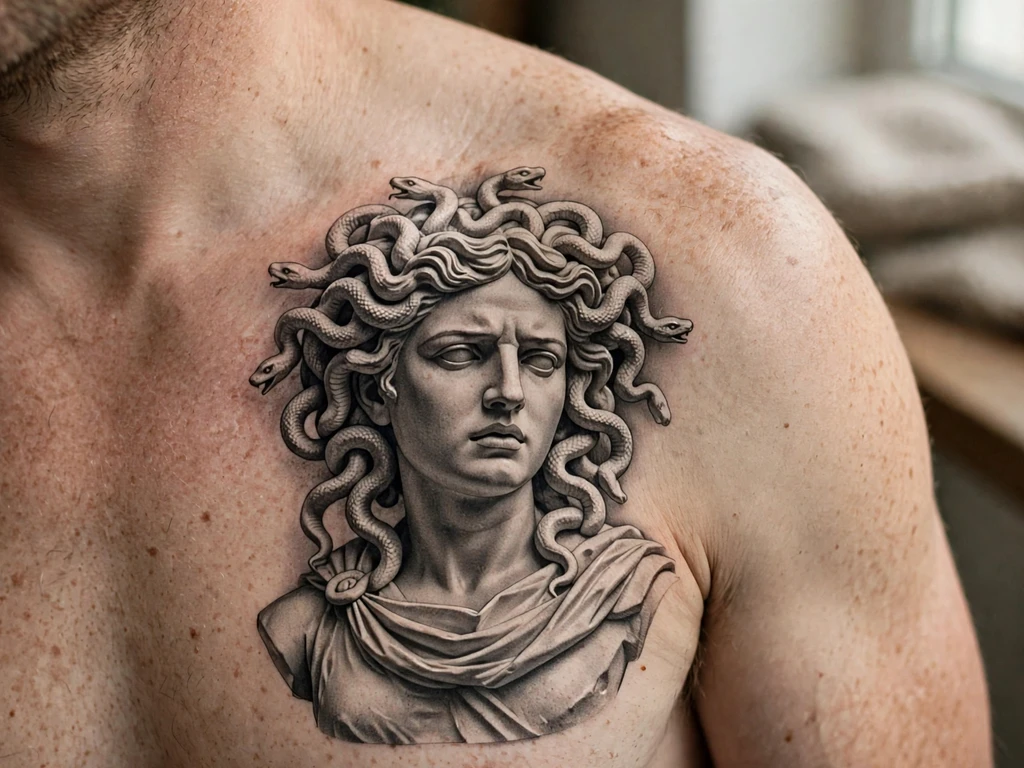
Our closing design goes back to the source: Medusa rendered as a carved marble bust, complete with the shading tricks that make skin look like stone — smooth gradients, chisel-line hair beneath the snakes, sometimes even a deliberate “crack” across the marble. It connects your tattoo directly to two thousand years of art history, from ancient temple carvings to the famous Renaissance versions, and it never goes out of style because it was never in fashion to begin with.
Best placement: Chest and shoulder, bust-style, like a sculpture on a plinth.
Best for / know before you book: The marble effect lives entirely in the shading, so this is a black-and-grey specialist’s piece — ask to see healed stone or statue work in the portfolio. It also pairs beautifully with other classical subjects later (columns, laurel, Greek key borders) if you ever want to build a mythology-themed chest or arm.
Medusa Tattoo Placement by Size
| Size | Typical dimensions | Best placements | Good to know |
|---|---|---|---|
| Small | 4–8 cm | Behind ear, inner wrist, ankle | The face must be simplified — tiny detailed portraits blur as ink settles |
| Medium | 9–16 cm | Forearm, shoulder blade, inner bicep, calf | Enough room for a real expression and a readable crown of snakes |
| Large | 17–30 cm | Upper arm, thigh, sternum, chest, ribcage | The sweet spot for portrait detail, symmetry and long-term clarity |
| Extra large | 30 cm+ / multi-session | Full back, half sleeve, front thigh | Plan in stages with one artist so style and shading stay consistent |
How to Choose Your Medusa Tattoo (and What to Know Before You Book)
Decide what she means to you first. Medusa carries several meanings at once — survival, protection, transformation, feminine power — and the strongest tattoos are built around the one that is yours. Tell your artist. A Medusa designed as a guardian reads differently from one designed as a memorial, and a good artist will adjust her expression, her snakes and her styling to match the story you are telling. Like the phoenix in our phoenix tattoo ideas guide, she is a symbol of rising from what should have finished you — wear her on purpose.
Portraits demand portrait artists. A face is the least forgiving subject in tattooing; a millimetre of drift changes an expression. Look at healed portraits in the portfolio — ideally a year or more old — and be especially careful with eyes, which are where Medusa tattoos succeed or fail. If an artist’s healed faces do not move you, keep looking, even if their price was tempting.
Size is a meaning decision too. Medusa’s power lives in her face, and faces need room. As a rule of thumb, a detailed front-facing portrait wants at least 10 cm of height to hold its expression over time; smaller pieces should be simplified on purpose, like the fine-line, silhouette and snakes-only designs in this list. When in doubt, go bigger — nobody regrets a Medusa with room to breathe.
Plan the snakes, not just the face. The snakes are half the artwork. Decide how many, how active (sleeping coils read calm; rearing, open-mouthed snakes read as a threat display), and how they will fill the space around the portrait so the composition hugs your body’s shape instead of floating on it. This is also where your artist earns their fee in the drawing stage — a custom composition will always outclass a copied one.
Look after the skin it lives on. Choose a licensed studio with single-use needles opened in front of you, and follow your artist’s aftercare instructions to the letter — portrait shading is the first thing poor healing damages. The American Academy of Dermatology’s guide to tattoos and piercings is a sensible dermatologist-written overview of how tattooed skin reacts and when a healing tattoo needs medical attention rather than patience.
Key points to remember:
- Meaning first: survival, protection, transformation or feminine power — pick the reading that is yours
- Healed portrait work in the portfolio matters more than fresh photos or low prices
- Detailed faces need at least ~10 cm; shrink the detail, not just the design, for small pieces
- Snake activity sets the mood: sleeping coils = calm guardian, rearing snakes = warning
- Custom-drawn compositions beat copied ones — bring references, not a finished design to trace
Frequently Asked Questions
What does a Medusa tattoo represent?
Above all, survival and protection. In the myth’s later telling, Medusa was wronged and then transformed — and her transformed face became a weapon that no one could approach with harmful intent. Modern wearers use her image to say: I went through it, it changed me, and now I am untouchable. She also stands for transformation itself, for feminine power that refuses to apologize, and as Athena used her image — as a shield that guards the wearer.
Is a Medusa tattoo a symbol for survivors?
For many people, yes — that is one of its best-known modern meanings, and it is why the design matters so much to the women who choose it. The connection comes from Ovid’s version of the myth, in which Medusa was assaulted and then punished for it, yet emerged with a gaze that protected her forever afterward. Not every Medusa tattoo carries this meaning for its wearer, and nobody owes anyone an explanation of theirs — but if that reading speaks to you, you are in a great deal of company.
How big should a Medusa tattoo be?
It depends on the style. A detailed, front-facing portrait generally needs at least 10 cm of height — more is better — so the eyes, expression and individual snakes stay distinct as the tattoo ages. Simplified versions play by different rules: fine-line, silhouette, geometric, blackwork and snakes-only designs can work beautifully at 5–8 cm because they are drawn with fewer, bolder shapes from the start.
Which placement suits a first Medusa tattoo?
The forearm, upper arm and shoulder blade are the friendliest starting points: flat, comparatively low-pain, easy to heal, and roomy enough for a medium portrait that can grow later. The thigh is the best choice if you want a large, detailed piece as your first — it is a generous canvas that stays hidden under clothing whenever you need it to. Save the hand, behind-the-ear and sternum for when you know how your skin holds ink.
How much does a Medusa tattoo cost?
Expect detail to drive the price. A small simplified Medusa may sit near a studio’s minimum charge; a medium forearm or shoulder portrait from a strong realism artist usually lands in the mid hundreds; large thigh, chest and back pieces and half sleeves run into four figures across several sessions. You are paying for portrait skill above all — with faces, the cheapest option is rarely the one you will be happiest showing off in ten years.
Final Thoughts
Medusa has been carved, painted and feared for well over two thousand years, and she has never once been decoration. That is the secret of this tattoo’s power: whether she is your shield, your memorial, your warning or your work of art, she arrives with a story already loaded into her — and your story completes it.
Choose the face that feels like yours, give her the size and the artist she deserves, and let the snakes fall where they want to. Some tattoos you wear; a Medusa, you stand behind.