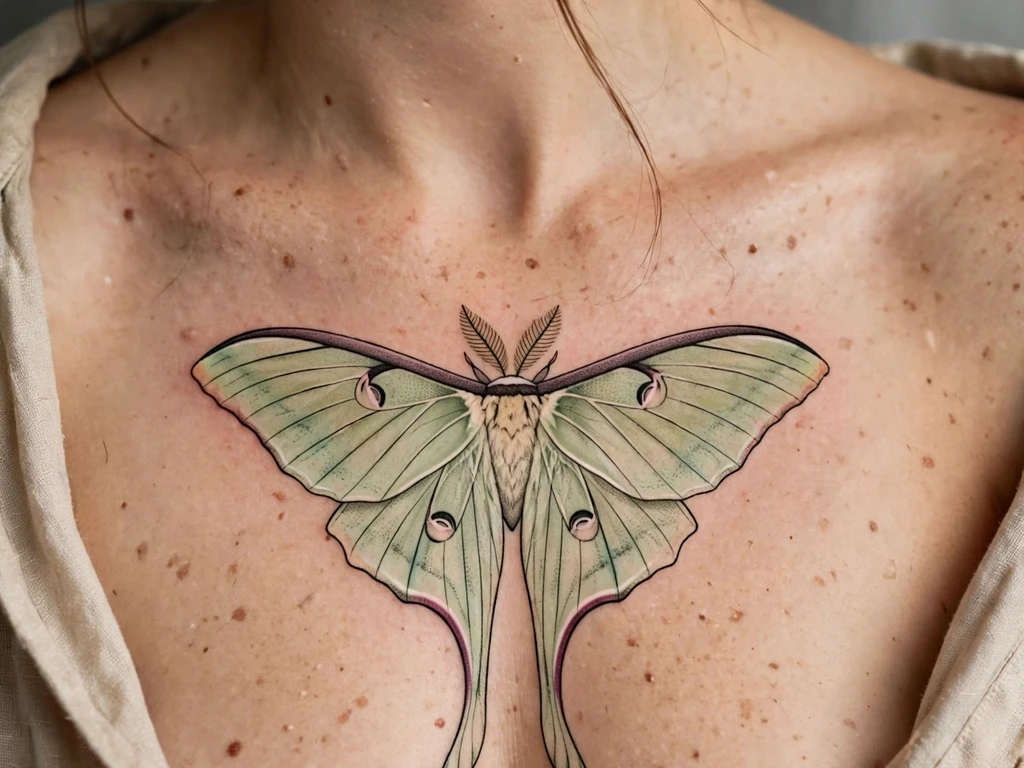
A moth tattoo carries a quieter kind of drama than most insect ink. It is drawn to moonlight, built for the dark, and shaped by one of nature’s most complete transformations: egg, caterpillar, chrysalis, winged adult. That journey is why moth tattoo ideas keep finding people who have changed slowly, privately and for good — not in a single bright moment, but through a season of becoming.
This guide begins with the meaning, because searches for “meaning of a moth tattoo” are rising fast, then compares moths with butterfly tattoo ideas so you can feel the difference in tone. After that come 25 designs: pale luna moths, the famous death’s-head hawkmoth, simple fine-line pieces for smaller placements, blackwork and dotwork versions, and larger back and chest compositions with room for wing detail.
What Does a Moth Tattoo Mean?
The shortest answer is transformation, but a moth means more than change alone. A butterfly often stands for change that happens in daylight and gets applauded. A moth suggests change that happens at night: grief processed quietly, a new identity formed before anyone else notices, intuition trusted when there is no clear map. Many people choose moth tattoo ideas after recovery, reinvention, a career turn, a spiritual shift or the end of a long hidden struggle.
The moth’s pull towards light adds a second layer. Read generously, it means hope, guidance and refusing to give up on the thing that calls you. Read honestly, it can also warn against obsession — flying too close to a flame, a person, a habit or an old version of yourself. That tension makes the symbol unusually personal: the same moth can be a promise on one body and a caution on another.
Real moths deepen the story. The University of Florida’s Featured Creatures profile of the luna moth notes that the luna takes its name from its moon-like spots, and adult luna moths live only briefly, relying on energy stored from their caterpillar stage. In tattoo language, that short, luminous adult life becomes a symbol of urgency and impermanence: be here now, while the wings are open.
| Symbolism | What it can mean in a tattoo | Design cues that express it |
|---|---|---|
| Transformation | A complete before-and-after: leaving one life stage for another | Chrysalis beneath the wings, split caterpillar-to-moth composition |
| Attraction to light | Hope, faith, ambition, or a warning about obsession | Lantern, candle flame, moon, single star or light rays |
| Nocturnal intuition | Trusting instinct, dreams and the unseen | Moon phases, closed eyes on wings, deep shading, stars |
| Resilience | Surviving dark periods and still moving | Weathered wings, patched patterns, moth rising from shadow |
| Rebirth | Starting again after loss, illness or a hard chapter | Sunrise behind the moth, fresh green luna colouring, open wings |
| Protection and mystery | A guardian with an edge; beauty that is not harmless | Death’s-head markings, skull accents, watchful wing eyes |
Two moth species do most of the symbolic heavy lifting in tattooing. The luna moth — pale green, long-tailed and moon-spotted — leans towards rebirth, intuition and gentle transformation. The death’s-head hawkmoth carries a skull-like marking on its thorax and a long folklore trail of omens; in modern tattoos it usually reads less as “bad luck” and more as protection, defiance and comfort with life’s darker seasons. You will find both below, in several sizes and styles.
Moth vs Butterfly Tattoos: Which One Fits You?
Searches for “moth vs butterfly” keep rising because the two insects share a family resemblance but tell different stories. Neither is better; they simply suit different wearers. Use this comparison before you fall for a reference photo.
| Point of comparison | Moth tattoo | Butterfly tattoo |
|---|---|---|
| Typical mood | Moonlit, mysterious, earthy, a little gothic | Bright, open, celebratory, romantic |
| Core symbolism | Private transformation, intuition, resilience, attraction to light | Visible change, freedom, joy, new beginnings |
| Natural behaviour | Mostly nocturnal; many rest with wings open or tented | Mostly daytime; many rest with wings folded upright |
| Body and antennae | Often sturdier bodies and feathery antennae | Usually slimmer bodies and club-tipped antennae |
| Wing detail in ink | Eyespots, scalloped edges, dusty shading, long luna tails | Bold colour blocks, symmetrical patterns, graphic wing shapes |
| Best styles | Fine line, blackwork, dotwork, neo-traditional, dark botanical | Colour realism, watercolour, traditional, fine line |
| Choose it if… | Your change happened quietly and means more for it | Your change feels like a celebration you want to share |
If you love both, a paired composition works beautifully: a butterfly in the upper, sunlit position and a moth below with moon phases — day self and night self in one piece. Just keep the two insects clearly distinct in body shape and antennae, or the comparison gets lost at a glance.
Moth Tattoo Ideas at a Glance
| # | Design | Style notes | Best placement |
|---|---|---|---|
| 1 | Luna Moth Sternum Piece | Pale luna wings, long tails, centre moon spot | Sternum |
| 2 | Death’s-Head Hawkmoth | Skull-marked thorax, bold symmetrical wings | Chest |
| 3 | Moth and Moon Phases | Moth beneath a horizontal phase arc | Upper back |
| 4 | Moth with Skull Accents | Wing skulls, darker ornamental shading | Thigh |
| 5 | Simple Fine-Line Moth | Small clean outline, minimal interior detail | Inner wrist |
| 6 | Moth and Wildflowers | Moth resting among stems and blooms | Forearm |
| 7 | Blackwork Moth | Solid black shapes with negative-space pattern | Upper arm |
| 8 | Collarbone Moth | Small centred moth following the neckline | Between collarbones |
| 9 | Moth and Lantern | Forearm scene with a warm light source | Forearm |
| 10 | Moth and Stars | Night-sky moth with fine star scatter | Shoulder blade |
| 11 | Dotwork Moth | Stippled shading and soft wing gradients | Inner bicep |
| 12 | Watercolour Luna Moth | Green and gold washes with a light outline | Shoulder |
| 13 | Back-of-Neck Moth | Compact vertical moth under the hairline | Nape |
| 14 | Moth and Crescent Moon | Curved ankle composition with a crescent | Outer ankle |
| 15 | Giant Moth Back Piece | Full wing span with layered patterning | Full back |
| 16 | Wing-Eye Moth | Prominent eyespots as the focal point | Chest |
| 17 | Geometric Moth | Mirrored angles, sacred-geometry accents | Forearm |
| 18 | Moth and Candle Flame | Moth circling a small flame | Ribcage |
| 19 | Moth in Profile | Side-view moth flowing along the calf | Calf |
| 20 | Moth Half-Sleeve Element | Moth as the anchor of a night-garden sleeve | Upper arm |
| 21 | Tiny Finger Moth | Micro moth reduced to silhouette and dots | Finger |
| 22 | Botanical Frame Moth | Oval leafy frame around a centred moth | Thigh |
| 23 | Neo-Traditional Moth | Bold outline, jewel tones, decorative tassels | Forearm |
| 24 | Moth and Crystals | Moth with hanging crystal drops | Sternum |
| 25 | Shoulder Moth Pair | Two smaller moths, one on each shoulder | Both shoulders |
25 Moth Tattoo Ideas
1. Luna Moth Sternum Piece
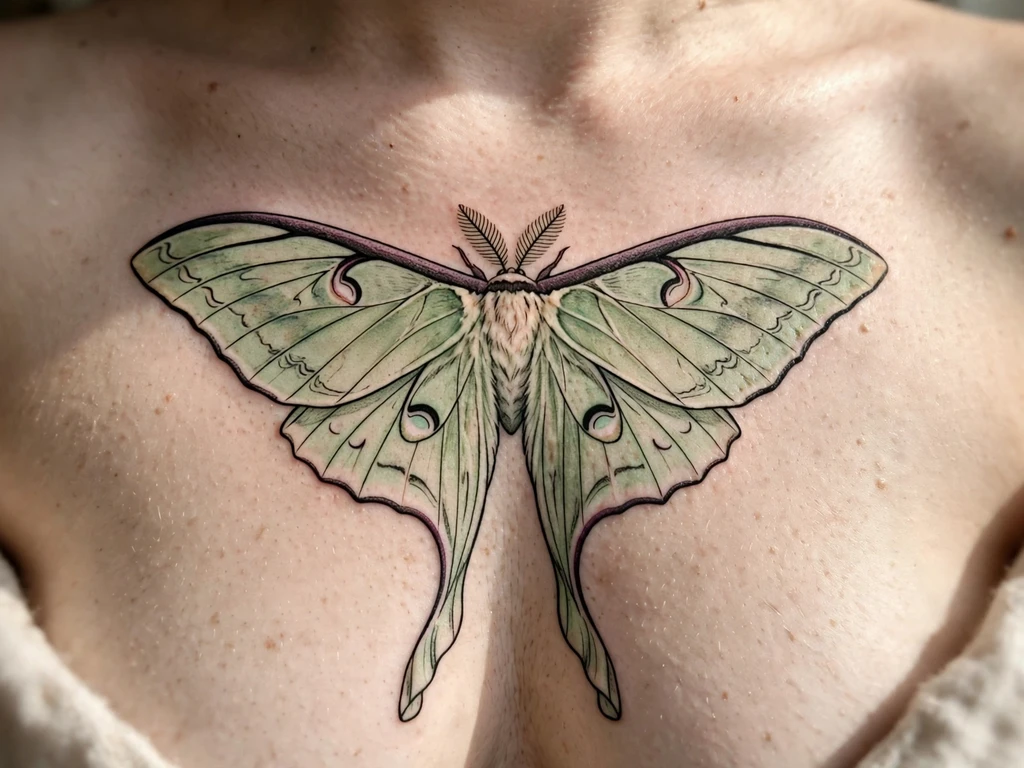
The luna moth is the signature design in this list for a reason: sea-green wings, crescent markings and those long, ribbon-like hindwing tails were practically made for the sternum. Centred between the ribs, the wings open with the body’s own symmetry while the tails drift down the midline. Kept in soft green and fine black line, it feels like jewellery grown rather than drawn.
Best placement: Centre sternum, wings spreading under the bust line and tails pointing down.
Best for / know before you book: The classic rebirth piece. Pale green ink fades faster than black, so ask for a fine-line skeleton underneath the colour — the design should still read beautifully when the green softens.
2. Death’s-Head Hawkmoth
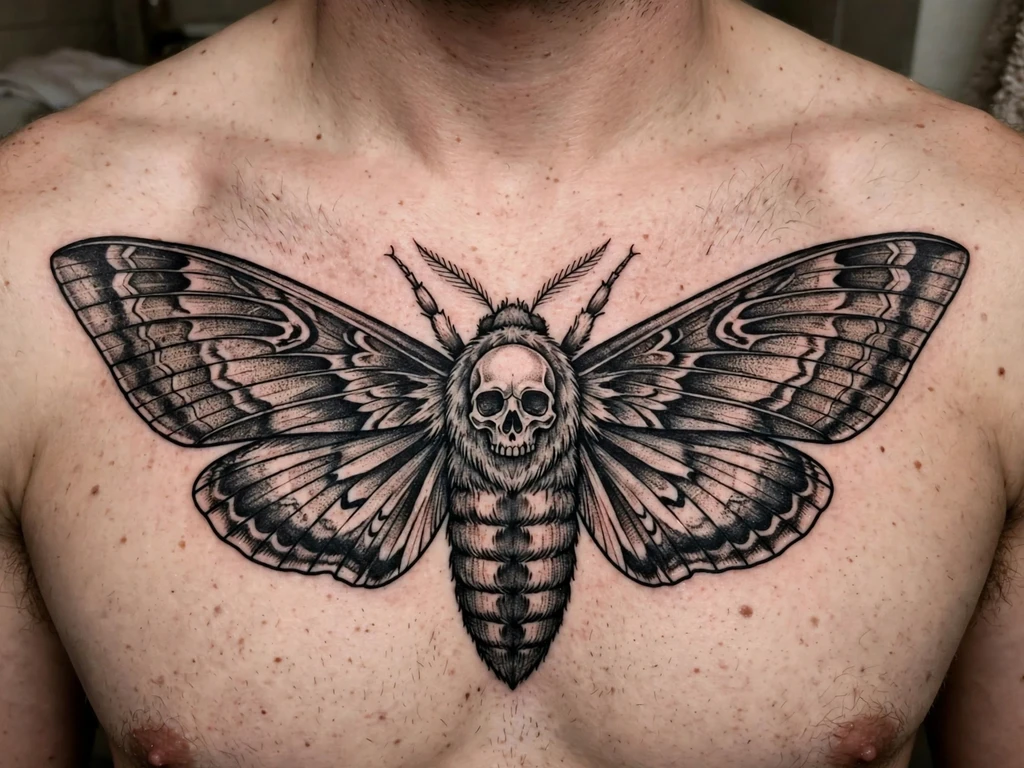
This is the design behind the rising search for “death’s head hawk moth tattoo,” and it earns the attention. The hawkmoth’s thorax carries a marking that genuinely resembles a human skull, which folklore turned into an omen and modern tattooing has reclaimed as a badge of defiance. Drawn large across the chest, with heavy wings and a detailed central body, it reads protective rather than morbid — a guardian that has seen the dark and stayed.
Best placement: Centre chest, wings opening towards both shoulders; a full upper-back version works just as well.
Best for / know before you book: For wearers who want the strongest meaning in the list. The skull marking must stay readable, so do not shrink it — if you are comparing centre-chest layouts, browsing chest tattoo ideas will help you judge the scale this motif needs.
3. Moth and Moon Phases
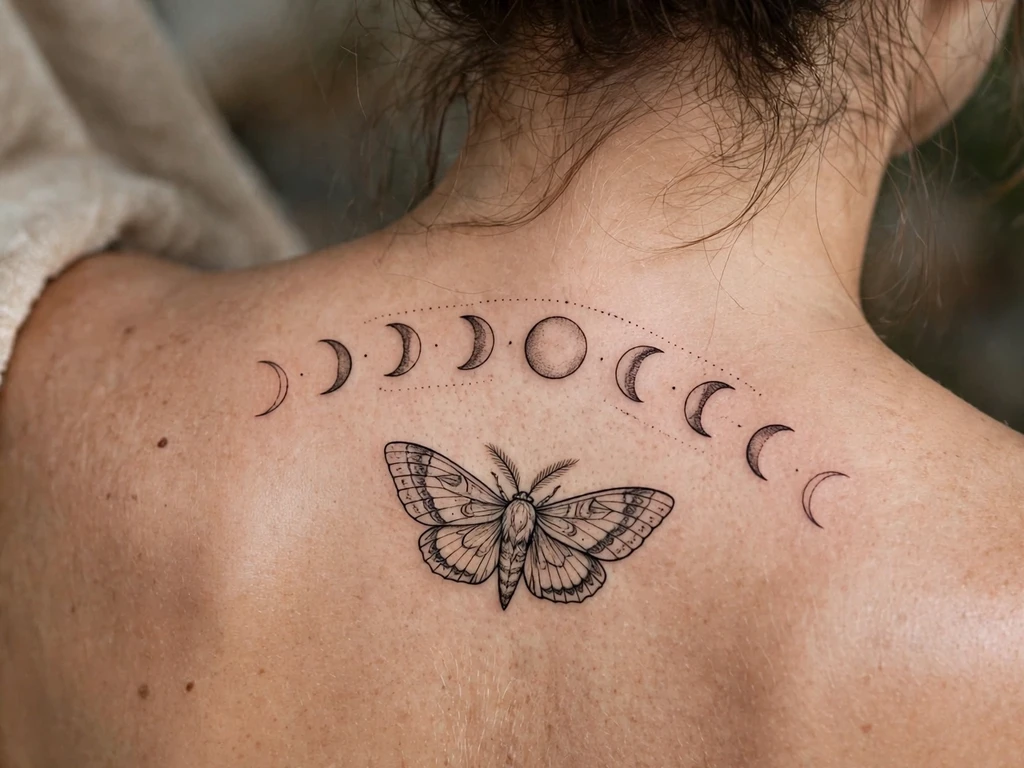
A moth resting beneath an arc of moon phases — crescent, half, full, half, crescent — turns the transformation meaning into a calendar. It suits people marking a change that happened in stages rather than overnight: recovery milestones, a year of rebuilding, a slow return to yourself. The horizontal layout sits naturally across the upper back or along the collarbone line.
Best placement: Upper back, phases arcing above the moth like a crown.
Best for / know before you book: Deeply customisable — many people make the full moon land on a meaningful date or phase. Keep the smallest crescents bold enough to survive; tiny slivers of negative space close up first as ink settles.
4. Moth with Skull Accents
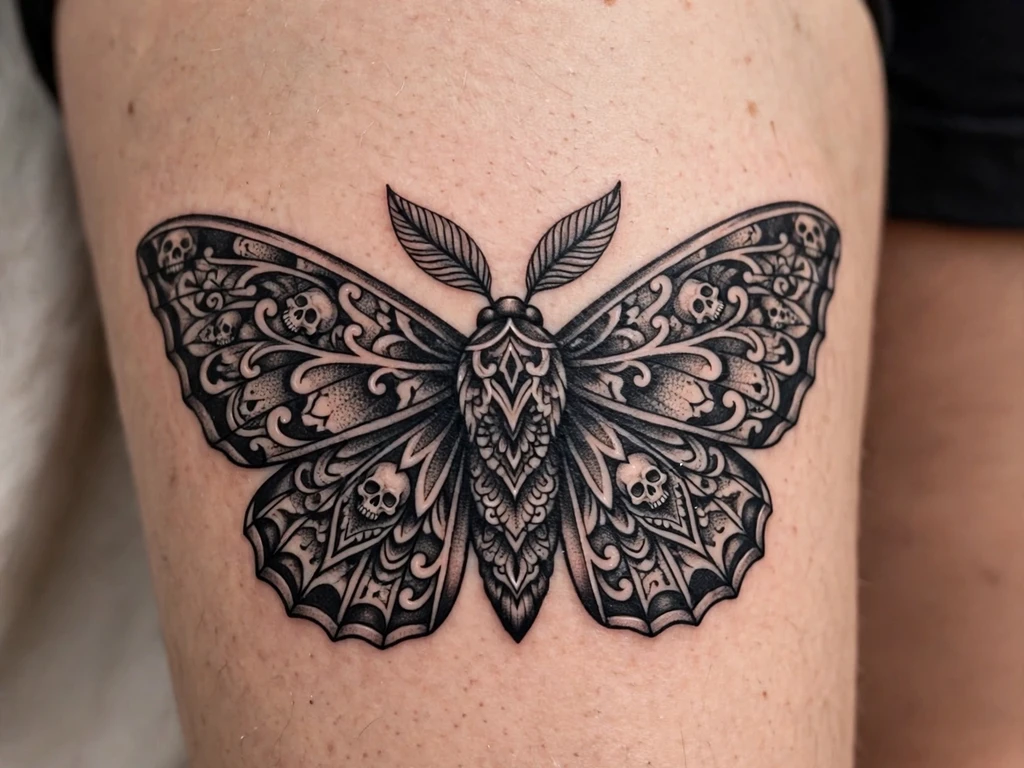
Where the death’s-head uses nature’s own marking, this design adds the symbolism deliberately: small skull shapes worked into the wing patterns, sometimes paired with a tiny skull at the body. It blends memento mori with transformation — a reminder that endings and beginnings share the same wings. The mood is gothic but can stay elegant if the skulls are kept ornamental rather than horror-styled.
Best placement: Front thigh, where the wingspan has room for hidden detail.
Best for / know before you book: A strong choice for dark-romantic tastes. Hidden details need scale; at small sizes the skulls become blobs, so treat this as a medium-to-large design only.
5. Simple Fine-Line Moth
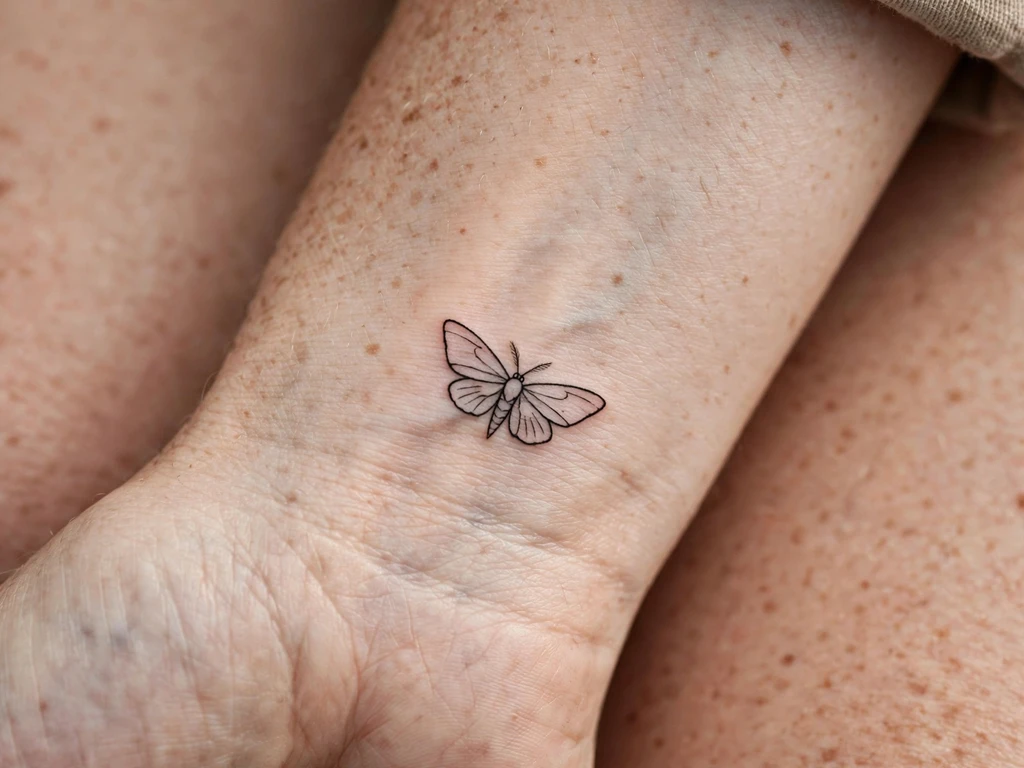
Searches for “simple moth tattoo” are climbing because this version strips the insect to its essentials: a soft body, two rounded wings, a hint of antennae and almost no interior pattern. On the inner wrist it reads like a small signature — private, quick to heal and easy to live with at work. Simplicity is not a compromise here; it is the whole aesthetic.
Best placement: Inner wrist, centred and small, wings level with the wrist crease.
Best for / know before you book: The gentlest entry point in the list. Minimal designs expose every wobble, and wings drawn too tiny will merge — hold the line at roughly 4 cm across and judge artists on healed fine-line work.
6. Moth and Wildflowers
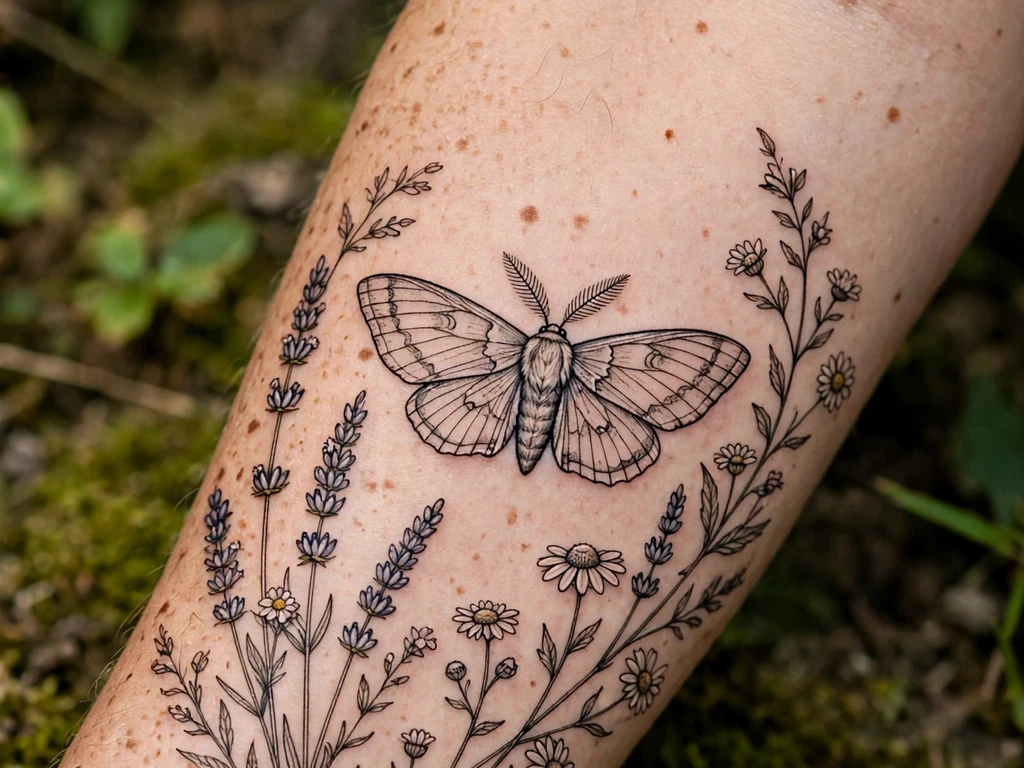
A moth settled among wildflower stems softens the insect’s nocturnal edge and roots it in the garden it actually lives in. Lavender, poppies, daisies and grasses give the artist vertical lines to play with, so the composition flows down a forearm like a pressed-flower page. It is a natural pick if your meaning is growth as much as change.
Best placement: Forearm, moth at the top with stems trailing towards the wrist.
Best for / know before you book: Lovely for botanical collectors. Decide early whether the flowers are supporting cast or co-stars — equal detail everywhere can pull focus from the moth, so most artists keep the blooms lighter than the wings.
7. Blackwork Moth
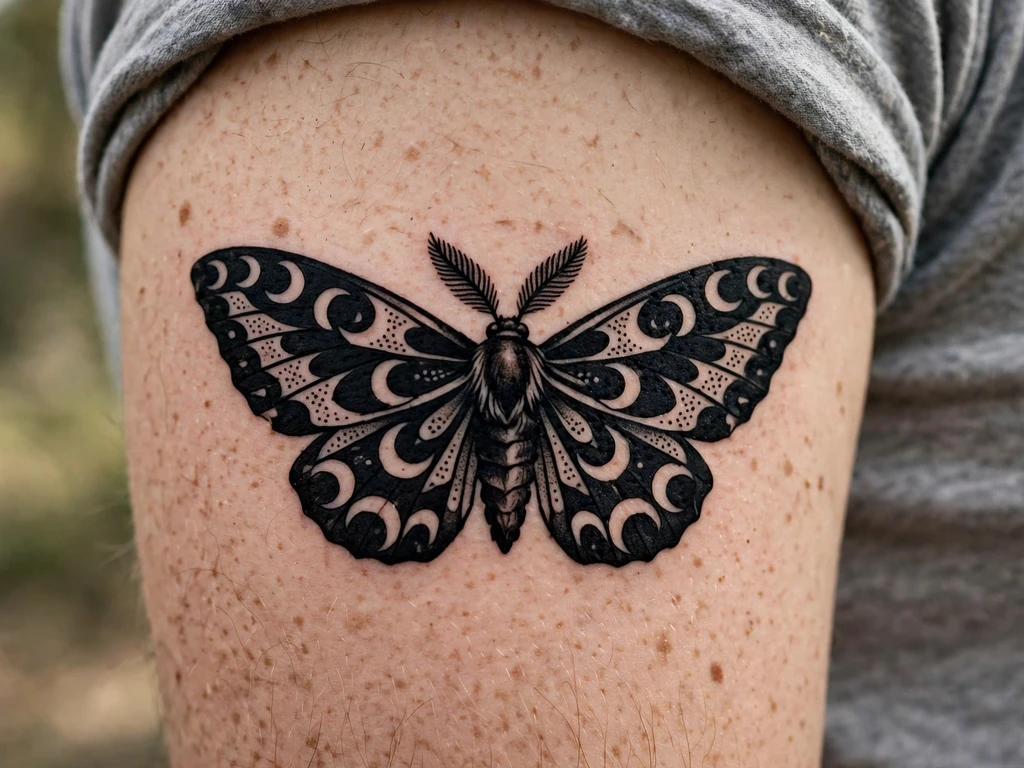
Blackwork swaps the moth’s dusty softness for graphic punch: solid black wing shapes cut with negative-space dots, crescents and line patterns that only appear where the skin shows through. It photographs sharply, ages slowly and suits people who want the symbol without any colour or grey wash. The silhouette does the talking, so wing shape matters more here than in any other style on the list.
Best placement: Upper arm, large enough for the negative-space pattern to breathe.
Best for / know before you book: The boldest low-maintenance option. Solid black is the hardest style to cover later, and saturated areas must heal evenly — choose an artist whose healed blackwork is deep and consistent, not patchy.
8. Collarbone Moth
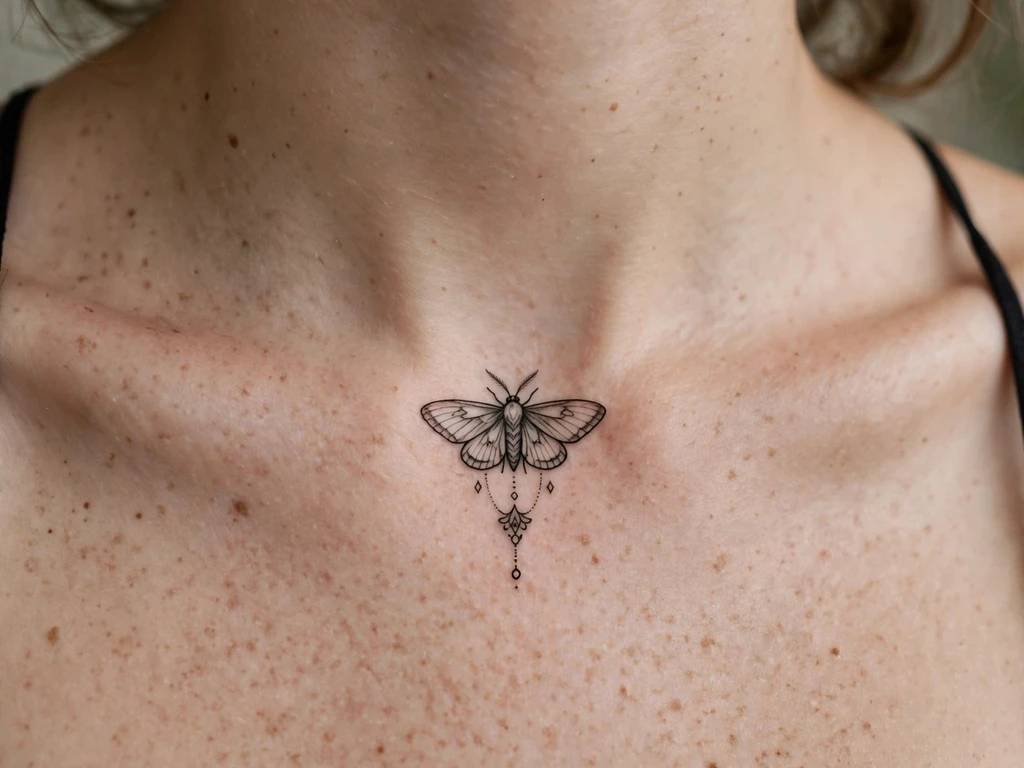
A small moth centred between the collarbones sits exactly where a pendant would hang, which makes it one of the most naturally placed designs in tattooing. The wings follow the collarbones’ gentle V while the body points down the sternum. It frames necklines beautifully and stays easy to cover with a collar or scarf.
Best placement: Centre of the upper chest, just below the hollow of the throat.
Best for / know before you book: Elegant and discreet. Skin here is thin and close to bone, so sessions are short but sensations are sharp; keep the design compact and the wing pattern uncomplicated.
9. Moth and Lantern
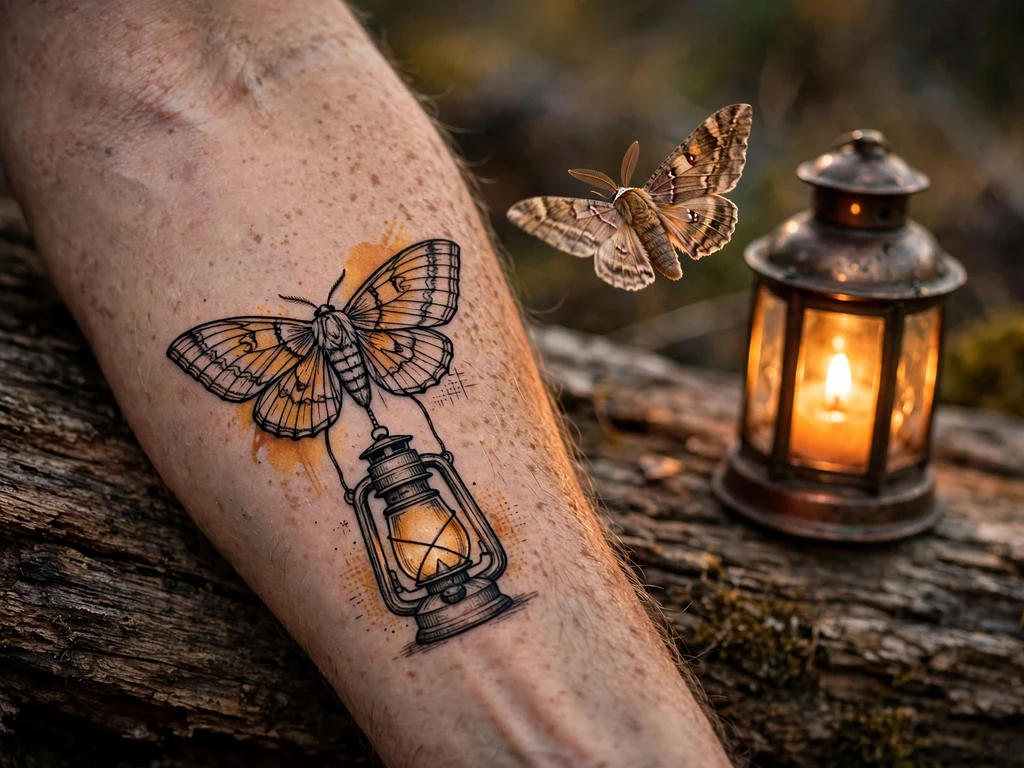
This design illustrates the moth’s most famous behaviour: a lantern glows at one end of the forearm and the moth leans towards it, wings mid-beat. It can mean guidance, faith, ambition — or serve as a wry warning about the lights you chase. The vertical scene suits the forearm perfectly and invites warm yellow or amber ink around the glass.
Best placement: Forearm, lantern low near the wrist and the moth above it, or the reverse.
Best for / know before you book: A storytelling piece with real warmth. Yellows and ambers are delicate colours; a black line structure underneath keeps the lantern readable after the glow tones soften.
10. Moth and Stars
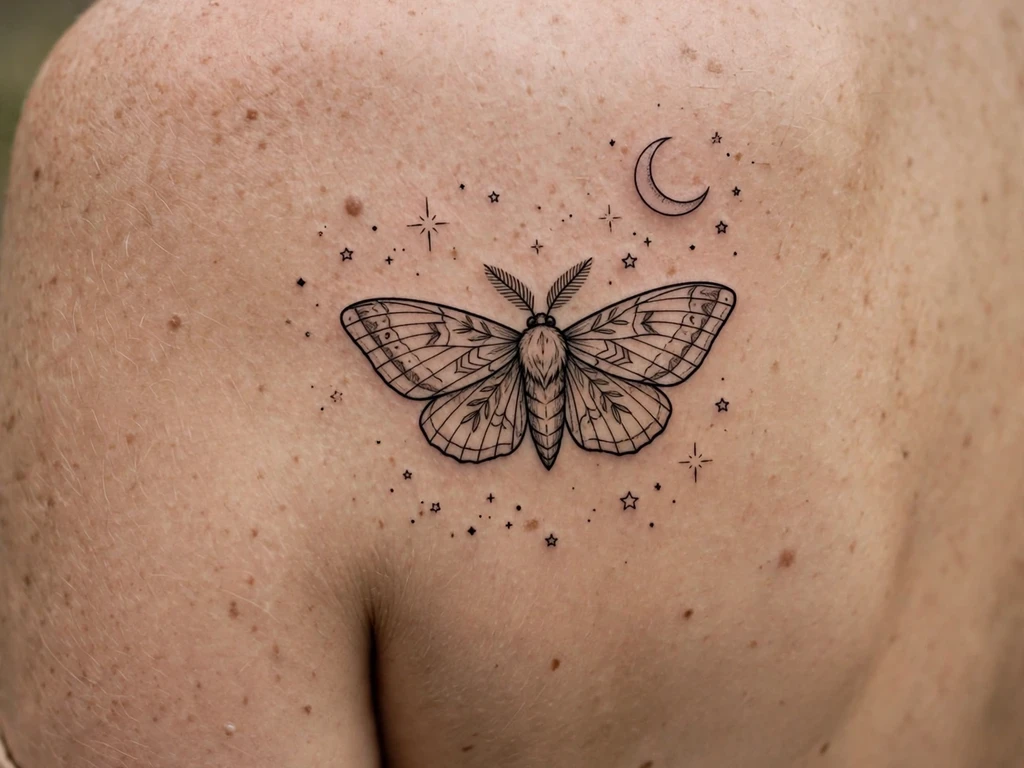
Scatter fine stars, dots and a crescent or two around a moth and the whole night sky comes with it. This version leans into nocturnal intuition — dreams, omens, the version of you that thinks at 2 a.m. People who connect with owl tattoo ideas often land here too, because both symbols belong to the same watchful darkness.
Best placement: Shoulder blade, with the star scatter drifting towards the shoulder.
Best for / know before you book: Forgiving and expandable — more stars can join later. Keep the moth itself substantially darker than the scatter, or the eye will not know where to land first.
11. Dotwork Moth
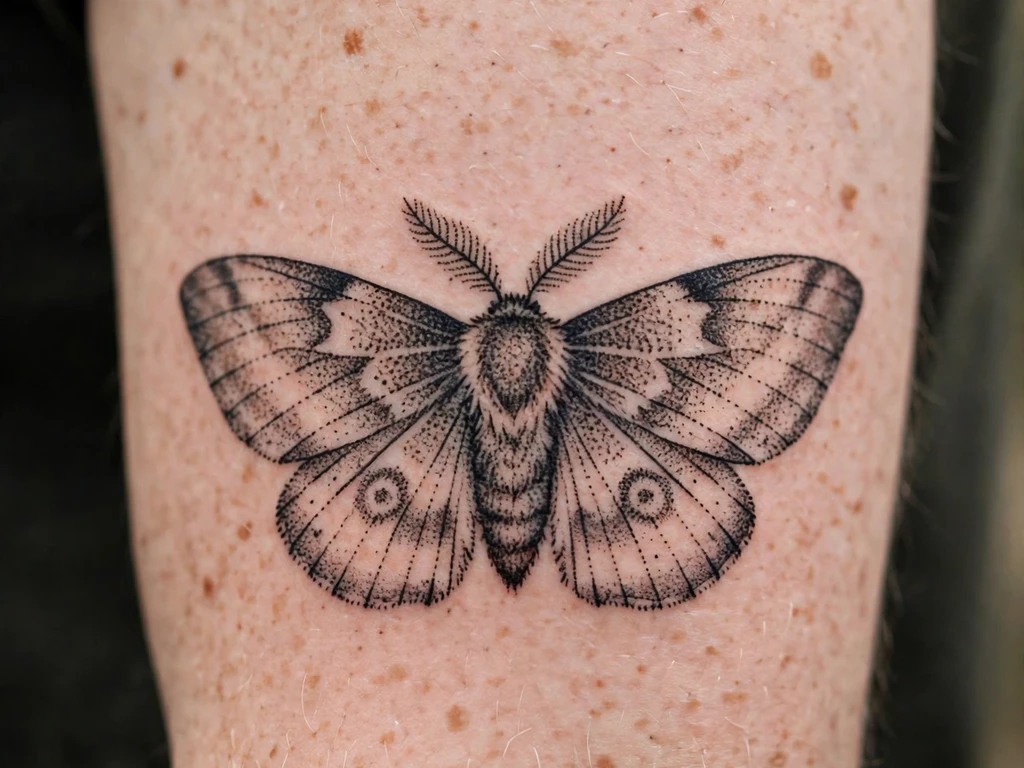
Dotwork builds the moth from thousands of tiny points, so the wings shade from deep shadow at the body to a dusty fade at the edges — the closest ink gets to a real moth’s powdery wings. The texture rewards a close look and flatters the inner bicep, where the design can sit like a specimen in a frame. It pairs well with small geometric or moon accents.
Best placement: Inner bicep, centred on the flat of the arm.
Best for / know before you book: For texture lovers with patience — stippling takes time. Dots placed too densely heal into flat grey, so trust your artist’s spacing even when the fresh piece looks lighter than expected.
12. Watercolour Luna Moth
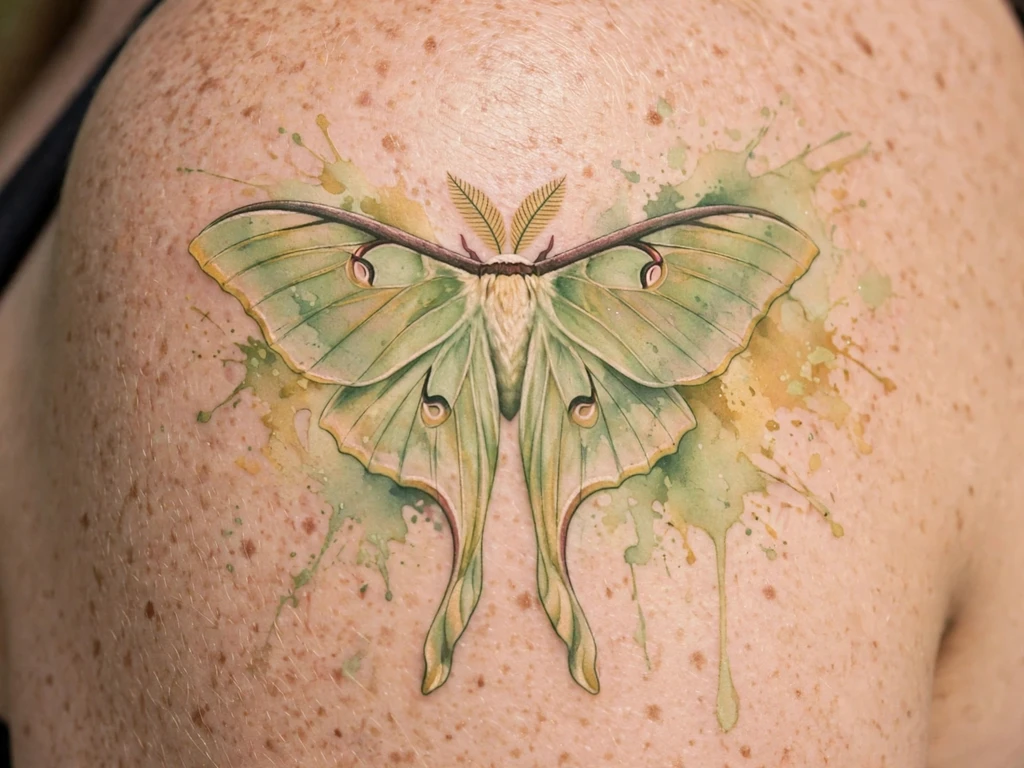
Watercolour treatment turns the luna moth into something half-insect, half-aurora: mint and sage washes drifting past the wing edges, touches of gold at the eyespots, and only the faintest outline holding the shape. Across a shoulder it looks like the moth is dissolving into evening light. Keep the long luna tails — in watercolour they trail like brush strokes.
Best placement: Shoulder and shoulder cap, with space around the wings for colour drift.
Best for / know before you book: The dreamiest option, and the highest maintenance. Watercolour softens sooner than lined work and sun fades it fastest, so budget for colour refreshes every few years.
13. Back-of-Neck Moth
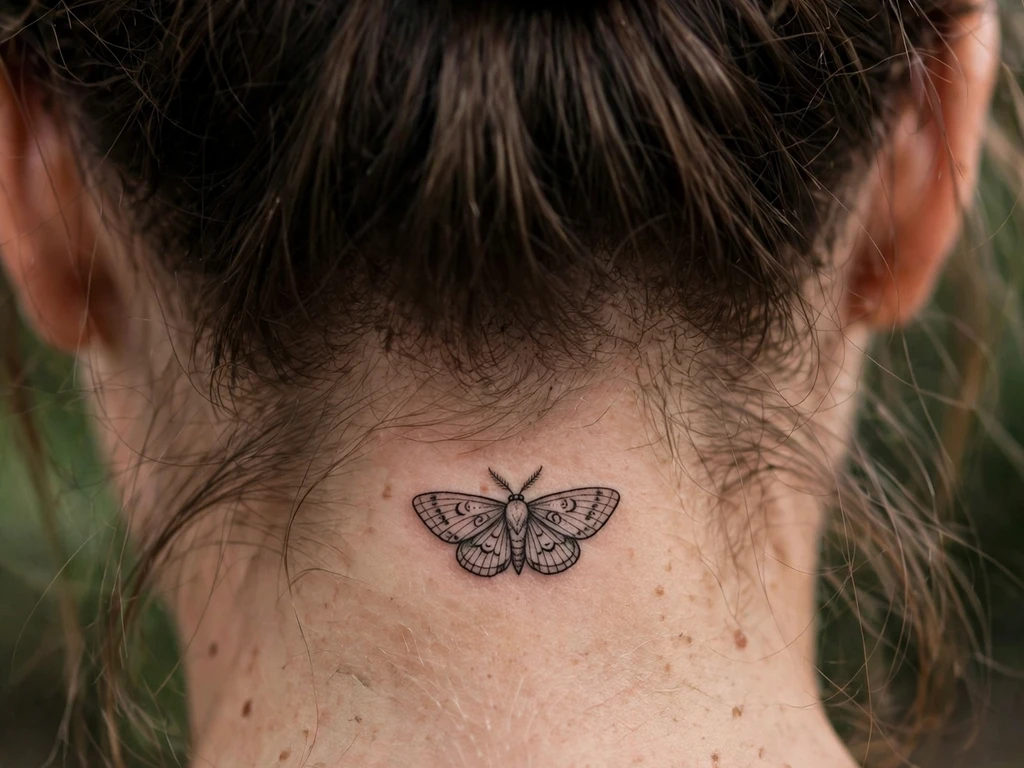
A compact moth at the nape hides under loose hair and appears when it is tied up — a small private signal with excellent reveal value. The vertical body line follows the spine’s start, and slightly raised wings keep the silhouette readable at this modest scale. It is a favourite first moth because the commitment stays low while the meaning stays full-size.
Best placement: Centre nape, just below the hairline.
Best for / know before you book: Discreet and quick to tattoo. Nape skin moves constantly and collars rub during healing, so simplify the wing pattern and plan your wardrobe for the first fortnight.
14. Moth and Crescent Moon Ankle
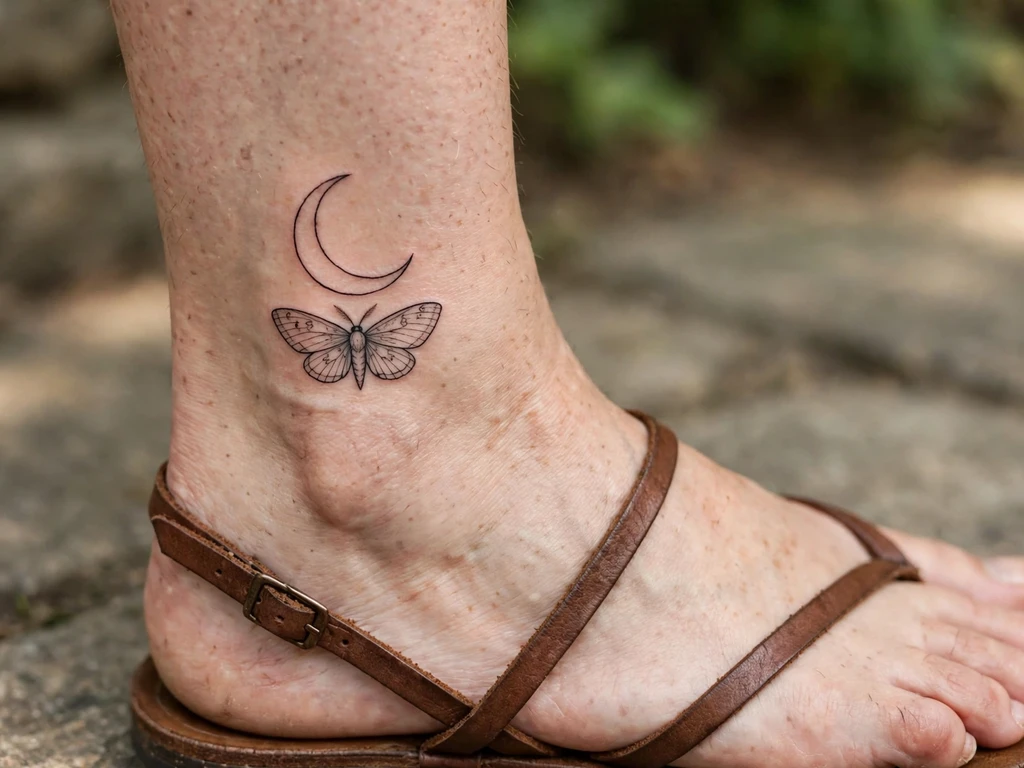
Curve a small moth beneath a crescent moon and the pair wraps the ankle bone like a charm on an anklet. The crescent does the compositional work, giving the moth somewhere to “hang” in the design, while a few dot stars finish the night theme. It is one of the most wearable small designs in the list and pairs naturally with sandals and bare feet.
Best placement: Outer ankle, crescent arcing over the ankle bone with the moth below.
Best for / know before you book: Book it when you can wear open footwear while it heals. Ankle skin is thin and shoes are friction machines, so keep the linework clean rather than miniature-detailed.
15. Giant Moth Back Piece
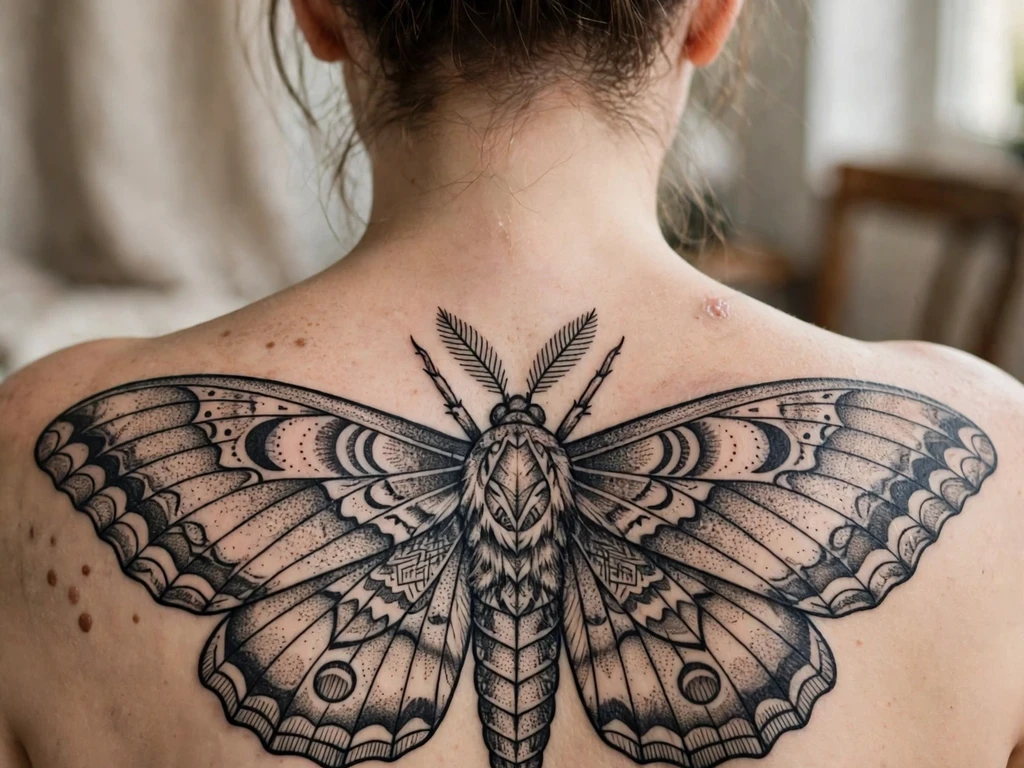
At full scale, a moth becomes architecture: wings spanning both shoulder blades, the body riding the spine, antennae curling towards the neck. Artists can layer everything the smaller designs must leave out — veined wings, fur texture on the thorax, secondary moons and botanical sprigs at the wing tips. It is the definitive transformation statement, worn like a cloak.
Best placement: Full upper back, wing tips reaching both shoulder blades.
Best for / know before you book: A multi-session commitment with a real budget. Symmetry is everything at this size, so insist on a full stencil fitting while standing, and choose the artist for their large-scale healed work, not their price.
16. Wing-Eye Moth
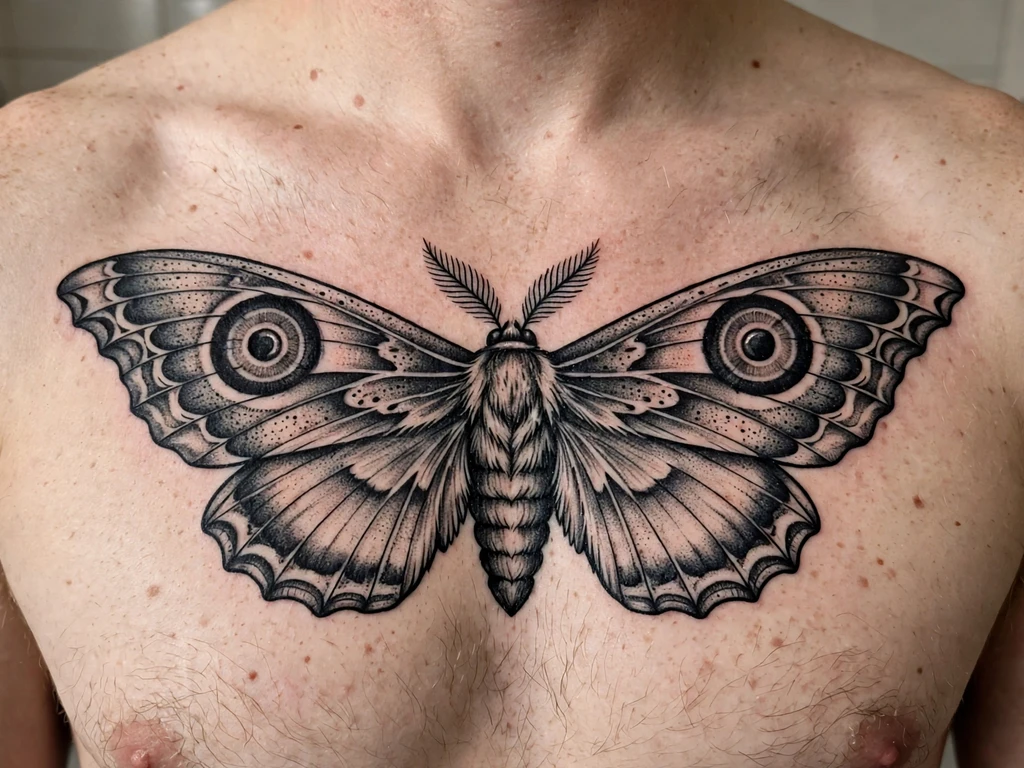
Many moths carry eyespots — round markings that mimic a much larger animal’s eyes to startle predators. As a tattoo, those spots become the focal point: two watchful eyes opening from the wings, equal parts beauty and warning. It is a protection symbol you can explain in one sentence, and it holds a gaze across a room.
Best placement: Centre chest, eyespots level with each other on the upper wings.
Best for / know before you book: Powerful and confrontational in the best way. The eyespots must match closely, so the stencil check matters — view it in a mirror at talking distance, not just up close.
17. Geometric Moth
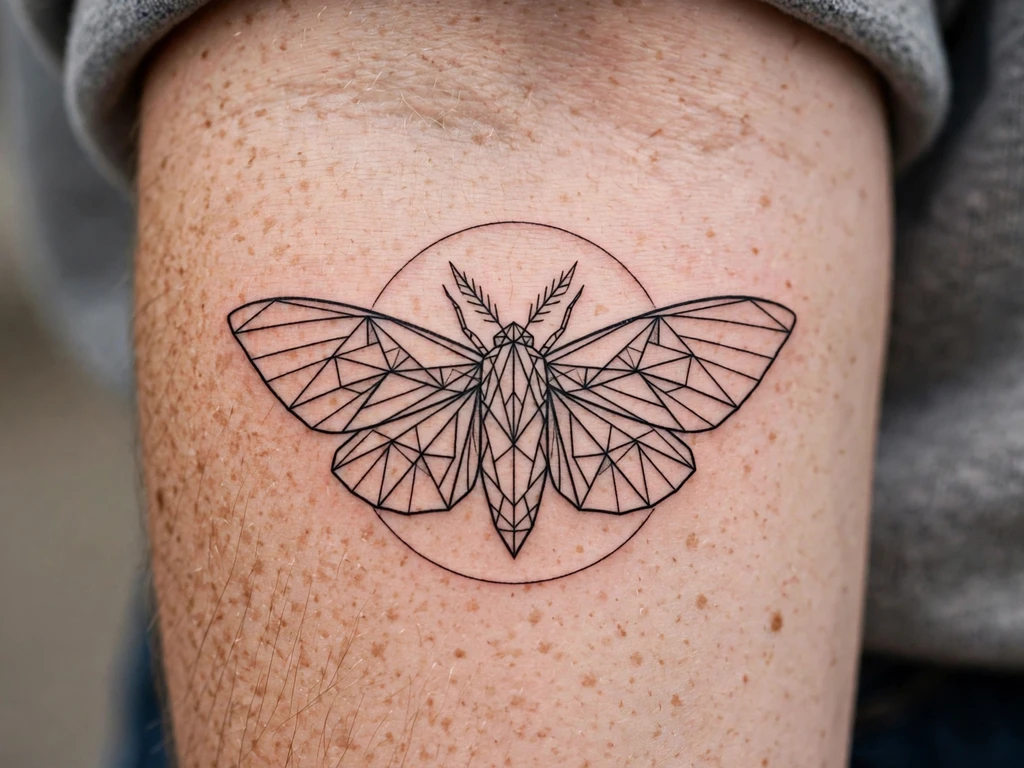
A geometric moth rebuilds the insect from straight lines and mirrored angles: triangular wing segments, a diamond body, perhaps a thin sacred-geometry halo behind it. It suits people who love the meaning but not the organic softness — transformation, engineered. The outer forearm is its natural home: the flat canvas keeps every angle honest and mirrored.
Best placement: Outer forearm, halo or circle centred behind the body.
Best for / know before you book: Precision is the entire effect; a wobbly angle breaks the spell. Pick an artist known for clean geometric work and expect them to spend real time aligning the stencil.
18. Moth and Candle Flame
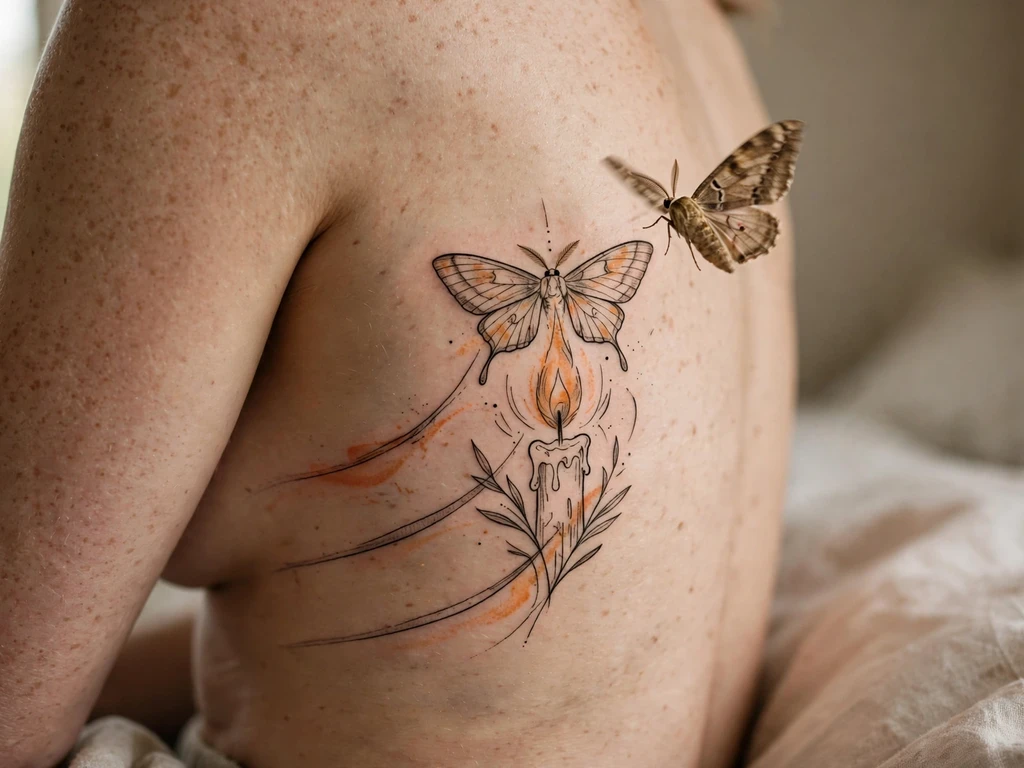
Smaller and more intimate than the lantern scene, this version pairs the moth with a single candle flame — the original light it cannot resist. People choose it for devotion, for grief (a flame kept burning), or as a private joke about their own fixations. Drawn along the ribs, the flame can flicker in the direction of the moth’s flight path.
Best placement: Ribcage, moth and flame in a gentle diagonal line.
Best for / know before you book: Ribs are tender and breathing moves the canvas, so short, calm sessions suit this spot. Keep the flame simple — a teardrop of warm colour with a fine outline outlasts a detailed one.
19. Moth in Profile
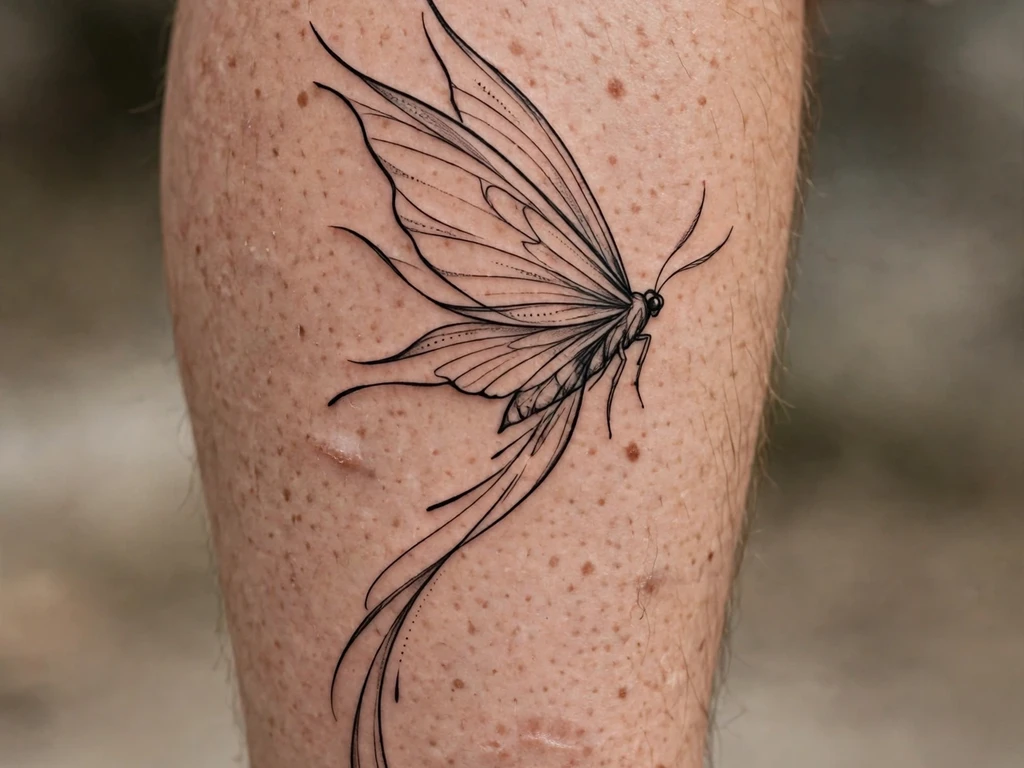
Most moth tattoos face forward; this one turns side-on, wings swept back as if caught mid-flight along the calf. The profile view lets the wings layer like feathers and gives the design a sense of travel rather than display. It shows with shorts and cropped trousers and hides under long ones, which is exactly the flexibility many wearers want.
Best placement: Outer calf, running from below the knee towards the ankle.
Best for / know before you book: A genuinely underused composition. Because the calf muscle curves, check the stencil standing and walking — a flight line that looks level at rest can shift as the muscle flexes.
20. Moth Half-Sleeve Element
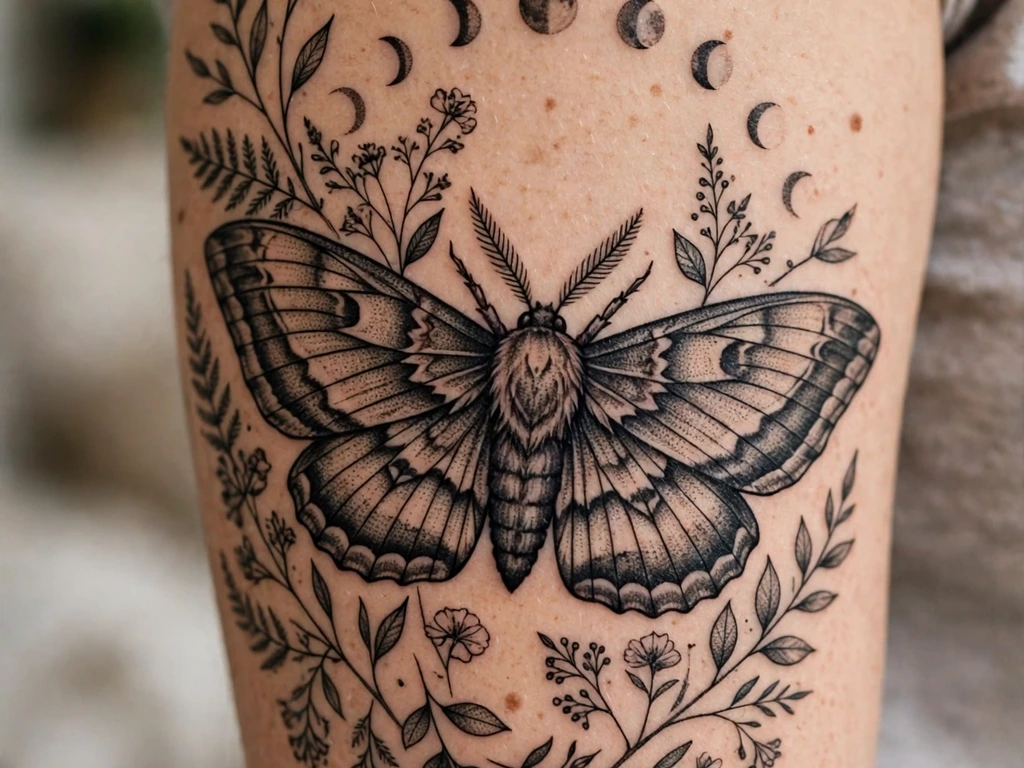
Here the moth anchors a larger night garden: moon phases at the shoulder, botanical stems winding down, stars and smaller insects filling the gaps as the sleeve grows. Starting with the moth gives the whole project a centre of gravity and a story — everything else in the sleeve is what the moth flies through. It can be built in stages over months without ever looking unfinished.
Best placement: Upper arm, moth on the outer arm as the focal point.
Best for / know before you book: Plan the full sleeve map at the first consultation, even if you tattoo it in stages. Agreeing the layout early prevents the classic problem of a beautiful moth with no room left around it.
21. Tiny Finger Moth
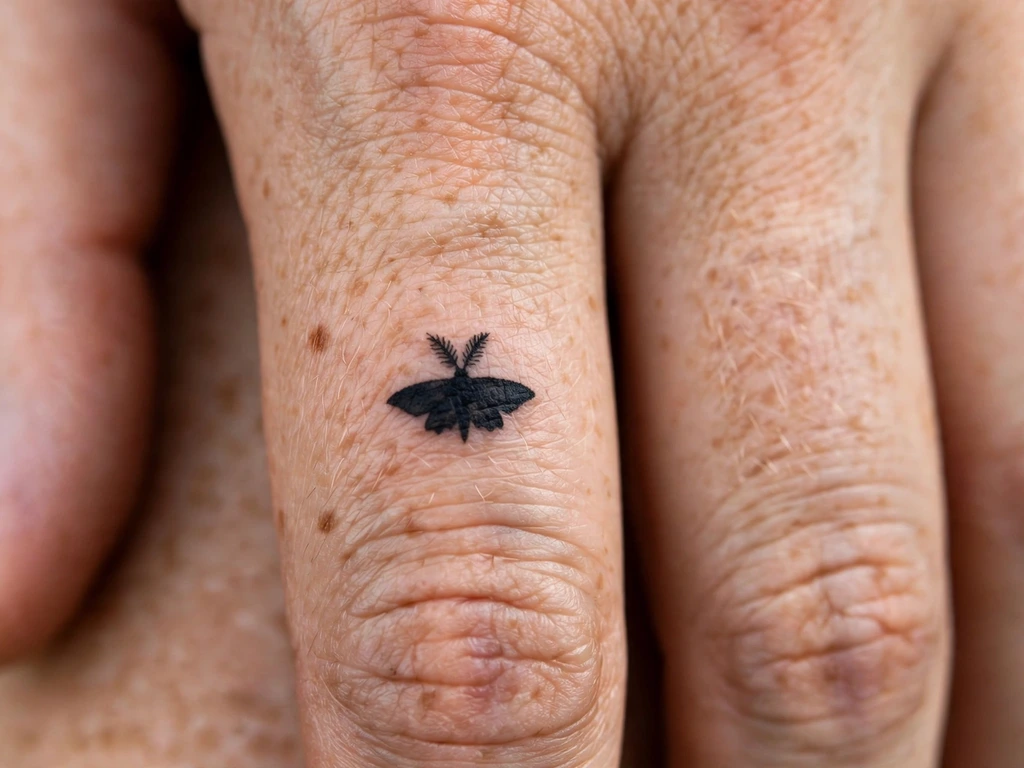
At finger scale, a moth becomes a hieroglyph: a plump little body, two wing arcs and dot antennae, nothing more. It reads like a secret signet — there when your hands move, gone when they rest. Some people match one with a partner or place a second micro moth on the opposite hand.
Best placement: Upper finger, between the knuckles, kept very small and simple.
Best for / know before you book: Go in clear-eyed: fingers shed skin fast and fine detail blurs sooner here than anywhere else. Bold-enough mini lines and an expectation of touch-ups are part of the deal.
22. Botanical Frame Moth
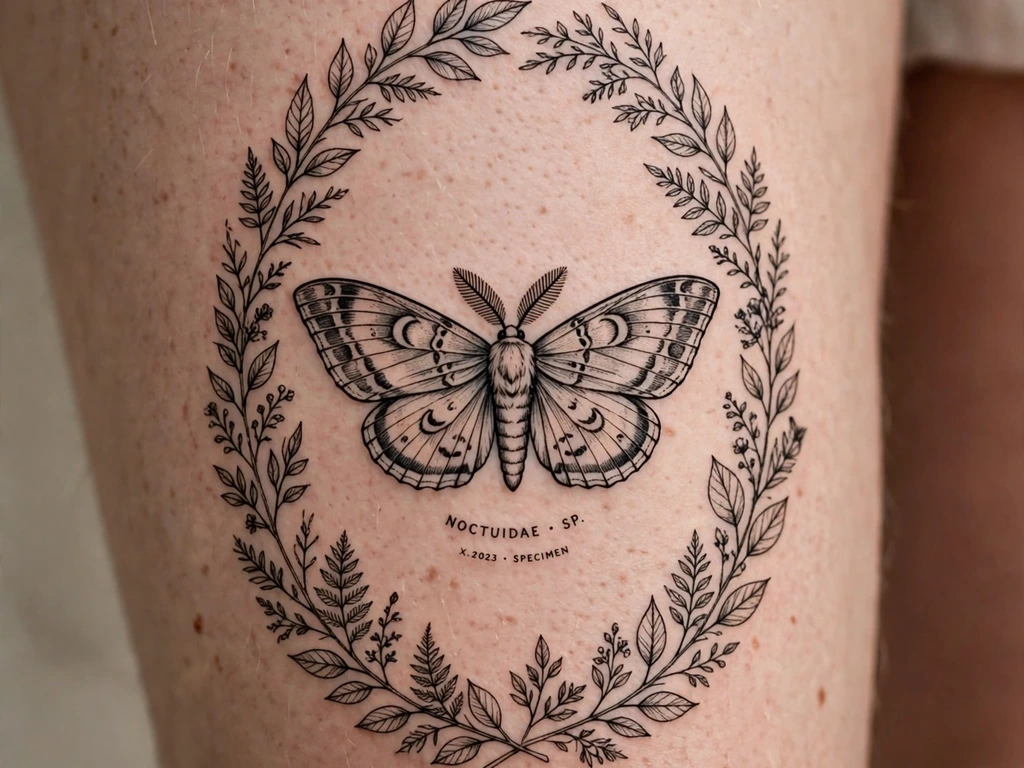
An oval frame of leaves, berries and fine stems turns a moth into a Victorian specimen print — collected, labelled, treasured. The frame gives the design a finished, almost jewellery-like edge and lets the moth itself stay relatively simple inside it. On the thigh, the oval can be drawn generously, with the frame’s plants echoing your birth flower or a meaningful herb.
Best placement: Front thigh, frame vertical with the moth centred inside.
Best for / know before you book: Symmetry and spacing rule this design; crowded frames shrink visually as ink settles. Leave honest gaps between leaves, even if the reference art looks denser.
23. Neo-Traditional Moth
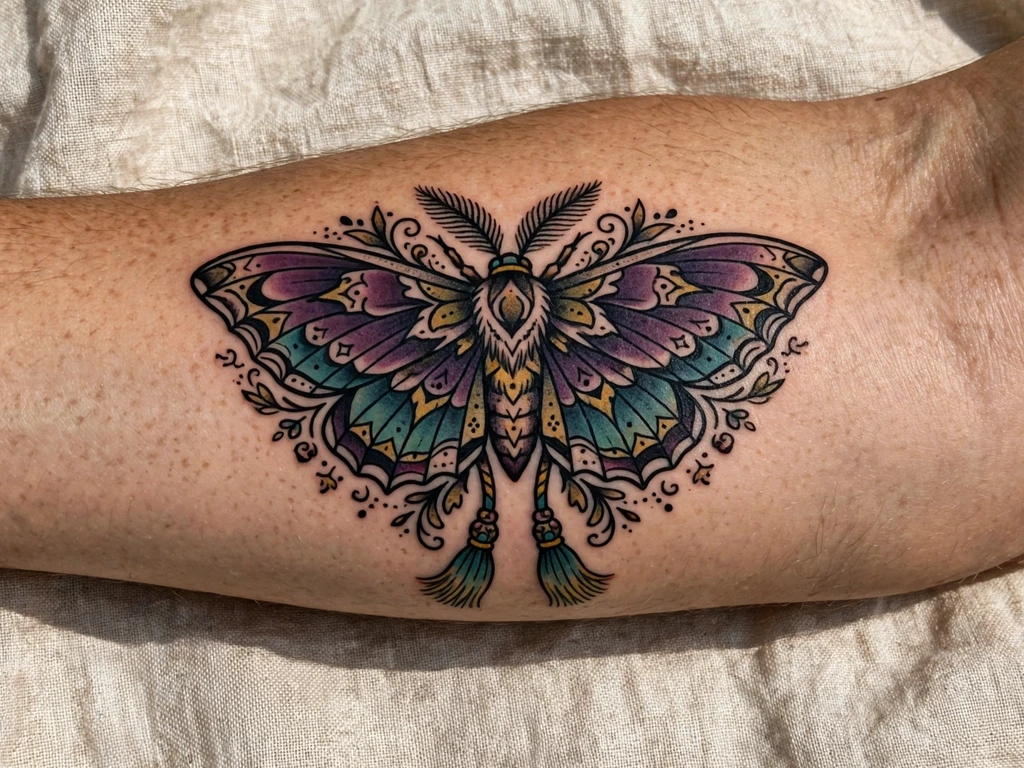
Neo-traditional style hands the moth bold outlines, jewel-toned wings — plum, teal, mustard, oxblood — and decorative extras like tassels, beads or a crescent pendant below. It is the most ornamented option in the list and the furthest from a real insect, closer to a vintage brooch. If your taste runs maximalist, this is your moth.
Best placement: Forearm, where the colour work stays on show.
Best for / know before you book: Rich colour needs a confident hand and a decent canvas; small versions lose the jewel effect. Ask to see healed colour from your artist, since these tones shift as they settle.
24. Moth and Crystals
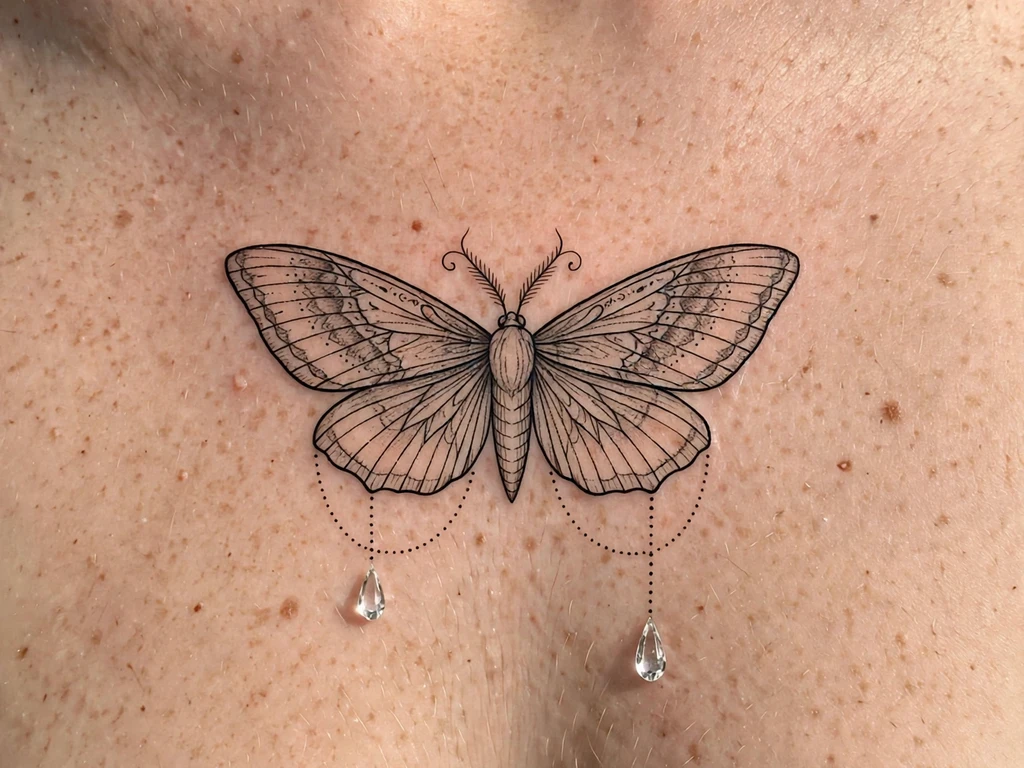
Crystal drops suspended from the lower wings — on fine chains or dotted lines — give a moth the quality of a chandelier: part insect, part heirloom. Wearers often choose crystals tied to their own practice or birthstone, which layers personal meaning under the transformation story. The hanging elements lengthen the design, flattering the sternum’s vertical space.
Best placement: Centre sternum, crystals trailing down the midline.
Best for / know before you book: Faceted crystals are drawn with tiny highlight geometry that must stay crisp; keep each drop bigger than feels necessary and limit yourself to three to five drops.
25. Shoulder Moth Pair
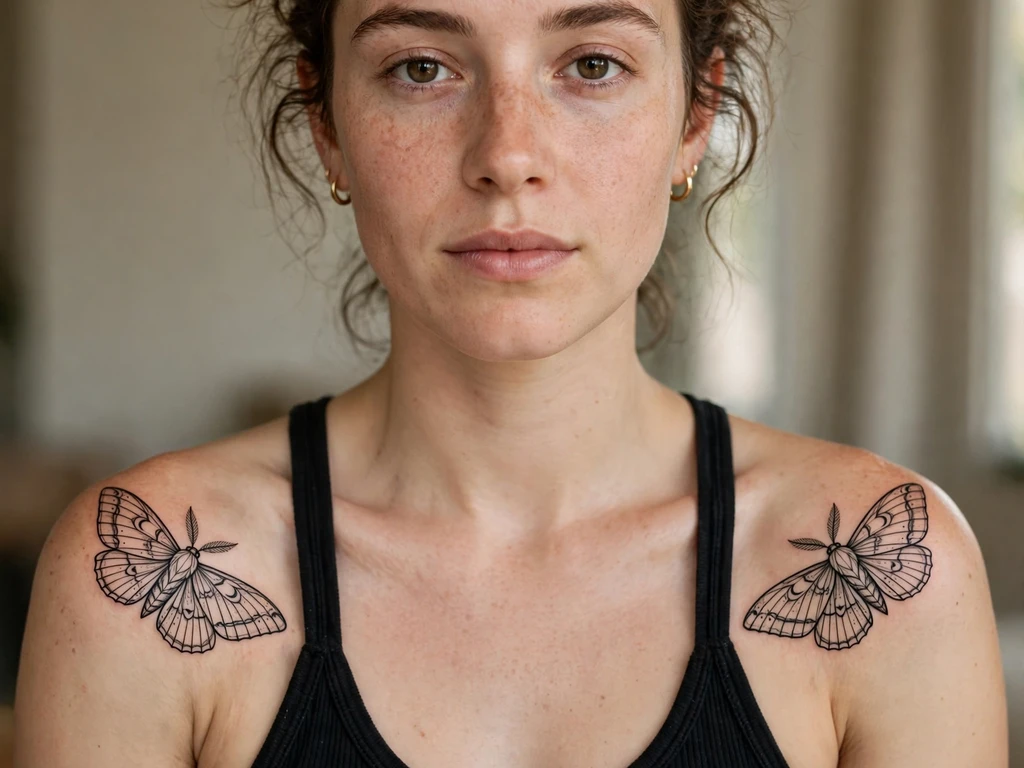
Finish with a pair: one moth on each shoulder, wings angled like epaulettes. They can mirror exactly, or tell a two-part story — a luna on one side for rebirth and a darker hawkmoth on the other for what you survived. Together they frame the neckline and collarbones in a way a single centred piece cannot.
Best placement: One moth on each shoulder cap, angled towards the neck.
Best for / know before you book: Matching pairs expose any size drift between sides, so have both stencils placed and compared before either is tattooed. Booking both in one session keeps the linework consistent.
Moth Tattoo Placement by Size
| Size | Typical dimensions | Best placements | Good to know |
|---|---|---|---|
| Small | 3–6 cm | Inner wrist, finger, ankle, nape, collarbone | Simplify hard: body, wings, antennae. Luna tails and eyespots need room |
| Medium | 7–15 cm | Forearm, inner bicep, shoulder blade, ribcage, sternum | The sweet spot for species detail — luna markings, hawkmoth thorax, moon phases |
| Large | 16–30 cm | Chest, thigh, upper back, half sleeve | Room for skull accents, botanical frames, lantern scenes and layered wing pattern |
| Extra large | 30 cm+ / multi-session | Full back, full sleeve built around a moth | Plan the whole composition first so added elements orbit the moth, not crowd it |
How to Choose Your Moth Tattoo (and What to Know Before You Book)
Choose your species before your style. “Moth” is a family of meanings, not one design. Luna moths carry rebirth and moonlit intuition; the death’s-head hawkmoth carries protection and defiance; an unnamed generic moth keeps the transformation story without the folklore. Decide which creature you are wearing first, then let style — fine line, blackwork, dotwork, colour — serve that choice.
Respect the wing-detail rule. Moth wings hold the design’s identity: eyespots, scalloped edges, luna tails, the hawkmoth’s skull-marked thorax. Every one of those details needs physical room. If your heart is set on a detailed species, size up or simplify the pattern; a crowded wing at 5 cm becomes a soft oval at year five, whatever the fresh photo promised.
Think about what the light means to you. Lanterns, candles, moons and stars are not decoration in moth tattoos — they steer the meaning towards hope, faith, grief or obsession. Talk it through with your artist. The same moth reads hopeful flying towards a moon and self-destructive circling a flame, and only you know which story is yours.
Book a licensed studio and heal it properly. A tattoo is broken skin before it is artwork. Australia’s national health service, healthdirect, advises choosing a qualified body artist to minimise health risks and following their care instructions while a new tattoo heals — its guide to body piercings and tattoos lists the warning signs of infection worth knowing. Keep the piece clean, do not pick at flaking skin, and keep fresh ink out of baths and swimming until it has fully healed.
Key points to remember:
- Meaning first: transformation is the headline, but light, intuition and resilience decide the design
- Luna = gentle rebirth; death’s-head = protection with an edge — pick your species deliberately
- Wing details need size; simplify the pattern or scale the tattoo up
- Symmetry pieces (chest, sternum, shoulder pairs) live or die on the standing stencil check
- Pale colours and watercolour washes fade fastest — a fine-line structure underneath protects the design
Frequently Asked Questions
What does a moth tattoo symbolize?
Most often, transformation and rebirth: the moth’s life cycle is a complete change of form, achieved in darkness. Moth tattoos also symbolise attraction to light (hope or, honestly read, obsession), nocturnal intuition, and resilience — continuing to move through dark periods. Luna moth designs lean gentle and moonlit; death’s-head hawkmoth designs lean protective and defiant.
What is the difference between a moth tattoo and a butterfly tattoo?
Tone, mostly. Butterfly tattoos usually celebrate visible, joyful change; moth tattoos mark private change, intuition and survival through darker seasons. Visually, moths are drawn with sturdier bodies, feathery antennae, eyespots and scalloped or long-tailed wings, while butterflies take slimmer bodies and club-tipped antennae. The comparison table above breaks the choice down in full.
What does a death’s-head hawkmoth tattoo mean?
The hawkmoth’s thorax carries a natural skull-like marking, which folklore once read as an omen. In modern tattooing the meaning has flipped: wearers choose it for protection, defiance, comfort with mortality and strength after dark chapters. It is less “bad luck symbol” and more “nothing scares me anymore.”
Are simple moth tattoos a good first tattoo?
Yes — a simple fine-line moth is one of the friendliest first pieces in this list: small, quick, and easy to place on a wrist, ankle or nape. Keep it around 4 cm or wider so the wings stay distinct as the ink settles, and choose an artist whose healed fine-line work you have seen. If you fall for the style, a simple moth also extends gracefully into a larger night-garden piece later.
How much does a moth tattoo cost?
Prices vary by city and artist. A simple wrist or ankle moth usually starts near a studio’s minimum charge; medium forearm, sternum or shoulder pieces with species detail sit in the low-to-mid hundreds; and large chest, thigh or back moths — especially multi-session back pieces — run into four figures. Detailed wings and colour work take time, and time is what you are paying for.
Where is the best placement for a moth tattoo?
For meaning and symmetry, the sternum and chest are the classic homes — the wings open with the body. For a first or smaller piece, the forearm, inner wrist, ankle and nape heal easily and stay versatile. For detail lovers, the thigh and upper back offer the flat, generous canvas that eyespots, skull markings and botanical frames need.
Final Thoughts
A moth is not a butterfly that failed to be pretty. It is a different creature with a different promise: that change can happen in the dark, without an audience, and still be complete. Whether your version is a pale luna moth breathing over your sternum, a death’s-head hawkmoth standing guard on your chest, or a simple outline moth on your wrist that only you fully understand, the design earns its place when the meaning is chosen as carefully as the artwork.
Shortlist the designs you keep returning to, wear the stencil in a mirror, and book an artist whose healed work you trust at the size you want. The right moth tattoo will not just sit on your skin — it will feel like the record of how you got your wings.