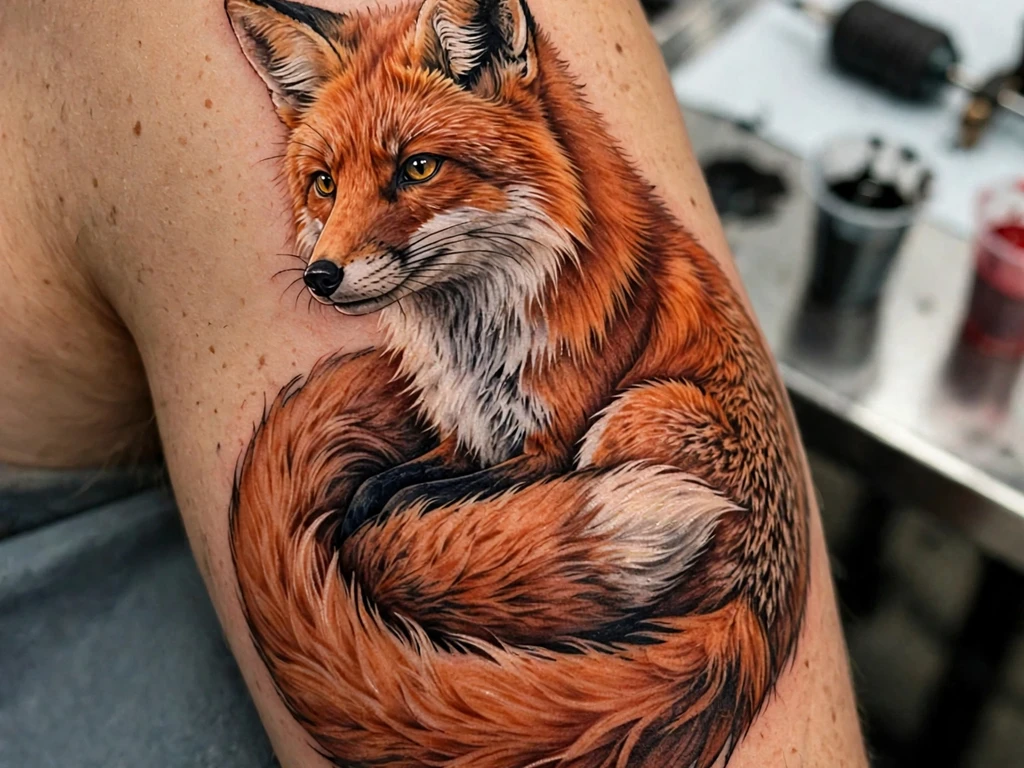
Few animals carry as many personalities at once as the fox. It is the trickster of a hundred folk tales and, at the same time, a devoted parent, a patient hunter and a creature so adaptable it thrives everywhere from Arctic tundra to city suburbs. That range is exactly why fox tattoos keep climbing: the same animal can be drawn cute, fierce, mystical or minimalist, and every version still reads unmistakably as a fox.
In this guide you will find 25 fox tattoo ideas that cover the whole spectrum — a nine-tailed kitsune, crisp geometric and dotwork pieces, soft watercolour, a sleeping fox no bigger than a coin, and a full back piece for the truly committed. First, though, it is worth understanding what a fox tattoo actually says, because with this animal the meaning is half the appeal.
What Does a Fox Tattoo Mean?
Start with the real animal. Red foxes live on every continent except Antarctica and South America, in habitats from farmland to the middle of large cities — National Geographic’s red fox profile notes that this resourcefulness is what earned the species its legendary reputation for intelligence and cunning. A fox tattoo borrows that reputation wholesale: it is ink for people who solve problems sideways, stay calm when plans collapse, and would rather be clever than loud.
Across cultures, the fox keeps showing up in stories, and each tradition adds a layer:
- Cunning and intelligence. From Aesop’s fables to Reynard the Fox in medieval Europe, the fox is the animal that out-thinks bigger, stronger opponents. It is the classic meaning, and the one most wearers still choose first.
- Adaptability. Foxes change dens, diets and hunting hours to suit whatever surrounds them. People often pick a fox after a move, a career change or any chapter that demanded they reinvent themselves.
- Playfulness. Real foxes pounce, wrestle and play well into adulthood. A fox tattoo can simply be a promise not to take life too seriously.
- Independence. Foxes hunt alone rather than in packs — a quiet contrast with the wolf. Wearers who prize self-reliance tend to feel this one strongly.
- Protection and guidance in folklore. In several traditions the fox is a guardian or a messenger between worlds, watching over travellers and thresholds.
Celtic and Native American traditions give the fox a more spiritual role. In Celtic lore the fox was a guide through the spirit world and a symbol of keen observation — a creature that moves between the seen and unseen. In a number of Native American traditions the fox appears both ways: as a wise, fire-bringing helper in some nations’ stories and as a sly trickster in others. As with all borrowed symbolism, the respectful approach is to enjoy the design and learn the story behind it, rather than treating sacred imagery as decoration.
| Symbolism | What it stands for | Designs that carry it well |
|---|---|---|
| Cunning | Out-thinking problems, wit over force | Geometric fox, fox face portrait |
| Adaptability | Thriving through change | Leaping fox, fox in autumn leaves |
| Playfulness | Humour, lightness, curiosity | Sleeping fox, fox and butterfly, fox cubs |
| Independence | Self-reliance, going your own way | Realistic profile fox, blackwork fox |
| Magic and wisdom | Folklore, mystery, hidden knowledge | Nine-tailed kitsune, fox and moon, galaxy fox |
| Family and devotion | Protecting your own | Fox family line, matching fox cubs |
The Kitsune: Japan’s Nine-Tailed Fox
No fox carries more mythology than the kitsune, the fox spirit of Japanese folklore. Kitsune are intelligent beings with magical powers — most famously the ability to shape-shift into human form — and they serve as messengers of Inari, the Shinto deity of rice, prosperity and fertility, whose shrines are guarded by fox statues to this day. Folklore divides them loosely into the benevolent zenko, Inari’s messengers, and the wilder, more mischievous yako.
The detail tattoo lovers borrow most is the tails. A kitsune grows wiser and more powerful with age, gaining tails as the centuries pass; the oldest and strongest of all is the nine-tailed fox, the kyūbi no kitsune, said to appear after a thousand years, its fur turned white or gold. That is why nine-tailed fox tattoos carry meanings the ordinary fox does not: hard-won wisdom, patience, transformation over a lifetime, and power that does not need to show off. If you choose a kitsune design, getting the tail count right matters — nine full, flowing tails is the whole point of the symbol.
Fox Tattoo Ideas at a Glance
| # | Design | Style notes | Best placement |
|---|---|---|---|
| 1 | Nine-Tailed Kitsune | Japanese folklore, nine flowing tails | Forearm |
| 2 | Geometric Fox | Faceted planes, straight lines, optional colour blocks | Shoulder |
| 3 | Watercolour Fox | Soft washes, splashes, light outline | Thigh |
| 4 | Sleeping Curled Fox | Nose-to-tail curl, gentle shading | Ankle |
| 5 | Fox and Wildflowers | Feminine floral frame, soft colour | Upper arm |
| 6 | Fox Face Portrait | Straight-on gaze, detailed fur | Shoulder blade |
| 7 | Fine-Line Minimal Fox | Single-weight outline, no shading | Inner wrist |
| 8 | Blackwork Fox | Solid black shapes, negative-space detail | Forearm |
| 9 | Fox in Autumn Leaves | Seasonal colour, falling leaves | Hip |
| 10 | Fox Beneath a Crescent Moon | Night scene, stars, black and grey | Upper back |
| 11 | Dotwork Fox | Stippled shading, ornamental touches | Inner bicep |
| 12 | Leaping Fox Silhouette | Mid-pounce shape, solid or gradient fill | Ribcage |
| 13 | Matching Fox Cub Pair | Two mirrored cubs for two people | Matching wrists |
| 14 | Fox Full Back Piece | Large scene with landscape and tails | Full back |
| 15 | Fox and Pine Forest Band | Wrap band, fox among pines, sleeve starter | Forearm |
| 16 | Origami Fox | Folded-paper facets, fine lines | Below collarbone |
| 17 | Fox Sternum Centrepiece | Symmetrical fox face with floral accents | Sternum |
| 18 | Fox and Butterfly | Small scene, playful pairing | Nape |
| 19 | Neo-Traditional Fox | Bold outlines, jewel-tone colour | Outer thigh |
| 20 | Fox Tail Wrap | One long tail circling the ankle | Ankle |
| 21 | Realistic Red Fox in Profile | Natural colour, side view, calm stance | Calf |
| 22 | Galaxy Fox | Cosmic colour inside a fox silhouette | Shoulder |
| 23 | Tiny Fox Behind the Ear | Micro outline, hidden placement | Behind ear |
| 24 | Fox With an Open Book | Storybook fox, reading theme | Inner forearm |
| 25 | Fox Family Line | Vixen and cubs walking in a row | Upper spine |
25 Fox Tattoo Ideas
1. Nine-Tailed Kitsune
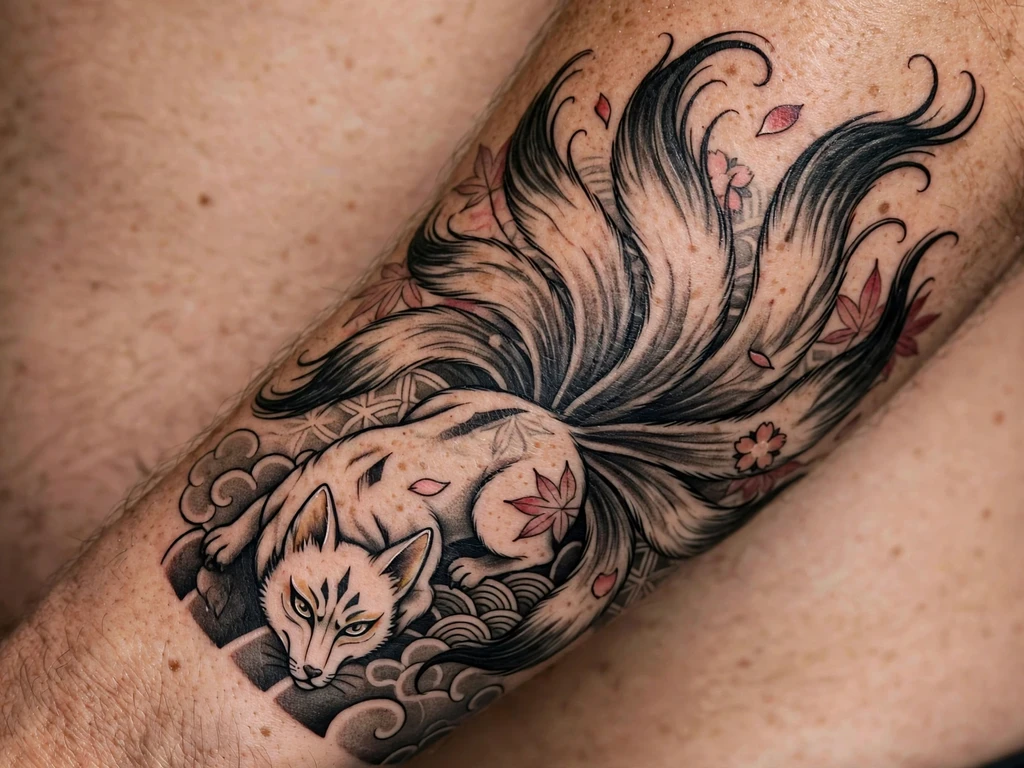
The folklore heavyweight of this list: a kitsune drawn with all nine tails fanning and curling around it, usually in black and grey or muted Japanese-style colour. The tails are the composition — they can wrap a forearm, spill across a shoulder or frame the fox’s face like a halo of fur. Add small details like a sacred jewel or flame wisps if you want the folklore turned up, or keep it clean and let the nine tails speak for themselves.
Best placement: Forearm, tails flowing from wrist to elbow; also superb as a thigh or back piece at larger sizes.
Best for / know before you book: For anyone drawn to the wisdom-and-transformation meaning. Nine tails need room — below about 12 cm the tails merge into a blur, so this design rewards going bigger and choosing an artist confident with Japanese-inspired work.
2. Geometric Fox
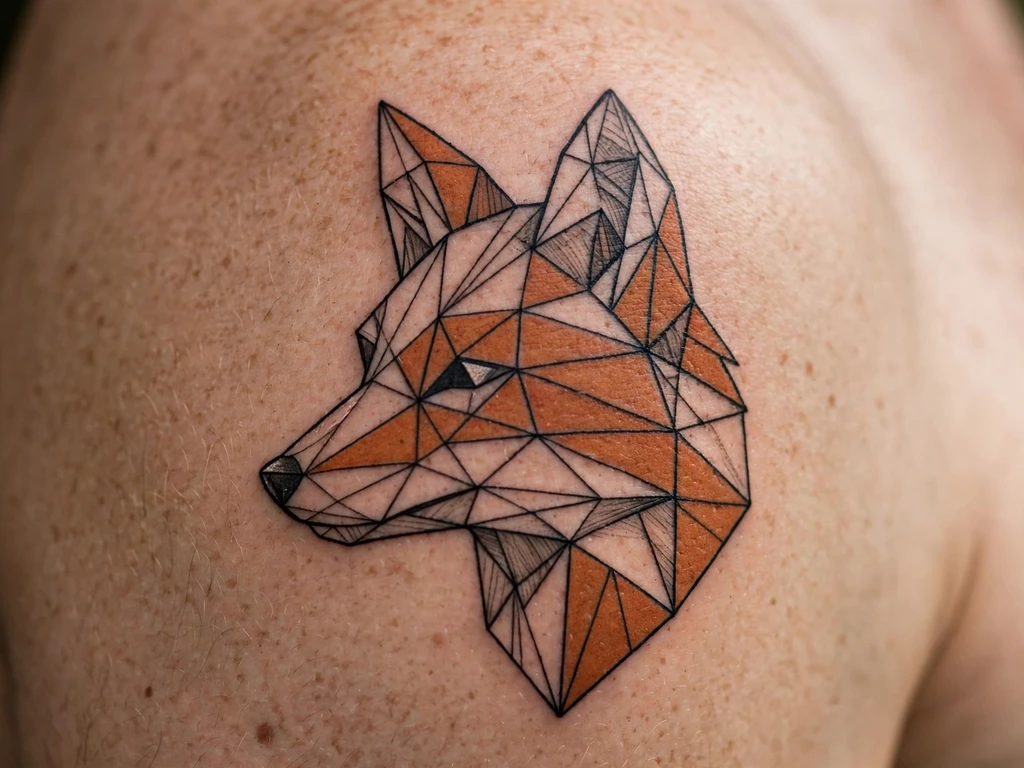
A fox rebuilt from triangles and straight edges: faceted planes for the ears and muzzle, a split-level face, sometimes one half solid and the other just outline. Geometric work suits the fox perfectly because the animal’s sharp ears and pointed face are already halfway to origami. Keep it pure black linework for a crisp, modern look, or fill the facets with flat blocks of orange, rust and teal for a stained-glass effect.
Best placement: Shoulder or upper chest, where the flat planes sit undistorted; also strong on the calf.
Best for / know before you book: Precision is everything here — a crooked facet cannot be hidden by shading. Ask to see healed geometric work, and stencil-check from several angles, because shoulders curve more than they appear to.
3. Watercolour Fox
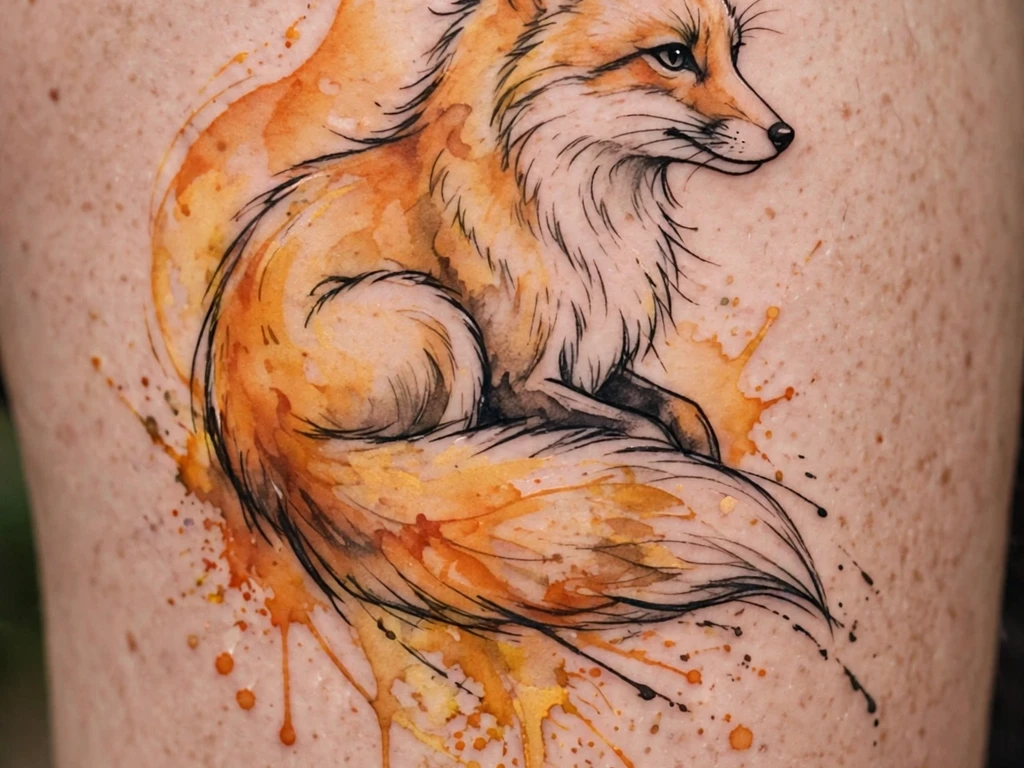
The fox dissolves into paint: loose washes of orange, amber and rust bleeding past a light outline, with splashes and drips trailing off the tail. Watercolour is the softest way to wear a fox, and the thigh gives the washes room to spread without crowding. The strongest versions keep a real drawn skeleton underneath — proper linework in the face and ears — so the design still reads as a fox when the colour softens with age.
Best placement: Thigh, where there is space for colour to drift; upper arm works for a smaller version.
Best for / know before you book: Watercolour fades faster than outlined styles and usually wants a colour refresh after some years. Choose an artist who specialises in it, and be honest with yourself about sunscreen — sun is this style’s biggest enemy.
4. Sleeping Curled Fox
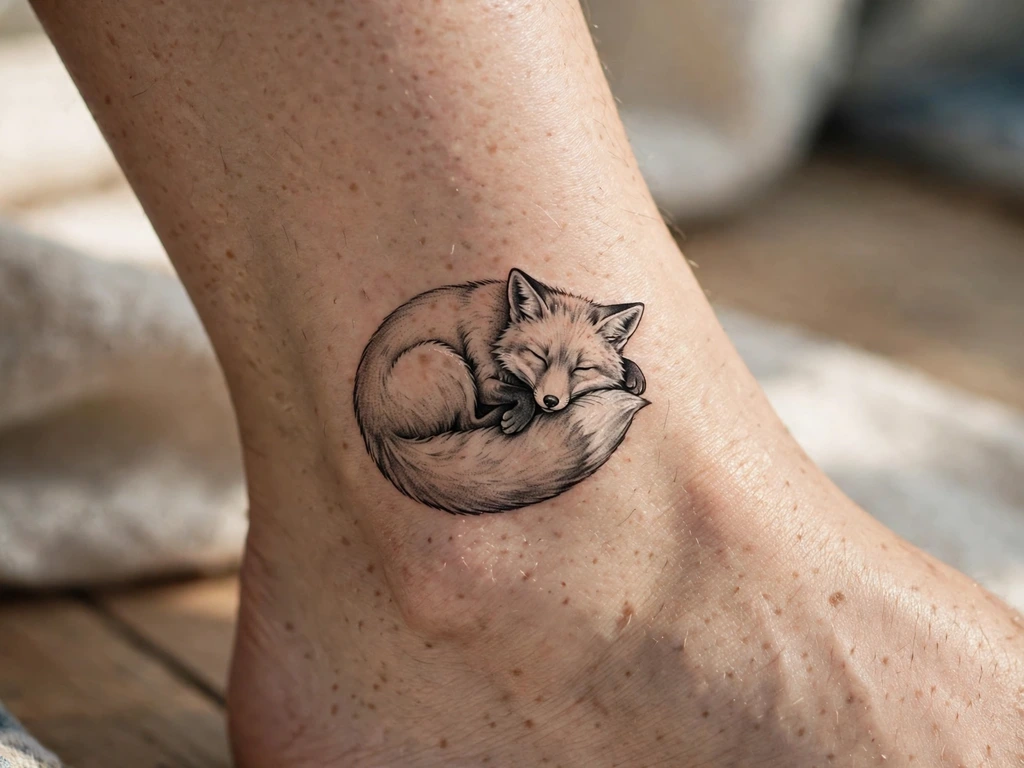
A fox asleep the way foxes actually sleep: curled into a tight circle, nose tucked to its tail, the big tail wrapping around like a blanket. It is the gentlest design in this guide and one of the most popular first fox tattoos, standing for rest, self-care and feeling safe in your own skin. Soft shading or a simple outline both work; a tiny heart or a few snow dots can personalise it without cluttering the curl.
Best placement: Ankle, where the round shape hugs the bone; also lovely on the inner wrist or shoulder blade.
Best for / know before you book: Small and quick, but keep it at least 5 cm across so the tail wrap and ear stay readable as the lines settle. Ankle skin rubs against shoes while healing, so time it for open footwear.
5. Fox and Wildflowers
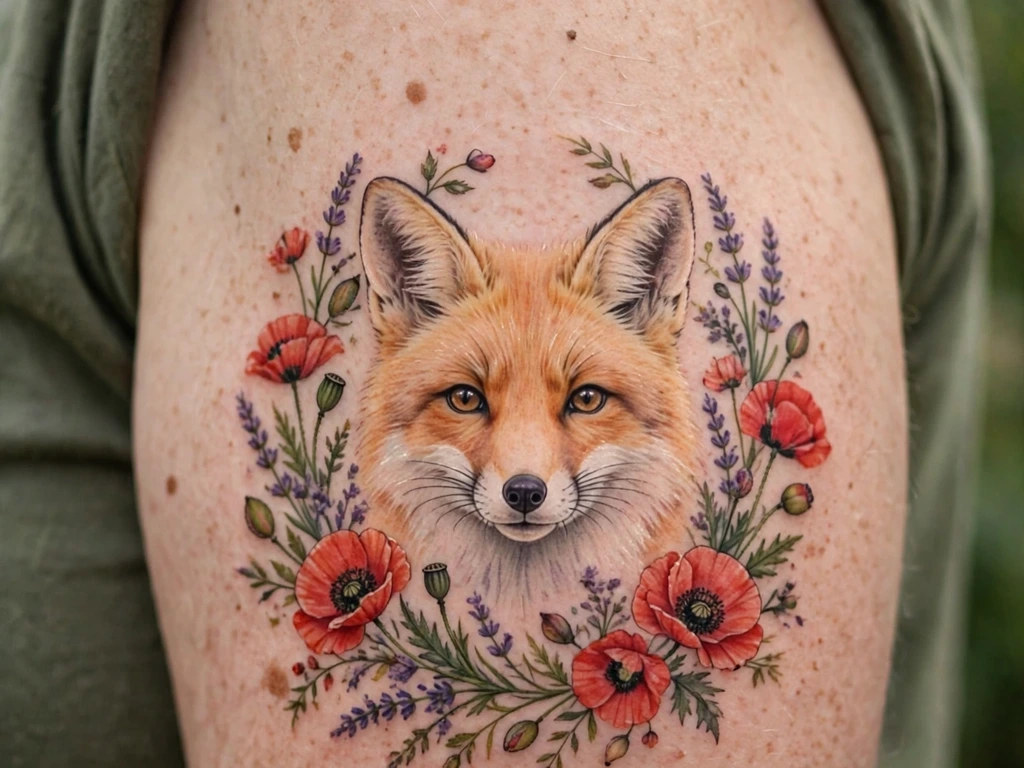
A fox’s face or full figure framed by wildflowers — poppies, lavender, daisies or foxgloves for the wordplay — in soft, feminine colour. The flowers do more than decorate: they soften the fox’s sharpness, add a seasonal or birth-flower layer of meaning, and give the composition its shape. This is the design to choose if you love the fox’s meaning but want the overall feel romantic rather than fierce.
Best placement: Upper arm, where the floral frame can curve naturally; thigh for a larger, more detailed version.
Best for / know before you book: Flower choices change the meaning, so pick blooms that mean something to you and tell your artist early. Fine petal lines need a little breathing room — resist shrinking this one down.
6. Fox Face Portrait
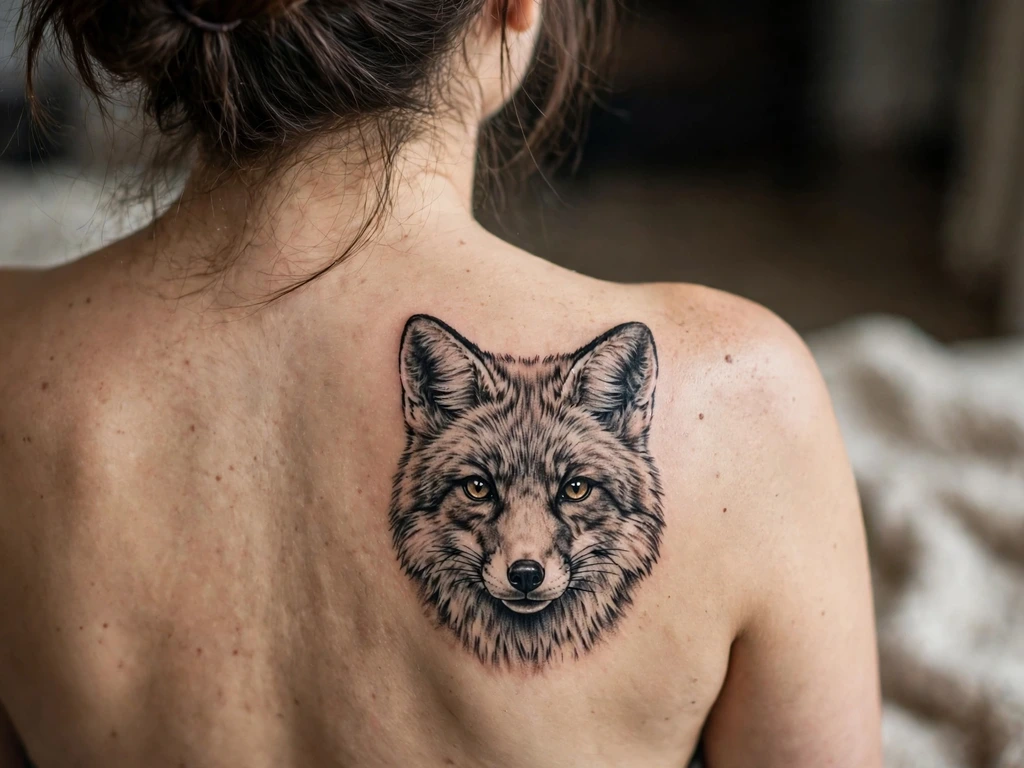
Just the face, straight on, filling the frame: amber eyes, white cheek ruffs, ears tall, every strand of fur shaded in. A portrait lives or dies on the eyes, and the fox’s direct, level gaze is what makes this design stop people mid-conversation. Black and grey gives it a serious, almost photographic mood; natural colour makes it warmer and more lifelike.
Best placement: Shoulder blade, where the flat canvas keeps the symmetry true; upper arm for a slightly smaller version.
Best for / know before you book: Portraits are an artist-matching exercise — book someone whose healed animal portraits you have seen, bring several clear reference photos, and expect the eyes to be worked on last and longest.
7. Fine-Line Minimal Fox
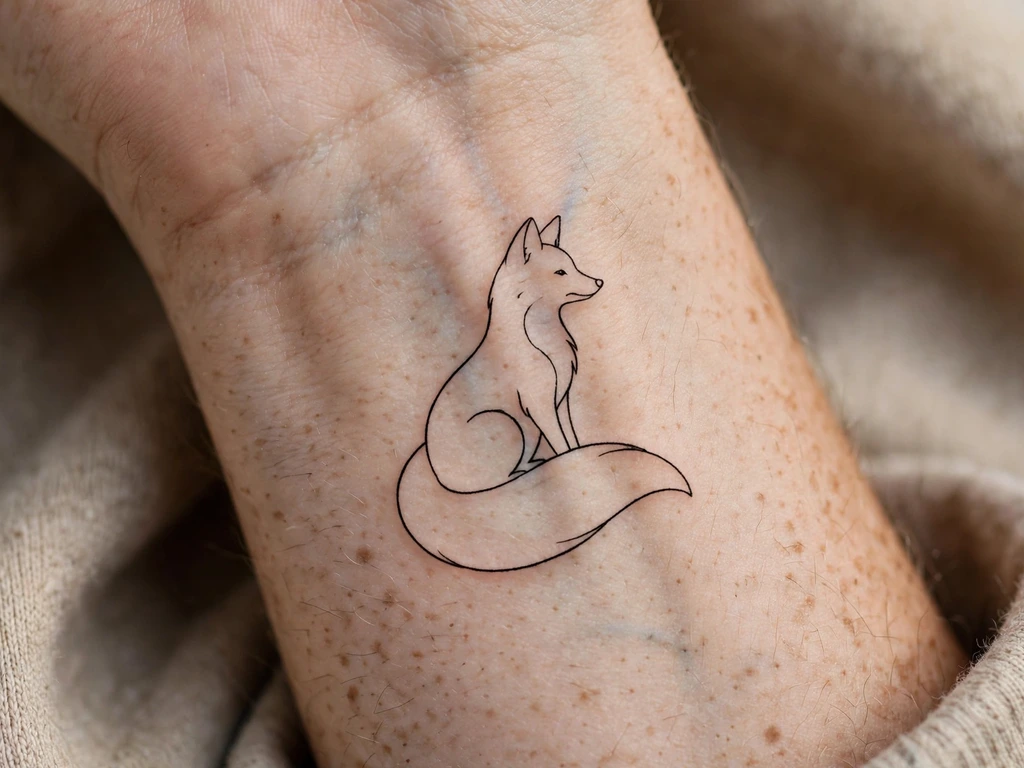
The fox reduced to its essentials: one continuous-feeling line for the ears, back and tail, no shading, no colour, nothing spare. Minimal fine-line foxes are the quietest way to wear the symbol — a private nod to cleverness rather than a public statement. The trick is proportion: the tail must stay big and the ears sharp, or the silhouette stops reading as a fox at small sizes.
Best placement: Inner wrist, where the wearer sees it daily; also behind the ankle or along a finger for the truly tiny.
Best for / know before you book: Fine lines soften as they settle, so a good artist draws them a fraction bolder than the reference suggests. Keep the design simple and expect that a small touch-up may be part of the deal.
8. Blackwork Fox
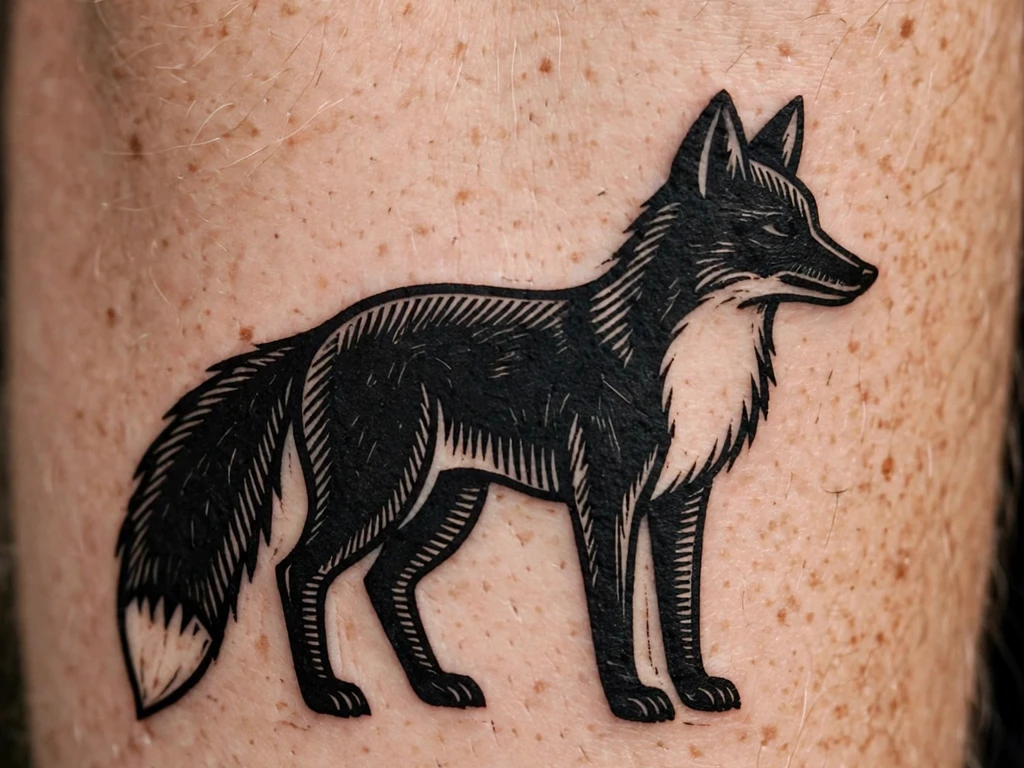
Solid black, bold shapes, and detail carved out of negative space: the white chest and tail tip are left as bare skin inside a black silhouette, and fur texture is suggested with a few confident cuts rather than shading. Blackwork foxes have a woodcut, storybook-illustration energy, and they are among the hardest-wearing designs on this list — heavy black holds its shape for decades.
Best placement: Outer forearm, where the long shape stretches out; calf and upper arm also suit it well.
Best for / know before you book: Packing solid black is slower and can feel spicier than linework, and it scabs more noticeably while healing — leave it alone and let it shed naturally. Check healed blackwork in portfolios; it should look like velvet, not patchwork.
9. Fox in Autumn Leaves
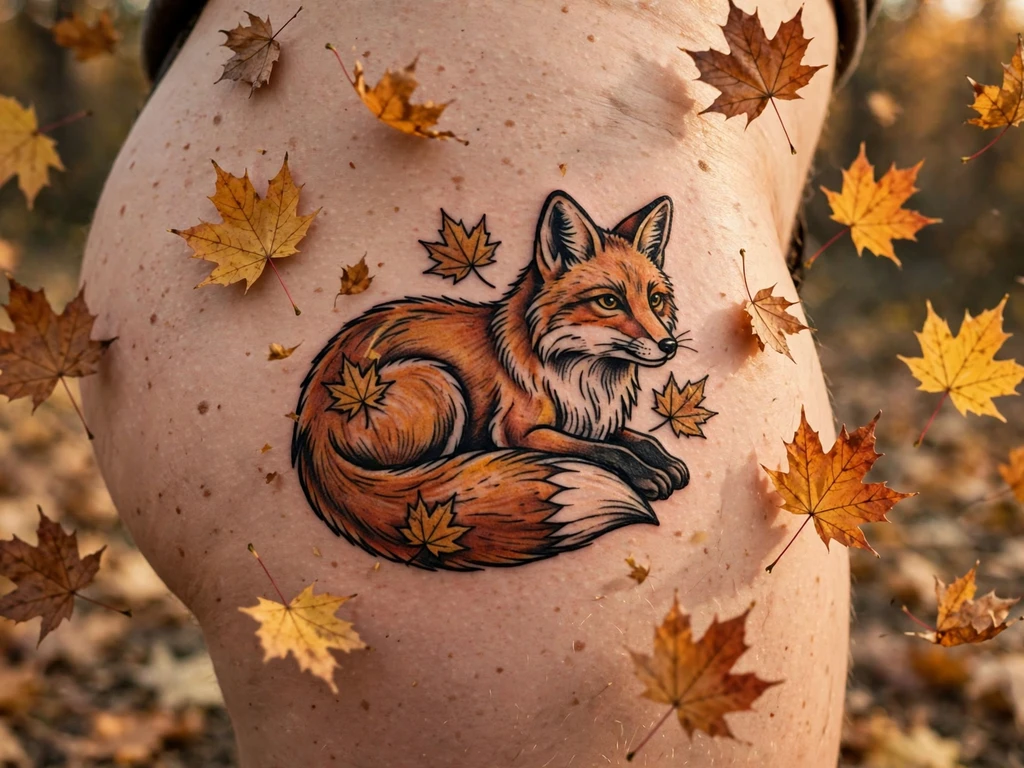
A fox stepping through falling leaves in full autumn colour — russet, gold and burnt orange, with a maple or oak leaf or two drifting past. It is the most seasonal design here, chosen by autumn-born wearers, people marking a harvest-season turning point, or anyone who simply looks best in those colours. The leaves also solve a composition problem, filling the corners so the fox feels placed in a moment rather than floating.
Best placement: Hip, where the design can curve with the body; outer thigh for more room.
Best for / know before you book: Reds and oranges are among the faster-fading pigments, and hip skin shifts with waistbands and weight change — go a touch bolder than feels necessary and keep the leaf shapes simple.
10. Fox Beneath a Crescent Moon
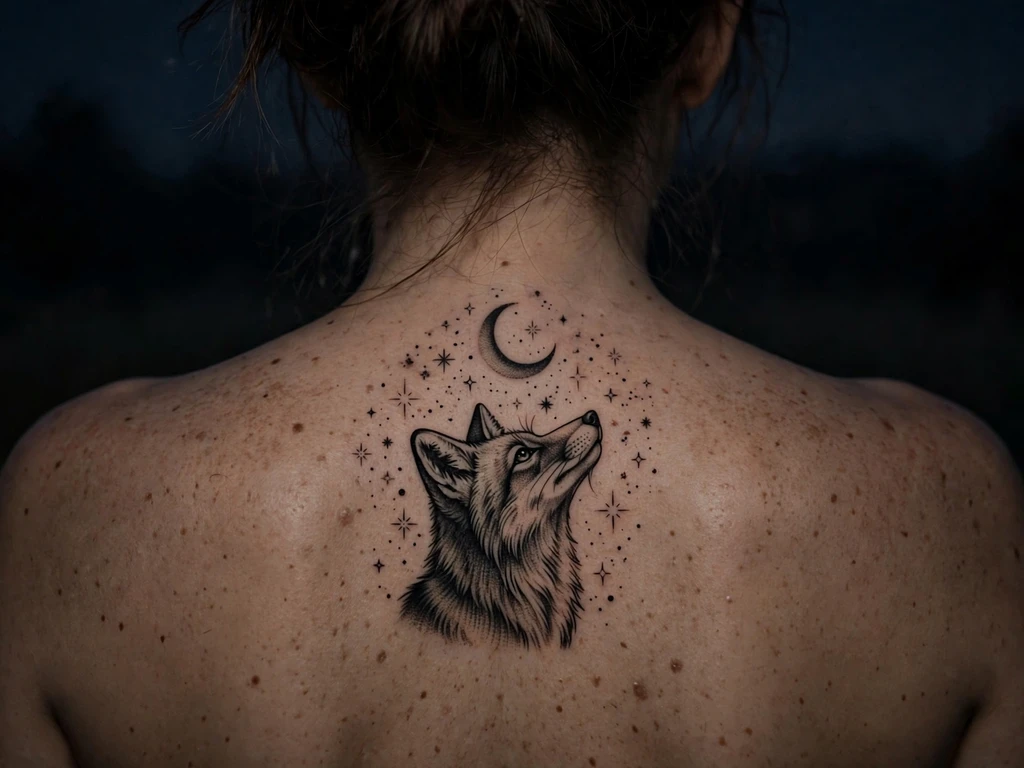
A night piece: a fox sitting or standing in profile under a crescent moon, stars scattered around, usually in black and grey with the moon picked out in negative space. It leans into the fox’s nocturnal, between-worlds folklore — the animal that moves through darkness by wit rather than eyesight. Night-shift workers, stargazers and anyone who does their best thinking after midnight tend to claim this one. It shares the dark-hours mood of owl tattoo ideas, the fox’s fellow night hunter.
Best placement: Upper back, centred between the shoulder blades like a medallion; sternum and thigh also work.
Best for / know before you book: Star fields are tempting to over-detail — keep stars sparse and varied in size, or they merge into freckles over time. Black and grey ages slowly, which suits a piece placed where you cannot watch it fade.
11. Dotwork Fox
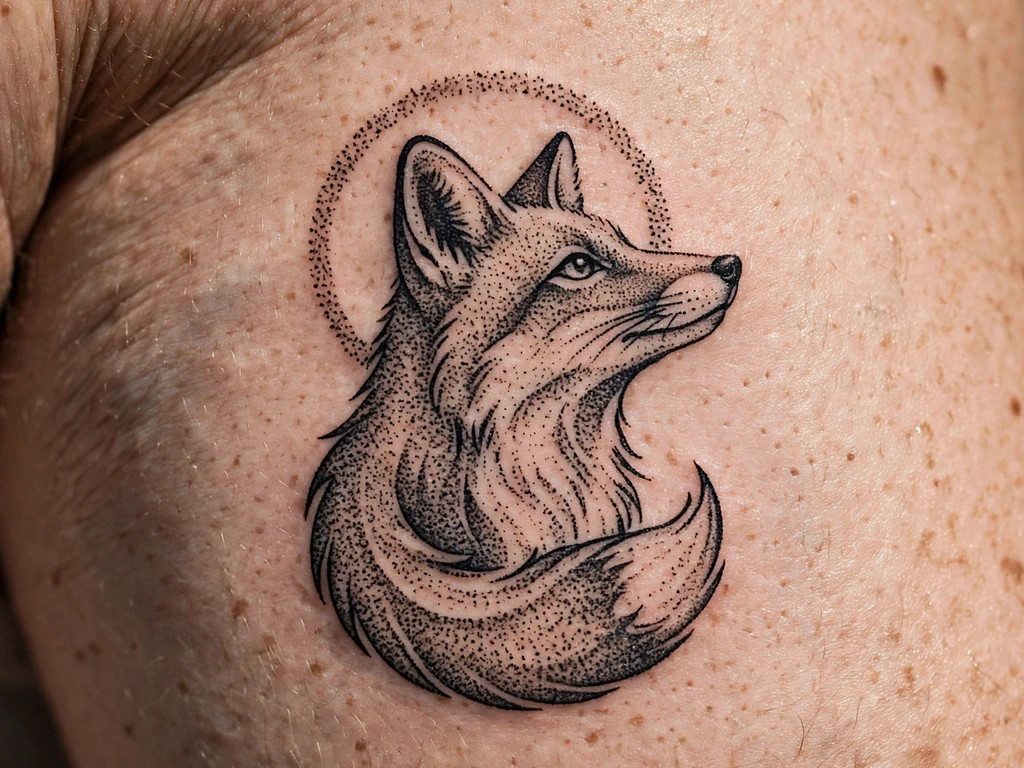
Instead of shading, thousands of dots: dense stipple builds the dark ears and back, sparse dots dissolve the tail into air. Dotwork gives a fox a soft, almost printed texture that photographs beautifully and ages gracefully, because there are no hard gradients to fall apart. Artists often add ornamental touches — a dotted halo, small geometric marks — that turn the animal into something between a tattoo and a piece of jewellery.
Best placement: Inner bicep, where the skin is smooth and the stipple stays even; forearm and calf are close seconds.
Best for / know before you book: Dotwork is slow, patient tattooing and the price reflects it. The dots must start properly spaced — too tight and they heal into a smudge — so choose an artist who does stipple work regularly, not as a side line.
12. Leaping Fox Silhouette
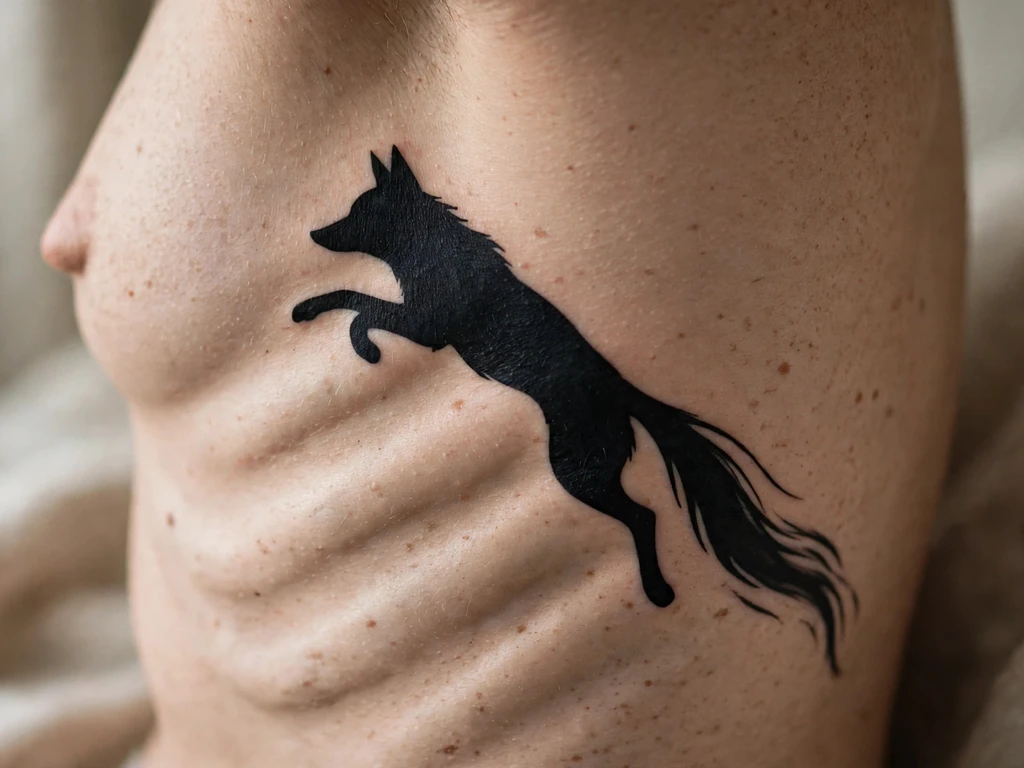
Caught mid-pounce: the fox stretched long, front paws reaching, tail streaming behind, drawn as one solid silhouette or a clean outline. The pose is pure fox — that famous headfirst dive they use to hunt mice under snow — and it stands for seizing the moment and trusting your senses. The stretched shape is made for long, narrow canvases that most animal designs cannot use.
Best placement: Ribcage, following the body’s length; along the spine or the side of the calf also flatter it.
Best for / know before you book: A silhouette has nowhere to hide a wobbly line, and ribs move with every breath, so expect a slower session and an artist who stencils with you standing. Solid fill here is bold; outline versions stay lighter and more forgiving.
13. Matching Fox Cub Pair
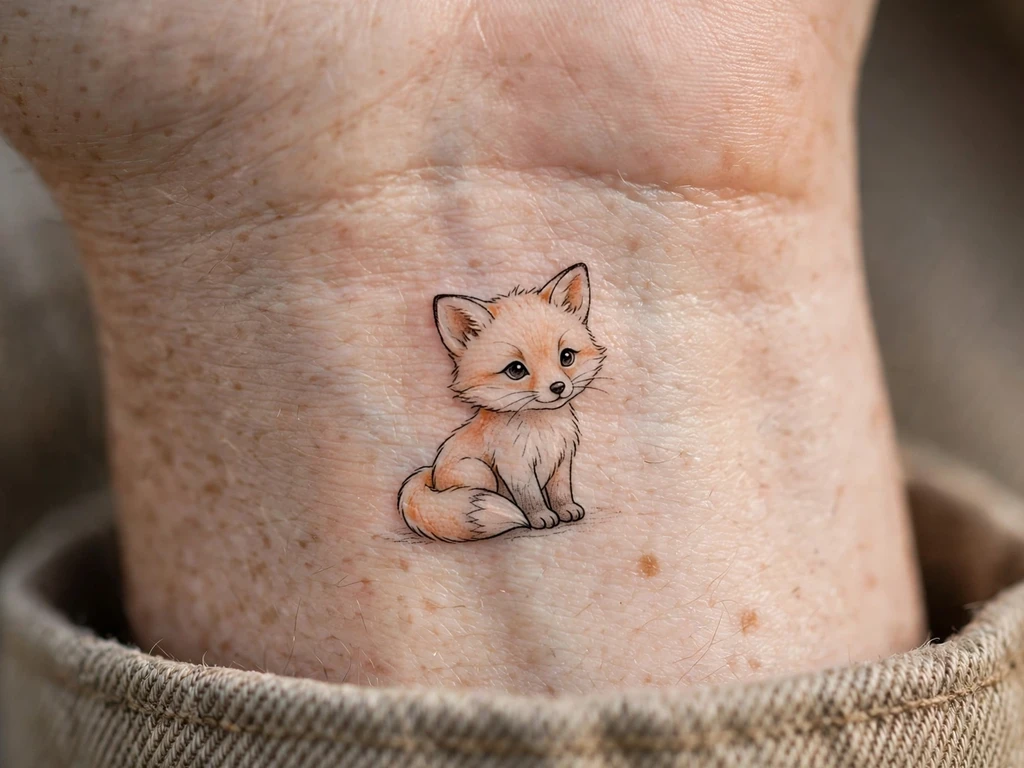
Two small fox cubs, one for you and one for your person — siblings, partners and best friends all claim this design. The cubs can be identical, mirrored so they face each other when your wrists meet, or drawn as two halves of one scene. Cubs carry the playful, unguarded side of fox meaning: loyalty before the world taught anyone caution.
Best placement: Matching inner wrists, matching ankles, or one behind each person’s ear-side shoulder.
Best for / know before you book: Book the same artist for both pieces, ideally in the same session, or “matching” quietly becomes “similar”. Agree the exact size in millimetres — a 5 mm difference is invisible on paper and obvious on skin side by side.
14. Fox Full Back Piece
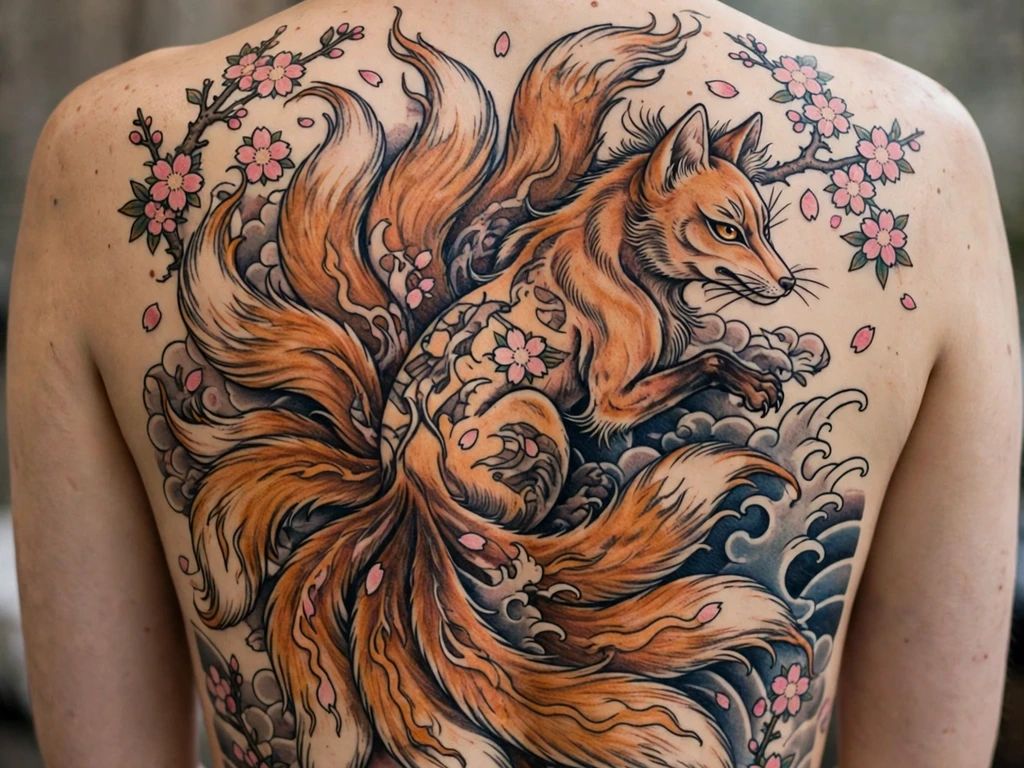
The commitment piece: a fox — often a kitsune — rendered across the whole back with room for landscape, blossom, waves or moonlight around it. At this scale the fur can be truly detailed, the tails can flow the full length of the spine, and the design becomes something closer to a painting than a tattoo. Many wearers build it around a life story: the fox they were, the terrain they crossed.
Best placement: Full back, designed in one consultation even if it is tattooed in stages.
Best for / know before you book: Expect multiple sessions across months and a serious budget. Choose the artist before the exact design — large-scale work should be drawn by the person who will tattoo it, fitted to your back’s actual shape, not copied from a photo of someone else’s.
15. Fox and Pine Forest Band
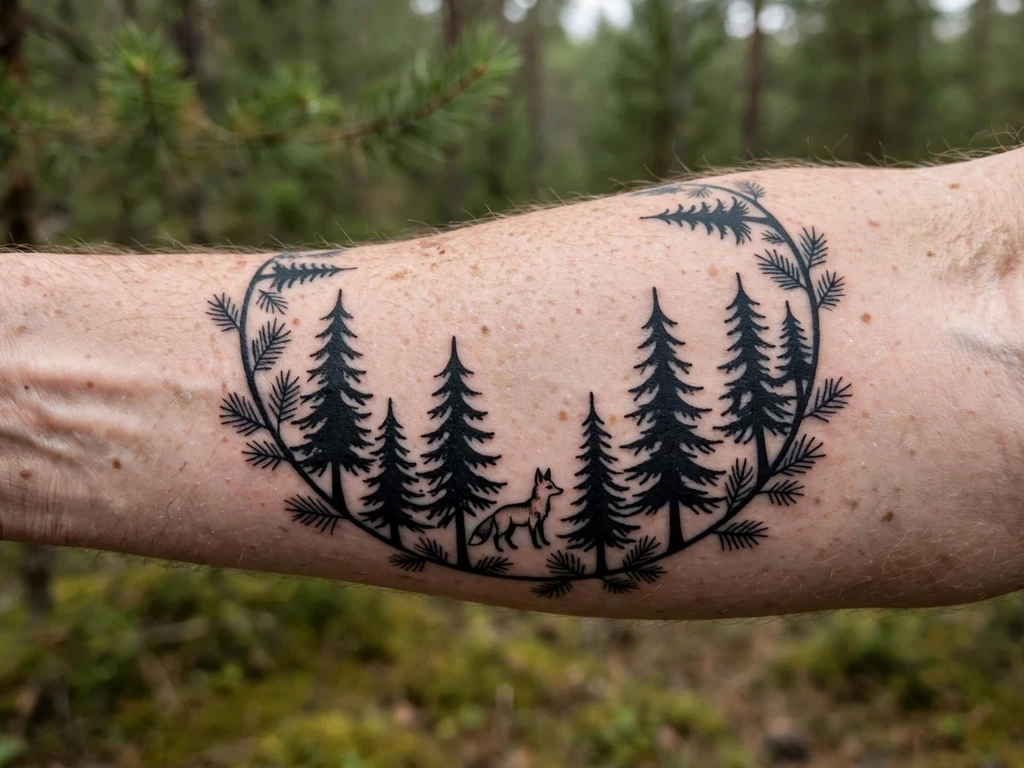
A wrap-around band: pine silhouettes circle the forearm and a fox slips between the trees, nose down, mid-hunt. It is a scene you wear like a bracelet, and it has a practical superpower — bands like this are the classic foundation of a nature sleeve, extendable upward with sky, birds and mountains whenever you are ready. If you are planning a sleeve eventually, browsing forearm tattoo ideas will show how bands like this grow into full-arm work.
Best placement: Forearm, the forest line wrapping fully with the fox on the outer side.
Best for / know before you book: Wrap designs must be drawn for a cylinder, not a flat page, or the ends never meet the way the sketch promised. Ask your artist to draw the band directly around your arm’s taper, and keep the trees bold — tiny branches blur first.
16. Origami Fox
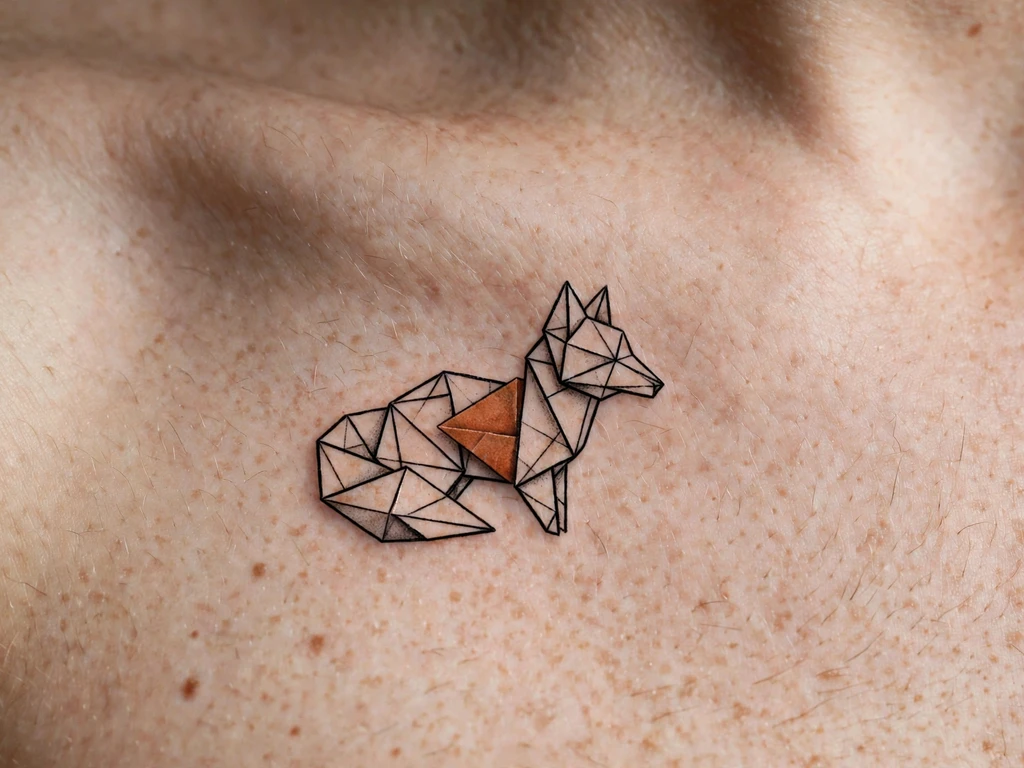
The fox as folded paper: a handful of triangular facets, a couple of crease lines, and the animal is suddenly there. Origami foxes appeal to minimalists who still want cleverness in the design — the puzzle of the folding is part of the meaning, a small monument to making something from almost nothing. It also carries a gentle nod to Japanese craft to sit alongside the kitsune’s folklore.
Best placement: Just below the collarbone, where the small angular shape sits like a brooch; inner wrist and ankle suit mini versions.
Best for / know before you book: This design is all proportion — if the ear facets are off, it reads as a random triangle. Bring two or three reference folds and let the artist redraw rather than trace; their version will sit better on skin.
17. Fox Sternum Centrepiece
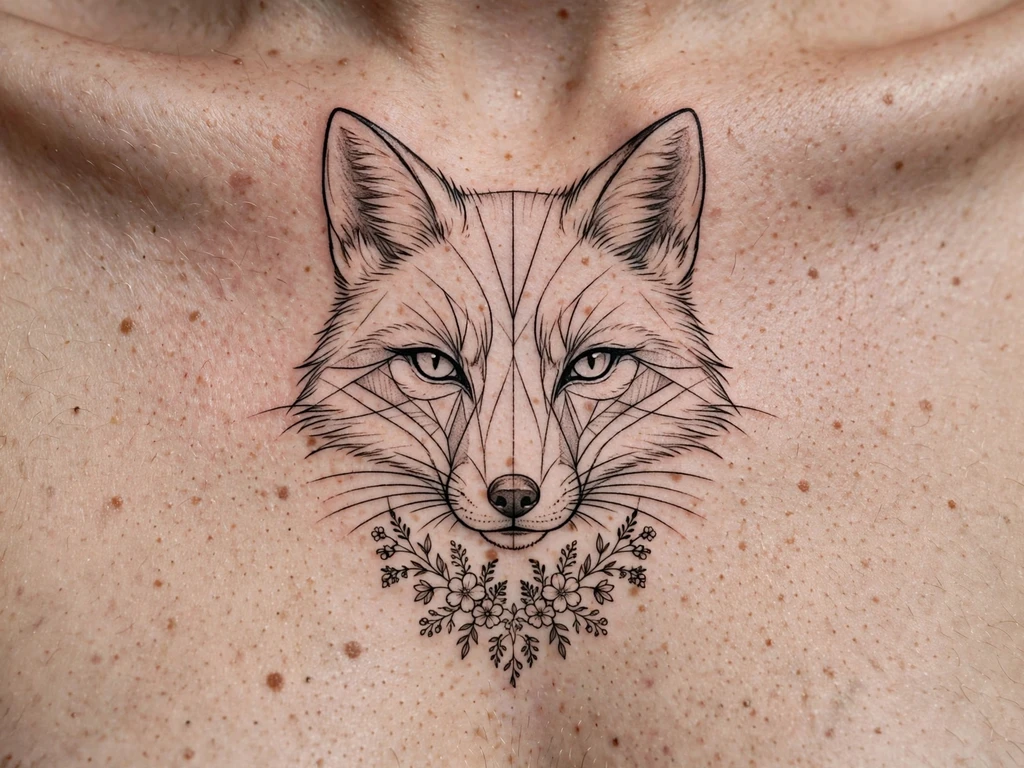
A fox face drawn in perfect symmetry at the centre of the chest, ears sweeping outward, small flowers or moon phases tucked along the lower edge like a pendant. It is the most ornamental design in this guide — part animal, part jewellery — and it frames the body the way a necklace does. Wearers choose it for the protection meaning as much as the look: a guardian worn over the heart.
Best placement: Centre sternum, the fox’s nose on the body’s centre line and ears following the chest’s curve.
Best for / know before you book: Symmetry here is unforgiving, so the stencil ritual matters: check it standing, in a full-length mirror, and speak up about a millimetre’s tilt now rather than forever. The sternum is a tender spot — short, calm sessions are the norm.
18. Fox and Butterfly
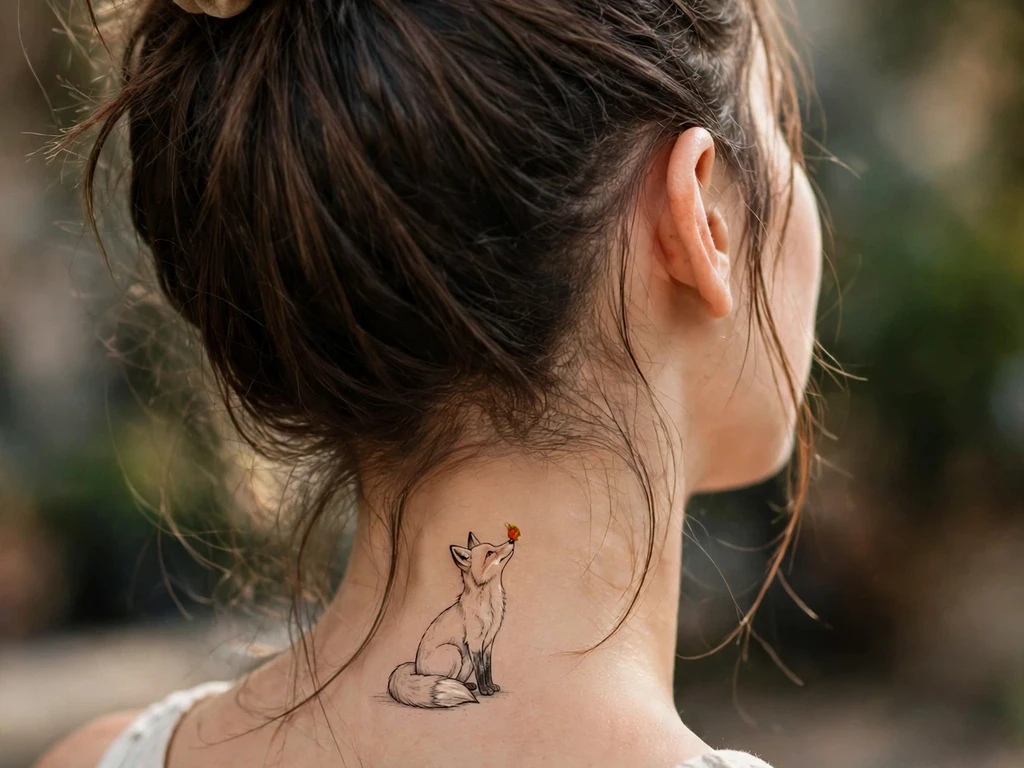
A fox sitting patiently while a butterfly rests on its nose — the internet’s favourite fox moment, and a genuinely sweet tattoo. It pairs the fox’s cleverness with the butterfly’s transformation story, which is why it gets chosen after big life changes that turned out well. Fans of the winged half of the pairing will find more in our butterfly tattoo ideas collection. Keep the butterfly’s colour small and bright so it stays the focal point.
Best placement: Nape of the neck, revealed when hair goes up; also charming on the shoulder blade or ankle.
Best for / know before you book: Two subjects at small size means both must simplify — agree with your artist which details survive before the stencil goes on. The butterfly’s wing lines are the finest in the piece and the first to soften.
19. Neo-Traditional Fox
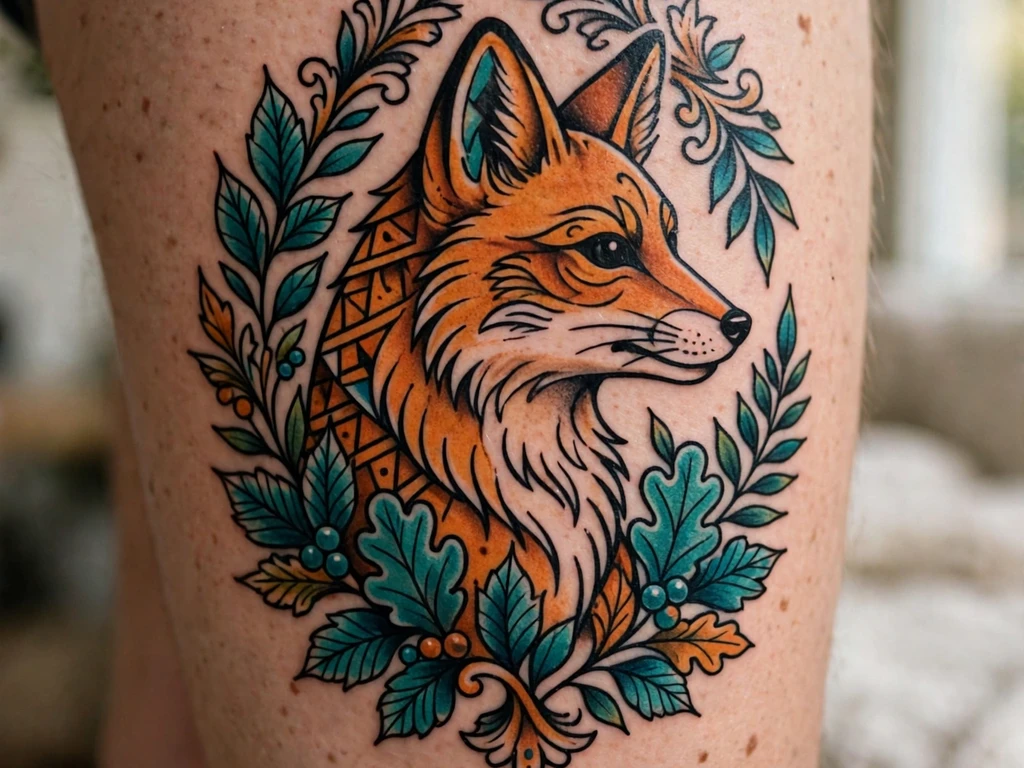
Bold black outlines, a jewel-box palette of burnt orange, teal and mustard, and decorative extras — leaves, gems, a moon — arranged around a fox with real attitude. Neo-traditional takes the old-school rules that make tattoos last (strong lines, simple shapes) and gives them a modern illustrator’s flair. It also works beautifully as the centrepiece of a growing sleeve or leg piece, because its bold shapes hold their own next to later additions.
Best placement: Outer thigh, where the colour blocks sit flat; upper arm is the classic alternative.
Best for / know before you book: The palette is the personality here, so settle colours against your skin tone at the consultation — teals and mustards shift noticeably between skin tones. Bold outlines mean this style ages among the best on the list.
20. Fox Tail Wrap
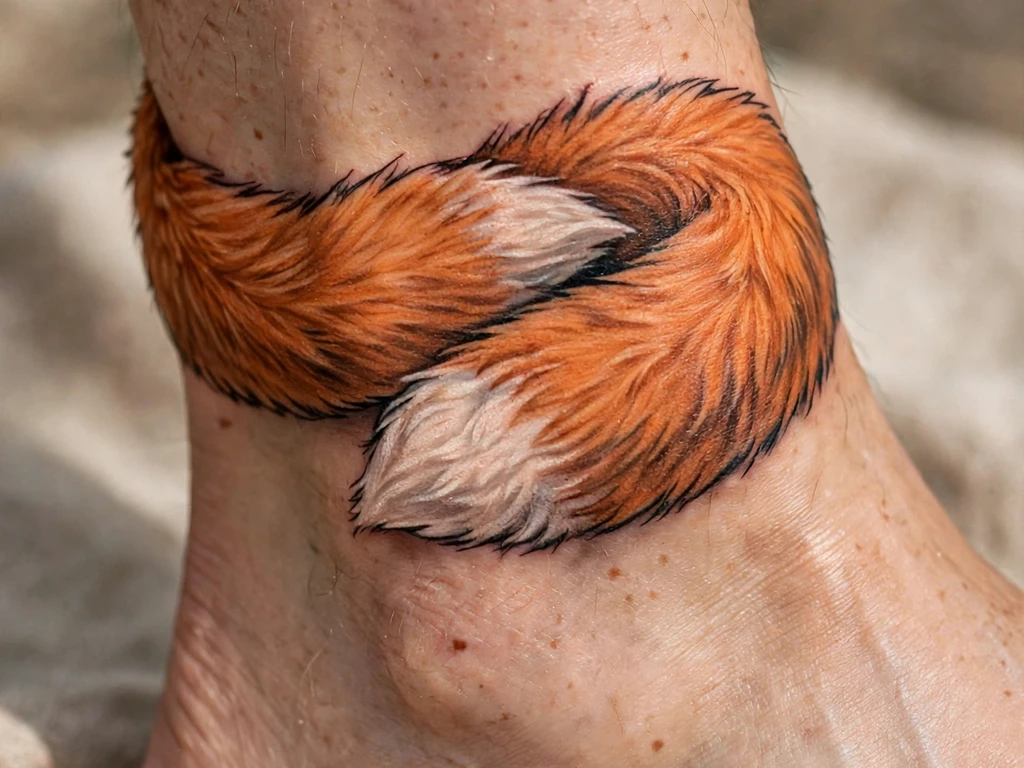
Not the whole fox — just the tail, that magnificent brush, circling the ankle with the white tip ending the loop like a clasp. It is a subtle insider’s design: other fox lovers recognise it instantly, everyone else sees an elegant anklet. The tail can be drawn soft and fluffy in colour, or reduced to a blackwork band with a single negative-space tip.
Best placement: Around the ankle, the tail’s tip finishing at the front; a wrist version works at smaller scale.
Best for / know before you book: Circular designs expose every wobble, and ankles swell during tattooing, which can distort the stencil — a good artist checks the wrap standing, with your weight on the leg. Shoes will rub while it heals, so plan footwear accordingly.
21. Realistic Red Fox in Profile
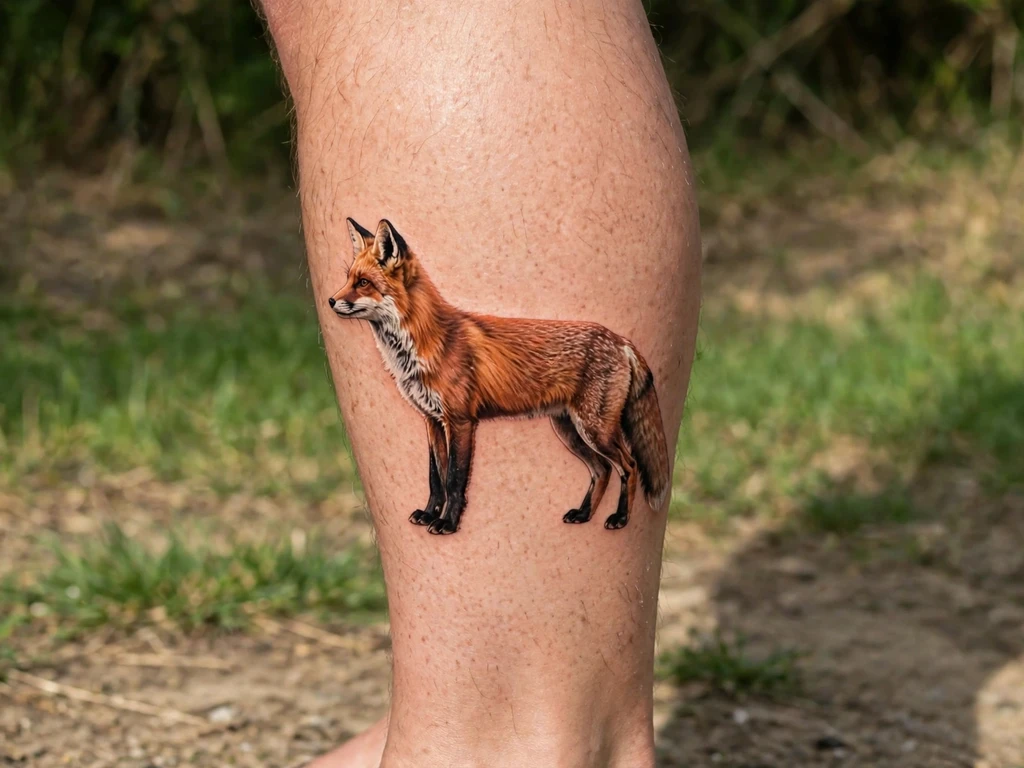
The fox as it actually is: side profile, head up, ears pricked, drawn in true natural colour — russet back, white chest, black ear backs and stockings. Profile realism has a field-guide elegance, and the calf’s long, gently curved surface is practically shaped for it. Of all the designs here, this is the one most often chosen by people who have met a real fox and never quite got over it.
Best placement: Calf, the fox’s body running down the leg’s length; outer forearm for a smaller study.
Best for / know before you book: Colour realism has no outline safety net — edges soften over the years, which suits fur but means booking a genuine realism specialist. White and cream pigments settle warmest; ask how the artist keeps pale chest fur from yellowing.
22. Galaxy Fox
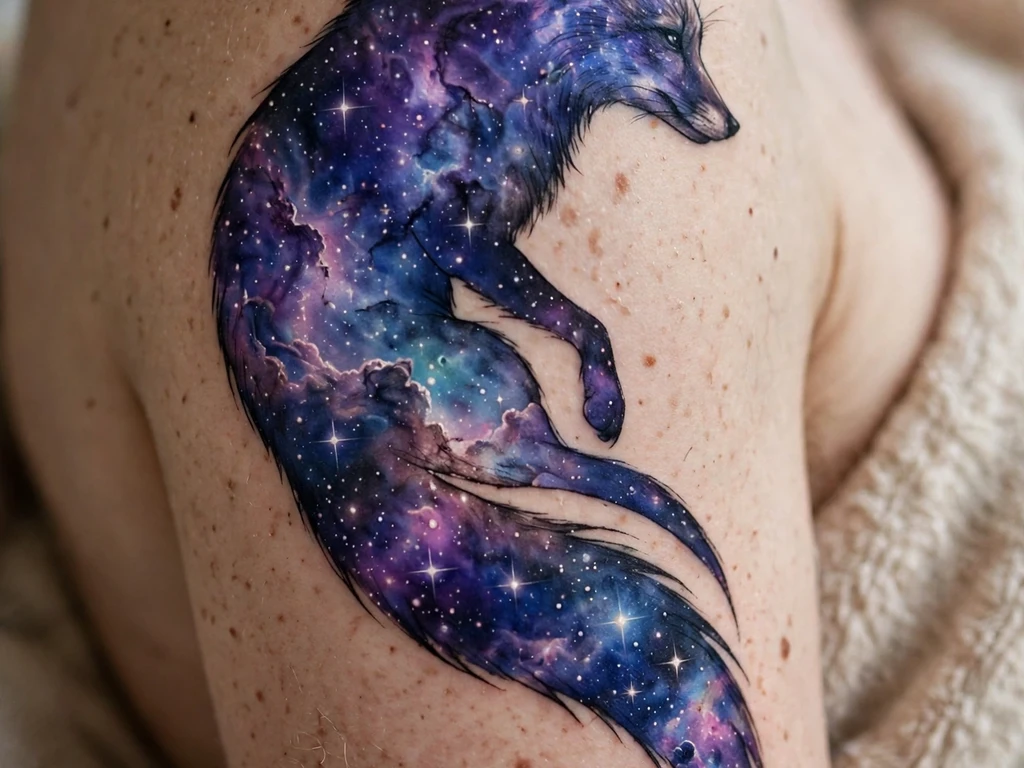
A fox silhouette filled with the night sky: nebula purples and blues, pinprick stars, maybe a comet trailing from the tail. It fuses the fox’s between-worlds folklore with a love of space, and it is one of the most customisable designs here — the silhouette can sit, leap or curl, and the cosmos inside is yours to choose. Many wearers tuck a real constellation into the stars as a hidden layer of meaning.
Best placement: Shoulder, the fox’s shape sweeping from shoulder cap onto the upper arm; thigh for a larger sky.
Best for / know before you book: Purples and blues are mid-speed faders and star dots need spacing to survive — resist packing the sky too densely. A thin outline around the silhouette keeps the fox readable when the inner colour softens.
23. Tiny Fox Behind the Ear
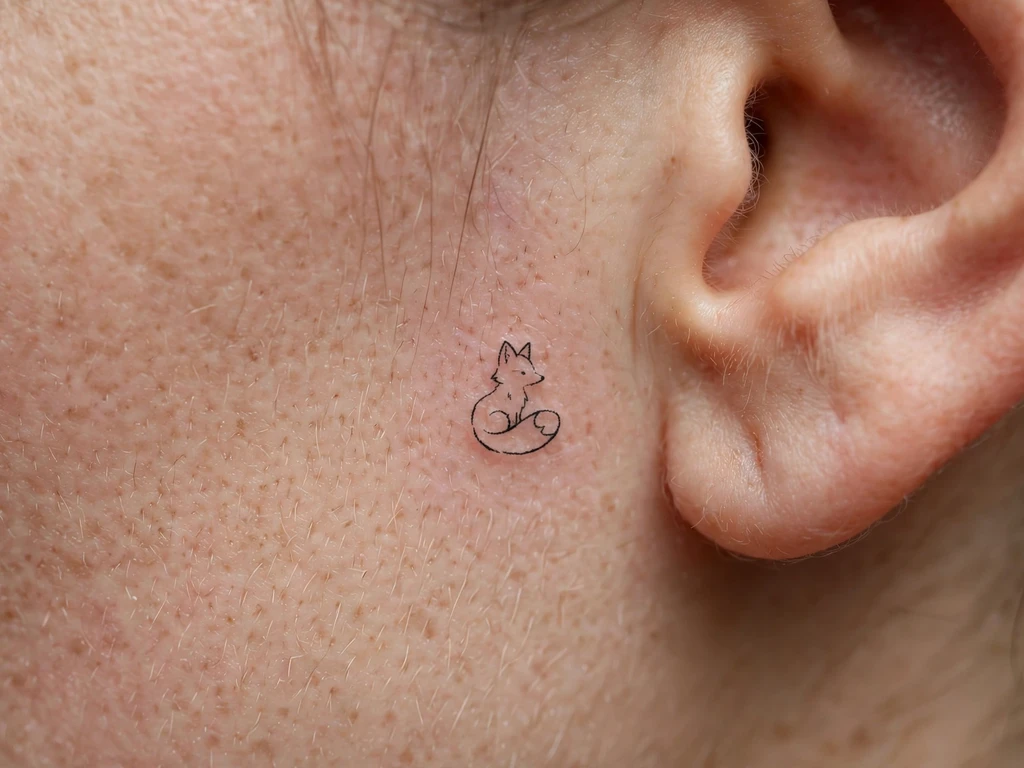
A fox the size of a fingernail: ears, back and tail in a few fine lines, hidden behind the ear where only people close to you ever see it. It is the most private design in this guide — a secret kept in ink, shown by tucking your hair back and hidden again by letting it fall. Secret-keepers, introverts and the tattoo-curious all start here.
Best placement: Behind the ear, following the ear’s curve; the same mini design works on a finger or inner ankle.
Best for / know before you book: Behind-ear skin is thin, oily and quick to shed, so tiny pieces here fade faster than almost anywhere — expect a touch-up and keep the lines as simple as the design allows. The buzzing feels louder than it is; the session is mercifully short.
24. Fox With an Open Book
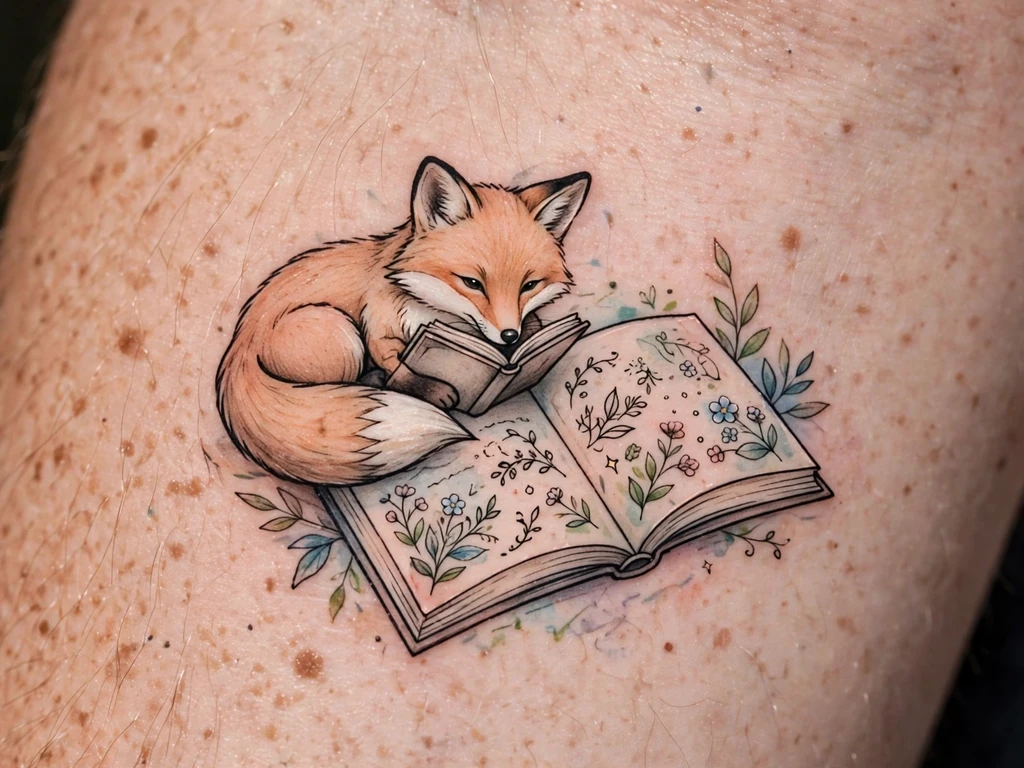
A storybook fox curled around — or sitting upright beside — an open book, sometimes with tiny glasses, always with the air of a creature who knows things. It is the design readers, teachers, librarians and the happily nerdy reach for: the fox’s cleverness pointed at stories instead of chickens. Blank pages are best left blank or filled with a few wavy lines; real text at this size blurs into grey within a few years.
Best placement: Inner forearm, where you can look down at it while you read; upper arm for a larger scene.
Best for / know before you book: Book edges and page lines are ruler-straight by nature, so this quietly demands an artist with very steady linework. If you want a specific story honoured, use its symbols — a key, a star, a wave — rather than its title in letters.
25. Fox Family Line
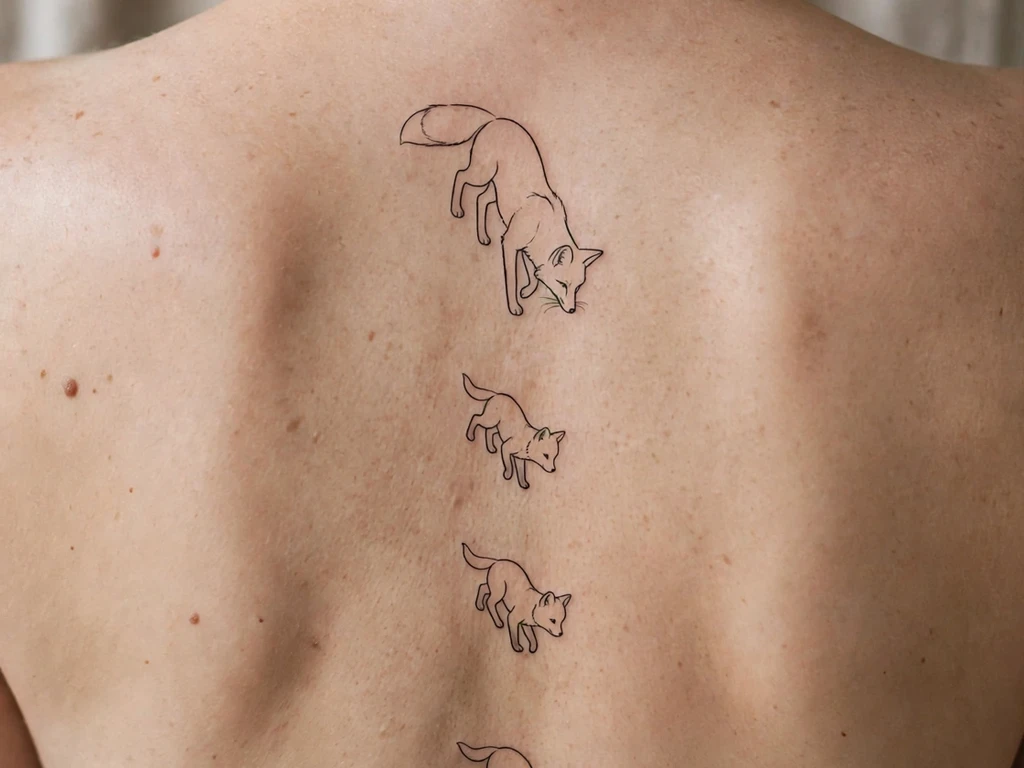
A vixen leading her cubs in single file, drawn as a walking line of simple, graceful shapes — mother first, then two or three cubs in descending size. Parents choose it to carry their children with them; siblings choose it for the family they grew up in. Because each cub is a separate small figure, the design can honestly grow: families add a cub when life does.
Best placement: Along the upper spine, the family walking down the back’s centre line; along a collarbone or ankle also suits the line.
Best for / know before you book: Decide the cub count and spacing with your whole future in mind — leaving a natural gap for a possible addition is easier than squeezing one in later. Simple shapes age kindly, which matters for a tattoo meant to be read for decades.
Fox Tattoo Placement by Size
| Size | Typical dimensions | Best placements | Good to know |
|---|---|---|---|
| Small | 3–6 cm | Wrist, behind ear, ankle, finger, below collarbone | Sleeping foxes, minimal outlines and origami foxes live here; keep detail minimal so lines stay separate |
| Medium | 7–15 cm | Forearm, upper arm, calf, shoulder blade, inner bicep | The sweet spot for most fox designs — room for fur texture, flowers and a proper tail |
| Large | 16–30 cm | Thigh, upper back, hip, ribs, sternum | Kitsune tails, portraits and watercolour washes need this much room to stay readable |
| Extra large | 30 cm+ / multi-session | Full back, full sleeve in progress | Plan the whole composition in one consultation, even if it is tattooed in stages |
How to Choose Your Fox Tattoo (and What to Know Before You Book)
Decide which fox you mean. “Fox” covers at least three different tattoos: the real animal (realism, profile studies), the folklore spirit (kitsune, moon and galaxy pieces) and the symbol (geometric, origami, minimal outlines). Looking at portfolios gets much easier once you know which family yours belongs to, because each one wants a different kind of artist.
Match the artist to the style, not the species. A brilliant blackwork artist is not automatically the right person for a watercolour fox. Whatever design you choose from this list, judge candidates on healed work in that exact style — fox fur, stipple and colour washes all change as they settle, and fresh photos flatter everything.
Respect the tail. Anatomically, the tail is nearly half the fox. Designs that shrink it to a stub stop reading as foxes at a glance, whatever the ears are doing. If space is tight, it is usually better to simplify the face than to amputate the tail — the leaping silhouette and the tail wrap both prove how much fox a tail alone can carry. If you are drawn to clever-animal symbolism generally, snake tattoo ideas are the fox’s closest cousin in meaning — another creature that survives by wit.
Take safety seriously. Choose a licensed studio, watch that single-use needles are opened in front of you, and ask about ink brands if your skin has ever reacted to cosmetics. WebMD’s overview, Tattoos: Are They Safe?, lays out the risks and the questions worth asking before any tattoo. Afterwards, follow your artist’s aftercare instructions first and keep the new piece clean, moisturised and out of the sun while it heals.
Key points to remember:
- Nine tails = kitsune: wisdom earned over a lifetime; get the tail count right
- The tail makes the fox — never let a design shrink it away
- Colour foxes (watercolour, autumn, galaxy) need sunscreen and eventual refreshes; blackwork and geometric foxes age the slowest
- Symmetrical designs (sternum centrepiece, face portrait) live or die on the stencil check in the mirror
- Matching and family designs should be booked with one artist and a plan for future additions
Frequently Asked Questions
What does a fox tattoo symbolize?
Most commonly: cunning and intelligence, adaptability, playfulness and independence. In Japanese folklore the fox (kitsune) adds magic, protection and wisdom to the list, while Celtic and some Native American traditions cast the fox as a guide between worlds. In practice, the meaning is the one you choose — but those are the stories the symbol arrives with.
What is the difference between a fox tattoo and a kitsune tattoo?
A fox tattoo depicts the animal. A kitsune tattoo depicts the fox spirit of Japanese folklore — usually shown with multiple tails (up to nine), sometimes with a sacred jewel, flame wisps or a more mystical expression. Kitsune designs carry extra meanings of wisdom, longevity and supernatural protection, and they are typically drawn in a Japanese-influenced style.
Do fox tattoos work for both men and women?
Yes — the fox is one of the most genuinely unisex subjects in tattooing. The same animal reads soft and romantic with wildflowers and watercolour, sharp and graphic in geometric or blackwork, and mystical as a kitsune. Style and placement, not the fox itself, set the tone.
How much does a fox tattoo cost?
It depends on size, style and city. A tiny behind-the-ear outline may cost a studio’s minimum charge; a medium forearm or thigh piece in colour usually sits in the low-to-mid hundreds; and a kitsune back piece runs into four figures across several sessions. Specialist styles — dotwork, watercolour, realism — are priced for the skill involved, and they are worth it.
What is the best placement for a first fox tattoo?
The forearm, upper arm, calf and shoulder blade are the friendliest starting points: flatter skin, moderate pain, easy healing and room for a medium design that can grow later. The ankle sleeping fox and the wrist fine-line fox are the gentlest small options. Save the ribs, sternum and full back for when you know how your skin holds ink.
Final Thoughts
A fox tattoo is a small declaration about how you move through the world: observant, adaptable, quietly self-reliant, and not above a little mischief. Whether yours is a thousand-year-old kitsune with nine flowing tails or a two-centimetre outline behind your ear, the same advice holds — choose the version of the fox that matches your story, book an artist who specialises in that style, and give the tail its full glory.
Shortlist the designs from this list that you keep coming back to, take them to a consultation, and wear the stencil before you commit. The right fox should feel less like a picture you picked and more like a creature that was always travelling with you.