Religious tattoos are the oldest kind there is. People were marking skin with sacred signs long before tattooing had shops, and the designs below come out of that habit: crosses and praying hands, Buddhas and unalomes, an Om, two Stars of David, mandalas. This page gathers 47 real religious tattoos on real skin, grouped by tradition, each symbol’s meaning explained the way its own tradition explains it.
Each tradition gets its own section, because a symbol’s meaning lives inside its tradition and does not travel well. Where the licensed pool honestly had no real tattoo to show — the ichthys fish, Islamic geometry — the symbol gets a short written note instead of a borrowed picture. For one faith in depth, see our cross tattoo design ideas guide and the lotus tattoo meaning page.
A Word on Respect Before the Designs
Every symbol on this page is sacred to somebody. That does not mean only believers may wear them — people get religious tattoos for family, memory, heritage and hard years survived, as well as faith — but it changes what a good tattoo asks of you. Learn what the symbol means first, and check any script with a reader of that language: sacred words copied from a photo can come out garbled — the one mistake no touch-up can talk its way out of.
Placement carries respect too. Some traditions treat the feet and lower legs as the least honoured part of the body, so a Buddha or a deity at the ankle can offend. The closing section — on wearing another tradition’s symbol — works through the questions worth asking first.
Christian Tattoo Ideas
Christian tattoos are the largest group here, at 22 designs, because the licensed pool is deepest for them: crosses in half a dozen forms, praying hands, portraits of Jesus and Mary, rosaries, scripture lettering. Crosses vary by tradition — knotwork Celtic, three-bar Orthodox — and each is named for what it is.
1. Celtic Cross Covering the Back
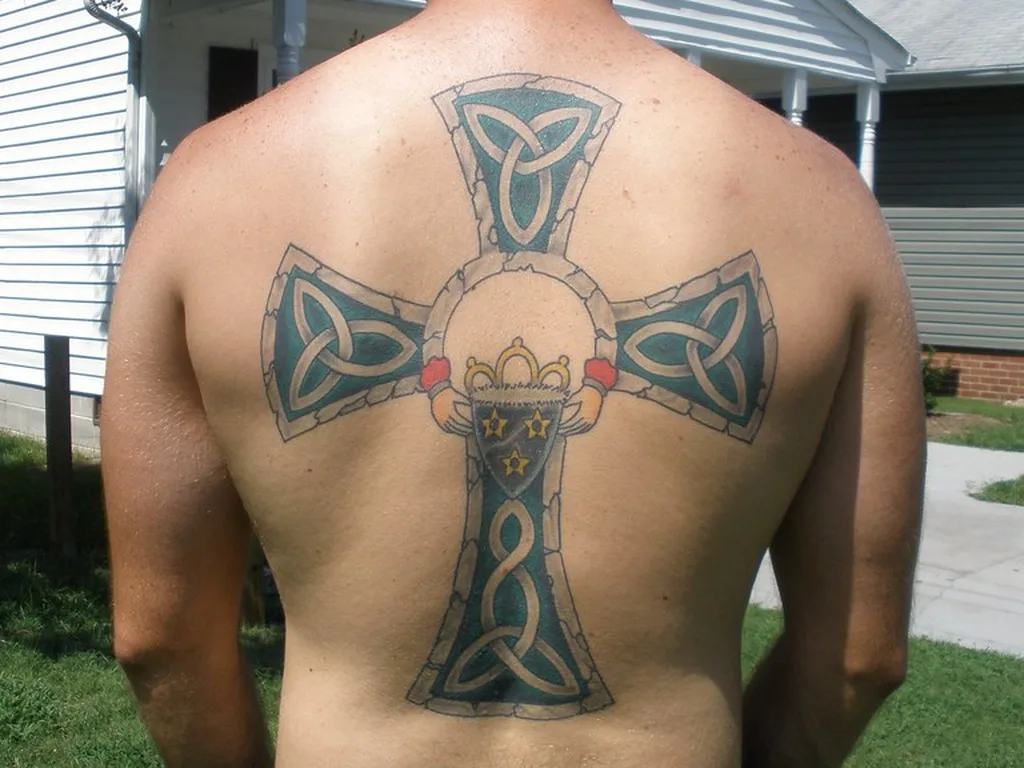
The Celtic cross is recognised by the ring at its intersection and the knotwork filling its arms. Tied to Ireland and Scotland, where stone versions have stood in churchyards for a thousand years, it often carries heritage as much as faith.
At full-back size the knotwork has room to stay open; drawn small, knot patterns close up as ink settles. Black and grey suits it — the stone originals were never coloured.
2. Bold Red Cross on the Leg
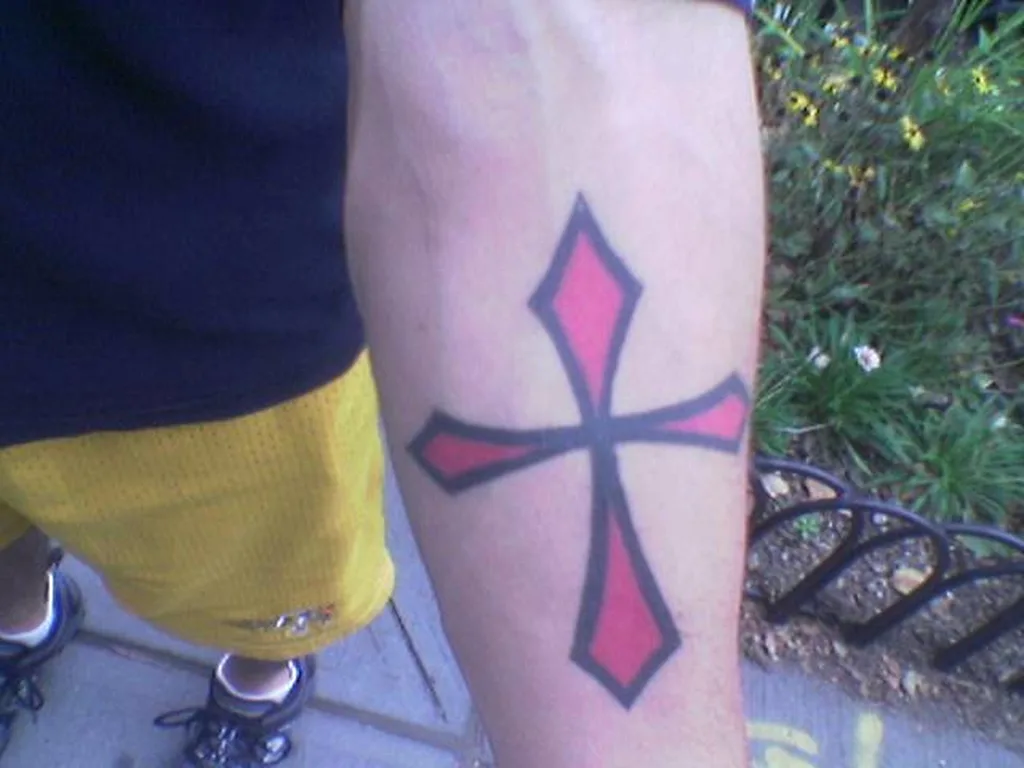
A plain Latin cross filled with flat red, held by a heavy black outline. Red carries weight in Christian symbolism — the blood of Christ, sacrifice, the Holy Spirit’s fire at Pentecost — so it reads as a statement about sacrifice, not decoration.
One outline, one colour: builds this simple are why traditional crosses hold up for decades — the outline does the work after the red softens.
3. Ornate Blue Cross on the Chest
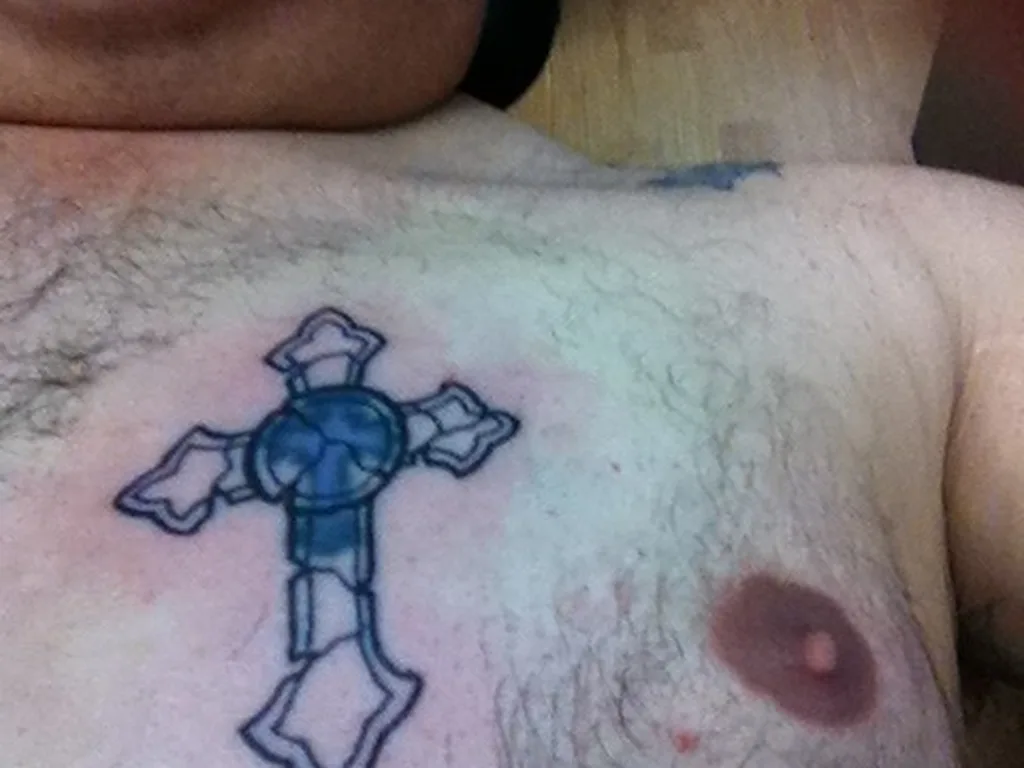
An ornamental cross across the upper chest, arms finished with flared ends, worked in blue outline. Blue is the colour most often linked with Mary and with heaven in Christian art, giving it a quieter feel than a black cross.
The chest suits a tattoo worn mainly for its owner — seen in a mirror each morning, covered by a shirt all day. Flat skin also lets a symmetrical cross sit level.
4. Orthodox Three-Bar Cross
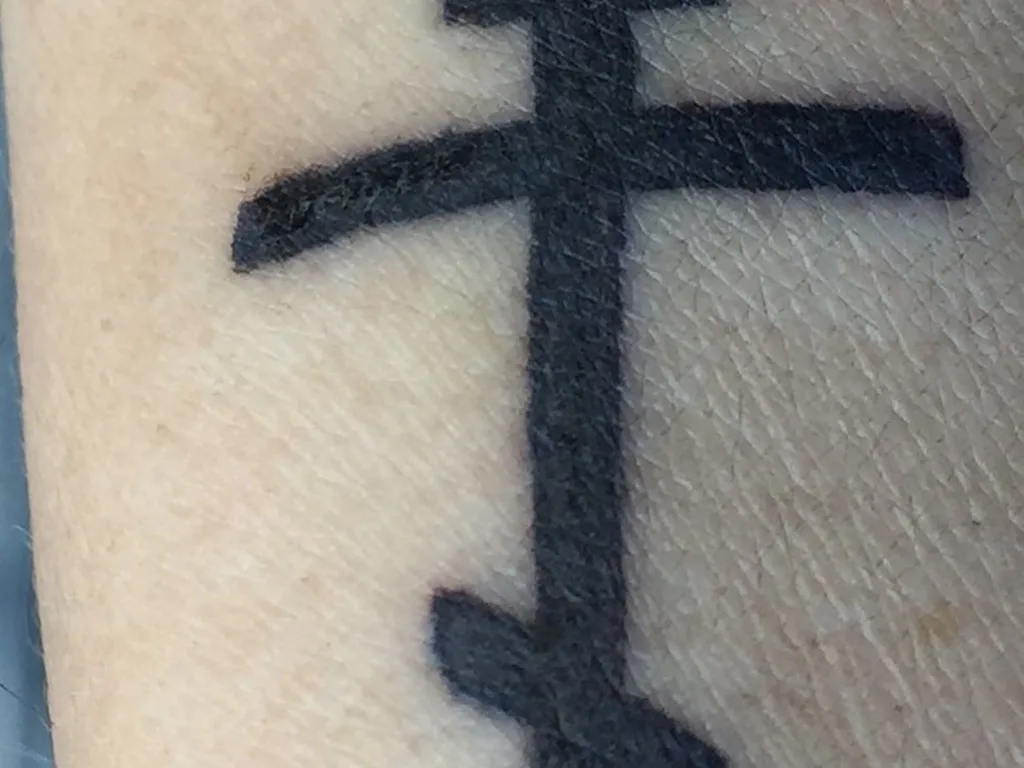
The Orthodox cross has three bars: the top for the sign above Christ’s head, the long middle bar for his arms, and a slanted bottom bar for the footrest — tilted, in Orthodox teaching, between the two thieves crucified beside him.
Wear this form and Orthodox Christians will recognise it instantly — a specific cross, not a generic one.
5. Golgotha Crosses With a Crown of Thorns
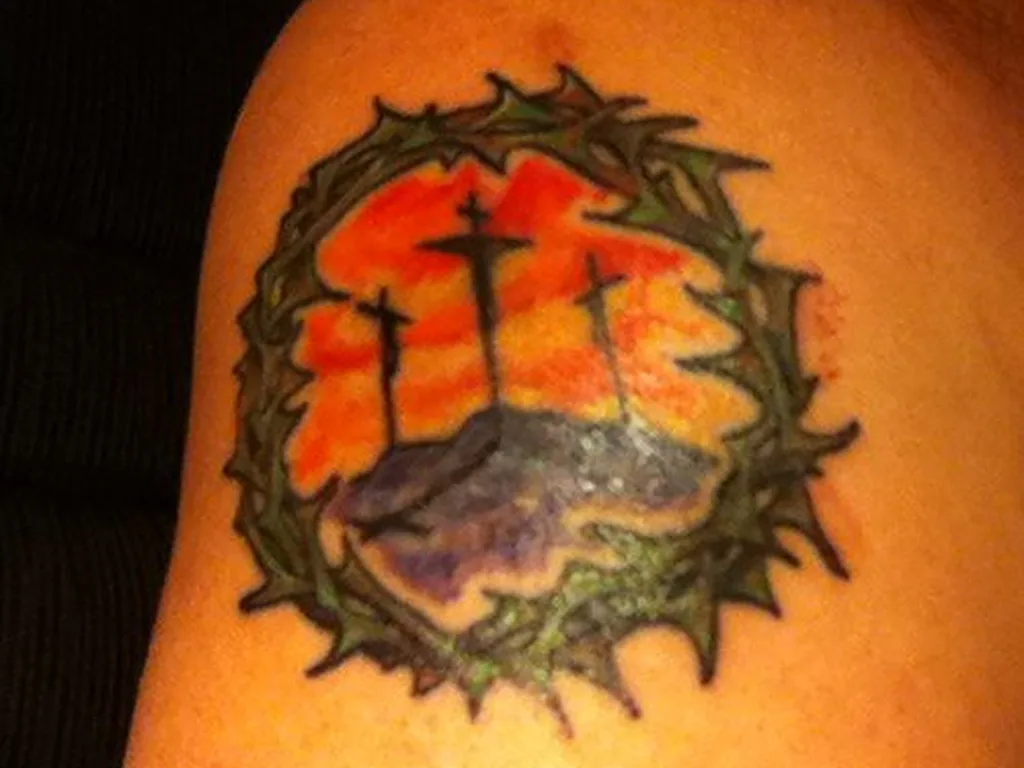
Three crosses on the hill of Golgotha, ringed by a crown of thorns, in colour on an upper arm. The outer crosses stand for the thieves crucified with Christ; the crown for the mockery before the crucifixion and, in Christian reading, for suffering carried for others.
Scene pieces compress a whole story into one image, and they need size — at wrist scale the wreath and crosses would crowd into mush.
6. Minimal Line Cross on the Upper Back
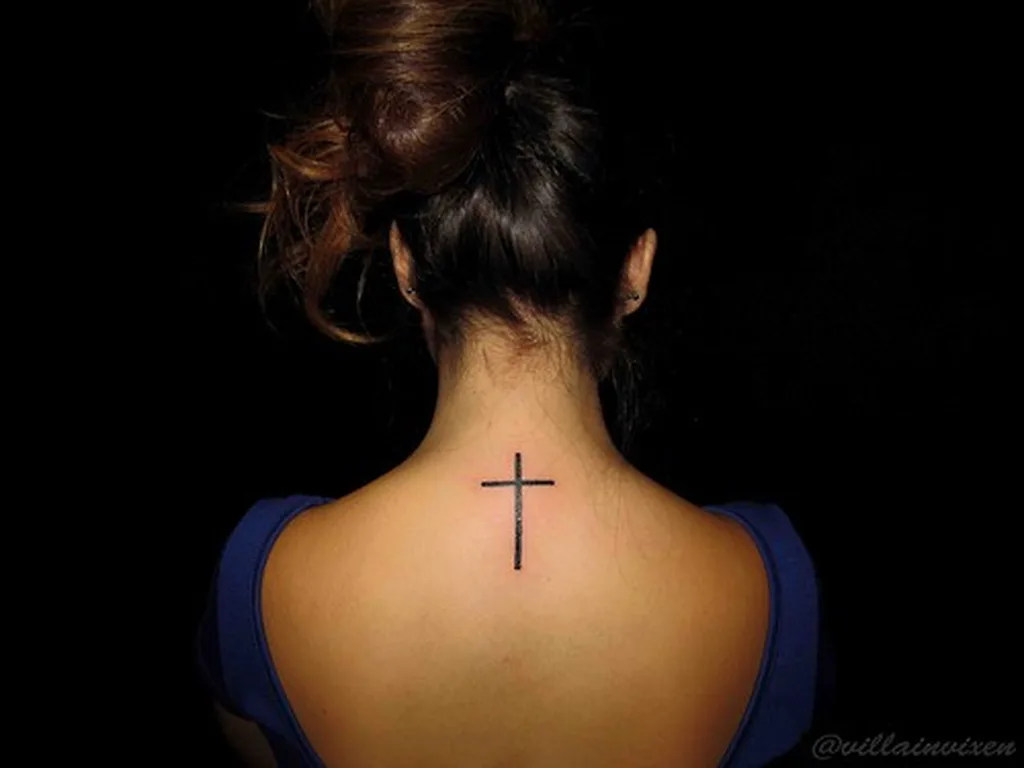
The opposite end of the scale: one thin line cross, a few centimetres tall, centred on the upper back. Small crosses like this are often private faith markers — a reminder worn for the wearer, not a statement for the room.
There is no inner detail to close up, so only the line itself softens. Our cross tattoo design ideas guide shows the full range between this and design 1.
7. Praying Hands With a Cross on a Hill
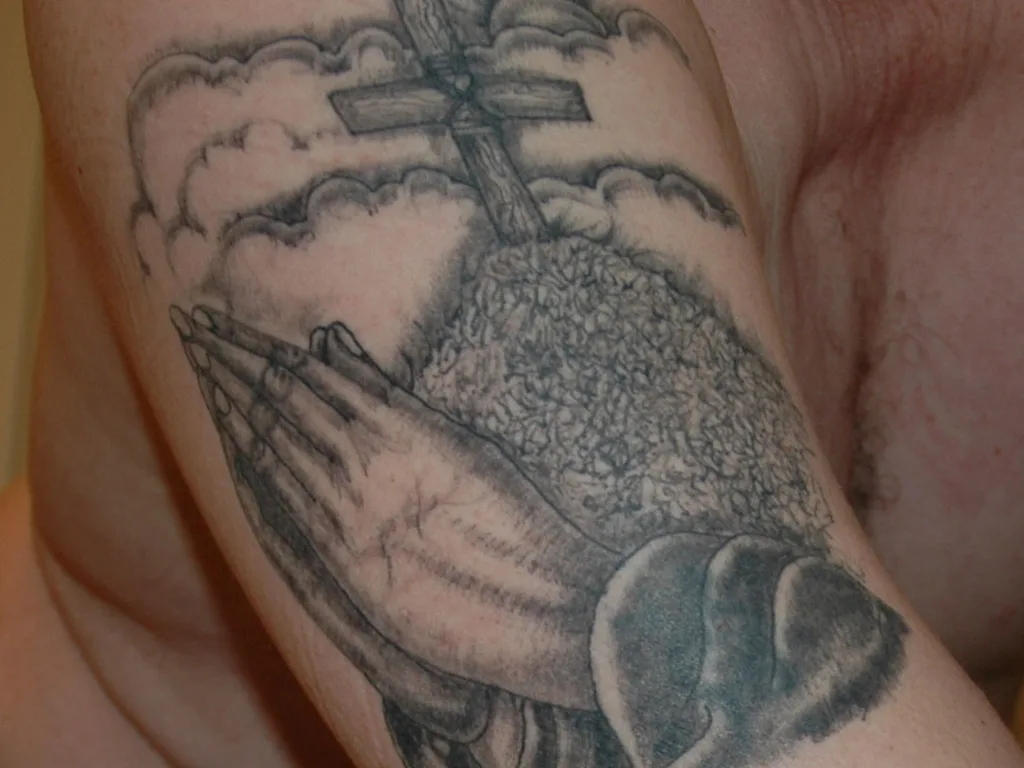
Praying hands are among the oldest Christian tattoo subjects, traced to a 16th-century drawing by Albrecht Dürer that became one of Christian art’s most copied images. Here they sit below a small cross on a hill, black and grey on the shoulder.
They are frequently memorial tattoos — for a parent or grandparent, someone prayed for, or someone who prayed for the wearer. Names and dates often fill the space around the fingers.
8. Colour Praying Hands Over a Sun Disc
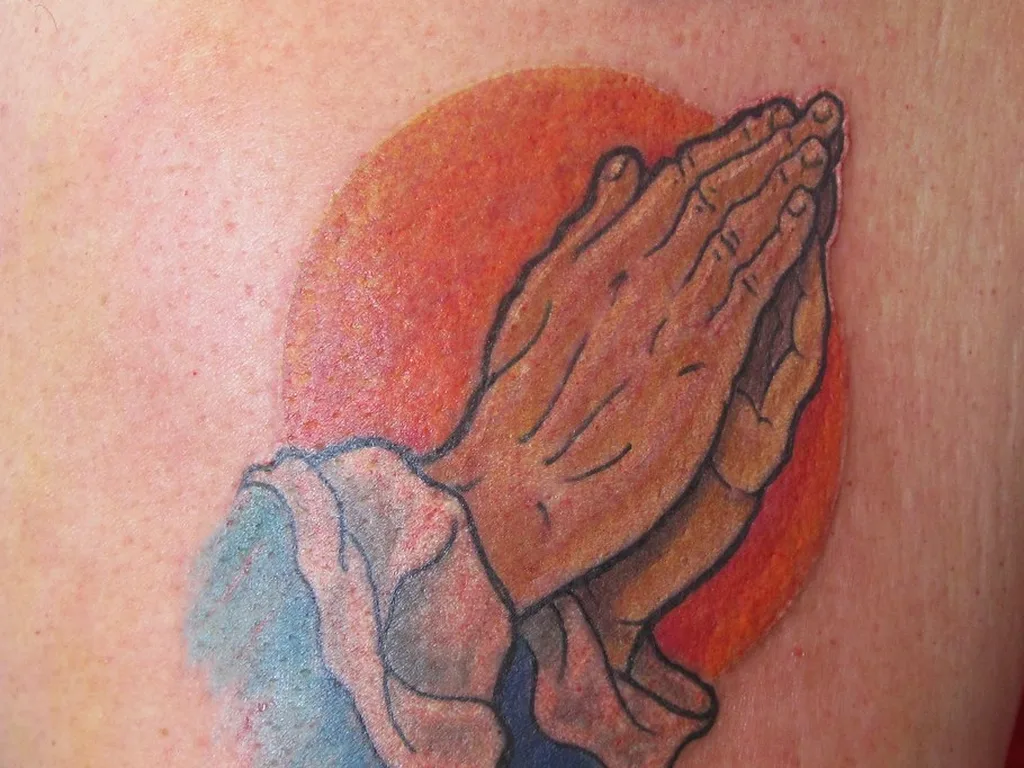
The same praying hands in colour, over a red-orange sun disc that works like a halo. The full photo carries “John 3:16” lettered above the hands — the New Testament’s most quoted verse, and a common pairing with praying hands.
Colour changes the mood: where design 7 reads as a memorial, this one reads as praise. The disc will soften first; the line-drawn hands outlast the glow.
9. Praying Hands Holding a Rosary
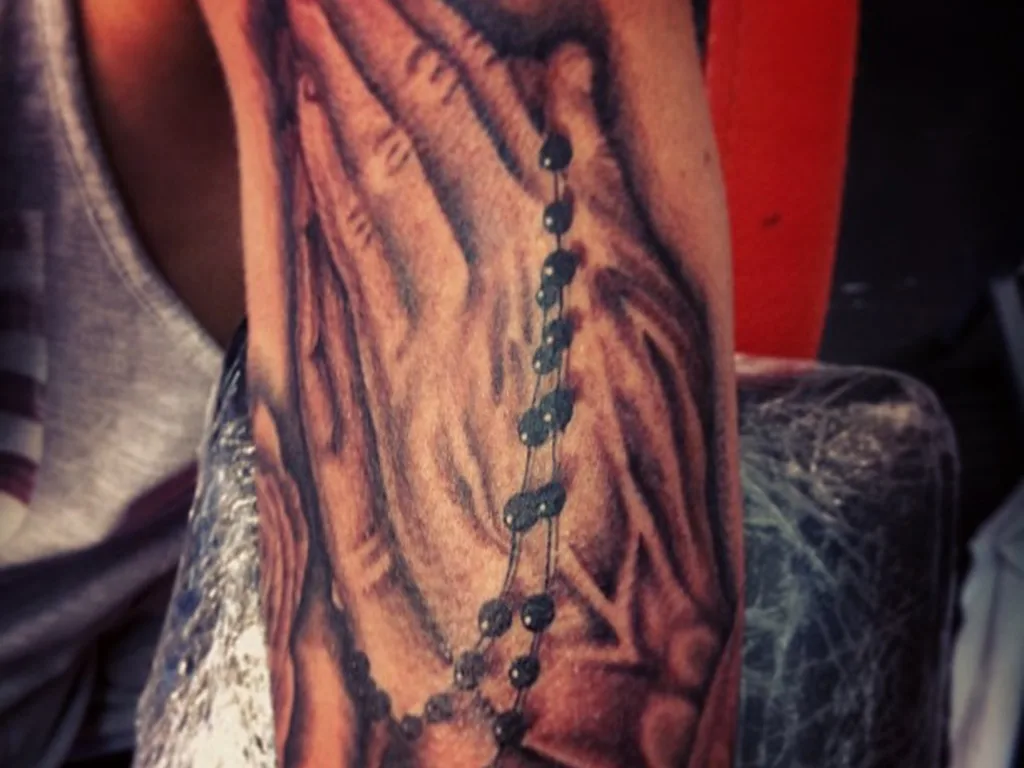
Praying hands with a rosary looped through the fingers, black and grey on a forearm. The rosary makes this a specifically Catholic version of the subject: the beads count a set cycle of prayers, most addressed to Mary.
Beads test an artist’s patience — near-identical circles that must stay evenly spaced around the fingers. Judge healed rosary work, not fresh work, when choosing who does it.
10. Jesus Portrait on the Upper Arm
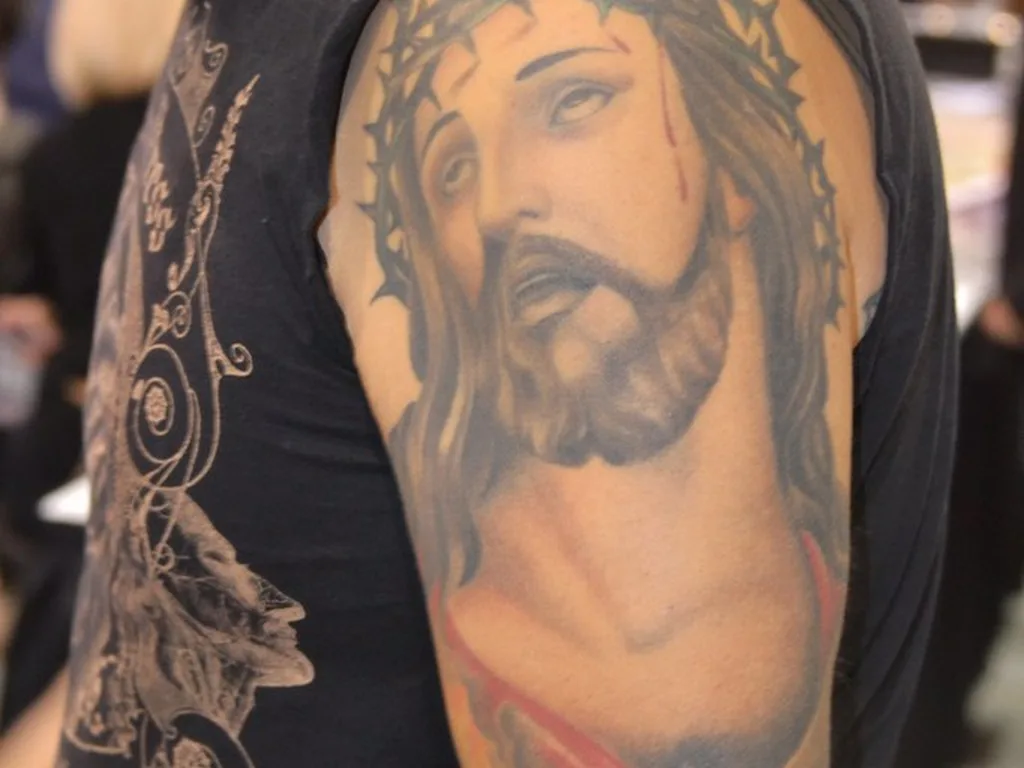
A black and grey portrait of Jesus on the upper arm, in the soft-shaded realism style Latin American and Chicano tattooing made its own. Portraits of Christ are usually devotion pieces, worn where the faith is personal and daily.
Portrait work lives on smooth shading, and smooth shading is the first thing time flattens. Upper arms help: stable, covered skin, easy to shield from sun.
11. Jesus Portrait Across the Back
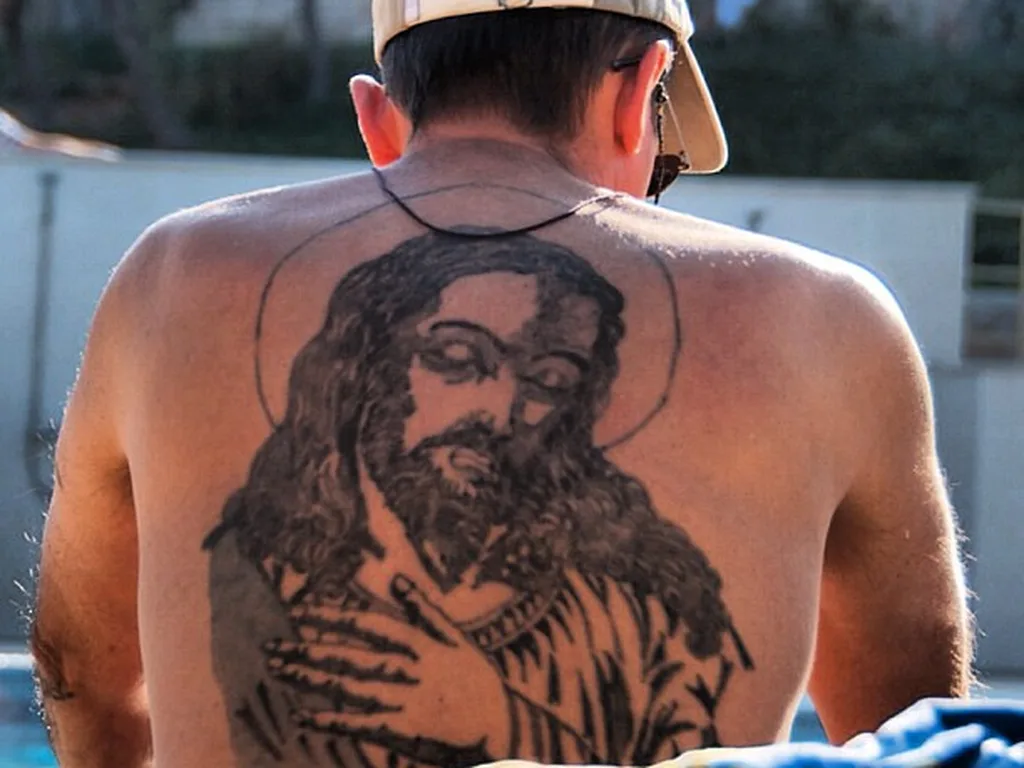
The same subject at full-back scale. A back gives a portrait what it cannot do without: a large, flat canvas where the face is big enough that the eyes and expression survive decades of softening.
Pieces this size are built over several sittings, shading layered in stages — the payoff reads like a painting, not a symbol.
12. Crucifixion Across the Full Back
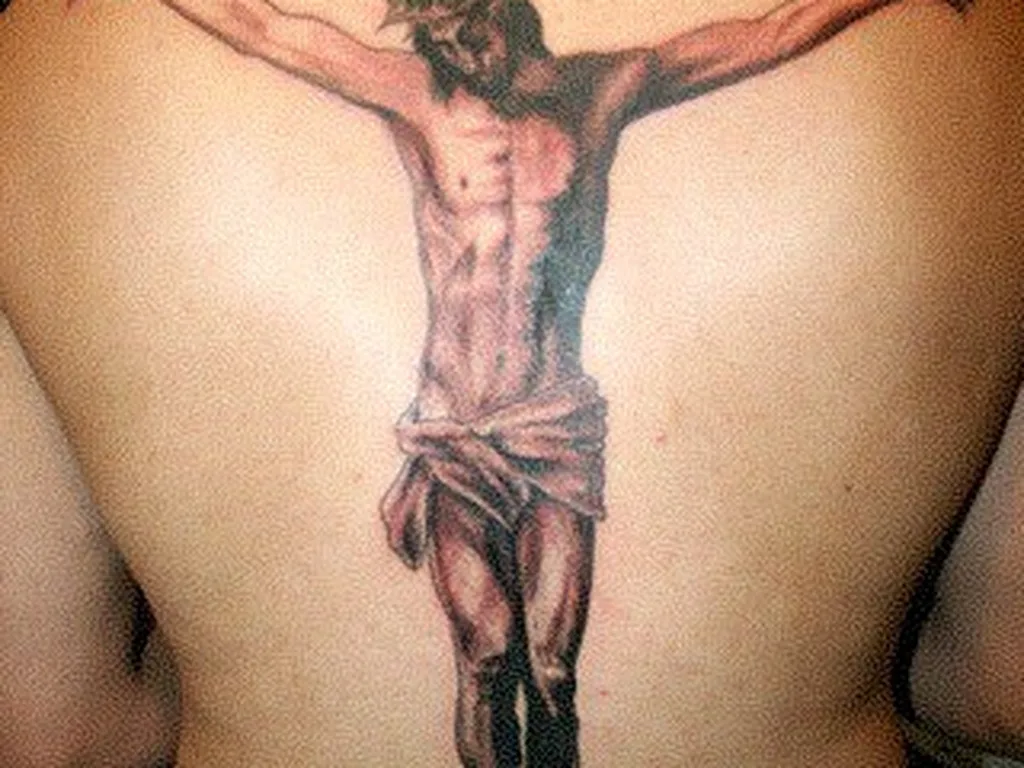
A full-back crucifixion: Christ on the cross, at tattooing’s largest scale. Crucifix imagery — the cross with the figure on it — is most at home in Catholic and Orthodox tradition; many Protestants choose the empty cross instead, a sign of resurrection rather than death.
Settle that choice before you book — crucifix or empty cross is a real theological difference, and artists watch clients change their minds mid-consultation often.
13. Christ on the Cross, Upper Arm
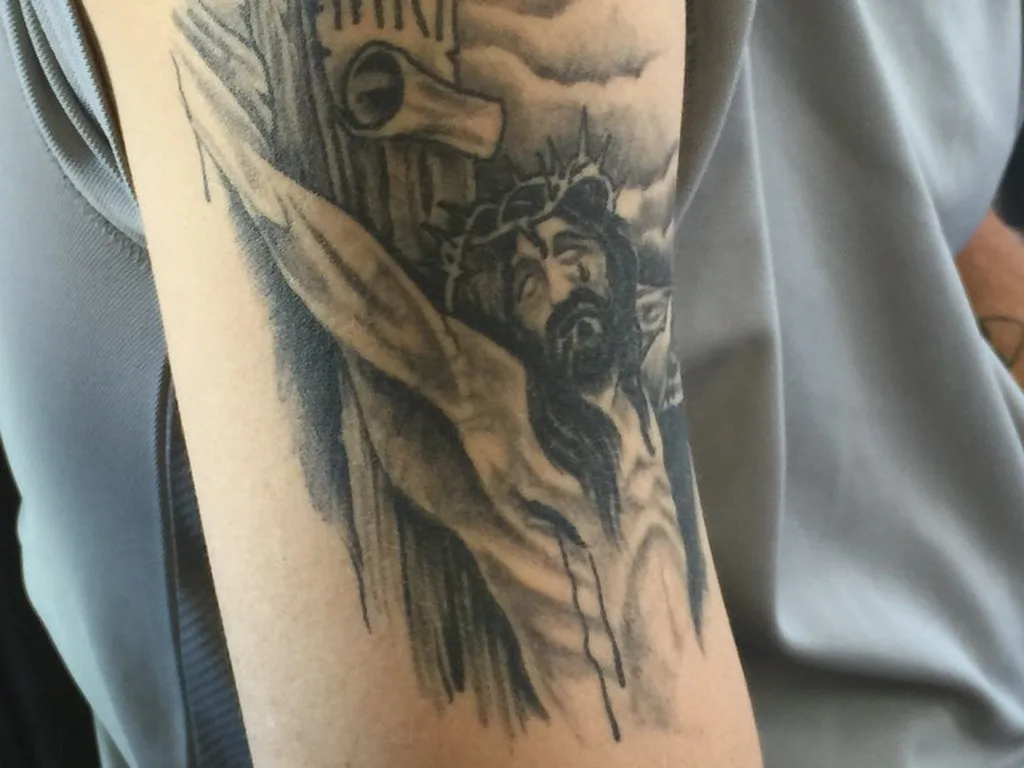
The crucifix at upper-arm scale, in black and grey. The cross’s arms follow the wearer’s own arm — why this placement has been a standard for generations: the body’s lines do half the composition.
At this size the figure must be simplified: face suggested, drapery in a few folds — good small crucifixes are exercises in leaving things out.
14. Virgin Mary Portrait, Close-Up
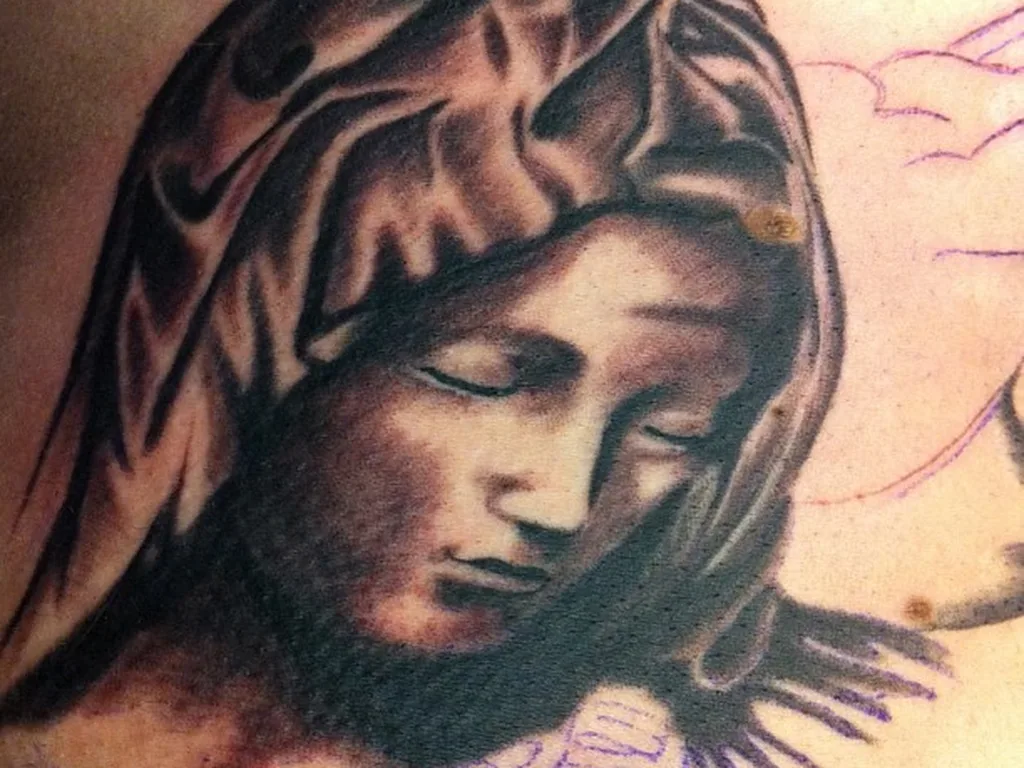
Mary’s face in a draped veil, black and grey, photographed close. Mary tattoos sit at the centre of Catholic devotion — prayed to as an intercessor, honoured as a mother — and double as memorial pieces for mothers and grandmothers more often than almost any other religious portrait.
The faint lines at the photo’s edge are stencil marks for the piece still being built around the portrait — usually one panel of a larger planned piece.
15. Our Lady of Guadalupe Back Piece
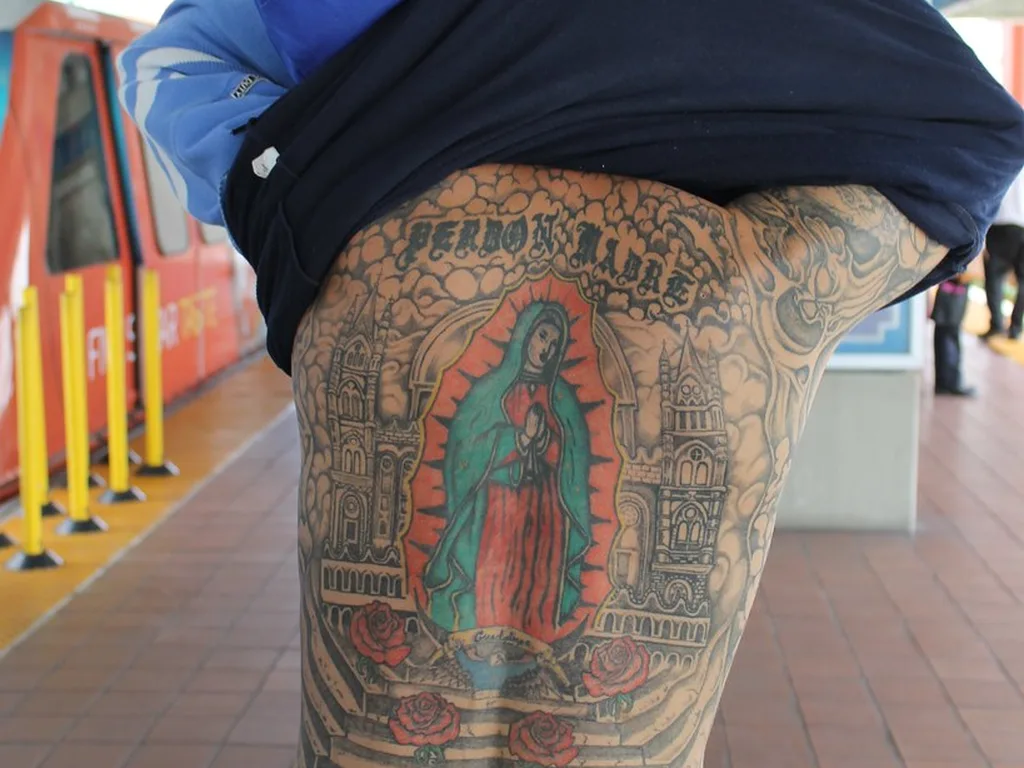
Our Lady of Guadalupe in full colour across a back: Mary in a mandorla of rays, on a crescent moon, in the blue-green mantle of the image venerated in Mexico City. Mexico’s patroness, she carries national and family identity along with devotion.
Colour is not optional for Guadalupe — the mantle and rays are how she is recognised, and large scale keeps those rays separate as the piece ages.
16. Virgin Mary With a Rose on the Forearm
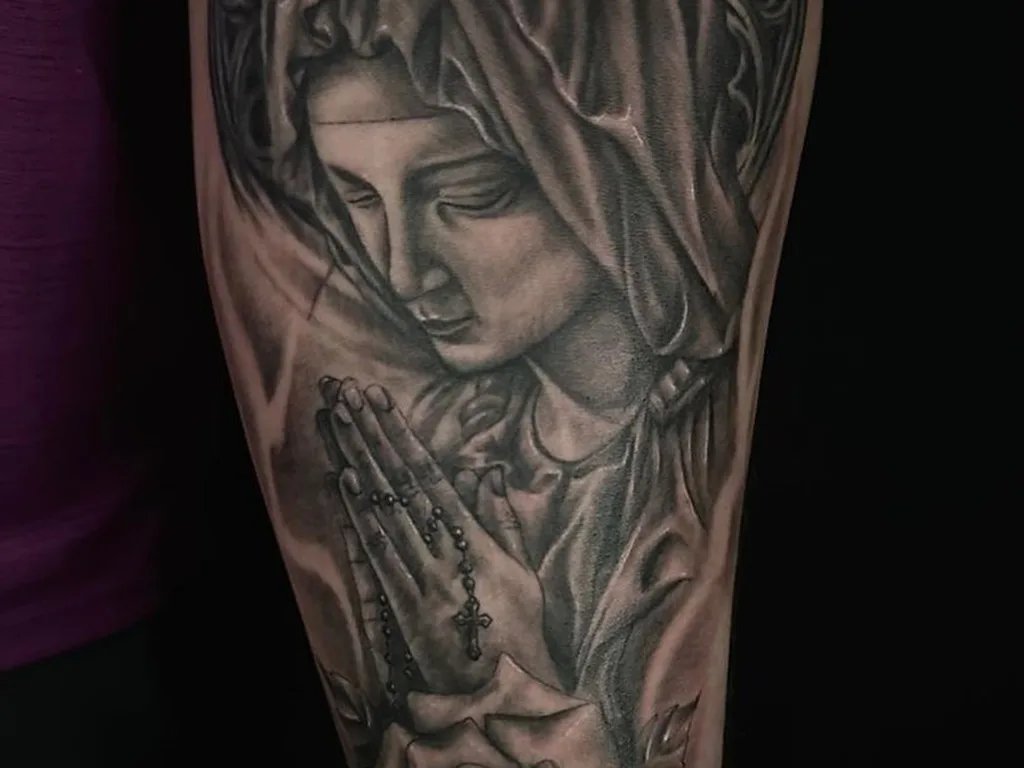
Mary with her own praying hands and a rose below, on a forearm. The rose is one of her oldest symbols — she is called the Mystical Rose in Catholic prayer — and it can take a name or date in its leaves without crowding the portrait.
The forearm is this section’s most public placement, chosen when the tattoo is part of how the wearer presents themselves.
17. Praying Angel With Doves on the Chest
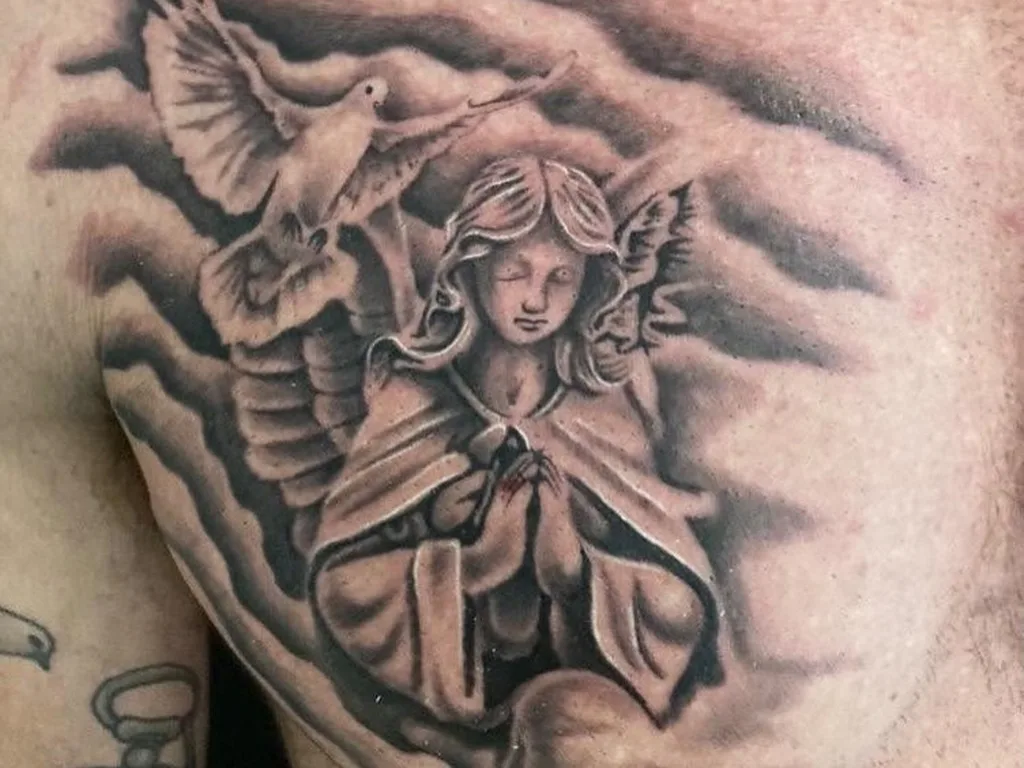
A praying angel in clouds with doves around it, across the chest and shoulder. Angels in Christian tradition are messengers and guardians, and one over the heart is usually a protection piece — for the wearer, or for children named in later work.
If wings are what you are really after, our angel wings tattoo ideas page gives them a full article of their own.
18. Dove in Flight on the Forearm
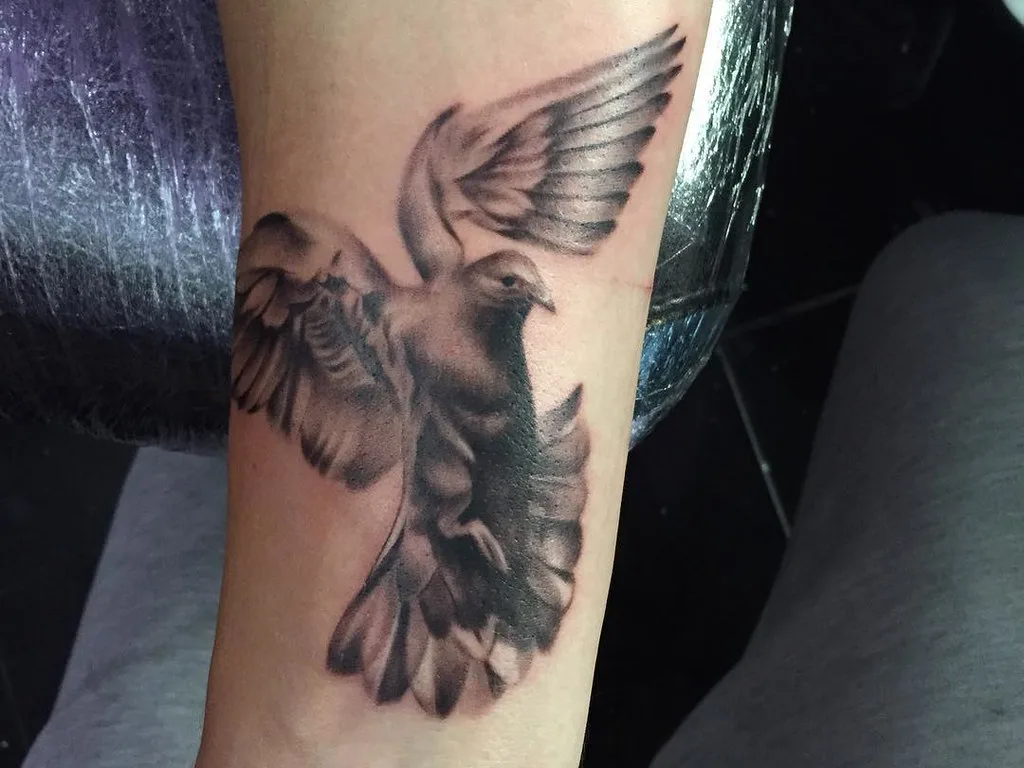
A single dove in flight. In Christian symbolism the dove is the Holy Spirit, descending at Christ’s baptism, and also the bird Noah released — peace after a flood, something survived. That second meaning puts doves in many memorial tattoos.
Doves are drawn soft, their feather detail fading gracefully rather than breaking up — a detailed subject that looks natural as it mellows.
19. Rosary Around the Wrist, Cross on the Hand
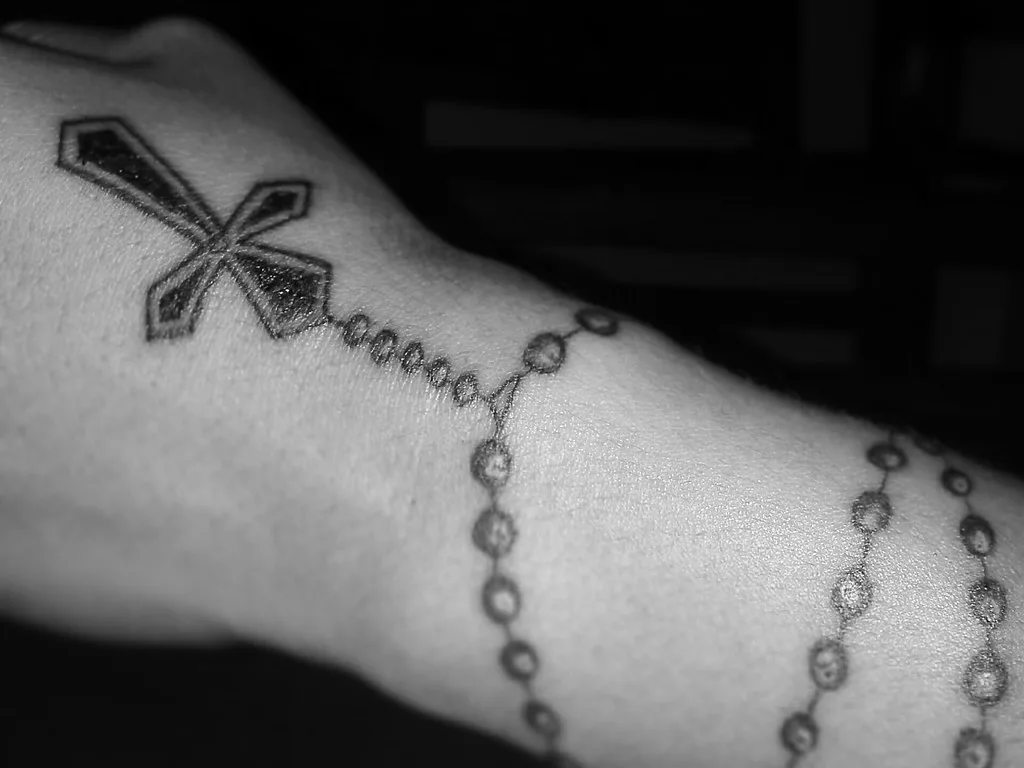
A rosary tattooed where a real rosary would fall: beads wrapping the wrist, cross on the back of the hand. It copies the jewellery exactly, which is the point — the wearer carries the beads permanently.
The honest warning: hands and wrists are the body’s fastest-fading skin. Bead chains there need touch-ups to stay readable, and bead detail goes first.
20. Rosary Anklet With a Cross Pendant
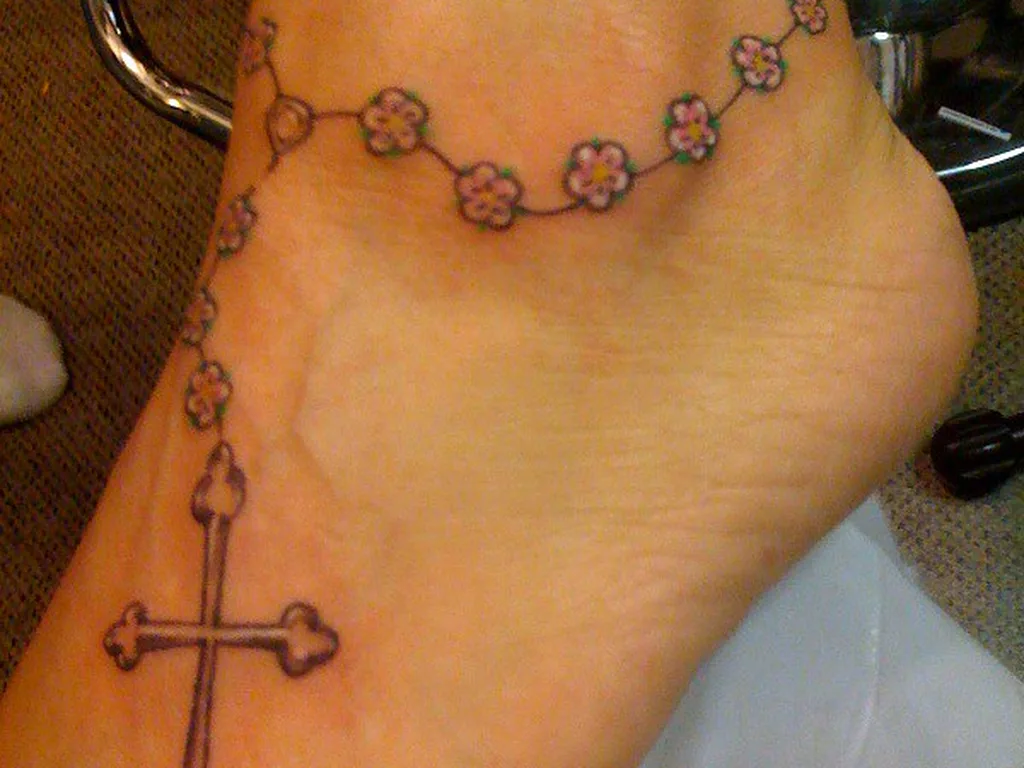
The rosary moved to the ankle, worn as an anklet with its cross as a pendant. The ankle is kinder skin than the hand — sock-covered part of the year, out of the wash cycle.
Shoe straps rub where the pendant hangs, so the cross is best drawn bold and simple, as here.
21. Eagle Wings With Isaiah 40:31 on the Chest
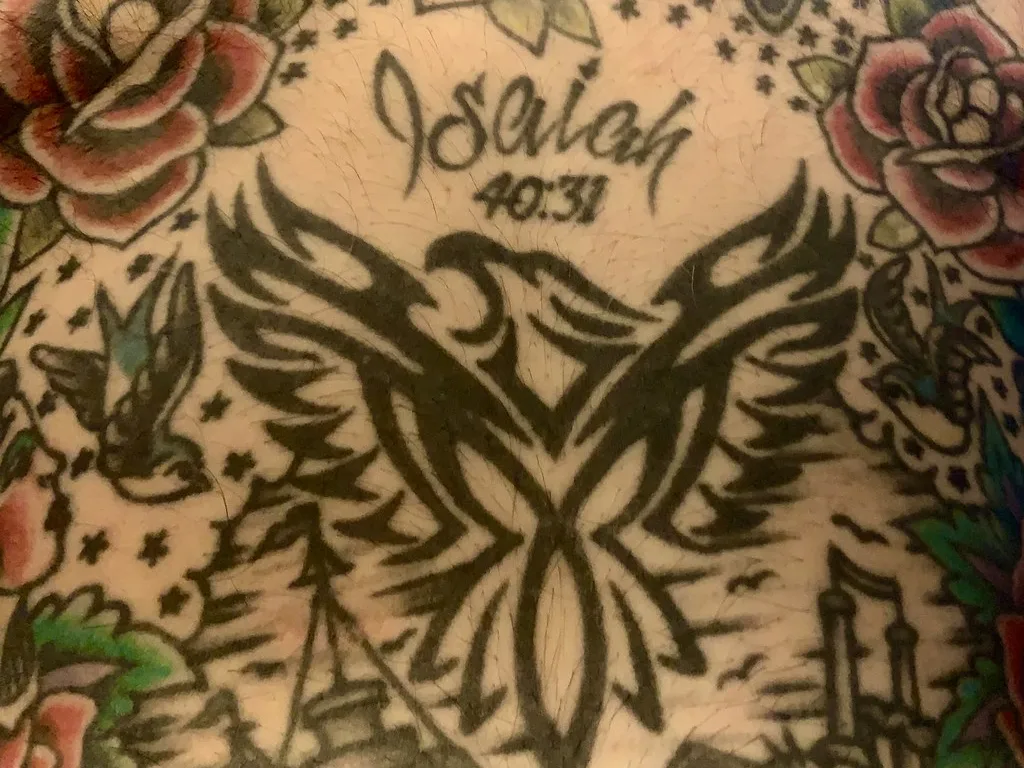
Spread eagle wings across a chest with “Isaiah 40:31” worked in — the verse promising that those who wait on the Lord “shall mount up with wings as eagles.” One of the most tattooed verses in the Bible, it usually marks endurance: an illness, a deployment, a hard stretch finished.
Citing the verse by address keeps lettering small while the reference carries the whole text.
22. Bible Verse Script Down the Forearm
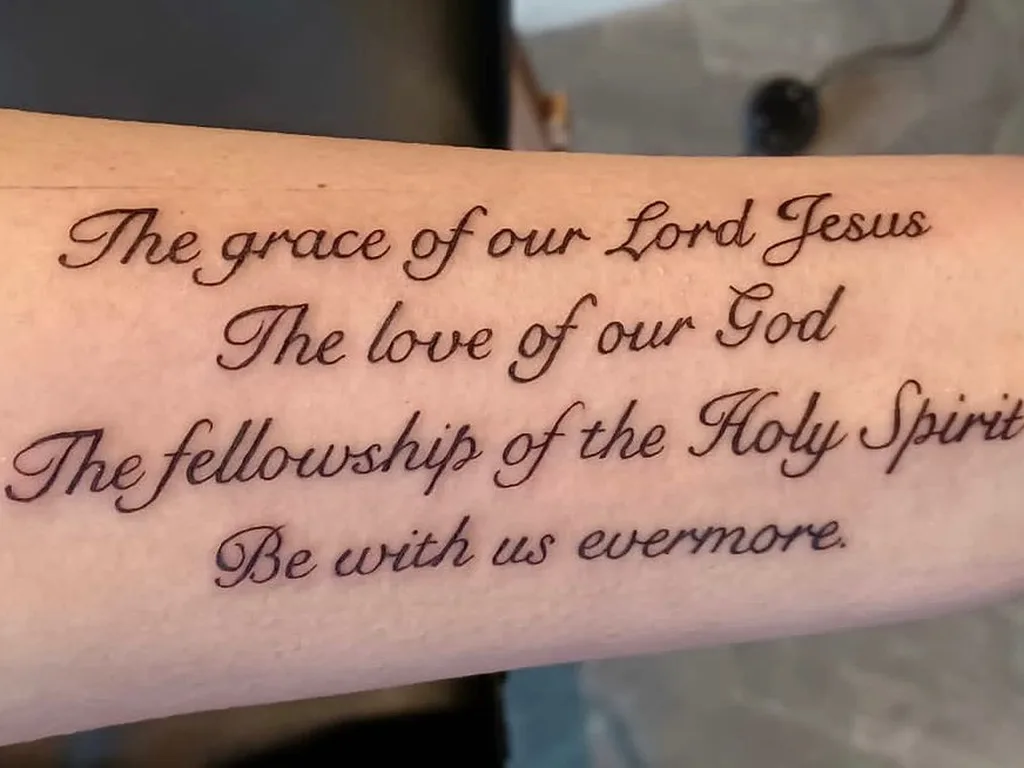
A benediction — “The grace of our Lord Jesus…” — scripted in cursive down a forearm. Full-text verse tattoos are the most literal religious tattoos there are: the words themselves are the design, meant to be read daily.
Proofread the stencil against the Bible text yourself, letter by letter, before the needle starts — a verse is the worst place for a transposed letter.
The ichthys, honestly noted: the fish symbol — two arcs forming a fish, used by early Christians as a quiet sign of faith — is a much-requested small religious tattoo, and the licensed pool holds no clear photo of one on skin. It is noted in words instead: a two-arc outline, often with a cross for an eye, worn small at the wrist, ankle or behind the ear.
Buddhist Tattoo Ideas
Buddhist tattoos split into two families: devotional images — the Buddha himself, and Chenrezig, the bodhisattva of compassion — and sak yant, the sacred tattoos of Thailand and Cambodia, traditionally given by monks or former monks with a bamboo rod and activated with a blessing. Sak yant come with precepts the wearer is asked to keep.
23. Colour Buddha With Lotus and Blossom on the Arm
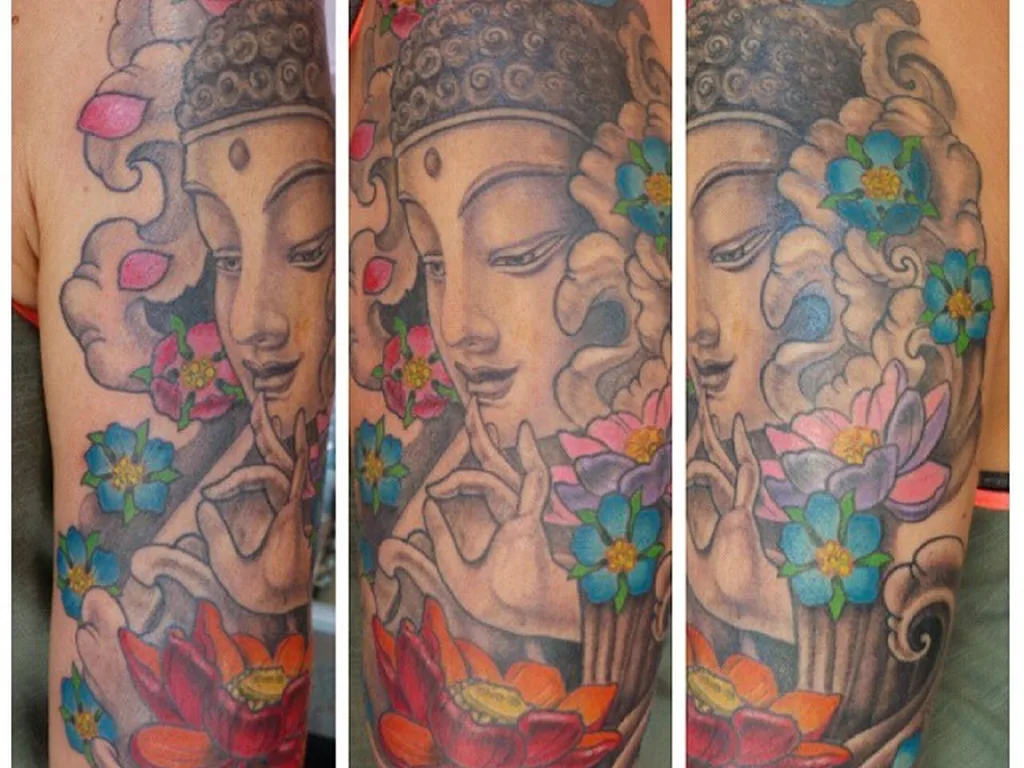
The Buddha in colour, seated with a lotus and cherry blossom around him, photographed from three angles on one arm. The lotus is Buddhism’s central flower — it roots in mud and opens clean on the surface, the tradition’s picture of a mind waking up. Our lotus tattoo meaning page covers it in detail.
A respect note for every Buddha here: in Buddhist cultures the image is sacred, and placing it low — feet, ankles, lower legs — reads as an insult. Arms, back and chest draw no objection.
24. Chenrezig Full-Back Piece
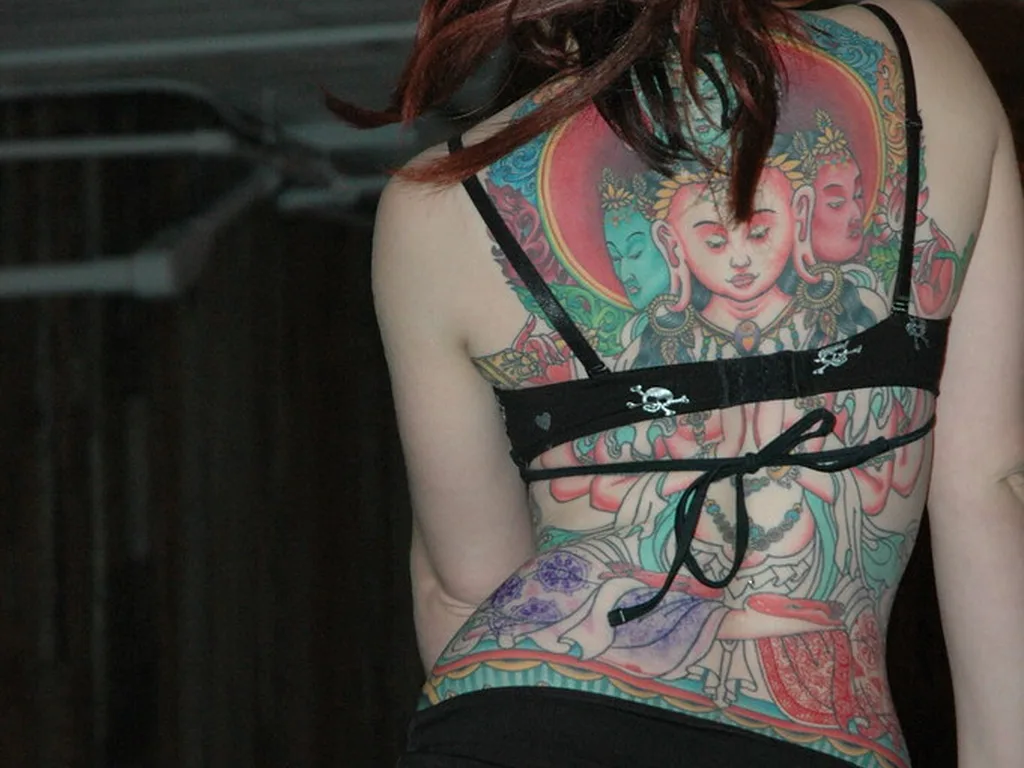
Chenrezig — Avalokiteshvara in Sanskrit — the bodhisattva of compassion, drawn with many heads and arms across a full back. In the traditional telling, the extra heads and arms came from compassion itself: he surveyed the world’s suffering and multiplied to see more of it and reach more of it.
A Tibetan Buddhist image, and a serious one — a devotional undertaking measured in years of sittings, not a decorative choice.
25. Buddha Silhouette Seated on a Lotus
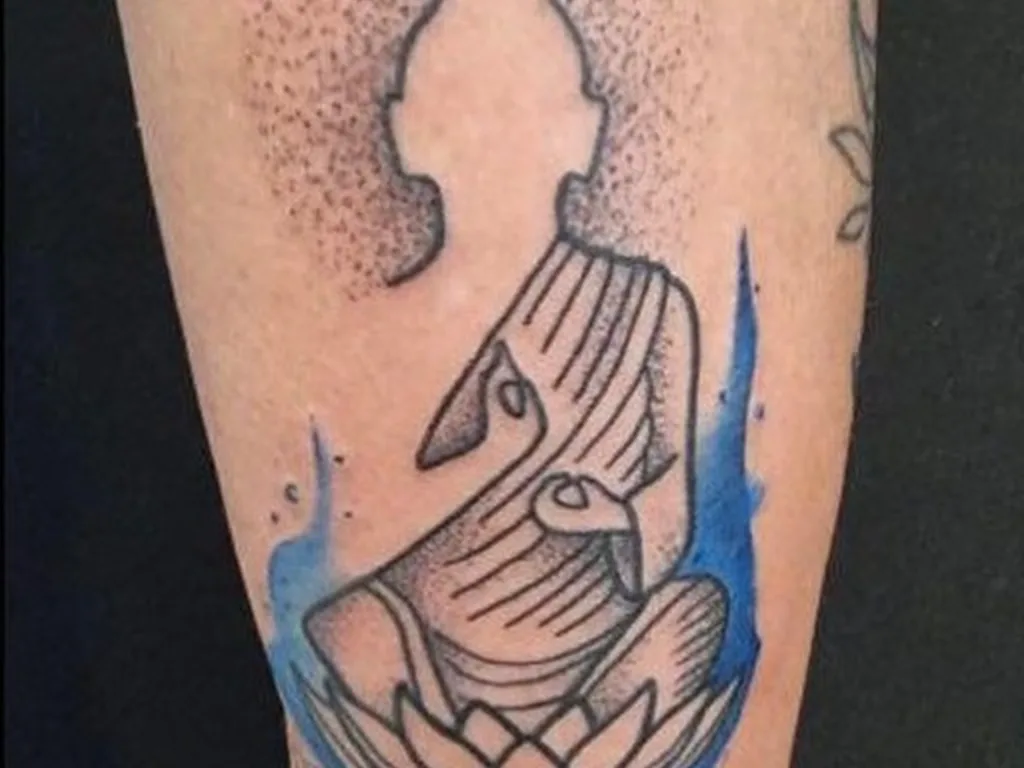
The Buddha reduced to a silhouette, seated on a lotus on a forearm, loose blue watercolour around it. This is how he usually appears in Western tattooing: meditation itself as the subject, not the teacher’s portrait.
A silhouette is forgiving — no facial features to distort, and the shape reads at any distance. The wash softens first; the silhouette still works when it does.
26. Buddha Face With a Mandala Crown
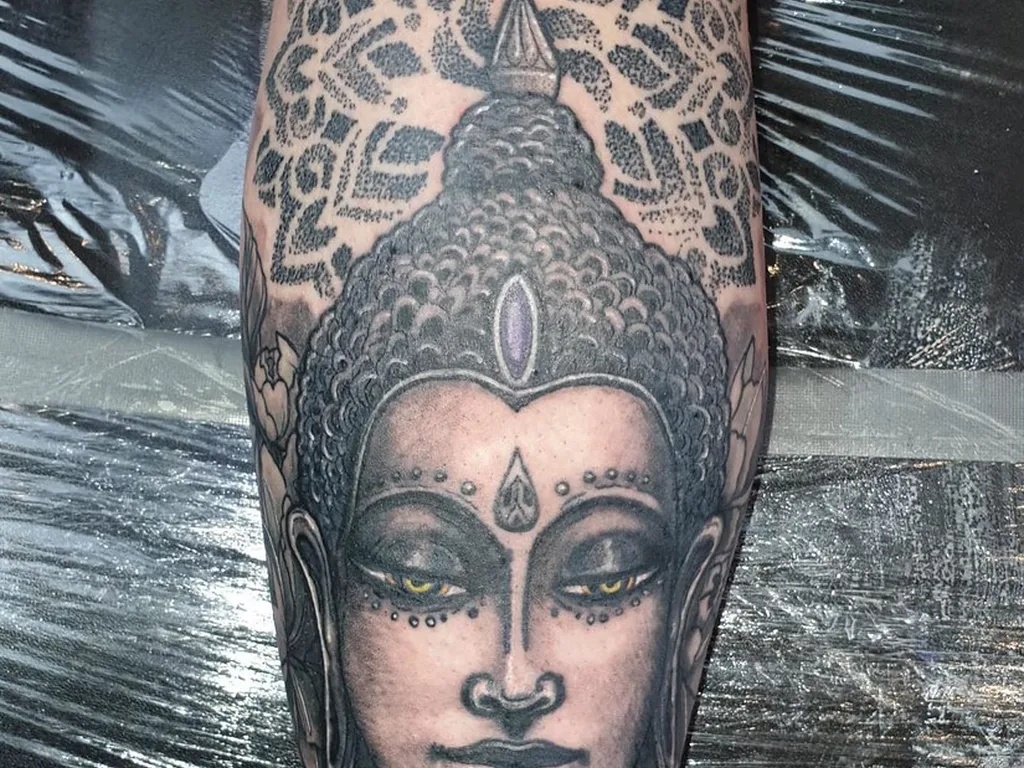
A calm Buddha face in black and grey, crowned with a mandala pattern, on a forearm. The serene expression is the point — a reminder of the state the wearer is practising toward, which is why the face is never drawn strained or fierce.
Faces need size. On a forearm the features sit close to the smallest they can honestly go; smaller, and the closed eyes go first.
27. Unalome on the Upper Back
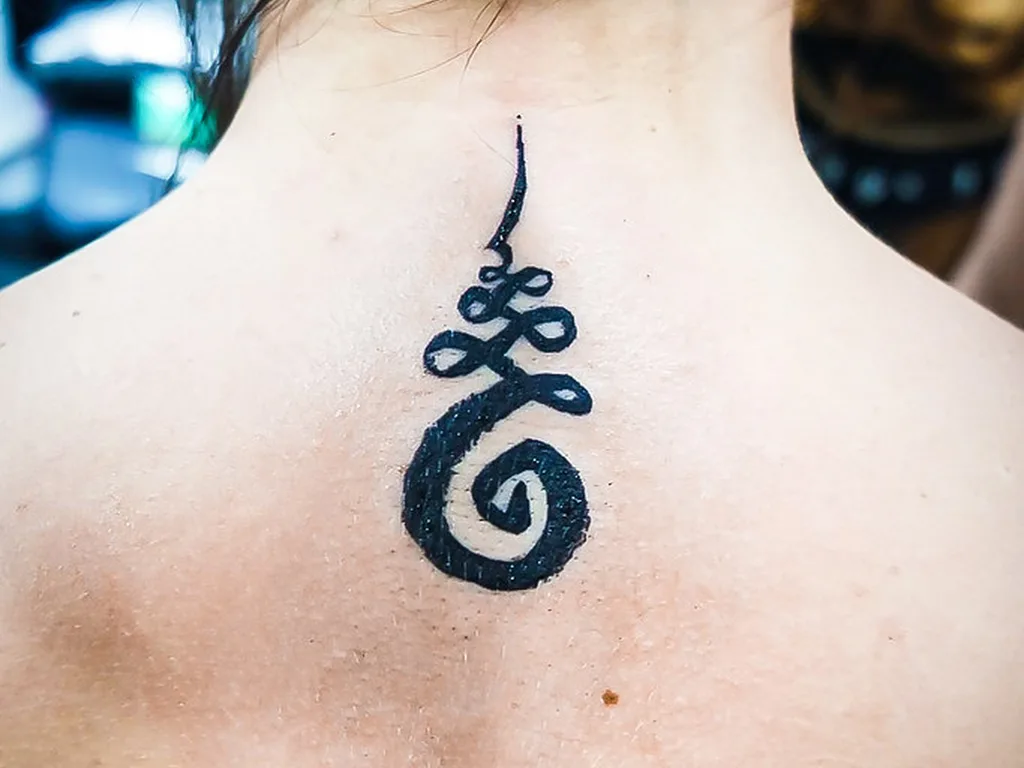
The unalome: a spiral at the base, a wavy line rising from it, dots at the top. In its home tradition it stands for the path to enlightenment — the spiral is a life’s twists, the wave its later stages, the dots the finish. The photo catches the bamboo rod in frame; this one was done the traditional sak yant way.
Now a popular small tattoo far outside Buddhism, the unalome is still a sacred symbol, not a decorative squiggle — worth checking against a traditional example, since garbled versions circulate widely.
28. Gao Yord — The Nine Spires Sak Yant
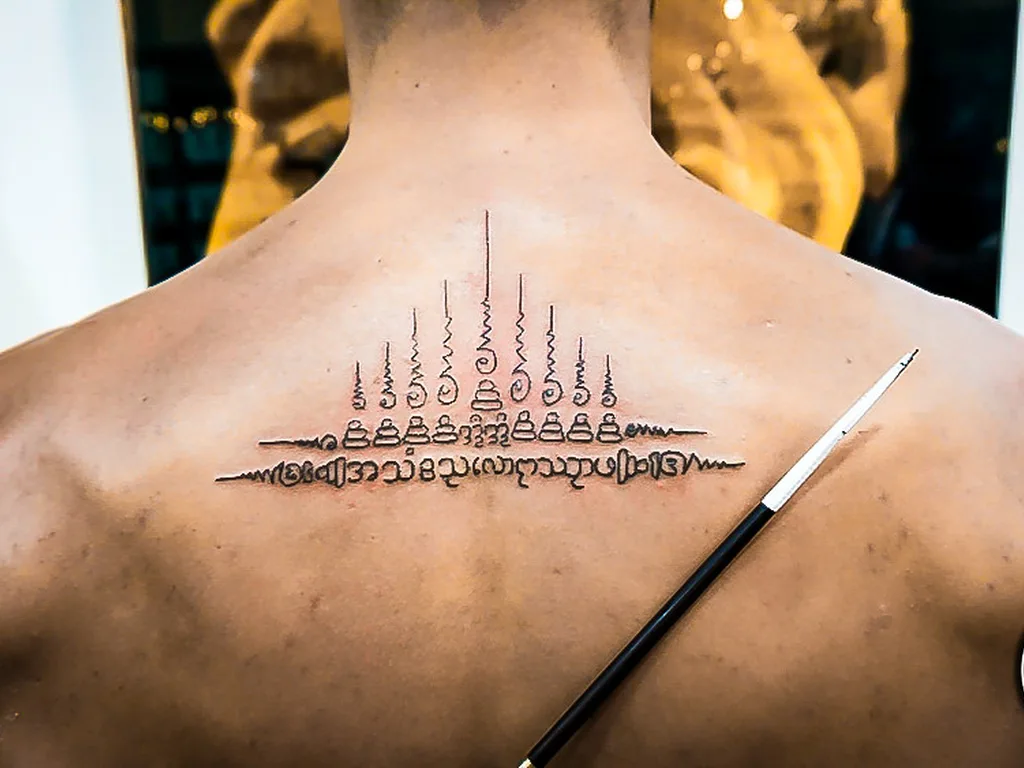
The Gao Yord is the master sak yant: nine spires across the upper back, for Mount Meru’s nine peaks and the Buddha’s nine virtues, script below holding the blessing. Traditionally the first sak yant received, it sits high on the body because of what it represents.
Sak yant are given with prayer, activated with a blessing, kept with precepts. A studio copy reproduces the look, not that.
29. Twin Tigers Sak Yant
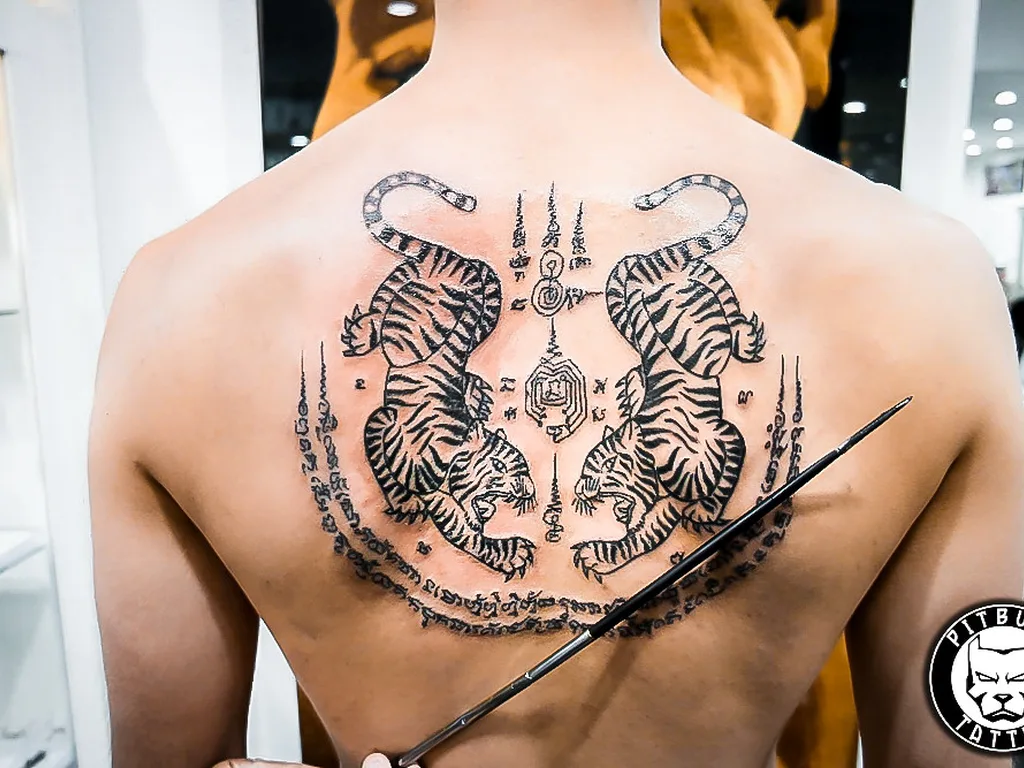
Two tigers facing each other across the back, ringed with Khmer script — the Suea Koo, or twin tigers. In the sak yant tradition the tiger stands for power and authority; doubled, it is worn for strength and protection, historically by fighters and soldiers.
The script is Pali in old Khmer letters — mantra, not decoration — and the part most often copied wrongly abroad.
Hindu Tattoo Ideas
Hindu tattoos centre on the divine in named forms: Om, the sound everything begins from; Ganesha, remover of obstacles; Shiva, destroyer and meditator; and script itself used as devotion. Design 35 is not a studio tattoo at all, but a living tradition photographed as practised.
30. Om on the Upper Arm
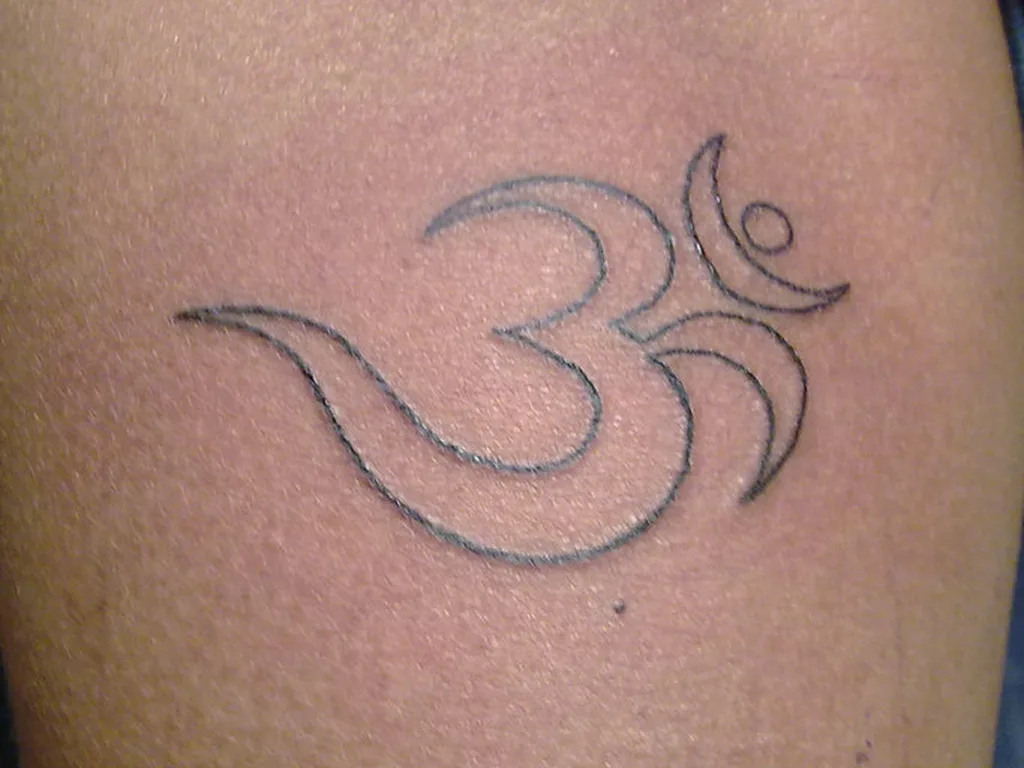
Om, drawn as a single clean line on an upper arm. Om is the primordial sound in Hindu thought — the syllable the universe is said to be built on, chanted at the start of prayers and meditation. As a tattoo it is design 6’s small cross in Hindu form: compact, complete.
Its curves carry meaning — read as the three states of consciousness — so copy an Om from a correct source, never freehand: a wrong curve is a wrong letter.
31. Ganesha on the Forearm
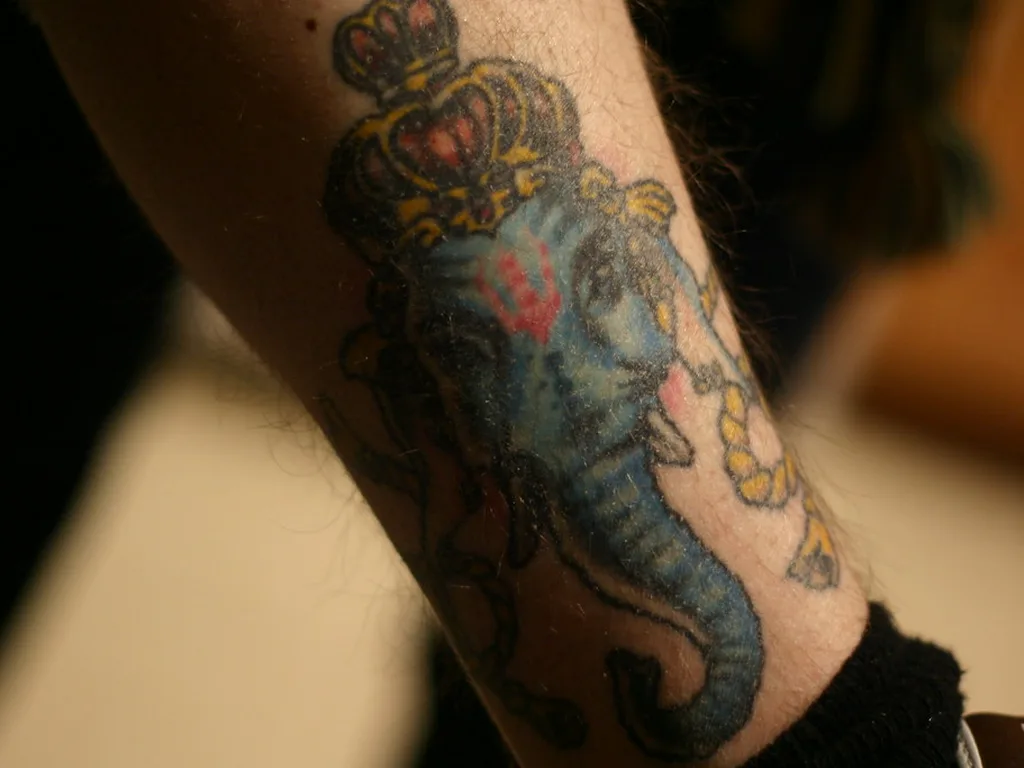
Ganesha in colour on a forearm — the elephant-headed god, one tusk broken, his sweets and mouse nearby in fuller versions. Remover of obstacles and god of beginnings, prayed to first before any venture, he is often booked to mark one — a business, a move, a recovery, a start.
He is also the Hindu deity most often tattooed outside the faith; the respectful version keeps him whole and recognisable, not an elephant-head doodle.
32. Shiva on the Forearm
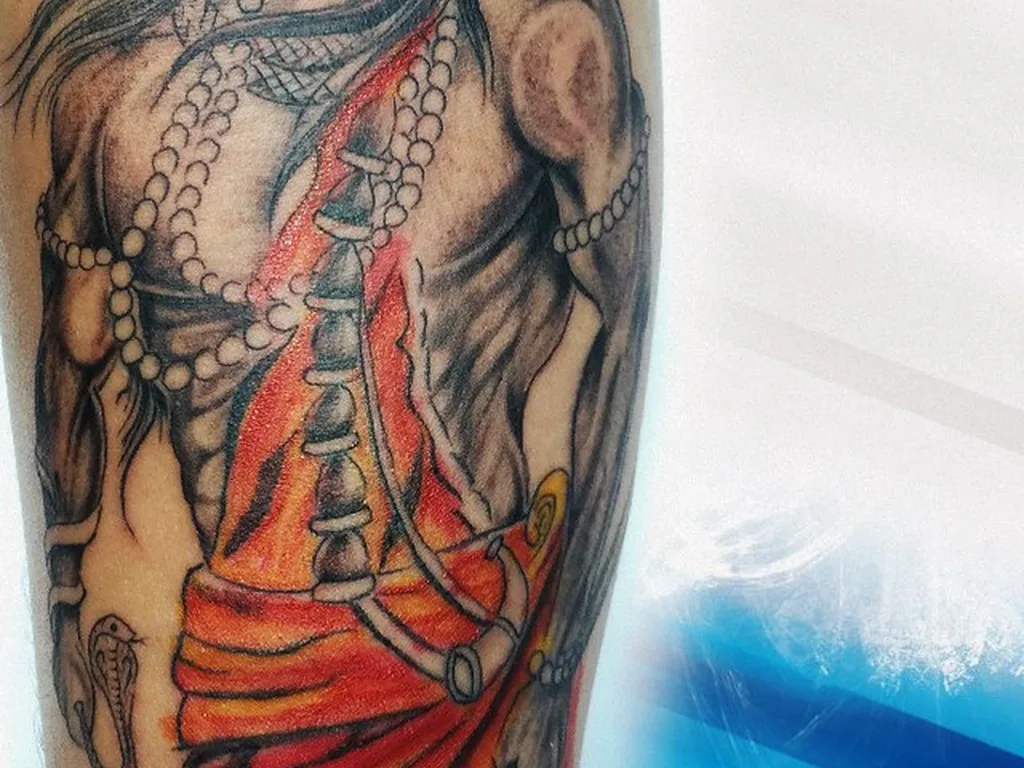
Shiva in full figure and colour: crescent moon in his hair, third eye on his forehead, trident and snake marking him. The destroyer in the Hindu triad — destruction as clearing ground for renewal — and patron of meditators, he is often worn by people drawn to the faith’s disciplined side.
Full-figure deities are demanding — faces, hands and attributes must all read at once — and forearm scale is about their floor.
33. Garuda on the Shoulder
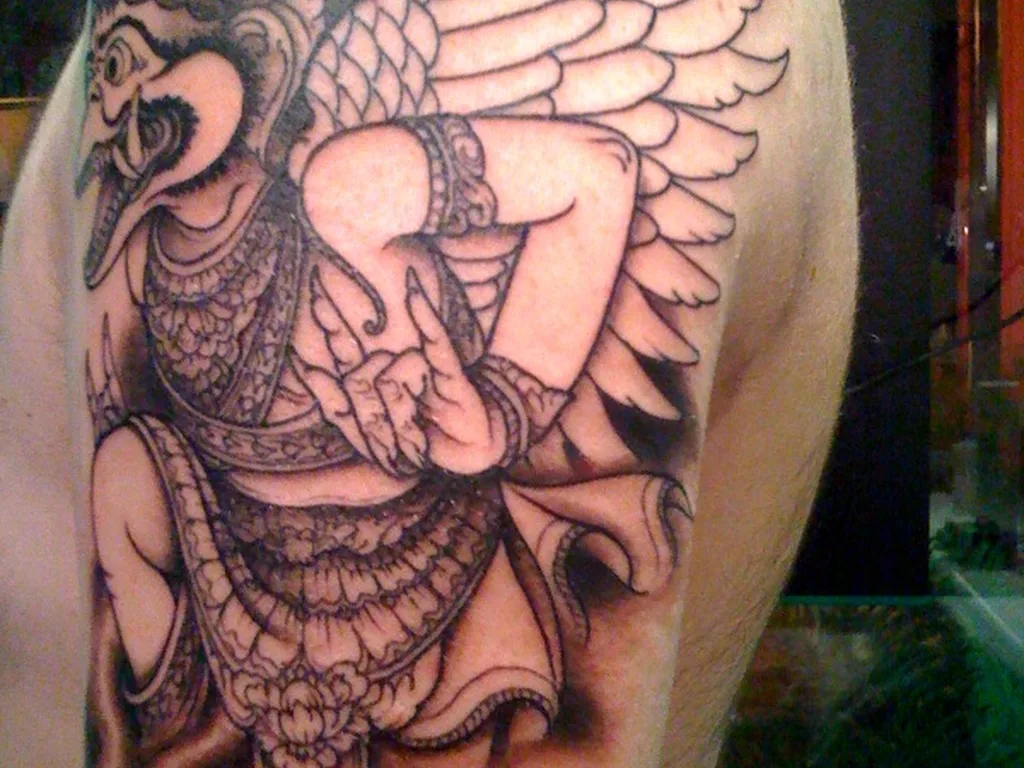
Garuda, the great bird who carries Vishnu, in black and grey over an upper arm and shoulder. He stands for speed, power and devoted service — a Hindu figure and a national emblem in Thailand and Indonesia, shown on Thai official documents as a mark of royal authority.
Winged figures wrap well around a shoulder, the wing following the deltoid’s curve — the same trick angel wings use, from another world entirely.
34. Sanskrit Script Across the Upper Back
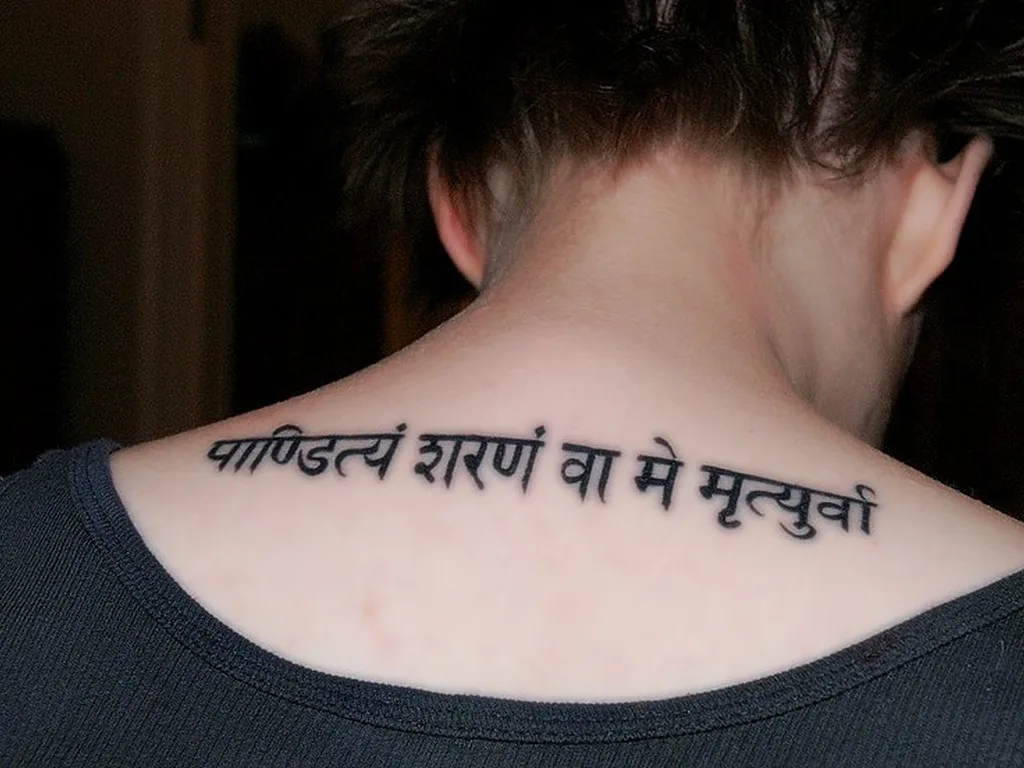
A single line of Devanagari script across the upper back, below the neck. Sanskrit is Hinduism’s liturgical language — of the Vedas and mantras like the Gayatri — and a line of it worn high sits half private, half seen.
Devanagari letters hang from a headline stroke; if it breaks or letters are misjoined, the words break with it. Here the “check it with a reader” rule matters most.
35. Ram Nami — A Face Covered in Ram’s Name
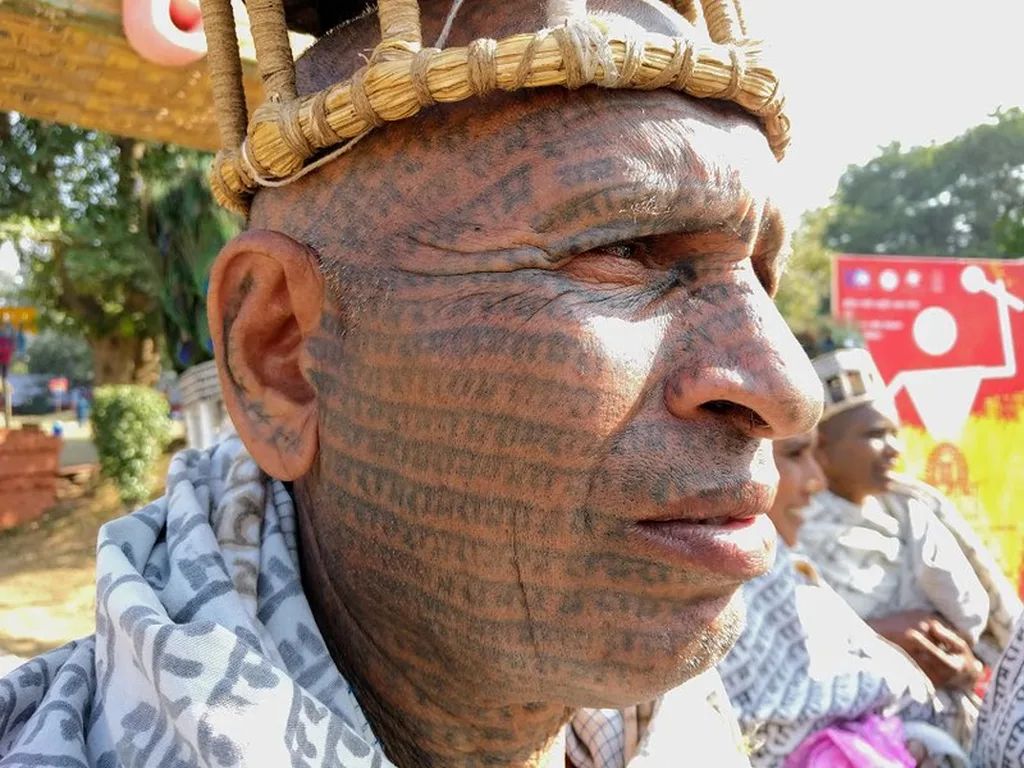
This photograph is not a studio piece. It shows a devotee of the Ramnami tradition of Chhattisgarh, India, his face covered with the name of Ram tattooed over and over. Ramnamis, historically barred from temples by caste, wrote their god’s name on their own bodies instead — the body became the temple. The practice continues today.
It closes this section deliberately: for many, a religious tattoo is not self-expression in the modern sense, but worship itself, worn where everyone can see whose the wearer is.
Jewish Tattoo Ideas
This is the shortest section on the page, and the honesty matters more than the length. Tattooing sits in a complicated place in Judaism — a line in Leviticus (19:28) against marking the skin is why many Jews do not tattoo at all, and why a tattooed Star of David is, for some families, fraught. Others wear one deliberately, as identity and remembrance. Both licensed photos the pool contains are Stars of David; the chai and menorah had none, so they are not pictured.
36. Shaded Star of David on the Upper Arm
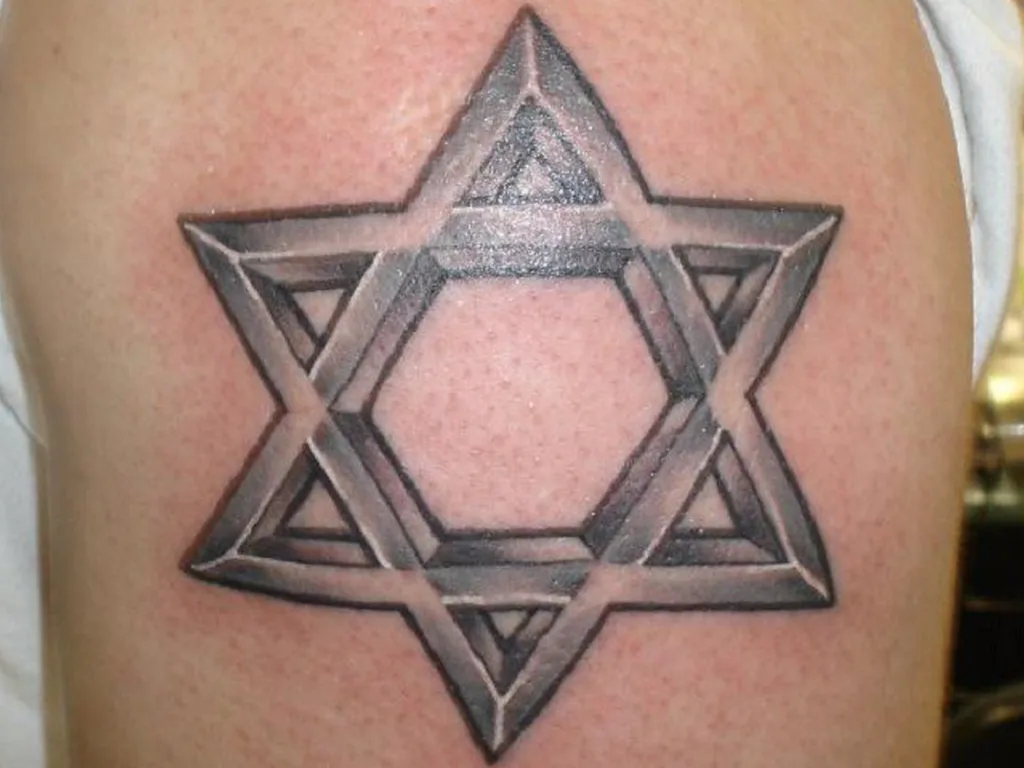
The Star of David — two overlapping triangles, the Magen David, the shield of David — shaded to sit three-dimensionally on an upper arm. The world’s most widely recognised Jewish symbol, carried on Israel’s flag and worn as a pendant by millions, it usually states ancestry and belonging rather than practice.
The geometry is unforgiving — two triangles either align or visibly do not — so stencil carefully and check from several angles.
37. Black Star of David on the Forearm
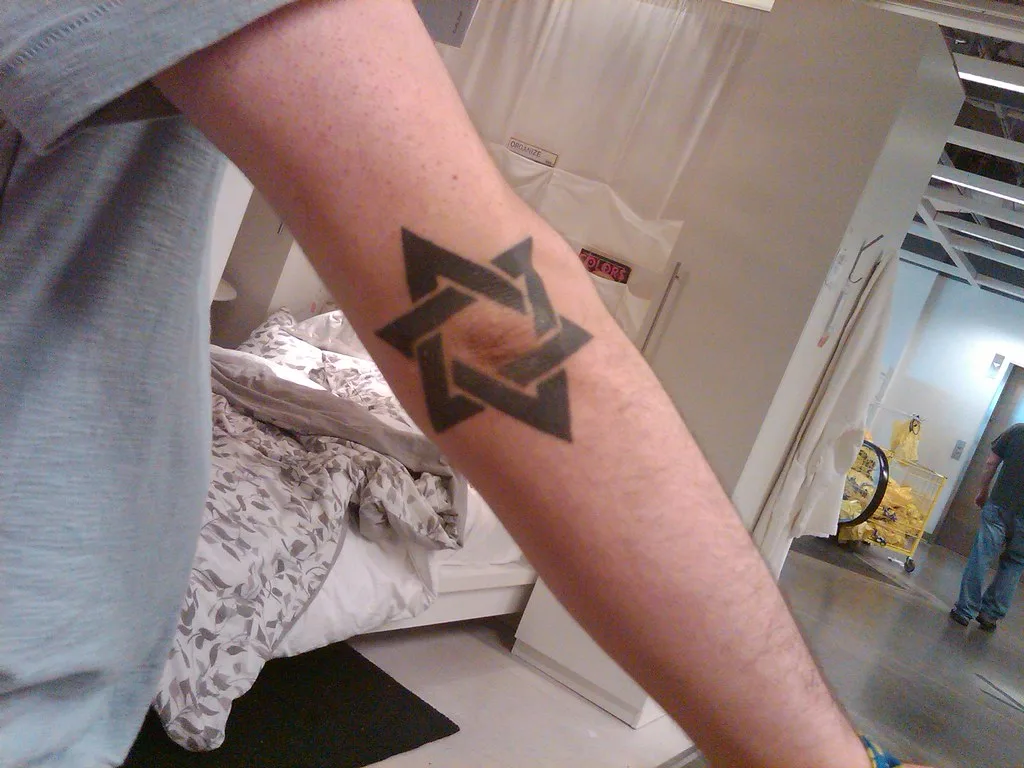
The same star as a flat black forearm piece — a public statement in a way design 36 is not, visible in every handshake. That suits the memorial and solidarity reasons many choose it for, including memory of family lost in the Holocaust.
Solid black stars age well. Keep the inner skin windows generous at the stencil stage and the star will not close into a blob over the years.
Sacred Geometry and Shared Symbols
The last ten designs belong to no single religion, or to several at once. Mandalas come out of Hindu and Buddhist practice. The hamsa is shared by Jewish and Middle Eastern cultures. The evil eye is older than most religions still practising. These are designs people reach for when they want the sacred without a creed — with meanings still worth knowing first.
38. Circular Mandala on the Upper Arm
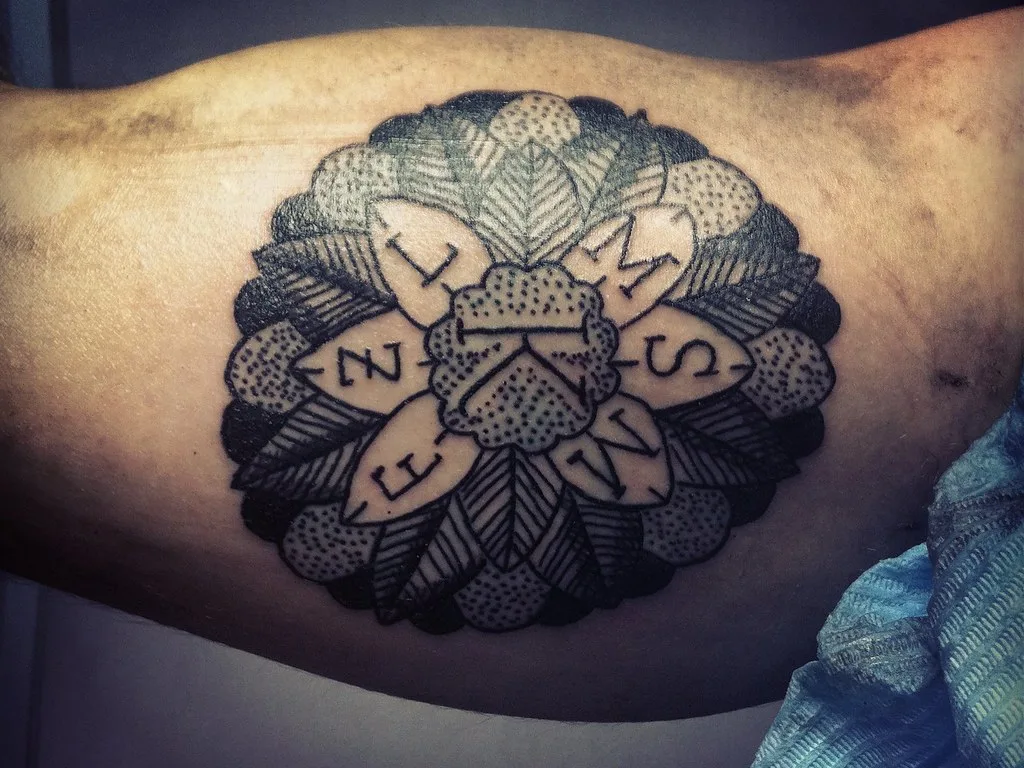
A mandala is a map before it is a picture: in Hindu and Buddhist practice, a geometric arrangement of the universe, drawn to be entered in meditation from edge to centre. This circular arm piece keeps that structure, lettering in its segments.
Symmetry is the whole difficulty — a mandala slightly off-centre reads wrong at a glance — so these are drawn, mirrored, stencilled, never improvised.
39. Ornamental Mandala Down the Forearm
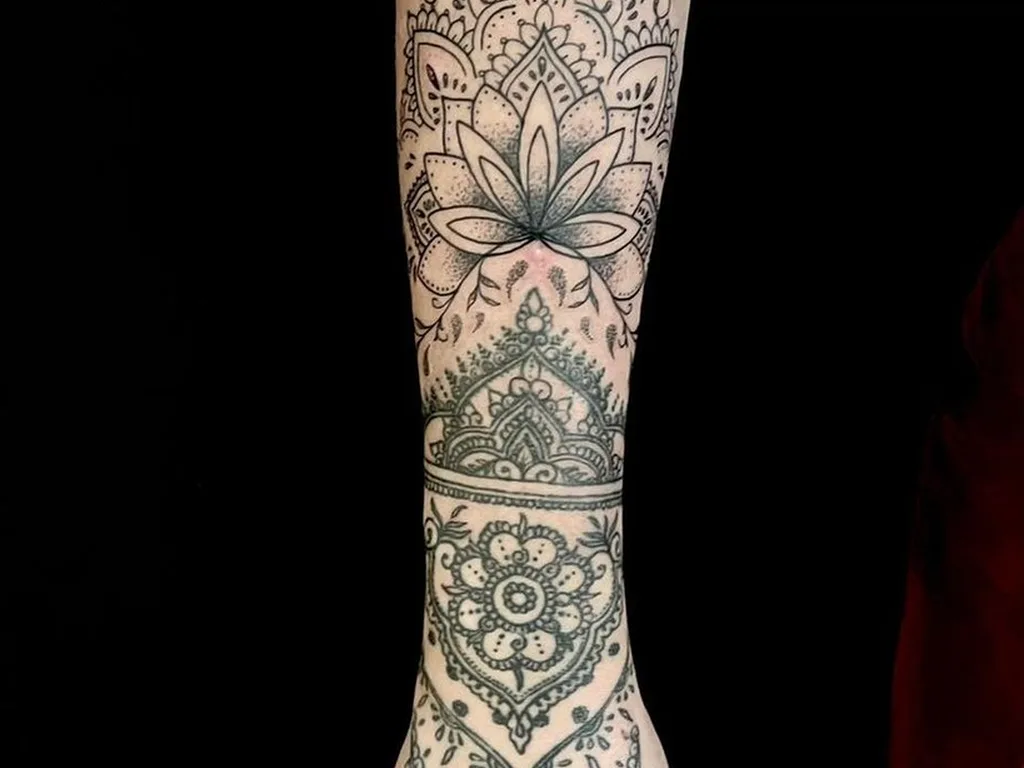
The mandala stretched into a long ornamental panel down a forearm — the form most Western mandala tattoos take, between the ritual diagram and lace. Dotwork shading does most of the softening here.
Dotwork ages kindly: dots that spread slightly still read as a field of dots, and long panels follow the forearm’s taper well.
40. Mandala With Sun and Moon Phases
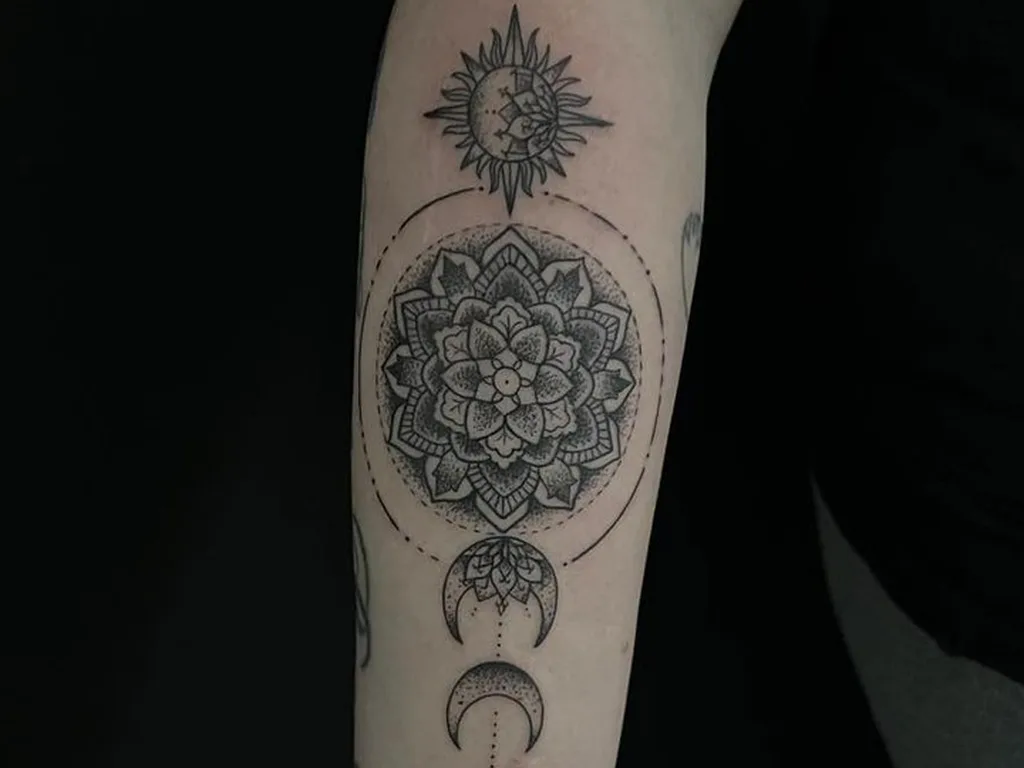
A mandala combined with a sun and a row of moon phases — cycle symbols layered into the circle. Sun-and-moon pairings stand for balance in a dozen traditions: day and night, outward and inward, two halves of a cycle neither wins.
Moon phase rows are small repeated shapes, and repetition exposes any wobble — place them along a straight run of skin, like this forearm.
41. Sacred Geometry Star on the Calf
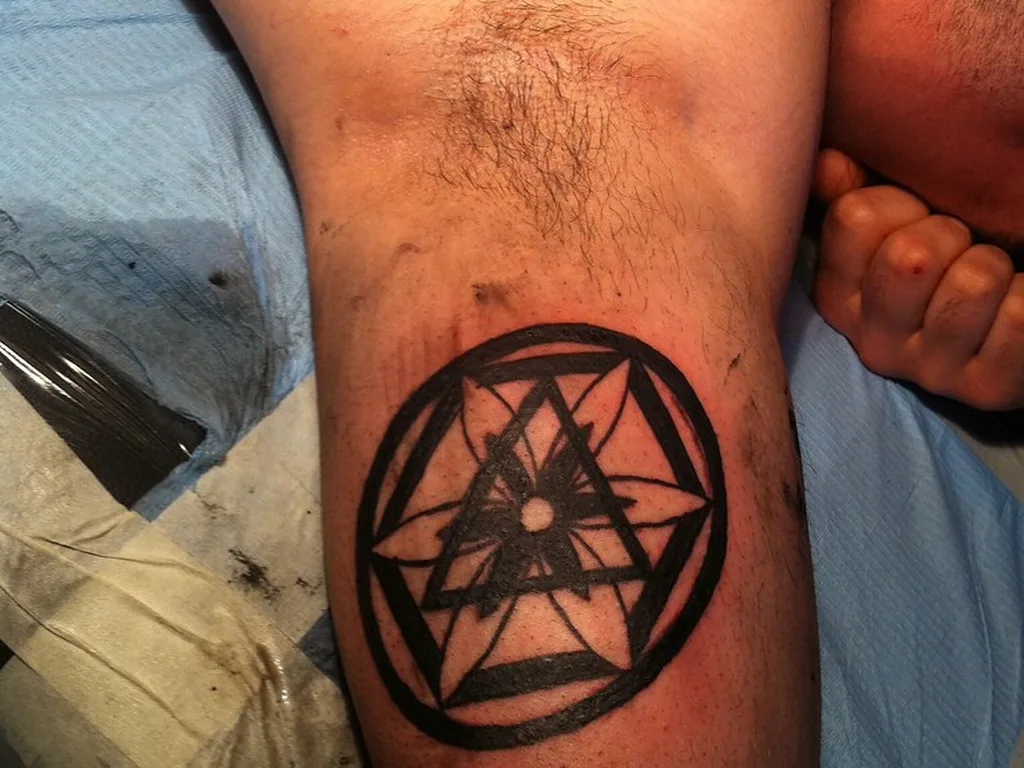
A star polygon drawn in one continuous line inside a circle, on a calf — sacred geometry in its strict sense: compass-built shapes that traditions from Pythagorean Greece onward have treated as creation’s underlying pattern.
One-line figures are honest tattoos, with nowhere to hide a mistake, and the calf’s flat back panel keeps a circle close to perfect.
42. Flower of Life Across Both Calves
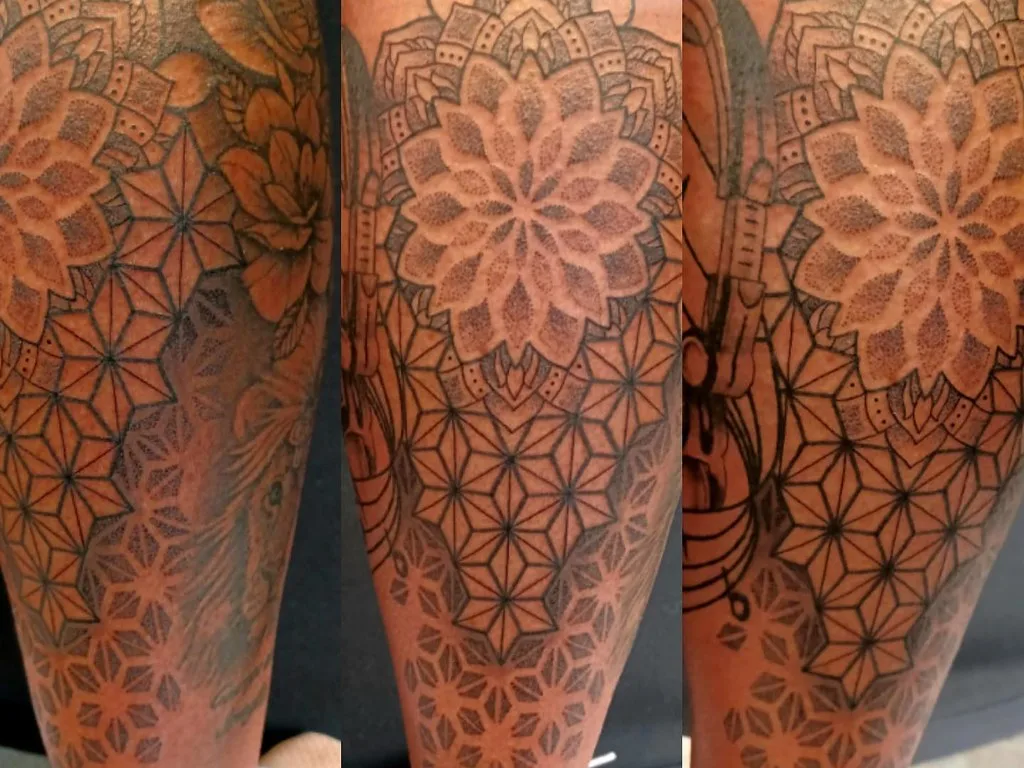
The flower of life — a lattice of overlapping circles — worked into large mandala pieces across both calves, photographed from three angles. Carved in temples from Egypt to China, the pattern is treated in modern sacred-geometry teaching as a template other shapes are drawn from.
Matching legs are planned as one tattoo in two sittings, the lattice scaled identically on each side or the pair looks unrelated.
43. Hamsa Hand With Eye and Lotus on the Flank
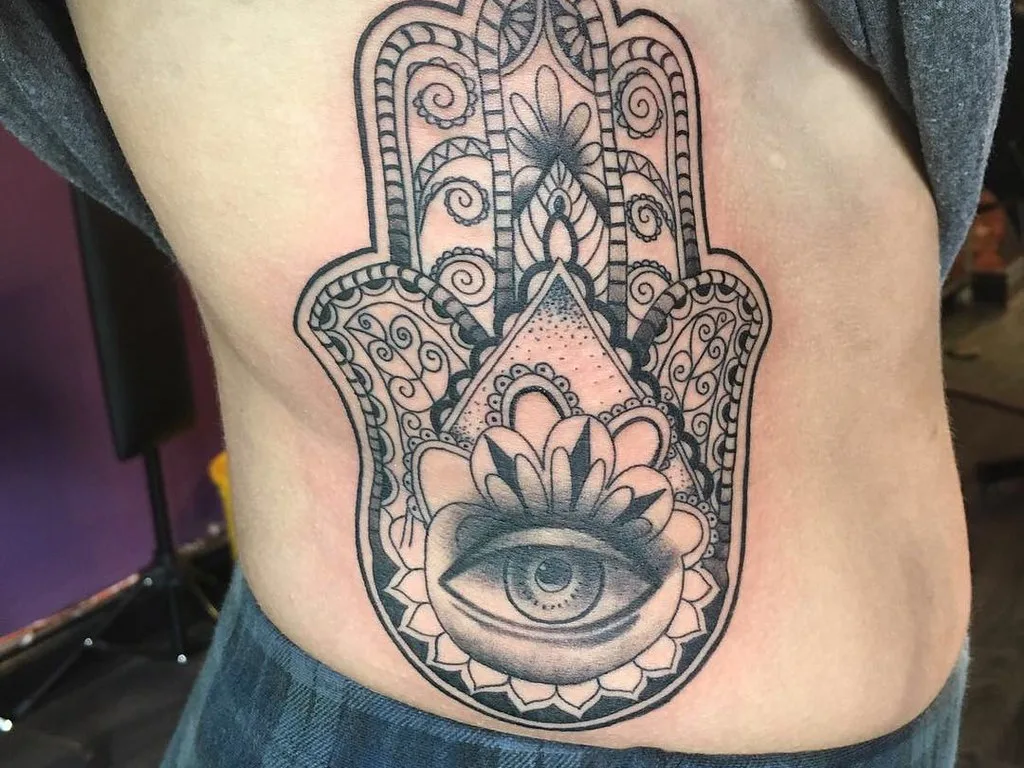
The hamsa: an open right hand with an eye in the palm, drawn large on a flank with a lotus worked in. A protective sign shared across the Middle East and North Africa — the Hand of Fatima in Muslim tradition, the Hand of Miriam in Jewish tradition — it is worn to turn away harm and envy.
Belonging to two traditions at once, it is often chosen from mixed backgrounds — protection symbolism with a shared history, not a single-owner meaning.
44. Hamsa Hand on the Upper Arm
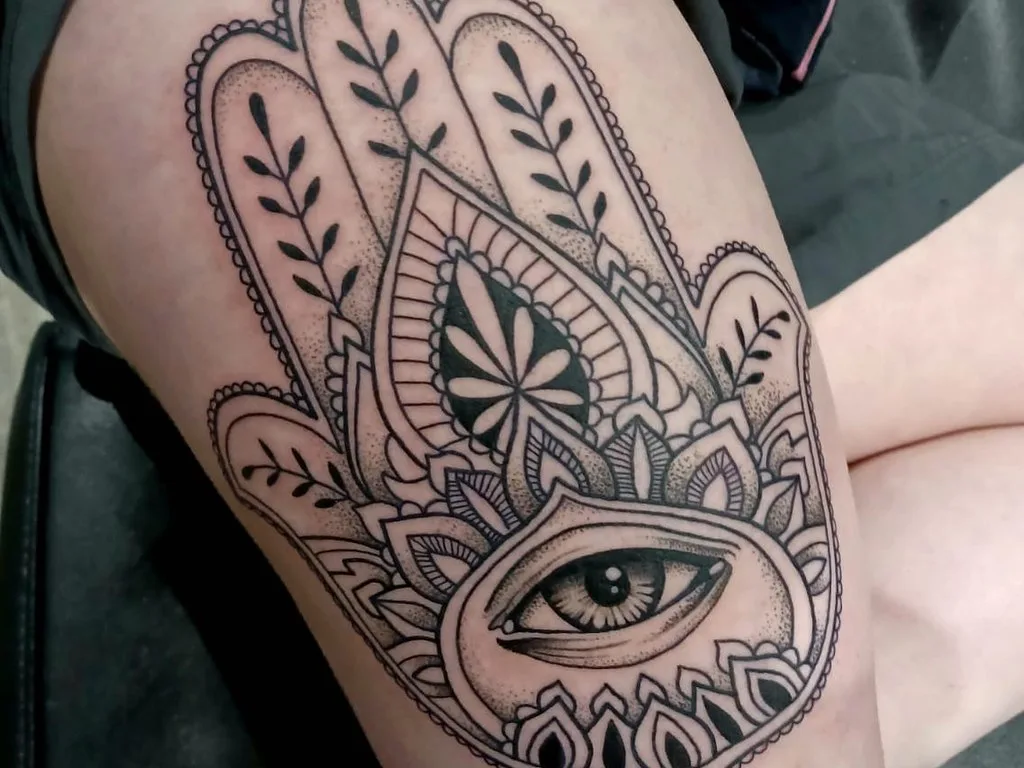
A second hamsa, plainer, on an upper arm. Orientation is the detail people ask about: fingers down is the common form, read in some traditions as welcoming abundance; fingers up as a stronger ward against evil. Neither is wrong — dialects of one sign.
The eye in the palm is the working part — keep it large and simple; a small busy eye blurs first.
45. Evil Eye in an Ornamental Frame
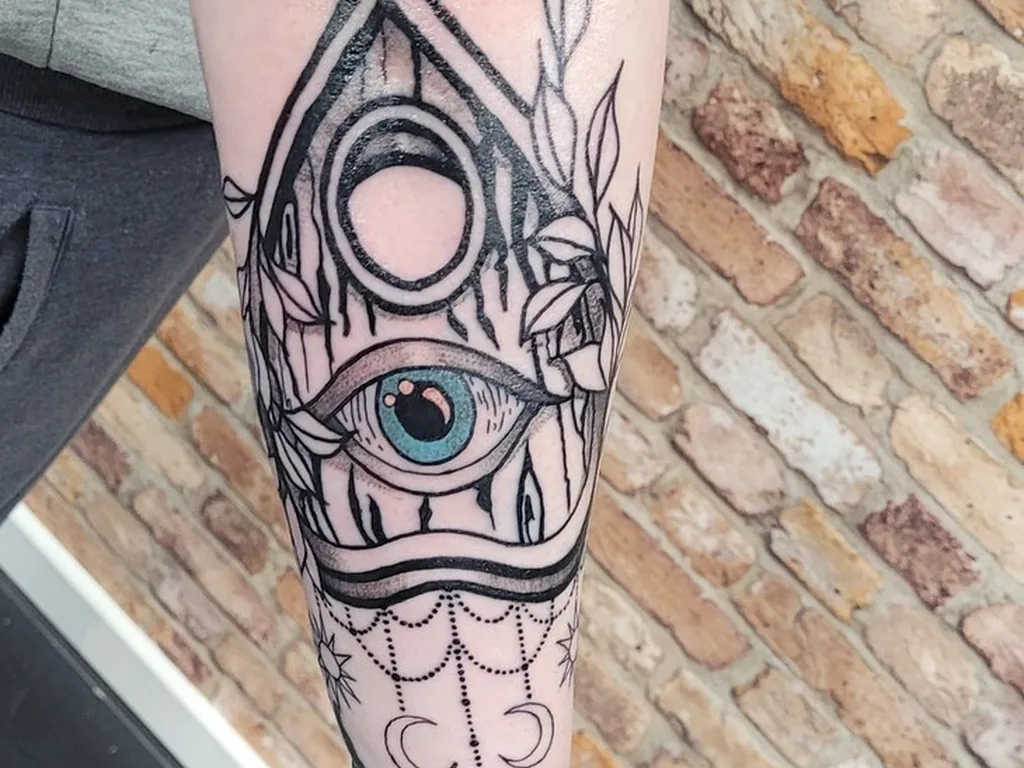
The evil eye — concentric circles of blue, white and black meant to catch and return a jealous gaze — in an ornamental frame on a forearm, moon phases around it. The belief is ancient Mediterranean and Middle Eastern; Turkey and Greece’s glass nazar charms carry the same design.
Colour carries the meaning — a black-and-grey evil eye loses its identifying blue. Blues hold well; the white ring needs watching.
46. Yin Yang Inside Sun Rays
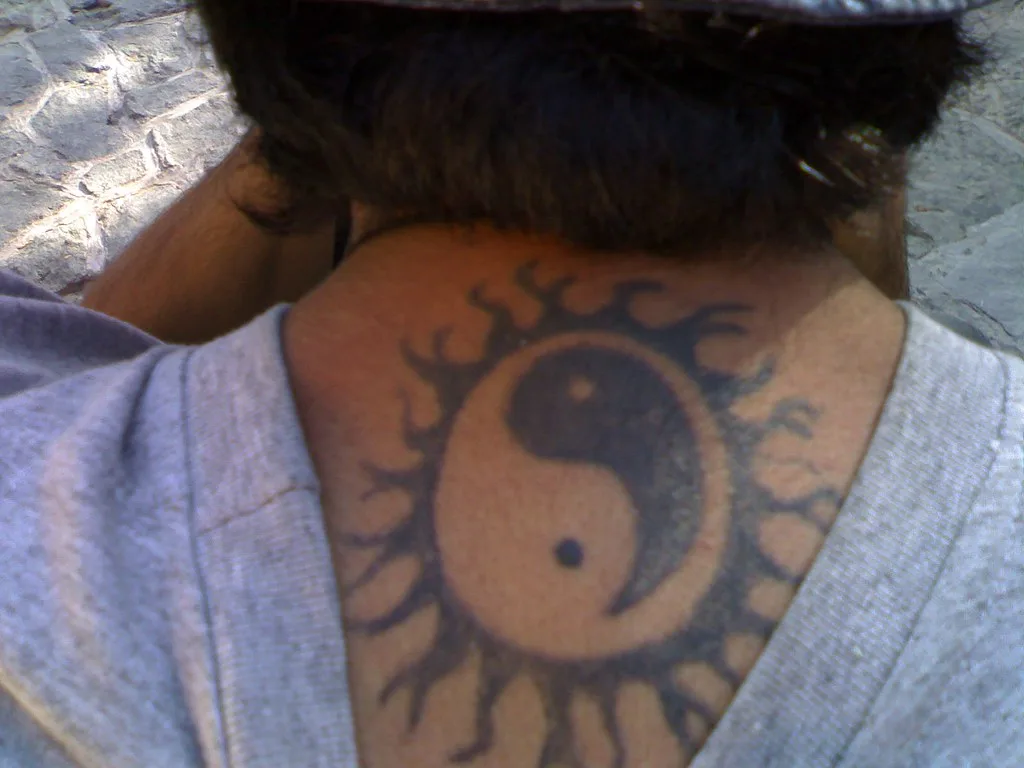
The yin yang — the taijitu, from Chinese philosophy and Taoism — inside a ring of sun rays on an upper back. Its teaching is in its construction: two opposed halves, each carrying the other’s seed, neither complete alone.
The two dots are the detail to protect: drawn too small they fill in, and the symbol loses its point.
47. All-Seeing Eye on the Back of the Hand
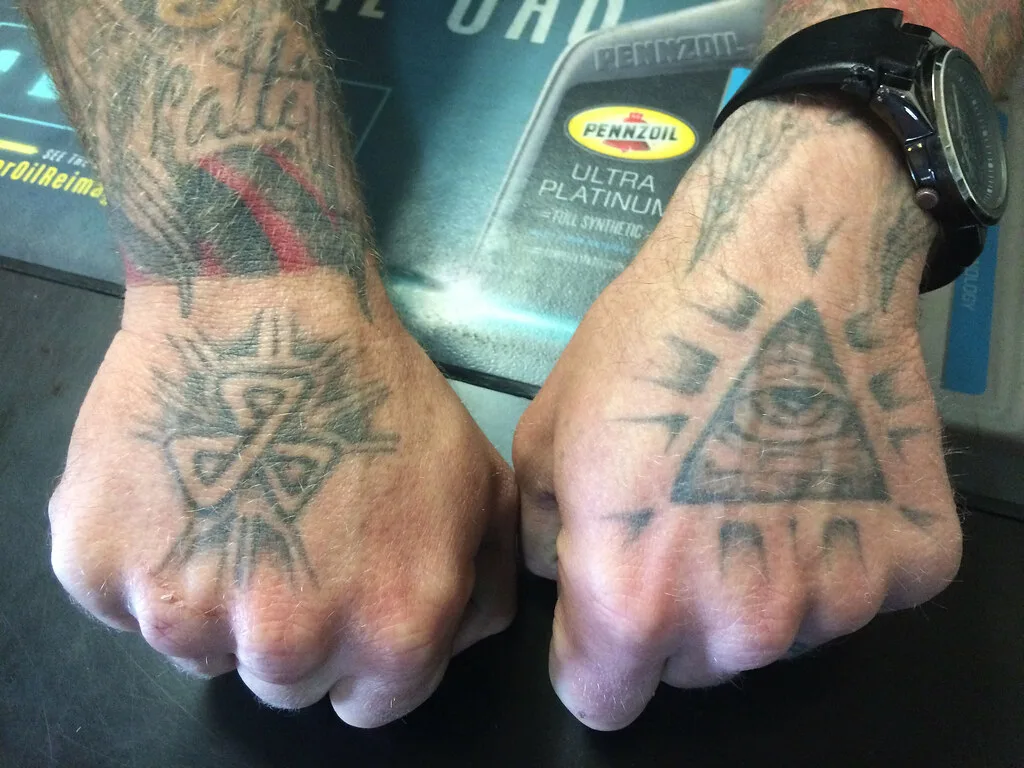
An eye inside a pyramid on the back of a hand: the Eye of Providence, the watchful eye of God over human affairs, familiar from church art and the US one-dollar bill. It is often confused with the Egyptian Eye of Horus — different symbols, different worlds — and the licensed pool held no true Horus eye on skin. An honest gap, noted rather than papered over.
Hand tattoos are this page’s boldest placement and its fastest to fade. An eye forgives: a simple shape that survives softening better than lettering.
Islamic geometry, honestly noted: geometric pattern is central to Islamic art, developed over centuries partly because images of living beings are avoided in religious settings. The licensed pool holds no clear photo of an Islamic-geometry tattoo on skin, so the tradition is acknowledged in words rather than illustrated with a picture that does not belong to it.
Best Placements for Religious Tattoos
Placement is decided by three things: the size the design needs, how public you want the statement, and what the tradition thinks of the spot. Portraits — Jesus, Mary, Shiva, Chenrezig — need back, chest or upper arm, because faces fail small. Symbols scale almost anywhere, which is why this article’s small placements are nearly all symbols.
The respect question is placement too. Several traditions regard the feet and lower legs as low and unclean, so Buddha images, deities and sacred script are best kept at the waist or above — a rule the tradition’s followers will notice you keeping. Hands sit at the other extreme: maximum visibility, fastest fading, as designs 19 and 47 accept knowingly.
Wearing Another Tradition’s Symbol
Plenty of designs here are worn daily by people outside the faith they come from — Ganesha by non-Hindus, unalomes by non-Buddhists, hamsas by people from neither of its traditions. Traditions differ on that, and there is no single rule — but there is a short list of questions that separates a thoughtful tattoo from a costume.
Do you know what it means — the real meaning, from the tradition, not a tattoo blog? Can you say it back if someone from that tradition asks, as they will? Is the symbol shared freely, like the hamsa or the dove, or treated as earned or blessed, like sak yant, where a studio copy takes the look without the thing itself? Is the placement one the tradition would accept — nothing sacred at the feet? If a symbol is closed — given by initiation, blessing or belonging — admire it here and choose something else.
Frequently Asked Questions
What is the most popular religious tattoo?
The cross, by a wide margin — simple, scalable, recognised everywhere; six of this page’s first designs are crosses of different traditions. Praying hands and rosaries follow among Christian designs; across all traditions, the lotus and Om are tattooed nearly as often.
Is it disrespectful to get a religious tattoo from a faith you don’t follow?
It depends on the symbol and how you wear it. Shared protective signs like the hamsa, dove and evil eye are worn across traditions without friction. Blessed or earned marks — sak yant above all — are different: the design can be copied, the blessing cannot, and presenting a studio copy as the real thing is where offence starts.
Where should you not put a Buddha tattoo?
Low on the body. Feet, ankles and lower legs cause real offence in Buddhist cultures, where feet are the least pure part of the body and the Buddha image the most honoured. Back, chest, shoulders and arms are accepted — and the same waist-up rule guides Hindu deities and script.
What does an unalome tattoo mean?
The unalome stands for the path to enlightenment in the sak yant tradition of Thailand and Cambodia. Its spiral is life’s twists and turns, the wavy line the path’s later stages, the dots the finish, where the line dissolves. Versions copied loosely from the internet often come out garbled.
Do religious tattoos fade differently from other tattoos?
No — ink is ink. What differs is what fading does to it: script breaks letter by letter, portraits lose expression, fine geometry closes its gaps, so those designs need bolder drawing and a touch-up budget. Bold symbols — crosses, Om, solid stars — age as well as any tattoo can.
Can a religious tattoo be covered up or removed?
Yes, like any tattoo — cover-ups need something darker and denser over the old piece, and laser works over sessions. Pause first: faith tattoos are often tied to family and memory, and these are the cover-ups clients hesitate over most. If faith has changed rather than disappeared, a rework into a new path’s symbol is sometimes better.
How much does a religious tattoo cost?
Prices vary too much by city and artist to quote honestly in one number. The pattern: small symbols sit at a studio’s minimum, portraits and back pieces run to many hours over several sittings, and the best healed sacred work is rarely the cheapest in town. Ask the price at the size the artist recommends.
What does a hamsa tattoo mean?
The hamsa is a protective hand with an eye in its palm, shared by Jewish and Middle Eastern tradition — the Hand of Miriam and the Hand of Fatima are the same sign in two faiths, worn against harm, envy and the evil eye. Fingers down is the common form; fingers up reads as a stronger ward.
Is a sak yant tattoo the same if a studio does it?
The picture can match; the tattoo, in its own tradition, does not. A traditional sak yant is approved by the monk or master, tattooed with prayer, activated with a blessing, and given with precepts. A studio version reproduces the design only — many choose it, but should know which of the two they are getting.
How do I check that sacred script is written correctly?
Take the exact text to a reader of that language — a native speaker, teacher, or the tradition’s local temple, church or community — and have them check the artist’s stencil, not a photo of a finished tattoo. Compare letter by letter, including joined strokes in scripts like Devanagari. It costs an afternoon and prevents the one unexplainable mistake.
Final Thoughts
Forty-seven designs, six traditions, one thread: these are tattoos people get when a mark on the skin is supposed to mean something permanent. Choose the symbol whose meaning you actually know. Place it where its tradition would accept it. Have every word checked by somebody who reads it. Do those three things and the tattoo tends to age the way its wearers hope — not just the ink, but the decision.