The lotus is the flower people pick when a tattoo has to carry a before and an after. It grows out of mud, pushes up through murky water and opens clean on the surface, and that one fact sits underneath nearly every meaning attached to it. If you are sorting through lotus tattoo ideas, this list shows the flower as it actually gets worn: tiny wrist outlines, sternum mandalas that took hours, big colour pieces across backs, and a few designs carrying real religious weight that deserve to be chosen with that in mind.
Every design below is a real tattoo in a real photograph, counted one by one: 40 in total. No drawings, no flash sheets, no photo repeated under a new caption. Where a photograph shows a tattoo fresh, cropped by the photographer, or shot in odd light, that gets said under the design instead of hidden.
This guide is the single-flower companion to our flower tattoo design ideas overview, which covers fifteen flowers at a shallower depth. Here the lotus gets the whole page: meanings, placements, styles, and what changes as the years pass.
What a Lotus Tattoo Means
The traditional reading is purity, and it comes straight from the plant. The sacred lotus (Nelumbo nucifera) roots in pond mud and still opens an unmarked flower above the water, which is why Britannica’s profile of the plant and the religions of Asia return to the same picture: something clean rising out of something murky. In tattoo terms: a hard stretch of life that did not stain the person who came through it. That reading is genuinely old, not a studio invention.
In Buddhism the lotus is a core symbol. Buddhas and bodhisattvas sit on lotus thrones, the flower stands for the mind unfolding toward awakening, and it sits inside the best-known mantra in Tibetan Buddhism, often translated as the jewel in the lotus. The eight-petalled lotus links to the Noble Eightfold Path, which is why so many mandala designs here are drawn with eight outer petals. If petal count matters to you, eight is the number with a real source behind it.
In Hinduism the lotus runs just as deep. Lakshmi stands on a lotus and holds lotuses; Brahma is born from a lotus growing out of Vishnu’s navel; the flower is tied to creation, beauty and spiritual unfolding, and the thousand-petalled lotus is the image used for the crown chakra in later yoga tradition. None of this puts the flower off-limits to anyone. It does mean a lotus paired with a Buddha, a mantra or an unalome is a religious tattoo, not a pattern, and it pays to know what you are wearing.
Colour lists circulate everywhere: white for purity, pink as the supreme lotus linked with the Buddha himself, red for the heart and compassion, blue for wisdom, purple for mysticism and the eightfold path. Treat them as tradition retold rather than law: the details shift from source to source, and plenty of wearers simply pick a colour they like. The idea that a wrong colour carries a bad meaning is modern shop talk; no text says that.
One mix-up worth knowing: the blue lotus of ancient Egypt, a symbol of the sun and rebirth on the Nile, is a water lily (Nymphaea), not the Asian sacred lotus. Tattoo designs rarely separate the two, and design 40 leans to the Egyptian side. It changes nothing about wearing it; it is just good to know which flower you actually have.
The unalome appears in several designs below (22, 25 and 26 owe it their tails). It is a sacred symbol from the Theravada Buddhist world, used in Thai sak yant tattooing: the spiral is the winding path of life, the end dots mark steps toward enlightenment, and a lotus is often drawn at the top as the point of arrival. Copied small on a wrist it reads as a pretty squiggle; it deserves more respect than that, and the designs here credit it properly.
The 40 Designs
The list runs from the largest pieces to the smallest: backs and sternums first, then arms, legs and feet, with the tiny wrist and ankle work at the end. Ageing notes are written per design, because a lotus that behaves beautifully at 20 centimetres can fall apart as a drawing at 3.
1. Purple and Blue Colour Lotus, Forearm
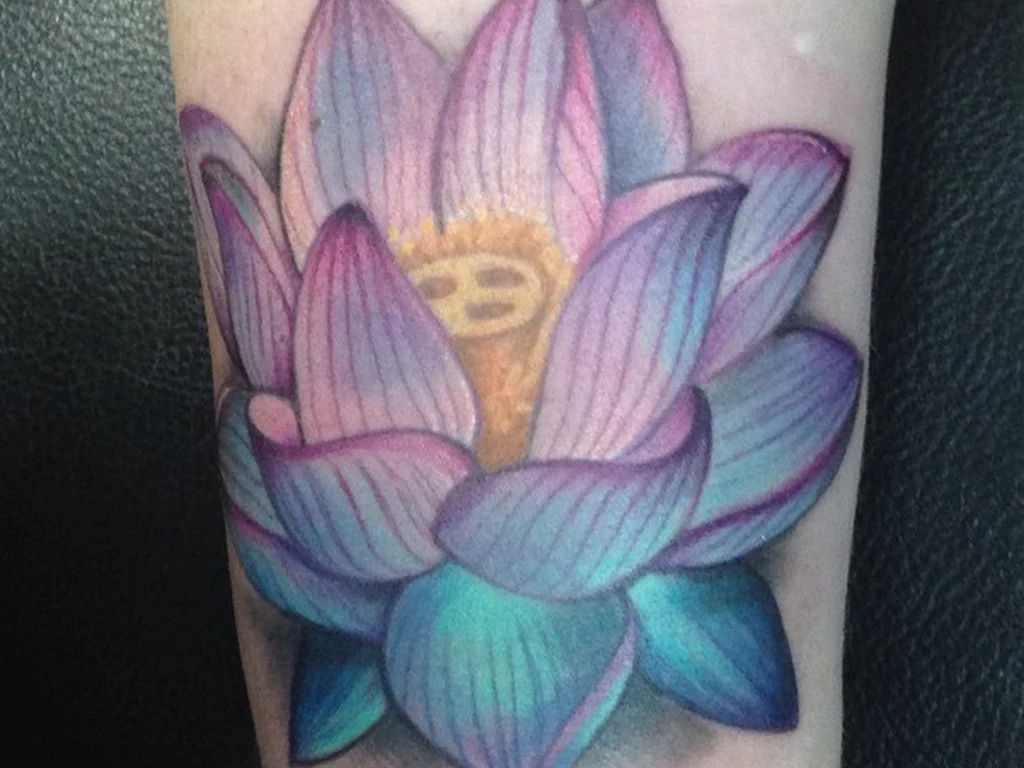
A big neo-traditional lotus filling the forearm: petals shaded from violet at the tips to blue at the base, the seed pod drawn as a small patterned dome in the middle. Bold outlines and a hard line between every petal keep a flower this detailed readable wrapped around an arm.
Purple and blue hold well under clothing and fade fastest in daily sun, so a forearm piece like this is a sunscreen habit as much as a tattoo. Expect the lightest violet to soften first.
2. Big Colour Lotus, Lower Back
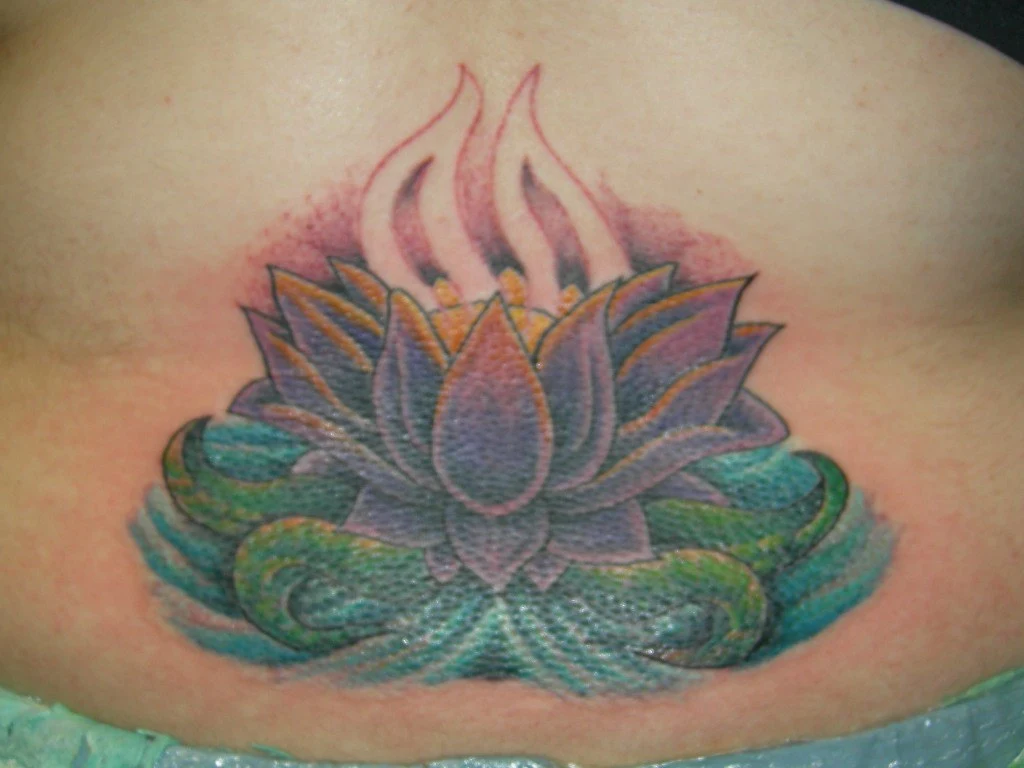
A wide lotus spread across the lower back, petals layered in teal and green with pink and orange heat at the centre, almost like flames rising out of the flower. The lower back gives a lotus the width it wants: the bloom opens symmetrically and the outer petals reach toward the hips.
Lower-back skin moves little, so line work here ages slowly. The trade-off is reach: you cannot moisturise the middle of your own back during healing, and this much colour means a careful first fortnight.
3. Japanese Lotus With Waves, Upper Back
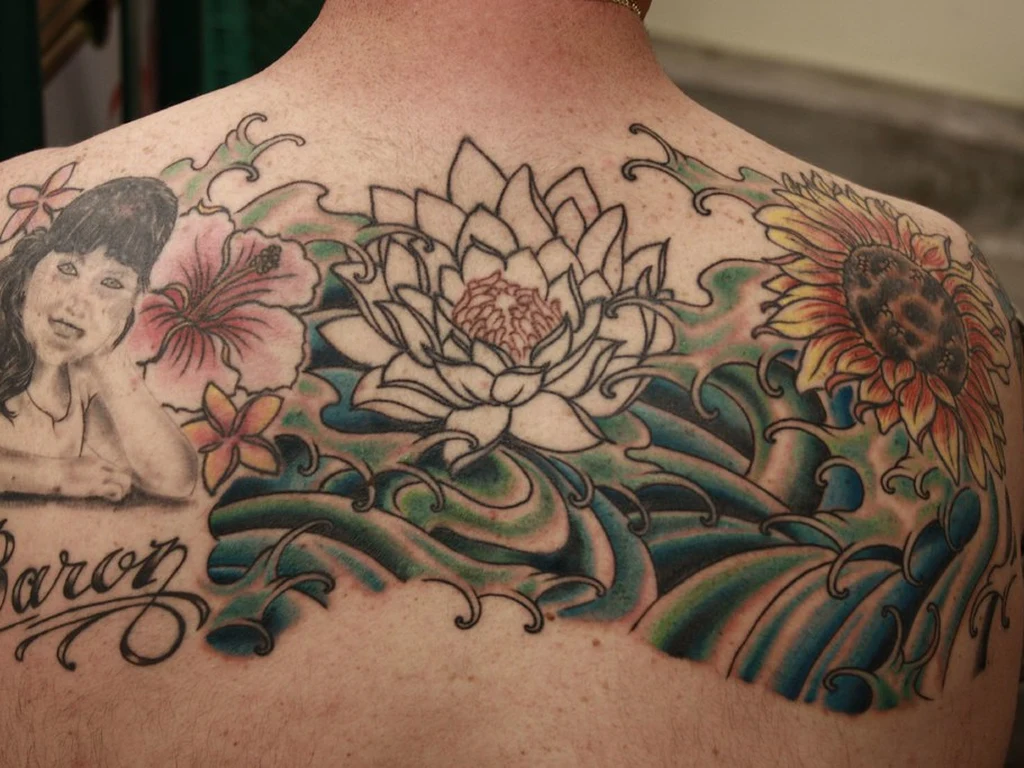
A full upper-back piece in the Japanese manner: a white lotus at the centre, green waves rolling around it, a sunflower and smaller blooms at the edges, a portrait and a name worked into the left side. In Japanese tattooing the lotus (hasu) often travels with water, and here the waves do the framing.
Bold outlines and flat colour fields are the combination that ages best at this size. Note that the portrait and name belong to this wearer; your version should be drawn for your own back, not copied.
4. Black and Grey Lotus on a Long Stem, Upper Back
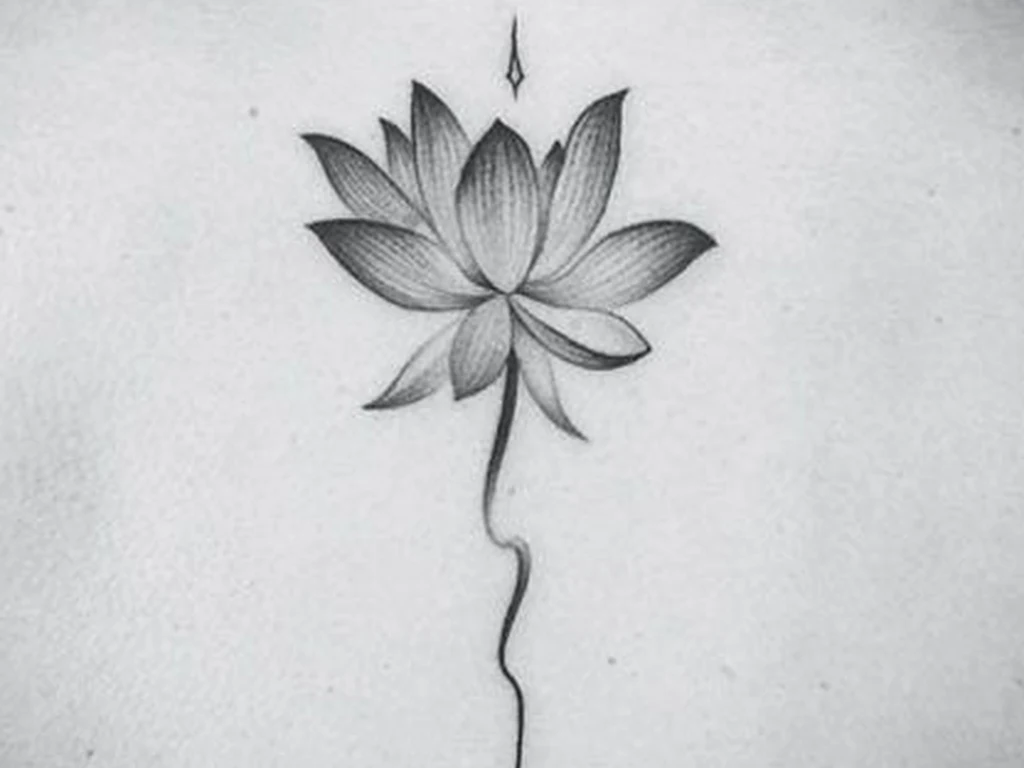
A single lotus in soft black and grey, petals shaded like folded cloth, on a long stem that wanders down the spine. Most lotus tattoos crop the flower at the waterline; this one keeps the whole plant, and the stem gives the back a vertical line to follow.
Soft grey shading with little hard outline is the first thing time blurs. At this size the petals are big enough to survive it; the shading will sit lighter in ten years, which suits the design.
5. Fine Line Lotus With a Script Stem, Upper Back
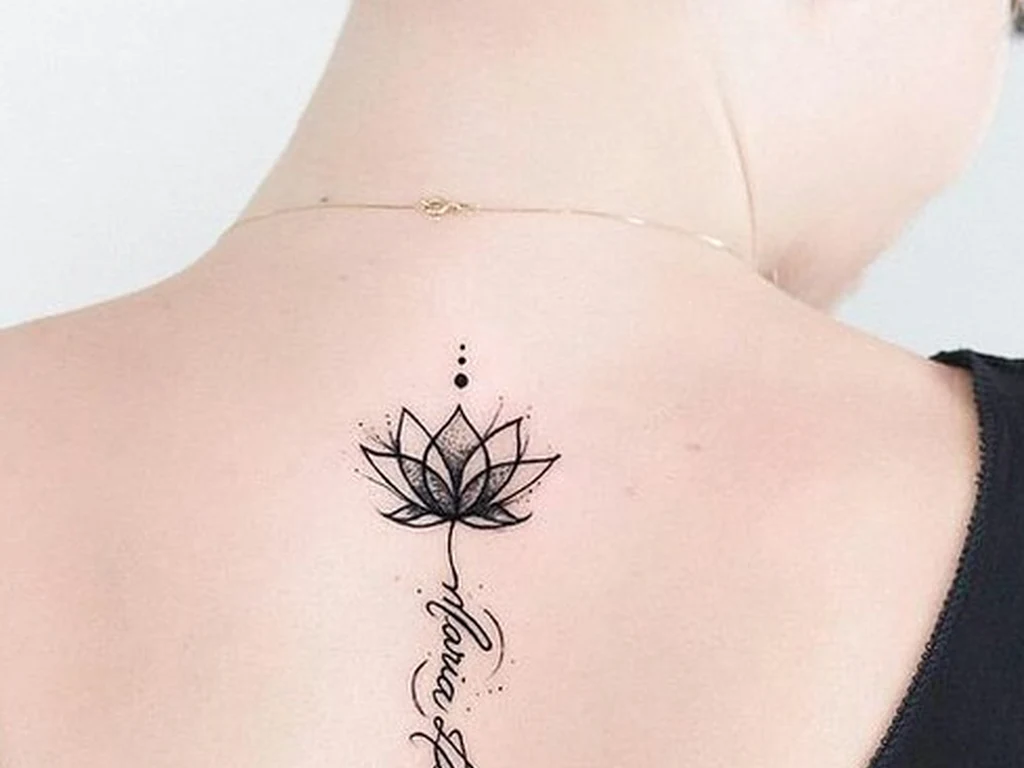
A small fine line lotus between the shoulder blades whose stem turns into a line of handwriting running down the spine. The flower marks the spot, the words carry the meaning, and neither half works as well alone.
Letters drawn this fine thicken slightly as ink settles over the years, so spine script needs more height and spacing than it looks like it needs on paper. Size the words for year ten, not day one. More work in this handling fills our fine line tattoo ideas guide.
6. Tiny Outline Lotus Between the Shoulder Blades
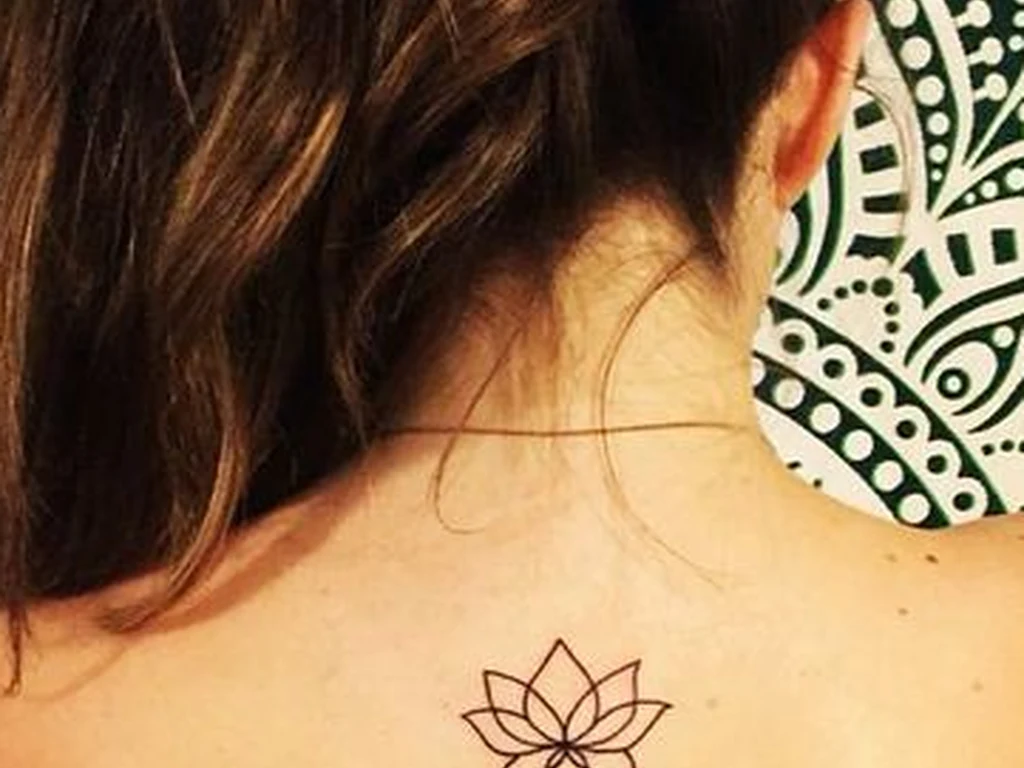
Seven clean strokes and a centre petal: a lotus reduced to its outline, sitting small and high between the shoulder blades. The photograph shows it at real scale on a real back, which is the honest way to judge a tiny design: mostly skin, small flower, deliberate.
Tiny outlines live or die on spacing. The petals here are separated by skin gaps wide enough to survive the slight spread every line undergoes. Take this photo as a scale reference, not just a shape reference.
7. Ornamental Lotus With Dot Drops, Nape
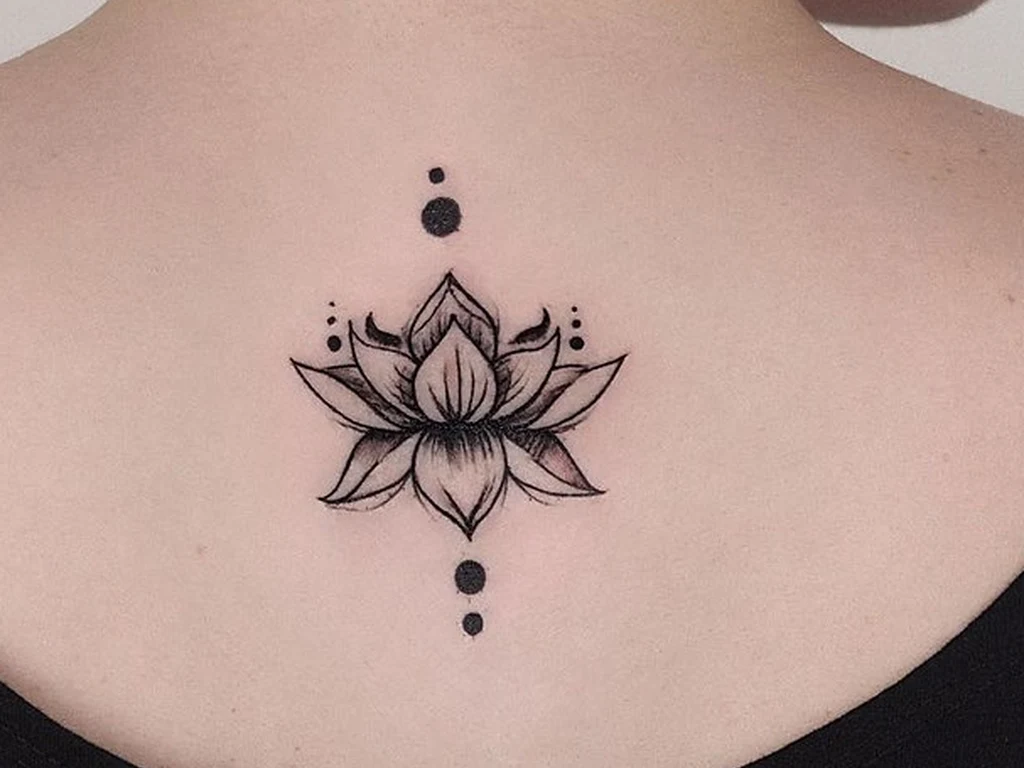
A shaded lotus at the nape with a bold dot above it and two smaller dots trailing below. The nape frames a symmetrical flower well: hair covers it when you want it covered, and the design sits on skin that barely stretches.
Nape skin heals well and sees little sun under hair, so black work here stays crisp. The dots are the detail to watch; dots merge first if placed too close, and these are spaced with room to spare.
8. Pink Lotus, Nape of the Neck
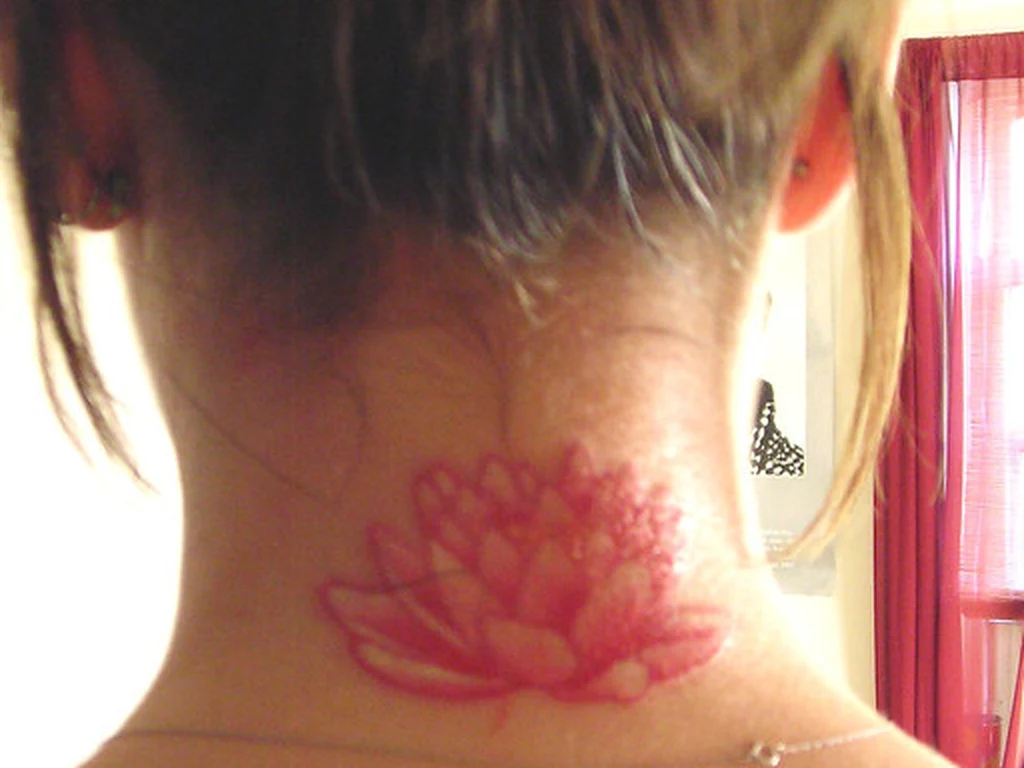
A pink lotus worn like a stamp at the top of the spine, petals graduated from deep pink at the edges to pale at the centre, a second smaller tattoo peeking out below the collar. Pink is the colour tradition reserves for the Buddha’s own lotus, and it is also the flower’s real colour, which is why it reads instantly.
Pink pigment is one of the faster faders in sun. At the nape it lives under hair and collars most of the year, the best protection a colour tattoo can get.
9. Lotus, Heart and Infinity Chain, Spine
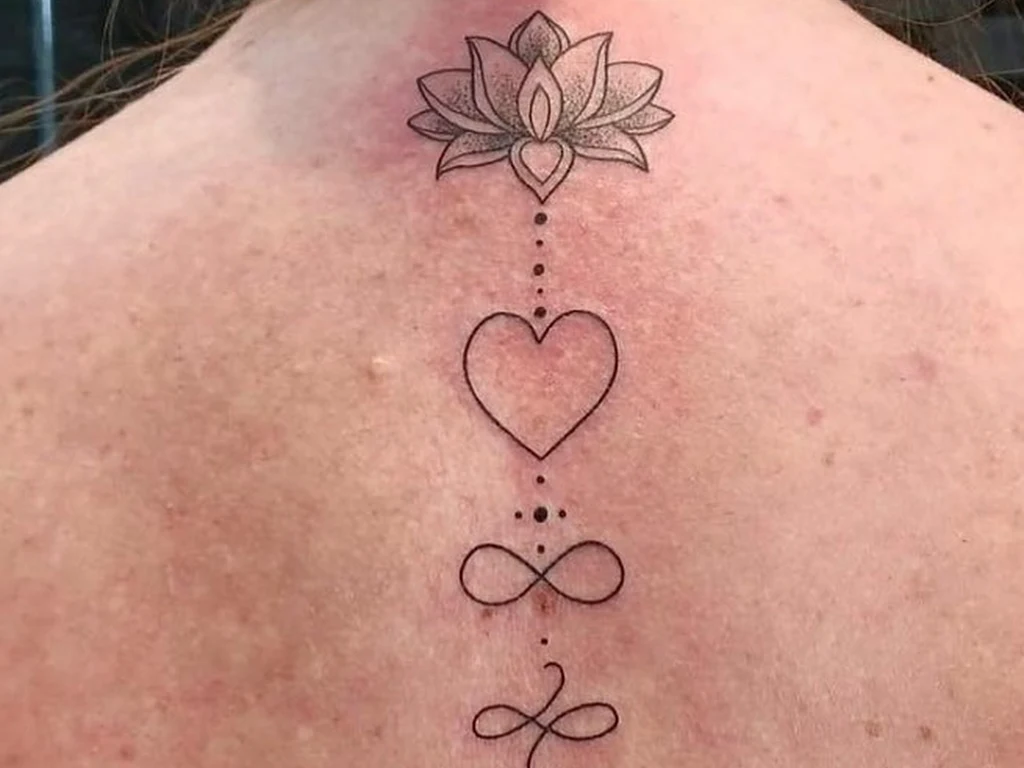
A vertical chain down the spine: a lotus at the top, a dotted drop, an open heart, an infinity knot, smaller marks continuing toward the lower back. This photograph is cropped to the upper section of the piece. Each symbol is small; the column is the design.
Spine chains follow the body’s centre line, so the stencil must be checked standing, sitting and twisting before any ink. Over the vertebrae the needle runs on bone with little padding, and most people rate the spine tender for that reason.
10. Mandala Lotus With Hanging Drops, Underbust
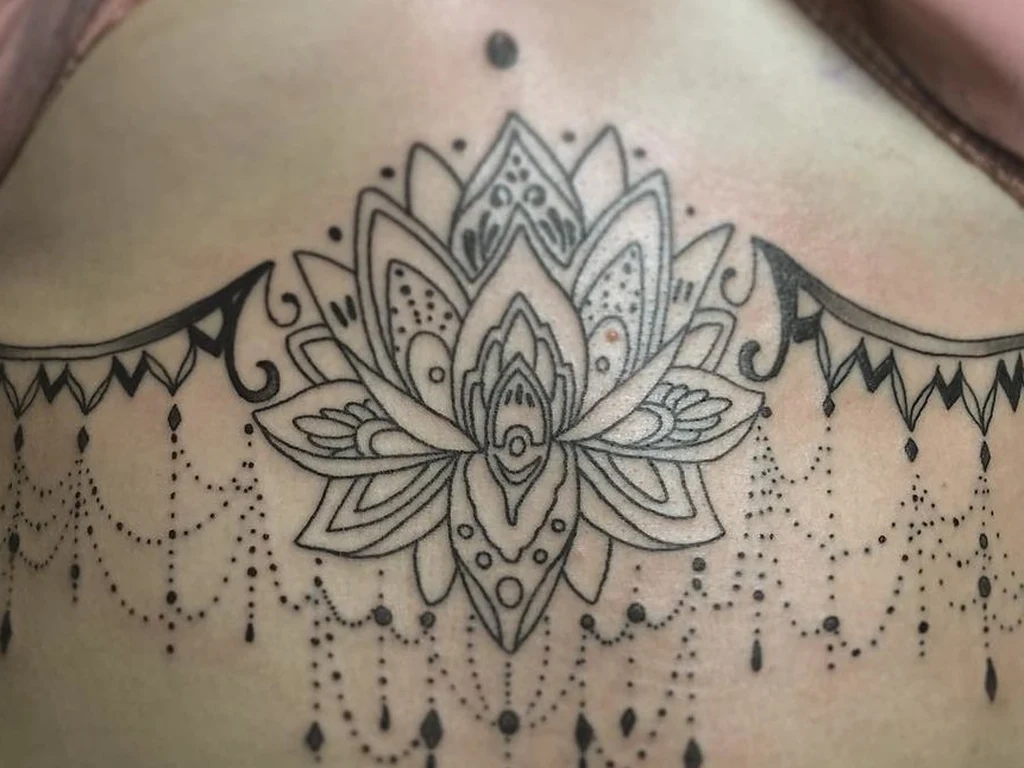
A mandala lotus centred under the bust, built from rings of pointed petals and finished with chains of tiny drops hanging toward the ribs on both sides. The flower sits on the sternum’s flat ground and the drops follow the curve underneath: the placement this style was made for.
Straight talk about this spot: skin under the bust changes with weight shifts, pregnancy and age more than back or arm skin, and a wide symmetrical piece shows it as slow drift. Drawn bold like this one, it absorbs the drift. Hairline-fine versions do not.
11. Dotwork Pointed Lotus, Sternum
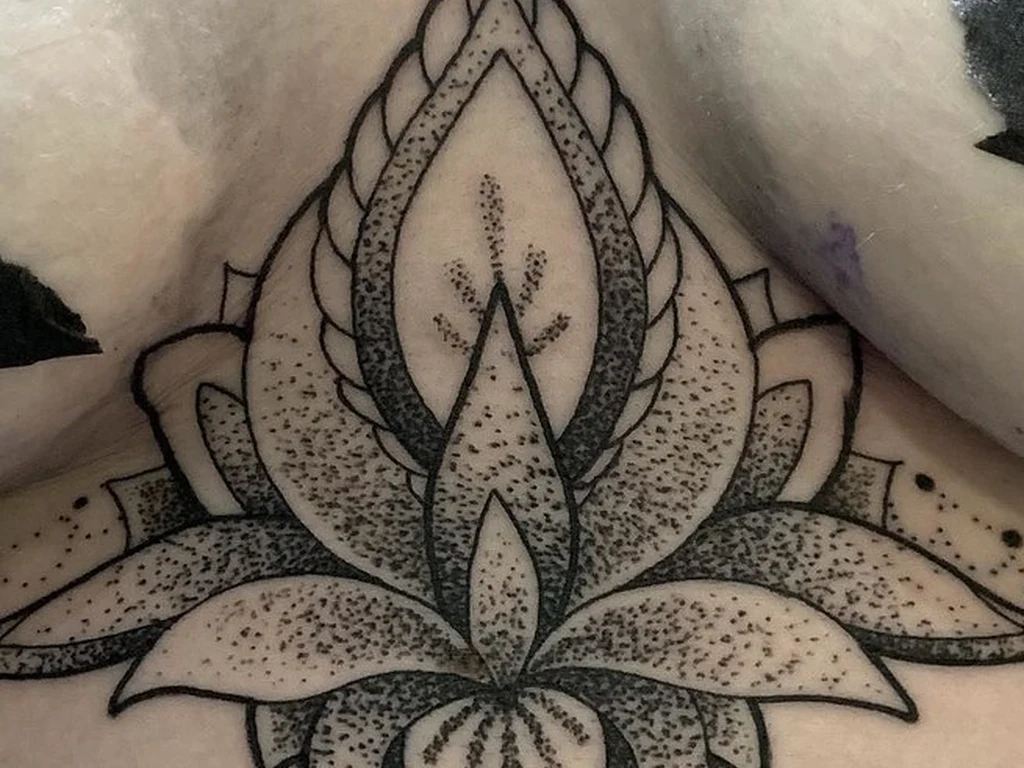
A tall, pointed lotus built almost entirely from dots: stippled petals, dotted leaves underneath, a shape that runs long rather than wide. Dotwork gives a sternum piece softness without grey wash, and the narrow build suits the strip of skin between the breasts.
Dot shading is slow work and the sternum is bony, so expect a long session with breaks. The payoff is ageing: dots blur into tone gracefully instead of breaking into patches.
12. Lotus With Bead Chains, Sternum
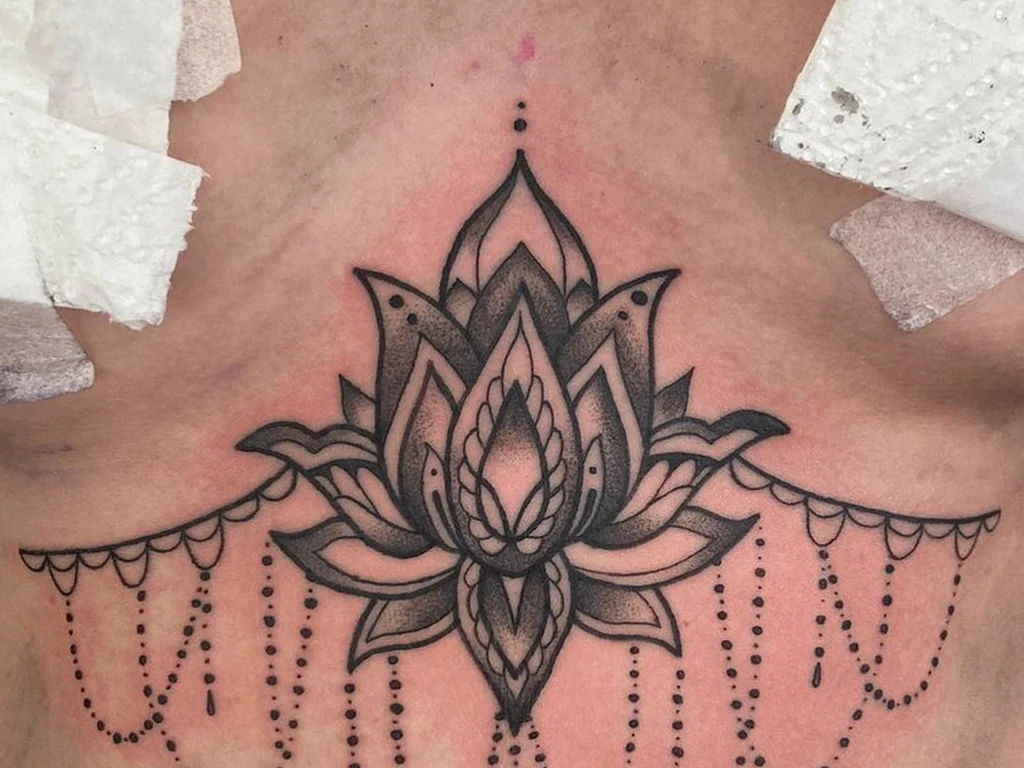
A black lotus at the centre of the chest with chains of beads and drops draped from it in two arcs, photographed fresh, skin still raised, protective pads just removed. The jewellery effect is the point: a necklace-and-pendant arrangement the body wears permanently.
Fresh photos are useful because they show the real size of the commitment: this piece covers most of the sternum. Wear a button-up shirt to the appointment, and expect the underband area to heal slowest.
13. Lotus Chain From Sternum to Navel
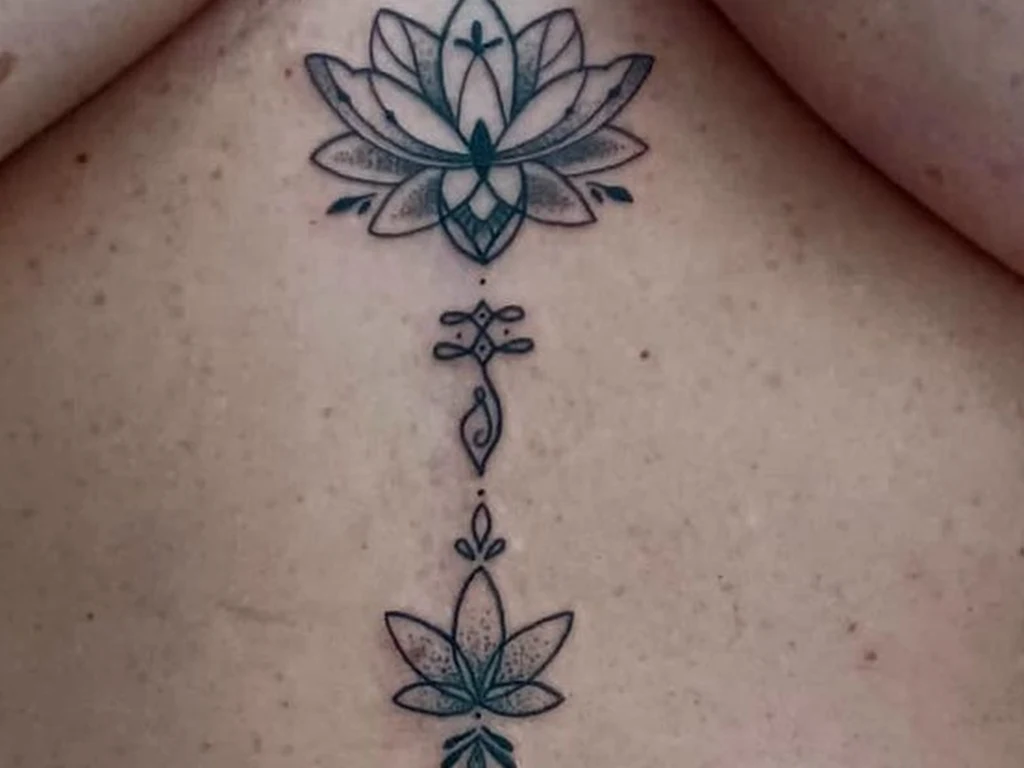
Two small lotuses, one at the sternum and one below the navel, joined by a vertical chain of links, dots and a tiny hanging charm. The design uses the torso’s centre line like a plumb line: everything hangs from the flower at the top.
Centre-line torso pieces are unforgiving of crooked stencils, and the midsection is where bodies change most. The saving grace here is that the parts are small and separate; a chain absorbs stretch that would warp one big picture.
14. Wide Mandala Lotus, Lower Stomach
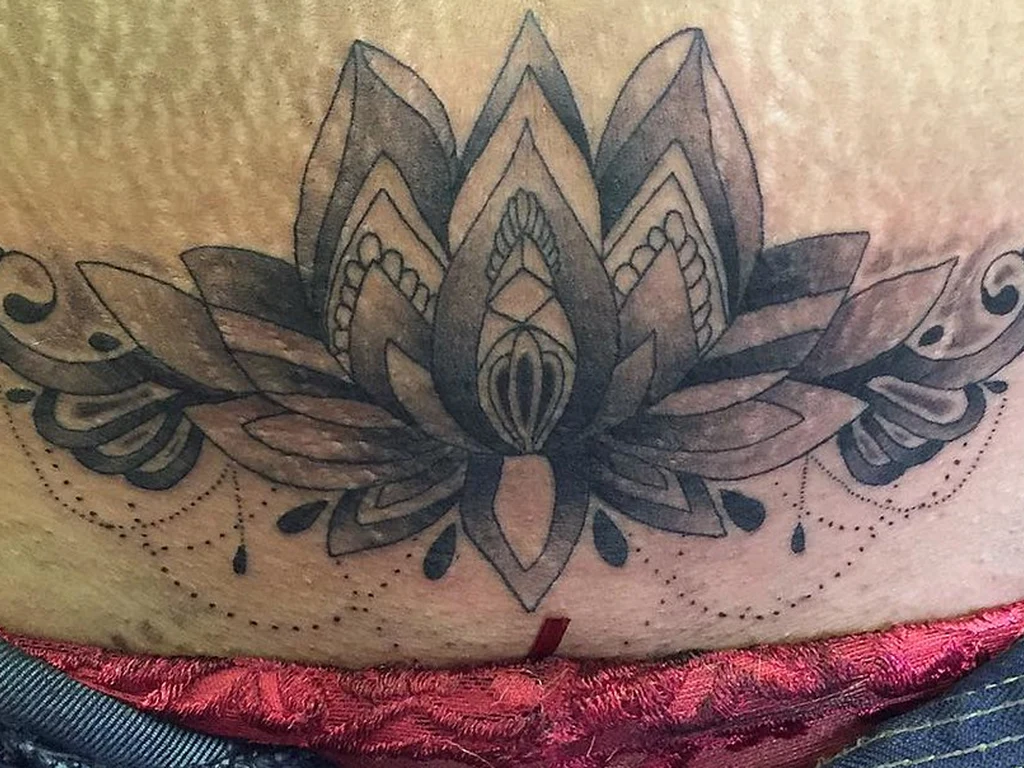
A broad mandala lotus spread across the lower stomach, petals layered in rings with fine inner detail and small dots along the top edge. It is drawn wide and low, sitting where a waistband crosses, and it fills that band completely.
The lower stomach is the placement most affected by weight change and pregnancy, full stop. A mandala is the smartest shape to put there because its symmetry distorts evenly instead of tearing a picture apart, but go in knowing this skin will move the design most.
15. Mandala Lotus With Crescents, Hip
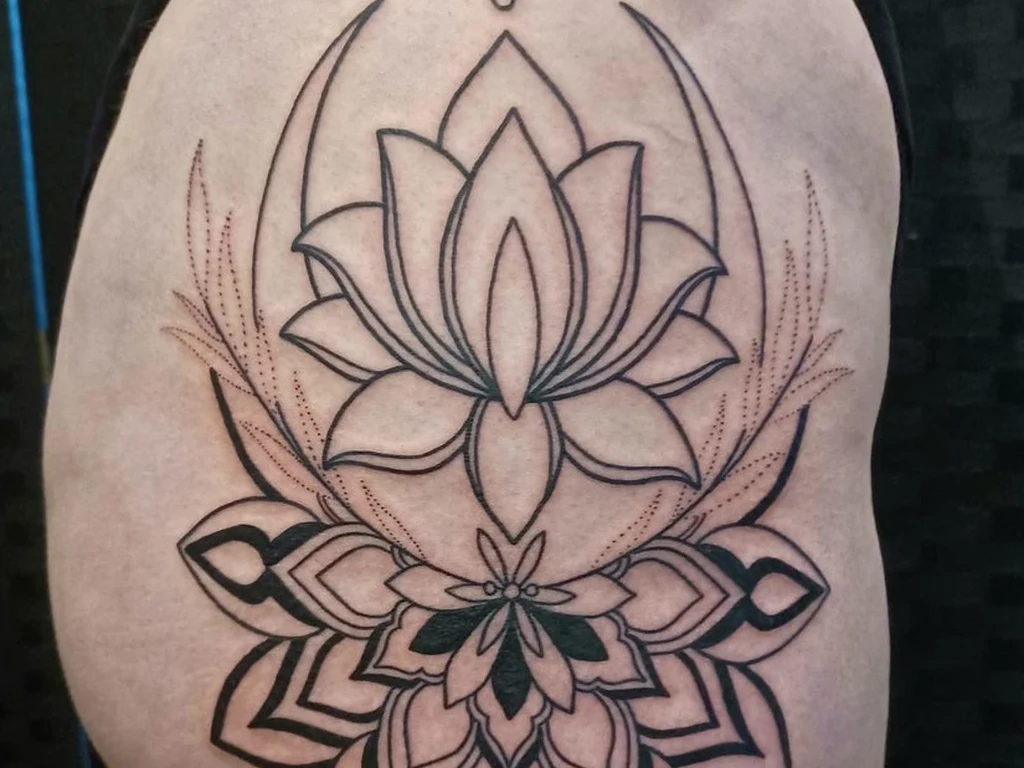
A mandala lotus on the hip crowned by a pair of crescent shapes and finished with a pointed drop below. The hip gives a round design a round canvas, and the crescents tie the flower to the moon-phase pairing that returns at design 33.
Hip skin is stretch-mark territory for many people, and ink sits differently in stretch-marked skin: lines can spread a touch more there. An experienced artist will check the area and adjust line weight. Ask directly rather than hoping it does not apply.
16. Purple and Pink Lotus, Upper Arm
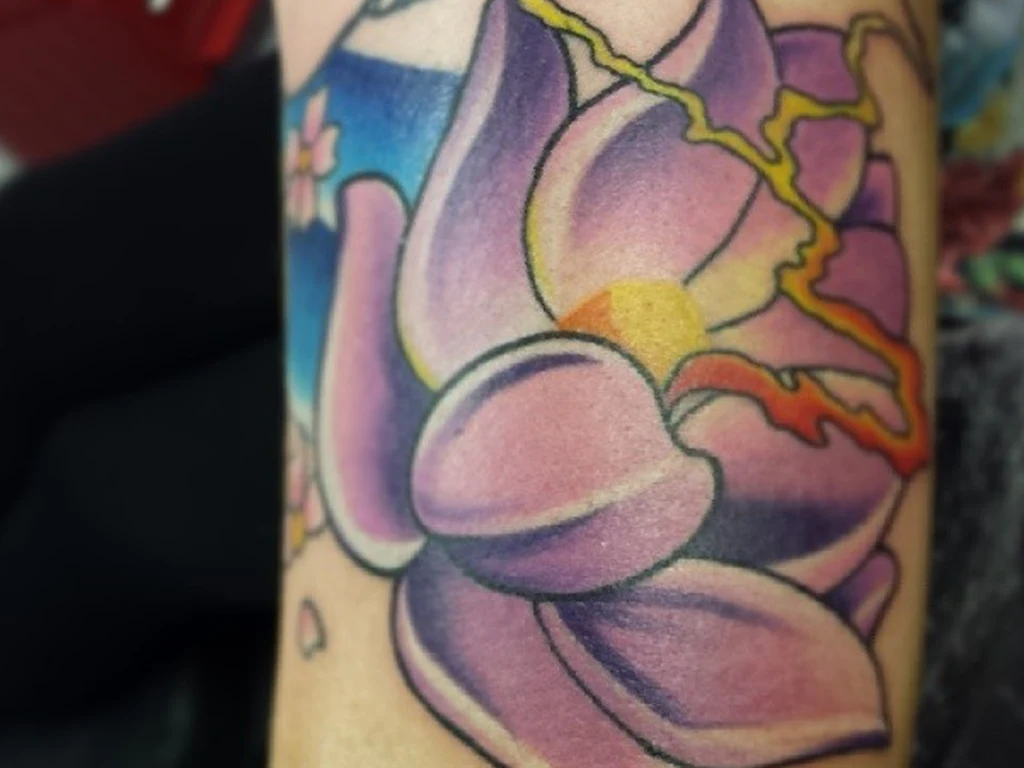
A painterly lotus on the upper arm, petals washed in purple and magenta with yellow light at the centre and no hard outline holding the colour in. It reads as a painting of a flower rather than a diagram of one, which is exactly its appeal.
Colour without outline is the fastest-ageing construction there is: edges soften, light colours sink, and in ten years this will be a gentler version of itself. Chosen knowingly, that settling is loved. If you expect day-one sharpness forever, pick design 1 instead.
17. Teal Lotus Cover-Up, Upper Arm
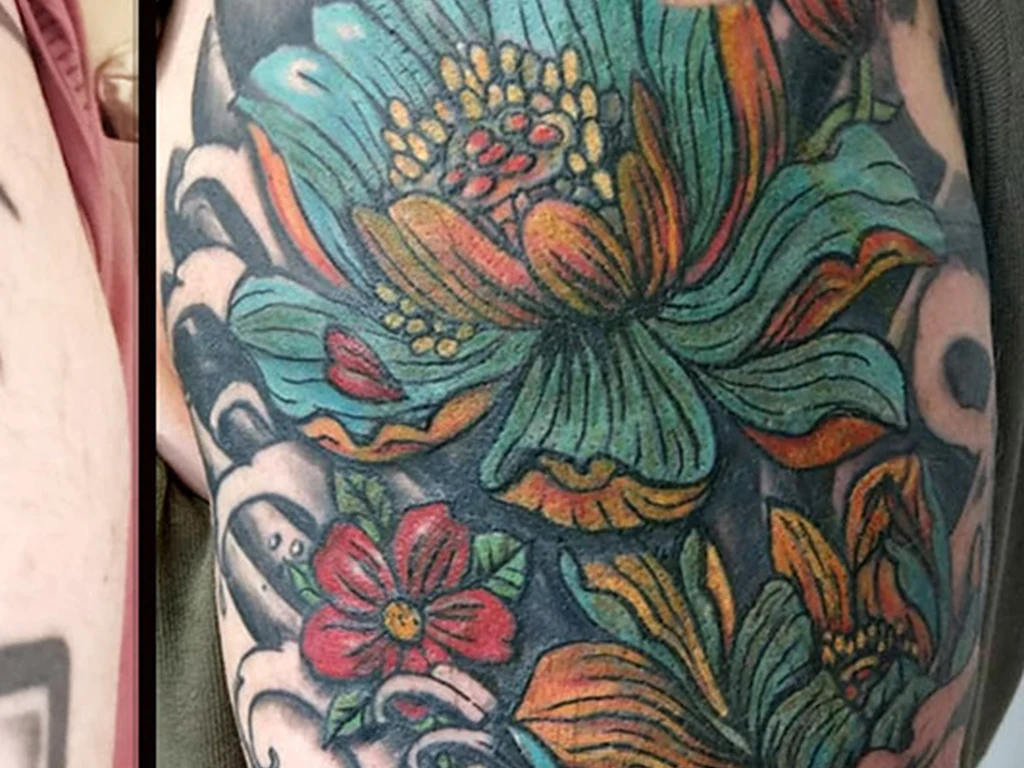
A large teal lotus with orange undertones covering an upper arm, smaller red blooms and grey wash clouds packed around it. This is the finished half of a before-and-after pair: the lotus was built to bury an older tribal piece, and the busy petals plus dark shading do that job.
Cover-ups drive their own rules: the new piece must be bigger and darker than what sits underneath, and flowers are a favourite because petals hide edges. Your artist needs to see the old tattoo in person before promising anything.
18. Pink and Purple Lotus With Seed Pod, Arm
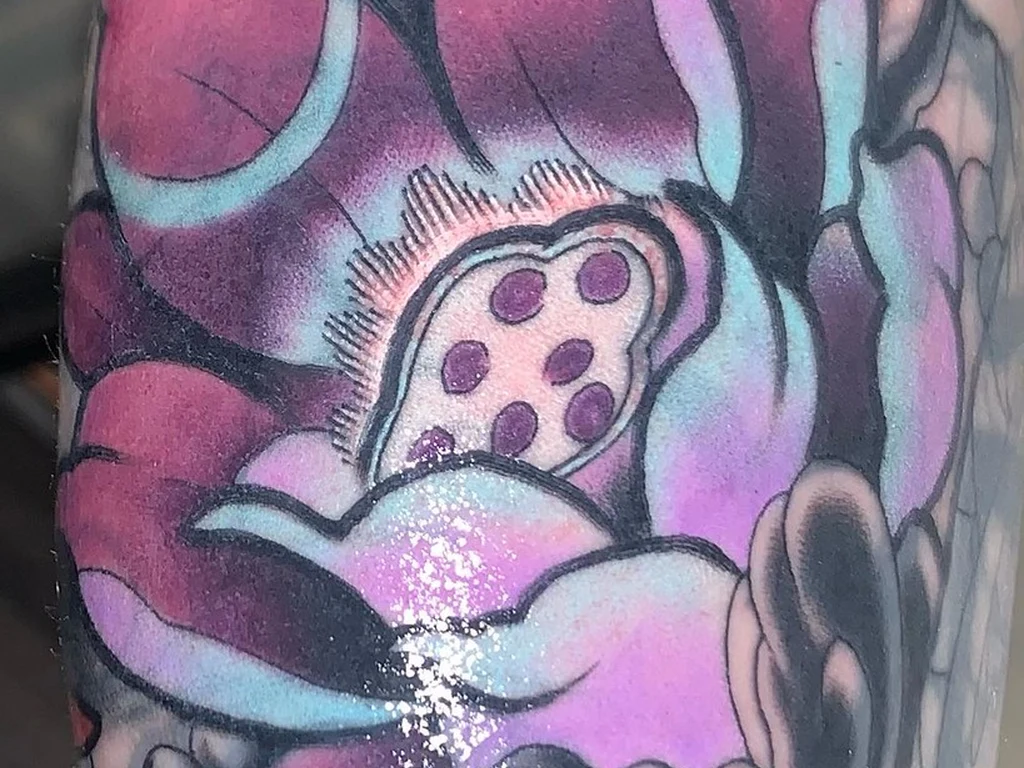
A close crop of a big colour lotus: magenta petals, a purple wash of shadow, and the seed pod drawn honestly in the middle with its dotted face. Most lotus tattoos tidy the pod away; this one makes it a feature, and the flower looks more like a real lotus for it.
The photographer cropped tight, so judge this as a detail study rather than a placement guide. It shows how much shading a large colour piece can carry, and why such pieces are priced by the hour.
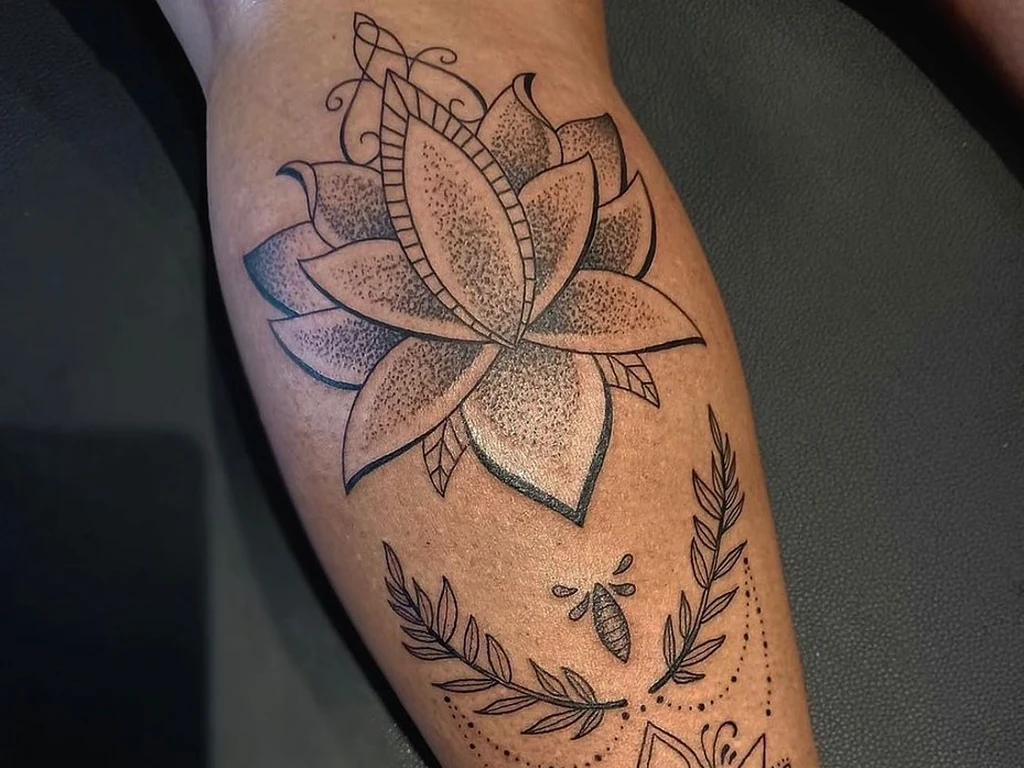
19. Shaded Lotus With Ferns and a Bee, Forearm
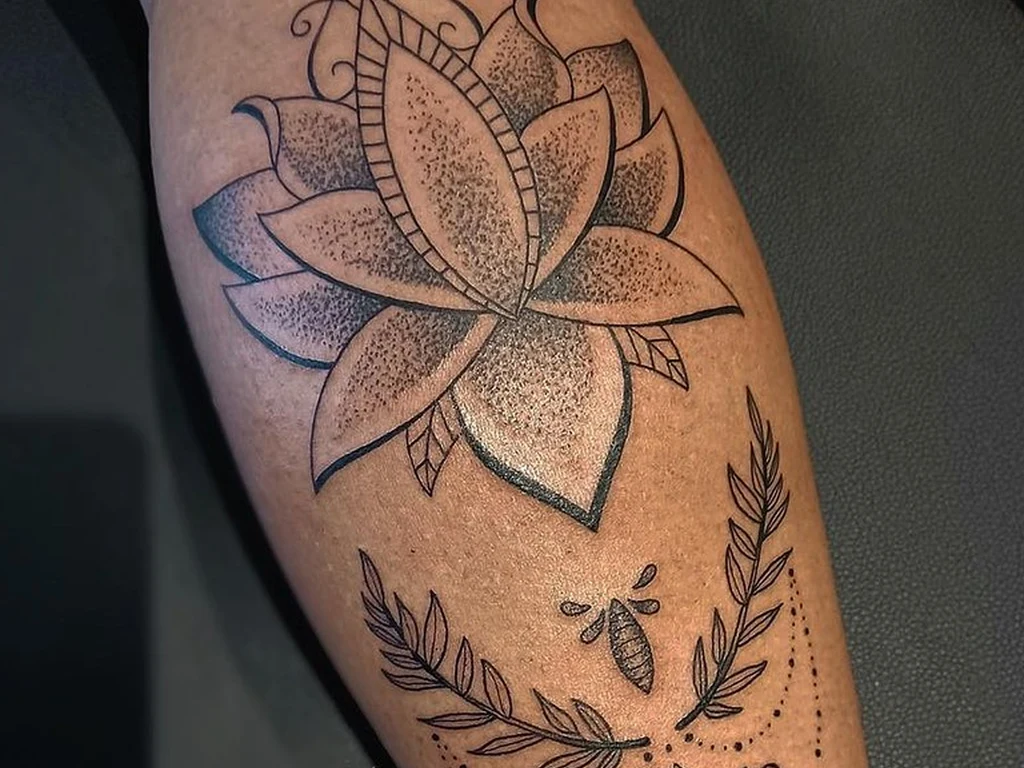
A dotwork-shaded lotus on the forearm, petals patterned inside, fern fronds curving underneath and a tiny bee worked into the leaves. The flower is the headline; the ferns turn it into a small piece of pond bank, and the bee rewards a second look.
Forearms are the easiest canvas on this page: flat, low-pain by most accounts, easy to keep clean while healing, and dotwork at this scale holds its pattern. Steal this construction if you want a first lotus.
20. Geometric Lotus With an Arrow, Forearm
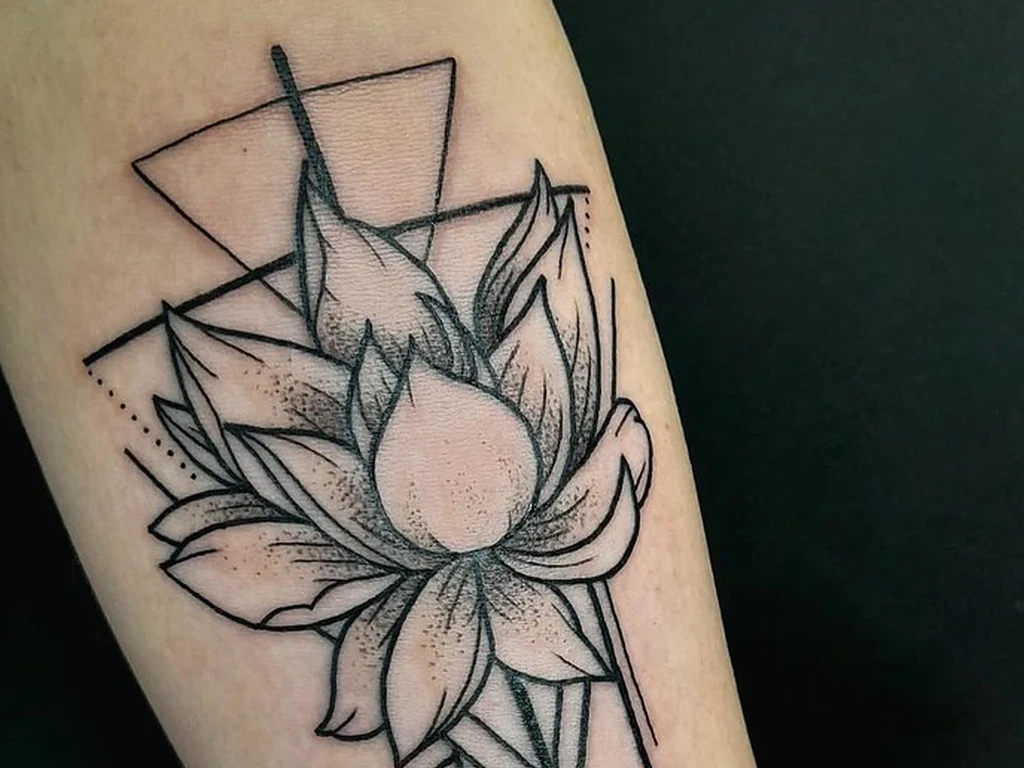
A line-drawn lotus pinned inside a frame of triangles and a circle, a thin arrow running down through the design toward the wrist. The flower is left unshaded, so the whole piece is line, air and skin.
Geometric work exposes every wobble. These lines stay honest because they are bold enough to hold; hairline versions of the same drawing would blur together within a few years. If your artist suggests thickening lines, that is experience talking.
21. Grey Ornamental Lotus, Forearm
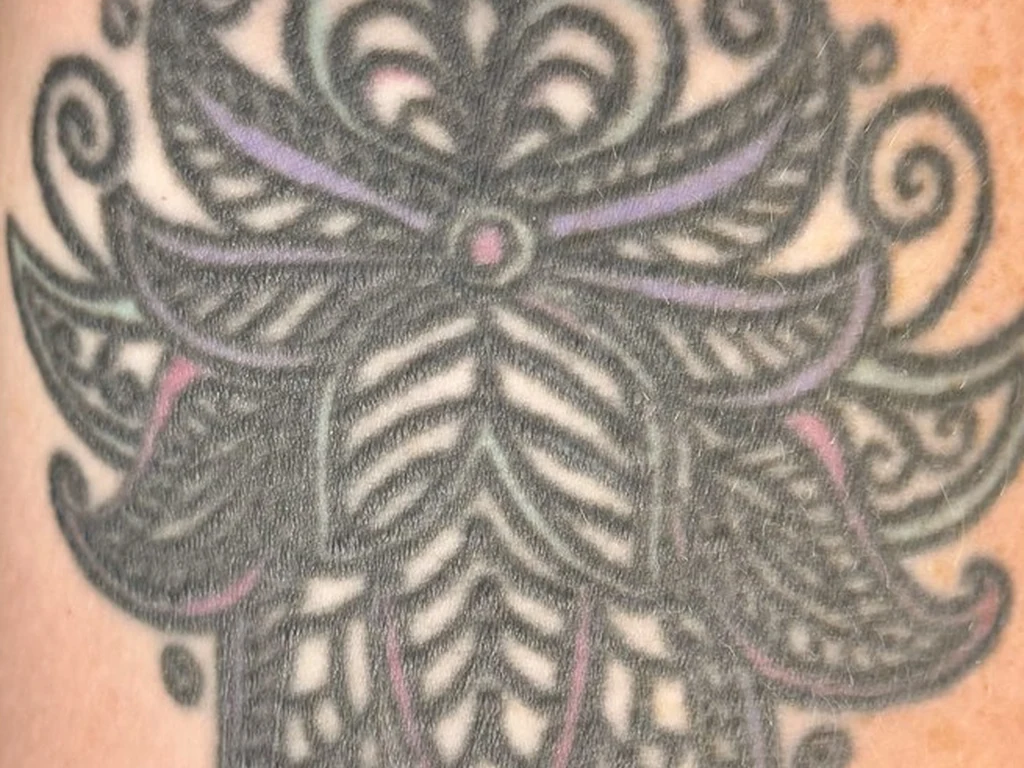
An ornamental lotus in grey tones spread across the forearm, petal inside petal, lace-like patterning filling every section. It owes as much to henna and carved ornament as to botany, and it covers like a cuff: a forearm piece, not a forearm accent.
Ornamental pattern ages from the inside out: the smallest filled sections merge first. This one keeps its sections large, so it will still read as pattern rather than smudge in a decade. The bigger the ornamental piece, the longer it lives.
22. Unalome With a Lotus Bloom, Forearm
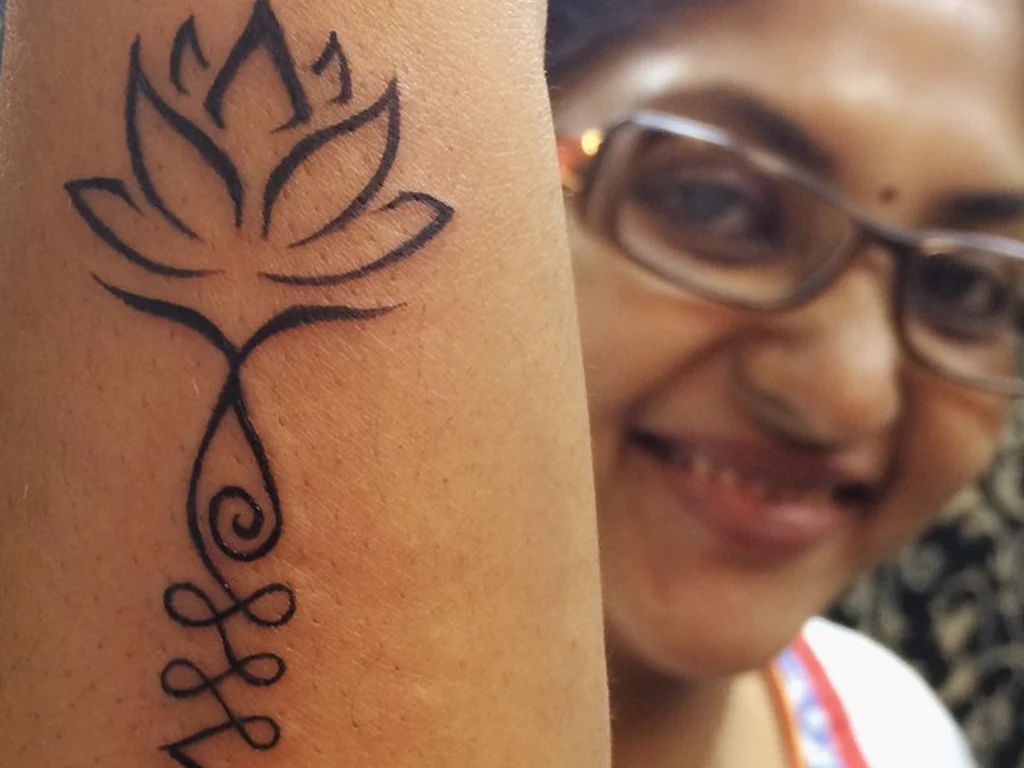
A bold unalome running up a forearm: the lotus bloom drawn open at the top, the stem twisting into the spiral and knot-work tail below. It is the clearest look in this list at how the two symbols join: the path underneath, the flower on top, the journey and the arrival in one line.
The unalome is a sacred symbol from Thai Buddhist tattooing, so treat the design as a religious one and choose artist and wording with care. Any accompanying script needs checking by someone who reads the language; a beautiful mistake is still a mistake, and it is permanent.
23. Lotus With Sanskrit Lines, Forearm
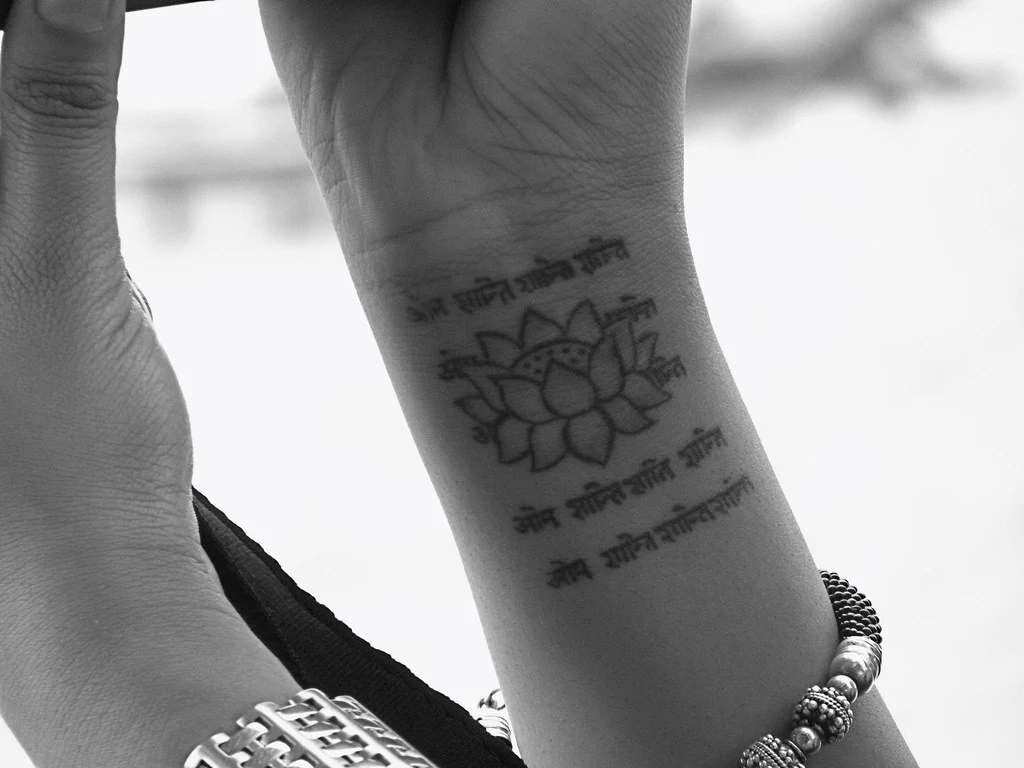
Shown in black and white: a small lotus outline on a forearm with lines of Devanagari script above and below it, worn like a page from a prayer book. The tattoo pairs the flower with actual text rather than decoration, which makes it the most literally meaningful piece in the list.
Script tattoos carry a duty the others do not: the text must be right. Spelling, grammar and letterforms need a fluent reader to check the final stencil, because an artist may draw beautifully in a language they cannot read. Do that check before the appointment, not after the photograph.
24. Small Lotus With an Infinity Tail, Forearm
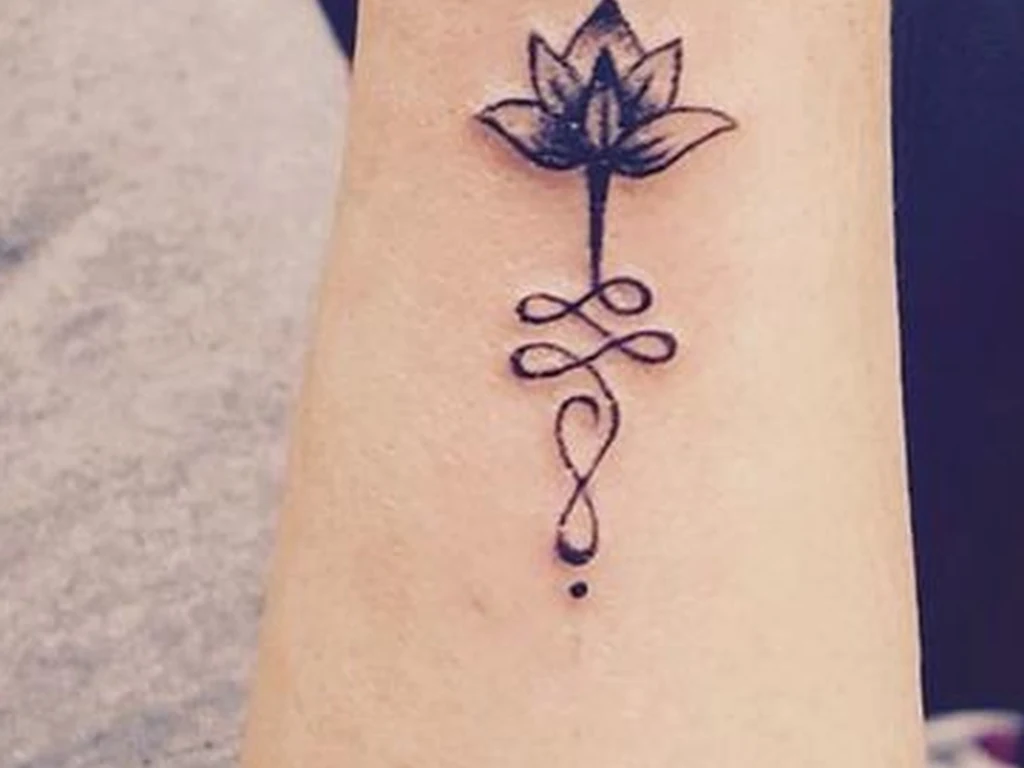
A small dark lotus on the inner forearm whose stem loops into an infinity knot and ends in a single dot. Three symbols in a design barely wider than a coin, and the heavy black fill keeps the flower readable at that scale.
Small and dark ages better than small and fine: solid black holds its silhouette. The infinity loop is the tightest curve here and the first place ink spread will show, so it needs to be drawn open, exactly as it is in this photograph.
25. Lotus With Unalome Dots, Inner Forearm
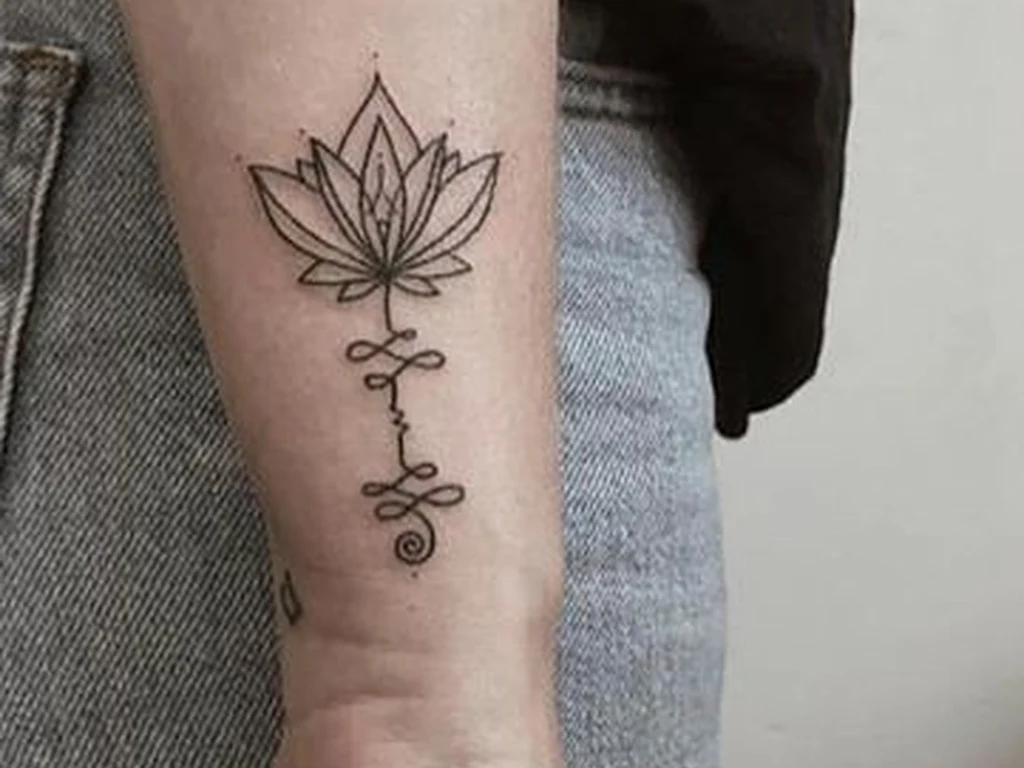
A fine lotus on the inner forearm with a short unalome tail of curves and dots dropping from its stem. It is the quiet version of design 22: the same pairing of symbols at a quarter of the size, worn where only the wearer, and whoever they show it to, will see it.
Inner forearm skin is thin and the lines live close together here; the dots sit with just enough air between them. If you copy this design smaller, drop the dots rather than crowding them.
26. Lotus on a Spiral Stem, Wrist
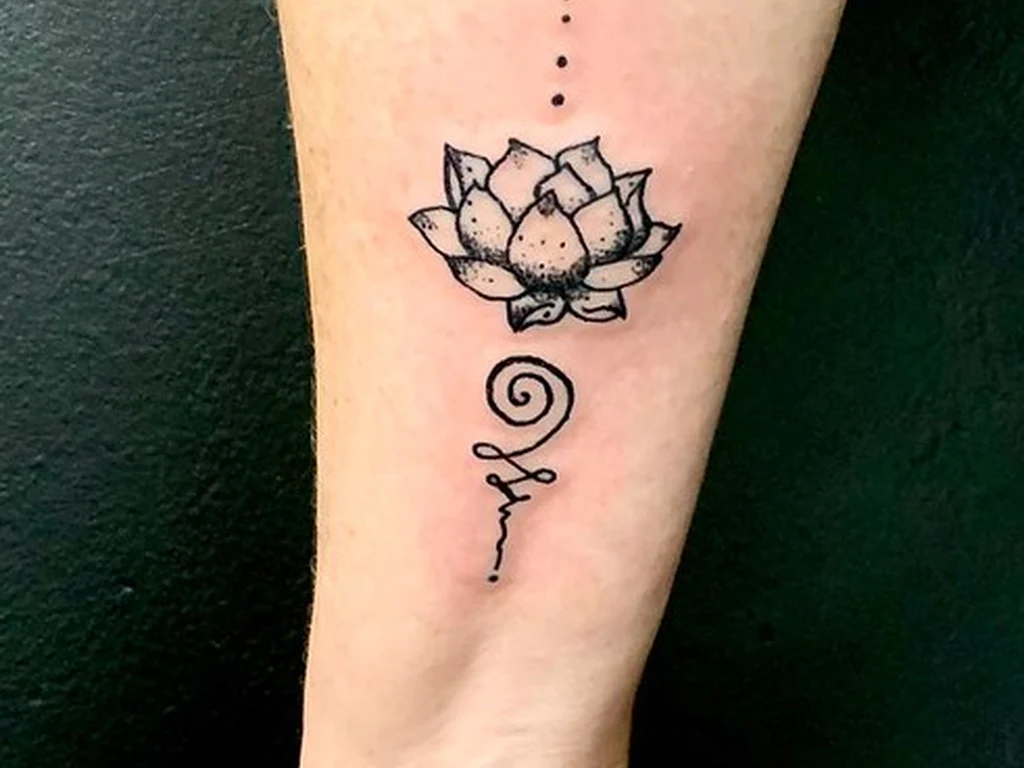
A small shaded lotus on the wrist with a dotted trail above it and an unalome-style spiral curling down from its base, photographed fresh and close. Even at this size the flower has light and dark sides; most wrist lotuses skip the shading, and this one is better for keeping it.
Wrists flex, wash and knock against desks all day, and small tattoos there soften faster than anywhere else on the arm. Shading this bold for the size is the correct defence. Budget for a touch-up in the first couple of years.
27. Fine Line Outline Lotus, Wrist
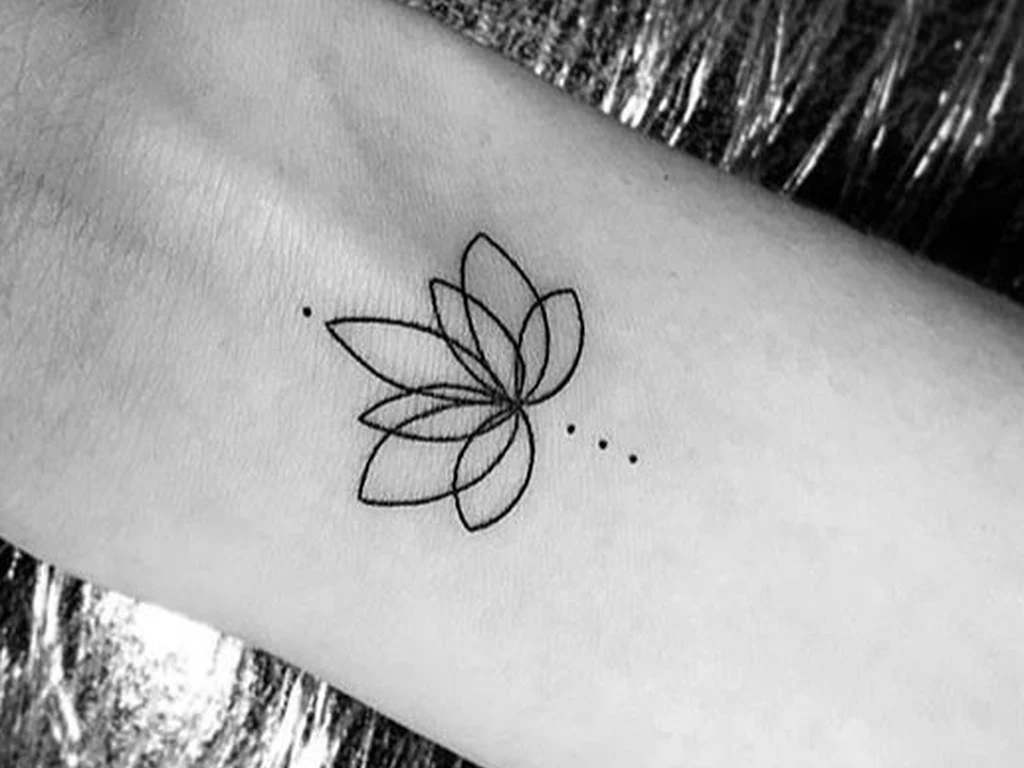
The simplest wrist lotus in the list: one continuous-weight outline, overlapping petals, three tiny dots trailing off the side. It is the design people screenshot, and the black and white photograph shows exactly what fine line promises: elegance now, softness later.
This construction spreads most visibly with age, because no shading or fill holds the shape once the line widens. Worn knowingly, it settles into something like a pencil sketch, and many wearers like that. Our small tattoos for women guide shows more work at this scale.
28. Small Dark Outline Lotus, Inner Wrist
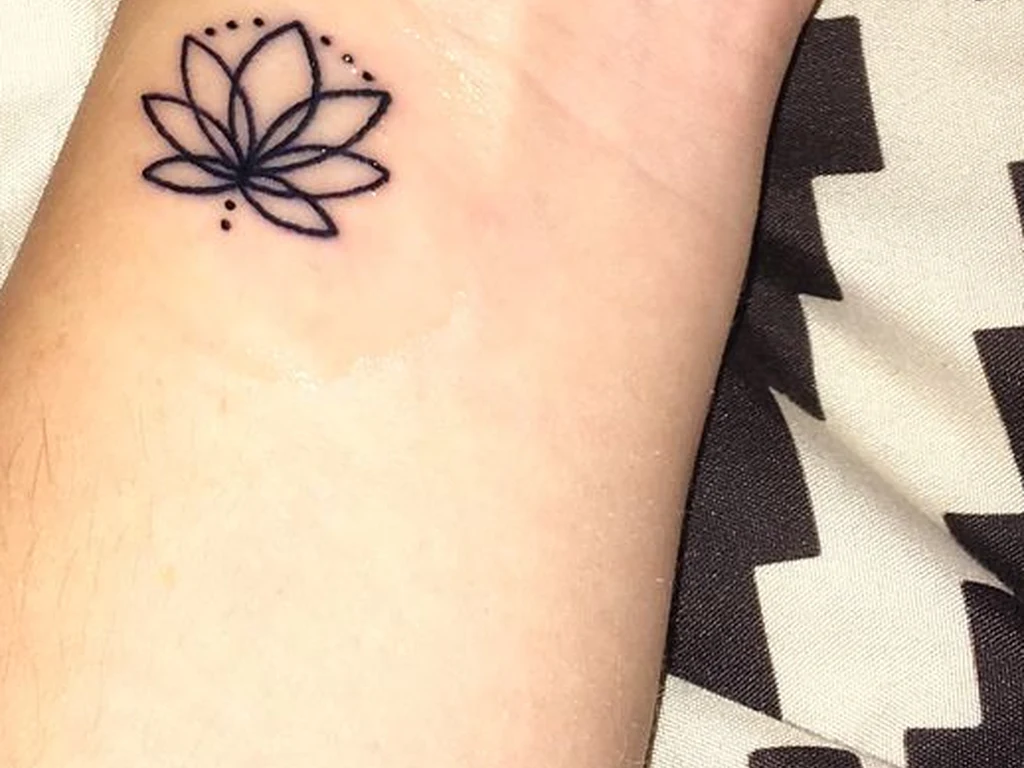
A small lotus drawn in a heavier outline on the inner wrist, petals overlapping in two layers. Set beside the fine line version above, this is the same idea with the line weight doubled, and that one decision separates a tattoo that blurs early from one that holds.
Inner wrist placement is semi-private: visible when your palm turns up, hidden when it turns down. It is also thin skin over tendons, so most people find it sharper than the outer wrist for the few minutes it takes.
29. Tiny Fresh Outline Lotus, Wrist
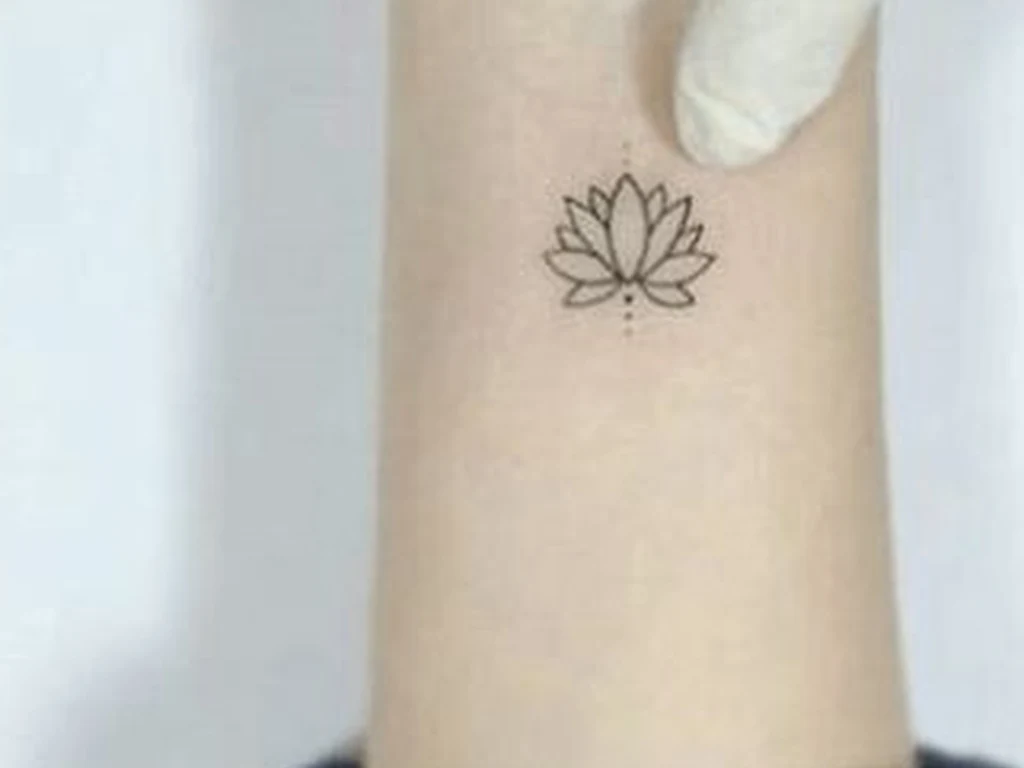
A tiny lotus outline photographed minutes after it was finished, a gloved hand still steadying the wrist. At this size the flower is eight short strokes. There is no room for detail, and the design does not pretend otherwise.
Tiny tattoos are quick and usually priced at a shop minimum, and healing is easy; the discipline is in the drawing. Every stroke here is separated by visible skin, the only reason it will still be a lotus, and not a small dark flower-shaped mark, in five years.
30. Bold Geometric Lotus Beside the Ear
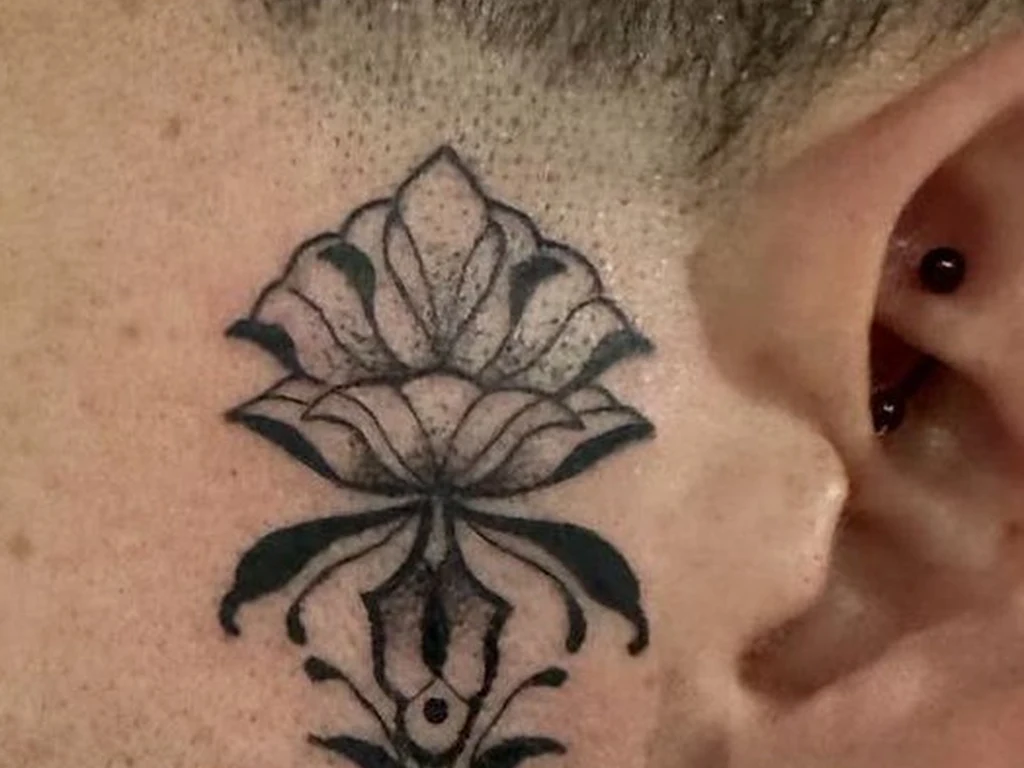
A solid black geometric lotus set into the sideburn area beside the ear, petals stacked like a crest, an ornamental drop below. Head tattoos are the most public placement there is, and this one is drawn with the boldness public work needs: no fine lines, no grey, nothing that can fade into ambiguity.
Think past the photograph before copying this placement. Hairlines move, barbers shave around ink, and many workplaces still read face-adjacent tattoos as a statement. The wearer here has other head work; the lotus is part of a larger commitment, not a first tattoo.
31. Buddha Resting on a Lotus, Chest
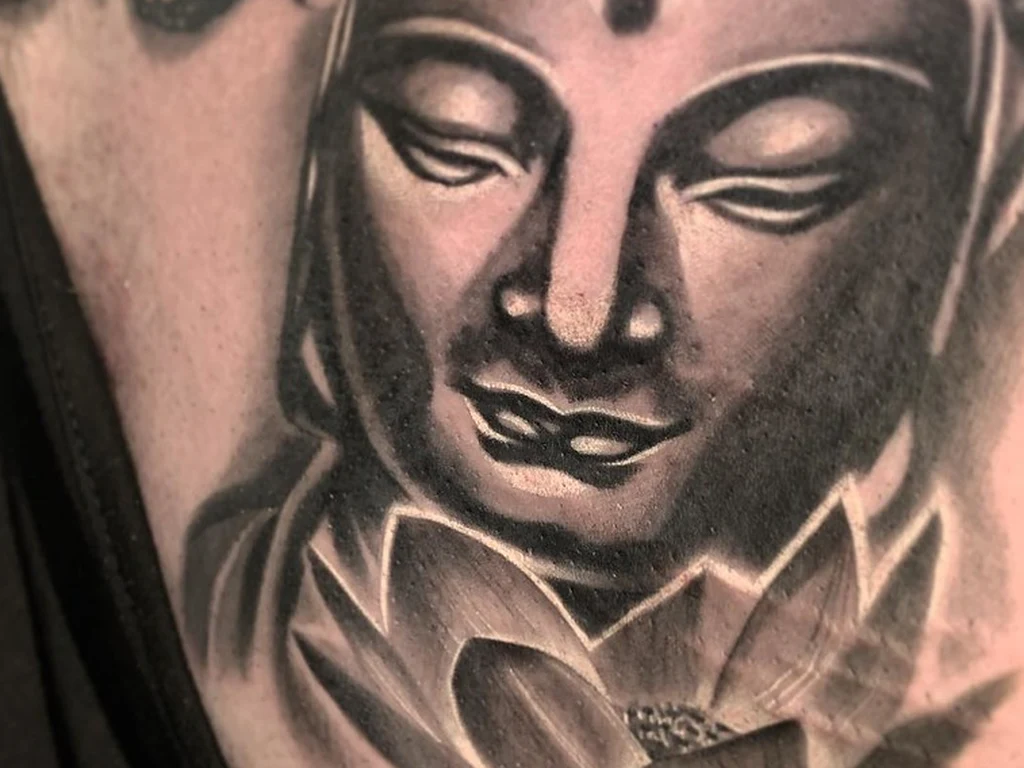
A black and grey Buddha face in deep shadow across the chest, the chin resting just above a lotus drawn along the bottom of the piece. In Buddhist art the Buddha sits on the lotus because the flower is his throne: purity holding up awakening. This tattoo keeps that arrangement and lets the lotus do quiet work under a powerful face.
This is a religious image worn large, and it should be chosen as one. Chest pieces this dark also commit you to long sessions, and to the touch-ups that keep deep grey from going flat; the shading here is layered enough to age with dignity.
32. Ornamental Lotus With Script, Thigh
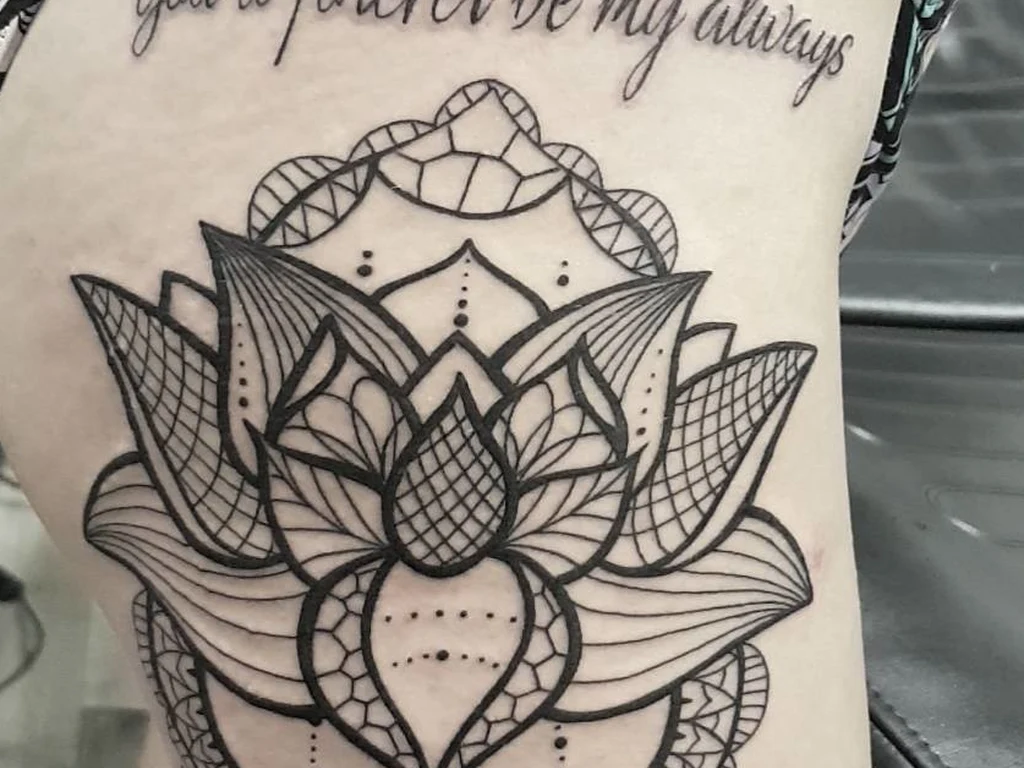
An ornamental lotus on the thigh under a line of script in the wearer’s own words. The lotus is built like a mandala with a pointed crown and layered petals; the lettering rides above it like a caption. Thigh skin gives ornamental work the room it needs to keep its sections separate.
Script above a picture works because the words explain the flower and the flower softens the words. Check the lettering standing and sitting: thigh skin shifts between the two more than people expect, and a line of script shows a stencil that was only checked one way.
33. Mandala Lotus With Moon Phases, Thigh
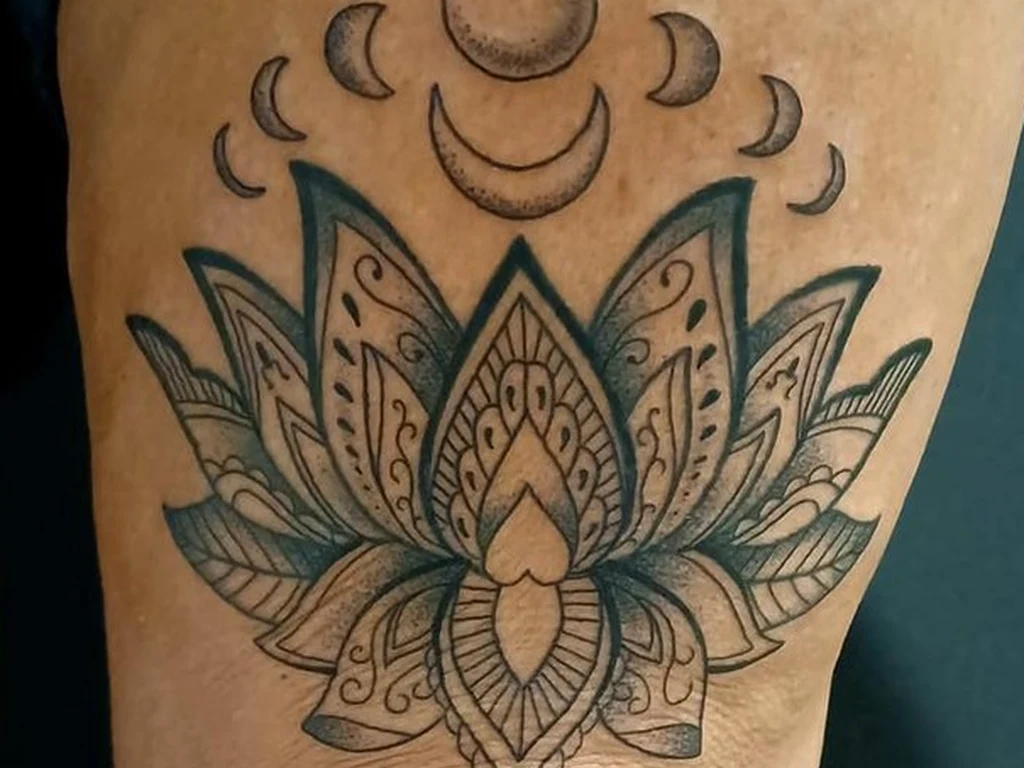
A mandala lotus on the thigh with a row of moon phases arcing over it: crescents, halves and a full moon in the middle. The pairing is modern rather than traditional, the moon standing for cycles and the lotus for rising through them, and the two symbols share a rounded geometry, so they sit together without fighting.
The moon row is the detail at risk: small crescents placed close together can clog as lines settle. These are spaced wide and drawn at a size where each phase stays distinct. Copy the spacing, not just the idea.
34. Pink Lotus With Swirls, Thigh
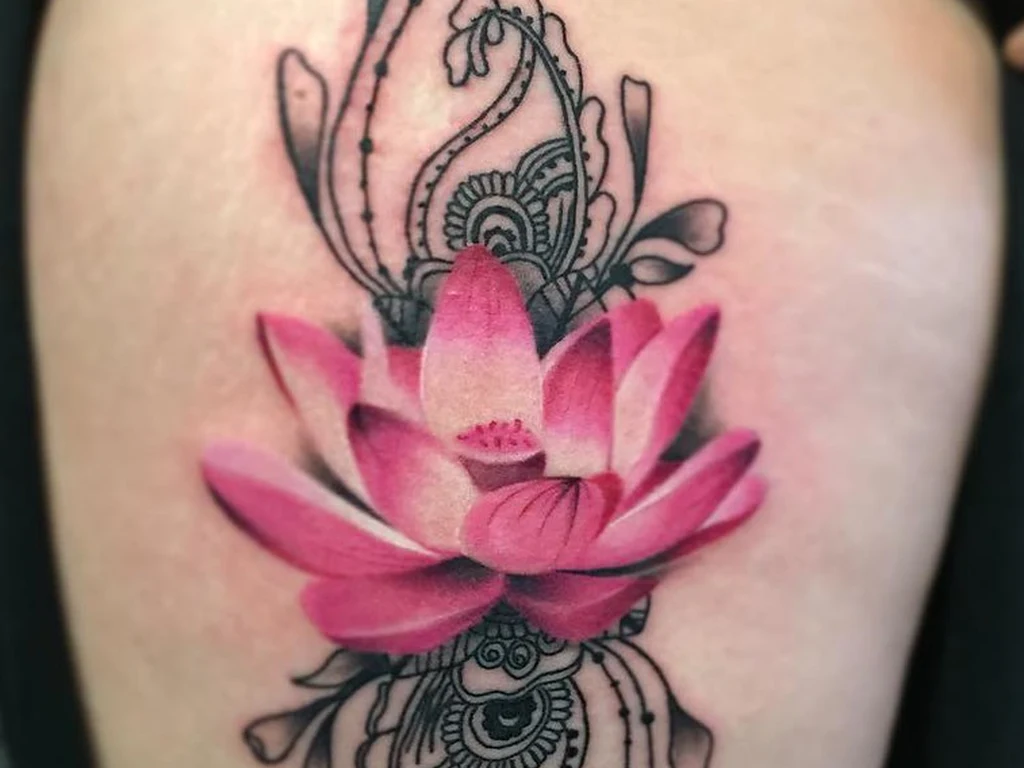
A saturated pink lotus on the thigh with black ornamental swirls curling out behind it. The contrast is the design: soft flower, hard ornament. The blackwork frame also gives the colour a dark edge to sit against, which keeps pink looking pink as it ages.
This is the smart way to wear a light colour big. Colour bordered by black holds its shape years longer than colour left open at the edges; compare design 16. If you love pink, steal this construction.
35. Large Outline Mandala Lotus, Thigh
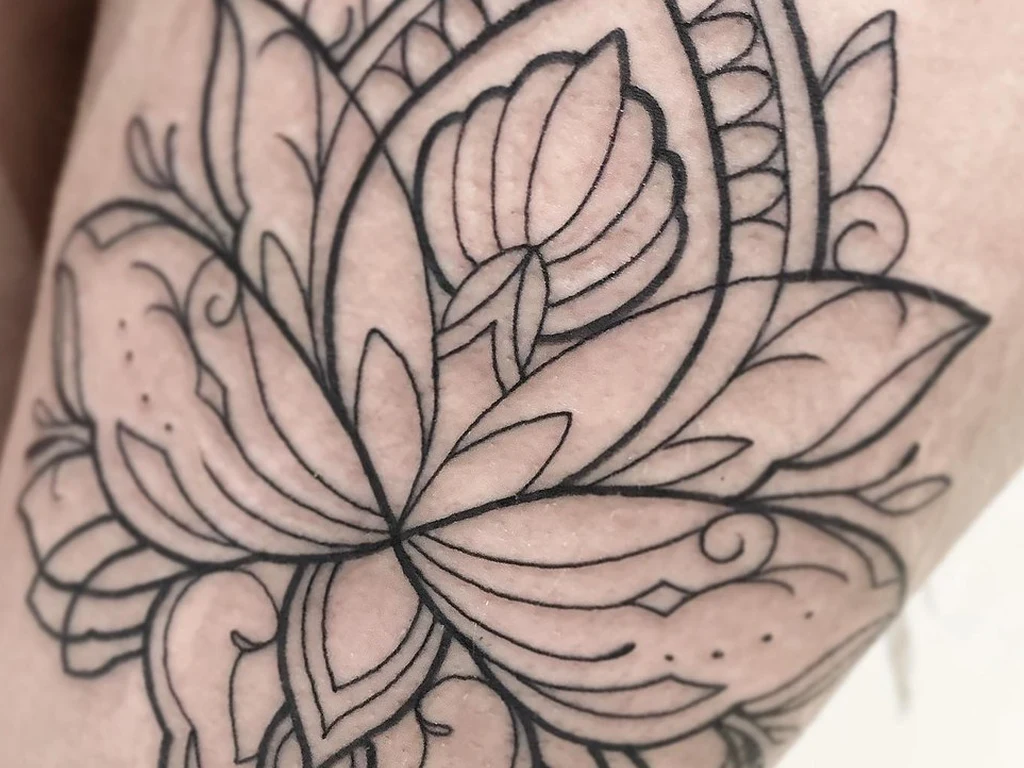
A mandala lotus drawn at full thigh scale in outline only, petals the size of playing cards, photographed close enough to fill the frame. At this size an unshaded outline is not a rough draft; it is a deliberate choice that leaves the skin as the colour and lets the line carry everything.
Big outline work is a long-term bet on line quality. Every wobble shows at this scale, and so does every year of spread, but the lines have so much room that spread reads as softening rather than damage. It also leaves the door open: shading or colour can be added later, and often is.
36. Lotus Vines on Both Calves
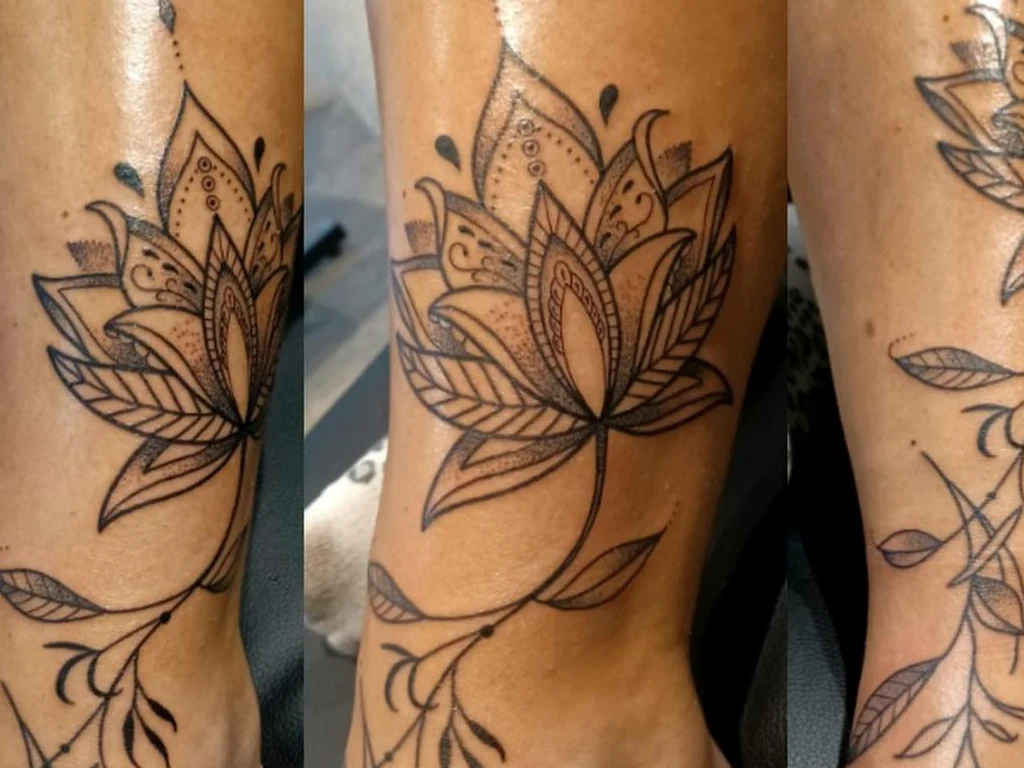
Matching lotus vines trailing down the backs of both calves: blooms, buds and leaves on curving stems, drawn as a pair rather than two separate tattoos. The calves suit trailing designs, because the muscle gives each stem a natural S-curve to follow.
Pairs are a planning exercise. Legs are not identical, so the drawings are mirrored by eye rather than traced, and a good artist redraws each side for the leg it sits on. Photograph both legs together at the stencil stage; that is when mismatches are still free to fix.
37. Pink Lotus, Lower Calf
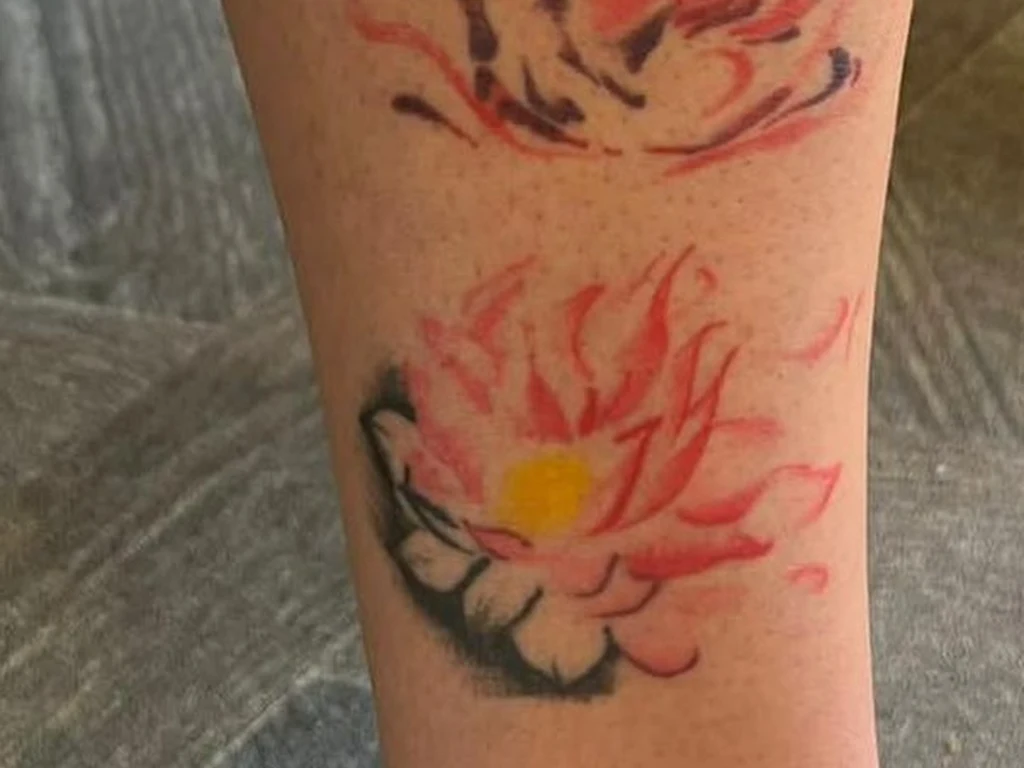
A pink lotus with a yellow heart on the lower calf, cropped from a photograph of a leg carrying a large red tiger piece above it. The lotus holds its own at the bottom of the leg: bright, simple, drawn in the same flat colour language as the work it sits under.
Small colour pieces low on the leg heal around shoes and socks, so the first two weeks need loose footwear and patience. Flat colour is forgiving: minor healing hiccups touch up invisibly in solid pink in a way they never would in soft shading.
38. Small Outline Lotus, Top of the Foot
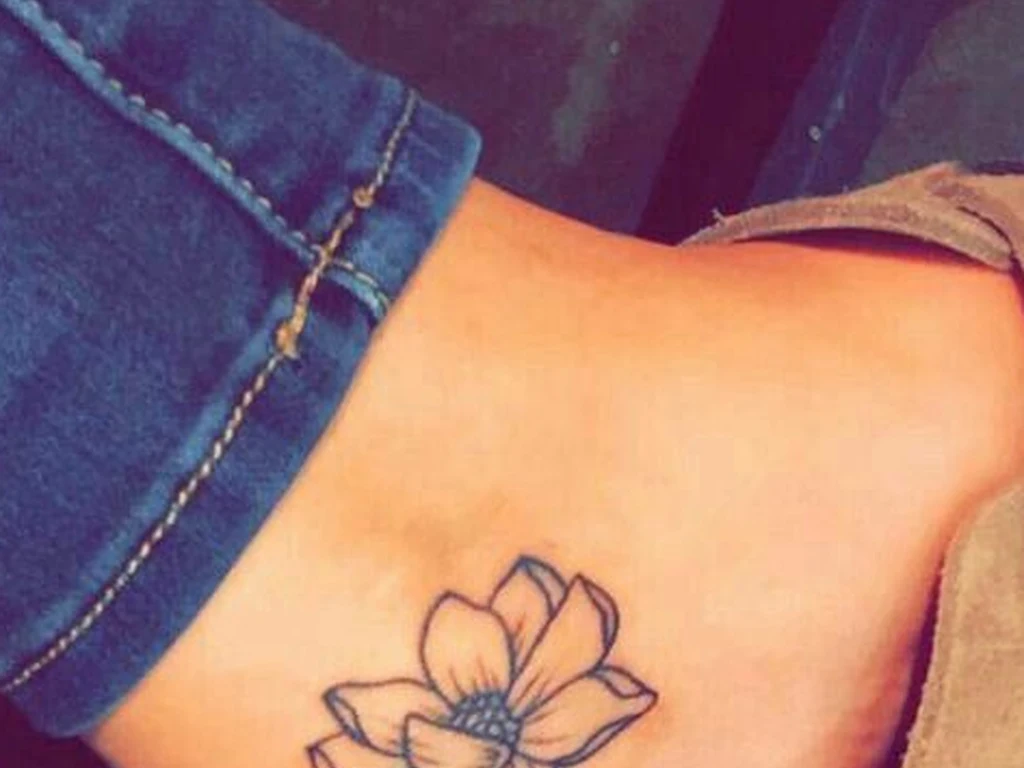
A small outline lotus on the top of the foot, five petals and a centre line, photographed against jeans and a trainer. The foot is a postcard-sized canvas and this design is sized honestly for it: one flower, no entourage.
Foot tattoos heal slower than almost anywhere: shoes rub, feet swell by evening, and thin skin over bone and tendon raises the risk of blown lines. Artists often book foot work with a touch-up included, because a second pass is the rule rather than the exception.
39. Tiny Outline Lotus, Ankle
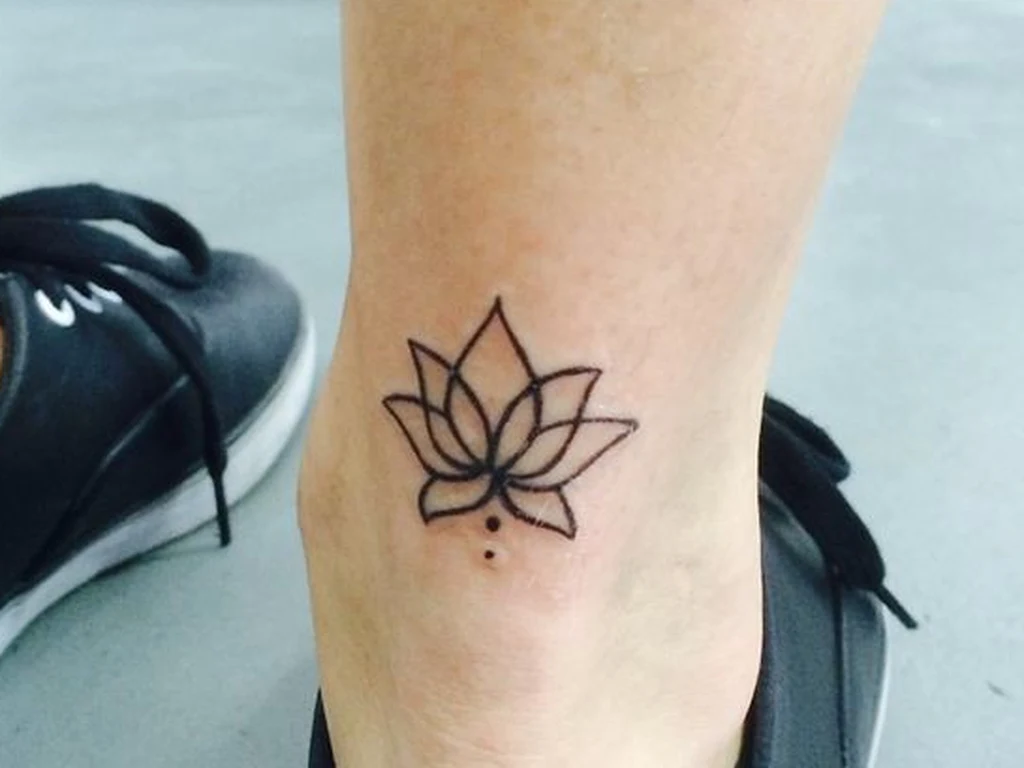
A tiny lotus outline on the flat ground just above the ankle bone, drawn with a dotted drop beneath. Ankle lotuses are the entry point for a lot of people: small, easy to cover with a sock or a boot, and a fair test of how you feel about having a tattoo at all.
The ankle’s thin, mobile skin spreads ink a little faster than the forearm’s. These lines are spaced for it. If you want this design, resist shrinking it further at the studio; it is already at the size where smaller stops working.
40. Lotus With Lily Pads, Shoulder Blade
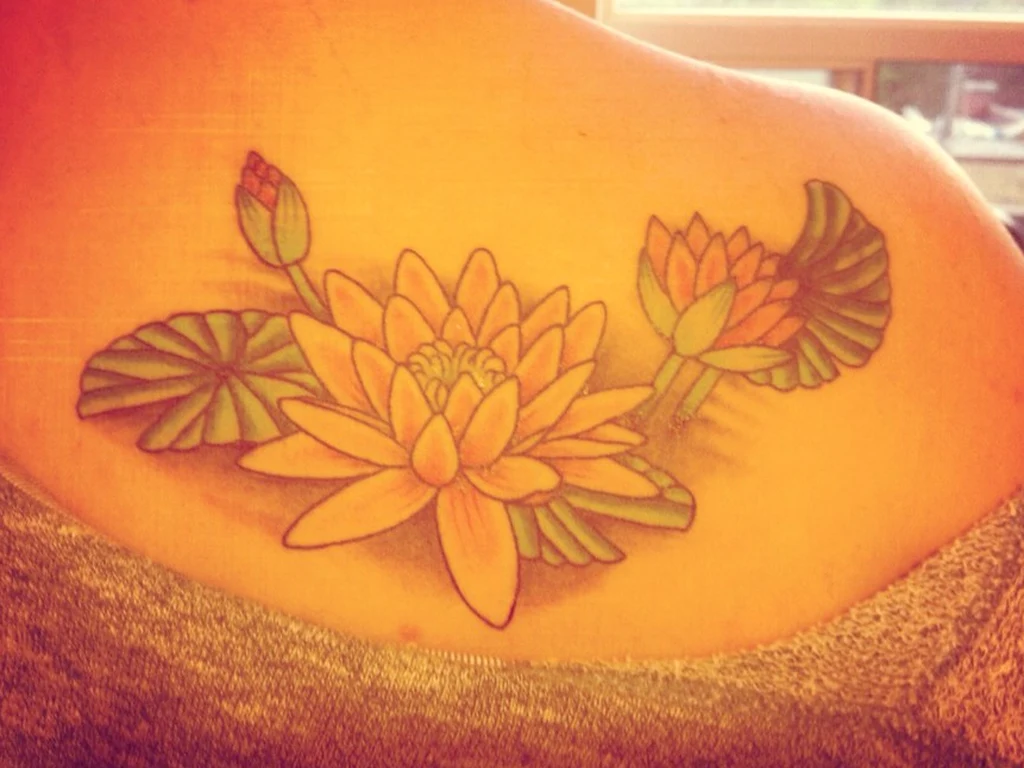
A golden lotus with two buds and round lily pads spread across a shoulder blade, photographed through a warm filter that pushes everything toward amber. The drawing leans to the Egyptian water-lily side of the family: flat pads, sun colours, a flower that reads like a small sunrise on the back.
Judge this one by its drawing, not its colours: the filter makes the true palette impossible to know, and the honest note matters more than a guess. The shoulder blade is kind canvas for a wide flat design; it moves when you reach, but the skin itself stays stable for decades.
Best Placements for a Lotus Tattoo
The sternum and underbust come first because they are the most requested and the least honestly discussed. The skin sits on ribs with little padding, so it is tender; it also changes. Weight shifts, pregnancy, training and ageing move the skin under the bust more than skin on a back or upper arm. A bold mandala like design 10 absorbs that movement; a hairline chain of tiny dots may not. Draw a sternum lotus a level bolder than your reference, check the stencil while breathing in and out, and know the underband of a bra will rub the lowest part for two weeks.
The spine is the lotus’s most natural vertical canvas, and chains like design 9 use it best, stacking small symbols along the centre line. Two practical notes: the needle runs close to bone over the vertebrae, which most people find sharp, and you cannot reach the middle of your own back to moisturise it during healing. Plan help, or a long-handled applicator, before the appointment.
The wrist is where lotus tattoos go small, and small is a trade. Wrist skin flexes and washes constantly, so fine lines soften there faster than anywhere else in this list; designs 26 to 29 run from shaded to single-line, and the shaded ones will outlast the single-line ones. At wrist size, pick fewer petals and heavier lines than your reference shows, and treat a touch-up in year one or two as part of the design.
Thighs, hips and stomach are the forgiving canvases for size and the least forgiving for change. A thigh mandala (designs 33 and 35) can be drawn big enough to keep every section separate for decades. Stomach and hip skin records weight change and pregnancy, and symmetrical designs show it first; symmetry is also the defence, because a mandala distorts evenly where a portrait would tear.
Feet and ankles close the list because they ask the most patience for the smallest reward in size. Thin skin, constant friction and slow healing mean foot lotuses (design 38) often need a second pass, and ankle pieces (design 39) spread slightly faster than arm work. Neither is a reason to avoid them; both are reasons to book an artist who tells you so upfront.
Lotus Tattoo Styles
Fine line work (designs 5 and 27) is a single needle drawing with thread-thin lines and no fill. It is the style of the moment and the one with the shortest memory: lines widen as ink settles over the years, so fine line petals need air between them. Specialists draw with that spread in mind, leaving gaps that look almost too wide on fresh skin and exactly right on aged skin.
Dotwork (designs 11 and 19) builds tone from thousands of individual dots instead of grey wash. It suits the lotus because petals are gradients in nature, darker at the base and pale at the tips, and stippling copies that gradient without a hard edge. It is slow to tattoo and priced accordingly, and it ages into tone gracefully, which is why so much sternum work uses it.
Black and grey (designs 4 and 31) trades colour for depth: smooth shading, deep blacks and skin left as the highlight give the lotus a sculptural feel, and with no pigment to fade unevenly it is the most predictable style across decades. If the meaning matters more than the colour, this is the safest pair of hands to put it in.
Colour splits into two camps in this list. Bold colour with hard outlines (designs 1, 2, 17 and 34) holds its edges and reads across a room; pinks and purples fade faster than other pigments in sunlight, but the outline keeps the flower’s shape when they do. Colour without outline (design 16) is painting on skin: beautiful, softer every year, and the right choice only if you like how watercolour settles. Our flower tattoo design ideas overview shows the same split across fifteen other flowers.
Ornamental and mandala work (designs 10, 15, 21, 32 and 35) treats the lotus as a jewel: symmetric, patterned, closer to carved decoration than to a plant. Symmetry is the whole skill and it is won or lost at the stencil, so these pieces reward artists who redraw rather than copy. The same ornamental language drives the site’s medusa tattoo meaning guide, if you want to see where the style goes at its most detailed.
Making It Yours
Start with the petal count, the one choice with a documented meaning behind it: eight outer petals point to the Noble Eightfold Path, and a bud instead of an open bloom is read in most studios as potential not yet opened. Neither choice needs defending; both are worth making on purpose rather than by accident.
Then decide what travels with the flower. The unalome adds a religious path under it (design 22). A seed pod makes it botanically honest (design 18). Script makes it personal, provided a fluent reader checks the words first (designs 5 and 23). Moon phases give it a cycle to belong to (design 33). Each addition changes the story; add one, not four.
Scale is the last lever and the strongest. The same outline exists in this list at wrist size (design 29) and at full-thigh size (design 35), and they are not the same tattoo: line weight, petal spacing and detail must all be redrawn for the size you pick. Bring your artist a design and a measurement, not just a design.
Lotus Tattoo FAQs
What does a lotus tattoo mean?
The traditional meaning is purity and rising through difficulty: the flower grows from pond mud and opens clean above the water. In Buddhism it also stands for spiritual awakening, in Hinduism for creation and divine beauty. Most wearers today pick it for a hard period survived cleanly, a fair use of a very old symbol.
Is it OK to get a lotus tattoo if I am not Buddhist or Hindu?
The flower on its own is worn across the world and is not restricted. Where respect matters is the company it keeps: a Buddha figure, a mantra in Sanskrit or Tibetan script, or an unalome turns the piece into a religious tattoo. Include those only if you know what they say; keep deity images off the feet and lower legs, and never treat sacred script as decoration.
How many petals should a lotus tattoo have?
Eight outer petals is the count with a source behind it, linked to the Noble Eightfold Path. Real lotus flowers have many more petals, and plenty of designs use five or six for a cleaner drawing at small sizes. Petal count is a meaning choice at large sizes and a legibility choice at small ones.
What do lotus tattoo colours mean?
The lists in circulation say white for purity, pink for the Buddha and the supreme lotus, red for the heart and compassion, blue for wisdom, purple for mysticism. They come from Hindu and Buddhist colour symbolism as popular sources retell it, and details vary between sources. Pick a colour because the tradition speaks to you, or because you like it; no old text punishes the second reason.
What is the spiral symbol under some lotus tattoos?
It is the unalome, a sacred symbol from Theravada Buddhism used in Thai sak yant tattooing. The spiral represents the winding path of a life, the dots mark progress toward enlightenment, and the lotus is often drawn above it as the destination. Designs 22, 25 and 26 in this list all use it.
Does an open lotus mean something different from a closed bud?
Studios commonly read an open bloom as awakening or a chapter fully lived, and a closed bud as potential, a beginning, or something still protected. That reading is modern convention rather than scripture, but it is widely shared, so other people will read your tattoo that way even if you chose the shape for its looks alone.
Where does a lotus tattoo hurt the most?
Of the placements in this list, the sternum and spine are usually rated the sharpest, because the needle works over bone with thin padding, and the top of the foot is close behind. Forearms and thighs are the gentlest. Pain is personal, and the big mandala pieces run long, so ask your artist how they pace breaks before you book.
Do fine line lotus tattoos age well?
They age softly rather than badly. Fine lines widen a little as ink settles, so petals drawn close together can merge over the years; petals drawn with air between them (designs 5 and 27 show the spacing to aim for) stay separate and settle into something like a pencil drawing. For one to stay crisp for ten years, go bigger than feels necessary.
Can a lotus tattoo cover up an old tattoo?
Yes, and it is one of the better cover-up subjects: layered petals hide edges, and the design tolerates the dark shading a cover-up needs. Design 17 is a worked example, a teal lotus built over an older tribal piece. The rules are fixed: the cover-up must be larger and darker than what sits underneath, and your artist needs to see the old tattoo in person first.
Will a sternum or stomach lotus stretch if my body changes?
It will move with the skin, because all tattoos do; the question is how the design handles it. Wide symmetrical mandalas (designs 10 and 14) distort evenly and stay readable through normal weight change. Fine detail, tiny dots and long straight lines show change first. If you are planning pregnancy, talk timing through with your artist; many people wait until after.
Final Thoughts
Forty lotuses, and the pattern across them is the one this site keeps finding: the tattoos that last are drawn at the size their detail needs, in lines heavy enough for the placement they sit on. The lotus asks for one extra thing most flowers do not. It arrives carrying two religions’ worth of meaning, so its strongest versions, from the tiny wrist outline to the Buddha on the chest, are the ones where the wearer knew which parts were sacred and chose them on purpose. Pick your flower, pick its company carefully, and let the drawing be as honest as the symbol.
Photo credits: 1: fifikins, CC BY 2.0, via Flickr. 2: arne h, CC BY-SA 2.0, via Flickr. 3: mattieb, CC BY-SA 2.0, via Flickr. 4, 5, 6, 7, 24, 25, 27, 28, 29, 38 and 39: Mini Tatuajes, CC BY 2.0, via Flickr. 8: dharmabum60, CC BY 2.0, via Flickr. 9, 12, 13, 15, 19, 20, 26, 30, 33, 36 and 37: TattoosAll, CC BY-SA 2.0, via Flickr. 10, 11, 14, 16, 18, 31, 32, 34 and 35: TattoosAll, CC BY 2.0, via Flickr. 17: AnjanaTattoo, CC BY-SA 4.0, via Wikimedia Commons. 21: antefixus21, CC0, via Flickr. 22: AMAR TATTOOZ, Public Domain Mark, via Flickr. 23: Unlisted Sightings, CC BY 2.0, via Flickr. 40: letsgoeverywhere, CC BY-SA 2.0, via Flickr. Full file names and source links are listed in this article’s package notes.

Pingback: Lotus Tattoo Meaning: Symbolism, History and What It Really Stands For