
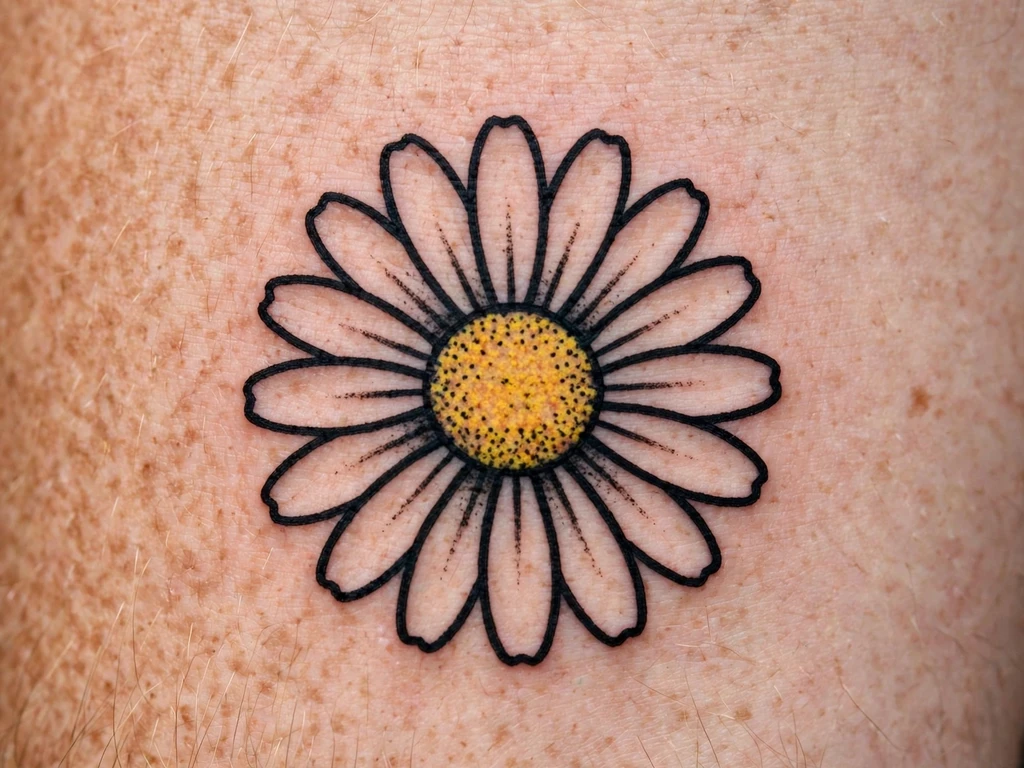
A daisy tattoo looks like the simplest flower in tattooing — a yellow centre, a ring of white petals, done. It is actually one of the most technically honest flowers you can choose, because the daisy hides the two hardest truths in floral tattooing inside its prettiest shape. The first truth: there is no white in a classic daisy tattoo. White ink cannot do what wearers ask of it, so the “white” petals of a healed daisy are the wearer’s own skin, held inside black line — the flower is drawn by what is left out of it. The second truth: a daisy is a radial design, a ring, and a ring forgives nothing. One petal spaced wider than its neighbours, one petal drawn shorter, and the whole flower limps forever.
You will find 25 original daisy tattoo ideas here — the classic single bloom, daisy chains for wrists and ankles, gerbera colour, dotwork and blackwork versions, an April birth-flower design, a bee, a butterfly, and one small, cheerful vandal called the oopsie daisy. But before the designs comes the part most daisy galleries skip: what a daisy actually is (it is not one flower at all), and the ring law that decides whether a daisy still reads as a daisy at year ten. Read that first. A daisy chosen with open eyes is the happiest tattoo in this series; this guide exists so that yours stays happy.
What Does a Daisy Tattoo Mean?
The daisy’s meanings are the sunniest in the flower language, and they gather around the flower’s own behaviour. Innocence and purity are the readings everyone reaches first: the white petals, the plainness of the plant, the flower of childhood games. New beginnings run just as deep — the daisy is among the first flowers back in spring grass, it reopens fresh every single morning, and wearers take it for restarts: the new chapter, the clean page, the life begun again deliberately. And cheerfulness: a daisy is the flower people draw in margins and pick on walks — optimism worn at small scale, without apology.
The flower’s name carries the loveliest of its meanings. Daisy comes from the Old English dæges ēage, “day’s eye”, because the petals open at dawn and close at dusk — in Medieval Latin it was solis oculus, “the sun’s eye”, as the Online Etymology Dictionary’s daisy entry records. A daisy is a small sun that keeps daylight hours: it wakes, it works, it closes. Wearers who choose the flower for a person who lights their days, or for their own decision to live more of life in the open, are wearing the name as much as the flower.
Then there is the game everyone knows: he loves me, he loves me not, petal by petal, the flower consulted as an oracle and destroyed in the asking. It is a gentle tradition — nobody consults a daisy about anything they truly fear — and it gives the daisy a romantic, hopeful meaning no other common flower carries: love tested lightly, with the last petal allowed to decide.
April’s flower. The daisy is April’s birth flower, and that is a genuine reason — not a decorative one — that a large share of daisy tattoos exist. April-born wearers take it as their flower outright; other wearers take it for an April child, an April anniversary, an April person. If you are planning a birth flower tattoo by month, the site’s birth flower tattoo ideas guide walks the whole year flower by flower. This guide is the deep dive on April’s flower alone.
One framing note, as this series always makes: these meanings are symbolism — personal and traditional, worn as meaning, not as fact. What is fact is the flower’s structure and the pigment’s behaviour, and that is where this guide goes next.
The Flower Under the Drawing: What a Daisy Actually Is
A daisy is not a flower. It is a crowd of flowers arranged to look like one — and once you know that, you know how to draw it.
The common daisy, Bellis perennis, belongs to the Asteraceae, the daisy family — one of the largest plant families on earth, shared with sunflowers, asters and gerberas. Its familiar head is a composite: the yellow centre is a dense disc of many tiny tubular disc florets, and each “petal” around it is a separate, complete ray floret — a small strap-shaped flower of its own. The Royal Botanic Garden Edinburgh’s profile of the common daisy puts it plainly: the flower head “is not a singular flower, but a composite of many tiny flowers”, the white ray florets surrounding the yellow disc. That single fact is the daisy tattoo’s whole craft in disguise: the centre is not a yellow circle to be filled flat but a texture of tiny units, drawn in dotwork and stipple — and the petals are not slices of one white disc but individual units around a ring, drawn as separate, counted shapes.
Bellis perennis is the original “true” daisy: a low European lawn and meadow plant, white-rayed and yellow-centred, blooming from early spring to late autumn, opening with the sun and closing at night — the day’s-eye behaviour its name describes. The daisies of florists’ buckets are mostly its cousins, the gerbera daisies (Gerbera jamesonii and its hybrids): bigger heads, and ray florets in pink, orange, red, coral and cream as well as white. For a tattooer, that split is a design fork. The common daisy gives you the classic: white-that-is-skin, yellow centre, black line. The gerbera gives you colour: petals that can genuinely be a colour, because they are drawn and filled as one. Designs 1 and 6 in this guide are the two poles.
And the chain: daisy chains are made by slitting one stem with a thumbnail and threading the next flower through, head after head. A tattooed daisy chain (Designs 3, 4 and 15) is that ritual made permanent, and its craft problem is the real chain’s problem too: every link must be complete in itself, and the join must be designed.
The Ring Law: How a Daisy Tattoo Is Built
Underneath every design in this guide sits one piece of geometry: a daisy is a ring of separate petals around a packed centre, and it is only ever as good as its ring. Five rules follow, and together they are this guide’s craft spine — call it the ring law.
Rule one: the white is skin. White ink exists, and skilled artists use it for highlights, but as a petal strategy it fails on a schedule: it yellows, creams and fades unevenly as it ages and meets the sun, and on many skin tones it barely shows even fresh. The classic daisy’s real method is older and better: petals drawn as black-line outlines with the inside left entirely open, so the petals read white because the wearer’s skin is white-to-tone inside them — a colour that never fades, never yellows and is guaranteed to match. Every “white” daisy in this guide is built that way, and FAQ 3 answers the direct question in full.
Rule two: count the petals, and keep the count honest. A tattoo ring works at a readable count — typically 12 to 21 petals depending on size — and what matters is not the number but the evenness: equal spacing, equal length, each petal its own separated shape with a genuine gap of skin between it and its neighbours. Petals drawn touching merge as lines settle; petals drawn unevenly make the flower nod. The stencil test is simple: count the petals and measure the gaps. If you can spot the widest gap fresh, everyone will spot it healed.
Rule three: the centre is a texture job, not a fill. Following the botany: the centre disc is hundreds of tiny florets, and it should be drawn as hundreds of tiny units — packed dotwork, dense stipple, a texture that deepens toward the middle. Flat-packed yellow with no texture reads as a fried egg at distance; a dotwork centre reads as a daisy at twenty metres. The yellow itself will soften toward cream over the years — the daisy’s one unavoidable tone drift — and a textured centre survives that softening far better than a flat one, because texture reads by pattern, not by colour.
Rule four: stems are the weak point. A daisy on a hairline green stem is a flower on borrowed time: thin lines spread, and pale greens and yellows are among the fastest-fading pigments in the skin, so the stem goes vague years before the head does. The series’ answer, applied throughout this guide: stems drawn in black or grey line at honest weight, with green used — if at all — as an accent inside a black structure, never as the structure itself. A stem is a line first and a colour second.
Rule five: the ring must survive the placement. A daisy is a circle, and circles warp on skin that bends, twists or swells. Flat, still skin — forearm, shoulder blade, calf, upper arm — keeps a ring round. Skin over a joint or along a curve asks for a smaller, bolder ring, stencilled on the body standing and checked in motion.
Daisy Tattoo Styles and How They Age
A daisy ages by the ring law’s logic: its line holds, its yellow softens, and its petals — being skin — never age at all. Every style below is a different treaty with that arithmetic.
| Style | How it is drawn | How it ages |
|---|---|---|
| Classic negative-space | Black-line petals left open as skin, dotwork yellow centre, black stem | The longest-lived daisy of all: the petals cannot fade, the centre’s texture survives its softening to cream, the ring reads for decades |
| Fine line | One delicate line weight, minimal or no centre texture, small scale | Softens soonest; survives only where the ring is simple, petals few and wide-spaced, the centre lightly stippled |
| Dotwork | Petals and centre both built from stippled dots over a light line skeleton | Dots hold their places well; the ring mellows into a soft, printed look — the most forgiving style for large daisies |
| Blackwork | Bold black petals as silhouettes or heavy line, packed black centre | Ages like all bold blackwork — superbly; trades the daisy’s sweetness for a graphic, unmistakable ring |
| Gerbera colour | Petals outlined and filled in pink, orange, red or coral; textured yellow-orange centre | The petal colour softens gently and evenly if packed well; pale pinks go first, saturated oranges and corals hold longest |
| Wash / watercolour-style | Soft colour washes for petals and centre over a minimal line skeleton | The softest ageing of all — edges diffuse into a haze of colour; chosen for that diffusion, never against it |
One more honesty belongs here: the fresh-photo problem. A new daisy tattoo photographs with its yellow at full bottle brightness and its fine lines at their thinnest — the two things time changes first. Every design in this guide is described at its healed reality. Judge artists the same way: healed daisies, or it did not happen.
Daisy Tattoo Ideas at a Glance
| # | Design | Style notes | Best placement |
|---|---|---|---|
| 1 | The Classic Single Daisy | Negative-space petals, dotwork centre | Forearm |
| 2 | April’s Daisy | Classic bloom, birth-flower reading | Forearm |
| 3 | Daisy Chain Anklet | Linked blooms wrapping the joint | Ankle |
| 4 | The Climbing Daisy Chain | Chain of daisies up the arm | Forearm |
| 5 | The Oopsie Daisy | One petal fallen, playful | Calf |
| 6 | Gerbera Daisy in Full Colour | Filled coloured petals | Upper arm |
| 7 | The Red Daisy | Gerbera form, red only | Shoulder |
| 8 | Daisy and Bee | Classic bloom, small bee visitor | Forearm |
| 9 | Daisy and Butterfly | Bloom with resting butterfly | Shoulder blade |
| 10 | Dotwork-Centre Daisy | Stipple centre, line petals | Forearm |
| 11 | Blackwork Daisy | Bold silhouette ring | Upper arm |
| 12 | Fine-Line Daisy | Single delicate line weight | Wrist (inner) |
| 13 | Tiny Daisy Behind the Ear | Micro bloom, bold for size | Behind ear |
| 14 | Tiny Daisy on a Finger | Smallest ring, honest warnings | Finger (side) |
| 15 | Daisy Chain Bracelet | Linked blooms around the wrist | Wrist |
| 16 | Two Daisies, One Stem | Paired blooms, shared stem | Calf |
| 17 | The Daisy Wreath | Ring of small daisies | Shoulder |
| 18 | The He-Loves-Me Daisy | One petal drawn mid-fall | Forearm |
| 19 | Wash Daisy | Soft watercolour-style washes | Shoulder blade |
| 20 | Traditional Daisy | Bold outline, flat colour | Upper arm |
| 21 | Daisy Sprig with Leaves | Bloom, buds and leaves on a stem | Calf |
| 22 | Daisy with Falling Petals | Petals drifting below the bloom | Shoulder |
| 23 | Three-Daisy Cluster | Trio of small blooms | Ankle |
| 24 | Collarbone-Edge Daisy Sprig | Fine sprig along the bone | Collarbone (outer edge) |
| 25 | The Big Shoulder-Blade Daisy | Large single statement bloom | Shoulder blade |
25 Daisy Tattoo Ideas
1. The Classic Single Daisy
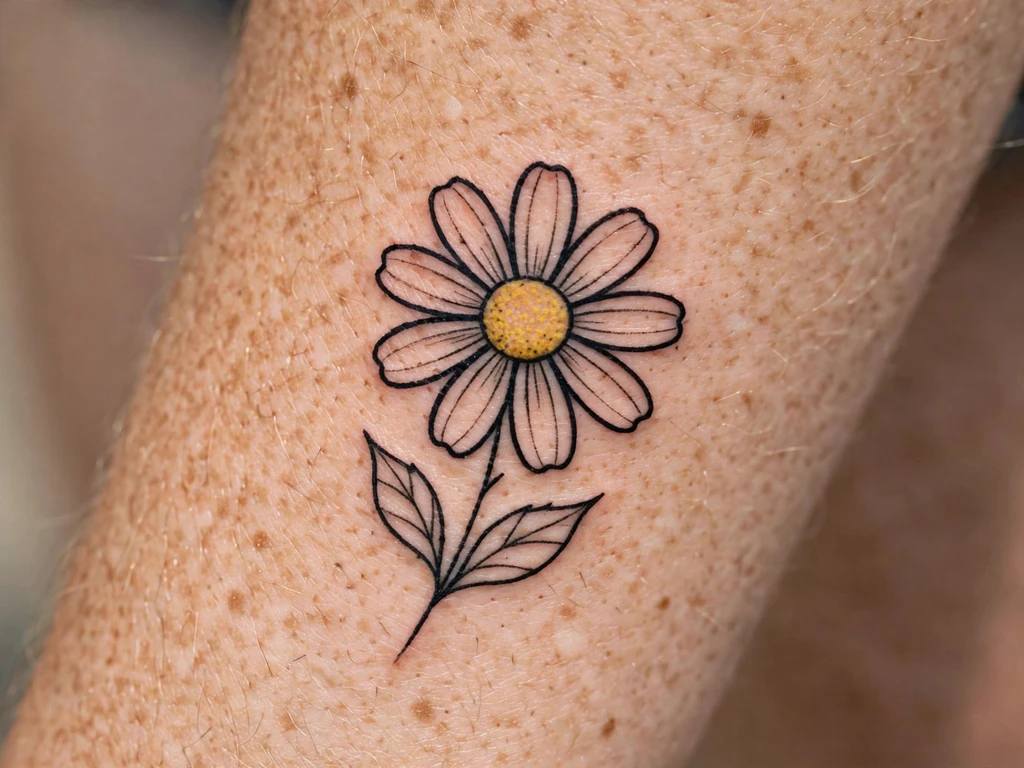
Begin with the archetype: one daisy, drawn the way the flower itself is built — a ring of separate white petals, each outlined in black and left as open skin inside, around a centre packed with yellow dotwork, on a short black stem with two simple leaves. This is the daisy of lawns and childhood summers, and it is also, quietly, the most technically correct flower tattoo in this guide: every decision in it follows the ring law.
The craft is the evenness of the ring. Thirteen to seventeen petals, each its own closed shape, each separated from its neighbours by a true gap of skin, struck from the centre at equal angles like spokes. The centre is stippled dense at the middle and lighter at its rim, so it domes the way a real disc of florets domes. Drawn at 6–9 cm on the forearm’s flat, this daisy reads across a room at year one — and at year twenty.
Best placement: Forearm, centred on the flat of the inner or outer arm; it also sits happily on a calf at the same scale.
Best for / know before you book: This is the design to judge a daisy artist by — count the petals and gaps on the stencil, and ask to see a healed floral piece, because the ring’s evenness is the whole examination.
2. April’s Daisy
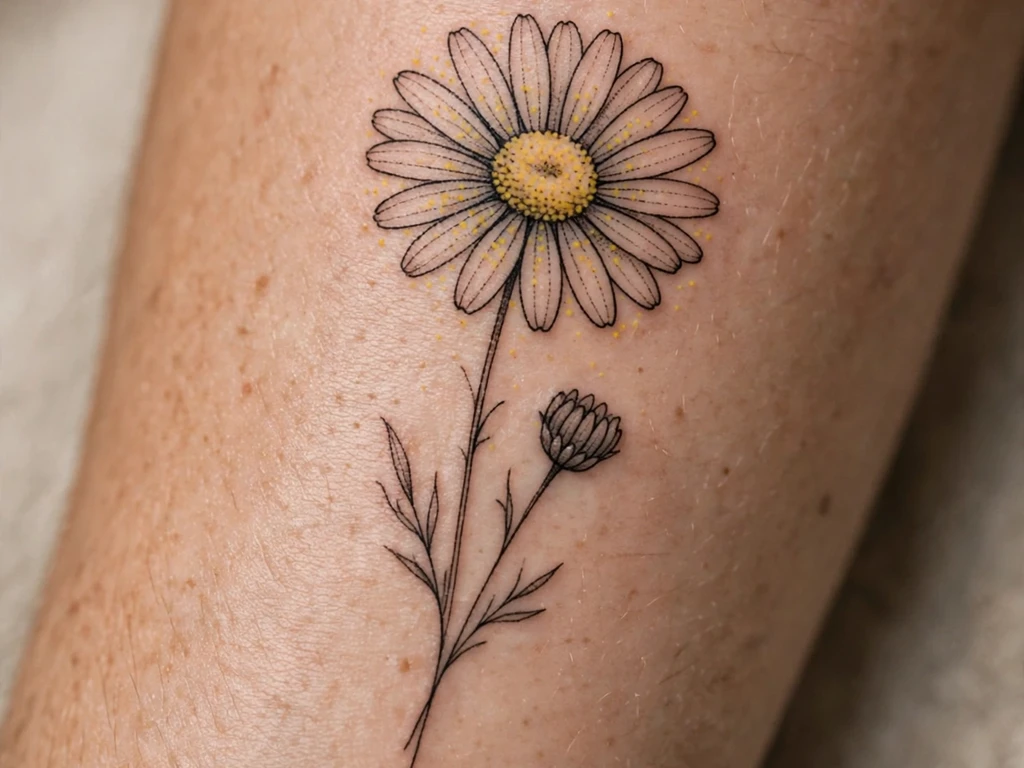
The birth-flower version of the classic: one full daisy in the negative-space construction, with a second, smaller bud still closed beneath it on the same stem — the April flower drawn with its own future attached. April-born wearers take the bloom as themselves and the bud as everything still coming; wearers marking an April child often reverse it, the open flower for the parent, the bud for the baby born in daisy month. Either way, the pairing gives the design a story that a lone bloom, however pretty, does not carry.
The bud is the craft decision. A closed daisy bud is a small green-white teardrop, and at tattoo scale it must be drawn as a simple, bold shape — a few sepals, one curve — or it becomes an unexplained green pea under a flower. Keep the bud at no less than a third of the bloom’s width, and resist adding dates or lettering: the script guide owns words, and this design’s meaning is complete in flowers.
Best placement: Forearm, bloom above and bud below along the arm’s length; a shoulder takes the pair side by side at slightly larger size.
Best for / know before you book: If the April connection is the point, say whose April it is at the consultation — artists draw the bud tenderly or boldly depending on whether it stands for a child or a beginning, and the drawing changes.
3. Daisy Chain Anklet
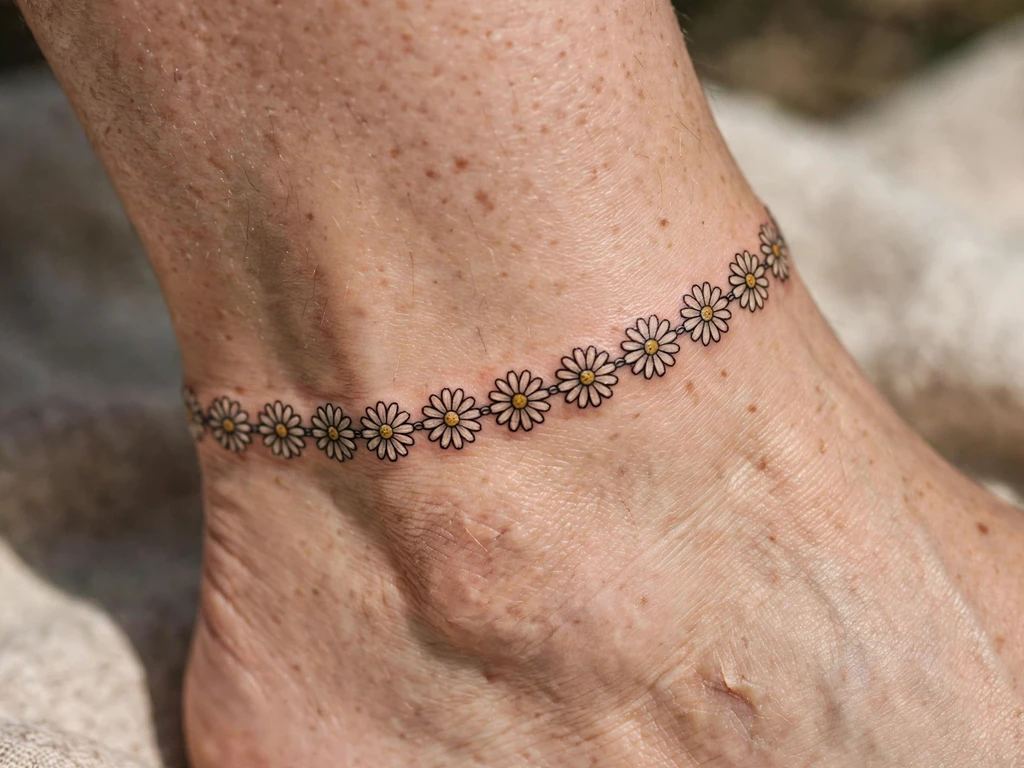
The childhood chain, made permanent: a ring of small daisies linked head to head around the ankle, each bloom complete — petals, centre, a breath of stem — and the chain closing on itself with no beginning and no end. It is the ankle’s version of jewellery, and it carries the chain’s original meanings unforced: friendship, summers, the people you linked yourself to on purpose.
Wrap designs live or die on their joins, and the site’s ankle tattoo ideas guide sets out the ankle’s general rules — thin skin, shoe-collar rub, the flat wall above the bone. The chain adds one rule of its own: the blooms must be sized to your ankle’s circumference so that a whole number of complete daisies makes the ring — a chain that ends in half a flower will bother its wearer for decades, so the artist should count the ring on your ankle, standing, before a needle is unwrapped.
Best placement: Ankle, a full ring on the flat above the ankle bone, clear of the shoe collar’s rub line.
Best for / know before you book: Bring your usual shoes to the stencil check — the chain must sit where your footwear does not live, or its lowest daisies will be sanded by straps every summer.
4. The Climbing Daisy Chain
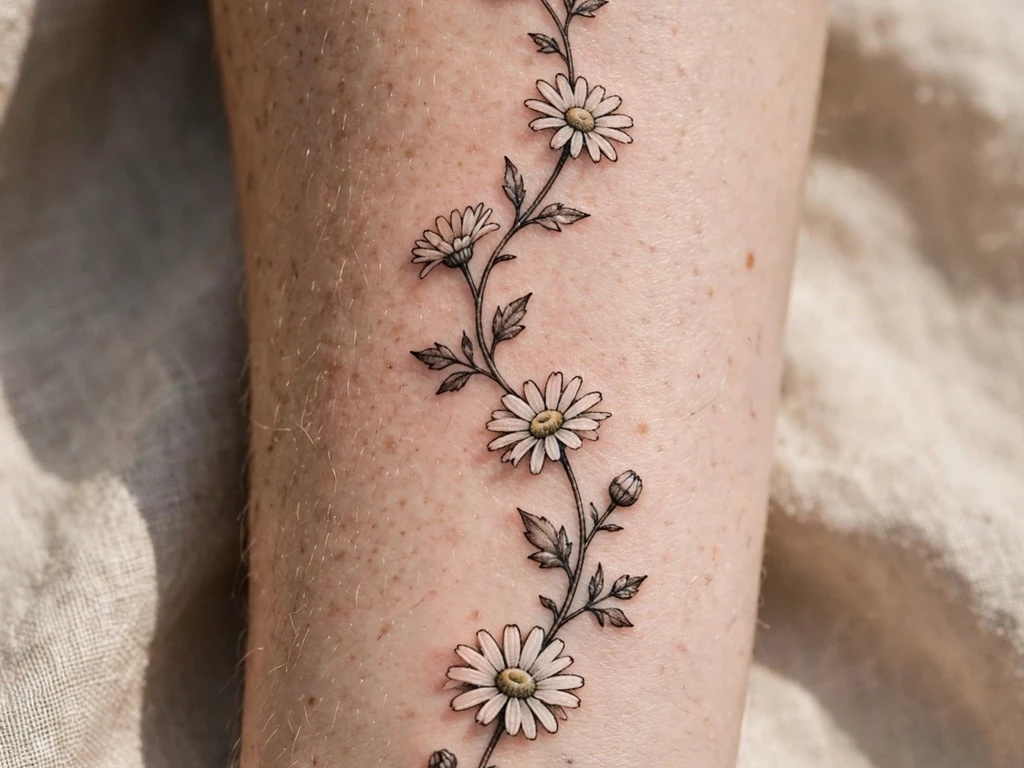
The chain set climbing: a winding stem runs the length of the forearm, and daisies open along it one after another — bud at the wrist, half-open bloom midway, full flower at the elbow end — with small leaves filling the stem’s curves. Where the anklet chain is a closed ring of equals, this one is a journey: the same flower at every stage of opening, travelling up the arm. Wearers take it for growth told honestly, one bloom at a time.
The wrap-and-travel construction is shared with vine work, and the site’s vine tattoo guide gives the full law for stems that travel a limb: even stem weight as the arm narrows, stencilled on the standing, turning arm. The daisy chain adds its flowers to that law: each bloom must sit on a flat the turning arm actually offers, and the gaps between blooms are design, not leftovers.
Best placement: Forearm, the chain climbing wrist to elbow along the arm’s natural line; the same climb wraps a calf beautifully.
Best for / know before you book: Approve the stencil with your arm rotating, not just flat on the table — a climbing chain is seen in motion all its life, and a bloom that lands on the arm’s edge will fold in half every time you turn your wrist.
5. The Oopsie Daisy
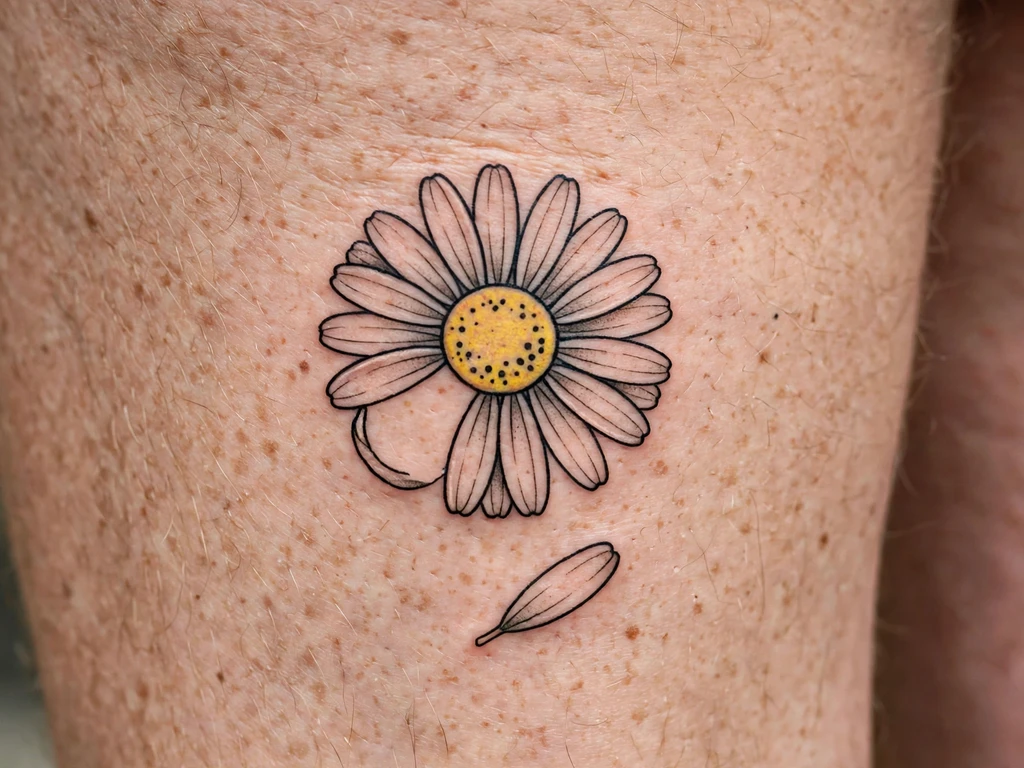
The design this guide was always going to include: a cheerful classic daisy with one petal missing from the ring — and there it is, drawn below the flower, mid-fall or just landed, the gap in the ring left honestly open. “Whoops-a-daisy” is the old exclamation for a small mishap survived — the stumble, the dropped thing, the minor fall you laugh about while getting up — and this tattoo is that sentence as a flower: something small went wrong, and the flower is still a flower, and that is rather the point of it.
The craft is restraint. Exactly one petal goes missing; two reads as damage, three as decay. The fallen petal is drawn at full petal size and quality, placed close enough to declare its origin and far enough to read as fallen. And the gap in the ring must be a true petal-shaped gap, because the joke only works on a flower drawn perfectly everywhere else. Wearers choose this for recoveries, for clumsiness embraced, for the year everything wobbled and held.
Best placement: Calf, flower high on the muscle and the fallen petal below it along the leg’s line; a forearm takes the pair side by side.
Best for / know before you book: Show the artist reference of the gap, not just the flower — the empty petal-space is the design’s signature, and it must be drawn deliberately, never left to look like an omission.
6. Gerbera Daisy in Full Colour
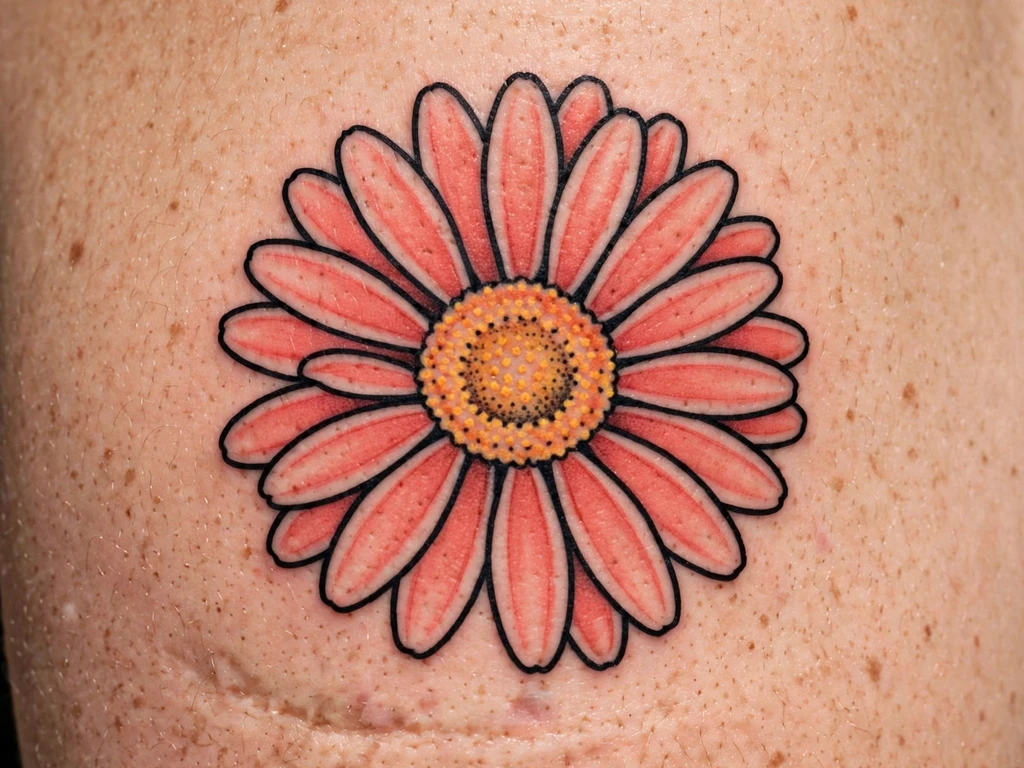
The other pole of the daisy family: a gerbera, the florist’s daisy, drawn at generous size with its ray petals outlined and filled — coral pink here, but the gerbera’s whole gift is its colour range: orange, salmon, scarlet, cream, magenta, each petal a true colour rather than borrowed skin. Where the classic daisy is a drawing, the gerbera is a painting, and wearers who found the white version too quiet usually stop scrolling here.
Colour changes the craft completely. Filled petals are a packing job: each petal filled evenly in patient passes, its outline a grade bolder than the classic’s, because the outline is now the only line holding the colour field’s shape as it settles. Saturated oranges, corals and reds hold their register longest; the palest pinks and creams soften first and should be chosen knowing it. The centre keeps the family rule — textured, dot-built, deepening inward — in orange-yellow tones that will cream gently with the years.
Best placement: Upper arm, where the gerbera gets the width its filled petals need; a shoulder blade hosts a larger one with room for a second bloom.
Best for / know before you book: Judge artists on healed colour packing — ask for a healed floral colour piece and check the fills are still even; fresh gerbera colour always looks lush, and healed fill is where the truth lives.
7. The Red Daisy
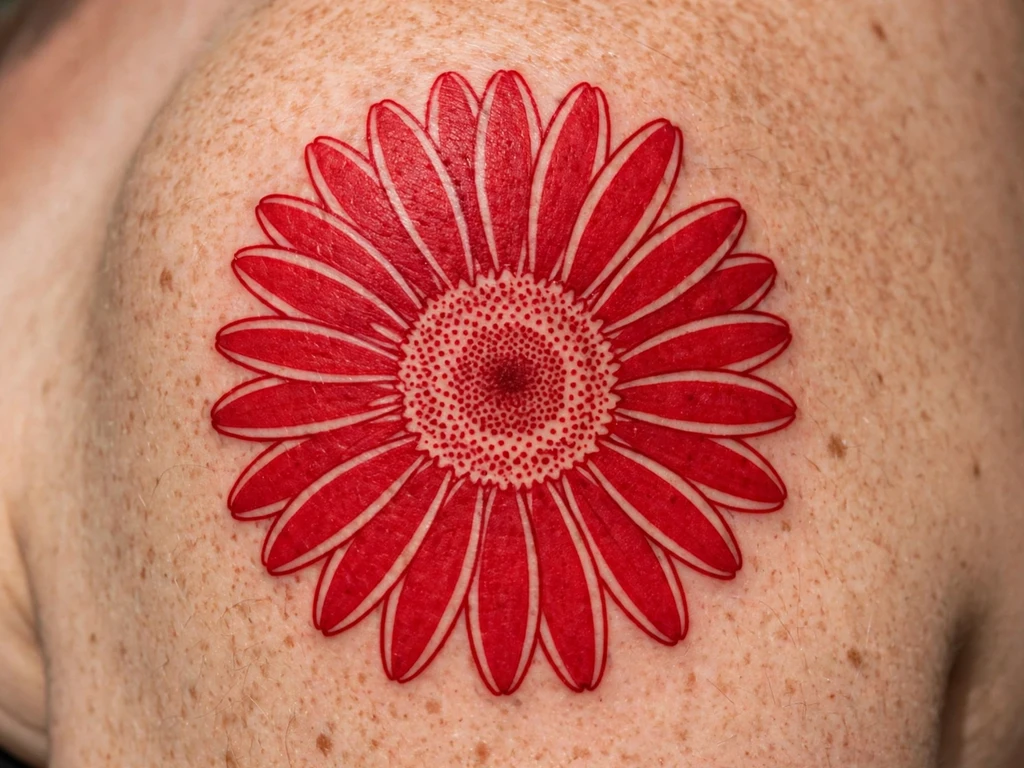
One design in this guide gives up every colour but one: a gerbera-form daisy drawn entirely in red — petals in flat red fill inside bold red line, centre in dense red dotwork, no black anywhere. In red-only ink the flower becomes something else entirely: the sweetest shape in tattooing wearing its loudest colour, a valentine with a pulse in it. Wearers take it for love stated at full volume, for luck in the Chinese reading of red, or simply because the red-only experiment fascinates them.
Everything the site’s red ink tattoo guide establishes applies here in full, and its honest section should be read before booking this design: red is the colour most often reported in tattoo skin reactions, it fades and drifts toward rust and brick faster than black, and the standard route in is a small red piece first, healed and watched. This daisy’s construction respects that record — its lines are drawn a grade bolder than the same flower in black, its centre is dotwork rather than flat fill, and its petals are simple, countable shapes, because in red-only work the drawing must survive on silhouette alone once the tone settles.
Best placement: Shoulder, centred on the cap, where covered skin keeps red’s tone longest; an upper arm is the second choice for the same reason.
Best for / know before you book: Do not make this your first red tattoo — get a small red piece elsewhere first, live with it healed for a season, and let your own skin cast the deciding vote.
8. Daisy and Bee
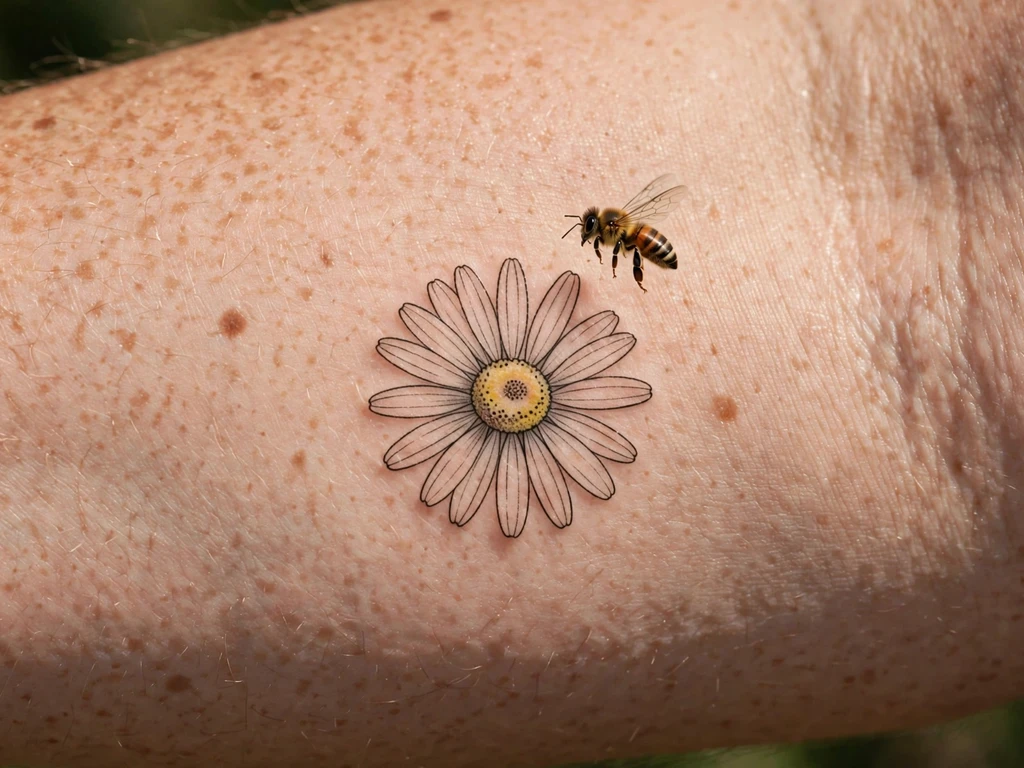
A classic daisy, and visiting it, one small bee: wings in fine line, body in a few bold stripes, hovering just above a petal as if it has only just arrived. It is the meadow in miniature — the flower and its oldest partner in one small scene — and wearers take it for sweetness with industry in it: the bee works, the flower opens, the summer holds. The pairing also quietly corrects the daisy’s reputation; this is not a passive flower, it is a workplace.
Scale is the whole craft. The bee must be big enough to stay a bee: below about 2 cm its stripes merge as they settle and the visitor becomes a smudge with wings. Draw the bee at a size where each stripe keeps its own skin gap, keep the wings as open shapes rather than veined detail, and place it clear of the petal ring. The daisy itself follows the classic construction exactly — the bee is the guest, and guests do not rearrange the house.
Best placement: Forearm, the daisy centred and the bee above its upper petal; a calf takes the scene lengthwise happily.
Best for / know before you book: Print the bee at final size and check the stripes read — a bee that needs explaining has already failed, and the fix is always size, agreed before the session, not after.
9. Daisy and Butterfly
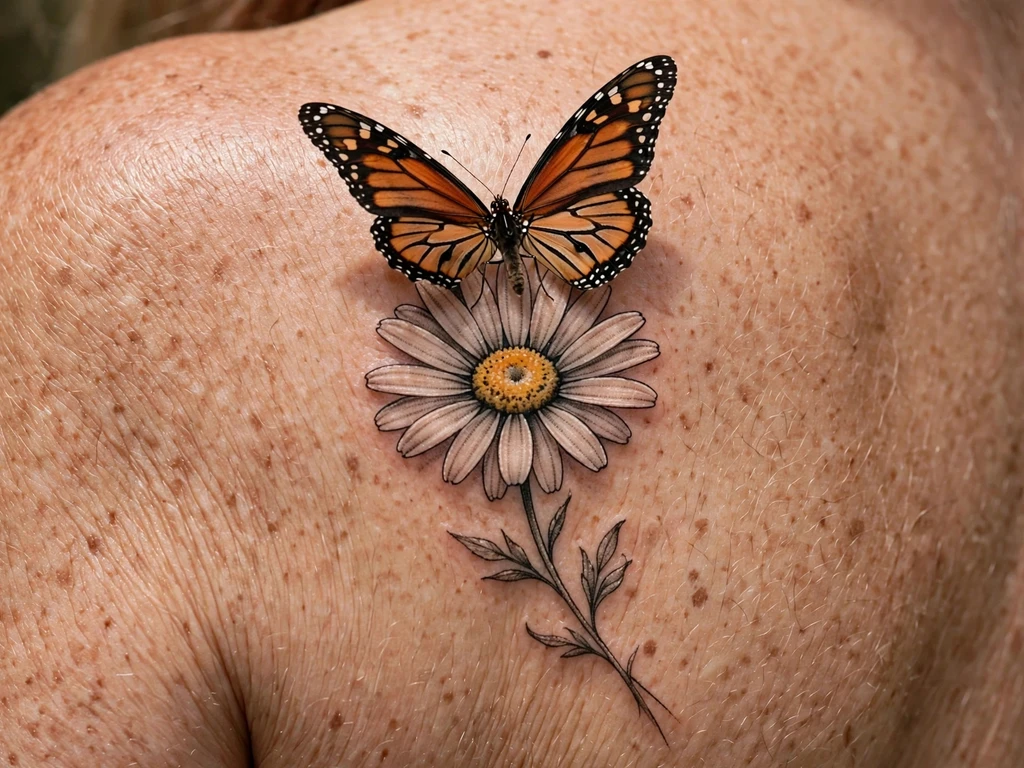
The daisy at rest, with company: a full classic bloom on the shoulder blade, and a butterfly settled on its upper petals, wings open, drawn at the same scale as the flower it has chosen. The pairing is tattooing’s oldest summer sentence — change alighting on innocence, the far-travelled visitor on the stay-at-home flower — and the site’s butterfly tattoo ideas guide explores the butterfly’s full range; here it is a guest star, drawn to share a scene rather than steal it.
Two radial designs in one tattoo means two symmetry appointments. The butterfly’s wings must match each other and sit truly on the flower’s ring, so the composition is stencilled as one drawing, checked standing in a mirror: the butterfly centred on the bloom’s vertical axis, its lower wings clear of the centre disc. Keep the butterfly’s interior detail a grade simpler than the flower’s — the daisy is the subject, and a lace-winged butterfly over a simple bloom reverses the picture.
Best placement: Shoulder blade, where the flat gives the pair their stage; a large version centres beautifully between the shoulder blades’ upper flats.
Best for / know before you book: Approve the combined silhouette at final size, blacked in — if the pair reads as one clear summer shape at two metres, the detail can be as gentle as you like inside it.
10. Dotwork-Centre Daisy
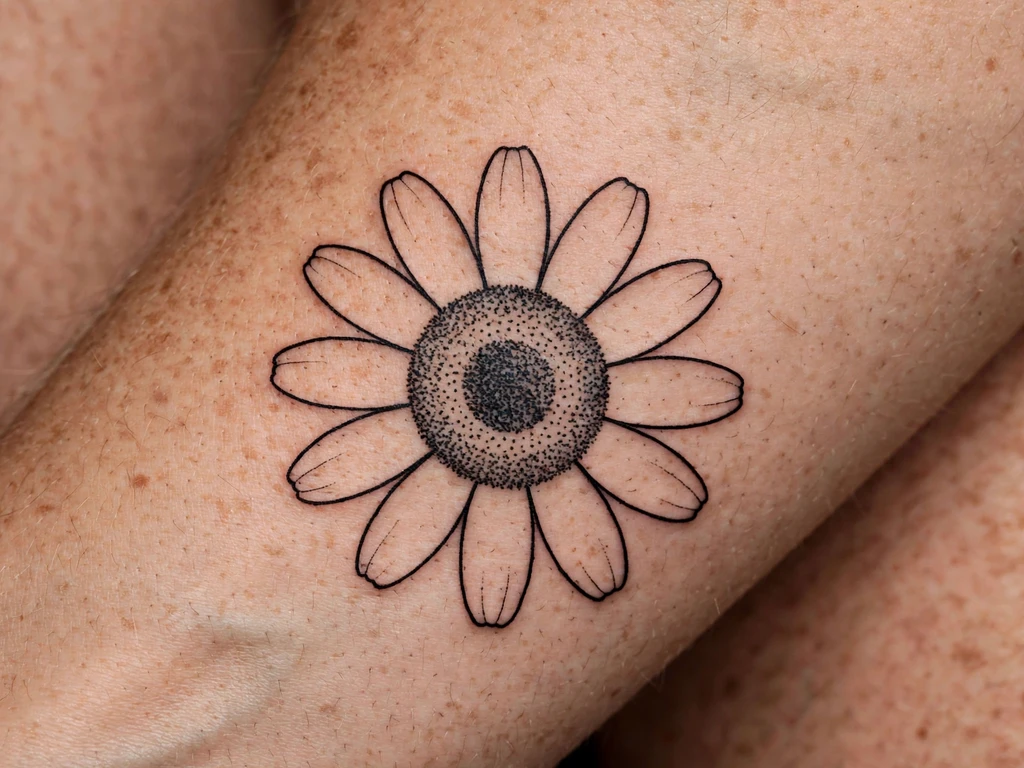
The design that takes the botany furthest: a daisy whose centre is the undisputed star — a wide disc built entirely from stippled dots, densest at the core and feathering outward, ringed by simple open petals in clean black line. It is the composite head drawn honestly at last: hundreds of tiny units making one apparent flower, exactly as the real disc florets do. Wearers who love process — stipple, patience, texture — tend to claim this one.
The density map is the whole craft, as it is in all dotwork: the gradient from the packed core to the petal line must step in stages the eye reads as continuous, every stage spaced for the healed spread of each dot. The petals, by contrast, stay deliberately plain — open skin, one line weight — because a dotwork centre with ornate petals is two textures arguing. Size serves the dots: below 7 cm the centre’s stages compress into a dark coin, so this design asks for a forearm’s or calf’s length and takes it gladly.
Best placement: Forearm, centred on the flat with the disc at the arm’s widest point; the calf takes it at equal size.
Best for / know before you book: Ask to see the artist’s dot-density sketch or a healed dotwork piece — fresh stipple always looks precise, and healed dot spacing is the skill you are actually buying.
11. Blackwork Daisy
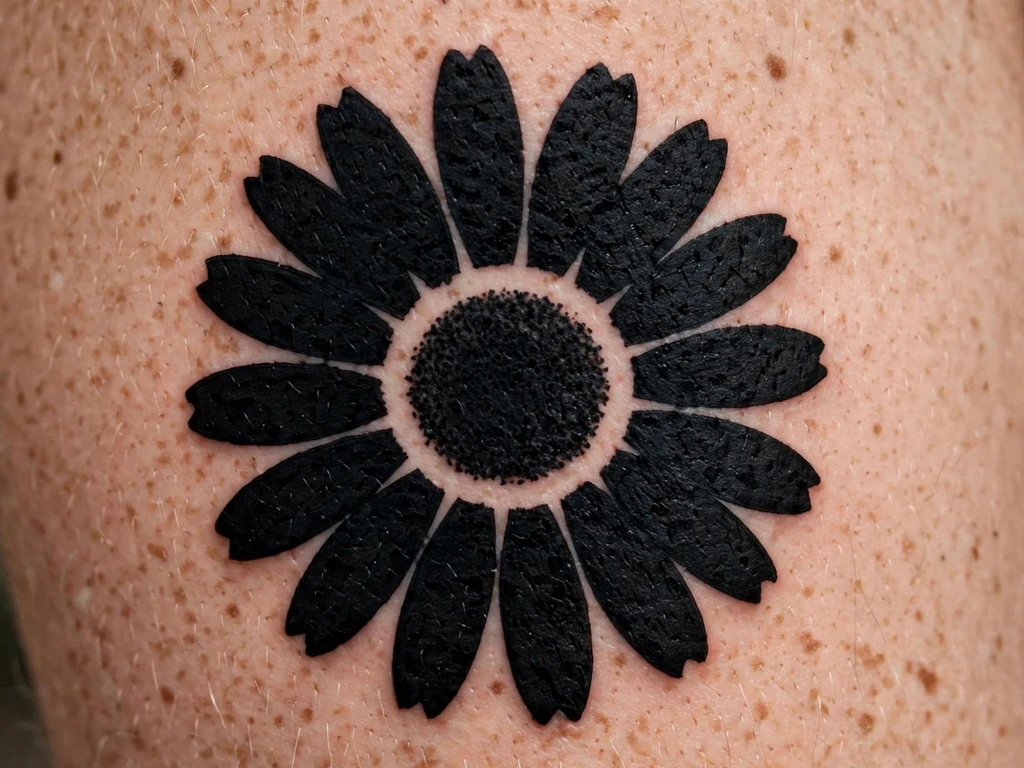
The daisy with its sweetness deliberately removed: petals as bold black silhouettes, each a solid filled shape, arranged around a packed black centre with one thin ring of open skin between centre and petals to keep the two blacks from merging into a disc. It reads across a street. Wearers who love the daisy’s geometry but not its greeting-card register — the blackwork crowd, the graphic crowd — take this version, and it rewards them by ageing better than any other design in this guide.
Solid petals are a packing examination at petal scale: twenty-some separate black fields, each needing an even, patient fill, because a patchy petal shows its misses as it lightens. The skin ring between centre and petals is structural, not decorative — draw it at honest width, or in ten years the centre and petals weld into a black sunflower-seed head. Keep petal shapes simple and generously sized; blackwork daisies die by fussy petal cuts, and live by silhouette.
Best placement: Upper arm, where the bold ring gets a broad, still field; a calf carries it at the same scale.
Best for / know before you book: Judge the artist on healed solid black — blackwork is a healed medium, and a portfolio of fresh black proves nothing about the packing you are buying.
12. Fine-Line Daisy
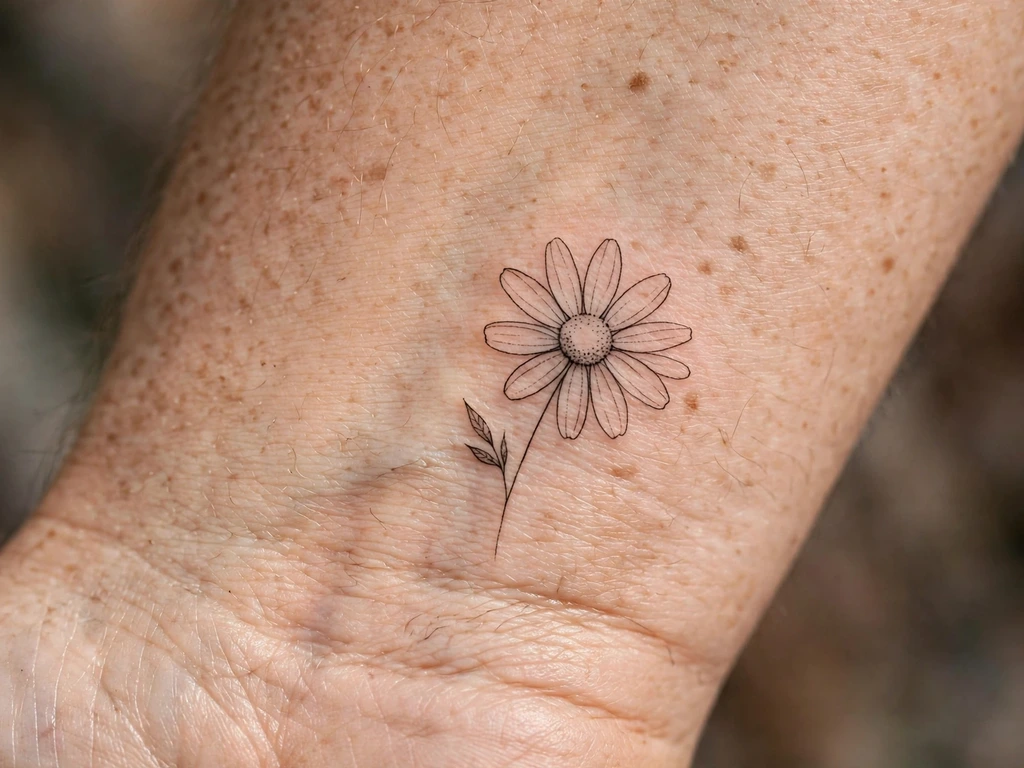
The daisy at its most whispering: one delicate line weight throughout — petals as single open strokes, the centre as the lightest stipple, a short stem with one small leaf — placed on the inner wrist where its wearer sees it a hundred times a day. Fine-line floral work is the defining dainty style of the last decade, and the daisy suits it, because the design is a ring and a centre and nothing it does not need.
Honesty, because this style needs it most: fine line softens soonest of all the styles in this guide, and a fine-line daisy survives that softening only by being drawn for it. Fewer petals than the classic — ten to twelve, wide-spaced — a centre given real stipple rather than a suggestive dot or two, and a stem at the same honest minimum weight as everything else. Drawn that way, the wrist daisy settles into a gentle, printed softness that its wearers love; drawn hairline-thin, it settles into a rumour. Choose the artist on healed fine line, a year old at least.
Best placement: Inner wrist, centred above the crease, sized 4–6 cm so the ring keeps its gaps.
Best for / know before you book: Ask the artist the smallest petal count they will draw at your size — an artist who answers with a number and a reason is protecting your tattoo’s tenth year, not just its first photo.
13. Tiny Daisy Behind the Ear
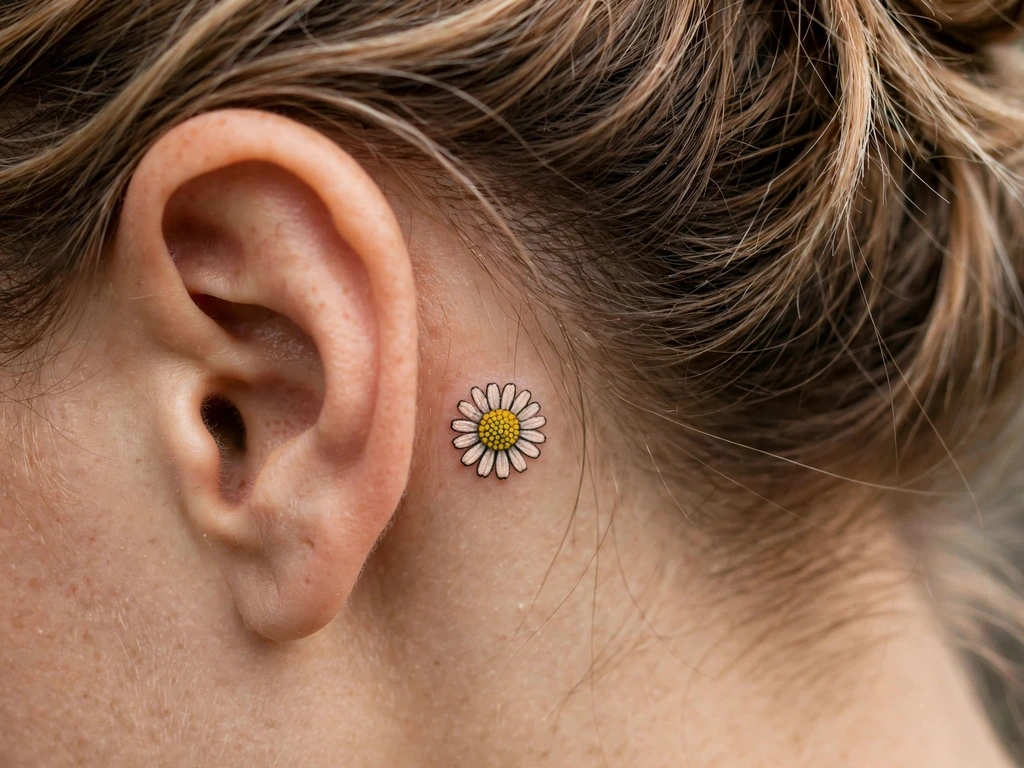
The guide’s one behind-ear design, and the daisy suits the address perfectly: a single small bloom tucked onto the flat behind the ear — hidden by hair in every formal room, revealed by a tucked strand like a kept secret. A daisy is the smallest complete flower tattooing owns at this scale, because its recipe is two shapes: a ring and a centre. Wearers take it as a private cheerfulness.
At 1.5–2 cm, the craft is pure honesty. The ring shrinks to eight or nine bold petals — no more, or the gaps close as the lines settle and the bloom becomes a white-ish blob with ambitions. The centre is packed fully rather than stippled, because stipple at this size is just future blur, and the whole flower is drawn a fraction bolder than the dainty reference photo suggests. Behind-ear skin settles a touch soft, so that fraction is the difference between a daisy at year ten and a pale freckle with a past.
Best placement: Behind the ear, centred on the flat of skin beneath the cartilage fold; sized to the wearer’s own ear, never from a universal template.
Best for / know before you book: Hold the printed design behind your ear in a mirror at true size — behind-ear tattoos are judged at real scale or not at all, and a daisy at this size is a commitment to boldness, not delicacy.
14. Tiny Daisy on a Finger
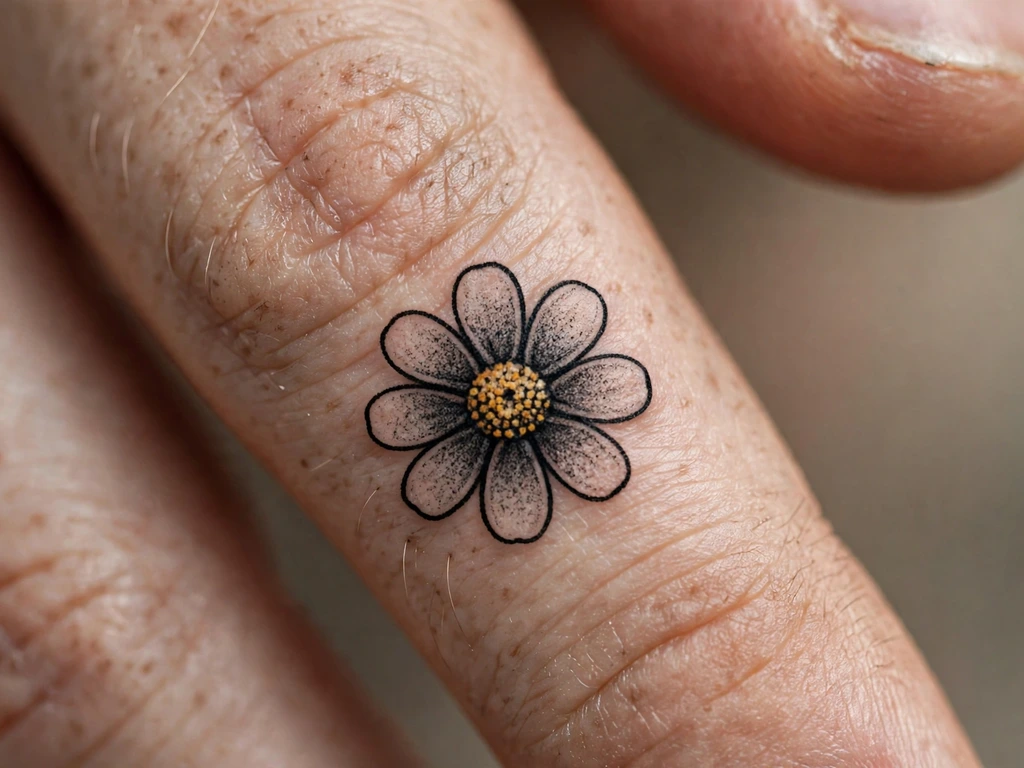
The smallest design in the guide, offered with the fullest honesty, because fingers are the fastest-fading ground tattooing has: a tiny daisy outline on the side of a finger. Finger skin regenerates fast, flexes constantly and sheds ink faster than anywhere else on the body, so say it plainly: this daisy will fade sooner than any other design here, its ring will soften first at the petal gaps, and it will need touch-ups across its life to stay a daisy rather than a rumour of one. Wearers choose it anyway, as a charm with a maintenance schedule — a small bright thing that asks to be renewed, like the feeling it usually stands for.
What can be done is done at the drawing: the ring reduced to six wide, openly spaced petals — the fewest that still read as a daisy — drawn as boldly as a finger allows, the centre packed solid, at the largest size the finger’s flat takes. And the side of the finger, not the palm side, because side skin holds ink slightly better and it is the best bargain this placement offers. Sized and drawn that way, each touch-up restores a flower, not a fog.
Best placement: Side of the finger, where the ring can sit unbroken and the skin keeps ink longest of anywhere on a finger.
Best for / know before you book: Price the touch-ups before you fall for the charm — if re-inking a small daisy every year or two would annoy you, Design 12’s wrist daisy carries the same meaning on skin that keeps it far longer.
15. Daisy Chain Bracelet
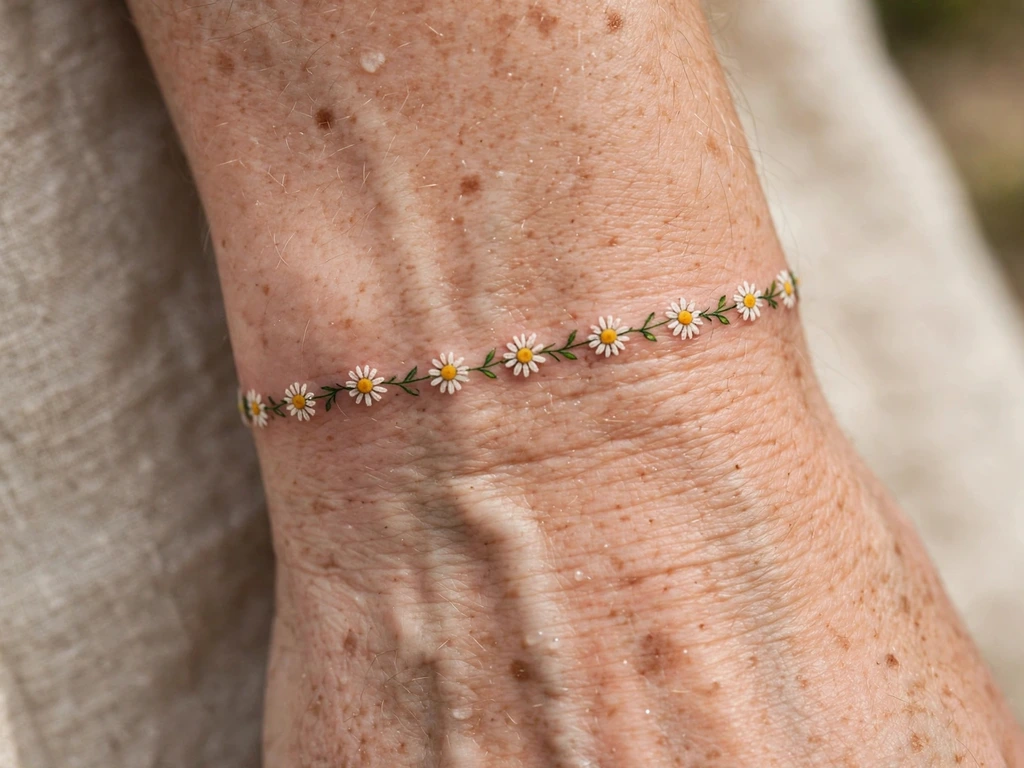
The anklet’s sister, worn where a bracelet lives: a full ring of small daisies circling the wrist, each bloom linked to the next by a short section of stem, closing on itself above the wrist bone. It is the most jewellery-like design in this guide — a chain of flowers that never comes off, never tarnishes and never needs a clasp — and it carries the daisy chain’s friendship-and-summer meanings at the body’s most visible small address.
The wrist is narrower and bonier than the ankle, and the craft adjusts: blooms a touch smaller and bolder than the anklet’s, the ring counted to the wearer’s own wrist so a whole number of complete daisies closes the circle, and the whole chain stencilled with the hand in natural rest and then in motion, because a wrist ring is seen from every angle daily.
Best placement: Wrist, a full ring on the flat band above the wrist bone, clear of the crease.
Best for / know before you book: Wear a real bracelet at the exact height for a week first — if the height annoys you in metal, it will annoy you in ink, and the week costs nothing.
16. Two Daisies, One Stem
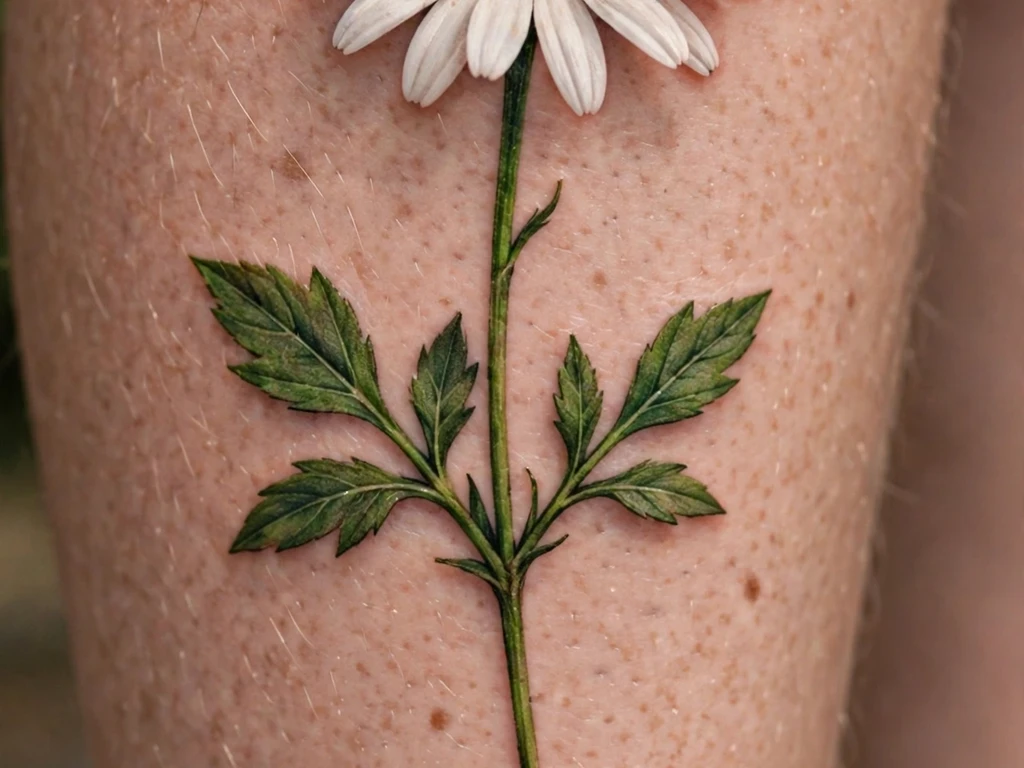
Two blooms sharing one stem: a large daisy fully open at the top, a smaller one below it half-turned, leaves between them, the single stem running the calf’s length and rooting the pair in one life. It is the guide’s quietest storytelling design — parent and child, mentor and student, the couple who grew from the same ground. Two flowers, one root system: the meaning needs no text, and gets none.
The composition’s craft is the relationship between the two rings. The smaller bloom is not a shrunken copy — it is drawn with fewer, bolder petals, because a daisy scaled down without redrawing becomes a dense little gear that blurs first. The shared stem must read as genuinely one stem, branching at a believable point, at one consistent honest weight; two stems pretending to be one is the version that looks wrong forever.
Best placement: Calf, the pair running ankle to knee along the muscle; a forearm takes a slightly smaller pair lengthwise.
Best for / know before you book: Decide whose daisy is whose before the consultation — the size relationship is the meaning here, and an artist drawing blind will default to equals, which is a different sentence.
17. The Daisy Wreath
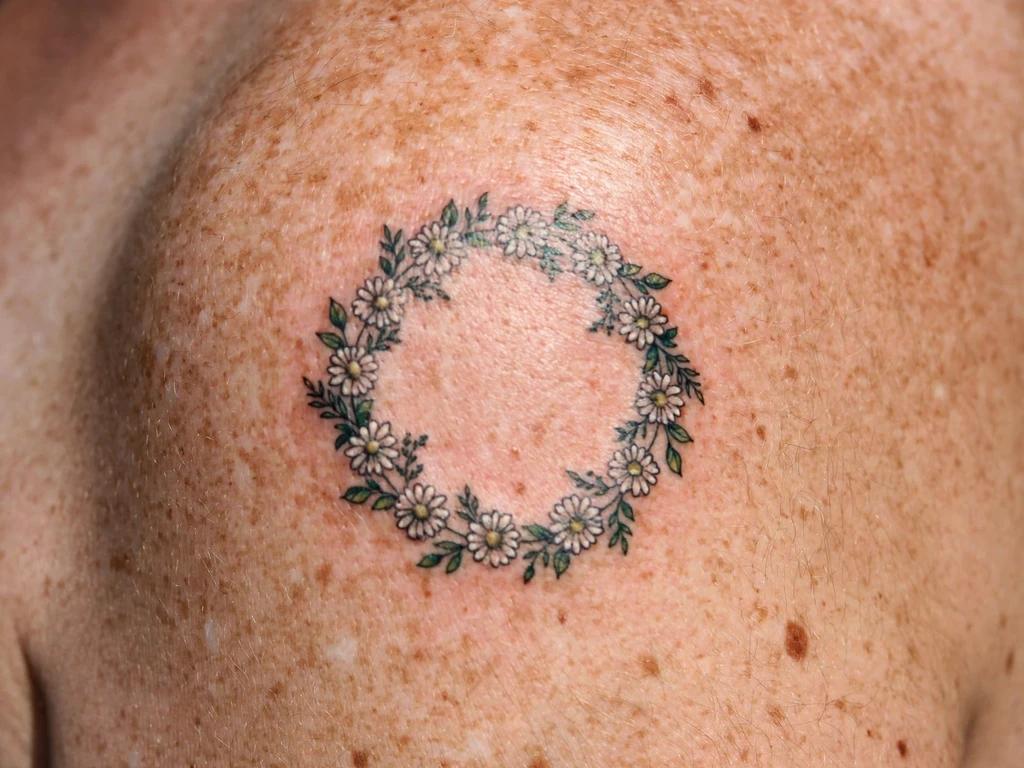
A ring made of daisies: small blooms and simple leaves alternating around a full circle of open skin, sitting on the shoulder like a garland laid down and kept. The wreath is one of tattooing’s oldest honour-shapes — victory, remembrance, celebration — and built from daisies it softens into something gentler: a circle of summers, a friendship with no ends, a good year commemorated. The open centre invites nothing added later; the emptiness is the design.
Repetition is the craft and the risk. Eight to twelve small daisies must match each other closely enough to read as one garland, yet each is a ring in miniature, subject to the whole ring law at small scale. The circle itself is stencilled as a true circle on the standing shoulder and checked as the arm moves, because the shoulder’s cap curves, and a wreath that warps at rest will never sit still. Leaves between blooms are the joinery — simple, dark, evenly spaced — and they carry the ring where blooms alone would crowd.
Best placement: Shoulder, the wreath centred on the cap; a smaller wreath sits flat on a shoulder blade.
Best for / know before you book: Count the stencil’s daisies and check two opposite ones minutely — in a wreath, one badly drawn bloom becomes the eye’s permanent address.
18. The He-Loves-Me Daisy
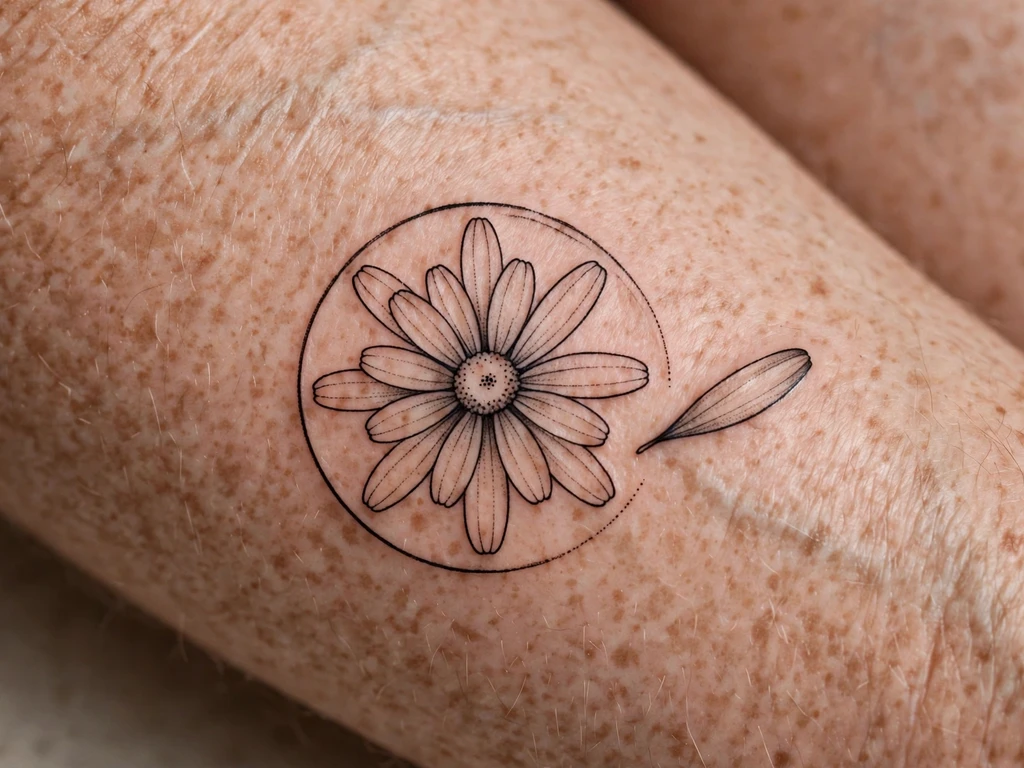
The oracle, caught mid-consultation: a classic daisy with one petal drawn at the moment of leaving — still touching the ring at its base, tilting away, the rest of the ring complete and calm. Every wearer of this design knows exactly which petal it is: the loves me one, fixed forever at the answer they wanted. It is the most romantic design in this guide precisely because it cheats — the game everyone played as a child, rigged at last in the player’s favour, in ink.
The craft is in the tilt. The departing petal must be drawn at full size and quality, angled just enough to read as leaving — too little and it reads as a drawing error, too much and it becomes Design 5’s fallen petal, which is a different story. Keep the rest of the ring drawn with extra strictness: the joke, and the romance, depend on this being a perfect flower with one deliberate exception. A second, smaller cue helps it land — one petal already gone, its gap clean, lower in the ring — the not already spent, the count already won.
Best placement: Forearm, where the wearer can see the answer daily; the calf takes it lengthwise with the stem below.
Best for / know before you book: Choose which petal leaves before the stencil is drawn and check its angle in a mirror — this design is a single gesture, and the gesture has to be unmistakable at arm’s length.
19. Wash Daisy
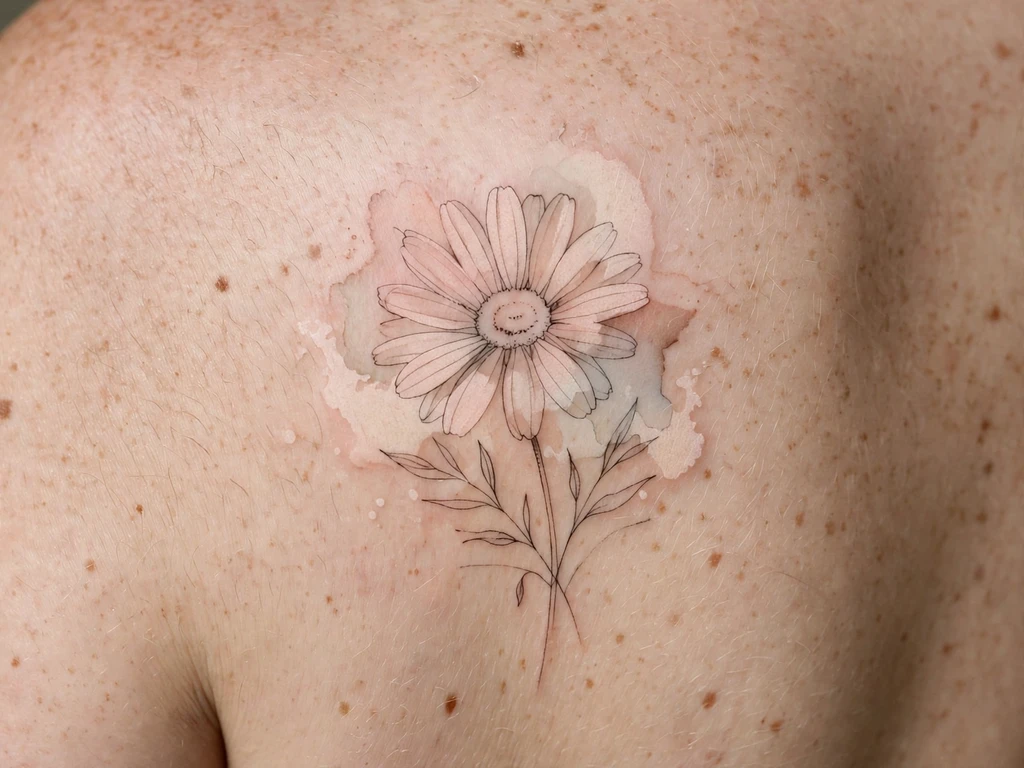
The daisy dissolved into weather: petals laid in as soft colour washes — the palest blush, cream and white-gold tones — over the barest line skeleton, the centre a warm haze of stipple and wash, the whole flower looking caught in bright haze or remembered rather than seen. Wash and watercolour-style work is the daisy’s most painterly register, and wearers choose it knowingly, for exactly the softness other styles defend against: this flower is about the feeling of a daisy, not its blueprint.
The honesty is in the future tense. Un-outlined washes diffuse as they age — edges melt, pale tones lighten toward the skin — and this design is chosen for that diffusion, the way the classic is chosen for its permanence. What keeps it a daisy at year ten is the skeleton: a complete, confident line drawing underneath, minimal but real, with the ring’s spacing law fully obeyed, so that when the washes have melted to their final haze the shape still stands.
Best placement: Shoulder blade, where the bloom gets a broad, calm field for its haze; a forearm takes a tighter, smaller version.
Best for / know before you book: Ask to see the artist’s wash work healed at two years or more — you are buying the melted version of this flower, and only healed photographs show it to you.
20. Traditional Daisy
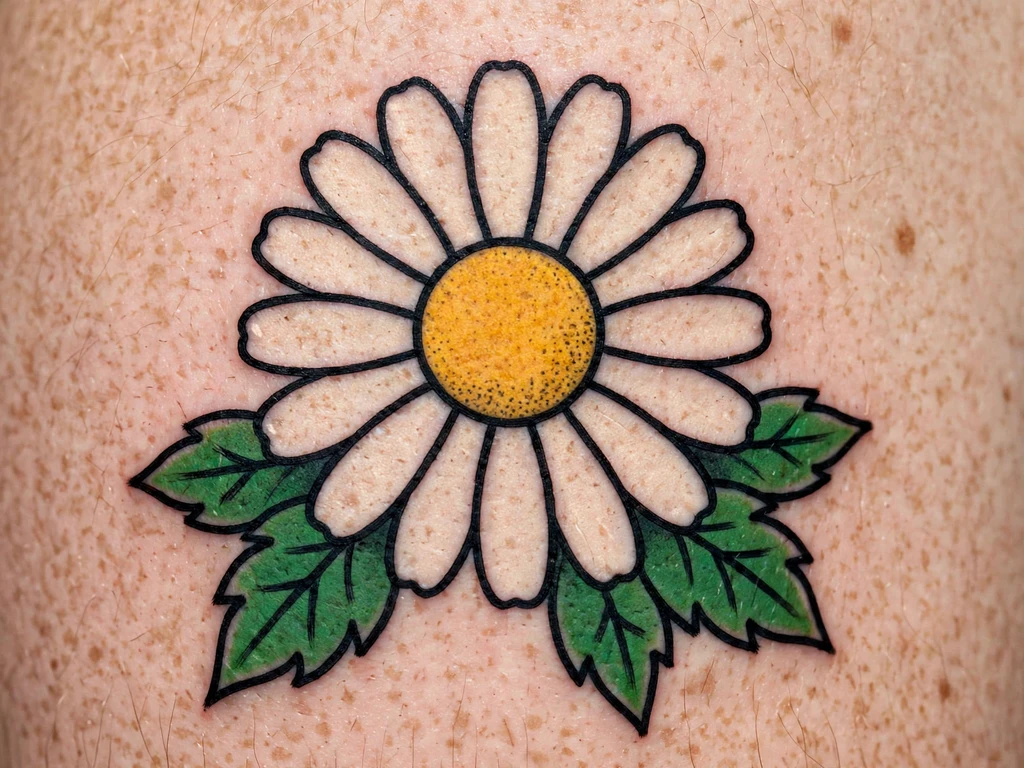
The old-school daisy: bold black outlines a full grade heavier than the classic’s, petals filled with flat warm cream rather than left as skin, the centre a solid packed yellow-gold, leaves in flat green with black structure, a stem like a rope. Traditional tattooing drew daisies on sailors and soldiers for a century before fine line existed, and this construction — simple shapes, heavy line, flat colour — is why those daisies are still readable in photographs of ninety-year-old arms.
Flat fill is the craft, and it is less simple than it looks: the cream petal fill must be packed evenly or it lightens in patches, and it will warm and soften toward the skin over the years — the traditional daisy accepts this as its vintage register. The centre’s solid yellow follows the same treaty: chosen bold and deep, so its softened future self is still clearly a daisy’s heart. Nothing in this design is delicate, and that is its entire promise: it will look like itself at every age of its wearer.
Best placement: Upper arm, the traditional daisy’s ancestral home; the calf is the second classic address.
Best for / know before you book: Ask how the artist packs flat cream and pale fills — pale colour is traditional work’s one weak joint, and an honest artist will tell you how they reinforce it.
21. Daisy Sprig with Leaves
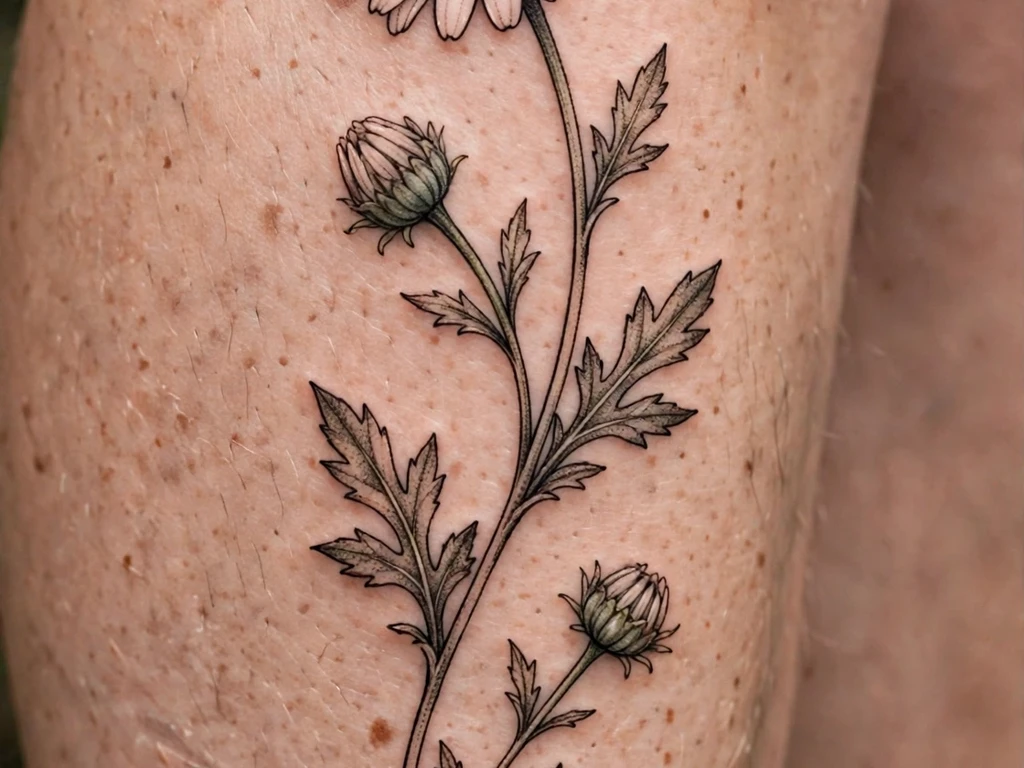
The botanical-plate daisy: one open bloom, two buds at different heights, and a long curving stem with the daisy’s real leaves — small, spoon-shaped, slightly serrated — drawn with a naturalist’s care. This is the design for wearers who love the actual plant: not a symbol of a daisy, but a portrait of one. It suits calves and forearms, and rewards a slow look the way a pressed flower in a book does.
Leaves are the craft test here. Daisy leaves are humble — no dramatic shape to hide behind — so they must be drawn as real observed leaves: alternating along the stem, sized honestly, their serration suggested in a few bold cuts rather than fussy detail that would blur. The stem follows the ring law’s fourth rule: black-grey structure at honest weight, green only as an inner accent. Buds follow Design 2’s discipline: simple teardrop forms, sepals as three confident strokes.
Best placement: Calf, the sprig running the muscle’s length with the bloom at its widest point; a forearm takes it at the same scale lengthwise.
Best for / know before you book: Bring a photograph of a real daisy plant, not another tattoo — this design’s whole claim is botanical truth, and the artist should draw from the plant, not from the genre.
22. Daisy with Falling Petals
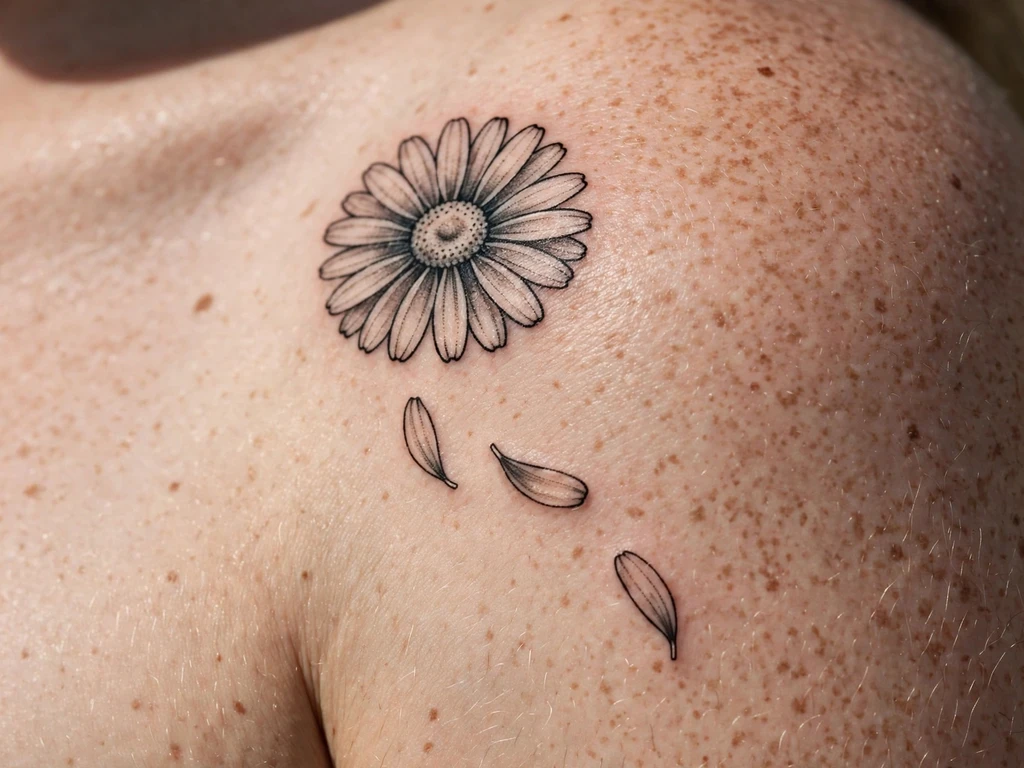
A full daisy, serene and complete at the top — and below it, three petals drifting down in a gentle arc, spaced like the beats of a slow sentence. Where the oopsie daisy plays a mishap for laughs, falling petals play time for keeps: the season turning, the beautiful thing in the act of leaving, a person or a summer remembered at the exact moment of letting go. It is the most bittersweet design in this guide and, in the right hands, the most beautiful.
The arc is the craft. The three petals must genuinely descend — decreasing slightly in size, rotating gently as they fall, spaced wider as they go, the way real falling things accelerate apart. Drawn in a straight line or at equal spacing, they read as a pattern, not an event. Each petal keeps full quality: the design says release, not damage. The bloom above stays complete and un-gapped — its ring whole, its centre calm — because this flower is not broken; it is generous.
Best placement: Shoulder, the bloom on the cap and the petals drifting down the upper arm’s line; a shoulder blade takes bloom and drift side by side.
Best for / know before you book: Approve the drift’s spacing on paper first, at final size — the arc is a drawing problem solved in the studio, and it cannot be adjusted once the petals are falling in ink.
23. Three-Daisy Cluster
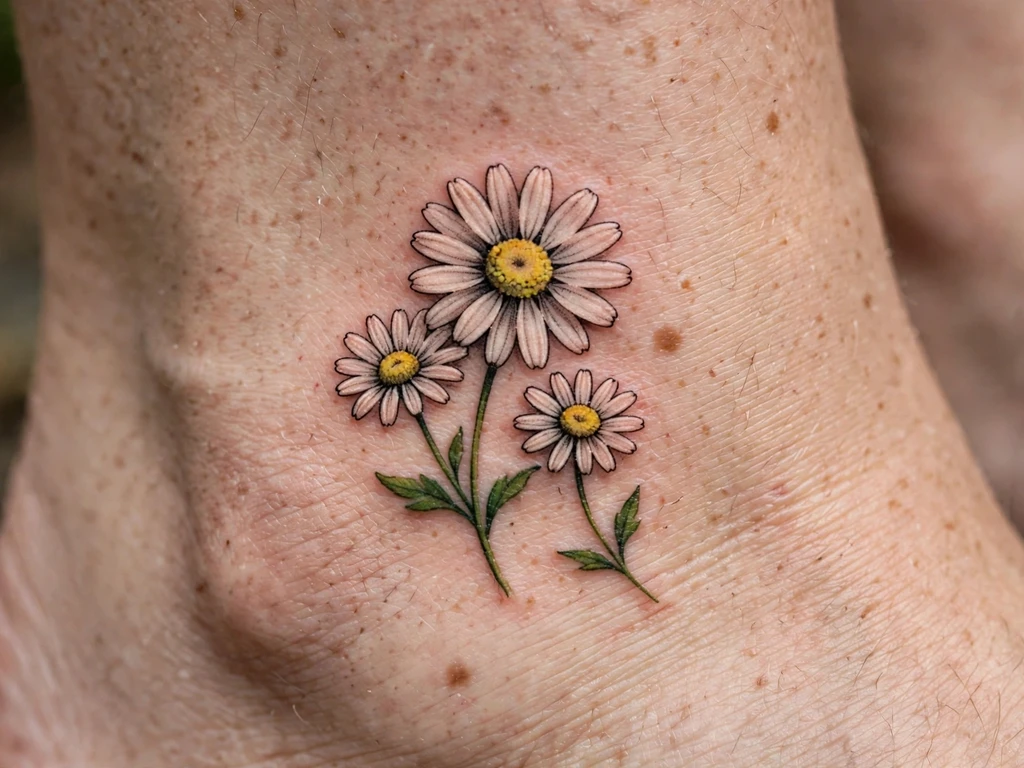
Three daisies gathered above an ankle: one full bloom and two smaller companions, short stems bound loosely by their own leaves, the whole cluster no bigger than a matchbox. Clusters are how daisies actually grow — nobody’s lawn produces one ceremonial flower — and this design wears that honesty cheerfully: friendship groups, siblings, three children, three chapters. It is also the ankle’s natural floral size, big enough to read, small enough to sit on the joint’s flat wall.
Small multiples multiply the ring law’s demands: three rings, three centres, three chances for an uneven petal to show. The discipline is to draw the cluster as one composition with a size hierarchy — the main bloom at full petal count, the smaller two redrawn bolder and simpler, never merely shrunk — and to let leaves and stems overlap slightly, the way real gathered flowers do, so the trio reads as a bunch rather than a diagram.
Best placement: Above the ankle, on the flat wall off the bone; the same cluster sits neatly on an inner wrist at slightly smaller size.
Best for / know before you book: Count each bloom’s petals on the stencil separately — the smallest daisy in a cluster is where artists rush, and it is the one your eye will find daily.
24. Collarbone-Edge Daisy Sprig
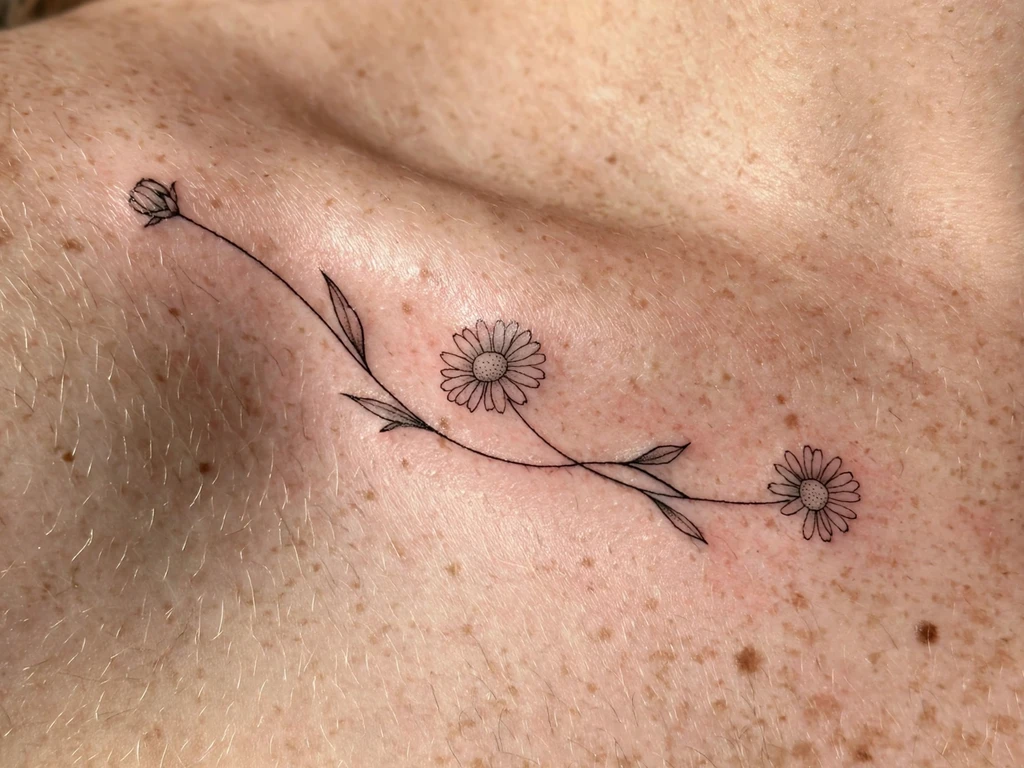
A fine sprig laid along the outer edge of the collarbone: two small open daisies and a bud on one curving stem, following the bone’s own line the way a necklace follows it. It is the most elegant small design in this guide, and the most placement-dependent: a sprig that honours the bone’s line looks inevitable, while one that crosses it looks lost.
The bone’s edge is a placement of movement and shallow skin, and the design respects both: the stem follows the bone so the tattoo travels with the shoulder, the blooms sit on the small flats just outside the ridge rather than on its moving crest, and every element is drawn a grade bolder than its prettiness suggests, because shallow skin over bone settles soft. Keep the sprig on the outer half of the bone, where the flat is widest. This is fine floral work at its most exposed; choose the artist on healed collarbone pieces specifically.
Best placement: Outer edge of the collarbone, stem following the bone, blooms on the flats outside the ridge.
Best for / know before you book: Stencil it, then shrug, reach and turn in the mirror — this sprig lives on a moving border, and it must look placed in every position, not just the pose.
25. The Big Shoulder-Blade Daisy
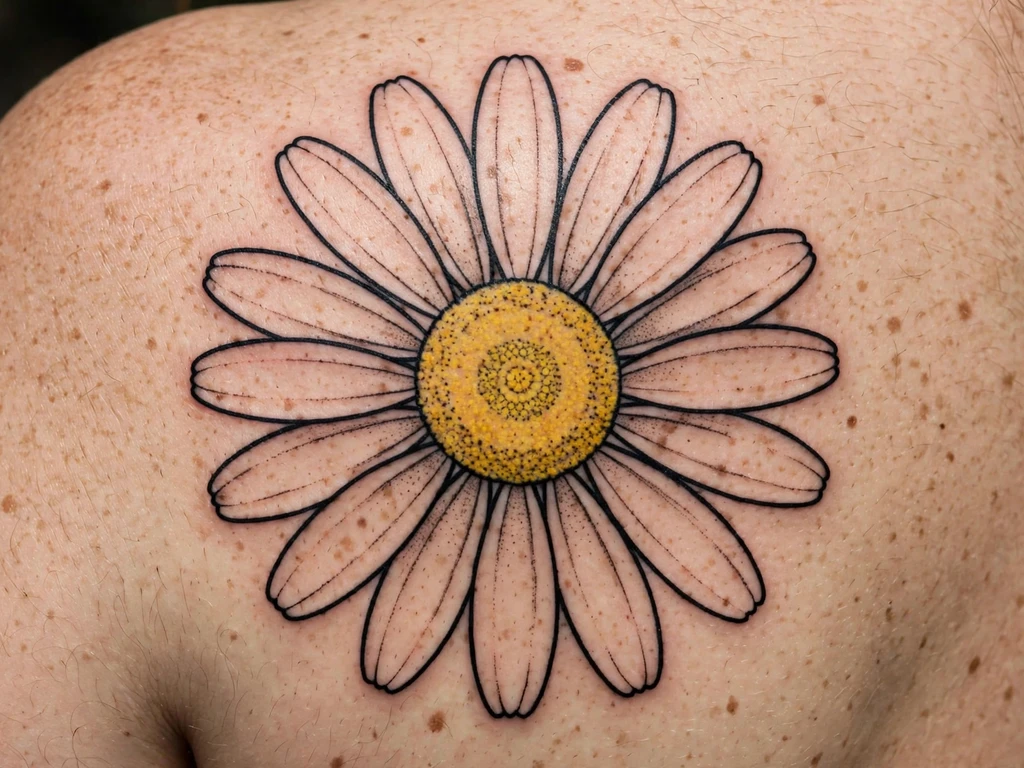
The guide ends at full scale: one daisy drawn large across a shoulder blade — petals wide and open at 15–20 cm, the centre a broad field of dotwork, the ring given the biggest, calmest canvas the upper body offers. At this size the daisy stops being a charm and becomes a statement: innocence at architectural scale, a flower the size of a hand, impossible to miss and strangely dignified. Wearers choose it as a back’s opening piece or its only one.
Scale changes the craft without changing the law. The petal count rises — twenty or more — but the temptation to decorate the petals must be refused: open skin is still the white, and the ring’s power at this size is its purity. The centre becomes genuine dotwork territory, hundreds of dots in a composed gradient, the guide’s fullest expression of the composite truth. And the ring must be checked as a true circle on the standing back, blade relaxed and blade raised, because the shoulder blade is a moving platform wearing a round design.
Best placement: Shoulder blade, centred on the flat; at the largest sizes it can crown the upper back between the blades’ upper edges.
Best for / know before you book: This is a specialist’s piece — choose an artist whose large healed floral work you have seen in person, and expect the centre’s dotwork to take the session’s longest hour.
Daisy Tattoo Placement by Size
| Size | Typical dimensions | Best placements | Good to know |
|---|---|---|---|
| Tiny | 1.5–3 cm | Behind ear, side of finger, inner wrist | The ring shrinks to 6–9 bold petals and a packed centre; finger daisies carry a permanent touch-up commitment |
| Small | 3–6 cm | Wrists, ankles, collarbone edge | Fine-line blooms, chain links, clusters — simple rings, wide petal gaps, the ideal scale for a first daisy |
| Medium | 6–14 cm | Forearms, calves, shoulders, upper arms | Most of this guide lives here: classic blooms, gerberas, chains and scenes at honest line weight with room for a true dotwork centre |
| Large | 14–22 cm | Shoulder blades, upper arms | The big single daisy and full wreaths — the scale where the centre’s dotwork gradient and a 20-petal ring become possible |
A daisy’s placement is also a geometry decision: the design is a circle, and circles belong on the body’s flats. Forearms and shoulder blades keep rings round for decades; ankles and wrists keep them round at smaller, bolder scales; joints and curves ask the ring to be redrawn, not merely resized.
How to Choose Your Daisy Tattoo (and What to Know Before You Book)
Decide what your petals are made of. This is the daisy’s first and most consequential choice, and it is the one first-time buyers most often get wrong: classic white petals are skin inside line, not white ink. If a reference photo shows you petals of glowing, opaque white, you are looking at a fresh tattoo, a pale skin tone, a filter — or all three. Tell your artist which construction you want — negative-space classic, filled gerbera colour, packed blackwork — and judge their answer. An artist who promises permanent porcelain-white petals is promising what pigment cannot do.
Count the ring before you commit to it. The ring law’s stencil test takes one minute and protects twenty years: count the petals, check the gaps are even, check each petal is its own separated shape. Do it on the printed stencil at final size, not zoomed on a screen.
Choose the daisy you actually mean. The classic Bellis and the gerbera are different flowers wearing one name, and they make different tattoos: the classic is a drawing — line, skin, a stippled sun of a centre — while the gerbera is a painting, filled colour on a bigger head. Neither is the “real” daisy tattoo. Pick by the object you love, not by the word.
Give the centre its due. Protect the centre: it should be texture — dotwork, stipple, dense fine units — never an afterthought of flat yellow. The centre is half the daisy’s identity and the part whose colour changes most, softening from yellow toward cream; a textured centre survives that change as pattern, a flat one survives it as a pale coin. If an artist’s healed daisies have living centres, you have found a daisy artist.
Mind the stem, or skip it. A stem drawn thin and green is a fading line with a flower on top. Either let the artist draw the stem in black or grey at honest weight — or choose one of this guide’s stemless designs and let the bloom stand alone. There is no third option that time respects.
Judge the artist on healed flowers. Daisies are a specialist’s flower disguised as a simple one. Ask for healed floral work — a year old at least — and look at three things: are the rings still even, are the petal gaps still open, and do the centres still read as texture? An artist who shows healed daisies gladly understands the ring law whether or not they call it that; one who shows only fresh work is showing you the one state your tattoo is in for a fortnight.
Key points to remember:
- A classic daisy’s white petals are your own skin inside black line — white ink yellows, creams and fades, and cannot be the petal strategy
- The daisy is a radial design: even petal count, even spacing and real skin gaps between petals are the whole geometry — count the ring on the stencil
- The centre is a disc of tiny florets in the real flower and must be texture in the tattoo — dotwork or stipple, never flat yellow, which softens toward cream
- Stems are the weak point: thin green stems fade first, so stems are drawn in black or grey line at honest weight, with green as accent only
- Gerbera daisies are the colour route — filled petals in pink, orange, red or coral; saturated colours hold longest, palest pinks soften first
- Finger and behind-ear daisies are commitments to boldness at tiny scale and, on fingers, to regular touch-ups — choose them with the maintenance priced in
Frequently Asked Questions
What does a daisy tattoo mean?
Most often: innocence and purity, from the flower’s white petals and meadow plainness; new beginnings, from a flower that reopens fresh every morning and returns among the first in spring; and cheerfulness — the daisy is the margin-doodle flower, optimism at small scale. Its name deepens the reading: daisy is the “day’s eye”, the flower that opens with the sun. It is also April’s birth flower, so a large share of daisy tattoos are worn for April births and April people, and the old petal-plucking game — he loves me, he loves me not — gives it a hopeful romantic meaning. As everywhere in this series: the meanings are tradition and personal symbolism, worn as meaning.
Is the daisy April’s birth flower?
Yes — in the modern birth-flower tradition, April’s flower is the daisy (the sweet pea is April’s recognised second flower in some lists). That makes it a popular marker for April birthdays, children, anniversaries and memorials. The site’s birth flower guide covers all twelve months; this guide is the daisy alone in depth. If your month is April, Design 2 was drawn for you; if your daisy is for an April person rather than yourself, the two-bloom design (Design 16) is the guide’s quietest way to say it.
Can a daisy tattoo actually be white?
Not in the way the question hopes — and this is the most useful answer in this FAQ. White tattoo ink exists and has legitimate uses in highlights, but as the main substance of a petal it fades fastest of all common pigments, yellows or creams as it ages and meets sunlight, and shows weakly on many skin tones even when fresh. That is why the classic daisy is drawn the other way round: black line for the petal shapes, and the petal interiors left as your own untouched skin — a “white” that matches you perfectly, never fades and never yellows. Every classic daisy in this guide is built that way. If an artist proposes solid white-ink petals as the plan, ask to see that work healed at two years before you agree.
Do daisy tattoos fade?
Their parts fade at different rates, which is why this guide is built the way it is. The black line of the ring and stem is as durable as any black line tattoo. The yellow centre softens toward cream over the years — slowest on covered skin, fastest in the sun — and a dotwork or stipple centre survives that softening as pattern. Fine-line daisies soften soonest and smallest designs lose their petal gaps first. Green stem colour fades early, which is why stems here are drawn in black or grey. The petals of a classic daisy, being skin, do not fade at all. Sunscreen on healed work and honest drawing at the start are the whole maintenance secret.
What is an oopsie daisy tattoo?
It is this guide’s Design 5, and it answers a rising search directly: an oopsie daisy tattoo is a daisy drawn with one petal missing from the ring — the petal shown fallen or falling just below the flower. The phrase plays on “whoops-a-daisy”, the old light-hearted exclamation after a small mishap — a stumble, a dropped cup, a trip survived laughing. The tattoo carries exactly that meaning: something small went wrong and I am still standing; clumsiness, recovery, or a hard year, worn with a grin. The craft rule is restraint — one petal only, drawn perfectly, with its gap left honestly in an otherwise perfect ring — because the charm is entirely in the flower being flawless apart from its one small accident.
Final Thoughts
A daisy tattoo is the happiest piece of engineering in tattooing: a ring of skin pretending to be petals, a disc of dots pretending to be a hundred tiny flowers, a black line doing all the holding — and the result, when the ring law is honoured, is a flower that can outlast its wearer’s youth and still be recognised by their grandchildren. The wearers who love theirs longest are the ones who made the honest choices at the start: petals of skin rather than promises of white ink, a counted ring, a textured centre, a stem built to survive.
So pick the daisy whose construction you believe in — the classic drawing, the gerbera painting, the blackwork ring, the chain you will wear like jewellery — book the artist whose healed flowers pass the three checks, and let the day’s eye open on your skin every morning for decades. Some tattoos ask to be taken seriously. This one asks only to be drawn evenly — and then it does the cheering up itself, daily, for free.