
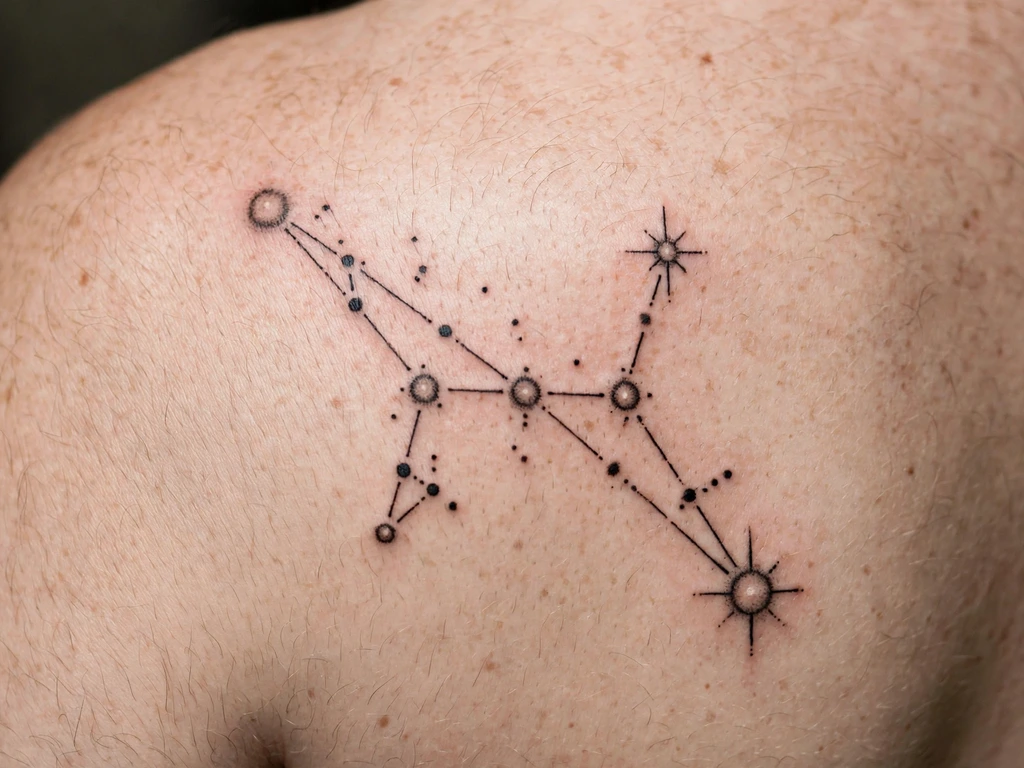
A constellation tattoo is not a picture of a thing — it is a map of a place: the one part of the sky that is yours, plotted as a scatter of star dots, sometimes joined by fine lines, in the exact pattern those stars hold overhead. That makes it unique among tattoos in one demanding way. A rose drawn slightly wrong is still a rose, but a constellation drawn slightly wrong is not a slightly wrong constellation — it is a different, invented pattern wearing a real one’s name. Accuracy is this tattoo’s whole subject, and this guide treats it that way: every design below is the real star pattern, taken from real charts, with its brightest stars named and its shape described the way the sky actually holds it.
You will find 25 constellation tattoo ideas here: the twelve zodiac constellations drawn as star patterns — Aries through Pisces, in the sky’s own spellings where they differ — then the great non-zodiac patterns: Orion, both Dippers, Cassiopeia, the Southern Cross, Lyra, Cygnus, the Pleiades, a band of the Milky Way, and the most personal design of all, a map of the sky on one date that matters to you. First, what the pattern means — and an honest word about which part of that meaning is astronomy and which part is belief.
One distinction before anything goes on your skin, because this site covers both and they are not the same tattoo. The zodiac signs — the glyphs, animals and symbols of astrological tradition — are a different tattoo altogether, and this guide contains none of those. There are no glyphs below, no rams, bulls or scorpions; there are only the stars themselves, in their true positions. If your sign matters to you as a pattern in the sky rather than a symbol in a system, you are in the right article — and if you want both, the two guides pair naturally: the sign’s story there, its stars here.
What Does a Constellation Tattoo Mean?
Begin with what is fact, because unusually for a tattoo, most of it is. A constellation is a real arrangement: a set of stars whose positions, seen from Earth, form a pattern stable enough that civilisations have navigated, farmed and told stories by it for thousands of years. Astronomers today recognise 88 official constellations covering the whole sky, and the patterns in this guide are drawn from those — the same shapes you can go outside and check on a clear night. When you wear a constellation, the pattern is not a matter of opinion. It either matches the sky or it does not.
The meanings wearers attach to the pattern gather around a few honest centres. Identity is the largest: your birth sign’s constellation is the sky’s version of the most autobiographical mark there is — not the symbol of your sign but its actual stars, the ones overhead in your season. It is the sky’s counterpart to the birth flower tattoo — the same birth, marked in stars rather than petals. Place and memory come next: the sky over a birthplace, a wedding night, a childhood home, a person lost — a specific arrangement of stars tied to a specific piece of a life, which is why the personal star map (Design 22) exists. Navigation is the oldest reading of all: fixed stars were humanity’s first map and compass, and a constellation worn on skin still carries that I know where I am charge — the Little Dipper’s end star, Polaris, has pointed north for as long as sailors have trusted it. And connection: two people wearing two halves of one sky, or the same pattern in two places, is the constellation version of a matching tattoo — except the thing shared is not a design invented for the pair, but a piece of the real sky both can go out and find.
Then the framing this guide will keep honest. Where a reading comes from astrology — the idea that your sign’s stars say something about your character, timing or fate — that is tradition and belief, a symbolic system millions use as a language for themselves, presented here exactly as that and never as established fact. The astronomy needs no such care: the stars of Scorpius really do curve in that S, Antares really is a red supergiant at its heart, and your tattoo can be checked against the sky itself. Wear the pattern for whatever it means to you — just let the pattern itself be true.
Many wearers also combine their constellation with the sky’s other two personal marks, the sun and the moon. Here, the stars keep the stage to themselves.
A Constellation Is a Map: The Accuracy Rules
Everything in this section follows from one sentence: a constellation tattoo is a map, and a wrong map is just dots. Tattoo galleries are full of “constellation” pieces whose stars were placed where they looked pretty — patterns that match nothing overhead. If that does not bother you, any scatter will do and you do not need this guide. If it does — and the rising searches for specific signs’ star constellations suggest it bothers more people every season — these are the rules that keep a tattoo true.
Rule one: the stencil comes from a real chart, never from a tattoo photo. Tattoo photographs are the worst possible source — the pattern has already been bent around somebody else’s body, simplified by somebody else’s artist, and often invented in the first place. Work from an actual star chart or planetarium: the free planetarium Stellarium will show you any constellation from any place on Earth on any date, with its stars at their true relative positions and brightnesses — set it to your sign, your date, your sky, and screenshot the pattern your artist will stencil from. Ten minutes there is the difference between a map and a rumour of one.
Rule two: the anchor stars must be right, because they are what the eye checks. Every constellation has a few bright stars that carry its shape — Betelgeuse and Rigel anchoring Orion’s shoulders and feet, Polaris ending the Little Dipper’s handle, Vega blazing at Lyra’s top, Deneb marking the Swan’s tail, Antares burning red at Scorpius’s heart. Get those stars in their true relative positions and at their true relative scale, and the pattern reads as itself even simplified; misplace an anchor and no amount of pretty dotwork will make it the constellation you named. Your artist does not need astronomy — they need the chart open beside the stencil, and the anchors checked first.
Rule three: dot size is data. On real star charts, a star’s dot is sized by its brightness — its magnitude — so the map itself tells you which stars matter. A tattoo that grades its dots the same way (brightest stars largest, around 2.5–3 mm; faintest at a still-honest 1.5–2 mm) does not just look better; it reads better, because the hierarchy the eye follows in the sky is preserved on the skin. A field of identical dots flattens the pattern into wallpaper. And the reverse also holds: never let a minor star swell bigger than an anchor — the map’s whole grammar breaks.
Rule four: lines are guests, dots are the house. The connecting lines in a constellation diagram are a modern chart convention — no lines hang in the sky — and in tattooing they are also the frailest element you can wear: hair-thin lines fade and soften first, years before the dots do. So decide lines consciously. Options, all honourable: fine lines, knowing they are the design’s most temporary part; dotted joins, which soften more gracefully; or no lines at all, letting graded dots carry the pattern unaided — the most durable choice, and the one closest to the sky itself. What is not optional is that the pattern must still read with its lines gone, because one day it may have to.
Rule five: spacing and size are survival, not taste. Star dots spread as they age — every dot is a small wound of ink settling outward — so dots planted too close merge into grey smudge and the pattern dies the death of a thousand cuts. Keep clear skin between every pair of dots (a gap at least the width of the smaller dot is a working floor), and accept that dense real patterns — the Pleiades’ tight knot, the Milky Way’s star fields — must be boldly simplified before they are stencilled: fewer stars, bigger dots, wider gaps. A simplified true pattern stays true; a complete one blurs into a lie.
Rule six: never mirror-flip the stencil. A constellation has a handedness — Scorpius curls one way, the Dipper’s handle bends one way, Orion’s belt tilts one way — and a stencil applied or designed in mirror image puts the pattern on your skin backwards: a constellation that exists in no sky. This is the easiest error in the whole design family to make (stencil software and transfer paper conspire toward it) and the hardest to forgive, because anyone who knows the sky sees it instantly. Check the transfer against the chart, on the skin, before the needle: same tilt, same curl, same bend.
Rule seven: place the map where the map stays flat. Star patterns are geometry, judged against the body’s curves. A pattern spanning a joint or a muscle’s peak will warp as you move; small warps are forgivable — but check the stencil standing naturally, limb at rest and in motion, and let the anchors sit on the flattest ground available. A map checked only lying down is drawn for somebody who never stands up.
Constellation Tattoo Styles and How They Age
Constellation work fails in one place only — smallness — and every style below is a different negotiation with that fact. Dots are the most durable marks in tattooing (a bold dot is nearly a tiny blackwork tattoo); lines are the least. Simplify a pattern in the drawing, boldly, and the tattoo stays a map for decades; shrink a detailed pattern instead, and ageing simplifies it for you, rudely.
| Style | How it is drawn | How it ages |
|---|---|---|
| Graded dots with fine lines | Star dots sized by brightness, joined by hair-thin lines | The classic chart look; dots hold for decades, lines soften first — pattern must read from dots alone |
| Graded dots only, no lines | The pattern carried purely by dot size and position | The most durable and the most sky-true; needs confident spacing so the eye can assemble the shape |
| Dotted joins | Stars linked by chains of tiny stipple dots instead of solid lines | Softens gracefully into a suggestion of connection; joins may eventually read as part of the star field |
| Fine line, single-weight dots | All stars one small size, hair-thin joins throughout | The most fragile build; tight patterns merge into grey — survives only at generous size and spacing |
| Blackwork star field | Bold solid dots and small solid stars, wide spacing | Superb longevity; the chart feel is lost but the pattern’s skeleton reads at any distance, forever |
| Dotwork sky / Milky Way shading | Stippled fields of tiny dots suggesting star clouds and nebula glow | Mellows into soft tone; individual stars planted inside must be bold or the field swallows them |
| White ink constellation | Stars and lines in white pigment only | The honest exception: white ink creams, yellows and can nearly vanish, showing longest on deeper skin tones — a temporary-by-design choice, included as a warning, not a recommendation |
The photograph problem: the constellation tattoos that circulate most are fresh, macro-photographed and drawn at densities skin cannot keep — twenty-star patterns in five centimetres, joins like spider silk. Every design here is described at its healed reality: honest dot sizes, simplified counts, spacing you could defend in ten years. A constellation is a promise that a pattern will still be findable on your skin in twenty years; draw it so the promise can be kept.
Constellation Tattoo Ideas at a Glance
| # | Design | Style notes | Best placement |
|---|---|---|---|
| 1 | Aries — The Ram’s True Stars | Graded dots, fine lines | Forearm |
| 2 | Taurus — The V and the Hyades | Graded dots, one red anchor | Upper arm |
| 3 | Gemini — The Twins’ Twin Lines | Two parallel star chains | Shoulder blade |
| 4 | Cancer — The Faint Upside-Down Y | Simplified bold dots, no filler | Forearm |
| 5 | Leo — The Sickle and Triangle | Graded dots, bold Regulus | Shoulder |
| 6 | Virgo — The Maiden’s Long Chain | Long graded pattern | Forearm |
| 7 | Libra — The Balance Beam of Stars | Two-star beam, graded dots | Forearm |
| 8 | Scorpius — The Great S and Antares | Long curving chain, red heart | Calf |
| 9 | Sagittarius — The Teapot | Compact graded pattern | Forearm |
| 10 | Capricornus — The Boomerang | Wide shallow arc | Calf |
| 11 | Aquarius — The Water-Bearer’s Streams | Scattered graded field | Forearm |
| 12 | Pisces — The Two Fish on One Cord | Two chains, one knot star | Shoulder blade |
| 13 | Orion — The Hunter | Full graded pattern, belt of three | Shoulder blade |
| 14 | Ursa Major — The Big Dipper | Seven bold stars, graded | Upper arm |
| 15 | Ursa Minor — The Little Dipper and Polaris | Graded dots, Polaris largest | Wrist |
| 16 | Cassiopeia — The W | Five stars, zigzag | Collarbone (outer edge) |
| 17 | Crux — The Southern Cross | Four anchors, one small fifth | Ankle |
| 18 | Lyra — Vega and the Parallelogram | One blaze, four small stars | Behind ear |
| 19 | Cygnus — The Northern Cross | Cross of graded stars | Shoulder |
| 20 | The Pleiades — The Seven Sisters, Simplified | Bold cluster of 6–7 dots | Shoulder blade |
| 21 | The Milky Way Band | Dotwork star field, bright anchors | Upper arm |
| 22 | Your Personal Star Map | The sky on one date, chart-true | Forearm |
| 23 | Two Constellations, a Matching Pair | One pattern each, same hand | Wrists (pair) |
| 24 | Stars Only — No Lines at All | Graded dots, unaided pattern | Calf |
| 25 | The Tiny Finger Constellation | Bold micro pattern, 5–7 dots | Finger (side) |
25 Constellation Tattoo Ideas
1. Aries — The Ram’s True Stars
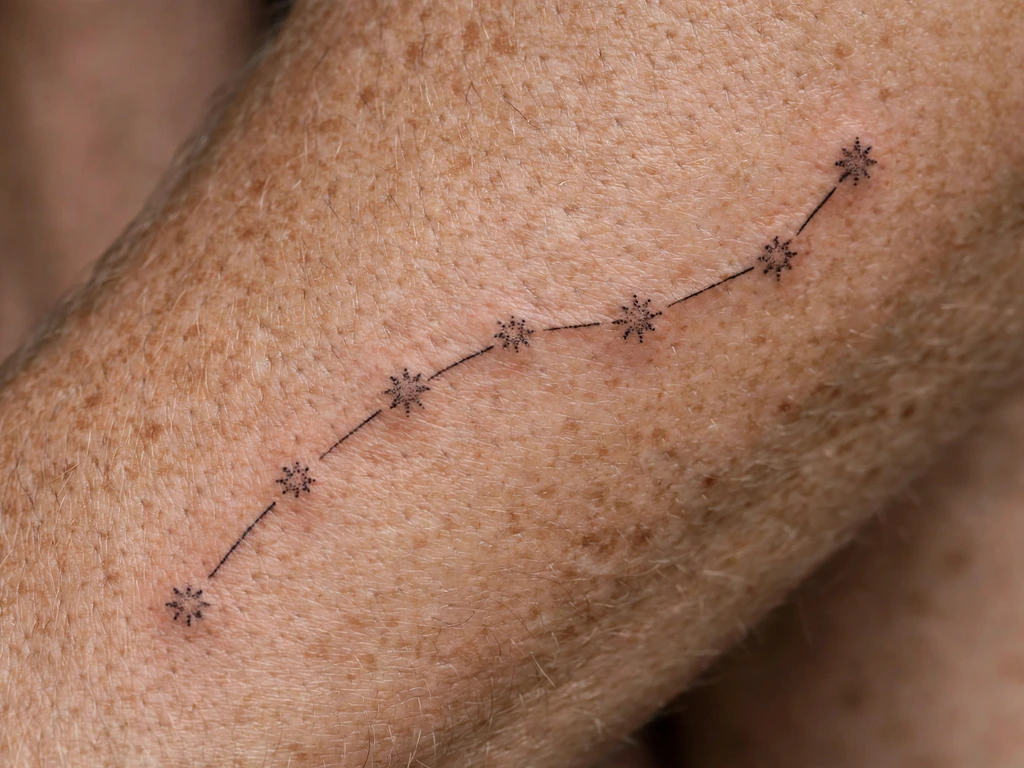
The zodiac’s first constellation is honestly one of its smallest: a short, bent chain of a few stars — a crooked line with a knot at one end, where the ram’s head sits. There is no grand shape to hide in, and that is exactly why the searches for the Aries star constellation are the fastest-rising in this whole subject: wearers want the real, modest pattern, not an invented ram. Its anchor is Hamal, the brightest star, at the chain’s western knot; grade it largest, let the few fainter stars step down honestly, and the little chain reads as what it is.
Because the pattern is small and spare, it forgives small placements better than any other in this guide — but spare is not the same as dense. Even Aries’ handful of dots need their skin gaps, and the bend at the head must survive the stencil check against the chart: flipped, this chain’s crook bends the wrong way and the map is wrong.
Best placement: Forearm, the chain running along the arm’s length; it is one of the few full constellations that also sits honestly on a wrist.
Best for / know before you book: This is the design to judge an artist’s chart discipline by — ask them to show you the chart they worked from, and compare the stencil to it star by star before anyone opens a needle.
2. Taurus — The V and the Hyades
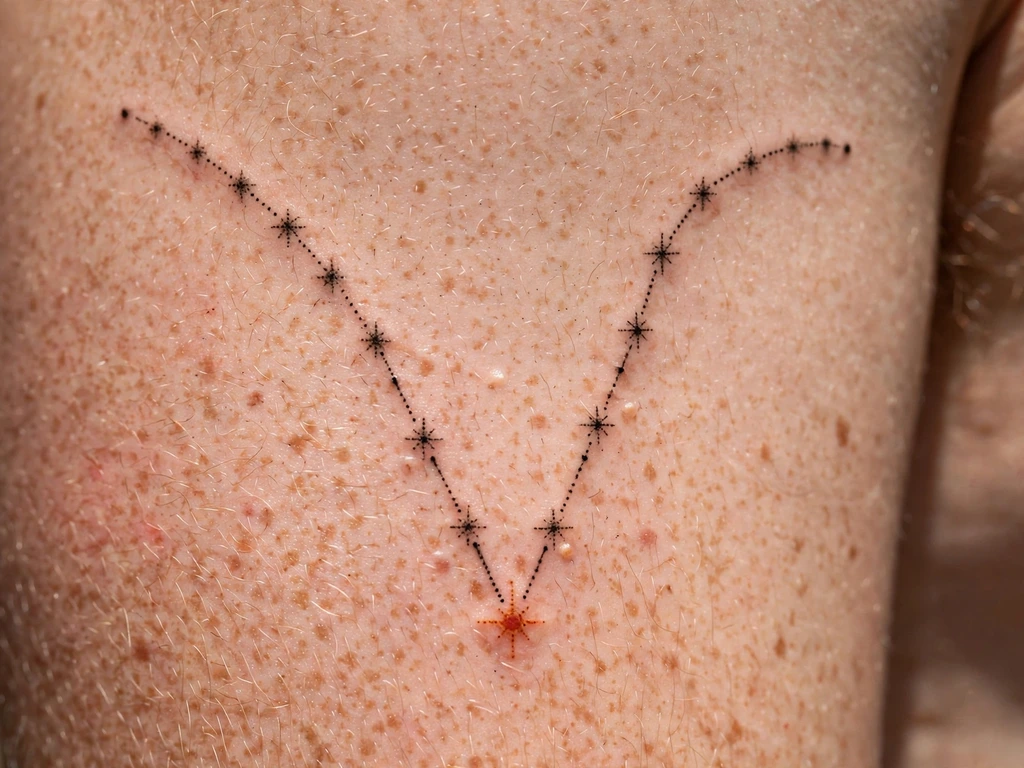
Taurus is drawn by its face: a clean V of stars — the Hyades cluster — that forms the bull’s forehead, with one long horn-line running up from each end of the V, and at the V’s lower tip a star that genuinely glows orange-red in the sky: Aldebaran, the bull’s eye, one of the brightest stars there is. It is the most instantly recognisable zodiac constellation after Scorpius, and the V does the recognising — get the V true and generous, and the horns can simplify.
Aldebaran invites the one colour decision in the zodiac twelve: a single warm-red or orange dot at the eye while every other star stays black. It is astronomically honest — the star really is that colour — and it ages to a muted ember rather than a mistake. If you take it, take it bold; a timid red dot reads as an error.
Best placement: Upper arm, where the V can open wide; the V alone, horns shortened, works on a forearm.
Best for / know before you book: Measure the V’s two arms against the chart, not against each other — they are genuinely unequal in the sky, and an artist who “corrects” them into symmetry has redrawn the map.
3. Gemini — The Twins’ Twin Lines
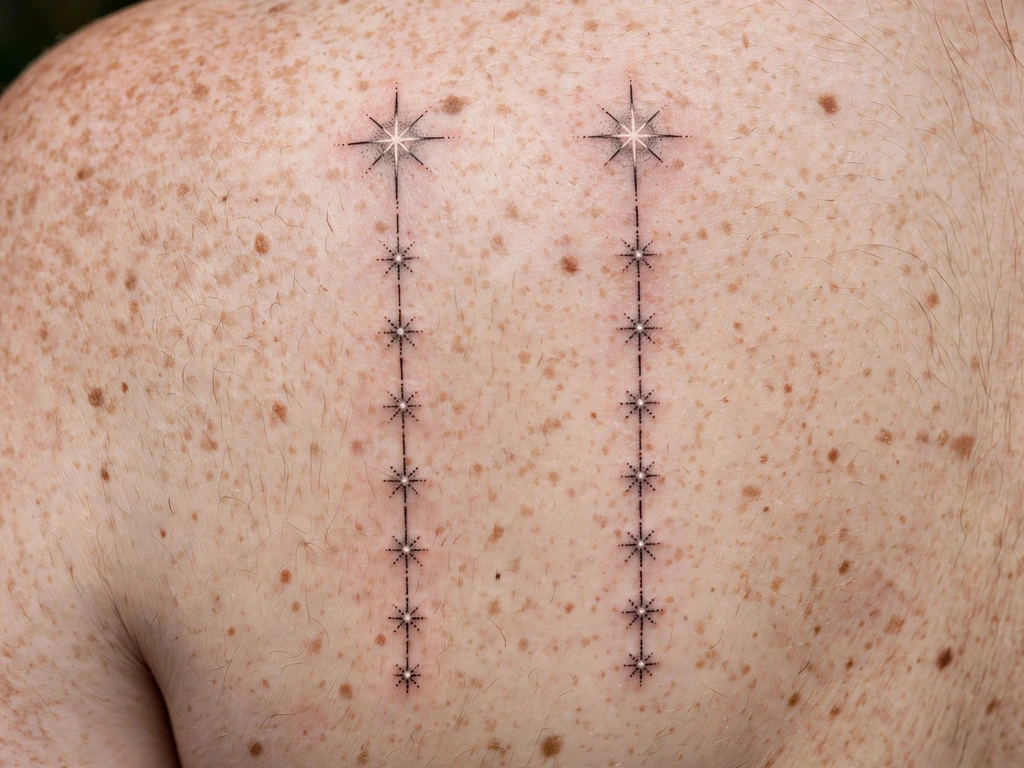
Gemini is the zodiac’s most tattoo-shaped constellation: two long, roughly parallel chains of stars running side by side — the twins standing shoulder to shoulder — each chain headed by a bright star, Castor at one head, Pollux at the other. Pollux is the slightly brighter and genuinely more golden of the two; Castor, the apparent single star, is famously a system of multiple stars bound together, which twin-wearers have always taken as a good omen for the design.
The craft is the pairing. The two chains must be drawn together from the one chart, at the same scale, heads level the way the sky levels them — Pollux a shade larger and lower. Drawn separately or “matched” freehand, the twins drift, and a Gemini whose chains wander apart reads as two unrelated patterns sharing a shoulder blade.
Best placement: Shoulder blade, the twins standing tall side by side; the pair also runs naturally down a forearm, one chain along each edge.
Best for / know before you book: Twins, siblings and pairs of every kind claim this design — if it is a two-person tattoo, take Design 23’s route instead: one chain each, from the same stencil file, in the same session.
4. Cancer — The Faint Upside-Down Y
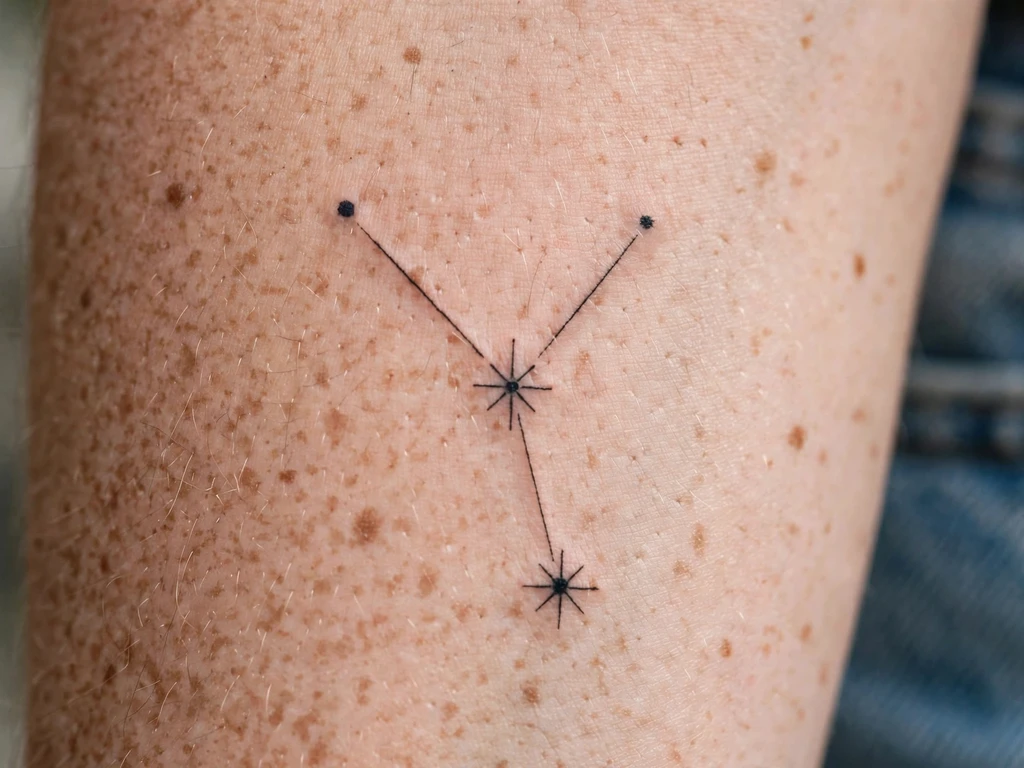
Cancer is the faintest constellation in the zodiac — genuinely, measurably dim, a sparse little upside-down Y of modest stars that city dwellers can barely see at all. Searches for its star constellation are rising fast anyway, and the honesty is the appeal: Cancer wearers are choosing the true pattern, faintness and all, over the crab symbol. A tattoo cannot be faint the way the sky is — ink that shy would vanish — so the build is translation, not transcription: the Y’s four or five real stars, placed truly, but drawn bold, at confident sizes, with the faintest members of the real pattern quietly omitted rather than shrunken into specks.
That omission is the design’s discipline, and it must be the wearer’s conscious choice, made over the chart: which stars stay is decided by the sky’s own brightness order, brightest first, never by which dots would look prettiest. The Praesepe — the Beehive Cluster, a fuzzy patch the ancients saw at the Y’s heart — can be honoured as one soft dotwork knot at the junction, the design’s one permitted blur.
Best placement: Forearm, where the Y can run tall; its sparseness also suits an ankle at bold scale.
Best for / know before you book: If your artist suggests adding extra stars to “fill it out”, decline — the emptiness is Cancer’s shape, and a filled-in version is a different, invented constellation.
5. Leo — The Sickle and Triangle
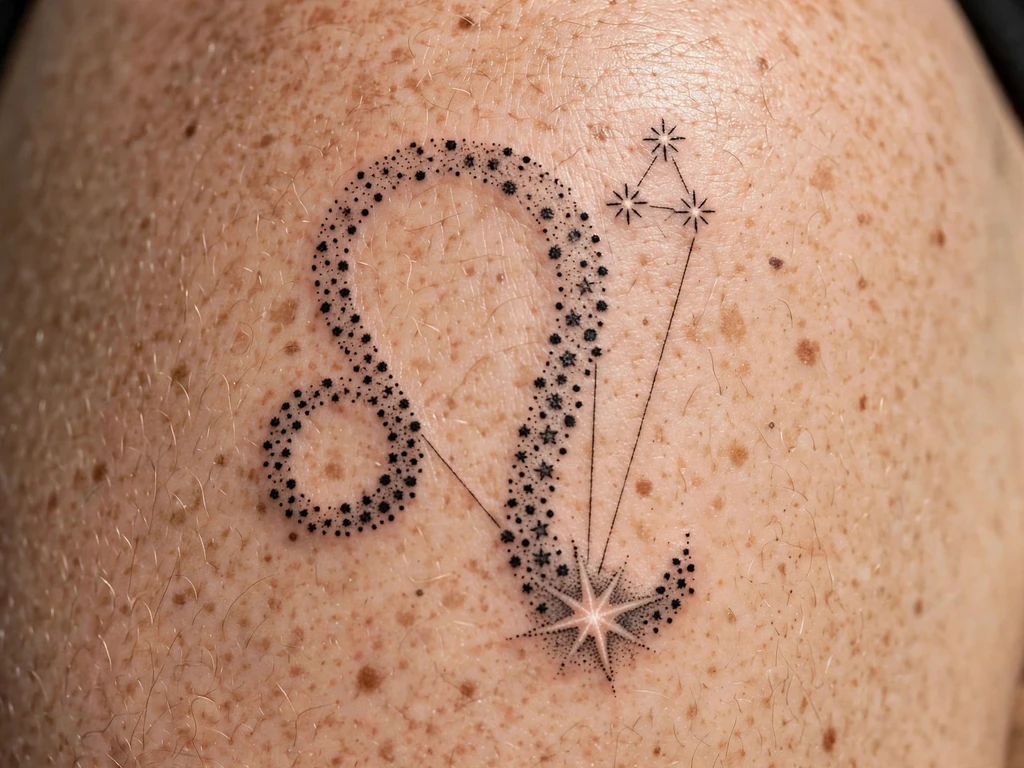
Leo is two shapes in one: a backward question mark of stars — the Sickle, the lion’s head and mane — opening above a neat triangle that forms the hindquarters. Its anchor is Regulus, at the sickle’s base, a genuinely brilliant blue-white star; grade it the largest dot in the piece and the whole lion assembles itself around it. Of the twelve, Leo is the one whose pattern most resembles its creature when drawn true, which is why it satisfies wearers who want the stars and the animal in a single honest mark.
The sickle’s curve is the stencil test: it bends one way in the sky (the question mark faces backward, toward Gemini), and a flipped stencil draws a lion looking over the wrong shoulder. Check the curve’s direction against the chart on your skin, standing, before the session starts.
Best placement: Shoulder, where the sickle’s curve rides the deltoid’s own curve; the full pattern also runs well down a forearm.
Best for / know before you book: Resist adding a drawn mane, crown or lion outline around the stars — the sickle is the lion; framing it in a cartoon of itself breaks the map’s whole discipline.
6. Virgo — The Maiden’s Long Chain
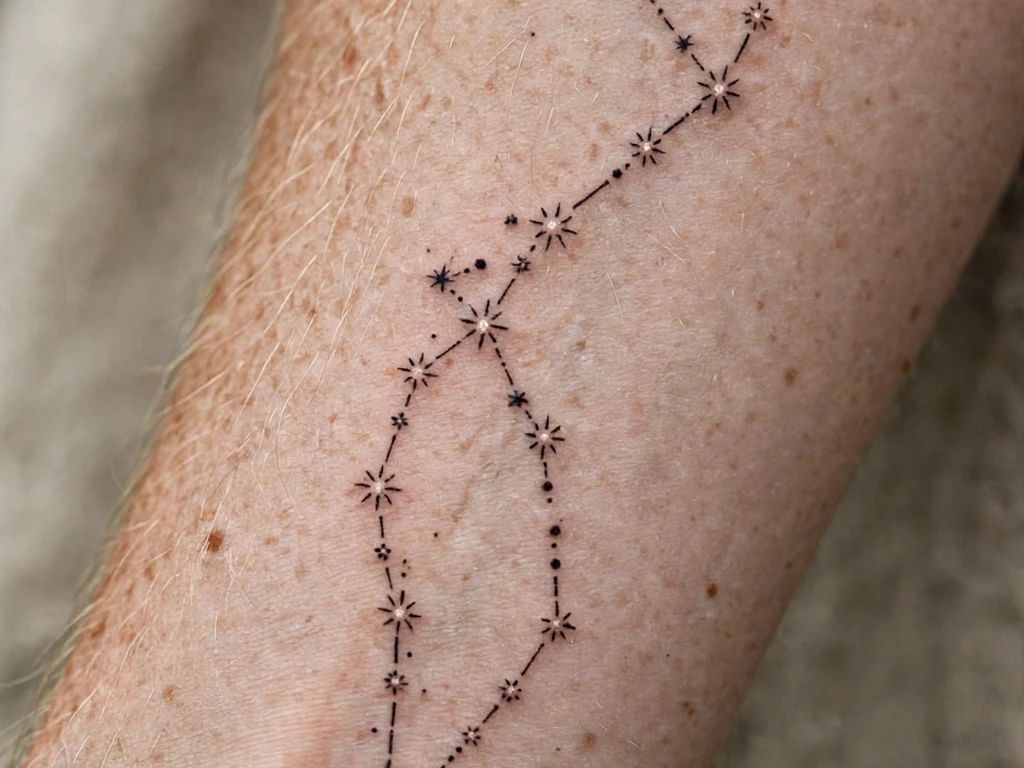
Virgo is the largest constellation of the zodiac and the second-largest in the whole sky — a long, sprawling chain of stars that takes real estate to wear honestly. Its anchor is Spica, a brilliant blue-white star near the chain’s lower end, traditionally the ear of wheat in the maiden’s hand: one blaze of a star in an otherwise modest field, which is exactly how the tattoo should grade it. Spica largest by a clear margin, the chain stepping down around it.
A pattern this long is a gift to the forearm, the body’s own long flat panel, and a problem everywhere else: shortened onto a small placement, Virgo must be simplified by dropping its faintest links in brightness order — never by compressing the chain’s proportions, which quietly redraws the map. If your placement cannot hold the chain at true spacing, the honest answer is an arc of it, chosen openly, not a squeezed whole.
Best placement: Forearm, the chain running its full length; a shoulder blade takes the wider sprawl if the pattern turns.
Best for / know before you book: Count the chain’s stars on chart and stencil together — Virgo’s length makes it the easiest constellation to lose one in, and a missing middle star bends every distance after it.
7. Libra — The Balance Beam of Stars
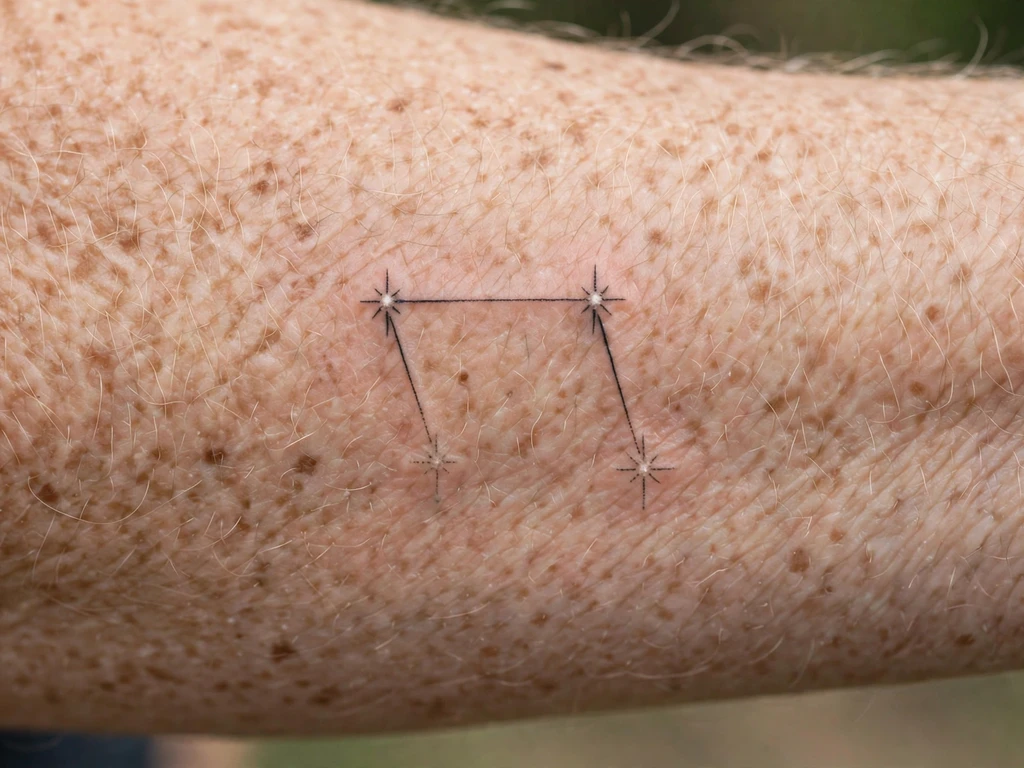
Libra’s stars were once the Scorpion’s claws — the two bright stars at its beam still carry Arabic names meaning the northern and southern claw — and the constellation the sky actually holds is minimal: a horizontal beam of two anchors, with two fainter stars hanging beneath like the pans of the balance the Romans later read into it. It is the sparsest of the twelve, and the most dependent on proportion: with so few stars, each one’s position carries the whole design.
Drawn well, it is the most elegant small constellation there is — a beam, a balance, four to six dots in all — and it punishes exactly one thing: a beam that is not level on the body. The sky’s horizontal is not your arm’s horizontal in every posture, so agree with your artist which pose the beam is levelled for (arm relaxed at your side is the honest default) and stencil for that pose only.
Best placement: Forearm, the beam running across the arm; a small version sits cleanly above an ankle.
Best for / know before you book: Few-star patterns cannot hide a misplaced dot — check each star’s distance from the beam against the chart with a ruler on the stencil printout.
8. Scorpius — The Great S and Antares
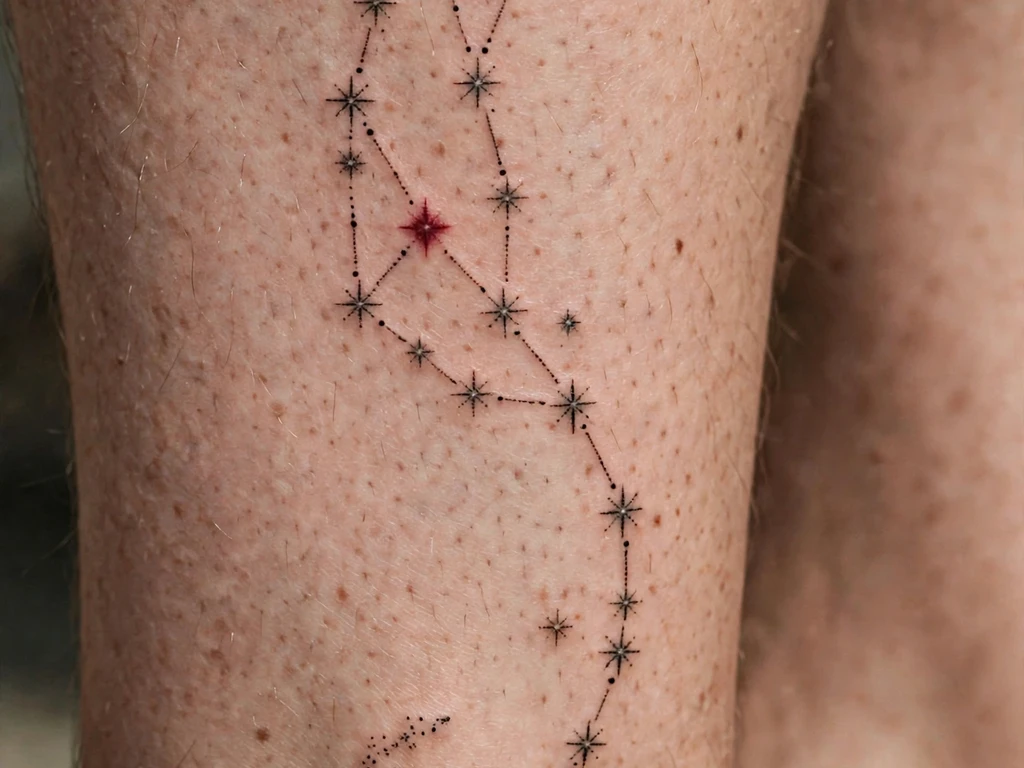
Here the astronomical spelling matters — it is Scorpius, the constellation, not Scorpio the sign — and here the sky out-draws every symbol of it: a magnificent S of stars, a clawed head at the top, a long body curving down and a sting genuinely raised at the tail. At its heart burns Antares, a red supergiant so large and so visibly red that its name means “rival of Mars”. Searches for this star constellation are among the fastest risers in the subject, and one look at a real chart explains why: no artist inventing a pattern would dare a curve this good.
The build follows the curve. Scorpius is long — the full S wants the calf’s vertical run or a forearm’s length — and its stars grade dramatically, Antares largest (take it in a true deep red if you take any colour in this guide; the star has earned it), the sting’s paired tip-stars drawn bold and close but never touching. The S bends one way only: flipped, the sting rises on the wrong side, and the sky’s most recognisable signature becomes a stranger’s.
Best placement: Calf, the S following the leg’s long curve; forearm for a slightly compressed but never re-proportioned version.
Best for / know before you book: This is the constellation most often tattooed wrong from gallery photos — insist the stencil is traced from a chart, and trace the S with your own fingertip, head to sting, before you approve it.
9. Sagittarius — The Teapot
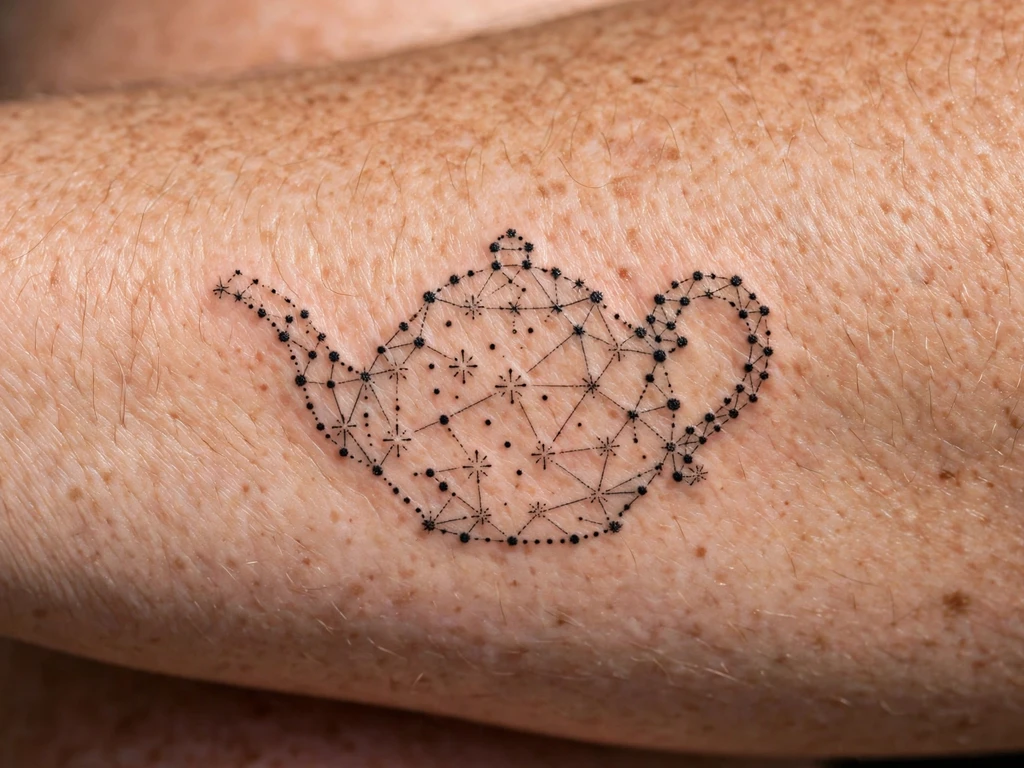
Ask an astronomer to draw Sagittarius and they will not draw a centaur — they will draw the Teapot: the constellation’s bright inner stars form a small, perfect teapot, spout, handle and lid, sitting in the richest star fields of the Milky Way. It is the most charming asterism in the sky, the pattern rising-query wearers are actually searching for, and this guide’s honest recommendation for the Archer’s stars: compact, unmistakable, and tattooable at modest size without losing a single anchor.
The sign’s full story — glyph, centaur, bow and all — is told in our dedicated Sagittarius tattoo design ideas guide; this design is only the stars. Draw the Teapot from the chart at true proportions (it is wider than it is tall, and galleries routinely stretch it), grade its eight main stars by brightness, and let the Milky Way richness around it be suggested, if at all, by a few faint field dots kept well clear of the pattern’s edges.
Best placement: Forearm, the Teapot sitting upright as the arm hangs; also excellent on a shoulder blade at larger scale.
Best for / know before you book: The Teapot is a shape with a correct orientation — lid up, spout tilted — so check it standing in a mirror, not laid flat on a table where every rotation looks equally fine.
10. Capricornus — The Boomerang
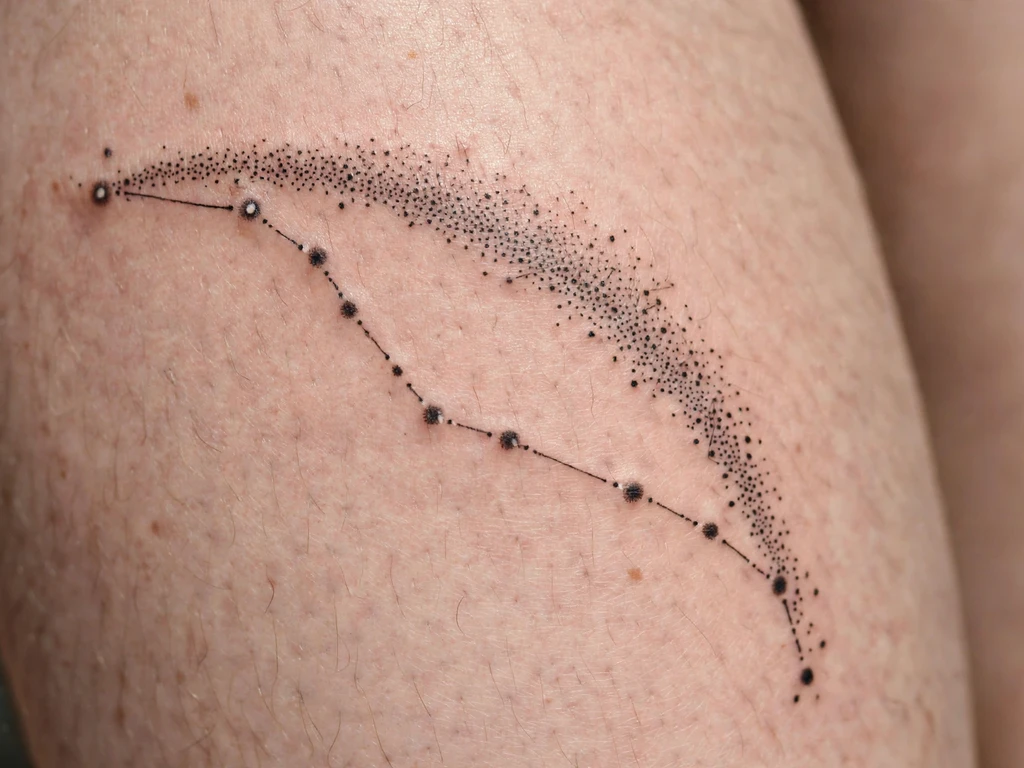
Capricornus — the constellation’s full astronomical name, the sea-goat’s Latin — is a wide, shallow boomerang of mostly modest stars: the zodiac’s quietest big shape, a smile of a pattern strung between two brighter anchors. Rising searches for the Capricornus star constellation have grown faster than almost any other sign’s, and the design rewards its seekers with the most wearable outline of the twelve: a single sweeping arc that follows the body’s own long curves beautifully.
A wide, faint pattern lives on its endpoints and its curve. Grade the two anchor stars clearly largest, let the arc’s middle stars step honestly down, and never let an artist deepen the boomerang’s bend to make it “read better” — the shallowness is the shape. On a calf, the arc can run horizontally around the muscle or lengthwise down it; lengthwise keeps the proportions truest.
Best placement: Calf, the arc running lengthwise; a wide forearm version suits arms that can give it the span.
Best for / know before you book: Faint constellations tempt artists to add stars — Capricornus complete has a specific, countable set, so count them on the chart together and add nothing.
11. Aquarius — The Water-Bearer’s Streams
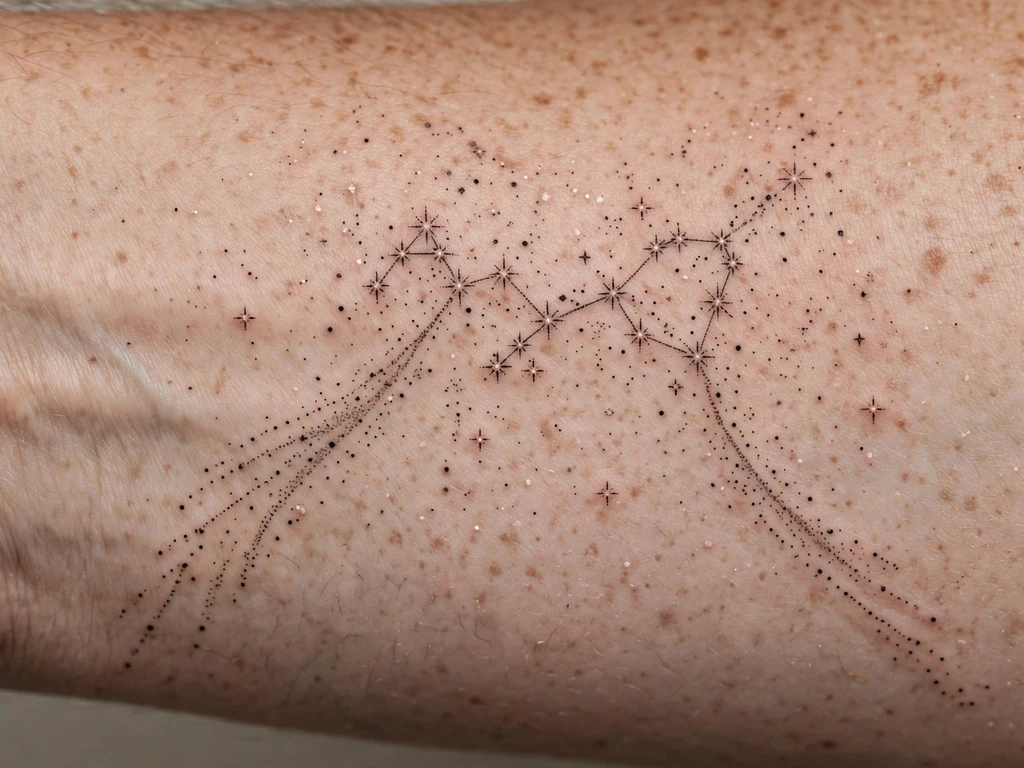
Aquarius is the zodiac’s sprawl: a loose, scattered field of mostly modest stars, with one compact little asterism — the Water Jar — and two thin streams of stars flowing away from it, the poured water. It has no single blazing anchor (its brightest, Sadalsuud, is respectable rather than brilliant), and its honesty is its looseness: this constellation really is a drift of stars, and a tattoo that tidies it into a neat shape has stopped being a map.
So build it as the sky builds it: the Jar drawn as a small tight knot of four or five dots — the pattern’s one dense address, planted bold with real gaps — and the streams as sparse chains wandering off it, their emptiness preserved. Grading matters more here than anywhere: with no blaze to organise the eye, the modest steps from brighter to fainter are what keep the field legible as a pattern rather than a rash.
Best placement: Forearm, which gives the streams room to wander; the Jar alone makes an honest small piece above an ankle.
Best for / know before you book: Agree the simplification in writing over the chart — which stream stars stay, which go — because “the loose one” is the design most likely to be quietly regularised by a helpful artist.
12. Pisces — The Two Fish on One Cord
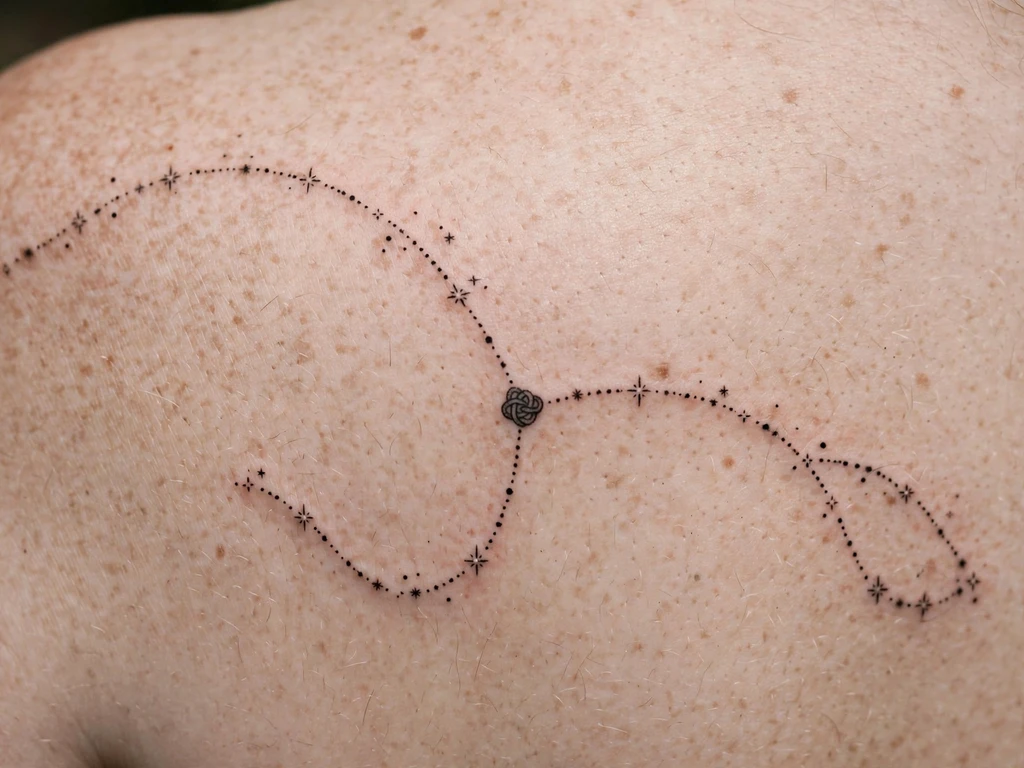
Pisces is two constellations wearing one name: two long, faint chains of stars — one fish swimming up, one west — tied together at a single knot star, Alrescha, whose name literally means “the cord”. The myth says the fish tied themselves together so as never to be separated; the sky, unusually, backs the story up with an actual junction star, which makes this the most narratively honest constellation in the zodiac.
It is also the faintest of the twelve, and the build obeys that truth: two sparse chains, drawn with the fewest stars of any design here, each chain’s dots bold and well separated, meeting at one clearly graded knot. The chains’ angle — they meet in a wide V — is the pattern’s signature; a stencil that narrows the V to fit a smaller space has drawn two different fish. Give it the shoulder blade’s width or choose one fish, openly, as a single-chain design.
Best placement: Shoulder blade, where the V can open to its true angle; one chain alone runs down a forearm.
Best for / know before you book: This is the design couples and siblings most often split between two bodies — if so, use Design 23’s discipline: same chart, same scale, same session, the knot star worn by one of you or shared as two matching dots.
13. Orion — The Hunter
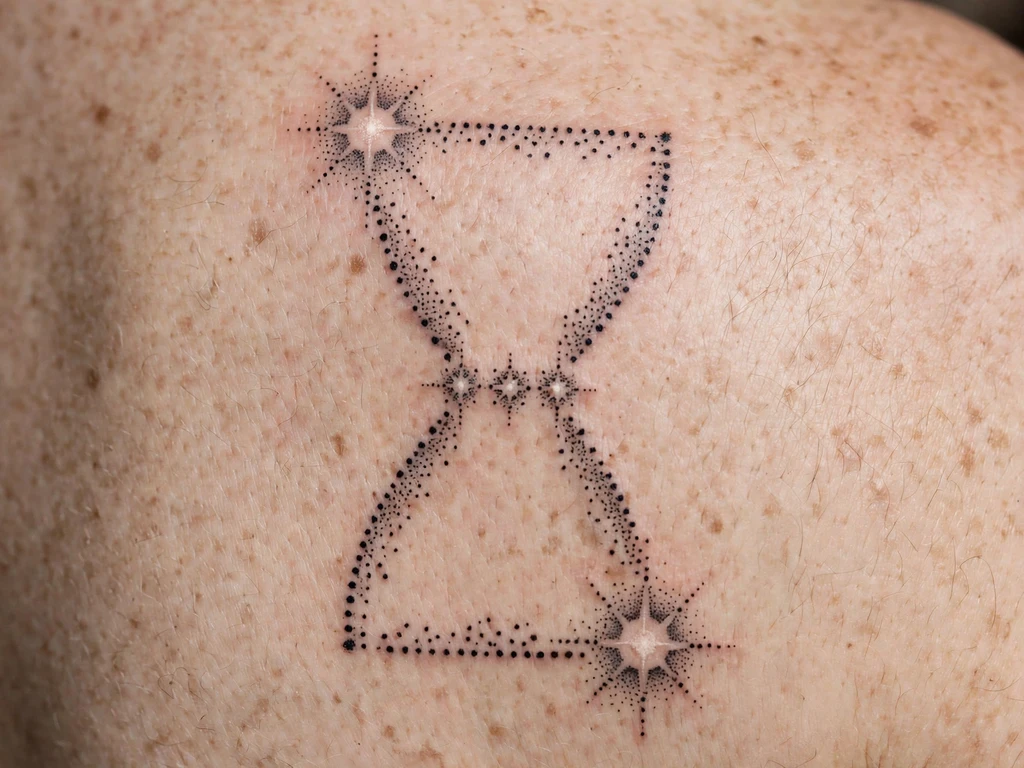
The greatest constellation tattoo there is, and this guide’s featured pattern: the Hunter, an hourglass of brilliant stars every human culture has recognised — Betelgeuse glowing orange-red at one shoulder, Rigel blue-white at the opposite foot, and between them the Belt, three stars in a near-perfect row that no other pattern in the sky can be mistaken for. Orion is the winter sky’s centrepiece in the northern hemisphere, and the one constellation a stranger will name correctly on your skin.
Its scale is its discipline. Orion is big — shoulder to foot spans a serious arc — and its proportions are its identity: the Belt must sit at the hourglass’s waist, neither high nor low, and Betelgeuse and Rigel must grade as near-equals at the pattern’s two poles, one warm, one cool (a muted red dot for Betelgeuse is the second colour this guide endorses, and the most earned). If you want to know when to go out and stand under your own tattoo, the Griffith Observatory’s Observing the Sky page publishes monthly sky summaries and weekly charts showing what is up and where to look — Orion’s season is the northern winter, and meeting your constellation in person is part of this design’s pleasure.
Best placement: Shoulder blade, where the hourglass gets the body’s broadest flat; at larger scale it spans an upper arm and shoulder together.
Best for / know before you book: Measure the Belt’s position on the stencil against the chart as a fraction of the whole height — “about the middle” is how Orions quietly go wrong, and the true waist sits specific.
14. Ursa Major — The Big Dipper
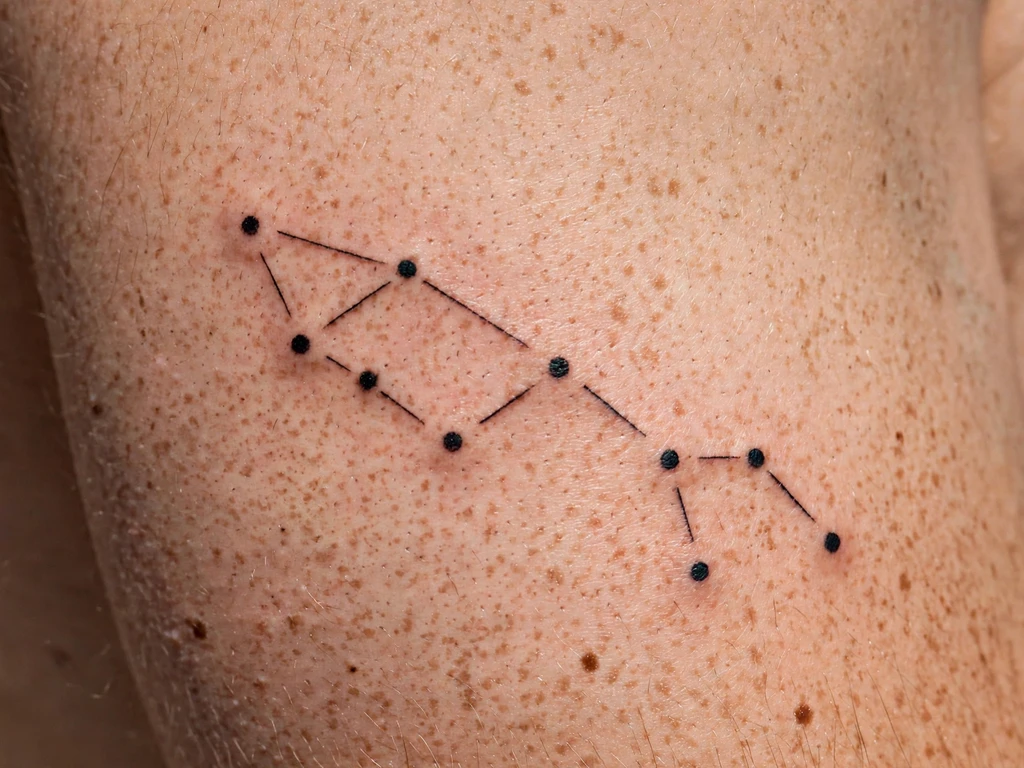
First, the honest naming this design insists on: the Big Dipper is not a constellation — it is an asterism, a famous pattern inside the much larger constellation Ursa Major, the Great Bear, whose full star figure sprawls far beyond the Dipper’s seven. The seven are what everyone knows: a bowl of four stars, a handle of three bending away from it, the most recognised shape in the northern sky and the pointer by which Polaris is found — the bowl’s two front stars, the Pointers, aim straight at the North Star.
Seven stars, all respectably bright, make this the most forgiving true pattern in the guide: it can be drawn bold, widely spaced, even quite large, and it will survive decades of settling with its shape intact. The bend of the handle is its fingerprint — the middle handle star, Mizar, carries a famous tiny companion, Alcor, which sharp-eyed wearers add as a satellite dot hard against it: the one double-star detail in tattooing that is astronomically true.
Best placement: Upper arm, the Dipper running bowl-to-handle along the arm; it also spans a shoulder blade proudly at full size.
Best for / know before you book: If you want the whole Bear rather than the Dipper, know it is a far larger, fainter undertaking — most wearers honestly want the seven, and this design refuses to pretend they are the same thing.
15. Ursa Minor — The Little Dipper and Polaris
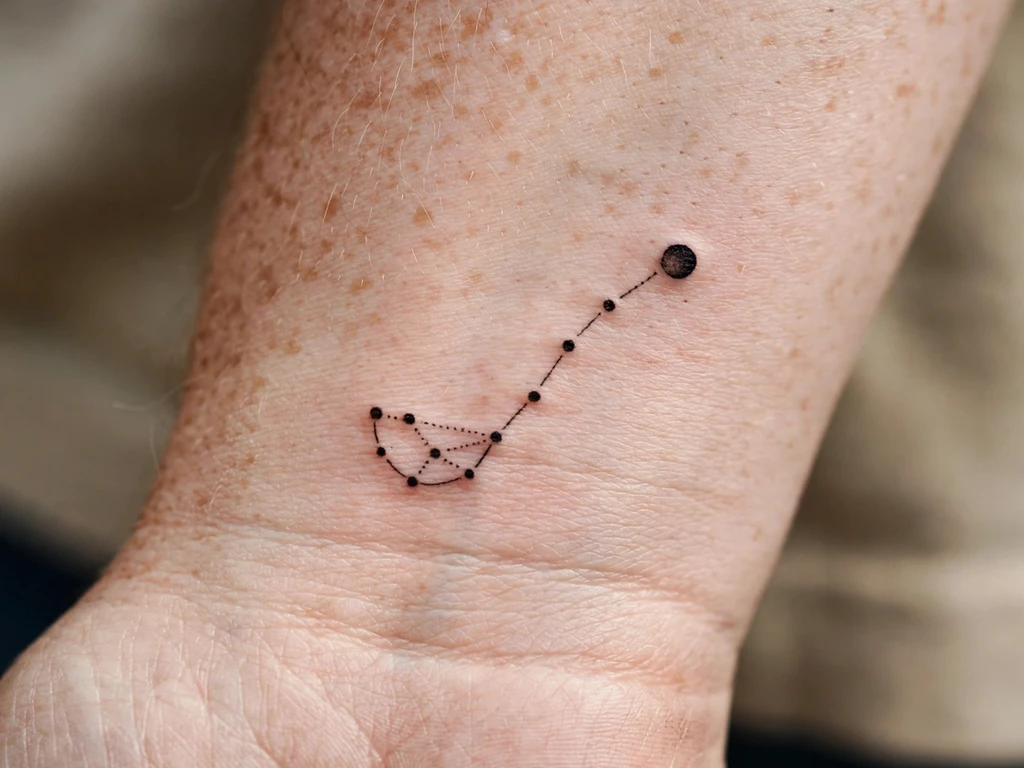
The Little Dipper is the Big Dipper’s smaller, fainter echo — same bowl-and-handle grammar, dimmer stars — with one star that outranks every other in this guide for sheer meaning: Polaris, the North Star, sitting at the very end of the handle, the fixed point the whole sky appears to turn around, the star navigators steered by for centuries. A constellation tattoo about one star more than its pattern: the reading is guidance, home, the way back.
The build must therefore grade ruthlessly: Polaris largest by a clear margin at the handle’s tip, the bowl’s two brighter guardians next, the faint handle stars honestly small but never below survival size. The Little Dipper simplified to seven bold dots is still itself; simplified by shrinking, it is seven specks. Its compactness makes it the natural full-constellation choice for a wrist — one of the very few that fits there without lying about its size.
Best placement: Inner wrist, handle running toward the hand so Polaris sits nearest the pulse; also honest above an ankle.
Best for / know before you book: Tell your artist which dot is Polaris and watch them mark it on the stencil — a Little Dipper with its biggest star mid-handle is the pattern’s one unforgivable error.
16. Cassiopeia — The W
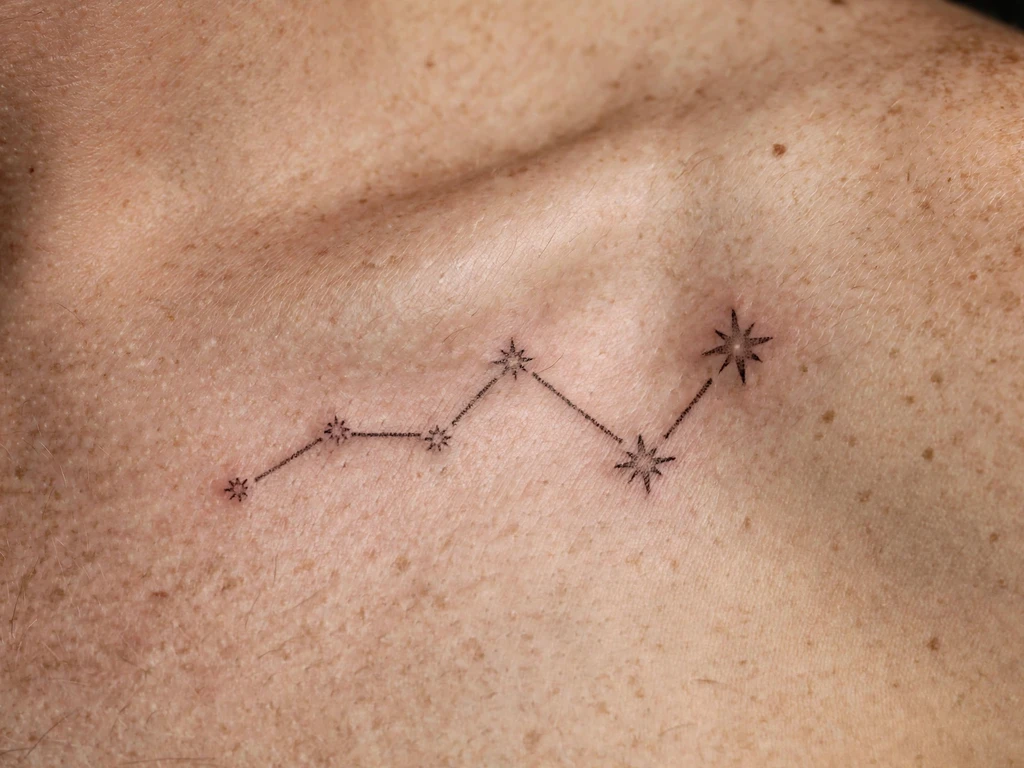
Five bright stars in a zigzag — a W in some seasons, an M in others, as the pattern wheels around the pole — Cassiopeia is the sky’s most recognisable signature after the Dipper, visible all year from northern latitudes and impossible to unsee once learned. In the Greek stories she is a queen set among the stars; in the chart she is simply five anchors in a row, each bright, each evenly consequential, the perfect beginner’s constellation and a perfect tattoo pattern.
Five stars is a small canvas with nowhere to hide: the zigzag’s two peaks are genuinely uneven (the W is lopsided in the sky — one side higher, one star, Schedar, a touch orange), and that lopsidedness is its identity. Stretched along the outer edge of a collarbone, the zigzag follows the bone’s own rise and fall beautifully — but agree the orientation on your standing body, because along a collarbone the pattern can be read from two directions and only one of them is the sky’s.
Best placement: Outer edge of the collarbone, the W lying along the bone; the zigzag also runs happily down a forearm.
Best for / know before you book: Photograph the stencil from the front, standing, at conversational distance — a W that reads as an M from the wearer’s own mirror has been placed upside down, whatever the chart on the table said.
17. Crux — The Southern Cross
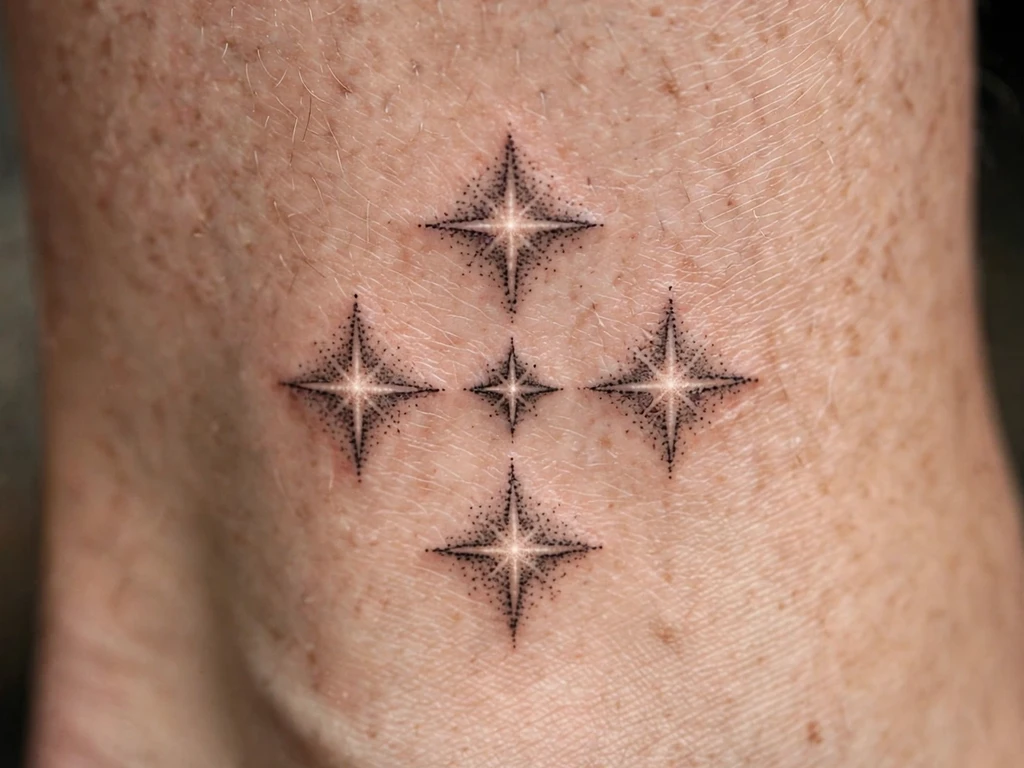
The smallest true constellation in the sky is also one of the most carried: Crux, the Southern Cross, four bright stars in a kite-shaped cross — Acrux at the foot, Mimosa and Gacrux along the beam, one smaller fifth star tucked inside the pattern — the emblem on flags, the signpost by which the southern sky finds south, and a piece of home for everyone who grew up under southern stars. Northern readers should know the honest caveat: below about 25°N it rides low, and from most northern latitudes it never rises at all — which for its wearers is often the point; it is the sky of somewhere specific.
Four-to-five stars at honest sizes make Crux the most ankle-worthy real constellation in this guide. Its cross is genuinely not symmetrical — the crossbar sits off-centre, the long axis tilts — and those irregularities, kept, are what separate a Crux from a generic cross of dots. Grade Acrux largest, keep the little fifth star (its inclusion is a connoisseur’s tell), and check the tilt against the chart.
Best placement: Ankle, the long axis running up the leg; a forearm takes it at prouder scale.
Best for / know before you book: If you have never actually seen Crux from your own sky, decide consciously that you are wearing a place, not a view — many wearers are, and it is a good reason, but it should be a chosen one.
18. Lyra — Vega and the Parallelogram
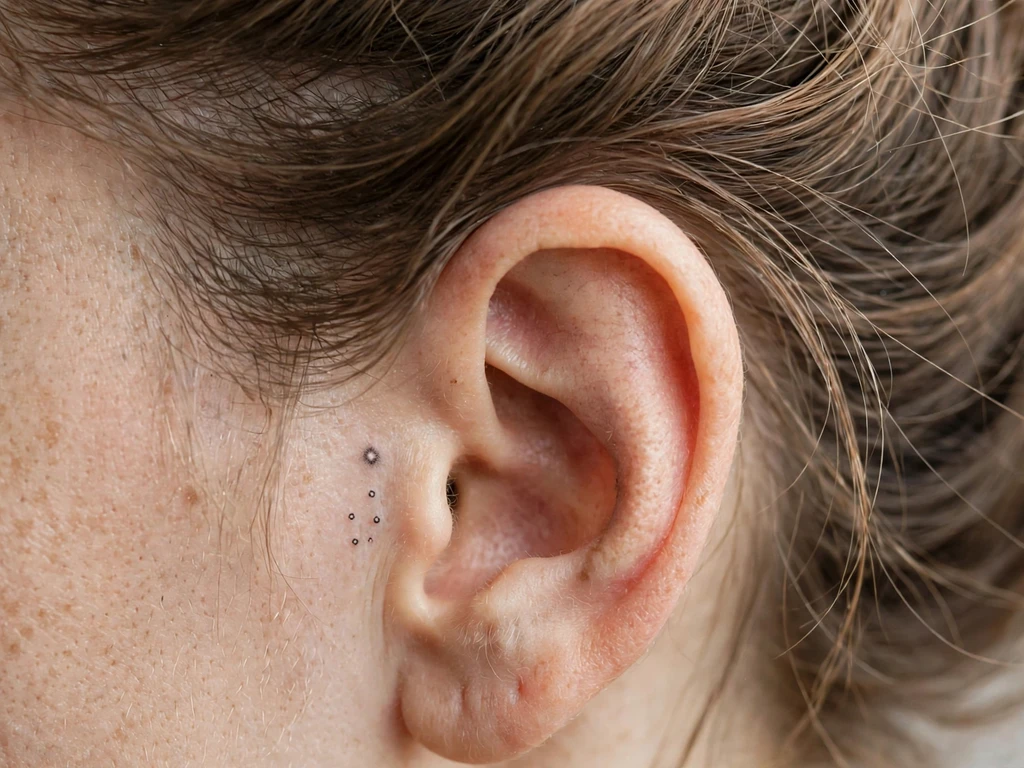
The smallest design in this guide, chosen for the one small placement where it fits honestly: Lyra is essentially one blaze and a jewel box — Vega, the fifth-brightest star in the entire sky, a blue-white beacon — with a tiny, neat parallelogram of four much fainter stars hanging just below it, the body of Orpheus’s lyre. Behind an ear, where the whole tattoo gets perhaps three centimetres, that structure is a gift: one big dot, four small ones, a pattern a thumbnail’s width that is nonetheless a complete, true constellation.
The honesty is in the grading and the gaps. The parallelogram’s stars are genuinely faint, but at this scale faint cannot mean tiny — the four must be drawn at the smallest survivable size, evenly, with real skin between them, Vega blazing at roughly twice their weight above. This is the guide’s single behind-ear design, and it is a design with a ceiling: if your artist wants to add the lyre’s strings, a music note, anything — the space has no budget for it, and the pattern alone must be allowed to be enough.
Best placement: Behind the ear, Vega high and the parallelogram falling below it on the flat of skin beneath the cartilage fold.
Best for / know before you book: Hair, glasses arms and this placement are lifelong neighbours — read the healed-placement realities carefully and print the pattern at final size to judge it, because at three centimetres every judgement is about spacing, not detail.
19. Cygnus — The Northern Cross
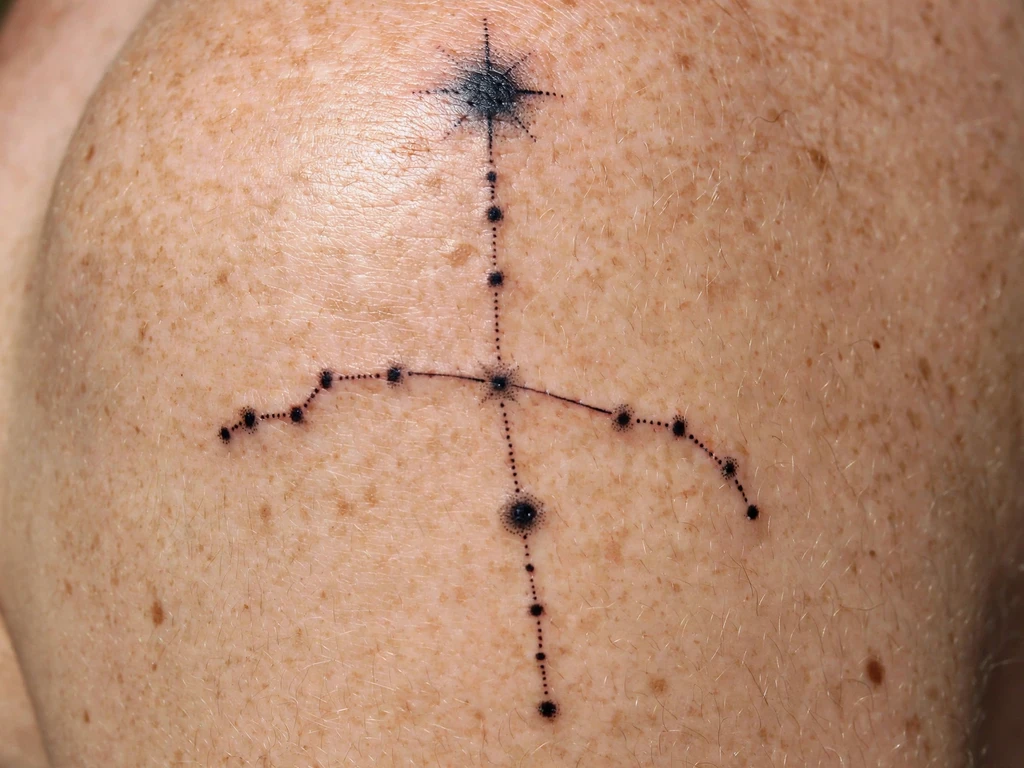
Cygnus the Swan flies down the Milky Way drawn as a cross: Deneb, a genuinely brilliant supergiant, at the tail; a long neck of stars running down to Albireo at the beak — a famous double star that through a small telescope splits into gold and blue — and a wing-bar of stars crossing the neck. As the Northern Cross it is one of the sky’s grand asterisms; as the Swan it rewards the wearer who knows the cross is a bird flying the river of the galaxy.
The cross tempts artists toward symmetry, and the truth is better: the wings are uneven, the neck is long, and Deneb must grade as the pattern’s clear summit. A Cygnus drawn as a tidy plus-sign is a logo; drawn from the chart, with the neck’s length kept and the wings’ lopsidedness honoured, it is the summer sky’s signature. The shoulder takes it naturally, the cross laid along the shoulder’s own axes, Deneb high toward the neck.
Best placement: Shoulder, the cross centred on the deltoid with the neck running down the arm; a forearm takes the cross lengthwise.
Best for / know before you book: If you wear one coloured dot in this design, Albireo tempts a gold-and-blue pair — charming, astronomically cheeky, and entirely optional; the black version loses nothing.
20. The Pleiades — The Seven Sisters, Simplified
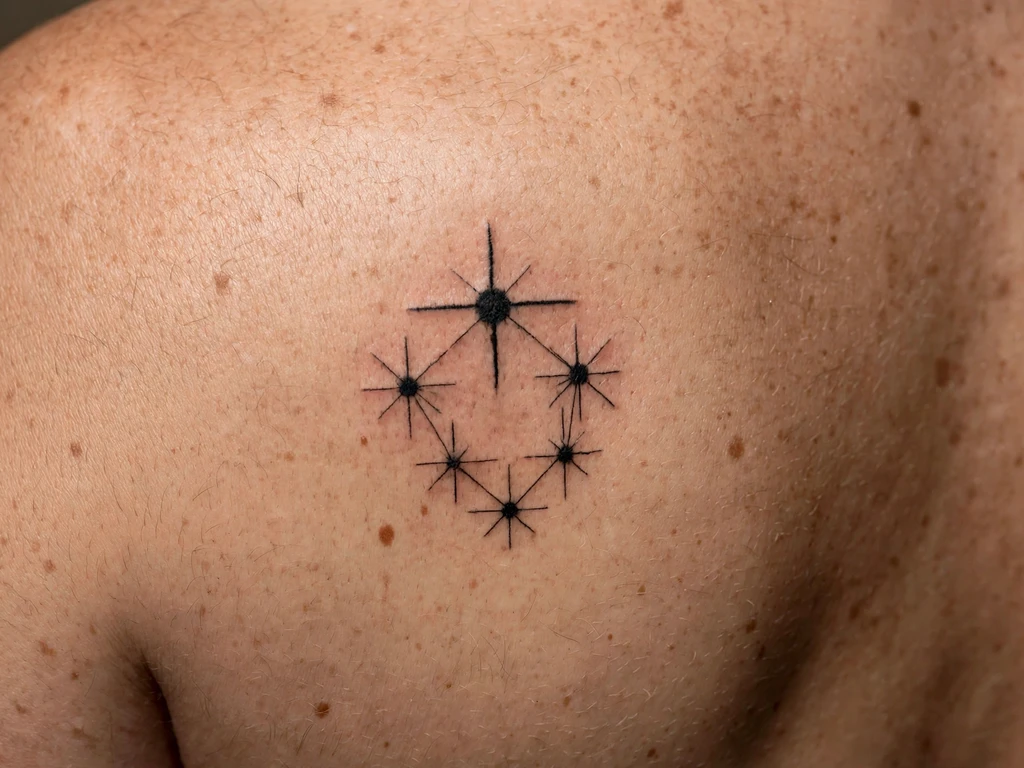
The Pleiades are not a constellation but a cluster — a true family of stars, born together, a few hundred of them, of which most eyes catch six or seven in a tiny knot no wider than a thumbnail held at arm’s length. (The “seven sisters” who are only six to most viewers are astronomy’s oldest mystery — cultures worldwide remember a seventh who faded.) As a tattoo, it is this guide’s fifth rule made flesh: the real thing is dense, and density is what skin cannot keep, so the design is the guide’s clearest exercise in bold simplification.
The build: six or seven dots — never the cluster’s hundreds — placed in the true knot’s relative arrangement, graded by the real brightness order (Alcyone at the knot’s heart, Atlas and Pleione at its edge), but drawn at bold sizes with spacing the sky never gave them. That liberty must be taken consciously: a Pleiades at true spacing blurs into one grey bloom within years, while the opened-out version stays a findable family of stars for decades. Say in the consultation which you are choosing; this design forgives everything except pretending the choice was not made.
Best placement: Shoulder blade, where the knot sits like a seal; a small version rides the shoulder itself.
Best for / know before you book: Count your sisters before you book — six visible, seven traditional — and let the count be a decision, because every onlooker who knows the cluster will count them too.
21. The Milky Way Band
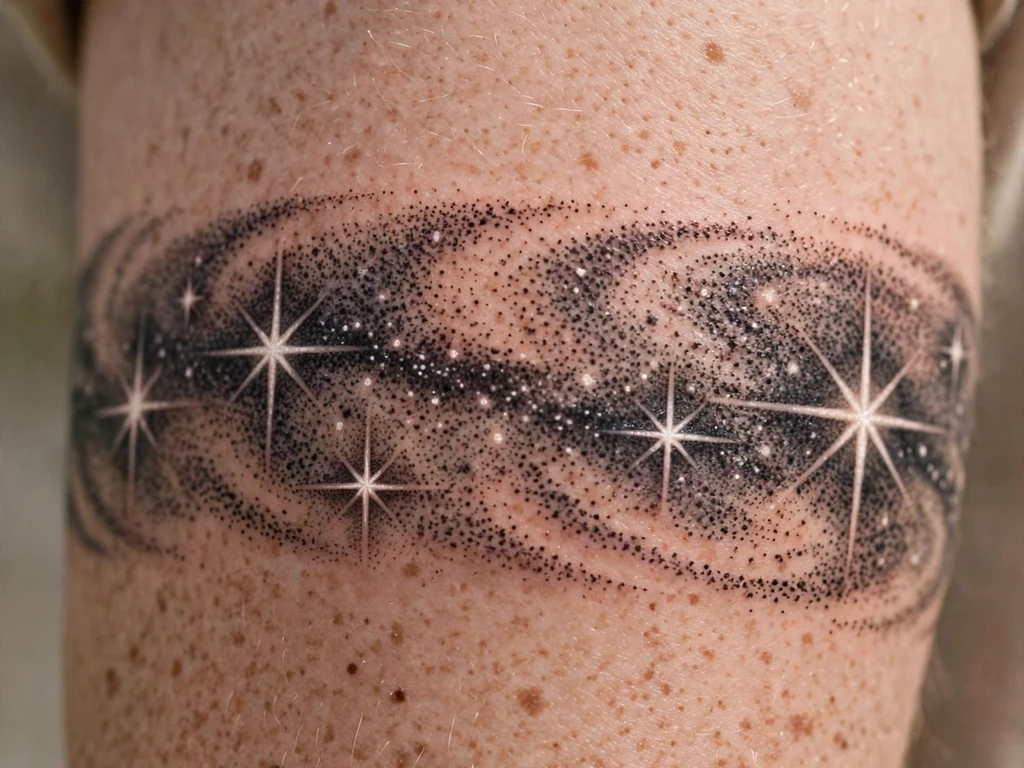
The one design here that is not a pattern but a place: the Milky Way itself, our own galaxy seen edge-on from inside — a river of unresolved starlight, billions of stars too dense and distant to separate, crossed by dark lanes of dust. As a tattoo it is a band of dotwork: thousands of stippled points in a flowing swathe, its brightness swelling and thinning the way the real band does toward Sagittarius, with a handful of genuinely named bright stars planted bold inside it — Deneb, Altair, Vega’s neighbourhood, the Summer Triangle’s corners — as the map’s anchors.
Honesty sets this design’s terms. The stipple field is shading, and shading softens: in fifteen years the band will be a luminous haze rather than a star-by-star river, and the design must be chosen for that future, not despite it. What survives is the band’s shape and its bold anchor stars — so the anchors carry the map’s truth, planted at survival sizes on the band’s true line, and the dust lanes are left as bare skin, the one negative space here that is itself a feature of the real sky.
Best placement: Upper arm, the band wrapping or running lengthwise; it also bands a forearm for wearers who want to watch it turn.
Best for / know before you book: Judge artists for this one on healed dotwork fields specifically — fresh stipple always looks finer than it will live, and the density plan for year ten is the whole consultation.
22. Your Personal Star Map
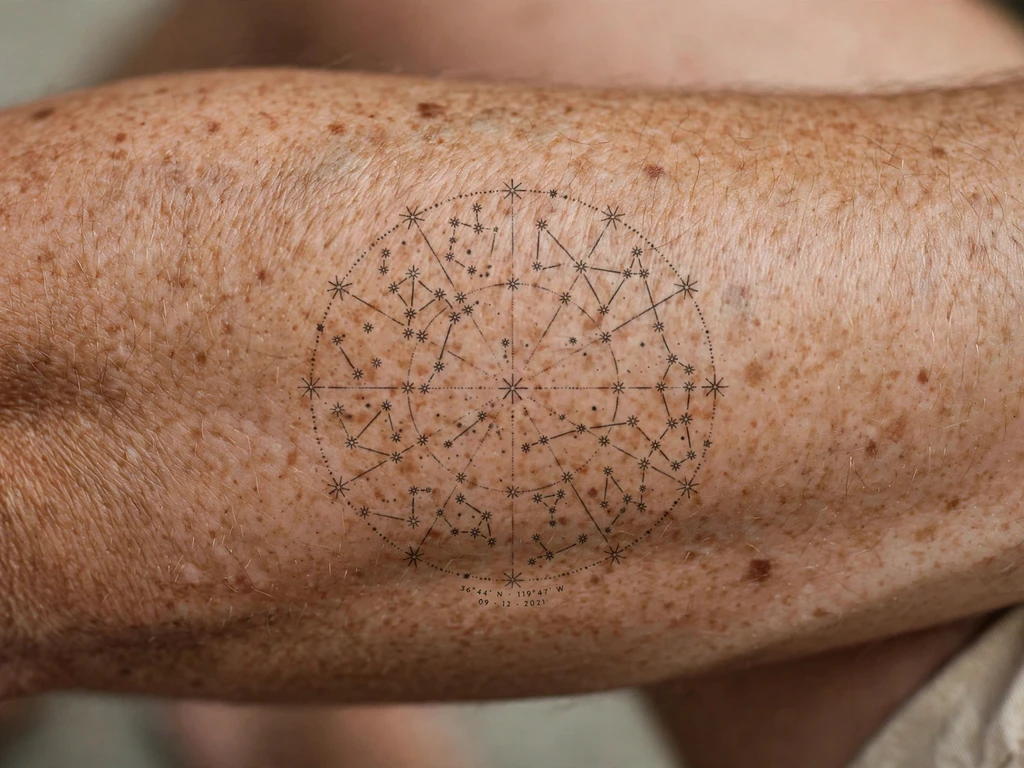
The most personal design in tattooing, full stop: not a sign, not a famous pattern, but the whole sky as it stood over one place on one date — a birth, a wedding, the night you met, the last night somewhere that mattered — drawn as a circular chart of that sky’s real constellations, graded stars and all. It is the design the rising searches keep circling, and it is the one where this guide’s rules matter most, because a personal map copied from a poster-shop print is very often quietly wrong: decorative stars in plausible arrangements, a map of no sky that ever was.
So build it from the sky itself. Free planetarium software — Stellarium is the one named in this guide’s accuracy section — will reconstruct any date, time and place’s sky exactly, and its chart, simplified with your artist, is the only honest stencil source: agree which constellations stay whole (usually the two or three dominant ones overhead that night), which shrink to their anchors, and let the rest become a graded star field. Add the moon if it was up — wearers of the paired sky will find its phases and forms in our moon tattoo design ideas guide — at its true place in that sky, not pasted in for balance. What results is the only tattoo here nobody else on Earth has a claim to: one night’s sky, checked.
Best placement: Forearm, the circular chart sitting flat and readable; a shoulder blade takes the larger, fuller version.
Best for / know before you book: Bring the date, the time as near as you know it, and the place’s name to the consultation — a map made from a vague memory of the night is the one error all the chart-checking in the world cannot fix afterwards.
23. Two Constellations, a Matching Pair
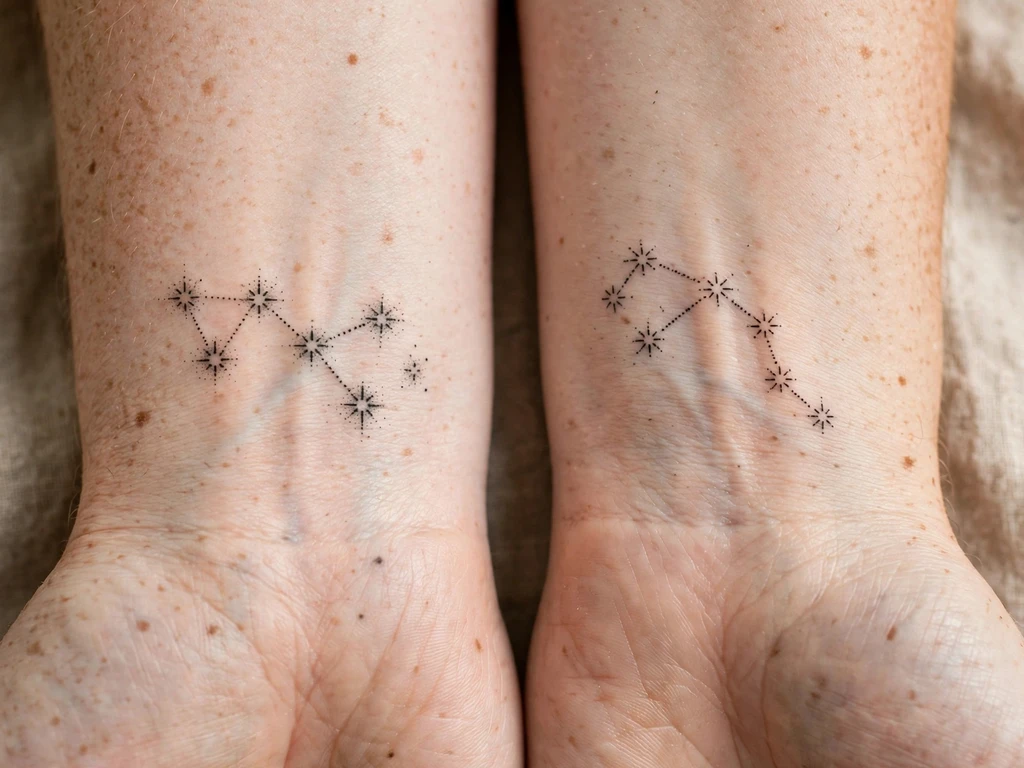
Two people, two patterns, one sky: partners wearing each other’s birth constellations, siblings wearing the two halves of one divided pattern — Pisces’ two chains are the classic split — or friends carrying the constellations that stood over a shared night. The constellation version of the matching tattoo has one advantage no invented design can match: the thing the pair shares is real, overhead, and findable by either wearer on any clear night, wherever in the world they are.
The discipline is the same as every pair in this series: one chart source, one stencil scale, one artist, one session — two patterns drawn by two hands on two days will differ in dot weight and spacing exactly where the eye compares them. Choose patterns of similar density (pairing Scorpius’s long S with Libra’s four dots unbalances the set; Aries and Libra, or the two Dippers, sit together naturally), and agree whose pattern sits at which wrist’s orientation, checked standing side by side before the needle, not after.
Best placement: Matching inner wrists are the classic; matching ankles carry the same idea more quietly.
Best for / know before you book: Each pattern must be a tattoo its wearer would happily own alone — the sky outlasts arrangements, and a true map worn solo is never a half of anything.
24. Stars Only — No Lines at All
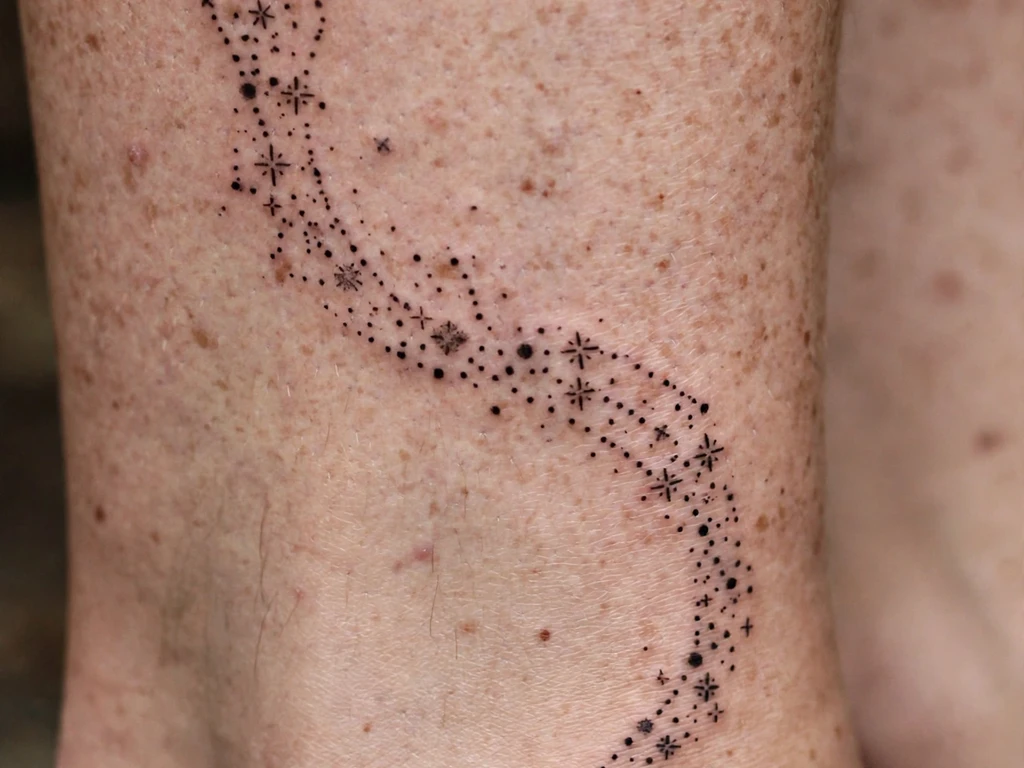
The purist’s build, and this guide’s quiet recommendation for anyone choosing a first constellation: take any true pattern from this article — Scorpius down a calf is the demonstration — and tattoo only the stars, graded by brightness, with no connecting lines whatsoever. It is the closest a tattoo can come to the thing itself, because the sky has no lines either; everyone who has ever found a constellation did it from the dots alone, and your skin asks its viewers for the same honest act of recognition.
It is also the longest-lived construction in the guide: no hair-thin joins to fade, nothing to soften except dots planted bold to begin with. Its one demand is confidence in the grading — with no lines to guide the eye, the size hierarchy does all the guiding, so anchors must be unmistakably largest and the steps down even. Wearers who later want the diagram look can add fine lines in a second session, once the dots have healed and proven their positions. Readers weighing single bold stars against patterns will find the shape side of the family in our star tattoo design ideas guide; this design is the patterns’ purest answer.
Best placement: Calf, where a long pattern can prove itself unaided; the Dippers and Orion also carry it superbly on an upper arm or shoulder blade.
Best for / know before you book: Live with a printed version — dots only, no lines — on the placement for a day; if you can assemble the pattern at a glance, so will everyone who knows it, and that test is the whole design.
25. The Tiny Finger Constellation
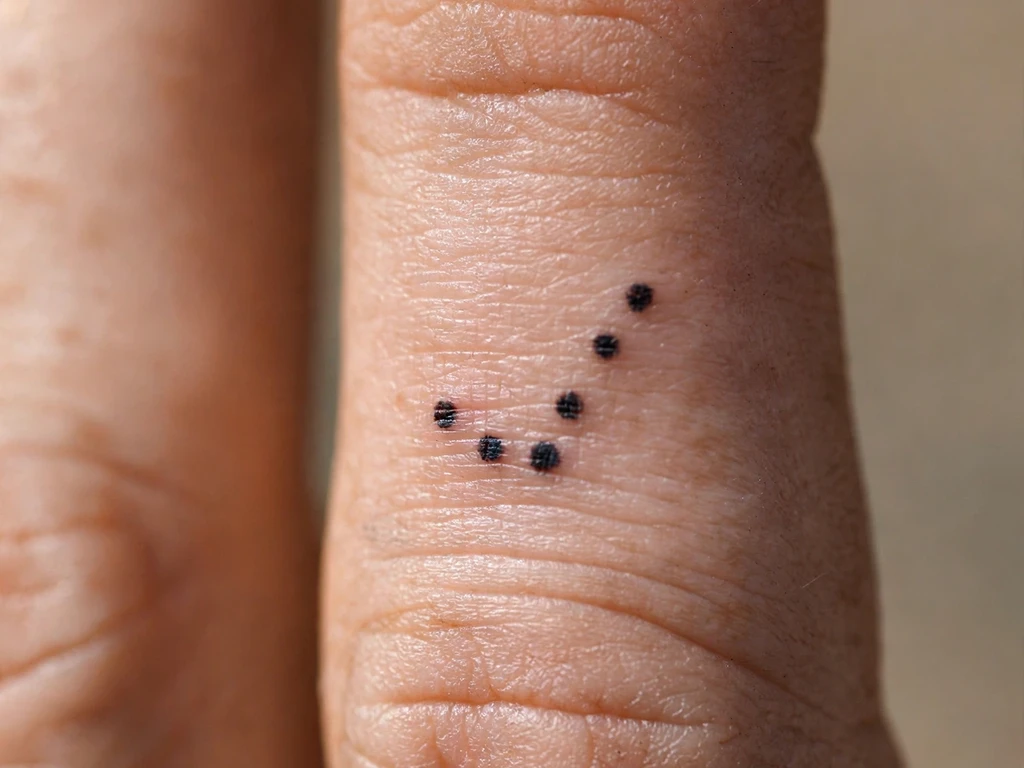
The smallest constellation in this guide, offered with the full honesty finger tattoos always require: a miniature true pattern — the Dipper reduced to its seven, or Crux to its five — planted as bold dots along the side of a finger, no lines, at the largest size the finger’s flat allows. When the hand opens, there it is: a whole piece of sky, in a centimetre and a half.
Now the warning, stated plainly because this placement demands it: finger skin regenerates fast, flexes constantly and sheds ink faster than anywhere else on the body, so a finger constellation will fade — not might — and will need touch-ups across its life to keep its stars separate and its pattern findable. At this scale the rules compress to one: dots bold for their size, spaced to their limit, the pattern chosen from the simplest true shapes — a finger cannot carry Scorpius, Virgo or any chain whose truth lives in many stars. Choose it as a charm with a maintenance schedule, ideally not as a first tattoo, and never as the only version of a pattern that matters to you: wear the full map somewhere durable, and let the finger carry its miniature.
Best placement: Side of the finger, where skin holds ink slightly better than the palm-facing surface and the pattern can run in one short line.
Best for / know before you book: Price the touch-ups before you fall for the charm — if re-inking a pattern every few years would annoy you, Designs 15 and 18 offer the same sky on skin that keeps it far longer.
Constellation Tattoo Placement by Size
| Size | Typical dimensions | Best placements | Good to know |
|---|---|---|---|
| Tiny | 1.5–3 cm | Behind ear, side of finger, wrist | Only the sparsest true patterns survive — Lyra, Crux, a Dipper reduced to its anchors; finger versions carry a permanent touch-up commitment |
| Small | 3–7 cm | Wrist, ankle, collarbone edge, forearm | Compact patterns whole (Aries, Libra, Teapot, Little Dipper); longer patterns must drop their faintest stars in brightness order |
| Medium | 7–14 cm | Forearm, calf, shoulder, upper arm | Most of the zodiac twelve at honest spacing; the Big Dipper bold; personal star maps simplified to two or three whole constellations |
| Large | 14–25 cm | Shoulder blade, upper arm | Orion complete, Scorpius’s full S, the Milky Way band, full personal skies — the patterns whose truth lives in their span |
A constellation is a horizontal argument on a body of verticals: patterns want flat, calm ground where their proportions survive the body’s motion. Forearms and shoulder blades are the map’s home territory; calves take the long curves; wrists, ankles and the collarbone’s edge take the compact patterns whole — and every pattern, whatever its home, is checked on the standing, moving body, because a map is only true in the posture it is actually worn in.
How to Choose Your Constellation Tattoo (and What to Know Before You Book)
Start with the sky, not the gallery. Decide which piece of sky is yours — your sign’s true stars, a famous pattern you have stood under, the sky of one date — and let that produce the design, rather than adopting somebody else’s invented scatter from a gallery. Every disappointment in this family begins with a photograph; every success begins with a chart.
Take the stencil from a chart and check it three ways. Against the chart on paper (positions, proportions, the anchors’ order of brightness); against the chart on your skin, standing, limb at rest and in motion; and against the mirror trap — the pattern must not be flipped. Three checks, five minutes, and the tattoo stays a map for life. An artist who welcomes the checking is the artist this design family exists for.
Grade the dots like a chart-maker. Brightest stars largest, each step down even, no faint star ever promoted for prettiness. The grading is not decoration; it is the information the pattern is made of — and it is also the ageing plan, because bold anchor dots are still anchors in twenty years while a field of equal specks is a rumour.
Simplify by the sky’s own order. When a pattern must shrink, stars are dropped faintest-first, and spacing is opened, never compressed. A simplified true constellation is a summary; a compressed one is a different pattern. If a design cannot survive those rules at your placement’s size, the honest moves are a bigger placement, a sparser constellation, or one arc of the pattern chosen openly — never a quiet squeeze.
Decide the lines question on purpose. Fine lines for the full chart look, knowing they soften first; dotted joins for a softer decay; no lines for the purest and most durable read. All three are respectable; the only wrong answer is not deciding — and discovering in year five that your pattern needed its lines to exist.
Keep colour to what the sky actually shows. If colour enters at all, let it be the true colour of a true star: Antares’ red, Aldebaran’s ember orange, Betelgeuse’s rust, each one dot in a black pattern. Invented rainbow gradients turn a map into a poster; the sky’s own palette, used at one point, turns a good tattoo into a knowledgeable one.
Key points to remember:
- A constellation tattoo is a map: its pattern either matches the real sky or it is decoration — decide which you are buying, and if it is a map, the stencil comes from a real chart or planetarium, never from a tattoo photo
- Anchor stars carry the pattern: Betelgeuse and Rigel, Polaris, Vega, Deneb, Antares — placed truly and graded largest, they make even a simplified pattern read as itself
- Dot size is data — grade star dots by real brightness, keep clear skin between every pair, and simplify dense patterns (Pleiades, Milky Way) boldly before they are stencilled, not after they blur
- Connecting lines are a chart convention and the frailest part of the tattoo: choose fine lines, dotted joins or no lines on purpose, and make sure the pattern still reads from its dots alone
- Never mirror-flip the stencil — Scorpius’s S, the Dipper’s bend and Orion’s tilt all have a handedness, and a reversed constellation is a wrong constellation
- Meanings split honestly: the astronomy is checkable fact, the astrology is tradition and belief — wear the pattern for your own reasons, and let the pattern itself be true
Frequently Asked Questions
What does a constellation tattoo mean?
Most often, a piece of the real sky made personal: your birth sign’s actual stars, the sky over a place or a date that matters, or a famous pattern — Orion, the Dippers — carried as guidance, memory or belonging. It is the rare tattoo whose pattern is a checkable fact: the stars really do stand in that arrangement. The further meanings — that your sign’s stars say something about your character or your path — come from astrology, and are best worn as what they are: a tradition and a personal belief, not a claim about the universe. The map is astronomy; the meaning is yours.
Should I get my sign’s constellation or its glyph and symbol?
They are different tattoos that happen to share a name. The glyph and symbol (covered in this site’s zodiac guide) are astrology’s shorthand — identity in a few strokes, durable and private at small sizes. The constellation is the sign as a place in the sky: subtler, more personal to verify, and more demanding — it needs honest size, graded dots and a chart-checked stencil. Choose the constellation if the stars themselves are what you love; choose the symbol if the sign’s story is. Many wearers eventually own both, on different skin.
Do constellation tattoos age well?
The dots do; the lines are the risk. A pattern planted as bold, well-spaced, brightness-graded dots keeps its shape for decades, because the pattern lives in the dots. Hair-thin connecting lines fade and soften first — sometimes within a few years — so a well-built constellation must still read with its lines half gone, and the no-lines version (Design 24) is the most durable construction of all. The failure mode is always the same: too many stars, too small, too close — a pattern that merges into grey smudge. If your artist proposes bigger dots and wider spacing than your reference shows, they are saving your tattoo, not spoiling it.
How do I make sure my constellation tattoo is accurate?
Three habits. Work from a real chart or a planetarium program (set to your sky and date) rather than any tattoo photograph. Check the anchor stars first — the brightest handful that carry the shape — for position and relative size, then check the whole stencil against the chart on your skin, standing, before the session. And check the mirror: a stencil flipped in transfer reverses the pattern, and a reversed constellation matches no sky that exists. Accuracy is not a talent; it is five minutes of comparison, done before the needle instead of after.
Which constellation is best for a small tattoo?
The sparse and the compact: Lyra (one bright star and a tiny parallelogram — this guide’s behind-ear design), Crux the Southern Cross (four or five stars, ankle-sized), Libra and Aries (short, few-star patterns), the Sagittarius Teapot and the Little Dipper at wrist scale. The rule is the star count, not the fame: a pattern whose truth fits in five to nine well-spaced dots survives small; long chains (Scorpius, Virgo, Pisces) and dense knots (the Pleiades at true spacing) must be given their size or openly simplified. Small is a legitimate choice — sparse over detailed, with the simplification done by brightness order.
Final Thoughts
A constellation tattoo makes a promise no other design can: this pattern is real, and you can check. Somewhere overhead tonight, the exact arrangement on your skin is standing in the dark — Betelgeuse on the Hunter’s shoulder, Polaris holding the north, seven sisters in their knot — and it will still be there when the tattoo is decades old. That is worth this guide’s small disciplines: a chart instead of a photograph, anchors checked, dots graded, spacing defended, the mirror refused.
Shortlist the patterns that are genuinely yours — your sign’s stars, your night sky, the pattern you learned as a child and never unlearned — and take a chart, not a screenshot, to your consultation. The right constellation tattoo should feel less like a picture of the stars and more like what it is: a map you are allowed to keep.