
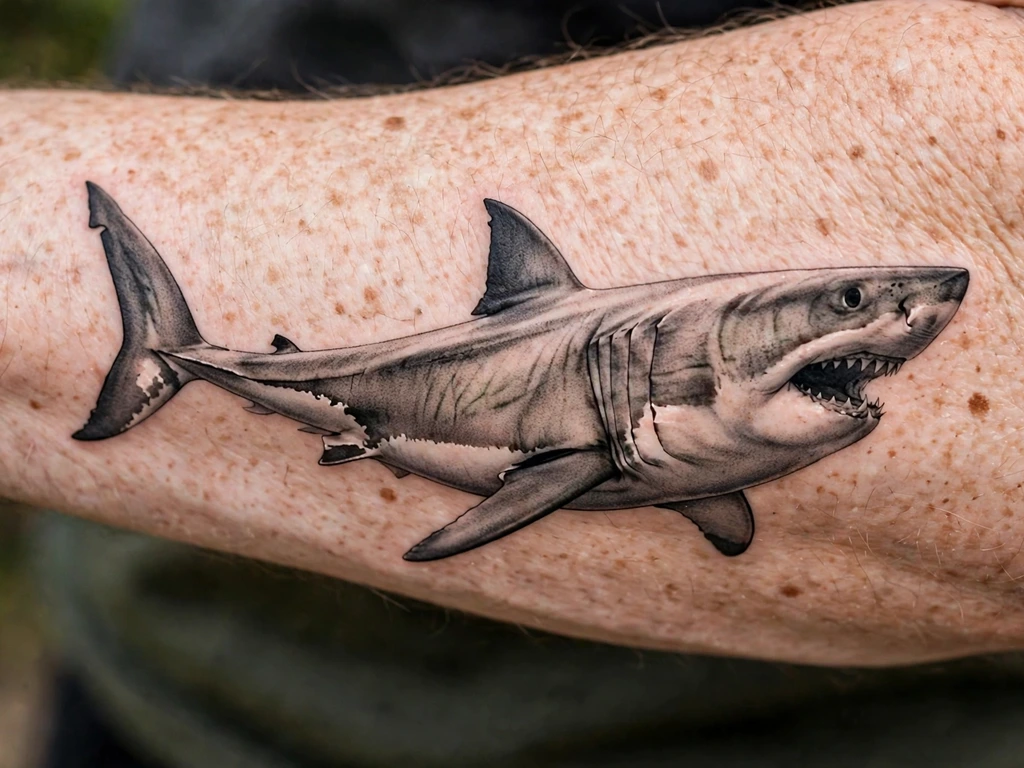
A shark tattoo is the closest thing tattooing has to a moving animal that never stops. A shark does not do stillness: the animal is built to cruise, and the designs in this guide are built the same way — twenty-five species-true sharks, from the great white that owns every shark conversation to the nurse shark asleep on the sand, each one drawn to be recognisable at a glance across a room.
That recognisability is the real subject of this guide. A shark tattoo fails in one specific way: it comes out as a generic fish. The cure is anatomy, and anatomy is checkable. Sharks are fish, but fish of a very particular construction — skeletons of cartilage rather than bone, skin armoured in tiny tooth-like scales, five gill slits cut into the flank, a tail whose upper lobe runs longer than the lower. Get those four things right and add the one feature that names the species — a hammerhead’s flattened head, a thresher’s absurd tail, a whale shark’s spots — and the tattoo reads as a shark, and as that shark, from the far side of the beach.
So this guide does two jobs. It gives you 25 original shark tattoo ideas — great white, hammerhead, nurse, thresher, tiger, whale shark, bull, mako and reef sharks, worked in traditional, blackwork, neo traditional, watercolour, Japanese-influenced and fine-line styles — and it gives you the law that keeps every one of them honest: the silhouette law, the species-accuracy rules that decide whether your shark reads as its species or as seafood. Read the law before the designs; it will change how you look at all twenty-five.
What Does a Shark Tattoo Mean?
Start with the answer most wearers actually mean: a shark tattoo means forward motion. Many sharks must keep swimming to push water over their gills — the image is so strong it has become the animal’s whole reputation — and wearers take the tattoo for exactly that: the refusal to drift, stall or go backwards. Focus is the second reading: a shark is a single-purpose animal, built around finding one thing in an entire ocean and going to it without distraction. Wearers in competitive work, in recovery, in long projects nobody else believes in, reach for that reading most.
The third reading is the oldest: protection. In Polynesian tradition, sharks are honoured as guardians — in Hawaiian tradition, a family’s ʻaumākua could take the form of a shark, a protector ancestor who watches over the family at sea. That reading is presented here as what it is, a living tradition held by the people it belongs to, and it is why shark tattoos carry a guardian meaning in Pacific tattooing that has nothing to do with aggression.
And there is the honest modern reading, the one this guide stands behind: sharks are misunderstood. A shark tattoo increasingly means quiet confidence rather than menace — the wearer who knows the animal is mostly harmless to humans, that the fear is out of all proportion to the animal, and who likes being read the same way. The facts support the calm version. As the conservation charity Oceana points out in its account of the shark’s senses, these are animals that find their way through dark water with a sixth sense — the ampullae of Lorenzini, tiny gel-filled pores on the snout that detect the faint electric fields of other animals, the heartbeat of prey buried in sand and perfectly still. A hunter that precise does not need to be a monster. It needs to be exact — and exactness is a meaning worth wearing.
One caution belongs in this section: none of these meanings is a fact about sharks. They are readings people bring to the animal, layered over centuries of sailor lore, Pacific tradition and modern conservation. The facts — cartilage skeleton, five gill slits, the asymmetric tail, skin of dermal denticles so rough it was once used as sandpaper — belong to the animal. The meanings belong to you. A good shark tattoo keeps the two in their places: the drawing factual, the meaning chosen.
The Silhouette Law: Why a Shark Reads as a Shark
Every subject in this series has a craft spine, and the shark’s is the strictest of all, because a shark tattoo is judged at distance, in silhouette, before a single detail resolves. A shark reads by outline: tail shape, dorsal fin position, snout shape and gill slits decide whether it reads as that species or as a generic fish. So the law here is named for the outline itself — the silhouette law — and it has five rules. Every design in this guide is drawn by them, and they are the checklist to take to your artist.
Rule one: the tail tells the truth. A shark’s tail fin is heterocercal — the upper lobe is distinctly longer than the lower, because the spine itself turns up into it. Draw the tail with equal lobes and you have drawn a tuna. Every shark in this guide, from the great white’s crescent to the thresher’s scythe, carries an upper lobe longer than its lower — the single fastest species check there is, visible across a room.
Rule two: five gill slits, never six, never four. Sharks have five pairs of gill slits (a handful of deep-water oddities have six or seven, and none of them is in this guide). Count them on the stencil the way the numeral guide in this series counts its letters: aloud, one by one. Five slits, set on the flank behind the eye, angled with the body’s curve. A shark with the wrong count is a fish wearing a costume.
Rule three: the dorsal fin sits where the species puts it. On a great white, the big triangular first dorsal rises over the inner margins of the pectoral fins; on a nurse shark it sits far back, nearer the tail than the head. The fin’s position is a species signature, as identifying as the head shape — sliding it forward or back for composition’s sake silently changes the species. Draw the fin where the animal carries it.
Rule four: teeth are seasoning, not the dish. A shark’s mouth shown with two or three visible teeth — triangular and serrated on a great white — reads as a shark. A mouth wallpapered with forty fangs reads as a cartoon monster, and dates the tattoo to the decade of the monster movie. The honest mouth is mostly closed or barely open, with the teeth suggested at the jawline. Save the open jaw for the one or two designs where the jaw itself is the subject, and even there, draw it like anatomy, not like a poster.
Rule five: the eye is a point, the snout is a verdict. A shark’s eye is small, round and dark — a punctuation mark, not a window. Draw it large and expressive and the animal turns cute or demonic; draw it as the animal carries it and the whole head stays shark. And the snout closes the identification: conical and pointed on the great white, shovel-flat on the hammerhead, blunt and rounded on the nurse shark, short and bullet-tight on the mako. Get the snout right and a viewer names the species before they can say why.
Shark Tattoo Styles and How They Age
A shark ages by one law: its grey tones and its outline set its lifespan. The ink in every stroke settles and spreads slightly across the years; strokes thicken, fine internal detail merges first, and the silhouette — the thing this subject lives by — is the last thing to go. Styles differ in what they sacrifice first.
| Style | How it is drawn | How it ages |
|---|---|---|
| Traditional (sailor) | Heavy black outline, flat red/grey/green palette, bold simple fins | Among the longest-lived of all: the outline is structural, the colours are few and deep — softens into the classic look it was always meant to have |
| Black and grey realism | Grey-wash shading, countershading (dark above, pale below), fine gill and denticle detail | The light greys go first, so the countershading must start bolder than looks right; at honest size the silhouette carries it for decades |
| Blackwork | Solid black and heavy shapes, dotwork or negative-space gills and eye | Superb ink-holding — there is so much black that settling barely registers — but species detail must live in the outline, because the interior is all one tone |
| Neo traditional | Bold outline, jewel-tone colour, decorative waves and framing | Ages like traditional with better colour discipline: outline holds the species, colour softens into richness — needs the size traditional needs |
| Watercolour | Soft washes of blue and teal over a fine-line skeleton, splash edges | The washes soften fastest of everything here; the skeleton line is the lifespan, so it must be a complete species-true outline, never a suggestion |
| Fine-line / minimalist | One continuous or near-continuous line, species feature reduced to one signature | The most fragile treaty: survives only at the top of its size range with the signature feature (tail, hammer, spots) drawn unmistakably — expect a possible early touch-up |
| Japanese-influenced | Bold waves, wind bars and a shark drawn in the irezumi composition language | Ages with the background, not against it: the wave work holds the piece together as the shark’s own greys settle — a composition style, not a small-piece style |
The photograph problem: the shark tattoos that circulate most are fresh, photographed close, and shaded at gallery delicacy — light greys that read beautifully for a season. Every design here is described at its healed density and honest minimum: countershading bold enough to survive, gill slits counted and cut deep enough to stay separate, a silhouette you can name from across the room.
Shark Tattoo Ideas at a Glance
| # | Design | Species / style focus | Best placement |
|---|---|---|---|
| 1 | Great White in Grey Wash | Great white, realism | Forearm |
| 2 | Hammerhead in Profile | Hammerhead, black and grey | Upper arm |
| 3 | Nurse Shark at Rest | Nurse shark, soft grey | Calf |
| 4 | Thresher Shark and Its Tail | Thresher, line and wash | Calf |
| 5 | Tiger Shark With Fading Stripes | Tiger shark, colour realism | Thigh |
| 6 | The Gentle Whale Shark | Whale shark, dotwork spots | Shoulder blade |
| 7 | Bull Shark, Built Like a Tank | Bull shark, black and grey | Upper arm |
| 8 | Mako, the Fastest Shark | Shortfin mako, dynamic line | Forearm |
| 9 | Blacktip Reef Shark | Blacktip reef, fine shading | Ankle |
| 10 | Shark Tooth, Drawn True | Tooth fossil style, fine line | Wrist |
| 11 | The Jaw as Anatomy | Jaw study, etched | Shoulder |
| 12 | Minimalist Line Shark | One-line silhouette | Wrist |
| 13 | One Small Young Shark | Small juvenile shark, soft colour | Ankle |
| 14 | Traditional Sailor Shark | American traditional | Upper arm |
| 15 | Blackwork Shark | Solid blackwork silhouette | Forearm |
| 16 | Neo Traditional Shark | Neo traditional colour | Shoulder |
| 17 | Watercolour Shark | Watercolour wash | Shoulder blade |
| 18 | Japanese-Influenced Shark | Irezumi composition | Upper arm |
| 19 | Shark Fin Above the Waterline | Fin and waterline, graphic | Calf |
| 20 | Two Sharks Circling | Paired sharks, balance piece | Shoulder blade |
| 21 | Shark and Anchor | Shark with nautical anchor | Forearm |
| 22 | Shark Skeleton Study | Fossil/cartilage study, fine line | Forearm |
| 23 | Tiny Shark Behind the Ear | Minute silhouette | Behind ear |
| 24 | Tiny Shark on a Finger | Minute silhouette | Finger (side) |
| 25 | Shark Along the Collarbone Edge | Slender shark, fine line | Collarbone (outer edge) |
25 Shark Tattoo Ideas
1. Great White in Grey Wash
This is the shark that springs to mind first, and it is also the most demanding to draw by the silhouette law. A great white’s claim to the picture is its underside: a white belly, a grey back, and the clean line between them running straight along the body from jaw to tail. The grey-wash version that anchors this guide uses that line as its architecture — deep grey above, bare skin below. The mouth carries two, at most three, visible teeth at its open jaw, the five gill slits set high on the flank behind the eye, the dorsal fin large and triangular over the inner-pectoral line, and the tail a clean crescent with the longer upper lobe — exactly the form a lifetime of posters and the Florida Museum’s great white species profile both agree on.
Best placement: Forearm stacked lengthways, 13–18 cm, so the crescent tail wraps visually around the wrist.
Best for: Anyone wanting the classic shark, drawn honestly and recognisably — the safest first shark tattoo there is.
2. Hammerhead in Profile
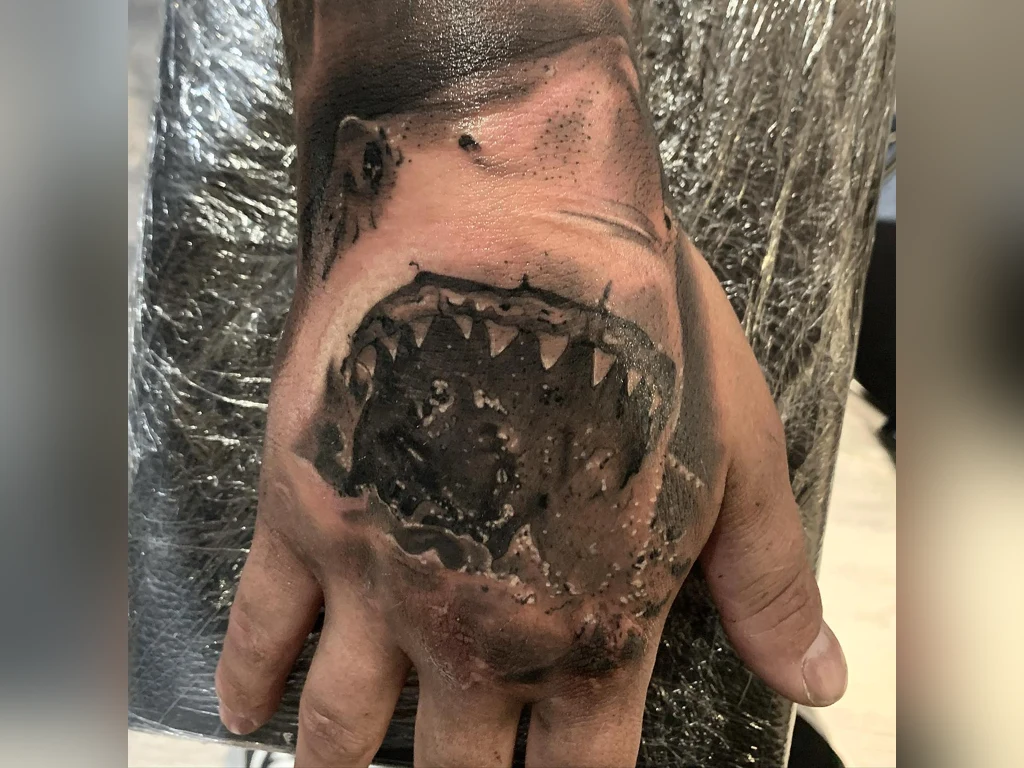
The hammerhead is the shark that cannot be confused with anything else. The head — the cephalofoil, that flattened lateral plane with the eyes pushed to its outer edges — does all the identification work, and the strength of this design is its refusal of anything else: a clean profile view with nothing to hide behind. Two details make the hammerhead read: the head’s front edge is essentially straight, not curved into a point, and the first dorsal fin is tall, sickle-shaped and set further back than you would like to draw it — its tallest point sits behind the pectoral fins.
Best placement: Upper arm, 10–14 cm, in black and grey — the clean lines suit a solid colour palette.
Best for: Wearers who want a design that reads as a specific animal even at small size.
3. Nurse Shark at Rest
This is the shark for the wearer who suspects their calmness is the interesting thing about them, and it is a design that tells a different kind of truth. Begin with the animal’s own facts, since the design earns its authority from the animal: nurse sharks are bottom-feeders that rest on the sand by day, often stacked together in groups, and they feed by suction — drawing food into their mouths through small barbels on their snouts, a fact that gives the honest design its central feature. They can live for as long as twenty-five years, quietly, in the same reef, and that quiet longevity is the design’s meaning: steady pressure, no theatre, a long slow cruise.
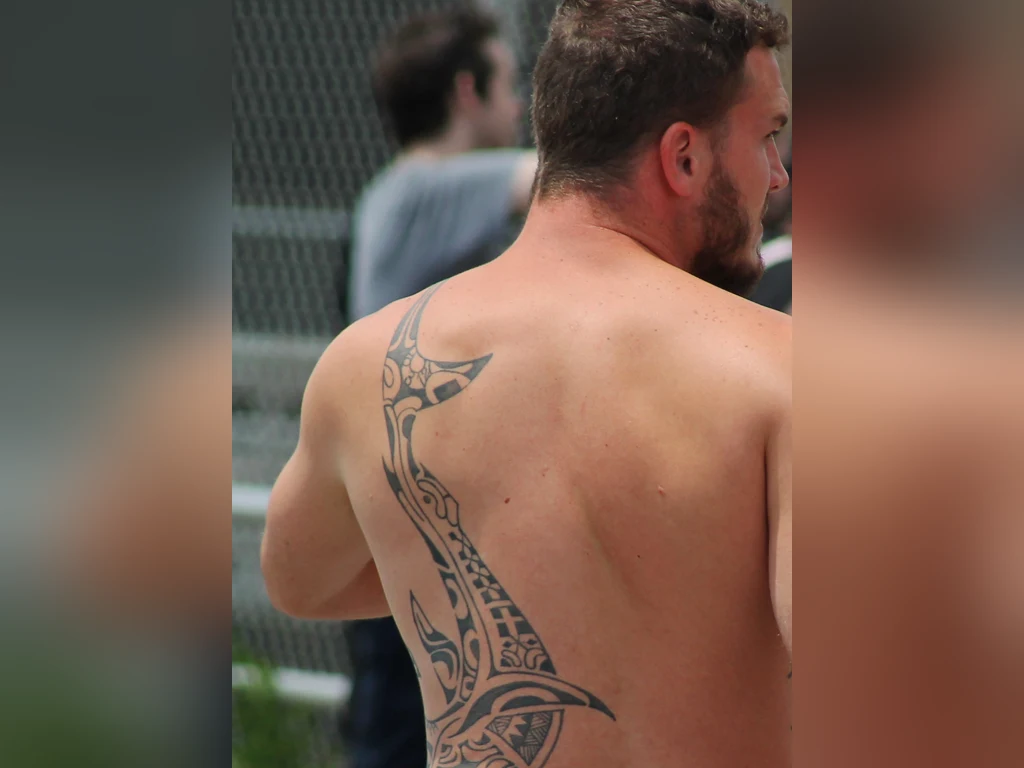
In a soft warm grey wash with a broad blunt head and only a suggestion of fins — the species’ small dorsal fins set far back on the tail stock, not up near the head — it reads as a relaxed shark, which is exactly the point. The design here is kept flat and horizontal, with the contours of the barbels under the snout acting as the identifying detail.
Best placement: Calf, 13–16 cm, in soft grey, where the horizontal composition matches the leg.
Best for: Anyone drawn to shark tattoos but wary of aggression — the defiant anti-shark-shark.
4. Thresher Shark and Its Tail
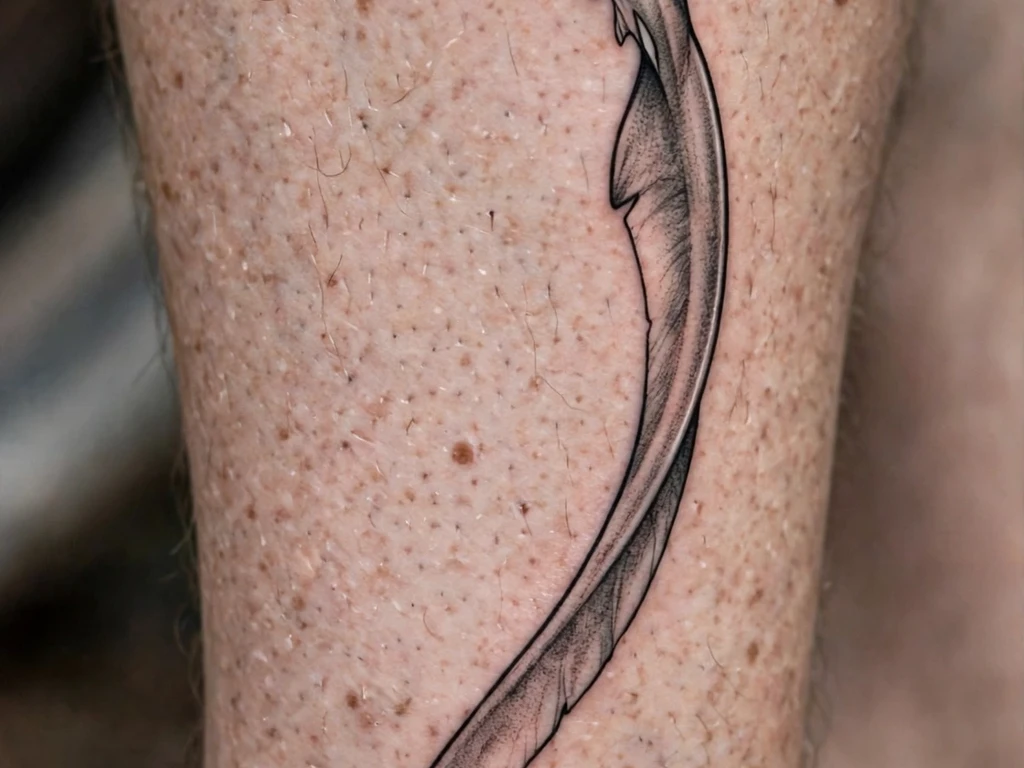
The thresher is the species that turns a tattoo into a rule about proportion. Its upper tail lobe is as long as its entire body, and it hunts with it — sweeping the tail overhead to stun schooling fish. The design here is a blue-grey fine-line piece where the tail is the whole subject: the body is deliberately short and small so the tail can streak across the calf, the head a low wedge at the opposite end, the pectoral fins long, scythe-like wings echoing the tail’s arc. Keep the scale order honest — tail first in length, body second — and a viewer with one look at the drawing will know the species.
Best placement: Calf, 15–18 cm along the leg, in line and wash so the tail has room to breathe.
Best for: Wearers who love shark anatomy as much as sharks; the design opens conversations.
5. Tiger Shark With Fading Stripes
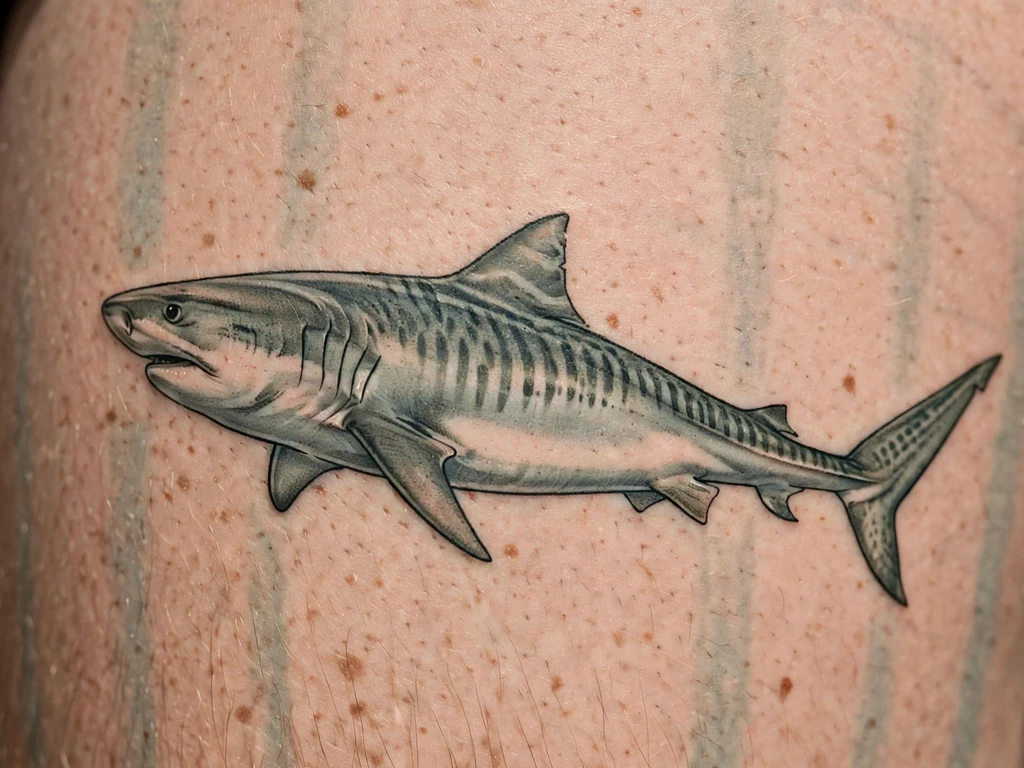
The tiger shark is the generalist: it grows larger than every shark in this guide except the whale shark, and its markings give the design its whole effect. Vertical dark stripes that fade toward the tail, a grey-green back over a pale belly, and a head that ends in a blunt, almost square snout. The stripes themselves are the risk. In youth they are strong and distinct; by adulthood they can be faint at best. The design here shows exactly that: stripes that are clear at the dorsal and dissolve halfway down the flank, a fading that reads beautifully in grey-wash and teaches the eye what ageing does to every pattern.
Best placement: Thigh, 15–20 cm, in a grey-green wash.
Best for: Large-scale placements — the tiger needs space for its flank pattern to read.
6. The Gentle Whale Shark
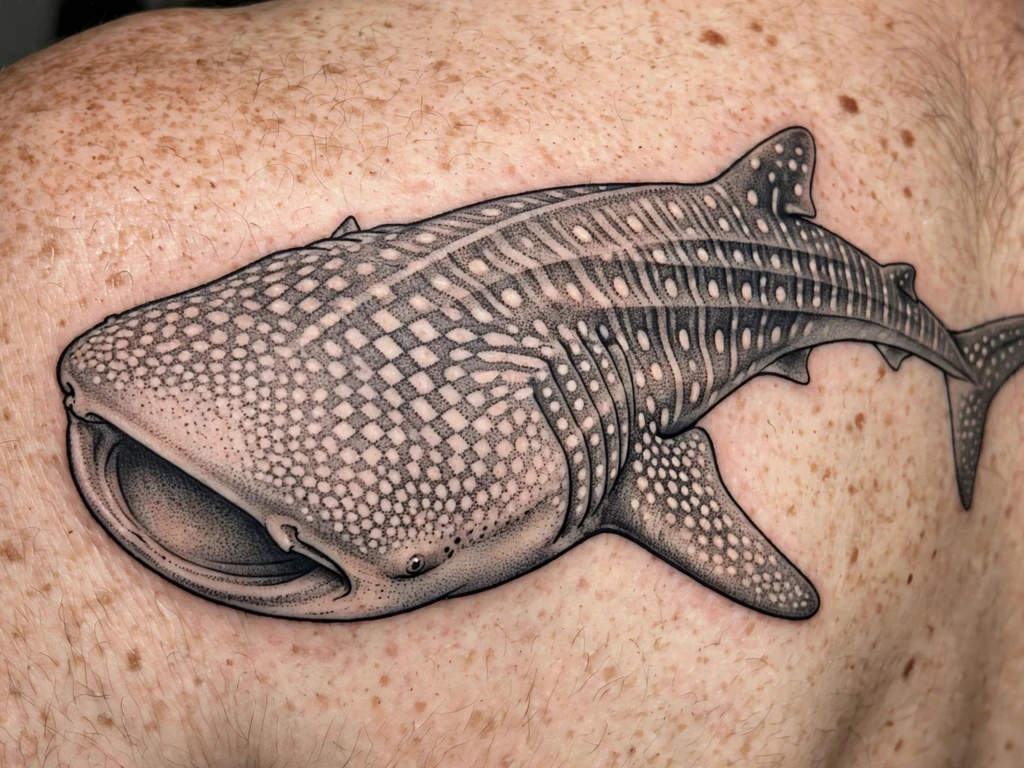
The whale shark is the board’s gentle giant — the biggest fish in the sea, growing to 12 metres, and the calmest animal in this guide. A whale shark eats plankton by filtering water through its gills; nothing it does is menacing. This is the design that answers “are you not scared of sharks?” with a smile. In dotwork, its markings do all the work: a wide flat head, a very broad mouth, and a pattern of white spots and vertical bars on a dark grey body — the spots and stripes unique to every individual, a natural fingerprint.
Dotwork takes time — thousands of dots — but the result ages well, since the pattern’s gaps are its structure, and it reads at a glance in silhouette or as a constellation of points. Here the shark hangs across the shoulder blade with the dots making the body, the fins kept as solid shapes.
Best placement: Shoulder blade, 13–17 cm, dotwork.
Best for: Divers, travellers, anyone who loves sharks without wanting to look dangerous.
7. Bull Shark, Built Like a Tank
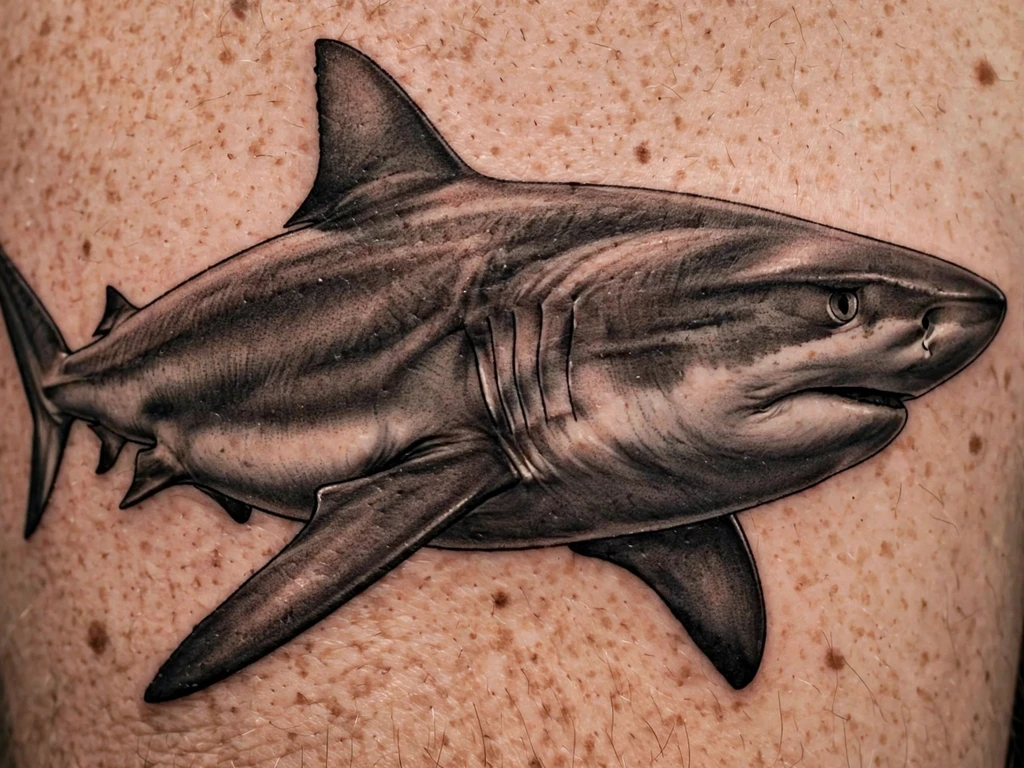
The bull shark earns its place as the design with the least prettiness and the most presence. The species is the stockiest shark in this guide — a grey torpedo with a blunt nose and a heavy body — and it is the most common large shark species encountered by people, in shallow warm water. The design uses that build as its core: the body is thick and drawn the full width of the design area, the snout blunt, the fins short and stout. The honest detail here is the water: bull sharks roam freshwater and are the sharks most likely to be encountered in rivers and estuaries, so this design’s background hints at fresh water in its cool tones.
Best placement: Upper arm, 13–15 cm, in heavy black and grey.
Best for: Wearers who want a shark that reads as sheer mass.
8. Mako, the Fastest Shark
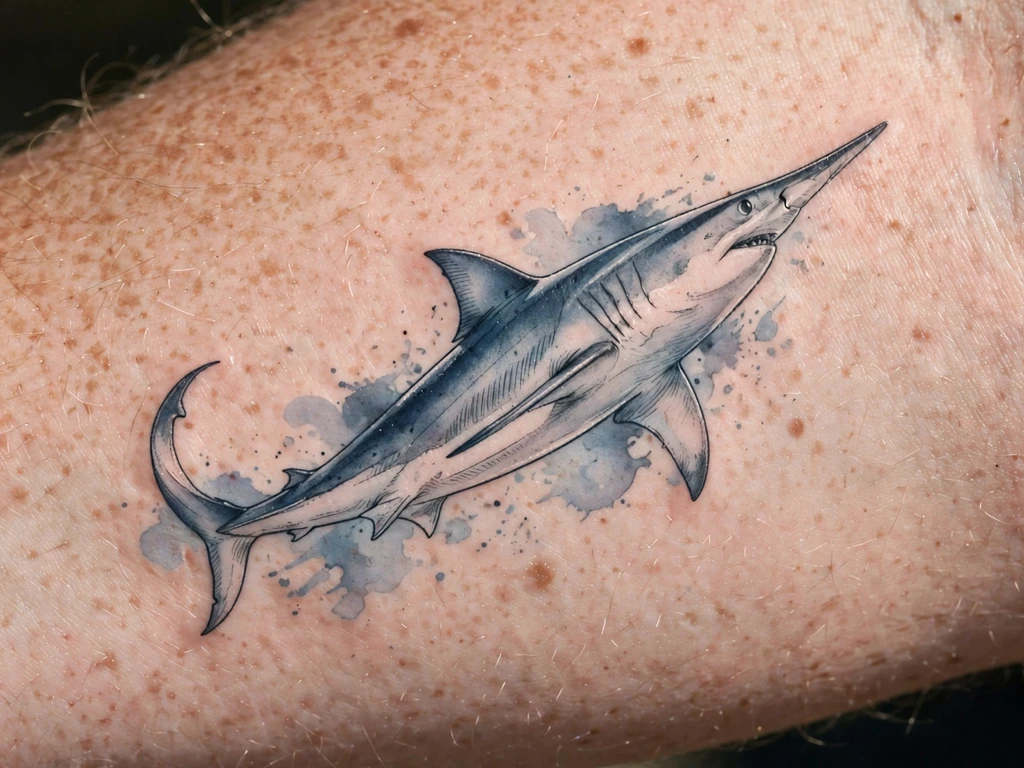
If the tiger shark is the board’s mass, the mako is its velocity. A shortfin mako can reach 70 kilometres an hour in bursts — the fastest shark in the sea — and the design must look like speed. The mako’s shape is a torpedo with a point: a narrow, conical snout, a slim body, a large crescent tail that is itself the visual signature, and a blue-grey back over a lighter belly. Fine line draws it best: the body should feel like it is leaving the page, with the tail turned upward at the end, the fins almost swept back into the body line itself.
Best placement: Forearm stacked horizontally, 13–16 cm, in fine line with a blue-grey wash.
Best for: Speed-lovers, athletes, anyone who identifies with doing things first and fastest.
9. Blacktip Reef Shark
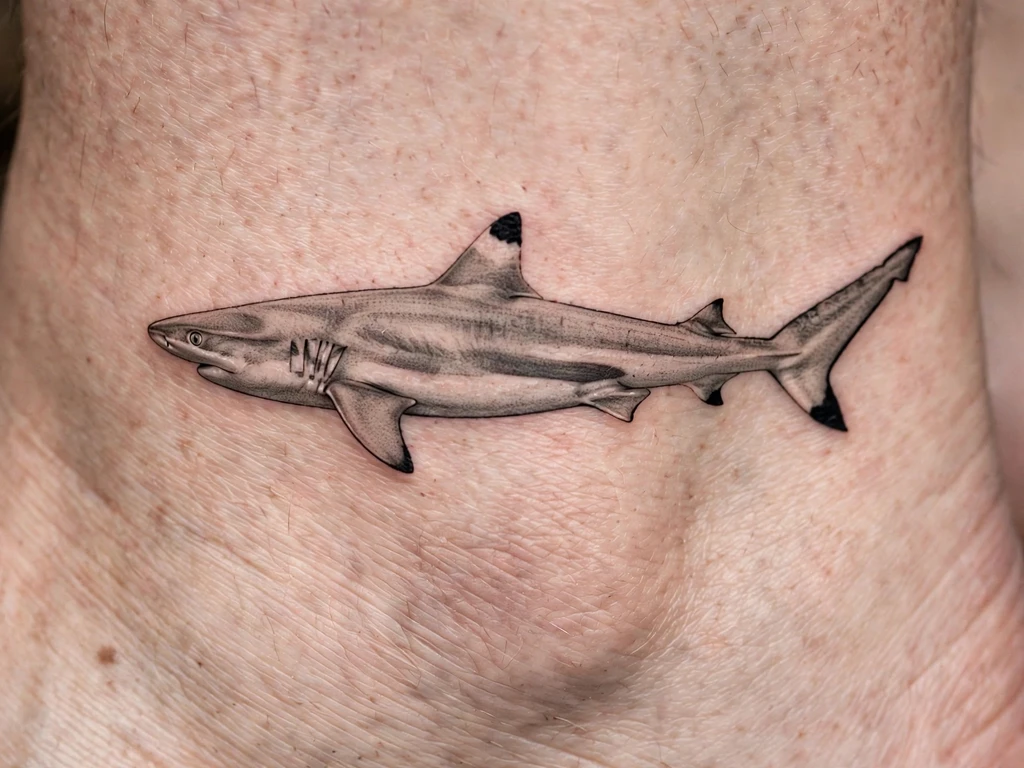
Along the shallow edges of coral reefs, a slender shark swims the drop-off both inside and outside the lagoon. The black markings on its fins give the design its whole effect: a thin black edge to the dorsal fin and a black tip to the tail’s upper lobe, a pale grey body otherwise — grey-brown above, white below. The blacktip reef shark’s body tells the story of its home: narrow, agile, built for cornering in shallow water.
Best placement: Ankle, 8–11 cm, fine grey shading with strong black tips.
Best for: Those who want a delicate shark tattoo that still reads as a shark.
10. Shark Tooth, Drawn True
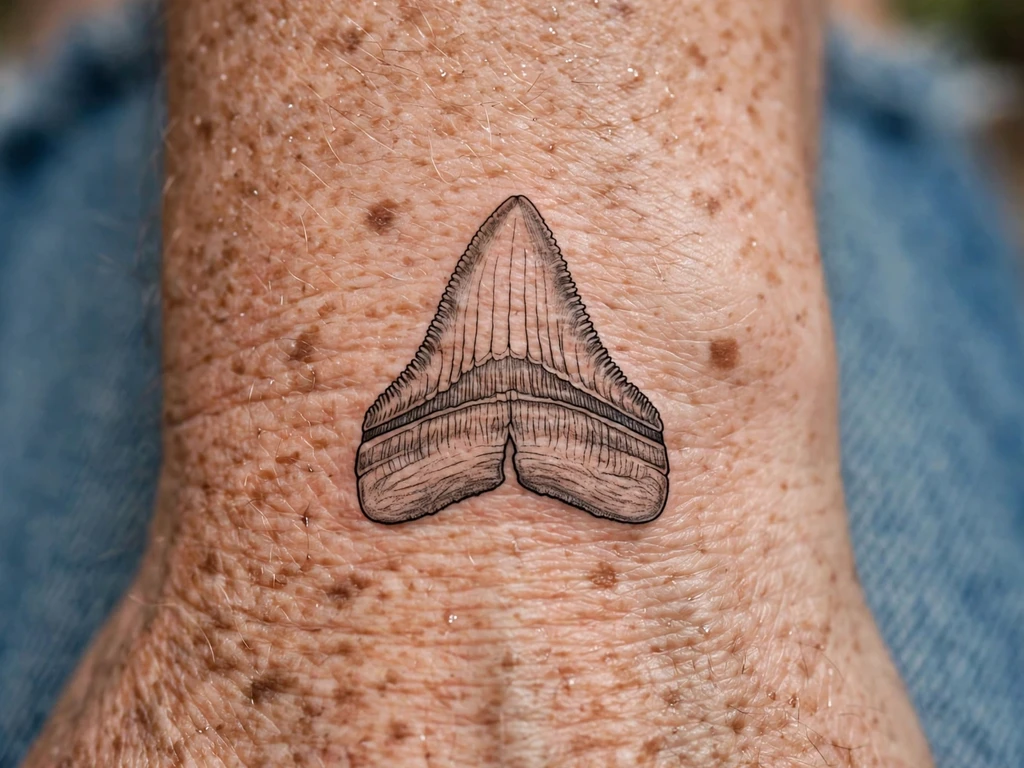
A shark loses teeth constantly — a few thousand in a lifetime — and the tooth is the animal distilled to one shape. The design here is insistently single: one tooth, because one tooth says it all. The great white’s tooth is the model — triangular, with serrated cutting edges you can count, the root dark and flaring to a narrow point — drawn at 3–5 cm on the wrist with fine line, sometimes a flash of colour at the root. Keep the serration visible; without it, a tooth is a blade, and a blade is not a tooth.
Best placement: Wrist, 3–5 cm, fine line.
Best for: Wearers who want the smallest honest shark tattoo there is.
11. The Jaw as Anatomy
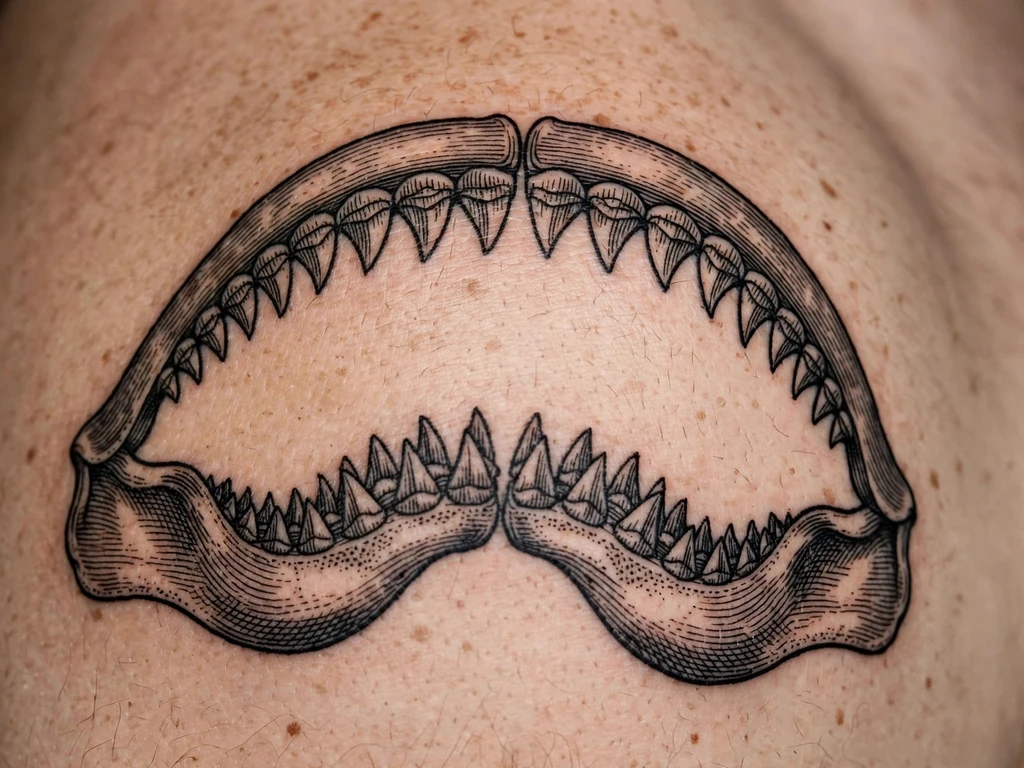
An open shark jaw holds rows of teeth — a set in use, a set developing behind it, ready to roll forward into place when the front row is shed. The jaw study borrows the visual language of natural-history engraving: a manta’s fine stipple and line, the cartilage arch drawn like a piece of architecture, the teeth drawn one by one. This design needs size and a place the arm can carry flat — the shoulder at 13 cm — because its power comes entirely from the accuracy of the teeth and the arch, the same museum vocabulary as the fossil shark section of an earlier design in this series.
Best placement: Shoulder, 12–16 cm, fine-line etched style.
Best for: Wearers who like the shark as science and as a plate in a book.
12. Minimalist Line Shark
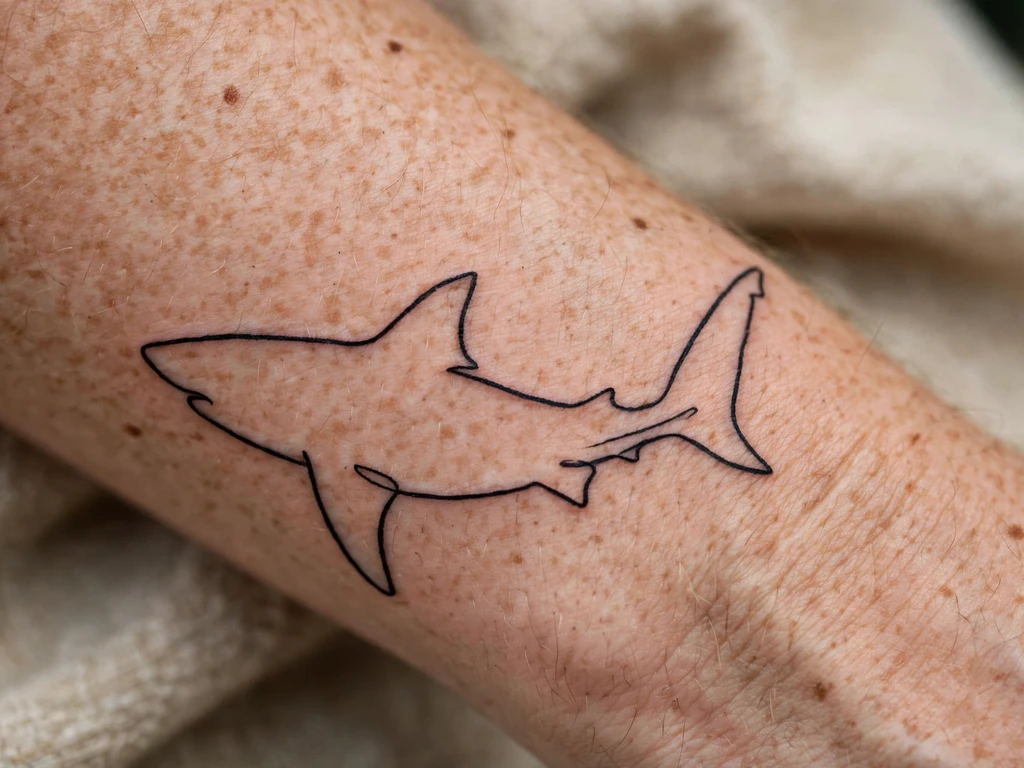
A one-line shark is the purest test of the silhouette law: the entire animal is drawn in a single flowing line without the pen leaving the skin. The test runs up against the law. The line must do the whole job — the upper tail lobe longer than the lower, the dorsal fin in its correct place, a snout that still says the species — because there is nothing else. At scale, a one-line shark under nine centimetres is often mistaken for a whale. Choose the design for its courage, not its modesty: it needs honest size, 12–16 cm, where the line is unmistakably a shark.
Best placement: Wrist or forearm, 12–16 cm, in a single bold line.
Best for: Minimalist wearers who are willing to go bigger than minimalism suggests.
13. One Small Young Shark
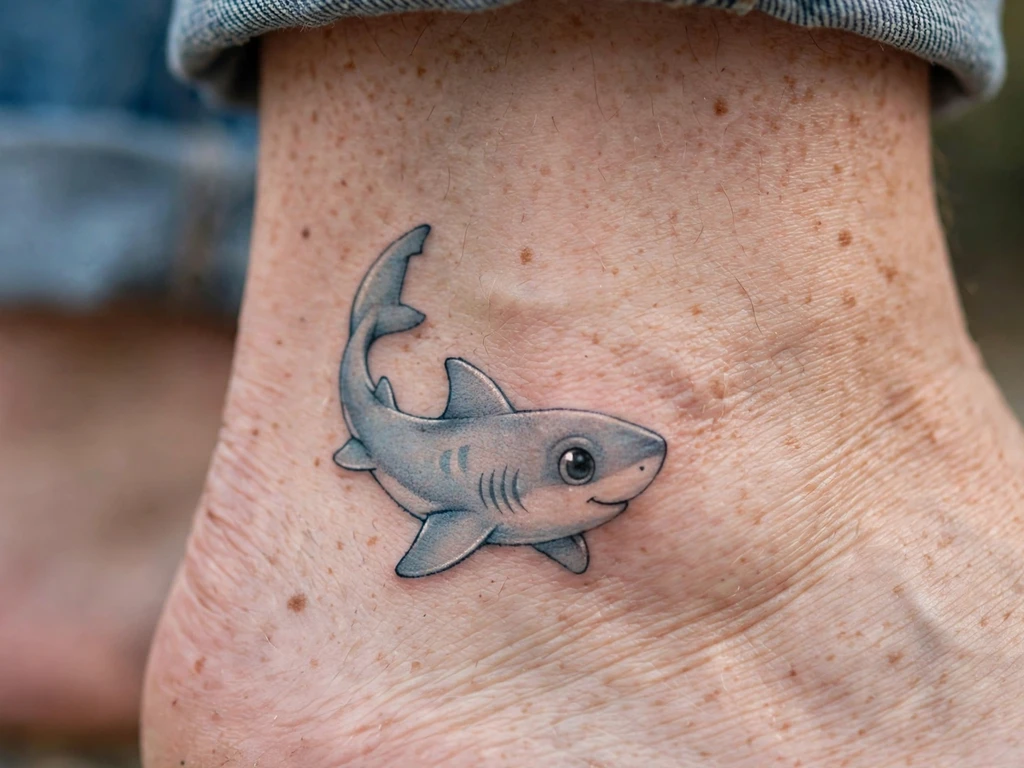
A young shark is not a shrunk adult: the species’ pups have proportionally larger eyes and rounder fins, and the design that draws a pup honestly draws a creature that still feels new. The design here is kept to gentle proportions and a soft grey-blue palette: a small full-body shark with the eye drawn a touch larger than the adult’s, its fins rounded rather than pointed, above the ankle at 8–11 cm. Nice for first tattoos, but do not take the small size as a design advantage: the price of youth is a design that must be the right size for its signature style.
Best placement: Above the ankle at 8–11 cm, in a soft grey-blue palette.
Best for: Wearers who want something delicate that still reads as a shark pup.
14. Traditional Sailor Shark
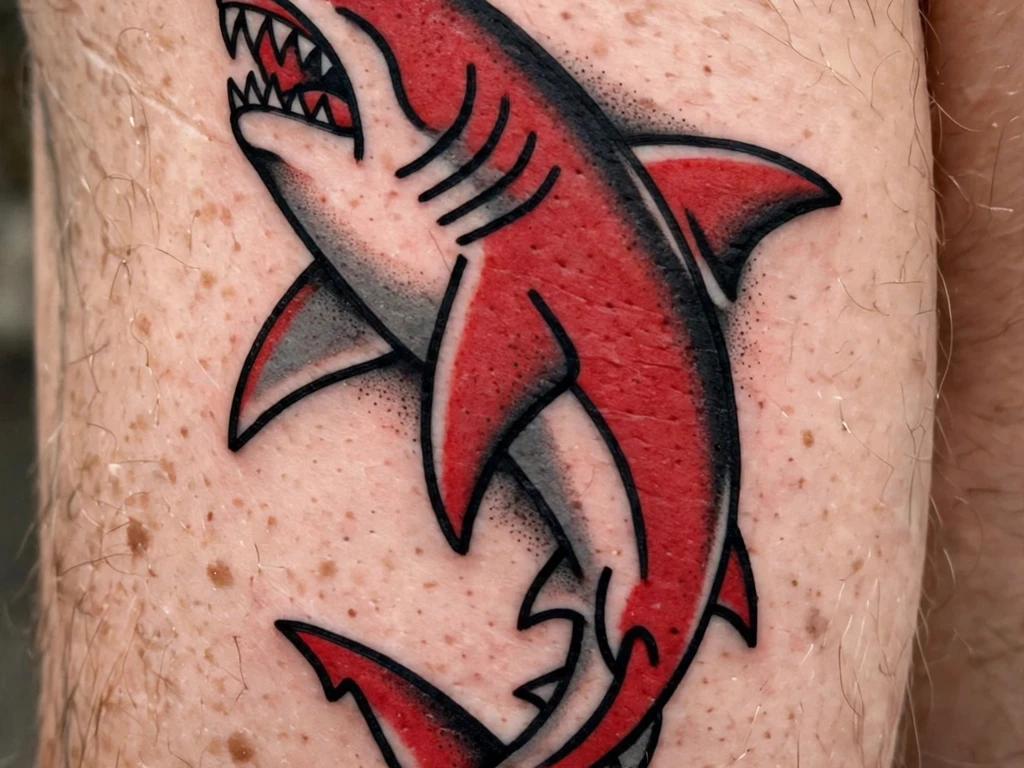
The traditional shark connects directly with the history of the tattoo itself. Sharks have been tattooed since tattooing became visible in the West — sailors brought the shark flash back from the Pacific in the early 20th century — and the American traditional style is the capsule of that moment: heavy black outline, flat fills of red and grey, and open jaws with teeth drawn in stylised rows. If you are drawn to this style, the traditional tattoo ideas guide covers its full vocabulary — the shark in this guide uses the style’s rules as they stand, with the shark’s silhouette kept honest enough that it still reads as a shark.
Best placement: Upper arm, 13–15 cm, in traditional style.
Best for: Wearers who want the most durable possible shark design — the whole idea of a tattoo that ages gracefully.
15. Blackwork Shark
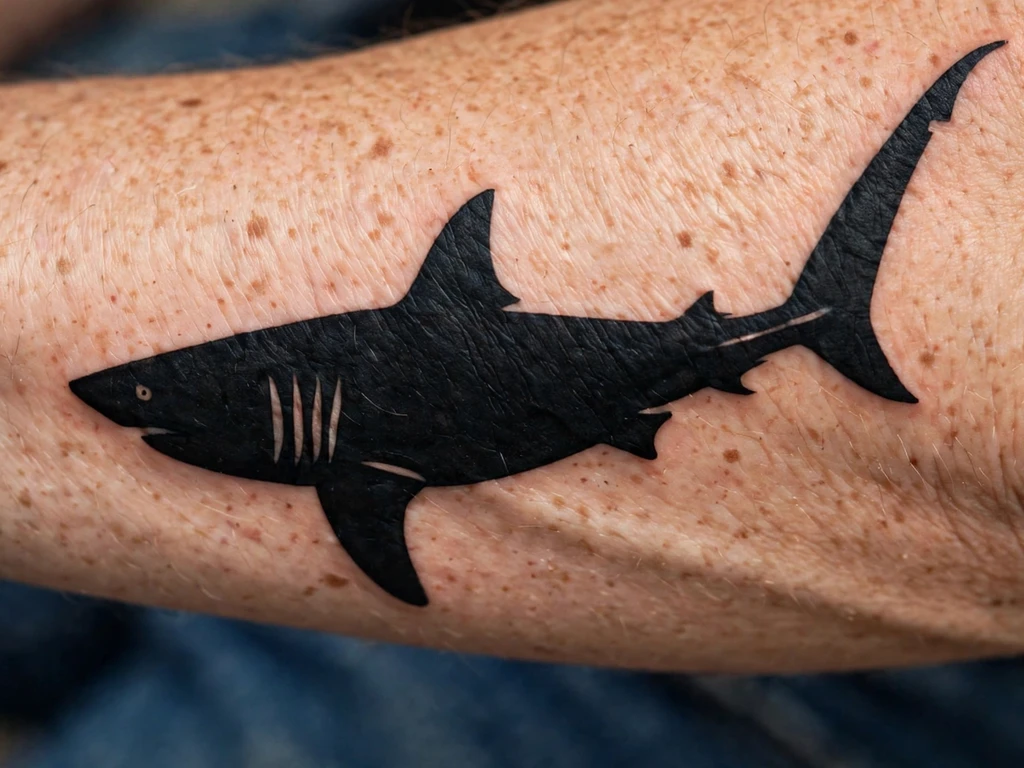
The blackwork shark is the purest shape of the whole guide. Drawn as a single solid silhouette, the design depends entirely on the outline being right. The eye is a single dot. The jaw opens once, with two teeth. There is no shading to hide behind. This one needs a big enough space to hold the silhouette without details bleeding together — 13–16 cm on the forearm — and the design’s strength is that it reads across a room.
For the full vocabulary of solid-black pieces, the blackwork tattoo guide covers the style’s design principles. The shark version adds one constraint the blackwork style makes visible: the silhouette must be species-true at a glance, with the tail’s upper lobe longer than its lower, because the silhouette has no backup.
Best placement: Forearm stacked horizontally, 13–16 cm, in solid black.
Best for: Wearers who want the boldest possible shark design.
16. Neo Traditional Shark
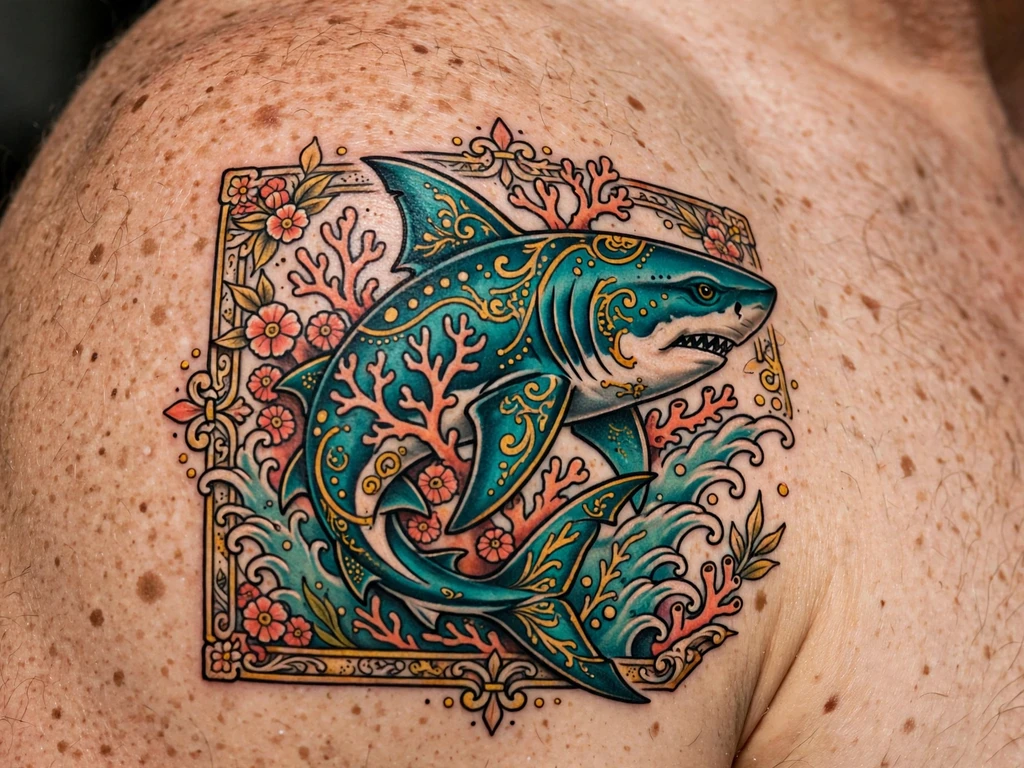
Where the traditional shark flattened its palette into red, grey and green, the neo traditional shark fills the same bold outline with jewel tones — deep blue and teal for the body, rose gold along the belly — and frames the whole piece with decorative waves and a border of geometric detail. The shark itself must read as a shark, so the design carries the silhouette law in the same bones: the tail with its long upper lobe, the dorsal fin in its species-correct place, five gill slits and the small dark eye — and the colour and framing never obscure those facts. This design needs room: the decorative composition forces a larger canvas and a 13–15 cm span is the minimum.
If you are building a collection of bold-outlined work, the neo traditional tattoo guide covers the palette and the decorative frames in depth.
Best placement: Shoulder, 13–15 cm, in jewel tones with a wave frame.
Best for: Wearers who love the bold outline of traditional but want richer colour.
17. Watercolour Shark
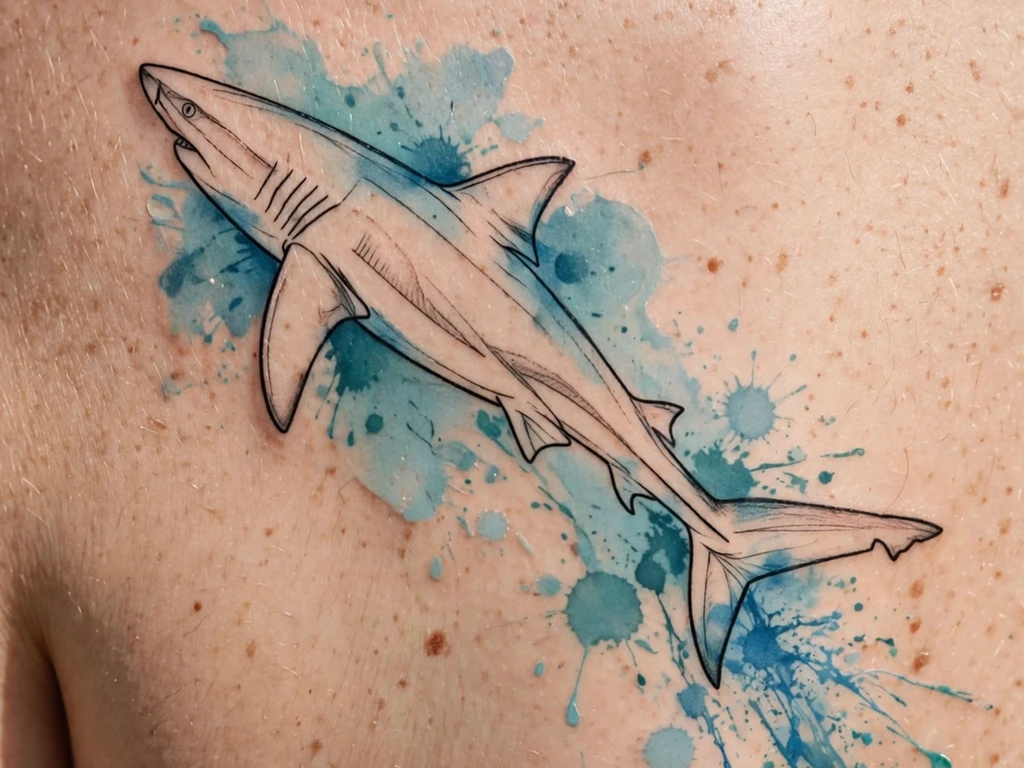
In a wash of blue and teal — the colours of water itself — the watercolour shark is drawn as a fine-line skeleton carrying soft colour, the washes bleeding just past the lines into splash edges, the whole design placed horizontally along the shoulder blade. It is the most delicate treatment in the guide, and the one that most needs the skeleton line to survive: without it, the washes fade on their own and the shark dissolves along with them.
The watercolour tattoo guide covers the technique’s whole palette and what to expect at five and ten years. Here, the shark version of the argument is the same one as everywhere: choose a design whose outline is strong enough to outlive its colours.
Best placement: Shoulder blade, 13–15 cm, in a fine-line outline with a wash.
Best for: Wearers who love colour and do not mind a future touch-up.
18. Japanese-Influenced Shark
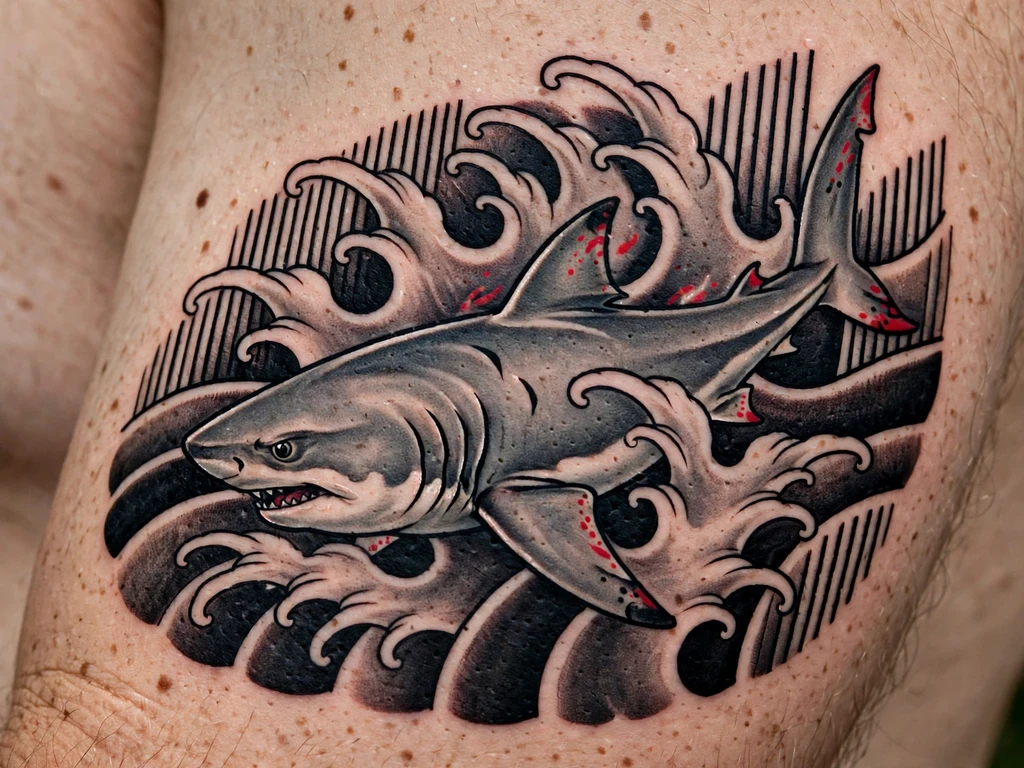
The shark is drawn in the Japanese idiom: a grey body driving through bold black waves and wind bars, the waves larger than the animal, the composition flowing vertically along the upper arm as the full-sleeve structure of irezumi would allow. The shark’s grey in this treatment is a pale grey-green close to the water itself, so the wave work does the bold drawing and the shark floats over it — a balance that echoes how koi fish tattoo ideas treat their own animals, where the fish and the wave are equally the subject.
Best placement: Upper arm, 15–18 cm, in the irezumi composition.
Best for: Wearers drawn to the Japanese aesthetic and willing to give it the space it needs.
19. Shark Fin Above the Waterline
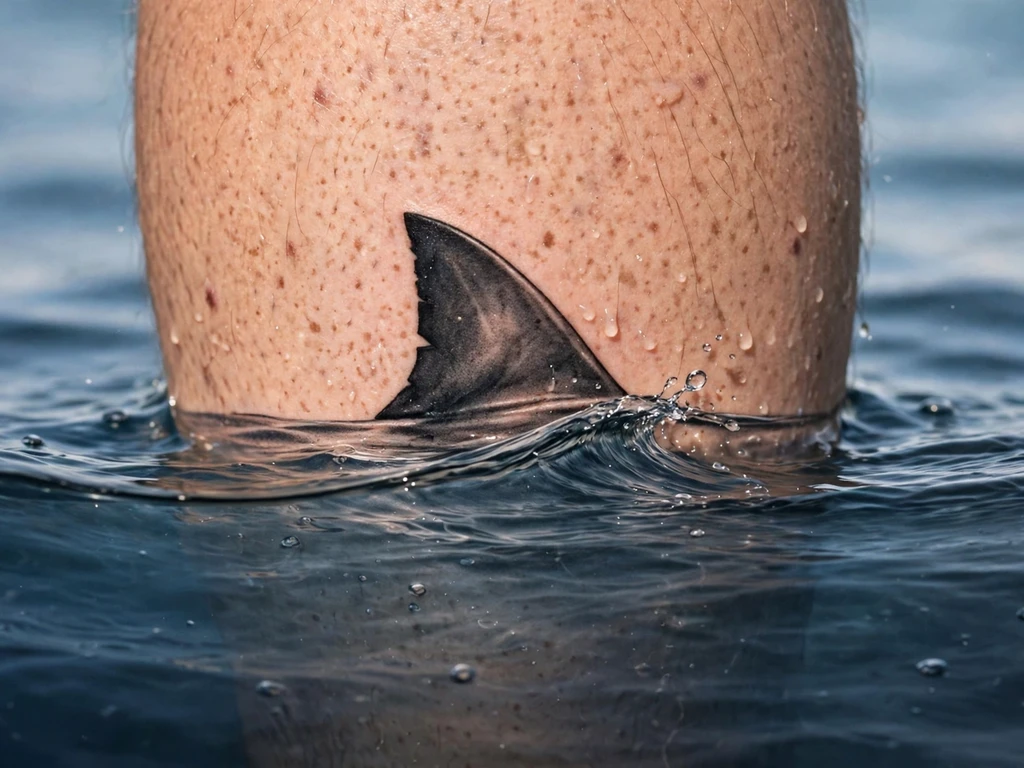
The fin above the waterline is the shark reduced to one shape. A single dorsal fin cutting a straight waterline — seen from the side, a thin slice above a horizontal, or from directly above, a dark shape with a clean wake trail. The design here is kept to a fine-line treatment of the fin itself, with two details that make it read: the fin’s shape triangular, its trailing edge slightly concave rather than straight, and the waterline utterly flat, with a small bow wave at the fin’s leading edge. Add a second fin, a body hint, and it becomes a whole shark; the design’s strength is keeping it at one.
Best placement: Calf, 8–12 cm, fine line.
Best for: Wearers who want the most understated shark tattoo of all.
20. Two Sharks Circling
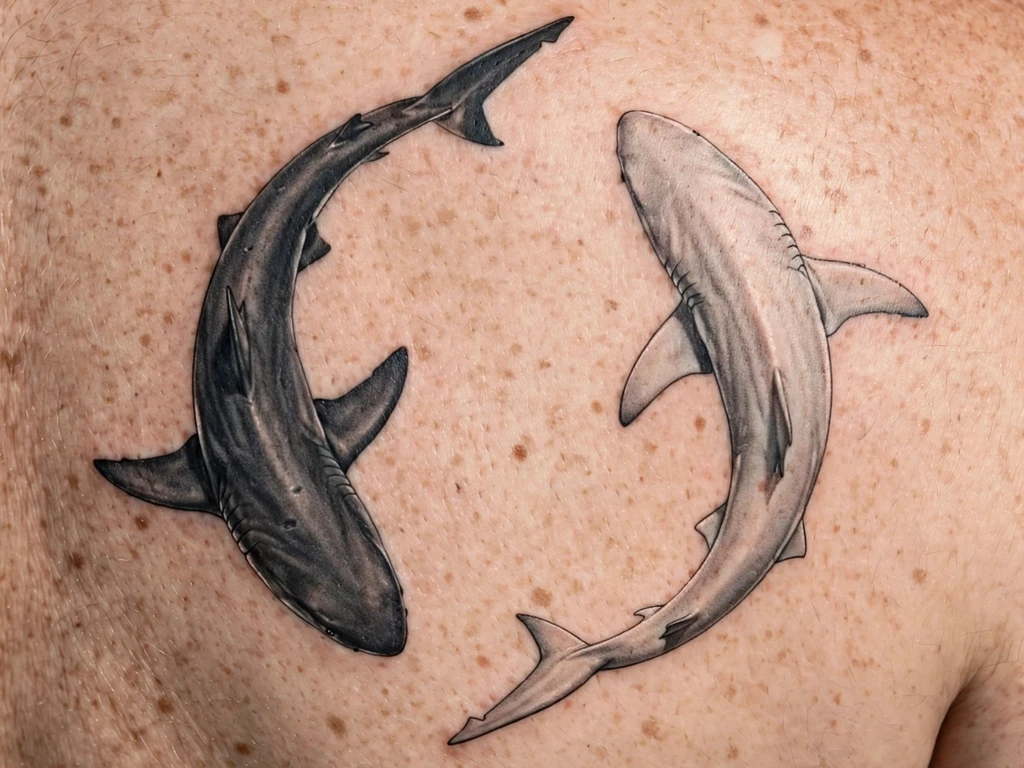
Two sharks circling make a piece about balance and motion. The design here is drawn as a pair in black and grey, their bodies curving into a circle with the nose of one meeting the tail of the other — a shape that reads as unity without sentimentality. The pair work best when the sharks are different sizes, one larger at the top and one smaller near the bottom, echoing the way sharks naturally school at different depths. Keep the dorsal fins turned the same way, both fins in the correct place on each animal, and the circle stays a pair of sharks rather than a decorative swirl.
Best placement: Shoulder blade, 13–17 cm, black and grey.
Best for: Couples, siblings, close friends, or anyone wanting a piece about two things in balance.
21. Shark and Anchor
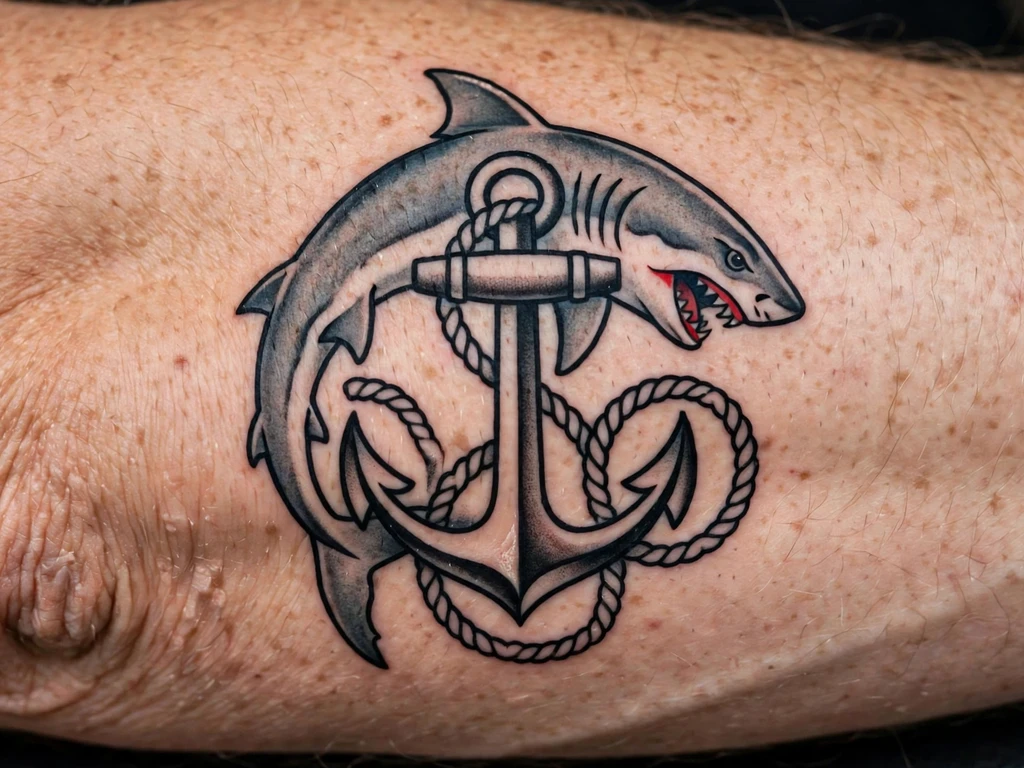
The anchor is the most traditional companion a shark has, and the two together read as a sailor’s emblem — the shark for forward motion that never stops, the anchor for the harbour it keeps returning to. The design here is traditional black and grey, the anchor drawn in its classic stacked form — heavy stock at the top, ring above, arms curving outward below — with the shark circling it so the tail wraps up alongside the anchor’s arm.
Best placement: Forearm, 13–15 cm, traditional black and grey.
Best for: Sailors, sea-lovers, or anyone who wants a traditional piece with a specific animal.
22. Shark Skeleton Study
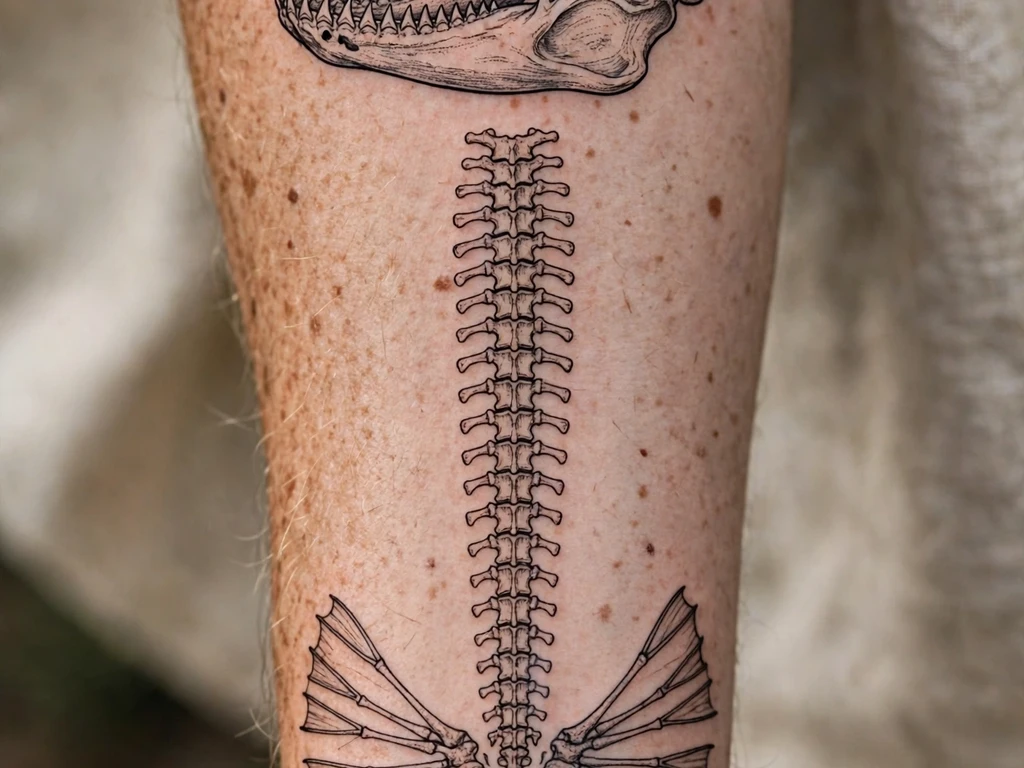
A shark’s skeleton is cartilage, not bone, so a shark skeleton is not the same subject as a fish skeleton. The cartilage framework in this study is drawn in fine line: the pale semi-transparent jaw and tail spines, the cartilaginous spine, the jaw, and the tail vertebrae — the same museum vocabulary as the jaw study above, here extended across the whole animal. The point of the exercise is the animal’s difference: it is softer and more flexible than the teleost fish skeleton it is usually mistaken for.
Best placement: Forearm stacked lengthways, 13–16 cm, in fine-line style.
Best for: Wearers who like the shark as science — and a piece that looks like an anatomy plate.
23. Tiny Shark Behind the Ear
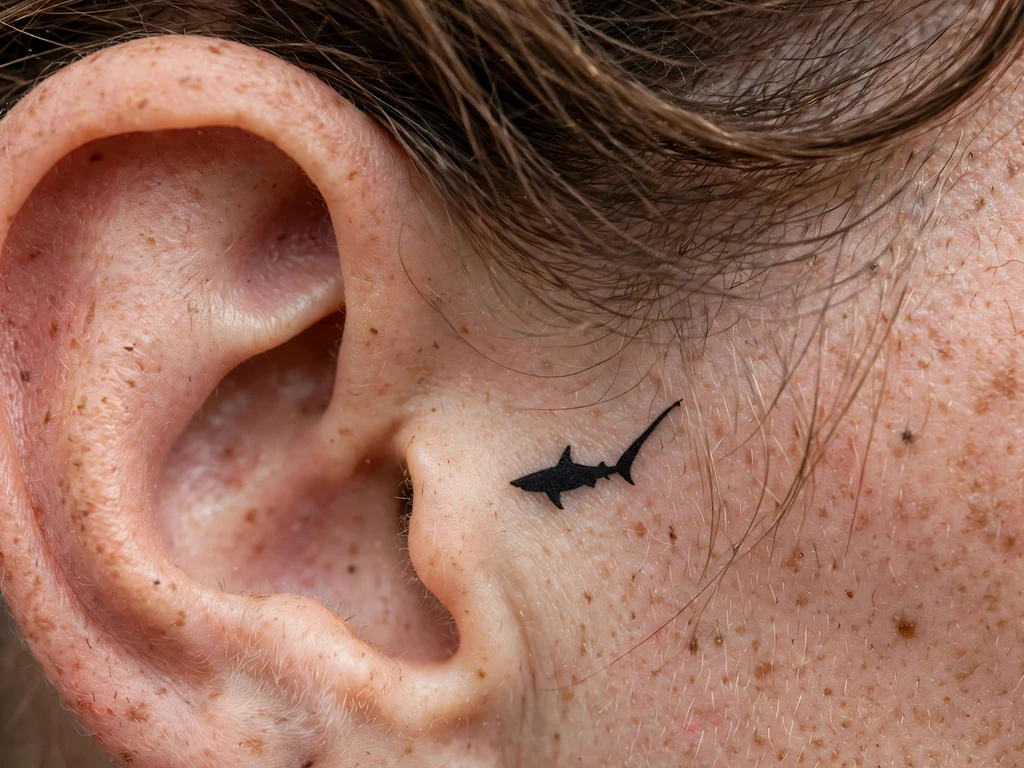
A tiny shark behind the ear is the board’s smallest statement — a solid black silhouette at the size where the species’ identity is carried entirely by the silhouette. If you are considering a tiny placement, be honest about what you will get: the honest warning is that this design is a species test of the worst kind, because it demands the whole animal’s identity in a space too small for its evidence. At 3–5 cm, the fin tips and the tail’s fork remain distinct enough to read as a shark, and the little shape is best at its smallest.
Best placement: Behind the ear, 2–3 cm, solid black.
Best for: Wearers who want a hidden, private shark tattoo.
24. Tiny Shark on a Finger
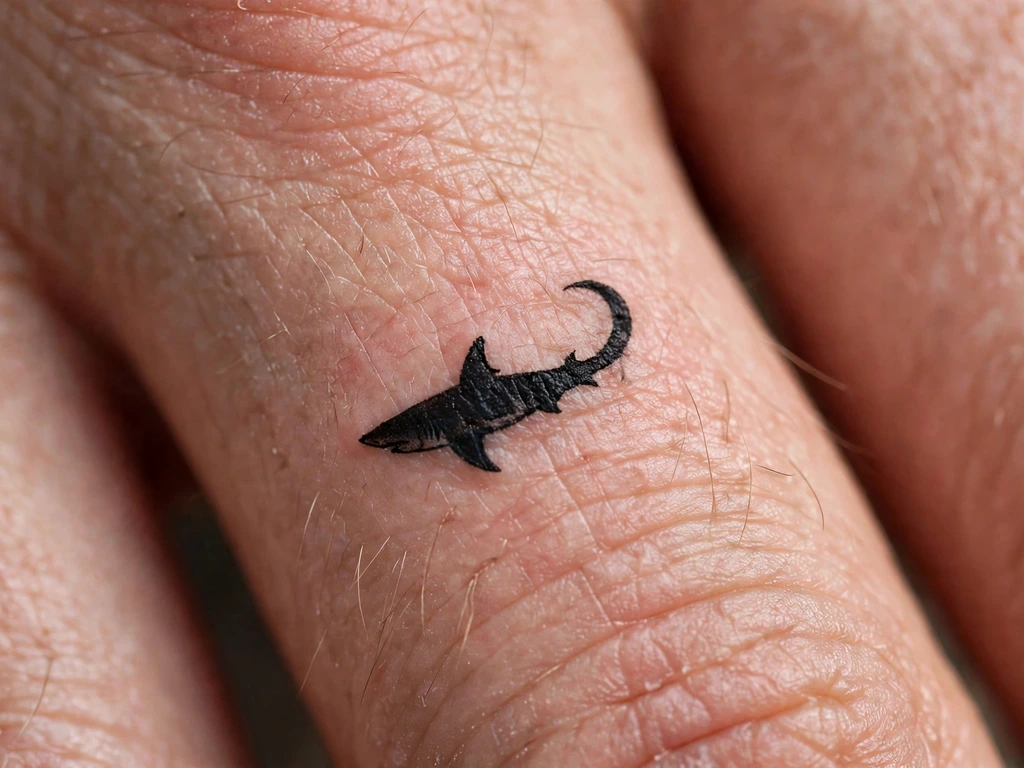
The finger shark is the smallest place a shark can be drawn, and the honest problem with it is that fingers are where tattoos go to fade: heavy sun exposure and constant hand-washing and creasing are the fastest route to a softened detail. At 1.5–2.5 cm, the design is reduced to pure silhouette — a bold simple shark shape, no fins, no gills, no eyes — and if you want more detail than that, do not put it on a finger. The honest minimums matter: the guide’s advice here is that finger tattoos need a bold design and a plan to touch it up.
Best placement: The side of a finger, 1.5–2.5 cm, solid black.
Best for: Wearers who want a shark tattoo almost no one sees — and who accept it will need love.
25. Shark Along the Collarbone Edge
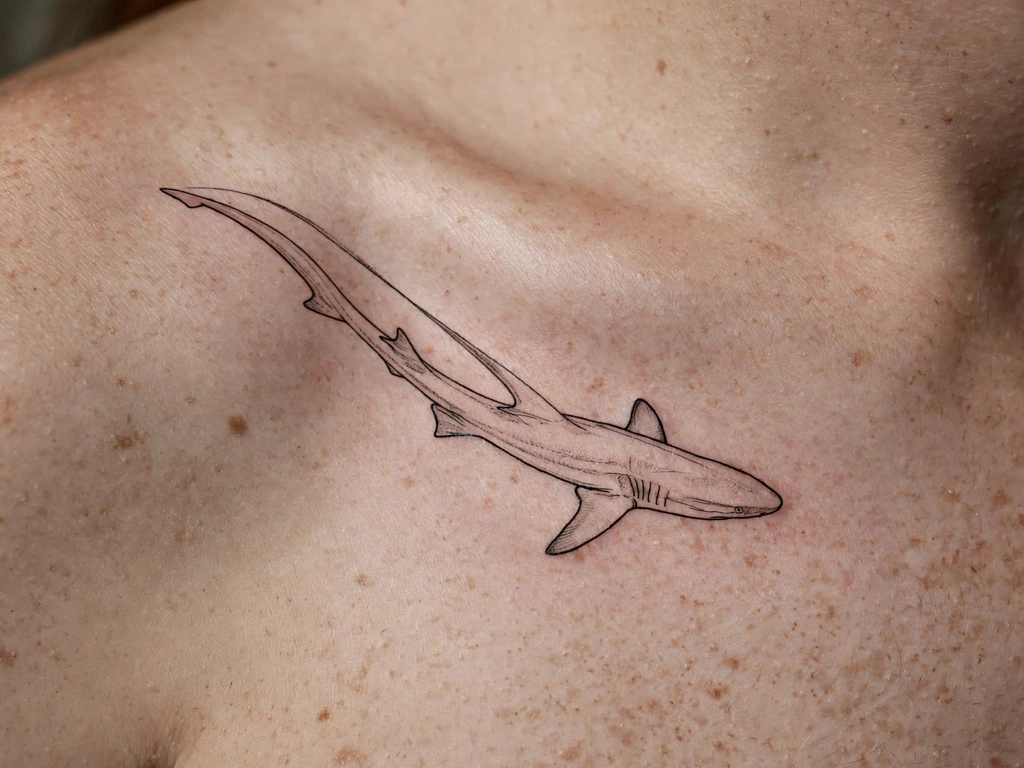
The collarbone gives the shark a natural runway: a slender fine-line shark that follows the outer edge where the line is unobstructed, the pointed snout at the outer end and the tail at the inner end. The placement is high, sharp and close to the face, so choose this design if you want to show off the animal above everything else. The species here is a slender reef shark — the drawing is made for a fine line, with the emphasis on the shark’s slenderness and speed rather than its size. The outer-edge placement keeps the collarbone line itself as the composition’s second subject.
Best placement: Collarbone (outer edge), 10–15 cm, fine line.
Best for: Wearers who want something elegant and visible.
The one-line version of this whole guide: count the slits, watch the tail, and a shark tattoo that reads as a shark will follow.
Shark Tattoo Placement by Size
| Placement | Best size range | What works here |
|---|---|---|
| Forearm | 13–18 cm | Horizontal swimmers: great white, mako, blackwork and skeleton. The forearm’s flat plane suits the shark’s long, low profile. |
| Upper arm | 13–18 cm | Bold pieces: the round shape of the upper arm suits a bold piece with a heavy outline — hammerhead, traditional, Japanese-influenced. |
| Shoulder blade | 13–17 cm | Wide, flat, forgiving — whale shark, two sharks circling, watercolour. |
| Thigh | 15–20 cm | Large species with patterns: tiger shark. |
| Calf | 13–18 cm | Horizontal designs with long proportions: nurse shark, thresher, fin. |
| Ankle | 8–11 cm | Delicate reef sharks and pups, where the small scale suits the reef’s small fish. |
| Wrist | 3–5 cm (tooth) to 12–16 cm (one-line) | Small and clean: the tooth, the one-line shark. |
| Behind the ear | 2–3 cm | The tiniest solid silhouette, hidden and private. |
| Finger (side) | 1.5–2.5 cm | Only the boldest silhouette — and plan for touch-ups. |
| Collarbone (outer edge) | 10–15 cm | A single fine-line shark following the bone’s edge. |
Two notes on the numbers in this table. The ranges are the honest minimums — the sizes below which these designs stop reading as sharks — not the maximums. Go bigger any time you can. And the forearm deserves its own mention: it is the best shark placement in the guide, because you look at it as often as anyone else does, and a shark is an animal you want to keep seeing.
How to Choose a Shark Tattoo
Start with the species, not the style. A shark tattoo’s subject is the shark itself — its species sets its silhouette, its gill count, its fin placement. Choose the animal first: a hammerhead if you want an unmistakable profile, a great white if you want the classic shark, a nurse shark if you want calm. The style follows the species, not the other way around — a tiger shark’s stripes cannot be crowded into a small space, and a watercolour shark needs the room for the wash.
Pick the placement by the shark’s shape, not your favourite spot. A shark is a long, low, horizontal animal, so it belongs on horizontal runways — forearm, calf, shoulder blade — not on small round patches that force it into a curve. The placement table above is the place to start; if the spot you love does not suit a long animal, choose a different species, not a smaller tattoo.
Ask your artist to draw the animal in profile before they draw the design. A shark tattoo is an anatomy test, and the profile view is the one that cannot hide a wrong proportion. If their profile drawing has five slits and the tail’s upper lobe longer than its lower, the design will work in any style.
Choose the size that protects the silhouette. A shark’s identifying features are small: gill slits, fins, the tail fork. Too small and those details merge until the animal becomes a blob. The design’s honest minimum is 13 cm for most sharks, 8 cm for the smallest reef species, and 3 cm only for the tooth. Consider the ageing advice: fine details fade, and the silhouette carries the design — so give it room.
Decide what the shark means to you before you book. Pick the reading that is yours, and tell your artist. The design changes with the meaning: a guardian shark is drawn calm and horizontal; a shark for forward motion is drawn in motion, with the tail turned up.
Budget for the touch-up. Greys soften, fine lines blur. The designs here are described at their honest minimum, and the grey-wash designs especially benefit from one touch-up in the first three years. The design’s fairness is that it improves with age, if it is given the size it needs.
Common mistakes to avoid:
- Choosing a small shark for a small space — the design below its honest minimum merges into a fish shape.
- Drawing an equal-lobed tail, the single error that turns a shark into a tuna.
- Using six or four gill slits, or setting them forward of the eye.
- Putting a big dorsal fin on the wrong species — a nurse shark’s fins are far back, a hammerhead’s is what makes the profile.
- Overloading a shark design with waves, sun and anchors until the shark disappears.
Key points to remember:
- Every shark in this guide is species-true — the silhouette law is the checklist: the tail, the five slits, the fin placement, the teeth, the eye and the snout.
- Traditional and blackwork age the best; watercolour and fine line need honest size and a touch-up plan.
- The forearm is the best shark placement in the guide; the collarbone edge is the most elegant.
Shark Tattoo FAQs
What does a shark tattoo mean?
A shark tattoo symbolises forward motion, focus and quiet confidence. In Hawaiian tradition, sharks are honoured as ʻaumākua — ancestor guardians at sea — so a shark tattoo also carries a meaning of protection that long predates the modern fear of sharks.
Is a shark tattoo too aggressive?
No, if the design is drawn the way this guide draws it. A shark reads as aggressive only when the jaws and the teeth are exaggerated. Sharks drawn with a closed mouth and accurate anatomy — a nurse shark, a whale shark, a mako in motion — read as calm and certain, not as a threat.
What is the best placement for a shark tattoo?
The forearm at 13–18 cm is the most reliable shark placement — the flat plane suits the shark’s long, low profile, and you see it as often as anyone else. For a larger piece, the shoulder blade at 13–17 cm or the thigh at 15–20 cm give the species room.
Do fine-line shark tattoos age well?
Fine-line sharks age as well as their outline allows. A single-line shark at the top of its honest size range — 12–16 cm — keeps its shape, while a small, very fine one softens until the fins merge. The best defence is size: draw the species at the top of its honest range, with the signature feature unmistakably drawn.
Which shark species is best for a first tattoo?
A great white at honest size is the safest first shark tattoo: grey wash, recognizable at a glance, and forgiving of ageing. For something smaller, the tooth (3–5 cm on the wrist) or the blacktip reef shark above the ankle are the best first choices.
Final Thoughts
The shark tattoo that lasts is the one drawn after the law: a species, a silhouette, a tail with its longer upper lobe — and, once a year or two have passed, a tattoo that has settled into the shape it was always meant to be. That is the design to choose: the shark that would still read as a shark from across the room, even when the grey has softened and the finest lines have faded.
Choose your species, count the slits, watch the tail, and give it the size it needs. The rest — the waves, the water, the meaning — will take care of itself.