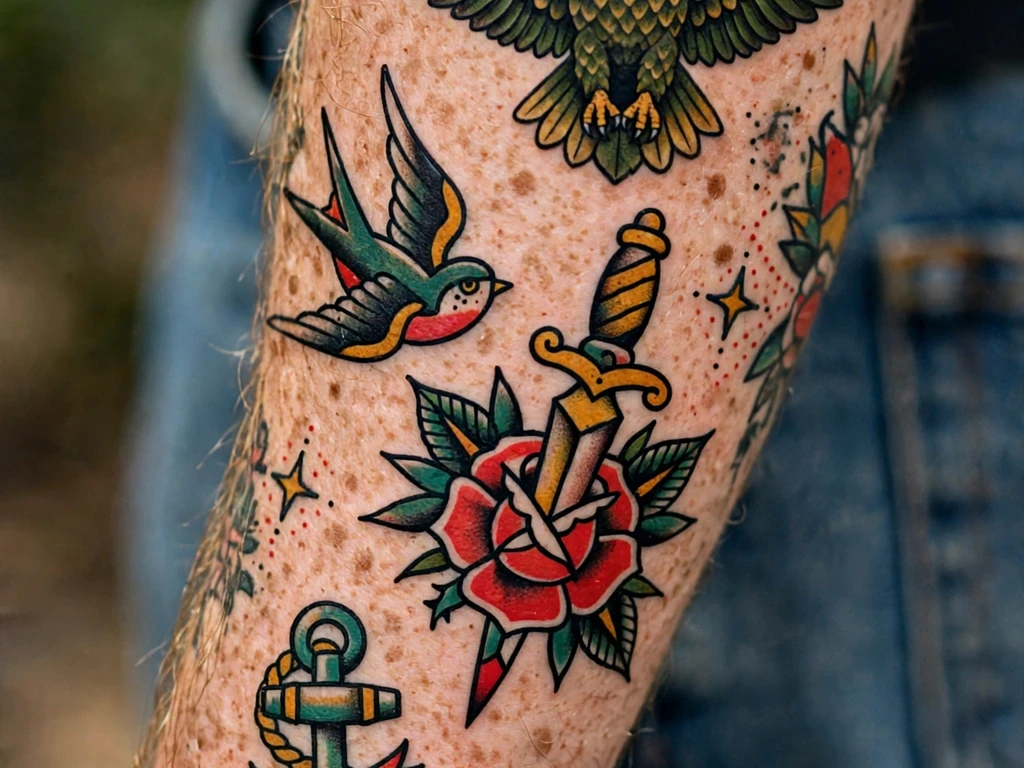
Some tattoo styles arrive with a trend cycle and leave with one. American traditional is not one of them. Forged in port towns and naval bases more than a century ago, built on heavy black outlines and a fistful of colours — brick red, bottle green, mustard gold, a little brown — these are the designs that were engineered, from the very first flash sheet, to stay readable for a lifetime. An eagle tattooed in 1945 can still be read across a room today, and that is not an accident. It is the whole point of the style.
In this guide you will find 25 traditional tattoo ideas covering the full classic canon: the eagle, the dagger and rose, the swallow, the anchor, the crawling panther, the clipper ship, the sacred heart and the big battle-royale back piece, each with its traditional meaning, its honest best placement, and the things a good artist would want you to know before you book. The canon was drawn by men for sailors, but it has never belonged to men alone — women have worn traditional work since the style’s earliest decades, and several designs here, from the gypsy head to the cherry pair, are classics precisely because women kept choosing them. First, a grounding in what makes a tattoo “traditional” at all, and what the classic motifs have traditionally meant.
What Is American Traditional Tattooing?
American traditional — also called old school — is the style that grew up alongside the electric tattoo machine in the late nineteenth and early twentieth centuries, in the port cities and military towns of the United States. When Samuel O’Reilly patented the first electric tattoo machine in 1891, tattooing became fast enough to serve a queue of sailors on shore leave, and the style that resulted was shaped by that queue: bold, simple, symbolic designs that could be picked off a wall of flash, tattooed in one sitting, and read at a glance. The Tattoo Archive’s history of the tattoo machine traces that lineage from O’Reilly’s 1891 patent through Charlie Wagner’s 1904 improvements to the two-coil machine most traditional artists still swear by — the style and the machine genuinely grew up together.
The style was codified by a generation of artist-sailors, above all Norman “Sailor Jerry” Collins, who worked Honolulu’s Hotel Street through the Second World War and fused American flash with lessons he drew from Japanese masters: stronger composition, better pigments, and designs built to move with the body. Around him worked Bert Grimm, Cap Coleman, Paul Rogers and others whose flash sheets are still tattooed, nearly unchanged, today.
Traditional work follows rules, and the rules are why it ages the way it does:
| Rule of the style | What it looks like | Why it matters |
|---|---|---|
| Bold black outlines | A heavy, confident black line around every shape | The line is the structure — it holds the design together as skin ages and ink settles |
| Limited palette | Brick red, green, mustard gold, brown, black — rarely more | Old pigments were limited; the classic colours are chosen because they endure |
| Black shading | Whip-shaded black and grey inside the lines | Gives weight and depth without extra colour, and black fades the slowest of all |
| Skin breaks | Areas of bare skin left as the “highlight” | Un-inked skin is the style’s white — it keeps designs open and readable |
| Simple, symbolic subjects | One strong image: an animal, a weapon, a flower, a heart | A design a sailor could explain in one sentence, readable across a deck — or a street |
The Meanings Behind American Traditional Tattoos
Search interest in the meaning of American traditional tattoos keeps climbing, and it is easy to see why: this is the most deliberately symbolic style in Western tattooing. Almost every classic motif began as a sign — of miles travelled, dangers survived, people missed, or luck asked for. One important honesty note: these meanings are traditional associations and sailor lore, passed down through flash sheets and shop talk rather than proven fact. The swallow’s famous mileage, for example, is something sailor tradition held to be true, not a documented naval rule. Wear the meanings because they speak to you — that is what their first wearers did.
That impulse itself is ancient. As Smithsonian Magazine’s worldwide history of tattoos documents, across cultures and millennia tattoos have been used to protect the wearer, declare love, and signal status and belonging — which is almost exactly the job description of a sailor’s chest piece in 1943. American traditional simply gave that old human habit its boldest visual language.
| Classic motif | Traditional meaning (sailor lore and custom) | Who chose it / chooses it |
|---|---|---|
| Swallow | In sailor tradition, one swallow for every 5,000 nautical miles travelled; swallows also meant hope of returning home, because swallows return | Sailors marking voyages; today, anyone marking a journey survived or a homecoming |
| Anchor | Stability and being held fast; in naval lore, also linked to having crossed the Atlantic | Sailors, and anyone wanting a symbol of staying grounded |
| Eagle | Patriotism, strength, courage and freedom | Servicemen first; now anyone drawn to a bold emblem of strength |
| Rose | Love, balance and remembrance — beauty held together with thorns | Partners, memorials, and romantics of every era |
| Panther | Power, stealth and protection — the crawling panther guards its wearer | Chosen as a guardian piece and a filler that flows with muscle |
| Heart and banner | Devotion made public — a name, a word, a vow carried on the skin | Sweethearts, mothers, units, mottos |
| Nautical star | Guidance and finding the way home — sailors navigated by the stars | Travellers and anyone marking a direction in life |
| Horseshoe | Luck, hung open-end up in lore “so the luck doesn’t run out” | The hopeful, the gambling-hearted, horse people |
| Dagger | Sacrifice, bravery, and the willingness to fight for something | Servicemen; today, anyone marking something defended |
| Clipper ship | Adventure, freedom, and the sailor’s “homeward bound” hope under full sail | Seafarers, travellers, restless spirits |
Traditional Tattoo Ideas at a Glance
| # | Design | Style notes | Best placement |
|---|---|---|---|
| 1 | American Eagle | Spread wings, shield, bold banner | Chest or forearm |
| 2 | Dagger and Rose | Vertical dagger through a red rose | Forearm |
| 3 | Swallow Pair | Two swallows in flight, mirror pair | Chest or shoulders |
| 4 | Anchor and Banner | Rope-wrapped anchor, name banner | Forearm |
| 5 | Crawling Panther | Low black panther, claws out | Forearm or calf |
| 6 | Tiger Head | Snarling frontal tiger head | Upper arm or thigh |
| 7 | Clipper Sailing Ship | Full sails, waves, “Homeward Bound” feel | Forearm or upper back |
| 8 | Snake and Dagger | Coiled serpent around a dagger | Forearm |
| 9 | Classic Skull | Grinning skull, hollow eyes | Upper arm |
| 10 | Heart and Banner | Red heart, scroll banner for a name | Chest or forearm |
| 11 | Lighthouse and Waves | Striped lighthouse, crashing waves | Calf or forearm |
| 12 | Lucky Horseshoe | Upturned shoe, flowers, nails marked | Ankle or forearm |
| 13 | Lucky Dice Pair | Two dice, flames or stars | Forearm or ankle |
| 14 | Cherry Pair | Two red cherries on one stem | Hip, ankle or arm |
| 15 | Pin-Up Silhouette | Tasteful vintage sailor-girl flash | Upper arm or calf |
| 16 | Nautical Star | Red-and-black five-point star | Elbow, shoulder or forearm |
| 17 | Sacred Heart | Flaming heart, cross, radiating lines | Chest or upper arm |
| 18 | Rock of Ages Cross | Cross in crashing waves | Upper arm or back |
| 19 | Traditional Dragon | Green Western-style curled dragon | Upper arm or calf |
| 20 | Gypsy Head | Classic woman’s portrait flash | Upper arm or thigh |
| 21 | Traditional Butterfly | Bold symmetrical butterfly | Sternum-side shoulder, arm or ankle |
| 22 | Crescent Moon and Stars | Smiling moon face, stars | Shoulder or forearm |
| 23 | Traditional Shark | Open-jawed shark in profile | Calf or forearm |
| 24 | Spider and Web | Webbed elbow with a hanging spider | Elbow |
| 25 | Eagle and Snake Back Piece | “Battle Royale” full composition | Full back |
25 Traditional Tattoo Ideas
1. American Eagle
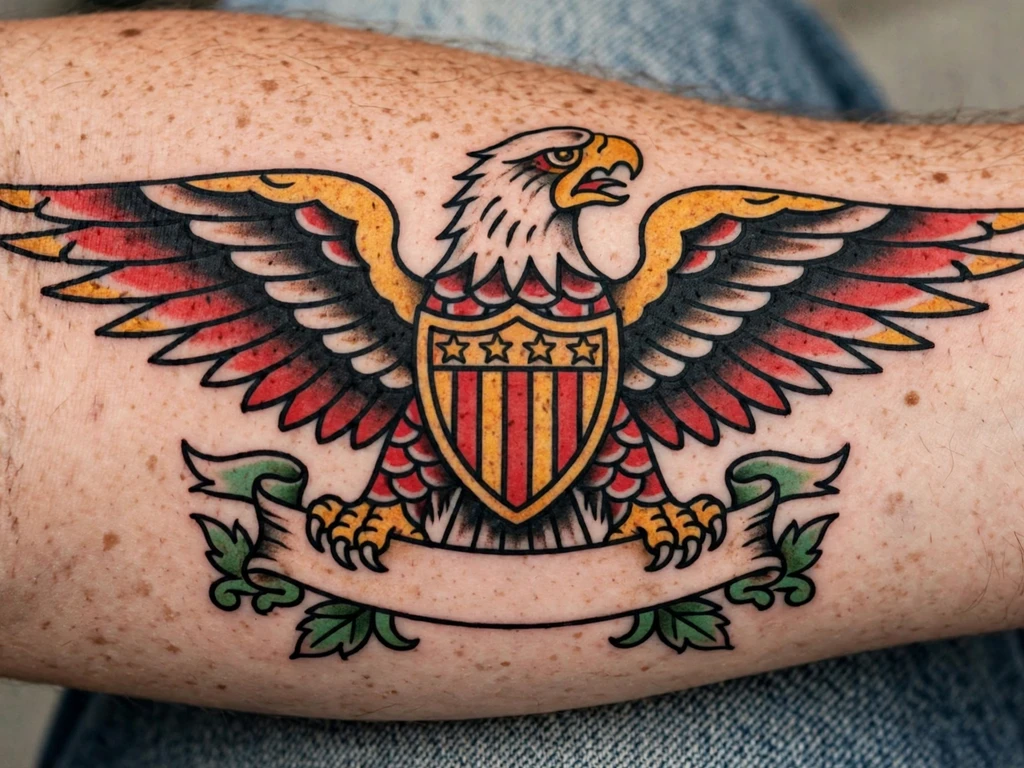
The flagship of the entire style: a bald eagle with wings spread wide, talons out, often clutching a shield, a flag or a banner left blank for a word. The eagle was the design servicemen queued for in wartime Honolulu and Pacific ports, and it remains the benchmark by which traditional artists are judged — if a shop’s eagle looks tired, walk away. Feather groupings are drawn as bold separated wedges, the head in profile with a fierce yellow eye, the whole bird built to read from across the street.
Best placement: Centre chest with wings following the collarbones, or wrapped proudly around a forearm or upper arm.
Best for / know before you book: Give the wings room — an eagle squeezed under about 12 cm wide loses its feather separations and heals into a brown bird-shaped mass. Leave the banner blank only if you truly want it blank forever; deciding on the word later means a second session over healed work.
2. Dagger and Rose
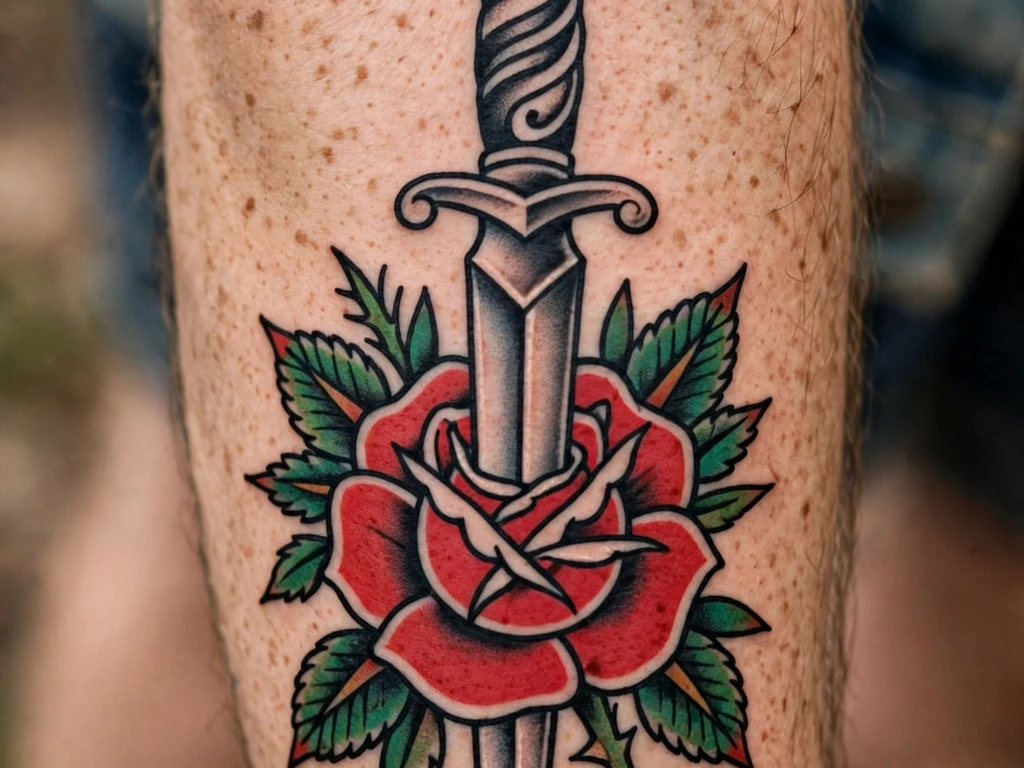
Love and violence in one vertical composition: a polished dagger driven through — or rising behind — a full red rose, green leaves cupping the bloom. The pairing is the traditional canon’s favourite piece of symbolism, read as love defended, beauty with a guard, or a heart that survived something sharp. It is also one of the most forgiving first traditional pieces, because the composition is naturally tall and narrow. Our wider rose tattoo design ideas show how the same flower carries a dozen other styles, but in bold red-and-green traditional it is the rose in its most durable form.
Best placement: Down the forearm, blade pointing towards the wrist or elbow; also strong on the outer calf or upper arm.
Best for / know before you book: The dagger’s edge lines run close and parallel — your artist should keep honest skin gaps between blade and petals, because tight parallel lines are the first to merge as the tattoo settles over the years.
3. Swallow Pair
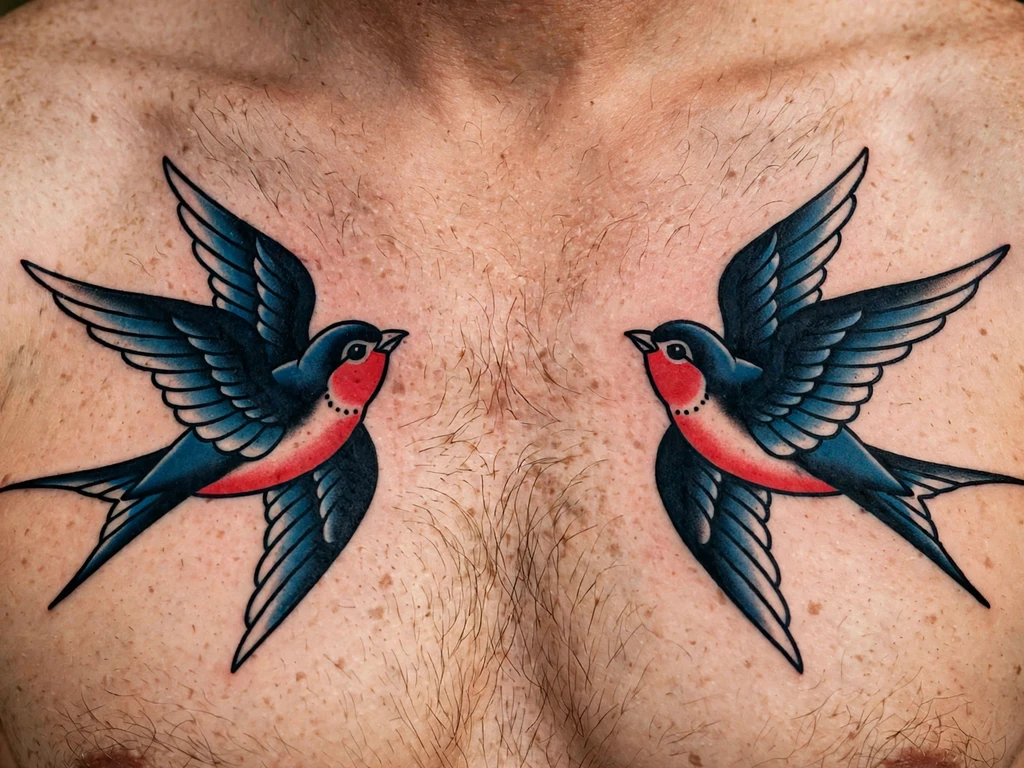
Two swallows in flight, wings swept, traditionally one on each side of the chest — among the oldest sailor tattoos in the canon, earned in lore at 5,000 nautical miles apiece and worn as a promise that the wearer, like the swallow, would return home. The traditional swallow is unmistakable: blue-black back, red throat, forked tail streaming. Worn singly today on a shoulder, wrist or ankle, it has become a general emblem of journeys, freedom and safe returns — and it is one of the designs women have made entirely their own, often placed at the collarbones or hips.
Best placement: Mirrored at the upper chest or collarbones as a pair; singly on a shoulder, forearm or ankle.
Best for / know before you book: A pair must match. Have both stencils placed and checked together in a mirror before either is tattooed, and accept that the forked tail’s fine split needs a few millimetres of size to survive — swallows under about 6 cm wide lose the fork.
4. Anchor and Banner
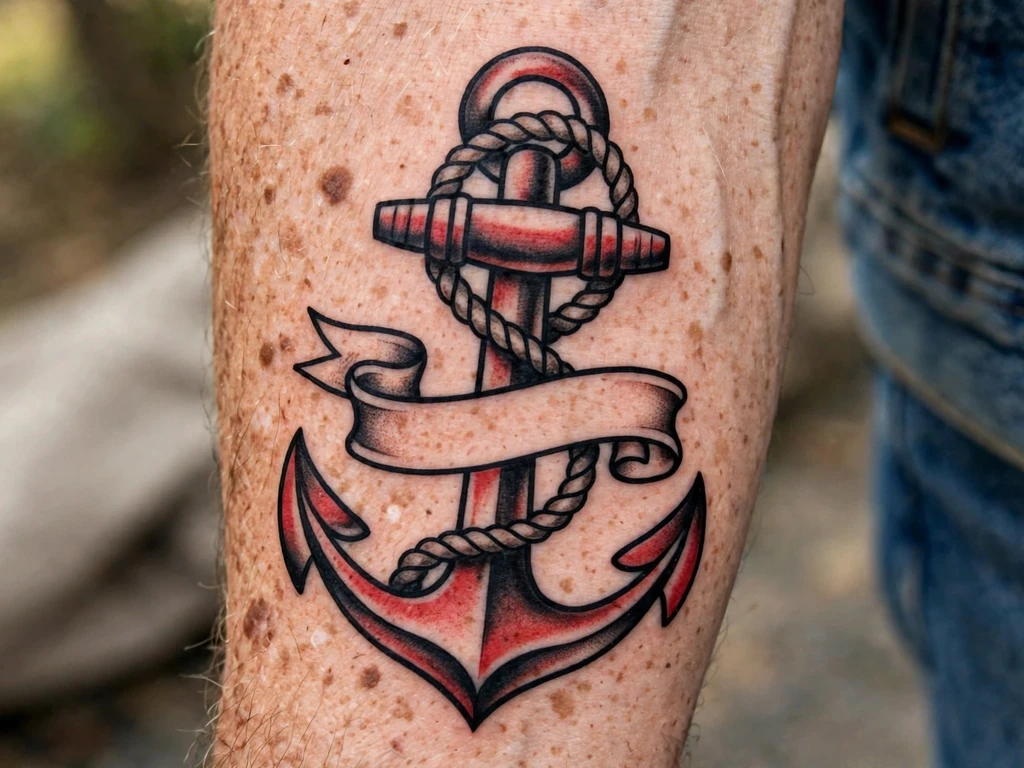
The anchor is stability you can draw: flukes dug in, rope wrapped around the shank, and a banner across the middle carrying a name, a port, or a word like “Steadfast” or “Refuse to Sink.” In naval custom the anchor marked a sailor who had crossed the Atlantic, and it has stayed the canon’s shorthand for whatever holds you in place — a person, a home, a faith, a recovery. It is compact, symmetrical and honest, which is why it is so often a first tattoo.
Best placement: Forearm, where the vertical shank follows the bone; also classic on an upper arm or calf.
Best for / know before you book: Rope detail is the trap — real traditional anchors keep the rope as a few bold wraps, not a twisted cord of twenty fine lines. If your reference shows intricate rope, ask your artist to simplify it the traditional way; your future self will thank them.
5. Crawling Panther
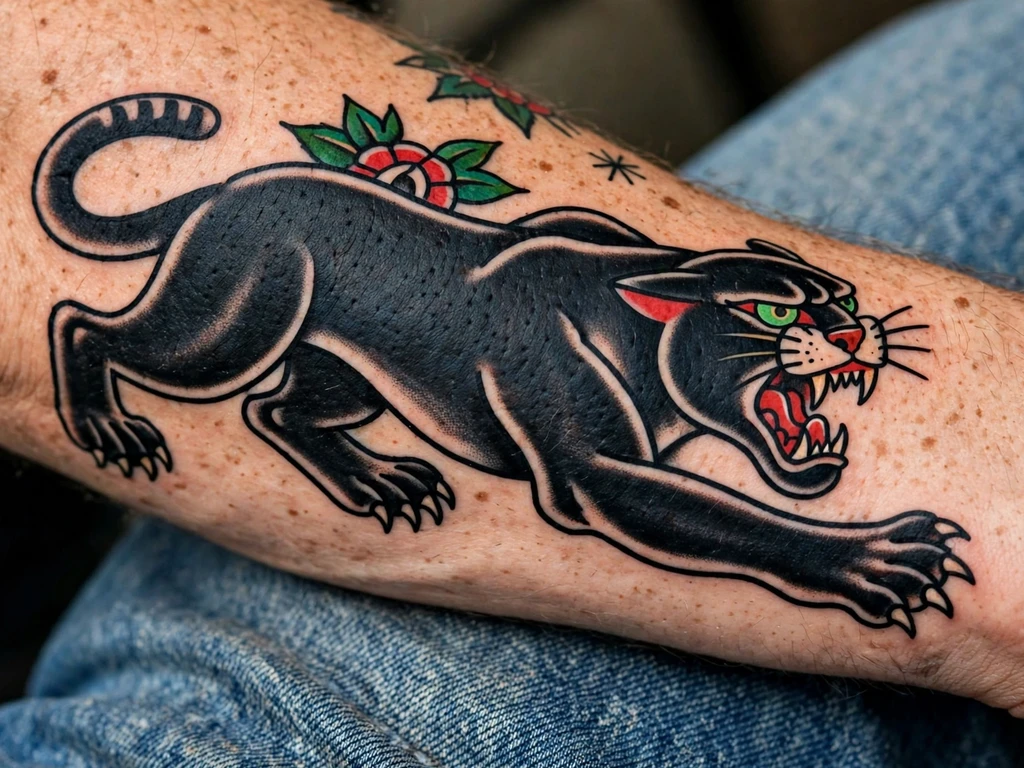
The panther crawls: body low, claws out, mouth open, rendered almost entirely in black with a red mouth and green or yellow eyes. It is the canon’s great space-filler and body-follower — a panther can crawl around a forearm, over a shoulder, or along a calf, turning corners no squared-off design can manage. Sailor Jerry’s panthers set the template, and the design’s meaning — power, stealth, a guardian that moves with you — has kept it in continuous demand for eighty years.
Best placement: Wrapping a forearm or calf, crawling over a shoulder, or climbing an upper arm.
Best for / know before you book: A panther is mostly solid black, and solid black is a commitment: it is the slowest-fading ink but also the hardest to cover or rework later. Check your artist’s healed blackwork — it should heal like velvet, and the claws and teeth, drawn as skin breaks, must be big enough to stay open.
6. Tiger Head
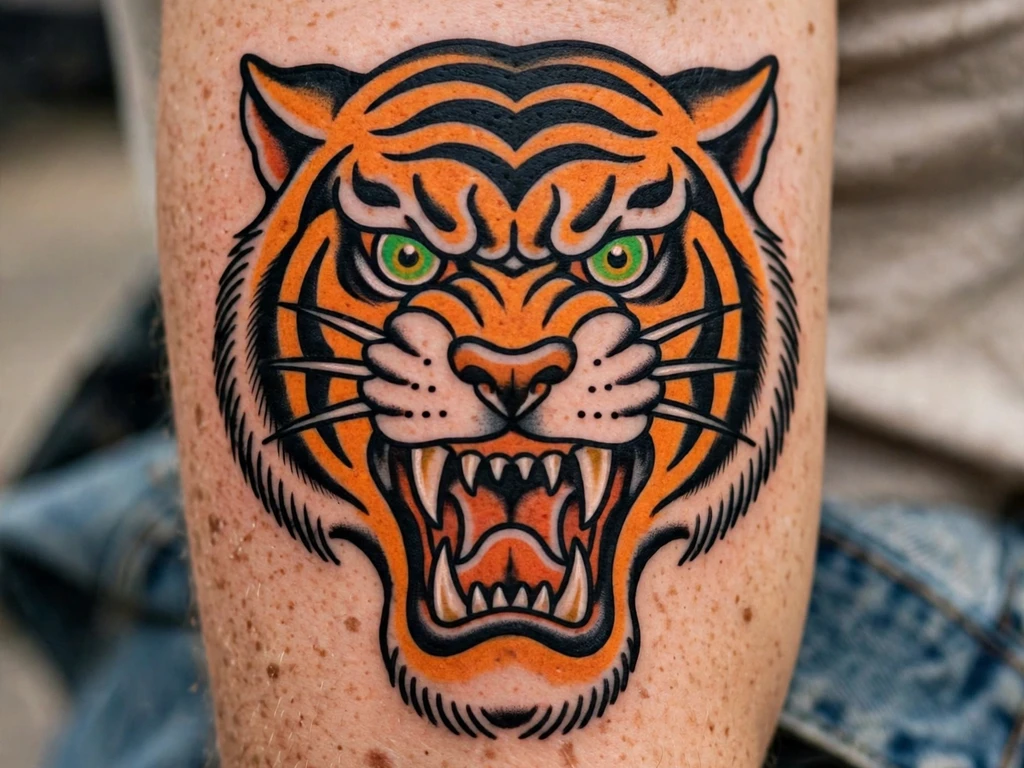
Frontal, snarling, symmetrical: the traditional tiger head is all orange fire and black striping, with green eyes and a red mouth full of white fangs. Where the panther is stealth, the tiger is confrontation — courage, ferocity, protection worn facing outwards. It is a naturally round composition, which makes it a perfect cap for a shoulder or a bold statement on a thigh, and its stripes are drawn as separated wedges so the face stays fierce as it ages.
Best placement: Shoulder cap, upper arm, thigh, or centred on the upper back.
Best for / know before you book: Symmetry again — a tiger’s two eyes a millimetre apart in height will glare at you forever, so check the stencil face-on in a mirror. Orange sits in the middle-fading family: expect it to mellow to a softer rust over the years, which traditional wearers accept as part of the patina.
7. Clipper Sailing Ship
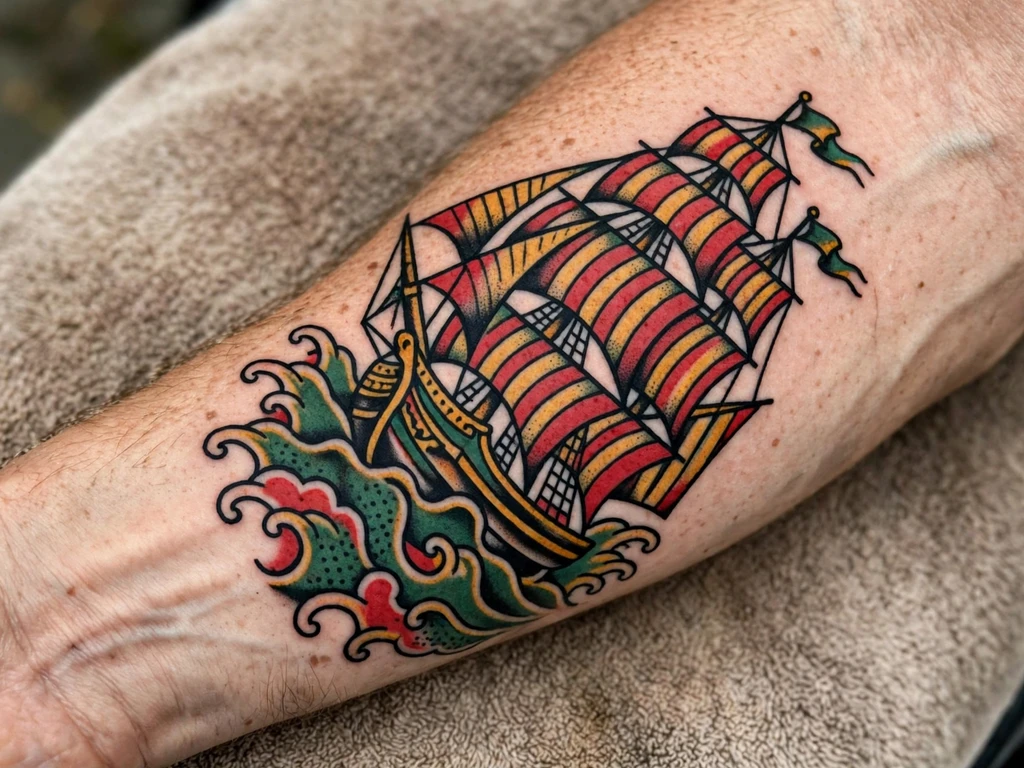
A tall ship under full sail, flags flying, riding stylised waves — the “homeward bound” ship, tattooed by sailors who had made the great voyages and by plenty who simply loved what a ship under sail promises: adventure, skill, and a home you carry with you. The traditional clipper is drawn with billowing striped sails and a hull you could recognise in silhouette, often with a small banner or a rising sun behind it. It is the most romantic image in the canon.
Best placement: Forearm or upper arm for a mid-size ship; the upper back or chest for a full scene with sea and sky.
Best for / know before you book: Rigging is this design’s fine-line trap. Traditional artists draw a handful of bold rigging lines, not a spiderweb — insist on the simplified version, and go bigger than you think: a ship needs roughly 12–15 cm before the sails read as sails rather than stripes.
8. Snake and Dagger
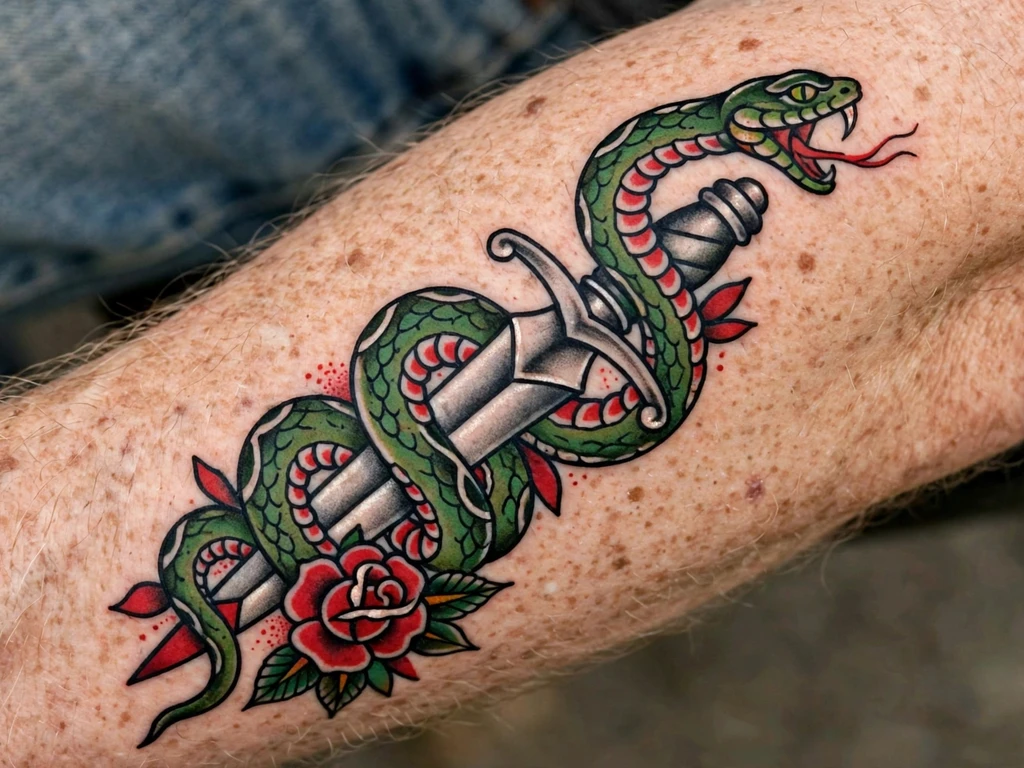
A serpent wound around a dagger, head raised, tongue out — temptation and defence locked together, read variously as good fighting evil, wisdom guarding strength, or a warning not to tread. The coil composition makes it one of the most adaptable vertical designs in the canon, and the snake’s scales, drawn as bold separated arcs, are a masterclass in how traditional artists suggest texture without fussy detail. The pairings in our snake tattoo ideas collection show the serpent in every style going; the traditional version is the one built to outlast them all.
Best placement: Forearm, the coils spiralling with the arm’s turn; also strong on the calf or as a sternum-side vertical on the ribs’ outer edge.
Best for / know before you book: Count the coils before you commit: too many wraps crowd the dagger into invisibility. Three to four bold coils with clear skin between them is the classic proportion, and the head needs a clear silhouette — a snake whose head merges with its own coil reads as a green knot.
9. Classic Skull
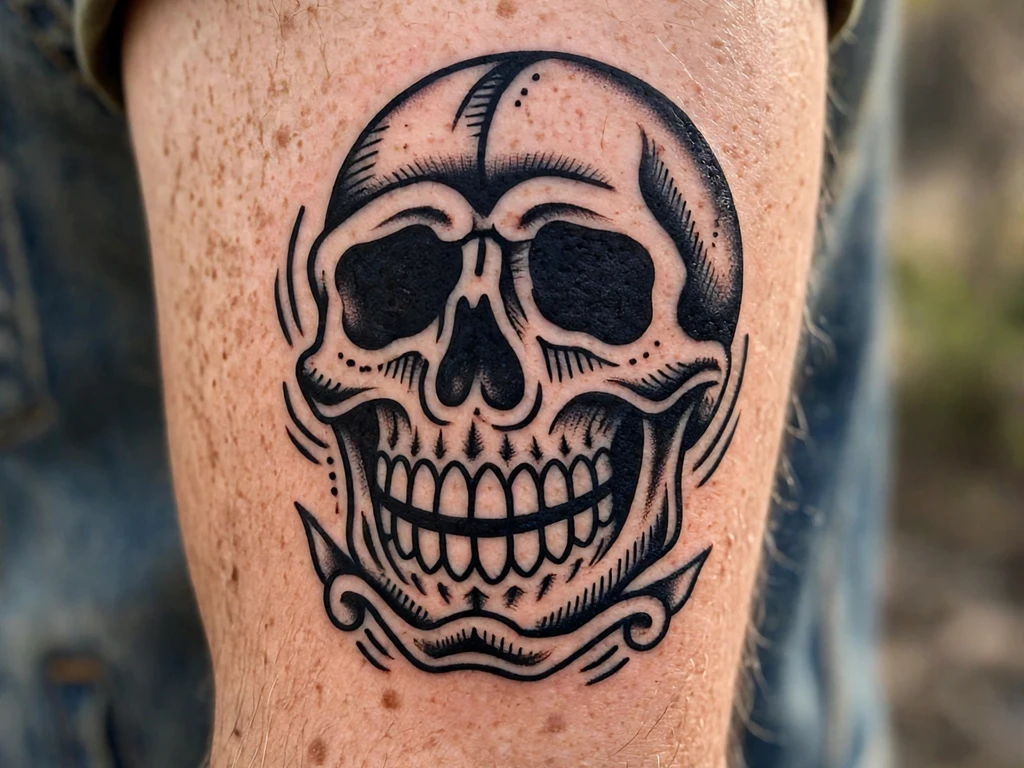
The traditional skull grins: hollow black eye sockets, a triangular nose cavity, and a row of bold teeth, sometimes crowned with a rose, a dagger or a top hat depending on the flash sheet. It is a memento mori from an era that did not flinch from the idea — sailors and soldiers wore the skull as a shrug at mortality and, in the older reading, as a charm that death had already been acknowledged and could pass by. As a tattoo it is nearly indestructible: big shapes, heavy black, nothing to blur.
Best placement: Upper arm, shoulder, or thigh — anywhere with room for the full cranium.
Best for / know before you book: Teeth make or break it. Each tooth needs its own black separation line with real width; teeth drawn as a fine comb merge into a single white block within a few years. Ask to see your artist’s healed skull teeth before you book.
10. Heart and Banner
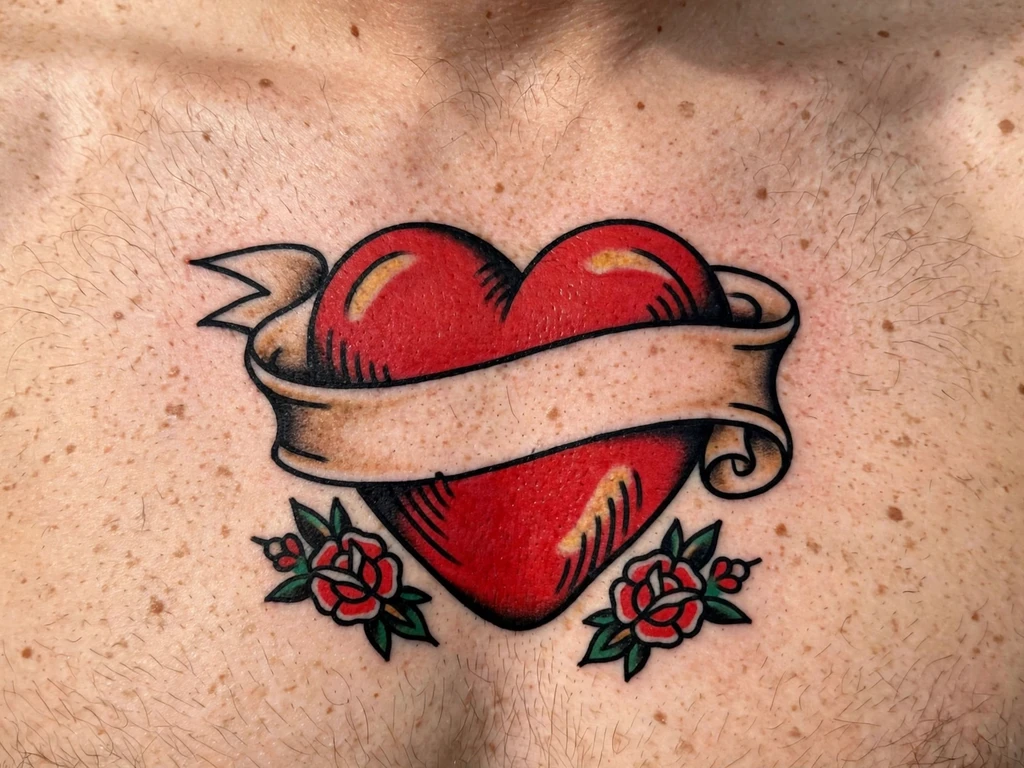
A plump red heart wrapped in a scroll banner — the most personal design in the canon, because the banner carries the point: a mother’s name in the original wartime classic, a partner, a child, a unit, a motto, or a single word like “True” or “Always.” The heart itself is drawn plump and simple with a strong black shade along one side, often flanked by two small roses or swallows. If traditional tattooing has a signature image, this is it.
Best placement: Centre chest over the heart itself, or on an upper arm or forearm where the banner reads clearly.
Best for / know before you book: Decide the banner text before the appointment and proofread the stencil letter by letter — banner script is the most commonly misspelled element in all of tattooing, and it is permanent. Keep lettering at least 8 mm tall per letter or it will thicken into illegibility as the lines settle.
11. Lighthouse and Waves
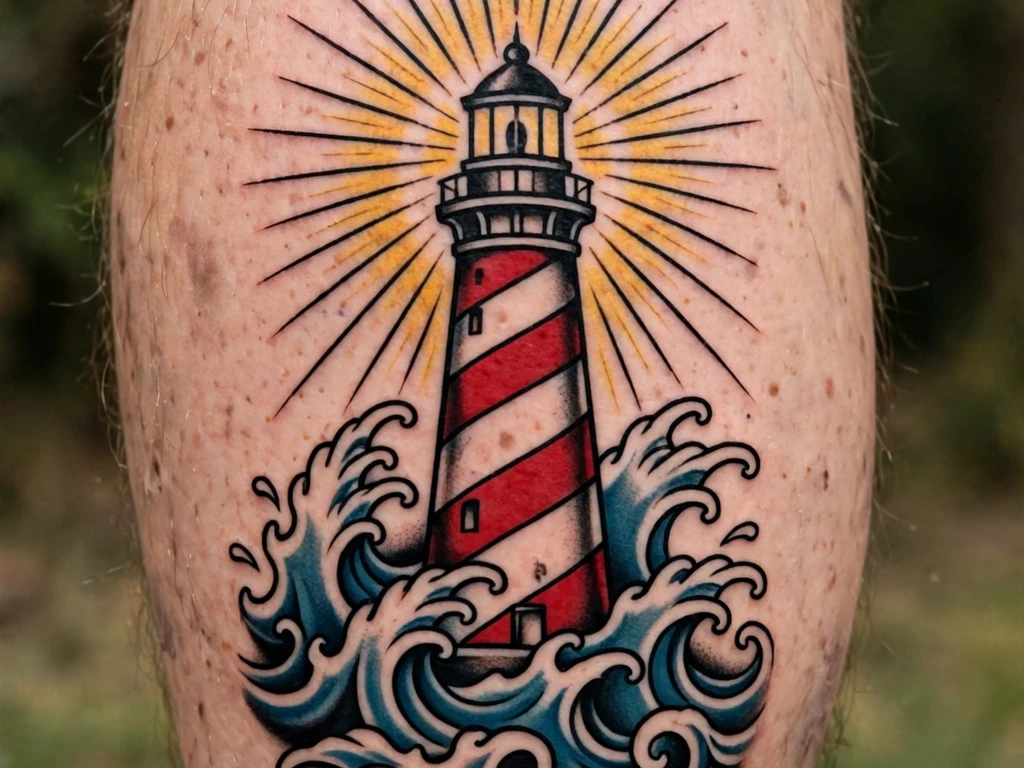
A red-and-white striped lighthouse standing in curling waves, beams radiating, sometimes with a swallow or two overhead: guidance, home, and the light you steer by in bad weather. The lighthouse carried obvious meaning for sailors, and it has kept that meaning for everyone since — people choose it for a parent, a mentor, a hometown coast, or their own determination to be the steady one. Its vertical shape and bold stripes make it one of the most legible designs at small-to-medium size.
Best placement: Calf, where the tower runs down the leg; forearm and upper arm also hold its vertical composition well.
Best for / know before you book: The light beams are usually drawn as skin-break rays or pale shading — agree exactly how yours will be rendered, because beams are the element most often added as an afterthought and the first to look it. Wave curls need the same skin-gap discipline as ship rigging.
12. Lucky Horseshoe
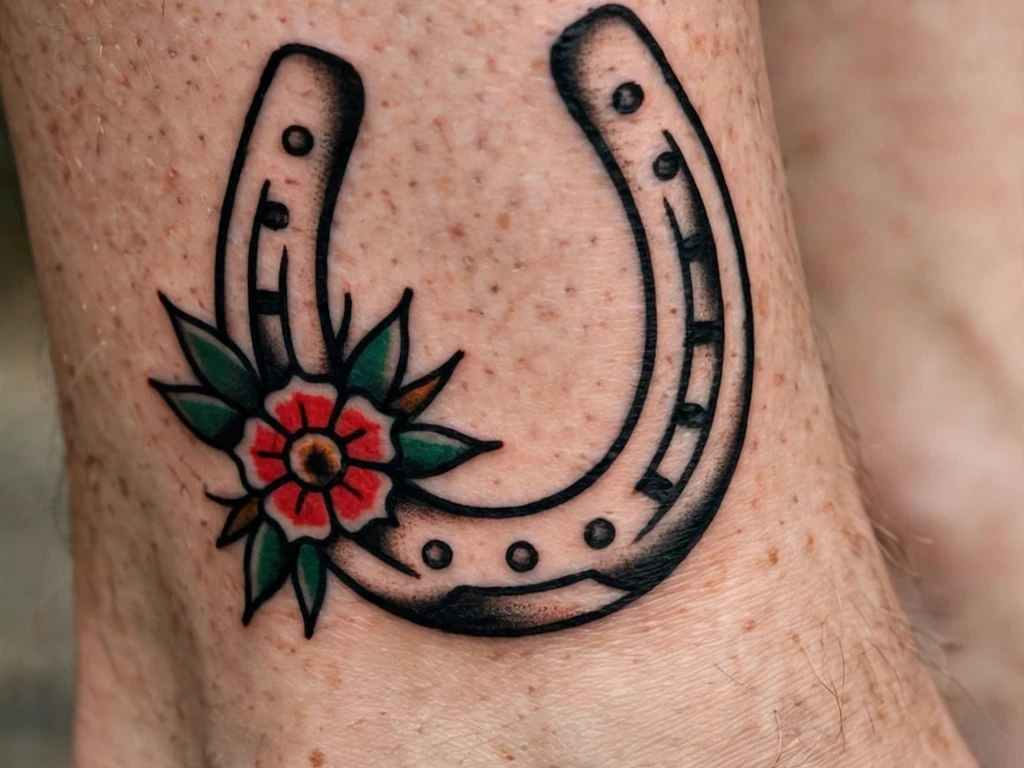
A horseshoe hung open-end up — in the lore, so the luck doesn’t run out — with its nail holes marked as bold dots and a flower or two tucked against the iron. Horseshoes belonged to the luck family of sailor and working-man tattoos, worn by people whose lives genuinely depended on fortune, and they remain the canon’s friendliest small piece: compact, symmetrical, and endlessly placeable. It is a favourite first traditional tattoo for women and men alike, often sitting just above an ankle bone or behind a wrist.
Best placement: Above the ankle bone, on a forearm, or small behind the shoulder; pairs beautifully as matching pieces.
Best for / know before you book: Orientation is the meaning — a shoe hung points-down reads, in the traditional reading, as luck poured away, so be certain which way yours hangs and that the stencil isn’t flipped in transfer. It happens more often than anyone admits.
13. Lucky Dice Pair
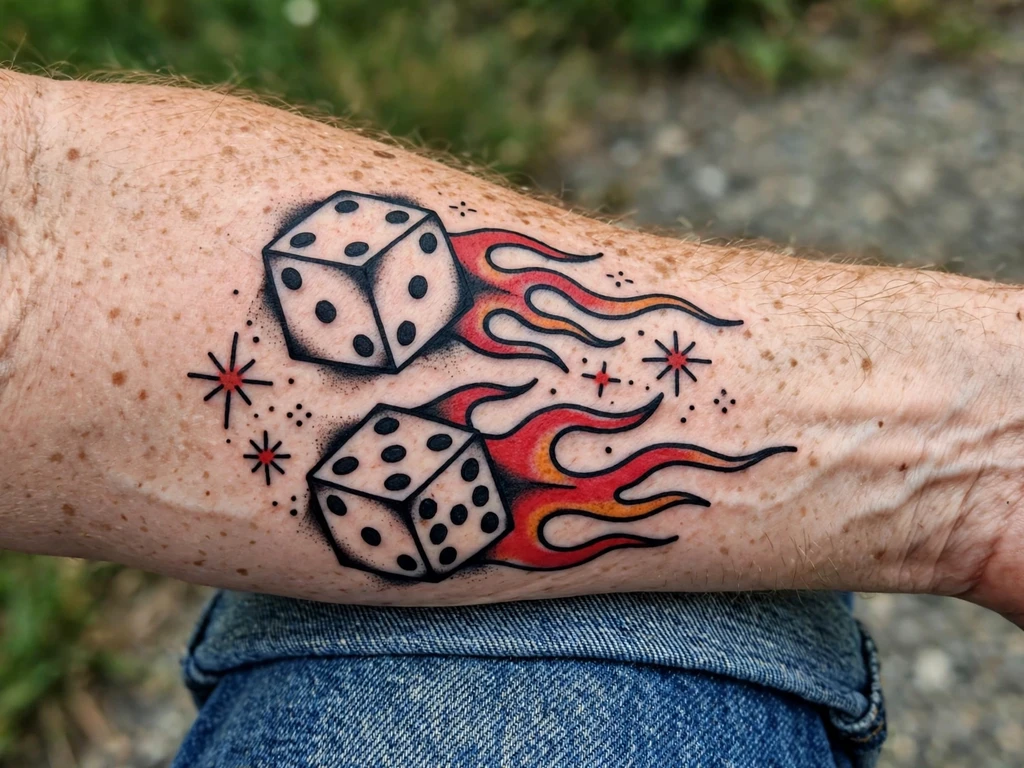
Two dice tumbling together, pips bold and black, often trailed by flames or framed by stars — the gambler’s emblem from the canon’s luck-and-risk shelf, kin to the “Man’s Ruin” flash family without the sermon attached. Dice marked the men who trusted fortune for a living, and today they are chosen by poker players, risk-takers, and anyone commemorating a bet on themselves that paid off. The numbers on the faces are yours to choose, and most people do choose them deliberately.
Best placement: Forearm, ankle, or the top of a foot; dice also sit naturally in the ditch of an elbow’s front.
Best for / know before you book: Pip math matters — opposite faces of a real die add to seven, and someone at every barbecue will check. Decide your shown faces (a pair of lucky sevens is the classic) and have your artist arrange the visible pips correctly, or embrace cartoon dice knowingly rather than accidentally.
14. Cherry Pair
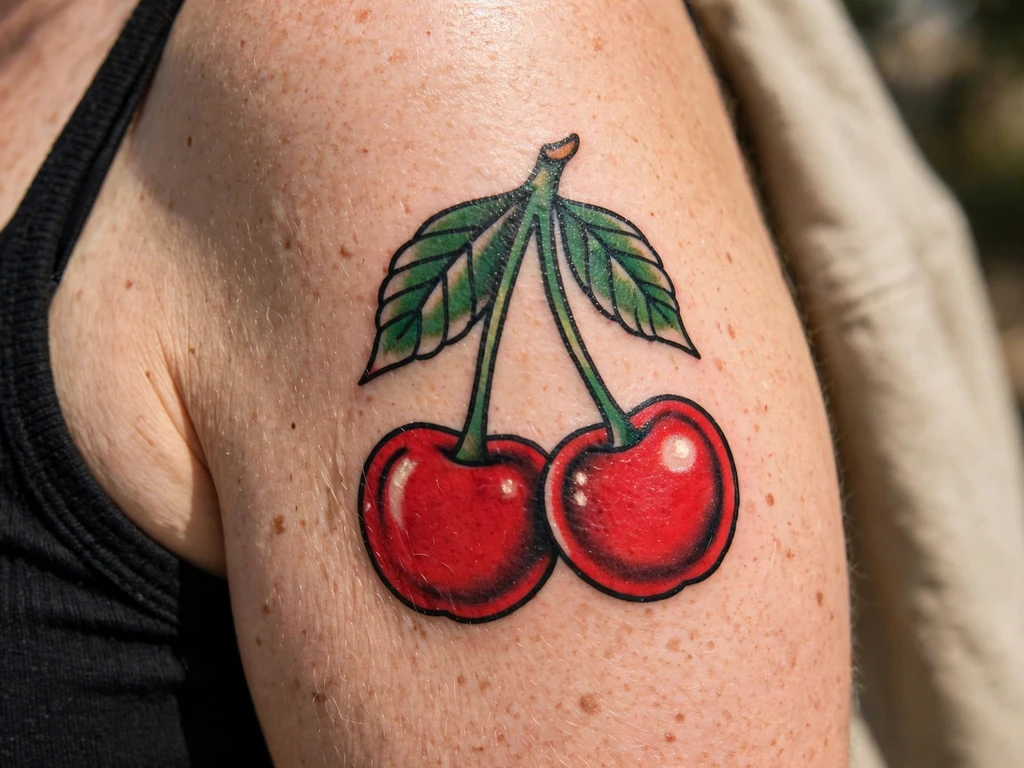
Two glossy red cherries on a single green stem, drawn with a bold black shade and one clean skin-break highlight on each fruit. The cherry pair is one of the canon’s great small designs — sweet, cheeky, and worn by women since the style’s mid-century decades, long before fruit tattoos cycled back into fashion. It scales down smaller than almost anything else in this list while staying perfectly readable, which is why it keeps appearing on ankles, hips and wrists generation after generation.
Best placement: Ankle, hip, wrist, or just below the collarbone — anywhere a small, bright accent belongs.
Best for / know before you book: The highlight is the design: that little un-inked crescent of skin is what makes the cherries look round and wet rather than like two red lollipops. Make sure your artist leaves it generous, because highlights shrink as surrounding lines settle.
15. Pin-Up Silhouette
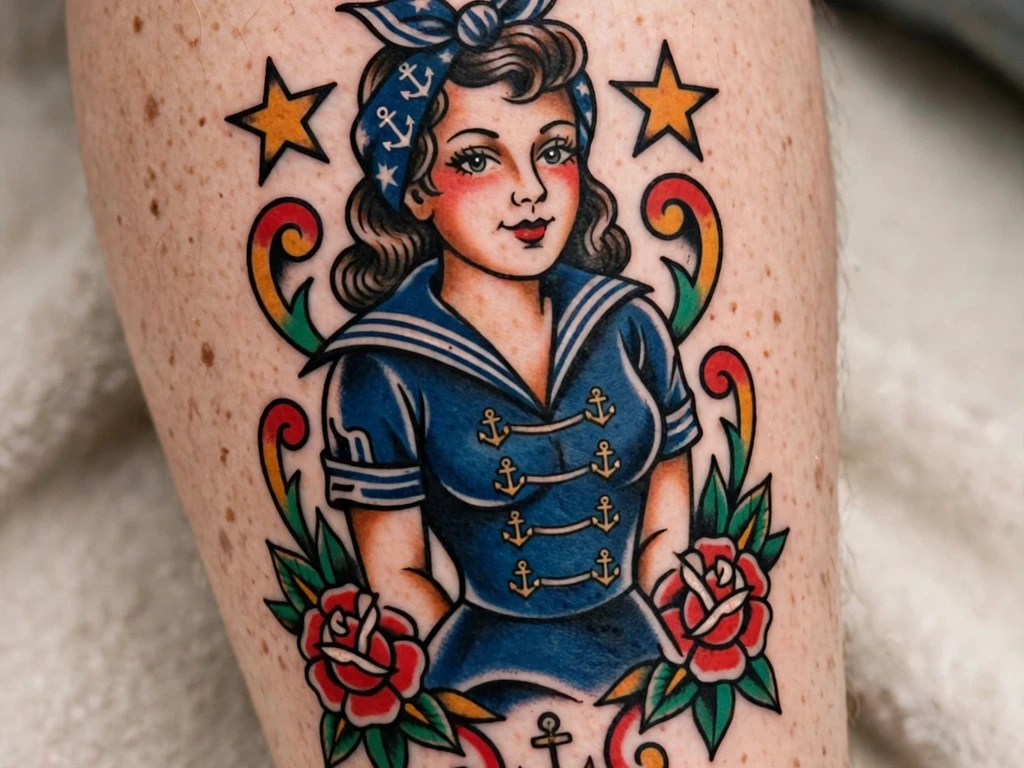
The classic sailor-girl flash, kept tasteful: a vintage pin-up figure in a modest sailor dress and heels, drawn in the flat colours and bold outlines of a 1940s flash sheet. The originals celebrated the sweethearts sailors were sailing back to, and the design remains a affectionate piece of period Americana — chosen today as much for its graphic charm and retro style as for the figure herself, and by plenty of women who wear the sailor girl as a emblem of their own. Treated as silhouette or as a simply drawn figure, it keeps the flash-sheet spirit without a hint of crudity.
Best placement: Upper arm or calf, the two classic flash placements; a thigh gives a larger figure room.
Best for / know before you book: Faces at this scale are unforgiving — a traditional pin-up face is three or four lines, and one tremor changes her expression for good. Look at your artist’s healed faces, not fresh ones, and consider the silhouette version if you want zero risk: it reads instantly and cannot age a day.
16. Nautical Star
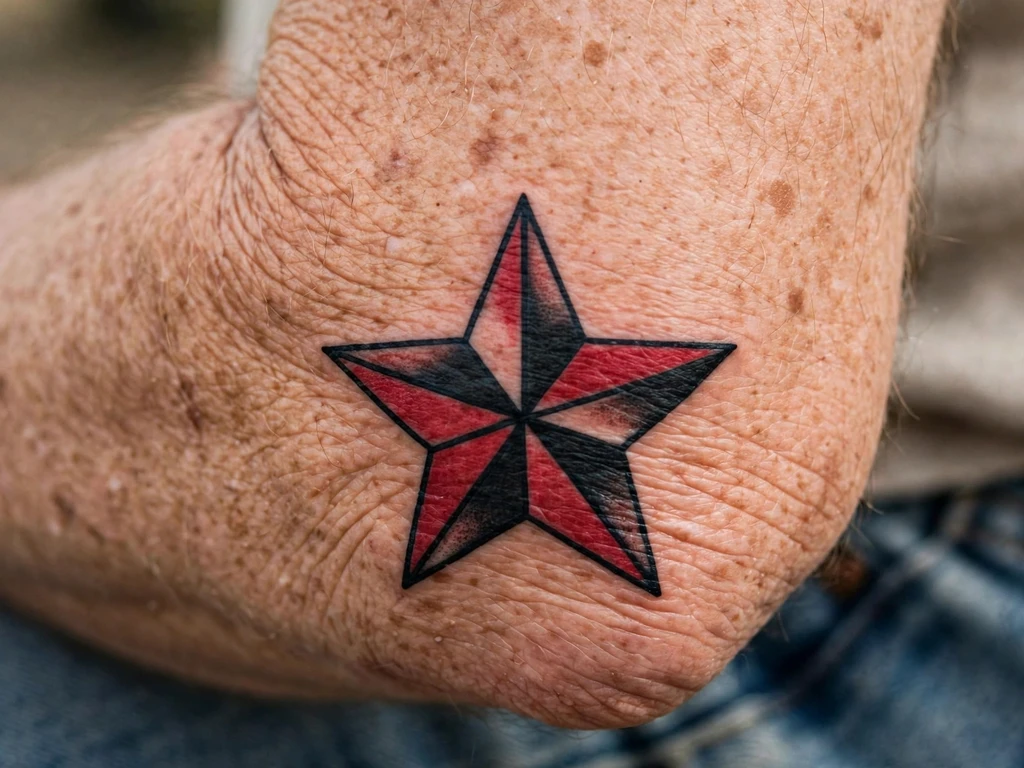
A five-pointed star split into alternating red and black (or black and skin) facets — the North Star sailors steered home by, and one of the most placed designs in the canon: on elbows, knees, shoulders, and the fronts of hips. Its meaning is guidance and finding your way, and its geometry is pure traditional logic: a shape so simple it cannot blur, in the two fastest-holding colours there are. It is also a classic gap-filler that knits patchwork sleeves together.
Best placement: Centred on an elbow or knee, on a shoulder point, or mirrored on both forearms.
Best for / know before you book: A nautical star is five exact points and ten exact facets — it advertises unevenness mercilessly. Have it stencilled and checked from a photograph square-on, not in a mirror, and if it centres on an elbow, check it with your arm bent and straight.
17. Sacred Heart
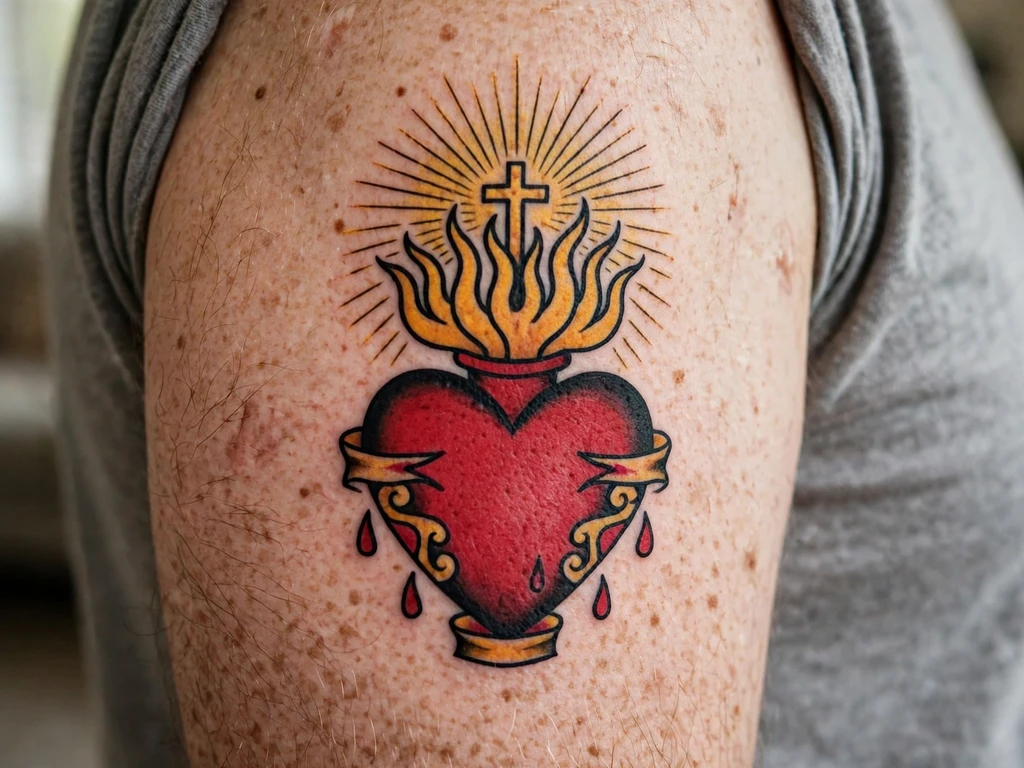
A red heart crowned with flames and a small cross, wrapped sometimes in thorns and always in radiating lines — the sacred heart carried devotional tattooing into the traditional canon, worn as an emblem of faith, sacrifice and a love that burns rather than fades. It is one of the oldest continuously tattooed images in the West, and its traditional rendering is pure geometry and symbol: flame tips, even rays, a heart plump enough to carry it all. Wearers choose it for faith, for family tradition, or for a love they consider sacred in the plain sense of the word.
Best placement: Centre chest, upper arm, or between the shoulder blades where the rays can spread.
Best for / know before you book: The radiating lines are a spacing test — rays drawn too close merge into a solid sunburst blob at the edges within years. Rays need the same daylight between them as the rays in any design in this guide, and the cross must be checked dead upright in the mirror, standing, before you commit.
18. Rock of Ages Cross
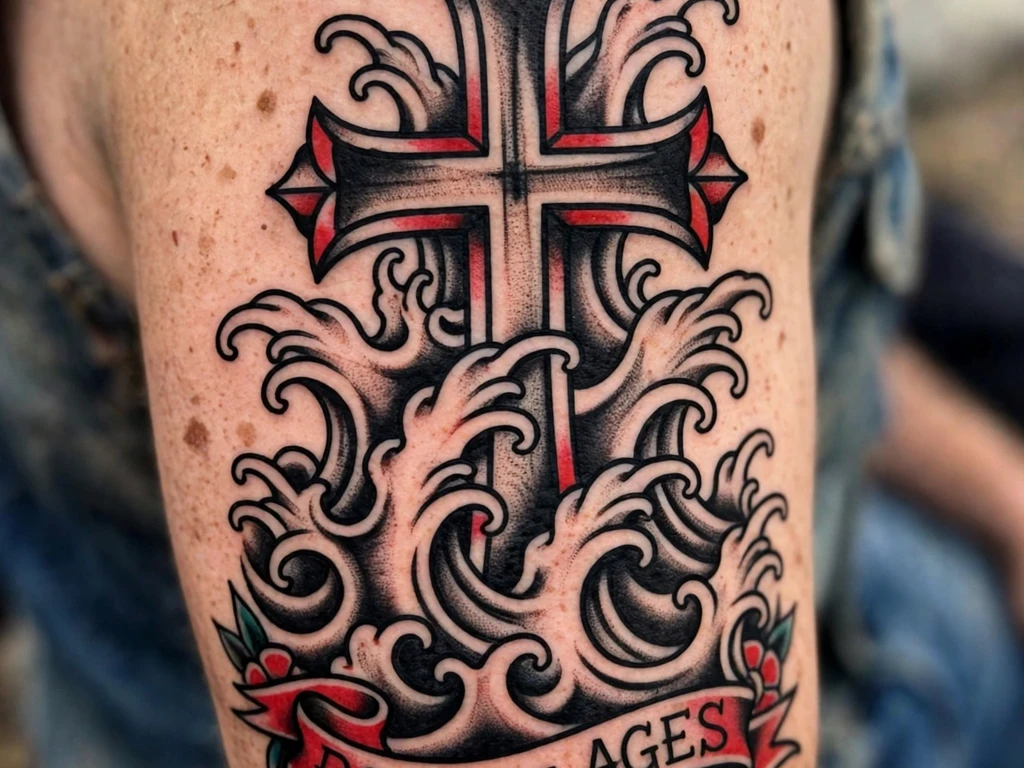
A cross rising out of crashing waves, sometimes with a clinging figure or a banner reading “Rock of Ages” — the hymn illustration that became one of the most tattooed religious images of the sailor era, standing for faith that holds in the storm, literally drawn as a storm at sea. It is the design sailors chose when they wanted their faith and their profession in the same picture. Our cross tattoo design ideas gather the wider family of cross designs; the Rock of Ages is its most storied traditional member.
Best placement: Upper arm or upper back, with the waves breaking at the base; a calf carries the vertical composition well.
Best for / know before you book: This is two designs in one — cross and sea — and it fails when either is cramped. Budget at least 12 cm of height so the waves can actually crash rather than squiggle, and proofread any banner hymn text letter by letter like every banner in this guide.
19. Traditional Dragon
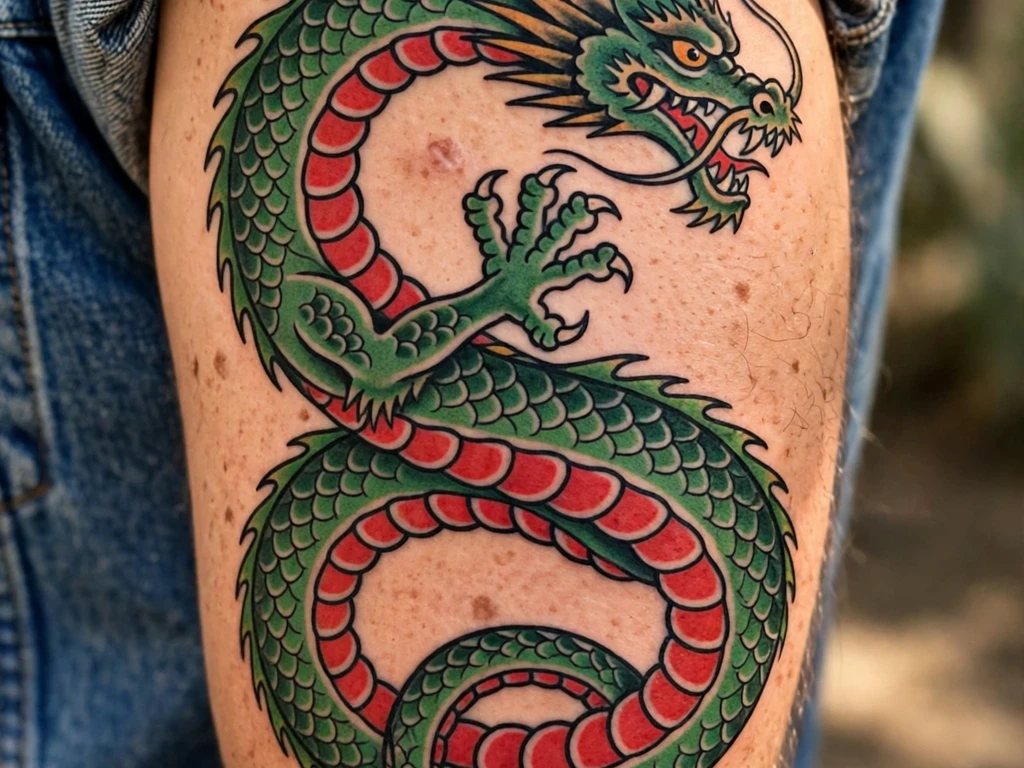
The American traditional dragon is its own creature: green-scaled, red-bellied, curled in a tight S with claws out and a snarling, almost dog-like head — descended from the Japanese dragons Sailor Jerry studied and admired, then redrawn in the bold, limited palette of American flash. It stands for power, wisdom and protection in both traditions, and its curling body is built to wrap an arm or climb a calf. The designs in our dragon tattoo design ideas span every culture’s take; the traditional version is the one that trades fine scale detail for a silhouette that will never quit.
Best placement: Wrapping an upper arm or forearm, curled around a calf, or climbing one side of the back.
Best for / know before you book: Scales are bold arcs or they are nothing — at small sizes they merge into green chainmail mush, so give a traditional dragon real estate, roughly 12 cm or more in its longest dimension. The belly segments need the same treatment: red wedges separated by clean black lines.
20. Gypsy Head
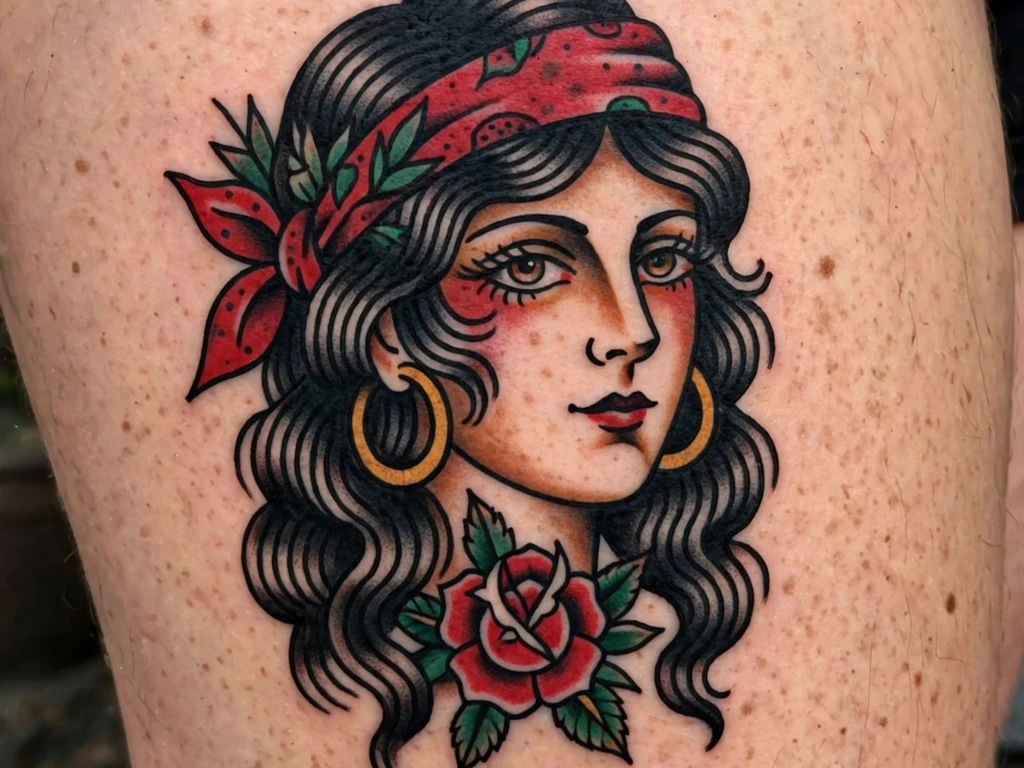
The classic woman’s portrait of old flash: dark hair in waves, a rose or scarf at her neck, hoop earrings, strong brows and a calm, unsmiling gaze — drawn in profile or three-quarter view. The gypsy head is one of the canon’s proof pieces that traditional tattooing was never only eagles and anchors; it was portraiture too, and women wear it today both as a beautiful object and as an emblem of independence and free-spiritedness. In modern readings she is less a “gypsy” stereotype than the style’s great female icon — treat her as a portrait with a history, and choose an artist who draws her with respect and skill.
Best placement: Upper arm, thigh, or shoulder blade — a flat enough canvas for a face to sit undistorted.
Best for / know before you book: Portrait faces are the hardest thing in traditional tattooing; this design should only go to an artist whose healed traditional faces you have seen and loved. Skin breaks do the modelling here — cheeks and hair highlights are bare skin — so the drawing must be composed on your skin tone, not copied from paper alone.
21. Traditional Butterfly
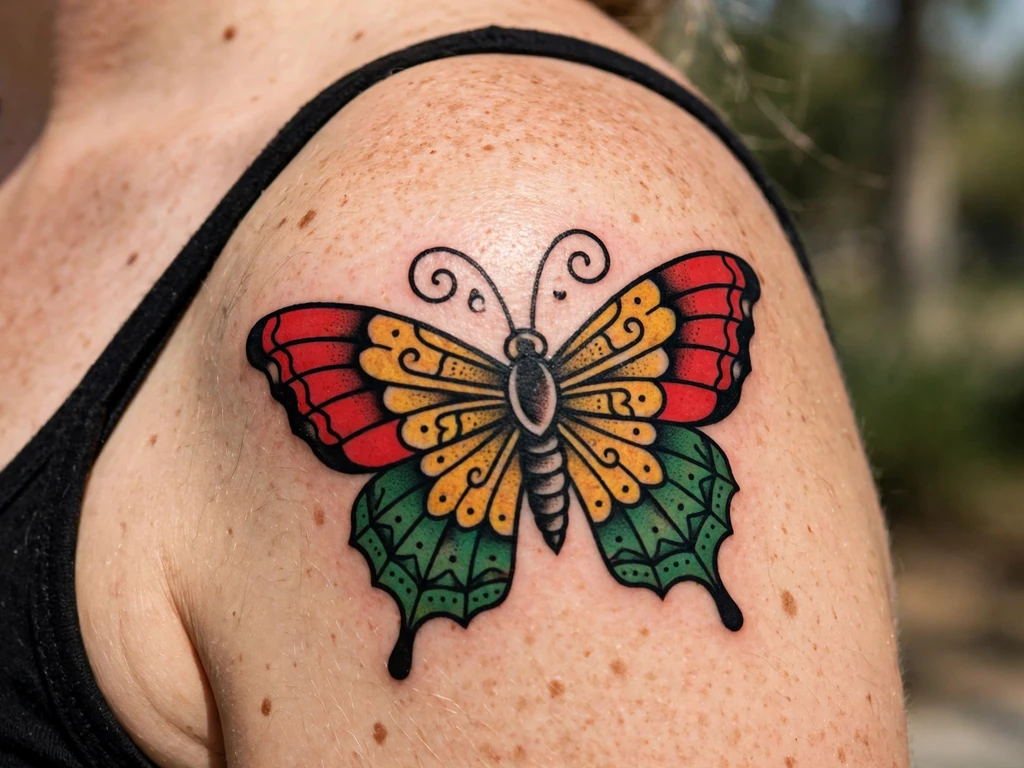
Before the butterfly was a fine-line favourite, it was a traditional one: bold black outlines, wings in red, gold and green, antennae curled, the pattern symmetrical as a printed emblem. Traditional butterflies sat on sailors’ chests and shoulders a century ago, carrying the same meaning they carry now — transformation, freedom, a soul that changed its form — executed with the staying power only heavy linework gives. For women especially, the traditional butterfly is the bridge piece: the softest subject in the canon, drawn in its toughest language.
Best placement: Shoulder, upper arm, ankle, or centred at the upper back between the shoulder blades.
Best for / know before you book: Symmetry and the wing pattern’s inner detail both need size — below about 7 cm wide, the wing wedges crowd and the butterfly becomes a colourful moth shape. Butterflies also expose a wobbly mirror image instantly, so the two-person mirror check applies here in full.
22. Crescent Moon and Stars
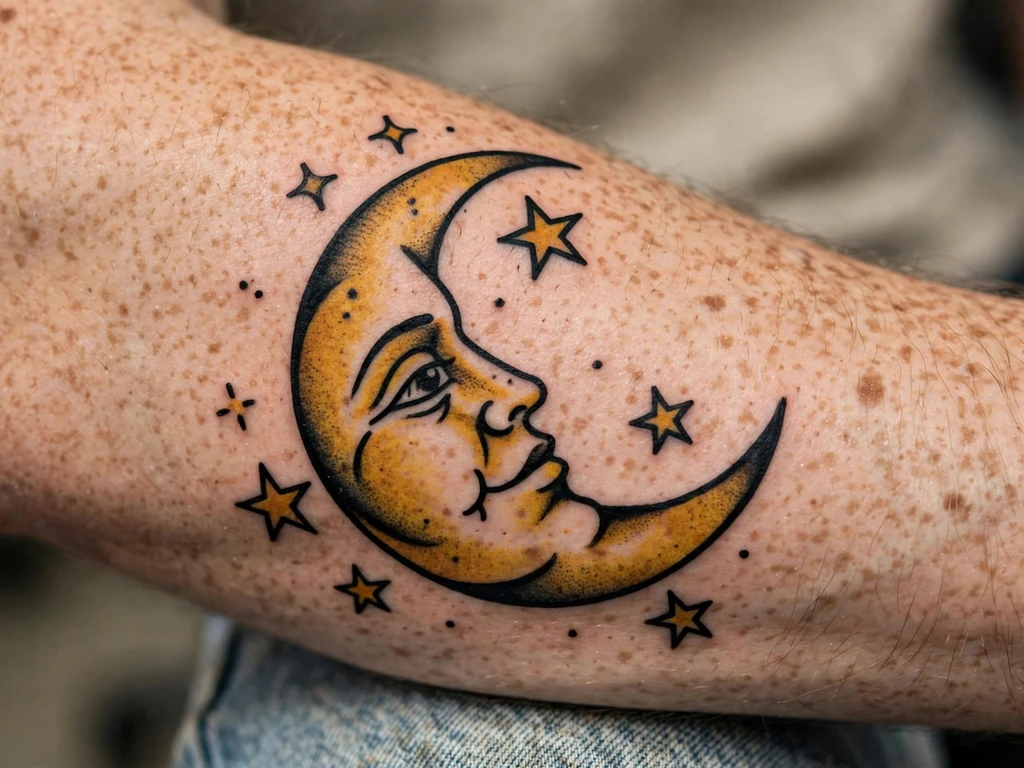
A crescent moon with a serene, heavy-lidded face in profile, stars scattered around it — the night sky of old flash, partner to the nautical star and carrier of its own meanings: cycles, dreams, the feminine in the broad symbolic sense, and guidance through dark water. The moon’s face is drawn with a few unhurried lines and a skin-break cheek, and the whole composition is one of the canon’s most charming small-to-medium pieces, worn happily by everyone.
Best placement: Shoulder, forearm, or the side of a calf; pairs naturally opposite a sun or a nautical star.
Best for / know before you book: The crescent’s inner curve is the skill test — a lumpy inner arc reads as a banana, not a moon. Check your artist’s curved linework in healed pieces, and keep the face’s features minimal: at traditional scale, two lines of expression beat six.
23. Traditional Shark
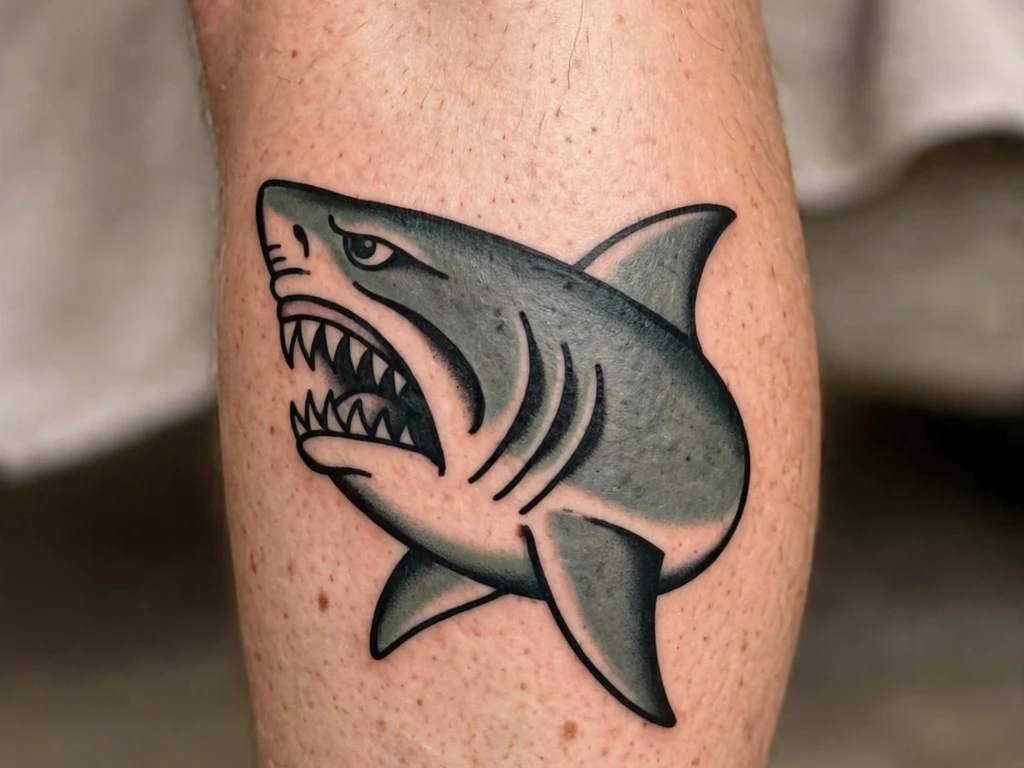
A shark in profile, jaws open, drawn with the flat grey-blue or green shading and bold gill lines of vintage flash — the apex predator of the sailor’s world, worn as courage, as a survivor’s emblem, and cheerfully as a warning. Sharks circled every ship a sailor ever sailed, and tattooing one was a way of owning the fear. Today it is chosen by surfers, divers, sailors still, and anyone who likes their emblems with teeth.
Best placement: Calf, where the body can run horizontally along the muscle; forearm or ribs’ outer side for a second classic fit.
Best for / know before you book: Teeth again — a shark’s jaw is a row of skin-break triangles, and each needs width to stay a tooth rather than a white zigzag band. Go a size up from your instinct, and let the artist simplify the gill lines to three bold strokes.
24. Spider and Web
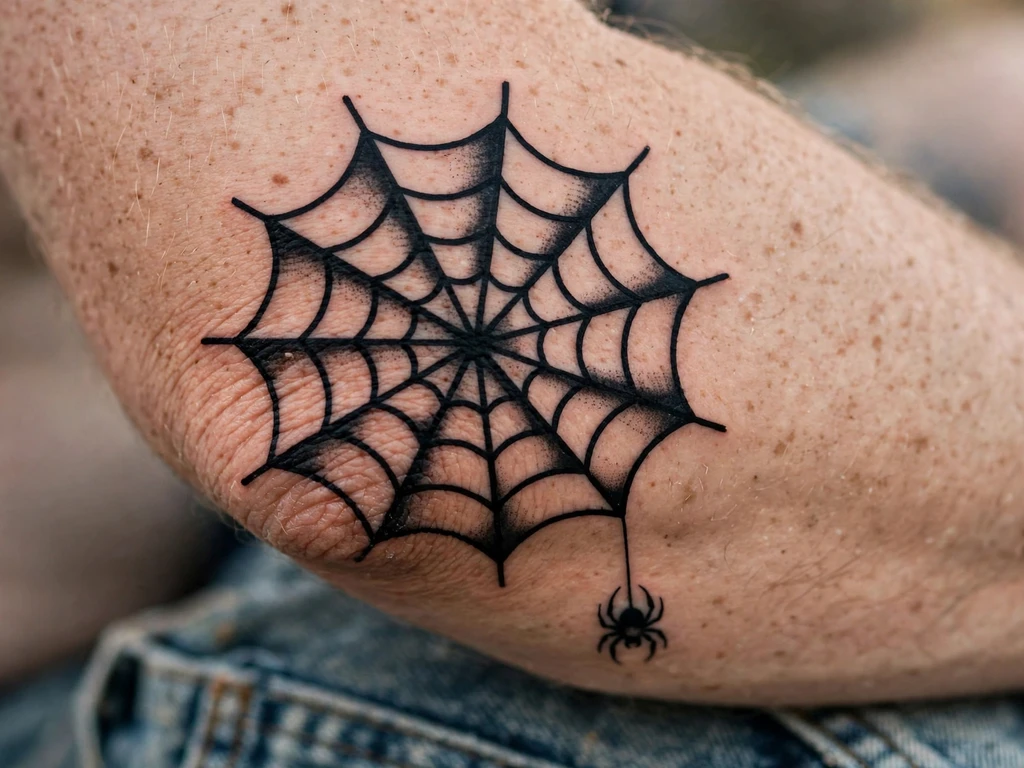
A web spread across the elbow, its radials following the joint’s own geometry, with a small black spider hanging from a thread at the centre: the elbow web is one of the oldest placement-specific designs in the canon, worn by sailors and working men, and endlessly re-read since — as time served, struggles survived, or simply the most satisfying piece of geometry an elbow can wear. Because the web is drawn on the joint itself, it moves: the web stretches and relaxes as the arm bends.
Best placement: Centred directly on the elbow point; a smaller web also sits well on a knee or the web of skin beside a thumb.
Best for / know before you book: Elbow skin is the toughest, driest canvas on the arm and the web’s centre sits right on it — expect a scratchy session and budget a touch-up as normal. The stencil must be checked with the arm bent and straight, because a web centred on a straight arm sits visibly off when you bend it.
25. Eagle and Snake Back Piece
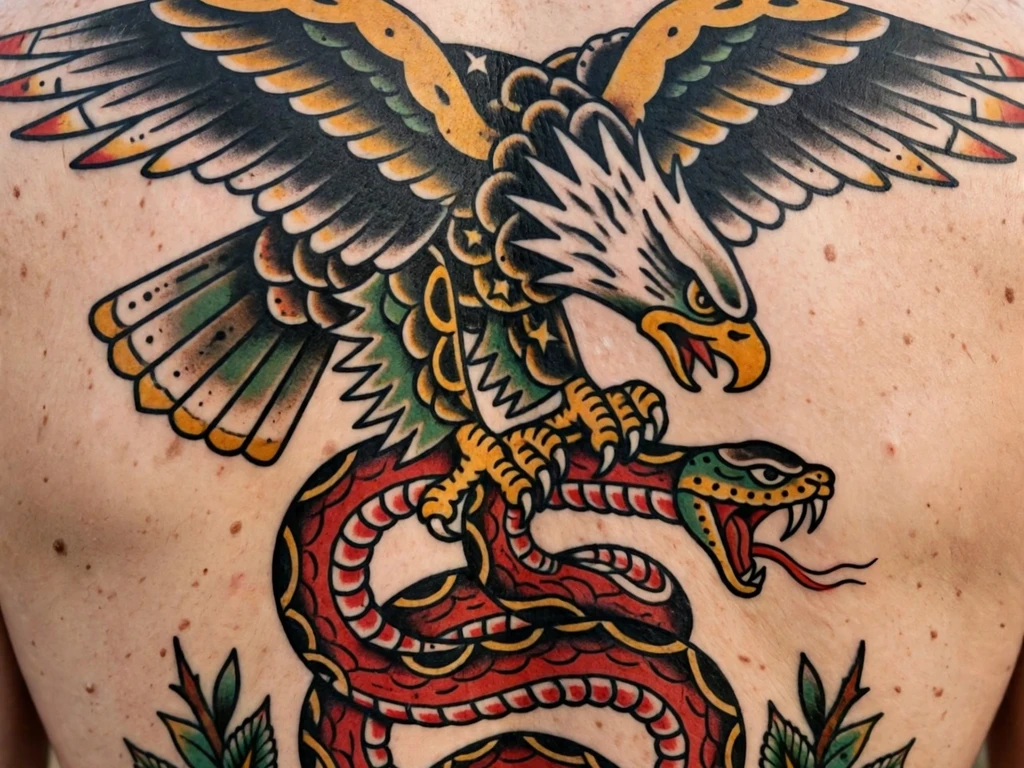
The capstone of the canon: an eagle and a snake locked in combat across the whole back — the famous “Battle Royale” composition, wings spread from shoulder to shoulder, talons in the serpent’s coils, feathers and scales rendered in the full traditional palette at the largest scale the style allows. It is the design the whole tradition points towards: maximum symbolism (strength against cunning, sky against earth), maximum craft, and a piece that takes multiple sessions and a serious artist. Nobody drifts into a Battle Royale; it is chosen the way a coat of arms is chosen.
Best placement: The full back, composed shoulder to shoulder and waist to nape.
Best for / know before you book: This is a project, not an appointment — book a consultation, expect a custom drawing fitted to your back standing, and plan the sessions and budget honestly (outline first, then colour in sittings). Choose the artist for their large-scale traditional work specifically; a great small-flash artist is not automatically a back-piece artist.
Traditional Tattoo Placement by Size
| Size | Typical dimensions | Best placements | Good to know |
|---|---|---|---|
| Small | 5–8 cm | Ankle, wrist, forearm, behind the shoulder | Cherries, horseshoes and small stars live here — traditional rarely works smaller; bold lines need room |
| Medium | 8–15 cm | Forearm, upper arm, calf, shoulder | The canon’s sweet spot: eagles, daggers, ships, hearts and heads all read perfectly at this scale |
| Large | 15–30 cm | Chest, thigh, upper back, full calf | Chest eagles, big tiger heads, ships with full sea and sky |
| Extra large | 30 cm+ / multi-session | Full back, chest-to-stomach compositions | Battle Royale back pieces and full traditional torsos; planned in one consultation, tattooed in sittings |
How to Choose Your Traditional Tattoo (and What to Know Before You Book)
Start from real flash, then make it yours. Traditional designs come from flash — the pre-drawn sheets on shop walls — and there is no shame in choosing one nearly as drawn; that is how the canon survived a century. The Tattoo Archive in North Carolina, founded by historian C.W. Eldridge, has spent decades preserving original flash, machines and shop records, and browsing archival flash (or a good flash book) is the best education your eye can get before a consultation. Then let your artist redraw it for your body: real traditional artists redraw rather than trace, adjusting the design to your anatomy and their hand.
Respect the style’s minimum size. Every style has a floor, and traditional’s is higher than most because the boldness is the point: heavy lines, separated colour wedges and skin-break highlights all need physical room. An eagle at 6 cm is a blob with ambitions; at 14 cm it is an eagle for life. If your chosen placement cannot fit the design at its honest size, change the placement or simplify the design — never shrink a traditional piece below its floor and expect the lines to hold.
Know how traditional colour ages — honestly. Traditional’s reputation for ageing well is earned, but it is not magic. Black holds longest and structures everything. The classic palette mellows in a rough order: reds soften and can turn rusty-pink over decades, greens hold well, mustard gold and yellows fade fastest and may want a refresh in 10–15 years, and orange settles towards rust. Sunlight accelerates all of it. What you get in exchange is the best failure mode in tattooing: a well-built traditional piece doesn’t blur into mush, it settles into a softer, slightly muted version of itself — the look people mean by “aged like a good tattoo.”
Build patchwork deliberately. Most traditional wearers collect: one piece at a time, different flash, gaps of skin between them — the famous patchwork sleeve or leg. Patchwork rewards a little planning: keep one scale family per limb, leave breathing room between pieces, and use small gap-fillers (stars, cherries, tiny daggers, dots) last, not first. The layouts in our forearm tattoo ideas show how collected pieces share an arm — the principle is identical, only the style here is bolder. And tell your first artist you plan to collect; compositions with open edges extend far more gracefully.
Choose the artist by their healed traditional work. Traditional looks simple and is not: a wobbly bold line cannot hide, colour packing shows every gap, and skin-break highlights are planned, not lucky. Fresh photos flatter; ask for healed work a year or more old, look at the black first (it should be velvet, not patchy), then at whether eagles still read as eagles. A traditional specialist will also talk you out of shrinking or over-detailing a design — that honesty is the sign you have found the right chair.
Take safety seriously. The old-school shops built this style’s reputation on discipline, and the modern version of that discipline is hygiene: a licensed studio, single-use needles opened in front of you, fresh ink in new caps, and an autoclave log the studio is happy to show. Eat before a long sitting, plan breaks on multi-hour colour work, and follow your artist’s aftercare — clean hands, gentle washing, no sun on the healing piece, and no picking at the heavier scabbing that solid colour packing can produce.
Key points to remember:
- Bold lines, limited colours, skin breaks: the rules are the reason traditional ages better than any other style
- Never shrink a traditional design below its honest minimum size — simplify it or move it instead
- Reds mellow, golds fade fastest, black holds longest; sunscreen is the maintenance contract
- Check banner lettering and stencil symmetry letter by letter, standing, in a mirror and a photo
- Judge artists on healed traditional work — fresh photos hide every weakness this style can’t forgive
Frequently Asked Questions
What is the meaning of an American traditional tattoo?
There is no single meaning — each classic motif carries its own traditional association, most of them rooted in sailor custom: swallows for voyages and returning home, anchors for stability, eagles for strength and patriotism, roses for love and remembrance, nautical stars for guidance. These meanings are lore and custom rather than documented fact, and modern wearers freely choose a design for the traditional meaning, for a private one, or simply because a bold eagle is a magnificent thing to wear. The meaning that counts is the one you can explain in a sentence.
Do traditional tattoos age better than other styles?
Yes — honestly earned yes. Heavy black outlines hold the design’s structure as skin changes, the limited palette uses the most durable pigments, skin breaks keep the image open, and there is no fine detail to blur. A traditional tattoo at twenty years old usually reads as a softer, slightly muted version of itself, where a fine-line or micro-detail piece of the same age may have lost whole elements. The trade-offs are real — golds and yellows fade first, reds mellow — but no style ages more gracefully overall.
Are traditional tattoos a good choice for women?
They always have been. Women have worn traditional work since the style’s early decades — the cherry pair, the swallow, the gypsy head and the heart-and-banner are classics in part because women kept choosing them — and today’s traditional scene is full of women artists and collectors building patchwork arms and legs in the canon. Placement and scale follow the same rules for everyone: bold designs on canvases that fit them. If a shop talks about this style as men’s work, it is telling you it learned its history from posters, not from the record.
How much does a traditional tattoo cost?
It tracks size and sitting count rather than the name. A small piece of flash — cherries, a horseshoe, a nautical star — may cost a studio’s minimum to the low hundreds; a medium eagle, ship or dragon usually sits in the mid hundreds depending on city and artist; chest pieces and the Battle Royale back piece are multi-session projects quoted by the sitting or the day. Traditional’s single-sitting efficiency is one of its economies: a bold medium design is often finished in one appointment where a detailed realism piece of the same size would take three.
Can a traditional tattoo be covered up or reworked later?
Bold traditional is actually the cover-up style of choice — heavy black and saturated colour bury old work better than anything — but the reverse is also true: a big, solid traditional piece is among the hardest tattoos to cover if you tire of it, precisely because it is so dark and so permanent. Reworking is the happier path: traditional pieces can be refreshed, re-lined and re-coloured decades later, and a good artist can add to a composition around an old piece. Choose designs you can imagine defending at sixty, and the question usually answers itself.
Final Thoughts
American traditional is tattooing’s longest-running argument that simple is not the same as easy. A century of sailors, soldiers, travellers and romantics stress-tested these 25 designs on real skin, in real sun and salt water, and the ones in this guide are the survivors — bold enough to read at a distance, symbolic enough to explain in a sentence, and built to settle into your skin rather than smear across it.
Shortlist the designs you keep coming back to, find the artist whose healed eagles and panthers convince you, and let them redraw your choice for your body. A century from now, someone will still be tattooing these same eagles and swallows — wear yours like you intend to be part of the reason why.
2 thoughts on “25 Timeless Traditional Tattoo Ideas That Never Go Out of Style”