Koi are the hardest-working fish in tattooing. One animal carries colour like a festival, moves like water, and comes with a story: the carp that swims upstream, fights the waterfall and, in the old Chinese tale retold in Japan, turns into a dragon. That story is why koi fish tattoo ideas keep circling back to the same themes — persistence, luck, and change you earn the hard way.
This page is a working catalogue, not a mood board. Every one of the 27 koi fish tattoo ideas below is a real tattoo on real skin, and each entry says where the piece sits, what the colours are doing, and how that style tends to age. Two entries are outline-stage back pieces and one is an older tattoo that has faded honestly; they are labelled as such.
One warning before the pictures. The details that make a koi read as a koi — the whiskers at the mouth, the plate-like scales, the long trailing fins — are the first details to blur when a design is drawn too small. Keep that in mind as you look through these koi fish tattoo ideas: the bold ones are not bold by accident.
What a Koi Tattoo Means, in Short
Most koi fish tattoo ideas say one of three things. The first is perseverance: the fish swims against the current, and the waterfall legend makes it a sign of effort rewarded. The second is luck and prosperity — ornamental carp have been bred in Japan since the 1820s, and a fat, bright fish has meant good fortune in the region for far longer. The third is balance, drawn most often as two koi circling head-to-tail, an image borrowed from the yin-yang form. You will see that pairing at design 11.
Colour carries its own layer. Orange and red fish — the kohaku and hi varieties — are the classic choice, linked with energy, love and good fortune. A black koi is read as strength through hard times. Gold points at wealth. Blue is calmer: peace, steadiness, and in some readings a son in the family, since the koinobori windsocks flown for Children’s Day assign a colour to each family member. That is the short version; the koi fish tattoo meaning page goes through the legend, the colour chart and the shop talk properly.
Colour Koi: The Classic Fish
Most koi fish tattoo ideas start here — saturated reds, oranges and golds, black keylines holding the colour in, waves or flowers packed around the fish. Colour is the traditional choice, and it asks the most of your aftercare: reds and oranges fade faster in sun than any black line does.
1. Orange and Teal, Traditional Style, Thigh
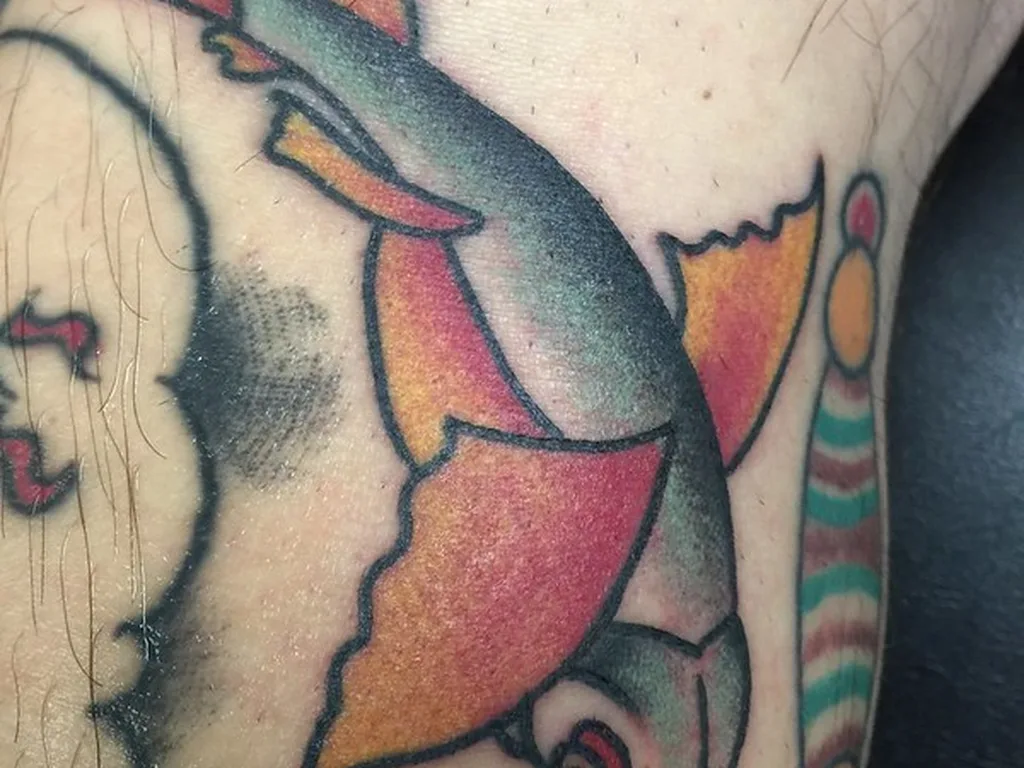
An orange koi with teal fins and heavy black shading, swimming down a thigh. This is the classic Japanese arrangement — warm fish, cool water colours, scales drawn as big clean plates — and the thigh gives it the size those plates need.
Colour this saturated settles softer than it photographs, and the orange will need sun protection to stay orange. The black underneath is what the design will stand on in twenty years, and here there is plenty of it.
2. Red Koi With a Lotus, Shoulder Blade
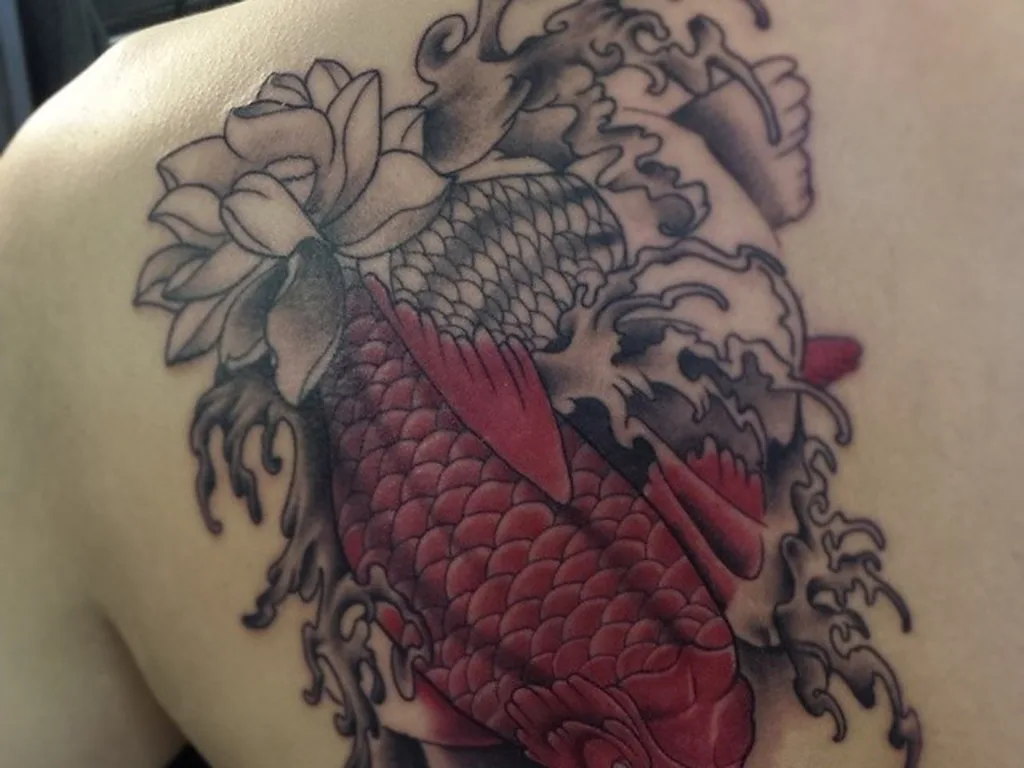
A deep red koi curling through splashes, with a pink lotus opening above it on the shoulder blade. The lotus is the koi’s oldest partner in Japanese tattooing — the flower that rises clean out of muddy water — and pairing the two is a small essay on the same theme. The lotus tattoo ideas guide shows the flower carrying a design on its own.
Shoulder blades move more than people expect, so the splashes are drawn loose on purpose. Red this deep holds well in a spot clothing covers most days.
3. Red-Orange Koi Over Black Waves, Shoulder
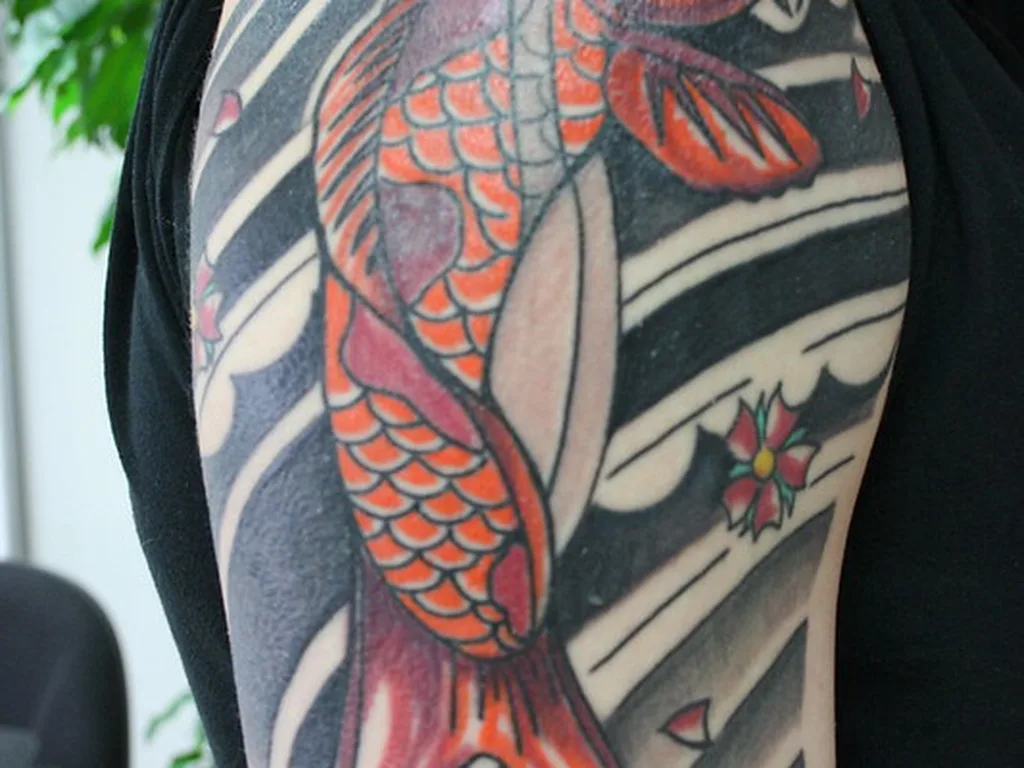
A red-orange koi laid over bold black wave bands on the shoulder — the fish bright, the water reduced to graphic stripes. It is a smart division of labour: the waves do the ageing-proof work in solid black while the fish carries the colour.
Shoulders are kind placements: flat, easy to sit through, covered in winter. The orange belly will quieten first; the wave bands will look the same for decades.
4. Blue and Gold Koi With a Pink Lotus, Forearm
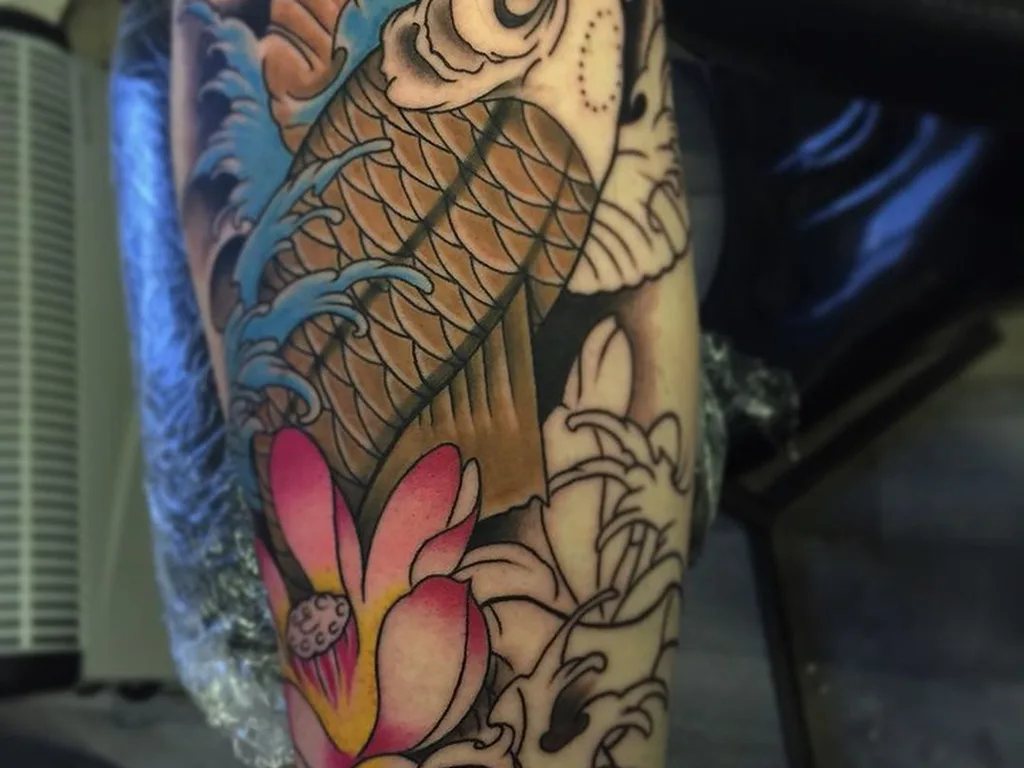
A blue-scaled koi with gold fins wrapped around a forearm, pink lotus below. Blue koi are the calm entry in the colour chart, and the gold keeps the fish from going cold — a combination worth copying if orange feels loud to you.
Forearms see daylight all year, and blue is one of the better-behaved colours under sun. The taper suits a curling fish — tail following the muscle.
5. The Big Blue Koi, Upper Arm
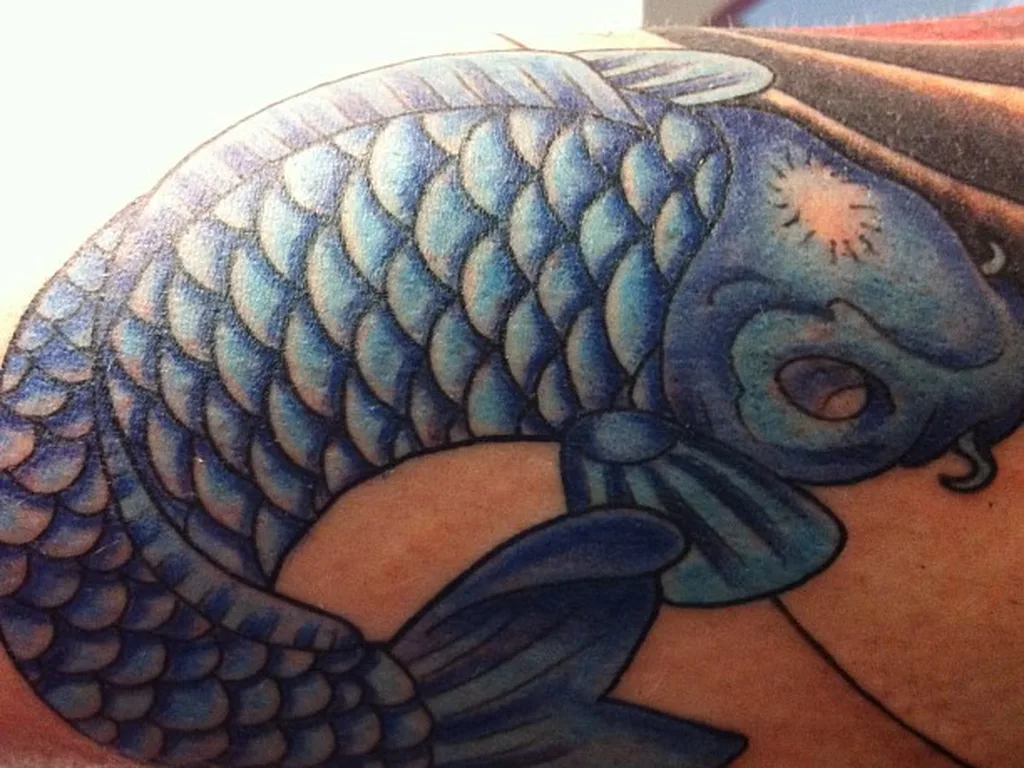
One blue koi drawn large enough to fill an upper arm, every scale shaded. A single-fish design lives or dies on its scale pattern, and this one commits: big plates, a strong eye, pale fins.
Size is the whole lesson. At this scale the scales can stay separate for twenty years. Halve the design and the same drawing turns to corduroy as the lines spread — ask your artist to show you the stencil at two sizes.
6. Red and Black Koi With a Lotus, Arm
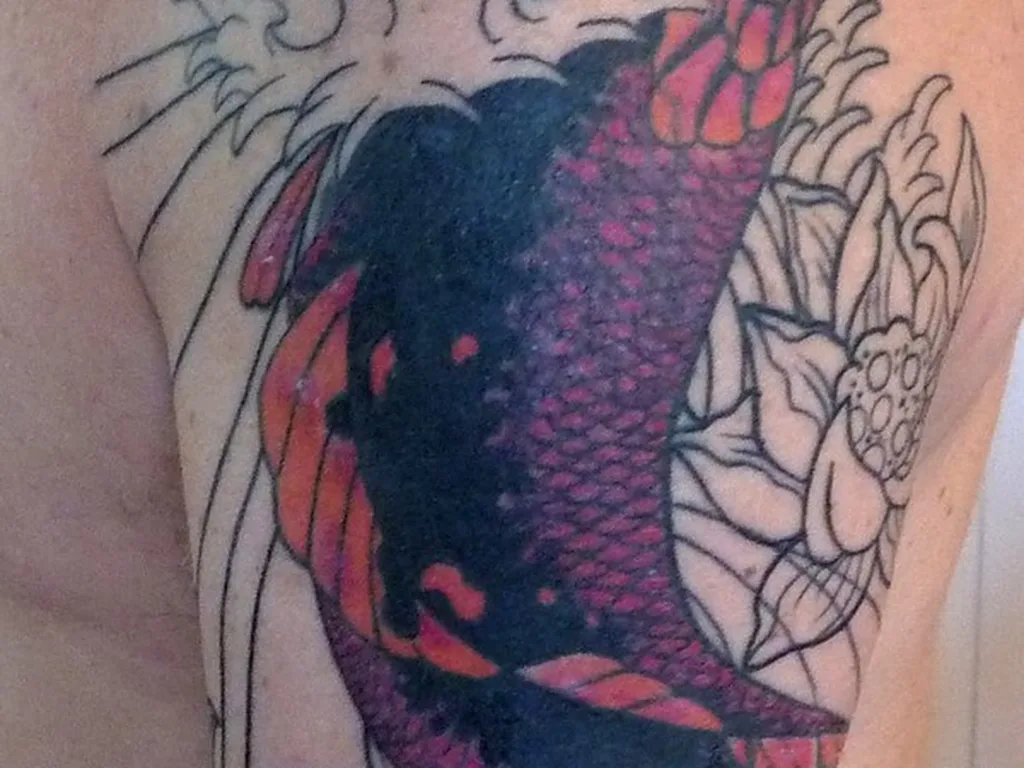
A red koi worked in heavy black shadow, tail sweeping past a lotus. Photographed with parts of the background still in outline, this is a piece mid-journey — the fish finished first, the setting to follow, which is how many large Japanese pieces actually get built.
Red over black shading is a durable recipe: as the red mellows, the black modelling keeps the fish three-dimensional. If you build a sleeve in stages, finish the hero animal first.
7. Pink and Grey Koi, Calf
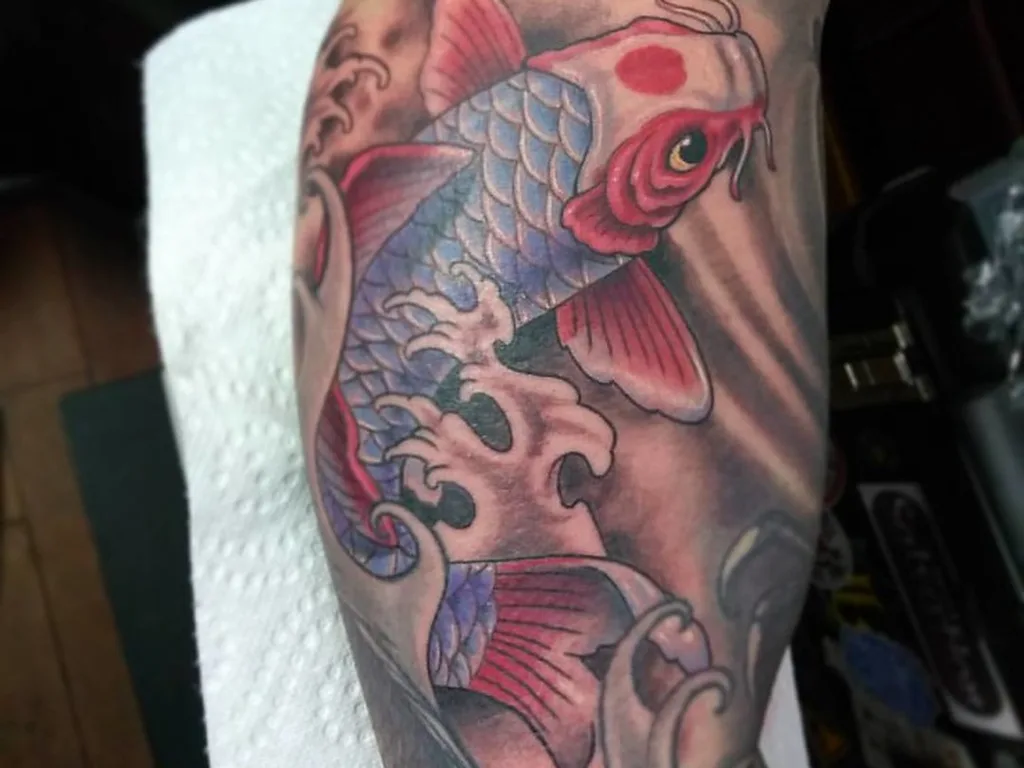
A pink koi with grey shading swimming down the back of a calf. Pink is an unusual pond colour — it reads as the pale sakura end of the red family — and against grey water tones it stays soft rather than sweet.
Calves are patient placements: the muscle gives the fish its curve and trousers keep the sun off. Pink fades faster than red, so this one may want a colour refresh one day — the grey underneath will wait politely.
8. Koi and Flowers Down a Whole Lower Leg
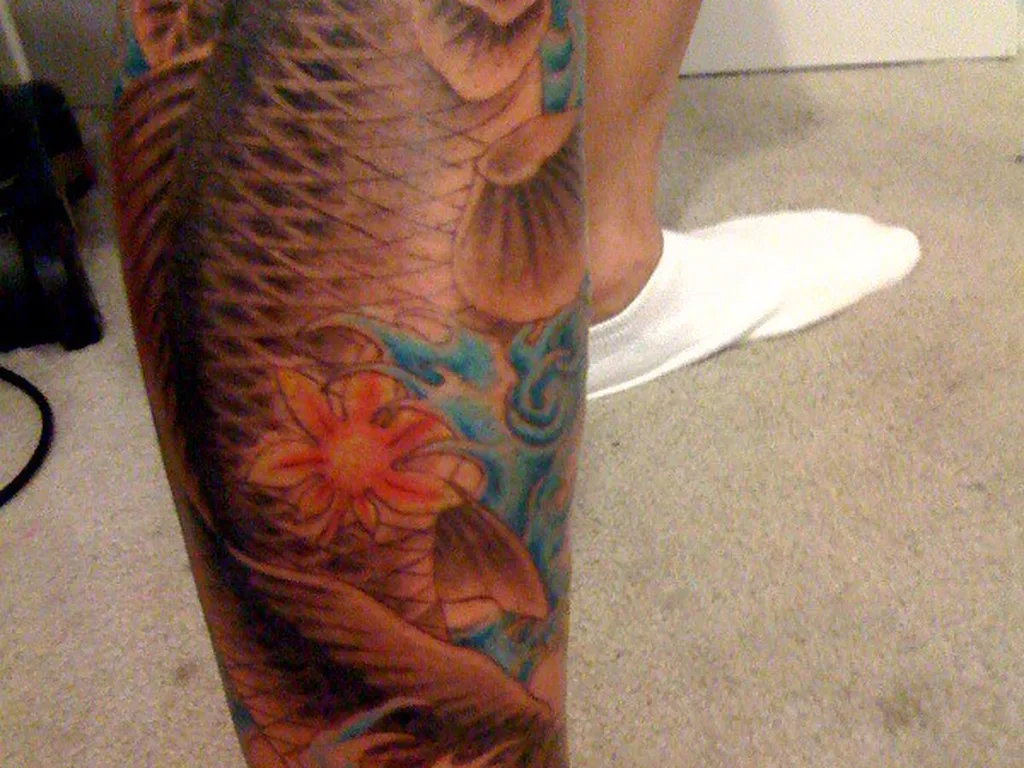
A colour koi with orange fins winding down a whole lower leg among flowers — a half-leg piece built the way sleeves are built, the fish spiralling so it reads from every side. Legs forgive this better than arms: there is more room, and the wrap is the design.
A leg piece is never seen from one angle, so the fish has to survive the turn around the calf. This one does — the body stays one unbroken ribbon of colour.
9. Watercolour Koi, Forearm
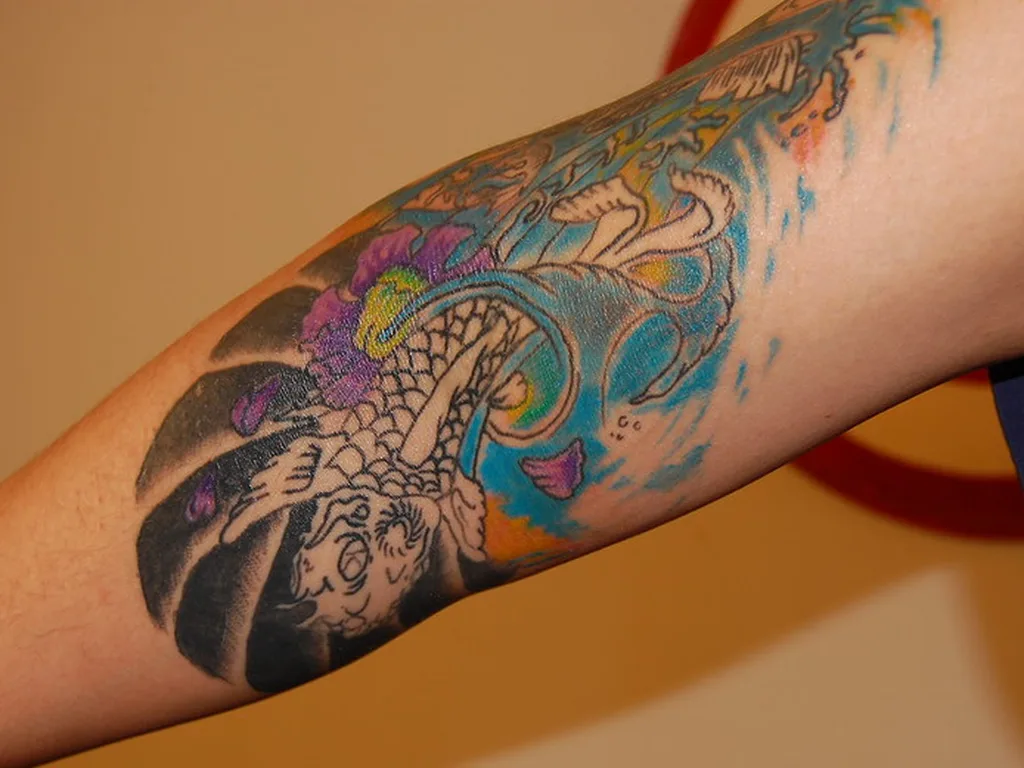
A koi built from paint splashes — purple, yellow and teal washes with a black-ink body showing through. Watercolour tattooing borrows the look of brush painting, and a koi is a natural subject for it, since the fish was a brush-painting favourite centuries before it was a tattoo.
The honest note: splash edges are the softest lines in tattooing, and they soften further with age. Fans accept a design that looks more like a painting every year. If you want crisp at year ten, pick design 1’s approach.
10. Golden Koi With Dark Flowers, Calf
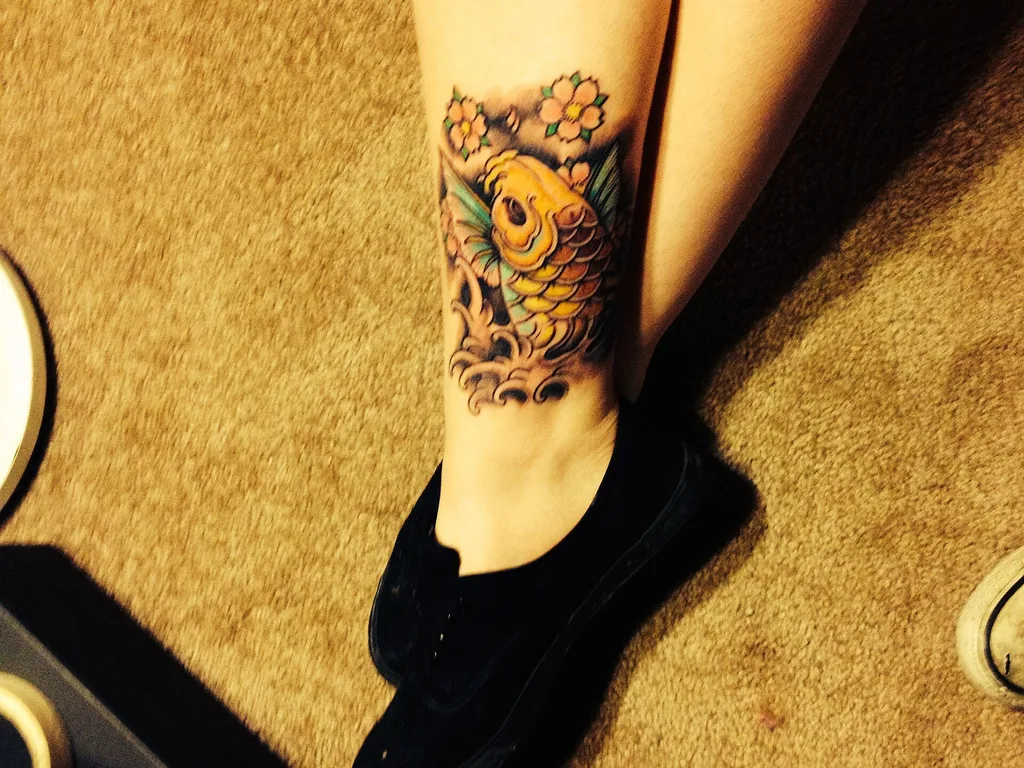
A golden-orange koi climbing a calf, set against dark flowers. Gold fish carry the wealth reading in the colour chart, and the dark background does practical work too — it throws the pale fish forward and hides the shading seams.
The point of the design is how clearly it still reads: pale fish, dark setting, strong outline. Calf pieces like this make a good first large tattoo.
11. Two Koi Circling, Across the Stomach
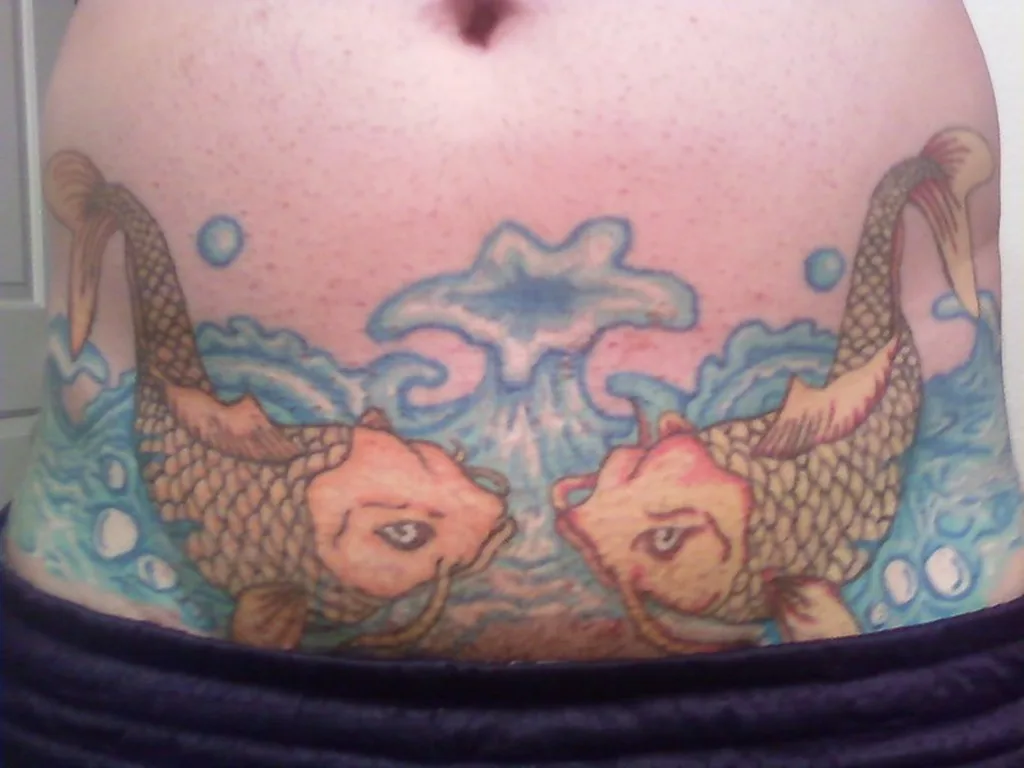
Two orange koi chasing each other in a circle of waves across the stomach — the balance design, borrowed from the yin-yang form. One fish is usually drawn darker than the other; here both run orange and the waves make the circle instead.
Stomach skin stretches more than almost anywhere else, though it is sun-shy, so colours stay true while lines may wander a little. A circular design is the forgiving choice here — no straight edge to give the game away.
Black and Grey Koi
Strip the colour away and a koi becomes a drawing problem: scales, fins and water separating in shades of one ink. Good black and grey koi fish tattoo ideas lean on contrast — deep black shadows, skin left bare for highlights — and age the most gracefully on this page.
12. The Bold Black Koi, Shoulder
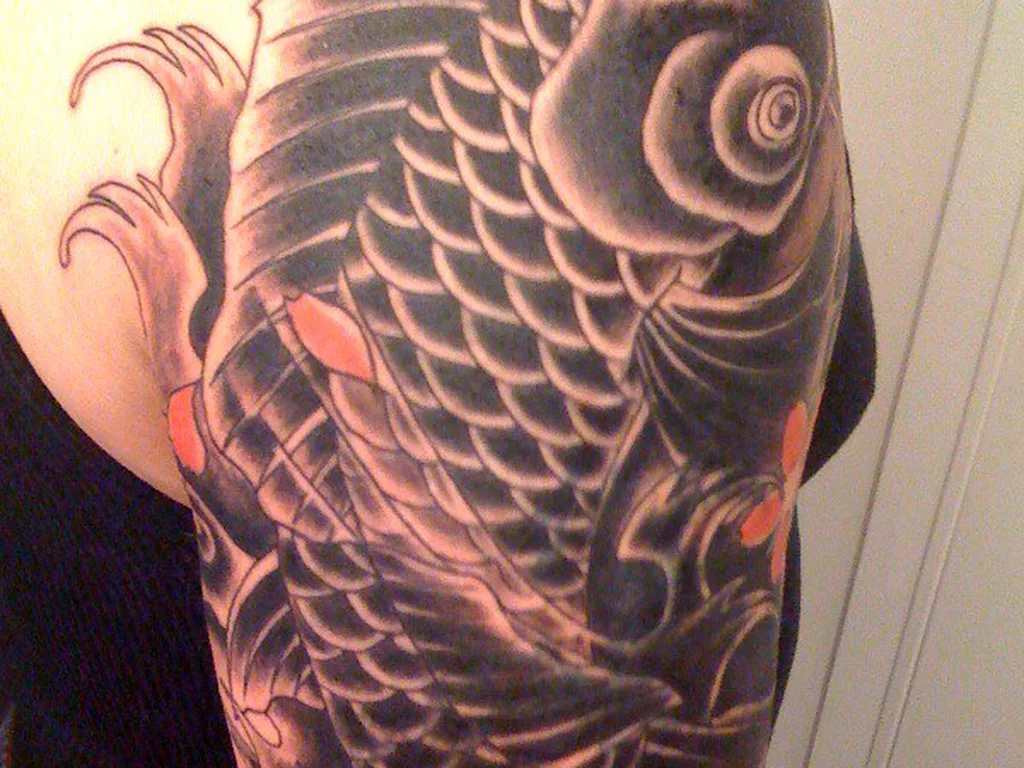
A koi drawn almost entirely in black, scales packed tight, riding high on a shoulder. Black koi carry the hardest-times reading in the colour chart — the fish that got through — and a design this dark wears that meaning on its face.
Solid black is the longest-lasting ink there is. The risk in a piece this heavy is lines merging into one dark mass — the artist has left thin skin gaps between scale rows, and those gaps keep the fish readable.
13. Black Koi, One Orange Lotus, Upper Arm
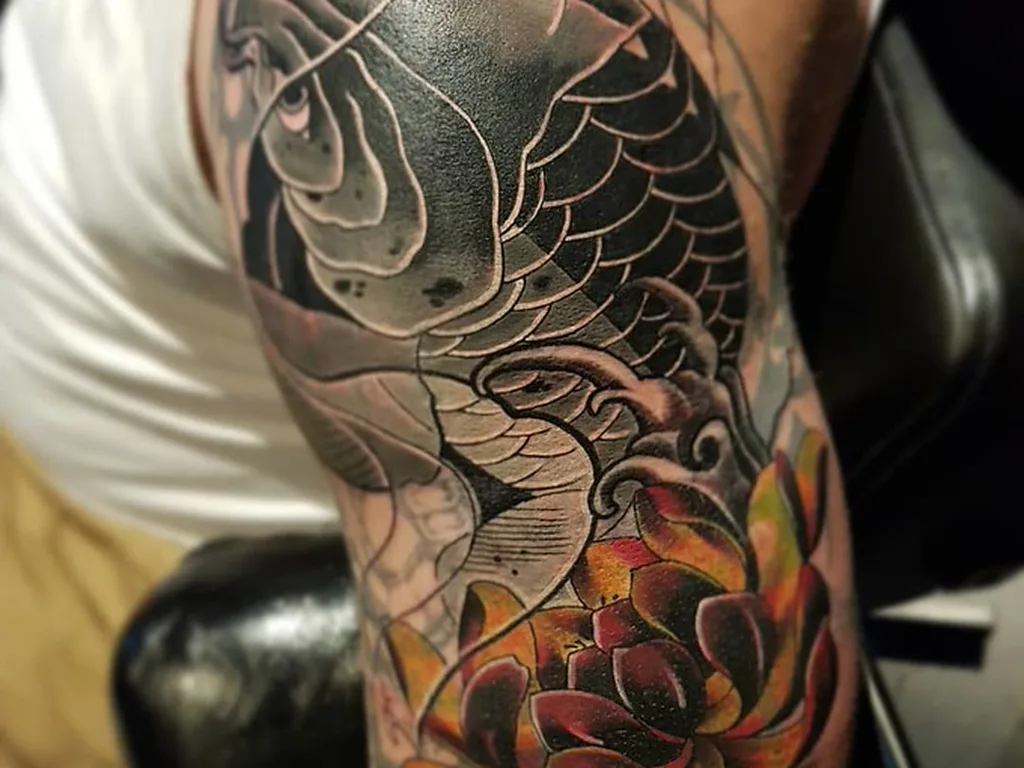
A black koi sweeping down an upper arm, with a single orange lotus glowing at the bottom of the piece. One colour accent in a grey design is a deliberate economy — the eye goes to the flower, then travels the fish.
If the orange ever tires, it is a small area to refresh; the koi itself is built from the durable stuff. As a way to test colour before committing a whole sleeve to it, this structure is hard to beat.
14. Grey-Wash Koi Half Sleeve
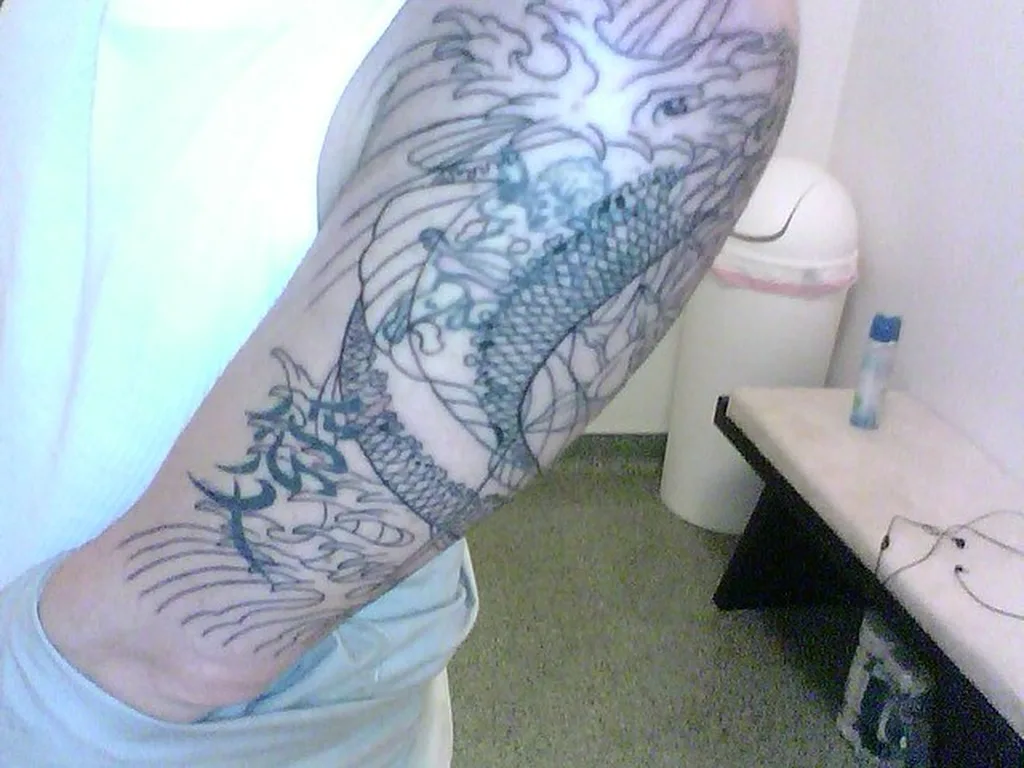
A grey-wash koi with waves filling a half sleeve, shoulder to elbow. The shading runs in smooth gradients rather than hard scale plates — a softer, more painted fish — and the waves fill every gap so the arm reads as one piece of water.
Grey wash lives on its lightest tones, and light grey is the first thing skin loses. Pieces like this often get one darkening pass years later — budget it as maintenance, not failure.
15. Koi With Peonies, Thigh
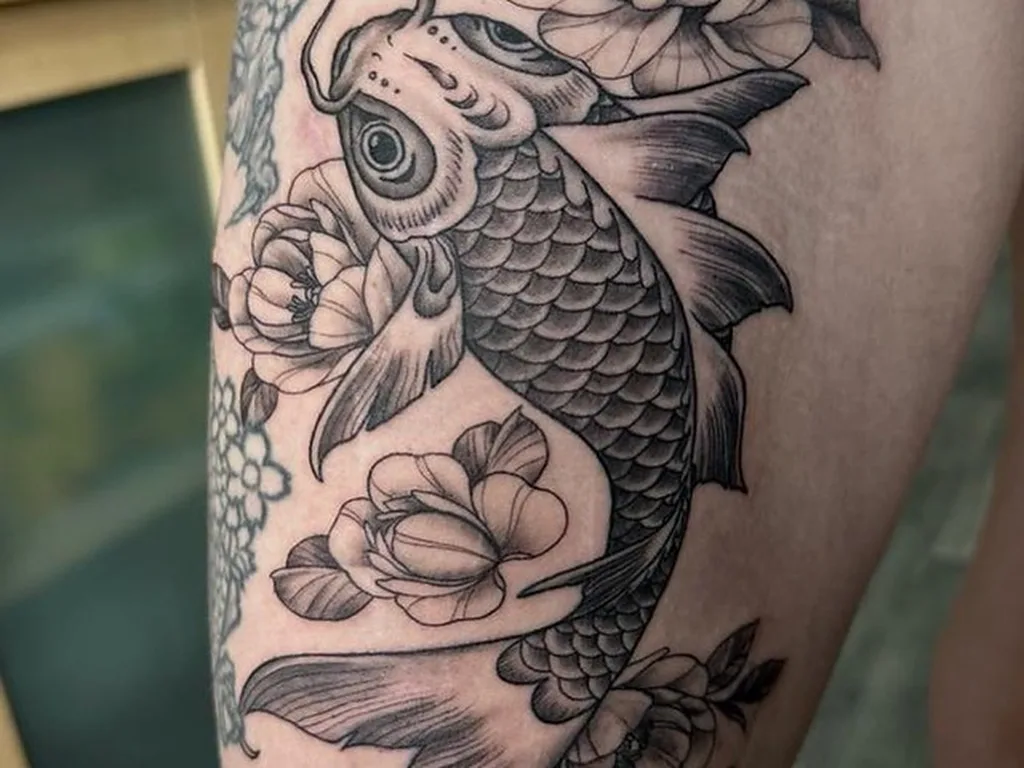
A fine black and grey koi among peonies on a thigh. Peonies are the other classic partner flower — bolder and more ruffled than the lotus — and in grey they let the artist play texture against texture: petals soft, scales hard.
Thighs give fine grey work its best home: big, flat, private from the sun — and still in the chair, which is part of how drawing this detailed gets done.
16. Linework Koi, Forearm
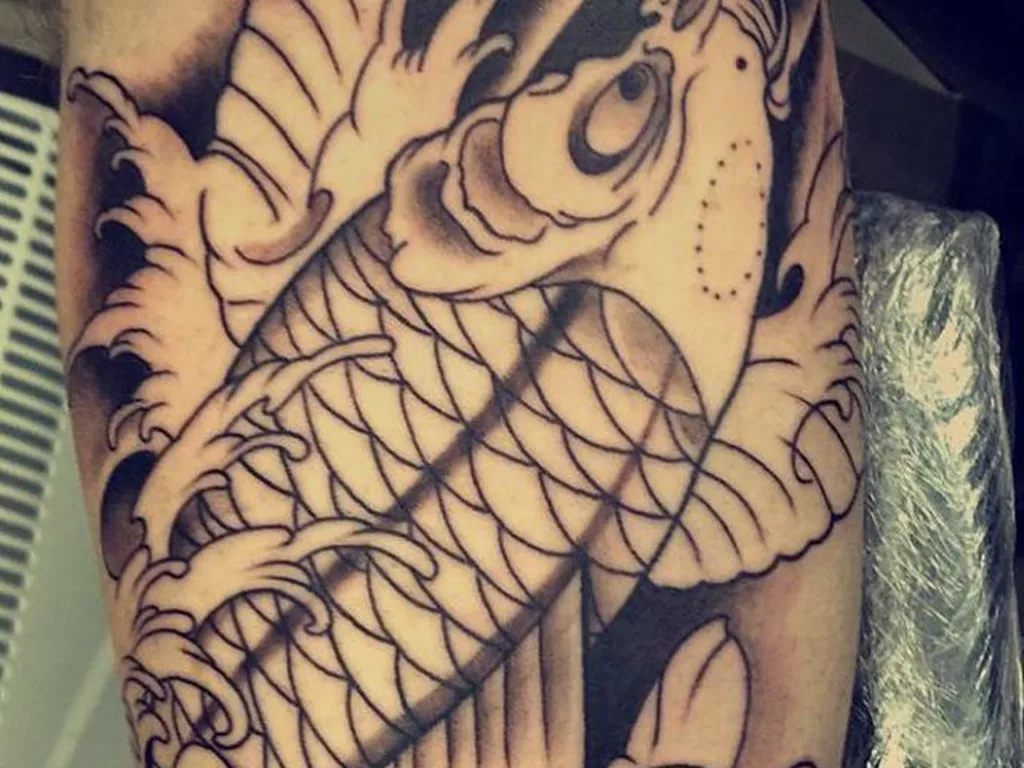
A koi built mostly from line — scales, fins and waves all drawn rather than shaded — on a forearm. Linework fish are the lightest way to wear the animal, and the drawing has nowhere to hide, which is why the whiskers and eye matter so much here.
Lines spread slowly outward as years pass, so a linework koi wants open spacing between its marks. This one has it. Drawn half this size, it would not — the same warning as design 5, from the opposite direction.
17. Koi in Waves, Hip
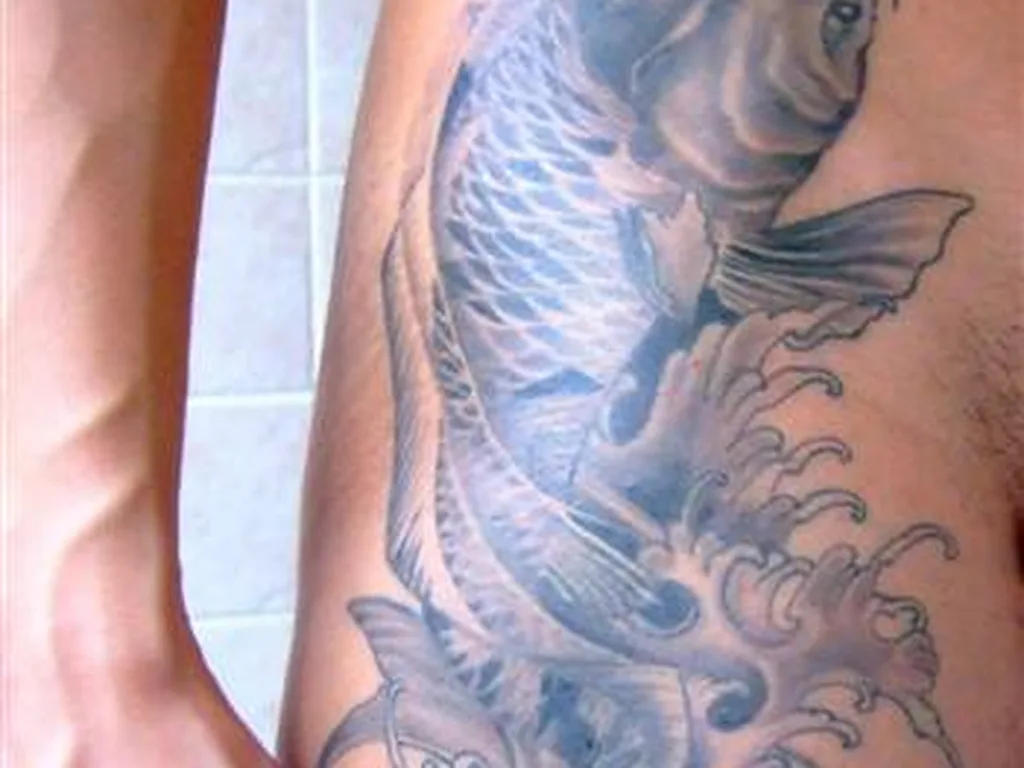
A black and grey koi curling through finger waves on a hip, photographed in black and white. The hip is a placement people choose for privacy as much as shape — the design shows when its owner decides — and the curve of the bone gives the fish its bend.
A note on the photograph itself: it is a small file, softer than the others here, and it is included because the design is a good one. Judge it for composition — fish placement, wave rhythm — and ask any artist for healed photos of their own grey work before booking.
18. Blue-Grey Koi, Shoulder Blade
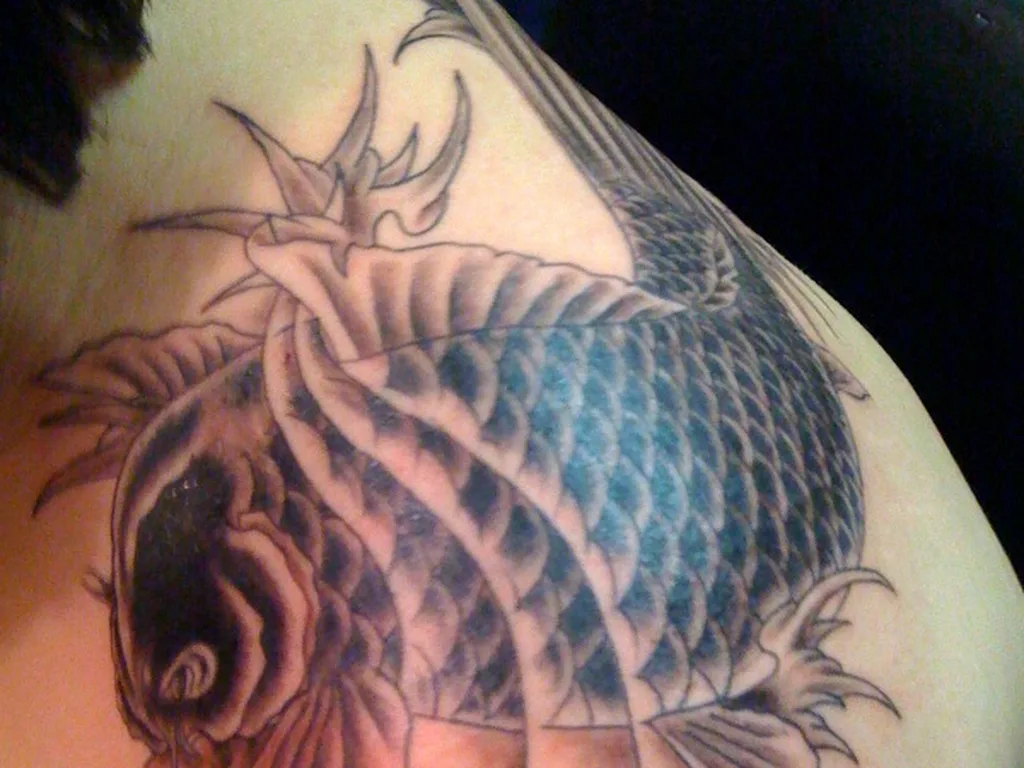
A koi in blue-grey tones settled on a shoulder blade, fins spread wide. It sits between the colour and grey camps: the blue is quiet enough to read as shading from a distance and shows itself up close.
Shoulder blades move with the shoulder, so the wide, calm composition is right — nothing here depends on a millimetre. Blue-grey holds its character well under clothing.
19. Koi Down the Ribs
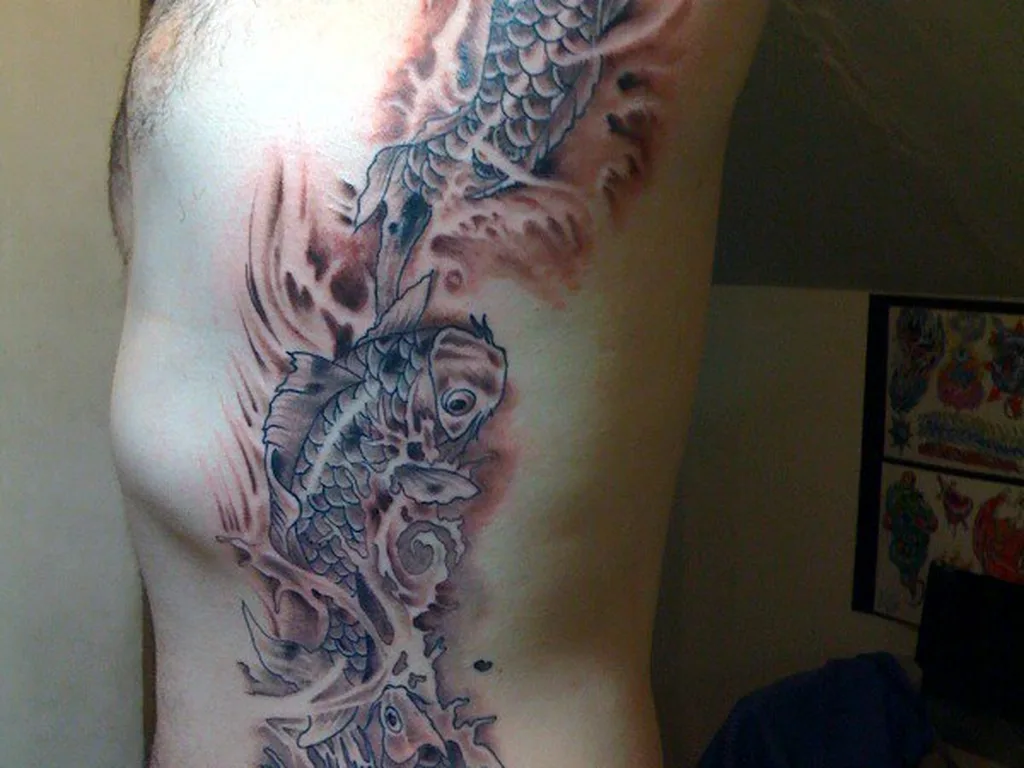
A large black and grey koi running down the ribs, photographed fresh — the skin is still red and the blacks will settle lighter than they look here. Rib pieces are private, painful, and some of the most elegant koi placements there are, because the fish gets the body’s longest curve.
Fresh photographs flatter every tattoo. Judge rib work by healed pictures where you can; what survives healing here is the composition — one long fish, generous spacing, nothing fiddly to lose.
Sleeves, Back Pieces and Other Big Koi
Koi reward scale like few subjects. A sleeve lets the fish spiral; a back lets it swim with company — waves, flowers, sometimes the dragon it is becoming. These are the biggest koi fish tattoo ideas here, and two are photographed at the outline stage, where every back piece honestly begins.
20. Full Sleeve: Koi and Lotus on Black
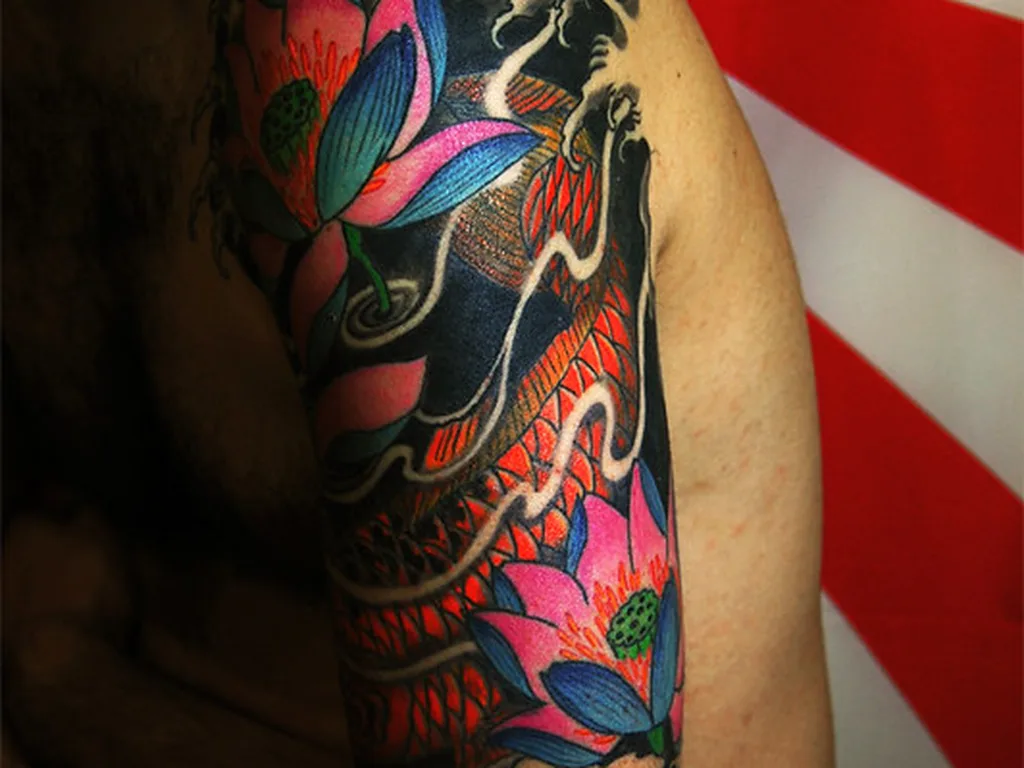
A full arm of colour koi and pink lotus packed over solid black — the background filled to the wrist so the fish and flowers carry all the light. Filling the ground in black is the irezumi way: the arm becomes a panel, not a collection of stickers.
Sleeves at this saturation are multi-session commitments, and the black ground makes touch-ups easy — any faded patch can be re-grounded without touching the fish.
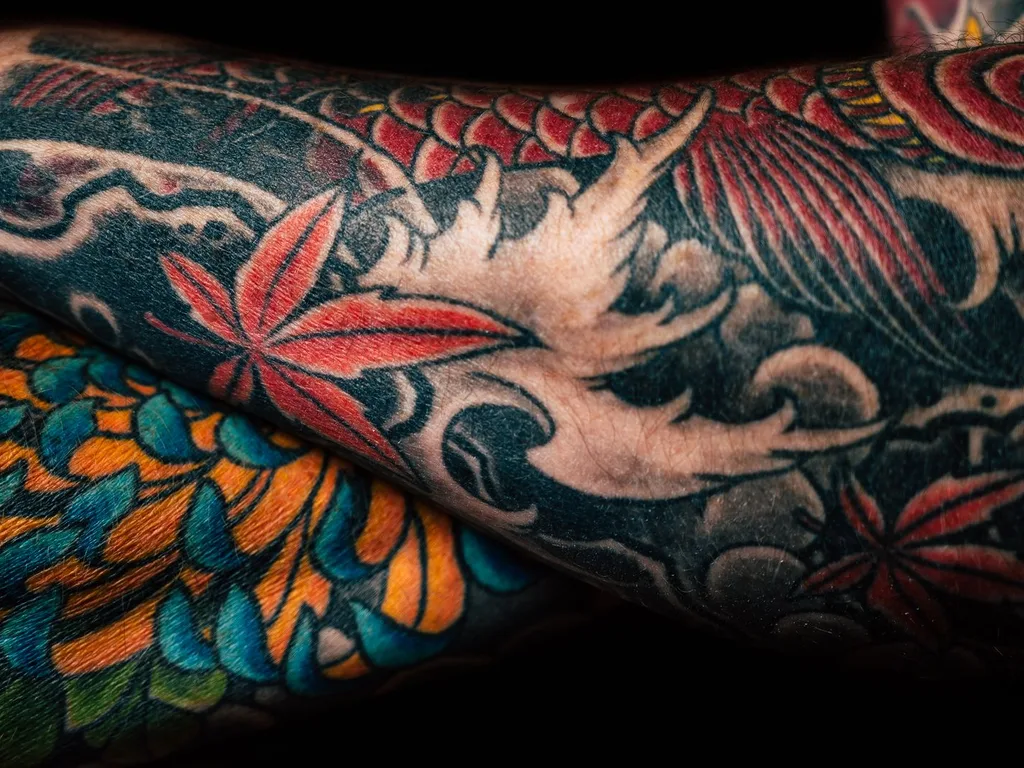
21. The Grey Koi and Maple Leaves, Back and Shoulder
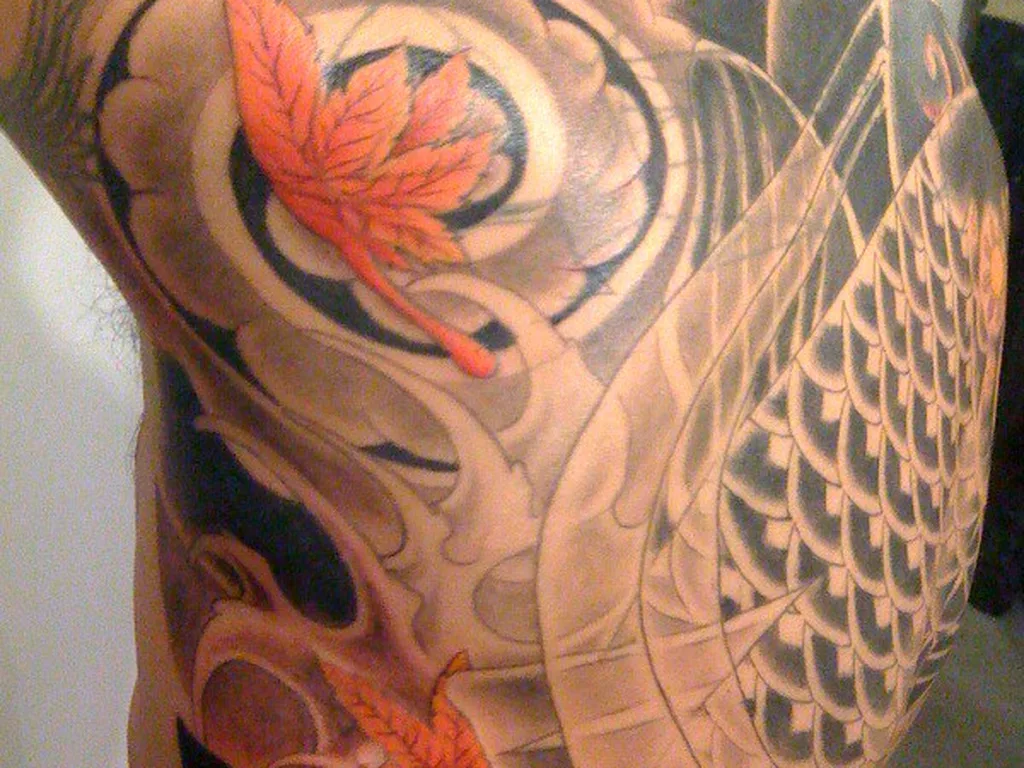
A huge grey koi poured over one shoulder and down the back, maple leaves scattered through it. Maple is the autumn partner in Japanese design, and its red-orange is the only warm note in a sea of grey — used here in the leaves alone, the way design 13 uses its lotus.
Pieces crossing the shoulder blade must be drawn for two postures, arm down and raised. This fish bends at the shoulder, so movement flexes the design instead of breaking it.
22. A Big Grey Koi Down a Back
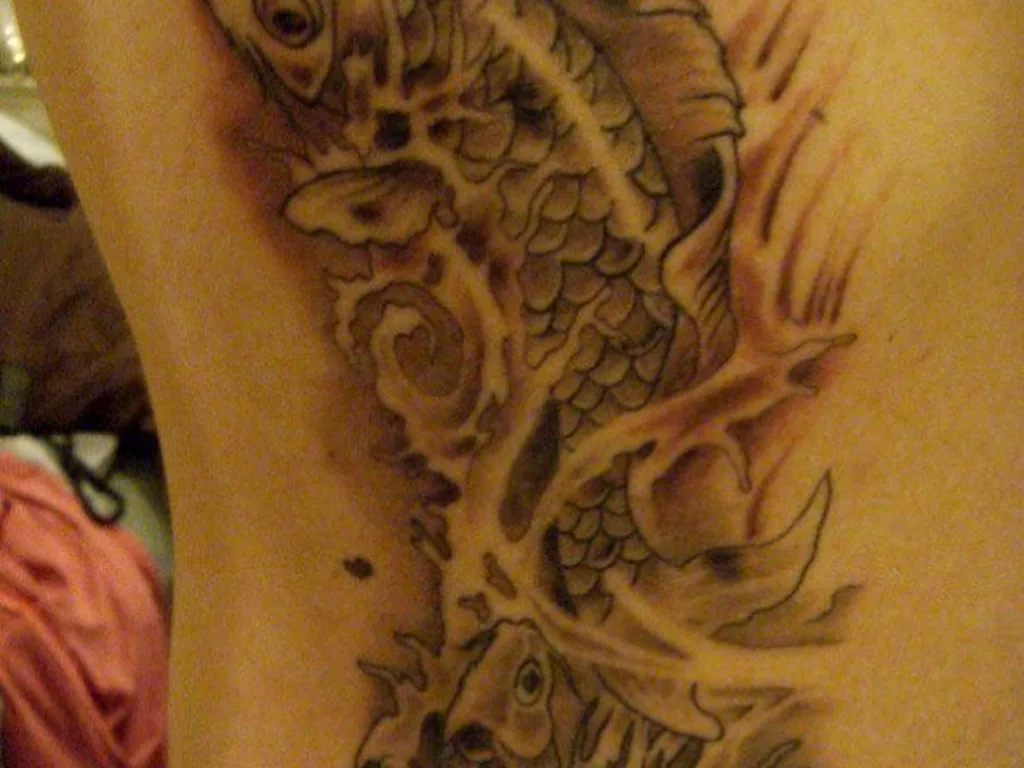
A large black and grey koi composition running the length of a back, fins and waves worked in soft grey. Backs are the best ageing surface on the body — flat, wide, covered most days — and a single-animal back piece spends that advantage on scale detail.
The commitment is real: sittings measured in months, and a design you cannot see without a mirror. If you are not certain yet, designs 14 and 15 offer the same grey language at a watchable size.
23. The Koi That Becomes a Dragon, Full Back
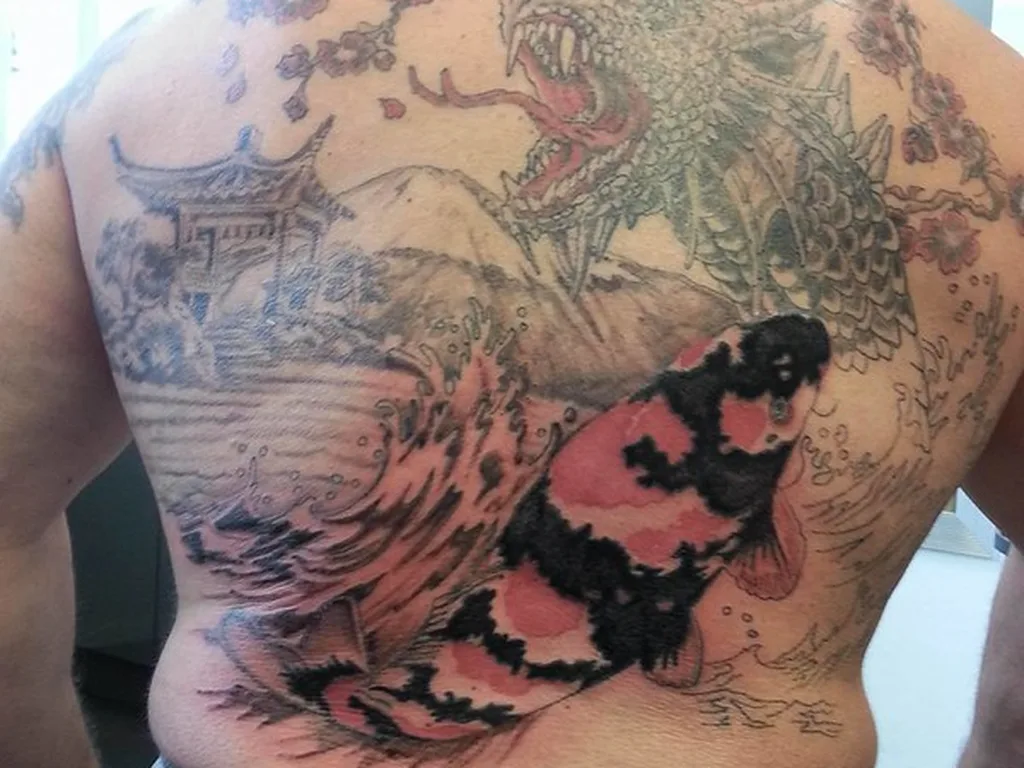
The legend drawn literally across a whole back: a red and black koi below, a dragon above, a pagoda and cherry blossom between them — the fish mid-transformation into the creature the waterfall story promises. This wearer’s back has been photographed many times over the years; this is the finished piece, and the only version counted here.
It is the most ambitious brief on this page — two animals, architecture, blossom, water — and it works because each element gets a floor of the back to itself. Crowding kills story pieces; this one gives the story room.
24. Koi and Lotus Outlines Across a Whole Back
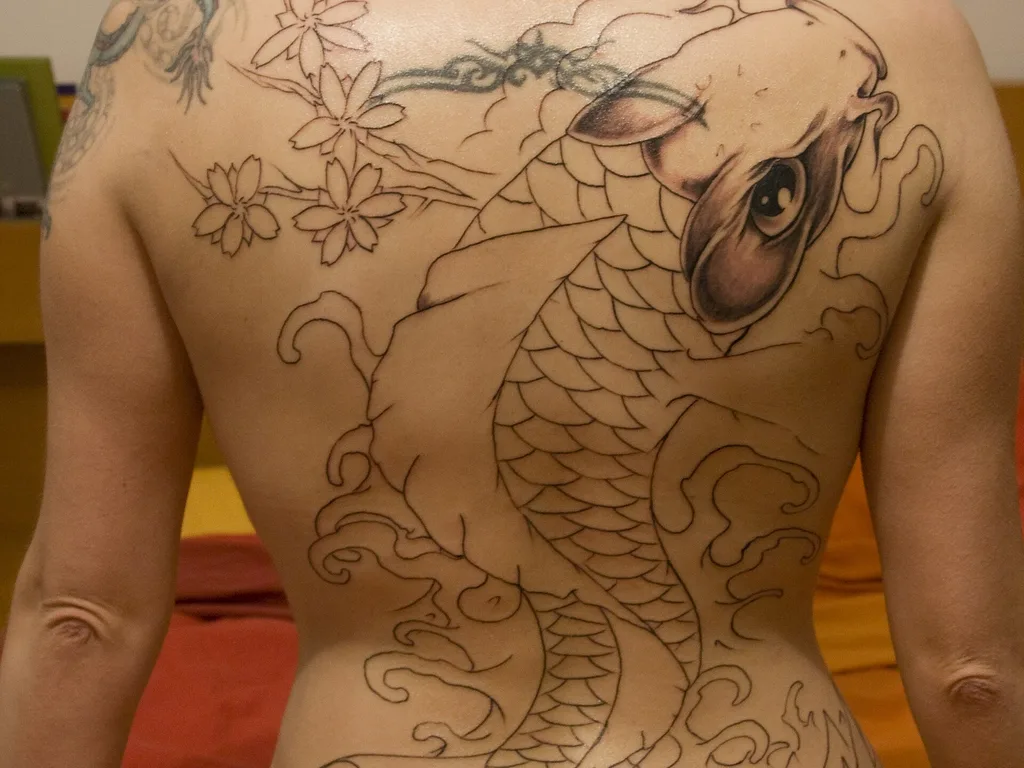
A full back at the outline stage: one large koi drawn across the upper back, lotus flowers outlined below, nothing coloured yet. Every back piece passes through this spare, map-like state, and a good outline is worth judging on its own — the colour can only fill what the lines have decided.
If you are planning a back, study this photograph: fish centred on the spine, flowers balanced left to right. Those are outline-day decisions — no later colour fixes a crooked map.
25. One Koi Outlined, Back
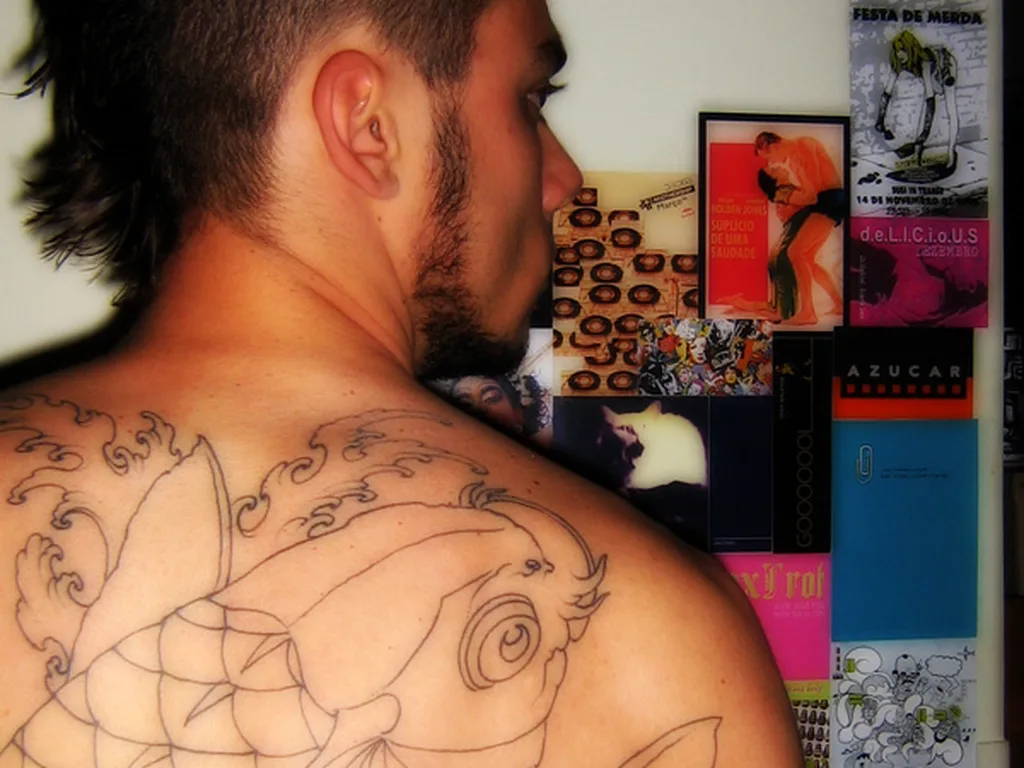
A second outline back, simpler than design 24: one koi, drawn large, its scales and fins mapped in line alone across a man’s back. A single-fish back is a purist’s choice — no supporting cast — and the drawing carries the whole back by itself.
Two outline pieces might look like a shortage of finished work; it is the opposite. Outlines show the skeleton finished photos hide — and the skeleton is the expensive part of any back piece.
Small Koi and Simple Koi
Koi are not natural minimalists — the animal comes with scales, whiskers and trailing fins attached. Small koi fish tattoo ideas that work cheat honestly: they cut the detail, keep the silhouette, and let one strong shape do the talking.
26. A Small Black Koi and a Red Stamp, Forearm
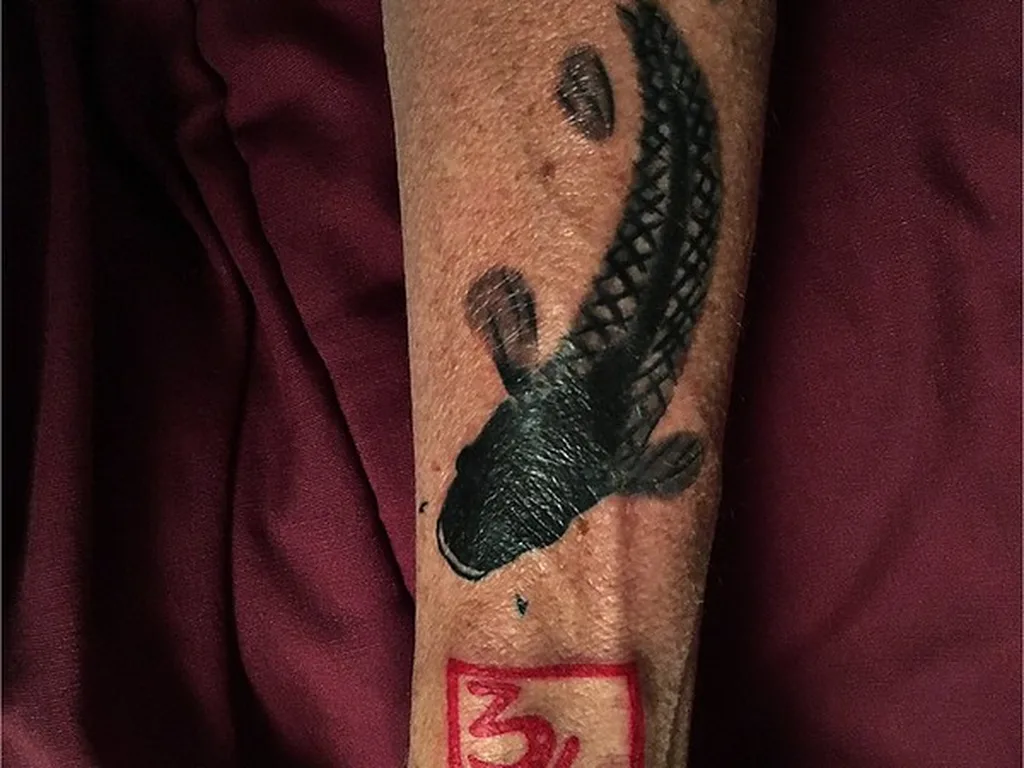
A small black koi drawn as a bold silhouette with a few water drops, above a red stamp-style mark. The wearer got it among a set of Japanese pieces marking his retirement — the stamp imitates the hanko seals used to sign artwork in Japan.
This is the template small koi fish tattoo ideas should follow: silhouette first, no scale pattern at all, nothing thinner than the drop shapes. It gives up detail on purpose and keeps the one thing that matters — you can tell it is a koi from across the room.
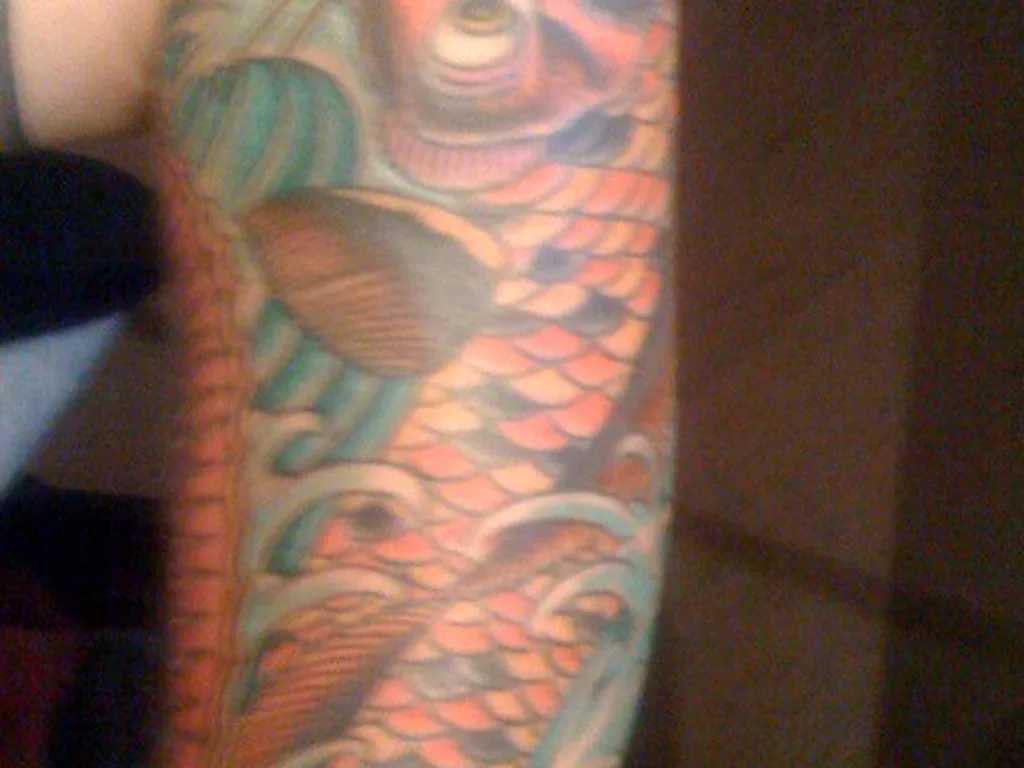
27. An Older Koi, Faded and Still Readable, Forearm
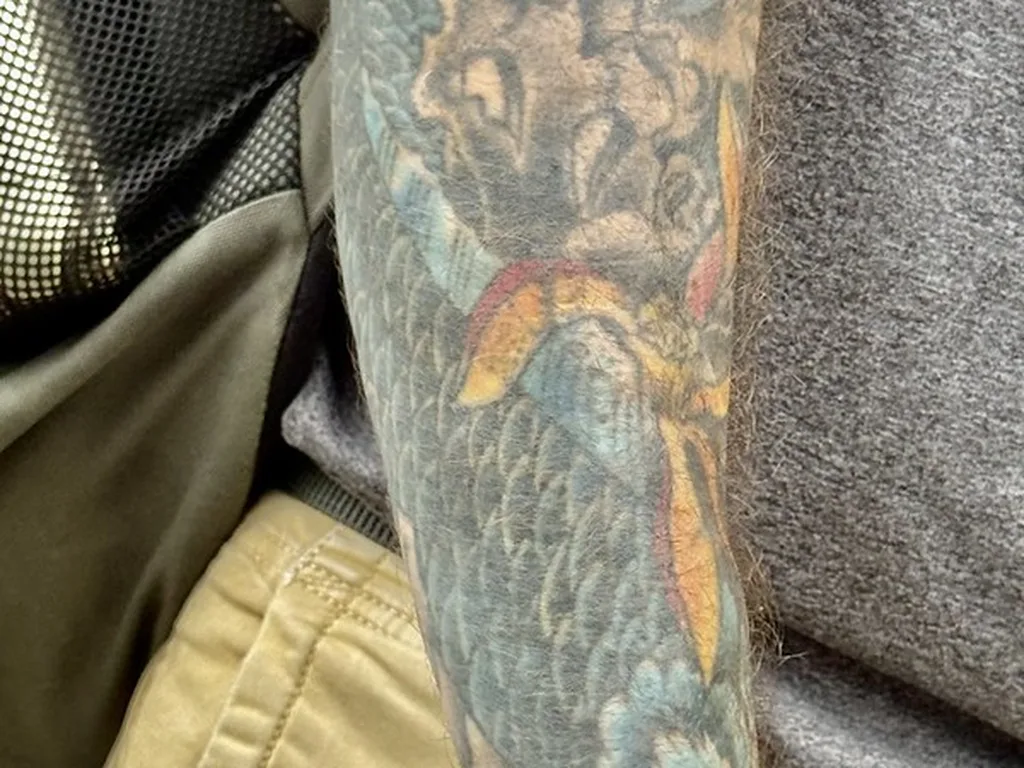
An older colour koi sleeve on a forearm, photographed on the street years after it was made: the blues greyed, the oranges quiet, the fish still plainly a fish. It is here as the honest end-point of every colour design on this page.
Notice what survived: the outline and the dark scales. What went first was the pale wash between them. If this worries you, your taste runs to designs 12 to 16; if it looks like a tattoo with a life lived in it, colour is safe with you.
Best Placements for Koi Fish Tattoo Ideas
Koi are long, curved animals, and they reward placements that let the body bend. Forearms and calves suit a single swimming fish. Upper arms and thighs take a fish with waves around it. A back gives you the full scene — two or three koi, moving water, flowers — and it is the placement that ages slowest, because the skin is flat and usually covered. The full range of animal subjects in this series sits in the animal tattoo ideas pillar, if the koi’s neighbours interest you too.
Direction matters more than most people expect. A koi drawn swimming up the body points at ambition and struggle; one swimming down reads as a calmer fish, past the hard part. Neither is wrong — but choose on purpose rather than learning about it afterwards.
On ageing, the honest summary is this: black linework and bold colour hold; fine scale detail and pale yellow soften first. Koi drawn at palm size or bigger keep their scales separate for years; koi squeezed onto a wrist lose them. The FDA’s page on tattoo safety is worth a read before any large piece — it covers ink reactions and what to check about a studio, in plain language.
Frequently Asked Questions
What does a koi fish tattoo mean?
At its core, perseverance. The koi swims against the current and, in the legend, climbs a waterfall to become a dragon, so the fish stands for effort that gets rewarded. Around that core sit luck, prosperity and balance — the meanings most koi fish tattoo ideas are built on. The deeper history is covered on the koi fish tattoo meaning page linked earlier.
What do the different koi colours mean?
Red and orange stand for energy, love and good fortune — the classic choice. Black means strength through hard times. Gold and yellow point at wealth. Blue is the calm colour: peace and steadiness. White is linked with purity and fresh starts. These readings come from pond-keeping and the koinobori windsock tradition, not from one ancient rulebook.
Which way should a koi tattoo swim, up or down?
Up the body is the ambitious reading: still climbing, still fighting the current. Down is the settled reading: the hard part is behind it. Pick the one that matches your reason, and tell your artist before the stencil — flipping is free at stencil stage and impossible afterwards.
Where is the best place for a koi tattoo?
For a first koi, the forearm, calf and thigh are kindest: room for scales, easy sittings, honest ageing. For a statement, the back is unmatched. Ribs and hips suit private designs. Wrists and ankles only work for the silhouette style at design 26 — a detailed koi that small will blur.
How big should a koi tattoo be?
Palm size is the practical floor for a detailed fish, and bigger is better. The scales are the reason: each is a small shape bounded by lines, and lines spread with age. Ask to see the stencil at your size and at twenty percent bigger — most people pick the bigger one.
Do koi tattoos age well?
The bold ones do — and that is the thread running through the koi fish tattoo ideas that still look good at twenty years. Solid black outlines and saturated colour hold their shape for decades, as design 27’s faded-but-readable forearm shows from the other side. Fine scale hatching, pale yellows and watercolour washes soften first. Sun is the biggest variable you control: covered koi keep their colour years longer than sun-exposed ones.
How much does a koi tattoo cost?
It follows size and hours, not the fish. A small silhouette koi is one short sitting; a coloured half sleeve is several; a back piece like design 23 is many, spread over months. Rates vary too much by city for an honest single figure — ask instead how many sessions the design needs and what each one costs.
Can a koi tattoo be a cover-up?
Yes — koi fish tattoo ideas are popular cover-up choices for a reason: the body is busy, dark in the right places, and wrapped in waves and flowers that swallow old lines. The new fish must be larger and darker than what it covers, designed around the old tattoo’s darkest areas. Bring a clear photo of the existing piece to the consultation.
What goes with a koi tattoo — waves, lotus or cherry blossom?
Waves are the default: a koi without water can look stranded, and waves fill awkward gaps. Lotus adds the rising-from-mud theme and a soft shape against the scales. Cherry blossom brings spring; peonies and maple leaves (designs 15 and 21) are the richer, autumn options. One partner element is usually enough.
What is the difference between a koi tattoo and a goldfish tattoo?
Anatomy and attitude. Koi are carp: long bodies, whisker-like barbels at the mouth, and the upstream-swimming story. Goldfish are smaller and rounder, often drawn with flowing double tails, and carry lighter meanings — luck and gold, without the waterfall. Whiskers and a long back mean koi, whatever the studio calls it.
Final Thoughts
Twenty-seven koi fish tattoo ideas, and the pattern underneath them is simple: the koi that last are drawn at the size their details need, in ink that can hold them. Pick the fish whose story matches yours — the climber, the lucky one, the pair in balance — then pick the version of it that will still read clearly in twenty years. If you want the meanings before the pictures, start with the koi fish tattoo meaning guide; if you want the neighbours, the animal tattoo ideas pillar collects the whole menagerie.
Photo credits: 1: Tobyotter, CC BY 2.0, via Flickr. 2: TattoosAll, CC BY 2.0, via Flickr. 3: sabotrax, CC BY 2.0, via Flickr. 4: TattoosAll, CC BY 2.0, via Flickr. 5: TattoosAll, CC BY 2.0, via Flickr. 6: @bastique, CC BY-SA 2.0, via Flickr. 7: ettorebechis, CC BY 2.0, via Flickr. 8: mytat_2s, CC BY 2.0, via Flickr. 9: Adam Jarmon Brown, CC BY-SA 2.0, via Flickr. 10: Rithistoryclassfall, CC BY-SA 3.0, via Wikimedia Commons. 11: tjanssen4, CC BY 2.0, via Flickr. 12: mytat_2s, CC BY 2.0, via Flickr. 13: TattoosAll, CC BY 2.0, via Flickr. 14: @bastique, CC BY-SA 2.0, via Flickr. 15: TattoosAll, CC BY-SA 2.0, via Flickr. 16: TattoosAll, CC BY 2.0, via Flickr. 17: daveyll, CC BY-SA 2.0, via Flickr. 18: mytat_2s, CC BY 2.0, via Flickr. 19: mytat_2s, CC BY 2.0, via Flickr. 20: Panal Lira, CC BY-SA 2.0, via Flickr. 21: mytat_2s, CC BY 2.0, via Flickr. 22: mytat_2s, CC BY 2.0, via Flickr. 23: KoiQuestion, CC BY-SA 2.0, via Flickr. 24: Marine, CC BY-SA 2.0, via Wikimedia Commons. 25: amfdesigner, CC BY-SA 2.0, via Wikimedia Commons. 26: Ronald Douglas Frazier, CC BY 2.0, via Flickr. 27: antefixus21, CC0, via Flickr. Images cropped and resized to 1024×768.

Pingback: Koi Fish Tattoo Meaning: Symbolism, History and What It Really Stands For