Some tattoos you choose to show. A neck tattoo shows itself. It sits above every collar, in every photograph, in every conversation — which is exactly why people who commit to one tend to describe it as the moment their tattoos stopped being a hobby and became part of who they are. It is also why the neck deserves more honest homework than almost any other placement on the body, and this guide does not skip that homework.
In this guide you will find 25 neck tattoo ideas spread across the three very different canvases the neck offers: the side of the neck, the front and throat, and the back of the neck at the nape. There is a fine-line script word no longer than your thumb, a coiled snake, a moth hidden at the hairline, a full ornamental throat centrepiece — and, running underneath the designs, the practical truth about pain, healing, visibility at work and how neck skin ages, so the design you pick is one you still love at fifty.
Why Neck Tattoos Are Trending
Twenty years ago a visible neck tattoo was close to a uniform: it belonged to a short list of professions and subcultures, and everyone else steered clear. That has changed fast. Athletes, rappers and actors have made the front-of-neck piece mainstream — the throat tattoo that once ended interviews now appears in them — and as heavily tattooed generations have moved into ordinary jobs, the neck has lost much of its shock value while keeping all of its impact.
Search behaviour tells the same story. Interest in neck tattoos is placement-led rather than motif-led: people search for the placement first and the design second, because the real decision is not what but whether — whether you are ready for ink that cannot be covered by anything short of a scarf or a high collar. Rising searches cluster around celebrity neck tattoos and around small, jewellery-like pieces, which points to the two forces driving the trend. The first is visibility itself: in a world of profile photos and video calls, the neck is prime real estate, framed by the jaw and collarbone in nearly every headshot. The second is the necklace effect — a well-drawn neck piece works the way jewellery does, following the throat’s curve and framing the face, so fine-line chains, pendants and delicate side pieces have surged alongside the bold traditional work.
The honest counterweight, which this guide returns to in the How to Choose section, is that mainstream is not the same as consequence-free. A neck tattoo is still the least coverable common placement, and the trend is best enjoyed by people who have thought about that clearly rather than discovered it afterwards.
The Three Neck Placements, Compared Honestly
“Neck tattoo” sounds like one placement. It is three, and they differ in almost everything that matters — how much they hurt, who can see them, how they heal and how they age. Choosing your sub-placement is a bigger decision than choosing your design, so start here.
| Sub-placement | Pain level | Visibility | Healing notes | Best design types |
|---|---|---|---|---|
| Side of neck | Moderate — fleshy parts are manageable; sharper near the jawline and the front edge by the windpipe | High in profile, moderate face-on; partly coverable by longer hair, never by a collar alone | Rubs against collars, seatbelts and pillowcases; hair should be tied back for the first days | Vertical compositions: snakes, daggers, script, florals that climb |
| Front / throat | Highest of the three — thin skin over the windpipe and thyroid, constant swallowing and head movement | Total — visible in every face-to-face moment and photograph; essentially uncoverable | The hardest heal on the neck: every swallow, turn and collar works the skin; expect a slower, more careful two weeks | Symmetrical centrepieces, lettering across the throat, ornamental collars |
| Back of neck (nape) | Lowest-to-moderate of the three — a fleshy pad, sharper right on the spine and up at the hairline | Low — hidden by hair worn down and most collars; revealed when hair goes up | Hair, shampoo and high collars are the friction culprits; easiest heal of the three if hair is kept up and off it | Centred motifs: moths, symbols, pendants, horizontal lettering |
A few honest patterns behind the table. The side of the neck is where most neck tattoos live, because it splits the difference: dramatic in profile, quiet face-on, and roomy enough for a real composition that climbs from collarbone to jaw. The front and throat is the statement placement — the skin is thin, the session is the spiciest on the neck, and the result is the most visible tattoo a person can wear, so it rewards certainty and punishes hesitation. The nape is the diplomat: a genuine neck tattoo with an off switch, hidden under hair and collars whenever you want it gone. If you are neck-curious but not neck-certain, the nape is where this guide quietly suggests you start.
Neck Tattoo Ideas at a Glance
| # | Design | Style notes | Best placement |
|---|---|---|---|
| 1 | Fine-Line Script Word | Single word, delicate cursive | Side of neck |
| 2 | Coiled Snake | Blackwork coils climbing vertically | Side of neck |
| 3 | Butterfly at the Side | Small butterfly with fine wing detail | Side of neck, below the ear |
| 4 | Traditional Dagger | Bold traditional, solid colour or black | Side of neck |
| 5 | Rose on a Long Stem | Traditional or fine-line rose, stem descending | Side of neck |
| 6 | Small Cross | Tiny fine-line or bold cross | Side of neck, behind the ear |
| 7 | Moth at the Nape | Centred moth with spread wings | Back of neck (nape) |
| 8 | Laurel Branch | Curved fine-line branch following the neck’s curve | Side of neck |
| 9 | Spider | Realistic or traditional spider, legs spread | Side of neck, towards the front |
| 10 | Watching Eye | Single eye with radiating lines | Front of neck, centred |
| 11 | Twin Flames | Mirrored flame shapes flanking the throat | Front of neck, both sides |
| 12 | Ornamental Chain Necklace | Fine chain drape with a small pendant | Front of neck / upper chest line |
| 13 | Roman Numerals | Horizontal date or number line | Back of neck (nape) |
| 14 | Swallow in Flight | Traditional swallow, wings swept | Side of neck |
| 15 | Tribal Neck Band | Bold black band wrapping the neck | Around the neck |
| 16 | Gothic Lettering Across the Throat | Blackletter word or short phrase | Front of neck |
| 17 | Tiny Symbol Column | Stars, moon and dots in a vertical row | Back of neck (nape) |
| 18 | Scorpion | Blackwork scorpion, tail curled | Side of neck |
| 19 | Cherry Pair | Traditional cherries with leaves | Front-side of neck |
| 20 | Pendant Drop at the Nape | Necklace line with a hanging pendant | Back of neck (nape) |
| 21 | Crescent Moon and Stars | Fine-line moon with star accents | Side of neck, behind the ear |
| 22 | Mini Dragon | Small dragon wrapping the neck’s curve | Side of neck |
| 23 | Vertical Behind-the-Ear Script | Word reading downward behind the ear | Side of neck, behind the ear |
| 24 | Ornamental Throat Centrepiece | Symmetrical mandala-style throat piece | Front of neck |
| 25 | Constellation Trail | Dots and fine lines descending from the nape | Back of neck (nape) |
25 Neck Tattoo Ideas
1. Fine-Line Script Word
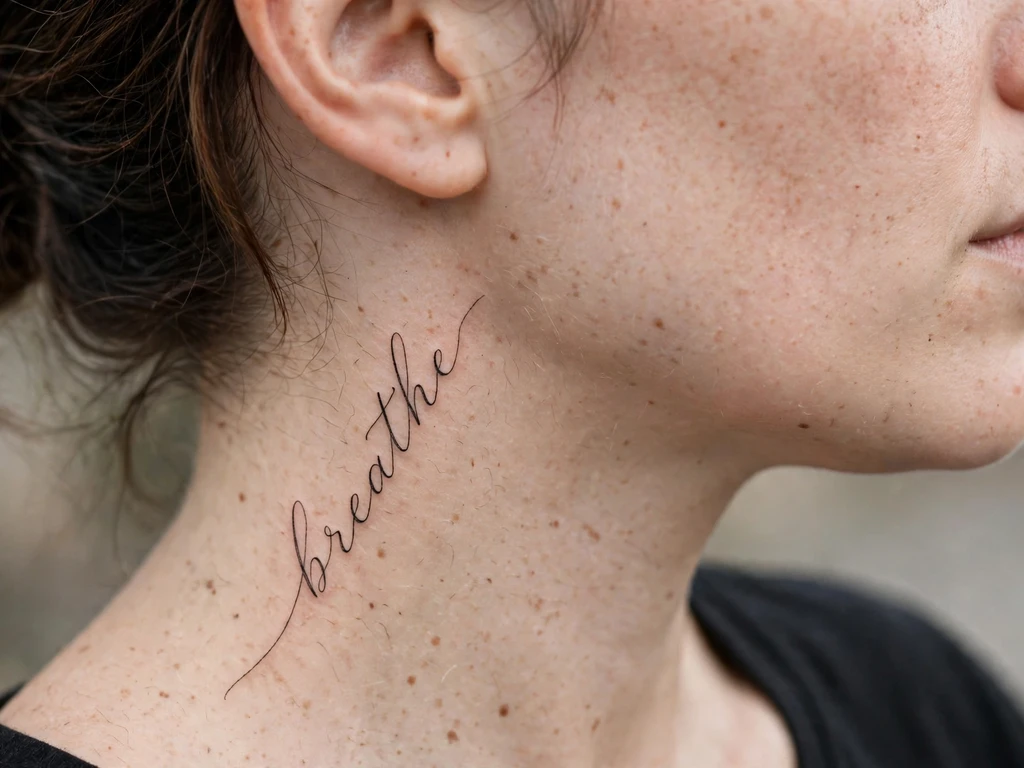
One word, written the way you would sign it: a name, a value, a promise — breathe, fearless, grace — in fine-line cursive running vertically or diagonally along the side of the neck. Script is the most personal neck tattoo there is, because handwriting is identity: the same word in ten different hands says ten different things. Keep the word short and let the letterforms do the decorating; a single elegant word needs no frame, no shading and no company.
Best placement: Side of the neck, following the natural diagonal from below the ear down towards the collarbone.
Best for / know before you book: Neck skin moves constantly — talking, turning, swallowing — and fine lines on moving skin spread faster than on still skin, so let your artist draw the letters a fraction bolder and slightly larger than the whisper-thin references you will find online. Read the stencil in a mirror at conversation distance: if you cannot read it at arm’s length now, it will not read at all in five years.
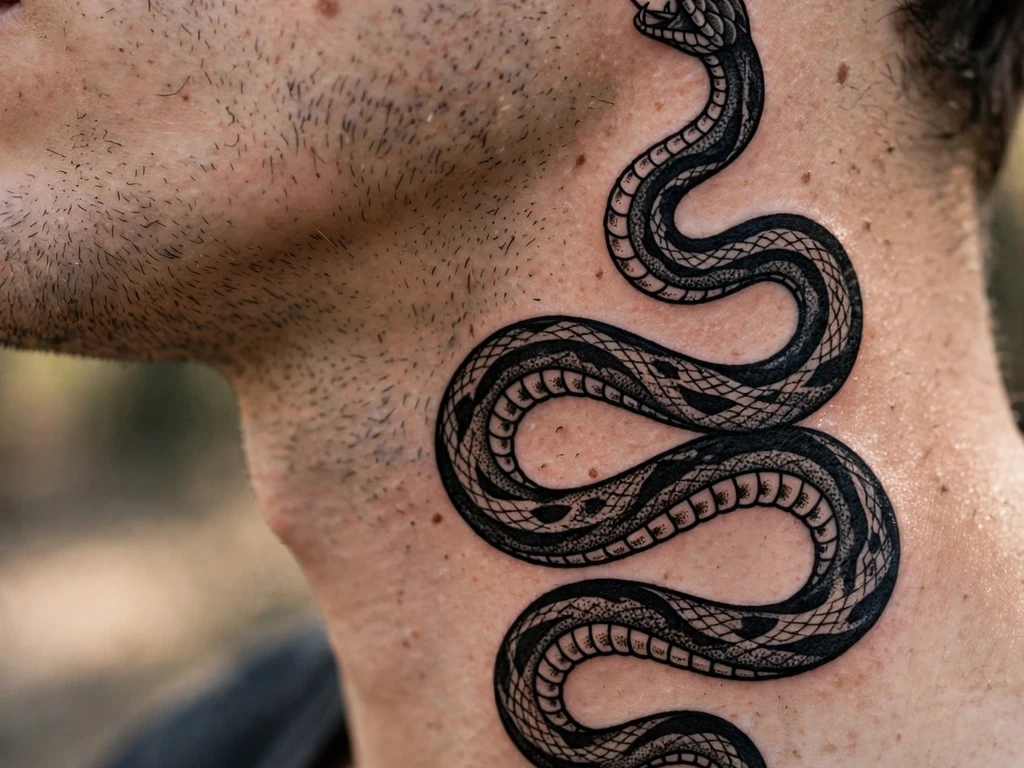
2. Coiled Snake
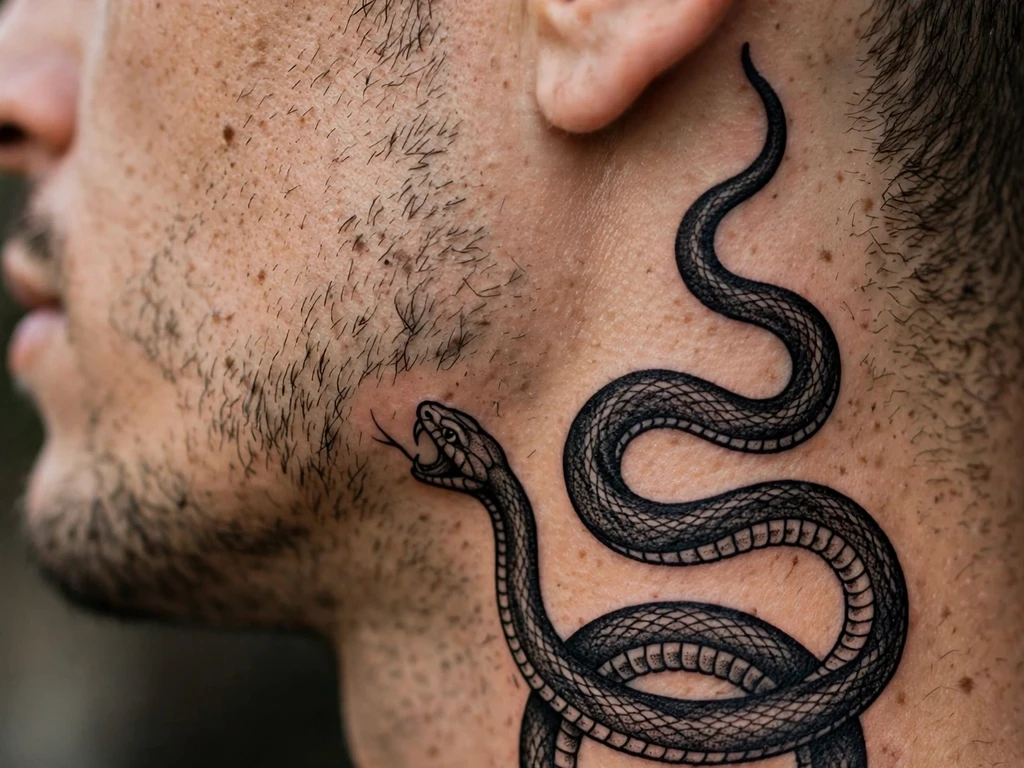
The snake is the neck’s natural design, because it is the only common motif shaped exactly like the canvas: a long, curving body that climbs from the collarbone, coils once or twice as it rises, and lifts its head near the jaw. Drawn in blackwork with scale detail or reduced to a single flowing line, it moves when you move — turning your head makes it slither. Our full snake tattoo ideas collection shows the range of snake styles, but on the neck the vertical, single-coil version is the one artists reach for again and again, because it is composed for the space rather than shrunk to fit it.
Best placement: Side of the neck, tail starting at the collarbone and the head finishing below the ear or jaw.
Best for / know before you book: The composition must be drawn on your neck, not adapted from a flat image — a coil that wraps correctly in profile can look broken face-on, so check the stencil from the front, in profile and at a three-quarter angle before you commit. Scales are fine detail on mobile skin; slightly larger, simpler scales age far better here.
3. Butterfly at the Side
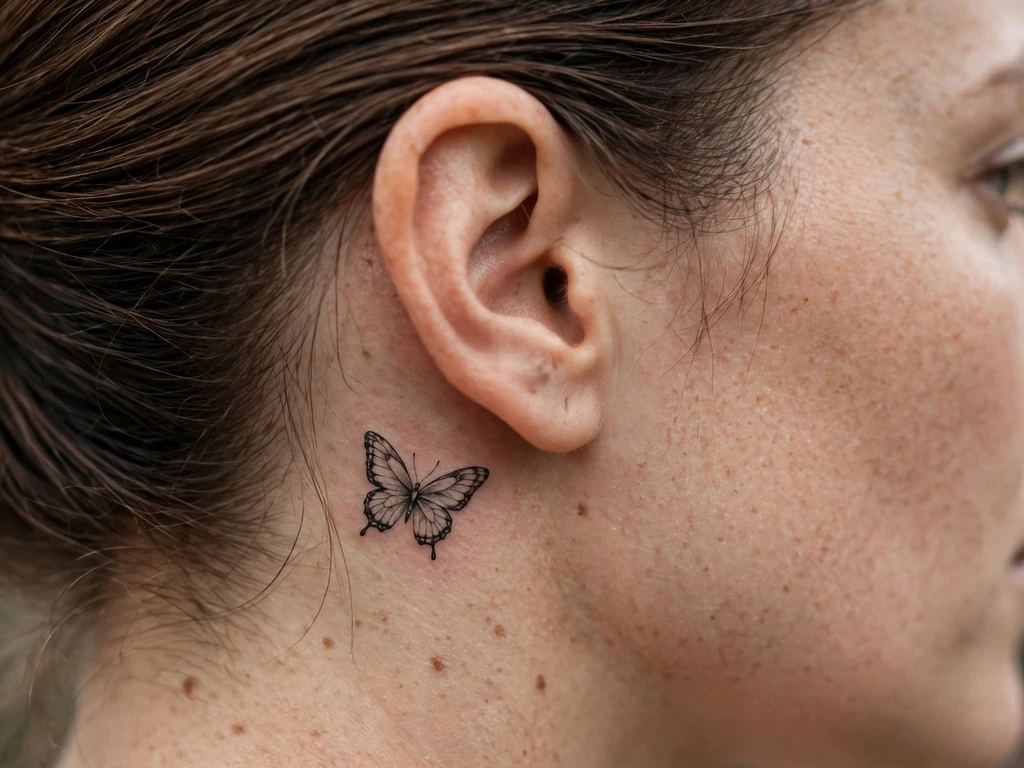
A small butterfly settled on the side of the neck, just below the ear, as if it landed there a moment ago. It is the gentlest design in this guide and one of the most requested entry points into neck tattoos: feminine, light, and visible in exactly the way a dangling earring is visible — in profile, in movement, when hair is swept back. The variations in our butterfly tattoo ideas collection all scale down to this spot, but the fine-line and lightly shaded versions suit it best, because heavy black wings can read as a blot at this size.
Best placement: Side of the neck just below the ear, wings angled as if the butterfly is resting, not flying.
Best for / know before you book: Symmetry is the design’s whole charm and its whole risk — wings that differ by a millimetre read as a mistake at a glance. This is also semi-visible territory: it peeks out from under most hairstyles, so file it under “visible” in the work conversation honestly, not under “hidden”.
4. Traditional Dagger
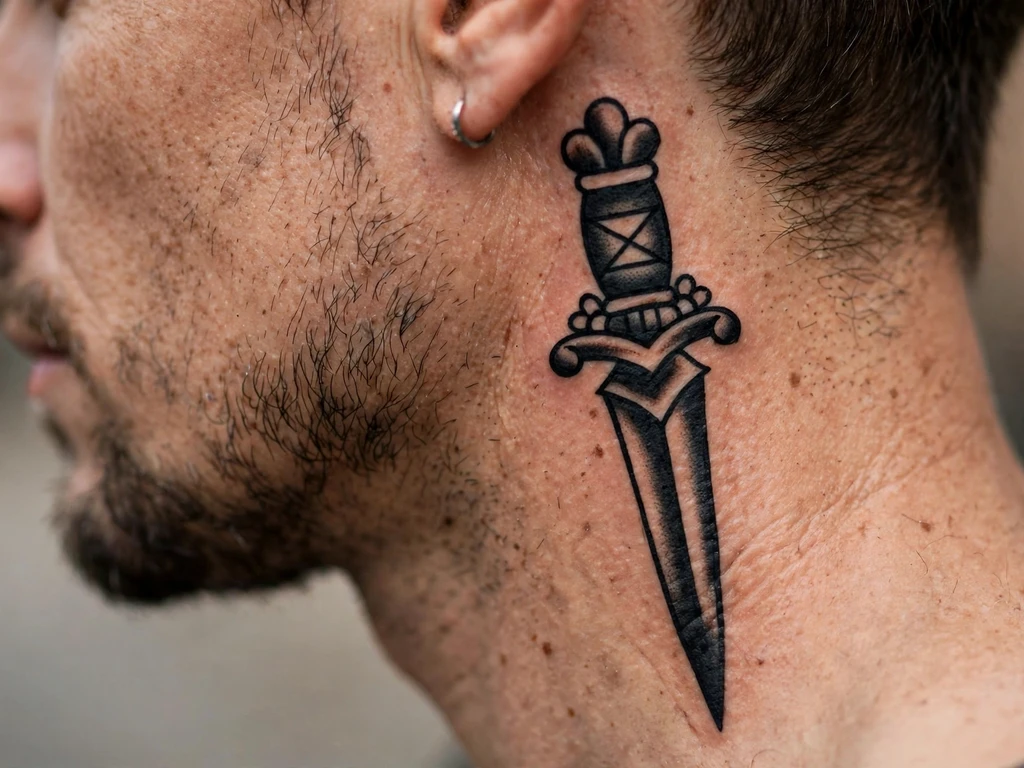
A dagger drawn the old way — bold outline, solid shading, the blade pointing down the side of the neck like a pendant on an invisible chain. Traditional work suits the neck better than almost any style, because its thick lines and packed colour are built to survive skin that moves, stretches and sees the sun, and the dagger’s long vertical shape is made for this column of skin. Add a small rose, a banner word or nothing at all; the classic version needs no help.
Best placement: Side of the neck, handle near the jaw and the blade tip pointing down towards the collarbone.
Best for / know before you book: Bold traditional is the best-ageing choice on this list, but the session is honest work — packing solid black and colour on the side of the neck, close to the jaw, is a spicy couple of hours. Eat beforehand, and do not book it the day before an event where you need to turn your head gracefully.
5. Rose on a Long Stem
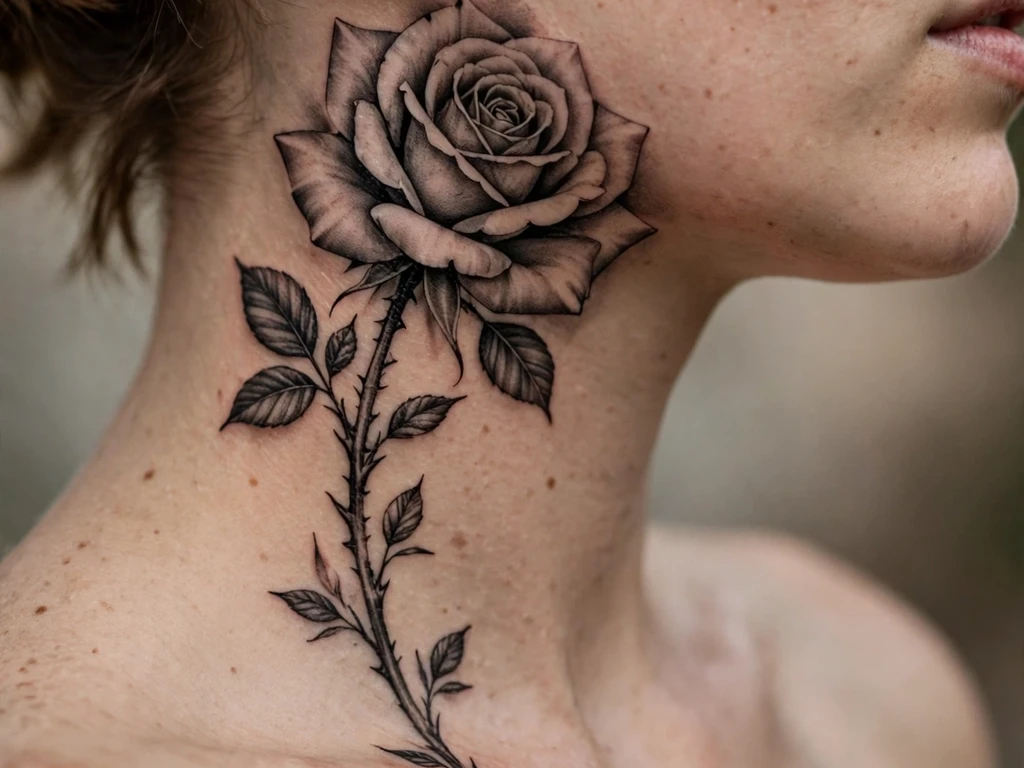
A single rose with its stem left long, so the flower opens at jaw height and the stem descends the neck like the flower is being worn, not stuck on. It is the most romantic of the traditional neck designs and one of the most versatile: fully traditional with bold colour, black-and-grey with soft shading, or fine-line for a drawn, botanical feel. The meanings and styles in our rose tattoo design ideas all apply, but the long stem is the neck-specific trick — it turns a flower that could sit anywhere into a composition that could sit nowhere else.
Best placement: Side of the neck, bloom at the top near the ear or jaw, stem running down towards the collarbone.
Best for / know before you book: Petals are overlapping curves, and on the neck’s curved, moving surface an under-detailed rose heals into a cabbage. Give the bloom at least 4–5 cm of height, insist the petal lines are spaced for ageing, and let the stem be drawn freehand so it follows your neck’s actual line.
6. Small Cross
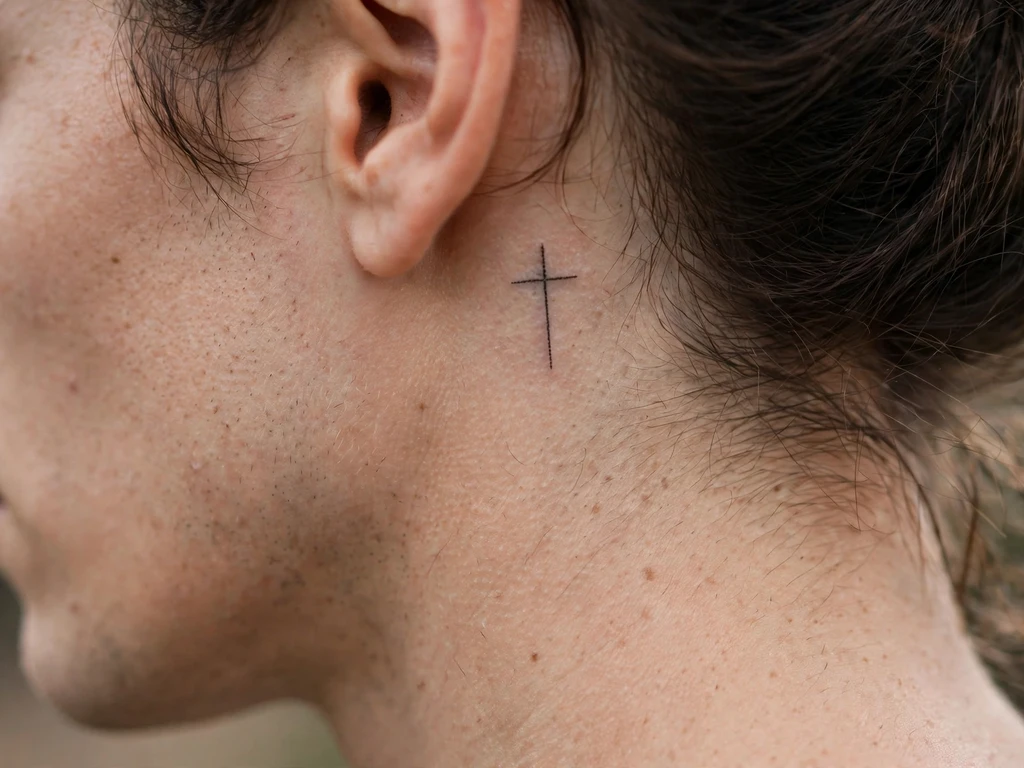
A small cross, placed just behind the ear or low on the side of the neck — one of the most common neck tattoos in the world, and one of the most quietly worn. For many wearers it is faith carried where it cannot be missed and does not need to be explained; for others it marks a person, a recovery or a turning point. The variations in our cross tattoo design ideas range from a two-line fine cross a centimetre tall to small ornate versions with flared ends, and at neck scale the simple end of that range is the right end.
Best placement: Side of the neck behind the ear for discretion, or centred low on the side of the neck where a collar’s edge would sit.
Best for / know before you book: A cross is two straight lines, which means it exposes any tilt mercilessly — and the side of the neck is all curves. Have the stencil checked standing, head straight, in a mirror, and understand that a cross geometrically perfect on the table can lean when you stand, because the skin it sits on has shifted.
7. Moth at the Nape
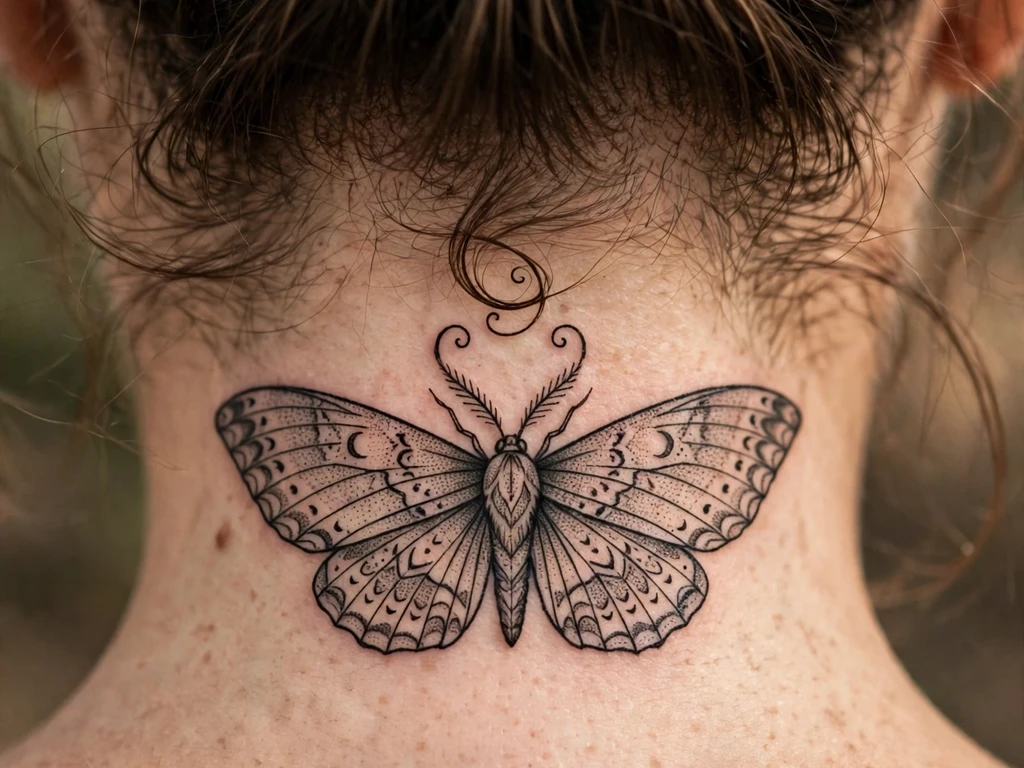
The nape’s signature piece: a moth with wings spread symmetrically across the back of the neck, antennae curling up towards the hairline, hidden completely by hair worn down and revealed in full when it goes up. The moth’s own symbolism — drawn to light, transformed in darkness — gives the placement a private meaning most people never see, which wearers tend to love. The designs in our moth tattoo ideas guide include luna and death’s-head versions, and both adapt beautifully to the nape: the luna’s trailing wing ribbons can follow the neck’s curve down, while the death’s-head’s skull marking sits naturally at the centre.
Best placement: Centre of the nape, wings spreading towards the sides of the neck, body of the moth on the centre line.
Best for / know before you book: You cannot see this tattoo being placed, so the stencil check is a two-mirror or photo ritual — insist on it, because a moth two millimetres off-centre will read lopsided in every updo photograph forever. Keep hair tied up and off it for the whole heal; loose hair dragging across a fresh nape piece is the most common cause of a scruffy heal here.
8. Laurel Branch
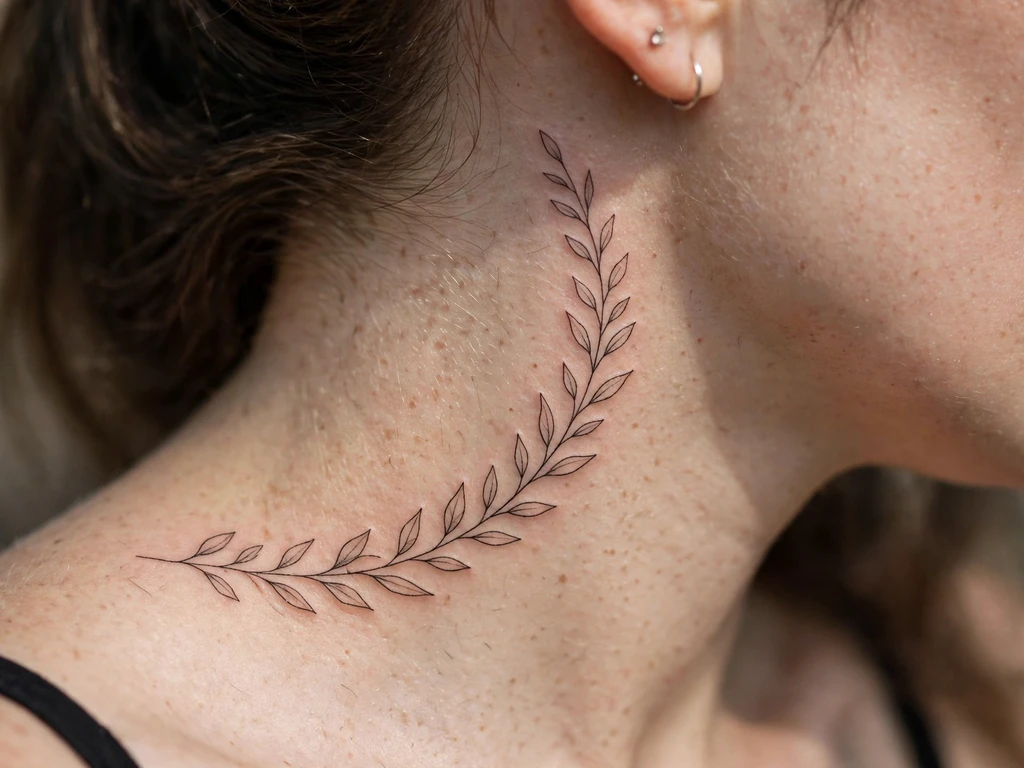
A single laurel branch, drawn in fine line, curving up the side of the neck the way the branch would curve around a classical portrait. Laurel carries an old, clean symbolism — victory, achievement, honour earned rather than given — and the design’s arc is a gift to this placement, because it follows the neck’s own curve instead of fighting it. Some wearers mirror a second branch on the other side later, framing the throat like a classical collar; most find one branch, well drawn, is the whole statement.
Best placement: Side of the neck, the branch arcing from the collarbone up towards the ear.
Best for / know before you book: Leaves are a row of near-identical shapes, which makes spacing the entire design: evenly spaced leaves look grown, uneven ones look stamped. Have the branch drawn or adjusted freehand on your neck so the arc is your arc — a laurel copied from a flatter neck will kink on yours.
9. Spider
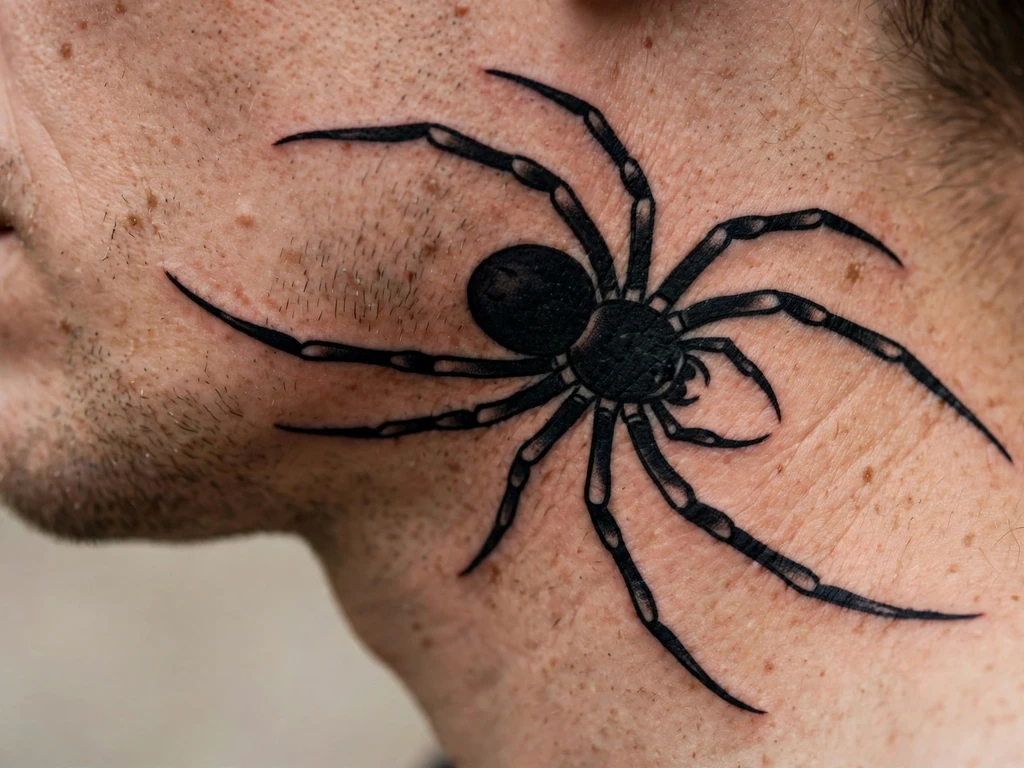
A spider with its legs spread wide across the side of the neck, drawn realistic enough to make strangers look twice — which is, for its wearers, precisely the point. The spider is the extrovert of neck tattoos: it plays with the neck’s curve so the body of the spider sits on the column and the legs climb and descend, and in profile it reads like the real thing pausing on your skin. Traditional versions with bold legs are the wiser choice for longevity; hyper-realistic ones are the choice for impact.
Best placement: Side of the neck towards the front, body centred on the neck’s column and legs spread up and down.
Best for / know before you book: Legs are long fine lines converging on one body, and on moving neck skin, fine legs placed too close together merge into a starburst within a few years. Keep the design big enough for daylight between the legs — your artist should be firm about minimum size here, and you should let them be. Also, honestly: this is the least coverable, most commented-on small design in this guide. Choose it for that, not despite it.
10. Watching Eye
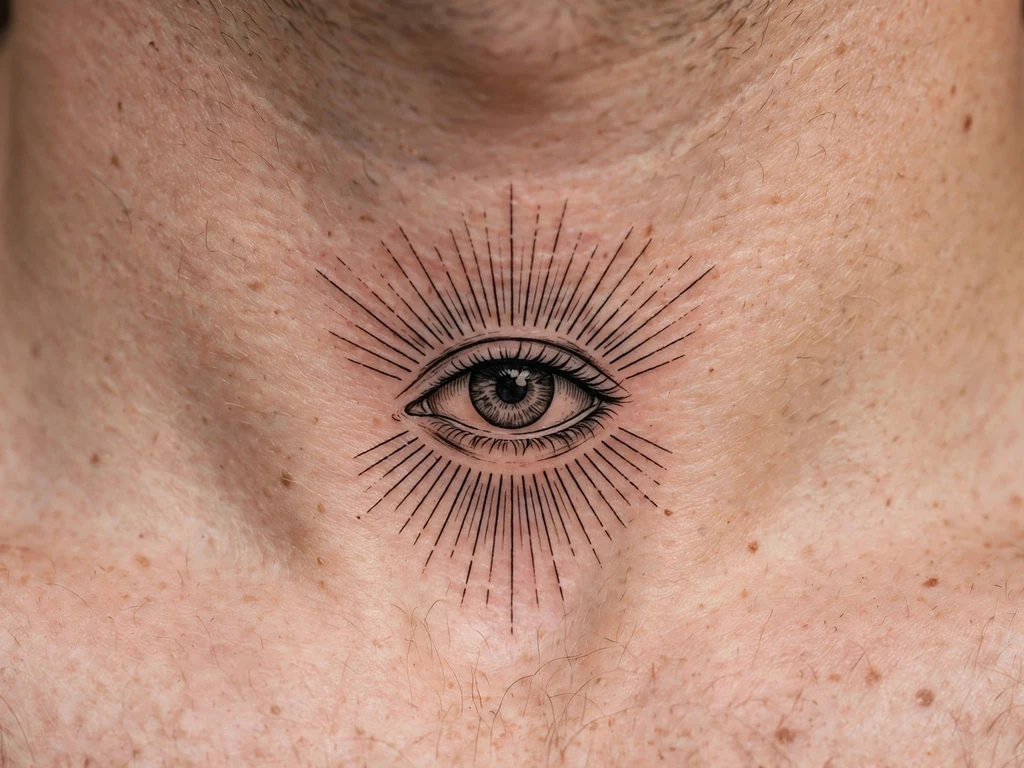
A single eye, centred on the front of the throat, with fine radiating lines above and below like a small sun that sees. It is the boldest small design in this guide, because placement is meaning: an eye on the front of the neck meets every gaze that meets yours. Wearers choose it as a symbol of awareness, protection or being watched over; strangers simply find it unforgettable. Keep it graphic — iris, lashes, rays — rather than realistic, because the throat’s soft, moving skin blurs photorealism faster than almost anywhere.
Best placement: Centre front of the neck, the eye sitting on the throat’s centre line.
Best for / know before you book: Front-throat work is the neck’s most sensitive territory, and a centred design adds a symmetry check you must do standing, swallowing and turning your head, because the throat’s centre line visibly moves. Book an artist whose healed throat work you have seen — fresh photos hide how this placement settles.
11. Twin Flames
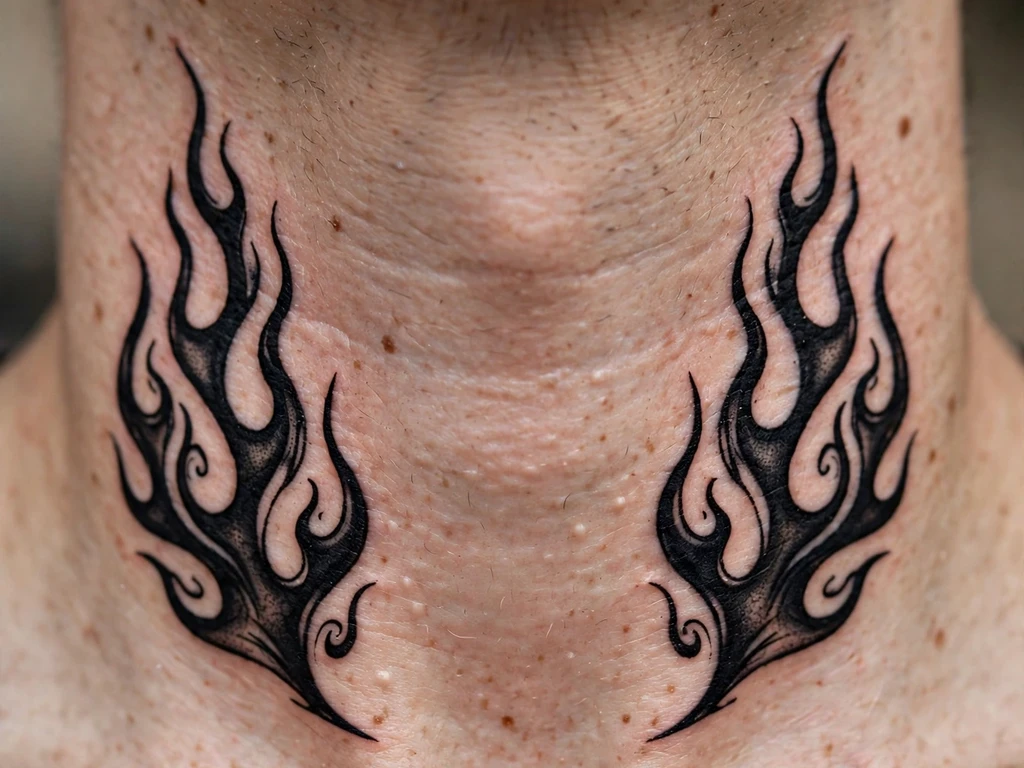
Two flame shapes, mirrored, rising on either side of the front of the neck like the collar of some ceremonial garment. Flames suit the throat’s anatomy surprisingly well: they are vertical, symmetrical and drawn to flicker upward, and the pair frames everything the wearer says — literally. Traditional black flames are graphic and timeless; red-and-orange flames turn the heat up and the maintenance too, because warm pigments fade fastest in a placement that sees this much daylight.
Best placement: Front of the neck, one flame on each side of the throat, tips rising towards the jaw.
Best for / know before you book: Mirrored pairs double the alignment problem, and the two sides of a throat are never perfectly symmetrical to begin with — a good artist draws the second flame to look matched from the front rather than measuring it identical. Approve the pair from a front-facing photo of the stencil, not from the mirror alone.
12. Ornamental Chain Necklace
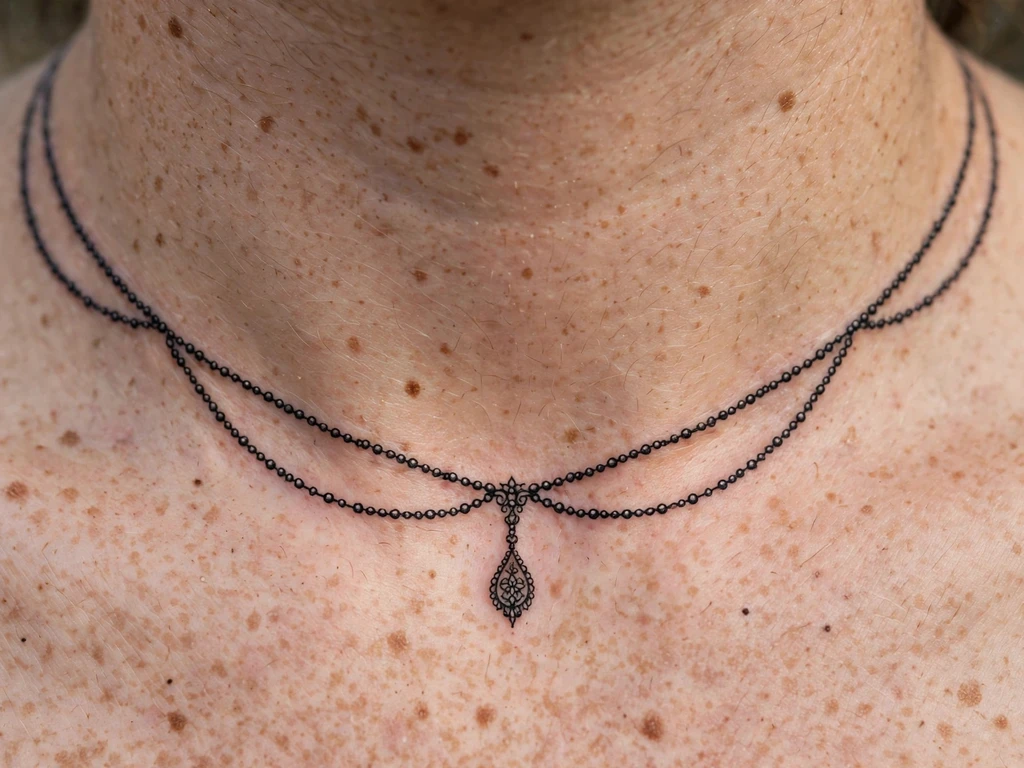
The necklace effect in its purest form: a fine chain — or two — drawn to drape across the front of the neck exactly where a real necklace rests, meeting at a small pendant drop at the centre of the throat. Of all the designs here, this is the one that explains the neck trend to people who do not get tattoos: it is jewellery, permanently worn, that frames the face in every photograph. Bead dots along the chain and a tiny gem or charm as the pendant finish it.
Best placement: Across the front of the neck at the base of the throat, the pendant centred — positioned on your body standing, so the drape hangs true.
Best for / know before you book: A chain drawn while you lie back will sag differently the moment you stand, so the stencil must be placed and checked upright, in your natural posture, full stop. Chains are fine line on sun-exposed, moving skin — the fastest-softening combination there is — so this design quietly commits you to daily sunscreen and a touch-up every few years.
13. Roman Numerals
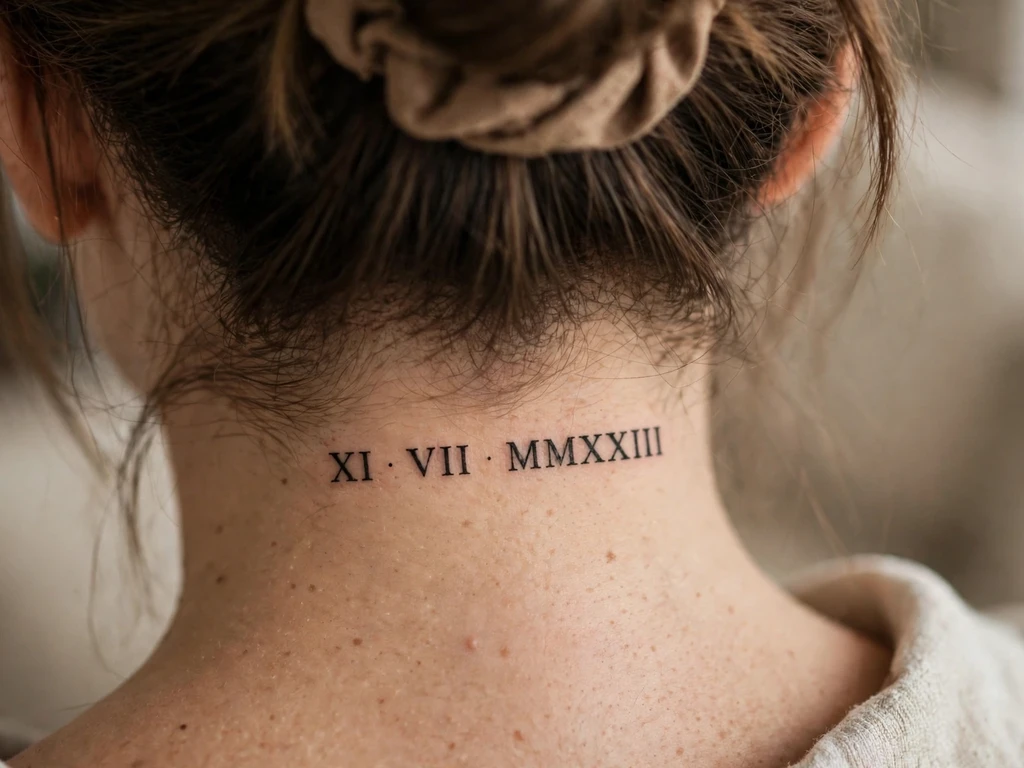
A date written the classical way — a birth, a wedding, a day everything changed — in Roman numerals running horizontally across the nape, just below the hairline. It is lettering as jewellery: from behind it reads like the engraved back of a pendant, from the front it does not exist at all. Clean serif numerals suit the placement’s formality; typewriter-style numerals give it a more stamped, document-like feel. Either way, the row should be short — the nape fits a date beautifully and a paragraph not at all.
Best placement: Across the back of the neck, centred, sitting just below the hairline.
Best for / know before you book: Proofread the numerals character by character, out loud, twice — Roman numerals are the easiest lettering in tattooing to transpose (XIV versus XVI), and you cannot see this tattoo to catch the error afterwards. Then have someone you trust photograph the stencil, because your own mirror check at the nape is guesswork.
14. Swallow in Flight
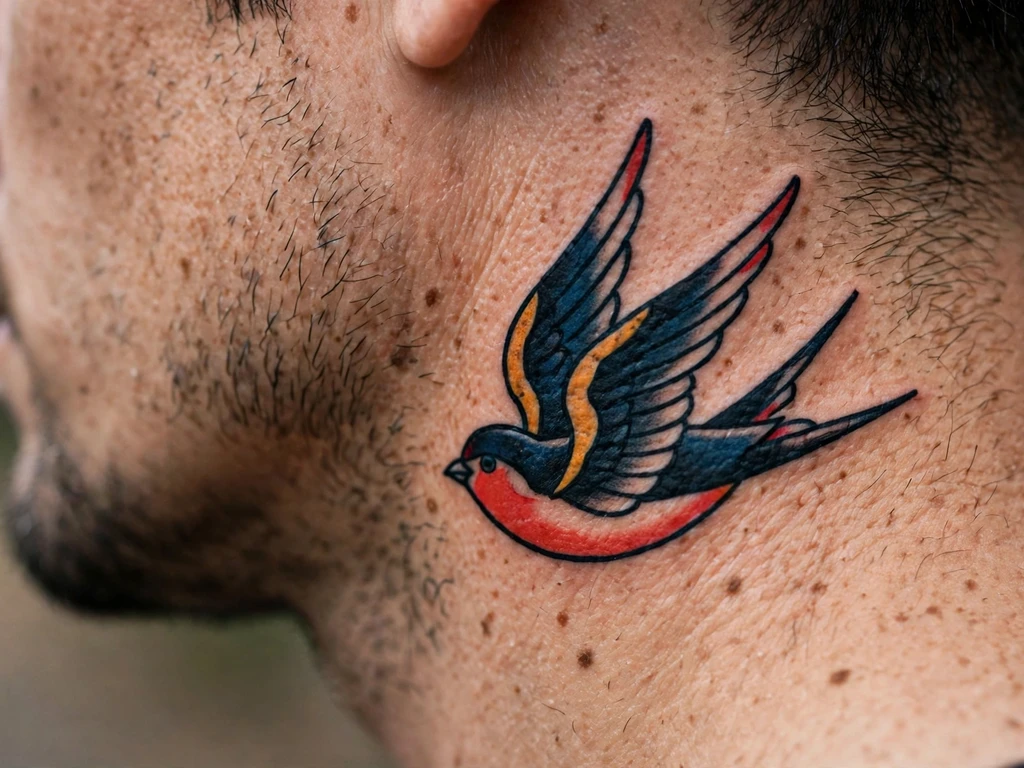
The sailor’s bird, flown up from the chest to the neck: a traditional swallow with wings swept and tail forked, drawn as if it has just launched from your collarbone. Swallows carry the old meanings — journeys, loyalty, always returning home — and their swept, horizontal shape lets a side-neck piece reach from the back of the jaw nearly to the throat, using the full width of the canvas. Bold traditional colour holds best; fine-line swallows are prettier on day one and softer by year five.
Best placement: Side of the neck, flying horizontally with the head towards the front and the forked tail towards the ear.
Best for / know before you book: A bird in flight is all diagonals, and diagonals on the neck shift as you turn your head — approve the stencil in your most natural head position, not stretched or turned for the artist’s convenience. Keep the wing detail chunky; feather barbs drawn too finely close up as the lines settle.
15. Tribal Neck Band
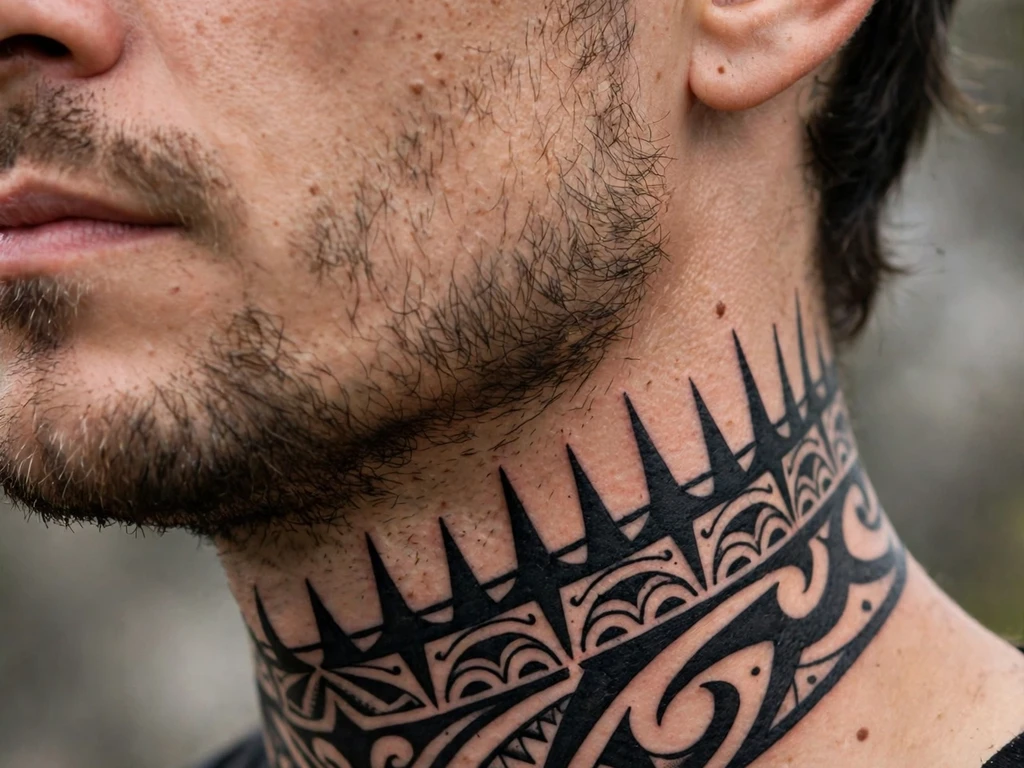
A band of bold black tribal pattern that wraps the neck like a collar — points, curves and solid black fields in the graphic language of 1990s tribal, redrawn by modern blackwork artists with cleaner geometry. It is the most architectural design in this guide: from every angle the neck reads as ringed, and the composition is usually built to peak at the front or centre its points at the throat. It is also the design that most clearly descends from much older traditions of neck marking, and the respectful way to wear it is as bold abstract blackwork in its own right, composed for you — not as a copy of any specific culture’s sacred patterns.
Best placement: Around the full circumference of the neck, usually at mid-neck height, with the design’s peak or centrepiece at the front.
Best for / know before you book: A wrap band is the hardest stencil job on the neck: it must meet itself seamlessly at the back, stay level through a full 360 degrees of moving, tapering skin, and survive your head turning in both directions during the check. Expect a long stencil session, and understand that solid black fields on the throat are an intense sit — many artists split a full band into two appointments.
16. Gothic Lettering Across the Throat
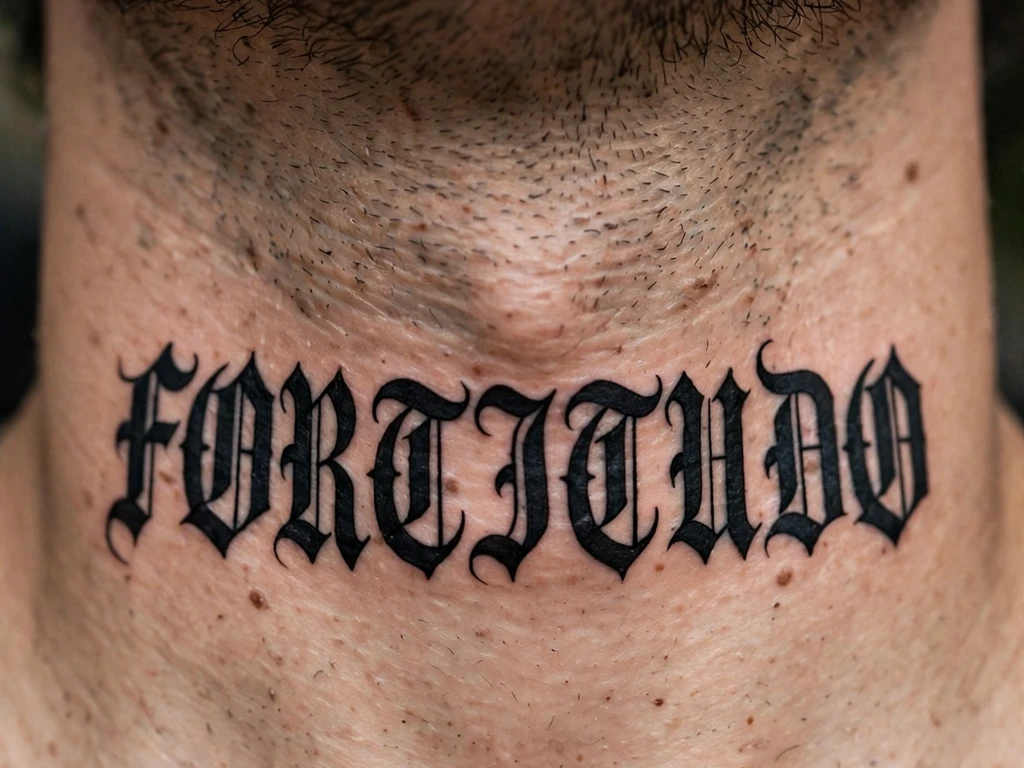
A word or short phrase in blackletter, set straight across the front of the throat — the design most people picture when they picture a throat tattoo, and the one currently driving the placement’s mainstream moment. Gothic lettering suits the throat because blackletter is architecture: vertical strokes, sharp angles, a word that reads like it was carved across a lintel. Choose the word like you would choose something to be introduced by, because that is functionally what it is — it is the first thing read in every conversation.
Best placement: Across the front of the neck, centred under the jaw, sized to span the throat without wrapping.
Best for / know before you book: Blackletter has enclosed counters and tight corners that fill in if it is set too small, and the throat’s skin is the least forgiving on the neck — go bigger than feels necessary and have the letterforms drawn for your throat’s width, not squeezed from a font file. Then proofread the stencil standing, looking straight ahead in the mirror, because lettering approved with your chin down will sit differently with your head up.
17. Tiny Symbol Column
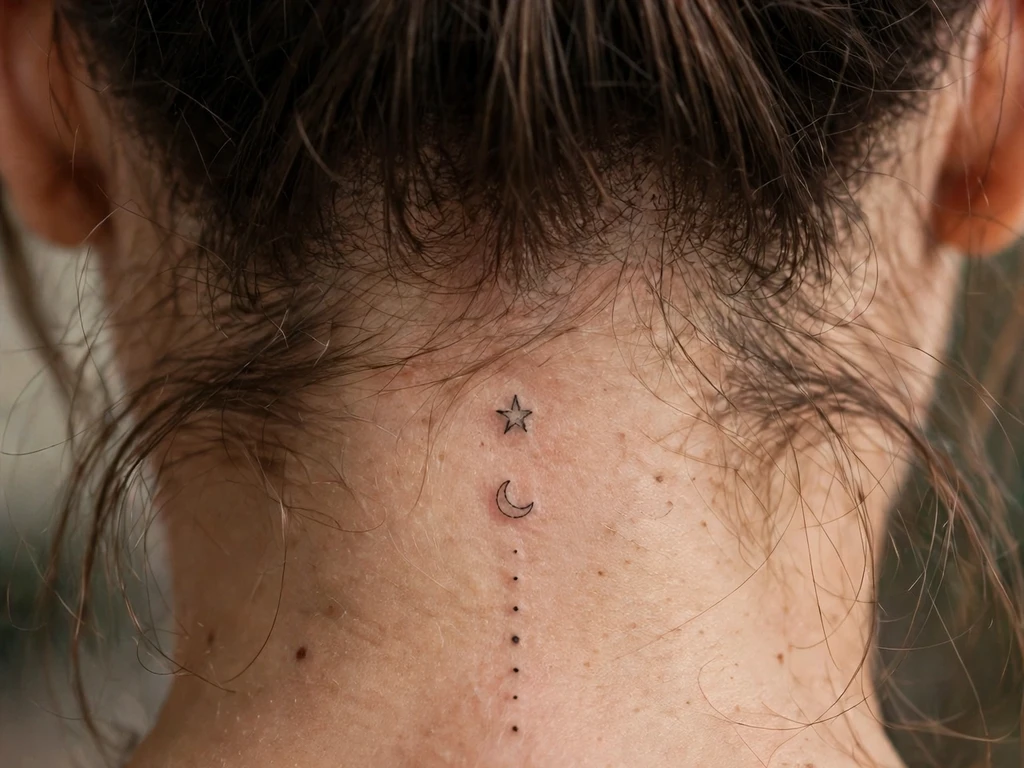
A vertical little procession down the centre of the nape: a star, a crescent moon, a dot, a tiny heart or an initial — three to five small symbols stacked like a charm bracelet unclasped and laid straight. Each symbol can carry its own meaning (a star for a person, a moon for a phase of life), and the column format invites additions: wearers often append one symbol per milestone, growing the column down towards the shoulders over years.
Best placement: Centre of the back of the neck, running vertically from the hairline downwards.
Best for / know before you book: The column lives or dies on its centre line and its spacing — evenly gapped symbols on a true line look deliberate, and anything else looks like a scatter that drifted. Have the centre line marked and photographed from directly behind before the first symbol is inked, and agree the spacing in millimetres, because “about even” is visible forever at this scale.
18. Scorpion
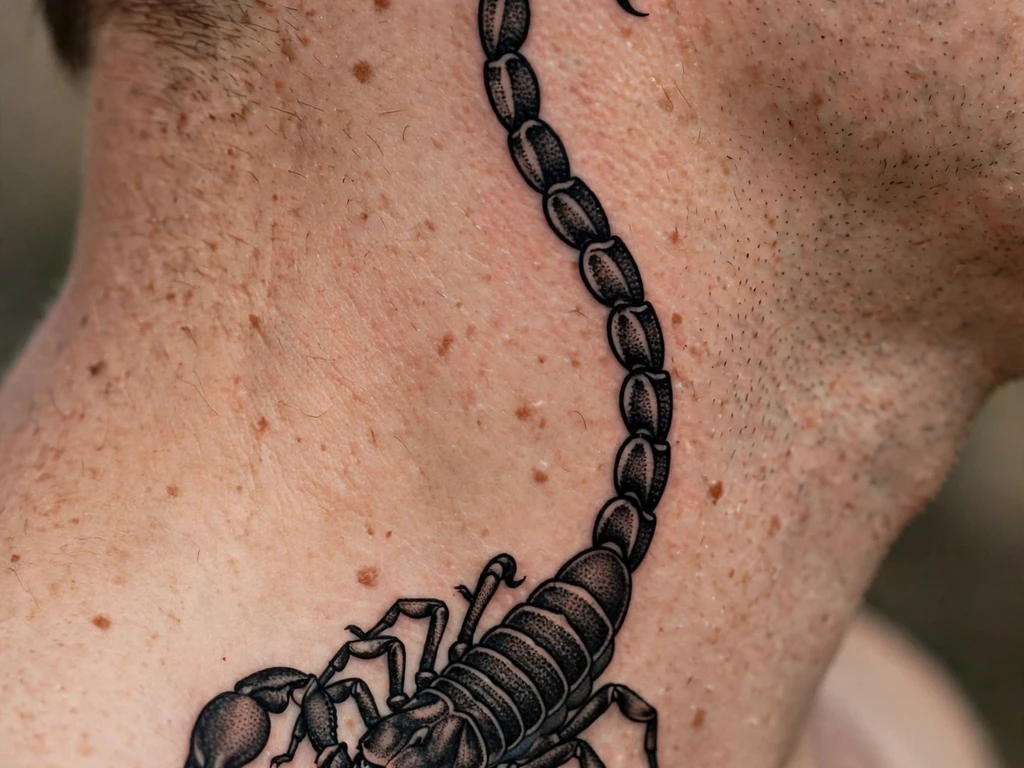
The scorpion is the spider’s heavier cousin in the neck-tattoo family: a solid blackwork body on the side of the neck with the tail curling up towards the ear, pincers facing forward. It reads as armour — dark, graphic, unbothered — and its curved anatomy is, like the snake’s, pre-shaped for this placement: the tail’s arc follows the neck’s column as if the design grew there. Scorpio wearers claim it as a birth sign; everyone else claims it as a warning label, and both readings are intended.
Best placement: Side of the neck, body low near the collarbone and the curled tail rising towards the jaw or ear.
Best for / know before you book: The legs are the ageing risk — eight of them, close together, on moving skin — so a good artist simplifies and separates them, and keeps the whole piece large enough for air between the lines. Solid black packing on the side of the neck scabs noticeably; time the appointment so the peeling week is not a week of collars, photographs or first impressions.
19. Cherry Pair
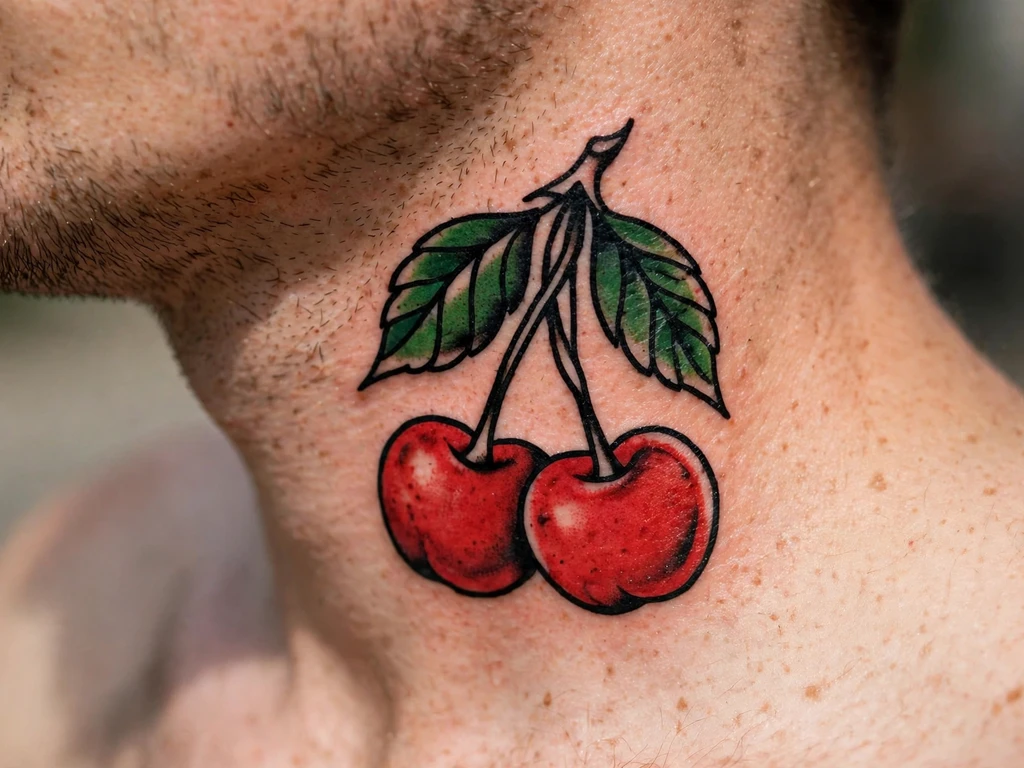
Two cherries on joined stems with a leaf or two, placed at the front-side of the neck where a pendant’s charm would sit. Cherries are traditional tattooing’s shorthand for sweetness with an edge — playful, a little retro, unmistakably deliberate — and at the front of the neck they work like a brooch: small, bright and right where the eye lands. Red is the classic choice and also the pigment family that fades fastest in sunlight, which this placement gets in full.
Best placement: Front-side of the neck, low, where the stems can point up towards the jaw.
Best for / know before you book: Red ink in a sun-facing placement is a maintenance plan, not a one-time purchase: expect the red to want refreshing years before the black outline does, and make sunscreen a habit from the day it heals. Keep the pair at least 4 cm tall so the stems and leaf veins stay separated as the lines settle.
20. Pendant Drop at the Nape
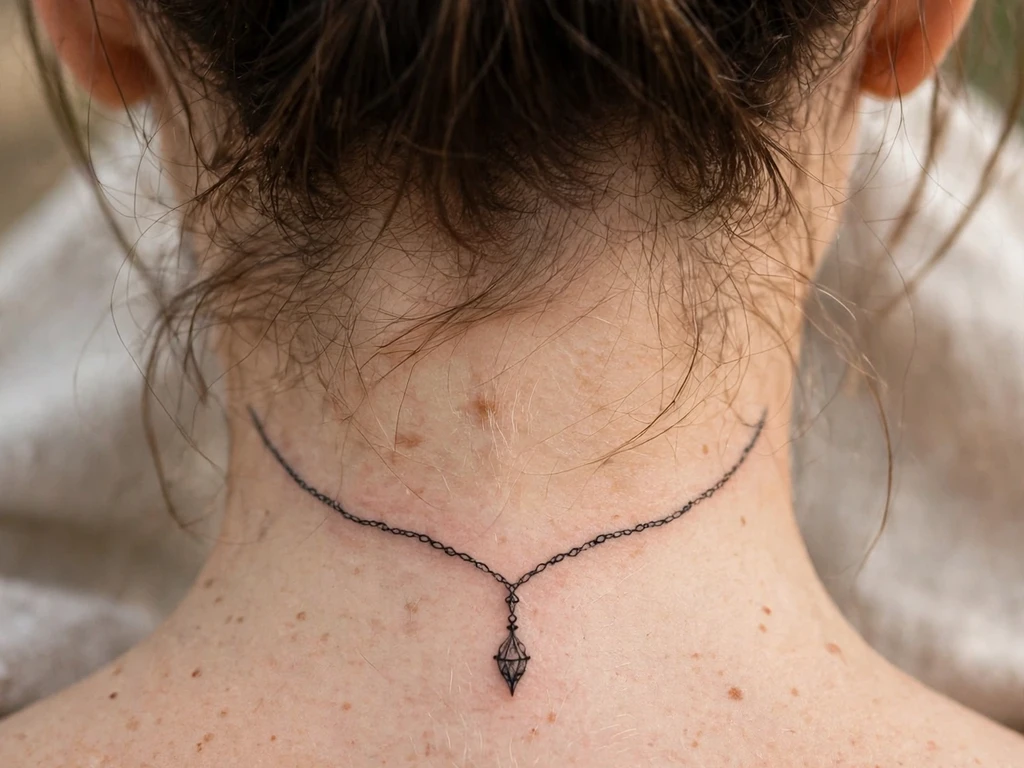
A necklace drawn to be seen from behind: a fine chain line curves across the nape and one pendant — a gem drop, a tiny mandala, a teardrop — hangs at its centre, revealed by updos and hidden by loose hair. It is the most jewellery-like of the nape designs and a quiet favourite among people who want one elegant, concealable neck piece. Where the front-of-neck chain is a statement, this is a signature: seen by fewer people, remembered by all of them.
Best placement: Centre of the nape, the pendant hanging just below the hairline on the centre line.
Best for / know before you book: Centring is everything and the canvas is one you cannot see — the stencil ritual here is mirrors plus a photograph, checked twice. Hair products, perfume and high collars all land exactly on a healing nape piece, so plan two weeks of hair-up, collar-open living, and add the pendant’s drop length to the stencil check: it must hang clear of the hairline, not into it.
21. Crescent Moon and Stars
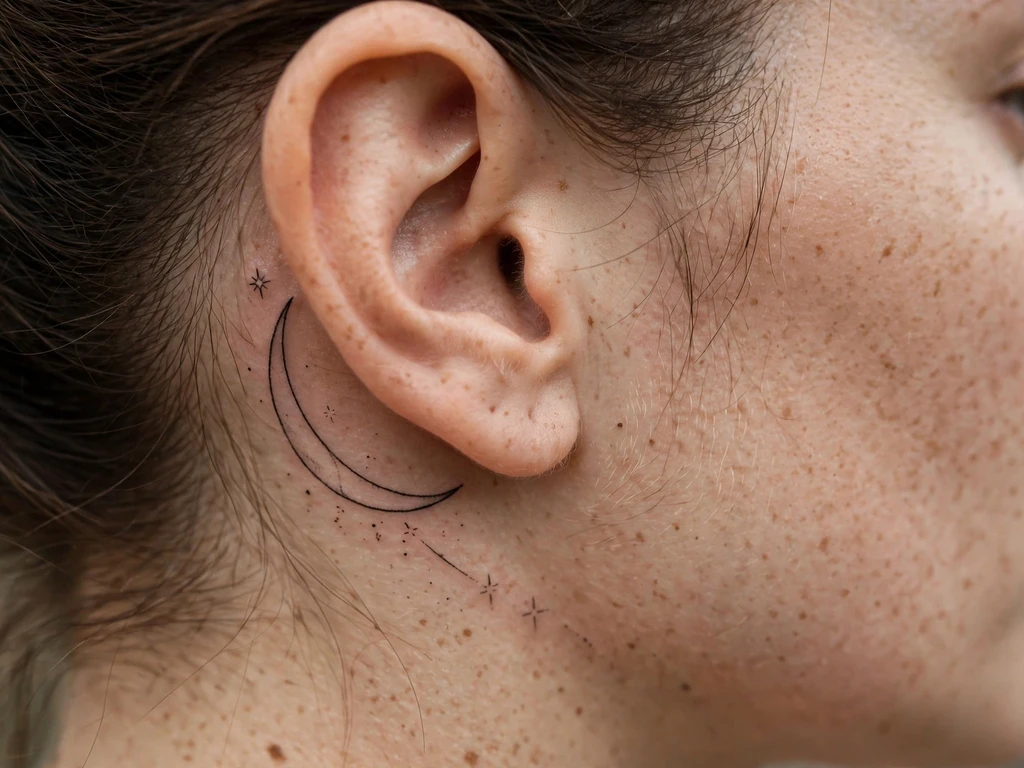
A fine-line crescent moon with two or three small stars, tucked on the side of the neck behind the ear — the celestial version of the small cross: discreet, symbolic and endlessly personalisable. The moon’s curve echoes the curve of the ear itself, which is why the composition looks grown rather than placed. Wearers read it as intuition, cycles, a night-owl nature or a private memorial; the design keeps its meaning to itself either way.
Best placement: Side of the neck directly behind the ear, the crescent following the ear’s own curve.
Best for / know before you book: A crescent is two curves, and the inner curve is deceptively easy to draw lopsided — study the stencil close-up, not at arm’s length. Behind-ear skin is thin and sheds ink quickly, so keep the moon’s outline a touch bolder than the ethereal references suggest and treat one touch-up as part of the price.
22. Mini Dragon
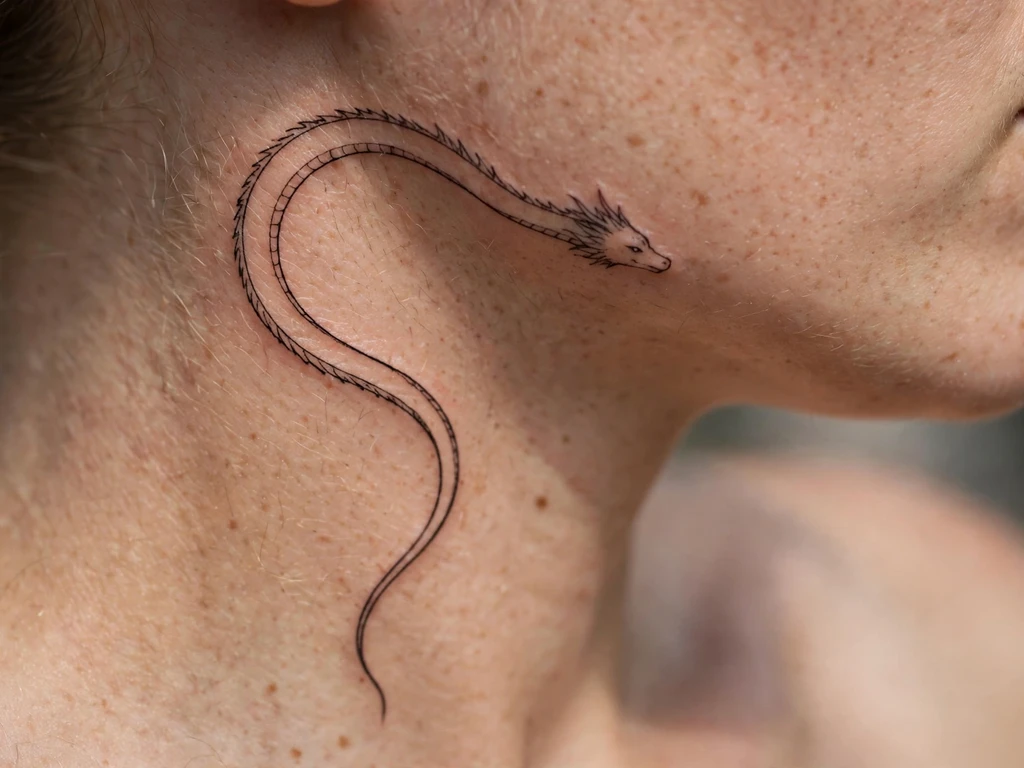
A small dragon, drawn to wrap: body curving around the side of the neck, tail tapering down towards the collarbone, head lifting near the jaw with the whiskers and horns kept simple. The dragon is the most ambitious small design in this guide — it carries scales, claws, wings or fins and a face, all in a few centimetres — and it succeeds precisely when the artist simplifies boldly: a strong silhouette line, a suggestion of scales, one clear eye. Japanese-influenced versions flow best, because that tradition draws dragons as water — and water shapes fit the neck’s curve naturally.
Best placement: Side of the neck, the body wrapping from the back of the jaw around towards the front.
Best for / know before you book: Detail density is the enemy at this size on this skin: every scale you insist on is a line that will merge. Ask your artist to show you the design at actual size, printed, and to remove detail until it reads clearly at arm’s length — what reads at arm’s length today reads at conversation distance in ten years.
23. Vertical Behind-the-Ear Script
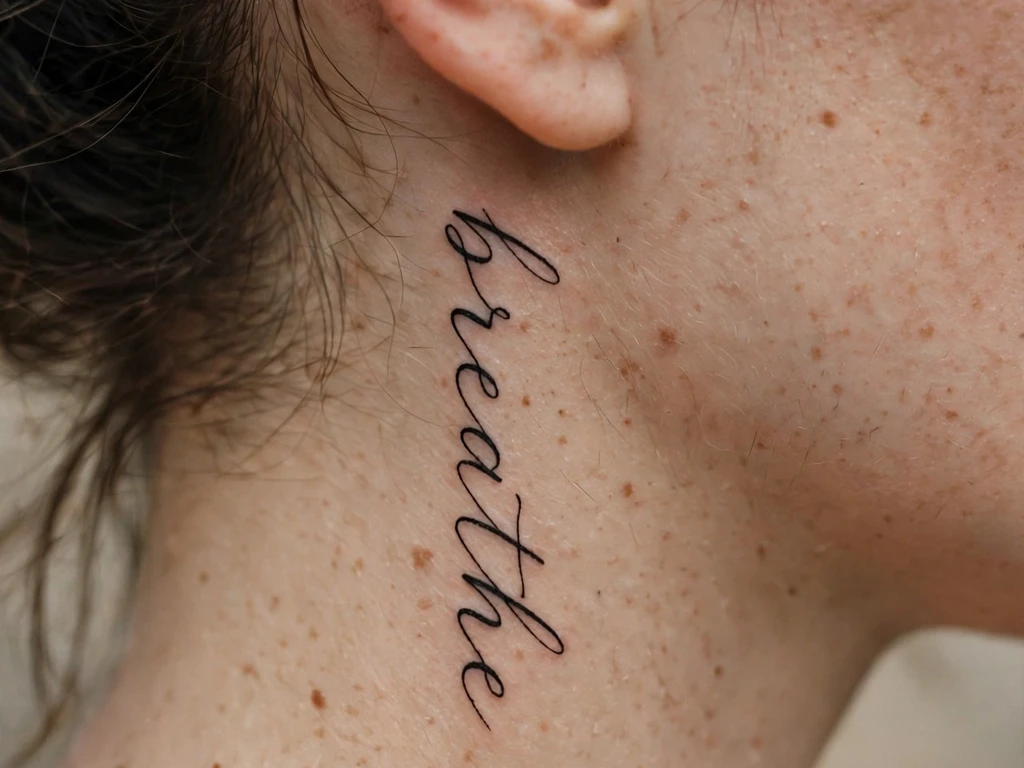
A word set vertically behind the ear, reading downward — a name, a date in slim numerals, a single vertical stroke of a phrase. It is script as secret: invisible face-on, half-glimpsed in profile, fully read only by people close enough to tuck your hair back. The vertical format suits the narrow strip of skin behind the ear perfectly, a column made for a column of letters, and it pairs naturally with small symbol tattoos lower on the neck later.
Best placement: Directly behind the ear, running vertically from the hairline down towards the jaw’s angle.
Best for / know before you book: Vertical lettering is read by tilting heads, so check the stencil’s direction with fresh eyes — specifically, confirm whether it reads top-to-bottom as intended once your head is level, not while you are craning at a mirror. The strip behind the ear is narrow and curved, which caps your letter height; accept fewer, larger characters over many small ones.
24. Ornamental Throat Centrepiece
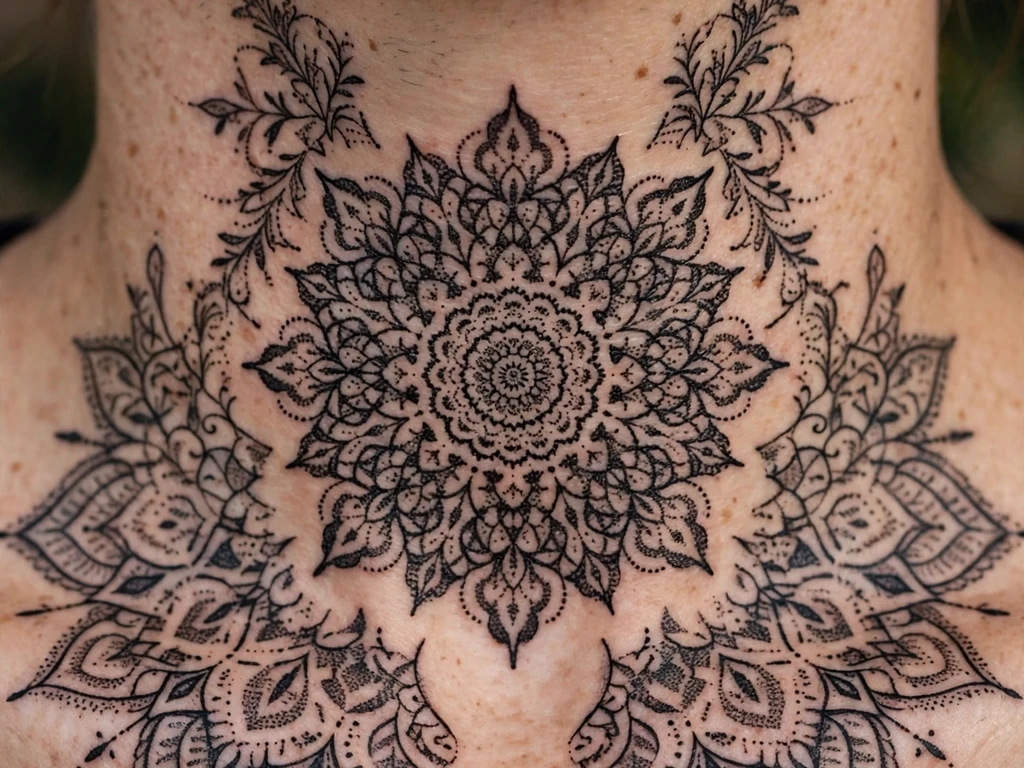
The full statement: a symmetrical ornamental composition built for the front of the neck — a mandala or lace medallion centred on the throat, with filigree, dotwork and small gem points spreading towards the jaw and down to the collarbones like the yoke of an elaborate necklace. It is the neck piece as couture: designed on the body, balanced to the millimetre, and utterly uncoverable — the wearer is not decorating an outfit but replacing the category. Done by a specialist, it is among the most striking tattoos a person can own.
Best placement: Front of the neck, centred on the throat and composed standing, spreading symmetrically to jawline and collarbones.
Best for / know before you book: This is consultation-first work: a custom drawing fitted to your throat, a stencil session measured in real time, and very likely two sittings — and it belongs to an artist whose healed throat and ornamental work you have inspected, not admired fresh. The throat swallows, breathes and moves through every minute of the session; plan breaks, eat well, and do not schedule it before a week in which your voice or your appearance carries your job.
25. Constellation Trail
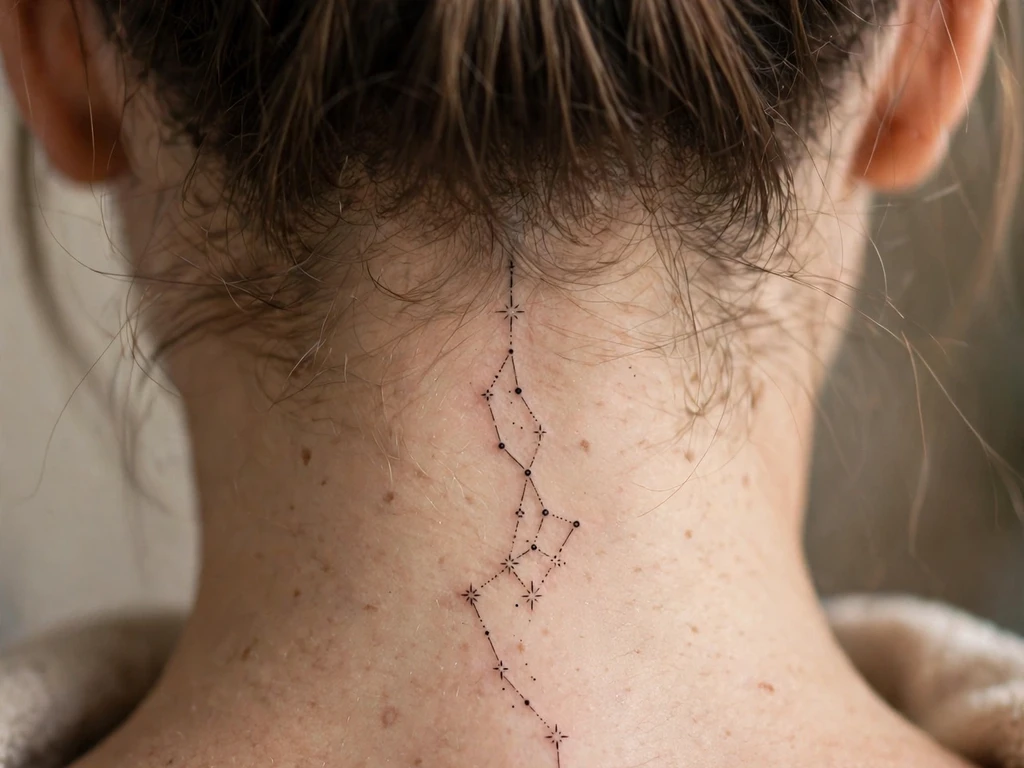
The lightest way to wear the nape: a scatter of tiny dots, hair-fine connecting lines and a few small stars trailing from the hairline down the centre of the back of the neck, like a star chart slipping out from under your hair. Some wearers map a real constellation — a birth sign, the sky over a place that matters — giving the trail a private second meaning under its jewellery surface. It is subtle enough for the most cautious neck-tattoo beginner and strange enough to be asked about constantly.
Best placement: Centre of the back of the neck, trailing vertically from the hairline downwards, as long or short as you like.
Best for / know before you book: Hair-fine connecting lines are the fastest-softening element in this entire guide — your artist should draw them a fraction heavier than the reference, and the dots need genuine spacing, because constellation dots that merge read as blemishes, not stars. Agree every dot’s position at the stencil stage; a star chart improvised mid-session never ends up looking charted.
Neck Tattoo Placement by Size
| Size | Typical dimensions | Best placements | Good to know |
|---|---|---|---|
| Small | 2–5 cm | Behind the ear, low side of neck, nape symbols | Crosses, moons, cherries and butterflies live here; keep detail minimal — neck skin spreads lines faster than still skin |
| Medium | 5–10 cm | Side of neck, nape centrepieces, front-throat motifs | The sweet spot for snakes, roses, daggers and moths — room for real composition without full commitment to the throat |
| Large | 10–18 cm | Full side panels, throat lettering, tribal band | Designs at this size use the neck’s full column or circumference; expect long stencil sessions and possibly split sittings |
| Extra large | 18 cm+ / wrap or multi-element | Ornamental throat centrepieces, full neck bands, pieces joining chest or back work | Plan the whole composition in one consultation, even if it is tattooed in stages |
How to Choose Your Neck Tattoo (and What to Know Before You Book)
Be honest with yourself about pain — it differs by sub-placement, a lot. The nape is the neck’s kindest territory: a fleshy pad that most people rate as moderate, sharpening only right on the spine or up at the hairline. The side of the neck sits in the middle — manageable on the fleshy column, noticeably sharper as work approaches the jawline and the front edge near the windpipe. The front and throat is the real test: thin skin over the windpipe and thyroid, vibrations you feel in your teeth, and the strange intimacy of swallowing against the needle for an hour or more. None of this makes a throat tattoo a bad idea — thousands of people sit for them happily — but nobody should book one believing it feels like a forearm. Eat properly, sleep, skip the alcohol the night before, and tell your artist if you need breaks; throat sessions especially are regularly split in two.
Have the visibility conversation with yourself in practical terms. The old word for a neck tattoo is “jobstopper”, and the honest modern version is more specific: a neck tattoo cannot be covered by clothing in any reliable way. A collar hides the nape and the lowest side work; nothing short of a scarf or a turtleneck touches the throat or the upper side of the neck, and most workplaces where that matters will not accept a permanent turtleneck as a uniform. So the practical questions are concrete ones. Does your current job have a written appearance policy, and does it actually get enforced? What about the job you want next — some industries (hospitality front-of-house, aviation, parts of finance, law and the military) still screen visible neck and hand tattoos, while tech, trades, creative work and most of retail increasingly do not. Are you willing to let it filter your options, the way any strong visible choice does? There is no wrong answer — there is only an unexamined one. If your honest answer is “not yet”, the nape designs in this guide give you a real neck tattoo with an off switch, and the side placements give you partial cover from longer hair. What nobody should do is get a front-throat piece on the reasoning that attitudes have changed everywhere; they have changed unevenly, and your career lives in specific places, not in the average.
Plan the heal around friction — the neck’s real enemy. A fresh tattoo is a wound, and the neck wounds live a harder life than most: collars rub them, scarves drag across them, seatbelts saw at the side of the neck, pillowcases grip them at night, and hair — loose hair especially — sticks, drags and sheds product onto nape and side pieces. For two weeks: wear open necklines or soft, high-quality cotton that does not saw at the skin; keep hair tied up and off a healing nape or behind-ear piece; sleep on a clean pillowcase and expect to change it often; skip the scarf even in cold weather, or choose the tattoo’s season accordingly. Follow your artist’s aftercare first, and keep it boring: the Sacramento County Environmental Management Department’s recommended tattoo aftercare is a good plain checklist of the standard rules — remove the bandage within 3–24 hours, wash hands before touching the tattoo, gentle washing with mild soap and water, a thin film of ointment for the first days, no picking at the light scab that forms, sun avoided while it heals, and medical care sought if you see severe redness, swelling, red streaks or discharge. On the neck, add one rule of your own: anything that wraps the neck waits until the skin has fully settled.
Understand how neck skin ages — because this placement changes more than most. Neck skin is thin, mobile and sun-exposed, and it is among the first skin on the body to lose elasticity: it creases horizontally, it stretches and sags gradually, and it does all of this while your tattoo rides on it. Fine lines soften and spread faster here than on protected still skin; small lettering is the first casualty, bold shapes the last. Weight change shows on the neck early, and a design composed on a fuller or slimmer neck will shift its proportions. None of this is a reason to avoid the placement — it is a reason to choose designs with structure: bold traditional work, simple strong silhouettes and generous spacing age into softer versions of themselves, while micro-detailed fine line can age into suggestion. Sun is the one factor entirely in your control: the neck catches UV in every season, collared or not, so a healed neck tattoo under daily sunscreen keeps its contrast years longer than one left to the weather.
Budget for touch-ups as maintenance, not failure. Every tattoo fades; neck tattoos, exposed to sun, movement and constant washing at the hairline and jaw, fade a touch faster and soften a touch sooner. Dermatology guidance is consistent on this: Baylor College of Medicine’s overview of how to prevent trouble with your tattoo notes that fading over time is normal because the skin continuously sheds and renews, that touch-ups every few years are the standard remedy, and that treating a fresh tattoo as an open wound — clean, protected, out of strong sun — plus ongoing SPF and moisturising is what keeps a piece looking its best long-term. Practical translation for the neck: fine-line and chain designs will likely want a first refresh within two to four years; bold traditional and blackwork pieces may go much longer; and a good studio will tell you its touch-up policy before you book, so ask. Build the cost and the habit into the decision now, and a softer line at year three is upkeep, not disappointment.
Take safety seriously — this placement is close to important anatomy. Choose a licensed, inspected studio, watch single-use needles opened in front of you, and be extra particular about artists for front-throat work: the skin is thin, the structures underneath are not forgiving of sloppy depth, and this is no place for a heavy-handed apprentice piece. Ask to see healed neck work specifically — healed, not fresh — because the neck exposes weak linework faster than any portfolio favourite on an arm. If a studio is casual about consent forms, aftercare instructions or your questions about the throat placement, that is your answer about the studio.
Key points to remember:
- Side, front-throat and nape are three different tattoos in pain, visibility and healing — choose the sub-placement before the design
- The front of the neck cannot be covered by ordinary clothing; think through your actual job and next job, not the average workplace
- The nape is the genuine neck tattoo with an off switch — hair and collars hide it completely
- Friction is the neck’s healing enemy: collars, scarves, seatbelts, pillowcases and loose hair all work against a fresh piece
- Neck skin is thin, mobile and sun-exposed, so it ages and stretches early — bold, well-spaced designs outlast fine detail
- Touch-ups every few years are normal maintenance for this placement, and daily sunscreen is the cheapest longevity there is
Frequently Asked Questions
How much do neck tattoos hurt?
It depends which neck you mean. The nape is usually rated moderate — the least painful of the three sub-placements, sharper only on the spine and hairline. The side of the neck is moderate and variable, tender near the jaw and the front edge. The front and throat is honestly one of the more intense common placements: thin skin over the windpipe, constant swallowing, and nowhere for the sensation to fade into the background. Most throat pieces are still perfectly sittable — sessions are often split — but go in respecting it rather than testing yourself.
Can a neck tattoo be covered up for work?
Partly, and only in the right sub-placement. The nape hides completely under hair worn down and under most collars. Low side-of-neck pieces can be softened by longer hair but are visible in profile and whenever hair goes up. Front and side pieces above the collar line cannot be covered by ordinary clothing at all — makeup can reduce them for an occasion, but it is not a daily professional solution. If coverability matters to your work, choose the nape, or keep side designs low and small.
How long does a neck tattoo take to heal?
The surface usually settles in about two weeks, with full settling underneath taking a few weeks longer — and the neck’s constant movement and friction can push it to the slower end. The front of the throat tends to heal slowest because every swallow and head turn works the skin. During the heal: open necklines, hair kept off the piece, no scarves or tight collars, clean pillowcases, gentle washing and no picking at flaking skin. If redness spreads, streaks or discharge appear, treat it as the aftercare guidance says — contact the studio and seek medical care.
Do neck tattoos age badly?
They age faster than tattoos on still, protected skin — that is the honest version. Neck skin is thin, mobile and sun-exposed, and it loses elasticity early, so fine lines soften, small lettering blurs first, and designs gradually ride the skin’s own changes. Bold traditional and blackwork designs with generous spacing age the most gracefully here, often needing only periodic touch-ups. Daily sunscreen on the healed piece is the single biggest thing you control, and it makes a visible difference within a few years.
What is the best first neck tattoo?
A small-to-medium design at the nape or low on the side of the neck, in a style with some structural weight — a moth or pendant at the nape, a small cross or moon behind the ear, a simple rose or dagger on the side. You get a real neck tattoo, a true reading of your own pain response on neck skin, and a placement you can cover while you learn how the visibility feels in your actual life. If it feels like not enough tattoo, the side and throat will still be there — necks reward people who arrive in stages.
Final Thoughts
A neck tattoo is the most deliberate tattoo most people ever get, because it removes the option of pretending otherwise: it is worn in every room, every photograph and every first impression, and it asks to be chosen with open eyes. Chosen that way — sub-placement first, design second, with the pain, the healing friction, the workplace reality and the ageing all priced in — it is also one of the most satisfying, because nothing else frames a face, finishes a collection or states an identity quite like it.
Shortlist the designs here that you keep returning to, note which third of the neck each one belongs to, and take them to an artist whose healed neck work you have seen with your own eyes. The right neck tattoo should feel less like a risk you took and more like a decision you made — visibly, permanently and entirely on purpose.