
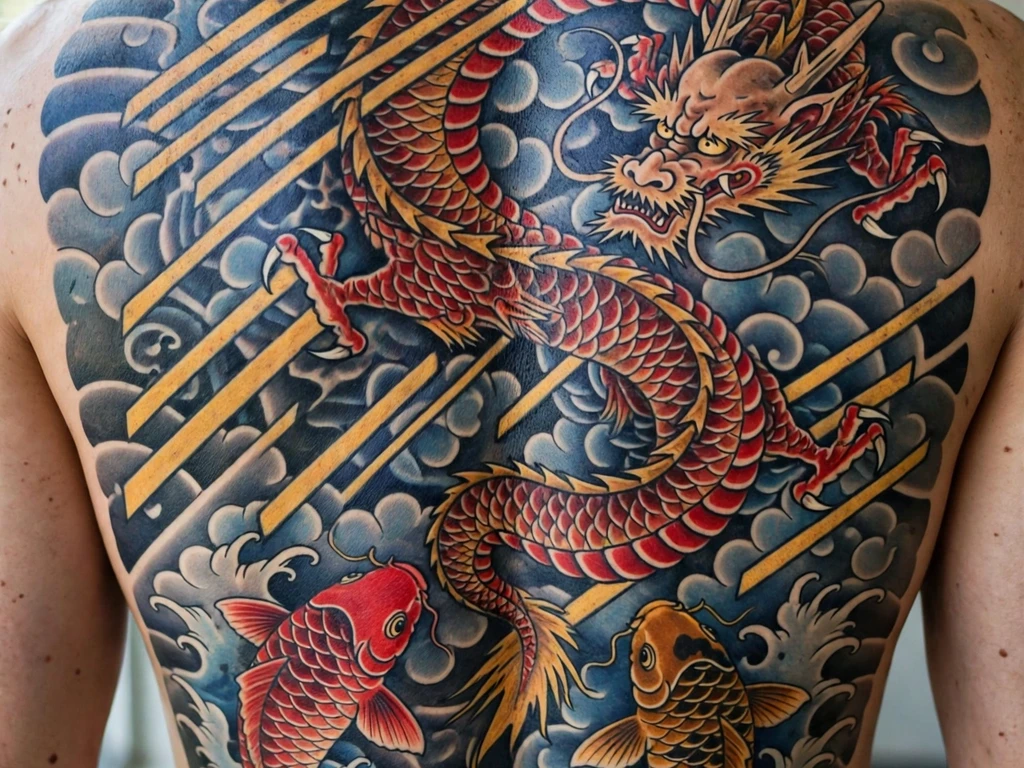
Some tattoo styles are collections of pictures. Traditional Japanese tattooing is a language. Every dragon, wave, petal and mask in an irezumi piece is there for a reason, placed where it sits for a reason, and surrounded by wind, water and flowers chosen to season and balance the whole composition. That is why a Japanese tattoo rewards study like no other style: learn the vocabulary and a stranger’s back piece starts telling you its story.
In this guide you will find 25 japanese tattoo ideas rooted in that tradition: the great motifs — dragon, koi, tiger, phoenix — the masks everyone is searching for right now, hannya and oni, the flowers that carry the seasons, and the background work that turns separate images into one unified piece. First, though, you need the grammar: what irezumi actually is, how it is structured on the body, and what the classic motifs traditionally mean.
What Is Irezumi?
Irezumi (入れ墨) is the traditional Japanese art of tattooing, developed over centuries and refined during the Edo period (1603–1868), when woodblock prints — ukiyo-e — gave tattoo artists a shared library of heroes, creatures and landscapes to draw from. A traditional tattooist is called a horishi, “one who carves”, and the name is literal: in the classic hand method, tebori, the artist pushes ink into the skin with a hand-held tool — a bundle of needles fixed to a bamboo or metal rod — working in a rhythmic rocking motion rather than with a machine. Tebori produces a particular softness in the shading that many collectors prize, and it remains in use by traditional studios in Japan and a small number of specialists worldwide. Most Japanese-style work outside Japan is done by machine in the tebori spirit: the look, structure and rules of the tradition, executed with modern equipment.
Those rules are what separate irezumi from a Japanese-themed tattoo. Three matter most:
The motif leads, and the background serves it. A main subject — a dragon, a koi, a warrior — is never left floating on bare skin in a traditional piece. It is set into a background of wind bars, water, clouds and seasonal plants called gakubori, which frames the motif, fills the body’s contours and binds separate sessions into one flowing composition.
The design follows the body, at scale. Japanese work is traditionally large. The canonical canvas is the back, and full compositions are planned as body suits with deliberate borders: the ink stops at clean lines so the piece sits hidden under clothing — traditionally ending at the wrists, ankles and collar line — and reads as one garment of imagery when revealed.
Meaning is chosen, not accidental. Motifs are selected for their traditional symbolism and paired thoughtfully — a creature with the flower of its season, water creatures in water, opposites balanced against each other. The symbolism table in the next section is the cheat sheet traditional artists work from.
| Bodysuit element | What it covers | What to know |
|---|---|---|
| Back piece | The full back, often to the backs of the thighs | The centrepiece of irezumi; the largest, flattest canvas, where the main motif lives |
| Sleeves (kame-no-koh and shorter cuts) | Arms, in full, three-quarter or half lengths | Sleeve ends stop at set borders; backgrounds flow from the back piece over the shoulders |
| Chest panels (munewari) | Two chest panels with a strip of bare skin down the centre | The open centre strip is deliberate — the piece parts like a garment rather than closing over the sternum |
| Leg work | Thighs to full legs, flowing from the back piece | Water and wind backgrounds carry motifs down the legs as one composition |
| Gakubori (background) | Everything around the motifs | Wind bars, water bars, clouds and micro-patterns that unify the whole suit |
One honest piece of history belongs in any guide to this style. In Japan, large-scale tattooing became associated during the twentieth century with the yakuza, and that association still shapes daily life there: many onsen (hot springs), sentō (public baths), gyms and some hotels in Japan refuse entry to tattooed guests, a policy travellers with ink of any style still meet today — though a growing number of baths now welcome tattoos openly, and Japan’s official tourism site lists tattoo-friendly onsen across the country. The practical guidance is in the How to Choose section below; the point here is simply respect: if you wear this art, knowing where it has been is part of wearing it well.
The Symbolism of Classic Japanese Motifs
Traditional meanings in irezumi come from folklore, Buddhism, seasonal observation and centuries of ukiyo-e storytelling. They are tradition, not fixed fact — artists and wearers sometimes choose a motif for beauty alone — but the classic readings below are the widely documented ones, and choosing with them in mind is what makes a composition feel authentically Japanese rather than merely decorated. Two motifs deserve a fuller word, because searches for hannya mask tattoo and oni mask tattoo meanings are climbing fast.
The hannya is a mask from Noh theatre representing a woman transformed by jealousy and grief into a demon-like spirit — horns, metallic eyes, a mouth caught between a snarl and sorrow. In tattooing it is traditionally read two ways at once: as a warning against jealousy consuming the wearer, and as a ward — a fierce face worn to turn away the very emotions and evils it depicts. Its expression famously shifts with the angle of view: tilted down it grieves, tilted up it rages. The oni, by contrast, is a full demon or ogre of folklore — horned, wild-haired, often carrying a club. Oni are not simply “evil” in Japanese tradition; they are also powerful enforcers who punish wrongdoing and guard thresholds, and an oni mask tattoo is usually chosen in that second sense: brute strength placed in the service of protection.
| Motif | Japanese name | Traditional meaning |
|---|---|---|
| Dragon | Ryū | Wisdom, strength and protection; a benevolent water deity in Japanese lore |
| Koi carp | Koi | Perseverance, courage and good fortune; a koi that leaps the waterfall becomes a dragon |
| Tiger | Tora | Courage, strength and protection against bad luck and disease |
| Phoenix | Hōō | Rebirth, triumph and grace; appears in times of peace and good government |
| Crane | Tsuru | Longevity, good fortune and fidelity; said in folklore to live a thousand years |
| Snake | Hebi | Protection, good luck and rebirth through the shedding of skin |
| Turtle | Kame / Minogame | Longevity and wisdom; the ancient minogame trails long algae “hair” |
| Fu dog (guardian lion) | Shishi / Komainu | Guardianship; pairs of them flank shrine and temple entrances |
| Cherry blossom | Sakura | The beauty and brevity of life; spring |
| Peony | Botan | Wealth, honour and bravery; the “king of flowers” |
| Chrysanthemum | Kiku | Longevity and rejuvenation; the Imperial flower of Japan |
| Maple leaves | Momiji | Autumn, change and the passing of time |
| Hannya mask | Hannya | Jealousy and grief transformed; worn as a ward against those passions |
| Oni mask | Oni | Demonic strength used for protection and the punishment of wrongdoing |
| Daruma | Daruma | Perseverance and goal-setting; one eye is filled in when a wish is made |
| Great Wave | — (after Hokusai) | The power of nature against human fragility; Fuji endures calmly beyond it |
Japanese Tattoo Ideas at a Glance
| # | Design | Style notes | Best placement |
|---|---|---|---|
| 1 | Dragon Back Piece (Ryū) | Full traditional dragon with wind and clouds | Full back |
| 2 | Koi Swimming Upstream | Orange koi against water bars, splashing current | Forearm or thigh |
| 3 | Yin-Yang Koi Pair | Black and white koi circling each other | Upper arm or calf |
| 4 | Hannya Mask | Noh mask with horns, two-tone expression | Thigh or upper arm |
| 5 | Oni Mask | Horned demon mask, bold red or blue skin tones | Upper arm or calf |
| 6 | Samurai Warrior | Armoured warrior mid-scene, battle-worn detail | Thigh or back panel |
| 7 | Cherry Blossom Branch (Sakura) | Branch arc with falling petals over a motif | Shoulder to arm |
| 8 | Great Wave off Kanagawa | Hokusai’s wave with Fuji in the distance | Calf or upper back panel |
| 9 | Peony (Botan) | Full peony blooms, often paired with a creature | Shoulder or thigh |
| 10 | Chrysanthemum (Kiku) | Long radiating petals, bold colour | Upper arm or back panel |
| 11 | Tiger (Tora) | Tiger descending through bamboo | Thigh or back |
| 12 | Phoenix (Hōō) | Flowing tail feathers with peonies | Back or thigh |
| 13 | Crane (Tsuru) | Crane in flight among pine or clouds | Shoulder blade or forearm |
| 14 | Daruma Doll | Round daruma, one eye filled, one waiting | Forearm or calf |
| 15 | Fu Dog Pair (Shishi) | Guardian lion with paw on a ball or cub | Chest panels or thighs |
| 16 | Snake (Hebi) | Coiling snake with peonies or blossom | Arm wrap or leg wrap |
| 17 | Minogame Turtle | Ancient turtle with flowing algae tail | Upper back or thigh |
| 18 | Koi Dragon Transformation | Half-koi, half-dragon mid-change | Forearm or calf |
| 19 | Wind and Water Bar Background | Gakubori background as the design itself | Around existing motifs |
| 20 | Kitsune (Nine-Tailed Fox) | Fox with multiple flowing tails and flames | Thigh or forearm |
| 21 | Geisha Portrait | Tasteful portrait in kimono with hair ornaments | Back or shoulder |
| 22 | Maple Leaves and Koi (Momiji) | Autumn maples with koi in dark water | Forearm or upper arm |
| 23 | Dragon and Tiger Pairing | Ryū above, tora below, balanced opposites | Back or both thighs |
| 24 | Mount Fuji Landscape Panel | Fuji with clouds, waves or blossom | Forearm or calf panel |
| 25 | Traditional Half Sleeve | Motif and gakubori to the elbow border | Upper arm to elbow |
25 Japanese Tattoo Ideas
1. Dragon Back Piece (Ryū)
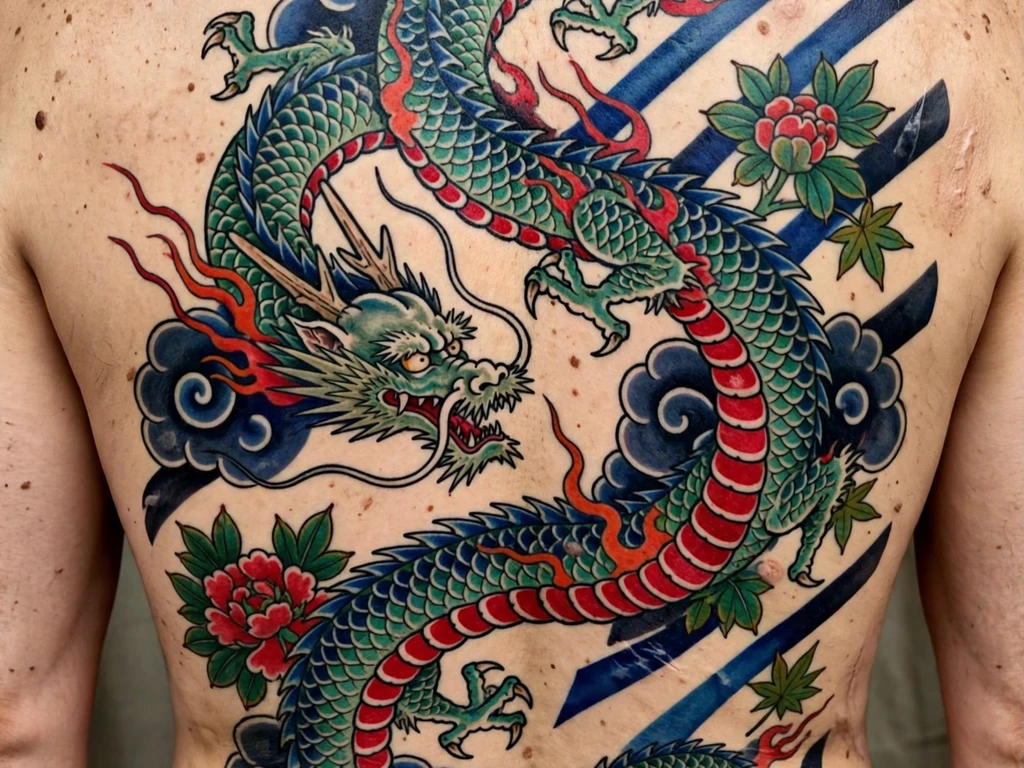
The emperor of irezumi motifs, and the design the full back was made for: a Japanese dragon — long, serpentine, three-clawed in the Japanese convention, whiskered, with a jewel or pearl often clutched in one claw — winding down the spine through clouds and wind bars. The Japanese ryū is a water deity and a bringer of rain, traditionally read as wisdom and protection rather than the fire-breathing menace of Western dragons, and its body lets an artist fill the entire back in one flowing composition. If you are comparing dragon treatments before committing to the traditional route, our dragon tattoo design ideas collect the other styles in one place.
Best placement: The full back, the dragon’s head at one shoulder and the tail sweeping to the opposite hip.
Best for / know before you book: This is the biggest commitment in this guide — expect multiple sessions across months and the largest budget of any design here. The drawing alone should be fitted to your back in person; a dragon designed on flat paper will not flow correctly down a real spine.
2. Koi Swimming Upstream
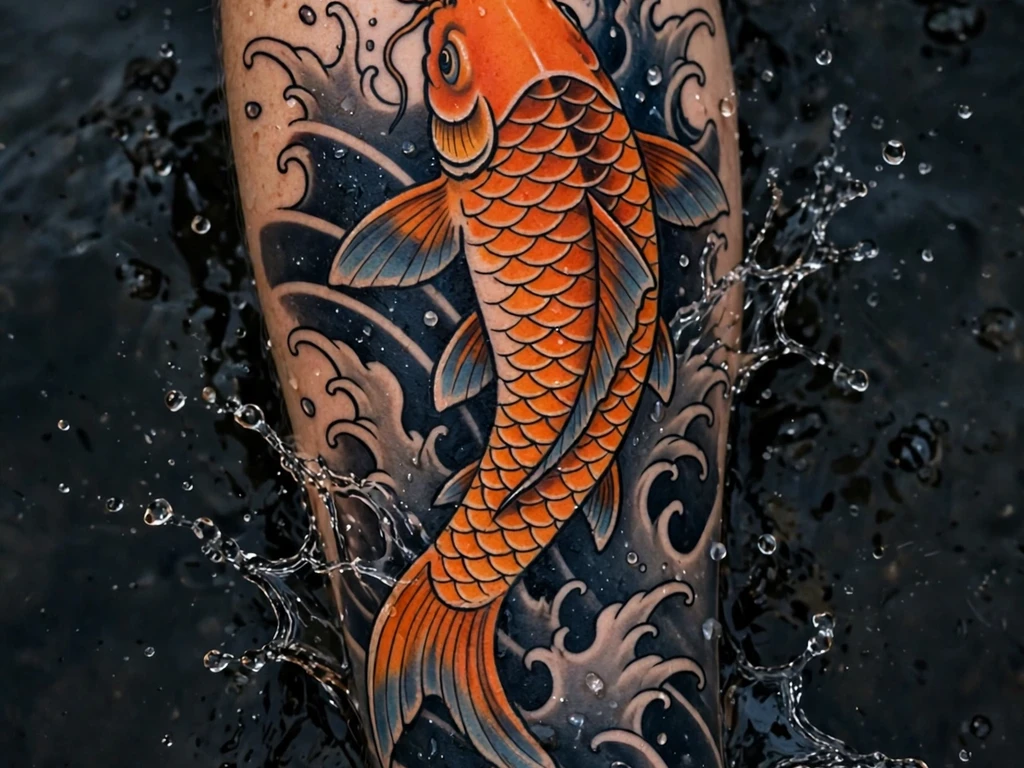
The beloved classic: a bright koi driving upward against stylised water bars and spray, scales picked out in orange, red or gold. The direction is the meaning — in the Chinese legend Japanese tattooing inherited, the koi that swims against the current and leaps the waterfall at Dragon Gate is rewarded by transformation into a dragon, so an upstream koi is traditionally perseverance made visible: effort against resistance, chosen by graduates, fighters and anyone mid-climb. A downstream koi exists in the vocabulary too, read as going with life’s flow after the struggle — but upstream is the one most people mean.
Best placement: Forearm or thigh, the fish angled so its head points up the limb against the water’s flow.
Best for / know before you book: Water bars are the unglamorous half of this design and they make or break it — judge artists on how their water moves, not just how they draw fish. Koi colour fades faster than black work, so saturated colour and sunscreen are part of the deal.
3. Yin-Yang Koi Pair
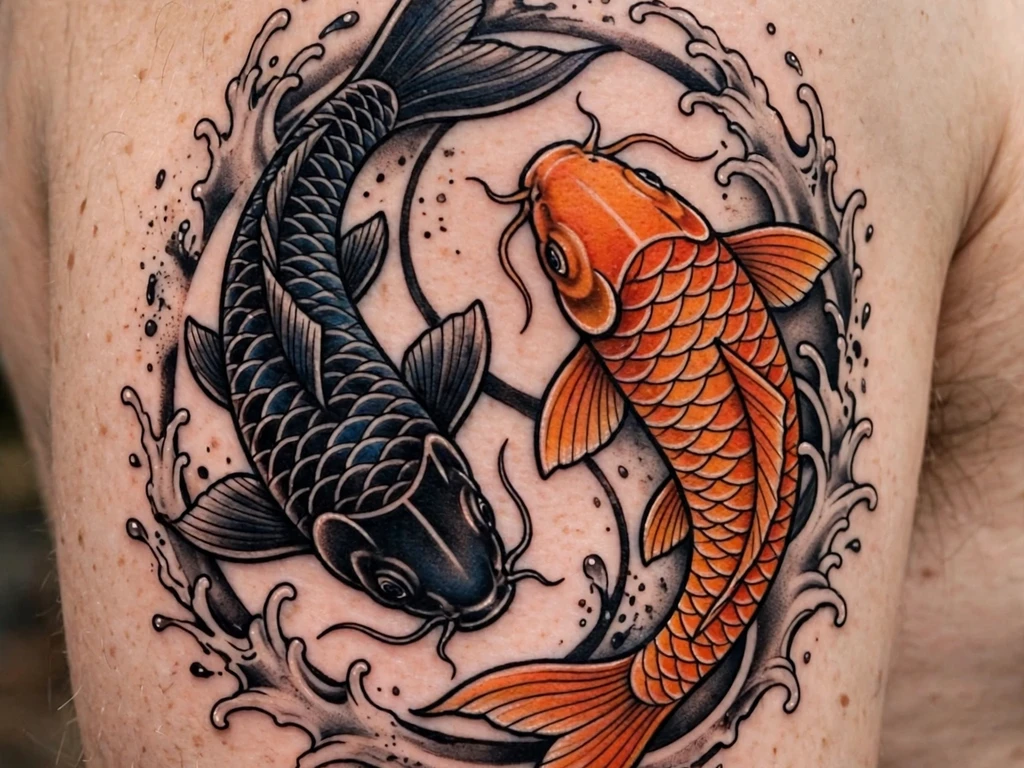
Two koi — traditionally one dark, one bright — circling head-to-tail in an endless loop, often set inside water bars or a ring of spray. The composition borrows the yin-yang idea of balanced opposites: effort and rest, light and dark, two forces keeping each other moving. Pairs choose it for relationships; solo wearers choose it for equilibrium. Because the design is circular, it sits beautifully on round canvases — the shoulder cap, the calf, the centre of the upper back — where a linear design would fight the anatomy.
Best placement: Shoulder cap, calf or centre upper back, the circle fitted to the body’s natural round.
Best for / know before you book: A circle on skin is a geometry test: check the stencil on the body part in its natural position and in motion, because a perfect ring on the table can heal into an egg. The two fish should differ in tone strongly, or the yin-yang read disappears in a few years.
4. Hannya Mask
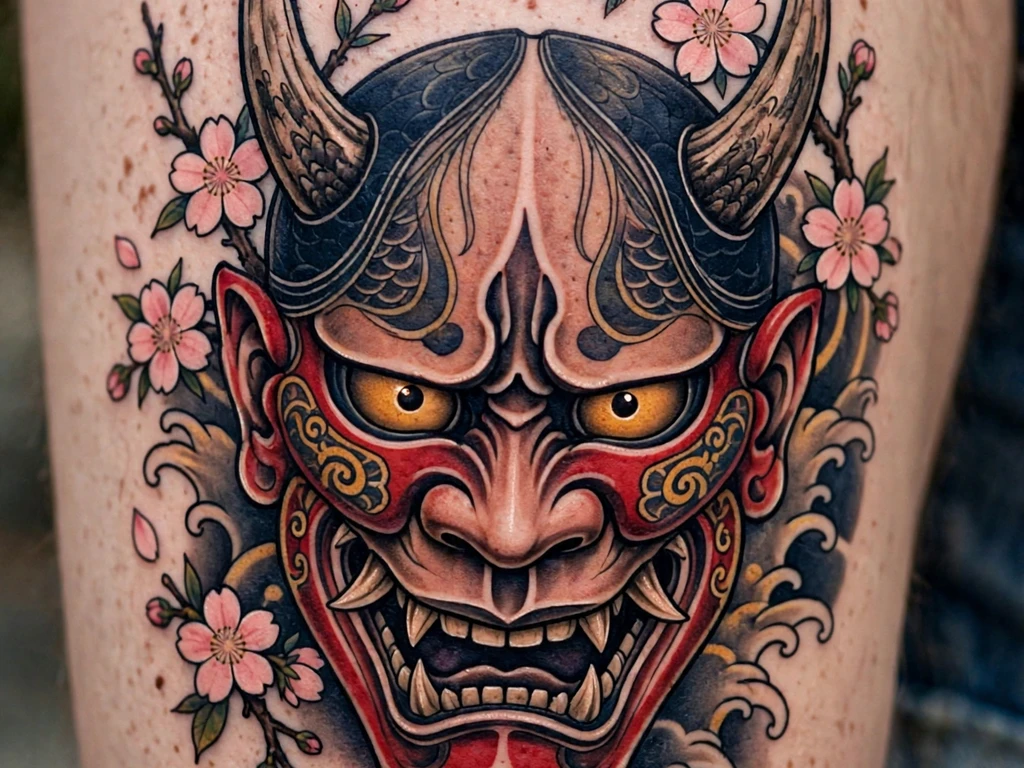
The mask driving the current boom in japanese tattoo art searches: a hannya in full Noh-theatre detail — sharp horns, metallic gold-toned eyes, fanged mouth — usually framed by cherry blossom, maple leaves or peonies that soften and season it. Skilled artists exploit the mask’s famous double expression, shading it so it grieves from one angle and rages from another. Wearers choose it as the tradition suggests: a fierce guardian against jealousy and obsession, or an honest emblem of having survived those emotions. It rewards size — the expression lives in fine gradations that vanish when small.
Best placement: Thigh, upper arm or one side of the back — flat, generous skin where the mask can be drawn at true scale.
Best for / know before you book: Do not shrink it. Below roughly palm-and-a-half size the eyes and mouth merge and the hannya reads as a generic demon. Ask to see healed mask work specifically; fresh shading always looks smoother than healed shading does.
5. Oni Mask
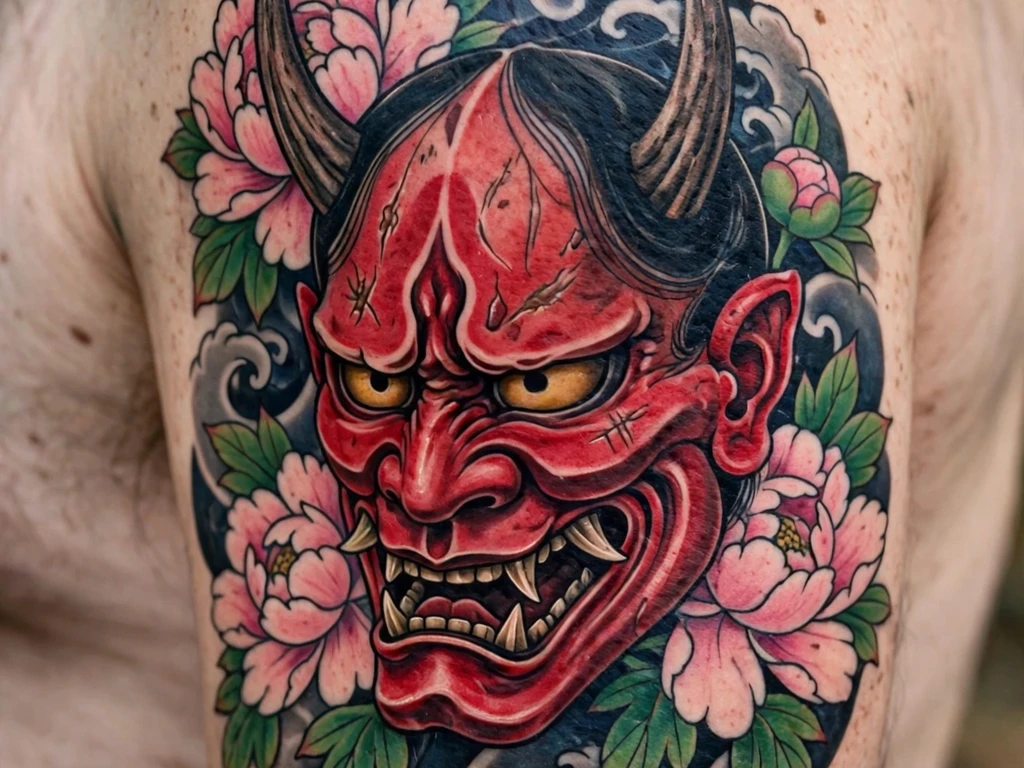
The hannya’s rowdier cousin: an oni face with bulging eyes, two horns, a fang-filled roar and a mane of wild hair, usually coloured in the classic red or blue of folklore illustrations. Where the hannya is sorrow sharpened into menace, the oni is pure force — chosen in tradition as a protector that frightens off lesser evils and punishes wrongdoing, a demon employed as a bodyguard. Oni masks pair naturally with peonies or crashing waves, and the face carries enough expression to stand alone with nothing but background bars behind it.
Best placement: Upper arm, calf or thigh, where the face can be drawn wide and symmetrical.
Best for / know before you book: Symmetry and the eyes decide everything — have the stencil checked facing a mirror at arm’s length, since small imbalances in the horns or fangs are invisible close up and obvious at conversational distance. Red and blue oni tones both sit in the faster-fading family; plan a colour refresh years down the line.
6. Samurai Warrior
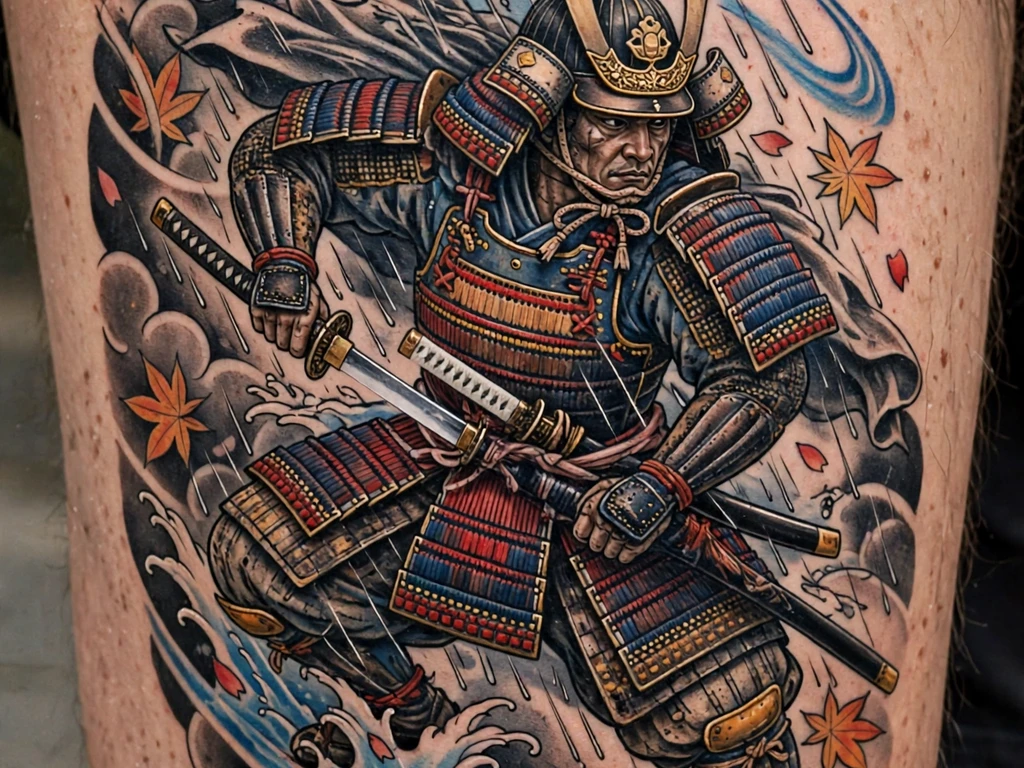
A full figure scene from the ukiyo-e tradition: an armoured samurai mid-action — drawing a sword, standing in wind and rain, or facing down an opponent — with armour lacing, family crests and a dramatic sky of cloud bars behind him. Samurai pieces are storytelling tattoos, usually read as loyalty, discipline and honour under pressure, and they are among the most demanding designs an artist can draw: faces, hands, armour patterns and fabric all in one composition. Choose your warrior’s moment carefully — a still, standing portrait and a battle scene are entirely different tattoos.
Best placement: Thigh for a single figure, or one full side of the back for a scene with background.
Best for / know before you book: This is specialist work. Portfolio-shop for artists who demonstrably draw Japanese figures — a great dragon artist is not automatically a great figure artist. Armour detail needs scale; a samurai compressed small turns into patterned noise.
7. Cherry Blossom Branch (Sakura)
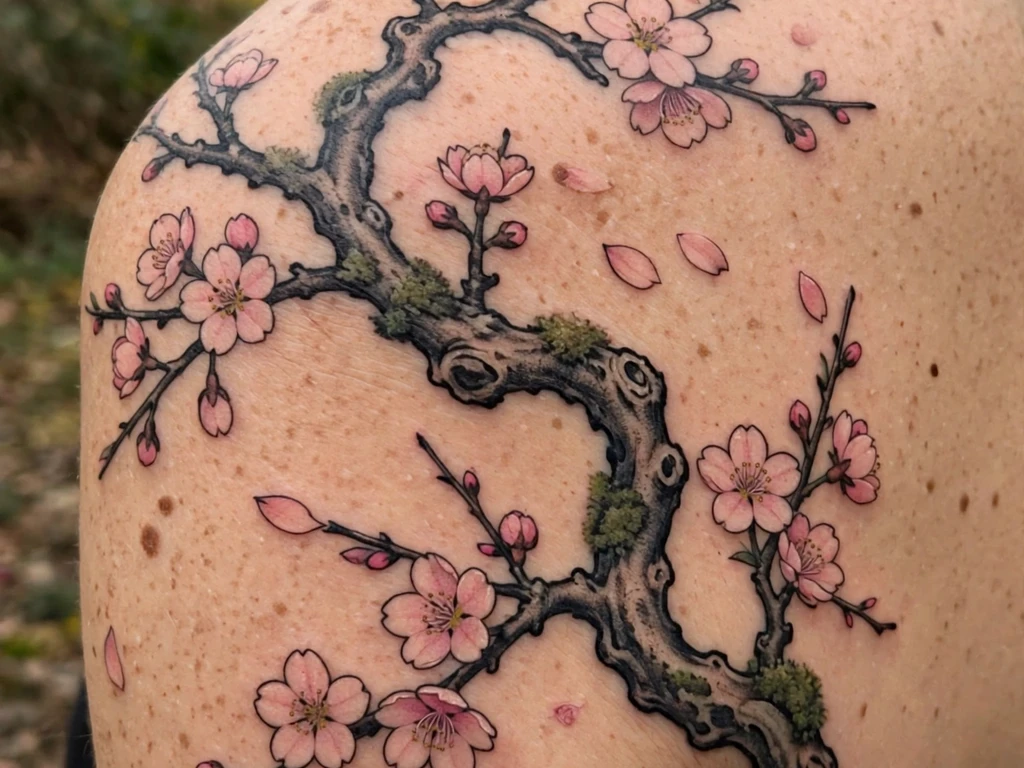
A dark, gnarled branch arcing across the skin, loaded with pink blossoms and loose petals drifting off its edges — sakura is irezumi’s spring, and its traditional meaning is the most quoted in all of Japanese symbolism: beauty inseparable from brevity, because the blossom blooms brilliantly and falls within days. Blossom is rarely the whole tattoo; it is woven over and around a main motif — petals falling across a koi’s water, a branch framing a mask — which is exactly how it is used here as a design in its own right, the branch itself becoming the composition. Our cherry blossom tattoo ideas go deeper on blossom-led designs.
Best placement: Flowing over the shoulder and down the arm, or across the collarbone and upper back.
Best for / know before you book: Petal pink is a delicate, fast-fading tone — artists usually outline blossoms in soft grey-black so the flowers keep their shape after the pink mellows. Falling petals scattered beyond the branch are the traditional finishing touch; agree their count and spread at the stencil stage.
8. Great Wave off Kanagawa
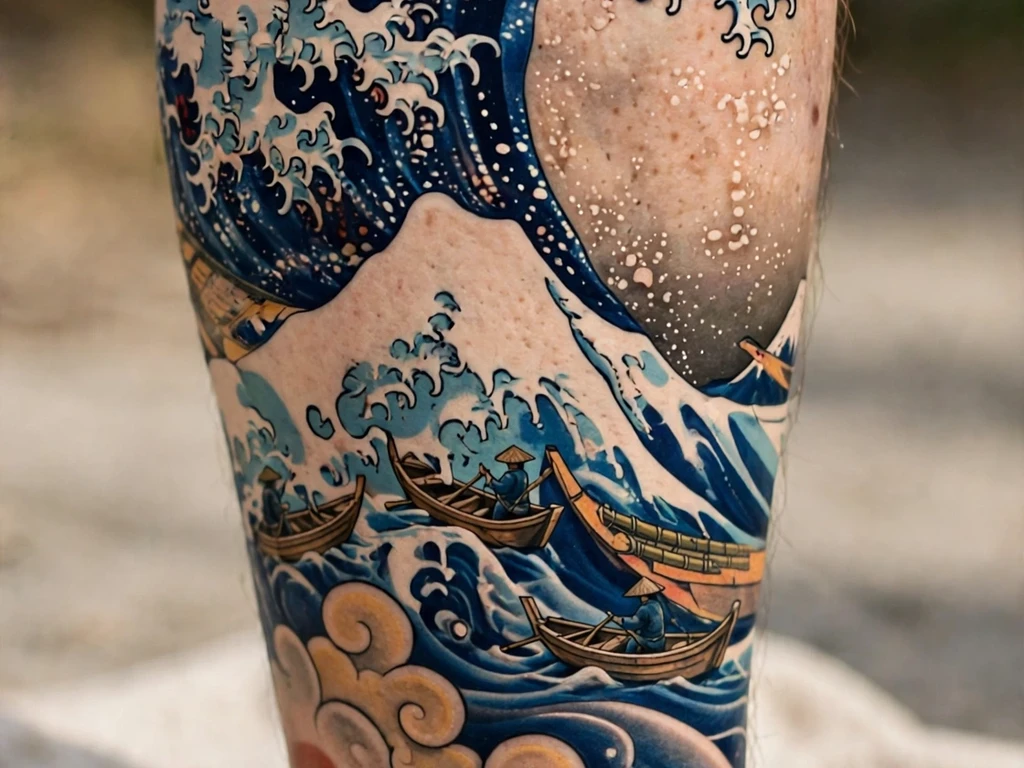
The most famous image in Japanese art, tattooed: Katsushika Hokusai’s great claw of water rising over tiny boats, Mount Fuji small and calm in the distance beneath it. The British Museum’s research on the Great Wave traces how the print — first published in 1831 as part of the series Thirty-six Views of Mount Fuji — was made and how its impressions differ; on skin, the composition is usually adapted rather than copied, the wave’s curl reshaped to wrap a calf or fill a back panel while Fuji holds the horizon. Its reading is the print’s own: nature’s power against human fragility, endurance in the distance.
Best placement: Calf wrap or upper back panel, with Fuji placed low and still as the composition’s anchor.
Best for / know before you book: The wave’s foam claws are made of fine curved lines that soften with age — a good artist thickens the claw tips slightly and keeps the spray dots sparse. Decide early whether you want a faithful print reproduction or a tattoo-adapted version; they diverge quickly.
9. Peony (Botan)
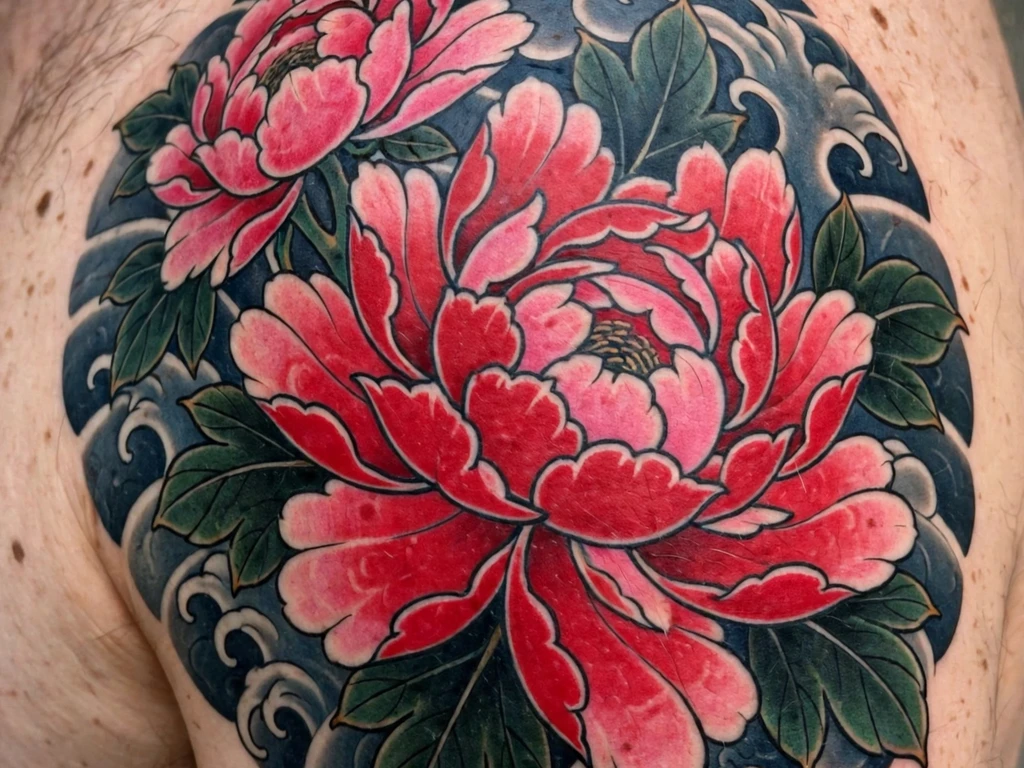
The king of flowers, drawn as it should be in this tradition: enormous, layered blooms in saturated red, pink or coral, with dark leaves, often spilling over a shoulder or filling the gaps around a larger motif. Botan carries wealth and honour in the traditional vocabulary — and a second, rougher reading of bravery, because it blooms boldly despite its delicate petals. Peonies are the classic partner flower for lions and dragons, and a peony-led piece is the most forgiving large floral in irezumi: its big shapes stay legible for decades.
Best placement: Shoulder cap flowing onto the upper arm, or as a full thigh arrangement.
Best for / know before you book: Peony colour is the tattoo — cheap-looking peonies are usually under-saturated ones. Look at healed peony work in portfolios and expect the red-pink family to want a refresh sooner than the black linework around it.
10. Chrysanthemum (Kiku)
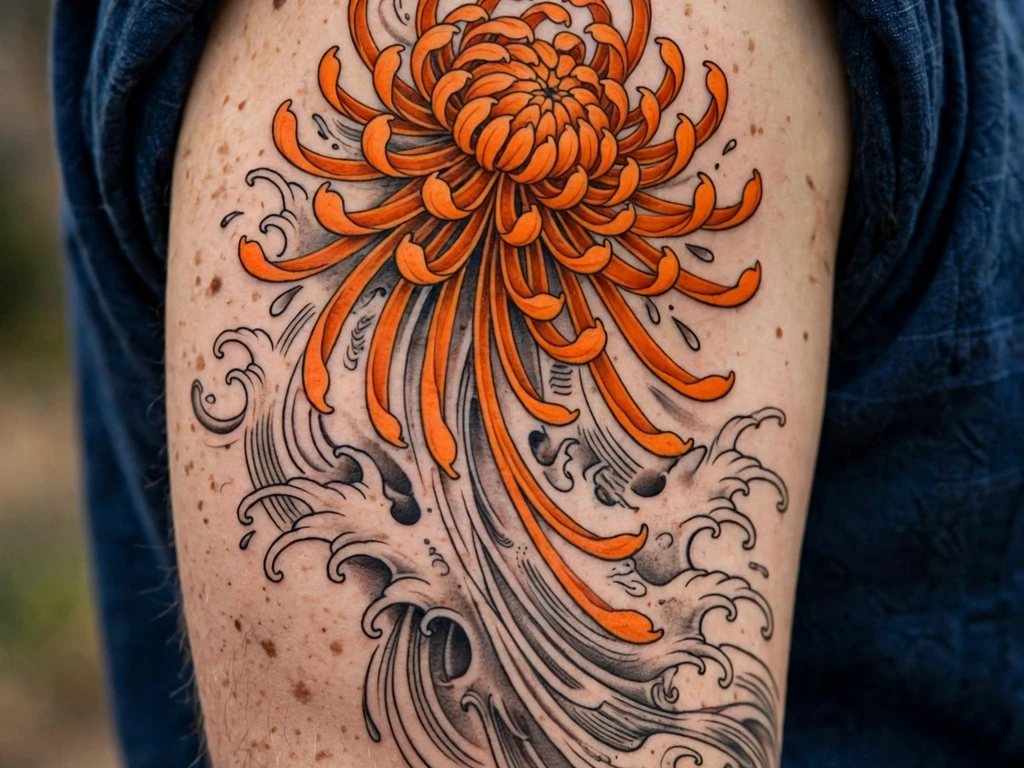
Japan’s Imperial flower, drawn with its signature long, radiating petals streaming out like water or rays — kiku is less a flower portrait than a burst of organised movement, which is why artists use it to fill sleeves and backs with direction and flow. Its traditional meanings are longevity and rejuvenation, and its association with the Imperial house gives it a formality the peony does not carry. Chrysanthemums are frequently paired with water bars, the petal streams echoing the current, or set as the anchor bloom at the end of a sleeve.
Best placement: Upper arm or the end of a sleeve, a back panel, or flowing down a thigh.
Best for / know before you book: Those long petals are many, many parallel lines — spacing is the whole craft. Petals drawn too close merge into a solid mass as ink settles, so this design quietly requires more size than clients expect; listen when your artist asks for room.
11. Tiger (Tora)
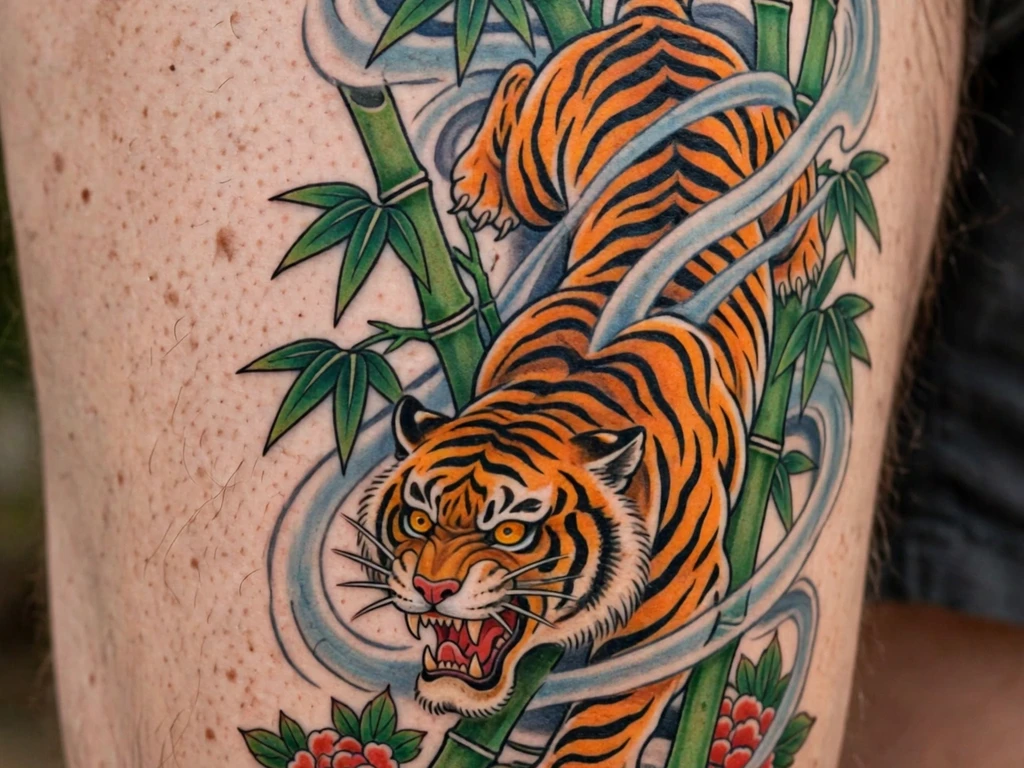
The dragon’s earthly counterpart: a tiger mid-prowl or descending through bamboo, stripes broken by wind bars, traditionally drawn with the slightly wild-eyed intensity of Japanese painting rather than zoological realism. Tora means courage and protection — against bad luck and disease in the older readings — and in composition it is the classic counterweight to the dragon: the tiger rules the earth and the winds, the dragon the water and the rain. Bamboo is its correct partner plant, bending in the same wind the tiger walks against.
Best placement: Thigh, or one full side of the back facing a dragon on the other.
Best for / know before you book: Stripes are a spacing discipline like chrysanthemum petals: too tight and the tiger becomes a tabby smudge at distance. Japanese tigers are deliberately stylised — if you want photorealism, this is the wrong tradition, and a good horishi-style artist will tell you so.
12. Phoenix (Hōō)
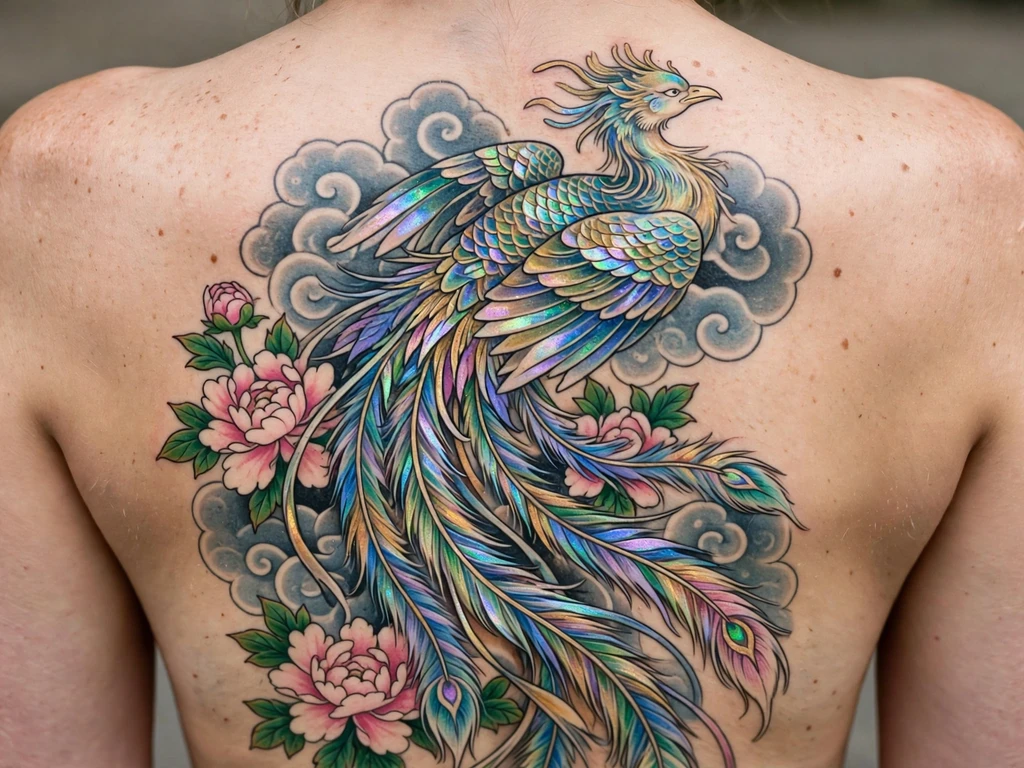
Not the Western firebird: the hōō of Japanese and Chinese tradition is a serene, composite creature — crested head, iridescent plumage and enormously long, flowing tail feathers that stream through peonies and cloud bars like ribbons. It appears, tradition says, only in times of peace and good rule, and in tattooing it carries rebirth and triumph with unusual grace, which is why it is so often chosen for back pieces marking a life rebuilt. The tail feathers are the design: they let a phoenix fill a back the way a dragon does, in long descending curves. Our phoenix tattoo ideas cover the motif’s other traditions and treatments.
Best placement: Full back with the tail streaming to the hips, or a thigh with feathers wrapping the leg.
Best for / know before you book: Feather bars and eye-spots are fine detail at large scale — count the sessions honestly, because a phoenix rushed in one sitting loses the delicacy that justifies it. Colour palettes vary widely; agree the full palette on paper before session one.
13. Crane (Tsuru)
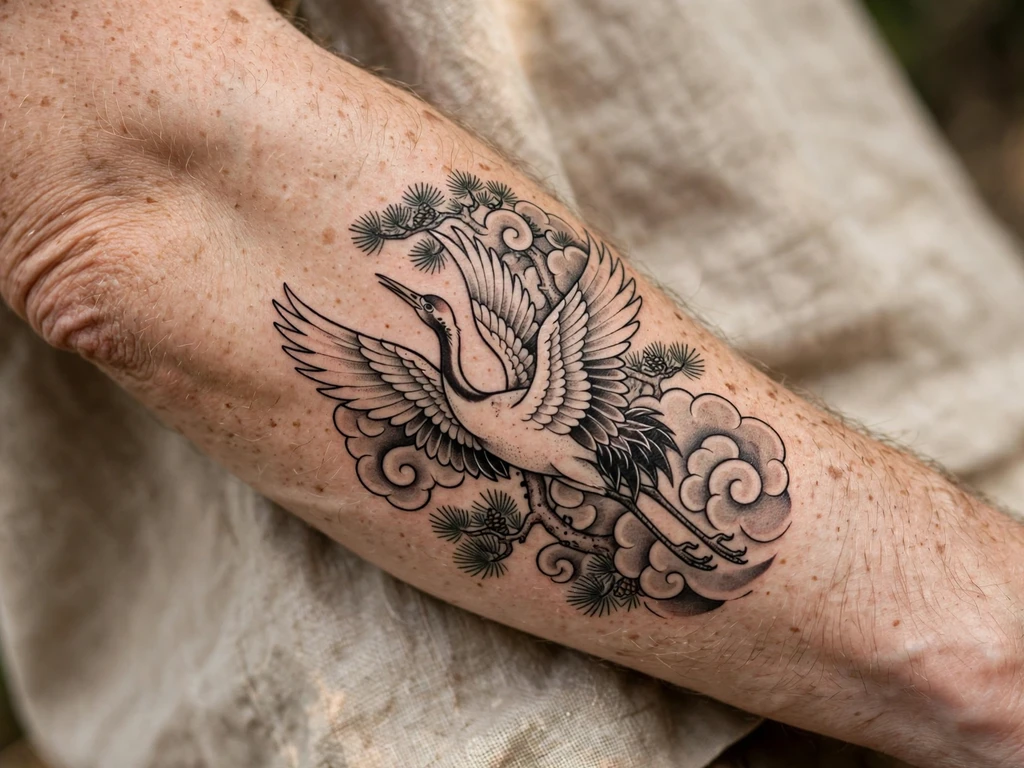
A crane in flight, neck extended, wings spread through pine branches or cloud bars — tsuru is folklore’s bird of a thousand years, a symbol of longevity, luck and faithfulness (cranes mate for life, in the traditional telling). In composition the crane is irezumi’s most elegant diagonal: those long wings and trailing legs draw a sweeping line across a back or down an arm that few other motifs can make. It is frequently chosen for milestone birthdays, anniversaries and memorial pieces, where its meanings do the talking.
Best placement: Across a shoulder blade with wings spreading to the arm, or a forearm panel in flight.
Best for / know before you book: Crane plumage is largely white — and white is negative space in tattooing, defined by the shading and background around it. The design therefore depends on strong cloud or wind bars behind the bird; a crane on bare skin with no background quickly loses its outline.
14. Daruma Doll
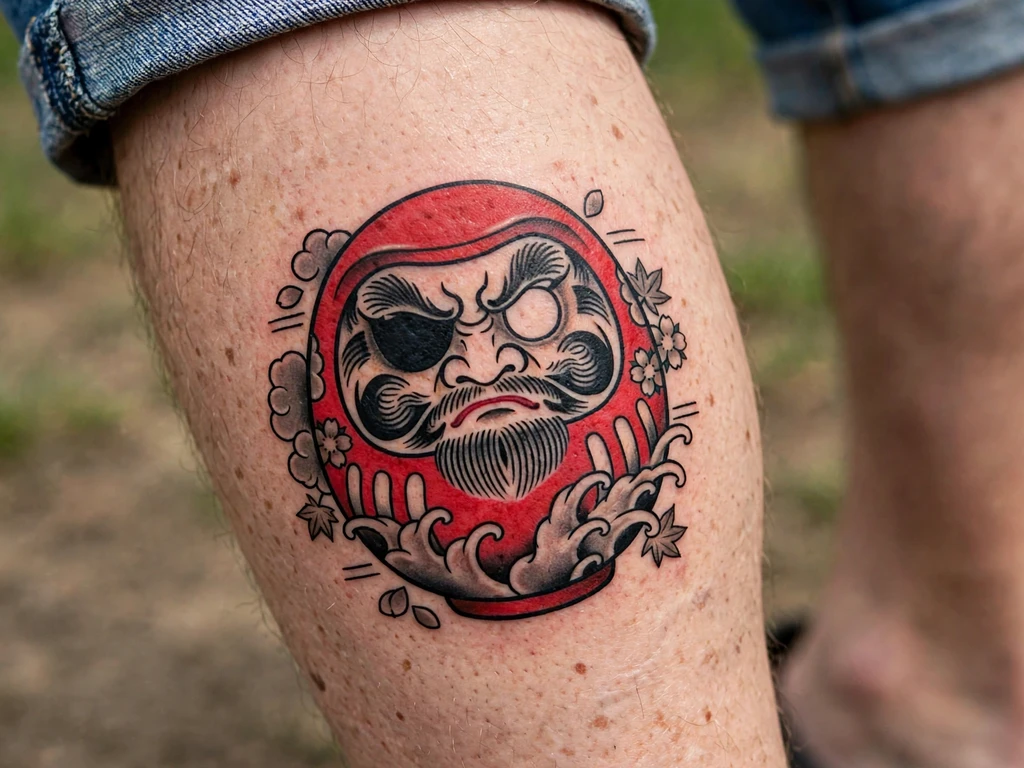
The round, bearded doll modelled on Bodhidharma, founder of Zen Buddhism — and the most personal design in this guide. In Japanese custom a daruma is bought with both eyes blank; you paint in one eye when you set a goal and the second when you achieve it, and the doll’s weighted, self-righting shape is itself the lesson: knocked down seven times, it rises eight. As a tattoo, the daruma is chosen at the start of an endeavour — a business, a recovery, a degree — sometimes with the second eye deliberately left blank in the ink, to be filled in when the goal lands.
Best placement: Forearm, calf or upper arm — a self-contained round design that needs no background.
Best for / know before you book: Daruma red is the classic colour and a faster-fading, occasionally reactive pigment family — raise any history of red-ink sensitivity with your artist and keep the design large enough that the face’s fierce expression stays readable. Decide the eyes question before the stencil: both filled, one filled, or one left for later.
15. Fu Dog Pair (Shishi)
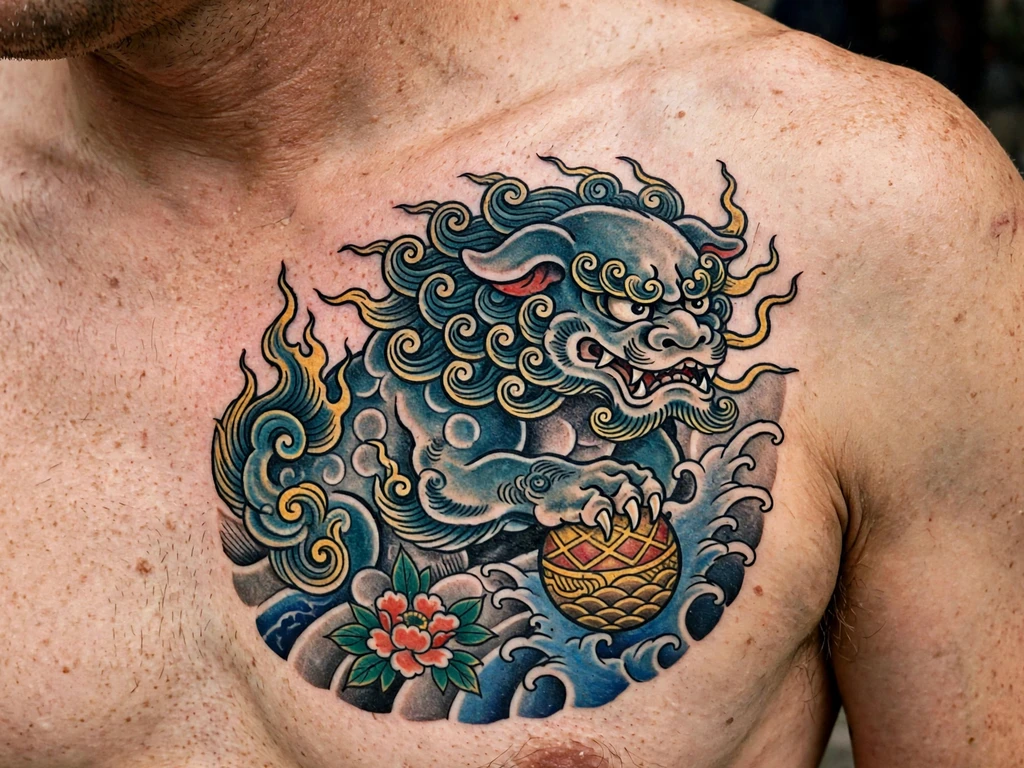
The guardian lions that flank shrine and temple gates — komainu in their shrine form — rendered as a tattooed pair: muscular bodies, curling manes and tails, one with a paw resting on a ball, sometimes a cub beneath the other. Fu dogs are pure guardianship in the vocabulary, placed at thresholds to keep harm out, and as tattoos they are traditionally worn as a matched pair guarding the body — one on each chest panel, each thigh, or each shoulder. Their dense curls and patterns make them among the most technically rich medium-sized designs in irezumi.
Best placement: Matched chest panels, both thighs, or both shoulders — a pair wants symmetry.
Best for / know before you book: Book both sides with the same artist, ideally in mirrored sessions close together, or the pair drifts into cousins. The mane’s spiral curls are tight, repetitive detail; check healed fu dog work for whether the curls stayed open.
16. Snake (Hebi)
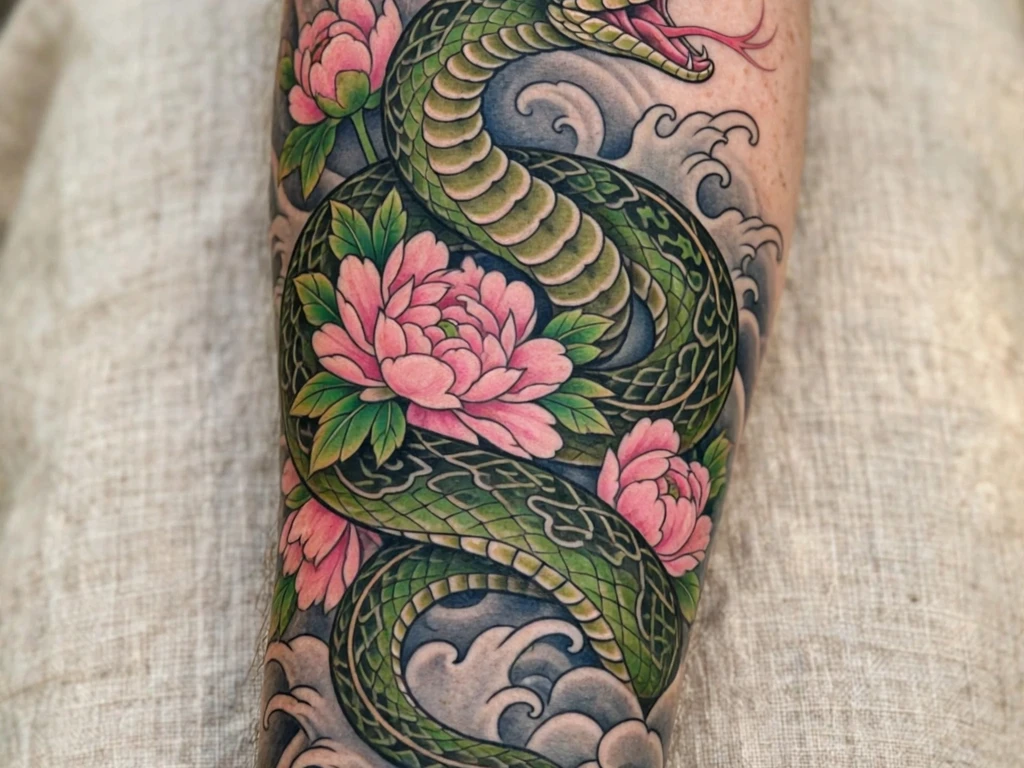
A long snake coiling around an arm or leg, tongue flicking, scales patterned, usually threaded through peonies or cherry blossom. Hebi in Japanese tradition is a guardian of water and wealth and a symbol of rebirth — the snake sheds its skin and emerges renewed — which makes it a popular choice after illness or reinvention. Compositionally the snake is irezumi’s great wrapper: its body is a natural spiral that fills a limb completely, head at the top, tail finishing the border. Our snake tattoo ideas show how other traditions handle the same animal.
Best placement: Wrapped around the forearm or calf, the coil following the limb’s full length.
Best for / know before you book: Scale patterns are the make-or-break detail — individual scale outlines drawn too small knit into mesh as they heal, so snakes need length and a generous coil width. The head placement is a decision of its own: visible at the wrist, or hidden higher up the limb.
17. Minogame Turtle
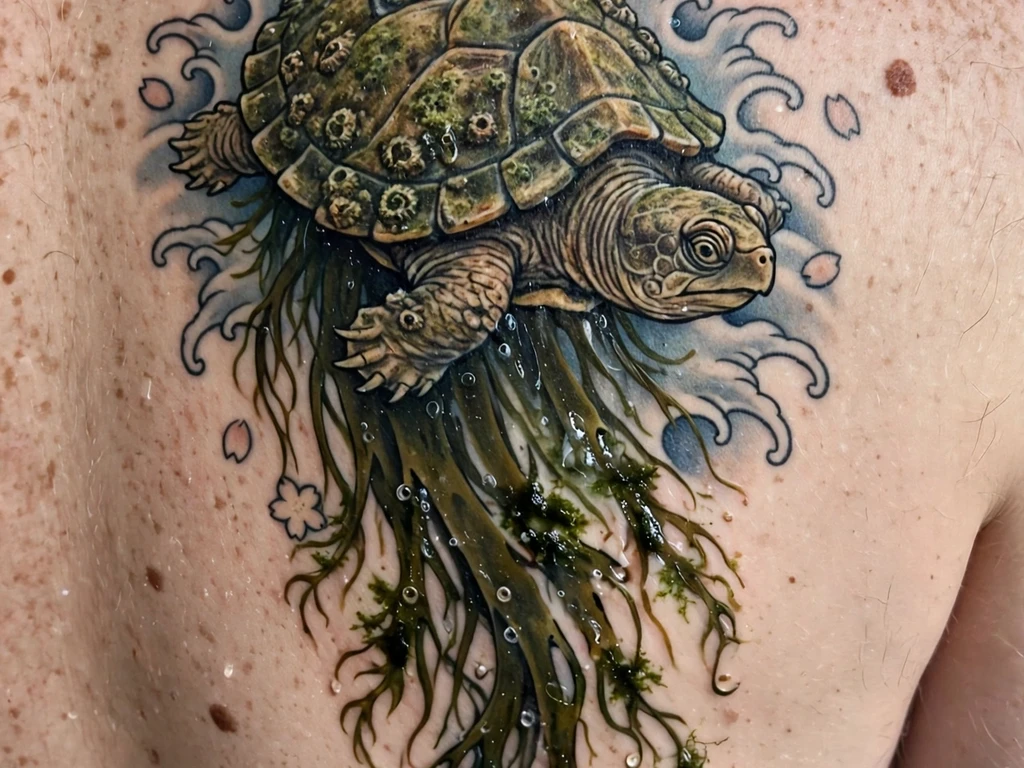
The most poetic creature in the vocabulary: an ancient turtle so old that algae streams from its shell and tail in long flowing strands — the minogame, a symbol of extreme longevity and wisdom, said in tradition to live ten thousand years. On skin, those trailing strands are drawn like water or hair, letting a turtle fill space with movement the way a phoenix’s tail feathers do. Minogame are most often chosen for grandparents, for elders, or by wearers marking their own long view of life.
Best placement: Centre of the upper back, or a thigh panel with the algae tail flowing downward.
Best for / know before you book: The algae strands are long fine lines that must be spaced like chrysanthemum petals — too close and the tail becomes a mop. This is a quiet design that suits a wearer, and an artist, of patience; its shading is soft and slow.
18. Koi Dragon Transformation
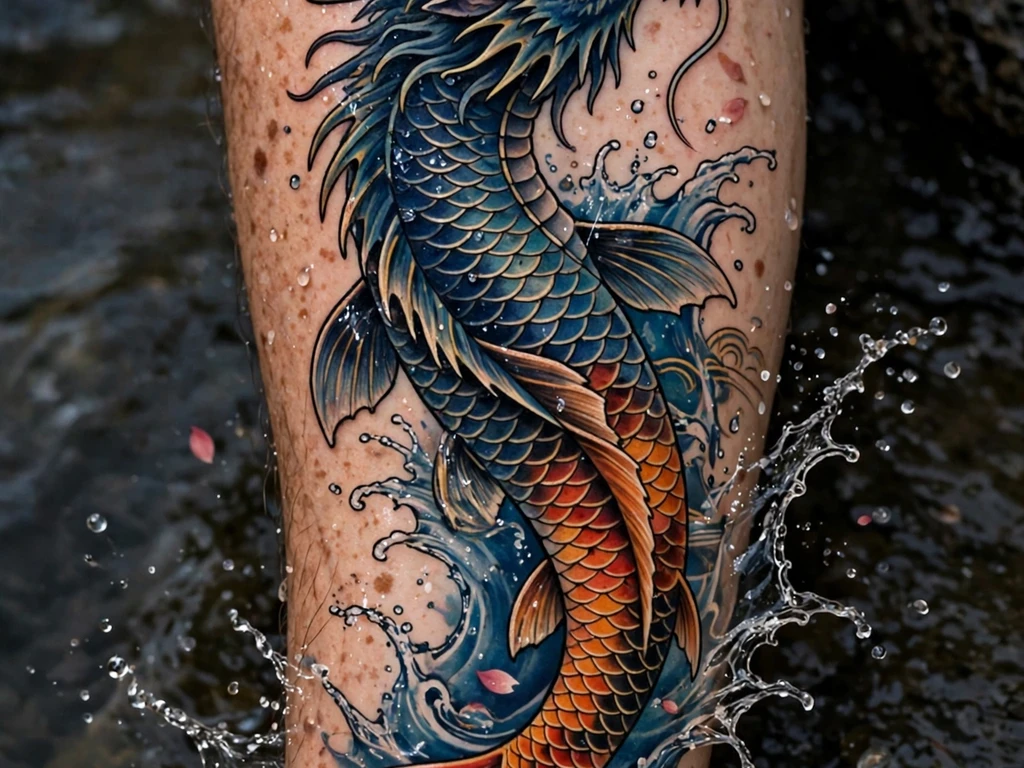
The legend mid-moment: a creature that is koi at the tail and dragon at the head — scales giving way to horns, whiskers and claws as it rises through spray and water bars. This design, sometimes called a dragon-koi, is the waterfall story frozen at its climax, and it is chosen by people who identify with the in-between state: the work done, the transformation not yet complete, or just completed. It is a connoisseur’s design — instantly recognised by anyone who knows the story, and a guaranteed conversation with anyone who does not.
Best placement: Forearm or calf, rising vertically so the change reads bottom-to-top.
Best for / know before you book: The halfway anatomy must be drawn, not improvised — a transformation that is muddled reads as a mistake rather than a metamorphosis. Insist on seeing the full custom drawing approved before stencil day, and be ready to pay for drawing time; this design cannot come from flash.
19. Wind and Water Bar Background
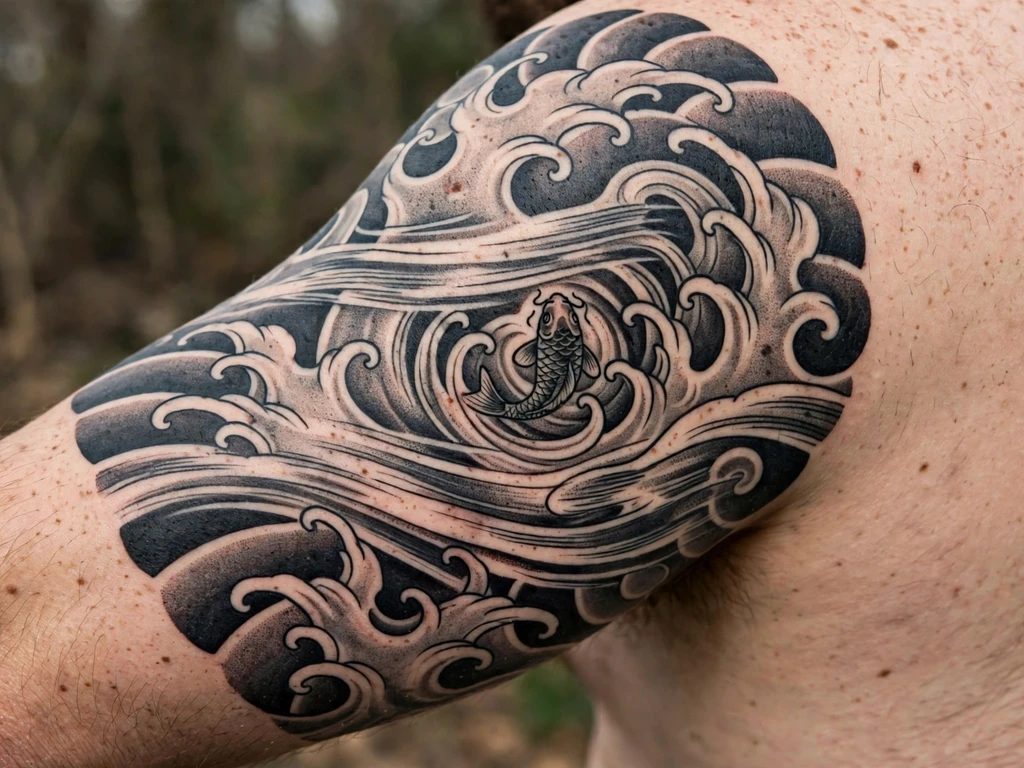
The design that is not a motif at all: gakubori itself — the deep black-grey fields of wind bars (long, curved, tapering bands) and water bars with their curling wave-fingers — tattooed as the subject, either as the finishing background around motifs you already have or as a bold abstract piece in its own right. This is the element that makes a collection of Japanese images into Japanese tattooing: the background sets the season, the weather and the movement, and unifies work done years apart into a single composition. Artists treat background as the senior craft of the style.
Best placement: Anywhere motifs need unifying — sleeves, backs and legs, drawn to flow with the body’s lines.
Best for / know before you book: Adding background around existing tattoos is specialist restructuring, not gap-filling; the bars must respect every existing outline. Choose an artist who plans the flow standing and moving, because background that fights the body’s motion looks wrong in a way no one can quite name — but everyone sees.
20. Kitsune (Nine-Tailed Fox)
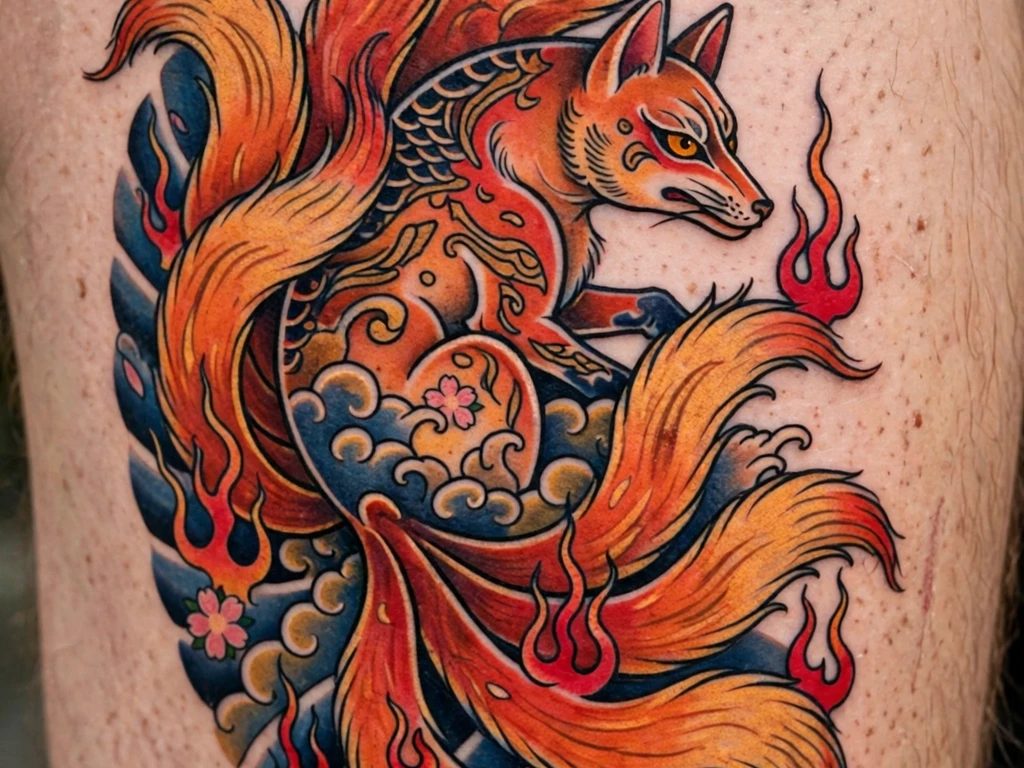
The fox of Japanese folklore — messenger of the god Inari, shapeshifter and trickster — drawn with up to nine flowing tails, sometimes with flames, a jewel, or a key in its mouth in the shrine tradition. More tails traditionally mean an older, wiser, more powerful fox, and kitsune tattoos are chosen for intelligence, adaptability and a little well-earned mischief: the clever survivor of the bestiary. The tails give the design its sweep, fanning across a thigh or back like a peacock’s train rendered in fur and fire. Our fox tattoo ideas explore the kitsune alongside the fox’s wider tattoo traditions.
Best placement: Thigh or side of the back, where the tails have room to fan; forearm for a three-tail version.
Best for / know before you book: Nine full tails is a lot of near-identical curves — at small sizes they merge into a single furry mass, so scale honestly or reduce the tail count. Fox faces are expressive and difficult; portfolio-check faces specifically, not just tails.
21. Geisha Portrait
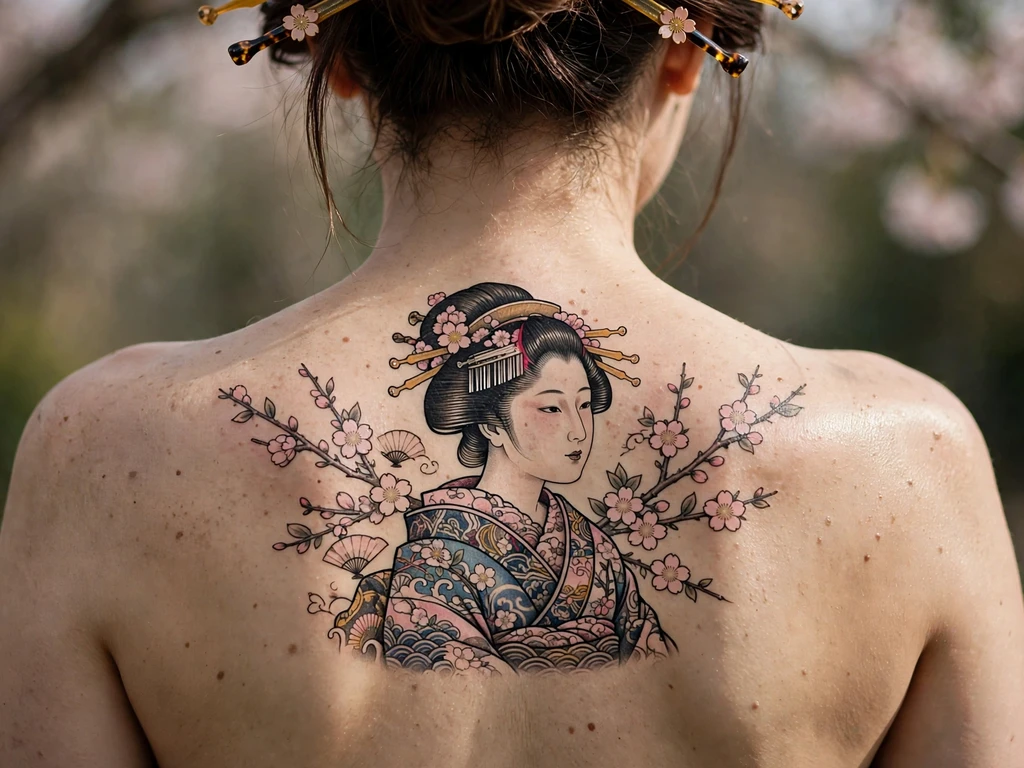
A portrait in the ukiyo-e manner: a geisha in an ornately patterned kimono, hair dressed with ornamental pins (kanzashi), perhaps holding a fan or shamisen, framed by cherry blossom or maple. Ukiyo-e began as pictures of exactly this floating world of theatre and pleasure quarters, so a geisha portrait is arguably the most historically direct design in this guide. Worn tastefully and at scale — this treatment belongs on a back or shoulder, rendered as art portraiture — it is chosen for grace, artistry and devotion to craft: the geisha is, in tradition, a professional artist.
Best placement: Upper back or shoulder blade as a portrait panel; the composition needs a flat, broad canvas.
Best for / know before you book: Portraits are the highest-skill work in tattooing, full stop — choose an artist whose healed portrait portfolio you have studied, and expect portrait pricing and portrait session counts. Kimono patterns simplify beautifully, but agree which details survive simplification before the drawing is final.
22. Maple Leaves and Koi (Momiji)
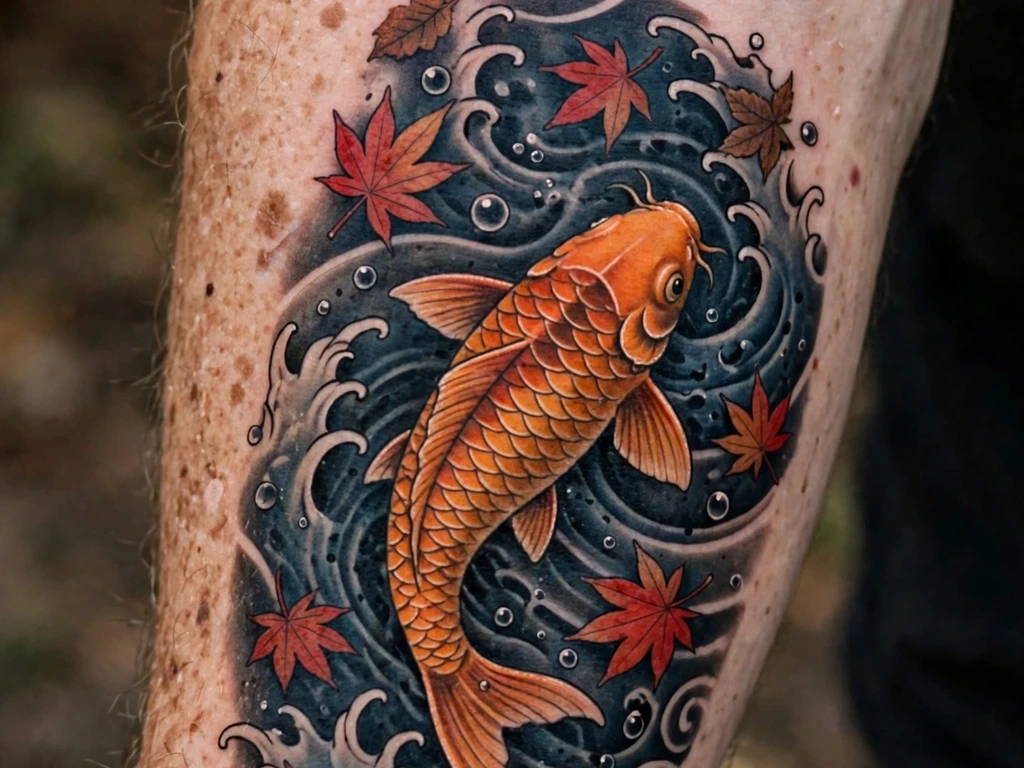
Autumn’s answer to the spring blossom koi: a koi moving through dark water strewn with scarlet maple leaves, the reds of fish and foliage answering each other across black water bars. Momiji — maple leaves — carry autumn, change and the beauty of things passing in the traditional vocabulary, and pairing them with a koi makes a seasonal statement precise enough to read like a date: this is a tattoo about a particular chapter, not just a pretty fish. It is also one of the most colour-rich designs in this list.
Best placement: Forearm or upper arm, the leaves scattered through the water around the fish.
Best for / know before you book: Two reds — fish orange-red and maple scarlet — must be kept tonally distinct or the composition muddles; ask your artist to show the palette together on paper. Autumn pieces are frequently booked as the seasonal counterpart to an existing spring blossom piece on the other limb.
23. Dragon and Tiger Pairing
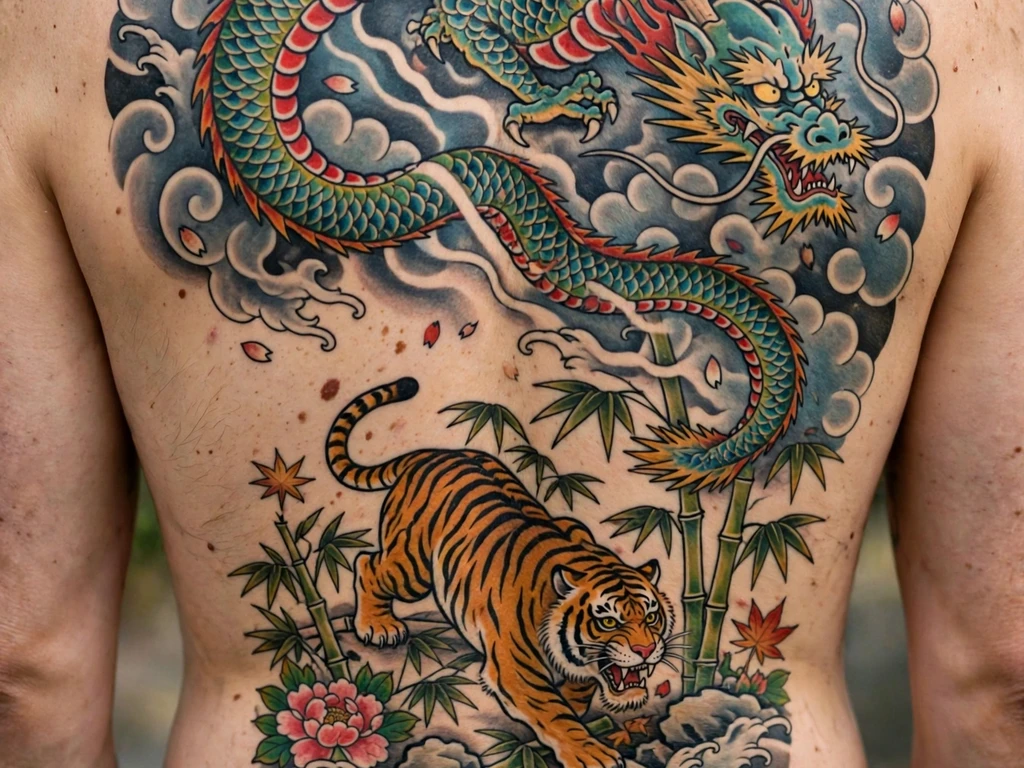
The classic balance of opposites, composed as one piece: the dragon in the upper field among clouds and rain, the tiger below among bamboo and wind — heaven and earth, water and land, two equal powers holding the design in tension. In traditional composition the dragon is placed higher as the celestial creature, and neither is drawn defeating the other; the point is equilibrium, which is why paired pieces are chosen for balance in life, in marriage, in temperament. Spread across a back, or split one motif to each thigh, it is the most philosophical composition in irezumi.
Best placement: Full back as one composition, or mirrored across both thighs or both arms.
Best for / know before you book: Two hero motifs double the drawing, the sessions and the cost of one — budget for this as two major tattoos that happen to share a frame. If split across limbs, keep the two sessions with the same artist and close in time so line weight and palette match exactly.
24. Mount Fuji Landscape Panel
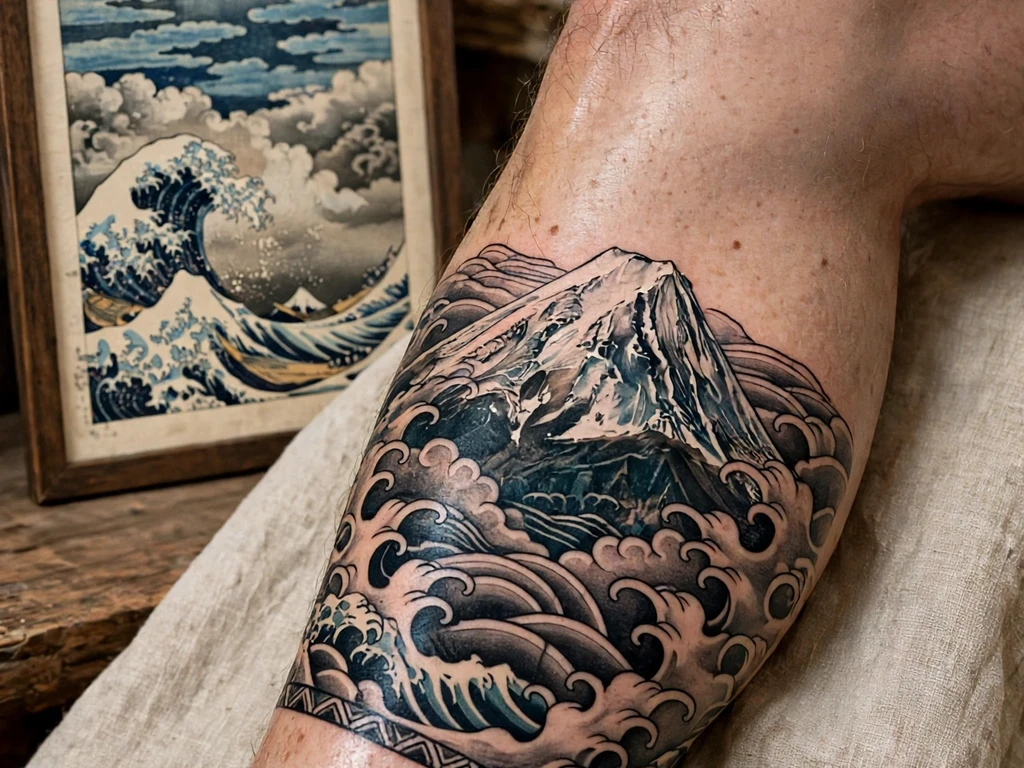
Fuji itself as the subject: the mountain’s perfect cone — snow-capped, serene — set in a framed panel of cloud bars, waves, pine or blossom, in the manner of the landscape prints that made it famous. Fuji in Japanese tradition is sacred and enduring, appearing in the Great Wave print small and calm while the sea rages, which is the mountain’s whole symbolic job: permanence against chaos. As a panel tattoo it is the most contained landscape in this guide, and a favourite of travellers marking a climb or a country that changed them.
Best placement: Calf or forearm as a vertical panel, or centred on the upper back.
Best for / know before you book: Fuji’s power is its silhouette — the cone must be drawn true, or the mountain reads as any hill. White snow is negative space, so the sky and cloud shading behind the peak must be planned as carefully as the mountain itself.
25. Traditional Half Sleeve
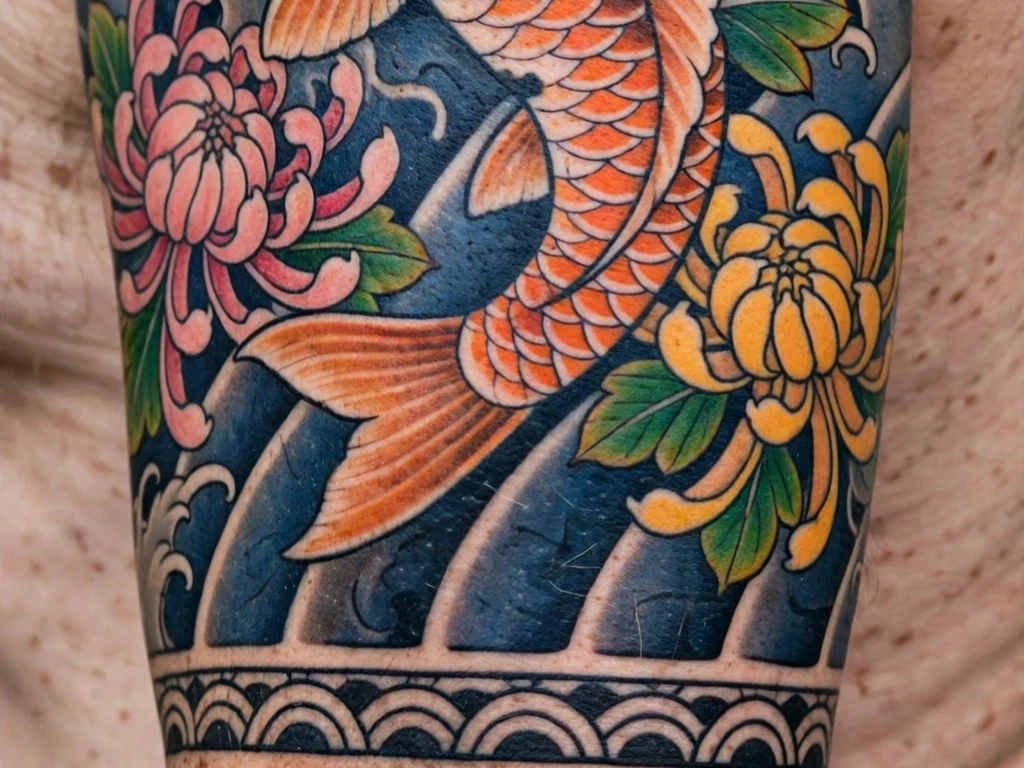
The way most people actually enter this tradition: one strong motif — a koi, a mask, a cluster of chrysanthemums — set in full gakubori background and finished at the traditional half-sleeve border just above the elbow, from where it can extend to a three-quarter or full sleeve later without redesign. The half sleeve teaches the real lesson of irezumi: the motif is only half the tattoo, and the background, the border and the flow with the shoulder are the rest. Planned properly, it looks complete at every stage of its life — which cannot be said of a random collection of Japanese images.
Best placement: Shoulder to just above the elbow, the border ending cleanly at the traditional cut line.
Best for / know before you book: Tell your artist on day one that extension is likely, and have the background drawn with open flow at the border so a future sleeve continues it naturally. Half sleeves sit under most shirt sleeves — which is precisely why the border lengths exist — but check your own workwear against the cut line before choosing it.
Japanese Tattoo Placement by Size
| Size | Typical dimensions | Best placements | Good to know |
|---|---|---|---|
| Small | Single motif, 8–15 cm | Forearm, calf, upper arm | True irezumi miniatures are rare — one motif, minimal background; masks and faces still need palm-plus scale |
| Medium | Half sleeve, thigh panel, chest panel | Upper arm to elbow, thigh, shoulder | The entry scale of the tradition: one motif with full background |
| Large | Three-quarter/full sleeve, full thigh, half back | Arms, legs, back | Multiple sessions; the composition is planned whole and tattooed in stages |
| Extra large | Full back piece, bodysuit | Back, torso, full limbs | The canonical irezumi commitment — months to years of sessions, drawn as one garment of imagery |
How to Choose Your Japanese Tattoo (and What to Know Before You Book)
Decide whether you want irezumi, or a Japanese image. Both are legitimate, but they are different purchases. True traditional work means a coherent composition — motif, seasonal pairing, background, traditional borders — usually at large scale with an artist who specialises in the style. A single small Japanese image is a fine tattoo, but it will not behave like, extend like, or age like a structured irezumi piece. Knowing which you are buying stops the most common disappointment in this style: a small motif the owner later tries to grow into a bodysuit it was never drawn to become.
Budget sessions and money honestly. Japanese work is traditionally large, and large work is slow work. A half sleeve commonly runs to several sessions spaced weeks apart for healing; a full back piece is typically a season or more of appointments and a budget in the thousands in most Western studios, varying widely by city and artist. Tebori, where offered, is priced as the specialist hand craft it is. Any quote that sounds dramatically cheaper than the local range for this scale of work is a warning, not a bargain — ask what is being left out.
Choose a specialist, and study healed work. The skills that make irezumi — background flow, motif drawing in the traditional manner, large-scale composition on a moving body — are a specialisation, not a default. Portfolio-shop for artists whose books are full of Japanese work, and weight healed photographs heaviest: background bars that healed patchy, or colour that dropped out of a koi, will not appear in fresh photos. A consultation where the artist discusses season, pairing and placement rules unprompted is the strongest signal you are in the right chair.
Respect the source culture — including on your travels. Learn the motif meanings you are wearing (the table above is a start), credit the tradition when people ask, and avoid mixing sacred imagery into jokey compositions. Practically: if you travel to Japan, know that many onsen, sentō, gyms and pools still refuse visible tattoos of any origin, a legacy of the yakuza association described earlier. Japan’s official tourism organisation, JNTO, maintains a guide to tattoo-friendly onsen in Japan — baths that welcome tattooed guests openly — and its advice is the working traveller’s kit: check a bath’s policy before you go, consider a private bath (kashikiri-buro), or use cover-up seals where a facility allows them for small tattoos. Rules vary by facility and change over time, so verify before each trip.
Take safety seriously. Large-scale work means long sessions and a lot of healing skin, which raises the hygiene bar. Choose a licensed, inspected studio; watch single-use needles opened in front of you; expect fresh ink in new caps for your session. Between sessions, aftercare is the job: follow your artist’s instructions, keep the piece clean and moisturised, keep it out of the sun and out of soaking water while it heals, and never schedule the next session on skin that has not fully settled — your artist should check and will postpone if needed.
Key points to remember:
- Irezumi is a composition system — motif, correct seasonal pairing, gakubori background and traditional borders — not just a Japanese picture
- Traditional Japanese work is large work: plan for multiple sessions, months of healing and a serious budget
- Hannya grieves and rages at once; oni are protectors — know the real traditional meanings of what you wear
- Background flow and healed results separate true specialists from generalists — portfolio-shop accordingly
- In Japan, many baths and gyms still refuse visible tattoos; check policies ahead and use tattoo-friendly facilities when you travel
Frequently Asked Questions
What does irezumi mean?
Irezumi (入れ墨) is the Japanese word for tattooing and, in tattoo culture, the name of the traditional Japanese style itself: large, coherent compositions of folkloric motifs set in wind, water and cloud backgrounds, with set borders at the wrists, ankles and collar. A traditional tattooist is a horishi, and the hand-poked method is tebori. In everyday Japanese the word can still carry old associations with punishment and organised crime — which is why the style is worn with knowledge and respect for its history.
How much does a Japanese tattoo cost?
It tracks scale more than any other factor. A single medium motif with background — a thigh koi, a forearm wave — typically sits in the mid hundreds to low thousands depending on city and artist; a half sleeve runs higher across several sessions; and a full back piece or bodysuit is a multi-thousand commitment spread over months or longer. Tebori specialists charge for scarce hand skill. Always get the full-project estimate — sessions, drawing time and likely touch-ups — in writing at the consultation, not just the first session’s price.
Do Japanese tattoos hurt more than other styles?
The style itself is average; the scale and placements are the story. Backs, ribs and the long sessions large work requires test endurance more than needle sensation, and tebori is often described by collectors as a different, duller pressure rather than simply more or less painful. Eat and sleep properly before long sessions, plan breaks with your artist, and expect big pieces to be tattooed in stages partly for your benefit — skin and stamina both have limits per sitting.
Can I get a small Japanese tattoo?
You can, and single motifs — a daruma, a small wave, a blossom branch — work well small. What does not work small is the full irezumi system: backgrounds, pairings and borders need room, and faces and masks need palm-plus scale to keep their expression. If a bodysuit is your eventual dream, tell your artist before the small piece, not after — placement of the first motif decides whether the later composition can be built around it.
Are tattoos accepted in Japan now?
Slowly, and unevenly. Tattoos are increasingly visible in Japanese fashion and media, and more baths, gyms and hotels accept them than a decade ago — but many onsen, sentō and pools still refuse visible tattoos, each facility setting its own policy, and there is no national rule either way. Tattooed travellers manage fine with a little planning: tattoo-friendly facilities, private baths and cover-up options all exist. Check the specific venue before you go rather than assuming either welcome or refusal.
Final Thoughts
A Japanese tattoo is the closest tattooing comes to wearing a story in a language older than any of its wearers. Choose the motif whose meaning you actually want to carry, pair it with its season, give it the scale and the background the tradition asks for, and put it in the hands of an artist who treats those rules as a craft rather than a costume. Do that, and the piece will not just decorate you — it will read, clearly and for decades, to everyone who knows the language.
Shortlist the designs from this list that stay with you, learn their stories properly, and take them to a specialist consultation. The right japanese tattoo should feel less like an image you picked and more like an inheritance you chose.