Hibiscus tattoo ideas live or die on colour. The flower is a five-petalled trumpet with a long stamen column poking out of its middle, and on skin that shape hands an artist two gifts: wide, soft petals that hold blended colour beautifully, and a silhouette bold enough to survive being simplified down to a bare outline. The six tattoos in this list are all real hibiscus photographed on real skin — two big pink blooms on a hip, one pink flower wrapped in green scrollwork, a calf wrapped in black outlines, a ruffled red wrist piece, and two pieces of straight colour realism. Our flower tattoo design ideas collection covers the wider field, and the lotus tattoo ideas guide shows a very different bloom handled with the same real-photo honesty.
One honest note before the designs start: this list was meant to be longer, and the legally usable photo pool says no. We screened hundreds of openly licensed photographs and stopped at six verified hibiscus tattoo ideas: the rest were drawings that were never inked, temporary tattoos, lilies and plumeria mislabelled as hibiscus, or studio photographs nobody had licensed for reuse. Six real ones is what the pool honestly holds. Every design below is a real flower on real skin, in a photograph its owner shared under a licence that lets us show it here.
What the Hibiscus Stands For
Start with Hawaii, because the flower is woven into the place. A yellow hibiscus, Hibiscus brackenridgei — pua aloalo in Hawaiian — is the state’s official flower, a status it has held since 1988, and hibiscus of every colour fill the leis handed to visitors. The hibiscus genus runs to hundreds of species across the warm parts of the world, but for a lot of wearers hibiscus tattoo ideas begin with the islands: a flower that stands for a home, a trip that mattered, or family roots somewhere in the Pacific.
The second meaning is written into the plant itself. A hibiscus bloom opens in the morning and is finished by the next day — as Britannica notes, the flowers of many species last only a single day. Flower symbolism has long read that short life as beauty that does not last, and it is why hibiscus tattoo ideas so often turn up as memorial pieces, or as a private reminder to enjoy a person or a season while it is here. Nobody invented that meaning to sell tattoos; it is simply what the flower does, every single day it blooms.
The flower travels well beyond Hawaii, too. Hibiscus rosa-sinensis, the bunga raya, is the national flower of Malaysia, and its hardier relative Hibiscus syriacus — the rose of Sharon — holds the same honour in South Korea. In Tahiti, a hibiscus worn behind the ear is often said to send a message of its own: behind one ear for taken, behind the other for available. Treat that as traveller’s lore rather than hard fact — but it explains why so many hibiscus tattoo ideas sit where a real flower could be tucked: behind an ear, at a hip, along a collarbone.
Colour carries the personal layer. Red hibiscus get chosen for love and strong feeling, pink for friendship and gentler affection, yellow for sunshine and good luck. These are loose associations borrowed from flower-giving habits, not a fixed code, so pick the colour that matches your own reason. With hibiscus tattoo ideas, the wearer’s story is usually the meaning that sticks longest — longer, honestly, than the petal colour will.
Hibiscus Tattoo Ideas: The Six Designs
Six designs, three schools of thought. Two lean on ornament, with scrollwork and filigree doing half the talking. One drops colour altogether. Three are straight colour work. Read the ageing note under each design before you fall for it, because hibiscus tattoo ideas stand or fall on how their petal colour was built — and these six were built very differently.
1. Two Pink Blooms With Black Filigree, Hip and Thigh
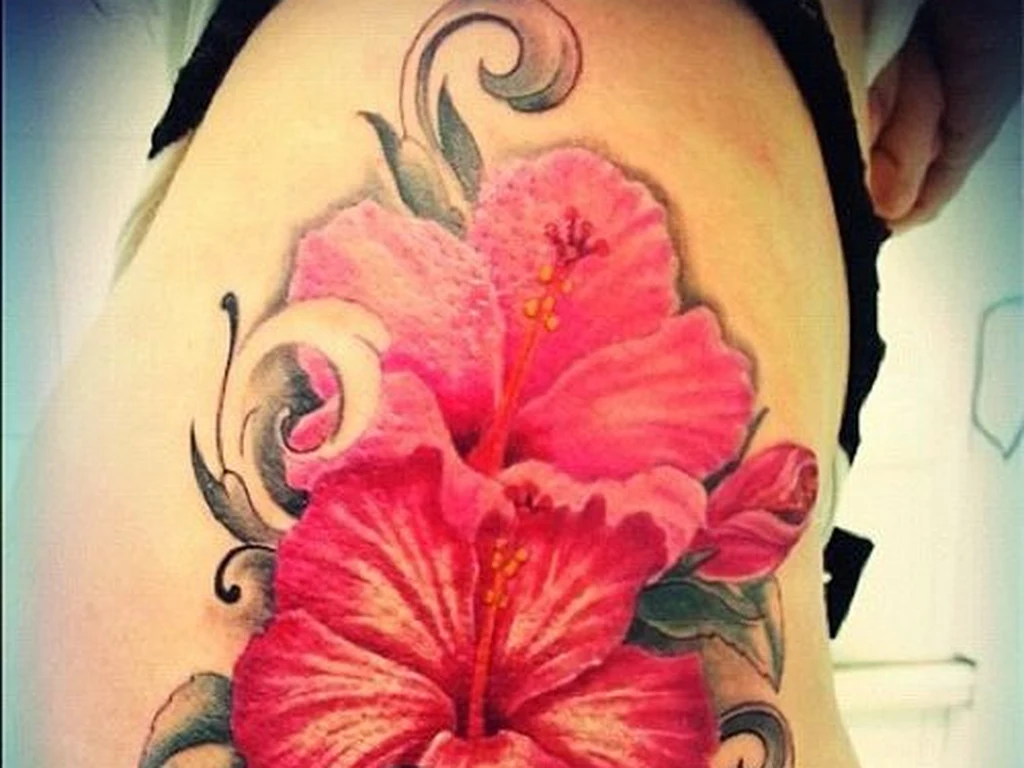
The biggest piece in the list, and the cover shot for a reason. Two large blooms run down a hip onto the thigh: the upper flower is a softer pink with a long stamen column tipped in amber dots, the lower one a deeper, veined pink-red, with a small closed bud tucked at the right edge and a few green leaves behind it. Black filigree curls sweep above and below the flowers, framing the pair. There is very little hard outline anywhere — the petals are soft colour blends, closer to painting than to traditional tattooing.
Size is doing the heavy lifting here, and it is the right trade. Soft pink blends with no outline to hold them will relax at the edges over the years, but at this scale the flowers can lose a little definition and still read clearly as hibiscus. The black filigree is the insurance policy: it is the darkest, boldest element in the piece, and it will keep framing the blooms long after the lightest pinks have settled. Hip and thigh skin helps too — stable, sheltered from sun most of the year, and slow to stretch. Of all the hibiscus tattoo ideas here, this is the one that asks the most of an artist, so take it to someone whose healed colour work you have seen in person.
2. One Pink Bloom Between Green Scrollwork, Lower Leg
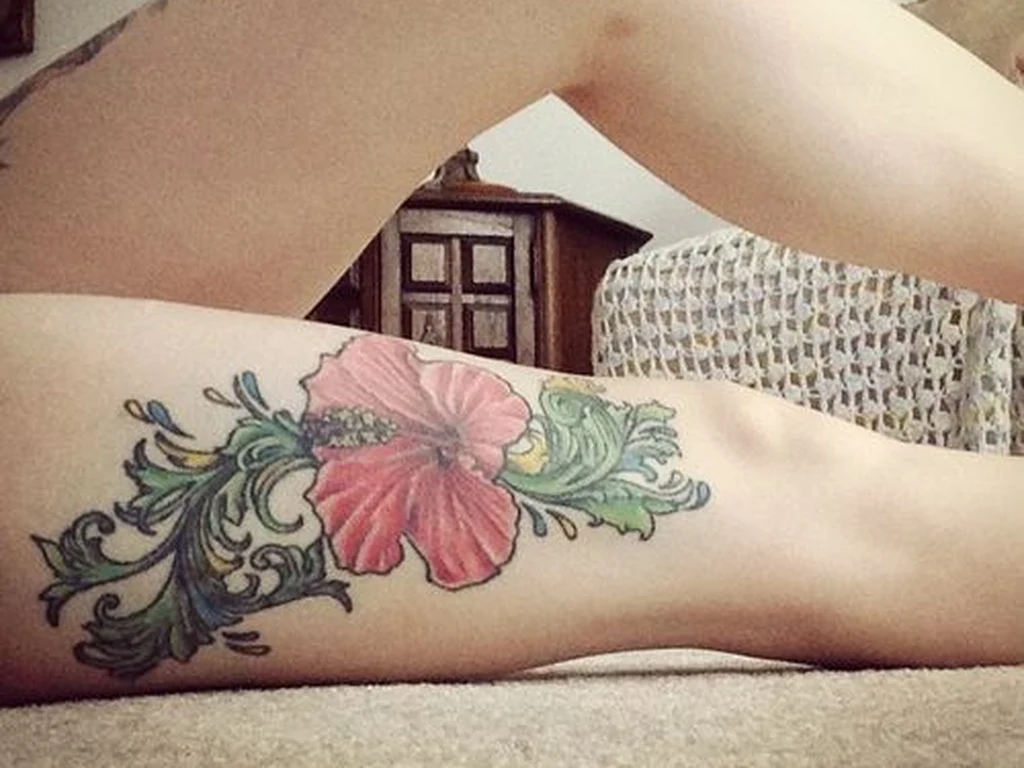
A single mid-pink bloom worn along the lower leg, its petals softly shaded and its stamen column kept short with a beaded tip. The flower is almost the smallest part of the design: big acanthus-style scrolls in green sweep out on both sides of it, flecked with blue and yellow, so the whole piece runs horizontally along the calf like a piece of carved ornament with a flower set in the middle. The photograph shows it healed, in ordinary daylight at home — worth more than a studio shot, because this is what the tattoo looks like out in the world.
The lesson in this one is how to make a single flower feel like a full design without adding a second bloom: let the leaves and scrollwork take the width. The greens in the scrollwork will hold their shapes for years, while the pink petals are the part that will lighten first — the flower will become a paler version of itself while the frame stays strong around it. The calf is kind skin for this: flat, low-movement, and easy for an artist to work on. Hibiscus tattoo ideas do not come much more wearable than this one.
3. Black Outline Hibiscus Wrap, Calf
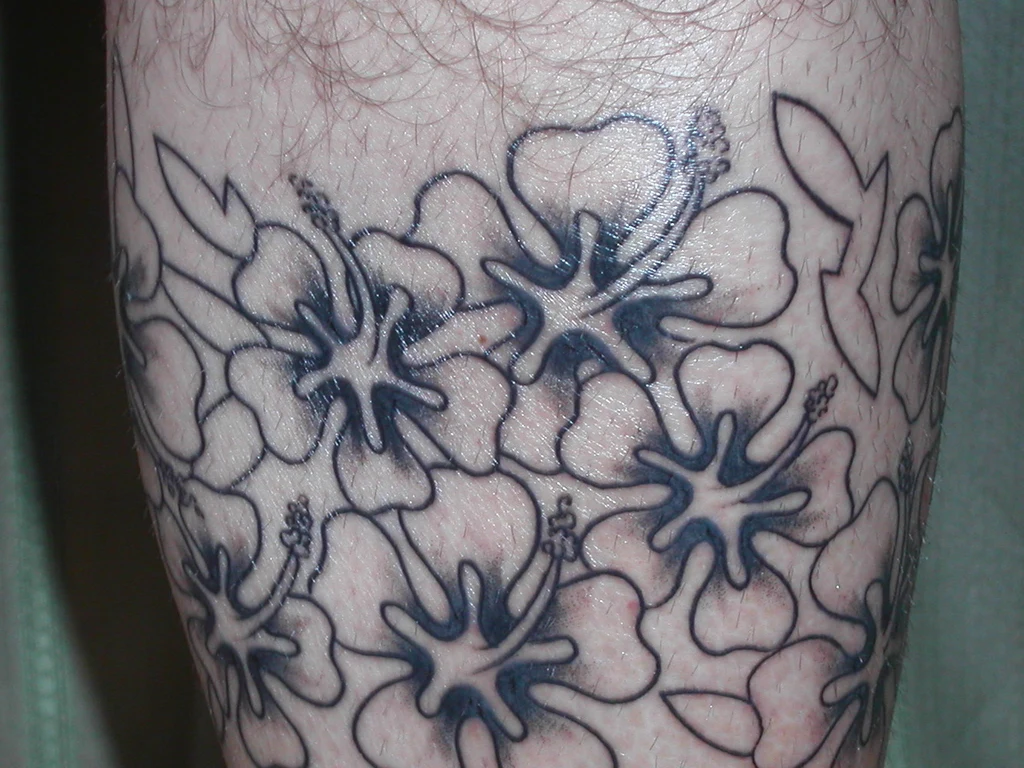
No petal colour at all. A whole band of hibiscus outlines wraps around a calf, bloom after overlapping bloom, each flower drawn in one confident black line with its petals left as bare skin. The only shading sits where the design needs weight: dark packing at the heart of each flower and around the stamen columns, so the centres read as deep points in a field of open petals. It is a bold, graphic piece — closer to a printed pattern than to a painting — and it covers more skin than anything else in this list.
This is also the ageing champion of the six. There is no pink to fade and no blend to soften; the only enemy is line spread, and the artist has left generous skin gaps between the flowers for exactly that reason. Worked this way, an outline wrap can look near-identical in fifteen years. It has one more trick up its sleeve: an outline piece like this can be coloured later, flower by flower, if the wearer ever wants it filled in. As hibiscus tattoo ideas go, it is the lowest-upkeep route to the flower there is.
4. Ruffled Red Hibiscus, Wrist
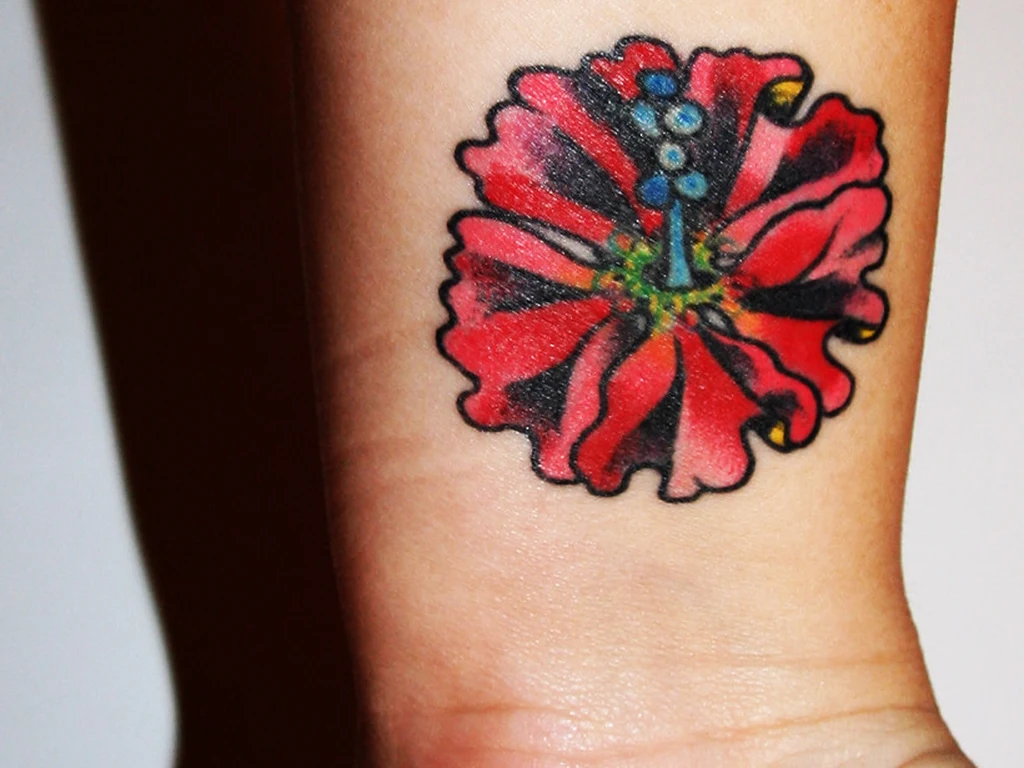
The smallest tattoo here, and the loudest colour. This is a double-form hibiscus — the ruffled kind, with layered petals stacked on petals — drawn small on a wrist. The petals are a saturated red with black shading tucked into the folds between them, the heart of the flower is green, and the stamen column is an unexpected blue, dotted with bead-like blue anthers and tiny specks of yellow. A firm black outline runs around the whole bloom, holding the ruffles apart so the eye can separate one petal layer from the next.
Every choice in this little piece is the right one for its size and spot. Red is the longest-lasting petal colour there is, the black shading gives the ruffles depth that will survive some fading, and the outline keeps the layers from merging into a red disc as the years pass. This one sits clear of the wrist crease itself, which matters: skin inside the crease folds all day and blurs ink faster. Wrists also catch sun every time you drive or type near a window, so hibiscus tattoo ideas placed here earn their keep from sunscreen more than most.
5. Pink Hibiscus Beside a Green Anole, Colour Realism
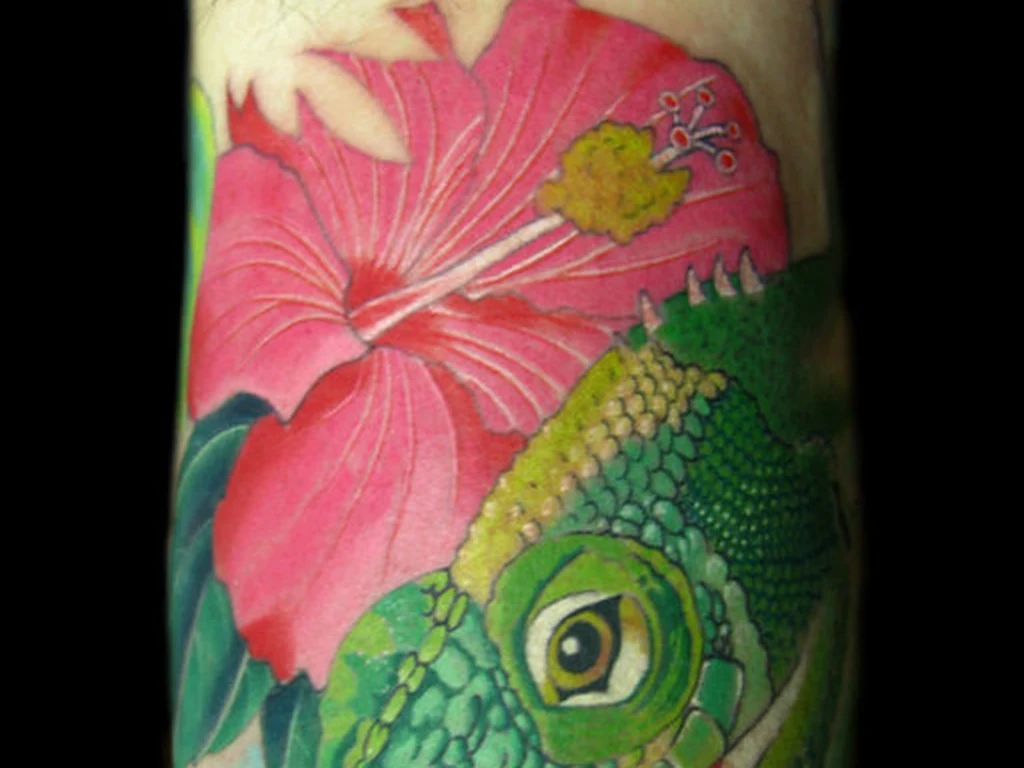
A big pink bloom takes the top half of the frame — petals veined in white, the stamen column tipped with a yellow-green head dotted in red — and below it, filling the bottom corner, is the head of a green anole lizard, its scales picked out one by one and one amber eye staring out of the picture. Dark teal-green leaves fill the left edge. The photograph is framed tight against a dark background, so the body part cannot honestly be named — but the piece is plainly large: detail like this, scale by scale and vein by vein, needs room.
Pairing the flower with a creature changes what the tattoo is. On its own, a hibiscus says Hawaii, summer, a place you love. Add the lizard that actually lives among those flowers and the piece becomes a portrait of one specific place — the anole is the everyday lizard of the Caribbean and the warm American south, the kind you see on garden walls where hibiscus grow. Realism like this lives on contrast rather than outline, so the honest ageing note is that the pink will soften first while the lizard’s deep greens hold. Among hibiscus tattoo ideas, this is the template for anyone whose flower means a place, not just a flower.
6. Red-Orange Bloom With a Green Halo
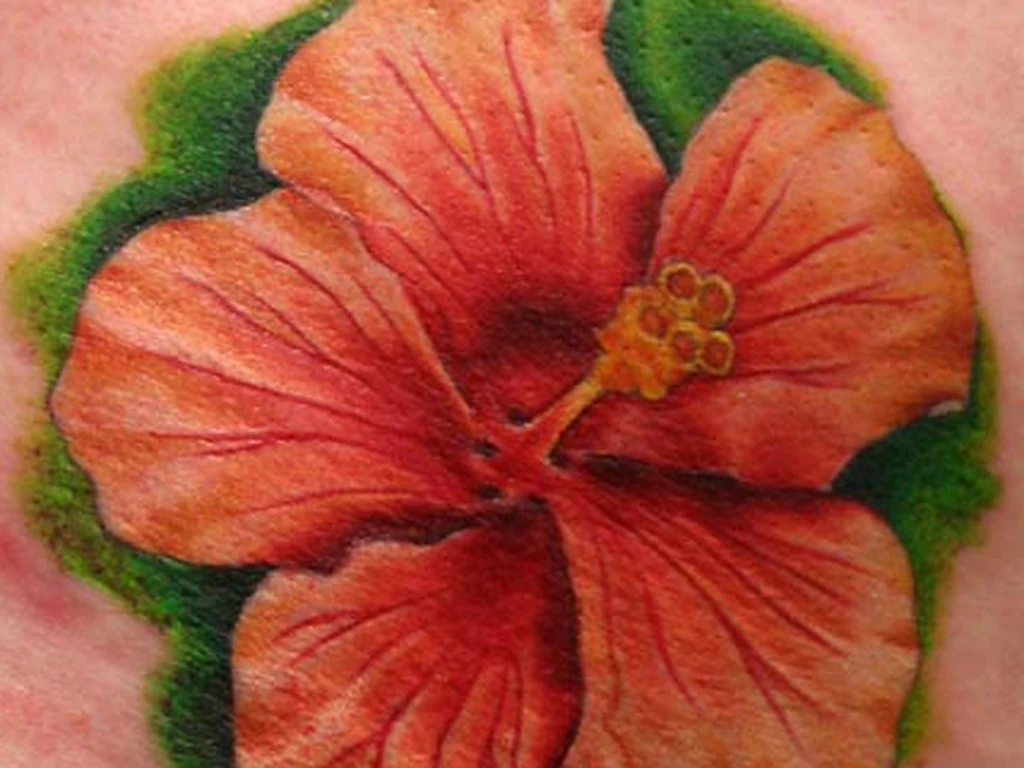
One bloom, filling the whole frame. Five wide petals shade from peach-orange at their edges down to a deep red throat, each one veined in fine red lines, with a cluster of yellow anthers riding the stamen column at the centre. Behind the flower, soft green shading is packed in like a halo, so the warm bloom lifts off the skin instead of sitting flat on it. There is no outline doing the work here — the separation between flower and background is pure contrast, warm against cool.
That green halo is a smarter trick than it looks. Orange sits in the middle of the colour survival order — tougher than yellow or pale pink, softer than true red — so this bloom will lighten over the years. But because it is read against the green behind it, it can lose a good share of its brightness and still read clearly as a hibiscus. One honest disclosure: the photograph is the softest of the six, taken from a small source image, so judge the design by its colour plan rather than by fine detail. Hibiscus tattoo ideas built on contrast age more gracefully than ones built on detail, and this is the proof of concept.
Placement and Colour: How Hibiscus Tattoos Age
Petal colour has an order of survival, and knowing it sorts hibiscus tattoo ideas into the ones that will still look like themselves in ten years and the ones that will not. Deep red lasts longest — it is the closest of the flower colours to the black that anchors traditional work. Pink blends soften into a paler blush version of themselves. Orange holds the middle ground. Yellow and the palest pinks fade first and may need a refresh every few years to keep the look you paid for. Notice what this means: the colour you fall for in the fresh photos is the most temporary part of a hibiscus tattoo. The shape — the trumpet silhouette, the long stamen column — is what stays.
The reason is simple: petal work is built from soft blends with very little black mixed in, and lightly packed pigment is what sunlight and time remove fastest. Then there is the stamen column, the flower’s signature detail: it is thin, it carries the finest lines in the design, and fine lines spread and merge as skin ages. A good artist draws the column chunkier than the reference photo shows, with the anther dots spaced wider than looks necessary on paper. When you compare hibiscus tattoo ideas at a consultation, that spacing is the detail to ask about — it is the difference between a flower that reads at year ten and a trumpet with a smudge in the middle.
Placement decides the rest, and the six designs above cover the main cases. Hip and thigh skin is the kindest canvas hibiscus can get: flat, stable, and under clothing most of the year, which is why the big two-bloom piece can afford its soft blends. The calf is nearly as kind and shows the work off in summer. The wrist is the demanding spot — visible, sun-catching, and close to a crease that folds all day — so wrist hibiscus tattoo ideas should stay small, bold and outlined, exactly like the ruffled red one in this list. And realism, like the anole piece, needs a big, flat field; fine detail cannot survive a wrist or an ankle. Match the softness of the style to the shelter of the skin, and a hibiscus will keep its shape for decades.
Hibiscus Tattoo Ideas: Frequently Asked Questions
What does a hibiscus tattoo mean?
Most hibiscus tattoo ideas draw on one of three meanings: Hawaii and island roots, since the hibiscus is Hawaii’s state flower and the bloom of the lei; beauty that does not last, from the real flower’s single-day life; or a personal meaning carried by the colour, like red for love or yellow for good luck. Plenty of wearers skip symbolism entirely and choose it as a portrait of a place they love.
Do hibiscus tattoos age well?
The bold ones do. An outlined hibiscus in red or black can look good for decades, because its shape is carried by dark lines rather than by fragile colour. Soft pink blends and outline-free realism soften faster — not ruined, but gentler and lower in contrast than the fresh photos suggest. When you compare hibiscus tattoo ideas, look for healed photos a few years old rather than fresh ones; that is the tattoo you are actually buying.
Which hibiscus colour fades fastest?
In hibiscus tattoo ideas, yellow and pale pink fade first, orange sits in the middle, and deep red lasts longest of the flower colours. Black outlasts all of them, which is why the outline-only calf wrap in this list will likely outlive every colour piece here. If you love a pale hibiscus, put it on sheltered skin — thigh, hip, upper back — and accept that a colour refresh every few years is part of the deal.
Where is the best placement for a hibiscus tattoo?
The thigh, hip and calf are the kindest choices: broad, stable skin that ages slowly and stays out of the sun much of the year. The shoulder and upper arm suit a single medium bloom well. Wrists and ankles can work for small, bold, outlined pieces, but soft colour blends belong on sheltered skin. Forearms show a hibiscus off beautifully and catch a lot of sun doing it, so budget for sunscreen as part of the placement.
How big should a hibiscus tattoo be?
Big enough for the stamen column to survive. A simple outlined bloom can work at the size of a large coin, because the outline carries it. A colour bloom with veined petals and a detailed centre needs to be palm-sized at least, and realism — like the anole piece in this list — wants far more room than that. As a rule, colour hibiscus tattoo ideas need that palm-size minimum. If an artist suggests going bigger than you planned, they are usually protecting the column and the gaps between the petals, which are the first details age closes up.
Can a hibiscus tattoo work without any colour?
Yes — the calf wrap in this list is nothing but black outlines and bare skin, and it is one of the strongest designs here. The hibiscus shape is distinctive enough to carry a tattoo on line alone: five petals and that long central column read clearly even at a glance. Black and grey shading works too, with grey wash standing in for petal colour. Hibiscus tattoo ideas in black are also the lowest-upkeep version of the flower, with no petal colour to refresh.
What flowers and motifs pair well with a hibiscus?
The classic partner in hibiscus tattoo ideas is plumeria — the two grow in the same gardens and share the same island associations — and broad tropical leaves, monstera and palm fronds all sit naturally around a hibiscus. Scrollwork and filigree work too, as the first two designs in this list show. If you are building a flower piece by piece, our cherry blossom tattoo ideas guide is worth a look as well: a very different flower, but one that pairs with hibiscus surprisingly often in larger tropical work.
Does a hibiscus tattoo hurt on the hip, calf or wrist?
The calf and the front of the thigh are at the mild end for most people — padded, flat, and an easy sit. The hip is more tender, especially as the work creeps toward the hip bone and the waistband line, and denim will rub a fresh hip piece, so time it for a week of soft waistbands. The wrist is a short, sharp session: thin skin, close to bone, but a wrist hibiscus is small, so it is over quickly. None of the six placements in this list is at the severe end of the chart.
How much does a hibiscus tattoo cost?
Prices for hibiscus tattoo ideas vary too much by city, studio and artist to put an honest single number on. A small outlined wrist bloom usually lands near a shop’s minimum fee; a palm-sized colour flower is a step up; a large realism piece like the hip blooms or the anole tattoo is priced by the hour or the session and can run to several sittings. The useful move is to send two or three local studios the design and the exact size you want, and compare real quotes instead of averages.
Can a hibiscus tattoo cover up an old tattoo?
Sometimes. A cover-up has to be darker and busier than what sits underneath, and a colour hibiscus has real advantages here: big petals, deep reds, dark green leaves and shading to hide old lines inside. The outline-only style cannot cover anything — bare skin shows straight through it. Pale pink blends are poor cover-up material too. Take the old tattoo to a consultation and let the artist judge it in person; hibiscus tattoo ideas make good cover-ups, but only when the colour plan is built for the job.
Final Thoughts
Six designs is a short list for a flower this popular, and the shortness is honest: these are the hibiscus tattoo ideas that could be verified, licensed and shown here without borrowing anyone’s work. What the six cover, between them, is the flower’s real range — ornament and outline, a coin-sized wrist bloom and a hip piece you could not hide, colour that will need refreshing and linework that will not. Pick the meaning first, then pick the colour for its staying power rather than its fresh-photo brightness, and give the stamen column room to age. Do those three things and a hibiscus will still be recognisably itself long after the real flower’s single day is up — which, given what the bloom stands for, is exactly the point of wearing one.