Dog portrait tattoo ideas start from a different place than most tattoo lists. Nobody browses them looking for a generic dog. You are looking at your dog — the exact tilt of her head, the grey creeping into his muzzle — and asking if an artist can keep that face recognisable on skin for decades. This page answers with six real portrait tattoos, photographed on the people wearing them and shared by their photographers under open licences. Six is a short list, and the reason is honest: dog portrait tattoo ideas are everywhere on social media, but almost none of those photographs are licensed for a site like this one to republish. Rather than pad the page with other people’s work shown without permission, here are the six that could be verified, photo by photo.
The six split into four colour pieces and two memorials. There is a young tan dog in profile, a bully type facing the camera, a pug cropped in close, a bulldog laughing inside flowers, a Shar Pei with wings and her name, and one old, faded memorial that shows what time does to a portrait. If you want the wider dog list, our dog tattoo ideas collection covers portraits alongside cartoons, mascots and cover-ups, and the pet tattoo ideas page gathers the cats, birds and other companions. This page stays narrow on purpose: dog portrait tattoo ideas only, and what each one teaches about getting a likeness right.
Read the ageing notes under each design before you fall for a style. Portraits are the least forgiving tattoos on this site, because a face that drifts stops being your dog. Dog portrait tattoo ideas are not a style to rush.
What Makes a Portrait Work: The Photo, the Likeness and the Style
Every portrait on this page began as somebody’s photograph, and the tattoo can only be as good as that starting point. Bring your artist one sharp head shot taken in daylight, with your dog looking at the camera and both eyes open and lit. Add a few more from the side and above so the markings read clearly: where the blaze stops, which ear folds, how the colour splits across the face. Phone photos are fine. Blurry ones are not, and neither are screenshots or heavily filtered pictures, because the artist ends up inventing the detail the filter removed. Among dog portrait tattoo ideas, the commissions that disappoint usually go wrong here, at the photo stage, before anyone picks up a needle.
Likeness lives in proportions, not detail. The distance between the eyes, the length of the muzzle against the skull, the set of the ears — get those right and a face reads as your dog from across the room. Get them wrong and no amount of fur texture will save it. Breed matters because breeds carry those proportions differently: the pug below is nearly all forehead and eye, while the tan dog’s likeness sits in a long, soft profile. If you want to check how your own dog’s features compare with the typical shape of its breed, the Britannica entry on the domestic dog is a plain-language place to start. A good portrait artist studies the breed first and your individual dog second — an order that matters more in dog portrait tattoo ideas than in almost any other subject.
Then choose how literal you want to be. Full realism, like the first two pieces below, copies the photograph almost tone for tone and asks the most of both artist and skin. Softer colour work, like the pug and the bulldog, keeps the dog recognisable while letting the artist simplify the shading — a kinder bargain as the years pass. And there is no rule that a portrait must be realism at all: the faded memorial at the end of this list is nearly flat colour, more symbol than photograph, and it carried its meaning for years. Dog portrait tattoo ideas work best when the style is chosen for the dog and the spot it will live on, not copied from whichever picture is trending this month.
Dog Portrait Tattoo Ideas: The Six Designs
Six designs, then, in the order a portrait hunter usually meets them: the two straight realism pieces first, the two looser colour faces, and the two memorials last. Each one is described exactly as it appears in its photograph, including the parts of these dog portrait tattoo ideas that will not age as well as the rest.
1. A Young Tan Dog in Profile, Colour Realism, Upper Arm
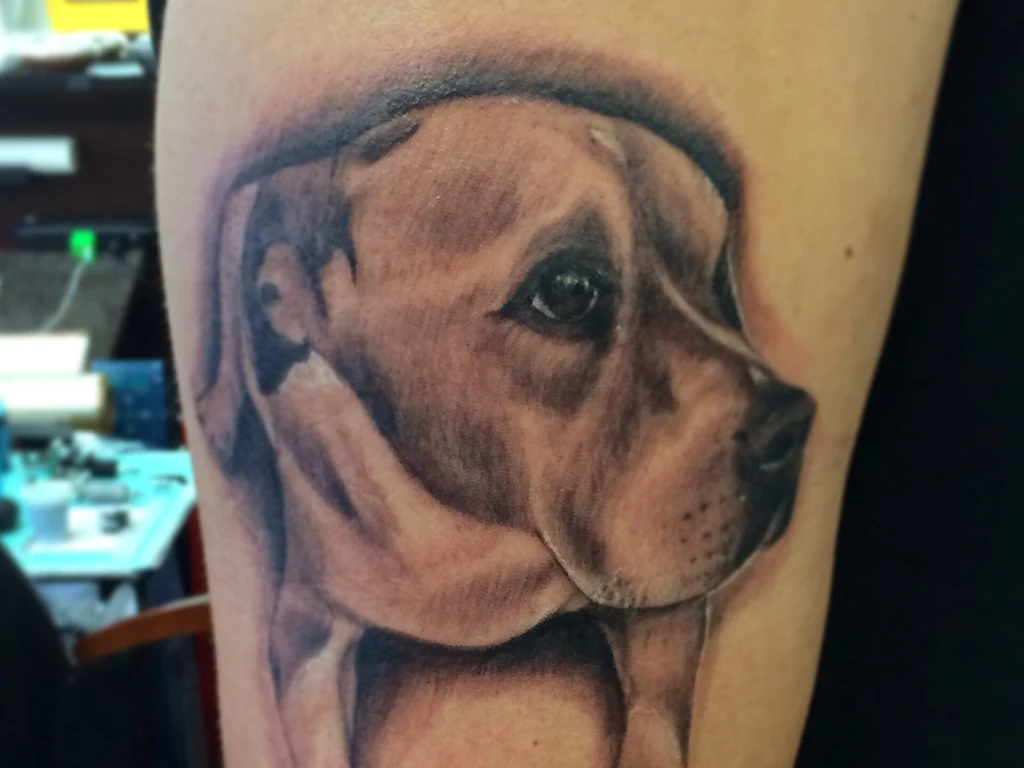
The photograph shows a big colour portrait taking up most of an upper arm: a young tan dog, Labrador in type, seen in profile and looking off to the right. The head is framed by a soft dark halo that pushes the pale coat forward, and the work runs on smooth blends rather than hard outlines — the long ear, the cheek and the muzzle are built from gentle shifts of brown. One dark eye with a small white highlight does most of the expressive work. Of all the dog portrait tattoo ideas on this page, this is the straightest from-a-photograph example: nothing added, nothing decorated, just the dog’s head given room.
Ageing note: profile portraits hold up kindly because the silhouette does the recognising. The outline of that ear and muzzle will read for decades. The soft blends are the slow cost — the cheek shading will flatten, and the eye highlight may need one refresh to keep the dog looking alert rather than sleepy.
2. Black and Tan Bully Type, Front On With a Chain Collar, Lower Leg
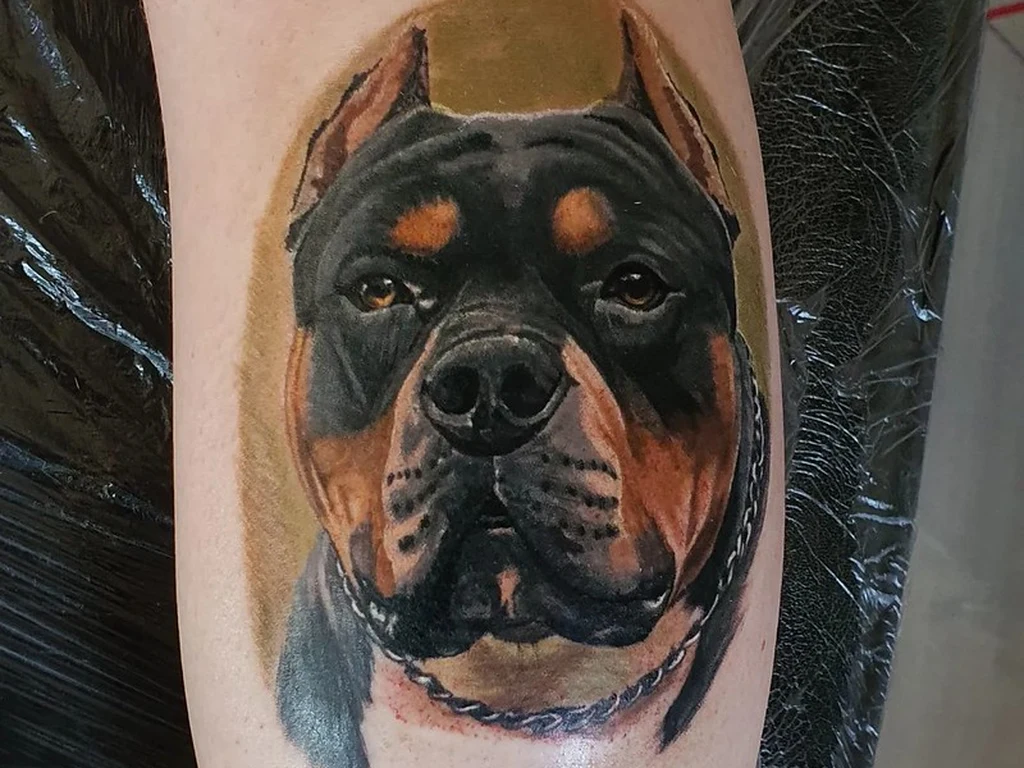
This lower-leg portrait faces the camera dead on: a heavy-headed black and tan dog of bully type, cropped ears up, two tan spots over the eyes like eyebrows, and a chain collar drawn link by link around the neck. A plain olive wash behind the head keeps the background quiet so the face carries the whole design. The black mask against the tan cheeks is the highest-contrast coat pattern a dog can offer, and the artist used all of it — the nose is deep black and the eyes carry amber.
Ageing note: the big shapes here are safe. A black mask and a tan blaze cannot blur far without staying readable. The chain is the fragile part. Drawn at this size its links hold, but fine repeated detail is always the first thing skin softens, so expect the collar to read as a textured band in ten years rather than as separate links. Dog portrait tattoo ideas with jewellery, tags or patterned collars all sign the same bargain.
3. A Pug’s Face, Cropped in Close, Soft Colour
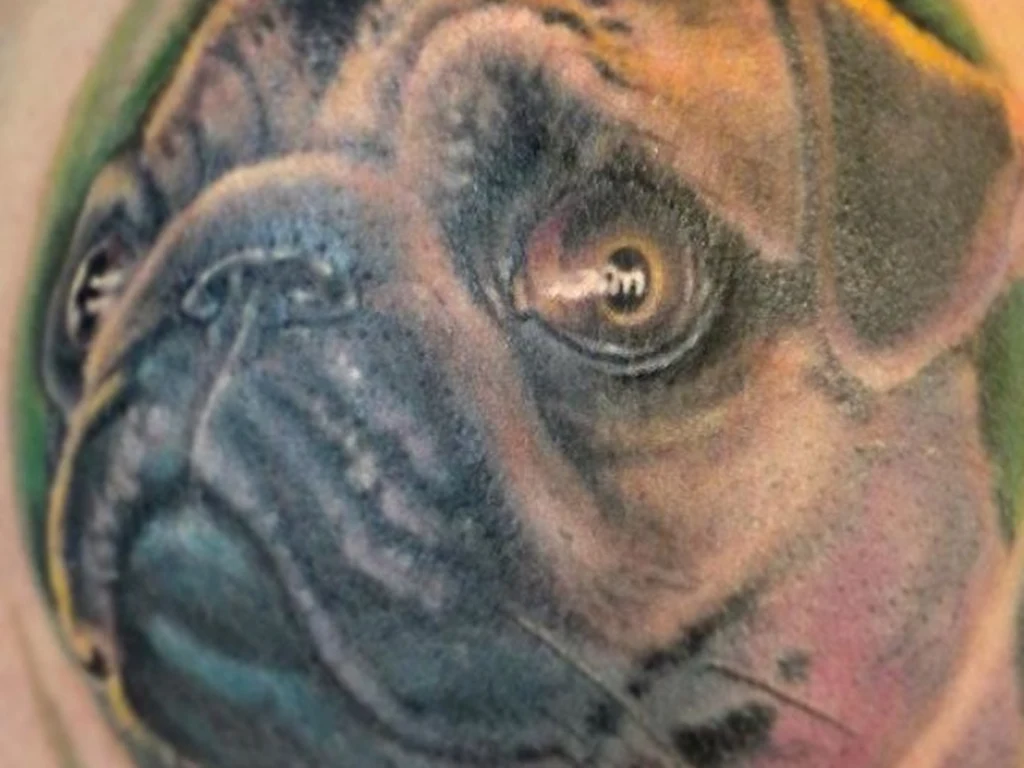
The third photograph is the tightest crop on the page: a pug’s face filling the whole frame, fawn forehead, black muzzle pushed up close, and one huge round eye with a white catchlight sitting at the centre of the design. Behind the head, soft washes of grey, pink and green fade the edges away. Short-muzzled breeds are the hardest faces in dog portrait tattoo ideas, because there is so little nose to draw and the likeness has to live in the wrinkles and the eyes instead. This artist made the right call — the eye is enormous, glossy and exact, and everything else supports it.
Ageing note: that eye is both the strength and the risk. A catchlight is a tiny white gap in dark ink, and tiny gaps are what ageing skin closes first. Keep the portrait big if you copy the idea. The same face at half the size would lose the eye, and a pug portrait without the eye is just wrinkles.
4. A Bulldog Laughing Inside Flowers, Loose Colour
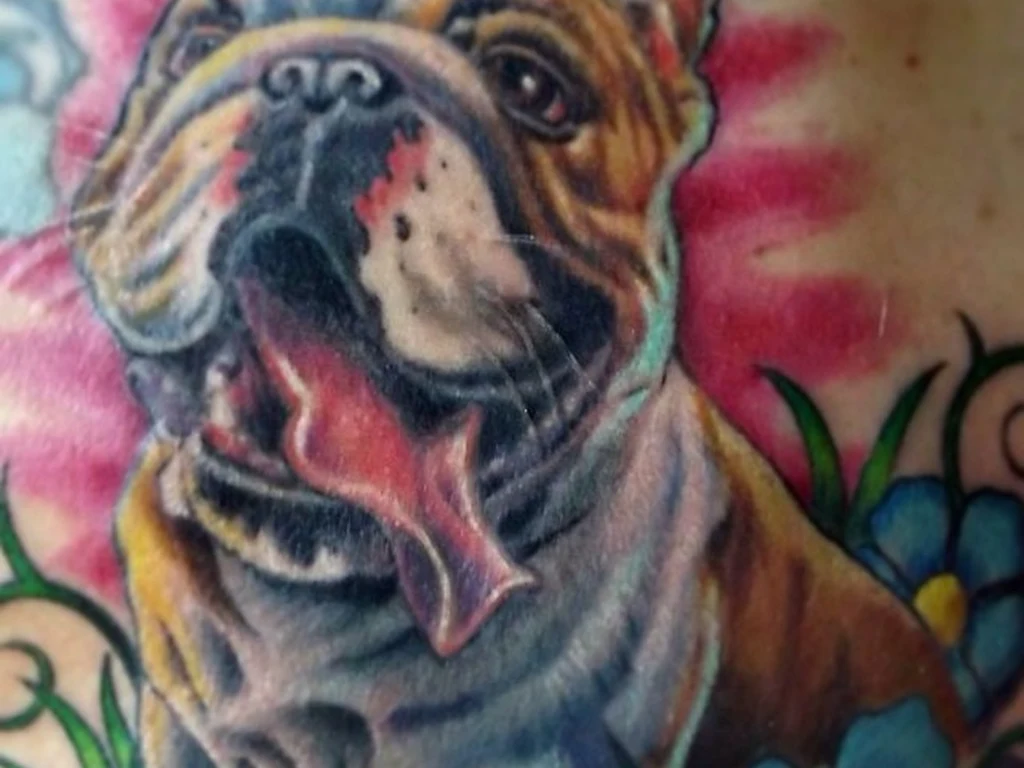
The fourth piece loosens up. A bulldog’s head tilts back, mouth open, long pink tongue hanging out, photographed against a wash of pink and red with flowers and green vine scrollwork curling in at the edges. Nothing here chases photographic exactness — the colours are brighter than any real coat, the tongue is doing comic work, and the floral frame turns the portrait into a small celebration. It is a fair reminder that dog portrait tattoo ideas do not have to be solemn. For a dog whose whole personality was the grin, a grinning portrait is the honest likeness.
Ageing note: bright colour asks for upkeep, and pink most of all. The tongue and the background wash will fade faster than the black nose and the dark lines around the muzzle, so this style suits someone who accepts a refresh every few years as part of the deal. The bold shapes underneath — head, tongue, flowers — are drawn large enough to survive the fading with the joke intact.
5. Lola the Shar Pei, With Wings and Her Name, Forearm
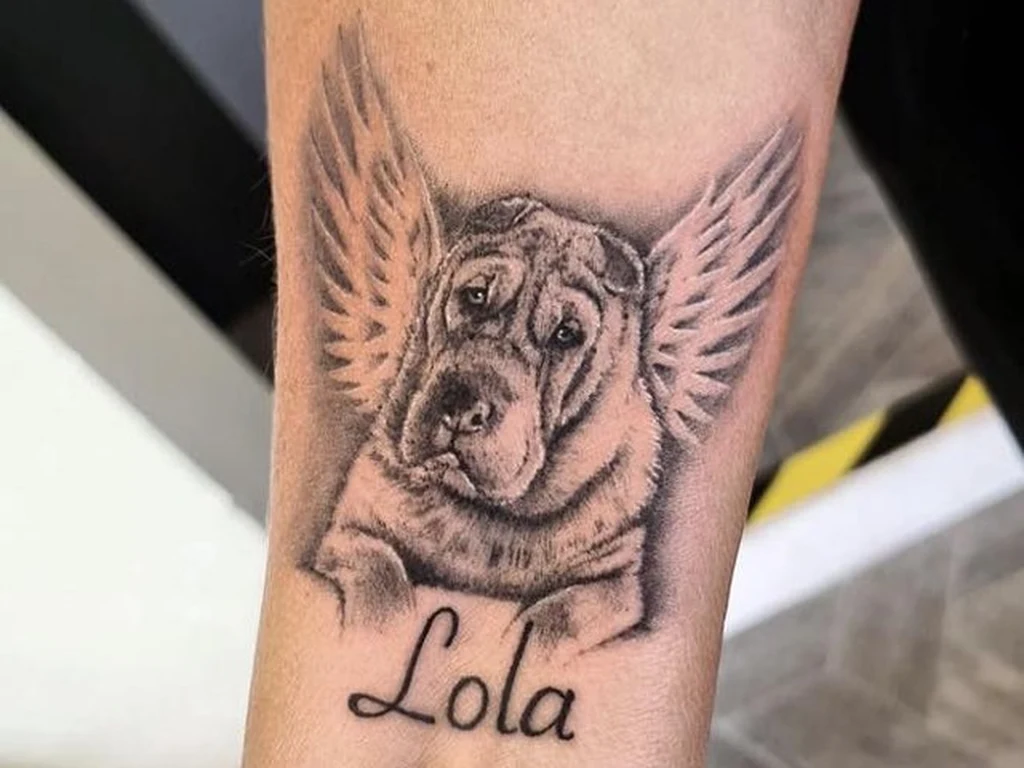
The first of the two memorials sits on a forearm: a black and grey Shar Pei, head and front paws, her wrinkled face looking straight out, with a feathered angel wing rising on each side of her and her name, Lola, written in script underneath. Shar Pei wrinkles are a gift to a portrait artist — the face is already a map of folds, so the likeness can be built from strong lines instead of fragile shading. The wings and the name say plainly what kind of piece this is, and our pet memorial tattoo ideas guide looks at the other ways people mark a loss, from paw prints to portraits like this one.
Ageing note: the portrait itself is built to last — wrinkles, dark eyes, a black nose. The wings are the soft part, drawn in light grey wash with fine feather separations, and light grey is always the first tone time takes. Expect the wings to read as a gentle halo in later years while Lola’s face stays clear. Many owners find that trade acceptable, even right: the dog stays, the decoration softens.
6. The Faded Memorial: A Pale Head Between Two Sets of Years, Upper Arm
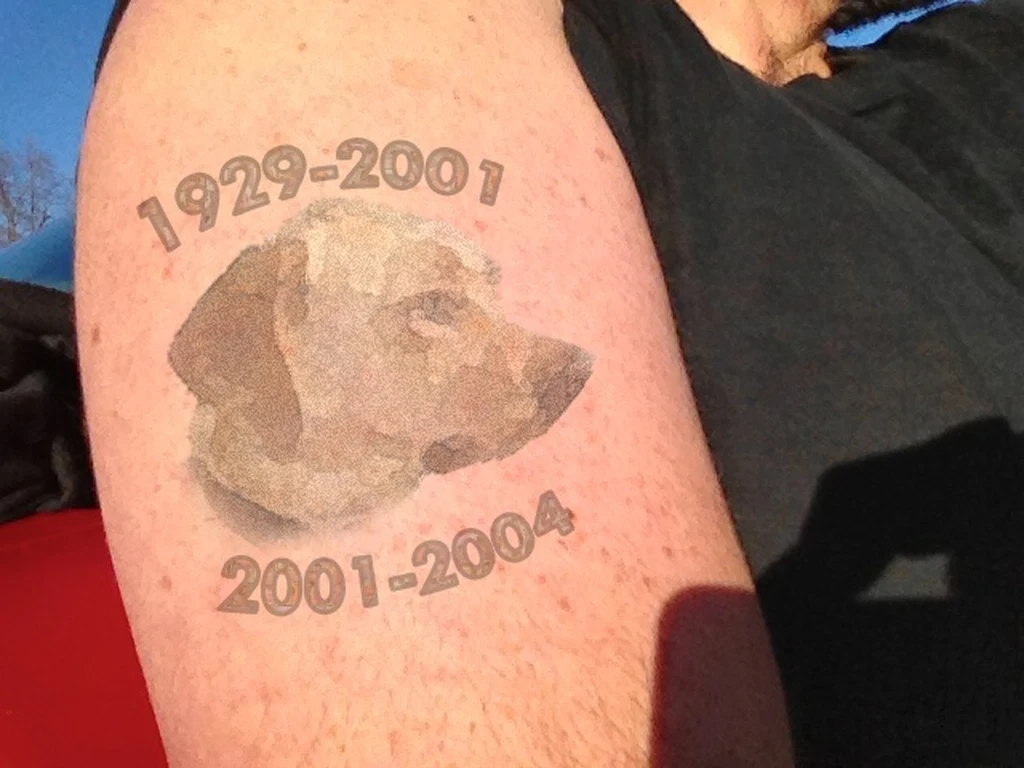
The last photograph shows an older upper-arm piece that time has nearly taken back: a pale dog’s head in profile, flat-toned and washed out, with the years 1929–2001 arched above it and 2001–2004 set below. The portrait was never a realism piece — the colour sits in flat blocks, poster-style — and the years since have flattened it further, until mostly the silhouette remains: the ear, the long head, the darker nose. It earns its place on this page as the honest end point of dog portrait tattoo ideas. This is what a lightly built portrait becomes.
Read it as a lesson, not a warning off. The head is still recognisable as a dog and still does its job as a memorial — the dates carry the meaning even where the ink has thinned. But if you want a face, with eyes and expression, to survive twenty years, it needs the things designs 1 and 5 have and this one lacks: deep darks, strong structure, and enough size. A portrait is a long promise. Build it like one.
Where Portraits Sit Best, and How They Age
Portraits need flat width, and the six pieces here agree on the shortlist: upper arm, forearm and lower leg — spots that stay still, keep their shape and give a face room to be a face. A head drawn at palm size or bigger keeps its eyes and nose separate, which is the whole game. Curved, bendy ground — wrists, ankles, the side of the neck — warps a muzzle and closes fine detail early, so save those spots for paw prints and silhouettes. If your dog’s portrait must live somewhere small, drop the realism and choose a bold outline version instead; dog portrait tattoo ideas in line work survive small in a way shaded faces never do.
On ageing, portraits soften from the middle of the face outward. The eyes and the nose carry a portrait’s identity, and they are built from the smallest marks in the design: a white catchlight a millimetre wide, the shine line on a wet nose, the separation between the nose and the muzzle. As skin ages, ink spreads a fraction, pale greys lighten, and those tiny contrasts are the first to go. The defences are known, and they are worth asking for at the consultation: eyes drawn slightly larger than life, catchlights left as generous gaps of bare skin, noses anchored in true black rather than dark grey, and enough empty skin around the face that the spread has somewhere harmless to go.
Sun does the rest of the damage. Ultraviolet light breaks pigment down, and the soft browns and greys that build a realistic face carry the least pigment to spare. A healed portrait kept under sunscreen keeps its likeness years longer than one left to bake. Plan for one professional touch-up in the first few years as well — not as a failure, but as maintenance, the way you would revarnish a painting in a bright room. Dog portrait tattoo ideas are the highest-maintenance entries in the whole dog list, and the owners who know that upfront are the ones still happy at year ten.
Dog Portrait Tattoo Ideas: Frequently Asked Questions
What makes a good reference photo for a dog portrait tattoo?
One sharp head shot in daylight, your dog looking at the camera, both eyes open and lit, markings visible. Add a few more from the side and above. Avoid heavy filters, screenshots from videos and blurry favourites — the artist ends up inventing whatever the photo hides. Most dog portrait tattoo ideas are won or lost at this stage, before any drawing starts.
How big should a dog portrait tattoo be?
Palm size is the honest floor for a shaded face, and bigger is kinder. Eyes, noses and catchlights need physical room to survive the ink spread that comes with age. A forearm or an upper arm gives a portrait the length it wants. If the space you have is coin-sized, choose an outline or a silhouette instead and save the portrait for a bigger canvas.
Do dog portrait tattoos age well?
The bold parts do; the fine parts soften. Solid darks — a black nose, dark eyes, strong ear edges — hold for decades. Pale grey shading, tiny catchlights and fine fur texture lighten and blur first, which is why design 6 reads as a silhouette now. The dog portrait tattoo ideas that age best are built on strong black anchors with the soft tones used where their fading will not hurt the likeness.
Should I choose colour or black and grey for a dog portrait?
Black and grey suits most real coats and asks the least upkeep, and it loses nothing on a grey or black dog. Choose colour when the coat itself is the point — a tan and black split, a brindle, a red coat — or when you want the looser, brighter treatment of design 4. Budget for refreshes with colour, since pinks, yellows and light browns fade ahead of the black work.
How much does a dog portrait tattoo cost?
Prices vary too much by city, studio and artist to quote honestly as one figure. As a guide to scale: a palm-sized realism portrait usually runs to several hours of an experienced artist’s time, a forearm piece like Lola’s takes longer again, and simple outline portraits sit at the opposite end. Get the quote with the reference photo in hand, and ask whether a first touch-up is included.
Where is the best placement for a dog portrait tattoo?
Broad, stable skin: the forearm, upper arm, calf and thigh give a face the width it needs, and the dog portrait tattoo ideas on this page sit on exactly those spots. Shoulders and upper backs suit larger heads. Hands, fingers, feet and the side of the neck renew fast and blur fine work early, so keep detailed faces away from them.
Can a dog portrait tattoo be a memorial?
Yes — two of the six designs on this page are memorials. Common additions are wings, the dog’s name, dates, a collar tag or a paw print, placed around the portrait rather than across it. Memorial dog portrait tattoo ideas carry one extra piece of advice: sit with the design for a few weeks before booking. Grief makes every option feel urgent, and the piece will be with you far longer than the urgency.
My dog has a black coat. Can a portrait still work?
Yes, and the bully portrait on this page is the proof: a black mask drawn against tan cheeks, with the face built from grey tones and highlights rather than from black alone. Artists render black fur the way painters do, mostly in dark greys, with true black saved for the nose, the eyes and the deepest folds. Bring photos taken in daylight — a black dog photographed in dim light arrives as a silhouette with no face to copy.
How do I choose an artist for a dog portrait?
Look for healed animal portraits in the portfolio, not just fresh ones and not just human faces. Dog fur, noses and eyes shade differently from skin tones, and healed photos show whether the artist spaces fine detail so it survives. A good sign is an artist who asks for several photos and tells you which one will tattoo best. Among dog portrait tattoo ideas, portraits are the least forgiving style to shop on price, so pick on the portfolio first.
Can an artist work from an old or blurry photo?
Partly. A skilled artist can rebuild proportions from several imperfect photos, and for a lost dog that may be all that exists. What cannot be recovered is fine detail that no photo shows — the artist will either invent it or simplify the style. Stylised dog portrait tattoo ideas exist for exactly this problem: a bolder, simpler drawing asks less of the source photo and can still carry the dog’s shape and markings honestly.
Final Thoughts
Six designs is a short list, and it is the honest one: these are the dog portrait tattoo ideas that could be photographed, licensed and shown here without borrowing anyone’s work or repeating photographs already published in this site’s other collections. What the six lack in number they cover in range — strict realism, loose colour, and two memorials at opposite ends of a portrait’s life, one fresh and one faded to a ghost. If you take one thing from this page, take the pattern the lasting pieces share: a clear photograph, an artist who draws animals for a living, dark anchors in the eyes and nose, and a size that respects the detail. Get those right and the likeness tends to follow. For the wider menagerie, browse the full animal tattoo ideas collection.