Some tattoos shout. Geometric tattoos do something more interesting: they hold your eye with order. Perfect circles nested inside circles, lines so straight they could have been ruled, patterns that mirror themselves across the body — this is tattooing built on mathematics, and when it is done well it looks less like decoration and more like a diagram of something true.
In this guide to geometric tattoo ideas you will find the ideas behind the style first: what sacred geometry actually is, why symmetry is both the whole point and the hardest part, and how these precise designs behave as they age. Then come 25 designs worth your consideration, from the ancient Flower of Life to faceted animals, optical illusions and honeycomb fades — each with placement guidance and the honest warnings this style demands.
What Is a Geometric Tattoo?
A geometric tattoo is any design built primarily from shapes, lines, dots and symmetry rather than from realistic shading. Animals become assemblies of triangles. Landscapes reduce to stacked lines and a single circle of sun. Complex spiritual diagrams — some of them thousands of years old — are drawn with the same compass-and-straightedge discipline that built cathedrals, mosques and temples. Modern geometric tattooing weaves these old patterns together with dotwork, fine linework and negative space.
At the heart of the style sits sacred geometry: the belief, shared by cultures that never met each other, that certain shapes and proportions carry meaning. The same interlocking circles appear in Egyptian temples, Islamic tilework, Hindu ritual diagrams and Gothic rose windows. Tattoo artists did not invent this vocabulary — they inherited it. The most requested symbols are worth knowing before you choose one:
| Symbol | What it is | What it represents |
|---|---|---|
| Seed of Life | Seven overlapping circles of equal size, drawn from a single centre | Creation, beginnings, the blueprint from which patterns grow |
| Flower of Life | Nineteen interlocking circles forming a flower-like lattice inside a ring | The interconnectedness of all life; unity and wholeness |
| Metatron’s Cube | Thirteen circles joined by straight lines, containing the five Platonic solids | Balance, harmony and the underlying structure of the universe |
| Sri Yantra | Nine interlocking triangles (four pointing up, five down) around a central point | A Hindu meditation diagram symbolising the cosmos and divine union |
| Vesica Piscis | The almond shape formed where two equal circles overlap | Duality in balance — two worlds, two people, one shared space |
| Tree of Life | A tree whose branches and roots mirror each other inside a circle | Connection between earth and sky; growth, ancestry and renewal |
A note on those first two patterns: the Seed and Flower of Life are not freehand art. They are constructions, drawn by moving a compass one radius at a time — the same ruler-and-compass constructions taught in geometry classes for centuries (Khan Academy’s geometry course walks through exactly how these circle constructions work). That is why a good geometric artist designs on paper or tablet first and tattoos from a printed, measured stencil. If an artist offers to draw a Flower of Life on your skin freehand, find another artist.
Why symmetry matters so much here. Human eyes are asymmetry detectors — we spot a two-millimetre drift in a mirrored design instantly, even when we cannot say what is wrong. Realistic tattoos hide small errors in shading and texture; geometric tattoos have nowhere to hide them. Complicating everything, your body is not actually symmetrical: shoulders slope differently, spines curve, muscles differ side to side. Skilled geometric artists stencil you standing naturally, then adjust the design so it reads as symmetrical on your body, which is a different thing from measuring mathematically equal.
How geometric work ages. Ink spreads a fraction over the years, whatever the style. In geometric work the effect shows first in the tightest places: dense dotwork gradients can mellow into soft shading (often still beautiful), while very fine inner detail on small pieces can blur together. Bold shapes, clean spacing and ruler-straight outer lines, by contrast, hold their structure for decades. Almost every design below includes a minimum-size note — with this style, size is not vanity, it is engineering.
Geometric Tattoo Ideas at a Glance
| # | Design | Style notes | Best placement |
|---|---|---|---|
| 1 | Flower of Life Back Piece | Nineteen-circle lattice, pure line or dotwork shade | Upper back |
| 2 | Metatron’s Cube Forearm | Thirteen circles, straight connecting lines | Forearm |
| 3 | Faceted Geometric Wolf Head | Low-poly triangular facets, split-style option | Upper arm |
| 4 | Geometric Owl | Circles and triangles, wide mirrored face | Thigh |
| 5 | Seed of Life Shoulder Blade | Seven circles with a fine dotwork halo | Shoulder blade |
| 6 | Sri Yantra Dotwork | Nine interlocking triangles, stippled shading | Upper back |
| 7 | Geometric Half Sleeve | Linked honeycomb, mandala and line gradients | Upper arm |
| 8 | Mandala Geometric Knee Web | Radial mandala centred on the kneecap | Knee |
| 9 | Geometric Mountain Forearm Band | Triangular peaks, sun disc, stacked band lines | Forearm |
| 10 | Geometric Bee and Honeycomb | Faceted bee over crisp hexagon cells | Shoulder blade |
| 11 | Geometric Anatomical Heart | Heart rebuilt as faceted chambers and straight vessels | Upper arm |
| 12 | Geometric Waves | Concentric arc scales in the Japanese seigaiha rhythm | Calf |
| 13 | Geometric Stag Head | Branching straight-line antlers, triangle face | Thigh |
| 14 | Geometric Lotus and Unalome | Arced petals above a spiral unalome path | Upper back |
| 15 | Honeycomb Gradient Fade | Hexagons dissolving from solid to scattered | Forearm |
| 16 | Geometric Elephant Head | Faceted ears and trunk, one side patterned | Thigh |
| 17 | Geometric Sun and Moon | Mirrored faces, rays as straight ruled lines | Shoulder |
| 18 | Geometric Bird in Flight | Polygon bird with outstretched angular wings | Shoulder blade |
| 19 | Geometric Tree of Life | Mirrored branches and roots inside one circle | Calf |
| 20 | Geometric Fox Head | Origami-style folded-paper planes | Forearm |
| 21 | Geometric Compass | Compass rose with degree ticks and fine rings | Forearm |
| 22 | Angular Geometric Snake | Zigzag segments and diamond scale patterning | Calf |
| 23 | Isometric Cube Illusion | Impossible-cube hexagons, optical depth | Forearm |
| 24 | Geometric Whale | Flowing polygons with a small moon circle | Upper arm |
| 25 | Geometric Hand with Eye | Symmetrical palm and central eye, hamsa-inspired | Upper back |
25 Geometric Tattoo Ideas
1. Flower of Life Back Piece
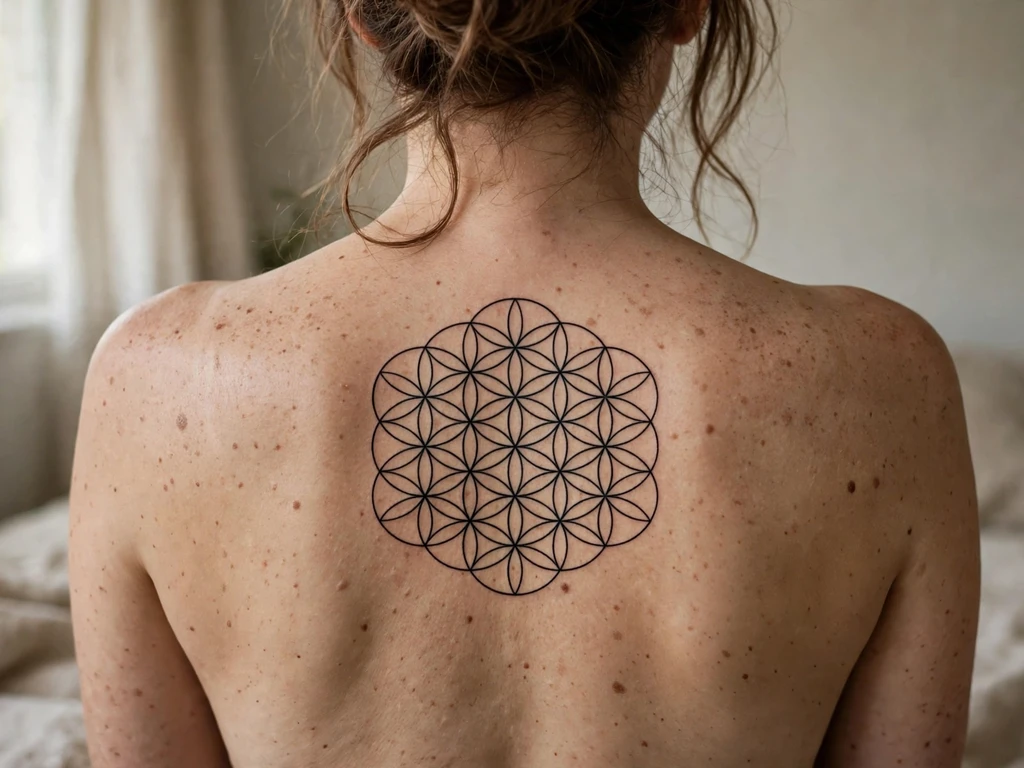
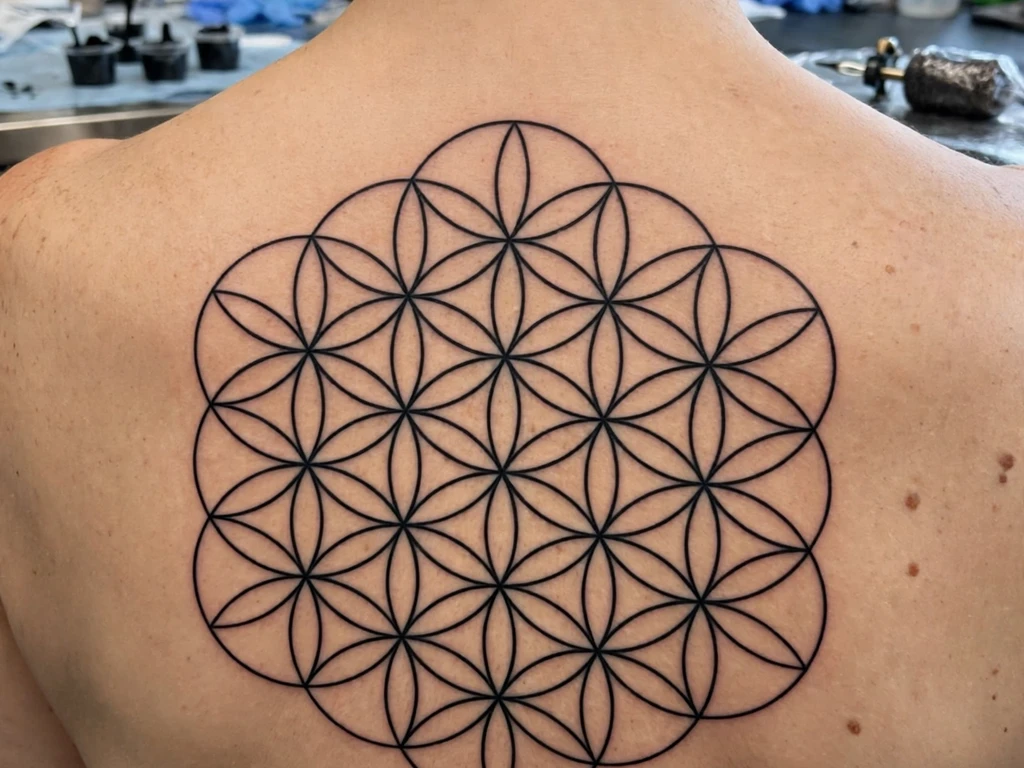
The definitive sacred geometry tattoo: nineteen circles of identical size overlapping into a lattice that seems to bloom the longer you look at it. On the upper back it can be drawn large enough for every intersection to stay crisp, and artists often add a ring of dotwork shading or a faint second pattern behind it to give the geometry depth. Worn plain, in black line alone, it has the calm authority of an architectural drawing.
Best placement: Centre of the upper back, between and below the shoulder blades.
Best for / know before you book: For anyone who wants the style’s most meaningful symbol at full scale. This design is only ever as good as its stencil — insist the pattern is generated digitally and printed, and check the printout with a ruler before it touches your skin if you like; serious geometric artists expect exactly that.
2. Metatron’s Cube Forearm
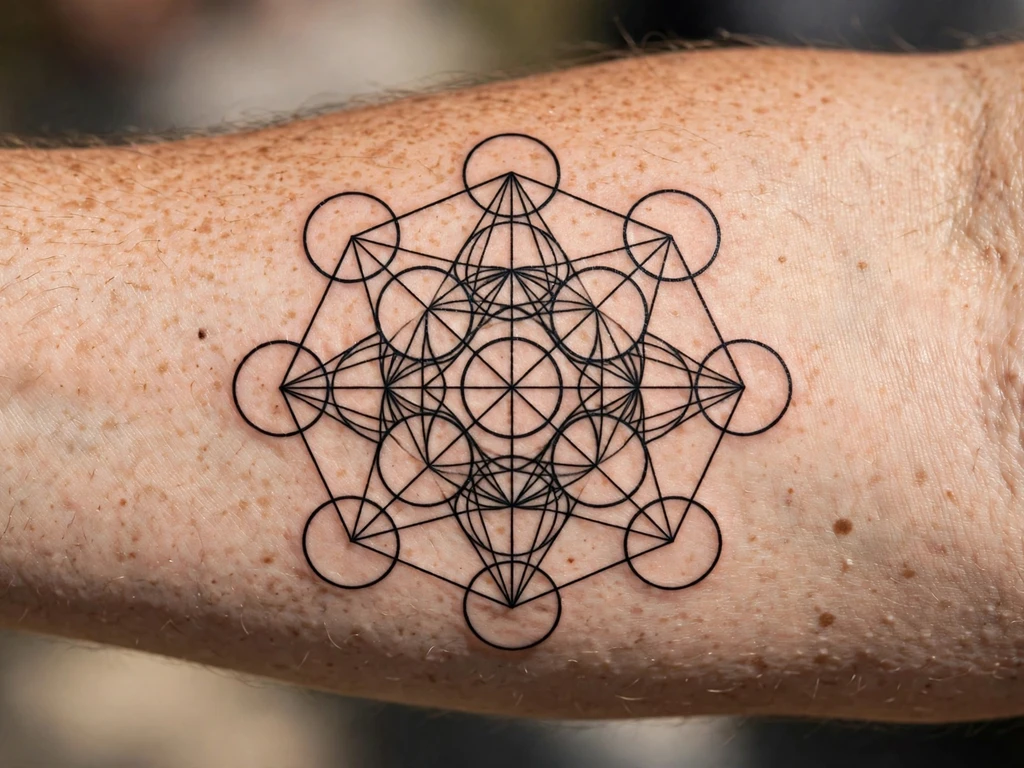
Thirteen circles, every centre connected to every other by straight lines, and hidden inside the web sit the five Platonic solids — the only perfectly regular 3D shapes that exist. The forearm is the natural home for it: flat enough to keep the lines true, visible enough to reward the effort. Some wearers keep it as pure linework; others shade one solid, often the cube, a shade darker to pull it out of the pattern.
Best placement: Inner or outer forearm, centred so the design’s middle circle sits on the arm’s flat.
Best for / know before you book: A design for people who like their symbolism with a maths degree. The connecting lines are long and exposed — even one visible wobble breaks the spell — so choose an artist whose healed straight lines you have inspected closely, and expect a slow, careful session.
3. Faceted Geometric Wolf Head
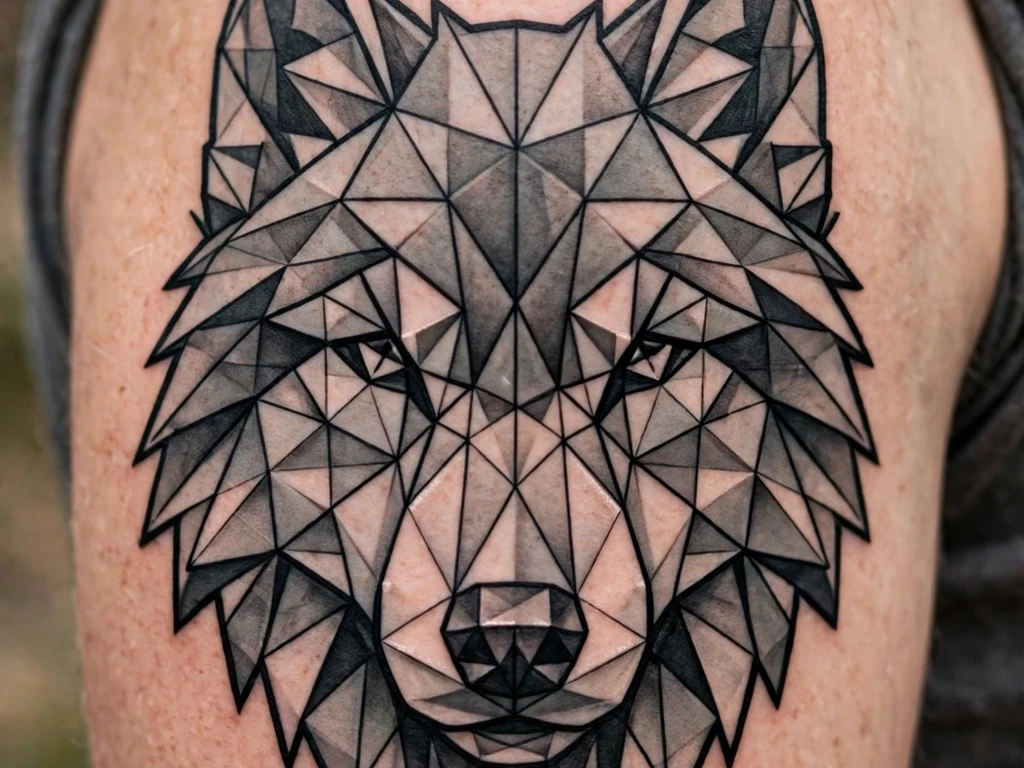
The wolf reduced to architecture: a head assembled from dozens of triangular facets, each plane shaded a fraction differently so the face emerges from the geometry. A popular variation splits the head down the middle — one half rendered realistically, the other half faceted — which sets up a striking conversation between instinct and order. Bold outer contours keep the whole thing readable from across a room.
Best placement: Upper arm or shoulder, where the head can be drawn at a commanding size.
Best for / know before you book: The go-to choice if you want an animal tattoo with a modern, engineered feel. Agree the facet map at the drawing stage: too many tiny triangles will mush together as the ink settles, so fewer, larger planes age far better than a hyper-detailed mesh.
4. Geometric Owl
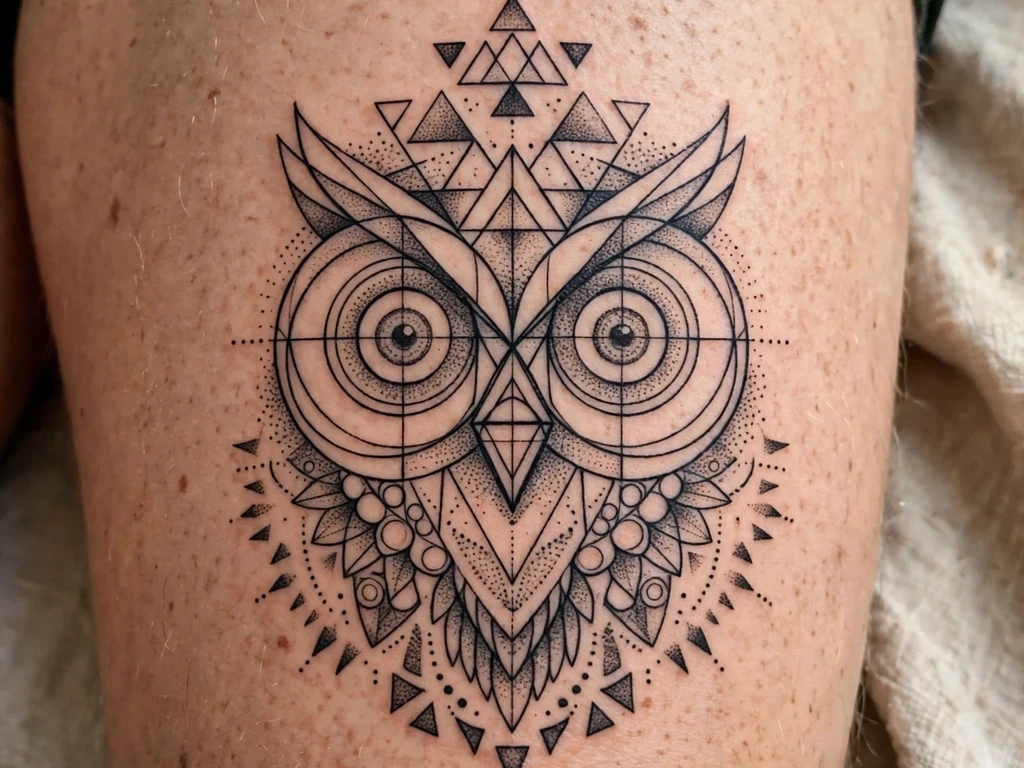
Owls are practically born geometric — that flat, heart-shaped face and those two huge circular eyes map beautifully onto circles, arcs and triangles. Built symmetrically, a geometric owl stares straight out of the skin with an almost hypnotic calm, and the wings give the artist long straight edges to frame the piece. If the symbolism draws you as much as the structure, our wider collection of owl tattoo ideas shows the same bird in softer, more realistic styles.
Best placement: Front thigh or upper arm, face-on and perfectly centred.
Best for / know before you book: Wisdom symbolism with a draughtsman’s finish. The two eyes must match to the millimetre or the owl looks cross-eyed forever — a mirrored design like this is where a specialist earns their fee, and where you should never accept a rushed stencil.
5. Seed of Life Shoulder Blade
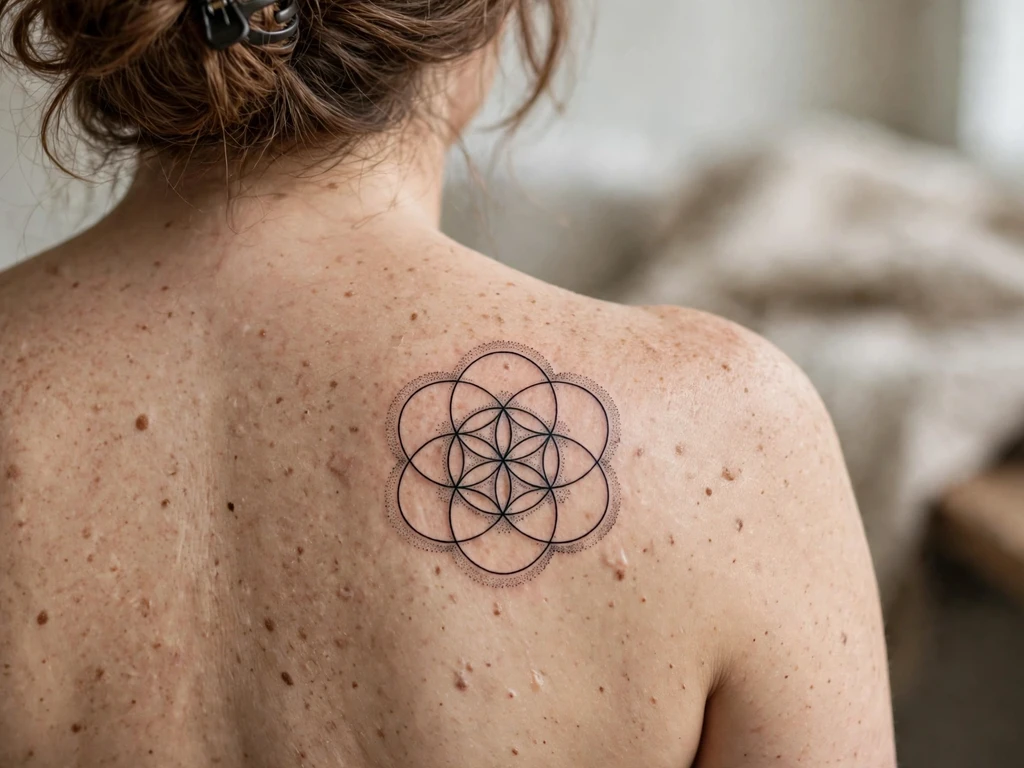
Seven equal circles, one in the centre and six around it, producing the pattern from which the Flower of Life grows. It is the gentlest entry in sacred geometry — clean, uncluttered, and readable at modest sizes — and the shoulder blade gives it a flat, private canvas that shows with a vest or open back and vanishes under a shirt. A whisper of dotwork around the ring can soften it further or set up a future expansion into the full Flower.
Best placement: One shoulder blade, or centred between both for a larger version.
Best for / know before you book: Ideal as a first geometric piece. Each of the seven circles must be the same size or the pattern visibly sags, so this is drawn from a measured stencil, never eyeballed — and keep it at least 8 cm across so the overlaps stay distinct as the lines settle.
6. Sri Yantra Dotwork
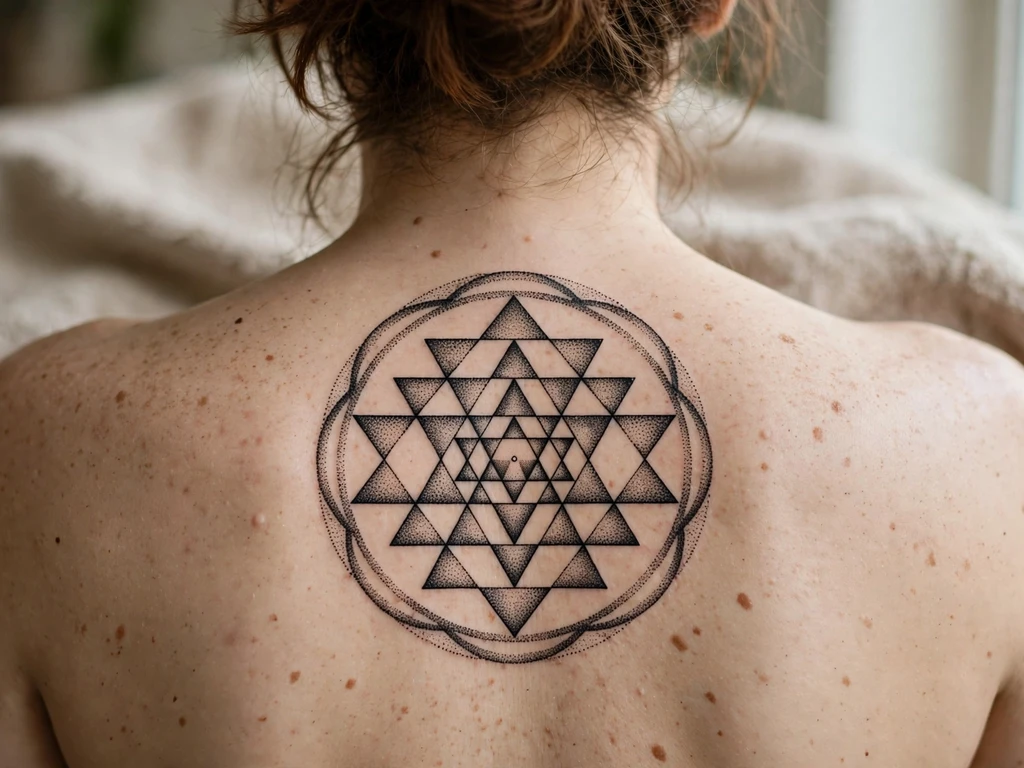
Nine triangles — four pointing up, five pointing down — interlocked around a single central point, framed by lotus petals and a square gateway. The Sri Yantra has been drawn for meditation in Hindu tradition for well over a thousand years, and tattooing it in slow dotwork suits its contemplative nature. Treat it with respect: this is a living sacred diagram, not just a pretty pattern, and wearers should understand what they are carrying.
Best placement: Upper back or centre of the thigh, large enough for the triangle lattice to breathe.
Best for / know before you book: For meditators and the spiritually serious. The interlocking triangles are the hardest construction on this list to keep accurate, and dotwork multiplies the hours — budget for a specialist and for time, and do not shrink it below about 12 cm or the inner triangles collide.
7. Geometric Half Sleeve
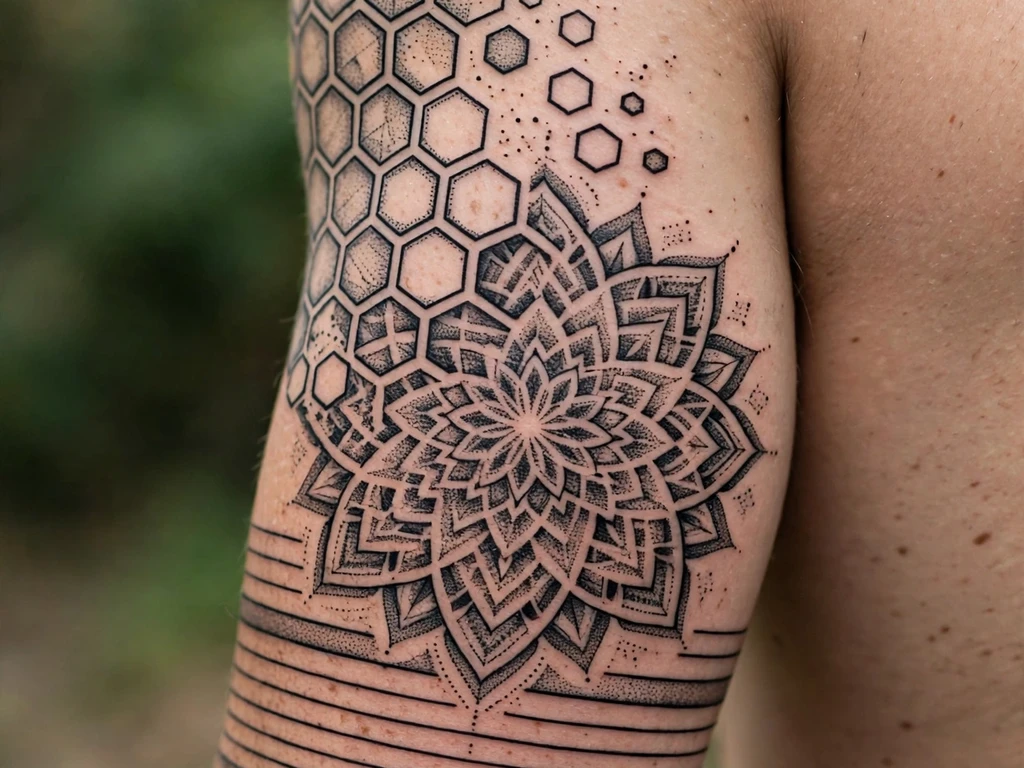
A half sleeve planned as one continuous mathematical composition: honeycomb dissolving into a mandala at the shoulder, bands of parallel lines tightening and relaxing around the arm, perhaps a faceted animal worked into the flow. Unlike a collage sleeve assembled tattoo by tattoo, a geometric sleeve is drawn whole before the first line is inked, so every pattern hands over cleanly to the next.
Best placement: Shoulder to elbow, designed as a single connected piece.
Best for / know before you book: A project, not an appointment. Book a consultation, agree the full-arm pattern map up front, and expect multiple sessions with the same artist so measurements and line weights stay consistent from shoulder to elbow.
8. Mandala Geometric Knee Web
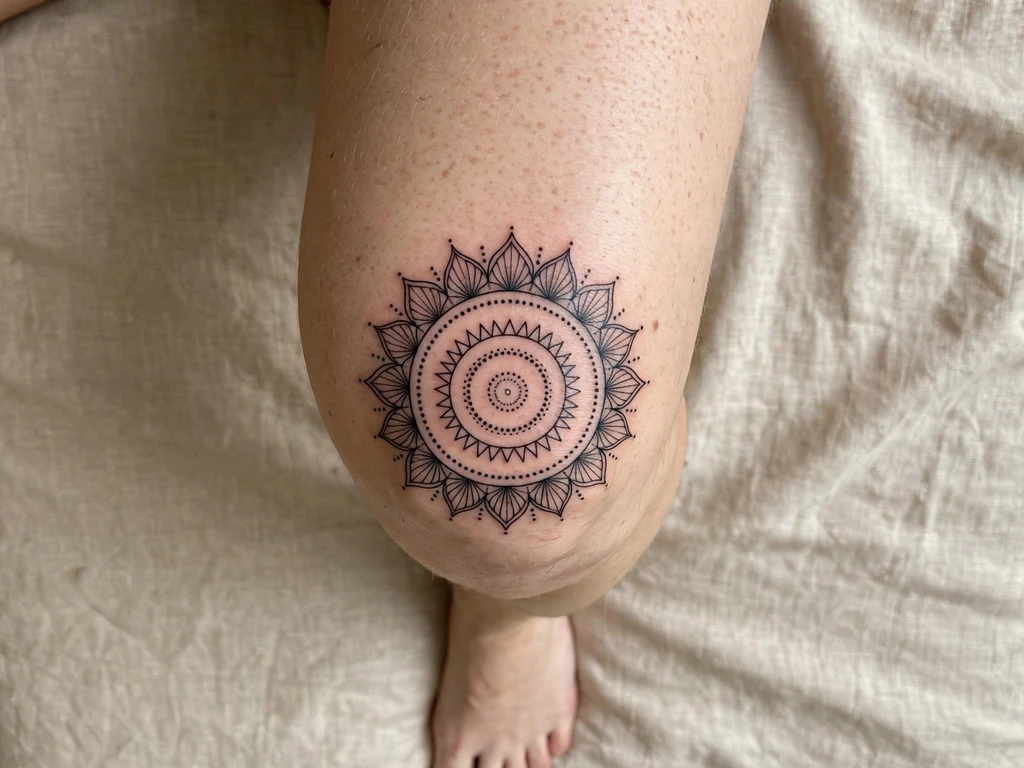
A radial mandala built outwards from the kneecap in rings of dots, petals and triangles, so the joint itself becomes the centre of the pattern. The design flexes as the knee bends — done well, the rings open and close like a mechanical flower. It is an uncommon placement that turns a difficult spot into the entire point of the tattoo.
Best placement: Centred directly on the kneecap, rings spreading onto thigh and shin.
Best for / know before you book: Knee skin is thick, mobile and quick to swell, and it sheds ink faster than flatter areas. Choose bold rings over fine detail, expect the session to be spicy, and accept that a healed touch-up is likely rather than a failure.
9. Geometric Mountain Forearm Band
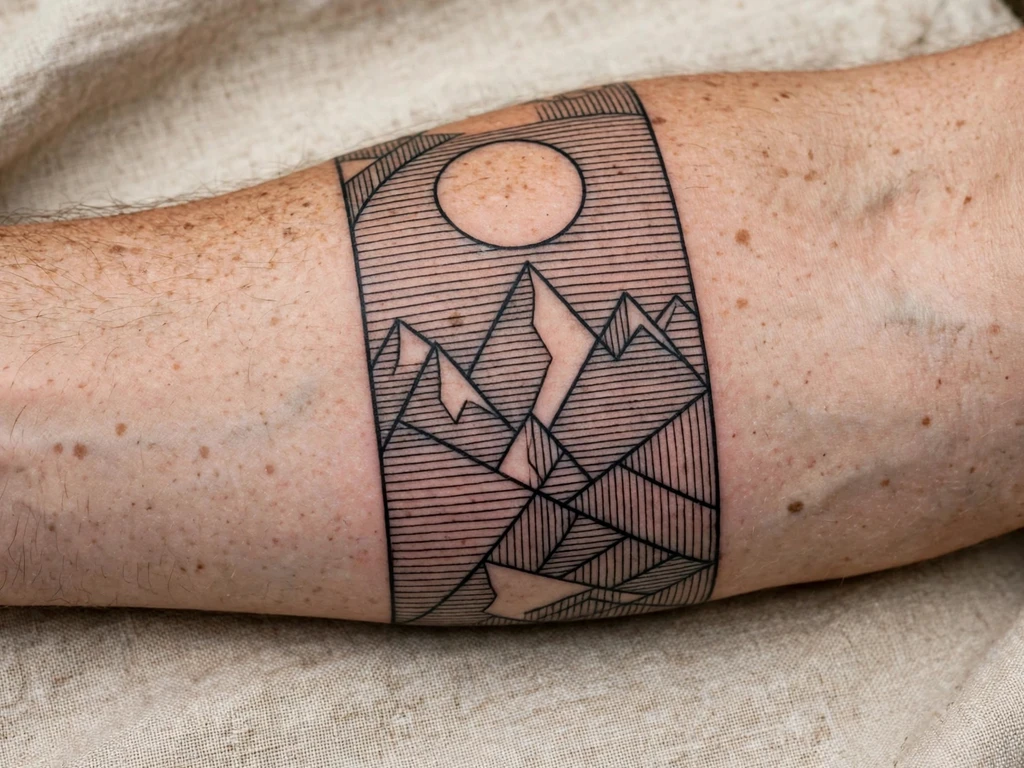
A mountain range distilled to its essentials: overlapping triangular peaks, one perfect circle of sun or moon, and a stack of fine horizontal lines for sky and ground, wrapped into a band around the forearm. It reads like a logo for the outdoors — minimal, confident, and endlessly customisable with the silhouette of a range you actually love. The band format also makes it a strong candidate if you are browsing forearm tattoo ideas for something that works from every angle.
Best placement: Around the forearm, peaks rising towards the elbow.
Best for / know before you book: Perfect for hikers and minimalists. Wrap-around bands expose any line that is not level, so your artist should stencil it with your arm hanging naturally and check the join at the back of the arm twice — that hidden seam is where bands succeed or fail.
10. Geometric Bee and Honeycomb
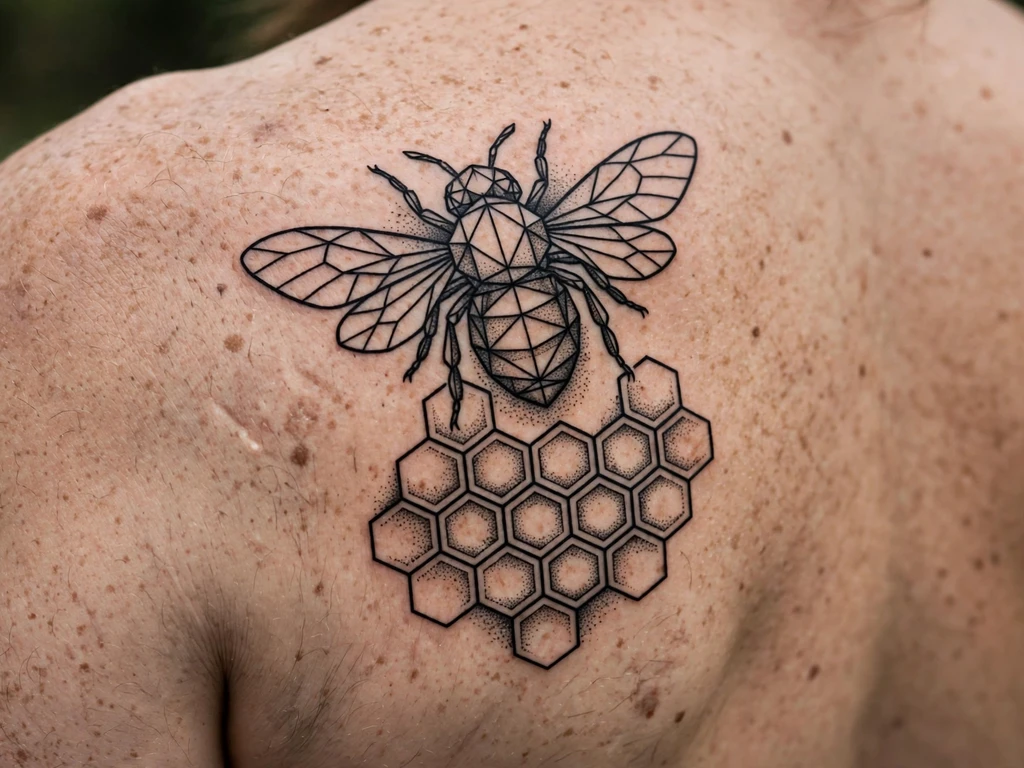
Nature’s own geometry lesson: a bee drawn in faceted planes, hovering over or emerging from a cluster of exact hexagons. Bees build hexagons because they are the most efficient shape in nature, and that story — industry, community, sweet results from hard work — is why people choose this design. A few cells are often filled with dotwork “honey” shading while the rest stay open line.
Best placement: Shoulder blade or outer forearm, at small-to-medium size.
Best for / know before you book: A charming, meaning-dense smaller piece. Hexagons are brutally honest shapes — six equal sides or the eye revolts — so this is another stencil-precision job, and the bee’s facets should stay chunky enough to read at arm’s length.
11. Geometric Anatomical Heart
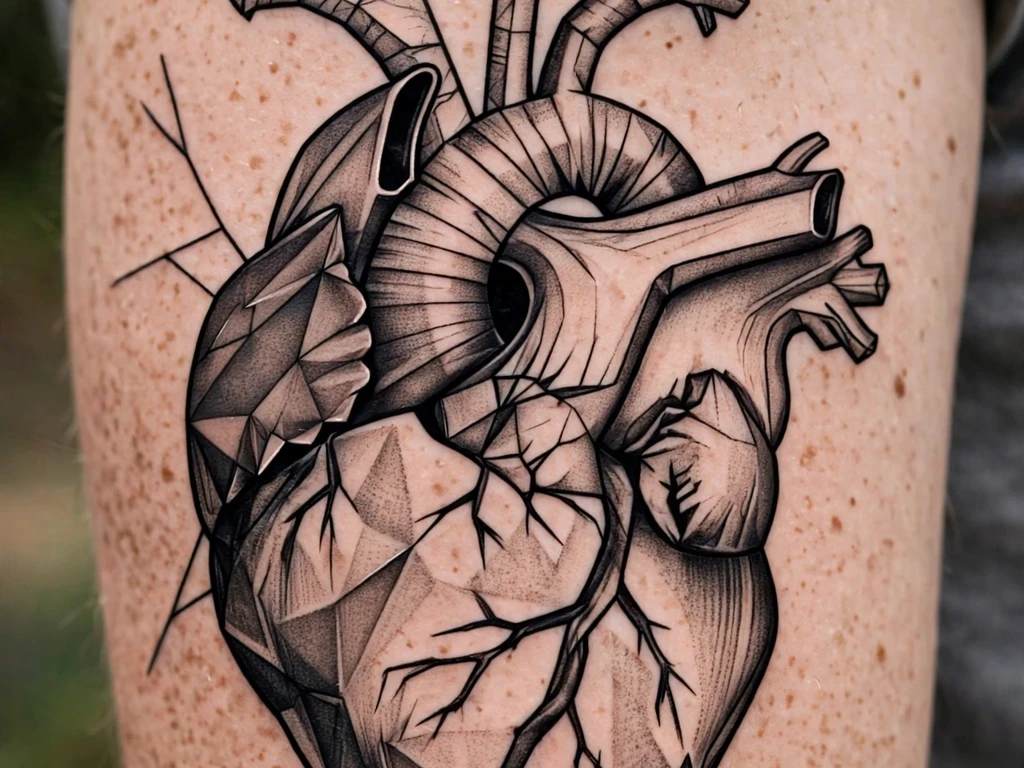
The anatomical heart rebuilt as a cut gem: chambers and valves drawn as angular facets, the aorta and vessels leaving the top as clean straight tubes instead of organic curves. It keeps the heart’s emotional weight but swaps sentimentality for structure — a favourite of medical professionals, science lovers, and anyone whose feelings run analytical. A single accent of red in one facet is a popular, restrained twist.
Best placement: Upper arm or calf, upright and palm-sized or larger.
Best for / know before you book: The facet shading does the heavy lifting, so ask to see your artist’s healed gradient work. Keep the vessel lines bold and few; thin tubes packed close together blur into a single mass within a few years.
12. Geometric Waves
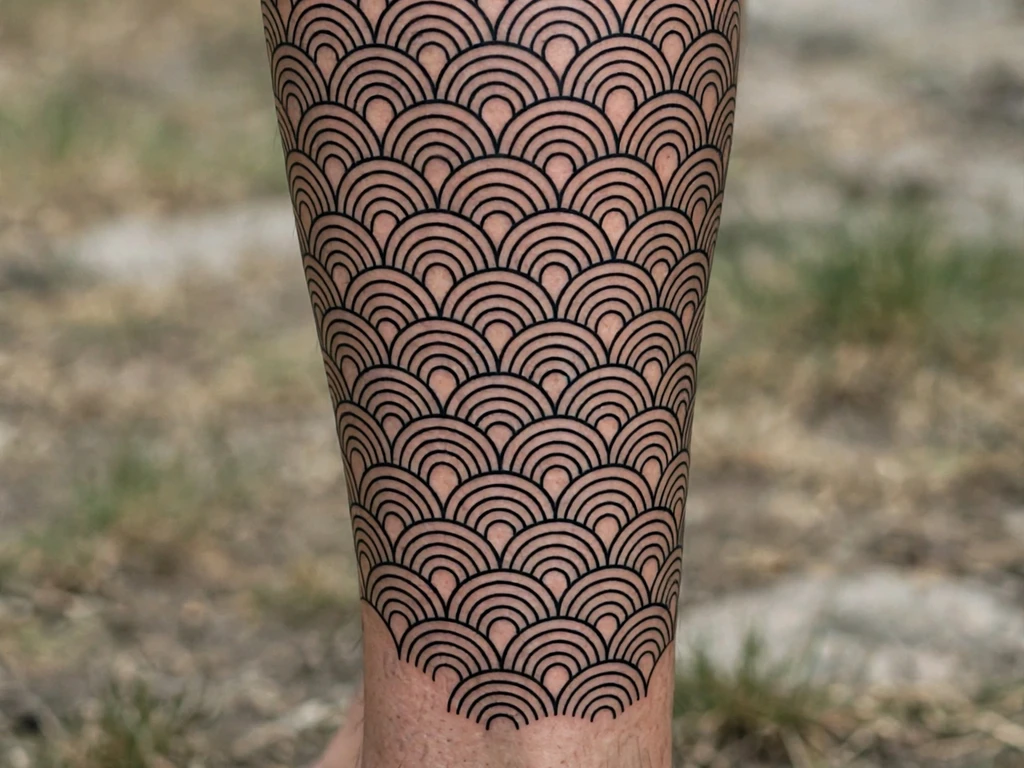
Rows of identical concentric arcs, each row offset from the last — the seigaiha pattern that has signified waves on Japanese textiles for centuries, rebuilt here as pure tattoo geometry. Wrapped around a calf or forearm it behaves like water in motion, the arcs catching light differently as the limb turns. Worn in black line it is meditative; with the arcs graded in dotwork it gains real depth.
Best placement: Wrapping the calf, or as a band around the forearm.
Best for / know before you book: Repetition is the entire effect, which means repetition is also the risk: every arc must match its neighbours. This is slow, methodical tattooing — choose patience in your artist over speed, and decide the arc size carefully, because small arcs merge sooner than large ones.
13. Geometric Stag Head
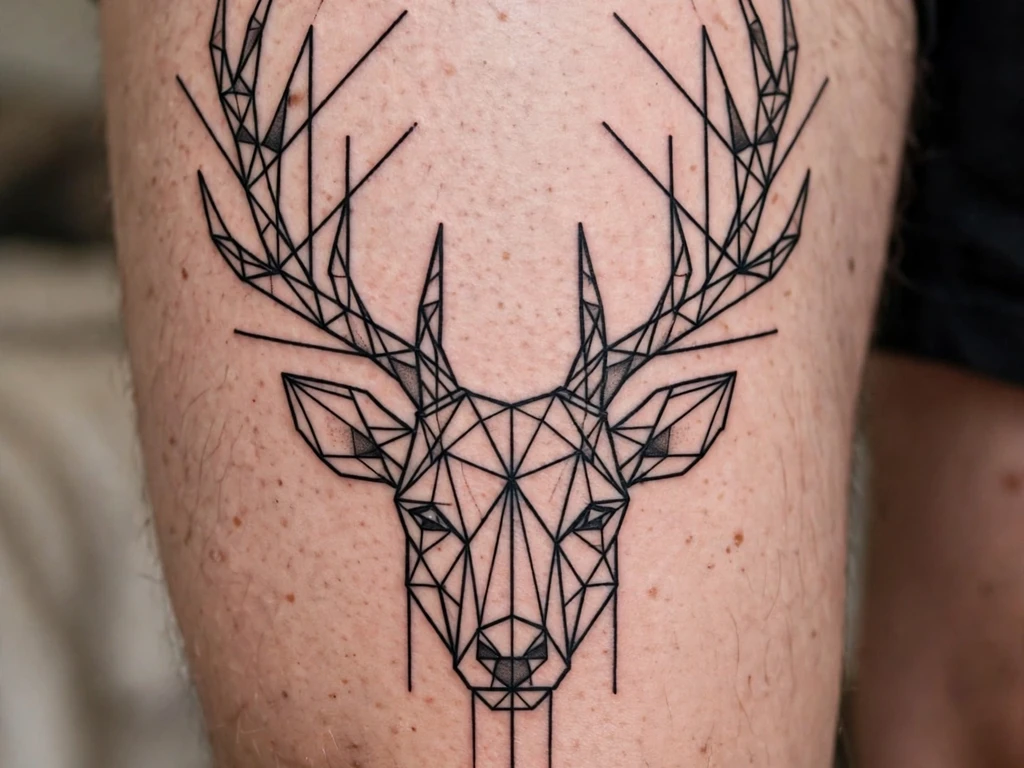
A stag’s head drawn in long, confident straight lines, the antlers branching upward as a tree of angles and triangles. Where the wolf (design 3) is all dense facets, the stag works in open structure — more line, less fill — which gives it an elegant, antlered-crown silhouette. A small circle or diamond between the antlers is a common finishing touch.
Best placement: Centre thigh or upper back, tall rather than wide.
Best for / know before you book: Antlers are a symmetry exam all by themselves: each branch must mirror its twin. Have the stencil checked from a distance of two metres, not just up close — antler drift is invisible at half a metre and glaring across a room.
14. Geometric Lotus and Unalome
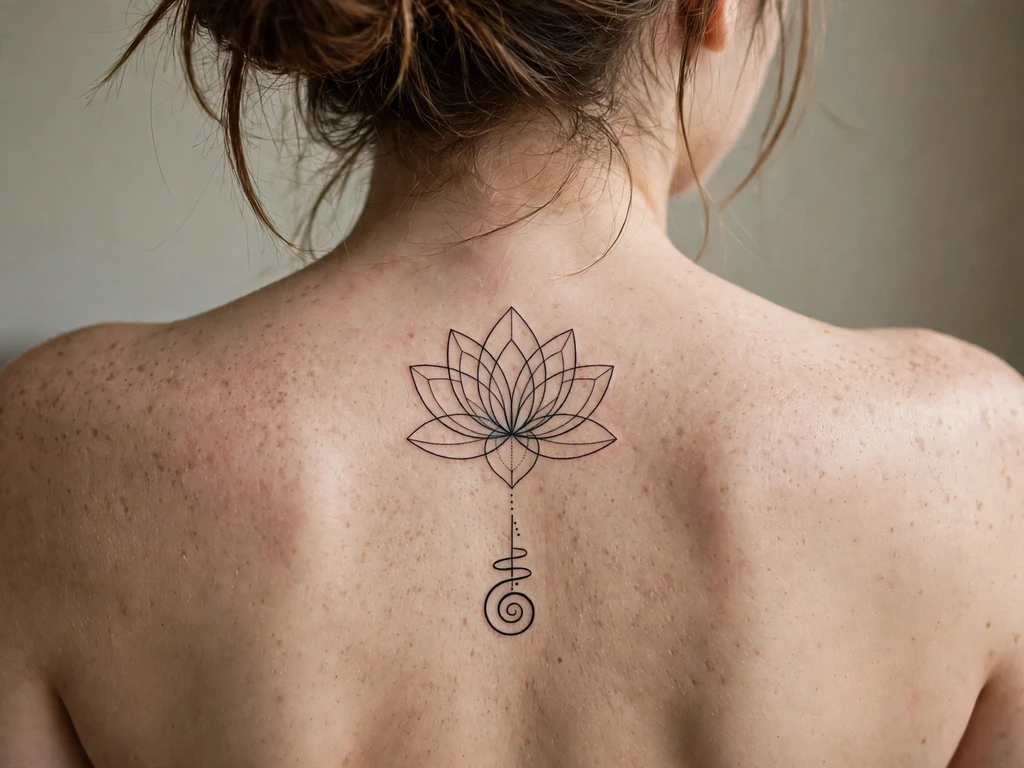
Two symbols in one vertical composition: a lotus whose petals are drawn as perfect arcs and straight-edged planes, and beneath it the unalome — the spiral-and-winding-line symbol from Buddhist tradition that traces life’s path towards enlightenment. The geometry disciplines the lotus while the unalome’s single flowing line keeps the piece human. Together they read as growth with a journey underneath it.
Best placement: Centre of the upper back, running vertically between the shoulder blades.
Best for / know before you book: A meaningful piece for people drawn to Eastern philosophy — wear the unalome knowingly, as it carries genuine religious significance. The spiral must unwind evenly, so this is stencil work, and the design wants vertical room; do not compress it to fit a smaller gap.
15. Honeycomb Gradient Fade Forearm
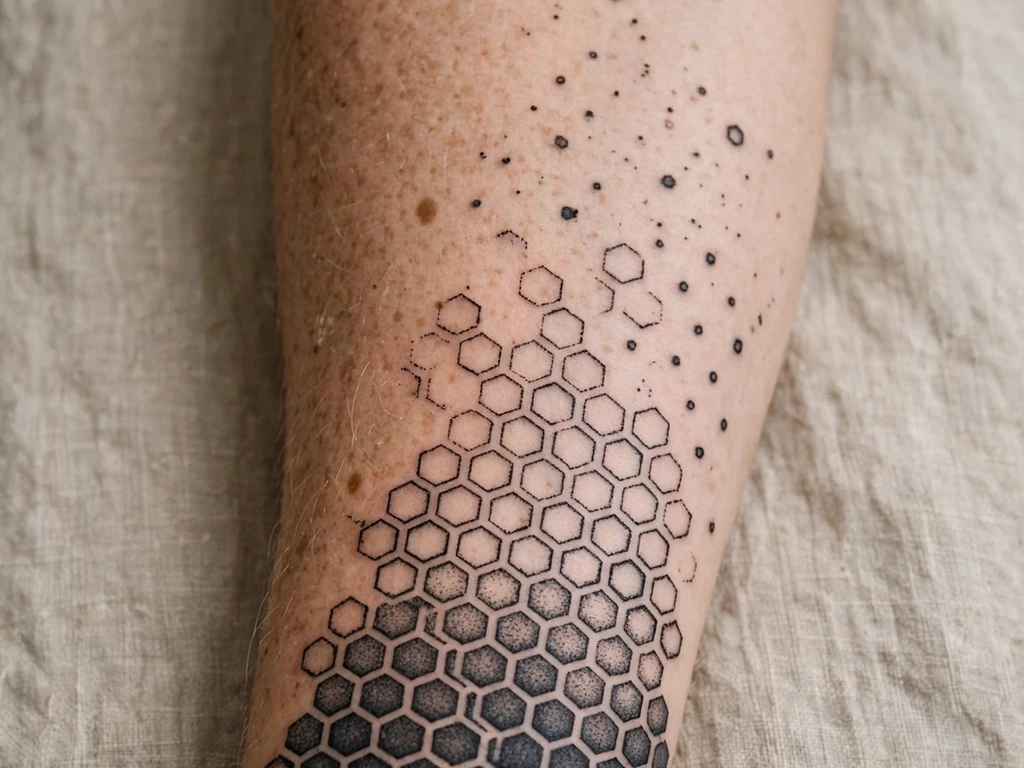
A field of hexagons that begins densely packed and shaded near the wrist, then breaks apart as it climbs the forearm — cells scattering, shrinking and finally floating free as single hexagons and dots. The fade is achieved with spacing and dotwork rather than shading, which gives the piece an almost digital dissolve effect. It is subtle, modern, and wraps the arm beautifully.
Best placement: Forearm, dense at the wrist and dissolving towards the elbow.
Best for / know before you book: Gradient work lives on judgement calls made mid-tattoo, so pick an artist with healed examples of fades, not just bold pattern work. Photograph the stencil stage: once the cells start scattering, repositioning them is no longer an option.
16. Geometric Elephant Head
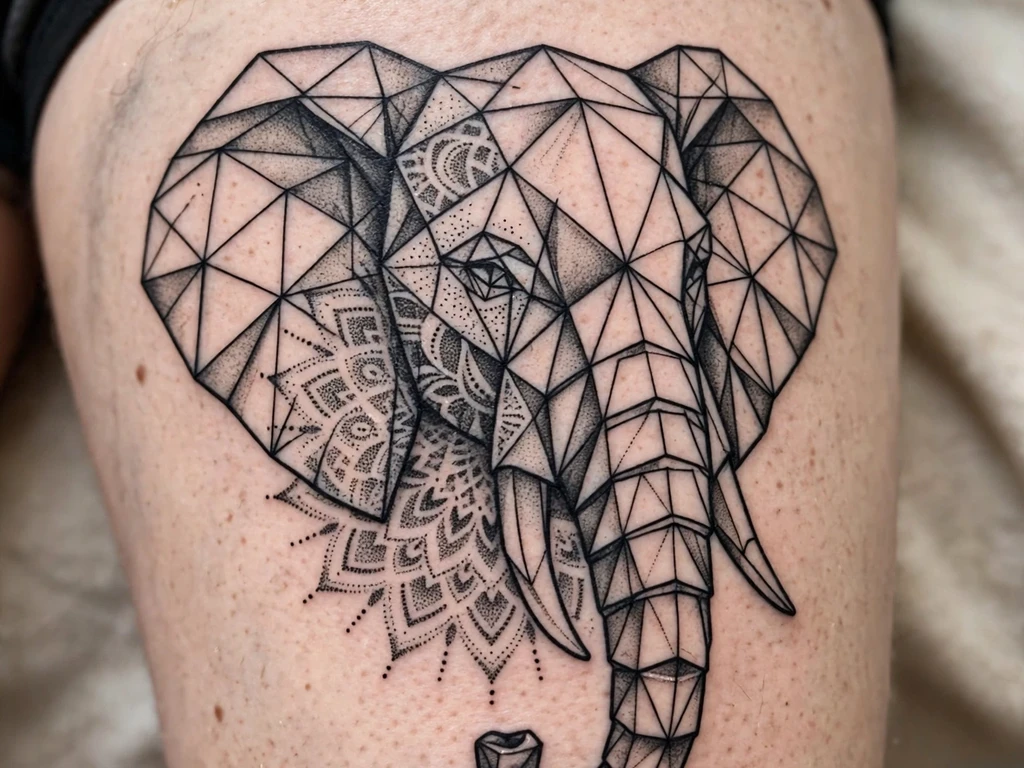
The elephant’s huge ears and long trunk translate into some of the most satisfying geometry on this list: broad triangular planes for the ears, segmented arcs for the trunk, tusks as two clean curved blades. Many designs pattern one half of the face with mandalas or dotwork while leaving the other half as plain facets — an old-meets-new balance that suits the elephant’s symbolism of memory and wisdom.
Best placement: Front thigh or upper arm, drawn large to honour the ears.
Best for / know before you book: Scale is everything — squeeze this onto a forearm and the trunk’s segments turn to mush. Tusks and trunk tip are the thinnest elements, so have your artist thicken them slightly beyond your first instinct; your future self will thank you.
17. Geometric Sun and Moon
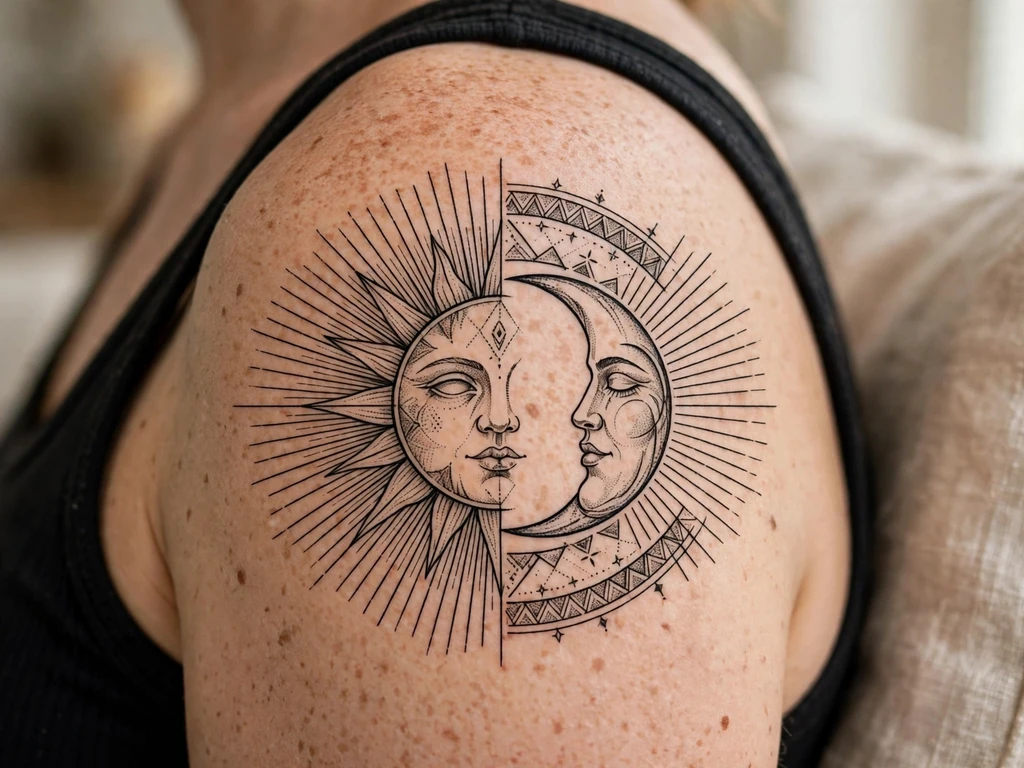
A sun and crescent moon drawn as mirror-image partners: the sun’s rays become ruled straight lines of alternating length, the moon a perfect crescent of intersecting circles, both often given calm geometric faces. The pairing stands for balance — day and night, logic and intuition — and the strict geometry keeps it from drifting into whimsy. A ring of small triangles or dots often closes the composition into a medallion.
Best placement: Shoulder or shoulder blade, as a round medallion composition.
Best for / know before you book: Medallion designs punish any centre that is off by even a few millimetres, because the eye compares the two halves constantly. This is one to stencil, step back, photograph, and only then approve.
18. Geometric Bird in Flight
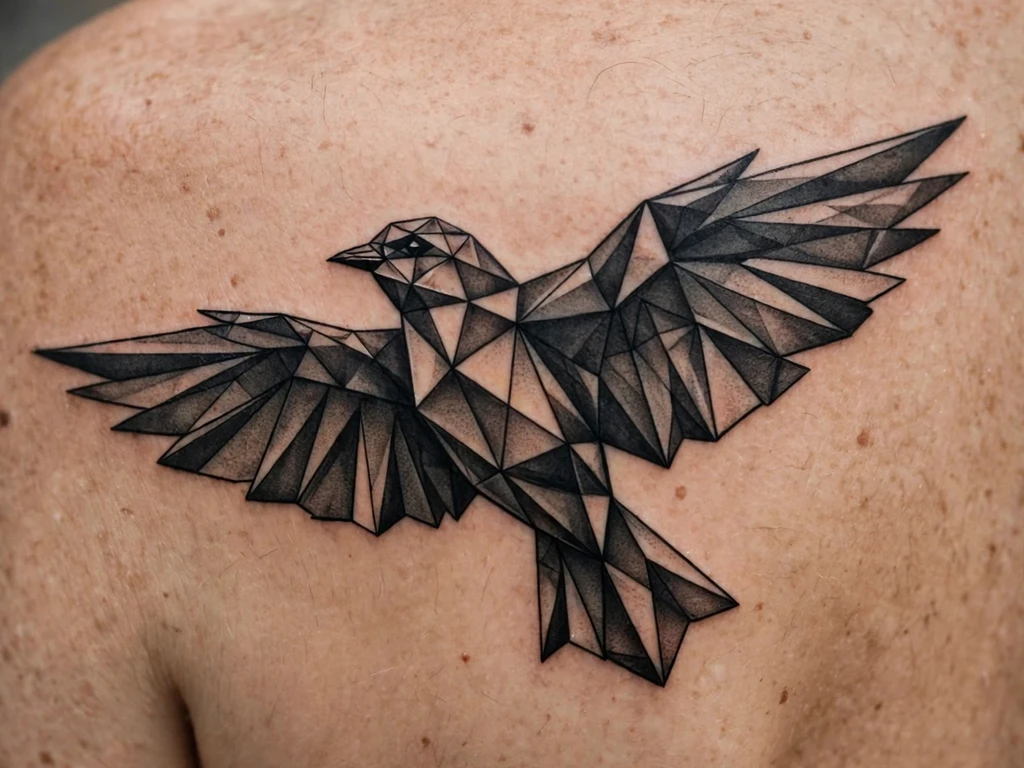
A bird — crane, swallow or dove — caught mid-flight and rebuilt from flat polygons, wings stretched into long angular planes. The low-poly treatment turns a soft subject into something aerodynamic and sharp, and the outstretched wings follow the shoulder blade or collarbone line beautifully. If mythic birds are more your territory, our phoenix tattoo ideas cover the firebird in bolder, more flowing styles.
Best placement: Shoulder blade, wingspan angled along the bone.
Best for / know before you book: Movement is the challenge: badly arranged polygons look like a crashed kite. Ask your artist for two or three sketch variations of the wing angles, and keep the facet count modest — flight reads through silhouette first, detail second.
19. Geometric Tree of Life
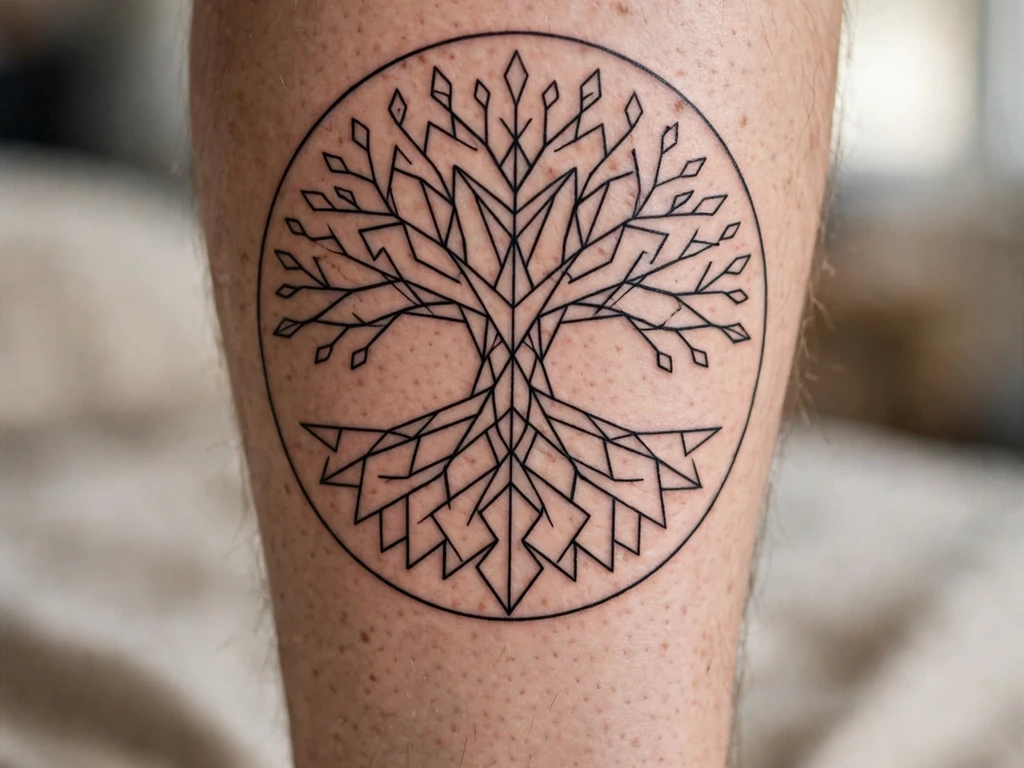
One circle, and inside it a tree whose canopy and root system are exact mirror images — branches reaching up in angular segments, roots reaching down in the same shapes. The design turns the ancient Tree of Life symbol into a diagram of balance between where you came from and where you are growing. Some wearers add a ring of small circles or the phases of the moon around the border.
Best placement: Calf or centre back, as a circular composition.
Best for / know before you book: The mirror between canopy and roots is the whole meaning, so it must survive the stencil stage intact — check it flipped, too, since a good artist will design it to read correctly in a mirror. Circular borders expose wobbly lines mercilessly; another case for a linework specialist.
20. Geometric Fox Head
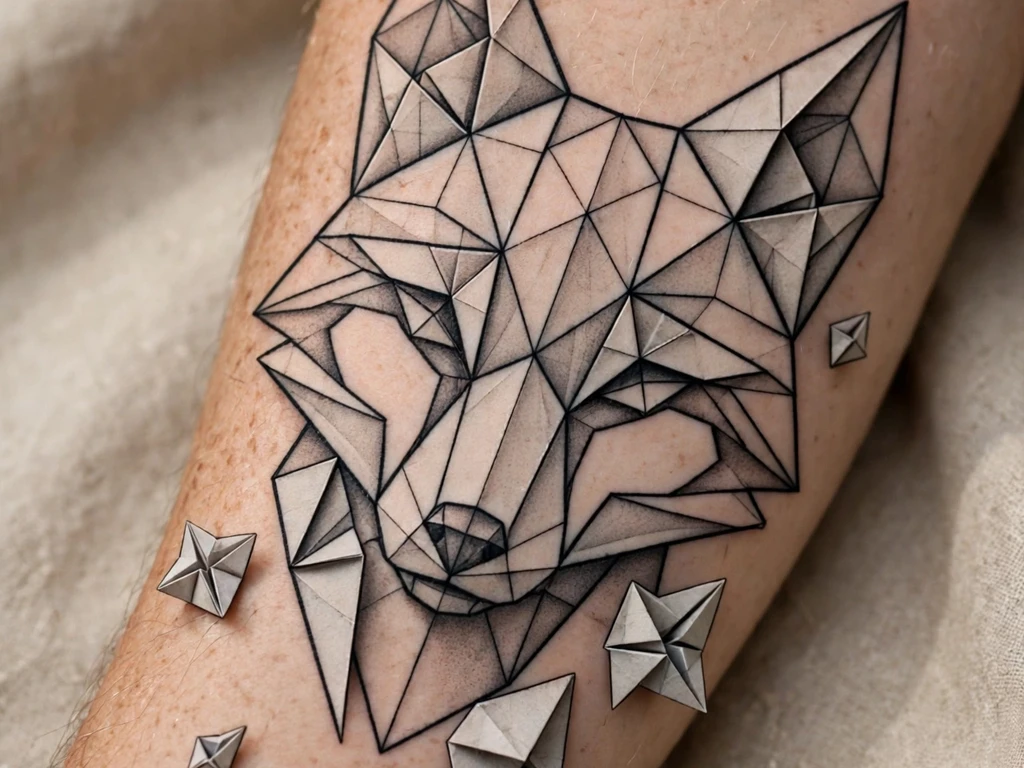
The fox drawn as if folded from a sheet of copper-coloured paper: pointed ears as tall triangles, the muzzle a cluster of small planes, the famous white cheek patches rendered as empty negative space. Origami-style animals are the most accessible corner of geometric tattooing — friendly, graphic, and readable at smaller sizes than most designs here. A single warm colour wash in a few facets is a popular finishing touch.
Best placement: Forearm or calf, upright and palm-sized.
Best for / know before you book: The negative-space cheeks only work if the surrounding facets are dark enough to define them, so discuss contrast openly with your artist. Foxes are symmetrical faces, so all the usual mirrored-stencil care applies.
21. Geometric Compass
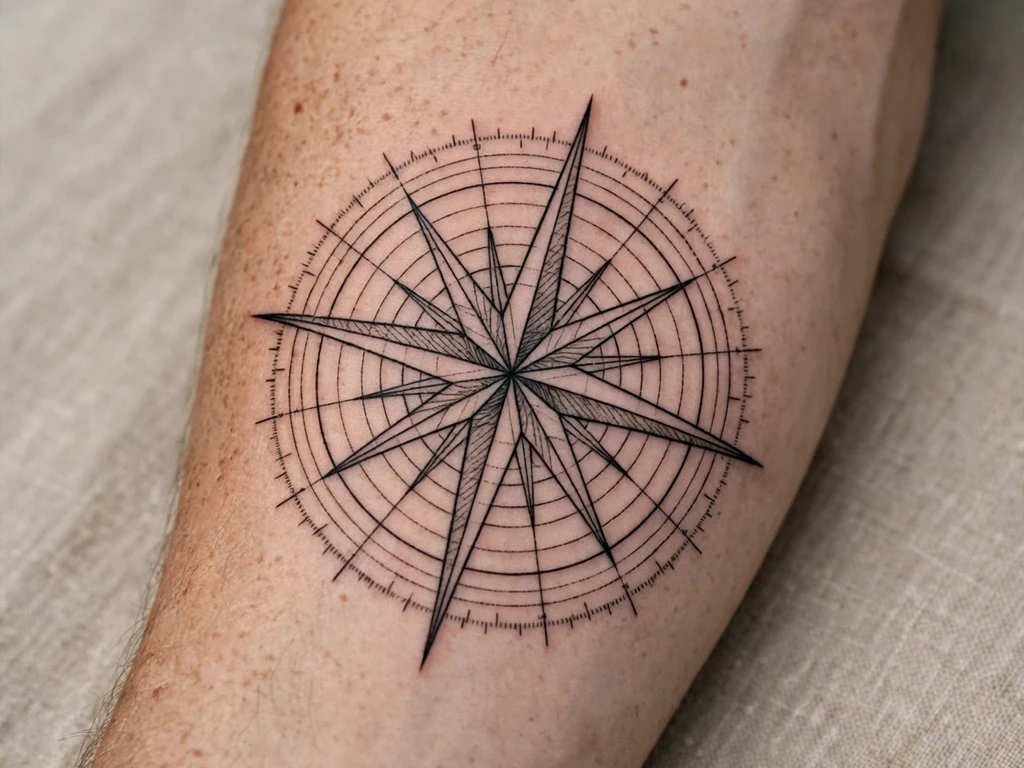
A compass rose stripped back to draughtsman’s essentials: concentric fine circles, eight long points for the cardinal and ordinal directions, and a ring of degree ticks around the rim. It symbolises direction chosen rather than drift — a traveller’s tattoo, and a reminder piece for anyone who has changed course on purpose. Small coordinates or a date can sit quietly beneath it.
Best placement: Inner forearm or just above the ankle, kept perfectly round.
Best for / know before you book: Round designs on forearms distort when the arm twists, so have the stencil applied and checked with your arm in its natural resting position, not flattened on the table. The degree ticks are micro-detail — at small sizes, ask for fewer, bolder ticks.
22. Angular Geometric Snake
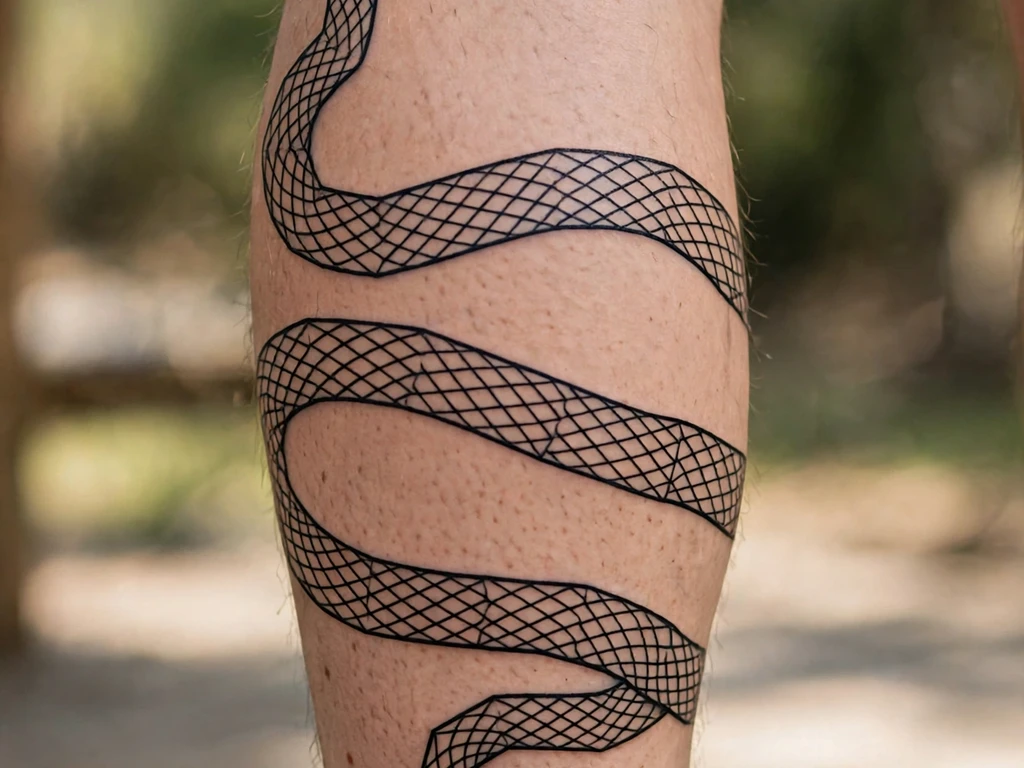
A snake rebuilt from straight segments: the body bends at crisp angles instead of curves, and the scales become a repeating field of diamonds and triangles along its length. The result looks half serpent, half circuit board — traditional snake symbolism of rebirth and protection in a thoroughly modern skin. For the same animal drawn in flowing, organic styles, browse our snake tattoo ideas alongside this angular take.
Best placement: Wrapping the calf, or running down the forearm.
Best for / know before you book: The diamond scale field must stay evenly spaced as the body narrows towards the tail, which is a genuine drafting problem — a digitally drawn stencil is non-negotiable. Long straight segments also show hand tremor, so healed linework in the portfolio matters more than usual.
23. Isometric Cube Illusion
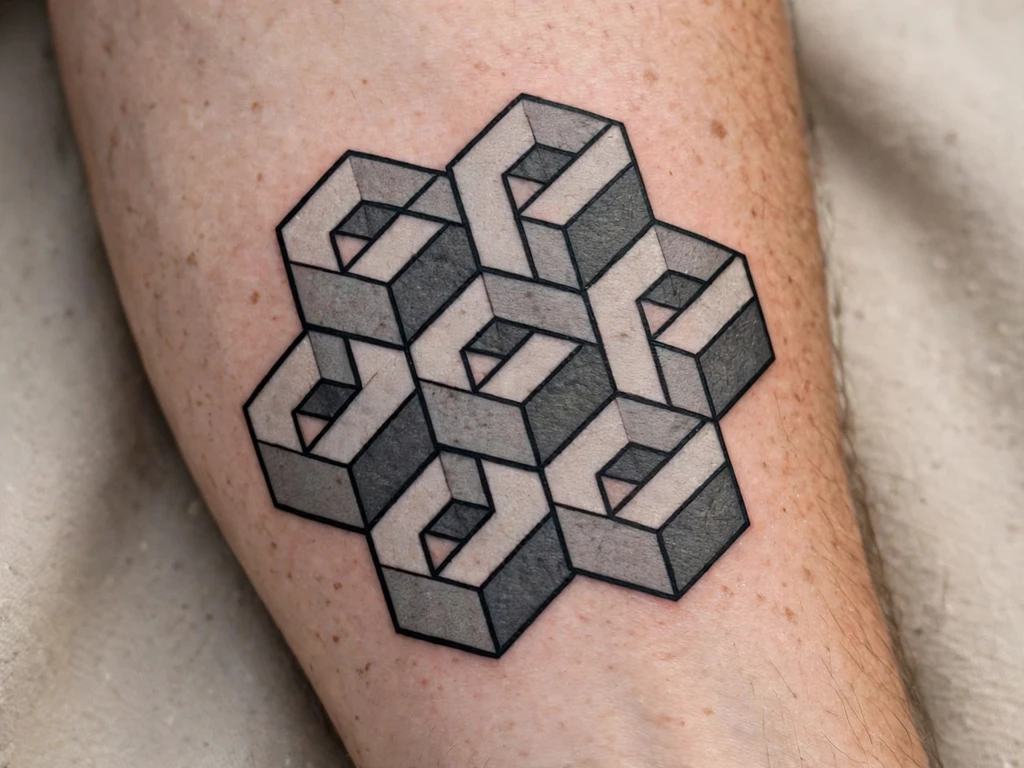
The tattoo as optical trick: a cluster of isometric cubes — the famous “impossible” hexagons — shaded in three flat tones so the cluster keeps flipping between convex and concave in your peripheral vision. It is the most playful design here and the most technically exposed, because the illusion collapses if a single angle drifts. Some wearers extend it into a whole honeycomb of cubes climbing the arm.
Best placement: Inner forearm, on the flattest available skin.
Best for / know before you book: Only book this with an artist who tattoos geometry full-time; the stencil typically comes from 3D software or careful isometric drafting, and the three shading tones must stay consistent across every cube. Keep the cluster small and perfect rather than large and approximate.
24. Geometric Whale
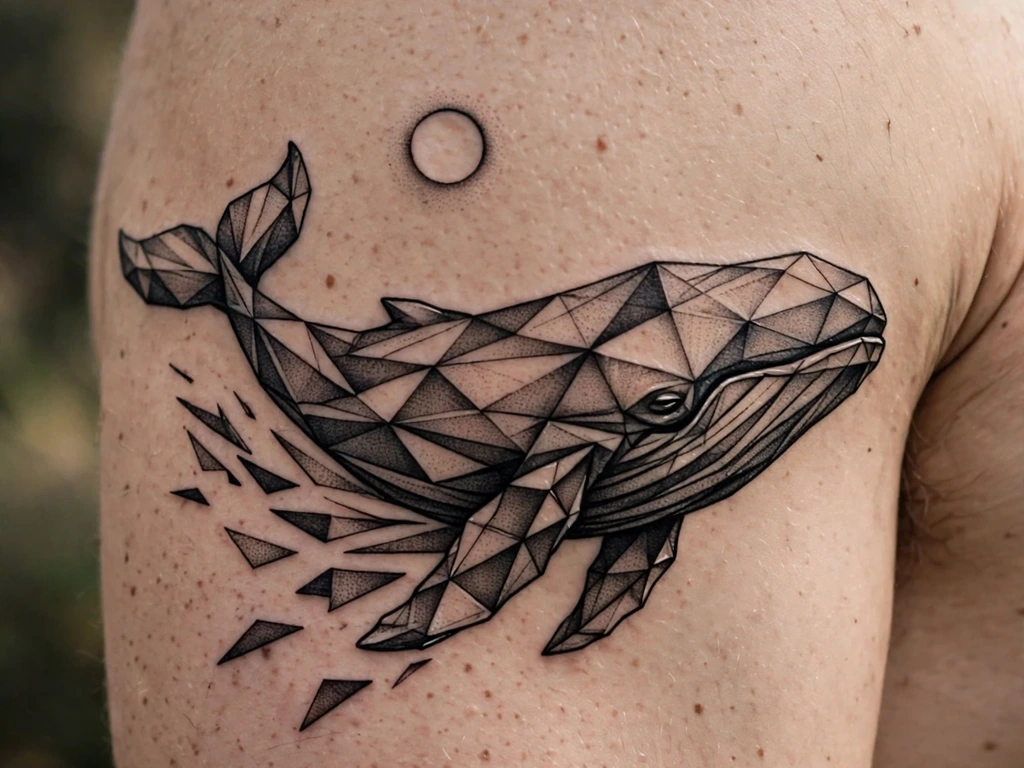
A whale drawn from flowing polygons — long curved planes for the body, triangles for the tail fluke, often a small perfect circle of moon floating above it. The geometry gives the ocean’s gentlest giant a crystalline, almost constellation-like quality, and the long horizontal body suits arms and ribs beautifully. Dotwork spray beneath the tail is a common, lovely finishing detail.
Best placement: Upper arm or outer calf, swimming horizontally.
Best for / know before you book: Curved facets are rarer in geometric work and harder to keep smooth than straight planes, so look for an artist who mixes both confidently. The tail fluke’s thin points should be drawn slightly blunt — needle-sharp tips are the first detail time erases.
25. Geometric Hand with Eye
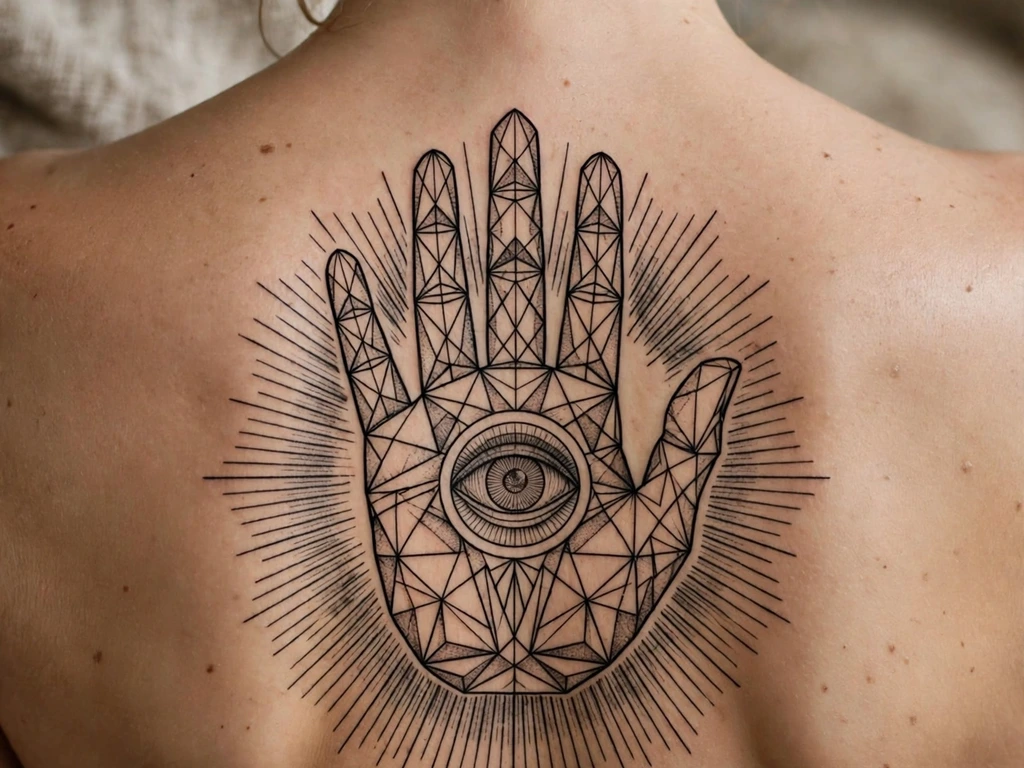
Our closing design is a protective emblem rebuilt as geometry: an open palm drawn in perfect symmetry, fingers as stacked rectangles and triangles, and a single concentric-circle eye at its centre — in the tradition of the hamsa, the ancient Middle Eastern and North African symbol of protection. Framed by radiating lines and dotwork, it becomes a medallion with genuine cross-cultural history behind it.
Best placement: Centre of the upper back, palm upright like a shield.
Best for / know before you book: As with the Sri Yantra, this is a symbol with living cultural and religious roots — wear it with understanding. Symmetry across five fingers is unforgiving, and the central eye’s circles must be truly concentric, so expect a long stencil session and choose your artist accordingly.
Geometric Tattoo Placement by Size
| Size | Typical dimensions | Best placements | Good to know |
|---|---|---|---|
| Small | 4–8 cm | Shoulder blade, wrist, ankle, forearm | Choose open designs — Seed of Life, bee, single hexagon motifs; dense patterns blur at this scale |
| Medium | 9–18 cm | Forearm, upper arm, calf, shoulder blade | The working range for most faceted animals, compasses and medallions |
| Large | 19–35 cm | Upper back, thigh, chest of the back, full calf | Room for the Flower of Life lattice, Sri Yantra and detailed facet work |
| Extra large | 35 cm+ / multi-session | Full back, half and full sleeves | Plan the entire pattern map before session one so geometry joins seamlessly |
How to Choose Your Geometric Tattoo (and What to Know Before You Book)
Book a geometry specialist, not a generalist. Every style forgives something; geometry forgives nothing. A two-degree error in a watercolour wash is invisible — in a Metatron’s Cube it is the only thing anyone sees. Look for artists whose portfolios are dominated by linework, dotwork and pattern, and study their healed photos: fresh geometric tattoos always look crisp because the stencil lines are still guiding the eye. Healed work tells you whose hands are genuinely steady.
Treat the stencil session as part of the tattoo. Proper geometric work is designed digitally or with compass and ruler, printed, and applied while you stand naturally. Expect this to take real time — sometimes half an hour of positioning for a symmetrical back piece. Check the stencil from a distance, in a mirror, and in a photograph. If something looks off, say so: moving a stencil costs nothing, moving a tattoo costs a cover-up.
Respect minimum sizes. Inner detail needs physical room to survive. As ink settles over the years, lines thicken slightly, and two lines placed too close will eventually hold hands. Your artist may propose scaling a design up by 20–30% or stripping out its finest layer of detail — that advice is the difference between a tattoo that reads clearly at year ten and one that reads as a smudge. Believe them.
Budget for precision, not just size. Geometric sessions often run slower per square centimetre than other styles because the artist is constantly checking angles, and complex pieces carry extra design and stencil time before the needle starts. Ask for the full estimate including the drawing stage, and be wary of quotes that price a Sri Yantra like a simple outline.
Take the basics of safety seriously. Choose a licensed studio, watch single-use needles come out of sealed packets, and follow your artist’s aftercare exactly — precision linework shows patchy healing more than any other style. MedlinePlus, the US National Library of Medicine’s public health resource, keeps a clear overview of tattoo risks and safety questions at its tattoos topic page, worth reading before a first piece.
Key points to remember:
- Symmetry is the style: a specialist artist and a measured, printed stencil are not optional extras
- Check every mirrored design standing, at a distance, and in a mirror before the needle starts
- Bigger and bolder ages better — tight inner detail is the first thing time blurs
- Healed portfolio photos are the only honest measure of a geometric artist
- Sacred symbols carry real meaning; a little research before you wear one is part of the design
Frequently Asked Questions
Do geometric tattoos age well?
The bold structure does, the micro-detail does not. Straight outer lines, clear shapes and honest spacing stay legible for decades, because there is a strong skeleton for the eye to follow. Very fine inner patterning and tight dotwork gradients soften as ink settles — usually into a gentler version of the design rather than a mess, provided the artist left enough room between elements. Choosing a medium-or-larger size is the single best ageing decision you can make in this style.
Why do geometric tattoos take so long to stencil?
Because the design has to be right, not approximately right. Sacred geometry patterns are mathematical constructions that must be generated accurately, then adjusted to your body’s natural asymmetries so they look balanced on you. Artists check placement standing, seated and in mirrors, sometimes reprinting the stencil at slightly different scales. That half hour of patience is what separates a tattoo people photograph from one people politely ignore.
What is sacred geometry, in plain terms?
It is the idea — found in Egyptian, Greek, Hindu, Islamic and Gothic art alike — that certain shapes and proportions (circles, triangles, the patterns built from them) reflect the structure of nature and carry spiritual meaning. The Seed of Life and Flower of Life are drawn with nothing but a compass, each new circle centred on the last. Whether you believe the philosophy or simply love the patterns, the designs arrive with thousands of years of use behind them.
How do I find the right artist for a geometric tattoo?
Search portfolios for healed linework, dotwork and pattern pieces specifically, not just tattoos you like. Check three things: are long lines straight in healed photos, do circles close perfectly, and do mirrored designs actually mirror? Then book a consultation and watch how the artist talks about stencil and sizing — a real geometric specialist will raise both before you do.
Can a geometric tattoo be small and simple?
Yes — some of the strongest pieces in this style are small. A Seed of Life on a shoulder blade, a single faceted bee, a tiny compass: open designs with few elements hold up well at 5–8 cm. What does not work is shrinking a dense design: a wallet-sized Flower of Life will fuse into lace within a few years. Small is fine; small and crowded is not.
Final Thoughts
Geometric tattoos ask more of everyone involved — more maths from the artist, more patience at the stencil, more honesty about size — and they repay it with a kind of clarity few other styles can match. A perfectly balanced pattern on skin does not date the way fashionable imagery does, because it was never really fashion: it is the same geometry people have carved into temples and woven into textiles for millennia.
Choose the symbol or shape you keep coming back to, find the artist whose healed lines you trust, and give the design the size it asks for. Precision is the whole aesthetic — get that right, and the meaning has a structure worthy of carrying it.