
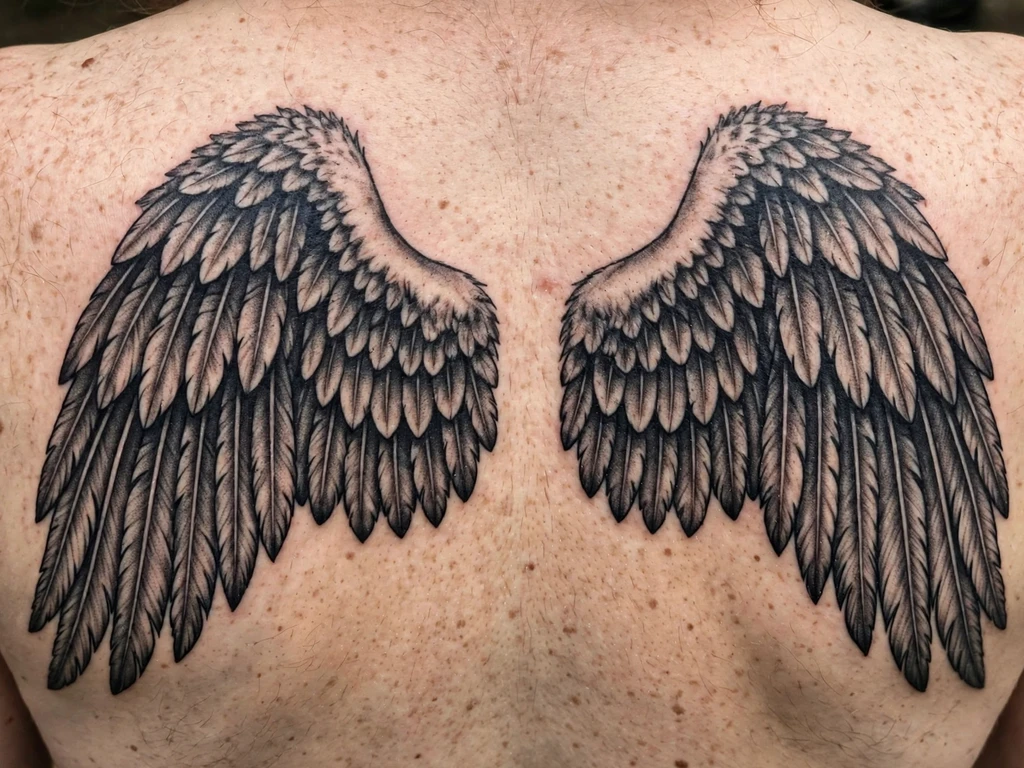
An angel wings tattoo is the angel with the angel taken away: no face, no robe, no figure at all — just the wings themselves, worn where your own would grow. That subtraction is the design’s whole power. A wing carries everything the full figure means — protection, flight, watching over, rising again — in a shape that is pure anatomy and symmetry, and it asks a harder craft question than any other tattoo in this family: a wing is built like a real wing or it is a costume, and skin can tell the difference for decades.
You will find 25 angel wings tattoo ideas here: the signature pair spread across both shoulder blades, folded and single wings, small pairs for wrists and ankles, black fallen wings, fine-line and dotwork pairs, one halo design, one memorial pair — every one of them wings only. First, what the wings mean; then the building rules, because wings fail in predictable places and every failure is preventable at the stencil.
One distinction before anything goes on your skin, because this site covers both and they are not the same tattoo. The full angel — guardian figures, archangels, cherubs as characters — is a different article: our angel tattoo design ideas guide covers the figures. This guide contains none of them. There are no faces below and no robed bodies; there are only wings — pairs, singles and single details — drawn the way wings are actually put together.
What Does an Angel Wings Tattoo Mean?
Start with where the image comes from. In Western art, wings are how an angel is identified: painters have marked angels out with long feathered wings for well over seven centuries — in one of the National Gallery’s earliest paintings, Cimabue’s Virgin and Child with Two Angels of about 1280–5, it is the two angels’ long feathered wings that present them as angels before anything else about them registers, the figures identified in the Byzantine tradition behind the picture as the archangels Michael and Gabriel. Tattoo wings inherit that convention whole: the feathers are borrowed from birds, the meaning from the figures who wore them, and wearers have always read the wings as the part that does the work — the flying, the sheltering, the watching.
Protection and the guardian is the largest reading, and it is held as tradition and belief rather than fact: in the guardian-angel tradition, each person is watched over, and a pair of wings worn across the shoulder blades puts that watchfulness at the wearer’s back, where the guardian would stand. Freedom and flight run second — wings are the body’s most literal symbol for leaving: a place, a job, a version of yourself. Memorial wings carry someone lost: a pair worn in memory says the person is carried still, and this guide includes exactly one such design (Design 18), drawn plainly and without a name or date — other guides on this site own lettering, and a memorial wing does not need it to be understood. And the fallen reading: black and dark wings, rising steadily in searches, worn for survival, nonconformity and mourning — for having gone through the fall and still being here. That is personal symbolism, stated as the wearer’s own meaning; this guide makes no occult claims for it and needs none.
Wearers often pair wings with the sky’s other marks — a halo (Design 15 is this guide’s one), a small heart, or the graded star patterns of our constellation tattoo guide. What unifies every reading is direction: wings point up and out. Whatever they mean, they are never about staying down.
The Mirror Law: How a Wing Is Actually Built
Everything in this section follows from one sentence: a pair of wings is one design drawn twice, and the second drawing is where tattoos go wrong. Wings look simple — feathers in rows — and fail in six predictable places. These are the rules that prevent each one, named here as the Mirror Law because the first rule governs all the others.
Rule one: a pair must be a true mirror, checked standing. The two wings are one shape reflected, not two similar shapes drawn separately. The honest method is mechanical: draw one wing completely, then flip the file for the other side — an artist who draws both freehand will give you cousins, not twins, and your back will show the difference at every distance. Then check the transferred pair on your standing body, arms relaxed, breathing normally: shoulder blades move independently, so a pair that mirrors on the table can sit a centimetre off on the back. Agree the mirror line — the spine — and check each wing’s height against it before the needle.
Rule two: feather rows are built in layers, like a real wing. A bird’s wing is not a fan of equal feathers. As the Naturalis Birds of Europe glossary sets out, a wing’s feathers divide into the flight feathers — the long primaries and secondaries — and the coverts that lie over their bases, each feather partially overlapping the next. In tattoo terms: the long primaries form the wing’s bottom and outer edge, the secondaries run inside them, and two or three rows of short coverts step down across the top toward the wing’s root. A tattoo wing drawn with those three layers reads as a wing at a glance; one drawn as a single row of long feathers reads as a headdress. Count the layers in your artist’s drawing before you book, not after.
Rule three: every feather is a separate shape, with skin between. Feathers that share edges merge as ink settles — the rows become one grey slab and the wing turns to felt. Each feather needs its own outline and a hair of bare skin or a clear tonal step between it and its neighbours. This is the rule galleries break most: fresh micro-feathering photographs beautifully and ages into corduroy. Feather count is vanity; feather separation is the design.
Rule four: wing tips taper; they never end blunt. A real wing narrows to its point — the outermost primaries are the longest, and the wing’s silhouette closes to a tip. A wing whose feathers end at one length has a cut-off edge that reads as a fan or a shell. When a design is shortened for a smaller placement, the taper is re-drawn at the new length, never simply cropped.
Rule five: a single wing is a complete design, not half of a pair. Singles are half the designs in this guide, and the failure to refuse is the amputee look: a wing drawn as one side of a pair, planted alone, reads as something missing. A true single is composed on its own terms — its root finished as a deliberate edge, its arc complete, its balance internal. Judge a single-wing stencil by covering the other half of the page: if it still looks finished, it is.
Rule six: barbs are suggested, never rendered. A real feather’s fine barbs are the first detail ageing takes — lines that fine soften and merge within a few years. Honest wing-building draws each feather’s centre shaft and a few confident barb strokes at its root, then lets smooth tonal steps do the rest. The wing that looks slightly under-detailed fresh is the one that still reads as feathers in year ten; the fully rendered one reads as grey texture. This is also the ageing law for every style below: separation survives, rendering does not.
Angel Wings Tattoo Styles and How They Age
Wings are one subject drawn in several registers, and the choice that matters most is realism versus stylisation. Realistic feathering borrows the bird’s actual structure — layered rows, individual feather shapes, tonal steps — and pays for it in size: below a certain scale, realism is a promise skin cannot keep. Stylised wings keep the silhouette and the layering logic but draw feathers as clean shapes, and they survive at sizes realism cannot. The same fork runs through every winged tattoo on this site — the moth tattoo ideas guide works through it for insect wings — and neither side is the “better” tattoo; they are different contracts with time. Choose by the size you actually want, not the photograph you fell for.
| Style | How it is drawn | How it ages |
|---|---|---|
| Black and grey layered realism | Feathers built in true rows — primaries, secondaries, coverts — with tonal steps between each | Excellent at large scale on the blades; separation holds for decades. Below ~12 cm the rows crowd and soften into texture |
| Fine line outline | Wing silhouette and feather divisions in single-weight line, no shading | Graceful and light; lines soften evenly, so the design must read from its outline alone — expect gentle fading of the interior divisions first |
| Blackwork | Feathers as solid black shapes with skin gaps between | The boldest ageing of all: shapes stay shapes forever. Loses softness by design — chosen for graphic strength, not delicacy |
| Dotwork | Feather rows built from stippled dots, tones graded by density | Mellows into soft tone; feather separations blur slowly, so rows must start widely spaced. Slow to tattoo |
| Soft grey wash, no outline | Feathers suggested by shading alone, almost no hard line | The most fragile build: with no outline to hold it, the wing flattens as the wash settles. Chosen knowingly, for a ghost of a wing |
| Watercolour wash | Colour washes for feathers over a light line skeleton | Washes diffuse outward over years; the skeleton decides what remains readable. Pastel wings fade fastest of all |
| White ink wings | Wing drawn in white pigment only | The honest exception: white ink creams, yellows and can nearly vanish, showing longest on deeper skin tones — a temporary-by-design choice, included as a warning, not a recommendation |
The photograph problem: the wing tattoos that circulate most are fresh, shot close, and feathered at densities skin cannot keep — forty rendered feathers in a palm’s width, barbs drawn hair by hair. Every design below is described at its healed density: feather counts a placement can hold, separations you could defend in ten years, barbs suggested rather than rendered. A wing is a promise that rows of feathers will still read as rows in twenty years; draw it so the promise can be kept.
Angel Wings Tattoo Ideas at a Glance
| # | Design | Style notes | Best placement |
|---|---|---|---|
| 1 | The Signature Pair, Spread Wide | Black and grey, layered rows | Shoulder blades |
| 2 | The Folded Pair at Rest | Black and grey, wings lowered | Shoulder blades |
| 3 | Single Wing on One Shoulder Blade | Black and grey realism | Shoulder blade |
| 4 | Single Wing Down a Forearm | Fine black and grey | Forearm |
| 5 | A Small Pair on a Wrist | Fine line | Wrist |
| 6 | Tiny Wings on an Ankle | Fine line, bold shapes | Ankle |
| 7 | Wings Along the Collarbone Edge | Fine line pair | Collarbone (outer edge) |
| 8 | Single Wing on an Upper Arm | Black and grey | Upper arm |
| 9 | A Pair Split Across Both Calves | Black and grey, one wing each | Calves |
| 10 | The Fallen Pair | Blackwork, heavy black | Shoulder blades |
| 11 | The Single Black Wing | Blackwork | Forearm |
| 12 | Fine-Line Outline Pair | Contour only, no shading | Shoulder blades |
| 13 | Dotwork Pair | Stippled rows | Shoulder blades |
| 14 | The Layered Realism Pair | Full realism | Shoulder blades |
| 15 | Wings With a Halo | Black and grey, small | Forearm |
| 16 | Wings With a Small Heart | Fine line and black | Forearm |
| 17 | Cherub Wings — Small and Rounded | Soft black and grey | Shoulder blade |
| 18 | The Memorial Pair | Black and grey, plain | Forearm |
| 19 | The Minimalist Feather-Wing | Single feather, fine line | Ankle |
| 20 | A Wing Behind the Ear | Fine line, tiny | Behind ear |
| 21 | The Tiny Finger Wing | Bold micro shape | Finger (side) |
| 22 | The Soft Grey-Wash Pair | Wash only, no outline | Shoulder blades |
| 23 | The Geometric Pair | Angular linework shapes | Upper arm |
| 24 | One Wing Raised, One Lowered | Black and grey, asymmetric | Shoulder blades |
| 25 | The Long Thigh Wing | Black and grey realism | Thigh |
25 Angel Wings Tattoo Ideas
1. The Signature Pair, Spread Wide
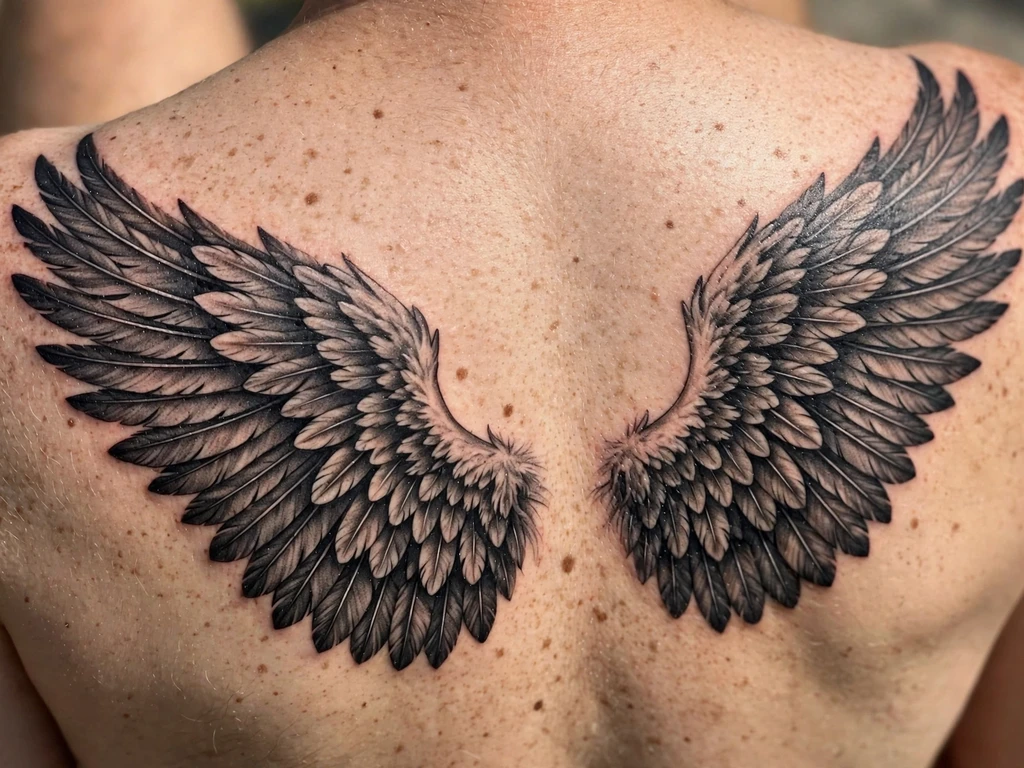
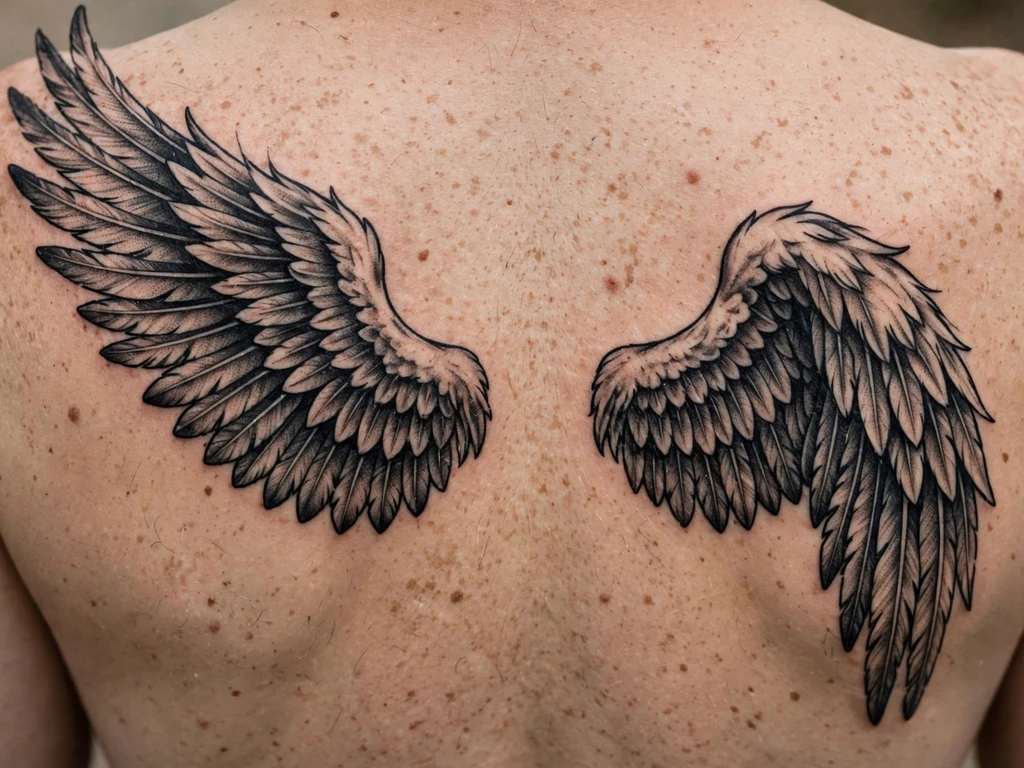
The design everyone pictures first: two wings rooted at the spine, spread across both shoulder blades, tips reaching out toward the shoulders — the pair that moves when you move, opening as the blades draw together. Build it black and grey with the layering honest: long primaries sweeping along each wing’s lower edge, secondaries inside them, coverts stepping down to the root, every feather a separate shape with skin between. This is the placement our shoulder tattoo ideas guide calls the quiet flat canvas, and wings are what it was made for.
The mirror law earns its name here. One wing is drawn completely, then flipped for the other; the pair is checked standing, blades relaxed, against the spine’s centre line. Spread pairs are the largest commitment in this guide — expect the width of both blades, and expect the size to be the point: at this scale the feather rows can be given the separation that keeps them rows for life.
Best placement: Both shoulder blades, roots meeting at the spine, tips toward the shoulders; nothing smaller does this design justice.
Best for / know before you book: Ask to see the single-wing drawing and its flipped twin side by side before the stencil — if the artist drew both wings freehand, ask them to flip instead. Cousins are not twins.
2. The Folded Pair at Rest
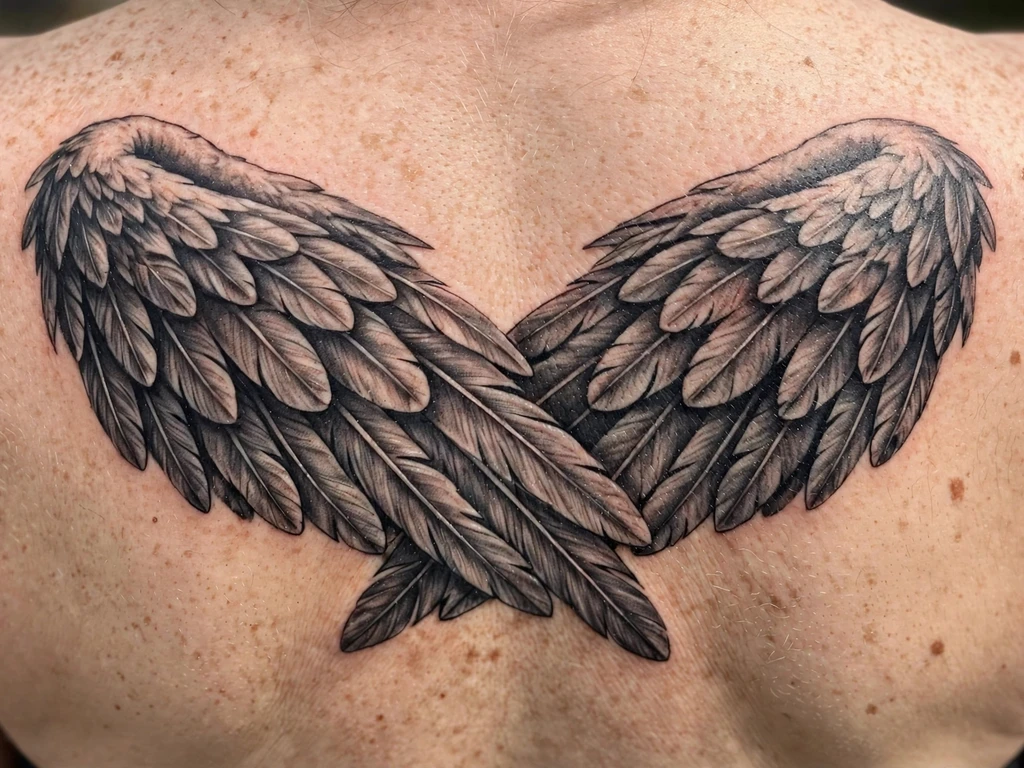
Not every pair is mid-flight. The folded pair hangs at rest: wings lowered along the blades, tips pointing down toward the waist, feathers overlapping the way a bird’s wing folds against its body — primaries crossed and stacked, coverts smooth above them. The reading shifts with the posture: rest instead of ascent, shelter instead of flight, a guardian off duty. Wearers choosing wings for calm rather than triumph land here.
Folding changes the drawing problem. Overlap replaces spread, so the layering order does all the work: each feather’s lower edge must sit visibly over the one beneath, with a tonal step or a skin line to prove it, or the stack reads as one mass. The pair is also narrower than the spread version — it fits blades that cannot give the full span, at the price of density, which the separation rule must defend harder.
Best placement: Both shoulder blades, the pair hanging vertically; the downward tips also follow a calf pair well at smaller scale.
Best for / know before you book: Judge the stencil by its overlaps — trace one feather’s edge with a fingertip; if you cannot follow where one feather ends and the next begins, the healed version will not show it either.
3. Single Wing on One Shoulder Blade
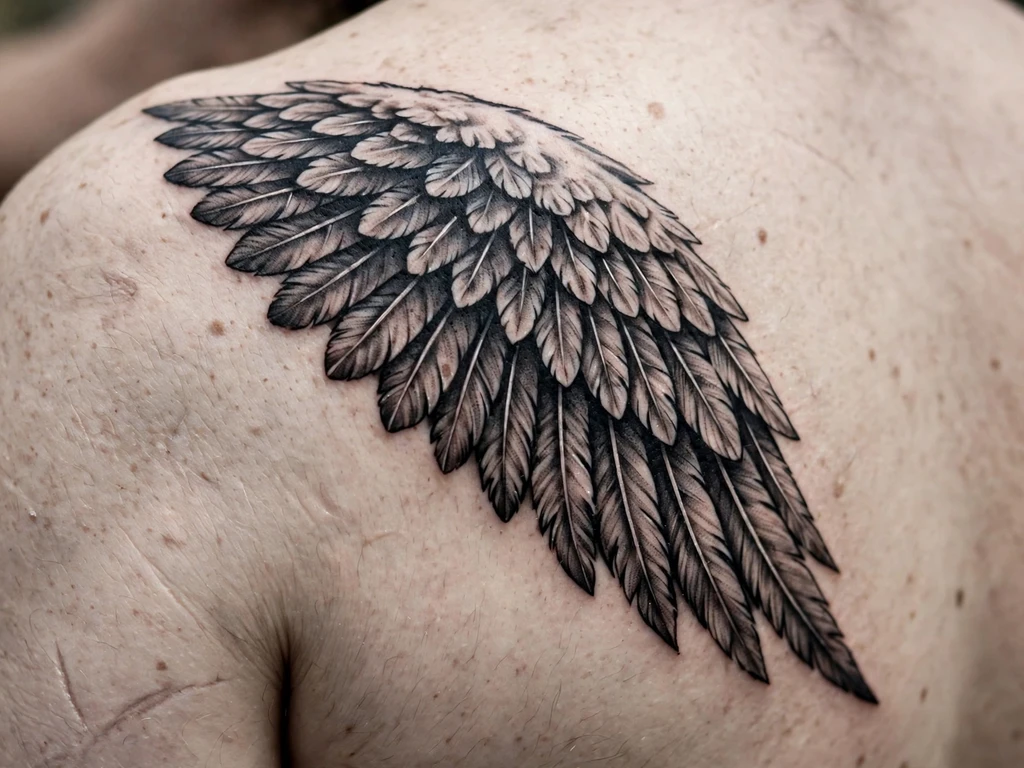
One blade, one wing, complete on its own terms: rooted high on the shoulder blade, sweeping out and down, tip tapered, every row finished as if no second wing was ever planned. Singles carry their own meanings — independence, a journey taken alone, one half of a story the wearer is not obliged to explain — and they leave the other blade free for whatever life adds later.
Rule five is the whole consultation: the wing must be composed as a single, not sliced from a pair. Its root should close in a deliberate finished edge — feathers stepping down to a clean base — rather than ending at an imaginary centre line. Check the stencil alone on the blade, standing: a true single looks intentional from every angle; a half-pair looks interrupted from all of them.
Best placement: One shoulder blade, the wing sweeping diagonally across it; the body’s best single-wing canvas.
Best for / know before you book: If you might add the second wing one day, say so now — your artist can root this wing on the true mirror line so a future twin lands exactly opposite.
4. Single Wing Down a Forearm
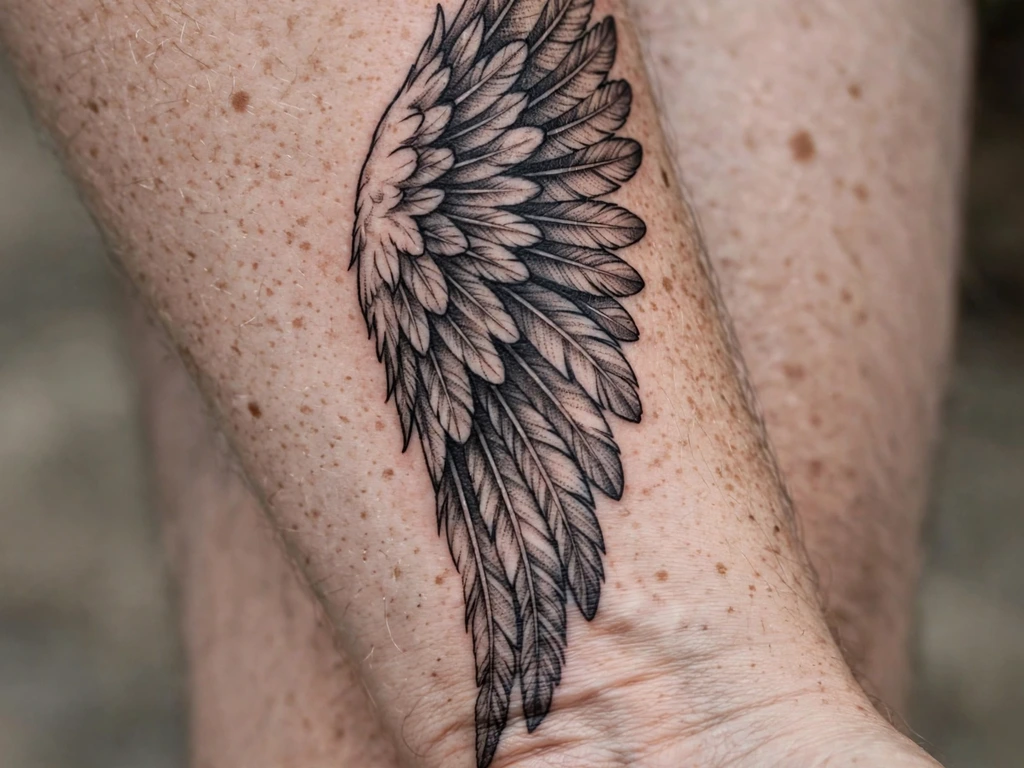
The forearm’s long panel takes a wing laid lengthwise: root at the elbow end, the wing running down toward the wrist, primaries fanning along its lower edge like a blade. It is the most visible wing in this guide — your own, in your own sight all day — and the one wearers choose when the meaning is personal momentum rather than private symbolism.
Length is the constraint and the gift. The forearm allows honest feather rows at moderate count — resist crowding: a forearm wing wants perhaps a dozen clear primaries, not thirty fine ones. The arm’s twist matters too: a wing stencilled with the forearm flat on the table will shear when the arm rotates, so the stencil is checked in natural positions, palm down and palm up, before anyone commits.
Best placement: Forearm, running elbow to wrist along the outer or inner panel; keep the tip clear of the wrist’s crease, where skin movement is hardest on fine tips.
Best for / know before you book: Rotate your arm through its full range with the stencil on — the wing should look composed in every position, not perfect in one and broken in the rest.
5. A Small Pair on a Wrist
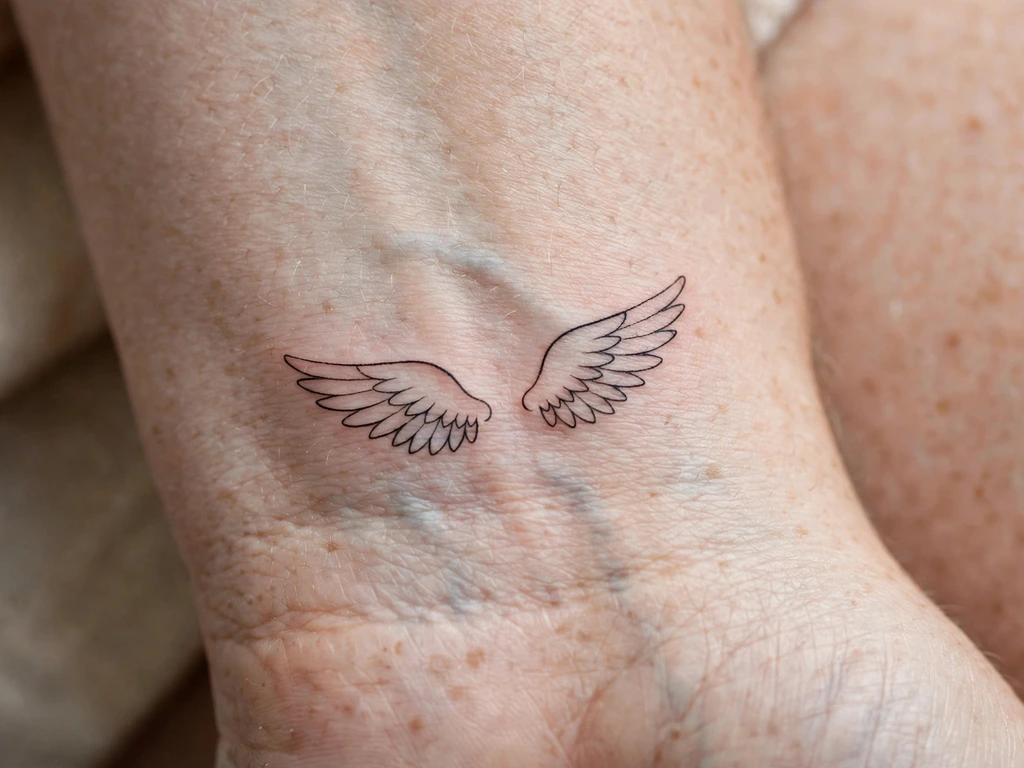
The pair at its smallest honest scale: two little wings on one wrist, spread tip to tip across the pulse, drawn in fine line with feathers reduced to a few clear shapes each — three or four primaries, a covert row, a clean silhouette. At this size the design is an emblem, not a study: it reads as wings because the silhouette and the mirror are right, not because the feathering is detailed.
Small pairs live or die on rule three at miniature scale. Each feather shape needs its skin gap exactly as a large wing does — the gaps are simply most of the design. If a proposed wrist pair shows more feather lines than feathers, it is drawn too fine for the spot; simplify the drawing, never shrink a big one.
Best placement: Inner wrist, the pair spread across it; the same build sits honestly on an ankle bone’s flat.
Best for / know before you book: Print the design at final size and tape it on for a day — wrist pairs are chosen from photographs taken at twice their real size, and the true-size test is the whole decision.
6. Tiny Wings on an Ankle
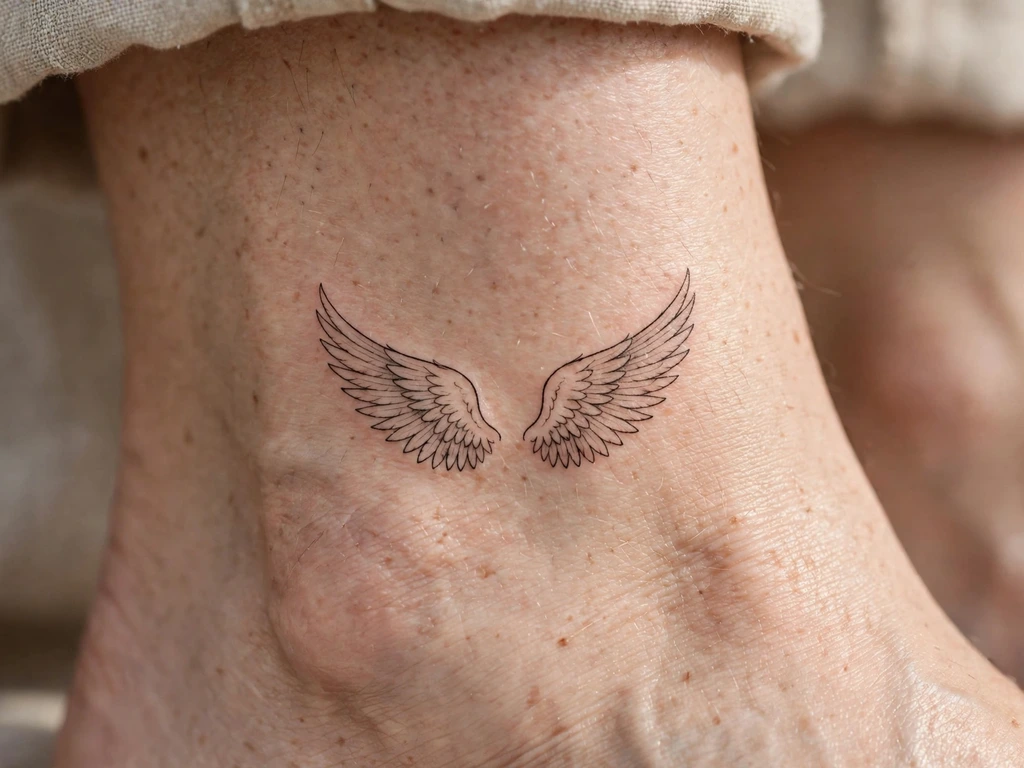
The fleet-footed pair: two tiny wings at one ankle, the placement mythology gave the messenger’s sandals and runners have borrowed ever since — speed, errands, lightness, the wish to be quick and gone. Drawn small and clean: a curved silhouette, a handful of separated feather shapes, a slight upward lift to the tips as if caught mid-step.
Ankle skin is thin and the bone’s curve distorts, so the pair sits on the flat just above the ankle bone rather than over it, and the mirror check happens standing with weight on the foot — the ankle’s shape changes between sitting and standing more than almost any placement here. Keep the pair level in the standing check and it stays level in life.
Best placement: Just above one ankle bone, on the flat; the pair reads best small, 4–6 cm across both wings.
Best for / know before you book: Shoes and straps are this tattoo’s lifelong neighbours — place the pair where your usual footwear does not rub, because friction is a fresh tattoo’s enemy and a healed one’s slow eraser.
7. Wings Along the Collarbone Edge
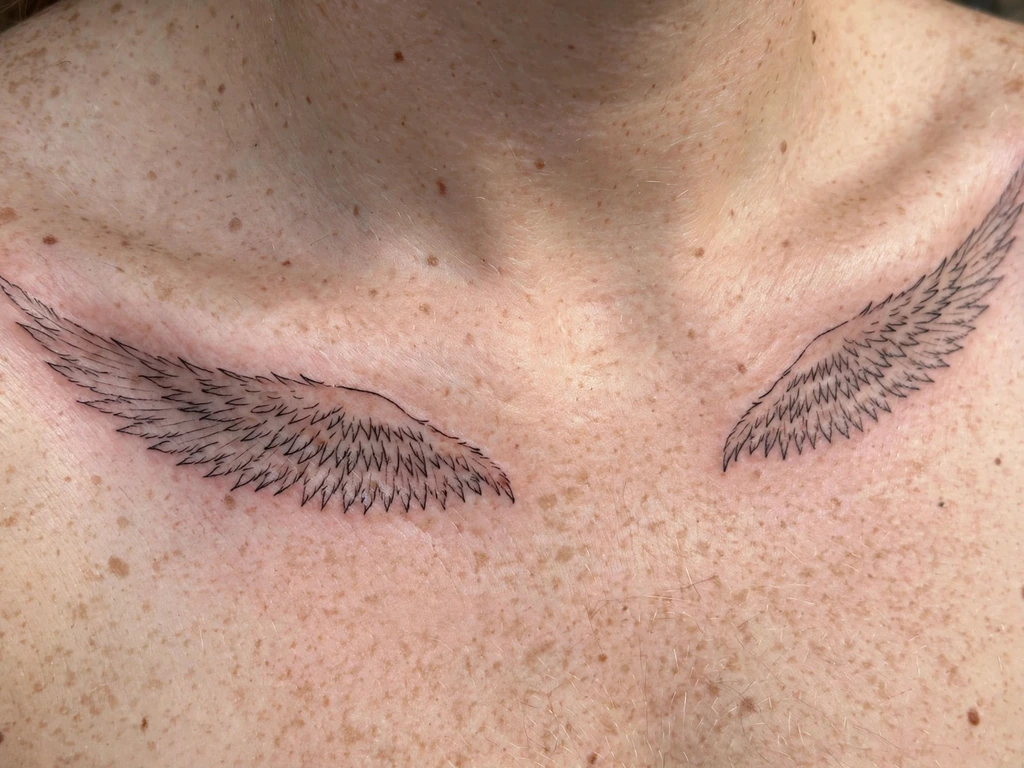
A pair worn like jewellery: one small wing along each collarbone’s outer edge, spread flat and horizontal, the two wings meeting the eye as a matched set across the upper chest’s frame — never the centre, always the bones’ own line. It is the most decorative placement in this guide and the most visible in ordinary clothes, chosen by wearers who want their wings in the open.
The collarbones are not level ground — they angle, and they angle differently on the two sides of most bodies. Each wing is therefore fitted to its own bone separately, then the pair is checked together in a mirror, standing straight: the goal is a pair that reads matched at conversational distance, drawn true to two different bones rather than copied identically onto both.
Best placement: The outer edge of each collarbone, wings lying along the bone; modest scale keeps them elegant and coverable by a strap’s width.
Best for / know before you book: This placement shows in most necklines — choose it as a display decision, not by accident, and expect sun exposure to be this pair’s main ageing enemy.
8. Single Wing on an Upper Arm
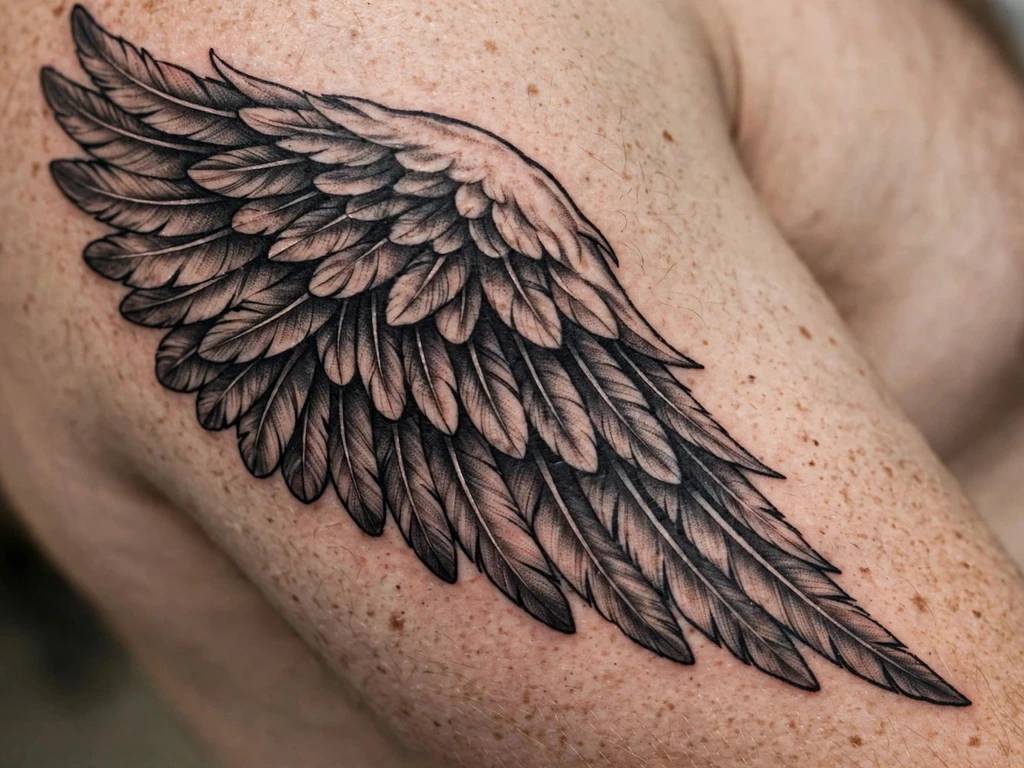
The upper arm takes a single wing wrapped gently around its curve: root at the shoulder end, the wing sweeping down and slightly around the arm so its tip turns with the muscle. It is the natural first large wing — roomy, forgiving, easy to cover, and the placement most likely to grow: today’s single wing is tomorrow’s half-sleeve foundation more often than any design here.
The wrap is the craft question. A wing drawn flat and wrapped will stretch its far feathers and compress its near ones; drawn for the arm, the feather rows are spaced to open correctly around the curve. Check the stencil with the arm hanging naturally and again flexed — a wing that only works on a relaxed arm will spend half its life distorted.
Best placement: Upper arm, outer panel, the wing following the arm’s length with a slight wrap; ideal first-wing territory.
Best for / know before you book: Mention any sleeve plans at the consultation — a wing rooted and tapered with expansion in mind saves a difficult join later.
9. A Pair Split Across Both Calves
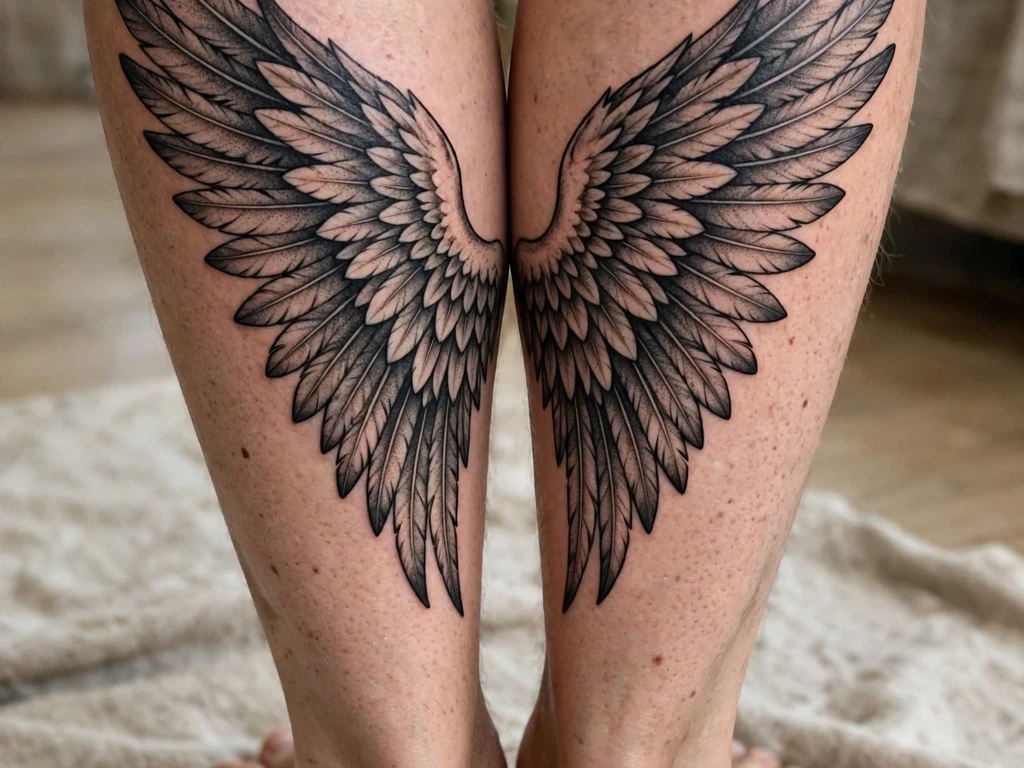
One wing on each calf, the pair completed by standing: legs together, the two wings meet across the gap and read as one spread pair; walking, they separate and recombine with every step. It is the most playful construction in this guide and the one with movement built into its meaning — flight, quite literally, at leg level.
The split imposes the mirror law twice over. Each wing must be a complete, finished single on its own calf (rule five), and the two must mirror truly when the legs stand together (rule one) — heights matched at the calf’s widest point, roots at the same level, tips tapering at the same angle. Stencil both in one session, checked standing with feet together and apart; two sittings a month apart will not match.
Best placement: One wing on each calf, at matching heights; symmetrical calves carry it best, and honest artists will say if yours differ enough to fight it.
Best for / know before you book: Book both wings in a single session with a single stencil file — the pair is one design that happens to live on two legs.
10. The Fallen Pair
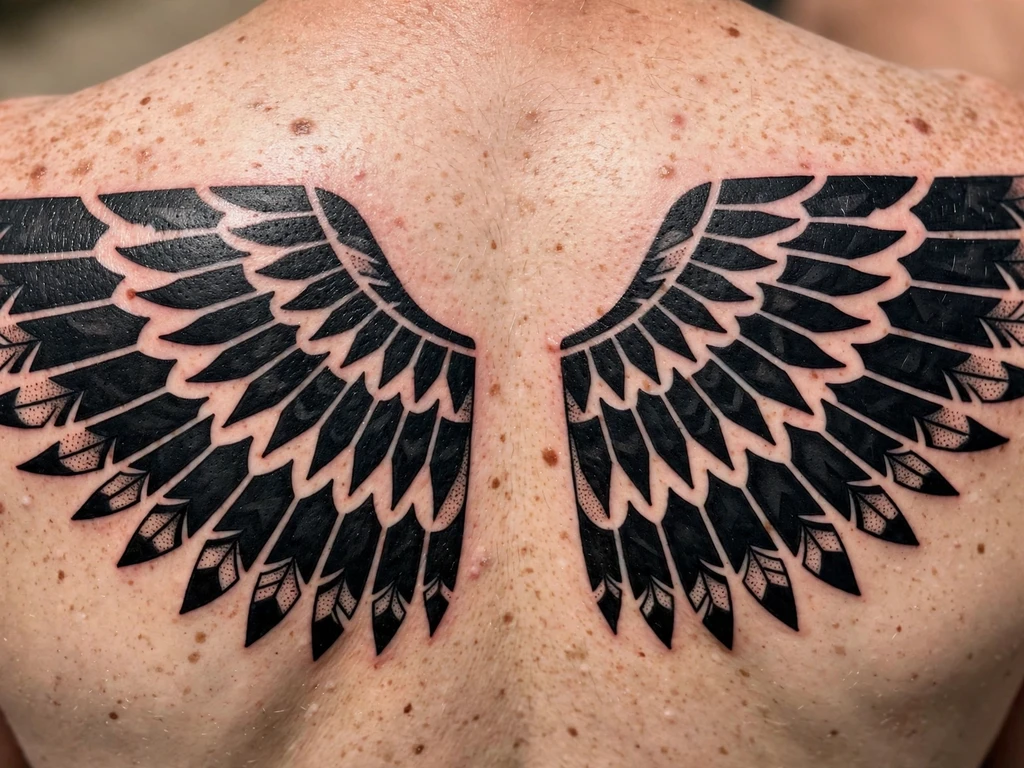
The dark current in this subject, and one of the fastest-rising searches in it: a full pair on the shoulder blades built in heavy black — feathers as bold solid shapes, skin gaps doing the separating, the whole pair reading darker and heavier than any shaded version. The meaning wearers give it is personal and plain: survival, nonconformity, mourning, a fall lived through. Stated as the wearer’s own symbolism it needs no embellishment, and this design adds none — no occult claims, no gore, just wings in black.
Blackwork is also a craft answer, not only a mood. Solid shapes with clear gaps are the most durable construction in this entire guide: there is no fine detail to lose, and the pair will read at twenty years almost exactly as it reads today. The discipline is the edges: each feather’s shape must be drawn decisively, because in solid black a wobbly edge is the only flaw there is to see.
Best placement: Both shoulder blades, full span; the weight of black wants the body’s broadest flat ground.
Best for / know before you book: All-black pairs are the hardest wings to extend or soften later — choose the darkness as a permanent decision, and judge artists on healed blackwork, where true solid packing shows.
11. The Single Black Wing
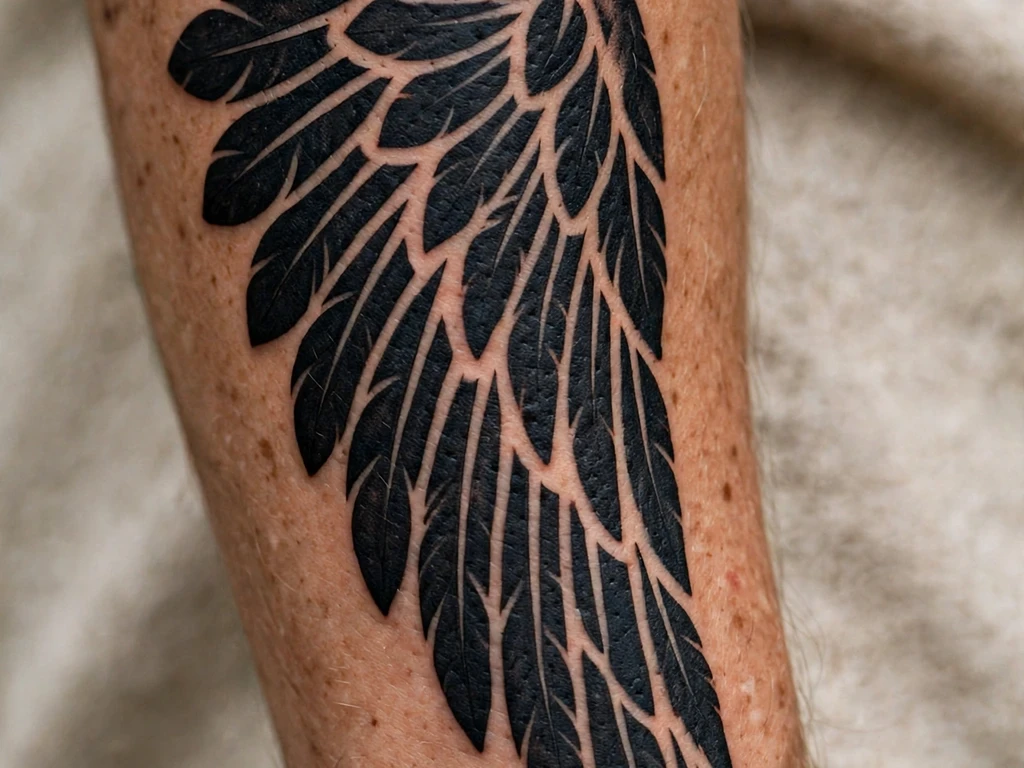
The fallen reading at single-wing scale: one wing down a forearm in solid blackwork, feathers as stacked solid shapes divided by hairlines of bare skin, the silhouette doing all the talking. It reads from across a room — a black wing is a graphic statement before it is a detailed one — and it pairs its darkness with the forearm’s visibility: this is a wing meant to be seen.
The skin gaps are the engineering. Solid black shapes planted edge to edge will settle toward each other over the years; the bare-skin hairlines between feathers are drawn slightly wider than they look fresh, so the healed wing keeps its rows. At the tip, the taper rule holds with extra force: a black wing ending blunt looks cut off at any distance.
Best placement: Forearm, running its length; the same build works on a calf for a quieter version.
Best for / know before you book: Blackwork this solid is a long sitting for its size — discuss pacing honestly, because rushed packing heals patchy and patchiness is forever visible in flat black.
12. Fine-Line Outline Pair
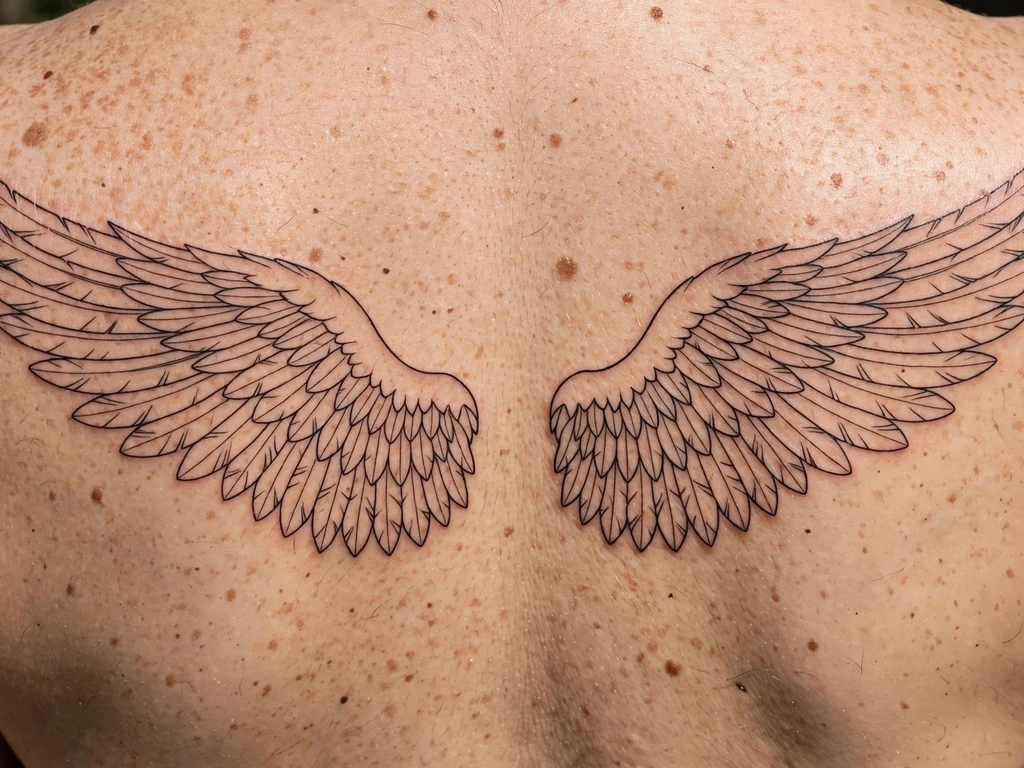
The pair reduced to drawing: both wings across the blades in fine line alone — silhouette, the arcs of the rows, each feather’s division — with no shading anywhere. It is the lightest way to wear a large pair, closer to a sketch or a diagram than a painting, and it suits wearers who find shaded wings heavy: the same span, a fraction of the visual weight.
Know its contract before choosing it. Fine lines soften evenly and gently, and the interior divisions — the thinnest lines in the piece — soften first; the design must therefore read from its silhouette and its main row-arcs with the small divisions gone. Drawn that way, it ages like handwriting: lighter, still legible. Drawn dense, it ages like a photocopy of a photocopy.
Best placement: Both shoulder blades at medium-to-large span; the outline needs size more than the shaded styles do.
Best for / know before you book: This is the style most often regretted at small sizes — if your heart is set on a small pair, Designs 5 and 19 carry that wish more durably.
13. Dotwork Pair
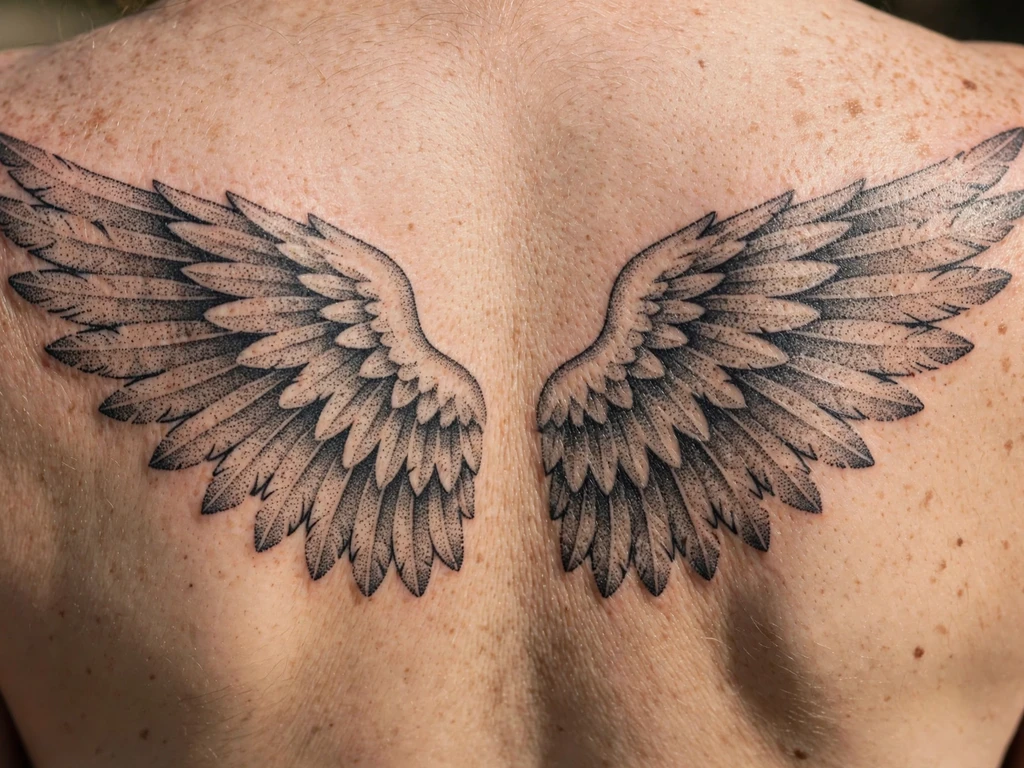
Both wings built entirely from dots: feather rows stippled into being, tones graded by dot density — dense and dark along the feather shafts, thinning toward the edges until the wing dissolves into skin. Dotwork gives wings a quality no other style quite matches: softness with structure, feathers that feel downy at the edges while the rows stay readable underneath.
Its honest cost is time and its honest limit is spacing. Stippled pieces take long sessions, and because dot fields settle and spread slightly, the rows must begin with more air between them than a lined design would need. Choose an artist whose healed dotwork you have seen at two or three years old — fresh stipple always looks finer than it will live, and the density plan for year five is the real consultation.
Best placement: Both shoulder blades, where the pair can be given medium-large span; also strong as a single wing on an upper arm.
Best for / know before you book: Ask directly about session length and per-session area — dotwork wings are measured in sittings, not hours, and a realistic plan beats an optimistic one.
14. The Layered Realism Pair
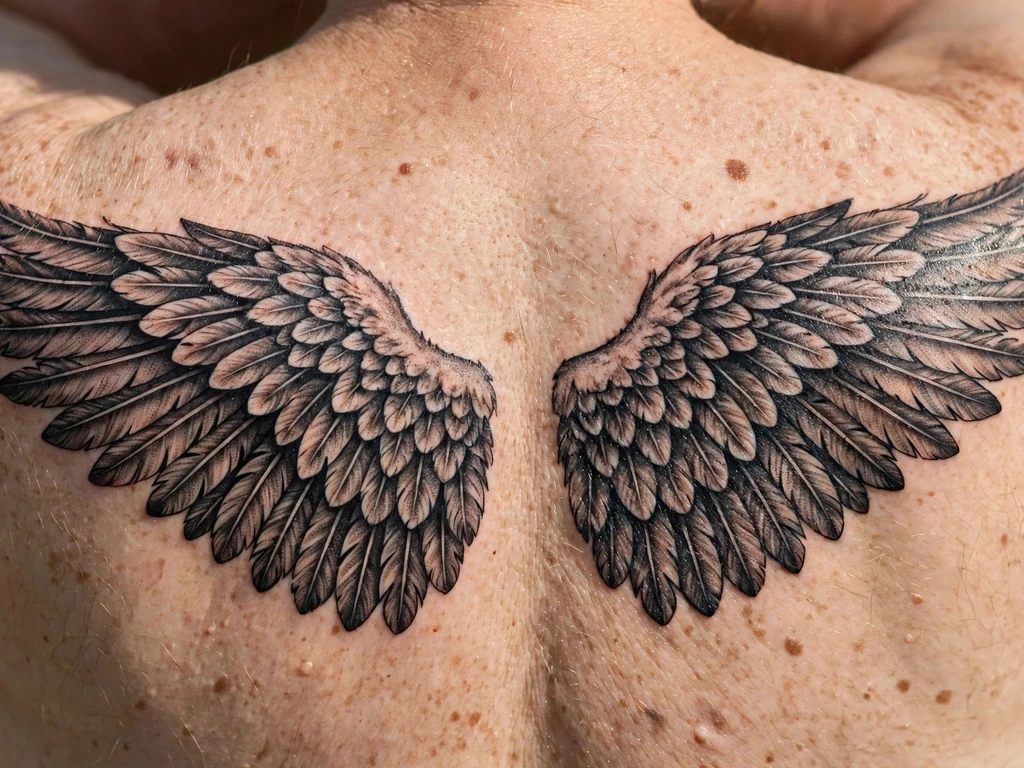
The realism showpiece: a full pair across both blades with every feather individually drawn — primaries long and separate along the lower edge, secondaries overlapping inside them, coverts stepping down in rows to the root, tonal steps instead of hard lines between many of the feathers. This is the design the Mirror Law was written for: real structure, truly mirrored, at the largest scale the back offers.
Its terms are strict and stated plainly. Realism needs size — this pair wants the full span of both blades and multiple sessions — and it needs an artist who specialises in it, judged on healed realism specifically. The barbs rule still applies inside all this detail: shafts and confident strokes, tonal steps for the rest, because the fully rendered version of this design is precisely the one that softens into grey texture. Done right, it is the closest skin comes to wearing an actual wing.
Best placement: Both shoulder blades at maximum span; there is no honest smaller version — scale down and you are choosing a different style, which is fine if chosen openly.
Best for / know before you book: Bring reference photographs of real bird wings, not tattoo photos — the layering order in nature is the design’s whole claim, and your artist should be working from the original.
15. Wings With a Halo
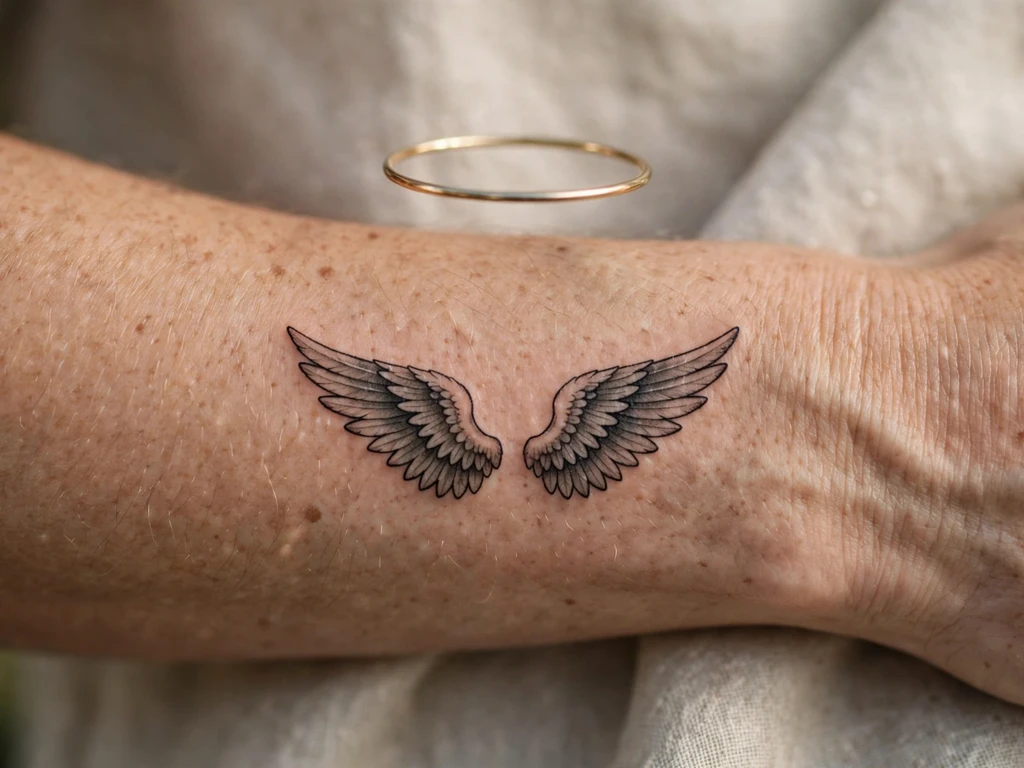
The one design in this guide that adds a second symbol, and the rule here is one symbol only: two small wings on the forearm, a halo — a simple ring, solid or outlined, roughly the width of the gap between the wing roots — floating above them, the emblem of the guardian reading made plain. Keep it factual and modest: a little wing, a little ring, drawn with the same honest layering as every other design here.
Proportion is the whole craft. The halo must float at the right distance: too close and it reads as a hat; too far and the two elements divorce. Its size should answer the wings’ span — roughly the width of the gap between the wing roots is the classic measure — and it is stencilled and checked with the wings as one composition, never added as an afterthought in a second session.
Best placement: Forearm, where the emblem sits flat and visible; a small version also sits well centred on one shoulder blade.
Best for / know before you book: If the halo is there for a memorial reason, know that Design 18 carries that meaning without it — choose the halo for the guardian reading, not by default.
16. Wings With a Small Heart
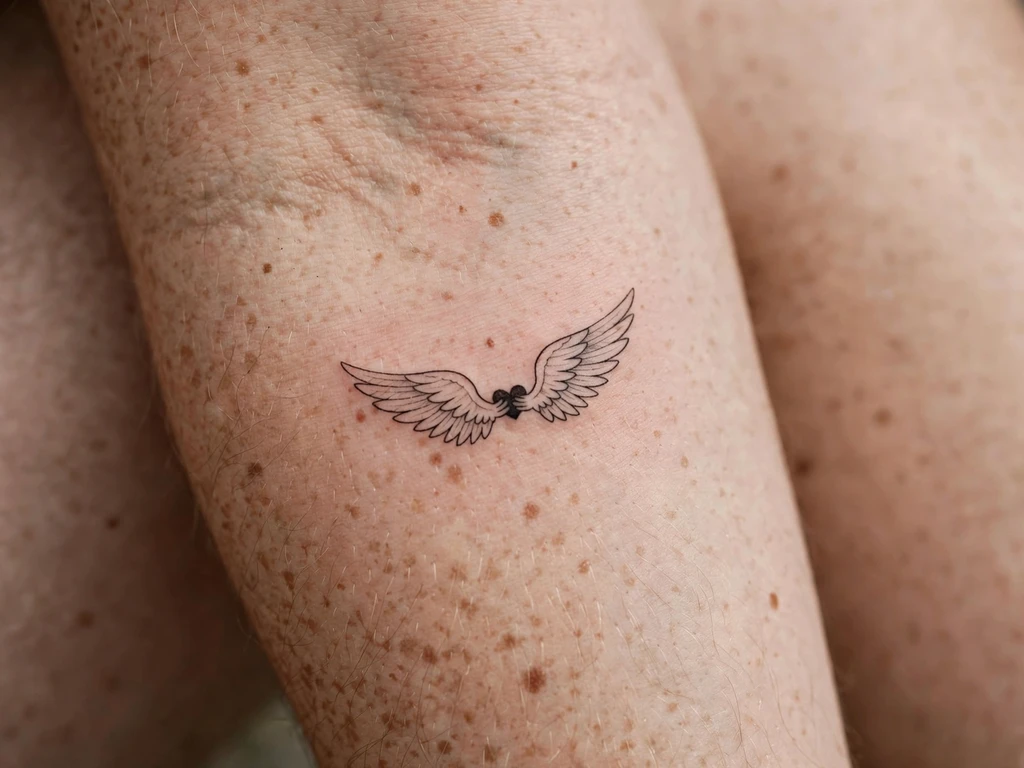
Two small wings cupped around one small heart: the wings lifted at either side, the heart — solid or simply outlined — resting in the cradle they form. It is the tenderest composition in this guide, read as love protected, love that lifts, or a child carried; the wings do the sheltering and the heart says what is sheltered. One design, one companion symbol, and restraint everywhere else.
Small centred compositions fail by crowding. The heart needs its own clear margin of skin on every side — the wings must frame it, not touch it — because at this scale any contact point becomes a blob as lines settle. Draw the heart at the boldest simplicity: a clean silhouette survives; a detailed anatomical heart at this size does not belong to this design.
Best placement: Inner forearm, centred; also honest at small scale on a wrist, with the heart kept bold and simple.
Best for / know before you book: Decide the heart’s treatment — solid black, red, or outline — as a permanence decision; solid reads longest, red carries its own fading character, and outline is the most delicate of the three.
17. Cherub Wings — Small and Rounded
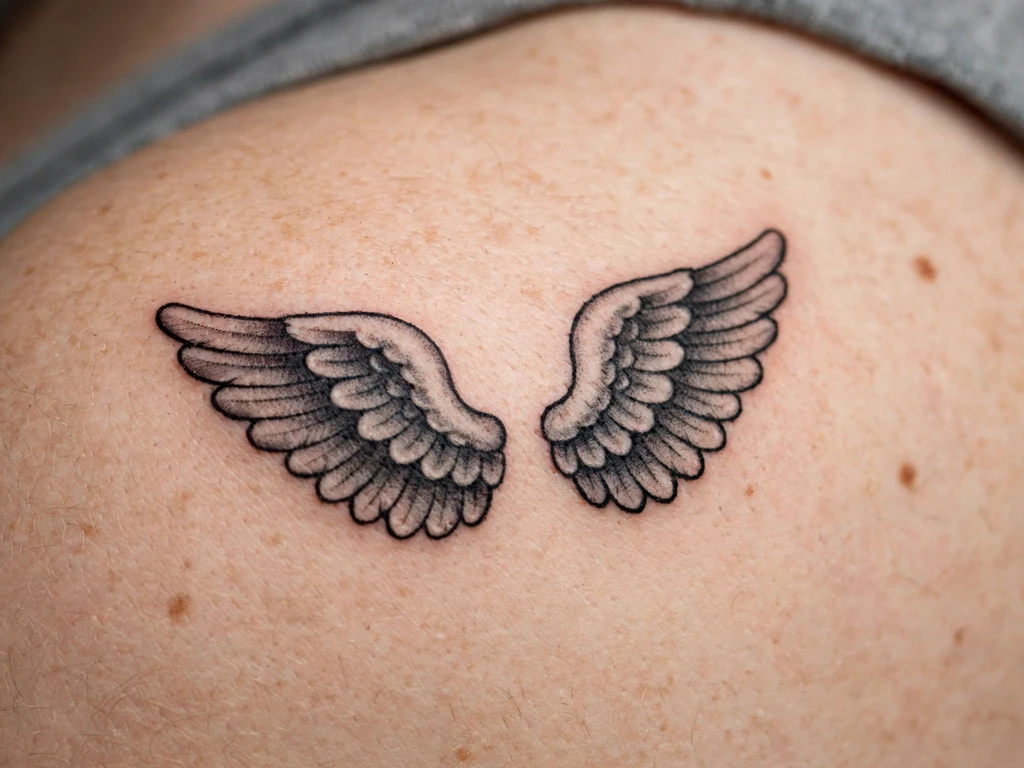
The pair at its softest: short, rounded wings — the little plump wings art gives its cherubs — drawn with stubby feathers in domed rows, more cushion than blade. On their own, without any figure, they read as innocence and gentleness in their purest form in this guide, and they are often chosen for a child, a childhood, or simply a refusal of grandeur.
Roundness is a drawing discipline: the wing’s silhouette is an arc, the feathers shorten evenly toward it, and the whole pair stays compact — a cherub wing stretched long stops being one. Soft black and grey suits them best, with the separations kept as firmly as in any design here; soft shading over merged feathers heals into a single grey puff, which is the one failure this gentle design cannot afford.
Best placement: One shoulder blade, small and high; the pair also sits sweetly at an ankle at tiny scale with feathers simplified to bold shapes.
Best for / know before you book: These are frequently memorial-adjacent — chosen for a child lost or a child born. Either way, tell your artist the weight the design carries; good artists draw differently when they know.
18. The Memorial Pair
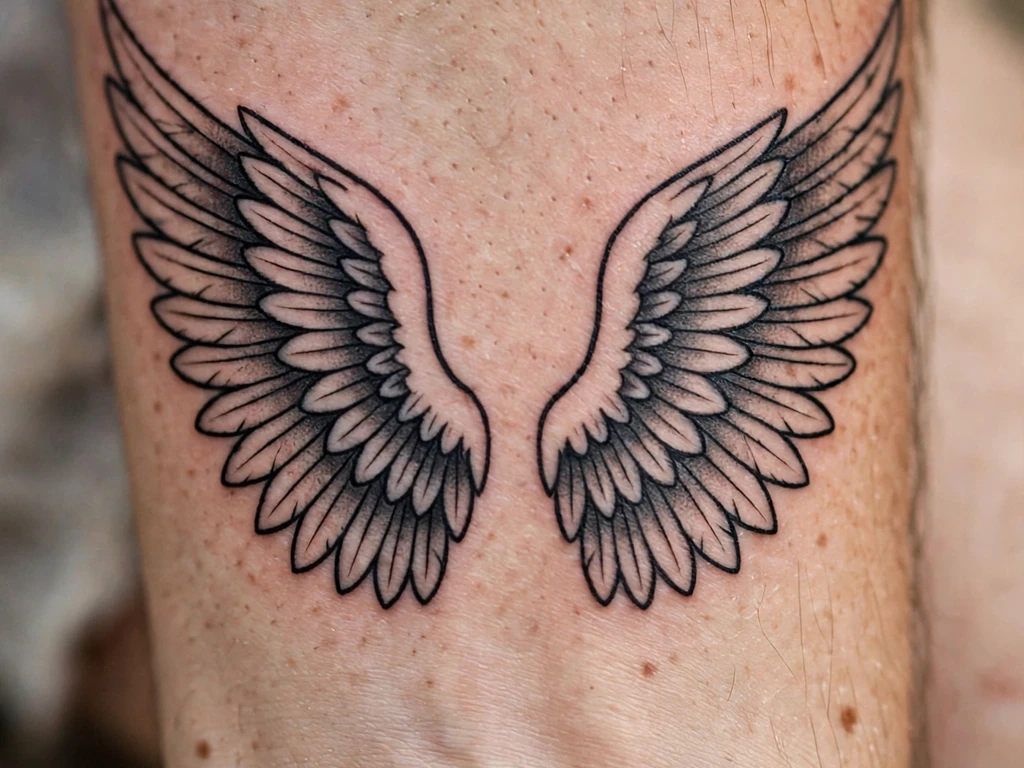
One design in this guide is set aside for remembrance, and it is deliberately the plainest pair here: well-built wings, honestly layered, no halo, no heart, no name and no date — the wings themselves carrying the whole statement that someone is gone and is carried still. Many memorial wings elsewhere add lettering; this guide’s lettering lives in other articles, and a pair drawn with this much quiet confidence does not need it.
Plainness is not simplicity of effort. A memorial pair is often looked at daily for decades, so its craft terms are the strictest in the guide: true mirror if it is a pair, full separation between feathers, sizes chosen for the twenty-year read. Timing deserves one honest sentence: many artists gently advise letting raw grief settle before committing to a permanent memorial, not as a rule but as experience — the design will wait, and it should be chosen by the person you are becoming as much as by the one who is grieving.
Best placement: Forearm, where it is seen by the wearer daily; or a shoulder blade, for a memorial kept private by default.
Best for / know before you book: Choose the wings for the person, not the occasion — a pair you would love as pure design will serve the memory longest, because you will still love looking at it in thirty years.
19. The Minimalist Feather-Wing
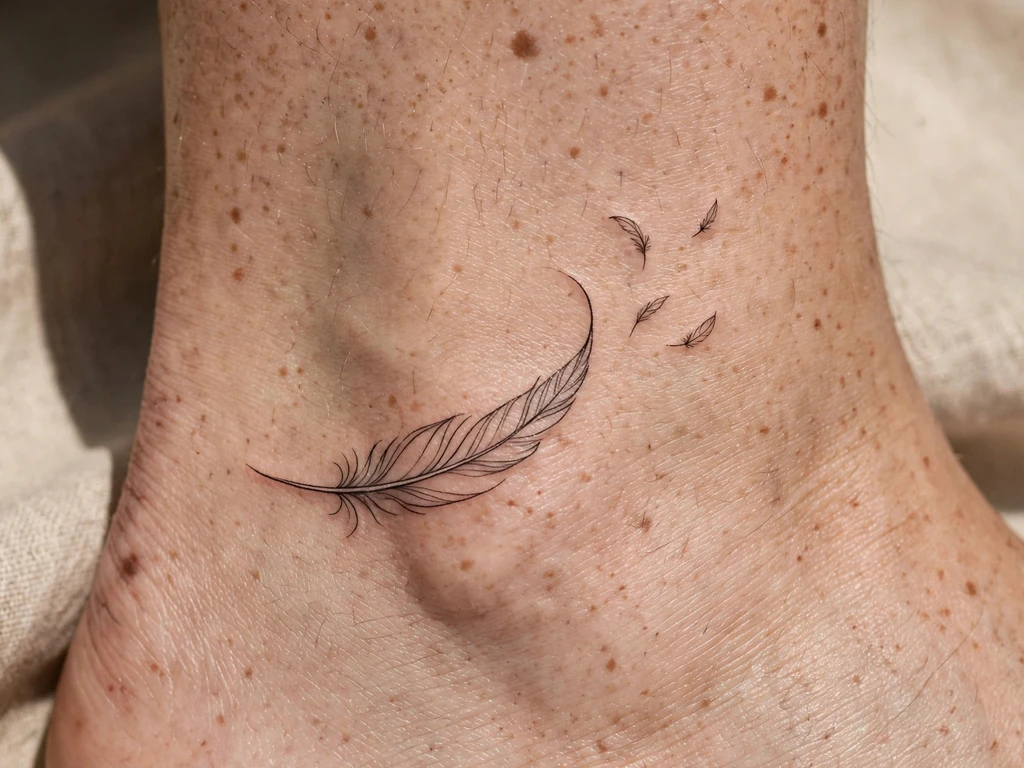
The wing distilled to one feather: a single long feather, curved as a wing curves, its barbs suggested by a few separated strokes so that the eye reads feather and wing at once. It is the most reduced design in this guide and the most dependent on a single decision — the curve. Drawn with the right sweep, one feather becomes the whole idea of flight; drawn straight, it is a leaf.
Minimalism here is a philosophy, not a size: this design works at ankle scale and would work at forearm scale too, because its content is the gesture rather than the detail. The strokes that suggest the barbs must be spaced like the guide’s feather rule demands — each one separate, none touching the shaft’s line at a point that can merge — and the feather’s tip tapers to a genuine point.
Best placement: Ankle, the feather curving above the bone; equally at home on an inner wrist.
Best for / know before you book: Live with the curve before you commit — draw it on the placement with a pen and wear it a day; this design is one line’s worth of decision, so that line must be exactly yours.
20. A Wing Behind the Ear
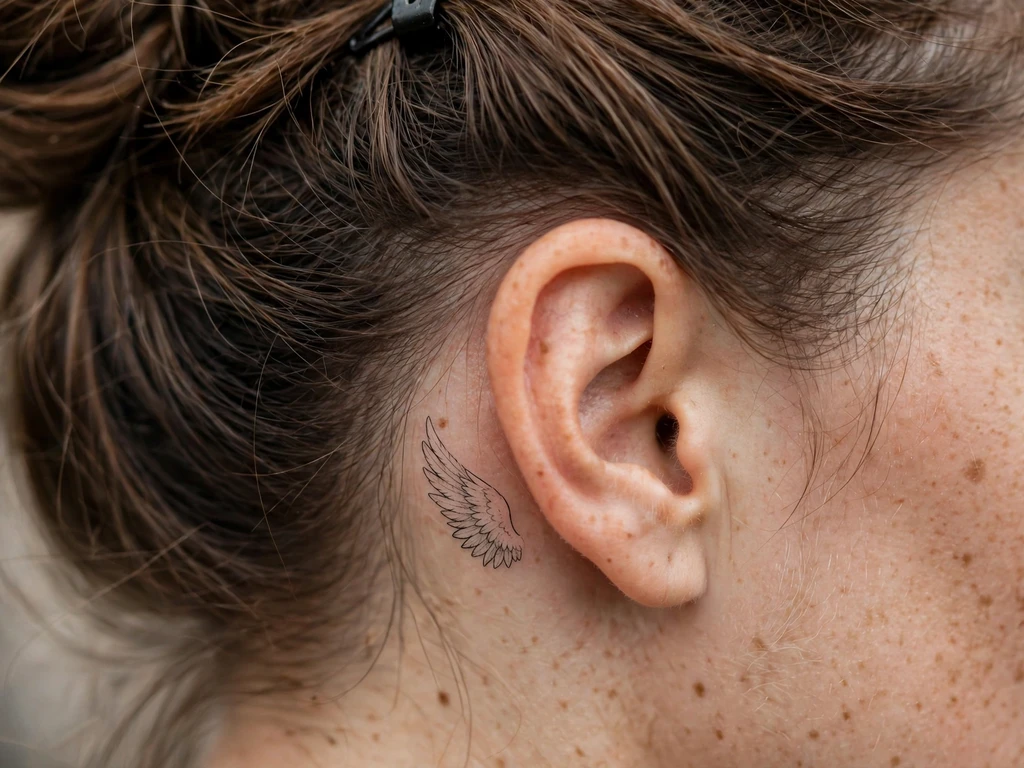
This guide’s one behind-ear design: a single small wing tucked on the flat behind the ear, feathers reduced to a silhouette and three or four clear divisions, small enough to hide under hair and quick enough to show by tucking it back. The placement gives the wing a private character no other spot matches — a guardian kept at whisper distance.
The space is small and the skin is thin, so the design obeys miniature law: bold shapes for their size, separations wide for their size, and no barb detail whatsoever. Expect this placement to soften faster than the guide’s larger wings — behind-ear skin is fine, flexes with expression, and meets shampoo, sun and spectacle arms daily. Chosen knowingly, it is a charm; chosen expecting permanence of detail, it will disappoint.
Best placement: Behind the ear, on the flat below the cartilage fold, the wing’s tip pointing down and slightly back.
Best for / know before you book: Print the design at final size — behind-ear judgements are all about the true-size test, because photographs of this placement are always magnified.
21. The Tiny Finger Wing
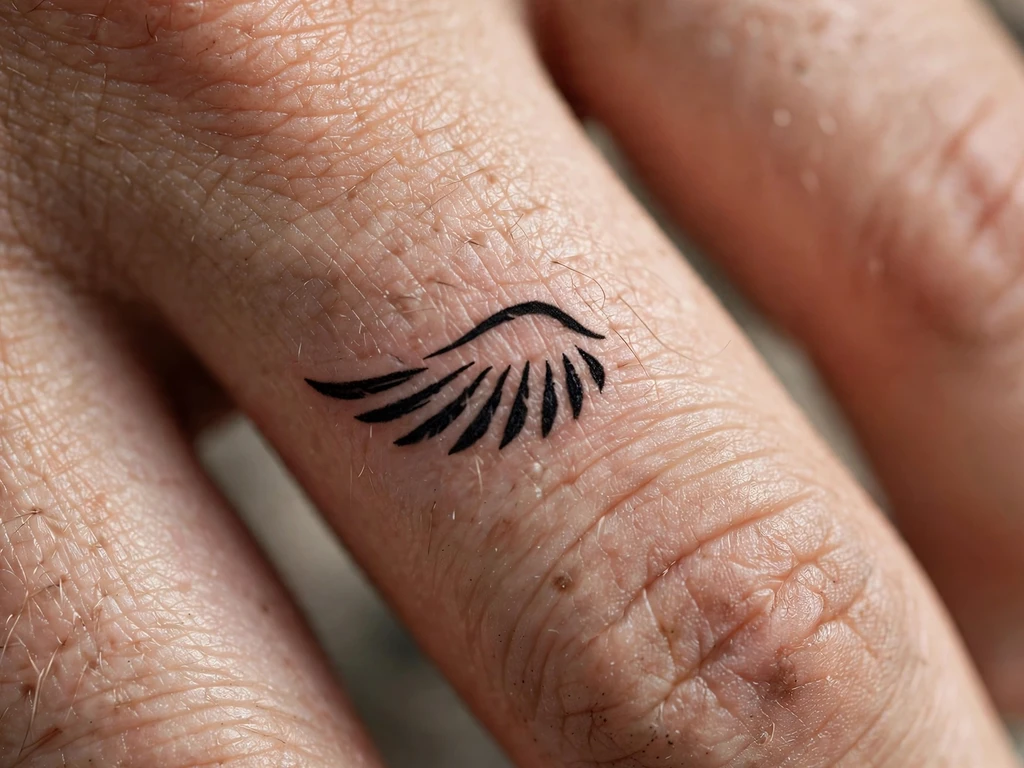
The smallest wing in this guide, offered with the full honesty finger tattoos always require: one tiny wing along the side of a finger — a silhouette, three bold feather notches, nothing finer — at the largest size the finger’s flat allows. When the hand opens, there it is: the whole idea of a wing, in a centimetre and a half.
Now the warning, stated plainly because this placement demands it: finger skin regenerates fast, flexes constantly and sheds ink faster than anywhere else on the body, so a finger wing will fade — not might — and will need touch-ups across its life to keep its feather shapes separate and its silhouette readable. The side of the finger holds ink longest of the finger’s surfaces, which is why the design lives there and nowhere else on the hand. Choose it as a charm with a maintenance schedule, ideally not as a first tattoo, and never as the only version of a wing that matters to you: wear the real pair somewhere durable, and let the finger carry its miniature.
Best placement: Side of the finger, where the small flat takes a single short design and holds ink best.
Best for / know before you book: Price the touch-ups before you fall for the charm — Designs 5, 6 and 20 offer the same idea on skin that keeps it far longer.
22. The Soft Grey-Wash Pair
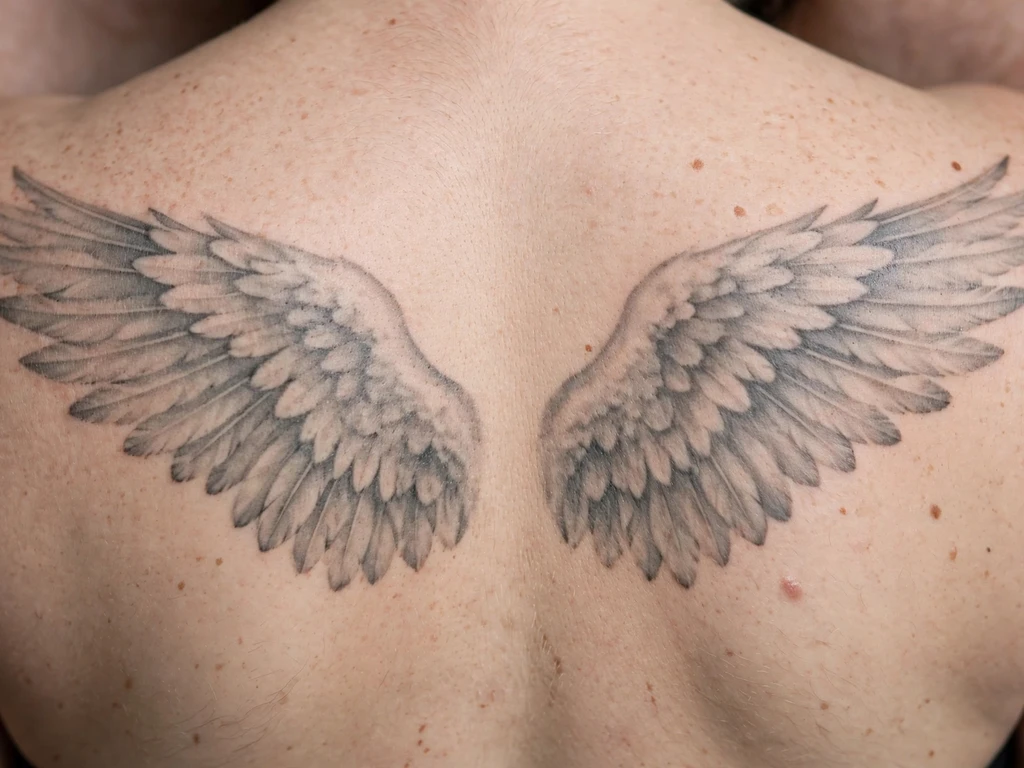
The ghost pair: both wings across the blades drawn in soft grey wash alone — feather rows suggested by shading, edges dissolving into skin, almost no hard outline anywhere. It is the most painterly build in this guide and the one wearers describe as dreamlike: wings that seem to be appearing, or remembered, rather than declared.
Choose it with its future in view. With no outline to hold the shapes, the wash settles and flattens over the years; the wing of year ten is a softer, paler version of the wing of year one, and the design must be wanted for that quality, not despite it. The row structure still has to be drawn underneath the softness — tonal steps placed where the feather separations belong — because wash over no structure heals into fog with a wing’s outline and nothing inside it.
Best placement: Both shoulder blades, at generous span; the softness needs size to read as wings rather than weather.
Best for / know before you book: Judge artists on healed wash work specifically — this style has no lines to rescue a weak hand, and fresh examples always flatter it.
23. The Geometric Pair
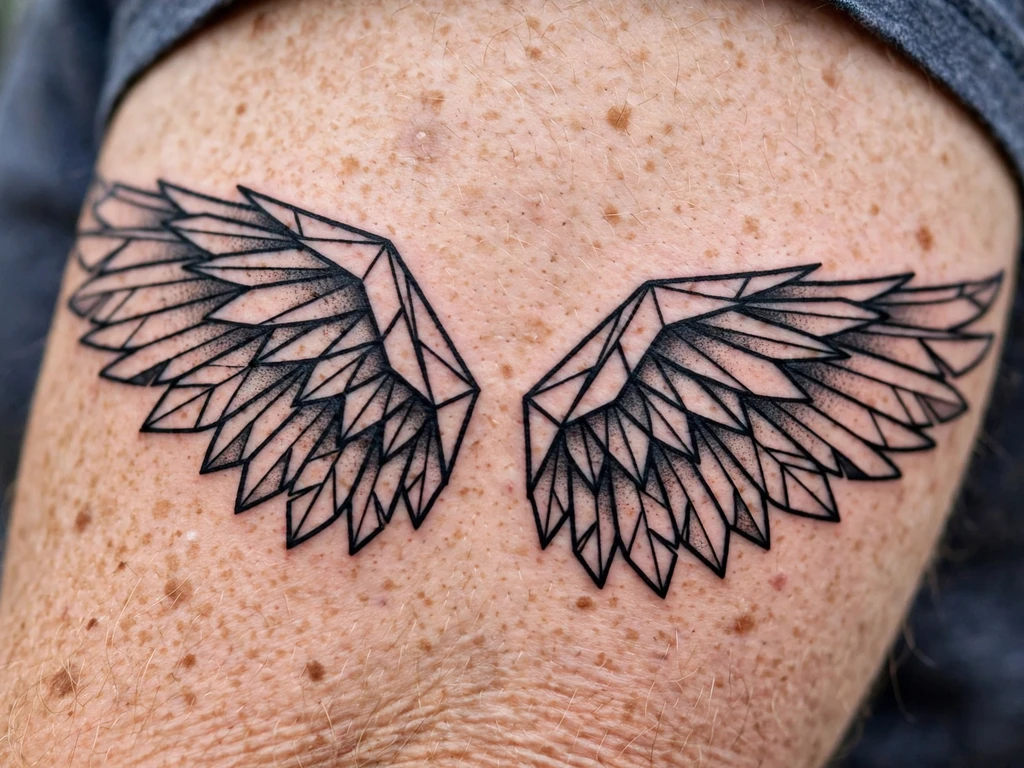
The stylised extreme: a pair of wings built from angular shapes — feathers as triangles, chevrons and stepped planes, the whole wing reading like folded paper or cut crystal. Geometric wings trade every soft quality for precision, and they make the layering logic more visible, not less: primaries, secondaries and coverts become three clear tiers of shapes marching down the wing.
Precision is the price. Straight edges and repeated angles expose every wobble, and the pair must mirror mathematically — this is the design where the flip-the-file rule is least negotiable. Spacing follows the same law as feathered work: a skin gap or a tonal step between shapes, because merged geometry is just a black polygon, and the tier structure is the first thing merging eats.
Best placement: Upper arm, one wing fanned across the outer panel or the pair split one per arm; the flat geometry also sits well on a calf.
Best for / know before you book: Ask for the design as a vector-clean drawing and inspect the stencil’s corners at full size — in geometric work, the corners are the craftsmanship.
24. One Wing Raised, One Lowered
The deliberate exception to the mirror law — and the proof of why the law exists. One wing lifted high, one wing lowered: a pair caught mid-gesture, taking off or landing, sheltering or recovering. The asymmetry is the meaning — transition, imbalance honestly admitted, a before and an after on one back — and wearers choose it precisely because their story is not symmetrical.
Its craft is subtler than the mirrored pair’s, not easier. Each wing must still be a complete, well-layered wing on its own (the lowered wing is composed, never merely the raised one rotated down), and the pair must balance as a composition across the spine: weights answering each other, tips at considered heights, the roots on one true line. Check it standing, and check it moving — an asymmetric pair is judged in motion, where a careless one looks like a mistake and a composed one looks like flight.
Best placement: Both shoulder blades; asymmetry needs the back’s full width to read as intention.
Best for / know before you book: This design lives or dies at the drawing stage — if the imbalance looks accidental on paper, it will look accidental forever. Book the artist whose sketch already convinces you.
25. The Long Thigh Wing
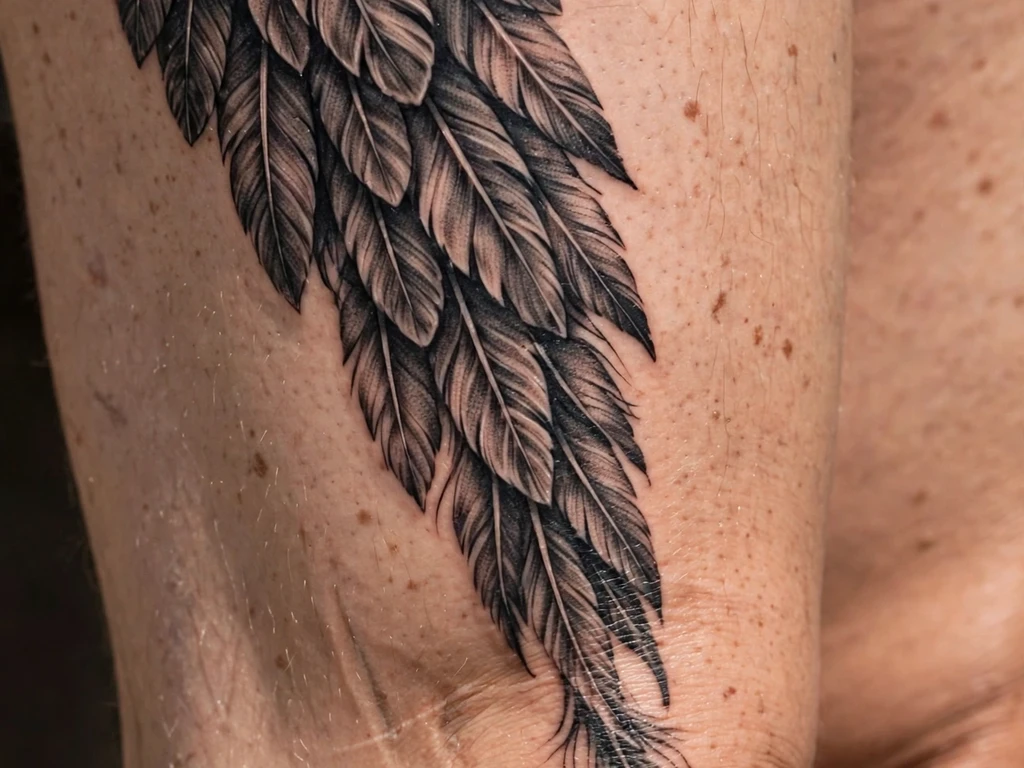
The last single, and the largest: one long wing running down the thigh, root at the hip end, primaries sweeping the leg’s length, tip tapering toward the knee. The thigh gives a wing what the forearm cannot — span. At this length the feather rows can be built at near-lifesize candour: full primaries, honest overlaps, coverts stepping down in real tiers, a wing you could almost measure against a bird’s.
Vertical composition is its discipline. The wing should follow the leg’s line without wrapping so far that its far side hides in standing view, and its taper must close before the knee’s movement zone, where skin travel punishes fine tips. Thigh skin takes ink kindly and hides under clothing by default, which makes this the guide’s grand-but-private option: the biggest single wing here, worn for the wearer.
Best placement: Thigh, front or outer panel, running hip to above the knee; keep the tip clear of the knee’s crease.
Best for / know before you book: If a pair is the long-term dream, the thigh is not where pairs live — choose this as the single it is, or take the blades’ span for the pair and let the thigh host something else later.
Angel Wings Tattoo Placement by Size
| Size | Typical dimensions | Best placements | Good to know |
|---|---|---|---|
| Tiny | 1.5–4 cm | Behind ear, side of finger, ankle | Only bold-shape wings survive — a silhouette and three or four feather shapes; the finger version carries a permanent touch-up commitment |
| Small | 4–8 cm | Wrist, ankle, collarbone edge, forearm | Small pairs and singles with feathers simplified to clear shapes; the halo and heart emblems live honestly at this scale |
| Medium | 8–16 cm | Forearm, upper arm, calf, one shoulder blade | Full singles with honest feather rows; split calf pairs; the folded pair fits blades at this size |
| Large | 16–30 cm | Both shoulder blades, thigh | The spread, realism, blackwork and asymmetric pairs — the designs whose truth lives in their span and layering |
A note on what this table leaves out, stated plainly. Wing pairs are often shown in galleries swept across the centre of the chest or under it; this guide deliberately keeps its pairs on the shoulder blades and its singles on flat, calm ground, for placement reasons only: a mirrored pair needs flat ground for its mirror check to mean anything, the centre chest moves with every breath and distorts a pair’s join, and fine feather rows survive worst on skin that stretches daily. The blades are not a compromise — they are where wings anatomically belong, and where they age best.
How to Choose Your Angel Wings Tattoo (and What to Know Before You Book)
Decide pair or single before anything else. It is the first fork and it decides placement, budget and meaning: pairs belong to the back and to symmetry; singles belong anywhere and to their own stories. Wearers who start by falling for a photograph usually discover the fork late — decide it first, from the meaning, and let the photograph follow.
Choose the register honestly: realism or stylised. Look at the size you actually want, then pick the register that size can keep. A 6 cm wing cannot be a realistic wing; it can be a superb stylised one. Most disappointment in this subject is a register chosen for a photograph and a size chosen for a budget, meeting each other on skin.
Count the layers in the drawing. Before booking, look at your artist’s drawing and count: primaries along the lower edge, secondaries inside them, coverts stepping down at the top. Three tiers, each feather a separate shape with skin or a tonal step between. If the drawing shows one row of long feathers, it is a headdress — send it back with this guide’s second rule.
If it is a pair, flip, don’t redraw. Ask for one wing drawn completely and the file flipped for the other side, then check the transferred pair standing, spine as the mirror line, blades relaxed. Five minutes of checking is the difference between twins and cousins, and it is only available before the needle.
Decide the darkness deliberately. Black and dark wings are rising for real reasons, and blackwork is the most durable build in this guide — but a heavy black pair is the hardest design here to soften, extend or cover later. Choose the fallen register as the permanent statement it is. If you are combining wings with a second symbol, keep it to one and keep it factual: this guide’s halo and heart are the proven pairings, and wearers drawn to balanced celestial pairings will find the fuller treatment in our sun and moon tattoo ideas guide, which publishes alongside this one.
Key points to remember:
- A pair of wings is one design drawn twice: draw one wing completely, flip the file for the other, and check the transferred pair standing against the spine — freehand “matching” wings are cousins, not twins
- A wing is built in layers like a bird’s — long primaries along the bottom and outer edge, secondaries inside them, short coverts stepping down at the top; one row of long feathers is a headdress, not a wing
- Every feather must be a separate shape with bare skin or a clear tonal step between it and its neighbours: separation survives ageing, fine rendering does not — barbs are suggested with a few confident strokes, never drawn hair by hair
- Wing tips taper to a point and are re-drawn, never cropped, when a design is shortened; a blunt-ended wing reads as a fan
- A single wing must be composed as a complete design with a finished root — half of a pair worn alone reads as something missing
- Black and fallen wings carry personal meanings — survival, nonconformity, mourning — and blackwork is the most durable build of all; choose the darkness as the permanent decision it is
Frequently Asked Questions
What does an angel wings tattoo mean?
Most often one of four things, all held as personal meaning and tradition rather than fact: protection — the guardian-angel idea of a watcher at your back; freedom and flight — leaving a place, a job or an old self; memorial — carrying someone who has died; and, in the black and fallen register, survival — having gone through a fall and still being here. The wings alone, without the angel figure, keep all four readings open, which is exactly why many wearers prefer them: the meaning stays theirs, and the shape stays pure anatomy and symmetry.
Are black or fallen angel wings disrespectful?
For most wearers they are not a religious statement at all, in either direction: black wings are usually chosen for personal symbolism — survival, nonconformity, grief — or simply because blackwork is bold and ages best. The fallen-angel story exists in religious tradition, but wearing dark wings makes no claim about it, and this guide treats the design as the wearer’s own meaning, respectfully and without occult claims. If your own faith community matters to the decision, that conversation is worth having with them; as a tattoo, a black pair is no more inherently disrespectful than a white one — both are wings, worn for the wearer’s reasons.
Do angel wings tattoos have to be symmetrical?
Pairs worn across the shoulder blades are normally mirrored, because the back itself is symmetrical and an unmatched pair there reads as an error — that is the Mirror Law, and it is a craft rule, not a meaning rule. Deliberate asymmetry exists and can be powerful: Design 24’s raised-and-lowered pair is composed asymmetrically on purpose, each wing complete in itself, balanced as a composition. The difference is intention visible in the drawing. If the two wings differ because they were drawn carelessly, the back will show it forever; if they differ by design, checked standing and composed as one piece, it reads as flight.
How well do the feather details age?
The shapes age well; the rendering does not. A wing built as separate feather shapes with clear skin or tonal steps between them keeps its rows for decades — that separation is the design’s skeleton, and it survives. The fine interior detail — individual barbs, hair-thin divisions — softens first, sometimes within a few years, which is why honest wing-building suggests barbs with a few confident strokes instead of drawing them all. Blackwork feathers age best of all, fine line softens most gracefully, and outline-free wash softens fastest. If an artist proposes fewer, larger, more separated feathers than your reference shows, they are saving your tattoo, not spoiling it.
Where is the best place to get an angel wings tattoo?
For a pair, the shoulder blades — the body’s broadest flat ground, where a mirror check means something, where the wings sit anatomically where wings belong, and where clothing covers them by default. For a single wing, the forearm (visible, personal, honest length), one shoulder blade, an upper arm or a thigh for the largest singles. Small wings live happily on a wrist or ankle drawn as bold simple shapes. The placements to choose knowingly rather than by default are the tiny ones — behind the ear and the side of a finger — where the idea is lovely and the upkeep is real: finger wings in particular will fade and need touch-ups across their life.
Final Thoughts
An angel wings tattoo makes a promise most designs do not: this is built like the real thing. A wing has a true structure — primaries, secondaries, coverts, each feather separate, the whole tapering to its tip — and a tattoo that honours that structure keeps reading as a wing when it is decades old, while a costume wing dissolves into grey feathers-shaped fog. That is worth this guide’s small disciplines: the flipped file, the standing mirror check, the counted layers, the defended spacing.
Shortlist by the fork that matters — pair or single, light or dark, realism or stylised — and take photographs of real birds’ wings, not other tattoos, to your consultation. The right wing tattoo should feel less like a picture of an angel and more like what it is: the part of the angel that does the flying, worn where your own would grow.