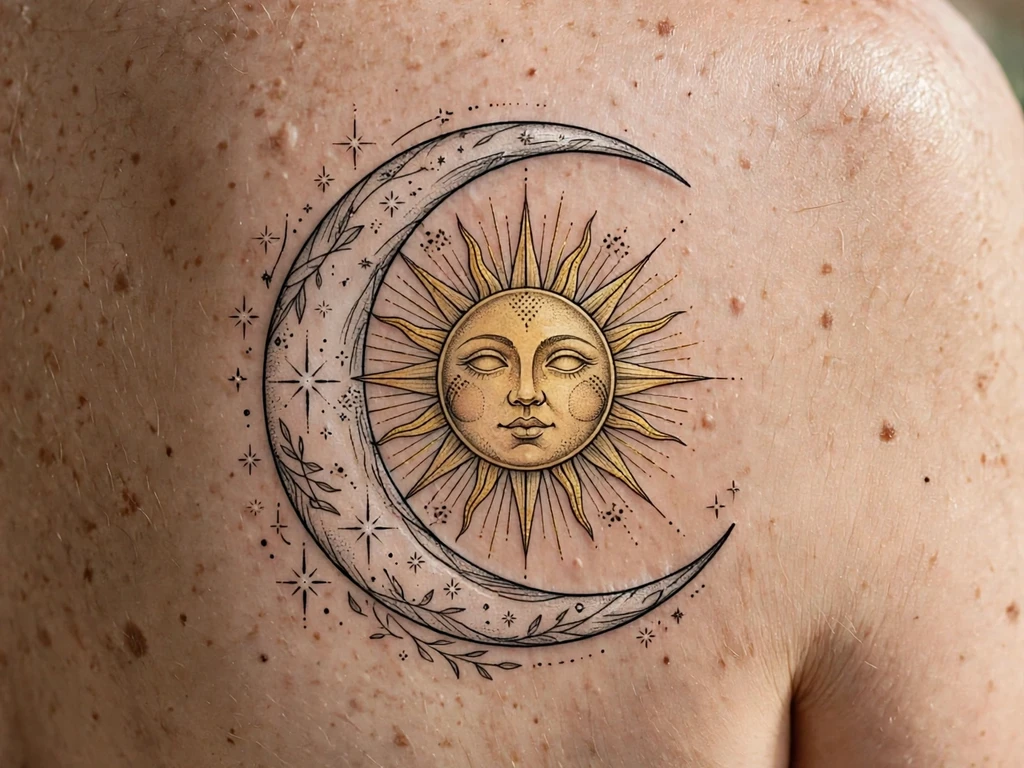
Day and night. Fire and tide. The loud, bright half of you and the quiet one that only comes out after dark. Sun and moon tattoos endure because almost everyone recognises themselves in that pairing — two opposite forces that do not fight, but complete each other. It is one of the oldest image pairings in art, and on skin it can be anything from a two-centimetre whisper on an ankle to a full celestial story across your back.
If you are drawn to delicate celestial linework, the designs here pair beautifully with the precision of fine line tattoo ideas — but this pairing also holds its own in bold blackwork, soft watercolour and vintage tarot styles. Below you will find 27 sun and moon tattoo ideas, the meaning behind the pairing, honest notes on placement and size, and what to think about before you book.
What Do Sun and Moon Tattoos Mean?
Few symbols carry as much shared meaning across cultures as the sun and the moon — yet the pairing still leaves room for a story that is entirely your own. Understanding the traditional symbolism helps you choose (or brief your artist on) a design that says what you actually mean.
The sun is the giver of light and life in nearly every tradition: vitality, strength, courage, truth and new beginnings. It is the self you show the world — energy, clarity and the confidence to begin again each morning.
The moon rules the night, the tides and the body’s rhythms. It stands for intuition, emotion, dreams, femininity and the beauty of cycles — the understanding that everything waxes and wanes, and that rest is part of growth, not a pause in it.
Together, the sun and moon are about balance: light and shadow, logic and feeling, the public self and the private one. Many people choose the pairing to mark a partnership of opposites — two people who differ but fit — or an inner truce: accepting both halves of themselves. Others simply love the celestial aesthetic, which is a perfectly good reason too.
| Symbol | Traditional associations | Often chosen to represent |
|---|---|---|
| Sun | Vitality, strength, truth, clarity, rebirth | Confidence, a fresh start, a father or protective figure |
| Moon | Intuition, cycles, dreams, femininity, calm | Inner life, a mother or guiding figure, change and renewal |
| Sun + Moon together | Balance, harmony, unity of opposites | Partnership, wholeness, light found within darkness |
Style notes before you browse:
- Faces or no faces? Giving the sun and moon human faces (the classic “anthropomorphic” look from old alchemy and tarot art) adds warmth and story; keeping them abstract reads more modern and minimal.
- Colour is optional. Most sun and moon tattoos are black and grey, but a gold-toned sun against a blue-grey moon is a classic pairing if you want gentle colour.
- The pair scales beautifully. This is one of the few motifs that works at 2 cm and at full-back size without losing its meaning — the designs below are ordered roughly from classic to bold so you can find your scale.
Sun and Moon Tattoo Ideas at a Glance
| # | Design | Style notes | Best placement |
|---|---|---|---|
| 1 | Classic Crescent Moon with Sun Face | Vintage faces, fine lines | Upper arm |
| 2 | Celestial Pair on the Shoulder Blade | Sun above, moon below, stars | Shoulder blade |
| 3 | Fine-Line Sun and Moon Wrist Duo | Tiny minimal pair | Wrist |
| 4 | Sun and Moon with Stars Forearm Piece | Flowing celestial scene | Forearm |
| 5 | Smiling Sun and Sleeping Moon Faces | Cheek-to-cheek, whimsical | Upper arm / calf |
| 6 | Sun Rising Over Moonlit Waves | Seascape, sun + crescent over water | Thigh |
| 7 | Matching Sun and Moon Pair for Two People | Split design, one per person | Wrists / ankles |
| 8 | Sternum Celestial Centrepiece | Mirrored sun-moon underbust | Sternum |
| 9 | Spine Sun and Moon Phase Column | Phases flowing down the back | Spine |
| 10 | Ankle Mini Sun and Moon Pair | One motif per ankle | Ankles |
| 11 | Sun and Moon Mandala | Circular mandala detail | Upper back |
| 12 | Watercolour Celestial Splash | Soft colour wash, no hard outline | Shoulder |
| 13 | Bold Blackwork Sun and Moon | Solid black, high contrast | Forearm / calf |
| 14 | Moon Phases with a Central Sun | Phase arc crowned by the sun | Chest / collarbone |
| 15 | Tarot-Style Sun and Moon | Vintage card artwork homage | Forearm |
| 16 | Dotwork Celestial Orbit | Stippled orbit rings | Upper arm |
| 17 | Sun and Moon Kissing Faces Medallion | Circular romantic emblem | Chest / upper arm |
| 18 | Minimalist Single-Line Sun and Moon | One continuous line | Inner forearm |
| 19 | Calf Crescent and Sun | Curved side piece | Calf |
| 20 | Sun and Moon Balance (Yin-Yang Inspired) | Interlocking halves | Forearm / back |
| 21 | Bohemian Sun and Moon with Flowers | Florals woven through rays | Hip / thigh |
| 22 | Tiny Behind-the-Ear Sun and Moon | Micro pair, one each side | Behind ears |
| 23 | Geometric Sun and Moon | Clean geometry, line symmetry | Forearm / upper back |
| 24 | Sun, Moon and Constellation Stars | Personal star-sign sky | Upper arm |
| 25 | Vintage Etching Sun and Moon | Antique engraving style | Upper arm / thigh |
| 26 | Collarbone Celestial Chain | Small sun centred, moons along bones | Collarbones |
| 27 | Full Back Celestial Story Piece | Large narrative scene | Full back |
27 Sun and Moon Tattoo Ideas
1. Classic Crescent Moon with Sun Face
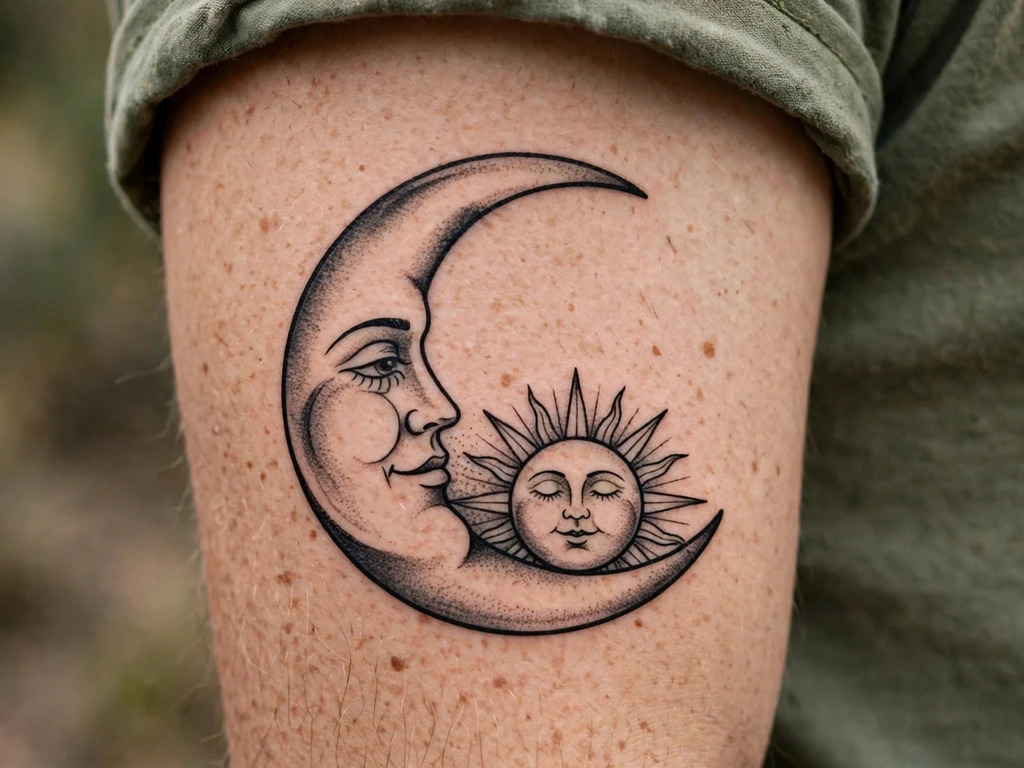
The design most people picture first: a serene crescent moon curving around a round sun, both with gentle, old-fashioned faces borrowed from antique prints. It is warm, storybook-like and instantly readable, which is why it has outlived every tattoo trend cycle of the last century. Fine lines and soft grey shading keep it timeless rather than cartoonish.
Best placement: Upper arm or shoulder, where the round composition sits naturally.
Best for / know before you book: The faces live or die on expression — ask to see your artist’s healed face work, and approve the stencil’s expressions closely; a millimetre changes the mood.
2. Celestial Pair on the Shoulder Blade
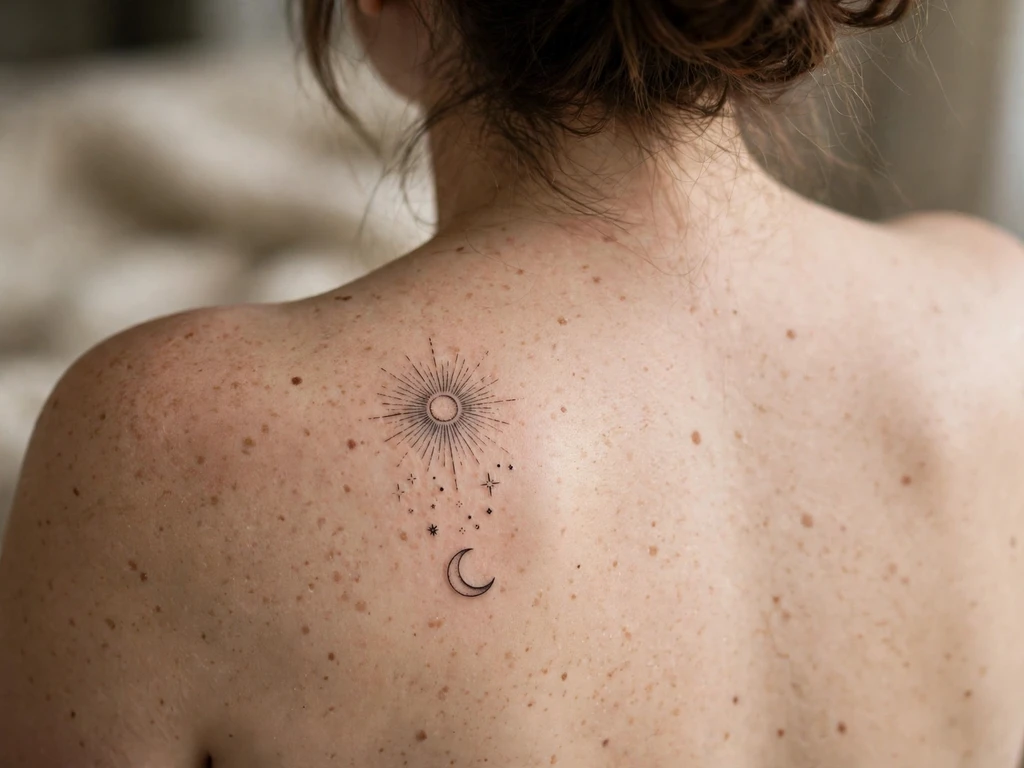
Here the two symbols stack vertically: a small radiant sun near the shoulder, a crescent moon below it, and a scatter of tiny stars filling the space between like a private piece of sky. The shoulder blade’s flat canvas suits the arrangement, and the design reveals itself in strappy tops while staying covered at work. It is a lovely choice for a first medium-sized piece.
Best placement: One shoulder blade, sun high and moon low.
Best for / know before you book: Decide the star scatter with your artist on the stencil, not freehand on the day — placement of the small elements is what makes it look designed rather than sprinkled.
3. Fine-Line Sun and Moon Wrist Duo
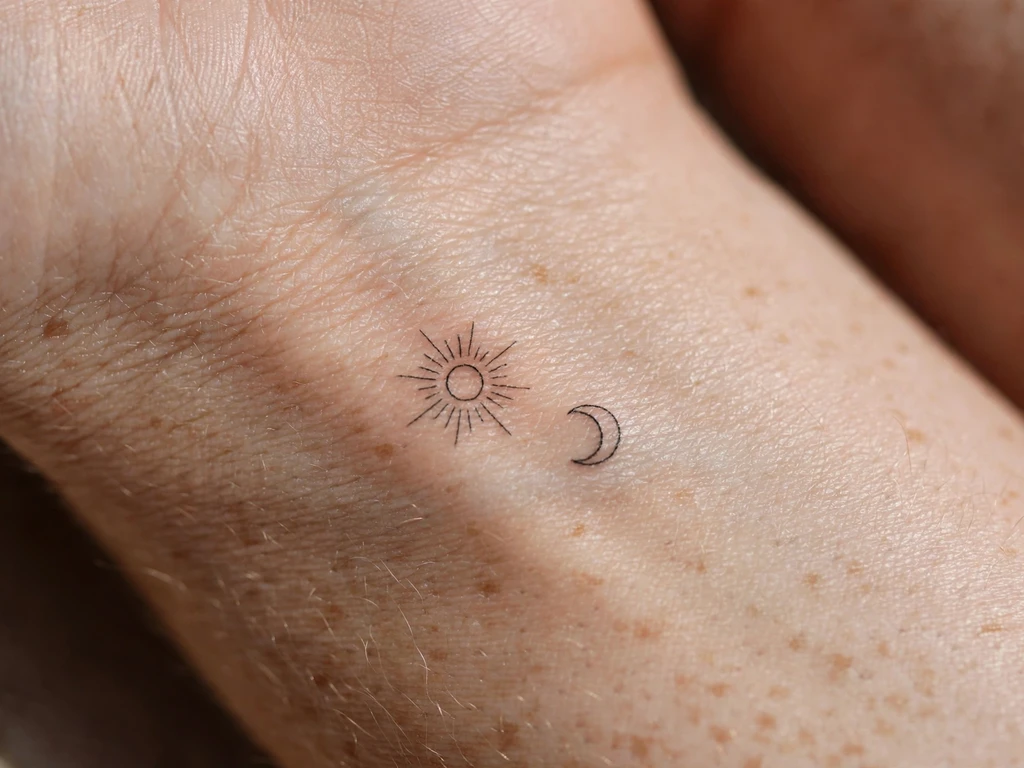
A palm-small pairing: a mini sun with short rays beside a slim crescent, drawn in hair-fine lines on the inner wrist. It is the definition of a quiet tattoo — visible to you all day, easy to cover with a watch or bracelet when you want. Many people explore wrist tattoo ideas before settling on something this small, because at this scale simplicity is everything.
Best placement: Inner wrist, centred or slightly towards the thumb side.
Best for / know before you book: Keep it at least 3–4 cm across in total. Wrist skin moves and sheds quickly, so ultra-micro versions blur; slightly bolder mini lines are the smarter kind of delicate.
4. Sun and Moon with Stars Forearm Piece
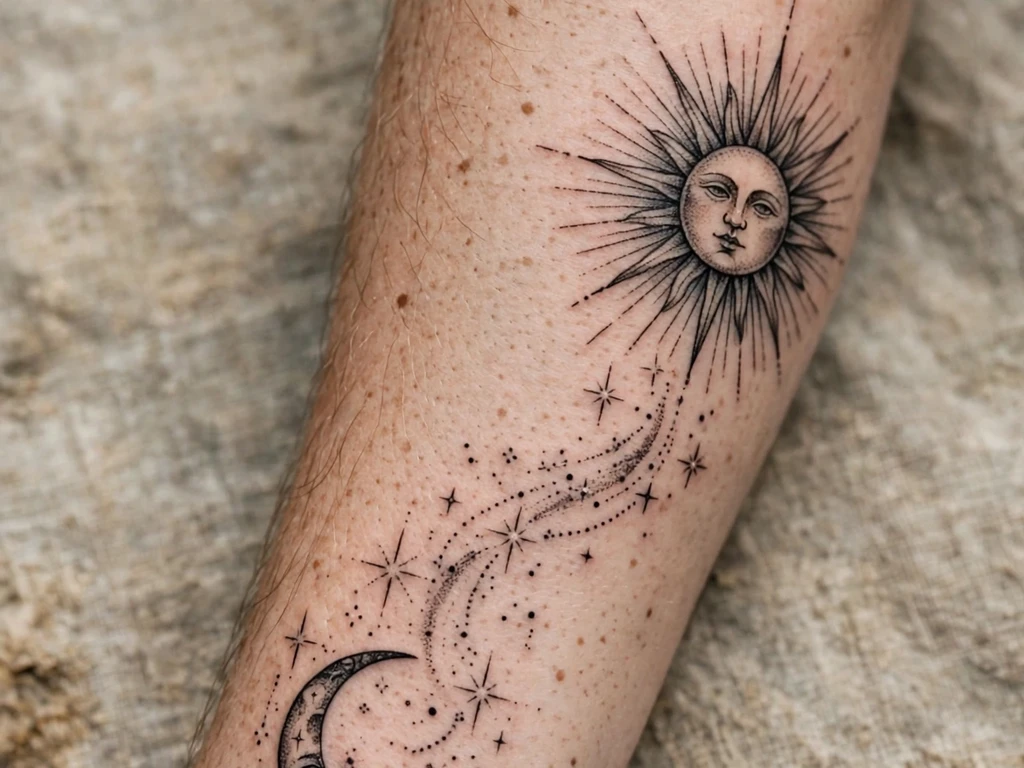
The forearm gives the pairing room to become a scene: a crescent moon at the wrist end, the sun towards the elbow, and stars, dots and tiny sparkles flowing between them like a river of sky. It wraps gently with the arm’s shape and pairs well with other celestial pieces if you later build a half sleeve. Black and grey with one or two gold-ink accents (done in regular ink tones) looks especially rich.
Best placement: Inner or outer forearm, running wrist to elbow.
Best for / know before you book: Long compositions should be stencilled with your arm in its natural hanging position — forearms twist, and a design that looks straight palm-down can corkscrew palm-up.
5. Smiling Sun and Sleeping Moon Faces
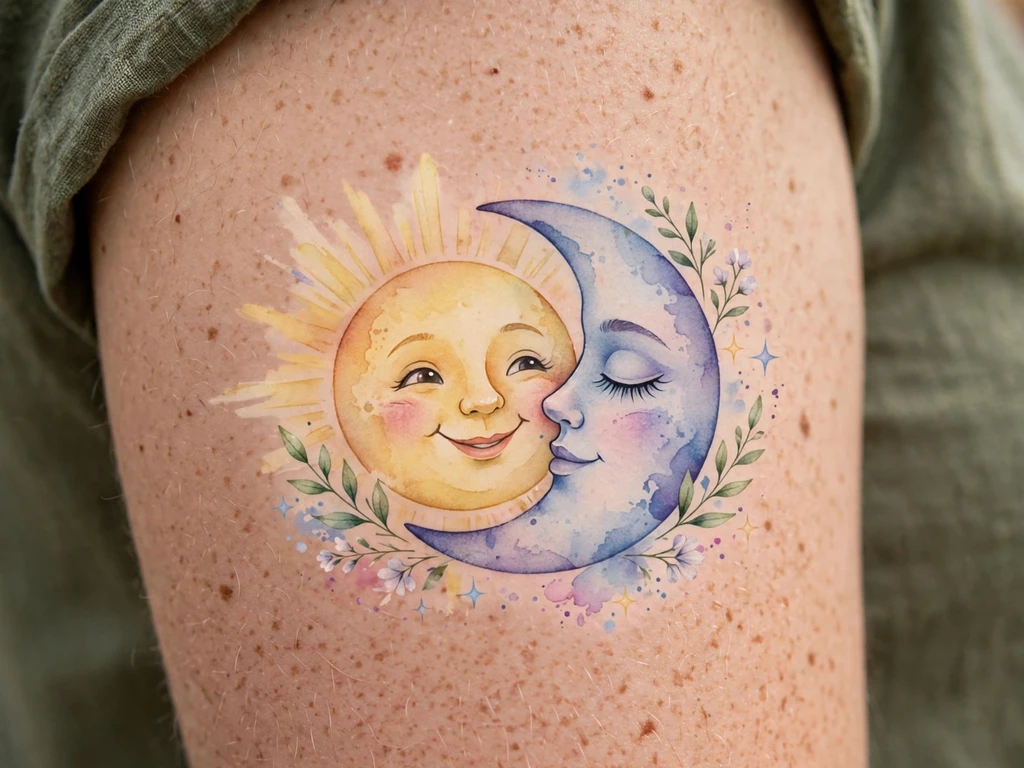
Pure charm: a round, beaming sun pressed cheek-to-cheek against a drowsy crescent moon with closed eyes and long lashes. The contrast in expressions tells the whole day-night story in one glance, and the design suits a softer, illustrative style with light colour or gentle grey wash. It is a favourite for marking the bond between an early bird and a night owl.
Best placement: Upper arm, calf or the front of the thigh.
Best for / know before you book: Whimsical styles need confident, even linework to stay cute rather than messy. If you want colour, ask how the specific inks age on your skin tone before committing.
6. Sun Rising Over Moonlit Waves
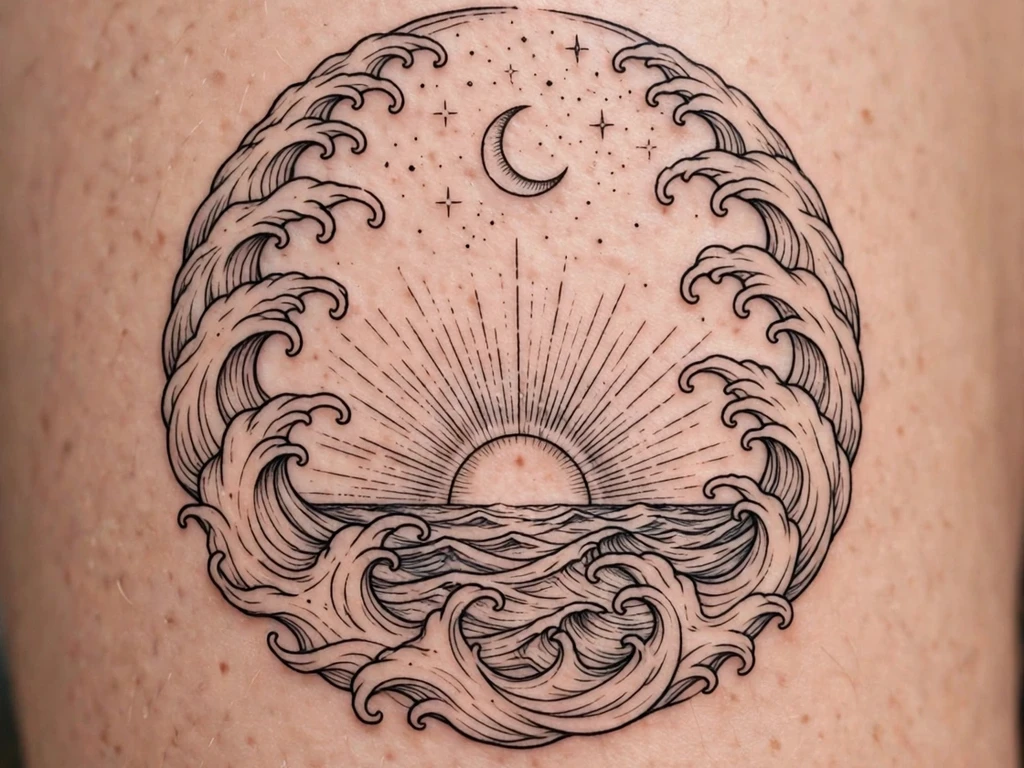
A small seascape in a circle or free-form frame: curling waves at the base, a rising sun on the horizon, and a crescent moon still hanging in the upper sky — the moment where night hands over to day. It suits ocean lovers and anyone whose balance story is about tides and timing. The wave curves give the design movement that flat symbols cannot.
Best placement: Front thigh, upper arm or calf — anywhere with room for the scene.
Best for / know before you book: Wave linework packs a lot of curves into a small area. Give the composition at least 10 cm so the water stays readable as the tattoo settles with age.
7. Matching Sun and Moon Pair for Two People
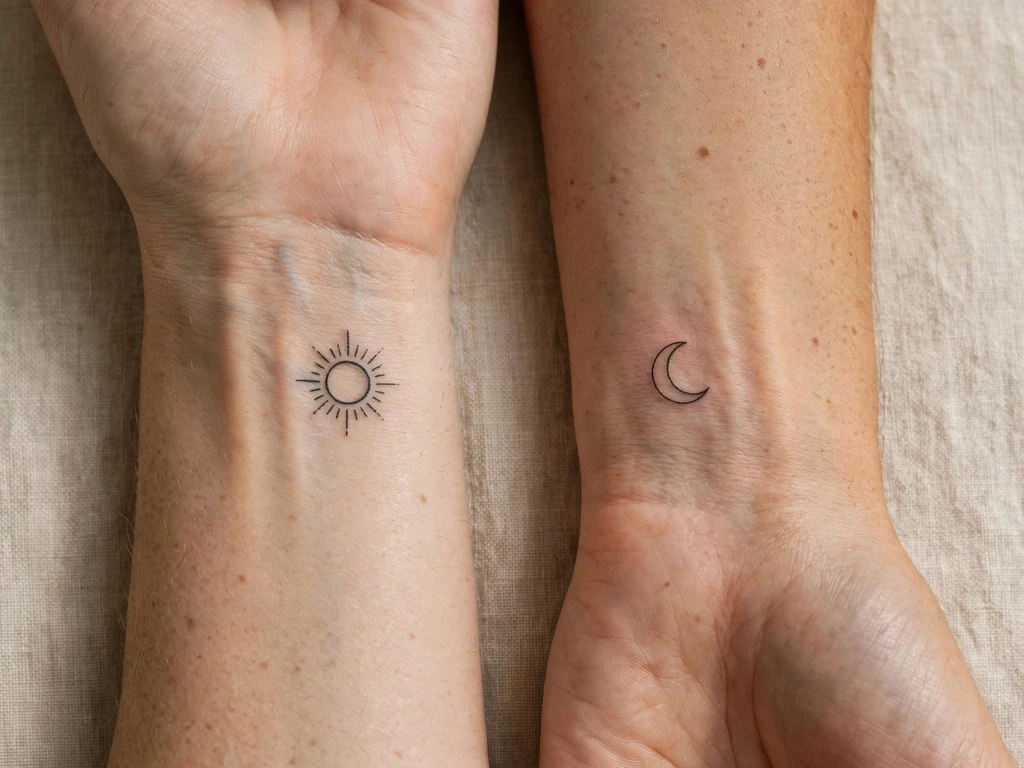
One person wears the sun; the other wears the moon. Together the pair is complete — a quiet, grown-up alternative to matching identical tattoos, and perfect for couples, siblings or best friends who are opposites in the best way. Each half is designed to look good alone, then click into a pair when you stand side by side or hold hands for the photo.
Best placement: Matching spots on both people — inner wrists and ankles are classics.
Best for / know before you book: Book the same artist for both pieces, ideally back-to-back in one visit, so line weight and style match exactly. Agree sizes beforehand; the pair only reads as a pair if the scale matches.
8. Sternum Celestial Centrepiece
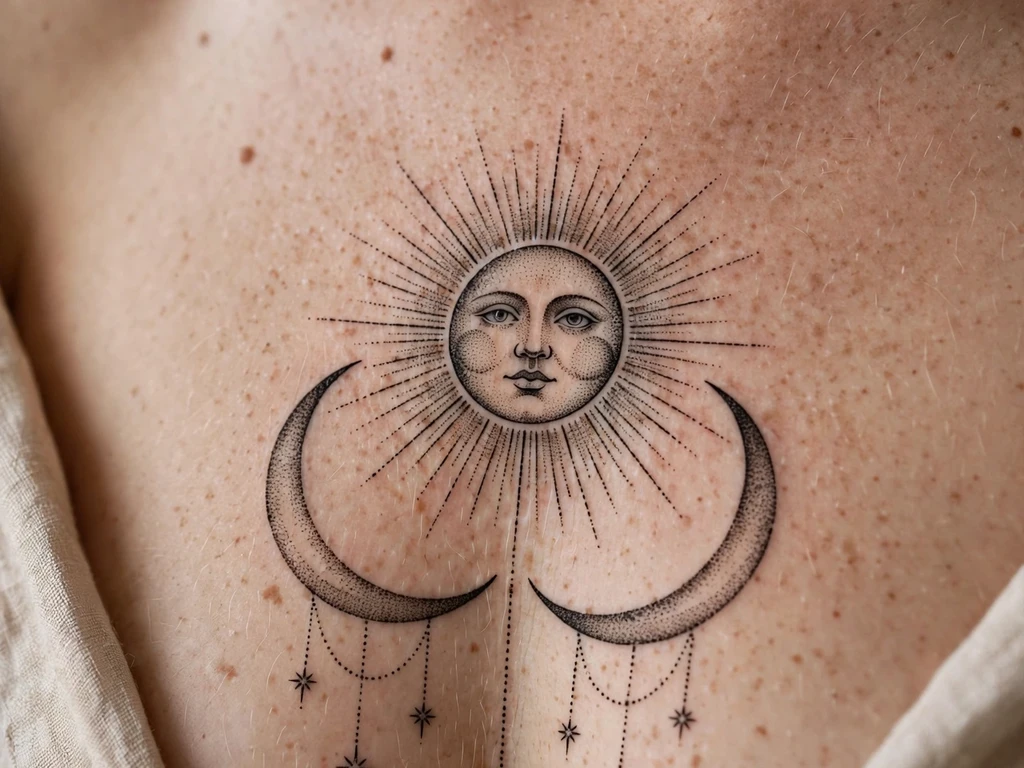
The sternum is natural home turf for this pairing: a central sun sits between the chest while two crescents curve outwards beneath, sometimes with tiny dangling stars like jewellery. It is symmetrical, feminine and striking in swimwear or low necklines, yet completely hidden under most clothing. Dotwork shading gives it a soft, ornamental glow without heavy black.
Best placement: Centre sternum, crescents following the natural curve beneath the chest.
Best for / know before you book: Symmetry is unforgiving here — your artist should stencil you standing upright and check both sides in a mirror. Sternum skin is tender and the area moves with breathing, so expect a slower session.
9. Spine Sun and Moon Phase Column
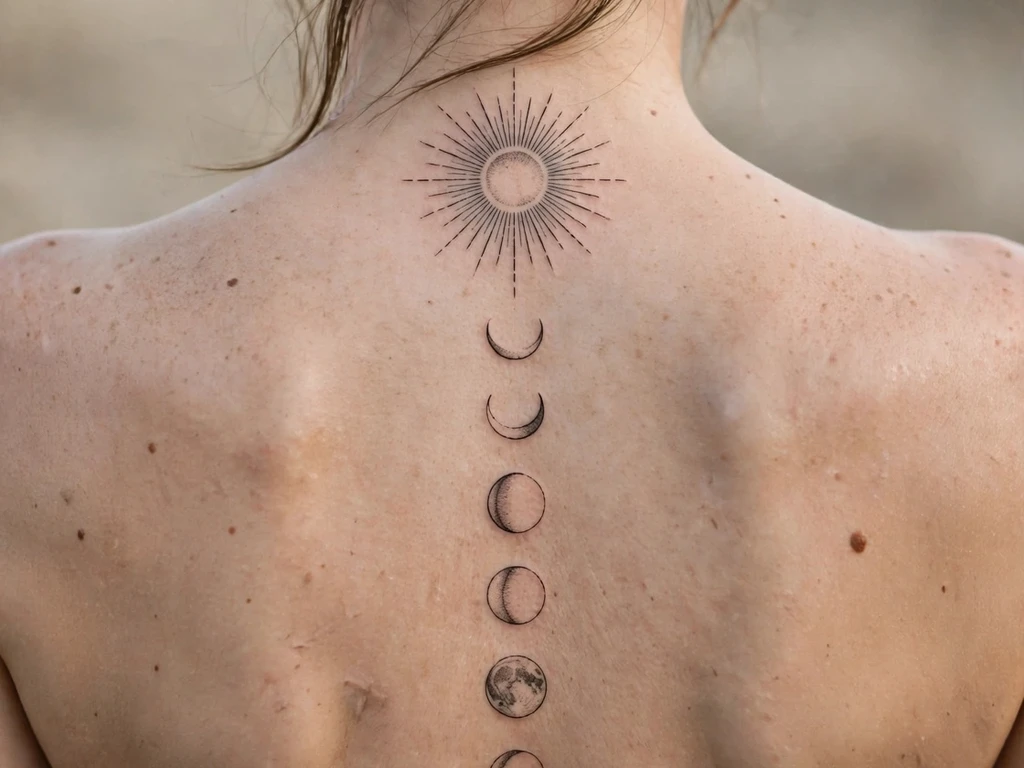
A vertical journey down the back: a radiant sun at the top, then the moon cycling through its phases — crescent, half, full, and back to crescent — as the design travels the spine. It turns the body’s centre line into a calendar of light, and it is one of the most requested layouts in spine tattoo ideas generally, because the column shape flatters the back so well. Keep each phase simple so the rhythm reads from a distance.
Best placement: Centre spine, from the nape to the lower back.
Best for / know before you book: Even spacing is the whole design. Have the stencil checked while you stand, sit and bend — the distances between phases change as your back moves, and your artist should plan for that.
10. Ankle Mini Sun and Moon Pair
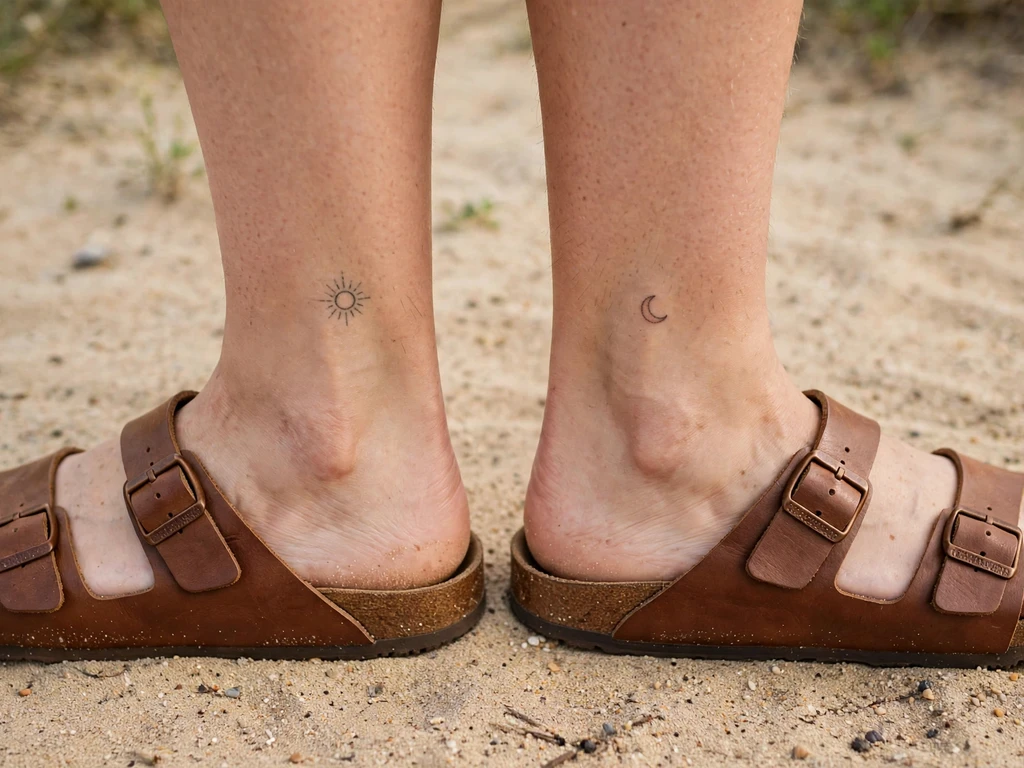
One ankle gets a tiny sun, the other a tiny moon — your own two feet carrying day and night. It is playful, balanced by design, and subtle enough for almost any workplace. The pair photographs beautifully with sandals and bare feet, and each mini motif is quick to tattoo, so both can be done in one short appointment.
Best placement: Just above the ankle bone, same position on each leg.
Best for / know before you book: Ankle skin is thin and footwear rubs it constantly during healing. Book in open-shoe season and keep both motifs bold enough (around 2–3 cm) to survive the friction.
11. Sun and Moon Mandala
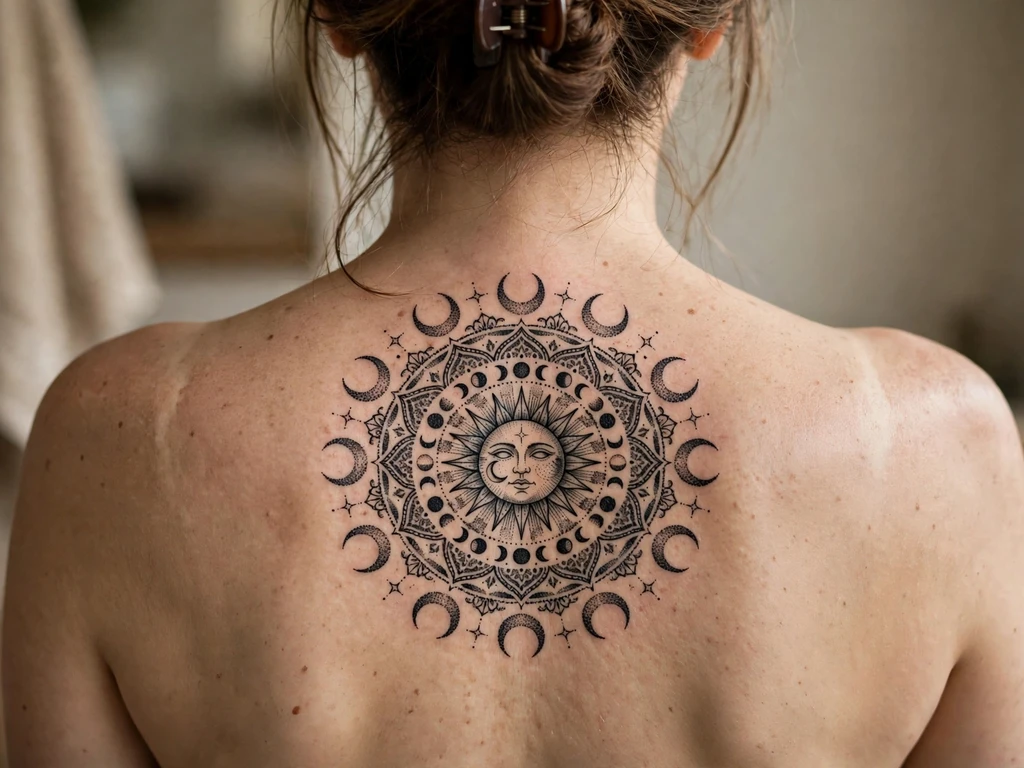
Mandala geometry meets celestial symbolism: a circular design where a central sun radiates patterned petals that resolve into crescent moons around the rim. The repetition is meditative to look at and deeply satisfying for anyone drawn to sacred geometry. Dotwork shading adds depth without a single solid fill, keeping even a large piece feeling light.
Best placement: Centre of the upper back, or the centre chest for a smaller version.
Best for / know before you book: Mandalas expose every wobble — this is specialist work. Choose an artist whose portfolio shows healed mandalas, and expect the stencil transfer alone to take a while; precision cannot be rushed.
12. Watercolour Celestial Splash
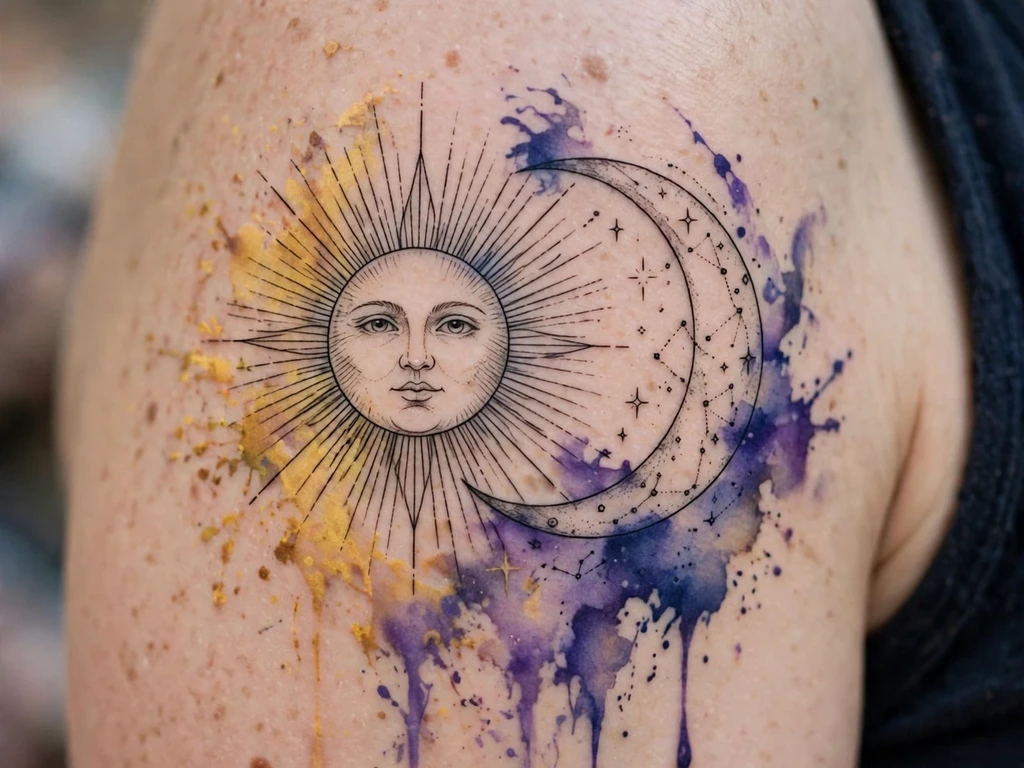
For colour lovers: a fine-line sun and moon set against loose washes of indigo, violet and gold that bleed softly beyond the lines, like aquarelle paint on wet paper. The contrast between crisp celestial outlines and dreamy colour gives it a modern, artistic feel very different from traditional celestial tattoos. It is especially popular on shoulders, where the splash can spread organically.
Best placement: Shoulder and shoulder cap, or the upper arm.
Best for / know before you book: Watercolour ages differently from blackwork — pigments soften and spread slightly over the years, and pastel tones fade fastest in the sun. Ask your artist honestly about a 5-year refresh plan before you fall for the fresh photos.
13. Bold Blackwork Sun and Moon
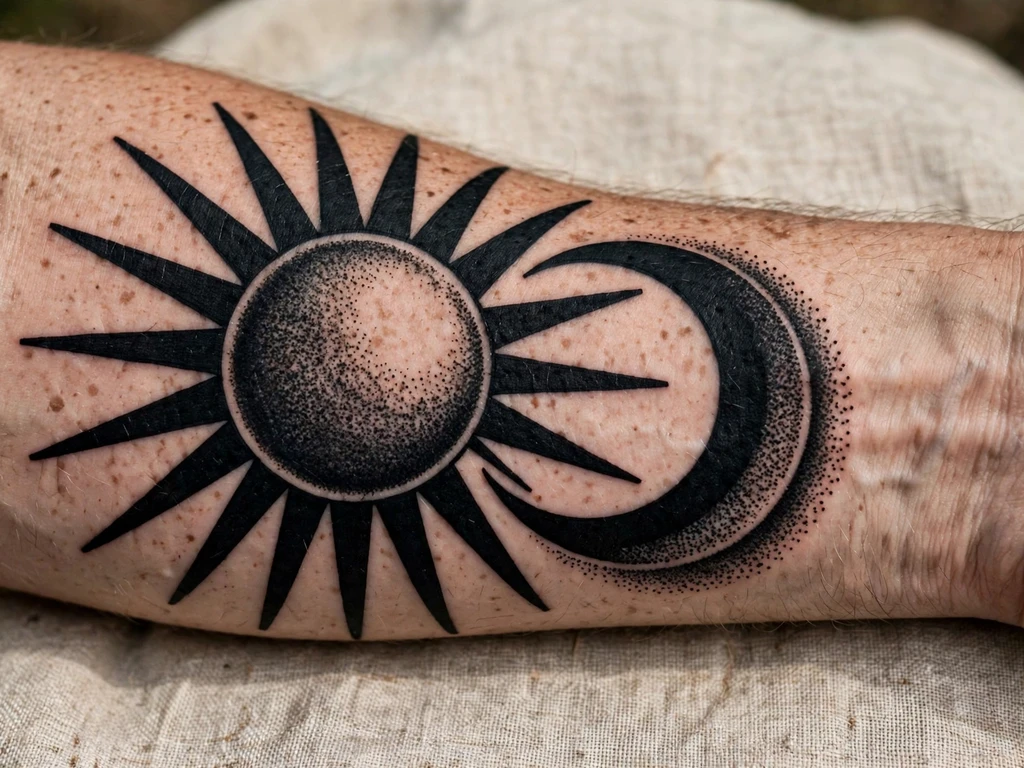
The opposite of delicate: a solid black crescent moon against a sun rendered in thick rays and heavy dotwork shading. Blackwork’s high contrast makes the pairing graphic and powerful, readable from across the room, and it ages exceptionally well because there is no hairline detail to lose. It suits people who want the symbolism with a harder, more tribal energy.
Best placement: Forearm, calf or upper arm — flat areas that show off the contrast.
Best for / know before you book: Solid black fill is a commitment and the slowest-healing style here; large filled areas can scab heavily, so follow aftercare strictly and do not pick. Check your artist’s healed blackwork for patchiness before booking.
14. Moon Phases with a Central Sun
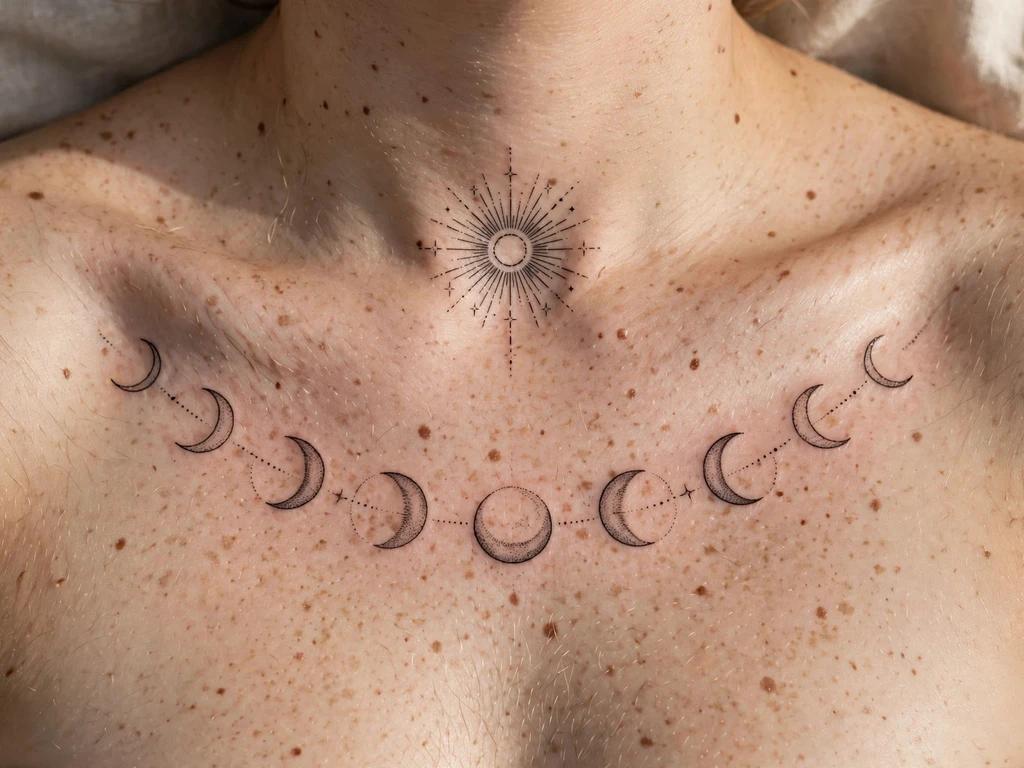
An arc of moon phases — crescent, half, full, half, crescent — curving like a crown, with a small radiant sun at the centre or directly above the full moon. It celebrates cycles and return: the moon changes, the sun remains. The curved layout is made for the chest, collarbone line or the back of the shoulders, following the body’s own arc.
Best placement: Across the upper chest below the collarbones, or mirrored along the spine’s top.
Best for / know before you book: The phases must be in the correct astronomical order and evenly sized — bring a reference diagram to your consultation rather than assuming, as reversed phases are a common and permanent little error.
15. Tarot-Style Sun and Moon
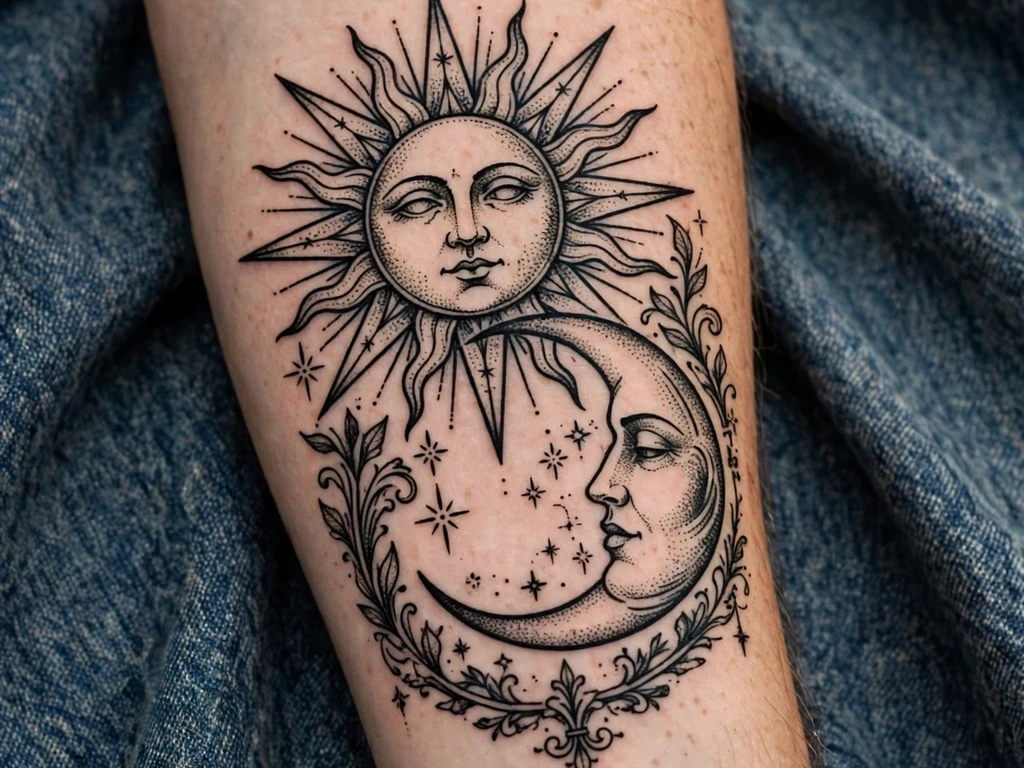
A homage to the two great tarot cards: The Sun and The Moon, drawn in vintage card-art style — a radiant faced sun, a crescent with a profile, and decorative rays, stars or a banner beneath. Fans of tarot love the layered meaning: The Sun for joy and clarity, The Moon for mystery and intuition. The rectangular card framing (or a free-form version of it) gives the design a collectable, antique feel.
Best placement: Forearm or upper arm, where the card-shaped composition fits.
Best for / know before you book: Vintage styles rely on fine detail and lettering-like elements — size it generously (12 cm or more in height) so the artwork does not crowd as it ages, and skip tiny banner text unless you accept it may soften.
16. Dotwork Celestial Orbit
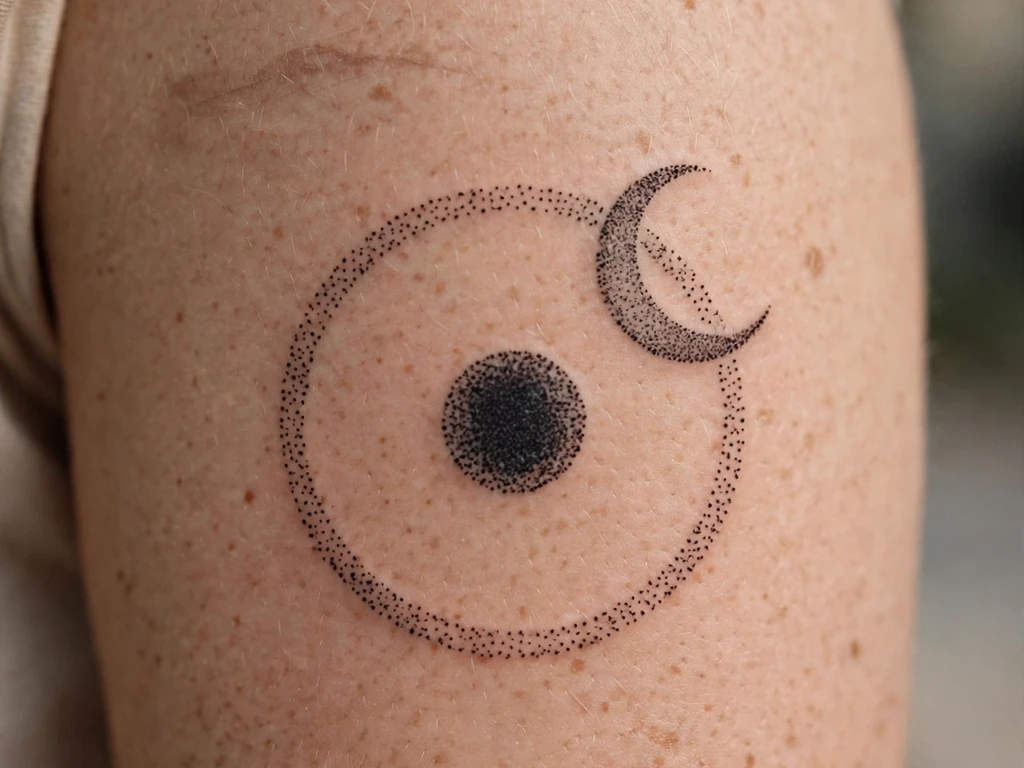
Built entirely from thousands of tiny dots: a small solid sun at the centre, and a crescent moon travelling a stippled orbit ring around it, with the dots thinning out into space. Dotwork gives celestial designs a soft, almost glowing texture that flat linework cannot, and it heals into a gentle gradient rather than hard edges. It is a thinking person’s statement piece — quiet from far away, astonishing up close.
Best placement: Upper arm or shoulder blade, where the circular orbit sits whole.
Best for / know before you book: Dotwork is slow — the same area takes longer than linework, and sessions are priced accordingly. Judge artists on healed dotwork specifically; fresh stippling always looks tighter than it settles.
17. Sun and Moon Kissing Faces Medallion
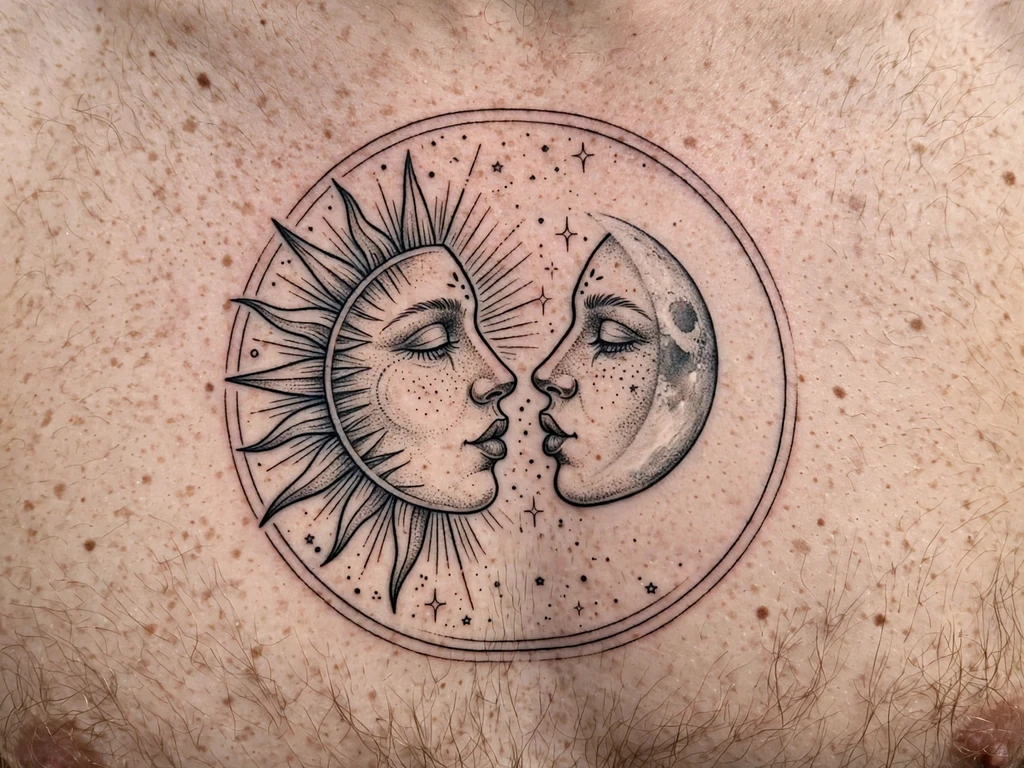
A circular medallion framing the oldest love story in the sky: the sun and moon leaning in, faces in profile, a breath away from a kiss. It is unapologetically romantic and often chosen for anniversaries, weddings or a love that bridges distance and different schedules. A thin double-ring border and a few tiny stars finish the emblem like a coin from a mythical kingdom.
Best placement: Centre chest, upper arm or between the shoulder blades.
Best for / know before you book: Profile faces are technically demanding — the noses and lips carry the whole emotion. Bring several reference expressions to the consultation and choose your artist for their face work above all.
18. Minimalist Single-Line Sun and Moon
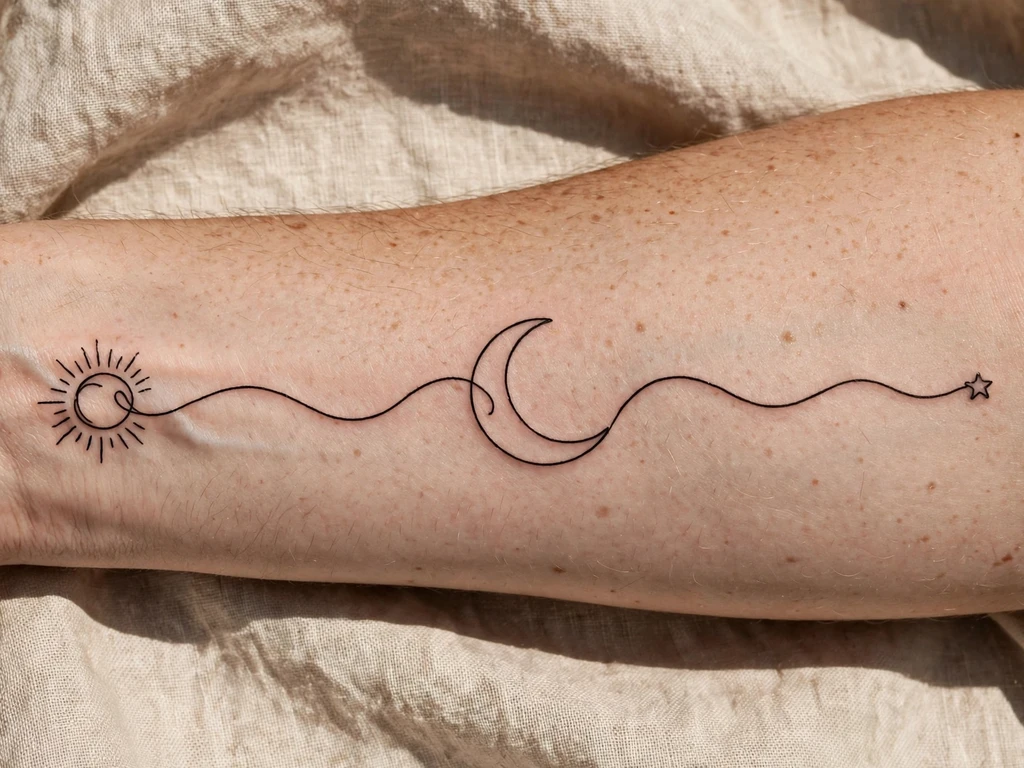
One unbroken line draws a sun, dips into a crescent moon, and ends in a tiny star — nothing lifted, nothing wasted. This is the pairing reduced to its essence, and it suits people who love the meaning but not the ornament. If you lean towards sharp, abstract linework in general, the same spirit runs through cybersigilism tattoo ideas, where fine lines carry the whole design.
Best placement: Inner forearm, collarbone or the side of the ribcage.
Best for / know before you book: A single flowing line exposes every tremor, so this tiny tattoo still needs an experienced fine-line hand. Keep it at least 6–7 cm long so the curves do not close up as the line settles over time.
19. Calf Crescent and Sun
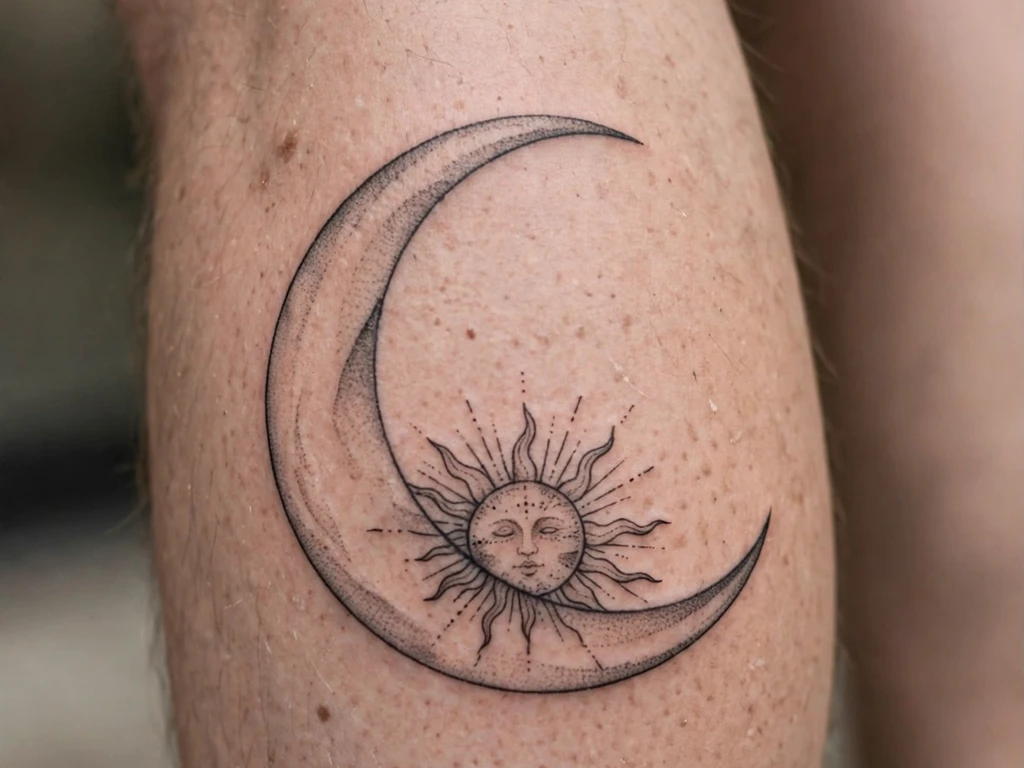
A large crescent sweeps along the outer calf with a small detailed sun resting in its curve, the whole design bending with the leg’s natural shape. Calf pieces are easy-going by default — revealed in shorts and cropped trousers, hidden under long ones the rest of the time — which suits a tattoo whose meaning is personal. Fine lines with soft grey shading keep the large shape elegant rather than heavy.
Best placement: Outer calf, crescent following the curve from below the knee towards the ankle.
Best for / know before you book: The calf is one of the kinder large canvases, though the muscle flexes as you walk, so check the stencil standing and mid-stride — a crescent that looks level at rest can shift as the muscle moves.
20. Sun and Moon Balance (Yin-Yang Inspired)
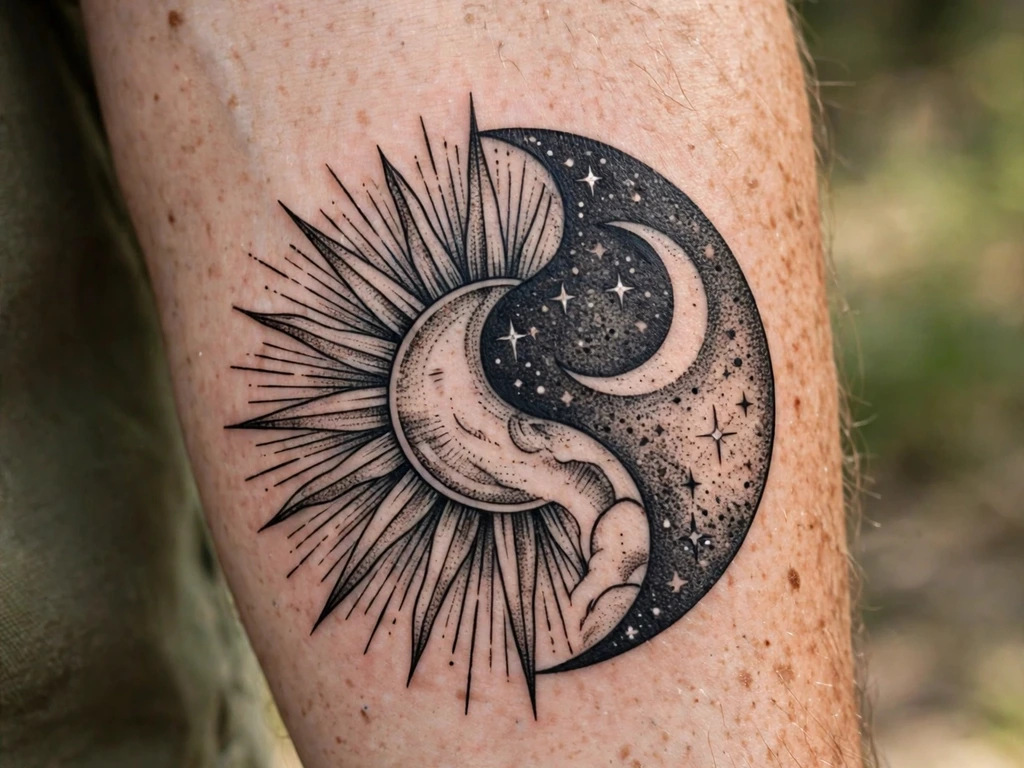
The balance meaning made literal: one circle, two interlocking halves — a radiant sun in one curve, a starry crescent moon in the other, each holding a small dot of the opposite. It borrows the yin-yang structure without copying it, and it is the design people point to when they say the pairing is about wholeness rather than decoration. It works in pure black and grey or with one warm and one cool tone.
Best placement: Forearm, upper back or centre chest — flat, round-friendly spots.
Best for / know before you book: The interlock curve must be drawn precisely or the balance reads as lopsided. Circles are deceptively hard on curved skin; have the stencil checked from several angles before agreeing.
21. Bohemian Sun and Moon with Flowers
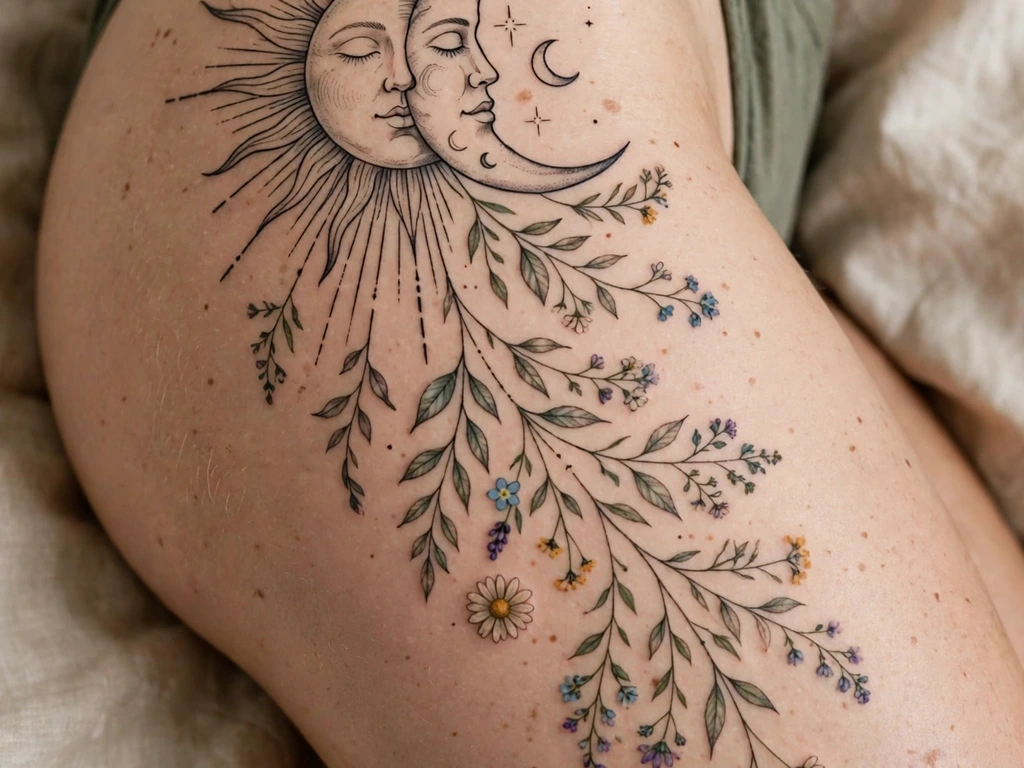
Free-spirited and feminine: a crescent moon and sun whose rays turn into stems, leaves and small wildflowers as they spread. The botanical tangle softens the celestial geometry and lets you weave in birth flowers or favourite blooms for a second layer of meaning. Soft grey shading with muted colour — dusty rose, sage, faded gold — is the classic palette.
Best placement: Hip flowing onto the thigh, or the outer upper arm.
Best for / know before you book: Botanical detail is dense; undersizing is the common mistake. Give the flowers room (12 cm or more in height) so petals stay distinct as the tattoo ages, and accept slightly bolder outlines than the dreamiest references show.
22. Tiny Behind-the-Ear Sun and Moon
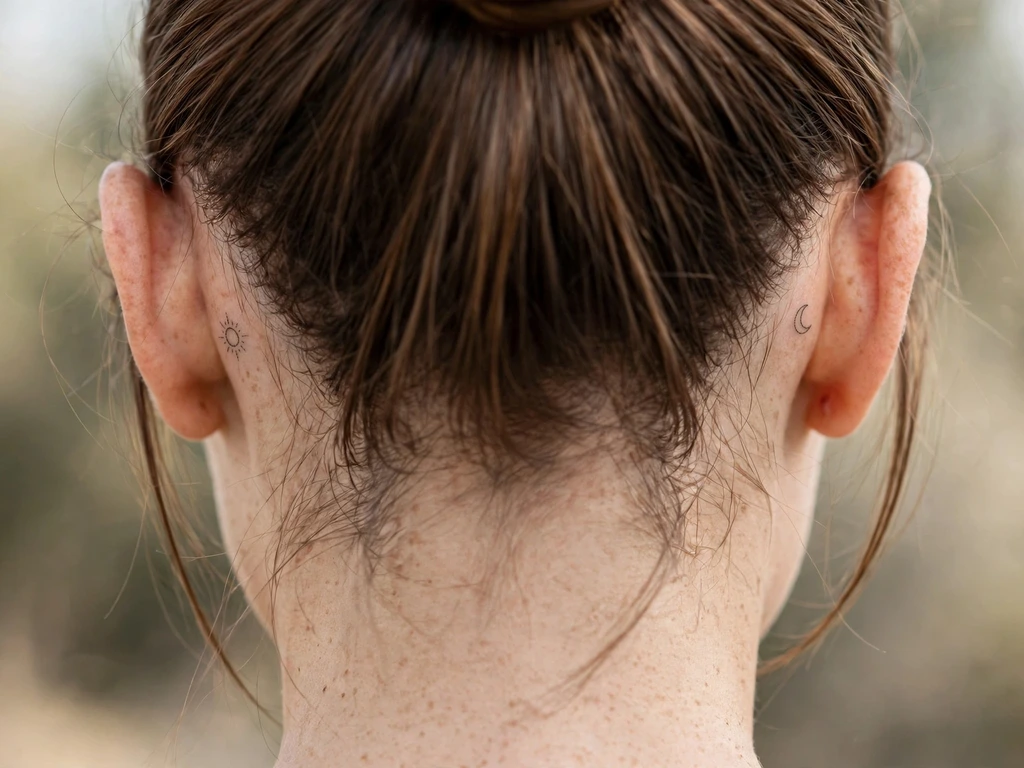
A secret pair: a 1–2 cm sun tucked behind one ear and a matching crescent behind the other, hidden by hair and revealed in an updo. It is one of the smallest ways to wear the pairing, and the symmetry between your own two sides is the entire charm. Because the canvas is tiny, the motifs must be reduced to their simplest readable shapes.
Best placement: Directly behind each ear, at matching height.
Best for / know before you book: Behind-ear skin is thin, curved and close to hair (which traps moisture while healing). Keep designs bold-mini rather than micro-detailed, and expect a touch-up once healed — the area sheds quickly.
23. Geometric Sun and Moon
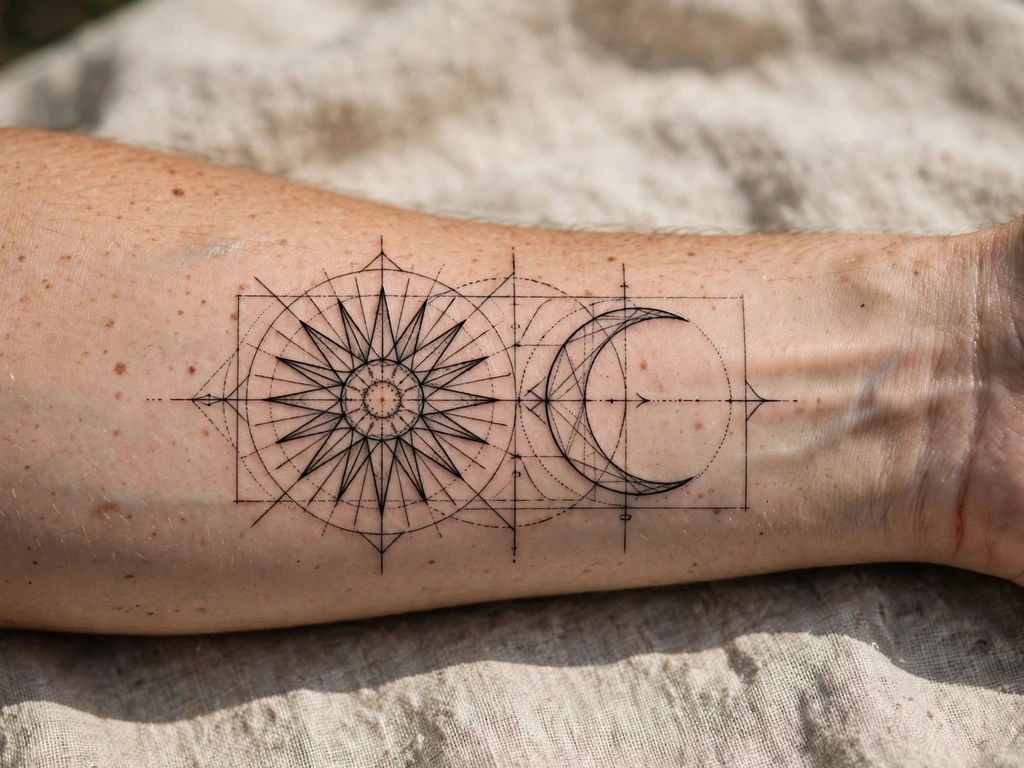
Celestial meets architectural: the sun built from precise triangular rays, the moon a perfect crescent measured like a compass drawing, aligned on shared axes with fine construction lines left visible. It appeals to engineers, designers and anyone who finds calm in precision, and it pairs naturally with other geometric or sacred-geometry pieces. Strictly black, with contrast coming from line weight alone.
Best placement: Forearm, centre upper back or sternum — symmetry-friendly zones.
Best for / know before you book: Geometric work is the least forgiving style in this list: a wonky ray or off-centre circle is visible forever. Choose an artist known for geometric pieces and allow generous stencil time.
24. Sun, Moon and Constellation Stars
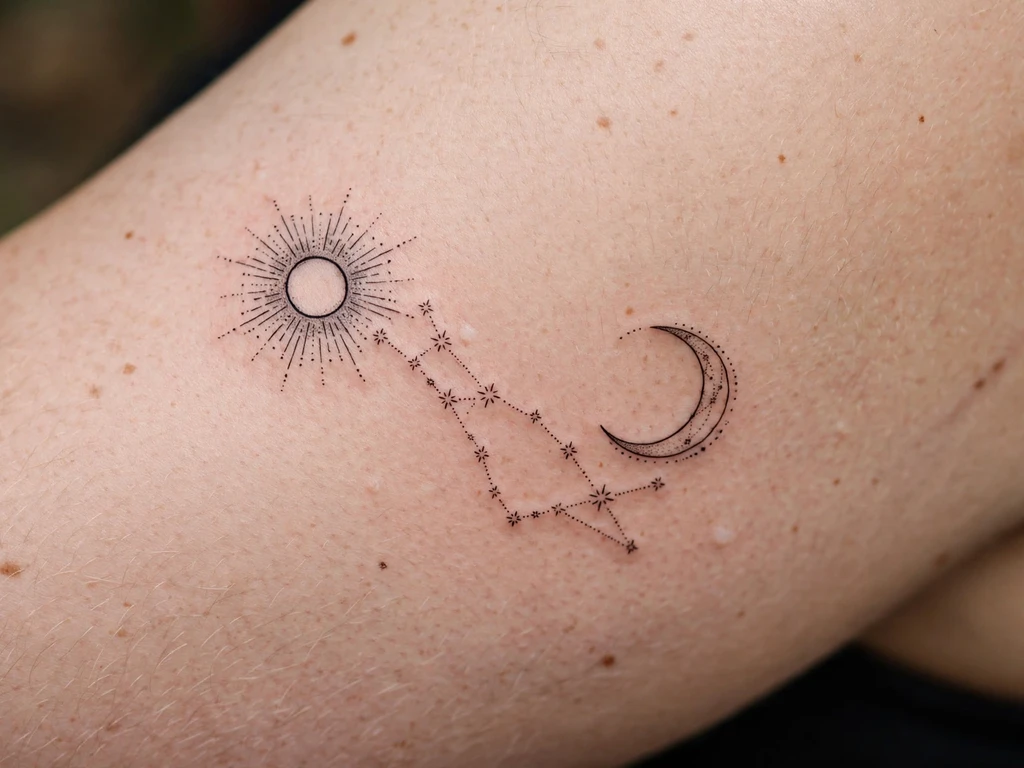
Make the sky yours: a sun and crescent moon joined by the dotted line of your zodiac constellation, or the star pattern from a meaningful date or place. It turns a classic pairing into a personal chart — part symbol, part map of a moment. Delicate dot-to-star connections keep it airy, and it layers gracefully with other small celestial pieces over time.
Best placement: Upper arm, shoulder blade or along the collarbone.
Best for / know before you book: Bring an accurate star chart of your constellation to the consultation; artists should not have to guess star positions, and a wrong constellation is an awkward permanent error. Decide dot sizes in advance — too fine and the chart fades unevenly.
25. Vintage Etching Sun and Moon
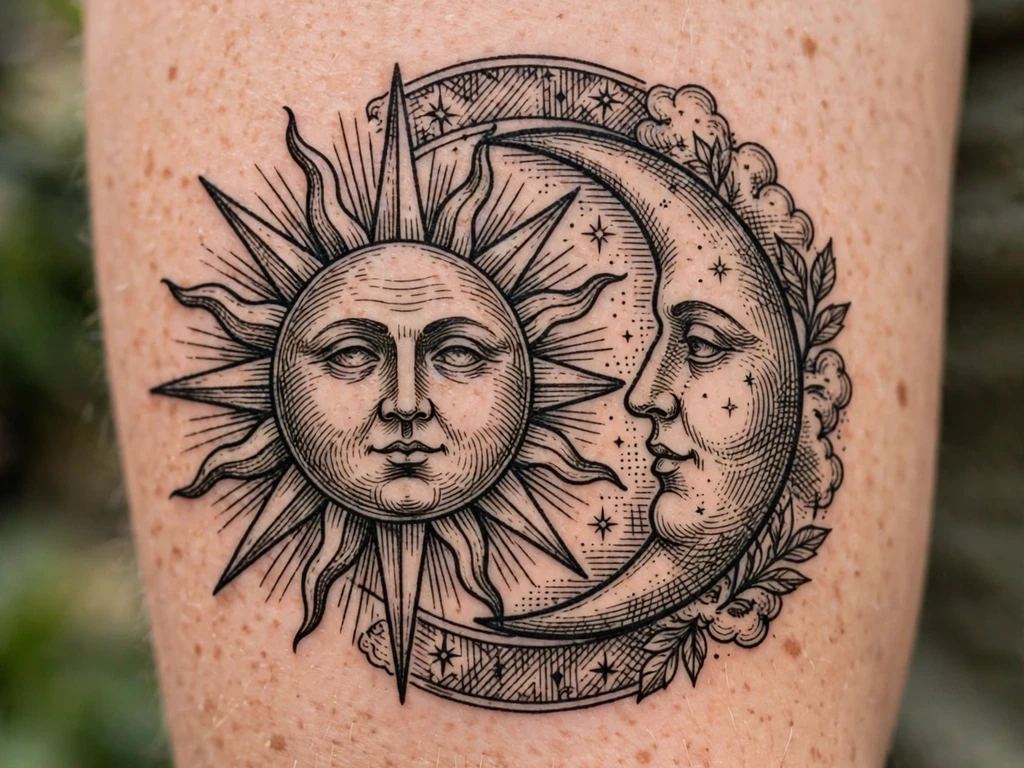
Drawn like an illustration from a 19th-century astronomy book: a faced sun and moon shaded entirely with fine hatching and cross-hatching, no solid fills. The etching technique gives the pairing an antique, scholarly elegance and ages gracefully, because the shading is built from the same lines as the drawing itself. It is a connoisseur’s style — understated, textured and unmistakably handcrafted in feel.
Best placement: Upper arm, thigh or calf — room for the hatching to breathe.
Best for / know before you book: Hatching density controls the darkness, so agree a small test area of shading in the stencil stage. Too-dense cross-hatching can settle into a grey blur; leave the artist white space to work with.
26. Collarbone Celestial Chain
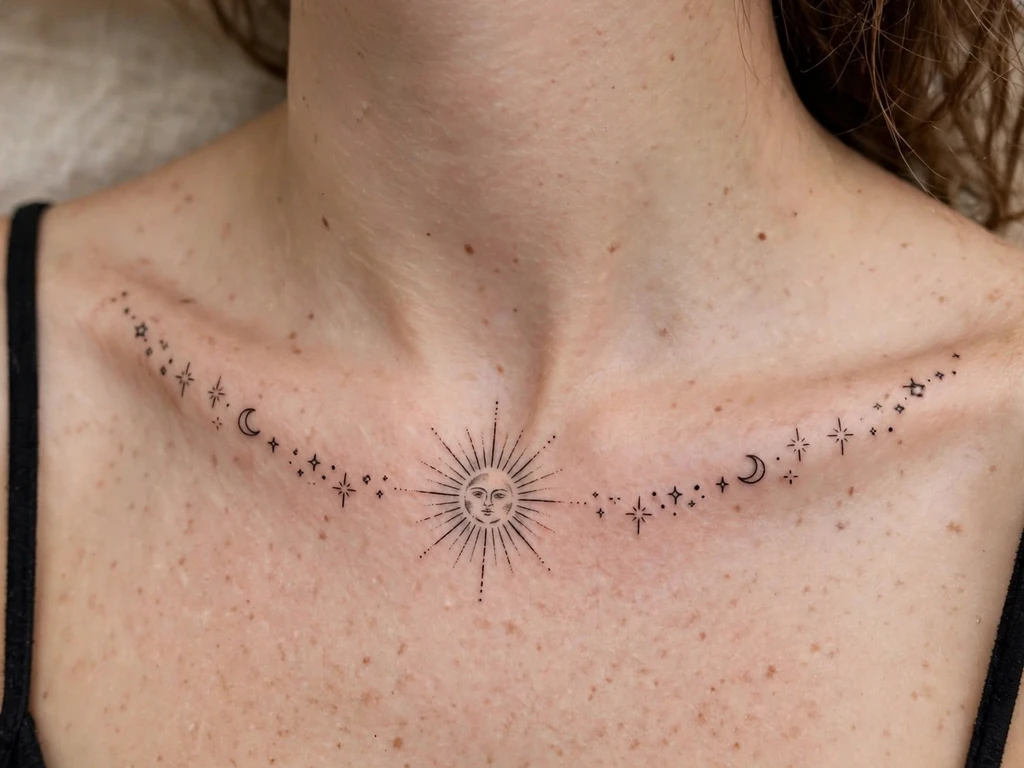
A necklace drawn in ink: a small radiant sun centred just below the throat, with tiny crescents, stars and dots trailing symmetrically along both collarbones like charms on a chain. It frames the neckline beautifully and reads as jewellery that never comes off. The elements are small individually, but the sweep of the composition makes it a real centrepiece.
Best placement: Centre chest below the throat, trailing along both collarbones.
Best for / know before you book: Both sides must mirror — have your artist stencil you standing with shoulders relaxed and photograph it straight-on to check. Collarbone skin is thin and close to bone, so the session is short but can feel sharp.
27. Full Back Celestial Story Piece
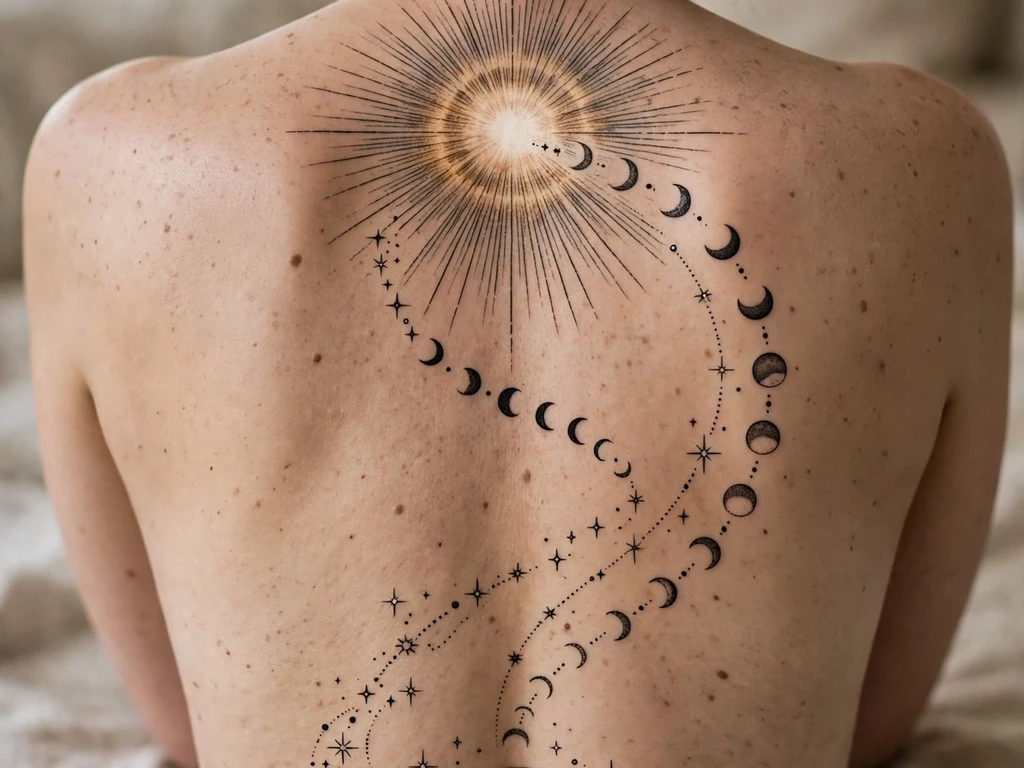
The pairing at full scale: a great radiant sun rising between the shoulder blades, a full moon low on the back, phase arcs, stars, clouds and rays connecting them into one continuous sky. A piece like this is planned, not picked — it is built with your artist over consultations and multiple sessions, and it becomes the centrepiece of a collection rather than an addition to one. Nothing else in this list has its presence.
Best placement: Full back, designed around the spine as its axis.
Best for / know before you book: Treat it as a project: agree the complete composition and session plan before the first line, choose one artist and stay with them, and budget honestly. Large work lives or dies on the initial drawing, so pay for the custom design stage gladly.
Sun and Moon Tattoo Placement by Size
| Size | Typical dimensions | Best placements | Good to know |
|---|---|---|---|
| Tiny | 1–3 cm | Behind ear, finger side, ankle accents | Motifs must be stripped to their simplest shapes to stay readable |
| Small | 3–7 cm | Wrist, ankle pair, collarbone chain, inner forearm | The sweet spot for first celestial tattoos; keep faces simple |
| Medium | 8–15 cm | Forearm, shoulder blade, upper arm, calf, sternum | Room for faces, phases and star details without crowding |
| Large | 16–30 cm | Thigh, ribcage, upper back, chest | Space for scenes — waves, mandalas, tarot artwork |
| Extra large | 30 cm+ / multi-session | Full back | Plan the whole composition and sessions with one artist |
How to Choose Your Sun and Moon Tattoo (and What to Know Before You Book)
Decide what the pairing means to you first. Balance, a relationship, a fresh start, a love of the night sky — your reason quietly decides the design. Partnership meanings suit split and matching layouts; personal-balance meanings suit single compositions where the two halves touch. Spend ten minutes on this before browsing portfolios and your shortlist will shrink to the right few.
Match the style to your tolerance for upkeep. Blackwork and etching styles age the hardest-wearing; fine-line and minimalist pieces may need a touch-up in later years; watercolour softens fastest. None of this should scare you off a style you love — but choose with your eyes open, and read a proper Mayo Clinic guide to tattoo risks and precautions if it is your first tattoo, so the health basics (sterile equipment, ink reactions, aftercare) are clear before you sit down.
Faces deserve a second consultation. If your design has sun and moon faces, the expressions are the tattoo. Good artists will draw two or three expression options. The symbolism of the faced sun and moon has deep roots in Western art — museums such as the Metropolitan Museum of Art hold centuries of celestial imagery in their collections, and browsing historical examples is a genuinely good way to find the expression style you love before committing to it.
Size the detail, not the dream. Every element you add — stars, phases, flowers, banners — needs physical room to survive a decade on skin. If your favourite reference is dense, scale up or simplify; your artist should tell you plainly which they recommend, and you should listen.
Key points to remember:
- Meaning first: partnership designs split, balance designs join
- Faces and phases are the details people get wrong — check expressions and phase order on the stencil
- Blackwork ages hardest; watercolour needs the most sun care and eventual refresh
- Every added element needs room — scale up before you simplify the story away
- Sunscreen is a celestial tattoo’s best friend: UV is the fastest fader of fine lines and colour alike
Frequently Asked Questions
What is the best placement for a first sun and moon tattoo?
The inner forearm, upper arm and shoulder blade are the friendliest starting points: flat, comparatively low-pain, easy to heal, and roomy enough for a medium design with faces or phases. Wrists and ankles work too if you keep the design simple and slightly bolder than the tiniest references.
Do sun and moon tattoos have to be matching for couples?
Not at all — matching is only one tradition. Many couples choose one shared composition tattooed identically on both, others split the pair (one sun, one moon), and many people wear both symbols themselves as a balance piece with no partner involved. The pairing works for every version of the story.
How much does a sun and moon tattoo cost?
Tiny behind-ear or wrist pieces usually sit at a studio’s minimum charge; medium forearm or shoulder pieces with faces and detail are typically in the low-to-mid hundreds; mandalas, full scenes and back pieces rise with session count into four figures. Watercolour and dotwork specialists price for their time — both techniques are slower than standard linework.
Will a fine-line sun and moon tattoo fade quickly?
Fine lines soften rather than vanish when they are tattooed well and sized sensibly. The biggest accelerants are sun exposure and placing micro-detail on high-friction skin (hands, feet, ankles). Choose clean spacing over micro-detail, use sunscreen once healed, and a good fine-line piece stays crisp for many years.
Can I add my zodiac sign or birth flowers to a sun and moon tattoo?
Yes — both are natural additions. A constellation can arc between the sun and moon, and birth flowers weave beautifully into rays or crescent curves (see the bohemian design in this list). Tell your artist at the consultation stage rather than the appointment, because these additions change the composition and the size it needs.
Final Thoughts
The sun and the moon have shared the sky in art for thousands of years because they share something in us: the need to be bright and bold, and the need to be quiet and inward — and to stop treating those as opposites. Whether your tattoo is a two-centimetre secret behind your ear or a sky that covers your whole back, choose the version whose meaning you can still say out loud in ten years, drawn by an artist whose healed work you trust.
Save the two or three designs here that keep pulling your eye, take them to a consultation, and let your artist translate them onto your body’s own curves. Day and night, balanced on your skin — that is a hard story to outgrow.