Mythology tattoo ideas start from the oldest stories people still tell: gods who throw lightning, a tree that holds up the world, a beetle that rolls the sun across the sky. This guide to mythology tattoo ideas gathers 47 real tattoos from eight traditions — Greek and Roman, Norse, Egyptian, Japanese, Celtic, Aztec and Maya, Hindu, and the phoenix, which has travelled through several cultures at once. Every design is a photograph of ink on real skin, grouped by tradition.
This page is a sampler. Where a subject has its own article here, it links down to it: the dragon tattoo design ideas collection, the phoenix tattoo design ideas page, the medusa tattoo meaning guide and the angel wings tattoo ideas collection. Find your tradition first, then go deeper on your figure.
How to read mythology honestly
Some of what follows comes from old texts and temple walls. Some comes from tattoo shops. The two get mixed so often that a design can carry a confident meaning invented twenty years ago. This page keeps them apart: where a meaning is documented in myth, history or religious practice, the copy says so; where a reading is modern shop talk, it says that instead. Neither is worthless — but you deserve to know which one you are buying.
Two gaps are worth naming now. Pegasus, the winged horse born from Medusa’s blood in Greek myth, produced no openly licensed photograph of a real tattoo in this search, so he appears in words only. The kitsune, Japan’s nine-tailed fox, is in the same position. Both are popular; the licensed photo pool does not cover them yet, and this page does not fill gaps with drawings or unlicensed work.
Greek and Roman Gods, Heroes and Monsters
Greek myth gives tattooing its most borrowed faces: Zeus and Athena, Poseidon with his trident, and Medusa, who has out-tattooed most of the gods. Roman wearers mean the same figures under Latin names — Neptune for Poseidon, Minerva for Athena — so this section covers both. Greek mythology tattoo ideas are where most people start; the Theoi Project keeps a free Greek mythology library online for anyone who wants the stories in full.
1. Zeus in Black and Grey, Forearm
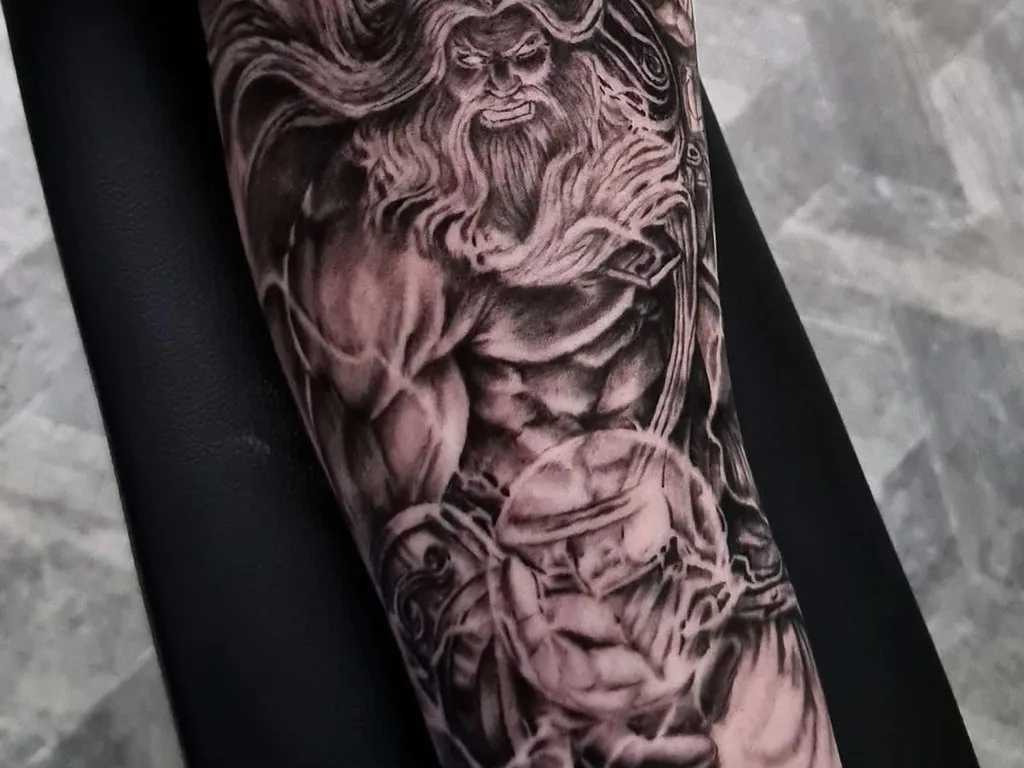
Zeus ruled Olympus and the sky; his weapon was the thunderbolt. This forearm portrait skips the bolt and goes for authority: a heavy beard, deep-set eyes, hair worked like carved marble.
Portraits this size hold up: the features are large. The risk is the soft grey face shading, which lightens over the years; the dark beard keeps this Zeus recognisable.
2. Zeus With Storm Clouds, Leg
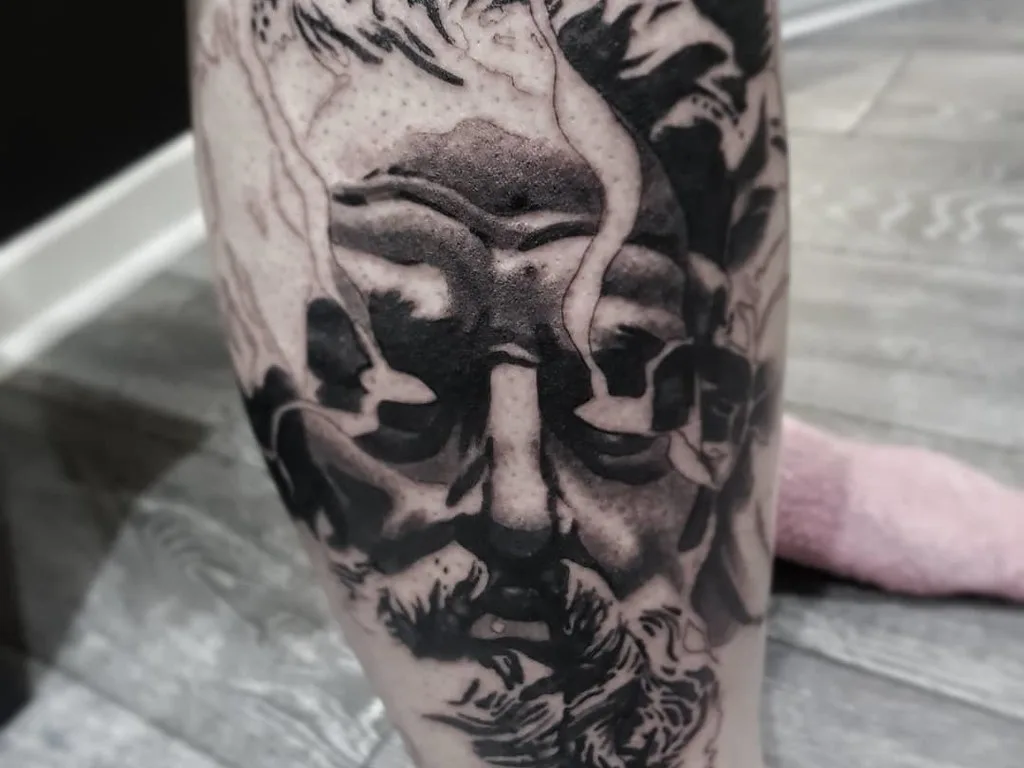
A second Zeus, on a leg and wrapped in the weather he commands. A plain face floats; a face inside a storm has a setting.
Leg pieces dodge sun under trousers, so black and grey here ages slower than on a forearm. Calf and thigh suit the vertical format.
3. Athena in Armour, Forearm
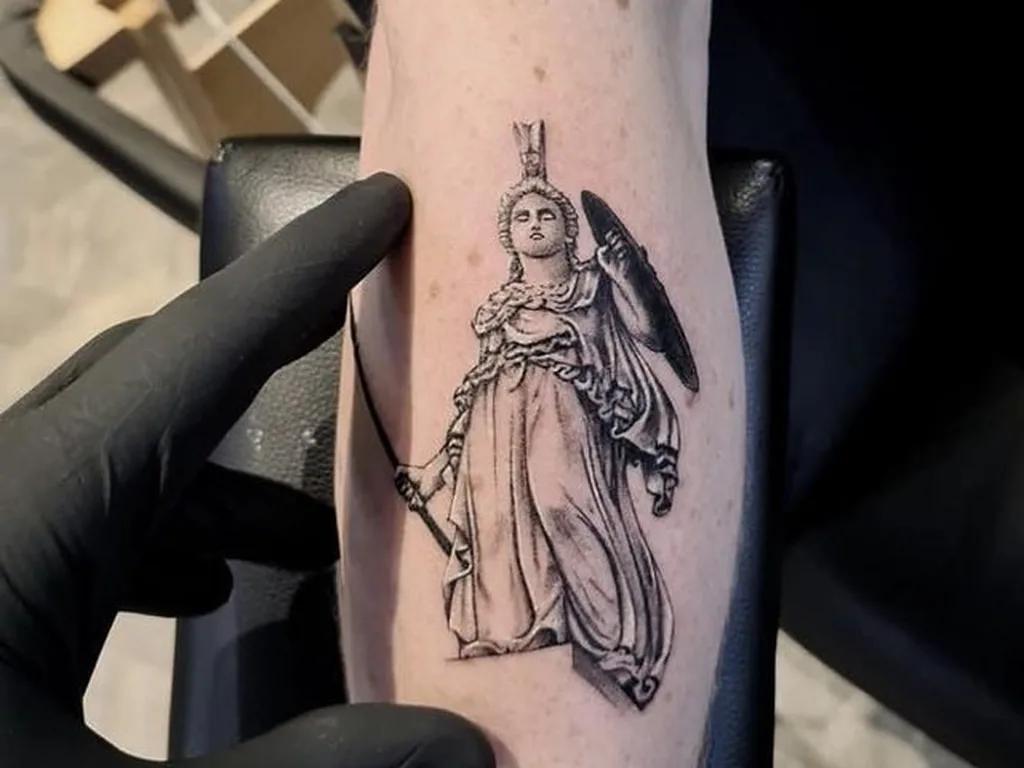
Athena was the goddess of wisdom and of war fought with a plan — patron of Athens, born fully armed from Zeus’s head. This forearm piece draws her in armour with a spear, in the same portrait language as the Zeus above.
Fine detail in armour and helmet crests softens first. Ask for helmet lines spaced a touch wider than drawn; the outline will thank you in a decade.
4. Poseidon With His Trident, Calf
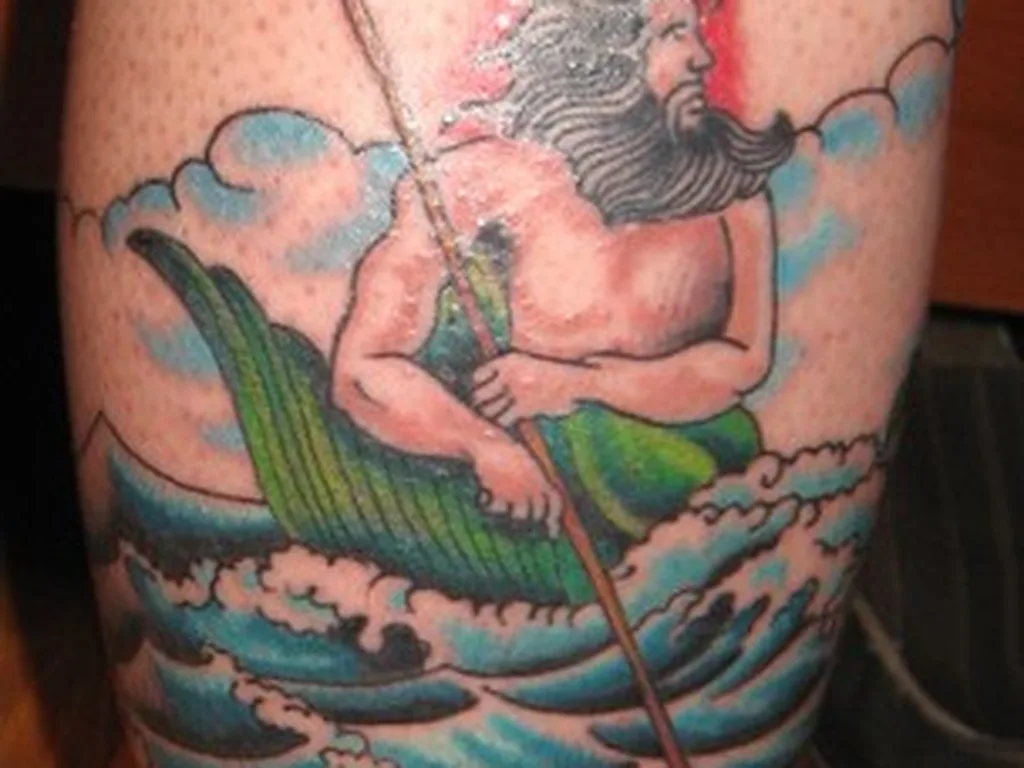
Poseidon ruled the sea and carried the trident; Earth-Shaker was his name for earthquakes. Here he rises out of painted waves on a calf in old-school colour — the Roman Neptune is the same god, which is why this tattoo’s photo series calls him Neptune.
This photograph comes from a small source file, so treat it as a style reference rather than a detail study. The design is built to last: bold outline, flat colour, waves that hide future softening.
5. Poseidon as a Cover-Up, Upper Arm
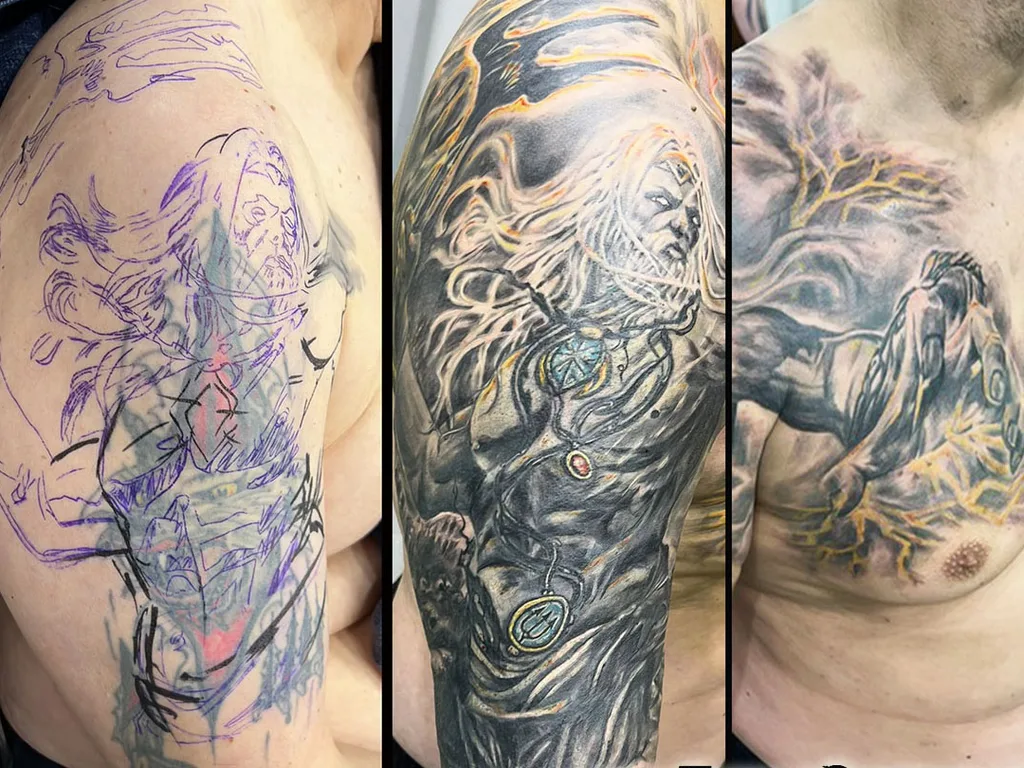
The same sea god doing harder work: this Poseidon covers an older tattoo, which is why the shapes are bold and the colour heavy. Cover-ups need dark, busy designs — a god bursting out of sea foam gives an artist both.
Planning a cover-up? This is the honest shape of the answer — bigger and darker than the thing it hides.
6. Medusa as a Card Design, Shoulder
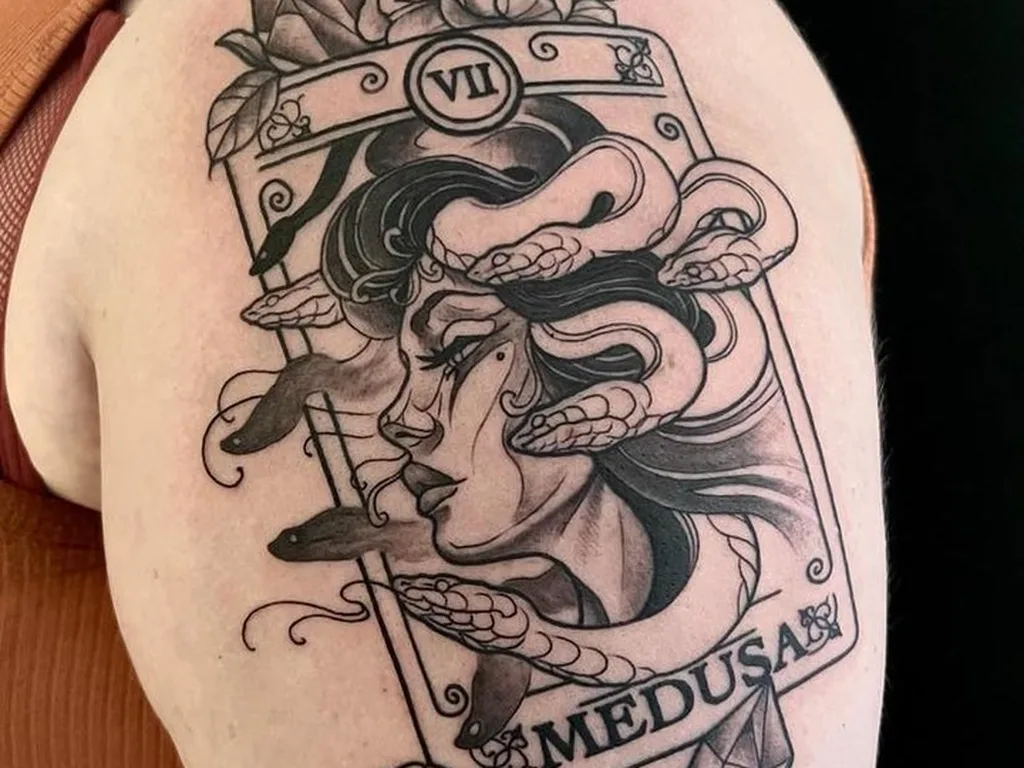
Medusa was the Gorgon whose gaze turned men to stone, killed by Perseus, who used her severed head as a weapon. This shoulder piece frames her as a printed card, snakes in neat waves — the neatest Medusa here, and a bridge into the medusa tattoo meaning guide, which covers her story properly.
Framed designs age kindly: the border holds the composition together as the inner grey softens, on flat, stable shoulder skin.
7. Medusa in Full Colour
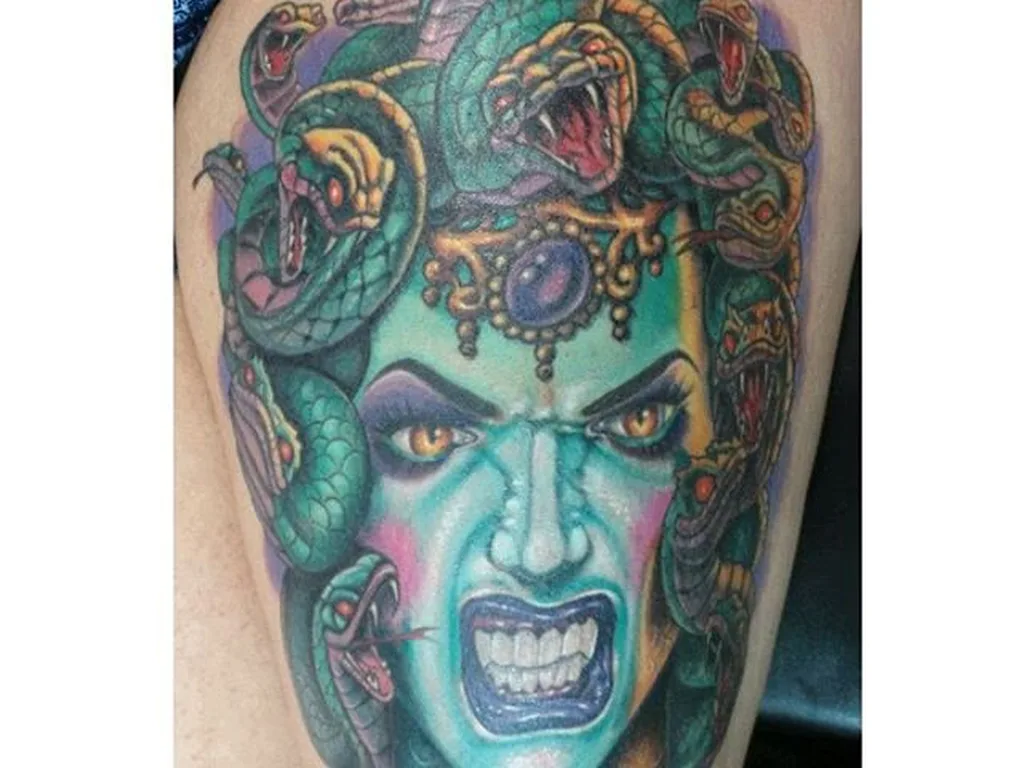
No stone grey here — this Medusa is green-skinned, red-eyed and furious, drawn like a horror poster. Colour changes her: black and grey versions read as classical and guarded; this one leans into the monster and dares you to look.
Bright greens and reds hold for years but want a refresh sooner than black; the thick snake outlines underneath do the long-term work.
8. Medusa in a Greek Key Border, Thigh
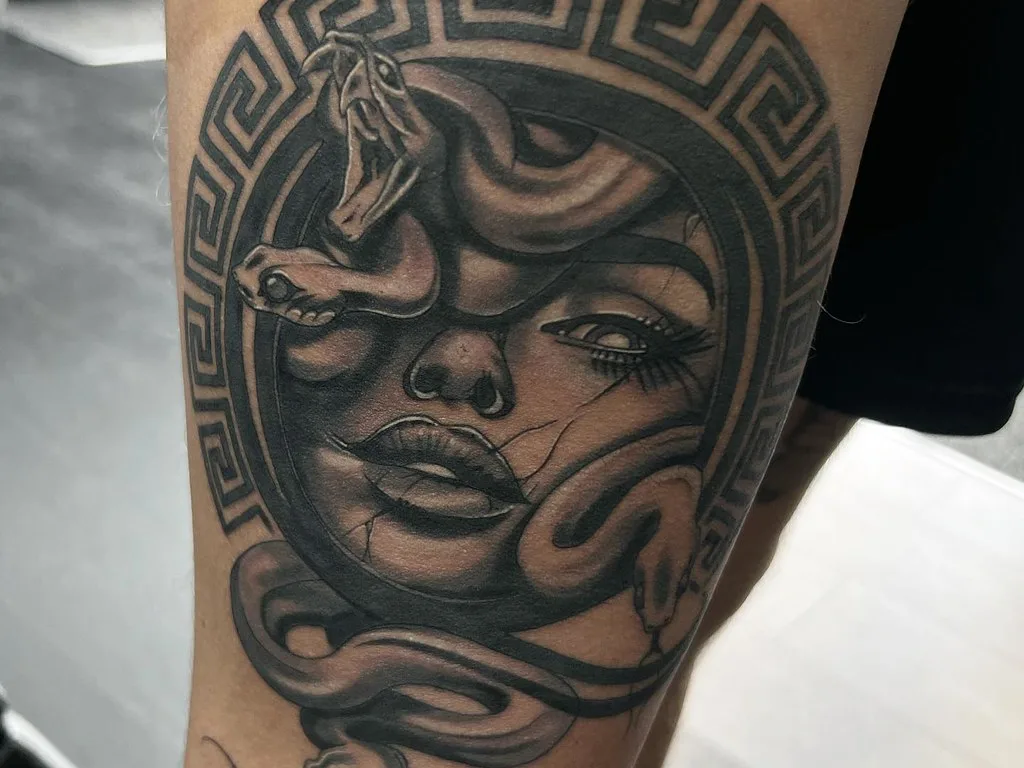
A calmer Medusa, face forward, snakes resting rather than striking, inside a Greek key pattern — the meander border from ancient pottery and friezes. It frames the face and quietly says which culture she belongs to.
Thighs forgive a lot: flat skin, a large area, clothing against the sun. A symmetrical design like this should keep its balance for years.
Norse Gods, Warriors and World Symbols
Norse designs lean on a different mood: older gods, harder weather, symbols carved rather than painted. Odin traded an eye for knowledge and hung on the world tree for the runes, which is why so many Norse tattoos are about paying for wisdom. One warning repeats here: several famous symbols are younger than the Vikings. That honesty matters in Norse mythology tattoo ideas more than most.
9. Odin and His Ship, Forearm
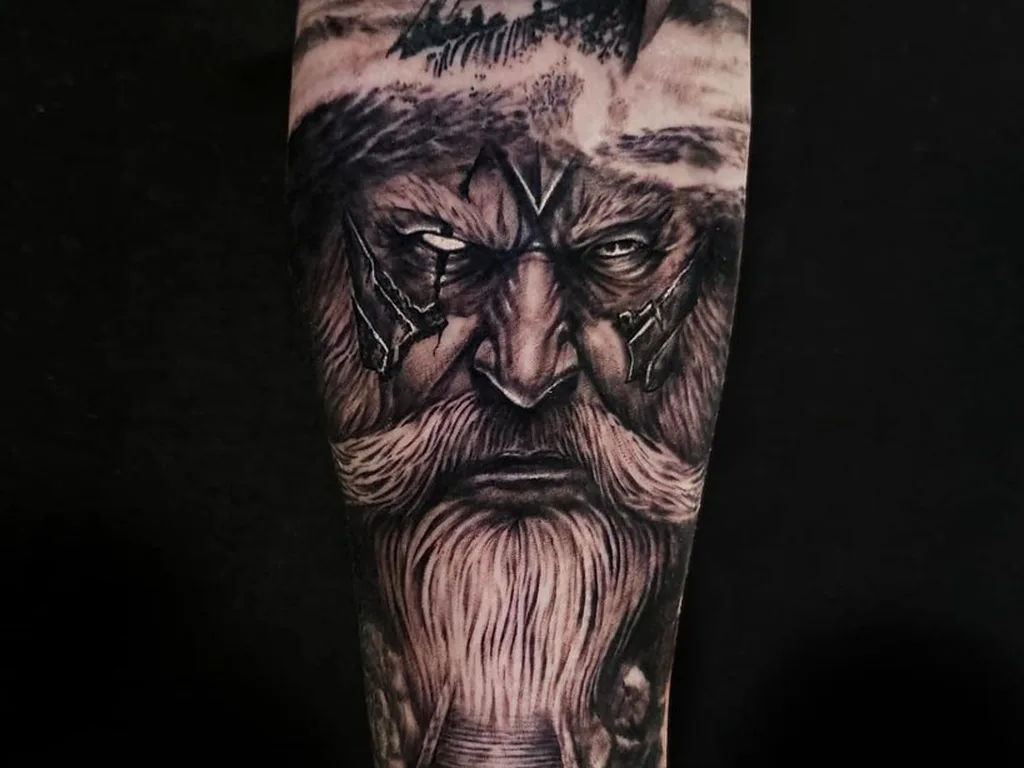
Odin, the All-Father, gave one eye for a drink from the well of wisdom and kept two ravens, Huginn and Muninn — thought and memory. This forearm piece pairs the bearded god with a Viking ship.
Faces and ships are detail-heavy, so the forearm is close to the smallest canvas this combination wants. Keep the dark beard and the ship’s hull bold, and the rest can be fine.
10. The Viking Elder, Forearm
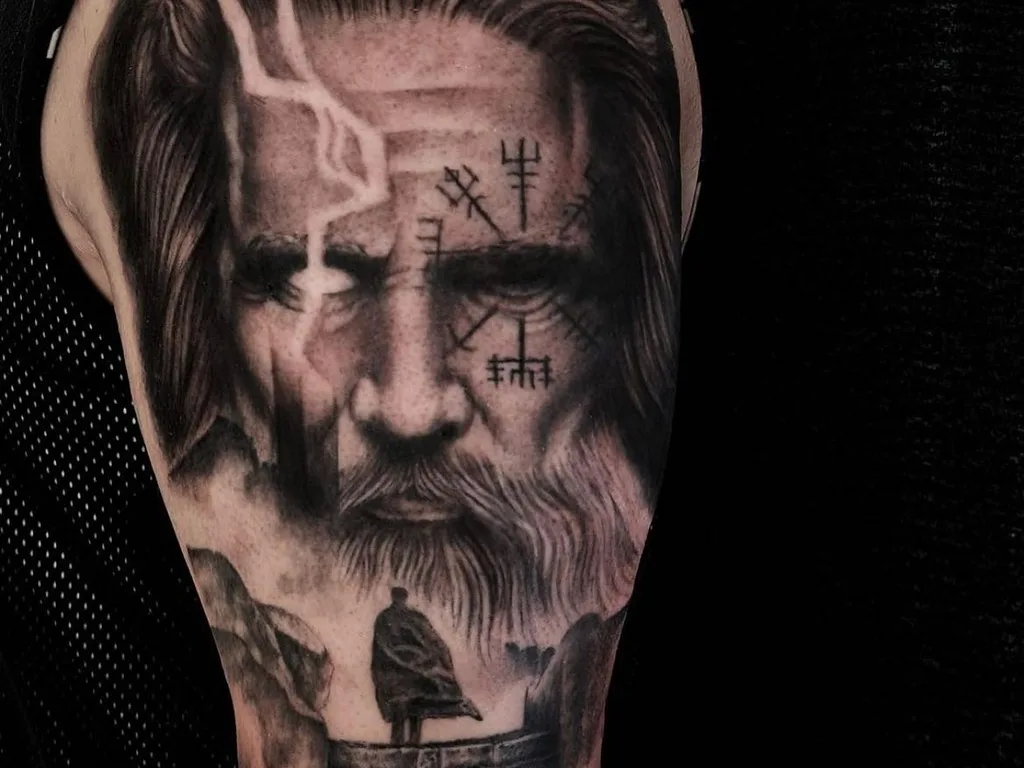
Not named as Odin on its own photo, and this page will not rename him — but an elder carved with lightning and rune-like marks belongs to the same family of images. Shop talk labels every bearded Norse face Odin; this is a Viking elder in Odin’s visual language.
If a figure’s identity matters to you, agree its marks with your artist — eye patch, ravens, spear — rather than trusting a beard.
11. Valkyrie Portrait, Forearm
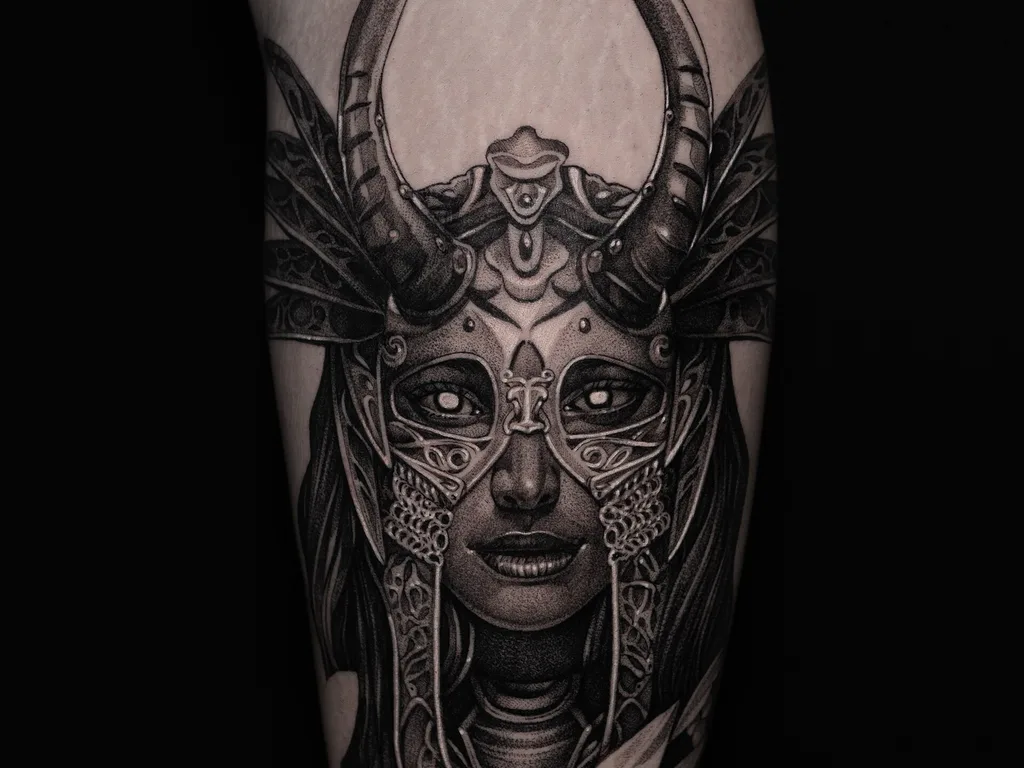
Valkyries were the choosers of the slain, who picked which warriors died in battle and which were carried to Valhalla. This portrait gives its valkyrie a horned helmet — a stage-costume invention from 19th-century opera, not Viking history, worth knowing before you wear it as an accuracy claim.
As a tattoo, the horns frame the face beautifully, which is why artists keep them. Portrait rules apply: big features, strong darks, room to breathe.
12. A Valkyrie in Progress, Shoulder
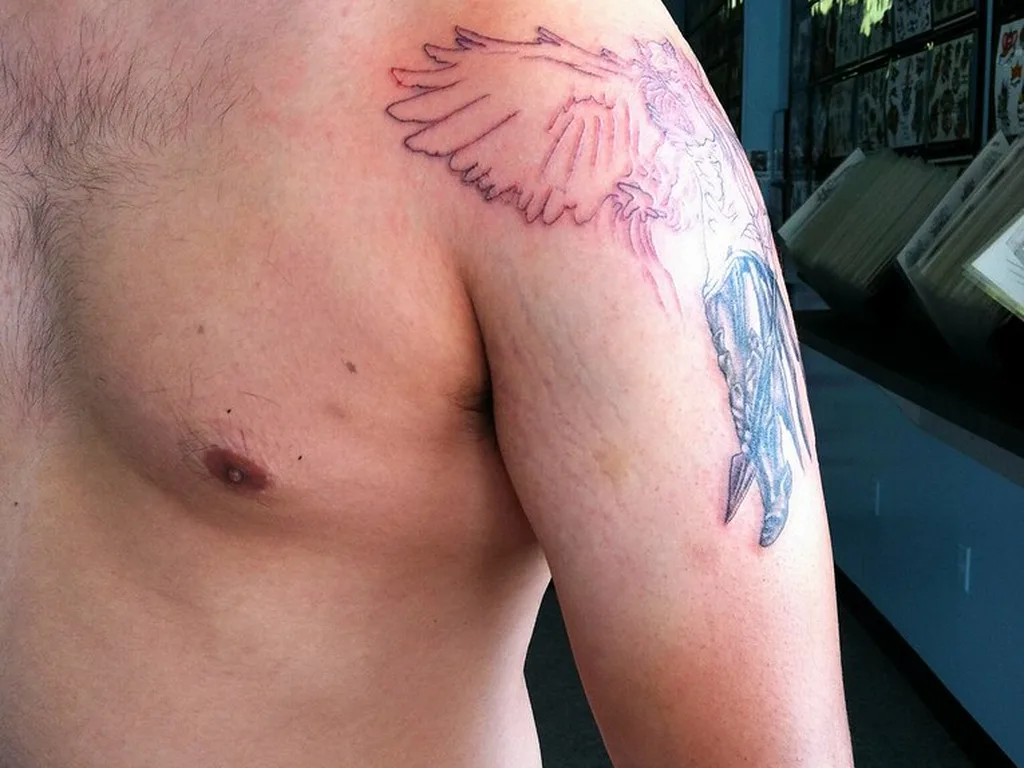
This winged figure was photographed between sittings: the wing is still red linework while the robed figure below is shaded. It is included on purpose — most pieces this size are built in stages, and this is stage two, honestly.
Budget for the sittings, and expect to walk around unfinished in between. The wing sits on the shoulder’s curve, the hardest anatomy to draw flat — the mirror check matters.
13. Odin’s Raven in Blue, Upper Arm
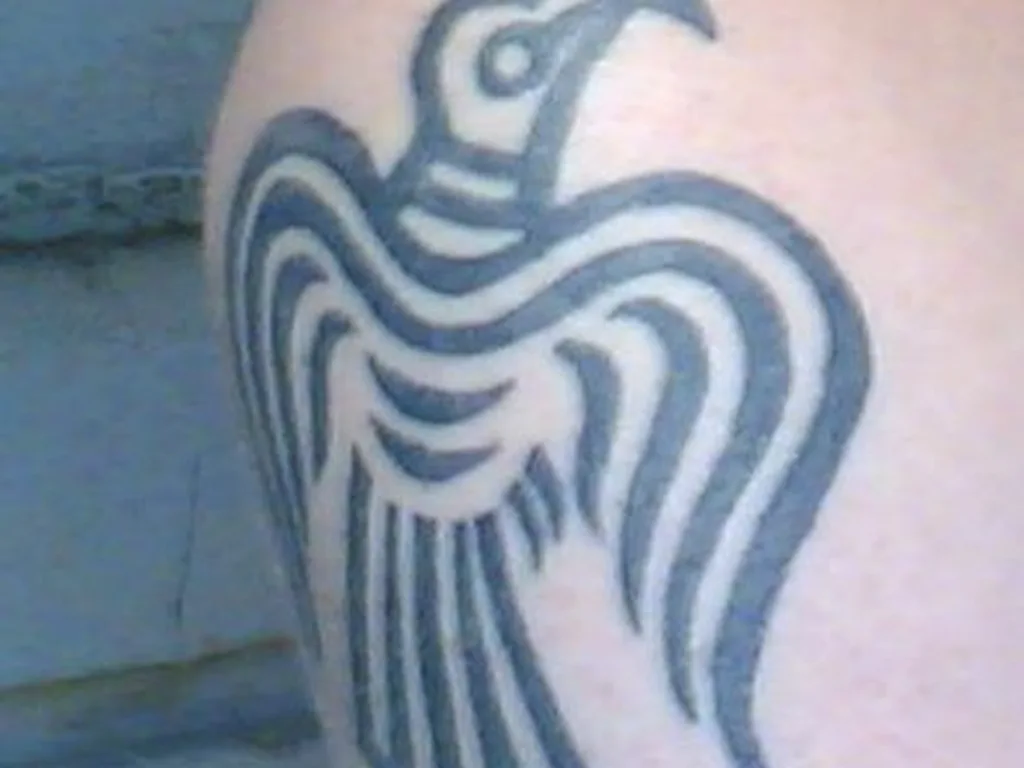
A single raven in flat blue-black, in a tribal style. Ravens are Odin’s birds above all — Huginn and Muninn again — and they haunt battlefields throughout Norse poetry, which made them a natural warrior emblem.
A small, old photograph — look at it for the idea, not the finish: one bird, one colour, no background. Simple designs still read at thirty years old.
14. Valknut, Blackwork Shoulder
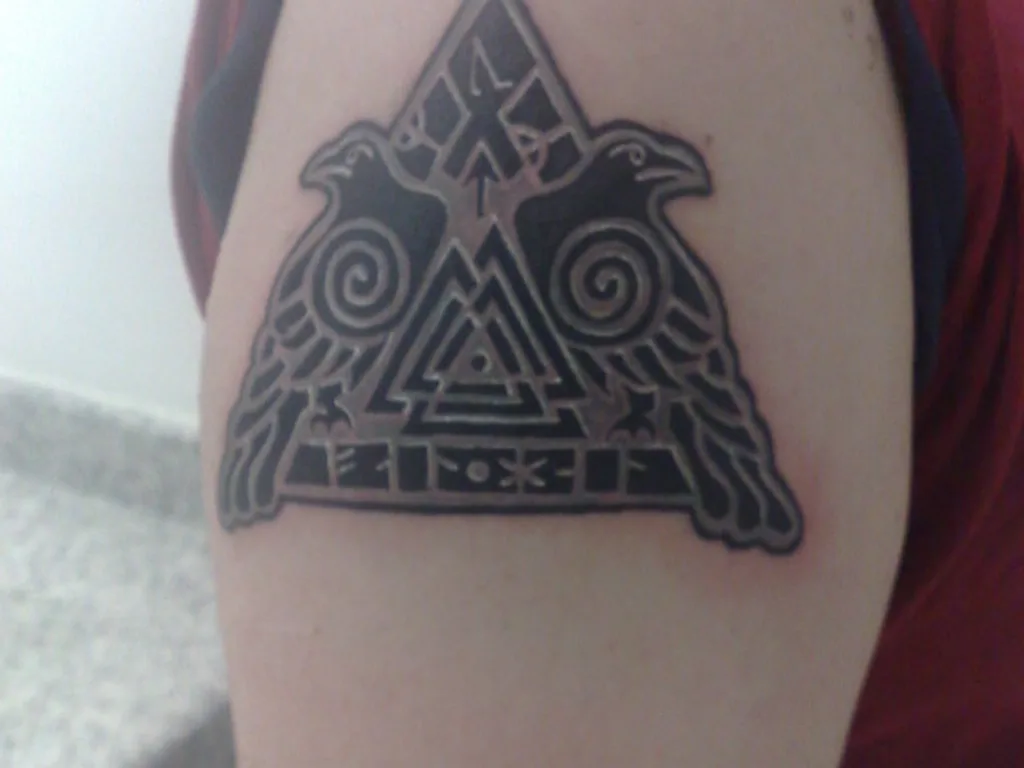
Three interlocked triangles: the valknut appears on old Norse picture stones, sometimes near figures who may be Odin, and its original meaning is genuinely not recorded. The confident modern reading — a knot for warriors who die bravely — is shop talk laid over a real old symbol.
As ink, the valknut is close to perfect: solid black, heavy symmetry, no fine detail to lose — among the safest designs here for ageing.
15. Valknut and Runes, Wrist
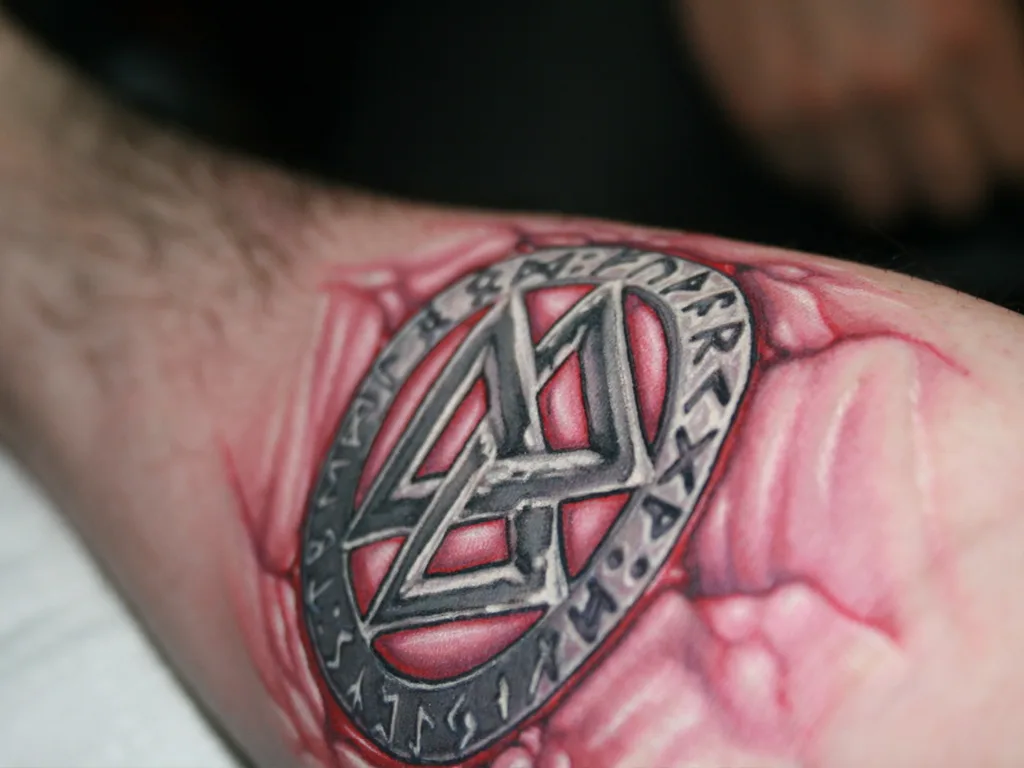
The same knot as a ring of triangular marks with runes, in warm red-brown ink on a wrist. Runes around a valknut usually spell a wearer’s chosen word — have runic text checked letter by letter, because runes are an alphabet, not decoration, and mistakes are permanent.
Wrists wash, knock and catch sun, so this fades faster than the shoulder version. Heavy fill is the defence; thin wrist runes blur first.
16. Vegvisir Over a Tree, Calf
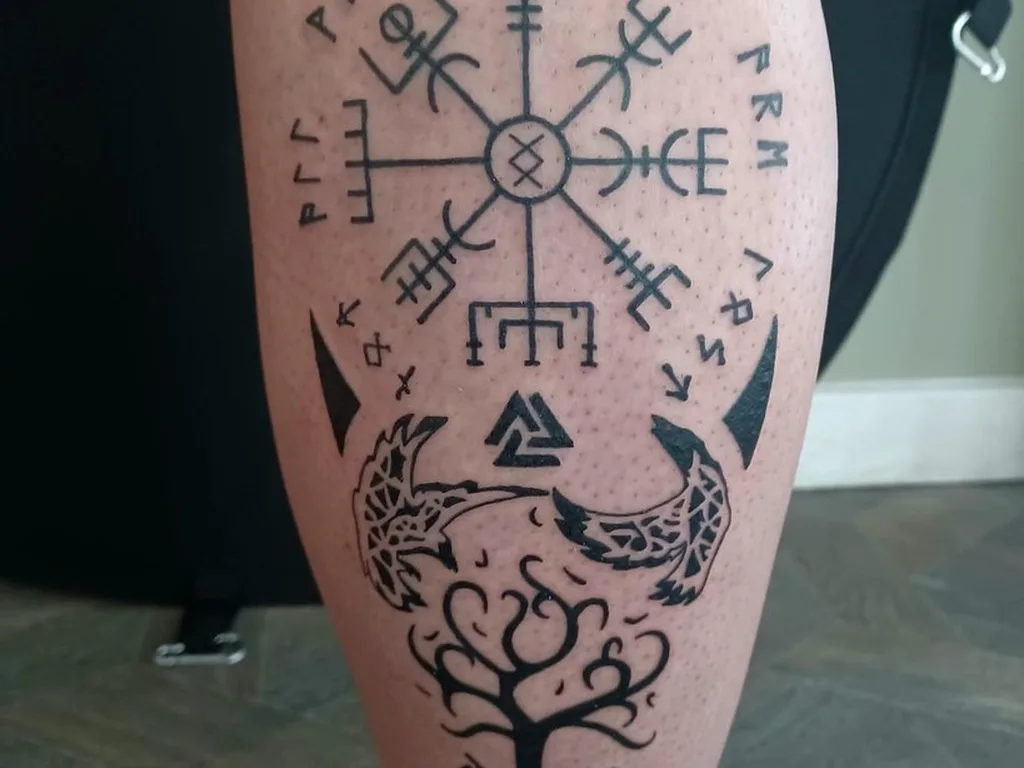
The branching stave is a vegvisir, an Icelandic wayfinder said to keep a traveller from getting lost in bad weather. Honesty matters here: it comes from 19th-century Icelandic manuscripts, some eight hundred years after the Viking Age ended — a real symbol, just younger than the shops claim.
Paired with the tree below it, the calf piece reads as one emblem. Calf skin is kind to blackwork.
17. Yggdrasil, the World Tree, Forearm
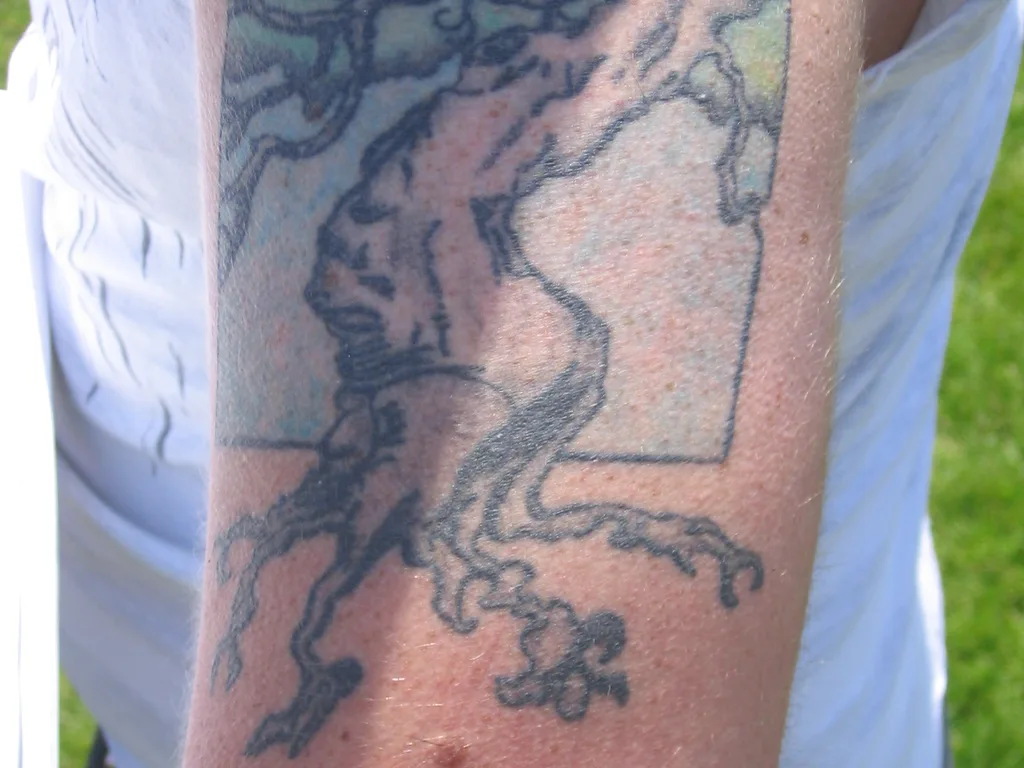
Yggdrasil is the great ash at the centre of Norse myth, holding the worlds in its branches and roots. This forearm version frames the tree like a woodcut, roots mirroring branches, exactly as the myth describes it.
Tree tattoos live or die on their roots: drawn as carefully as the branches, they read as trees for years; rushed roots become scribble.
Egyptian Gods and Sacred Animals
Egyptian tattoos draw on some of the oldest religious art on earth — Anubis at the scales, the restored eye of Horus, the scarab pushing the sun. These are living religious images for some people, as the respect section covers. As mythology tattoo ideas go, these run from black and grey sleeves down to small flat symbols.
18. Anubis in Black and Grey, Upper Arm
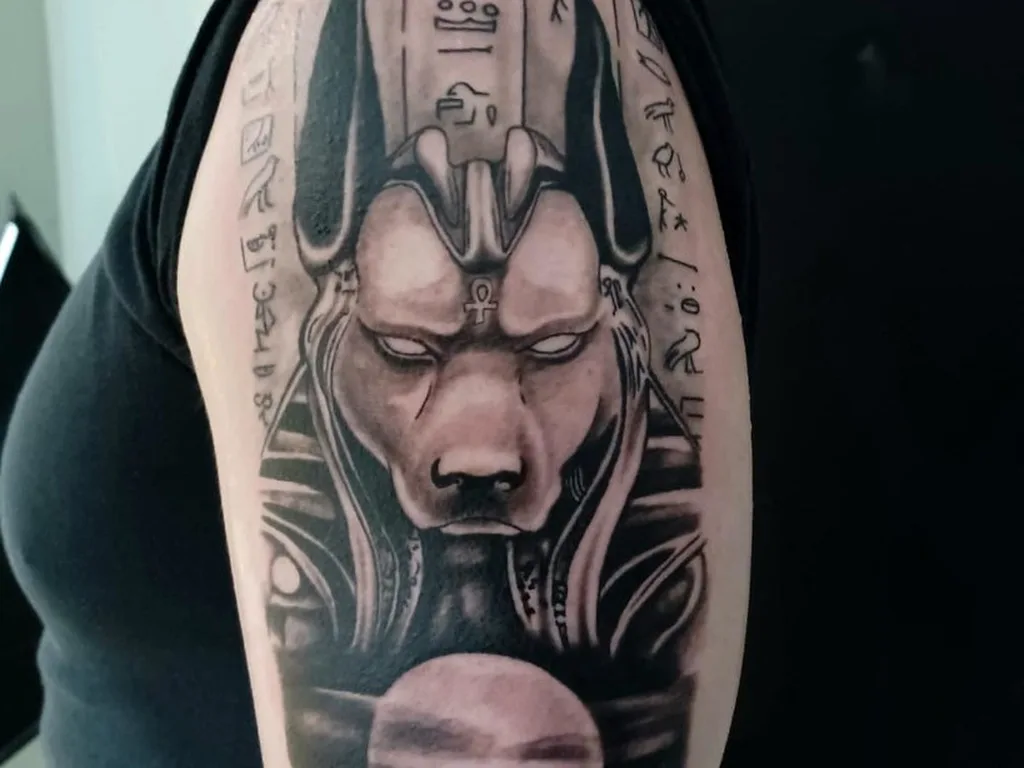
Anubis, the jackal-headed god, watched over cemeteries and the weighing of the dead — jackals haunted the necropolis edges, and the god took their shape. This upper arm piece gives him a tall headdress and a tomb-painting stare.
Black and grey suits Anubis, whose jackal form was shown black — linked with Nile soil and rebirth, not mourning. The long muzzle needs a long placement.
19. Anubis With a Skull, Forearm
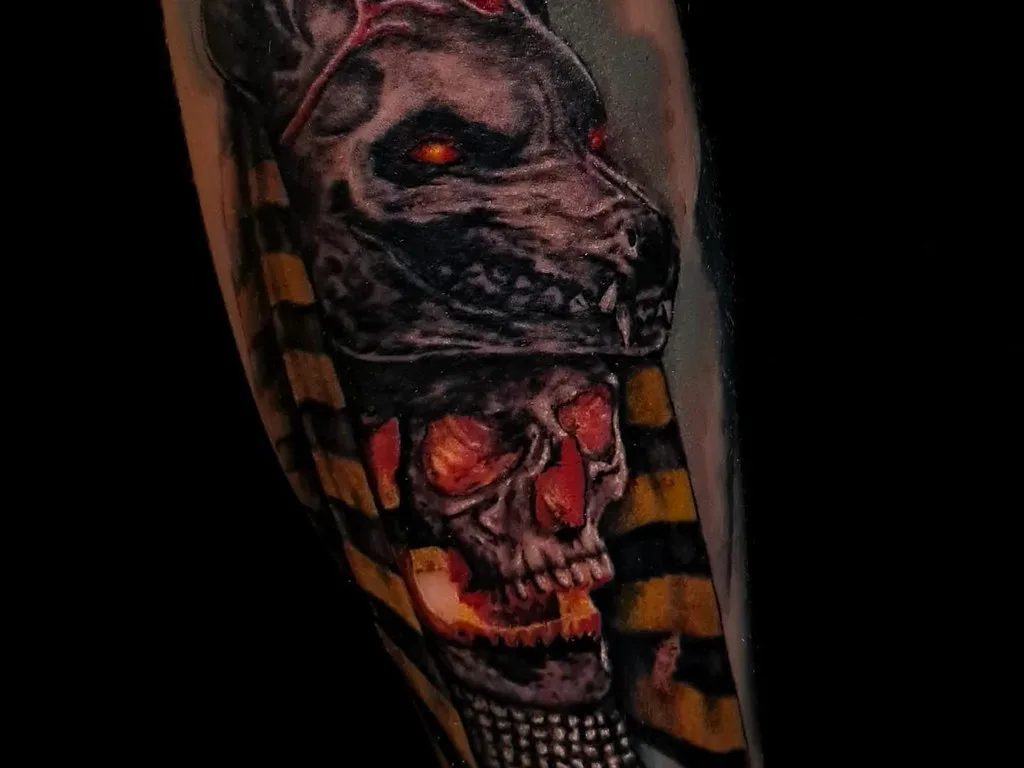
Anubis again, in colour and paired with a skull — a reminder that his job was the dead: embalming, guarding tombs, weighing hearts against a feather. The pairing is modern tattoo logic rather than temple logic, but it points at the right part of the myth.
Forearm colour lives harder than back colour. The skull’s reds soften first; the black jackal head is built to outlast them.
20. Anubis Over the Pyramids, Thigh
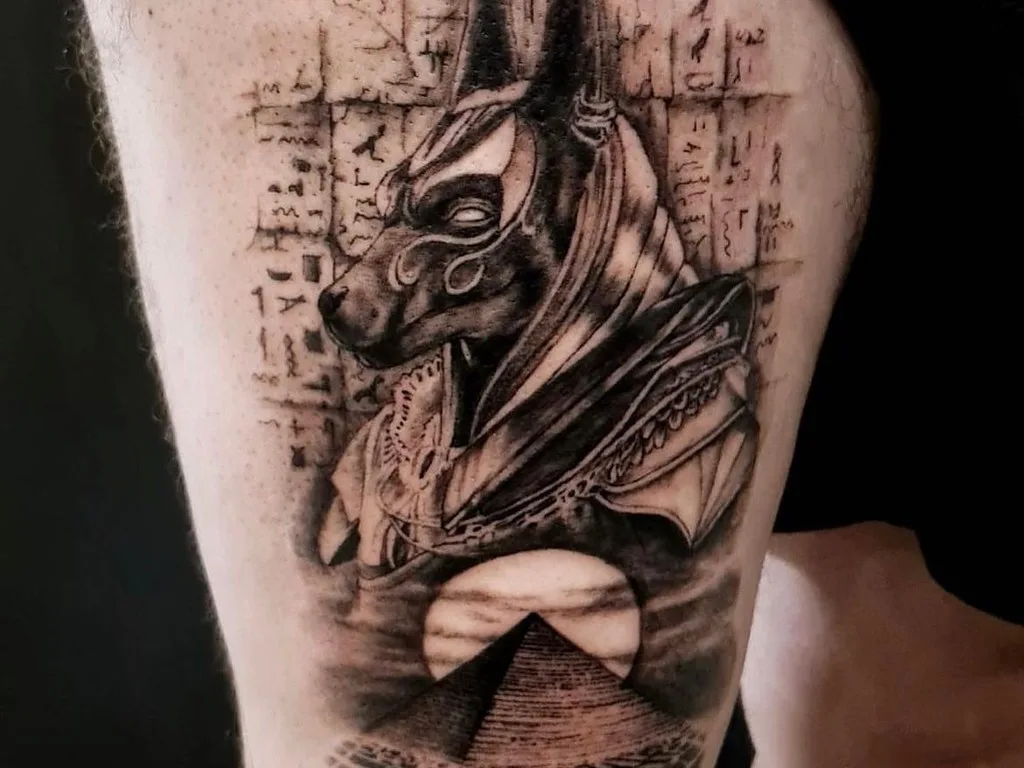
The third Anubis here adds his landscape: the pyramids of Giza below the god, tying him to the necropolis he guarded. The thigh gives the scene the wide, flat canvas a horizon line needs.
Scenes age on their straight lines, and pyramids are forgiving: three big triangles keep their meaning as edges soften.
21. Anubis With Hieroglyphs, Forearm
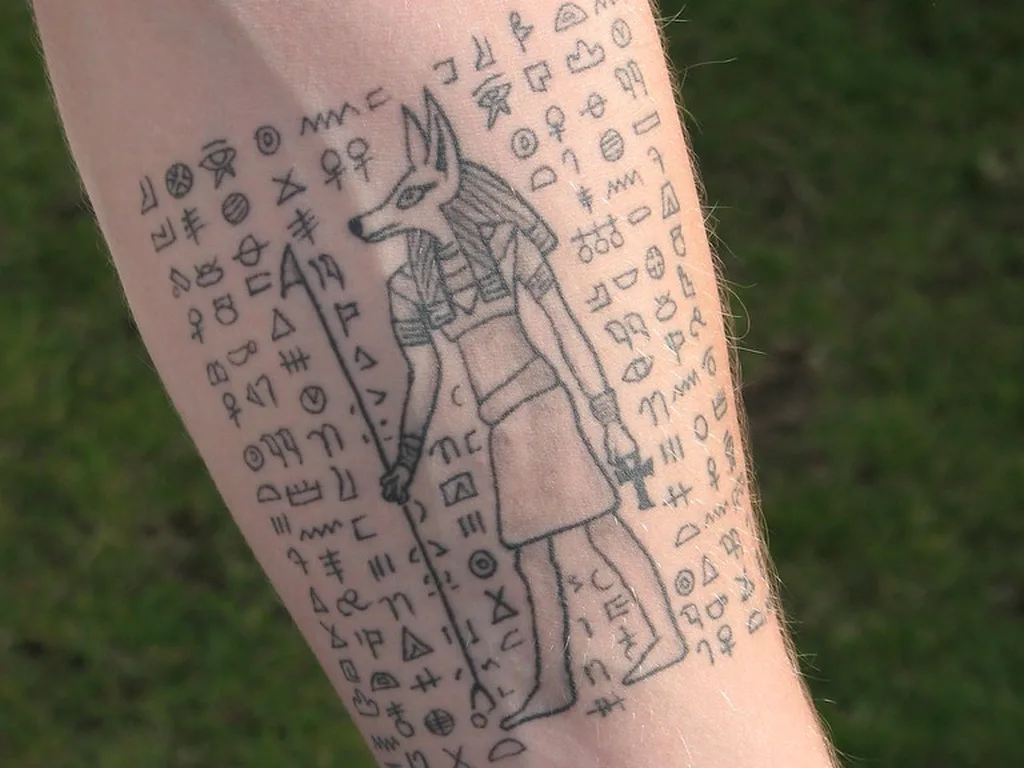
A smaller, older-style Anubis between columns of hieroglyphs, drawn the Egyptian way: profile head, formal pose, text doing half the talking. Pieces like this copy the flat temple style and read as artefacts as much as tattoos.
Hieroglyphs are real writing. If your version includes them, ask what they say — reference sheets sometimes copy signs in the wrong order.
22. Eye of Horus, Close-Up
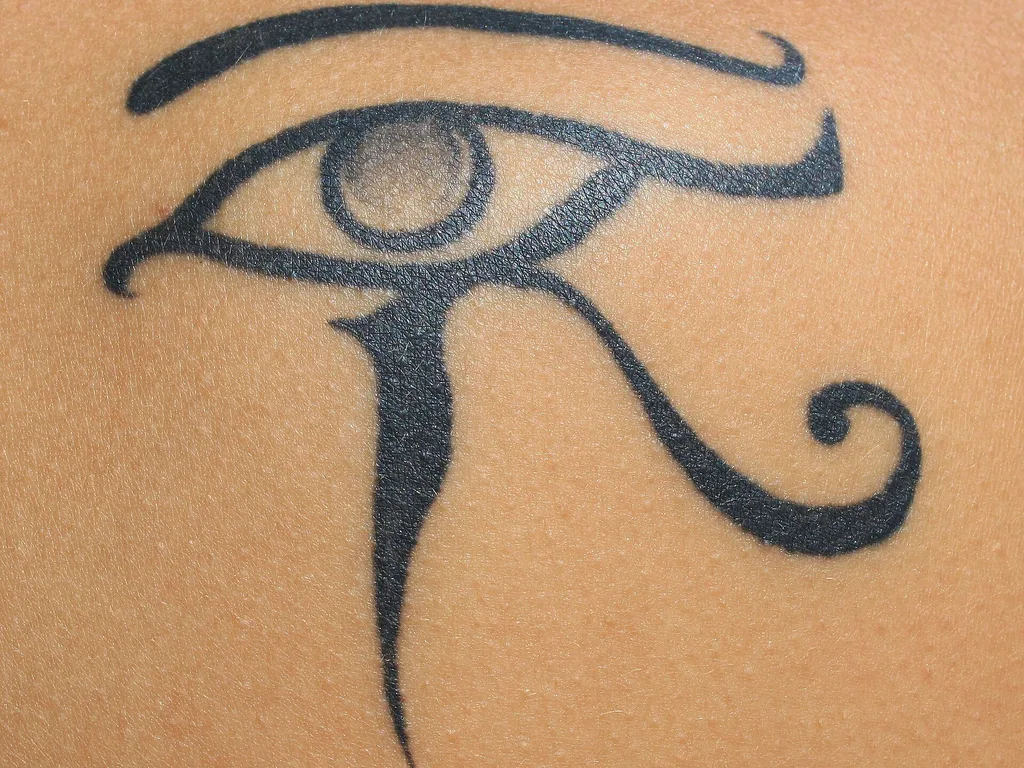
The wedjat eye is the eye of Horus, torn out in his fight with Set and restored — which is why Egyptians wore it for protection and healing on amulets, boats and coffins. Few symbols carry a meaning this well documented: three thousand years of use.
A gift for small placements: one bold shape, thick lines, deep black. Wrist, ankle and chest all work, and black this solid outlasts almost anything here.
23. Scarab Pushing the Sun, Forearm
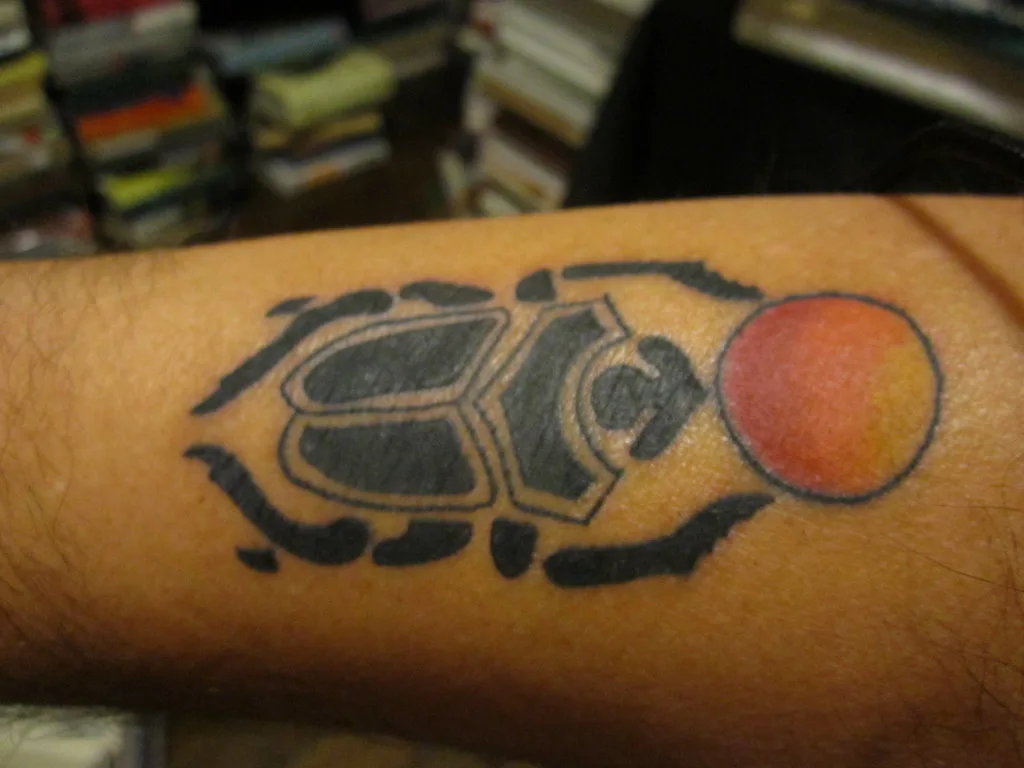
The scarab is the dung beetle: Egyptians watched it roll its ball and saw Khepri rolling the sun across the sky, so the beetle became a sign of sunrise and renewal. This forearm scarab pushes an orange sun disc, in the flat style of carved amulets.
Flat, bold, mostly black: amulet logic applied to skin. The orange disc will mellow; the beetle will not.
24. Scarab Beetle at the Neck
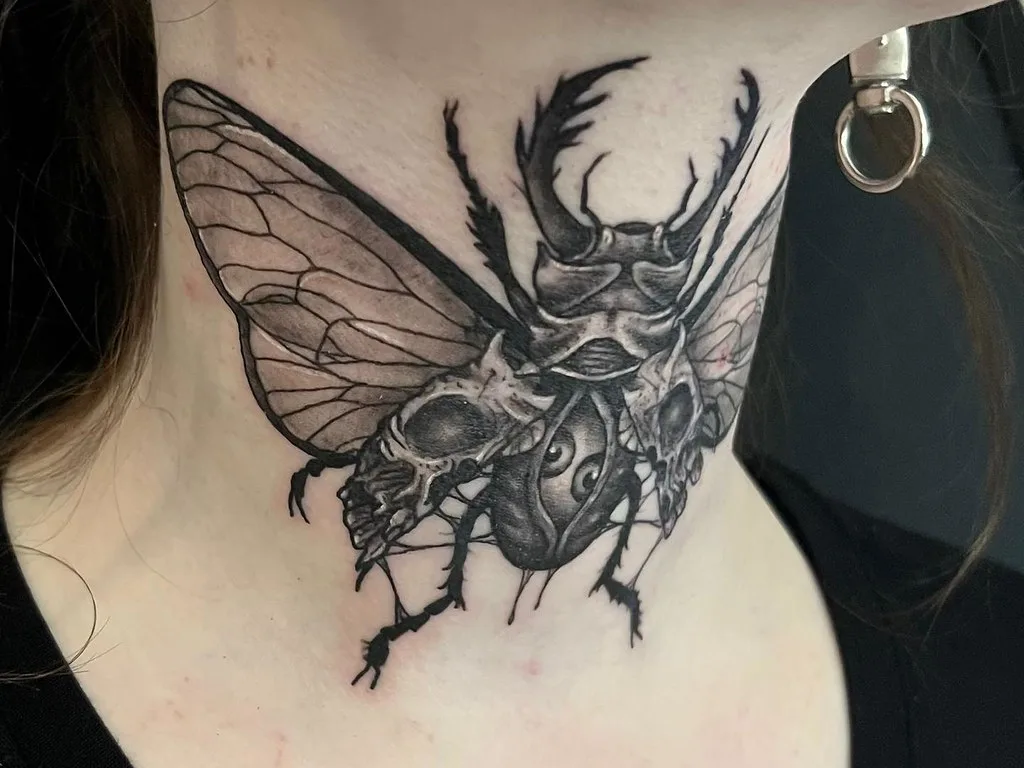
A second scarab, black and grey, worn at the side of the neck — a placement Egyptians would have recognised, since scarab amulets were worn as pendants and seals. The wing cases give an artist tidy geometry.
Neck skin moves and sees sun, so expect an earlier touch-up than a forearm. In exchange, the scarab sits where jewellery would — the oldest way to wear one.
25. Bastet, the Winged Cat, Shoulder Blade
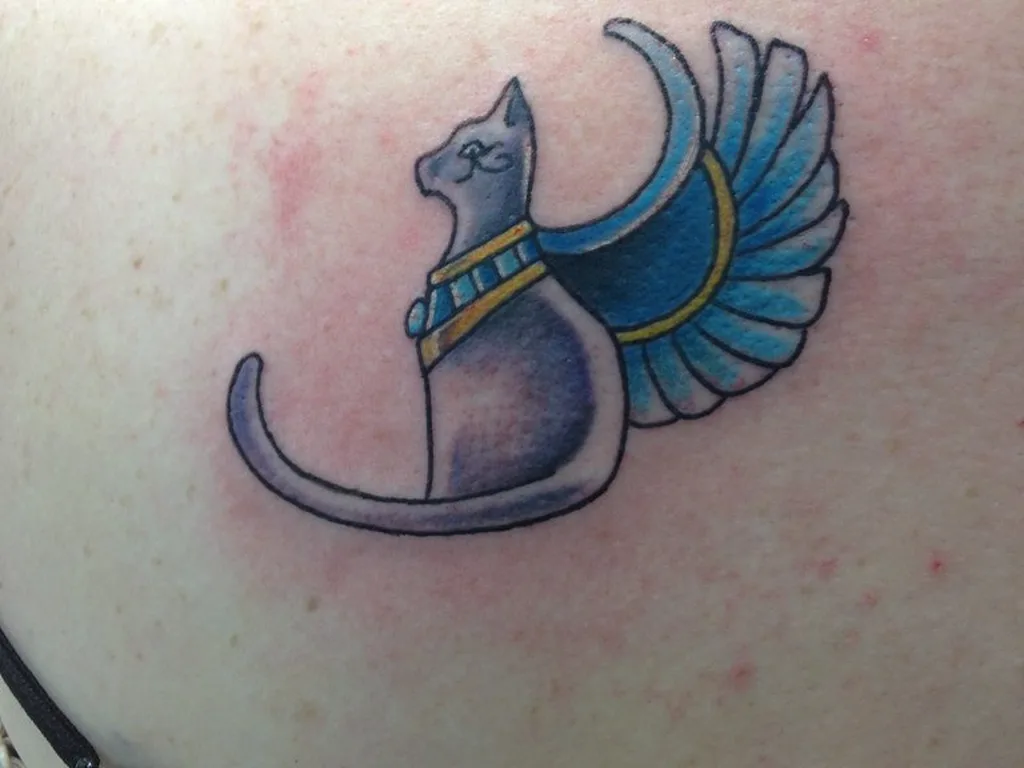
Bastet was the cat goddess of home, protection and good health — earlier drawn as a lioness with a warlike side, later softened into the household cat. This shoulder blade piece, photographed fresh with the skin still pink, gives her a collar and a fan of blue feathers.
Fresh tattoos look brighter than healed ones: expect these greys to settle quieter. The design underneath is simple and well-shaped.
26. Winged Goddess, Full Back
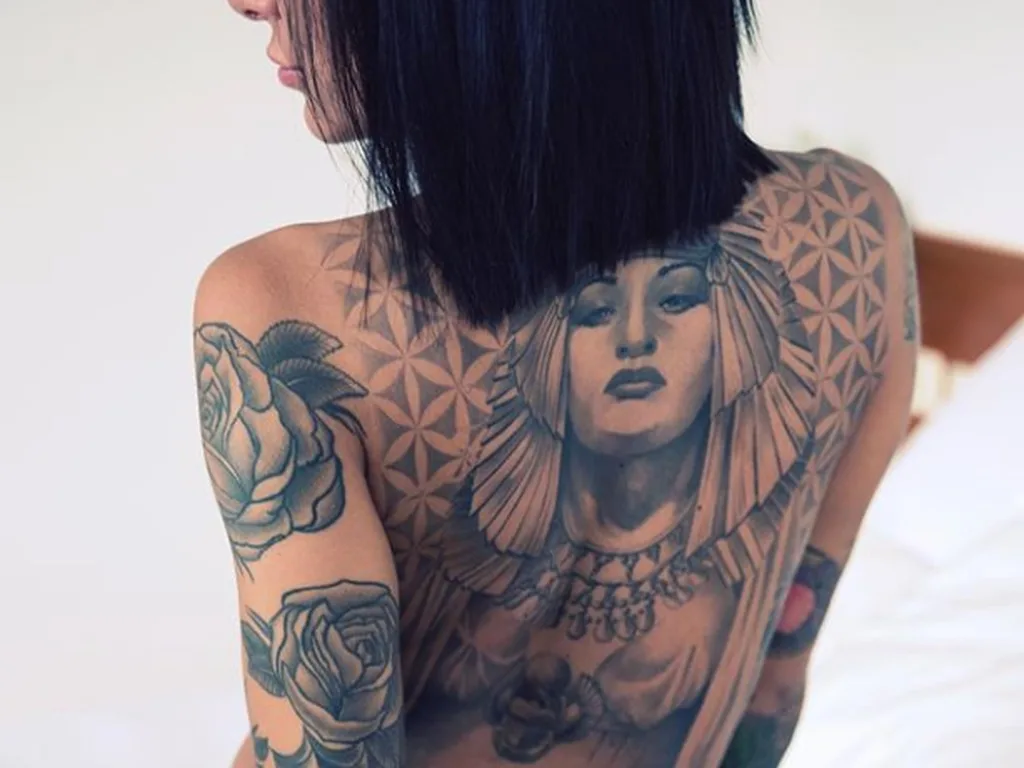
A full back given to a winged Egyptian goddess, with tattooed sleeves completing the picture. Large Egyptian work copies the tomb-painting formula — wings spread wide to protect the body they cover, the gesture carved over temple doors and coffin lids.
Backs are the best ageing surface on the body: huge, flat, covered most days. A winged figure gets its longest life here.
Japanese Dragons, Demons and Masks
Japanese mythology reaches skin mostly through irezumi, the full-coverage tradition of dragons, waves and masks. The dragon here is a water creature of rain and wisdom, far from Europe’s fire-breathing hoard guard. The hannya and oni masks carry the darker half: jealousy, rage, punishment of cruelty. Japanese mythology tattoo ideas are the most coverage-hungry in this guide.
27. Dragon Back Piece in Full Colour
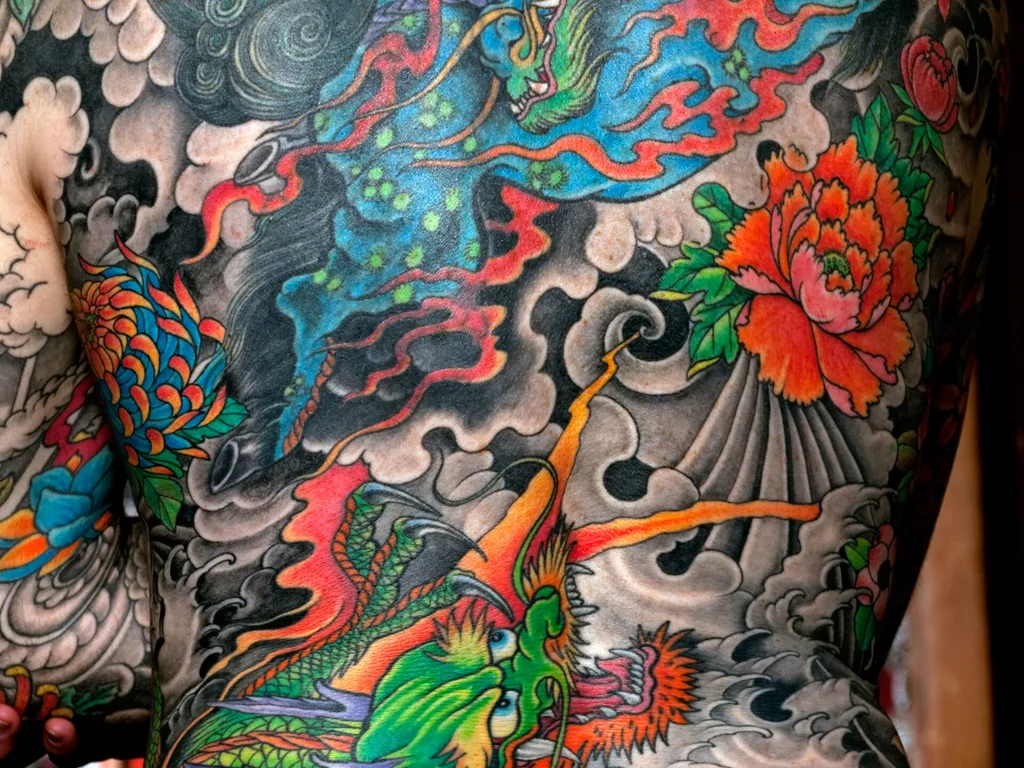
The Japanese dragon — ryu — is a creature of water, rain and wisdom, usually drawn with three claws and a body that moves like a river. This full back piece is classic irezumi: the dragon owns the canvas, waves fill the spaces, colour packed to survive. The dragon tattoo design ideas guide breaks down dragon styles from every culture.
Back pieces take years and many sittings. No other placement lets a dragon be a dragon at full size, and clothing gives its colour the longest life.
28. Dragon Sleeve in Green and Orange
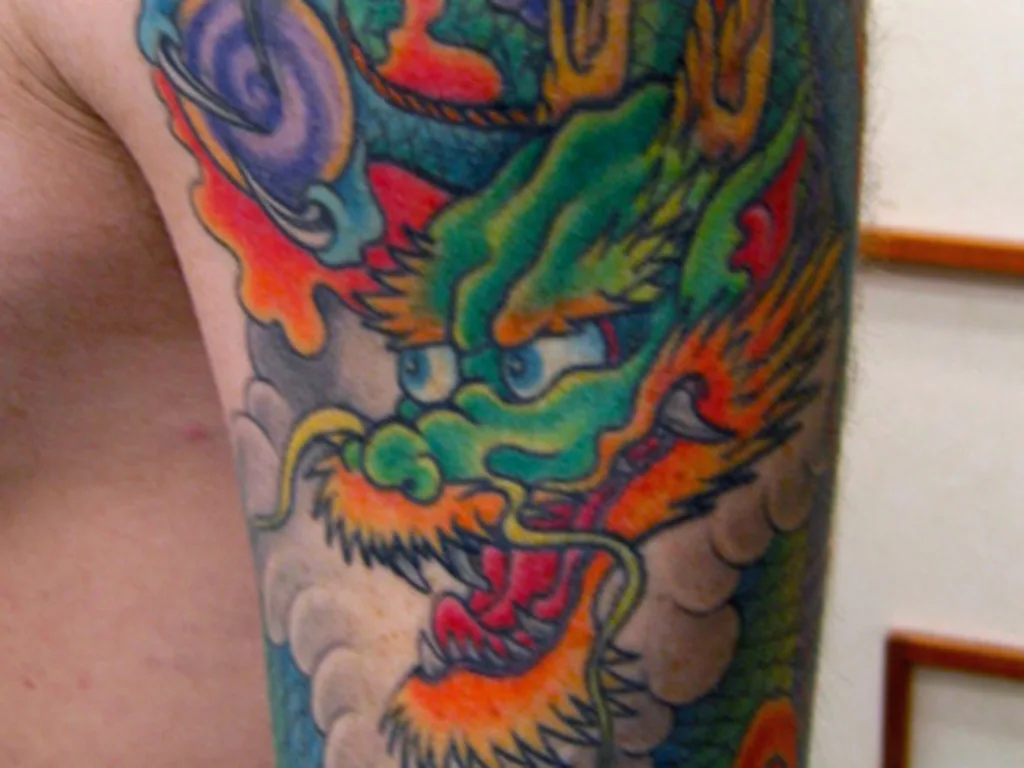
The same animal at sleeve scale, coiling down an arm in green and orange. Sleeve dragons work because the body is one long spiral — the artist wraps the anatomy instead of fighting it.
This photograph is a small file, so use it for composition, not detail. The orange belly scales give the green body its contrast — what a sleeve needs once colours settle.
29. Dragon Over Skulls, Shoulder and Arm
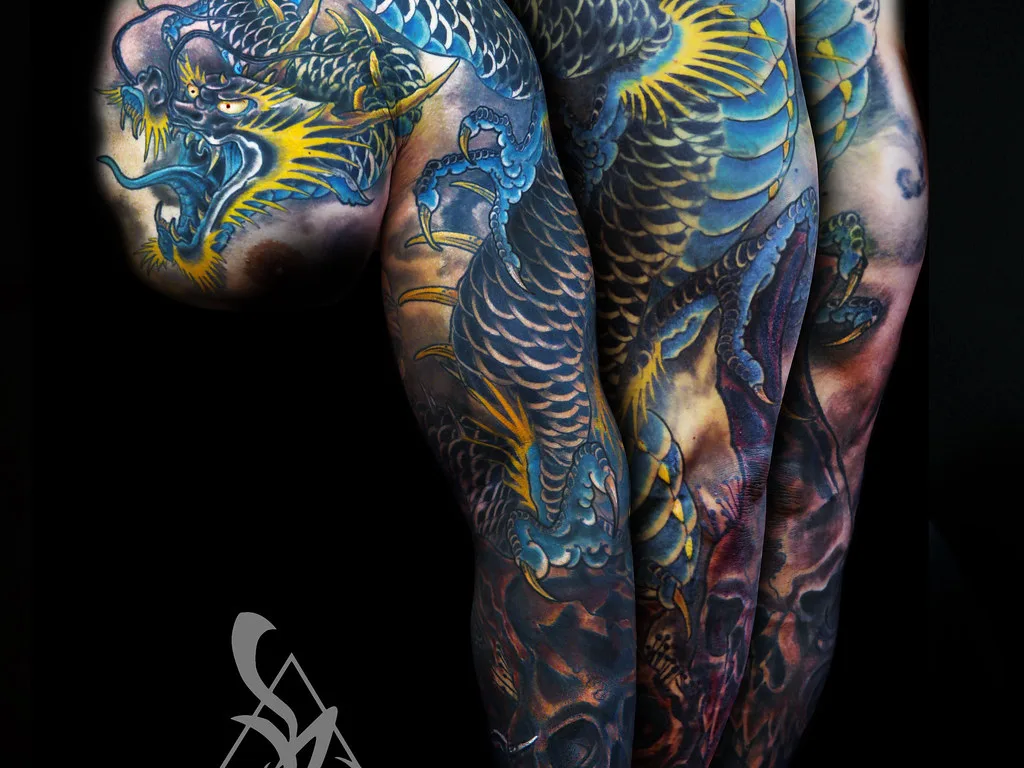
A blue and yellow dragon from three angles, head snarling on the chest, body pouring down the arm over skulls. Ben Lucas’s studio mark sits in the frame’s corner; the tattoo is a cover-up at full saturation, hence the heavy colour.
Three-view photos are the best reference you can take to a studio, because sleeves are architecture, not pictures. Ask how the design wraps first.
30. Hannya Mask With a Green Snake, Full Sleeve
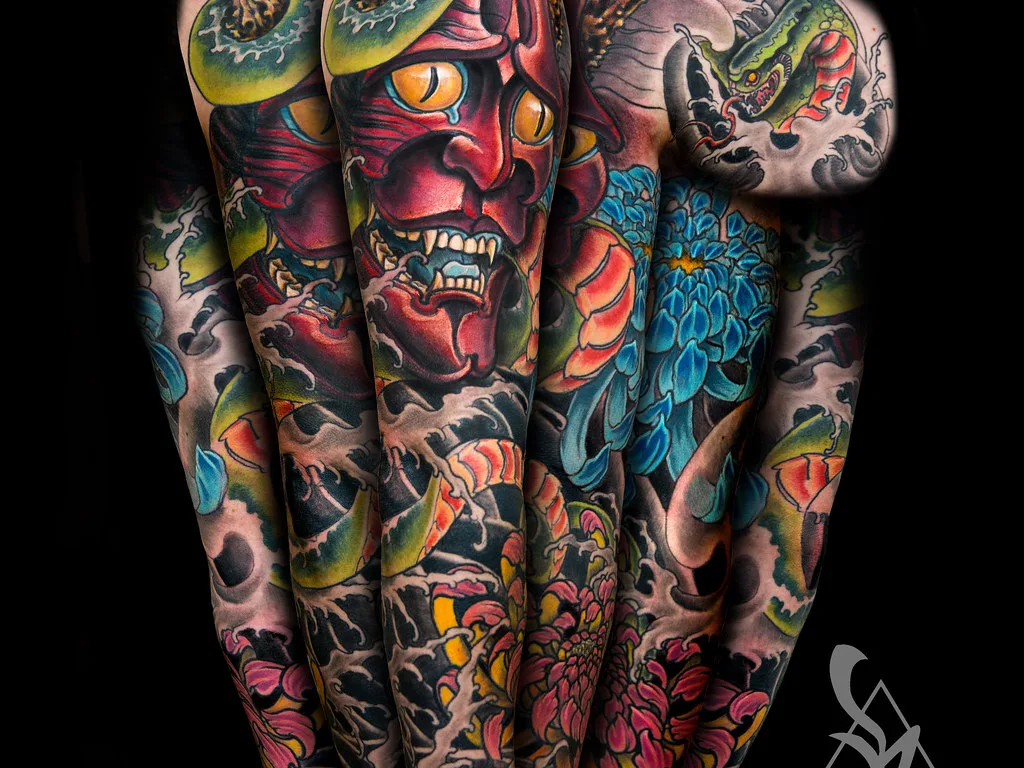
The hannya is a Noh theatre mask: a woman whose jealousy and grief twisted her into a demon, horns up, mouth full of fangs. In tattooing it stands for passion that cost too much — a warning, a memorial, or both. Here it rides a full sleeve with a green snake and chrysanthemums.
Full sleeves in this style are marathons. The hannya’s face must stay readable after everything around it softens, so it gets the boldest blacks.
31. Hannya Mask in Black and Grey, Leg
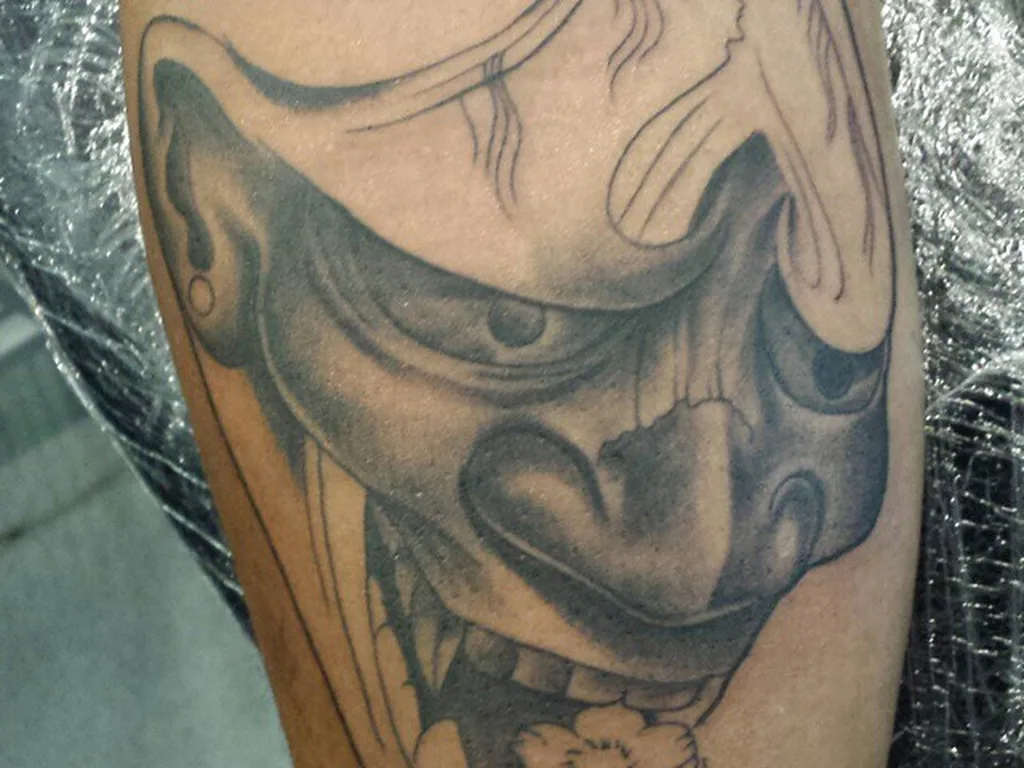
The same mask without colour, on a leg, and the mood changes — this hannya reads as grief first and fury second. Black and grey hannya test an artist: the expression lives in tiny shading shifts around the eyes and mouth.
Legs are patient placements for grey work — protected, easy to sit through. For the mask’s sorrow rather than its rage, show your artist this one.
32. Oni Mask in Red, Calf
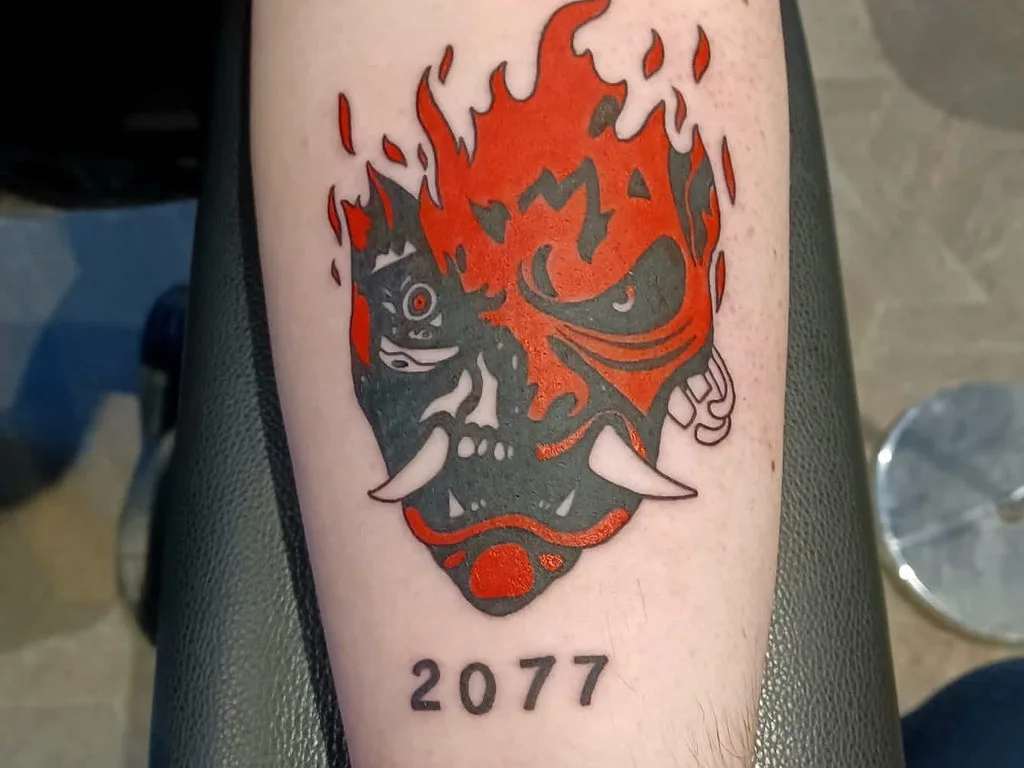
The oni is Japan’s ogre — a horned demon who punishes cruelty, villain in old stories and, in some tellings, a fierce protector. This calf piece draws the mask in flat red with black flames and the number 2077 beneath.
Flat colour and heavy outline make this the hardiest Japanese design here. Red holds well, and a calf keeps it out of the sun.
Celtic Knots, Crosses and the Tree of Life
Celtic work is the most pattern-led in this guide: knots with no beginning or end, triple knots, trees whose roots copy their branches. Some motifs are genuinely old — knotwork covers medieval manuscripts and carved stones — while some familiar designs are modern drawings in an old language. Celtic mythology tattoo ideas reward patience: the knots take longer in the chair than they look.
33. Triquetra Over a Heart, Shoulder
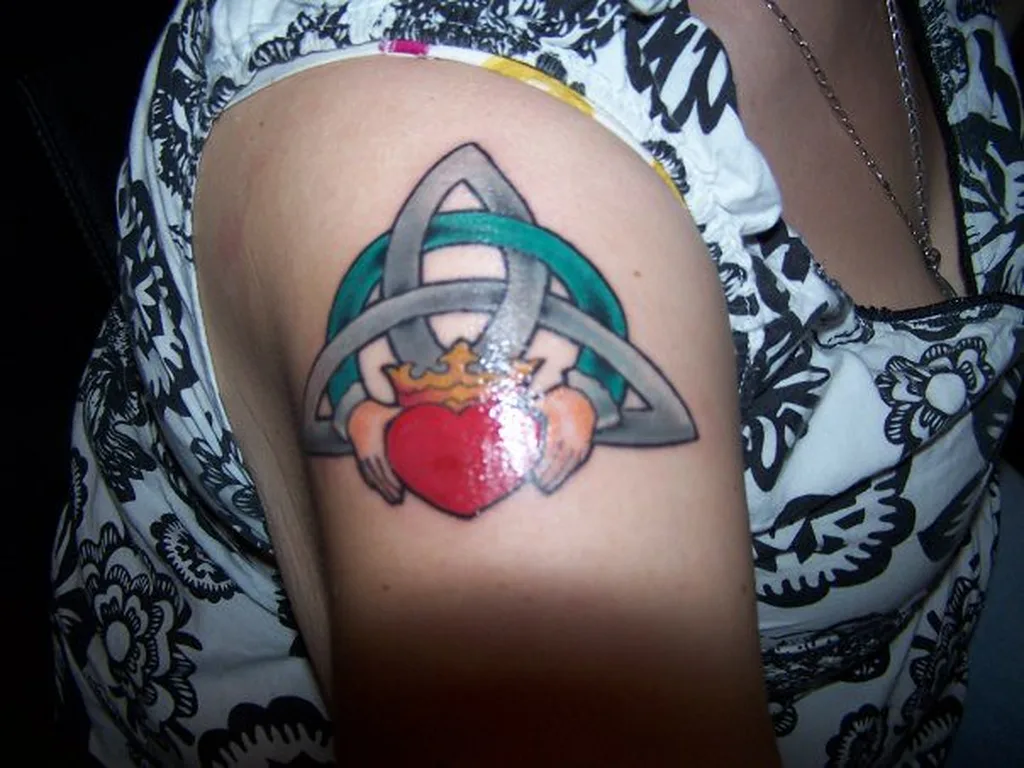
The triquetra — three linked arcs in one unbroken line — turns up in early medieval art across Ireland and Scandinavia, later used as a sign of the Trinity. This shoulder version pairs it with a heart and crown, borrowing from the Irish Claddagh ring: love, loyalty, friendship.
Small knotwork succeeds on spacing: the three arcs must never touch, or time joins them for you. At this size, the gaps can survive.
34. Triquetra With a Rose, Arm
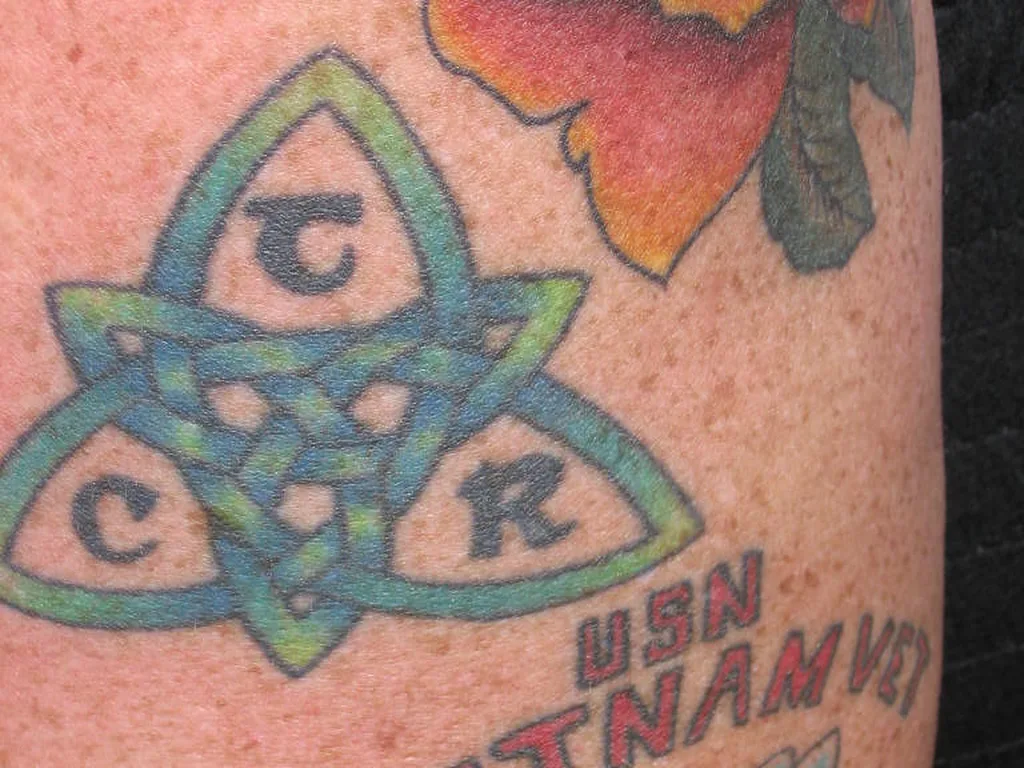
An older, settled triquetra in green, softened into the skin and paired with a rose. The combination is modern tattoo logic — an old knot for continuity, a rose for love — and there is nothing wrong with that, as long as nobody claims the pairing is ancient.
This photo earns its place as an ageing record: lines spread a little, green quietened, design still readable. That is good ageing.
35. Celtic Cross in a Circle, Blackwork
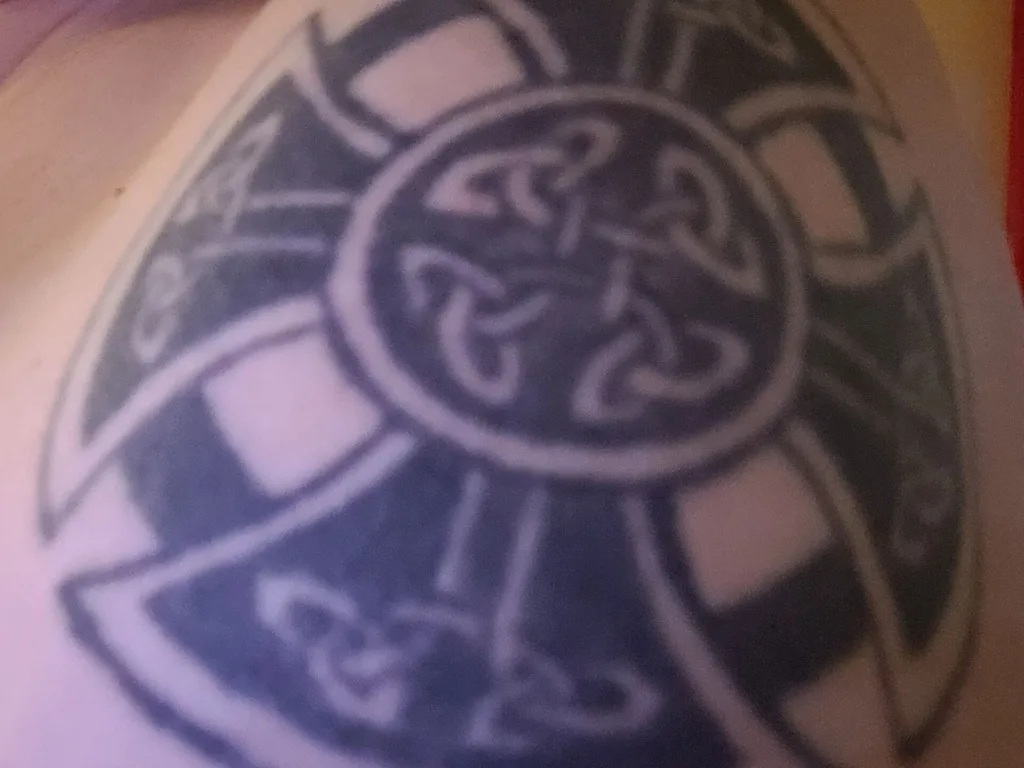
The Celtic cross — a cross with a ring around its centre — stands in churchyards across Ireland and western Scotland, some carved over a thousand years ago. This blackwork version fills the ring with knotwork and keeps the rest solid black.
Solid black is the longest-lasting ink there is; a cross built from it is nearly indestructible. The ring needs width — do not shrink it.
36. Celtic Knot in Purple, Forearm
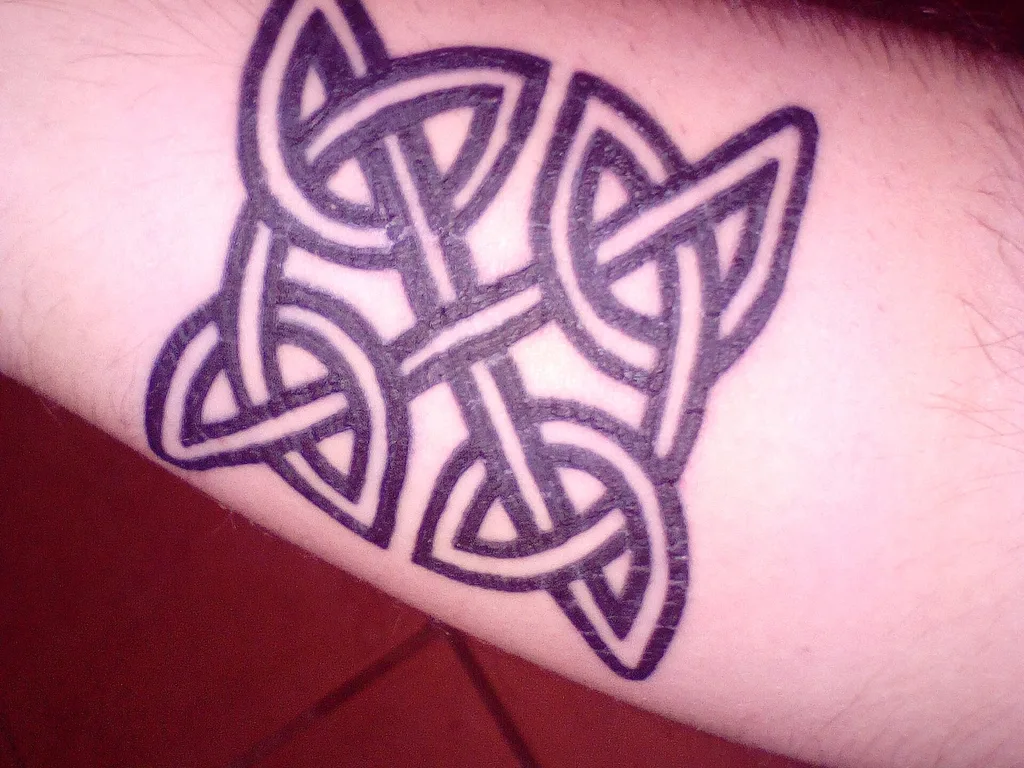
A single endless knot in purple on a forearm — the purest form of Celtic tattooing, one line weaving over and under itself. Knots like this filled the margins of illuminated manuscripts such as the Book of Kells.
Purple fades faster than black, especially on a sunlit forearm. Wide spacing is the knot’s protection; keep the weave open.
37. Celtic Knot Armband With Dragon Heads
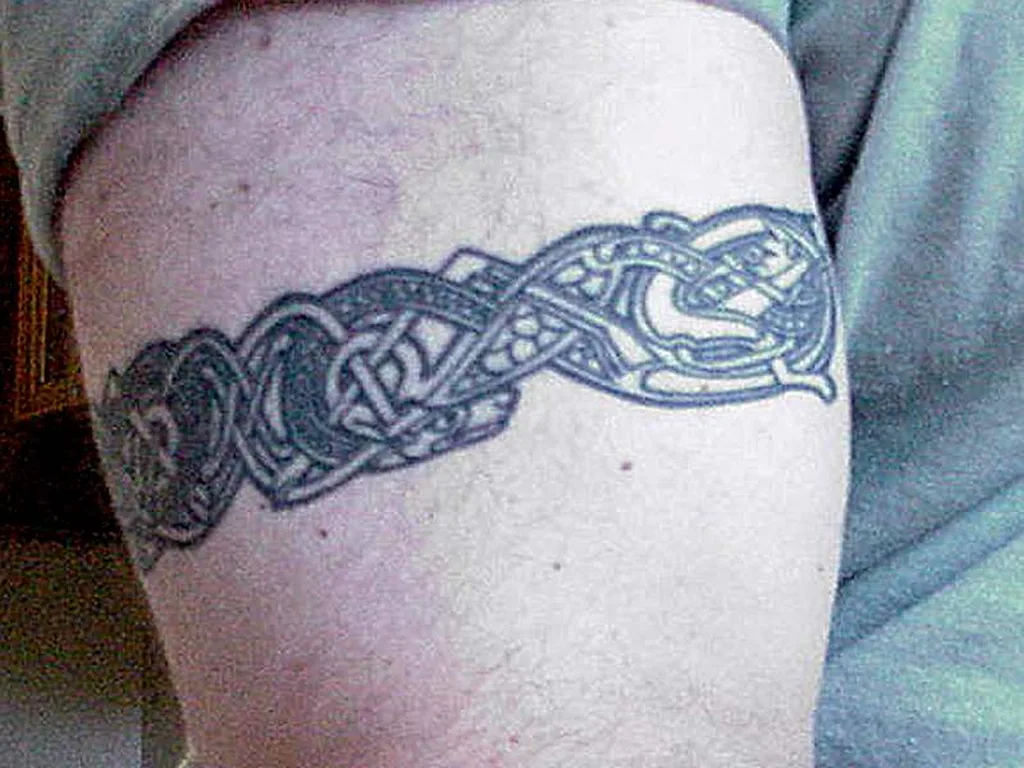
An armband of interlaced knotwork finished with dragon heads — a reminder that Celtic and Norse art drank from the same well, their beasts tangling together in carvings for over a thousand years.
Armbands are a measuring test: the pattern must join perfectly or the seam shows forever. Good artists stencil the join first.
38. Tree of Life in Knotwork, Back
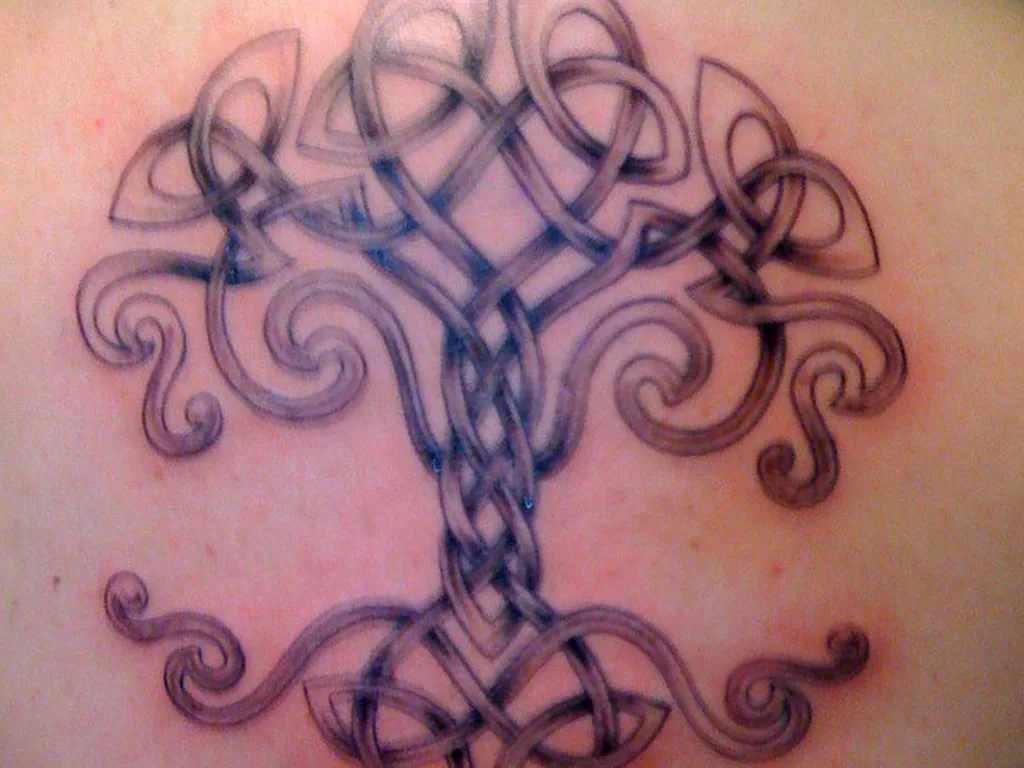
Trees held a sacred place in Celtic life — a tribe’s great tree, the crann bethadh, linked the world above and the world below. This back piece draws that idea in purple knotwork, roots and branches in one round shape across the shoulder blades.
The back is the natural home for round designs, and symmetry is the whole game: a tree millimetres off-centre will bother you for years. A two-person stencil job.
39. Celtic Tree of Life in a Circle, Thigh
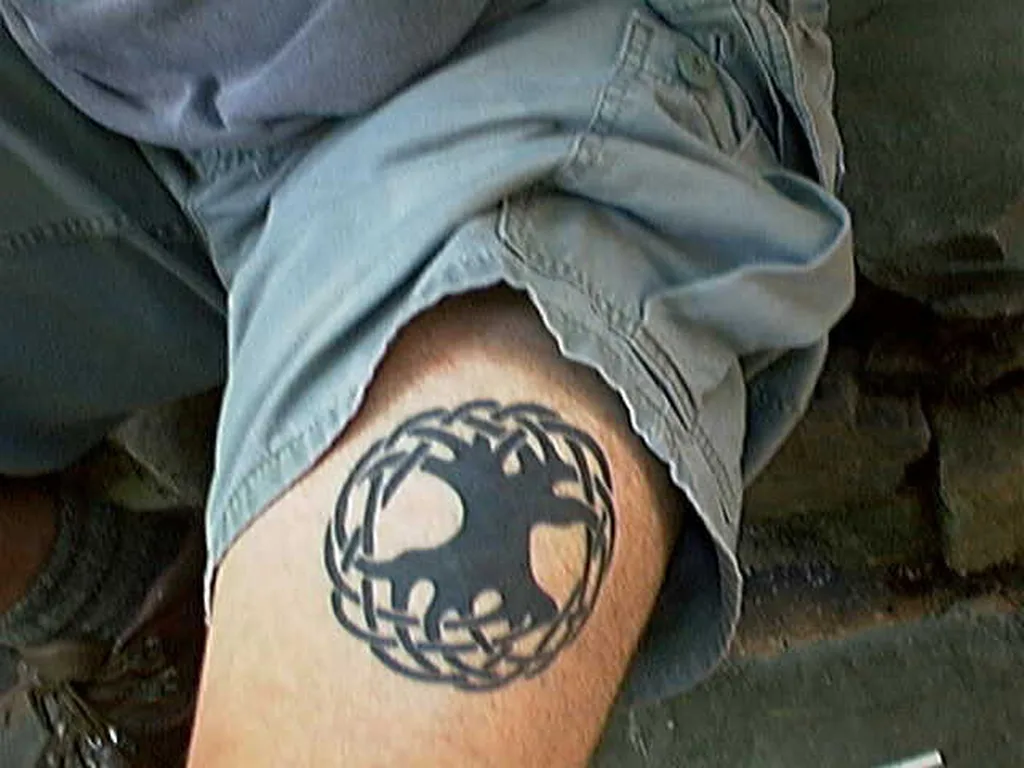
The same tree at thigh scale, held in a plain black circle. Modern tree-of-life tattoos mix the Celtic tree with ideas from other traditions — the neat root-mirror-branch drawing is a contemporary design in old clothing, and wearing it honestly means knowing that.
Thighs hide under clothes, stretch less than stomachs, and offer a big flat circle of skin — a kind placement for a first large piece.
Aztec and Maya Gods and Calendars
Central American designs borrow from stone: carved gods, feathered serpents and the great circular stones of the Aztec and Maya worlds. One honest correction up front — the famous Aztec ‘calendar stone’ is the Sun Stone, a monument, not a working calendar. Wearing it is fine; calling it a calendar is the part worth fixing. Aztec and Maya mythology tattoo ideas live or die on that accuracy.
40. Plumed Serpent, Leg
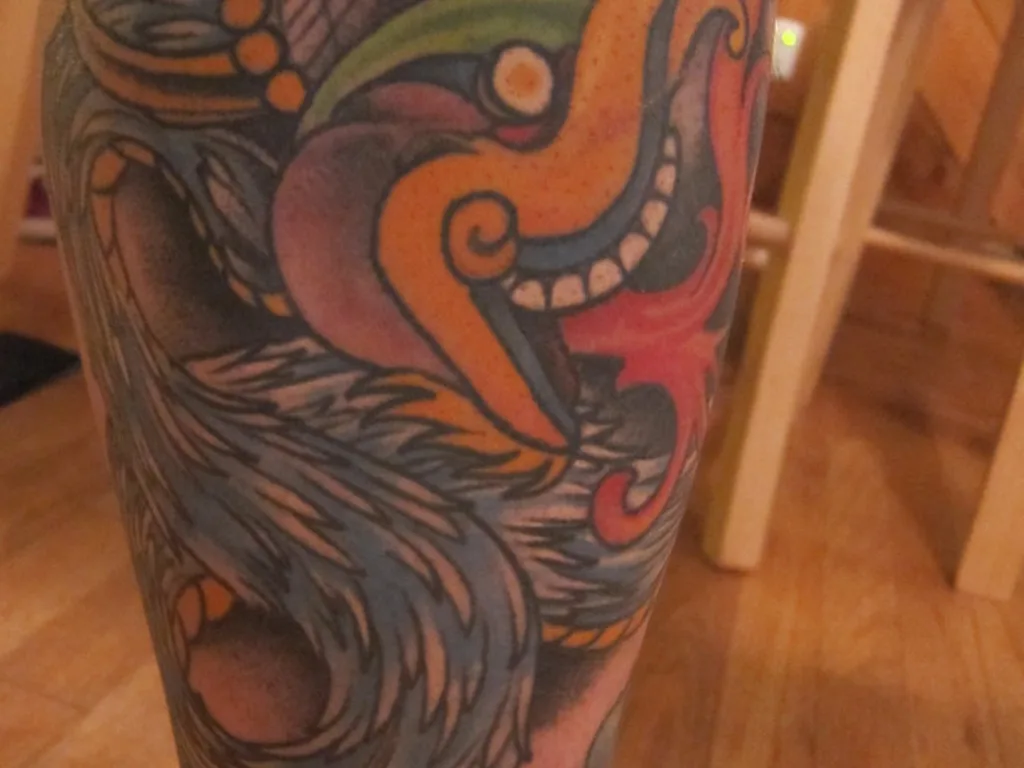
The feathered serpent is one of Central America’s great gods: Quetzalcoatl to the Aztecs, Kukulkan to the Maya — a serpent in quetzal feathers, tied to wind, learning and the calendar. This leg piece draws him mid-strike in full colour.
Serpents wrap legs beautifully, following the calf’s curve as this one does. Bright colour wants sunscreen; the outline holds the shape after the greens mellow.
41. Aztec Figure in a Feather Headdress, Forearm
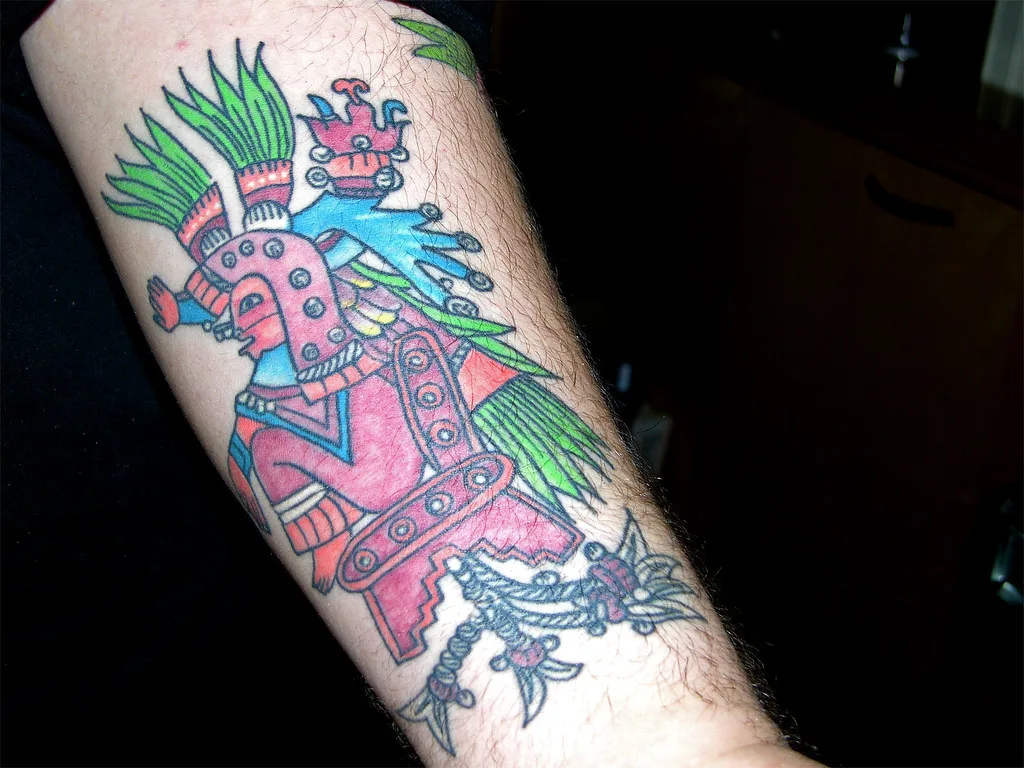
A standing figure in a tall feather headdress, in the flat, frontal style of the Aztec codices — the painted books that recorded gods and calendars before the Spanish conquest destroyed most of them. Forearm pieces in this style read like a page from one of those books.
Codex style is honest tattooing: flat colour, black keylines, no fake shading. Keylines keep the figure readable while colour fades inside them.
42. Maya Figure in a Calendar Circle, Arm
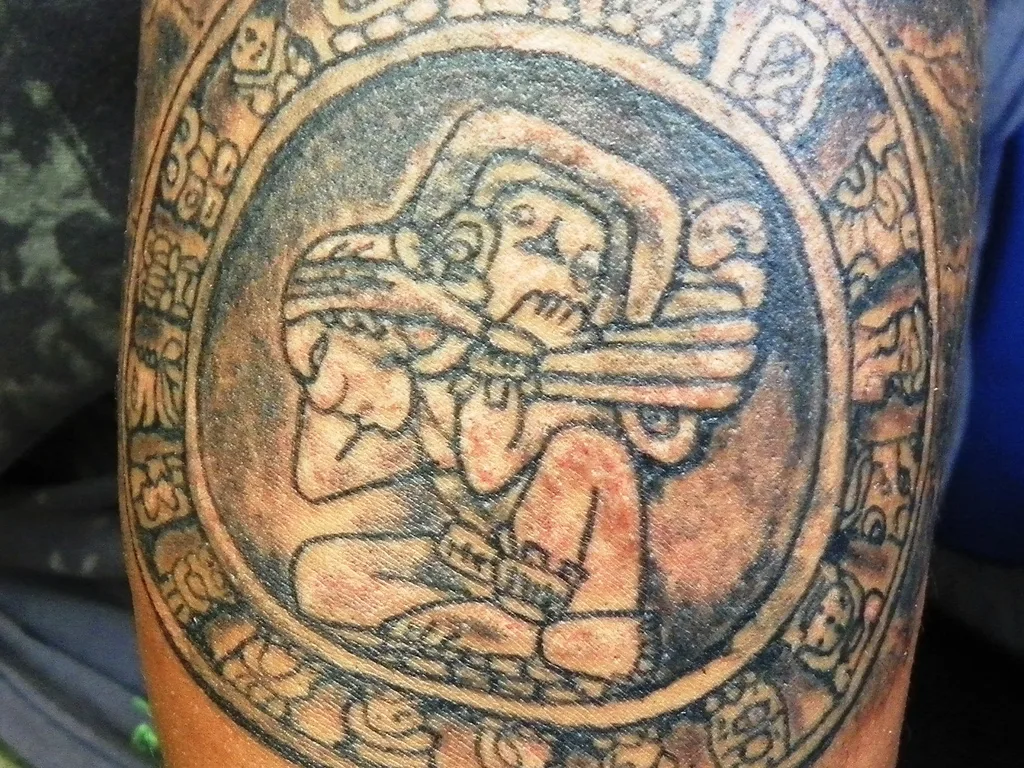
A kneeling figure sealed inside a ring of glyph-like carving, copying Maya stone work. Circular designs like this borrow their shape from carved stelae and from the Aztec Sun Stone — which, once more, was a monument and not a calendar, whatever the gift shops claim.
Round designs need round placements: upper arm, shoulder blade, calf. A forearm’s taper would bend the circle.
43. Aztec-Style Carved Figures, Arm
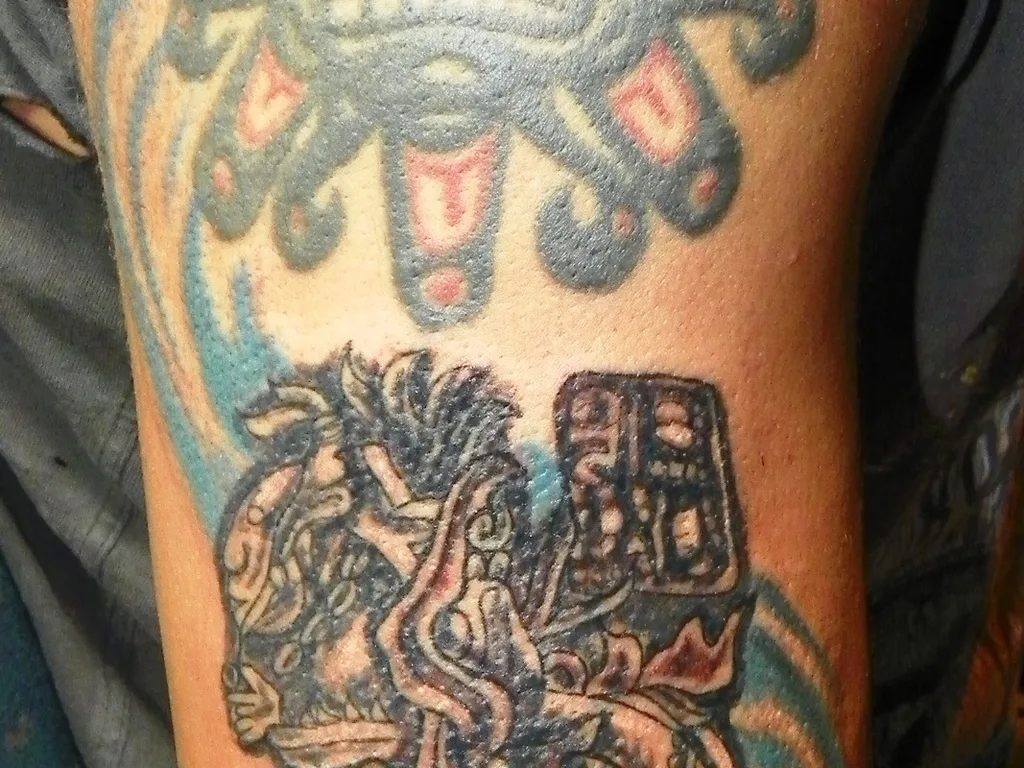
Two panels of carved-figure work in black and grey, drawn to look like relief sculpture — the tattoo as a temple wall. Stone-effect tattoos live on their shadows: every carved edge needs a dark side and a light side, or the whole thing flattens.
That is their ageing risk too: soft grey shadow is the first thing skin loses. True black in the darkest lines gives the relief a skeleton.
Hindu Gods in Ink
Hindu subjects here centre on Ganesha, the elephant-headed god who opens most prayers and undertakings in India. These are images from a living religion, so the entries treat them as devotional pictures first and design ideas second — and placement advice carries extra weight. Hindu mythology tattoo ideas ask for that care most of all.
44. Ganesha in Black and Grey, Side and Chest
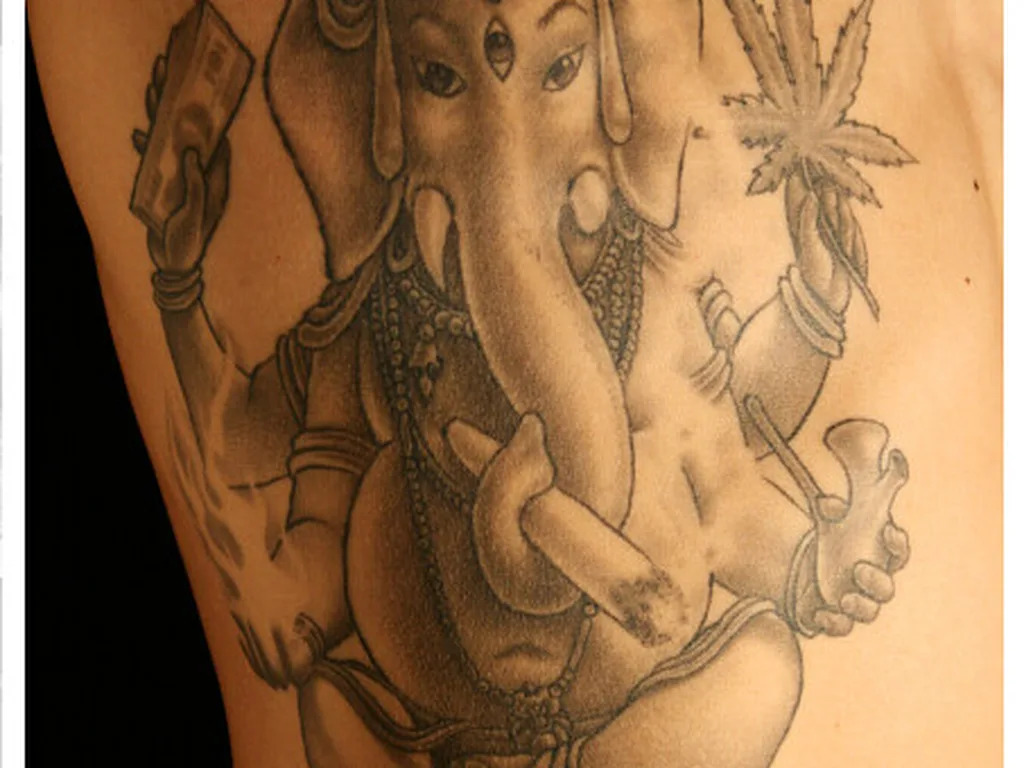
Ganesha, elephant-headed son of Shiva and Parvati, is the remover of obstacles and god of beginnings — prayed to first, before new ventures, journeys and books. Tradition names him the scribe of the Mahabharata. This side piece draws him seated and calm.
A devotional image asks for a respectful placement, and the torso is exactly that — the respect section below explains why. The soft shading needs a grey-work specialist.
45. Ganesha as a Cover-Up, Arm
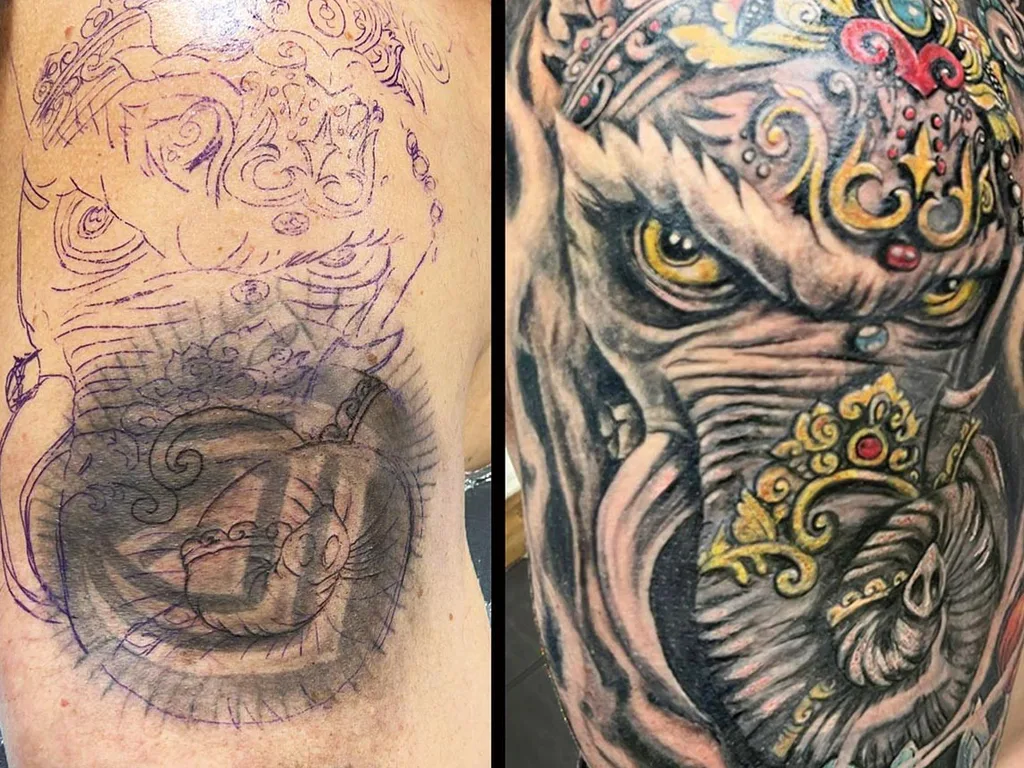
Two panels of the same arm: the cover-up in progress and finished, Ganesha’s shape doing the hiding. Cover-ups built on gods are an old solution — the figure is busy, dark in the right places, full of cloth and jewellery to bury old lines inside.
The lesson of the two panels is patience: cover-ups are designed backwards from the old tattoo’s darkest areas, so the consultation matters most.
The Phoenix, the Bird That Crosses Borders
The phoenix does not belong to one tradition, which is why phoenix mythology tattoo ideas borrow from several at once. Greek writers described a great bird that burns and returns; their account borrowed from Egypt’s benu bird, and China’s flame-coloured fenghuang is a different creature often merged into the same tattoo. Two designs stand for the family here; the phoenix tattoo design ideas guide goes deeper.
46. Phoenix in Full Colour, Back and Arm
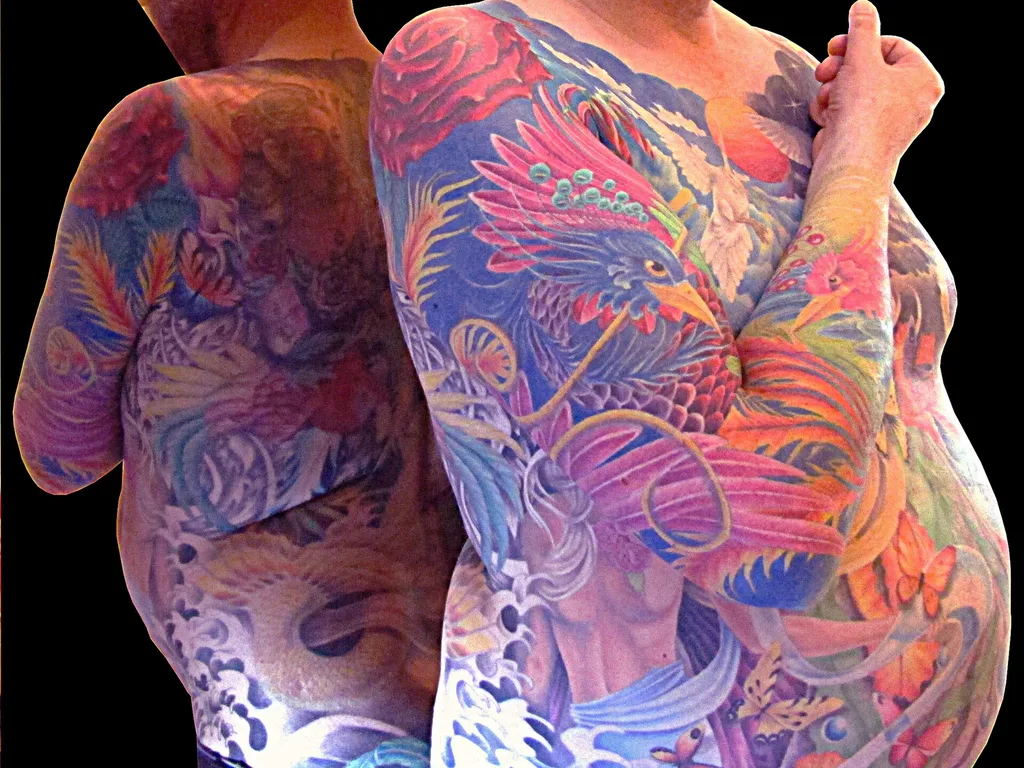
The phoenix in full glory — pink, orange and blue feathers pouring down a back and arm, in the Japanese hou-ou manner. Greek writers told of a bird that burned and rose from its ashes; Herodotus admitted he had only seen it in pictures, in Egypt, where the benu bird belonged to the sun god.
Work at this scale is a serious undertaking, and the phoenix tattoo design ideas guide shows the full range. This outline-free colour will soften into something dreamlike with age — plan for that picture, not just the fresh one.
47. Phoenix in Outline, Full Back
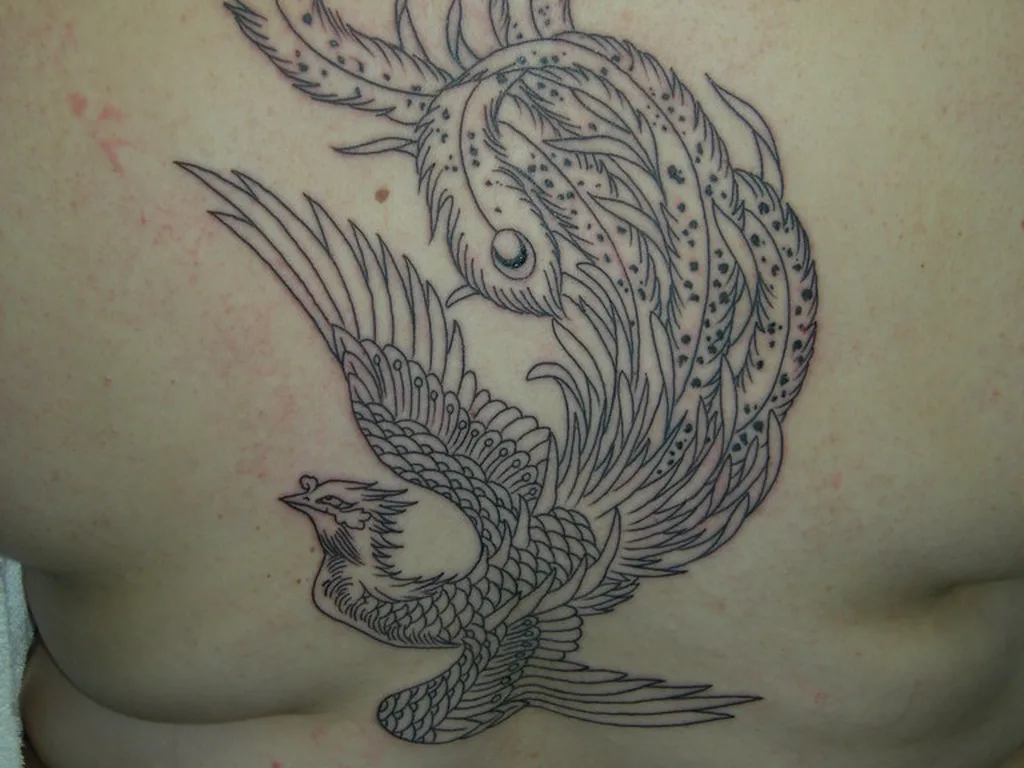
The opposite treatment: a phoenix in line alone across a whole back, no colour, almost no shading. Outline pieces are sometimes stage one of a coloured back and sometimes the finished choice — the drawing has to be flawless, because there is nothing to hide behind.
A full-back outline is the most honest sizing lesson here: at this size every feather can stay separate for decades; at hand size it would be soup in five years.
Best Placements for Mythology Tattoo Ideas
Among mythology tattoo ideas, portraits of gods — Zeus, Athena, Odin, the valkyrie — want flat, wide skin: forearm for a single face, thigh or upper back for anything with a weapon, ship or wings attached. Faces smaller than a palm lose their expressions first.
Symbols are the flexible family. Valknut, triquetra, Eye of Horus and scarab work at wrist, ankle, chest and neck sizes — they were amulets and carvings long before they were tattoos, and their thick lines are built for small scale.
Full scenes — dragon back pieces, the winged goddess, the phoenix — belong on backs, where the canvas is biggest and the sun rarest. Sails, robes and wings need room.
One placement rule is cultural, not practical: deities from living religions — Ganesha above all — are widely considered disrespectful on feet and lower legs. The next section covers that.
A Note on Respect
Some of these designs are stories; some are gods people pray to today. Ganesha is worshipped daily by hundreds of millions of Hindus; Anubis and Horus belong to a revived Egyptian practice, and Norse gods have modern followers too. None of that bans the tattoos — people inside these religions wear them — but it changes what a thoughtful wearer does.
Three habits cover most of it, whatever mythology tattoo ideas you are weighing. Place deities with respect: torso, arm and shoulder, not feet, ankles or near swimwear. Get the details right: a deity’s objects, animals and gestures carry meaning, and a wrong detail is the tattoo version of a misspelled name. And skip costume-shop versions — real temple art outclasses a party outfit.
Symbols deserve the same care in the other direction. Valknut and vegvisir get sold with confident Viking meanings history does not back up; a wearer who knows the true, younger or murkier story is better armed than one repeating a label. This page flags those cases in the entries.
Frequently Asked Questions
What is the most popular mythology tattoo?
Among mythology tattoo ideas, Medusa is the strongest current favourite, with Zeus portraits, Odin and Norse symbols, and Japanese dragons close behind. Popularity moves in waves driven by games, series and films, but the top group is stable because all of them draw well at portrait and symbol size.
What does a Medusa tattoo mean?
In the Greek story, Medusa was a Gorgon whose gaze turned men to stone. The modern reading — survival and protection after harm — is widely worn today, though it is recent rather than ancient. The medusa tattoo meaning guide separates the layers.
Are Norse tattoos only for people with Scandinavian roots?
No. Norse imagery has been borrowed for centuries, and modern Norse pagans are generally welcoming of respectful wearers. The better test is knowledge: if you wear a valknut or vegvisir, know its real history — including that the vegvisir is an 1800s Icelandic symbol, not a Viking one.
Is it disrespectful to get a Ganesha tattoo?
It depends on placement and treatment. In India, Ganesha tattoos on arms and backs are common and devotional. What many Hindus object to is the god on feet, ankles or near swimwear, or drawn in a mocking style. A respectful placement and accurate drawing are welcomed; a careless one is not.
Which mythology tattoo ideas age best?
The bold symbols: valknut, triquetra, Eye of Horus and scarab, all in solid black. Carved and cast as amulets for thousands of years, heavy black shapes with wide spacing barely change over a lifetime. Colour portraits and fine grey shading soften first.
How big should a Zeus or Odin portrait be?
Palm-sized at the smallest, bigger is better. A god’s face carries its meaning in the eyes and beard, and those details merge as ink spreads if they start small. Forearm, thigh and upper arm are the usual homes.
What does a triquetra tattoo mean?
The honest answer is layered. The triquetra is an old triple-knot motif from early medieval art; Christians later used it for the Trinity, and modern pagan readings link it to triple goddesses and to land, sea and sky. None can be proved original, so wear the layer that is true for you — and know it is a layer.
Can a mythology tattoo be a cover-up?
Yes — two designs in this guide are exactly that. Gods and monsters make good cover-ups: busy, dark, full of cloth, feathers, scales and waves to hide old lines in. The new piece must be larger and darker, designed around the old tattoo’s shape.
Do Japanese dragon tattoos have to cover the whole back?
No. Full backs are the classic irezumi format, but sleeve and half-back dragons are just as traditional in structure — the long body wraps whatever canvas it is given. What matters is that the body stays unbroken and scaled to the space.
What should I check before getting a mythology tattoo?
Three things. The story: read the actual myth, not only shop summaries. The text: any runes, hieroglyphs or script checked by someone who reads them. And the artist: healed photos of the same style, at least a year old, before you book.
Final Thoughts
Forty-seven designs, eight traditions, one pattern underneath: the mythology tattoo ideas that last — in skin and in meaning — belong to wearers who knew the real story before they booked. Pick the figure whose story you can tell without notes, give it the size and placement it asks for, and let the deep guides do the rest: dragons, phoenixes, Medusa and angel wings all have pages of their own.