Lizard tattoo ideas are harder to research than most animal designs, because the internet is full of the same handful of drawings passed from one gallery to the next. This guide works from real photographs instead. All ten designs below are real lizard tattoos on real skin, taken from openly licensed photos, and they cover the full range of what people actually get: geckos stretched along forearms, a tribal chameleon on a shoulder, one small pink climber inside a green circle, and a black and grey Komodo dragon that takes up a whole bicep. If lizards are one stop on a longer search, our wider guide to animal tattoo ideas covers the rest of the menagerie.
One honest note before the designs. We set a target of twenty lizard tattoo ideas for this guide and went looking across Flickr, Wikimedia Commons and Pexels, checking the licence on every photo’s own page. Ten designs passed every check: a real tattoo, clearly a lizard, and a licence that allows reuse. The rest of the pool fell away because the licence forbade it, the photo turned out to be a real lizard sitting on someone rather than ink, or the design was a dragon wearing a lizard costume. Rather than pad the list with drawings, stock illustrations or photos we had no right to use, this guide publishes the ten that verified. Ten real ones beat twenty borrowed ones.
What a Lizard Tattoo Can Mean
Change is the meaning most people reach for first, and the chameleon carries it. Chameleons shift colour to communicate and to manage their body temperature, not simply to hide, as the Encyclopaedia Britannica lizard entry explains in its survey of the group. A chameleon tattoo tends to belong to someone who has remade themselves at least once and expects to do it again: new city, new trade, new life, same person underneath.
Regeneration runs a close second. Many lizards can shed a tail that a predator has grabbed and grow a replacement over the following weeks. The regrown tail is never quite the original, which is exactly why the symbol lands with people. It says: something took a piece of me, and I grew back anyway, slightly different and entirely unbothered. Geckos add a warmer note. In plenty of warm-climate households a house gecko is a welcome guest, an insect hunter that people treat as a small guardian of the home, so gecko tattoos often carry luck and protection meanings for the wearer. At the far end of the scale sits the Komodo dragon, the largest living lizard, and choosing one is a straightforward power statement. Few lizard tattoo ideas are subtle once a Komodo is involved. Most people mix two or three of these meanings together rather than picking just one, and the ten lizard tattoo ideas below show the mixtures working in practice.
Lizard Tattoo Ideas: Ten Designs in Real Photographs
The designs run from the biggest commitment to the smallest. One warning that applies to all ten: a lizard’s long body and tail make placement half the design. The best lizard tattoo ideas below work because the animal’s shape follows the limb or the shoulder it lives on, so read the placement notes as closely as the artwork. Treat all ten as starting points for your own lizard tattoo ideas, not as stencils to copy line for line.
1. Black and Grey Komodo Dragon Head on the Bicep
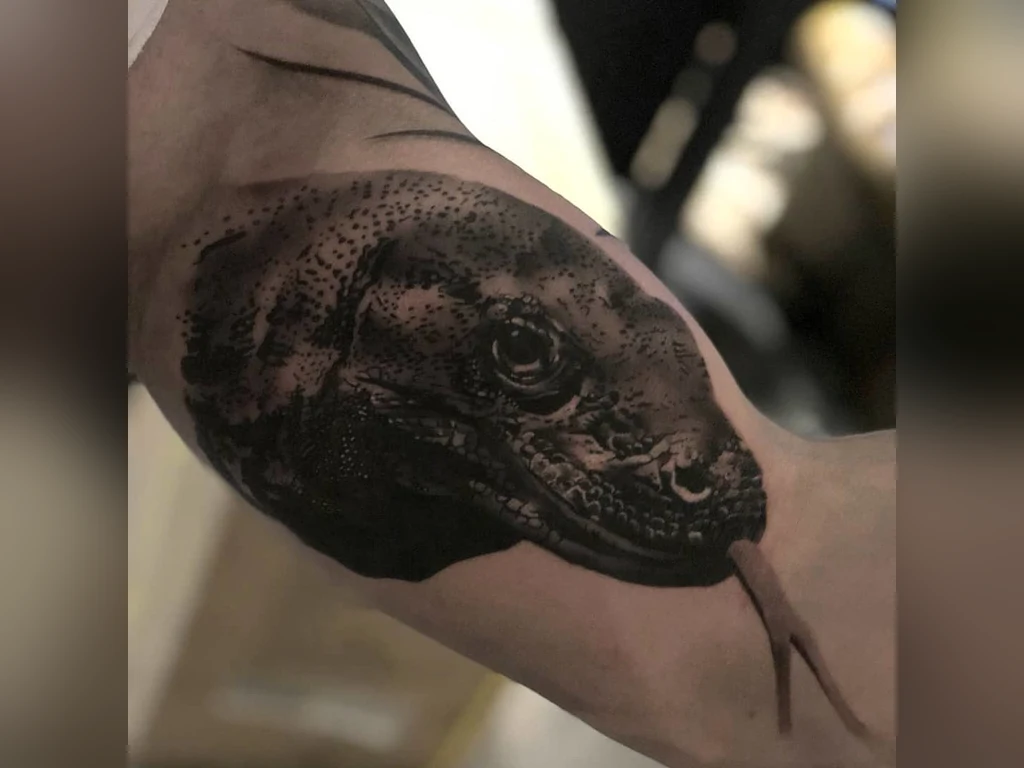
The heavyweight of the list. This Komodo dragon is drawn as a portrait rather than a full animal: the head fills the bicep, built from stippled scales, a wet-looking eye and row after row of teeth and jaw texture, and the forked tongue leaves the mouth and runs down toward the forearm, which ties the whole arm into one design. Nothing about it is decorative. It reads as a warning, and that is clearly the point.
Realism like this is the most demanding style on the page. The soft grey shading that makes the scales feel armoured will relax over the years, so this design needs both a realism specialist to start with and enough size to hold its detail. Shrink it and the stippling merges into a dark patch. At this scale, on an arm that can carry it, it is the strongest of all the lizard tattoo ideas here.
2. Blue-Grey Gecko With a Patterned Back, Forearm
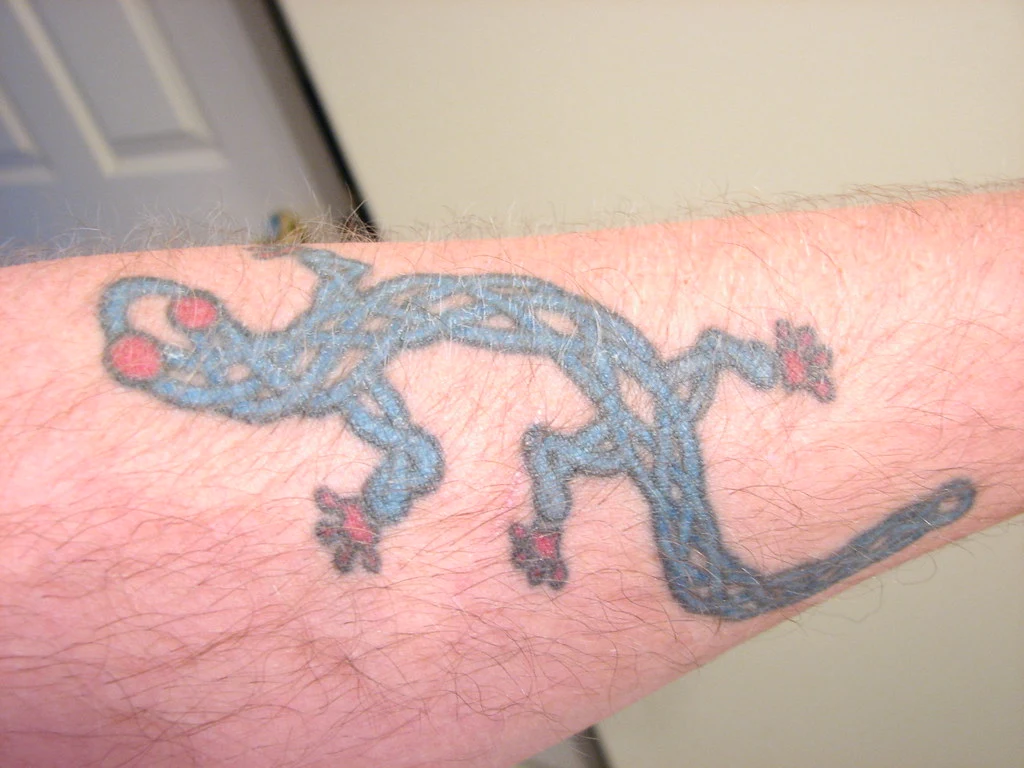
This gecko uses the whole forearm the way a real gecko uses a wall: head at the wrist end, tail trailing to the elbow, all four feet planted. The body is a slate blue-grey filled with a lighter open pattern, almost like knotwork, and the accents are tiny hits of red on the toe pads and eyes. It is a friendly design with a lot of quiet detail in it.
The photograph also shows this tattoo settled and softened with age, and that honesty is useful. Light blue-grey ink is one of the first colours to fade, and the fine pattern inside the body has relaxed as the skin has. If this style appeals, budget for a touch-up years down the line and keep the pattern bold enough to survive one.
3. Tribal Chameleon With a Coiled Tail, Shoulder
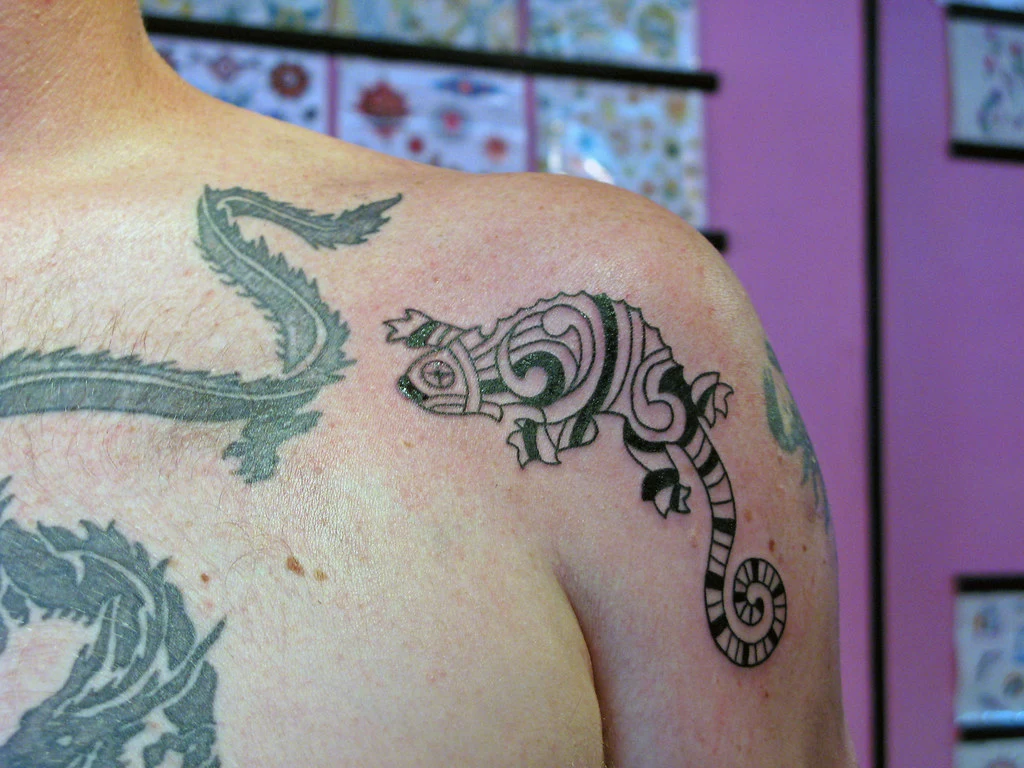
Tribal blackwork suits a chameleon better than almost any other animal, because the animal already comes with the shapes the style loves: a ridged back, a casque on the head and a tail that coils into a perfect spiral. This shoulder piece leans into all three. The body is patterned with swirls and stripes, the eye is a small ring, and the tail finishes in a tight coil that gives the whole design its focal point.
The photograph shows the wearer’s other work too, including a green dragon running across the chest. The chameleon holds its own corner regardless, which says something about bold black linework: it does not get crowded out. Solid black tribal work also ages more gracefully than any other style in this guide, so of all the lizard tattoo ideas here, this is the design to copy if you want a lizard that looks the same in fifteen years.
4. The Lizard King: A Black Tribal Climber, Forearm
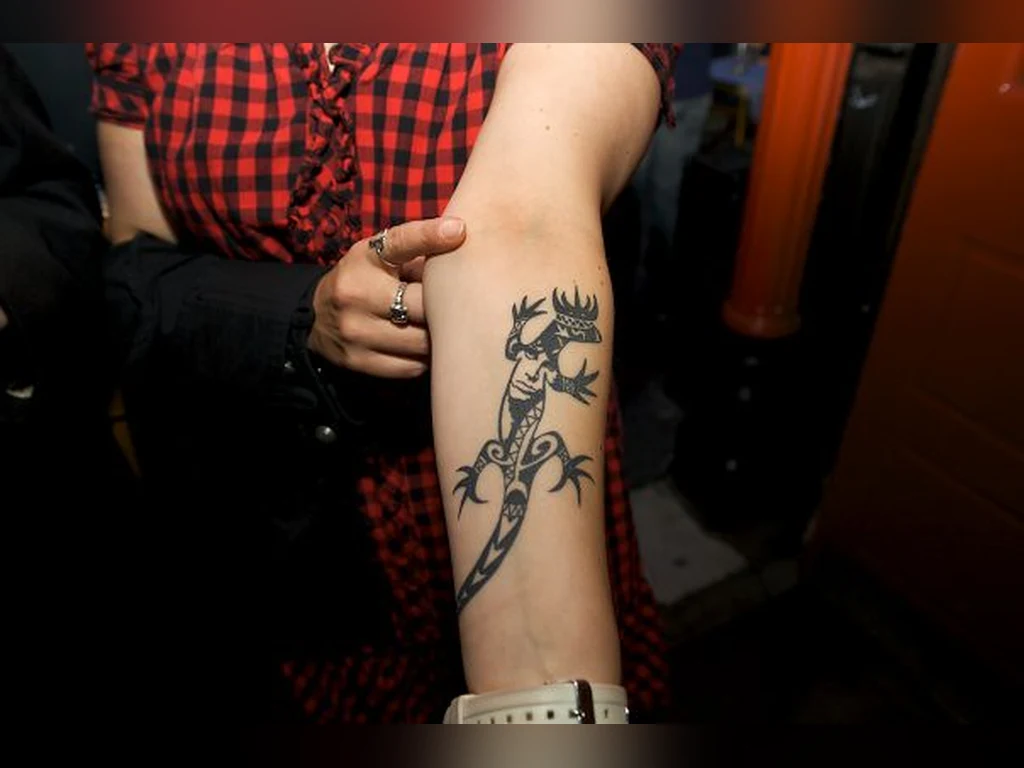
The photographer titled this one “The Lizard King”, and the design earns a bit of swagger. It is a long, spiky tribal lizard running nearly the full length of a forearm, head down toward the wrist, with a ridged spine and sharp, almost flame-like edges to the body. There is no colour and no background, just black ink and skin, and the forearm’s own shape does the rest.
Forearm climbers like this are the most copied of all lizard tattoo ideas, for a practical reason: the placement is visible when you want it and covered by a sleeve when you do not, and the lizard’s stretched pose flatters the arm instead of fighting it. Keep the silhouette spiky and simple. Fine interior detail at this width would blur into the black within a few years.
5. Pink Gecko Inside a Green Circle, Calf
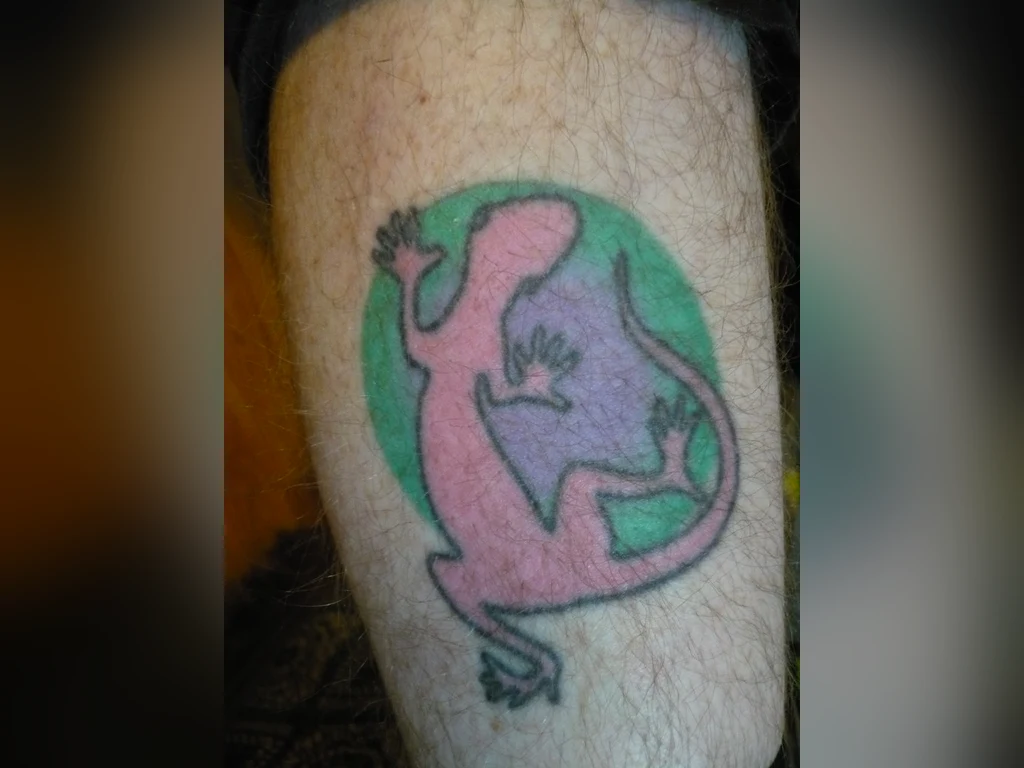
The happiest design in the guide. A pink and purple gecko climbs across a solid green circle, one front foot reaching past the edge of the disc as if it is climbing out of the picture. The colours are flat, the outline is thick, and the whole thing works like a badge or a sticker. It is proof that a lizard tattoo does not have to look fierce, scaly or even slightly realistic to work.
Flat colour blocks are a smart way to do a small-to-medium design, because there is no fine detail to lose. The honest trade-off is the pink itself: pale pinks and purples are among the fastest-fading tattoo colours, especially on a leg that sees summer sun. Expect this one to need a colour refresh sooner than the blackwork designs, and it will look cheerful again in one short session.
6. Green Dancing Gecko Outline, Calf
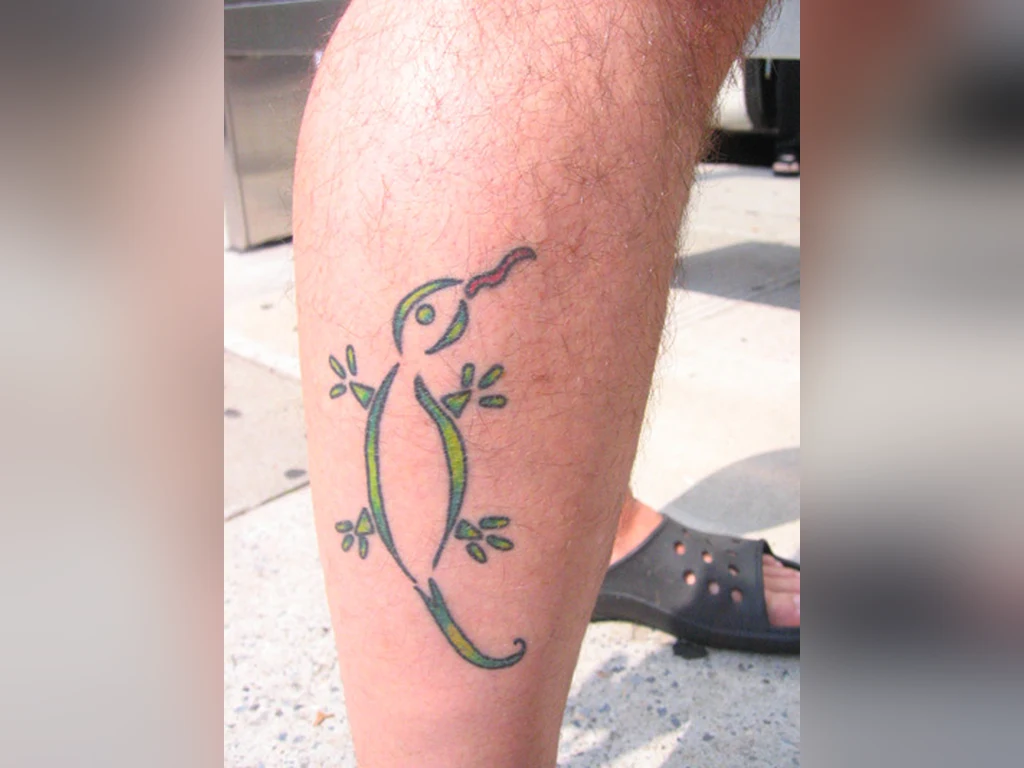
Two shades of green, one curved line for a body, and a gecko that looks mid-dance: that is the entire design, and it is enough. The body bends into a loose S, the little splayed feet are drawn as simple shapes, and the tongue sticks out, which gives the whole tattoo its joke. It sits on the back of a calf, where the curve of the leg adds to the curve of the pose.
This is the most first-tattoo-friendly design in the guide. It is small, quick to sit through, easy to extend later if you fall for lizards in a bigger way, and cheap to keep because a two-colour design touches up fast. Simple line geckos like this one are also the easiest lizard tattoo ideas to personalise: change the pose, the colour or the expression and the design becomes yours.
7. Curled Lizard With Red Triangle Patterning, Forearm
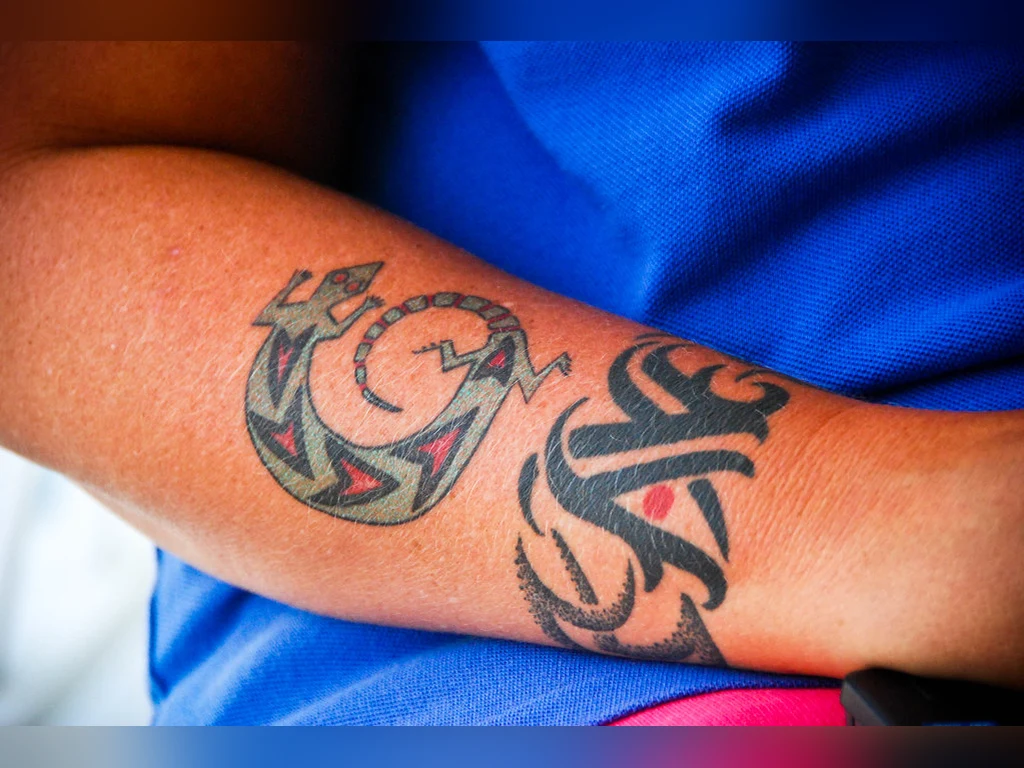
Full disclosure on this one: the photographer titled the photo “Britas salamander”. Salamanders are amphibians, lizards are reptiles, and the two get mixed up constantly in tattoo galleries. This design, though, is drawn with a lizard’s long tail, clawed toes and dry, patterned skin, curled into a resting C on the forearm with a row of red triangles running down its back. We have included it as a lizard, and told you about the title so you can judge for yourself.
The curl is the design’s strength. Curled poses are the lizard tattoo ideas to study when your spot is round: a curled lizard fits forearms, shoulders and calves, where a stretched-out climber would wrap awkwardly. The red triangles are a small, cheap way to add colour to a black design: three or four hits of red do the work of a full colour piece and age far better. The black tribal piece beside it is a separate tattoo, and the two sit together without crowding.
8. Small Black Gecko Between the Shoulder Blades

This photograph was taken from across a fair, so be honest with yourself about what it shows: a small black gecko sitting high on a woman’s back, between the shoulder blades, drawn simply enough to read at a distance. Sometimes a wide photo is more useful than a close-up, because this is how a small tattoo actually looks in the world, as one part of a person rather than a gallery shot.
The upper back is a natural home for a gecko. The spot is flat, symmetrical and easy to cover, and a gecko’s splayed feet suit a design that spreads gently sideways instead of running long. Small lizard tattoo ideas live or die on simplicity: at this size the design has to stay bold, legs and tail as clear shapes, or it shrinks into a smudge by its fifth summer.
9. Small Colourful Gecko on the Upper Arm

Another candid rather than a studio shot: a man reading on a beach towel, with a small multicoloured gecko high on his upper arm. The design is only a few inches long, drawn in a simple cartoon style with the feet spread wide, the sort of tattoo that gets pointed at and asked about rather than stared at.
Take the setting as the lesson. Small colour lizard tattoo ideas and beach holidays are natural enemies, because ultraviolet light is the main thing that fades colour ink, and an upper arm in the sun all afternoon takes the full dose. If your lizard will live on sun-exposed skin, sunscreen once it has healed is not optional. It is the difference between the colours in this photo and a pale outline.
10. Infinity Lizard on the Shoulder Blade
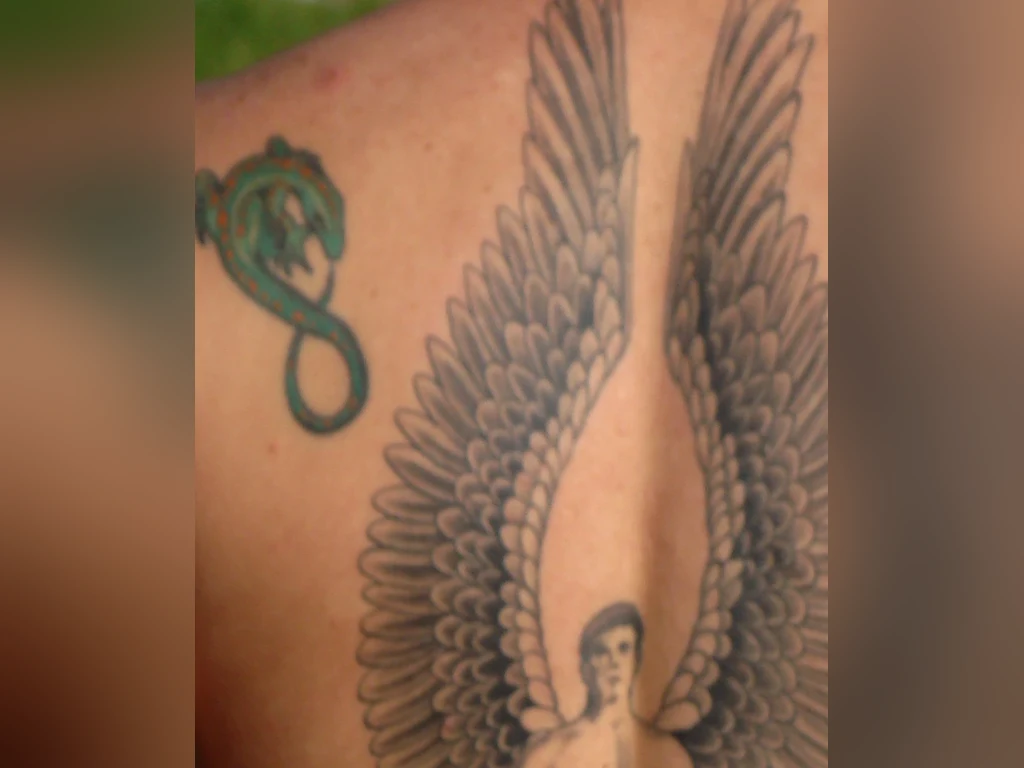
The cleverest small idea in the guide. This green lizard’s body and tail loop back on themselves to form an infinity shape, sitting on one shoulder blade. We have cropped the photograph closer than the original: the lizard shares a back with a very large winged piece that fills the rest of the skin, and the little green loop holds its own in the corner of it.
As a symbol it layers two meanings neatly, the lizard’s regeneration and the infinity loop’s forever, in a design small enough for a first tattoo. It earns its place among lizard tattoo ideas that punch well above their size. Symbol-plus-animal combinations like this are worth stealing as a method even if you pick a different animal: draw the creature so its own body makes the symbol, rather than placing two clip-art shapes side by side.
Placement, Size and How These Designs Age
Lizards are the easiest animals in tattooing to place, because the animal is basically a line with legs. Forearms and calves take the stretched climbers, as designs 2, 4 and 6 show. Shoulders and shoulder blades take the curled and coiled poses, as designs 3 and 10 show. The upper back suits a small splayed gecko, and a bicep has just enough curve to hold a big head portrait like the Komodo. What lizard tattoo ideas rarely survive is being squeezed into a spot that bends the animal out of shape: an ankle or a wrist will fold a long body in ways that read badly at a glance.
On ageing, the ten photographs in this guide are the evidence for what happens to lizard tattoo ideas over time. The bold black tribal work (designs 3 and 4) has stayed sharp. The light blue-grey of design 2 has softened, the pink of design 5 will need refreshing first among its neighbours, and the realism of design 1 will need the most care of all. None of that makes the softer styles bad choices. It means you choose them with a touch-up in the diary and sunscreen in the routine, instead of being surprised in year five.
Lizard Tattoo Ideas: Frequently Asked Questions
What does a lizard tattoo mean?
The common meanings are adaptability, regeneration and luck. Chameleons stand for change, lizards that regrow their tails stand for recovery and survival, and geckos carry a friendly luck-and-protection meaning in many cultures where house geckos are welcome guests. A Komodo dragon drops the gentle meanings and stands for power.
What is the best placement for a lizard tattoo?
For lizard tattoo ideas that climb, the forearm and calf are the most popular spots, because a lizard’s long body follows the limb. Shoulders suit coiled chameleons, the upper back suits a small gecko, and a bicep can carry a large head portrait. Pick the pose to fit the body part: stretched climbers for limbs, curled poses for round areas.
Do gecko tattoos work as a first tattoo?
Yes, and the guide includes two good templates: the simple green outline gecko at design 6 and the small upper-back gecko at design 8. Both are quick to sit through, easy to cover at work, and simple to extend later if you want a bigger piece built around them.
How much does a small lizard tattoo cost?
Prices depend on your city, the artist and whether the shop charges a minimum fee for small work, so any single figure would be a guess. A small two-colour gecko usually falls at or near a shop’s minimum charge, while the Komodo at design 1 is a multi-hour realism piece at the other end of the scale. Ask two or three local studios for a quote on your reference photo; the range will tell you the going rate where you live.
Should a lizard tattoo be colour or black and grey?
Colour wins for cheerful gecko designs, like the pink climber at design 5, and for anything chameleon-like where colour is half the animal’s identity. Black and grey or solid black wins for longevity: tribal and blackwork lizards hold their edges for decades, while pale colours need refreshing. Choose with your tolerance for touch-ups in mind.
How do lizard tattoos age?
The bold and the black age best. In this guide’s photographs, the tribal chameleon and the Lizard King have stayed crisp, the light blue-grey gecko has visibly softened, and fine stippled realism like the Komodo will relax the most over time. Sun exposure speeds all of it up, so healed tattoos need sunscreen.
Can a lizard tattoo be really small?
It can, if the design is simplified to match. A tiny lizard needs a clear silhouette, thick enough lines and no interior detail smaller than a pinhead, like the shoulder-blade gecko at design 8. A detailed Komodo scaled down to two inches would blur into a dark blob within a few years.
What is the difference between a gecko tattoo and a chameleon tattoo?
Mostly shape and meaning. Geckos are drawn smooth and flat with round toe pads, and they carry luck, home and protection meanings. Chameleons are drawn with a curled tail, a ridged back and a casque on the head, and they carry change and adaptability meanings. If you cannot decide, the tail gives it away: a tight spiral means chameleon.
Can a lizard design cover up an old tattoo?
Often, yes. A dark, stretched lizard body covers a surprising amount of old ink, and scaled or patterned skin hides faded work better than flat shapes do. The Komodo portrait style at design 1 is the strongest cover-up candidate here. Show the old tattoo to your artist before committing, because cover-ups need the new design drawn around what is already there.
How do I choose an artist for a lizard tattoo?
Match the artist to the style, not to the animal. Realism pieces like the Komodo need a realism portfolio, tribal pieces need clean blackwork, and flat colour geckos need an artist whose colour work heals solid. In each case, look at healed photos in their portfolio, not fresh ones: a healed photo is the tattoo you will actually own.
Final Thoughts
Ten designs is a shorter list than we wanted to publish, and it is the right list anyway. Every tattoo in this guide is real, every lizard is actually a lizard, and every photograph is here with its photographer’s permission framework intact, credited below. If these lizard tattoo ideas have started something, take a reference photo to a local artist rather than copying a design line for line; the pose and placement lessons travel, and the exact tattoo stays its owner’s. Reptile people tend not to stop at one animal, so our snake tattoo ideas and frog tattoo ideas guides are the natural next stops. This guide will grow as more lizard tattoo ideas pass the licence and subject checks; the list gets longer when the verified photos do, not before.