One tattoo is a statement. Two tattoos, worn by two people, are a promise — a small piece of ink that only tells its whole story when you are standing next to your person. That is the magic of matching tattoos: whether it is a couple marking a decade, two best friends who have survived everything since school, siblings who shared a childhood bedroom, or a mother and daughter getting inked together for the first time, the design is never really about the picture. It is about the bond it points at.
In this guide you will find 25 matching tattoos organised around the four relationships people actually search for — couples, best friends, siblings, and parent and child. There are identical twin pieces, complementary pairs like a sun and a moon, and clever split designs that only complete when two wrists, two forearms or two ankles meet. You will also find the honest conversation every matching tattoo deserves before booking: what permanence really means when a tattoo involves another person, and how to choose a design that will still make you smile whatever life does next.
What Makes a Tattoo a Matching Tattoo?
Matching tattoos come in three families, and choosing your family first makes every later decision easier. Identical tattoos are exact twins: the same design, the same size, usually the same placement on both people. Complementary tattoos are two different designs that belong together — a sun and a moon, a lock and a key — each complete on its own but richer as a pair. Split tattoos are one design divided in two: each person wears half, and the full picture only appears when you stand together and join them.
None of the three is better than the others, but they suit different bonds and different temperaments. Identical pieces make the strongest public statement and demand the most agreement. Complementary pairs let two different personalities show inside one idea. Split designs are the most playful — and the ones that need the most thought about how each half looks when you are apart, which for most of life, you will be.
| Approach | How it works | Best for | Watch out for |
|---|---|---|---|
| Identical | The exact same design, size and placement on both people | Best friends, siblings, couples who want a true twin piece | You must agree on everything — size in millimetres, font, line weight |
| Complementary | Two different designs built as a pair (sun/moon, lock/key) | Couples, parent and child, pairs with different tastes | Balance the visual weight, or one half will look like the “main” tattoo |
| Split | One design divided into two halves that complete when joined | Couples, best friends, anyone who loves the reveal moment | Each half spends most of its life alone — it must still look intentional solo |
Matching Tattoos by Relationship
Search interest in matching tattoos is rising across every relationship, and the fastest-growing searches of all are for friends — proof that this is no longer just a couples’ tradition. Each bond has its own habits, and reading them honestly will help you pick a design that fits the relationship you actually have, not the one in the reference photo.
Couples tend to choose symbols of partnership and balance: two halves, two forces, one shared point on a map. Best friends choose playfulness and shared history — the joke, the fandom-free private symbol, the thing only the two of you understand. Siblings reach for childhood: the house, the landscape, the birth order, the animal their family always joked was theirs. Parent-and-child pairs choose protection and continuation — one design in two sizes, a bloom and its bud, a compass and the star it points to.
| Relationship | What they usually choose | Identical or complementary? | Best placements |
|---|---|---|---|
| Couples | Sun and moon, lock and key, split hearts, coordinates of where they met | Mostly complementary or split — two halves of one whole | Inner wrists, forearms, ring fingers, matching ankles |
| Best friends | Puzzle pieces, identical tiny symbols, split phrases, matching constellations | Mostly identical or split — the twin effect is the fun | Wrists, ankles, forearms, behind matching shoulders |
| Siblings | Birth-order numerals, childhood-home coordinates, matching animals, shared skylines | Mostly identical, sometimes mirrored | Forearms, ankles, upper arms, calves |
| Parent and child | Fingerprint hearts, a flower and its bud, big and little versions of one design | Mostly complementary — same design, scaled to each generation | Forearms, wrists, ankles, over the heart side of the chest |
Matching Tattoos and Permanence: The Honest Part
Every tattoo is permanent, but a matching tattoo deserves one extra minute of honesty, because it ties the ink to another person as well as to your skin. Relationships are living things. Couples grow, friendships drift and come back, siblings move to different continents, and children become adults with their own lives. None of that is a reason not to do this — most matching tattoos in the world are still treasured decades later — but it is a reason to choose what the tattoo points at with a little care.
The designs that age best emotionally are the ones anchored to a shared memory, place or meaning rather than to a name. A pair of coordinates, the birds from your childhood garden, the phrase from the trip that changed you — these stay true even if the shape of the relationship changes, because the memory stays true. Names, initials and portraits of each other are the risky end of the scale: they cannot be reinterpreted, only kept or removed. A good test is the solo test — does this design stand alone beautifully? If your half still looks intentional, still carries its meaning, and would still make you smile on a stranger’s skin, it will survive anything life does to the pairing.
It also helps to know what changing your mind actually involves. Laser removal is real, but it is a project, not an eraser: the American Society for Laser Medicine and Surgery’s tattoo removal guidance explains that no tattoo can be fully removed in a single session, that six to more than ten treatments spaced six to eight weeks apart may be needed, that black ink is the easiest colour to clear, and that some tattoos never resolve completely — which is why removal specialists advise seeing a board-certified dermatologist rather than a bargain clinic if you ever go down that road. In other words, choose your matching design as a permanent decision you are happy to keep, not a temporary one you can cheaply undo. Chosen that way — a symbol of something true, beautiful on its own — a matching tattoo stops being a gamble and becomes what it should be: a chapter marker you are proud to wear.
Matching Tattoos at a Glance
| # | Design | Who it suits / style notes | Best placement |
|---|---|---|---|
| 1 | Sun and Moon Pair | Couples; one radiant sun, one crescent moon | Inner wrists |
| 2 | Split Heart, Two Halves | Couples and friends; completes when wrists meet | Inner forearms |
| 3 | Lock and Key | Couples; one vintage lock, one small key | Forearms |
| 4 | King and Queen Crowns | Couples; tiny tasteful fine-line crowns | Wrists |
| 5 | Yin and Yang Split Pair | Couples and friends; one half of the circle each | Ankles |
| 6 | Matching Ring Finger Bands | Couples; simple band lines, his and hers | Ring fingers |
| 7 | Matching Coordinates | Couples and siblings; where you met, or the family home | Inner wrists |
| 8 | Complementary Script Phrases | Best friends and couples; one phrase in two halves | Forearms |
| 9 | Puzzle Pieces That Fit | Best friends; two interlocking pieces | Wrists |
| 10 | Identical Fine-Line Hearts | Best friends; exact twin tiny hearts | Inner wrists |
| 11 | Two Birds in Flight | Best friends and siblings; matching birds | Ankles |
| 12 | Matching Constellations | Best friends; the same star pattern, mirrored | Collarbones |
| 13 | Mirrored Ocean Waves | Best friends and siblings; one wave, mirrored | Forearms |
| 14 | Tiny Pinky Promise Pair | Best friends; two small pinky-swear hands | Wrists |
| 15 | Sibling Birth-Order Numerals | Siblings; Roman numerals I, II, III | Upper arms |
| 16 | Matching Mountain Skyline | Siblings; the ridge from home, drawn as one line | Forearms |
| 17 | Two Koi, One Circle | Siblings and couples; a pair of circling fish | Calves |
| 18 | Big Bear, Little Bear | Parent and child; two constellation bears | Shoulders |
| 19 | Fingerprint Heart Pair | Parent and child; each other’s fingerprint | Forearms |
| 20 | Mother and Daughter Flowers | Mother and daughter; one shared bloom | Ankles |
| 21 | Dad and Daughter North Star | Father and daughter; a compass and its star | Forearms |
| 22 | Elephant and Calf Pair | Parent and child; a large and small elephant | Upper arms |
| 23 | Butterfly Split-Wing Pair | Friends and mother-daughter; one butterfly in two halves | Wrists |
| 24 | Matching 444 Pair | Friends and couples; identical small numerals | Inner wrists |
| 25 | One Line, Two People | All bonds; one continuous line split across two arms | Forearms |
25 Matching Tattoos
1. Sun and Moon Pair
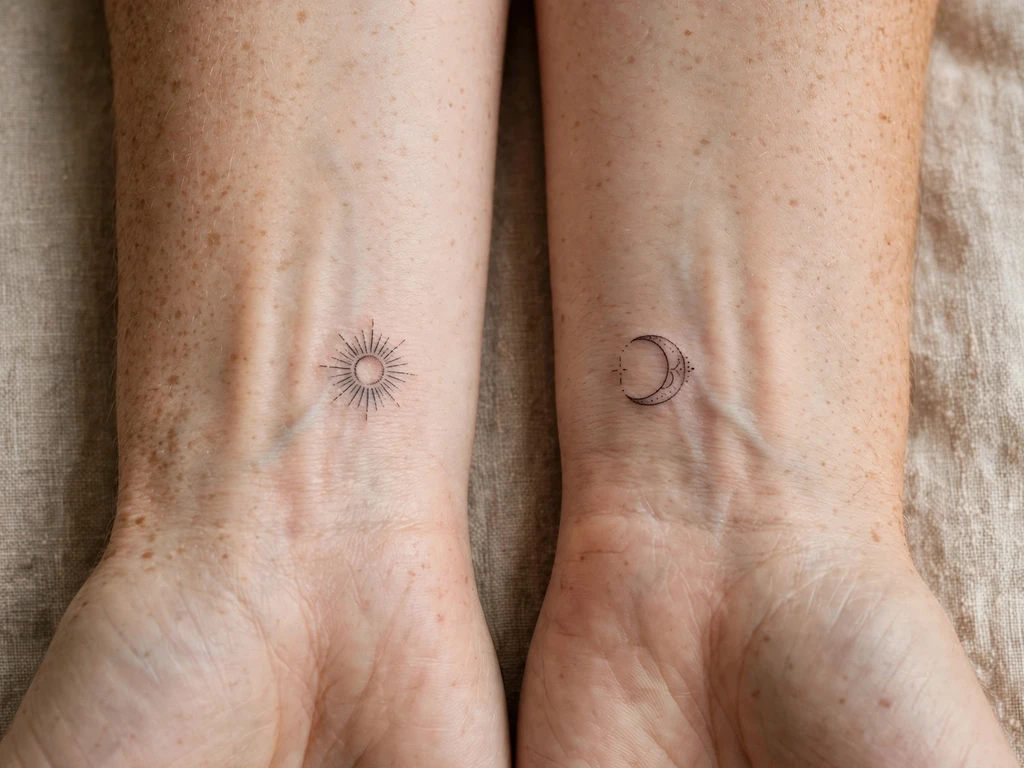
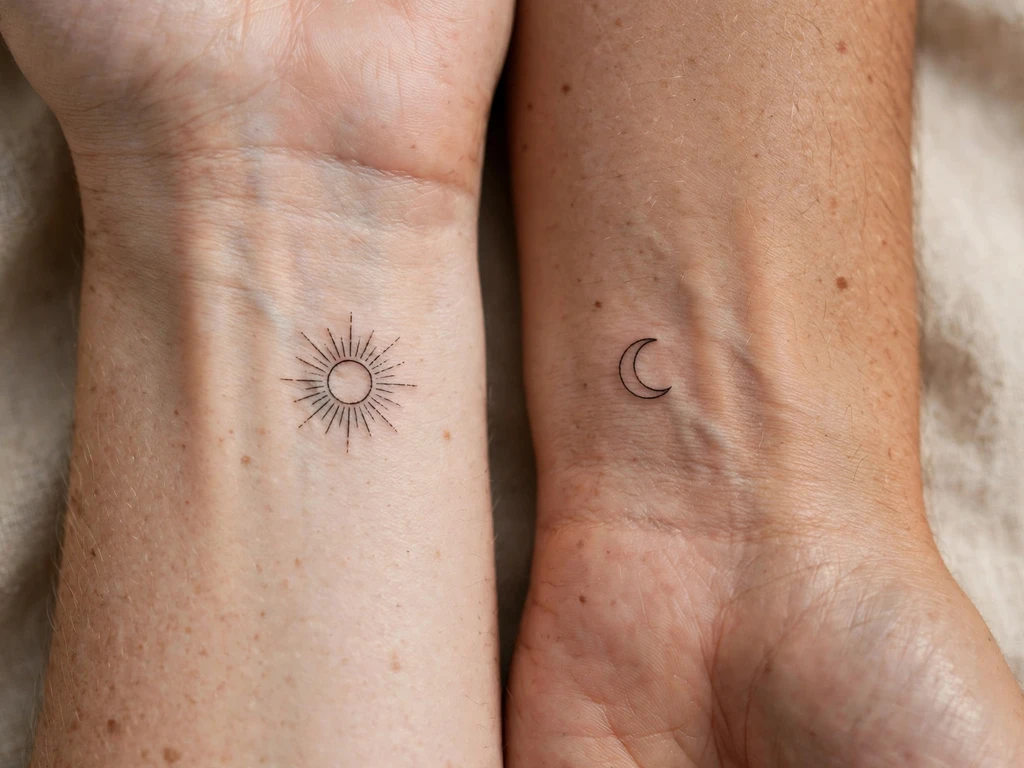
The most beloved complementary pair in tattooing: one of you wears a small radiant sun, the other a crescent moon, usually on matching inner wrists so the two rise and set side by side every time you hold hands. The symbolism is built in — day and night, light and reflection, two very different energies that are only ever described together. There is real astronomy inside the romance, too: as NASA’s Moon Phases guide explains, the Sun is the only object in our solar system that shines with its own light, and everything we call moonlight is that sunlight reflected — which is exactly the dynamic most couples are describing. If you want to explore the pairing in more depth before you book, our sun and moon tattoo ideas collect dozens of variations on the theme.
Best placement: Matching inner wrists, the sun and crescent at the same height so they align when your wrists meet.
Best for / know before you book: Decide who is the sun and who is the moon before the consultation, not during it — and keep both designs the same visual weight, with similar line counts and the same outer diameter in millimetres, or one partner’s piece will quietly read as the main tattoo and the other as its accessory.
2. Split Heart, Two Halves
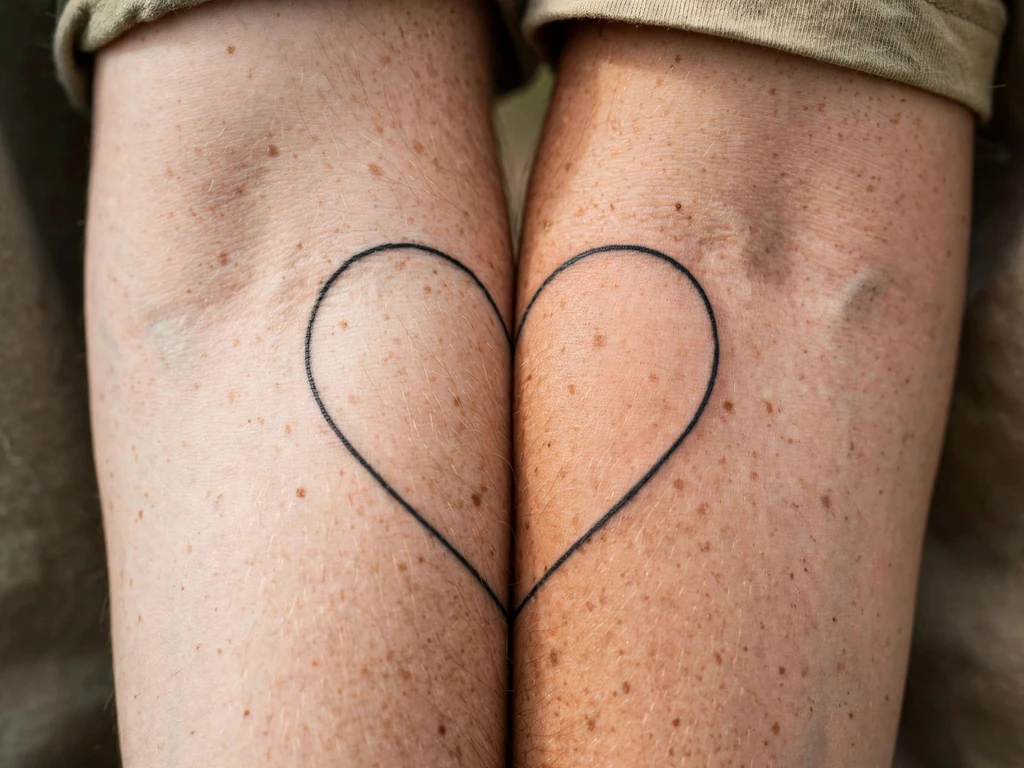
One heart, drawn whole, then divided down the middle: each of you wears a half, and the complete heart appears only when you press your forearms or wrists together. It is the purest split design there is, and the reveal moment — two arms meeting to finish the picture — never stops being satisfying. The halves are usually drawn with a slightly irregular, hand-cut middle edge rather than a straight line, so when they join, the seam looks grown rather than sliced.
Best placement: Inner forearms or the edges of matching wrists, positioned so the halves meet naturally when you stand side by side.
Best for / know before you book: Apply the solo test honestly — a heart half alone reads as an abstract curve with a bump, so choose a version whose half is stylised enough to look deliberate on its own (a clean outline and a small detail like a dot or tiny star helps). Have both stencils placed with your arms actually touching, in the position you will join them in photos.
3. Lock and Key
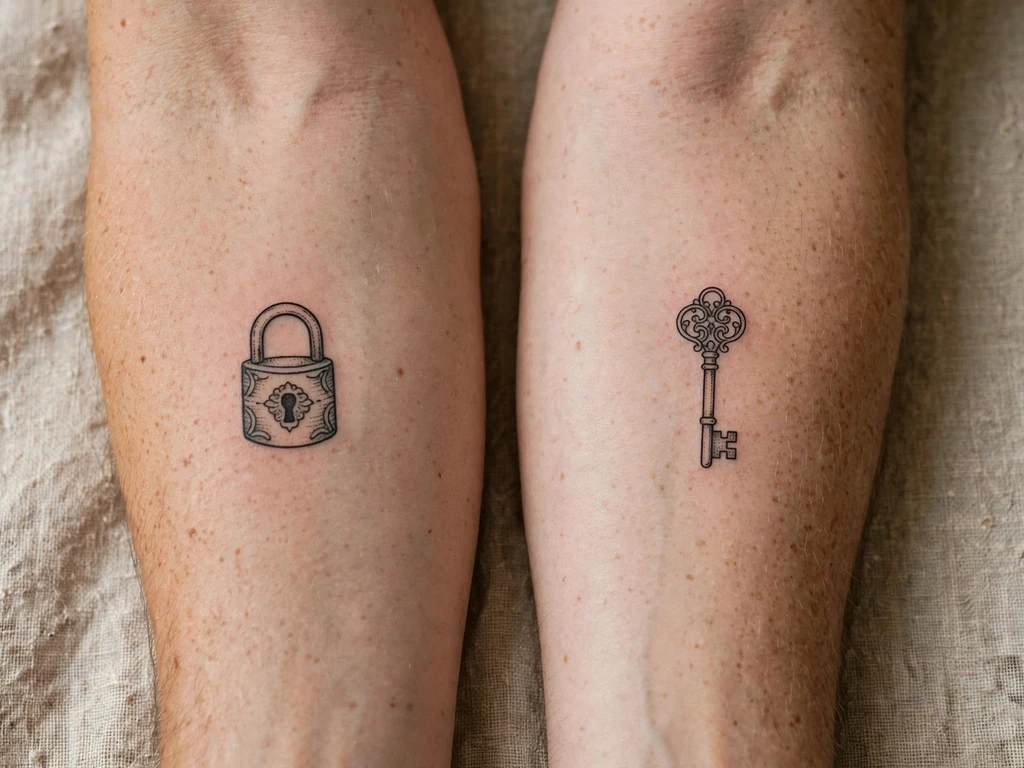
One partner wears a small vintage lock, the other its key — the oldest complementary metaphor couples have, drawn here in fine line with just enough detail to read as antique rather than cartoon. The lock is usually the larger, squarer piece; the key is slimmer and longer, so the pair looks best when the two designs are balanced by ink density rather than by raw size. Some couples add the same tiny detail to both — a shared initial-free flourish, the same small heart cut into the lock and repeated on the key’s bow — to tie the pair together at a glance.
Best placement: Forearms, the lock and key facing the same direction so the story reads when your arms rest together.
Best for / know before you book: Keys have teeth, and teeth have a pattern — agree the exact key design at the stencil stage, because couples occasionally discover mid-session that they pictured different keys. Keep the key’s cuts bold and simple; fine, intricate bitting blurs within a few years.
4. King and Queen Crowns
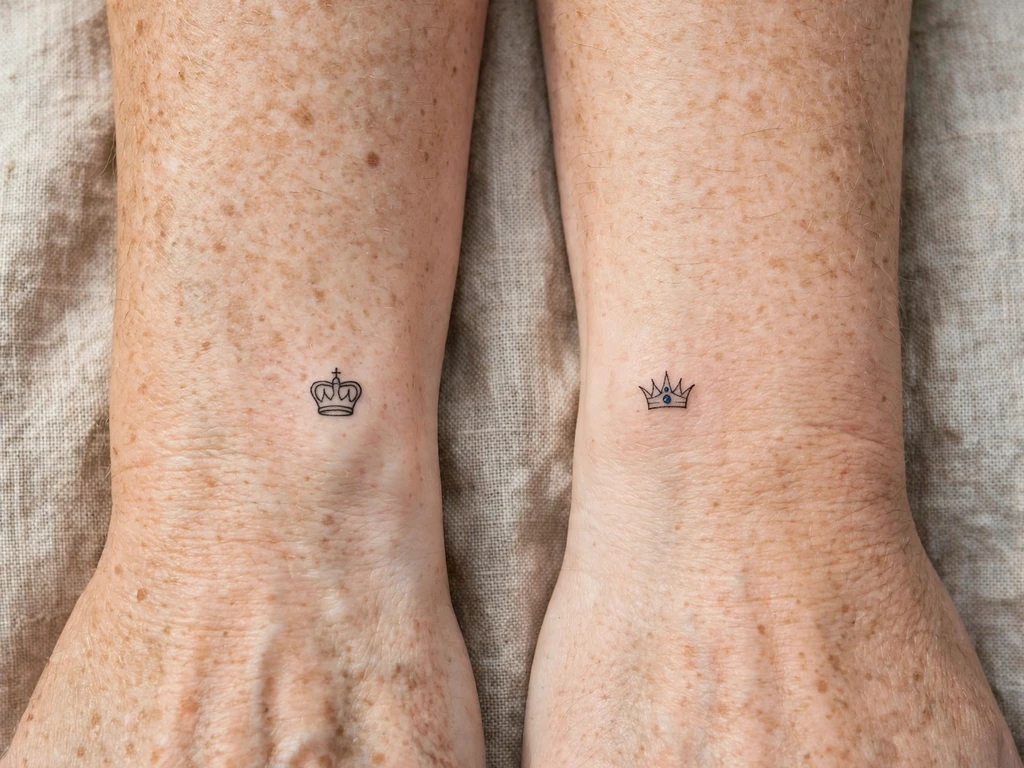
Done tastefully, this is far from the loud version you may be picturing: two tiny fine-line crowns, his with simple straight points, hers with a softer curve and one small dot or gem point, worn small on matching wrists or just above them. At this scale the crowns read as elegant jewellery marks first and royal statements second, and the pair is often chosen by couples who call each other by those names in private. Restraint is the entire design — the moment a crown grows big or gains lettering, it changes genre.
Best placement: Matching wrists or the side of matching ring fingers for the smallest, most discreet version.
Best for / know before you book: Crown points are tiny line intersections, and intersections spread first — keep each crown at least 2 cm wide with the points opened up slightly by your artist. Agree which small difference distinguishes king from queen (a dot, a cross, a heart point) so the pair is recognisably a pair, not two copies.
5. Yin and Yang Split Pair
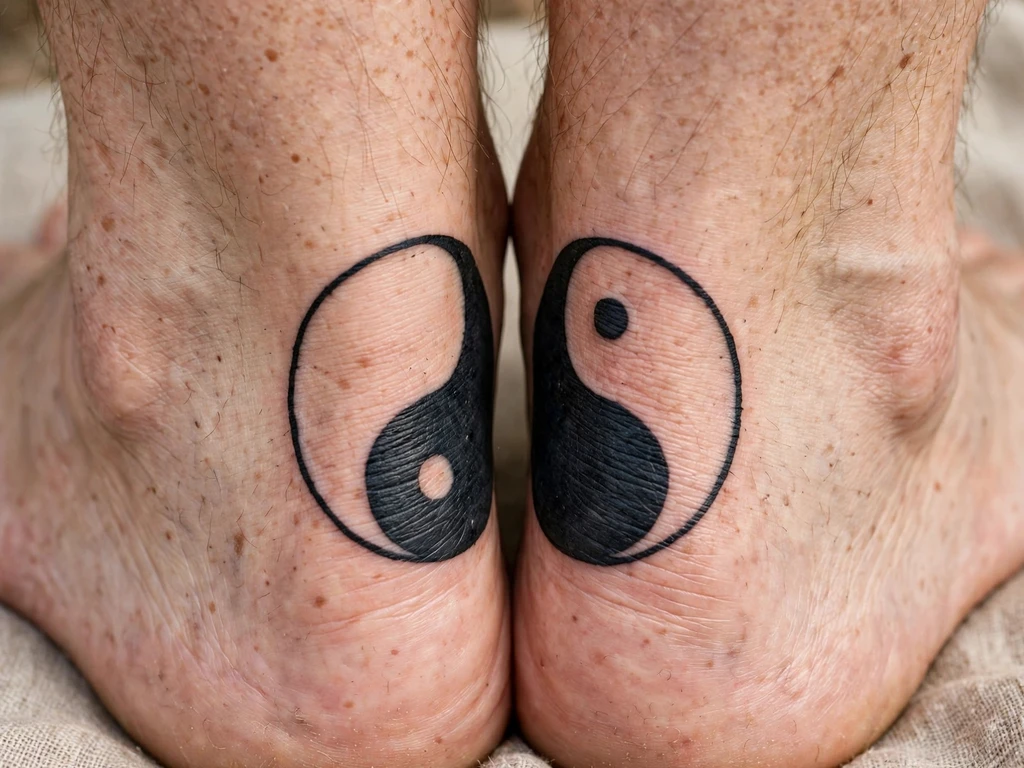
Each of you wears one half of the yin-yang circle — one the dark teardrop with its light dot, the other the light teardrop with its dark dot — and the full symbol of balance forms when your ankles or wrists come together. It suits couples and close friends who are genuinely opposite in temperament and proud of it: the organised one and the chaos one, the early bird and the night owl. Because each half carries the seed dot of the other colour, the halves also carry a real idea alone — I hold a piece of you — which helps this split design pass the solo test better than most.
Best placement: Matching ankles or outer wrists, where the two circles can meet edge to edge.
Best for / know before you book: The S-curve dividing the halves must be drawn once, as one circle, then split — if your artist draws two separate halves freehand, they will never marry up cleanly. The light half is mostly outline and negative space, so agree how its edge is defined (a full outline reads best) or it will look unfinished next to its packed-black partner.
6. Matching Ring Finger Bands
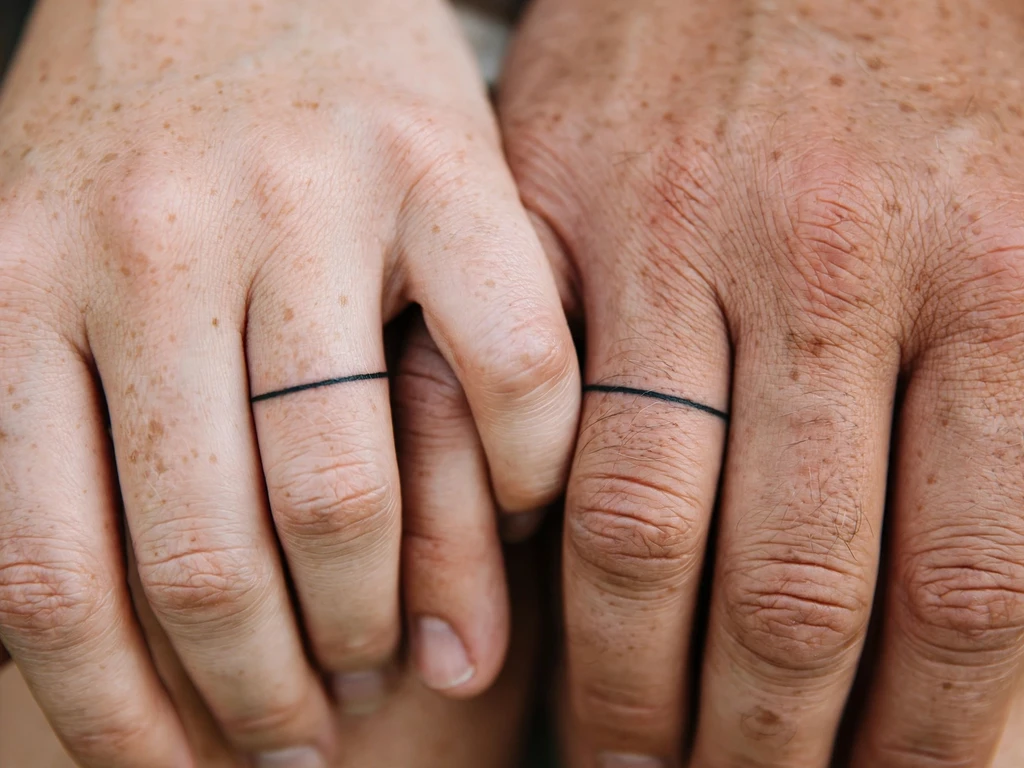
His and hers in their most permanent form: a simple band — one clean line, a double line, or a fine dotted ring — tattooed around each partner’s ring finger where a wedding band would sit. Some couples tattoo the band under their real rings, as the vow beneath the jewellery; others wear the ink instead of metal, common for people whose work forbids rings. Either way it is the most quietly serious design in this list, and studios take it seriously too — many artists will talk finger ink through twice before booking it.
Best placement: Around the base of each ring finger, positioned to sit under a real band if you wear one.
Best for / know before you book: Finger skin sheds ink faster than anywhere else on the body, so go in expecting the bands to need touch-ups over the years and to heal slightly softer than arm work — that is maintenance, not failure. Keep the band design to lines only; detail at finger scale does not survive, and a clean, slightly bold single band ages the most gracefully of all the options.
7. Matching Coordinates
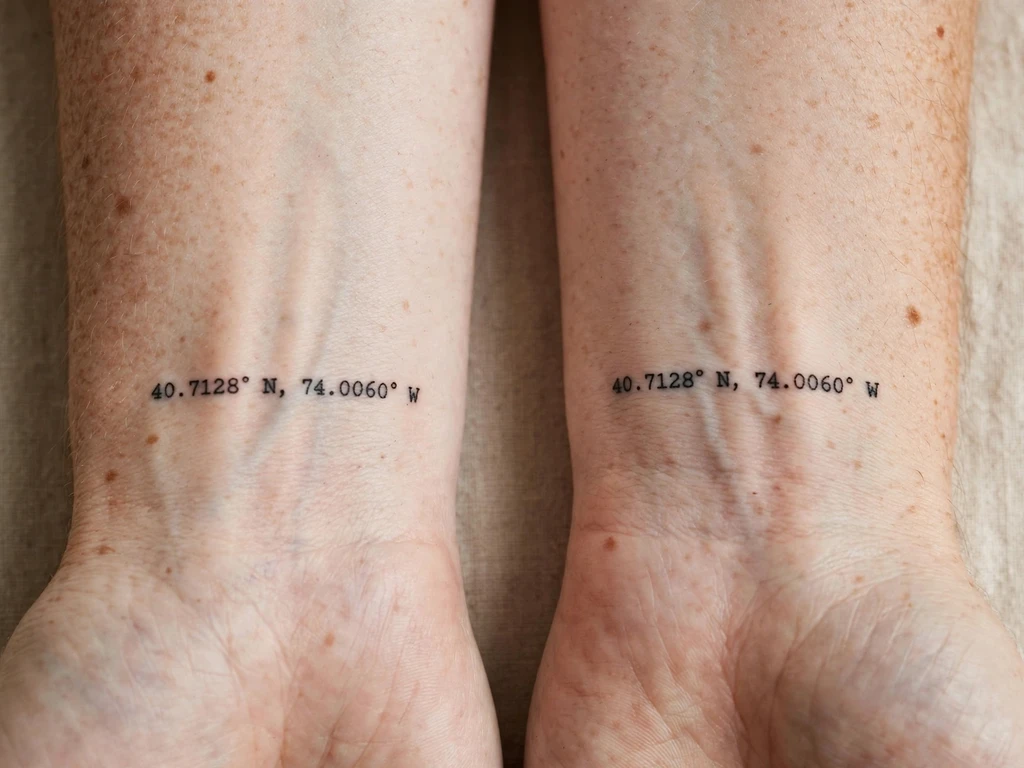
The same latitude and longitude, in small neat numerals, on both of you: the coordinates of the café where you met, the hospital where your child was born, or — the sibling favourite — the family home you both grew up in. To anyone else it is an anonymous string of numbers; to the two of you it is the most specific tattoo imaginable, a place rather than a person, which is also why coordinates age so well emotionally. The typewriter and clean sans-serif fonts suit the data-like character of the design; browsing wrist tattoo ideas will show how much quiet presence a small numeral piece like this carries on the inner wrist.
Best placement: Matching inner wrists, or along matching forearms where a longer coordinate string has room to sit in one line.
Best for / know before you book: Proofread the numbers character by character, out loud, twice — a transposed digit moves your tattoo to the wrong ocean, and numerals are the easiest thing in the world to skim. Screenshot the exact coordinates from the map pin itself rather than typing them from memory, and bring the screenshot to the session.
8. Complementary Script Phrases
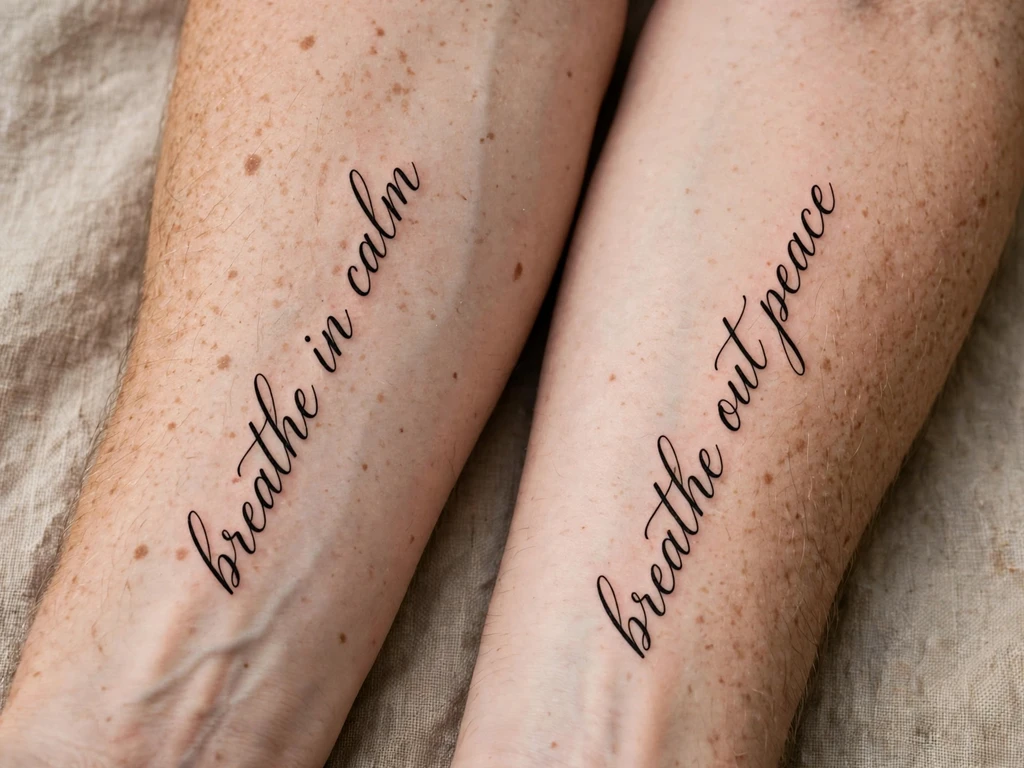
One sentence, two people: the first half of a phrase in flowing script on one forearm, the second half on the other, so the words only complete when you stand together. The strongest phrases are your own — a line from a letter, the words one of you always says to the other, a private promise — rather than famous quotations, because an original phrase cannot be anyone else’s tattoo. Script choice matters enormously here: the handwriting style is the design, and some pairs use a scan of a parent’s or grandparent’s actual handwriting for one shared family phrase.
Best placement: Matching inner or outer forearms, at the same height, so the two halves line up as one line of text when your arms meet.
Best for / know before you book: Have the full sentence lettered as one piece by your artist, then split it — never letter two halves separately, or the flow, slant and spacing will drift apart. Decide the split point together and mark it in the design file, and remember each half should still read gracefully alone, even if it is deliberately incomplete.
9. Puzzle Pieces That Fit
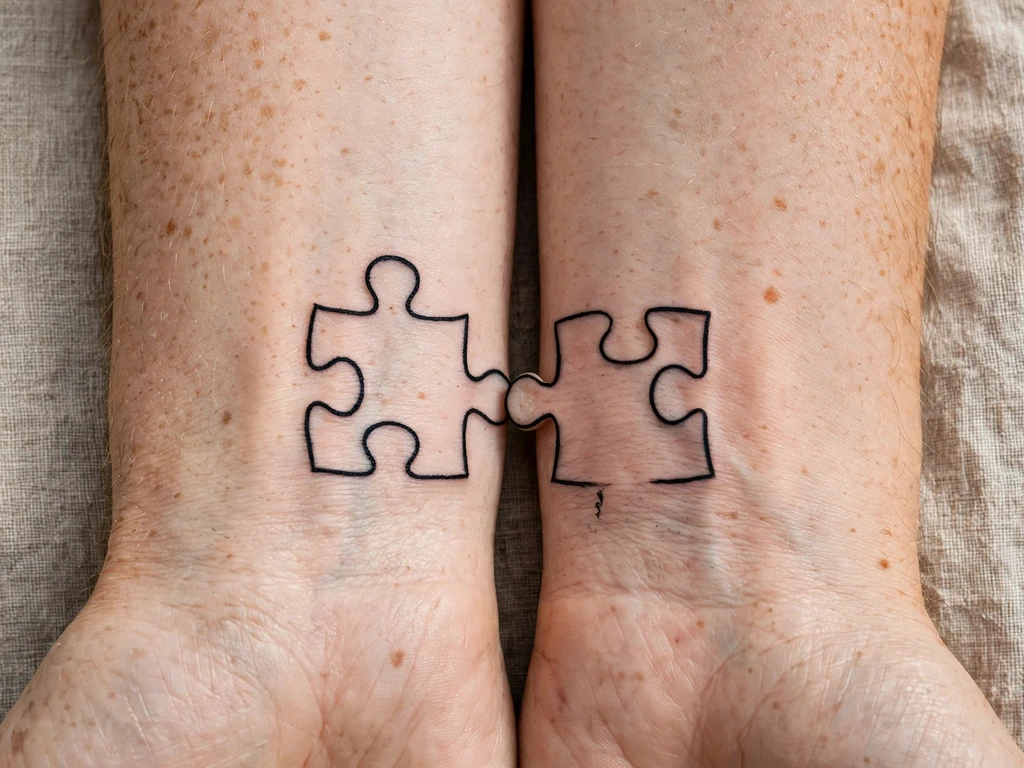
Two jigsaw pieces, one tab and one blank, drawn from a single outline so they genuinely interlock when your wrists or forearms touch. It is the best-friend design par excellence — playful, instantly understood, and quietly profound about how two different-shaped people fit. The pieces are usually kept as clean outlines, sometimes with a tiny shared detail inside both: the same small star, dot pattern or miniature flower, so each piece also carries a private echo of the other.
Best placement: Matching wrists or inner forearms, positioned at the exact angle your arms naturally meet.
Best for / know before you book: The fit is the design, so the two stencils must be placed together, with your arms in the joined position, and photographed before either is tattooed. Puzzle outlines are all curves and corners — keep the pieces at least 3 cm across, because tiny tabs and blanks are the first details to soften and the fit is what everyone will look for.
10. Identical Fine-Line Hearts
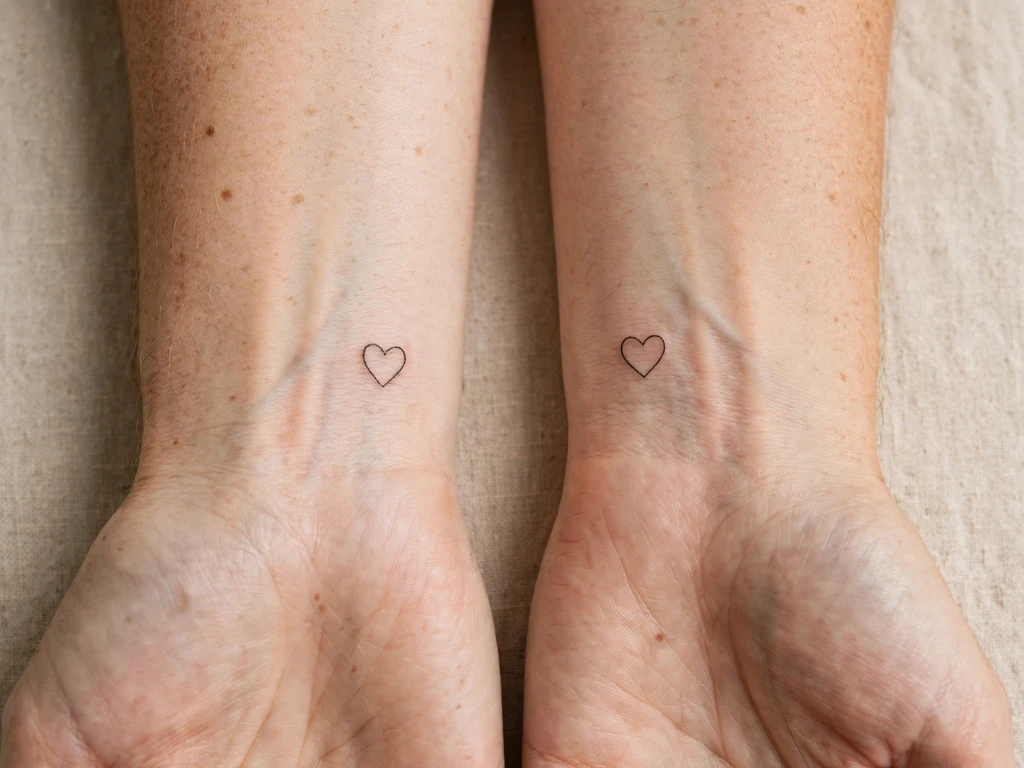
The identical twin of the list: the same tiny heart outline, drawn once and tattooed at the exact same size on both inner wrists — no variation, no personal twist, because the twinness is the whole point. Best friends choose this one more than any other in this guide, often as a first tattoo together, and its power is in the photograph: two wrists, two identical hearts, years of friendship in one frame. It takes under half an hour for both pieces and heals fast, which makes it the gentlest possible entry into matching ink.
Best placement: Matching inner wrists, the classic; matching ankles are the more discreet twin.
Best for / know before you book: This design lives or dies on sameness, so book the same artist in the same session, agree the size in millimetres (most pairs choose 12–18 mm), and have both stencils cut from the same printed file. Even a 2 mm difference is visible when the wrists meet — check both stencils side by side before anyone is tattooed.
11. Two Birds in Flight
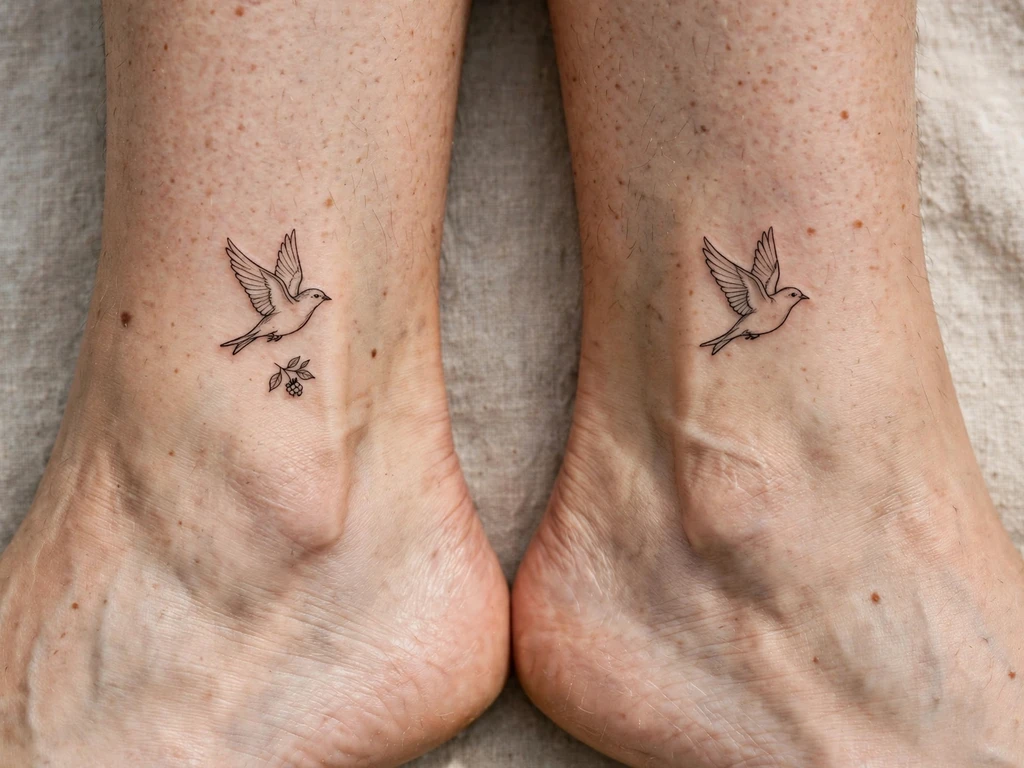
Two small birds, one on each of you, drawn in the same flight pose — wings up, mid-journey — as if the pair of you are two members of one flock travelling the same direction. Friends choose birds for the freedom in them: we fly together, but each on our own wings. Siblings choose them for the leaving-home story, especially families where the kids scattered to different cities. A tiny detail can separate the two birds without breaking the match — one with a slightly longer tail feather, one carrying a dot-sized berry — a private way of telling you apart.
Best placement: Matching ankles, outer forearms or just below matching collarbones, the birds facing the same way.
Best for / know before you book: Flight direction is a real decision: birds should face forward on the body (towards your front) on both people, which means the stencil is flipped for one of you if you choose mirrored placements like left ankle and right ankle. Confirm the flip at the stencil check, not mid-session.
12. Matching Constellations
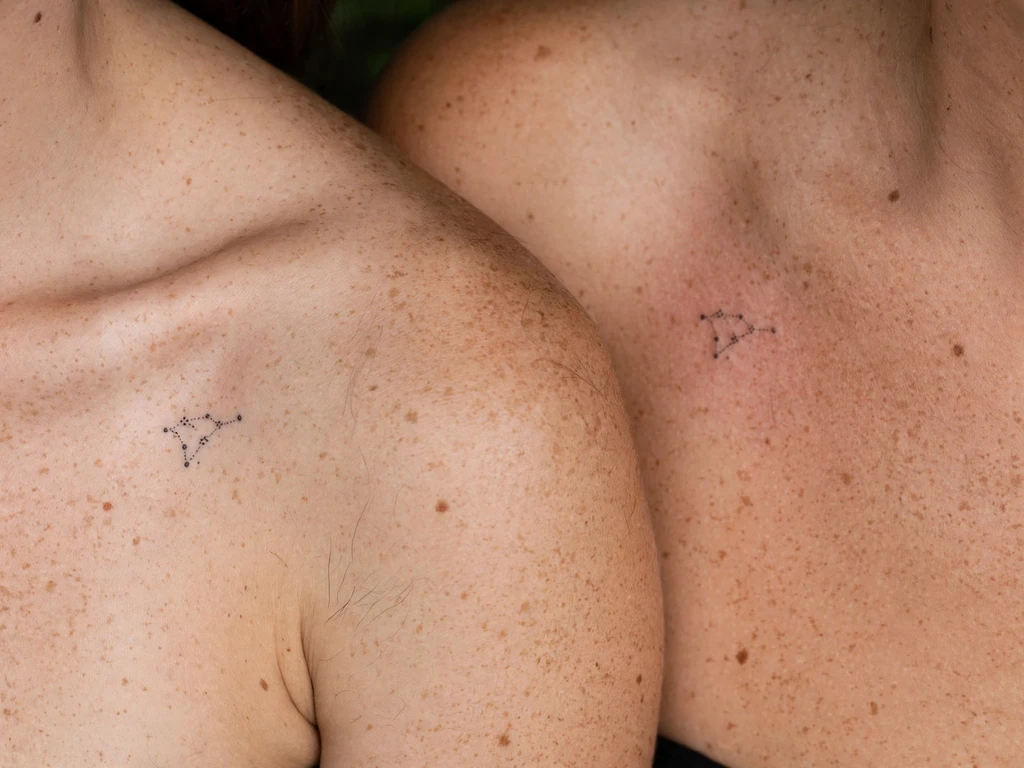
The same constellation — the one from the night you met, the shared star sign you were both born under, or simply the pattern you both love — tattooed in fine dots and hair-thin connecting lines on both of you. Constellations wear almost like jewellery, a scatter of tiny stars that most people read as decoration until you tell them the pattern is identical and chosen. Some pairs mirror the constellation (one wears it as seen, the other reversed), which looks especially elegant on opposite-side placements.
Best placement: Just below matching collarbones, along matching shoulder lines, or on matching inner ankles where the dots can run a little longer.
Best for / know before you book: Map every dot’s position at the stencil stage and keep real spacing between them — constellation dots placed too close merge as lines settle and read as blemishes rather than stars. Hair-fine connecting lines soften fastest, so a good artist draws them a touch heavier than the airy reference photos suggest.
13. Mirrored Ocean Waves
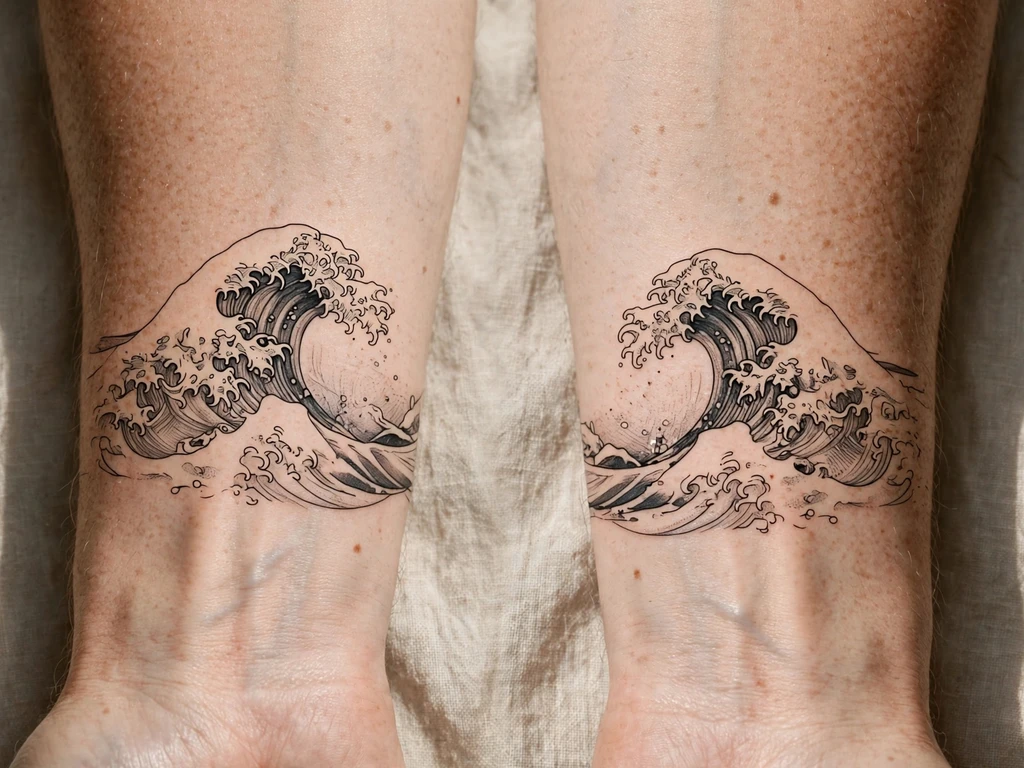
One curling wave each — but mirrored: your wave breaks left, theirs breaks right, so when your forearms face each other the two waves roll towards one another like a single sea seen from two shores. Mirroring is the sibling and surf-friend special: the design declares same water, different coast, which is exactly the story of siblings who grew up in one house and built separate lives, or friends separated by distance who still face each other. Single-line and Japanese-inspired wave styles both mirror beautifully.
Best placement: Matching forearms (one left, one right) so the waves face; matching calves work the same trick when you stand side by side.
Best for / know before you book: A mirrored pair is one design, flipped — make sure your artist flips the digital file rather than redrawing it, or the “mirror” pair will quietly differ in curl count and foam dots. Check both stencils in a mirror together; that is literally how the design will be seen.
14. Tiny Pinky Promise Pair
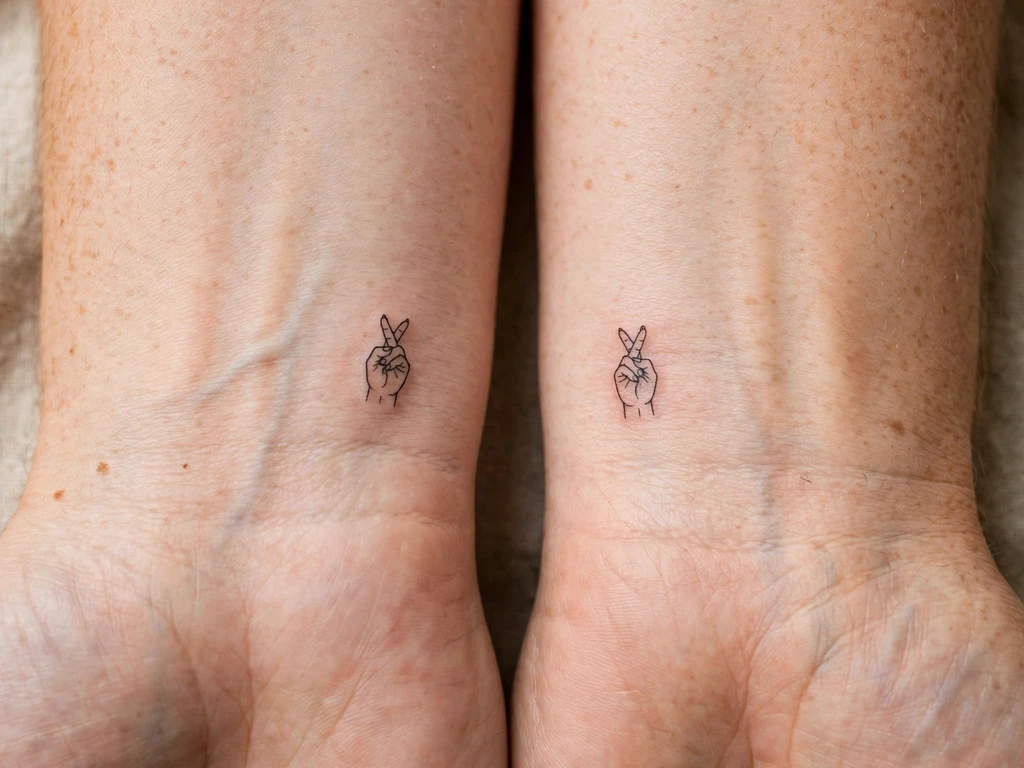
The childhood contract, made permanent: a tiny fine-line drawing of two pinky fingers curled around each other, one on each best friend’s wrist — or, in the micro version, a miniature version on each person’s actual pinky finger. It is the sweetest design in this guide and the one most rooted in a specific shared past, because everyone getting it remembers exactly who they first pinky-swore with. Kept tiny and simple, it reads as a cute minimal mark; the meaning is supplied entirely by the two of you.
Best placement: Matching inner wrists for a piece that will hold its detail; the side of the pinky finger only if you accept finger fading.
Best for / know before you book: Two curling fingers are fiddly linework at small sizes — below about 2.5 cm the curl of the fingers blurs into a knot, so let your artist simplify the drawing to its clearest outline. On actual fingers, expect faster fading and at least one touch-up, as with all finger ink.
15. Sibling Birth-Order Numerals
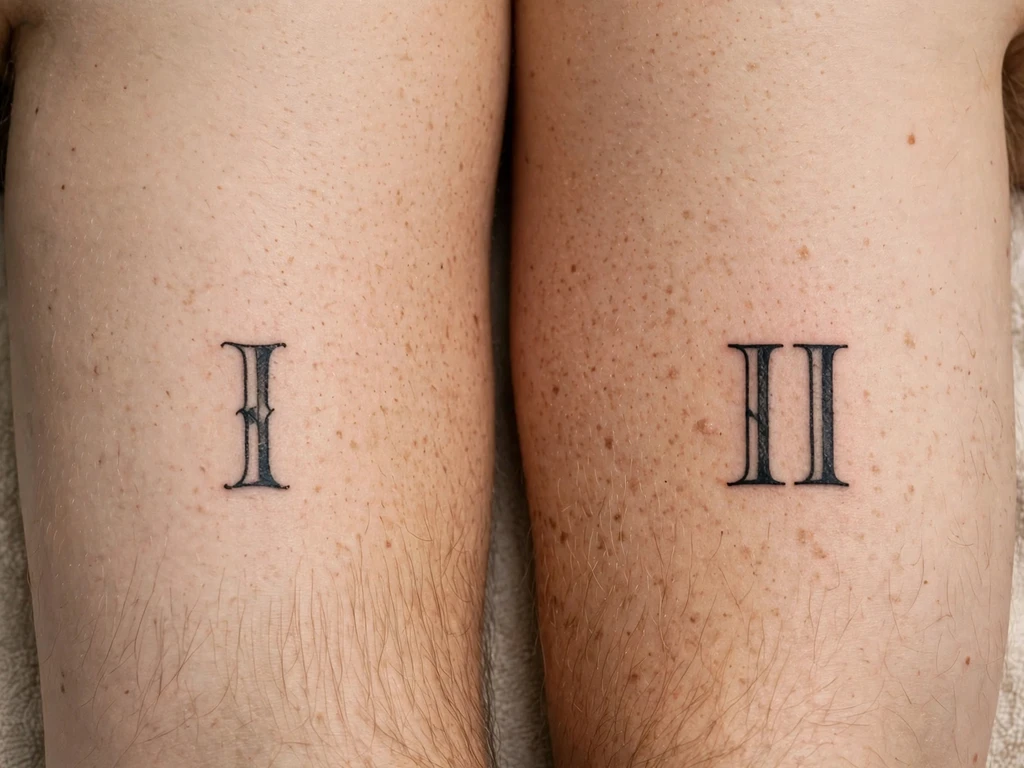
I, II, III — each sibling tattooed with their birth-order Roman numeral, in the same typeface, at the same size, on the same placement. It is the wittiest sibling design there is: an instant family tree in three characters, and a guaranteed story every time someone asks. The numerals are usually kept classical and clean (a serif or typewriter face), and families with more siblings sometimes extend the set over years as younger ones reach tattoo age — the design is deliberately built to welcome IV and V later.
Best placement: Matching upper arms or forearms in a row when siblings stand together; some families choose matching ankles for discretion.
Best for / know before you book: Agree the counting rules before anyone books — who counts as I in blended families is a joyful conversation to have at the kitchen table, not a dispute to have in the studio. Keep the typeface chunky enough that I, II and III can never blur into each other or into a single barcode-like block.
16. Matching Mountain Skyline
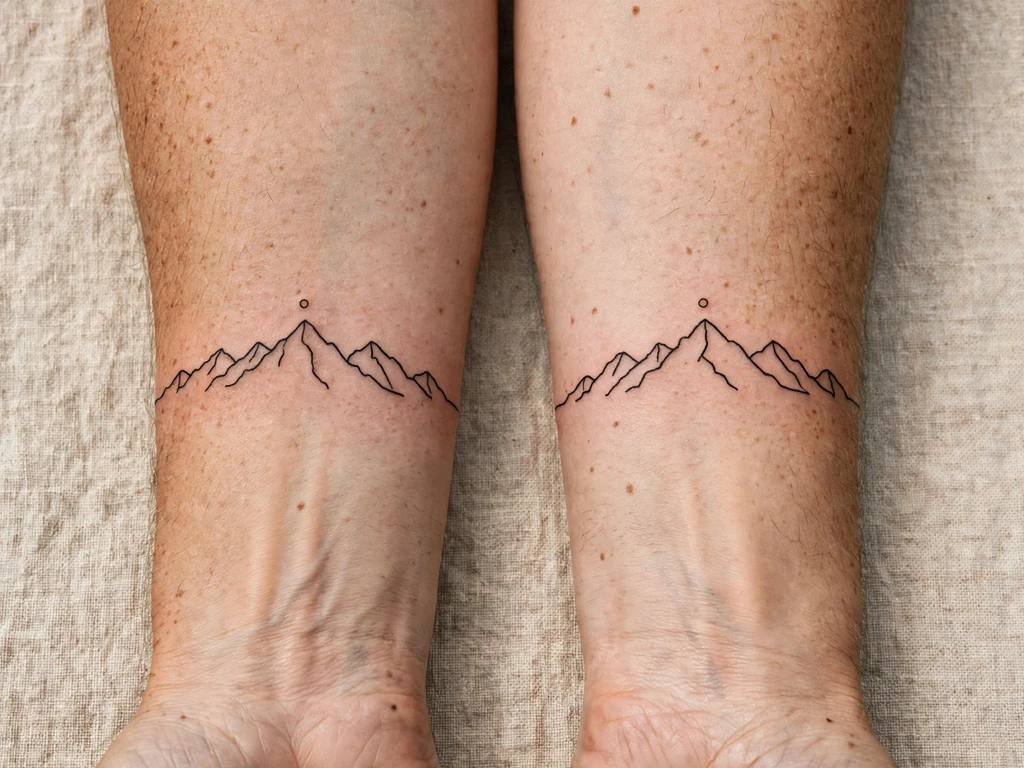
One continuous line tracing a mountain ridge — the actual ridge you could see from your childhood home, the range from the family camping trip, the skyline of the town that raised you — tattooed identically on every sibling. Skyline lines are drawn from a photograph of the real place, simplified into a single rising-and-falling stroke, sometimes with one small sun or star dot marking the house’s direction. To everyone else it is a minimalist mountain tattoo; to your family it is a map of home, and it passes the solo test effortlessly.
Best placement: Matching forearms, where the line can run long and level; matching calves suit a taller, more detailed ridge.
Best for / know before you book: Trace the line from one photograph, together, and simplify it as a group before the session — siblings each remembering the ridge slightly differently is charming in conversation and chaos in a stencil. A single-weight line at least 6 cm long holds the detail of the smaller peaks; shorter versions lose the very bumps that make it your mountain.
17. Two Koi, One Circle
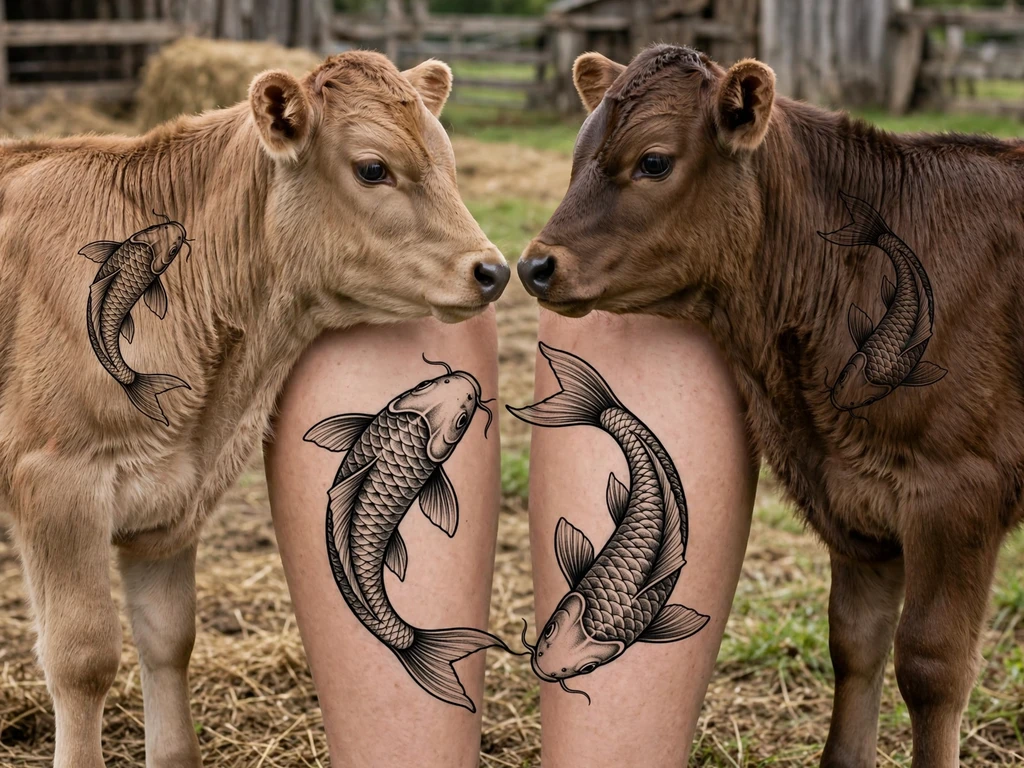
Each of you wears one koi, drawn so that when your calves or forearms come together, the two fish complete a circling pair — head to tail, chasing each other in the classic double-koi composition associated with harmony and perseverance. Separately, each fish is a complete, handsome tattoo in its own right, which makes this the strongest solo-test design among the animal pairs. Siblings choose koi for shared resilience; couples choose them for balance — two strong swimmers, one current.
Best placement: Matching calves, where each fish has room to curve; matching outer forearms for a smaller, tighter circle.
Best for / know before you book: Each fish must be drawn at the same curve radius, or the circle will not close when you join them — have the pair drawn as one composition and then separated, exactly like a split design. Scale patterns and fin lines are the detail that fades into mush if the fish are too small; 8 cm per fish is a sensible floor.
18. Big Bear, Little Bear
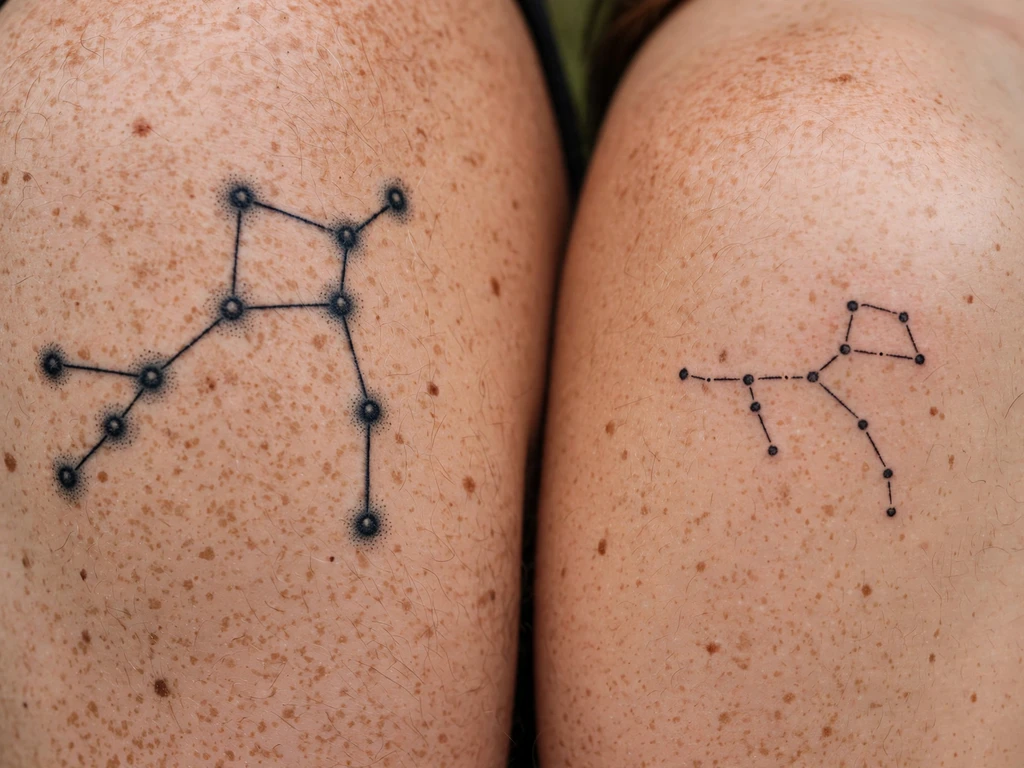
The parent-and-child constellation: one of you wears Ursa Major, the Great Bear; the other wears Ursa Minor, the Little Bear — the two bear constellations that have circled the night sky together, parent and cub, in story after story. It is usually a mother or father and an adult child who choose it, often when the child is leaving for university, another city or their own family: the astronomy itself carries the promise, since the two bears never set below the horizon in northern skies — they are always up there, together, all year round.
Best placement: Matching shoulders or upper backs, the big bear on the parent and the little bear on the child, at sizes that echo the real constellations’ proportions.
Best for / know before you book: Use the real star patterns — both constellations include the familiar Dipper shapes, and astronomy-literate strangers will notice invented stars. The little bear’s stars are genuinely fainter in the sky, but keep its dots the same size as the parent’s on skin; poetic faintness just reads as fading.
19. Fingerprint Heart Pair
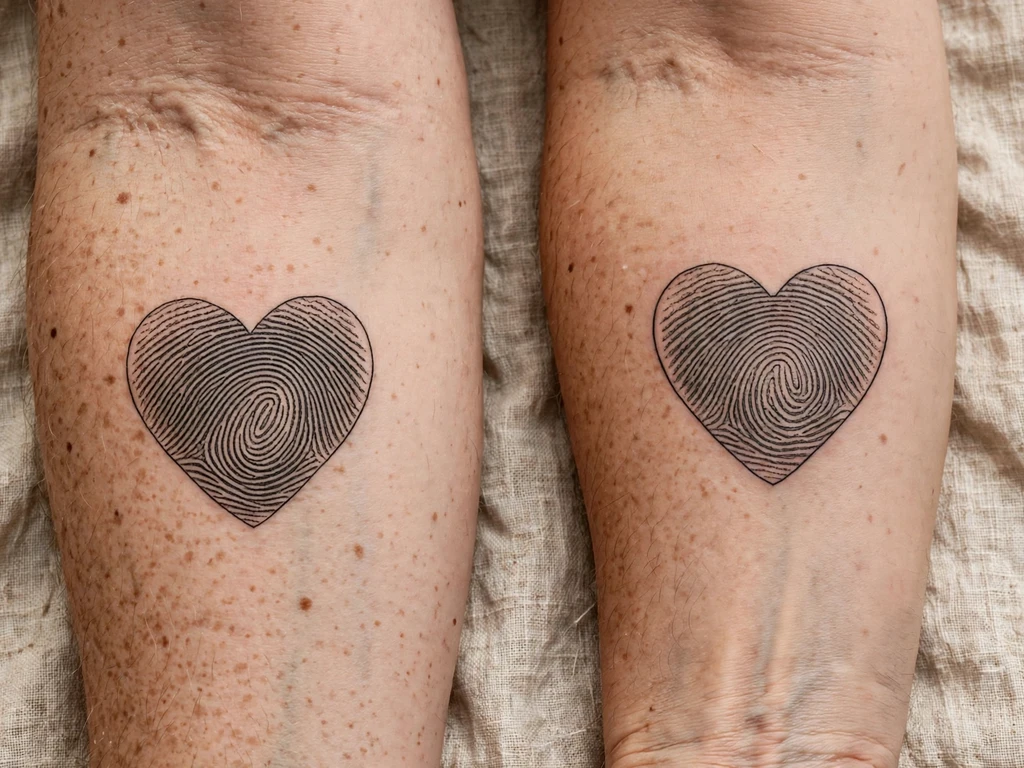
The most personal design in tattooing, full stop: a heart shape built from a real fingerprint — usually each other’s. A parent wears a heart formed from their adult child’s fingerprint; the child wears the parent’s. Couples use it too. The whorls and ridges of the print become the heart’s shading, so no two versions of this tattoo exist anywhere else on Earth. It is made by taking a clean ink print on paper at the consultation, enlarging it, and tracing the ridge flow into a heart outline — part portrait, part symbol, entirely yours.
Best placement: Matching forearms or over the wrist, where the heart can be big enough for the ridge detail to read; at least 4 cm wide is a working minimum.
Best for / know before you book: Fingerprint ridges are extremely fine lines packed tightly together, which is precisely what tattoo ink refuses to do forever — a skilled artist will interpret the print, keeping its unique overall swirl pattern while spacing the ridges honestly, rather than tracing it literally into a future smudge. Bring several clean prints of each finger and let the artist choose the clearest whorl.
20. Mother and Daughter Flowers
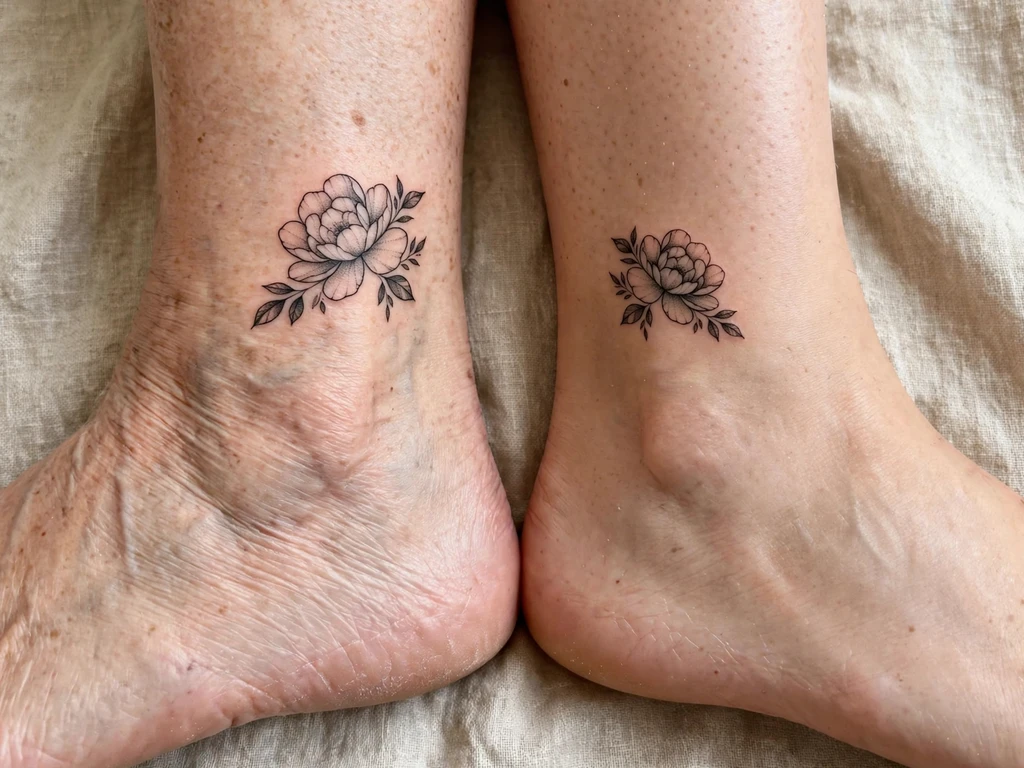
One flower, worn by two generations: mother and daughter with the same bloom — her favourite flower, the one from her wedding bouquet, the one that grew outside the family kitchen — tattooed in the same style on matching ankles or wrists. Some pairs keep the tattoos truly identical; others draw the daughter’s as the same flower one size smaller, a bloom and its echo. Choosing the species together is half the ritual, and our flower tattoo design ideas are a good place to compare what each bloom traditionally means before you settle on yours.
Best placement: Matching ankles or inner wrists; the ankle version is a beloved mother-daughter first tattoo because it is pretty, discreet and gentle to get.
Best for / know before you book: If you scale the daughter’s flower down, scale it modestly — petals drawn too small lose their shape as lines settle, so a 20% size difference reads clearly without shrinking the smaller bloom into mush. Book together and sit for each other; for many pairs the shared appointment is the memory the tattoo marks.
21. Dad and Daughter North Star Pair
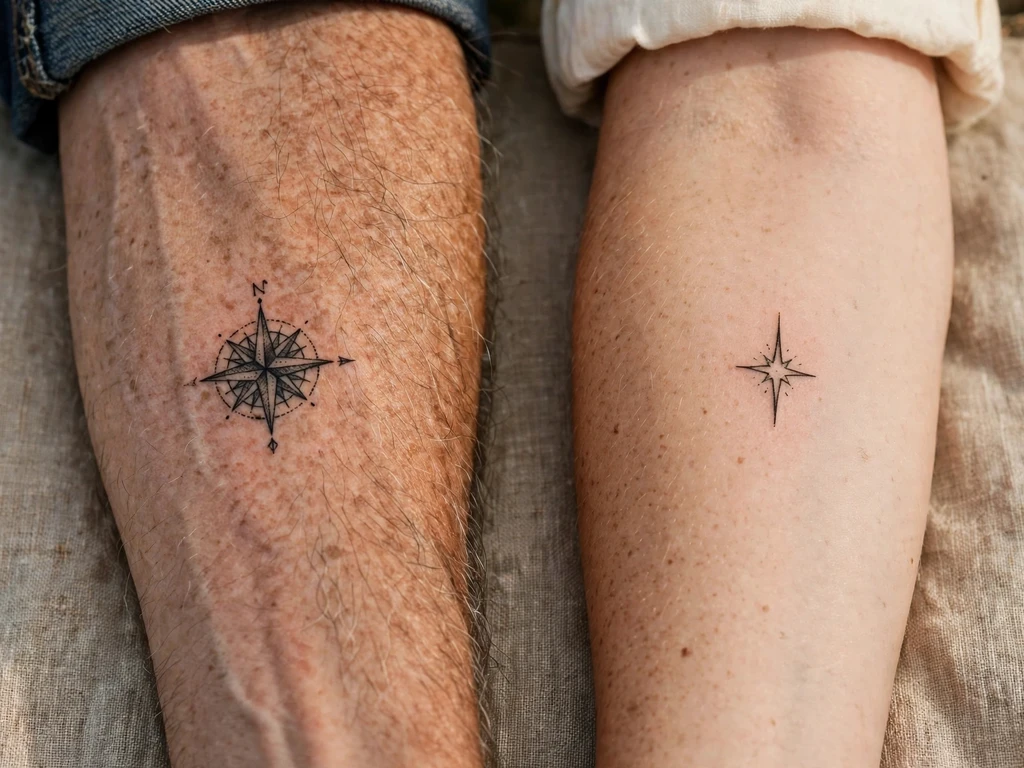
For fathers and daughters — one of the fastest-growing matching searches there is — a navigation pair: Dad wears a small compass rose, his daughter wears its north point pulled out as a single bright star. The meaning needs no explaining to either of them: he taught her how to find her way; the star is the one he pointed at. Drawn in fine black line with the star kept small and four-pointed, the pair is handsome rather than sentimental, which is exactly how most dad-and-daughter pairs want it.
Best placement: Matching forearms — his compass at a medium size, her star smaller on the same spot of the opposite or same arm.
Best for / know before you book: The compass rose lives on straight lines and perfect points, so it exposes any stencil tilt mercilessly — check it standing, arm relaxed. Agree the star’s design as a true extract of the compass’s north point (same shape, same proportions) rather than a generic star, or the pair reads as two unrelated tattoos.
22. Elephant and Calf Pair
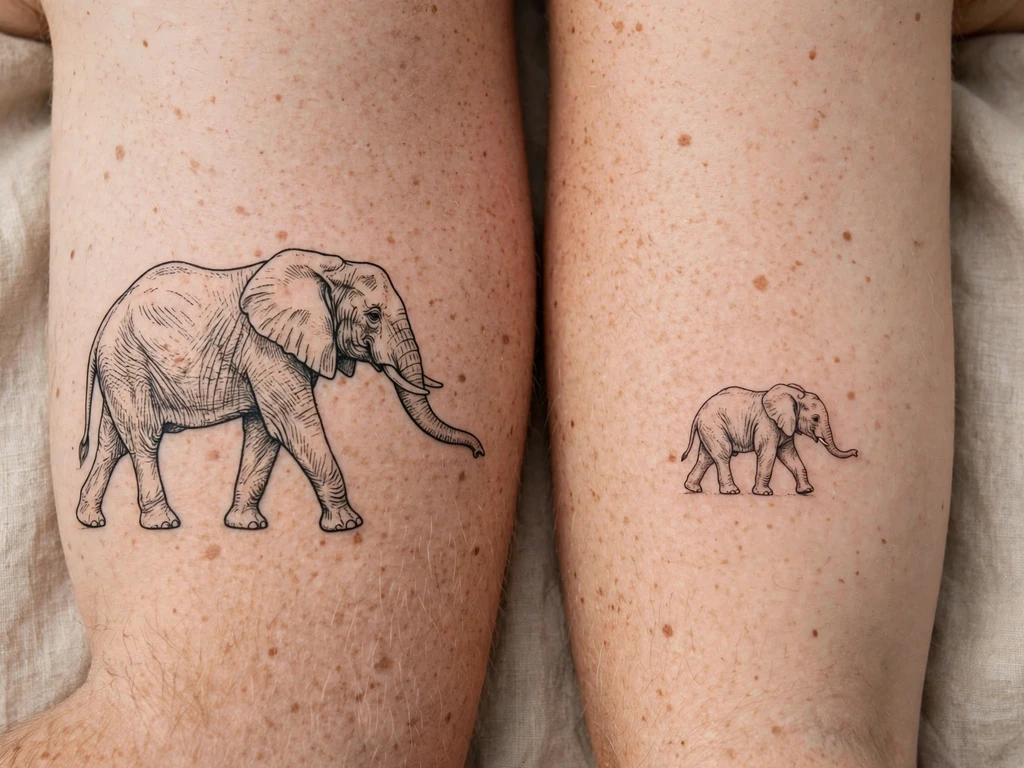
A large elephant on the parent, a small calf on the child, drawn in the same style and walking the same direction — in the fullest version, the calf’s trunk reaches towards the parent’s tail, the way real calves walk holding on. Elephants are the animal kingdom’s emblem of family memory and matriarchal loyalty, which is why mothers in particular claim this pair, though it works for any parent. In matching fine-line or gentle dotwork shading, the pair is tender without being cute, and each elephant is a complete, proud tattoo alone.
Best placement: Matching upper arms or calves, both elephants facing forward on the body and walking the same way.
Best for / know before you book: Draw the pair from one illustration so the style, ear shape and proportions genuinely match — two elephants sourced from different references will look like strangers. Keep the calf at least 5 cm long; below that, trunk and ear detail merge, and the calf stops reading as an elephant at conversational distance.
23. Butterfly Split-Wing Pair
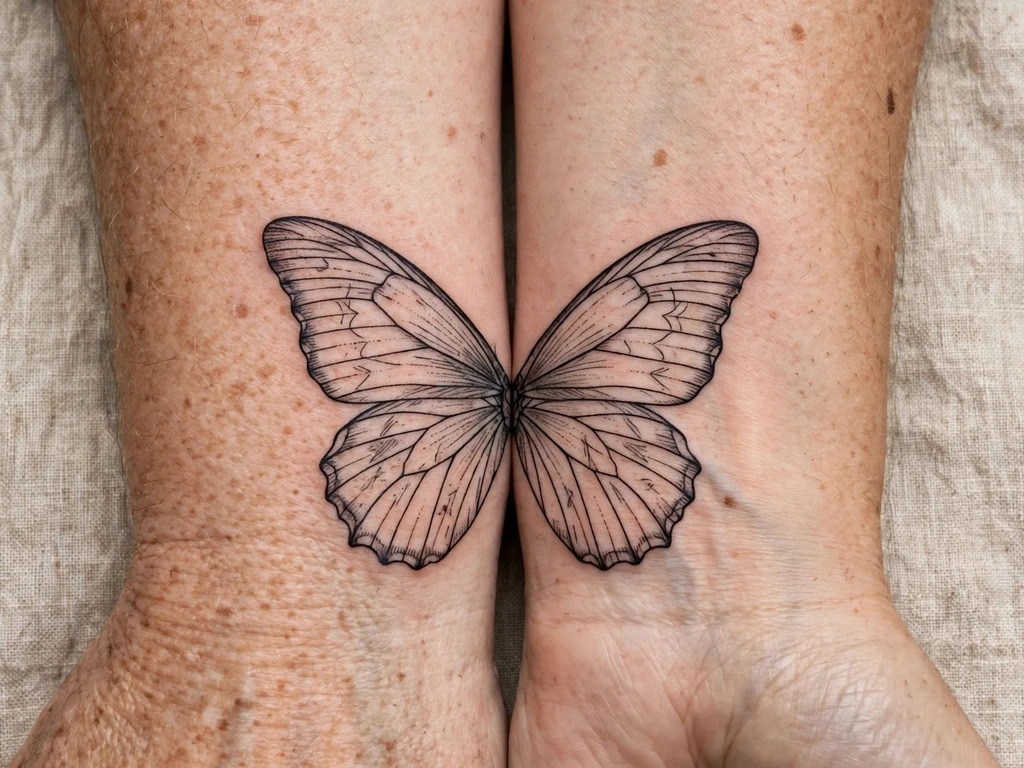
One butterfly, halved down its body: each of you wears one wing, and the whole insect appears only when your wrists come together wing to wing. It is a favourite of best friends and mother-daughter pairs alike — transformation and growth, the classic butterfly meanings, with a built-in story about needing the other person to be complete. Our butterfly tattoo ideas show how many wing styles there are to split, from realistic monarch patterns to a few clean fine lines.
Best placement: Matching inner wrists or the backs of matching hands’ wrist edges, where the two halves meet naturally in a photograph.
Best for / know before you book: This is the split design that most needs the solo test — one wing alone can read as an abstract leaf or flame — so choose a wing with enough internal pattern (veins, dots, an eye-spot) to stand as a deliberate design by itself. Both wings must be cut from one drawing; symmetrical wings drawn separately never quite mirror.
24. Matching 444 Pair
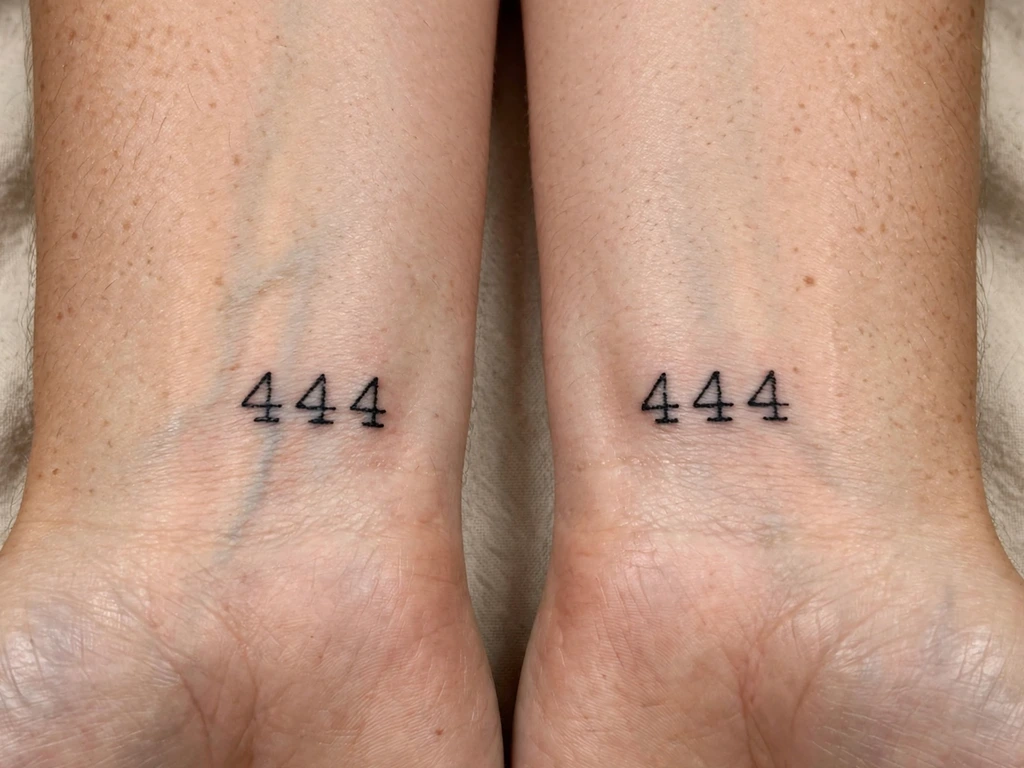
The same three numerals on both of you: 444, read in angel-number tradition as protection, stability and a reminder that you are watched over — which is why pairs choose it as a mutual promise, we look out for each other. It is usually tattooed as identical small fine-line or typewriter-font numerals on matching inner wrists, and it belongs to a bigger family of number pairs: some duos split the meanings instead, one wearing 444 and the other 222 for balance. The full story of the number, and dozens of ways to draw it, live in our 444 angel number tattoo ideas guide.
Best placement: Matching inner wrists, centred over the pulse point; matching ankles for a more private pair.
Best for / know before you book: Three identical digits invite the eye to skim, so proofread both stencils digit by digit, out loud, in the mirror — four, four, four, on both wrists — and agree the size in millimetres so the pair truly matches. Keep the numerals at least 2.5 cm wide in total so fine lines do not merge into each other as they settle.
25. One Line, Two People
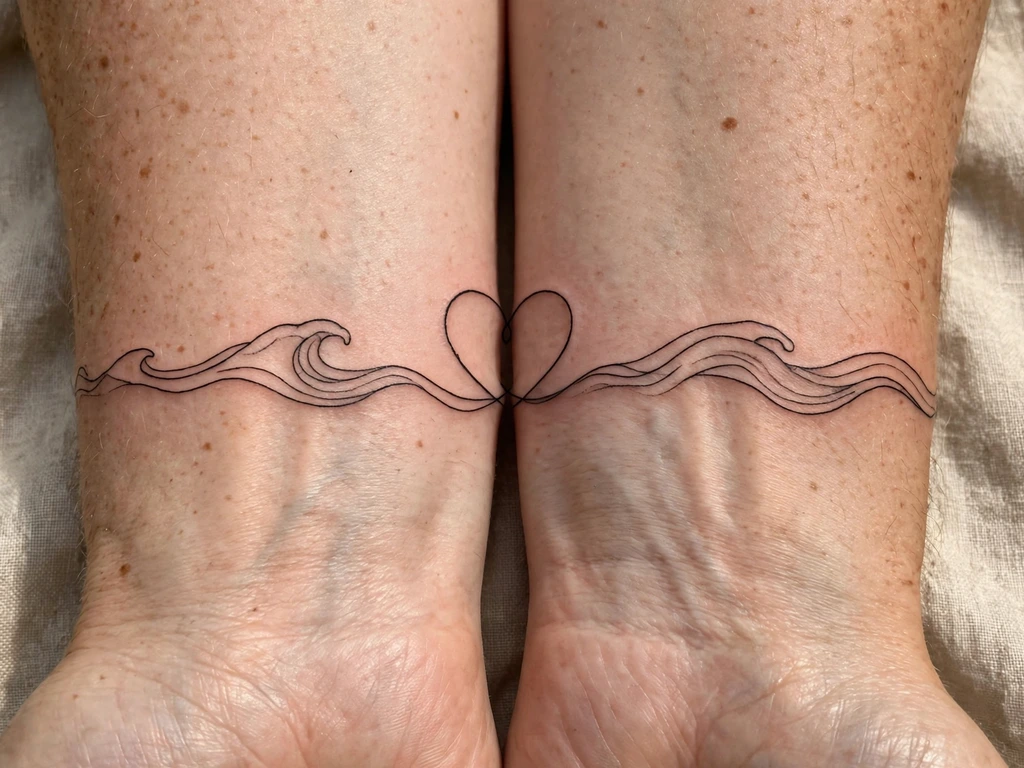
The finale, and the most artistic split of all: a single continuous-line drawing — a wave becoming a heart, an unbroken profile of two faces, a looping signature-like flourish — designed as one stroke, then divided across two forearms. Alone, each half is an elegant abstract line; together, with your arms side by side, the stroke runs unbroken from one person onto the other. It suits every bond in this guide — couples, friends, siblings, parent and child — because the metaphor is universal: two separate lives, one continuous story running through both.
Best placement: Matching inner forearms, at the exact height where your arms rest together, so the line joins without either of you twisting to meet it.
Best for / know before you book: Continuous lines have nowhere to hide — every wobble shows, and the join point must match to the millimetre — so choose an artist whose healed single-line work you have seen, and have the joined stencil checked with your arms actually together, standing, before the split stencils are separated. Agree in advance how each half ends at the split point (a clean cut reads best) so neither half looks accidentally unfinished.
Matching Tattoo Placement by Size
| Size | Typical dimensions | Best placements | Good to know |
|---|---|---|---|
| Small | 2–5 cm | Inner wrists, ankles, behind matching shoulders | Hearts, numerals, coordinates, crowns and constellations live here; simple shapes only, as fine detail merges |
| Medium | 5–10 cm | Forearms, upper arms, calves | The sweet spot for split designs, script phrases, koi, skylines and fingerprint hearts that need room to breathe |
| Large | 10–15 cm | Upper arms, upper back, thighs | Room for detailed pairs like elephants or a compass rose with real internal detail |
| Extra large | 15 cm+ / paired compositions | Two forearms or backs designed as one canvas | Draw the whole composition in one consultation, even if the two halves are tattooed in separate sittings |
How to Choose Your Matching Tattoos (and What to Know Before You Book)
Book the same artist, in the same session. This is the single most repeated advice in this guide because it decides whether “matching” ends up meaning identical or merely similar. One artist, one stencil file, one set of needles’ line weights, one afternoon: that is how two tattoos come out as true twins. If you absolutely cannot sit together, book the same artist within the same few weeks and have the first person’s healed-or-fresh photo and the exact design file at the second appointment.
Agree the boring details in writing first. Size in millimetres. Same placement, or mirrored? Same side of the body, or opposite? Which font file, which line weight, black only or a shared accent colour? Pairs who write these down on one shared note arrive at the studio in agreement; pairs who assume they agree discover their differences at the stencil stage, with an audience. Photograph both stencils side by side before either of you is tattooed — the camera catches size and height mismatches that excited eyes miss.
Choose a symbol of a memory, not of a mood. As the permanence section above argues, the pairs that stay loved are anchored to something that cannot change: a place, a shared story, a number, an animal, the flower from a specific garden. Be more careful with names, initials and each other’s handwriting signatures — not forbidden, just the least flexible choice you can make. Run the solo test on every candidate design: would I still love this if it were only mine? If the answer needs a pause, keep designing.
Plan for two different bodies. The same design sits differently on different skin — different tones, textures, hair, muscle and curvature — and it will age at two different speeds depending on each person’s sun habits and skin. Simple, slightly bold designs converge as they age; fussy, ultra-fine ones diverge. If one of you has significantly darker skin, talk to your artist about line weight and any colour choices early, because contrast behaves differently and a good artist will adjust both pieces so they still read as a pair in ten years.
Take safety seriously — twice. There are two of you, so everything doubles: choose a licensed, inspected studio, watch that single-use needles are opened in front of each of you, expect fresh ink caps for each person, and follow the aftercare instructions you are given, individually. Do not share aftercare products mid-heal, do not compare healing speeds anxiously (two bodies heal at two paces, and redness on day three is not a verdict), and book the session when you can both rest the placements properly afterwards — matching tattoos, individual healing.
Key points to remember:
- Same artist, same session, same design file — that is what makes matching mean matching
- Agree size in millimetres and placement (same side or mirrored) in writing before you book
- Anchor the design to a shared memory or meaning, not a name — and make sure each piece passes the solo test
- Identical, complementary and split are three different promises; pick the family before the design
- Simple designs age together; ultra-fine detail ages apart at two different speeds on two different bodies
Frequently Asked Questions
Do matching tattoos have to be identical?
No. Identical twins are only one of the three families — complementary pairs (a sun and a moon, a lock and a key, a compass and its star) and split designs (two halves of one heart, one butterfly in two wings) are just as much matching tattoos, and for many relationships they fit better, because they let two different people show inside one idea. Choose identical when the twin effect itself is the point — best friends and siblings especially love it — and complementary when your tastes or roles within the bond genuinely differ.
What if the relationship changes after we get matching tattoos?
It is the question everyone thinks and few say out loud, so here is the calm answer: choose designs anchored to a shared memory, place or meaning rather than a name, make sure your piece passes the solo test and looks complete on its own, and a changed relationship leaves you with a chapter marker, not a mistake. Most people keep and even cherish them. And if you truly want one gone, laser removal exists — but it takes many sessions over many months and may not clear completely, which is exactly why the choice deserves care up front rather than panic later.
Should we get our matching tattoos in the same session?
Yes, whenever you possibly can. The same artist in the same session, working from one design file, is how the two pieces come out at the same size, line weight and ink density. It also turns the appointment into the shared event the tattoo is commemorating — most pairs say the session itself becomes part of the memory. If life forces two appointments, use the same artist, bring the design file and photos of the first tattoo, and do not let more than a few weeks pass between sittings.
Where is the best placement for matching tattoos?
Inner wrists and forearms are the most popular, because the two pieces can be joined, compared and photographed effortlessly, and they hide under sleeves when needed. Ankles are the discreet classic, especially for parent-and-child pairs. The real rule is not the spot but the symmetry: choose the same placement on both bodies (or a deliberate mirror of it), at the same height, measured — because a centimetre’s difference in height is invisible separately and obvious the moment you stand together.
How much do matching tattoos cost?
Usually the price of two small tattoos, because that is what they are: two separate pieces of work, two setups, two lots of single-use equipment. Many pairs each pay a studio’s minimum charge for tiny identical designs; larger complementary pieces like a compass and star are priced by size and detail for each person. Some studios offer a small same-session courtesy when both pieces are done together by one artist, but do not count on a two-for-one — ask politely when you book, and budget for two tattoos regardless.
Final Thoughts
A matching tattoo is the smallest possible monument: a few centimetres of ink that say this person, this bond, this chapter of my life mattered enough to keep. The designs in this guide — a sun and its moon, a heart in two halves, a bear and its cub circling the same sky — all work for the same reason: they point at something true, and they are beautiful even when the other half is a thousand miles away.
So choose slowly and book together. Pick the symbol that belongs to your shared story, agree the millimetres, sit in the same session, and check those stencils side by side. Done that way, your matching tattoos will not just match each other — they will match the relationship you meant to honour.