A frog tattoo is the only common tattoo subject that arrives carrying a pun, a life story and a good-luck charm in the same small body. The pun is Japanese, and it is the reason this little animal is suddenly everywhere: in Japanese, the word for frog — kaeru — sounds exactly like the word for “return”, and a creature whose name is a promise that things come back is a creature people want on their skin. The life story is metamorphosis: no other familiar animal visibly rebuilds its entire body, trading a tail and gills for legs and lungs, and wearers take the frog for exactly that rebuild. And the charm is the oldest layer of all — frogs have meant luck, rain, fertility and money coming home in tradition after tradition for thousands of years.
That triple load is why frog tattoos fail in one specific way when they fail: they come out as generic pond clip-art — a green blob with two eyes that could be any frog, from anywhere, meaning nothing in particular. The cure is the same cure this series applies to every animal: draw the true animal, and choose the reading on purpose. A frog is a very particular construction — a folded haunch that makes up most of its silhouette, two eyes carried on top of the head like periscopes, toes ending in pads or webbing depending on whether the species climbs or swims. Get the haunch and the eyes right, add the one feature that names the kind — toe pads, jewel warning colours, a coin — and the tattoo reads as a frog, and as that frog, from across the room.
So this guide does two jobs. It gives you 25 original frog tattoo ideas — the Japanese sitting frog, the money frog, tree frogs, dart frogs, a bullfrog, a rain frog, a glass frog, the bone frog handled with the respect it is owed, and frogs worked in Japanese-influenced, traditional, neo traditional, blackwork, watercolour, dotwork and fine-line styles — and it gives you the law that keeps every one of them readable for life: the haunch rule. Read the law before the designs; it will change how you look at all twenty-five.
What Does a Frog Tattoo Mean?
Start with the reading that is driving the whole subject right now: in Japan, a frog tattoo means return. The Japanese word for frog is kaeru (蛙), and it is a perfect homophone of kaeru (帰る), “to return” — so the frog has carried the return reading in Japanese culture for centuries: the traveller returns home safely, the money you spend returns to you, the person you love returns. Travellers in Japan have long carried small frog charms for exactly this reason, and in the Japanese tattoo tradition — the wider world this site’s Japanese tattoo ideas guide sets out — the frog is drawn sitting upright and alert, an animal that has come back and is watching the door.
The second reading rides on the first, across the sea in China: the money frog, and luck that comes home. The Chinese tradition gives the frog a three-legged, coin-carrying form — Jin Chan, the money toad — a mythical creature with a gold coin in its mouth, companion to the immortal Liu Hai, kept in homes and shops as a charm for wealth arriving and staying. The House of Good Fortune’s account of Jin Chan describes the figure exactly as the statues show it: three-legged, red-eyed, seated on a pile of coins, and placed facing inward, so the wealth is drawn into the home rather than out of it. Three legs is the point, not a defect: the missing leg is read by some scholars of the symbolism as wealth that flows rather than being hoarded. A money frog tattoo takes that whole story at charm scale: money that returns, fortune that is invited in and asked to stay.
The third reading is the one written into the animal’s own body: transformation. A frog is the only common tattoo animal that visibly rebuilds itself — egg, tadpole, a creature with a tail and gills, then legs, lungs and a new shape entirely. AmphibiaWeb, the University of California’s amphibian database, currently lists more than 8,000 frog species — and every single one of them performs that rebuild. A frog tattoo says: the second body is not a metaphor. It happened once; it can be chosen again.
Two quieter readings complete the set. Adaptability: the frog is at home in water and on land both, breathes through lungs and through skin, and survives in deserts (the rain frog, Design 9, waits out drought buried in sand) as well as rainforests — wearers take it for the ability to live in two worlds. And cleansing and rain: frogs arrive with the rains in tradition after tradition, and in ancient Egypt the frog-headed goddess Heqet stood for fertility, birth and the waters of creation. Luck, rain, new life: the frog has been a good sign for a very long time, in a great many places, independently.
One design carries a meaning of a different kind, flagged here so it is never worn by accident: the bone frog — a frog skeleton — is a tribute worn within the US Navy SEAL community, honouring fallen teammates (Design 7 and the FAQ). Choose it knowingly or not at all.
And the usual caution of this section applies: none of these meanings is a fact about frogs. They are readings people bring to the animal — a Japanese pun, a Chinese charm, a life cycle, a service community’s tribute — layered over a real creature whose actual facts are remarkable enough without invention. Keep the two in their places: the drawing factual, the meaning chosen.
The Haunch Rule: Why a Frog Reads as a Frog
Every subject in this series has a craft spine, and the frog’s is a shape. A frog is judged the way this series’ sharks are judged — at distance, in silhouette, before any detail resolves (the distance logic behind the shark tattoo ideas guide applies here unchanged) — but the silhouette that decides it is stranger than a shark’s. A sitting frog is mostly one curve: the great folded haunch, thigh pressed against the body, rising from the ground to the animal’s highest point and falling to a small head. Get that curve right and two bumps right, and any viewer reads “frog” instantly. Get them wrong and no amount of green will save it. So the law here is named for the curve itself — the haunch rule — and it has five parts.
Rule one: the haunch curve is the silhouette. A sitting frog’s outline is one long folded S: the haunch sweeps up and over, the back falls away short, and the front legs are near-vertical props. Every sitting design in this guide is checked by the squint test: reduce it to a black shape, and the haunch’s high folded curve must still be the tallest, longest line in it.
Rule two: the eyes sit on top, as two bumps. A frog’s eyes are carried on top of the head, raised like periscopes, because the animal sits low in water with only its eyes breaking the surface. In silhouette, those two eye bumps — with the slight dip between them — are the frog’s signature, as identifying as a shark’s tail. Eyes drawn on the front of the head make a cartoon; eyes drawn as mere dots on a smooth skull make a lizard.
Rule three: toes are drawn few, long and separate. A frog’s front toes are long and thin, its back toes longer still, and whether they end in round climbing pads (tree frogs) or in webbing (pond frogs) is a species fact, not a decoration choice. The tattooing discipline is spacing: toes drawn touching merge into a fin within a few years, so each toe is separated by visible skin, and fine webbing is suggested with two or three strokes rather than drawn as lace.
Rule four: the throat is left light. A frog’s throat and belly are pale, soft and unmarked where its back is coloured — the countershading of the pond. In a tattoo, that pale underside is drawn as reserved skin or the lightest wash in the piece, and it is what separates the animal’s head from its body in the reading. Fill the throat with the back’s full colour and the head vanishes into the body.
Rule five: pattern serves the shape, never the reverse. A dart frog’s jewel blocks, a tree frog’s side stripe, a bullfrog’s mottling — pattern is the last layer, laid over a silhouette that already passes rules one to four with the colour mentally removed. The chair-side test is the same as always: if the plain black shape still reads as its frog, the pattern can go on; if it needs its colours to explain itself, the drawing underneath is underweight.
Frog Tattoo Styles and How They Age
A frog ages by one law: its fine toes and its lightest greens set its lifespan. The ink in every stroke settles and spreads slightly across the years; strokes thicken, close parallel lines merge first, and pale colour softens earliest. The frog’s vulnerable points are specific: the long thin toes, the pale throat, and the light greens and yellows that dominate the subject’s palette. Styles differ in what they sacrifice first.
| Style | How it is drawn | How it ages |
|---|---|---|
| Japanese-influenced | Bold line, the frog composed sitting upright with waves, wind bars or plants in the irezumi composition language | Ages with its setting, not against it: bold line holds the haunch for decades; the deep greens soften into richness |
| American traditional | Heavy black outline, flat green/red/gold palette, the frog as a bold emblem with a few big shapes | Among the longest-lived of all: the outline is structural and the shapes are few — softens into the classic look it was always meant to have |
| Neo traditional | Bold outline, jewel-tone greens and accents, decorative framing (mushroom, lotus, moon) | Ages like traditional with better colour discipline: outline holds the frog, colour softens — needs the size the framing demands |
| Black and grey realism | Grey-wash modelling of the haunch and belly, fine toe and skin detail | The light greys go first, so the belly and throat must start bolder than looks right; at honest size the haunch curve carries it for decades |
| Colour realism | Species-true colour and pattern (dart frog blocks, tree frog stripes) over a complete line drawing | The pattern’s lightest colours (yellow, pale green) soften first; the line underneath is the lifespan, so it must be a complete drawing |
| Blackwork | Solid black and heavy shapes, the frog as one confident silhouette, skin channels for toes and throat | Superb ink-holding — settling barely registers in this much black — but the species must live in the outline, because the interior is one tone |
| Dotwork | Stippled dots build tone and pattern, spaced for healed skin | Dots drawn at healed spacing soften into tone gracefully; dots drawn dense merge into flat grey — spacing is the whole craft |
| Watercolour | Soft washes of green and blue over a fine-line skeleton, splash edges | The washes soften fastest of everything here; the skeleton line is the lifespan and must be a complete haunch-true drawing, never a suggestion |
| Fine-line / minimalist | One continuous or near-continuous line, the frog reduced to haunch curve and eye bumps | The most fragile treaty: survives only at simple shapes and honest size, with the toe spacing rule obeyed even here — expect a possible touch-up |
The photograph problem: the frog tattoos that circulate most are fresh, photographed close, and frequently drawn at clip-art delicacy — hairline toes, whisper-pale greens, detail that reads beautifully for a season. Every design here is described at its healed density and honest minimum: toes spaced for the decade, greens laid in a tone deeper than the photograph suggests.
Frog Tattoo Ideas at a Glance
| # | Design | Species / style focus | Best placement |
|---|---|---|---|
| 1 | Japanese Sitting Frog (Kaeru) | Japanese frog, irezumi-influenced | Forearm |
| 2 | Money Frog With a Coin | Jin Chan money frog, neo traditional | Shoulder |
| 3 | Red-Eyed Tree Frog | Red-eyed tree frog, colour realism | Calf |
| 4 | Poison Dart Frog | Dart frog, bold colour miniature | Ankle |
| 5 | Tree Frog on a Leaf | Tree frog, fine line and colour | Forearm |
| 6 | Bullfrog in Grey | American bullfrog, black and grey | Upper arm |
| 7 | The Bone Frog | Frog skeleton study, fine line | Forearm |
| 8 | Origami Frog | Origami fold, geometric line | Wrist |
| 9 | Rain Frog, Round and Calm | Desert rain frog, soft colour | Shoulder blade |
| 10 | Glass Frog | Glass frog, fine line and negative space | Calf |
| 11 | Golden Poison Frog | Golden poison frog, bold colour | Shoulder |
| 12 | Traditional Sailor Frog | American traditional | Upper arm |
| 13 | Frog and Mushroom | Storybook pair, neo traditional | Thigh |
| 14 | Blackwork Frog | Solid blackwork silhouette | Forearm |
| 15 | Watercolour Frog | Watercolour wash | Shoulder blade |
| 16 | Tiny Tree Froglet | Young tree frog, minimalist colour | Ankle |
| 17 | Frog in Mid-Leap | Leaping frog, fine-line motion | Calf |
| 18 | Dotwork Frog | Dotwork tone and pattern | Shoulder |
| 19 | Frog and Lotus | Pond pair, Japanese-influenced | Shoulder blade |
| 20 | Two Frogs, Face to Face | Paired frogs, fine line | Collarbone (outer edge) |
| 21 | Frog on a Lily Pad | Pond frog, traditional colour | Thigh |
| 22 | Tiny Frog Behind the Ear | Minute silhouette | Behind ear |
| 23 | Tiny Frog on a Finger | Minute silhouette | Finger (side) |
| 24 | Tree Frog Climbing | Climbing tree frog, colour realism | Forearm |
| 25 | One-Line Frog in Profile | One-line minimalist | Wrist |
25 Frog Tattoo Ideas
1. Japanese Sitting Frog (Kaeru)
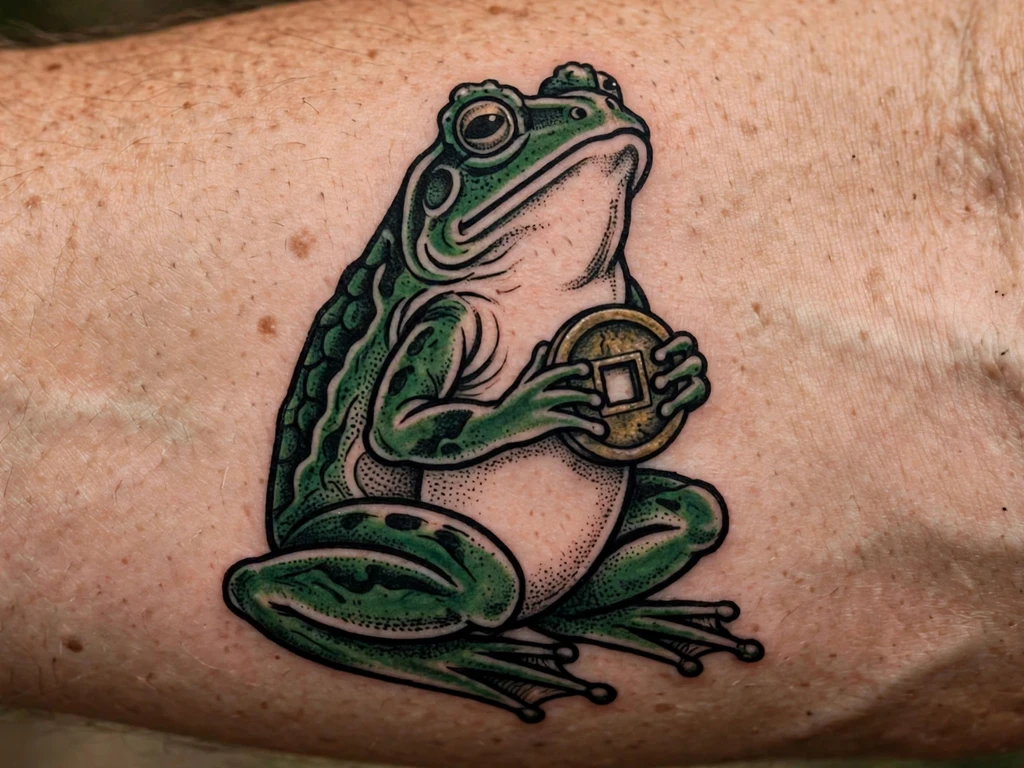
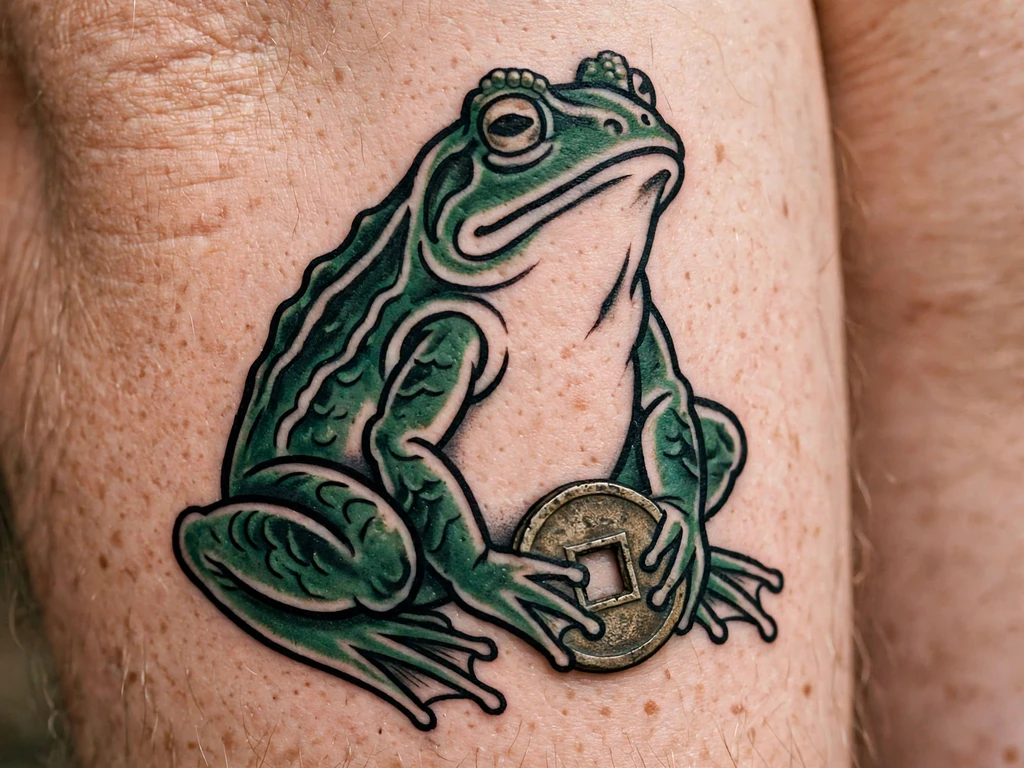
Begin with the design this guide exists for: a Japanese-style frog sitting tall on a forearm — upright, front legs straight as pillars, haunch folded high, eyes carried on top of its head and looking out at the world — drawn in the bold line and deep greens of the Japanese tradition, a single old coin held between its front feet. This is the kaeru frog in its classic posture: the animal whose name promises return, sitting the way temple-gate frogs sit, as if it has come home and intends to stay.
The drawing discipline is posture. The Japanese sitting frog is nearly symmetrical and completely still, so every asymmetry shows: the two haunches must match, the eye bumps must sit level, the front feet must land together. The coin is drawn as one simple ringed disc — an old cash coin with its square hole — never as lettering or ornament; the moment it becomes currency artwork the charm turns into clip-art. At 10–14 cm the forearm hosts the full upright figure; this design does not shrink gracefully, because the posture needs its height.
Best placement: Forearm, the frog sitting upright along the arm’s length, facing the hand, where the posture lies flat and reads whole.
Best for / know before you book: This is the meaning-first design — if the return reading is why you are here, judge artists on healed Japanese-style animal work and check the symmetry in their frogs before anything else.
2. Money Frog With a Coin
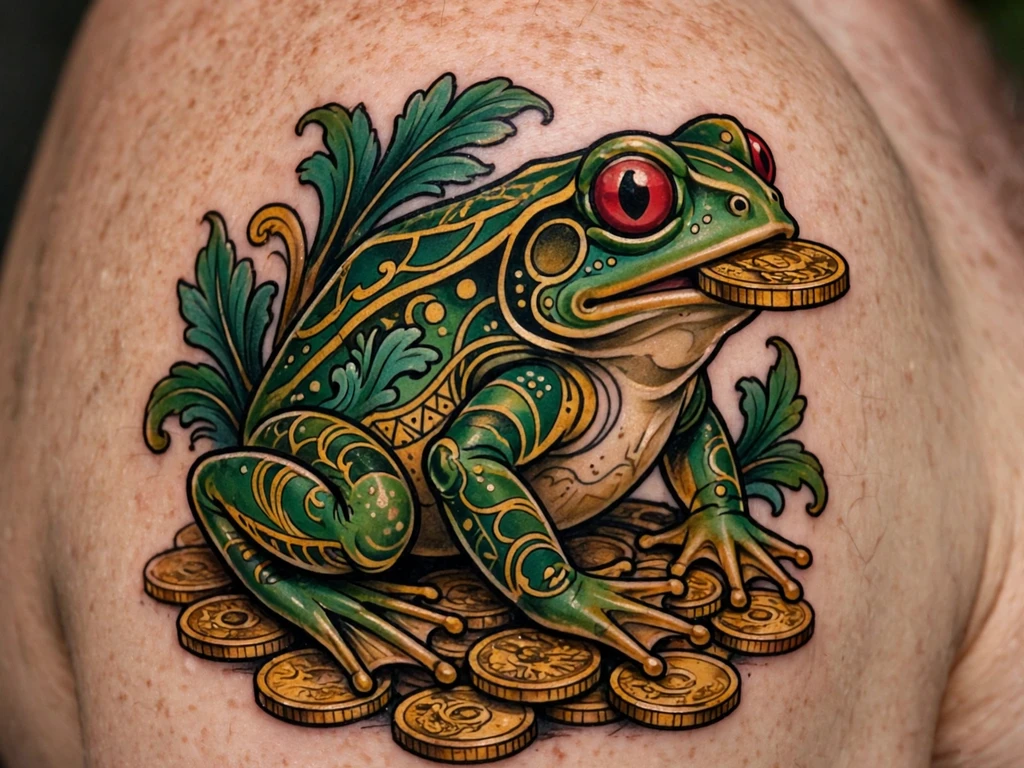
The Chinese money frog — Jin Chan — drawn as a tattoo charm at shoulder scale: a broad, warty-skinned frog with red eyes and flared nostrils, three legs only, a gold coin held in its mouth, seated on a small neat pile of ringed coins. Worked in neo traditional — bold outline, jewel greens and golds — it is the prosperity reading of the frog made literal: the animal that gathers wealth and brings it home.
Three legs is the design’s whole exam. The tradition is exact about the anatomy — two front legs, one back leg, the tripod that never wobbles — and a four-legged money frog is simply a frog near some coins. The coins under it are kept to one small pile, drawn as simple ringed discs; a treasure heap turns the charm into a cartoon. Red eyes are the palette’s one hot note, laid in deep so they soften to ember rather than vanish. At 9–13 cm on the shoulder’s cap, the money frog sits like a guardian on a gatepost.
Best placement: Shoulder, the frog seated squarely on the joint’s cap, facing outward as the statues face into a room — toward the world the wearer walks into.
Best for / know before you book: Count the legs on the stencil aloud — three, arranged as a tripod. If the artist instinctively “corrects” it to four, this is not their design.
3. Red-Eyed Tree Frog
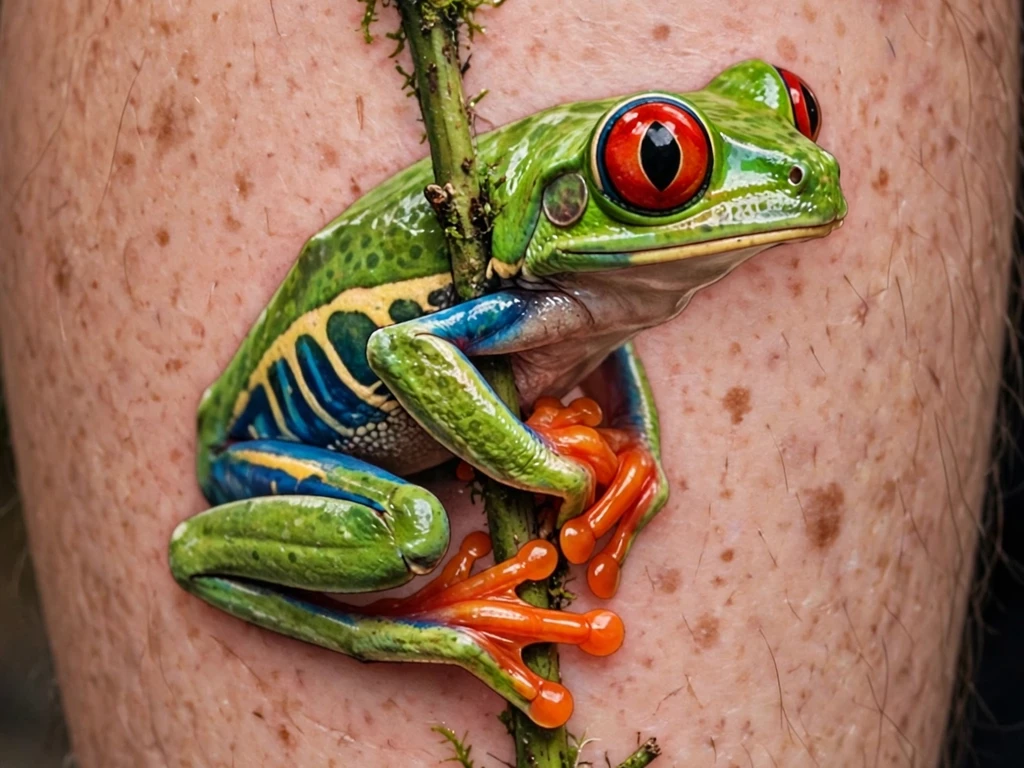
The most recognisable frog on earth: a red-eyed tree frog in full colour realism on a calf — leaf-green back, a flank striped in blue and yellow, enormous scarlet eyes, orange toes wrapped around a stem. Drawn true, it earns the fame: no other frog carries that colour combination.
Colour realism lives or dies on Rule five — pattern over a true shape. Beneath the colour sits a complete frog: haunch folded even in the climbing pose, toe pads drawn as distinct discs, the eye bumps swollen with those famous eyes. The palette is laid in at healed depth: the green a tone deeper than the photograph, the red of the eyes deepest of all, because red is both the signature and a colour that softens honestly with years.
Best placement: Calf, the frog clinging vertically down the muscle, stem running with the leg’s line.
Best for / know before you book: Ask to see healed colour frogs or lizards — the red eye at a year old is this design’s report card.
4. Poison Dart Frog
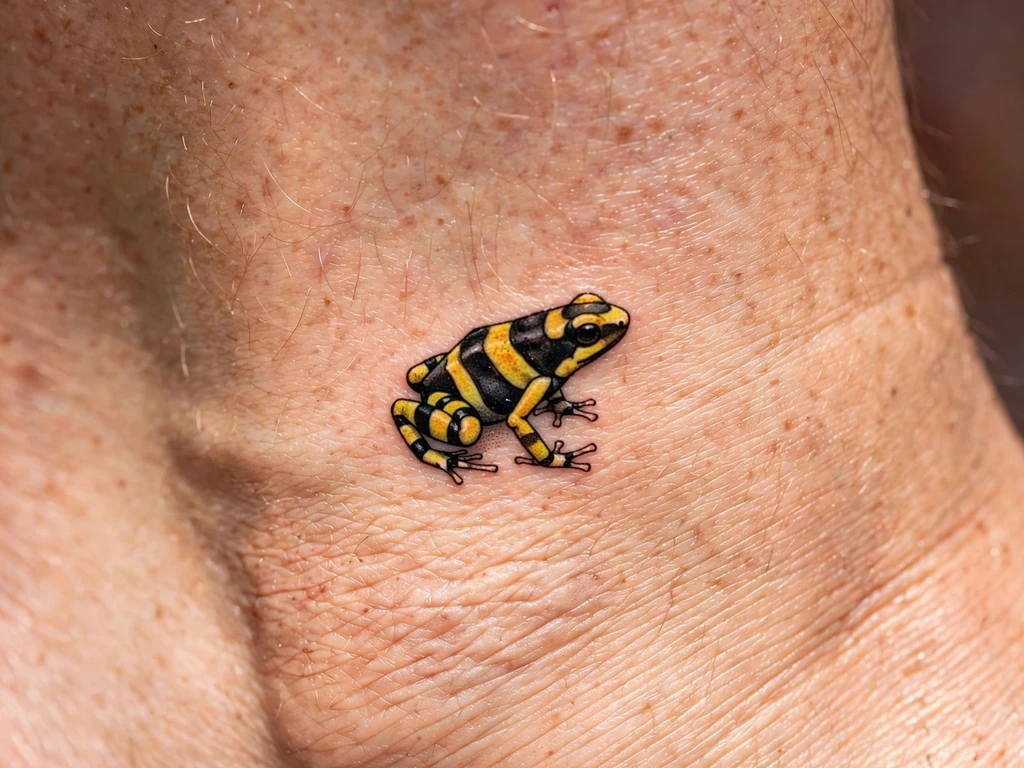
The jewel of the rainforest, worn at ankle scale: a poison dart frog at 5–8 cm, its whole body a warning sign — golden yellow banded with black, or cobalt blue, or strawberry red over navy, depending on the species drawn. Dart frogs are tiny, smooth-skinned and outrageously coloured because in nature the colours are a notice: skin toxins, do not touch. The tattoo takes the notice as pure design — the boldest colour-per-centimetre ratio of any animal in this guide.
Small size is honest here because the real animal is small — most dart frogs are under 4 cm — but the drawing must not confuse small with simple. The colour blocks are the species’ own pattern, drawn in a handful of large bands or blotches, never speckled: speckle merges, blocks endure. The body is smooth, with no warts and no heavy texture.
Best placement: Above the ankle, the frog sitting on the outer side in profile, clear of the shoe collar’s rub line.
Best for / know before you book: Choose the species by its pattern, not just its colour — and have the artist draw the blocks at healed boldness, because jewel colours are chosen to be seen.
5. Tree Frog on a Leaf
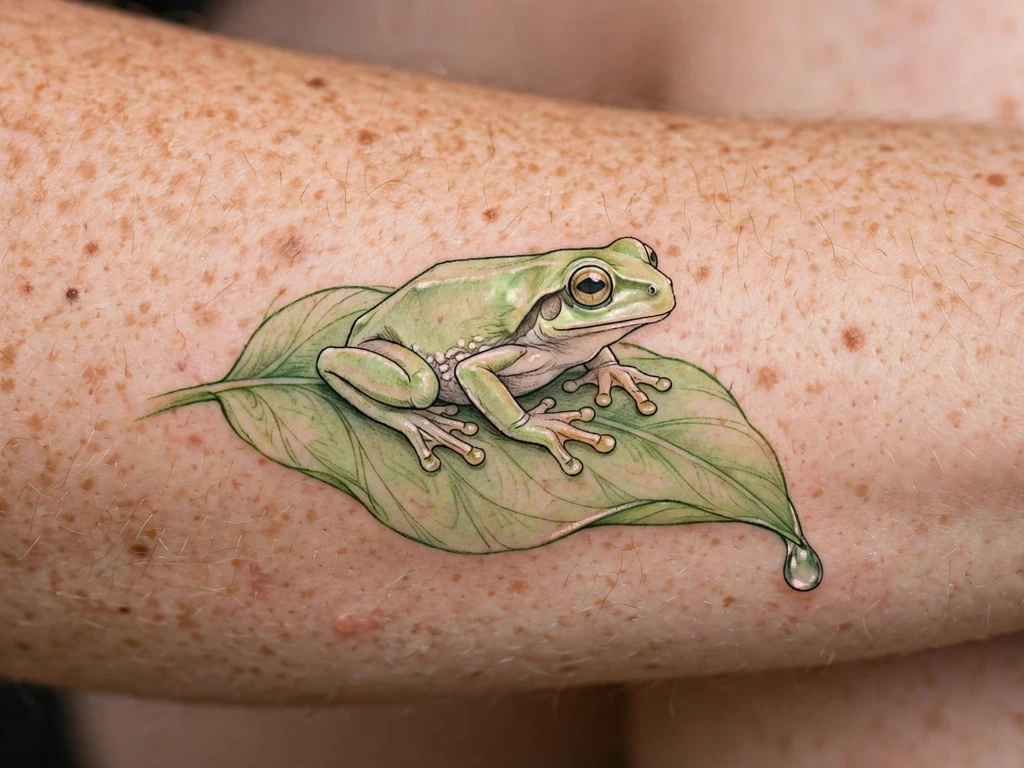
The gentle version of the climbing frog: a small tree frog resting on a broad leaf along a forearm, drawn in fine line with soft colour — the frog pale green and calm, the leaf one large graphic shape beneath it, a single water drop at the leaf’s tip. Where Design 3 is a poster, this is a quiet margin note: the frog at rest, toes spread, eyes half-lowered. Wearers take it for the calm reading — the animal that lives between water and air and hurries in neither.
The toe pads are the design’s signature and its test: each toe ends in a distinct round disc, drawn slightly larger than nature gives, because the pads are what make a tree frog a tree frog (Rule three, in its climbing form). Fine line sets the trap — pads drawn as tiny perfect circles at fresh density will close as the line settles, so the pads are drawn bold-ringed and few.
Best placement: Forearm, the leaf lying along the arm’s length with the frog resting on its upper surface, read from the wearer’s side.
Best for / know before you book: Count the toe pads on the stencil — one clear disc per toe, each standing separate. Melted pads are how this design dies.
6. Bullfrog in Grey
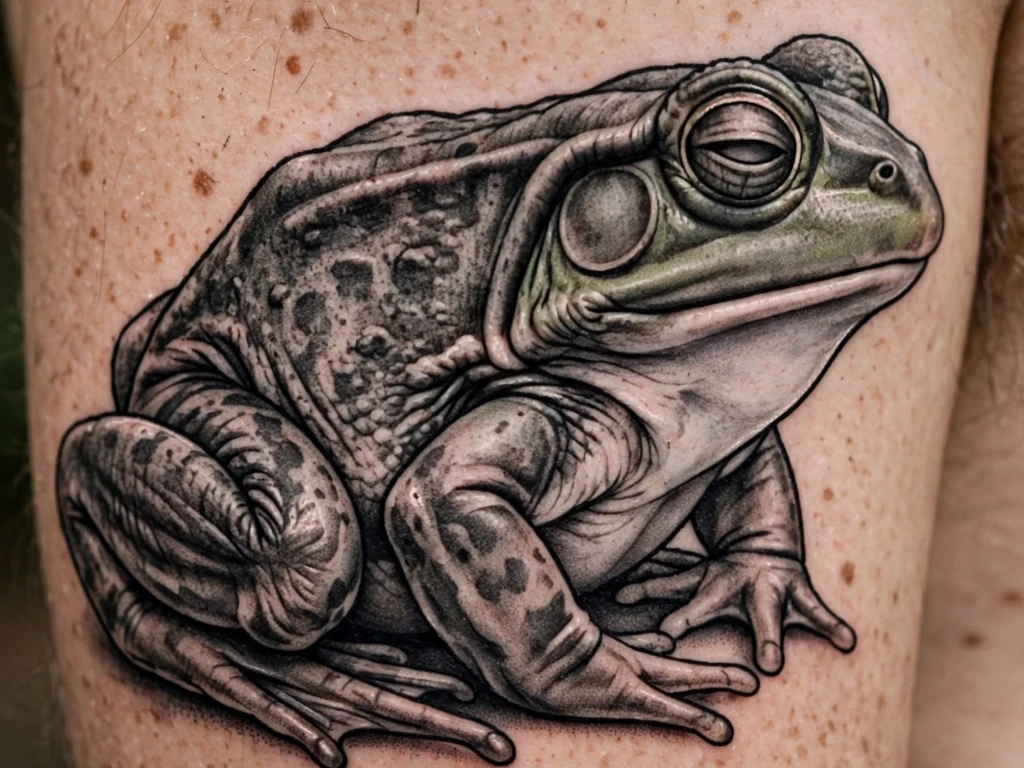
The heavyweight: an American bullfrog in black and grey across an upper arm — the biggest frog in North America drawn at the size its bulk deserves, deep haunch, a heavy ridged brow running from eye to eardrum, the skin mottled in grey tones rather than coloured. The grey treatment suits it: this is the frog as sculpture, all mass and fold.
The species signature is the fold: on a bullfrog a ridge of skin curves from behind the eye down around the eardrum, and that ridge — drawn as one confident line — names the animal as surely as a shark’s tail names a shark. Everything else is honest bulk: the haunch fold deeper than any other in this guide, the throat pale and heavy (Rule four at its most important, since this head is mostly throat), the mottling kept to large soft patches.
Best placement: Upper arm, the frog sitting across the outer flat, given the arm’s full width for its haunches.
Best for / know before you book: This is the design for wearers who want presence without colour — check that your artist can model with grey wash without reaching for tiny detail.
7. The Bone Frog
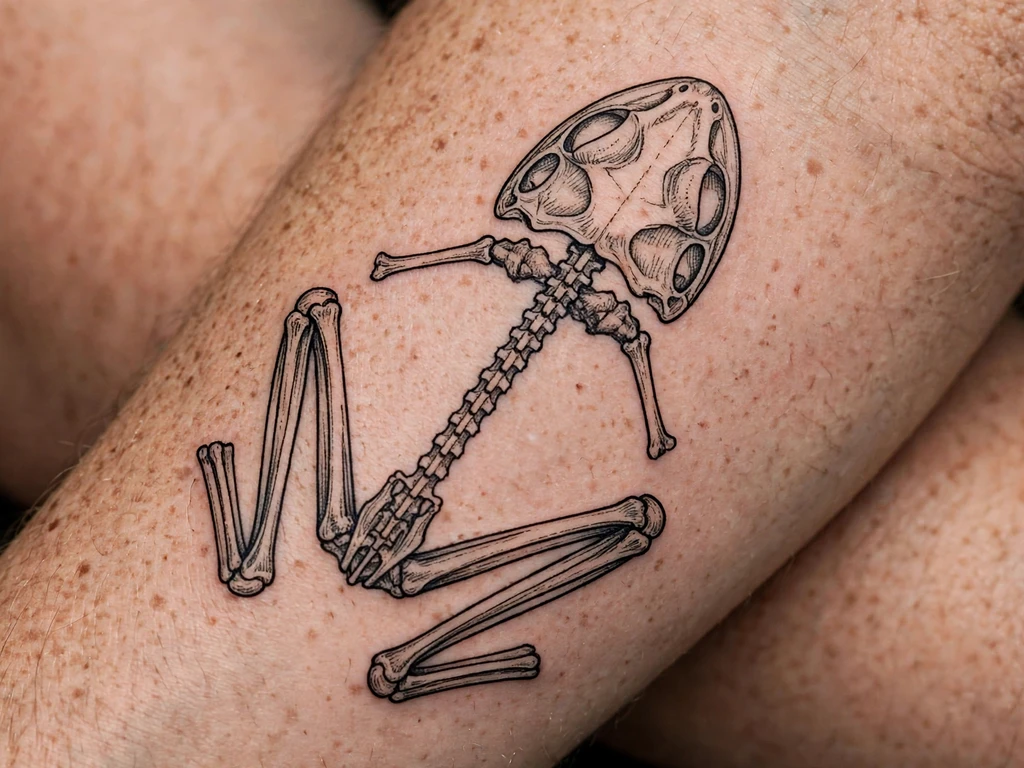
The bone frog is a frog skeleton: the animal reduced to its architecture — a broad skull, a short spine, and those enormous folded leg bones, longer than the rest of the skeleton together, drawn in fine line along a forearm like a plate from an anatomy book. It carries a meaning a wearer must know before choosing it: within the US Navy SEAL community, the bone frog is worn as a tribute, honouring teammates who did not come home. It is their symbol, held with gravity, and this guide treats it exactly that way — as a memorial design with an owner, not a curiosity.
Drawn as anatomy, it succeeds or fails on accuracy: a frog’s skeleton is genuinely strange — no ribs to speak of, a fused tail-bone (the urostyle) running inside the pelvis, toe bones in long delicate chains — and the drawing should respect the strangeness. Fine line, the leg bones drawn with air between them, the toe chains simplified to their main bones so they survive settling. Wearers connected to the community take it as the tribute it is; wearers drawn only to the image are asked, plainly, to choose one of the other twenty-four frogs in this guide and leave this one to the people whose dead it names.
Best placement: Forearm, the skeleton laid along the arm’s length, the long leg bones using the forearm’s full run.
Best for / know before you book: Know whose symbol this is before you book it — and if it is yours to wear, choose an artist who will draw a true frog skeleton from a reference, not an approximation.
8. Origami Frog
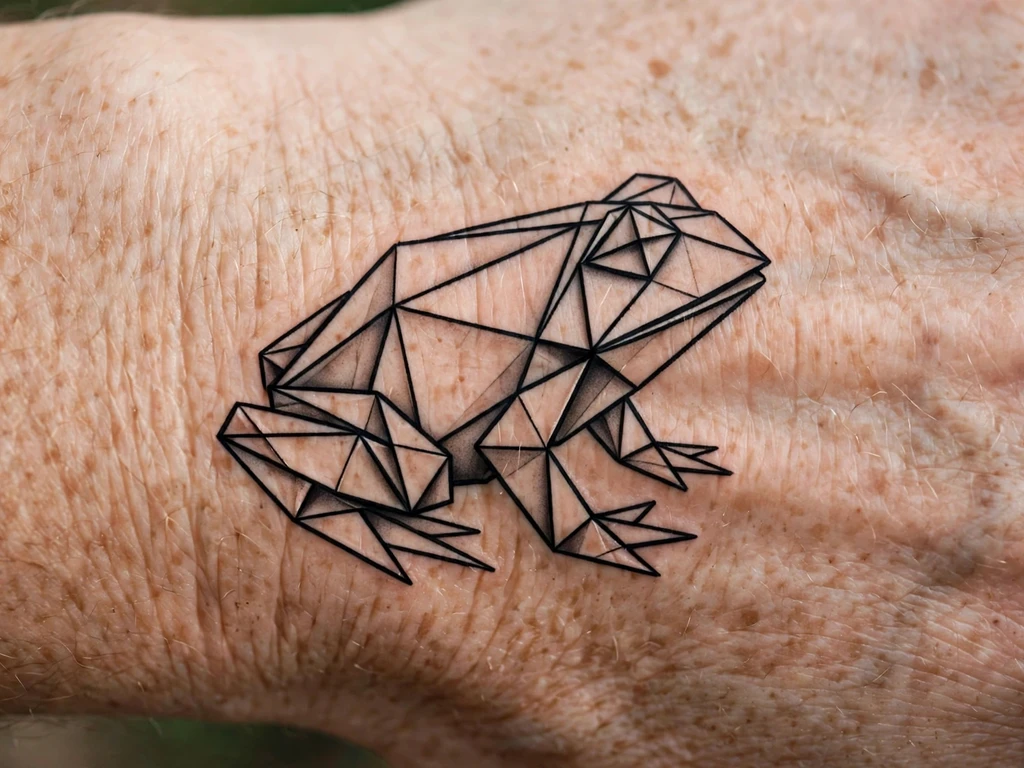
The frog as pure geometry: an origami frog on a wrist, drawn as a handful of flat folded planes — triangles and trapezoids meeting at crisp edges — in clean black line, no colour or a single flat green laid inside the folds. The folded-paper frog is a charm in its own right in Japan (a paper kaeru given for the same safe-return wish), and it is also this guide’s most graphic design: a frog with every curve removed that still reads instantly — because the origami figure keeps exactly the haunch fold, the eye bumps and nothing else.
The discipline is the fold count. A real origami frog folds from a specific sequence, and the drawing honours it: eight to twelve planes, each a simple shape, each edge straight. Add extra lines and it becomes a render.
Best placement: Wrist, the origami frog sitting on the inner wrist flat, its fold lines aligned to read to the wearer.
Best for / know before you book: Print the fold diagram beside the stencil — if the planes don’t match a frog you could actually fold, simplify until they do.
9. Rain Frog, Round and Calm
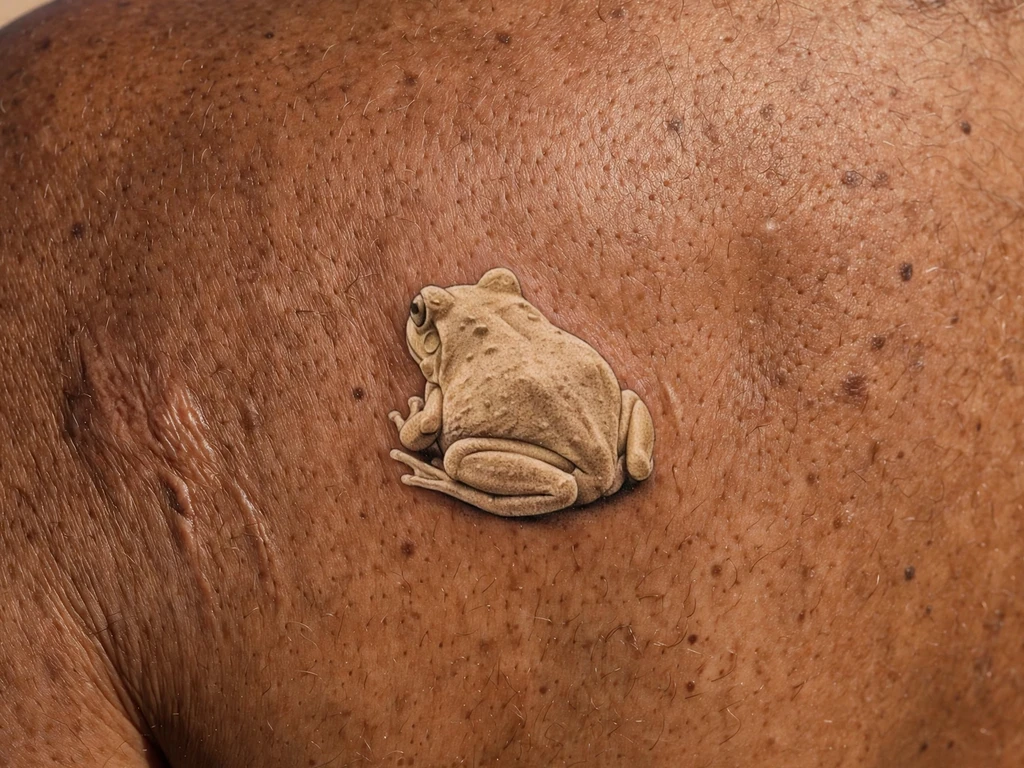
The anti-frog frog: a desert rain frog on a shoulder blade — a species so round it looks upholstered, a pebble with eyes, spending its life buried in the sand of the Namib and South African coasts and emerging at night and in the rains. Drawn in soft sandy colour with minimal pattern, it is the calmest design in this guide: a frog reduced almost to a circle, worn by people who find the roundness itself a whole philosophy.
Roundness is a drawing challenge disguised as a simple shape: a perfect ball with two eye bumps reads as a cartoon unless the few true details are placed exactly — the eyes high and close, the mouth a short level line low on the face, the tiny folded haunch suggested by one short curve at the base, feet barely shown. The shoulder blade gives it a calm, flat home at 8–12 cm. Colour stays in the sand-and-clay range, laid in soft but complete: pale species tempt artists into whisper tones, and this frog’s whole body is the pale zone, so the outline carries extra weight here.
Best placement: Shoulder blade, the frog sitting centred on the blade’s flat like a stone on a beach.
Best for / know before you book: Simplicity is the exam — if the stencil doesn’t make you calm looking at it, the details aren’t placed right yet.
10. Glass Frog
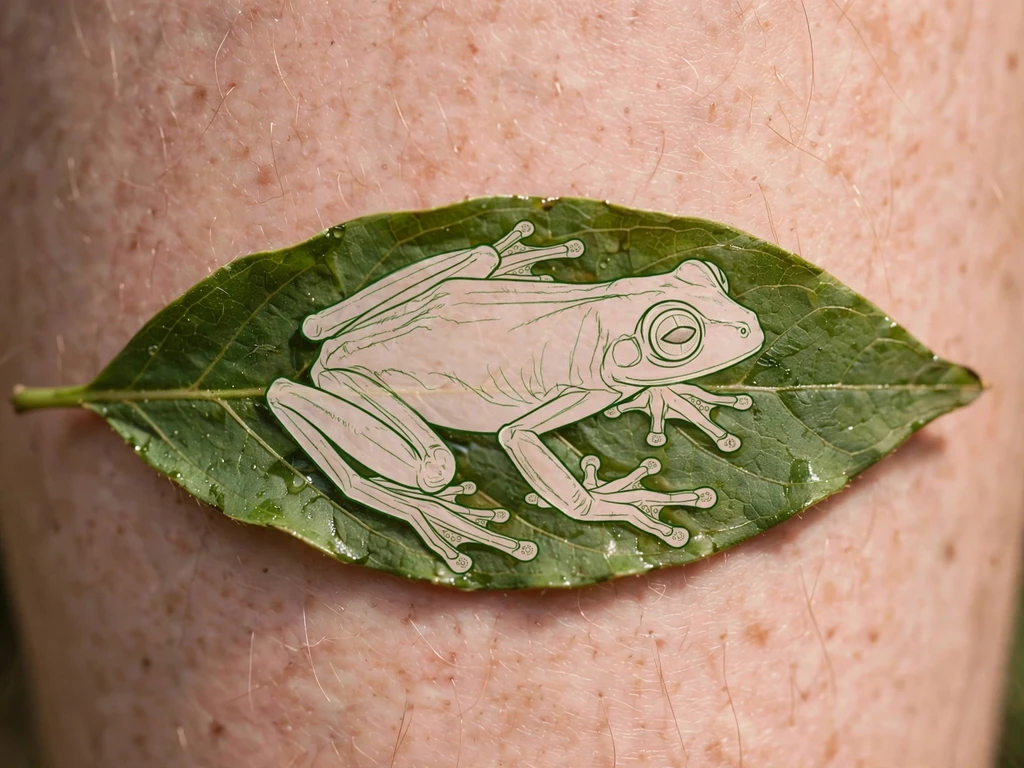
The frog that is half invisible: a glass frog on a calf, drawn in pale green fine line on the underside of a leaf, its famous translucent belly rendered as bare skin — the design’s centre left open, so the wearer’s own skin does the work the animal’s transparent underside does in life, letting the background show through. Glass frogs sleep on leaves over rainforest streams, invisible from below to everything hunting them; the tattoo honours the trick by making absence the main material.
This is the most demanding design in the guide, and it works by one decision: the belly is not drawn. Around that emptiness, everything must be exact — the leaf’s edge complete, the frog’s back and limbs in fine but unbroken line, the toe pads distinct where the feet grip the leaf’s rim. Negative-space designs age by their edges: if every drawn line is at healed weight, the open centre stays open and the trick survives; one weak line and the frog dissolves into the leaf within years.
Best placement: Calf, the leaf set diagonally across the muscle with the frog on its underside, belly open to the skin below.
Best for / know before you book: Judge the stencil by its emptiness — cover the belly with your thumb; the frog must still read from its outline alone.
11. Golden Poison Frog
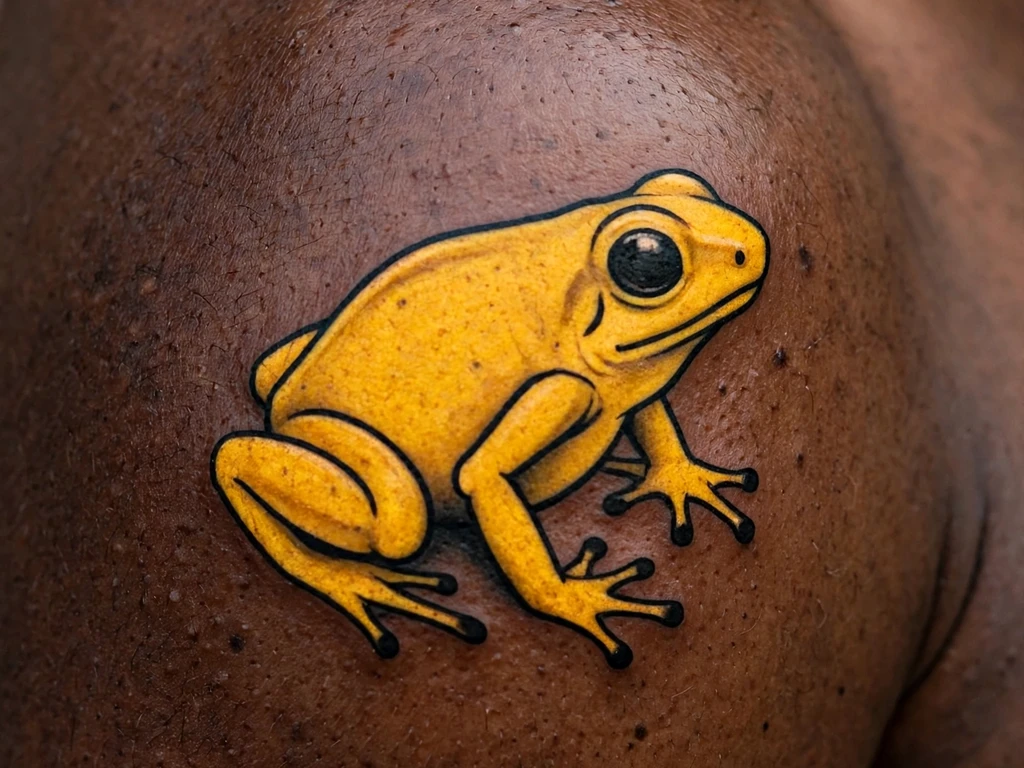
One of the most toxic animals on earth, and one of the most beautiful: the golden poison frog of Colombia’s Pacific coast, a thumb-sized frog in a single saturated yellow-gold so complete it looks dipped. On a shoulder, in bold colour over a strong black skeleton line, it is a jewel with a warning label — the skin carries batrachotoxin in quantities that make it genuinely dangerous, which is what the colour is for.
The craft here is one colour, laid perfectly. A single-tone body has nowhere to hide a mistake: the fill must be packed evenly, the outline bold and unbroken (Rule five’s fence, carrying an entire body of colour), the black restricted to eyes, toes and the outline itself.
Best placement: Shoulder, the frog sitting on the cap in profile, the gold given clear skin on all sides to glow against.
Best for / know before you book: Look at healed yellow work in the artist’s portfolio — yellow at five years is the truth about yellow, and this design is all yellow.
12. Traditional Sailor Frog
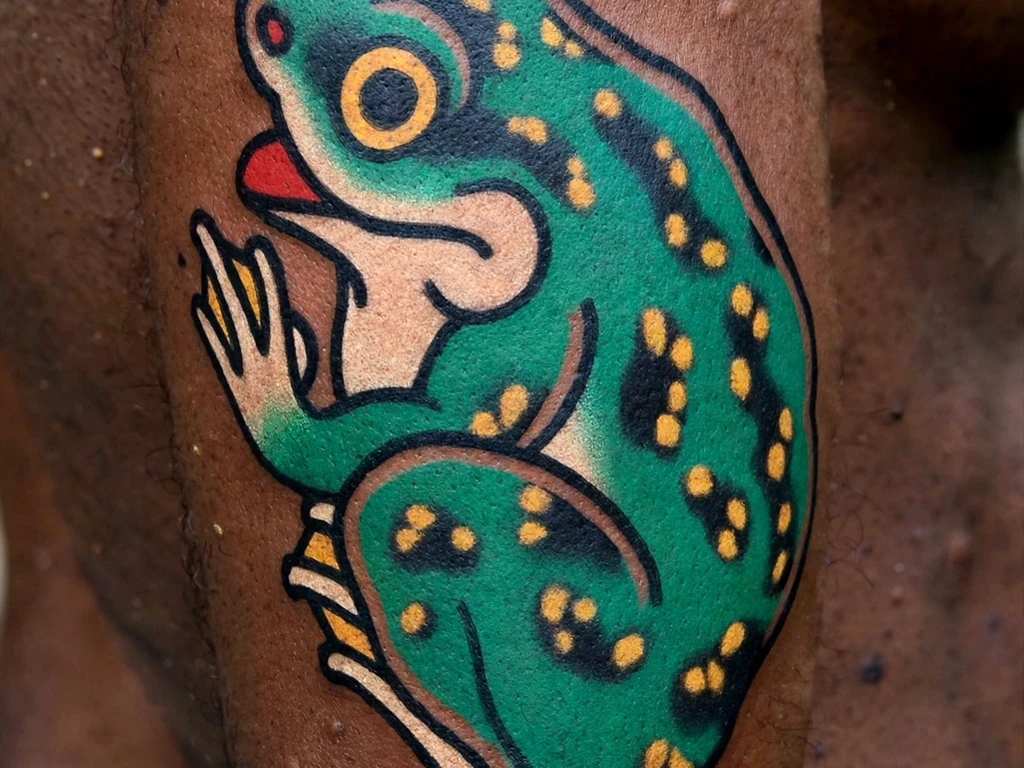
The frog as the old tattooers would have drawn it: an American traditional frog sitting upright on an upper arm — an outline you could hang a coat on, flat fills of green, red and gold, the eyes as two hard bumps with dot pupils, a red throat bib, the whole animal reduced to eight or nine big shapes that will read across a street in thirty years. Frogs crossed the old flash sheets as luck pieces and travellers’ charms: a traditional frog is a good-luck emblem first and an animal study second.
The full grammar of the style — its palettes, its rules, its century of flash — lives in our traditional tattoo ideas guide; this design applies that grammar to the frog, which means the haunch rule in traditional terms: the folded haunch as one huge shape, the eyes as two bumps of solid colour, the toes as three bold marks per foot.
Best placement: Upper arm, the frog sitting square across the outer flat, where the style’s bold scale sits naturally.
Best for / know before you book: Traditional is a commitment to a look — if the aged, softened version of this style is the one you love, book with complete confidence.
13. Frog and Mushroom
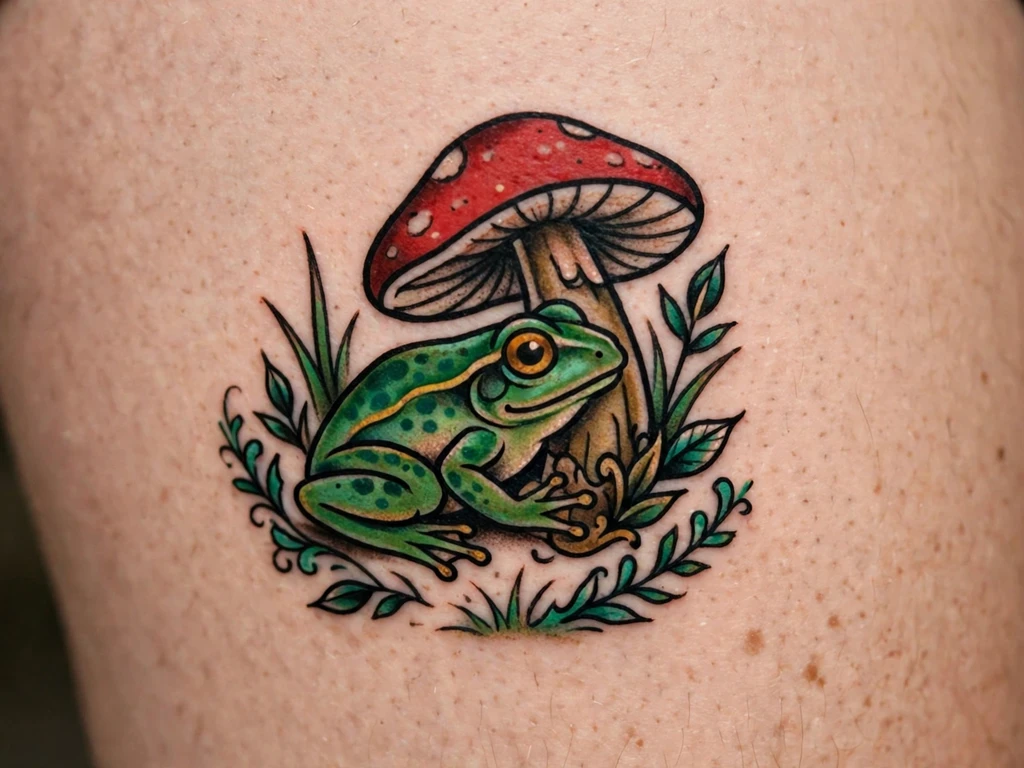
The storybook pairing, done with intent: a small green frog sheltering beneath a red-capped mushroom on a thigh, drawn in neo traditional — bold outline, jewel colour, the composition built like a scene from a book you half remember. This is the whimsical corner of the subject, the frog under its mushroom umbrella is the image a generation carries from childhood reading, and the same story-first logic that drives this series’ anime tattoo ideas guide applies here — the wearer is tattooing a scene from their own inner library, and the design’s job is to draw that scene so well it survives as art, not just as reference.
The composition’s discipline is scale honesty: the mushroom must be big enough to shelter, the frog small enough to be sheltered, and the grass reduced to three or four blades, never a whole illustrated meadow. The red cap is the palette’s anchor, laid deep; the frog’s green sits a tone below it in brightness so the eye lands on the shelter first, then finds the frog, which is the scene’s whole joke and meaning. The thigh’s room lets it breathe at 11–15 cm.
Best placement: Thigh, the scene set on the front or outer thigh with the mushroom’s cap given the composition’s high point.
Best for / know before you book: Bring the feeling, not a page to copy — an original scene drawn for you will outlast any traced illustration, legally and artistically.
14. Blackwork Frog
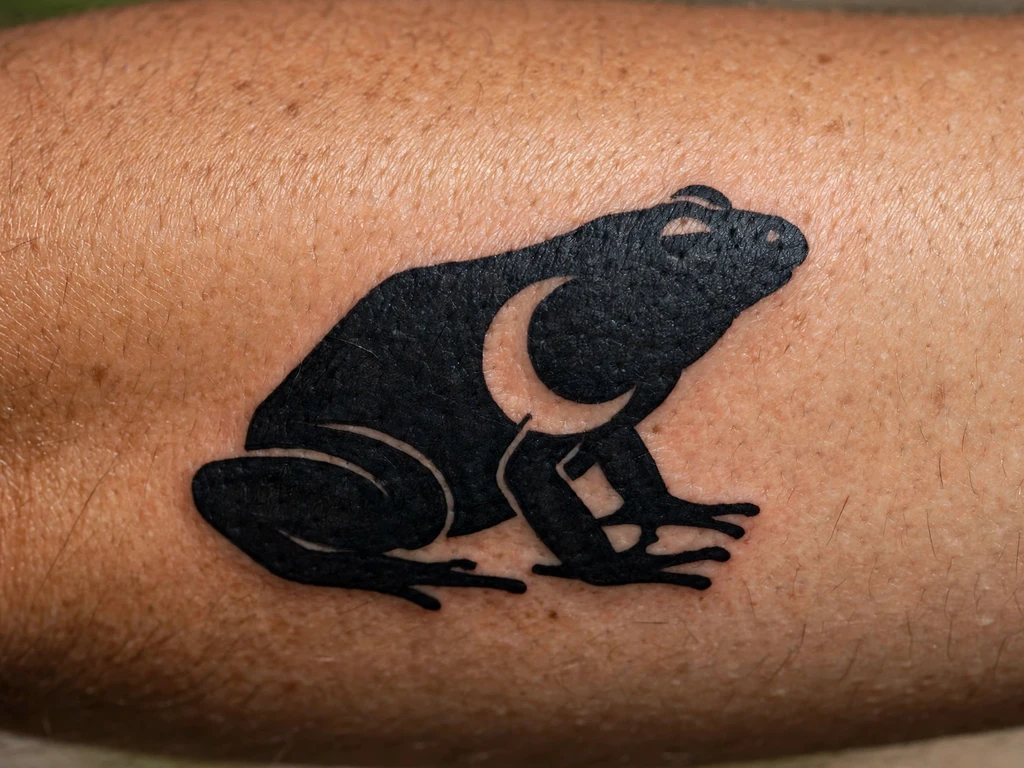
The frog as pure shape: a solid blackwork frog crouched along a forearm, the animal rendered as one confident black mass — haunch, back, head — with its details cut out in negative space: the pale throat as a bare-skin crescent under the jaw, the eye bumps as two skin dots on top, the toes separated by bare-skin channels. Blackwork’s heavy-saturation discipline suits the frog the way it suits few animals, because a frog’s reading is its outline — and here the outline is all there is, drawn at maximum strength.
The craft is the negative space’s width, exactly as it is in every solid-black animal: each skin channel must be wide enough that a decade of the black settling inward leaves it open — a throat crescent drawn hairline closes, and a closed throat takes the head with it (Rule four, in its negative form). Size it at 10–15 cm, and choose the pose for the silhouette: the crouch, haunch high and head low, is the frog at its most frog-shaped. This design asks only whether the wearer wants their frog at maximum volume forever.
Best placement: Forearm, the frog crouching along the arm’s length, head towards the wrist.
Best for / know before you book: Squint at the stencil from across the room: the throat crescent and eye dots must survive the squint as hints — if they vanish, widen them.
15. Watercolour Frog
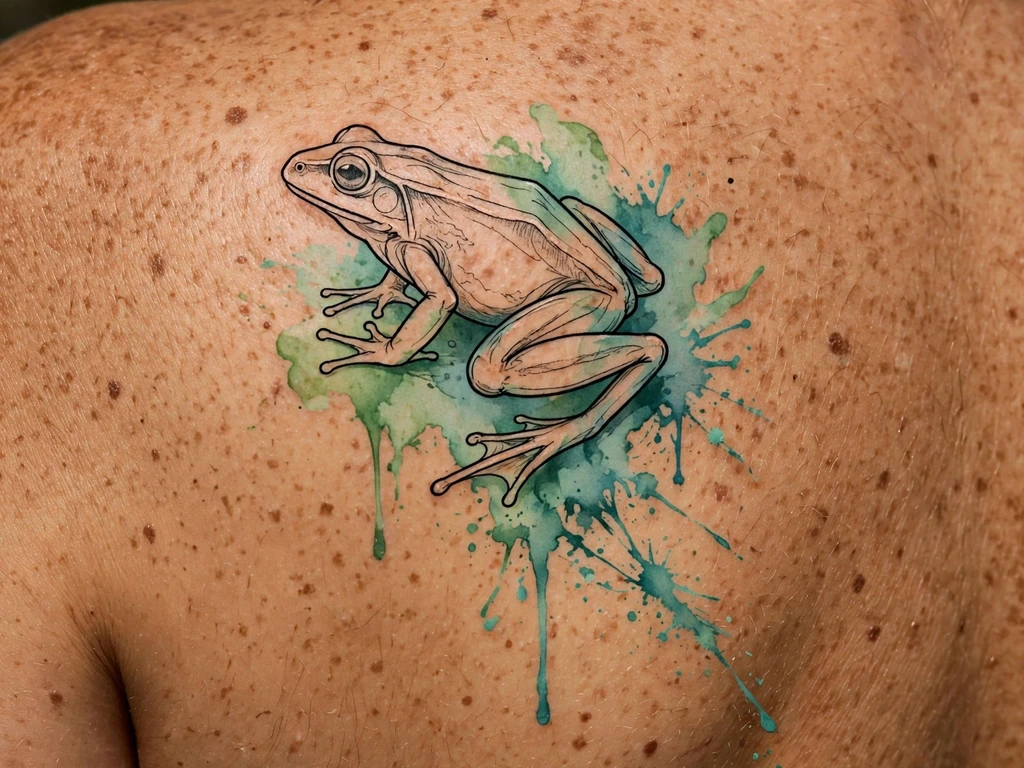
The frog as a painting: soft washes of green, teal and a breath of blue laid over a complete fine-line skeleton of a sitting frog, set across a shoulder blade where the washes have room to drift — splashes trailing from the haunch like the animal is dissolving back into pond water. The style’s treaty applies unchanged: the washes are the perishable part, the skeleton line is the pension.
The skeleton, then, is drawn first and drawn complete — haunch curve, eye bumps, toes spaced, throat reserved — a frog that would satisfy the haunch rule in plain black before a drop of colour is added. Colour placement does the modelling: deep green along the back and haunch, the washes thinning to bare skin at the throat and belly, one teal passage at the flank where tree frogs carry their hidden colour. At 11–15 cm the blade gives the piece its pond.
Best placement: Shoulder blade, the frog sitting level on the blade’s flat with the wash splashes given clear skin around them.
Best for / know before you book: Look at healed watercolour animals at five years and choose the skeleton’s weight from what you see there — never from fresh photographs.
16. Tiny Tree Froglet
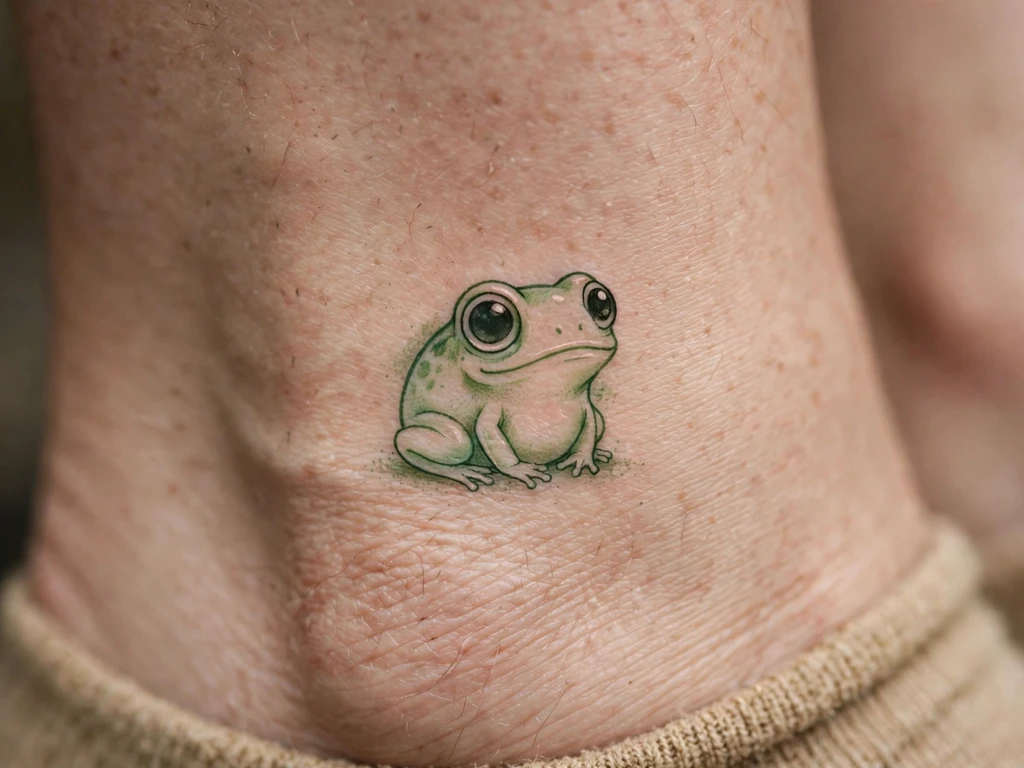
The frog at its most charming honest scale: a tiny tree froglet — a young frog, drawn as the animal actually is at that age, eyes proportionally huge, body round and small — in soft green at 4–6 cm just above an ankle. This is the small-and-sweet corner of the search demand — ankle frog tattoos are a rising query — drawn with the restraint this series applies to every young animal: the charm comes from true proportions, not from a costume or a cartoon face.
Its honesty points are the small design’s usual two. The eyes are the whole face at this size, so they are drawn bold and simple — two dark bumps with a reserved-skin highlight each — and the toe pads are suggested as slightly enlarged toe tips rather than detailed discs. Soft green softens fastest of the frog palette, so it is laid a tone deeper than the wearer first wants, with a possible gentle refresh priced in.
Best placement: Above the ankle, the froglet sitting on the outer side, where it shows with summer shoes and rests clear of straps.
Best for / know before you book: Print it at true size and wear the print for a day — tiny frogs are judged at real scale, and the ankle’s curve surprises everyone once.
17. Frog in Mid-Leap
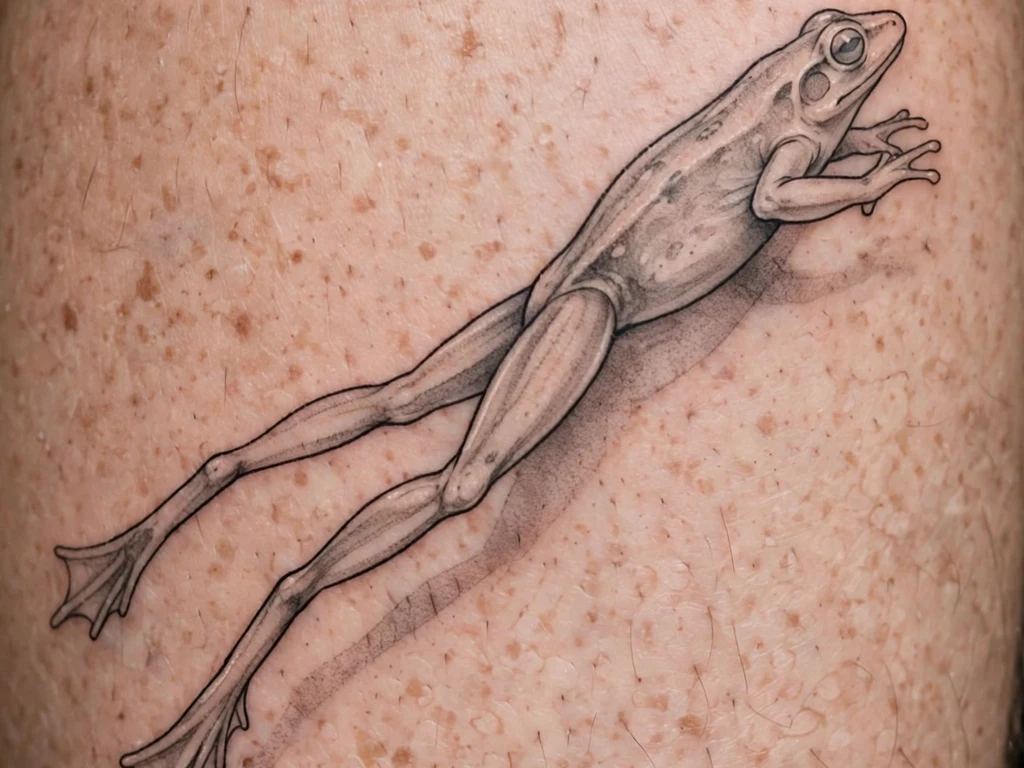
The only frog in this guide drawn doing the thing frogs are famous for: a frog in mid-leap along a calf — body stretched long, the great back legs extended behind it in one clean line from haunch to toe, front legs tucked, the whole animal an arrow of muscle in fine line and soft grey wash. Every other design here sits; this one is the verb. Wearers take it for the leap itself — the jump taken, the pond left, the decision mid-air — and the calf is its only honest home, the one canvas long enough for the extension.
A leaping frog breaks the sitting silhouette, so its reading is carried by the legs: the extended back leg must read as one limb in three parts — thigh, shin, long foot — with the joints placed where anatomy puts them, or the animal becomes a green comet. Fine line draws the outline; the wash is kept to one soft passage along the back so the line stays the lifespan. At 13–17 cm, from below the knee to above the ankle.
Best placement: Calf, the leap running diagonally down the muscle, head low towards the ankle.
Best for / know before you book: Judge it in motion — stencil on, walk past a mirror. A leap that only works frozen was drawn wrong.
18. Dotwork Frog
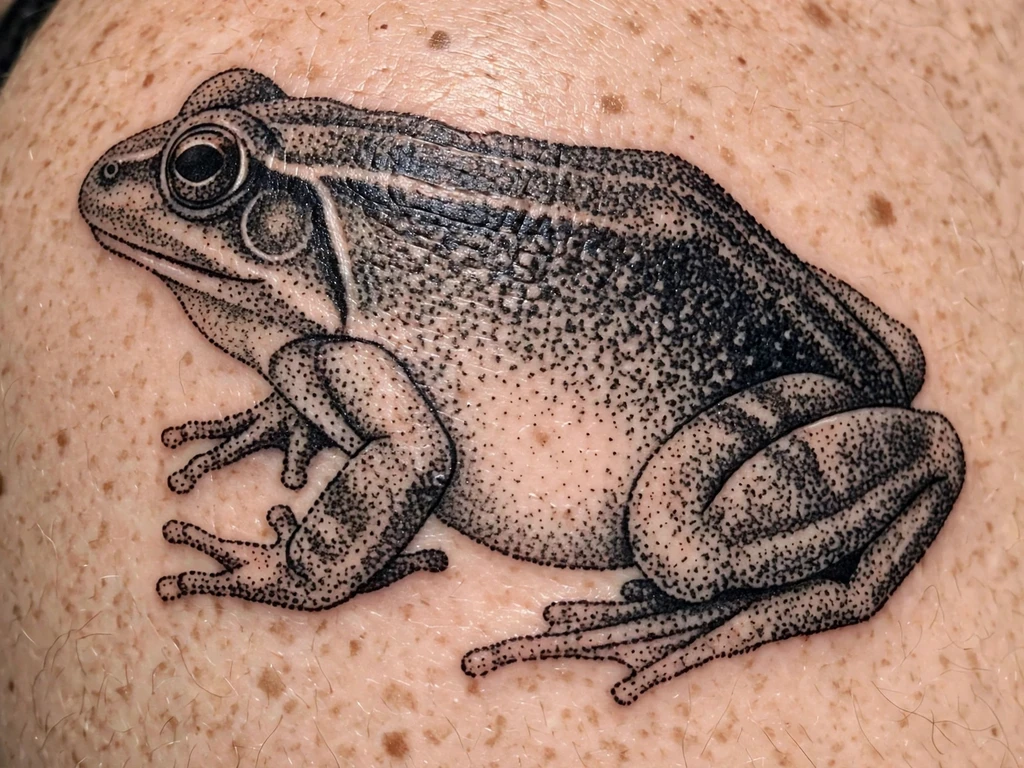
A frog built from nothing but dots: a sitting frog on a shoulder, its form stippled — dense dot fields at the haunch and back, the dots thinning across the flank and vanishing at the throat, so the animal is modelled by spacing alone, no outline anywhere except the faintest guide at the silhouette’s edge. Dotwork is the frog’s most patient style, producing a texture no other technique makes: a frog like carved dark sand, soft and granular.
Spacing is the whole craft and the ageing law in its purest form: every dot grows slightly as it settles, so dots drawn at the density that looks right fresh heal into grey mud, while dots drawn at a spacing that looks slightly too open heal into tone. The eye bumps are two small rings of density; the throat is where the dots simply stop. At 10–14 cm the shoulder hosts the full gradient without crowding it.
Best placement: Shoulder, the frog centred on the cap, its gradient given clear skin on all sides.
Best for / know before you book: Ask how the artist spaces dotwork for healed results, and compare the answer with a healed stippled piece in their portfolio — this design is that answer, worn.
19. Frog and Lotus
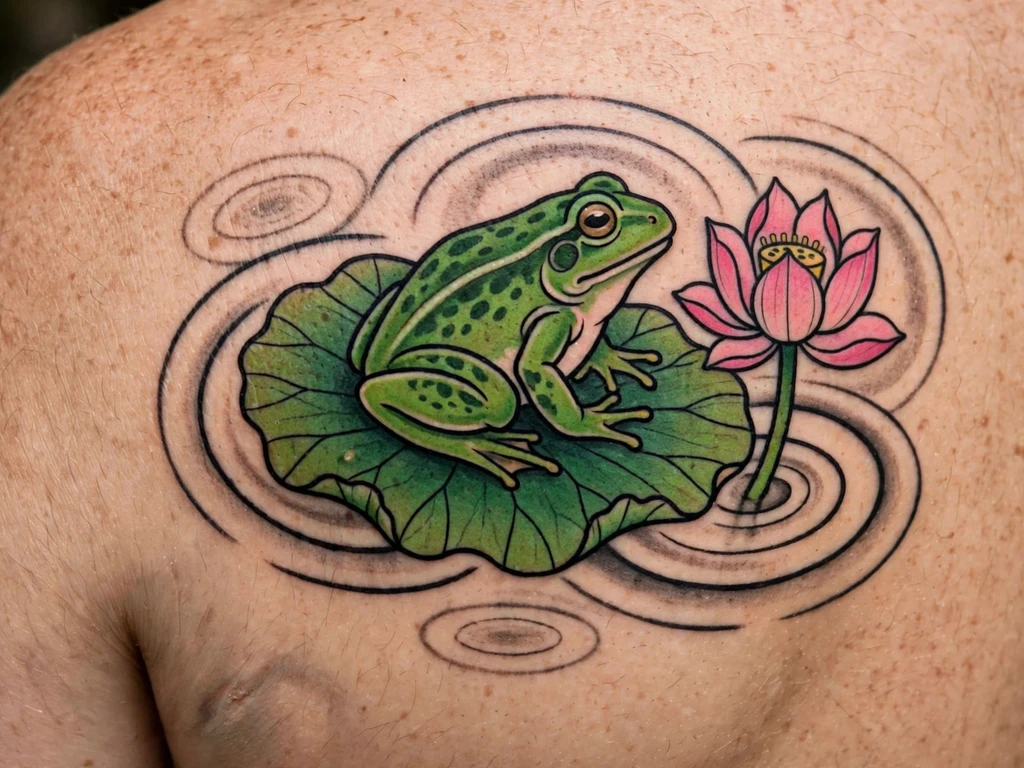
The pond’s classic pair: a green frog sitting on a broad lotus leaf, one pink lotus opening beside it, across a shoulder blade in Japanese-influenced style — the frog upright in the kaeru posture, the leaf drawn as one great shape, the flower as the composition’s single colour accent. Frog and lotus share a pond and a philosophy in Japanese imagery: the flower rises clean from muddy water, the frog returns to the water it rose from, and wearers take the pair for the cycle itself — leaving and returning, blooming and coming home. The pond’s other great animal keeps its own lotus pairings in our koi fish tattoo ideas guide; this design is the frog’s quieter answer to that page.
The drawing discipline is restraint with the setting: one leaf, one flower, two or three water rings at most. A full pond scene crowds a shoulder blade into wallpaper; the pair, given air, reads as an emblem. The lotus pink is laid at the deep end of its range, since pink softens early and the flower carries the design’s colour argument. At 12–16 cm.
Best placement: Shoulder blade, the leaf set level across the blade’s flat, horizon checked standing in a mirror.
Best for / know before you book: Decide the water rings on paper — two or three, no more — and hold the line when the stencil tempts you to add the pond.
20. Two Frogs, Face to Face
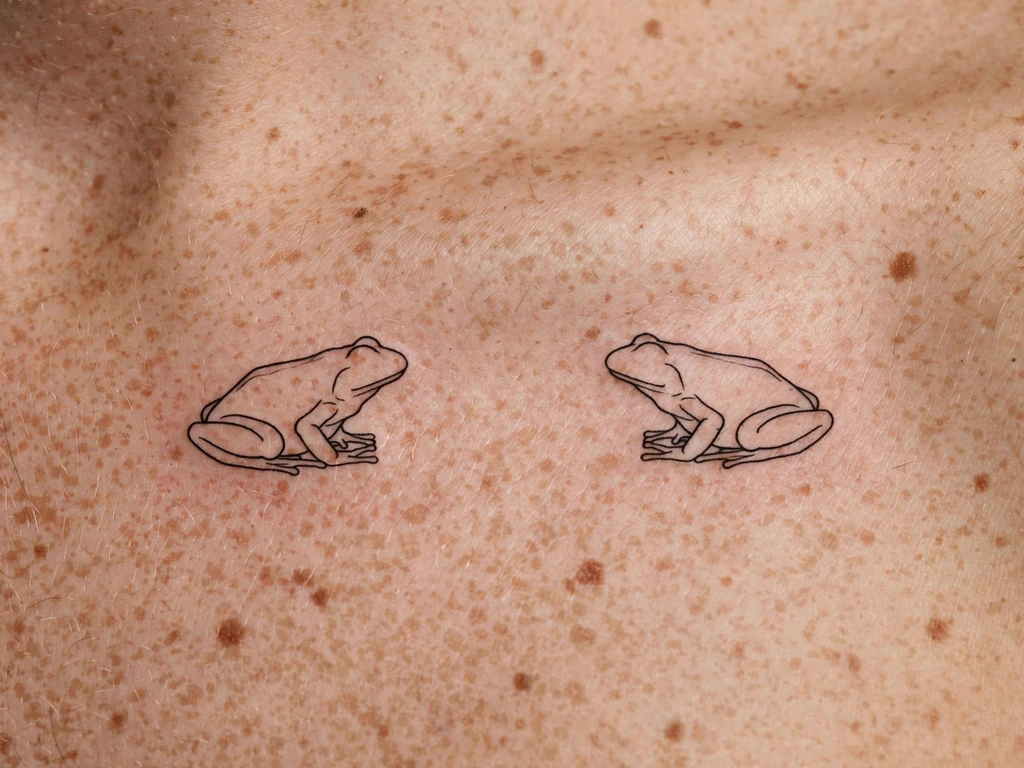
A pair, worn at the necklace line: two small frogs sitting face to face in fine black line along the outer edge of a collarbone — mirror poses, haunches folded, eyes meeting across a few centimetres of skin between them. It is the relationship design of the list: two returners, two transformers, drawn as equals — taken by couples on one body or split across two. The collarbone edge sets the terms, as it does for every design placed there — along the outer edge, on the calm slope below the bone’s peak, checked standing with shoulders level.
Fine line doubles the risk: the frogs must match in weight and haunch curve.
Best placement: Outer edge of the collarbone, the frogs facing each other across the bone’s mid-slope, checked standing, shoulders level.
Best for / know before you book: Photograph the stencil in your most common neckline — a collarbone pair is a collaboration with your wardrobe.
21. Frog on a Lily Pad
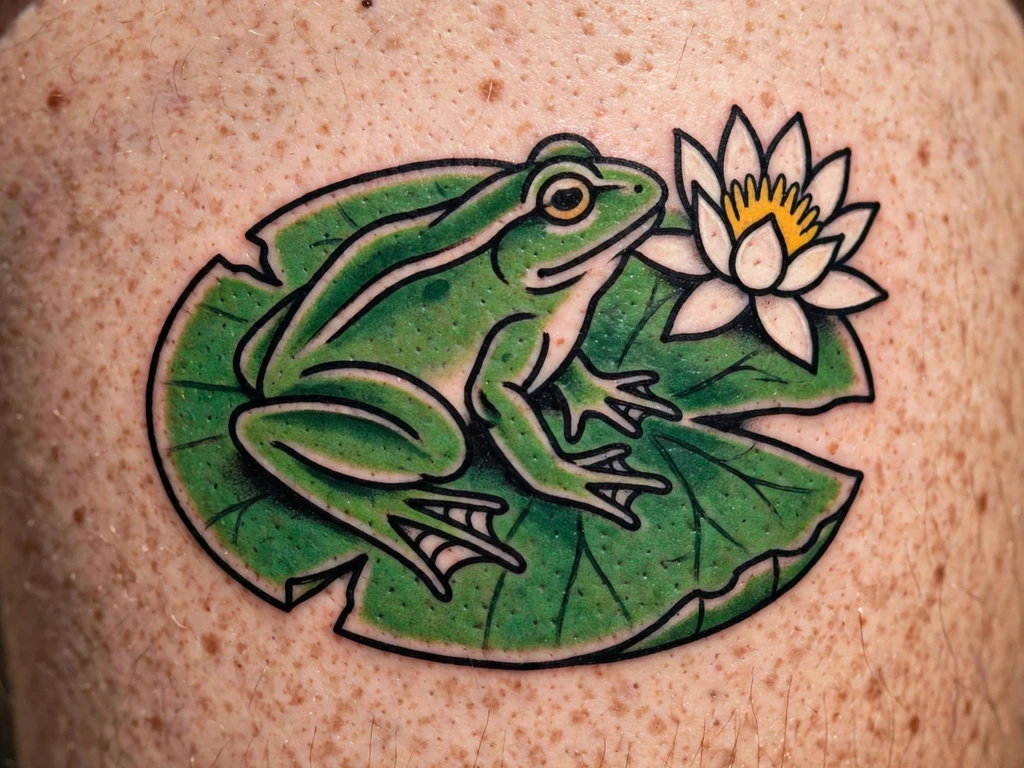
The postcard, done properly: a green pond frog sitting square on a round lily pad, one white water lily open at the pad’s edge, two soft water rings around the whole — in traditional colour on a thigh, bold outline, flat fills, nothing fiddly. This is the image most people picture first, drawn at traditional discipline: the pad one shape, the frog five, reading from the far side of a beach.
The pond frog is drawn true under the cheerfulness: webbed back toes spread on the pad (a pond frog swims; its feet say so), haunch folded deep, throat pale under the chin. The pad’s notch — every lily pad has one wedge cut from its circle — is drawn honestly, because a perfect green disc reads as a plate, not a leaf.
Best placement: Thigh, the pad set level on the front or outer thigh, given the full width its circle wants.
Best for / know before you book: This is the friendly-first-tattoo design of the list — choose it for the classic itself, and let the bold drawing keep it classic rather than cute.
22. Tiny Frog Behind the Ear
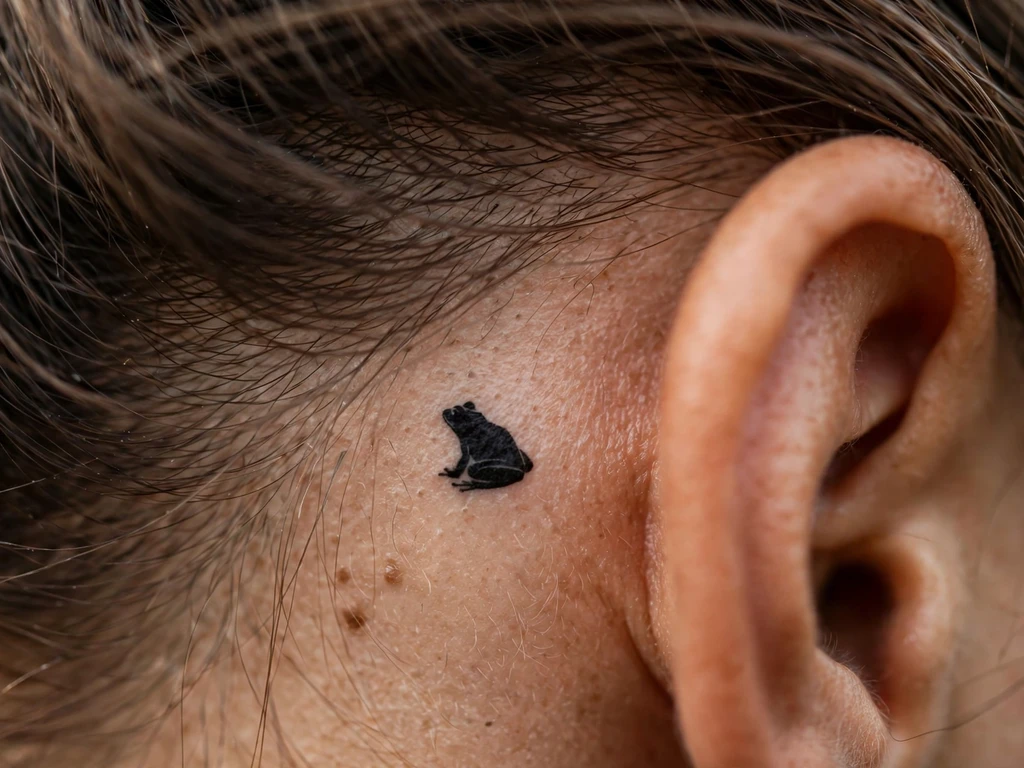
The frog at its smallest honest scale: a tiny solid silhouette behind the ear, 2–3 cm of dark shape — haunch curve, two eye bumps, front feet — hidden by hair and revealed by a tucked strand. At this size the haunch rule becomes absolute, exactly as the silhouette law does at the same placement in the shark guide: there is no detail at all, so the outline is not the first thing that matters, it is the only thing. A blob with feet is a beetle; a blob with the folded haunch and two bumps on top is a frog, and the difference is drawn, not hoped for.
Solid is the honest construction at this scale — a filled silhouette holds its shape as it settles, where a fine-line miniature would soften into punctuation. Expect the edges to soften over the years; the shape, if drawn true, survives it.
Best placement: Behind the ear, centred on the flat below the cartilage fold, sized to the wearer’s own ear.
Best for / know before you book: Hold the true-size printout behind your ear in the mirror, hair up and hair down — it should read as a frog, unmistakably, in both.
23. Tiny Frog on a Finger
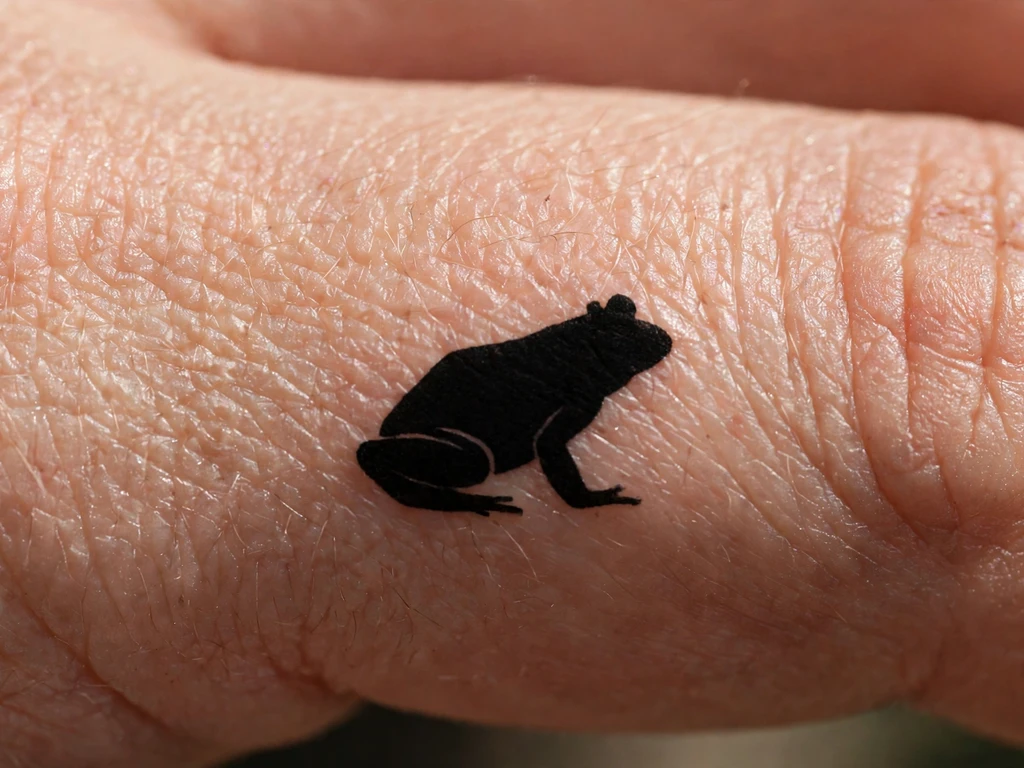
The smallest frog in the guide, offered with its full warning label: a tiny solid silhouette on the side of a finger, 1.5–2.5 cm — a haunch bump, two eye bumps, nothing else — drawn as one bold little shape, because at finger scale a shape is all a tattoo gets to be. It is the haunch rule at atomic scale, and the finger is the hardest address in this entire guide.
The honesty is stated plainly, because finger skin asks for it: finger skin regenerates fast, flexes constantly and sheds ink like no other placement here, so a finger frog will fade — not might, will — faster than any other design in this guide, and will need touch-ups, plural, across its life. It survives at all only by silhouette discipline: the boldest, simplest frog, drawn slightly heavier than instinct suggests, ideally not as a first tattoo. Designs 16 and 22 offer the same small-frog idea on skin that keeps it far longer.
Best placement: Side of the finger, where the skin holds ink slightly better than the palm-facing surface.
Best for / know before you book: Price in the maintenance before falling for the charm — if regular touch-ups would annoy you, this is a photograph, not a tattoo.
24. Tree Frog Climbing
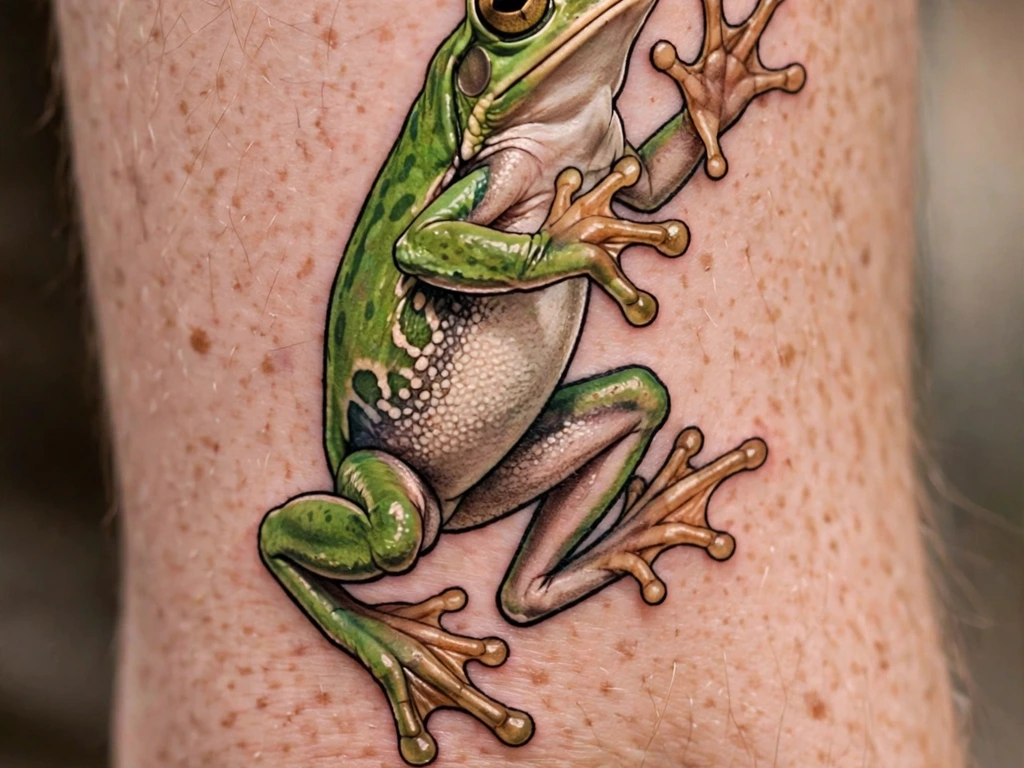
The climber in motion: a tree frog climbing upward along a forearm in colour realism — body stretched along an unseen branch, all four feet spread, every toe ending in its round gripping pad, the belly’s pale underside showing where the body lifts from the surface. Where Designs 3 and 5 sit their tree frogs still, this one is caught mid-climb, the forearm playing the branch.
The pads carry the design (Rule three, at full stretch): twenty toes, twenty discs, each drawn separate and slightly oversized — the one design in the guide where the toe count is the composition. Colour is the green family’s honest middle: deep enough to survive, bright enough to climb. At 11–15 cm, using the forearm’s full length.
Best placement: Forearm, the frog climbing the outer flat lengthwise, head toward the elbow, checked with the arm hanging naturally.
Best for / know before you book: Count the pads on the stencil aloud — twenty, each separate. It takes one minute and it is the whole design.
25. One-Line Frog in Profile
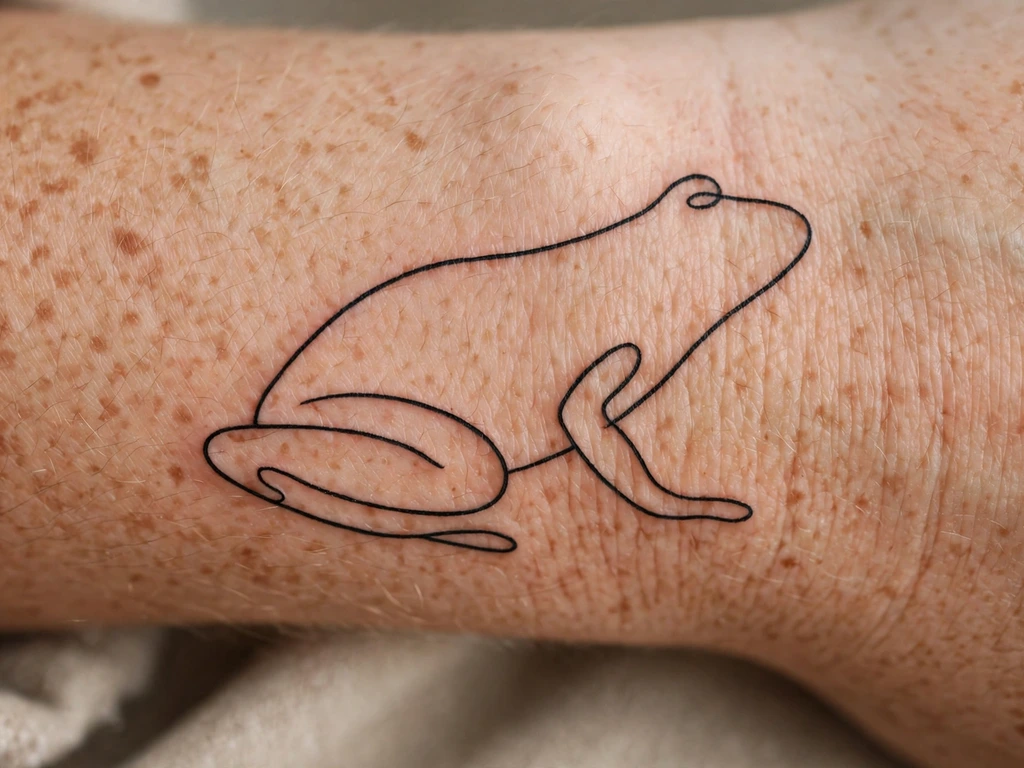
The frog reduced to one gesture: a single flowing line on a wrist that rises into the folded haunch, dips along the back, lifts once for the eye bump, and finishes in two short toe strokes at the ground. Minimalism in this series is a philosophy of subtraction: the subtraction must stop exactly at the species line. Remove the eye bump and the line is a hill; remove the haunch’s height and it is a slug; keep both, and one line is unmistakably a frog.
That single decision is the design; everything else is execution: one line weight at the bold end of fine, 5–8 cm, and a warning — at 3 cm the eye bump flattens within years and the species evaporates into a wavy line. Hold the size, keep the two features — haunch, bump — drawn unmistakably, and the piece stays a frog for decades on nothing but a line.
Best placement: Wrist, the line running along the wrist’s length in profile, facing outward or toward the wearer by their reading.
Best for / know before you book: Print it at true size and step back two metres — if you cannot name it at that distance, it is not minimal, it is missing.
The one-line version of this whole guide: fold the haunch high, put the two eyes on top, space the toes with skin between them, leave the throat light — and any frog you draw will be the frog you meant.
Frog Tattoo Placement by Size
| Size | Typical dimensions | Best placements | Good to know |
|---|---|---|---|
| Tiny | 1.5–4 cm | Behind ear, side of finger | Silhouette only — solid shape, no internal detail; the haunch curve and two eye bumps are the species signature even here; the finger version is a touch-up commitment and fades fastest of all |
| Small | 4–8 cm | Wrists, ankles | Dart frogs, froglets, origami and one-line frogs — colour blocks drawn large, toe pads suggested boldly; soft greens soften first at this size |
| Medium | 8–14 cm | Forearms, upper arms, shoulders, outer collarbone edge | The frog sweet spot: sitting portraits at honest detail — haunch folded deep, toes spaced, throat left light |
| Large | 11–20 cm | Shoulder blades, thighs, calves | Room for scenes and verticals: the leaping frog, the climbing compositions, frog-and-lotus and frog-and-mushroom pairs — detail finally stops being the argument |
| Long pieces | 13 cm+ | Calves, forearms | The leap and the climb: size from the longest feature (extended leg, climbing body) up, never down |
Run the three-metre test before any frog design is approved: a frog you can name — species or style, not just “frog” — from across a room is a frog for life; a frog that reads only at twenty centimetres is a frog for a photograph.
How a Frog Tattoo Ages
A frog tattoo ages at its finest and palest points first. The toes go earliest: long thin toes are the subject’s lace-work, and toes drawn touching merge into fins as the ink settles — the spacing in Rule three is the difference between feet and webbing the drawing never intended. The pale greens and yellows soften next: the frog palette lives at the light end of tattooing’s range, and light colour is what time negotiates with first — which is why this guide keeps steering designs toward greens laid a tone deeper than the reference photograph. The throat holds if it was reserved or lightly washed, and vanishes into the body if it was filled mid-tone: Rule four is an ageing rule wearing a drawing rule’s clothes.
Common Frog Tattoo Mistakes
The cartoon frog. A famous green face copied from a screen, or a generic clip-art frog with eyes on stalks and a grin. Set aside that a copied character belongs to its creators — the practical failure is that cartoon frogs are drawn for charm at small size, with eyes that carry the whole design and no haunch to speak of; on skin, and at year five, the charm evaporates and the shape underneath was never a frog.
The oval with legs. The body drawn as a stone with limbs attached — no folded haunch, no S-curve — because the reference was a top-down photograph or a toy. The haunch is the frog (Rule one); a sitting frog is a folded spring.
Eyes on the front of the head. Frog eyes sit on top, raised as two bumps (Rule two). Eyes drawn facing forward turn the animal into a cartoon character or a strange small mammal; eyes drawn as flat dots turn it into a lizard.
Toes drawn as lace. Webbing and toe detail rendered at jewellery fineness — every toe webbed with hairlines, every pad textured. On skin it is a merger scheduled for year three: the feet become mittens. Toes are drawn few, long and separated by skin (Rule three).
The filled throat. The throat and belly shaded to the same depth as the back, because the reference photograph was lit flat. The head disappears into the body as the tones settle (Rule four).
Pattern before shape. A dart frog’s exact wild pattern or a tree frog’s flank stripe copied lovingly onto a body whose silhouette was never checked. Pattern is the last layer (Rule five): squint at the stencil in plain black first, and only let the colour in when the black shape already says frog.
Judging by the fresh photograph. Fresh frog tattoos are the greenest things in the world: saturated, crisp, photographed wet-looking under studio light. Healed frogs are the same drawing after physics. Judge artists on healed frogs — a year old, in ordinary light.
How to Choose Your Frog Tattoo (and What to Know Before You Book)
Choose the meaning before the species. The frog carries more distinct readings than most animals its size: return (the Japanese kaeru), prosperity (the money frog), transformation (the life cycle itself), adaptability, luck and rain. Decide which one is yours first, because it chooses the design family for you — the upright sitting frog for return, the coin-bearer for prosperity, any true species portrait for transformation. Readers who choose the picture first end up with a handsome frog that means nothing in particular — the one outcome this animal, of all animals, should never produce.
Apply the haunch rule to every sketch. Before any design is approved, run the five rules against it in order: the haunch curve is the silhouette; the eyes sit on top as two bumps; the toes are few, long and separated by skin; the throat is left light; the pattern serves the shape and never the reverse. A sketch that fails a rule can be fixed in a minute on paper and never on skin — this five-minute check is the frog tattoo’s proofread, and it has never once been wasted time.
Size from the signature feature, never down to the canvas. The tree frog’s toe pads, the dart frog’s colour blocks, the money frog’s three legs, the leaping frog’s extended leg: each design has one feature that carries it, and that feature sets the minimum size. If the result is bigger than you pictured, the real options are a bigger placement, a bolder style, or a different design — never the same frog squeezed.
Choose the style by its treaty with time. Traditional and blackwork for the longest read; Japanese-influenced and neo traditional for bold line with colour that softens into richness; colour realism with its skeleton line complete; watercolour, glass-frog negative space and fine line with the fragility honestly priced in.
Match the frog to the body’s lines. Sitting frogs want calm flats — forearms, shoulder blades, thighs; climbing and leaping frogs want length — calves and forearms; the ankle takes the small true species at their natural scale. Set the stencil standing, weight even, and photograph it from the angle the world will judge it from.
Judge the artist on healed animals. Ask for healed frogs, lizards or other small animals — a year old at least — and read three things: does the silhouette still name the animal, are the toes still separate, and has the pale throat survived as a boundary rather than a blur? An artist whose healed animals pass those three checks can be trusted with yours, in any style on this page.
Key points to remember:
- A frog reads by its haunch: the folded S-curve is the silhouette, the two eye bumps on top of the head are the signature — draw those true and the details can be simple
- In Japanese the frog’s name, kaeru, is the word for “return”: safe journeys home, money returning, loved ones returning — the meaning driving the subject’s rise, and the reason the sitting frog leads this guide
- The money frog is three-legged on purpose: Jin Chan’s tripod is the tradition’s exact anatomy, and a four-legged money frog is just a frog near coins
- Toes are drawn few, long and separated by skin; webbing is suggested, never embroidered — toes drawn touching heal into fins
- The bone frog is a Navy SEAL tribute symbol with an owner — chosen knowingly or not at all; the frog’s other 24 designs carry no such claim
- Size from the signature feature — pads, blocks, legs, the leap — and judge artists on healed animals, never fresh photographs
Frequently Asked Questions
What does a frog tattoo symbolize?
Most often, one of three readings. Return: in Japanese, the word for frog — kaeru — is a perfect homophone of the word for “to return”, so the frog stands for safe journeys home, money coming back and loved ones returning. Prosperity: in the Chinese tradition the three-legged money frog, Jin Chan, carries a coin and draws wealth into the home. Transformation: the frog rebuilds its whole body from tadpole to adult, and wearers take it at life’s turning points. The guide’s Meaning section gives each reading in depth.
What does a Japanese frog tattoo mean?
It means return, in the language’s own wordplay. The Japanese word for frog, kaeru (蛙), sounds exactly like kaeru (帰る), “to return” — so the frog has been a safe-travel and homecoming charm in Japan for centuries, carried by travellers and drawn sitting upright and alert in tattoos in the Japanese tradition: the animal that comes back, watching the door. Design 1 in this guide is built around it.
What is a bone frog tattoo?
A bone frog is a frog drawn as a skeleton — skull, spine and the long folded leg bones. Within the US Navy SEAL community it is worn as a tribute, honouring fallen teammates, and it is held there with real gravity. That is the whole account, stated plainly on purpose: a memorial symbol belonging to a specific community, not a general design.
Do frog tattoos fade?
Every tattoo softens as ink settles, and frog tattoos feel it in predictable places: the long thin toes (drawn touching, they merge into fins — so they are drawn separated by skin), the pale greens and yellows that dominate the frog palette (laid a tone deeper than the photograph, because light colour softens first), and fine pattern like dart-frog speckle or a glass frog’s edges (drawn with air around it, or not drawn at all). The defences are all at the drawing stage: a true haunch silhouette, spaced toes, a light throat, and a style matched to the size. A frog drawn by those rules still names itself at twenty years; blackwork and traditional frogs last longest, watercolour and fine-line frogs trade some years for delicacy with their skeleton lines complete.
Where is the best place to get a frog tattoo?
Where the design’s posture fits the body’s shape. Sitting frogs — the majority of this guide — want calm, flattish canvases: the forearm, the shoulder blade, the thigh, the upper arm. Climbing and leaping frogs want length: the calf above all, then the forearm. Small true species (dart frogs, froglets) are at their best just above the ankle — a rising placement for this subject — where 5–8 cm is both the animal’s honest scale and the design’s. The behind-ear and side-of-finger versions exist (Designs 22 and 23) as charms with honest warnings attached.
Final Thoughts
A frog tattoo is a small animal carrying an outsized set of promises — that what left will return, that money and luck come home, that a body can be rebuilt into a second shape and the second shape can be the true one. The designs that honour it are drawn the way the animal is built: the haunch folded high, the eyes carried on top like periscopes, the toes given their air, the throat left pale — a true frog underneath whichever promise the wearer chose.
So choose your meaning, run the five rules against the sketch, and book the artist whose healed frogs still read as frogs across a room.