A lion is the tattoo people reach for when they want one word — strength — to do all the talking. If you are working through lion tattoo ideas, most of what you will find is the head alone: the mane does the visual work, so a lion reads at sizes where other animals turn into blobs. The real choice is between photo-real portraits and drawn styles — heraldic, tribal, geometric, storybook — and this list has both, so you can see what each asks of you.
Every design below is a real tattoo in a real photograph, counted one by one: 30 in total. No stock illustrations, no repeated photos under different names, no padding. Where a photo shows a tattoo fresh or unfinished, that gets said out loud.
This guide sits inside the animal cluster on this site. It is the single-species companion to our animal tattoo ideas pillar and the wild animal tattoo ideas sampler, and it is built the same way as our owl tattoo ideas guide — real photographs only, honest counts, and the ageing notes included, good or bad.
What Lion Tattoos Mean
Courage and strength come first, and they are the meaning most wearers will give you. Worth knowing: in a real pride the lionesses do most of the hunting, while males spend much of the day asleep. Britannica’s lion profile covers pride behaviour in plain terms. The “king of beasts” title is something humans handed the lion in stories, flags and fables — a perfectly good reason to tattoo one, as long as you know the crown comes from us, not the savanna.
Royalty and heraldry run a close second. A drawn lion reads at a distance and fits a shield, so lions ended up on coats of arms, coins and flags across Europe, Africa and Asia. The rampant pose — up on the hind legs, claws out — is the heraldic standard, and designs 5 and 22 are that pose tattooed — one solid, one outline.
Then there is Leo. People born under the sign — roughly late July to late August — get lion tattoos as a birth-sign piece, usually smaller and more personal than the big statement portraits: a head, a silhouette, sometimes the constellation worked in.
The Lion of Judah needs care, because it is a faith symbol before it is a design. In Genesis, Judah is blessed as a lion’s cub; in Revelation, Christ is called the Lion of Judah. A crowned lion was the emblem of Ethiopia’s emperors, and Rastafari adopted it because Emperor Haile Selassie stands at the centre of that faith. Design 10 shows the tattoo version — a calm lion’s face with the words arched above it. If you wear it, know it reads as a statement of belief to the people who hold it.
Two more meanings round it out. Aslan, from C. S. Lewis’s Narnia books, is a fictional character — said plainly — and tattoos of a gentle lion face are often about him: childhood, courage and faith rather than the animal. No photo in this set is an Aslan piece, so he is covered in words only. And in China and Japan, stone guardian lions — shishi, often called foo dogs — stand in pairs at gates and temple steps as protectors. Design 12 is that tradition at sleeve scale.
The 30 Designs
1. Roaring Lion in Black and Grey, Forearm
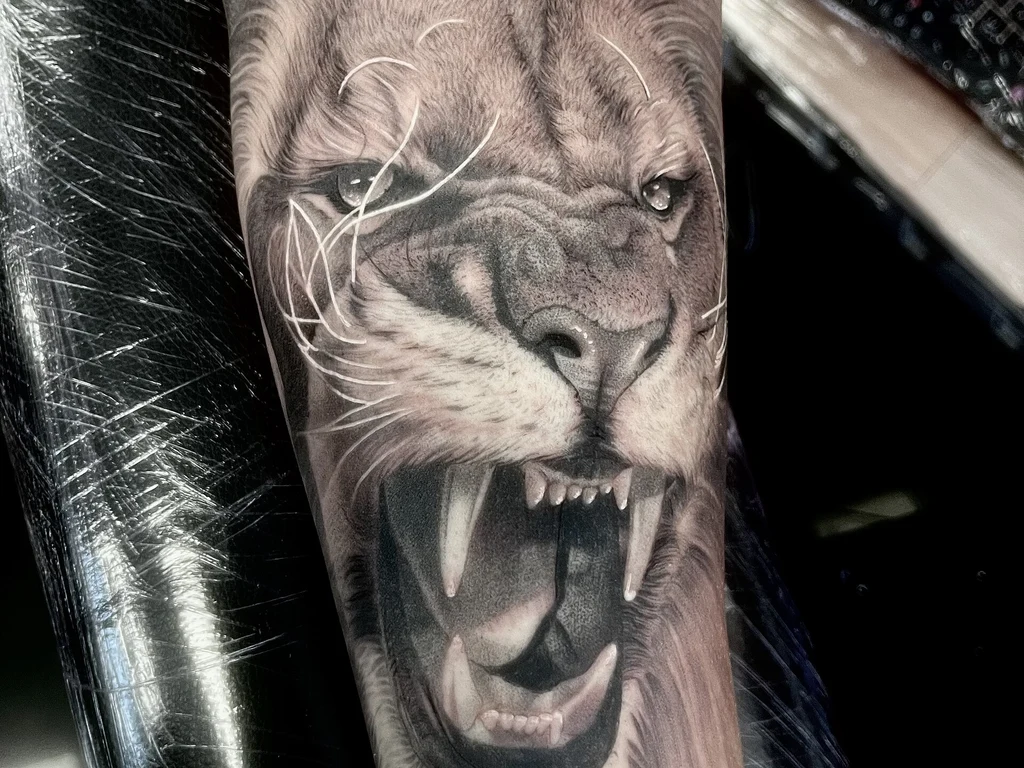
A lion mid-roar fills the forearm — mouth open, fangs out, nose wrinkled, mane pushed back by the pose. It was photographed in the studio while the ink was still glossy, which is why the blacks look wet.
A roar lives or dies on the mouth — teeth and tongue need hard, clean edges. Ask to see healed open-mouth work before booking anything like this.
2. Blue Lion Head in Profile, Ribs
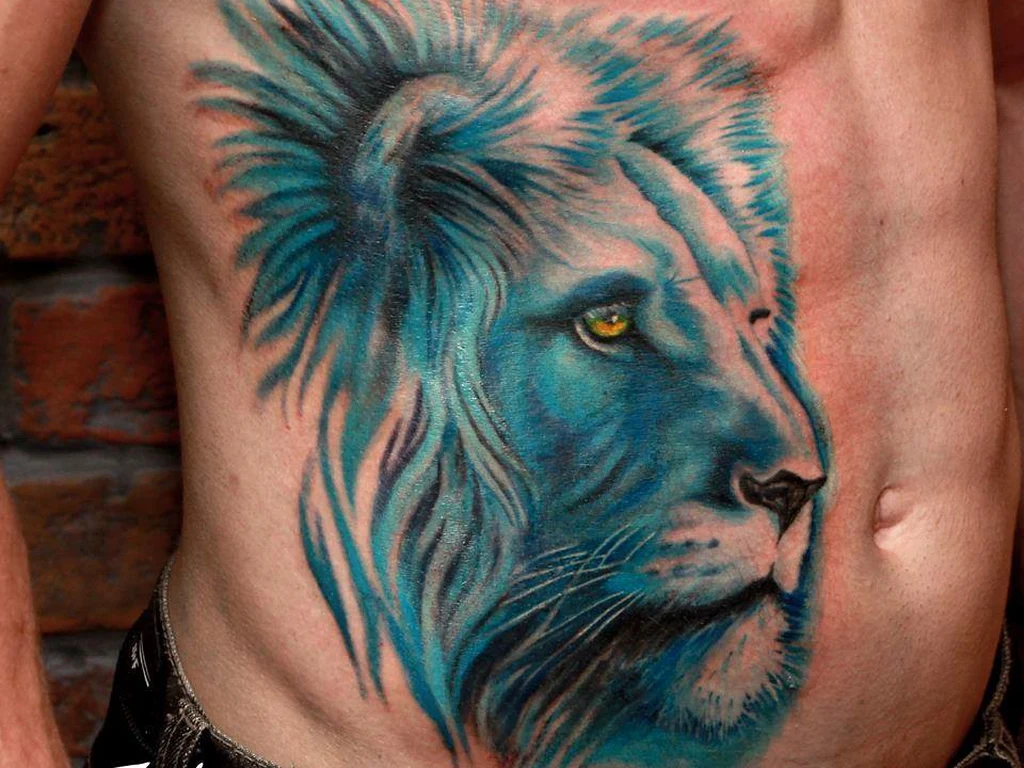
A lion’s head in profile, inked in blues and teals, running down the ribs. The mane is built from long strokes that follow the curve of the torso, with one amber eye.
Ribs are a sore spot, and the skin moves with every breath, so sittings tend to be short. Bold blue holds well, but it will never pass for subtle.
3. Lion Head With a Mandala Mane, Forearm
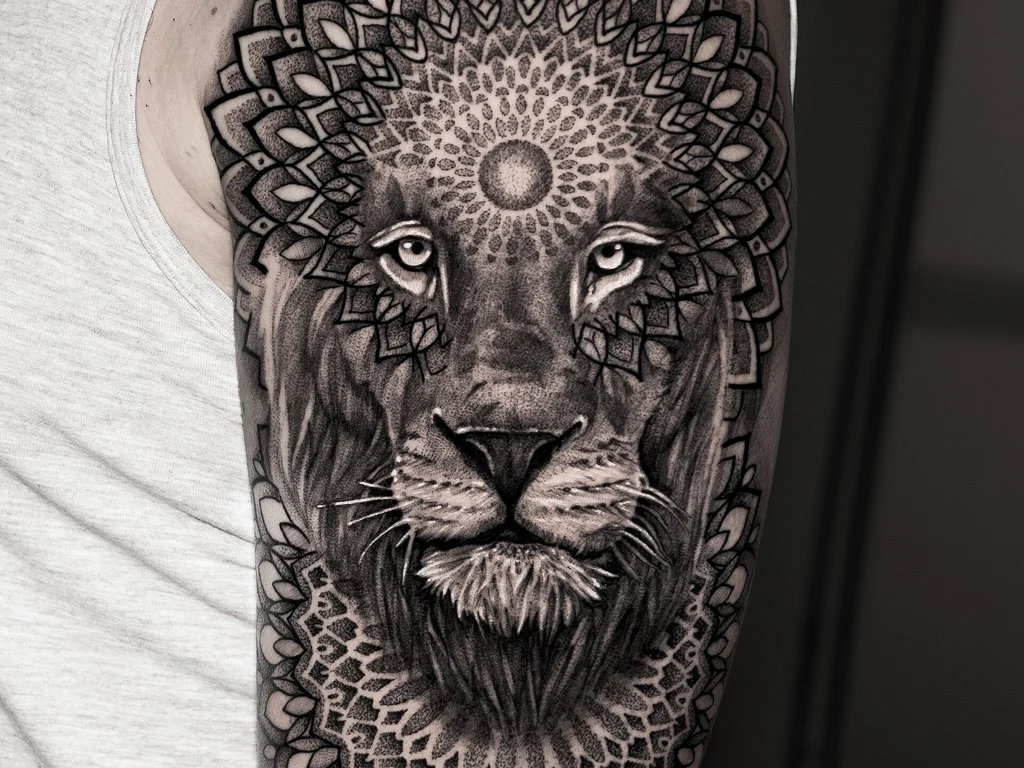
A straight-on lion’s face whose mane turns into mandala patterning — rings of dots and petal shapes instead of hair. It is black and grey throughout, with a small circle of bare skin left at the forehead like a third eye.
Patterned manes age better than hair-by-hair shading, because the shapes are bold and well separated. Symmetry this exact has to be drawn carefully — check the stencil from the front before anyone starts.
4. Mandala Lion in Linework, Upper Back
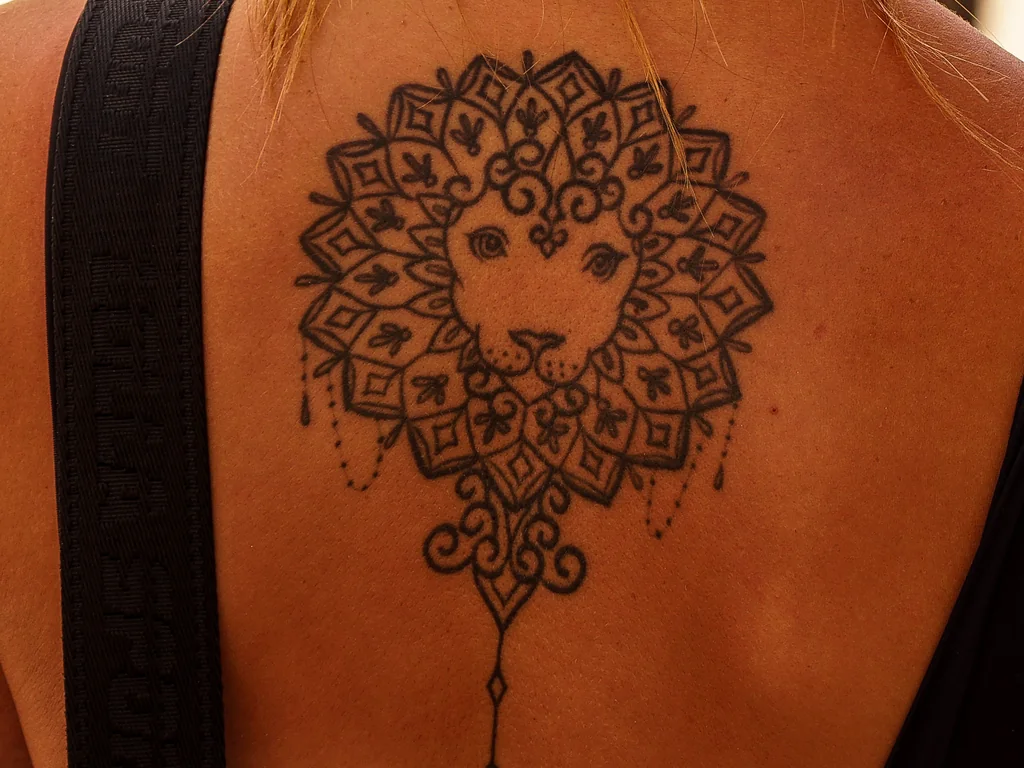
A lion’s face in plain black line, with almost no shading anywhere. The mane is a mandala ring of diamonds and petal shapes, dotted chains hang at the sides, and a curled pendant drop runs down the spine from it. The photograph was taken on a Lisbon street.
The second mandala mane in this list, and the opposite of design 3: there the pattern is filled with shading, here the face is left nearly empty, so the linework does all the work. Plain lines age slowly, and the upper back is flat, easy to cover and slow to stretch.
5. Heraldic Rampant Lion, Calf
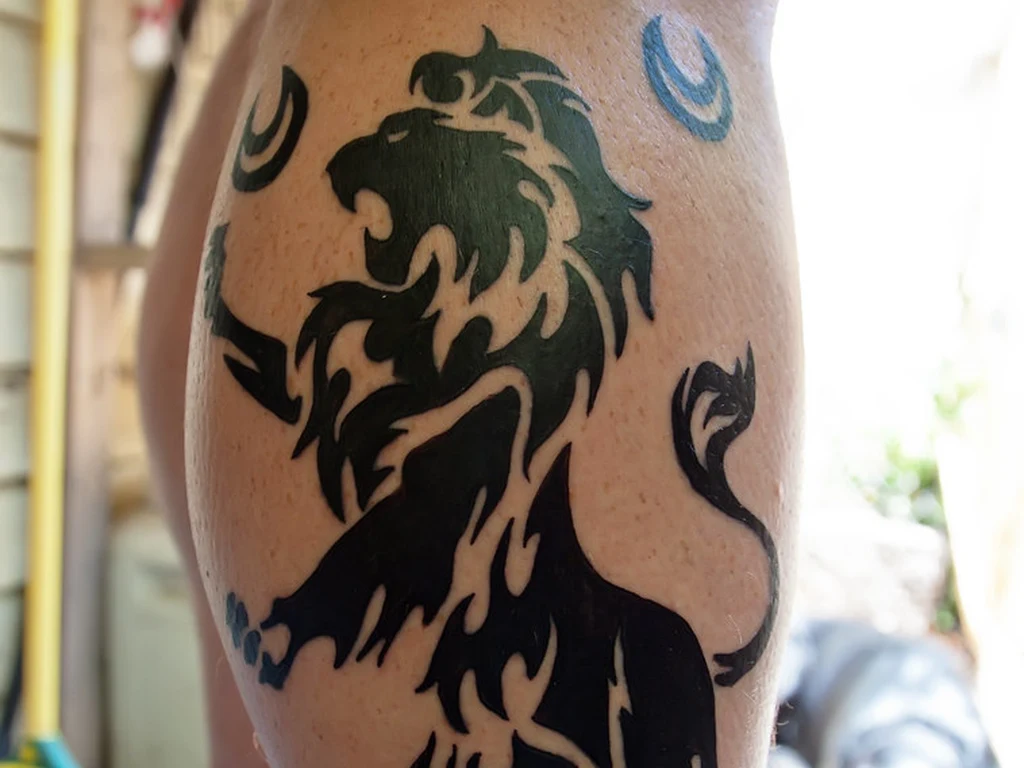
A solid black lion up on its hind legs, claws out, in the rampant pose that heraldry has used for centuries. A horseshoe is worked in below it, and the photo was taken in a garden — that is a family dog in the corner of the frame.
This is the oldest design language in the list. One flat colour and a hard outline mean it will still read clearly in twenty years, and the calf gives the pose the tall, narrow frame it wants.
6. Lion and Cub, Forearm
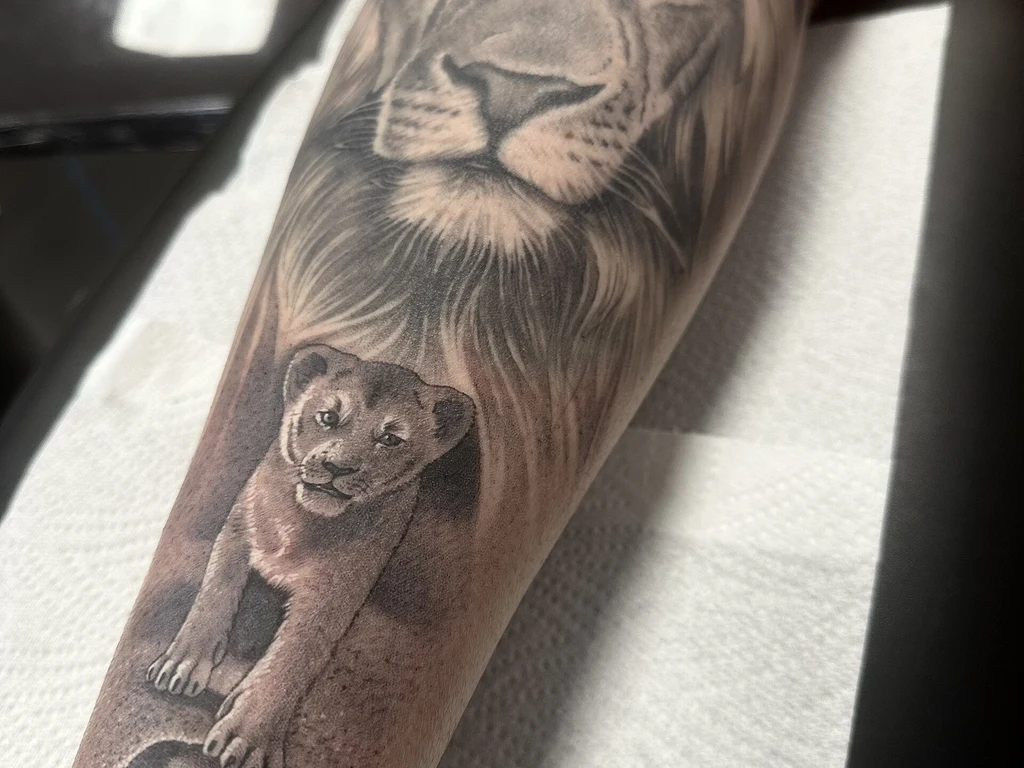
An adult lion at the top of the forearm and a small cub standing underneath it, both in soft black and grey realism. The size gap between the two faces is the whole design.
Parent-and-cub pieces are usually personal — a child, or the wearer’s own younger self. The cub’s face is small, so go bigger than feels necessary; tiny faces are the first thing ageing takes.
7. Ornamental Lion Linework, Thigh
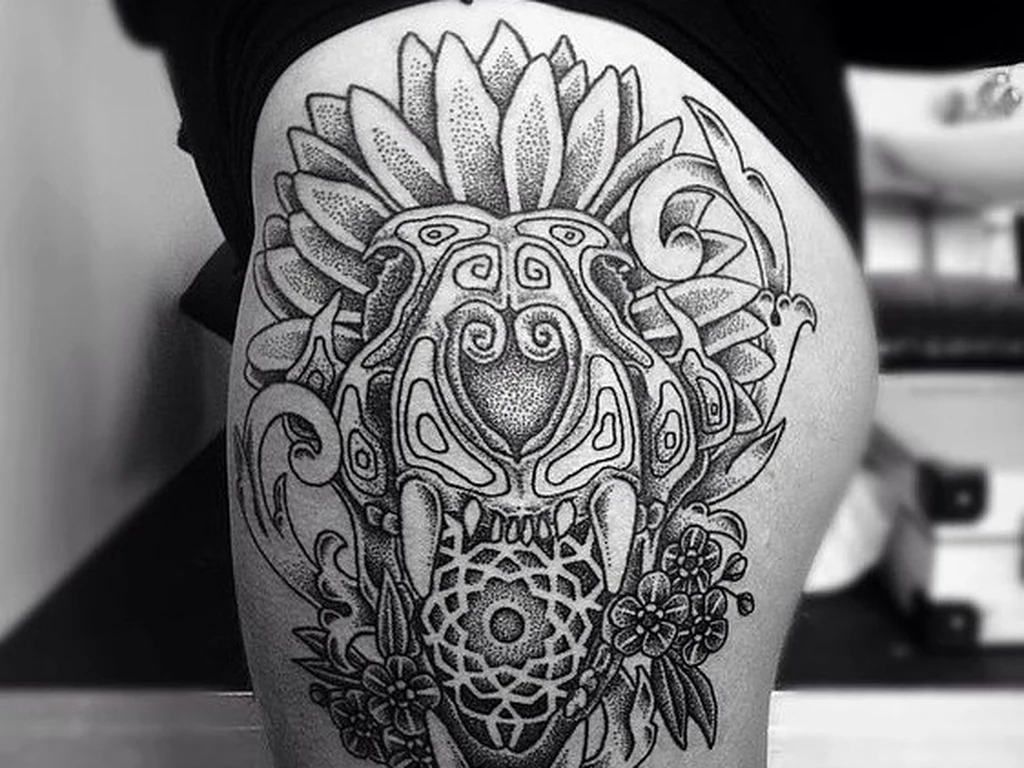
An ornamental lion drawn in line work alone — a sunflower-like burst of petals around the head, dotwork and fine pattern inside the face. This photograph shows the outline stage, before any shading or colour went in.
Some people stop at this stage on purpose, and it suits the thigh: flat, wide and easy to show or cover. If colour might come later, say so at the start — line weights are chosen differently for a piece that will be filled.
8. Lion Portrait With a Hard Stare, Forearm
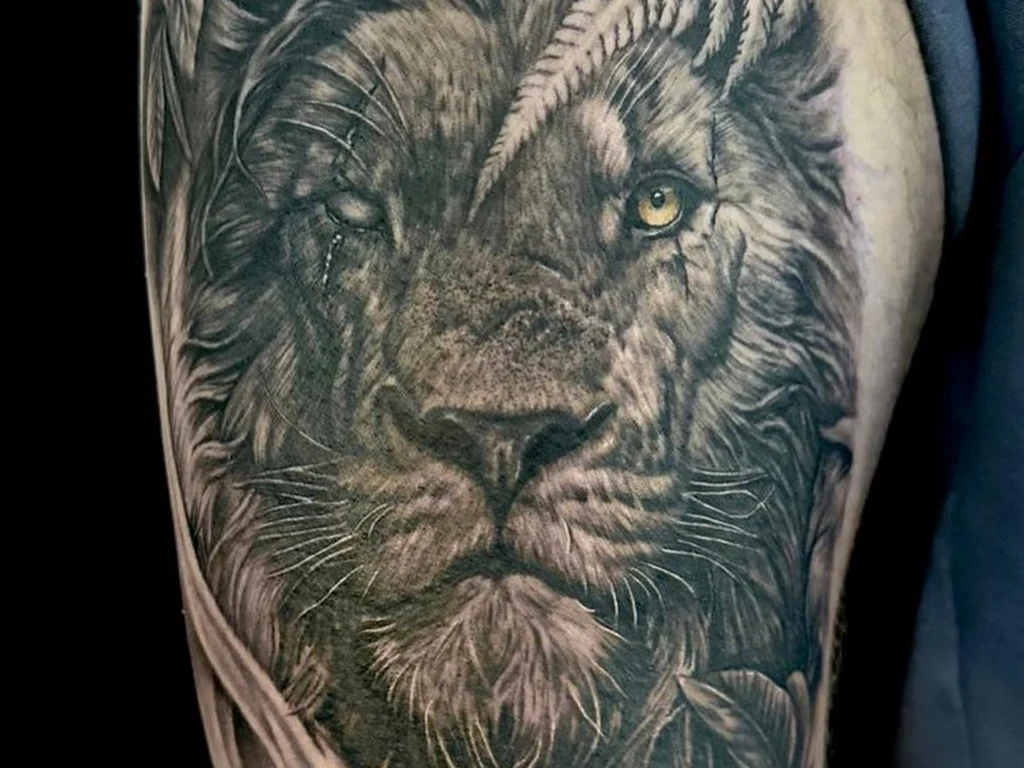
A front-facing lion portrait in black and grey, cropped tight on the forearm. The eyes are level and direct, and the mane is shaded darker at the edges to push the face forward.
Forearm portraits sit where everyone sees them, including you. Fine mane lines soften over the years — the dark edge framing is what keeps the face readable.
9. Colour Lion Head, Shoulder
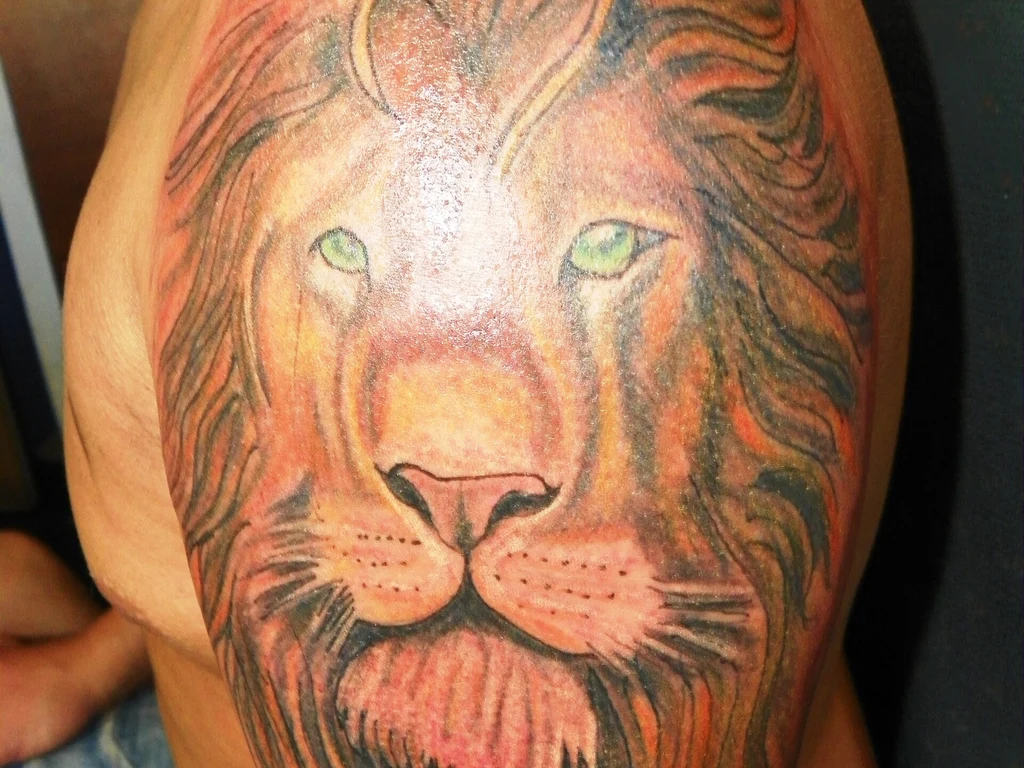
A full-maned lion’s head in natural colour — ambers, browns and a paler muzzle — taking up the whole shoulder cap. There is a touch of shine on the skin in this photo; the ink itself is matte.
The shoulder’s round shape suits a head study, because the mane can follow the muscle. Warm ambers are among the first tones to dull in the sun, so this is a design that earns its sunscreen.
10. Lion of Judah, Forearm
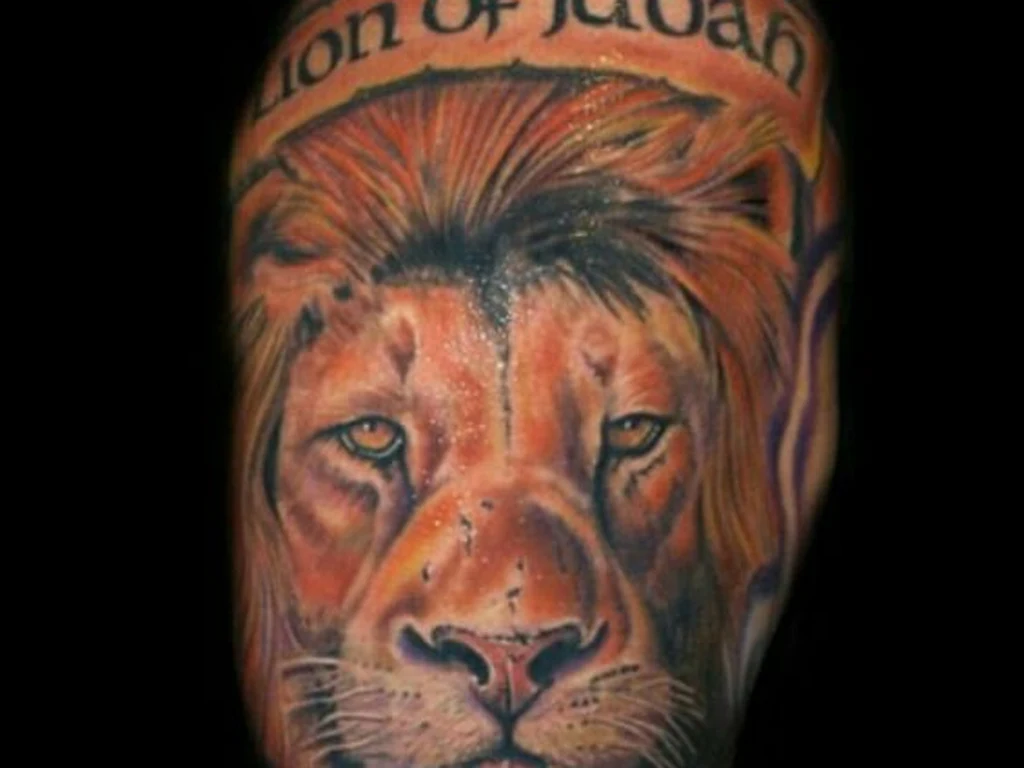
A colour lion’s face with the words “Lion of Judah” arched over the top in script. The mane runs red-brown, and the face is calm rather than roaring — a portrait, not a threat.
For most wearers this is the faith piece described above. Lettering over a portrait needs sizing care — small letters blur toward the mane as they age.
11. Lion Wearing a Crown, Chest
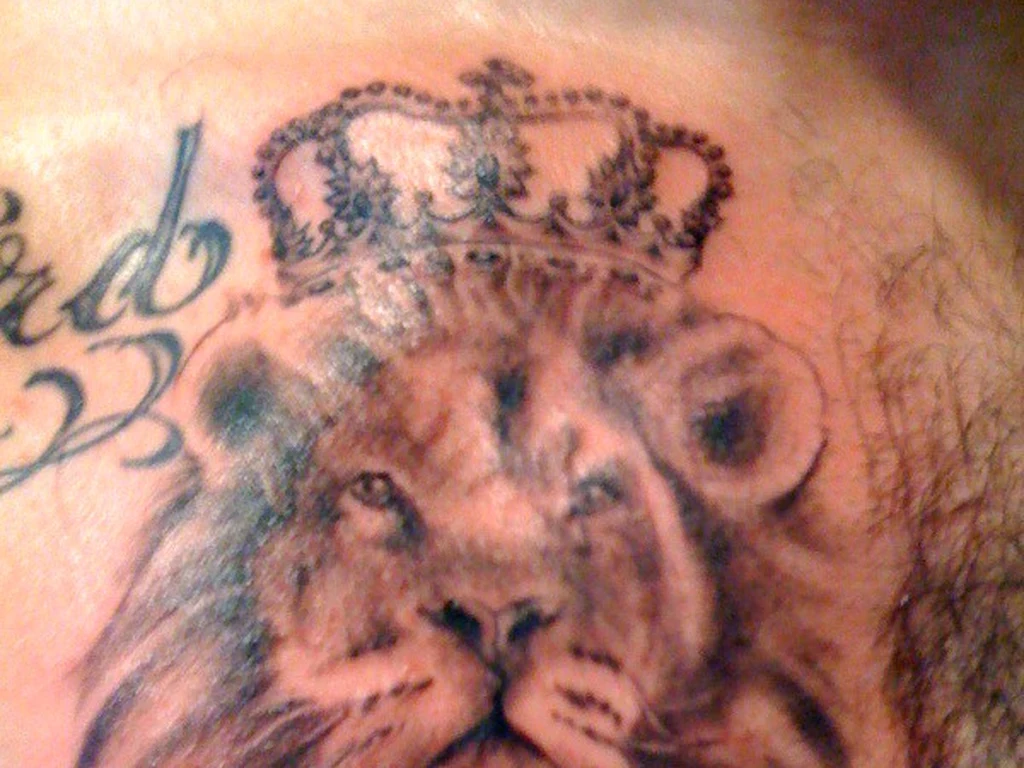
A black and grey lion’s head with a crown sitting on top of the mane, placed high on the chest. Script lettering from an older tattoo shows beside it — chest pieces often have neighbours.
The crown is the most copied add-on in lion tattooing — it turns “strength” into “king” in one move, and drawn this boldly it holds up. Tiny crown points and jewels merge first.
12. Guardian Lion Sleeve, Arm
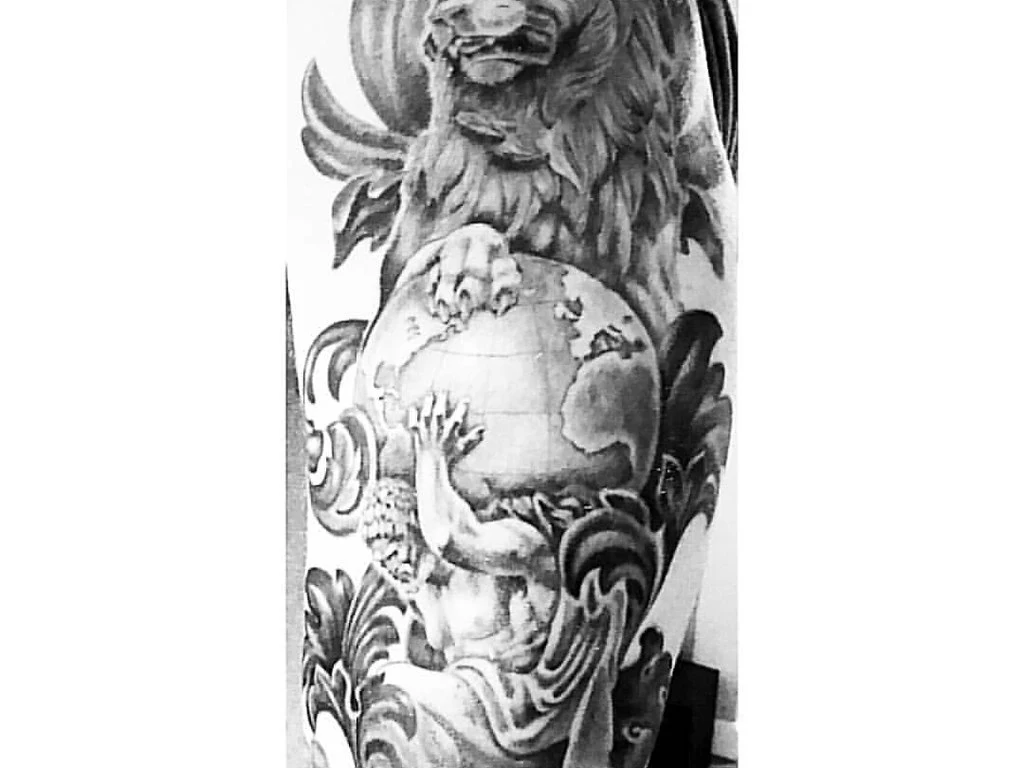
A Japanese-style guardian lion — the shishi, or foo dog — worked down the arm in black and grey: all curls, claws and bared teeth, with the patterned ball these statues are shown holding.
Guardian lions are protectors, carved in pairs at gates and temple steps. As a tattoo it is a bigger commitment than a portrait — the design only makes sense at sleeve scale.
13. Roaring Lion Head, Upper Arm
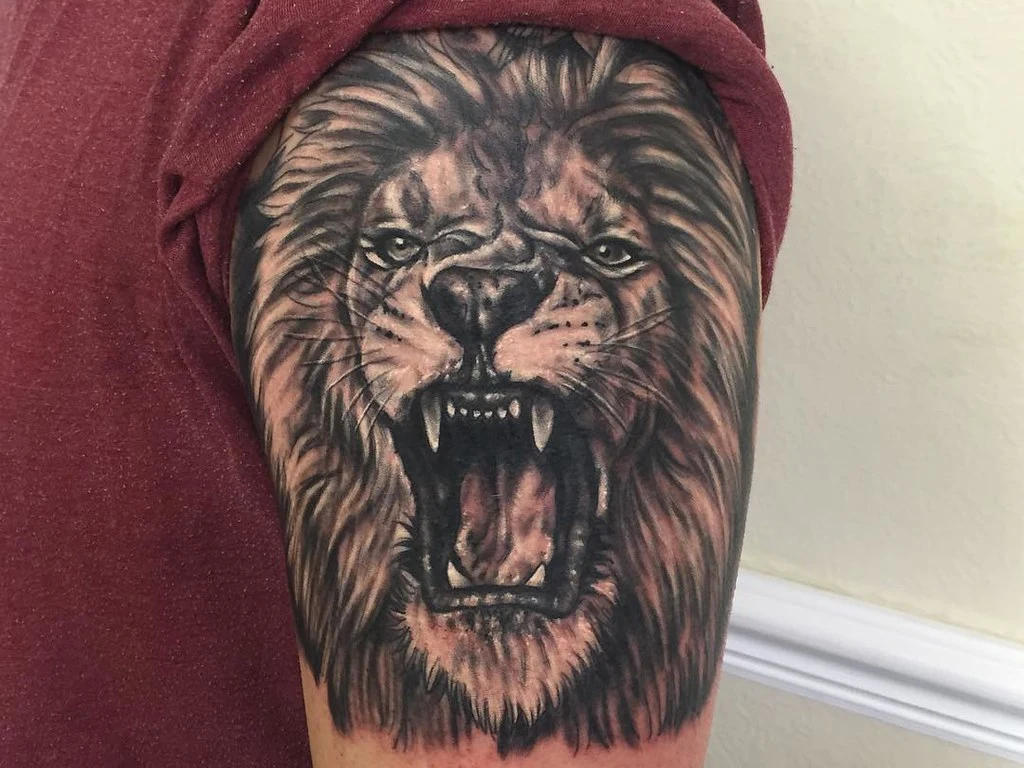
A roaring lion’s head in black and grey on the upper arm, mouth wide open and the mane pulled back by the pose. This is the classic placement for a first big-cat piece, and the most common design in the list.
Upper-arm skin is steady and easy to cover, and a head this size fits without wrapping. The roar reads from across the room; the detail is for people standing closer.
14. Lion’s Face Across the Back of a Hand
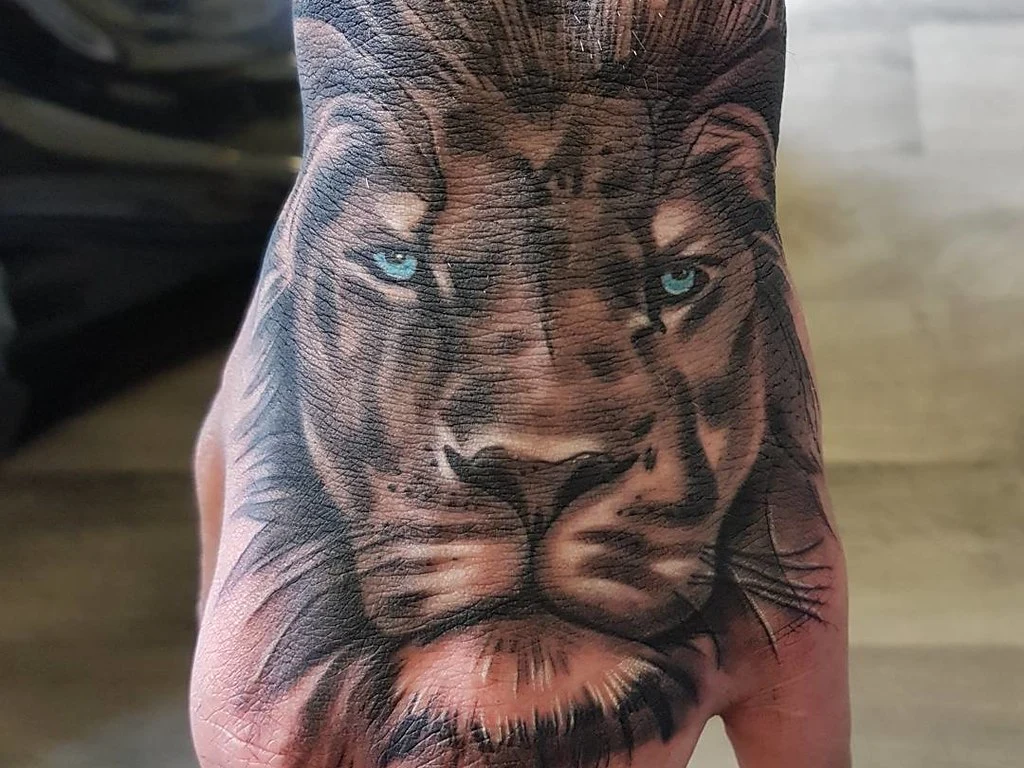
A lion’s face fitted onto the back of a hand — muzzle toward the wrist, eyes toward the fingers, and pale blue-grey eyes in an otherwise black and grey piece.
Hands show in every handshake and photograph, and hand skin sheds fast, so pieces here fade sooner than almost anywhere. Most artists want you to have visible work already before agreeing to one.
15. Geometric Lion Head, Calf
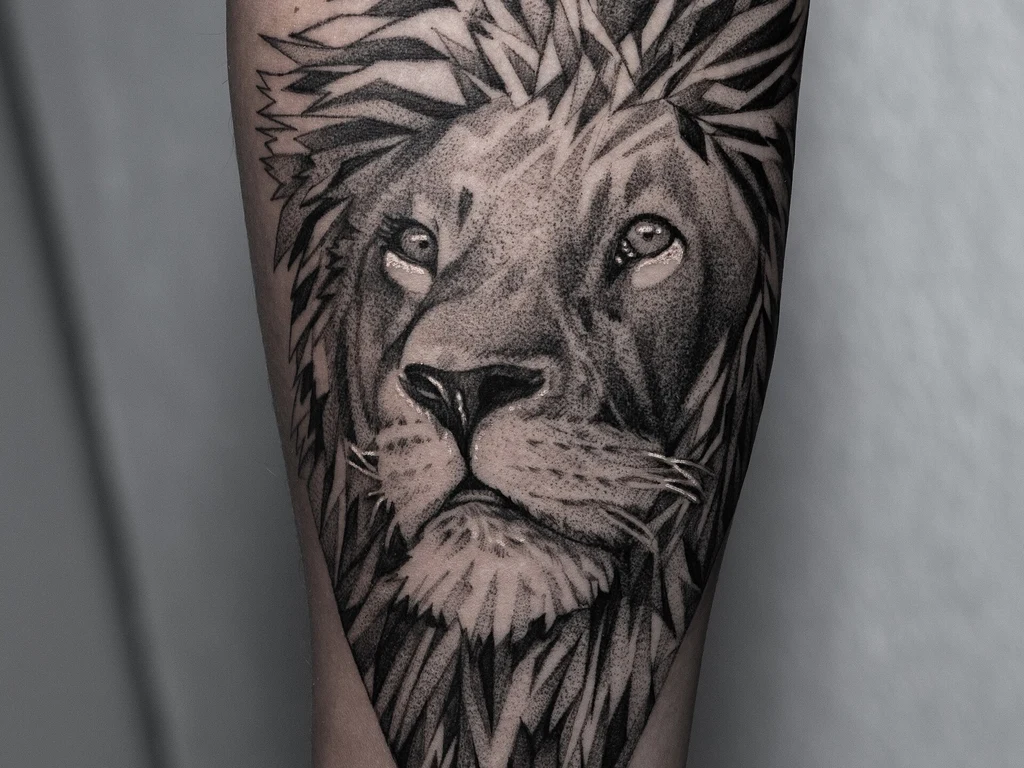
A lion’s face built from straight edges and angles — a geometric version in black and grey running down the calf, the mane faceted like cut stone, one half of the face patterned and the other shaded smooth.
Geometric work needs a ruler-steady artist: curves forgive, straight lines do not. The calf’s length suits the long face, and bold facets with clear space between them age cleanly.
16. Lion and Lamb, Upper Arm
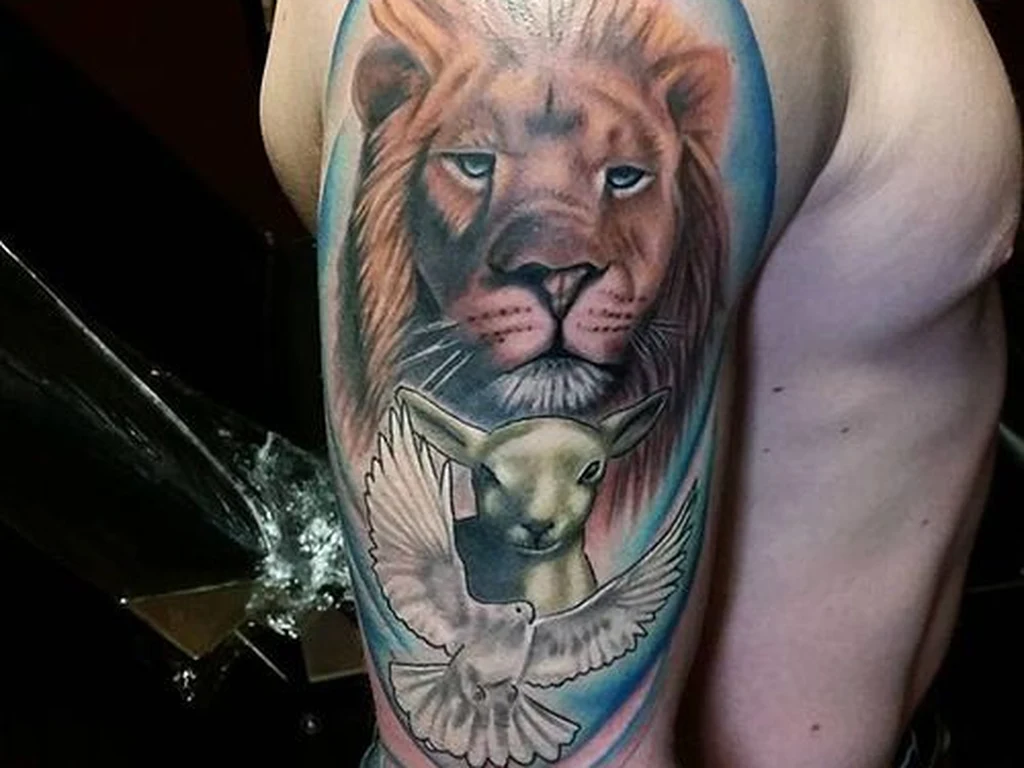
A colour lion portrait with a small lamb and a white dove worked in below it — the lion-and-lamb pairing from the peace prophecy in Isaiah, worn as a single design.
This is a faith design more than an animal one, and a neat lesson in scale: the lion gets the size, the lamb gets the meaning, and both stay readable because neither carries more detail than skin can hold.
17. Lion and Cub in Black and Grey, Forearm
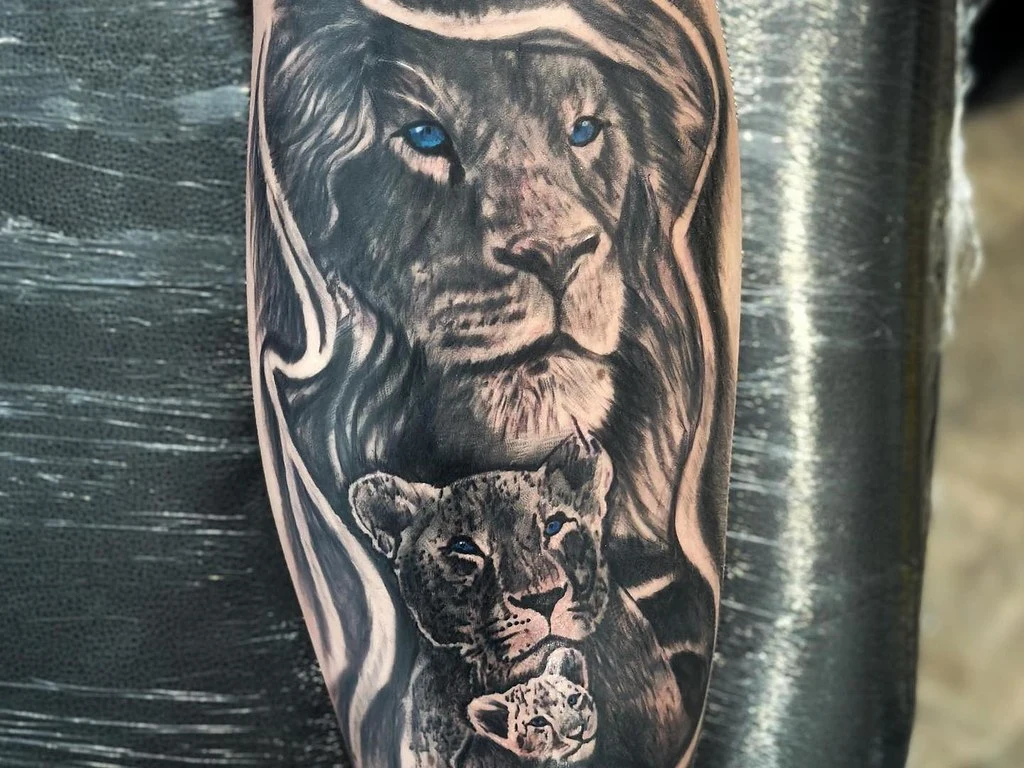
A calm adult lion at the top of the forearm with a cub’s face below it, the pair framed by ribbon-like shapes. It is a softer, more decorative take on design 6’s subject.
Two lion-and-cub pieces sit in this list on purpose: the subject is popular, and the real decision is the one shown here — photo-real, like design 6, or framed and graphic, like this one.
18. Lion With Peonies in Colour, Upper Arm
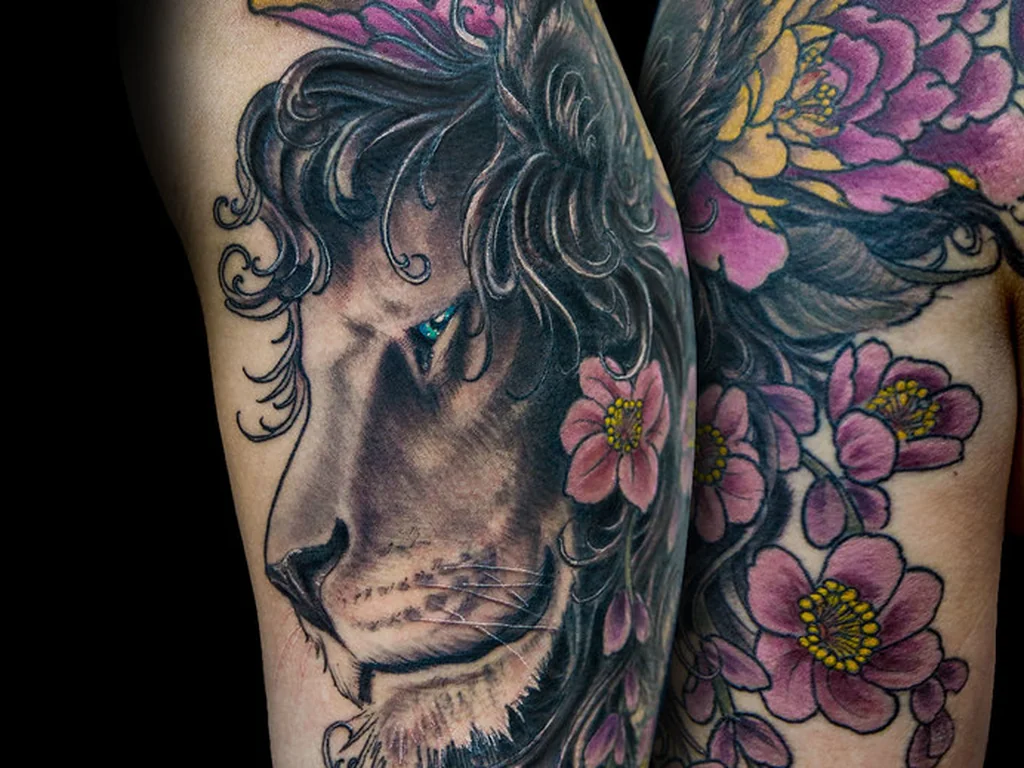
A lion in profile in soft black and grey, with one blue eye and a mane drawn as long curling strands. Pink and yellow peonies and cherry blossom are packed around it and keep going around the arm — artist Ben Lucas photographed the finished half sleeve from two sides.
Colour packed this densely means sun cream for life once it has healed; pinks and yellows quieten down first. A profile lion reads calmer than a frontal one, and a half sleeve like this is drawn as one piece from the start, not added to bit by bit.
19. Tribal Lion Silhouette, Shoulder Blade
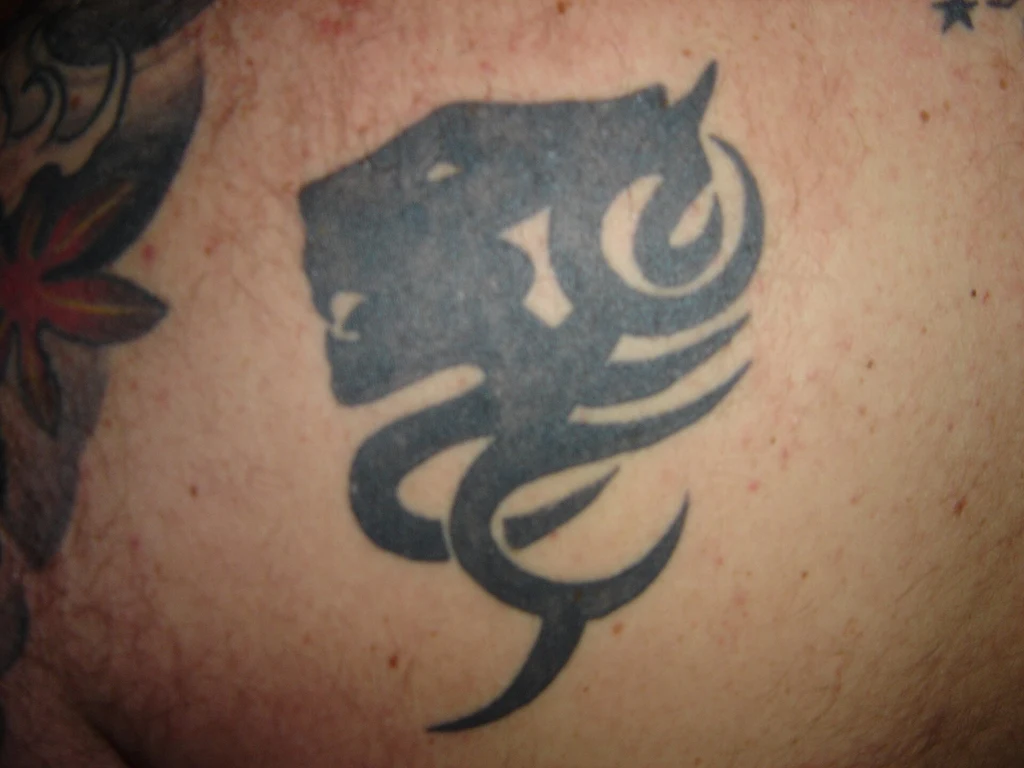
A lion’s head in profile built from black tribal shapes and swirls, sitting on the shoulder blade. No shading and no colour — the silhouette is the design.
Tribal pieces of this era were often drawn to fit the body in front of the artist, which is why the swirls follow the shoulder’s curve. Solid black at this size stays readable for decades.
20. Lion in a Feather Headdress, Back
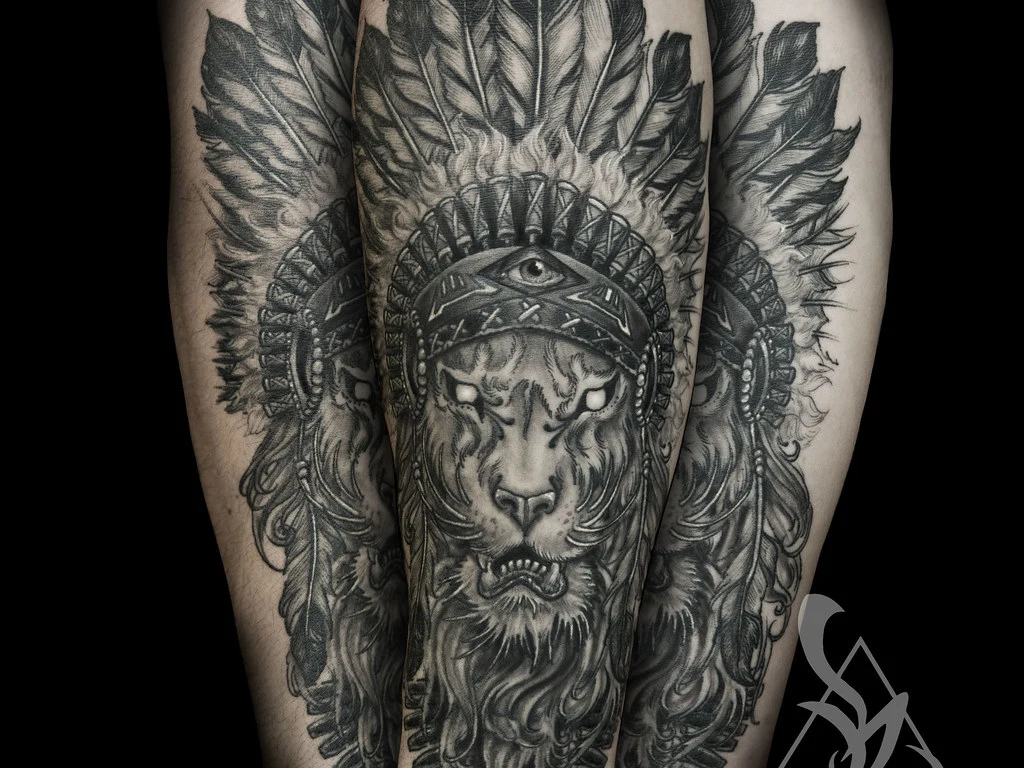
A lion’s face wearing a tall feather headdress, centred on the back in black and grey. The feathers widen the design until it fills the space between the shoulder blades.
One honest note: the headdress borrows from Native American regalia, and plenty of wearers would now frame the same lion differently. A mane of leaves, flames or sun rays gives the same width without borrowing a symbol that is not yours.
21. Lioness and Cub With a Butterfly, Shoulder
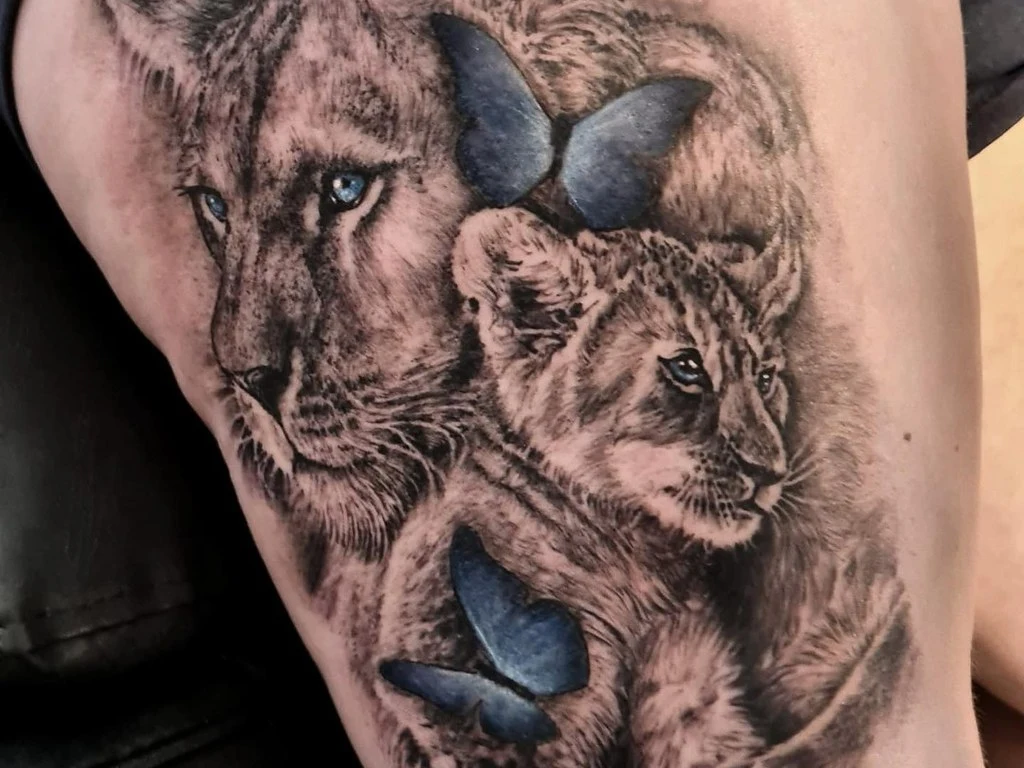
A lioness and her cub worked together on the shoulder in black and grey, with small blue butterflies as the only colour in the piece.
A spot of colour inside a grey piece is a deliberate accent — here it pulls the eye to the cub. Blues soften faster than grey, so expect the butterflies to quieten first.
22. Heraldic Lion Outline, Upper Arm
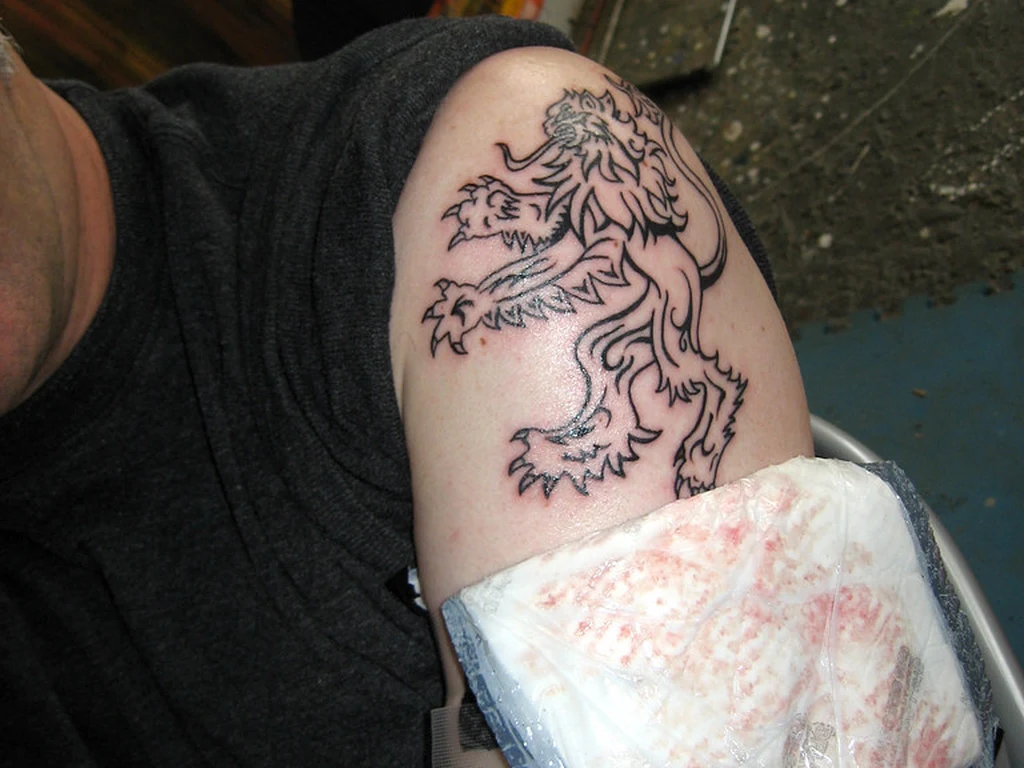
The second rampant lion in the list, this one left as an outline and photographed fresh — the protective dressing is still on the lower arm in the photo, and the skin around the lines is pink.
Fresh tattoos always look angrier than healed ones, so judge the drawing, not the redness. Set beside design 5, it shows the same pose in its two honest versions: filled solid, or line only.
23. Roaring Lioness Close-Up, Forearm
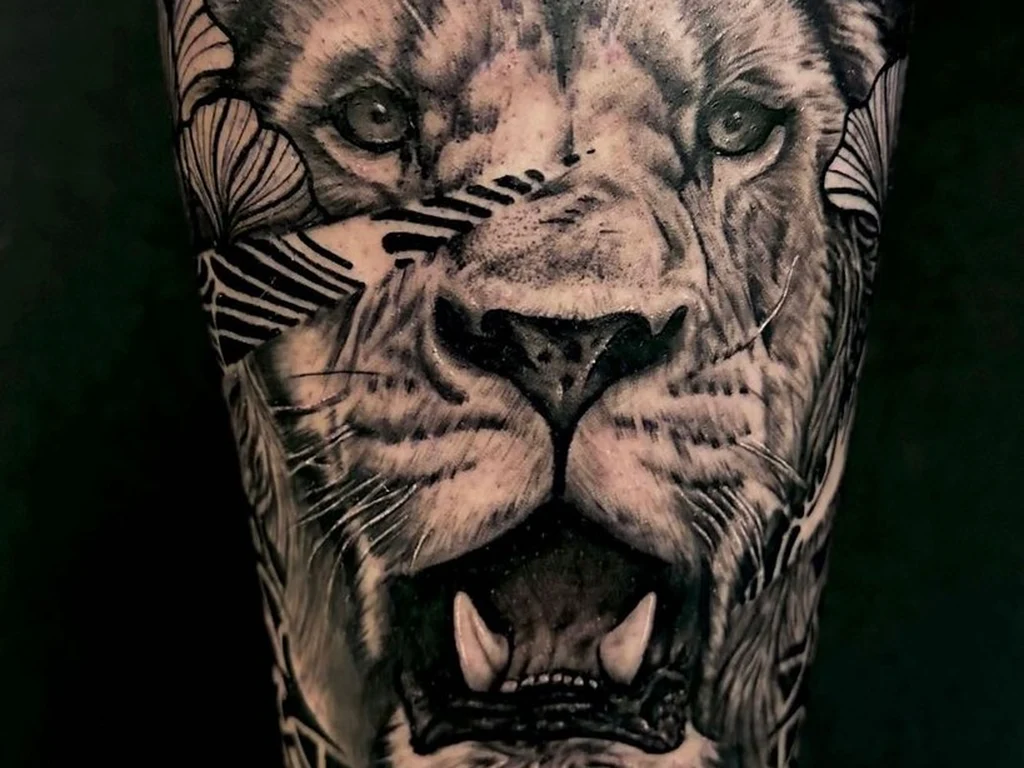
A lioness’s face cropped close on the forearm — mouth open, teeth bared, whisker spots and nose texture in fine detail. No mane, no background, just the face at large scale.
Close-cropped faces are the realism test. Whisker dots and fine texture soften first as a tattoo ages, so a good artist draws them slightly bolder than life.
24. Lion Inside a Keyhole, Back
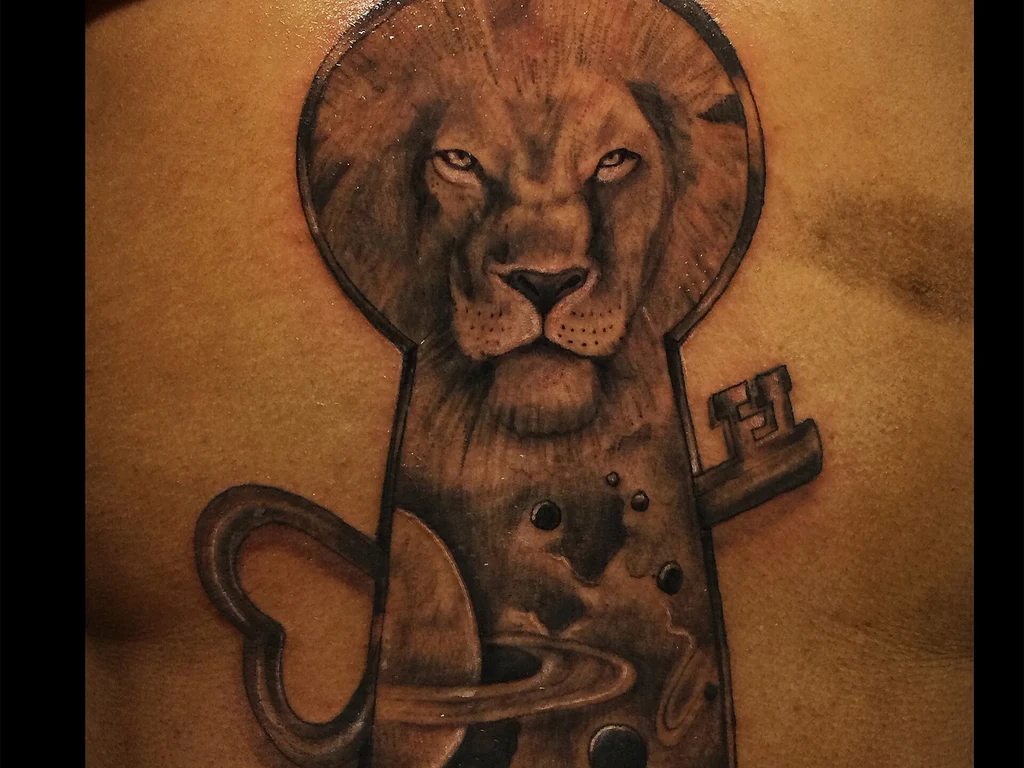
A lion standing inside a keyhole-shaped frame on the back, holding the key in its paw, drawn in a storybook style with a heart-shaped lock below. It is the playful end of lion tattooing.
Framed designs sit well on the back because the frame gives the piece its own clean edges. This one is closer to an illustration than a portrait, and it owns that.
25. Winged Lion, Side of the Neck
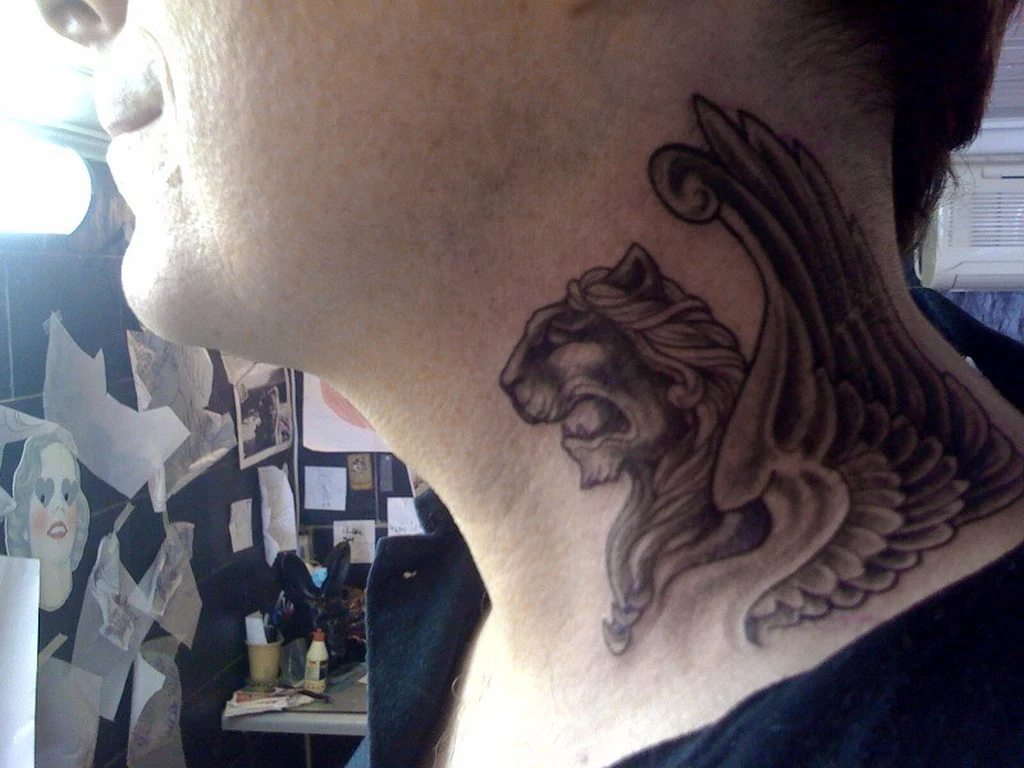
A winged lion in profile climbing the side of the neck in black and grey — a lion’s body with feathered wings, the same creature carved on Venetian columns and stamped on old bookplates.
Neck tattoos show in nearly every setting, and the skin moves constantly, which works fine detail hard. A profile is the smart shape here — it follows the jaw-to-collarbone line.
26. Lion and Lioness Together, Forearm
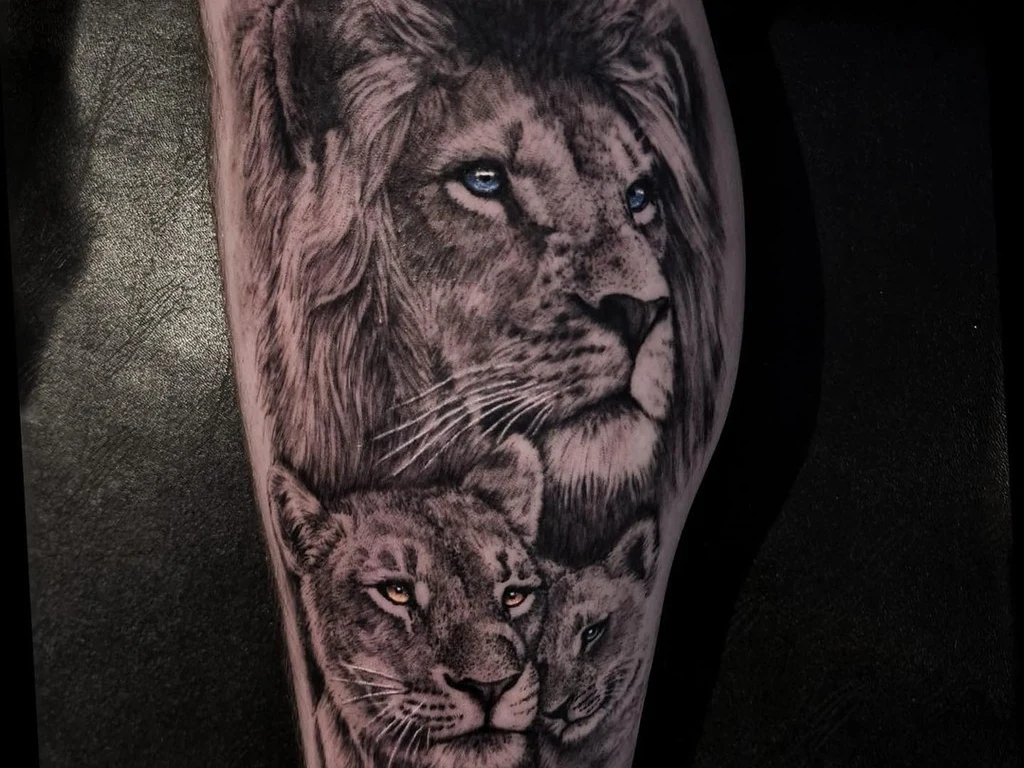
A male lion and a lioness in one black and grey forearm piece, faces side by side, his mane framing both heads.
Pair portraits are usually about a partner, and the trick is balance: the lioness needs equal size, or the mane swallows the design and she becomes a detail in his picture. This one gets it right.
27. Black Lion Silhouette With Paw Prints, Calf
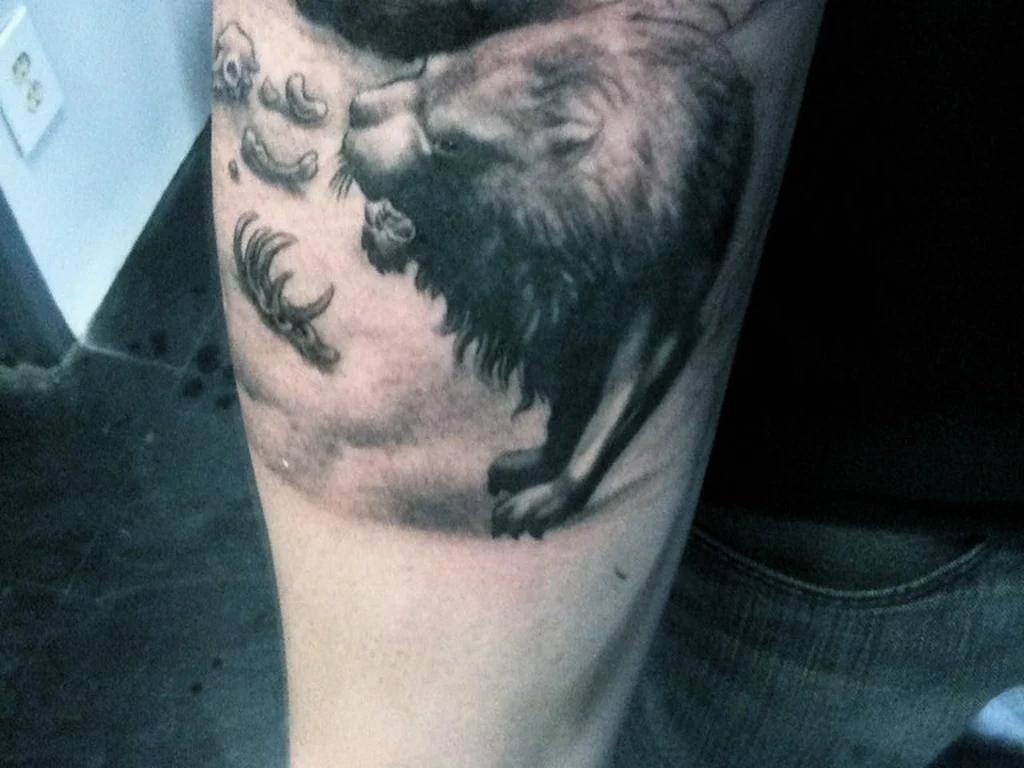
A solid black lion walking down the calf with a trail of paw prints beside it. The shape is silhouette rather than detail — mane, tail and profile doing the talking.
Silhouette work sits at the affordable end of this list and ages slowly, because there is no fine detail to lose. It does demand a confident outline: at this scale the profile alone has to say “lion”.
28. Colour Lion With Cubs, Calf
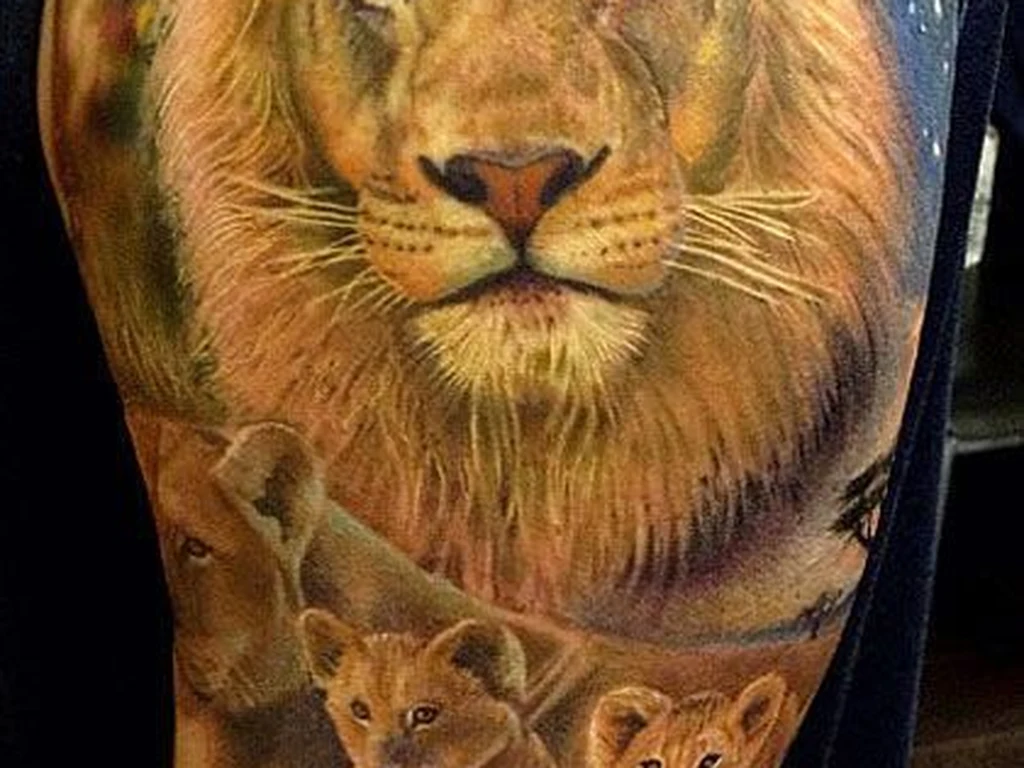
A colour lion’s head on the calf with two small cubs worked in at the bottom, in warm natural tones. The source photo is an older, smaller file, so this is the softest image in the list — the tattoo is bolder than it looks here.
Calf pieces wrap, and this one uses the wrap well: the head faces forward, the cubs sit low where the leg narrows. Family pieces get added to over the years, so leave space if more cubs are a possibility.
29. Lion Head With Red Marks, Hand
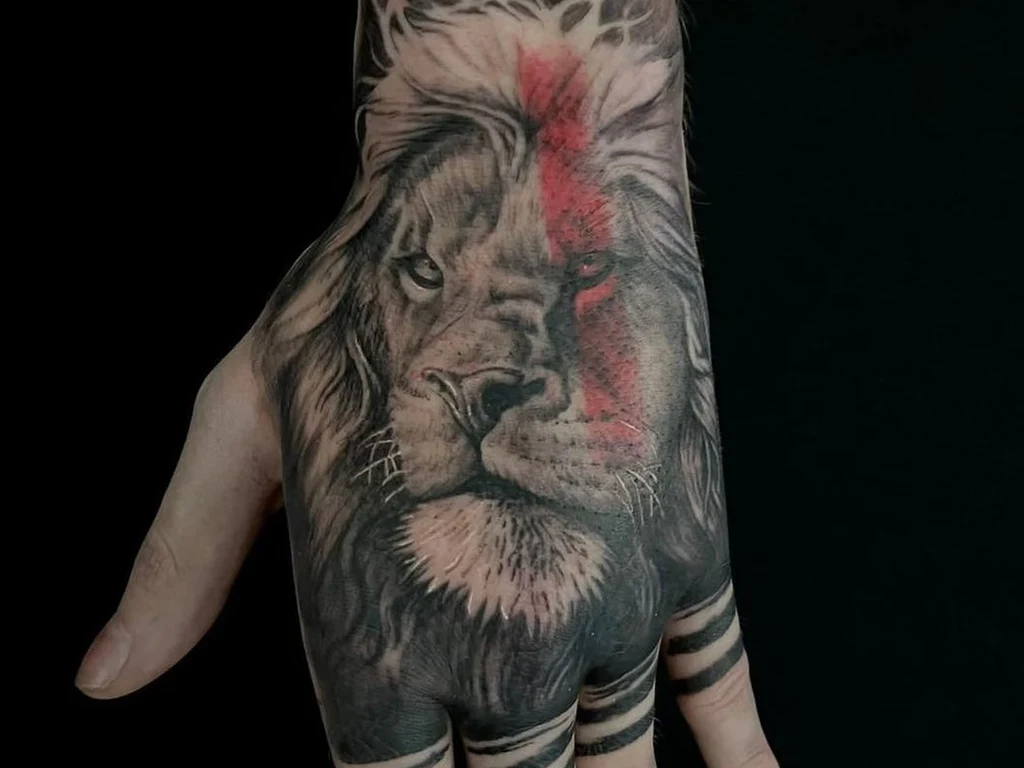
A lion’s head across the back of a hand, with red scar-like stripes worked through one side of the mane and plain band lines around two fingers.
A little red does a lot of work here. Red ink fades faster than black and irritates some skins, so a careful artist may suggest a test spot. The finger bands will need touch-ups — fingers shed ink fastest of all.
30. Plain Black Lion Head, Shoulder Blade
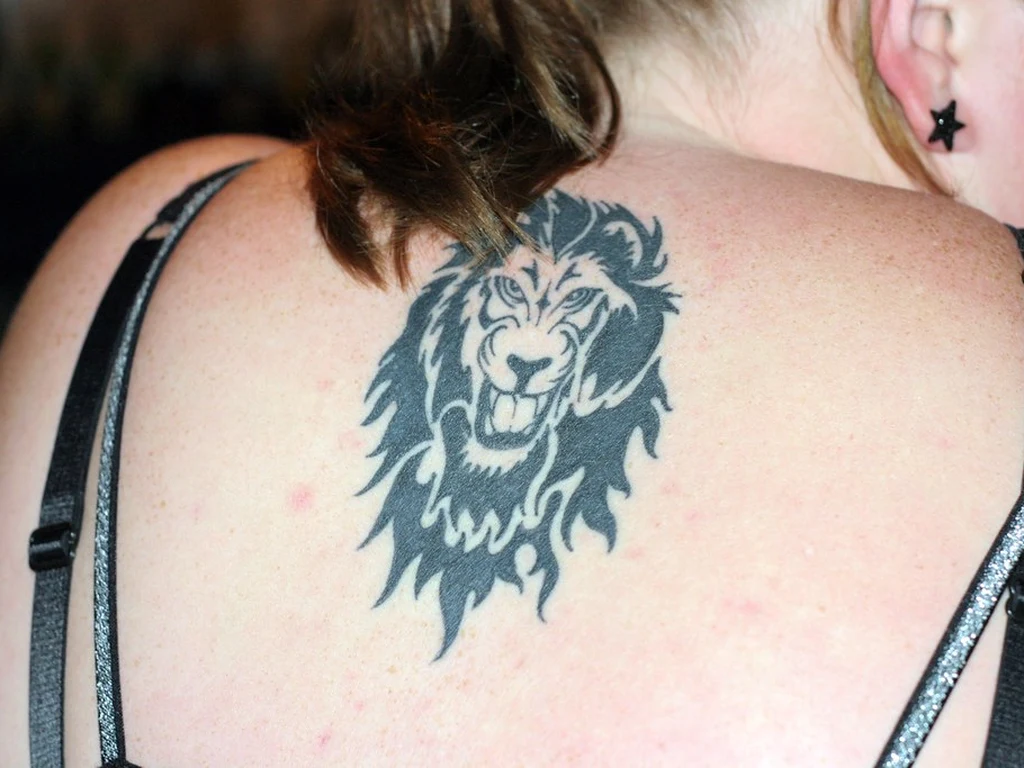
A simple black lion’s head — spiked mane, calm face, no background — centred on a shoulder blade. It is the smallest, plainest design in this list, and there is nothing wrong with that.
Plain is a fair choice. A piece like this works as a finished small tattoo or as the centre of something bigger later — the shoulder blade takes additions in every direction.
Where a Lion Tattoo Works Best
Forearm. The portrait address. Most of this list lives here because the forearm is flat, visible, and gives a vertical face a natural frame. It is also where you will watch your own tattoo age.
Upper arm and shoulder. The classic first big-cat spot — easier to cover than the forearm, roomy enough for a full mane, and the natural starting panel if a sleeve might follow.
Chest and back. The only placements that fit a full-mane centre piece at honest scale. Centre placements reward symmetry and punish a crooked stencil, so the mirror check matters, as the chest pieces in our eagle tattoo ideas guide show.
Calf and thigh. Long frames for long faces. The calf suits heraldic and silhouette designs; the thigh is the realism canvas — flat, wide, modest pain, easy cover.
Hand and neck. Designs 14, 25 and 29 look strong, and all three carry the same warning: these spots show in every job interview and family photo, and the skin ages tattoos there faster than almost anywhere. A good artist will talk it through first — that conversation is a good sign.
Small spots. Silhouettes and outlines (designs 27 and 30) work small. Realism does not shrink: a detailed mane squeezed into a few centimetres merges into a dark patch within a few years.
Frequently Asked Questions
What does a lion tattoo mean?
Most people mean courage, strength or pride. After that it depends on the version: a crowned lion leans royal, a rampant lion is heraldic, a lioness usually stands for family and providing, and the Lion of Judah is a statement of faith. Plenty of wearers will also tell you they just like lions — that is a complete answer too.
How much does a lion tattoo cost?
Size and detail set the price, not the animal. A small silhouette or outline lion usually starts at the studio minimum, commonly $60–$150 in the US. A palm-size portrait is a few hours of work, and a chest or back lion runs across sessions — get the number at a consultation, at final size.
Where is the best place for a lion tattoo?
For a portrait, the forearm or upper arm — flat skin, good visibility, room for the mane. For a big centre piece, the chest or back. For something small and simple, the calf or shoulder blade. In the end the design chooses the spot: a wide mane needs a wide, flat canvas.
Do lion tattoos age well?
The bold ones do. Heraldic, tribal and silhouette lions (designs 5, 19 and 27) hold their shape for decades. Realism ages softer: fine mane shading relaxes at the edges, and small faces lose detail first. Size is the best protection — a mane drawn with space between its lines stays a mane.
Lion or lioness — what is the difference in meaning?
The lion is the symbol of pride, courage and kingship — the mane is the crown nature gave it. The lioness stands for the working half of the pride: hunting, providing and protecting cubs, which is why family pieces so often use her. Neither belongs to one gender of wearer; pick the animal whose story is closer to yours.
What does a lion with a crown mean?
“King of the jungle,” stated as directly as a tattoo can — authority, leadership, running your own life. It is the most popular add-on in this list (design 11). If the crown copies a specific emblem — a club, a regiment, a family crest — people will read that connection too.
What does the Lion of Judah tattoo mean?
It is a religious symbol. In the Bible, Judah is blessed as a lion’s cub and Christ is called the Lion of Judah; a crowned lion was Ethiopia’s imperial emblem, and Rastafari holds it sacred because of Emperor Haile Selassie. People wear it as a declaration of faith and heritage — treat it with that weight, especially if it is not your tradition.
Can a lion tattoo be small?
Yes, if it is simple — a silhouette, an outline head, a heraldic lion (designs 22, 27 and 30 all work at small sizes). What cannot go small is realism: below about 8–10 cm across, a detailed mane has to be simplified anyway, because tightly packed shading blurs as it heals and ages.
How long does a lion tattoo take?
A small outline or silhouette can be done in one short sitting. A palm-size portrait is usually two to four hours. Chest and back lions are measured in sessions, not hours — outline first, then shading visits spaced weeks apart.
Can a lion tattoo cover an old tattoo?
Often, yes — a dark, busy mane is one of the better cover-up tools there is. The new piece must be bigger and darker than what sits underneath, faded work covers easiest, and the artist gets the final say after seeing your skin in person.
Final Thoughts
Thirty real lions, and the pattern is simple: the designs that last are drawn at the size their detail needs, in a style honest about what skin does over time. Pick the version that matches your reason — heraldic, royal, faithful, protective, or just a face you want to look at — and let the placement follow. If the lion is not your animal after all, our snake tattoo ideas guide argues a very different case.
Photo credits: 1: Wikimedia Commons (tattoo by Alan Hindes; photo Gypates), CC BY-SA 4.0. 2: Flickr (thewildtattoo), Public Domain Mark. 3: Wikimedia Commons (Dom Carter), CC BY-SA 4.0. 4: Wikimedia Commons (Jens Cederskjold), CC BY 4.0. 5: Flickr (RuggyBearLA), CC BY-SA 2.0. 6: Wikimedia Commons (tattoo by Alan Hindes; photo Gypates), CC BY 4.0. 7: Flickr (thewildtattoo), Public Domain Mark. 8: Flickr (TattoosAll), CC BY-SA 2.0. 9: Wikimedia Commons (Tattoodelmono), CC BY-SA 3.0. 10: Flickr (thewildtattoo), Public Domain Mark. 11: Flickr (mytat_2s), CC BY 2.0. 12: Flickr (ettorebechis), CC BY 2.0. 13: Flickr (thewildtattoo), Public Domain Mark. 14: Flickr (TattoosAll), CC BY 2.0. 15: Wikimedia Commons (Dom Carter), CC BY-SA 4.0. 16: Flickr (thewildtattoo), Public Domain Mark. 17: Flickr (TattoosAll), CC BY-SA 2.0. 18: Flickr (BenLucasTattoos), Public Domain Mark. 19: Wikimedia Commons, CC BY-SA 2.5. 20: Flickr (BenLucasTattoos), Public Domain Mark. 21: Flickr (TattoosAll), CC BY-SA 2.0. 22: Flickr (Hollingsworth), CC BY-SA 2.0. 23: Flickr (TattoosAll), CC BY-SA 2.0. 24: Wikimedia Commons (Citizeninkstudios), CC BY 3.0. 25: Flickr (Dplanet::), CC BY 2.0. 26: Flickr (TattoosAll), CC BY-SA 2.0. 27: Flickr (benrjordan), CC BY-SA 2.0. 28: Flickr (thewildtattoo), Public Domain Mark. 29: Flickr (TattoosAll), CC BY-SA 2.0. 30: Flickr (sopues), CC BY 2.0. Full file names and source links are listed in this article’s package notes.

Pingback: 20 Realistic Lion Tattoo Ideas: Photo-Real Designs and What They Take
Pingback: Lion Tattoo Meaning: Symbolism, History and What It Really Stands For