Few tattoo subjects have been inked as long, or as often, as the eagle. It was a standard design in the sailor tattooing of a century ago, it anchors chest and back pieces in American traditional work, and it still shows up every week in realism studios as a black and grey portrait. This page collects eagle tattoo ideas the way this site always does: real tattoos, on real skin, in real photographs, counted one by one. There are 22 below — that is the honest total from this round of sourcing, and every one of them earned its place.
You will find the classic flag-and-anchor sailor piece, a full back eagle photographed at a convention, three black and grey realism portraits by the same artist, a Japanese-style bird under a red sun, and one small silhouette that proves an eagle does not have to cover your whole chest to read as an eagle.
What Eagle Tattoos Mean
Three meanings come up again and again. Strength is the first: the eagle is a large bird of prey that hunts alone and answers to nothing in the sky. Freedom is the second, and the simpler one — a bird that flies higher than almost any other is an easy symbol for a life lived on your own terms. Protection is the third. Eagles watch from a great height and see detail at a distance, so the design is often chosen by people who think of themselves as looking out for family.
The bird also carries national meanings, and it pays to know them before you wear one. The bald eagle has appeared on the Great Seal of the United States since 1782 and was formally made the country’s national bird in 2024; the US Fish and Wildlife Service keeps the plain facts on the species. Mexico’s flag shows a golden eagle on a cactus holding a snake, an image taken from an Aztec founding legend. Germany’s federal eagle, Rome’s legion standard, and a long list of air forces and army units have all used the bird the same way. Most wearers pick the eagle for the bird itself — but a flag, a banner or a unit reference added to the design will be read as part of its meaning, so add those elements on purpose, not by habit.
One pairing deserves a straight note. The eagle holding a snake is one of the oldest combinations in tattooing, and it turns up in sailor work, in Mexican imagery and in designs about good fighting evil. Our snake tattoo ideas page covers the serpent side of that pairing in full. There is no photograph of an eagle-and-snake tattoo in this set, so it is explained in the questions at the end rather than shown as a design. If you want the other great symbolic bird after this one, the phoenix tattoo design ideas page is the natural next read.
The 22 Designs
1. American Traditional Eagle With a Flag and Anchor, Upper Arm
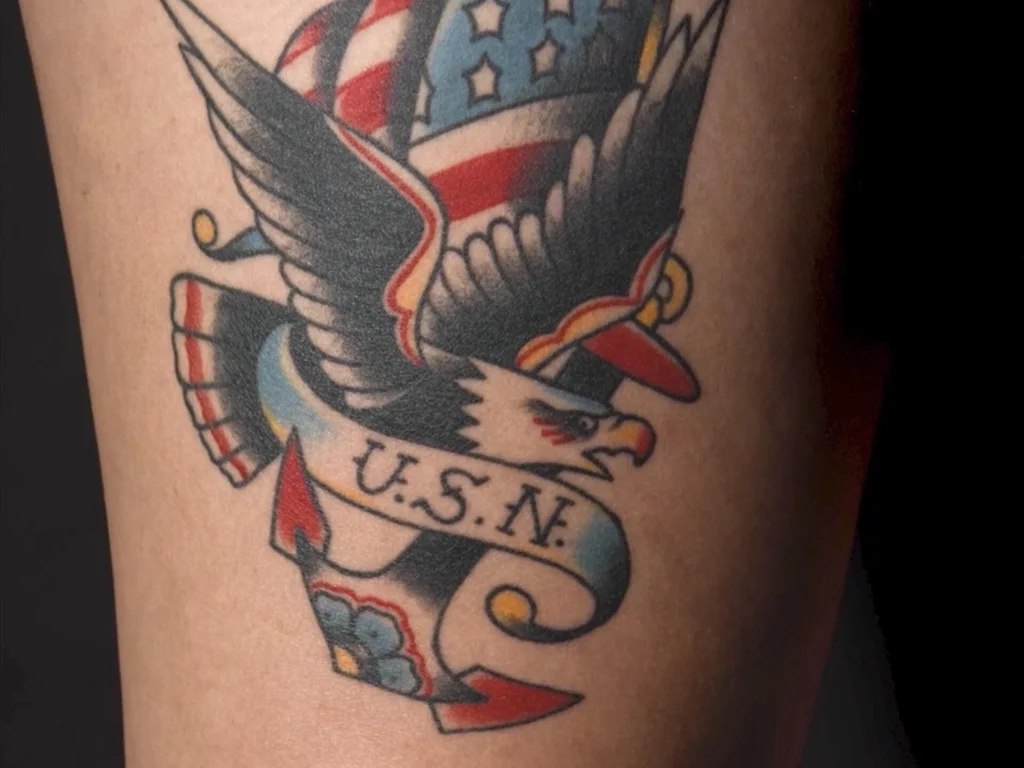
This is the design most people picture when they hear the words eagle tattoo. A spread-wing bird in grey, red and yellow, a flag behind it, an anchor below and a banner reading U.S.N. — United States Navy. Pieces like this were standard work in the port-city studios where sailors spent their leave, and the layout has barely changed in a hundred years.
Look at why it lasts. Every shape is simple, every colour is packed into a bold block, and the black outline does the heavy work. Traditional eagles of this kind are among the best-ageing tattoos there are, which is why the style is still the safe first recommendation for a bigger piece.
2. Spread-Wing Eagle Across the Whole Back
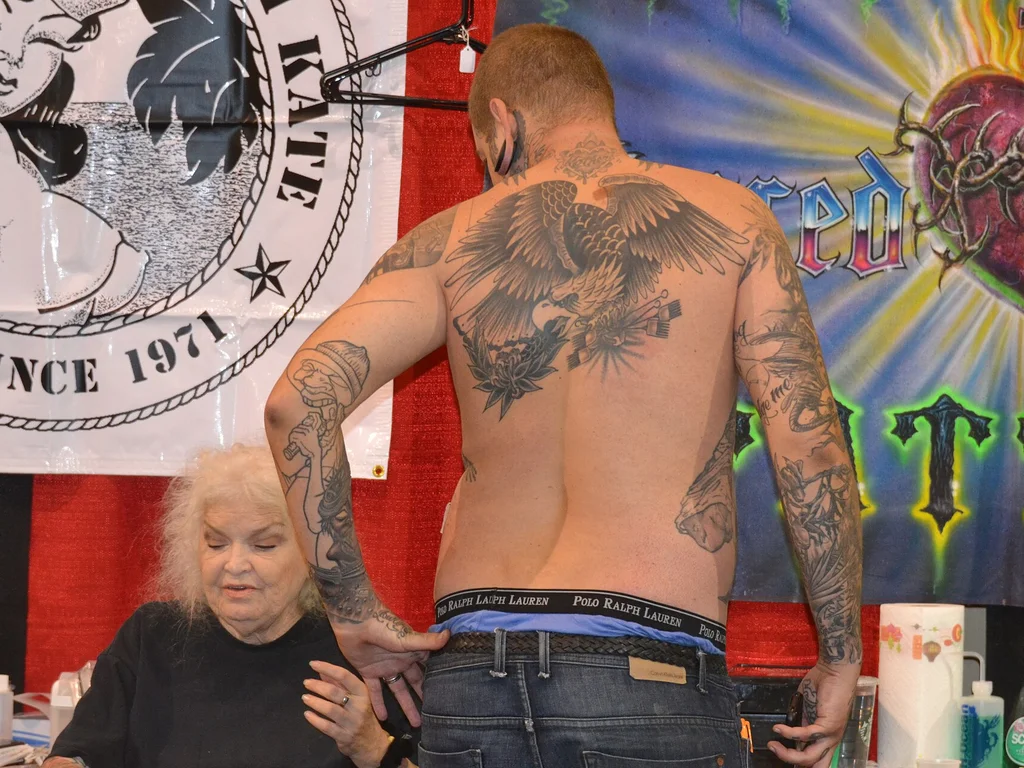
Photographed at a tattoo convention, this eagle uses the full width of a man’s back, wingtip to wingtip across the shoulder blades. The bird is drawn head-on with its head turned to one side, and the feathers are worked in fine black and grey lines rather than solid blocks, so the whole piece reads soft from a distance and detailed up close.
A back is the one canvas where an eagle can be drawn at something like its real wingspan, and this is the scale that design wants. Work like this is measured in sessions, not hours — expect the outline first, then shading visits spread over months.
3. Black and Grey Eagle Across the Upper Back
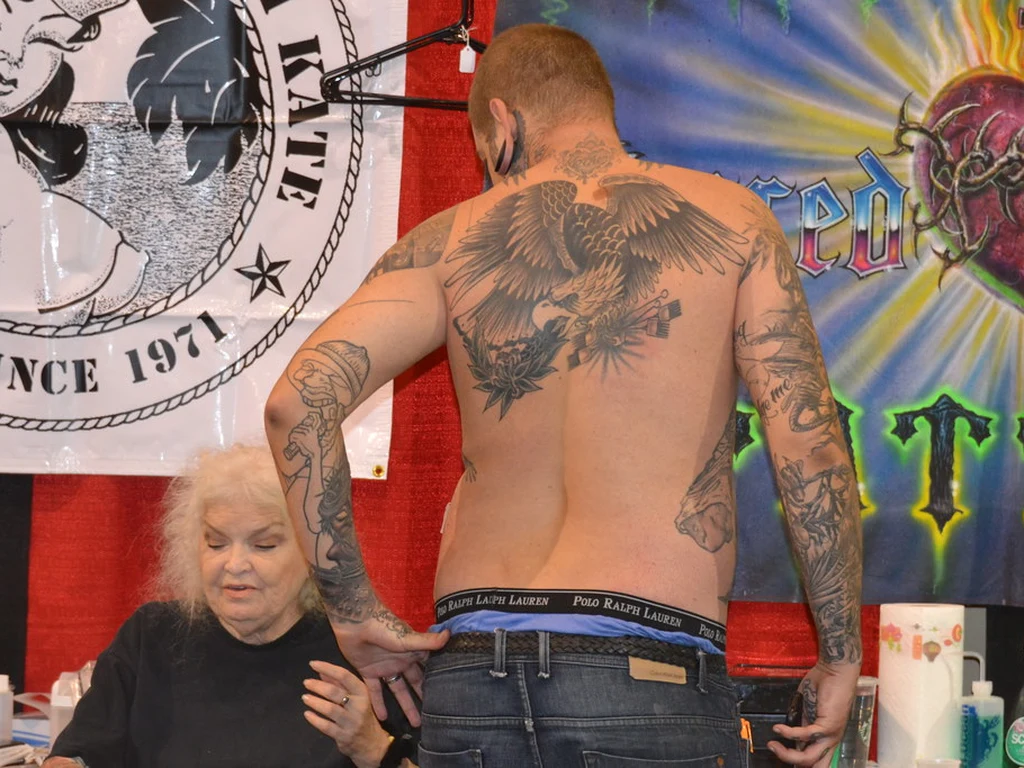
Photographed at a tattoo convention, this eagle sits high on a man’s back with its wings raised and its head turned down, worked in black and grey with heavy, dark feathers. A star sits below it, and both of the man’s arms carry more traditional work, so the back reads as the centre of a collection that is still growing.
An upper-back placing is the halfway point between a chest piece and a full back. It takes the widest part of the shoulders, leaves the lower back free for whatever comes next, and stays hidden under a shirt. Compare it with design 2: same canvas, opposite temper — that one all fine lines, this one built on solid black.
4. Black Traditional Eagle Across the Chest
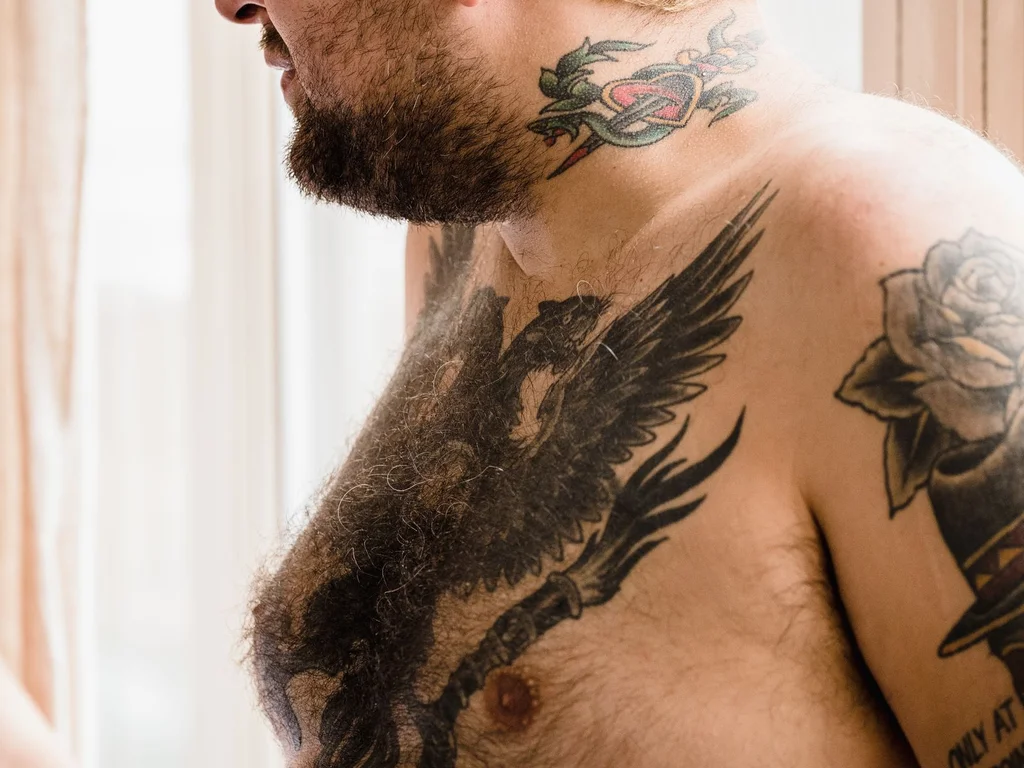
A big black eagle sits across this man’s chest with its wings raised and its talons closed around a branch. There is no colour anywhere in it. The feathers are built from heavy black shapes with thin lines of bare skin left between them, a traditional layout pushed to its darkest end.
Solid black work like this is a commitment in both directions. It covers well, it holds for decades, and it is very hard to change later.
5. Traditional Eagle Across the Upper Chest, With a Banner

An eagle does not belong to men’s tattooing, whatever the old flash sheets suggest. This woman wears a traditional eagle across her upper chest, wings spread wide, with a banner worked through the design and a rose tattoo sitting above it on her neck. The colours are the classic set: muted red, gold and green over strong black lines.
The upper chest is a kind placement for this style: flat skin, easy to show or cover, and a symmetrical bird follows the collarbones naturally.
6. Traditional Eagle Over a Flag Shield, Chest
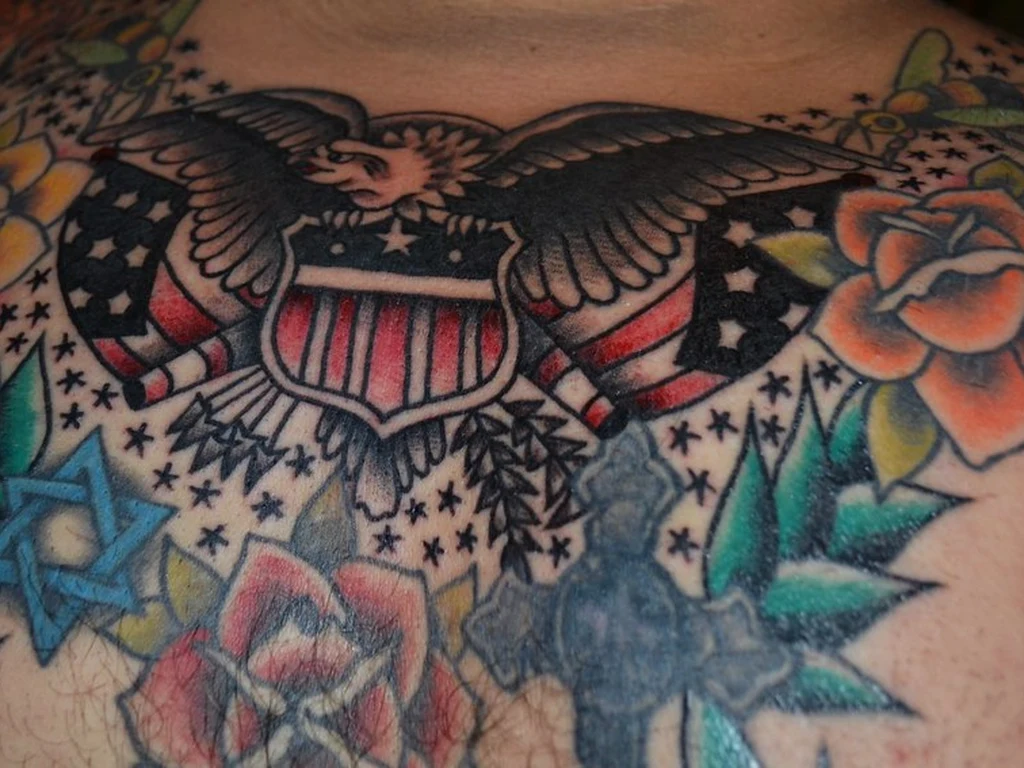
A bald eagle spreads its wings over a shield drawn as the American flag — stars on blue above, red and white stripes below — with roses and scattered stars packed around it. Everything here is drawn the traditional way: thick black outlines, flat colour, no soft shading anywhere.
This is design 1’s sailor formula moved from the arm to the chest, where the shield gets the width it wants. One thing to take from it: in a design like this the flag is not background. Most people will read the patriotism first and the bird second, and for most wearers that order is the point.
7. Tribal Eagle Across the Chest
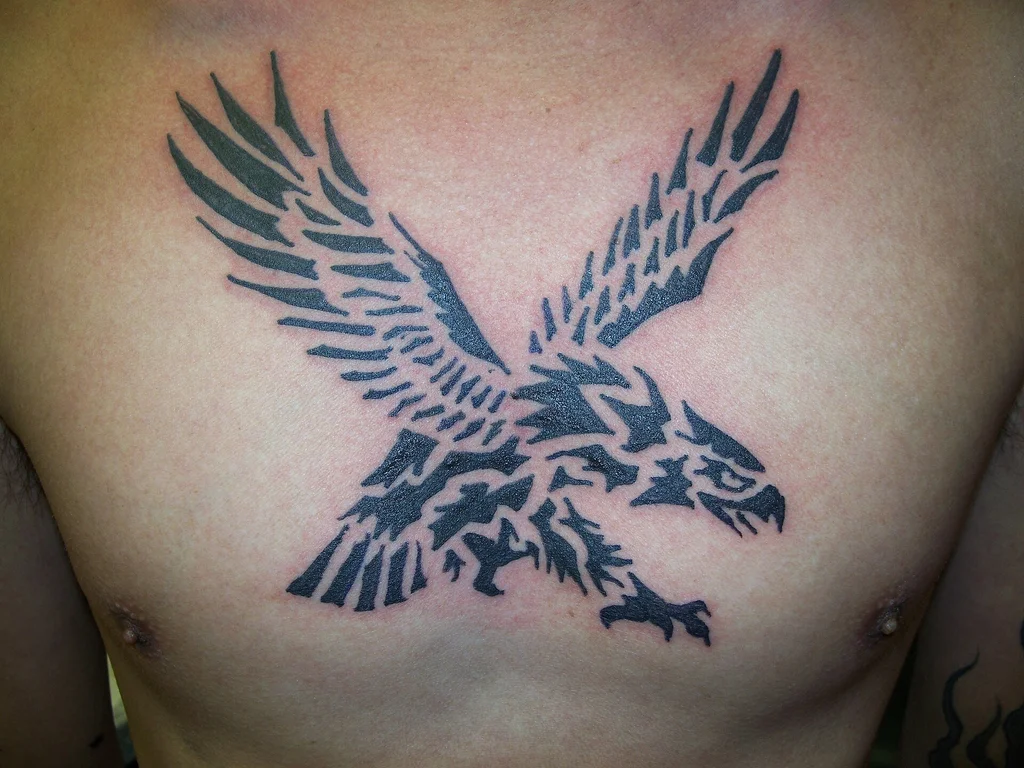
No head detail, no feather shading, no colour — this eagle is built the way tribal work builds everything, from pointed black shapes. The wings sweep up toward the shoulders, the body drops to a point at the sternum, and the whole bird is readable from across the room as a single black mark.
Tribal eagles were everywhere in the 1990s and 2000s, and plenty were done badly. This one shows the rules of the good ones: the points follow the chest muscles, the two sides match, and there is enough bare skin between the shapes that the design will not merge into one blob as it ages.
8. Realistic Eagle Head in Black and Grey, Forearm
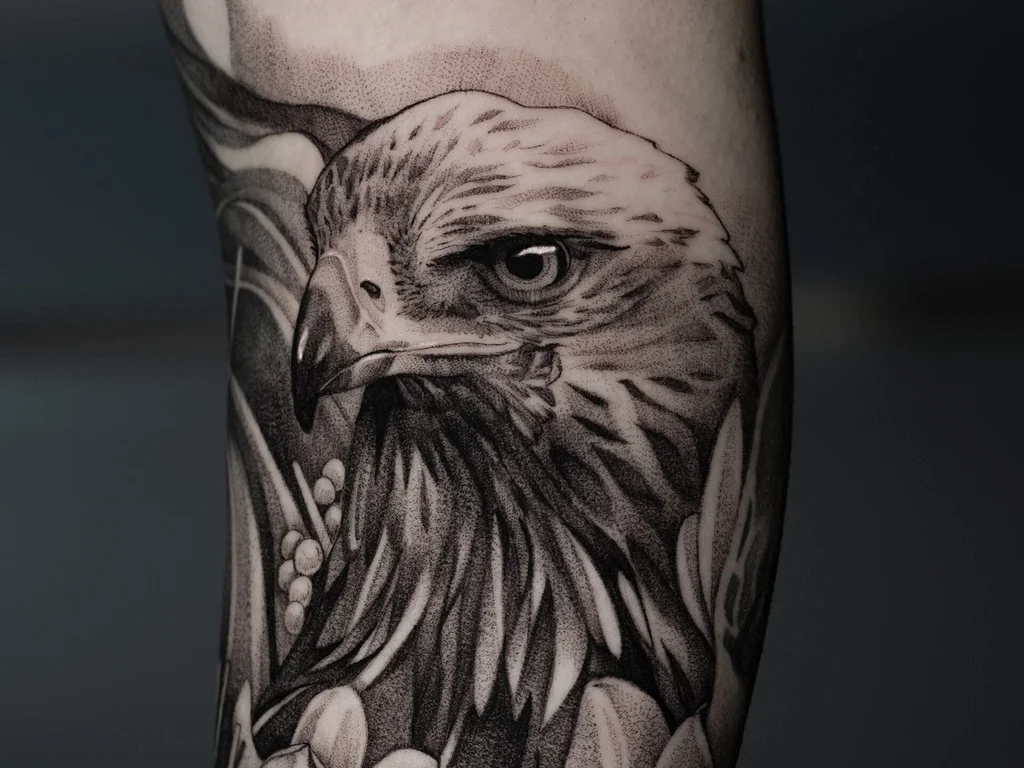
British artist Dom Carter works in a soft black and grey realism that suits birds of prey well. This forearm piece is a single eagle head at large scale: heavy brow, hard stare, hooked beak, and leaves worked around the edges to give the portrait a frame. There is almost no hard outline in it — the shapes are built from shading alone.
Realism like this asks two things of you. Pick an artist whose healed work you have seen, because soft shading settles differently than it looks on the day. And give the head room: a portrait squeezed too small loses the eye first, and the eye is the whole design.
9. Realistic Eagle Over a Pine Cone, Forearm
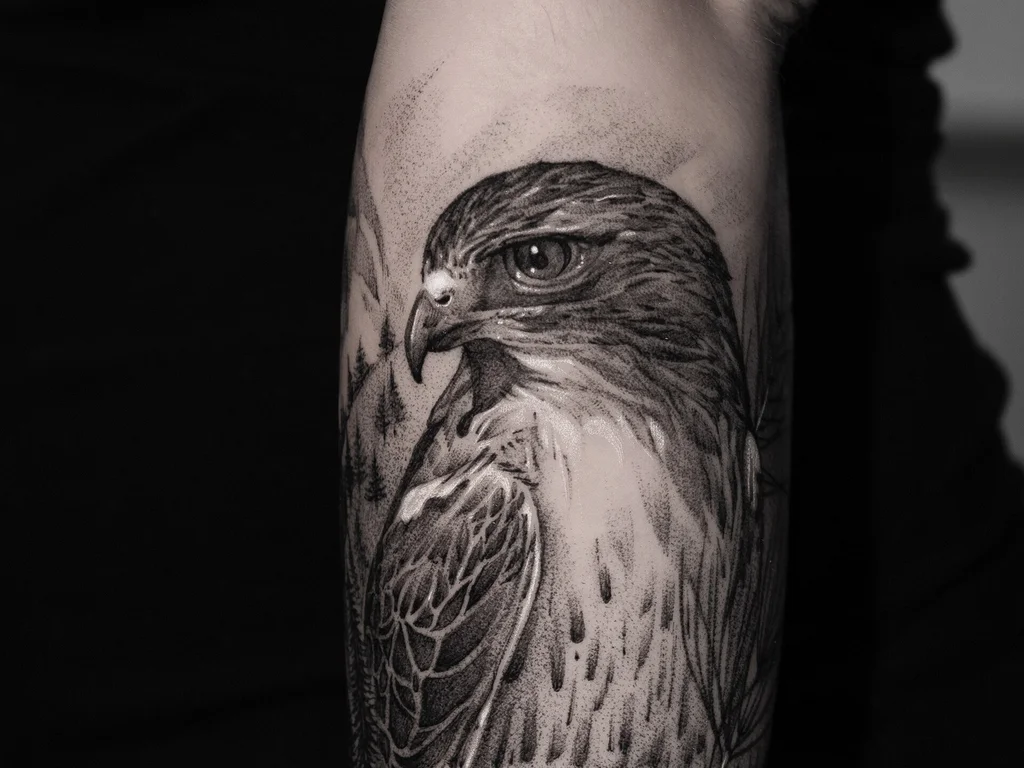
Another Dom Carter piece, this time the whole bird rather than the head alone. The eagle sits upright on the forearm in profile, speckled breast, folded wing, and a large pine cone drawn beneath it. The pairing is a woodland one — eagles of several species nest in tall pines, and the cone fills the lower forearm in a way a branch alone would not.
A forearm suits a vertical bird like this — the design reads when the arm hangs at your side. Notice the pine cone is drawn almost as large as the bird; background at honest scale is what separates a composed piece from a sticker.
10. Realistic Eagle Among Foxgloves, Upper Arm
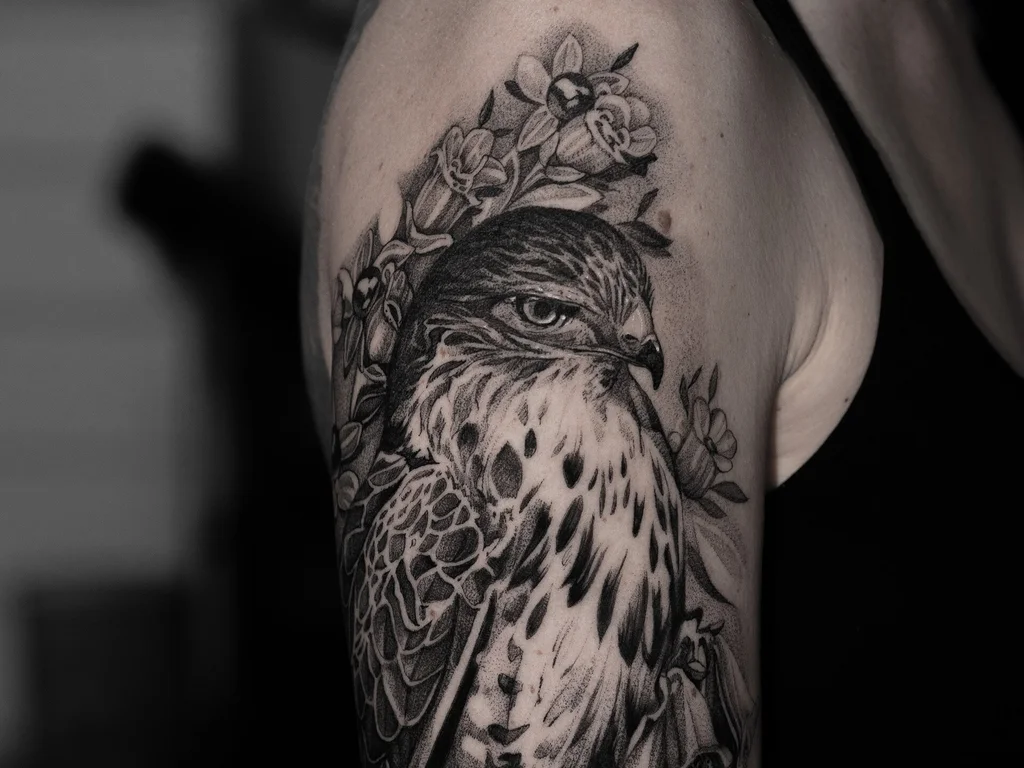
The third Carter eagle in this set takes the other route: the bird is smaller in the frame and the flowers do half the work. Foxglove spikes rise around a perched eagle on an upper arm, drawn in the same soft black and grey, so the tattoo reads as a piece of countryside rather than a portrait.
Three designs from one artist sit in this collection on purpose. Put them side by side and you can see the choice clearly: head alone for force, full bird for story, bird with plants for mood. The same subject, three different tattoos. That is the decision to make before you book anyone.
11. Colour Eagle With Flame-Toned Feathers, Shoulder
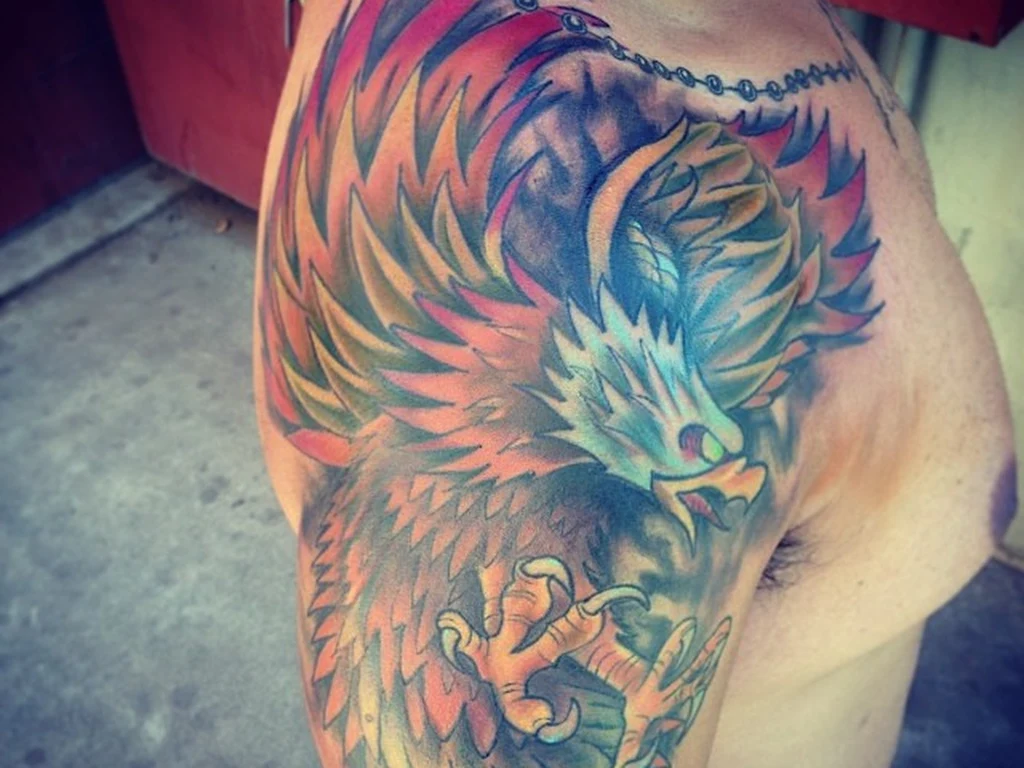
Not every eagle comes off a flash sheet. This one covers a shoulder and runs down the upper arm in the new school manner: a teal-green head, feathers tipped red and orange like flames, and the talons drawn big in the foreground. No real bird wears these colours, and that is rather the point.
New school work runs on exaggeration — bigger beak, bigger claws, hotter colour. The trade comes later: bright teals and oranges soften faster than traditional reds and golds, so a piece this saturated should be planned with a refresh in mind. As a placing it does what design 18’s 1973 eagle does, following the round of the shoulder — just fifty years louder.
12. Japanese-Style Eagle With a Red Sun, Upper Arm
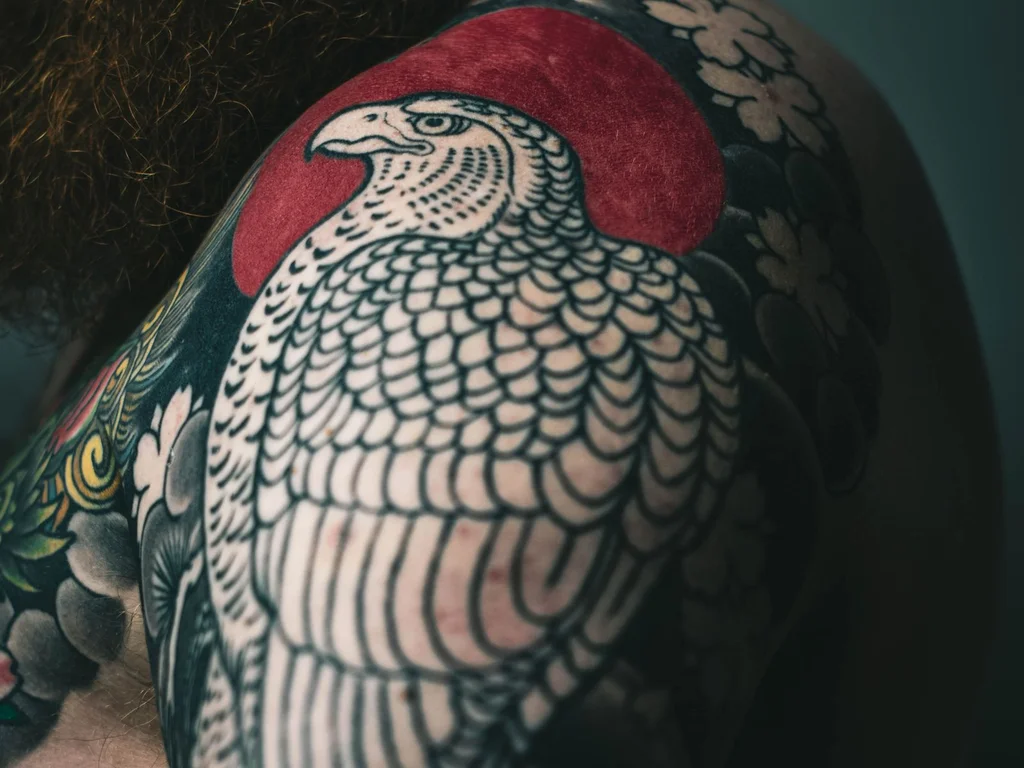
Japanese tattooing draws its birds of prey — the taka, covering hawks and eagles — with patterned, scale-like feathers, a fierce round eye and a strong hooked beak. This upper arm piece shows the full formula: the bird fills the arm from shoulder to elbow, a solid red sun sits behind its head, and clouds and blossom fill what is left.
In Japanese work the bird is never alone on the skin; background is part of the design, not decoration added later. If this style is the one you want, plan the whole arm from the start. Our dragon tattoo design ideas come from the same tradition and follow the same rules.
13. Spread Eagle on the Chest, Black and Grey
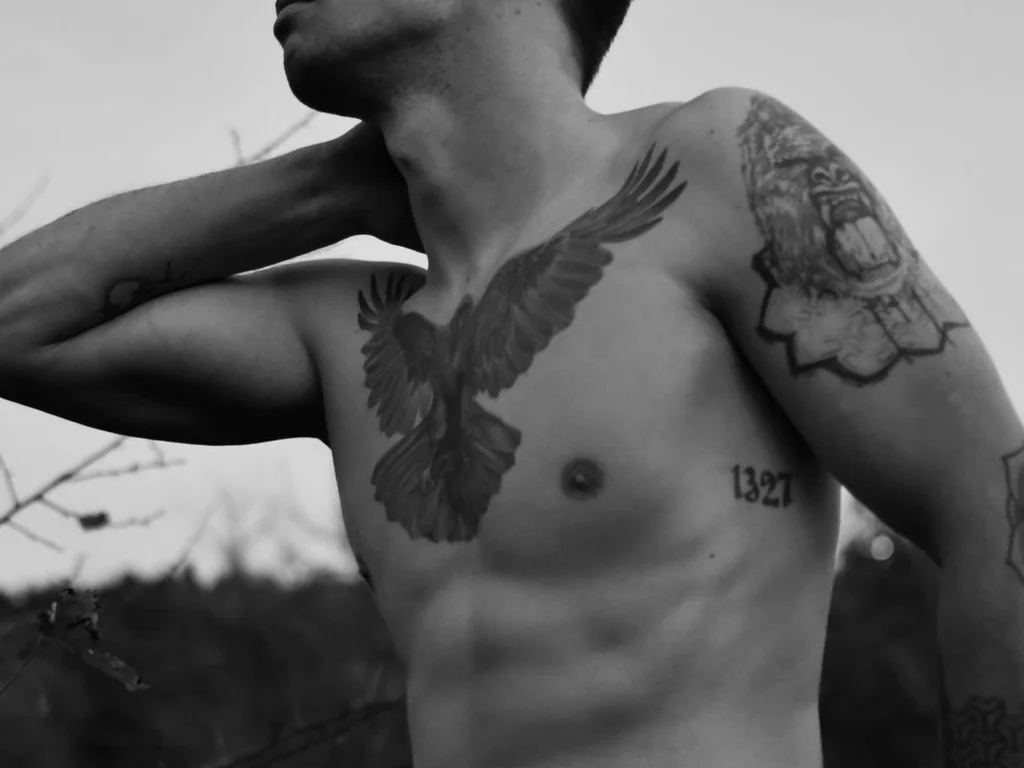
This photograph is black and white, so judge the tattoo by its shapes. An eagle climbs across the chest with one wing high and one dropped low, drawn in black and grey with the head at the centre of the chest. The pose is a taking-off moment rather than the flat heraldic spread, and it gives the piece movement most chest eagles do not have.
An off-centre, climbing bird is also a practical choice. It leaves room on the other side of the chest for later work — this wearer has a large rose on the opposite shoulder already — where a perfectly symmetrical eagle takes the whole chest and ends the conversation.
14. Outline Eagle Across the Upper Chest
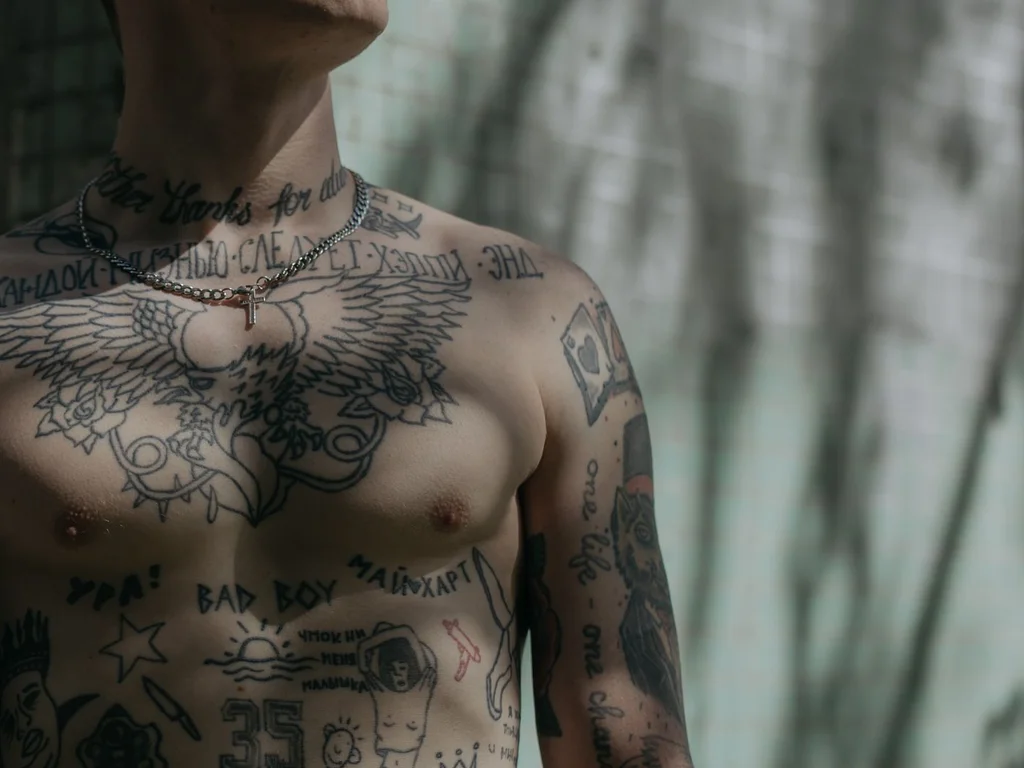
Here is the eagle reduced to its lines. Wings spread across the upper chest, roses at the wingtips, a small head at the centre — and no shading or colour fill anywhere. The man’s other tattoos are mostly the same way, a whole collection built from outline work and lettering.
An outline piece like this is sometimes a finished choice and sometimes stage one of a tattoo that will be shaded later. Both are fine, but know which one you are getting. Unshaded linework shows every wobble, so this style needs a steady artist more than a famous one.
15. Bald Eagle at the Centre of the Chest
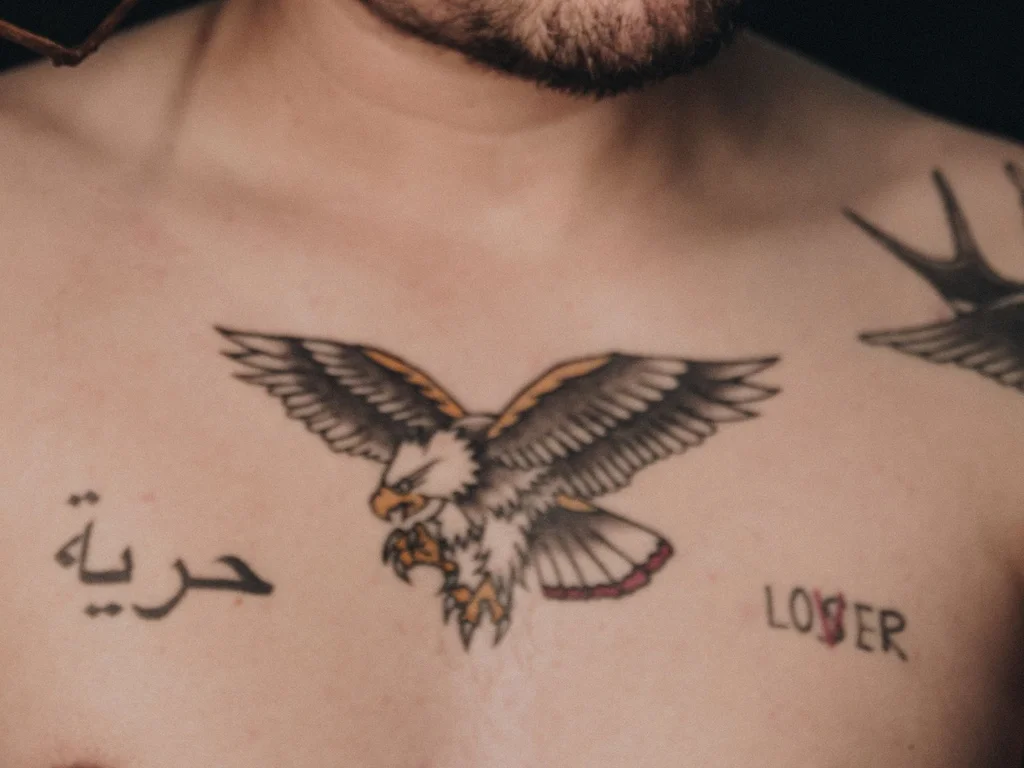
A bald eagle drawn the way the species actually looks — white head, yellow beak and talons, dark brown wings — sits at the centre of this man’s chest with its feet forward, mid-strike. Beside it, in Arabic script, is the word for freedom, and a small piece of English lettering sits on the other side. The bird and the word say the same thing twice, in two languages.
Colour realism at this size lives on contrast. The white head only reads because the wings behind it are dark, and the yellow stays bright because there is so little of it. If you want a true bald eagle rather than a generic bird, those colour breaks are the part to get right.
16. Eagle Across the Front of the Neck
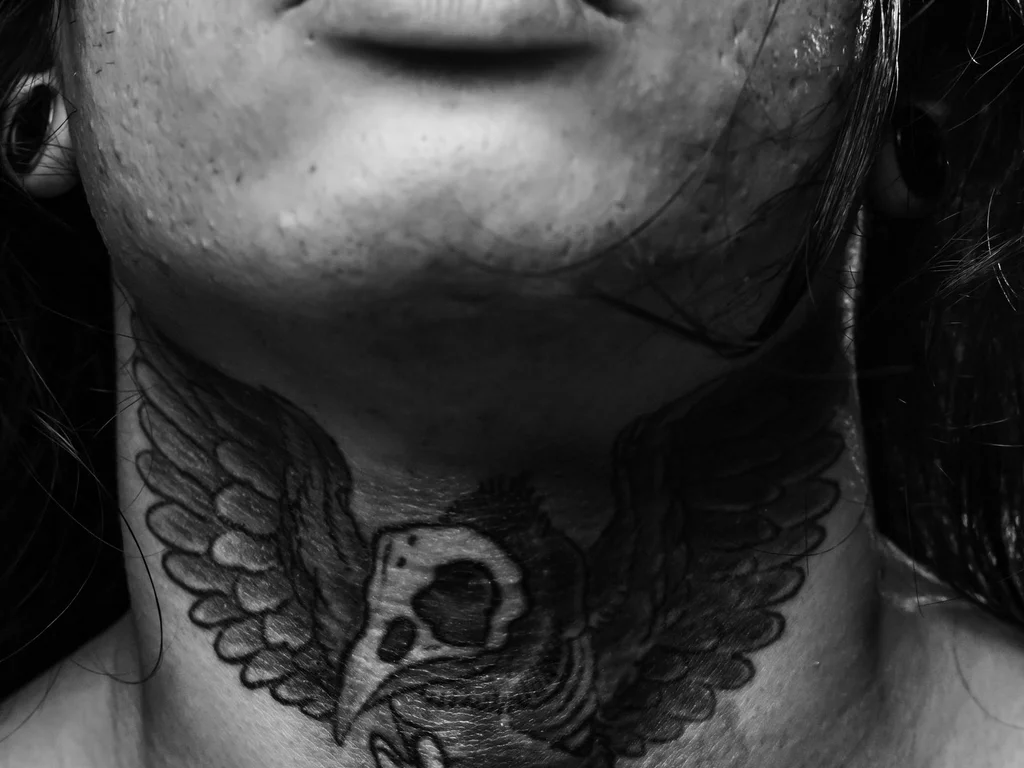
The boldest placement in this set. An eagle’s spread wings fit the front of the neck almost exactly — one wing up each side, the head at the throat — and this wearer has filled the centre with a small skull, so the bird wraps around it. The photograph is black and white; the tattoo is black and grey work.
Nothing hides a neck tattoo but a high collar, and the skin there is thin and moves constantly, which makes it a slow, sharp place to be tattooed. Artists will usually ask a new client to start somewhere else. As a later piece on someone already heavily tattooed, it is one of the strongest placements an eagle can take.
17. Traditional Perched Eagle in Profile, Arm
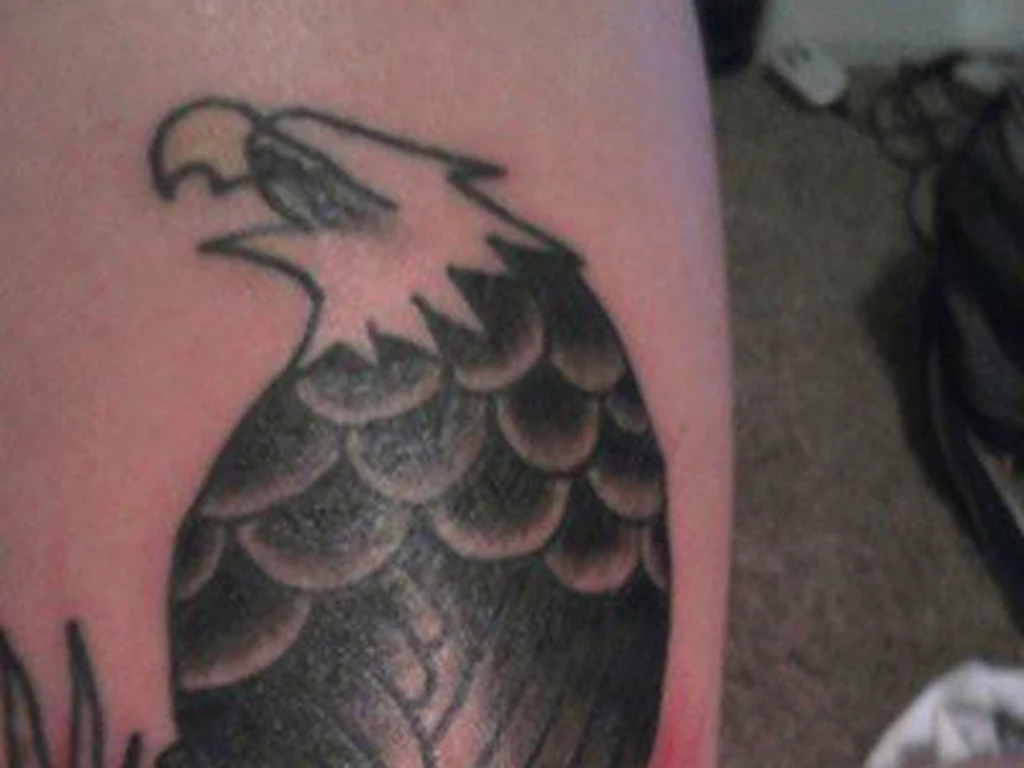
A bald eagle sits side-on along this arm: white head up, beak open, and a body built from rows of black scale-like feathers with red showing underneath. The photograph closes in on the head and body; below the crop the bird stands on a branch, in the perched pose — the eagle at rest rather than in flight.
A perched bird suits a limb the way a flying one suits a chest. The body runs along the arm’s length and nothing has to wrap around it. The photograph itself is a small, soft one from an older upload, but a heavy-lined traditional piece survives a soft photograph — its shapes were never depending on fine detail in the first place.
18. Colour Eagle on the Shoulder, Photographed in 1973
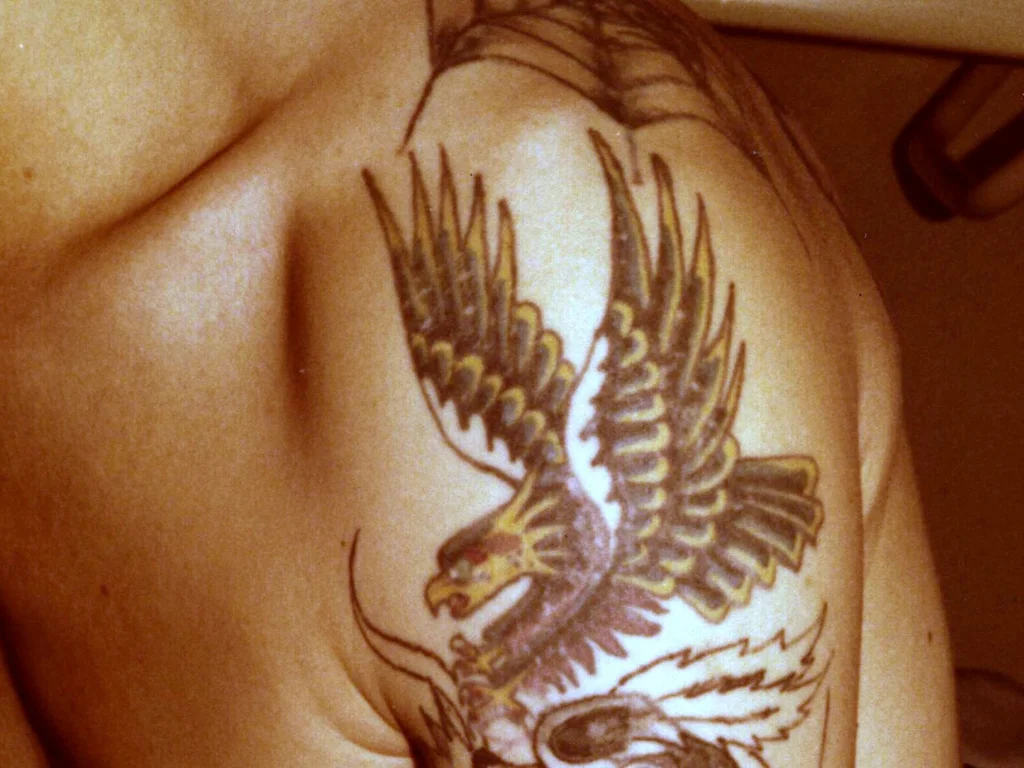
This photograph was taken in 1973, and the tattoo in it was already a settled, worn piece of work: a colour eagle with wings raised, climbing over a man’s shoulder. The reds and golds are the flat, limited colours of that period’s inks, and the lines are the thick hand-poked-look outlines of old European shop work.
Old photographs like this one are useful in a way fresh studio shots are not. They show what an eagle tattoo becomes after years on a body — softer, flatter, still plainly an eagle. If a design reads clearly after that long, the design was sound.
19. Eagle Head With a Black Swirl, Upper Arm
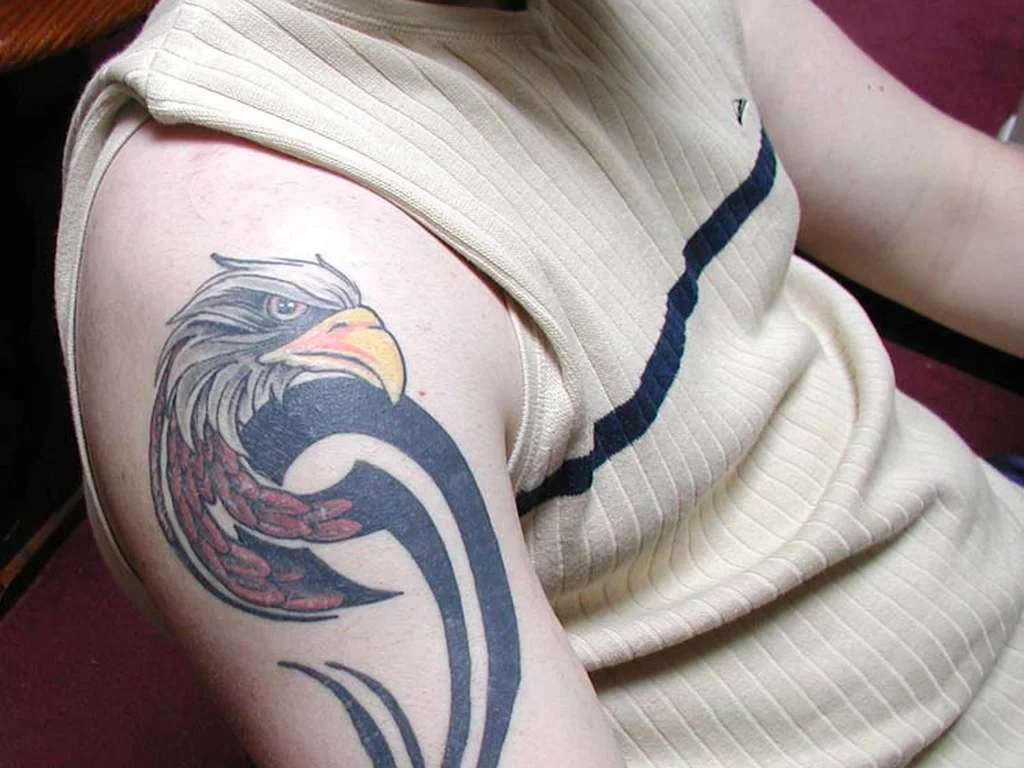
An American sailor’s upper arm, photographed for a US Navy record: a bald eagle’s head in white, red and yellow, and below it a single huge black swirl that runs down the arm like a wave. The two halves should not work together — a detailed head and an abstract mark — and yet the swirl gives the head somewhere to sit, and the arm reads as one design.
Pairing a literal subject with one bold abstract shape is an old sailor solution to a long, thin canvas, and it still works. If you want an eagle on an arm without a full sleeve of background, this is the honest way to fill the space.
20. Bald Eagle With a Flag and a Fire Axe, Upper Arm
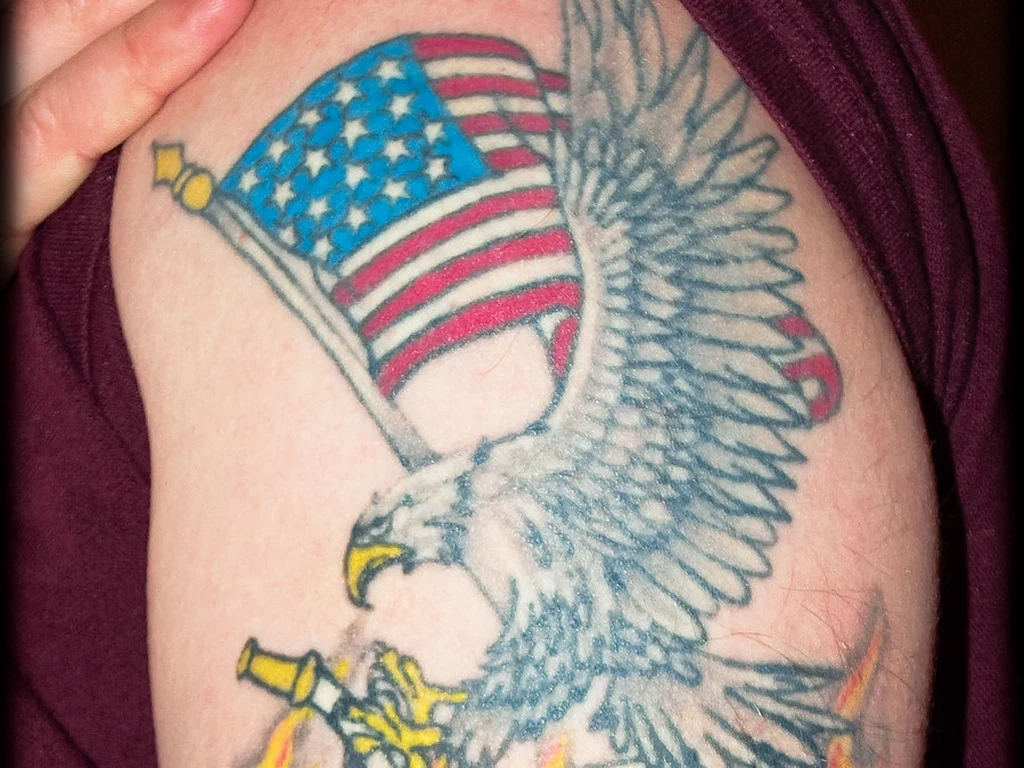
A bald eagle stands in front of an American flag on this upper arm, one wing raised high, its talons gripping a fire axe, with flames worked along the bottom. The photograph’s own title asks whether you can guess what the wearer does for a living. Fire-service eagles are a branch of the subject all their own — the same watchful bird, aimed at a different kind of duty.
It is also an honest look at an older tattoo. The blues have greyed, the lines have spread a little, and the flames have lost their hard edge. Years of sleeves, sun and physical work do that to a colour arm piece — and it still reads as an eagle at a glance, which is the test designs 1 and 6 will have to pass in their turn.
21. Eagle Head on the Upper Arm, Shown Outdoors
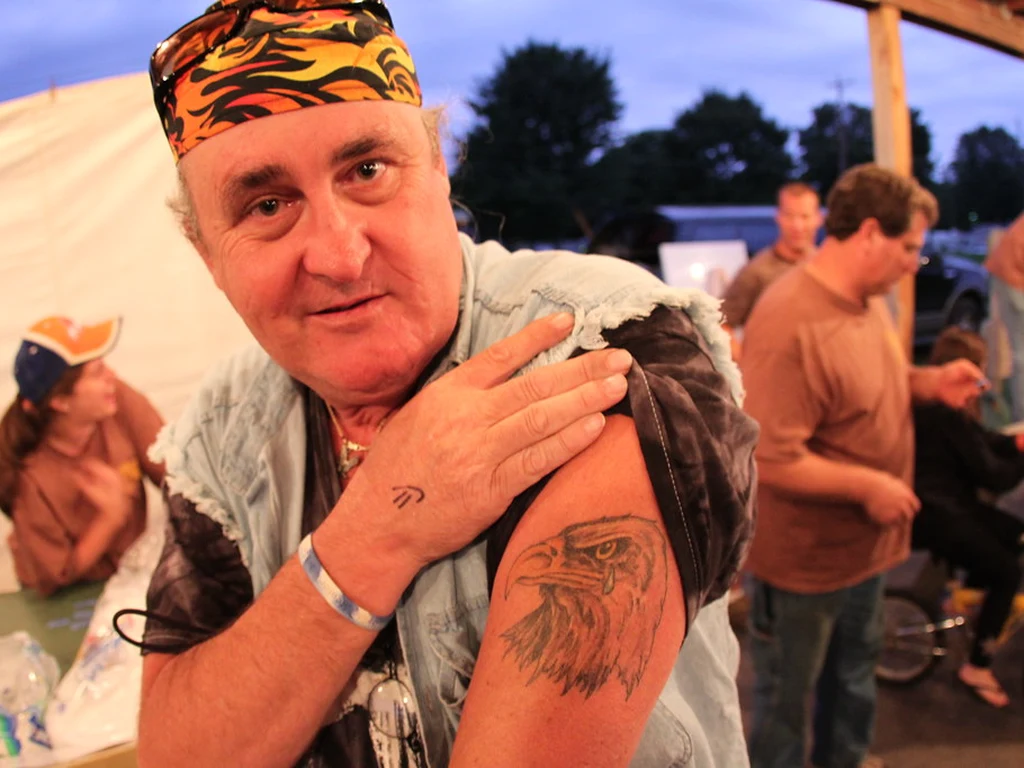
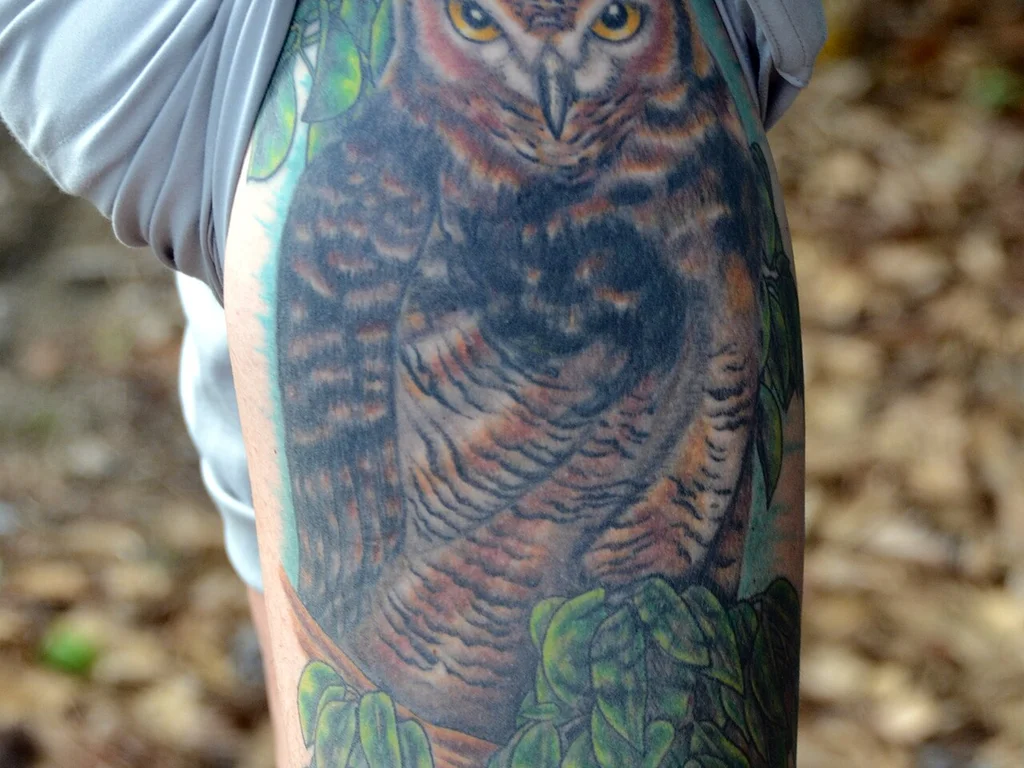
No studio and no backdrop here — a man at an outdoor gathering pulls his sleeve back to show the eagle head on his upper arm. The portrait is all head: heavy brow, hooked beak, feathers layered down the neck, in black and grey with a warm brown wash through it.
A head on its own is one of the oldest ways to wear this bird, and it asks one thing of the artist above everything else: the eye and the beak have to be right, because there is nothing else in the design to look at. Sized this way, an eagle also fits where a whole bird cannot — inside a sleeve plan, or standing alone on an arm for decades.
22. Small Eagle Silhouette, Upper Arm
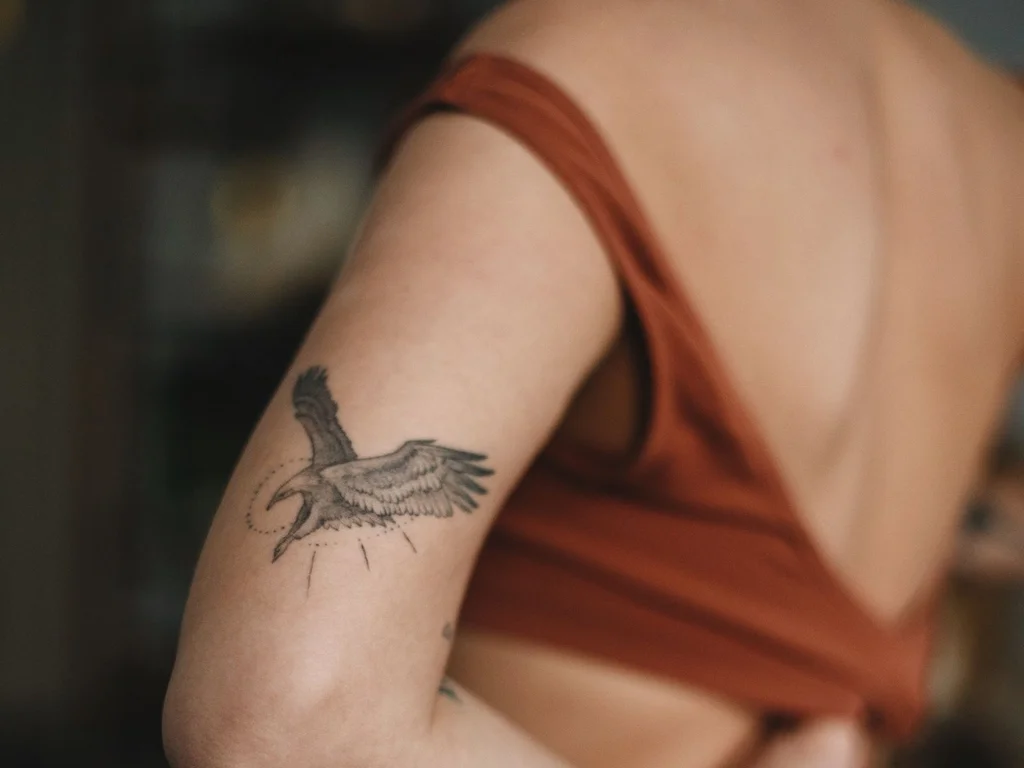
The smallest design in this set, and the only one that fits in a single short sitting. A little eagle in flight, drawn as a dark silhouette with a few lines for the wing feathers, sits high on this woman’s upper arm. At this size there is no beak detail and no eye — the wing shape and the hooked profile carry the whole meaning.
Small eagles live or die on that profile. Keep the wings up in the flying pose rather than folded, keep the beak hooked, and resist adding detail the size cannot hold. Done that way, a two-inch bird still reads as an eagle from across a room — the same test the big chest pieces have to pass.
Where an Eagle Tattoo Works Best
Chest. The natural home of the spread-wing eagle, and seven of the twenty-two designs in this set live there for a reason. The chest is wide, flat and symmetrical, and a bird with raised wings follows its shape without being forced. Small centre-chest birds work too, as design 15 shows. Pain sits in the middle of the range, sharper over the sternum and collarbones.
Back. The only place an eagle can go to full wingspan. A back piece is a project of several sessions, but nothing else gives the feathers this much room, and the skin there ages slowly because it sees little sun. Design 2 is the example in this set.
Upper arm and shoulder. The classic sailor placement and still the easiest to live with: covered by a sleeve of the clothing kind, shown when you want it shown. Vertical birds and single heads both fit the arm’s shape, as designs 1, 10, 12 and 19 show. Shoulder-cap eagles with raised wings, like design 18, use the round of the muscle well.
Forearm. Best for portraits. A head or a perched bird runs along the bone and stays readable, which is why all three realism pieces in this set sit on arms. Forearms fade faster than upper arms because of sun and washing, so bold shapes matter here.
Neck and other small spots. The neck eagle at design 16 is a statement placement for people who are already committed to visible work. For a first or a small piece, the upper arm silhouette at design 22 is the pattern to copy — and if you like your lines fine rather than bold, the same small-bird thinking runs through our fine line tattoo ideas. Traditional artists often pair eagles with star tattoo design ideas in the nautical style, worth a look if you are building a traditional arm.
Frequently Asked Questions
What does an eagle tattoo mean?
Most wearers mean one of three things: strength, freedom, or protection — the watching-over-others kind. Eagles also carry national and military meanings, strongest with the American bald eagle, so a flag, banner or unit badge added to the design will be read as part of the message.
How much does an eagle tattoo cost?
Size decides it. A small silhouette like design 22 is often a shop-minimum piece, commonly $60–$150 in the US. A palm-size traditional eagle runs a few hundred dollars. Chest and back pieces are priced by the session, and a full back eagle can pass several thousand dollars across its sessions. Get the number at a consultation, with the design at final size.
Do eagle chest tattoos hurt?
About as much as any work of the same size. The flat of the chest is moderate for most people; the sternum, the collarbones and the edges near the armpit are sharper. A chest eagle usually takes more than one sitting at traditional or realism scale, and most people find the second session easier than the first.
How well do eagle tattoos age?
The bold ones age about as well as tattoos can. Traditional eagles with thick outlines and simple colour blocks — designs 1, 4 and 5 — hold their shapes for decades. Soft realism like the Dom Carter portraits will lose some of its lightest shading over the years and may want a refresh. The 1973 photograph at design 18 is a fair picture of the honest end state: softer, flatter, still readable.
What is the difference between a bald eagle and a golden eagle tattoo?
The look, mostly. A bald eagle is drawn with the white head and tail and yellow beak of the adult bird, as in design 15, and it reads as American almost everywhere. A golden eagle is brown all over with a lighter, golden wash on the back of the head; it is the species on Mexico’s flag and the bird most European heraldry was based on. In black and grey they are told apart by shape and by the legs — golden eagles are feathered right down to the feet.
What does an eagle holding a snake mean?
It depends where the wearer takes it from. On Mexico’s flag it marks the Aztec founding legend of Tenochtitlan, the city that became Mexico City. In older European and sailor imagery the same fight usually stands for good over evil, or strength over a threat held down. There is no photograph of the pairing in this set, so it is covered here in words rather than shown.
How big should an eagle tattoo be?
As big as the feather detail you want to keep. A spread-wing bird with separated wing feathers wants at least the width of a hand; below that, the design has to simplify toward the silhouette of design 22, which is a good tattoo but a different one. Eagle heads can go smaller than whole birds because the beak and brow carry the likeness on their own.
Are eagle tattoos only for men?
No. The old flash books aimed them at sailors, so the back catalogue is full of men’s pieces, but two of the twenty-two designs in this set are women’s — the traditional chest eagle at design 5 and the small silhouette at design 22 — and studios book eagle work for women every week. Placement and scale change; the bird does not.
Can an eagle tattoo work in a fine line style?
A small one can, with care. Fine line feathers soften as they heal, so the design has to be drawn with space between the lines from the start — a flying silhouette with a few clear wing lines, like a lighter version of design 22. Detailed wing fans in hair-thin lines tend to merge within a few years, which is why most fine line eagles stay small and simple.
Where is the least painful place for an eagle tattoo?
The outer upper arm, for most people — padded, steady skin, and the placement half the classic sailor eagles used anyway. The outer forearm and the shoulder blade are close seconds. The neck, sternum and ribs sit at the other end of the scale.
Final Thoughts
Twenty-two designs is still short of the thirty-five this page first aimed for, and it is the real number — every photograph here was checked and credited. What the set does show is the full range of the subject: a sailor’s flag piece and a modern realism portrait, a full back and a two-inch silhouette, a bird from 1973 and birds done last year. Pick the scale first, the style second, and the exact bird third. An eagle drawn at the size its feathers need will still look like an eagle when both of you are older.
Photo credits: Design 1: US Navy, via Wikimedia Commons, public domain. Design 2: via Wikimedia Commons, CC BY 2.0. Design 3: Tony Alter, via Flickr, CC BY 2.0. Design 4: Pexels photo 13765710, Pexels License. Design 5: Pexels photo 4588720, Pexels License. Design 6: Tony Alter, via Flickr, CC BY 2.0. Design 7: Keith Killingsworth, via Wikimedia Commons, public domain. Designs 8, 9 and 10: tattoos and photographs by Dom Carter (@domcartertattoo), via Wikimedia Commons, CC BY-SA 4.0. Design 11: church32, via Flickr, CC BY 2.0. Design 12: Pexels photo 2200913, Pexels License. Design 13: Pexels photo 18512735, Pexels License. Design 14: Pexels photo 5320030, Pexels License. Design 15: Pexels photo 9408048, Pexels License. Design 16: Pexels photo 9617619, Pexels License. Design 17: Cameron Genereux, via Flickr, CC BY 2.0. Design 18: Wikimedia Commons (Hoffmann, 1973), CC BY-SA 3.0 DE. Design 19: US Navy, via Wikimedia Commons, public domain. Design 20: TheeErin, via Flickr, CC BY-SA 2.0. Design 21: Daveynin, via Flickr, CC BY 2.0. Design 22: Pexels photo 7682971, Pexels License.