A wild animal tattoo makes its point before anyone asks what it means. A lion reads as pride and nerve, a wolf as loyalty with teeth, an elephant as family and a long memory. The designs below skip the cartoon versions: every one is a real tattoo on real skin, photographed and counted one by one — 35 in total, across fourteen kinds of animal.
This page is the cross-species sampler. Lions, tigers and wolves get four designs each; elephants, deer and the spotted cats get a fair share; and a few animals — the fox, the lynx, the giraffe — appear once, because that is how many good, legally shareable photographs of them exist. Dedicated single-species guides are on the way, and this page will point to each one as it lands.
Everything here sits under our animal tattoo ideas pillar, which maps the whole cluster. If your animal flies rather than walks, the bird tattoo ideas page is the other half of the family, and the snake tattoo ideas guide covers the one common tattoo animal that is not a mammal at all.
What Wild Animal Tattoos Mean
Strength is the reading most people start with, and the lion owns the oldest version of it. Lions stood for royalty and courage in heraldry and royal art for centuries — Britannica’s lion article traces how deep that runs, from ancient Egypt to the modern zoo. Tigers carry a parallel weight in Asian art, and the Sak Yant tiger below is a living religious tradition, not a motif.
Freedom and instinct are the newer layer. A wolf or a stag is often shorthand for trusting your gut and answering to nobody, and honesty requires a label: that reading is mostly tattoo-shop convention from the last few decades, built on real animal behaviour. Wolves really do live and hunt as families; stags really do meet challenges head-on. The symbolism is recent even when the behaviour is not.
The third reading is family and protection. Elephant pieces are usually about kin — a mother, calves, names scripted underneath. The lion-and-cub and fox-and-cub designs in this set say the same thing in a different accent. And plenty of wild animal tattoos mean nothing more coded than respect for the animal itself, which is a perfectly good reason.
The 35 Designs
1. Geometric Lion Head in Black and Grey, Forearm
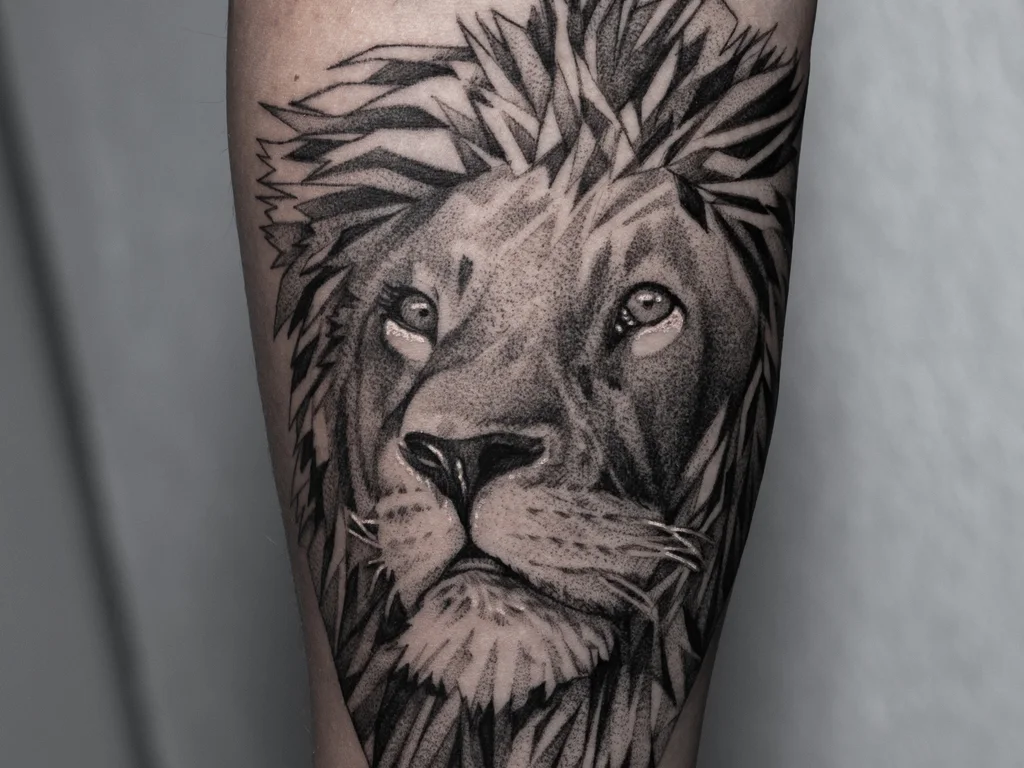
The lion’s face is built from flat planes and hard edges, like a carved model of a head. No whisker detail and no soft fur — the mane is a crown of triangles, and the shading sits inside the shapes.
Geometric work ages honestly. The planes stay readable as the greys soften, because the likeness lives in the shapes rather than the shading. It does need a steady artist: one crooked plane has nowhere to hide.
2. Lion With a Mandala Mane, Upper Arm
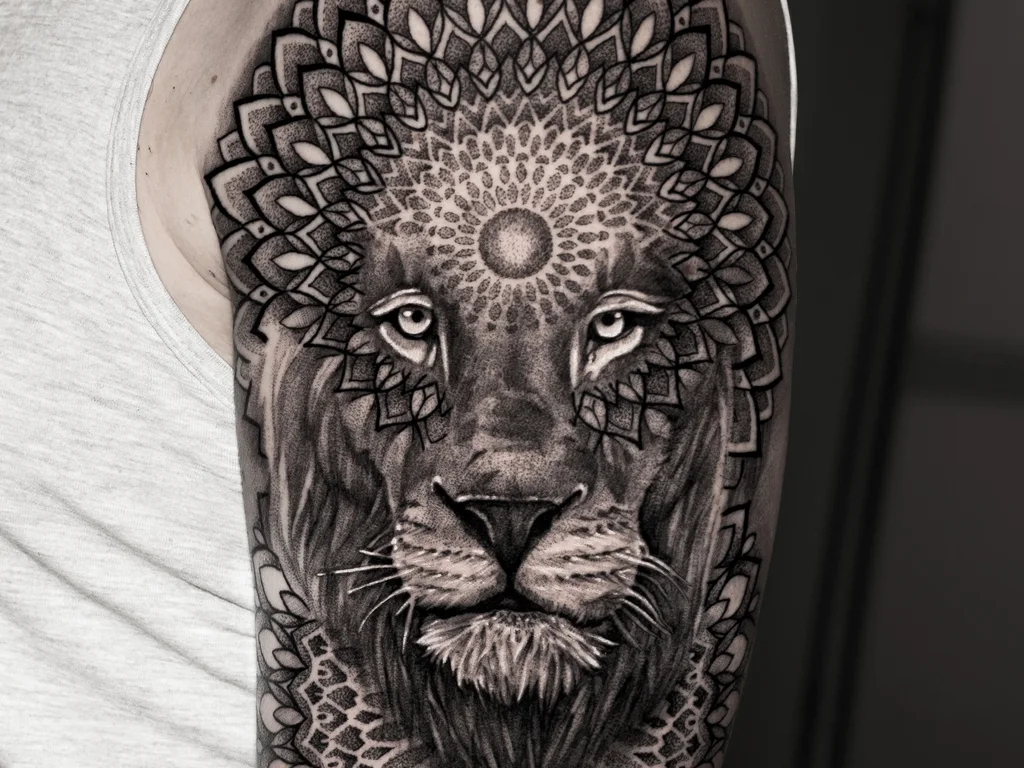
A calm lion face sits inside a full mandala — rings of petal pattern where the mane should be, a small sun disc on the forehead.
Mandala pieces reward patience and punish rushing, since every ring has to match its opposite number. The upper arm gives the full circle room to sit flat instead of wrapping out of shape.
3. Colour Lion Head, Shoulder and Upper Arm
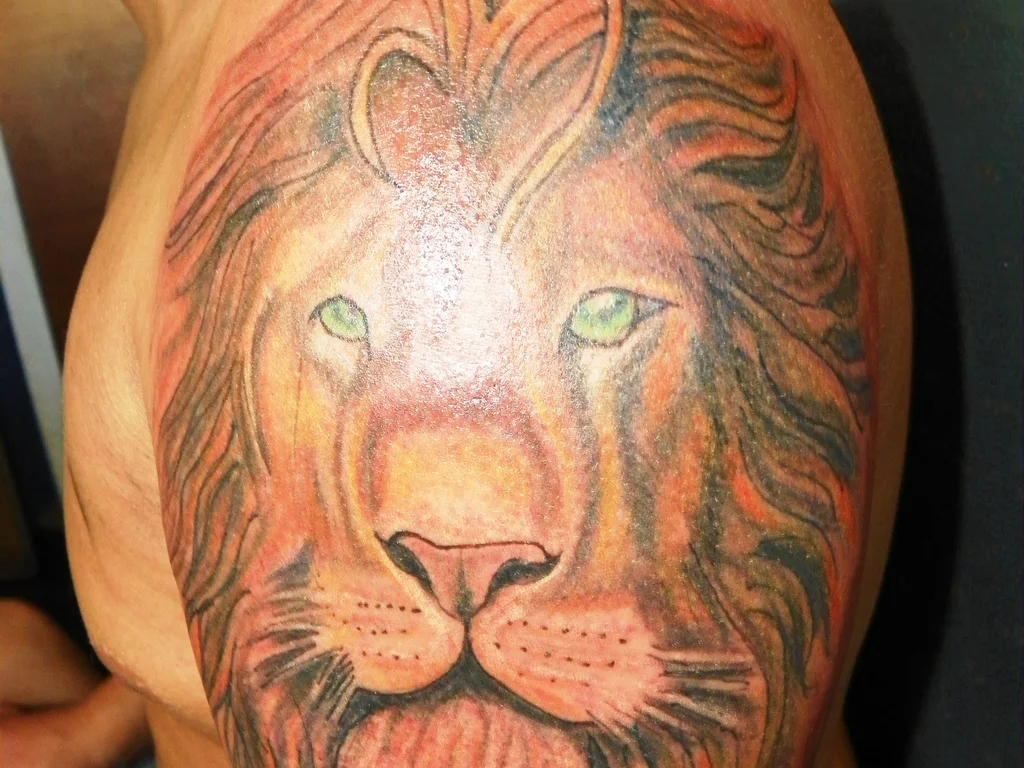
A full-colour lion in oranges and rust, mane swept back, pale green eyes — the warm end of the lion family. It fills the shoulder cap and runs down the upper arm.
Colour this saturated is a maintenance promise: sunscreen as a habit, and probably one refresh over the years to keep the mane loud.
4. Lion and Cub, Forearm
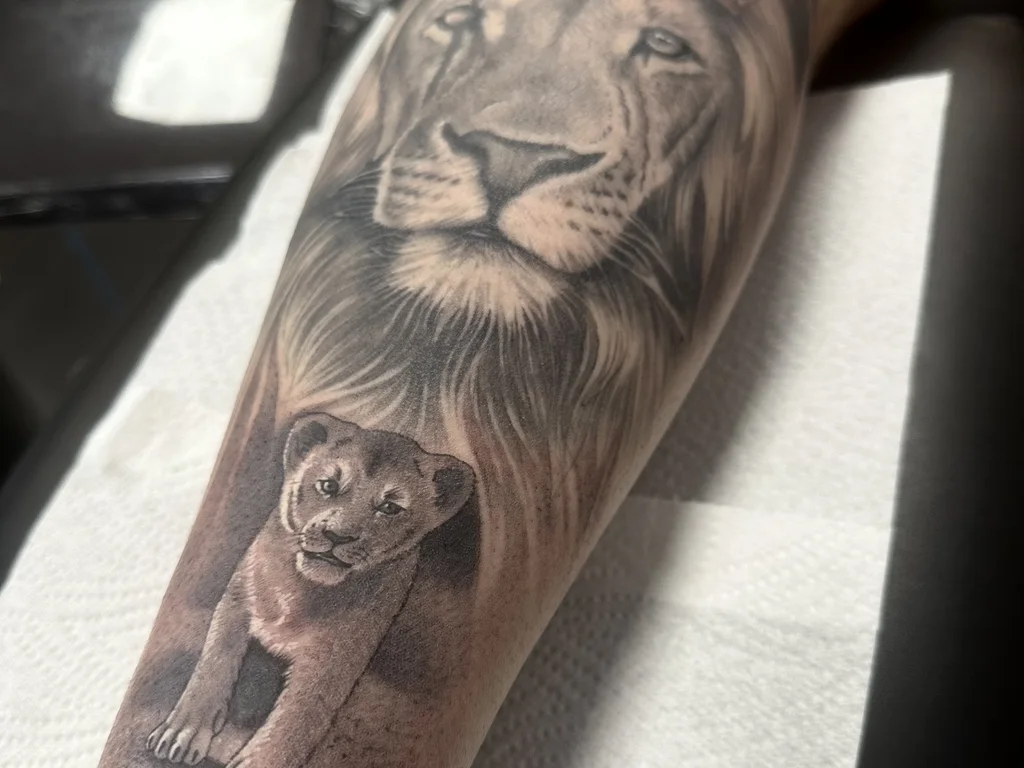
An adult lion’s head fills the top of the forearm; below it, drawn smaller, a cub walks out from under the mane. The scale difference does the storytelling.
Parent-and-child pieces are the most common reason people pick a lion over a tiger. Fine grey shading like this heals softer than it looks on the day, so judge the artist on healed photographs.
5. Tiger Face Across the Whole Back
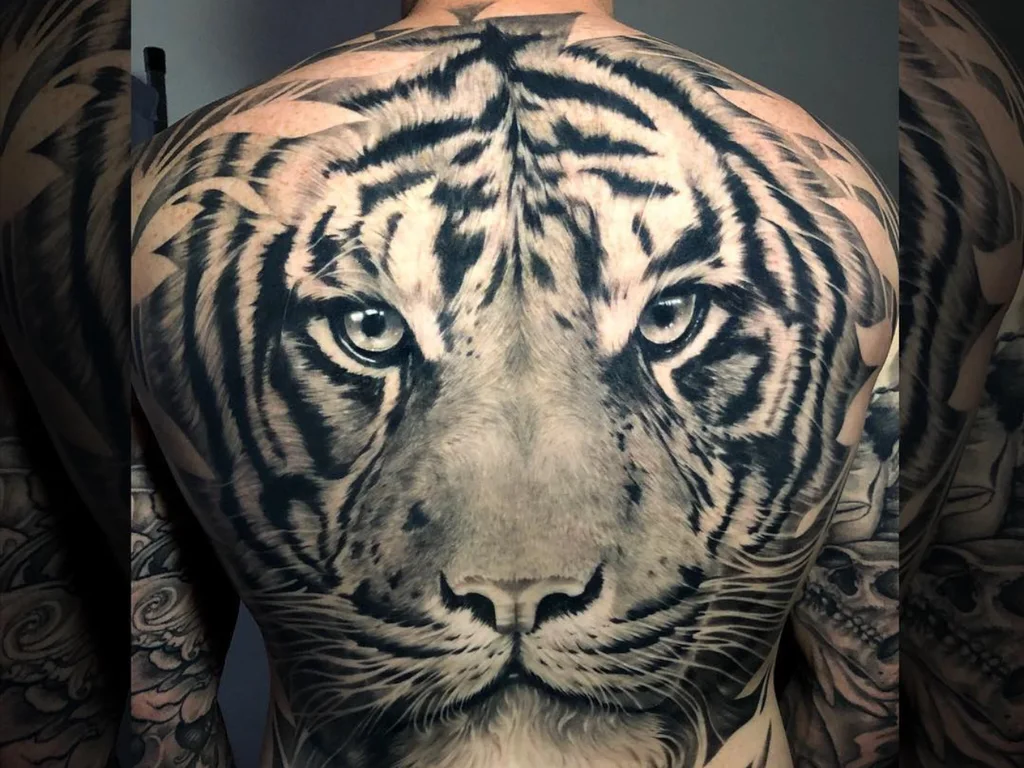
A tiger’s face at full stretch — ear to ear across the shoulder blades, nose centred on the spine, drawn in black and grey with the stripes doing all the pattern work.
A back piece this size is a project: outline first, then shading sessions spread over months. The payoff is a scale no other placement allows. The cost is that you will rarely see your own tattoo without a mirror.
6. Sak Yant Tiger With Sacred Script, Back
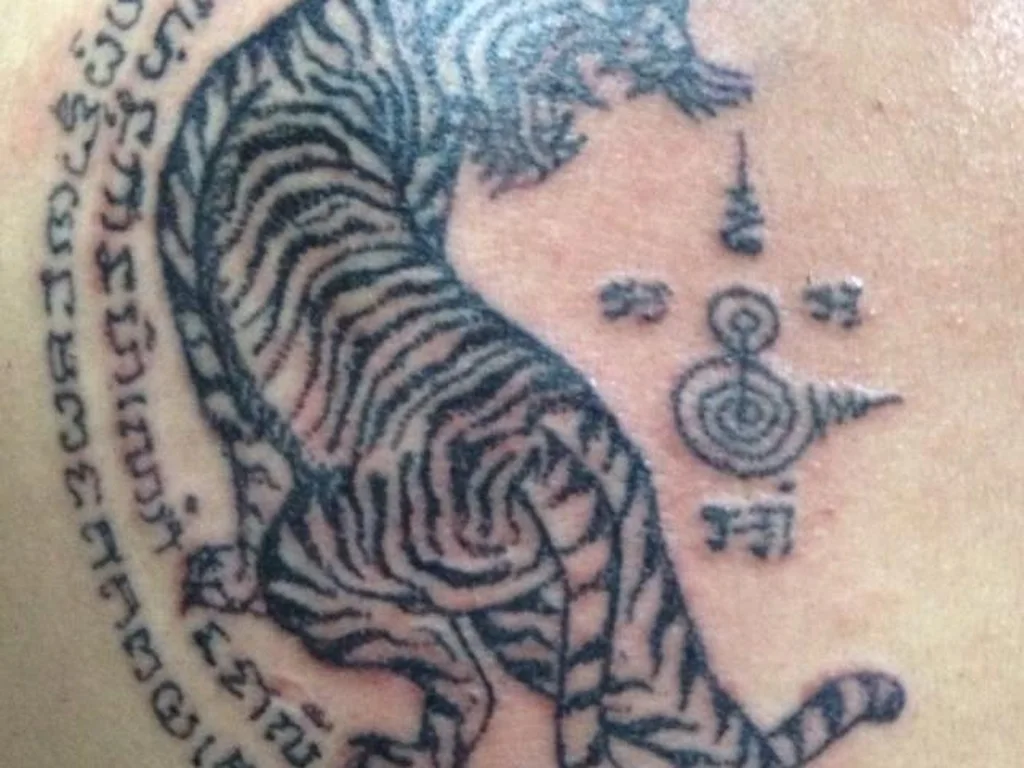
This leaping tiger is a Sak Yant, a sacred Thai tattoo ringed with Khmer script and yantra symbols. Traditionally they are given by Buddhist monks or ajarn — tattoo masters — worked by hand, with prayers built into the sitting.
For many wearers this is a blessing and a religious commitment, not a style. If you want one, the honest route is to receive it properly, from an ajarn, rather than copy the look in a regular studio.
7. Colour Realism Tiger, Upper Arm
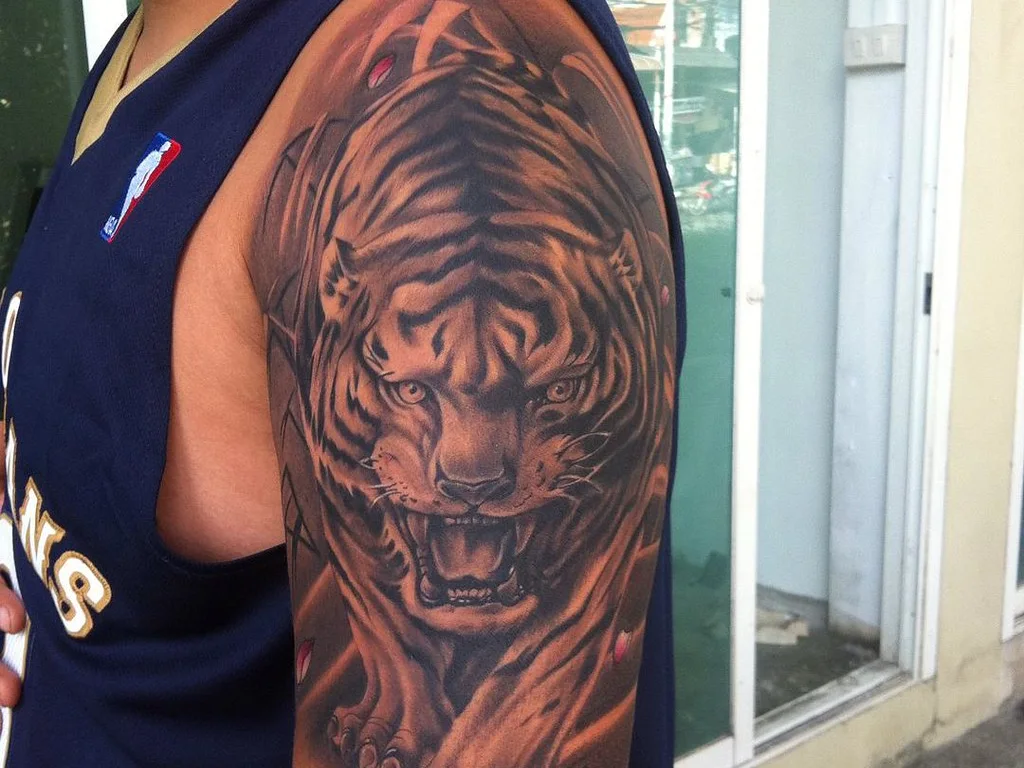
A snarling tiger head in full colour — orange coat, white muzzle, teeth out — wrapped around an upper arm and photographed in daylight, so what you see is close to the healed truth.
Realism needs this kind of room. Shrink a tiger’s face too small and the stripes merge into mud within a few years; at upper-arm scale the pattern has space to stay separate as the ink settles.
8. Roaring Tiger Head With a Kanji Character
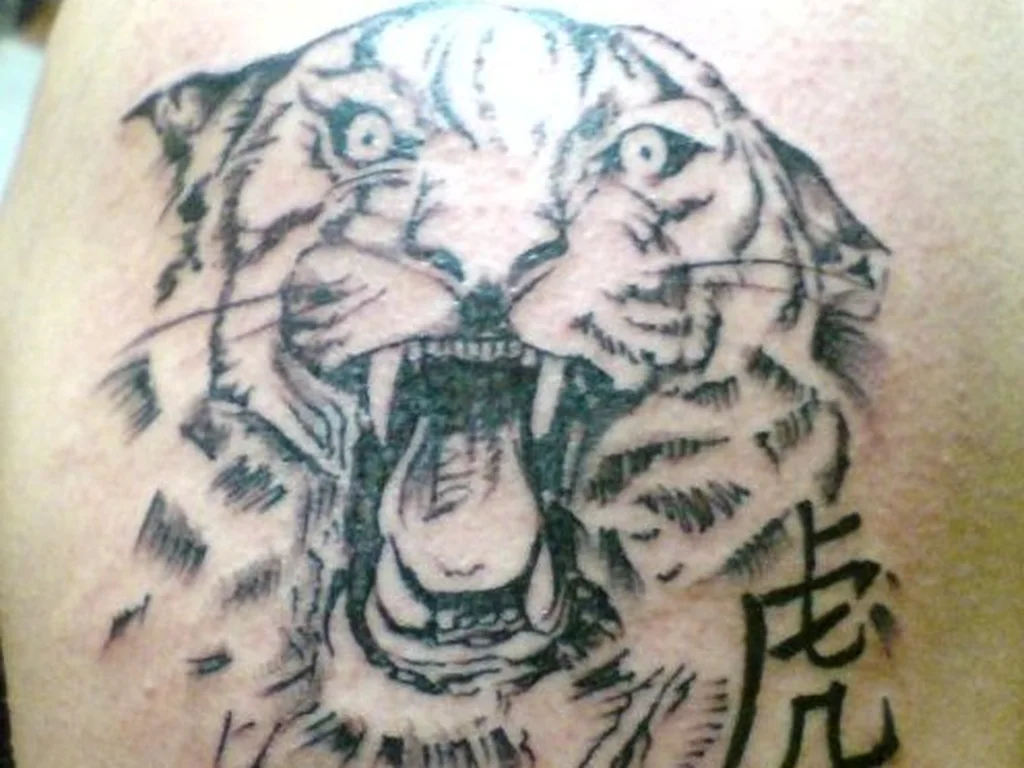
A roaring tiger head in loose black line work, the kanji character for “tiger” set beside the jaw. The lines have spread a little and the blacks have greyed — a tattoo that has been lived in.
Study it for exactly that reason. The bold shapes still read clearly years on, while the finest whisker lines have blurred. Design for year ten, not day one.
9. Colour Wolf Portrait, Upper Arm
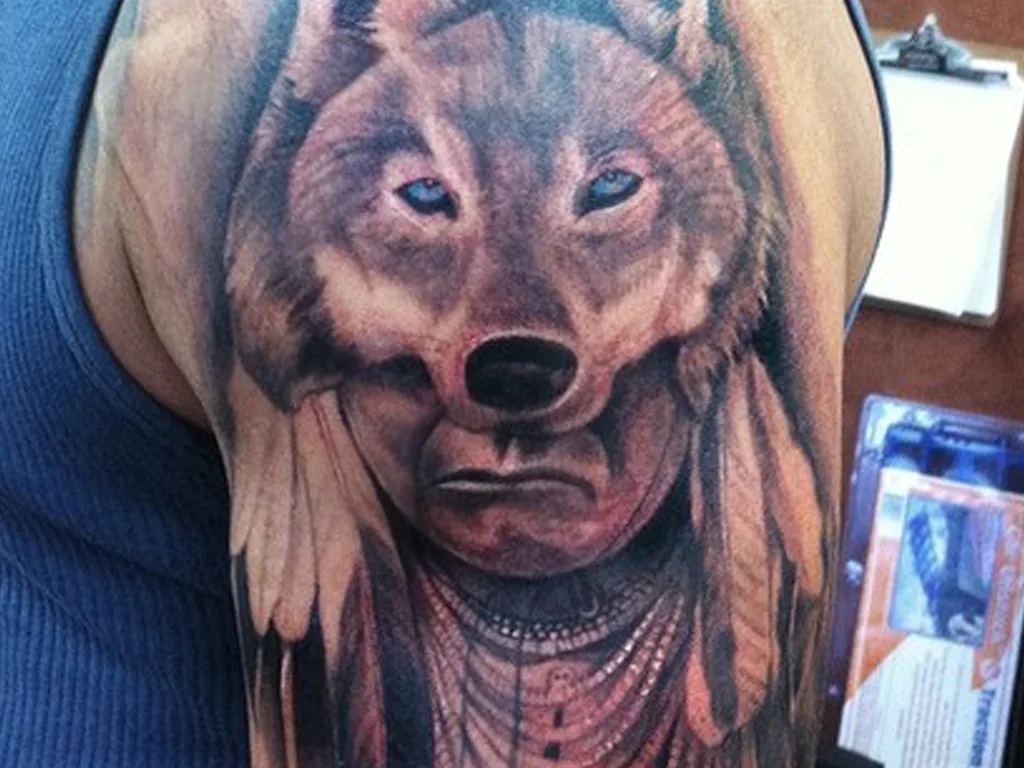
A warm brown wolf stares straight out of this upper-arm piece, feather shapes hanging at either side of its face. The eyes are pale against the dark coat, and they carry the whole design.
Colour wolves are rarer than black and grey ones — most people draw the wolf as a night animal and keep it monochrome. Browns soften gracefully with age, which makes this a safer colour bet than reds or blues.
10. Wolf Head With a Crescent Moon in a Geometric Frame, Thigh
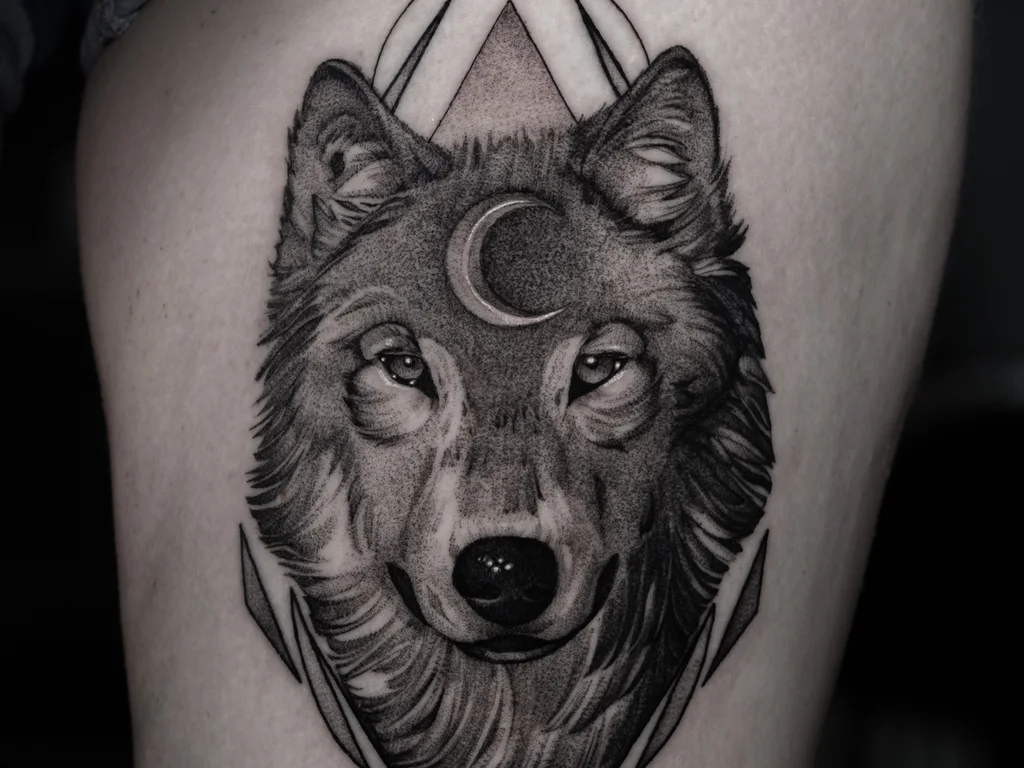
A wolf’s face drawn soft and symmetrical, a crescent moon set into its forehead, the whole head inside a triangle of fine line work, on the thigh, where the frame gets room.
The moon is the meaning here — the night side of the wolf, intuition over aggression. Fine geometric frames need breathing space between the lines, and this size gives them it.
11. Black and Grey Wolf, Biceps
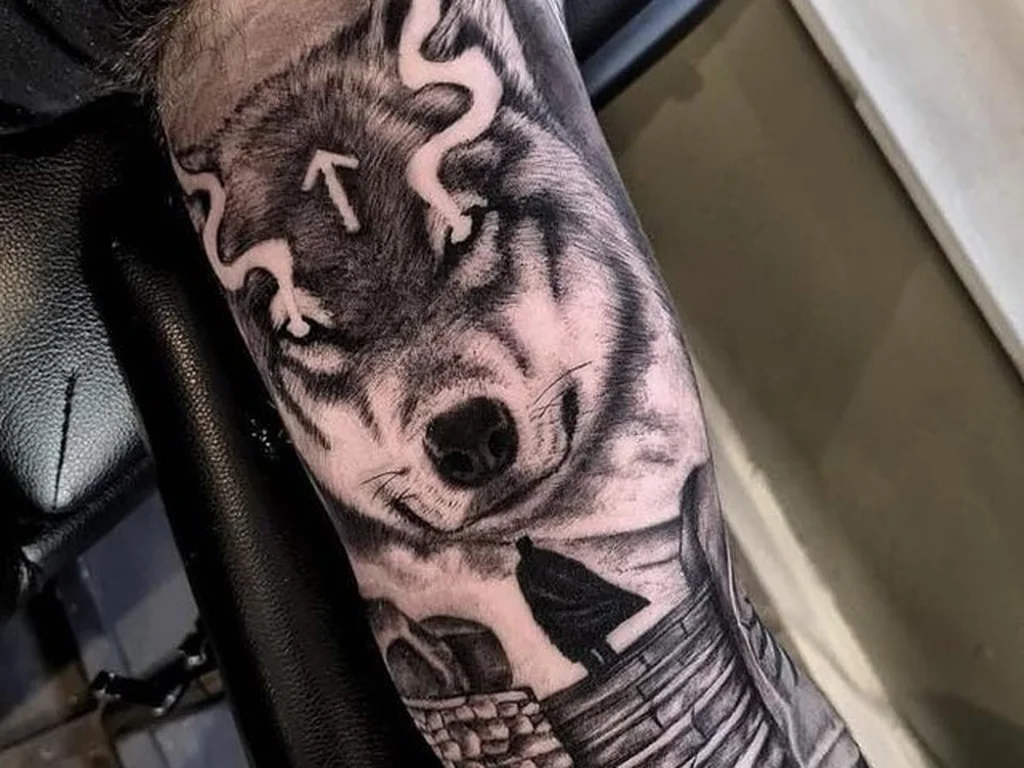
A snarling wolf head wraps the biceps, small white rune-like marks worked into the fur above the eyes. This is the defensive wolf — teeth first, questions later.
Biceps pieces shift as the arm flexes, which suits an aggressive design. The white marks are bare skin left untattooed rather than white ink, so they will hold up better over time.
12. Wolf and Skull With a Red Band, Forearm
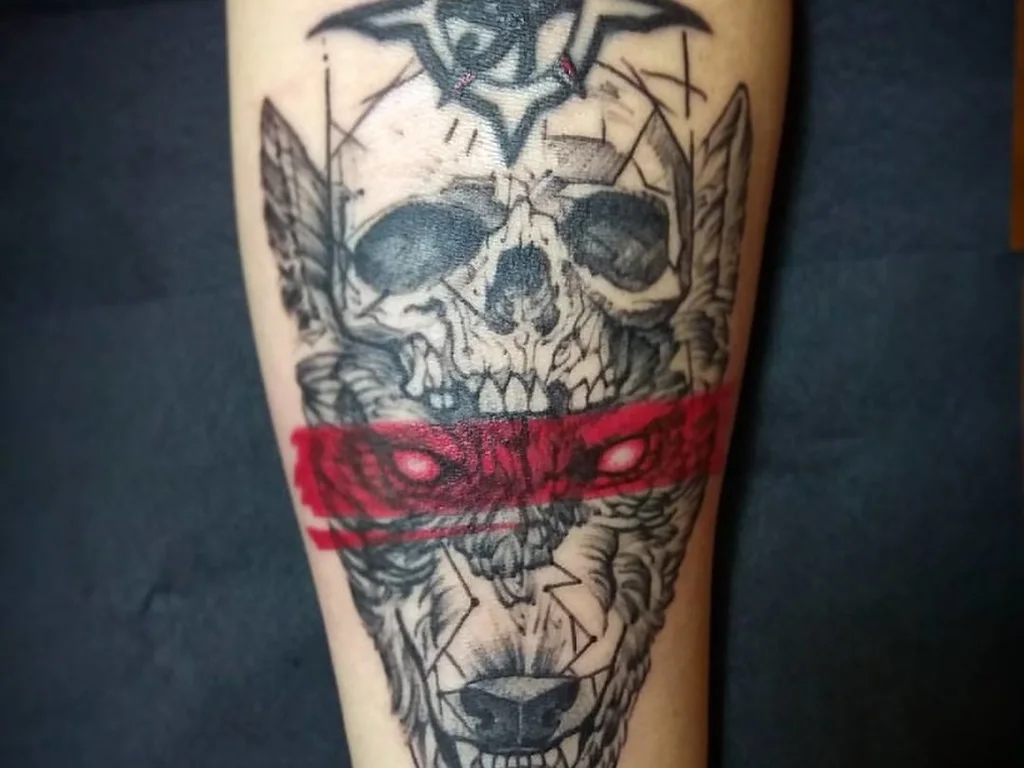
A human skull sits above a wolf’s head on this forearm, and a band of solid red — the only colour in the piece — crosses the wolf’s eyes like a blindfold.
Skull-and-wolf is the memento mori pairing: the wild thing, and the reminder that it ends. One flat colour used once is a strong trick — the red stays the loudest thing on the arm for years.
13. Roaring Bear Head, Upper Arm
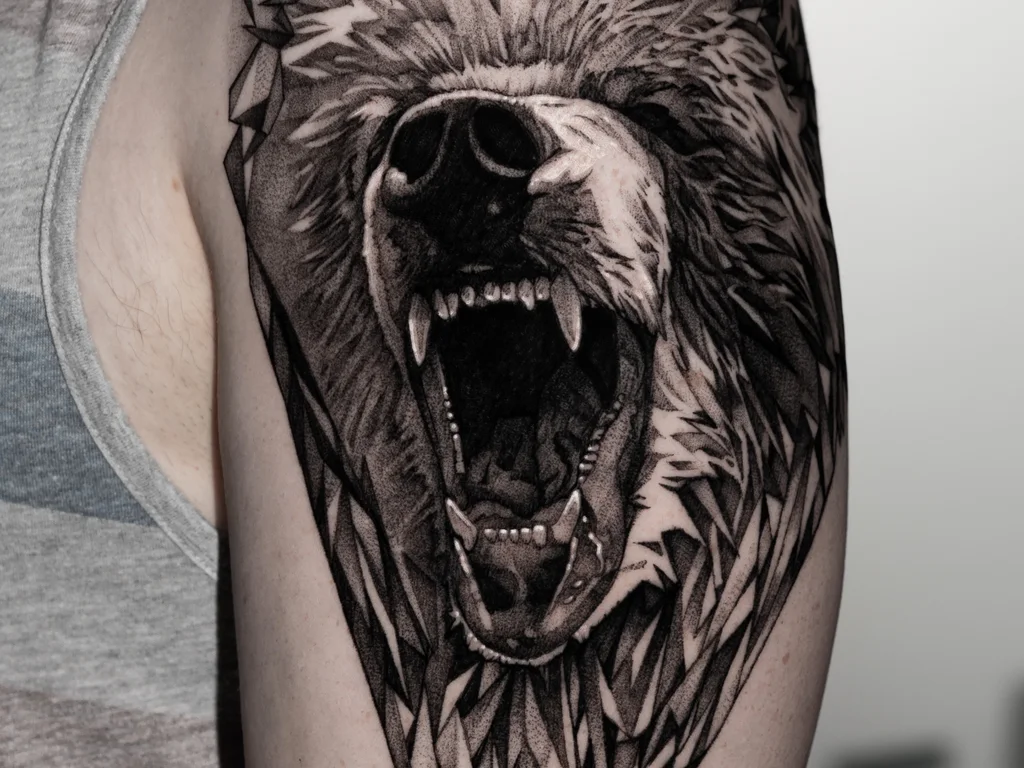
A bear’s head mid-roar fills the upper arm, jaws open, the whole design pulled into a long triangle that follows the arm’s shape. All black and grey, all volume.
This is the bear most people picture: power and temper in one frame. The open mouth is the hard part — teeth and tongue need real gaps of bare skin between them to stay readable as the greys settle.
14. Bear Face With Roses, Forearm
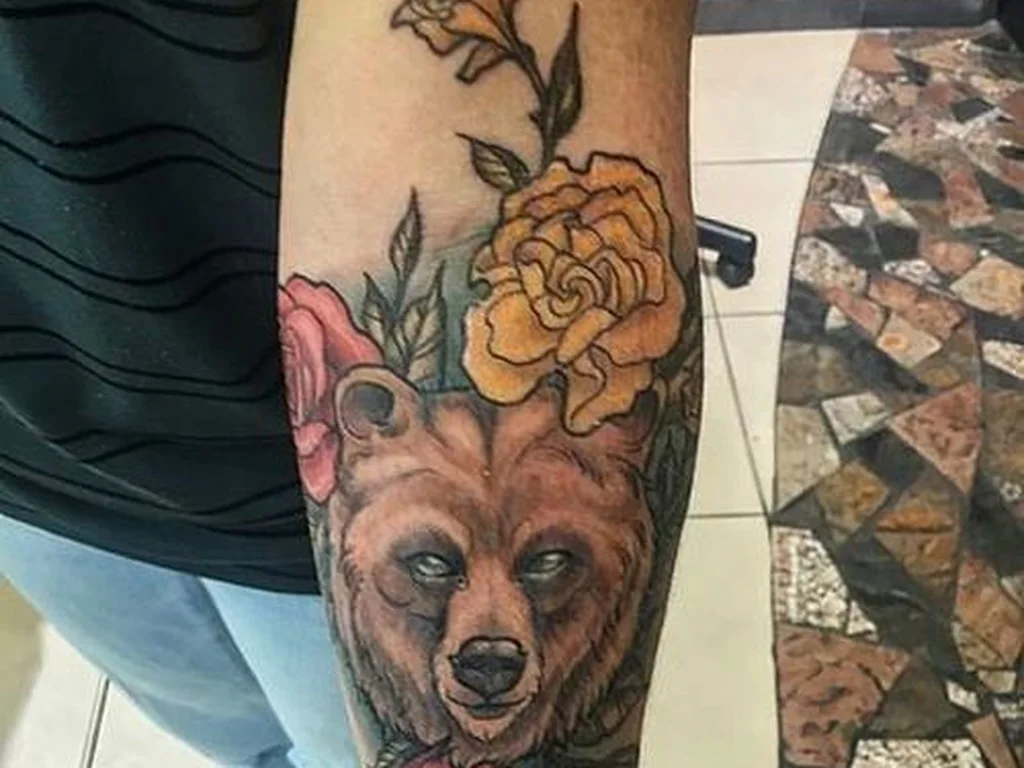
The gentle version: a brown bear’s face in soft colour, framed by yellow and pink roses, running down a forearm. The bear looks calm; the flowers do half the talking.
Bear-plus-flowers is often a memorial piece, or a mother’s — strength with the edges taken off. Soft colour heals pastel, so keep the outlines if you want it to stay gentle rather than washed out.
15. Standing Bear in Black and Grey, Arm
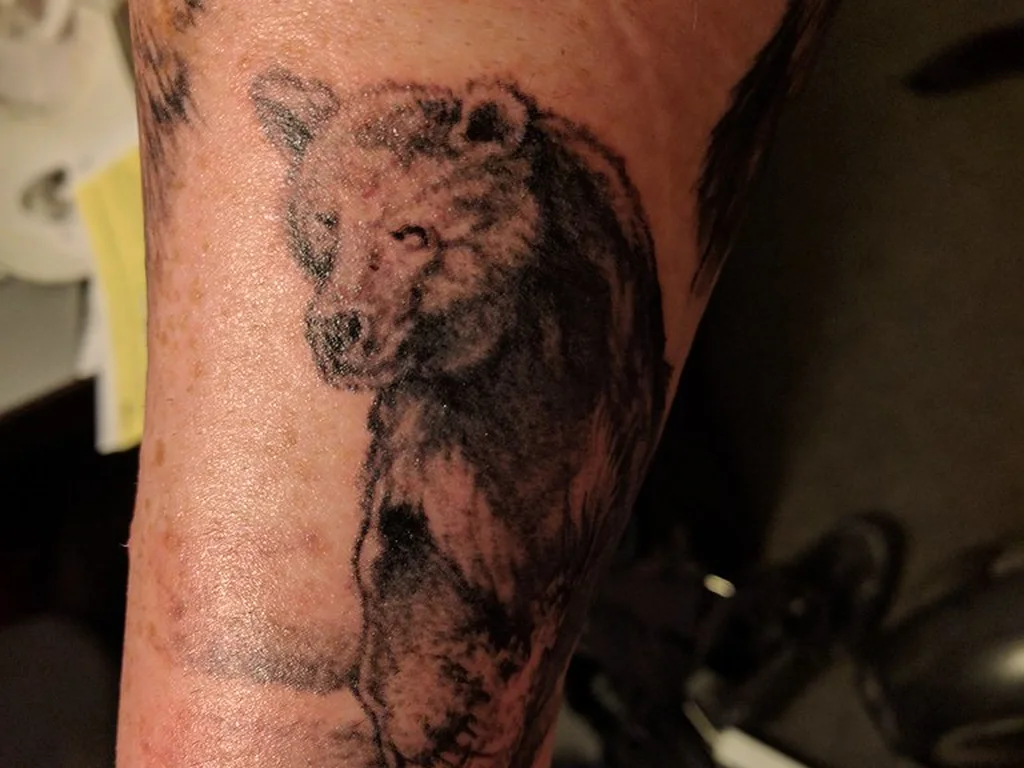
A whole bear, standing in profile, drawn in scratchy black and grey down the arm. The fur is built from rough strokes rather than smooth blends, and the edges have softened with wear.
Full-body animals are the exception in this set — heads dominate, because faces carry the meaning. A standing bear reads as a nature piece, and loose shading like this hides ageing better than smooth realism does.
16. Elephant Head and Trunk Across a Whole Torso
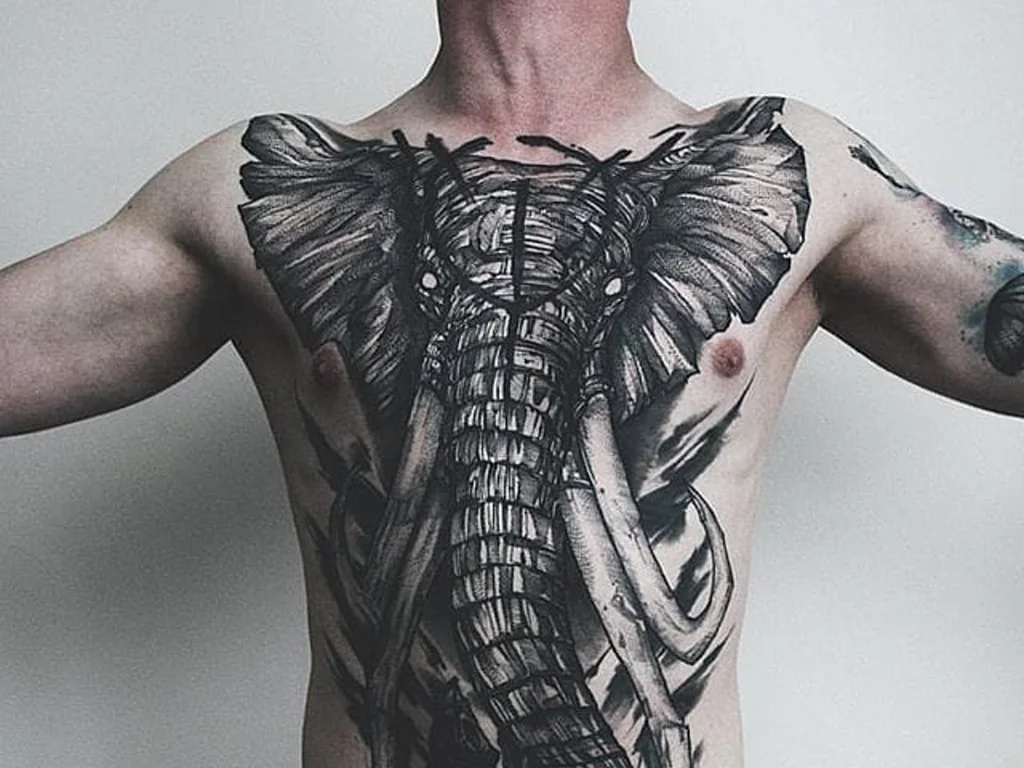
The biggest commitment in this collection: an elephant’s head spread ear to ear across the chest, trunk running down the centre of the torso. There is no background — the animal is the whole canvas.
Work at this scale takes many sittings and decides what the rest of the torso can ever hold. It is also the clearest statement of what elephants mean to most wearers: memory, patience, weight carried calmly.
17. Elephant Mother and Calves With Names, Forearm
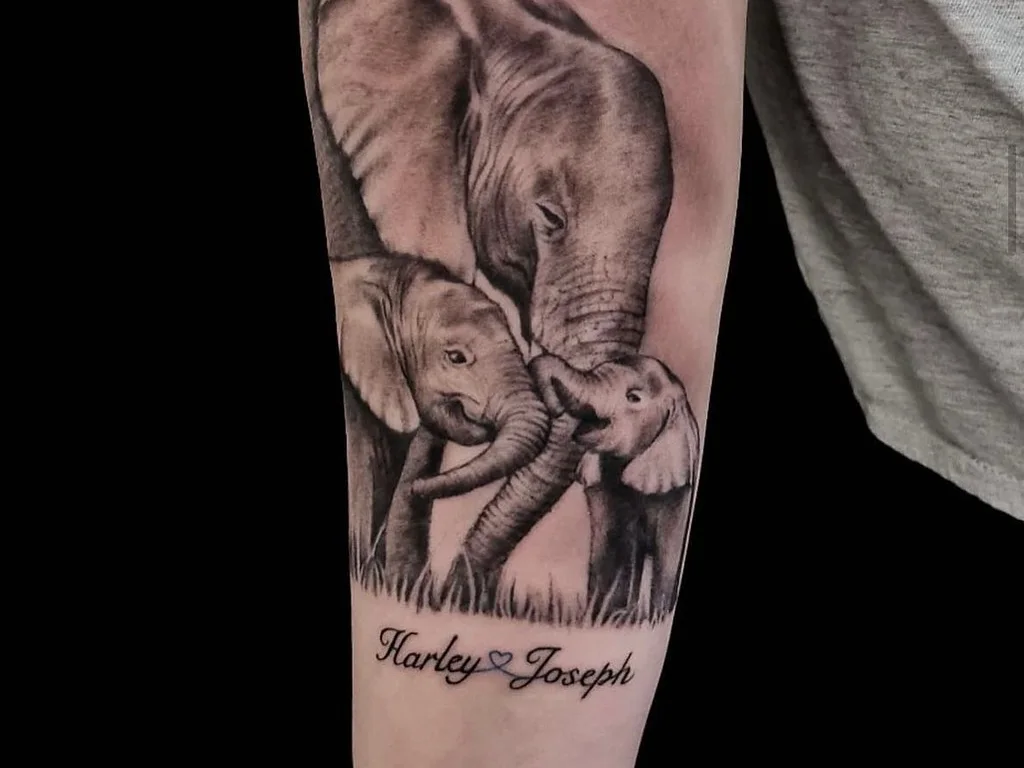
A mother elephant bends over two calves, trunks touching, with two names scripted underneath along a line of grass. It is a family portrait wearing an animal’s shape.
This is why elephants top the family-tattoo list: the herd behaviour is real, and anyone reading the tattoo gets it without a caption. Names under an animal also age kindly — the picture carries the meaning even if the script softens.
18. Ornamental Elephant Head, Leg
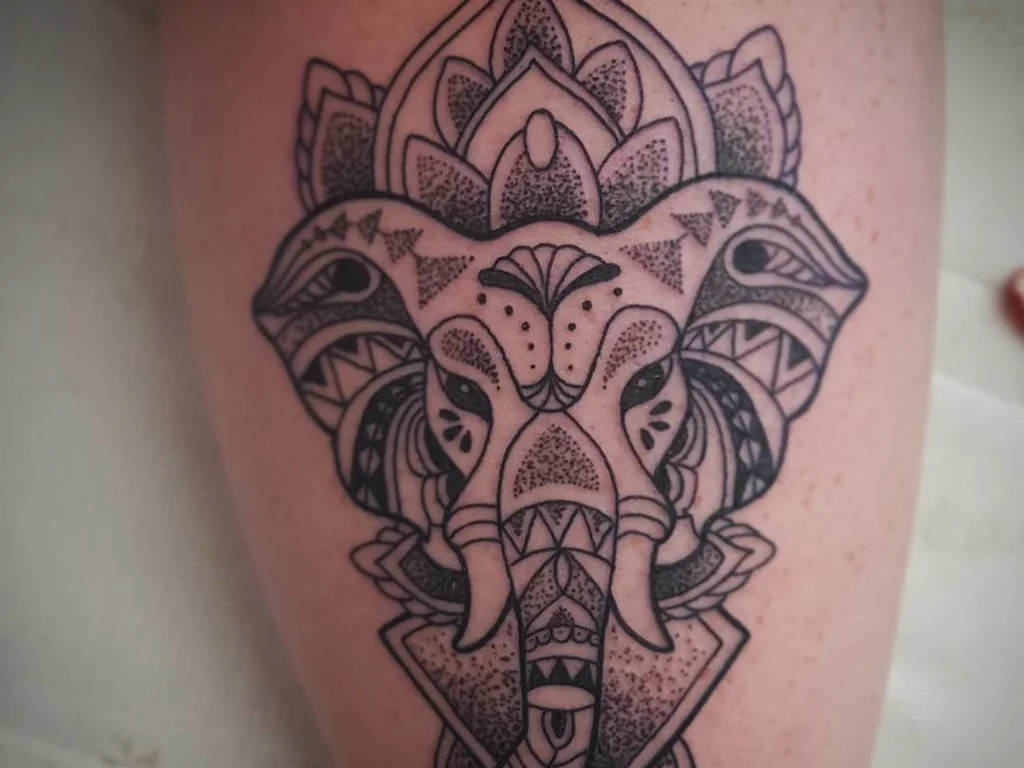
An elephant’s head rebuilt as ornament — mandala crown, patterned ears, dotwork shading — drawn symmetrical down the leg, the trunk forming a point at the bottom.
Ornamental elephants borrow from Indian decorative art, where the animal has stood for luck and wisdom for a long time. Dotwork softens gracefully too; the pattern relaxes into texture instead of losing its edges.
19. Elephant With Hibiscus Flowers, Back
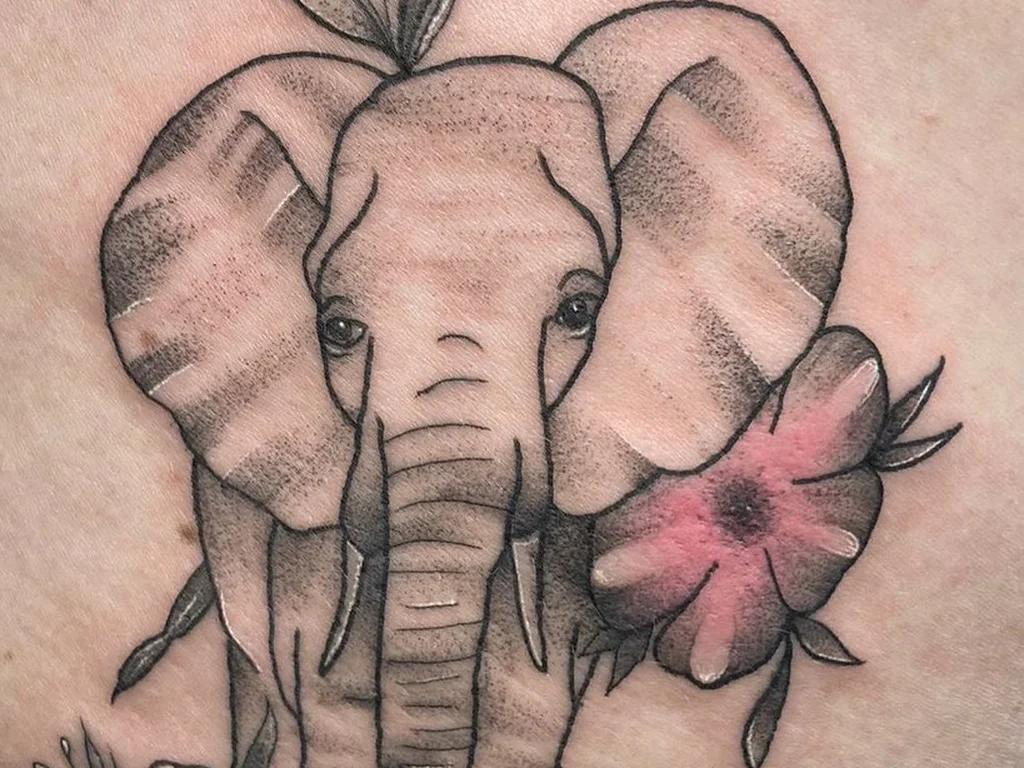
A young elephant faces forward, ears wide, drawn in soft dotwork greys with one big pink hibiscus at its side. It sits high on the back, where the ears get the width they want.
Front-facing elephants read friendlier than profile ones — all ears and forehead. The pink flower is the piece’s single colour note, and it will want an occasional touch-up while the greys hold.
20. Doe Among Flowers and Acorns, Forearm
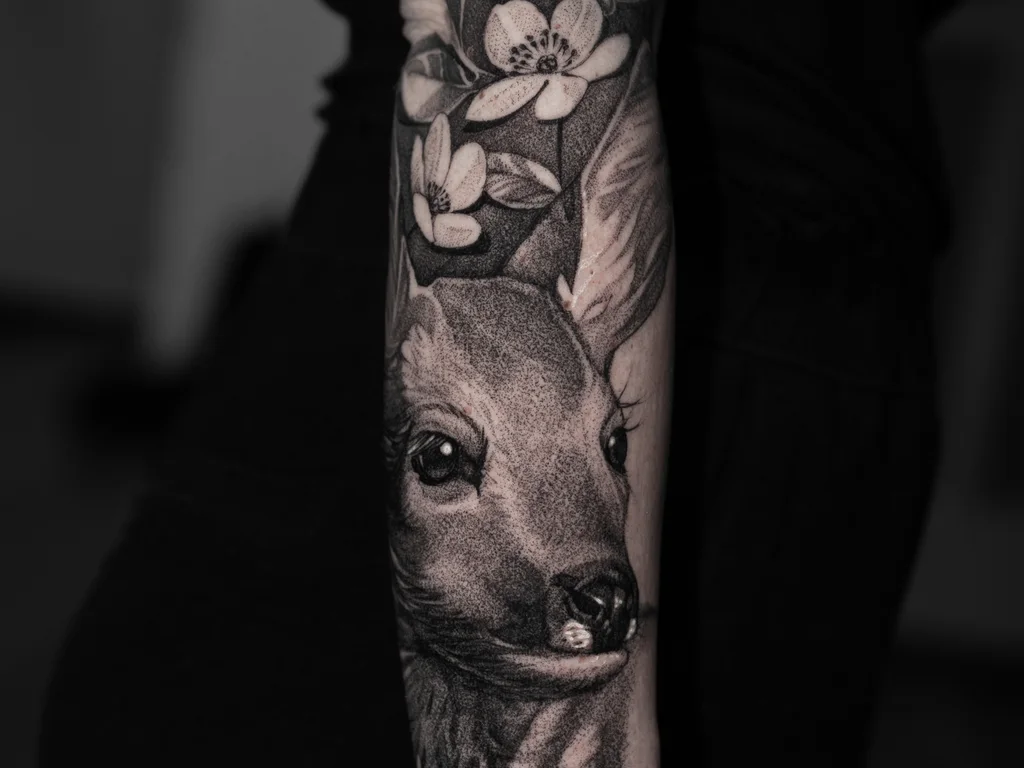
A doe’s face in soft black and grey rises through flowers and acorns on a forearm. No antlers, no drama — just the animal looking up out of the plants.
Does are the quiet half of the deer family in tattooing: gentleness and watchfulness, a woodland feel. Soft realism like this needs an artist who can shade without leaning on outlines.
21. Realism Stag Among Pines, Arm
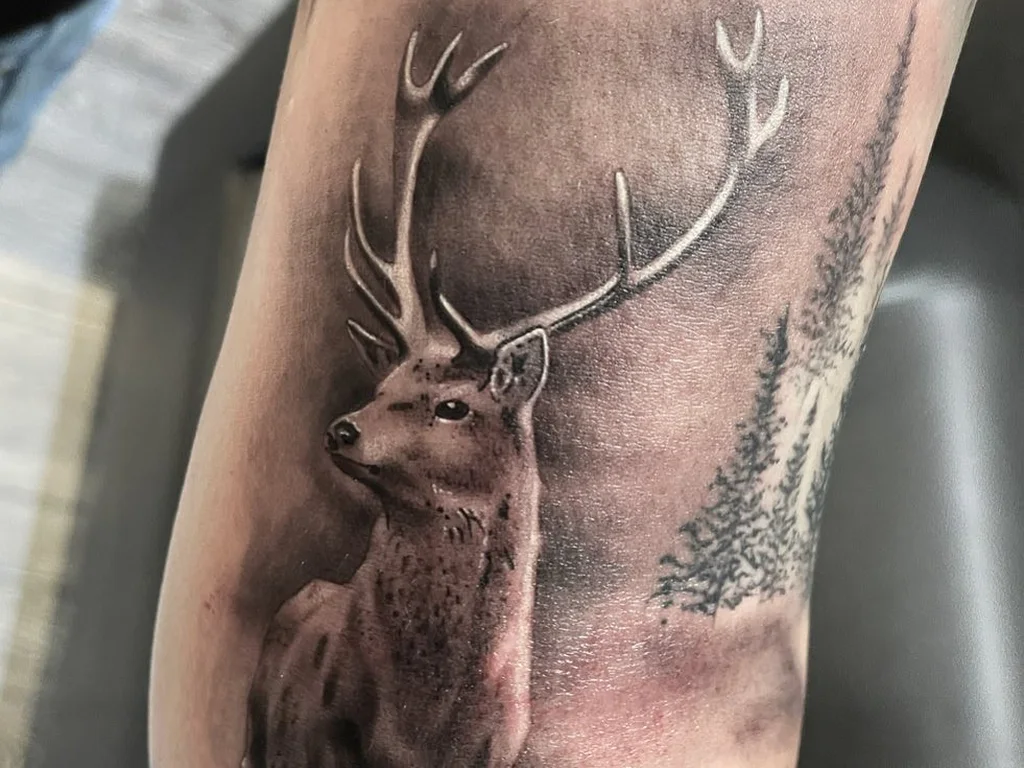
A whole stag stands in profile among pine trunks, antlers up, the scene washed in grey like a forest at dusk. It runs the length of the arm.
Scene pieces live on atmosphere, and atmosphere is the first thing time takes — the palest greys lift over the years. The dark pines sit low on purpose, anchoring the design as the stag’s lighter tones settle.
22. Stag in a Dark Forest, Chest
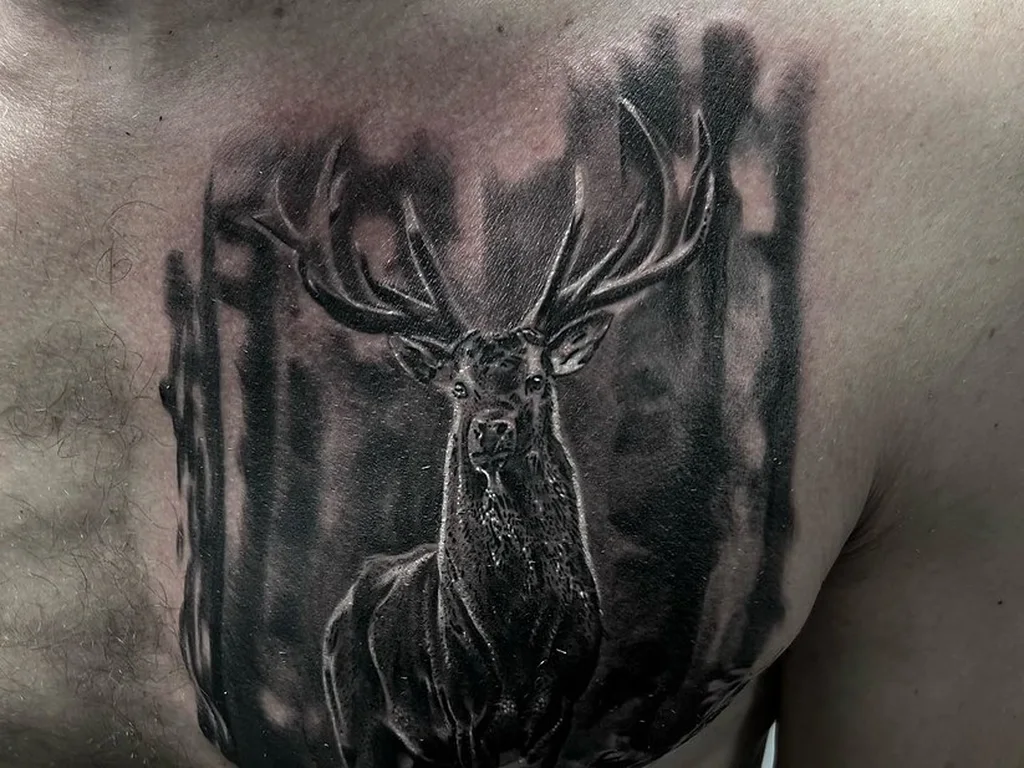
A stag faces out of a wall of black — tree trunks and shadow packed solid around it, the deer’s face lit at the centre of the chest.
Heavy black backgrounds are both a gift and a commitment: they make the subject glow and cover almost anything underneath, and they are very hard to extend or remove later. Choose the frame as carefully as the stag.
23. Line-Work Stag Head With Long Antlers, Thigh
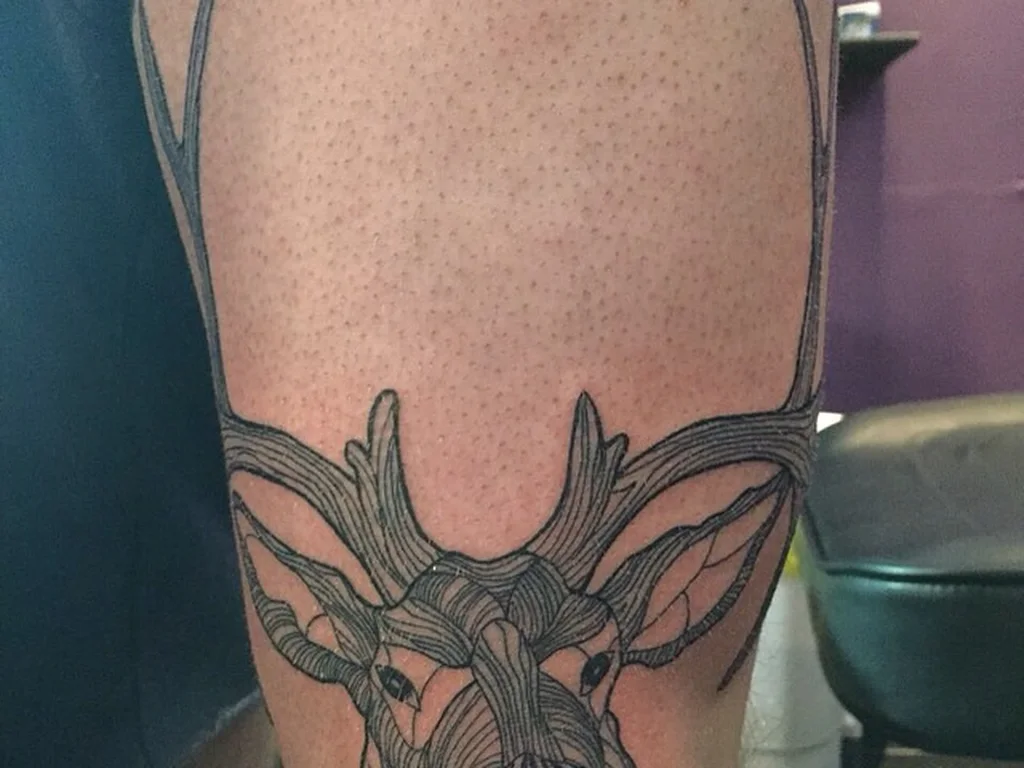
Nothing but line: a stag’s head in clean black line work, antlers running so long they leave the top of the frame. No shading, no fill, no colour.
Line-only animals heal fast and forgive nothing — every wobble shows. The thigh gives the antlers their runway; on a smaller placement the design would have to shrink the one thing that makes it.
24. Gorilla Face With Palm Leaves, Arm
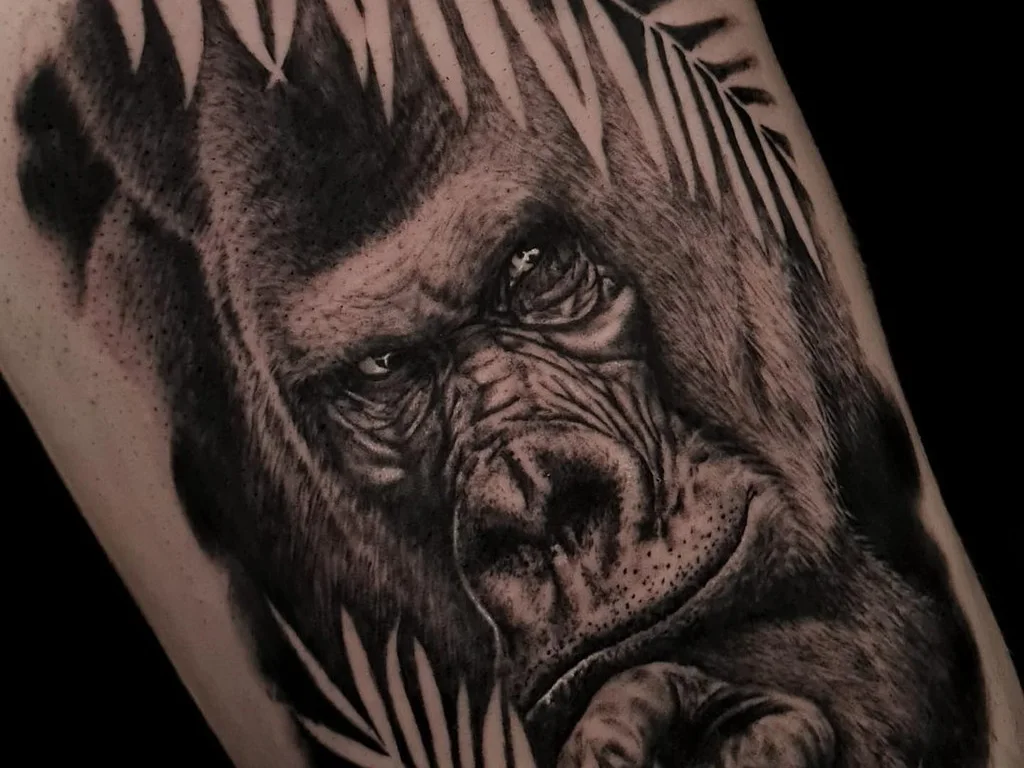
A gorilla’s face fills the frame, palm fronds at the edges, drawn in dense black and grey realism. The expression is the whole piece: heavy-browed, direct, unimpressed.
Gorillas are the power pick for people who find lions too obvious. The meaning most wearers give is protective strength — the silverback as head of a family, not a brawler.
25. Gorilla Portrait, Forearm
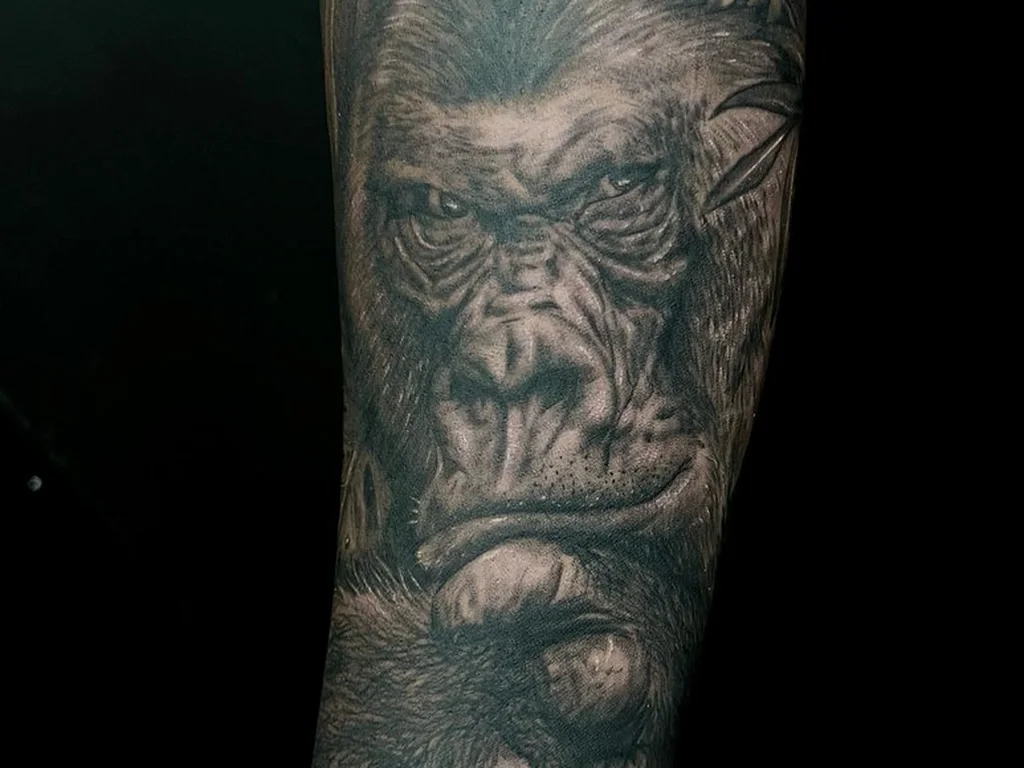
A frontal gorilla portrait down the forearm, chin resting near a knuckled hand, the fur built from hundreds of short strokes. It wraps the arm, so the face meets you from most angles.
Packed this dark, a piece reads as a black mass from across the street and a portrait up close. Both are fine — as long as you know that before you book it.
26. Gorilla Face in Black and Grey, Leg
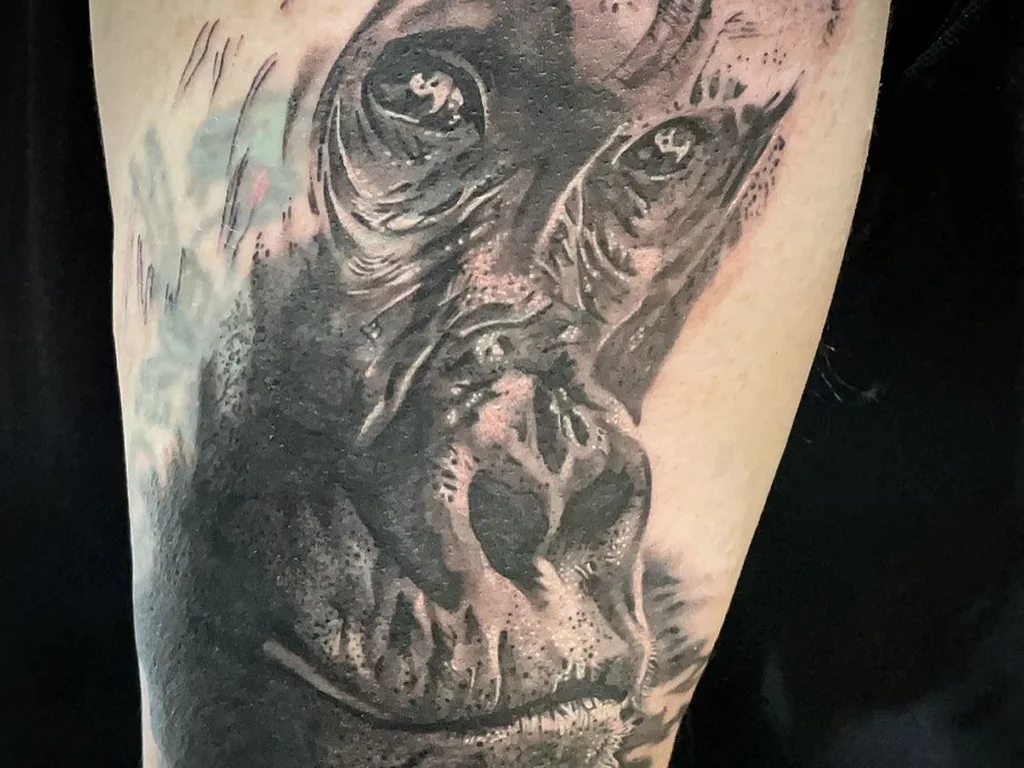
This gorilla’s face wraps a leg in black and grey, and the photograph shows it honestly: patches have lightened, and the softest greys have thinned with wear and weather.
Legs are hard on tattoos — trousers rub, sun hits calves, skin stretches over muscle. Treat this as the realistic end state of large, soft realism, and budget for a refresh if you go this route.
27. Leopard Face in a Roundel, Chest
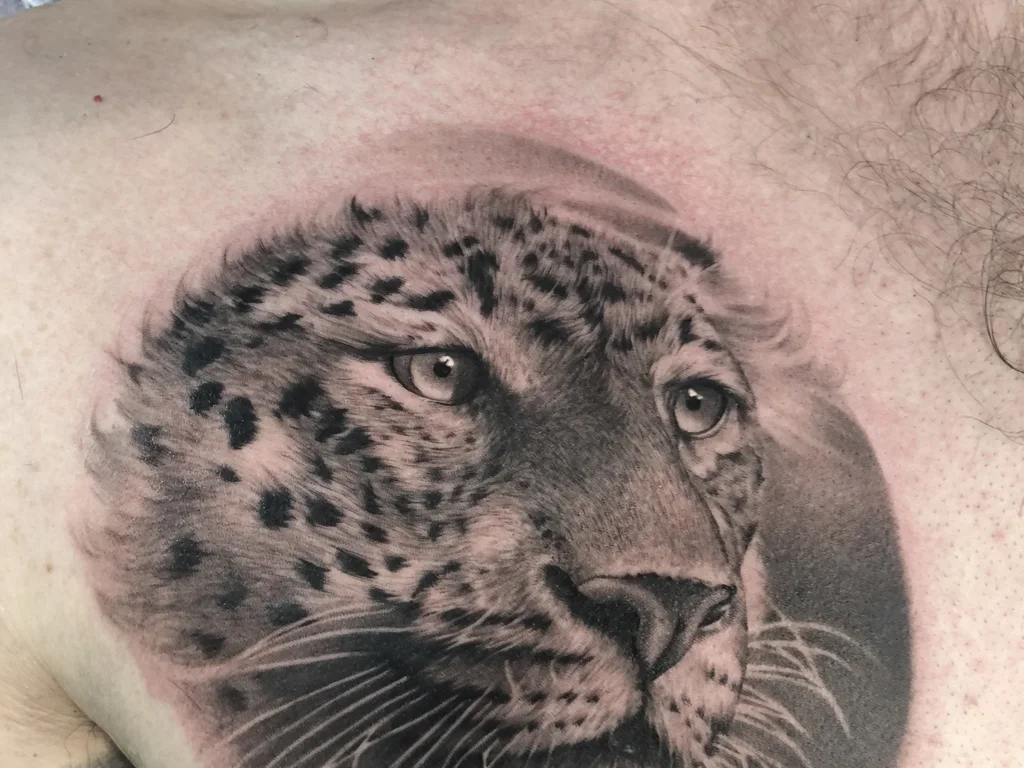
A leopard’s face fills a circle high on the chest — spotted coat, pale eyes, whiskers fanned wide. The round frame keeps a broad design tidy on a curved placement.
Spots are the leopard’s signature and its risk: packed too close, they merge as the ink spreads under the skin. This spacing — bold rosettes with real skin between them — is what to ask for.
28. Jaguar Face, Forearm
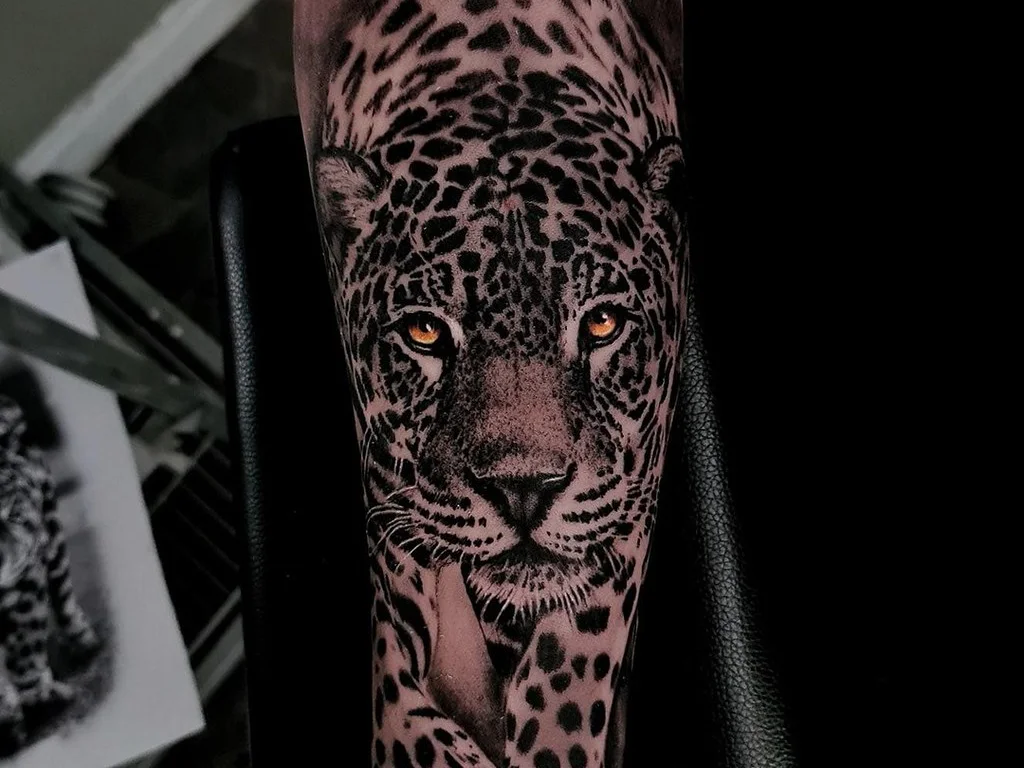
A jaguar stares down a forearm, orange eyes set into a black and grey face, the coat marked with broken rosettes — spots with dark centres, heavier than a leopard’s plain rings.
That rosette is how you tell the two cats apart on skin. The jaguar is the Americas’ big cat, tied in older Central and South American art to night, water and power — one of the few genuinely old symbolisms in this set.
29. Black Panther in Profile With Leaves, Chest
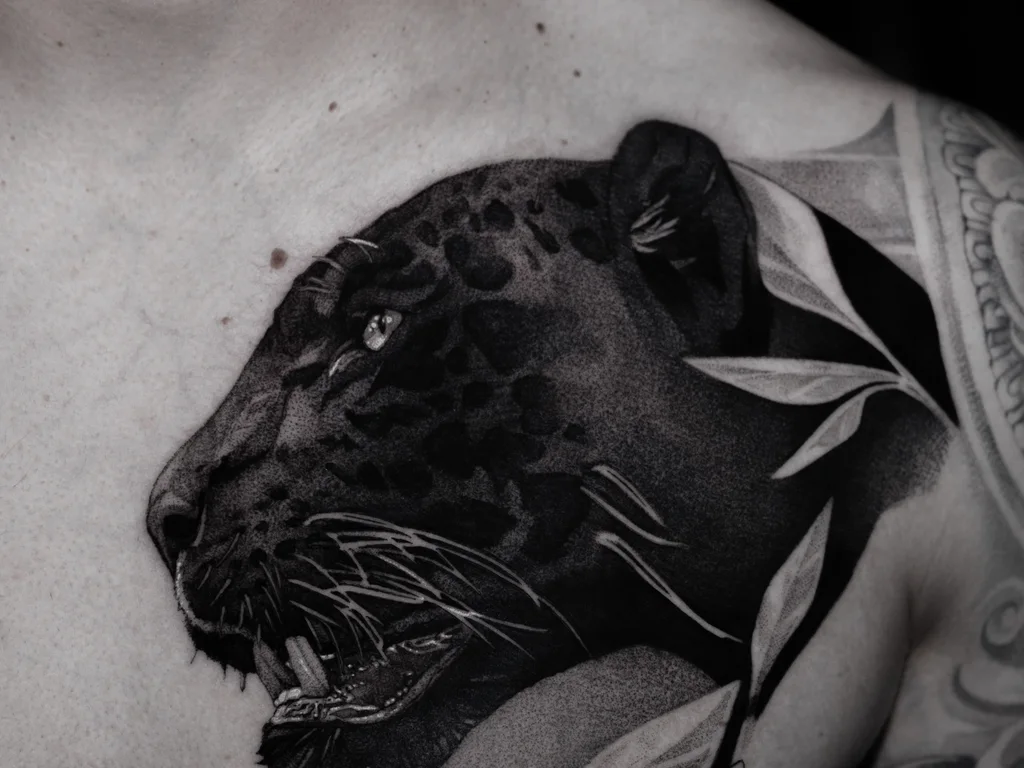
A black panther’s head in profile across the chest, mouth slightly open, leaves left as bare skin behind it. Look closely: the coat is not flat black — faint rosettes sit inside the darkness.
That hidden pattern is the truth of the animal: a panther is a leopard or jaguar whose dark coat still carries its spots. Near-solid black is also why panthers are the classic cover-up animal.
30. Black Panther With Green Eyes, Arm
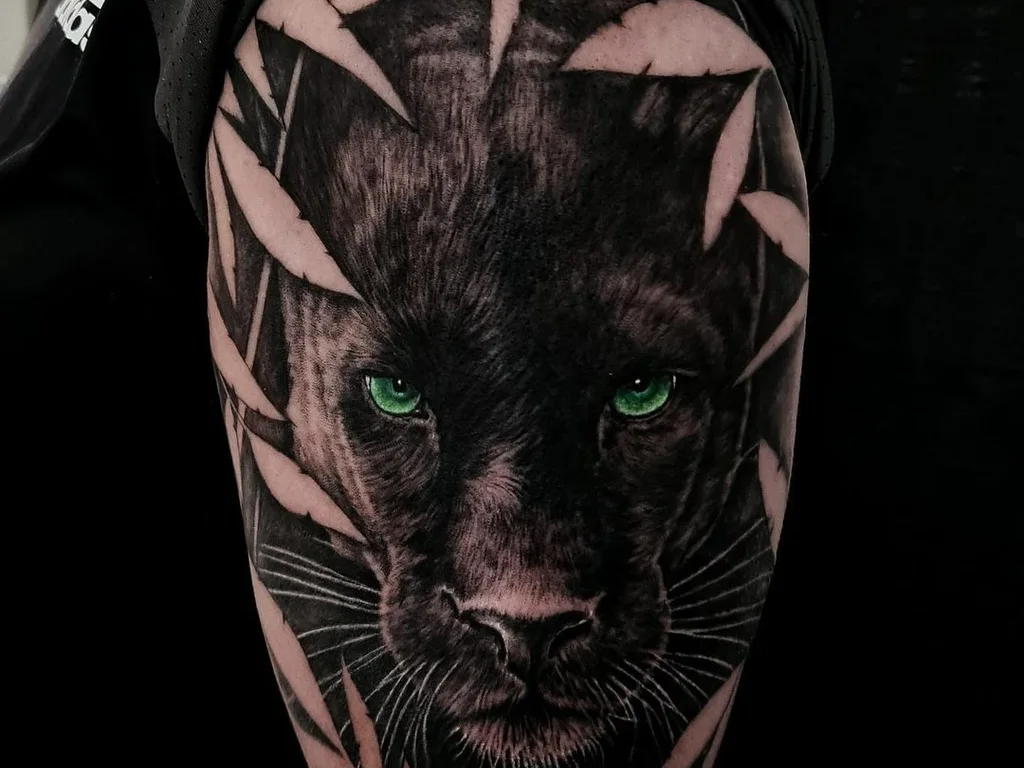
A frontal black panther fills the arm, bare skin left in leaf shapes around the head, and two green eyes doing all the colour work in the piece.
Coloured eyes against black fur is the panther formula at its simplest. The eye colour is a tiny patch of ink — cheap to refresh, and worth refreshing, because the whole design points at it.
31. Fox and Cub in Black and Grey, Forearm
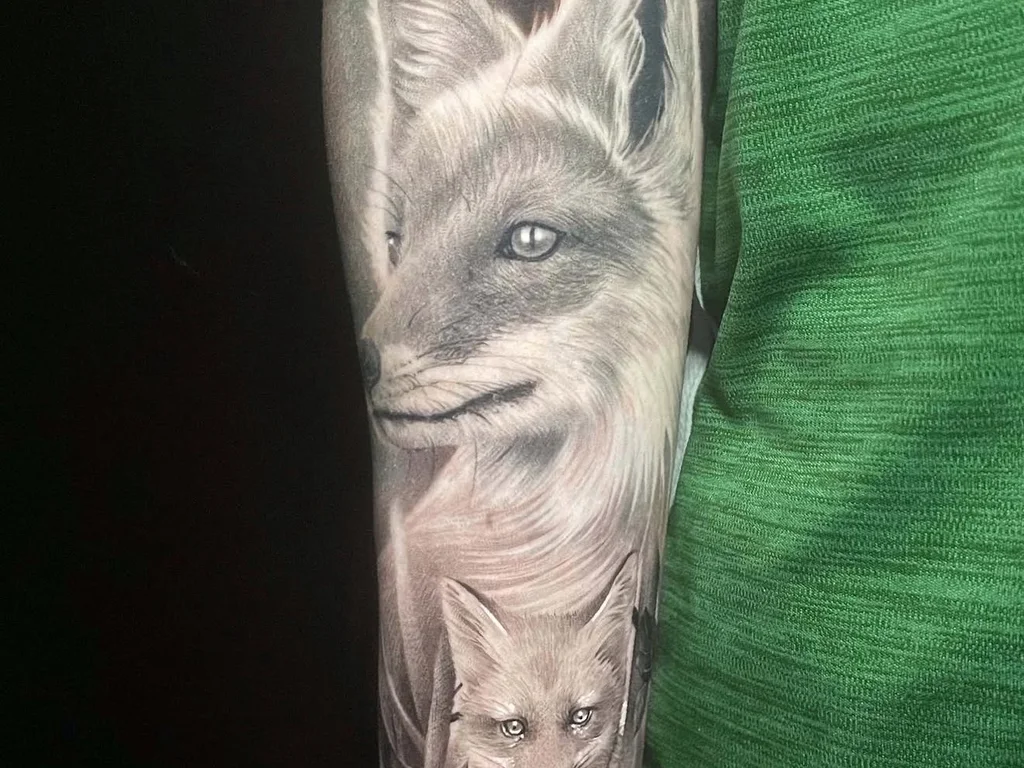
An adult fox in profile runs down the forearm, and below it, smaller, a cub’s face looks out. Soft grey realism the whole way — no outlines, no colour.
Two-animal pairings usually mean family, and foxes add their own flavour: cleverness, adaptability, the animal that gets out of the trap. Foxes are also far less common on skin than wolves, which is part of the appeal.
32. Lynx Among Leaves, Forearm
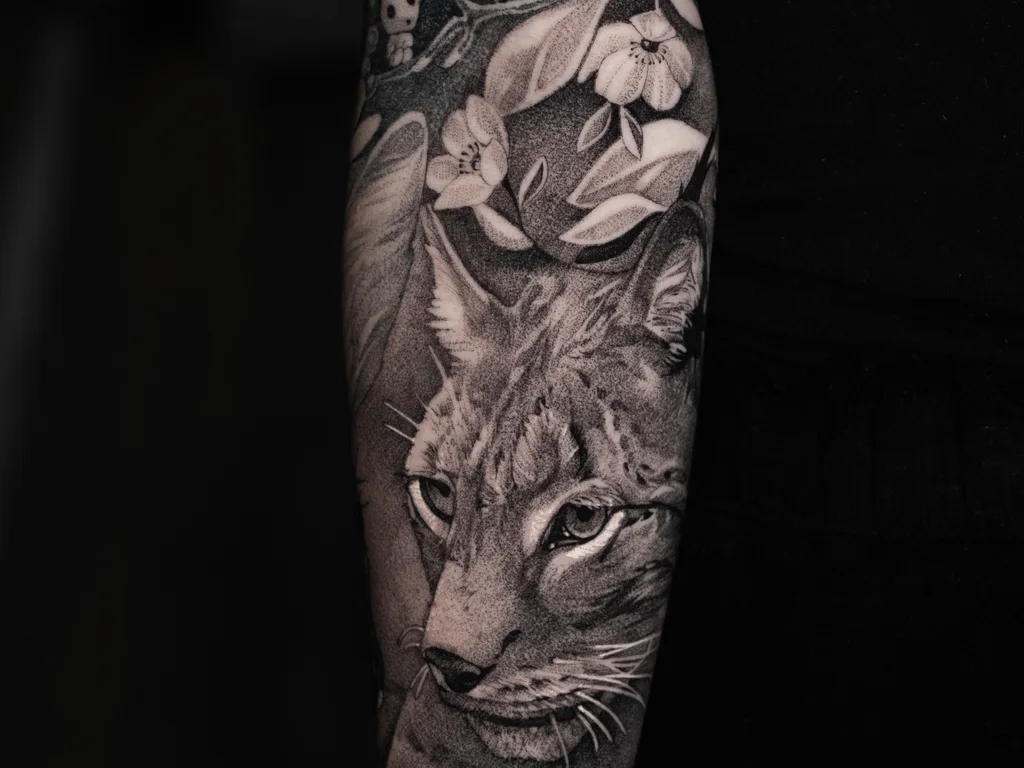
A lynx head rises through leaves and flowers on a forearm — ear tufts up, cheek fur flared, the coat faintly spotted. It is the only lynx in the set, because it was the only good, legally shareable photograph to be found.
In European folklore the lynx stands for seeing what is hidden, and the cat is a genuine rarity in tattooing — a good pick if you want an animal nobody else at the studio is wearing.
33. Giraffe Head Above a Savanna Skyline, Forearm
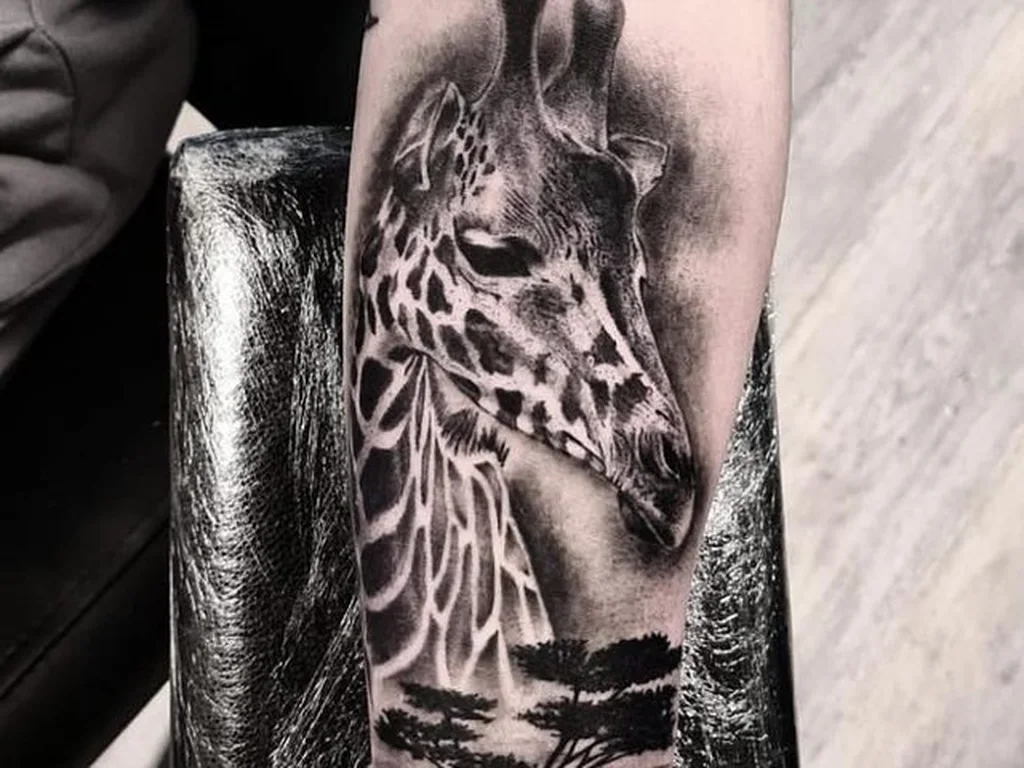
A giraffe’s head and long neck in profile fill the forearm, and at the wrist sit tiny acacia trees in silhouette — the whole savanna in one arm, most of it neck.
The giraffe is the gentlest animal here, chosen for height, patience and standing apart. The portrait is soft realism while the little trees are solid black, so the bottom of the design will outlast the top.
34. Bison Head in Heavy Black Shading, Forearm
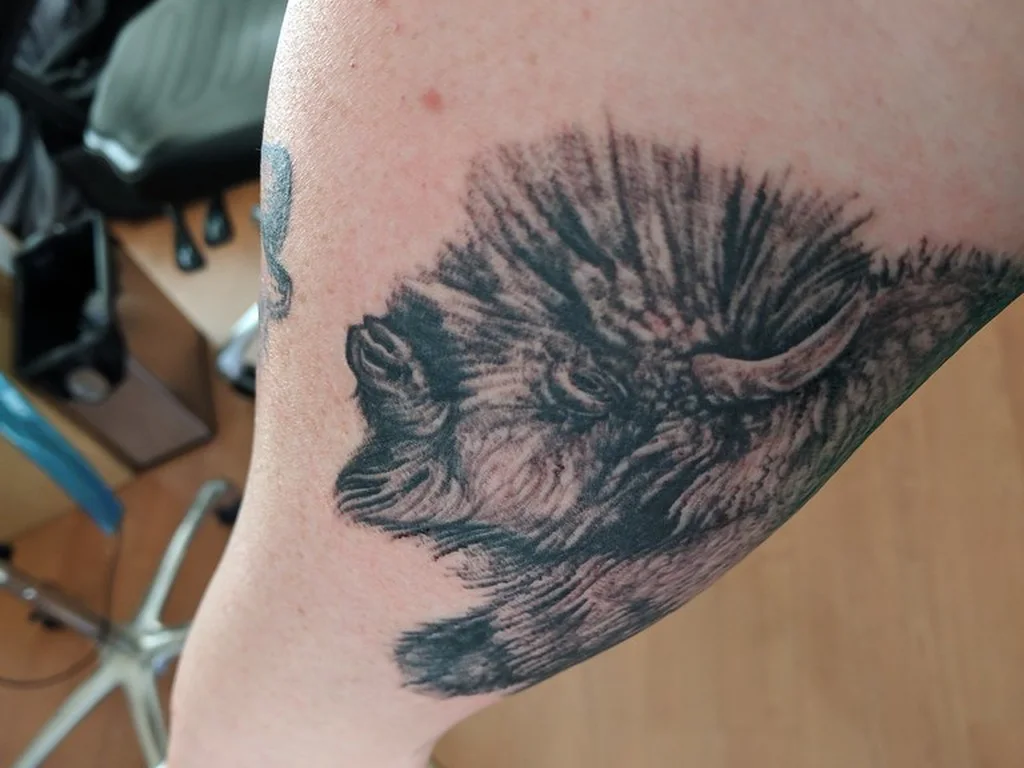
A bison’s head faces forward — all shaggy mass and horn, the fur worked in rough, heavy black strokes down the forearm.
The bison is the North American entry in the strength family: endurance, survival, a herd animal that came back from near-extinction. The rough shading suits the subject and ages better than smooth blends would.
35. Bison Head in Profile, Forearm
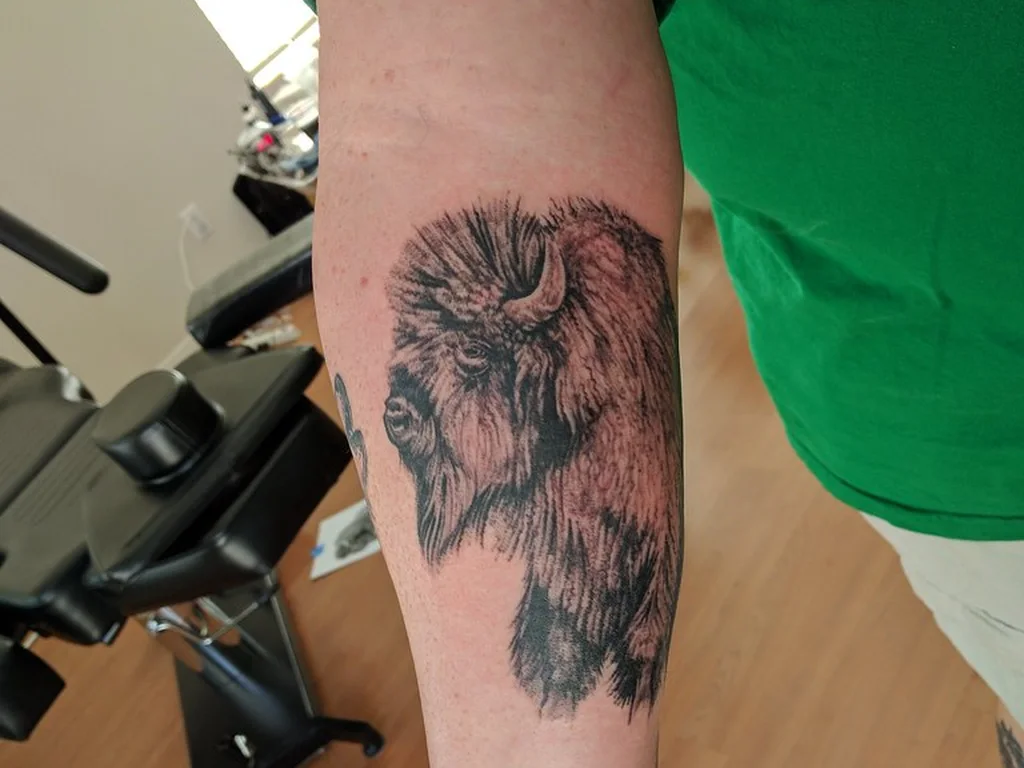
The same animal from the side: a bison head in profile, horn curved, beard long — photographed fresh, the skin still red around the new ink.
Fresh tattoos always look angrier than healed ones; the redness vanishes and the blacks settle a tone lighter. Profile views suit forearms well, because the head’s long shape follows the bone.
Where a Wild Animal Tattoo Works Best
Forearm. The most popular address in this set, and the numbers back it up — well over half the designs here live on one. A long, flat canvas suits vertical animal faces, the pain is mild to moderate, and you can watch the whole thing happen.
Upper arm and shoulder. Lion and tiger country. Manes and stripes need width, the shoulder cap takes a round design naturally, and a short sleeve covers it when it has to be covered.
Chest. Built for wide, symmetrical faces — the leopard roundel, the forest stag and the panther all sit there. The flat of the chest is moderate; the sternum and collarbones are sharper, and centre pieces punish a crooked stencil.
Back. The only placement that fits a full tiger face or a Sak Yant with its full ring of script. Expect a project of several sessions, on skin that ages slowly because it rarely sees the sun.
Thigh. The private canvas: geometric frames and long antlers get their room here, cover is total, and the skin is flat and forgiving — a good first large piece.
Torso and legs — the honest end. The full-torso elephant is an outlier and a life decision, not a first tattoo. Legs sit at the other extreme of upkeep: designs 26 shows what rubbing, sun and stretching do to soft realism over time.
Frequently Asked Questions
What does a wild animal tattoo mean?
It depends on the animal. Lions lean on an old link with royalty and courage; tigers carry power and protection in Asian traditions; wolves, elephants and foxes are mostly read through family and loyalty today. Some of that is documented history and some is modern shop convention — and the wearer’s own reason outranks both.
How do I choose which animal to get?
Match two things: the temperament you want to wear — power, patience, cleverness, family — and a shape that fits the placement you have in mind. Long faces suit forearms, wide faces suit chests, and anything with antlers or a mane needs width. Then judge artists on healed photos of that animal, not on flash drawings.
How much does a wild animal tattoo cost?
Size and detail set the price, not the species. A small, simple animal often starts at a studio’s minimum charge — commonly $60–$150 in the US. A palm-sized realism head is a few hours of work; back or torso pieces are priced by the session and can run into thousands. Get the number at a consultation, with the design at its final size.
Do wild animal tattoos hurt?
No more than any tattoo of the same size in the same place. Forearms and upper arms are mild spots. The sharper versions in this set are the chest pieces near the sternum, the full back, and anything that runs over the spine or ribs.
How well do animal realism tattoos age?
Bold shapes hold; soft shading relaxes. Designs 8, 15 and 26 in this set are shown lived-in on purpose — lines spread slightly, the palest greys lift, and the design still reads. Sunscreen on healed ink slows all of it, and a realism piece may want one refresh in its life.
Can a wild animal tattoo be small?
Yes, if the design is simple — the line-work stag at design 23 would work at half its size. Realism cannot shrink the same way: below roughly palm size, fur detail and stripes merge as the ink settles. Simplify on purpose rather than letting time simplify it for you.
What is a Sak Yant tiger tattoo?
A sacred tattoo from Thailand, traditionally given by Buddhist monks or ajarn masters, worked by hand and paired with prayers and rules the wearer agrees to live by. The tiger design at number 6 is one of the best-known forms. Treat it as a religious practice to receive properly, not a pattern to copy from a photograph.
Colour or black and grey for an animal tattoo?
Black and grey ages slower and suits the night animals — wolves, panthers, bears. Colour earns its upkeep when the coat is the point: a tiger’s orange, a lion’s warmth, one green pair of panther eyes. Either way, contrast does the long-term work, so keep the darks properly dark.
Can a wild animal tattoo cover an old tattoo?
Often, yes. Dark, busy animals are the classic cover-up choices — the panther’s near-solid black, the bison’s heavy shading, or a stag set in a packed black forest. The new piece must be bigger and darker than what sits underneath, and the artist gets the final say after seeing the old work in person.
Are wild animal tattoos only for men?
No. The old flash books aimed big cats and wolves at men, so the back catalogue skews that way, but this set holds does, elephants, foxes and floral bears worn by everyone. Style and placement get gendered by habit; the animals themselves do not.
Final Thoughts
Thirty-five real pieces, fourteen kinds of animal, and one pattern running through all of them: the tattoos that still read well are the ones drawn at the size their detail needed. Pick the animal whose temperament you actually want to wear, give it room, and check the artist’s healed work before you book. If your taste runs to feathers, our owl tattoo ideas and eagle tattoo ideas pages are built the same way — and for the animals that live indoors, pet tattoo ideas covers the domestic side of the family.
Photo credits: 1: Dom Carter, CC BY-SA 4.0, via Wikimedia Commons. 2: Dom Carter, CC BY-SA 4.0, via Wikimedia Commons. 3: Tattoodelmono, CC BY-SA 3.0, via Wikimedia Commons. 4: Alan Hindes, CC BY 4.0, via Wikimedia Commons. 5: Alan Hindes, CC BY 4.0, via Wikimedia Commons. 6: Sorasak2008, CC BY-SA 4.0, via Wikimedia Commons. 7: Donald Rider (thewildtattoo), Public Domain Mark, via Flickr. 8: Katherine Mercury, CC BY 3.0, via Wikimedia Commons. 9: Citizeninkstudios, CC BY 3.0, via Wikimedia Commons. 10: Dom Carter, CC BY-SA 4.0, via Wikimedia Commons. 11: Josh Morley, CC BY-SA 2.0, via Wikimedia Commons. 12: Ettore Bechis, CC BY 2.0, via Flickr. 13: Dom Carter, CC BY-SA 4.0, via Wikimedia Commons. 14: Donald Rider (thewildtattoo), Public Domain Mark, via Flickr. 15: Matthew Dillon (RuggyBearLA), CC BY-SA 2.0, via Flickr. 16: Ricardo Spitale Machado Fausto, CC BY-SA 4.0, via Wikimedia Commons. 17: Tattoo Edge Marketing, CC BY-SA 2.0, via Flickr. 18: Tattoo Edge Marketing, CC BY 2.0, via Flickr. 19: Tattoo Edge Marketing, CC BY-SA 2.0, via Flickr. 20: Dom Carter, CC BY-SA 4.0, via Wikimedia Commons. 21: Tattoo Edge Marketing, CC BY 2.0, via Flickr. 22: Tattoo Edge Marketing, CC BY 2.0, via Flickr. 23: Tattoo Edge Marketing, CC BY 2.0, via Flickr. 24: Tattoo Edge Marketing, CC BY-SA 2.0, via Flickr. 25: Tattoo Edge Marketing, CC BY-SA 2.0, via Flickr. 26: Tattoo Edge Marketing, CC BY 2.0, via Flickr. 27: Alan Hindes, CC BY-SA 4.0, via Wikimedia Commons. 28: Tattoo Edge Marketing, CC BY-SA 2.0, via Flickr. 29: Dom Carter, CC BY-SA 4.0, via Wikimedia Commons. 30: Tattoo Edge Marketing, CC BY-SA 2.0, via Flickr. 31: Alan Hindes, CC BY 4.0, via Wikimedia Commons. 32: Dom Carter, CC BY-SA 4.0, via Wikimedia Commons. 33: Tattoo Edge Marketing, CC BY-SA 2.0, via Flickr. 34: Matthew Dillon (RuggyBearLA), CC BY-SA 2.0, via Flickr. 35: Matthew Dillon (RuggyBearLA), CC BY-SA 2.0, via Flickr. Full source links for every design are listed in this article’s package notes.