Realism is the least forgiving way to tattoo a lion. A traditional lion can be simplified into bold shapes and still read as a lion; a realistic one has nowhere to hide. The mane is hundreds of separate strokes, the eyes carry the whole expression, and if the muzzle’s proportions are a few millimetres off, the face looks wrong. This page collects realistic lion tattoo ideas the way this site always does: real tattoos, on real skin, in real photographs, counted one by one. There are 20 below.
The scope is strict. Every design here is a photo-real lion or lioness, in black and grey or in colour. The tribal, geometric, mandala and cartoon lions were left out on purpose — they live in our general lion tattoo ideas guide, alongside the wider mix of styles. This page is only for people who want the animal itself, drawn the way a camera sees it.
Lions sit inside the animal cluster on this site. The animal tattoo ideas pillar covers the full menagerie, and our wild animal tattoo ideas sampler mixes lions with the other big species. Here it is one animal, one technique, twenty honest examples.
What Realism Takes
Size first, because size decides everything else. A lion’s face is mostly fine detail — whisker spots, fur direction, the wet shine on the nose — and that detail needs physical room. As a rough floor, a full face with the mane wants to be at least as wide as your hand. Shrink it further and any honest artist will start simplifying: fewer fur strokes, a darker mane, bigger features. The result can still be a good tattoo, but it stops being realism.
Second, the artist. Realism is worked from photographic reference, built up in layers of diluted black ink rather than drawn from an outline. That is a specialist skill, and plenty of good tattooers do not offer it. Judge a realism artist on healed photographs, not fresh ones — fresh realism always looks sharper than it will in six months. The same rule decided the realism portraits in our eagle tattoo ideas guide, and it applies twice over to an animal whose face everyone knows.
Third, sessions. A forearm face like most of the designs below is usually one long sitting, sometimes two. A chest piece runs to several sessions, and a back like design 20 is a project spread over months, because the layers need to heal before the next one goes in. Cost follows the same logic: realism is priced by the session or the day, not at the shop minimum, so the honest question at a consultation is “how many sessions will this take?” Anyone who quotes a fixed figure for a full back before seeing the design is guessing.
Last, ageing. Realism has no black outline holding the shapes apart, so edges relax over the years. The lightest greys soften first, and white highlights — the glint in an eye, whisker dots — fade faster than anything else here. The dark parts of a mane hold for decades. None of that makes realism a bad choice; it makes it a choice to plan, with sunscreen on healed skin and, for some pieces, a refresh sitting years down the line. What lions themselves are like, mane, pride and all, is covered by Britannica’s lion profile.
The 20 Designs
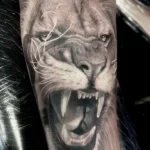
1. Roaring Lion Down the Forearm
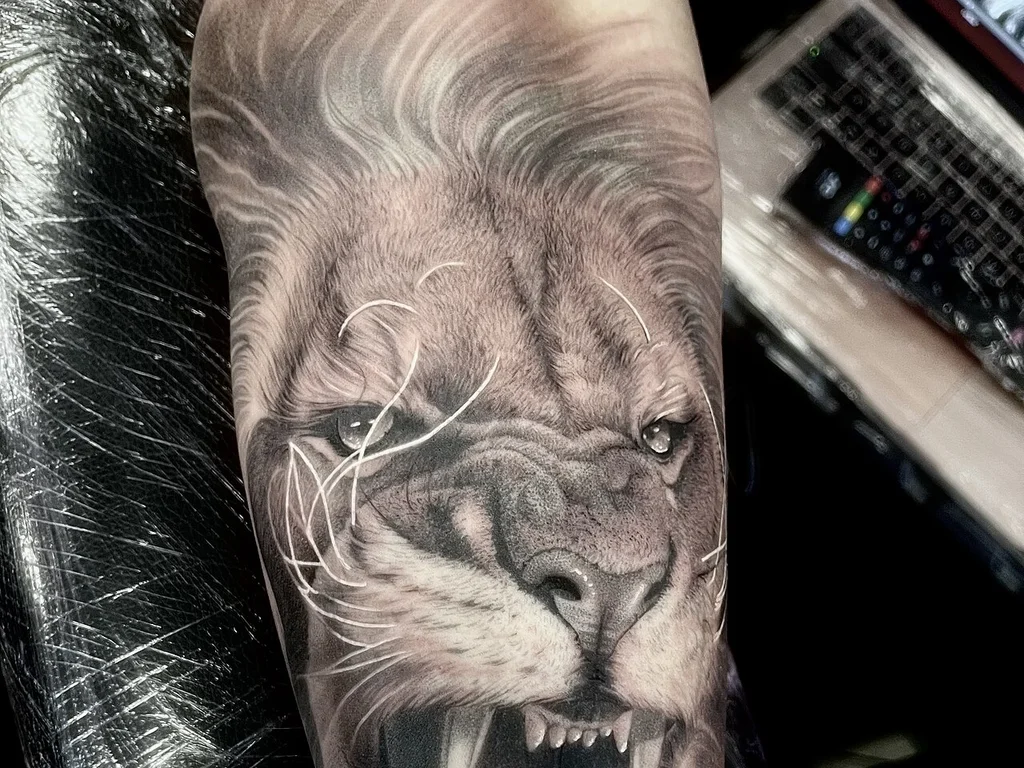
British artist Alan Hindes put this roaring lion down the full length of a forearm: mouth open, fangs out, the mane built from layer on layer of soft grey fur strokes. The photograph was taken in the studio with the arm still resting on the chair, which is why you can see clingfilm and the edge of a laptop in the background.
Notice the whiskers: they are left as pale lines against the dark muzzle, and pale detail like that is always the first thing to soften as a tattoo ages.
2. Lion Face With Amber Eyes, Forearm
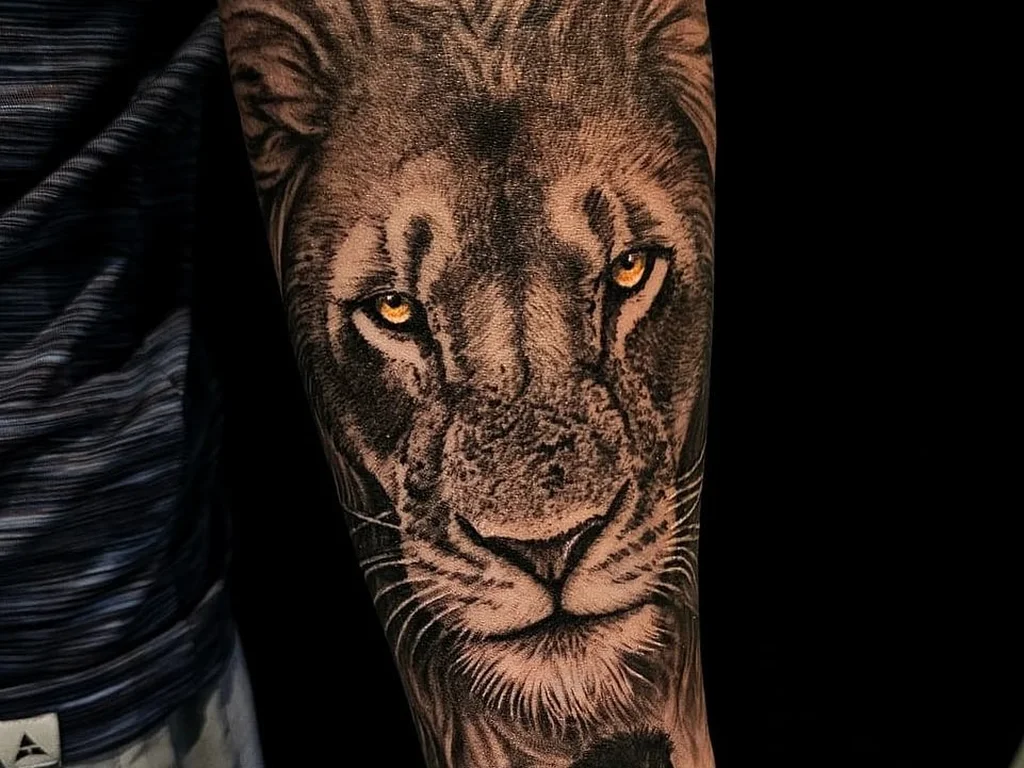
A calm lion’s face fills the top of this forearm in black and grey, with one touch of colour: amber in the eyes. Below it, near the wrist, stands a second, much smaller lion in silhouette, looking at the same view you are.
The two scales work because they ask different things of the ink. The big face is all soft shading; the little lion is one dark shape, and simple dark shapes are what survives at small sizes. If you want a tiny lion inside a realism piece, this silhouette trick is the honest way to do it.
3. Roaring Lion Across the Chest
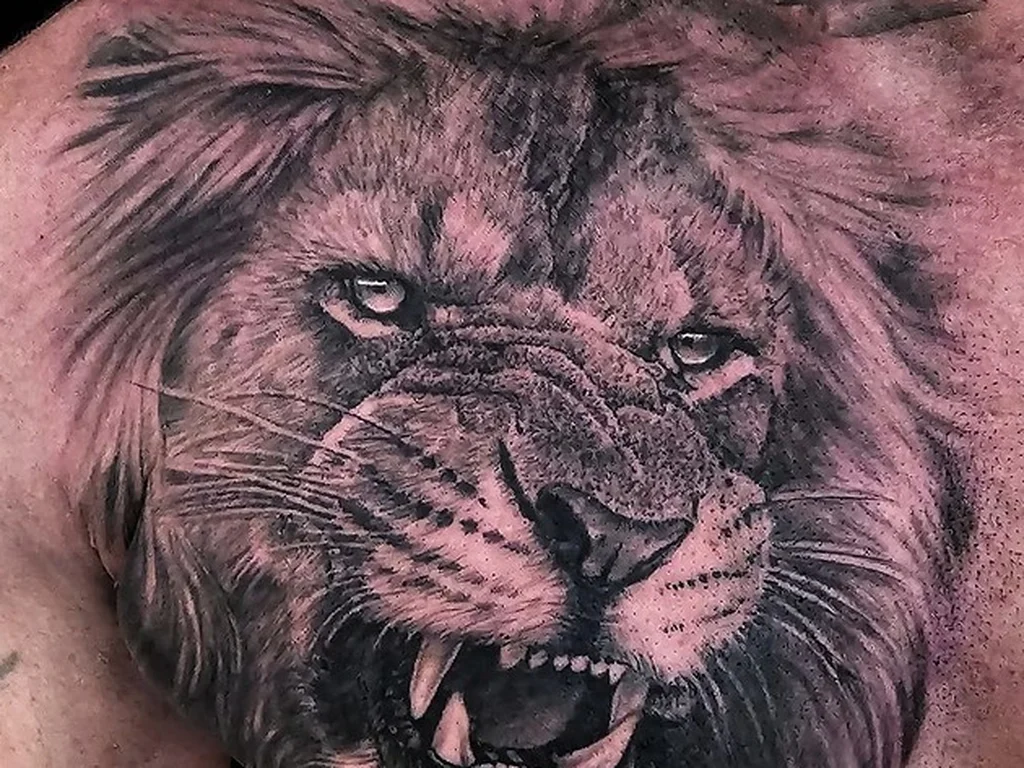
This roaring lion takes the whole width of the chest, with the open mouth low over the sternum. The skin around it is pink and angry-looking, because the photograph was taken straight after the session finished.
That redness is skin, not ink: fresh photos flatter realism with extra contrast that settles as the piece heals. The chest earns the design, though — it is one of the few places wide enough for a roaring face at the scale the teeth and tongue need.
4. Lion and Cub, Forearm
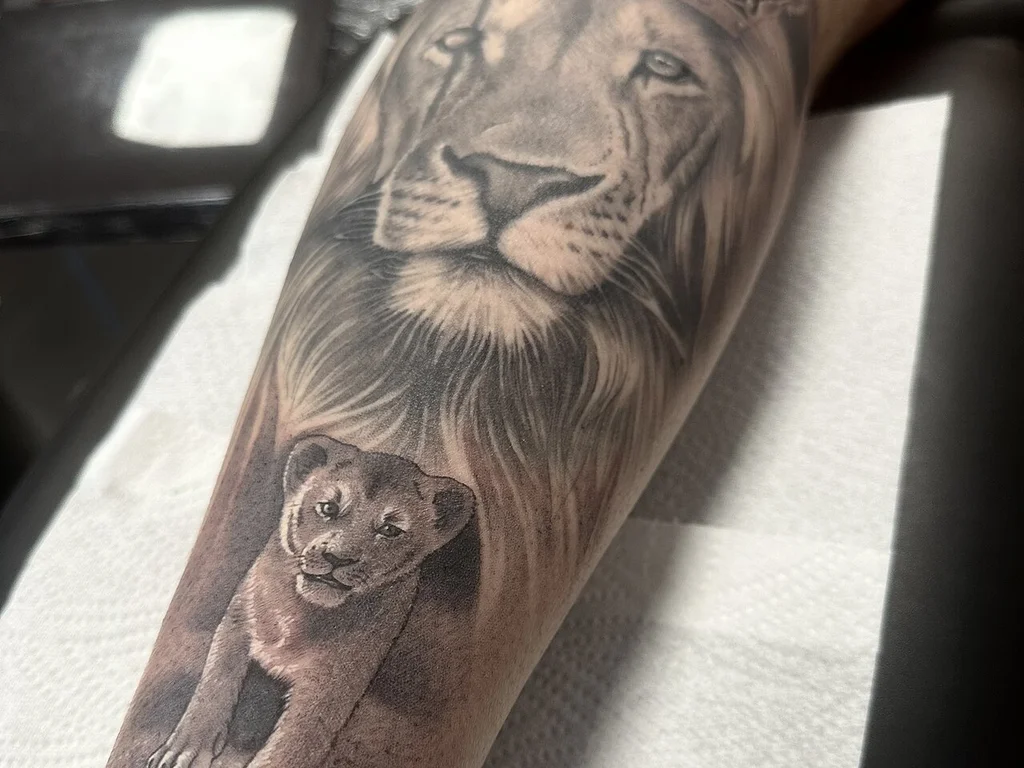
A second Hindes forearm: a full-maned lion in black and grey with a small cub standing in front of him, and the hint of a crown worked in at the top of the arm. It is the family version of the subject — most people who choose this layout are marking a son or a daughter.
The cub is the technical risk: at maybe a quarter of the adult’s size, it is close to the smallest a realistic animal can go before the face turns to mush. It holds here because its features are kept simple and its outline stays dark.
5. Snarling Lion With Greek Key Bands, Forearm
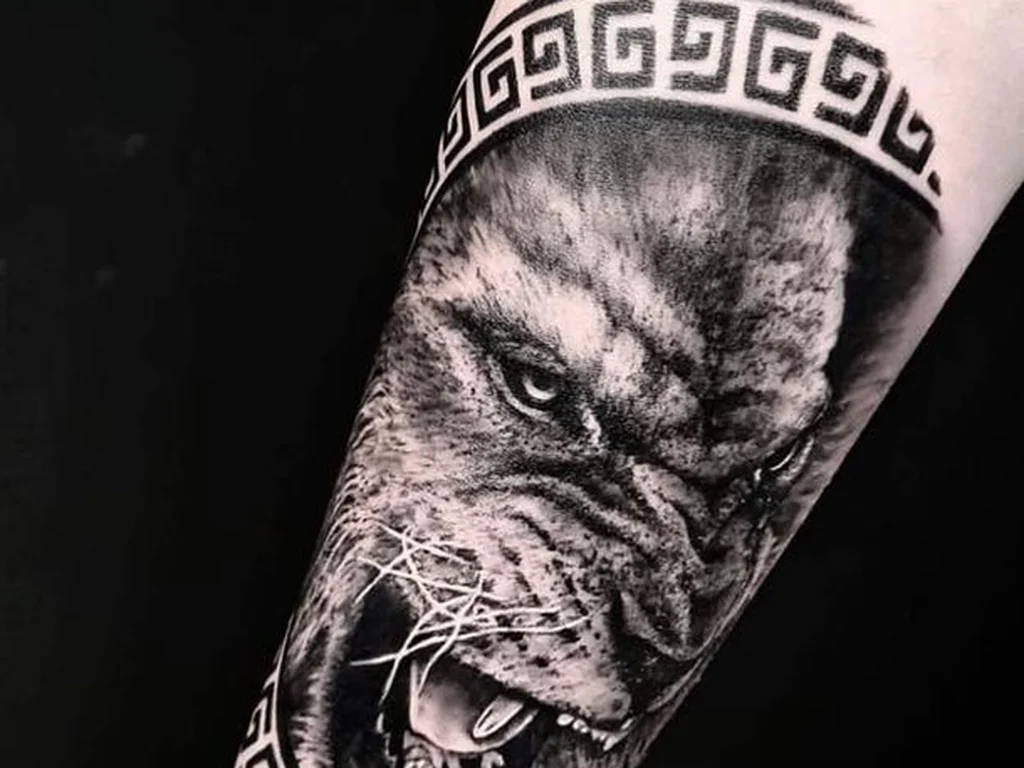
A snarling lion’s face in soft black and grey, framed top and bottom by hard black Greek key bands, by Fink Tattoo. The face wrinkles properly — a snarl is mostly nose and brow, and both are pushed up the way a real lion’s are.
The bands are doing quiet structural work. They are not realism at all; they are bold graphic shapes, and bold shapes age far more slowly than soft shading. A graphic frame gives the eye a hard edge to hold on to years later, when the fur has relaxed.
6. Half-Face Lioness With Negative-Space Swirls, Forearm
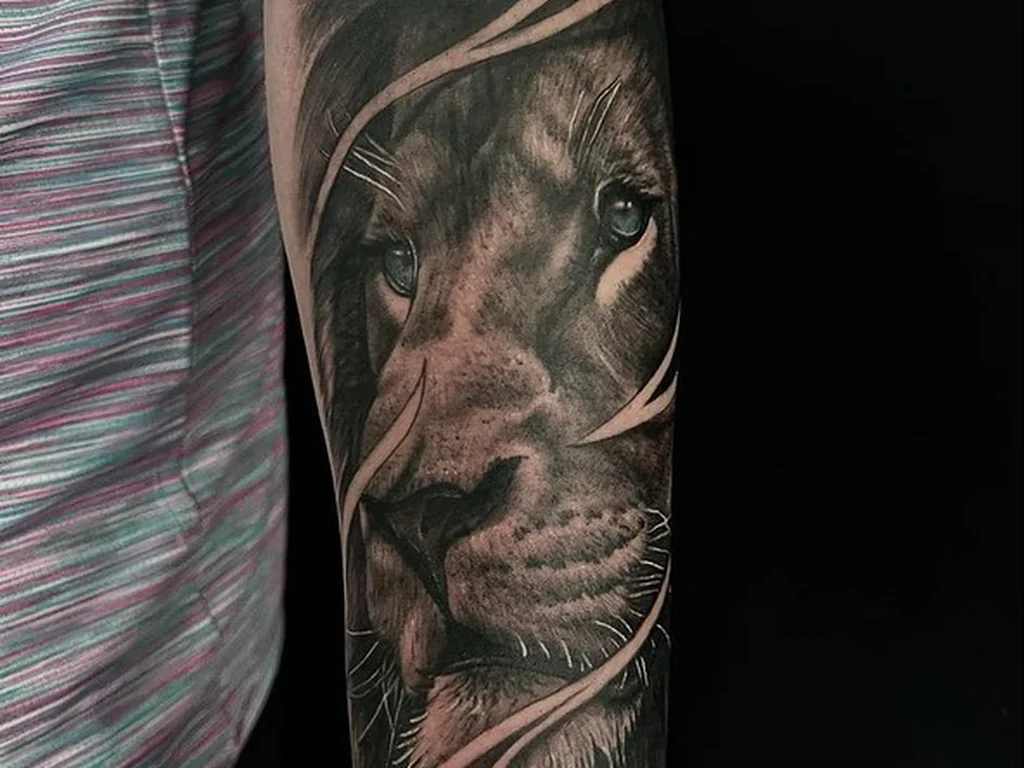
Half a lioness’s face, drawn at full forearm scale, with ribbons of bare skin curling through the design. The eye that made it into the frame is pale and clear, and the muzzle detail — whisker spots, the grain of the nose — is as fine as anything on this page.
Cropping the face in half is a practical trick, not just a style choice: one eye and half a muzzle can be drawn at twice the size a full face would allow. The swirls are the price — those clean skin ribbons need a very steady hand, because a wobble in untouched skin cannot be hidden.
7. Lioness Inside a Broken Clock, Forearm
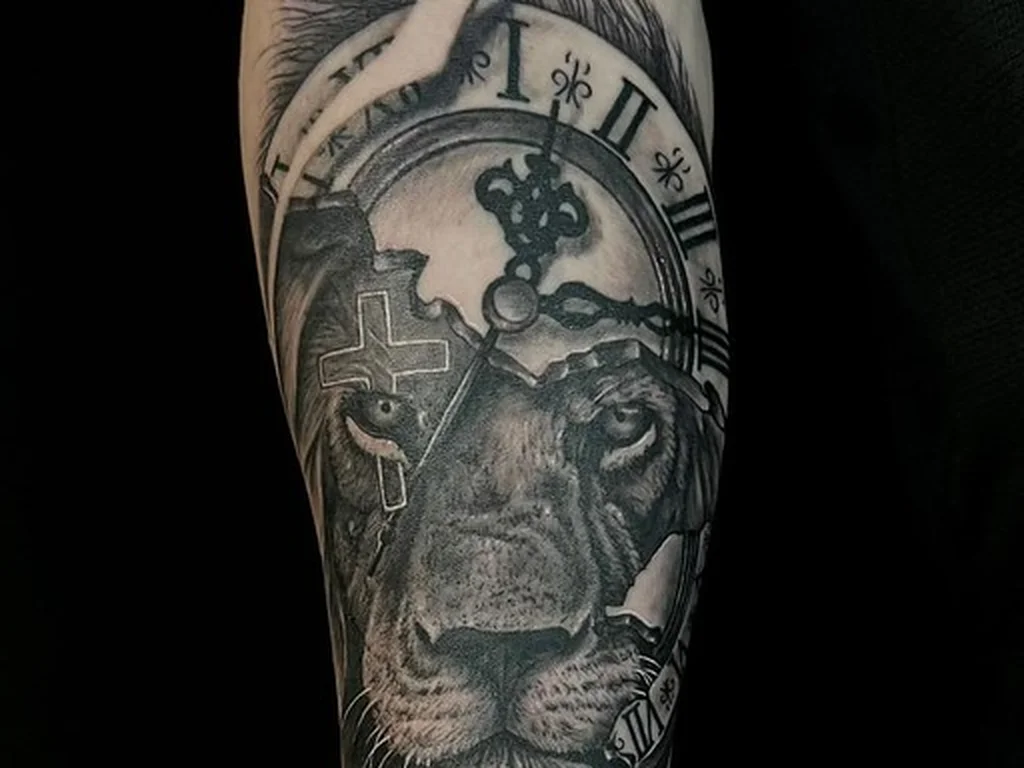
A lioness stares out from inside a cracked clock face, roman numerals around the rim, the clock’s hands and a small cross worked into the top of the design. Clocks are the most common partner for realism lions — time, a date that matters, a life measured out.
Look at the size of the numerals. At this scale they stay readable for years; halve the design and they would be the first element to blur. If your version includes lettering or numerals, their size is the thing to defend at the design stage.
8. Lion Faces Split by Clockwork, Forearm
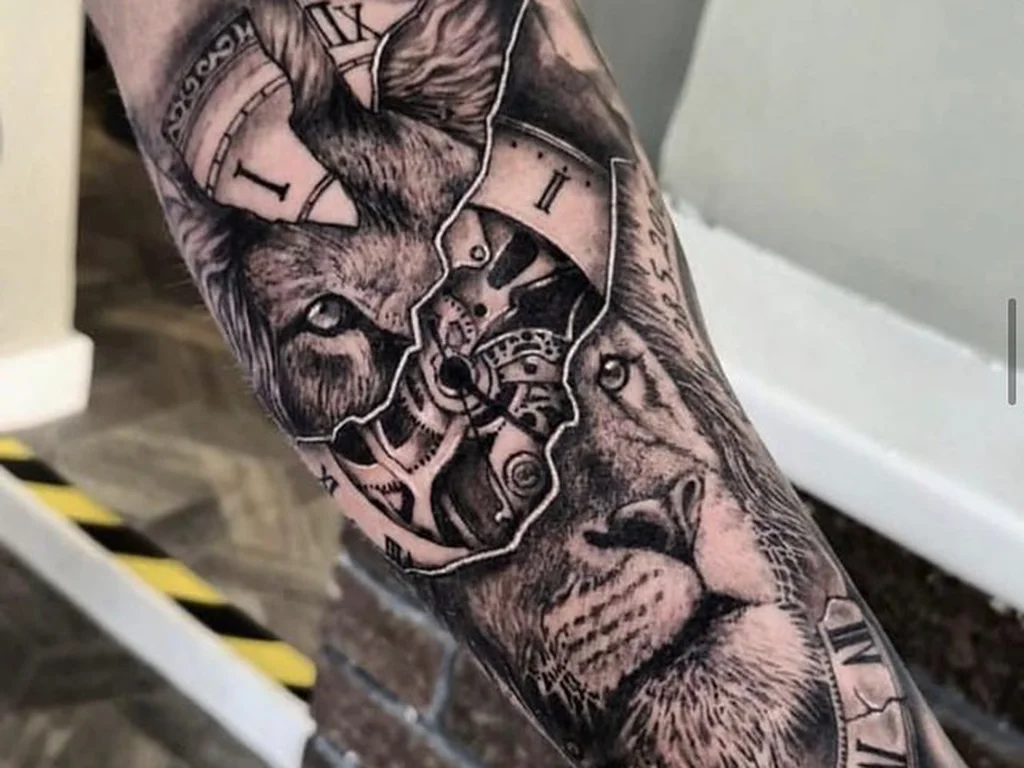
Two lion faces in black and grey, split apart along a jagged seam with clockwork gears showing in the gap and clock numerals bending around the arm. It is a morph design — part animal portrait, part machine — photographed here at a slight angle on the forearm.
Honest warning about the gears: teeth, axles and screws are the fiddliest detail in tattooing, and small mechanical parts blur faster than fur does. This one keeps them big, which is the only reason the mechanism still reads as a mechanism.
9. Lion With Gold Eyes and a Rose, Forearm
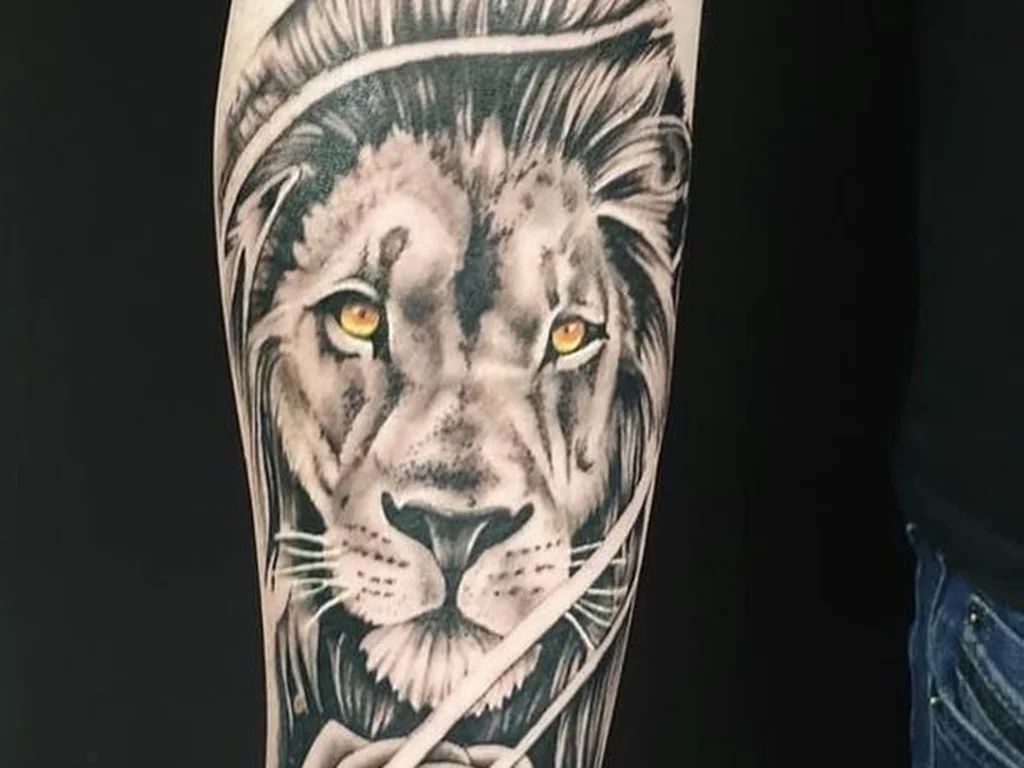
A front-facing lion in black and grey with gold in both eyes and a big soft rose below the chin, ribbons of bare skin sweeping across the whole forearm. The face is calmer than most on this page — mouth closed, ears up, watching rather than roaring.
The rose is shaded in the same grey palette as the lion, which keeps the eyes as the single bright note. One accent colour, used once, is a pattern you will see again at designs 2 and 17 — the usual way colour is handled in black and grey realism.
10. Memorial Lioness for “Dad”, Forearm
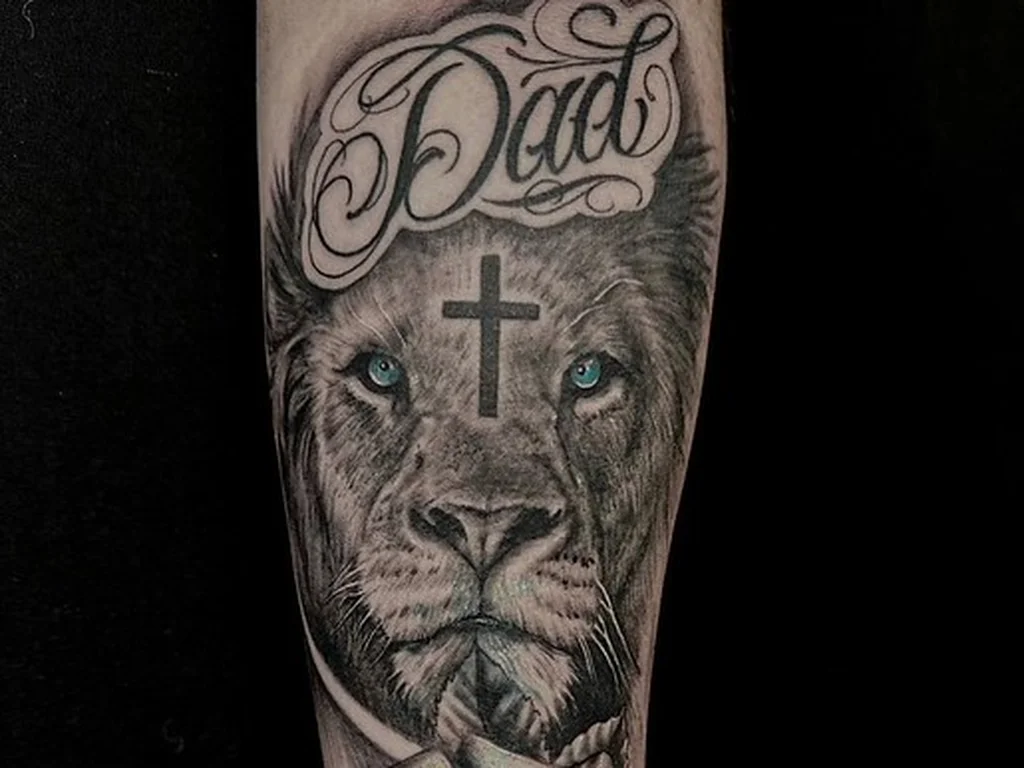
A memorial piece: a lioness’s face with pale blue eyes, the word “Dad” in script across the forehead, a plain cross between the eyes and a rose at the wrist. The lioness stands in for the person; the lettering says who.
Memorial realism carries two jobs at once, portrait and text, and the text is the fragile half. Script this size holds well; script half this size, with the same swirls, would not. If a word matters to the piece, let it be big enough to read across a room.
11. Lion Profile Over a Savanna Scene, Forearm
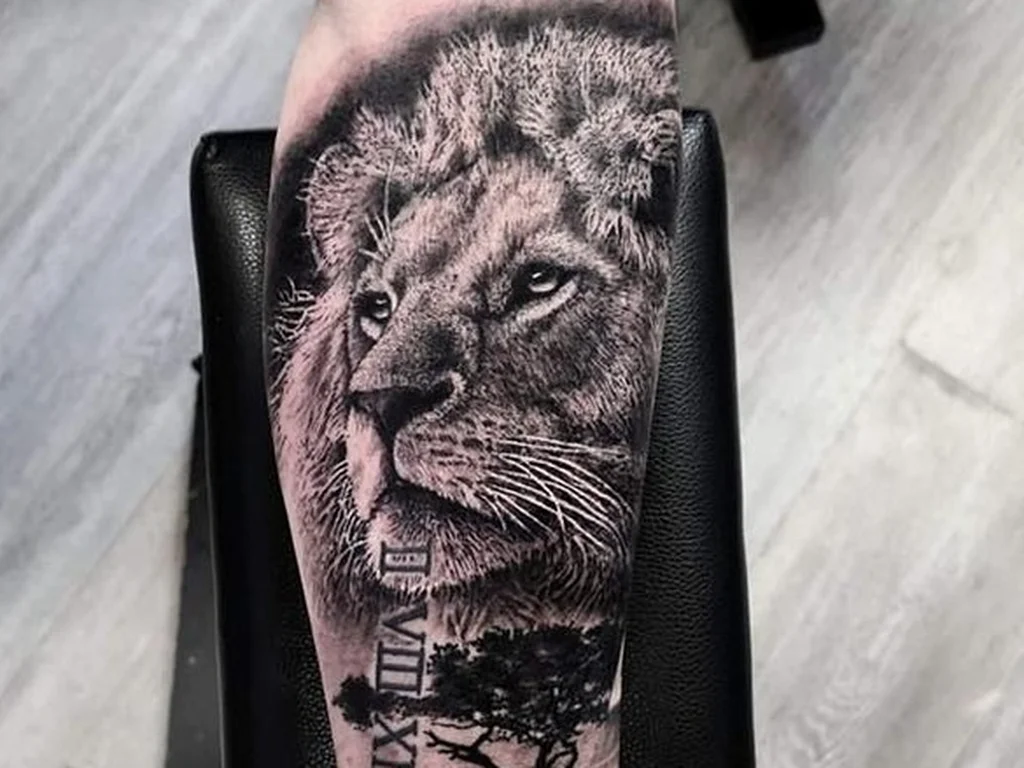
A lion’s head in profile takes the top two-thirds of this forearm, and below it the design steps down into a savanna strip: an acacia tree, a small elephant in silhouette, and roman numerals recording a date. The head is drawn scarred and weathered, an old male rather than a poster lion.
The scene works because it cheats in the right direction — the tree and elephant are silhouettes, not miniatures of realism. Mixing one big realistic subject with simple dark shapes beneath it is the same trick as design 2, and the reliable way to build a forearm composition.
12. Roaring Lion Close-Up, Chest
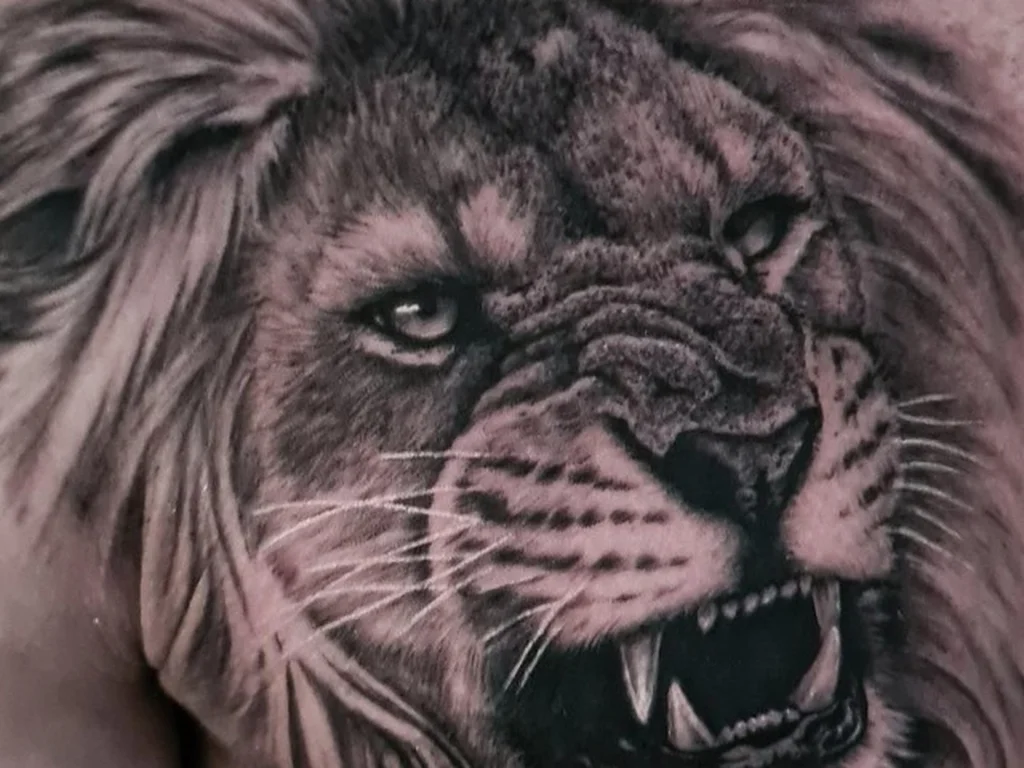
The closest crop on this page: a roaring lion’s face photographed tight, so the mane runs off the edges of the frame and the open mouth, tongue and fangs sit dead centre. The whisker spots are packed in rows across the muzzle, each one placed.
A face cropped this hard only works at chest or back scale, where the full piece is far bigger than the photograph suggests. It is also the roaring composition that ages most gracefully — the features are so large that a decade of softening still leaves them readable.
13. Crowned Lion With Roses, Chest
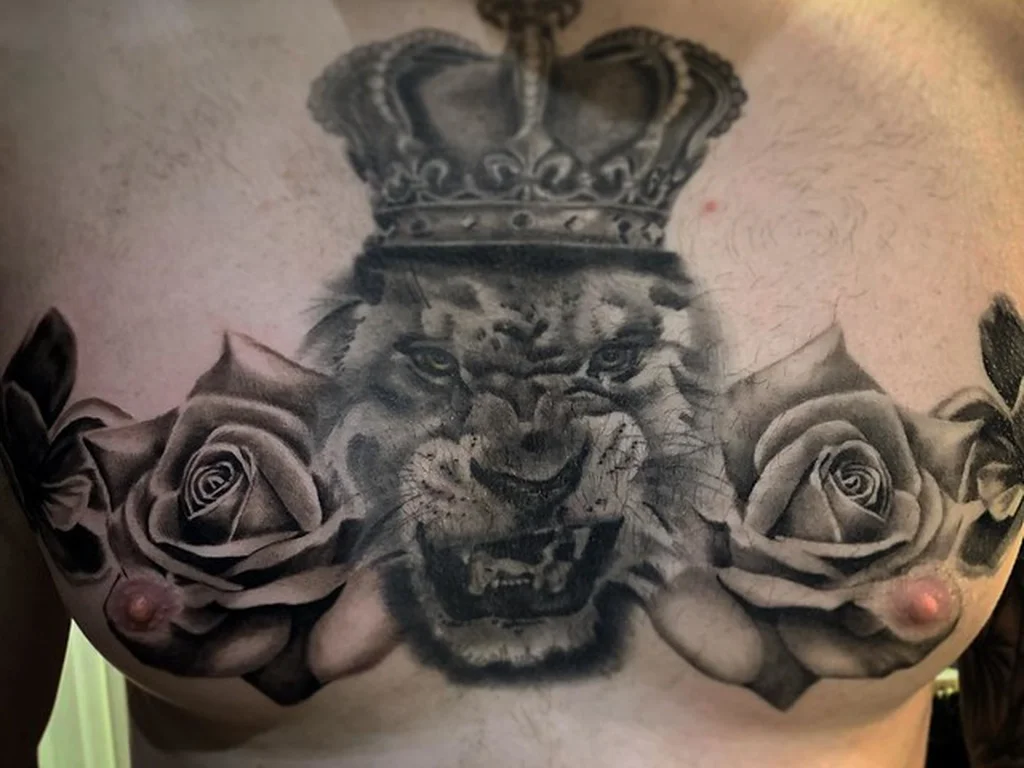
A snarling lion wearing a crown, with a big shaded rose over each side of the chest. The crown is drawn as a real object — patterned band, cross on top — not as a cartoon symbol, and the roses are worked in the same soft greys as the face.
Fitting three subjects across one chest means the lion’s face is smaller than in designs 3 and 12, and you can see the trade: the crown and roses are handsome, but the face carries less detail. Decide which element the piece is really about before the stencil goes on.
14. Roaring Lion With a Crown of Thorns, Forearm
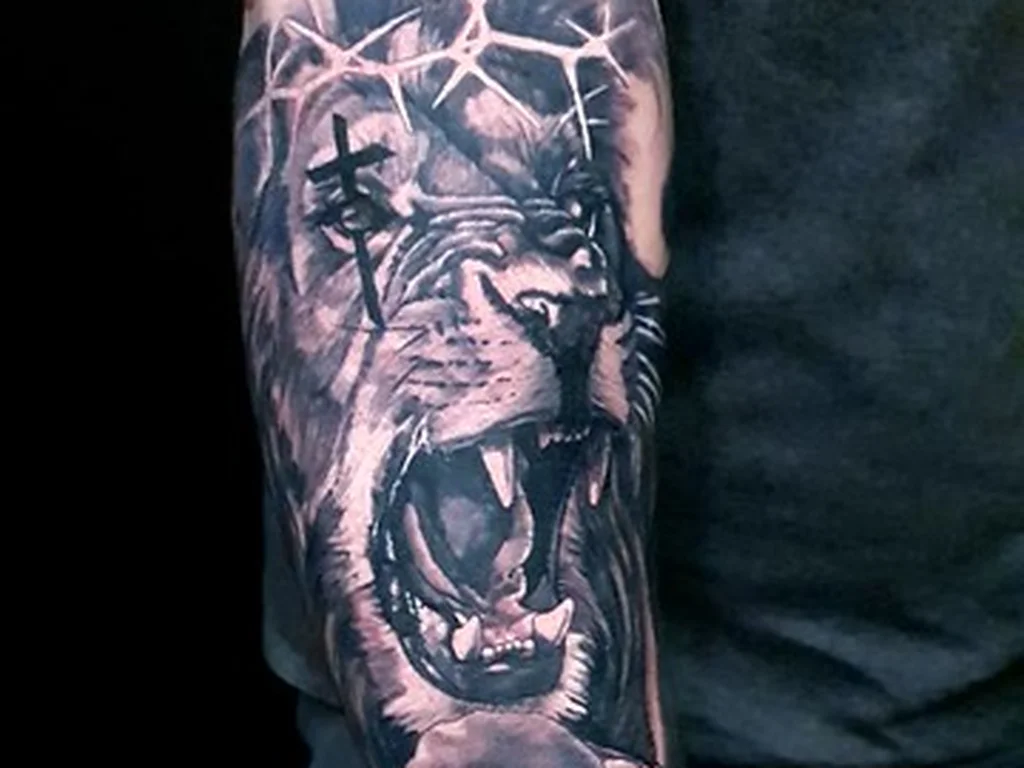
A roaring lion down the forearm with a crown of thorns scratched across the top in pale lines, a small cross beside it and a shaded rose at the wrist — the Lion of Judah layout, faith stated through the animal. A fair warning about the photograph itself: it is the smallest source image in this collection, so this is the softest picture on the page.
The thorns are drawn mostly as bare skin and white, the brightest thing in the design. Bright negative detail fades sooner than the dark work around it, so expect the crown to quieten down over the years while the face stays.
15. Heavy-Maned Lion, Upper Arm
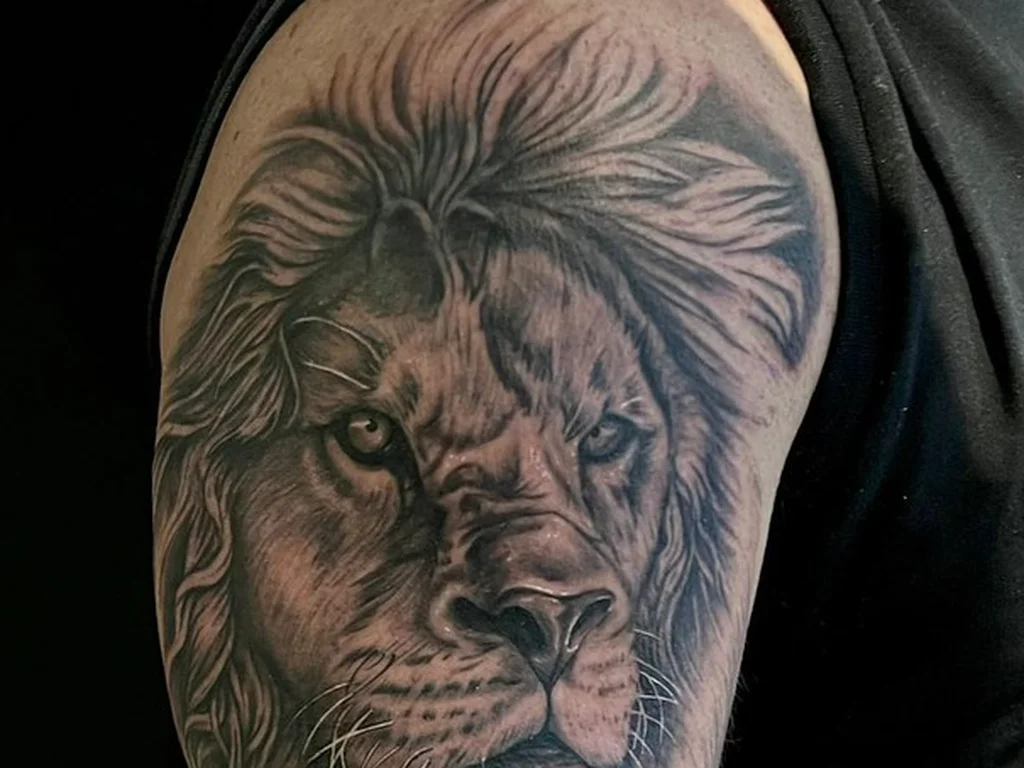
A big-maned lion filling an upper arm, photographed in a way that suggests a healed piece rather than a fresh one: the greys have settled into the skin, the contrast is lower than the studio shots, and there is a slight sheen of texture across the nose.
Treat this one as the page’s reality check: roughly what the fresh forearm pieces above will look like in a few years — softer, calmer, still plainly a lion. If you like a design in this state as much as in its fresh state, you have picked the right one.
16. Painterly Lion Profile, Upper Arm
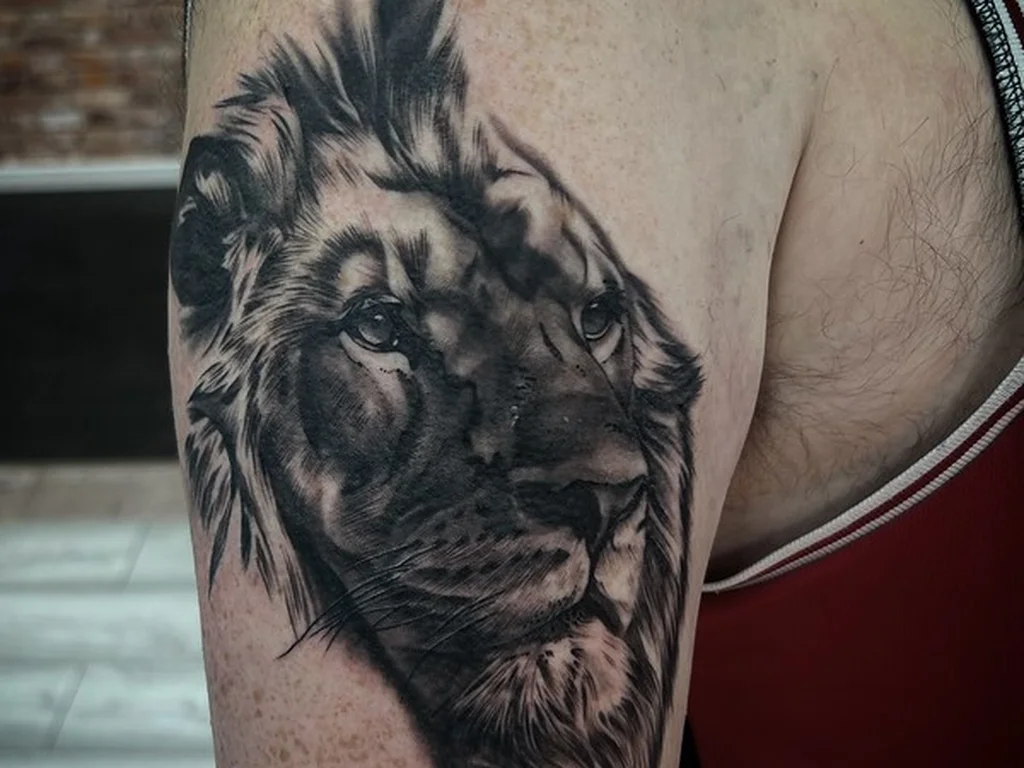
A lion’s head in profile on an upper arm, worked looser than the rest of this page: the shading has a brushed, sketchy energy, and the mane breaks into strokes you can count. It is realism with the hand of the artist left visible in it.
Realism has degrees, and this is worth knowing before you book. Looser work sits faster, and its edges will soften sooner than the tight studio pieces. Chosen knowingly, it has a life the polished versions do not.
17. Lioness Face With Orange Eyes, Forearm
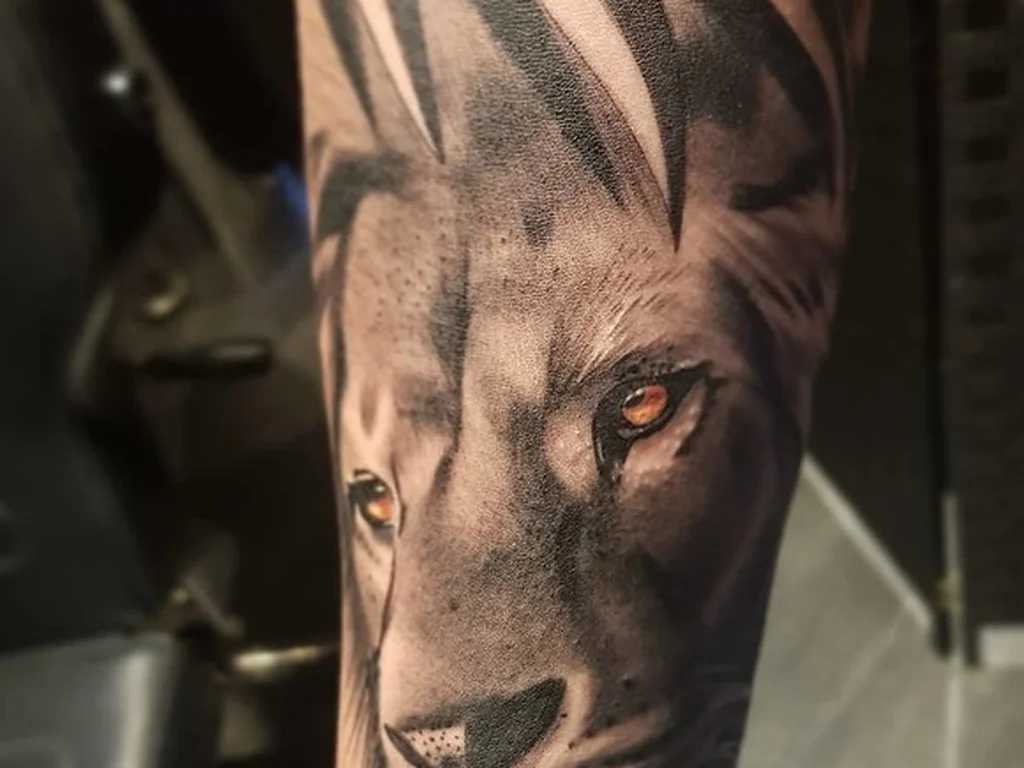
A lioness’s face cropped close on a forearm, orange in the eyes, bold black shapes sweeping over the top of the design. With no mane to draw, a lioness portrait is all about the planes of the face — brow, cheek, muzzle — and this one is built from strong light and shade.
Lionesses are the sharper test of a realism artist: no mane to hide behind, and no mane to fill the space with. When choosing between artists, ask to see a lioness or another short-haired animal in their healed work.
18. Snarling Lion, Shoulder Blade
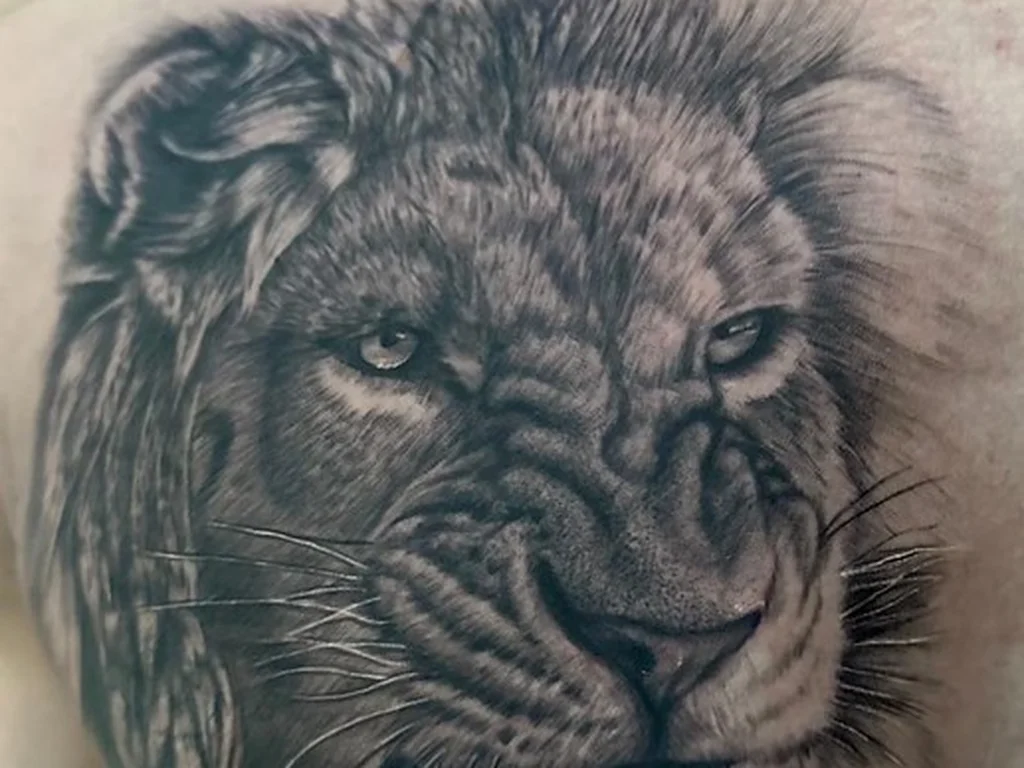
A snarling lion’s face set high on the back of a shoulder, the head turned as if looking behind. The skin does not have the redness of the fresh chest piece at design 3, so this is a settled piece photographed in ordinary light.
The shoulder blade is a kind canvas for realism: flat, slow to stretch, and covered by clothing at work, which keeps the sun off it. Faces placed here hold their light greys longer than the same work on a forearm.
19. Lion Among Peonies, Forearm
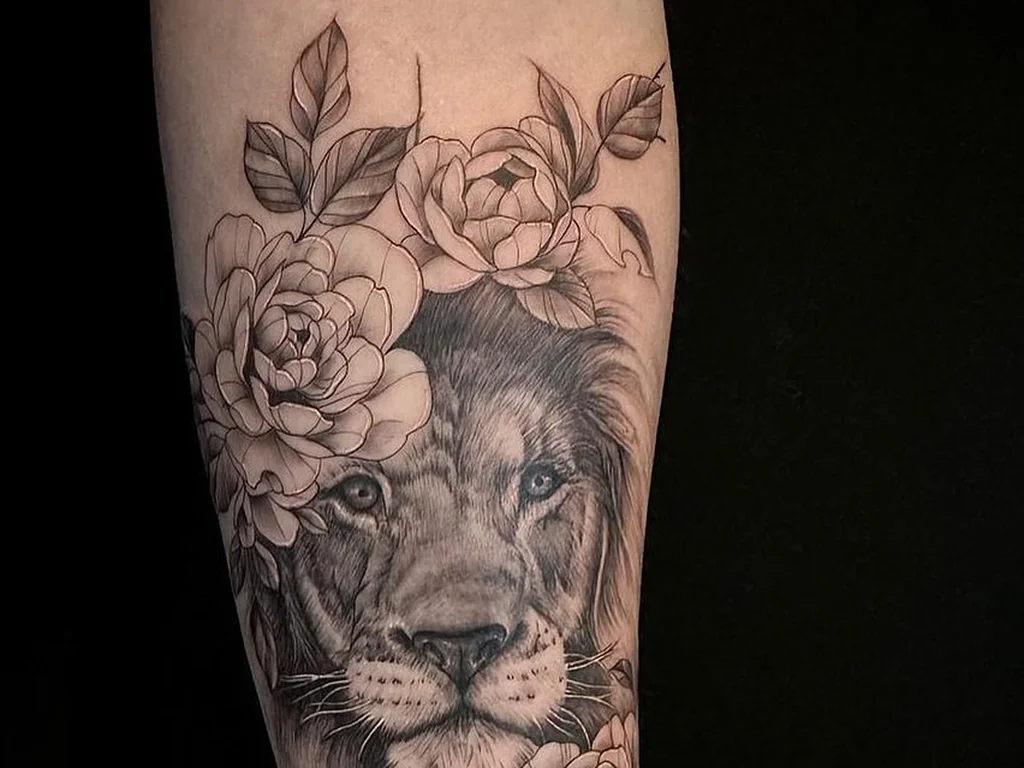
The gentlest piece here: a young lion’s face in soft black and grey, framed by peonies and leaves drawn in fine line and light wash. The lion itself is shaded very pale compared with the roaring forearms above — this is realism turned down low.
Soft work like this is the fastest-fading end of realism. The face will keep its shape, but the light greys in the cheeks and flowers need the most sun protection of any design on this page, and possibly a gentle refresh in time. Go in knowing that, and it is a lovely choice.
20. Lion Back Piece With the Colosseum and Eiffel Tower
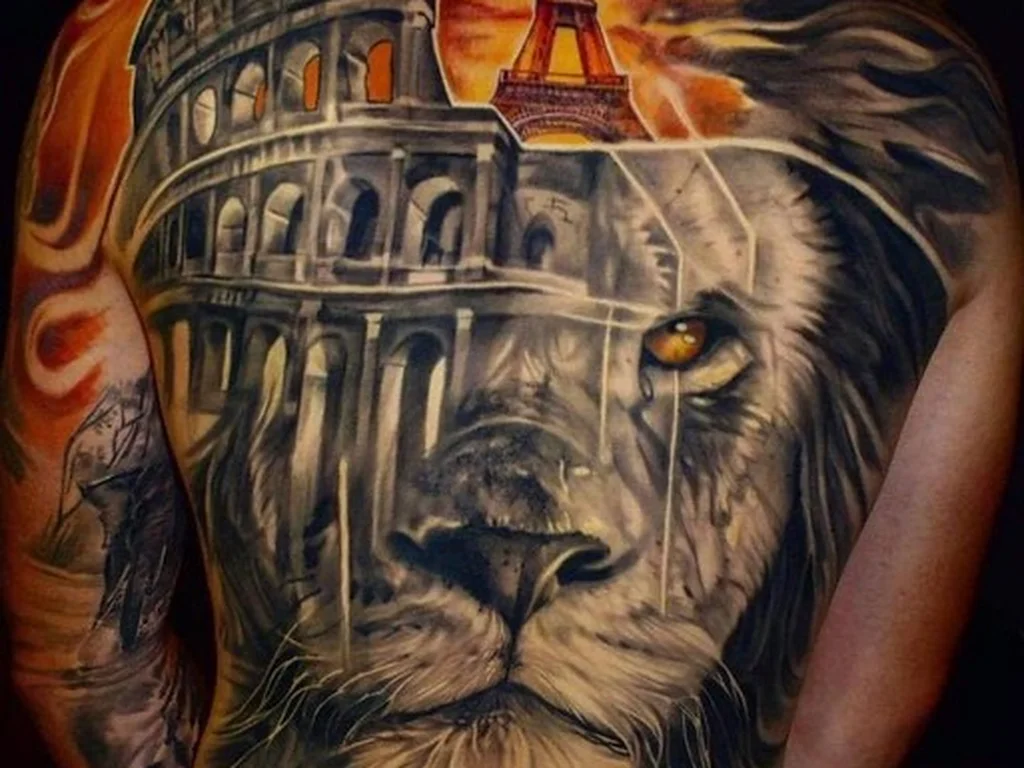
The only full back in the set, and the only full-colour face: a lion’s head in colour realism fills the lower back, with the Colosseum layered across the top of the mane and the Eiffel Tower rising behind it against an orange sky. It is a travel piece — two cities and the animal, blended like a double-exposure photograph.
Work like this is measured in sessions spread over months, and the photograph shows settled, healed colour rather than fresh work. It is also a useful scale check: the lion’s face alone is wider than most chest pieces, which is what lets the whiskers, nose and one amber eye carry detail at this size.
Where Realistic Lion Tattoos Work Best
Forearm. Thirteen of the twenty designs live here, and it is no accident: the forearm is long, fairly flat, and easy to watch being done. Pain sits in the middle of the range. Its one weakness is the sun — forearms see more daylight than anywhere else on this list.
Upper arm and shoulder. A rounder canvas than the forearm, good for a single head like designs 15 and 16, and the natural first panel of a future sleeve. Covered by a short sleeve when you need it covered.
Chest. The width a roaring face wants. Designs 3, 12 and 13 all use the chest’s symmetry, and all three show the same trade: the bigger the face, the fewer extra elements fit honestly beside it. Expect several sessions, and sharper pain over the sternum.
Back and shoulder blade. The only placements that take a lion at something like full scale — design 20’s face alone is wider than a chest. Back skin also ages tattoos kindly because it sees little sun. The cost is commitment: several sessions, and you cannot watch any of it happen.
Frequently Asked Questions
How big does a realistic lion tattoo need to be?
For a full face with mane, think hand-width as the floor — roughly the size of the forearm faces in this collection. Below that, the fur detail has to be simplified and the piece stops reading as realism. A cropped half-face, like design 6, is the honest way to go smaller, because it spends the available space on fewer features drawn bigger.
How many sessions does a realistic lion tattoo take?
A forearm face is usually one long sitting, sometimes two if the detail runs high or your skin needs a break. Chest pieces generally take several sessions, and a full back like design 20 is spread over months. The layers of grey need to heal before the next sitting adds more, which is a limit of skin, not of the artist’s diary.
How much does a realistic lion tattoo cost?
Realism is priced by the session or the day, and the total follows the session count, the size and the artist’s waiting list — a forearm face and a full back are different conversations entirely. Any single figure quoted without those details would be a guess, so get the estimate at a consultation and ask how many sessions it assumes.
Do realistic lion tattoos age badly?
They age softly rather than badly. With no outline holding the shapes, edges relax and the lightest greys fade first — white whisker marks and eye glints go earliest, dark manes last longest. Design 15 shows a settled, healed piece: calmer than the fresh photos, still clearly a lion. Sunscreen on healed skin is the single habit that slows all of it down.
Black and grey or colour for a realistic lion?
Nineteen of these twenty designs are black and grey, and that reflects the wider pattern: grey ink gives the widest range of fur tones and weathers evenly. Colour realism, like the back piece at design 20, can be superb, but it asks for an artist who specialises in it and for more care with sun. A middle path shows up three times here — black and grey with one colour spent on the eyes alone.
Can a realistic lion tattoo cover an old tattoo?
Often, yes — a mane is one of the best cover-up tools there is, because it is busy, textured and naturally dark in patches. The rules are the usual ones: the new piece must be bigger and darker than what sits underneath, and realism cover-ups may need the darkest parts of the mane placed exactly where the old ink is strongest. The artist gets the final say after seeing the old tattoo in person.
Do realistic lion tattoos hurt more than other tattoos?
The needle work is the same as any other tattoo in the same place. What differs is the clock: realism sittings run long, because soft shading is built slowly, and most people find the last hour of a long sitting harder than the first hour of a short one. Placement decides the rest — ribs, sternum and feet at the sharp end, outer arm and shoulder blade at the kind end.
What should I look for in a realism tattoo artist?
Healed photographs, first of all — ask for work at least a year old, because that is the version you will actually wear. Then look for animals specifically, and short-haired ones if you can: a lioness portrait with no mane to hide behind shows an artist’s real control of light and shade.
Does a lioness work as well as a lion in realism?
Yes — four designs here are lionesses (6, 7, 10 and 17), and they hold some of the finest detail on the page. What changes is the composition: without a mane, the design needs another frame, which is why the lionesses here arrive with clocks, lettering, swirls or a very tight crop. The face itself carries just as well.
How do I look after a realistic lion tattoo?
Follow your artist’s healing instructions for the first weeks, then treat sun as the long-term enemy: soft greys show sun damage before bold work does, so healed realism earns high-factor sunscreen whenever it is uncovered. Keep the skin moisturised in dry weather. If the lightest passages fade unevenly years later, a short refresh sitting with the original artist is the normal fix.
Final Thoughts
Twenty designs, and one lesson runs through all of them: realism is bought with size, time and the right artist, in that order. Pick the face at the scale its detail needs, let the mane be as dark as the artist wants it, and judge every portfolio by healed work. Do that, and the lion you get is the lion in the photograph — years later, too, when the greys have settled.
Photo credits: Designs 1 and 4: tattoo by Alan Hindes, photographs by Gypates — design 1 CC BY-SA 4.0, design 4 CC BY 4.0, via Wikimedia Commons. Design 5: tattoo by Fink Tattoo, via Flickr (TattoosAll), CC BY-SA 2.0. Designs 13, 16, 17 and 20: via Flickr (TattoosAll), CC BY 2.0. Designs 2, 3, 6, 7, 8, 9, 10, 11, 12, 14, 15, 18 and 19: via Flickr (TattoosAll), CC BY-SA 2.0.