
If you are comparing moon tattoo design ideas, start with what the moon lets you say that no other symbol quite can: change itself. The moon is the one sky object that visibly transforms — it waxes, fills, wanes and disappears on a cycle of about 29.5 days, and every phase of that cycle has become a tattoo shorthand for a stage of a life. Change the form — a thin crescent, a full disc, a whole row of phases, a moon paired with its opposite, the sun — and the same symbol tells a different story. This guide walks through 18 moon tattoo designs, each with its own photo, its usual reading, and one practical thing to know before you book.
One honest note before the meanings: phase symbolism is convention, not fact. The associations below are what wearers and artists commonly intend by each phase today; they are modern tattoo-culture readings, not rules handed down from antiquity. The astronomy underneath them is real — the phases really do run in one fixed order — and the older history is real too: the moon had named deities in the ancient world, Selene in Greek tradition and Luna in Roman, with Artemis linked to the moon in later Greek religion. What a given crescent “means” on your skin, though, is decided by you and your artist, not by a chart.
What a Moon Tattoo Means
| Meaning | What wearers usually intend by it |
|---|---|
| Cycles and change | The core reading — the phases as proof that nothing, good or bad, is permanent |
| Growth and new beginnings | The waxing moon: something increasing — a recovery, a plan, a self still becoming |
| Letting go | The waning moon: something deliberately decreasing — grief, a habit, a finished chapter |
| Femininity and intuition | A long-standing traditional association, from moon goddesses to the lunar month’s closeness to the menstrual cycle |
| Night, dreams and the hidden side | The moon as the light of the private hours — dreams, secrets, the self others do not see |
| Balance and duality | Usually drawn, not implied: the moon paired with the sun, night held against day in one design |
Moon Phases and Forms, Honestly Labelled
| Phase or form | The usual convention | The honest catch |
|---|---|---|
| Crescent moon | New beginnings, hope, potential — the moon on its way somewhere | Waxing and waning crescents point opposite ways, and the meanings flip with them; most viewers cannot tell which they are looking at, so orientation is a detail to agree with your artist, not to assume |
| Full moon | Completion, wholeness, clarity, things coming to a head | The one phase that needs no explanation — which is why full moons carry the scenic designs (designs 13–17) where the disc is a backdrop, not a symbol |
| Moon phases row or column | The whole cycle at once: change, time passing, a life in stages | The phase order is fixed astronomy, not decoration — crescent, half, gibbous, full, then mirrored back. A row drawn out of order is simply wrong, and people who know moons notice |
| Triple moon | Maiden, mother and crone; the goddess in three aspects | That three-part reading is a 20th-century popularization, spread widely by Robert Graves’s The White Goddess (1948) — a modern tradition, honestly held, but not an ancient one |
| Blood moon | Intensity, rarity, upheaval — “once in a blood moon” | A blood moon is just a totally eclipsed moon, copper-red from Earth’s shadow; there is no separate phase to draw. Honest limit of this page: none of the 18 photographed designs here is an eclipse piece |
| Sun and moon together | Balance, duality, two people or two halves of one person | The pairing is a visual argument, not an old single symbol — it means what the wearer sets in balance (designs 6 and 7) |
The 18 Designs at a Glance
| Design | Style | Works best on | Size |
|---|---|---|---|
| 1. Moon Phases Column | Black-and-grey dotwork | Forearm, spine, calf | Medium |
| 2. Moon Phases with a Death Star Full Moon | Black-and-grey | Inner arm, forearm, calf | Small–medium |
| 3. Minimalist Crescent Moon | Fine line | Forearm, wrist, ankle, sternum | Tiny–small |
| 4. Abstract Black Crescent Moon | Blackwork | Forearm, calf, upper arm | Medium |
| 5. Smoke Crescent Moon | Black-and-grey | Calf, forearm, ribs | Medium–large |
| 6. Crescent Moon and Sun | Blackwork / dotwork | Shoulder blade, chest, upper back | Medium |
| 7. Sun and Moon Yin Yang | Black-and-grey | Upper back, shoulder, chest | Medium |
| 8. Crescent Moon and Wave | Fine line | Back, ribs, hip, ankle | Small–medium |
| 9. Raven on a Crescent Moon | Blackwork, illustrative | Upper arm, thigh, shoulder blade | Medium |
| 10. Black Cat on a Crescent Moon | Black-and-grey | Calf, upper arm, thigh | Medium |
| 11. Crescent Moon and Bats | Blackwork, brush-stroke | Shoulder, upper arm, thigh | Medium–large |
| 12. Crescent Moon and Bat | Black-and-grey | Calf, forearm, upper arm | Small–medium |
| 13. Wolf Howling at a Full Moon | Black-and-grey realism | Upper arm, back, thigh | Large |
| 14. Full Moon and Cactus | Blackwork, framed | Upper arm, calf, forearm | Small–medium |
| 15. Ship Silhouette Against a Full Moon | Black-and-grey silhouette | Calf, upper arm, back | Medium–large |
| 16. Crescent Moon over Mountains | Black-and-grey, framed | Thigh, upper arm, calf | Medium |
| 17. Full Moon over Layered Mountains | Dotwork, framed | Upper arm, forearm, calf | Medium |
| 18. Crescent Moon Clock | Black-and-grey | Upper arm, thigh, chest | Medium–large |
18 Moon Tattoo Designs, With Photos
1. Moon Phases Column Tattoo
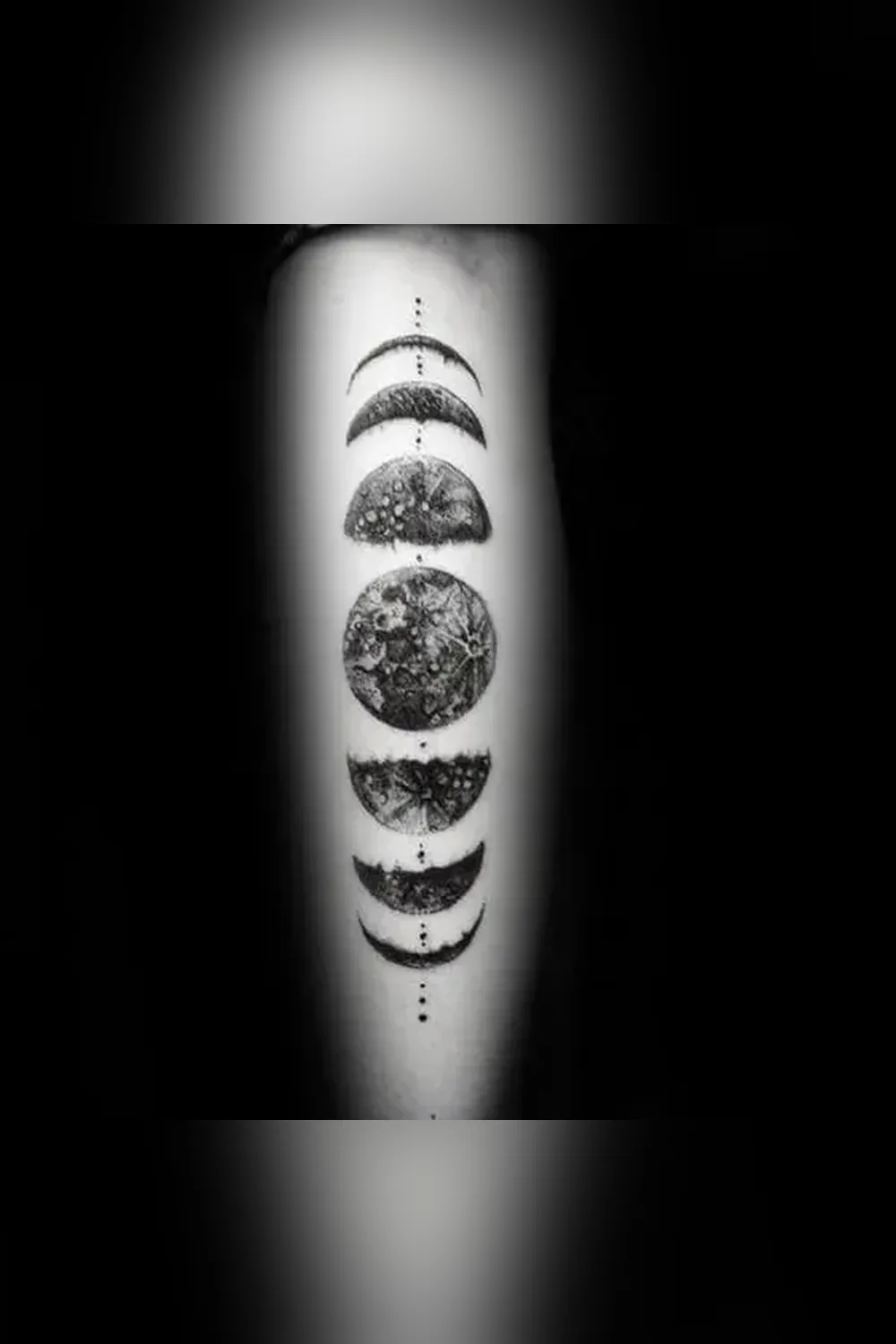
The cycle drawn whole: seven moons stacked down the forearm on a dotted center line, each disc filled with stippled crater texture so even the crescents read as moon surface, not empty shapes. Because the column is symmetrical around the full moon at its center, it makes the phases’ argument for you — waxing on one side, waning on the other, change as the design’s whole structure.
Best for: the cycle meaning in its most complete form. Placement: forearm, spine, sternum, calf — anywhere with a straight vertical run. Know before you book: the stipple texture is what separates the moons; done too small, seven discs blur into seven blobs.
2. Moon Phases with a Death Star Full Moon Tattoo
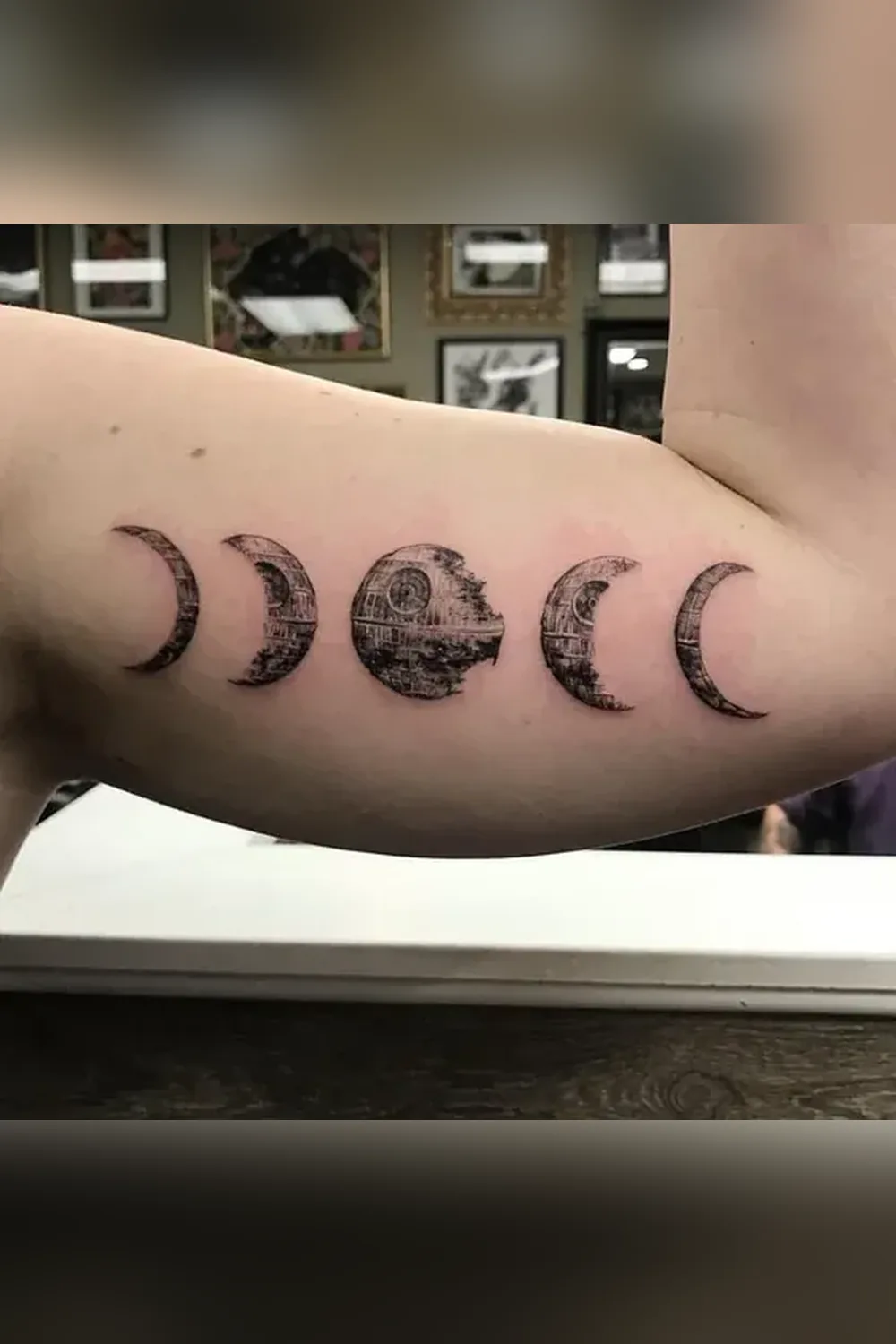
Five moons in a row across the inner arm — two crescents, two half-lit discs, and at the center, where the full moon belongs, a Death Star, drawn with its dish and panel lines at the same scale and shading as the real moons around it. It is the gallery’s one joke design, and it works because the swap is played straight: everything else about the row is astronomically correct.
Best for: Star Wars fans who want the reference worn quietly, inside a classic design. Placement: inner arm, forearm, calf, ribs. Know before you book: the dish detail is small linework; at tiny sizes the center reads as a plain full moon, which may or may not be what you want.
3. Minimalist Crescent Moon Tattoo
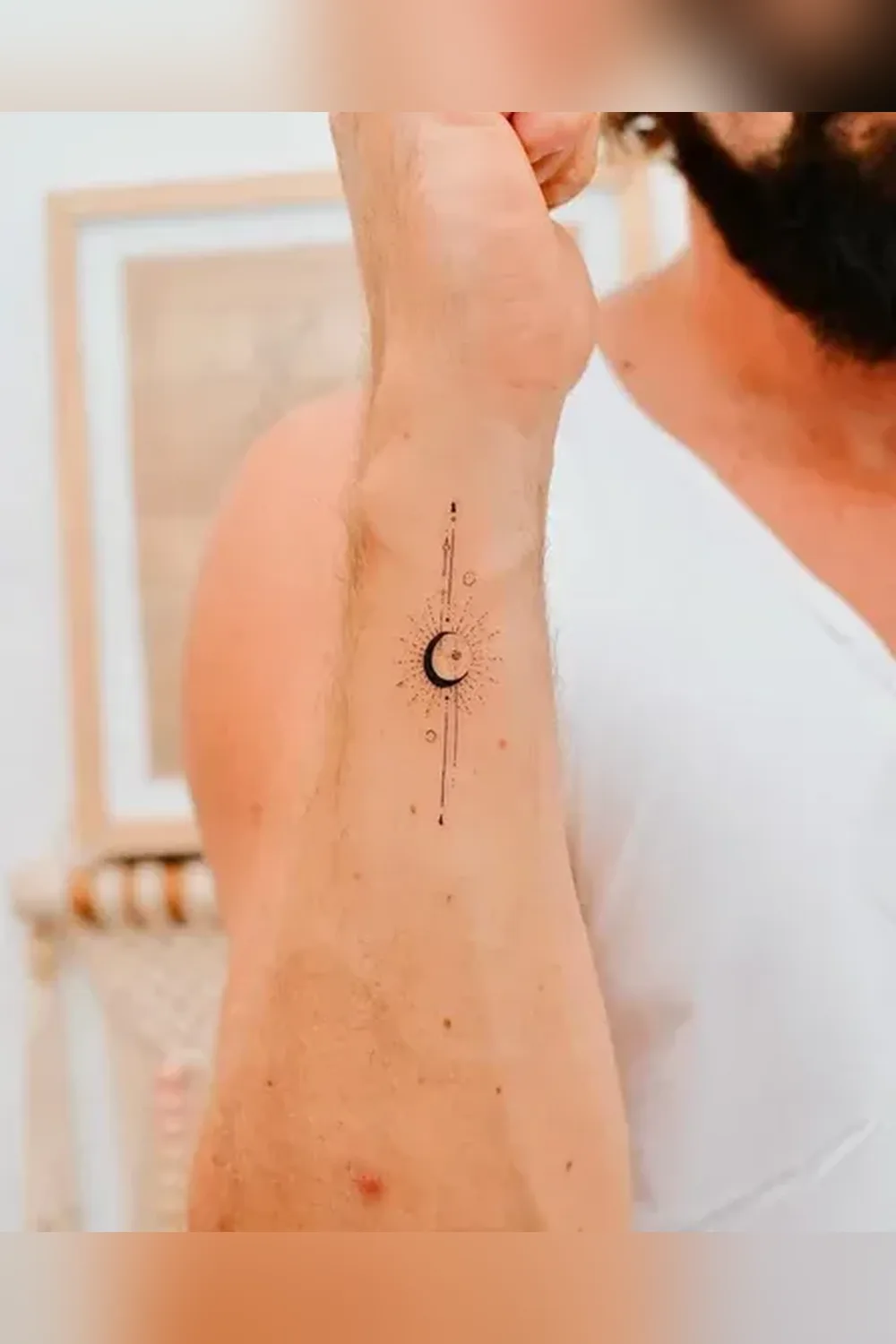
The moon at its smallest honest size: one fine-line crescent hung on a vertical drop of dots and hair-thin lines, ornamental rather than astronomical. Designs like this are the current default first moon tattoo — the meaning is carried by placement and delicacy, and the piece is small enough to sit inside a sleeve’s gap or stand alone on a forearm.
Best for: first tattoos; the new-beginnings reading worn lightly. Placement: forearm, wrist, ankle, behind the ear. Know before you book: dotted drops soften fastest of anything here; a slightly heavier dot than the reference photo is the usual compromise.
4. Abstract Black Crescent Moon Tattoo
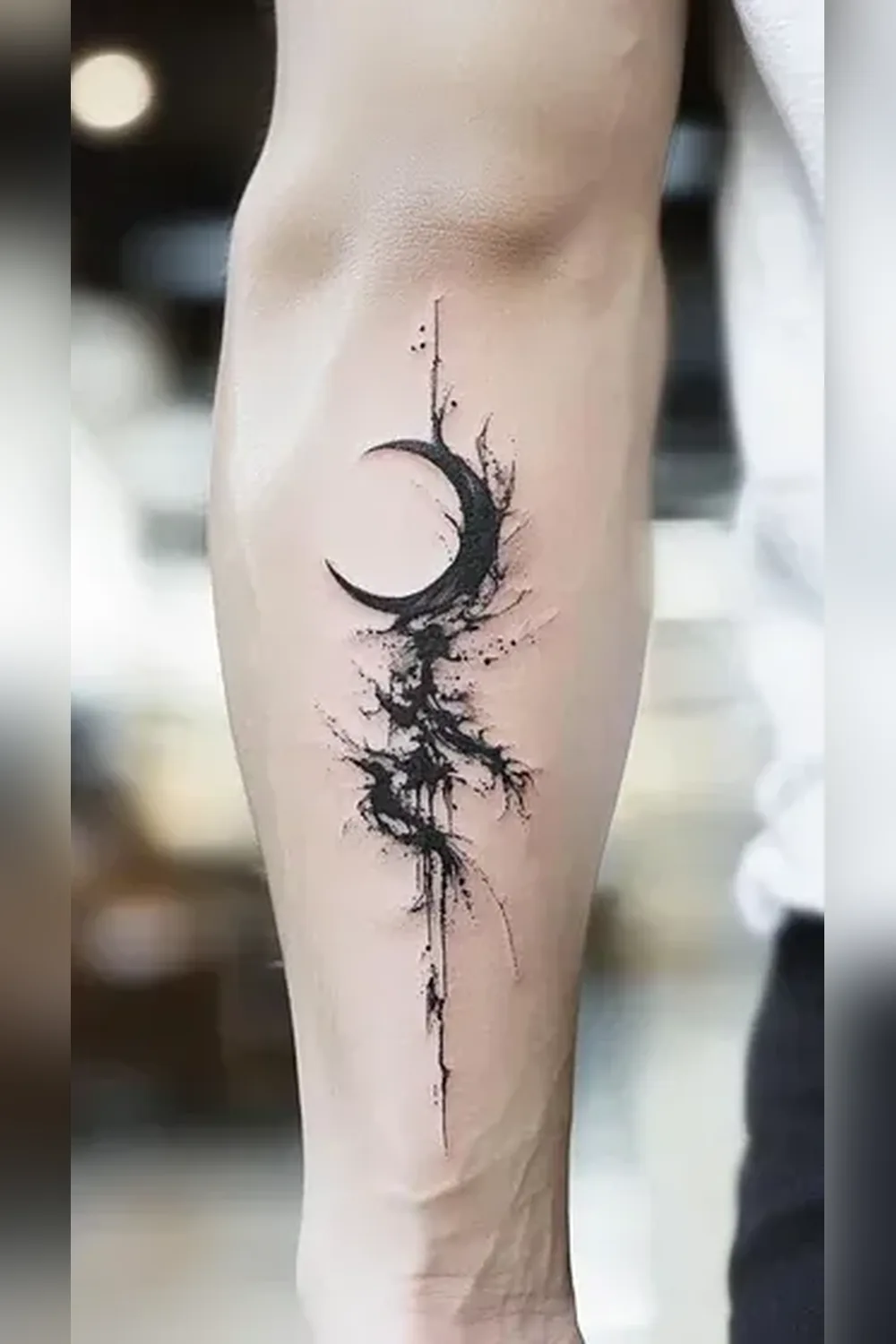
The opposite approach to design 3: a crescent packed with solid black, its lower edge breaking into splatter and dry-brush strokes that trail down the forearm. There is no outline to fail here — the shape is the ink mass itself — which makes this the most forgiving crescent in the list as it ages, and the boldest read at a distance.
Best for: wearers who want the crescent graphic and permanent, not delicate. Placement: forearm, calf, upper arm. Know before you book: splatter edges are controlled accidents; look at your artist’s healed blackwork, not just fresh photos, before trusting the effect.
5. Smoke Crescent Moon Tattoo
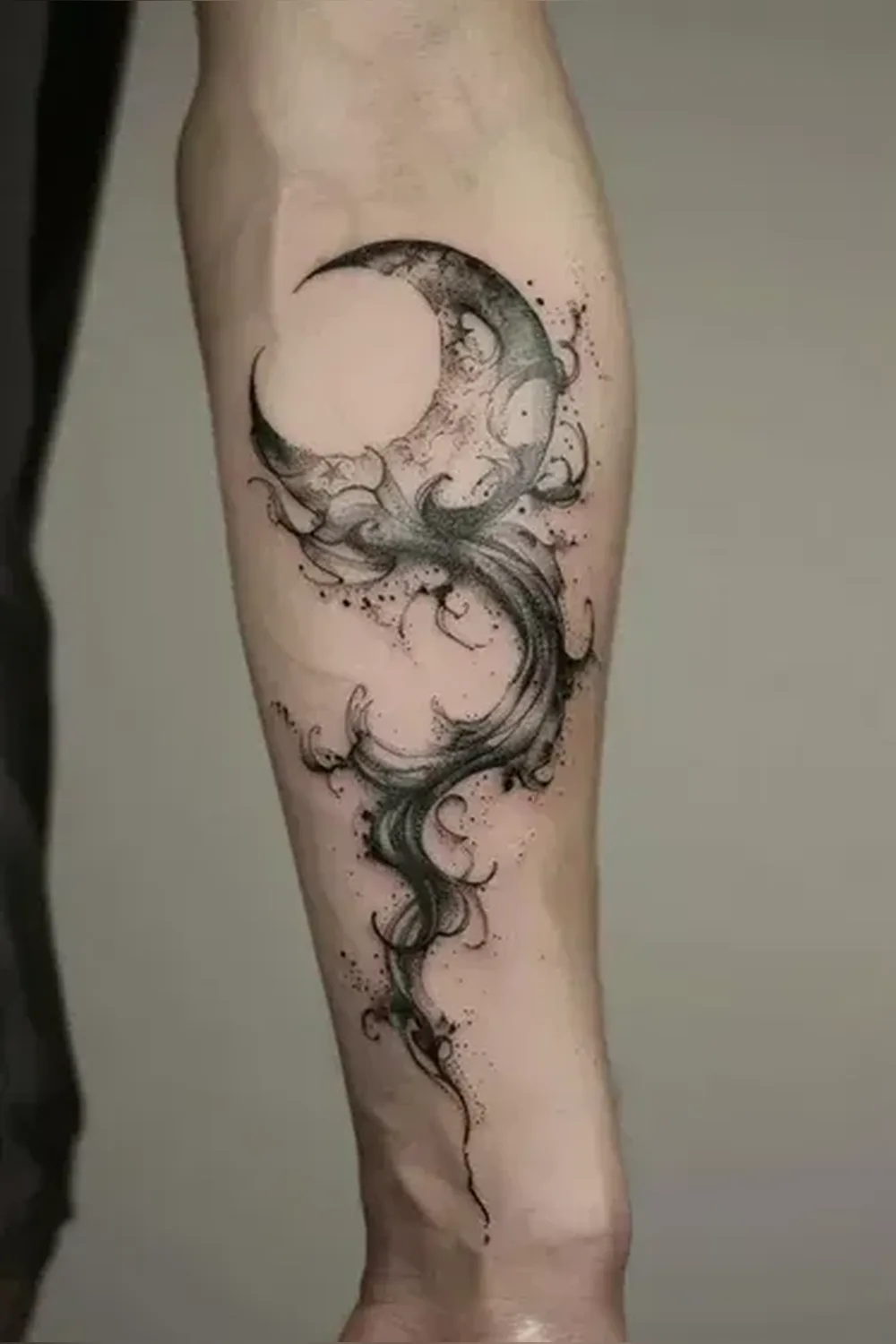
A shaded crescent at the top of the calf that refuses to stay a crescent: its lower horn unravels into smoke, and the smoke keeps going, curling down the leg in grey wisps. The reading is the moon as something half-grasped — dreams, memory, a phase already leaving — and the design needs its length, because the dissolve is the design.
Best for: the dream-and-hidden-side meaning; long, flowing placements. Placement: calf, forearm, ribs, spine. Know before you book: smoke is soft grey with no outline — it softens further with age, so the crescent’s dark core has to be dark enough to anchor it in ten years.
6. Crescent Moon and Sun Tattoo
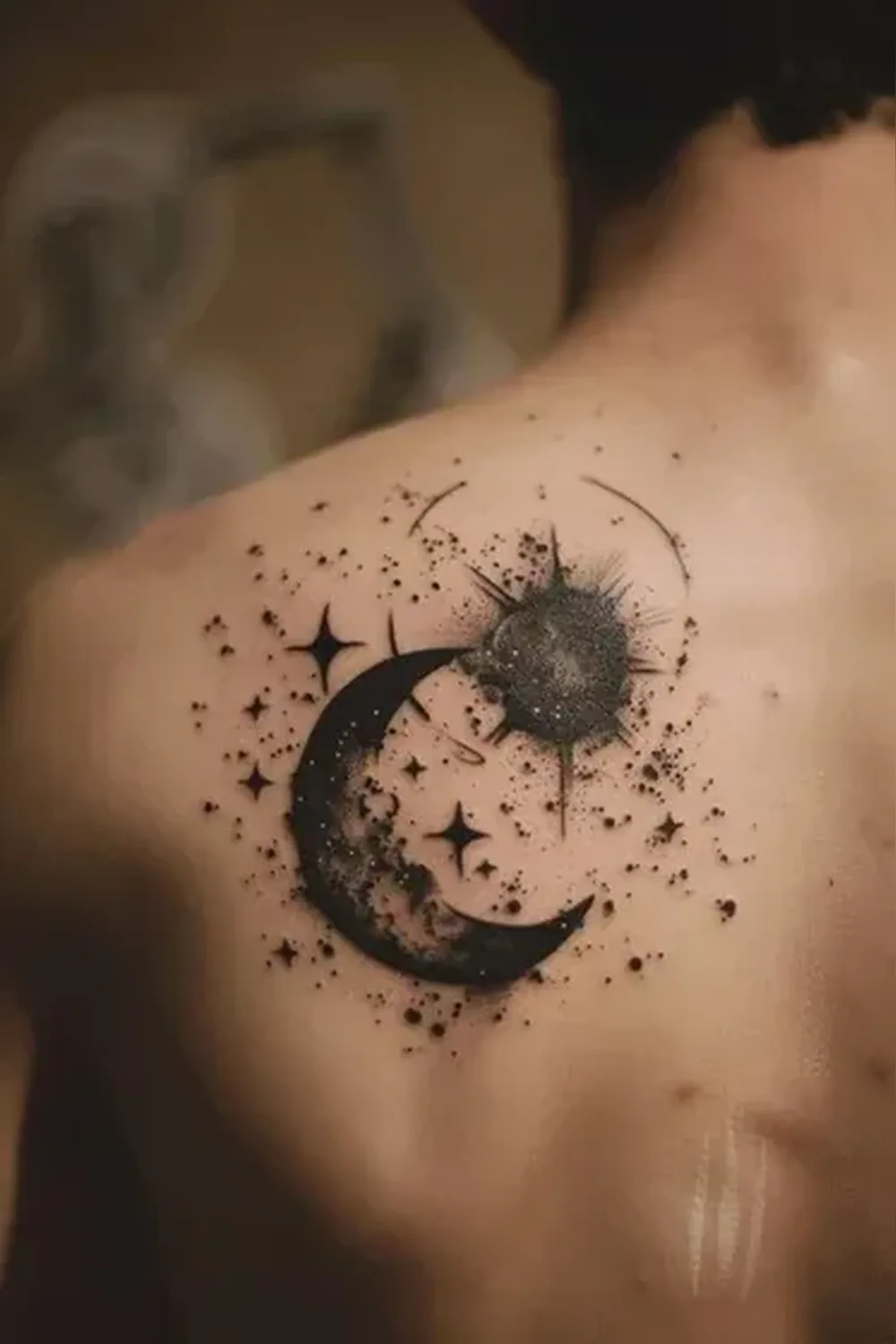
On the shoulder blade, a heavy black crescent cradles a field of stipple and four-pointed stars, while beside it the sun is drawn as a dark, rayed disc — the pairing done in a single ink, night and day given equal weight instead of the usual gold-versus-silver contrast. Scattered dotwork drifts off both bodies like dust.
Best for: the balance reading with a darker, blackwork hand. Placement: shoulder blade, chest, upper back, thigh. Know before you book: a black sun reads as an eclipse to some viewers; if that ambiguity bothers you, give the sun open rays and keep its center light.
7. Sun and Moon Yin Yang Tattoo
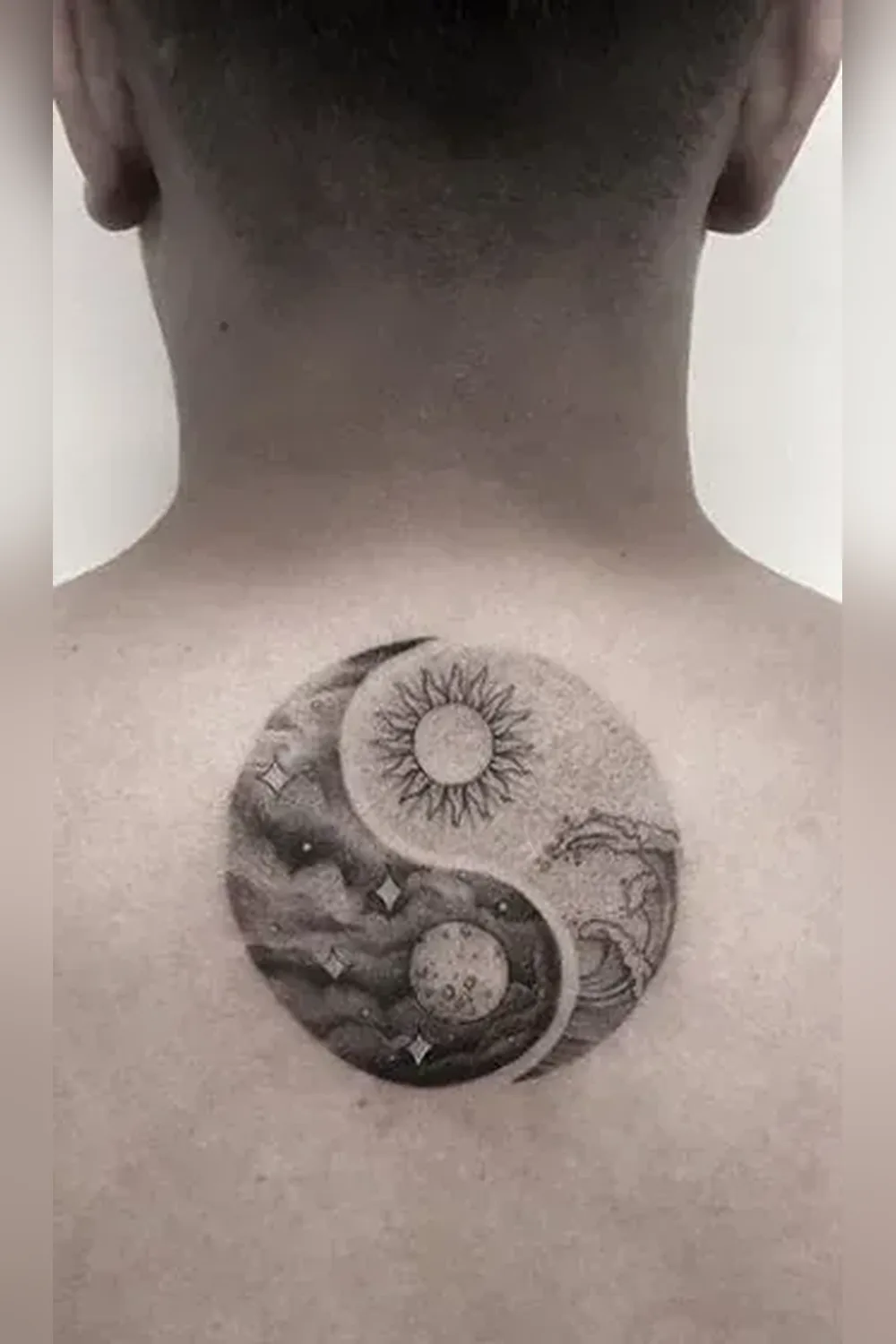
The duality design made literal: a yin yang on the upper back where one swirl holds a rayed sun and the other holds a moon among stars, the dividing curve doing the argument — each half carries the other’s seed dot, each is shaped by the other. Of all the sun-and-moon pairings, this is the one whose meaning a stranger can read without help.
Best for: balance meanings stated plainly; two-sided stories. Placement: upper back, shoulder, chest. Know before you book: the design lives or dies on the circle — circles distort on curved, moving skin, so check the stencil standing and twisting, not just flat.
8. Crescent Moon and Wave Tattoo
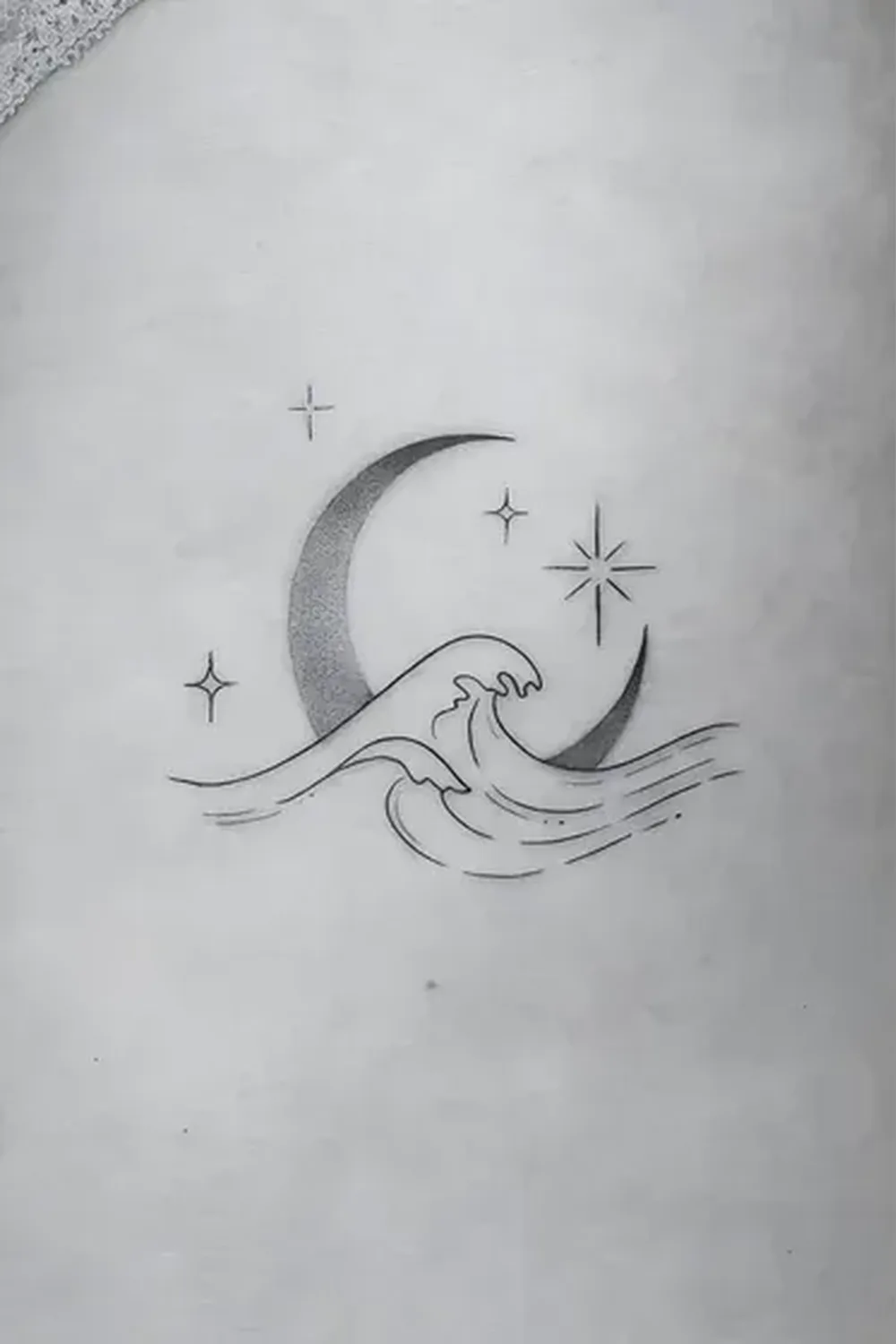
A soft-shaded crescent setting into a line-drawn wave, three sparkle stars around it — the smallest scene in this list. The pairing is the one moon combination with physics underneath it: the moon’s gravity drives the ocean tides, so moon-over-water is the rare tattoo metaphor that is also literally true, which is part of why surfers and sailors keep choosing it.
Best for: ocean people; a quiet scene instead of a symbol. Placement: back, ribs, hip, ankle. Know before you book: the wave is two or three lines — if they thicken unevenly the curl goes first, so this wants a steady fine-line hand and a touch more size than feels necessary.
9. Raven on a Crescent Moon Tattoo
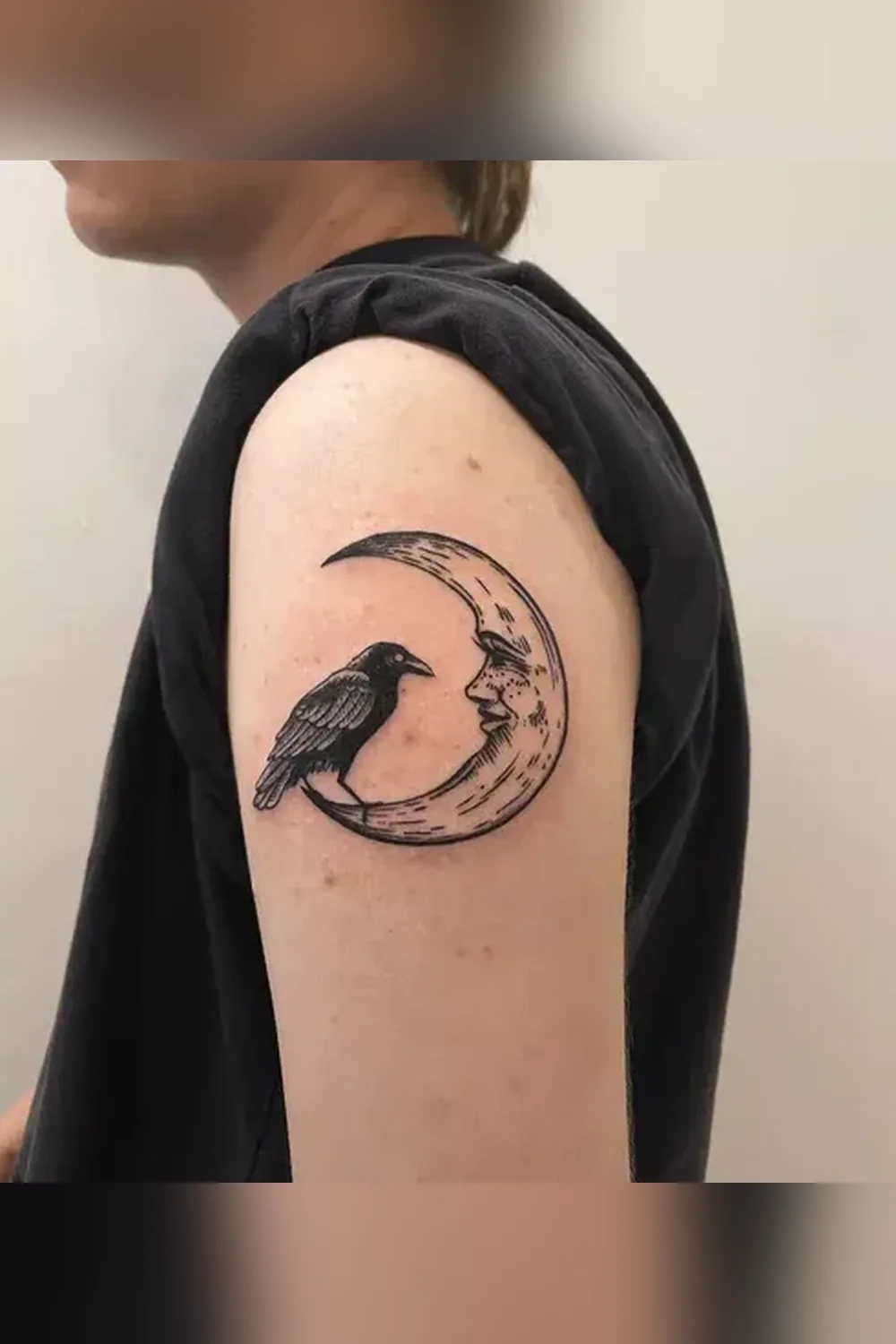
An engraved-style crescent on the upper arm, its inner curve holding two figures face to face: a raven perched at one horn, and, formed by the moon’s own shaded edge, the profile of a face — the old man-in-the-moon, awake and looking back at the bird. Ravens carry their own night freight (messengers, memory, omens in the folklore of several cultures), and the face-to-face composition makes the piece a conversation rather than a perch.
Best for: folklore and storybook readings; corvid people. Placement: upper arm, thigh, shoulder blade. Know before you book: the face lives in a few engraved lines — it is the first detail to soften, so keep the design at the size in the photo or larger.
10. Black Cat on a Crescent Moon Tattoo
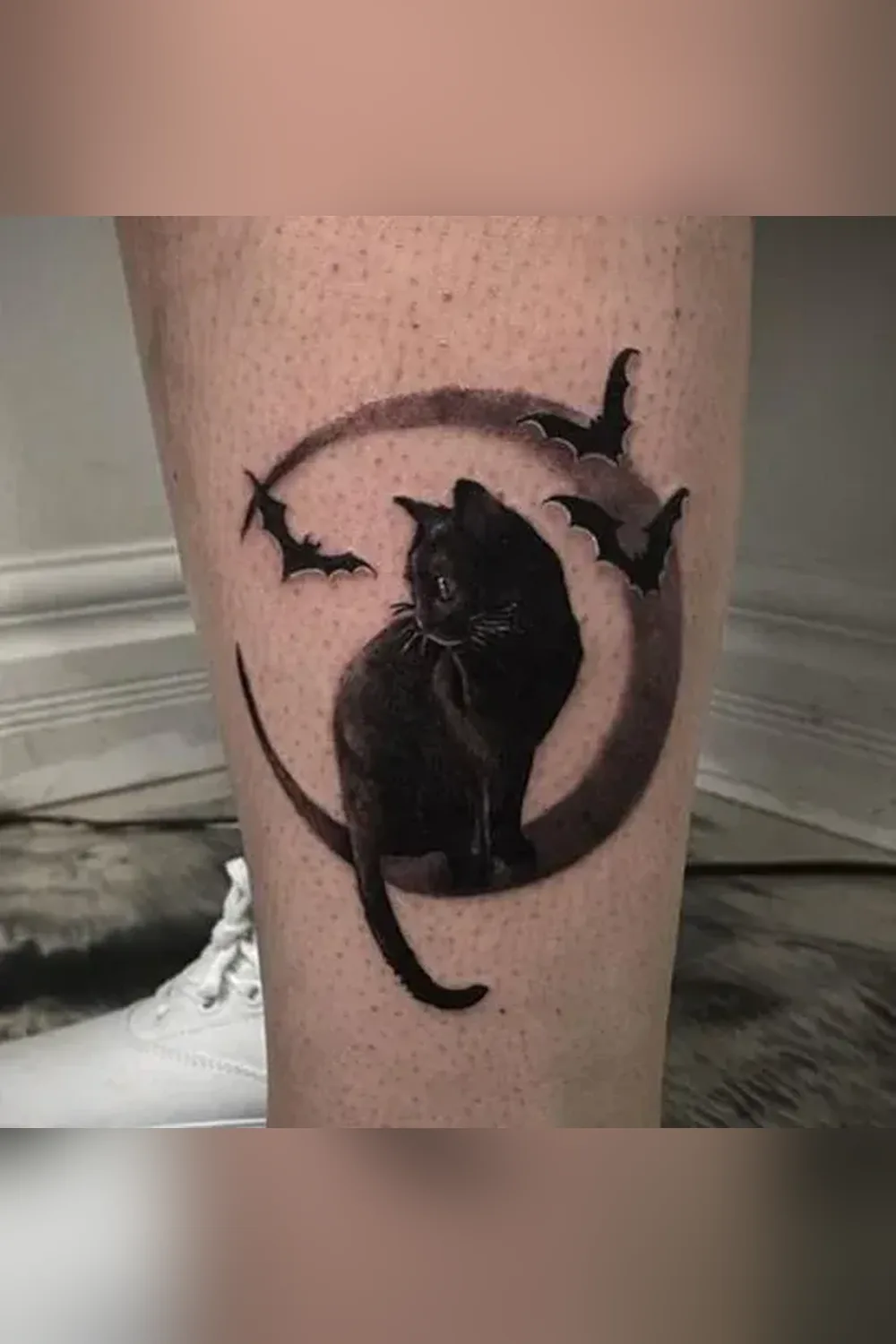
A black cat sitting upright inside a shaded crescent ring on the calf, tail curling out below the curve, three small bats around the rim. The cat is a near-silhouette — its face is carried by a few light lines for eyes and whiskers — so the design reads as one dark shape against the moon’s grey, a Halloween-adjacent composition that works all year because the rendering stays elegant.
Best for: cat people; the night-side meaning with warmth in it. Placement: calf, upper arm, thigh. Know before you book: silhouette cats age into blobs if the ears and tail lose their gaps — the skin breaks between tail, body and moon are doing structural work.
11. Crescent Moon and Bats Tattoo
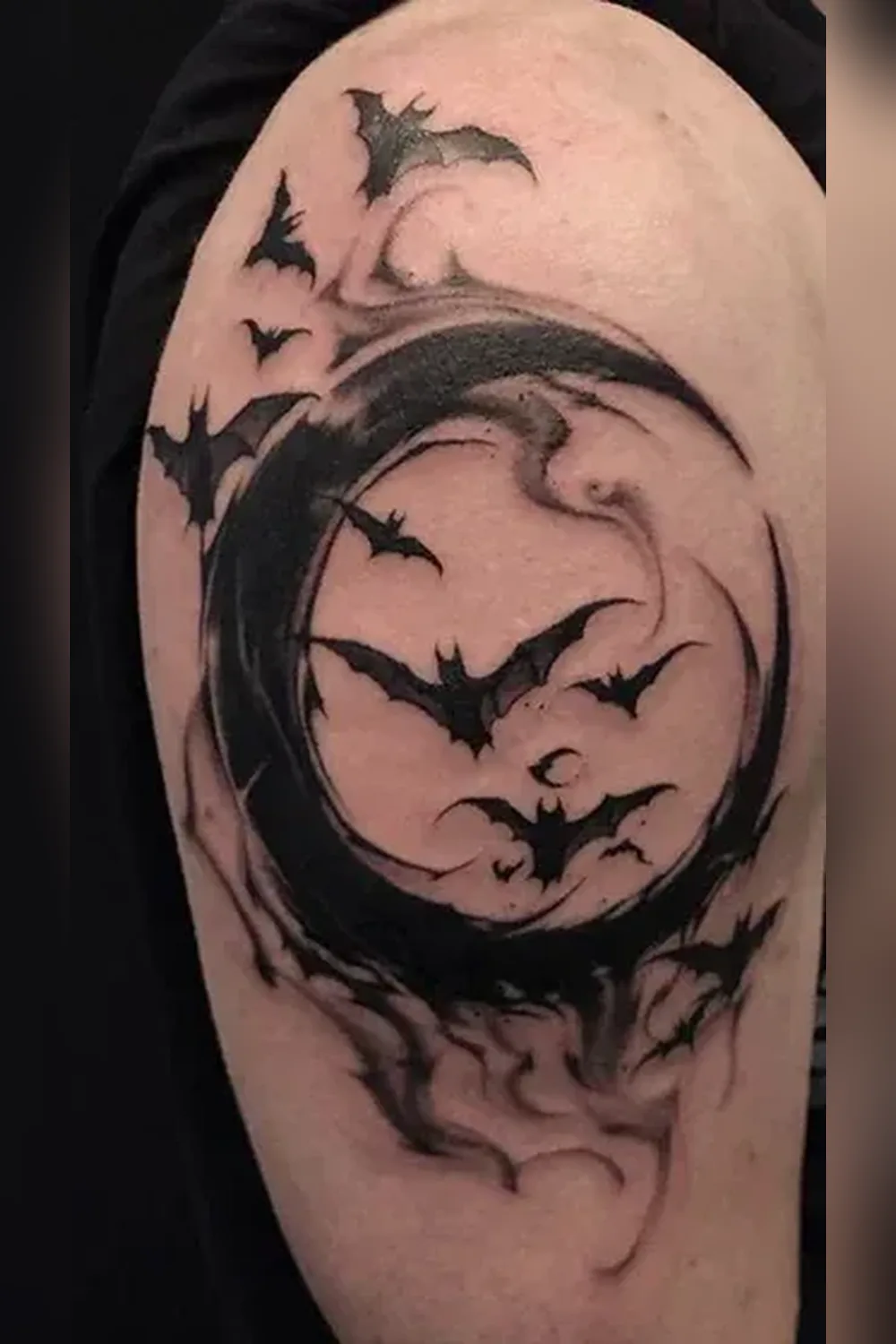
The boldest night piece here: a huge brush-stroke crescent sweeping across the shoulder, smoke at its edges, and a loose swarm of bat silhouettes inside and above the curve. Where design 12 keeps one bat in careful detail, this one is about movement — the moon is a stroke of weather and the bats are caught in it.
Best for: committed night imagery at a large, graphic scale. Placement: shoulder, upper arm, thigh, back. Know before you book: brush-stroke edges are meant to look torn; confirm with your artist where the stroke ends and smudging begins, in a healed example.
12. Crescent Moon and Bat Tattoo
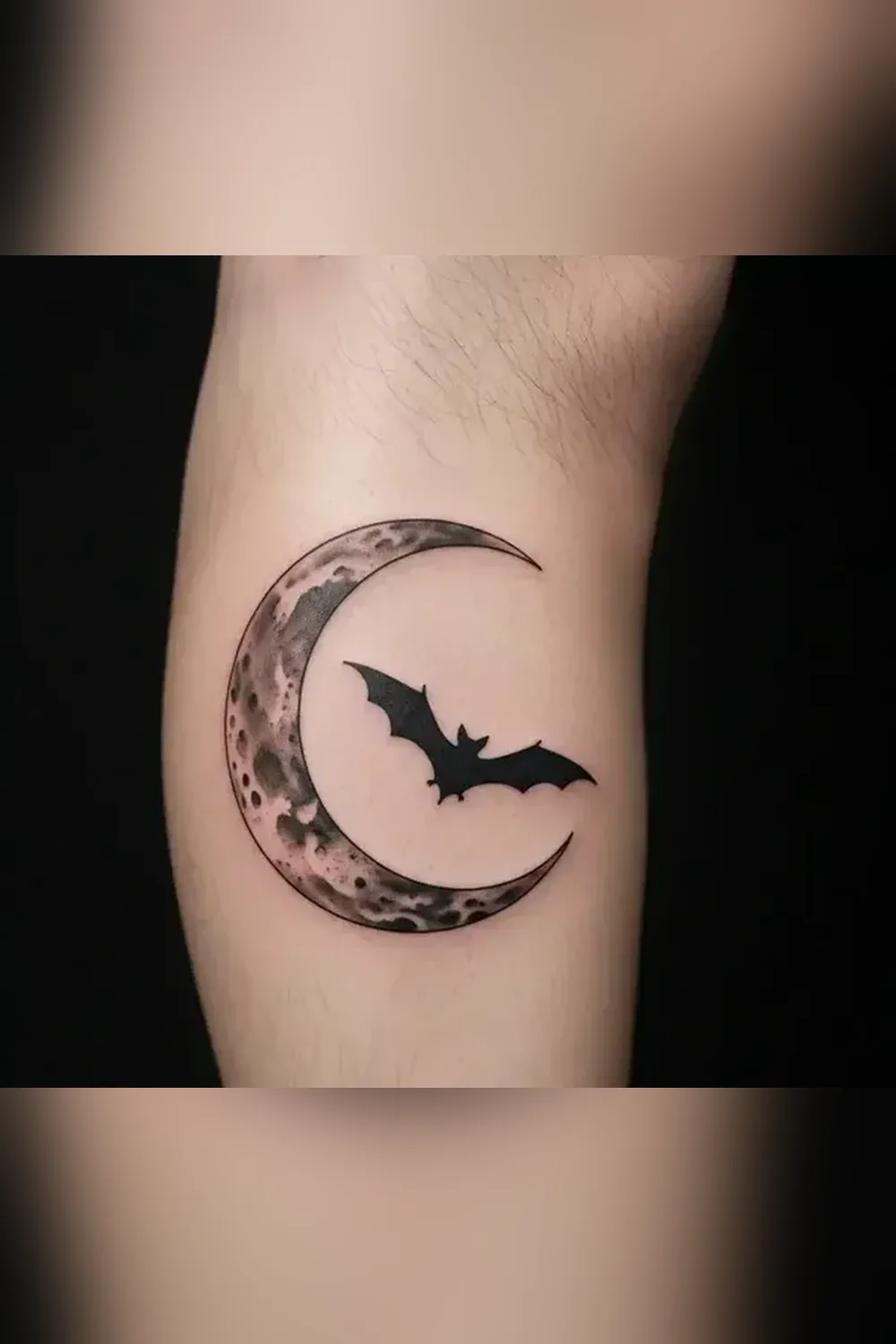
One bat, centered in the curve of a crater-textured crescent — the bat a clean black silhouette, the moon behind it mottled with stippled craters so the two never compete. It is the tidy version of design 11’s storm: same cast, opposite temperament, and proof that the bat-and-moon pairing scales down gracefully if the textures are kept apart.
Best for: the nocturnal pairing at a wearable, medium size. Placement: calf, forearm, upper arm. Know before you book: the bat’s wing fingers are thin negative lines; slightly oversizing the bat protects them.
13. Wolf Howling at a Full Moon Tattoo
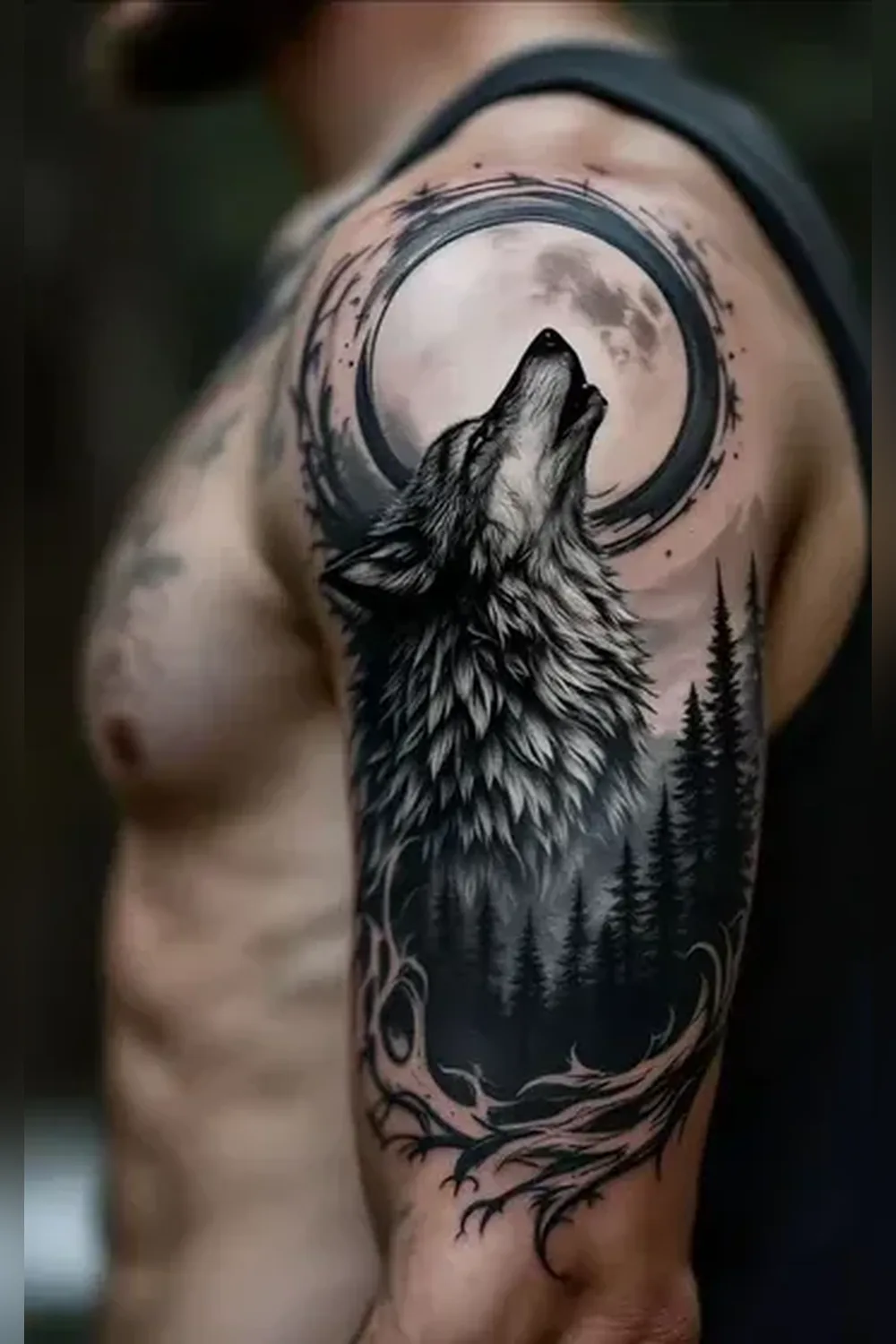
The classic, done in full: a wolf’s head thrown back in a howl, silhouetted against a pale full moon ringed by a brush-stroke circle, pine forest below. One honest note the design itself would want made — real wolves do not howl at the moon; they howl to communicate, and the moonlit image is a human invention layered on top. As an invention it is a great one: longing, wildness and pack loyalty in a single glance.
Best for: wilderness and loyalty meanings at full commitment. Placement: upper arm, back, thigh, chest. Know before you book: fur texture is hundreds of fine strokes; this is a large-piece artist’s job, and the pale moon needs the dark ring to stay readable.
14. Full Moon and Cactus Tattoo
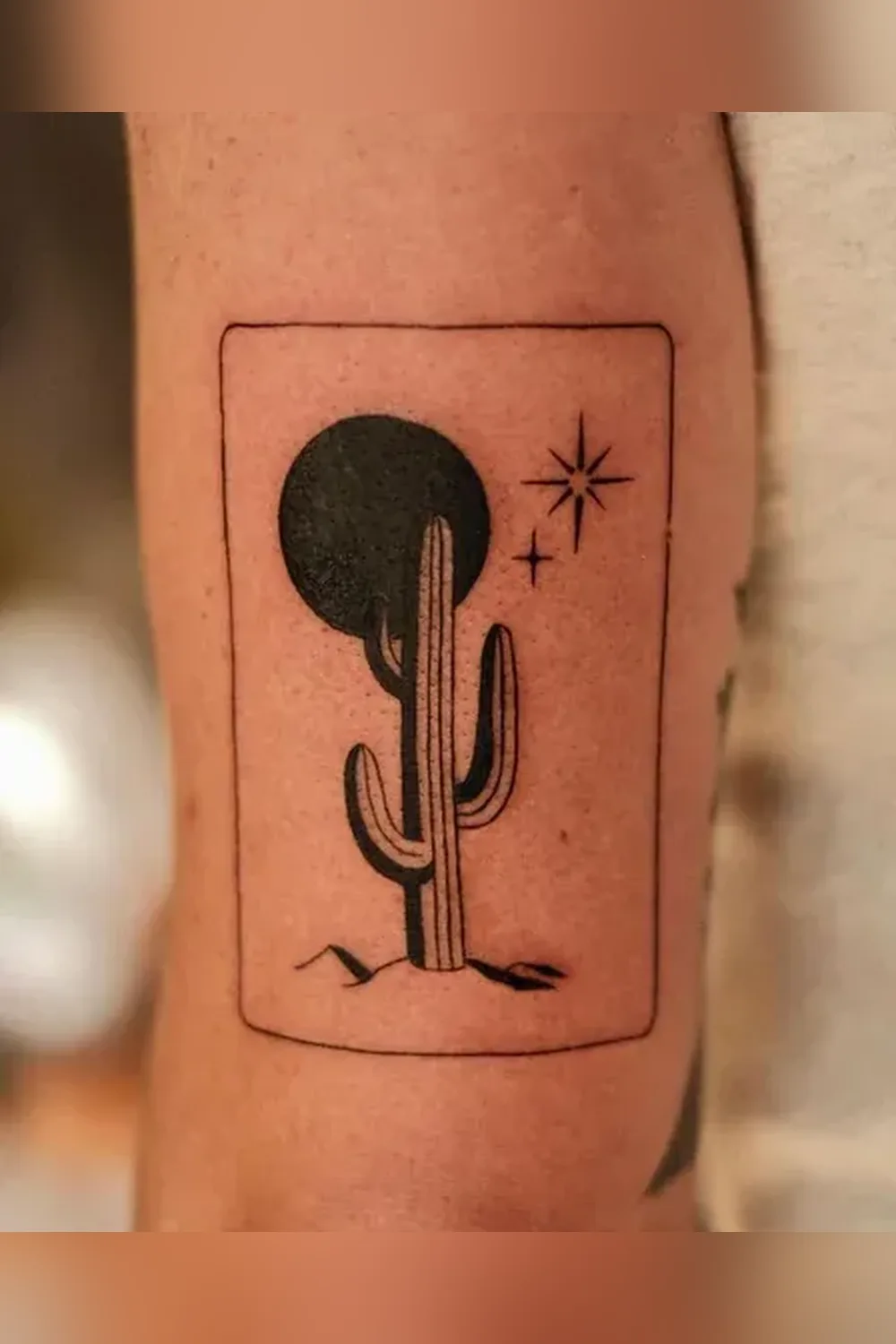
A saguaro standing in front of a solid black full moon, two sparkle stars beside it, the whole scene held in a thin rectangular frame like a tarot card or a poster. The joke of the composition is tonal: the moon, usually the light in a night scene, is the blackest thing here, and the desert plant reads against it in clean outline — a desert-night design with almost no shading to fail.
Best for: desert and Southwest associations; graphic, poster-style work. Placement: upper arm, calf, forearm. Know before you book: a solid black disc this size is a long, careful fill — check healed solid-black work when choosing the artist.
15. Ship Silhouette Against a Full Moon Tattoo
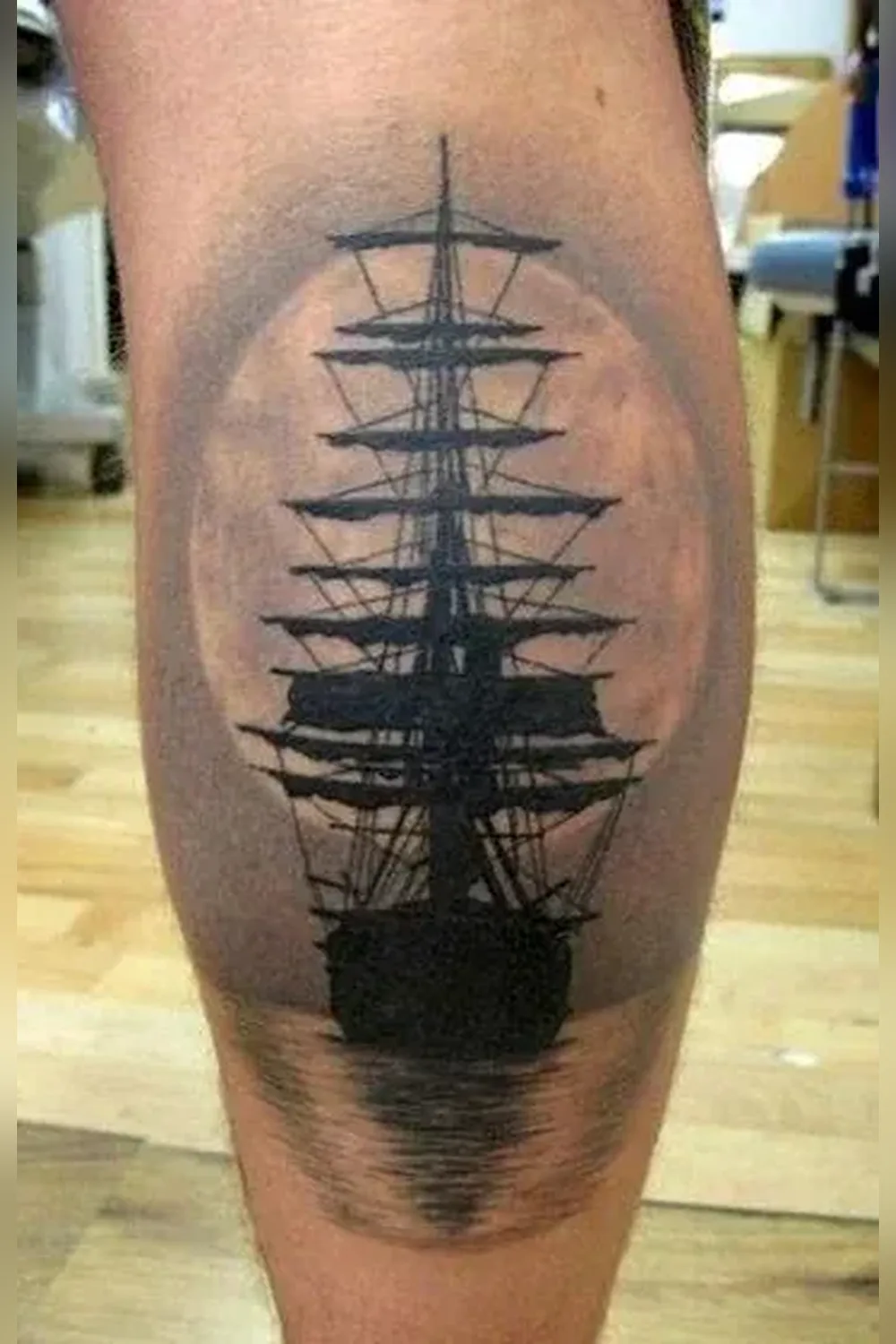
A tall ship in full sail, drawn as a pure silhouette, crossing the face of an oversized full moon on the calf, its reflection smudged in below. The moon here is not the subject but the light source — the trick that makes a black shape read as a scene instead of a sticker — and it is the oldest composition in this list, borrowed straight from moonlit seascapes.
Best for: travel, journeys and sea meanings with a vintage cast. Placement: calf, upper arm, back. Know before you book: rigging is a web of hair-thin lines; expect the artist to thicken or drop some of it, and agree which before the stencil goes on.
16. Crescent Moon over Mountains Tattoo
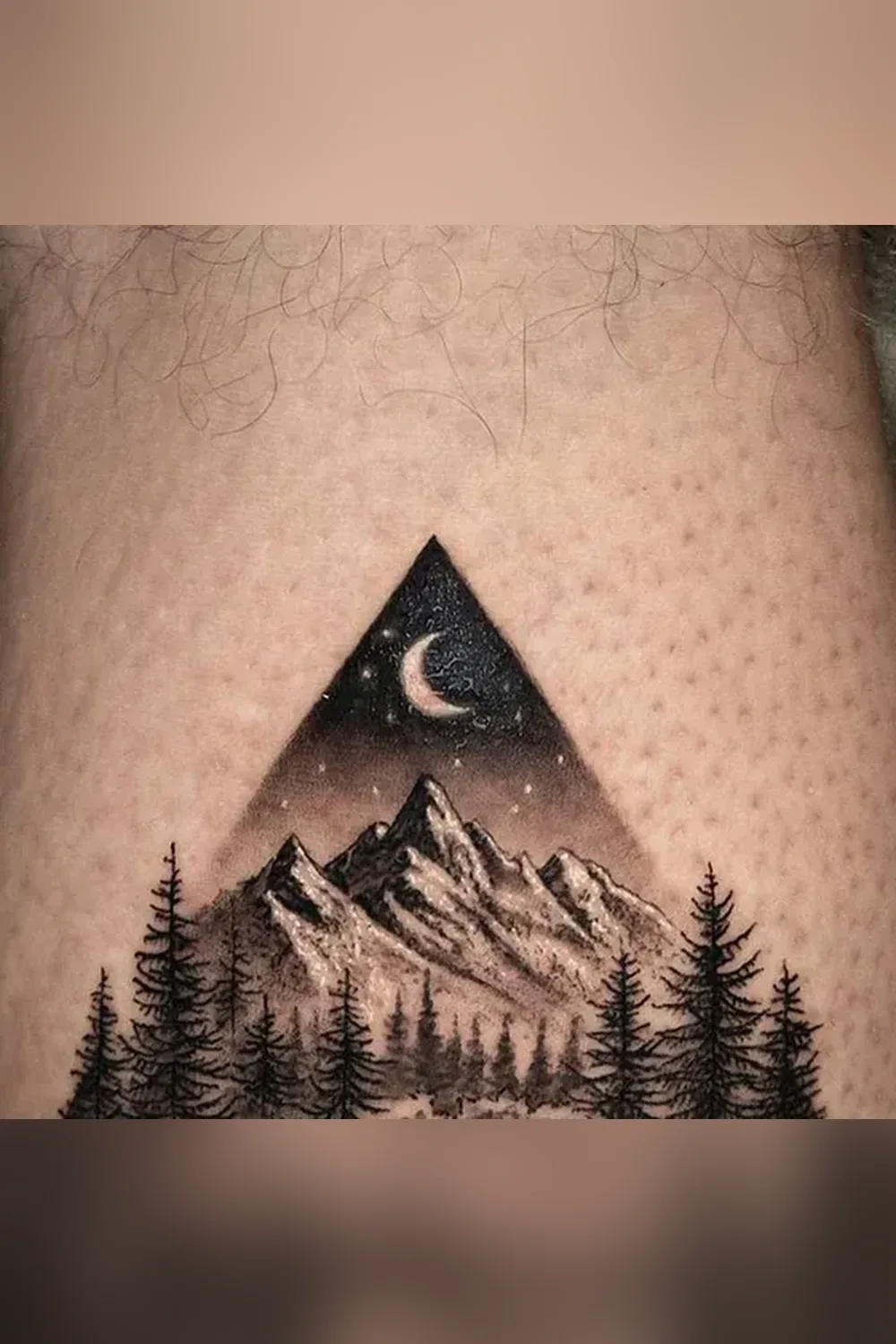
A triangle of night sky on the thigh: inside it, a small bright crescent and stars above shaded mountain peaks, and below the frame a row of pine trees that breaks out of the geometry. The triangle does quiet symbolic work of its own — it is the shape of the mountains, echoed — but mostly it is a window: a portable piece of night landscape.
Best for: mountain and hiking associations; a scene that stays graphic. Placement: thigh, upper arm, calf, chest. Know before you book: the sky is a gradient wash inside straight borders; soft gradients against hard edges are where mediocre shading shows first.
17. Full Moon over Layered Mountains Tattoo
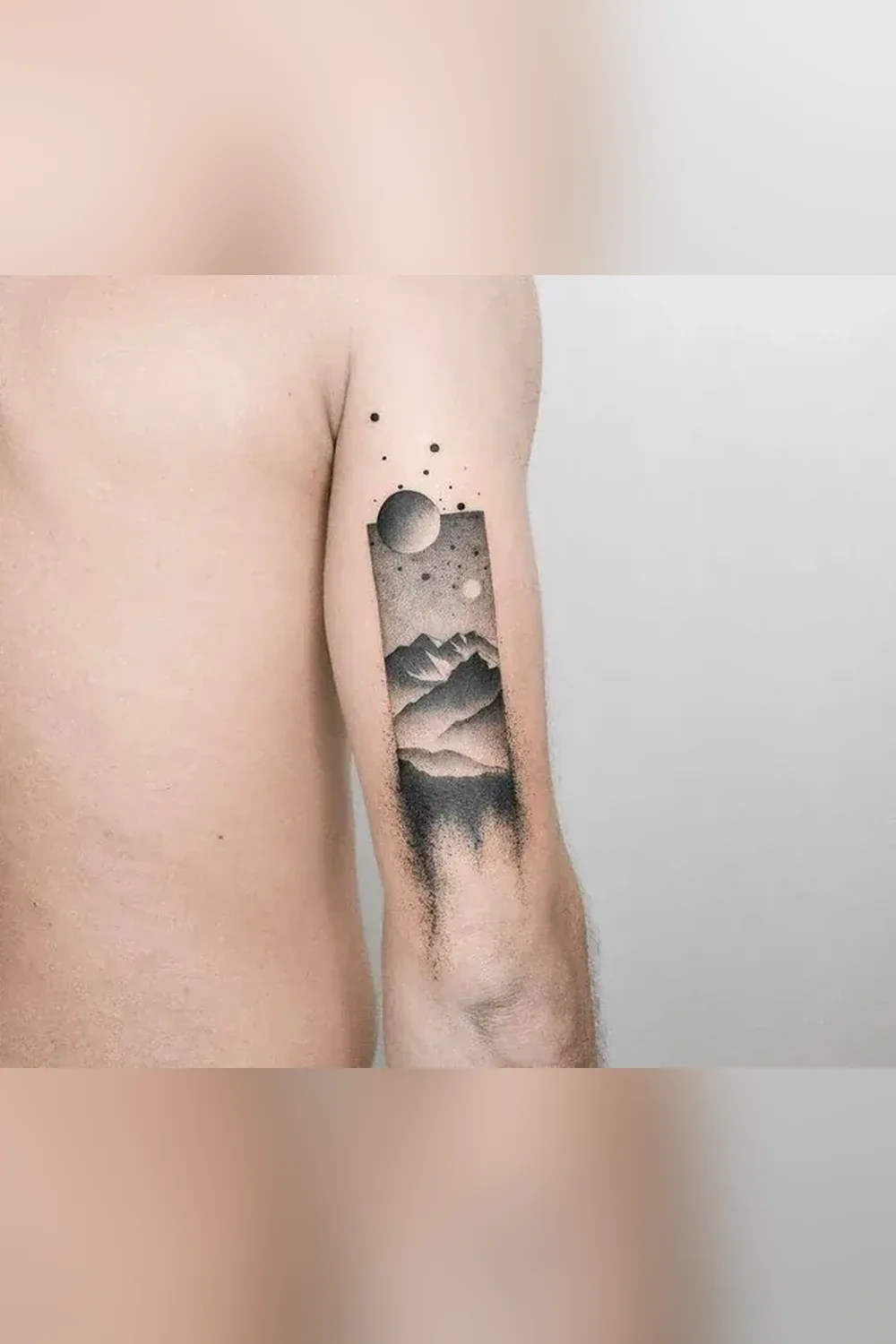
A vertical panel of dotwork on the upper arm: a shaded full moon breaking over the panel’s top edge, a smaller pale moon beneath it, and range after range of stippled mountains receding down the arm until the panel dissolves into drips at the elbow. Everything is dots — sky, stone and shadow alike — which gives the scene its misty, printed quality and its one real vulnerability.
Best for: landscape lovers who want texture over outline. Placement: upper arm, forearm, calf. Know before you book: dotwork gradients merge as dots spread with age; the ranges need more contrast between them than the fresh photo suggests.
18. Crescent Moon Clock Tattoo
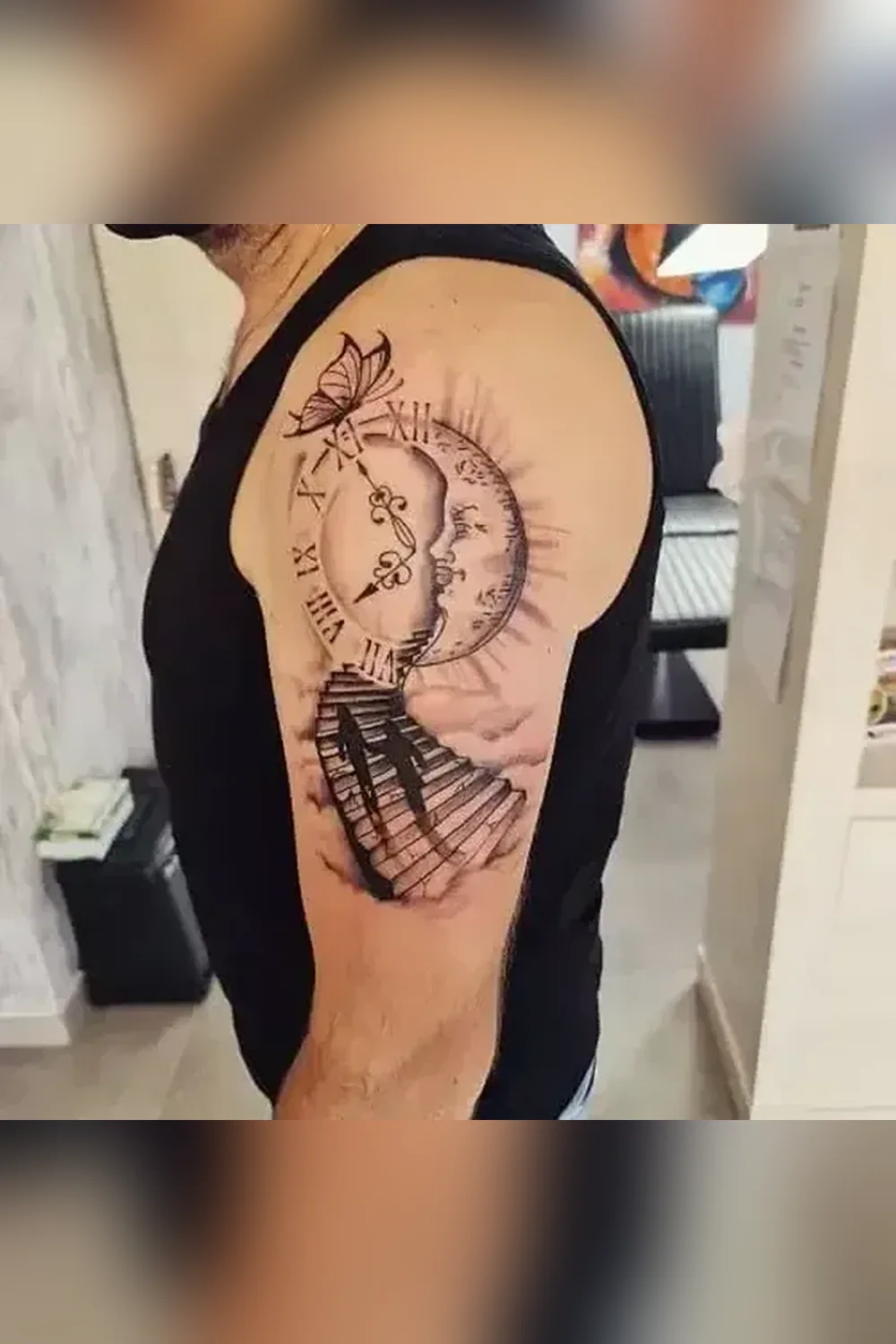
The moon given a mechanism: a crescent whose curve carries a clock face — Roman numerals around the arc, ornate hands at the center, a face in profile inside the moon itself — with piano keys cascading out of the dial and a butterfly at the top. Time is the moon’s oldest human job (months are moons, measured), so the pairing is less surreal than it looks; clocks and moons were the same instrument for most of history. It is also a natural sibling of the rose-and-clock pairing in our rose tattoo design ideas guide, where the clock carries a date instead of a phase.
Best for: time, music and memory meanings in one composition. Placement: upper arm, thigh, chest. Know before you book: numerals are lettering — proofread the Roman numerals on the stencil (IIII instead of IV is traditional on clock faces, so agree which your artist is using).
Placement by Size: A Practical Guide
| Size | What works | Good placements | Watch out for |
|---|---|---|---|
| Tiny–small (under 5 cm) | Minimalist crescent, single small full moon, crescent-and-wave | Wrist, ankle, behind ear, collarbone, finger-side | Crater texture and phase detail disappear — the silhouette must do everything |
| Medium (5–12 cm) | Phases rows and columns, crescent pairings, cat/raven/bat pieces, framed scenes | Forearm, upper arm, calf, shoulder blade, thigh | The sweet spot: phases stay separable and partner subjects keep their detail |
| Large (12 cm+) | Wolf and full moon, brush-stroke crescents, ship scenes, clock compositions | Upper arm, back, thigh, chest | Multiple sittings for realism fur and large black fills; fit scenes to the limb’s curve |
How Moon Tattoos Age
Moons age on their edges and their spacing. A crescent reads by the clean skin curve inside it; if the horns are drawn too close together or the fill spreads, the crescent fattens toward a banana and then a blob — which is why the boldest crescents here (designs 4 and 11) will out-read the finest (design 3) in fifteen years. Phase rows age on separation: seven or five moons need real gaps, because each disc’s soft edge grows toward its neighbor. Dotwork crater texture (designs 1, 12, 17) is the most perishable surface in the list — stipple merges into flat grey — while solid black silhouettes (designs 13–15) barely change at all. Grey smoke and gradient skies (designs 5, 16) narrow in contrast but keep their shapes. As with every tattoo, size is the cheapest insurance: one size up buys years.
Common Moon Tattoo Mistakes
Drawing the phases out of order. The sequence is fixed — crescent, half, gibbous, full, then back down in mirror image. A phases row with the shapes shuffled is the moon equivalent of a misspelled word, and it cannot be reordered after the fact. Flipping the crescent by accident. Waxing and waning crescents point opposite ways; if the direction carries your meaning, check the stencil in a mirror, because limbs flip designs. Shrinking the phases. Five moons at wrist size become five grey coins; phases need medium size or larger. Judging by drawings. Over a third of this page’s old gallery was flash, stock illustration and digital art rather than tattoos — paper tolerates lines skin cannot keep, so always ask for healed photos in the style you want. Believing the chart. Phase meanings are modern conventions that vary by source; pick the reading you intend rather than treating any table — including this one — as law.
Frequently Asked Questions
What does a moon tattoo symbolize?
Most often change and cycles — the moon is the visible proof that phases pass. Around that core sit growth (waxing), letting go (waning), femininity and intuition (a traditional association running back to moon goddesses like Selene and Luna), dreams and the hidden side of the self, and, when paired with the sun, balance.
What do moon phases mean in a tattoo?
By modern convention: a crescent for beginnings and potential, a full moon for completion and wholeness, and a full row or column of phases for the whole cycle — a life, a recovery or a change seen entire. These readings are tattoo-culture conventions, not ancient rules, and the triple-moon maiden-mother-crone version is a 20th-century tradition.
Should I get a crescent moon or a full moon?
Choose by shape first and meaning second. A crescent is a graphic mark — it works tiny, pairs with anything, and reads at a glance — while a full moon is a surface: it holds texture, faces and whole scenes behind silhouettes (designs 13–17), but needs medium size or larger to stay a moon and not a circle.
Do moon tattoos age well?
Bold ones do — solid crescents, silhouette scenes and well-spaced phase rows hold for decades. The perishable versions are fine-line crescents, tight phase rows whose discs merge, and dotwork crater texture, which softens into flat grey. Spacing and size decide more than style.
Where is the best place for a moon tattoo?
The forearm, for most people: it takes a phases column vertically, a crescent at any size, and stays visible. The calf suits scenes and smoke, the shoulder blade suits sun-and-moon pairings, and the upper back is the natural home of a full yin yang or a wide phases row.
Final Thoughts
A moon tattoo is a calendar with one page showing: pick the phase that matches the chapter, or take all of them and wear the whole cycle. Decide the form first — crescent for the mark, full moon for the scene, phases for the story — then size it so the horns stay sharp and the discs stay separate in twenty years. For the moon’s classic partners, our dragon tattoo design ideas guide covers the dragon that chases the moon-pearl through East Asian art, and if you want blooms worked into the crescent’s curve, our flower tattoo design ideas guide is the natural next read.
2 thoughts on “Moon Tattoo Design Ideas — 18 Meaningful Designs and Their Meanings”