Most heart tattoos are symbols. Anatomical heart tattoo ideas are the opposite of a symbol: they copy the real organ, with its aorta arch, its cut vessel ends and its lopsided muscle, and they ask the viewer to recognise the thing itself rather than a cartoon of it. That honesty is the whole appeal. People choose anatomical heart tattoo ideas after heart surgery, during medical training, after losing someone whose heart gave out, or simply because the real shape is stranger and more interesting than the valentine version.
A quick word about the photos in this guide, because it matters. We only publish photographs we can legally use and verify, and anatomical heart tattoo ideas turned out to be one of the hardest subjects on this site to photograph honestly. Studios post thousands of these tattoos, but almost all of them sit behind all-rights-reserved licences. After checking hundreds of candidates one by one, exactly one real, openly licensed photograph survived. So this guide studies that one design properly, in depth, and then covers the styles, placements and ageing behaviour in words. We would rather show one real tattoo well than fill the page with pictures we have no right to use.
Anatomical Heart Tattoo Ideas and the Real Heart They Copy
An anatomical heart is not symmetrical, and it is not cute. The real organ is a fist-sized muscle tilted to the left of the chest, with the thick-walled left ventricle doing most of the work and a bundle of major vessels leaving the top: the aorta curving over in its famous arch, the pulmonary artery splitting, and the two venae cavae returning blood from the body. Britannica’s heart anatomy overview walks through the chambers and vessels in plain language, and it is worth ten minutes of any tattoo client’s time, because an artist who copies a medical illustration will produce a different tattoo from one who copies another tattoo.
That difference is the first thing to understand about anatomical heart tattoo ideas. A tattoo copied from an anatomy plate tends to get the aorta arch the right height, keeps the vessel ends uneven the way they really are, and lets the ventricles bulge unevenly. A tattoo copied from a photograph of a tattoo often drifts: the arch flattens, the vessels become neat little pipes, and the organ slides back toward the valentine shape it was supposed to escape. If you collect reference for your artist, collect at least one proper anatomical illustration alongside the tattoo photos.
The meaning people attach to these designs is personal rather than traditional, and it deserves honest hedging. There is no centuries-old symbolism dictionary for anatomical heart tattoo ideas the way there is for the sacred heart or the classic heart-and-banner. What wearers actually say, in consultation posts and studio interviews, falls into a few loose groups: medical staff and students marking their work; heart patients and transplant recipients marking survival; scientists and anatomy lovers who simply like the organ; and people who want a love tattoo that feels grown-up and unsentimental. Any of those may fit you, or none. The design does not come with a fixed meaning, and an artist who tells you otherwise is selling you something.
If the symbolic end of the heart spectrum appeals to you more, our existing guide to classic heart tattoo designs covers the traditional shapes, banners and sacred hearts. Anatomical heart tattoo ideas sit at the far end of that same spectrum: same organ, opposite treatment.
The One Verified Design: A Soft Black and Grey Chest Piece
Here is the single photograph in this guide that passed both tests: a real anatomical heart tattoo on real skin, under a licence that allows us to publish it with credit. Everything claimed about it below comes from looking at the photograph itself.
Design 1: Soft Black and Grey Anatomical Heart, High on the Chest
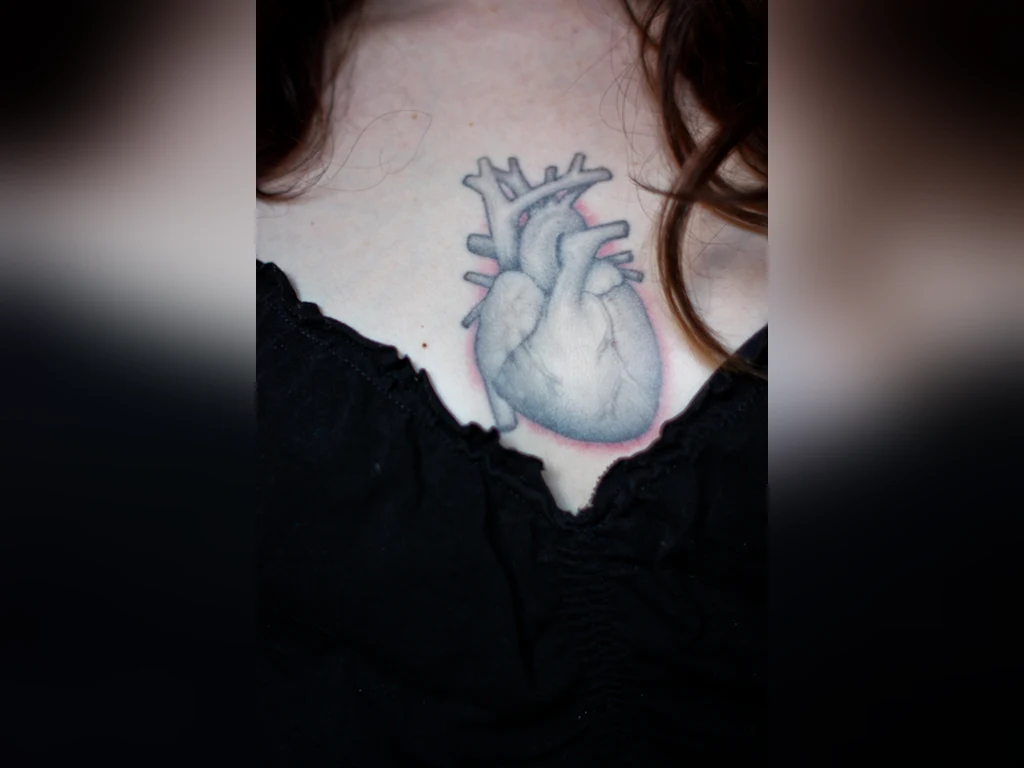
The tattoo sits high on the upper chest, just right of the sternum line, roughly over the spot where the wearer can press a palm and feel a heartbeat. It is worked in soft black and grey with no hard outline in the lower body of the organ: the ventricles are modelled with gentle shading rather than line, so the muscle looks rounded and heavy. Across the top, the anatomy is specific. The aorta rises and arches over with its three small branches suggested, the pulmonary vessels cut off at an angle, and the vessel ends are left open and uneven instead of capped or tidied. Fine surface veins are drawn across the lower ventricle in pale lines.
The pink halo around the piece in the photograph is healing skin, not part of the design: this picture was taken while the tattoo was still fresh. That is worth knowing when you judge the softness of anatomical heart tattoo ideas in this style. Fresh black and grey always looks gentler than it will at six months, once the greys settle and the lightest tones drop out. Expect the finished, healed version of a piece like this to read slightly darker and flatter, with the finest surface-vein lines the first detail to disappear.
What makes this one of the more honest anatomical heart tattoo ideas we have seen is what the artist refused to do. There is no banner, no flowers, no wings, no clock, and no attempt to make the organ pretty. The heart is also drawn at a believable tilt rather than straightened for the camera. The trade-off for that purity is ageing risk: with no strong outline holding the shape, the design depends on its shading contrast to stay readable, and soft shading is exactly what spreads and lightens first. A piece in this style needs to start a touch darker than the client thinks, and it needs size. At palm-size or bigger on the chest, the vessel ends stay separate. Shrunk to half that, they would merge into a single dark crown within a few years.
Anatomical Heart Tattoo Ideas in Other Styles
One photograph cannot show the range of anatomical heart tattoo ideas, so the styles below are described rather than pictured. Treat them as a briefing list for a consultation: each is a real, commonly offered way of handling anatomical heart tattoo ideas, with the weakness of each stated plainly.
Blackwork and Etched Hearts
Blackwork versions copy the look of old anatomical engravings: solid blacks, parallel hatching, and stippled shading instead of smooth gradients. They suit the subject well because the source material, the printed anatomy plate, was itself blackwork. The hatched shading also ages better than soft grey washes, since a line can spread slightly and still read as a line. If you like this direction, the pieces in our blackwork tattoo ideas collection show the same hatching and dotwork handling on other subjects. Among anatomical heart tattoo ideas, the etched style is the one we would point a cautious first-timer toward.
Fine Line Hearts
Fine line versions of anatomical heart tattoo ideas are drawn with a single-needle outline, light vessel detail and almost no shading. Fresh, they look like pencil studies and photograph beautifully, which is why they fill social feeds. The honest warning: the thin lines that draw the small vessels are the fastest-fading lines on the body, and a fine line heart can lose its top third, visually, within three to five years unless it is drawn bigger than feels necessary and touched up on schedule. Choose this style with your eyes open.
Colour Realism Hearts
Colour realism treats the organ as a still life: deep red muscle, blue-grey veins, pale fat and connective tissue at the top. Done well, it is the most striking version of all anatomical heart tattoo ideas, and the most demanding. It needs a large canvas, usually a thigh, upper arm or back, a specialist artist, and a client who accepts that reds and pale tones are the first colours to dull in sun. Budget for a refresh session at five to seven years if you want it to keep looking wet and alive.
Traditional Hearts With Real Anatomy
Some artists keep the bold outline and flat colour of traditional tattooing but swap the valentine shape for the real organ, then add the classic furniture: a banner, roses, a dagger, an eye. These hybrid anatomical heart tattoo ideas age the best of the whole family, because bold lines and packed colour are built to last, and they read clearly from across a room. The anatomy is simplified, sometimes to the point of caricature, so pick them for toughness and punch rather than accuracy.
Dark and Gothic Pairings
The anatomical heart is a natural partner for darker motifs: skulls, crows, webs and thorn work. A heart wrapped in a web, or set beside a spider, leans into the specimen-jar mood of the subject, and our spider tattoo ideas collection shows the web and arachnid side of that pairing. Gothic versions usually push the contrast up, deepen the blacks inside the chambers, and let the vessels twist into roots or branches. They are dramatic, and they forgive ageing better than the soft styles, because heavy black has somewhere to spread into.
Where Anatomical Heart Tattoo Ideas Sit Best
Placement decides how much anatomy survives. The heart shape carries its meaning in the top third, the vessels, and vessels need room. On the chest, the classic spot is high and slightly left of centre, where the design in our photograph sits; the sternum itself is a thinner, bonier canvas that hurts more and blurs fine lines faster, so most artists nudge the piece onto the pectoral. A chest heart also hides under shirts and shows in open necklines, which suits anatomical heart tattoo ideas that many people get for private reasons.
The forearm is the practical favourite for anatomical heart tattoo ideas: flat, visible, easy to size up, and easy for the artist to work on. An inner-forearm heart can run long, following the arm, with the vessels pointing toward the elbow. The upper arm and shoulder take a rounder composition and cover easily. The thigh is where colour realism hearts belong, because it offers the largest flat area most people are willing to give a single organ. Ribs and the side of the torso look dramatic in photographs and are honestly the worst choice for fine vessel detail: the skin stretches with every breath, the area is among the most painful on the body, and lines there spread early.
On size, be blunt with yourself. Below about eight centimetres tall, an anatomical heart stops being anatomical: the vessel ends fuse, the arch reads as a lump, and strangers see a classic heart with lumps on top. Ten to fifteen centimetres is the honest working range for most styles, and the soft black and grey approach in our photograph wants the top of that range or beyond.
How Anatomical Heart Tattoo Ideas Age
Every weakness of anatomical heart tattoo ideas sits in the fine detail. The small vessels at the top are drawn with lines a millimetre or two apart; skin does not hold gaps that fine forever, and as lines soften and spread, close neighbours join up. Artists who know the subject draw the vessel group with exaggerated spacing, fewer vessels than the real organ has, or both. If a stencil shows you twelve delicate pipes crowning the heart, ask for six bold ones instead.
Soft shading ages the way pencil shading smudges: gradually, and from the lightest tones upward. In the chest piece pictured above, the pale surface veins on the ventricle will likely be gone within a few years, and the design will still work, because its readability rests on the dark arch and the overall silhouette. Judge any design you are offered by the same test: squint at it from two metres away. If the heart still reads with the fine detail imagined away, it will age gracefully. If it turns into a grey smudge, it will not.
Sun is the other enemy, and it hits red ink hardest. Colour anatomical heart tattoo ideas worn on forearms and shoulders need sunscreen as a habit, not an afterthought. Black and grey pieces forgive sun better but still grey out faster on always-exposed skin. None of this is a reason to avoid the subject; it is a reason to place it thoughtfully, size it generously, and treat the first touch-up as part of the price.
Anatomical Heart Tattoo Ideas: Frequently Asked Questions
What do anatomical heart tattoo ideas usually mean?
There is no fixed traditional meaning. Wearers most often link them to surviving heart illness or surgery, working in medicine, studying anatomy, or wanting a love symbol without the sweetness of the classic heart shape. The meaning is the one you bring to it.
How big should an anatomical heart tattoo be?
Plan for at least eight centimetres tall, and ideally ten to fifteen. Smaller than that, the vessels at the top merge as the lines spread with age, and the organ stops reading as anatomical.
Where is the best placement for an anatomical heart tattoo?
The upper chest and the inner forearm are the most practical spots: flat, sizeable and easy to keep out of the sun. The thigh suits large colour pieces. Ribs and the sternum look striking but hurt more and blur fine detail sooner.
Do anatomical heart tattoos age badly?
The fine vessel detail at the top is the weak point of all anatomical heart tattoo ideas, and the lightest shading fades first. Boldly drawn vessels, generous spacing and a design that still reads when you squint will age well; delicate, crowded detail will not.
Which style of anatomical heart tattoo lasts longest?
Blackwork and traditional-leaning versions last longest, because strong outlines and packed black or colour hold up as skin ages. Fine line versions are the most fragile and usually need a touch-up within a few years.
Are anatomical heart tattoos only for medical people?
No. Medical staff and heart patients are a large share of wearers, but plenty of people choose anatomical heart tattoo ideas for the look alone, or to mark grief, love or a fascination with anatomy.
How much does an anatomical heart tattoo cost?
Prices vary too much by city, artist and size for a single honest figure. A palm-sized black and grey piece is usually priced as a half-session or a few hourly units at a reputable studio; large colour realism costs several times that. Get a quote from the artist who will actually draw it, and treat very cheap offers on detailed work as a warning sign.
Can an anatomical heart tattoo cover a scar?
Sometimes. Chest pieces are sometimes chosen to sit near, or partly over, healed sternotomy or pacemaker scars, and the organ’s irregular shape can work with a scar’s line. Scar tissue takes ink unpredictably, so this needs an in-person consultation, a fully healed scar, and an artist with cover-up experience.
Should the heart in my tattoo be medically accurate?
It should be accurate where the eye checks first: the aorta arch, the uneven vessel ends and the heavier left side. Below that level, every tattoo simplifies. Bring your artist one medical illustration as well as tattoo photos, so the simplifications stay honest ones.
Why does this guide show only one photograph?
Because it is the only one we could verify as both a real anatomical heart tattoo and openly licensed for republication. We checked hundreds of photographs individually for this article on anatomical heart tattoo ideas; the rest belonged to photographers who have not granted reuse rights. We publish credits for the one we use, and we would rather be short on pictures than wrong on rights.
Final Thoughts
Anatomical heart tattoo ideas reward people who like the real thing more than the symbol of it. Choose the style with its ageing behaviour in mind, give the vessels room, place the piece where the skin stays calm, and bring your artist an anatomy plate as well as photographs. Do that, and the design will still look like a heart, the actual organ, long after softer tattoos have blurred into shapes. And if you are the photographer of an anatomical heart tattoo published under an open licence, we would genuinely like to grow the gallery of anatomical heart tattoo ideas on this page: real photos, properly credited, are the whole point of it.