Birds turn up in tattoo studios more than almost any other animal. They fly, they migrate, they come home. This page gathers 35 bird tattoo ideas from real photographs — every design below is an actual tattoo on actual skin, counted one by one. No drawings, no mock-ups, no repeated photos wearing different names.
The range is wide: a sailor’s swallow on each hand, an eagle that takes a whole back, a duck barely two centimetres tall. Styles run from old-school traditional to blackwork, realism and watercolour. Two famous birds are missing on purpose. The dove has its own dove tattoo guide on this site, and the phoenix is a myth rather than a bird, so it sits in our phoenix tattoo ideas collection instead. If wings are what you are really after, the dragonfly tattoo design ideas guide is worth a look too.
What Bird Tattoos Mean
Freedom is the meaning nearly everyone gives. A bird is the animal that can simply leave. People book bird tattoos when life changes shape — leaving home, ending something, starting again somewhere new. The bird says the old ground is optional.
The swallow has the oldest tattoo story of the lot. Sailors wore one swallow for every 5,000 nautical miles sailed, so the birds counted a man’s experience at sea. Swallows also return to the same nesting place every year, which made the bird a promise: travel far, still come home. Real barn swallows earn the symbol — they migrate thousands of miles annually, as the Cornell Lab of Ornithology’s barn swallow guide sets out. The pair of swallows on a sailor’s hands at design 2 is this tradition, still alive.
Birds are messengers in a lot of old stories. Doves carried messages and came to stand for peace. In Norse myth, Odin’s two ravens flew across the world each day and reported back — ravens still carry that mix of cleverness and dark news. Owls belonged to Athena, goddess of wisdom, which is why owls mean knowledge in the West. In some other cultures an owl warns of death. Worth knowing before you wear one.
The rest is shorthand. Eagles stand for strength and for countries — half the flags and army badges on earth seem to use one. Falcons mean speed and focus. Peacocks are pride and display, worn by people happy to be looked at. Crows and ravens are the clever outsiders. Hummingbirds get requested constantly, but no photograph we could license honestly showed one, so there is no hummingbird below. If we could not verify a photo and its licence, the design did not make the cut.
The 35 Designs
1. A Swallow on Each Shoulder
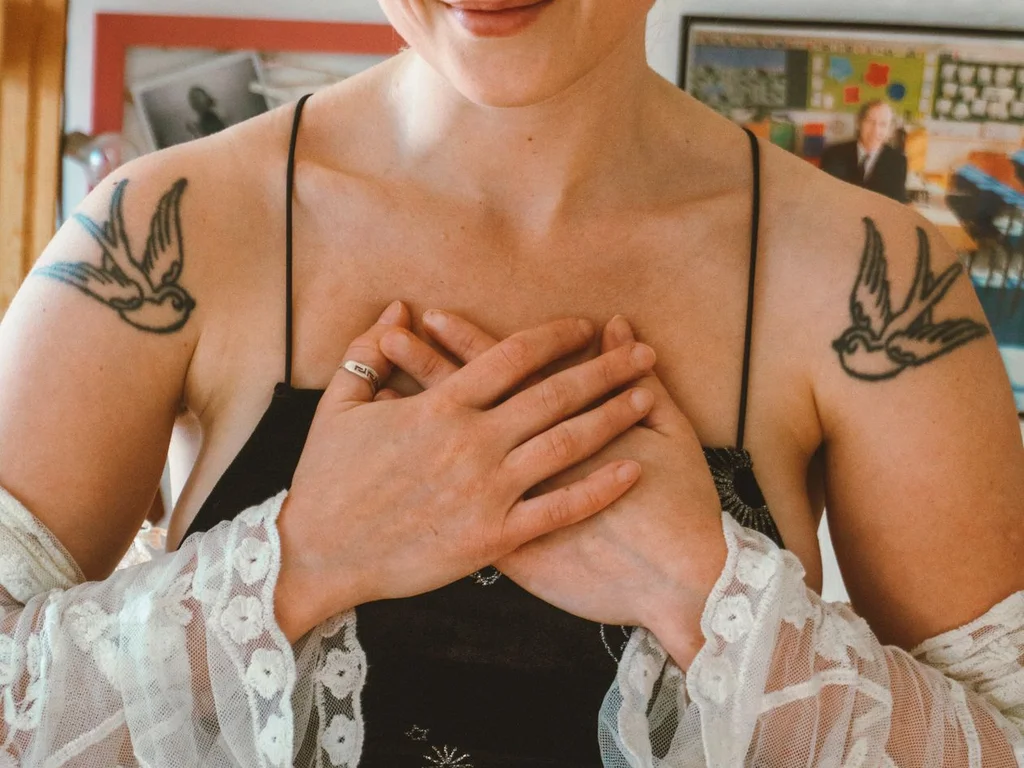
A matching pair — one swallow over each collarbone, drawn in clean black line with a touch of grey shade. The birds face inward, so the two tattoos read as one set across the chest.
Shoulders and collarbones are easy to show and easy to cover, and the skin there moves little, so plain linework holds its shape well. A pair means double the stencil-checking: small differences between sides stand out, so have the same artist do both.
2. Hold Fast Swallows on Both Hands
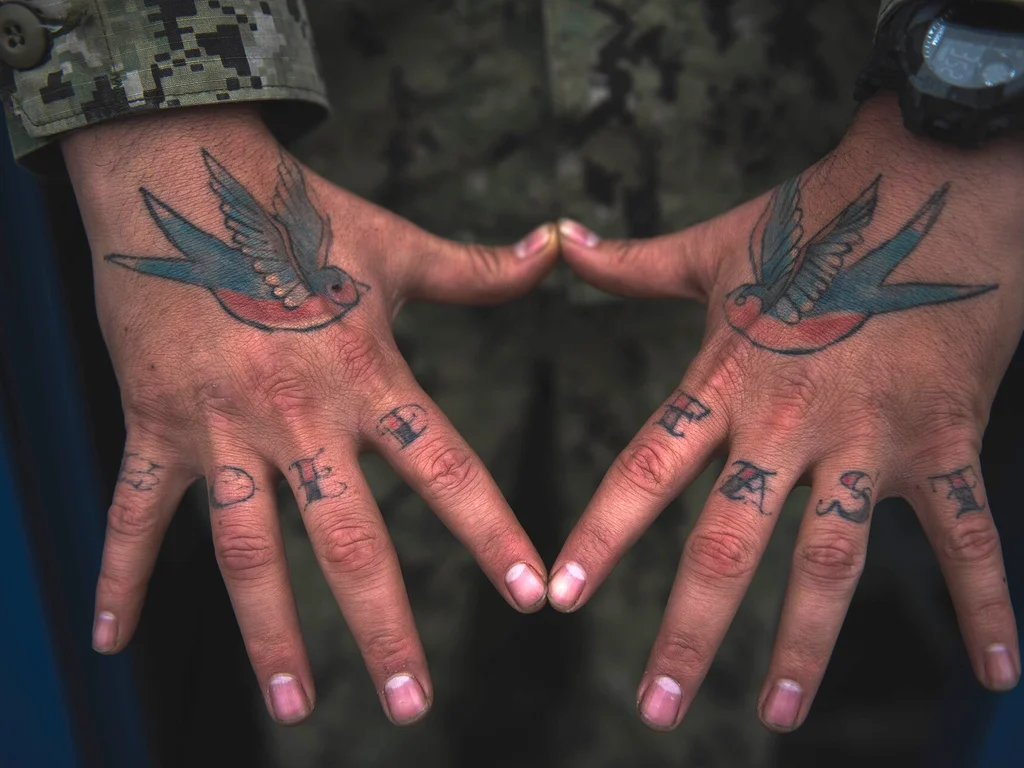
The full sailor setup: a blue and red swallow on the back of each hand, with lettering across the knuckles. This is the tattoo the swallow’s reputation was built on, photographed on a modern sailor’s hands.
Hands fade faster than almost anywhere — sun, washing, constant use. Bold traditional colour survives best, and even then a touch-up every few years is part of the deal.
3. Swallow on the Side of the Neck
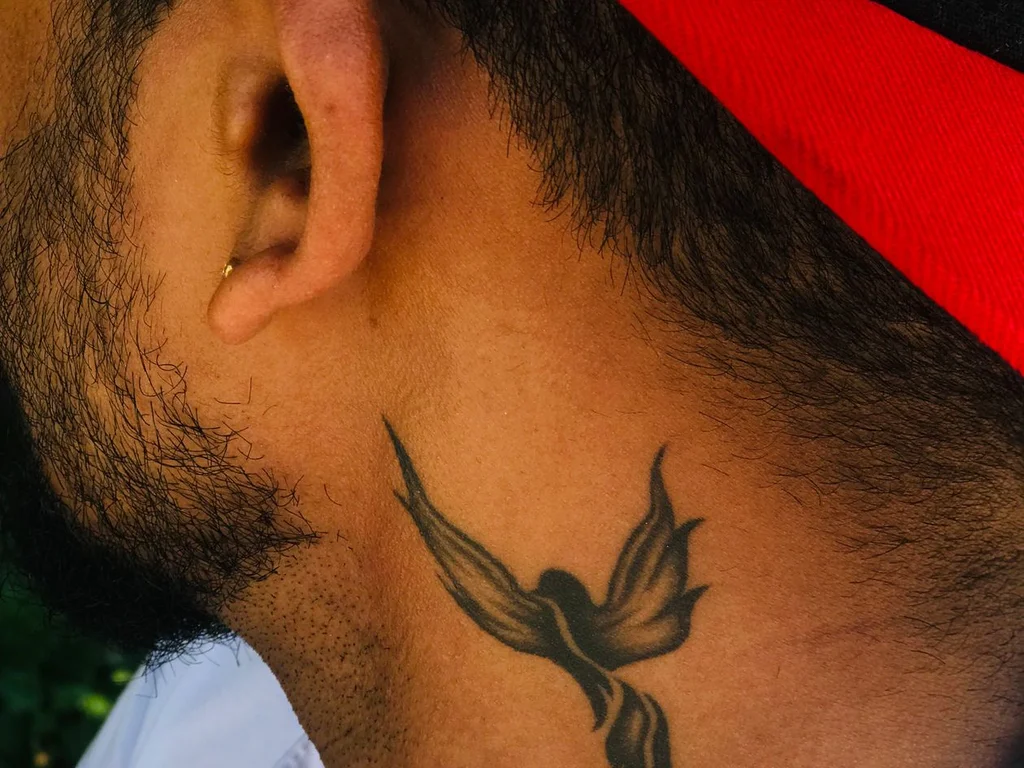
One black swallow in flight, wings swept back, sitting high on the side of the neck. No colour and no extras. The shape does all the work.
A neck piece is on show in most jobs and most weather, so think past the design to the diary. The lines here are thick enough to age kindly, which matters in a spot no sleeve will ever cover.
4. Three Tiny Birds Behind the Ear
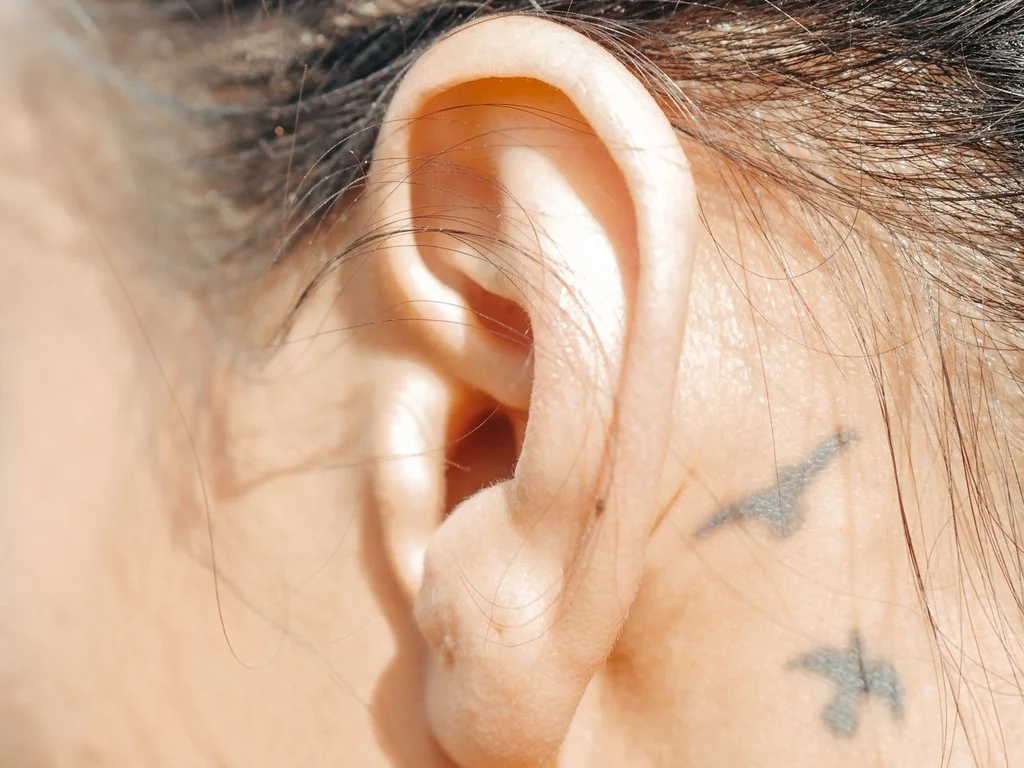
Three small bird silhouettes in a loose row behind the ear, each one only a few strokes of black ink. Together they look like a flock crossing the skin.
This is about as small as a bird tattoo gets. Lines this fine soften within a few years, so ask for them a touch bolder than the stencil suggests. More pieces at this scale live in our small tattoos for women collection.
5. Sparrow on a Branch, Calf
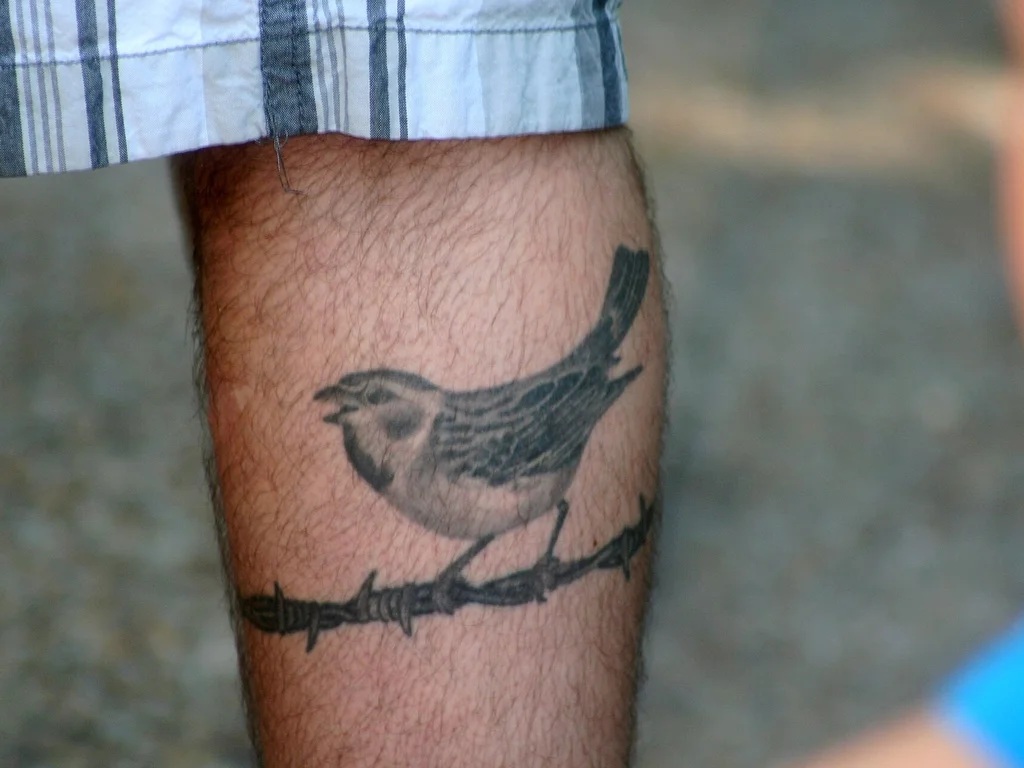
A small sparrow perched on a bare twig, shaded softly in black and grey. The sparrow is an old tattoo subject — sailors wore those too — shrunk here into something quiet and plain.
The calf is flat, forgiving and low on the pain scale. A perched bird suits it, because the leg gives the branch somewhere to run.
6. Red Bird With Blossom, Upper Arm
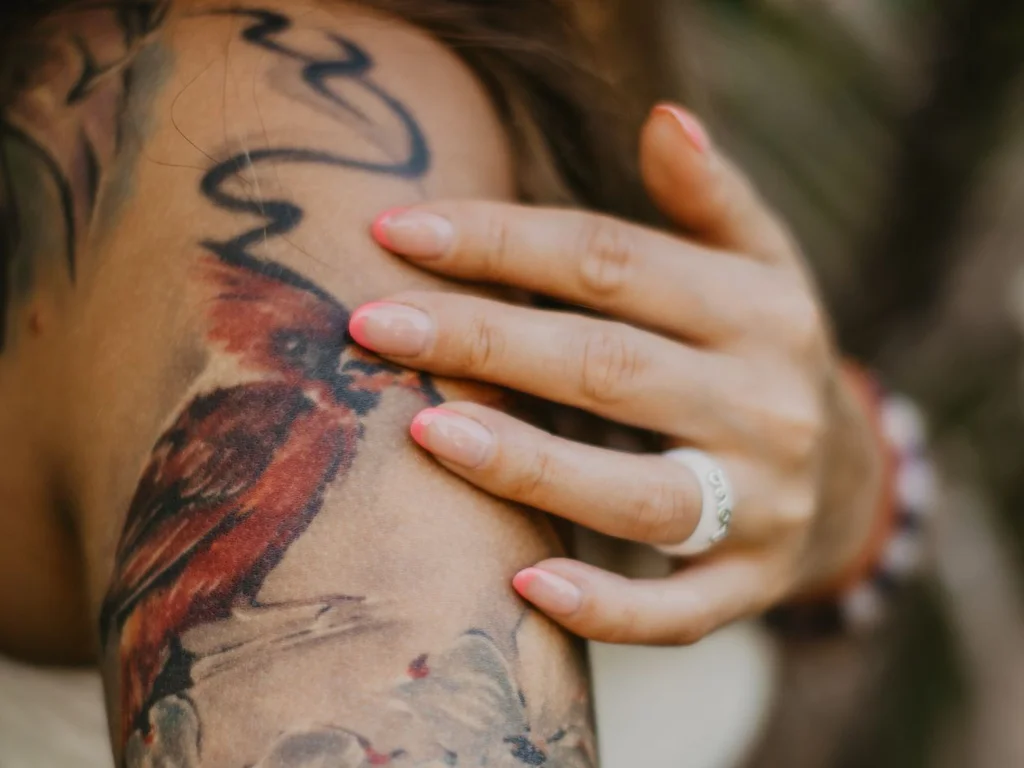
A red bird — the colour and shape point to a cardinal — sitting among pale blossom on the upper arm, worked in a soft, painterly style with grey-green leaves.
Red ink holds its own well over time. The soft edges are the weak point: with no hard outline to hold them, the blossom will blur gently as the years pass. Many wearers count that softness as part of the charm.
7. Tiny Duck, Forearm
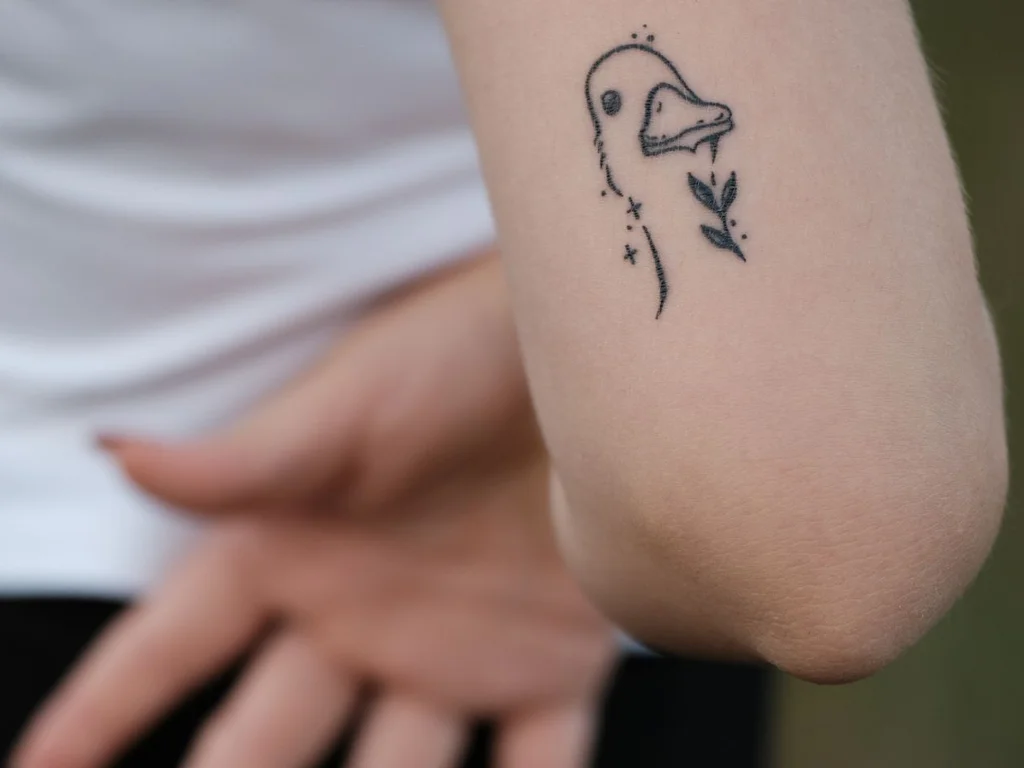
A duck’s head drawn in a few fine lines, a small sprig beside it, the whole thing barely two centimetres tall. It reads more like a doodle than a declaration.
Single-needle work this small is quick and sits at most studios’ minimum charge. It is also the first style to spread, so a good artist will open the lines slightly — enough that the duck stays a duck.
8. Birds Leaving a Tree, Forearm
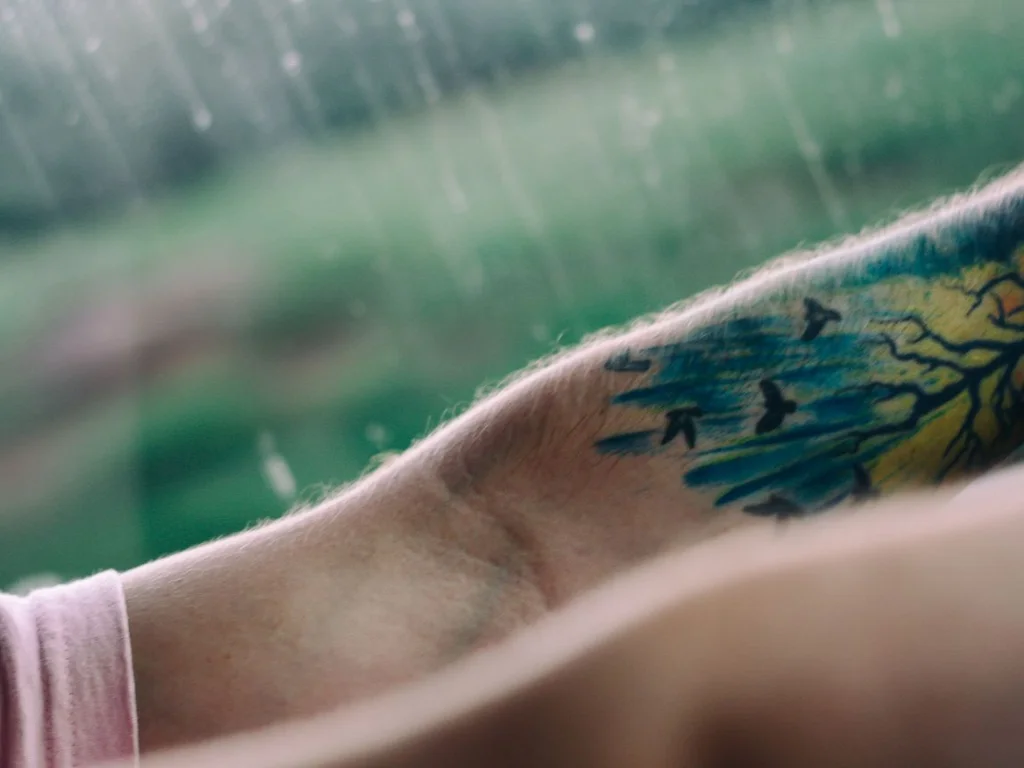
A tree in blue and green watercolour spreads along the forearm, and small black birds lift off its branches toward the wrist.
The mix is built sensibly. Watercolour fades first, but the birds here are solid black, so the design keeps its story as the colour softens. Plan on the colour needing a refresh one day.
9. Eagle Head in Black and Grey, Forearm
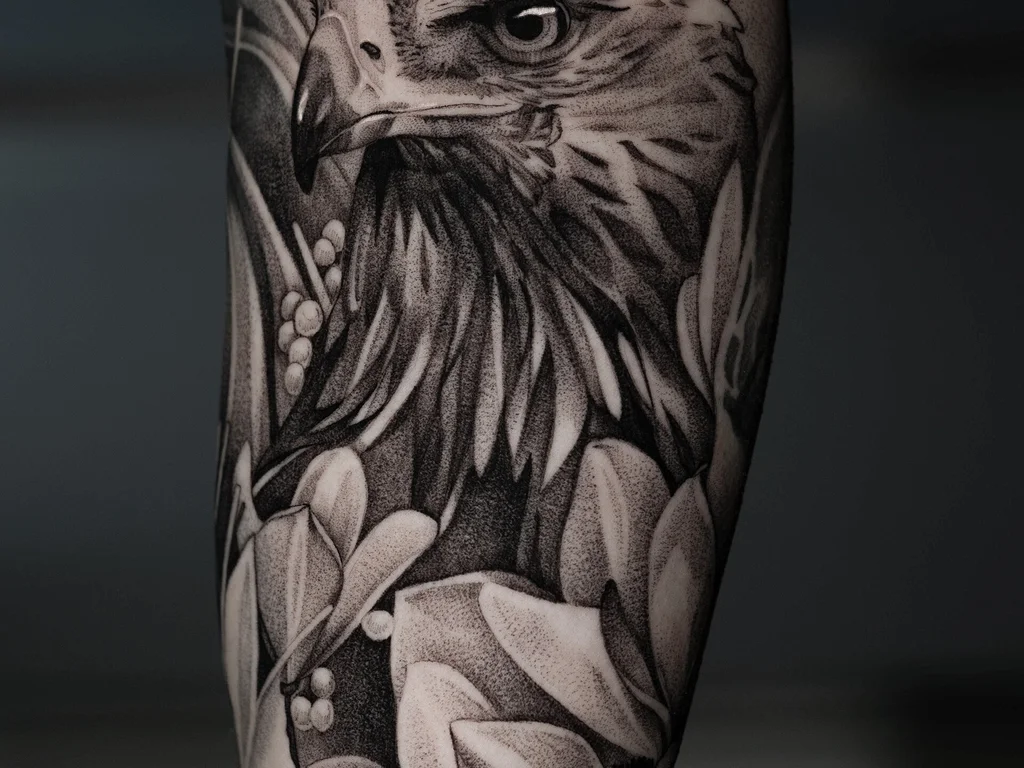
A bald eagle’s head at full forearm scale, every feather shaded, staring straight out of the skin. Dark leaves frame the bottom of the piece.
Black and grey realism needs a specialist and a long sitting. Forearm skin shows it best — steady, flat, on display. Check healed work, not fresh, when you choose the artist.
10. Eagle Across the Whole Back
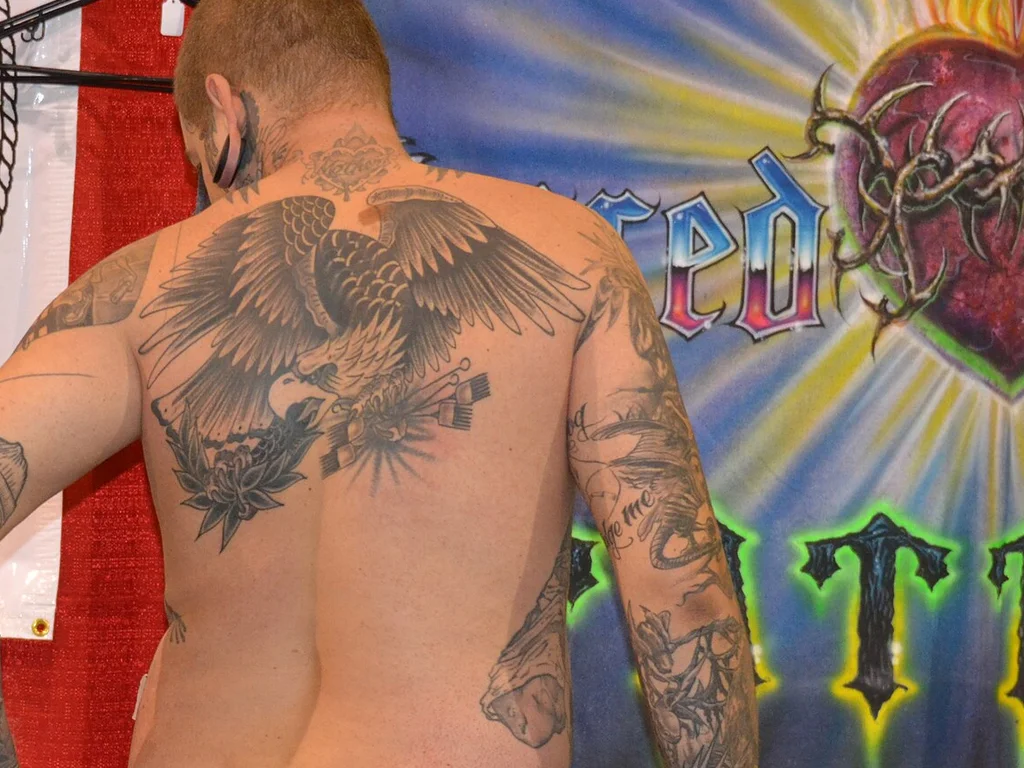
An eagle with wings raised covers this man’s entire back, photographed at a tattoo convention. A piece at this size is drawn in stages and finished over several sittings.
The back is the biggest canvas on the body and one of the slowest to fade. It is also the one spot you cannot watch being tattooed.
11. Tribal Eagle, Chest
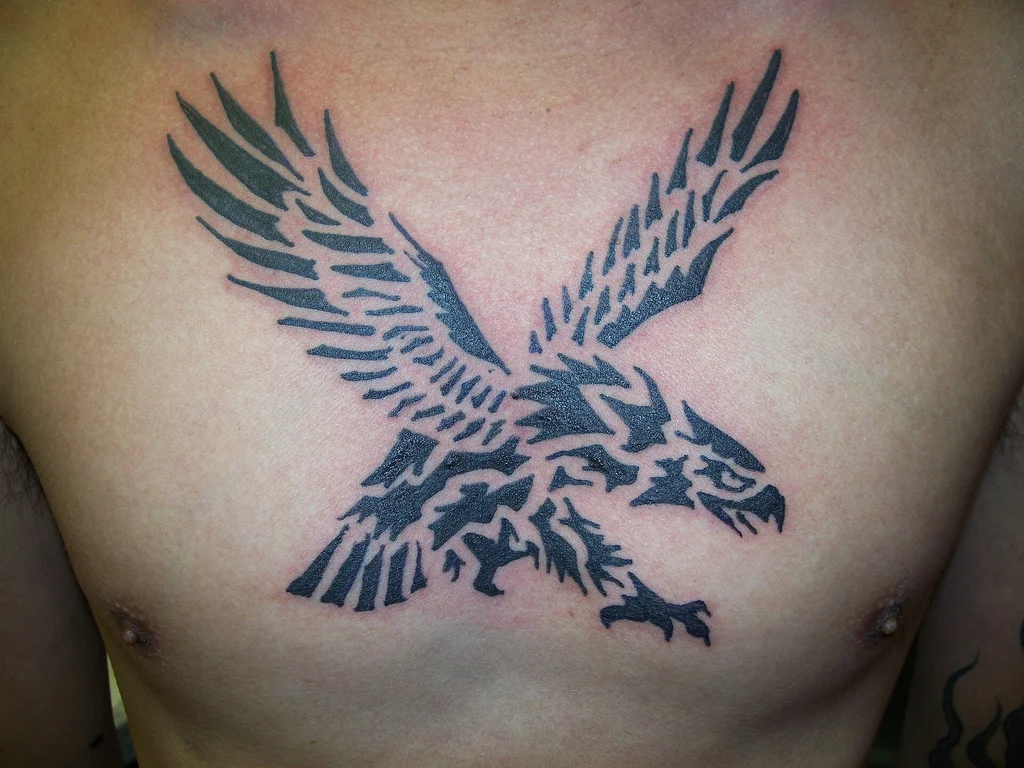
A tribal-style eagle built from sharp black shapes, wings lifted in a V across the chest. No shading, no colour — silhouette only.
Solid black ages better than any other approach. Chest skin also shifts with training and weight change, and bold shapes forgive that movement instead of fighting it.
12. Traditional Navy Eagle, Thigh
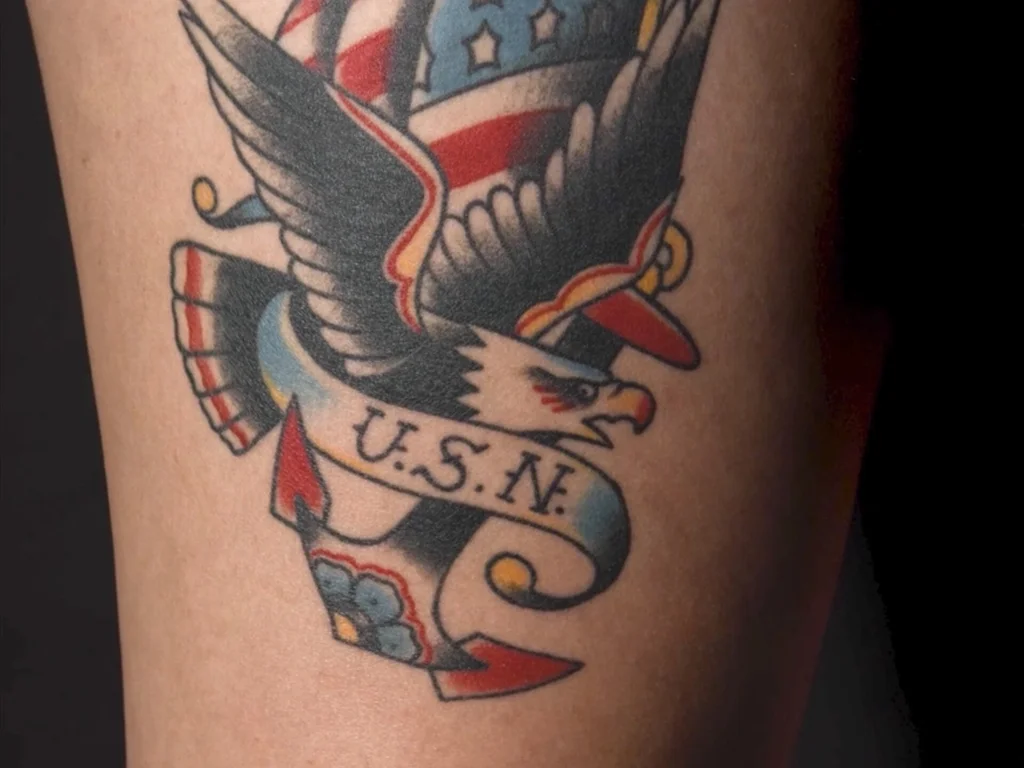
The classic American traditional eagle: flag colours, wings spread, a U.S.N. banner underneath. Sailors have worn this bird for a hundred years; the thigh is one of its traditional homes.
Thick outlines and flat colour are why traditional tattoos from decades ago still read clearly. The thigh hides the piece under trousers and gives it room.
13. Falcon Head Among Leaves, Forearm
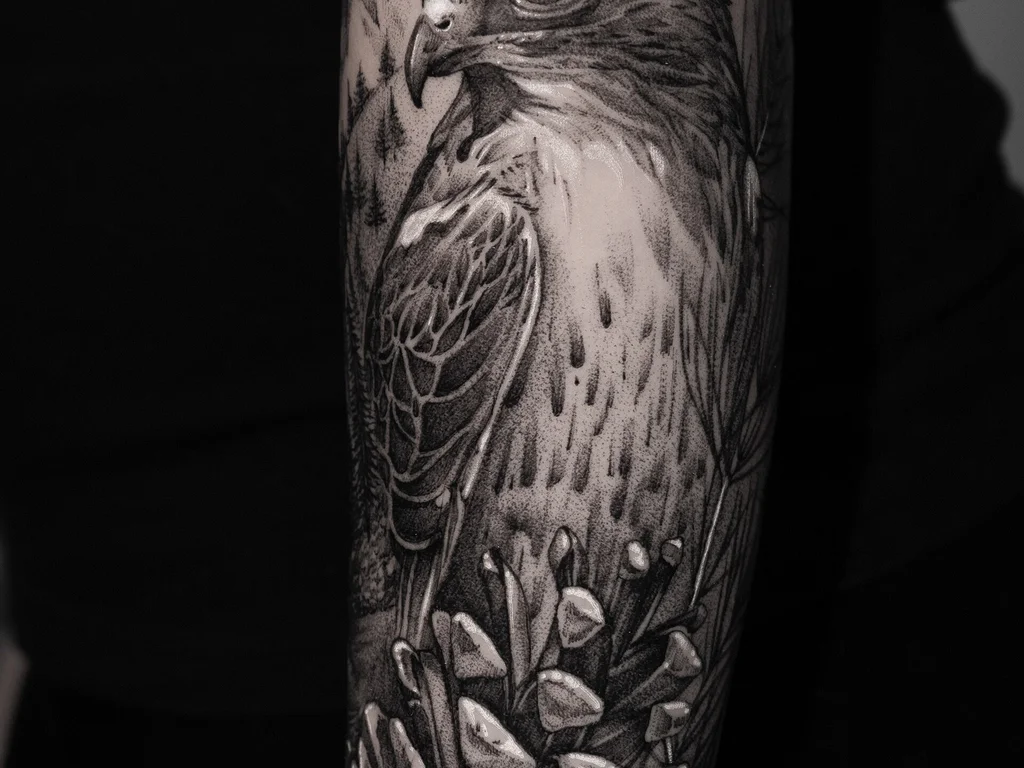
A falcon’s head and shoulders in black and grey, tucked among shaded leaves. The eye is the sharpest point in the whole tattoo, exactly as it should be.
Falcons suit people who find eagles a bit grand. The head works at half this size too, as long as the eye stays clean and dark.
14. Falcon With Roses, Upper Arm
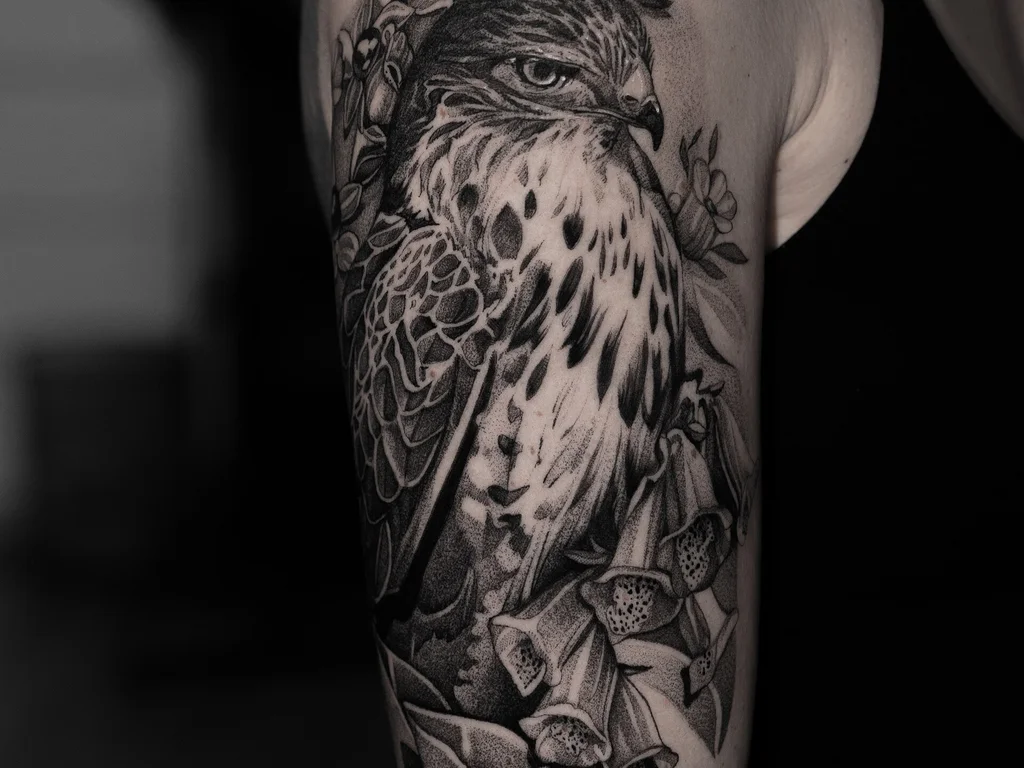
A full falcon perched upright, roses packed around its feet. The breast feathers are dotted and soft, the wing folded in tight.
The upper arm is prime space for a perched bird: tall, flat, and easy to grow into a half sleeve later by adding branch, sky or a second bird.
15. Blackwork Falcon in a Dive, Upper Arm
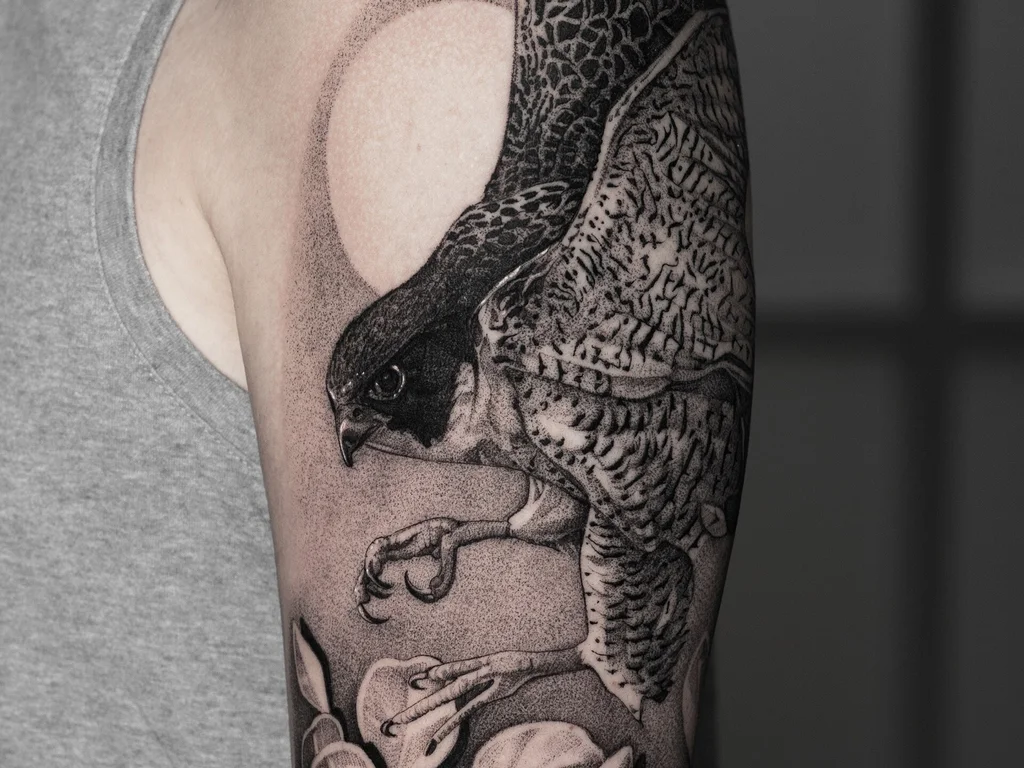
A falcon folded into a dive, drawn in heavy blackwork with a pale round moon behind it. The pose supplies the speed — no motion lines, no wind streaks needed.
Diving poses follow the upper arm’s curve well. Heavy black holds up for decades, though the tight feather pattern softens at its edges first.
16. Hawk Head With a Crescent Moon, Forearm
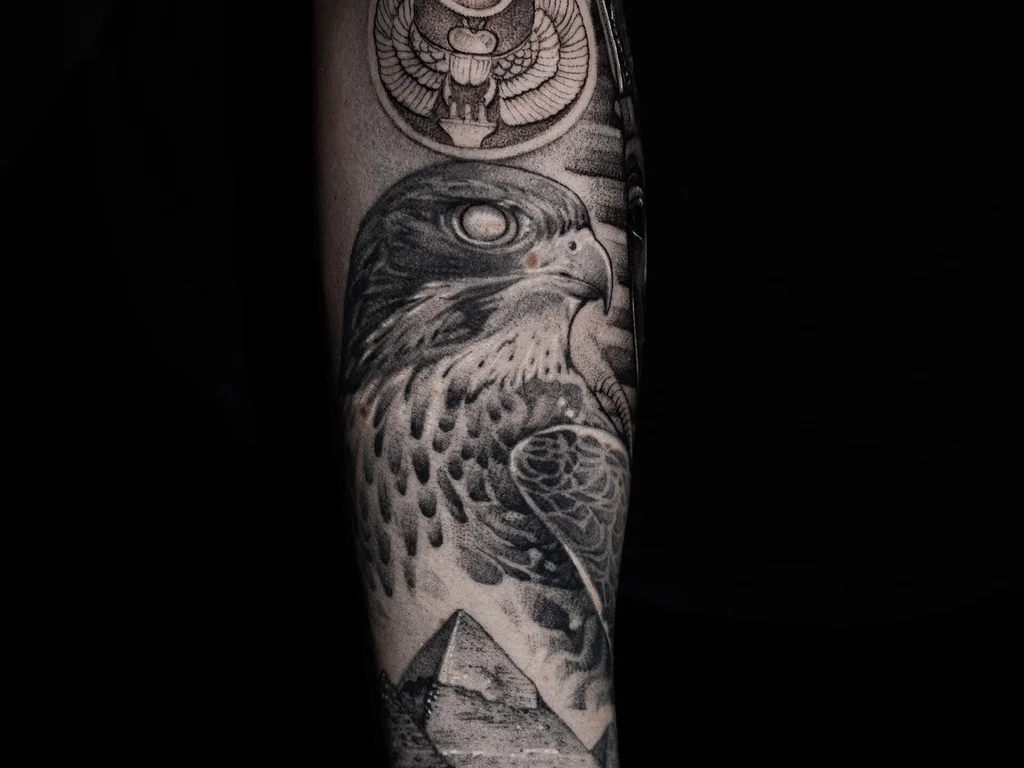
A hawk’s head in profile above a crescent moon, with a row of small geometric marks below, all in black and grey.
Hawks and falcons get mixed up constantly — even some photo captions swap them. The heavy brow and hooked beak here are hawk through and through. If the species matters to you, bring reference photos of the real bird.
17. Japanese Hawk With a Red Sun, Upper Arm
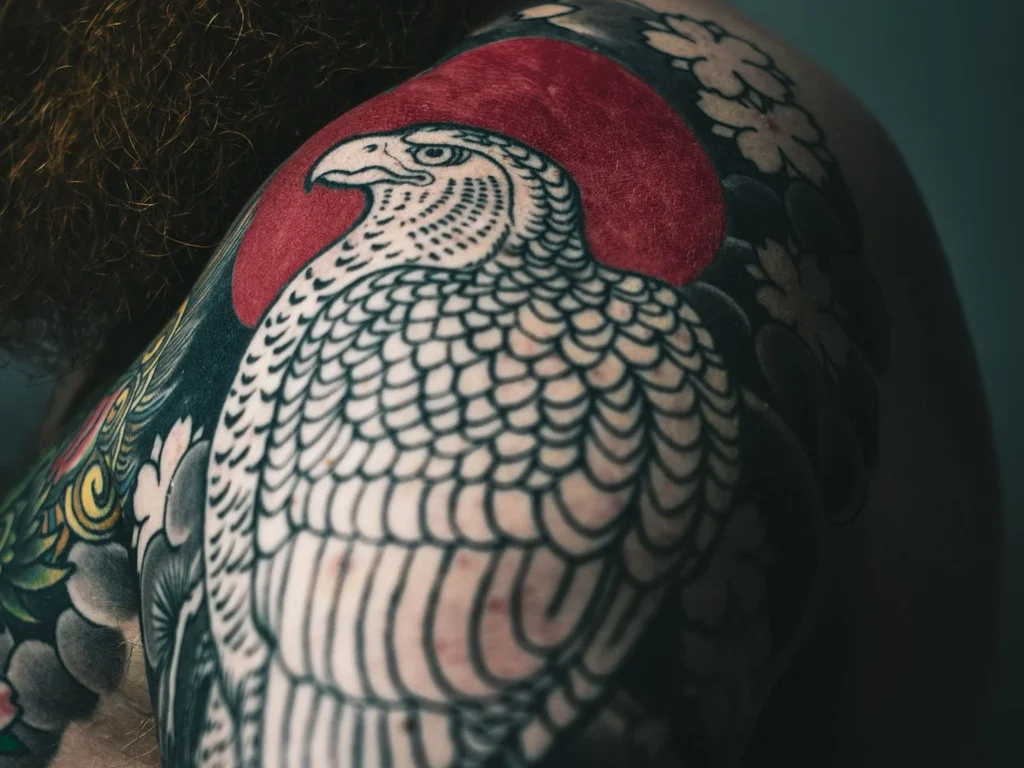
A hawk in the Japanese manner: feathers drawn as neat patterned scales, a deep red sun disc behind the head, cherry blossom at the edges.
In Japanese tattooing the hawk, or taka, stands for keen eyesight and never letting a chance slip. Bold pattern like this is built to last. The red disc will need sun care to stay deep.
18. Folk-Style Owl in Bright Colour, Shoulder
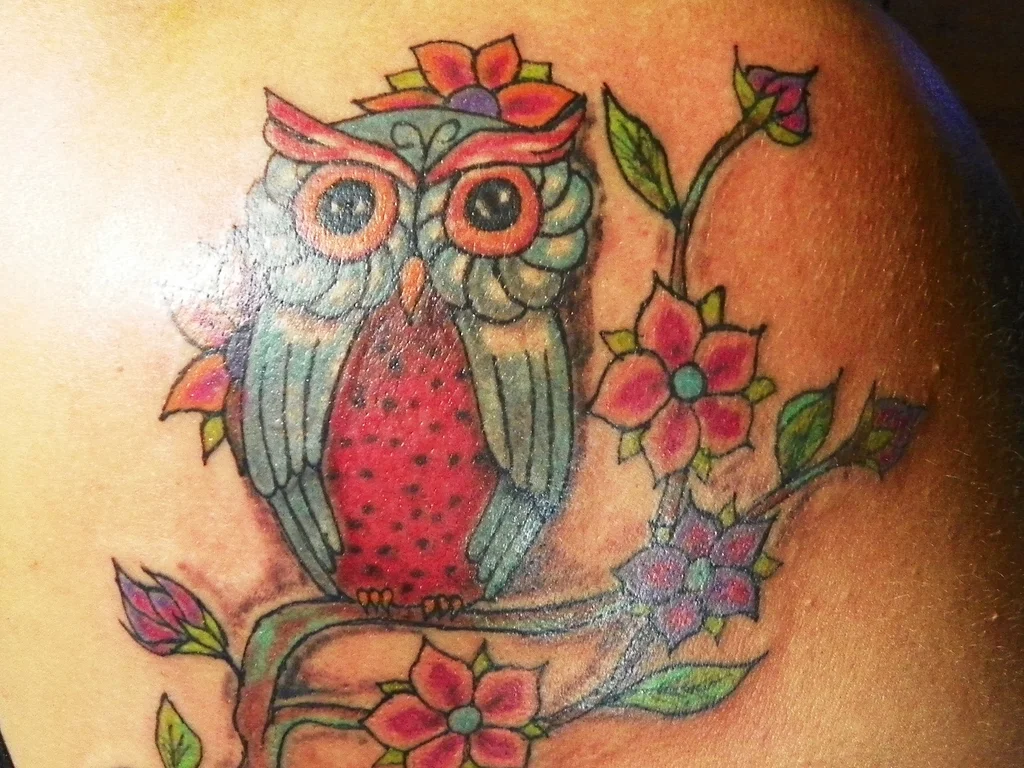
A round little owl in teal, red and orange, perched on a flowering branch. It owes more to folk art than to wildlife painting, and it is better for it.
Bright colour on the shoulder catches summer sun, so this is a sunscreen tattoo. The thick black outline will hold the shape long after the reds soften.
19. Barn Owl Under a Full Moon, Forearm
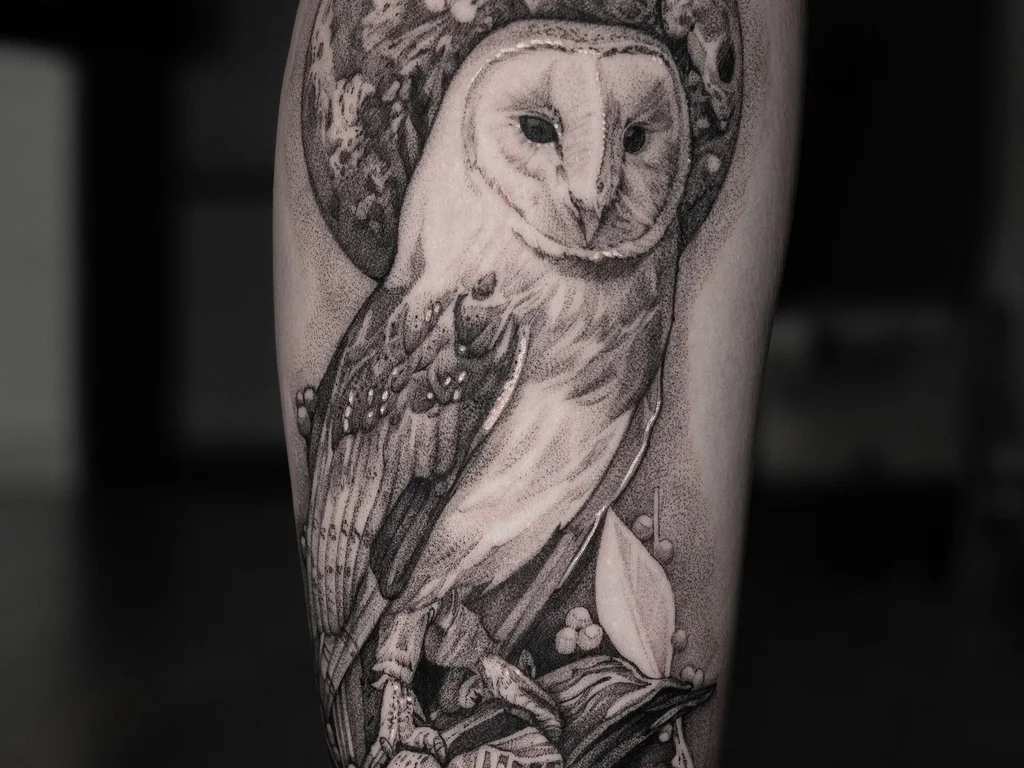
A barn owl perched in front of a large pale moon, drawn in soft black and grey. The owl’s white face is left mostly uninked — the wearer’s own skin does that work.
Using bare skin as the lightest shade is a confident move. It also means the contrast depends on your skin tone staying roughly as it is.
20. Barn Owl Face, Forearm
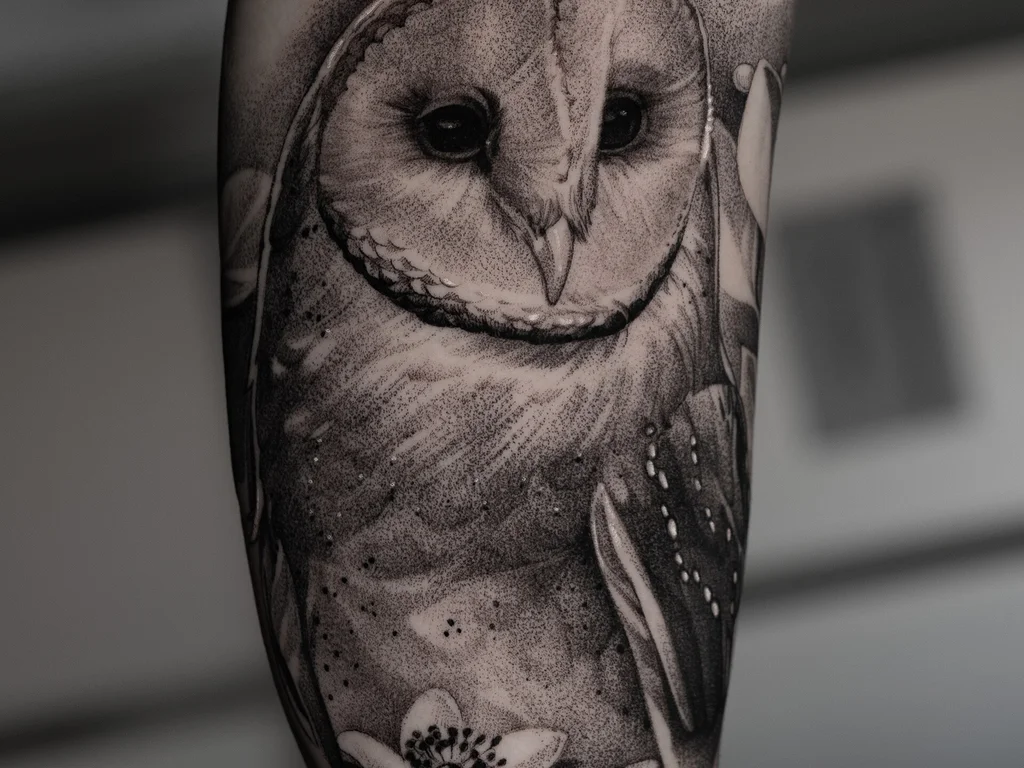
The same species, opposite approach: a barn owl’s heart-shaped face fills the frame, all speckle and shadow, with no moon and no branch.
Two barn owls sit near each other in this list on purpose. Subject is only half the choice — framing and shading change the whole feel.
21. Ornamental Blackwork Owl, Forearm
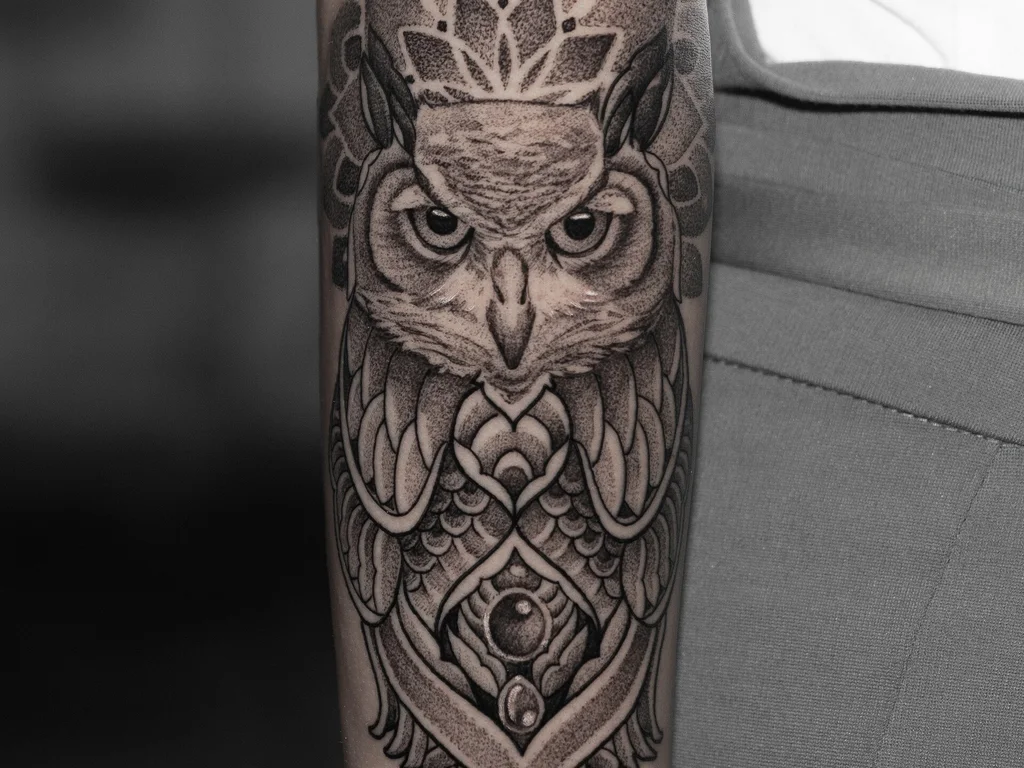
An owl built like a piece of carved jewellery: a mandala pattern through the body, fine lines and dots fanning out below, not a drop of colour anywhere.
Ornamental work lives or dies on symmetry, and a forearm shows any wobble honestly. Take your time over the stencil check in the mirror — it matters more here than in any loose, organic design.
22. Owl Under a Dreamcatcher, Calf
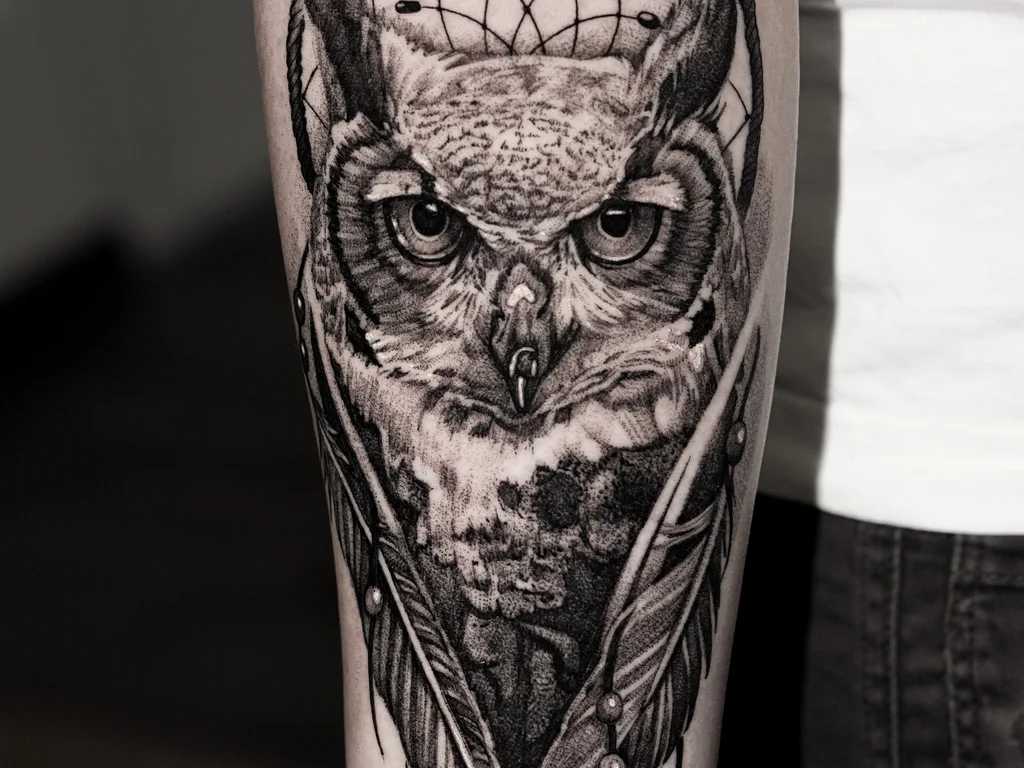
A horned owl’s face with a dreamcatcher’s web spread out above it, the web’s threads drawn into the design.
The calf gives this tall, narrow layout room. Web lines sit close together, and close lines are the first thing age blurs — going slightly larger than planned is the usual fix.
23. Owl With Wings Spread, Chest
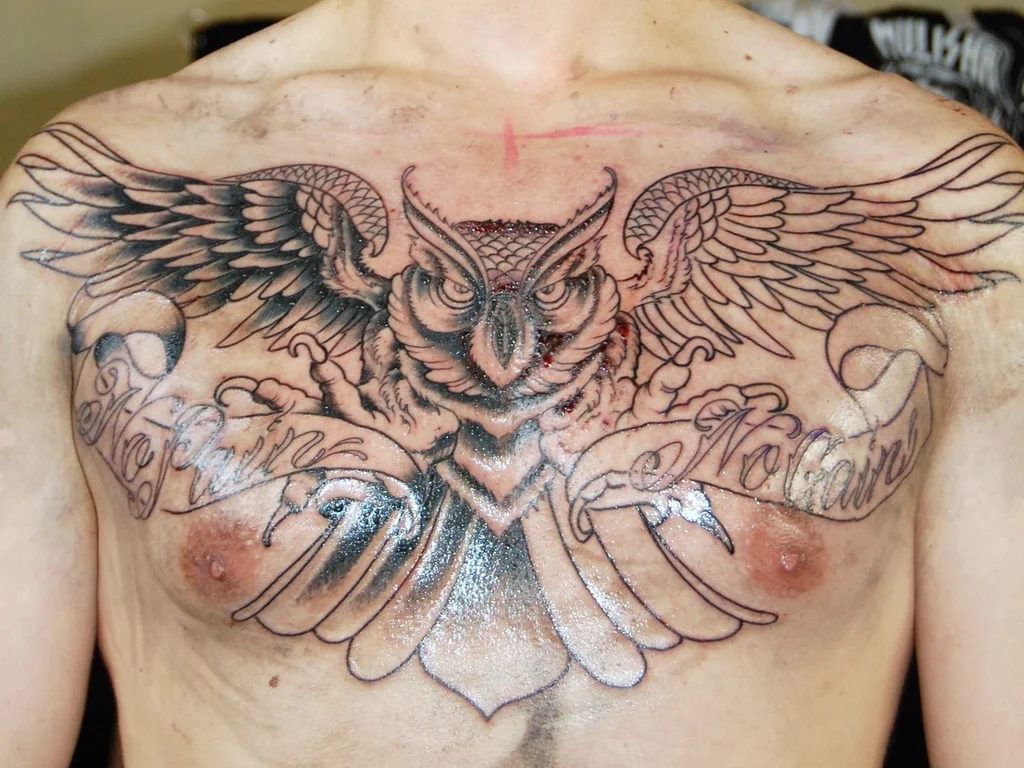
An owl at full stretch across the chest, wingtips reaching toward both shoulders, done in linework and light shade.
A chest piece this wide takes more than one sitting, and the middle of the chest is tender. The payoff is a design that moves when you breathe.
24. Horned Owl With Orange Eyes, Forearm
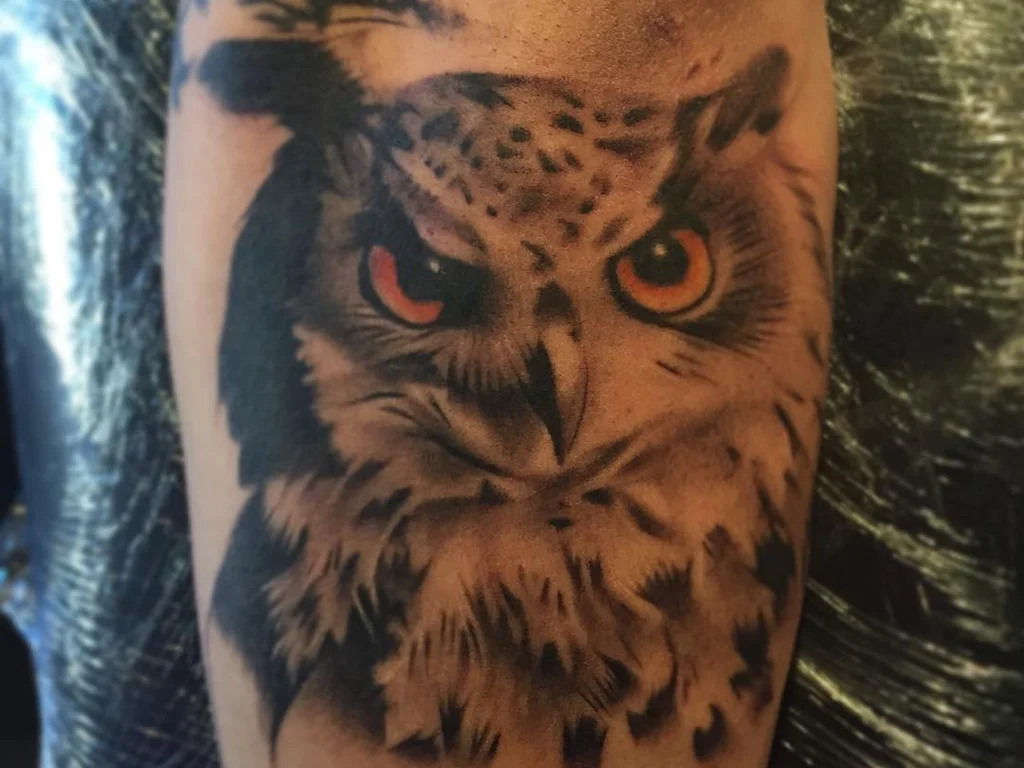
A horned owl in warm browns, staring out with bright orange eyes. The colour is muted everywhere except those eyes, which is exactly where you look first.
Browns and oranges sit in the middle for fading — slower than pastels, faster than black. When this piece eventually needs a refresh, the eyes are where the money should go.
25. Owl With a Skull Face, Front of the Neck
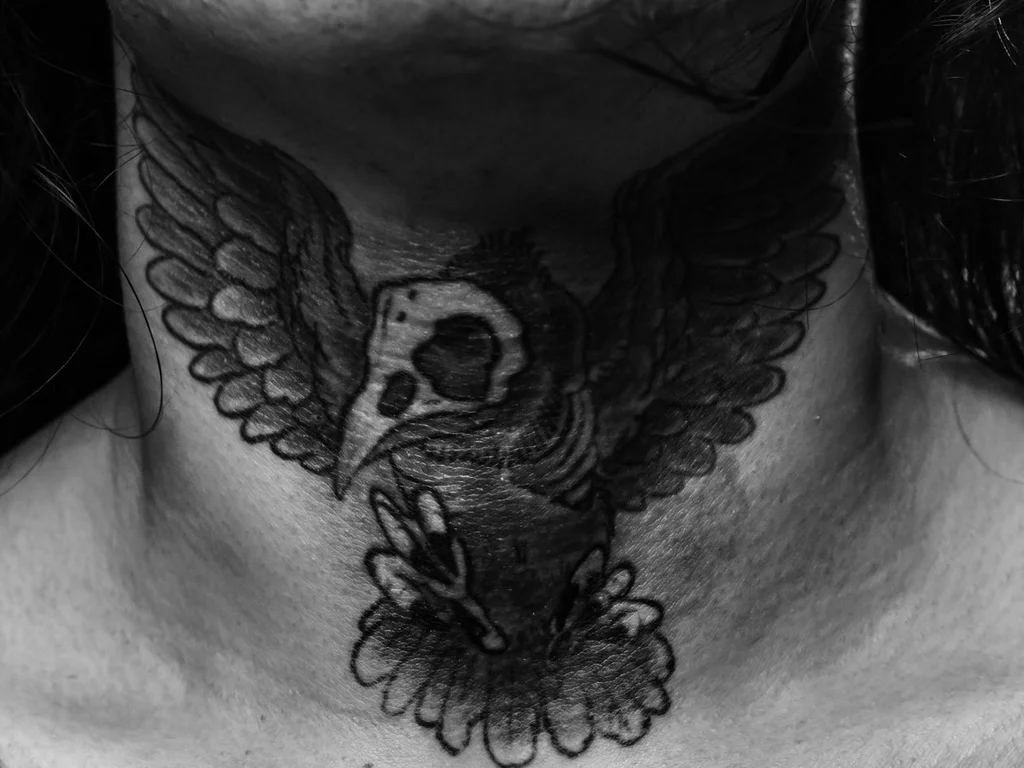
An owl spread across the front of the neck, wings up, with a small skull where its face should be. It is the darkest design in this list, worn where nobody can miss it.
A throat tattoo is a life decision before it is a design decision — no collar covers the front of the neck. The bold shading suits a spot that moves every time you swallow.
26. Raven Over Pine Trees, Forearm
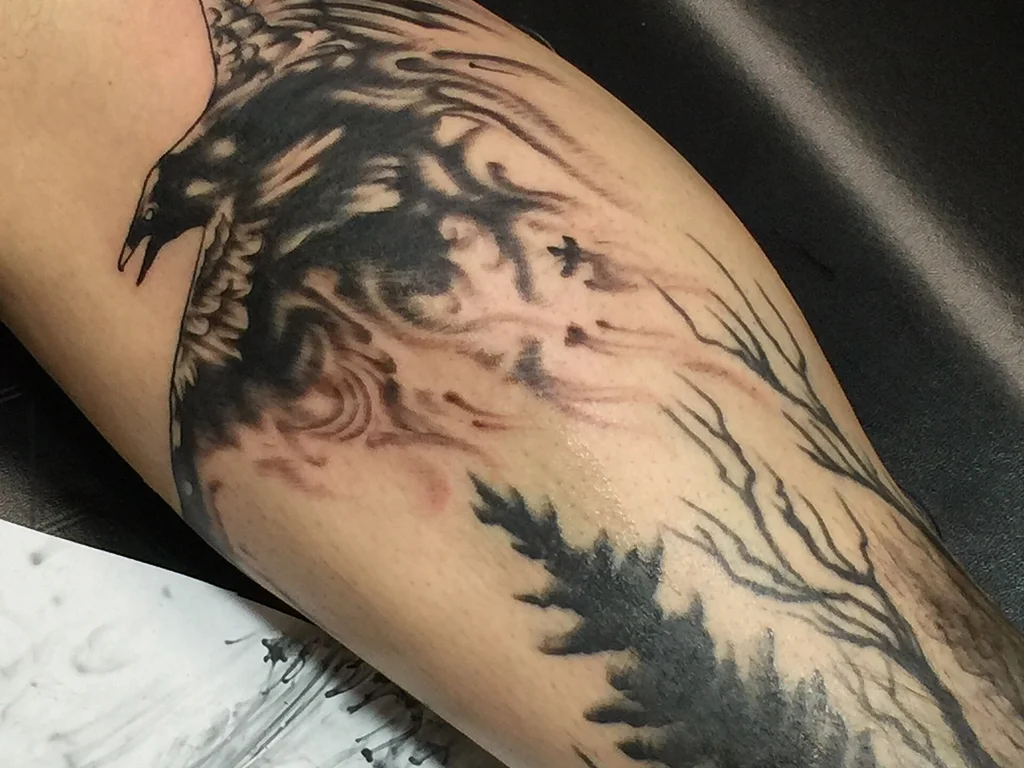
A raven in black and grey, with pine trees worked into the lower half of the design, as if the bird is rising straight out of a forest.
The trees give the forearm’s length a job and soften what could be a heavy block of black. The same raven works over branches or nothing at all.
27. Crow Across the Chest
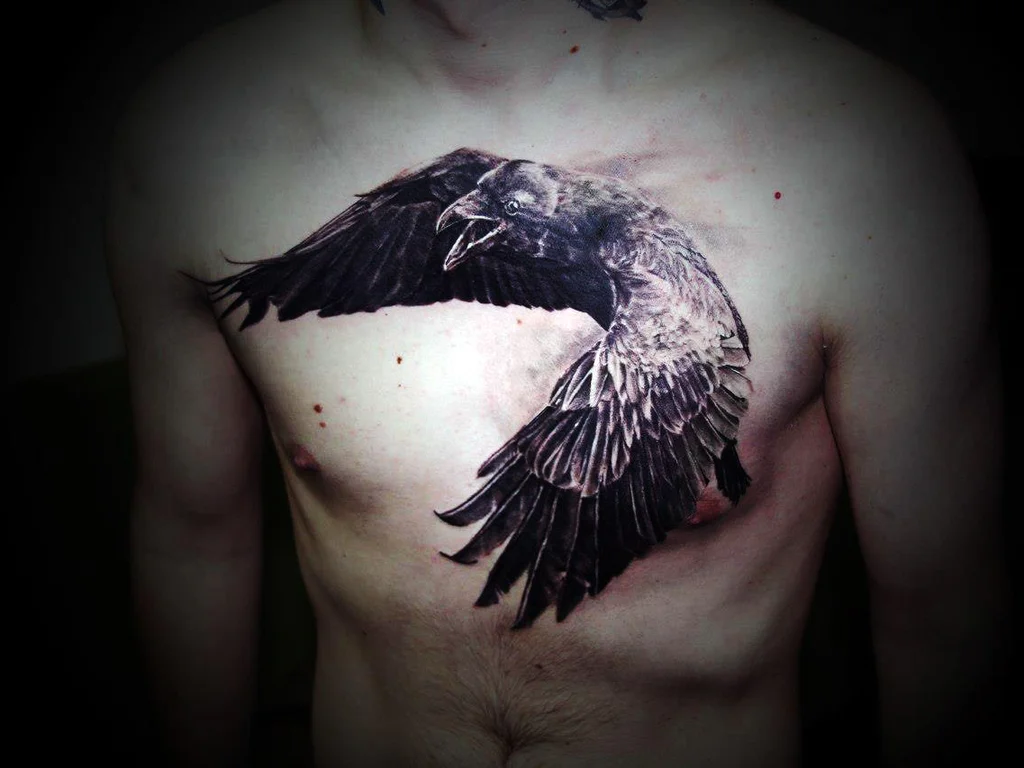
One crow, wings half open, spread wide across the chest in deep black. The photograph was taken in low light and the bird still reads from across the room.
That readability is the lesson. At chest scale, a simple black shape beats a detailed one — fine feather detail disappears at viewing distance anyway.
28. Raven Silhouette, Upper Back
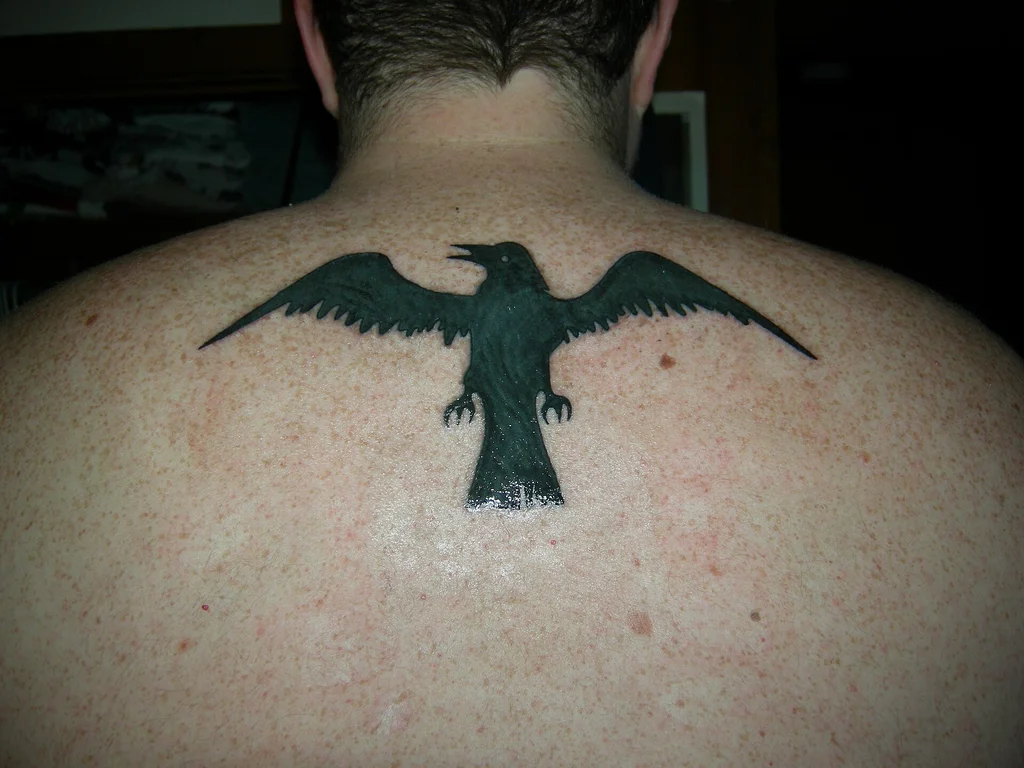
A plain black raven in flight between the shoulder blades, wings in a shallow V. Nothing else with it — no branch, no moon, no lettering.
Silhouettes are the most forgiving bird design there is. One clean outline and even, thick fill, and it will look much the same in twenty years.
29. Crow on a Heraldic Shield, Upper Arm
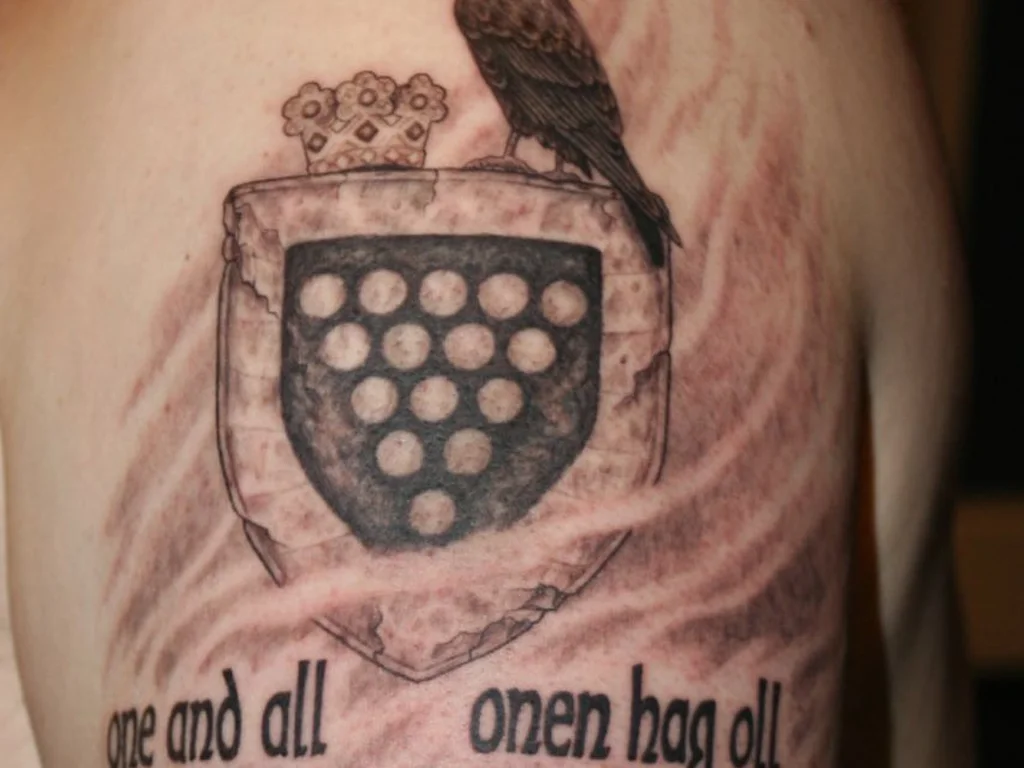
A crow perched on top of a shield, a crown above it and the Cornish motto “One and all” below, drawn softly in black and grey.
Heraldic designs suit people who want a bird with a story pinned to it — a county, a family, a regiment. Check any wording twice. Skin keeps your typos.
30. Two Crows on a Branch, Bold Black
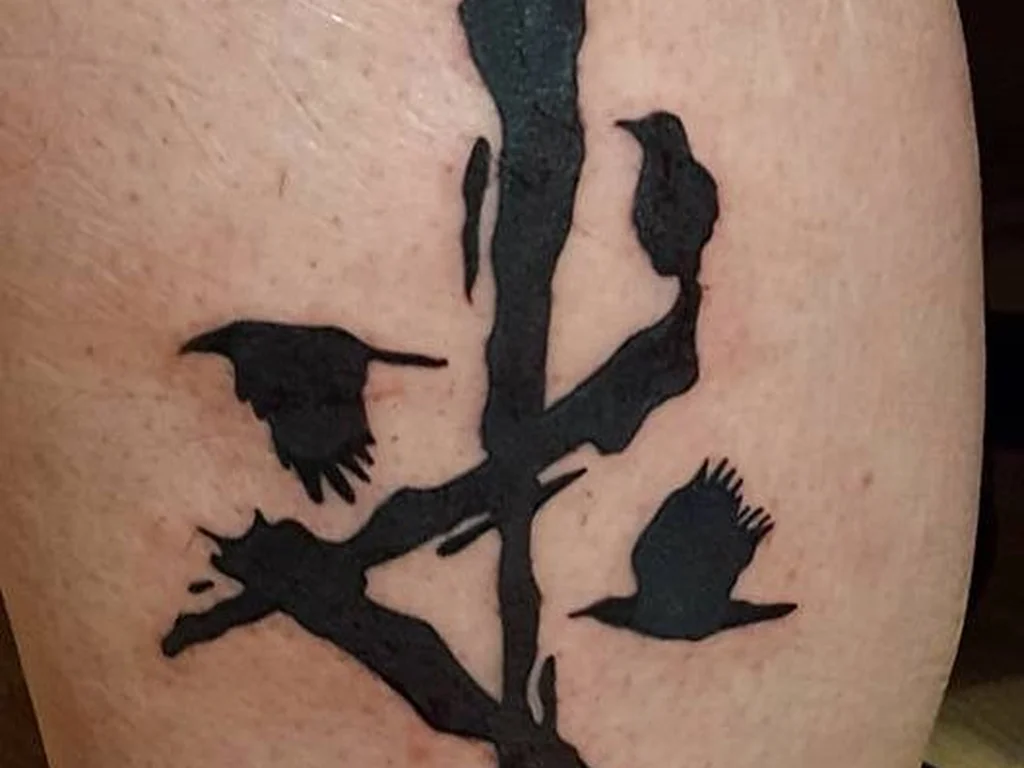
Two crow silhouettes on a thick, crooked branch, drawn like strokes of a loaded brush. The whole tattoo is a handful of bold black shapes.
This style asks little of the skin and ages slowly. It makes a kind first tattoo too: one short sitting, simple healing, room to add a third bird later.
31. Crow on a Key, Forearm
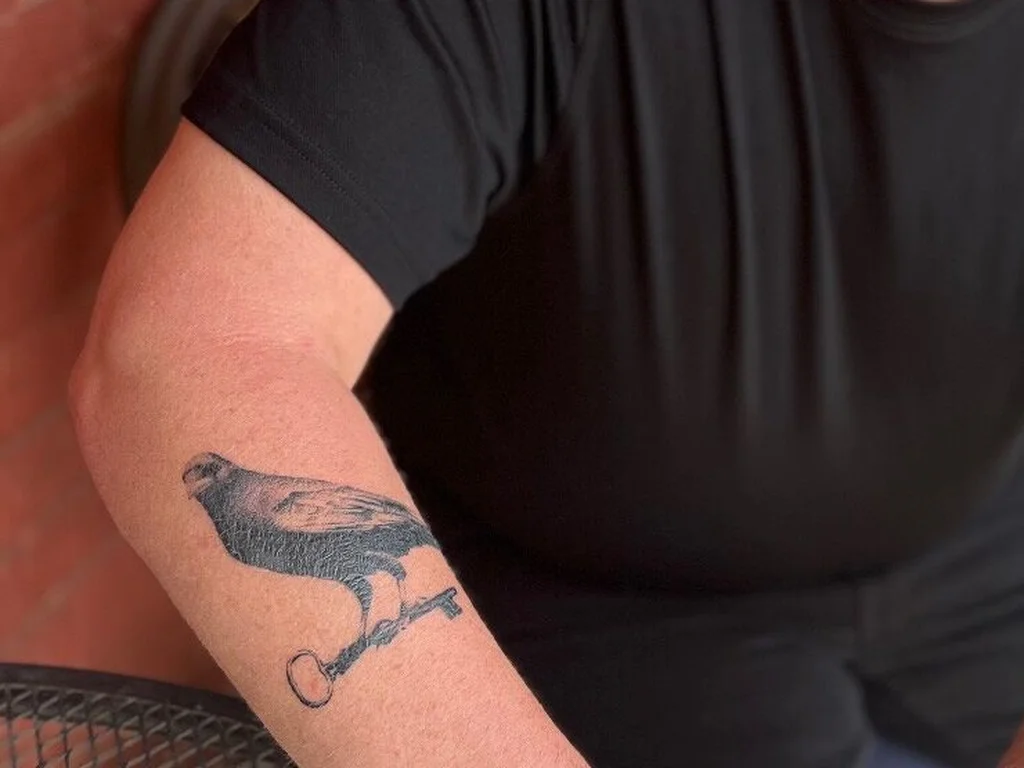
A crow standing on an old-fashioned key, drawn in scratchy black lines on a forearm. Small, odd, and full of character.
The photograph shows this tattoo healed on an older arm — a useful, honest sight. Black line spreads a little and softens as skin ages, and good designs are drawn with that in mind.
32. Formline Bird, Back
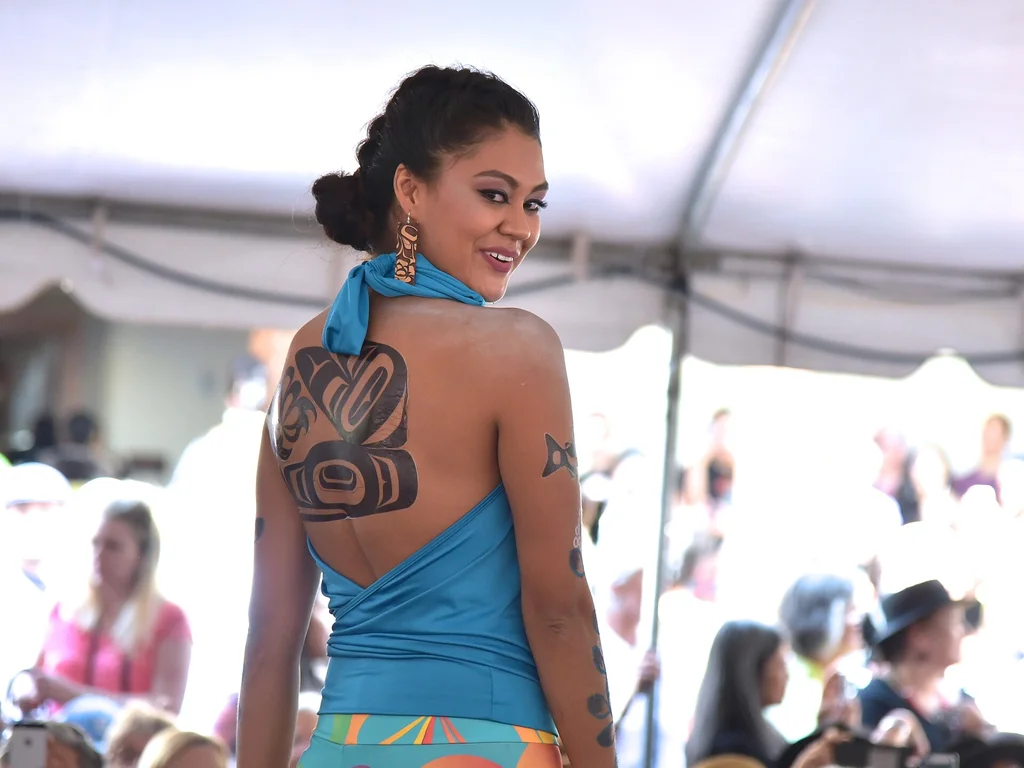
A bird drawn in the formline style of the Indigenous peoples of the Pacific Northwest — thick black outlines, red accents, the body built from ovals and U-forms — worn down one side of the back.
Formline is a living art tradition with its own rules and its own artists. If it speaks to you, the respectful route is to commission an Indigenous artist rather than copy a design out of a photograph.
33. Peacock in Blue and Green, Forearm
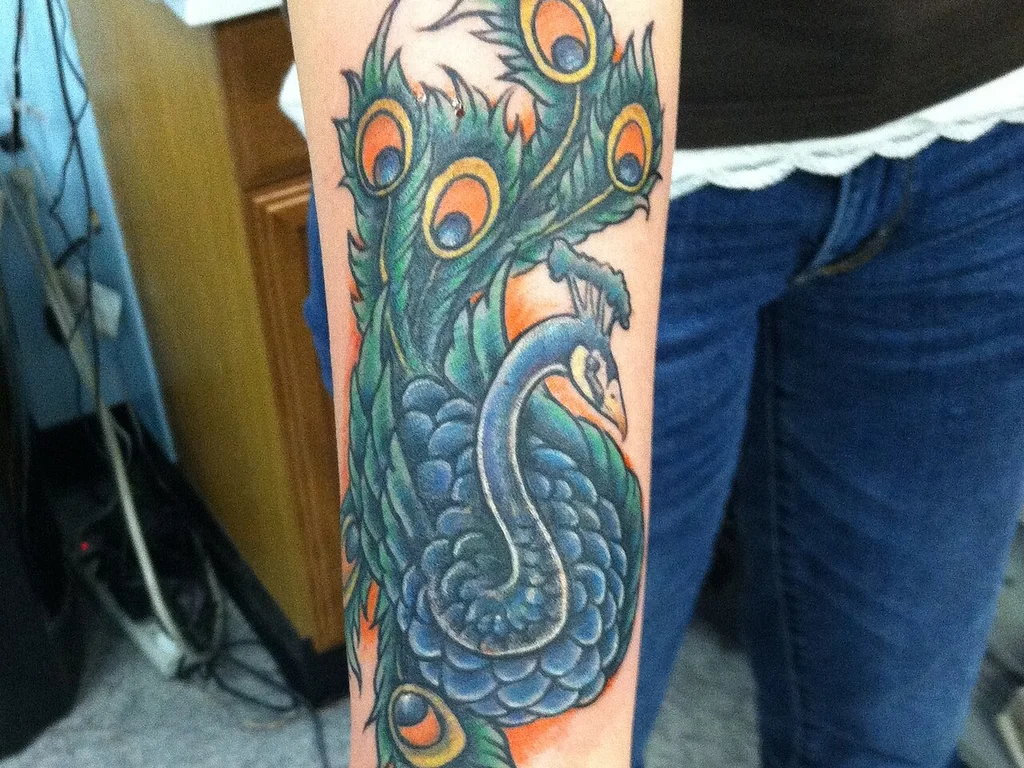
A peacock with its train curled around it, the eye-spots of the tail picked out in orange against blue and green. The design wraps the forearm like a cuff.
Peacocks are the show-offs of the bird world, and the tattoo keeps the habit. Blues and greens hold well, but the detail inside each eye-spot wants at least a medium scale.
34. Peacock Feather, Foot
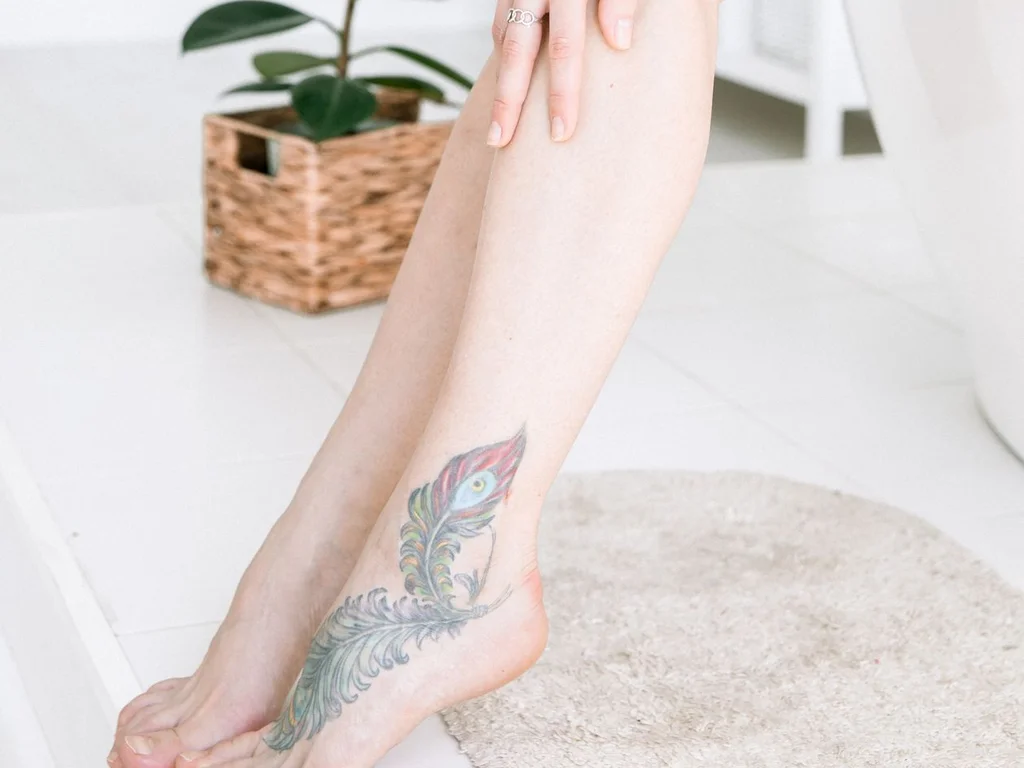
A single peacock feather in soft colour laid across the top of the foot, the feather’s eye near the ankle.
Feet rub and shed skin faster than anywhere, so feather tattoos here often need a touch-up once healed. This one has settled into the skin rather than sitting on it — a healed example, shown as it really looks.
35. Peacock Feather With a Flute, Calf
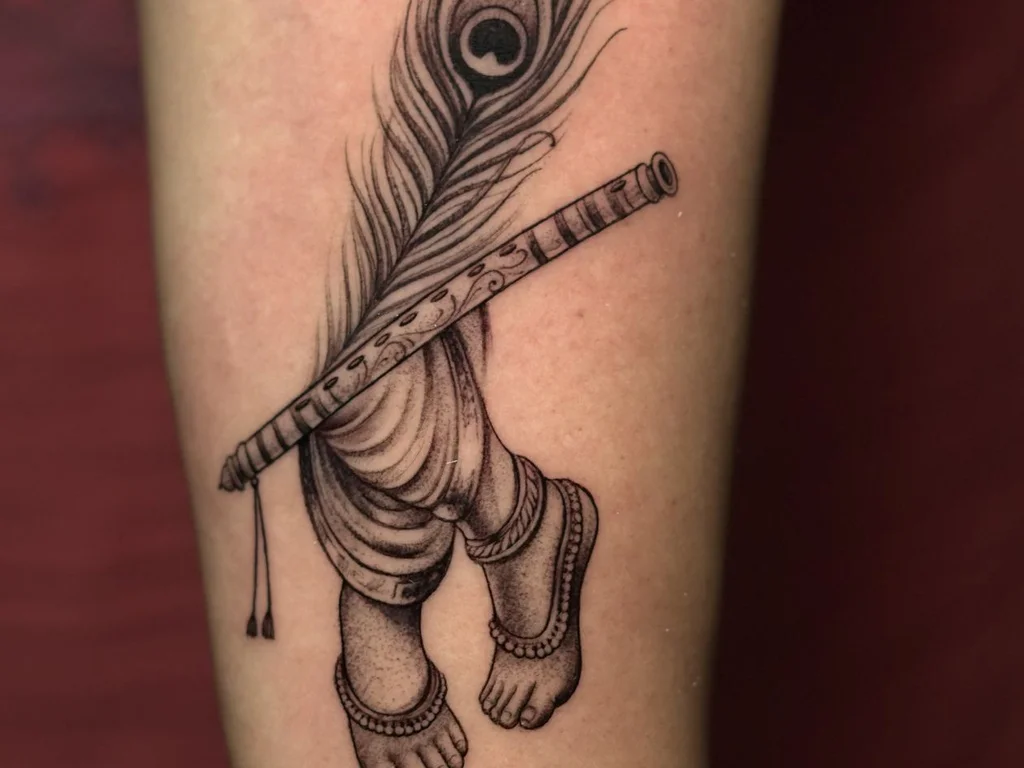
A tall peacock feather with a bamboo flute crossed in front of it and a small draped figure below — a pairing linked to Krishna, who is pictured with both the feather and the flute.
The calf suits the feather’s long shape. Black line keeps the meaning up front and the upkeep low, and the feather’s barbs are drawn as a few clean strokes instead of hundreds of fine ones.
Where a Bird Tattoo Works Best
Forearm and calf. The workhorse spots: flat, fairly low-pain, easy to show or cover. Perched birds — falcons, owls, sparrows — sit naturally here, which is why so many designs above live on one or the other.
Chest and back. Birds are wide animals, and these are the wide places. A spread-wing design needs a canvas that matches its wingspan — designs 10, 11, 23 and 27 all use their full width. Crowding a big bird into a small space is the most common bird tattoo mistake.
Shoulders and collarbones. Built for pairs and symmetry. Two birds facing each other across the chest, like design 1, is one of the oldest layouts in tattooing and still one of the neatest.
Neck and hands. High display, faster fading, no hiding. Keep the design bold and simple — designs 2 and 3 both follow that rule. Our fine line tattoo ideas guide shows how thin lines behave over time, which is worth a read before choosing delicate work for either spot.
Small and hidden spots. Behind the ear, the ankle, the foot, the ribs. Tiny silhouettes and single feathers belong here. The trade is upkeep: feet shed skin fast, and fine detail anywhere small softens sooner than you hope.
Frequently Asked Questions
What is the most popular bird tattoo?
Swallows and owls are the two artists mention most, with eagles close behind. No official count of tattoos exists, so treat exact rankings with suspicion — but those three birds are in every studio’s flash books.
What does a swallow tattoo mean?
It comes from sailing. A swallow marked 5,000 nautical miles at sea, and because swallows return to the same nest each year, the bird also stood for coming home safely. Today most people keep the second meaning — home, or someone worth returning to.
Do bird tattoos age well?
The bold ones do. Thick outlines, solid black and simple colour blocks hold their shape for decades. Fine feather detail softens first, and watercolour edges blur gently. Placement matters as much as style: backs age slower than hands and feet.
How much does a bird tattoo cost?
Size and detail decide it, not the species. A tiny silhouette sits at most studios’ minimum charge, commonly $60–$150 in the US. Detailed pieces are usually priced by the hour, and a full back per session across several sessions. Get the price at a consultation.
Where is the best place for a first bird tattoo?
The forearm, calf or shoulder. All three are low-to-moderate for pain, easy to cover at work, and slow to fade. Save the neck, hands and ribs for a later tattoo, once you know how your skin takes ink.
Can a bird tattoo be really small?
Yes, if the design shrinks honestly. A silhouette of a few strokes works at two centimetres — designs 4 and 7 prove it. What does not work is a detailed bird drawn tiny: the feather detail merges into one dark shape within a few years.
What does an owl tattoo mean?
In the West, wisdom and watchfulness, through the owl’s link with Athena. In parts of Asia, Africa and Latin America, owls are tied to death or bad luck instead. Know which story you are wearing, especially if you travel.
Which bird tattoo suits a man or a woman?
Birds cross over more than most subjects. Eagles, ravens and big owls are picked more often by men, and swallows and fine-line birds more often by women, but nearly every design on this page is worn by both. Placement and scale change the feel more than the species does.
Can a bird tattoo cover an old tattoo?
Often, yes. Spread wings and dark birds — ravens, crows, blackwork eagles — are among the best cover-up shapes because they are wide, busy and can be made darker in patches. A cover-up has to be bigger and darker than what sits underneath, so the artist should draw over the old tattoo at the consultation.
How do I choose the right bird?
Match the bird’s reputation to your reason, and its shape to the body part. Wide birds need wide skin. Perched birds need a vertical canvas. Long, thin designs — feathers especially — suit calves, ribs and spines. Placement first, and the shortlist writes itself.
Final Thoughts
Birds have stayed popular in tattooing for over a century because they carry meaning without needing a caption. Pick the bird whose story matches yours, give it skin that fits its shape, and keep the drawing bolder than feels necessary on day one.
Photo credits: Designs 1, 3, 4, 6, 7, 8, 17, 25, 34 and 35 — Pexels, Pexels License. Designs 2, 11 and 12 — Wikimedia Commons, public domain. Design 31 — Wikimedia Commons, CC0. Designs 5, 10, 24, 26, 29, 32 and 33 — Wikimedia Commons, CC BY 2.0. Design 28 — Wikimedia Commons, CC BY-SA 2.0. Designs 18, 23 and 27 — Wikimedia Commons, CC BY-SA 3.0. Designs 9, 13, 14, 15, 16, 19, 20, 21, 22 and 30 — Wikimedia Commons (Dom Carter / Dominic Carter), CC BY-SA 4.0. Full source links for every photo are listed in this article’s research notes.