Sea turtles earn their place on skin the honest way. They are old animals, patient swimmers, and one of the few creatures that cross whole oceans and still find their way back to the beach they were born on. That mix of endurance and homecoming sits behind most sea turtle tattoo ideas, and it shows in the designs people pick: long-distance travellers, drawn with care.
Every one of the 22 sea turtle tattoo ideas below is a real tattoo on real skin, photographed and shared under an open licence. The set runs from a chest-sized tribal medallion to a wrist outline the size of a coin, and each entry says where the piece sits, how it is drawn, and how that approach tends to hold up as the years pass. A few are freshly finished and still shiny; they are labelled as such, because fresh ink always looks sharper than healed ink will.
One check before the pictures. A sea turtle is not a tortoise, and the difference is in the feet: sea turtles have flippers, built for swimming, while tortoises and freshwater turtles have claws and toes for walking. Every design in this collection has flippers. If you take one of these sea turtle tattoo ideas to an artist, that flipper check is worth doing on the reference photos too. For the wider family, the sea creature tattoo ideas pillar covers the rest of the ocean, and the animal tattoo ideas guide covers the land side. Wild sea turtles, for the record, need the help more than they need the tattoos: the NOAA guide to helping sea turtles is a short, practical read.
Realistic and Black & Grey Sea Turtles
Black and grey is where sea turtles show off. The shell is a natural pattern plate, the flippers carry their own speckled texture, and a good artist can build the whole animal out of dotwork and soft shading without a drop of colour. These six lean on that strength.
Geometric Shell, Realistic Head
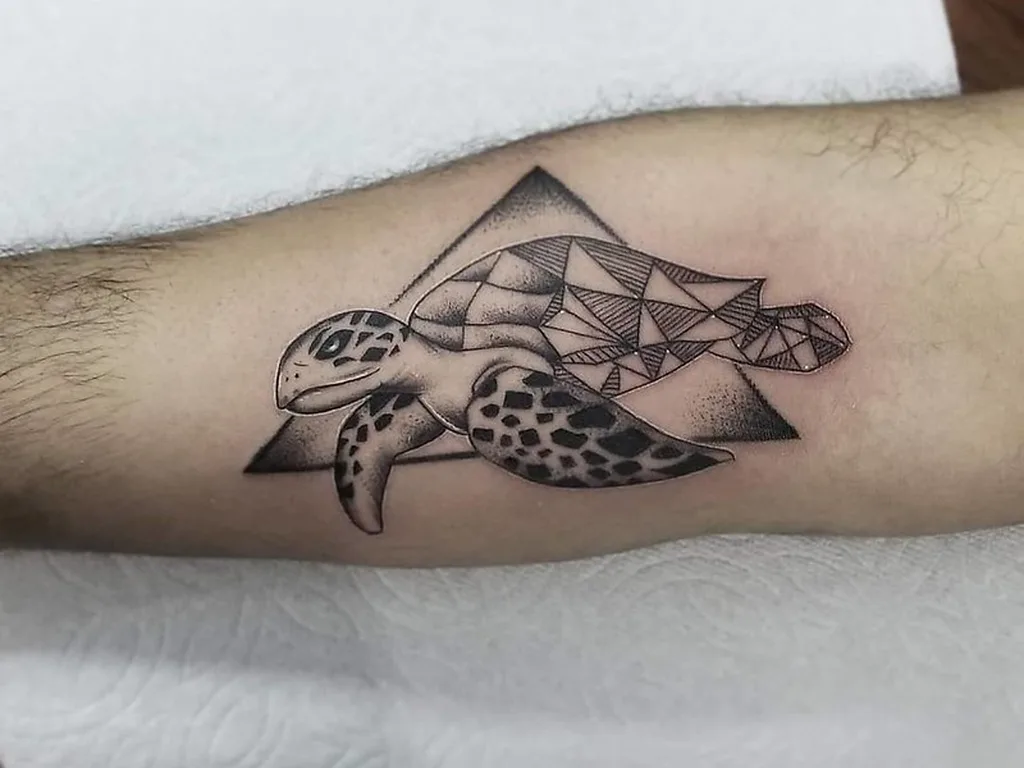
A sea turtle swimming across a forearm, drawn two ways at once. The head and the big front flippers are realistic — spotted skin, a calm eye, shading that rounds the body — while the shell is built from flat geometric facets, like a cut stone. A dotted triangle sits behind the whole animal and holds the composition together.
The split personality is the point, and it is a kind way to structure a first sea turtle tattoo: the realistic parts give it life, the geometric shell gives it a graphic edge that stays readable as the softer shading settles with age. Pieces like this sit best at forearm or calf size, where the facets stay big enough to read.
Flowers Inside the Shell
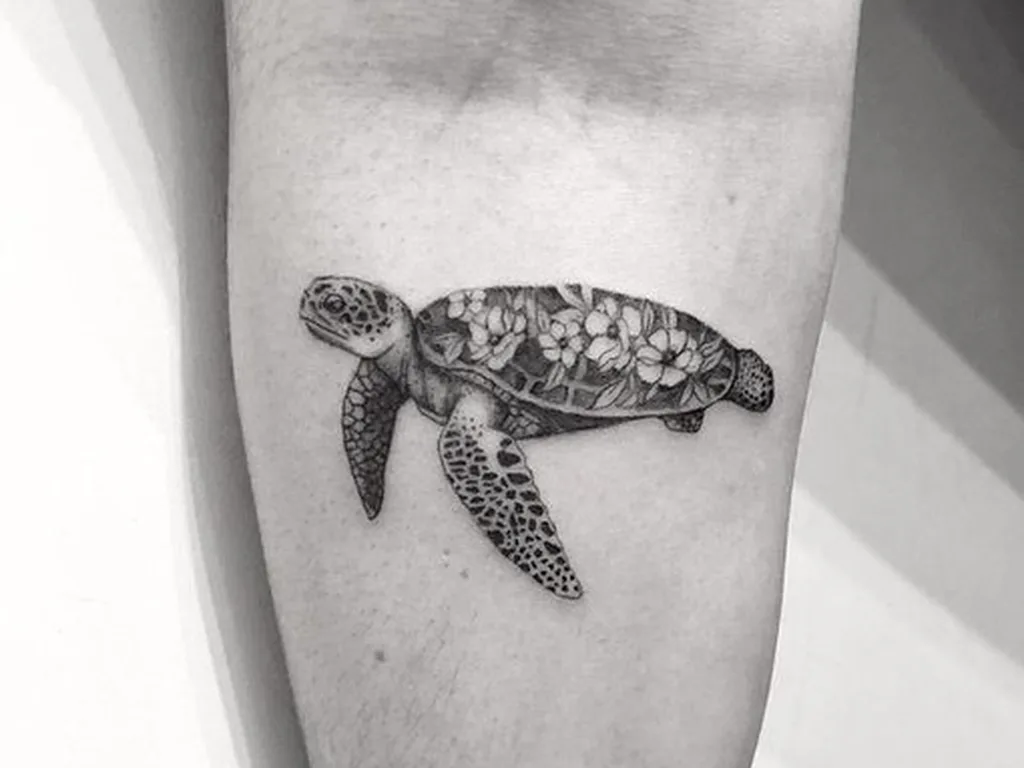
A black and grey turtle on a calf, photographed in black and white, with a garden where the shell plates should be. The head and flippers are drawn true to life — speckled, shaded, unmistakably a sea turtle — and then the shell opens into hibiscus-style flowers instead of scutes.
Swapping the shell pattern for flowers is one of the most repeated moves in sea turtle tattoo ideas, and this is a clean version of it: the outline of the shell stays intact, so the animal still reads from across a room, while the inside carries the personal part. Calf placement suits the long body shape well.
The Shattering Shell
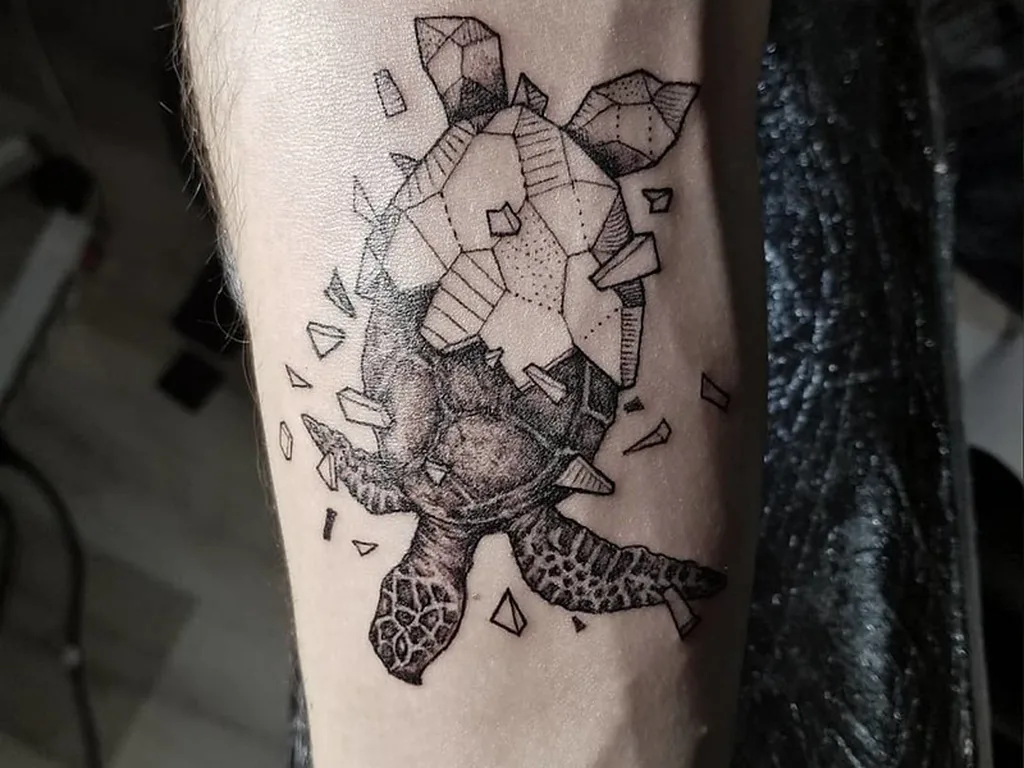
This forearm turtle is coming apart on purpose. The lower half of the animal is shaded and solid; the shell breaks upward into geometric shards that scatter off the body, part crystal, part explosion. It is the boldest composition in this collection, and the forearm gives it the vertical run it needs.
Designs that mix dense shading with fine floating fragments ask a lot of the healing process — the smallest shards are the first thing to soften. If this is the sea turtle tattoo you want, keep the fragments bigger than feels necessary on paper. On skin, in ten years, you will be glad of it.
Loose Sketch Lines
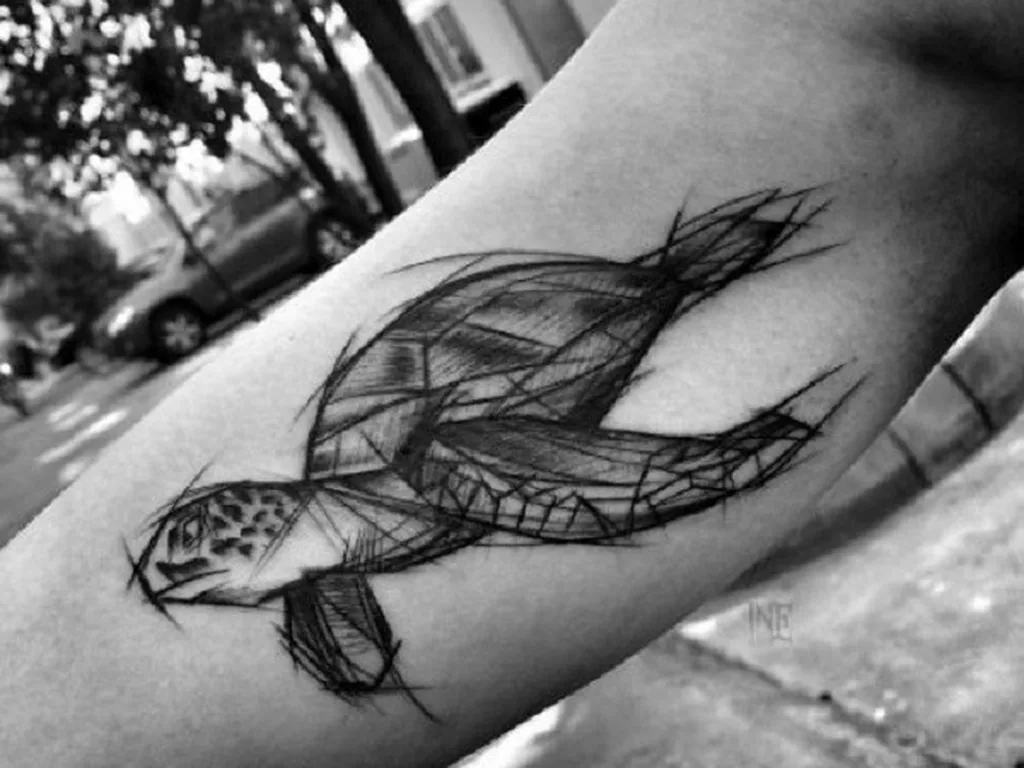
A turtle drawn the way a pencil sketch looks before it gets tidied: long hatched strokes, lines that overshoot the edges, the shell suggested in cross-hatching rather than filled. The photograph is black and white, shot outdoors on a forearm, and the loose style suits the casual framing.
Sketch-style work divides people. It looks like motion and process rather than a finished emblem, which is exactly why its fans choose it. Know that the scratchy outer lines are meant to blur a little with age — that softening is part of the style, not a fault in it.
Dotwork on the Inner Wrist
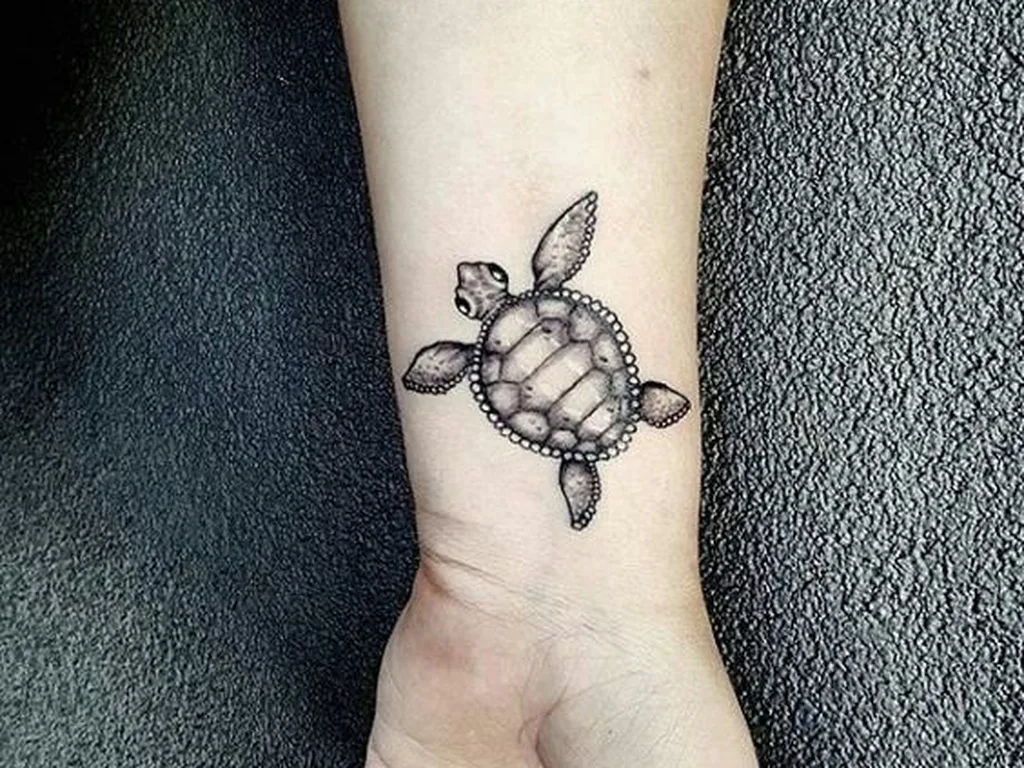
A small turtle viewed from above, built almost entirely from dots: dotted outline, dotted shell plates, a dotted edge running around the flippers. It sits on the inner wrist under an older script tattoo, and the top-down view is the classic way to draw this animal small — shell, four flippers, head, all readable at a glance.
Dotwork is a sensible technique at this size. Dots soften into a gentle grey rather than bleeding into blobs the way tiny solid lines can, so a wrist turtle done this way keeps its pattern longer than most small pieces.
A Whale, a Turtle and a Globe
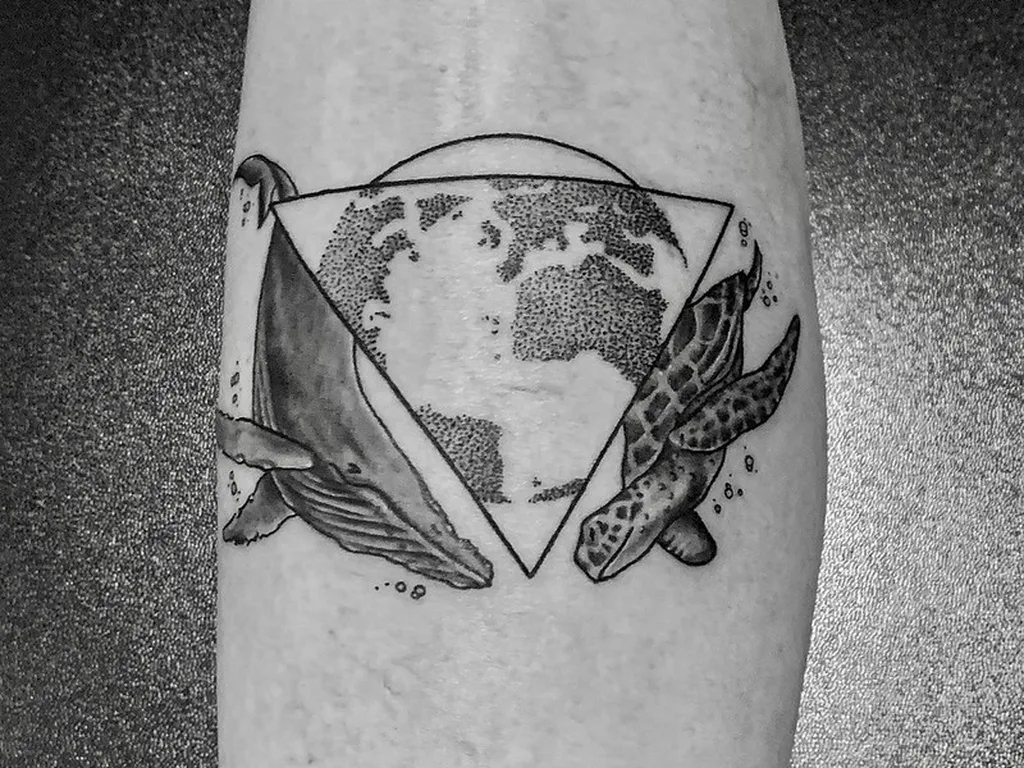
The biggest idea in this set, worn on a calf: a humpback whale on one side, a sea turtle on the other, and between them a dotwork globe of the world inside a thin triangle. The turtle here is drawn with a proper patterned shell and long front flippers, head down as if mid-dive.
As sea turtle tattoo ideas go, this is the one for people whose turtle means the whole ocean, not just the animal. It needs room — the globe only works because the calf gives the triangle width — and it shows how well a turtle pairs with a second creature when both are drawn in the same shaded hand.
Tribal and Polynesian-Style Sea Turtle Tattoo Ideas
The turtle is an old subject in Pacific tattooing. In Hawaiian culture the honu — the green sea turtle — is respected as a sign of longevity and peace, and for some families a honu is an ʻaumākua, a guardian with a personal connection to the family. That weight is worth knowing before borrowing the style. A respectful approach: take inspiration from the bold shapes, let your own artist draw the patterns, and do not copy traditional motifs piece for piece off someone else’s body. The three tattoos here are modern tribal-style work, and they are labelled as that, not as traditional pieces.
Tribal Medallion on the Chest
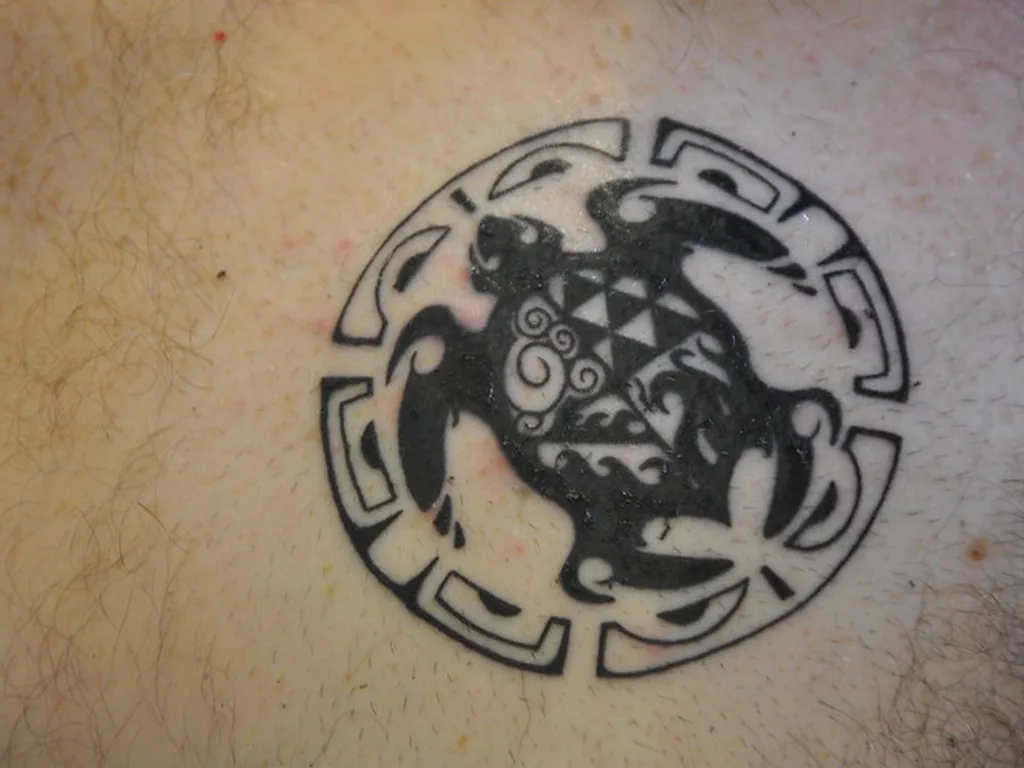
A black tribal turtle locked inside a broken circular ring, worn in the centre of a chest. The turtle itself is built from the style’s usual kit — solid black shapes, spiral curls, a triangle-patterned band across the shell — and the flippers stay broad and plainly flipper-shaped, so the animal reads as a sea turtle and not a tortoise.
The photograph was taken while the piece was still fresh, which is why it shines. Of all the sea turtle tattoo ideas in this collection, this is the one that leans hardest on the Pacific tribal tradition, and solid blackwork like this settles to a matte finish once healed, and the bold shapes are exactly what a chest medallion needs: no fine lines to lose, nothing that depends on detail to make sense.
Swirl-Pattern Turtle on the Shoulder Blade
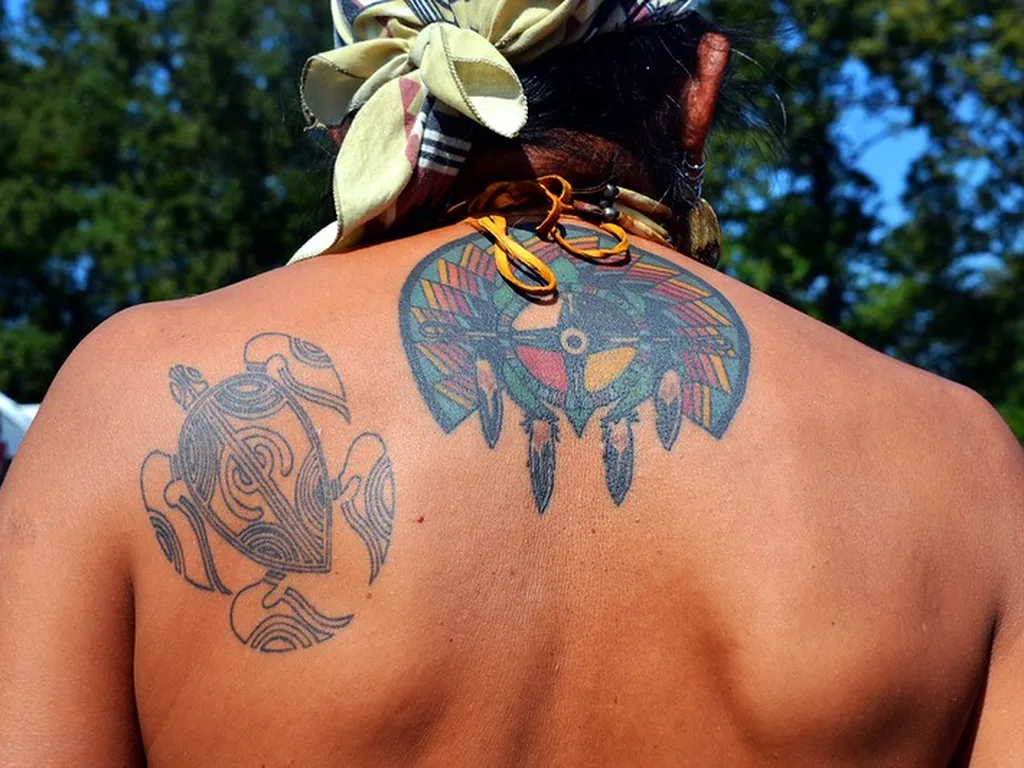
On the left shoulder blade of this back sits a line-art turtle filled with swirls and wave-like curls, a sea turtle drawn as pure pattern. It shares the back with a much larger, older colour piece, and the contrast is instructive: the turtle’s open linework still reads clearly where parts of the bigger tattoo have softened.
Pattern-filled turtles in this style are forgiving tattoos. There is no single focal detail to lose, the shell gives the artist a natural frame for the swirls, and the shoulder blade offers a flat, low-stretch canvas that treats linework kindly.
A World Map for a Shell
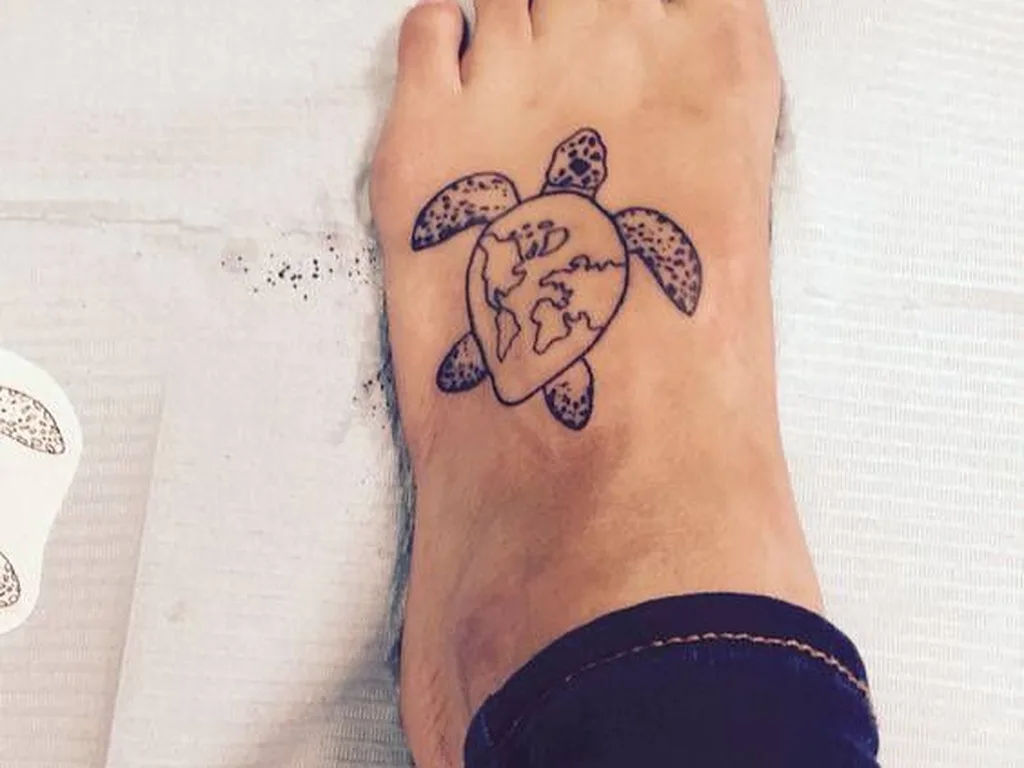
A fresh outline turtle on the top of a foot, its shell given over to a map of the world — continents in outline, dotted speckles across the flippers. For an animal that navigates oceans by memory and magnetism, the map shell is the most literal idea in this collection, and one of the most popular sea turtle tattoo ideas among travellers.
Foot tattoos rub against shoes and fade faster than almost anywhere else, and thin map lines are delicate to begin with. Anyone copying this should expect touch-ups and draw the coastlines a touch bolder than the stencil suggests.
Colour Sea Turtles
Real sea turtles are mostly greens, browns and golds, but tattoo colour stopped obeying nature a long time ago. These three take the animal into rainbow patchwork, origami geometry and watercolour washes.
Rainbow Patchwork
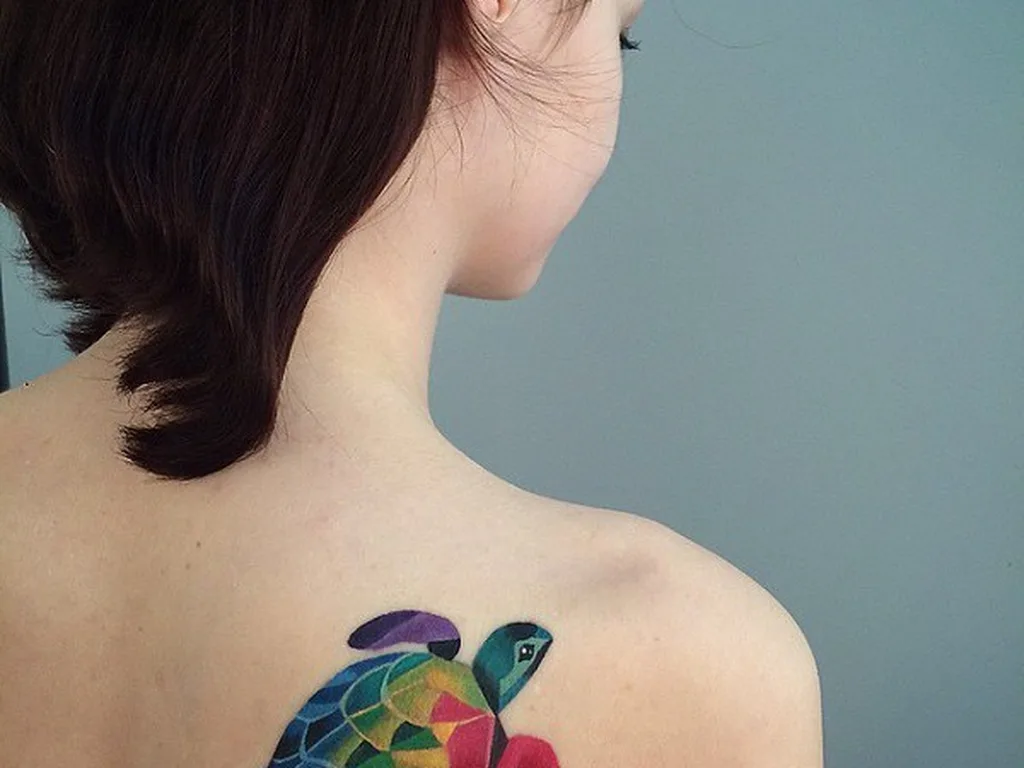
A turtle on a shoulder blade, built like a stained-glass window: the shell divided into clean sections and each section filled with a different saturated colour, purple flippers, a teal head. It is the happiest-looking tattoo in this set, and the shoulder blade shows it off flat and undistorted.
Colour-block work ages better than most colour styles because each section is a simple flat fill with a black border holding it in. The light greens and yellows will fade first — they always do — but the structure underneath them survives the fading.
Origami Colour on the Forearm
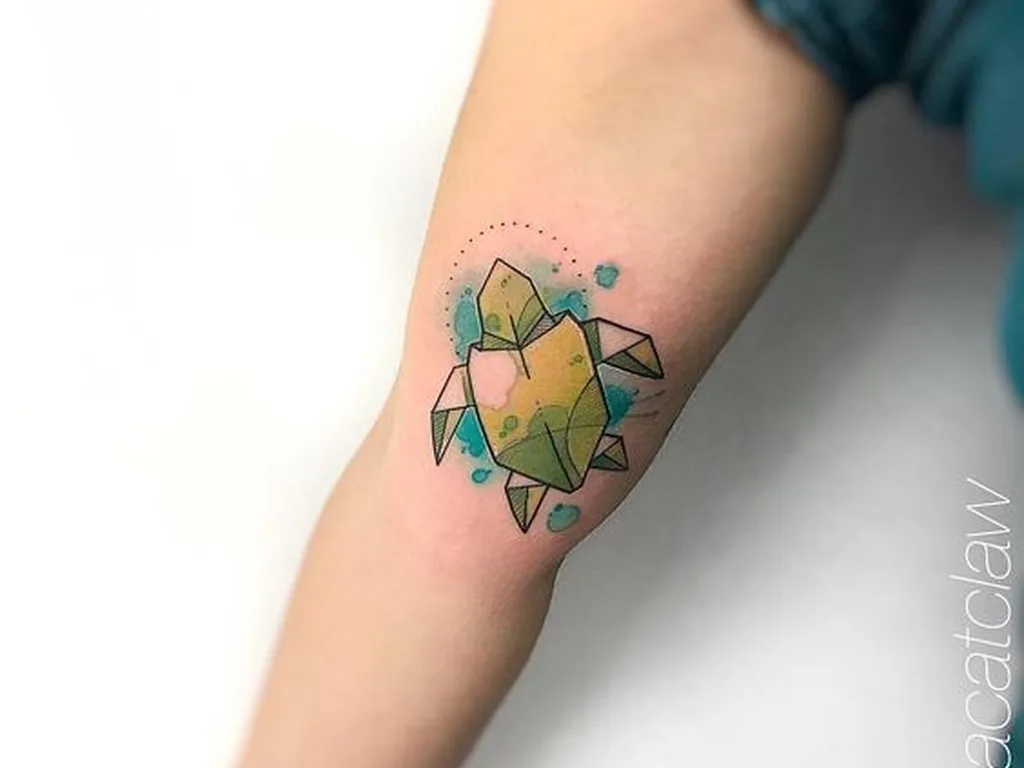
A small jewel of a turtle on a forearm: folded-paper geometry in green, gold and teal, with a few colour dots floating off the shell like spray. At this size the origami treatment is a smart choice — flat facets need no texture, so the design stays crisp where a realistic turtle would turn muddy.
The original photograph carries the artist’s own watermark along its edge, trimmed out by the crop used here; the credit below still points to the source. Small geometric colour pieces like this one are quick to tattoo and quick to judge: if the facets line up on paper, they will line up on skin.
Watercolour on the Foot
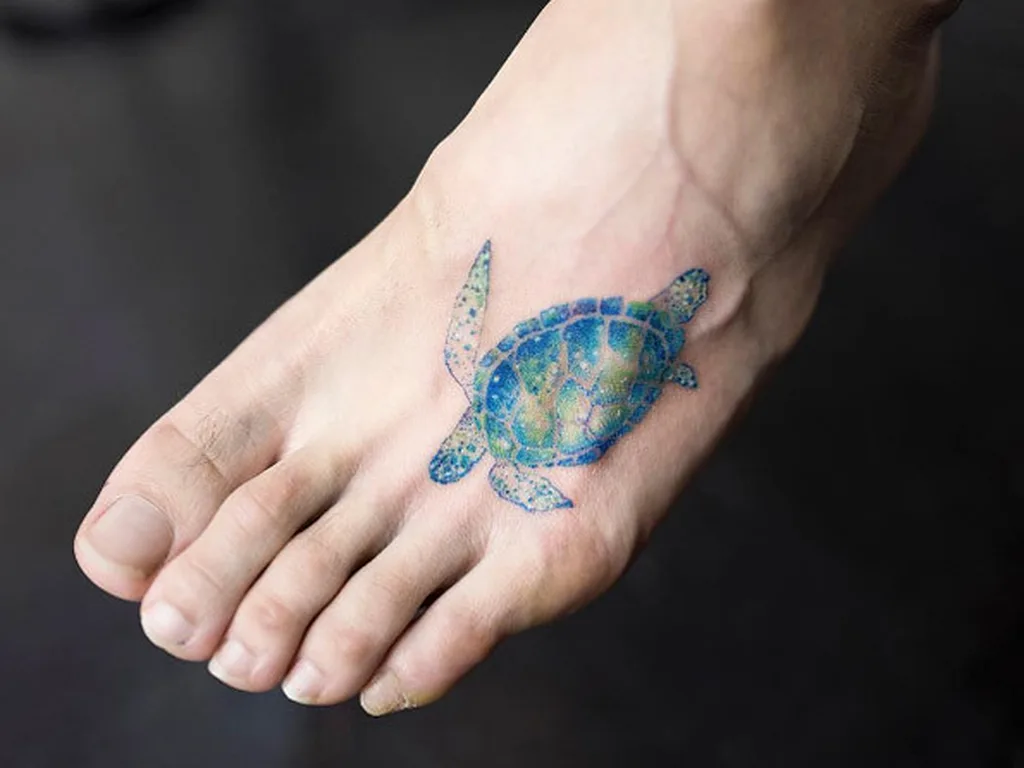
A blue-green turtle resting across the top of a foot, painted in loose watercolour washes with almost no black outline. The shell is suggested in speckled blues, the flippers wash out at the edges, and the whole thing has the softness of a page from a sketchbook.
Be honest with yourself about this style on this placement. Watercolour tattoos fade faster than outlined work everywhere on the body, and the top of the foot is a high-friction spot. As sea turtle tattoo ideas go it is a lovely one — just budget for refreshes if you choose it.
Small and Fine Line Sea Turtles
Fine line work suits this animal better than most. A sea turtle’s outline is simple and famous — oval shell, four flippers, small head — so it survives being shrunk further than most animals would. These seven stay small, and the best of them use the saved space on one good detail.
The Constellation Turtle
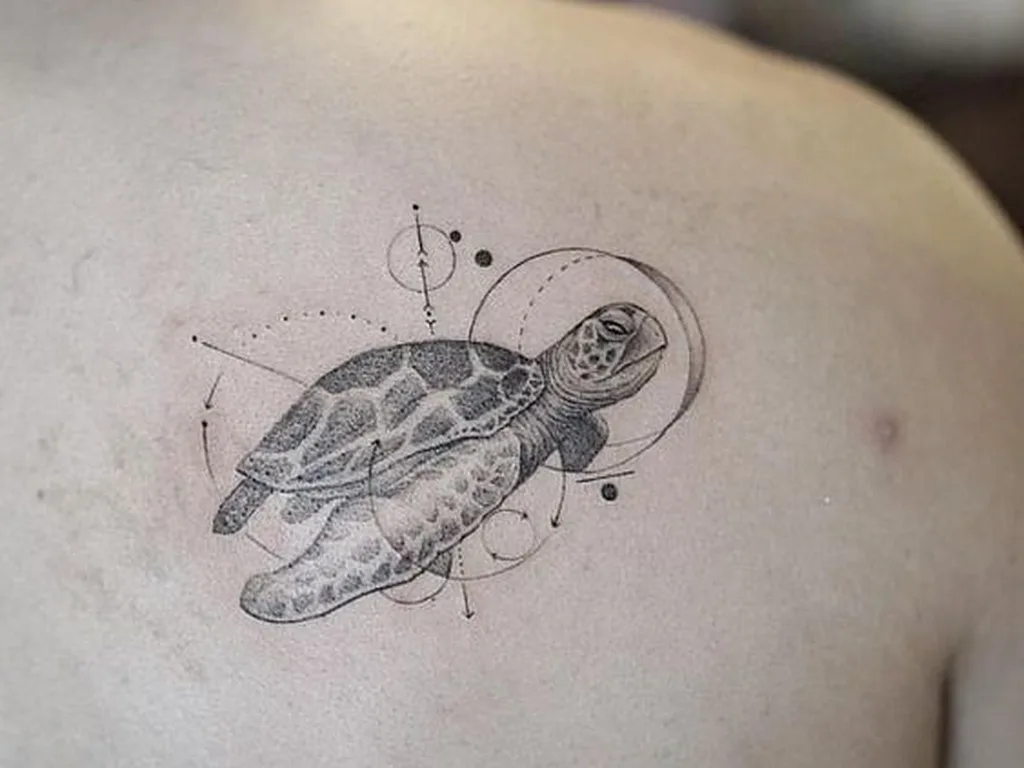
A finely shaded turtle on an upper back, ringed by thin orbit lines, small circles and dots — part star chart, part tattoo. The animal itself is drawn with real care: shell plates, speckled flippers, a shaded underside. The space hardware floats around it without crowding it.
Upper-back placement flatters pieces like this. The canvas is flat and wide, the skin moves less than most spots, and a centred turtle between the shoulder blades sits where a shirt collar can show or hide it as the day requires.
Fine Line With Circle Details
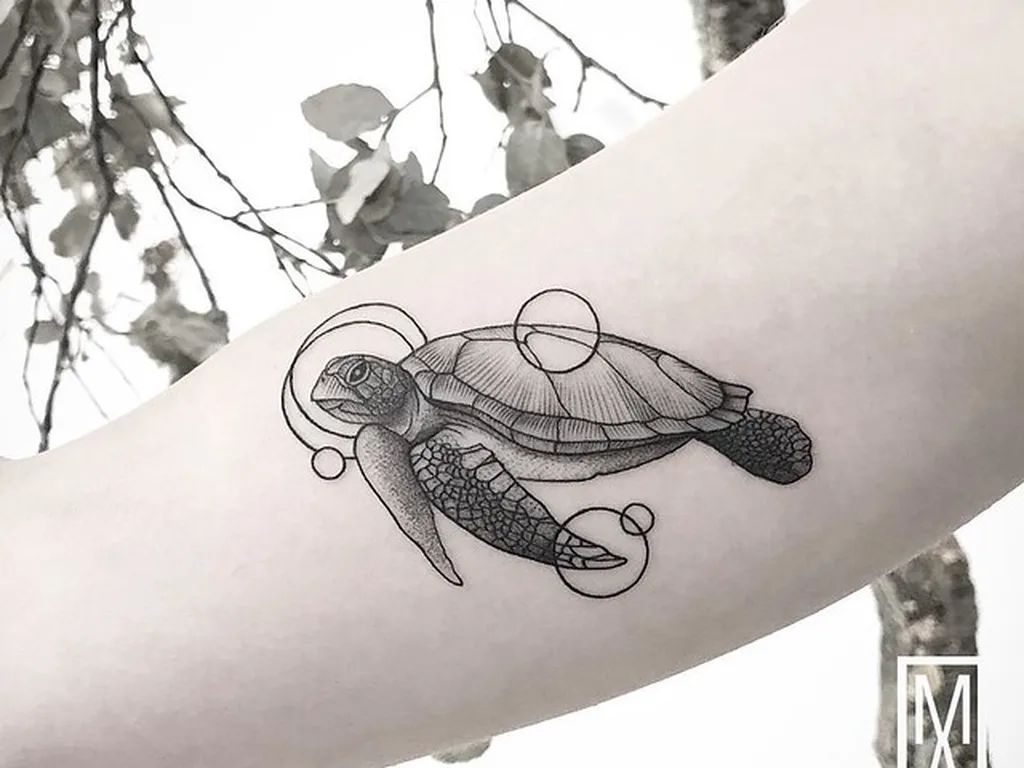
One turtle, drawn in a single confident weight of line on a forearm, with three thin circles overlapping the shell and head like bubbles caught mid-rise. The shading is all in the flippers and the shell’s edge; the rest is clean skin and line.
This is the fine line style at its most restrained, and restraint is its protection: with so little packed in, there is little to blur together. Pieces in this vein are among the most requested sea turtle tattoo ideas in studios right now, precisely because they read as drawings first and tattoos second.
A Peony in the Shell
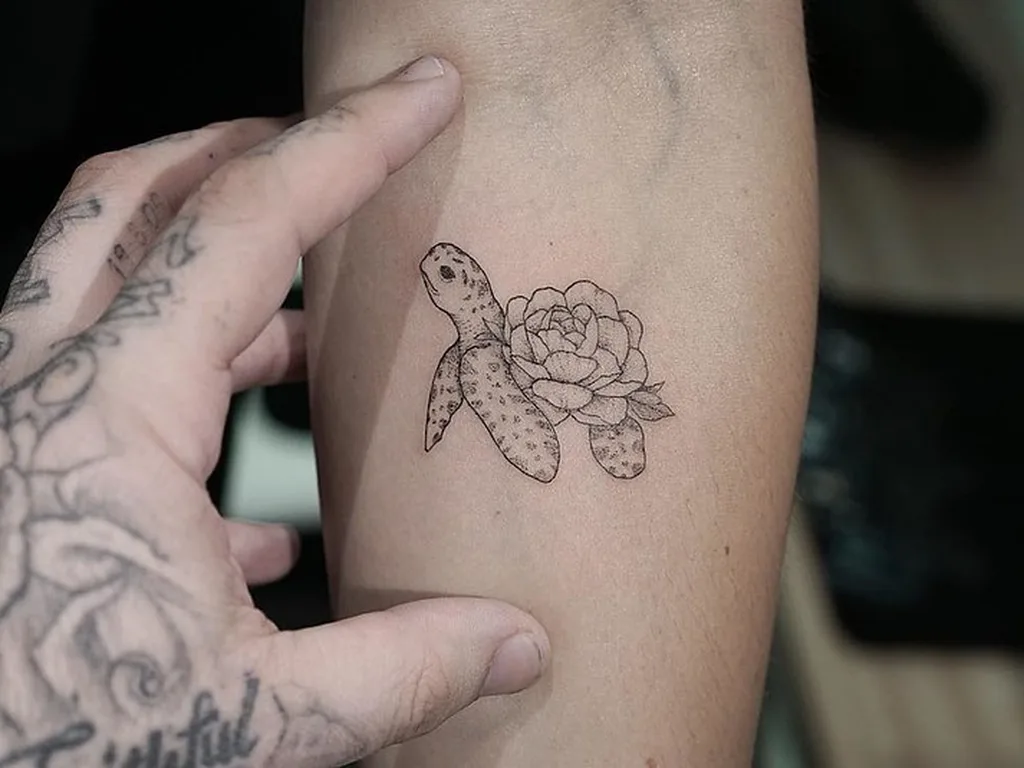
A small forearm turtle whose shell gives way to a blooming peony — half animal, half flower, the two sharing one outline. Sea turtle tattoo ideas that borrow a flower for the shell turn up in a lot of sketchbooks, and this is the lightest version of the idea in this set. The turtle’s head and speckled flippers are drawn straight; the flower takes the shell’s place without a border between them.
Flower-shell turtles appear twice in this collection (the black and grey calf piece above is the other), and comparing the two shows the range of the idea: shaded and botanical there, light and linear here. Small fine line work like this belongs on low-friction skin — a forearm, as here, is ideal.
Baby Turtle, Seen From Below
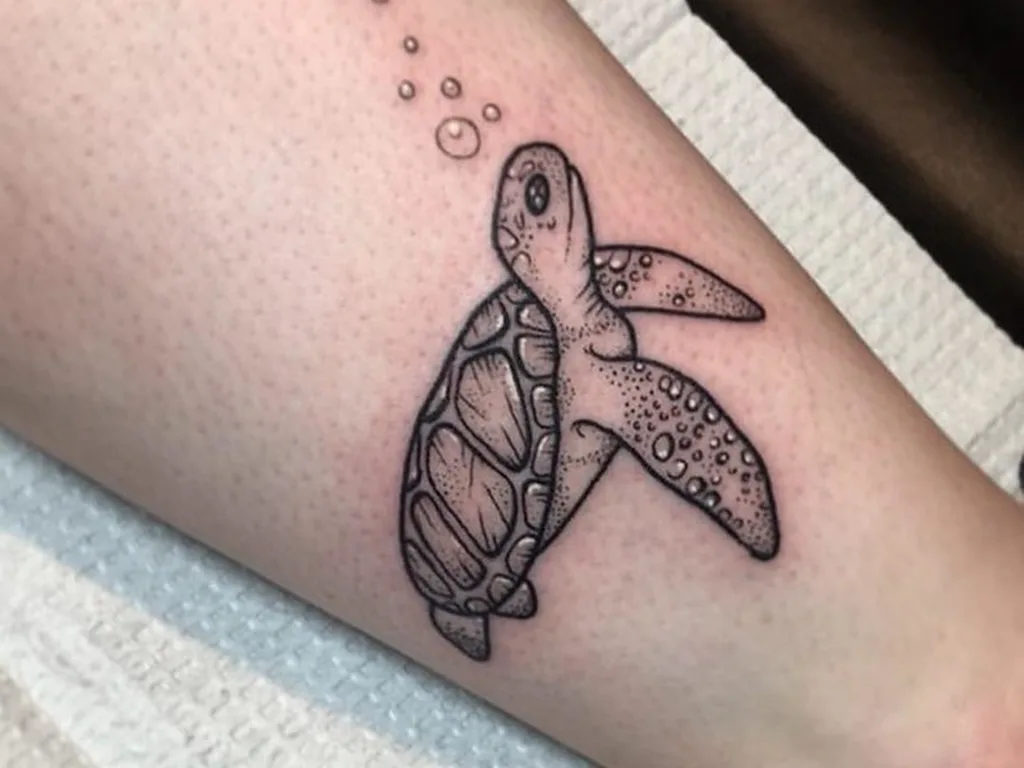
Most turtle tattoos are drawn from above, shell first. This one flips the view: a baby sea turtle seen from underneath, pale belly toward the viewer, both front flippers spread, with a trail of small bubbles rising past its head. It sits just above an ankle, where the curve of the leg suits the swimming pose.
The underside view is a genuinely fresh angle on a well-worn subject, and the bubbles do quiet compositional work — they give the eye a path and stop the small piece from looking stranded. Hatchling tattoos are often chosen to mark a beginning: a move, a recovery, a first anything.
Swimming With a Freediver
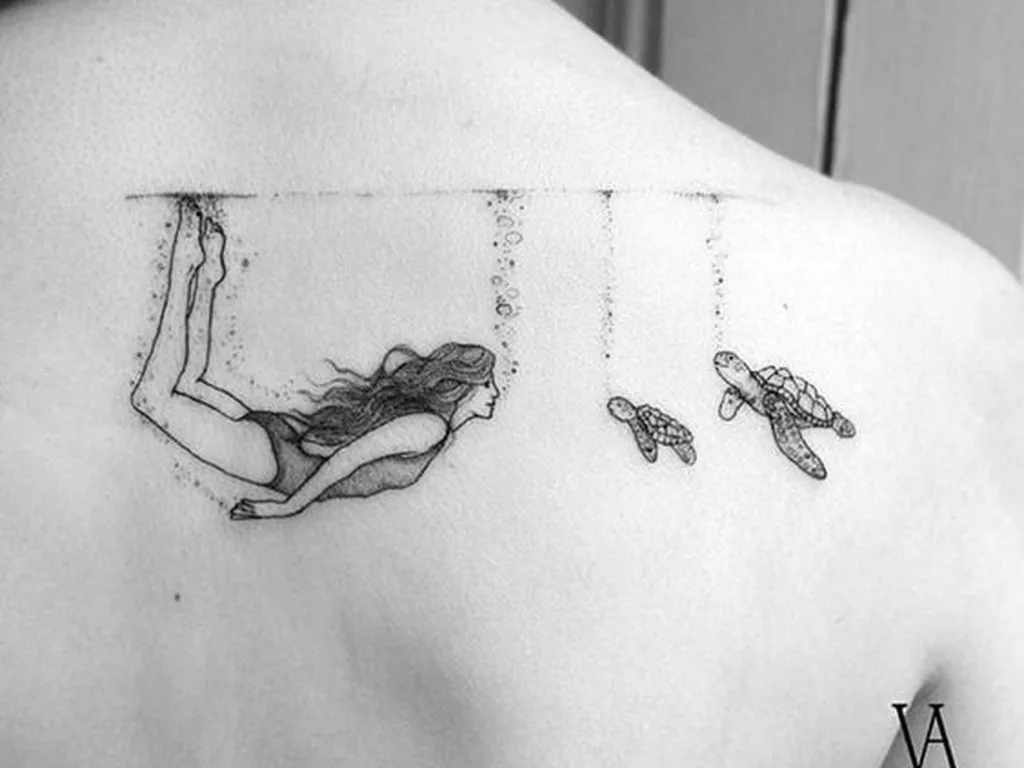
A scene rather than a symbol: a freediver hanging under a drawn waterline on an upper back, hair streaming, with two small sea turtles swimming ahead of her. Everything is fine line and light shade, and the turtles — one larger, one small — are the clear destination of the diver’s gaze.
For divers and snorkellers this is the most personal design in the set, the kind chosen after a real encounter on a reef. Scene pieces depend on spacing: the waterline, the diver and the turtles each need their own air, which is why the wide upper back serves it so well.
Matching Collarbone Pair
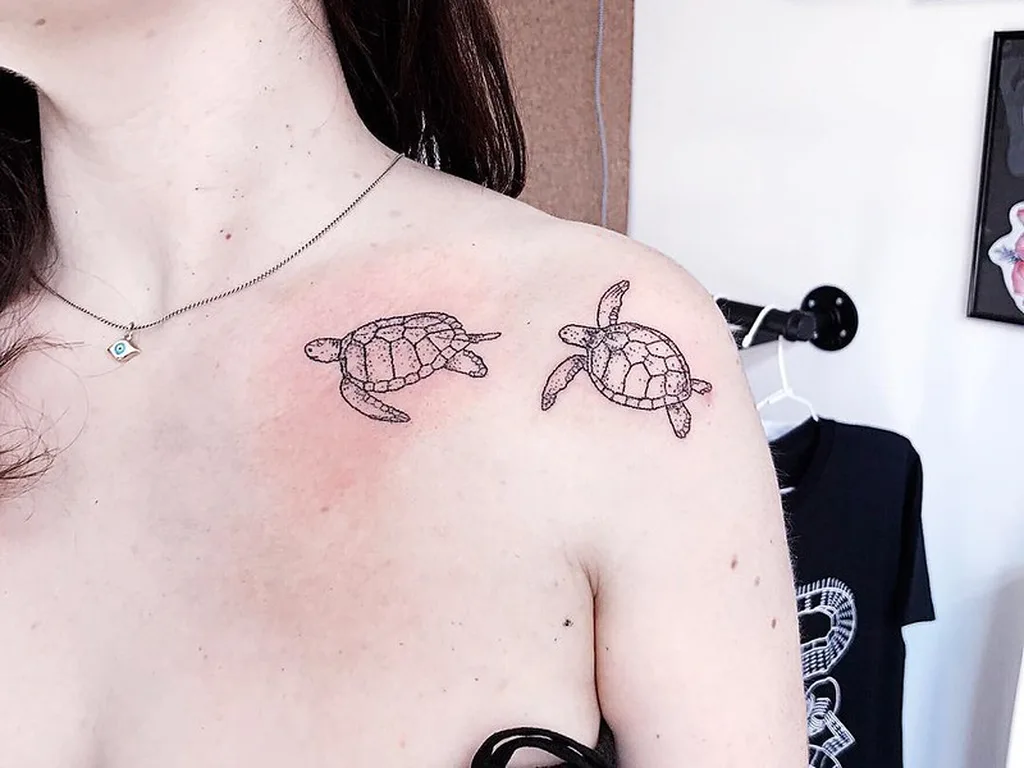
Two outline turtles, one under each collarbone, swimming toward each other. They are drawn as near-mirror images — plain shell plates, small heads, no shading to speak of — and photographed fresh, with the skin still pink around them.
Pairs like this are usually shared symbols worn by one person: two journeys, two children, two homes. Among small sea turtle tattoo ideas they are also among the easiest to personalise — one turtle can gain a dot, a flower or a tiny wave without breaking the match. The collarbone is a tender spot to tattoo and the skin there is thin, so simple outlines are the right call — they heal fast and ask little of the skin.
Tiny and Freshly Finished
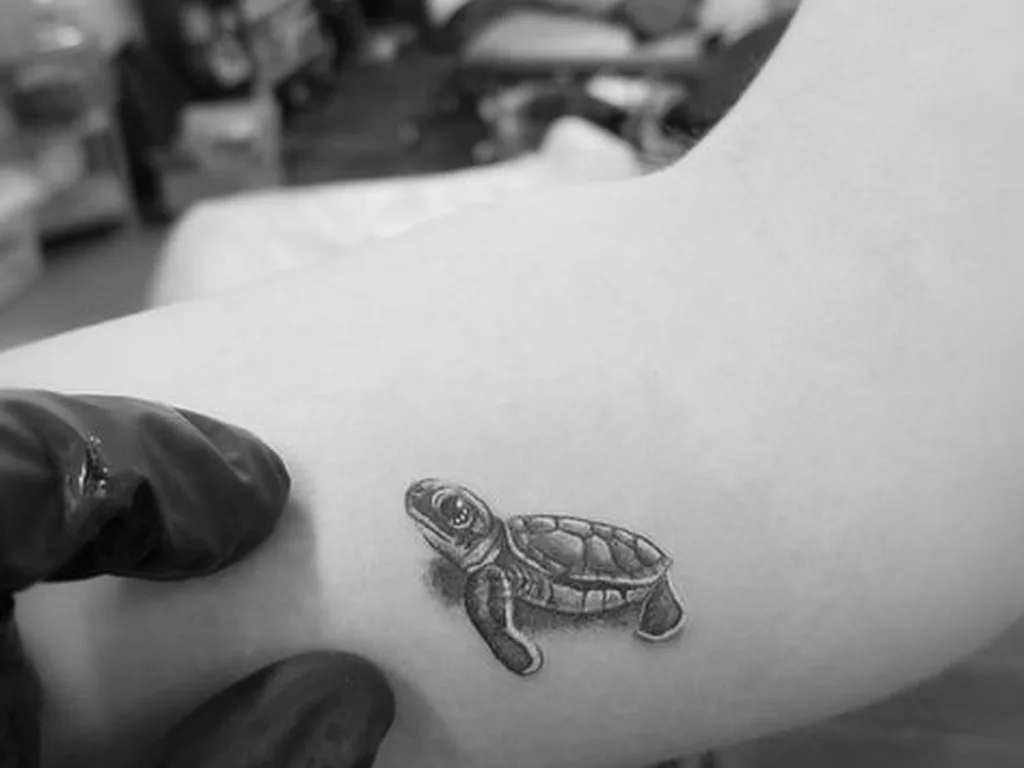
A baby sea turtle no longer than a thumb, shaded properly despite its size, photographed on an inner arm moments after the artist set the machine down — a gloved hand still steadies the skin. At this scale the artist has kept every element big relative to the whole: clear shell divisions, one visible eye, flippers with room to breathe.
That discipline is what separates tiny tattoos that last from tiny tattoos that merge. If small sea turtle tattoo ideas are what you came for, this is the standard to hold a stencil to: squint at it from a metre away, and it should still say turtle.
Bold, Simple and Symbolic
The last three strip the animal down to its silhouette. No shading worth the name, no detail to lose — just the shape, which for a sea turtle turns out to be enough.
Solid Black Silhouette
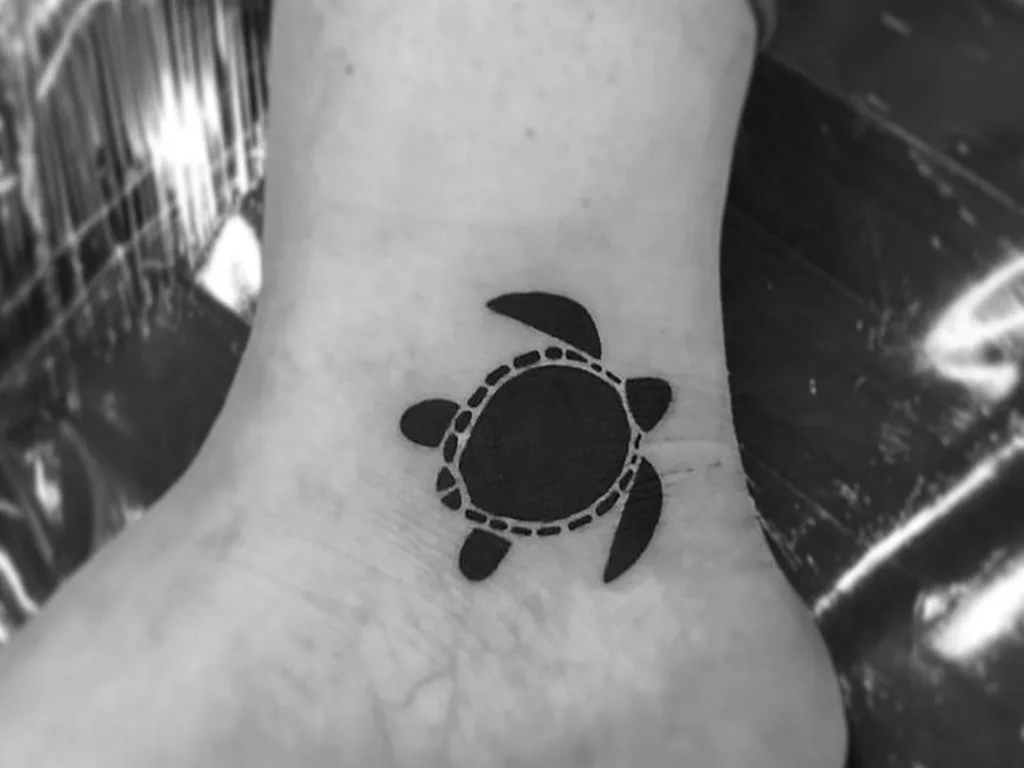
A turtle reduced to a black disc of a shell with a dashed outline, four paddle flippers and a head — worn on the ankle, photographed in black and white. It is close to a pictogram, and that is its charm: it will read at ten paces on a beach.
Solid black silhouettes are among the longest-lived tattoos a person can get. There are no lines to spread into each other and no greys to drop out; the shape either holds or it does not, and at this boldness it holds.
The Tiniest Outline
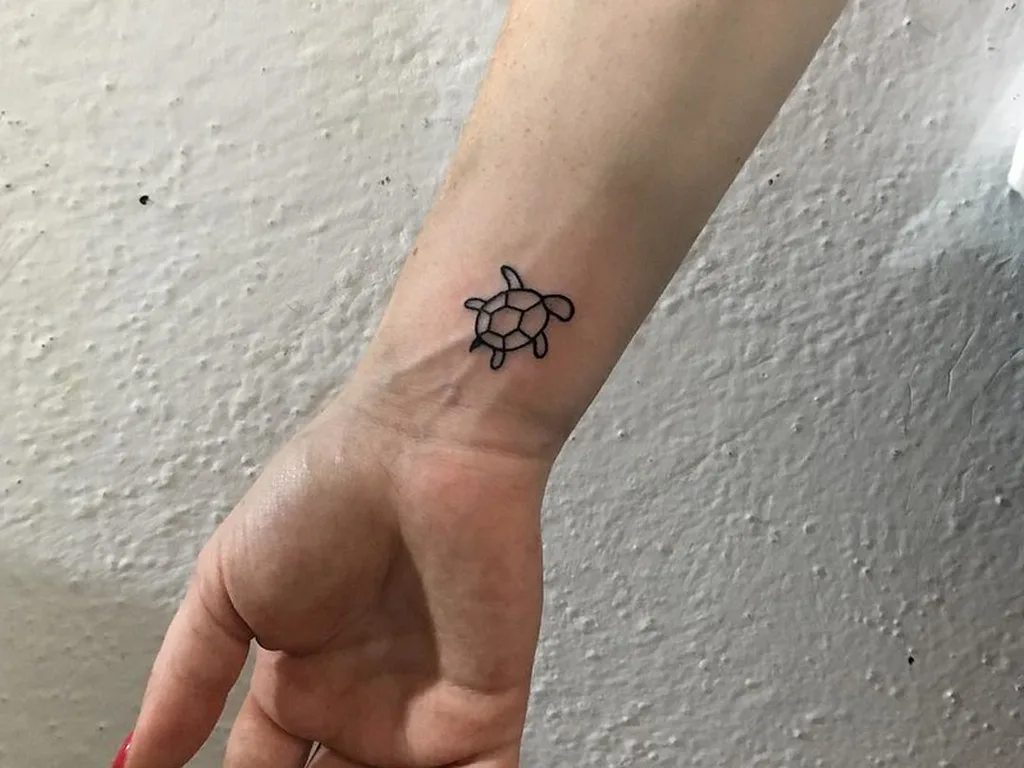
The smallest tattoo in this collection: a single-weight outline of a turtle, shell plates and all, sitting on the inner wrist. From a distance it is a small dark mark; up close it resolves into the full animal, which is the quiet pleasure of minimal work.
Wrists flex, wash and sun more than almost any other placement, so a design this fine should be booked with a touch-up in mind. Its saving grace is simplicity — one line weight, nothing enclosed tightly enough to fill in.
Dreamcatcher Shell on the Foot
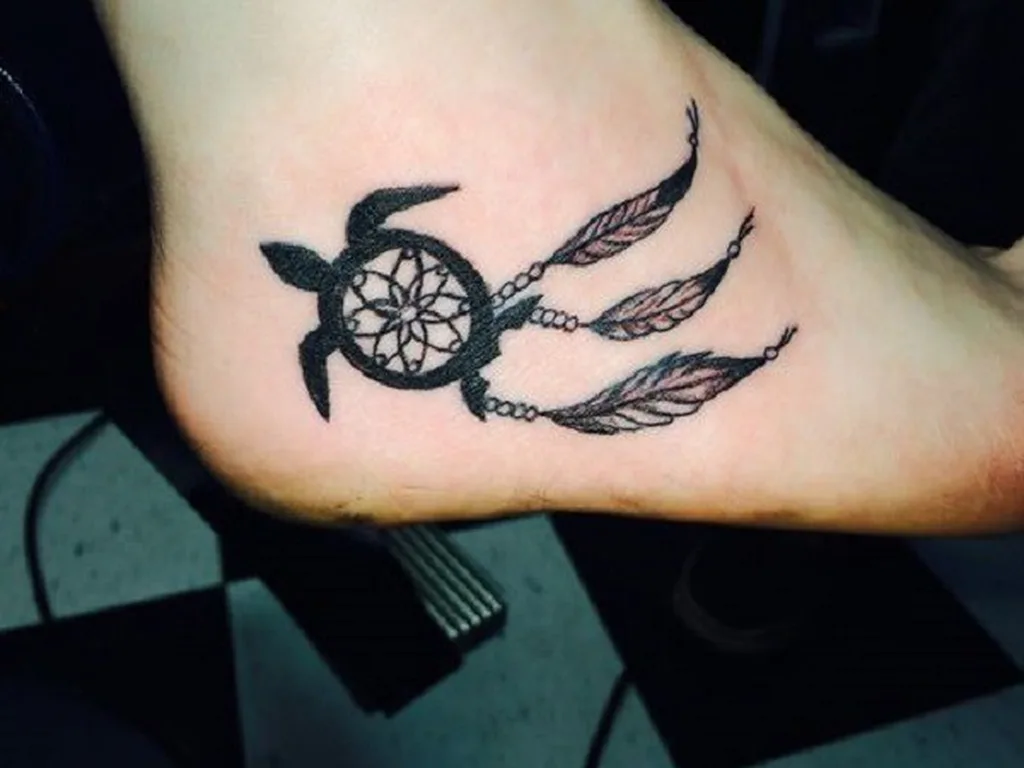
The last design swaps the shell for a dreamcatcher: a black turtle on the top of a foot, its shell drawn as the webbed hoop, three beaded feathers trailing toward the ankle. It is a modern hybrid — the dreamcatcher comes from Ojibwe tradition, not from the sea — and it is labelled as a hybrid here rather than dressed up as anything older.
As a piece of design it works because the shapes agree: a round shell and a round hoop are nearly the same silhouette, so the swap looks natural. On the foot, the trailing feathers follow the foot’s own line toward the ankle, which keeps the composition from sitting like a stamp.
Placement and Ageing Advice
Look back over the sea turtle tattoo ideas above and a placement pattern shows. Sea turtles are a forgiving shape to place. Viewed from above — designs 5, 9, 20, 21 and 22 here — the animal is a near-oval badge that sits happily on a wrist, ankle, foot or shoulder blade. Viewed from the side, it is a long swimmer that follows a forearm, a calf or the line of a back. Pick the view first and the placement usually picks itself.
On ageing, the pattern across this collection is plain. Bold black shapes (the chest medallion, the ankle silhouette) barely change. Flat colour blocks hold their structure and lose their lightest tones first. Fine line and watercolour work — the collarbone pair, the foot watercolour — softens fastest, and feet, wrists and hands speed that up with friction and washing. None of that makes the delicate styles a mistake; it makes them a commitment to sunscreen and the odd touch-up.
Two practical notes. First, feet and ankle tattoos swell; book them when you can rest the foot for a day or two and wear open shoes while they heal. Second, hygiene is not a detail: the FDA’s tattoo safety guidance covers what a clean studio should look like and which ink reactions are worth a doctor. Read it before a first tattoo of any kind.
Sea Turtle Tattoo FAQs
What does a sea turtle tattoo mean?
The meanings most people attach to sea turtle tattoo ideas are patience, endurance and finding your way home. Sea turtles migrate thousands of miles and return to the beach where they hatched, which makes the animal a natural symbol for long journeys that end where they started. In Hawaiian culture the honu also stands for longevity and peace. Meanings are personal, though — plenty of wearers simply dive, surf or keep a memory of one trip.
What is the difference between a sea turtle tattoo and a tortoise tattoo?
The feet give it away. Sea turtles have smooth flippers for swimming and cannot pull them into the shell; tortoises have sturdy legs with claws for walking on land, and a higher, domed shell. If a reference photo shows toes and claws, it is a land turtle, whatever the caption says. All 22 designs in this collection have flippers.
Where is the best placement for a sea turtle tattoo?
Forearms and calves suit side-view swimmers; shoulder blades, wrists, ankles and feet suit top-down designs. The upper back takes the wide scene pieces. Feet and wrists are popular for small sea turtle tattoo ideas but fade fastest, so they suit bold, simple designs better than fine line ones.
How small can a sea turtle tattoo be?
The tiny wrist outline in this collection (design 21) is about as small as the animal goes while staying readable. Below roughly two centimetres the shell plates and flippers start merging into one blob as the ink settles. If you want smaller, drop the internal detail and keep only the silhouette, like the ankle design 20.
Do sea turtle tattoos age well?
The bold ones do. Solid black and strong outlines hold for decades; flat colour blocks keep their structure while light tones fade; fine line, dotwork detail and watercolour soften the soonest. A sea turtle is a better ageing subject than most animals because its outline is simple and its shell pattern is broken into sections that tolerate a little spread.
What is a honu tattoo?
Honu is the Hawaiian word for the green sea turtle. In Hawaiian culture the honu represents longevity and peace, and for some families it is an ʻaumākua, a guardian connected to the family. Tribal-style honu tattoos are popular far beyond Hawaii; if the tradition is not yours, the respectful route is an original design in that bold spirit rather than a copy of traditional patterns.
Can a sea turtle tattoo be a cover-up?
Often, yes. The shell is a large, naturally patterned area, and a design with a shaded or geometric shell can sit over an old tattoo and hide it inside the pattern. The realistic and shattering-shell designs in this collection (1 and 3) show the kind of density a cover-up needs. An artist will want to see the old tattoo in person before promising anything.
How much does a sea turtle tattoo cost?
Prices track size and detail more than subject. A tiny outline turtle may sit at a studio’s minimum charge; a forearm piece with geometric or realistic work runs to several hours at the studio’s hourly rate; a chest medallion sits in between. Rates vary widely by city and artist, so treat any number here as a shape, not a quote — your studio’s price is the real one.
What pairs well with a sea turtle in a tattoo?
This collection alone pairs the turtle with a whale and a globe (design 6), flowers in the shell (2 and 15), bubbles (16), a freediver (17) and a dreamcatcher (22). Waves, hibiscus and plumeria, anchors and compasses are the other common partners. The rule of thumb: one partner element per tattoo, drawn in the same style and line weight.
Are sea turtle tattoo ideas good for a first tattoo?
Yes — few subjects are better suited. The shape reads at almost any size, the styles run from a ten-minute outline to a full-day realism piece, and placements include easy, lower-pain spots like the forearm, calf and shoulder blade. Start with the simpler designs in this list, live with it, and add ocean around it later if the habit takes hold.
Final Thoughts
Twenty-two sea turtle tattoo ideas, and the animal never repeats itself: geometric, tribal, rainbow, watercolour, a thumb-sized hatchling, a chest medallion built to outlast fashion. That range is the real argument for the subject. Pick the design whose drawing style matches how you want to age with it — bold if you want it unchanged, fine and light if you accept softness as part of the deal — and take the flipper check, a good studio and one honest reference photo with you.
Photo credits: design 1 by sergi60 (Public Domain Mark 1.0), design 2 by sergi60 (Public Domain Mark 1.0), design 3 by sergi60 (Public Domain Mark 1.0), design 4 by sergi60 (Public Domain Mark 1.0), design 5 by sergi60 (Public Domain Mark 1.0), design 6 by sergi60 (Public Domain Mark 1.0), design 7 by RuggyBearLA (CC BY-SA 2.0), design 8 by Tobyotter / Tony Alter (CC BY 2.0), design 9 by sergi60 (Public Domain Mark 1.0), design 10 by sergi60 (Public Domain Mark 1.0), design 11 by sergi60 (Public Domain Mark 1.0), design 12 by sergi60 (Public Domain Mark 1.0), design 13 by sergi60 (Public Domain Mark 1.0), design 14 by sergi60 (Public Domain Mark 1.0), design 15 by sergi60 (Public Domain Mark 1.0), design 16 by sergi60 (Public Domain Mark 1.0), design 17 by sergi60 (Public Domain Mark 1.0), design 18 by sergi60 (Public Domain Mark 1.0), design 19 by sergi60 (Public Domain Mark 1.0), design 20 by sergi60 (Public Domain Mark 1.0), design 21 by sergi60 (Public Domain Mark 1.0) and design 22 by sergi60 (Public Domain Mark 1.0), all via Flickr; full source links for every photo are listed in this article’s package notes.