Short answer first: a koi fish tattoo meaning usually starts with one stubborn fish. The koi is a carp that swims against the current, and in a Chinese legend more than a thousand years old, the carp that fought its way up a waterfall at the Dragon Gate was turned into a dragon. Perseverance is the centre of the whole subject, and it has real history behind it. Around that centre sit good fortune and prosperity, which have genuine roots in Chinese and Japanese folk culture, and then a younger layer — colour charts, swimming-direction rules, lucky numbers — that tattoo studios and koi keepers built in the last few decades. Both layers are fine reasons to get inked. They are not the same age, and this page keeps them apart.
The designs themselves fill our koi fish tattoo ideas collection. What follows is the story underneath them: where the legend came from, how a food fish became the most bred-for-beauty fish on earth in Japan, and which meanings would survive a history check. If you want the short version of the whole page, it is this — the koi stands for not turning back, and almost everything else is decoration hung on that one strong hook.
The Dragon Gate: Where the Koi Fish Tattoo Meaning Starts
The legend is Chinese, and it is set on the Yellow River at a place called Longmen — the Dragon Gate — where the river squeezes through a cleft in the mountains on the border of Shanxi and Shaanxi. Local tradition credits Yu the Great, the flood-taming hero of Chinese myth, with cutting the gorge. The story goes that every spring, carp from the rivers and the sea gathered below the falls and fought the current to reach them. Most were swept back. The rare fish that leapt clear of the waterfall passed through the Dragon Gate and became a dragon.
This is not a story somebody invented for a tattoo flash sheet. It was written down in early Chinese texts, and a version quoted in the Taiping Guangji, a tenth-century collection, puts a number on the odds: in a year, no more than seventy-two carp made the leap. Success was supposed to be rare. That is the whole point of the story. The Longmen entry in Wikipedia gathers the old accounts and the sayings the legend left behind, including the proverb it became: a carp leaping the Dragon Gate.
The proverb did real work in Chinese life. Passing the imperial civil service examinations was the one road by which an ordinary family could rise, and a student facing the exams was compared to a carp attempting the Dragon Gate — a sudden, earned jump in status, won against a current designed to push most people back. The image spread through New Year pictures, carvings and wedding decorations. In Japan the motif arrived with so much else of Chinese culture and kept its name in translation: toryumon, the dragon-climbing gate, is still used there for a make-or-break hurdle.
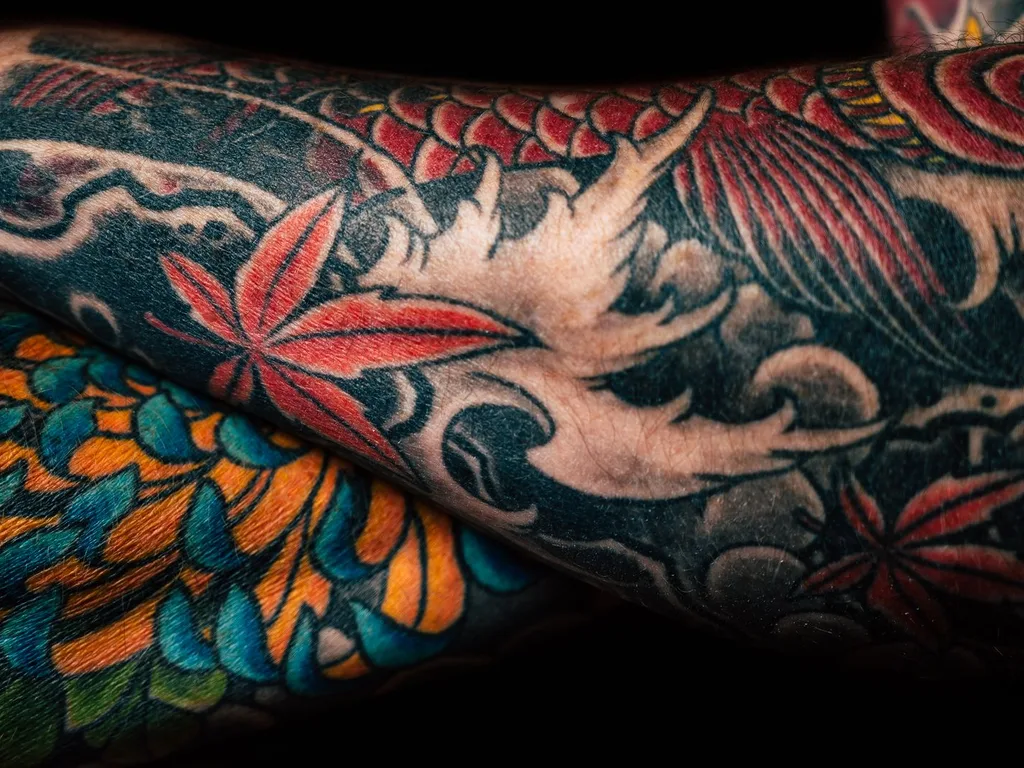
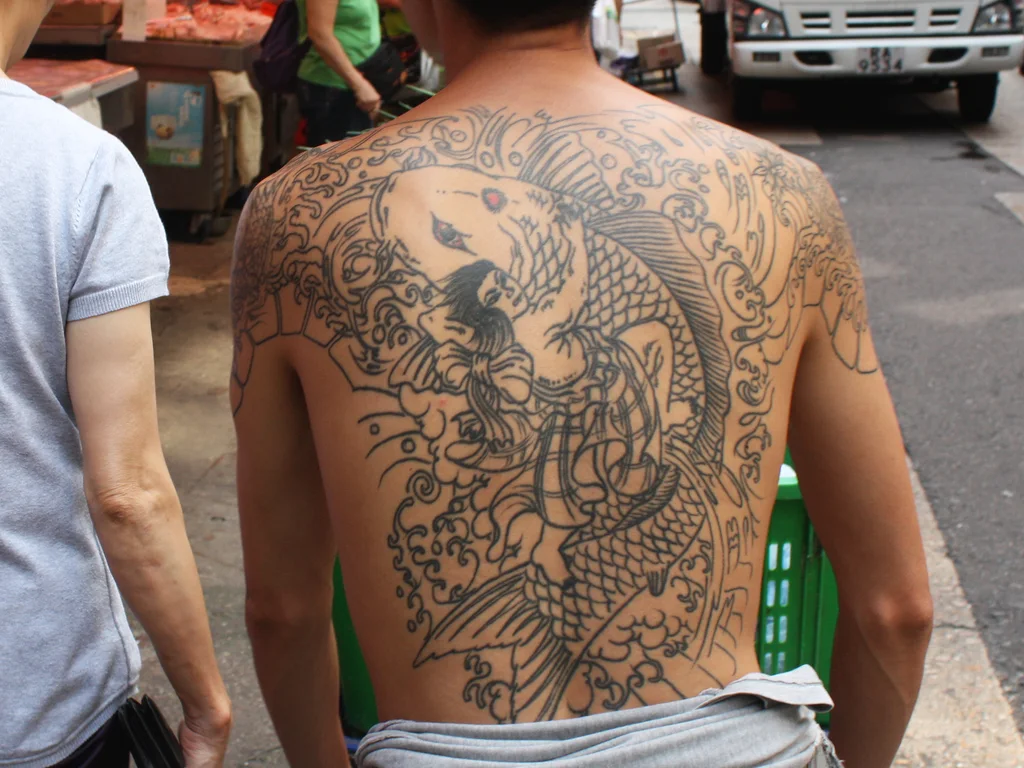
For a tattoo, the important detail is where the fish is in the story. The koi on skin is almost never drawn as the dragon at the top. It is drawn mid-river, head up, pushing into falling water. The meaning is the climb, not the prize: effort that has not paid off yet, and a refusal to drift back down. People choose this fish after illness, after a business nearly failed, in the middle of a degree or a recovery — while the outcome is still undecided. That honesty is built into the legend. Seventy-two fish a year made it. The rest of the school is in every tattoo too.
Perseverance You Can Watch in a Pond
The legend stuck to this fish because the fish behaves like it. Carp are strong, deliberate swimmers that hold their position in moving water instead of being carried off, and anyone who keeps koi has watched them nose into the inflow of a pond filter and hold there, working. Wild carp run rivers upstream to spawn. The storytellers of the Yellow River were not decorating a random animal; they were describing the strongest swimmer in their river and asking what it would take to beat the falls. That is why the koi fish tattoo meaning most people ask about first is perseverance.
Japan gives children the same lesson every spring. For Children’s Day on 5 May, families fly koinobori — long cloth streamers shaped and painted as carp, one for each member of the family, the black carp for the father, a red one for the mother and smaller ones for the children. The streamers are built to swim: rigged on poles, they belly out and stream in the wind as if they were fighting a current in the sky. The wish behind them is plain. Parents want their children to have the carp’s strength and the carp’s luck — to keep going upriver and to come through.
Sound plays a part too, in both countries. In Japanese, the word for the carp, koi, is a perfect homophone of the word for love and affection, so the fish turns up in love tokens and wedding imagery with a pun built in. In China, the word for carp sits close in sound to words for profit and for a gift, and carp were given and pictured as bearers of good wishes for exactly that reason. None of this is tattoo folklore — it is how the fish was used in the two cultures that produced it, long before it was drawn on skin.
Good Fortune and Prosperity
Of all the meanings hung on this fish, good fortune is the oldest part of the koi fish tattoo meaning after perseverance itself. In Chinese folk art the carp was a standard good-luck image for centuries — printed on New Year pictures, carved into furniture, embroidered on wedding cloth — carrying wishes for success, abundance and sons who would pass their exams. A fish that multiplies by the thousand and thrives in muddy water needs no interpreter. It was wealth you could watch swimming.
The modern layer is feng shui. In current feng shui practice, a koi pond — or even a painting of koi — is kept at a home or business to draw prosperity and keep fortune circulating, and gold-coloured fish get tied to wealth most tightly of all. This is a living practice, but it belongs to the modern world of feng shui manuals, not to the Dragon Gate texts. A koi tattoo worn for prosperity stands on both layers at once: an old folk symbol of abundance, topped up with a newer practice that promises the fish can pull money toward a house. It just should not be sold to you as a rule from a thousand years ago.
The Fish Itself: Two Hundred Years of Breeding
Here is the part most tattoo pages skip, and it changes how the rest of the koi fish tattoo meaning should be read. The fish in the legend is a plain river carp, farmed in China as food for thousands of years. The jewel-bright fish in a modern koi tattoo — white with red patches, gold, platinum, blue-grey — did not exist in the legend’s time. It was bred, recently, on purpose.
In the mountain villages of Niigata prefecture in Japan, around Ojiya and Yamakoshi, rice farmers kept carp in their irrigation ponds as a winter food store. Some time in the early 1800s — the All Japan Nishikigoi Promotion Association’s Niigata branch puts it between 1804 and 1830 — farmers began keeping the odd coloured fish that turned up among the food carp and breeding from them instead of eating them. Two centuries of selection followed. The result is the nishikigoi, the “brocaded carp”: by the late 1880s breeders such as Kunizo Hiroi had fixed the red-on-white kohaku pattern, and when Niigata koi were shown at the Tokyo Taisho Exposition in 1914, the hobby broke out of the mountains and spread across Japan and then the world. The association’s history of nishikigoi in Niigata tells the story from the breeders’ side.
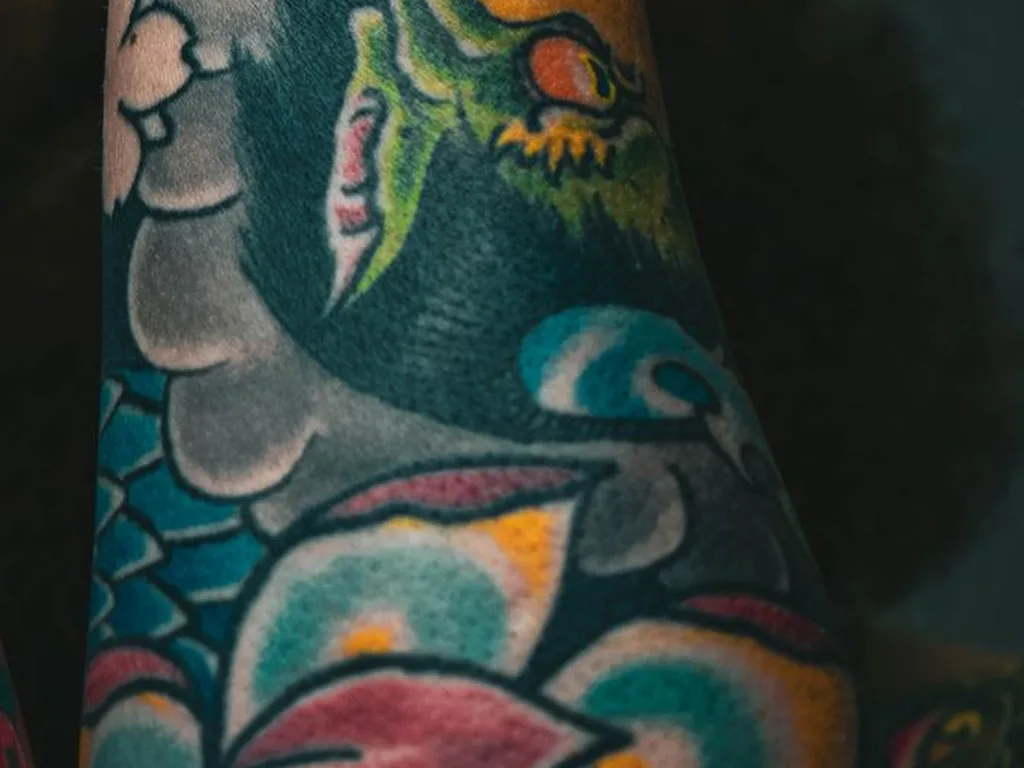
Hold on to the dates, because they sort the whole subject. The legend is over a thousand years old. The coloured fish is about two hundred. Any meaning that depends on a koi’s colour — and the next section is full of them — can be no older than the breeding that produced the colour. That does not make colour meanings worthless. It makes them modern, and modern meanings are allowed to be chosen rather than inherited. The trouble only starts when a chart presents a twentieth-century convention as ancient law, and charges your skin for the difference.
Koi Fish Tattoo Meaning by Colour: a Modern Chart, Labelled as One
No temple text, breeder’s manual or old tattoo master assigns a fixed meaning to each koi colour. The chart below is the one tattoo studios and koi-keeping books have settled into over recent decades. It is widely shared, it is genuinely useful for choosing a design, and most wearers pick their fish by it. Read it as a modern convention — a set of associations in current use — not as a code handed down from the Dragon Gate.
Red and white: the kohaku
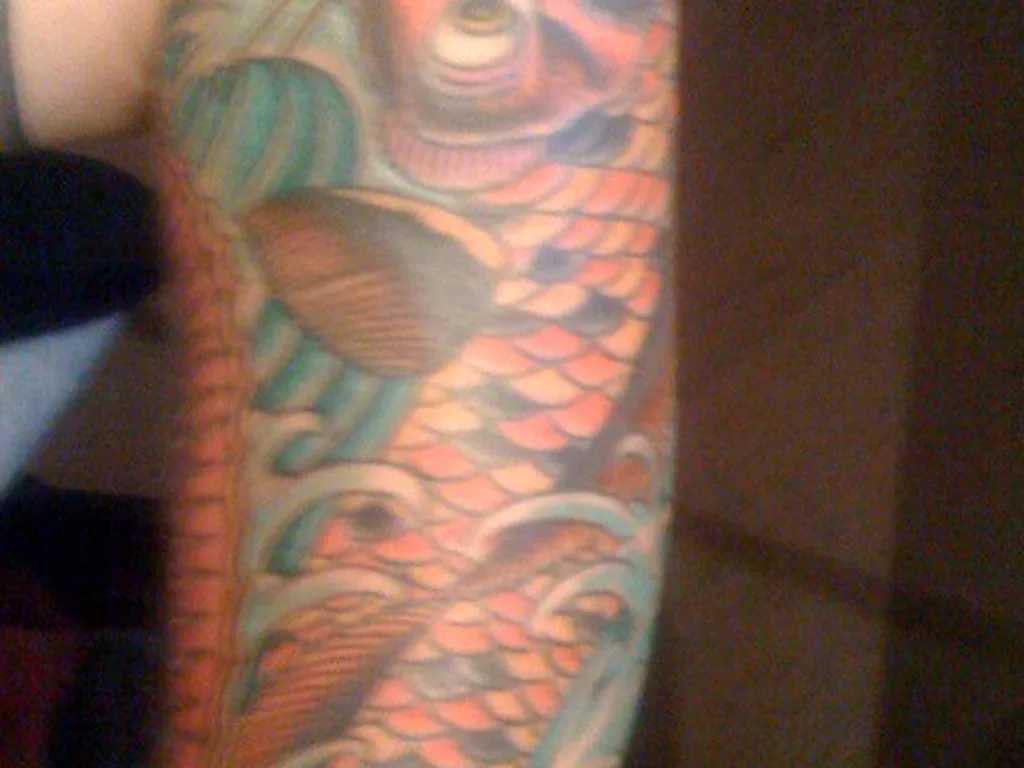
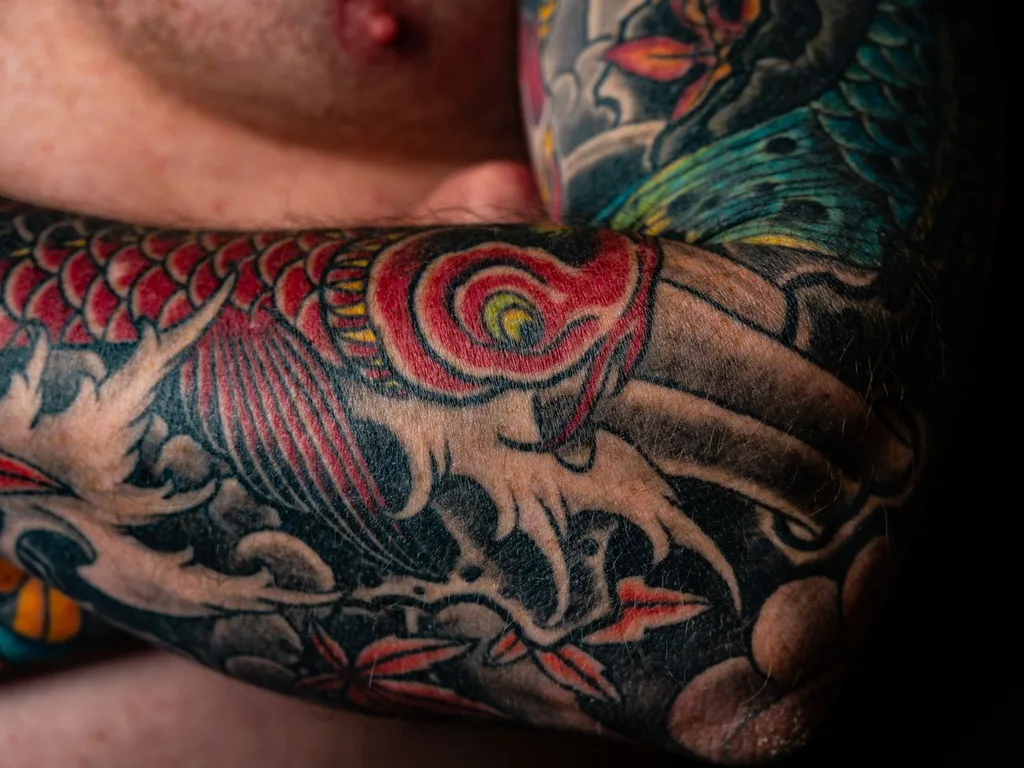
The kohaku — red markings on a white fish — is the first variety the Niigata breeders fixed and still the pattern most people picture. In the modern chart, red is read as love, energy and courage. The mostly red koi pictured below and the patterned kohaku belong to the same family of choices, and the kohaku is the closest thing the subject has to a default: the classic fish, worn for the classic reasons.
Black koi: the one that came through
In the modern reading, a black koi stands for hardship survived — the fish that went through dark water and came out the other side — and in feng shui ponds a single black fish is said to absorb bad luck meant for the others. Japan itself attaches nothing gloomy to the black carp at all: it is the ordinary wild colour, the father’s streamer on the koinobori pole, and there it reads as strength without decoration. Either way, the idea that black koi are unlucky is not a Japanese tradition. It is a misunderstanding of one.
Gold and yellow: the money fish
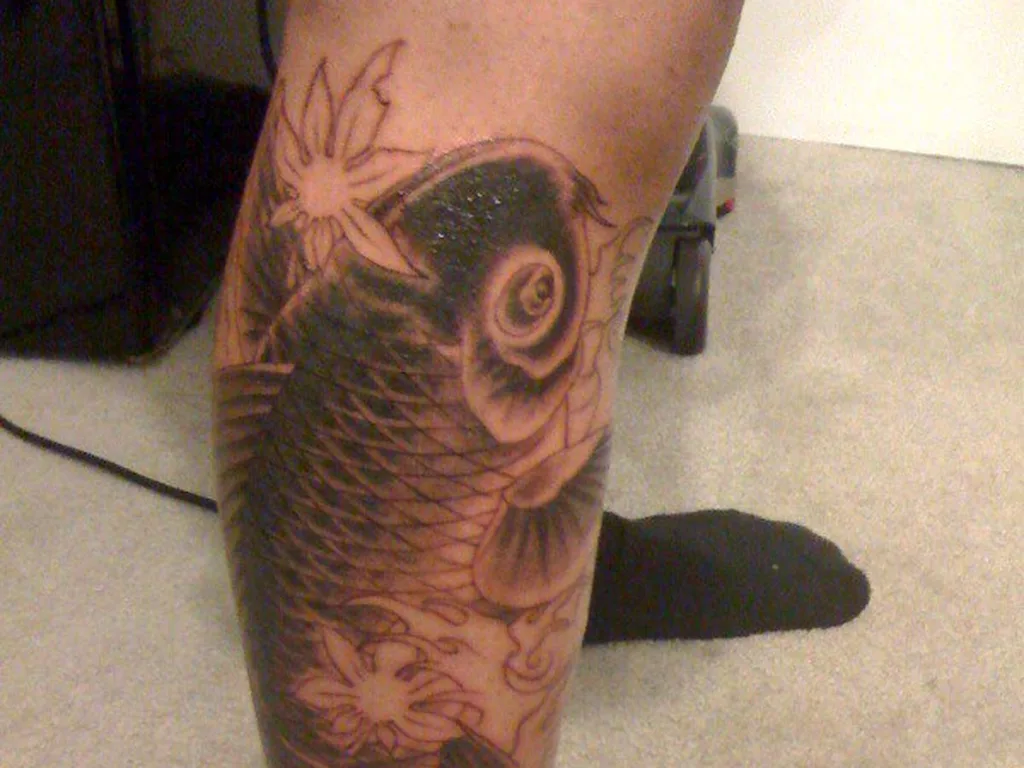
A gold or yellow koi — the yamabuki variety in the pond — is the prosperity choice in the modern chart: wealth, good fortune and success, worn by people who want the fish to pull toward money and by plenty who simply like a fish the colour of a coin. Of all the colour readings, this one has the shortest trip to make, since gold has meant wealth in both China and Japan for as long as either has had coins — a modern tattoo convention, but the easiest one to believe.
Blue, and platinum
Blue-grey koi exist in the pond through varieties such as the asagi, with its netted blue scales and red belly, and in the modern chart blue is read as calm, peace and steadiness — the fish for someone whose struggle is behind them or whose aim is a quieter life. Platinum-white fish get purity, and in koi-keeping books a second reading of success in business. Both readings are recent and both are honestly come by: the wearers who use them know they are choosing a meaning, not obeying one.
Direction, Pairs and Numbers
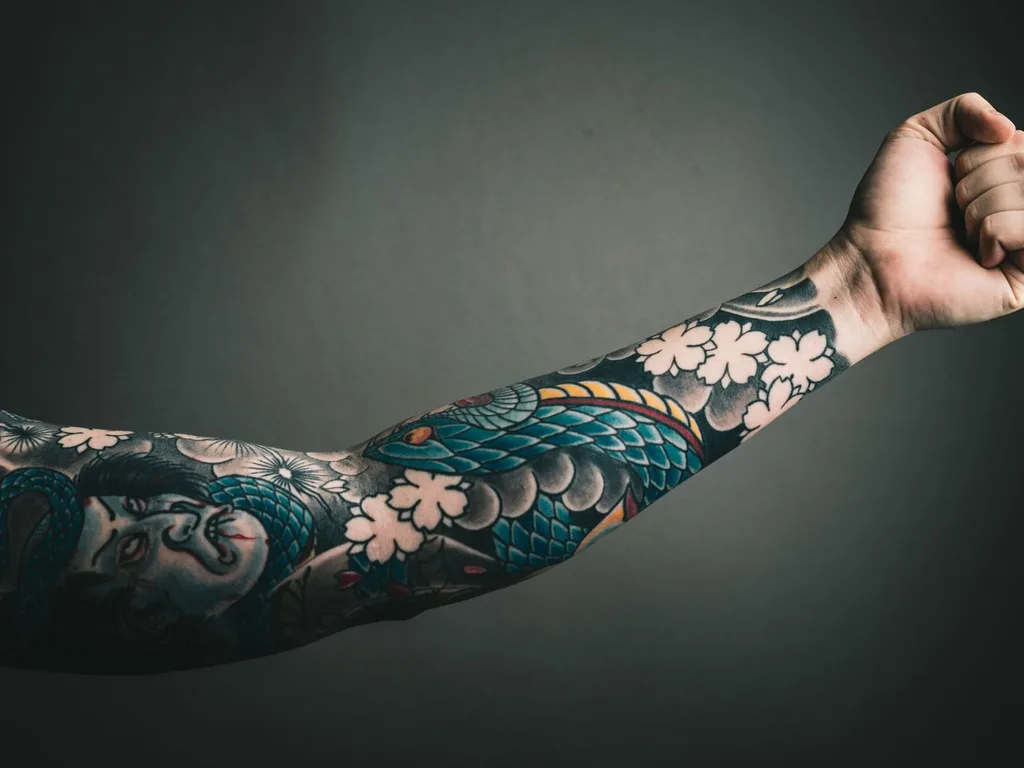
Ask a studio which way a koi should swim and you will get a confident answer – it is the part of the koi fish tattoo meaning people argue about most. Treat it as studio convention, because that is what it is — the old art shows koi climbing, falling, circling and resting with no fixed rule, and the meanings below were pinned to the directions by modern tattooing. They are good conventions, widely understood, and a wearer can rely on other people reading them the same way.
A koi swimming up — head against the flow, often into drawn waterfall water — is the Dragon Gate fish mid-climb: perseverance, a struggle still in progress, ambition. It is the most chosen direction and the one with the legend behind it. A koi swimming down is read two ways in the modern convention: going with the flow, relaxed about where the river goes, or as the far side of the climb — the fish that no longer has to fight because the hard stretch is behind it. Downward is not failure in any old source. It is a modern reading, and a gentle one.
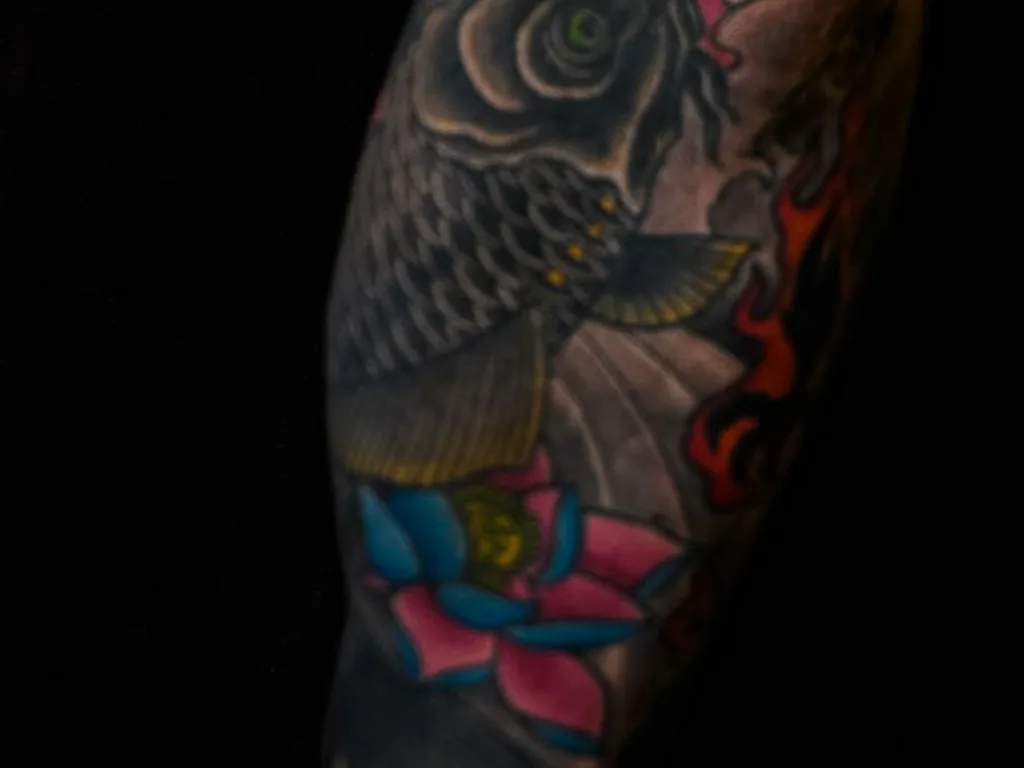
Two koi together carry their own reading. Drawn circling head to tail, a light fish and a dark fish copy the shape of the taijitu — the yin-yang symbol — and stand for balance, harmony and two unlike things completing each other; couples wear paired koi for exactly that. A pair swimming the same way is read more simply, as partnership and shared direction. The circling design is a modern composition built on a genuinely old symbol, and artists reach for it because it solves a real problem: it lets a long fish fill a round space, a shoulder cap or a chest panel.
Numbers belong to the pond more than the skin, but they follow koi tattoos home. Feng shui practice often stocks a pond with nine koi, nine being a number tied to longevity and completeness, or with eight bright fish and one black one — eight for prosperity, and the black fish, as above, to soak up the bad luck. Tattoo clients borrow the counts for multi-fish pieces for the same reasons. File all of it under modern practice, and about as ancient as the garden centre.
Myths and Mix-ups
“The colour chart is an ancient code.” It cannot be. The varieties themselves were bred in the 1800s and 1900s, so a meaning attached to a platinum or a blue koi is younger than the fish. The chart is a modern agreement between studios, koi books and clients — useful, shareable, and not a law from old Japan.
“A koi swimming down means giving up.” No old text says this. Japanese art is full of koi descending, drifting and circling, drawn without any sense of defeat. The up-equals-struggle, down-equals-ease pairing is a neat modern invention, and even inside that invention, down usually means rest after effort — the opposite of surrender.
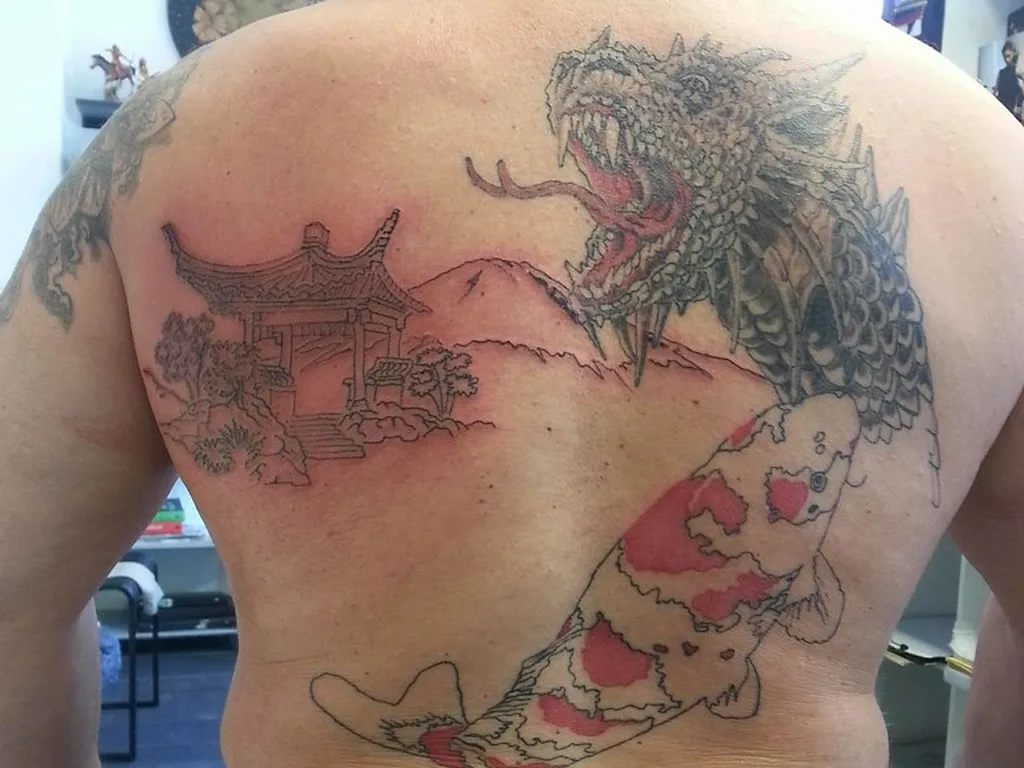
“Koi live for two hundred years.” The famous case is Hanako, a Niigata koi said to have died in 1977 at the age of 226, her years counted from rings in her scales by the professor who examined them. The story is repeated everywhere and may even be true, but it rests on that one examination, and fish scientists do not treat scale rings as proof of extreme age. Pond koi commonly live twenty-five to thirty-five years, with well-kept fish passing forty. That is a long life for a fish, and it needs no embroidery.
“A koi tattoo is purely Japanese.” The coloured fish is Japanese; the legend that gives the tattoo its meaning is Chinese, and the fish reached Japan as an ordinary food carp long before anyone bred it for beauty. A koi tattoo is one of the cleaner examples of the two cultures building something together — a Chinese story, a Japanese fish, and a meaning that belongs to both.
Frequently Asked Questions
What does a koi fish tattoo mean?
The koi fish tattoo meaning starts with perseverance: in the Dragon Gate legend, the carp that leaps the waterfall becomes a dragon, so the fish stands for effort rewarded and refusal to give up. Around that sit good fortune and prosperity from Chinese and Japanese folk culture, and a younger set of colour and direction readings that modern tattooing added.
What does a koi swimming upstream mean?
The climb itself — a struggle still in progress. An upstream or upward koi is the Dragon Gate fish mid-leap: ambition, determination and a hard thing not yet finished. It is the most common direction chosen, and the only one the old legend speaks to directly.
What does a koi swimming downstream mean?
In modern tattoo convention, ease: going with the flow, or having come through the hard stretch and no longer needing to fight the current. No old source treats a downward koi as failure or bad luck — that idea is a recent invention, and even the convention reads the direction as rest, not surrender.
What does a black koi tattoo mean?
Hardship survived, in the modern reading of the koi fish tattoo meaning — the fish that came through dark water. Feng shui adds that a single black koi absorbs bad luck for the rest. In Japan the black carp is simply the natural colour and the father’s koinobori streamer, so nothing about a black koi is unlucky in the culture that bred them.
What does a gold koi tattoo mean?
Wealth and good fortune. The gold or yellow koi — yamabuki in the pond — is the prosperity fish of the modern colour chart, chosen by wearers who want the tattoo to point at money, success and abundance.
What do two koi fish tattooed together mean?
Drawn circling head to tail, a light and a dark koi copy the yin-yang shape and stand for balance, harmony and a partnership of opposites in the modern koi fish tattoo meaning — a popular choice for couples. Two koi swimming the same way read more simply: shared direction, two people on the same river.
Is a koi tattoo Chinese or Japanese?
Both. The Dragon Gate legend and the carp’s good-luck folk meanings are Chinese. The ornamental fish itself — every colour variety tattooed today — was bred in Niigata, Japan, in the 1800s, and Japanese tattooing made the koi one of its central subjects. The tattoo is a shared inheritance.
What does a red and white koi mean?
The red-on-white fish is the kohaku, the first variety fixed by Japanese breeders in the late 1800s and still the classic pattern. Modern charts read its red as love, energy and courage. Because the variety itself is genuinely old in koi terms, a kohaku is the most traditional colour choice a client can make.
Does a koi tattoo have to face a certain way on the body?
No rule fixes it. Artists compose koi to move with the body — up a forearm or a back for the climbing reading, down a leg or a rib where the anatomy falls that way — and the wearer’s chosen meaning follows the design, not a law. Talk the direction through with your artist; the flow of the piece on your frame matters more than any chart.
What is usually tattooed with a koi?
Water first of all — waves and waterfall splashes are the koi’s home ground and let the design wrap a limb. Lotus flowers pair purity with the fish’s effort, cherry blossom adds the spring of the koinobori season, maple leaves mark autumn, and a dragon beside a koi quotes the legend directly: the fish and the creature it is trying to become, in one piece.
Final Thoughts
The koi earns its popularity honestly, and so does the koi fish tattoo meaning. It is one of the few tattoo subjects whose central meaning — keep swimming against the current and the falls are not the end of the story — is documented in texts older than most countries, and whose modern meanings grew in the open, in ponds and studios. Choose the colour and direction that fit your own stretch of river, and let the charts stay what they are: a modern language for an old fish. The full range of designs is in our koi fish tattoo ideas collection, and the koi’s place among the great animal subjects is mapped in our animal tattoo ideas guide.
Photo credits: 1: Brett Sayles, Pexels Licence, via Pexels. 2: istolethetv, CC BY 2.0, via Wikimedia Commons. 3: Frenkieb, CC BY 2.0, via Flickr. 4: Kevin Bidwell, Pexels Licence, via Pexels. 5: Brett Sayles, Pexels Licence, via Pexels. 6: mytat_2s, CC BY 2.0, via Flickr. 7: Kevin Bidwell, Pexels Licence, via Pexels. 8: Brett Sayles, Pexels Licence, via Pexels. 9: KoiQuestion, CC BY-SA 2.0, via Flickr. 10: Ettore Bechis, CC BY 2.0, via Flickr. Images cropped and resized to 1024×768.